The Army Universal Task List (March 2011) - page 1
FM 7-15, C6
Change No. 6
Headquarters
Department of the Army
Washington, DC, 18 March 2011
The Army Universal Task List
1. Change 6 to FM 7-15, 27 February 2009, updates the tasks with engineer and other collective tasks, several
updates, and the recent publication of updated field manuals, including FM 3-0, FM 3-35, and FM 5-0.
2. Replaces chapter 1.
3. Replaces chapter 3.
4. Replaces figure for ART 6.7.
5. Replaces ART 7.3.6.
6. A infinity symbol (∞) marks new material.
7. FM 7-15, 27 February 2009, is changed as follows:
Remove Old Pages
Insert New Pages
pages i through viii
pages i through viii
pages 1-1 through 1-49
pages 1-1 through 1-50
pages 3-1 through 3-11
pages 3-1 through 3-12
pages 6-45 and 6-46
pages 6-45 and 6-46
pages 7-7 and 7-8
pages 7-7 and 7-8
pages 7-23 through 7-41
pages 7-23 through 7-44
pages References-1 through References-6
pages References-1 through References-5
8. File this transmittal sheet in front of the publication for reference purposes.
DISTRUBUTION RESTRICTION: Approved for public release; distribution is unlimited.
FM 7-15
Field Manual
Headquarters
Department of the Army
No. 7-15
Washington, DC, 27 February 2009
The Army Universal Task List
Contents
Page
PREFACE
ix
INTRODUCTION
xii
∞Chapter 1
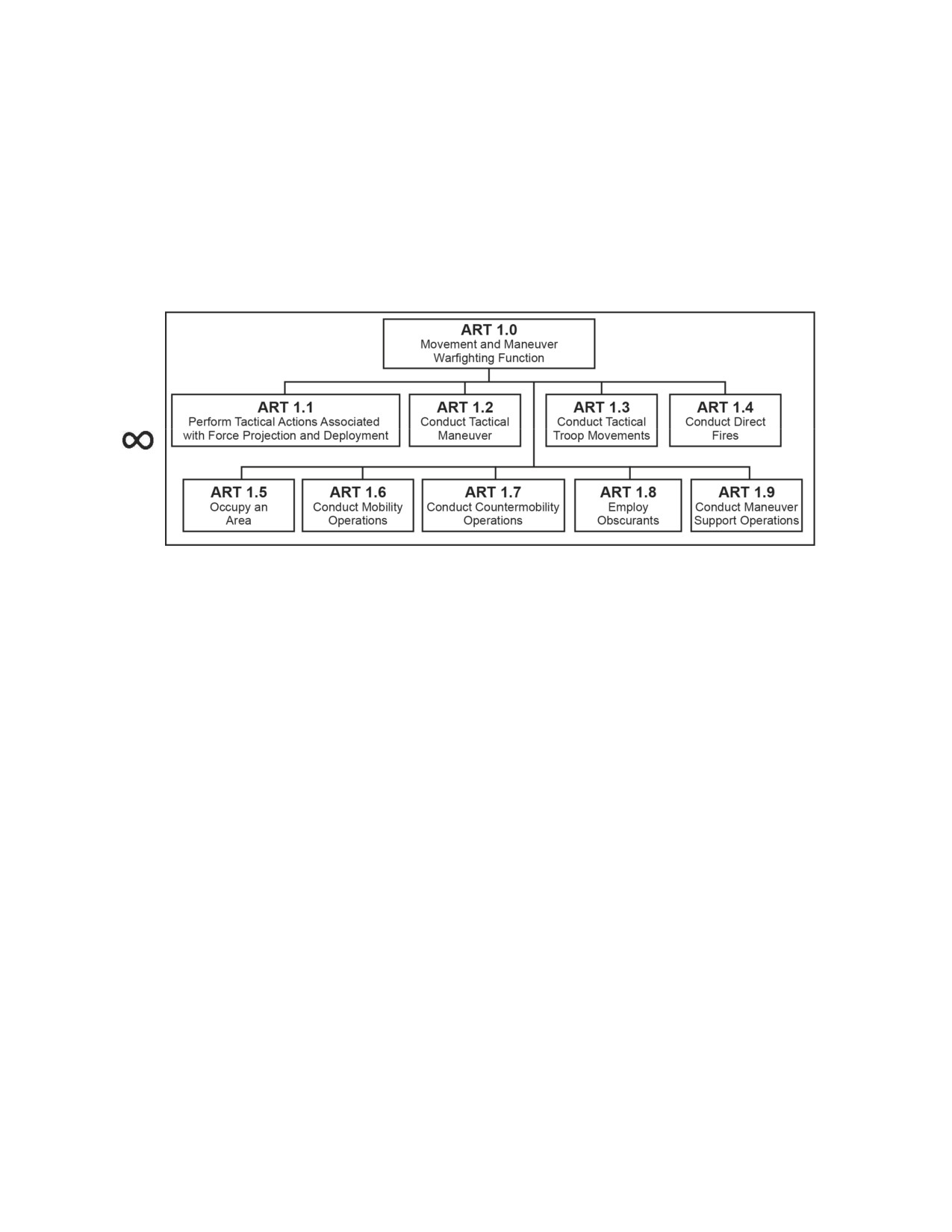
ART 1.0: THE MOVEMENT AND MANEUVER WARFIGHTING FUNCTION.. 1-1
Section I - ART 1.1: Perform Tactical Actions Associated with Force
Projection and Deployment
1-2
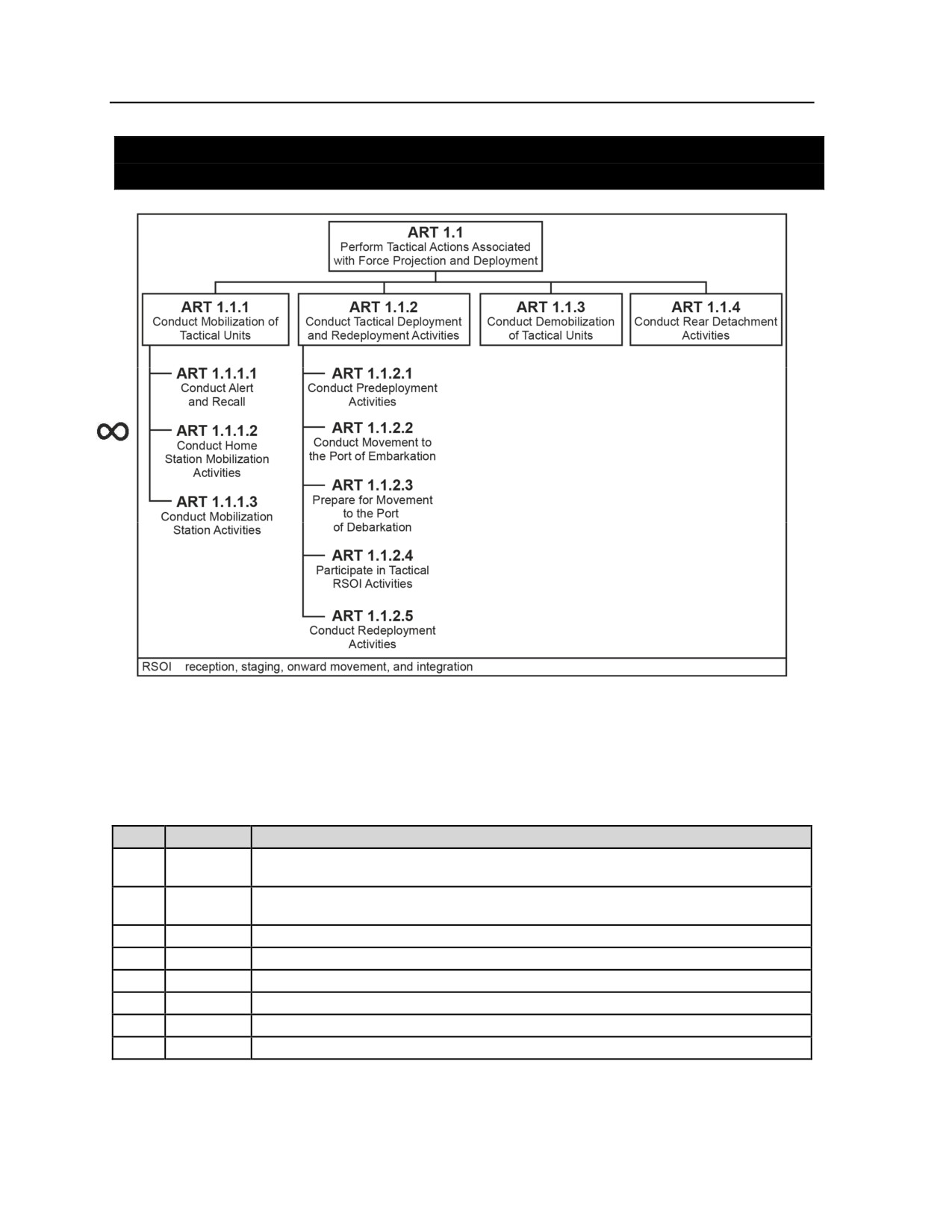
ART 1.1.1 Conduct Mobilization of Tactical Units
1-3
∞ART 1.1.2 Conduct Tactical Deployment and Redeployment Activities
1-4
ART 1.1.3 Conduct Demobilization of Tactical Units
1-8
ART 1.1.4 Conduct Rear Detachment Activities
1-8
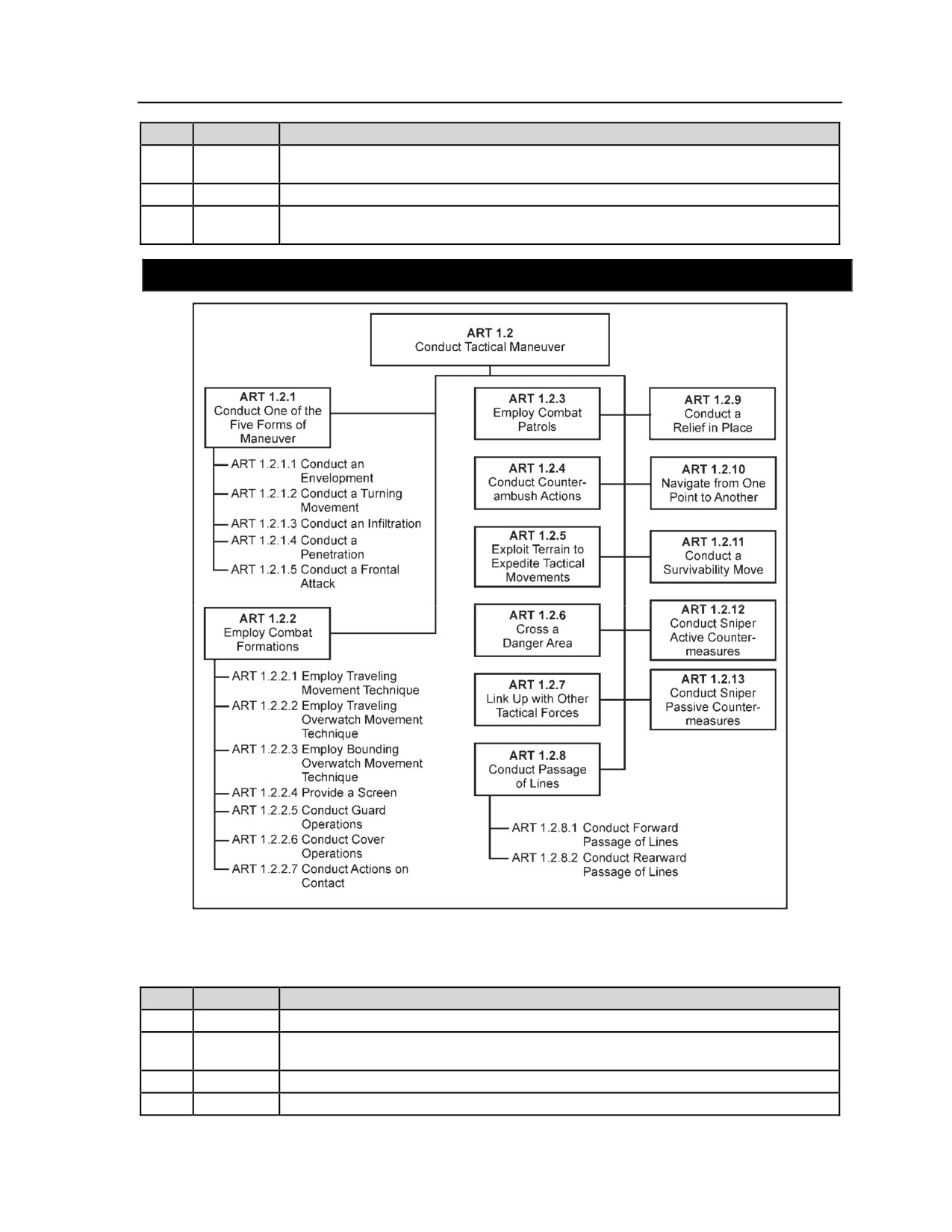
Section II - ART 1.2: Conduct Tactical Maneuver
1-9
ART 1.2.1 Conduct One of the Five Forms of Maneuver
1-10
ART 1.2.2 Employ Combat Formations
1-12
ART 1.2.3 Employ Combat Patrols
1-18
ART 1.2.4 Conduct Counterambush Actions
1-18
ART 1.2.5 Exploit Terrain to Expedite Tactical Movements
1-19
ART 1.2.6 Cross a Danger Area
1-19
ART 1.2.7 Link Up with Other Tactical Forces
1-19
ART 1.2.8 Conduct Passage of Lines
1-20
ART 1.2.9 Conduct a Relief in Place
1-21
ART 1.2.10 Navigate from One Point to Another
1-22
ART 1.2.11 Conduct a Survivability Move
1-22
ART 1.2.12 Conduct Sniper Active Countermeasures
1-23
ART 1.2.13 Conduct Sniper Passive Countermeasures
1-23
Section III - ART 1.3: Conduct Tactical Troop Movements
1-24
ART 1.3.1 Prepare Forces for Movement
1-24
ART 1.3.2 Conduct Tactical Road March
1-26
ART 1.3.3 Conduct Tactical Convoy
1-26
ART 1.3.4 Conduct an Approach March
1-27
Distribution Restriction: Distribution Restriction: This manual is approved for public release; distribution is
unlimited.
*This publication supersedes FM 7-15, 31 August 2003.
18 March 2011
FM 7-15, C6
i
Contents
Section IV - ART 1.4: Conduct Direct Fires
1-28
ART 1.4.1 Conduct Lethal Direct Fire Against a Surface Target
1-28
ART 1.4.2 Conduct Nonlethal Direct Fire Against a Surface Target
1-29
Section V - ART 1.5: Occupy an Area
1-30
ART 1.5.1 Occupy an Assembly Area
1-30
ART 1.5.2 Occupy an Attack and Assault Position
1-30
ART 1.5.3 Occupy and Establish a Battle or Defensive Position
1-31
ART 1.5.4 Conduct Drop Zone Operations
1-31
ART 1.5.5 Conduct Landing Zone Operations
1-32
Section VI - ART 1.6: Conduct Mobility Operations
1-33
ART 1.6.1 Overcome Barriers, Obstacles, and Mines
1-34
∞ART 1.6.2 Enhance Movement and Maneuver
1-39
ART 1.6.3 Negotiate a Tactical Area of Operations
1-44
ART 1.6.4 Provide Diver Support
1-45
ART 1.6.5 Conduct Nontactical Movements
1-46
Section VII - ART 1.7: Conduct Countermobility Operations
1-46
ART 1.7.1 Site Obstacles
1-48
ART 1.7.2 Construct, Emplace, or Detonate Obstacles
1-48
ART 1.7.3 Mark, Report, and Record Obstacles
1-49
ART 1.7.4 Maintain Obstacle Integration
1-49
Section VIII - ART 1.8: Employ Obscurants
1-50
∞Section IX - ART 1.9 Conduct Maneuver Support Operations
1-50
Chapter 2
ART 2.0: THE INTELLIGENCE WARFIGHTING FUNCTION
2-1
Section I - ART 2.1: Intelligence Support to Force Generation
2-2
ART 2.1.1 Provide Intelligence Readiness
2-2
ART 2.1.2 Establish Intelligence Architecture
2-4
ART 2.1.3 Provide Intelligence Overwatch
2-8
ART 2.1.4 Generate Intelligence Knowledge
2-8
ART 2.1.5 Tailor the Intelligence Force
2-13
Section II - ART 2.2: Support to Situational Understanding
2-15
ART 2.2.1 Perform Intelligence Preparation of the Battlefield
2-16
ART 2.2.2 Perform Situation Development
2-20
ART 2.2.3 Provide Intelligence Support to Protection
2-20
ART 2.2.4 Provide Tactical Intelligence Overwatch
2-21
ART 2.2.5 Conduct Police Intelligence Operations
2-21
ART 2.2.6 Provide Intelligence Support to Civil Affairs Activities
2-26
Section III - ART 2.3: Perform Intelligence, Surveillance, and
Reconnaissance
2-27
ART 2.3.1 Perform Intelligence, Surveillance, and Reconnaissance
Synchronization
2-28
ART 2.3.2 Perform Intelligence, Surveillance, and Reconnaissance
Integration
2-30
ART 2.3.3 Conduct Reconnaissance
2-33
ART 2.3.4 Conduct Surveillance
2-38
ART 2.3.5 Conduct Intelligence Related Missions and Operations
2-38
Section IV - ART 2.4: Support to Targeting and Information Superiority . 2-46
ii
FM 7-15, C6
18 March 2011
Contents
ART 2.4.1 Provide Intelligence Support to Targeting
2-47
ART 2.4.2 Provide Intelligence Support to Army Information Tasks
2-48
ART 2.4.3 Provide Intelligence Support to Combat Assessment
2-53
∞Chapter 3
ART 3.0: THE FIRES WARFIGHTING FUNCTION
3-1
∞Section I - ART 3.1: Integrate Fires
3-1
∞ART 3.1.1 Conduct the Targeting Process
3-2
∞ART 3.1.2 Decide Surface Targets
3-2
∞ART 3.1.3 Detect Surface Targets
3-3
∞ART 3.1.4 Nominate Electronic Attack Targets
3-3
∞ART 3.1.5 Nominate Computer Network Attack Targets
3-3
∞Section II - ART 3.2: Provide Fire Support
3-4
∞ART 3.2.1 Employ Fires
3-4
∞ART 3.2.2 Conduct Counterfire Operations
3-10
∞ART 3.2.3 Conduct Survey Operations
3-10
∞ART 3.2.4 Conduct Meteorological Operations
3-11
∞Section III - ART 3.3 Integrate Air-Ground Operations
3-11
Chapter 4
ART 4.0: THE SUSTAINMENT WARFIGHTING FUNCTION
4-1
Section I - ART 4.1: Provide Logistics Support
4-2
ART 4.1.1 Provide Maintenance Support
4-3
ART 4.1.2 Provide Transportation Support
4-7
ART 4.1.3 Provide Supplies
4-15
ART 4.1.4 Provide Field Services
4-32
ART 4.1.5 Provide Contracting Support
4-38
ART 4.1.6 Provide Distribution
4-39
*ART 4.1.7 Provide General Engineer Support
4-44
Section II - ART 4.2: Provide Personnel Services Support
4-45
*ART 4.2.1 Provide Human Resources Support
4-46
ART 4.2.2 Provide Financial Management Support
4-52
ART 4.2.3 Provide Legal Support
4-56
ART 4.2.4 Plan Religious Support Operations
4-61
ART 4.2.5 Provide Band Support
4-64
*Section III - ART 4.3: Provide Health Service Support
4-65
*ART 4.3.1 Provide Combat Casualty Care
4-66
*ART 4.3.2 Provide Medical Evacuation (Air and Ground)
4-69
*ART 4.3.3 Provide Medical Regulating Support
4-70
*ART 4.3.4 Provide Medical Logistics
4-71
+ Section IV - ART 4.4: Conduct Internment/Resettlement Operations ... 4-73
ART 4.4.1 Perform Internment Operations
4-74
ART 4.4.2 Conduct Resettlement Operations
4-76
*Section V - ART 4.5: Provide General Engineering Support
4-77
*ART 4.5.1 Restore Damaged Areas
4-78
*ART 4.5.2 Construct Sustainment Lines of Communications
4-79
*ART 4.5.3 Provide Engineer Construction Support
4-90
*ART 4.5.4 Supply Mobile Electric Power
4-91
*ART 4.5.5 Provide Facilities Engineer Support
4-92
18 March 2011
FM 7-15, C6
iii
Contents
*ART 4.5.6 Conduct Technical Engineer Operations
4-95
*ART 4.5.7 Produce Construction Materials
4-97
Chapter 5
ART 5.0: CONDUCT COMMAND AND CONTROL
5-1
Section I - ART 5.1: Execute the Operations Process
5-2
ART 5.1.1 Plan Operations
5-2
ART 5.1.2 Prepare for Tactical Operations
5-8
ART 5.1.3 Execute Tactical Operations
5-11
ART 5.1.4 Assess Tactical Situations and Operations
5-17
Section II - ART 5.2: Conduct Command Post Operations
5-21
ART 5.2.1 Conduct Command Post Operations to Support Tactical
Operations
5-22
ART 5.2.2 Displace the Command Post
5-23
ART 5.2.3 Execute Sleep Plans
5-24
ART 5.2.4 Manage Stress
5-25
ART 5.2.5 Maintain Continuity of Command and Control
5-25
Section III - ART 5.3: Integrate Information Superiority Contributors
5-26
ART 5.3.1 Integrate Information Engagement Capabilities
5-26
ART 5.3.2 Conduct Military Deception
5-29
ART 5.3.3 Facilitate Situational Understanding Through Knowledge
Management
5-30
+ ART 5.3.4 Manage Information and Data
5-30
+ ART 5.3.5 Establish the Information Network and System
5-30
ART 5.3.6 Conduct Electromagnetic Spectrum Management Operations
5-35
Section IV - ART 5.4: Conduct Civil-Military Operations
5-37
ART 5.4.1 Provide Interface or Liaison Among Military and Civilian
Organizations
5-38
ART 5.4.2 Locate and Identify Population Centers
5-39
ART 5.4.3 Identify Local Resources, Facilities, and Support
5-39
ART 5.4.4 Advise Commanders of Obligations to Civilian Population
5-40
ART 5.4.5 Conduct Negotiations With and Between Other Government
Agencies and Nongovernmental Organizations
5-41
ART 5.4.6 Conduct Civil Affairs Operations
5-42
Section V - ART 5.5: Execute Command Programs
5-59
ART 5.5.1 Support the Commander’s Leadership Responsibilities for Morale,
Welfare, and Discipline
5-59
ART 5.5.2 Preserve Historical Documentation and Artifacts
5-63
ART 5.5.3 Conduct Official Ceremonial, Musical, Public, and Special Events. 5-68
ART 5.5.4 Develop a Command Environmental Program
5-68
Section VI - ART 5.6: Integrate Space Operations
5-69
ART 5.6.1 Provide Space Force Enhancement
5-69
ART 5.6.2 Provide Space Control
5-72
ART 5.6.3 Provide Army Space Support
5-72
ART 5.6.4 Provide Space Situational Awareness
5-73
ART 5.6.5 Coordinate Army Space Capabilities
5-74
Section VII - ART 5.7: Conduct Public Affairs Operations
5-74
ART 5.7.1 Plan Public Affairs Operations
5-74
ART 5.7.2 Execute Information Strategies
5-75
iv
FM 7-15, C6
18 March 2011
Contents
ART 5.7.3 Facilitate Media Operations
5-75
ART 5.7.4 Maintain Community Relations
5-76
ART 5.7.5 Conduct Internal Information Program
5-76
ART 5.7.6 Implement Higher Headquarters Public Affairs Themes
5-76
+ Section VIII - ART 5.8 Establish and Maintain Discipline
5-77
ART 5.8.1 Conduct Law and Order Operations
5-77
ART 5.8.2 Intern U.S. Military Prisoners
5-82
≠Chapter 6 ART 6.0: THE PROTECTION WARFIGHTING FUNCTION
6-1
Section I - ART 6.1: Employ Air and Missile Defense
6-2
ART 6.1.1 Process Tactical Aerial Platforms
6-2
ART 6.1.2 Destroy Aerial Platforms
6-5
ART 6.1.3 Deny Enemy Use of Airspace
6-9
ART 6.1.4 React to Enemy Aerial Attack
6-9
ART 6.1.5 Plan Ballistic Missile Defense
6-10
ART 6.1.6 Conduct Ballistic Missile Defense
6-10
ART 6.1.7 Manage System Configuration
6-11
ART 6.1.8 Plan Rocket, Artillery, and Mortar Defense
6-12
ART 6.1.9 Conduct Rocket, Artillery, and Mortar Defense
6-12
Section II - ART 6.2: Conduct Personnel Recovery Operations
6.13
ART 6.2.1 Ensure Personnel Recovery Readiness During Premobilization
6-14
*ART 6.2.2 Perform Personnel Recovery-Related Force Protection Tasks
6-15
ART 6.2.3 Plan Personnel Recovery Operations
6-17
ART 6.2.4 Provide Personnel Recovery Support to Civil Search and Rescue
Authorities on a Noninterference Basis
6-19
ART 6.2.5 Support Homeland Security Personnel Recovery Operations
6-19
Section III - ART 6.3: Conduct Information Protection
6-20
ART 6.3.1 Provide Information Assurance
6-20
ART 6.3.2 Perform Computer Network Defense
6-23
ART 6.3.3 Perform Electronic Protection Actions
6-23
ART 6.3.4 Conduct Electronic Protection
6-24
Section IV - ART 6.4: Perform Fratricide Avoidance
6-25
ART 6.4.1 Detect and Establish Positive Identification of Friend, Foe, and
Noncombatants
6-25
ART 6.4.2 Maintain Constant Situational Awareness
6-27
Section V - ART 6.5: Conduct Operational Area Security
6-27
ART 6.5.1 Conduct Area and Base Security Operations
6-29
ART 6.5.2 Conduct Critical Installations and Facilities Security
6-31
ART 6.5.3 Establish Local Security
6-31
ART 6.5.4 Provide Protective Services for Selected Individuals
6-38
ART 6.5.5 Conduct Response Force Operations
6-38
ART 6.5.6 Secure Supply Routes and Convoys
6-40
≠ART 6.5.7 Conduct Support Area Operations
6-41
Section VI - ART 6.6: Apply Antiterrorism Measures
6-42
ART 6.6.1 Identify Potential Terrorist Threats and Other Threat Activities
6-43
ART 6.6.2 Reduce Vulnerabilities to Terrorist Acts and Attacks
6-43
ART 6.6.3 React to a Terrorist Incident
6-44
18 March 2011
FM 7-15, C6
v
Contents
Section VII - ART 6.7: Conduct Survivability Operations
6-45
ART 6.7.1 Protect Against Enemy Hazards in the Area of Operations
6-46
ART 6.7.2 Disperse Tactical Forces
6-57
ART 6.7.3 Conduct Security Operations
6-57
ART 6.7.4 Conduct Actions to Control Pollution and Hazardous Materials
6-58
*Section VIII - ART 6.8: Provide Force Health Protection
6-59
*ART 6.8.1 Provide Preventive Medicine Support
6-60
*ART 6.8.2 Provide Veterinary Services
6-62
*ART 6.8.3 Provide Combat and Operational Stress Control Prevention
6-62
*ART 6.8.4 Provide Preventive Dentistry Support
6-63
*ART 6.8.5 Provide Area Medical Laboratory Services
6-63
≠Section IX - ART 6.9: Conduct Chemical, Biological, Radiological, and
Nuclear Operations
6-64
≠ART 6.9.1 Support Weapons of Mass Destruction Proliferation Prevention .. 6-65
≠ART 6.9.2 Conduct Weapons of Mass Destruction Counterforce Operations 6-66
≠ART 6.9.3 Conduct Chemical, Biological, Radiological, and Nuclear
Defense
6-71
≠ART 6.9.4 Conduct Chemical, Biological, Radiological, and Nuclear
Consequence Management
6-76
≠ART 6.9.5 Provide Technical Chemical, Biological, Radiological, and
Nuclear Expertise
6-80
Section X - ART 6.10: Employ Safety Techniques
6-82
ART 6.10.1 Conduct Composite Risk Management
6-82
ART 6.10.2 Develop and Implement Command Safety Program
6-82
ART 6.10.3 Minimize Safety Risks
6-83
Section XI - ART 6.11: Implement Operations Security
6-83
ART 6.11.1 Conduct Operations Security
6-84
ART 6.11.2 Implement Physical Security Procedures
6-86
ART 6.11.3 Counter the Threat
6-87
≠ART 6.11.4 Conduct Logistics Security Operations
6-91
*Section XII - ART 6.12: Provide Explosive Ordnance Disposal
Protection Support
6-92
ART 6.12.1 Conduct Unexploded Explosive Ordnance and Explosive
Remnants of War Operations
6-93
ART 6.12.2 Remove Stuck Rounds and Download Misfired Munitions in
Weapon Systems
6-94
*ART 6.12.3 Conduct Improvised Explosive Device Operations
6-95
ART 6.12.4 Conduct Explosive Ordnance Disposal Chemical Operations
6-96
ART 6.12.5 Provide Explosive Ordnance Disposal Support to Weapons of
Mass Destruction Operations
6-97
ART 6.12.6 Conduct Improved Explosive Device and Unexploded Explosive
Ordnance Protection Operations
6-98
ART 6.12.7 Respond to Accidents or Incidents Involving Military Chemical,
Biological, Radiological, and Nuclear Munitions
6-102
ART 6.12.8 Provide Explosive Ordnance Disposal Sustainment Support
6-103
Chapter 7
ART 7.0: FULL SPECTRUM OPERATIONS, TACTICAL MISSION TASKS, AND
OPERATIONAL THEMES
7-1
Section I - ART 7.1: Conduct Offensive Operations
7-2
vi
FM 7-15, C6
18 March 2011
Contents
ART 7.1.1 Conduct a Movement to Contact
7-2
ART 7.1.2 Conduct an Attack
7-3
ART 7.1.3 Conduct an Exploitation
7-4
ART 7.1.4 Conduct a Pursuit
7-4
Section II - ART 7.2: Conduct Defensive Operations
7-5
ART 7.2.1 Conduct a Mobile Defense
7-5
ART 7.2.2 Conduct an Area Defense
7-5
ART 7.2.3 Conduct a Retrograde
7-6
Section III - ART 7.3: Conduct Stability Operations
7-7
ART 7.3.1 Establish Civil Security
7-8
ART 7.3.2 Establish Civil Control
7-12
ART 7.3.3 Restore Essential Services
7-16
ART 7.3.4 Support Governance
7-19
ART 7.3.5 Support Economic and Infrastructure Development
7-21
∞ART 7.3.6 Conduct Security Force Assistance
7-24
Section IV - ART 7.4: Conduct Civil Support Operations
7-27
ART 7.4.1 Provide Support in Response to Disaster or Terrorist Attack
7-28
ART 7.4.2 Provide Support to Civil Law Enforcement
7-28
ART 7.4.3 Provide Other Support as Required
7-29
Section V - ART 7.5: Conduct Tactical Mission Tasks
7-30
ART 7.5.1 Attack by Fire an Enemy Force or Position
7-30
ART 7.5.2 Block an Enemy Force
7-30
ART 7.5.3 Breach Enemy Defensive Positions
7-30
ART 7.5.4 Bypass Enemy Obstacles, Forces, or Positions
7-31
ART 7.5.5 Canalize Enemy Movement
7-31
ART 7.5.6 Clear Enemy Forces
7-31
ART 7.5.7 Conduct Counterreconnaissance
7-31
ART 7.5.8 Contain an Enemy Force
7-31
ART 7.5.9 Control an Area
7-31
ART 7.5.10 Defeat an Enemy Force
7-31
ART 7.5.11 Destroy a Designated Enemy Force or Position
7-31
ART 7.5.12 Disengage from a Designated Enemy Force
7-31
ART 7.5.13 Disrupt a Designated Enemy Force’s Formation, Tempo, or
Timetable
7-32
ART 7.5.14 Conduct an Exfiltration
7-32
ART 7.5.15 Fix an Enemy Force
7-32
ART 7.5.16 Follow and Assume the Missions of a Friendly Force
7-32
ART 7.5.17 Follow and Support the Actions of a Friendly Force
7-32
ART 7.5.18 Interdict an Area or Route to Prevent, Disrupt, or Delay Its Use
by an Enemy Force
7-32
ART 7.5.19 Isolate an Enemy Force
7-32
ART 7.5.20 Neutralize an Enemy Force
7-32
ART 7.5.21 Occupy an Area
7-32
ART 7.5.22 Reduce an Encircled or Bypassed Enemy Force
7-33
ART 7.5.23 Retain a Terrain Feature
7-33
ART 7.5.24 Secure a Unit, Facility, or Location
7-33
ART 7.5.25 Seize an Area
7-33
18 March 2011
FM 7-15, C6
vii
Contents
ART 7.5.26 Support by Fire the Maneuver of Another Friendly Force
7-33
ART 7.5.27 Suppress a Force or Weapon System
7-33
ART 7.5.28 Turn an Enemy Force
7-33
ART 7.5.29 Conduct Soldier Surveillance and Reconnaissance
7-33
Section VI - ART 7.6: Operational Themes
7-34
ART 7.6.1 Conduct Military Engagements
7-34
ART 7.6.2 Conduct Limited Interventions
7-37
ART 7.6.3 Conduct Peace Operations
7-39
ART 7.6.4 Conduct Irregular Warfare
7-42
GLOSSARY
Glossary-1
REFERENCES
References-1
Figures
Introductory figure. Links between Army warfighting functions and UJTL task areas
xiii
Tables
Introductory table. Basic terms, their definitions, and their proponents
xiv
viii
FM 7-15, C6
18 March 2011
Chapter 1
∞ART 1.0: The Movement and Maneuver Warfighting
Function
The movement and maneuver warfighting function is the related tasks and systems
that move forces to achieve a position of advantage in relation to the enemy. Direct
fire is inherent in maneuver, as is close combat. The function includes tasks
associated with force projection related to gaining a positional advantage over an
enemy. One example is moving forces to execute a large-scale air or airborne assault.
Another is deploying forces to intermediate staging bases in preparation for an
offensive. Maneuver is the employment of forces in the operational area through
movement in combination with fires to achieve a position of advantage in respect to
the enemy in order to accomplish the mission. Maneuver is the means by which
commanders mass the effects of combat power to achieve surprise, shock, and
momentum. Effective maneuver requires close coordination with fires. Movement is
necessary to disperse and displace the force as a whole or in part when maneuvering.
Both tactical and operational maneuver require logistic support.
(FM
3-0)
(USACAC)
18 March 2011
FM 7-15, C6
1-1
Chapter 1
SECTION I - ART 1.1: PERFORM TACTICAL ACTIONS ASSOCIATED WITH
FORCE PROJECTION AND DEPLOYMENT
1-1.
∞Force projection is the military element of national power that systemically and rapidly moves
military forces in response to requirements of full spectrum operations. Force projection demonstrates the
ability of the nation to alert, mobilize, and rapidly deploy combat forces and sustainment units (regular
Army, the Army National Guard/Army National Guard of the United States, and the United States Army
Reserve forces) to operate effectively anywhere in the world. The ability to rapidly deploy Army forces
with sufficient depth and strength to sustain multiple, simultaneous operations contributes to mission
accomplishment. (FM 3-35) (CASCOM)
No.
Scale
Measure
Unit deployed from its current location to the area of operations per the time-phased
01
Yes/No
force and deployment list.
Unit included contractors authorized to accompany the force in its force planning
02
Yes/No
processes.
03
Time
To complete unit mobilization.
04
Time
To complete required training before employment in a theater of operations.
05
Time
To determine available transportation infrastructure and resources.
06
Time
To deploy unit from home or mobilization station to a theater of operations.
07
Time
To redeploy unit from theater of operations to home station or another theater.
08
Percent
Of combat effectiveness of unit when employed in a theater of operations.
1-2
FM 7-15, C6
18 March 2011
∞ART 1.0: The Movement and Maneuver Warfighting Function
ART 1.1.1 CONDUCT MOBILIZATION OF TACTICAL UNITS
1-2. Mobilization is the process by which Army tactical forces or part of them are brought to a state of
readiness for war or other national emergency. (See JP 1-02 for a complete definition.) It includes
activating all or part of the Reserve Components as well as assembling and organizing personnel, supplies,
and materiel. (FM 3-35) (CASCOM)
No.
Scale
Measure
01
Yes/No
Unit was brought to its planned state of readiness in specified time.
02
Yes/No
Unit mobilization progress monitored by higher headquarters.
03
Time
Between planned and actual unit arrival time at mobilization station.
To process Reserve Components through their mobilization station or continental
04
Time
United States replacement center.
05
Percent
Of key personnel reporting within planning timelines.
06
Percent
Of alert and activation messages dispatched within timelines.
07
Percent
Of required initial mobilization reports submitted on time.
ART 1.1.1.1 CONDUCT ALERT AND RECALL
1-3. This task involves activities required when units and individuals receive mobilization and alert
orders. Individuals assigned to the unit are notified of the situation. All individuals report to the designated
location at the designated time with designated personal items. (FM 3-35) (CASCOM)
No.
Scale
Measure
Unit mustered its assigned personnel at the designated location within the designated
01
Yes/No
time.
02
Yes/No
Unit alert and recall progress reported to and monitored by higher headquarters.
For notified units to identify and report preliminary list of deployable and nondeployable
03
Time
personnel.
04
Percent
Of key personnel reported within planning timelines.
05
Percent
Of alert messages dispatched within timelines.
06
Percent
Of alert messages returned for incomplete or inaccurate addresses.
07
Percent
Of notified units able to alert all their personnel within 24 hours.
ART 1.1.1.2 CONDUCT HOME STATION MOBILIZATION ACTIVITIES
1-4. This task involves activities of Reserve Components at home station after receiving a mobilization
order followed by entry onto Federal active duty or other command and control changes. It includes taking
action to speed transition to active duty status, such as identifying shortages of critical personnel and
equipment. Task activities include inventorying unit property, dispatching an advance party to the
mobilization station, and loading the unit on organic equipment or designated carriers. Movement is
coordinated with state area commands defense movement coordinator, unit movement coordinator,
installation transportation offices, and Military Surface Deployment and Distribution Command. (FM 3-35)
(CASCOM)
No.
Scale
Measure
01
Yes/No
Unit deployed to its mobilization station according to its mobilization timetable.
Unit home station mobilization activities reported to and monitored by higher
02
Yes/No
headquarters.
03
Time
To activate key unit personnel.
04
Time
To conduct preparatory administrative, logistic, medical, and readiness activities.
05
Time
To submit initial mobilization reports.
18 March 2011
FM 7-15, C6
1-3
Chapter 1
No.
Scale
Measure
06
Percent
Of key personnel reported within planning timelines.
07
Percent
Of initial mobilization reports submitted on time.
ART 1.1.1.3 CONDUCT MOBILIZATION STATION ACTIVITIES
1-5. This task encompasses actions required to meet deployment or other unit validation criteria. It results
in assuring the unit’s mission capability. Members of Reserve Components transition to active duty.
Commanders conduct necessary individual and collective training that may vary as evaluations and
circumstances dictate. Personnel complete preparation for overseas movement. Soldiers prepare equipment
for deployment. Mobilization station commanders verify training and processing completed at home station
to preclude it being repeated. Depending on the situation, units may move through a mobilization site rather
than a mobilization station. (FM 3-35) (CASCOM)
No.
Scale
Measure
Unit met deployment or other unit validation criteria within established mobilization
01
Yes/No
timetables.
Unit home station mobilization activities reported to and monitored by higher
02
Yes/No
headquarters.
03
Time
To assemble unit and report status.
04
Time
To conduct specified training.
05
Time
To requisition mobilization station training and support requirements.
06
Time
To transfer home station property and prepare to move to the mobilization station.
07
Percent
Of specified training completed.
08
Percent
Of required mobilization station training and support requirements requisitioned.
09
Percent
Of home station property transferred to the appropriate agency.
∞ART 1.1.2 CONDUCT TACTICAL DEPLOYMENT AND
REDEPLOYMENT ACTIVITIES
1-6. Deployment consists of activities required to prepare and move forces, supplies, and equipment to a
theater. Deployment directly impacts the timing and amount of deliverable combat power. Redeployment
involves the return of personnel, equipment, and materiel to home, demobilization stations, or both home
and demobilization stations. Commanders consider redeployment as an operational movement critical in
reestablishing force readiness. Redeployment planning is an integral part of employment planning and
should be coordinated with mission termination or transition plans. (FM 3-35) (CASCOM)
Note: The following deployment/redeployment tasks are addressed elsewhere in the AUTL:
ART 1.3 (Conduct Tactical Troop Movements) addresses onward movement.
ART 4.1.2.3.2 (Move by Air) addresses intra-theater lift.
ART 4.1.2.3.3 (Move by Water) addresses intra-theater lift..
No.
Scale
Measure
01
Yes/No
Unit loaded its designated operational systems per the force deployment plans.
Unit conducted a loading exercise of its vehicles and equipment to include containers
and garrison close out procedures (if applicable) before developing and inputting unit
02
Yes/No
movement data into automated deployment systems. These systems include
Transportation Coordinator’s Automated Information for Movements System II and the
Joint Operations Planning and Execution System.
03
Yes/No
Unit coordinated deployment activities with all required agencies.
1-4
FM 7-15, C6
18 March 2011
∞ART 1.0: The Movement and Maneuver Warfighting Function
No.
Scale
Measure
Unit included contractors authorized to accompany the force in their force planning
04
Yes/No
processes.
05
Yes/No
Unit closed on port of debarkation by scheduled date and time.
To task-organize the unit based on mission, concept of operations, available lift, and
06
Time
other resources.
To echelon the unit based on mission, concept of operations, available lift, and other
07
Time
resources.
To tailor unit based on mission, concept of operations, available lift, and other
08
Time
resources.
10
Percent
Of lift available to move unit to port of debarkation.
10
Percent
Of lift available to move unit configured for tactical employment.
∞ART 1.1.2.1 CONDUCT PREDEPLOYMENT ACTIVITIES
1-7. Predeployment activities are actions taken to prepare forces for deployment and are not limited to the
deploying unit, but include supporting units and the installation staff. Planning, document preparation,
equipment readiness, and training are the foremost predeployment unit activities. (FM 3-35) (CASCOM)
No.
Scale
Measure
01
Yes/No
Unit is trained to minimum operationally ready status.
02
Yes/No
Unit evaluated during exercises for deployment.
Unit provided with base support, such as training areas, ranges, facilities, ammunition
03
Yes/No
and general support.
04
Yes/No
Unit performed mission-essential and other required tasks to standard.
05
Yes/No
Unit reviewed maintenance posture and performed required services.
Unit reviewed Soldier readiness processing and contractor personnel related
06
Yes/No
procedures.
Unit conducted a loading exercise of its vehicles and equipment to include containers
and garrison close out procedures (if applicable) before developing and inputting unit
07
Yes/No
movement data into automated deployment systems. These systems include
Transportation Coordinator’s Automated Information for Movements System II (TC-
AIMS II) and the Joint Operations Planning and Execution System (JOPES).
08
Yes/No
Unit reviewed and updated vehicle load plans and container packing lists.
Unit cross-leveled and redistributed personnel and equipment to meet supported
09
Yes/No
commanders’ force requirements.
Unit included contractors authorized to accompany the force in its force planning
10
Yes/No
processes.
11
Yes/No
Unit updated organizational equipment lists based on warning order.
12
Yes/No
Unit updated unit deployment list based on warning order.
13
Yes/No
Unit loaded its designated operational systems per the force deployment plans.
14
Yes/No
Unit movement data validated in TC-AIMS II and transmitted to JOPES.
∞ART 1.1.2.2 CONDUCT MOVEMENT TO THE PORT OF EMBARKATION
1-8. This task begins with planning and preparation for movement. It involves coordination among the
state area command defense movement coordinator, installation transportation office, unit movement
officer, Military Surface Deployment and Distribution Command (SDDC), Air Mobility Command, and
unit commander. Task activities include updating movement plans, developing unit deployment lists,
verifying load and stow plans, preparing cargo documentation and radio frequency devices, identifying
support equipment and personnel requirements, and planning movement control and convoy. (FM 3-35)
(CASCOM)
18 March 2011
FM 7-15, C6
1-5
Chapter 1
No.
Scale
Measure
Delay in transportation did not degrade, delay, or modify movement to port of
01
Yes/No
embarkation.
Unit loaded personnel and equipment on strategic and operational lift systems per the
02
Yes/No
deployment plan.
03
Yes/No
Units approved movement plans.
04
Yes/No
Units approved convoy clearance and request for special hauling permits as required.
Unit prepared and configured equipment for shipment by rail, surface, or air to port of
05
Yes/No
embarkation.
Unit completed Solider readiness program, and unit personnel (to include deploying
06
Yes/No
contractor personnel) prepared for movement to future duty assignments.
07
Yes/No
Unit personnel and equipment moved as scheduled to designated ports of embarkation.
Unit completed equipment and cargo shipping documentation, such as hazardous
08
Yes/No
materials, agriculture, and maintenance inspections.
Unit marked vehicles, containers, and pallets with proper shipping labels and radio-
09
Yes/No
frequency devices.
10
Yes/No
Unit closed into designated assembly areas.
∞ART 1.1.2.3 PREPARE FOR MOVEMENT TO THE PORT OF DEBARKATION
1-9. Strategic movement includes all actions required to process unit equipment, containerized cargo,
hazardous materials
(HAZMAT)—including HAZMAT compatibility, agricultural inspections, and
validation of equipment—and HAZMAT cargo documentation during final preparation for loading.
Movement by sea involves the transport of unit’s personnel, equipment, and cargo by ocean vessel from the
seaport of embarkation to the seaport of debarkation. Movement by air involves the transport of unit’s
personnel and equipment by strategic airlift from the air port of embarkation to the airport of debarkation.
(FM 3-35) (CASCOM)
No.
Scale
Measure
Unit marked vehicles, containers, and pallets with proper shipping labels and radio-
01
Yes/No
frequency devices.
02
Yes/No
Delay in providing strategic lift assets did not degrade, delay, or modify deployment.
03
Yes/No
Unit identified supercargoes for movement by sea.
04
Yes/No
Unit identified cargo requiring special handling and security.
Units had all required approved transportation shipping documents, such as export
05
Yes/No
traffic releases, transportation control and movement documents, and stow plans.
06
Yes/No
Units verified personnel and cargo manifests.
∞ART 1.1.2.4 PARTICIPATE IN TACTICAL RECEPTION, STAGING, ONWARD MOVEMENT,
AND INTEGRATION ACTIVITIES
1-10. The process of reception, staging, onward movement, and integration is designed to rapidly combine
and integrate arriving elements of personnel, equipment, and materiel into combat power. This task
involves unit reception at the port of debarkation (POD). It may include drawing equipment from pre-
positioned stocks. This task begins when the first strategic lift system of the main body arrives at the POD.
It ends when units are combat ready. (FM 3-35) (CASCOM)
No.
Scale
Measure
01
Yes/No
Unit received discharged personnel and equipment from strategic transportation assets.
02
Yes/No
Unit properly equipped, manned, and supported port marshalling areas.
Yes/No
Transportation was available to transport personnel, equipment, and materiel to staging
03
areas.
1-6
FM 7-15, C6
18 March 2011
∞ART 1.0: The Movement and Maneuver Warfighting Function
No.
Scale
Measure
04
Yes/No
Logistics support services were provided to units transiting the PODs.
05
Yes/No
Unit organized and staged personnel, equipment, and basic loads into movement units.
Confirmed units prepared for movement and provided logistics support when transiting
06
Yes/No
the staging area.
Yes/No
Unit coordinated movement from reception facilities and staging areas to the tactical
07
assembly areas or other theater destinations.
08
Yes/No
Unit coordinated movement of nonunit personnel to gaining commands.
09
Yes/No
Unit coordinated movement of sustainment supplies to distribution sites.
Yes/No
Unit synchronized transfer of capabilities (units, equipment, and supplies) to the
10
operational commander’s force prior to mission execution.
Unit coordinated draw and integration of Army pre-positioned stocks (APS) and
11
Yes/No
supplies, if required.
Yes/No
Unit updated unit designated list to identify APS equipment in Transportation
12
Coordinator’s Automated Information for Movements System II, if required.
Yes/No
Unit determined security requirements available to support reception, staging, onward
13
movement, and integration of operations.
Yes/No
Unit reported activities to reconstitute unit and build combat power to higher
14
headquarters. Higher headquarters monitored these same activities.
∞ART 1.1.2. 5 CONDUCT REDEPLOYMENT ACTIVITIES
1-11. Redeployment involves the return of personnel, equipment, and materiel to home or demobilization
stations. Redeployment planning is an integral part of employment planning and should be coordinated
with mission termination or transition plans. (FM 3-35) (CASCOM)
No.
Scale
Measure
01
Yes/No
Delay in transportation did not degrade, delay, or modify movement to Unit coordinated.
02
Yes/No
Unit determined lift and security requirements.
03
Yes/No
Unit identified routes and en route rest areas.
04
Yes/No
Unit deployed security forces to support movements and overall security.
05
Yes/No
Unit closed into designated assembly areas.
06
Yes/No
Unit approved convoy clearance and request for special hauling permits as required.
07
Yes/No
Unit approved movement plans.
08
Yes/No
Unit verified personnel and cargo manifests and validated load plans.
Yes/No
Unit identified theater provided equipment and Army pre-positioned stocks for turn-in
09
and updated unit designated list in Transportation Coordinator’s Automated Information
for Movements System II.
Yes/No
Unit prepared and configured equipment for shipment by rail, surface, or air to port of
10
embarkation.
Yes/No
Unit completed Soldier readiness processing, and unit personnel (including redeploying
11
contractor personnel and equipment) prepared for movement to future duty assignment.
12
Yes/No
Unit personnel and equipment moved as scheduled to designated ports of embarkation.
Yes/No
Unit completed equipment and cargo shipping documentation, such as hazardous
13
materials, agriculture, and maintenance inspections.
Yes/No
Unit marked vehicles, containers, and pallets with proper shipping labels and radio-
14
frequency devices.
Yes/No
Unit loaded personnel and equipment on strategic and operational lift systems per the
15
redeployment plan.
16
Time
Required to complete movement to POE.
18 March 2011
FM 7-15, C6
1-7

Chapter 1
ART 1.1.3 CONDUCT DEMOBILIZATION OF TACTICAL UNITS
1-12. Demobilization is the act of returning the force and materiel to a premobilization posture or to some
other approved posture. Demobilization actions occur in the area of operations, between the port of
embarkation
(POE) and demobilization station or POE and continental United States
(CONUS)
demobilization center, at the demobilization station and CONUS demobilization center, and at home station
or home of record. This task also includes environmental considerations. (FM 3-35) (CASCOM)
No.
Scale
Measure
01
Yes/No
Unit demobilized personnel, equipment, and supplies per plans.
02
Yes/No
Unit maintained accountability of property and personnel.
To prepare unit equipment and supplies for movement (includes cleaning, maintaining,
03
Time
and configuring vehicles for movement by removing canvas tarps and folding down
windows).
04
Time
To move demobilizing organization from its current location to demobilization station.
05
Time
Between planned and actual unit arrival at home station or demobilization station.
06
Time
To process Reserve Components through the demobilization station.
To prepare to transfer unit supplies and equipment listed in table of organization and
07
Time
equipment (TOE) to appropriate storage location.
To conduct individual demobilization administrative, logistic, medical, and financial
08
Time
management activities.
09
Time
To transfer home station property back to the unit.
10
Time
To terminate outstanding contracts.
Of unit supplies and equipment listed in TOE transferred to temporary or permanent
11
Percent
storage locations.
12
Percent
Of home station property transferred back to the unit.
13
Percent
Of outstanding contracts to terminate.
Of individual demobilization administrative, logistic, medical, and financial management
14
Percent
activities completed.
ART 1.1.4 CONDUCT REAR DETACHMENT ACTIVITIES
1-13. Rear detachment activities use nondeployable and other personnel to maintain facilities and
equipment at home station when the deployed force is expected to return. Such activities include supporting
families of deployed personnel. This task includes turning over residual equipment, supplies, and facilities
to appropriate authorities (for example, the mobilization station commander) if the unit does not return to
the mobilization station. (FM 1-0) (USAAGS)
No.
Scale
Measure
Unit family members continued to receive authorized support, assistance, and
01
Yes/No
counseling during operational deployments of Soldiers.
Rear detachment maintained and accounted for unit installation property and
02
Yes/No
equipment throughout the unit’s deployment.
Rear detachment established rear detachment program before beginning deployment
03
Yes/No
activities.
Environmental considerations associated with departing units have been identified and
04
Yes/No
appropriate actions taken.
To turn over residual equipment, supplies, and facilities to appropriate authorities when
05
Time
the unit will not return to home or mobilization station.
06
Time
To conduct rear detachment administrative and logistic activities.
07
Time
To establish a functioning family support group.
1-8
FM 7-15, C6
18 March 2011
∞ART 1.0: The Movement and Maneuver Warfighting Function
No.
Scale
Measure
To provide quality and meaningful assistance to unit family members during times of
08
Time
need and support.
09
Percent
Of rear detachment administrative and logistic reports submitted on time.
Of residual equipment, supplies, and facilities turned over to appropriate authorities
10
Percent
when unit returns to home or mobilization station.
SECTION II - ART 1.2: CONDUCT TACTICAL MANEUVER
1-14. Maneuver is the means by which commanders mass the effects of combat power to achieve surprise,
shock, momentum, and dominance. Commanders take full advantage of terrain and combat formations
when maneuvering their forces. (FM 3-90) (USACAC)
No.
Scale
Measure
01
Yes/No
Unit achieved a position of advantage with respect to the enemy.
Subordinate commanders used their initiative to achieve the commander’s intent when
02
Yes/No
the plan no longer applied.
03
Yes/No
The commander maintained control of associated forces.
04
Time
To initiate maneuver.
18 March 2011
FM 7-15, C6
1-9
Chapter 1
No.
Scale
Measure
05
Time
To complete maneuver.
06
Percent
Of forces achieving position of advantage after executing the plan.
07
Percent
Of enemy force destroyed and neutralized by the maneuver of the friendly force.
08
kph
Rate of movement across the battlefield.
ART 1.2.1 CONDUCT ONE OF THE FIVE FORMS OF MANEUVER
1-15. The forms of maneuver are envelopment, turning movement, infiltration, penetration, and frontal
attack. While normally combined, each form of maneuver attacks the enemy differently. A single operation
may contain several forms of offensive maneuver. For example, a frontal attack to clear a security area may
be followed by a penetration to create a gap in the defenses. This could be followed by an envelopment to
destroy the first line of defense. Each form of maneuver poses different challenges for attackers and
different dangers for defenders. Commanders determine the form of maneuver to use by analyzing the
factors of mission, enemy, terrain and weather, troops and support available, time available, civil
considerations. (FM 3-90) (USACAC)
ART 1.2.1.1 CONDUCT AN ENVELOPMENT
1-16. An envelopment is a form of maneuver in which an attacking force seeks to avoid the principal
enemy defenses by seizing objectives to the enemy rear to destroy the enemy in his current positions. At the
tactical level, envelopments focus on seizing terrain, destroying specific enemy forces, and interdicting
enemy withdrawal routes. Envelopments avoid the enemy front where enemy forces are protected and can
easily concentrate fires. Single envelopments maneuver against one enemy flank; double envelopments
maneuver against both. A vertical envelopment (an air assault or airborne operation) creates an assailable
flank by arriving from an unexpected direction. An envelopment may result in an encirclement. (FM 3-90)
(USACAC)
Note: Airborne, air assault, and amphibious operations are tactical aspects of forcible entry
operations that involve seizing and holding a military lodgment in the face of armed opposition.
Joint force commanders conduct forcible entry operations at the operational level. (See JP 3-18.)
Forcible entry operation tasks are addressed in the Universal Joint Task List (UJTL).
ART 1.2.1.1.1 Conduct an Airborne Assault into Area of Operations
1-17. An airborne assault secures a defendable airhead from which to conduct lodgment activities or to
seize key terrain to block or deny its use by the enemy. This mission begins when paratroopers and
equipment exit the aircraft by parachute or are air landed. The mission ends when all elements of the
relevant airborne echelon are delivered to the objective area and the assault objective has been seized.
(FM 3-90) (USACAC)
Note: Marshaling forces for airborne operations is addressed as ART 1.3.1.3 (Marshal Forces to
Conduct an Airborne Assault).
The air movement phase of airborne operations is addressed as ART 4.1.2.3.2 (Move by Air).
Tasks for the ground tactical-phase of airborne operations duplicate missions are contained
elsewhere in this chapter.
No.
Scale
Measure
01
Yes/No
Enemy situation in the area of operations known and disseminated to assault force.
02
Yes/No
Drop zone/landing zone marked by pathfinders.
03
Yes/No
En route communications established between assault force and force headquarters.
04
Yes/No
Preassault fires executed before H-hour.
1-10
FM 7-15, C6
18 March 2011
∞ART 1.0: The Movement and Maneuver Warfighting Function
No.
Scale
Measure
05
Yes/No
Assault force establishes contact with force headquarters.
06
Percent
Of friendly casualties occurring during the airborne assault.
ART 1.2.1.1.2 Conduct an Air Assault
1-18. An air assault secures a defendable airhead or other key terrain from which to conduct lodgment
activities or follow-on tactical operations. The mission ends when all elements of the relevant air assault
echelon are delivered to the objective area and the assault objective has been seized. (FM 90-4) (USAIS)
Note: ART 1.2.1.1.2 does not include air traffic control. Air traffic control is addressed under
ART 5.1.3.1.7 (Control Tactical Airspace).
ART 1.2.1.1.2 does not include efforts to improve the landing zone. Landing zone improvement
is addressed under ART 1.6.2 (Enhance Movement and Maneuver).
Pickup zone operations are addressed as ART 1.3.1.4 (Conduct Pickup Zone Operations).
The air movement phase of air assault operations is addressed as ART 4.1.2.3.2 (Move by Air).
Tasks for the ground tactical phase of air assault operations duplicate missions contained
elsewhere in this chapter.
Scale and measures assigned to ART 1.2.1.1.1 apply.
ART 1.2.1.1.3 Conduct an Amphibious Assault
1-19. The Army conducts an amphibious assault as a member of the landing force in conducting one of
four forcible entry operations. It may also conduct forcible entry operations via airborne, air assault or a
combination of any or all of these forcible entry techniques. An amphibious assault secures a defendable
beachhead from which to conduct lodgment activities. This mission begins when Soldiers and equipment
leave the ships that bring them to the amphibious objective area and transfer to the landing craft that will
deliver them to the beach. The mission ends when all elements of the amphibious force are delivered onto
the beachhead and the assault objective has been seized. (JP 3-02) (USJFCOM JWFC)
Note: Army forces follow joint doctrine and Marine Corps doctrinal publications when tasked to
conduct amphibious operations.
Scale and measures assigned to ART 1.2.1.1.1 apply.
ART 1.2.1.1.4 Conduct an Encirclement
1-20. Encirclements are operations where one force loses its freedom of maneuver because an opposing
force is able to isolate it by controlling all ground lines of communications. (FM 3-90) (USACAC)
ART 1.2.1.2 CONDUCT A TURNING MOVEMENT
1-21. A turning movement is a maneuver in which an attacking force seeks to avoid the enemy’s principal
defensive positions by seizing objectives to the enemy rear and causing the enemy to move out of his
current positions or divert major forces to meet the threat. (FM 3-90) (USACAC)
ART 1.2.1.3 CONDUCT AN INFILTRATION
1-22. An infiltration is a maneuver in which an attacking force conducts undetected movement through or
into an area occupied by enemy forces to occupy a position of advantage while exposing only small
elements to enemy defensive fires. (FM 3-90) (USACAC)
Note: Infiltration is also a tactical march technique used within a friendly territory to move
forces in small groups at extended or irregular intervals. (See FM 3-90.)
18 March 2011
FM 7-15, C6
1-11
Chapter 1
ART 1.2.1.4 CONDUCT A PENETRATION
1-23. A penetration is a maneuver in which an attacking force seeks to rupture enemy defenses on a narrow
front to disrupt the defensive system. Commanders direct penetrations when enemy flanks are not
assailable or time does not permit another form of maneuver. Successful penetrations create assailable
flanks and provide access to enemy sustainment areas. (FM 3-90) (USACAC)
ART 1.2.1.5 CONDUCT A FRONTAL ATTACK
1-24. A frontal attack is a maneuver in which the attacking force seeks to destroy a weaker enemy force or
fix a larger enemy force in place over a broad front. At the tactical level, an attacking force can use a
frontal attack to overrun a weaker enemy force rapidly. A frontal attack strikes the enemy across a wide
front and over the most direct approaches. Commanders normally use it when they possess overwhelming
combat power and the enemy is at a clear disadvantage. (FM 3-90) (USACAC)
ART 1.2.2 EMPLOY COMBAT FORMATIONS
1-25. Use an ordered arrangement of troops and vehicles for a specific purpose. Commanders use one of
seven different combat formations: column, line, echelon (left or right), box, diamond, wedge, and vee.
Their use depends on the factors of mission, enemy, terrain and weather, troops and support available, time
available, civil considerations (METT-TC). (FM 3-90) (USACAC)
No.
Scale
Measure
01
Yes/No
Combat formation reflected the existing factors of METT-TC.
02
Yes/No
Unit complied with all graphic control measures.
03
Yes/No
Unit employed the movement formation ordered by the leader.
04
Time
To plan and prepare operation order.
05
Time
To initiate movement.
06
Time
To complete movement.
Of area of operations observed during reconnaissance conducted before starting
07
Percent
operations.
08
Percent
Of allocated forces in place at the start of the plan.
09
Percent
Of unit in designated combat formation throughout the movement.
10
Percent
Of unit moving on the specified route or axis.
11
Percent
Of casualties to the force that occurred during the operation.
12
kph
Rate of movement.
ART 1.2.2.1 EMPLOY TRAVELING MOVEMENT TECHNIQUE
1-26. All unit elements move simultaneously. (FM 3-90) (USACAC)
No.
Scale
Measure
Combat formation reflected the existing factors of mission, enemy, terrain and weather,
01
Yes/No
troops and support available, time available, civil considerations.
02
Yes/No
Unit complied with all graphic control measures.
03
Yes/No
Unit employed the movement formation ordered by the leader.
04
Yes/No
Unit commander did not expect to encounter the enemy.
All subordinate elements of the unit assigned areas of operations for observation during
05
Yes/No
the movement.
Unit leaders ensured 360-degree coverage of the unit for observation and fire, to
06
Yes/No
include air guard.
1-12
FM 7-15, C6
18 March 2011

∞ART 1.0: The Movement and Maneuver Warfighting Function
No.
Scale
Measure
Route of movement offered concealment from enemy ground and air observation,
avoided skylining, avoided moving directly forward from firing positions, crossed open
07
Yes/No
areas quickly, avoided possible kill zones, avoided wide open spaces (especially where
high ground dominates or where the terrain covers and conceals the enemy), and
avoided obvious avenues of approach.
08
Time
To plan and prepare operation order.
09
Time
To initiate movement.
10
Time
To complete movement.
11
Percent
Of allocated forces in place at the start of the plan.
12
Percent
Of unit in designated combat formation throughout the movement.
13
Percent
Of unit moving on the specified route or axis.
14
Percent
Of casualties to the force occurring during the operation.
ART 1.2.2.2 EMPLOY TRAVELING OVERWATCH MOVEMENT TECHNIQUE
1-27. The lead element moves continuously. Trailing elements move at varying speeds, sometimes pausing
to overwatch movement of the lead element. (FM 3-90) (USACAC)
No.
Scale
Measure
Combat formation reflected the existing factors of mission, enemy, terrain and weather,
01
Yes/No
troops and support available, time available, civil considerations.
02
Yes/No
Unit complied with all graphic control measures.
03
Yes/No
Unit employed the movement formation ordered by the leader.
04
Yes/No
Unit commander determined that enemy contact is possible, but speed is important.
All subordinate elements assigned area of operations for observation during the
05
Yes/No
movement.
Unit leaders ensured that 360-degree coverage exists for observation and fire, to
06
Yes/No
include air guard.
Route of movement offered concealment from enemy ground and air observation,
avoided skylining, avoided moving directly forward from firing positions, crossed open
07
Yes/No
areas quickly, avoided possible kill zones, avoided wide open spaces (especially where
high ground dominates or where the terrain covers and conceals the enemy), and
avoided obvious avenues of approach.
08
Time
To plan and prepare operation order.
09
Time
To initiate movement.
10
Time
To complete movement.
11
Percent
Of allocated forces in place at the start of the plan.
12
Percent
Of unit in designated combat formation throughout the movement.
13
Percent
Of unit moving on the specified route or axis.
14
Percent
Of casualties to the force that occurred during the operation.
15
kph
Rate of movement.
ART 1.2.2.3 EMPLOY BOUNDING OVERWATCH MOVEMENT TECHNIQUE
1-28. Using successive or alternate bounds, overwatching elements cover bounding elements from
covered, concealed positions with good observation of, and fields of fire against, possible enemy positions.
(FM 3-90) (USACAC)
18 March 2011
FM 7-15, C6
1-13
Chapter 1
No.
Scale
Measure
Combat formation reflected the existing factors of mission, enemy, terrain and weather,
01
Yes/No
troops and support available, time available, civil considerations (METT-TC).
02
Yes/No
Unit complied with all graphic control measures.
03
Yes/No
Unit employed the movement formation ordered by the leader.
04
Yes/No
Unit commander expected to make enemy contact.
All subordinate elements of the unit assigned an area of operations for observation
05
Yes/No
during the movement.
Unit leaders ensured 360-degree coverage exists for observation and fire, to include air
06
Yes/No
guard.
Length of bounds, selected overwatch positions, and variation of techniques—use of
07
Yes/No
alternate or successive bounds—reflected existing factors of METT-TC.
Route of movement offered concealment from enemy ground and air observation,
avoided skylining, avoided moving directly forward from firing positions, crossed open
08
Yes/No
areas quickly, avoided possible kill zones, avoided wide open spaces (especially where
high ground dominates or where the terrain covers and conceals the enemy), and
avoided obvious avenues of approach.
09
Time
To initiate movement.
10
Time
To complete movement.
11
Percent
Of allocated forces in place at the start of the execution of the plan.
12
Percent
Of unit in designated combat formation throughout the movement.
13
Percent
Of unit moving on the specified route or axis.
14
Percent
Of casualties to the force occurring during the operation.
15
kph
Rate of movement.
ART 1.2.2.4 PROVIDE A SCREEN
1-29. A screen is a security operation that primarily provides early warning to the protected force. The unit
executing a screen observes, identifies, and reports enemy actions. Generally, a screening force, augmented
by indirect fires, engages and destroys enemy reconnaissance elements within its capabilities, but otherwise
fights only in self-defense. (FM 3-90) (USACAC)
No.
Scale
Measure
The screening force’s operations provided the protected force or installation with
01
Yes/No
sufficient reaction time and maneuver space to conduct defensive operations.
02
Yes/No
Screening force was in place not later than time specified in operation order.
03
Yes/No
Screening force prevented enemy ground observation of protected force or installation.
04
Yes/No
Collateral damage from the screening force’s activities was within acceptable limits.
05
Yes/No
Screening force provided early and accurate warning of enemy approach.
06
Yes/No
Screening force oriented its operations of the force or facility to be secured.
07
Yes/No
Screening force performed continuous reconnaissance.
08
Yes/No
Screening force maintained contact with enemy forces.
09
Yes/No
Commander developed criteria for ending the screening operation.
10
Time
To conduct reconnaissance of the area surrounding the secured force or installation.
11
Time
To plan the screen.
12
Time
To prepare for the screen including movement into security area.
13
Time
To execute the screen.
14
Time
To report enemy activities to appropriate headquarters.
1-14
FM 7-15, C6
18 March 2011
∞ART 1.0: The Movement and Maneuver Warfighting Function
No.
Scale
Measure
Of warning that the screening force gives to the secured unit or installation before the
15
Time
secured unit or installation makes contact with the enemy.
16
Percent
Of screening force casualties during the screen.
17
Percent
Of secured force or installation casualties during the conduct of the screen.
18
Percent
Of unit combat power used to provide a screen.
19
Percent
Of enemy reconnaissance elements destroyed or repelled by the screening force.
20
Percent
Of friendly operations judged as not compromised before or during execution.
Of operations not compromised (based on enemy prisoner of war interrogations or
21
Percent
captured documents).
Of the area of operations (AO) or security area that can be observed at any given time
22
Percent
by the screen force using visual observation and sensors.
23
Number
Of incidents where enemy forces affect the security of friendly units and facilities.
Of incidents where enemy reconnaissance forces compromise friendly courses of
24
Number
action causing them to be delayed, disrupted, canceled, or modified.
25
Number
Of screening force casualties during the security operation.
26
Number
Of secured force or installation casualties during the conduct of the security operation.
27
Number
Of enemy reconnaissance elements destroyed during security operation.
28
Number
Of mobility corridors or avenues of approach that the screening force can observe.
29
Number
Of observation posts that the screening force can establish.
Square
30
Size of security area or AO.
Kilometers
ART 1.2.2.5 CONDUCT GUARD OPERATIONS
1-30. Guard is a security operation. Its primary task is to protect the main body. It gains time by fighting. It
also observes and reports information while preventing enemy ground observation of and direct fire against
the main body. A guard differs from a screen in that a guard force contains sufficient combat power to
defeat, repel, or fix the lead elements of an enemy ground force before it can engage the main body with
direct fires. The guard force operates within the range of the main body’s fire support weapons, deploying
over a narrower front than a comparable-sized screening force to permit concentrating combat power.
(FM 3-90) (USACAC)
No.
Scale
Measure
Guard force’s operations provided the protected force or installation with sufficient
01
Yes/No
reaction time and maneuver space to conduct defensive operations.
02
Yes/No
Guard force was in place not later than time specified in operation order.
03
Yes/No
Guard force prevented enemy ground observation of protected force or installation.
04
Yes/No
Collateral damage from the guard force’s activities was within acceptable limits.
05
Yes/No
Guard force provided early and accurate warning of enemy approach.
06
Yes/No
Guard force oriented its operations of the force or facility to be secured.
07
Yes/No
Guard force performed continuous reconnaissance.
08
Yes/No
Guard force maintained contact with enemy forces.
09
Yes/No
Commander developed criteria for ending the guard operation.
10
Yes/No
Guard force caused the enemy main body to deploy.
11
Yes/No
Guard force impeded and harassed the enemy within its capabilities while displacing.
12
Time
To conduct reconnaissance of the area surrounding the secured force or installation.
13
Time
To plan the guard operation.
14
Time
To prepare for the guard operation to include movement into security area.
18 March 2011
FM 7-15, C6
1-15
Chapter 1
No.
Scale
Measure
15
Time
To execute the guard operation.
16
Time
To report enemy activities to appropriate headquarters.
Of warning that the guard force gives to the secured unit or installation before the
17
Time
secured unit or installation makes contact with the enemy.
18
Percent
Of guard force casualties during the guard operation.
19
Percent
Of secured force or installation casualties during the guard operation.
20
Percent
Of unit combat power used to provide the guard force.
21
Percent
Of enemy reconnaissance elements destroyed or repelled by the guard force.
22
Percent
Of friendly operations judged as not compromised prior to or during execution.
Of operations not compromised (based on enemy prisoner of war interrogations or
23
Percent
captured documents).
Of the area of operations or security area that can be observed at any given time by the
24
Percent
guard force using visual observation and sensors.
25
Number
Of incidents where enemy forces affect the security of the secured force or facilities.
Of incidents where enemy reconnaissance or advance guard forces compromise
26
Number
friendly courses of action.
27
Number
Of guard force casualties during the guard operation.
28
Number
Of secured force or installation casualties during the guard operation.
Of enemy reconnaissance and advance guard elements destroyed during the guard
29
Number
operation.
30
Number
Of mobility corridors or avenues of approach that the guard force can observe.
31
Number
Of observation posts that the guard force can establish.
Square
32
Size of security area or area of operations.
Kilometers
ART 1.2.2.6 CONDUCT COVER OPERATIONS
1-31. Cover is a security operation. Its primary task is to protect the main body. It gains time by fighting. It
also observes and reports information while preventing enemy ground observation of and direct fire against
the main body. A covering force operates outside supporting range of the main body. It promotes early
situational development as it deceives the enemy about the location of the main battle area while disrupting
and destroying enemy forces. Cover operations provide the main body with the maximum early warning
and reaction time. (FM 3-90) (USACAC)
No.
Scale
Measure
Covering force’s operations provided the protected force with sufficient reaction time
01
Yes/No
and maneuver space.
02
Yes/No
Covering force was in place not later than time specified in operation order.
03
Yes/No
Covering force prevented enemy ground observation of protected force or installation.
04
Yes/No
Collateral damage from the covering force’s activities was within acceptable limits.
05
Yes/No
Covering force provided early and accurate warning of enemy approach.
06
Yes/No
Covering force oriented its operations on the secured force.
07
Yes/No
Covering force performed continuous reconnaissance.
08
Yes/No
Covering force maintained contact with enemy forces.
09
Yes/No
Commander developed criteria for ending the covering operation.
10
Yes/No
Covering force caused the enemy main body to deploy.
Covering force defeated or repelled enemy forces as directed by the higher
11
Yes/No
commander.
1-16
FM 7-15, C6
18 March 2011
∞ART 1.0: The Movement and Maneuver Warfighting Function
No.
Scale
Measure
During an offensive cover operation, the covering force penetrated the enemy’s security
12
Yes/No
area and located the enemy’s main defensive positions.
During an offensive cover operation, the covering force determined enemy strengths
13
Yes/No
and dispositions and located gaps or weak points within the enemy’s defensive
scheme.
During an offensive cover operation, the covering force deceived the enemy into
14
Yes/No
thinking the main body had been committed.
During an offensive cover operation, the covering force fixed enemy forces in current
15
Yes/No
positions to allow the main body to maneuver against them.
During a defensive cover operation, the covering force avoided being bypassed by
16
Yes/No
attacking enemy forces.
17
Time
To conduct zone reconnaissance of the area surrounding the secured force.
18
Time
To plan the cover operation.
19
Time
To prepare for the cover operation to include movement to security area.
20
Time
To execute the cover operation.
21
Time
To report enemy activities to appropriate headquarters.
Of warning that the covering force gives to the secured unit or installation before the
22
Time
secured unit or installation makes contact with the enemy.
23
Percent
Of covering force casualties during the cover operation.
24
Percent
Of secured force casualties during the cover operation.
25
Percent
Of unit combat power used to provide the covering force.
Of enemy reconnaissance, advance guard, and main body elements destroyed or
26
Percent
repelled by the covering force.
27
Percent
Of friendly operations judged as not compromised prior to or during execution.
Of operations not compromised (based on enemy prisoner of war interrogations or
28
Percent
captured documents).
Of the security area that can be observed at any given time by the covering force using
29
Percent
visual observation and sensors.
30
Percent
Of area of operations cleared of enemy forces by an offensive covering force.
31
Percent
Of enemy forces in an area of operations bypassed by an offensive covering force.
32
Number
Of incidents where enemy forces affect the security of the secured force.
Of incidents where enemy reconnaissance, advance guard, or first echelon forces
33
Number
compromise friendly courses of action.
34
Number
Of covering force casualties during the cover operation.
35
Number
Of secured force casualties during the cover operation.
Of enemy reconnaissance, advance guard, and main body first echelon elements
36
Number
destroyed during the security operation.
37
Number
Of mobility corridors or avenues of approach that the covering force can observe.
38
Number
Of observation posts that the covering force can establish.
Square
39
Size of security area or area of operations.
Kilometers
ART 1.2.2.7 CONDUCT ACTIONS ON CONTACT
1-32. Develop the situation once contact is made, concentrate combat power, and transition to a hasty
attack or defense. Actions on contact include all forms of contact: sensor; direct and indirect lethal and
nonlethal fires; air; obstacle or device; electronic warfare; and chemical, biological, radiological, and
nuclear. Whether attacking or defending, commanders generate and sustain overwhelming combat power at
the point combat forces collide to defeat the enemy rapidly. (FM 3-90) (USACAC)
18 March 2011
FM 7-15, C6
1-17
Chapter 1
No.
Scale
Measure
Unit generated and sustained overwhelming combat power at the point of contact if the
01
Yes/No
element that made contact was able to defeat the enemy unassisted.
The generation of overwhelming combat power was the product of the recommended
02
Yes/No
course of action to the higher commander.
Intelligence, surveillance, and reconnaissance assets were used to develop situation
03
Yes/No
without main body being in contact with the enemy.
04
Time
To deploy and report.
05
Time
To evaluate and develop the situation.
06
Time
To choose a course of action (COA).
07
Time
To execute a selected COA.
08
Time
To recommend a COA to the higher commander.
09
Time
To return to previous mission.
10
Percent
Of friendly forces available to continue previous mission.
11
Percent
Of combat effectiveness of enemy force that made contact.
ART 1.2.3 EMPLOY COMBAT PATROLS
1-33. Use ground and air detachments to provide security and harass, destroy, or capture enemy troops,
equipment, or installations. (FM 3-21.10) (USAIS)
No.
Scale
Measure
Combat patrols provided security and harassed, destroyed, or captured enemy troops,
01
Yes/No
equipment, or installations per the commander’s intent.
02
Time
To prepare patrol plan.
03
Time
To conduct rehearsals.
04
Time
To conduct the combat patrol within time higher headquarters allocates.
05
Percent
Of assigned area covered during the patrol.
06
Percent
Of friendly casualties received during the combat patrol.
07
Percent
Of encountered enemy troops and equipment destroyed or captured.
08
Percent
Of information requirements achieved.
ART 1.2.4 CONDUCT COUNTERAMBUSH ACTIONS
1-34. Execute immediate action against near and far ambushes to minimize casualties, exit the enemy
engagement area, inflict casualties on the enemy ambush force, and continue the mission. (FM 3-21.10)
(USAIS)
No.
Scale
Measure
01
Yes/No
Unit continued its mission after exiting the enemy engagement area.
02
Yes/No
Unit security element detected the ambush.
03
Yes/No
Unit prevented the enemy from gaining intelligence.
04
Yes/No
Unit security element prevented the enemy from engaging the unit main body.
05
Yes/No
Unit bypassed the ambush kill zone and the enemy’s associated security positions.
Unit attacked and defeated the enemy ambush force before the enemy initiated the
06
Yes/No
ambush.
Unit disengaged its elements in the kill zone before destroying all elements in the kill
07
Yes/No
zone.
08
Yes/No
Unit engaged and fixed enemy forces to prevent their withdrawal.
09
Number
Of enemy casualties.
1-18
FM 7-15, C6
18 March 2011

∞ART 1.0: The Movement and Maneuver Warfighting Function
ART 1.2.5 EXPLOIT TERRAIN TO EXPEDITE TACTICAL
MOVEMENTS
1-35. Use terrain as a combat equalizer or multiplier by positioning or maneuvering forces to outfight the
enemy. Reinforce natural terrain advantages through mining, barriers, and other obstacles. (FM 3-90)
(USACAC)
No.
Scale
Measure
01
Yes/No
Unit used terrain to provide concealment from enemy ground and air observation.
Unit avoided skylining vehicles, and enemy Soldiers, fighting positions, and survivability
02
Yes/No
positions.
03
Yes/No
Unit avoided moving directly forward from firing positions toward the enemy.
04
Yes/No
Unit crossed open areas quickly.
05
Yes/No
Unit avoided possible enemy kill zones.
Unit avoided open spaces where the enemy can detect and engage in it at long ranges,
06
Yes/No
especially where high ground dominates or where the terrain covers and conceals the
enemy.
07
Yes/No
Unit avoided obvious avenues of approach into enemy positions.
ART 1.2.6 CROSS A DANGER AREA
1-36. Move forces rapidly across potential enemy engagement areas without detection by the enemy and
without exposing the entire force. (FM 7-85) (USAIS)
No.
Scale
Measure
01
Yes/No
Unit prevented decisive engagement by the enemy.
02
Yes/No
Unit prevented the enemy from surprising the main body.
To submit reports of the danger area to higher headquarters per unit standing operating
03
Time
procedures.
04
Time
For unit to cross danger area.
05
Percent
Of unit personnel that became casualties while crossing the area.
06
Percent
Of unit equipment that was damaged or immobilized while crossing the area.
07
Percent
Of unit personnel and equipment that crossed the danger area.
ART 1.2.7 LINK UP WITH OTHER TACTICAL FORCES
1-37. A linkup is a meeting of friendly ground forces that occurs in many circumstances. It happens when
an advancing force reaches an objective area previously seized by an airborne or air assault force; when an
encircled element breaks out to rejoin friendly forces or a force comes to the relief of an encircled force;
and when converging maneuver forces meet. Forces may be moving toward each other, or one may be
stationary. (FM 3-90) (USACAC)
No.
Scale
Measure
Units made physical contact with each other while accomplishing their assigned
01
Yes/No
missions.
02
Yes/No
Main bodies of units linking up were not surprised by the enemy.
Higher headquarters directing linkup established control measures that protected both
03
Yes/No
forces from fratricide and expedited execution of the linkup.
Higher headquarters issued instructions and control measures with adequate time for
04
Yes/No
affected units to plan and prepare for linkup.
05
Time
To complete link-up plan.
06
Time
Between planned and actual link-up times.
18 March 2011
FM 7-15, C6
1-19
Chapter 1
No.
Scale
Measure
07
Time
For units linking up to establish a consolidated chain of command.
08
Distance
Between planned and actual link-up locations.
09
Number
Of instances of fratricide occurring during the linkup.
ART 1.2.8 CONDUCT PASSAGE OF LINES
1-38. A passage of lines is a tactical enabling operation in which one unit moves through another unit’s
positions with the intent of moving into or out of enemy contact. (FM 3-90) (USACAC)
No.
Scale
Measure
The unit moving in or out of contact accomplished its mission after passing through the
01
Yes/No
stationary unit.
02
Yes/No
The enemy surprised neither the stationary nor the passing unit main body.
Higher headquarters directing the passage designated subsequent missions for both
forces, when and under what conditions passage of command took place, start and
03
Yes/No
finish times for the passage, contact points between the units involved, and common
maneuver control measures and graphics.
Stationary unit provided guides and other assistance to the passing unit per the
04
Yes/No
operation order directing the passage.
All personnel and equipment moved through the stationary unit by time specified in
05
Yes/No
operation or fragmentary order.
06
Time
To pass through the lines.
07
Time
Between planning contact and making contact.
Between planning the transfer of responsibility for the area of operations and when it
08
Time
actually occurs.
Of support (such as fires, maintenance, medical) the passing unit requests and the
09
Percent
stationary unit provides.
10
Distance
Between planned and actual locations of contact points.
11
Distance
Between planned and actual locations where the passage of lines takes place.
12
Number
Of casualties from friendly fire or obstacles in either the stationary or the passing unit.
ART 1.2.8.1 CONDUCT FORWARD PASSAGE OF LINES
1-39. A forward passage of lines occurs when a unit passes through another unit’s positions while moving
toward the enemy. (FM 3-90) (USACAC)
No.
Scale
Measure
The unit conducting the forward passage of lines accomplished its mission after
01
Yes/No
passing through the stationary unit.
02
Yes/No
The enemy surprised neither the stationary nor the passing unit main body.
Higher headquarters directing the passage designated subsequent missions for both
forces, when and under what conditions passage of command took place, start and
03
Yes/No
finish times for the passage, contact points between the units involved, and common
maneuver control measures and graphics.
Stationary unit provided guides and other assistance to the passing unit per the
04
Yes/No
operation order directing the passage.
All personnel and equipment moved through the stationary unit by time specified in
05
Yes/No
operation order.
06
Time
To complete the forward passage of lines.
07
Time
Between planning the contact and making contact.
08
Time
Between planning the transfer of responsibility and when it actually occurs.
1-20
FM 7-15, C6
18 March 2011
∞ART 1.0: The Movement and Maneuver Warfighting Function
No.
Scale
Measure
Of support (such as fires, maintenance, and medical) the passing unit requests and the
09
Percent
stationary unit provides.
10
Distance
Between planned and actual locations of contact point.
11
Distance
Between planned and actual locations where the passage of lines takes place.
12
Number
Of casualties from friendly fire or obstacles in either the stationary or the passing unit.
ART 1.2.8.2 CONDUCT REARWARD PASSAGE OF LINES
1-40. A rearward passage of lines occurs when a unit passes through another unit’s positions while
moving away from the enemy. (FM 3-90) (USACAC)
No.
Scale
Measure
Unit conducting the rearward passage of lines accomplished its mission after passing
01
Yes/No
through the stationary unit.
02
Yes/No
The enemy surprised neither the stationary nor the passing unit main body.
Higher headquarters directing the passage designated subsequent missions for both
forces, when and under what conditions passage of command took place, start and
03
Yes/No
finish times for the passage, contact points between the units involved, and common
maneuver control measures and graphics.
Stationary unit provided guides and other assistance to the passing unit per the
04
Yes/No
operation order directing the passage.
Higher headquarters issued instructions and control measures with adequate time for
05
Yes/No
affected units to plan and prepare for linkup.
All personnel and equipment moved through the stationary unit by time specified in
06
Yes/No
operation order.
07
Time
To complete the rearward passage of lines.
08
Time
Between planning contact and making contact.
Between planning the transfer of responsibility for the area of operations and when it
09
Time
actually occurs.
Of support (such as fires, maintenance, and medical) the passing unit requests and the
10
Percent
stationary unit provides.
11
Distance
Between planned and actual locations of contact point.
12
Distance
Between planned and actual locations where the passage of lines takes place.
13
Number
Of casualties from friendly fire or obstacles in either the stationary or the passing unit.
ART 1.2.9 CONDUCT A RELIEF IN PLACE
1-41. A relief in place is a tactical enabling operation in which, by the direction of higher authority, all or
part of a unit is replaced in an area by the incoming unit. The responsibilities of the replaced elements for
the mission and the assigned zone of operations are transferred to the incoming unit. The incoming unit
continues the operation as ordered. The relieving unit usually assumes the same responsibilities and
initially deploys in the same configuration as the outgoing unit. Relief in place is executed for a number of
reasons including introducing a new unit into combat, changing a unit’s mission, relieving a depleted unit
in contact, retaining a unit, relieving the stress of prolonged operations in adverse conditions, resting a unit
after long periods in a mission-oriented protective posture, decontaminating a unit, and avoiding excessive
radiation exposure. A relief in place may be hasty or deliberate. This task may contain significant
environmental considerations, especially if the relief in place occurs at a base camp or other similar place.
(FM 3-90) (USACAC)
18 March 2011
FM 7-15, C6
1-21
Chapter 1
No.
Scale
Measure
The relieving unit assumed command of the area of operations after the previously
01
Yes/No
designated trigger event occurred.
02
Yes/No
The relieved unit started its next mission per operation order.
Higher headquarters directing the relief designated subsequent missions for both
forces, when and under what conditions passage of command took place, start and
03
Yes/No
finish times for the relief, contact points between the units involved, and common
maneuver control measures and graphics.
04
Yes/No
Enemy did not detect the relief.
05
Yes/No
Enemy attacked during the relief was defeated.
06
Time
To complete the plan for conducting the relief in place.
07
Time
Of starting the relief is by time specified in operation order.
08
Time
Of completing the relief is by time specified in operation order.
09
Percent
Of designated supplies and equipment left in position.
10
Percent
Of relieved unit’s fire, weapons plans, and range cards passing to relieving unit.
11
Percent
Of lanes marked and guides in place prior to initiating the relief.
12
Percent
Of friendly casualties resulting from an enemy attack during the relief.
13
Number
Of casualties from friendly fire or obstacles in either the relieving or relieved unit.
ART 1.2.10 NAVIGATE FROM ONE POINT TO ANOTHER
1-42. Use navigational aids, such as maps, compasses, charts, stars, dead reckoning, and global positioning
system receivers. ART 1.2.10 includes determining distance; direction; location; elevation and altitude;
route; and data for navigational aids, orientation, and rate of movement. (FM 3-25.26) (USAIS)
No.
Scale
Measure
01
Yes/No
The unit was in the correct position at the correct time.
02
Time
To plan the movement of the individual, unit, vehicle, ship, or aircraft.
03
Time
Of force delays due to navigational error.
04
Percent
Of force no longer mission capable due to navigational error accidents.
05
Percent
Of force that arrives at the correct destination at the planned time.
ART 1.2.11 CONDUCT A SURVIVABILITY MOVE
1-43. Rapidly displace a unit, command post, or facility in response to enemy direct and indirect fires, the
approach of an enemy unit, or as a proactive measure based on intelligence preparation of the battlefield
and risk analysis. (FM 3-90) (USACAC)
No.
Scale
Measure
01
Yes/No
Unit prevented the enemy from engaging the main body.
02
Yes/No
Unit prevented decisive engagement by the enemy.
To report survivability move to higher headquarters per unit standing operating
03
Time
procedures.
04
Time
For unit to displace from area projected to be crossed by approaching enemy unit.
05
Time
For unit to become operational again after survivability move.
Of unit casualties while displacing from the area projected to be traversed by the
06
Percent
approaching enemy unit.
Of unit equipment damaged or immobilized while displacing from the area projected to
07
Percent
be traversed by the approaching enemy unit.
08
Percent
Of unit personnel and equipment that displaces before the enemy unit arrives.
1-22
FM 7-15, C6
18 March 2011
∞ART 1.0: The Movement and Maneuver Warfighting Function
ART 1.2.12 CONDUCT SNIPER ACTIVE COUNTERMEASURES
1-44. Use active sniper countermeasures to detect and destroy the sniper before the sniper can fire, or
engage and neutralize the sniper after the sniper fires. (FM 3-06.11) (USAIS)
No.
Scale
Measure
01
Yes/No
Unit maintained 360-degree security.
02
Yes/No
Unit did not set patterns.
03
Yes/No
Unit used observation posts and aerial observers.
04
Yes/No
Unit used magnified optics to scan for snipers.
05
Yes/No
Unit used small reconnaissance and security patrols.
06
Yes/No
Unit identified sniper location and returned fire.
07
Yes/No
Unit attacked by maneuvering on enemy location and killing the enemy.
08
Yes/No
Unit reorganized and evaluated casualties.
ART 1.2.13 CONDUCT SNIPER PASSIVE COUNTERMEASURES
1-45. Use passive sniper countermeasures to prevent the sniper from acquiring a clear target or prevent
sniper fires from inflicting casualties. (FM 3-06.11) (USAIS)
No.
Scale
Measure
01
Yes/No
Unit planned and rehearsed actions on sniper control.
02
Yes/No
Unit maintained 360-degree security.
03
Yes/No
Unit limited exposure of personnel and equipment.
04
Yes/No
Soldiers stuck to the shadows, used cover, and used concealment.
05
Yes/No
Soldiers removed rank insignia and did not salute in the field.
06
Yes/No
Leaders blended into element.
07
Yes/No
Soldiers wore protective armor.
08
Yes/No
Soldiers used armored vehicles.
09
Yes/No
Unit erected screens and shields for concealment.
10
Yes/No
Unit denied enemy the ability to overwatch terrain.
Unit used smoke hazes, smoke screens, and/or nonlethal weapons to distract,
11
Yes/No
disorient, degrade, and/or obscure the sniper’s field of view.
Unit used smoke hazes, smoke screens, and/or nonlethal weapons to limit the
12
Yes/No
effectiveness of the sniper’s fire.
18 March 2011
FM 7-15, C6
1-23
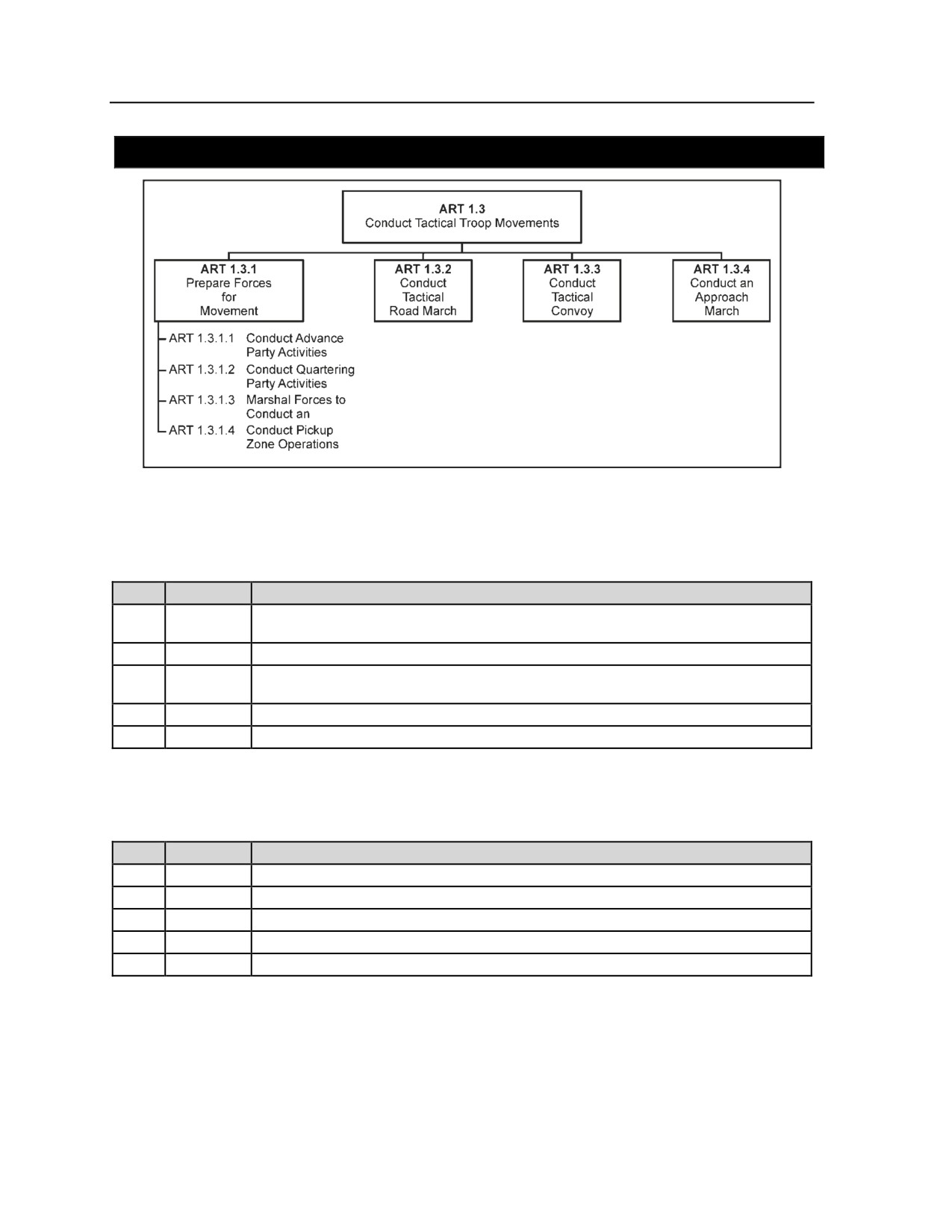
Chapter 1
SECTION III - ART 1.3: CONDUCT TACTICAL TROOP MOVEMENTS
1-46. Relocate or move by any means or mode of transportation preparatory to deploying into combat
formations to support tactical commander and joint force commander plans. Positioning and repositioning
must support the commander’s intent and concept of operation. ART 1.3 includes generating and dispersing
tactical forces. It also includes moving units by military, host-nation, or contracted vehicles. (FM 3-90)
(USACAC)
No.
Scale
Measure
Unit followed the prescribed route at the prescribed speed without deviating unless
01
Yes/No
required otherwise by enemy action or on orders from higher headquarters.
02
Yes/No
Unit crossed and cleared start point and release point at designated time.
Enemy did not surprise the unit’s main body because of a failure to conduct security
03
Yes/No
operations.
04
Percent
Of casualties sustained during the movement.
05
kph
Rate of movement.
ART 1.3.1 PREPARE FORCES FOR MOVEMENT
1-47. Assemble, inspect, and load personnel, equipment, and supplies to prepare for a tactical movement.
(FM 3-90) (USACAC)
No.
Scale
Measure
01
Yes/No
Unit prepared to move at the appointed time and place.
02
Time
To load forces and equipment.
03
Time
To prepare movement orders.
04
Time
To deploy transportation and security forces.
05
Percent
Of forces and equipment loaded within established time requirements.
ART 1.3.1.1 CONDUCT ADVANCE PARTY ACTIVITIES
1-48. Send a detachment ahead of the main body to establish conditions for the main body’s arrival.
Conditions include administrative and logistic actions. (FM 3-35) (CASCOM)
1-24
FM 7-15, C6
18 March 2011
∞ART 1.0: The Movement and Maneuver Warfighting Function
No.
Scale
Measure
The advance party established necessary conditions for the unit main body to conduct
01
Yes/No
and complete the reception, staging, onward movement and integration by time
specified.
02
Yes/No
Advance party arranged to receive the main body.
03
Yes/No
Advance party assisted point of debarkation with discharge operations.
Advance party consisted of battery teams, fuel handlers, drivers, and property book and
04
Yes/No
supply personnel.
Advance party deployed sufficiently in advance of the main body to accomplish its
05
Yes/No
assigned responsibilities.
Unit requested sufficient external transportation support to accomplish assigned
06
Yes/No
responsibilities.
ART 1.3.1.2 CONDUCT QUARTERING PARTY ACTIVITIES
1-49. Secure, reconnoiter, and organize an area for the main body’s arrival and occupation. (FM 3-35)
(CASCOM)
No.
Scale
Measure
Quartering party deployed sufficiently in advance of the main body to accomplish its
01
Yes/No
assigned responsibilities.
Quartering party guided unit main body into position from the release point to precise
02
Yes/No
locations within the assembly area.
03
Yes/No
Quartering party secured the designated assembly area.
Quartering party conducted an area reconnaissance of the designated assembly area
04
Yes/No
per environmental considerations.
Of assembly area (and positions in it) changed from tentative locations selected by unit
05
Distance
commander based on a map reconnaissance.
ART 1.3.1.3 MARSHAL FORCES TO CONDUCT AN AIRBORNE ASSAULT
1-50. Marshaling airborne forces involves conducting the planning, rehearsals, and briefbacks addressed in
ART 5.0. It involves assembling and preparing paratroopers, equipment, and supplies for the jump. It
includes airborne-specific briefings; prejump training; the actual movement of paratroopers, equipment,
and supplies to departure airfields; and loading them into aircraft. (FM 90-26) (USAIS)
No.
Scale
Measure
Unit completed all preparations—such as assembling, organizing, marking, and rigging
unit equipment, rations, ammunition, water, and other supplies—by time specified in
operation order. Preparations also include, but are not limited to, ensuring the cross
01
Yes/No
loading of personnel and key weapon systems, conducting prejump refresher training
and mission rehearsals, and moving to the departure airfield by time specified in
operation order.
02
Yes/No
Unit commander issued warning order and operation order.
03
Yes/No
Unit met station time.
04
Yes/No
Unit met load time.
05
Time
From receiving warning order to completing preparations for airborne operation.
ART 1.3.1.4 CONDUCT PICKUP ZONE OPERATIONS
1-51. Pickup zone operations involve assembling and preparing Soldiers, equipment, and supplies for an
air assault. ART 1.3.1.4 includes conducting air assault-specific briefings and training; moving Soldiers,
equipment, and supplies to pickup zones; and loading into rotary aircraft. (FM 90-4) (USAIS)
18 March 2011
FM 7-15, C6
1-25

Chapter 1
No.
Scale
Measure
01
Yes/No
Unit commander issued warning order and operation order.
Unit adjusted load plan and ground tactical plan to account for less than scheduled
02
Yes/No
amount of aircraft.
03
Yes/No
Unit met load time.
04
Yes/No
Unit maintained local security during loading.
Unit completed all preparations—such as assembling, organizing, marking, and rigging
unit equipment, rations, ammunition, water, and other supplies—by time specified in
operation order. Preparations also include, but are not limited to, ensuring the cross
05
Yes/No
loading of personnel and key weapon systems, conducting air assault refresher training
and mission rehearsals, conducting an air mission brief, and moving to the departure
airfield by time specified in operation order.
Unit released available attack and reconnaissance assets from pickup zone security to
06
Yes/No
perform air route reconnaissance and to establish mobile flank screens for air
movement to landing zones.
07
Time
From receiving warning order to completing preparations for air assault operation.
08
Percent
Of changes in numbers and types of rotary-wing aircraft.
ART 1.3.2 CONDUCT TACTICAL ROAD MARCH
1-52. A tactical road march is a rapid movement used to relocate units within an area of operations in order
to prepare for combat operations. Commanders arrange troops and vehicles to expedite their movement and
conserve time, energy, and unit integrity. They anticipate no interference except by enemy forces, or
sympathizers. Units conducting tactical road marches employ three tactical march techniques: open
column, close column, and infiltration. (FM 3-90) (USACAC)
No.
Scale
Measure
01
Yes/No
Unit crossed and cleared start point and release point at designated times.
Unit followed the prescribed route without deviation unless required otherwise by
02
Yes/No
enemy action or on orders from higher headquarters.
Enemy did not surprise the unit main body through a failure to conduct appropriate
03
Yes/No
security operations.
Unit employed appropriate tactical road march technique (open column, close column,
04
Yes/No
or infiltration).
05
Yes/No
Unit task-organized properly for tactical road march.
06
Time
To initiate movement.
07
Time
To complete movement.
08
Percent
Of force completing the movement.
09
Percent
Of unit casualties.
ART 1.3.3 CONDUCT TACTICAL CONVOY
1-53. Conduct tactical convoys by employing one or a combination of three types of column formations:
open, close, and infiltration. Tactical convoys are combat operations in which forces and materiel are
moved overland from one location on the battlefield to another while maintaining the ability to aggressively
respond to enemy attempts to impede, disrupt, or destroy elements of the convoy. (FM 55-30) (CASCOM)
No.
Scale
Measure
Unit conducted precombat checks and inspections to include unit test fire of all
01
Yes/No
weapons.
02
Yes/No
Unit was equipped with primary and alternate communications.
1-26
FM 7-15, C6
18 March 2011
∞ART 1.0: The Movement and Maneuver Warfighting Function
No.
Scale
Measure
Unit had frequencies for close air support, fires, and medical evacuation and duress
03
Yes/No
frequencies.
04
Yes/No
Unit crossed start point by time specified in operation order.
05
Yes/No
Unit reported crossing start point to higher headquarters.
Unit had constant and uninterrupted internal and external communications throughout
06
Yes/No
the convoy.
07
Yes/No
Unit maintained 360-degree security and situational awareness during the convoy.
Unit conducted rehearsals to react to enemy attack per operation order, battle drill, and
08
Yes/No
standing operating procedures.
Unit rehearsed actions to deal with noncombatants who attempt to pilfer for personal
09
Yes/No
reasons; unit was able to respond passively to these disruptions.
10
Yes/No
Unit identified checkpoints en route and reported crossing checkpoints.
11
Yes/No
Unit maintained visual contact and proper intervals between vehicles.
Forward security element provided the convoy with sufficient reaction time and
12
Yes/No
maneuver space to avoid or react to enemy contact.
13
Yes/No
Unit crossed the release point by time specified in operation order.
14
Yes/No
Unit reported arrival at release point to higher headquarters.
Unit rehearsed special teams, actions on enemy contact, and improvised explosive
15
Yes/No
devices to include medical evacuations and vehicle recovery.
16
Time
To designate and position security teams throughout the convoy.
To designate quick reaction force, special teams for aid and litter, combat lifesaver, and
17
Time
recovery and landing zones.
18
Time
To provide situational reports to higher headquarters.
19
Number
Of types of enemy forces active within area of influence (convoy route).
20
Number
Of enemy actions in the last 30 days (or other selected period).
ART 1.3.4 CONDUCT AN APPROACH MARCH
1-54. Conduct an advance of a combat unit when direct contact with the enemy is intended. An approach
march emphasizes speed over tactical deployment. It is used when the enemy’s approximate location is
known and allows the attacking force to move with greater speed and less physical security or dispersion.
An approach march ends in an attack position, assembly area, or assault position; or it transitions to an
attack. (FM 3-90) (USACAC)
No.
Scale
Measure
Using the approach march allowed the force to move quickly to the area where it
01
Yes/No
expected to make contact with the enemy and transition to an appropriate combat
formation.
02
Yes/No
Unit task-organized properly for approach march.
03
Yes/No
Unit used established control measures and control graphics.
04
Time
To initiate the approach march.
05
Time
To complete the approach march.
06
Time
Between planned and actual unit arrival at checkpoints.
07
Percent
Of force completing the approach march.
08
Percent
Of force maintaining correct interval between units.
Of force using correct movement techniques (traveling, traveling overwatch, and
09
Percent
bounding overwatch).
10
kph
Rate of movement.
18 March 2011
FM 7-15, C6
1-27
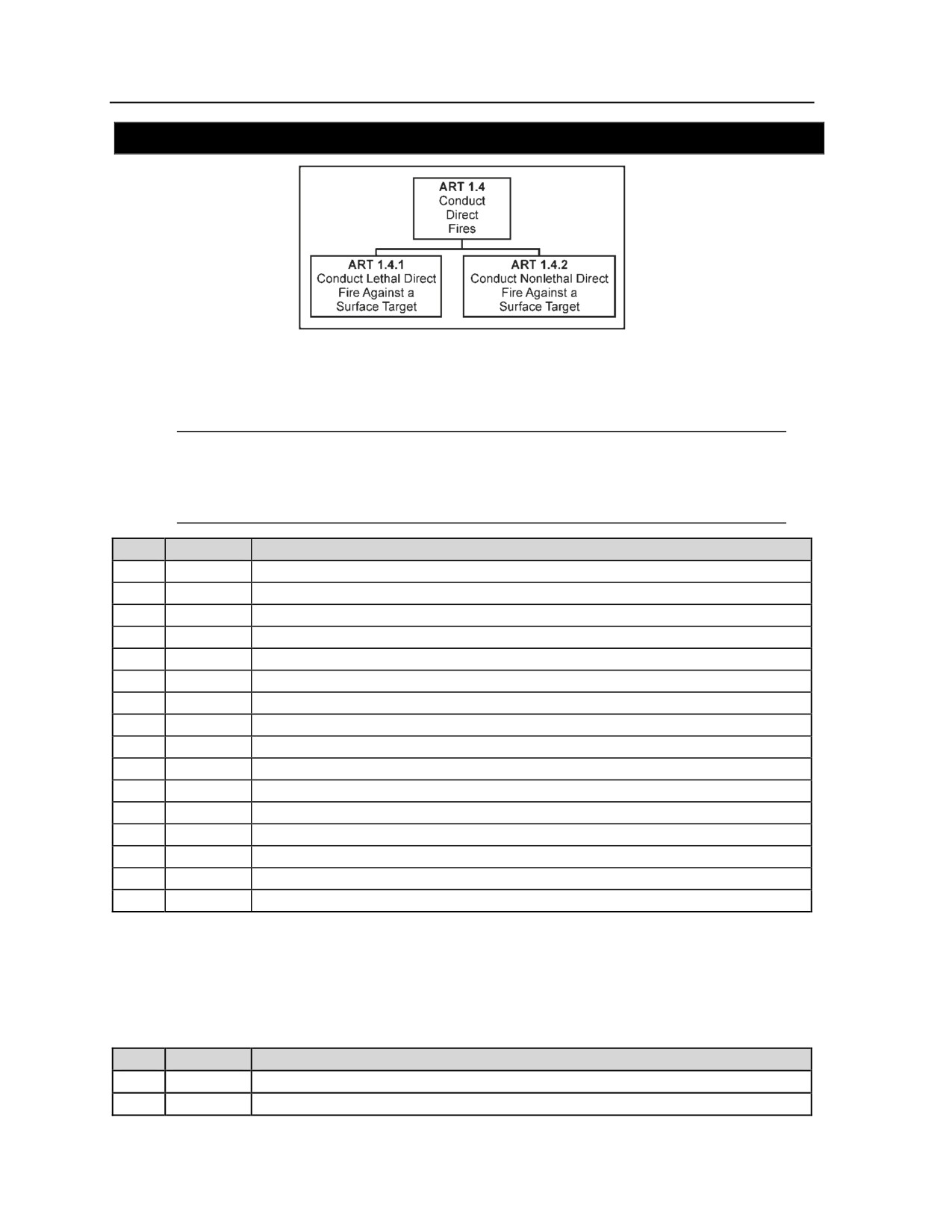
Chapter 1
SECTION IV - ART 1.4: CONDUCT DIRECT FIRES
1-55. Conduct lethal and nonlethal direct fires. Examples of direct-fire systems include small arms, tanks,
antitank weapons, automatic weapons, directed energy, optical, acoustic, and blunt trauma weapons. ART
1.4 includes attack helicopter fires and direct fire tied directly to battlefield movement.
(FM 3-90)
(USACAC)
Note: ART 6.1.2 (Destroy Aerial Platforms) includes the attack of aerial targets.
ART 1.7.1 (Site Obstacles) addresses the elements of direct fire planning, such as the integration
of indirect fires, obstacles and terrain, and air and ground assets with control measures designed
to mass fires.
No.
Scale
Measure
01
Yes/No
Unit direct fires contributed to accomplishing unit mission.
02
Yes/No
Conduct of direct fires done was done per established rules of engagement.
03
Yes/No
Unit used correct weapon to engage target.
04
Time
To get complete attack on direct fire target after detecting and identifying target.
05
Time
To suppress targets.
06
Percent
Of probability of suppressing a target.
07
Percent
Of probability of a hit.
08
Percent
Of probability of a kill given a hit.
09
Percent
Of missions flown and fired to achieve desired target damage.
10
Percent
Of available direct fire weapon systems engaging direct fire targets.
11
Percent
Of direct fire targets not engaged.
12
Percent
Of enemy performance degraded due to direct fire attack.
13
Percent
Of direct fire attacks that result in collateral damage.
14
Percent
Of direct fire attacks that result in friendly or neutral casualties.
15
Number
Of direct fire attacks that result in collateral damage.
16
Number
Of direct fire attacks that result in friendly or neutral casualties.
ART 1.4.1 CONDUCT LETHAL DIRECT FIRE AGAINST A SURFACE
TARGET
1-56. Engage enemy equipment and materiel, personnel, fortifications, and facilities with direct fire
designed to destroy the target. These direct fires may be from fixed- or rotary-wing systems. (FM 3-90)
(USACAC)
No.
Scale
Measure
01
Yes/No
Direct fires contributed to accomplishing unit mission.
02
Yes/No
Direct fire attack was conducted per established rules of engagement.
1-28
FM 7-15, C6
18 March 2011
∞ART 1.0: The Movement and Maneuver Warfighting Function
No.
Scale
Measure
03
Yes/No
Unit used correct weapon to engage target.
04
Time
To get complete attack on direct fire target after detecting and identifying target.
05
Time
To suppress targets.
06
Percent
Of probability of suppressing a target.
07
Percent
Of probability of a hit.
08
Percent
Of probability of a kill given a hit.
09
Percent
Of missions flown and fired to achieve desired target damage.
10
Percent
Of available direct fire weapon systems engaging direct fire targets.
11
Percent
Of direct fire targets not engaged.
12
Percent
Of enemy performance degraded due to lethal direct fire attack.
13
Percent
Of lethal direct fire attacks that result in collateral damage.
14
Percent
Of lethal direct fire attacks that result in friendly or neutral casualties.
15
Number
Of lethal direct fire attacks that result in collateral damage.
16
Number
Of lethal direct fire attacks that result in friendly or neutral casualties.
ART 1.4.2 CONDUCT NONLETHAL DIRECT FIRE AGAINST A
SURFACE TARGET
1-57. Employ nonlethal direct fires to incapacitate threat personnel and materiel without causing
permanent injury or destruction. ART 1.4.2 includes using nonlethal weapons such as directed energy,
blunt trauma, riot control agents, vehicle and vessel arresting devices, and water cannons. (FM 3-19.15)
(USAMPS)
No.
Scale
Measure
01
Yes/No
Direct fires contributed to accomplishing the unit mission.
Conduct of nonlethal direct fires against surface target was done per rules of
02
Yes/No
engagement, to include receipt of the approval of weapons released from a competent
authority.
03
Time
To develop nonlethal direct fire options after receiving warning order.
04
Time
To complete nonlethal direct fire attack on target (after initiation).
05
Percent
Of all targets evaluated as candidates for nonlethal direct fire attack.
06
Percent
Of nonlethal direct fire attacks on selected targets that achieve desired effect.
07
Percent
Of nonlethal direct fire attacks without lethal results.
Of nonlethal direct fire attacks that require lethal fires to achieve desired operational
08
Percent
effects.
09
Percent
Of nonlethal direct fire attacks that result in result in collateral damage.
Of threat actions that are denied, stopped, moved, diverted, suppressed, and/or
10
Percent
disabled due to nonlethal direct fire attack.
11
Percent
Of nonlethal direct fire attacks that result in friendly or neutral casualties.
12
Number
Of nonlethal direct fire attacks that result in friendly or neutral casualties.
13
Number
Of nonlethal direct fire attacks that result in collateral damage.
18 March 2011
FM 7-15, C6
1-29
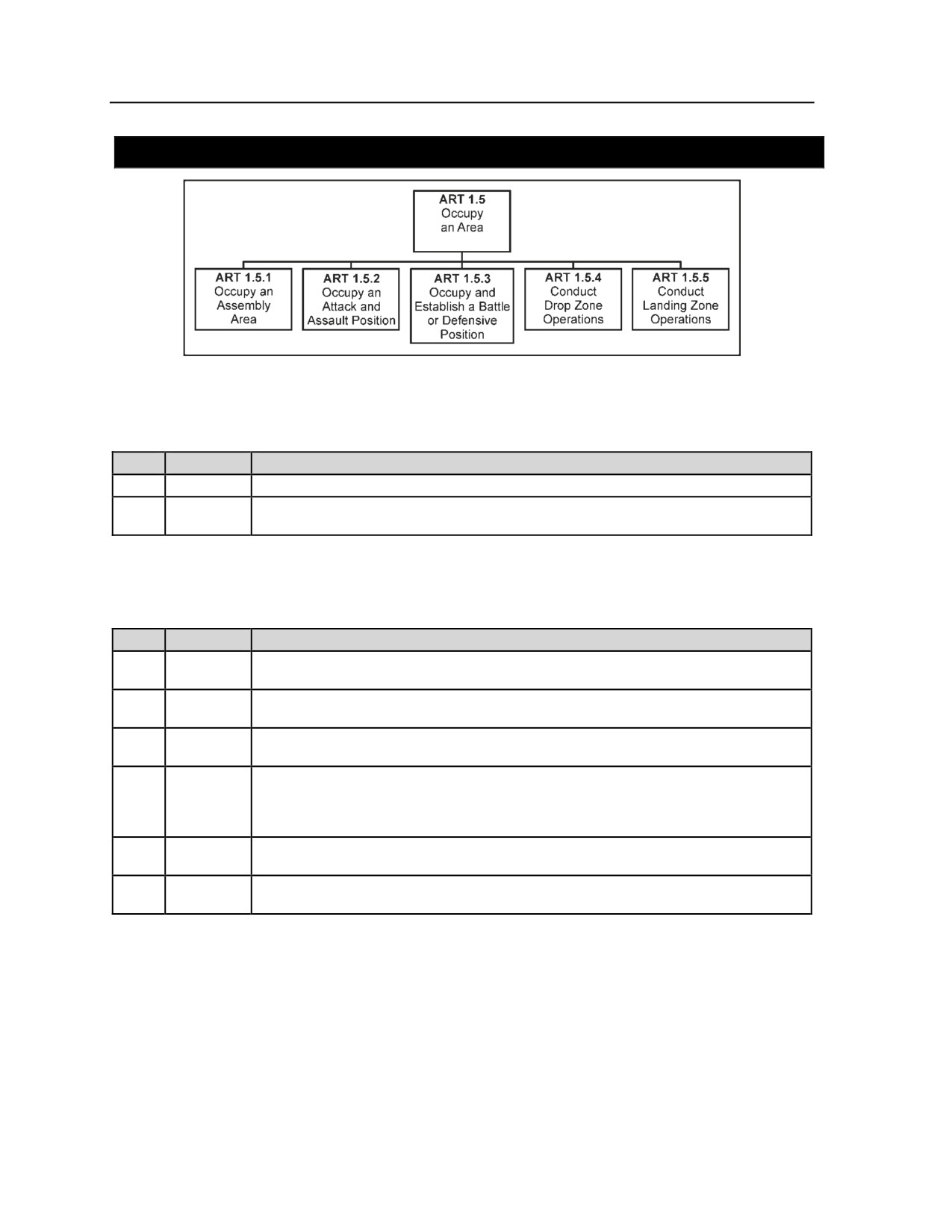
Chapter 1
SECTION V - ART 1.5: OCCUPY AN AREA
1-58. Move forces into and secure an area from which to conduct future operations. This task includes
occupying assembly areas; occupying attack or assault positions; and establishing and occupying defensive
positions, including the five types of battle positions: primary, alternate, supplementary, subsequent, and
strong point. (FM 3-90) (USACAC)
No.
Scale
Measure
01
Yes/No
Unit controlled the area so the enemy could not use the area.
Personnel and essential equipment were in assigned positions by time specified in
02
Yes/No
operation order.
ART 1.5.1 OCCUPY AN ASSEMBLY AREA
1-59. Move forces into and occupy an assembly area in which to assemble and prepare for further action.
Actions include resupplying and organizing forces for future operations. (FM 3-90) (USACAC)
No.
Scale
Measure
Unit moved into and occupied an assembly area in which it assembles and prepares for
01
Yes/No
further action by time specified in operation order.
Unit forced enemy reconnaissance elements to withdraw without allowing penetration of
02
Yes/No
the assembly area perimeter.
The enemy did not surprise the unit main body through a failure to conduct security
03
Yes/No
operations.
Unit dispersed its forces appropriately; used cover and concealment; and designated
entrances, exits, and internal routes per the factors of mission, enemy, terrain and
04
Yes/No
weather, troops and support available, time available, civil considerations to include
drainage and soil conditions per environmental considerations.
All personnel and essential equipment moved into assigned initial defensive positions
05
Yes/No
by time specified in operation order.
Unit completed preparations for next operation per commander’s intent by time
06
Yes/No
specified in operation order.
ART 1.5.2 OCCUPY AN ATTACK AND ASSAULT POSITION
1-60. As part of an offensive operation, move tactical forces into and through these positions to prepare for
further action or support actions of another force. Activities include making last-minute coordination and
tactical adjustments, preparing specialized equipment for immediate use, and protecting the occupying
force until supporting fire is lifted or shifted. This task includes the use of attack-by-fire and support-by-fire
positions and holding areas by attack helicopters. (FM 3-90) (USACAC)
1-30
FM 7-15, C6
18 March 2011
∞ART 1.0: The Movement and Maneuver Warfighting Function
No.
Scale
Measure
Unit occupied attack and assault positions only as necessary to ensure the attack’s
01
Yes/No
success.
02
Yes/No
Unit cleared these positions of enemy forces.
03
Yes/No
The enemy did not surprise the unit main body.
All personnel and essential equipment moved into assigned positions by time specified
04
Yes/No
in operation order.
Unit completed attack and assault preparations per commander’s intent and the factors
05
Yes/No
of mission, enemy, terrain and weather, troops and support available, time available,
civil considerations.
ART 1.5.3 OCCUPY AND ESTABLISH A BATTLE OR DEFENSIVE
POSITION
1-61. As part of a defensive operation, move tactical forces into positions to prepare for further action. A
battle position is a defensive location oriented on a likely enemy avenue of approach. Five kinds of battle
positions exist: primary, alternate, supplementary, subsequent, and strongpoint. The positions may be
located on any type of land and terrain, such as urban, natural, mountainous, piedmont, steppe, delta,
desert, jungle, and arctic. (See CJCSM 3500.04E condition C 1.0 for factors that describe the physical
environment.) (FM 3-90) (USACAC)
Note: ART 1.7.1 (Site Obstacles) addresses defensive planning.
No.
Scale
Measure
01
Yes/No
Unit can conduct a coherent defense from its positions.
02
Yes/No
Unit cleared enemy forces from the defended area.
03
Yes/No
The enemy did not surprise the unit main body.
All personnel and essential equipment moved into assigned positions by time specified
04
Yes/No
in operation order.
05
Yes/No
Unit was prepared to defend by the time specified in operation order.
06
Percent
Of acceptable friendly losses.
07
Number
Of casualties from friendly fire.
ART 1.5.4 CONDUCT DROP ZONE OPERATIONS
1-62. ART 1.5.4 begins when paratroopers and equipment exit the aircraft by parachute or airland. ART
1.5.4 ends when all elements of the relevant airborne echelon arrive in the objective area. (FM 90-26)
(USAIS)
No.
Scale
Measure
Unit assembled according to its landing plan (on the objective, on the drop zone, or in
01
Yes/No
an assembly area adjacent to the drop zone) and began to execute the ground tactical
plan by time specified in operation order.
02
Yes/No
Enemy forces were unable to engage forces landing on the drop zone.
Security positions were positioned around drop zone until completion of vertical
03
Yes/No
envelopment.
Unit cleared drop zone of equipment and debris for use by follow-on forces or future
04
Yes/No
airland operations.
To conduct map or physical reconnaissance of site to ensure that the drop zone
05
Time
supports operational requirements, such as acceptable degree of slope, surface
conditions, appropriate size, and free of obstacles.
18 March 2011
FM 7-15, C6
1-31

Chapter 1
No.
Scale
Measure
To clear or mark obstacles such as stumps, fences, and barbed wire located on the
06
Time
drop zone.
07
Time
To ensure drop zone approach and exit paths are free of obstructions.
08
Time
To mark the drop zone.
09
Time
For pathfinder elements to establish communications with follow-on aircraft.
10
Time
For pathfinder elements to confirm or determine drop heading with aircrew.
Of dropped and airlanded aircraft loads under control of a ground station located on or
11
Percent
near the drop zone.
12
Percent
Of airborne unit personnel and cargo drops landing in the drop zone.
13
Number
Of personnel landing in the drop zone.
Of tons and types of cargo landing in the drop zone or that the airborne unit can
14
Number
recover.
Of casualties from accidents caused by conditions on the drop zone, such as wind
15
Number
speed, obstacles, and surface conditions.
ART 1.5.5 CONDUCT LANDING ZONE OPERATIONS
1-63. ART 1.5.5 begins when Soldiers and equipment exit the helicopters. It does not include air traffic
control or efforts to improve the landing zone. ART 1.5.5 ends when all elements of the relevant air assault
echelon arrive in the objective area. (FM 90-4) (USAIS)
No.
Scale
Measure
Unit assembled according to its landing plan (on the objective, on the landing zone, or
01
Yes/No
in an assembly area adjacent the landing zone) and began to execute the ground
tactical plan by time specified in operation order.
Security positioned around landing zone occupied zone until completion of the vertical
02
Yes/No
envelopment process.
Unit cleared landing zone of equipment and debris for use by follow-on forces or future
03
Yes/No
airland operations.
To conduct map or physical reconnaissance of site to ensure that landing zone
supports operational requirements, such as acceptable degree of slope, surface
04
Time
conditions, appropriate size to accommodate the helicopters delivering the force, and
free of obstacles.
05
Time
To clear or mark obstacles such as stumps and fences located on the landing zone.
06
Time
To ensure landing zone approach and exit paths are free of obstructions.
07
Time
To mark the landing zone.
08
Percent
Of air assault unit personnel and cargo landing in the landing zone.
09
Number
Of personnel landing on the landing zone.
10
Number
Of tons and types of cargo landing on the landing zone.
Of casualties from accidents caused by landing zone conditions, such as foreign object
11
Number
damage and hidden obstacles.
1-32
FM 7-15, C6
18 March 2011
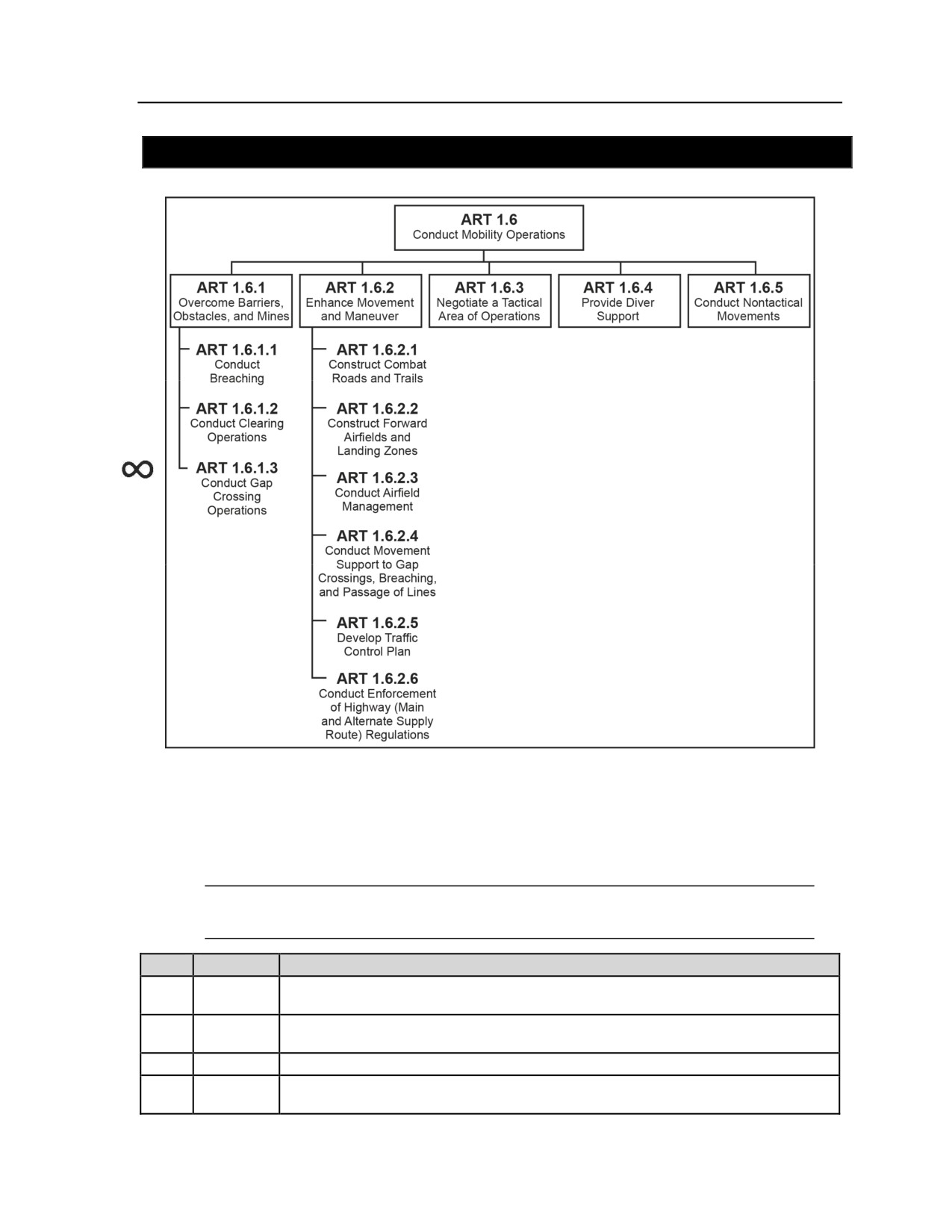
∞ART 1.0: The Movement and Maneuver Warfighting Function
SECTION VI - ART 1.6: CONDUCT MOBILITY OPERATIONS
1-64. Maintain freedom of movement for personnel and equipment in an area of operations without delays
due to terrain or barriers, obstacles, and mines. Mobility operations preserve the freedom of maneuver of
friendly forces. Mobility tasks include breaching, clearing, or crossing obstacles; increasing battlefield
circulation; improving or building roads; providing bridge and raft support; and identifying routes around
contaminated areas. Countermobility denies mobility to enemy forces. It limits the maneuver of enemy
forces and enhances the effectiveness of fires. (FM 3-90.12) (USAES)
Note: The term “breaching system” used in this section includes both manual and mechanical
means.
No.
Scale
Measure
Terrain, barriers, and obstacles were overcome within the period the operation order
01
Yes/No
specifies.
Commander coordinated with higher, adjacent, supported, and supporting units to
02
Yes/No
maintain freedom of movement in the area of operations.
03
Time
That terrain, barriers, obstacles, and mines delay movement of friendly forces.
To conduct route, zone, and area reconnaissance to determine terrain trafficability and
04
Time
the location and boundaries of barriers, obstacles, and minefields.
18 March 2011
FM 7-15, C6
1-33
Chapter 1
No.
Scale
Measure
After discovery for staff to disseminate terrain trafficability and barrier, obstacles, and
05
Time
mine data to higher headquarters, laterally, and subordinate units.
To conduct successful execution of breach fundamentals—suppress, obscure, secure,
06
Time
reduce, and assault—at the obstacle.
07
Time
To reduce lanes through obstacles.
To complete mobility activities that improve the unit’s capability to cross the terrain,
08
Time
such as applying a rock layer to a combat road and cutting down trees to make a trail.
09
Time
To complete minefield reduction.
10
Time
To move breaching equipment to breach site.
11
Percent
Of obstacles in the area of operations that have been breached.
12
Percent
Of breaching systems that are mission capable.
13
Percent
Of completed engineer efforts designed to enhance the unit’s capability to cross terrain.
14
Number
Of breaching systems that are mission capable.
15
Number
Of friendly and neutral casualties during mobility enhancing activities.
ART 1.6.1 OVERCOME BARRIERS, OBSTACLES, AND MINES
1-65. Enable a force to maintain its mobility by reducing, bypassing, or clearing obstacles. An obstacle is
any obstruction designed or employed to disrupt, fix, turn, or block the movement of an opposing force,
and to impose additional losses in personnel, time, and equipment on the opposing force. Obstacles can be
natural or man-made, or a combination of both. Naturally existing obstacles can include rivers, mountains,
barrier reefs, and cities. Man-made or reinforcing obstacles can include minefields and antitank ditches. A
complex obstacle is a combination of different types of individual obstacles that requires more than one
reduction technique (explosive, mechanical, or manual) to create a lane through the obstacle. A reinforcing
obstacle is an obstacle that is specifically constructed, emplaced, or detonated through military effort.
(FM 3-90.12) (USAES)
No.
Scale
Measure
01
Yes/No
Unit overcame obstacles and barriers by time specified in operation order.
02
Time
That enemy-emplaced obstacles delay friendly force movement.
For staff to disseminate barrier, obstacle, and mine data to subordinate units, higher
03
Time
headquarters, and laterally after discovery.
To conduct reconnaissance of obstacle focused on answering obstacle intelligence
information requirements—obstacle location, length, width, and depth; obstacle
04
Time
composition (such as wire and mines by type); soil conditions; locations of lanes and
bypasses; and the location of enemy direct fire systems.
To conduct successful execution of breach fundamentals—suppress, obscure, secure,
05
Time
reduce, and assault—at the obstacle.
06
Time
To reduce lane through obstacles.
07
Time
To complete mine clearing.
08
Time
To move breaching equipment to breach site.
09
Time
To reduce underwater obstacles at crossing sites.
10
Percent
Of obstacles in the area of operations that have been breached.
11
Percent
Of breaching systems that are mission capable.
12
Number
Of breaching systems that are mission capable.
13
Number
Of friendly and neutral casualties caused by detonation of mines or explosives.
1-34
FM 7-15, C6
18 March 2011
∞ART 1.0: The Movement and Maneuver Warfighting Function
ART 1.6.1.1 CONDUCT BREACHING OPERATIONS
1-66. Conduct a combined arms operation to project combat power to the far side of an obstacle. Breaching
tenets include intelligence, synchronization, mass, breach fundamentals (suppress, obscure, secure, reduce,
and assault), and breach organization (support, assault, and breach forces). ART 1.6.1.1 includes the
reduction of minefields and other obstacles. Reduction is the creation of lanes through or over an obstacle
to allow an attacking force to pass. The number and width of lanes created varies with the enemy situation,
the assault force’s size and composition, and the concept of operations. The lanes must allow the assault
force to rapidly pass through the obstacle. The breach force will reduce, proof (if required), mark, and
report lane locations and the land-marking method to higher headquarters. Follow-on units will further
reduce or clear the obstacle when required. (FM 3-90.12) (USAES)
No.
Scale
Measure
01
Yes/No
Unit completed breaching operation by time specified in the operation order.
For staff to disseminate barrier, obstacle, and mine data to subordinate units, higher
02
Time
headquarters, and laterally after discovery.
03
Time
That enemy-emplaced obstacles delay friendly force movement.
04
Time
To conduct reconnaissance of barriers, obstacles, and minefields.
To conduct successful execution of breach fundamentals—suppress, obscure, secure,
05
Time
reduce, and assault—at the obstacle.
06
Time
To reduce lane through obstacles (one lane per assault company, two lanes per task force).
07
Time
To move breaching equipment to breach site.
08
Percent
Of obstacles in the area of operations that have been breached.
09
Percent
Of breaching systems that are mission capable.
10
Number
Of lanes opened by the breaching operation.
11
Number
Of breaching systems that are mission capable.
12
Number
Of friendly and neutral casualties caused by detonation of explosives.
ART 1.6.1.2 CONDUCT CLEARING OPERATIONS
1-67. Clearing operations (area or route clearance) are conducted to enable the use of a designated area or
route. Clearing is the total elimination or neutralization of an obstacle (to include explosives hazard) or
portions of an obstacle. Clearing operations are typically not conducted under fire and may be performed
after a breaching operation where an obstacle is a hazard or hinders friendly movement or occupation of a
location. ART 1.6.1.2.1 (Conduct Area Clearance) focuses on obstacle clearance of a designated area and is
typically not a combined arms operation. ART 1.6.1.2.2 (Conduct Route Clearance)focuses on obstacle
clearance along a specific route, typically conducted as a combined arms operation, and may be performed
in situations where enemy contact is likely. (FM 3-90.12) (USAES)
No.
Scale
Measure
01
Yes/No
Unit completed obstacle clearance mission by time specified in operation order.
02
Yes/No
Unit conducted emergency de-mining and unexploded explosive ordnance removal.
03
Yes/No
Unit conducted mapping and survey exercises of mined areas.
04
Yes/No
Unit marked minefields.
Unit identified and coordinated emergency de-mining and unexploded explosive
05
Yes/No
ordnance removal requirements.
06
Yes/No
Unit established priorities and conducted de-mining operations.
07
Yes/No
Unit initiated large-scale de-mining and unexploded explosive ordnance removal operations.
For staff to disseminate obstacle data to subordinate units, higher headquarters, and
08
Time
laterally after discovery.
18 March 2011
FM 7-15, C6
1-35
Chapter 1
No.
Scale
Measure
To conduct reconnaissance of obstacle focused on answering obstacle intelligence
information requirements—obstacle location, length, width, and depth; obstacle
09
Time
composition (such as wire, mines by type); soil conditions; locations of lanes and
bypasses; and the location of enemy direct fire systems.
10
Time
To plan how to clear the obstacle.
11
Time
To clear the obstacles.
12
Time
To move equipment to the area where the clearance mission takes place.
13
Percent
Of obstacle that has been removed or neutralized.
14
Percent
Of systems committed to the clearance mission that are mission capable.
15
Number
Of lanes opened by the reducing operation.
16
Number
Of systems that are mission capable.
17
Number
Of friendly and neutral casualties during the clearance mission.
ART 1.6.1.2.1 Conduct Area Clearance
1-68. Area clearance is the total elimination or neutralization of an obstacle or portions of an obstacle in a
designated area. (FM 3-90.12) (USAES)
No.
Scale
Measure
01
Yes/No
Unit completed area clearance mission by time specified in operation order.
02
Time
That obstacles delay friendly force movement.
For staff to disseminate obstacle data to subordinate units, to higher headquarters, and
03
Time
laterally after discovery.
04
Time
To conduct area reconnaissance.
05
Time
To plan how to clear the area.
06
Time
To clear the area.
07
Time
To move equipment to the area where the clearance mission takes place.
08
Percent
Of area that has been cleared.
09
Percent
Of systems committed to the clearance mission that are mission capable.
10
Number
Of area clearance systems that are mission capable.
11
Number
Of friendly and neutral casualties during the area clearance mission.
ART 1.6.1.2.2 Conduct Route Clearance
1-69. A route clearance is a combined arms operation conducted to remove mines and other obstacles
along preexisting roads and trails. (FM 3-90.12) (USAES)
No.
Scale
Measure
01
Yes/No
Unit accomplished route clearance by time specified in operation order.
02
Yes/No
Unit dismantled roadblocks and established checkpoints.
03
Time
That obstacles along the route delay the friendly force movement.
For staff to disseminate obstacle data to subordinate units, higher headquarters, and
04
Time
laterally after discovery.
05
Time
To conduct route reconnaissance.
06
Time
To plan how to clear the route.
07
Time
To clear the route.
To move equipment from its current location to the route where the clearance mission
08
Time
takes place.
09
Time
To establish security along portion of the route being cleared.
1-36
FM 7-15, C6
18 March 2011
∞ART 1.0: The Movement and Maneuver Warfighting Function
No.
Scale
Measure
10
Percent
Of route cleared by time specified in operation order.
11
Percent
Of systems committed to route clearance that are mission capable.
Of increase in transportation and maneuver efficiency due to the completion of route
12
Percent
clearance mission.
13
Number
Of obstacles along the route that have been cleared.
14
Number
Of breaching systems that are mission capable.
15
Number
Of friendly and neutral casualties during the route clearance mission.
ART 1.6.1.3 CONDUCT GAP CROSSING OPERATIONS
1-70. A gap crossing operation is a combined arms operation to project combat power across a linear
obstacle. The obstacle is linear in that it creates a line crossing all or a significant portion of the area of
operations. The obstacle can be wet gap (water obstacle) or dry gap that is too wide to overcome by self-
bridging. The nature of the obstacle differentiates a gap crossing from a breaching operation. A wet gap
crossing (river crossing) is also unique because the water obstacle is significantly large enough to prevent
normal ground maneuver. A gap crossing generally requires special planning and support. Mission, enemy,
terrain and weather, troops and support available, time available, civil considerations factors dictate the
type of crossing (hasty, deliberate, or retrograde). Gap crossing generally includes preparing access and
egress routes, completing a hydrographic survey (underwater obstacle detection or reduction), employing
crossing means (bridging and rafts), and operating an engineer regulating point if required. This task is
measured against a river crossing, the most difficult standard of gap crossing operation. Crossing
fundamentals include surprise, extensive preparation, a flexible plan, traffic control, organization, and
speed. Gap crossings may be conducted in support of combat maneuver or in support of lines of
communication. (FM 3-90.12) (USAES)
Note: The engineer bridge, raft, and assault boat systems percentages in this task apply to the
individual ribbon bridge bays and rafts, and to individual assault boats and not to a ribbon or
assault bridge set as a whole.
No.
Scale
Measure
01
Yes/No
Unit accomplished gap crossing by time specified in operation order.
02
Time
That the gap or obstacle delays friendly force movement.
03
Time
To conduct area reconnaissance of the terrain surrounding the gap.
04
Time
To plan the gap crossing.
For staff to disseminate data concerning the gap to subordinate units, higher
05
Time
headquarters, and laterally after determination.
06
Time
For underwater reconnaissance to be performed by dive team.
07
Time
To move engineer bridging equipment to the crossing site.
To establish conditions necessary for success, such as suppressing enemy systems
08
Time
overwatching the river, breaching minefields and other obstacles barring access to the
riverbanks, and preparing access and egress routes.
09
Time
To emplace and construct crossing assets.
10
Time
To complete gap crossing.
11
Percent
Of crossing unit that has moved to the far shore of the gap.
12
Percent
Of engineer bridge, raft, and assault boat systems that are mission capable.
13
Percent
Of crossing area seeded with obstacles if conducting a retrograde crossing.
14
Number
Of bridges and crossing sites established.
15
Number
Of engineer bridge, raft, and assault boat systems that are mission capable.
16
Number
Of friendly casualties due to accidents and enemy action during the river crossing.
18 March 2011
FM 7-15, C6
1-37

Chapter 1
No.
Scale
Measure
17
Number
Of obstacles emplaced in the crossing area, if conducting a retrograde crossing.
18
Rate
Per hour that personnel, tactical, and combat vehicles can cross the river.
ART 1.6.1.3.1 Conduct Gap Crossing in Support of Combat Maneuver
1-71. Conduct gap crossing in support of combat maneuver includes both hasty and deliberate gap
crossings and the majority of river crossing operations. It includes both those operations conducted
primarily at the brigade combat team level and those conducted by the division or corps level organization.
Those gap crossings conducted as a reduction method within a combined arms breaching operation are also
included in this art, but since the primary focus of planning and preparation is on the breaching operation
they are typically discussed as a part of the breaching operation rather than as a separate gap crossing
operation in that context. (FM 3-90.12) (USAES)
No
Scale
Measure
01
Yes/No
Unit accomplished gap crossing by time specified in operation order.
02
Time
That the gap or obstacle delays friendly force movement.
03
Time
To conduct area reconnaissance of the terrain surrounding the gap.
04
Time
To plan the gap crossing.
For staff to disseminate data concerning the gap to subordinate units, to higher
05
Time
headquarters, and laterally after determination.
06
Time
To move engineer bridging equipment to the crossing site.
To establish conditions necessary for success, such as suppressing enemy systems
07
Time
over watching the river, breaching minefields and other obstacles barring access to the
riverbanks, and preparing access and egress routes.
08
Time
To emplace and construct crossing assets.
09
Time
To complete gap crossing.
10
Percent
Of crossing unit that has moved to the far side of the gap.
11
Percent
Of engineer bridge, raft, and assault boat systems that are mission capable.
12
Percent
Of crossing area seeded with obstacles if conducting a retrograde crossing.
13
Number
Of crossing area seeded with obstacles if conducting a retrograde crossing.
14
Number
Of engineer bridge, raft, and assault boat systems that are mission capable.
15
Number
Of friendly casualties due to accidents and enemy action during the gap crossing.
ART 1.6.1.3.2 Conduct Line of Communications Gap Crossing Support
1-72. Conduct line of communications (LOC) gap crossing support is not tactically focused, although it
may clearly affect tactical operations. This support may provide the means for combat maneuver forces to
move, but it is not directly in support of combat maneuver. As the title implies this is focused on ultimately
using nonstandard bridging. Both assault and tactical bridging is designed to support the flow of traffic
requirements (number of passes) of LOCs. (FM 3-90.12) (USAES)
Note: For construction and maintenance or roads and highways, see ART 1.6.2.1 (Construct and
Maintain Combat Roads and Trails).
No
Scale
Measure
Unit constructed or maintained adequate bridging for a given LOC road within the
01
Yes/No
timeframe of the construction directive without degrading or delaying movement along
the LOC.
02
Yes/No
Unit developed detailed plans for all necessary gap crossings.
1-38
FM 7-15, C6
18 March 2011

∞ART 1.0: The Movement and Maneuver Warfighting Function
No
Scale
Measure
Unit inspected project for quality control and ensured gap crossings were completed on
03
Yes/No
time and to appropriate standards.
To conduct reconnaissance to determine how the local environment will affect the
04
Time
bridging.
05
Time
To conduct underwater inspection to support the bridging for a wet gap crossing.
To review available information in construction directive, intelligence reports, and site
06
Time
investigation to develop an operation plan or operation order.
To plan the bridging requirements including construction estimate, construction
07
Time
directive, and quality control.
08
Time
To prepare a bridging estimate.
09
Time
To prepare a bridging construction directive and issue it to the construction units.
10
Time
To coordinate additional personnel, equipment, and critical items.
11
Time
To monitor construction and conduct quality assurance inspections.
12
Time
To perform final inspection of finished bridging and turn it over to the user.
13
Time
To construct and maintain bridging.
That scheduled arrivals in area of operations (AO) are delayed on the average due to
14
Time
interruptions in roads and highways by combat actions or natural disasters.
Difference between planned and actual requirements for bridging construction and
15
Percent
maintenance requirements.
Of force becoming casualties due to enemy action or accidents during bridging
16
Percent
construction and repair.
Increase in the carrying capability of a road or highway due to bridging construction and
17
Percent
maintenance.
18
Percent
Of planned bridging construction and maintenance capability achieved in AO.
19
Percent
Of personnel in AO required to construct and maintain bridging.
20
Percent
Of bridging construction and repair capability provided by host nation.
21
Percent
Of existing bridging in AO improved.
Of bridging in AO that can be used in their current condition by military load
22
Percent
classification.
Of unit operations degraded, delayed, or modified in AO due to bridge or gap
23
Percent
impassability.
24
Number
Of bridges in the AO damaged by enemy fire or natural disaster.
25
Number
Of bridges in the AO requiring construction and maintenance in AO.
26
Number
Of bridges constructed and improved in AO.
27
Number
Of meters of bridging constructed and improved in AO in a specified time.
Of instances of delays in scheduled arrivals due to interruption of bridging in AO by
28
Number
combat actions or natural disaster.
Of instances in which troop movement or sustaining operations were prevented due to
29
Number
bridge or gap impassability.
30
Number
Of bridging maintenance inspections conducted per month in AO.
∞ART 1.6.2 ENHANCE MOVEMENT AND MANEUVER
1-73. Enhance movement and maneuver to increase the freedom of action of the maneuver force by
proactively applying all available means. This may include mobility operations; traffic control measures
and traffic regulation enforcement; inherent sustainment requirements; explosive ordnance disposal
support; route improvement and clearing, marking, or signing; and chemical, biological, radiological, and
nuclear support. Environmental considerations are applied as appropriate. (FM 3-90.31) (MSCoE)
18 March 2011
FM 7-15, C6
1-39

Chapter 1
ART 1.6.2.1 CONSTRUCT COMBAT ROADS AND TRAILS
1-74. Prepare and maintain routes for equipment and personnel. ART 1.6.2.1 includes delineating routes,
conducting reconnaissance, clearing ground cover, performing earthwork, providing drainage, stabilizing
soil, and preparing the road surface for transit by Army combat and tactical vehicles. (FM 3-90.12)
(USAES)
No.
Scale
Measure
Unit completed combat road and trail construction or maintenance operation by time
01
Yes/No
specified in operation order.
To respond to an event (natural disaster or combat activity) that impacts existing
02
Time
combat roads and trails.
That the preparation and execution of unit operations are delayed due to a natural
03
Time
disaster or combat activity that impacts the unit’s capability to use a combat road or
trail.
To conduct area reconnaissance of location where the construction and repair of
04
Time
combat roads and trails will take place.
For staff to disseminate reconnaissance results to subordinate units, to higher
05
Time
headquarters, and laterally after discovery.
06
Time
To plan the construction and maintenance of combat roads and trails.
To establish the conditions necessary for success of the construction and maintenance
07
Time
effort, such as establishing security, gaining permission from local authorities for
construction, and obtaining supplies—gravel, sand, and soil stabilization systems.
08
Time
To move mobility enhancing systems to the work site.
09
Time
To construct, improve, and repair the required combat roads and trails.
Of movement between given points reduced due to the construction and maintenance
10
Time
of combat roads and trails.
11
Percent
Of combat roads and trails construction and maintenance operations completed.
Of reduction in speed of vehicles traversing existing combat roads and trails due to
12
Percent
existing environmental conditions, such as snow, ice, and grade.
Of mobility enhancing systems available to the tactical force commander that are
13
Percent
committed to the task.
14
Percent
Of increase in movement time during the actual repair of combat roads and trails.
15
Percent
Of decreased movement time due to construction of combat roads and trails.
16
Number
Of mobility enhancing systems that are mission capable.
Of friendly and neutral casualties during the combat roads and trails construction and
17
Number
maintenance operation.
18
Number
And type of vehicles unable to traverse existing terrain, combat roads, and trails.
And type of vehicles able to traverse combat roads and trails after their construction
19
Number
and maintenance.
Of necessary and unnecessary environmentally harmful incidents, such as petroleum
20
Number
spills in watersheds and soil spills into fish habitats.
ART 1.6.2.2 CONSTRUCT FORWARD AIRFIELDS AND LANDING ZONES
1-75. Prepare and maintain landing zones and landing strips to support Army and joint aviation ground
facility requirements. (FM 3-90.12) (USAES)
No.
Scale
Measure
Unit completed forward airfield and landing zone construction and maintenance effort
01
Yes/No
by time specified in operation order.
To respond to an event (natural disaster or combat activity) that negatively impacts the
02
Time
capability of existing forward airfields and landing zones.
1-40
FM 7-15, C6
18 March 2011
∞ART 1.0: The Movement and Maneuver Warfighting Function
No.
Scale
Measure
That the preparation and execution of unit operations are delayed due to a natural
03
Time
disaster or combat activity that negatively impacts a unit’s use of existing forward
airfields and landing zones.
To conduct an area reconnaissance of the current location of forward airfields and
04
Time
landing zones that have been negatively impacted due to an event or of proposed
locations for forward airfields and landing zones.
For the staff to format and disseminate information obtained by the area
05
Time
reconnaissance to subordinate units, to higher headquarters, and laterally.
06
Time
To plan for the construction and repair of forward airfields and landing zones.
To establish the conditions necessary for success of the construction and repair effort,
07
Time
such as establishing security, gaining permission from local authorities, and obtaining
supplies—gravel, sand, airfield mats, and soil stabilization systems.
08
Time
To move mobility enhancing systems to the work site.
09
Time
To complete construction and repair of the forward airfield or landing zone.
Of reduction in forward airfield and landing zone capacity due to existing environmental
10
Percent
conditions, such as snow, ice, and fog.
11
Percent
Of forward airfield and landing zone construction and repair completed.
Of mobility enhancing systems available to the tactical force commander that are
12
Percent
committed to the task.
Of increase in capacity of unit forward airfields and landing zones due to completion of
13
Percent
the construction and repair effort.
Of forward airfields and landing zones in the area of operations (AO) with approaches
14
Percent
compatible with Army fixed-wing operational support aircraft.
Of forward airfields and landing zones in the AO with navigational aids allowing for
15
Percent
landings in bad weather.
16
Distance
Between existing and proposed forward airfields and landing zones.
17
Number
Of mobility enhancing systems that are mission capable.
18
Number
And types of aircraft unable to use existing forward airfields and landing zones.
And types of aircraft able to use forward airfields and landing zones after the
19
Number
construction and maintenance of those zones.
And types of aircraft able to use forward airfields and landing zones simultaneously—
20
Number
maximum on ground—after the construction and repair of those zones.
Of friendly and neutral casualties during the construction and repair of forward airfields
21
Number
and landing zones due to accidents and enemy actions.
Of necessary and unnecessary environmentally harmful incidents, such as petroleum
22
Number
spills in watersheds and soil and spills into fish habitats.
∞ART 1.6.2.3 CONDUCT AIRFIELD MANAGEMENT
1-76. Airfield management enhances operational maneuver by synchronizing airfield construction and
repair efforts, identifying and marking unexploded ordnance, coordinating for explosive ordnance disposal
support, mitigating aviation risk and ensuring the airfield environment is safe to operate from, directing
airfield support operations, processing notices to airmen, implementing airfield operational procedures, and
enabling the creation and protection of airspace for aviation forces to operate within. Airfield management
enhances the speed, safety, sustainability, and survivability of aircraft and aircrews, and ensures successful
mission completion. Army airfield management forces must seamlessly integrate joint, multinational, and
host-nation policies and procedures to ensure the safe and expeditious operation of aircraft within the
operational environment. AR 95-2 discusses airfield management on depth. (FM 3-04.300) (USAACE)
18 March 2011
FM 7-15, C6
1-41
Chapter 1
No.
Scale
Measure
Unit identified key airfields and airfield management forces have conducted planning
01
Yes/No
using the movement and maneuver objectives of occupying forces.
Initial planning efforts revealed airfield support requirements to enhance the movement
02
Yes/No
and maneuver of forces.
03
Yes/No
Commander identified and appointed senior airfield authority.
Commander authorized and certified in writing those personnel to approve and submit
04
Yes/No
notices to airmen into the defense internet notice to airmen service.
Unit conducted daily and annual airfield inspections and checks to ensure a safe airfield
05
Yes/No
environment.
06
Time
To coordinate airfield security plan with available forces.
07
Time
To develop a plan for airfield occupation.
08
Time
To develop a plan for airfield parking.
09
Time
To assess runway and landing area use and safety requirements.
To establish maximum on ground requirements for C-130/C-27J or other cargo aircraft
10
Time
used in joint or multinational operations.
11
Time
To coordinate the repair of runway and landing areas for operational use.
12
Time
To coordinate airfield lighting and marking requirements for aircraft operations.
13
Time
To establish a Pre-Accident/Aircraft Mishap Response Plan.
14
Time
To establish an airfield reporting and pilot notice system.
15
Time
To establish air traffic control services and develop airspace usage agreements.
16
Time
To establish a precision approach.
17
Time
To establish a nonprecision approach.
To implement an Airfield Management Plan that includes procedures for wildlife
18
Time
management, foreign object damage prevention, airfield safety, hazardous materials
handling, and environmental control and management.
Of follow-on forces required to expand airfield activities to meet full mission
19
Number
requirements (crash rescue, movement control, cargo handling, engineer construction
and repair, security, contracting, weather support, refuel, and armament).
Of aircraft diverted or cancelled because airfields or landing zones are not prepared or
20
Number
managed sufficiently.
∞ART 1.6.2.4 CONDUCT MOVEMENT SUPPORT TO GAP CROSSINGS, BREACHING, AND
PASSAGE OF LINES
1-77. Movement support to gap crossing, breaching operations, and passage of lines includes the execution
of traffic control measures and other required support to enable orderly movement of personnel, supplies,
and equipment through a designated crossing site. (FM 3-39) (USAMPS)
Note: This task is related to ART 1.6.1
(Overcome Barriers, Obstacles, and Mines) and
ART 1.2.8 (Conduct Passage of Lines).
No.
Scale
Measure
01
Yes/No
Unit established appropriate staging and traffic control measures.
02
Yes/No
Unit coordinated all movements with the area commander.
03
Yes/No
Unit synchronized movement support activities with the maneuver force.
04
Yes/No
Unit completed unit movement by time specified in operation order.
05
Yes/No
Unit used transportation resources and assets efficiently.
06
Time
To initiate movement.
1-42
FM 7-15, C6
18 March 2011
∞ART 1.0: The Movement and Maneuver Warfighting Function
No.
Scale
Measure
07
Time
To complete movement.
08
Percent
Of force completing the movement.
09
Rate
Of movement.
∞ART 1.6.2.5 DEVELOP TRAFFIC CONTROL PLAN
1-78. Support movement control measures with a traffic control plan that addresses military police support
in controlling the use of main and alternate supply routes (names, direction of travel, size, and weight
restrictions), checkpoints, rest and refuel areas, traffic control points, highway regulation points, and
mobile patrols. The traffic control plan identifies major routes to bear most of the traffic load. It also
reflects any route restrictions such as direction of travel, size and weight restrictions, and critical points.
Critical points are facilities, terminals, ports, railheads, and cargo transfer points that, if congested, will
limit the efficiency and effectiveness of the entire transportation network. ART 1.6.2.5 includes efforts to
address high-volume traffic conditions and mitigate or prevent excessive traffic on highways, high volume
primary routes, and urban streets including secondary routes and residential streets. The traffic control plan
includes traffic enforcement measures that support movement control and highway traffic regulations,
addresses speed control, and safety inspection checkpoints that assist in protecting the force and ensures
that only authorized traffic uses controlled routes. (FM 3-39) (USAMPS)
Note: This task supports ART 4.1.2.1 (Provide Movement Control).
No.
Scale
Measure
Procedures to control traffic in the area of operations (AO) did not delay, degrade,
01
Yes/No
cause the modification of, or cancel unit operations.
Unit coordinated traffic control plan with movement control elements and the
02
Yes/No
appropriate sustainment cell.
03
Yes/No
Unit identified and reported obstructions or conditions that may impact movement.
Unit made recommendations for alternate routes, movement table adjustments, and
04
Yes/No
security.
Mobility support operations enhanced the capabilities of units in the AO to accomplish
05
Yes/No
missions.
Unit planned for military police patrol throughout movement corridors and along main
06
Yes/No
and alternate supply routes.
07
Time
To refine the traffic control plan for AO after receipt of warning order.
08
Time
Of delay in operations due to critical chokepoint clearance.
09
Time
To identify location of personnel and equipment in transit.
10
Time
To produce and post route control signs.
To identify control and protection measures (checkpoints, rest areas, refuel points,
11
Time
traffic control points, and highway regulation points to support the operation).
Of difference between traffic regulation and enforcement plan requirements and actual
12
Percent
requirements in AO.
13
Percent
Of planned port clearance (air and sea) realized in AO.
14
Percent
Of scheduled transport movements completed on schedule.
15
Percent
Of accurate position reports.
16
Number
Of critical points identified.
Of traffic control measures (such as defiles and holding areas) required to facilitate
17
Number
movement.
18 March 2011
FM 7-15, C6
1-43
Chapter 1
∞ART 1.6.2.6 CONDUCT ENFORCEMENT OF HIGHWAY (MAIN AND ALTERNATE SUPPLY
ROUTES) REGULATIONS
1-79. Conduct enforcement of highway regulations involves actions taken by military police to support
movement control and enable freedom of movement throughout the area of operations. Military police units
conduct highway regulation enforcement consistent with the traffic control plan (see ART 1.6.2.5). A
traffic control plan is developed by military police to complement the movement control and highway
regulation plan. The traffic control plan contains specific measures to ensure the smooth and efficient use
of the road network to include route designations, restrictions, priority of movement, direction of travel,
highway regulation points, and preplanned military police traffic control points. (FM 3-39) (USAMPS)
No.
Scale
Measure
Procedures to control movement in the area of operations did not delay, degrade,
01
Yes/No
cause the modification of, or cancel unit operations.
Unit maintained coordination regarding traffic control enforcement with movement
02
Yes/No
control.
03
Yes/No
Unit identified and reported obstructions or conditions that may impact movement.
Unit made recommendations for alternate routes, movement table adjustments, and
04
Yes/No
security.
Mobility support operations enhanced the capabilities of units in the area of operations
05
Yes/No
to accomplish missions.
Military police patrolled throughout movement corridors and along main and alternate
06
Yes/No
supply routes.
To refine traffic regulation and enforcement plan for area of operations upon
07
Time
identification of obstruction, delay, or other environmental effects on movement.
08
Time
Of delay in operations due to critical chokepoint clearance.
09
Time
To identify location of personnel and equipment in transit.
10
Time
To produce and post route control signs.
Of difference between movement and enforcement plan requirements and actual
11
Percent
requirements in the area of operations.
12
Percent
Of scheduled transport movements completed on schedule.
13
Percent
Of accurate incident reports completed.
14
Percent
Of incident responses conducted.
15
Time
To clear incident sites obstructing main supply routes.
Of traffic control measures (such as defiles and holding areas) required to facilitate
16
Number
movement.
ART 1.6.3 NEGOTIATE A TACTICAL AREA OF OPERATIONS
1-80. Overcome the challenges presented by the trafficability or configuration of the ground, air, or sea
environment through the inherent characteristics of personnel or their equipment. This task involves
overcoming aspects of the physical environment—such as high winds and rain—and the presence of
chemical, biological, radiological, and nuclear agents. It includes crossing or bypassing contaminated areas.
(FM 3-11) (USACBRNS)
Note: ART 1.6.3 differs from ART 1.3.2 (Conduct Tactical Road March) and ART 1.3.3
(Conduct Tactical Convoy) by the environment in which it takes place. ARTs 1.3.3 and 1.3.4
involve only the act of moving units. ART 1.2.2.2 (Employ Traveling Overwatch Movement
Technique) includes crossing and bypassing contaminated areas.
1-44
FM 7-15, C6
18 March 2011
///////////////////////////////////////