MULTISERVICE HELICOPTER SLING LOAD: SINGLE-POINT RIGGING PROCEDURES (February 2000) - page 2
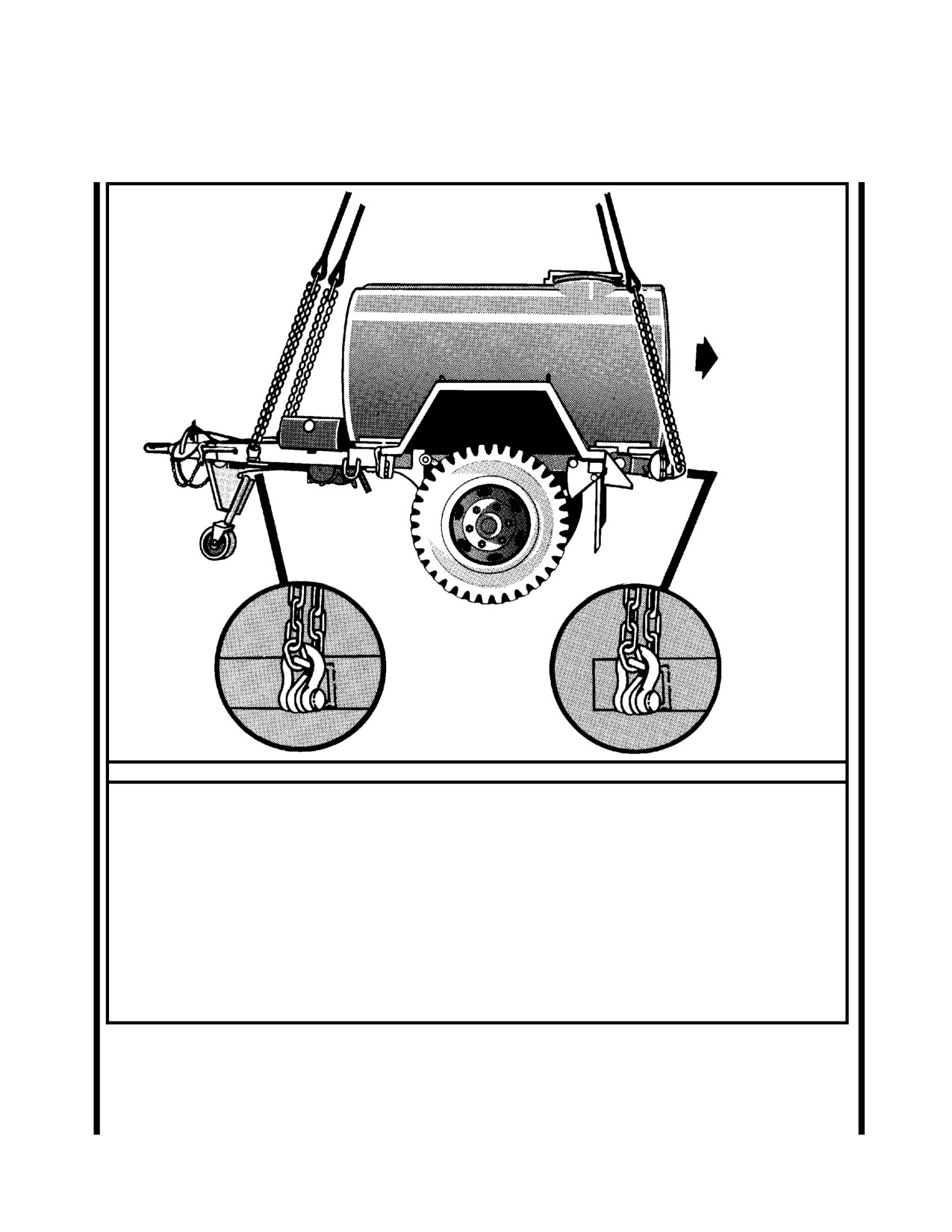
C1, FM 10-450-4/MCRP 4-23E, VOL II/NWP 3-04.12/AFJMAN 11-223, VOL II/
COMDTINST M13482.2
RIGGING STEPS
1. Position the apex fitting on top of the water tank.
3. Route the chain end of sling leg 3 through the left rear
Route outer sling legs 1and 2 to the front of the trailer
lift provision. Place the correct link from Table 3-26 in the
and inner sling legs 3 and 4 to the rear. Sling legs 1 and
grab hook. Repeat with sling leg 4 through the right rear
3 must be on the left side of the load.
lift provision.
2. Loop the chain end of sling leg 1 through the left
4. Pad the chains where they make contact with the
front lift provision located on the left front corner of
trailer.
the trailer. Place the correct link from Table 3-26 in the
grab hook. Repeat with sling leg 2 through the right front
5. Cluster and tie or tape (breakaway technique) all
lift provision.
sling legs together on top of the trailer to prevent en-
tanglement during hookup and lift-off.
Figure 3-26. XM1112 400 Gallon Water Trailer
3-52

C1, FM 10-450-4/MCRP 4-23E, VOL II/NWP 3-04.12/AFJMAN 11-223, VOL II/
COMDTINST M13482.2
CHAPTER 5
CERTIFIED SINGLE-POINT RIGGING PROCEDURES FOR TRUCK AND TOWED
COMBINATIONS
5-1. INTRODUCTION
This chapter contains rigging procedures for single-point
dure. An applicability paragraph is also a part of each
truck and towed combination loads that have been certi-
paragraph and identifies the certified loads. The certified
fied for sling load. Each rigging procedure is found in a
single-point rigging procedures for truck and towed com-
paragraph that includes a description of the load, materi-
bination loads are in this section. Paragraphs 5-2 and 5-3
als required for rigging, and steps to complete the proce-
give detailed instructions for rigging loads.
5-2. M973/M973E1/M1065/M1066 Small Unit Support Vehicle (SUSV)
a. Applicability. The following items in Table 5-1 are certified for all helicopters with suitable lift capacity by the US
Army Soldier Systems Center:
Table 5-1. Small Unit Support Vehicle (SUSV)
M AX
RECOMMENDED
LINK COUNT
NOMENCLATURE
WEIGH T
SLING SET
AIRSPEE D
FRONT/REA R
(POUNDS )
(KNOTS )
Front-6,380
Listed inRig
i
M973, Cargo, Tracked
Rear-6,600
25K
80
Instruc
i
T
ot
l
Front-6,380
Listed inRig
i
M973E1, Cargo, Tracked
Rear-6,600
25K
80
Instruc
i
T
ot
l
Front-6,380
Listed inRig
i
M1065, Comm and Post, Tracked
Rear-6,600
25K
80
Instruc
i
T
ot
l
Front-6,380
Listed inRig
i
M1066, Am bulance, Tracked
Rear-6,600
25K
80
Instruc
i
T
ot
l
b. Materials. The following materials are required to
(2) Additional chain length, part number 38850-00053-
rig this load:
102, from 25,000-pound capacity sling sets (8 each).
(1) Sling set (25,000-pound capacity) (2 sets).
(3) Additional coupling links, part number 664241,
from 25,000-pound capacity sling sets (8 each).
5-1
C1, FM 10-450-4/MCRP 4-23E, VOL II/NWP 3-04.12/AFJMAN 11-223, VOL II/
COMDTINST M13482.2
(4) Aerial delivery slings, Type XXVI nylon, 4 loop, 20
(e) Fold side mirrors inboard and tie or tape as re-
foot length (2 each) (Used to form 40 foot vertical pen-
quired.
dant) (For CH-47 use only).
(f) Tape windshield wipers to windshield.
(5) Apex fitting (25,000-pound capacity) (2 each) (For
CH-47 use only).
(g) Secure all hoses and cables located between the
two cars with tape or nylon cord to avoid entanglement
(6) Tape, adhesive, pressure-sensitive, 2-inch wide
with sling legs.
roll.
(h) Screw the lifting eyes in as far as possible while
(7) Webbing, cotton, 1/4-inch, 80-pound breaking
ensuring that they are pointing towards the middle of each
strength.
car. Tie diagonally opposing rings of each car together
(for example, the front right ring to the left rear ring) with
(8) Tie-down strap, CGU/1B (as required).
Type III nylon cord.
(9) Cord, nylon, Type III, 550-pound breaking strength.
(i) Place the mud flaps in the up position and tape
them in place.
c. Personnel. Two persons can prepare and rig this
load in 30 minutes.
(j) Ensure the fuel tank is not over 3/4 full. Inspect
fuel tank cap, oil filler cap, and battery caps for proper
d. Procedures. The following procedures apply to this
installation.
load:
(2) Rigging. Rig the load according to the steps in
(1) Preparation. Prepare the load using the following
Figure 5-1.
steps:
(3) Hookup. The helicopter lands near the vehicle.
(a) Secure all internal cargo and loose items with
The hookup team crawls under the helicopter. The static
Type III nylon cord or tie-down straps.
wand person discharges the static electricity with the static
wand. The hookup person places the apex fitting onto the
(b) Lock the articulated steering unit with the steer-
aircraft cargo hook. The hookup team then moves clear of
ing cylinder locks.
the helicopter but remains close to the load as the helicop-
ter removes slack from the sling legs. When successful
(c) Secure all doors, windows, and roof hatches in
hookup is assured, the hookup team quickly exits the area
the closed position.
underneath the helicopter to the designated rendezvous
point.
(d) Tape all lights and glass fixtures including the
windshield.
(4) Derigging. Derigging is the reverse of the prepa-
ration and rigging procedures in steps d (1) and d (2).
5-2
C1, FM 10-450-4/MCRP 4-23E, VOL II/NWP 3-04.12/AFJMAN 11-223, VOL II/
COMDTINST M13482.2
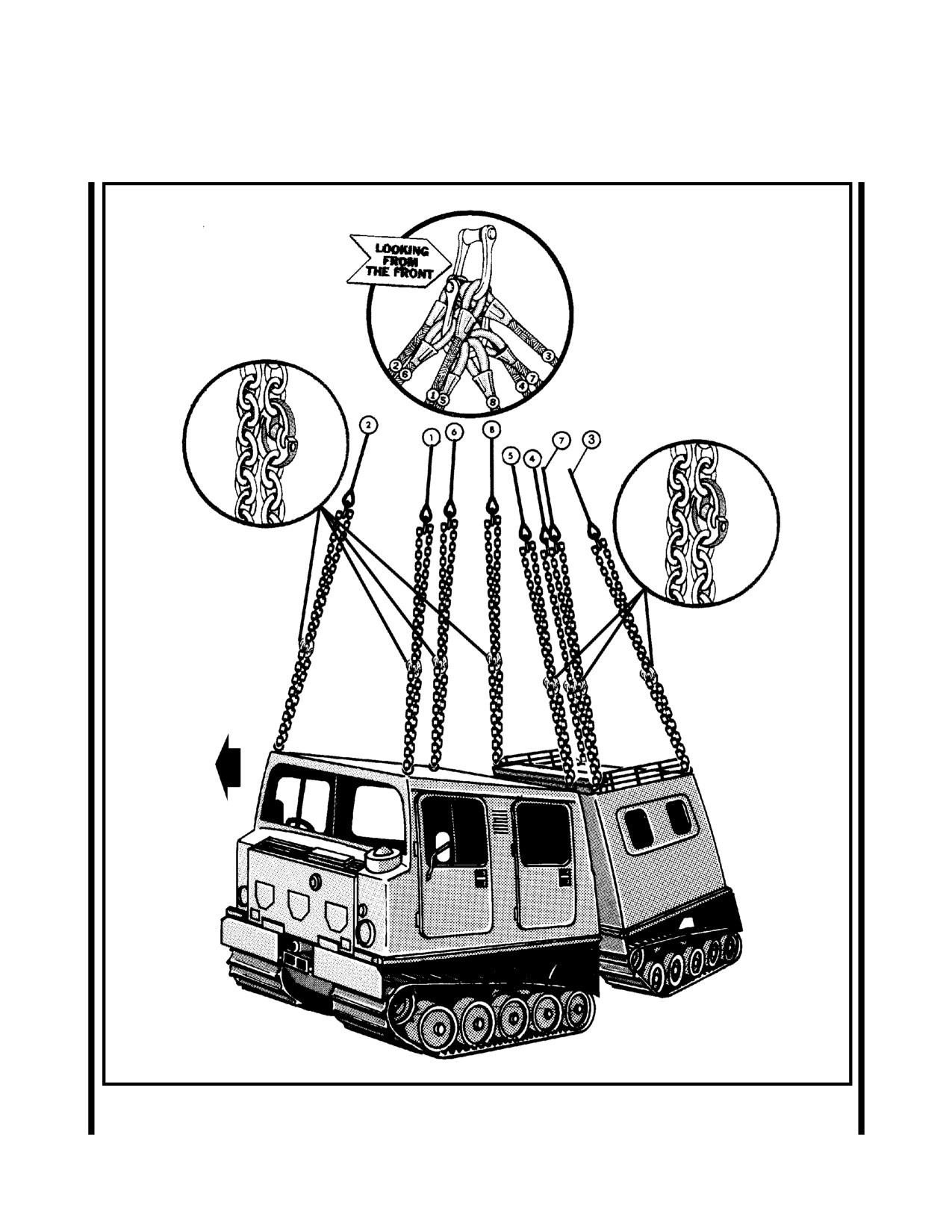
Figure 5-1. Small Unit Support Vehicle (SUSV)
5-3
C1, FM 10-450-4/MCRP 4-23E, VOL II/NWP 3-04.12/AFJMAN 11-223, VOL II/
COMDTINST M13482.2
RIGGING STEPS
1. Assemble the two sling sets as shown in the insert on
6. Route the chain end of sling leg 7 through the left
page 5-3. Note the sling numbering sequences.
front lift provision of the rear car. Add an additional chain
length using the coupling links. The chain must be looped
2. Route outer sling legs 1and 2 to the front of the front
through the lifting provision prior to attaching the addi-
provisions of the front car. Route inner sling legs 3 and 4
tional chain. Place link 67 in the grab hook. Repeat with
under the roof rack and to the rear provisions of the rear
sling leg 8 through the right front lift provision of the rear
car. Sling legs 1 and 3 must be on the left side of the load.
car. Secure the excess chain with Type III nylon cord.
3. Route sling legs 5 and 6 to the rear provisions of the
7. Route the chain end of sling leg 3 through the left
front car. Route sling legs 7 and 8 to the front provisions
rear lift provision of the rear car. Add an additional chain
of the rear car. Sling legs 5 and 7 must be on the left side
length using the coupling links. The chain must be looped
of the load.
through the lifting provision prior to attaching the addi-
tional chain. Place link 40 in the grab hook. Repeat with
4. Loop the chain end of sling leg 1 through the left
sling leg 4 through the right rear lift provision of the rear
front lift provision of the front car. Add an additional
car. Ensure sling legs 3 and 4 are routed under the roof
chain length using the coupling links. The chain must be
rack. Secure the excess chain with Type III nylon cord.
looped through the lifting provision prior to attaching the
additional chain. Place link 40 in the grab hook. Repeat
8. Cluster and tie or tape (breakaway technique) the
with sling leg 2 through the right front lift provision of the
sling legs together on top of the vehicle to prevent en-
front car. Secure the excess chain with Type III nylon
tanglement during hookup and lift-off.
cord.
9. When using a CH-47 helicopter, assemble a 40-foot
5. Route the chain end of sling leg 5 through the left
vertical pendant using two 20-foot aerial delivery slings
rear lift provision of the front car. Add an additional chain
and two 25,000-pound capacity apex fittings. Attach the
length using the coupling links. The chain must be looped
end of the 40-foot vertical pendant to the top apex fitting
through the lifting provision prior to attaching the addi-
of the sling set by removing the bolt from the apex fitting.
tional chain. Place link 67 in the grab hook. Repeat with
Insert the looped end of the vertical pendant into the apex
sling leg 6 through the right rear lift provision of the front
fitting and replace the bolt.
car. Secure the excess chain with Type III nylon cord.
Figure 5-1. Small Unit Support Vehicle (SUSV) (continued)
5-4
C1, FM 10-450-4/MCRP 4-23E, VOL II/NWP 3-04.12/AFJMAN 11-223, VOL II/
COMDTINST M13482.2
5-3. M1067 Flatbed Small Unit Support Vehicle (SUSV)
a. Applicability. The following item in Table 5-2 is certified for the CH-47 HELICOPTER ONLY by the US Army
Soldier Systems Center:
Table 5-2. Flatbed Small Unit Support Vehicle (SUSV)
M AX
RECOMMENDED
LINK COUNT
NOMENCLATURE
WEIGH T
SLING SET
AIRSPEE D
FRONT/REA R
(POUNDS )
(KNOTS )
Front-6,600
Listed inRig
i
M1067, Flatbed, Tracked
Rear-7,150
25K
70
Instruc
i
T
ot
l
b. Materials. The following materials are required to
steps:
rig this load:
(a) Secure all internal cargo and loose items with
(1) Sling set (25,000-pound capacity) (2 sets).
Type III nylon cord or tie-down straps.
(2) Additional chain length, part number 38850-00053-
(b) Lock the articulated steering unit with the steer-
102, from 25,000-pound capacity sling sets (12 each).
ing cylinder locks.
(3) Additional coupling links, part number 664241,
(c) Secure all doors, windows, and roof hatches in
from 25,000-pound capacity sling sets (12 each).
the closed position.
(4) Aerial delivery slings, Type XXVI nylon, 4 loop, 20
(d) Tape all lights and glass fixtures including the
foot length (2 each) (Used to form 40 foot vertical pen-
windshield.
dant) (For CH-47 use only).
(e) Fold side mirrors inboard and tie or tape as re-
(5) Apex fitting (25,000-pound capacity) (2 each) (For
quired.
CH-47 use only).
(f) Tape windshield wipers to windshield.
(6) Tape, adhesive, pressure-sensitive, 2-inch wide
roll.
(g) Secure all hoses and cables located between the
two cars with tape or nylon cord to avoid entanglement
(7) Webbing, cotton, 1/4-inch, 80-pound breaking
with sling legs.
strength.
(h) Screw the lifting eyes in as far as possible while
(8) Tie-down strap, CGU/1B (as required).
ensuring that they are pointing towards the middle of each
car. Tie diagonally opposing rings of each car together
(9) Cord, nylon, Type III, 550-pound breaking strength.
(for example, the front right ring to the left rear ring) with
Type III nylon cord.
c. Personnel. Two persons can prepare and rig this
load in 30 minutes.
(i) Place the mud flaps in the up position and tape
them in place.
d. Procedures. The following procedures apply to this
load:
(j) Cargo in the rear car must be loaded so that it will
not make contact with the sling legs and that it is not
(1) Preparation. Prepare the load using the following
higher than the sides of the rear car.
5-5
C1, FM 10-450-4/MCRP 4-23E, VOL II/NWP 3-04.12/AFJMAN 11-223, VOL II/
COMDTINST M13482.2
(2) Rigging. Rig the load according to the steps in
the helicopter but remains close to the load as the helicop-
Figure 5-2.
ter removes slack from the sling legs. When successful
hookup is assured, the hookup team quickly exits the area
(3) Hookup. The helicopter lands near the vehicle.
underneath the helicopter to the designated rendezvous
The hookup team crawls under the helicopter. The static
point.
wand person discharges the static electricity with the static
wand. The hookup person places the apex fitting onto the
(4) Derigging. Derigging is the reverse of the prepa-
aircraft cargo hook. The hookup team then moves clear of
ration and rigging procedures in steps d (1) and d (2).
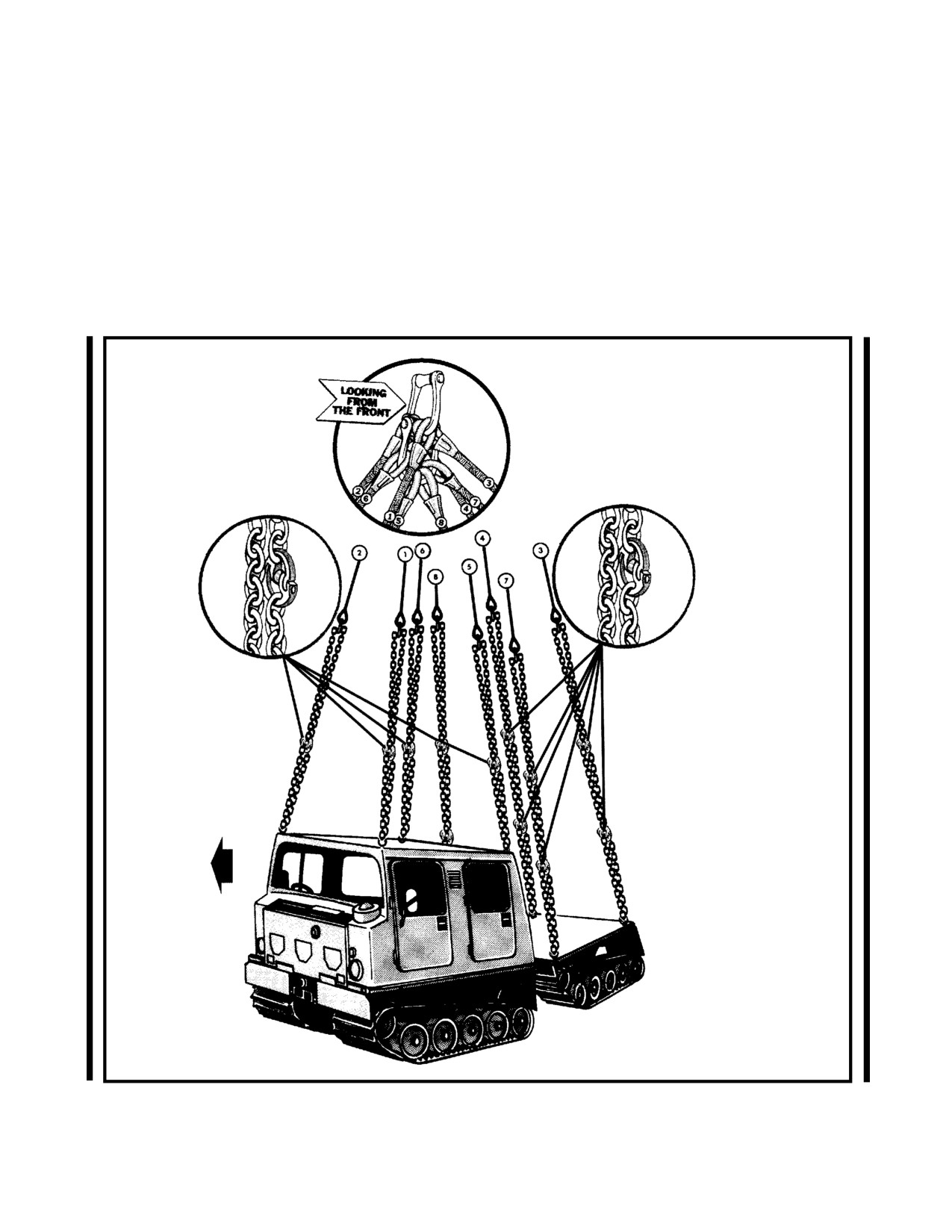
Figure 5-2. Flatbed Small Unit Support Vehicle (SUSV)
5-6
C1, FM 10-450-4/MCRP 4-23E, VOL II/NWP 3-04.12/AFJMAN 11-223, VOL II/
COMDTINST M13482.2
RIGGING STEPS
1. Assemble the two sling sets as shown on page 5-6.
6. Route the chain end of sling leg 7 through the left
Note the sling numbering sequences.
front lift provision of the rear car. Attach two additional
chain lengths using the coupling links. The chain must be
2. Route outer sling legs 1and 2 to the front of the front
looped through the lifting provision prior to attaching the
provisions of the front car. Route inner sling legs 3 and 4
additional chains. Place link 67 in the grab hook. Repeat
to the rear provisions of the rear car. Sling legs 1 and 3
with sling leg 8 through the right front lift provision of the
must be on the left side of the load.
rear car. Secure the excess chain with Type III nylon cord.
3. Route sling legs 5and 6 to the rear provisions of the
7. Route the chain end of sling leg 3 through the left
front car. Route sling legs 7 and 8 to the front provisions
rear lift provision of the rear car. Attach two additional
of the rear car. Sling legs 5 and 7 must be on the left side
chain lengths using the coupling links. The chain must be
of the load.
looped through the lifting provision prior to attaching the
additional chains. Place link 40 in the grab hook. Repeat
4. Loop the chain end of sling leg 1 through the left
with sling leg 4 through the right rear lift provision of the
front lift provision of the front car. Attach an additional
rear car.
chain length using the coupling links. The chain must be
looped through the lifting provision prior to attaching the
8. Cluster and tie or tape (breakaway technique) the
additional chain. Place link 40 in the grab hook. Repeat
sling legs together on top of the vehicle to prevent en-
with sling leg 2 through the right front lift provision of the
tanglement during hookup and lift-off.
front car. Secure the excess chain with Type III nylon
cord.
9. Secure legs 7 and 8 to the outside supports of the
spare fuel can racks using 1/4-inch cotton webbing to
5. Route the chain end of sling leg 5 through the left
prevent damage to the racks during lift-off.
rear lift provision of the front car. Attach an additional
chain length using the coupling links. The chain must be
10. Assemble a 40-foot vertical pendant using two 20-
looped through the lifting provision prior to attaching the
foot aerial delivery slings and two 25,000-pound capacity
additional chain. Place link 67 in the grab hook. Repeat
apex fittings. Attach the end of the 40-foot vertical pen-
with sling leg 6 through the right rear lift provision of the
dant to the top apex fitting of the sling set by removing
front car. Secure the excess chain with Type III nylon
the bolt from the apex fitting, inserting the looped end of
cord.
the vertical pendant into the apex fitting and replacing the
bolt.
Figure 5-2. Flatbed Small Unit Support Vehicle (SUSV) (continued)
5-7
C1, FM 10-450-4/MCRP 4-23E, VOL II/NWP 3-04.12/AFJMAN 11-223, VOL II/
COMDTINST M13482.2
ter removes slack from the sling legs. When successful
(4) Derigging. Derigging is the reverse of the prepa-
hookup is assured, the hookup team quickly exits the area
ration and rigging procedures in steps d (1) and d (2).
underneath the helicopter to the designated rendezvous
point.
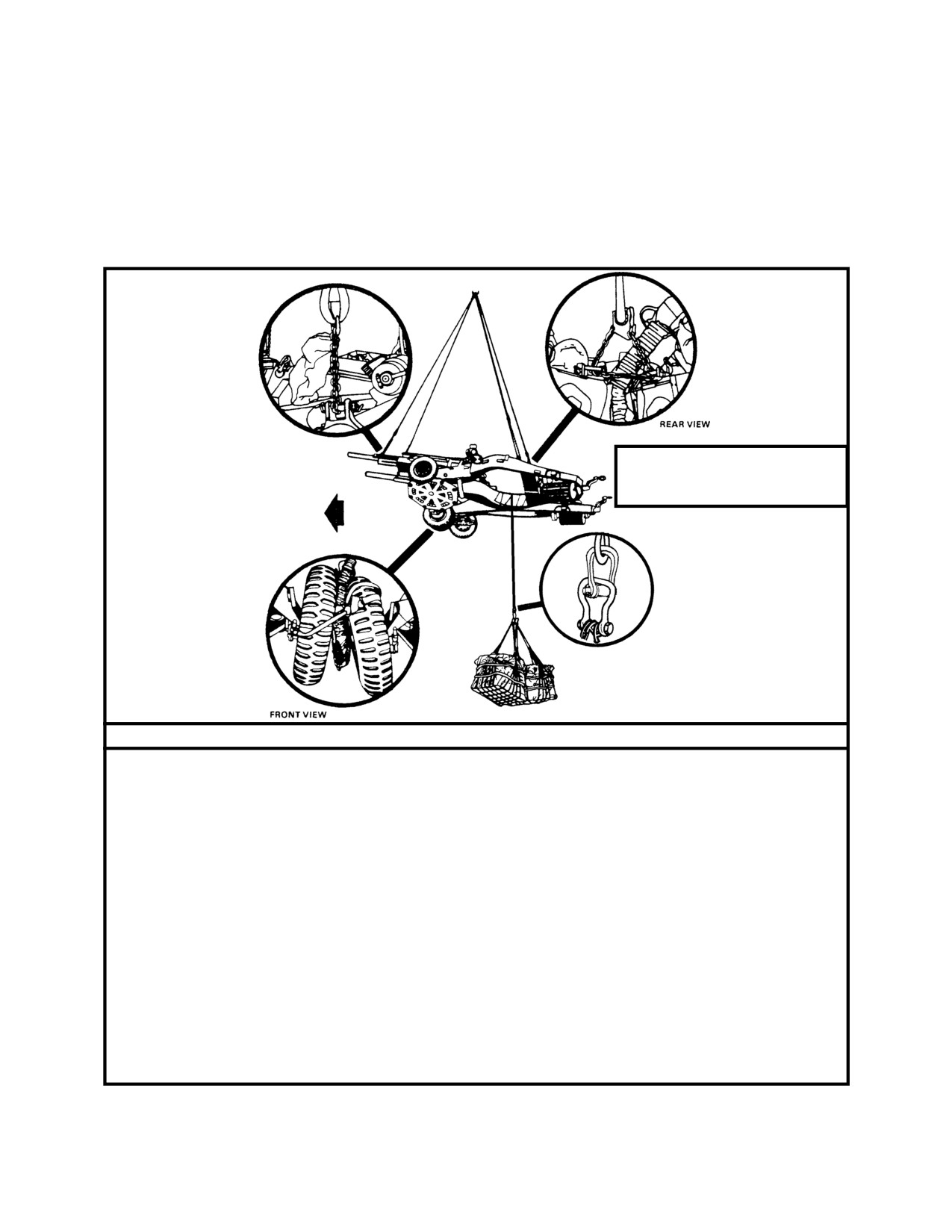
NOTE: Use two 25,000-pound capac-
ity sling legs when carrying three
A-22 cargo bags
RIGGING STEPS
1. Add the additional sling leg to the sling set. The outer sling
cord.
legs are numbers 1 and 2, the inner sling legs are numbers 3 and
4, and the center sling leg is number 5.
5. Route the chain end of sling leg 5 through the lift provi-
sions on the inside trails of both howitzers. Place the correct
2. Position the apex fitting on top of the inner wheels at the
link from Table 6-6 in the grab hook. Secure the excess chain
center of the load. Route outer sling legs 1and 2 to the barrels.
with Type III nylon cord.
Route inner sling legs 3 and 4 to the outside trails, and center
sling leg 5 to the inside trails of both howitzers. Sling legs 1 and
6. Cluster and tie or tape (breakaway technique) the sling
3 must be connected to the left howitzer.
legs together on top of the howitzers to prevent entanglement
during hookup and lift-off.
3. Route the chain end of sling leg 1 through the lift provision
on the barrel of the left howitzer. Place the correct link from
7. Wrap the chain end of the sling leg(s) around both inboard
Table 6-6 in the grab hook. Repeat with sling leg 2 on the right
trails over the felt sheets and insert link 60 in the grab hook.
howitzer. Secure the excess chain with Type III nylon cord
Secure the excess chain with Type III nylon cord.
4. Route the chain end of sling leg 3 through the lift provision
8. Route the other end of the sling leg(s) under the outside
on the outside trail of the left howitzer. Place the correct link
trail of the howitzers and attach the additional apex fitting. Place
from Table 6-6 in the grab hook. Repeat with sling leg 4 on the
the medium clevis of the A-22s on the bolt of the apex fitting.
right howitzer. Secure the excess chain with Type III nylon
Figure 6-6. Two M102 105-MM Howitzers with One, Two, or Three A-22 Cargo Bags
6-13
C1, FM 10-450-4/MCRP 4-23E, VOL II/NWP 3-04.12/AFJMAN 11-223, VOL II/
COMDTINST M13482.2
6-8. M119 105-MM Howitzer, Folded/Towed Position
a. Applicability. The following items in Table 6-7 are certified for all helicopters with suitable lift capacity by the US
Army Soldier Systems Center:
Table 6-7. M119 105-MM Howitzer, Folded/Towed Position
M AX
RECOMMENDED
LINK COUNT
NOMENCLATURE
WEIGH T
SLING SET
AIRSPEE D
FRONT/REA R
(POUNDS )
(KNOTS )
M119 Howitzer
4,400
10K
50/10
120
M119 Howitzer with accompanying
l
7,400
25K
40/10
120
b. Materials. The following materials are required to
(1) Preparation. Prepare the load using the following
rig this load:
steps:
(1) Sling set (10,000-pound capacity) (when moving
(a) Place the howitzer in the folded/towed position.
the howitzer without accompanying load).
Ensure the wheel knock-off hub is horizontal. Engage the
right wheel parking brake (wheel with the knock-off hub).
(2) Sling set (25,000-pound capacity) (when moving
the howitzer with an accompanying load).
(b) Secure the sight cover to the dial sight with tape
or Type III nylon cord.
(3) Tape, adhesive, pressure-sensitive, 2-inch wide
roll.
(c) Secure the firing platform, hand spike, and jack to
the trail assembly with Type III nylon cord.
(4) Cord, nylon, Type III, 550-pound breaking strength.
(d) Ensure the lunette is in the extended position.
(5)
Webbing, cotton, 1/4-inch, 80-pound breaking
Install the towing eye stop (C-clamp) on the lunette and
strength.
secure in place with its retaining pins, when applicable.
(6) Sling set chain safety clamp.
(e) The sling set chain safety clamp is an additional
authorized item. Refer to TM 9-1015-252-10 for NSN and
(7) Webbing, nylon, tubular, 1/2-inch (as required).
installation information.
(8) Line, multiloop, Type XXVI, 4-loop, 3-foot.
(f) When the detachable field spade is attached,
ensure the two locking pins are installed and locked. Route
(9) Clevis, suspension, medium (2 each).
and tie a length of Type III nylon cord through the key
ring of the cable and around the end of the locking pin.
(10) Bag, cargo A-22 or net, cargo (5,000- or 10,000-
pound capacity).
(2) Rigging. Rig the load according to the steps in
Figure 6-7.
(11) Apex fitting (10,000- or 25,000-pound capacity)
(1 each).
NOTE: When an accompanying load requires a sling
leg, you may remove and use one of the inner sling legs
c. Personnel. Two persons can prepare and rig this
from the sling set, leaving one sling leg attached to the
load in 30 minutes.
lunette of the howitzer.
d. Procedures. The following procedures apply to this
(3) Hookup. The hookup team stands beside the how-
load:
itzer on the trails. The static wand person discharges the
6-14
C1, FM 10-450-4/MCRP 4-23E, VOL II/NWP 3-04.12/AFJMAN 11-223, VOL II/
COMDTINST M13482.2
static electricity with the static wand. The hookup person
the hookup team quickly exits the area underneath the
places the apex fitting onto the aircraft cargo hook. The
helicopter to the designated rendezvous point.
hookup team then moves clear of the helicopter but re-
mains close to the load as the helicopter removes slack
(4) Derigging. Derigging is the reverse of the prepa-
from the sling legs. When successful hookup is assured,
ration and rigging procedures in steps d (1) and d (2).
WARNING
WARNING
When moving the howitzer with an accom-
Accompanying loads must not exceed the weight limits
panying load, the 25,000-pound capacity
of the cargo net, cargo bag, sling leg, or exceed the lift
sling set must be used.
capability of the helicopter.
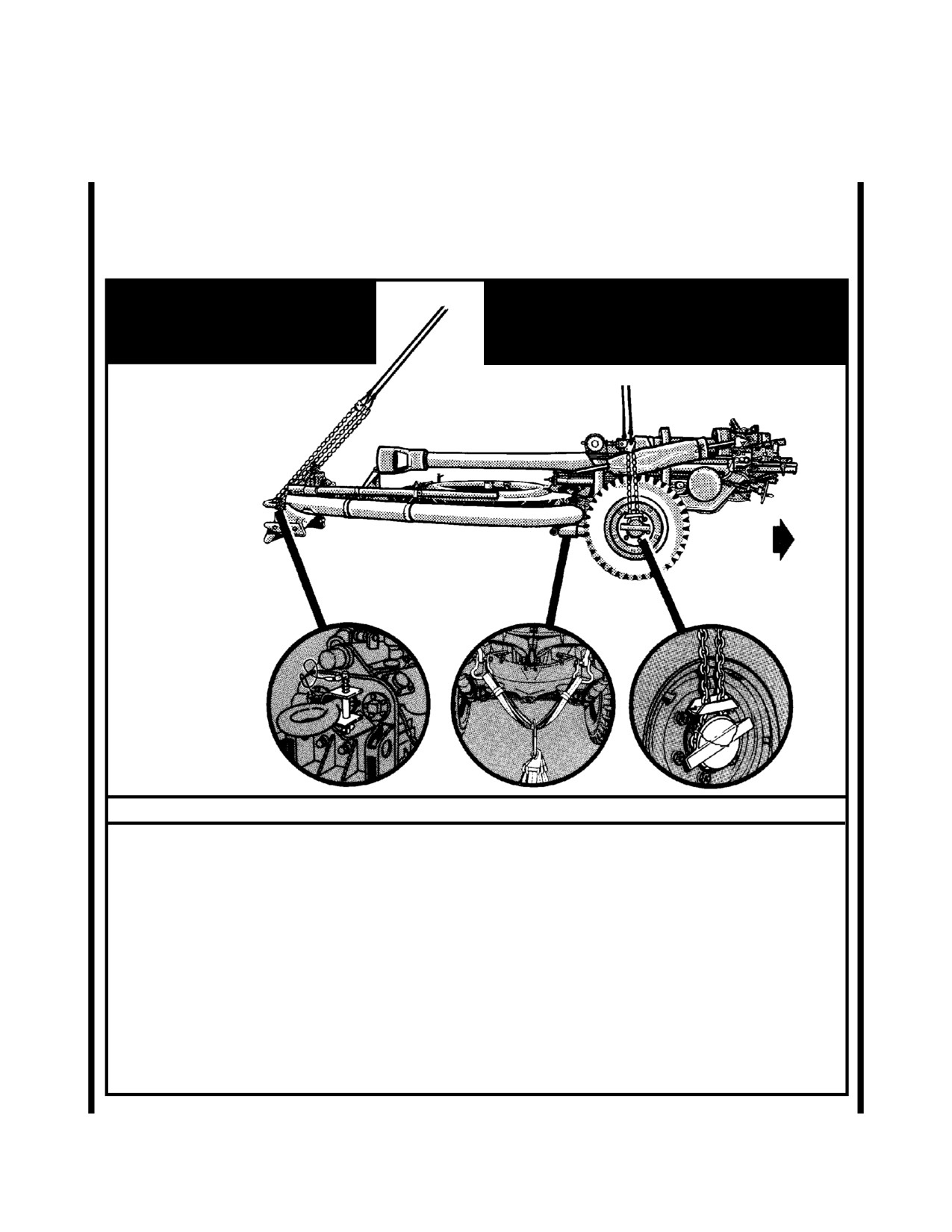
RIGGING STEPS
1. Position the apex fitting on the barrel over the firing plat-
3. Route the chain end of sling legs 3 and 4 through the lu-
form. Route outer sling legs 1and 2 to the wheel hubs. Route
nette. Place the correct link from Table 6-7 in the grab hook.
inner sling legs 3 and 4 to the lunette. Sling legs 1 and 3 must be
on the left side of the load.
4. Cluster and tie or tape (breakaway technique) the sling
legs together on top of the howitzers to prevent entanglement
2. Route the chain end of sling leg 1 around the left wheel
during hookup and lift-off.
hub. Place the link from Table 6-7 in the grab hook. Pull the
chain taut and ensure the chain is centered on the hub. Install the
5. Attach the accompanying load by routing the 3-foot, 4-
sling set chain safety clamp on the two chain links closest to the
loop, Type XXVI multiloop line through the eye of the sling leg
top of the wheel hub. If using the 25,000-pound capacity sling
attached to an A-22 or the apex fitting of a cargo net. Place a
set, tie the two chain links together with 1/2-inch tubular nylon
medium suspension clevis through the loop on each end of the
webbing. Repeat with sling leg 2 on the right wheel hub. Secure
multiloop line and attach to the provisions located under the
the excess chain with Type III nylon cord.
howitzer carriage and inboard of the wheels.
Figure 6-7. M119 105-MM Howitzer, Folded/Towed Position
6-15
C1, FM 10-450-4/MCRP 4-23E, VOL II/NWP 3-04.12/AFJMAN 11-223, VOL II/
COMDTINST M13482.2
6-9. M119 105-MM Howitzer, Forward/Firing Position
a. Applicability. The following items in Table 6-8 are certified for all helicopters with suitable lift capacity by the US
Army Soldier Systems Center:
Table 6-8. M119 105-MM Howitzer, Forward/Firing Position
M AX
RECOMMENDED
LINK COUNT
NOMENCLATURE
WEIGH T
SLING SET
AIRSPEE D
FRONT/REA R
(POUNDS )
(KNOTS )
Listed inrig
i
M119 Howitzer
4,400
10K
11
0
t
Listed inrig
i
M119 Howitzer with accompanying
l
7,400
25K
11
0
t
b. Materials. The following materials are required to
(13) Coupling link, part number 664241, from a 25,000-
rig this load:
pound capacity sling set (1 each) (for accompanying load).
(1) Sling set (10,000-pound capacity) (when moving
(14) Strap, cargo, tiedown, CGU-1/B (as required).
the howitzer without accompanying load).
c. Personnel. Two persons can prepare and rig this
(2) Sling set (25,000-pound capacity) (when moving
load in 30 minutes.
the howitzer with an accompanying load).
d. Procedures. The following procedures apply to this
(3) Reach Pendant (11,000 or 25,000-pound capacity).
load:
(4) Tape, adhesive, pressure-sensitive, 2-inch wide
(1) Preparation. Prepare the load using the following
roll.
steps:
(5) Cord, nylon, Type III, 550-pound breaking strength.
(a) Place the howitzer in the forward/firing position.
If the firing platform is to be carried in the down position,
(6) Webbing, cotton, 1/4-inch, 80-pound breaking
follow these steps:
strength.
1 Mark the wheel hubs at the center of gravity
(7) Sling set chain safety clamp.
(CG) with tape. The CG is located 6-inches behind (to-
wards the lunette) the center of the hub.
(8) Webbing, nylon, tubular, 1/2-inch (as required).
2 Mark the center of the firing platform with tape.
(9) Line, multiloop, Type XXVI, 4-loop, 3-foot (for
Roll the howitzer onto the firing platform aligning the tape
accompanying load).
strips. The wheel knock-off hub must be horizontal. En-
gage both parking brakes.
(10) Clevis, suspension, medium (2 each) (for accom-
panying load).
3 Connect the firing platform to the weapon and
add an additional CGU-1/B tiedown strap.
(11) Bag, cargo A-22 or net, cargo (5,000- or 10,000-
pound capacity).
(b) When the firing platform is carried on top of the
trails ensure the wheel knock-off hub is horizontal. En-
(12) Chain length, part number 38850-00053-102, from
gage the right wheel parking brakes.
a 25,000-pound capacity sling set (1 each) (for accompa-
nying load).
(c) Secure the sight cover to the dial sight with tape
6-16
C1, FM 10-450-4/MCRP 4-23E, VOL II/NWP 3-04.12/AFJMAN 11-223, VOL II/
COMDTINST M13482.2
or Type III nylon cord.
ing load and using sling leg 4 on the accompanying load,
extend the chain on sling leg 3 by adding an additional
(d) Secure the firing platform (if carried), hand spike,
length of chain with a coupling link from a 25,000-pound
and jack to the trail assembly with Type III nylon cord.
capacity sling set.
(e) Ensure the lunette is in the extended position.
(2) Rigging. Rig the load according to the steps in
Install the towing eye stop (C-clamp) on the lunette and
Figure 6-8.
secure in place with its retaining pins, when applicable.
NOTE: When an accompanying load requires a sling
(f) The sling set chain safety clamp is an additional
leg, you may remove and use one of the inner sling legs
authorized item. Refer to TM 9-1015-252-10 for NSN and
from the sling set, leaving one sling leg attached to the
installation information.
lunette of the howitzer.
(g) When the detachable field spade is attached to
(3) Hookup. The hookup team stands beside the how-
the permanent spades, ensure the two locking pins are
itzer on the trails. The static wand person discharges the
installed and locked. Route and tie a length of Type III
static electricity with the static wand. The hookup person
nylon cord through the key ring of the cable and around
places the top loop of the reach pendant onto the aircraft
the end of the locking pin.
cargo hook. The hookup team then moves clear of the
helicopter but remains close to the load as the helicopter
(h) When moving the howitzer without an accompa-
removes slack from the sling legs. When successful
nying load, extend the chain on sling leg 3 by removing
hookup is assured, the hookup team quickly exits the area
the chain length and coupling link from sling leg 4 and
underneath the helicopter to the designated rendezvous
attaching them to the end of the chain on sling leg 3.
point.
(i) When moving the howitzer with an accompany-
(4) Derigging. Derigging is the reverse of the prepa-
ration and rigging procedures in steps d (1) and d (2).
6-17
C1, FM 10-450-4/MCRP 4-23E, VOL II/NWP 3-04.12/AFJMAN 11-223, VOL II/
COMDTINST M13482.2
WARNING
WARNING
When moving the howitzer with an accompanying load,
Accompanying loads must not exceed the weight limits
the 25,000-pound capacity sling set must be used.
of the cargo net, cargo bag, sling leg, or exceed the lift
capability of the helicopter.
RIGGING STEPS
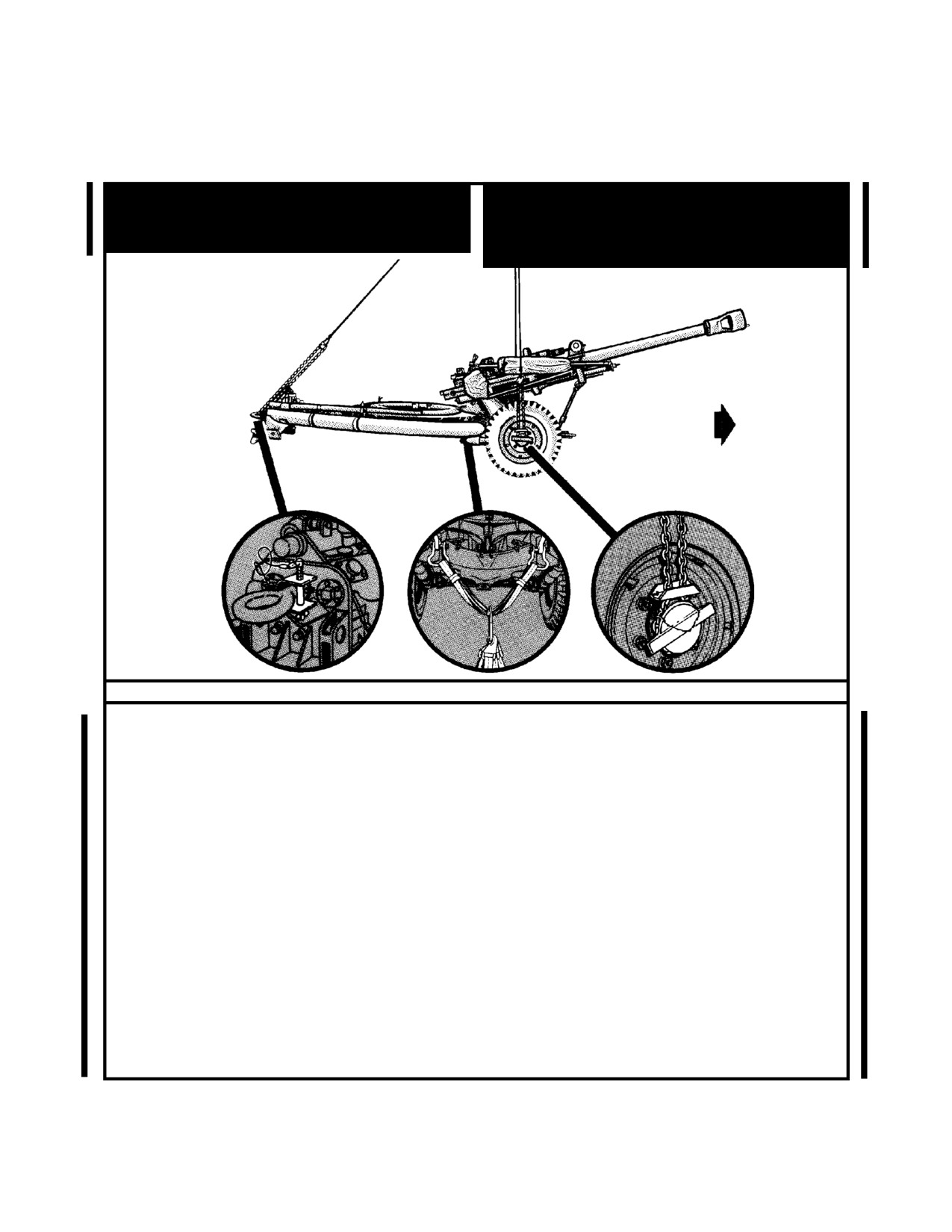
1. Attach a reach pendant on the sling set apex fitting.
4. Route the chain end of the extended sling leg 3
through the lunette. Place link 35 (when using the 10,000-
2. Position the apex fitting and the reach pendant on
pound capacity sling set) or link 28 (when using the 25,000-
the breech assembly. Route outer sling legs 1and 2 to the
pound capaclity sling set) in the grab hook. Secure the
wheel hubs. Route inner sling leg 3 to the lunette.
excess chain with Type III nylon cord
3. Route the chain end of sling leg 1 around the left
5. Cluster and tie or tape (breakaway technique) the
wheel hub. Place link 55 (when using the 10,000-pound
sling legs together on top of the howitzers to prevent
capacity sling set) or link 45 (when using the 25,000-pound
entanglement during hookup and lift-off.
capaclity sling set) in the grab hook. Pull the chain taut
and ensure the chain is centered on the hub. Install the
6. Attach the accompanying load (if required) by rout-
sling set chain safety clamp on the two chain links closest
ing the 3-foot, 4-loop, Type XXVI multiloop line through
to the top of the wheel hub. If the sling set chain safety
the eye of the sling leg attached to an A-22 or the apex
clamp is unavailable or if the 25,000-pound capacity sling
set is being used, tie the two chain links together with 1/2-
fitting of a cargo net. Place a medium suspension clevis
inch tubular nylon webbing. Repeat with sling leg 2 on
through the loop on each end of the multiloop line and
the right wheel hub. Place link 50 (when using the 10,000-
attach to the provisions located under the howitzer car-
pound capacity sling set) or link 40 (when using the 25,000-
riage and inboard of the wheels.
pound capaclity sling set) in the grabhook. Secure the
excess chain with Type III nylon cord
Figure 6-8. M119 105-MM Howitzer, Forward/Firing Position
6-18
FM 10-450-4/MCRP 4-23E, VOL II/NWP 3-04.12/AFJMAN 11-223, VOL II/
COMDTINST M13482.2
CHAPTER 8
CERTIFIED SINGLE-POINT RIGGING PROCEDURES FOR ENGINEER EQUIPMENT
8-1. INTRODUCTION
This chapter contains rigging procedures for single-point
procedures for engineer equipment are in this section.
lift of engineer equipment that has been certified for sling
Paragraphs 8-2 through 8-40 give detailed instructions
load. Each rigging procedure is found in a paragraph that
for rigging loads.
includes a description of the load, materials required for
rigging, and steps to complete the procedure. An applica-
NOTE: Reach Pendants may be used on all single point
bility paragraph is also a part of each paragraph and iden-
loads. A static discharge person is not required when
tifies the certified loads. The certified single-point rigging
using a Reach Pendant.
8-2. T-3 Tractor, Crawler
a. Applicability. The following items in Table 8-1 are certified for all helicopters with suitable lift capacity by the US
Army Soldier Systems Center:
Table 8-1. T-3 Tractor, Crawler
M AX
LINK COUNT
RECOMMENDED
NOMENCLATURE
WEIGH T
SLING SET
FRONT /
AIRSPEE D
(POUNDS )
REAR
(KNOTS )
T
ractor, Full-Tracked, JD550 wih
Roll Over Protection System
16,662
25K
1
/
90
(ROPS), Towing Winch and
Hydraulic Angle Blade
b. Materials. The following materials are required to
load:
rig this load:
(1) Preparation. Prepare the load using the following
(1) Sling set (25,000-pound capacity).
steps:
(2) Tape, adhesive, pressure-sensitive, 2-inch wide
(a) Secure the operator's seat cushion to the seat
roll.
frame with tape or Type III nylon cord.
(3) Cord, nylon, Type III, 550-pound breaking strength.
(b) Remove both canopy lights, wrap in padding,
and store in the toolbox.
(4) Webbing, cotton, 1/4-inch, 80-pound breaking
strength.
(c) Secure all loose covers and panels with tape.
(5) Felt sheet, cattle hair, Type IV, 1/2-inch or suitable
(d) Place the transmission in neutral and start the
substitute.
engine. Raise the blade 12 inches above the ground and
align the blade at a 90 degree angle to the tractor. Turn the
c. Personnel. Two persons can prepare and rig this
engine off and tape the ignition key in place.
load in 10 minutes.
(2) Rigging. Rig the load according to the steps in
d. Procedures. The following procedures apply to this
Figure 8-1.
8-1
FM 10-450-4/MCRP 4-23E, VOL II/NWP 3-04.12/AFJMAN 11-223, VOL II/
COMDTINST M13482.2
(3) Hookup. The hookup team stands on the engine
moves slack from the sling legs. When successful hookup
cowl in front of the ROPS. The static wand person dis-
is assured, the hookup team quickly exits the area under-
charges the static electricity with the static wand. The
neath the helicopter to the designated rendezvous point.
hookup person places the apex fitting onto the aircraft
cargo hook. The hookup team then moves clear of the
(4) Derigging. Derigging is the reverse of the prepa-
load but remains close to the load as the helicopter re-
ration and rigging procedures in steps d (1) and d (2).
RIGGING STEPS
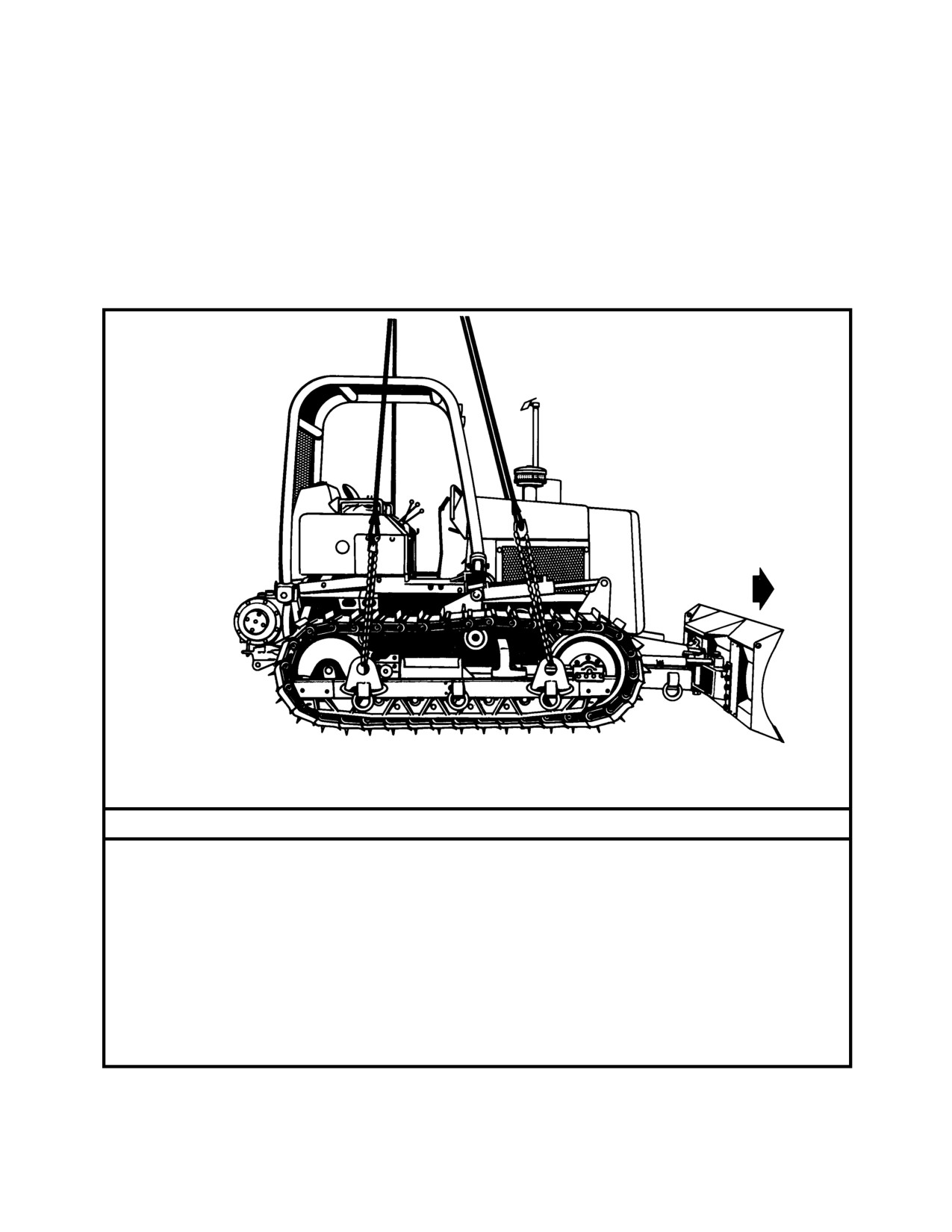
1. Position the apex fitting on top of the ROPS. Route
3. Route the chain end of sling leg 3 through the left
outer sling legs 1and 2 to the front of the load. Route
rear lift provision located forward of the left track rear
inner sling legs 3 and 4 to the rear of the load. Sling legs 1
wheel. Place the correct link from Table 8-1 in the grab
and 3 must be on the left side of the load.
hook. Repeat with sling leg 4 on the right rear lift provi-
sion located on the right track.
2. Route the chain end of sling leg 1 through the left
front lift provision located just aft of the front of the left
4. Cluster and tie or tape (breakaway technique) the
track. Place the correct link from Table 8-1 in the grab
sling legs together on top of the crew compartment to
hook. Repeat with sling leg 2 and the right front lift provi-
prevent entanglement during hookup and lift-off.
sion located on the right track. Secure the excess chain
with Type III nylon cord.
Figure 8-1. T-3 Tractor, Crawler
8-2
C1, FM 10-450-4/MCRP 4-23E, VOL II/NWP 3-04.12/AFJMAN 11-223, VOL II/
COMDTINST M13482.2
8-38. Tractor (Dozer), Full-Tracked, Type III, JD450G
a. Applicability. The following items in Table 8-37 are certified for all helicopters with suitable lift capacity by the US
Army Soldier Systems Center:
Table 8-37. Tractor (Dozer), Full-Tracked, Type III, JD450G
M AX
LINK COUNT
RECOMMENDED
NOMENCLATURE
WEIGH T
SLING SET
FRONT /
AIRSPEE D
(POUNDS )
REAR
(KNOTS )
T
ractor (Dozer), Full-Tracked, Type
18,400
25K
3/10
100
III, JD450G
T
ractor (Dozer), Full-Tracked, Type
17,700
25K
3/10
100
III, JD450G,without ROP S
T
ractor (Dozer), Full-Tracked, Type
III, JD450G,without ROPS and
16,160
25K
3/10
100
Winch
b. Materials. The following materials are required to
(1) Preparation. Prepare the load using the following
rig this load:
steps:
(1) Sling set (25,000-pound capacity).
(a) Connect one additional chain length to each chain
on each sling set with a coupling link.
(a) Chain length, part number 38850-00053-102, from
a 25,000-pound capacity sling set (4 each).
(b) Prepare the tractor for mission needs using the
operator's manual. Special tools may be required to re-
(b) Coupling link, part number 664241, from a 25,000-
move the ROPS or winch.
pound capacity sling set (4 each).
(c) Secure all loose equipment with tape or Type III
(2) Tape, adhesive, pressure-sensitive, 2-inch wide
nylon cord.
roll.
(d) Place the transmission in neutral and set the park-
(3) Cord, nylon, Type III, 550-pound breaking strength.
ing brake.
(4) Webbing, cotton, 1/4-inch, 80-pound breaking
(e) Tape the front sling guides on the ROPS. Tape all
strength.
lights and gauges.
(5) Heavy padding (1/4 section of a steel-belted tire or
(f) Ensure the fuel tank is not over 3/4 full. Ensure
a length of fire hose or equivalent) (2 each).
the fuel tank cap is in the vent position. Inspect the oil
filter cap and battery caps for proper installation.
c. Personnel. Two persons can prepare and rig this
load in 15 minutes.
(2) Rigging. Rig the load according to the steps in
Figure 8-37.
d. Procedures. The following procedures apply to this
load:
(3) Hookup. The hookup team stands on top of the
dozer. The static wand person discharges the static elec-
8-77
C1, FM 10-450-4/MCRP 4-23E, VOL II/NWP 3-04.12/AFJMAN 11-223, VOL II/
COMDTINST M13482.2
tricity with the static wand. The hookup person places
quickly exits the area underneath the helicopter to the
the apex fitting onto the aircraft cargo hook. The hookup
designated rendezvous point.
team then moves clear of the load but remains close to the
load as the helicopter removes slack from the sling legs.
(4) Derigging. Derigging is the reverse of the prepa-
When successful hookup is assured, the hookup team
ration and rigging procedures in steps d (1) and d (2).
NOTES: Padding for the rear chains cannot be
added until the chains have been routed through
the sling guides and attached to the grabhooks.
CAUTION
THIS LOAD HAS A TENDENCY
TO ROTATE IN FLIGHT. DO NOT
ALLOW THE LOAD TO ROTATE
MORE THAN TWO COMPLETE
TURNS. IF THE LOAD CANNOT
BE STABILIZED, IT SHOULD BE
LANDED.
RIGGING STEPS
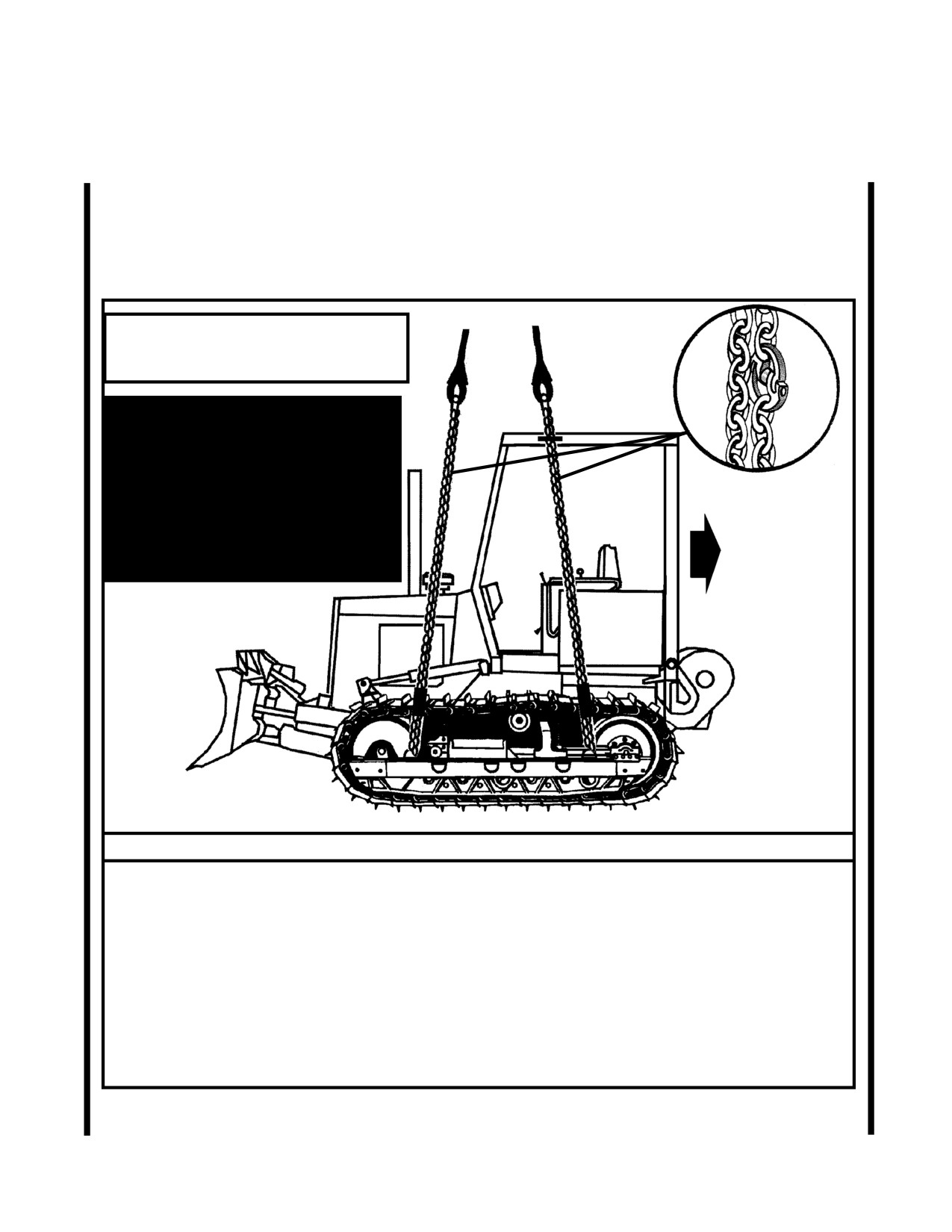
1. Position the apex fitting on top of the ROPS. Route
front sling guide on the ROPS, down through the left rear
outer sling legs 1and 2 to the front of the load. Route
lift provision, and back through the same sling guide. Place
inner sling legs 3 and 4 to the rear of the load. Sling legs 1
the correct link from Table 8-37 in the grab hook. Repeat
and 3 must be on the left side of the load.
with sling leg 4 on the right rear lift provision. Secure the
excess chain with tape or Type III nylon cord.
2. Route the chain end of sling leg 1 through the left
front lift provision. Place the correct link from Table 8-37
4. Heavy pad the sling legs where they make contact
in the grab hook. Repeat with sling leg 2 and the right
with the tracks.
front lift provision.
5. Cluster and tie or tape (breakaway technique) the
3. Route the chain end of sling leg 3 through the left
sling legs together on top of the ROPS to prevent en-
tanglement during hookup and lift-off.
Figure 8-37. Tractor (Dozer), Full-Tracked, Type III, JD450G
8-78
C1, FM 10-450-4/MCRP 4-23E, VOL II/NWP 3-04.12/AFJMAN 11-223, VOL II/
COMDTINST M13482.2
8-39. Vibrating Roller, Caterpillar, RO-33
a. Applicability. The following item in Table 8-38 is certified for all helicopters with suitable lift capacity by the US
Army Soldier Systems Center:
Table 8-38. Vibrating Roller, Caterpillar, RO-33
M AX
RECOMMENDED
LINK COUNT
NOMENCLATURE
WEIGH T
SLING SET
AIRSPEE D
FRONT/REA R
(POUNDS )
(KNOTS )
Vibrating Roller, Caterpillar, RO-33
16,425
25K
3
/
120
b. Materials. The following materials are required to
filter cap and battery caps for proper installation.
rig this load:
(c) Secure the seat cushion to the frame with tape or
(1) Sling set (25,000-pound capacity).
Type III nylon cord.
(2) Tape, adhesive, pressure-sensitive, 2-inch wide
(d) Remove and secure the exhaust stack.
roll.
(e) Tape all lights and gauges. Secure all loose cov-
(3) Cord, nylon, Type III, 550-pound breaking strength.
ers and panels with tape or Type III nylon cord.
(4) Webbing, cotton, 1/4-inch, 80-pound breaking
(f) Tie down the steering wheel with Type III nylon
strength.
cord.
(5) Lumber, 2-inch x 4-inch (as required).
(g) Place the wooden block in the pivot point at the
center of the roller to prevent the two halves from flexing
(6) Felt sheet, cattle hair, Type IV, 1/2-inch or suitable
during flight.
padding.
(2) Rigging. Rig the load according to the steps in
c. Personnel. Two persons can prepare and rig this
Figure 8-38.
load in 15 minutes.
(3) Hookup. The hookup team stands on top of the
d. Procedures. The following procedures apply to this
roller. The static wand person discharges the static elec-
load:
tricity with the static wand. The hookup person places
the apex fitting onto the aircraft cargo hook. The hookup
(1) Preparation. Prepare the load using the following
team then moves clear of the load but remains close to the
steps:
load as the helicopter removes slack from the sling legs.
When successful hookup is assured, the hookup team
(a) Place the transmission in neutral and set the park-
quickly exits the area underneath the helicopter to
ing brake.
thedesignated rendezvous point.
(b) Ensure the fuel tank is not over 3/4 full. Ensure
(4) Derigging. Derigging is the reverse of the prepa-
the fuel tank cap is in the vent position. Inspect the oil
ration and rigging procedures in steps d (1) and d (2).
8-79
C1, FM 10-450-4/MCRP 4-23E, VOL II/NWP 3-04.12/AFJMAN 11-223, VOL II/
COMDTINST M13482.2
RIGGING STEPS
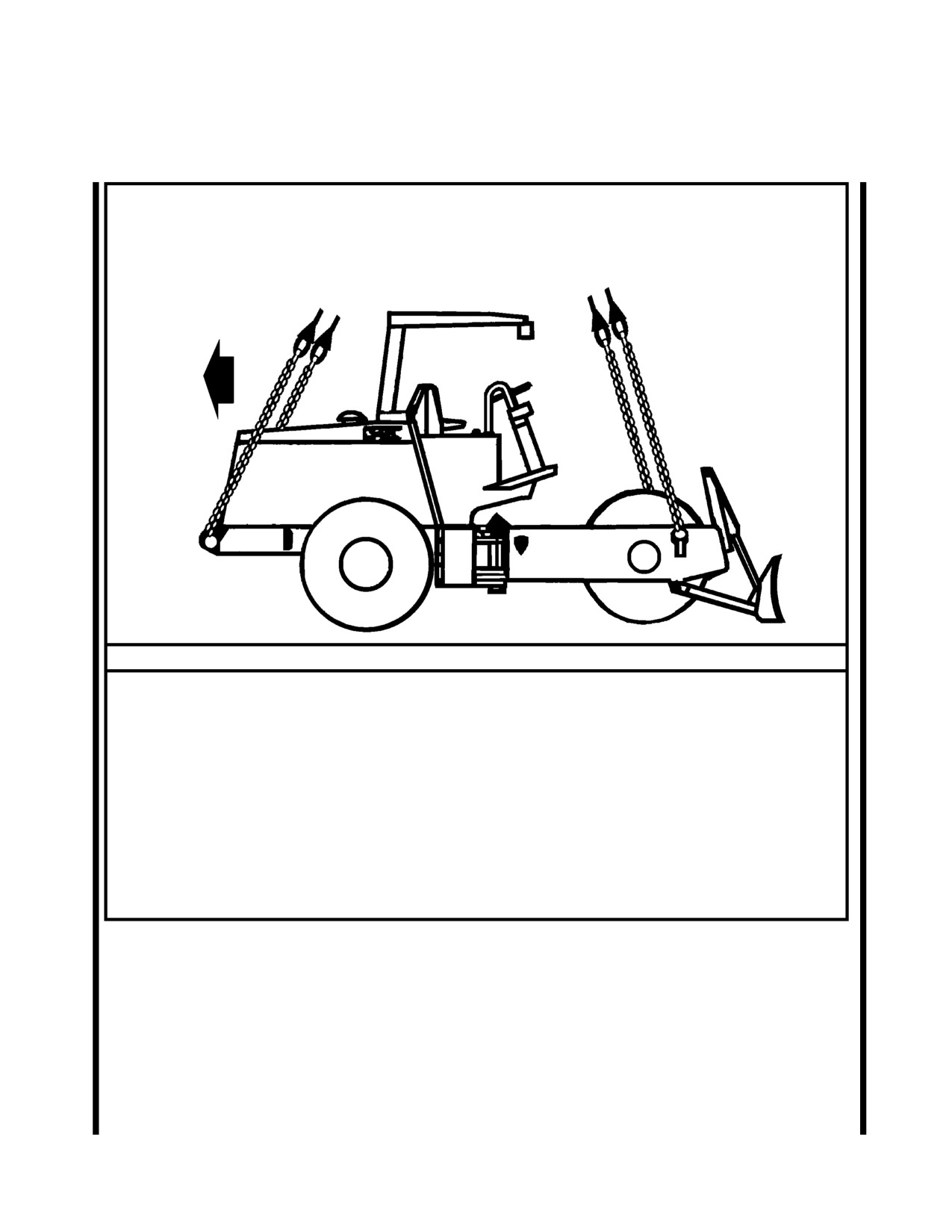
1. Position the apex fitting near the roller. Route outer
rear lift provision. Place the correct link from Table 8-38 in
sling legs 1and 2 to the front of the load (roller end). Route
the grab hook. Repeat with sling leg 4 on the right rear lift
inner sling legs 3 and 4 to the rear of the load (engine end).
provision.
Sling legs 1 and 3 must be on the left side of the load.
4. Pad the sling legs/chains in the area where they make
2. Route the chain end of sling leg 1 through the left
contact with the vehicle.
front lift provision. Place the correct link from Table 8-38
in the grab hook. Repeat with sling leg 2 and the right
5. Cluster and tie or tape (breakaway technique) the
front lift provision. Secure the excess chain with tape or
sling legs together on top of the roller to prevent entangle-
Type III nylon cord.
ment during hookup and lift-off.
3. Route the chain end of sling leg 3 through the left
Figure 8-38. Vibrating Roller, Caterpillar, RO-33
8-80
C1, FM 10-450-4/MCRP 4-23E, VOL II/NWP 3-04.12/AFJMAN 11-223, VOL II/
COMDTINST M13482.2
8-40. Countermine Mini-Flail
a. Applicability. The following item in Table 8-39 is certified for all helicopters with suitable lift capacity by the US
Army Soldier Systems Center:
Table 8-39. Countermine Mini-Flail
M AX
RECOMMENDED
LINK COUNT
NOMENCLATURE
WEIGH T
SLING SET
AIRSPEE D
FRONT/REA R
(POUNDS )
(KNOTS )
Countermine M
i
i
2,420
10K
3
/
100
b. Materials. The following materials are required to
(a) Tape the flail headspring mechanism to the lift/tie
rig this load:
crossmember.
(1) Sling set (10,000-pound capacity).
(b) Ensure the engine compartment door securing
pin is present and safety the pin with tape.
(2) Tape, adhesive, pressure-sensitive, 2-inch wide
roll.
(c) Secure loose cables, safety cables, and safety
chains with tape or Type III nylon cord.
(3) Cord, nylon, Type III, 550-pound breaking strength.
(d) Engage the brakes.
(4) Webbing, cotton, 1/4-inch, 80-pound breaking
strength.
(2) Rigging. Rig the load according to the steps in
Figure 8-39.
(5) Felt sheet, cattle hair, Type IV, 1/2-inch or suitable
padding.
(3) Hookup. The hookup team stands beside the mini-
flail. The static wand person discharges the static elec-
c. Personnel. Two persons can prepare and rig this
tricity with the static wand. The hookup person places
load in 10 minutes.
the apex fitting onto the aircraft cargo hook. The hookup
team then moves clear of the load but remains close to the
d. Procedures. The following procedures apply to this
load as the helicopter removes slack from the sling legs.
load:
When successful hookup is assured, the hookup team
quickly exits the area underneath the helicopter to
(1) Preparation. Prepare the load using the following
thedesignated rendezvous point.
steps:
(4) Derigging. Derigging is the reverse of the prepa-
ration and rigging procedures in steps d (1) and d (2).
8-81
C1, FM 10-450-4/MCRP 4-23E, VOL II/NWP 3-04.12/AFJMAN 11-223, VOL II/
COMDTINST M13482.2
RIGGING STEPS
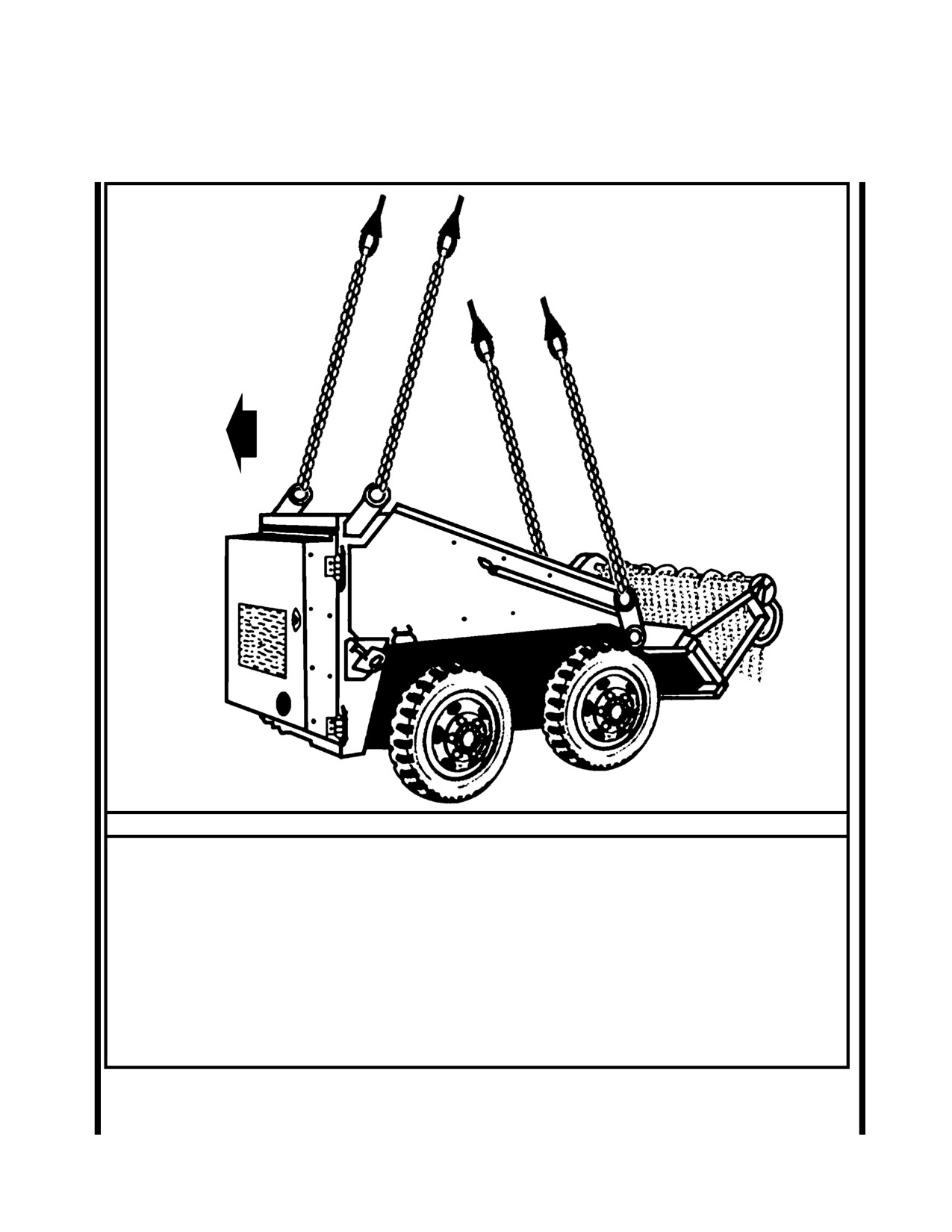
1. Position the apex fitting near the mini-flail. Route
3. Route the chain end of sling leg 3 through the left
outer sling legs 1and 2 to the front of the load (engine
rear lift provision (flail head end). Place the correct link
end). Route inner sling legs 3 and 4 to the rear of the load
from Table 8-39 in the grab hook. Repeat with sling leg 4
(flail head). Sling legs 1 and 3 must be on the left side of
on the right rear lift provision.
the load.
4. Pad the sling legs/chains in the area where they make
2. Route the chain end of sling leg 1 through the left
contact with the vehicle.
front lift provision (engine end). Place the correct link
from Table 8-39 in the grab hook. Repeat with sling leg 2
5. Cluster and tie or tape (breakaway technique) the
and the right front lift provision. Secure the excess chain
sling legs together on top of the vehicle to prevent en-
with tape or Type III nylon cord.
tanglement during hookup and lift-off.
Figure 8-39. Countermine Mini-Flail
8-82
C1, FM 10-450-4/MCRP 4-23E, VOL II/NWP 3-04.12/AFJMAN 11-223, VOL II/
COMDTINST M13482.2
CHAPTER 11
CERTIFIED SINGLE-POINT RIGGING PROCEDURES FOR CONTAINERS
11-1. Introduction
tifies the certified loads. The certified single-point rigging
This chapter contains rigging procedures for single-point
procedures for containers are in this section. Paragraphs
lift of containers that have been certified for sling load.
11-2 through 11-11 give detailed instructions for rigging
Each rigging procedure is found in a paragraph that in-
loads.
cludes a description of the load, materials required for
rigging, and steps to complete the procedure. An applica-
NOTE: Reach Pendants may be used on all single point
bility paragraph is also a part of each paragraph and iden-
loads. A static discharge person is not required when
using a Reach Pendant.
11-2. Pershing II in Container
a. Applicability. The following items in Table 11-1 are certified for all helicopters with suitable lift capacity by the US
Army Soldier Systems Center:
Table 11-1. Pershing II in Container
M AX
RECOMMENDED
LINK COUNT
NOMENCLATURE
WEIGH T
SLING SET
AIRSPEE D
FRONT/REA R
(POUNDS )
(KNOTS )
Pershing II First Stage Section
14,410
25K
3/20
90
Pershing II Second Stage Section
10,158
25K
3/13
110
Pershing II Guidance and Contro/l
3,500
10K
3/14
100
Adapter Section
Pershing II Radar Section
1,708
10K
3/3
70
b. Materials. The following materials are required to
d. Procedures. The following procedures apply to this
rig this load:
load:
(1) Sling set (10,000- or 25,000-pound capacity) (as
(1) Preparation. Prepare the load using the following
required).
steps:
(2) Tape, adhesive, pressure-sensitive, 2-inch wide
(a) Ensure the container cover is securely fastened.
roll.
(b) Ensure the container skids and lift handles are
(3) Cord, nylon, Type III, 550-pound breaking strength.
serviceable.
(4) Webbing, cotton, 1/4-inch, 80-pound breaking
(2) Rigging. Rig the load according to the steps in
strength.
Figure 11-1.
c. Personnel. Two persons can prepare and rig this
(3) Hookup. The hookup team stands on top of the
load in 10 minutes.
container. The static wand person discharges the static
11-1
C1, FM 10-450-4/MCRP 4-23E, VOL II/NWP 3-04.12/AFJMAN 11-223, VOL II/
COMDTINST M13482.2
electricity with the static wand. The hookup person places
quickly exits the area underneath the helicopter to the
the apex fitting onto the aircraft cargo hook. The hookup
designated rendezvous point.
team then moves clear of the load but remains close to the
load as the helicopter removes slack from the sling legs.
(4) Derigging. Derigging is the reverse of the prepa-
When successful hookup is assured, the hookup team
ration and rigging procedures in steps d (1) and d (2).
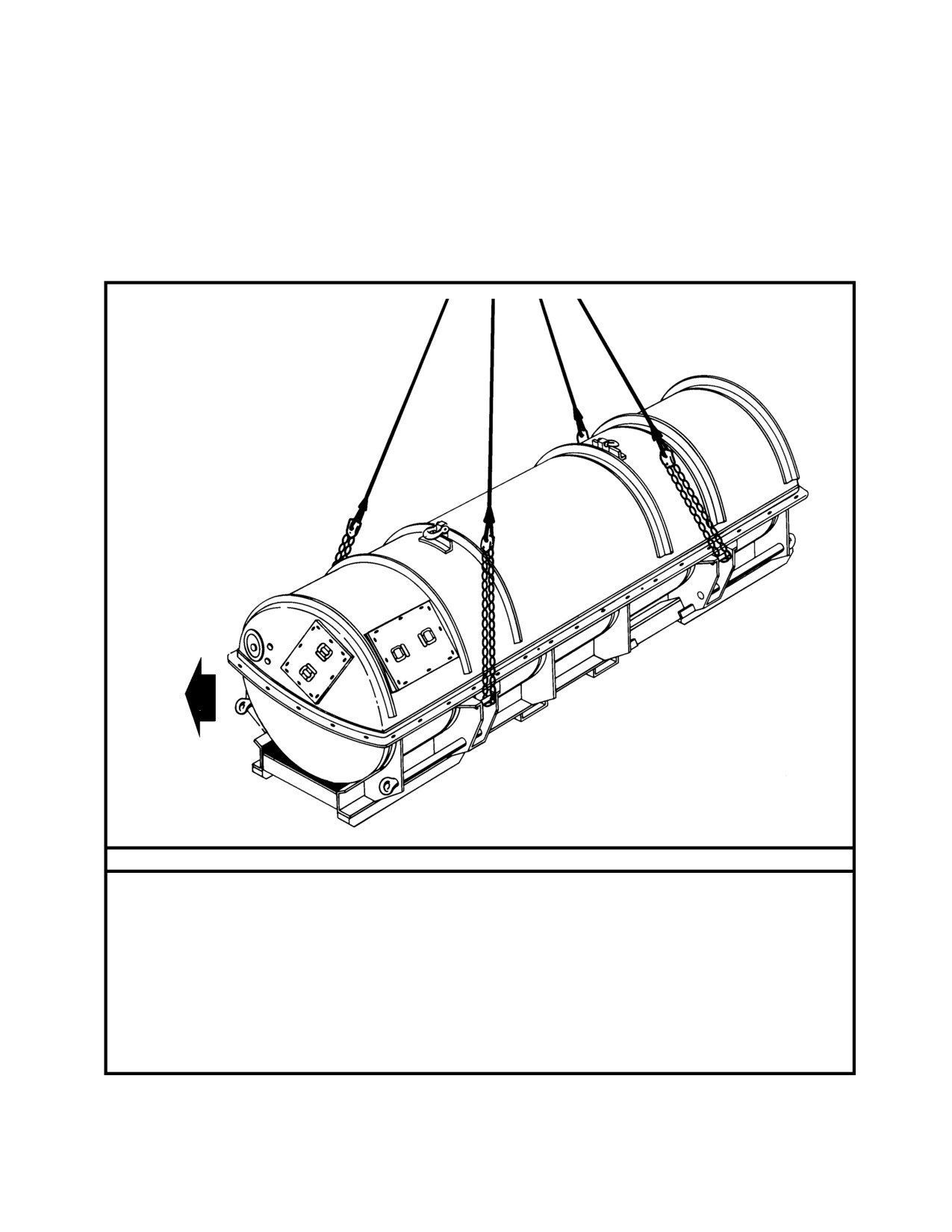
RIGGING STEPS
1. Position apex fitting on top of the container. Route
3. Loop the chain end of sling leg 3 through the left rear
outer sling legs 1 and 2 to the front of the container and
lift handle. Place the correct link from Table 11-1 in the
inner sling legs 3 and 4 to the rear. Sling legs 1 and 3 must
grab hook. Repeat with sling leg 4 on the right rear lift
be on the left side of the load.
provision. Secure the excess chain with tape or Type III
nylon cord.
2. Loop the chain end of sling leg 1 through the left
front lift handle. Place the correct link from Table 11-1 in
4. Cluster and tie or tape (breakaway technique) all sling
the grab hook. Repeat with sling leg 2 on the right front
legs together on top of the container to prevent entangle-
lift provision.
ment during hookup and lift-off.
Figure 11-1. Pershing II in Container
11-2
C1, FM 10-450-4/MCRP 4-23E, VOL II/NWP 3-04.12/AFJMAN 11-223, VOL II/
COMDTINST M13482.2
11-4. Army Missile Systems Enclosure Assembly Launch Pods (EALP), One Container
a. Applicability. The following items in Table 11-3 are certified for all helicopters with suitable lift capacity by the US
Army Soldier Systems Center:
Table 11-3. Army Missile Systems Enclosure Assembly Launch Pods, One Container
M AX
RECOMMENDED
LINK COUNT
NOMENCLATURE
WEIGH T
SLING SET
AIRSPEE D
FRONT/REA R
(POUNDS )
(KNOTS )
Multiple Launch Rocket System wih
5,005
10K
/
90
Rocket Pod/Container (with Six Rocket
s)
Guided Missile Launch Assembly
5,071
10K
/
90
(GMLA )
b. Materials. The following materials are required to
(1) Preparation. Prepare the EALP for travel in accor-
rig this load:
dance with standard procedures.
(1) Sling set (10,000-pound capacity).
(2) Rigging. Rig the load according to the steps in
Figure 11-3.
(2) Tape, adhesive, pressure-sensitive, 2-inch wide
roll.
NOTE: The firing end is considered to be the front of the
load.
(3) Cord, nylon, Type III, 550-pound breaking strength.
(3) Hookup. The hookup team stands on top of the
(4) Webbing, cotton, 1/4-inch, 80-pound breaking
EALP . The static wand person discharges the static elec-
strength.
tricity with the static wand. The hookup person places
the apex fitting onto the aircraft cargo hook. The hookup
c. Personnel. Two persons can prepare and rig this
team then moves clear of the load but remains close to the
load in 15 minutes.
load as the helicopter removes slack from the sling legs.
When successful hookup is assured, the hookup team
d. Procedures. The following procedures apply to this
quickly exits the area underneath the helicopter to the
load:
designated rendezvous point.
(4) Derigging. Derigging is the reverse of the prepa-
ration and rigging procedures in steps d (1) and d (2).
11-5
C1, FM 10-450-4/MCRP 4-23E, VOL II/NWP 3-04.12/AFJMAN 11-223, VOL II/
COMDTINST M13482.2
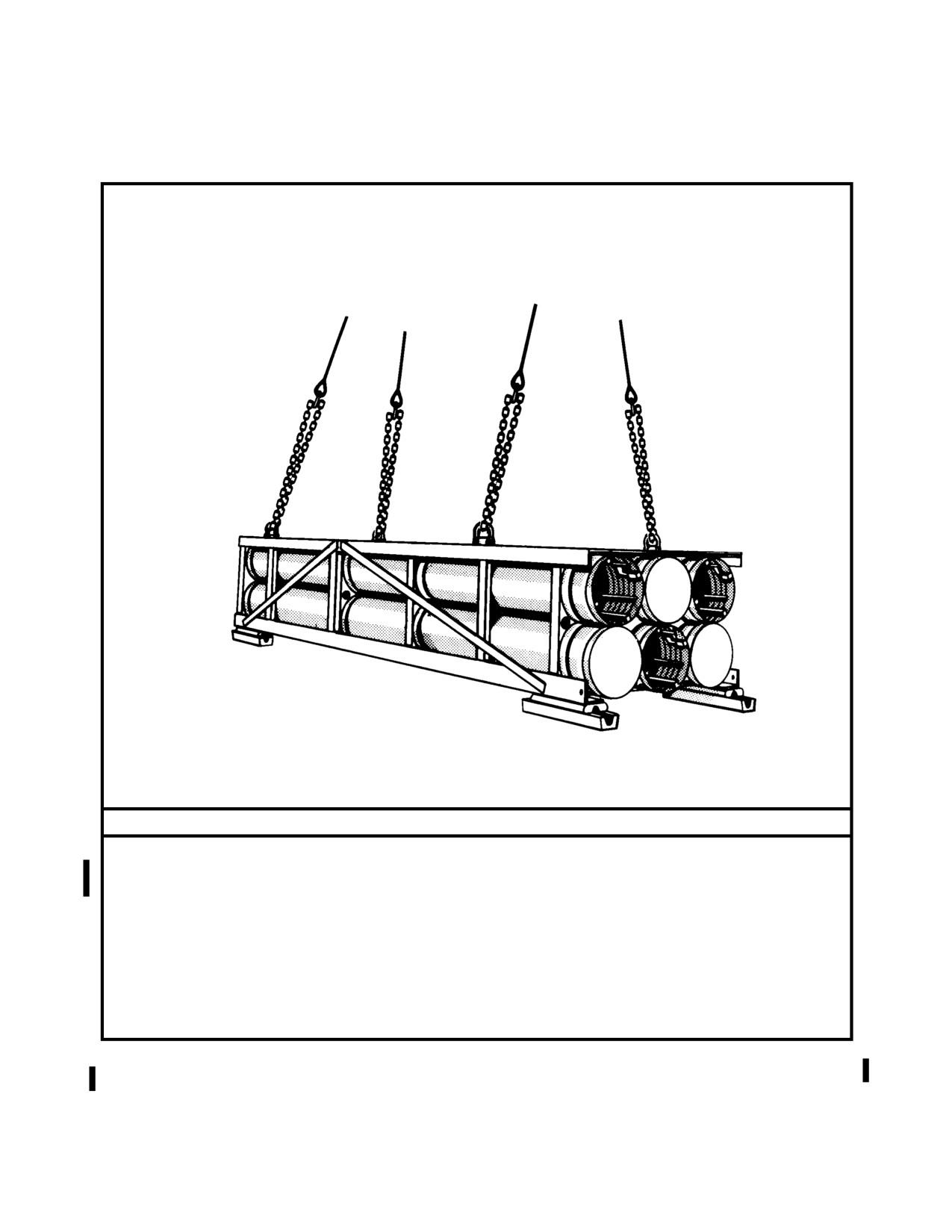
RIGGING STEPS
1. Position apex fitting on top of the EALP. Route outer
3. Loop the chain end of sling leg 3 through the left
sling legs 1 and 2 to the front of the EALP and inner sling
rear lift provision. Place the correct link from Table 11-3 in
legs 3 and 4 to the rear. Sling legs 1 and 3 must be on the
the grab hook. Repeat with sling leg 4 on the right rear lift
left side of the load.
provision.
2. Loop the chain end of sling leg 1 through the left
4. Cluster and tie or tape (breakaway technique) all sling
front lift provision. Place the correct link from Table 11-3
legs together on top of the container to prevent entangle-
in the grab hook. Repeat with sling leg 2 on the right front
ment during hookup and lift-off.
lift provision.
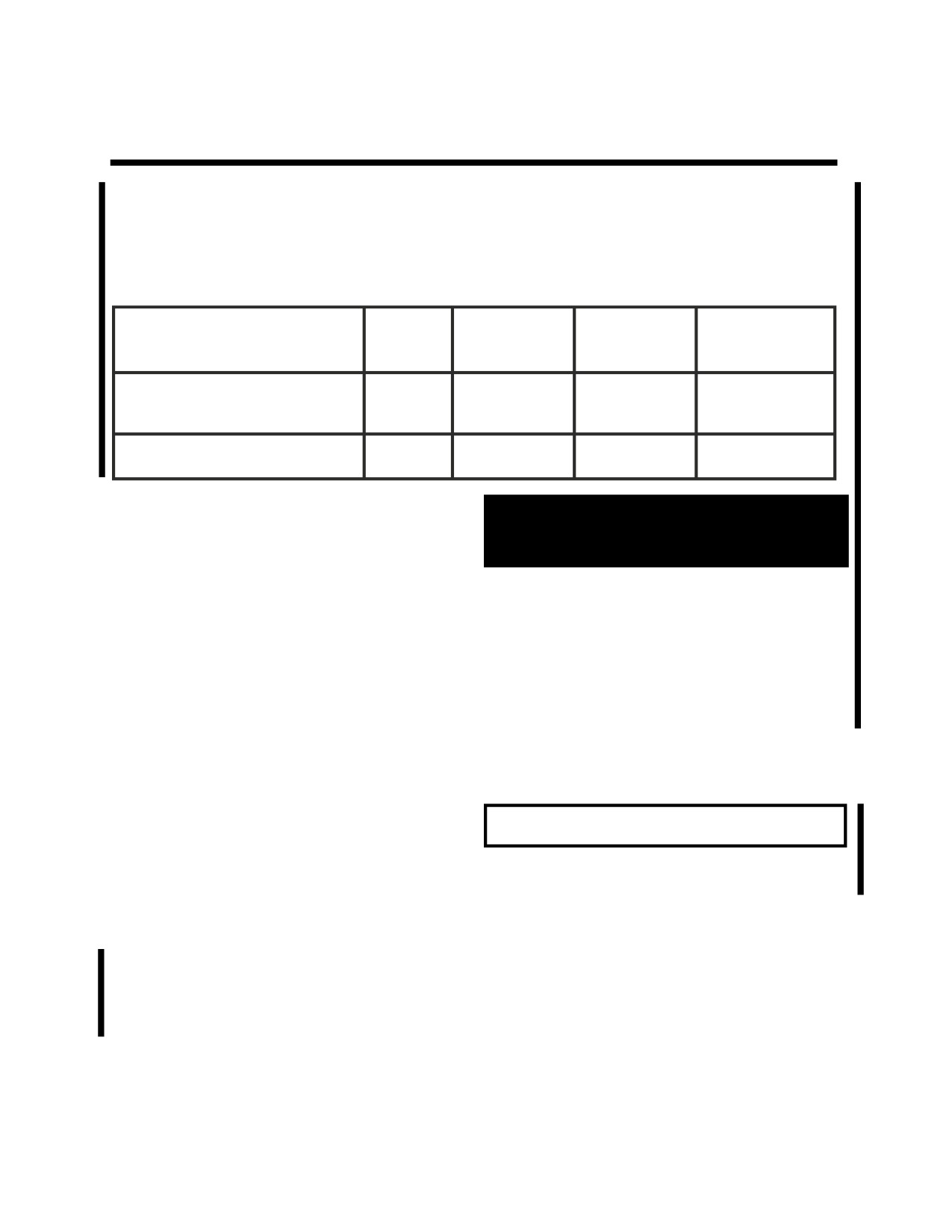
Figure 11-3. Army Missile Systems Enclosure Assembly Launch Pods, One Container
11-6
C1, FM 10-450-4/MCRP 4-23E, VOL II/NWP 3-04.12/AFJMAN 11-223, VOL II/
COMDTINST M13482.2
11-5. Army Missile Systems Enclosure Assembly Launch Pods (EALP), Two Containers
a. Applicability. The following items in Table 11-4 are certified for all helicopters with suitable lift capacity by the US
Army Soldier Systems Center:
Table 11-4. Army Missile Systems Enclosure Assembly Launch Pods (EALP), Two Containers
M AX
RECOMMENDED
LINK COUNT
NOMENCLATURE
WEIGH T
SLING SET
AIRSPEE D
FRONT/REA R
(POUNDS )
(KNOTS )
Multiple Launch Rocket System withT wo
Rocket Pods/Containers (with Six
10,010
25K
/
85
Rockets)
T
wo Enclosure Assem bly Launch Pods,
10,142
25K
/
85
Guided Missile Launch Assem bly
b. Materials. The following materials are required to
CAUTION
rig this load:
Do not mix the MLRS and the GMLA in the
same load.
(1) Sling set (25,000-pound capacity).
(c) Lash the stack of EALPs together using the
(2) Tape, adhesive, pressure-sensitive, 2-inch wide
CGU-1/B tie-down straps. Two of the straps should run
roll.
through both sets of lifting provisions on each end of the
EALPs, to keep them aligned during flight. Evenly space
(3) Cord, nylon, Type III, 550-pound breaking strength.
the remaining two straps between the lifting provisions,
running them around the EALPs. DO NOT ROUTE THE
(4) Webbing, cotton, 1/4-inch, 80-pound breaking
STRAPS OVER THE ROCKET TUBES. Pad all straps in
strength.
the area where they contact the edges of the EALPs.
(5) Felt sheet, cattle hair, Type IV, 1/2-inch or suitable
(2) Rigging. Rig the load according to the steps in
substitute.
Figure 11-4.
(6) Tie-down strap, cargo, CGU-1/B (as required).
NOTE: The firing end is considered the front of the
load.
c. Personnel. Four persons can prepare and rig this
load in 30 minutes.
(3) Hookup. The hookup team stands on top of the
EALPs. The static wand person discharges the static
d. Procedures. The following procedures apply to this
electricity with the static wand. The hookup person places
load:
the apex fitting onto the aircraft cargo hook. The hookup
team then moves clear of the load but remains close to the
(a) Prepare the EALPs for travel in accordance with
load as the helicopter removes slack from the sling legs.
standard procedures.
When successful hookup is assured, the hookup team
quickly exits the area underneath the helicopter to the
(b) Stack the EALPs one on top of the other, with
designated rendezvous point.
both EALPs facing the same direction.
(4) Derigging. Derigging is the reverse of the prepa-
ration and rigging procedures in steps d (1) and d (2).
11-7
C1, FM 10-450-4/MCRP 4-23E, VOL II/NWP 3-04.12/AFJMAN 11-223, VOL II/
COMDTINST M13482.2
RIGGING STEPS
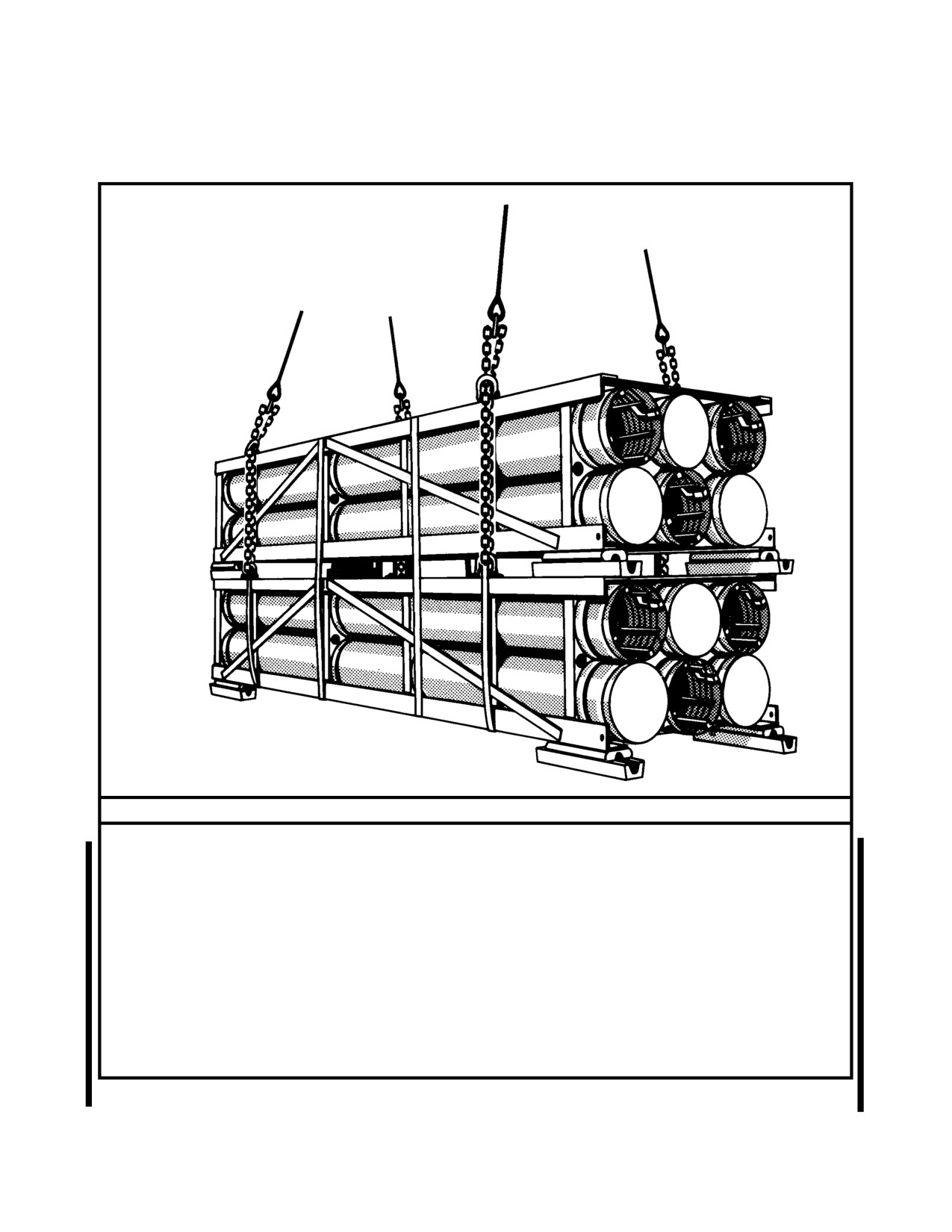
1. Position apex fitting on top of the EALPs. Route
3. Loop the chain end of sling leg 3 through the left rear
outer sling legs 1 and 2 to the front of the EALPs and inner
lift provision on the top EALP and through the rear lift
sling legs 3 and 4 to the rear. Sling legs 1 and 3 must be on
provision on the bottom EALP. Thread it back through
the left side of the load.
the rear lift provision on the top EALP. Place the correct
link from Table 11-4 in the grab hook. Repeat with sling
2. Loop the chain end of sling leg 1 through the left
leg 4 on the right rear lift provision.
front lift provision on the top EALP and through the front
lift provision on the bottom EALP. Thread it back through
4. Cluster and tie or tape (breakaway technique) all sling
the front lift provision on the top EALP. Place the correct
legs together on top of the EALP to prevent entanglement
link from Table 11-4 in the grab hook. Repeat with sling
during hookup and lift-off.
leg 2 on the right front lift provision.
Figure 11-4. Army Missile Systems Enclosure Assembly Launch Pods (EALP), Two Containers
11-8
C1, FM 10-450-4/MCRP 4-23E, VOL II/NWP 3-04.12/AFJMAN 11-223, VOL II/
COMDTINST M13482.2
11-9. Distributed Explosive Technology (DET) System, Array Container
a. Applicability. The following item in Table 11-8 is certified for all helicopters with suitable lift capacity by the US
Army Soldier Systems Center:
Table 11-8. Distributed Explosive Technology (DET) System, Array Container
M AX
RECOMMENDED
LINK COUNT
NOMENCLATURE
WEIGH T
SLING SET
AIRSPEE D
FRONT/REA R
(POUNDS )
(KNOTS )
Distributed Explosive Technology (DET)
Navy MK105
O
4,000
/
90
System
, Array Container
SlingAssem
l
b. Materials. The following materials are required to
(2) Rigging. Rig the load according to the steps in
rig this load:
Figure 11-8.
(1) Sling set, Navy MK105 O Sling Assembly with 91-
(3) Hookup. The hookup team stands on top of the
inch or longer leg assembly.
container. The static wand person discharges the static
electricity with the static wand. The hookup person places
(2) Tape, adhesive, pressure-sensitive, 2-inch wide
the apex fitting onto the aircraft cargo hook. The hookup
roll.
team then moves clear of the load but remains close to the
load as the helicopter removes slack from the sling legs.
(3) Cord, nylon, Type III, 550-pound breaking strength.
When successful hookup is assured, the hookup team
quickly exits the area underneath the helicopter to the
c. Personnel. Two persons can prepare and rig this
designated rendezvous point.
load in 10 minutes.
(4) Derigging. Derigging is the reverse of the prepa-
d. Procedures. The following procedures apply to this
ration and rigging procedures in steps d (1) and d (2).
load:
(1) Preparation. Prepare the load by taping the handles
on the sides of the container.
11-15
C1, FM 10-450-4/MCRP 4-23E, VOL II/NWP 3-04.12/AFJMAN 11-223, VOL II/
COMDTINST M13482.2
RIGGING STEPS
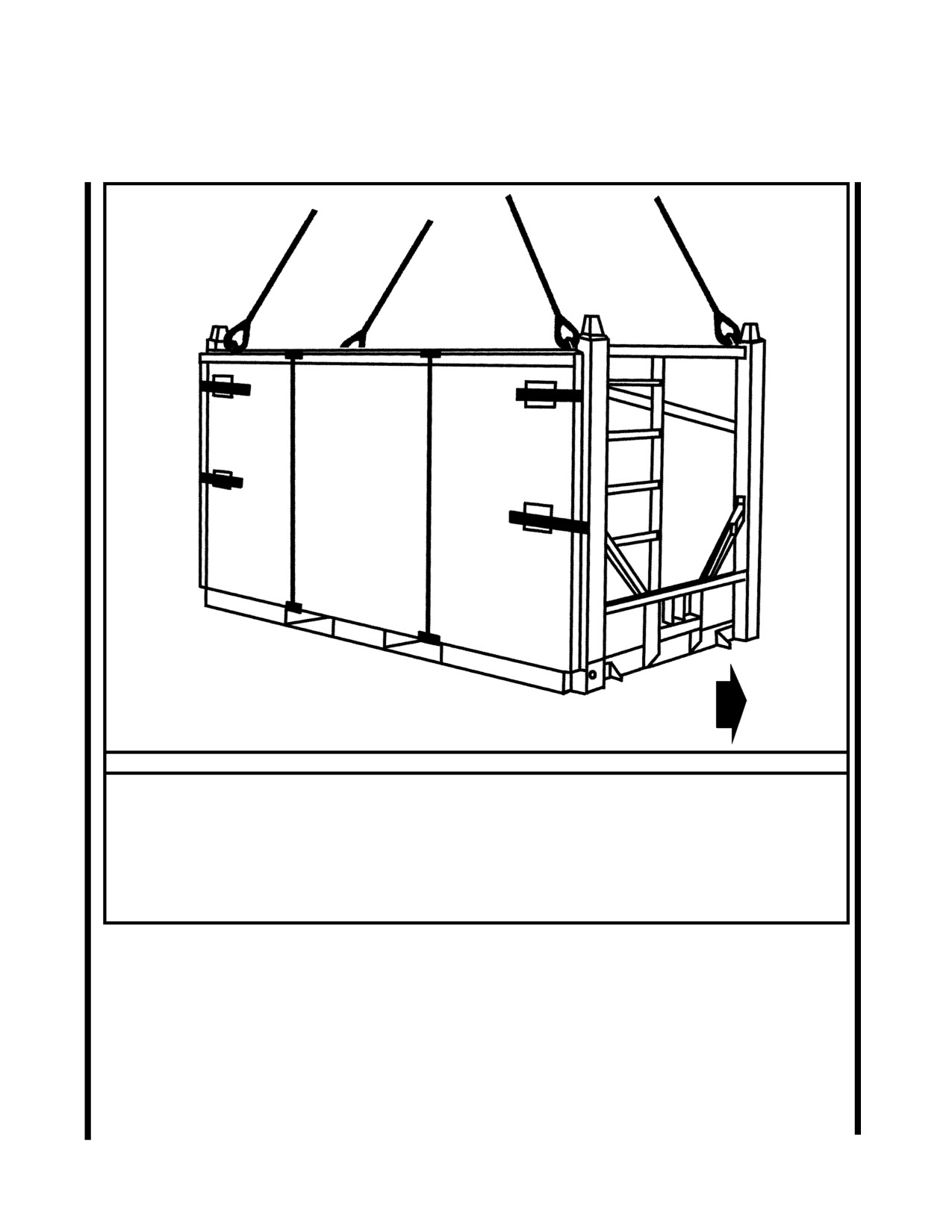
1. Position apex fitting on top of the container. Route
respective lift provision located at the top corners of the
outer sling legs 1 and 2 to the front of the container. Route
container.
inner sling legs 3 and 4 to the rear of the container. Sling
3. Secure the sling leg hooks in the closed position
legs 1and 3 must be on the left side of the load.
with Type III nylon cord.
2. Attach the hook on the end of each sling leg to the
Figure 11-8. Distributed Explosive Technology (DET) System, Array Container
11-16
C1, FM 10-450-4/MCRP 4-23E, VOL II/NWP 3-04.12/AFJMAN 11-223, VOL II/
COMDTINST M13482.2
11-10. Distributed Explosive Technology (DET) System, Landing Craft, Air Cushioned
(LCAC), Landing Interface Kit (LIK) Container, Single
a. Applicability. The following item in Table 11-9 is certified for all helicopters with suitable lift capacity by the US
Army Soldier Systems Center:
Table 11-9. Distributed Explosive Technology (DET) System, Landing Craft, Air Cushioned (LCAC), Landing
Interface Kit (LIK) Container, Single
M AX
RECOMMENDED
LINK COUNT
NOMENCLATURE
WEIGH T
SLING SET
AIRSPEE D
FRONT/REA R
(POUNDS )
(KNOTS )
Distributed Explosive Technology (DET)
System, Landing Craft, Air Cushioned
Navy MK105
O
1,200
/
80
(LCAC), Landing Interface Kit (LIK
)
SlingAssem
l
Container
b. Materials. The following materials are required to
(2) Rigging. Rig the load according to the steps in
rig this load:
Figure 11-9.
(1) Sling set, Navy MK105 O Sling Assembly with 91-
(3) Hookup. The hookup team stands on top of the
inch or longer leg assembly.
container. The static wand person discharges the static
electricity with the static wand. The hookup person places
(2) Cord, nylon, Type III, 550-pound breaking strength.
the apex fitting onto the aircraft cargo hook. The hookup
team then moves clear of the load but remains close to the
c. Personnel. Two persons can prepare and rig this
load as the helicopter removes slack from the sling legs.
load in 10 minutes.
When successful hookup is assured, the hookup team
quickly exits the area underneath the helicopter to the
d. Procedures. The following procedures apply to this
designated rendezvous point.
load:
(4) Derigging. Derigging is the reverse of the prepa-
(1) Preparation. Prepare the load by placing a strap
ration and rigging procedures in steps d (1) and d (2).
over each end of the LIK container and attaching it to the
platform in accordance with manufacturer's instructions.
11-17
C1, FM 10-450-4/MCRP 4-23E, VOL II/NWP 3-04.12/AFJMAN 11-223, VOL II/
COMDTINST M13482.2
RIGGING STEPS
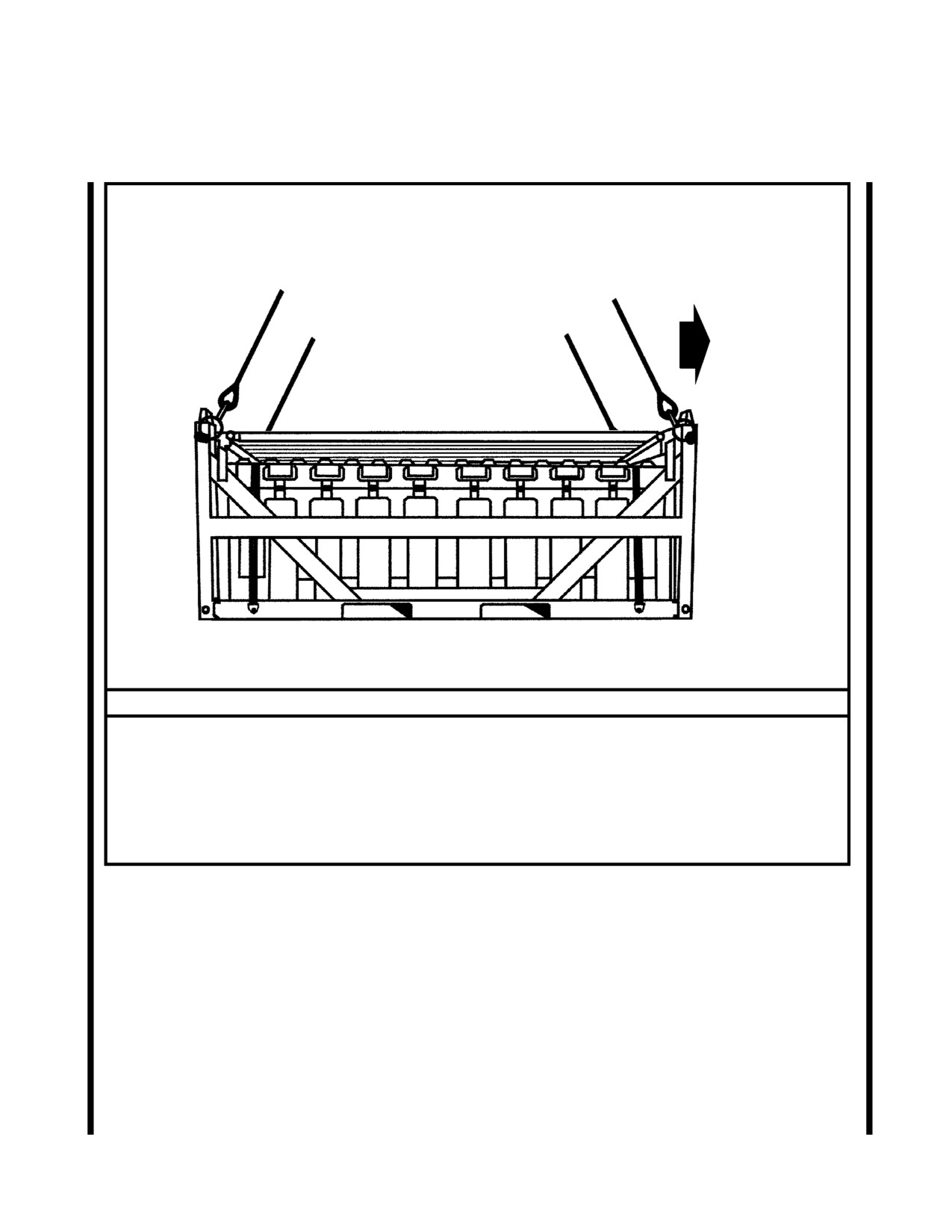
1. Position apex fitting on top of the container. Route
the respective lift provision located at the top corners of
outer sling legs 1 and 2 to the front of the container. Route
the container.
inner sling legs 3 and 4 to the rear of the container. Sling
3. Secure the sling leg hooks in the closed position
legs 1and 3 must be on the left side of the load.
with Type III nylon cord.
2. Attach the hook on the end of each sling leg to
Figure 11-9. Distributed Explosive Technology (DET) System, Landing Craft, Air Cushioned (LCAC), Landing
Interface Kit (LIK) Container, Single
11-18
C1, FM 10-450-4/MCRP 4-23E, VOL II/NWP 3-04.12/AFJMAN 11-223, VOL II/
COMDTINST M13482.2
11-11. Distributed Explosive Technology (DET) System, Landing Craft, Air Cushioned
(LCAC), Landing Interface Kit (LIK) Container, Doubled, Stacked
a. Applicability. The following item in Table 11-10 is certified for all helicopters with suitable lift capacity by the US
Army Soldier Systems Center:
Table 11-10. Distributed Explosive Technology (DET) System, Landing Craft, Air Cushioned (LCAC), Landing
Interface Kit (LIK) Container, Doubled, Stacked
M AX
RECOMMENDED
LINK COUNT
NOMENCLATURE
WEIGH T
SLING SET
AIRSPEE D
FRONT/REA R
(POUNDS )
(KNOTS )
DistributedExplosiveTechn
l
System
, Landing Craft, Air Cushioned
Navy MK105
O
(LCAC), Landing Interface Kit (LIK
)
2,400
/
85
Sling Assem
l
Container, Doubled, Stacked
b. Materials. The following materials are required to
on top of the other according to the manufacturer's in-
rig this load:
structions.
(1) Sling set, Navy MK105 O Sling Assembly with 91-
(c) Tie the bottom container lift provisions down to
inch or longer leg assembly.
a point on the load with Type III nylon cord.
(2) Cord, nylon, Type III, 550-pound breaking strength.
(2) Rigging. Rig the load according to the steps in
Figure 11-10.
c. Personnel. Two persons can prepare and rig this
load in 10 minutes.
(3) Hookup. The hookup team stands on top of the
container. The static wand person discharges the static
d. Procedures. The following procedures apply to this
electricity with the static wand. The hookup person places
load:
the apex fitting onto the aircraft cargo hook. The hookup
team then moves clear of the load but remains close to the
(1) Preparation. Prepare the load using the following
load as the helicopter removes slack from the sling legs.
steps:
When successful hookup is assured, the hookup team
quickly exits the area underneath the helicopter to the
(a) Place a strap over each end of the LIK container
designated rendezvous point.
and attach it to the platform in accordance with
manufacturer's instructions.
(4) Derigging. Derigging is the reverse of the prepa-
ration and rigging procedures in steps d (1) and d (2).
(b) Ensure the containers are secured together one
11-19
C1, FM 10-450-4/MCRP 4-23E, VOL II/NWP 3-04.12/AFJMAN 11-223, VOL II/
COMDTINST M13482.2
RIGGING STEPS
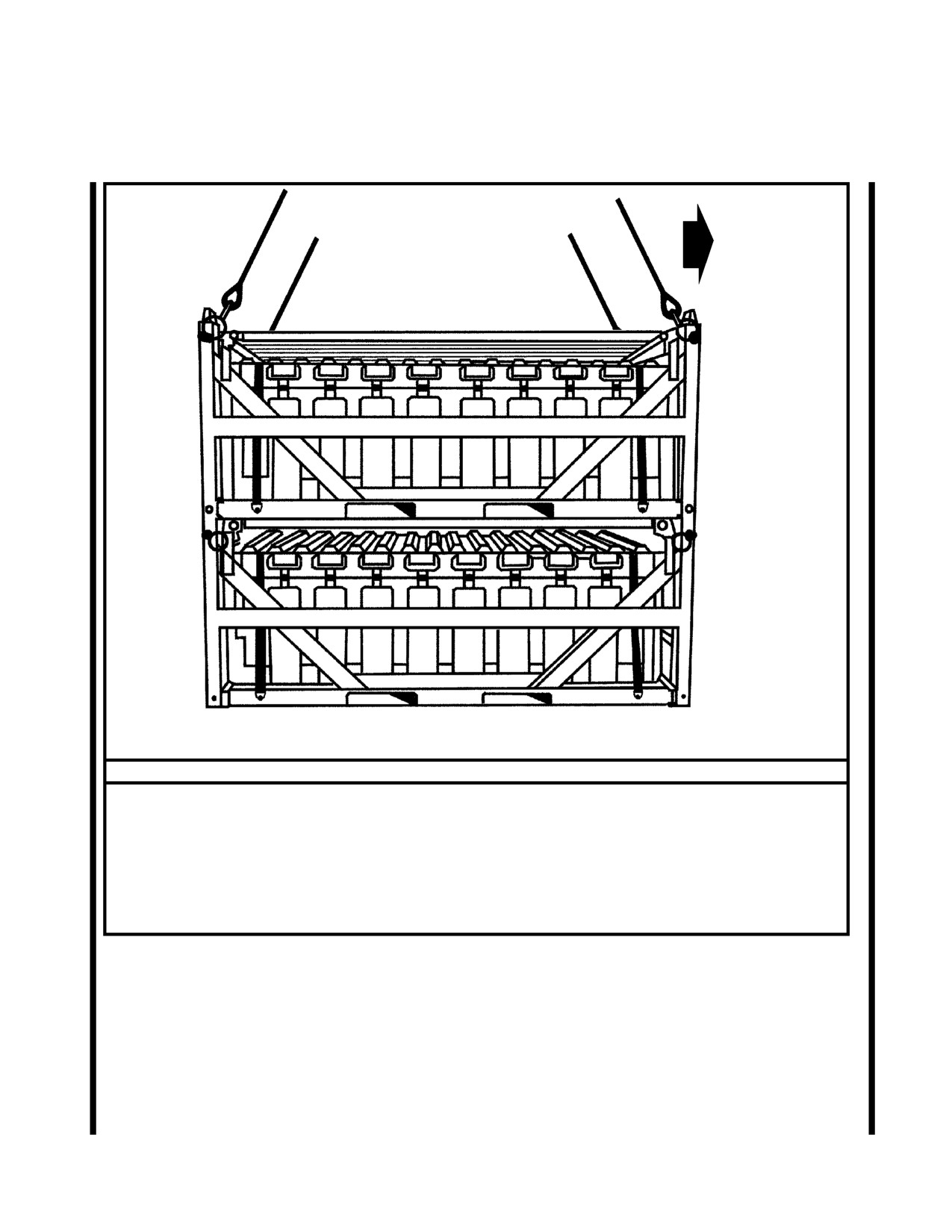
1. Position apex fitting on top of the container. Route
the respective lift provision located at the top corners of
outer sling legs 1 and 2 to the front of the container. Route
the container.
inner sling legs 3 and 4 to the rear of the container. Sling
legs 1and 3 must be on the left side of the load.
3. Secure the sling leg hooks in the closed position
with Type III nylon cord.
2. Attach the hook on the end of each sling leg to
Figure 11-10. Distributed Explosive Technology (DET) System, Landing Craft, Air Cushioned (LCAC), Landing
Interface Kit (LIK) Container, Double Stacked
11-20
FM 10-450-4/MCRP 4-23E, VOL II/NWP 3-04.12/AFJMAN 11-223, VOL II/
COMDTINST M13482.2
CHAPTER 12
CERTIFIED SINGLE-POINT RIGGING PROCEDURES FOR RADAR AND
SATELLITE EQUIPMENT
12-1. Introduction
This chapter contains rigging procedures for single-point
equipment are in this section. Paragraphs 12-2 through
lift of radar and satelite equipment that has been certified
12-12 give detailed instructions for rigging loads.
for sling load. Each rigging procedure is found in a para-
graph that includes a description of the load, materials
NOTE: Reach Pendants may be used on all single point
required for rigging, and steps to complete the procedure.
loads. A static discharge person is not required when
An applicability paragraph is also a part of each para-
using a Reach Pendant.
graph and identifies the certified loads. The certified
single-point rigging procedures for radar and satellite
12-2. AN/TPQ-37 Artillery-Loading Radar Set (Firefinder)
a. Applicability. The following item in Table 12-1 is certified for all helicopters with suitable lift capacity by the US
Army Soldier Systems Center:
Table 12-1. AN/TPQ-37 Artillery-Loading Radar Set (Firefinder)
M AX
RECOMMENDED
LINK COUNT
NOMENCLATURE
WEIGH T
SLING SET
AIRSPEE D
FRONT/REA R
(POUNDS )
(KNOTS )
AN/TPQ-37 Artillery-Loading Radar
10,800
24K
68/5
90
Set (Firefinder)
b. Materials. The following materials are required to
c. Personnel. Two persons can prepare and rig this
rig this load:
load in 30 minutes.
(1) Sling set (25,000-pound capacity).
d. Procedures. The following procedures apply to this
load:
(2) Tape, adhesive, pressure-sensitive, 2-inch wide
roll.
(1) Preparation. Prepare the load using the following
steps:
(3) Cord, nylon, Type III, 550-pound breaking strength.
(a) Antenna unit should be configured for march
(4) Webbing, cotton, 1/4-inch, 80-pound breaking
order. If the antenna unit is mounted on its transport
strength.
trailer, it must be removed for sling loading. If the trailer is
to accompany the unit, it must be rigged and moved as a
(5) Felt sheet, cattle hair, Type IV, 1/2-inch or suitable
separate load.
substitute.
(b) Ensure the maintenance tent frame and cover are
(6) Ladder.
stowed and secured in their proper position.
12-1
FM 10-450-4/MCRP 4-23E, VOL II/NWP 3-04.12/AFJMAN 11-223, VOL II/
COMDTINST M13482.2
(c) Ensure all cover panels, cabinet doors, and vents
(3) Hookup. The hookup team remains close to the
are installed and secured.
load as the helicopter removes slack from the sling legs.
When successful hookup is assured, the hookup team
(d) Secure all loose items with Type III nylon cord.
quickly exits the area underneath the helicopter to the
designated rendezvous point.
(e) Ensure the rear door is closed and secured with
the locking handle. Door rods must be secured in their
NOTE: Hookup is accomplished by the flight engineer
clips.
using a cargo-hook loading pole (Shepard's Hook). En-
sure the helicopter crew is informed of this in advance.
(f) Ensure the antenna transport cover is secured
tightly to the lacing brackets with bungee cord. If neces-
(4) Derigging. Derigging is the reverse of the prepa-
sary, secure the antenna with additional nylon cord.
ration and rigging procedures in steps d (1) and d (2).
(2) Rigging. Rig the load according to the steps in
NOTE: Advise the pilot to hover to one side before releas-
Figure 12-1.
ing the apex fitting from the cargo hook .
CAUTION
Do not stand on top of the load. Use the
ladder to connect the sling legs to the load.
12-2
C1, FM 10-450-4/MCRP 4-23E, VOL II/NWP 3-04.12/AFJMAN 11-223, VOL II/
COMDTINST M13482.2
12-12. Secure Mobile Anti-Jam Reliable Tactical Terminal (SMART-T) Pallet
a. Applicability. The following item in Table 12-11 is certified for all helicopters with suitable lift capacity by the US
Army Soldier Systems Center:
Table 12-11. Secure Mobile Anti-Jam Reliable Tactical Terminal (SMART-T) Pallet
M AX
RECOMMENDED
LINK COUNT
NOMENCLATURE
WEIGH T
SLING SET
AIRSPEE D
FRONT/REA R
(POUNDS )
(KNOTS )
Secure Mobile Anti-Jam Reliable
2,440
10K
3/30
100
T
actical Terminal (SMART-T) Pa
l
b. Materials. The following materials are required to
nylon cord. Ensure the fuel cans at the end of the pallet
rig this load:
are locked in position.
(1) Sling set (10,000-pound capacity).
(b) Secure the antenna dish.
(2) Tape, adhesive, pressure-sensitive, 2-inch wide
(2) Rigging. Rig the load according to the steps in
roll.
Figure 12-11.
(3) Cord, nylon, Type III, 550-pound breaking strength.
NOTE: The fuel can brackets are on the rear of the load.
(4) Webbing, cotton, 1/4-inch, 80-pound breaking
(3) Hookup. The hookup team stands beside the
strength.
pallet. The static wand person discharges the static elec-
tricity with the static wand. The hookup person places
c. Personnel. Four persons can prepare and rig this
the apex fitting onto the aircraft cargo hook. The hookup
load in 10 minutes.
team then moves clear of the load but remains close to the
load as the helicopter removes slack from the sling legs.
d. Procedures. The following procedures apply to this
When successful hookup is assured, the hookup team
load:
quickly exits the area underneath the helicopter to the
designated rendezvous point.
(1) Preparation. Prepare the load using the following
steps:
(4) Derigging. Derigging is the reverse of the prepa-
ration and rigging procedures in steps d (1) and d (2).
(a) Secure all loose equipment with tape or Type III
12-23
C1, FM 10-450-4/MCRP 4-23E, VOL II/NWP 3-04.12/AFJMAN 11-223, VOL II/
COMDTINST M13482.2
RIGGING STEPS
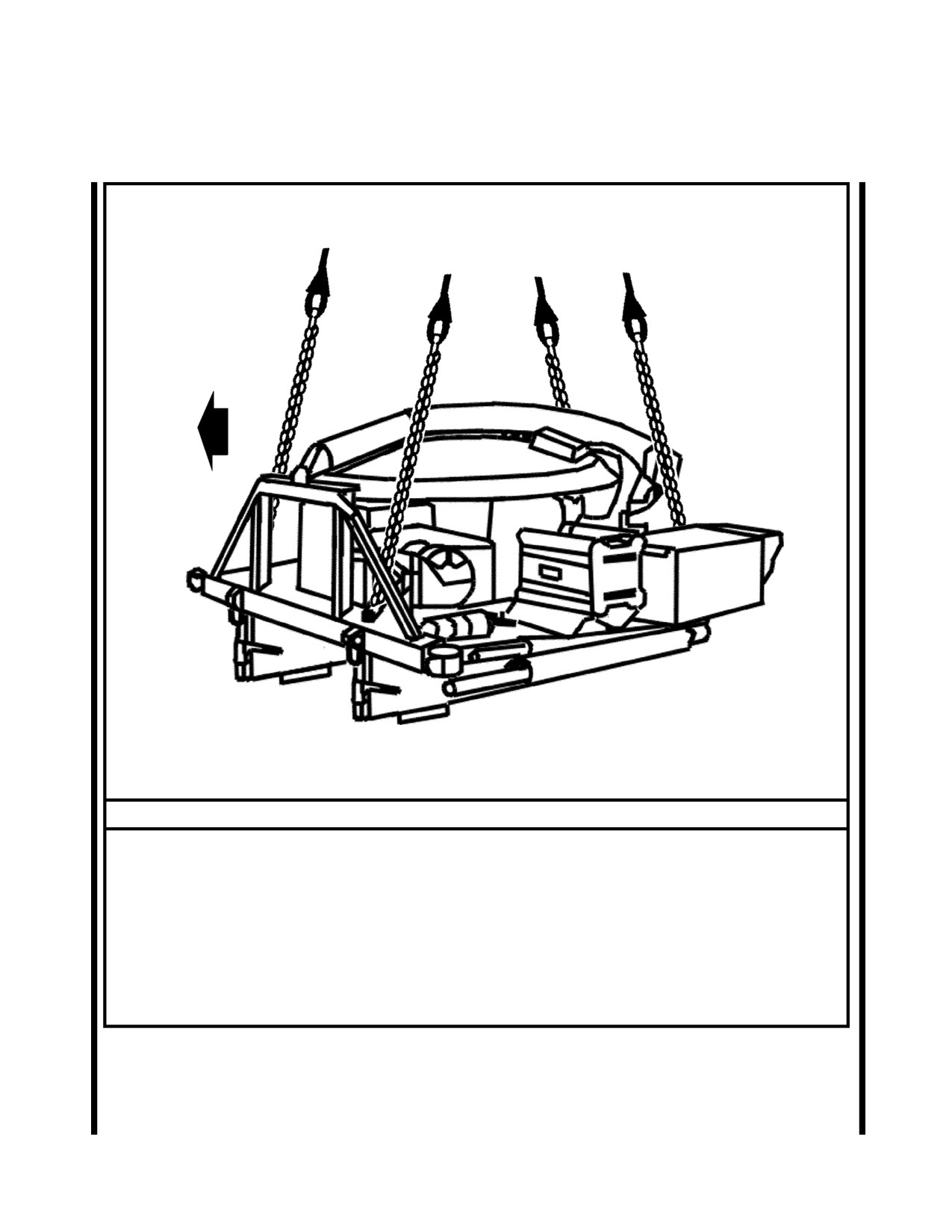
1. Position the apex fitting beside the pallet. Route
3. Loop the chain end of sling leg 3 through the left rear
outer sling legs 1 and 2 to the front of the load and inner
lift provision. Place the correct link from Table 12-11 in the
sling legs 3 and 4 to the rear. Sling legs 1 and 3 must be on
grab hook. Repeat with sling leg 4 on the right rear lift
the left side of the load.
provision. Secure excess chain with tape or Type III ny-
lon cord.
2. Loop the chain end of sling leg 1 through the left
front lift provision. Place the correct link from Table 12-11
4. Cluster and tie or tape (breakaway technique) all sling
in the grab hook. Repeat with sling leg 2 on the top right
legs together on top of the load to prevent entanglement
corner of the frame.
during hookup and lift-off.
Figure 12-11. Secure Mobile Anti-Jam Reliable Tactical Terminal (SMART-T) Pallet
12-24
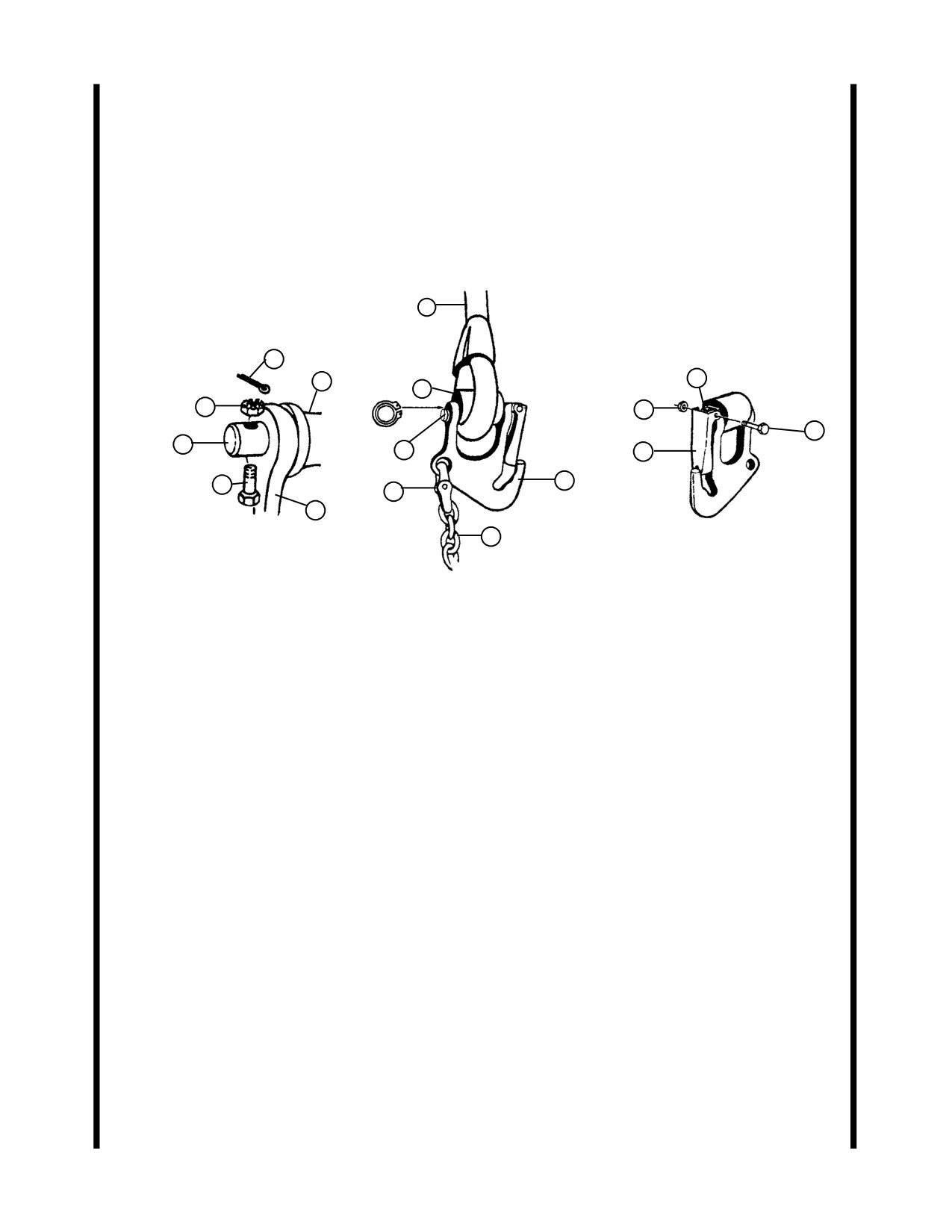
C1, FM 10-450-4/MCRP 4-23E, VOL II/NWP 3-04.12/AFJMAN 11-223, VOL II/
COMDTINST M13482.3A
APPENDIX A
NATIONAL STOCK NUMBERS FOR SLINGS,
NETS, AND SPARE PARTS
10,000-POUND CAPACITY SLING SET AND COMPONENTS
7
6
3
12
9
5
15
13
14
2
10
11
4
8
17
1
16
10,000- or 25,000-Pound Capacity Sling Set (Circled Numbers Correspond with NSNs of Identified Part)
NSN
PART NUM BER
DESCRIPTION
Qty
1670-01-027-2902
38850-00001-043
SlingSetAssemblyComp
l
t
1 ea
1
4030-01-048-4045
38850-00004-045
Apex Fitting Assem bly
1 ea
2
5315-01-115-3482
38850-00008-101
Pin, Apex Fitting
1 ea
3
5365-01-235-0908
38850-00015-104
Spacer, Apex
1 ea
4
5306-00-944-1536
NAS1306-16D
Bolt
1 ea
5
5310-00-207-9274
AN 320C6
Nut, Caste
l
1 ea
6
5315-00-2341864
MS 24665-302
Cotter Pin
1 ea
7
4020-01-047-6814
38850-00009-055
Rope Assem bly, Black
4 ea
8
4030-01-048-4046
38850-00011-041
Grabhook Assem bly
4 ea
9
5364-01-109-2543
38850-00015-101
Spacer, Grabhook
4 ea
10
5315-01-121-0497
38850-00008-103
Pin, Spacer
4 ea
11
4030-01-100-1684
38850-00017-101
Keeper, Grabhook
4 ea
12
5360-01-115-6833
38850-00019-101
Keeper, Spring
4 ea
13
5365-01-046-3670
MS 3217-1050
Snap Ring
4 ea
14
5306-00-771-7621
NAS 1303-21
Bolt, Shear
4 ea
15
5310-00-807-1467
MS 21042-3
Nut, Lock
4 ea
16
4010-01-058-4772
38850-00053-101
Chain, 8-foot Length
4 ea
17
4010-01-193-9331
577-0615
Link, Coupling
4 ea
18
8460-00-606-8366
Mil-41835
KitBag,Flye
’
1 ea
A-1
C1, FM 10-450-4/MCRP 4-23E, VOL II/NWP 3-04.12/AFJMAN 11-223, VOL II/
COMDTINST M13482.3A
25,000-POUND CAPACITY SLING SET AND COMPONENTS
NSN
PART NUM BER
DESCRIPTION
Qty
1670-01-027-2900
38850-00001-044
SlingSetAssemblyCom
l
1 ea
1
4030-01-048-4044
38850-00004-046
ShackleAssem bly
1 ea
2
5315-01-119-9065
38850-00008-102
Pin, Apex Fitting
1 ea
3
1670-01-235-0907
38850-00015-105
Spacer, Apex
1 ea
4
5306-00-944-2659
NAS1306-22D
Bolt
1 ea
5
5310-00-207-9274
AN 320C6
Nut, Castellated
1 ea
6
5315-00-234-1864
MS 24665-302
Cotter Pin
1 ea
7
1670-01-047-6815
38850-00009-056
Rope Assem bly
4 ea
8
4030-01-048-4047
38850-00011-046
Grabhook Assem bly
4 ea
9
1670-01-109-2544
38850-00015-102
Spacer, Grabhook
4 ea
10
5315-01-121-2874
38850-00008-104
Pin, Spacer
4 ea
11
4030-01-100-1685
38850-00017-102
Latch, Safety Hook
4 ea
12
5360-01-115-6833
38850-00019-101
Keeper, Spring
4 ea
13
5365-00-261-3918
MS 3217-1075
Snap Ring
4 ea
14
5306-00-771-7621
NAS 1303-21
Bolt, Shear
4 ea
15
5310-00-807-1467
MS 21042-3
Expanded Washer
4 ea
16
4010-01-058-4771
38850-00053-102
Chain, 8-foot Length
4 ea
17
4010-01-041-9751
664241
Link, Coupling
4 ea
18
8460-00-606-8366
Mil-41835
KitBag,Flye
’
1 ea
A-2
C1, FM 10-450-4/MCRP 4-23E, VOL II/NWP 3-04.12/AFJMAN 11-223, VOL II/
COMDTINST M13482.3A
15,000-POUND CAPACITY MULTILEG SLING ASSEMBLY
NSN
PART NUM BER
DESCRIPTION
Qty
Sling, multi-legassemb
y
1670-00-902-3080
3900061
1
ea
T
AMCN B2030
5365-00-946-8719
AC6000292
Web Ring assem bly
1 ea
1670-00-719-6243
MS24553-1
Link Assem bly, Web Ring
1 ea
1670-00-946-8631
3110167
Sling legassem
l
4 ea
NA
391
1
Keeper, 5-inch,
l
4 ea
NA
391
1
Keeper, 6 1/4-inch,
l
4 ea
1670-00-719-6343
MS 24553-1
Link assembly, sling
l
1 ea
NA
31610
Grab
l
4 ea
NA
FE7623-3
Keeper, grab
l
4 ea
NA
34012-18
Spring keeper, grab
l
4 ea
5310-00-167-0818
NAS1145f0363f
Washer keeper, grab
l
4 ea
5315-00-812-3765
MS20392-2033
Pin, keeper, grab
l
4 ea
5315-00-839-2325
MS24665-132
Cotter pin, keeper, grab
l
4 ea
NA
31
1
Coupling
l
4 ea
NA
34080-4
Ch
i
4 ea
A-3
C1, FM 10-450-4/MCRP 4-23E, VOL II/NWP 3-04.12/AFJMAN 11-223, VOL II/
COMDTINST M13482.3A
40,000-POUND CAPACITY SLING SET AND COMPONENTS
NSN
PART NUM BER
DESCRIPTION
Qty
3940-01-183-21
18
TAMCN
SlingSetAssemblyCom
l
1 ea
4030-01-199-9562
FE8109-1
Apex shackle assembly
1 ea
N
A
FE8109-5
Shackle
1 ea
N
A
FE8109-3
Pin, shackle, apex
1 ea
N
A
FE8109-2
Spacer, shackle, apex
1 ea
5306-00-763-7931
NAS1306-21D
Bolt, shear
1 ea
5310-00-176-81
10
AN320-6
Nut, castellated, plain, hex
1 ea
5315-00-234-1864
MS24665-302
Cotter Pin
1 ea
3940-01-194-9364
JETSWMC-2000
Sling
l
4 ea
4030-01-197-1629
FE8103-1
Shackle assembly
4 ea
N
A
FE8103-4
Spacer, grab
l
4 ea
5306-00-151-1482
AN12-42
Bolt, grablink
4 ea
5310-00-167-1292
AN310-12
Nut, plain, castellated, plain, hex
4 ea
5315-00-285-7161
MS20392-2033
Pin, cotter
4 ea
N
A
34012-18
Spring, keeper, grab
l
4 ea
5310-00-167-0818
AN960-10
Washer, keeper, grab
l
4 ea
5315-00-839-2325
MS24665-132
Cotter pin, keeper, grab
l
4 ea
4010-01-081-51
14
577-0815
Link, Coupling
4 ea
N
A
607050
Chain, 8-foot
4 ea
A-4
C1, FM 10-450-4/MCRP 4-23E, VOL II/NWP 3-04.12/AFJMAN 11-223, VOL II/
COMDTINST M13482.3A
FLAT WEB NYLON SLINGS
TYPE X NYLON AERIAL DELIVERY SLING
NSN
Description
3940-00-675-5001
Sling, endless donut, 10-inch
1670-00-393-0460
Ring assembly, 25,000-pound capacity
TYPE XXVI NYLON MULTILOOP LINE
NSN
Description
1670-01-062-6301
2-loop, 3 foot
1670-01-062-6306
4-loop, 3 foot
1670-01-062-6304
2-loop, 9 foot
1670-01-062-6305
4-loop, 9 foot
1670-01-063-7760
2-loop, 11 foot
1670-01-062-6310
4-loop, 11 foot
1670-01-062-6303
2-loop, 12 foot
1670-01-062-6307
4-loop, 12 foot
1670-01-063-7761
2-loop, 16 foot
1670-01-062-6308
4-loop, 16 foot
1670-01-062-6302
2-loop, 20 foot
1670-01-064-4453
4-loop, 20 foot
1670-01-062-6309
4-loop, 28 foot
1670-01-062-6313
3-loop, 60 foot
1670-01-064-4454
6-loop, 60 foot
1670-01-062-6311
2-loop, 120 foot
1670-01-062-6312
6-loop, 120 foot
1670-01-107-7651
3-loop, 140 foot
ROUNDSLINGS
NSN
CAPACITY
LENGTH
1670-01-388-6789
5,300-pound
8 foot
1670-01-388-8480
8,400-pound
8 foot
1670-01-388-3845
5,300-pound
17 foot
1670-01-388-8479
8,400-pound
17 foot
1670-01-388-3917
13,200-pound
30 foot
1670-01-388-3901
21,200-pound
65 foot
1670-01-388-3965
21,200-pound
70 foot
A-5
C1, FM 10-450-4/MCRP 4-23E, VOL II/NWP 3-04.12/AFJMAN 11-223, VOL II/
COMDTINST M13482.3A
5,000- AND 10.000-POUND CAPACITY CARGO NETS AND COMPONENTS
NSN
Part Number
Description
Qty
1670-01-058-3811
6018-5
Net, 5,000-pound capacity,
1 ea
LIN N02776, TAMCN J3121
1670-01-058-3810
6018-10
Net, 10,000-pound capacity,
1 ea
LIN N02708, TAMCN J3120
1670-01-070-5276
6019
Apex fitting
1 ea
1670-01-067-9989
6020
Hook
4 ea
4020-01-118-5826
M7515-7N
Repair cord, used on
As req
part no. 6018-5
4020-01-119-5994
6018-20
Repair cord, used on
As req
part no. 6018-10
8030-01-152-2286
WB460-23
Antiabrasion compound,
As req
olive drab
8030-01-154-2327
WB460-7012
Antiabrasion compound,
As req
black
1080-00-108-1155
13226EO964-2
Transportease
1 ea*
8460-00-606-8366
MIL-K-41835
Kit bag, flyers
1 ea*
* Alternate NSN is 1080-00-107-8580. These cases are designed and marked for use with the
camouflage screen. Camouflage system markings should be replaced with “Helicopter External Cargo
Net, 10,000-pound capacity.”
PROTECTIVE EQUIPMENT
NSN
Description
4240-00-052-3776
Eye goggles
8415-01-158-9445
Gloves, electrical workers, size 9
8415-01-158-9446
Gloves, electrical workers, size 10
8415-01-158-9447
Gloves, electrical workers, size 11
8415-01-158-9448
Gloves, electrical workers, size 12
8415-00-268-7859
Gloves, leather
4240-00-759-3290
Headset (USAF)
4240-00-762-2582
Headset (USAF)
8415-00-071-8786
Helmet, flight deck (USN/USMC/USAF)
6515-00-137-6345
Plugs, ear, hearing protection
A-6
C1, FM 10-450-4/MCRP 4-23E, VOL II/NWP 3-04.12/AFJMAN 11-223, VOL II/
COMDTINST M13482.3A
MISCELLANEOUS EQUIPMENT AND MATERIAL
NSN
Description
4030-00-360-0304
Clevis assembly, small, MS 70087-1
5305-00-726-2553
Bolt, Screw Cap, Hexagon Head
5310-00-835-2037
Nut, Plain, Hexagon
4030-00-678-8562
Clevis assembly, medium, MS 70087-2, Shackle
5305-00-940-8069
Bolt, Screw Cap, Hexagon Head
5310-00-842-1190
Nut, Plain, Hexagon
4030-00-090-5354
Clevis assembly, large, MS 70087-3, Shackle
5305-00-177-5617
Bolt, Screw Cap, Hexagon Head
5310-00-891-3428
Nut, Plain, Hexagon
4020-00-240-2146
Cord, nylon, Type III, 550-pound breaking strength
8305-00-958-3685
Felt sheeting, 1/2-inch thick, 30-inch wide
8305-00-191-1101
Felt sheeting, 1/2-inch thick, 60-inch wide
7510-00-079-0286
Ink, marking, parachute, orange-yellow, marker
7520-00-634-6583
Ink, marking, parachute, orange-yellow, liquid
7510-00-230-2734
Ink, marking, parachute, strata-blue, marker
7520-00-286-5362
Ink, marking, parachute, strata-blue, liquid
5825-00-917-3738
Light, beacon, beanbag
6260-01-074-4230
Light, chemical wand, 30-minute glow time, Yellow
6260-00-106-7478
Light, chemical wand, 6-hour glow time, Green
6260-01-074-4229
Light, chemical wand, 12-hour glow time, Green
1670-00-783-5988
Link assembly, Type IV
1670-00-212-1149
Rachet, Adjustable, Assembly, Tiedown
1670-00-516-8405
Tiedown, Cargo, Aircraft, 10,000-pound capacity
1670-00-753-3928
Pad, energy-dissipating, honeycomb
8135-00-664-6958
Padding, cellulose, 20-inch by 60-foot
8135-00-808-6446
Padding, cellulose, 24-inch by 125-foot
8345-00-174-6865
Panel, marker, red-yellow, VS-17, orange
4020-00-231-2581
Rope, 3/8-inch, TR605, Natural
4020-00-968-1357
Rope, fibrous, 1/2-inch, MIL-R-17343
6850-00-264-9038
Solvent, dry cleaning, PD-680
7510-00-266-5016
Tape, adhesive, pressure-sensitive, 2-inch wide roll, green
A-7
C1, FM 10-450-4/MCRP 4-23E, VOL II/NWP 3-04.12/AFJMAN 11-223, VOL II/
COMDTINST M13482.3A
MISCELLANEOUS EQUIPMENT AND MATERIAL (CONTINUED)
7510-00-074-4969
Tape, adhesive, pressure-sensitive, 2-inch wide roll, red
1670-00-725-1437
Tie-down strap, CGU-l/B, 5,000-pound capacity
5340-01-204-3009
Tie-down strap, web nylon, 5,000-pound capacity
1670-00-937-0271
Tie-down strap, web nylon, 10,000-pound capacity
5365-00-937-0147
D-Ring, aerial delivery
3990-00-937-0272
Load binder assembly
1670-00-986-1139
Quick-fit strap fastener
Two-point link assembly components:
5306-00-435-8994
Bolt, 1-inch diameter, 4-inch long (2 each)
5310-00-232-5165
Nut, 1-inch diameter (2 each)
1670-00-003-1954
Plate, side, 5 1/2-inch long (2 each)
5365-00-007-3414
Spacer, large
1670-00-574-8044
Wand, static discharge
5920-01-192-5535
Wand, static discharge, 3-foot, PN 1610AS100-1, TAMCN C6254
5920-01-347-0728
Wand, static discharge, 5-foot, PN 1610AS100-2, TAMCN C6252
8305-00-082-5752
Webbing, nylon, tubular, 1/2-inch, 1,000-pound breaking strength
8305-00-268-2411
Webbing, cotton, 1/4-inch, 80-pound breaking strength
EXTERNAL LIFT DEVICES
1670-00-587-3421
Bag, cargo, A-22, LIN B 14181, TAMCN C4070
3940-00-892-4380
Cargo net, 14-foot square, 10-inch mesh
3940-00-892-4374
Cargo net, 14-foot square, 8-inch mesh
1450-01-219-4360
Mk105 pendant
1450-00-414-7172
Mk105 hoisting sling assembly, 6,000-pound capacity
4020-00-881-8736
Mk105 sling leg assembly
4020-01-365-3115
Pendant, reach, 11,000-pound capacity
4020-01-337-3185
Pendant, reach, 25,000-pound capacity
1670-01-003-0803
Releasable swivel hook pendant sling AC6000500 Mod 1
1450-00-169-6927
Sling, pallet, Mk86, LIN S80670
1398-00-004-9175
Sling, pallet, Mk100, LIN S80738
1670-00-103-6617
Swivel hook sling leg, AC6000153 (USMC, USN)
A-8
C1, FM 10-450-4/MCRP 4-23E, VOL II/NWP 3-04.12/AFJMAN 11-223, VOL II/
COMDTINST M13482.3A
GLOSSARY
ACRONYMS AND ABBREVIATIONS
ADCGS
aviation direct current generator set
trailer
AETC
auxiliary equipment transportation
HMD
high mobility downsized
container
HMDA
high mobility digital group multiplexer
AFATADS
advanced field artillery tactical data
assemblage
systems
HMMH
high mobility materiel handler
AGPU
aviation ground power unit
HMMWV
high-mobility multipurpose wheeled
ARL-C
airborne reconnaissance low-comint
vehicle
ARL-I
airborne reconnaissance low-imagery
HMT
high mobility trailers
ASK
acoustic suppression kit
HSTRU
hydraulic system test and repair unit
AS
aviation section
HZ
hertz
ATG
antenna transceiver group
IAS
intelligence analysis system
BIDS
biological integrated detection system
IEW
intelligence and electronic warfare
bn
battalion
IMETS
integrated meteorological systems
BSTF
base shop test facility
ISO
International Organization of
BTU
British Thermal Unit
Standardization
CBC
cargo bed cover
JSTAR
joint surveillance target attack radar
CFM
cubic feet per minute/cylinder filling
JTIDS
joint tactical information distribution
module
system
CLFFK
company level field feeding kit
KW
kilowatt(s)
CMTH
contact maintenance truck, heavy
LAV
light armored vehicle
CONEX
container express
LCAC
landing craft air cushioned
CWAR
continuous wave acquisition radar
LHGXA
lightweight high gain x-band antenna
DASC
direct air support central
LIK
landing interface kit
DAMP
digital antenna mast program
LIN
line number
DDSS
downsized direct support section
LMS
lightweight multipurpose shelter
DDGM
downsized digital group multiplexer
LTACFIRE
lightweight tactical fire control system
DET
distributed explosive technology
LTR
light tactical floating raft bridge
DGM
digital group multiplexer
LVAD
low velocity airdrop
DOD
Department of Defense
MGB
medium girder bridge
DOM
desert operation motorcycle
MHG
meterological hydrogen generator
DOT
desert operation trailer
MICLIC
mine clearing line charge
EALP
enclosure assembly launch pods
MIL STD
military standard
EBFL
extendable boom forklift
MLRS
multiple launch rocket system
ECU
environmental control unit
mm
millimeter
EFOGM
enhanced fiber optic guided missile
MOST
mobile oversnow transport
EMI
electromechanical induction
MR
mobile radio
EPLRS
enhanced position location reporting
MRBS
mobile radio broadcasting subsystem
system
MSFDCS
multiservice flight data collection sheet
FAAR
forward area alerting radar
MT
mobile television
FARE
forward area refueling equipment
MTBS
mobile television broadcasting subsystem
FMOGDS
field medical oxygen generation/distribu-
MTMCTEA Military Traffic Management Command
tion system
Transportation Engineering Agency
FOPS
falling objects protection system
MTS
mobile-track system
FUPP
full-up power pack
NABS
NATO airbase satcom
GMLA
guided missile launch assembly
NATO
North Atlantic Treaty Organization
GPH
gallons per hour
NAVAIR
Naval Air Systems Command
GPM
gallons per minute
NCS-E(D)
downsized net control system
HATS
hardened army tactical shelter
NRDEC
Natick Research, Development,
HEMAT
heavy expanded mobility ammunition
and Engineering Center
Glossary-1
C1, FM 10-450-4/MCRP 4-23E, VOL II/NWP 3-04.12/AFJMAN 11-223, VOL II/
COMDTINST M13482.3A
NSN
national stock number
SICPS
standardized integrated command post
OC
operations central
systems
OCG
operational control group
SIXCON six-compartment container
OGDM
oxygen generation/distribution module
SMART-T secure mobile anti-jam tactical terminal
OVE
operator vehicle equipment
SMMS sensor mobile monitoring system
PN
part number
SPAM
shop, portable aircraft maintenance
POC
platoon operations center
SUSV
small unit support vehicle
PTO
pioneer tool outfit
TAFDS
tactical airfield fuel dispensing system
QRSA
quick reaction satellite antenna
TAMCN
Table of Authorized Material Control
RIE
required individual equipment
Number
RLST
remote landing site tower
TM
technical manual
ROPS
roll-over protection system
TOW
tube launched, optically tracked,
ROWPU
reverse osmosis water purification unit
wireguided
RP/C
rocket pod/container
TQG
tactical quiet generator
RT
rough terrain
TRSS
tactical remote sensor system
SCAMP
self-propelled crane for Army aircraft
TSS
tracked suspension system
maintenance and positioning
TTCS
tactical terminal control system
SCOTT single channel objective tactical terminal
US
United States
SDASS
special diver's air support system
USA
United States Army
SEE
small emplacement excavator
USMC
United States Marine Corps
Glossary-2
C1, FM 10-450-4/MCRP 4-23E, VOL II/NWP 3-04.12/AFJMAN 11-223, VOL II/
COMDTINST M13482.3A
REFERENCES
REQUIRED PUBLICATIONS
Required publications are sources that users must read in order to understand or to comply with this publication.
MULTISERVICE PUBLICATION
AFJMAN 24-204/TM 38-250/NAVSUP PUB 505/MCO P 4030.19F/DLAM 4145.3, Packaging and Materials Handling:
Preparing Hazardous Materials for Military Air Shipment. November 1994.
FM 10-450-3/MCRP4-23E, Vol I/NWP 3-04.11/AFJMAN 11-223, VOL I/COMDTINST M13482.2A
Multiservice Helicopter Sling Load: Basic Operations and Equipment. April 1997.
MIL STD 913 - Requirements for the Certification of Sling Loaded Equipment for External Transportation by Department
of Defense Helicopters. February 1997.
TM 9-2320-285-24&P - Unit, Direct Support, and General Support Maintenance Repair Parts and Special Tools Lists,
Truck, Tractor, Yard-type: 43,500 GVW, DED, 4 x 2 (Army Model M878A1). June 1992.
TM 9-1015-252-10 - Operator's Manual for Howitzer, Light, Towed: 105-MM, M119A1. October 1992.
TM 9-1425-2585-10-1 - System Description of M48A2 (Chaparral Air Defense Guided Missile System). June 1984.
TM 9-1430-588-10 - Operator's Manual for Radar Set, AN/MPQ-49 (Forward Area Alerting Radar System). February 1986.
Reference-1