FM 90-20 J-FIRE MULTISERVICE PROCEDURES FOR THE JOINT APPLICATION OF FIREPOWER (NOVEMBER 1997) - page 2
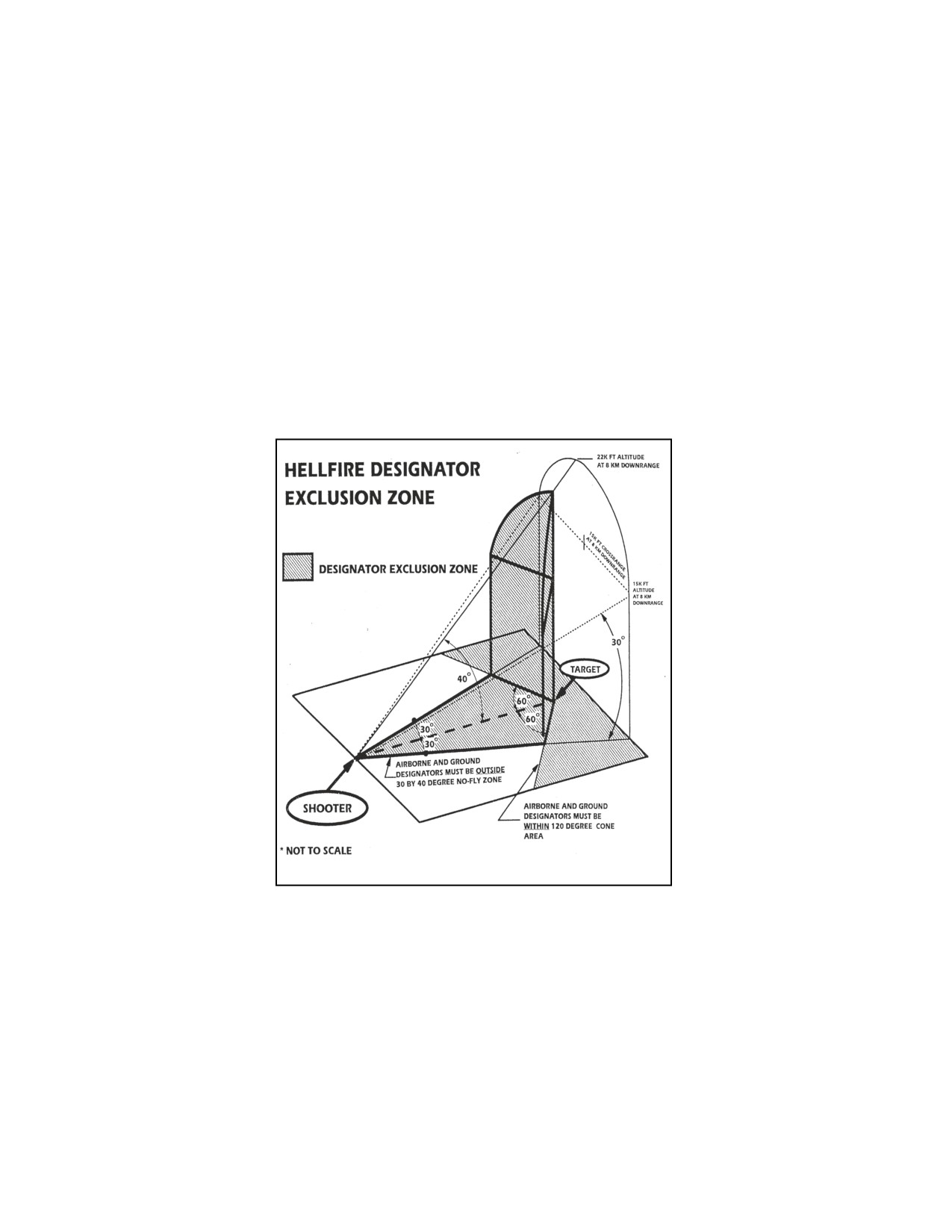
♦ Hellfire Designator Exculsion Zone. Figure 16 depicts
the Hellfire designator exclusion zone. This is the most
current template for Hellfire employment. This diagram will
be listed in the AH-1W TACMAN (Revision F) and the US
Army’s Point Target Weapon Handbook as the standard
exclusion zone diagram for Hellfire employment.
Figure 16. Hellfire Designation Exclusion Zone
41
♦ Hellfire Missile Surface Danger Zones
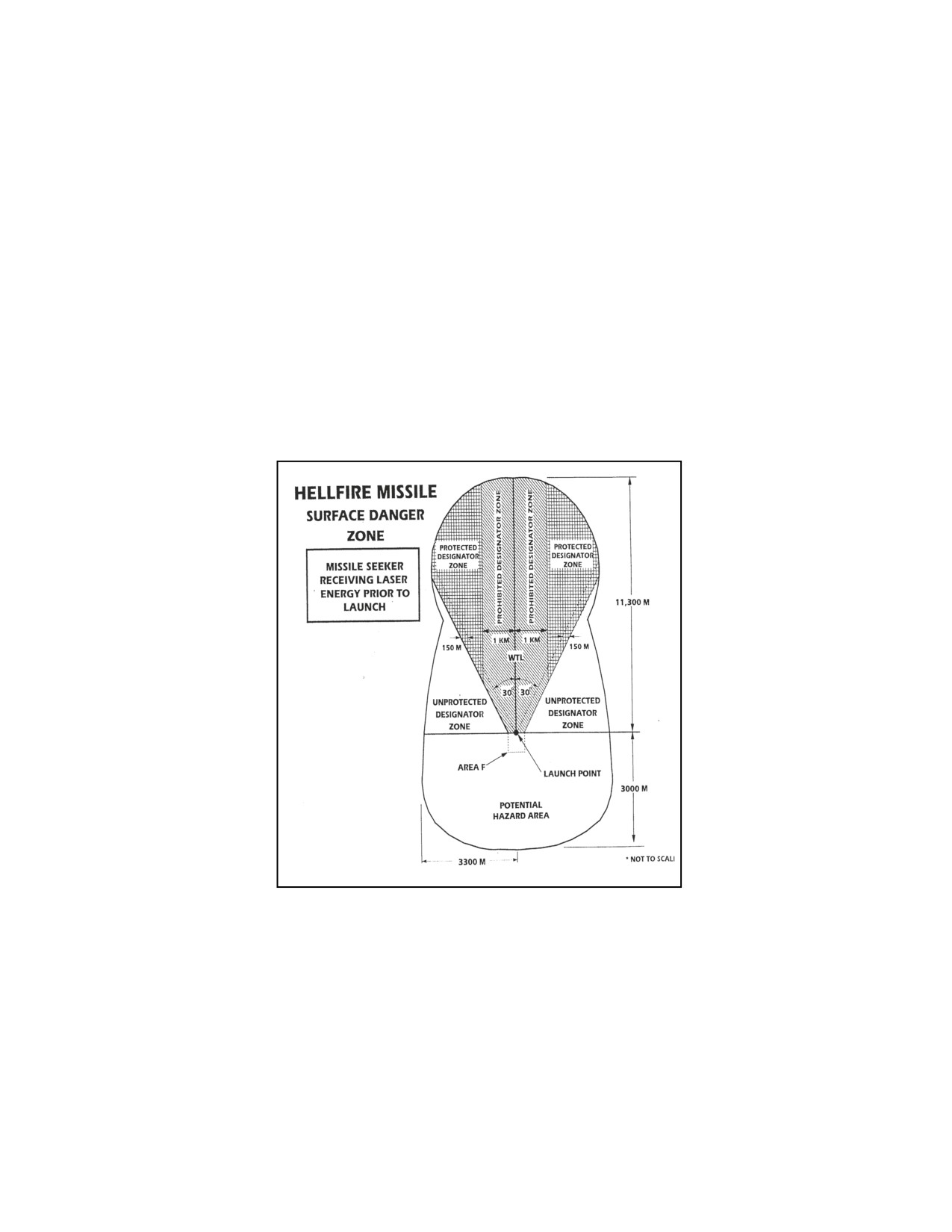
♦♦ Figure 17a depicts the surface danger zone (SDZ)
for a Hellfire launch in which the missile was receiving
laser energy prior to launch, regardless of the mode
selected. Because of the large surface danger zone and the
limited range of the designators, it may be necessary to
place designator operators within the surface danger zone.
Diagram NOT TO SCALE.
Figure 17a. Hellfire Surface Danger Zone
42
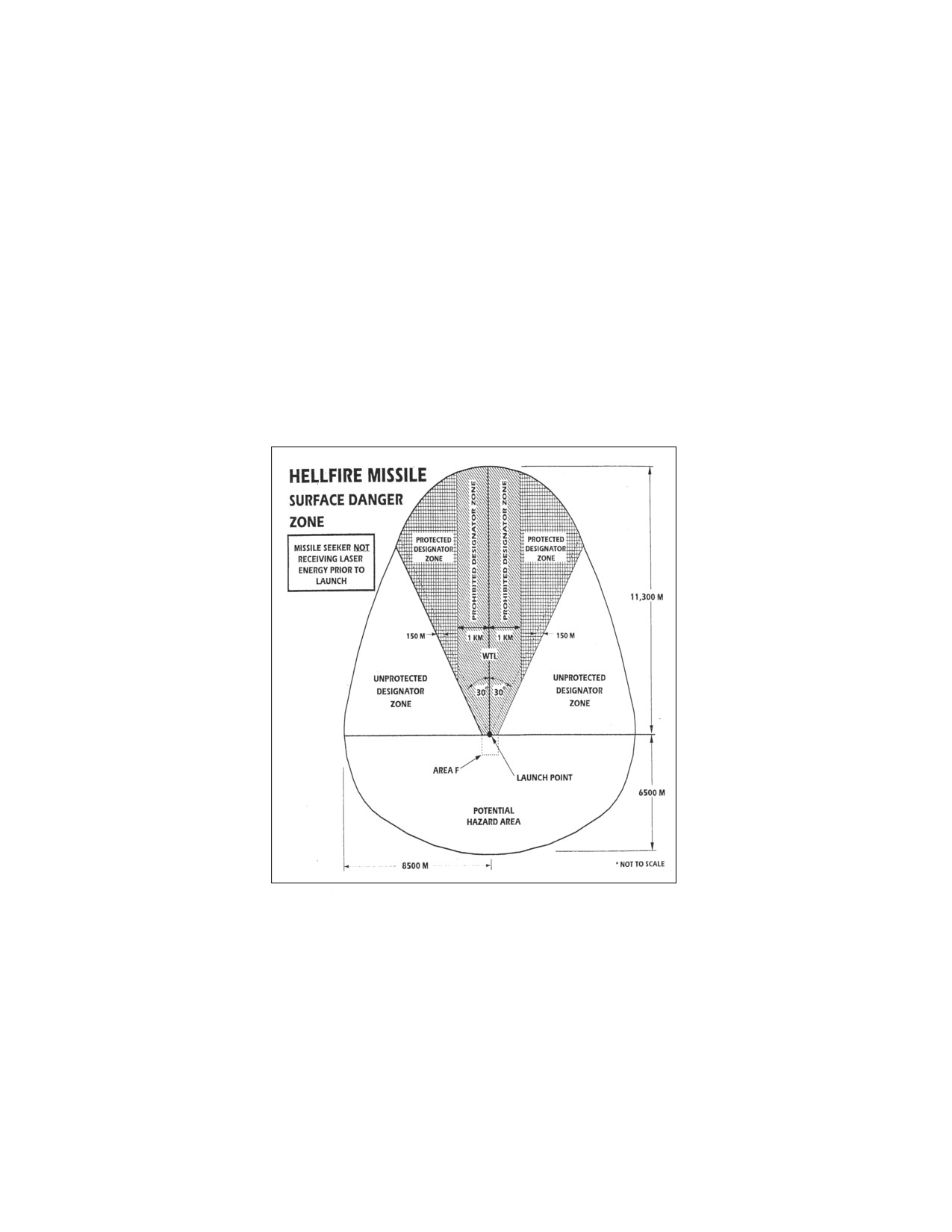
♦♦ Figure 17b depicts the SDZ for a Hellfire launch in
which the missile was not receiving laser energy before
launch. The surface danger zones provide for all firing modes
of the Hellfire missile at fixed targets to include the effects
of the warhead functioning at the edge of the impact area.
Three designator zones and their specific range requirements
are provided.
Figure 17b. Hellfire Surface Danger Zone
43
♦♦♦ Prohibited Designator Zone. No designator
operators are allowed in this zone due to the unacceptable
probabilities associated with the following hazards: (1) there
are remote scenarios where the missile seeker can track the
laser backscatter energy at the exit aperture of the designator
or along the path of the laser beam, and (2) the probability of
random missile failures is the highest within this zone.
♦♦♦Protected Designator Zone. Designator
operators are not vulnerable to a normally functioning missile
tracking the laser backscatter energy within this zone.
However, there is a possibility that the missile may track
and impact an obstruction (for example, trees, grass, or hills)
near the designator operator if it is accidentally illuminated
by the laser beam. There is a possibility of being injured by
a random missile failure impact. The probability of a random
missile failure impacting within 150 meters of a designator
operator in this area is less than 4 in 10 million.
♦♦♦♦ Ground designator operators shall wear
flak jackets and military issue helmets and be located in
protected positions.
♦♦♦♦ The designator shall have a clear
unobstructed line-of-sight to the target. Special care must
be taken to ensure designator line-of-sight is unobstructed
across the entire path of a moving target during the time of
missile flight to impact.
♦♦♦Unprotected Designator Zone. Although
designator operators are not vulnerable to a normally
functioning missile tracking the backscatter or false targets
in this zone, there is still a possibility of being injured by a
random missile failure. The probability of a random missile
failure impacting within 150 meters of the designator
operator is smaller in this zone than in the protected
designator zone.
44
♦♦♦♦ At a minimum, ground designator
operators shall wear flak jackets and military issue helmets.
♦♦♦♦ The designator shall have a clear
unobstructed line-of-sight to the target. Special care must
be taken to ensure designator line-of-sight is unobstructed
across the entire path of a moving target during the time of
missile flight to impact.
♦♦♦♦ Ground designator operators must ensure
that they do not inadvertently lase through dust caused by
personnel, vehicles, etc.
♦♦♦♦ Airborne designators must ensure that
they are either over ground conditions which do not create
dust or are at altitudes where rotor downwash does not create
dust.
♦♦ Two additional areas within the SDZ are-
♦♦♦
Potential Hazard Area - an area designated to
contain a malfunctioning missile at the point of launch. Only
mission essential personnel may occupy this area.
♦♦ Area F - an area to the rear of the launch point 30
meters wide and 15 meters long. Hazards are launch motor
blast, high noise levels, overpressure, and debris. Serious
casualties or fatalities may occur to any personnel occupying
this area.
Note: The Hellfire SDZs depicted in figures 17a and
17b are for fixed targets. The footprints must become
dynamic when engaging moving targets.
45
GENERAL INFORMATION
TARGET WEATHER INFORMATION (TARWI)
The TARWI code is a technique for transmitting detailed
information about en route or target area weather
observations.
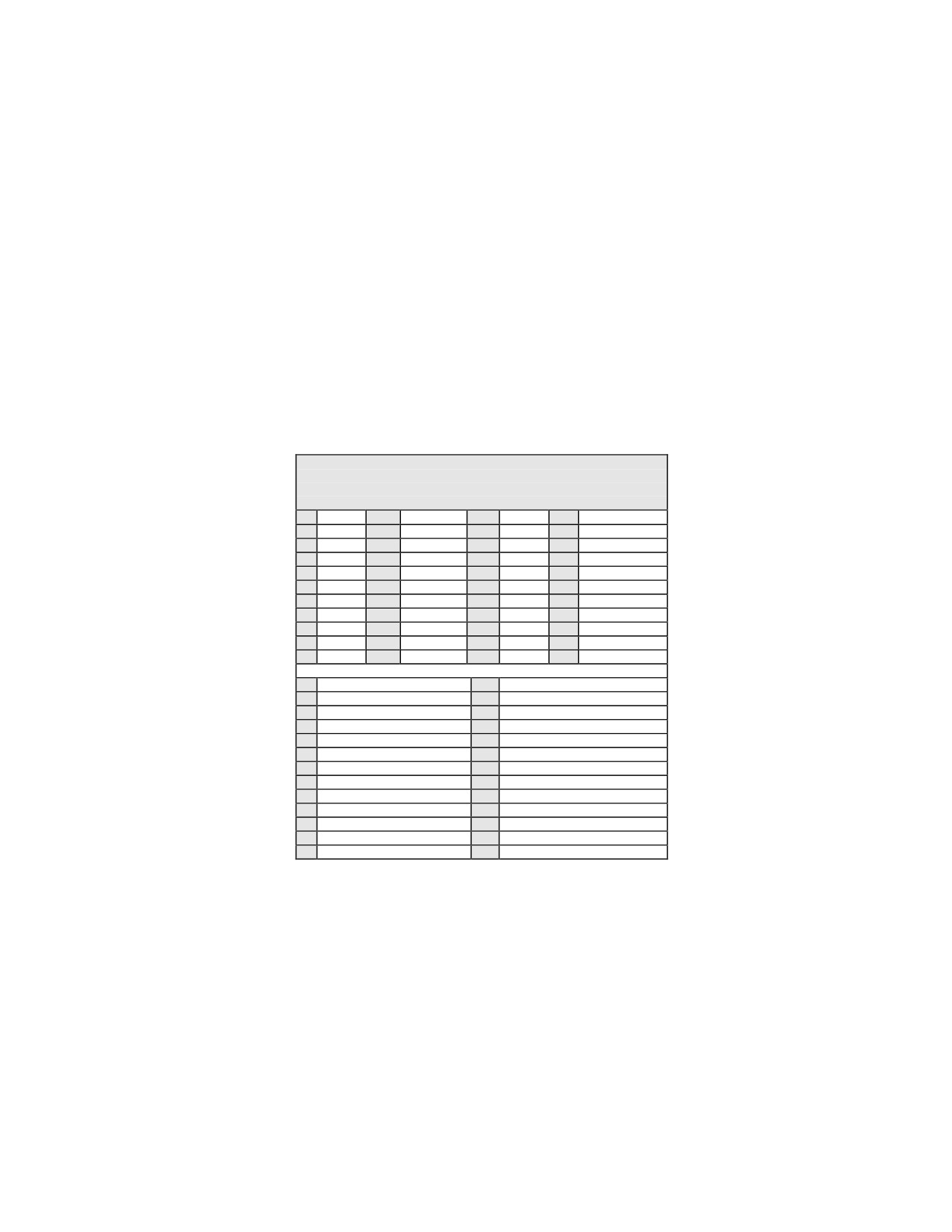
Table 9. TARWI Data
Example: “3, 6, 8, 9, X-ray, Kilo, November”this code
indicates weather at the target was 3/8 cloud at 3000 AGL,
visibility at least 8 km (5 NM), thunderstorms, WX suitable for
mission, higher terrain obscured, thunderstorms en route.
# Cloud
#
Ht (AGL)
# Vis (NM)
#
WX
0
None
0
None
0
0+
0
Not obs
1
1/8
1
500’
1
1+
1
None
2
1/4
2
1000’
2
2+
2
Sleet
3
3/8
3
1500’
3
3+
3
Dist/Smoke
4
1/2
4
2000’
4
4+
4
Fog/Haze
5
5/8
5
2500’
5
5+
5
Drizzle
6
3/4
6
3000’
6
6+
6
Rain
7
7/8
7
3500’
7
7+
7
Snow
8
8/8
8
4000’
8
8+
8
Showers
9
Not obs
9
Not obs
9
Not obs
9
T-storms
A
WX SIM for Exercise
N
T-Storms En route
B
Cloud HT X 10
O
Ice/Freezing Rain
C
No Med Cloud
P
SFC Wind NEG
D
Scattered Cloud
Q
SFC Winds SE
E
Broken Overcast
R
SFC Winds SW
F
Contrails AT FL
S
SFC Winds NW
G
Mainly IFR
T
WX Better to North
H
Mainly VFR
U
WX Better to East
I
Gusty SFC Winds
V
WX Better to South
J
Fog In Valley
W
WX Better to West
K
Hilltops Obscured
X
WX Suitable
L
VIS Varies in Showers
Y
WX Marginal
M
T-storms
Z
WX Unsuitable
46
Note: The following tables can be used to figure the
number of min/secs that it will take a fighter to go from
the IP to the target at speeds (G/S). Also a chart is
provided to convert meters to feet that will be used on
9-line briefings.
Table 10. Speed and Time Conversions
A/S
NM/
(Knots) MIN
8NM 9NM 10NM 11NM 12NM 13NM 14NM 15NM
300
5
1:36
1:48
2:00
2:12
2:24
2:36
2:48
3:00
360
6
1:20
1:40
1:40
1:50
2:00
2:10
2:20
2:30
420
7
1:09
1:17
1:26
1:34
1:43
1:51
2:00
2:09
450
7.5
1:04
1:12
1:20
1:28
1:36
1:44
1:52
2:00
480
8
1:00
1:08
1:15
1:23
1:30
1:38
1:45
1:53
510
8.5
:57
1:04
1:11
1:18
1:25
1:32
1:39
1:46
540
9
:53
1:00
1:07
1:13
1:20
1:27
1:33
1:40
CAS Aircraft Run-In Speeds
A/C
A/S (knots)
AC-130 H/U
210-250
A-10
300-350
AV-8B
420-480
F-16
480-540
F/A-18
480-520
47

Table 11. Distance Conversion Table
(Distance Meters to Feet Multiply by 3.28)
METERS FEET
METERS FEET
METERS
FEET
25
82
525
1722
1025
3362
50
164
550
1804
1050
3444
75
246
575
1886
1075
3526
100
328
600
1968
1100
3608
125
410
625
2050
1125
3690
150
492
650
2132
1150
3772
175
574
675
2214
1175
3852
200
656
700
2296
1200
3936
225
738
725
2378
1225
4018
250
820
750
2460
1275
4100
275
902
775
2542
1275
4182
300
984
800
2624
1300
4264
325
1066
825
2706
1325
4346
350
1148
850
2788
1350
4428
375
1230
875
2870
1375
4510
400
1312
900
2952
1400
4592
425
1394
925
3034
1425
4674
450
1476
950
3116
1450
4756
475
1558
975
3198
1475
4838
500
1640
1000
3280
1500
4920
48
MUNITIONS DESCRIPTIONS
♦ General Purpose Bombs
♦♦ MK-82, LD, 500 lb; MK-83, LD, 1000 lb; MK-84,
LD, 2000 lb - All are similar in construction and vary only
in size and weight. Streamlined cylindrical body with conical
fins designed for low drag. Effects: Blast, frag, and deep
cratering (with a delayed fuse).
♦♦ MK-82 HDGP (SNAKE-EYE) - MK-82 with four MK-
15 retarding fins. Selectable high or low drag. Effects: blast,
frag, and deep cratering (with a delayed fuse).
♦♦ MK-82 Air Inflatable Retarder (AIR) HDGP - GP
bombs with AIR tail assembly.
♦♦ MK-84 (AIR) HDGP - Uses a ballute as a retarding
device. Selectable HDALD. Effects: blast, frag.
♦♦ MK-36 (DESTRUCTOR) - MK-82 snake-eye with a
MK-75 arming kit which converts the bomb into a land or
water mine. Deployed HD only. Timed self-destruct or
magnetic fusing.
♦♦ BLU-109/B (I-2000) Penetrator Bomb - 2000 lb
improved GP bomb. Effects: cratering and hard target
penetration. See GBU-24 A/B.
♦♦ M-1 17, 750 lb GP Bomb - Effects: Same as other GP
bombs.
♦♦ M-1 17R - Selectable HD/LD by means of a retarding
tail assembly.
♦♦ M-1 17D (DESTRUCTOR) - Equipped with a MK-75
arming kit for ground implant and shallow water mining.
High drag releasable only!
♦♦ M-118 3000 lb Demolition Bomb - Effects: blast,
frag, cratering. Not good for penetration.
49
♦ Guided Bombs
♦♦ GBU-10/GBU-12 - Laser guided, maneuverable, free-
falling weapons. GBU-10 is a MK-84 and the GBU-12 is a
MK-82. Effects: Same as MK-82/84 bomb series.
♦♦ GBU-16 - Laser guided maneuverable free-falling
weapon. Effects: Same as MK-83.
♦♦GBU-24/B LLLGB - Low level, laser guided,
maneuverable free-fall weapon. MK-84 body. Can be released
at very low altitudes. Bomb bumps up approx 450 ft above
release altitude. Effects: Same as MK-84.
♦♦ GBU-24A/B LLLGB - Same as GBU-24/B but uses
BL-109/B bomb body. Used for hard target penetration.
♦♦ GBU-15 - TV or IR guided, automatically or manually
by the WSO. MK-84 or BLU-109 body. Effects: Same as
MK-84/ BLU-109.
♦ Missiles
♦♦ AGM-65 Missile (MAVERICK) - A and B models are
guided based on visual contrast. D and G models use infrared
guided. The Marine Corps E model is laser guided. Designed
for standoff acquisition and destruction of point targets.
Effects: Shaped charge produces a good penetration of hard
targets such as tanks and bunkers.
♦♦ AGM-130 - Rocket powered version of GBU-15.
Standoff range out to 15NM.
♦♦ AGM-114B Hellfire Missile - Solid propellant laser/
radar guided antiarmor missile. Max range in excess of 8000
meters.
50
♦♦ BGM-71A TOW Missile - Solid propellant, wire
guided antiarmor missile. Min range 500m; max range
3750m; max time of flight 21.5 sec.
♦ Guns
♦♦ 7.62 Mini-Gun - Up to 6000 rounds per minute. TP,
AP, and tracer.
♦♦ .50 Cal - 1150 to 1250 rounds per minute. TP, AP,
API, and tracer.
♦♦ 20mm - 750 to 850 rounds per minute. AP, HE, and
incendiary.
♦♦ 20mm Gattling - 2500 to 6000 rounds per minute.
TP, HEI, API, TPI, HEIT.
♦♦ GAU-8, 30mm Gattling - 4200 rounds per minute.
1.5 1b projectile TP, HEI, API on the A/OA-10 only.
♦ Practice Bombs
♦♦ BDU-33 - 24 lb practice bomb with spotting charges.
♦♦ BDU-48/B - Practice bomb that simulates Mk-82 HD
ballistics. (Similar to Mk-106)
♦♦ BDU-50 - MK-82 inert 500 lb practice bomb.
♦♦ MK-106 - Practice bomb simulating HD ballistics with
spotting charge.
♦♦ MK-76 - Navy version of BDU-33.
51
♦ Flares
♦♦ LUU-1/B, 5B, 6D (Target Marking Flares
[LOGS]) - Designated for a 30 minute burn time on the
ground providing a colored flame. LUU-1 burns red, LUU-
5 burns green, and LUU-6 burns maroon.
♦♦ LUU-2A/B Flare - Parachute flare with a 4.5 minute
burn time at an average of 2 million candle power.
♦♦ M257 Flare - Parachute flare with a minimum burn
time of 100 seconds at an average of 1 million candle power.
♦ Rocket Launchers
♦♦ LAU-3/A, A/A, B/A,-60A/61 - 2.75 inch, 19 tubes,
ripple fire only.
♦♦ LAU-10 - 5 inch zuni, 4 tubes, single or ripple fire.
♦♦ LAU-68 - 2.75 inch, 7 tubes, single or ripple fire.
♦♦ LAU-5003/A - 19 tubes; launches the Canadian
hypervelocity CRV-7 rocket.
♦ Rocket Warheads
♦♦ MK-1 - HE, 2.75 inch. Effects are blast and frag.
♦♦ MK-5 - HEAT, 2.75 inch shaped charge. Excellent
armor penetrator, very little lateral blast effect.
♦♦ MK-61 - TP. A practice MK-1.
♦♦ MK-67 mod 0 - Smoke WP.
52
♦♦ MK-67 mod 1 - Smoke RP.
♦♦ M-151 - HE, 2.75 inch. Primarily frag.
♦♦ M-156 - WP, 2.75 inch. Used for target marking.
♦♦ WDU-4A/A, WDU-13/A - Flechett for antipersonnel.
♦♦ WTU-1/B - TP. A practice M-151.
♦♦ CRV-7 - Canadian hypervelocity rocket with various
combinations of warheads and fuses.
♦ Clusters Bombs
♦♦ CBU-24 - SUU-30 loaded with 665 BLU-26 bomblets.
The BLU-26 submunition is baseball sized, spins to arm, and
detonates on impact. Fragmentation results from small steel
balls in the casing. Note: Dispersion pattern is torus or
donut shaped.
♦♦ CBU-30 - SUU-13 with 40 canisters containing 32 CS
bomblets each. Bomblets will start dispensing CS gas 5 to 6
seconds after release and will dispense for 10 to 15 seconds.
Note: Dispersion is linear and target must be overflown
due to downward dispensing SUU-13.
♦♦ CBU-38 - SUU-13 containing 40 BLU-49 antimaterial
HE bomblets that will penetrate jungle canopies. Note:
Dispersion is linear and target must be overflown due
to downward dispensing SUU-13.
♦♦ CBU-49 - Same as CBU-24 except bomblets have delay
timers to detonate at random times after impact. Note:
Dispersion pattern is torus or donut shaped.
53
♦♦ CBU-52 - SUU-30 loaded with 220 BLU-61 softball
sized bomblets with an incendiary lining and a scored steel
casing for fragmentation. Note: Dispersion results in a
torus or donut shaped pattern.
♦♦ CBU-55 - Slow speed Fuel Air Explosive (FAE). Used
against blast sensitive targets. Kills by over pressurization.
♦♦ CBU-58 - SUU-30 loaded with 650 BLU-63 baseball
sized bomblets with incendiary pellets and scored casings
for fragmentation. Note: Dispersion results in a torus or
donut shaped pattern.
♦♦ CBU-71 - Same as CBU-58 except submunitions have
delay fuses that detonate at random times after impact.
Note: Dispersion results in a torus or donut shaped
pattern.
♦♦ CBU-87 (Combined Effects Munitions [CEM]) -
SUU-65 loaded with 202 BLU-97 bomblets. BLU-97 has a
shaped charge for armor, steel scored liner for fragmentation,
and incendiary ring. Note: Dispersion is rectangular.
♦♦ CBU-89 (GATOR) - SUU-64 loaded with a mix of 72
BLU-91/B antiarmor and 22 BLU-92/B antipersonnel mines
with preset self-destruct time. Note: Dispersion varies
from circular at high angles to linear at low angles.
♦♦ CBU-97/B (Sensor Fused Weapons) - SUU-64 with
an airbag dispensing system and 10 BLU-108/B submunitions
designed to provide multiple kill per pass capability against
tanks, armored vehicles, artillery, APCs and support vehicles.
♦♦ MK-20 (ROCKEYE) - MK-7 loaded with 247 MK-118
antiarmor submunitions with antipersonnel capabilities.
Note: Dispersion varies from circular at high angles
to linear at low angles.
54
♦♦ BL-755 - European munitions loaded with 147
antiarmor submunitions. Designed for low altitude low angle
deliveries against armor but produces more fragmentation
than the MK-20 ROCKEYE. Note: Dispersion is
rectangular.
♦♦ GBU-55/72 - High speed Fuel Air Explosive (FAE).
Used against blast sensitive targets. Kills by over
pressurization.
RISK-ESTIMATE DISTANCES
Risk-estimate distances are based on the following
assumptions. Any changes to the assumptions will increase
the risk-estimate distances from those given in Table 12.
Risk-estimate distances allow the ground forces commander
or combat air commander to estimate the risk in terms of
the percent of friendly casualties that may result from an
air strike against an enemy threat along the forward line of
own troops (FLOT). Risk-estimate distances are based on
fragmentation patterns.
COMPUTATIONS
All attacks are parallel to the FLOT. Distances are
computed from the intended impact point of the center of a
stick of bombs or a pod of rockets. Deflection distance (from
the aiming point toward the friendly troops) is built into the
risk-estimate distance. The deflection distance equals the
distance from the aircraft centerline to the farthest outboard
station, plus the lateral distance that a weapon travels
because of rack-ejection velocity. Risk-estimate distances
are for combat use and are not minimum safe distances
for peacetime training use.
55
RELATIONSHIPS BETWEEN WEAPON IMPACTS AND
POINT OF INTERSECTION
For all determinations in Table 12, the position of a prone
man was assumed to be on a line perpendicular to the line of
flight (or line of weapon impacts) at the midpoint of the line
(stick) of weapons. For all sticks of weapons, a weapon was
assumed to impact at the point of intersection of these two
lines. Thus, for the weapons evaluated, the following
relationships between weapon impact and the point of
intersection were assumed:
♦ GP bombs - center bomb of stick impacts at point of
intersection.
♦ Rockets - center rocket.
♦ Cluster weapons - pattern center of the center dispenser.
♦ Guns - center of pattern.
♦Maverick - single-weapon delivery impacting at point of
intersection.
WEAPON RELIABILITY AND DELIVERY
PARAMETERS
A weapon reliability of 1.0 was used for all weapons
evaluated. Delivery parameters and considerations for
specific weapons are in (S) FM 101-50-36-CD/61A1-3-11-CD/
FMFM 10-2-CD/NA 00-130AA-1-3-11-CD.1
_________________
1Joint Munitions Effectiveness Manual/Air-to-Surface
(JMEM/AS): Risk Estimates for Friendly Troops, 1 Nov 95.
56
CASUALTY CRITERION
The casualty criterion is the 5-minute assault criterion for
a prone soldier in winter clothing and helmet. The probability
of incapacitation (PI) means a soldier is physically unable to
function in an assault within a 5-minute period after an
attack. The 0.1 percent PI value can be interpreted as being
less than or equal to one chance in one thousand.
TROOPS IN CONTACT
The FAC should regard friendlies within 1 kilometer of
targets as a troops-in-contact situation and advise the ground
commander accordingly. The ground commander must accept
responsibility for friendly risk when targets are inside 0.1
percent PI. The passing of the ground commander’s initials
indicates his acceptance of the risk for intentional ordnance
delivery inside the 0.1 percent PI distance.
57

Table 12. Risk-Estimate Distances for
Aircraft Delivered Ordnance
Risk-Estimate
Distance (m)
10%
0.1%
Item
Description
PI
PI
MK-82 LD
500-lb Bomb
250
425
MK-82 HD
500-lb Bomb (Retarded)
100
375
MK-82 LGB
500-lb Bomb (GBU-12)
2501
4251
MK-83 HD/LD
1000-lb Bomb
275
475
MK-83 LGB
1000-lb Bomb (GBU-16)
2751
4751
MK-84 HD/LD
2000-lb Bomb
325
500
MK-84 LGB
2000-lb Bomb (GBU-10/24)
2251
500 1
MK-20 2
Rockeye (Antiarm or CBU)
150
225
MK-77
500-lb Napalm (FAE)
100
150
1
1
CBU-55/77 2
Fuel-Air Explosive (FAE)
CBU-52 2
CBUs (All Types)
275
450
CBU-58/71 2,3
CBUs (All Types)
350
525
CBU-87 2
CBUs (All Types)
175
275
CBU-89 3
CBUs (All Types)
175
275
2.75 FFAR
Rocket with Various Warheads
160
200
5.00 FFAR
Zuni with Various Warheads
150
200
SUU-11
7.62mm Mini-gun
M 4, M 12,
SUU-23,M 61
20mm Gattling Gun
100
150
GAU-12
25mm Gun
100
150
GPU-5A,
GAU-8
30mm Gattling Gun
100
150
AGM-65 4
Maverick (TV, IIR, Laser Guided)
25
100
MK-1/MK-21
Walleye II (1000-lb TV Guided
Bomb)
275
500
MK-5/MK-23
Walleye II (2400-lb TV Guided
1
1
Bomb
AGM-123A
Skipper (1000-lb Laser Guided
2751
5001
Rocket-Booster Bomb)
AC-130 5
20mm, 25mm, 40mm
35
125
105mm Cannon
80
200
58
Table 12. (Continued)
Warning: Risk-estimate distances are for
combat use and are not minimum safe dis-
tances for peacetime training use.
1. Risk-estimate distances are to be determined. For LGBs,
the values shown are for weapons that do not guide and
that follow a ballistic trajectory similar to GP bombs.
2. Not recommended for use near troops in contact.
3. CBU-71/CBU-84 bombs contain time-delay fuses that
detonate at random times after impact. CBU-89 bombs are
antitank and antipersonnel mines and are not recom-
mended for use near troops in contact.
4. The data listed applies only to AGM-65A, B, C, and D
models. AGM-65E and G models contain a larger warhead
and risk-estimate distances are not currently available.
5. This distance is used for all AC-130 engagements as it
has the largest fragmentation pattern for the largest
weapon system on board.
59

COMMUNICATIONS
Note: To request CAS use the tactical air request net/
Air Force Air Request Net (AFARN). Control of CAS
aircraft should be conducted on a tactical air direction
net.
Table 13. Ground Communications Equipment
Frequency
Frequency
Secure
Component Radios
Band (Note 1) Hopping
Capable
AN/PRC-119
VHF-FM
SINCGARS
KY-57
US Army AN/PRC-177
VHF-FM
No
FIST
AN/VRC-12
No
AN/VRC-24
No
AN/GRC-206
HF
No
KY-65/99
AN/GRC-206
VHF-FM
No
KY-57
AN/GRC-206
VHF-AM
No
KY-57
AN/GRC-206
UHF
Have Quick II
KY-57
USAF
AN/PRC-77
VHF-FM
No
KY-57
TACP
AN/PRC-119
VHF-FM
SINCGARS
KY-57
AN/PRC-104
HF
No
KY-65/99
AN/PRC-113
VHF-AM
No
KY-57
AN/PRC-113
UHF
Have Quick II
KY-57
AN/PRC-77
VHF-FM
No
KY-57
USMC
AN/PRC-119
VHF-FM
SINCGARS
KY-57
TACP
AN/PRC-104
HF
No
KY-65/99
AN/PRC-113
VHF-AM
No
KY-57
AN/PRC-113
UHF
Have Quick II
KY-57
AN/VRC-12
VHF-FM
No
No
AN/PRC-117D
VHF-FM
No
KY-57
AN/PRC-117D
VHF (Note 2)
No
KY-57
SOF
AN/PRC-117D
UHF (Note 3)
No
KY-57
SOTAC
AN/PRC-126
VHF-FM
No
KY-57
LST-5
UHF
No
KY-57
SATCOM
LST-5
Note 1: Frequency bands for ground radios are as follows:
HF:
2.000 to
29.999 MHz in 1 kHz increment.
VHF-FM: 29.950 to
75.950 MHz in 50 kHz increments.
VHF-AM: 116.000 to 149.975 MHz in 25 kHz increments.
UHF: 225.000 to 399.975 MHz in 25 kHz increments.
Note 2: AN/PRC-117D VHF-AM/FM frequency range is 116.000-
173.995 MHz.
Note 3: AN/PRC-117D UHF-AM/FM frequency range is 225.000-
419.995 MHz.
60

Table 14. Rotary-Wing Communications
Equipment Summary
Aircraft
Freq Band
Freq
Secure
Type
Radios
(Note 1)
Hopping
Capable
AH-1W
2-AN/ARC-182
(Note 2)
No
KY-58
UH-1N
2-AN/ARC-182
(Note 2)
No
KY-58
1-AN/ARC-201
VHF-FM
SINCGARS
KY-58
UH-60
1-AN/ARC-201
VHF-FM
No
KY-58
1-AN/ARC-115
VHF-AM
No
No
1-AN/ARC-164
UHF
Have Quick II
KY-58
2-AN/ARC-201
VHF-FM
SINCGARS
KY-58
OH-58C
1-AN/ARC-115
VHF-AM
No
No
(Note 4)
1- AN/ARC-164
UHF
No
or AN/ARC-116
No
2-AN/ARC-201
VHF-FM
SINCGARS
KY-58
OH-58D 1-AN/ARC-186
VHF
No
KY-58
(Note 5) 1-AN/ARC-164
UHF
Have Quick II
KY-58
1-AN/ARC-199
HF
No
KY-75
1-AN/ARC-201
VHF-FM
SINCGARS
KY-58
AH-64
1-AN/ARC-164
UHF
Have Quick I
KY-58
1-AN/ARC-186
VHF (Note 3) No
No
Note 1: Frequency bands are as follows:
HF = 2.000 to 29.999 MHz in 1 kHz increments.
VHF-FM = 29.950 to 87.975 MHz in 25 kHz increments.
VHF-AM = 108.000 to 151.975 MHz in 25 kHz increments.
UHF = 225.000 to 399.975 MHz in 25 kHz increments.
Note 2: The AN/ARC-182 is a multiband radio that operates in any one
of four bands: standard VHF-FM, VHF-AM, UHF, or 156.0-173.975
MHz VHF-FM. It can monitor only one band at a time.
Note 3: The AN/ARC-186 operates either in the VHF-AM or VHF-FM
band. Each radio can monitor only one band at a time.
Note 4: Only one AN/ARC-201 is connected to the KY-58. The other
one is unsecure.
Note 5: The OH-58D has two KY-58s. One is dedicated to an
AN/ARC-201. The other KY-58 is shared between the other three
radios.
61

Table 15. Fixed-Wing Aircraft Communications Summary
Aircraft
Freq Band
Freq
Secure
Type
Radios
(Note 1)
Hopping
Capable
2-AN/ARC-164
UHF
Have Quick II
KY-58
AC-130
1-AN/ARC-164
SATCOM
No
KY-58
3-AN/ARC-186
VHF (Note 3)
No
KY-58
2-AN/ARC-190
HF
No
KY-75
2-AN/ARC-159
UHF
No
EA-6B
1-AN/ARC-175
VHF
No
1-AN/ARC-105
HF
No
KY-58
AV-8B
2-AN/ARC-182
(Note 2)
No
KY-58
1-AN/ARC-164
UHF
Have Quick II
KY-58
A/OA-10
1-AN/ARC-186
VHF-FM
No
KY-58
1-AN/ARC-186
VHF-AM
No
No
B-1B
2-AN/ARC-164
UHF or
Have Quick II
KY-58
SATCOM
1-AN/ARC-190
HF
No
No
1-AN/ARC-164
UHF
Have Quick II
KY-58
B-52H
1-AN/ARC-171
UHF or
No
No
SATCOM
1-AN/ARC-190
HF
No
No
F-14
1-AN/ARC-182
(Note 2)
Have Quick II
KY-58
1-AN/ARC-59
UHF
No
KY-58
F-15E
2-AN/ARC-164
UHF
Have Quick II
KY-58
F-16
1-AN/ARC-164
UHF
Have Quick II
KY-58
1-AN/ARC-186
VHF (Note 3)
No
F/A-18
2-AN/ARC-182
(Note 2)
No
KY-58
(Note 4)
2-AN/ARC-210
VHF
Have Quick II
KY-58
Note 1: Frequency bands are as follows:
HF
=
2.000 to 29.999 MHz in 1 kHz increments.
VHF-FM = 29.950 to 87.975 MHz in 25 kHz increments.
VHF-AM = 108.000 to 151.975 MHz in 25 kHz increments.
UHF
=
225.000 to 399.975 MHz in 25 kHz increments.
Note 2: The AN/ARC-182 is a multiband radio that operates in any one
of four bands: standard VHF-FM, VHF-AM, UHF, or 156.0-173.975
MHz VHF-FM. It can monitor only one band at a time.
Note 3: The AN/ARC-186 operates either in the VHF-AM or VHF-FM
band. Each radio can monitor only one band at a time.
Note 4: F/A-18s are fitted with either two AN/ARC-182 radios or two
AN/ARC-210 radios.
62

Table 16. USMC Fire Support Request Nets
Stations on
Net
Purpose
Net Control
Net
Freq
Arty
FOs request
DS arty BN
DS arty BN,
VHF
conduct
and adjust
firing
of fire
arty fire
battery, arty
LNO at BN,
FOs, REIN
arty Units
GCE air
Naval
Arty regt
NAO, arty
VHF
spot net
aviation
BN, firing
observers
battery, FOs,
FSCCs, GCE
HQ
Tactical
To request
TACC -
TACC,
HF
air request
immediate
afloat
DASC,
air support
DASC -
FSCCs, FAC
ashore
parties,
airborne
controllers,
HDC, TADC
Tactical
Direction of
TACC -
TACC,
UHF/VHF
air
aircraft in
afloat
DASC,
aircraft
direction
CAS
DASC -
FSCCs, FAC
dependent
missions by
ashore
parties,
a terminal
airborne
controller
controllers,
OAS aircraft
and TAC as
required
NGF
Spot teams
NGLO at
BN NGLO,
HF PRI
ground
request and
BN FSCC
NGF spot
VHF ALT
spot
adjust NGF
TMs, DS
ship, GS ship
as required
NGF air
NAOs
SACC -
SACC,
UHF/VHF
spot
request and
afloat
TACC,
aircraft
adjust NGF
TACC -
FSCCs,
dependent
afloat as
DS&GS
required
ships, NAOs
GCE FSCC
ashore
BN mortar
Mortar FOs
Mortar PLT
Mortar PLT
VHF
request and
cmdr
cmdr, mortar
adjust fires
FOs, BN
FSCC
63

Table 17. Army Fire Support Request Nets
Net
Stations
Net
Purpose
Control
On Net
Freq
MVR BN
Calls for fire
MVR
MVR BN FSE,
FM
fire
from non FA
BN FSE
MVR BN FSO,
support
observers
FOs, MVR BN
Mortar FDC, FIST
HQ, any FDC,
FSO, or COLTS
as required, MVR
BDE FSO
MVR BN
Tactical and
MVR
MVR BN
FM
mortar FD
technical fire
BN
FSE/FSO, MVR
direction and
mortar
CO FOs, MVR BN
calls for fire to
FDC
mortar FDC, FIST
the mortar FDC
HQ, COLT(S), any
FSO or observer
as required
DS BN
Tactical and
DS BN
DS BN FDC,PLT
FM
fire
technical fire
FDC
FDCs, FIST HQ,
direction
direction and
FOs, AN/TPQ-36
calls for fire to
radar, COLT(S),
FA BN, btry, or
BN FSE/FSO,
PLT FDCs
MVR Bde
FSE/FSO, FA btry
FDCs, FA PLT
FDCs
Air Force
TACP request
ASOC
TACPs, ASOC,
HF
air request
immediate air
ALO, CAS AC,
net
support
FAC(A)
NGF
Fire control
SALT
CO FCT, BN FSE
HF PRI
ground
teams request
AT BN
and SALT, Bde
VHF ALT
spot
and adjust NGF
FSE
FSE and
ANGLICO TM, Div
FSE and
ANGLICO TM, DS
Ship, GS ship as
required.
64
LIAISON ELEMENTS
ARMY FIRE SUPPORT ELEMENTS (FSEs)
Mission
Responsibility for command, control, and coordination of
fire support begins with the force commander. From the corps
down to the company and team, all levels have FSEs. The
FSEs assist the maneuver commander in the decision and
execution process, advise on fire support capabilities, and
assist in the planning and coordination of fire support.
Organization
FSEs have a fire support coordinator (FSCOORD) and a
supporting staff but will otherwise vary according to the
available fire support assets. An FSE will usually include
an air liaison officer (ALO); representatives from such
elements as the air and naval gunfire liaison company
(ANGLICO); Army aviation units, and electronic warfare
support elements (EWSEs); mortars; and other assets
required by the force commander.
Echelons Above Corps. The battlefield coordination
detachment (BCD) mission is to establish Commander Army
Forces (COMARFOR) liaison and interface with the Joint
Forces Air Component Commander (JFACC) to facilitate the
coordination and synchronization of JFACC air and ground
operations. The BCD performs its mission through the
exchange of operational and intelligence data between the
JFACC and COMARFOR. Additionally, the BCD interprets
the land battle situation for the JFACC and the air operations
situation for the COMARFOR. It operates on a 24 hour a
day basis.
65
Corps and Division. The section within the corps
commander’s command post that performs the deep attack
function is called the deep operations coordination cell
(DOCC). The DOCC is the centralized planning, coordination
and execution center for deep attack operations within the
corps area of operations. The DOCC maintains linkages to
USAF via the BCD located at the AOC and the Navy via a
Navy Surface Fires Liaison Team located in the DOCC. The
FSEs provided at the corps and division levels are similar in
structure. They are located in the main and tactical command
posts, usually with representatives in the rear command post.
Brigade and Battalion. The FSCOORD at brigade level
is the commander of the direct support field artillery
battalion. The brigade FSCOORD establishes fire support
organizations in each maneuver battalion and company. The
FSEs at brigade and battalion levels are located in the
brigade/battalion command post.
Company. The fire support organization at company level
is the fire support team (FIST). The FIST is headed by the
company FSO, who is also the company FSCOORD. The field
artillery and mortars provide the primary fire support to
the company. The FIST coordinates these assets and, when
available, coordinates CAS and naval resources through the
appropriate agencies. The FIST also provides forward
observer capabilities to the company.
MARINE CORPS TACTICAL AIR CONTROL PARTY
Mission
The Marine TACP establishes and maintains facilities
for liaison and communications between supported units and
appropriate control agencies. The TACP is led by the air
66
officer (AO), who informs and advises the ground unit
commander on the employment of supporting aircraft and
requests and coordinates air support missions.
Organization
The battalion TACP has two forward air control (FAC)
parties, while the regimental and division TACPs have none.
Division. The division TACP has 2 officers and 11 enlisted
communications personnel. They assist the division AO by
monitoring all immediate air support requests from
supporting units, by supervising the operation of aviation
nets in the division fire support coordination center (FSCC),
and by keeping the fire support coordinator (FSC) advised of
the general air situation and specific requests of subordinate
units.
Regiment. The regimental TACP has one regimental air
officer (RAO) and four enlisted communications personnel.
The RAO advises and assists the regimental commander
regarding all aviation matters, consolidates all preplanned
and support requests from subordinate units, coordinates
with the regimental FSC, functions as the air representative
with the regimental FSCC, and facilitates the disposition of
immediate air support requests if necessary.
Battalion. The battalion TACP has 3 officers and 12
enlisted communications personnel. The senior naval aviator/
naval flight officer functions as the battalion air officer, and
each of the other two officers is the leader of a FAC party.
67
AIR/NAVAL GUNFIRE LIAISON COMPANY
Mission and Employment
The ANGLICO can support a US Army or allied division,
or elements thereof, by providing the control and liaison
agencies for the employment of naval surface fire and naval
air support in amphibious assault or other operations. The
ANGLICO is normally attached to the supported force for a
joint or combined operation in which US fleet assets are
employed. The ANGLICO can control fleet firepower to help
offset the lack of heavy combat support initially available in
most expeditionary environments. To support airborne and
special operations forces, the ANGLICO maintains an
airborne capability.
Organization
The ANGLICO maintains a high degree of organizational
flexibility and can task-organize to meet the needs of the
supported force. A company, if fully committed, can support
an entire US Army division of three maneuver brigades. An
ANGLICO consists of a company headquarters and three air/
naval gunfire liaison platoons. The ANGLICO headquarters
performs command and staff functions necessary to
administer, plan, direct, and supervise the execution of
assigned missions and to advise the supported commander
on the employment of the company.
The company headquarters can form a task-organized
division air/naval gunfire liaison team as necessary to support
a division or comparable-sized allied unit. Each platoon has
one brigade liaison team to effect fire support coordination
at the US Army combat brigade or equivalent level, two
supporting arm liaison teams (SALTs) to effect fire support
at the maneuver battalion level, and four firepower control
68
teams (FCTs) to provide control of naval surface support,
naval air support, and artillery support at the company level.
Division Air/Naval Gunfire Liaison Team. The division
air/naval gunfire liaison team can provide support to an
Army division or comparable-sized allied unit. The division
team usually attaches to the supported division headquarters
FSCC, FSE, or a comparable agency for planning, liaison,
control, coordination, and employment of supporting arms.
Brigade Air / Naval Gunfire Team. The brigade air/
naval gunfire liaison team can support a maneuver brigade.
The air/naval gunfire teams are task-organized to support
an Army maneuver battalion or comparable-sized allied unit.
The brigade air/naval gunfire liaison team usually attaches
to the supported brigade TOC or comparable supporting arm
for an Army brigade or comparable-sized allied unit.
Battalion Supporting Arms Liaison Team. SALTs
provide the capability to support a battalion. They are task-
organized to support an Army maneuver battalion or a
comparable-sized allied unit. The SALT usually attaches to
a supported battalion TOC or a comparable agency for
planning, requesting, coordinating, and controlling supporting
arms for an Army battalion or comparable-sized unit, as well
as for liaison.
Firepower Control Team. FCTs provide terminal
control of naval gunfire and USN and USMC CAS to a
supported maneuver company. They are task-organized to
support an Army maneuver company or a comparable-sized
allied unit. Company commanders employ FCTs much as
they would TACPs, FISTs, or comparable agencies-to plan,
request, coordinate, and provide terminal control of
supporting arms for an Army maneuver company or
comparable-sized allied unit—as well as for liaison.
69
AIR FORCE TACTICAL AIR CONTROL PARTY
Mission
The Air Force TACP is a control element stationed with
and supporting an Army combat unit. The TACP provides
the interface between the Army unit it supports and the
combat Air Force unit that provides combat air support. The
TACP advises the ground commander on the capabilities and
limitations of combat aircraft and weapons and assists in
planning for combat air support. The airborne forward air
controller (AFAC), the air liaison officer (ALO), and the
enlisted terminal attack controller (ETAC) in the TACP
provide final attack control for CAS missions.
Organization
TACPs are located at corps, division, brigade, and
battalion levels and are tailored in manning and skills to
the Army unit they support. While employed, TACPs are
under the operational control of an air support operations
center (ASOC) or the senior TACP element deployed.
Corps and Division. At corps and division levels and
sometimes at the field army level, the TACP has a senior
ALO, plus the fighter and airlift liaison officers and tactical
air command and control specialists (TACCSs).
Brigade. The brigade TACP has a brigade ALO, fighter
and airlift liaison officers, and TACCs.
Battalion. The battalion TACP has one ALO and two
TACCSs assigned. At least one TACCS will also be ETAC-
qualified.
70
FIRE SUPPORT AND AIRSPACE
COORDINATION
FORMAL COORDINATION
The FSCOORD establishes fire support and airspace
coordination, with input from his ALO counterpart at the
appropriate level of command and control. Formal measures
are usually published in the fire support plan and the
airspace coordination order (ACO). Formal coordination can
be either permissive or restrictive.
PERMISSIVE
Permissive coordination consists of the following:
Fire Support Coordination Line (FSCL). A line
established by the appropriate land or amphibious force
commander to ensure coordination of fire not under the
commander’s control but which may affect current tactical
operations. The FSCL is used to coordinate fires of air,
ground,, or sea weapons systems using any type of
ammunition against surface targets. The FSCL should follow
well-defined terrain features. The establishment of the FSCL
must be coordinated with the appropriate tactical air
commander and other supporting elements. Supporting
elements may attack targets forward of the FSCL without
prior coordination with the land or amphibious force
commander provided the attack will not produce adverse
surface effects on or to the rear of the line. Attacks against
surface targets behind this line must be coordinated with
the appropriate land or amphibious force commander.
71
Coordinated Fire Line. A line beyond which
conventional or improved conventional indirect fire weapons
(mortars, field artillery, and naval gunfire) may fire at any
time within the zone of the establishing headquarters without
additional coordination.
Free-Fire Area. A designated area in which any weapon
system can fire conventional or improved munitions without
additional coordination and is normally established on
identifiable terrain.
RESTRICTIVE
Restrictive coordination consists of the following:
No-Fire Area. An area in which no fires or the effects of
fires are allowed without prior clearance from the
establishing headquarters, except if the commander’s force
must defend against an engaging enemy force within the no-
fire area.
Restrictive Fire Area. An area in which specific
restrictions are imposed and into which fires that exceed
those restrictions are prohibited without prior coordination
from the establishing headquarters.
Restrictive Fire Line. A line established between
converging friendly forces. It prohibits fires or the effects of
fires across the line without coordination from the
establishing headquarters.
Airspace Coordination Area (ACA). An ACA is a three-
dimensional block of airspace in a target area, established
by the appropriate ground commander, in which friendly
aircraft are reasonably free from friendly surface fires. The
airspace coordination area may be informal or formal.
72
Informal. An informal ACA is most often used and is
preferred. An informal ACA is normally in effect for a very
short time. It can be established by using lateral altitude or
time separation or any combination of these separations.
Formal A formal ACA is a three-dimensional block of
airspace in which friendly aircraft are reasonably safe from
friendly surface fires. A formal ACA is usually in effect longer
than an informal ACA. Altitude is in feet above sea level.
73
References
Joint
Joint Publication 1-02, DOD Dictionary of Military and
Associated Terms
Joint Publication 3-0, Doctrine for Joint Operations
Joint Publication 3-01, Joint Doctrine for Countering Air
and Missile Threats
Joint Publication 3-05.5, Joint Special Operations
Targeting and Mission Planning
Joint Publication 3-09, Doctrine for Joint Fire Support
Joint Publication 3-09.1, Joint Laser Designation
Procedures
Joint Publication 3-09.3, Joint Tactics, Techniques, and
Procedures for Close Air Support
Joint Publication 3-52, Doctrine for Joint Airspace Control
in the Combat Zone
Joint Publication 3-56, Command and Control Doctrine for
Joint Operations
Joint Publication 3-56.1, Command and Control for Joint
Air Operations
Joint Publication 6-0, Doctrine for Command , Control,
Communications, and Computer (C4) System Support to
Joint Operations
References-1
Multiservice
FM 100-103-2/FMFRP 5-62/NDC TACNOTE 3-56.2/
ACCP 50-54/PACAFP 50-54/USAFEP 50-54,
Multiservice Procedures for the Theater Air Ground
System (TAGS)
FM 6-20-10/MCRP 3-16.14, Tactics, Techniques, and
Procedures for the Targeting Process
FM 6-60/FMFRP 6-6-60 Tactics, Techniques, and
Procedures for Multiple Launch Rocket System (MLRS)
Operations
(S) FM 101-50-36-CD/61A1-3-11-CD/FMFM 10-2-CD/
NA 00-130AA-1-3-11-CD, Joint Munitions Effectiveness
Manual/Air-to-Surface (JMEM/AS): Risk Estimates for
Friendly Troops (U)
Army
FM 1-112, Tactics, Techniques, and Procedures for Attack
Helicopter Battalions
ST 6-60-30, The Army Tactical Missile System (Army
TACMS) Tactics, Techniques, and Procedures
FM 6-20-20, Fire Support at Battalion Task Force and
Below
FM 6-30, Observed Fire
FM 34-81, Weather Support for Army Tactical Operations
References-2
Marine
FMFM 5-41. Close Air Support
FMFM 5-42, Deep Air Support
FMFM 6-9, Marine Artillery Support
FMFM 6-18, Techniques and Procedures for Fire Support
Coordination
Air Force
Multi Command Manual 3-1, Volume 2, Threat Reference
Guide and Countertactics
Other
Federal Aviation Administration Handbook 7340.1
General Use
References-3
Glossary
A
A/C
aircraft
A/C/D
aircraft designator
AAGS
army air-ground system
ABCCC
airborne battlefield command and
control center
ACA
airspace coordination area
ACC
air component commander
ACE
airborne command element (USAF); air
combat element (NATO); aviation
combat element (USMC)
ACIF
artillery counterfire information form
ADA
air defense artillery
ADAFCO
air defense artillery fire control officer
ADAM
area-denial artillery munitions
ADCOORD
air defense coordinator
AFAC
airborne forward air controller
AFARN
Air Force Air Request Net
AFDC
Air Force Doctrine Center
AGL
above ground level
ALSA
Air Land Sea Application
ALO
air liaison officer
AMC
air mission commander
AMLS
airspace management liaison section
ammo
ammunition
ANGLICO
air/naval gunfire liaison company
AO
air officer (USMC); aviation ordnance
person, area of operations
AOC
air operations center (USAF)
AP
attack position/antipersonnel; average
point
APAM
antipersonnel antimateriel
Glossary-1
APERS-T
antipersonnel-tracer
APICM
anti personnel improved conventional
munition
ARLO
air reconnaissance liaison officer
arty
artillery
ASOC
air support operations center
ATACMS
Army Tactical Missile System
ATK
attack
AWACS
airborne warning and control system
A2C2
army airspace command and control
B
BAT
brilliant antiarmor technology
submunition
BBDPICM
Base Bleed Dual Purpose Improved
Conventional Munitions
BCD
battlefield coordination detachment
BD
base detonating
BDA
battle damage assessment
BLK
block
BOMREP
bombing report
BP
battle position
C
cal
caliber
CAS
close air support
CBU
cluster bomb unit
CFL
coordinated fire line
chem
chemical
COC
combat operations center (USMC)
COMARFOR
Commander Army Forces
CP
concrete-piercing; command post;
contact point; collection point
Glossary-2
CPHD
copperhead
CRC
control and reporting center
CRP
control and reporting post
C/S/TAD
call sign tactical air direction
CVT
control variable time fuse
D
DASC
direct air support center (USMC)
DEL
delay
DIR
direction
DPICM
dual-purpose improved conventional
munitions
DTACC
deployed tanker/airlift control center
DTV
day television
E
EENT
early evening nautical twilight
ER
extended range
ET
electronic time
ETAC
enlisted terminal attack controller
EWSE
electronic warfare support element
F
FA
field artillery
FAC
forward air controller, forward air control
FAC-A
forward air controller (airborne)
FAE
fuel-air explosive
FASCAM
family of scatterable mines
FCT
firepower control team
FDC
fire direction center
FFA
free fire area
FFAR
folding-fin aerial rocket
Glossary-3
FFE
fire for effect
FIST
fire support team
FL
flight level
FLIR
forward-looking infrared radar
FLOT
forward line of own troops
FM
frequency modulation; field manual
FO
forward observer
frag
fragmentation
freq
frequency
FSC
fire support coordinator (USMC)
FSCC
fire support coordination center
FSCL
fire support coordination line
FSCOORD
fire support coordinator (USA)
FSE
fire support element
FSO
fire support officer
FTR
fighter
F/W
fixed wing
FY
fiscal year
G
GFAC
Ground Forward Air Controller
GLINT
Gated Laser Intensifier
GLO
ground liaison officer
GP
general group
GPS
Global Positioning System
grnd
ground
GTL
gun to target line
H
HARM
high-speed antiradiation missile
HC
smoke
HD
high drag (also snakeye and air-inflatable
retarded (AIR)
Glossary-4
HE
high explosive
HEAT
high explosive, antitank
HEI
High Explosive Incendiary
HEP
high explosive, plastic
HES
high explosive, spotting
HOB
height of burst
HT
height
I
ICM
improved conventional munitions
ID
identification
IDM
improved data modem
IFR
instrument flight rules
IIR
imaging infrared
illum
illuminating; illumination
in
inch
ind
indicator
IP
initial point
J
J-SEAD
joint suppression of enemy air
defenses
JAAT
joint air attack team
JFACC
joint forces air component commander
JOC
joint operations center
K
kHz
kilohertz
km
kilometer
Glossary-5
L
L/R
left/right
LANTIRN
low-altitude navigation and targeting
infrared for night
LAT
latitude
lb
pounds
LCC
land component commander
LD
low drag
LGB
laser guided bomb (GBU-10/12/24)
LGW
laser guided weapon
LLLTV
low-light level television
LOAL
lock-on after launch
LOBL
lock-on before launch
LONG
longitude
LRF
laser range finder
LST
laser spot tracker
LT
laser-target
LTD
laser target designator
LTL
laser-target-line
LZ
landing zone
M
m
meter; minute
m/d/s
model/designator/series
mm
millimeter
MAG
magnetic
MAGTF
Marine air-ground task force
max
maximum
MCCDC
Marine Corps Combat Development
Command
med
medium
MG
machine gun
mHz
megahertz
Glossary-6
min
minimum
MLRS
multiple-launch rocket system
mm
millimeter
MORTREP
mortar bombing report
MSL
mean sea level
MT
mechanical time
MTSQ
mechanical time, superquick
N
NA
not applicable
NAO
naval aviation officer
nap
napalm
NATO
North Atlantic Treaty Organization
NAVAIR
naval air
NCC
naval component commander
NDC
Naval Doctrine Command
NEG
negative
NFA
no fire area
NM
nautical mile
NSFS
naval surface fire support
NVG
night vision goggles
NW
northwest
O
obs
obscured
OPRs
offices of primary responsibility
ord
ordnance
P
PD
point detonating/delay
PI
probability of incapacitation
pt
point
Glossary-7
Q
Q
quick
R
RAAM
remote antiarmor mine system
RAO
regimental air officer
RAP
rocket-assisted projectile
RECCE
reconnaissance
Ref
reference
rev
revolutions
RFA
restrictive fire area
RFL
restrictive fire line
RPM
rounds per minute
R/W
rotary wing
S
SACC
supporting arms coordination center
SALT
supporting arms liaison team
SATCOM
satellite communications
SDZ
surface danger zone
SE
southeast
SEAD
suppression of enemy air defenses
sec
second
SFC
surface wind speed
SHELREP
shelling report
SIM
simulation
SINCGARS
Single-Channel Ground and Airborne
Radio System
SLAM
standoff land attack missile
SMK
smoke
SOF
special operations forces
Glossary-8
SOTAC
special operations terminal attack
controller
STT
special tactics team
sust
sustained
SW
southwest
T
T
tracer
T-Storms
thunderstorms
TAC(A)
tactical air coordinator (airborne)
TACC
tactical air control center (USN); tactical
air command center (USMC); tanker
airlift control center (USAF)
TACCS
tactical air command and control
specialist
TACP
tactical air control party
TACS
theater air control system (USMC)
TALCE
theater airlift coordination element
TALO
theater airlift liaison officer
TAOC
tactical air operations center (USMC)
TAR
tactical air reconnaissance
TARWI
target weather information
TGL
target to gun line
tgt
target
TI
time
TOC
tactical operations center
TOT
time on target
TOW
tube-launched, optically tracked, wire-
guided missile
TTT
time to target
TV
television
TVS
television sensor
Glossary-9
U
UFN
until further notice
UHF
ulta high frequency
USA
United States Army
USAF
United States Air Force
USMC
United States Marine Corps
USN
United States Navy
UTM
universal transverse mercator (grid)
V
VFR
visual flight rules
VHF
very high frequency
VIS
visual
VT
variable time
W
WOC
wing operations center
WP
white phosphorus
WX
weather
Glossary-10