FM 90-20 J-FIRE MULTISERVICE PROCEDURES FOR THE JOINT APPLICATION OF FIREPOWER (NOVEMBER 1997) - page 1
*FM 90-20
*MCRP 3-16.8B
*NWP 3-09.2
*AFTTP(I) 3-2.6
FM 90-20
US Army Training and Doctrine Command
Fort Monroe, Virginia
MCRP 3-16.8B Marine Corps Combat Development Command
Quantico, Virginia
NWP 3-09.2
Naval Doctrine Command
Norfolk, Virginia
AFTTP(I) 3-2.6
Headquarters Air Force Doctrine Center
Maxwell Air Force Base, Alabama
6 NOVEMBER 1997
J-FIRE
Multiservice Procedures
for the
Joint Application of Firepower
TABLE OF CONTENTS
Page
PREFACE
i
ARTILLERY/MORTAR FIRE
1
Target Location Methods
2
Message To Observer
3
Artillery/Mortar Definitions
3
* This publication supersedes FM 90-20, FMFRP 2-72, ACCP 50-28,
USAFEP 50-9, PACAFP 50-28, and CINCLANTFLTINST 3330.5, 11 Feb 94.
v
NAVAL SURFACE FIRE SUPPORT
12
5"/54 Gun Data
12
Danger Close Missions
12
Directions
12
Polar Plot
12
Shift From Known Point
13
CLOSE AIR SUPPORT
15
Joint Air Attack Team (JAAT)
20
AC-130 Call For Fire
22
Terminal Controller's Calls
23
NATO Information
24
Aircraft Capabilities
29
Night CAS Planning Considerations
33
LASER OPERATIONS
37
Ground Forward Air Controller (GFAC)
Responsibilities
37
Pilot Calls
38
Laser Designation Zones
40
GENERAL INFORMATION
46
Target Weather Information (TARWI)
46
Munitions Descriptions
49
RISK-ESTIMATE DISTANCES
55
Computations
55
Relationships Between Weapon Impact and Point
of Intersection
56
Weapon Reliability and Delivery Parameters
56
Casualty Criterion
57
Troops in Contact
57
COMMUNICATIONS
60
vi
LIAISON ELEMENTS
65
Army Fire Support Elements (FSEs)
65
Marine Corps Tactical Air Control Party
66
Air/Naval Gunfire Liaison Company
68
Air Force Tactical Air Control Party
70
FIRE SUPPORT/AIRSPACE COORDINATION
71
Formal Coordination
71
Restrictive
72
REFERENCES
References-1
GLOSSARY
Glossary-1
FIGURES Figure 1. Adjust Fire Mission Format
5
Figure 2. Fire For Effect Mission Format
6
Figure 3. Marking Mission Format
7
Figure 4. Artillery/Mortar Quick Smoke
Request Format
8
Figure 5. Artillery/Mortar Illumination
Mission Format
9
Figure 6. Naval Gunfire Call For Fire
Format
14
Figure 7. Immediate Close Air Support
Request Format
15
Figure 8. CAS Check-In Briefing
16
Figure 9. CAS 9-Line Briefing
17
Figure 10a. CAS Briefing Worksheet
18
Figure 10b. CAS Briefing Worksheet
19
Figure 11. NATO CAS Worksheet
(Check-In Information)
27
Figure 12. NATO CAS Worksheet
(FAC To Fighter Information)
28
Figure 13. Joint Tactical Air Strike
Request Form
34-35
vii
Figure 14. Assault Support Request
Form
36
Figure 15. Laser Designation Zones
40
Figure 16. Hellfire Designation Exclusion
Zone
41
Figure 17a. Hellfire Surface Danger Zone
42
Figure 17b. Hellfire Surface Danger Zone
43
TABLES
Table 1. Artillery Weapons Capabilities
10
Table 2. Mortar Weapons Capabilities
11
Table 3. Targets and Suggested
Ammunition
11
Table 4. Artillery/Mortar Illumination
Factors
11
Table 5. Abort Call Illustration
23
Table 6. Fixed-Wing Aircraft Weapons and
Capabilities
29-30
Table 7. Rotary-Wing Aircraft
31
Table 8. Attack Helicopters Weapons
and Capabilities
32
Table 9. TARWI Data
46
Table 10. Speed and Time Conversions
47
Table 11. Distance Conversion Table
48
Table 12. Risk-Estimate Distances for
Aircraft Delivered Ordnance
58-59
Table 13. Ground Communications
Equipment
60
Table 14. Rotary-Wing Communications
Equipment Summary
61
Table 15. Fixed-Wing Aircraft Commun-
ications Summary
62
Table 16. USMC Fire Support Request
Nets
63
Table 17. Army Fire Support Request
Nets
64
viii
PROGRAM PARTICIPANTS
The following commands and agencies participated in the
development and review of this publication:
Army
HQ, Department of the Army, ODCSOPS (DAMO-FDQ),
Pentagon, Washington, DC
HQ, TRADOC, DCSDOC (ATDO-A), Ft Monroe, VA
U.S. Army Field Artillery School, ATSF-TW, Ft Sill, OK
U.S. Army Infantry Center, ATZB-CS, Ft Benning, GA
Marine Corps
Expeditionary Warfare Training Group, Norfolk, VA
HQ, U.S. Marine Corps, PP&O Plans Div, Washington, D.C.
Marine Corps Combat Development Command, C427,
Quantico, VA
MAWTS-1, Yuma, AZ
Navy
Department of the Navy, CNO, N511, Pentagon, Washing-
ton, D.C.
Naval Doctrine Command, N3, Norfolk VA
Air Force
Air Systems Command, XRW, Eglin AFB, FL
Air Force Doctrine Center, Langley AFB, VA
Detachment 6, 57 WG, Ft Irwin, CA
ix
HQ, U.S. Air Force, AF XOXD, Washington, D.C.
HQ Air Combat Command, Langley Air Force Base, VA
XPJD / DOTW/ DOY / INO
HQ AFSOC/DOXT, Hurlburt Field FL
HQ USAFE, XPX, Ramstein, GE
Space Warfare Center, CV, Peterson Field CO
USAF Weapons School, CCO Division, Nellis AFB, NV
USAF-AGOS, Hurlburt Field, FL
3 ASOG, CC, Ft Hood, TX
9AF, DO, Shaw AFB, SC
12AF, DO, Davis-Mothan AFB, AZ
18 ASOG/CG, Pope AFB, NC
Other
U.S. Atlantic Command, J723D, Suffolk, VA
U.S. Central Command, CCJ5-O, MacDill AFB, FL
U.S. European Command, ECJ5-D, APO AE 09128
U.S. Pacific Command, J3832, Camp H.M. Smith, HI
U.S. Southern Command, SCJ5-PS, APO AA 34003
U.S. Space Command, SPJ5X, Peterson AFB, CO
U.S. Special Operations Command, JSOFI, SOFI-D, Ft
Bragg, NC
x
ARTILLERY/MORTAR FIRE
A call for fire is a concise message prepared by the observer.
It contains all information needed by the fire direction center
(FDC) to determine the method of target attack. It is a request
for fire, not an order. There are six elements of the call for fire
sent to the FDC in three transmissions: The observer
identification, warning order, target location, target
description, method of engagement, and method of fire and
control. There is a break after each transmission and the
FDC reads back data. Be ready for a challenge and response
after the last readback.
1st Transmission (Mandatory Call)
1. Observer identification (ID). (Call Signs)
2. Warning order (adjust fire; fire for effect; immediate
suppression; immediate smoke; suppress; mark; adjust fire,
polar; adjust fire, shift
(insert the known point or target).
2nd Transmission (Mandatory Call)
3. Target location (can be given in three ways: grid,
polar plot, and shift from a known point).
3rd Transmission (Mandatory Call)
4. Target description (brief but accurate statement
describing the target).
5. Method of engagement (danger close, high angle,
ammo type requested, mark).
6. Method of fire and control (at my command, request
time of flight, request splash, request time on target (TOT),
direction).
1
TARGET LOCATION METHODS
There are three methods to define the target location: grid
coordinates, polar plot, and shift from a known point. The
most common method is grid coordinates. The call for fire
formats on following pages are all set up for the grid
coordinates method. If the other methods are desired,
substitute these formats into the second transmission (target
location box).
Polar Plot:
“Direction _______________” in mils/degrees
(Observer to target (tgt) line)
(Note: Must specify degrees to FDC only if direction is
given in degrees.)
“Distance ___________________________” in meters
“Up/Down __________________________” in meters
(Note: Difference in target altitude with respect to
observer altitude.)
Shift From A Known Point:
“Direction _____________________” in mils/degrees
(Observer to tgt line)
(Note: Must specify degrees to FDC only if direction is
given in degrees)
“Left/Right (Lateral Shift)____________” in meters
“Add/Drop (Range Shift)______________” in meters
“Up/Down (Vertical Shift) _____________” in meters
(Note: Difference in target altitude with respect to
known point altitude.)
2
MESSAGE TO OBSERVER
After the FDC processes the call for fire, it will send the
following:
a. Call sign of the unit firing the mission (Mandatory
Call). This is given as the last letter of the call sign of the
unit firing the mission. If two letters are given, then the first
letter is the unit that will fire for effect, and the second is the
unit firing the adjusting rounds.
b. Changes to the call for fire (if any are made).
c. Number of Rounds (Mandatory Call). Number of
rounds, per tube that will fire for effect.
d. Target Number (Mandatory Call). For tracking
subsequent missions or to record as a target for future use.
e. Time of Flight. Time in seconds from shot to impact.
Announced when time of flight is requested by observer or
when firing high angle, aerial observer, moving target,
Copperhead, or coordinated illumination missions.
ARTILLERY/MORTAR DEFINITIONS
At My Command - The command used when the observer
desires to control the exact time of delivery of fires.
Ammo/Fuse Types - Observer may request specific shell/
fuse combinations during the initial call for fire or request a
change in shell/fuse combinations during subsequent
adjustments.
Check Firing - A command to cause a temporary halt in
firing.
Danger Close - Within 2000 meters (m) for Multiple-
Launch Rocket System (MLRS), 600m of friendly troops for
3
mortars and artillery; 750m for 5 inch (in) naval guns. The
creeping method of adjustment will be used exclusively during
danger close missions.
Direction - In artillery and naval gunfire support, a term
used by a spotter/observer in a call for fire to indicate the
direction from the observer to the target. Preferred units are
mils, but the FDC will accept degrees. The observer must
specify if using degrees.
End of Mission - Transmitted when the mission has been
completed.
High Angle - Low angle is standard. If high angle is desired,
you must request it.
Mark - Spotting round (normally white phosphorous [WP])
to indicate targets to aircraft, ground troops, or fire support.
Repeat - An order or request to fire again the same number
of rounds with the same method of fire.
Surveillance - Battle damage assessment (BDA).
Shot - Announced by the FDC to alert the observer that
rounds have been fired.
Splash - In artillery and naval gunfire support, word
transmitted to an observer or spotter 5 seconds (sec) before
the estimated time of impact of a salvo or round.
Time of Flight - The time in seconds from shot to impact
of a round.
Time on Target - The desired time the observer wants the
round(s) to impact.
4
ADJUST FIRE MISSION
(Grid Method)
Observer:
“___________ this is _________ Adjust Fire, Over”
(FDC’s Call Sign)
(Observer’s Call Sign)
“Grid _________________________________________, Over”
(6-Digit UTM)
Target Description “_____________” (Target Description, Size,
Activity)
Method of Engagement (Optional)
(Danger Close, Mark, High
Angle, Ammo/Fuse Type)
Method of Fire and Control (Optional)
(At My Command, Time
on Target, Request Splash, Request Time of Flight, “Over”)
FDC may challenge after they read back the above. The
observer should be prepared to authenticate.
Message To Observer
*= Mandatory Call
Units to Fire*
(Firing Unit, Adjusting Unit)
Changes to Call for Fire
(If Any)
Number of Rounds*
(Per Tube)
Target Number*
Time of Flight
(Seconds)
Given After Message To Observer
“Direction ___________, Over”
(Mils or Degrees, Magnetic)
Adjustments
“Left/Right __________”
(Meters, from Impact to Observer
Target Line)
“Add/Drop _________”
(Meters, Distance from Impact to
Target)
Once on target call:
“Fire for Effect, Over”
Mission Completion
“End of Mission, _______________________________, Over.”
(BDA and Target Activity)
Figure 1. Adjust Fire Mission Format
5
FIRE FOR EFFECT MISSION
(Grid Method)
“______________ this is _____________ Fire for Effect, Over”
(FDC’s Call Sign)
(Observer’s Call Sign)
“Grid _________________________________________, Over”
(6-Digit UTM)
Target Description “_________________”(Target Description,
Size,
Activity)
Method of Engagement (Optional)
(Danger Close, Mark, High
Angle, Ammo/Fuse Type)
Method of Fire and Control (Optional)
(At My Command, Time on
Target, Request Splash, Request Time of Flight, “Over”)
FDC may challenge after they read back the above. The
observer should be prepared to authenticate.
Message To Observer
*= Mandatory Call
Units to Fire*
Changes to Call for Fire
(If Any)
Number of Rounds*
(Per Tube)
Target Number*
Tim e of Flight
(Seconds)
Adjustments
“Direction ____________________________________, Over”
(Prior to 1st Adjustment)
(Mils or Degrees, Magnetic)
“Left/Right _________”(Meters, from Impact to Observer
Target Line)
“Add/Drop __________”(Meters, Distance from Impact to Target)
“Fire for Effect, Over”
“Repeat, Over”
Mission Completion
“End of Mission, ______________________________, Over.”
(BDA and Target Activity)
Figure 2. Fire For Effect Mission Format
6
MARKING MISSION
(Grid Method)
“_____________ this is ____________ Fire for Effect, Over”
(FDC’s Call Sign)
(Observer’s Call Sign)
“Grid ______________________________________, Over”
(6-Digit UTM)
“Mark, WP, At My Command, Request Time of Flight, Over”
Method of Engagement (Optional)
(Danger Close, Mark, High
Angle, Ammo/Fuse Type)
Method of Fire and Control (Optional)
(At My Command, Time on
Target, Request Splash, Request Time of Flight)
FDC may challenge after they read back the above. The
observer should be prepared to authenticate.
Message To Observer
*= Mandatory Call
Units to Fire*
(If Any)
Changes to Call for Fire
(Per Tube)
Number of Rounds*
Target Number*
(Seconds)
Time of Flight
Mission Completion
“End of Mission, Over.”
Figure 3. Marking Mission Format
7
ARTILLERY/MORTAR QUICK SMOKE REQUEST
Observer “___________ this is ___________ Adjust Fire, Over”
(FDC’s Call Sign)
(Observer’s Call Sign)
“Grid _________________________________________, Over”
(6-Digit UTM)
Target Description “___________________________________
_______________________________ Smoke/WP in Effect, Over”
a. L: Length of Smoke Screen Desired ___________________
b. M: Maneuver-Target Line ___________________________
c. Dir: Wind Direction _________ (Head, Tail, Right Cross, Left
Cross, Headwind, Tailwind)
d. T: Time or Duration of the Smoke Screen is to be effective
_______
Adjust Fire Up/Down
For Ground Burst “up 100”
NOTE: High explosive (HE) will be used to adjust rounds onto
the desired target area. Once properly adjusted, the observer
will request shell smoke; adjustments will be made if necessary.
Then Fire for Effect is requested.
Figure 4. Artillery/Mortar Quick Smoke Request Format
8
ARTILLERY/MORTAR ILLUMINATION
REQUEST-CALL FOR FIRE
WARNING: Use of illumination requires care and
adequate coordination to avoid adverse impact on
the operations of adjacent and supporting units and
those using night-vision devices.
Observer “_________________ this is __________________”
(FDC’s Call Sign)
(Observer’s Call Sign)
Warning order:
“ ______________________________, Over”
(Such As Adjust Fire, Fire for Effect)
Target Location:
“___________________, Over” (Such as Grid,
Polar, Shift)
Target Description:
“_______________” (Target Description, Size,
Activity)
Method of Engagement:
“Illumination”
Method of Fire and Control:
“________, Over” (Such as by Shell,
at My Command)
“Direction ___________________________________,Over”
Adjustment of illumination:
Note: Observer will give direction if grid mission.
Corrections include
“Right/left
” in 200m increments
“Add/drop
” in 200m increments
“Up/down
” in 50m increments
Adjust illumination over adjusting point/target. When
maximum target illumination is obtained, the observer
transmits:
“Illumination mark.” When target is verified,
observer transmits “coordinated illumination” and attacks
with desired munitions using the call for fire format. NOTE:
Coordinated illumination directs the FDC to calculate and
direct the firing of the illumination and the attack munitions
at a time that should result in the attack munitions impacting
when the target is at maximum illumination. Observers
desiring to control the firing of both the illumination and the
attack munitions transmit:
“By shell, at my command.” To
receive 2 or 4 gun illumination during an illumination mission
transmit the following:
For 2-gun illumination:
“Range spread” or “Lateral spread.”
For 4-gun illumination:
“Range and lateral spread.”
Figure 5. Artillery/Mortar Illumination Mission Format
9

Table 1. Artillery Weapons Capabilities
105mm
DPICM
SUSTAIN-
WEAPONS
BASIC
EXTENDED
RANGE
RAP
MENT RATE
& AMMO
RANGE (m)
RANGE (m)
(m)
RANGE (m)
(RPM)
M102
11,400
N/A
10,500
15,300
3
Applicable
HE, WP,
DPICM
RAP (M548)
Ammo
ILLUM,
(M916)
HC, APICM,
FY99*
SMK
M119A1
11,500
14,000
14,100
19,500
3
Applicable
HE, WP,
HE (M760)
DPICM
RAP (M913)
Ammo
ILLUM,
(M915)
HC, APICM,
FY99*
SMK
*Expected year-in inventory
105mm
BASIC
DPICM
BBDPICM
RAP
SUSTAIN-
WEAPONS
RANGE
RANGE
RANGE
RANGE (m)
MENT RATE
& AMMO
(m)
(m)
(m)
(RPM)
M109A5/A6
18,200
17,900
28,100
30,000
1
Applicable
HE, WP,
DPICM,
BBDPICM
RAP
Ammo
ILLUM,
M825 SMK,
(M864)
(M549A1)
HC,
FASCAM
APICM,
SMK
M198
18,300
18,000
28,200
30,100
2
Applicable
HE, WP,
DPICM,
BBDPICM
RAP
Ammo
ILLUM,
M825 SMK,
(M864)
(M549A1)
HC,
FASCAM
APICM,
SMK
Copperhead range for M109s and the M198 is 16,000 meters
M270 LAUNCHER
MUNITION
RANGE
PAYLOAD
MLRS
M26
32,000
DPICM
ER MLRS FY99*
45,000
DPICM
ATACMS
M39
165,000
APAM
BLK 1A FY98*
300,000
APAM
BLK 2 FY01*
140,000
BAT
BLK 2A FY04*
300,000
BAT2
*Expected year-in inventory
For planning purposes danger close is considered 2000m for MLRS and
rocket fires, 600m from friendly troops for mortar and artillery fires.
10
Table 2. Mortar Weapons Capabilities
MAX
SUSTAIN-
MAX
MIN
RATE OF
MENT
GUN/
RANGE
RANGE
FIRE
RATE
MORTAR
(m)
(m)
(RPM)
(RPM)
AMMO
FUSES
PD,
HE, WP,
VT,
ILLUM
TI,
60mm
3500
70
30
20
delay
PD,
81mm
HE, WP,
VT,
M252/
5800/
ILLUM
TI,
M29A1
4790
80/70
30/25
15/8
delay
PD,
HE, WP,
VT,
107mm
ILLUM
TI
M329A2
6840
770
18
3
delay
PD,
HE, WP,
VT,
ILLUM
TI
120mm
7200
200
15
4
delay
Table 3. Targets and Suggested Ammunition
TARGETS
SHELL/FUSE
Personnel or Light Vehicles
DPICM
Covered Positions or Heavy Vehicles
DPICM
Vehicles or Personnel
HE/VT/MT
Bunkers
HE/CP
Armor, Bunkers
Copperhead
Table 4. Artillery/Mortar Illumination Factors
RATE OF
BURN TIME
FALL
WEAPON
SHELL TYPE
HOB (m)
(SEC)
(m/SEC)
60mm
M83A1
160
25
6
60mm
M83A2/3
160
32
6
81mm
M301A3
600
60
6
105mm M314A2
750
60
10
105mm M314A3
750
70-75
10
107mm M335
700
60
10
107mm M335A1
700
70
10
107mm M335A2
400
90
5
155mm M118
750
60
10
155mm M485A
600
120
5
11
NAVAL SURFACE FIRE SUPPORT
5”/54 GUN DATA:
Maximum Range: 23,100m (Full Charge)
12,200m (Reduced Charge)
29,181m rocket assisted projectile (RAP)
Sustained Fire Rate: 20 rounds per minute (RPM)
Ammo: HE, Illum, WP
Fuses: quick (Q), mechanical time (MT), controlled variable
time (CVT), variable time (VT), delay (del)
Illumination: Height of burst (HOB) (m) = 500; Burn Time
(sec) = 45/72; Rate of Fall (m/sec)= 10/2
DANGER CLOSE MISSIONS (< 750m)
Give cardinal direction and distance to friendlies.
Use first salvo offset and “creeping” method for adjustments
at 50m increments.
DIRECTIONS
Directions are normally given in mils in relation to grid north.
Any other combination may be used but must be specified (for
example, “direction 180 degrees magnetic”).
POLAR PLOT:
“Direction _________________________” in mils/degrees
“Distance ______________________________” in meters
“Up/Down _______________________________” in meters
(vertical shift)
12
SHIFT FROM KNOWN POINT:
“Shift ____________________________________________”
(target number/reference point)
“Direction ____________________________” in mils/degrees
(from observer to target)
“Spotter-TGT Line_________________” in mils/degrees
“Right/Left ______________________________” in meters
(lateral shift)
“Add/Drop ______________________________” in meters
(range shift)
“Up/Down _______________________________” in meters
(vertical shift)
13
NGF CALL FOR FIRE
(Given in two transmission)
(Grid Method)
“_______ this is ______ Fire Mission, Target # ______, Over”
(Ship Call Sign)
(Observer’s Call Sign)
(Assigned by observer)
“Grid ________, Altitude ________, Direction _______ Over”
(6-Digit UTM)
(Meters MSL)
(Mils/Grid)
Target Description
(Target Description, Size,
Activity, Cover)
Method of Engagement
(Danger Close, Ammo/Fuse
Type, # Salvos, # Guns,
Reduced Charge, TOT)
Method of Control
(Fire for Effect, Ship Adjust,
Spotter Adjust, Cannot
Observe, At My Command)
Message To Observer
Gun-Target Line
(From Gun To Target)
Ready/Time of Flight/Line
of Fire (if firing Illum)
(Time of Flight in Seconds)
First Salvo at Offset
(Danger-Close Missions Only)
Summit
(Max Ord in Feet for Air
Spotter, Meters for Ground
Spotter)
Changes to Call for Fire
Figure 6. Naval Gunfire Call For Fire Format
14
CLOSE AIR SUPPORT
IMMEDIATE CLOSE AIR SUPPORT (CAS)
REQUEST
(This format is also used to request USMC close-in fire
support and USAF AC-130 gunship support.)
1. TACP: “______this is______ with an immediate CAS request.”
(ASOC/DASC/AOC)
(TACP’s ID)
SACC)
NOTE: Await acknowledgment.
2.
“Immediate”
3. Target Description: “________________________________”
4. Target Location:
“__________________________” elevation
(UTM Grid Coordinates)
“_______________________________________________” feet
5. Time on Target: “___________________________________”
6. Desired Ordnance/Results: “_________________________”
Note: When identifying position coordinates for joint
operations, include the map data that location coordinates are
based on.
7. Final control.
“Call Sign: ________________________________________”
“Frequency: ______________________________________”
“Contact Point of IP: _______________________________”
8. Remarks, such as—
“Friendly Location: _________________________________”
“Weather: ________________________________________”
“Threats: __________________________________________”
Figure 7. Immediate Close Air Support Request Format
15
CAS CHECK-IN BRIEFING
Aircraft Transmits to Controller
Aircraft:
“_________________ this is __________________”
(Controller Call Sign)
(Aircraft Call Sign)
Note: Authentication and appropriate response suggested
here. The brief may be abbreviated for brevity or security
(“as fragged” or “with exception”).
Identification/Mission Number:
“________________________”
Number and Type of Aircraft:
“_________________________”
Position and Altitude:
“_______________________________”
Ordnance: “_______________________________________”
Play Time:
“_______________________________________”
Abort Code:
“_____________________________”(If applicable)
*Remarks: “_____________ (NVG, LST, Special Mission Items)
__________________________________________________”
*Optional Entry
Figure 8. CAS Check-In Briefing
16
CAS BRIEFING FORMAT (9-LINE)
(Omit data not required, do not transmit line
numbers. Units of measure are standard unless
otherwise specified.
*denotes minimum essential in
limited communications environment. BOLD
denotes readback items when requested.)
Terminal controller:
“_____________ this is ______________”
(Aircraft Call Sign)
(Terminal Controller)
*1. IP/BP:
“ _______________________________________”
*2. Heading:
“____________________________”
(Magnetic)
(IP/BP to Target)
Offset:
“____________________” (Left/Right)
*3. Distance:
“______________________________________”
(IP-to-Target in Nautical Miles/BP-to-Target in Meters)
*4. Target Elevation:
“________________________________”
(in Feet/M SL)
*5. Target Description:
“______________________________”
*6. Target Location:
“__________” (Latitude/Longitude or Grid
Coordinates or Offsets or Visual)
*7. Type Mark:
“______________” Code: “______________”
(WP, Laser, IR, Beacon)
(Actual Code)
Laser to Target Line: “______________ Degrees”
*8. Location of Friendlies:
“__________________________”
Position Marked By:
“_____________________________”
9. Egress:
“________________________________________”
Remarks (as appropriate):
“___________________________”
(Threats, Restrictions, Danger Close,
Attack Clearance, SEAD, Abort
Codes, Hazards)
“Time on Target (TOT):
“________” or Time to Target (TTT):
“Stand by______________ plus _________________, Hack.”
NOTE: When identifying position coordinates for joint
operations, include the map datum data. DESERT STORM
operations have shown that simple conversion to
latitude/longitude is not sufficient. The location may be
referenced on several different databases; for example, land-
based versus sea-based data.
Figure 9. CAS 9-Line Briefing
17

Figures 10a and 10b are provided for multiple missions.
Call Sign
Mission #
Number/Type
Aircraft
Position and
Altitude
Ordnance
Playtime
Abort Code
LST/Datum /NVG
LST/Datum /NVG
LST/Datum /NVG
1. IP/BP
2. Heading
Offset L/R
3. Distance
F/W NM,
R/W M
4. Tgt
Elevation
(mean sea
level)
5. Tgt
Description
6. Tgt Location
7. Mark
Laser Code__
Laser to
Target Line
8. Friendlies
9. Egress
Remarks
(Threat,
Hazards,
Weather,
ACAs,
Restrictions)
Final Attack
Heading
Altitude
Restriction
Other Fires
(SEAD, etc.)
Follow-on
(Re-attack,
etc.)
TTT/TOT
Figure 10a. CAS Briefing Worksheet
18

Call Sign
Mission #
Number/Type
Aircraft
Position and
Altitude
Ordnance
Playtime
Abort Code
LST/Datum/NVG
LST/Datum/NVG
LST/Datum/NVG
1. IP/BP
2. Heading
Offset L/R
3. Distance
F/W NM,
R/W M
4. Tgt
Elevation
(mean sea
level)
5. Tgt
Description
6. Tgt
Location
7. Mark
Laser Code__
Laser to
Target
Line
8. Friendlies
9. Egress
Remarks
(Threat,
Hazards,
Weather,
ACAs,
Restrictions)
Final Attack
Heading
Altitude
Restriction
Other Fires
(SEAD, etc.)
Follow-on
(Re-attack,
etc.)
TTT/TOT
Figure 10b. CAS Briefing Worksheet
19
JOINT AIR ATTACK TEAM (JAAT)
Briefings
JAAT Air Mission Commander (AMC) to the
tactical air control party (TACP)/forward air control
(FAC)/tactical air coordinator (airborne) TAC[A])
(Omit data not required; do not transmit line numbers.)
JAAT AMC: “________________, this is __________________”
(FAC Call Sign)
(JAAT AMC Call Sign)
1. Target Description:
“________________________________”
2. Target Location:
“___________________________________”
(Grid Coordinates [See note below])
3. Type Mark: “________________” Code: “_______________”
(WP, Beacon, Laser)
(Beacon, Laser)
For laser target marking, include laser-to-target line.
4. Location of Friendlies: “_____________________________”
5. Time over target: “TOT____________” or Time to Target
(TTT): “Hack time will be____________________________”
6. Type of Attack/Timing: “____________________________”
7. Threats: “__________________________________________”
(Type and Location)
8. Restrictions: “______________________________________”
NOTE: After initial contact with the attack aircraft,
the TACP/FAC/TAC(A) will brief the flight lead using
the appropriate standardized J-Fire briefing format
(9-line or NATO). In the Remarks section of the brief,
the TACP/FAC/TAC(A) will provide the AMC’s call sign
and radio frequency, then direct the flight lead to
contact the AMC.
20
JAAT AMC to Attack Aircraft Flight Lead
(Format is flexible and depends on TACP/FAC/TAC(A)
availability.)
JAAT AMC: “_______________, this is ___________________”
1. Target Description: “_________________________________”
2. Target Location: “____________________________________”
(Grid Coordinates and Visual Reference, if possible. )
3. Threats: “___________________________________________”
4. Type of Attack/Timing:
“_____________________________”
5. Time over target: “TOT______________________________”
or
Time to target (TTT): “Stand by _____________________”
(Minutes)
plus_________________________________________, hack.”
6. Restrictions: “_______________________________________”
7. Coordination Call: “Call ____________________ seconds.”
8. Remarks: “__________________________________________”
(Specific Attack Roles, Laser Codes)
Attack Aircraft Flight Lead to JAAT AMC
1. Departing IP: “_____________________, Departing IP.”
2. Coordination/Weapon Call: “_________________________,
(Aircraft Call Sign)
____________________seconds, _______________________”
(Ordnance)
21
AC-130 CALL FOR FIRE
1. Observer/Warning Order: “_________ , this is _________,
Fire Mission, Over."
(AC-130)
(Observer)
2. Friendly Location/Mark: “My position _______________
marked by _______________________
(TRP, Grid, etc.)
(Beacon, IR Strobe, etc.)
3. Target Location: “______________________.”
(Bearing (magnetic) & Range (meters), TRP, Grid, etc.)
4. Target Description/Mark: “_______________, marked by
_____________, Over.”
(Target Description)
(IR Pointer, Tracer, etc.)
5. Remarks: “________________________________________.”
(THREATS, danger close clearance, restrictions, “at my command,
etc.)”
As Required
1. Clearance: Transmission of the fire mission is clearance
to fire. Danger close is 200m with the 105mm and 125m
with the 40mm, 25mm, and the 20mm. For closer fire, the
observer must accept responsibility for increased risk. State
“Cleared Danger Close” on line five. This clearance may
be preplanned.
2. At my command: State “At My Command” on line five.
The gunship will call “ready to fire” when ready.
3. Adjust Fire: Only adjust for marking rounds or incorrect
target. Adjust from impact by giving range (meters) and
cardinal (North, South, East, West) direction.
Don'ts
1. Do not ask the gunship to identify colors.
2. Do not reference clock positions.
3. Do not pass run-in headings/no-fire headings.
4. Do not correct left/right or short/long.
22

TERMINAL CONTROLLER'S CALLS
Abort
Directive/informative to cease action/
attack/event/mission.
Cleared Hot Ordnance release is authorized.
Continue
Continue present maneuver, does not
imply clearance to engage or expend
ordnance.
Continue Dry Ordnance release not authorized.
WARNING
The word “CLEARED” will only be used when
ordnance is actually to be delivered. This will
minimize the chances of dropping ordnance on dry
passes further reducing the risk of fratricide.
Table 5. Abort Call Illustration
(The FAC is “NAIL 11”; the CAS attack flight is “SPIKE 41.”
SPIKE 41 flight has chosen “BR” (authenticated “D”) as the
abort code.)
Radio Call
Action Taken
(During the CAS check-in
NAIL 11 notes the correct reply
briefing): “NAIL 11, this is SPIKE
f.r “BR” is “D.”
41, abort code BRAVO ROMEO.”
(The FAC calls for an abort)
SPIKE 41 aborts the pass.
“SPIKE 41, NAIL 11, ABORT
DELTA, ABORT DELTA, ABORT
DELTA.”
23
NATO INFORMATION
NATO Briefing Formats
NATO Fighter Check-In Briefing (Permissive
Environment) (Be prepared to use this format with NATO
forces.)
Aircraft Transmits to Controller
1. Aircraft Call Sign: “_________________________________”
2. Mission Number: “__________________________________”
3. Authentication: “___________________________________”
FAC Authentication Response: “______________________”
4. Number and Type of Aircraft: “_______________________”
5. Ordnance: “________________________________________”
6. Position: “_________________________________________”
7. Playtime: “________________________________________”
8. Abort Code: “______________________________________”
24
NATO Fighter Check-In Briefing (Uncertain/
Hostile Environment) (Be prepared to use this format
with NATO forces.)
Aircraft Transmits to Controller
1. Aircraft Call Sign: “_________________________________”
2. Mission Number: “__________________________________”
3. Authentication: “___________________________________”
FAC Authentication Response: “______________________”
4. Briefing Termination: “______________________________”
NATO Forward-Air-Controller-to-Attack Aircraft
Briefing
MISSION C/S _____________ABORT CODE______________
Note:
1. A-J are mandatory brief items,
K-O are optional.
2. Items A, D, G, H underlined are
mandatory readback (even if “NONE”).
3. Heading and bearings magnetic unless
true is requested.
A. IP
“______________________________________________"
B. BEARING “_______________________________________"
C. DISTANCE
“ ______________________nautical miles”
25
D. TARGET LOCATION UTM OR LAT/LONG "_______
______________________________________________________"
E. TARGET ELEVATION "____________________________"
F. TARGET DESCRIPTION "_________________________"
G. MANDATORY ATTACK HEADING "_____________"
H. FRIENDLY FORCES "___________________________ "
I. ATTACK TIME TOT/TTT "__________________________"
J. ATTACK CLEARANCE FAC C/S _______ TAD _______
====================================================================
K. TARGET INDICATION:
REFERENCE PT [ ] SMOKE [ ] LIGHT/MIRROR [ ]
LASER CODE "____________________________________"
LASER TO TARGET LINE "________________________"
BEACON FREQUENCY "_________________________"
BEARING
"______________________________"
DISTANCE
"______________________________"
ELEVATION "___________________________FT "
L. THREATS "_______________________________________ "
26

M. WEATHER (IF SIGNIFICANT) "___________________ "
N. HAZARDS "______________________________________ "
O. EGRESS "________________________________________"
NATO Fighter Departing Initial Point
(Information sent to coordinating element as a one-line
transmission.)
“____________________departing IP, ___________________”
(Mission Number)
(Abort Code)
CHECK-IN INFORMATION
Call Sign
Mission #
Authentication
#/Type Aircraft
Ordnance
Position
Playtime
Abort Code
LST/Datum/NVG LST/Datum/NVG LST/Datum/NVG
Figure 11. NATO CAS Worksheet (Check-In Information)
27

FAC TO FIGHTER INFORMATION
A. IP
B. Bearing
C. Distance
“nautical miles”
D. Tgt Location
(UTM) Lat/Long
E. Tgt Elevation
F. Target
Description
G. Mandatory
Attack Heading
H. Friendly Forces
I. Attack Time
TOT/TTT
J. Atk Clearance
/
/
/
FAC C/S/TAD
K. Target Ind
Ref Pt/Smoke/
Ref Pt/Smoke/
Ref Pt/Smoke/
Lt Mirror
Lt Mirror
Lt Mirror
Laser Code
Laser to Target
Beacon Freq
Distance
Elevation
L. Threats
M. Weather
(if significant)
N. Hazards
O. Egress
Note:
1. A-J are Mandatory Brief items, K-O are optional.
2. Items A, D, G, H underlined are mandatory read-back
(Even if “NONE”).
3. Heading and bearings Magnetic unless true is
requested.
Figure 12. NATO CAS Worksheet
(FAC to Fighter Information)
28

AIRCRAFT CAPABILITIES
Table 6. Fixed-Wing Aircraft Weapons and Capabilities
Aircraft
Using
Laser
Marking
Beacon
Other
M/D/S
Service
Ordnance
Capability
Capability
Capability
Systems
LST
LTD
AV-8B
USMC
Laser-guided
YES
NO
Rockets
None
TV
Harrier II
bombs*
NVG
AGM-65 Maverick
GPS
GP bombs
CBUs
Napalm
Aerial mines
2.75" rockets
5.0" rockets
LUU-2 flares
25mm cannon
AGM-122 Sidearm
AV-8B
USMC
As above
NO
NO
Rockets
None
NVG
Harrier II
FLIR
(APG-GS-
Radar
Radar)
GPS
“II Plus”
A/OA-10A
USAF
Laser-guided
YES
NO
WP rockets
None
NVG
bombs*
30mm HEI
AGM-65 Maverick
LUU-1
GP bombs
LUU-5
CBUs
LUU-6
Aerial mines
2.75" rockets
LUU-1/-2 flares
LUU-5/-6 flares
30mm cannon
AC-130H
USAF
105mm howitzer
NO
YES
GLINT
PPN-19
FLIR
(SOF)
40mm cannon
note1
105mm WP
SST-181
LLLTV
20mm cannon
105mm HE
SSB
Radar
40mm
PLS
GPS
misch
LTD
(1688 only)
AC-130U
USAF
105mm howitzer
NO
YES
GLINT
PPN-19
FLIR
SOF
40mm cannon
105mm WP
SST-181
LLLTV
20mm cannon
105mm HE
Radar
40mm
GPS
misch
codable
LTD
B-1B
USAF
GP bombs
NO
NO
None
PPN-19
Radar
B-52H
USAF
AGM-142 Have
NO
NO
None
PPN-19
FLIR
Nap
PPN-20
LLLTV
GP bombs
Radar
CBUs
NVG
Aerial mines
GPS
Laser guided
bombs
29

Table 6. (Continued)
Aircraft
Using
Laser
Marking
Beacon
Other
M/D/S
Service
Ordnance
Capability
Capability
Capability
Systems
LST LTD
F-14
USN
Laser-guided
YES
YES
Laser
None
NVG
LANTIRN
bombs
Rockets
FLIR
GP bombs
20mm cannon
CBUs
Aerial mines
LUU-2 flares
F-15-E
USAF
Laser-guided
NO
YES
Laser
PPN-19
FLIR
bombs
PPN-20
Radar
GP bombs
CBUs
20mm cannon
F-16 (less
USAF
Laser-guided
NO
NO
WP rockets
None
Radar
LANTIRN
bombs*
NVG
AGM-65 Maverick
GPS**
GP bombs
CBUs
20mm cannon
F-16C/D
USAF
Laser-guided
NO
YES
Laser
None
FLIR
(with
bombs*
GPS
LANTIRN)
AGM-65 Maverick
NVG
GP bombs
Radar
CBUs
20mm cannon
F/A-18
USN
Laser-guided
YES
YES
Laser
None
FLIR
(A/C)
bombs
WP rockets
GPS
AGM-65 Maverick
HE rockets
NVG
USMC
AGM-62 Walleye
Radar
(A/C/D)
AGM-84 SLAM
AGM-88 HARM
GP bombs
CBUs
Aerial mines
2.75” rockets
5.0” rockets
LUU-2 flares
Napalm/FAE
20mm cannon
S-3B
USN
BP bombs
NO
NO
WP rockets
None
FLIR
CBUs
Radar
2.75” rockets
5.0” rockets
Aerial mines
LUU-2 flares
LST: Laser Spot Tracker. LTD: Laser Target Designator.
Note 1: The AC-130H can only designate laser code 1688.
*Though these aircraft can carry and release LGBs, they require off-board
designation for terminal guidance
**GPS on some aircraft (Blocks 40/41; 50/52)
30

Table 7. Rotary-Wing Aircraft
Aircraft
Laser
Marking
Other
M/D/S
Service
Ordnance
Capability
Capability
Systems
LST LTD
UH-1N
USMC
7.62 MG
NO
NO
Rockets
LRF
.50 cal MG
NVG
2.75” rockets
FLIR
GPS
AH-1F
USA
BGM-71 TOW
NO
NO
Rockets
NVG
2.75” rockets
20mm cannon
AH-1W2
USMC
BGM-71 TOW
NO
YES
Rockets
FLIR
AGM-114
Laser
NVG
Hellfire
GPS
FAE
5” rockets
2.75” rockets
20mm cannon
LUU-2 flares
AGM-122
Sidearm
AH-64 A1
USA
AGM-114
YES
YES
Laser
FLIR 39.8x
Hellfire
Note 1
Rockets
NVG
2.75” rockets
DTV 127x
30mm cannon
AH-64D
USA
AGM-114L
YES
YES
Laser
FLIR 39.8x
(including
Hellfire
Note 1
Rockets
NVG
Longbow)
2.75” rockets
DTV 127x
30mm cannon
Radar (air and
grnd tgt modes)
IDM
GPS
OH-58D
USA
AGM-114
YES
YES
Laser
FLIR 66 2/3x
(Kiowa
Hellfire
Rockets
TVS 50x
Warrior)
2.75” rockets
NVG
50 cal MG
Note 1 The AH-64 helicopters cannot designate laser codes 1711 to 1788.
Note 2 The AH-1W can designate codes 1111-1488, but has max
effectiveness from 1111-1178.
“IDM” = Improved Data Modem
31

Table 8. Attack Helicopter Weapons Capabilities
Effective Max
Maximum Load
Weapon
Range (m)
(Rounds) *
2.75RX, 10-lb
7500
76
2.75RX, 17-lb
6000
76
2.75 MK 66/M151 22.95-lb2
6900
38
7.62 mm mini-gun
1000
5000
50 cal machine-gun
1830
500
20mm cannon
1500
750
30mm cannon1
3000
1200
40mm grenade launcher1
1600
265
TOW
3750
8
Hellfire
8000
16
5.00RX2
7200
8
CBU-55FAE2
NA
4
*Reflects maximum rounds A/C can carry however
mission may dictate less ammunition being carried.
__________________________________
1 USA only.
2 USMC only.
32
NIGHT CAS PLANNING CONSIDERATIONS
Weather
♦ Ceiling/visibility
♦ Altitude winds (for flare drift)
♦ Sunset/EENT
♦ Moon rise/set
♦ Moon position
♦ Percent of illumination (illum)
Equipment
♦ Marking flares
♦ NVDs
♦ Strobes
♦ Compass
♦ Laser (Colt Team)
♦ IR pointer/marking devices/IR chem sticks
♦ Arty (for illum rounds)
♦ Mortars (for illum rounds)
Rules of Thumb
♦ 5000’ ceiling with no clouds below (possible 3000’ with
LANTIRN)
♦ 5 miles visibility
♦ IP must be identifiable
♦ Target must be lighted or illuminated (flares,
IR wands, or lights on tgt) (NA for LANTIRN)
♦ Identify friendly locations
Techniques
♦ Bring aircraft to target area with vectors
♦ Point out range restrictions (if applicable)
♦ Vector aircraft and call for flare release
♦ Give 10 second warning before flare drop
♦ Brief bombing pattern (orbit direction, roll-in heading,
laser-tgt line, etc.)
♦ Give direction from flare to target
33
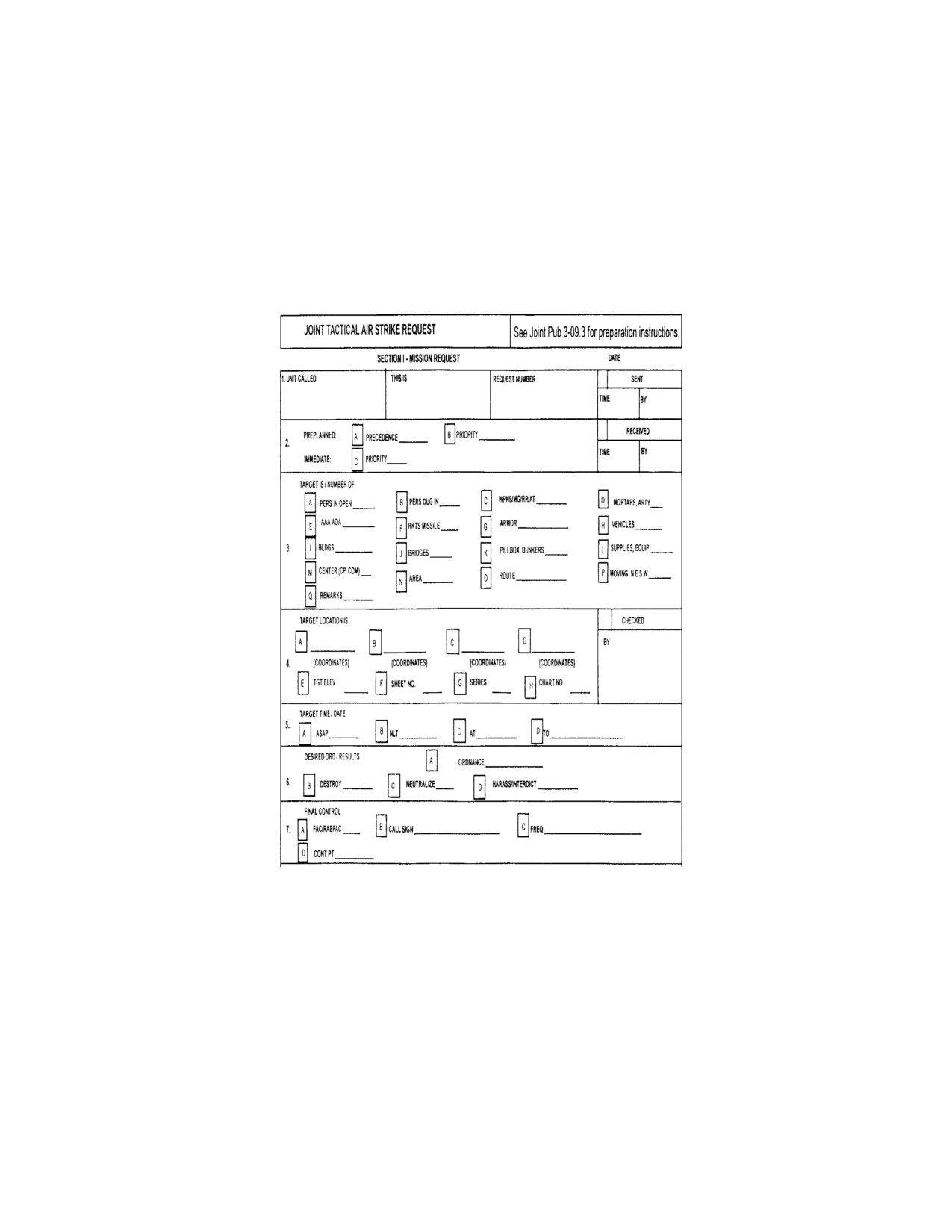
DD 1972 (Revised) 15 Nov 94 (Supersedes DD Form 1972, 1 Apr 75)
Figure 13. Joint Tactical Air Strike Request Form
34
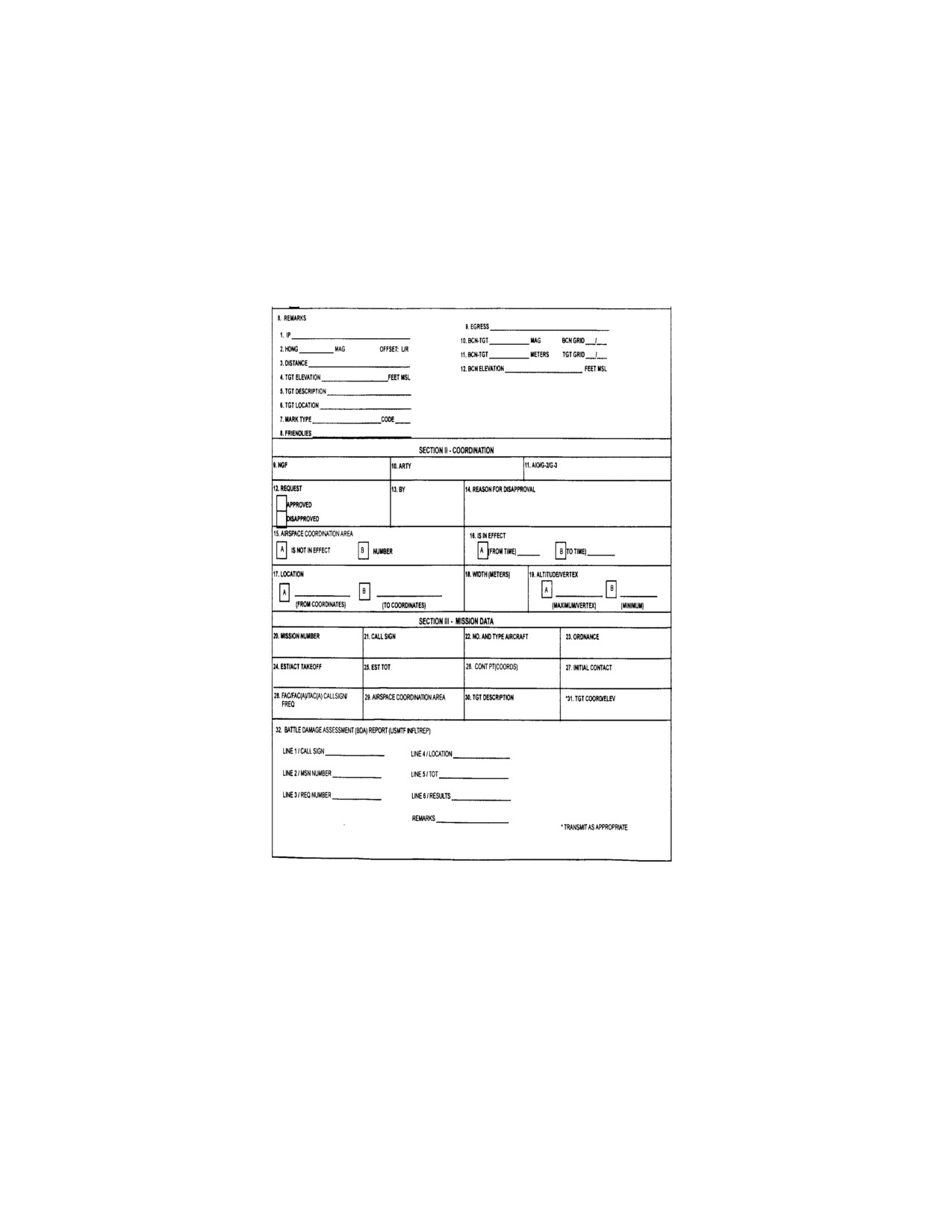
DD 1972 (Revised) 15 Nov 94 (Supersedes DD Form 1972, 1 Apr 75)
Figure 13. (Continued)
35
ASSAULT SUPPORT REQUEST FORM
1. Action Addressee: ______ this is ______ Request No _______
2. Request For: ______Helicopter ______ Fixed-Wing Transport
3. Mission Precedence: ____ Mandatory ___ Emergency ___Urgent
___ Priority ___ Routine ___
4. Type of Mission:
_____Troop Lift _____ SAR _____ Retraction
____Logistics
____VIP Code ____Photo
____Recon Insert
____Spot/Obs ____Unit Cdr
____MEDEVAC ____Liaison
____Other
5. Mission Description: # of Troops ___Internal Cargo: (weight/cube)
Largest Item (LxWxH) ___x____x___ External Cargo: weight ____lbs
6. Instructions: Pick up Time Coordinates LZ Time Coordinates
A.
_______
_______
______
_______
B.
_______
_______
______
_______
C.
_______
_______
______
_______
D.
_______
_______
______
_______
7. LZ Description: Size _______ Obstacles _______
Wind Direction ______
Friendly Positions _____
Secure/Insecure ______
Enemy Position _______
8. LZ will be: _______Unmarked ____Marked with ________ (color)
______Panels _____Flares _______Smoke
________Lights
____Other
For A/C and LZCP/TACP
9. Comms___ P/U Zone Call Sign/Channel______/_____Freq_____
LZ Call Sign/Channel _________/__________ Freq __________
10. Local Date/Time ______________Authentication ____________
Figure 14. Assault Support Request Form
36
LASER OPERATIONS
GROUND FORWARD AIR CONTROLLER (GFAC)
RESPONSIBILITIES
♦ Include Laser Code and Laser-Target-Line (LTL) on Line 7
of the 9-line brief.
♦ Avoid the 20 degree safety zone whose apex is at the target
and extends 10 degrees either side of the LTL for aircraft
run-ins.
♦ The optimal attack zone is a 120 degree fan whose apex is
at the target and extends to 60 degrees either side of the
LTL, leaving an ideal attack zone of 50 degrees either side
excluding the safety zone.
♦ Anticipate aircraft will show up with either Laser Spot
Trackers (LSTs) or Laser Guided Weapons (LGWs).
♦ Prebrief pilot if possible.
♦ Plan early and get the FO/FIST ready for mission.
♦♦ Laser code: ensure code in Laser Target Designator
(LTD) matches code that pilot passed.
♦♦ Explain ordnance and aircraft characteristics.
♦♦ Explain minimum safe distances of ordnance being
used.
♦♦ Laser-Target (LT) line is no more than 5 degrees off
briefed LT line.
♦♦ Explain that you are in control and that the LTD is
operated at YOUR Command.
♦♦ Ensure communications are in place-the simpler the
better.
♦♦ Get coordinates of all friendly locations and ensure
that no friendlies are in the flight path.
37
PILOT CALLS
♦ Laser Operations:
♦♦ “10 Seconds” - Directive to terminal controller to
standby for Laser on call in approximately 10 seconds.
♦♦ “Laser On” - Directive to start laser designation.
♦♦ “Spot” - Acquisition of laser designation.
♦♦ “Shift” - Directive to shift laser illumination energy
from offset to target.
♦♦ “Terminate” - Cease laser designation.
(During
peacetime prompt pilot if call is not heard within 20 seconds
after “Laser on” call is made or after weapons impact.
Wartime: laser time may exceed 20 seconds; however, be
aware of battery life.)
♦ Night IR CAS Brevity Terms:
♦♦ “Rope” - Call made by exception if the terminal
controller is to illuminate the aircraft with an IR pointer.
♦♦ “Visual” - The terminal controller has the attack
aircraft in sight, or the attack aircraft has positively
identified the terminal controller’s or friendly position.
♦♦ “Contact” - Acknowledges sighting of a specified
reference point.
♦♦ “Snake” - Call made for the terminal controller to
jiggle the IR beam on the target.
38
♦♦ “Sparkle” - Terminal controller marks the target with
an IR pointer. Also used by AC-130s to mark the target with
40mm misch.
♦♦ “Tally” - The enemy position/target is in sight; opposite
of NO JOY.
♦♦ “Steady” - Terminal controller steadies the beam.
♦♦ “Stop” - Terminal controller stops the beam.
♦ Others:
♦♦ “Bingo” - Prebriefed fuel state that is needed for
recovery using prebriefed parameters.
♦♦ “Blind” - No visual contact with friendly aircraft/
ground position-opposite of term “Visual.”
♦♦ “Chattermark” - Begin using briefed radio procedures
to counter jamming.
♦♦ “Joker” - Fuel state above Bingo at which separation/
bugout/event termination should begin.
♦♦ “No Joy “ - Aircrew does not have visual contact with
the target/bandit/landmark-opposite of TALLY.
♦♦ “Winchester” - No ordnance remaining.
39
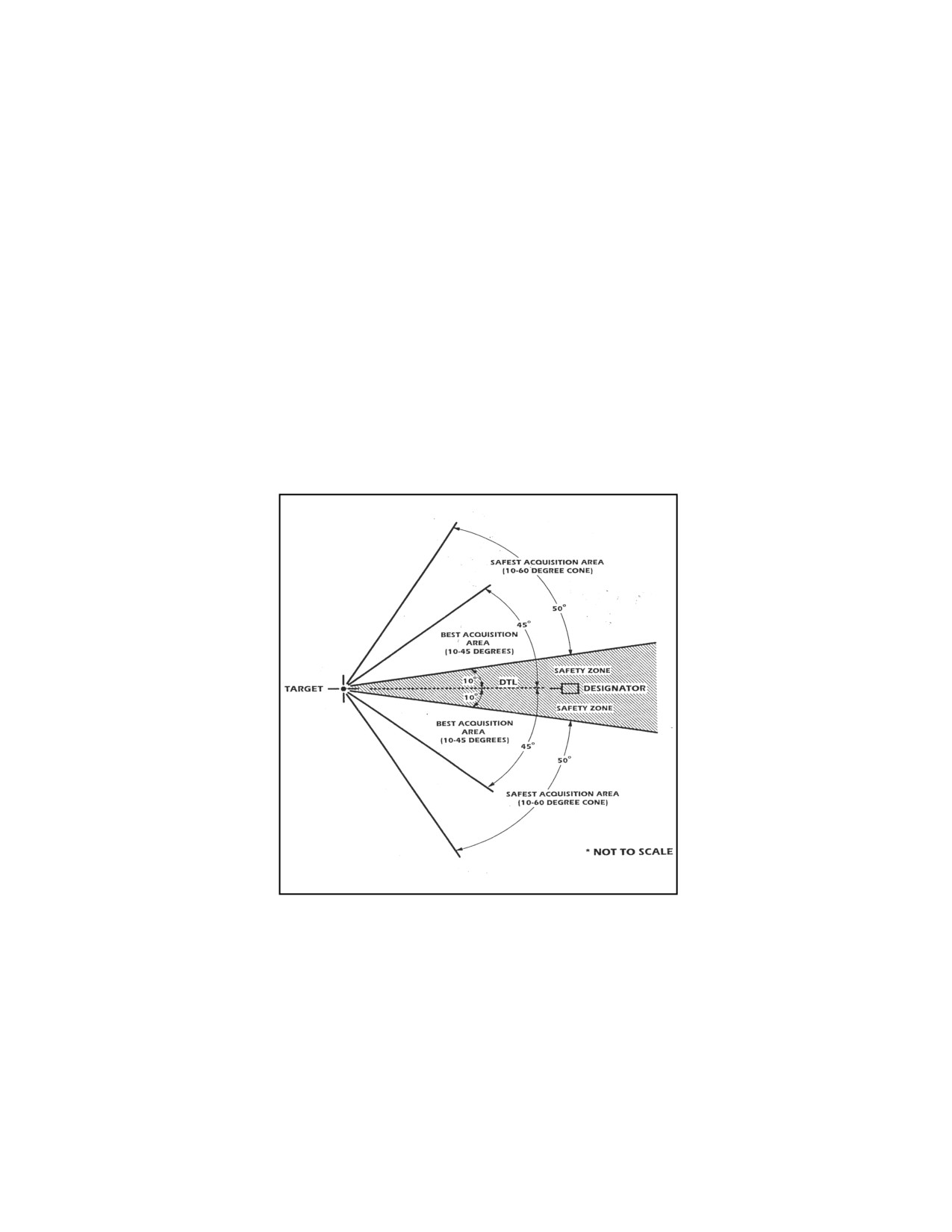
LASER DESIGNATION ZONES
♦ Acquisition Areas and Safety Zones. Figure 15 depicts
the acquisition areas and safety zones as defined by FMFM
5-41, CAS, 28 Oct 92 and FMFM 5-42, DAS,
4 Mar 93.
Reference to Laser Guided Weapons in general, this is the
most current template for LGW employment. This depiction
conforms to the Joint Warfighting Center Laser safety issues
message regarding a recommended change to the J-Laser
designator safety zone due to the A-10 incident at Fort Sill,
OK (R081957Z JAN 96).
Figure 15. Laser Designation Zones
40
///////////////////////////////////////