FM 3-19.50 Police Intelligence Operations (July 2006) - page 2
Chapter 5
SITUATIONAL UNDERSTANDING
5-19. Commanders and their staffs may be unfamiliar with the intricacies of the urban environment and
more adept at thinking and planning in other environments. Therefore, without detailed situational
understanding, commanders may assign missions that their subordinate forces may not be able to achieve.
As importantly, commanders and their staffs may miss critical opportunities because they appear
overwhelming or impossible (and concede the initiative to the threat). They also may fail to anticipate
potential threat COAs afforded by the distinctive urban environment. Commanders may fail to recognize
that the least likely threat COA may be the one adopted precisely because it is least likely and therefore
may be intended to maximize surprise.
5-20. Adversaries will also seek to shape conditions to their advantage. They will try to change the nature
of the conflict or use capabilities that they believe will be difficult for US forces to counter. They will use
complex terrain, urban environments, and force dispersal methods similar to those used by the North
Vietnamese, Iraqis, and Serbs to offset US advantages.
COORDINATION
5-21. Commanders coordinate their planning and efforts (early and continuously) to ensure that their
decisive, shaping, or sustaining operations are not working against the efforts and operations of other
agencies that may have the lead role in the operation. A critical shaping operation may be to establish the
coordination to help develop a common purpose and direction among agencies.
URBAN TERRAIN
5-22. Although intricate, understanding the urban terrain is relatively straightforward in comparison to
comprehending the multifaceted nature of urban society. UO often require Army forces to operate in close
proximity to a high density of civilians. Even evacuated areas can have a stay-behind population in the tens
of thousands.
5-23. This population's presence, attitudes, actions, communications with the media, and needs may affect
the conduct of operations. Homogeneity decreases drastically as the size of the urban area increases.
Commanders must take into account the characteristics of a population whose beliefs and interests may
vary. Civilian populations continually influence, to varying degrees, operations conducted in an urban area.
Commanders must understand cultural differences. PSYOP, CA operations, and the use of the media can
greatly contribute to stability and success in UO.
5-24. Thoroughly understanding these societal aspects and avoiding "mirror-imaging"—overlaying one's
own values and thought processes on top of the person or group one is trying to assess—will help to
accurately anticipate civilian actions and responses.
URBAN INTELLIGENCE, SURVEILLANCE, AND
RECONNAISSANCE
5-25. Commanders at all levels require accurate and timely information to conduct assessments for
successful UO. This is critical to planning and execution. Senior commanders have a large role in
coordinating the urban ISR effort. National strategic sources (as well as open sources) may provide some
of the information that commanders and staffs require on the characteristics of the human dimension, the
physical properties of the terrain, and the infrastructure. However, tactical forces conducting deliberate
R&S can best obtain the required information. The general characteristics of these aspects of the urban
environment do not change drastically over time, with one exception—military operations or natural
disasters can change the physical characteristics of the urban environment drastically.
5-26. Analysts can obtain crucial information through diligent research of intelligence databases and open
sources. However, the disposition and composition of the urban threat is time-sensitive and not likely to be
discovered through this type of investigation. Due to the effects of the urban environment, deceptive efforts
may influence the threat more easily. R&S provide accurate and timely information regarding threat
5-4
FM 3-19.50
21 July 2006
Police Intelligence Operations in Urban Operations
dispositions, the composition and state of the population, and the specifics of the urban terrain. Successful
UO depend on the successful conduct of urban reconnaissance.
CHALLENGES
5-27. The most significant challenge to urban ISR is the physical challenge. The organization and
complexity of the urban terrain (both man-made and natural) challenge national, strategic, operational, and
tactical ISR capabilities.
5-28. Commanders understand the challenges when planning and allocating time and resources to their
ISR efforts. They acknowledge that subordinate commanders will face similar challenges. Therefore,
commanders must consider subordinate capabilities, limitations, and needs when planning, requesting,
allocating, and prioritizing ISR assets and capabilities.
RECONNAISSANCE AND SURVEILLANCE
5-29. R&S may be employed to determine the disposition, activities, and intentions of civilian populations
(hostile and neutral) and uniformed or irregular threats. Reconnaissance for information collection and
security continues throughout the operation. Success requires integrating all available information from
civil and military sources. In foreign humanitarian assistance operations, reconnaissance helps determine
how and where to effectively apply limited assets to benefit the most people. Units conducting domestic
stability operations in urban environments conduct reconnaissance to help determine when and where to
apply manpower and resources. Forces conducting domestic stability operations must know the legal
limitations when acquiring information on civilians.
5-30. In many instances, international organizations and nongovernmental organizations (NGOs) will have
been in the AOs long before US forces. These organizations produce reports, operate Web sites, and
maintain databases of immense value. In the case of mines or unexploded ordnance, there is often a global
positioning system reference collection of minefield survey data. US forces can access much of this
information before deploying. Although commanders may access this information using intelligence
operations, sound civil-military coordination may be a more effective approach.
5-31. Nonmilitary organizations can provide valuable information; however, they may resent being
considered a source of intelligence. Because of the nature of their work, some organizations must remain
independent and nonaligned with any military force. Commanders must foster communications and share
valuable information with these organizations to become familiar with the cultures and sensitivities of the
local population. Sharing relevant information is an element of information management and not ISR.
5-32. PIR in UO, especially during stability operations, may differ from those in offensive and defensive
operations. In combat operations, PIR focus on the enemy's military capability and intentions. However,
intelligence collection in stability operations may be adjusted to the people and their cultures, politics,
crimes, religions, economics, and related factors and any variances within affected groups of people.
INTELLIGENCE SYNCHRONIZATION
5-33. In addition to their organic assets, collection managers must be able to synchronize their collection
efforts with a broad range of collection assets operating in the AO over which they have no direct control.
These assets may include military police conducting PIO, USACIDC conducting CRIMINT analysis,
counterintelligence (CI) and HUMINT collection teams under the control of another agency, signals
intelligence and imagery intelligence collectors under the control of a joint task force, and collectors under
the control of friendly elements such as the HN or coalition forces.
21 July 2006
FM 3-19.50
5-5
Chapter 6
Police Intelligence Operations on Installations
This chapter describes the collaborative relationship between the Installation
Management Agency (IMA) and the DES and/or PM. It will concentrate on the
DES's and PM's application of PIO on installations.
RESPONSIBILITIES OF THE INSTALLATION MANAGEMENT
AGENCY
6-1. The relationships and responsibilities of IMA to regional installations are evolving. The following
paragraphs serve as a guide to PIO on installations.
6-2. The IMA and some major army commands (MACOMs) have ownership of installations. Although
not all inclusive, IMAs/MACOMs generally have responsibility for—
z
Mobilization.
z
Deployment.
z
Redeployment and demobilization support.
z
Training management.
z
Ammunition management.
z
Airfield management when applicable.
z
Mission support to reserve components when applicable.
z
Civil authorities and other agencies.
z
Law enforcement.
z
Physical security.
z
Personnel security.
z
Industrial security.
z
Information security.
z
Operational security (OPSEC).
z
AT and FP planning.
z
Chemical, biological, radiological, nuclear, and high-yield explosives (CBRNE).
z
Fire protection.
z
Emergency services planning.
6-3. These responsibilities are delegated to designated agencies based on the function being performed.
From the above list, the DES and/or PM have primary responsibility as key planners of law enforcement,
physical security, industrial security, OPSEC, AT and FP planning, CBRNE, fire protection, and
emergency services planning.
AUTHORITY TO CONDUCT POLICE INTELLIGENCE OPERATIONS
6-4. While the following authoritative documents do not specifically use the term "police intelligence
operations," they do provide the authority and the premises on which to conduct PIO on installations. It is
the police information and CRIMINT that results from the activities described in these documents that
comprise PIO activities. DODD 2000.12 directs commanders to ensure that they have a capability to
21 July 2006
FM 3-19.50
6-1
Chapter 6
collect, receive, evaluate, analyze, and disseminate all relevant data on terrorist activities, trends, and
indicators of an imminent attack. It also requires commanders to fuse suspicious activity reports from
military security, law enforcement, and counterintelligence organizations with national-level ISR collection
activities.
6-5. DODI 2000.16 directs commanders to task the appropriate organizations under their command to
gather, analyze, and disseminate terrorism threat information as appropriate. It requires the Army to ensure
that forces are trained to maximize the use of information derived from law enforcement liaison and
intelligence and counterintelligence processes and procedures. This includes intelligence procedures for
handling priority intelligence requests for in-transit units and implementation of procedures to conduct IPB
and mission analysis.
6-6. AR 525-13 directs commanders to ensure that the appropriate intelligence and law enforcement
organizations within their command collect and analyze criminal threat information and that the collection
operations are being conducted according to applicable regulations and directives. This AR also requires
commanders to ensure that threat information prepared by the intelligence community, USACIDC, PMs,
and other organizations or sources be used when conducting threat assessments. See Chapter 2 for further
discussion of this AR, the provisions of DODD 5200.27, and other authoritative documents.
MANAGEMENT OF POLICE INTELLIGENCE OPERATIONS ON
INSTALLATIONS
6-7. Managing PIO on installations is very similar to the description of the PIO function described in
Chapter 3. The distinct difference is that unlike a battalion with an S2 complemented by a full staff and
possibly an assigned CRIMINT analyst, many DESs and PMs do not have a full staff available to analyze
police information. The bulk of threat information generally comes from outside law enforcement and
national intelligence agencies instead of organic collection assets.
STAFF RESPONSIBILITIES
6-8. The DES, PM, or SAC is responsible for the implementation and management of PIO. Effective
operations are created by—
z
Developing effective PIO by integrating it into management, operations, and planning.
z
Providing required training and resources for PIO.
z
Approving the CCIR from staff nominations.
z
Providing intent for planning and directing the PIO, targeting the entity of interest, and
reviewing the collection plan for compliance.
z
Developing an effective law enforcement network as described in Chapter 7.
z
Staffing PIO activities and products with the SJA.
THREAT INFORMATION AND MODELS
6-9. Installation commanders often rely on IMA to provide threat information from DOD intelligence
agencies such as the DIA, the NSA, and non-DOD agencies such as the FBI and the Department of HLS.
Within the IMA, this function is the responsibility of the intelligence fusion cell. There are many
organizations in the intelligence community. FM
2-0 describes the various intelligence and law
enforcement agencies that provide intelligence support to military operations and installations.
6-10. For local threat information, installation commanders rely on the DES, PM, and CID to coordinate
with local, state, and federal law enforcement agencies. These personnel in these agencies can provide
valuable information on local threats such as gangs, hate groups, and criminals. The installation
commander counters these and other threats through physical security measures, random antiterrorism
measures (RAM), access control points, aggressive law enforcement, and so forth.
6-2
FM 3-19.50
21 July 2006
Police Intelligence Operations on Installations
6-11. Installation assets that are trained to collect and report police information and may assist in the
development of threat information include—
z
ALE patrols.
z
Access controllers.
z
USACIDC and military police investigators.
6-12. In order to capture police information and CRIMINT, the DES, PM, and CID use a threat model.
Threat model designs can differ based on the type of environment within which a mission is being
conducted, as well as the conflict intensity within that environment. For example, on an installation with
habitual relationships and a relatively stable OE, models may, over time, reach a degree of specificity and
detail not possible in the more fluid environment associated with a contingency operation. Clearly defined
threat categories are essential to the development of a threat model.
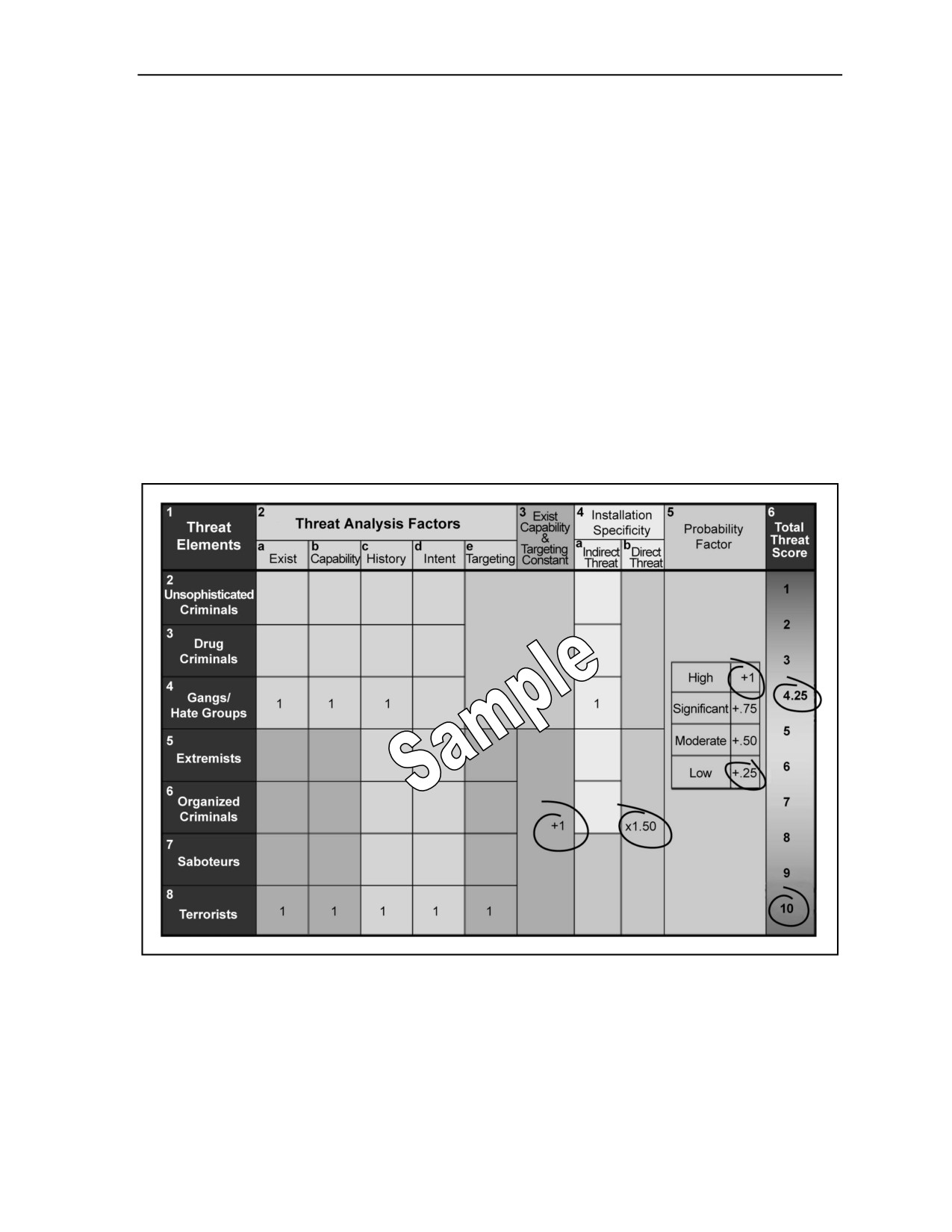
6-13. Intelligence managers must define in detail each threat group by capability and intent. For example,
whereas a gang might target individuals, it does not target specific installations. Understanding what a
gang targets is central to understanding the threat that gang poses to an installation. Figure 6-1 is a sample
model that was designed for use at US Army installations. It is not prescriptive, but is descriptive of the
need for a standardized quantifiable method to conduct threat estimates. The police information and
CRIMINT collected from PIO efforts are put into databases. These databases are described in Chapter 4.
Figure 6-1. US Army Installation Threat and Crime Model
21 July 2006
FM 3-19.50
6-3
Chapter 6
POLICE INTELLIGENCE OPERATIONS PLANNING AND EXECUTION
6-14. During the planning and directing of PIO, the DES, PM, or SAC must identify and approve the
CCIR and plan and direct the information collection effort. The DES, PM, and CID planners consider the
same factors the staff identified in Chapter 3.
z
What (activities and indicators that will confirm the threat).
z
Where (probable locations to include NAI).
z
When (the time that the event may occur).
z
Why (justification of the requirement).
z
Who (the persons and agencies needing the results of the collection efforts).
6-15. Once priorities have been established, a police information collection strategy and plan are prepared
based on the same factors described in Chapter 3. The police information collection plan will—
z
Synchronize the CCIR with the collection effort by prioritizing collection tasks.
z
Assign law enforcement assets for the collection effort and interdiction coverage (patrols,
checkpoints, access control points, and so forth) with special emphasis on NAI and vulnerable
areas.
z
Manage collection assets such as patrols, contraband detectors, access control teams; special
services such as investigations, dog patrols, and physical security; or external support such as
explosive ordnance disposal (EOD).
z
Provide indicators and special instructions.
6-16. The police information collection process is the same for installations, with the exception of the
reporting of police information and CRIMINT to S2s and G2s (see Chapter 3). Because of the restrictions
placed on the collection of information about US citizens by intelligence agencies, police information and
CRIMINT will only be channeled through S3s and G3s and law enforcement channels, except when
paragraph 1.6a of EO 12333 applies.
6-17. The remainder of PIO and its processes are performed in the same manner as described in previous
chapters. A recap of those actions is as follows:
z
A collection plan is used to gather police data or CRIMINT products required to answer the
CCIR in the collection phase.
z
The collected data is entered into a data stream through reporting and is organized and
prioritized in preparation for analysis and production of CRIMINT in the reporting and
processing phase.
z
Data analysis, evaluation, and interpretation occur and are then converted into CRIMINT
products that are entered into a production stream and on to production cycles in the analysis
and production phase.
z
These products are disseminated to appropriate users when, where, and in the form needed in the
dissemination and integration phase.
z
Evaluation and feedback occur (typically initiating more CRIMINT requirements) during all
phases.
6-4
FM 3-19.50
21 July 2006
Chapter 7
Police Intelligence Operations Networking
This chapter describes the development of PIO networks in various OEs and the
development and management of forums, committees, councils, and threat working
groups. This chapter also describes some of the law enforcement and intelligence
agencies and the tools that they can provide in support of ALE personnel.
PIO networks in tactical and nontactical environments are developed similarly with
the same overarching objective—to enhance police information and CRIMINT
sharing. Whether in a tactical or nontactical environment, subtle influences may
create some variation in network membership from one ALE organization to the next.
Influences such as the availability of agencies within the local OE, the personalities
of organizational leaders, and cultural or operational differences between agencies
may influence membership participation and team dynamics. For instance, ALE
personnel may not have a local FBI or Bureau of Alcohol, Tobacco, and Firearms
(BATF) field office within the operating vicinity of the installation. Likewise, UN
civilian police may be operating in the Balkans while preparing to deploy civilian
police into the Afghanistan theater. Despite such local variations, a more general
perspective provides important similarities in developing and managing PIO
networks that can provide a firm basis for future ALE doctrine.
By using standard protocols, ALE personnel may develop PIO networks anywhere in
support of Army installations or specific AOs. Such standardization would provide a
platform for tailoring staff, providing institutional training, and selecting the most
appropriate resources such as automation and other emerging technologies. The
successful development of PIO networks may help create seamless OEs between
local agencies and may provide a springboard for developing vast regional, national,
or even international PIO networks.
NONTACTICAL NETWORKS
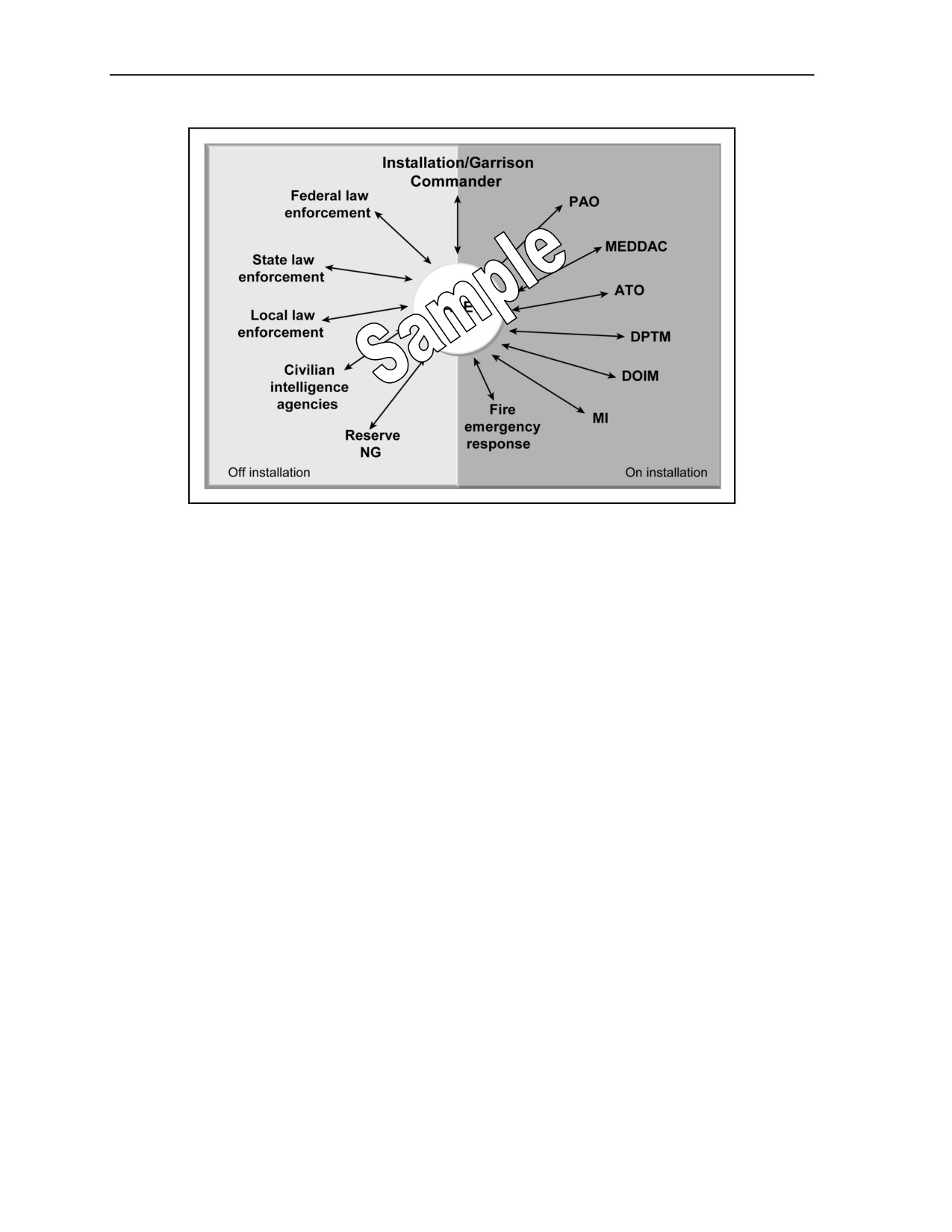
7-1. Figure 7-1, page 7-2, provides a sample of a nontactical PIO network at the Army installation level.
This is just a sample of one possible network pattern and would undoubtedly change from locality to
locality based on the aforementioned variables. In Figure 7-1, ALE personnel are located in the center,
with installation agencies on the right (gray background) and agencies located off the installation are
located on the left (light gray background). Typical law enforcement agencies may include international,
federal, state, and local law enforcement depending on whether the installation is located in CONUS or
OCONUS.
7-2. Relationships between ALE personnel and other PIO network members will differ. Some network
members will require day-to-day working relationships while others will be based on—
z
Mutually supporting relationships for routine activities.
z
Occasional collaboration.
7-3. PIO network relationships between agencies will ebb and flow based on numerous factors affecting
the OE. Relationships will also continue to develop as bonds are strengthened through joint ventures and as
agencies expand their own operating network.
21 July 2006
FM 3-19.50
7-1
Chapter 7
Figure 7-1. Nontactical PIO Network
TACTICAL NETWORKS
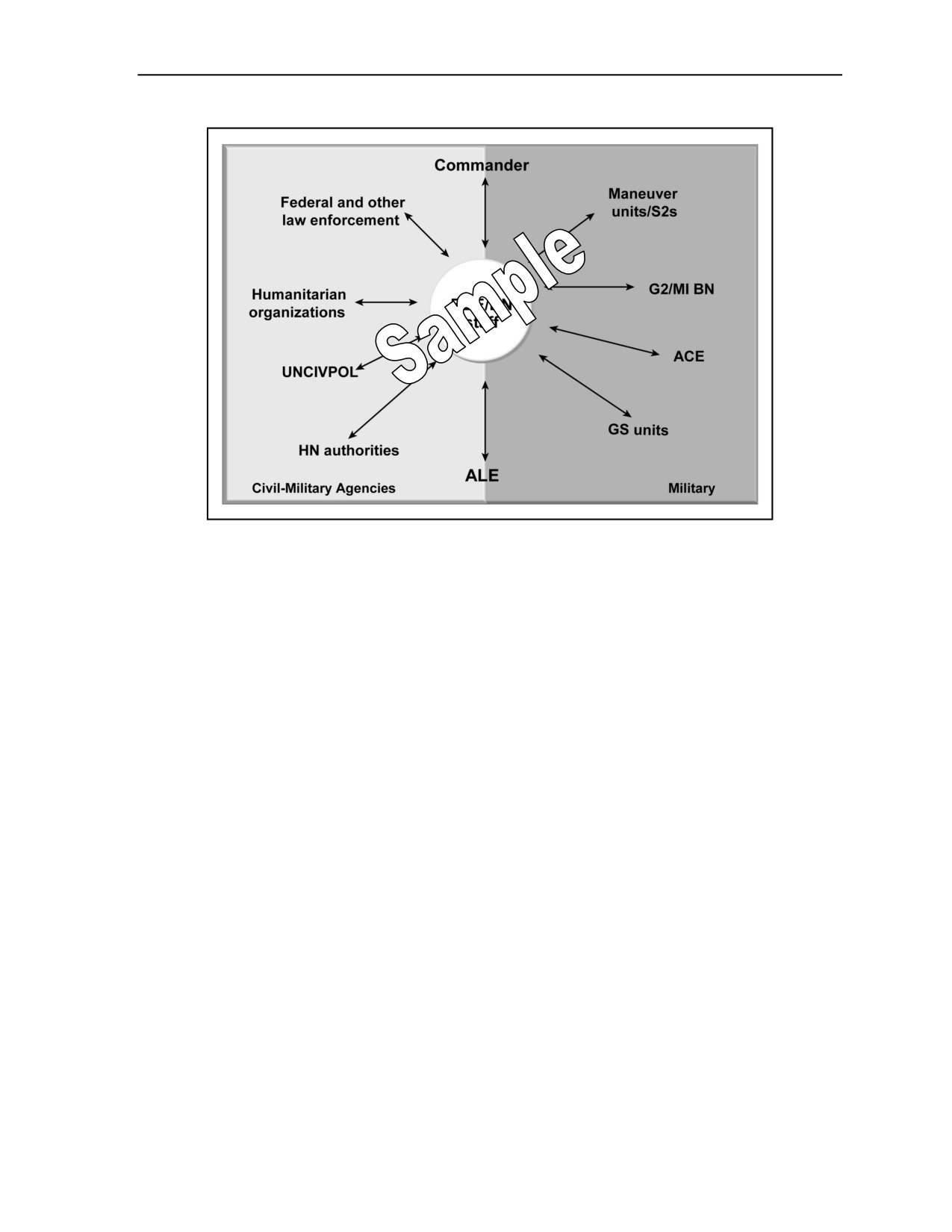
7-4. Figure 7-2 provides a sample of a PIO network in a tactical environment. PIO networks will also
vary from locality to locality in a tactical environment. Similar to the nontactical PIO network, military
organizations are located on the right (gray background), while civil-military agencies are located on the
left (light gray background).
DEFINING NETWORK PARTICIPANTS
7-5. A PIO network should be tailored to meet the local (common) OE and is influenced by such factors
as the threat assessment, intelligence requirements, and the specific needs of participating agencies. A PIO
network will generally consist of agencies located within the immediate OE. However, with a growing
number of agencies using the Internet, this may not always be the case. Instead, agencies participating in a
PIO network may be defined by their affiliation rather than their actual location and may be located across
the state or country, or even located across the world. Such arrangements may fill essential gaps in the PIO
network. If particular agencies are not represented in the local environment (for example, FBI or Drug
Enforcement Administration (DEA) field offices, MI, or HN law enforcement), ALE personnel can add
them to their network by either leveraging another law enforcement PIO network or making direct contact
with the agency using Internet-based intelligence services.
7-6. The success of the PIO network depends on the mutual exchange of timely, relevant, accurate, and
predictive intelligence with regards to established laws and regulations. To accomplish this, PIO managers
must work closely with other agencies and thoroughly understand each agency to complement each other's
strengths and weaknesses. They must understand each organization's vision, mission, goals, and objectives
and identify and develop strategies to overcome cultural, organizational, and operational barriers. By
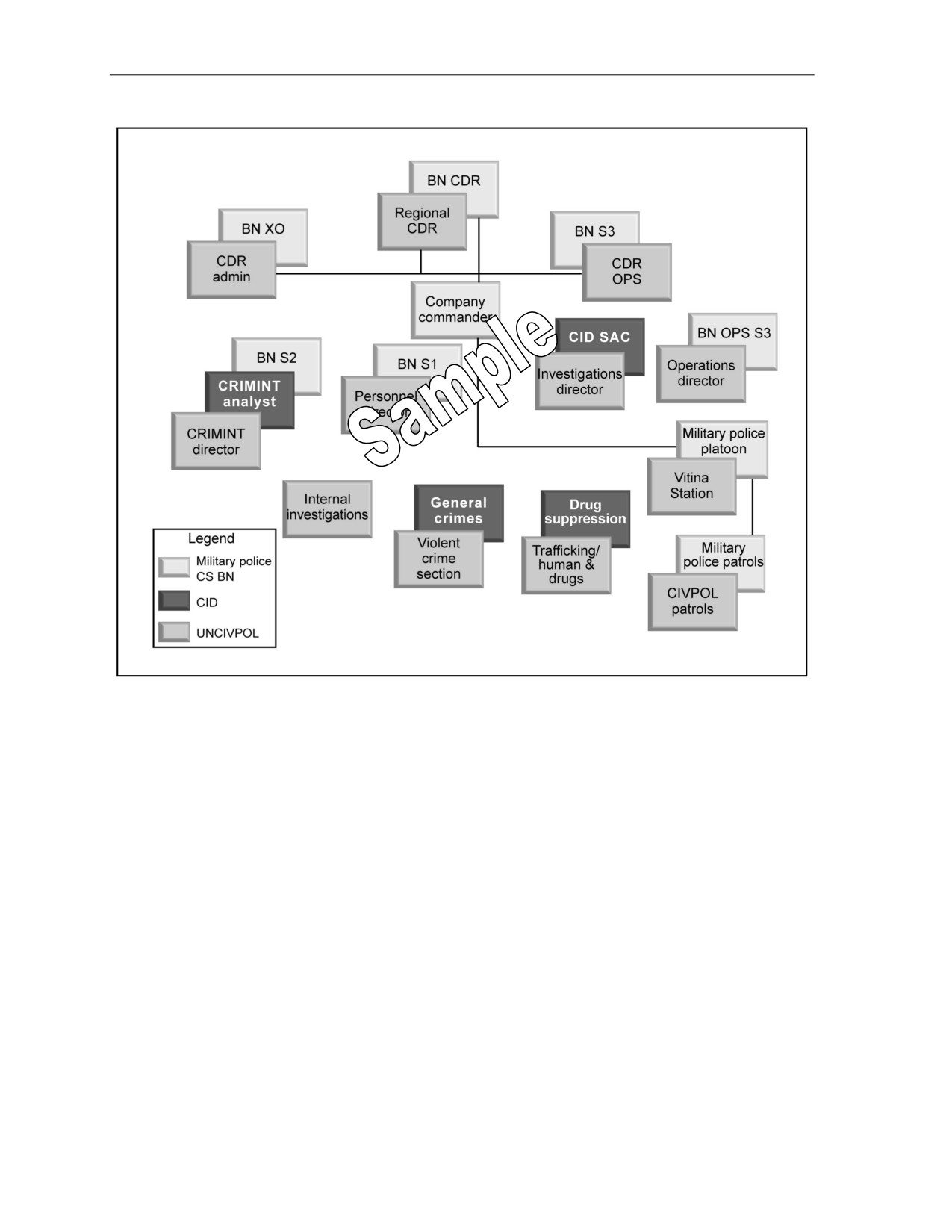
reviewing organizational charts, PIO managers can align their organization with other organizations. They
should identify and superimpose the task and purpose for each key member onto an organizational chart to
assist with aligning parallel levels and similar intelligence functions between organizations. Using the
modified organizational chart, managers can identify comparable staff positions and existing gaps between
organizations. Figure 7-3, page 7-4, is a sample of an organizational chart showing nested organizations.
7-2
FM 3-19.50
21 July 2006
Police Intelligence Operations Networking
Figure 7-2. Tactical PIO Network
7-7. The modified organizational chart can now be used to identify and align intelligence contacts within
each participating agency. It is important to nest appropriately similar command and staff, levels of
authority, and intelligence functions between each agency to increase interoperability. For instance, ALE
personnel must recognize that similar ranks or titles between organizations do not necessarily translate to
the same management level. A lieutenant with the state police, for example, may be the equivalent of a
military police colonel. Also, appropriate staff alignment can help to build personal working relationships
for more effective interagency cooperation and intelligence sharing. When nesting organizations, PIO
managers must identify and cross-level or provide training to bridge organizational gaps, to include
cultural, operational, technological, and experience gaps.
7-8. ALE personnel must develop a comprehensive communications system to support a PIO network.
Contact lists for all agencies should be disseminated throughout the network and routinely checked to
validate less frequent contacts and maintain personal working relationships. It is desirable that agencies
have compatible communications systems for routine support. Compatible communications systems should
include—
z
Conventional communications systems such as—
A telephone.
A radio.
A fax machine.
z
Nonconventional communications systems such as a—
A Secure Internet Protocol Router Network (SIPRNET).
A Nonsecure Internet Protocol Router Network (NIPRNET).
An electronic intelligence interface, videoconferencing capability.
Web sites.
Computer databases.
21 July 2006
FM 3-19.50
7-3
Chapter 7
Figure 7-3. Organizational Chart
FORUMS AND THREAT WORKING GROUPS
7-9. Whether in a tactical or nontactical environment, commanders must establish forums and/or threat
working groups to enhance their PIO networking capabilities. The PM should always be a member of these
forums and/or cells.
DEVELOPING FORUMS
7-10. A forum is a select group of agency representatives who are usually selected from within the PIO
network to meet as part of a working group, committee, council, or cell. The purpose of the forum can be
to accomplish any number of objectives such as targeting, planning and directing, collecting, processing,
analyzing, and producing or disseminating intelligence to meet established criteria. Each forum should
have a charter that clearly defines its vision, mission, goals, and objectives. Examples might include such
common forums as a gang task force, FP council, or AT working group; or they may include less common
forums such as an installation threat working group or a law enforcement targeting cell. Because forums
are established for different reasons, forum chairpersons will be designated based on the intent of the
forum. For example, the chairperson for law enforcement concerns will most likely be the PM, the
chairperson for FP concerns will most likely be the FP officer, and so forth (see paragraph 7-16). Based on
their charter, forums can either be recurring or limited in scope.
7-4
FM 3-19.50
21 July 2006
Police Intelligence Operations Networking
Recurring Forums
7-11. Recurring forums provide a broad-based platform for sharing CRIMINT and police information and
are usually formed without a specific end state. Each meeting is generally guided by an agenda focused to
achieve current goals and objectives. A recurring forum may be formed to provide the latest updates
relevant to its charter, or it may provide a platform for a more cyclic process such as planning, directing,
and targeting.
7-12. Targeting consists of receiving raw data or information through various sources, developing
actionable CRIMINT (through the CRIMINT process), and then targeting an individual or organization
associated with a specific crime. An example of targeting is that of economic crimes, where an individual
commits systematic larceny of government properties, such as central issue facility (CIF) items. CIF
personnel report the individual suspected of committing larceny. ALE personnel initiate an investigation,
develop actionable CRIMINT, target the individual, complete the investigation by proving the elements of
the crime, and forward the report for the purpose of adjudication.
7-13. An AT working group and a law enforcement targeting forum are examples of recurring forums
because they are focused on an ever-present challenge. These examples could continue indefinitely to meet
specific objectives that are developed and refined on a recurring basis to meet changes in the threat
assessment or other changes affecting the OE. Recurring forums can be challenging for ALE personnel. To
be successful, such forums require a long-term commitment, membership stability, and well-prepared and
focused agendas. Law enforcement targeting forums, for example, require a continual assessment of the
threat, current intelligence analysis and production, and updated targeting folders prepared before each
meeting.
Limited-Scope Forums
7-14. Limited-scope forums are generally brought together for a particular mission or task and would
normally have a clear end state. Such forums provide an excellent platform for crisis and consequence
management. For example, a task force for a homicide case is a limited-scope forum, convening for the
purpose of solving a specific murder case. Once the case is solved, the forum's charter would be
accomplished and the forum disbanded. While the participating agencies are no longer part of the forum,
they remain part of the network and are available to participate in future forums.
TAILORING FORUMS
7-15. Whether a forum is recurring or limited in scope, membership must be specifically recruited for each
particular charter. Membership should be both inclusive and exclusive. It must include all relevant
members from the PIO network (such as the G2); the director of plans, training, and mobilization (DPTM);
and the garrison commander, but exclude all others less relevant. Admitting too many agency
representatives or those unrelated to the mission may create a forum that is either too large or too diffused
to be effective. Selective membership will encourage an open dialogue, especially when sharing classified
or sensitive intelligence. Law enforcement personnel, for example, may not openly share police
information with non-law enforcement agencies or members present. If a forum were created to target
gangs, however, it should include a representative from each agency within the PIO network with specific,
relevant jurisdiction, such as local or regional gang units. Additionally, once the forum is established,
membership should be guarded to minimize membership turnover or influx that can reduce the
effectiveness of the group dynamics.
7-16. Forum management must also consider the appropriate membership level and functional expertise.
Some forums may require managers because their charters require rapid decisions to integrate intelligence
closely with operations. Targeting forums, for example, are best supported by decision makers who can
make immediate operational decisions for their respective organizations. This can abbreviate the targeting
cycle by cutting through the normal staffing process required for analysts to inform commanders regarding
targeting results. This may be particularly important when planning and targeting joint law enforcement
21 July 2006
FM 3-19.50
7-5
Chapter 7
operations where staff delays from each agency can compound critical time delays between actionable
intelligence and taking action. Forum management should also consider the appropriate functional
expertise required to accomplish charter goals and objectives during the forum. For example, a more
general forum mix (such as managers, analyst, and targeters) may provide a quicker staff process, but may
provide less specific intelligence than more specific representation (such as a group of analysts).
MANAGING FORUMS
7-17. Effective management is critical in achieving a level of interagency cooperation beyond a simple
exchange of information. The traditional challenges of managing time, priorities, and results must be
addressed at every meeting. The forum agenda, supported with the latest intelligence updates, can help
manage time, while providing linkage between forum goals and objectives, and the group's current focus.
A formal agenda can also provide a medium for staffing forum topics with agency management before
each meeting and, when used to document results, can provide a standard product for dissemination to
respective agency staffs.
7-18. Critical management positions such as a chairperson or project leader, a person or team responsible
for developing the agenda and collecting current intelligence, and someone responsible for documenting
forum results and preparing in-progress reviews must be selected for the forum. Because membership may
represent many diverse backgrounds, forum progress can easily become sidetracked and lose focus. To
counter this, it is important that the forum chairperson review agendas before meetings, maintain focus
during meetings, make decisions on dissemination, and review and assign intelligence tasks to forum
members. Forums must also include functionary experts for those intelligence processes being conducted,
and the chairperson or forum manager must be familiar with the major function associated with the forum's
charter. For example, the chairperson for a law enforcement targeting forum may not provide discrete
targeting input into the agenda. However, he must understand the targeting process and be able to translate
specific guidance based on input such as the current threat assessment and CCIR into targeting priorities.
THREAT WORKING GROUPS
7-19. Forums, when developed for the purpose of integrating intelligence from multiple sources, are
referred to as threat working groups. These groups provide one of the most important components of an
effective PIO network. Generally, they represent the most senior intelligence forum for each organization
and network (for example, installation threat working groups, state or regional law enforcement threat
working groups, or an ACE). A threat working group provides a central location for CRIMINT
management and is used throughout the Army at different echelons in both tactical and nontactical
environments. Threat working groups may be formal or ad hoc, based on specific CRIMINT, operating
requirements or constraints, and available resources. Like forums, threat working groups may be staffed on
a recurring basis or under a limited operating scope. They may meet periodically or operate 24/7.
7-20. Although fusion of CRIMINT may occur at any level, establishing a threat working group requires a
more formal structure. A threat working group may be established at almost any organizational level that
can provide the requisite direction and expertise. Threat working groups can manage CRIMINT from
specific or multiple sources. They are designed to collect CRIMINT products from any number of forums,
such as EOD teams working postblast analyses, AT working groups, law enforcement targeting forums,
juvenile review boards, gang task forces, or any number of other forums. Additionally, they can manage
CRIMINT collected directly from separate or isolated sources.
THREAT WORKING GROUP PARTICIPATION
7-21. ALE personnel must provide threat working groups or participate in local threat working groups in
both tactical and nontactical environments. In the tactical environment, they should work closely with a
task force ACE or other threat working groups. In nontactical environments, ALE personnel should
7-6
FM 3-19.50
21 July 2006
Police Intelligence Operations Networking
provide a threat working group at the PM level or, where available, work closely with the installation threat
working group. The following manuals include a discussion of threat working group activities or cells:
z
AR 525-13 mandates that installation commanders, "designate a focal point to coordinate
requirements for, and receive and disseminate time-sensitive threat information received from
federal, state, local, HN, USACIDC, and US intelligence agencies,"
z
US Army installation commanders' blueprint states, "Using the installation S2 as a base, form an
installation focused intelligence threat working group including representatives from these
offices: PM, CID, CI, local, state, federal, and HN law enforcement and intelligence agency
representatives. If OCONUS, include supporting MI detachments and HN law enforcement and
intelligence agency representatives. Meet often and disseminate aggressively."
7-22. While neither manual specifically mandates how threat working groups should manage CRIMINT,
where possible, law enforcement must provide formal structure, staffing, training, and resources. Also,
ALE personnel should incorporate local PIO network representatives for a more comprehensive threat
picture.
THREAT WORKING GROUP STRUCTURE
7-23. Developing or tailoring a threat working group is conducted similarly to tailoring a forum. Threat
working groups supporting higher organizational levels will require more formal structure, management,
and resourcing. At higher organizational levels, threat working groups will be expected to manage larger
volumes of intelligence data and products to service more CRIMINT forums and agencies through—
z
Product dissemination.
z
Planning and directing.
z
Other intelligence support activities such as answering requests for information
(RFIs),
providing consulting services, and supporting intelligence queries. An installation, for instance,
could potentially manage far more networks, agencies, and forums than one of its major
subordinate commands (MSC), just as an MSC could manage more intelligence products and
services than one of its subordinate units.
7-24. Threat working groups must be tailored to support projected estimates regarding the management of
intelligence activities, the operating tempo (OPTEMPO), and product and service support. An analysis of
threat working group requirements can be conducted similarly to that required for tailoring an organization.
Although resource availability will impact threat working group operations, managers should consider the
overall intelligence requirements when developing a threat working group, to include the following:
z
Threat working group charter with mission, goal, and objectives.
z
Expected intelligence management responsibilities.
z
Number and type of agency participants.
z
Expected intelligence products and services.
z
Current threat and vulnerability assessments.
z
Current FPCON.
z
Volume and complexity of intelligence requirements.
z
Targeting cycles and products.
THREAT WORKING GROUP STAFFING
7-25. A full-time intelligence or police intelligence manager is recommended for the management of a
threat working group. This position may be required even during limited operations to maintain police
information and CRIMINT flow, storage, query, and dissemination. In general, threat working group
staffing should include a representative from each charter organization within the PIO network, but at a
minimum, it should include the following:
z
CID.
z
PM.
z
MI.
21 July 2006
FM 3-19.50
7-7
Chapter 7
z
902d MI Detachment.
z
UN, international, and coalition law enforcement agencies.
z
HN law enforcement agencies.
z
Federal, state, and local law enforcement, as applicable.
z
Other intelligence agencies/collectors, when applicable.
z
Other military installations.
z
FP and AT officers.
z
DPTM.
7-8
FM 3-19.50
21 July 2006
Appendix A
Integrating Police Intelligence Operations Planning
in the Military Decision-Making Process
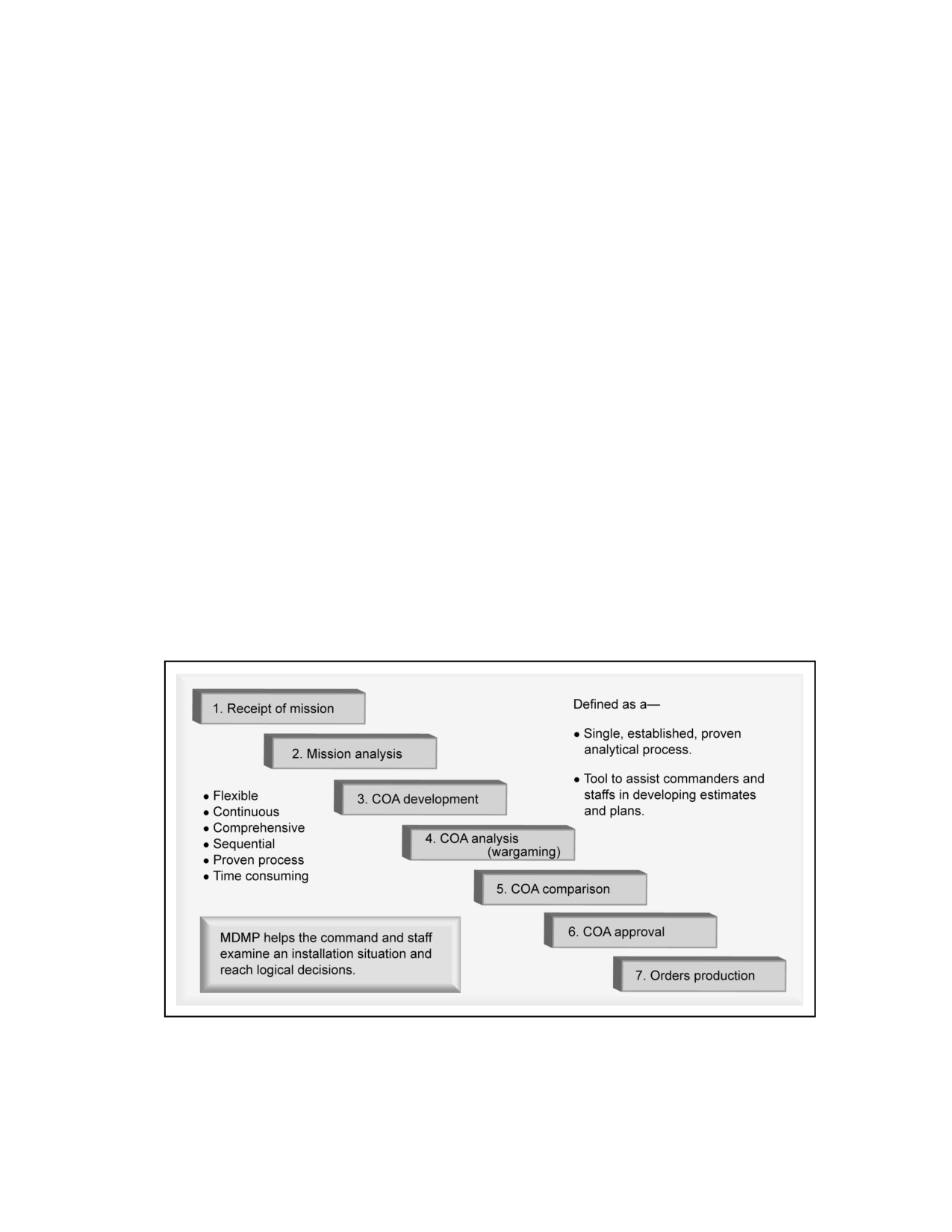
Although designed for tactical planning, the MDMP can assist in the accomplishment
of any mission, including PIO. The MDMP is an established and proven analytical
process that helps organize the thoughts of a commander and his staff to examine
specific situations and reach logical decisions. It helps them apply thoroughness,
clarity, sound judgment, logic, and experience to reach decisions and develop
effective plans. Steps of the MDMP are the same for any mission. The MDMP
establishes procedures for—
• Analyzing a mission.
• Developing and wargaming a COA against the threat.
• Comparing friendly COAs against threat criteria and each other.
• Selecting the best COA.
• Preparing an OPLAN or OPORD for execution.
The MDMP depicted in Figure A-1 organizes these procedures into seven
manageable, logical steps. These steps provide the commander and his staff with a
means to organize their planning activities, understand the mission and the
commander's intent, and develop effective plans and orders.
Figure A-1. MDMP
21 July 2006
FM 3-19.50
A-1
Appendix A
THE MILITARY DECISION-MAKING PROCESS
A-1. Interaction among various planning steps allows a concurrent coordinated effort that maintains
flexibility, makes efficient use of time available, and facilitates continuous information sharing. FM 5-0
describes the planning process and prescribes formats for staff estimates and orders.
A-2. Although the seven-step planning process is the same for all types of planning, there are unique
challenges concerning the MDMP for installation commanders not found in a tactical unit. An installation
is normally formed of units and functions to support the various administrative purposes of its residents
and tenant units. It is not, as a rule, organized for combat operations. Installation staffs vary widely in size
and capability. Some installations are assigned military and civilian staffs less experienced in the MDMP
than officers in a tactical staff. The following paragraphs describe the MDMP and show how the PIO
function is embedded in that process.
RECEIPT OF MISSION
A-3. Step 1 of the MDMP begins with receiving or anticipating a new mission, such as the mission to
collect police information. A directive from higher headquarters, a change in FPCON, or a specific incident
(significantly increased criminal incidents in a unit area) may initiate planning. Timely notification of an
impending planning session facilitates preparedness for the planning staff. In a crisis action or management
situation, the following staff should be notified and should participate in the planning process:
z
Local, state, and federal agencies in HN.
z
Police.
z
PIO network members.
z
Emergency medical services.
z
Installation staffs.
z
Others, as identified.
A-4. Once notified of an impending planning session, staff officers prepare by updating their estimates
and other critical information relating to PIO. Planners gather the necessary planning tools that will be used
during mission analysis and COA development. These tools include—
z
Threat estimate.
z
Higher headquarters' order and plans, such as prioritized collection requirements.
z
Memorandum of agreement (MOA) and memorandum of understanding (MOU) with off-post
agencies.
z
Maps and other terrain products.
z
Applicable DA and DOD regulations, instructions, and policies.
z
Installation SOP.
z
Current staff estimates.
MISSION ANALYSIS
A-5. Step 2 is mission analysis, which is the crucial step in determining the mission and developing
situational understanding. It consists of
17 tasks (described in Chapter 3, FM 5-0), not necessarily
sequential, and results in a restated mission, commander's intent, and planning guidance to the staff for
COA development. Threat analysis begins during the mission analysis. A thorough mission analysis
enables the commander to better understand friendly forces and capabilities, the threat, and the
environment. Additionally, it assists the commander in determining the criticality and vulnerability of his
assets and the areas where he will accept risk.
A-6. Mission analysis includes determining specific tasks, normally provided by higher headquarters;
specified tasks, normally provided by the G2 or S2; and implied tasks, determined by subordinate planners
(such as the company commander who is in receipt of the police information collection effort). It is here,
when addressing PIO, that planners analyze the tasks associated with police information collection efforts.
A-2
FM 3-19.50
21 July 2006
Integrating Police Intelligence Operations Planning
in the Military Decision-Making Process
Mission-essential tasks are derived from the list of specified and implied tasks that form the basis of the
mission statement. An analysis of specified tasks will result in implied tasks.
A-7. Another part of mission analysis is determining limitations and assumptions. AR 525-13 and the
manuals identified in Chapter 2 provide many of the limitations imposed on a commander regarding police
information and CRIMINT collection and the authority and jurisdiction of terrorist incidents. Commanders
must comply with these manuals when executing PIO actions.
A-8. The staff gathers all relevant PIO information. Where information and facts are not available,
assumptions must fill the gap and provide the necessary detail to continue the planning process. However,
assumptions must be pursued to verify them as fact, or they must be dismissed all together. All information
and facts must be constantly reviewed for validity. Do not "assume away" problems, particularly a threat
potential. New facts may alter requirements and require a reanalysis of the mission. Whenever the facts or
assumptions change, the commander and staff assess the impact of these changes on the plan and make the
necessary adjustments, including changing the CCIR if necessary. The dissemination phase of the
CRIMINT process applies in this step—the CRIMINT analysts submit CRIMINT products to the staff for
consideration in the mission analysis.
A-9. Central to the MDMP are the CCIR (inclusive of the friendly force information requirements [FFIR]
and the PIR) and essential elements of friendly information (EEFI). Although EEFI are not part of the
CCIR, they become a commander's priority when he states them. EEFI help commanders understand what
enemy commanders want to know about friendly forces and why. These requirements and the commander's
intent provide focus to the collectors in the PIO collection efforts.
COURSE OF ACTION DEVELOPMENT
A-10. Step 3 of the MDMP begins with the staff developing COAs for analysis and comparison after
receiving the commander's planning guidance. In tactical planning, planners begin COA development by
analyzing the relative combat power of friendly and enemy forces. In PIO planning, this step may consist
of a troop-to-task analysis. For example, matching generic units, functions, and/or assets against collection
requirements will provide insight into the battalion's resource requirements and shortfalls. Planners initiate
the development of and strategy for the police information collection plan in this step of the MDMP.
A-11. Another way to begin conceptualization is to use a reverse planning technique. Start with a
worst-case scenario such as a high-explosive vehicle bomb detonated at the battalion's tactical operations
center. In this instance, the planner first develops the COA from the reactive perspective then develops a
concept of prevention and protection.
A-12. The COA will be presented to the commander for consideration in the form of a concept statement
and sketch. The concept may be presented as a phased task (preincident, incident, and postincident) or as
proactive and reactive tasks. The concept statement must describe the objective, the task and purpose and
how they support the higher headquarters' concept, and the main effort of each task with each supportive
element identified. The main effort could be by unit or more likely by function.
A-13. Since military operations can have an adverse effect on the environment and civilians commanders
must consider the local community and infrastructure, as well as friendly forces. The staff assesses the
hazards, develops controls, determines residual risks, and advises the commander on risk mitigation
measures.
A-14. The concept statement and sketch cover the who (generic task organization), what (tasks), when,
where, how, and why (purpose) for each subordinate unit and any significant risks and locations where
they might occur. The sketch must include the location of—
z
Response and security forces.
z
Access control points.
z
Possible threat infiltration locations.
z
Command post and emergency operation centers.
21 July 2006
FM 3-19.50
A-3
Appendix A
z
Evacuation routes.
z
Staging areas.
z
Mass casualty care facility.
COURSE OF ACTION ANALYSIS, COMPARISON, AND APPROVAL
A-15. Steps 4, 5, and 6 of the MDMP are similar between tactical and nontactical planning. The detailed
COA analysis allows the staff to refine and synchronize each COA. The procedures for conducting a
wargame are found in FM 5-0 and can be modified for PIO planning.
A-16. COA comparison starts with each staff officer analyzing and evaluating the advantages and
disadvantages of each COA from his perspective. The staff then collectively compares each COA to
identify the one that has the highest probability of success. There are several techniques that facilitate the
staff reaching the best recommendation. The most common technique is the decision matrix, which uses
evaluation criteria to assess the effectiveness and efficiency of each COA. After completing its analysis
and comparison, the staff identifies its preferred COA and makes a recommendation to the commander.
After the COA decision brief, the commander selects the COA he believes to be the most favorable to
accomplish the mission. In the event of a PIO mission, he will select the COA that will best achieve the
desired end state of PIO collection efforts. If PIO are conducted in support of a larger effort, the COA will
most likely support the larger effort. The G2 or S2 or the DPTM, DES, or PM needs to nest PIO with
whatever COA is chosen. The commander then issues any additional guidance on priorities, orders
preparation, rehearsals, and preparations for mission execution.
ORDERS PRODUCTION
A-17. Step 7 of the MDMP is to complete the plan and publish the order. The five-paragraph OPORD
format described in FM 5-0 is the most appropriate.
THE CRIMINAL DIMENSION
A-18. A dynamic to consider when planning PIO in conjunction with conducting the MDMP is the
criminal dimension. This is not a new dynamic to ALE personnel, but rather, one that has been previously
underestimated, underrepresented, and/or overlooked when conducting the MDMP for military operations.
Frequently, the criminal dimension is the last priority of military police planners due to the platform-based,
maneuver centric nature of the US military; an aversion to law enforcement operations in general; and the
traditional military police response to supporting that nature. In the past, the criminal dimension was also
neglected because of the absence of assessment tools and constructs. The acronym POLICE (described in
Chapter 1) and the processes described in Chapters 3 and 4 provide the fundamentals necessary to assist in
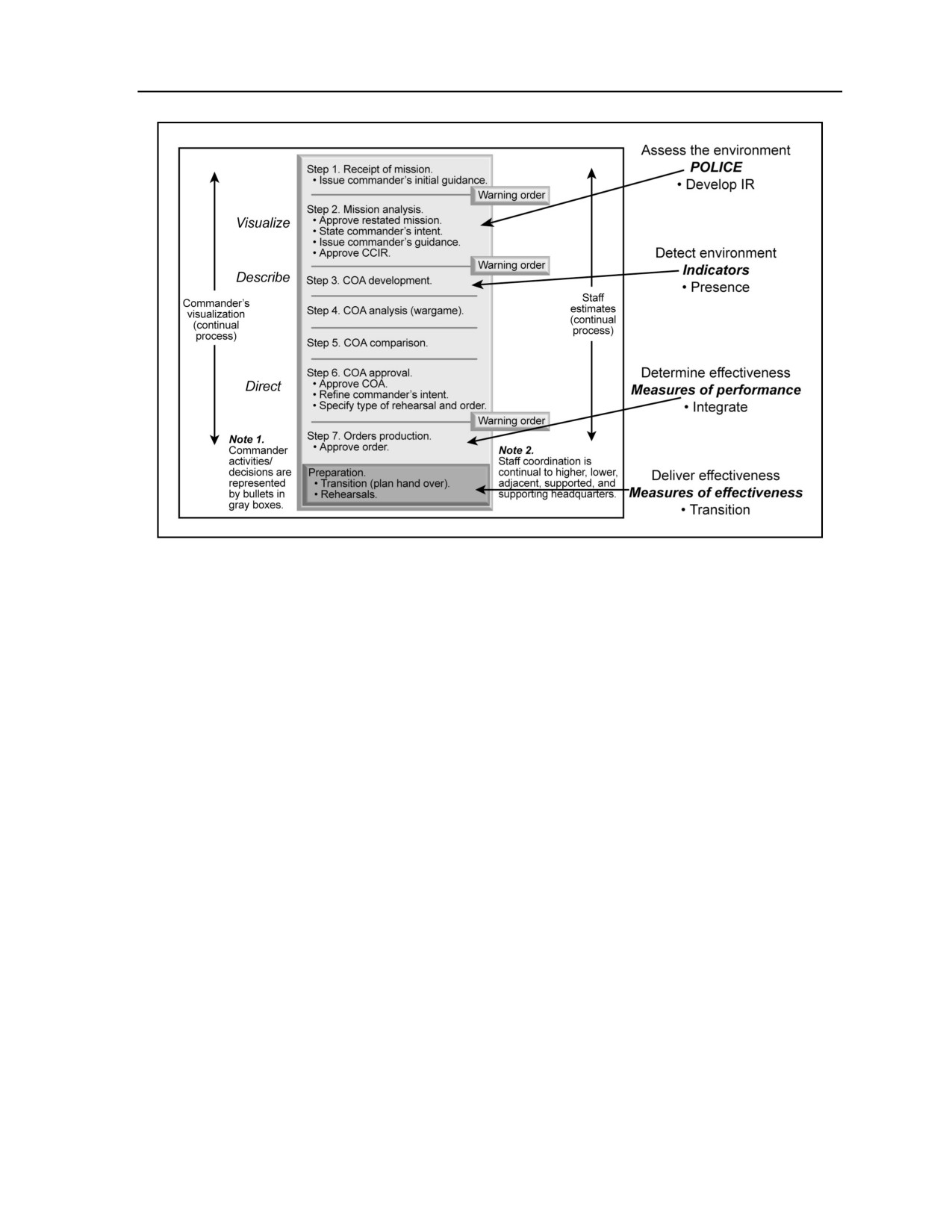
assessing the criminal dimension. Figure A-2 shows PIO criminal dimension considerations in relation to
the MDMP.
A-19. The criminal dimension adds an uncertainty to the contemporary operational environment (COE).
This dimension is generally unpredictable and unprovoked. The ramifications of an unchecked and
unevaluated criminal dimension may result in a significant impact to the mission.
A-20. The criminal dimension is comprised of criminal threats that, when left unchecked, will impede
critical tasks. Assessment of the criminal dimension is vital when considering the civil considerations of
METT-TC in the initial planning phases of an operation.
A-21. Figure A-2 addresses assessing the environment. ALE personnel do this through POLICE. Upon
receipt of the mission
(Step
1), the military police planner gathers all information concerning the
environment and begins an in-depth analysis of the effects the environment will have on the mission.
A-22. While conducting the mission analysis (Step 2), the military police planner highlights facts and
assumptions collected from the assessment of POLICE. The facts and assumptions highlight the "E" of
POLICE and help the staff understand the effectiveness of existing criminal justice systems. The military
police planner then provides intelligence requirements that will confirm the presence and degree of
effectiveness of the system in relation to the mission.
A-4
FM 3-19.50
21 July 2006
Integrating Police Intelligence Operations Planning
in the Military Decision-Making Process
Figure A-2. PIO Criminal Dimension and the MDMP
A-23. During COA development, the military police planner identifies the indicators and synchronizes with
other staff agencies the desired effectiveness the system must have in order to support the mission. If the
military police planner determines that no mechanism exists or the ones present are ineffective, he
emphasizes this during the mission analysis and identifies the risks if left unchecked. Areas where no
enforcement mechanisms exist and the commander does not want to assume risk, the military police
planner recommends some form of bypass criteria or requests augmentation from higher authority in order
to maintain stability. If a credible local enforcement mechanism exists, then the military police planner
incorporates and develops transition criteria.
21 July 2006
FM 3-19.50
A-5
Appendix B
Sample Criminal Intelligence Products
CRIMINT products may range from the simplest form to the most complex. This
appendix provides a variety of sample products including the Be on the Look Out
(BOLO) alert; HLS and terrorism daily open-source news summaries; wanted
posters; and link analysis graphs, charts, and maps.
This appendix is not intended to be an all-inclusive explanation or sample of
CRIMINT products. It is intended to show some existing products, provoke thought
in creating other CRIMINT products, and get users of such products to consider
linkage to other CRIMINT products. When these products, and others like them, are
used alone, they assist commanders in making decisions in PIO.
GENERAL
B-1. CRIMINT products may also assist commanders in determining CCIR and COAs. These products
may assist ALE personnel in capturing a wanted felon, closing an investigation, or gaining information to
assist in an investigation.
B-2. When CRIMINT products are linked to other CRIMINT products or databases, they multiply the
opportunities of providing the mechanism with which to capture the wanted person(s) and provide closure
to the investigation.
CRIMINAL INTELLIGENCE PRODUCTS
B-3. This appendix will address and show sample copies of the following:
z
BOLO alerts.
z
Open-source intelligence daily report.
z
Wanted posters.
z
Link analysis charts, maps, and graphs.
z
I&W.
BE ON THE LOOK OUT ALERTS
B-4. BOLO alerts are sent out by ALE and civilian law enforcement agencies. ALE and civilian law
enforcement agencies request that if a person recognizes a wanted person that they do not attempt to
follow, capture, or conduct a citizens arrest of the individual, but rather that the individual call the contact
number and report the sighting. See Figure B-1, page B-2, for a sample BOLO alerts.
OPEN-SOURCE INTELLIGENCE DAILY REPORT
B-5. The next several pages, representing Figure B-2, page B-2, are a sample of an open-source
intelligence daily report. This report, provided by North American Aerospace Defense Command
(NORAD)/ United States Northern Command (USNORTHCOM), consists of summaries or recent
incidents and activities related to HLS and/or terrorism incidents.
21 July 2006
FM 3-19.50
B-1

Appendix B
For Immediate Release
March 20, 2003 Washington D.C.
FBI National Press Office
Adnan G. El Shukrijumah poster
FBI SEEKING PUBLIC'S ASSISTANCE IN LOCATING INDIVIDUAL
SUSPECTED OF PLANNING TERRORIST ACTIVITIES
The FBI has issued a "Be on the Look Out" (BOLO) alert for Adnan G. El Shukrijumah in connection with
possible threats against the United States. In the BOLO alert, the FBI expresses interest in locating and
questioning El Shukrijumah, and asks all law enforcement personnel to notify the FBI immediately if he is
located. El Shukrijumah's current whereabouts are unknown.
El Shukrijumah is possibly involved with al-Qaeda terrorist activities and, if true, poses a serious threat to U.S.
Citizens and interests worldwide.
El Shukrijumah is 27 years old and was born in Saudi Arabia. He is approximately 132 pounds (but may be
heavier today), 5 '3" to 5'5" tall, has a Mediterranean complexion, black hair, black eyes, and occasionally wears
El Shukrijumah carries a Guyana passport, but may attempt to enter the U.S. with a Saudi, Canadian, or Trinidad
passport as well. El Shukrijumah has gone by the following aliases:
Adnan G. El Shukri Jumah;
Abu Arif;
Ja'far Al-Tayar;
Jaffar Al-Tayyar;
Jafar Tayar;
Jaafar Al-Tayyar
Figure B-1. BOLO Alert
UNCLASSIFIED
Homeland Security/Terrorism Daily Open-Source News Summary
NORAD/USNORTHCOM
Detachment Ft Leavenworth
Use of these articles does not reflect official endorsement. Reproduction for private use or
gain is subject to original copyright restrictions.
This report is a compilation of open source information and not evaluated or a final
intelligence product. This information is derived from publicly available sources including the
Internet and other media. The credibility and reliability of the sources has not been
determined.
Figure B-2. Sample of an Open-Source Intelligence Daily Report
B-2
FM 3-19.50
21 July 2006
Sample Criminal Intelligence Products
2 March 2005
Index
TERRORISM
HOMELAND SECURITY
CYBER NEWS
OTHER ITEMS OF INTEREST
Homeland Security Advisory System Terrorist Threat to the US: Yellow - Elevated
Terrorism
Yemen Arrests Several Al Qaeda Suspects1
Yemeni authorities have arrested a number of suspected al Qaeda members in the Arab
state in the last two days, a government newspaper said on Wednesday. The online edition
of the weekly, September 26, quoted army sources as saying the arrests were carried out in
the capital Sanaa and the port city of Aden, but did not say how many people had been
detained. "Those arrested included elements suspected of involvement in terrorist cases or of
links to al Qaeda," it quoted a source as saying. "Security forces in Sanaa and Aden are still
pursuing some suspects wanted in terrorist and severe criminal cases."
Homeland Security
Where's Iowa's Homeland Security Money Going? 2
Since September Eleventh, the government has spent billions on homeland security. Now
some question whether Iowa's getting its fair share of that money. Some people say there's
no need to worry about a terrorist attack here in the Midwest. Yet, the Department of
Homeland Security has given millions to Iowa. But where's all that money going, and are we
getting the right equipment? The government has spent 111 million dollars to keep Iowans
State slated to receive $16 million for homeland security. 3
Rhode Island is getting more than 16 (m) million dollars from the federal government to
prepare for a terrorist attack or natural disaster. The funds will go to the state Emergency
Management Agency, and are earmarked for specific programs, including a homeland
security program. That program is getting more than ten million dollars.
1 "Yemen Arrests Several Al Qaeda Suspects." Metro News. Access Date: 2 March 2005. Source Date:
2 Geary, Mark. "Where's Iowa's Homeland Security Money Going?" KCRG.com. Access Date: 2 March
3 "State slated to receive $16 million for homeland security." WPRI.com. Access Date: 2 March 2005.
Figure B-2. Sample of an Open-Source Intelligence Daily Report (Continued)
21 July 2006
FM 3-19.50
B-3
Appendix B
Cyber News
Open-Source Cyber News Summary - Ft. Leavenworth, CIAP-Cyber
Threats
NIST releases final security guidelines 4
A final version of security guidelines designed to protect federal computer systems and the
information they hold was released Monday by the National Institute of Standards and
Technology. The guidelines will serve as a road map for federal agencies in meeting
mandates set by the Federal Information Security Management Act (FISA). Government
agencies will be required to have certain security controls, policies and procedures in place.
5593256.html>
Security Firm Warns of Mozilla, Firefox Security Hole 5
Hackers can grab control of computers by taking advantage of vulnerabilities in both the
Mozilla browser suite and the Firefox stand-alone browser, a security intelligence firm said
Monday. According to Reston, Va.-based iDefense, Mozilla 1.7.3 and Firefox 1.0 - and likely
all earlier versions as well - include a "design error" that lets hackers create a memory heap
overflow, which then allow remote code execution and a compromise of the system. Even a
failed attempt to exploit this flaw could bring down the browser, added iDefense.
Other Items of Interest
Beirut opposition plans next move 6
Lebanese opposition groups are deciding whether to take part in talks to form a new
government after the previous administration resigned amid protests. President Emile
Lahoud should consult MPs before appointing a new prime minister, under the constitution.
But some want Mr Lahoud himself to quit, saying he is too close to Syria, which still
Iran Produces New Armor-Piercing Sniper Guns 7
(Full Article) Iran has begun to produce heavy machine-guns with armor-piercing bullets,
Iranian state television reported today. Iranian Defense Minister Ali Shamkhani said the
12.7-millimeter gun has a range of 2.5 kilometers and is suitable for snipers.
"The United States had protested to a European country about selling the gun [to Iran], while
we have already produced it," Shamkhani said. "Today the first consignment of the weapon
was delivered. Now our snipers can target the enemy in their armored personnel carriers and
4 Kawamoto, Dawn. "NIST releases final security guidelines." CNetNews. Access Date: 2 March 2005.
Source Date: 28 February 2005. <http://news.com.com/NIST+releases+final+security+guidelines/2100-
7348_3-5593256.html>
5 "Security Firm Warns Of Mozilla, Firefox Security Hole." SecurityPipeline.com. Access Date: 2 March
6 "Beirut opposition plans next move." BBC. Access Date: 2 March 2005. Source Date: 2 March 2005.
7 "Iran Produces New Armor-Piercing Sniper Guns." Israel National News. Access Date: 2 March 2005.
Figure B-2. Sample of an Open-Source Intelligence Daily Report (Continued)
B-4
FM 3-19.50
21 July 2006
Sample Criminal Intelligence Products
concrete bunkers." The gun weighs 35 pounds and can be mounted on a vehicle. There is
widespread concern that the guns will reach the hands of Hizbullah and other terror groups.
Iran also produces the Shihab-3 missile, capable of reaching Israel, its own brand of tanks,
armored
personnel
carriers,
missiles
and
even
a
fighter
plane.
China Bids to Restart North Korea Nuclear Talks 8
A senior Chinese official planned to begin three days of talks in South Korea today as part of
efforts to restart stalled six-party negotiations on North Korea's nuclear weapons
programmes. Chinese Deputy Foreign Minister Wu Dawei was scheduled to meet his
counterpart, Song Min-soon. Wu and Song are top negotiators in the North Korean nuclear
Taiwan Claims China has 706 Missiles 9
(Full Article) In an appeal to the European Union (EU) not to lift of arm embargo, Taiwanese
President Chen Shu-bian has said China had 496 missiles in 2003 and that the amount has
increased to 706.
In a teleconference with members of the European Parliament, Chen claimed that China
targets Taiwan and it adds 120 middle and short-range missiles every year. He stressed that
the Chinese have 173 strategic missiles and 496 tactical missiles along its southeastern
coast.
According to the Taiwanese President, if the EU lifts the embargo imposed on the Beijing
administration, this will send a wrong message to China. The EU plans to lift the Chinese
embargo in the next six months. US President George W. Bush has announced concern over
8 "China Bids to Restart N Korea Nuclear Talks." Scotsman.com. Access Date: 2 March 2005. Source
9 "Taiwan Claims China has 706 Missiles." Zaman Online. Access Date: 2 March 2005. Source Date:
Figure B-2. Sample of an Open-Source Intelligence Daily Report (Continued)
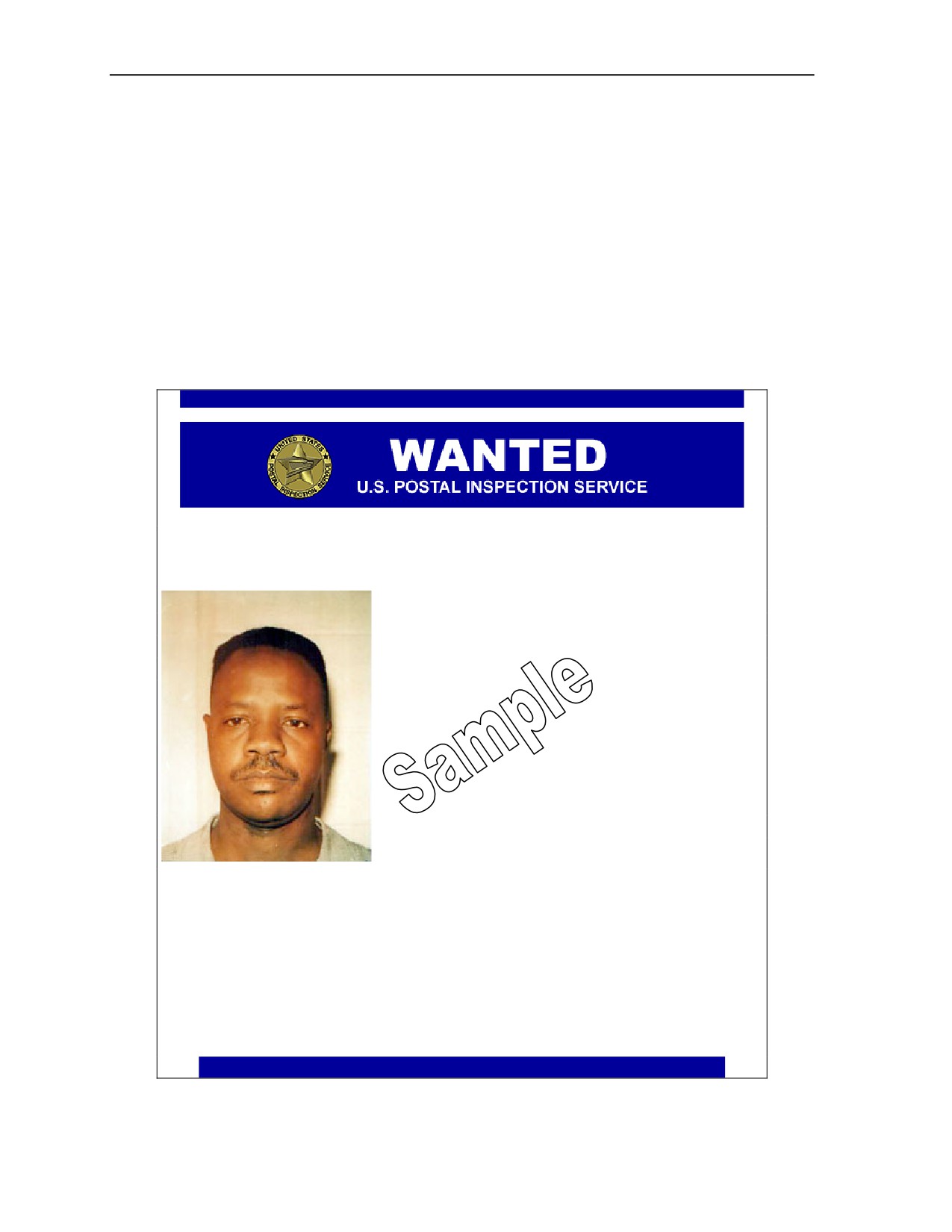
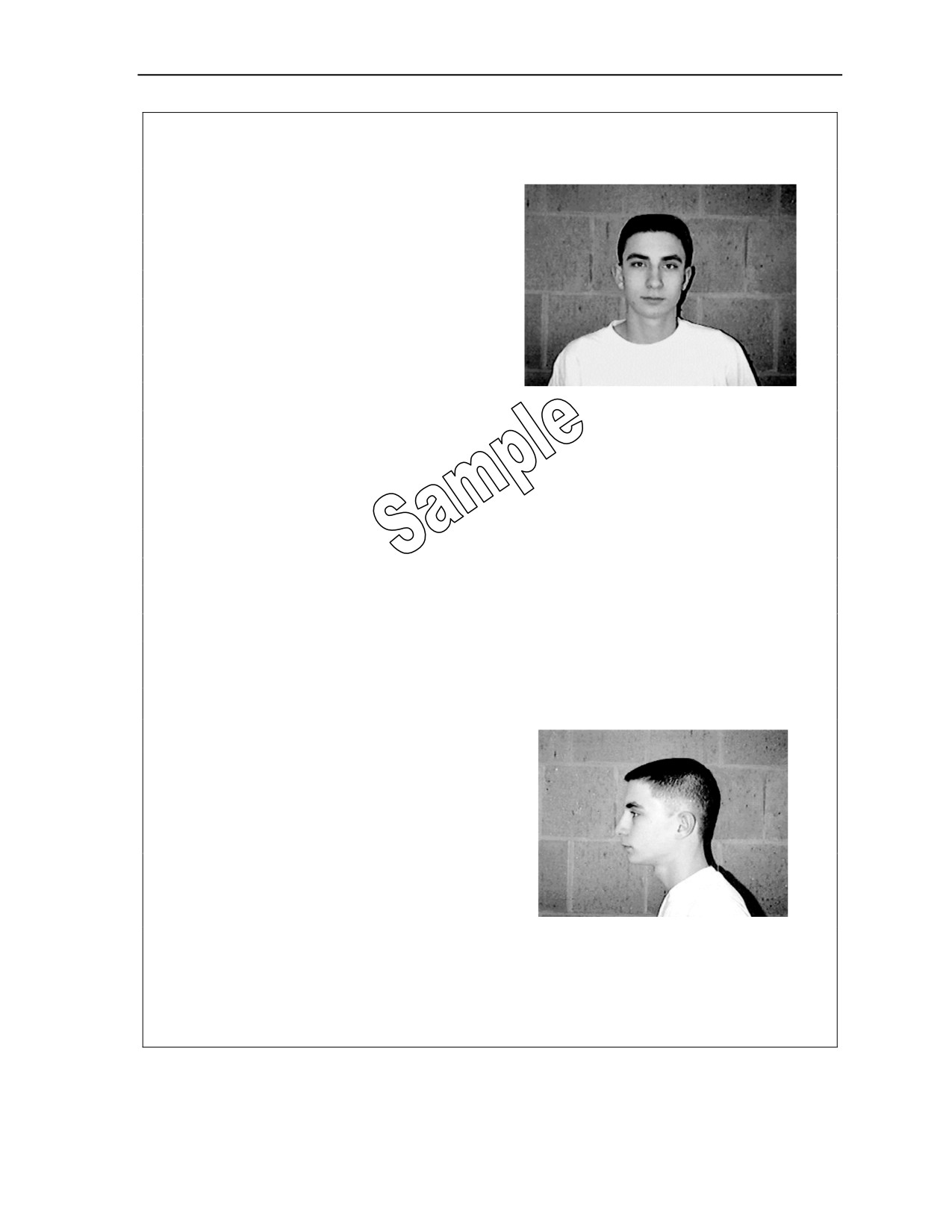
WANTED POSTERS
B-6. Wanted posters bring criminals to justice by putting their faces in the public's view. The posters
show the community who is dangerous and keeps the public aware that there are fugitives loose in their
community. The picture can be either an artist's sketch or a photograph. An artist's sketch is a rendering of
the suspect through the eyes of the witness. The photograph should be as recent as possible. Below the
sketch or photograph, there should be a short history of the criminal, including date of birth, sex, height,
weight, hair and eye color, scars or marks, occupation, social security number, nationality, place of birth,
and all known aliases. Wanted posters are posted by local, state, and federal agencies.
B-7. Posters give a detailed description of the events that occurred during the crime. Posters usually
contain a few remarks on what to do when an individual observes the wanted person. If a reward is offered,
the poster states how much it is and who is providing it. Figures B-3 and B-4, pages B-6 and B-7, represent
samples of wanted posters.
LINK ANALYSIS MAPS, CHARTS, AND GRAPHS
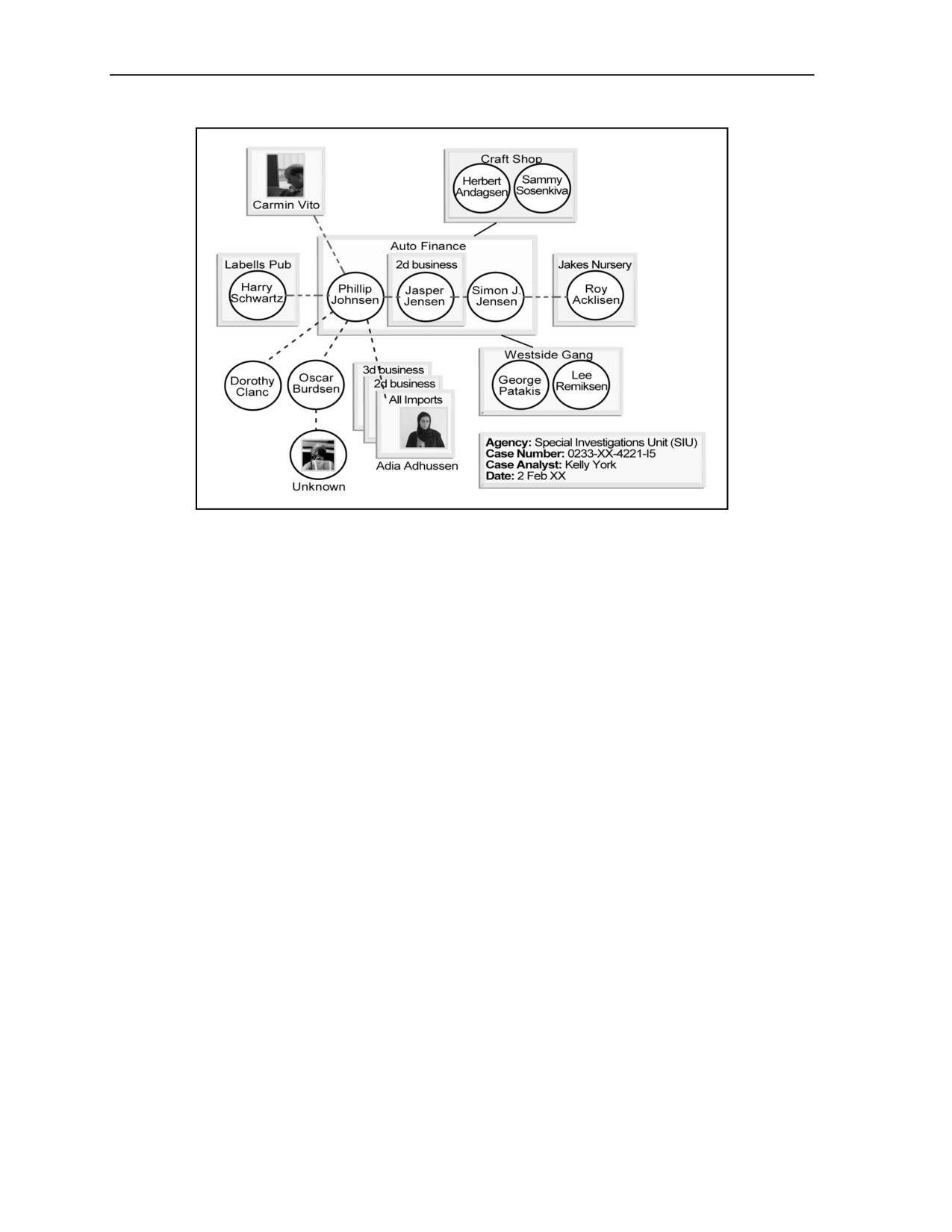
B-8. These tools are used to assist in developing crime trends and patterns. They help ALE personnel
determine what crimes are taking place where and when. When coupled with the S2's efforts, these tools
may link crimes to terrorist-related activity that may impact the operational picture, the IPB, and the CCIR.
Figure B-5, page B-8, depicts information that these tools may portray.
21 July 2006
FM 3-19.50
B-5
Appendix B
INDICATIONS AND WARNINGS
B-9. Battalion staff and ALE analysts frequently use I&W in the development of CRIMINT products.
Joint Publication (JP) 3-13 defines I&W as those intelligence activities intended to detect and report time-
sensitive intelligence information on foreign developments that could involve a threat to US or allied
and/or coalition military; political or economic interests; or US citizens abroad. I&W include forewarning
of enemy actions or intentions; the imminence of hostilities; an insurgency; a nuclear or nonnuclear attack
on the US, its overseas forces, or allied and/or coalition nations; hostile reactions to US reconnaissance
activities; terrorist attacks; and other similar events.
B-10. FM 2-0 reinforces this definition by stating that I&W come from time-sensitive information and
analysis of developments that could involve a threat to US and multinational military forces, US political
or economic interests, or US citizens. While the G2 or S2 is primarily responsible for producing I&W
intelligence, each element (such as the military police conducting PIO) within every unit contributes to
I&W through awareness of the CCIR and by reporting related information.
Osayi Ojo
Violations: Credit card fraud. 18 USC 1209(a)(2)
Case No.:
214-1188830-CID(1)
NCIC No.:
W055879164
FBI No.:
142754JA0
Warrant No.:
02/02/98, District of Massachusetts
David Festus, Travis Ojo, Calvin
Aliases:
Johnson, Musa Osayi
DOB:
11/27/57, Nigeria
Black male, 5'7”, 150 lbs., black hair,
Description:
brown eyes.
Misc. Info.: None
TAKE NO ACTION TO APPREHEND THIS PERSON YOURSELF.
If located, please call the Northeast Division at (617) 556-4400 or
your nearest Postal Inspector in Charge.
All information will be kept strictly confidential.
Figure B-3. Sample of a US Postal Inspection Wanted Poster
B-6
FM 3-19.50
21 July 2006
Sample Criminal Intelligence Products
Wanted
ARMED AND EXTREMELY DANGEROUS
PHOTO:
NAME: BILL WINTEN
DOB: NOVEMBER 29, 1985
SEX: MALE
HEIGHT: 6' 1"
WEIGHT: 195 POUNDS
HAIR: BROWN
EYES: BROWN
RACE: WHITE
SCARS OR MARKS: BULLET WOUND ON THE LOWER THIGH AND ON THE RIGHT ARM; SCAR ON
RIGHT WRIST, SCAR ON THE LEFT THIGH, AND SCAR ON THE LEFT ANKLE. ALSO HAS TRACK
MARKS ON HIS RIGHT ARM AND BETWEEN HIS TOES.
OCCUPATION: CONSTRUCTION
SSN USED: 123-45-6789
NATIONALITY: AMERICAN
PLACE OF BIRTH: MIAMI, FLORIDA
ALIAS: BILL JOHNSON; JAMES WILLIAM
LONG, JR.
IF YOU HAVE ANY INFORMATION CONCERNING THIS CASE, CONTACT YOUR LOCAL GROCER.
ANY ADDITIONAL PICTURES:
THE CRIME: UNLAWFUL FLIGHT TO AVOID
PROSECUTION - ATTEMPTED MURDER. BILL
WINTEN IS BELIEVED TO BE CONNECTED WITH
THE ATTEMPTED MURDER OF A STATE
TROOPER WHEREIN A .357-CALIBER PISTOL
WAS USED.
REWARD: YOUR LOCAL GROCER IS
OFFERING UP TO $50,000 FOR THE
APPREHENSION OF BILL WINTEN.
REMARKS: BILL HAS BEEN KNOWN TO BE ASSOCIATED WITH THE KLU KLUX KLAN AND OTHER
RACIST GROUPS.
SOURCES: SARASOTA COUNTY SHERIFFS DEPARTMENT
WRITTEN BY: ROBBY BURNS
Figure B-4. Sample of an FBI Wanted Poster
21 July 2006
FM 3-19.50
B-7
Appendix B
Figure B-5. Link Analysis Chart
B-8
FM 3-19.50
21 July 2006

Appendix C
Sample Police Intelligence Operations Checklist
The list of questions in Figure C-1 has been devised to assist managers and operators
in PIO. The questions listed in Figure C-1 are not all-inclusive. Each question listed
should be answered yes or no. If any questions are answered no, corrective action
must be taken (see Figure C-1).
PIO Checklist
Yes
No
Has the SJA been consulted to ensure that there are no legal issues associated with
this operation?
Does the brigade/battalion have an SOP that covers PIO?
Are all personnel aware of the restrictions placed on the collection of information?
Were the intelligence process and the IPB process followed during the threat analysis to
aid in identifying the local threat?
Does the threat analysis include—
• Area geography?
• Law enforcement resources?
• Population and cultural factors?
• Communications capabilities?
• Possible criminal COAs?
Have all sources of information for the threat analysis process been identified (for
example, MI; CI; and federal, state, and local law enforcement agencies)?
Have liaison and coordination for information sharing with federal, state, and local law
enforcement agencies and the HN (if applicable) been established?
Has the local threat been identified as an immediate or long-term threat?
Have other threats been identified (for example, national and international groups that
might target the US)?
Has the threat analysis identified HRPs, MEVAs, or HRTs vulnerable to terrorist attack?
Does the threat assessment include the threat(s) identified in the higher headquarters'
threat assessment?
Has the threat assessment been updated periodically?
Are reporting procedures established?
Are all lines of communication established?
Was corrective action taken for the questions that were answered no?
Figure C-1. Sample PIO Checklist
21 July 2006
FM 3-19.50
C-1
Appendix D
Tactical Questioning
FM 2-0 describes tactical questioning. According to this manual, Soldiers develop
special levels of situational awareness due to exposure to events occurring in their
AO. Soldiers have the opportunity to collect information by observing and interacting
with the population and the environment. They can also give useful information to
assist the commander in achieving situational understanding. ALE missions often
require close contact with the local population.
DEFINING TACTICAL QUESTIONING
D-1. Tactical questioning is a critical element for small unit operations. A more complete operations
picture is developed for the commander through tactical questioning, observing the local environment, and
interacting with the local population during the conduct of PIO and other missions such as processing
EPWs/detainees and handling captured enemy documents and equipment. Soldiers serve as valuable
sources of information; they serve as the commander's eyes and ears while—
z
Performing traditional offensive or defensive missions.
z
Collecting police information.
z
Performing a patrol in a stability operation.
z
Performing security in operations such as OIF.
z
Manning a checkpoint or a roadblock.
z
Occupying an OP.
z
Escorting convoys.
z
Passing through areas in convoys.
z
Observing and reporting the environmental elements and activities of the population in the AO.
D-2. Tactical questioning is the expedient, initial questioning of individuals to obtain information of
immediate value. When tactical questioning involves interacting with the local population, it is not really
questioning; it is more conversational in nature. Tactical questioning can be designed to build rapport with
the local population while collecting information and understanding the environment. The Soldier conducts
tactical questioning according to the unit's SOP, ROE, and orders for that mission. Small unit leaders must
include specific guidance for tactical questioning in the OPORD for appropriate missions. The brigade and
battalion S2s and S3s must provide specific guidance in the form of special orders and requests down to
company, troop, or battery level to help guide tactical questioning. The information that the Soldier reports
as a result of tactical questioning is passed up the chain of command (including the battalion and brigade
S2s) and is a vital part of planning and operations. The careful and quick handling of EPWs/detainees and
documents by military police may also help the ISR effort.
D-3. Tactical questioning differs from interrogation. Interrogation is defined as a systematic effort to
procure information to answer specific collection requirements by using direct and indirect questioning
techniques. Interrogation is conducted only by personnel trained to use legal and approved methods of
convincing individuals to cooperate.
21 July 2006
FM 3-19.50
D-1
Appendix D
INTERACTING WITH AND COLLECTING INFORMATION FROM
THE LOCAL POPULATION
D-4. Information collection can and should occur at all times in an OE. Collection of combat information
consists of becoming familiar with the surrounding environment, to include the people, infrastructure, and
terrain. Collection of combat information also includes recognizing change. Like a police officer patrolling
in a neighborhood day after day, Soldiers at all ranks and echelons must be able to recognize that
something has changed and determine why, if possible. Even if the Soldier cannot determine why
something has changed, he should report that there has been a change. This may help MI personnel.
Soldiers should train themselves to become constantly aware of conditions concerning—
z
Armed elements. Consider the location of factional forces, minefields, and potential threats.
z
Homes and buildings. Consider the condition of the roofs, doors, windows, lights, power lines,
water system, sanitation system, roads, and bridges.
z
Infrastructure. Consider the presence of functioning stores, service stations, and similar
establishments. Look for antennas on or near buildings that could be used for communications.
z
People. Consider all characteristics of the population. Determine how many people there are;
their sexes; their ages; if they are a resident of the area, a displaced person, a refugee, or an
evacuee; and their health conditions, their daily clothing, their daily activities, and their leaders.
z
Environmental changes. Look for changes in appearance. For example, new locks on buildings,
boarded up windows, and previously boarded-up windows now open. Look for anything that
indicates a change in the use of a building. Note buildings that have been defaced with graffiti.
D-5. Everyone involved in the collection of combat information must be aware of the IR. All Soldiers
who have contact with the local population, routinely travel in the area, or frequently attend meetings with
local organizations must know the commander's IR and their responsibility to observe and report.
CONSIDERATING THE ELEMENTS OF COMMUNICATION
D-6. A conversation may be more effective and productive if the elements of communication are
considered. Various AOs have different social and regional considerations that affect communications and
can affect operations. These may include social taboos, desired behaviors, customs, and courtesies. The
staff must include this information in predeployment training at all levels to ensure that Soldiers are
properly equipped to interact with the local population. Soldiers must also keep in mind safety
considerations and possible dangers associated with their actions. Soldiers must—
z
Know the threat level and FP measures in the AO.
z
Be knowledgeable of local customs and courtesies.
z
Be careful of their body language.
z
Approach people in normal surroundings to avoid suspicion.
z
Be friendly and polite.
z
Remove sunglasses when speaking to people with whom a favorable impression is attempted.
z
Know information about the local culture and a few phrases in the local language.
z
Understand local customs (for example, male Soldiers not speaking to female civilians, female
Soldiers not speaking to male civilians).
z
Position weapons in the least intimidating position as possible if security conditions permit.
z
Ensure that they do not cluster in such close proximity of each other that they cannot provide
cover for one another.
z
Ensure that they never lose sight of team members.
ASKING QUESTIONS
D-7. Asking questions is the best way to open and maintain conversation. Try to use open questions that
cannot be answered "yes" or "no." An open question is a basic question that usually begins with an
interrogative (who, what, where, when, how, or why) and requires a narrative answer. These questions are
D-2
FM 3-19.50
21 July 2006
Tactical Questioning
brief and simply worded to avoid confusion. For example, "When was the last time an enemy patrol passed
through here?" is a better question than, "Have you seen the enemy?" The better question requires a
narrative response and requests specific elements of information. Well-crafted, open questions—
z
Are broad in nature and serve as an invitation to talk. They require an answer other than "yes" or
"no."
z
Give the individual answering the questions freedom in his responses. These types of questions
do not offer a forced choice such as, "Was the man tall or short?" The answer to that question
could be confusing, and it does not allow for responses such as, average or medium height or
other descriptive responses.
z
Encourage discussion. Let the individual being questioned know that his opinion or observations
are of interest.
z
Allow the individual to talk while the Soldier listens and observes. The Soldier should look for
signs of nervousness or other nonverbal communication.
z
Pose no or little threat to the individual. Not all questioning is targeted at information collection.
Asking questions about neutral or safe topics can help build rapport with the individual.
z
Allow people to become involved. People like to think that their opinion is important. Asking
what people think allows them to feel that they are involved.
z
Obtain answers that reveal what the individual thinks is important. If relating an experience,
people will often start with what is most important to them.
z
Create a conversational tone. For example, a simple question about family, work, or hobbies
allows an individual to talk freely since the topic is nonthreatening and is one that they know
about. These nonpertinent questions can serve as a springboard to topics more closely related to
the collection requirement, often without the individual you are talking to realizing that the topic
has changed.
z
Should be subtle throughout the conversation. Remember to be sociable, but reserved at all
times. Rattling off a series of questions and writing down the responses will not gain the trust of
the individual that is being addressed.
MAINTAINING THE CONVERSATION
D-8. Some common techniques Soldiers should use to maintain the conversation once it is established are
to—
z
Avoid using military jargon, especially with civilians.
z
Be prepared to discuss personal interests (such as hobbies, books, and travel).
z
Be sensitive to your own body language. You must remember to—
Smile as long as it is appropriate.
Avoid sitting with your arms crossed.
Avoid showing the bottoms of your feet in an Arabic culture.
Keep hands away from your mouth.
Lean forward and nod.
Make frequent eye contact (if culturally appropriate).
z
Use the individual's name, position title, rank and/or other verbal expressions of respect.
z
Avoid judging the individual by age, gender, or appearance.
z
Keep body posture relaxed, but alert.
z
Remember that an individual's favorite topic is himself or herself.
z
Use humor carefully. Some cultures consider excessive humor to be offensive or a sign of
deceit.
z
Understand the significance of holidays, religious days, or religious times of the day or the
week.
z
Have a second individual listen to the conversation and later compare what was heard for
accuracy.
21 July 2006
FM 3-19.50
D-3
Appendix D
Note: Comparing observations regarding the individual's eyes (that can indicate deception) and
hands can provide insight to the individual's truthfulness. Hand gestures can indicate what the
individual was doing. For instance, twisting of hands may represent fabrication of information
or nervousness.
Note: Although not a factor in maintaining the conversation, the individual asking the questions
must be aware that he may be observed by another individual. The questioner should establish
countersurveillance when conducting questioning of an individual to determine whether another
individual is observing his operation or the individual being questioned. It should be noted
whether the observer approached the individual who was just questioned. The observer's activity
may represent that information is collected about the questioner or that the individual just
questioned was warned not to speak with the questioner again.
QUESTIONING NONCOMBATANTS
D-9. When conducting tactical questioning of noncombatants, it is imperative that the provisions of the
Geneva Conventions and FM 27-10 be followed at all times. Detainees are not to be mistreated in any way.
Do not—
z
Attempt to force or scare information from noncombatants.
z
Attempt to recruit or task someone to go seek out information.
z
Give or offer compensation in return for information.
z
Ask questions of noncombatants in an area where the questioning puts the noncombatant in
danger. Be discreet, but not so discreet to attract attention.
z
Ask questions that make the unit's mission or IR obvious.
z
Take notes in front of the individual after asking the question.
z
Ask leading questions.
Note: Leading questions are questions that typically require a "yes" or "no" answer rather than a
narrative answer. Leading questions allow the individual to answer with a response that he
thinks is desired and not necessarily the facts.
z
Ask negative questions.
Note: Negative questions are questions that contain a negative word in the question itself, such
as "Didn't you go to the warehouse?" Instead, ask "Did you go to the warehouse?"
z
Ask compound questions.
Note: Compound questions consist of two questions asked at the same time; for example,
"Where were you going after work and who were you meeting there?" The individual may only
answer one of the questions or may become confused by multiple questions asked at the same
time.
z
Ask vague questions.
Note: Vague questions do not have enough information for the individual to understand exactly
what is being asked. His answers may be incomplete, general, and nonspecific and create doubt.
D-4
FM 3-19.50
21 July 2006
Appendix E
Questions to Ask Detainees
The following list of questions has been devised to assist individuals in questioning
detainees. The list is not all inclusive. Detainees should answer each question as fully
as possible, while proper and humane treatment of each detainee is afforded. The
questions are—
z
What is your name (including any aliases)?
Note: Have the detainee legibly write his name.
z
What is your date of birth?
z
What is your place of birth?
z
What is your address?
z
What is your height and weight?
z
What gang, clan, and/or tribe are you affiliated with?
z
What is your hair color?
z
What is your eye color?
z
What scars, tattoos, or other identifying marks do you have?
Note: Take photographs if possible.
z
Are you married, single, or divorced?
z
What is your religious preference?
z
What is the current location of your immediate family (spouse and children) and how many of
them are there?
z
What is your next of kin's phone number and address?
z
Do you have any medical conditions (such as allergies to medications) or diseases (such as
tuberculosis, hepatitis, or Acquired Immune Deficiency Syndrome?
z
What is your blood type?
z
Do you have any friends and associates you wish to have contacted while you are detained?
z
Do you have any other conditions? For example, do you have any psychological disorders, take
any medication, wear dentures, wear eye glasses or contacts, or have prosthetic limbs.
z
Do you have a passport or Voluntary Intermodal Sealift Agreement (VISA)?
z
Do you have transportation? If yes, where is it?
z
Are there any wants or warrants out for you?
21 July 2006
FM 3-19.50
E-1
Appendix F
Debriefings and/or After-Action Reviews
This appendix is designed to assist the individuals responsible for conducting PIO
debriefings and/or AARs. The areas addressed are generic in nature and are not
all-inclusive.
MILITARY (FACTION) ACTIVITIES
F-1. Debriefings and/or AARs are meetings from which to collect battle order information. This
information includes—
z
Unit identification, size, and disposition.
z
Personnel strength.
z
Personnel activities.
z
Equipment and its condition.
z
Weapons, their conditions, and their states of preparedness.
z
Special weapons, their quantities, and their deployment.
z
Vehicles and their conditions.
z
Petroleum, oils, and lubricants supply levels.
z
Available transportation.
F-2. After identifying the battle order information, it should be determined if this information represents a
change from the norm. The reaction (if any) to the presence of a US or multinational force patrol should
also be noted.
CIVILIAN ACTIVITIES (LOCAL POPULATION)
F-3. The presence and activities of civilians can often provide valuable information relating to the
activities of military and other operatives in an area. Details that seem insignificant, such as the doors to
residences being closed when they are usually open, may indicate that something is about to happen. The
closed doors may indicate that civilians have been alerted to take cover. Debriefing and/or AAR questions
regarding civilian activities should include the following:
z
What is the ethnic makeup of the population?
z
Are disparate ethnic groups congregating together?
z
Are the usual civilian activities occurring?
z
Are there unusually large gatherings of people present?
z
Are normal gatherings missing or are they significantly smaller than usual?
z
Is there graffiti present and what message does it convey?
F-4. After identifying the above information, it should be determined if this information represents a
change from the norm. The reaction (if any) to the presence of a US or multinational force patrol should
also be noted.
21 July 2006
FM 3-19.50
F-1
Appendix F
INFRASTRUCTURE CONDITIONS OR STATUS
F-5. Infrastructure is another significant area in which critical information can be gathered. Debriefing
and/or AAR questions regarding infrastructure conditions or status should include the following:
z
Are the roads passable?
z
Are the structures usable?
z
Are utilities (water, electric, and sewer) functional and adequate?
z
Are radio stations broadcasting any anti- or pro-US statements?
z
Are schools, hospitals, and post offices open?
z
Are NGOs operating in the area? If so, what are they doing?
z
Is there any interference with NGO activity? If so, by whom?
z
Are there any food shortages? If so, what are they?
F-6. After identifying the above information, it should be determined if any of the information represents
a change from the norm. The reaction (if any) to the presence of a US or multinational force patrol should
also be noted.
F-2
FM 3-19.50
21 July 2006
Appendix G
Sources
Sources are valuable law enforcement tools. Sources bring risks to the agency and
themselves. The reliability of sources and the information disclosed to the source
should be considered. As a rule, ALE personnel should disclose the least amount of
information concerning the law enforcement operation with the source. The
disclosure of too much information to a source could jeopardize the investigation and
the safety and identification of ALE officers. Sources may be collecting as much
information on law enforcement as law enforcement is attempting to collect on the
criminals. This appendix will address open and nonopen sources and covert and overt
sources. Sources are the mainstay of law enforcement personnel in their effort to
gather police information.
OPEN AND NONOPEN SOURCES
G-1. Open and nonopen sources, while appearing cut and dry on the surface, often entail much more
discriminating viewpoints. Before acting on information received from open and nonopen sources, the
information must be verified. The decision to maintain a nonopen source as nonopen can be complex. If
the source's status is changed to open, it may lead to compromising the source, losing possible future police
information and compromising the investigation. Open and nonopen sources are comprised of HUMINT,
signal intelligence, and any other media available to the general public.
OPEN SOURCES
G-2. Open sources, as suggested by their name, are open to the public and are easily accessible by anyone.
Open sources may be commanders, individuals in positions of responsibility or authority, or anyone that
can provide information of significant value.
NONOPEN SOURCES
G-3. Nonopen sources are not as readily available to the public as open sources. Generally, if a nonopen
source is used, there is a requirement to register and pay a fee.
Note: The US Army and CID use specific criteria to further identify types of nonopen sources.
Those criteria are beyond the scope of this manual.
OVERT SOURCES
G-4. Overt collection efforts are simply information-gathering efforts where concealment of the effort is
not a priority. While information collection efforts should always be considered sensitive and involve only
those with a need to know or a need to be involved, it is in no way secret. Overt sources include—
z
Newspapers, magazines, periodicals, and the media.
z
Service records, leases, medical records, and job applications.
z
Open Internet sources.
z
Interviews and interrogations.
21 July 2006
FM 3-19.50
G-1
Appendix G
COVERT SOURCES
G-5. Covert collection sources and information gathering is designed to keep the collection effort secret.
It often involves the use of registered sources or undercover personnel. Additionally, surveillance provides
another covert collection method to obtain information.
G-6. Surveillance can be manned or unmanned and involves the use of multiple pieces of equipment.
Surveillance may be as simplistic as a stakeout or as extreme as using satellite imagery. While most
surveillance falls somewhere in the middle, photographic evidence should be obtained to document
evidence, as needed. The advancement of video/photography capabilities should be considered.
G-7. Wire authority (recordings) should be obtained according to agency policies and existing laws.
Current federal law concerning the recording of personal conversations requires that only one party
consent to recording the conversation. State laws often vary and may require two-party consent. It is the
responsibility of the law enforcement officer recording the conversation to familiarize himself with local
and state laws concerning wire authority. The court (state or federal) in which the case will be presented
determines which legal restrictions apply. Wire authority does not require a warrant signed by a judge or
federal magistrate. Unlike wiretaps and other covert listening devices, wire authority to record
conversations is usually limited between sources or undercover agents and a specific individual.
Wiretaps/covert listening devices usually require a warrant or court order signed by a federal judge or
federal magistrate. The physical location, specific individuals, and suspected information to be gained are
usually outlined in an affidavit and presented before a federal judge or federal magistrate. Additionally, the
warrant usually outlines the restrictions concerning the type of equipment to be used and identifies the time
frame of the authority under which the recording can be used.
G-8. Undercover operatives are excellent sources for covert information and intelligence gathering. The
use of undercover operatives should be considered when there is a need for long-term intelligence. There
are drawbacks associated with using undercover operatives. These drawbacks can include long
establishment time, high costs, and intensive manpower requirements. The advantages of using undercover
operatives in an investigation can be firsthand knowledge of the information/intelligence by a law
enforcement officer. Undercover operatives are the preferred covert sources because they provide
credibility during the prosecution of a suspect.
G-2
FM 3-19.50
21 July 2006
Glossary
Acronym/Term
Definition
AAR
after-action review
ACE
analysis control element
ACERT
Army Computer Emergency Response Team
ACI2
Army criminal investigative information system
ACIC
Army Counterintelligence Center
AI
area of interest
ALE
Army law enforcement
AO
area of operation
AOR
area of responsibility
AR
Army regulation
ARNG
Army National Guard
AS
area security
AT
antiterrorism
ATO
anti-terrorism officer
ATOIC
Antiterrorism Operations Intelligence Cell
ATTN
attention
BATF
Bureau of Alcohol, Tobacco, and Firearms
bde
brigade
BN
battalion
BOLO
Be on the Look Out
C2
command and control
CA
civil affairs
CALL
Center for Army Lessons Learned
CASCOPE
civil areas, structures, capabilities, organizations,
people, and events
CBRN
chemical, biological, radiological, and nuclear
CBRNE
chemical, biological, radiological, nuclear, and
high-yield explosives
CCIR
commander's critical information requirement
CDR
commander
CEO
Chief Executive Officer
CI
counterintelligence
CIA
Central Intelligence Agency
CIASE
Criminal Intelligence Analytical Support Element
CID
Criminal Investigation Division Command
CIF
central issue facility
CIVPOL
civilian police
21 July 2006
FM 3-19.50
Glossary-1
Glossary
COA
course of action
CONUS
continental United States
COE
contemporary operational environment
COPS
Centralized Operator's Police Suite
CRIMINT
criminal intelligence
DA
Department of the Army
DCIS
Defense Criminal Investigative Services
DEA
Drug Enforcement Administration
DES
director of emergency services
DIA
Defense Intelligence Agency
DOD
Department of Defense
DISC4
director of information systems for command,
control, communications, and computers
DODD
Department of Defense Directive
DODI
Department of Defense Instruction
DOIM
director of information management
DP
decision point
DPTM
Director of Plans, Training, and Mobilization
EBO
effects-based operations
ECOA
enemy course of action
EEFI
essential elements of friendly information
EEI
essential elements of information
EO
executive order
EOC
Emergency Operations Center
EOD
explosive ordnance disposal
EPW
enemy prisoner of war
EU
European Union
FBI
Federal Bureau of Investigations
FFIR
friendly force information requirements
FISA
Federal Information Security Management Act
FM
field manual
FOIA
Freedom of Information Act
FP
force protection
FPCON
force protection condition
Ft
Fort
G2
assistant chief of staff, intelligence section
G3
assistant chief of staff, operations and plans
G5
assistant chief of staff, civil affairs
GS
general support
HLS
Homeland Security
HN
host nation
Glossary-2
FM 3-19.50
21 July 2006
Glossary
HPT
high-payoff targets
HQ
headquarters
HQDA
Headquarters, Department of the Army
HR
hour
HRP
high-risk person
HRT
high-risk targets
HUMINT
human intelligence
I/R
internment/resettlement
IMA
Installation Management Agency
INSCOM
Intelligence and Security Command
intel
intelligence
IO
information operations
IPB
intelligence preparation of the battlefield
IR
information requirements
ISR
intelligence, surveillance, and reconnaissance
I&W
indications and warnings
J2
joint intelligence section
JP
Joint Publication
JR
Junior
JWICS
Joint Worldwide Intelligence Communications
System
LO
law and order
lbs.
pounds
LES
law enforcement sensitive
LIWA
Land Information Warfare Activity
m
million
MACOM
major army command
MANSCEN
manuever support center
MDMP
military decision-making process
MEDDAC
Medical Department Activity
METT-TC
mission, enemy, terrain and weather, troops and
support available, time available, and civil
considerations
MEVA
mission-essential vulnerability area
MI
military intelligence
MMS
maneuver and mobility support
MO
modus operandi
MOA
memorandum of agreement
MOU
memorandum of understanding
MP
military police
MSC
major supporting command
21 July 2006
FM 3-19.50
Glossary-3
Glossary
MSR
main supply route
NAI
named area of interest
NCIC
National Crime Information Center
NCOES
Noncommissioned Officer Education System
NG
National Guard
NGO
nongovernmental organization
NIPERNET
nonsecure Internet Protocol Router Network
NIST
National Institute of Standards and Technology
NO
number
NORAD
North American Aerospace Defense
NSA
National Security Agency
OAKOC
observation and fields of fire, avenues of approach,
key terrain, obstacles and movement, and cover and
concealment
OCONUS
outside the continental United States
ODCSOPS
Office of the Deputy Chief of Staff for Operations
and Plans
OE
operational environment
OEF
Operation Enduring Freedom
OES
Officer Education System
OIF
Operation Iraqi Freedom
OP
observation post
OPLAN
operation plan
OPORD
operation order
OPS
operations
OPSEC
operational security
OPTEMPO
operating tempo
PAO
public affairs office
PDP
patrol distribution plan
PIO
police intelligence operations
PIR
priority intelligence requirements
PM
provost marshal
PMO
Provost Marshal Office
POLICE
police and prison structures, organized crime, legal
systems, investigations, crime-conducive conditions,
and enforcement mechanisms and gaps
PSVAs
personal security vulnerability assessments
PSYOP
psychological operation
RAM
random antiterrorism measures
REL
release
RFI
request for information
ROE
rules of engagement
Glossary-4
FM 3-19.50
21 July 2006
Glossary
R&S
reconnaissance and surveillance
S1
adjutant
S2
intelligence staff officer (US Army)
S3
operations staff officer
S5
Civil Affairs Officer (US Army)
SAC
special agent in charge
SALUTE
size, activity, location, unit, time, and equipment
SECDEF
Secretary of Defense
SGT
sergeant
SIPERNET
secure Internet Protocol Router Network
SIPRNET
secret Internet Protocol Network
SITREP
situation report
SIU
Special Investigations Unit
SJA
Staff Judge Advocate
SO
security officer
SOFA
status of forces agreement
SOP
standing operating procedure
SSN
social security number
TALON
threats and local observation notices
TCP
traffic control point
THT
tactical human intelligence team
TRADOC
Training and Doctrine Command
UN
United Nations
UNCIVPOL
United Nations civilian police
UO
urban operations
US
United States
USACIDC
United States Army Criminal Investigations
Command
USAMPS
United States Army Military Police School
USC
United States Code
USNORTHCOM
United States Northern Command
Va.
Virginia (the state of)
VISA
Voluntary Intermodal Sealift Agreement
WFF
warfighting function
XO
executive officer
21 July 2006
FM 3-19.50
Glossary-5
References
SOURCES USED
AR 25-55. The Department of the Army Freedom of Information Act Program. 1 November 1997.
AR 195-1. Army Criminal Investigation Program. 12 August 1974.
AR 195-2. Criminal Investigation Activities. 30 October 1985.
AR 381-10. US Army Intelligence Activities. 22 November 2005.
AR 381-12. Subversion and Espionage Directed Against the US Army (SAEDA). 15 January 1993.
AR 381-20. The Army Counterintelligence Program. 15 November 1993.
AR 525-13. Antiterrorism. 4 January 2002.
CID Regulation 195-1. Criminal Investigation Operational Procedures. 15 June 2004.
DA Form 2804. Crime Records Data Reference.
DODD 2000.12. DOD Antiterrorism (AT) Program. 18 August 2003.
DODI 2000.16. DOD Antiterrorism Standards. 14 June 2001.
EO 12333. United States Intelligence Activities. 4 December 1981.
FM 1-02. Operational Terms and Graphics. 21 September 2004.
FM 2-0. Intelligence. 17 May 2004.
FM 3-0. Operations. 14 June 2001.
FM 3-19.4. Military Police Leaders' Handbook. 4 March 2002.
FM 3-90. Tactics. 4 July 2001.
FM 5-0. Army Planning and Orders Production. 20 January 2005.
FM 7-15. The Army Universal Task List. 31 August 2003.
FM 27-10. The Law of Land Warfare. 18 July 1956.
FM 34-2. Collection Management and Synchronization Planning. 8 March 1994.
Geneva Conventions. 12 August 1949
JP 3-13. Joint Doctrine for Information Operations. 9 October 1998.
USA Patriot Act, Uniting and Strengthening America By Providing Appropriate Tools Required to
Intercept and Obstruct Terrorism Act of 2001. 24 October 2001.
USC, Title 18, Crimes and Criminal Procedure; Part I, Crimes; Chapter 121, Stored Wire and
Electronic Communications and Transactional Records Access; Section 2703, required
disclosure of customer communications or records.
DOCUMENTS NEEDED
DA Form 2028. Recommended Changes to Publications and Blank Forms.
READINGS RECOMMENDED
AR 25-400-2. The Army Records Information Management System (ARIMS). 15 November 2004.
AR 190-6. Obtaining Information From Financial Institutions. 9 February 2006.
AR 190-27. Army Participation in Criminal Justice Information Systems, Federal Bureau of
Investigation. 8 November 2005.
AR 190-40. Serious Incident Report. 9 February 2006.
AR 190-45. Law Enforcement Reporting. 23 February 2006.
21 July 2006
FM 3-19.50
References-1