Rigging heavy antitank assault weapon system (TOW) (April 2000) - page 2
FM 10-500-29/TO 13C7-10-171
INSTALLING CARGO PARACHUTES
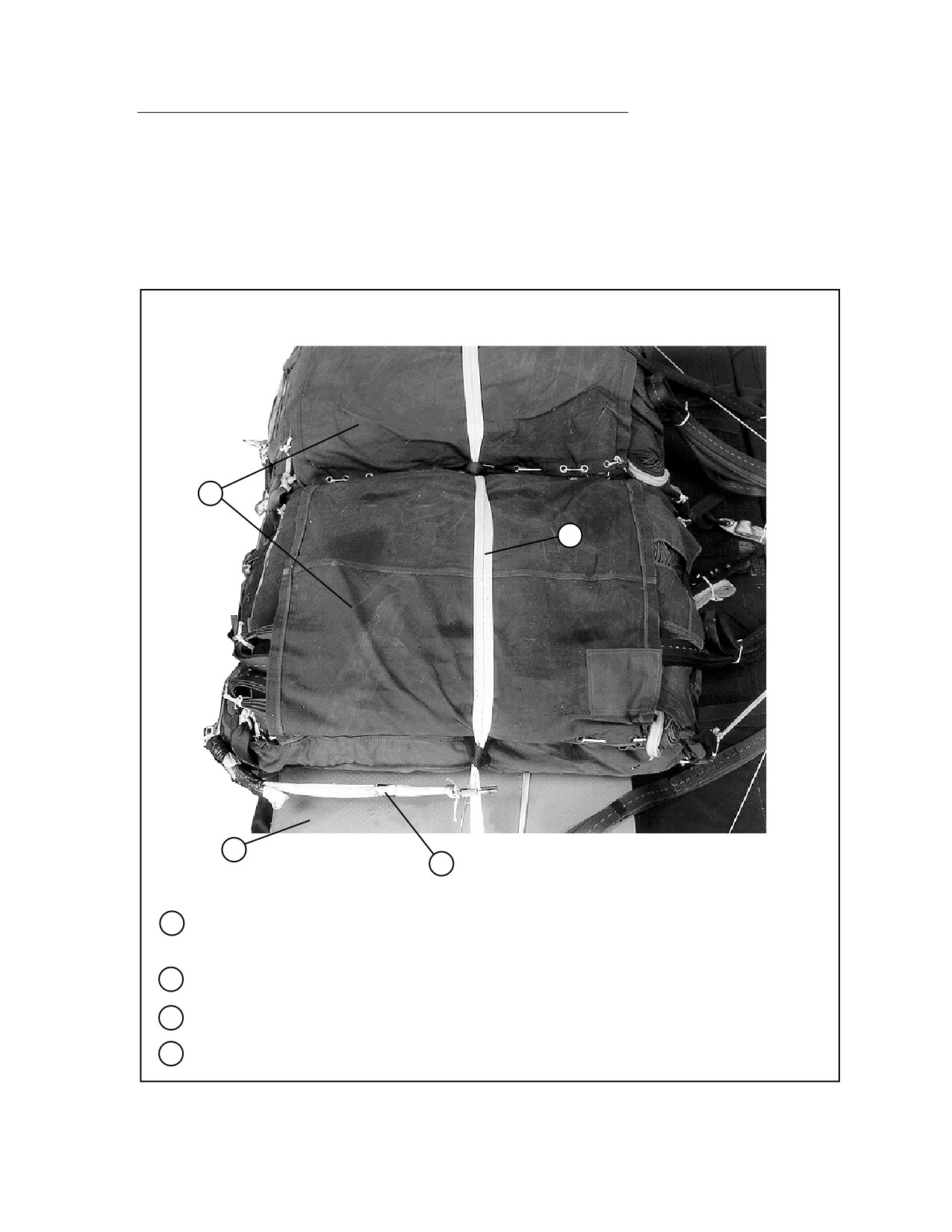
4-8. Install two G-11 cargo parachutes according to FM 10-500-2/TO 13C7-1-5, and
as shown in Figure 4-9.
2
3
1
4
1
Secure a 36- by 96-inch piece of honeycomb along the rear edge of the load with type III nylon
cord. Tape the honeycomb where the type III nylon cord touches.
2
Place two G-11 cargo parachutes on the parachute stowage platform.
3
Restrain the parachutes with type VIII nylon webbing to clevises 8 and 8A.
4
Install the parachute release straps according to FM 10-500-2/TO 13C7-1-5.
Figure 4-9. G-11 Cargo Parachutes Installed
4-11
FM 10-500-29/TO 13C7-10-171
Installing Release System
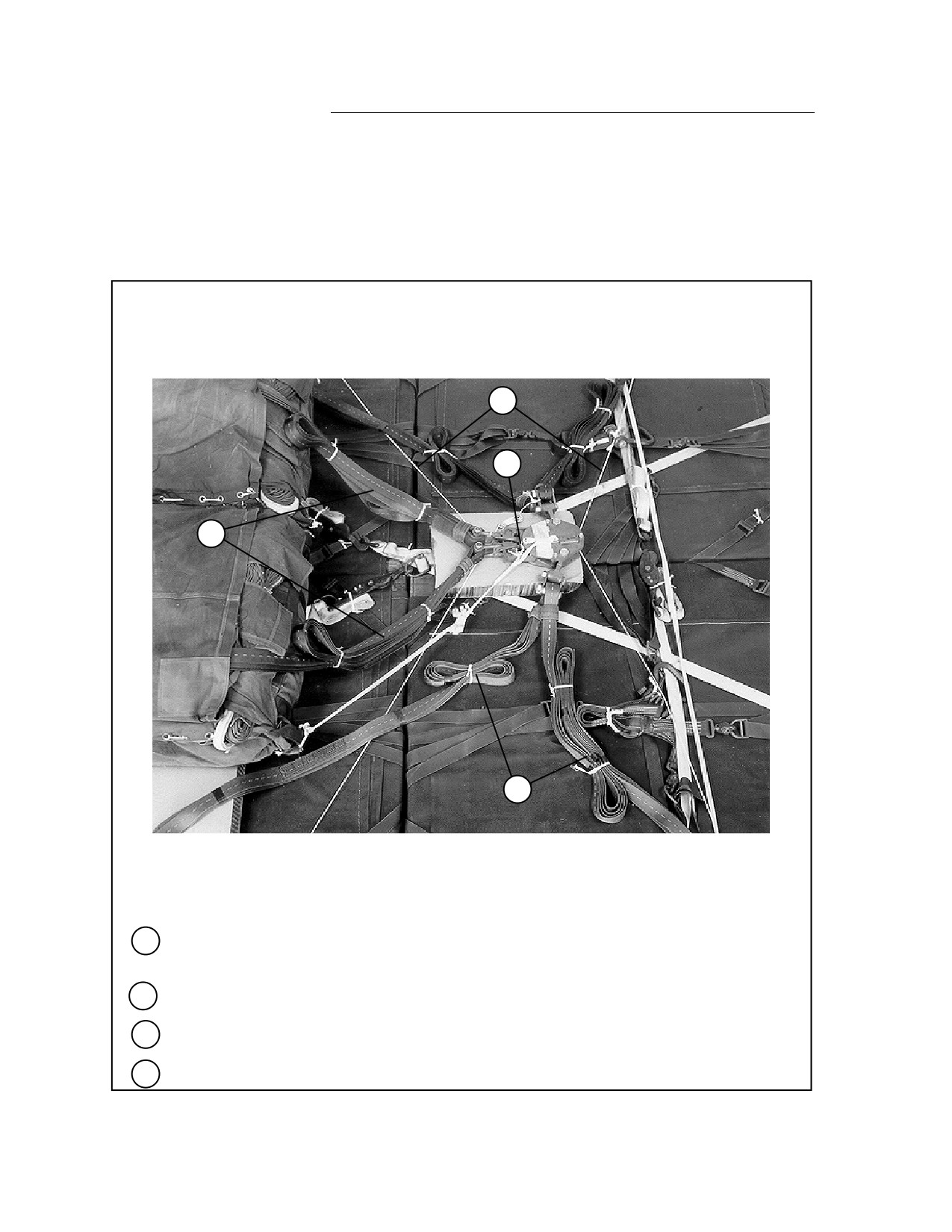
4-9. Install the M-1 cargo parachute release assembly according to FM 10-500-2/TO
13C7-1-5, and as shown in Figure 4-10.
4
1
2
3
1
Center a piece of honeycomb on top of the load, and place an M-1 cargo parachute release on
the honeycomb. Attach the parachute riser extension and suspension slings.
2
Fold any excess parachute riser, and tie the folds with type I, 1/4-inch cotton webbing.
3
Fold any excess suspension sling, and tie the folds with type I, 1/4-inch cotton webbing.
4
Safety the release to the load with type III nylon cord.
Figure 4-10. M-1 Cargo Parachute Release Installed
4-12
FM 10-500-29/TO 13C7-10-171
Installing Extraction System
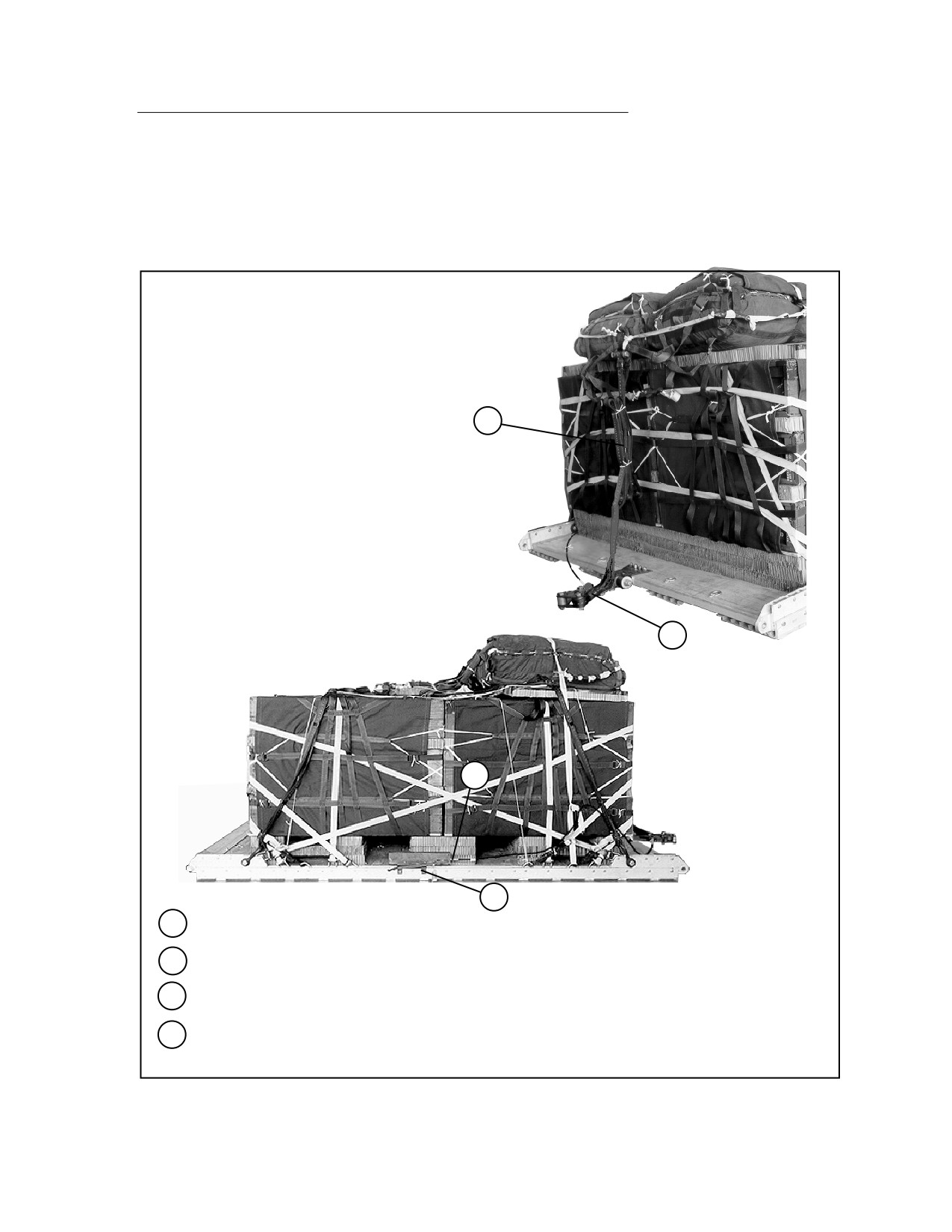
4-10. Install the EFTC extraction system according to FM 10-500-2/TO 13C7-1-5,
and as shown in Figure 4-11.
4
3
2
1
1
Bolt the EFTC mounting brackets in the rear mounting holes on the left platform rail.
2
Install a 12-foot cable to the actuator. Install the actuator to the brackets.
3
Attach the latch assembly to the extraction bracket. Attach the cable to the latch assembly.
4
Install a 9-foot, (2-loop), type XXVI nylon webbing sling as the deployment line. S-fold the
excess and tie it in two places with type I, 1/4-inch cotton webbing.
Figure 4-11. EFTC Installed
4-13
FM 10-500-29/TO 13C7-10-171
Installing Extraction Parachute
4-11. Select the extraction line and extraction parachute needed using the extraction
line requirements table in FM 10-500-2/TO 13C7-1-5. Place the extraction parachute
and extraction line on the load for installation in the aircraft.
Installing Provisions for Emergency Restraints
4-12. Select and install provisions for emergency restraints according to the emer-
gency aft restraints requirements table in FM 10-500-2/TO 13C7-1-5.
Marking Rigged Load
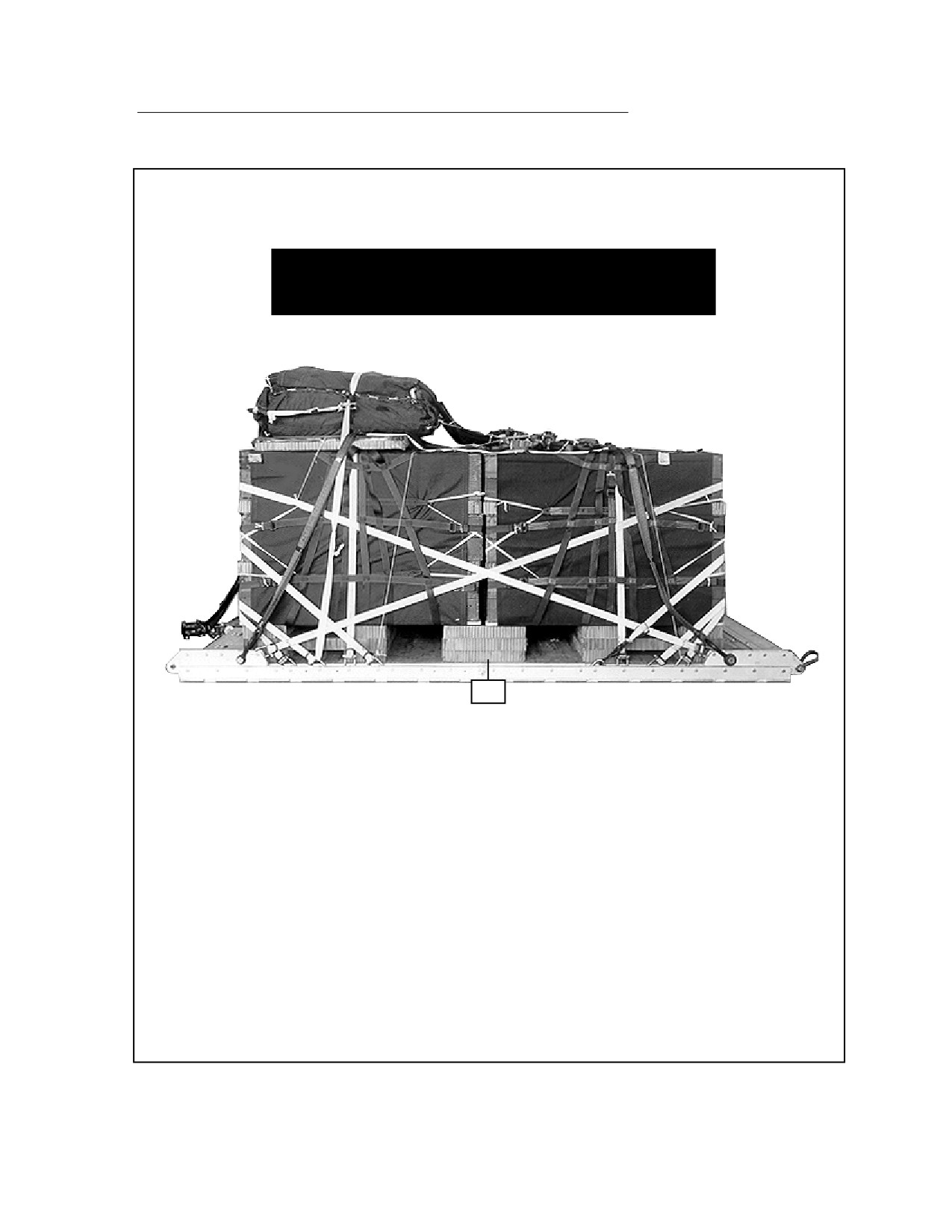
4-13. Mark the rigged load according to FM 10-500-2/TO 13C7-1-5, and as shown in
Figure 4-12. Complete the Shipper’s Declaration for Dangerous Goods. If the load
varies from the one shown, the weight, height, tip-off curve, CB, and parachute
requirements must be recomputed.
Equipment Required
4-14. Use the equipment listed in Table 4-1 to rig this load.
4-14
FM 10-500-29/TO 13C7-10-171
Make the final rigger inspection required by FM 10-500-2/
TO 13C7-1-5 before the load leaves the rigging site.
CB
Rigged Load Data
Weight: Load shown
6,600 pounds
Maximum
7,100 pounds
Height
75 inches
Width
108 inches
Length
165 inches
Overhang:
Front
0 inches
Rear
18 inches
CB (from front edge of platform)
77 inches
Extraction System (adds 18 inches to length of platform)
EFTC
Figure 4-12. TOW Missiles Rigged in A-22 Cargo Bags on a 12-foot Type V Platform for Low-
velocity Airdrop
4-15
FM 10-500-29/TO 13C7-10-171
Table 4-1. Equipment Required for Rigging TOW Missiles in A-22 Cargo Bags on a 12-foot Type V
Platform for Low-velocity Airdrop
National Stock
Item
Quantity
Number
8040-00-273-8713
Adhesive paste, 1-gal
As required
1670-00-587-3421
Bag, cargo, A-22
4
l
4030-00-090-5354
1-in (large
)
7
4030-00-678-8562
3/4-in, medium
6
4020-00-240-2146
Cord, nylon, typeII, 550
l
As required
1670-00-434-5783
Coupling, airdrop, extractionforce transfer with cable,
12-ft
1
Cover:
1670-00-360-0328
Clevis,
l
1
1670-00-360-0329
Link, type
I
3
1670-01-183-2678
Leaf, extraction
l
3
Line, drogue (for C-17)
1670-01-064-4452
60-ft (1
l
1
Line, extraction
1670-01-064-4452
For C-130: 60-ft (1
l
1
1670-01-107-7652
For C-141: 160-ft (1
l
1
For C-5:
1670-01-107-7652
160-ft (1
l
1
1670-01-107-7652
For C-17: 160-ft (1
l
1
Link assembl:
1670-00-783-5988
Type
I
3
T
wo-point, 3 3/4-in (for C-17 )
1
5306-00-435-8994
Bolt, 1-in diam, 4 in
l
(2
)
5310-00-232-5165
Nut, 1-in, hexagona l
(2
)
1670-00-003-1953
Plate,side,33/4
i
(2
)
5365-00-007-3414
Spacer,
l
(2
)
4-16
FM 10-500-29/TO 13C7-10-171
Table 4-1. Equipment Required for Rigging TOW Missiles in A-22 Cargo Bags on a 12-foot Type V
Platform for Low-velocity Airdrop (continued)
National Stock
Item
Quantity
Number
1670-00-753-3928
Pad, energy-dissipating, honeycomb, 3- by 36- by 96-in
16 sheets
Parachute:
1670-01-016-7841
Cargo, G-11B
2
1670-01-063-3715
Cargo extraction, 15-ft
1
1670-01-063-3715
Drogue, 15-ft (for C-17
)
1
Platform, airdrop, type V, 12-ft
1670-01-353-8425
Bracket assembly, coupling
(1
)
1670-01-162-2372
l
(20
)
1670-01-354-8424
Extraction bracket assembly
(1
)
1670-01-162-2381
Link, tandem, suspension
l
(4
)
1670-01-097-8816
Release, cargo parachute, M-1
1
Sling, cargo airdrop
For suspension:
1670-01-062-6303
12-ft (2-loop), type XXVI n
l
4
For deployment:
1670-01-062-6304
9-ft (2-loop), type XXVI nylon webbing
1
For riser extension:
1670-01-062-6302
20-ft (2-loop), type XXVI n
l
2
1670-00-998-0116
Strap, parachute release,single or
1
5340-00-040-8219
Strap, parachute release, multicut
2
7510-00-266-5016
T
ape, adhesive, 2-in
As required
1670-00-937-0271
Tie-down assembly, 15-ft
21
Webbing:
8305-00-268-2411
Cotton, 1/4-in, type I
As required
8305-00-082-5752
Nylon, tubular, 1/2-in
As required
8305-00-261-8585
Type V
I
As required
4-17
FM 10-500-29/TO 13C7-10-171
SECTION II- RIGGING MISSILES ON A TYPE V PLATFORM
FOR LOW-VELOCITY AIRDROP
DESCRIPTION OF LOAD
4-15. Forty-eight boxed missiles are rigged on a 12-foot, type V airdrop platform.
Each boxed missile weighs 87 pounds and is 57 1/2 inches long, 12 inches
high, and 12 inches wide.This load requires two G-11 cargo parachutes.
PREPARING PLATFORM
4-16. Prepare a 12-foot, type V airdrop platform as described below.
a. Inspecting Platform. Inspect, or, assemble and inspect, the platform
according to TM 10-1670-268-20&P/TO 13C7-52-22.
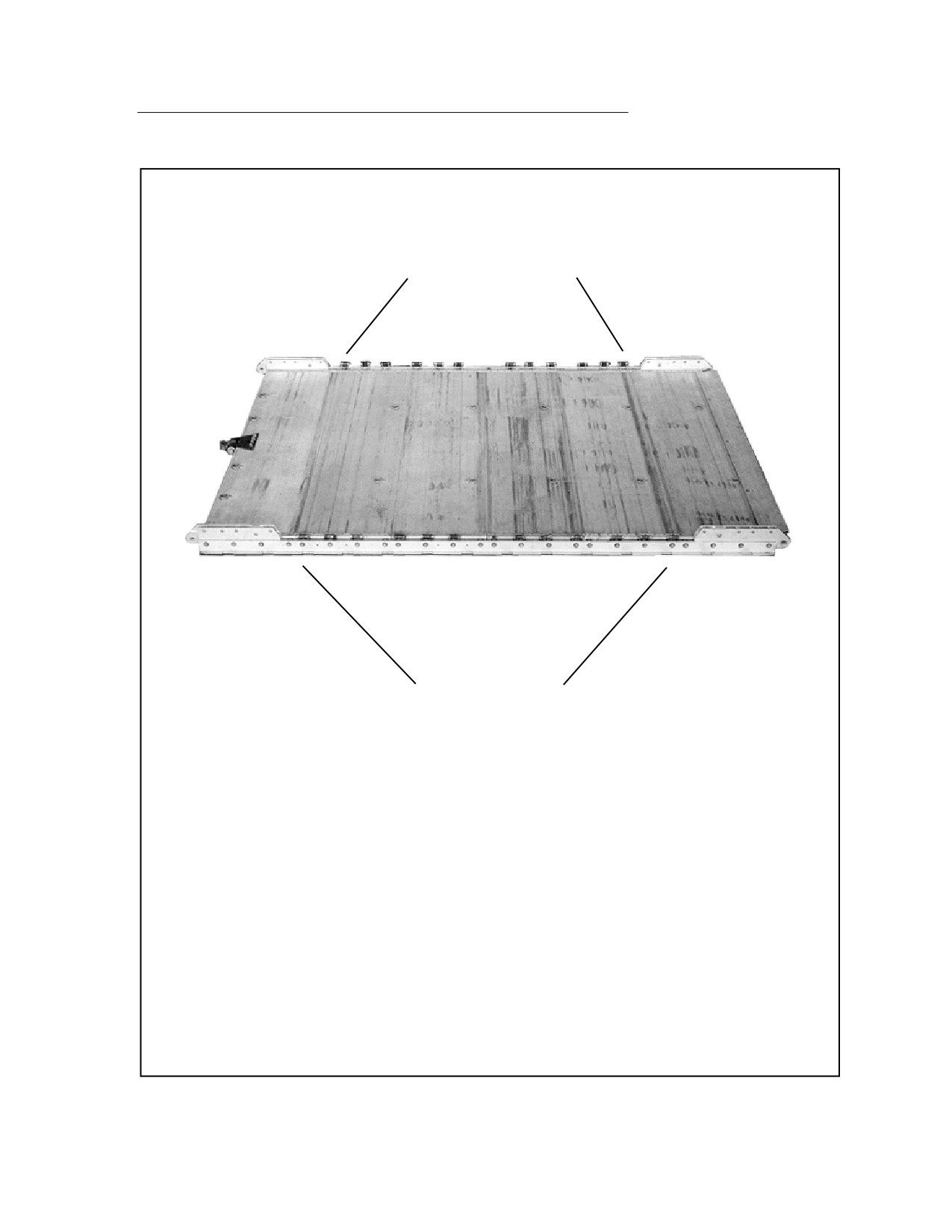
b. Installing Tandem Links. Install tandem links as shown in Figure 4-13.
c. Attaching and Numbering Clevises. Attach and number 24 clevis
assemblies as shown in Figure 4-13.
NOTES:
1. The nose bumper may or may not be installed.
2. Measurements given in this load are from the front edge of the platform,
NOT from the front edge of the nose bumper.
4-18
FM 10-500-29/TO 13C7-10-171
CLEVISES
12A THROUGH 1A
LEFT
REAR
FRONT
RIGHT
CLEVISES
12 THROUGH 1
Step:
1.
Install a tandem link to the front of each platform side rail using holes 1, 2, and 3.
2.
Install a tandem link to the rear of each platform side rail using holes 22, 23, and 24.
3.
Starting at the front of each platform side rail, install clevises on the bushings bolted
on holes 5, 6, 7, 9, 10, 11, 14, 15, 16, 18, 19, and 20.
4.
Starting at the front of the platform, number the clevises 1 through 12 on the right side
and 1A through 12A on the left side.
Figure 4-13. Platform Prepared
4-19
FM 10-500-29/TO 13C7-10-171
BUILDING AND PLACING HONEYCOMB STACKS
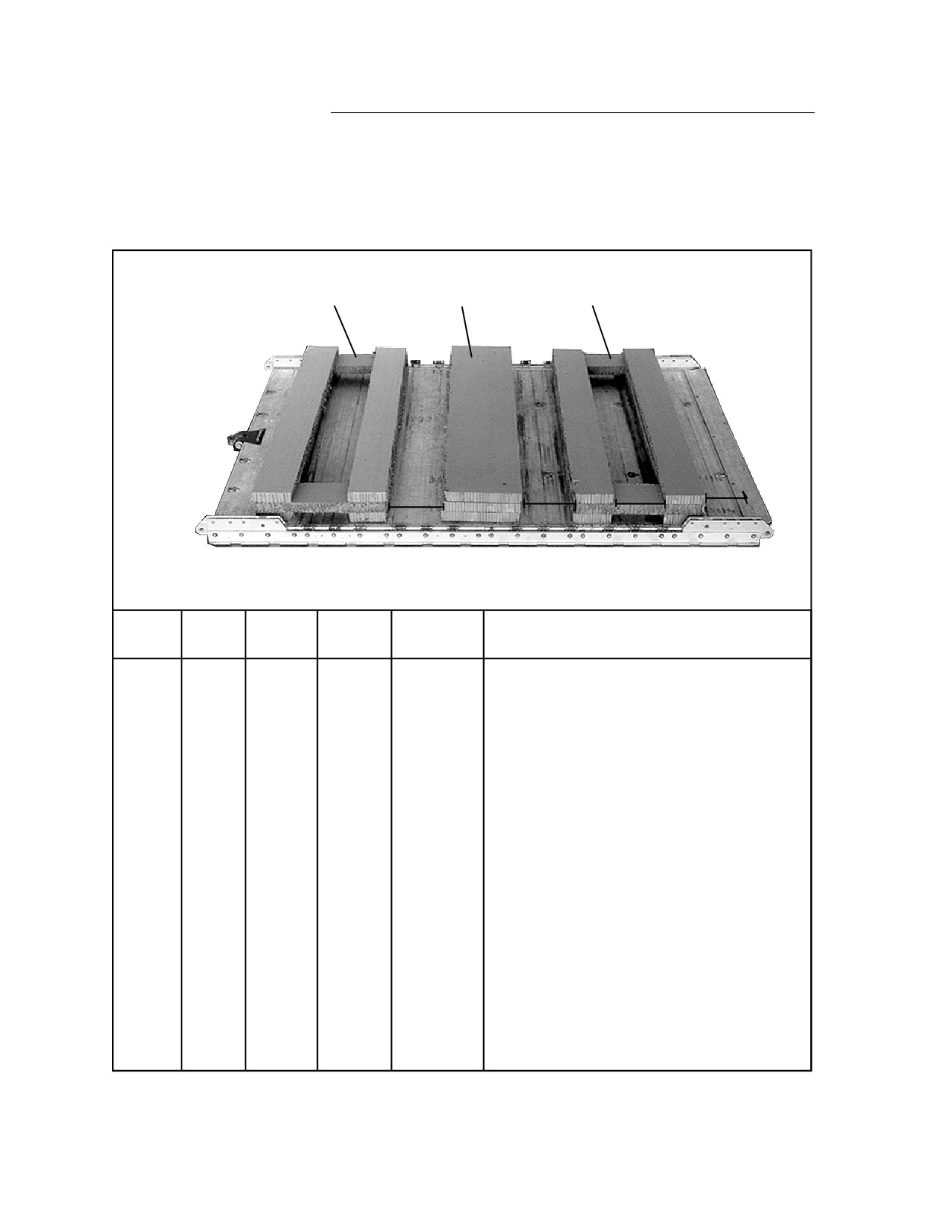
4-17. Build the honeycomb stacks and place them on the platform as shown in
Figure 4-14.
STACK
STACK
STACK
3
2
1
FRONT
14”
14”
14”
14”
Stack
Width
Length
Numbe r
Pieces
(Inches)
(Inches)
Material
Instructions
1
2
96
10
Honeycomb
Place one piece 14 inches from the front edge
of the platform. Place another piece 14 inches
from the first piece.
2
10
34
Honeycomb
Place one piece over each end of the two base
pieces as a bridge.
2
76
10
Honeycomb
Place flush over each base piece, filling the
space between the two bridge pieces.
2
96
10
Honeycomb
Place flush over each end of the stack.
2
3
96
20
Honeycomb
Glue layers flush together and center14 inches
from stack
1
3
2
96
10
Honeycomb
Place one piece 14 inches from stack 2. Place
another piece 14 inches from the first piece.
2
10
34
Honeycomb
Place one piece over each end of the two base
pieces as a bridge.
2
76
10
Honeycomb
Place flush over each base piece, filling the
space between the two bridge pieces.
2
96
10
Honeycomb
Place flush over each end of the stack.
Figure 4-14. Honeycomb Stacks Prepared and Positioned
4-20
FM 10-500-29/TO 13C7-10-171
PLACING MISSILE BOXES ON PLATFORM
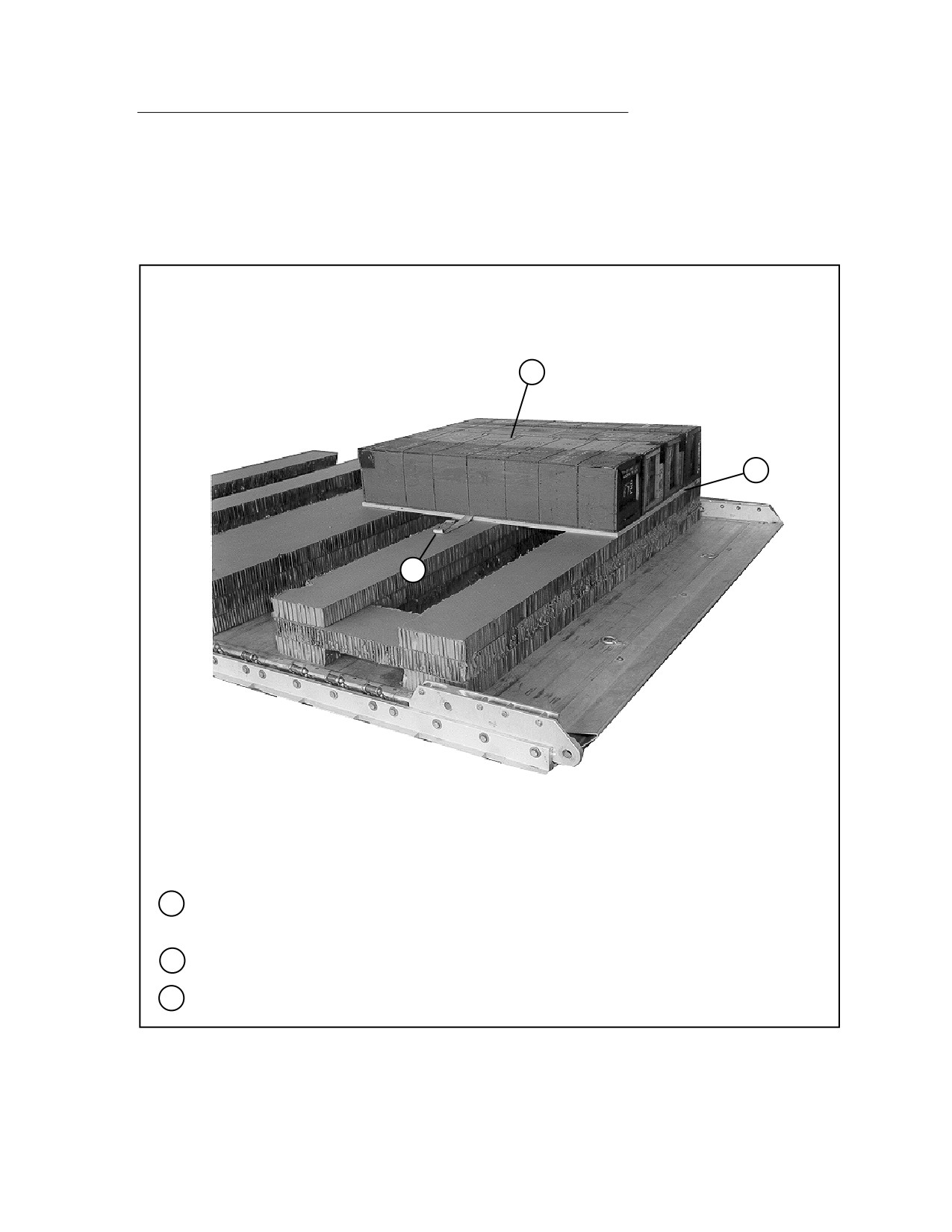
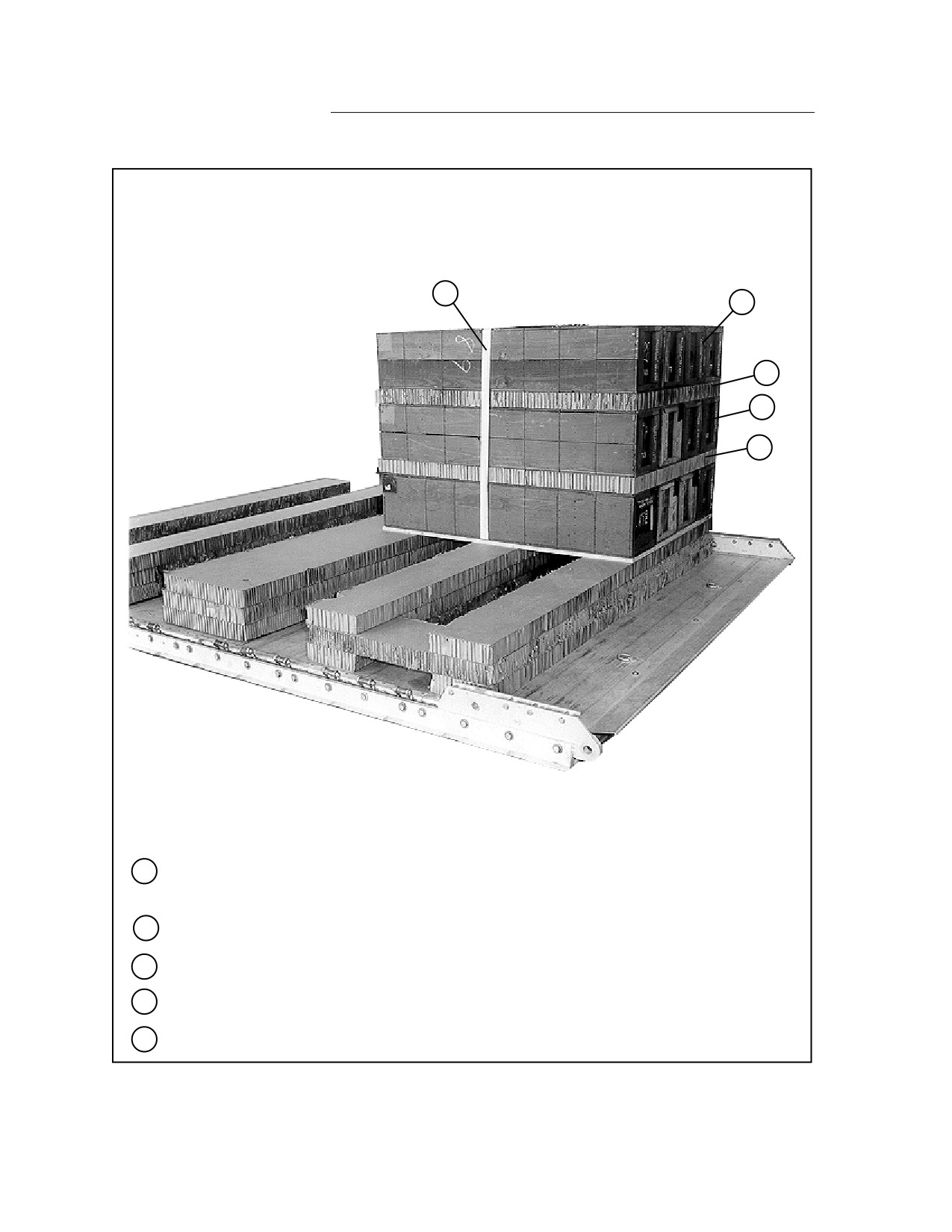
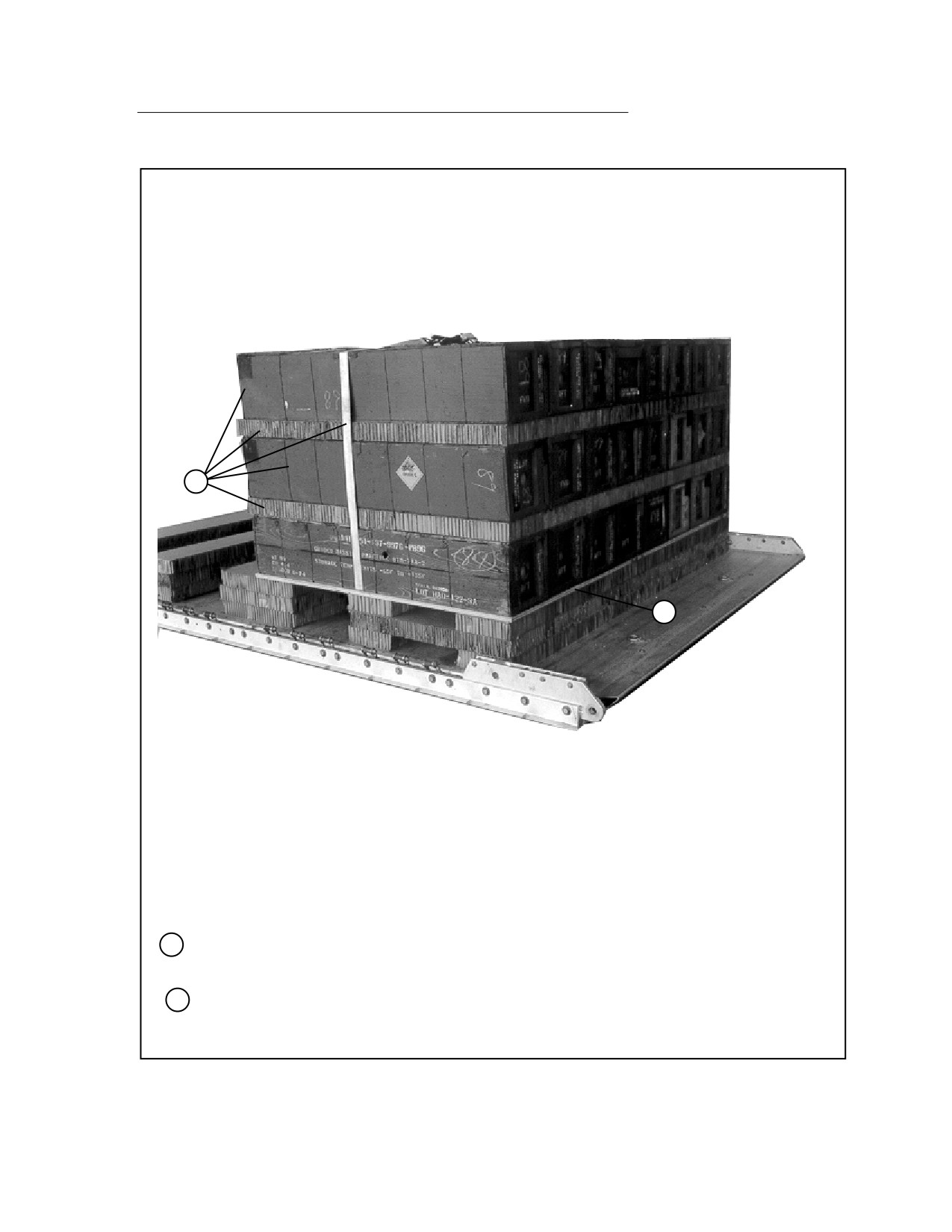
4-18. Place the missiles on the honeycomb stacks as shown in Figure 4-15. Place
six 15-foot lashings over the stacks of boxes as shown in Figure 4-16.
3
1
2
1
Place a 3/4- by 48- by 58-inch piece of plywood on top of stacks 1 and 2 so that it is flush with
the front and left sides of stack 1.
2
Lay a 15-foot lashing across the plywood.
3
Set four boxed missilies on the plywood.
Figure 4-15. Missile Boxes Placed on Honeycomb
4-21
FM 10-500-29/TO 13C7-10-171
8
7
6
5
4
4
Form a layer of honeycomb on top of the missiles with one 36- by 48-inch piece of honey
comb and one 22- by 48-inch piece of honeycomb.
5
Place four boxed missiles on the honeycomb.
6
Cover the boxes with a layer of honeycomb constructed as in step 4 above.
7
Place four boxed missiles on the second layer of honeycomb.
8
Bind the missiles together with the lashing prepositioned in step 2 on the previous page.
Figure 4-15. Missile Boxes Placed on Honeycomb (continued)
4-22
FM 10-500-29/TO 13C7-10-171
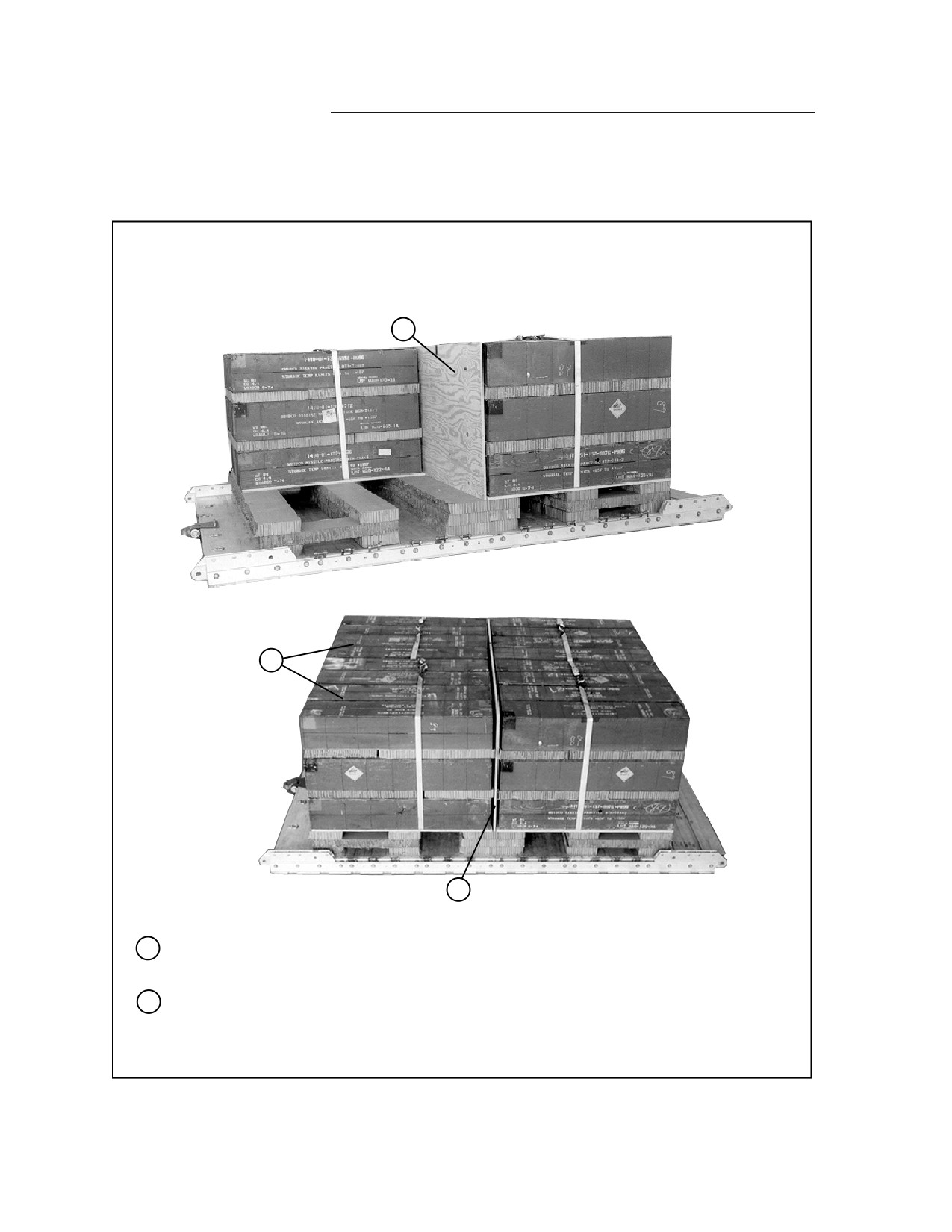
10
9
9
Place a 3/4- by 48- by 58-inch piece of plywood on top of stacks 1 and 2 so that it is flush with
the front and right side of stack 1.
10
Repeat steps 2 through 8 to position another twelve boxed missiles on the platform.
Figure 4-15. Missile Boxes Placed on Honeycomb (continued)
4-23
FM 10-500-29/TO 13C7-10-171
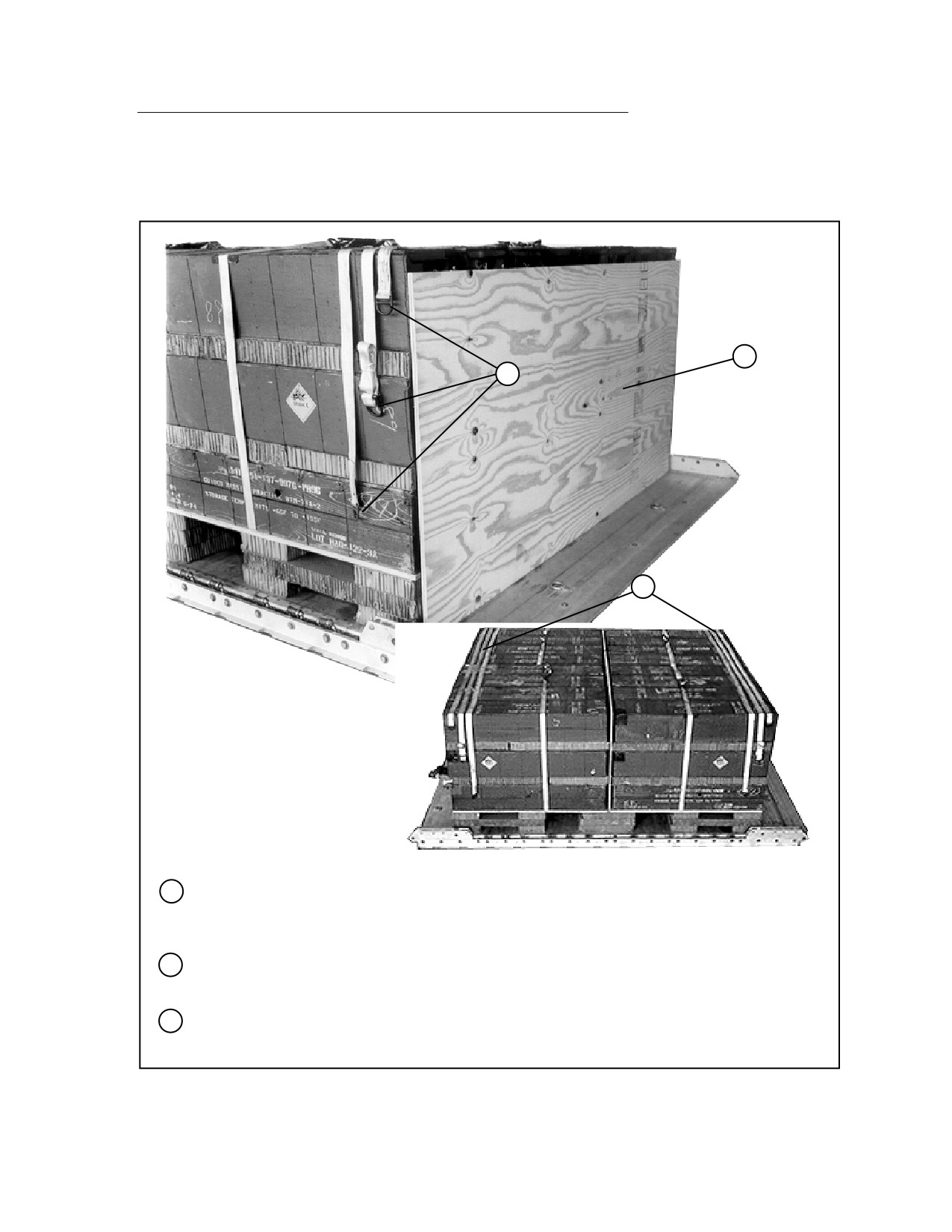
11
12
11
11
Place a 3/4- by 42- by 96-inch piece of plywood on edge on top of honeycomb stack 2 against
the rear of the first two stacks of boxes.
12
Adapt steps 1 through 10 to rig the two rear stacks of 12 missiles each on the rear of
the platform.
Figure 4-15. Missile Boxes Placed on Honeycomb (continued)
4-24
FM 10-500-29/TO 13C7-10-171
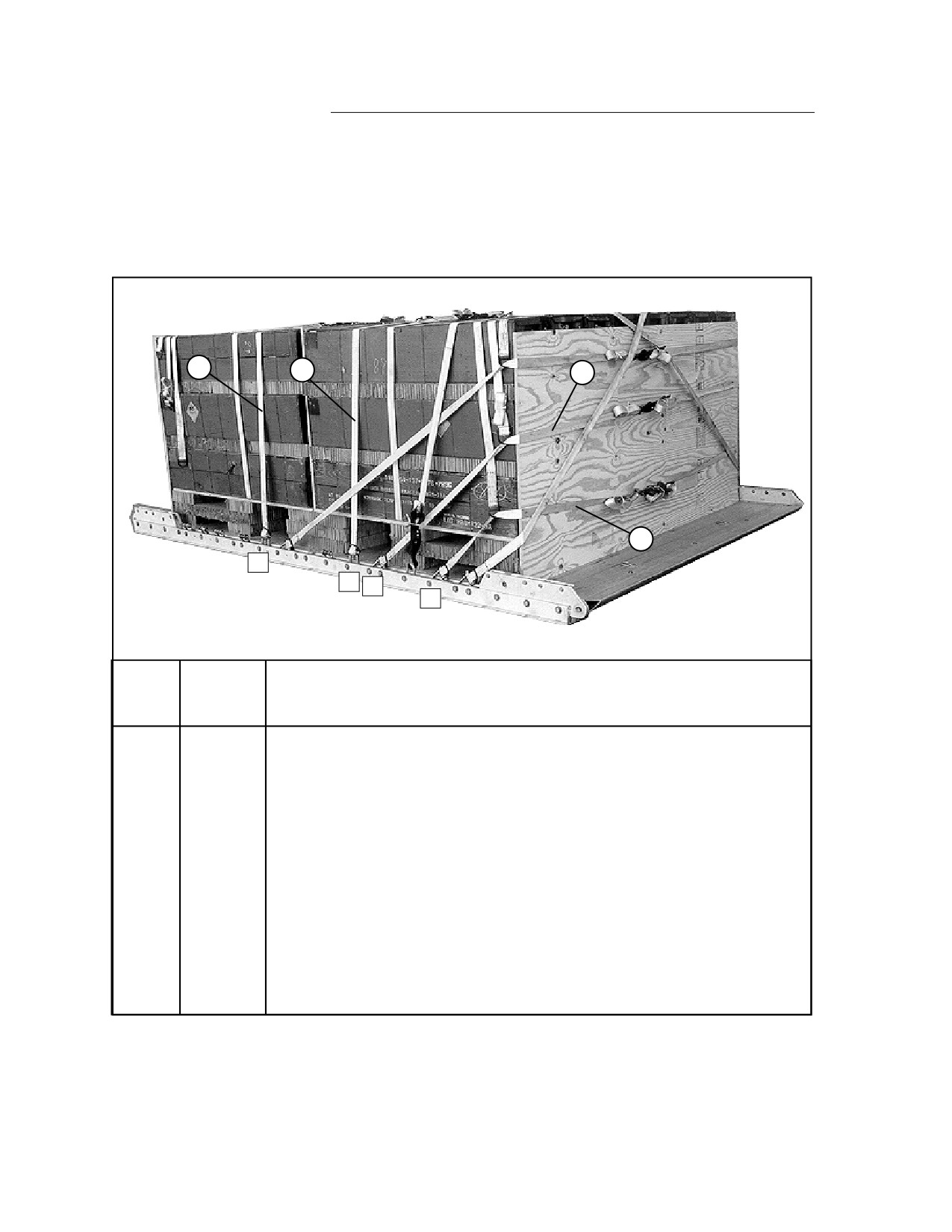
1
3
2
1
Place a 3/4- by 48- by 96-inch piece of plywood against the front edge of honeycomb stack 1
and the boxes. Place another 3/4- by 48- by 96-inch piece of plywood against the rear edge of
honeycomb stack 3 and the boxes.
2
Lay three 15-foot lashings side-by-side across the front edges of the boxes. Lay three 15-foot
lashings side-by-side across the rear edges of the boxes.
3
Fit a D-ring onto the free end of each lashing. Adjust the D-rings on each side of the load so
that a D-ring is at the center of each layer of boxes.
Figure 4-16. Lashings Placed on Missile Boxes
4-25
FM 10-500-29/TO 13C7-10-171
LASHING LOAD
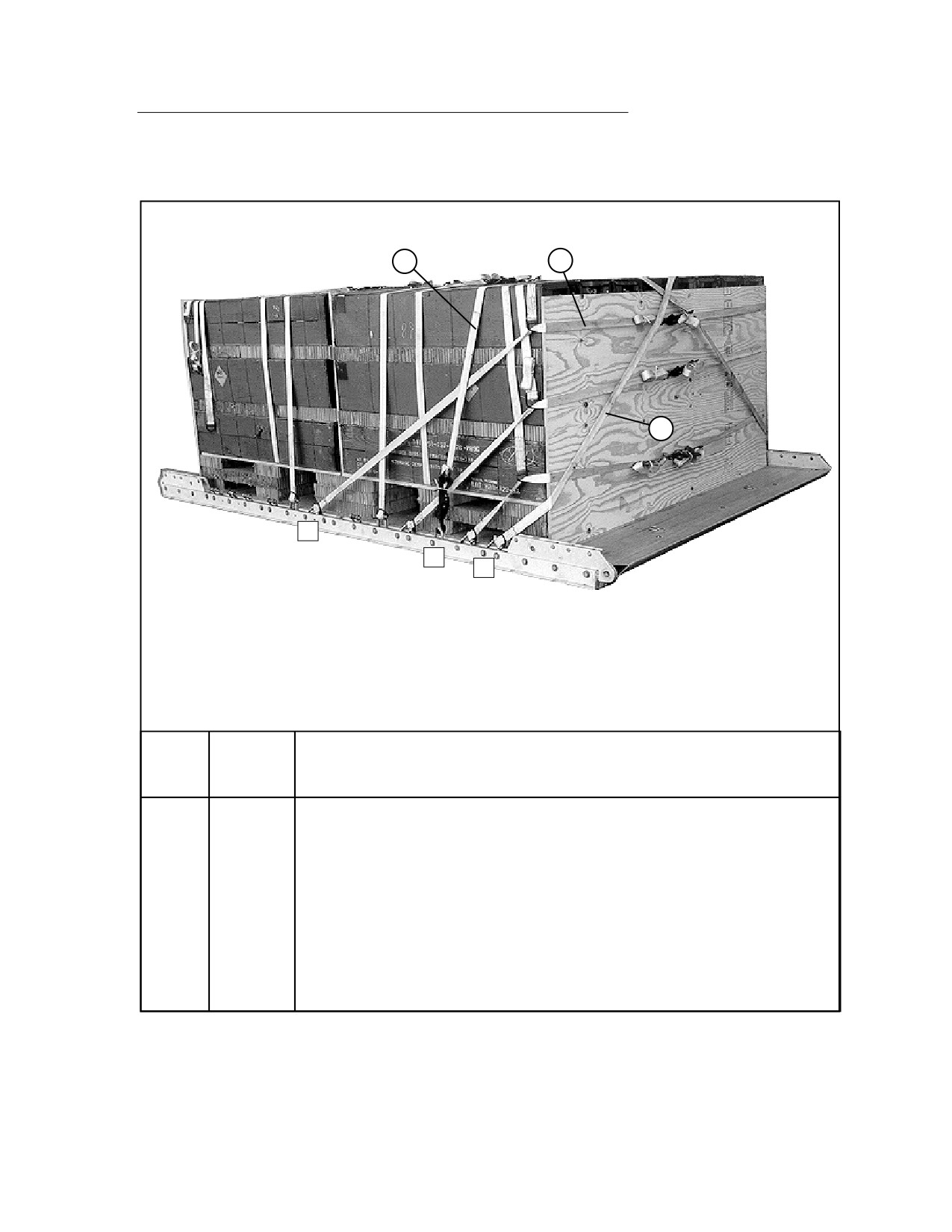
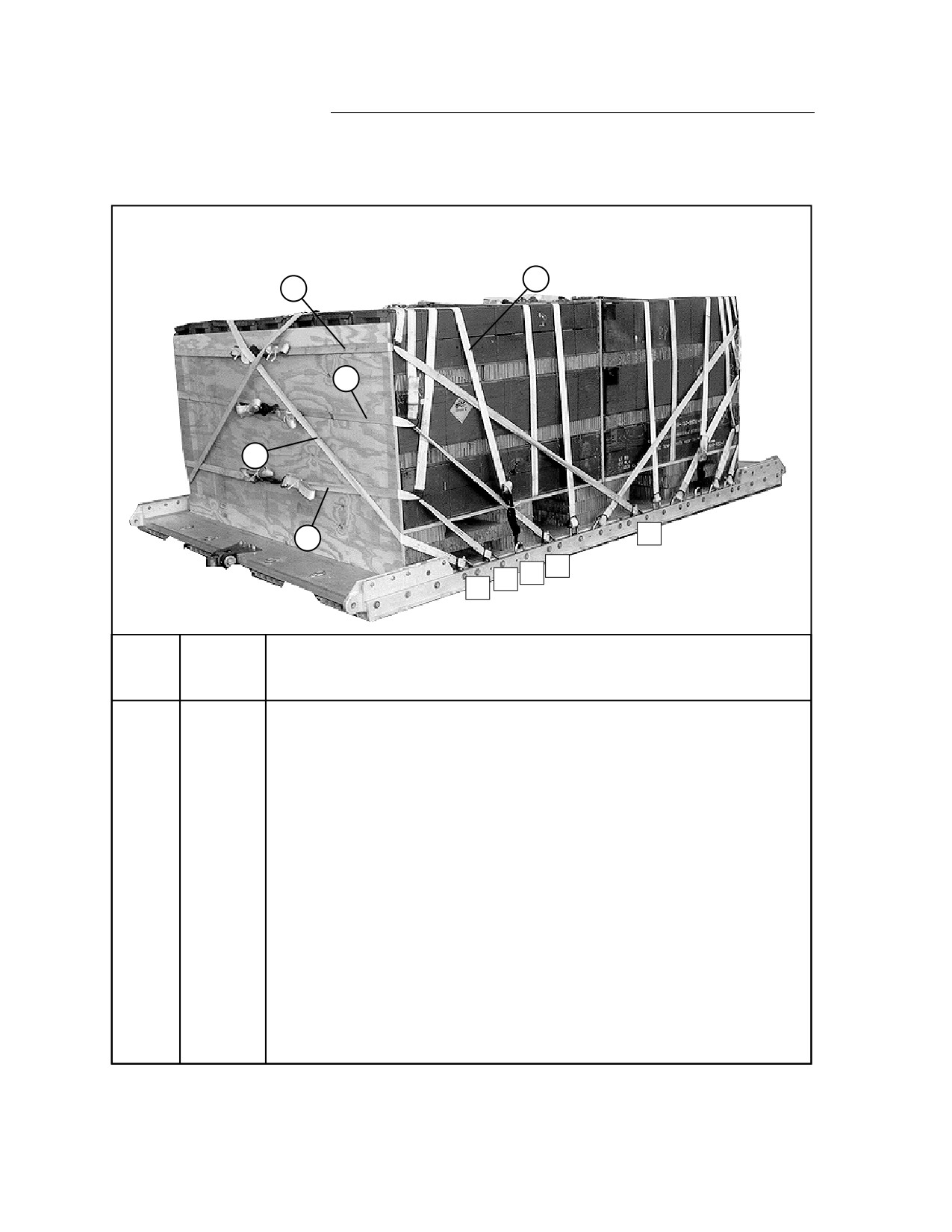
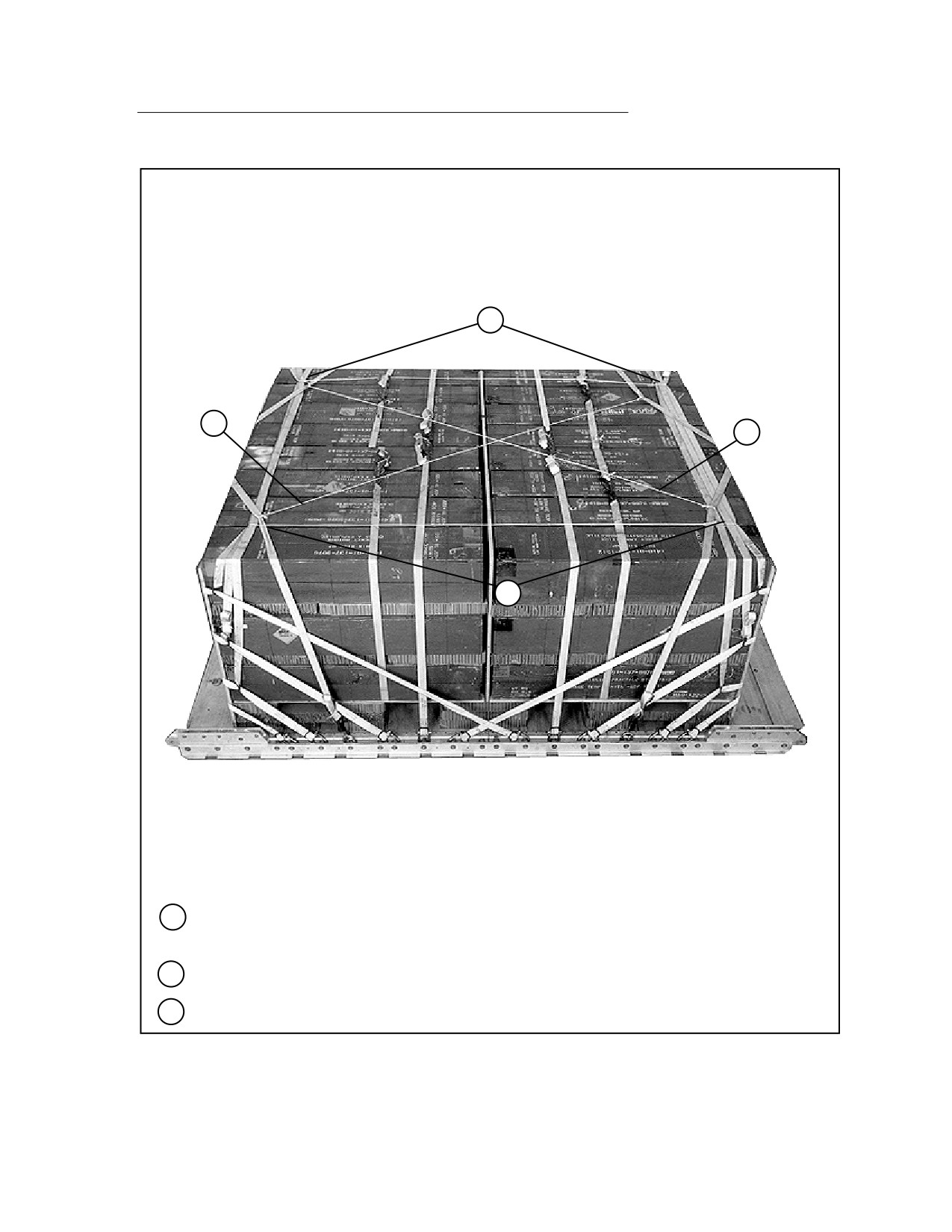
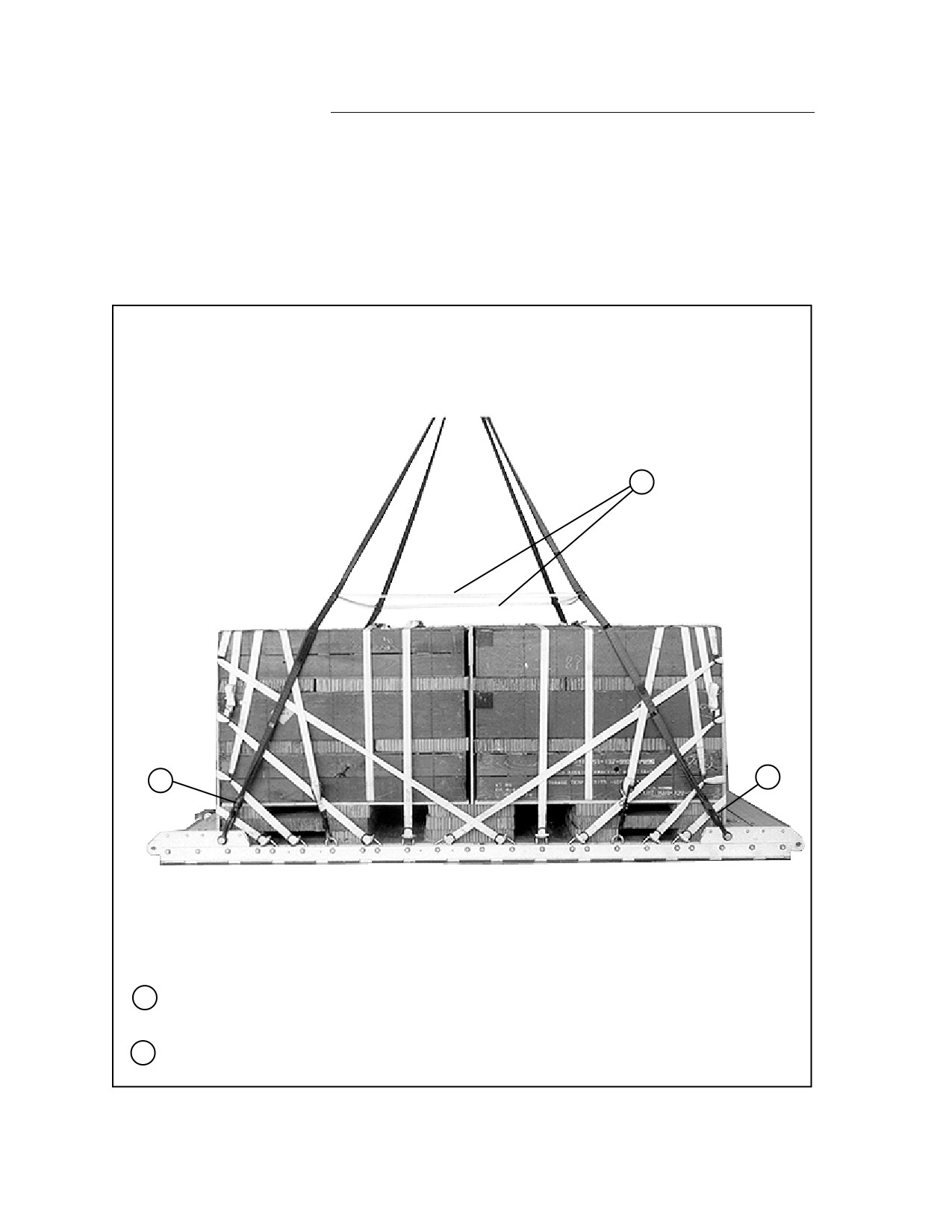
4-19. Lash the A-22 cargo bags to the platform as shown in Figures 4-17 through
4-19. Secure the corner lashings as shown in Figure 4-20.
2
1
4
3
8
5
4
2
Tie-down
Lashing
Clevis
Numbe r
Numbers
Instructions
Pass lashing:
1
5 and 5A
Through clevis 5 and its own D-ring. Pass a second lashing through clevis 5A
and its own D-ring. Pass the lashings over the top of the load. Secure the
lashings with two D-rings and a load binder on top of the load.
2
8 and 8A
Through clevis 8 and its own D-ring. Pass a second lashing through clevis 8A
and its own D-ring. Pass the lashings over the top of the load. Secure the
lashings with two D-rings and a load binder on top of the load.
3
2 and 2A
Through clevis 2 and its own D-ring. Pass a second lashing through clevis 2A
and its own D-ring. Run each lashing through the D-ring at the bottom layer of
boxes. Run each lashing to the front of the plywood. Secure the lashings
i
front with two D-rings and a load binder.
4
4 and 4A
Through clevis 4 and its own D-ring. Pass a second lashing through clevis 4A
and its own D-ring. Run each lashing through the D-ring at the middle layer of
boxes. Run each lashing to the front of the plywood. Secure the lashings
i
front with two D-rings and a load binder.
Figure 4-17. Lashings 1 Through 4 Installed
4-26
FM 10-500-29/TO 13C7-10-171
7
5
6
7
3
1
Tie-down
Lashing
Clevis
Numbe r
Numbers
Instructions
Pass lashing:
5
7 and 7A
Through clevis 7 and its own D-ring. Pass a second lashing through clevis 7A
and its own D-ring. Run each lashing through the D-ring at the top layer of
boxes. Run each lashing to the front of the plywood. Secure the lashings
i
front with two D-rings and a load binder.
6
1 and 3A
Through clevis 1 and through its own D-ring. Run the lashing around the front
of the plywood and over the top of the boxes. Attach a D-ring to the free end of
the lashing and secure it to clevis 3A with a load binder.
7
1A and
3
Through clevis 1A and through its own D-ring. Run the lashing around the front
of the plywood and over the top of the boxes. Attach a D-ring to the free end of
the lashing and secure it to clevis 3 with a load binder.
Figure 4-18. Lashings 5 Through 7 Installed
4-27
FM 10-500-29/TO 13C7-10-171
12
10
9
11
8
6
9
10
11
12
Tie-down
Lashing
Clevis
Numbe r
Numbers
Instructions
Pass lashing:
8
11 and
Through clevis 11 and its own D-ring. Pass a second lashing through clevis 11A
11A
and its own D-ring. Run each lashing through the D-ring at the bottom layer of
boxes. Run each lashing to the rear of the plywood. Secure the lashings in the
rear with two D-rings and a load binder.
9
9 and 9A
Through clevis 9 and its own D-ring. Pass a second lashing through clevis 9A
and its own D-ring. Run each lashing through the D-ring at the middle layer of
boxes. Run each lashing to the rear of the plywood. Secure the lashings in the
rear with two D-rings and a load binder.
10
6 and 6A
Through clevis 6 and its own D-ring. Pass a second lashing through clevis 6A
and its own D-ring. Run each lashing through the D-ring at the top layer of
boxes. Run each lashing to the rear of the plywood. Secure the lashings in the
rear with two D-rings and a load binder.
11
12 and
Through clevis 12 and through its own D-ring. Run the lashing around the rear
10A
of the plywood and over the top of the boxes. Attach a D-ring to the free end of
the lashing and secure it to clevis 10A with a load binder.
12
10 and
Through clevis 12A and through its own D-ring. Run the lashing around the rear
12A
of the plywood and over the top of the boxes. Attach a D-ring to the free end of
the lashing and secure it to clevis 10 with a load binder.
Figure 4-19. Lashings 8 Through 12 Installed
4-28
FM 10-500-29/TO 13C7-10-171
1
2
3
1
1
Tie the front and rear groups of support lashings installed in Figure 4-16 to each other over
the top of the load on each side with type III nylon cord.
2
Secure lashing 6 to lashing 12 with a length of type III nylon cord.
3
Secure lashing 7 to lashing 11 with a length of type III nylon cord.
Figure 4-20. Lashings Secured
4-29
FM 10-500-29/TO 13C7-10-171
INSTALLING SUSPENSION SLINGS
4-20. Install four 12-foot (2-loop), type XXVI nylon webbing slings as suspension
slings. Install and safety the slings according to FM 10-500-2/TO 13C7-1-5, and as
shown in Figure 4-21.
2
1
1
1
Attach a 12-foot (2-loop), type XXVI nylon webbing sling to each of the four tandem links
using a large clevis.
2
Raise the suspension slings above the load and install the deadman’s tie as outlined in FM
10-500-2/TO 13C7-1-5.
Figure 4-21. Suspension Slings Installed
4-30
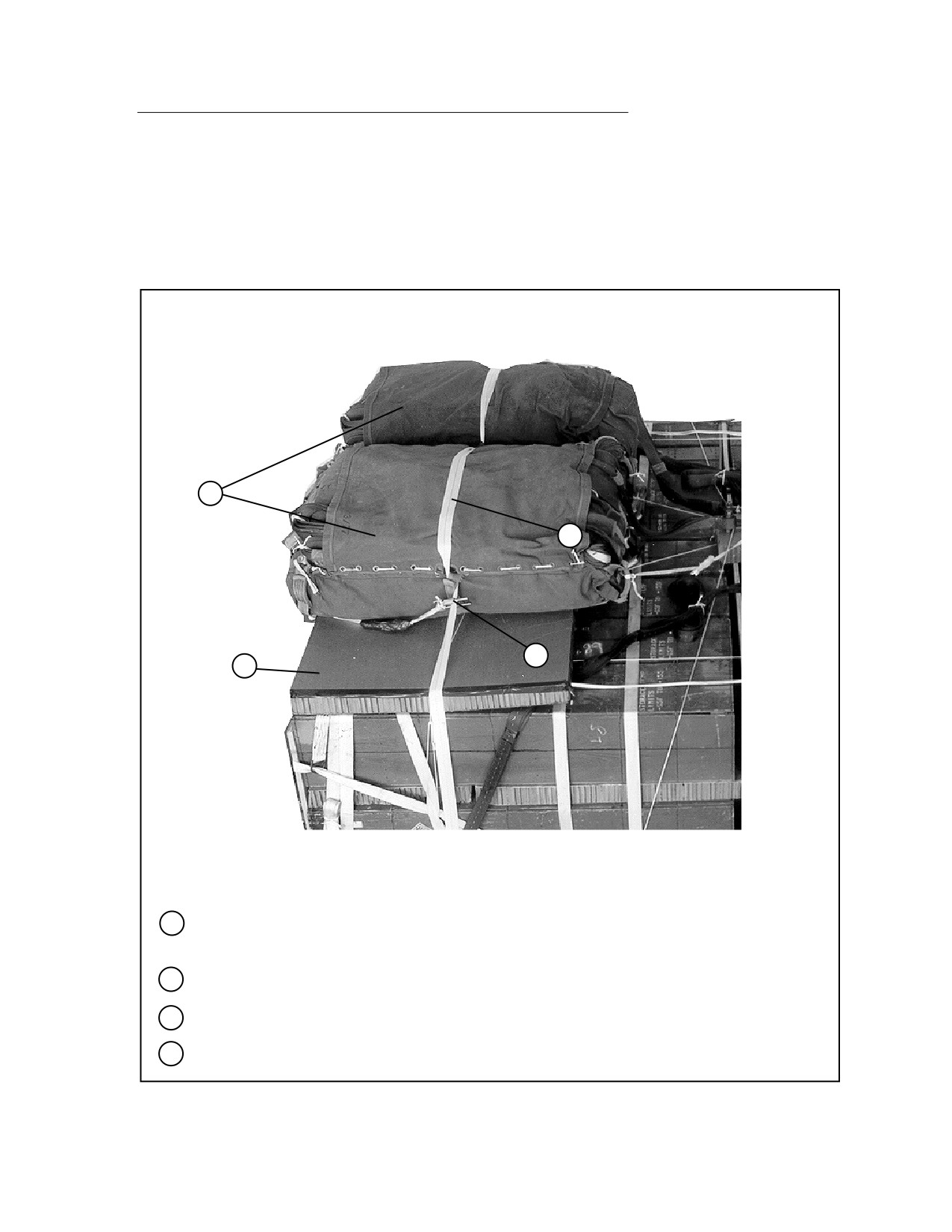
FM 10-500-29/TO 13C7-10-171
INSTALLING CARGO PARACHUTES
4-21. Install two G-11 cargo parachutes according to FM 10-500-2/TO 13C7-1-5,
and as shown in Figure 4-22.
2
3
4
1
1
Secure a 36- by 96-inch piece of honeycomb along the rear edge of the load with type III
nylon cord. Tape the honeycomb where the type III nylon cord touches.
2
Place two G-11 cargo parachutes on the parachute stowage platform.
3
Restrain the parachutes with type VIII nylon webbing to clevises 8 and 8A.
4
Install the parachute release straps according to FM 10-500-2/TO 13C7-1-5.
Figure 4-22. G-11 Cargo Parachutes Installed
4-31
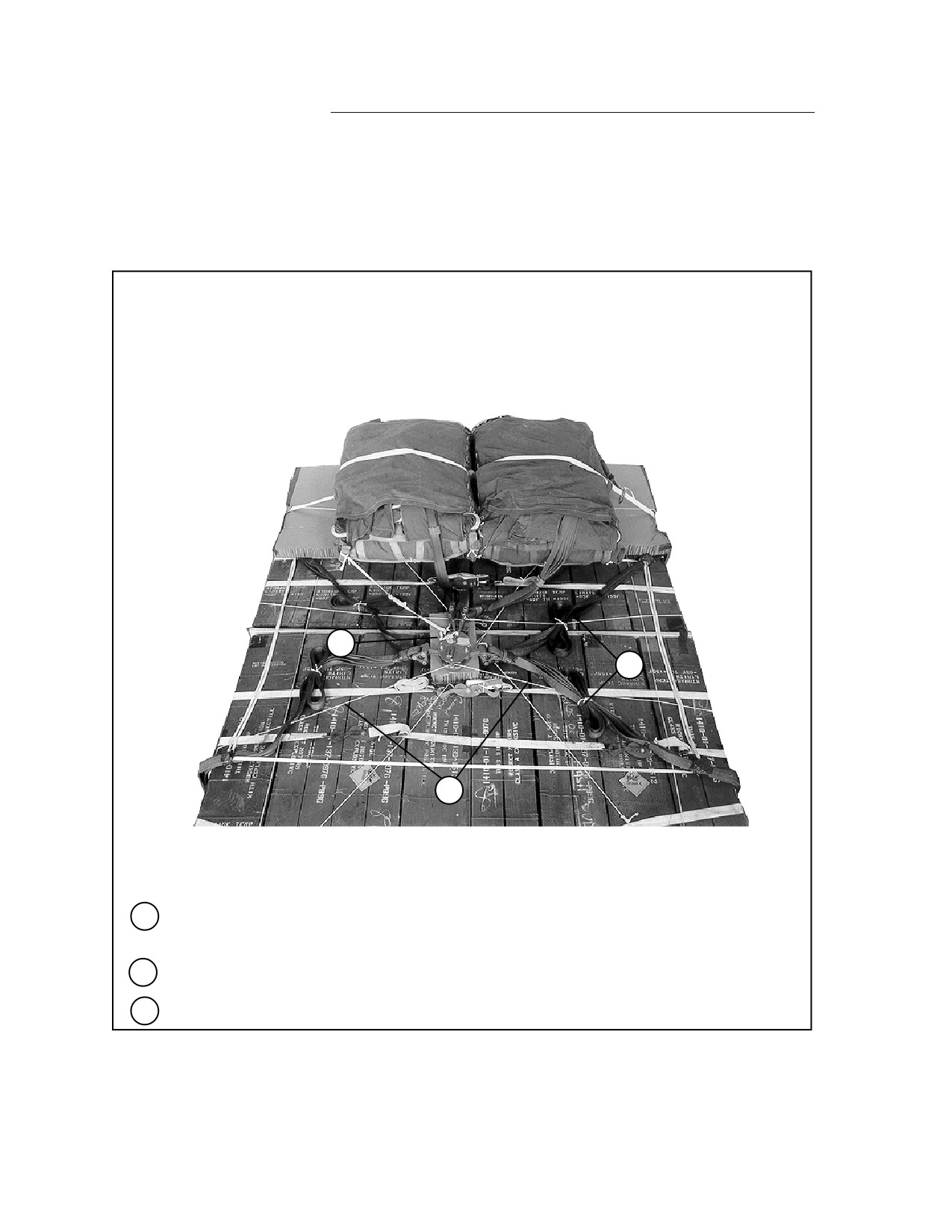
FM 10-500-29/TO 13C7-10-171
Installing Release System
4-22. Install the M-1 cargo parachute release assembly according to FM 10-500-2/
TO 13C7-1-5, and as shown in Figure 4-23.
1
2
3
1
Center a piece of honeycomb on top of the load, and place an M-1 cargo parachute release
on the honeycomb. Attach the parachute riser extension and suspension slings.
2
Fold any excess suspension sling, and tie the folds with type I, 1/4-inch cotton webbing.
3
Safety the release to the load with type III nylon cord.
Figure 4-23. M-1 Cargo Parachute Release Installed
4-32
FM 10-500-29/TO 13C7-10-171
Installing Extraction System
4-23. Install the EFTC extraction system according to FM 10-500-2/TO 13C7-1-5,
and as shown in Figure 4-11. Use the front mounting holes in the left platform
side rail to install the EFTC actuator mounting brackets. Install a 12-foot cable,
and a 9-foot, (2-loop), type XXVI sling as a deployment line.
Installing Extraction Parachute
4-24. Select the extraction line and extraction parachute needed using the extrac
tion line requirements table in FM 10-500-2/TO 13C7-1-5. Place the extraction
parachute and extraction line on the load for installation in the aircraft.
Installing Provisions for Emergency Restraints
4-25. Select and install provisions for emergency restraints according to the emer-
gency aft restraints requirements table in FM 10-500-2/TO 13C7-1-5.
Marking Rigged Load
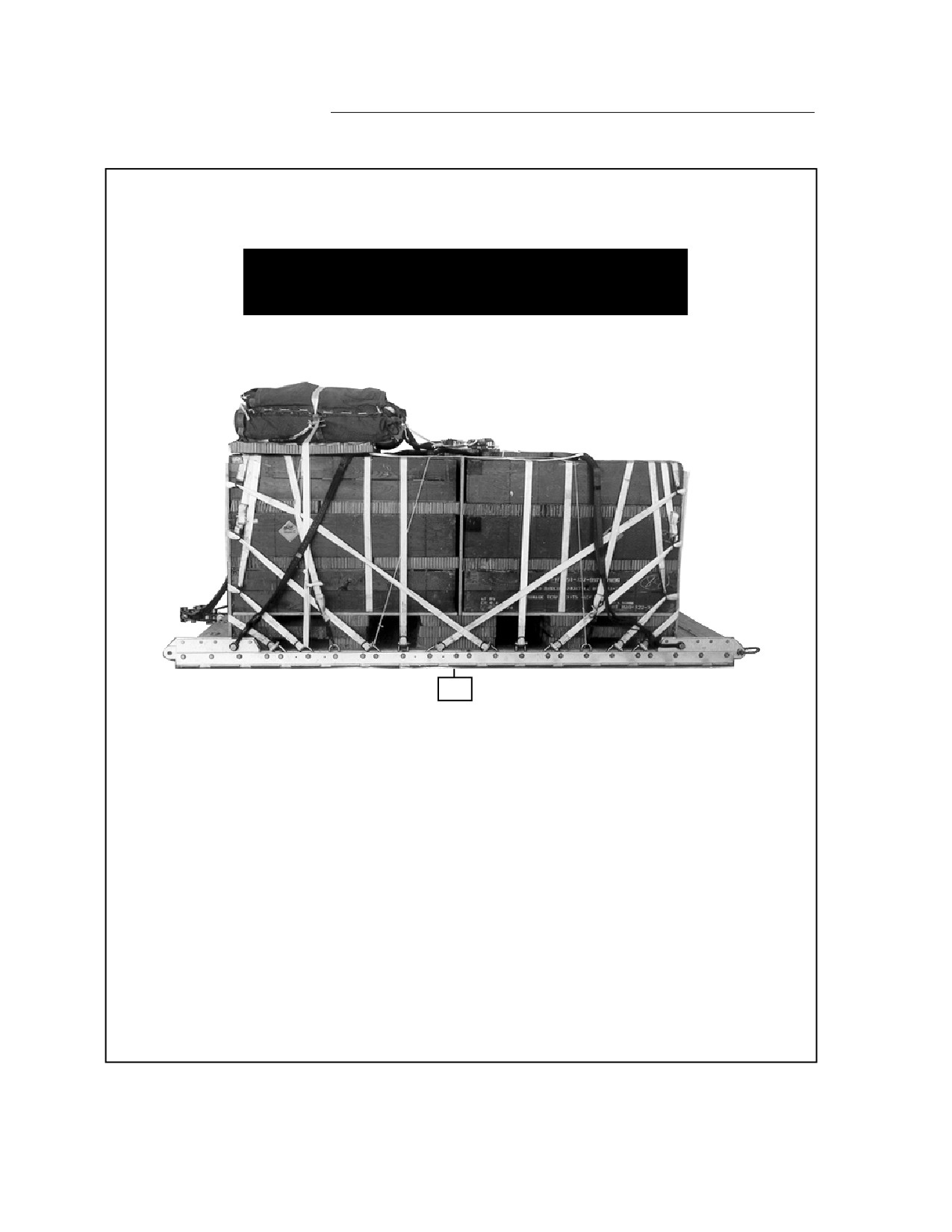
4-26. Mark the rigged load according to FM 10-500-2/TO 13C7-1-5, and as shown
in Figure 4-24. Complete the Shipper’s Declaration for Dangerous Goods. If the
load varies from the one shown, the weight, height, tip-off curve, CB, and para
chute requirements must be recomputed.
Equipment Required
4-27. Use the equipment listed in Table 4-2 to rig this load.
4-33
FM 10-500-29/TO 13C7-10-171
Make the final rigger inspection required by FM 10-500-2/
TO 13C7-1-5 before the load leaves the rigging site.
CB
Rigged Load Data
Weight: Load shown
6,650 pounds
Maximum
7,100 pounds
Height
75 inches
Width
108 inches
Length
165 inches
Overhang:
Front
0 inches
Rear
18 inches
CB (from front edge of platform)
77 inches
Extraction System (adds 18 inches to length of platform)
EFTC
Figure 4-24. TOW Missiles Rigged on a 12-foot Type V Platform for Low-velocity Airdrop
4-34
FM 10-500-29/TO 13C7-10-171
Table 4-2. Equipment Required for Rigging TOW Missiles on a 12-foot Type V Platform for Low-
velocity Airdrop
National Stock
Item
Quantity
Number
8040-00-273-8713
Adhesive paste, 1-gal
As required
l
4030-00-090-5354
1-in (large
)
7
4030-00-678-8562
3/4-in, medium
2
4020-00-240-2146
Cord, nylon, type
I
I
As required
1670-00-434-5783
Coupling, airdrop, extractionforce
t
1
Cover:
1670-00-360-0328
Clevis,
l
3
1670-00-360-0329
Link, type
I
3
1670-01-183-2678
Leaf, extraction
l
3
Line, drogue (for C-17)
1670-01-064-4452
60-ft (1-loop), type XXV I
1
Line, extraction
1670-01-064-4452
For C-130: 60-ft (1-loop), type XXV I
1
1670-01-107-7652
For C-141: 160-ft (1-loop), type XXV I
1
For C-5:
1670-01-107-7652
160-ft (1-loop), type XXV I
1
1670-01-107-7652
For C-17: 160-ft (1-loop), type XXV I
1
Link assembl:
1670-00-783-5988
Type
I
3
T
wo-point, 3 3/4-in (for C-17 )
1
5306-00-435-8994
Bolt, 1-in diam, 4 in
l
(2
)
5310-00-232-5165
Nut, 1-in, hexagona l
(2
)
1670-00-003-1953
Plate,side,33/4
i
(2
)
5365-00-007-3414
Spacer,
l
(2
)
4-35
FM 10-500-29/TO 13C7-10-171
Table 4-2. Equipment Required for Rigging TOW Missiles on a 12-foot Type V Platform for Low-
velocity Airdrop (continued)
National Stock
Item
Quantity
Number
1670-00-753-3928
Pad, energy-dissipating, honeycomb, 3- by 36- by 96-in
18 sheets
Parachute:
1670-01-016-7841
Cargo, G-11B
2
1670-01-063-3715
Cargo extraction, 15-ft
1
1670-01-063-3715
Drogue, 15-ft (for C-17
)
1
Platform, airdrop, type V, 12-ft
1670-01-353-8425
Bracket assembly, coupling
(1
)
1670-01-162-2372
l
(24
)
1670-01-354-8424
Extraction bracket assembly
(1
)
1670-01-162-2381
Link, tandem, suspension
l
(4
)
5530-00-128-4981
Plywood, 3/4- by 48- by 96-in
7 sheets
1670-01-097-8816
Release, cargo parachute, M-1
1
Sling, cargo airdrop
For suspension:
1670-01-062-6303
12-ft (2-loop), type XXVI n
l
4
For deployment:
1670-01-062-6304
9-ft (2-loop), type XXVI nylon webbing
1
For riser extension:
1670-01-062-6302
20-ft (2-loop), type XXVI n
l
2
1670-00-998-0116
Strap, parachute release,single or
1
5340-00-040-8219
Strap, parachute release, multicut
2
7510-00-266-5016
T
ape, adhesive, 2-in
As required
1670-00-937-0271
Tie-down assembly, 15-ft
30
Webbing:
8305-00-268-2411
Cotton, 1/4-in, type I
As required
8305-00-082-5752
Nylon, tubular, 1/2-in
As required
8305-00-261-8585
Type V
I
As required
4-36
FM 10-500-29/TO 13C7-10-171
Chapter 5
Rigging the Improved Target Acquisition System (ITAS) in
M1121 HMMWV Truck for Low-velocity Airdrop
DESCRIPTION OF LOAD
5-1. The ITAS is an aiming system for the TOW missile. Another aiming
system is shown in Chapter 6. The ITAS consists of the Fire Control Sub
system (FCS), Traversing Unit (TU), Target Acquisition Subsystem
(TAS), and Battery Power Source (BPS). Rig the ITAS in the M1121 or
M966 HMMWV truck as shown in this chapter. Use FM 10-517/TO 13C7-
1-111 to rig the truck on a 16-foot, type V airdrop platform.
PREPARING PLATFORM, HONEYCOMB, AND TRUCK
5-2. Prepare the platform, three honeycomb stacks, and the M966 or M1211
truck as shown in Chapters 2 and 3 of FM 10-517/TO 13C7-1-111.
a. Inspect, assemble, and install clevises on a 16-foot, type V airdrop plat-
form according to TM 10-1670-268-20&P/TO 13C7-52-22, and as shown in
Figure 2-2, FM 10-517/TO 13C7-1-111.
b.Prepare three honeycomb stacks as shown in Figures 2-3 and 2-4, FM 10-
517/TO 13C7-1-111.
c. Prepare the truck as shown in Figures 3-2 and 3-3, FM 10-517/TO 13C7-
1-111.
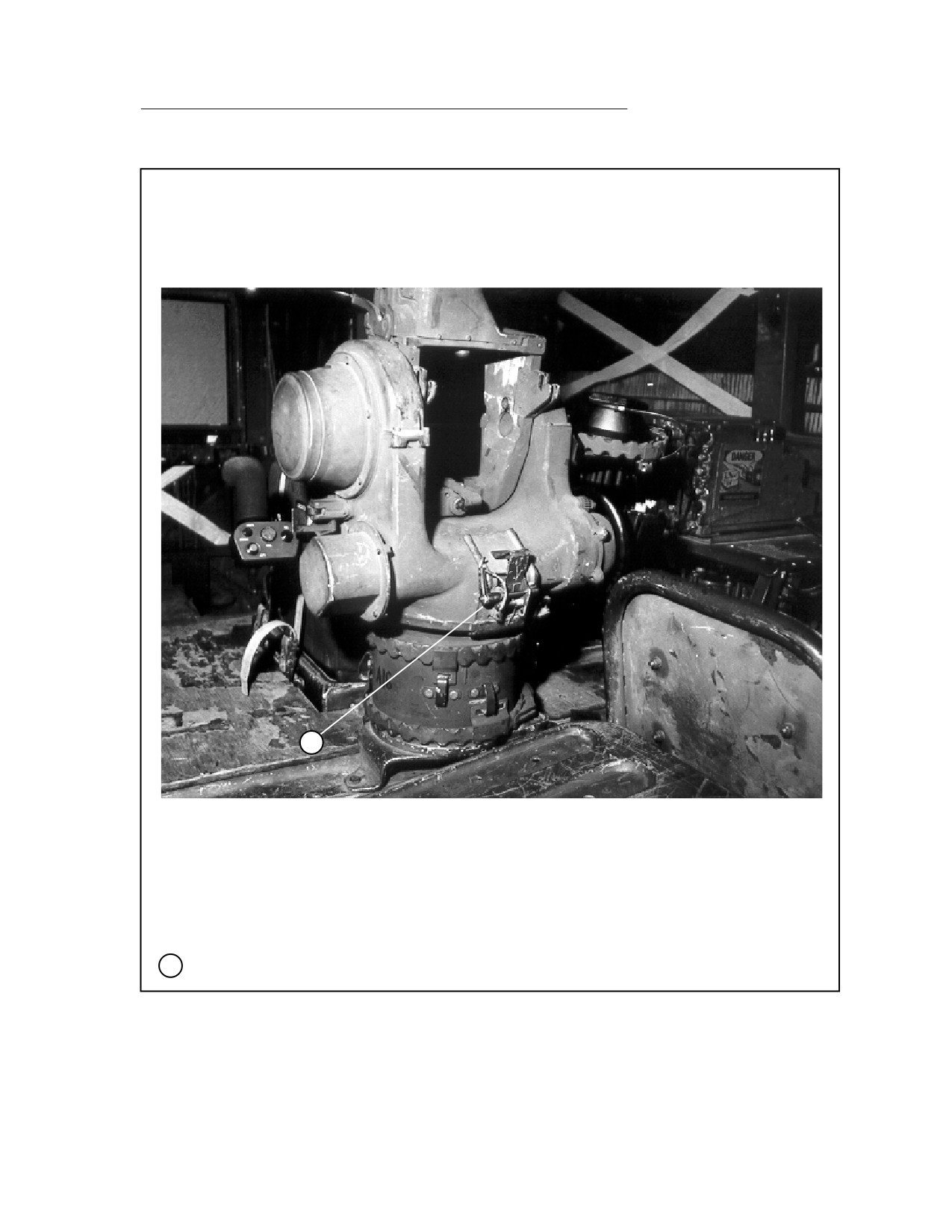
RIGGING ITAS IN HMMWV TRUCK
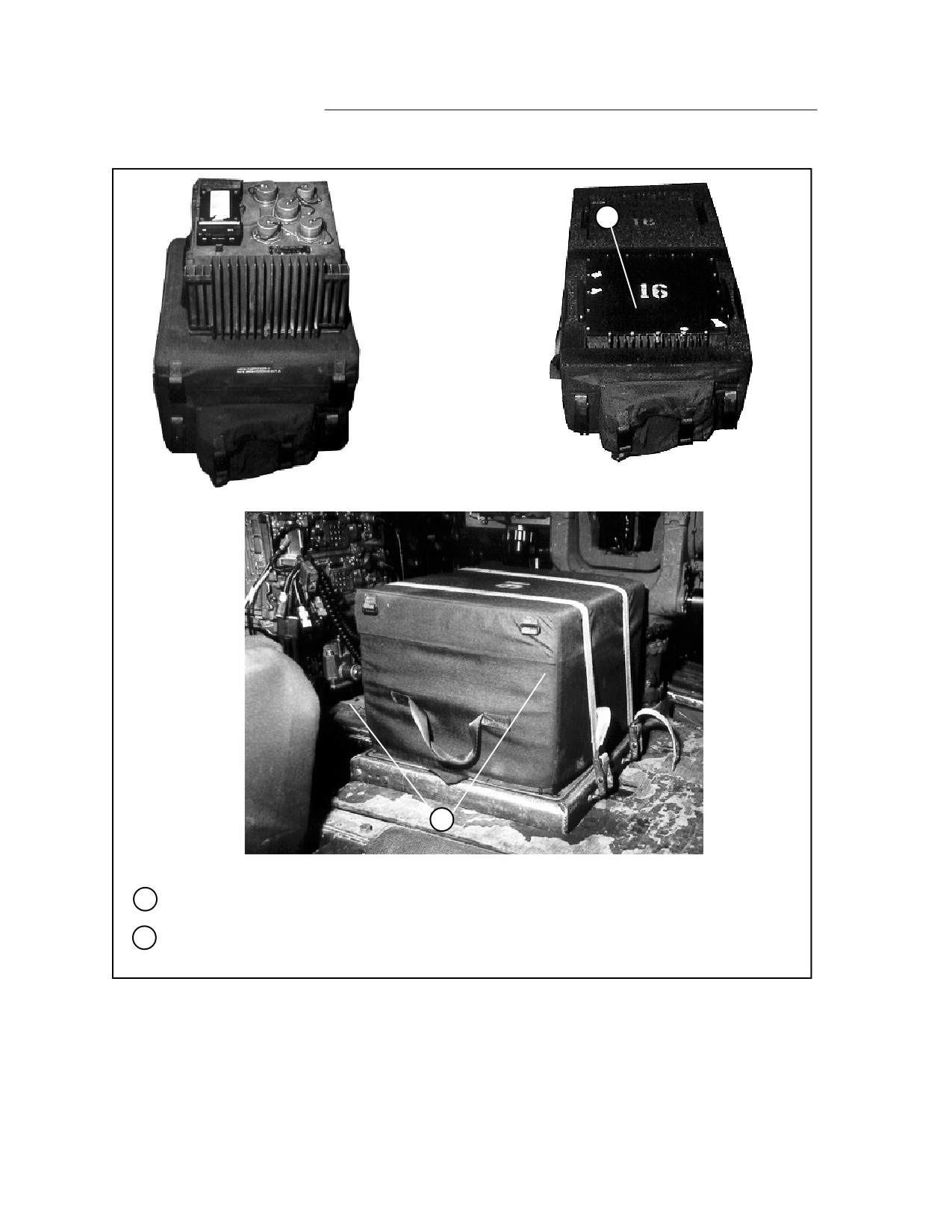
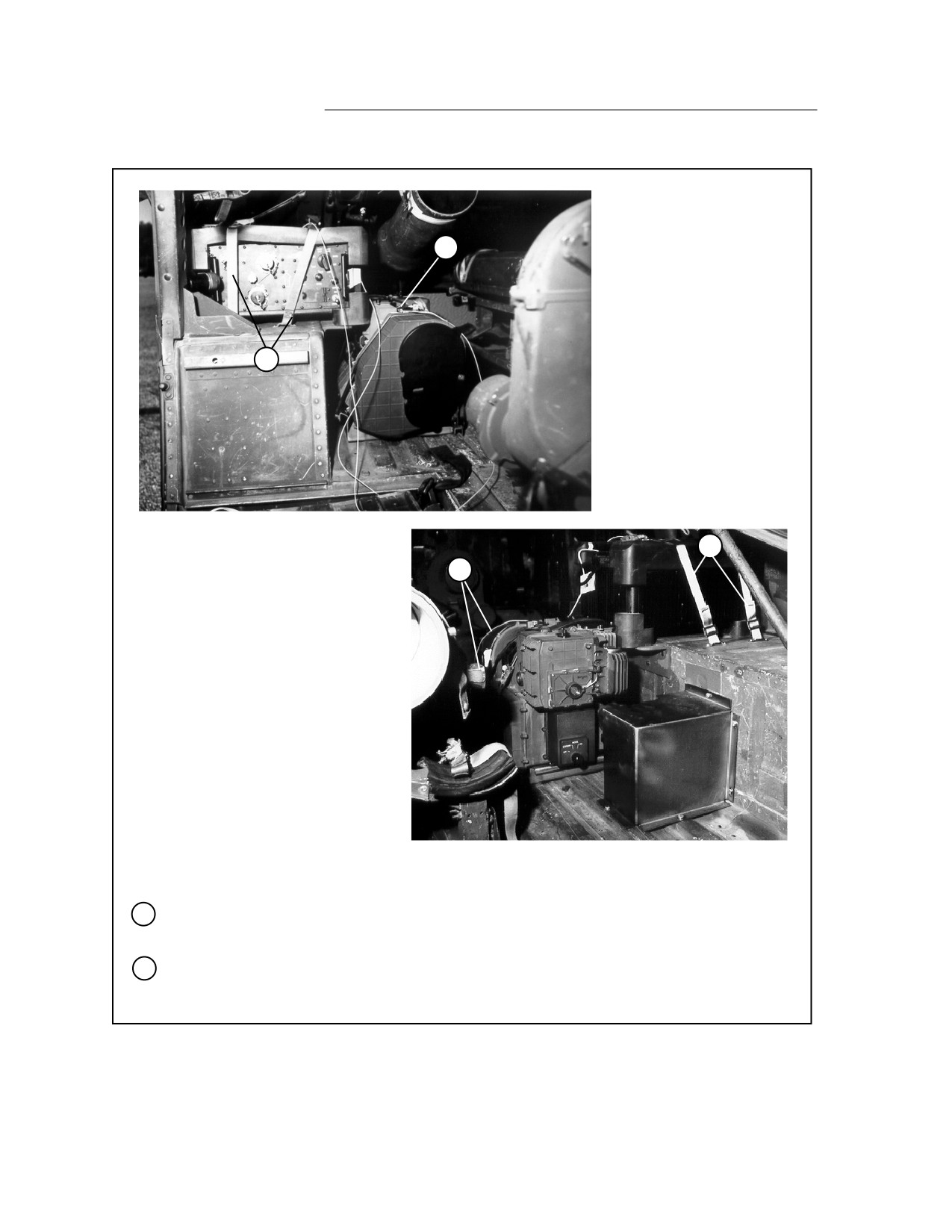
5-3. Rig the components of the ITAS in the truck as shown in Figure 5-1.
COMPLETING THE LOAD
5-4. Finish rigging the M966 or M1121 HMMWV truck as shown in Chapter 3,
FM 10-517/ TO 13C7-1-111.
5-1
FM 10-500-29/TO 13C7-10-171
1
2
1
Place the FCS upside down in its storage bag.
2
Place the FCS in its bag flush on the gunner’s stand and secure it in place with the
straps provided.
Figure 5-1. ITAS components rigged in truck
5-2
FM 10-500-29/TO 13C7-10-171
3
3
Position the TU in its mounting bracket and secure it with the clips provided.
Figure 5-1. ITAS components rigged in truck (continued)
5-3
FM 10-500-29/TO 13C7-10-171
4
5
5
4
4 Position the TAS into its mounting bracket, being sure that the biocular subassembly
fits into its protective housing. Secure the TAS with the two straps provided.
5
Place the rubber mounts on the BPS. Position it on its mounting bracket, and secure it
with the two straps provided.
Figure 5-1. ITAS components rigged in truck (continued)
5-4
FM 10-500-29/TO 13C7-10-171
CHAPTER 6
RIGGING M966, M1036, AND M1121 TOW CARRIERS FOR
LOW-VELOCITY AIRDROP ON A TYPE V PLATFORM
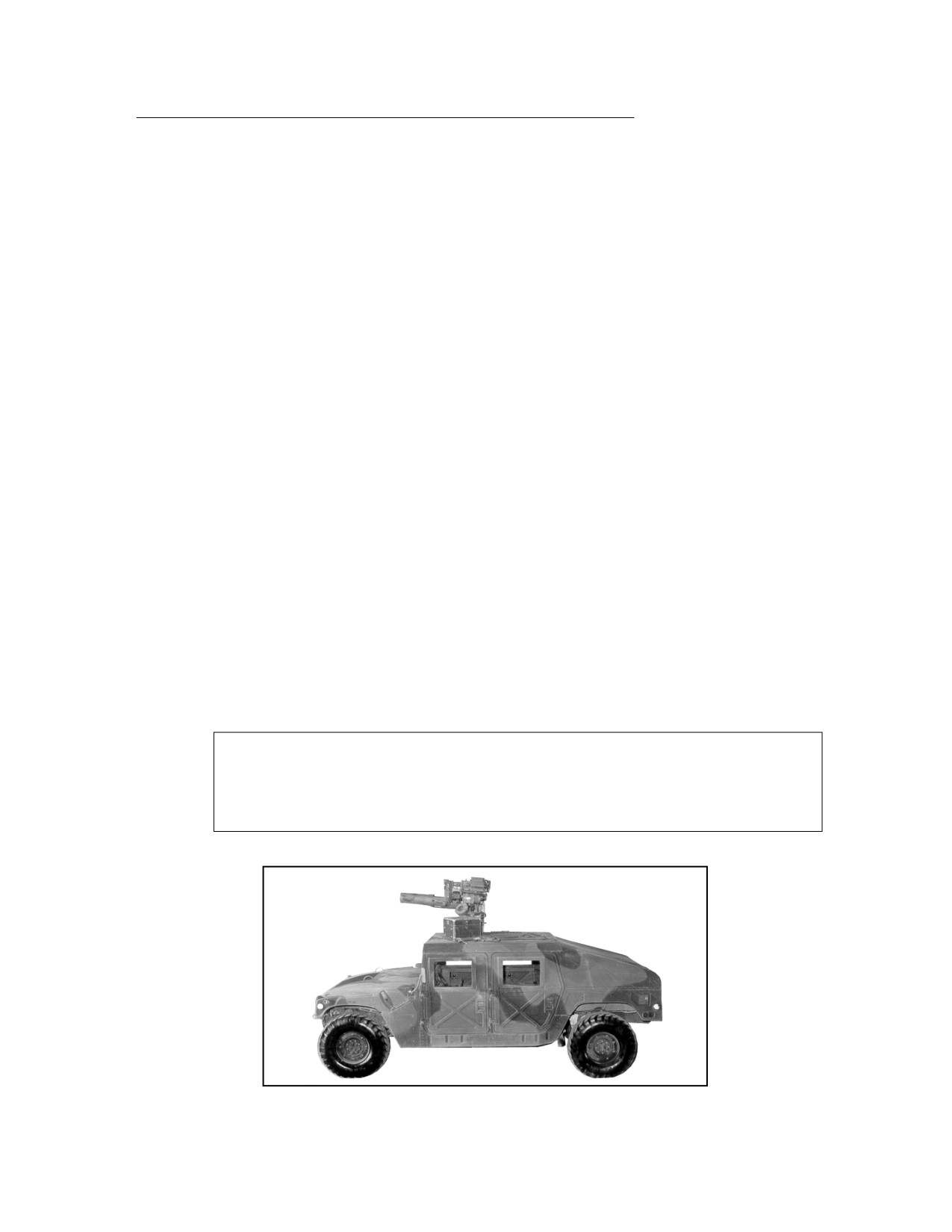
Description of Load
6-1. The unrigged M966 TOW carrier (Figure 6-1) is described in FM 10-517/TO
13C7-1-111, Chapter 1. The truck is rigged on a 16-foot, type V airdrop platform
for low-velocity airdrop. An accompanying load weighing a minimum of 800
pounds and a maximum of 2,000 pounds must be rigged in the truck. The load
requires two G-11 cargo parachutes. The M1036 is the same truck with the
addition of a winch, and is rigged the same as the M966. The M1121 is a heavier
version of the TOW carrier, but is rigged in the same way as the M966 and M1036.
Preparing Platform
6-2. Prepare a 16-foot, type V airdrop platform according to TM 10-1670-268-20&P/
TO 13C7-52-22. Install four tandem links and 18 load tie-down clevises according
to FM 10-500-2/TO 13C7-1-5, and as shown in FM 10-517/TO 13C7-1-111, Figure
2-2.
NOTES: 1. You will need FM 10-517/TO 13C7-1-111 to rig this load.
2. The nose bumper may or may not be installed.
3. Measurements given in this chapter are from the front edge
of the platform, NOT from the front edge of the nose bumper.
Figure 6-1. M966 TOW carrier
6-1
FM 10-500-29/TO 13C7-10-171
Preparing and Positioning Honeycomb Stacks
6-3. Build the honeycomb stacks as shown in FM 10-517/TO 13C7-1-111, Figures
2-3 and 2-4. Position the stacks on the platform as shown in FM 10-517/TO 13C7-
1-111, Figure 2-5.
Preparing Truck
6-4. Prepare the truck as described in FM 10-517/TO 13C7-1-111, Paragraphs 2-
4a through e, g, and h, and as shown in Figures 2-6 and 2-7, 2-8 (omit steps 1
and 3), 2-9, 2-11, and 2-12. Use the closed-body preparation procedures given in
FM 10-517/TO 13C7-1-111, Figures 3-2 and 3-3.
Stowing Accompanying Load and
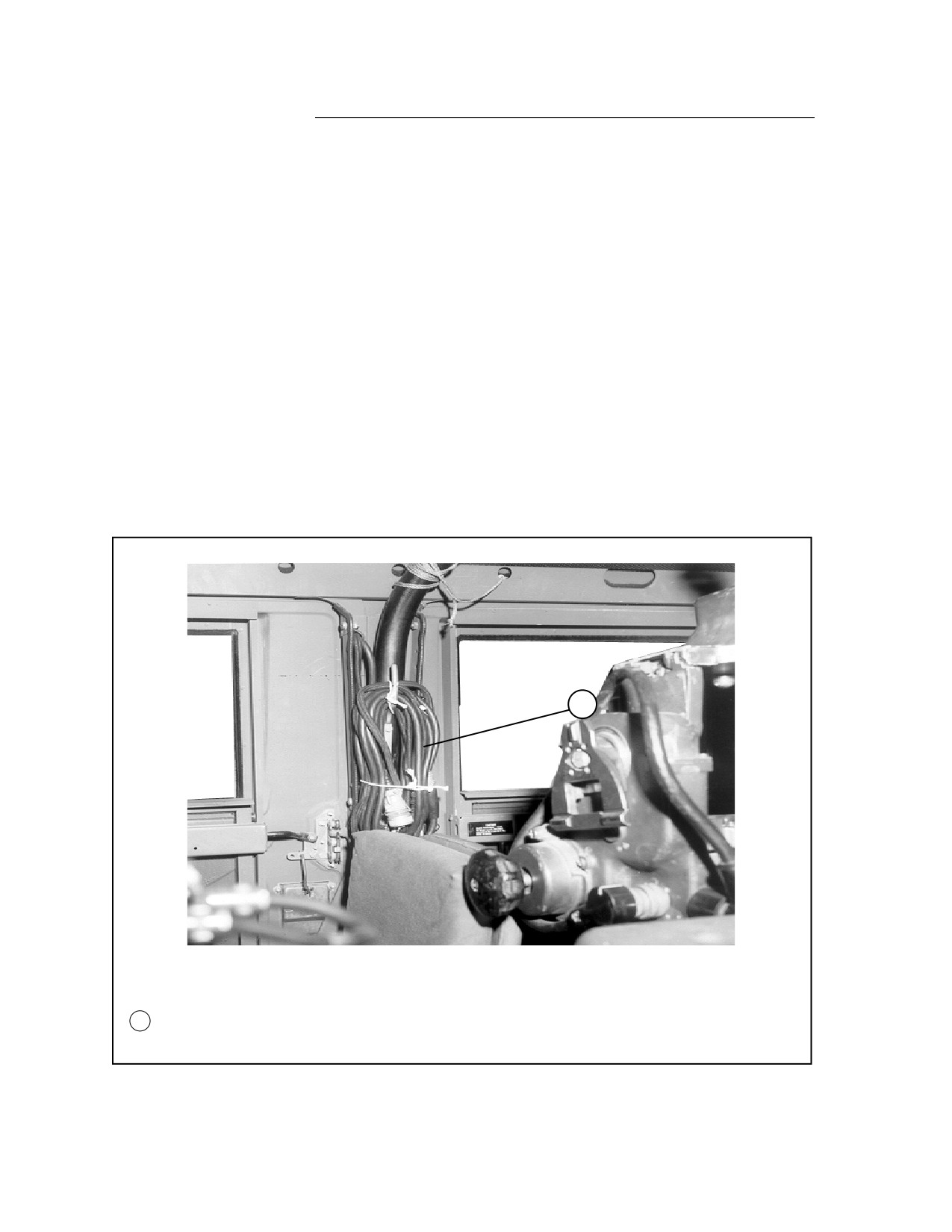
Securing Doors
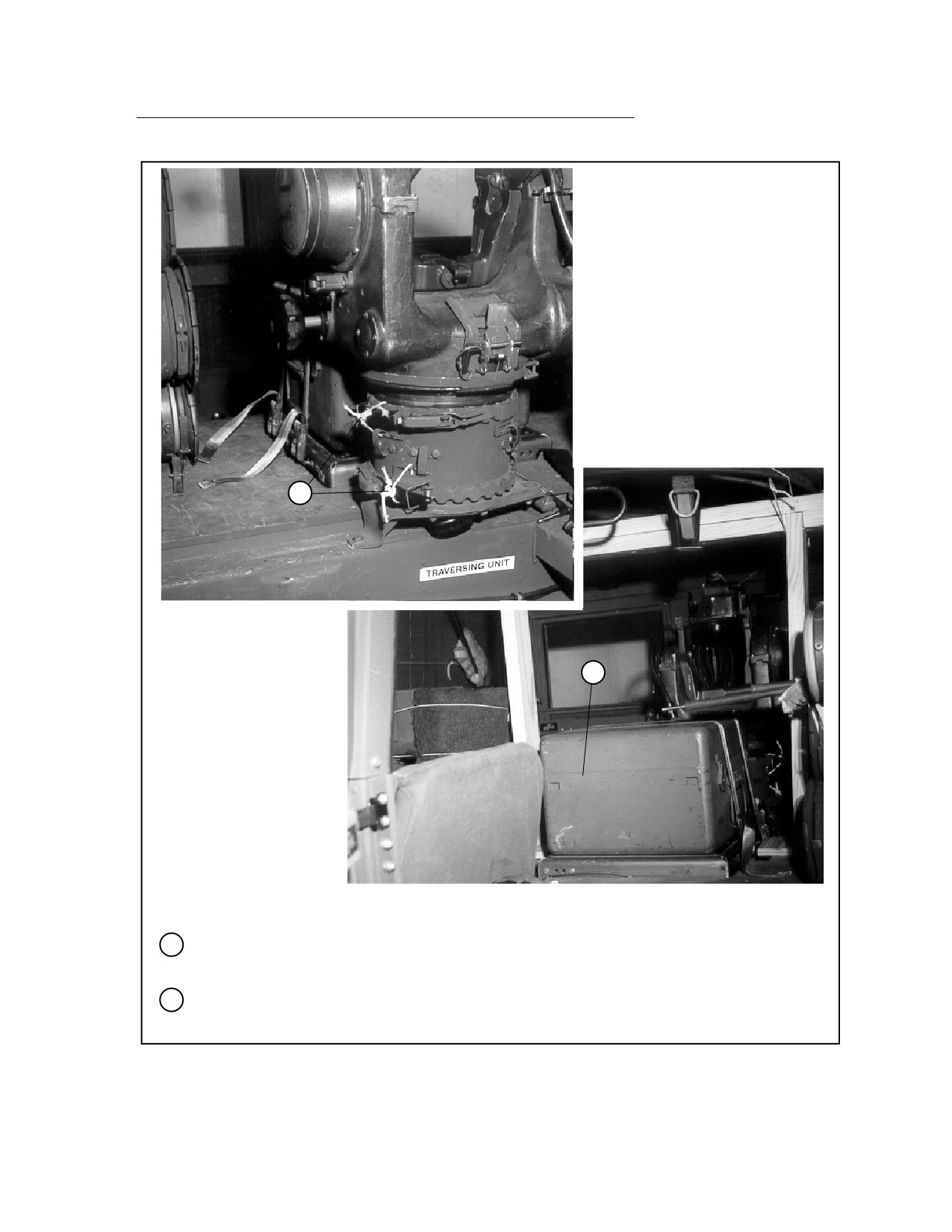
6-5. Prepare and stow the TOW equipment as shown in Figure 6-2 below. Secure
the hatch cover as shown in FM 10-517/TO 13C7-1-111, Figure 3-4, step 11.
1
1 Disconnect the TOW system power cables, roll them, and tie them with type III nylon cord
to convenient places in the truck.
Figure 6-2. TOW Equipment Prepared and Stowed
6-2
FM 10-500-29/TO 13C7-10-171
2
3
2
Place the traversing unit on its stand. Fasten the securing straps provided, and safety the
latches with type III nylon cord.
3
Place the missile guidance system box in its rack, and secure it with the straps provided.
Figure 6-2. TOW Equipment Prepared and Stowed (continued)
6-3
FM 10-500-29/TO 13C7-10-171
5
4
6
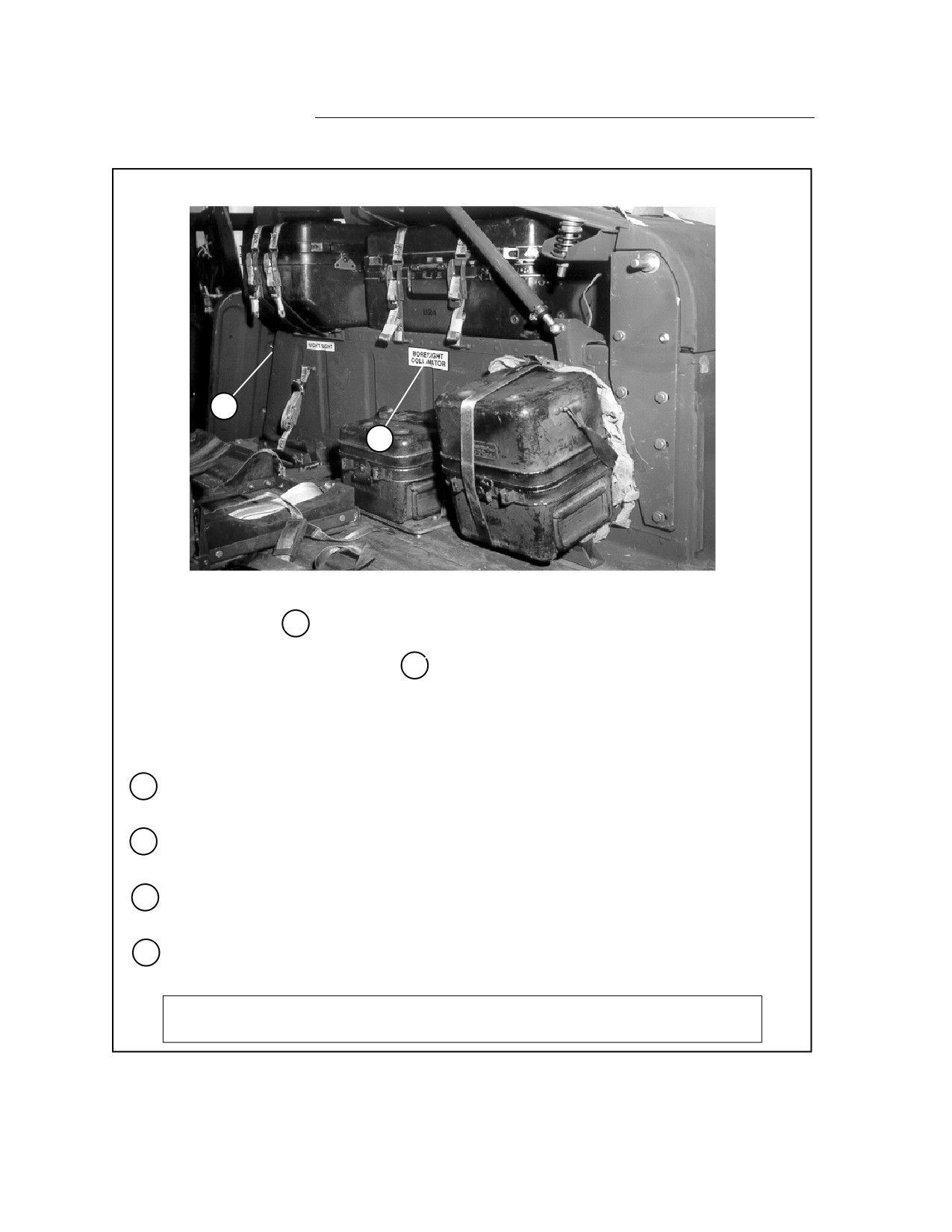
7
4
Place the boresight collimator on the shelf in the right rear part of the truck. Secure the
collimator with the retainer straps.
5
Place the infrared nightsight set on the shelf in the right rear part of the truck next to the
boresight collimator. Secure the nightsight set with the retainer straps.
6
Place the nightsight battery set on the floor in the right rear part of the truck. Secure the
battery set with the retainer straps.
7
Place the battery power conditioner on the floor in the right rear part of the truck. Secure the
battery power conditioner with the retainer straps.
Note: Pad the equipment shown above, as necessary, with cellulose wadding to
prevent the equipment from rubbing against the body of the truck.
Figure 6-2. TOW Equipment Prepared and Stowed (continued)
6-4
FM 10-500-29/TO 13C7-10-171
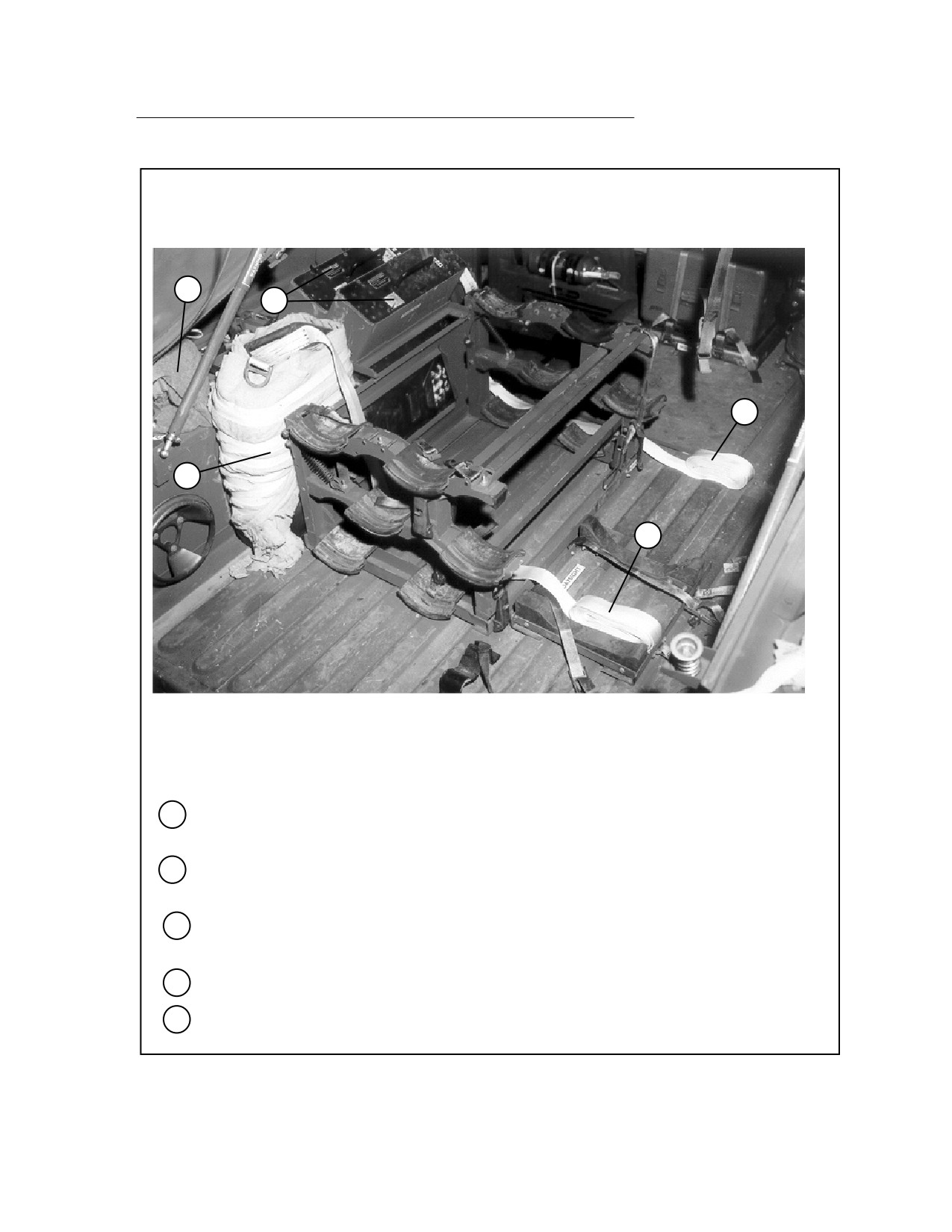
8
10
12
9
11
8
Place the highway emergency kit in the left rear part of the truck. Tie the kit in place with
type III nylon cord.
9
Pad the M13 decontamination apparatus with felt or cellulose wadding. Tape the padding in
place. Place the decontamination apparatus in its rack, and fasten the retainer straps.
10
Place the missile guidance system battery packs in their racks. Secure them in place with
their fasteners.
11
Position a 15-foot lashing under the rear of the TOW missile rack.
12
Position a 15-foot lashing under the front of the TOW missile rack, and in front of the rack
support.
Figure 6-2. TOW Equipment Prepared and Stowed (continued)
6-5
FM 10-500-29/TO 13C7-10-171
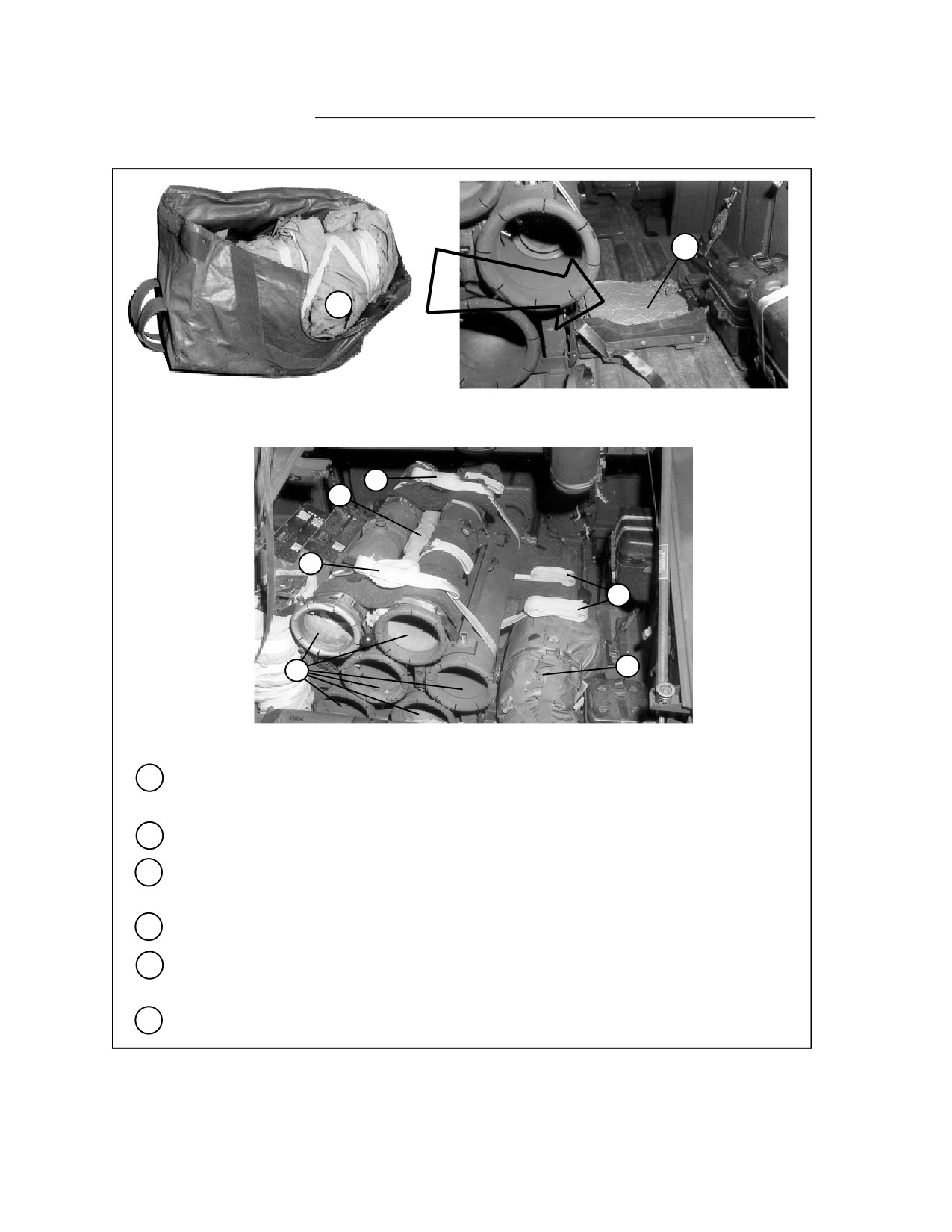
17
16
15
14
15
18
13
17
13
Place six TOW missiles in the rack with their nose ends to the front. Secure them with the
straps provided.
14
Wrap the radio antenna with cellulose wadding, and place it between the top two missiles.
15
Fasten the pre-positioned lashings over the missiles. Pad the missiles with felt under the load
binders.
16
Pad the optical sight generously with cellulose wadding and place it in its bag.
17
Cut a piece of honeycomb to fit in the sight bracket. Place the sight bag in the bracket, and
secure it with the straps provided.
18
Run two 15-foot lashings around the right three missiles.
Figure 6-2. TOW Equipment Prepared and Stowed (continued)
6-6
FM 10-500-29/TO 13C7-10-171
19
21
19
20
19
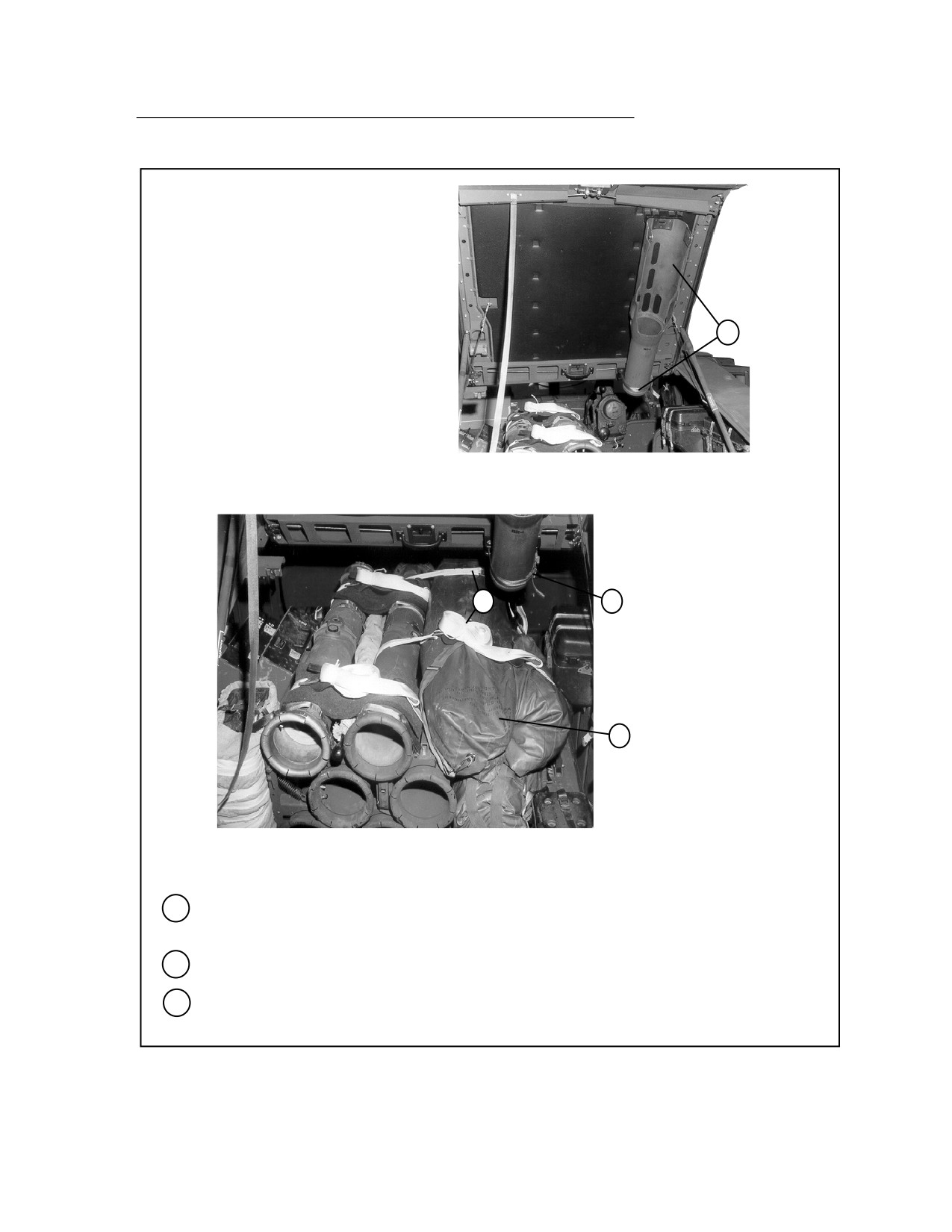
Place the missile launcher tube in its rack on the hatch cover. Secure it with the strap pro
vided.
20
Lay the camouflage net bags to the right of the missiles.
21
Secure the camouflage net bags to the missiles with the lashings pre-positioned in step 18
above. Fasten the load binders against the bags, and not against the missiles.
Figure 6-2. TOW Equipment Prepared and Stowed (continued)
6-7
FM 10-500-29/TO 13C7-10-171
23
24
22
22
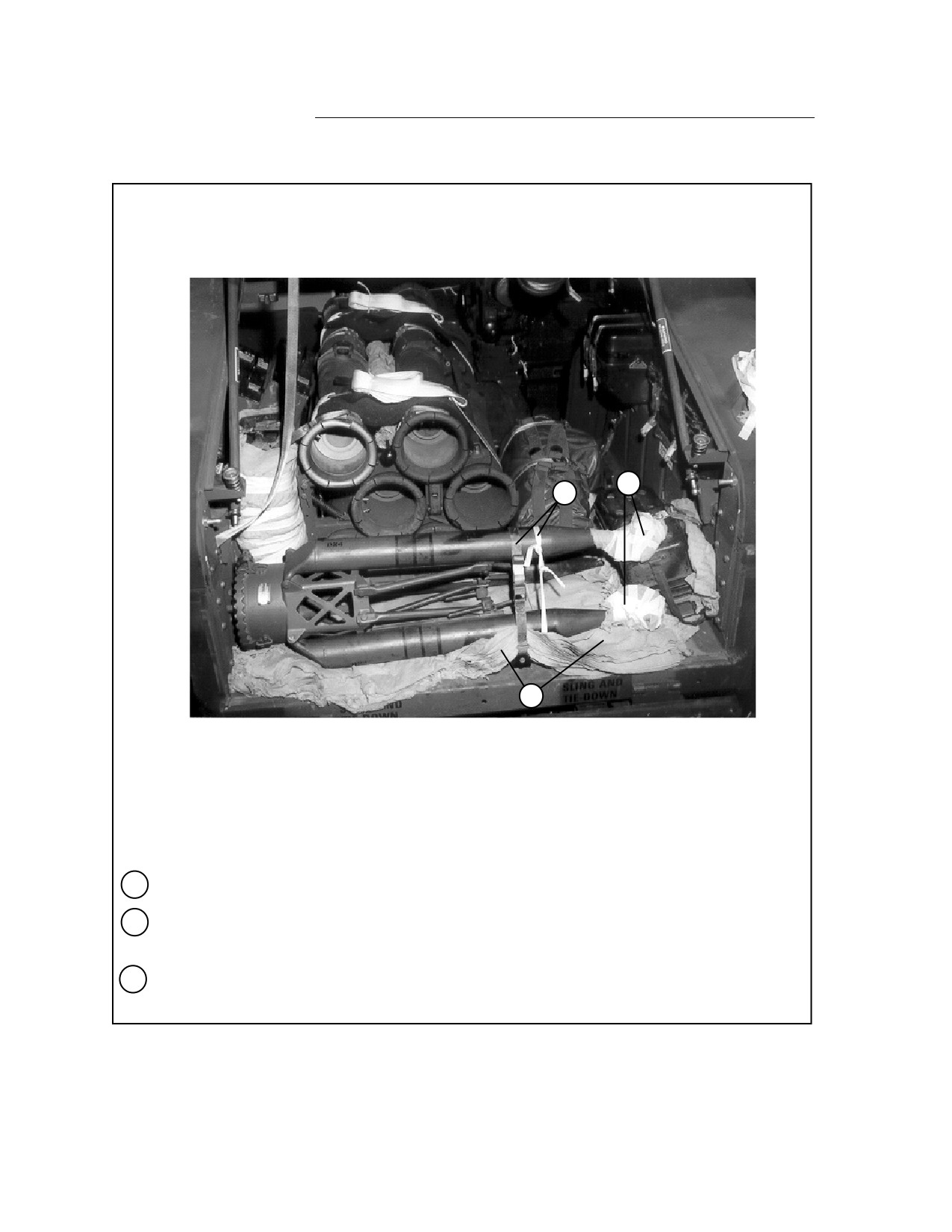
Pad the tripod storage area with cellulose wadding.
23
Place the tripod in its storage rack. Pad the legs with cellulose wadding where they touch the
battery power conditioner.
24
Secure the tripod in place with the retainer strap and a length of 1/2-inch tubular nylon
webbing.
Figure 6-2. TOW Equipment Prepared and Stowed (continued)
6-8
FM 10-500-29/TO 13C7-10-171
Lifting and Positioning Truck and
Installing Drive-Off Aids
6-6. If drive-off aids are to be used, install them on the platform as shown in FM
10-517/TO 13C7-1-111, Figure 2-16. Install lifting slings on the truck and position
the truck on the honeycomb stacks as shown in FM 10-517/TO 13C7-1-111, Figure
2-17. Install the drive-off aids to the rear wheels of the truck as shown in FM 10-
517/TO 13C7-1-111, Figure 2-18.
Lashing Truck
6-7. Lash the truck to the platform with fifteen 15-foot tie-down assemblies as
shown in FM 10-517/TO 13C7-1-111, Figures 2-19 and 2-20, and according to FM
10-500-2/TO 13C7-1-5.
Installing and Safetying Suspension Slings
6-8. Install and safety four 16-foot (2-loop), type XXVI nylon suspension slings as
shown in FM 10-517/TO 13C7-1-111, Figure 3-5.
Stowing Cargo Parachutes
6-9. Stow two G-11 cargo parachutes on the load according to FM 10-500-2/TO
13C7-1-5, and as shown in FM 10-517/TO 13C7-1-111, Figure 2-22.
Installing Parachute Release
6-10. Prepare and install an M-1 cargo parachute release according to FM 10-500-
2/TO 13C7-1-5, and as shown in FM 10-517/TO 13C7-1-111, Figure 3-6.
Installing Extraction System
6-11. Install the EFTC extraction system according to FM 10-500-2/TO 13C7-1-5,
and as shown in FM 10-517/TO 13C7-1-111, Figure 2-24.
Installing Provisions for Emergency Restraints
6-12. Install provisions for emergency restraints according to FM 10-500-2/TO
13C7-1-5.
Placing Extraction Parachute
6-13. Select the extraction parachute and extraction line needed, using the
extraction line requirements table in FM 10-500-2/TO 13C7-1-5. Rig the extrac-
tion line in a line bag according to TM 10-1670-286-20/TO 13C5-41. Place the
extraction parachute and extraction line on the load for installation in the air
craft.
6-9
FM 10-500-29/TO 13C7-10-171
Marking Rigged Load
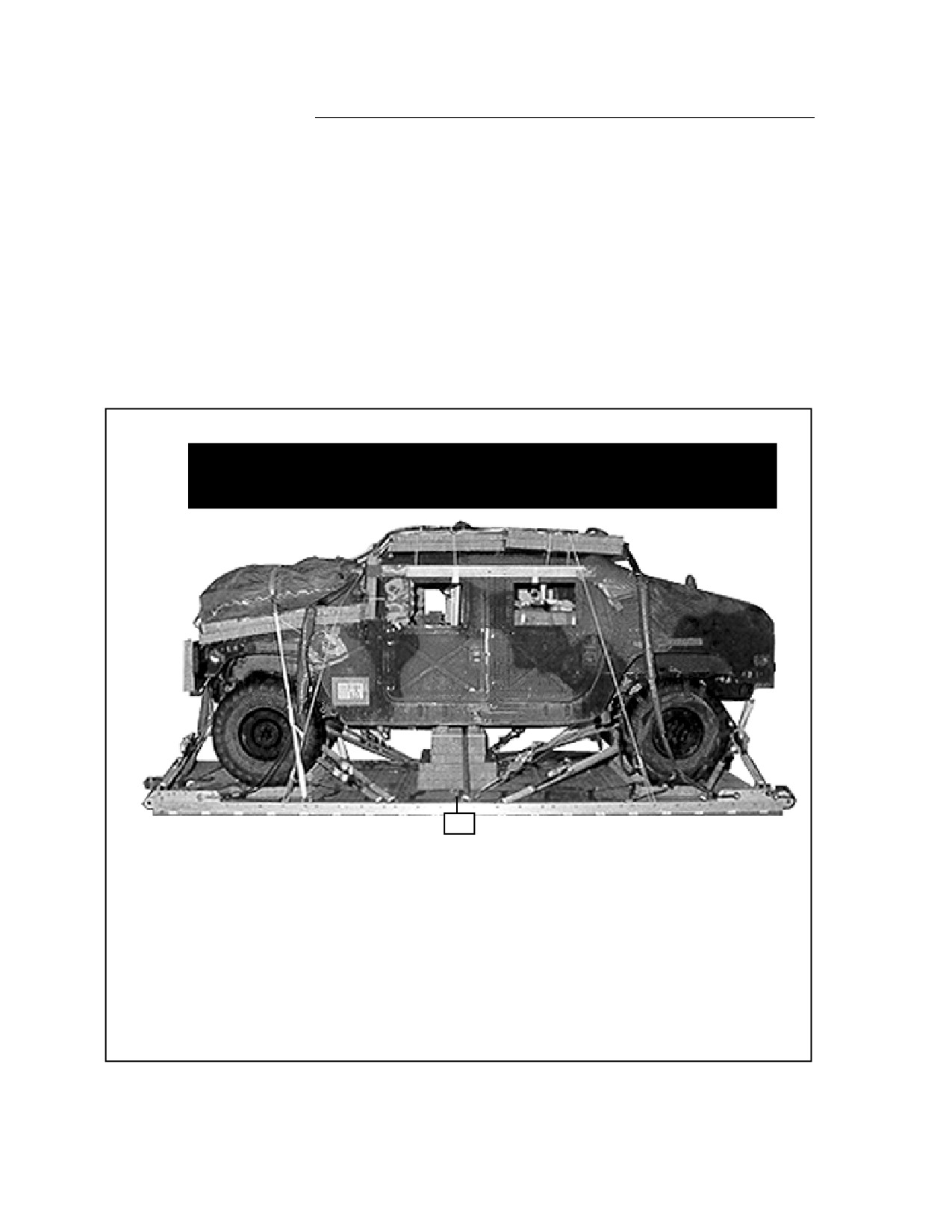
6-14. Mark the rigged load according to FM 10-500-2/TO 13C7-1-5, and as shown
in Figure 6-3. Complete Shipper's Declaration for Dangerous Goods. If the load
varies from the one shown, the weight, height, CB, and parachute requirements
must be recomputed.
Equipment Required
6-15. Use the equipment listed in Table 6-1 to rig this load. The equipment for
rigging the accompanying load is included in Table 6-1.
CAUTION: Make the final rigger inspection required by FM 10-500-2/
TO 13C7-1-5 before the load leaves the rigging site.
CB
RIGGED LOAD DATA
Weight: Load shown
8,810 pounds
Maximum load allowed
10,500 pounds
Height (with two G-11 parachutes)
91 inches
Width
108 inches
Length
215 inches
Overhang: Front
0 inches
Rear
18 inches
CB (from front edge of platform)
102 inches
Figure 4-3. M966 TOW carrier rigged for low-velocity airdrop
6-10
FM 10-500-29/TO 13C7-10-171
Table 6-1. Equipment required for rigging the M966 TOW carrier for low-velocity airdrop
National Stock
Number
Item
Quantity
8040-00-273-8713
Adhesive, paste, 1-gal
As required
4030-00-090-5354
Clevis,suspension,1-in
l
8
4020-00-240-2146
Cord, nylon, typeII, 550
l
As required
1670-00-434-5785
Coupling, airdrop, extractionforce
t
1
Cover:
1670-00-360-0328
Clevis,
l
1
1670-00-360-0329
Link, type
I
3
8135-00-664-6958
Cushioningmaterial,packaging,cel
l
l
As required
8305-00-958-3685
Felt, 1/2-in thick
As required
1670-01-183-2678
Leaf, extraction
l
2
Line, drogue (for C-17)
1670-01-064-4452
60-ft (1
l
1
Line, extraction:
1670-01-062-6313
60-ft (3-loop), type XXVI (for C-130)(Use w/ 140-ft
f
1
1670-01-107-7651
140-ft (3
l
1
Link assembl:
1670-00-783-5988
Type
I
3
T
wo-point, 3/4-in
(1
)
5306-00-435-8994
Bolt, 1-in diam, 4-in
l
2
5310-00-232-5165
Nut, 1-in, hexagona l
2
1670-00-003-1953
Plate,side,33/4
i
2
5365-00-007-3414
Spacer,
l
2
Lumber:
5510-00-220-6146
2- by 4-in
As required
5510-00-220-6448
2- by 6-in
As required
5510-00-220-6274
4- by 4-in
As required
5315-00-010-4659
Nail, steel wire, 8d
As required
6-11
FM 10-500-29/TO 13C7-10-171
Table 6-1. Equipment required for rigging the M966 TOW carrier for low-velocity airdrop
(continued)
National Stock
Number
Item
Quantity
1670-00-753-3928
Pad, energy-dissipating (honeycomb)
3- by 36- by 96-in
11 sheets
Parachute:
Cargo:
1670-01-016-7841
G-11B
2
Cargo extraction:
1670-01-063-3716
22-ft
1
1670-01-063-3715
Drogue (for C-17) 15-ft
1
Platform, airdrop, type V, 16-ft
1670-01-353-8425
Bracket assembly, coupling
(1
)
1670-01-162-2372
l
(20
)
1670-01-354-8424
Extraction bracket assembly
(1
)
1670-01-162-2381
T
andem link assembly (Multipurpose
l
(4
)
5530-00-128-4981
Plywood, 3/4-in
3 sheets
1670-01-097-8816
Release, cargo parachute, M-1
1
Sling, cargo, airdrop
For suspension:
1670-01-063-7761
16-ft (2-loop), type XXVI n
l
4
For lifting
:
1670-01-062-6304
9-ft (2-loop), type XXVI nylon webbing
2
1670-01-062-6303
12-ft (2-loop), type XXVI n
l
2
For deployment:
1670-01-062-6304
9-ft (2-loop), type XXVI nylon webbing
1
For riser extension:
1670-01-062-6302
20-ft (2-loop), type XXVI n
l
2
5340-00-040-8219
Strap, parachute release, multi-cut, comes w/ 3 knives
2
7510-00-266-5016
T
ape, adhesive, 2-in
As required
1670-00-937-0271
T
ie-down assembly, 15-foot
27
1670-00-431-8486
Vehicle drive-off aids
1
Webbing:
8305-00-268-2411
Cotton, 1/4-in, type I
As required
8305-00-082-5752
Nylon, tubular, 1/2-in
As required
8305-00-263-3591
Type V
I
As required
6-12
GLOSSARY
ACB
attitude control bar
AD
airdrop
AFB
Air Force base
AFJMAN
Air Force Joint Manual
AFR
Air Force regulation
AFTO
Air Force technical order
ALC
Airlift Logistics Center
attn
attention
BPS
battery power source
C
change
cap
capacity
CB
center of balance
chap
chapter
d
penny
DA
Department of the Army
DC
District of Columbia
DD
Department of Defense
diam
diameter
EFTC
extraction force transfer coupling
fig
figure
FCS
fire control subsystem
FM
field manual
ft
foot/feet
gal
gallon
HQ
headquarters
HMMWV
high-mobility, multipurpose, wheeled vehicle
in
inch
ITAS
improved target acquisition system
JAI
joint airdrop inspector
lb
pound
LV
low-velocity
MCRP
Marine Corps Reference Publication
mm
millimeter
NSN
national stock number
OVE
on-vehicular equipment
TAS
target acquisition subsystem
TM
technical manual
TO
technical order
TOW
tube launched, optically-tracked, wire-guided
TRADOC
US Army Training and Doctrine Command
TU
traversing unit
US
United States
w
with
yd
yard
Glossary-1
REFERENCES
AFR 55-40/AR 59-4. Joint Airdrop Inspection Records, Malfunction Investigations
and Activity Reporting. 27 November 1984.
*AFJMAN 24-204/TM 38-250. Preparing Hazardous Materials for Military Air
Shipments. 25 November 1994.
FM 10-500-2/TO 13C7-1-5. Airdrop of Supplies and Equipment: Rigging Airdrop
Platforms. 1 November 1990.
FM 10-500-3/TO 13C7-1-11. Airdrop of Supplies and Equipment: Rigging Containers.
16 October 1996.
FM 10-500-53/TO 13C7-18-41. Airdrop of Supplies and Equipment: Rigging
Ammunition. 1 March 1996.
TM 9-2320-280-10/TO 36A-12-1A-2091-1/TM 2320-10/6. Operator's Manual for Truck,
1 1/4-ton. April 1985
TM 10-1670-268-20&P/TO 13C7-52-22. Organizational Maintenance Manual With
Repair Parts and Special Tools List: Type V Airdrop Platform. 1 June 1986.
TM 10-1670-276-23&P/TO 13C5-29-2. Unit and Intermediate Direct Support (DS)
Maintenance Manual (Including Repair Parts and Special Tools List) for
Parachute, Cargo-Type: 26-foot Diameter, High-Velocity Cargo Parachute.
28 September 1990.
TM 10-1670-278-23&P/TO 13C5-26-2/NAVAIR 13-1-27/TM 01109C-23&P/1. Unit and
Intermediate DS Maintenance Manual Including Repair Parts and Special
Tools List for Parachute, Cargo Type, 15-ft Diam, Cargo Extraction.
6 November 1989.
TM 10-1670-279-23&P/TO 13C5-27-2/NAVAIR 13-1-28. Unit and Intermediate DS
Maintenance Manual Including Repair Parts and Special Tools List for
Parachute, Cargo Type, 22-ft Diam, Cargo Extraction. 30 August 1989.
TM 10-1670-280-23&P/TO 13C5-31-2/NAVAIR 13-1-31. Unit and Intermediate DS
Maintenance Manual Including Repair Parts and Special Tools List for
Parachute, Cargo Type, G-11A, G-11B, and G-11C. 5 August 1991.
TM 10-1670-281-23&P/TO 13C5-32-2. Unit and Intermediate DS Maintenance
Manual Including Repair Parts and Special Tools List for Parachute, Cargo
Type: 64-foot Diameter, Model G-12D and Model G-12E. 12 October 1990.
References-1
TM 10-1670-282-23&P/TO 13C5-30-2. Unit and Intermediate DS Maintenance
Manual Including Repair Parts and Special Tools List for Parachute, Cargo
Type: 34-foot Diameter, Model G-14, Low-Velocity Cargo Parachute. 12
October 1990.
TM 10-1670-286-20/TO 13C5-2-41. Unit Maintenance Manual for Sling/Extraction
Line Panel (Including Stowing Procedures). 1 April 1986.
TM 10-1670-298-20&P. Unit Maintenance Manual (Including Repair Parts and
Special Tools List) Container Delivery System. 15 September 1995.
AFTO Form 22. Technical Order Publication Improvement Report
DA Form 2028. Recommended Changes to Publication and Blank Forms. February
1974.
* Shipper’s Declaration for Dangerous Goods. Locally procured form
*AFJMAN24-204/TM 38-250 has superseded AFR 71-4/TM 38-250 (15 January 1988).
This revision reflects this change.
* Shipper’s Declaration for Dangerous Goods has superseded DD Form 1387-2
(February 1982.) This revision reflects this change.
References-2