Rigging heavy antitank assault weapon system (TOW) (April 2000) - page 1
Chapter 2
Rigging TOW Weapon Systems and Missiles in
A-22 Cargo Bags
SECTION I- RIGGING TOW WEAPON SYSTEM AND MISSILES IN AN
A-22 CARGO BAG FOR LOW-VELOCITY AIRDROP
DESCRIPTION OF LOAD
2-1. The TOW weapon system consists of the launcher, launch tube, and power
pack. It can be rigged with eight missiles in an A-22 cargo bag for low-velocity
airdrop. The load requires one G-12E or three G-14 cargo parachutes.
RIGGING A-22 CARGO BAG
2-2. Rig the TOW weapon system and eight missiles in the A-22 cargo bag as
described below.
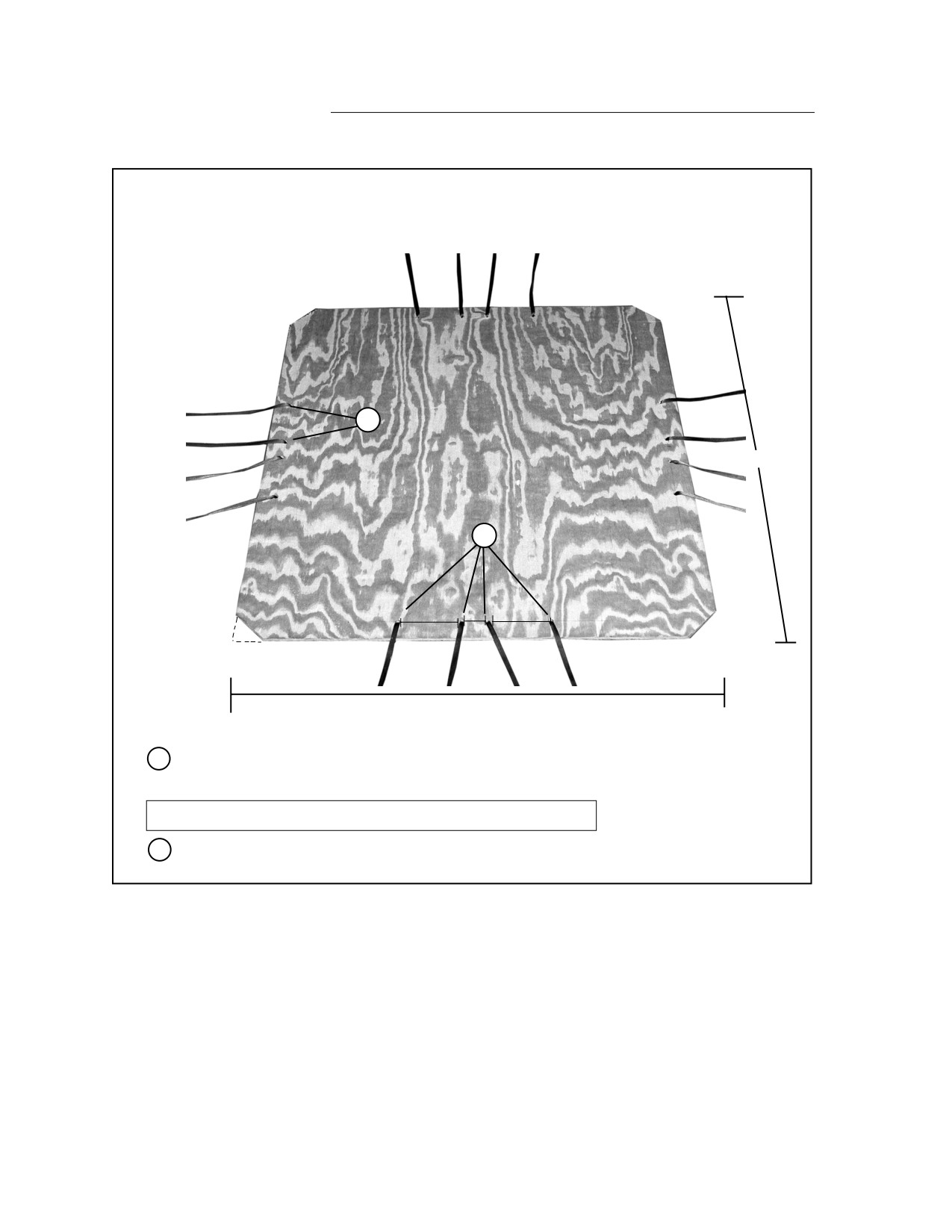
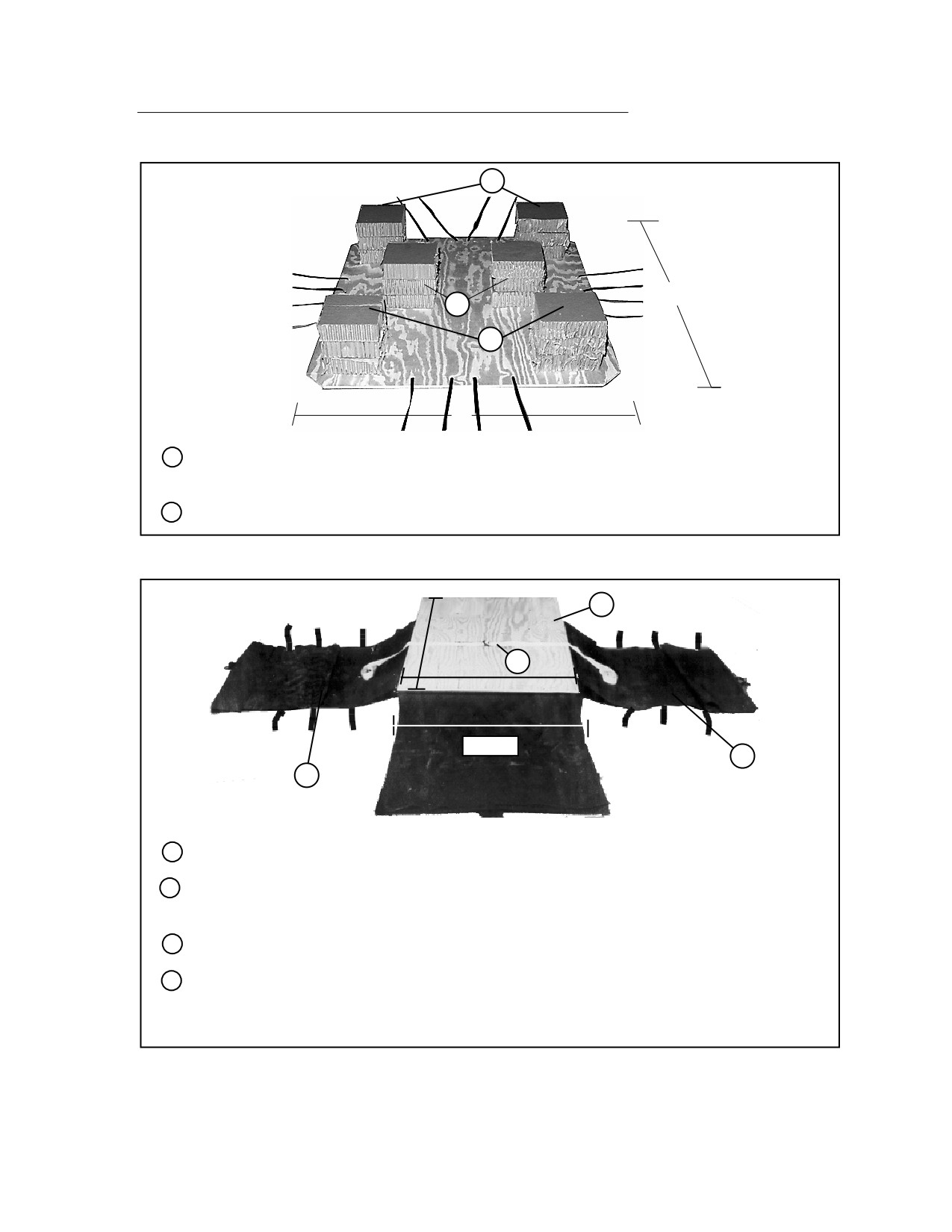
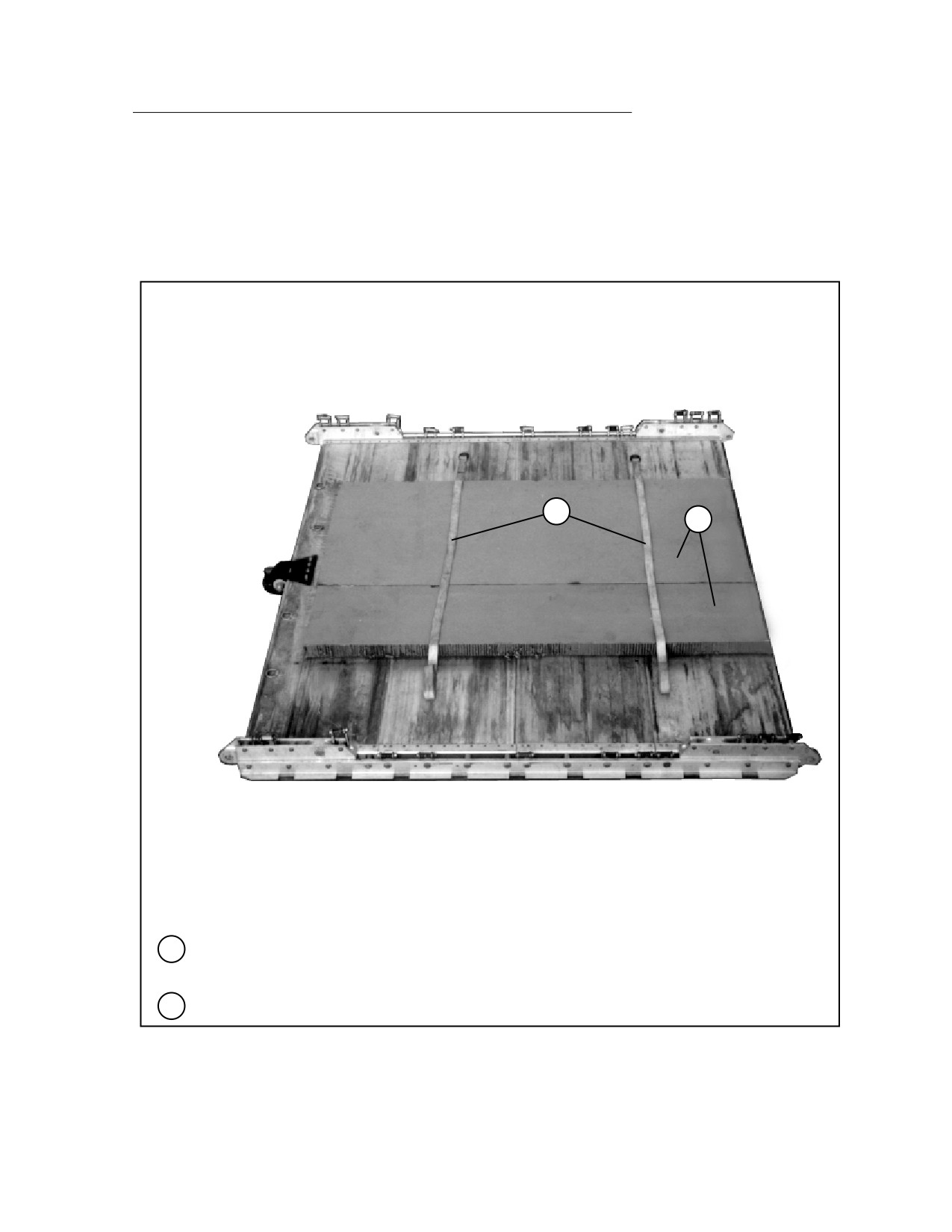
a. Prepare the skid board as shown in Figures 2-1 and 2-2.
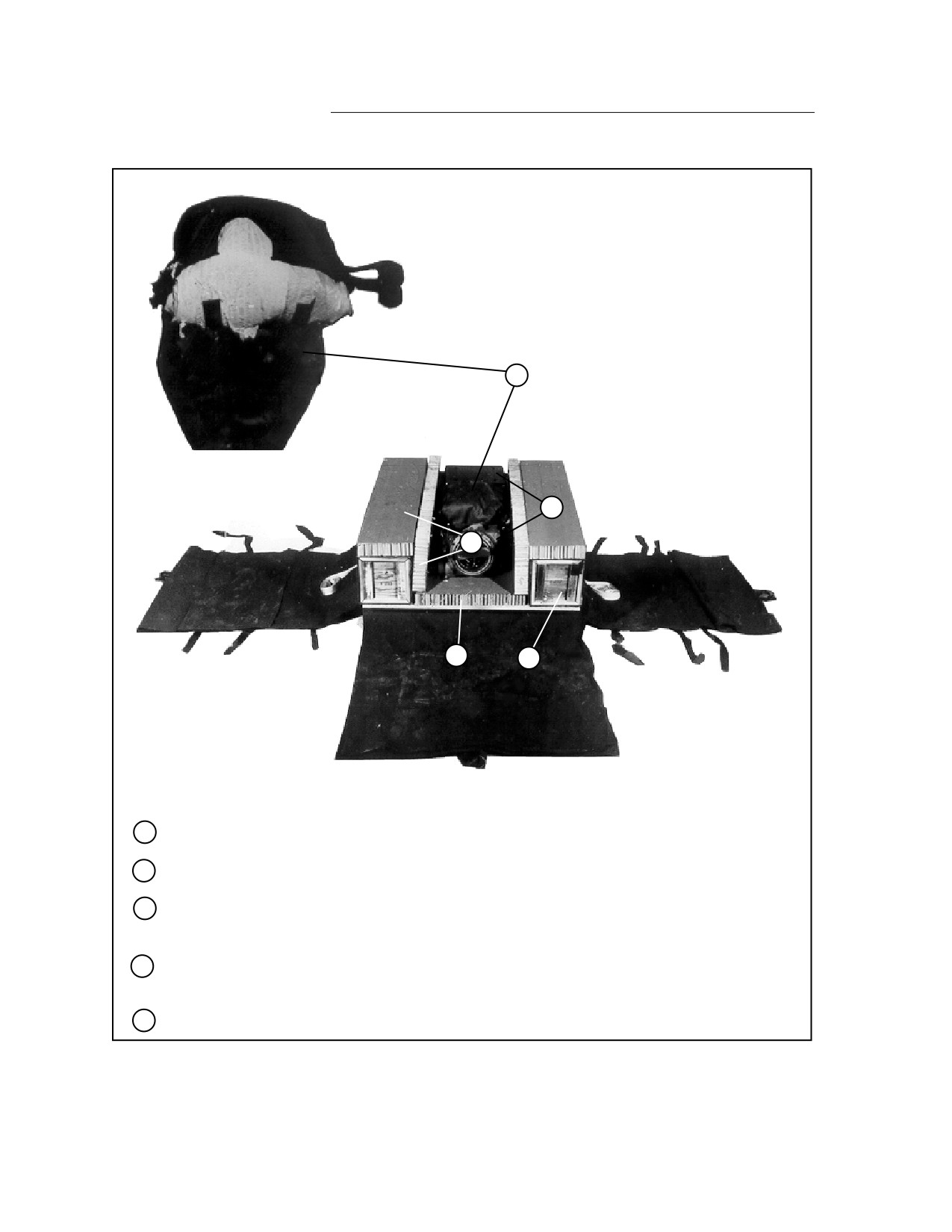
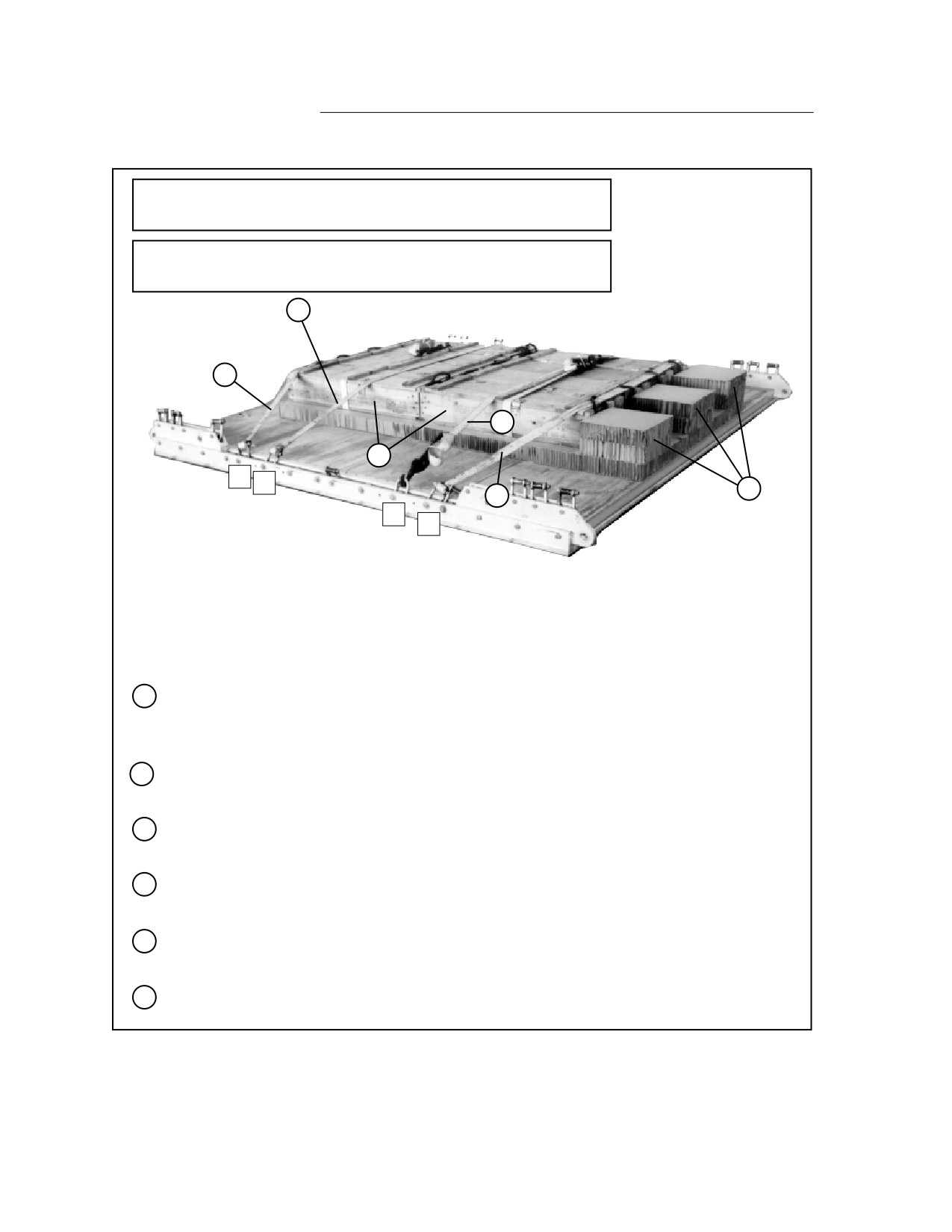
b. Lay out the A-22 cargo bag as shown in Figure 2-3.
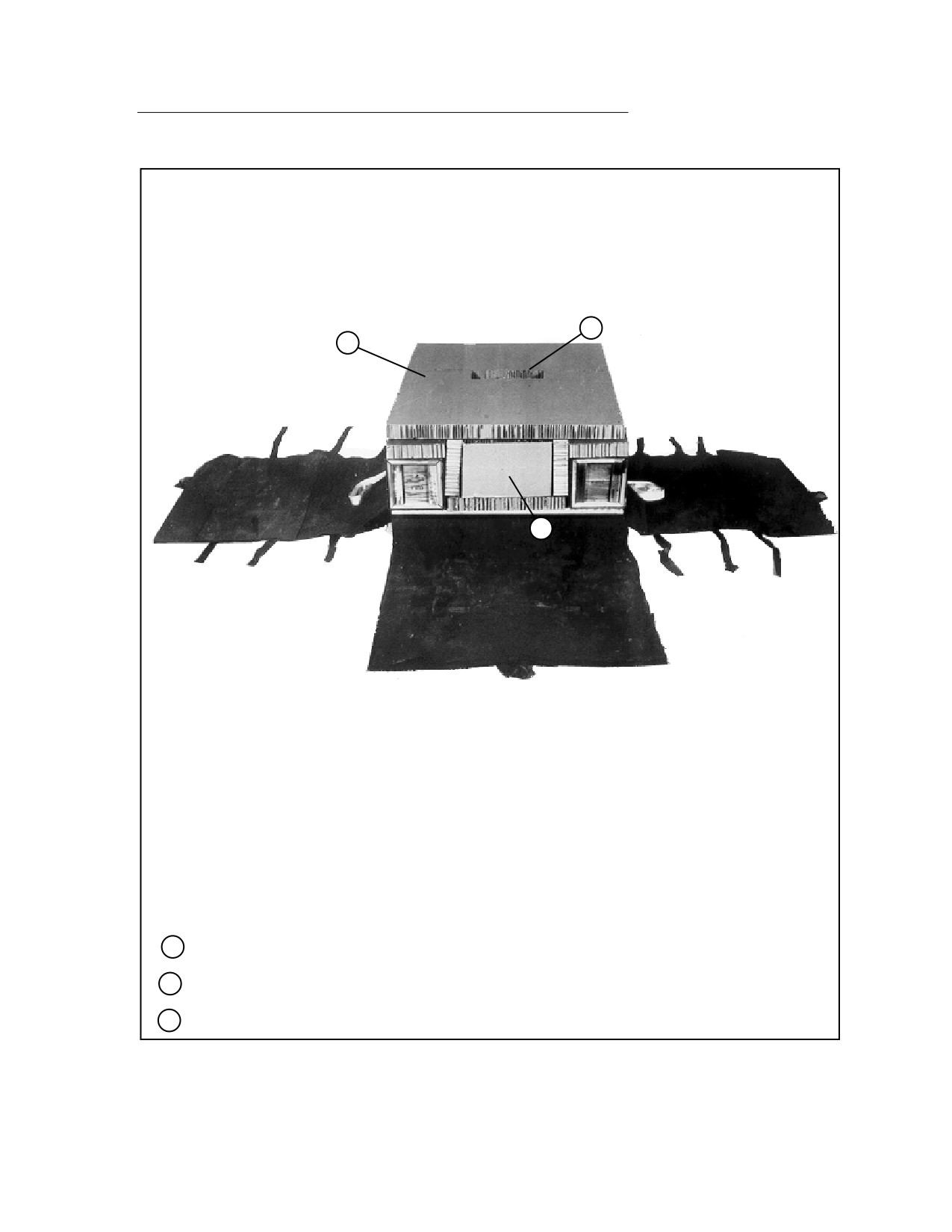
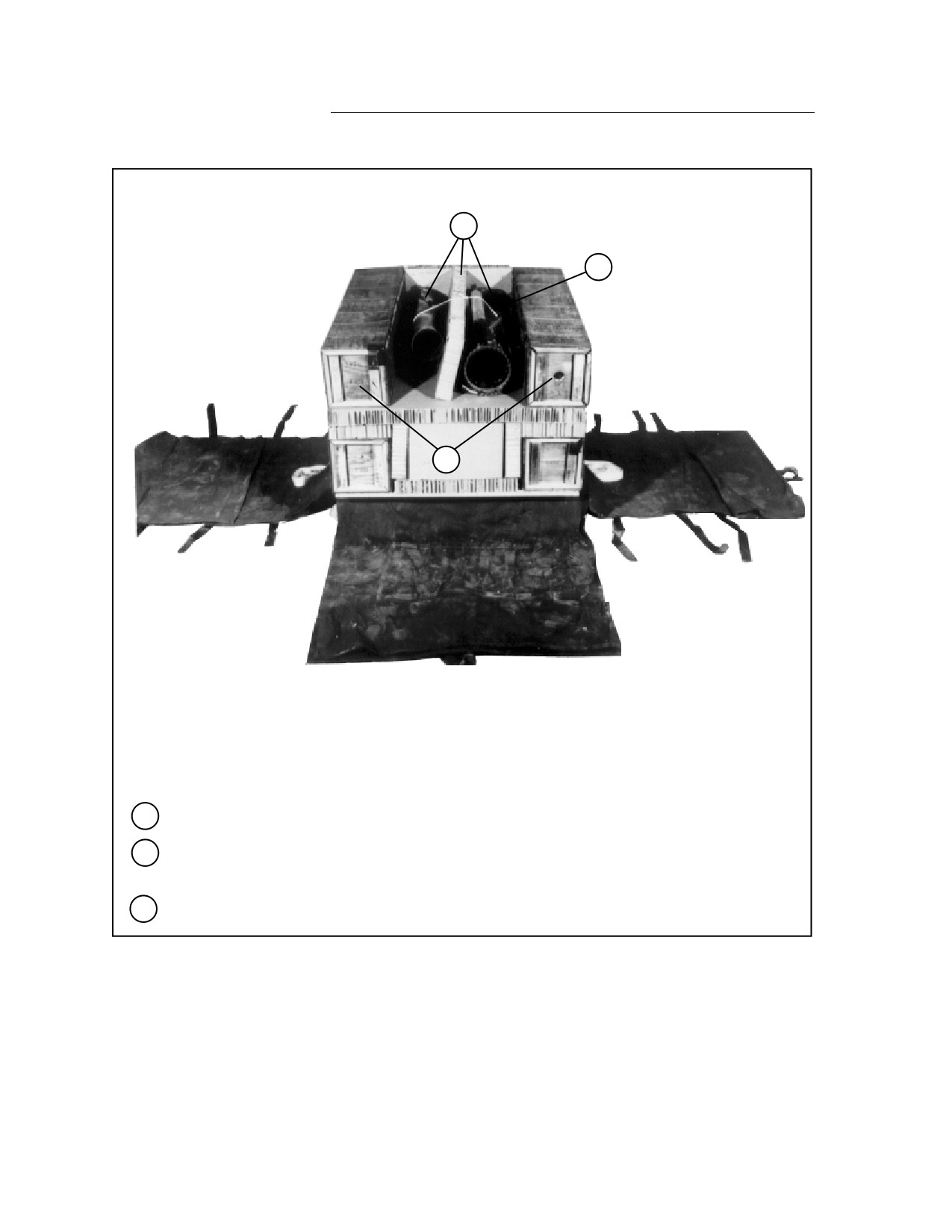
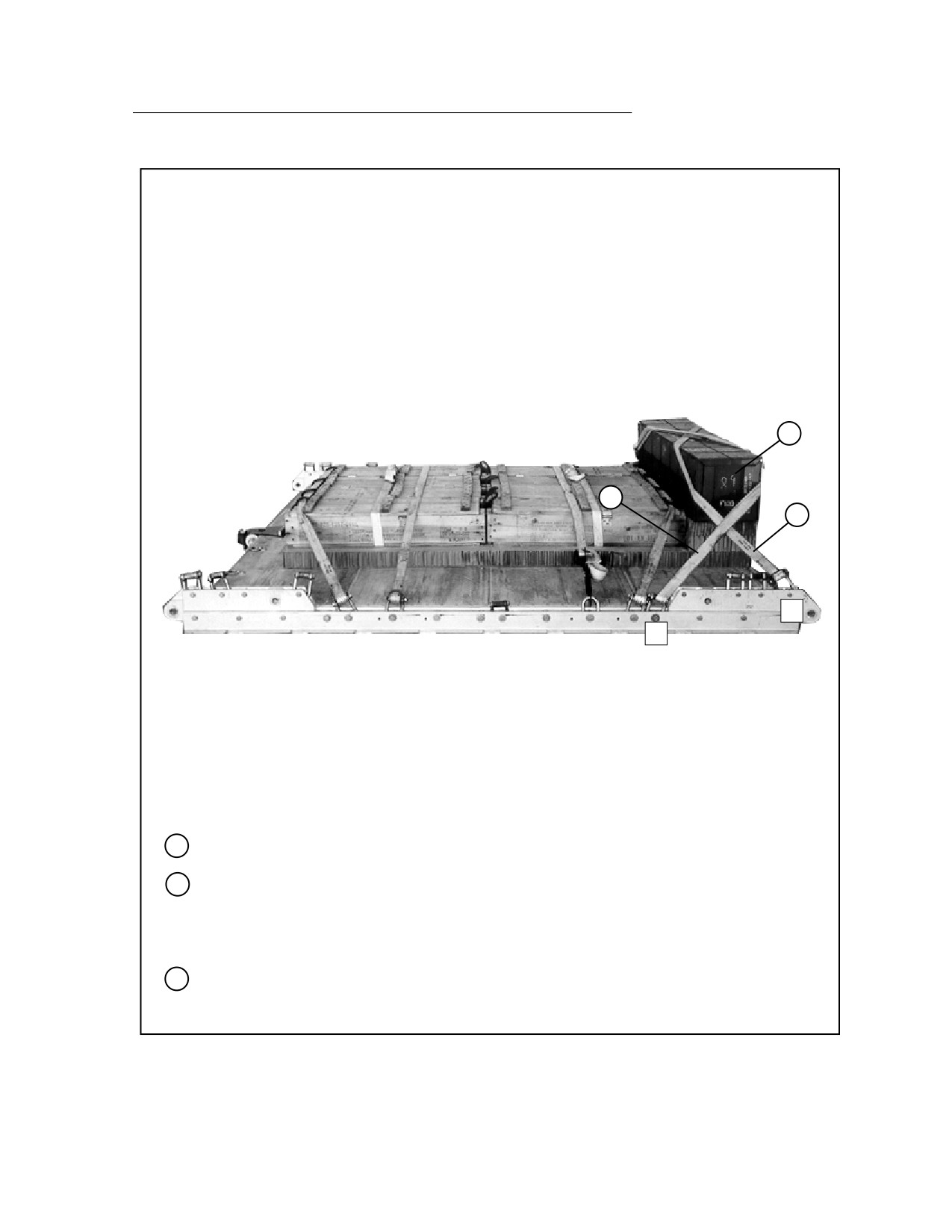
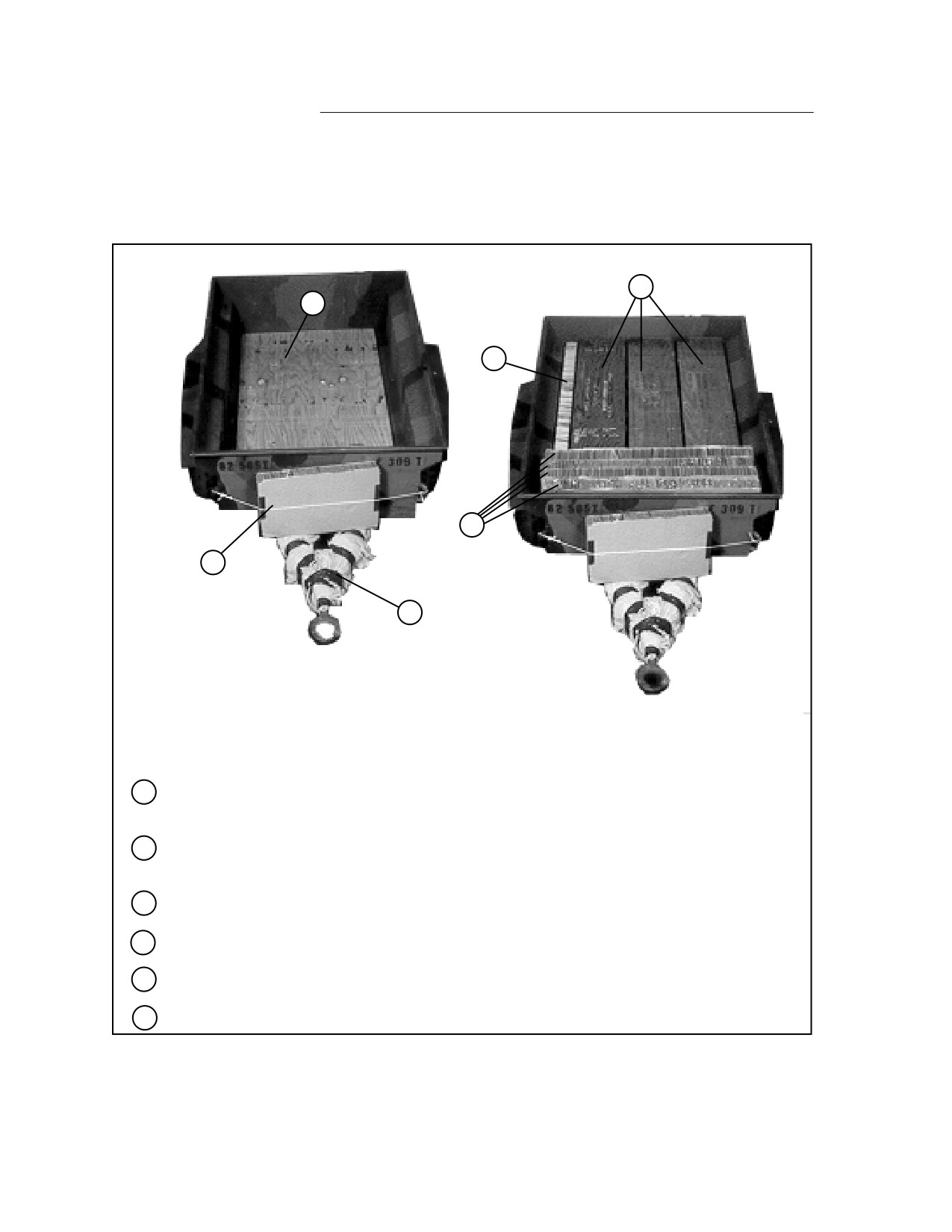
c. Pack the TOW weapon system and missiles as shown in Figures 2-4 through
2-7.
ATTACHING CARGO PARACHUTES
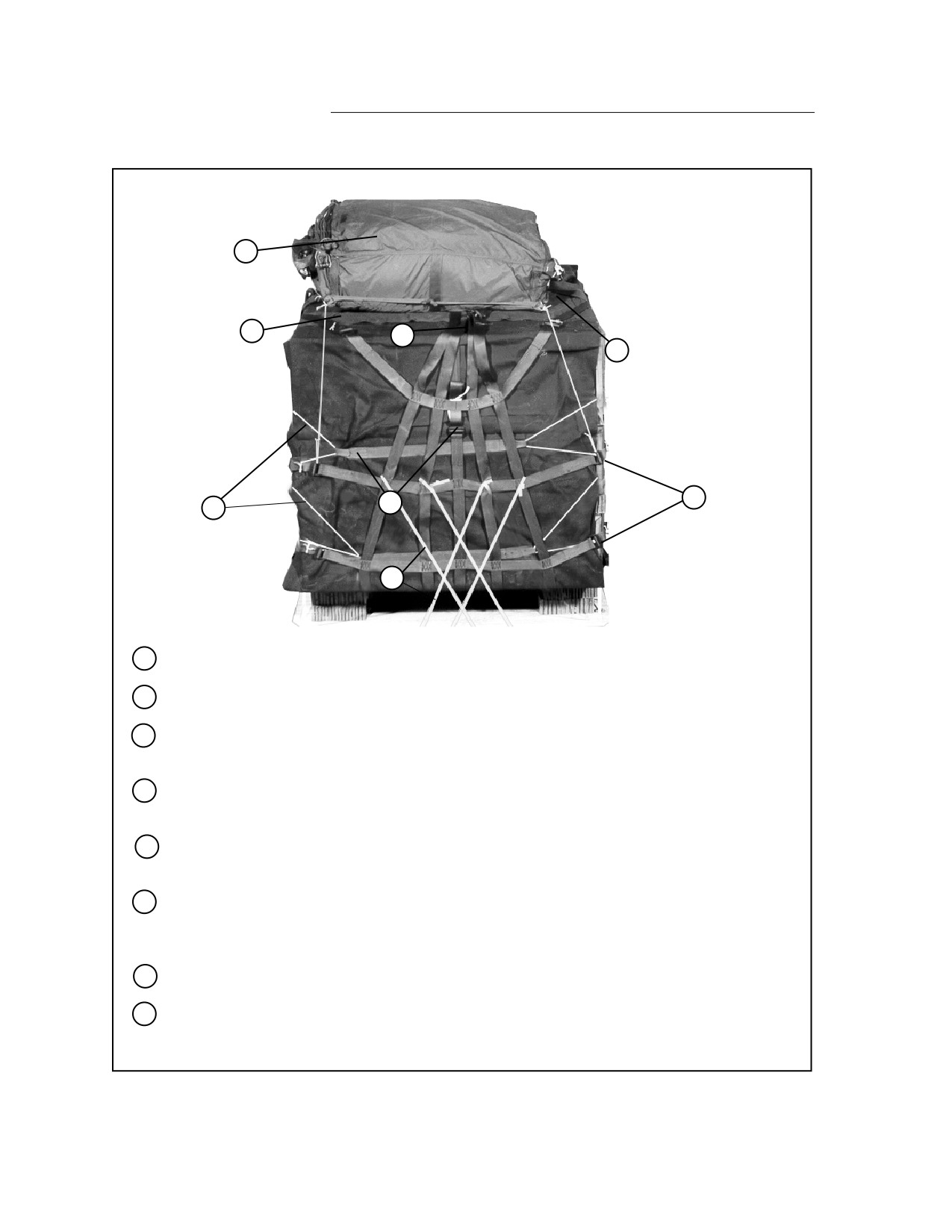
2-3. Prepare and install one G-12E cargo parachute or three G-14 cargo parachutes
to the A-22 cargo bag according to FM 10-500-3/TO 13C7-1-11, and as shown in
Figure 2-8.
2-1
FM 10-500-29/TO 13C7-10-171
2
53 1/2 “
1
3
5
2
5
3
48”
1
Center and drill four 1/2-inch holes two inches on center from each edge of the skid board as
shown. Cut the corners of the skidboard as shown in FM 10-500-3/TO 13C7-1-11.
Note: The distances between holes are measured on center.
2 Install an 8-foot length on 1/2inch tubular nylon webbing through each pair of holes.
Figure 2-1. Skid Prepared
2-2
FM 10-500-29/TO 13C7-10-171
1
53 1/2 “
2
1
48”
1
Make six three-layer stacks of honeycomb from eighteen 9- by 9-inch pieces. Glue the layers
together. Place a stack of honeycomb at each corner of the plywood 3 inches from each edge.
2
Center the two remaining stacks of honeycomb on the plywood 10 inches from each long edge.
Figure 2-2. Honeycomb Positioned on the Skid
3
58”
4
48”
48”
1
2
1
Lay the A-22 sling assembly on the honeycomb stacks.
2
Center the A-22 cover, outside down, on the sling assembly, with the long panel over the long
tie-down strap.
3
Center a 3/4- by 48- by 58-inch piece of plywood on the A-22 cover.
4
Make a 30-foot lashing according to FM 10-500-2/TO 13C7-1-5, and lay it across the plywood.
Figure 2-3. A-22 Cargo bag Prepared for the TOW Missile System
2-3
FM 10-500-29/TO 13C7-10-171
4
5
3
2
1
1
Set two boxed missiles on the plywood, one even with each 58-inch edge.
2
Lay a 24- by 58-inch piece of honeycomb between the missiles.
3
Place a 12- by 58-inch piece of honeycomb on each boxed missile and one against the inside
of each box.
4
Wrap the sight in cellulose wadding and place it in its case, if available (inset above). Lay it on
the honeycomb between the missiles.
5
Set the power pack and sight traversing unit on the honeycomb with the sight.
Figure 2-4. Missiles, Sight Traversing Unit, Sight, and Power Pack Stowed
2-4
FM 10-500-29/TO 13C7-10-171
2
1
3
1
Place a 48- by 58-inch layer of honeycomb on top of the load.
2
Make a 6- by 18-inch cutout in the honeycomb to keep the honeycomb from touching the sight.
3
Place a piece of honeycomb, cut to fit, at each end of the equipment.
Figure 2-5. Honeycomb Placed on Top of the Load
2-5
FM 10-500-29/TO 13C7-10-171
2
3
1
1
Set the two boxed missiles on the honeycomb even with each 58-inch edge.
2
Lay the tripod and launch tube between the missiles. Place a 12- by 52-inch piece of honey-
comb between them.
3
Tie the tripod, launch tube, and honeycomb together with 1/2-inch tubular nylon webbing.
Figure 2-6. Missiles, Tripod, and Launch Tube Stowed
2-6
FM 10-500-29/TO 13C7-10-171
4
3
2
1
1
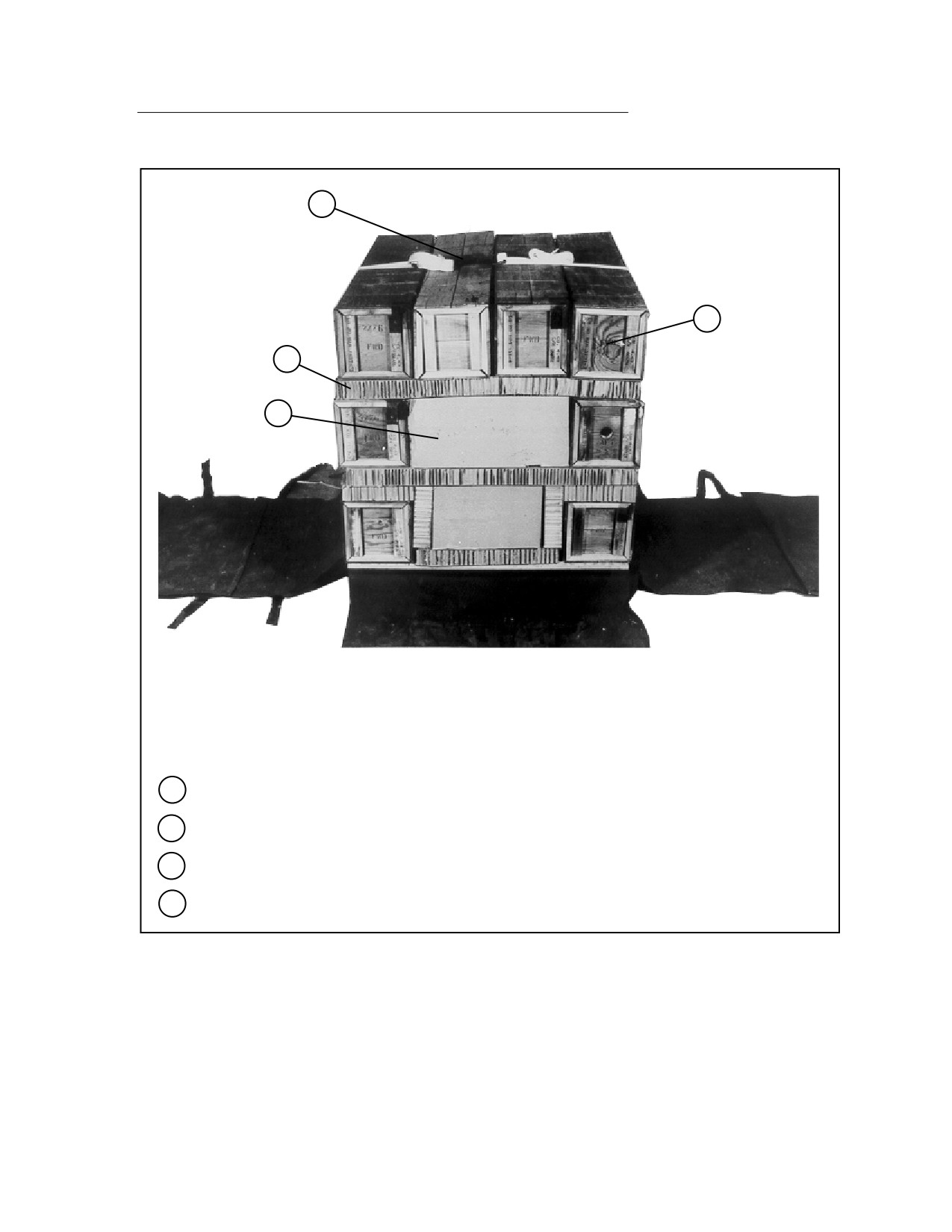
Place a piece of honeycomb, cut to fit, at each end of the equipment.
2
Place a 48- by 58-inch layer of honeycomb on top of the load.
3
Set four boxed missiles on the honeycomb.
4
Bind the load together with the 30-foot lashing, two D-rings, and a load binder.
Figure 2-7. Load Completed and Bound Together
2-7
FM 10-500-29/TO 13C7-10-171
8
1
2
5
4
6
3
7
1
Bring the A-22 cover up over the load, and fold excess material under as necessary.
2
Pass the A-22 tie-down straps up over the load. Fasten and tighten the straps.
3
Lace each corner of the cover through the lacing loops with type III nylon cord to form a figure
eight.
4
Fasten the lateral straps together around the A-22 cover. Pass the upper lateral straps around
the top of the corners.
5
Attach the suspension webs to the D-rings of the support webs with the open side of the snaps
facing inward. Tape the snaps to the D-rings.
6
Adjust all straps to make the sling assembly fit snugly. Pull the suspension webs to their full
height. Adjust the upper lateral straps to prevent binding the upper part of the support web.
Fold all excess straps and tie the folds with type I, 1/4-inch cotton webbing.
7
Make the skidboard ties according to FM 10-500-3/TO 13C7-1-11.
8
Prepare, attach, and safety one G-12E cargo parachute (with a 68-inch pilot parachute), or
three G-14 cargo parachutes to the load according to FM 10-500-3/TO 13C7-1-11.
Figure 2-8. A-22 Cargo Bag Secured and Parachutes Installed
2-8
FM 10-500-29/TO 13C7-10-171
MARKING THE RIGGED LOAD
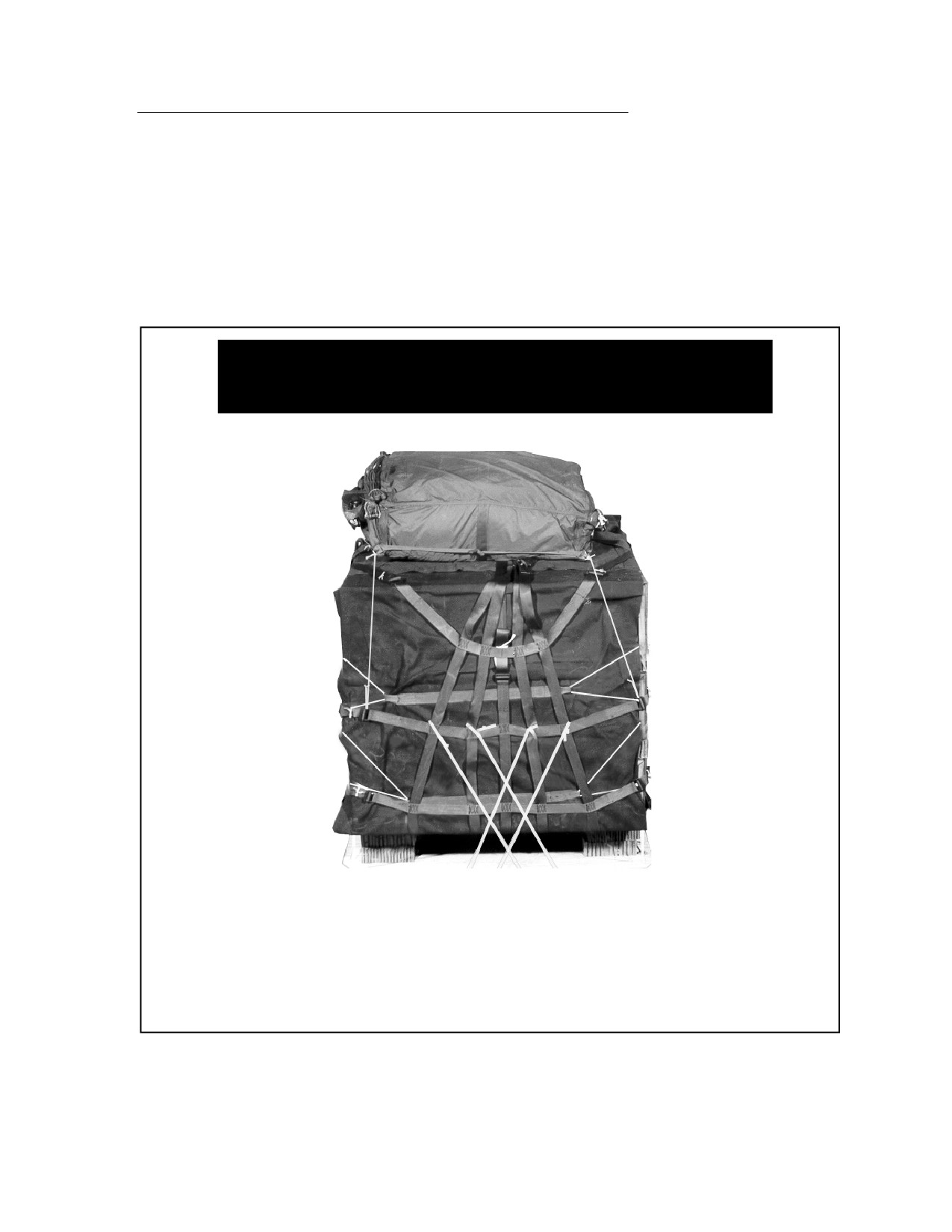
2-4. Mark the rigged load as described in Chapter 1, FM 10-500-3/TO 13C7-1-11,
using the data given in Figure 2-9. Complete the Shipper’s Declaration for Dangerous Goods.
CAUTION
Make the final inspection required by Chapter 1, FM 10-500-3/TO 13C7-1-11
before the load leaves the rigging site.
RIGGED LOAD DATA
Weight
1,217 pounds
Width
48 inches
Height
72 inches
Length
58 inches
Figure 2-9. TOW Weapon System and Missiles Rigged in an A-22 Cargo Bag for Low-velocity
Airdrop
2-9
FM 10-500-29/TO 13C7-10-171
EQUIPMENT REQUIRED
2-5. The equipment required to rig this load is listed in Table 2-1.
Table 2-1. Equipment Required to Rig the TOW Weapon Sysytem and Eight Missiles in A-22
Cargo Bag
National Stock
t
Quantity
Numbe r
8040-00-273-8713
Adhesive, paste, 1-gal
As required
1670-00-587-3421
Bag, cargo, aerial delivery, A-22
1
4020-00-240-2146
Cord, nylon, type III, 550
l
As required
1670-00-753-3928
Pad, energy-dissipating, honeycomb
3she
t
1670-01-065-3751
Parachute, cargo, 64-ft diam, G-12E or
1
1670-00-999-2658
Parachute, cargo, G-14
3
1670-00-216-7297
Parachute, pilot, 68-in diam
1
5530-00-914-51
18
Plywood, 1-in thick
48- by 53 1/2-in
1
48- by 58-in
7510-00-266-5016
T
ape, adhesive, 2-in
As required
8310-00-917-3945
Thread, cotton,
t
As required
1670-00-937-0271
T
ie-down assembly, 15-ft
2
8305-00-268-2411
Webbing, type
I
As required
8305-00-082-5752
Webbing, nylon, tubular, 1/2-in
As required
2-10
FM 10-500-29/TO 13C7-10-171
SECTION II - RIGGING 12 TOW MISSILES IN AN A-22 CARGO BAG
FOR LOW-VELOCITY AIRDROP
DESCRIPTION OF LOAD
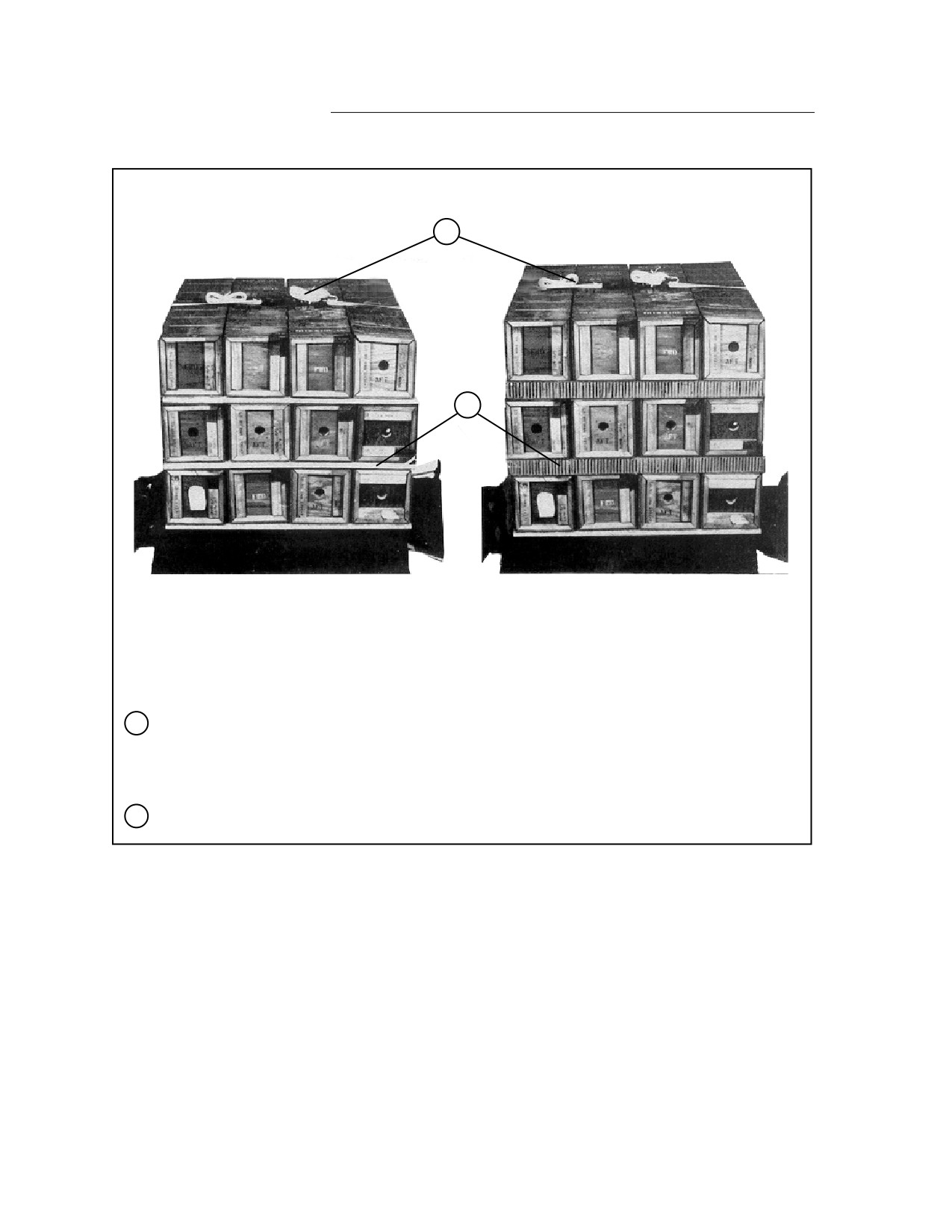
2-6. This load consists of 12 TOW missiles in overpacks. The 12 missiles are rigged
in a standard A-22 cargo bag. The load requires one G-12E or three G-14 cargo
parachutes.
RIGGING A-22 CARGO BAG
2-7. Rig 12 TOW missiles in the A-22 cargo bag as described below.
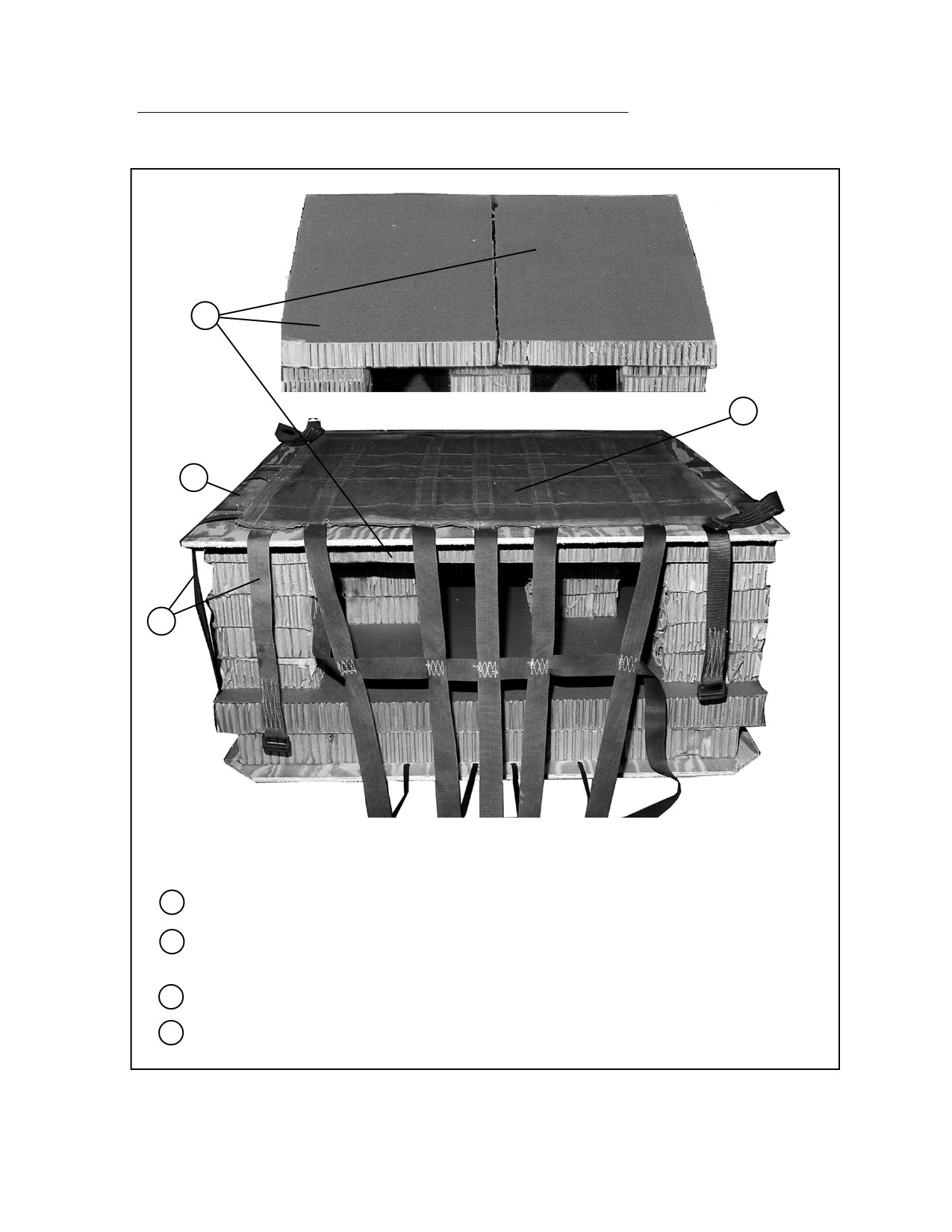
a. Prepare the skid board and A-22 cargo bag as shown in Figures 2-1 and 2-2 of
Section I.
b. Pack the missiles as shown in Figure 2-10.
c. Close and secure the A-22 cargo bag as shown in Figure 2-11.
ATTACHING CARGO PARACHUTES
2-8. Prepare and attach one G-12E cargo parachute or three G-14 cargo parachutes
as shown in Figure 2-11, and according to FM 10-500-3/TO 13C7-1-11.
2-11
FM 10-500-29/TO 13C7-10-171
2
1
1
Place the twelve TOW missiles as shown on the A-22 cargo bag. Place a 48- by 58-inch layer
of 3/4-inch plywood or honeycomb between each layer of missiles. Figure 2-10 shows
both honeycomb and plywood. Do not use both honeycomb and plywood between the
layers in the same A-22 bag.
2
Bind the missiles together with a 30-foot lashing, two D-rings, and a load binder.
Figure 2-10. Twelve TOW Missiles Loaded on the A-22 Cargo Bag
2-12
FM 10-500-29/TO 13C7-10-171
8
5
2
1
6
3
4
7
1
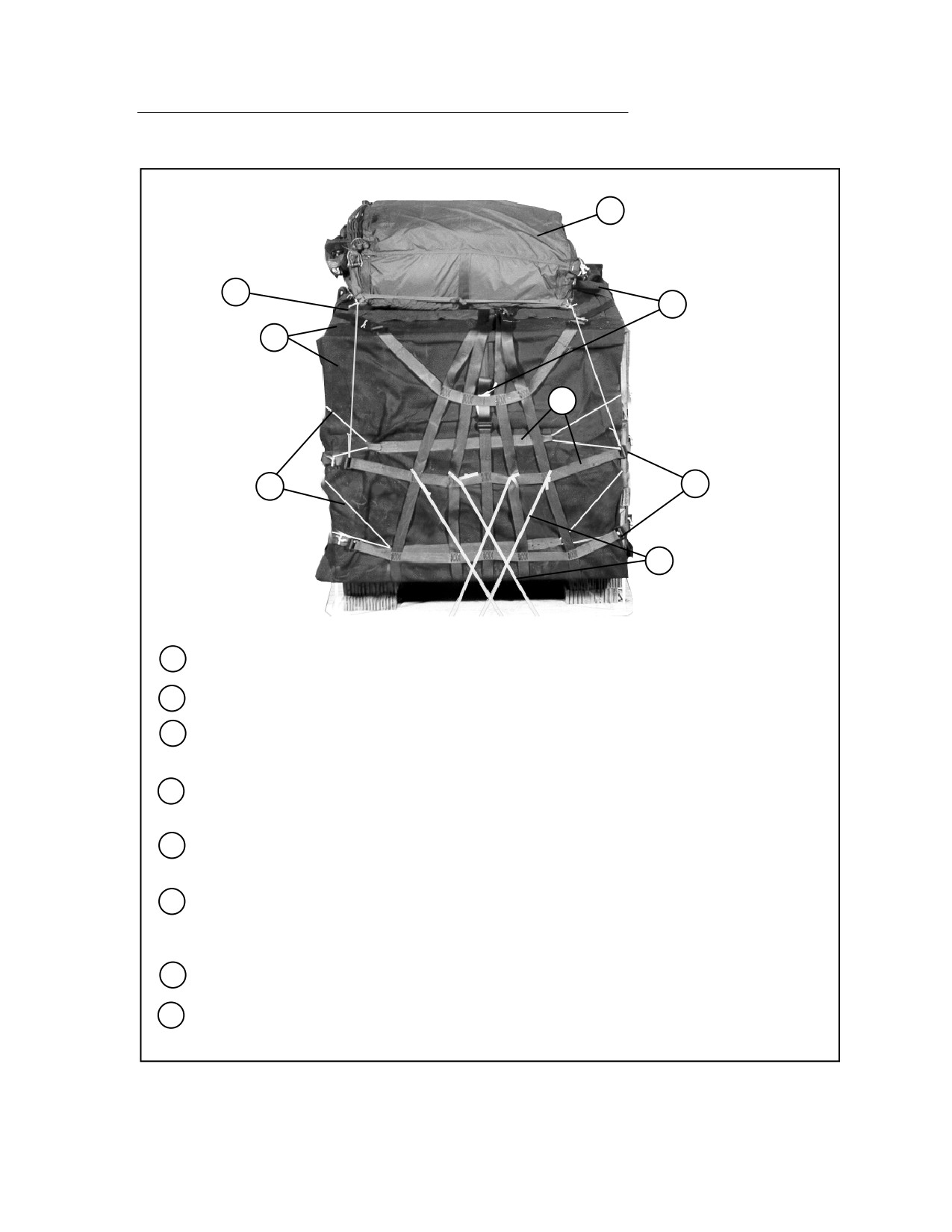
Bring the A-22 cover up over the load, and fold excess material under as necessary.
2
Pass the A-22 tie-down straps up over the load. Fasten and tighten the straps.
3
Lace each corner of the cover through the lacing loops with type III nylon cord to form a figure
eight.
4
Fasten the lateral straps together around the A-22 cover. Pass the upper lateral straps around
the top of the corners.
5
Attach the suspension webs to the D-rings of the support webs with the open side of the
snaps facing inward. Tape the snaps to the D-rings.
6
Adjust all straps to make the sling assembly fit snugly. Pull the suspension webs to their full
height. Adjust the upper lateral straps to prevent binding the upper part of the support web.
Fold all excess straps and tie the folds with type I, 1/4-inch cotton webbing.
7
Make the skidboard ties according to FM 10-500-3/TO 13C7-1-11.
8
Prepare, attach, and safety one G-12E cargo parachute (with a 68-inch pilot parachute), or
three G-14 cargo parachutes to the load according to FM 10-500-3/TO 13C7-1-11.
Figure 2-11. A-22 Cargo Bag Secured
2-13
FM 10-500-29/TO 13C7-10-171
MARKING THE RIGGED LOAD
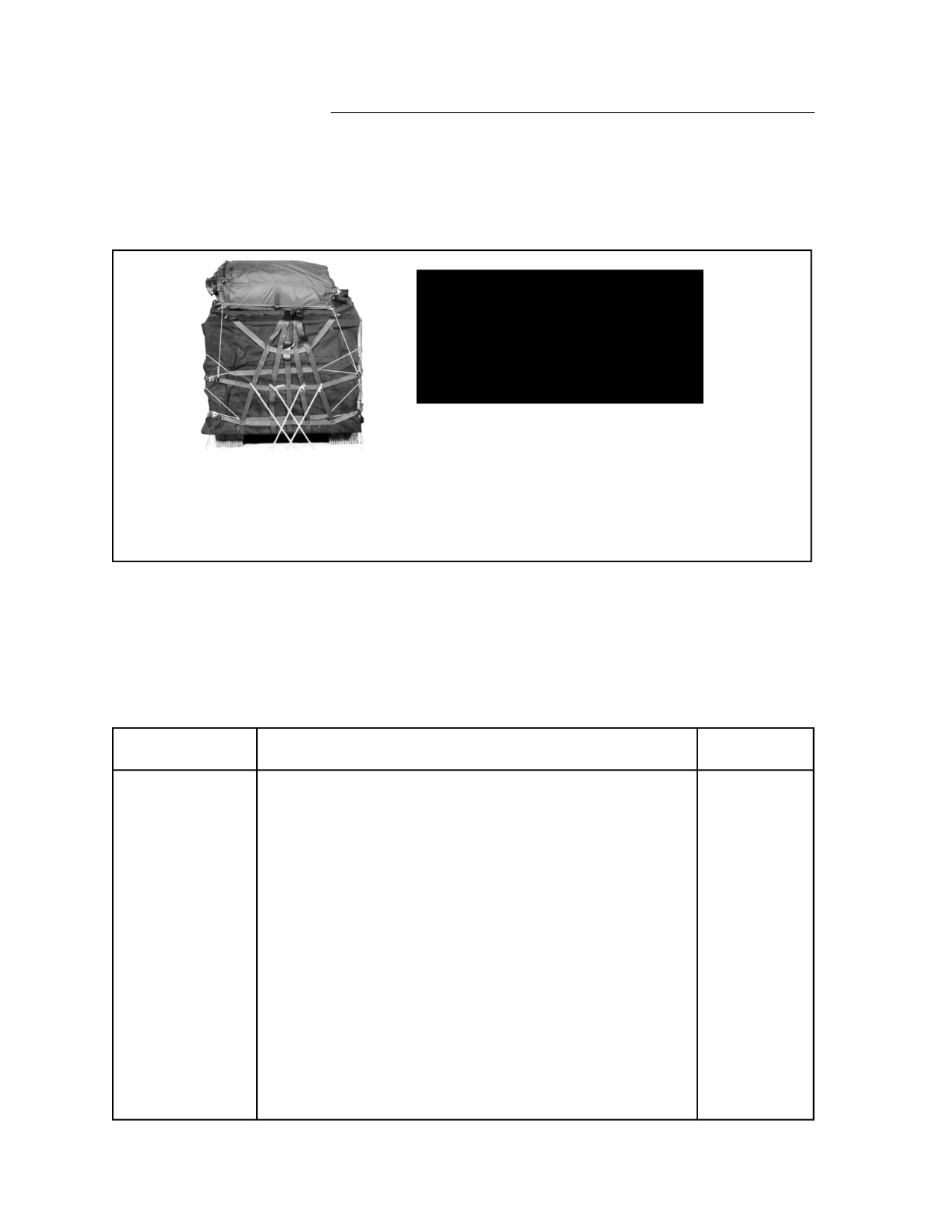
2-9. Mark the rigged load as described in Chapter 1, FM 10-500-3/TO 13C7-1-11.
Complete the Shipper’s Declaration for Dangerous Goods.
CAUTION
Make the rigger inspection
described in Chapter 1, FM 10-500-3/
TO 13C7-1-11 before the load
leaves the rigging site.
RIGGED LOAD DATA
Weight
1,394 pounds
Width
48 inches
Height
69 inches
Length
58 inches
Figure 2-12. Twelve TOW Missiles Rigged in an A-22 Cargo Bag for Low-Velocity Airdrop
EQUIPMENT REQUIRED
2-10. The equipment required to rig this load is listed in Table 2-2.
Table 2-2. Equipment Required to Rig TwelveTOW Missiles in an A-22 Cargo Bag for Low-velocity
Airdrop
National Stock
t
Quantity
Number
8040-00-273-8713
Adhesive, paste, 1-gal
As required
1670-00-587-3421
Bag, cargo, aerial delivery, A-22
1
4020-00-240-2146
Cord, nylon, typeII, 550
l
As required
1670-00-753-3928
Pad, energy-dissipating, honeycomb
2she
t
1670-01-065-3751
Parachute, cargo, 64-ft diam, G-12E or
1
1670-00-999-2658
Parachute, cargo, G-14
3
1670-00-216-7297
Parachute, pilot, 68-in diam
1
5530-00-914-5118
Plywood, 1-by 48- by 53 1/2-in
1
5530-00-128-4981
Plywood, 3/4- by 48- by 58-in (add
t
used)
7510-00-266-5016
Tape, adhesive, 2-in
As required
8310-00-917-3945
Thread, cotton,
t
As required
1670-00-937-0271
Tie-down assembly, 15-ft
2
8305-00-268-2411
Webbing, type
I
As required
8305-00-082-5752
Webbing, nylon, tubular, 1/2-in
As required
2-14
FM 10-500-29/TO 13C7-10-171
SECTION III - RIGGING 12 MISSILE OVERPACKS IN AN A-22 CARGO
BAG FOR HIGH-VELOCITY AIRDROP
DESCRIPTION OF LOAD
2-11. This load consists of 12 TOW missiles in overpacks. The 12 missiles are rigged
in a standard A-22 cargo bag. The load requires one 26-foot, high-velocity cargo
parachute.
RIGGING A-22 CARGO BAG
2-12. Rig the A-22 cargo bag as described below.
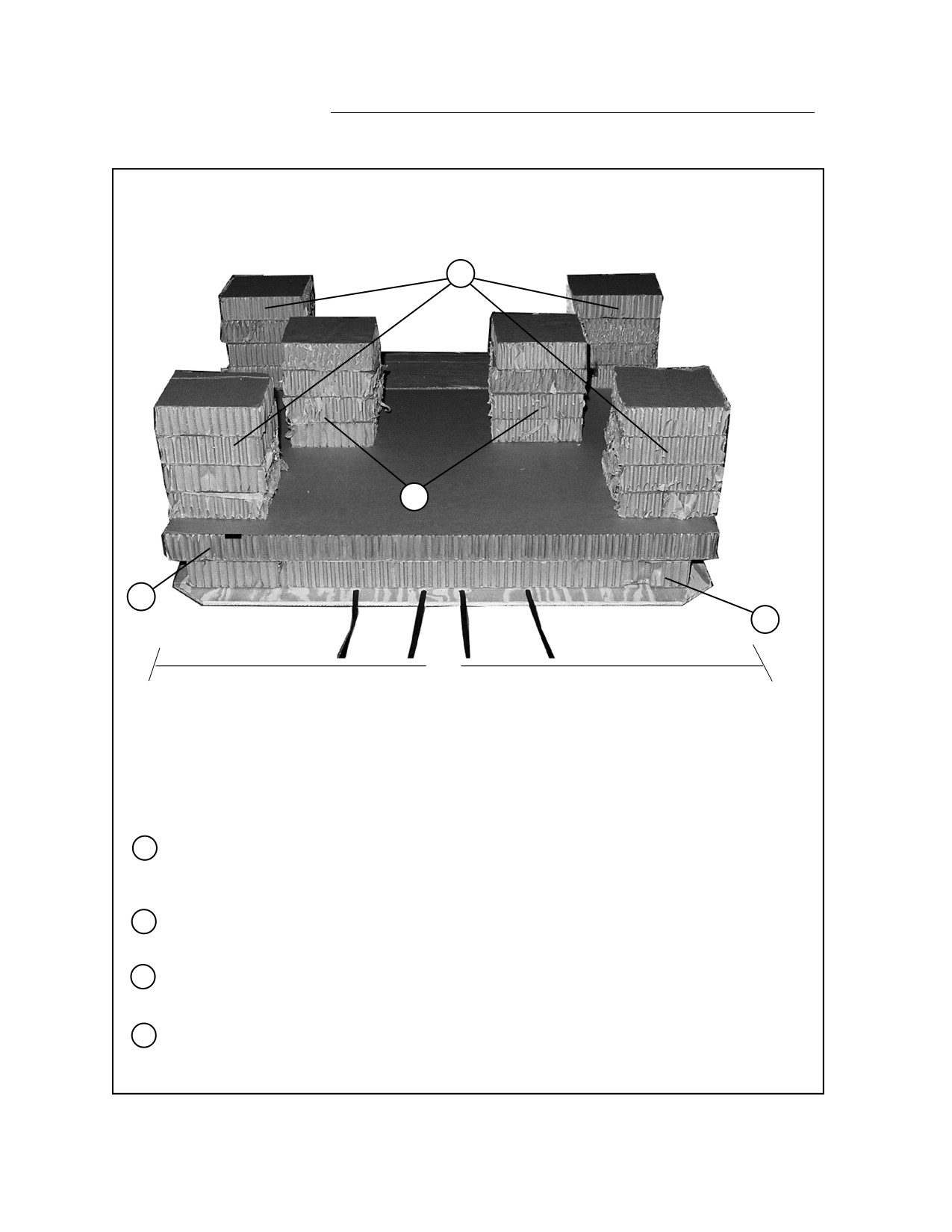
a. Prepare the skid and honeycomb as shown in Figure 2-13.
b. Position and secure the missiles as shown in Figure 2-14.
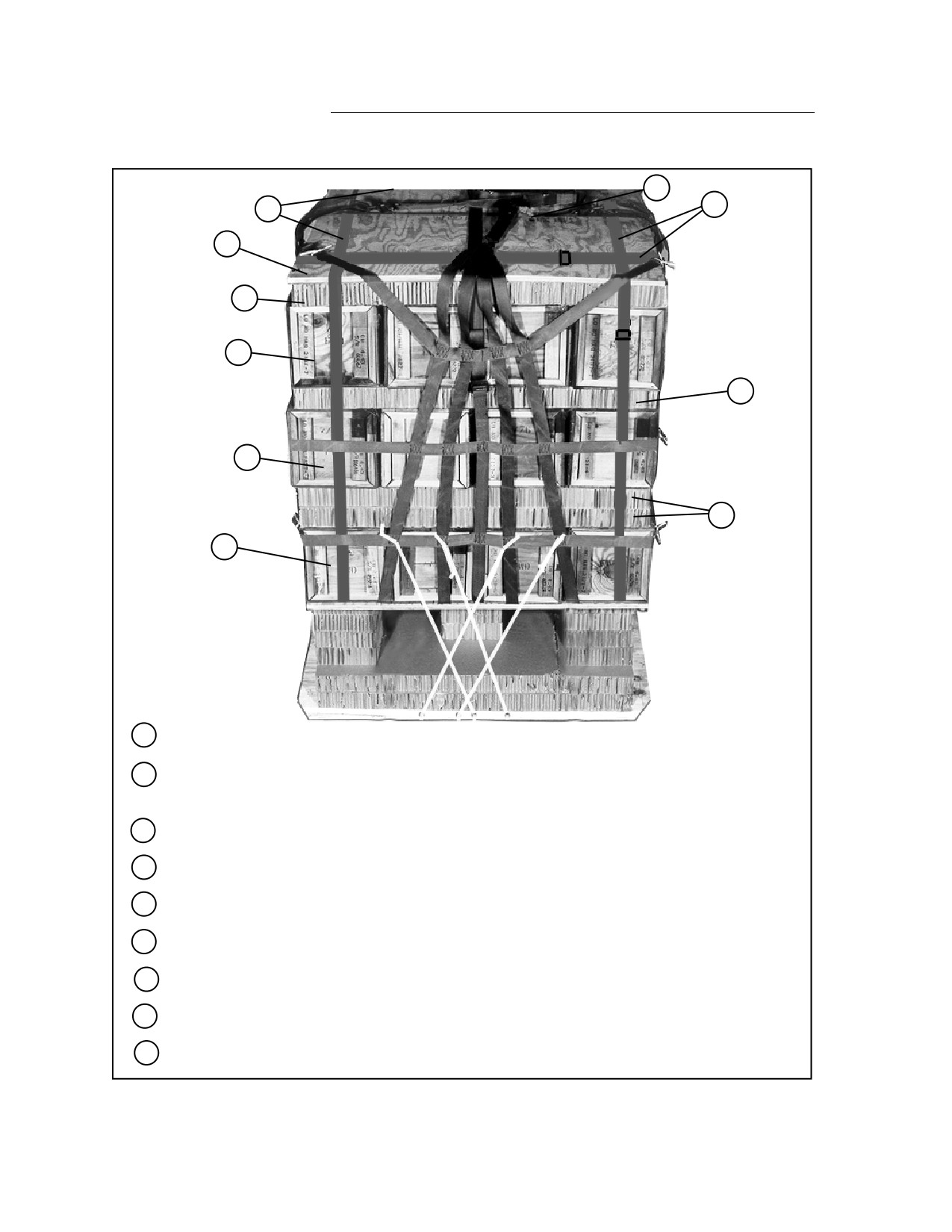
c. Finish rigging the A-22 cargo bag as shown in Figure 2-15 and according to
FM 10-500-3/TO 13C7-1-11.
ATTACHING CARGO PARACHUTE
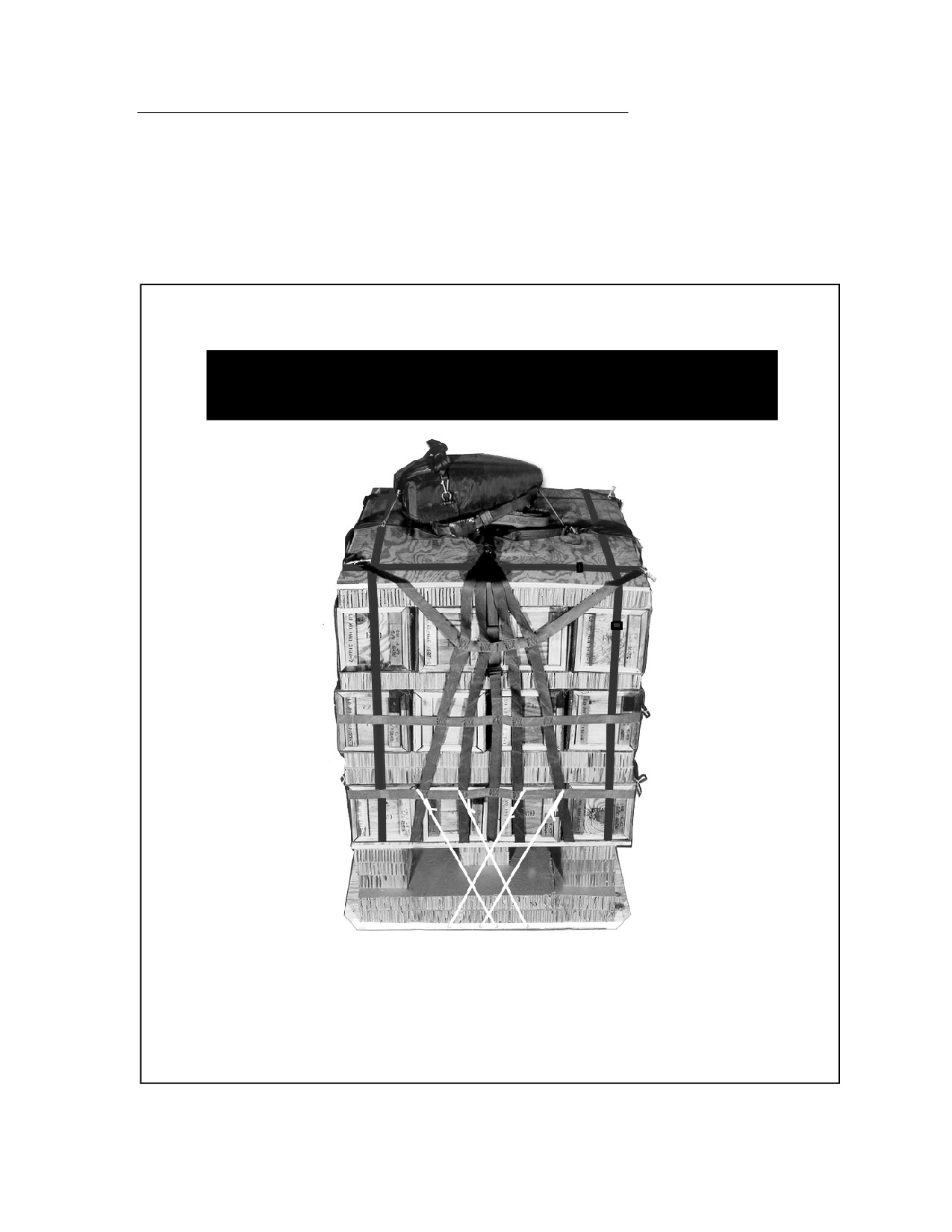
2-13. Prepare and attach one 26-foot, high-velocity cargo parachute as shown in
Figure 2-16, and according to FM 10-500-3/TO 13C7-1-11.
2-15
FM 10-500-29/TO 13C7-10-171
3
4
2
1
48”
FRONT
1
Use one 8- by 48-inch and one 36- by 48-inch piece of honeycomb to form a layer of 44- by 48-
inch honeycomb. Center the honeycomb on the skidboard with the 44-inch edges along the 48-
inch sides of the skidboard.
2
Use one 12- by 48-inch and one 36- by 48-inch piece of honeycomb to form a layer of 48-
by 48-inch honeycomb. Center and glue this layer on the layer made in step 1 above.
3
Glue four 9- by 9-inch pieces of honeycomb together to make each of six stacks. Glue four of
these stacks three inches from the ends, and flush with the left and right sides of the base.
4
Center two 9- by 9-inch stacks along the left and right sides, 10 inches from the left and right
edges of the base.
Figure 2-13. Skid and Honeycomb Prepared
2-16
FM 10-500-29/TO 13C7-10-171
5
8
6
7
5
Center and glue two 24- by 48-inch pieces of honeycomb on top of the 9- by 9-inch stacks.
6
Center a 3/4- by 48- by 58-inch piece of plywood on top of the honeycomb. Place the the 58-
inch side of the plywood parallel to the 53 1/2-inch side of the skid board.
7
Lay an A-7A strap along each side of the plywood, 6 inches from each edge.
8
Set the sling assembly on the plywood and the A-7A straps.
Figure 2-14. Skid and Honeycomb Prepared (Continued)
2-17
FM 10-500-29/TO 13C7-10-171
9
8
8
7
6
5
4
3
2
1
1
Place four missiles on the scuff pad.
2
Place two layers of honeycomb on the missiles. Use a 36- by 48-inch and a 22- by 48-inch
piece of honeycomb to form each layer.
3
Place four missiles on the layers of honeycomb.
4
Place one 48- by 58-inch layer of honeycomb on the missiles.
5
Place four missiles on the layer of honeycomb.
6
Place one 48- by 58-inch layer of honeycomb over the missiles.
7
Place a 48- by 58-inch piece of plywood on top of the load.
8
Secure the four A-7A straps from under the scuff pad on top of the load.
9
Close the A-22 cargo bag according to FM 10-500-3/TO 13C7-1-11.
Figure 2-15. Missiles Positioned and Secured
2-18
FM 10-500-29/TO 13C7-10-171
MARKING THE RIGGED LOAD
2-14. Mark the rigged load as described in Chapter 1, FM 10-500-3/TO 13C7-1-11,
using the data given in Figure 2-16. Complete the Shipper’s Declaration for Dangerous Goods.
CAUTION
Make the final inspection required by Chapter 1, FM 10-500-3/TO 13C7-1-11
before the load leaves the rigging site.
RIGGED LOAD DATA
Weight
1,359 pounds
Width
48 inches
Height
83 inches
Length
58 inches
Figure 2-16. Twelve TOW Missiles Rigged in an A-22 Cargo Bag for High-Velocity Airdrop
2-19
FM 10-500-29/TO 13C7-10-171
EQUIPMENT REQUIRED
2-15. The equipment required to rig this load is listed in Table 2-3.
Table 2-3. Equipment required to Rig Twelve TOW Missiles in Overpacks in an A-22 Cargo Bag for
High-Velocity Airdrop
National Stock
t
Quantity
Number
80400027
-
Adhesive, paste, 1-gal
Asrequired
16700058
-
Bag, cargo, aerial delivery, A-22
1
16700075
-
Pad, energy-dissipating, honeycomb
5she
t
16700087
-
Parachute, cargo, high-velocity, 26-ft
1
5530 00 914 51
18
Plywood,1by48-by531/2-
i
1
55300012
-
Plywood,3/4by48-by58-
i
2
16700
-
Strap, A-7A
4
75100026
-
T
ape, adhesive, 2-in
Asrequired
83100091
-
Thread, cotton,
t
Asrequired
8305002682
1
Webbing, type
I
Asrequired
83050008
-
Webbing, nylon, tub
l
Asrequired
2-20
FM 10-500-29/TO 13C7-10-171
Chapter 3
Rigging TOW Missiles in 1/4-ton Cargo Trailer
for Low-velocity Airdrop
DESCRIPTION OF LOAD
3-1.The M416, 1/4-ton cargo trailer with eight boxed missiles is rigged on an 8-foot,
type V airdrop platform for low-velocity airdrop. The load requires one G-11 cargo
parachute. Each missile in its box weighs 87 pounds, and is 57 1/2 inches long, 12
inches high and 12 inches wide. The M416 with missiles weighs 1170 pounds. It
is 109 inches long, 61 inches wide, and 44 inches high. The accompanying load
consists of eight boxes of 105-millimeter ammunition. It weighs 588 pounds.
PREPARING PLATFORM
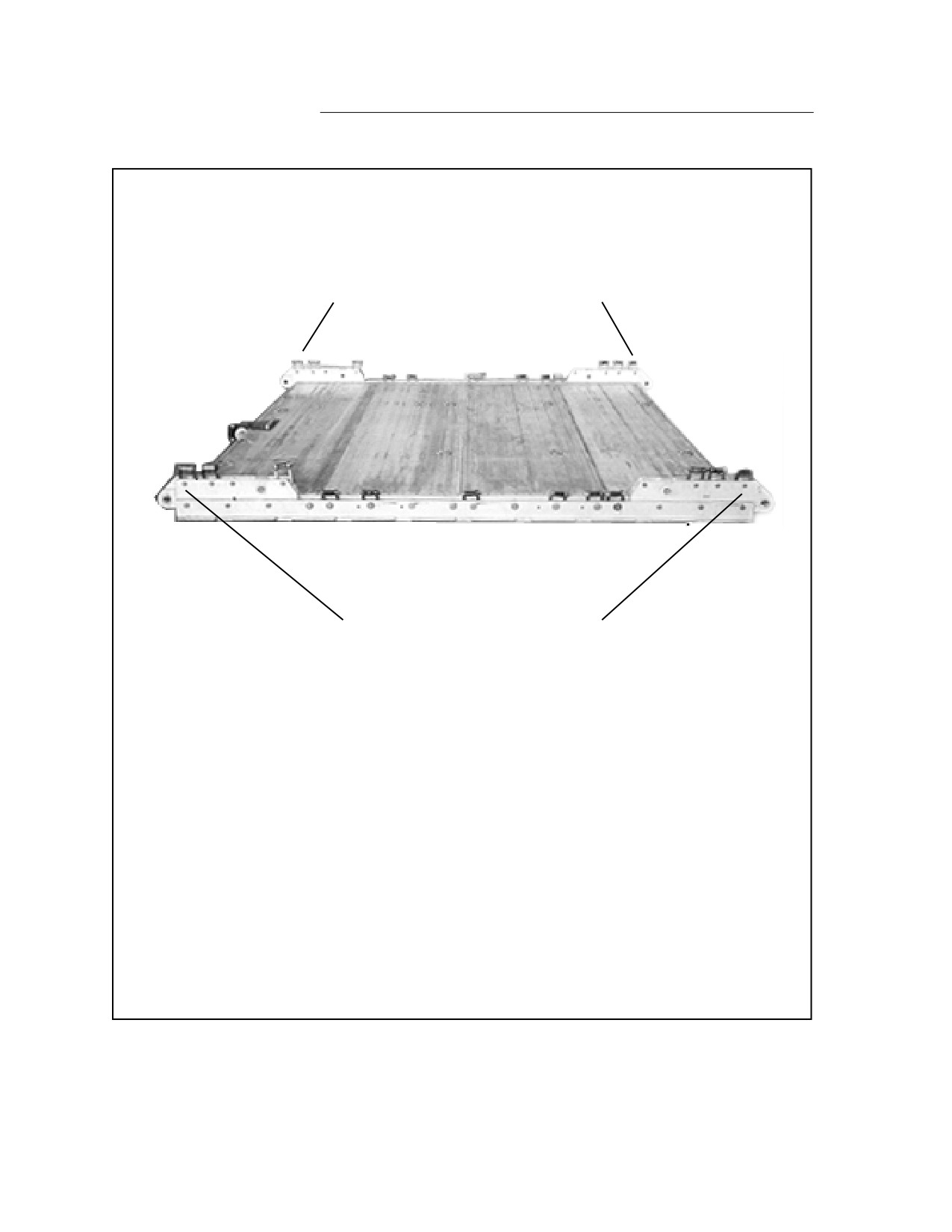
3-2. Prepare an 8-foot, type V airdrop platform as shown in Figure 3-1.
a. Inspecting Platform. Inspect, or, assemble and inspect, the platform
according to TM 10-1670-268-20&P/TO 13C7-52-22.
b. Installing Tandem Links. Install tandem links as shown in Figure 3-1.
c. Attaching and Numbering Clevises. Attach and number 24 clevis
assemblies as shown in Figure 3-1.
NOTES:
1. The nose bumper may or may not be installed.
2. Measurements given in this load are from the front edge of the platform,
NOT from the front edge of the nose bumper.
3-1
FM 10-500-29/TO 13C7-10-171
CLEVISES 12A THROUGH 1A
LEFT
REAR
FRONT
RIGHT
CLEVISES 12 THROUGH 1
Step:
1.
Install a tandem link to the front of each platform side rail using holes 1, 2, and 3.
2.
Install a tandem link to the rear of each platform side rail using holes 14, 15, and 16.
3.
Install a clevis on bushings 1, 2 and 3 on each front tandem link.
4.
Install a clevis on bushings 1, 3, and 4 on each rear tandem link.
5.
Starting at the front of each platform side rail, install clevises on the bushings bolted
on holes 4, 5, 6, 8, 11, and 12.
6.
Starting at the front of the platform, number the clevises 1 through 12 on the right side
and 1A through 12A on the left side.
Figure 3-1. Platform Prepared
3-2
FM 10-500-29/TO 13C7-10-171
Stowing Accompanying Load
3-3. Place the honeycomb and stow the accompanying load as shown in Figure 3-
2.
2
1
1
Position one piece of 18- by 86-inch honeycomb and one piece of 36- by 86-inch honeycomb
side- by side to form one layer on the front edge of the platform.
2
Position two 15-foot lashings on the honeycomb as shown for use as binding lashings.
Figure 3-2. Accompanying Load Stowed
3-3
FM 10-500-29/TO 13C7-10-171
Note: Other boxed ammunition may be used for this load.
Adapt the honeycomb and lashings for the ammunition rigged.
Notice of Exception: Exception to FM 10-500-2/TO 13C7-1-5 is
granted to rig ammunition on one layer of honeycomb.
7
6
5
3
9
8
8
4
6
5
3
Position eight boxes on the honeycomb as shown so that the four rearmost boxes are flush
with the rear edge of the honeycomb. Secure the binding lashings placed in step 2 around the
boxes.
4
Run a 15-foot lashing through clevis 5 and through its own D-ring. Bring the lashing through
the front box carrying handles and fasten it to clevis 5A with a D-ring and a load binder.
5
Run a 15-foot lashing through clevis 6A and through its own D-ring. Bring the lashing over the
top of the front boxes and fasten it to clevis 6 with a D-ring and a load binder.
6
Run a 15-foot lashing through clevis 9 and through its own D-ring. Bring the lashing through
the rear box carrying handles and fasten it to clevis 9A with a D-ring and a load binder.
7
Run a 15-foot lashing through clevis 8 and through its own D-ring. Bring the lashing over the
top of the rear boxes and fasten it to clevis 8A with a D-ring and a load binder.
8
Evenly space and glue three two-layer stacks of 12- by 12-inch honeycomb to the front edge
of the base honeycomb.
Figure 3-2. Accompanying Load Stowed (continued)
3-4
FM 10-500-29/TO 13C7-10-171
9
10
11
1
4
9
Center one boxed TOW missile on the 12- by 12-inch stacks of honeycomb.
10 Center the D-rings of a 30-foot lashing on top of the box. Run a free end of the lashing through
clevis 4, around the front of the box, over the center of the box, and around the back of the box
to clevis 1A. Run the other free end of the lashing through clevis 1A. Secure the ends of the
lashing with two D-rings and a load binder on the left side .
11 Run a 15-foot lashing through clevis 1 and through its own D-ring, around the rear of the box,
over the center of the box,and around the front of the box to clevis 4A. Fasten the lashing to
clevis 4A with a D-ring and a load binder.
Figure 3-2. Accompanying Load Stowed (continued)
3-5
FM 10-500-29/TO 13C7-10-171
Preparing Missiles and Trailer
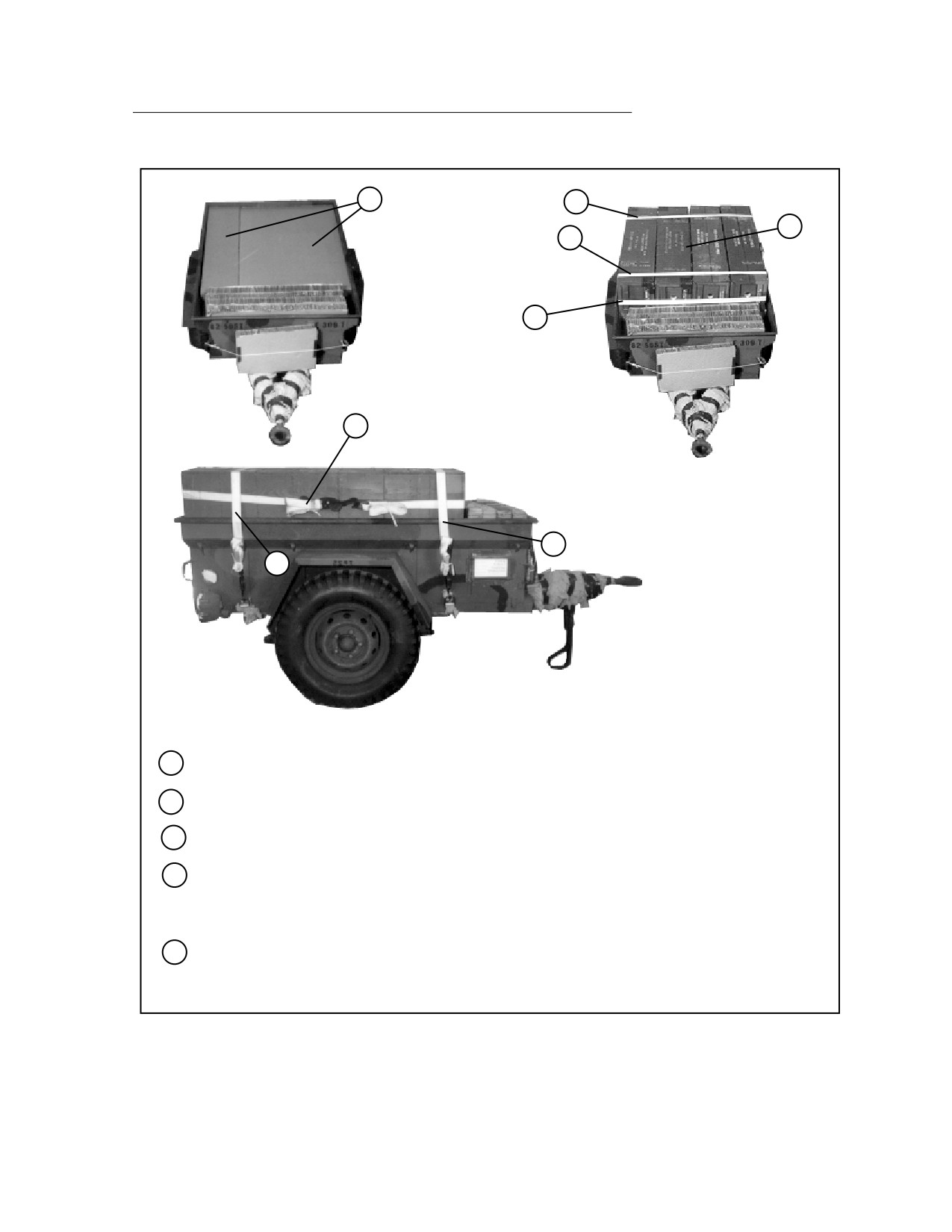
3-4. Prepare the missiles and trailer as shown in Figure 3-3.
4
3
5
6
1
2
1
Tie the hand brake in the unlocked position with type III nylon cord. Cover the brake with a 14-
by 24-inch piece of honeycomb, and tie it in place with type III nylon cord.
2
Fold the intervehicular cable. Tie the cable and chains to the drawbar with type III nylon cord.
Pad the drawbar with cellulose wadding, and tape the wadding in place.
3
Place a 3/4- by 36- by 70-inch piece of plywood in the trailer bed.
4
Place three boxed missiles against the rear wall of the trailer.
5
Place one 11- by 57-inch piece of honeycomb along one side of the missiles.
6
Set four 18- by 42-inch pieces of honeycomb in front of the missiles.
Figure 3-3. Missiles and Trailer Prepared
3-6
FM 10-500-29/TO 13C7-10-171
7
11
8
10
9
9
10
11
7
Place one 36- by 57-inch and one 12- by 57-inch piece of honeycomb on top of the missiles.
8
Set four boxed missiles on top of the honeycomb against the rear wall of the trailer.
9
Bind the top four missiles together with a 30-foot lashing.
10
Pass a 15-foot lashing around the front of the missiles and under the trailer just ahead of the
front spring brackets. Fasten the lashing with a D-ring and a load binder on the side of the
trailer.
11
Pass a 15-foot lashing around the rear of the missiles and under the trailer just behind the
rear spring brackets. Fasten the lashing with a D-ring and a load binder on the side of the
trailer.
Figure 3-3. Missiles and Trailer Prepared (continued)
3-7
FM 10-500-29/TO 13C7-10-171
Placing Honeycomb Stacks and Placing the Trailer
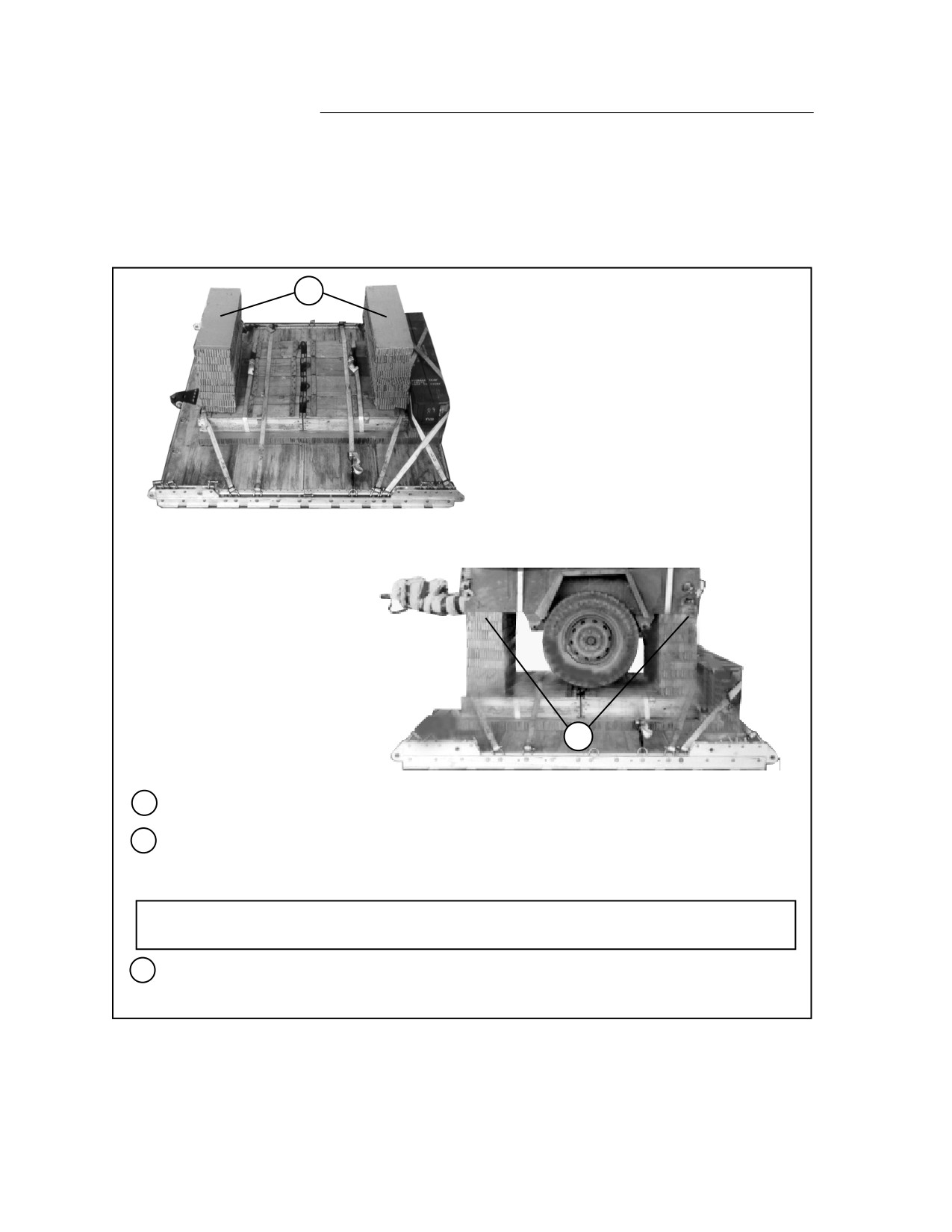
3-5. Place the honeycomb stacks on the accompanying load, and place the trailer
on the stacks as shown in Figure 3-4.
2
3
1
Glue together two nine-layer stacks of 42- by 12-inch honeycomb.
2
Set the stacks centered at each end of the ammunition boxes, flush with the front and rear
edges. Make indentations in the bottom of the honeycomb, if necessary, to allow for the cleats
on the box tops.
Note: The boxes may vary from those shown. The distance between the front edge of the front
stack and the rear edge of the rear stack should be 72 inches.
3
Set the trailer on the stacks so that the rear edge of the trailer is 15 inches from the front edge
of the platform. Be sure that the trailer rests squarely on the stacks as shown.
Figure 3-4. Honeycomb Stacks Placed and the Trailer Placed on the Stacks
3-8
FM 10-500-29/TO 13C7-10-171
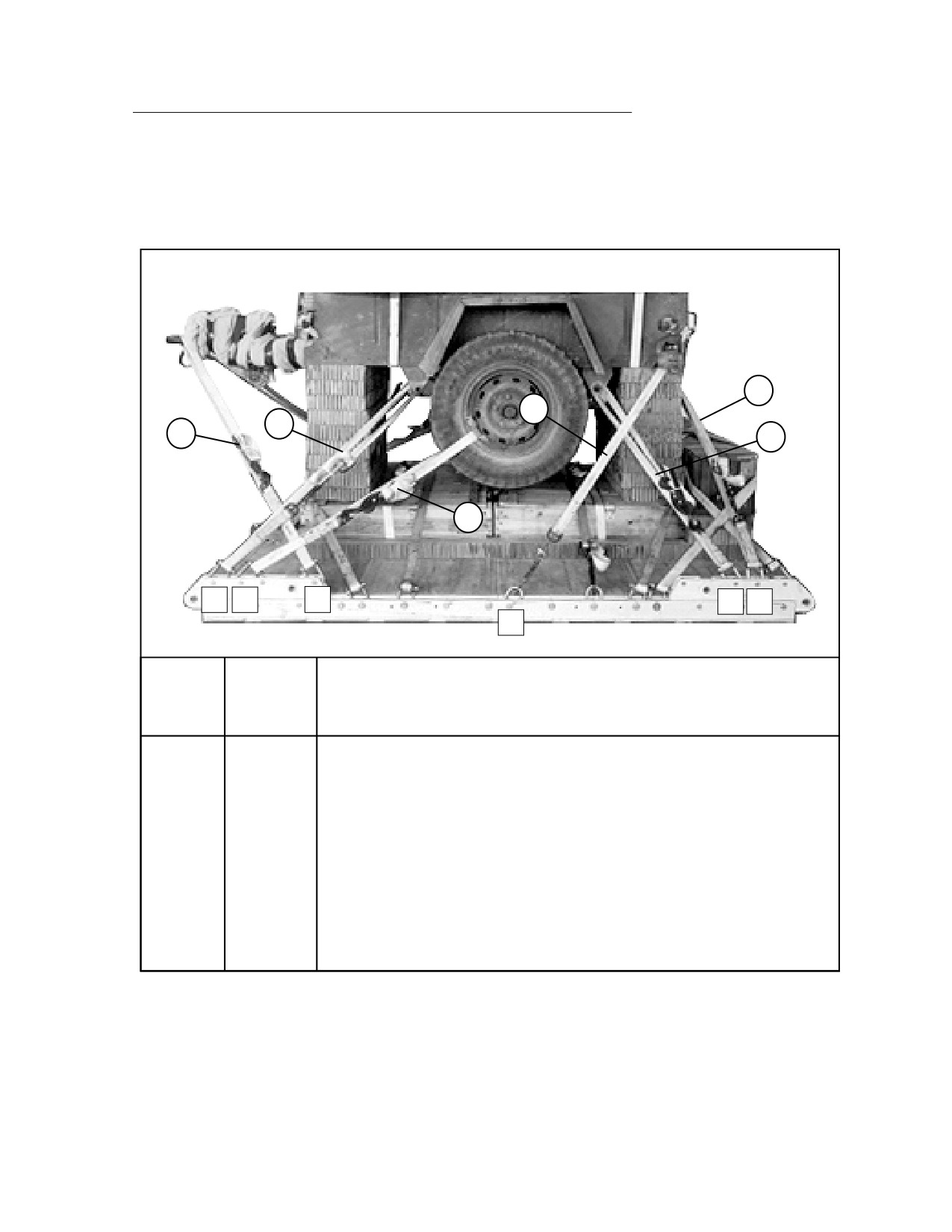
Lashing Trailer
3-6. Lash the trailer to the platform as shown in Figure 3-5.
1
5
10
6
3
8
12
11
10
3
2
7
Tie-dow n
Lashing
Clevis
Number
Number
Instructions
Pass lashing:
1
2
Through right rear handle.
2
2A
Throughf left rear handle.
3
3
Through rear spring bracket.
4
3A
Through rear spring bracket.
5
7 and 7A
Through clevis 7A, through both rear handles, to clevis
7
6
10
Through lunette.
7
10A
Through lunette.
8
11
Through left wheel. (Pad the wheel opening.)
9
11A
Through right wheel. (Pad the wheel opening.)
10
12
Through front spring bracket.
11
12A
Through front spring bracket.
Figure 3-5. Lashings Installed
3-9
FM 10-500-29/TO 13C7-10-171
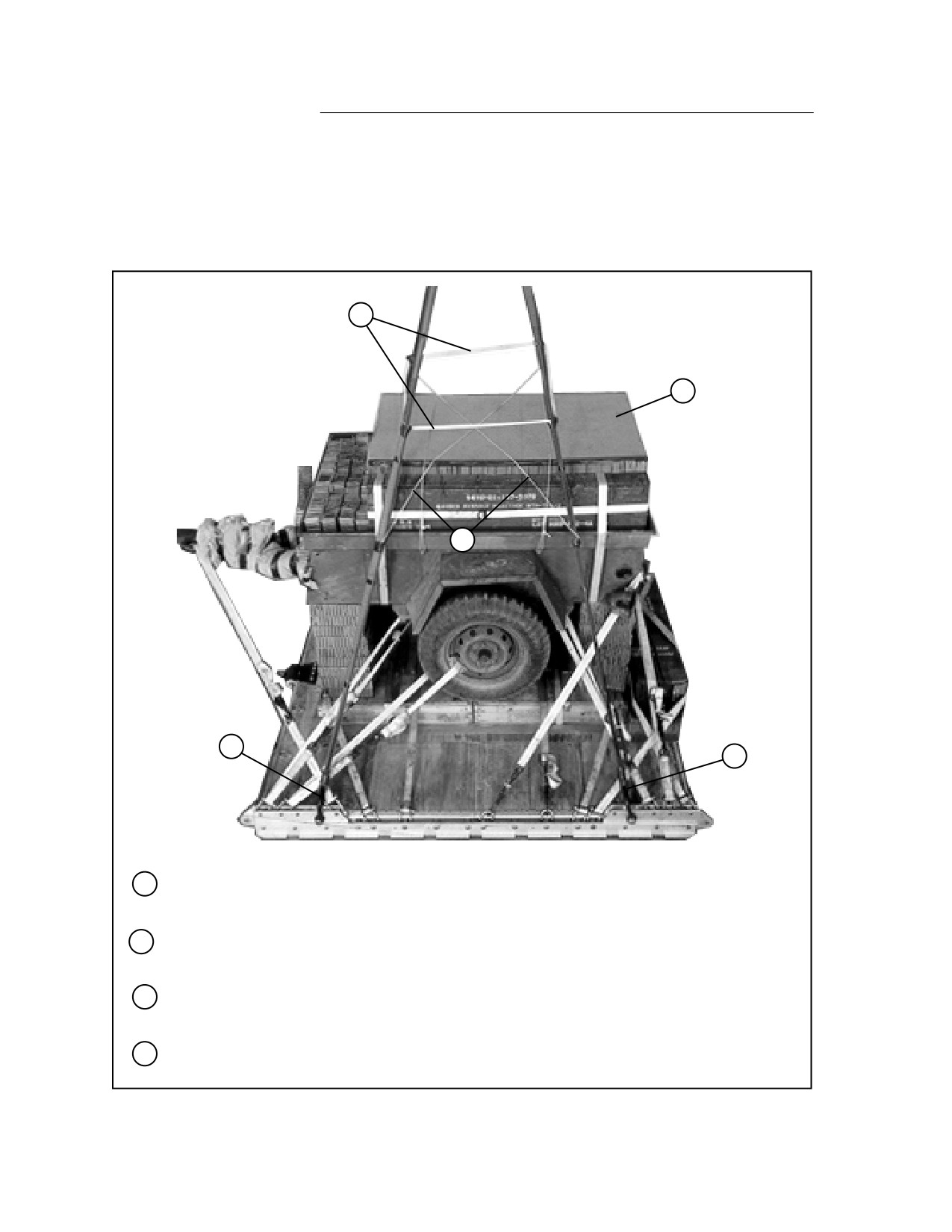
Installing Suspension Slings
3-7. Install four 12-foot, 2-loop, type XXVI nylon webbing slings according to FM
10-500-2/TO 13C7-1-5, and as shown in Figure 3-6.
4
1
3
2
2
1
Place a 36- by 56-inch piece of honeycomb on top of the missiles in the trailer. Tape the
edges of the honeycomb. Tie the honeycomb in place with type III nylon cord.
2
Attach a 12-foot, (2-loop), type XXVI nylon webbing sling to each tandem link with a large
clevis.
3
Tie the right front and left rear slings together with type III nylon cord. Tie the right rear and
left front slings together in the same way.
4
Raise the suspension slings and install the deadman’s tie according to FM 10-500-2/TO
13C7-1-5.
Figure 3-6. Suspension Slings Installed
3-10
FM 10-500-29/TO 13C7-10-171
Installing Cargo Parachute and Release Assembly
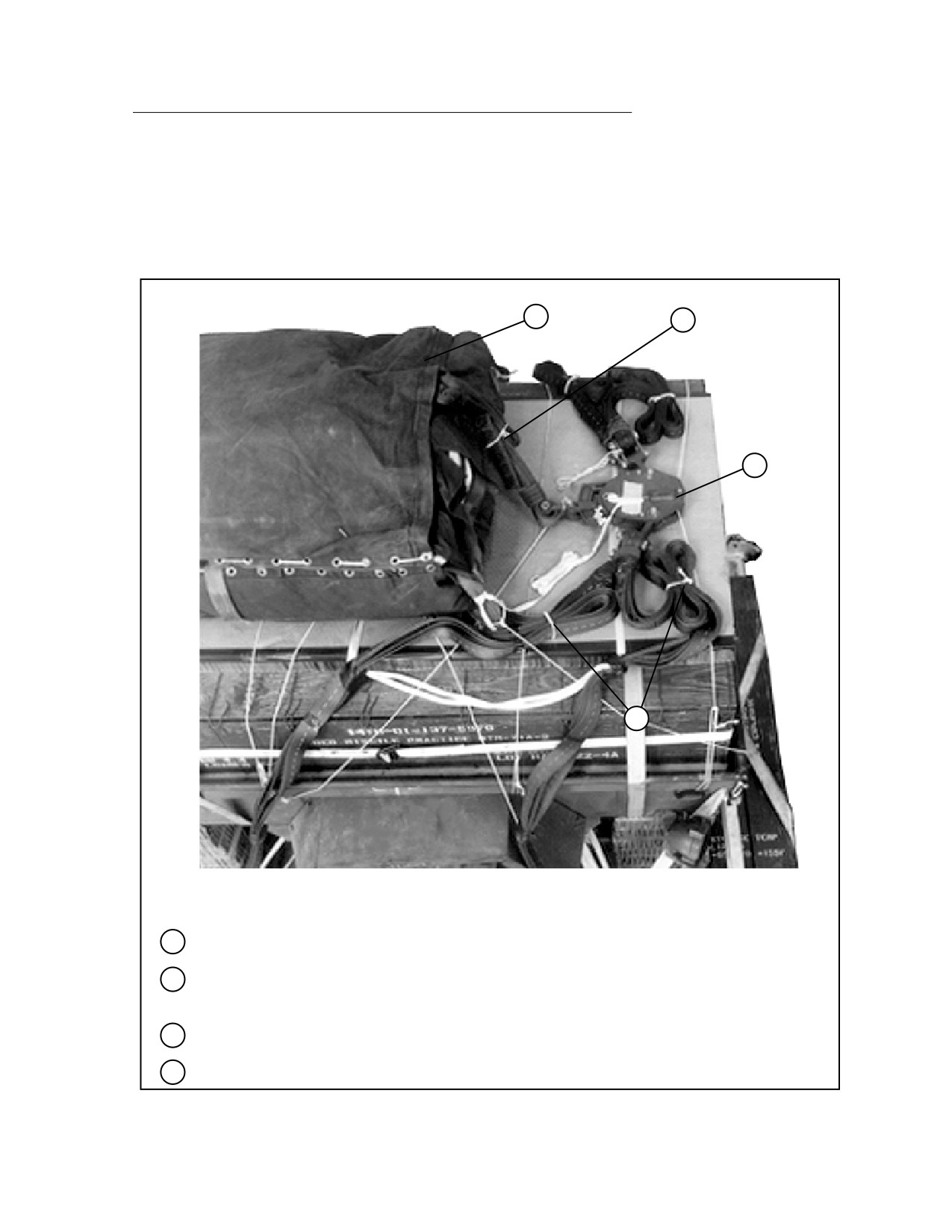
3-8. Install one G-11 cargo parachute and an M-1 cargo parachute release accord-
ing to FM 10-500-2/TO 13C7-1-5, and as shown in Figure 3-7.
1
3
2
4
1
Install one G-11 cargo parachute on the rear part of the honeycomb installed in Figure 3-6.
2
Center an M-1 cargo parachute release in front of the parachute, and attach the parachute
riser and suspension slings.
3
Fold any excess parachute riser, and tie the folds with type I, 1/4-inch cotton webbing.
4
Fold any excess suspension sling, and tie the folds with type I, 1/4-inch cotton webbing.
Figure 3-7. G-11 Cargo Parachute and M-1 Release Installed
3-11
FM 10-500-29/TO 13C7-10-171
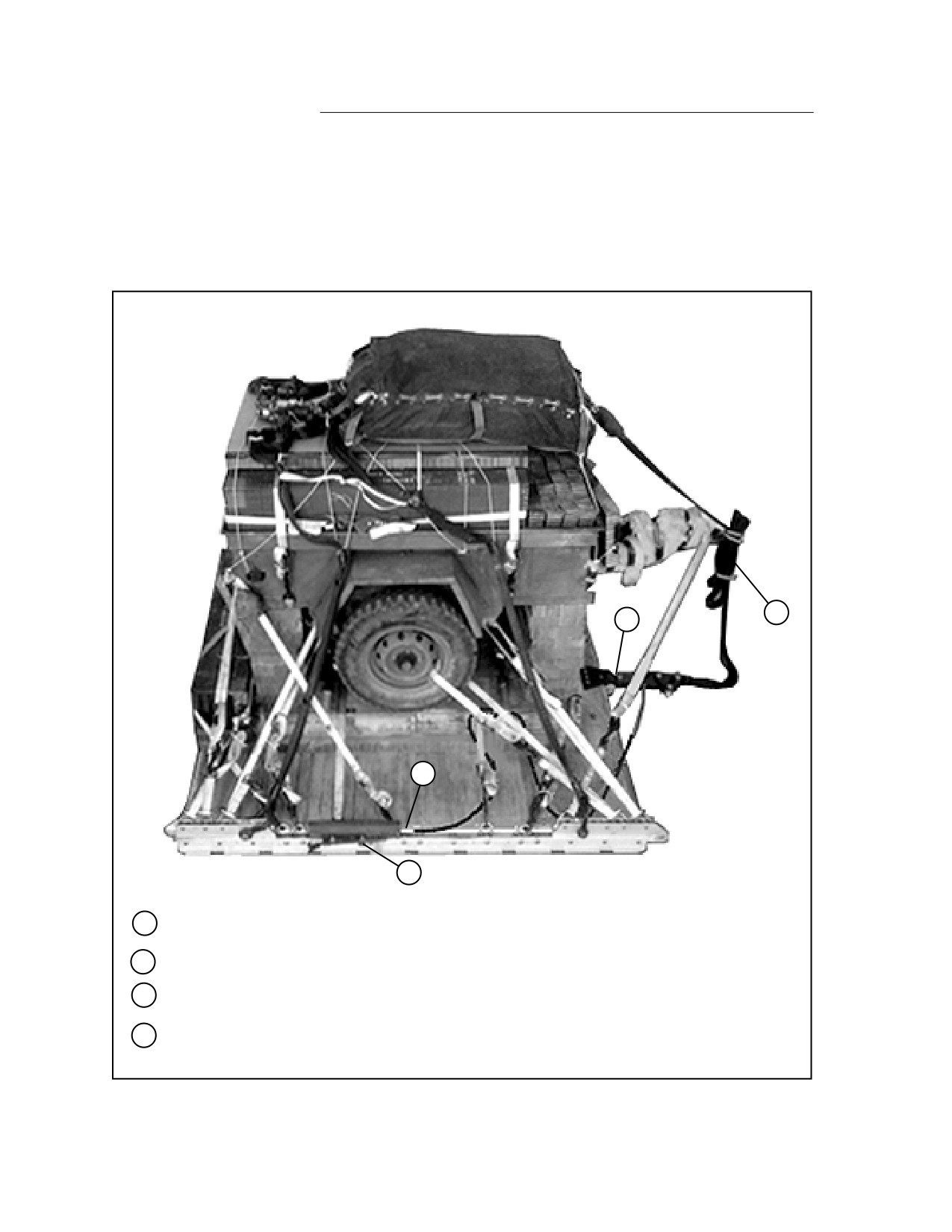
Installing Extraction System
3-9. Install the EFTC extraction system according to FM 10-500-2/TO 13C7-1-5,
and as shown in Figure 3-8.
4
3
2
1
1
Bolt the EFTC mounting brackets in the front mounting holes on the left platform rail.
2
Install a 12-foot cable to the actuator. Install the actuator to the brackets.
3
Attach the latch assembly to the extraction bracket. Attach the cable to the latch assembly.
4
Install a 9-foot, (2-loop), type XXVI nylon webbing sling as the deployment line. S-fold the
excess and tie it in two places with type I, 1/4-inch cotton webbing.
Figure 3-8. EFTC Installed
3-12
FM 10-500-29/TO 13C7-10-171
Installing Extraction Parachute
3-10. Select the extraction line and extraction parachute needed using the extrac
tion line requirements table in FM 10-500-2/TO 13C7-1-5. Place the extraction
parachute and extraction line on the load for installation in the aircraft.
Installing Provisions for Emergency Restraints
3-11. Select and install provisions for emergency restraints according to the emer-
gency aft restraints requirements table in FM 10-500-2/TO 13C7-1-5.
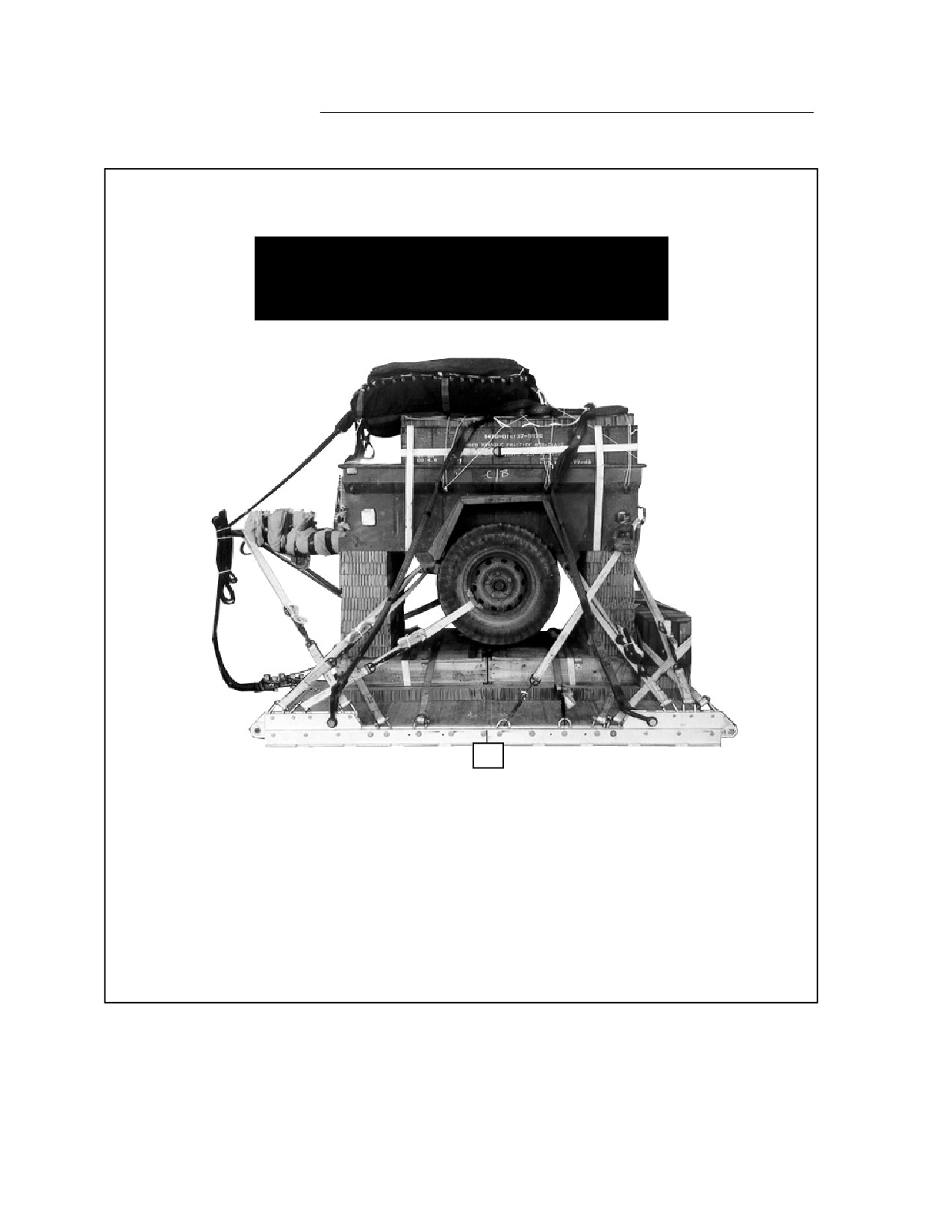
Marking Rigged Load
3-12. Mark the rigged load according to FM 10-500-2/TO 13C7-1-5, and as shown
in Figure 3-9. Complete the Shipper’s Declaration for Dangerous Goods. If the
load varies from the one shown, the weight, height, tip-off curve, CB, and para
chute requirements must be recomputed.
Equipment Required
3-13. Use the equipment listed in Table 3-1 to rig this load.
3-13
FM 10-500-29/TO 13C7-10-171
CAUTION
Make the final rigger inspection required by FM 10-500-2/
13C7-1-5 before the load leaves the rigging site.
CB
Rigged Load Data
Weight: Load shown
3,480 pounds
Maximum
5,250 pounds
Height
87 inches
Width
108 inches
Length
124 inches
Overhang:
Front
0 inches
Rear
25 inches
CB (from front edge of platform)
51 inches
Extraction System (adds 18 inches to length of platform)
EFTC
Figure 3-9. M416 Trailer with Eight TOW Missiles Rigged for Low-Velocity Airdrop
3-14
FM 10-500-29/TO 13C7-10-171
Table 3-1. Equipment required for rigging the M416 trailer with eight TOW missiles for low-
velocity airdrop
National Stock
Item
Quantity
Numbe r
8040-00-273-8713
Adhesive paste, 1-gal
As required
4030-00-090-5354
Clevis,suspension,1-in
l
5
4030-00-678-8562
l
2
4020-00-240-2146
Cord, nylon, type
I
I
As required
1670-00-434-5783
Coupling, airdrop, extraction force transfer with cable,
12-ft
1
Cover:
1670-00-360-0328
Clevis,
l
1
1670-00-360-0329
Link, type
I
1
8135-00-664-6958
Cushioning material, cellulose wadding
As required
1670-01-183-2678
Leaf, extraction
l
3
Line, drogue (for C-17
)
1670-01-064-4452
60-ft (1-loop), type XXV I
1
Line, extraction
1670-01-064-4452
For C-130: 60-ft (1-loop), type XXV I
1
1670-01-107-7652
For C-141: 160-ft (1-loop), type XXV I
1
For C-5:
1670-01-107-7652
160-ft (1-loop), type XXV I
1
1670-01-107-7652
For C-17: 160-ft (1-loop), type XXV I
1
Link assembly:
1670-00-783-5988
Type
I
1
Two-point, 3 3/4-in
1
5306-00-435-8994
Bolt, 1-in diam, 4 in
l
(2
)
5310-00-232-5165
Nut, 1-in, hexagonal
(2
)
1670-00-003-1953
Plate, side, 3 3/4-in
(2
)
5365-00-007-3414
Spacer,
l
(2
)
3-15
FM 10-500-29/TO 13C7-10-171
Table 3-1. Equipment required for rigging the M416 trailer with eight TOW missiles for low-
velocity airdrop (continued)
National Stock
Numbe r
Item
Quantity
1670-00-753-3928
Pad, energy-dissipating, honeycomb, 3- by 36- by
96-in
8 sheets
Parachute:
1670-01-016-7841
Cargo, G-11B
1
1670-01-063-3715
Cargo extraction, 15-ft
1
1670-01-063-3715
Drogue, 15-ft (for C-17)
1
Platform, airdrop, type
V
, 8-foot
1670-01-353-8425
Bracket assembly, coupling
(1
)
1670-01-162-2372
Clevis assembly, type V
(24)
1670-01-353-8424
Extraction bracket assembly
(1
)
1670-01-162-2381
Link, tandem, suspension link assembly
(4
)
5530-00-128-4981
Plywood, 3/4- by 48- by 96-in
1 sheet
1670-01-097-8816
Release, cargo parachute, M-1
1
Sling, cargo airdrop
For suspension:
1670-01-062-6303
12-ft (2-loop), type XXVI nylon webbing
4
For deployment:
1670-01-062-6304
9-ft (2-loop), type XXVI nylon webbing
1
1670-00-998-0116
Strap, parachute release,single
1
7510-00-266-5016
T
ape, adhesive, 2-in
As required
1670-00-937-0271
Tie-down assembly, 15-ft
29
Webbing:
8305-00-268-2411
Cotton, 1/4-in, type
As required
8305-00-082-5752
Nylon, tubular, 1/2-in
As required
8305-00-261-8585
T
ype VIII
As required
3-16
FM 10-500-29/TO 13C7-10-171
Chapter 4
Rigging TOW Missiles in Boxes
on Type V Platform for Low-velocity Airdrop
SECTION I- RIGGING MISSILES IN A-22 CARGO BAGS
ON A TYPE V PLATFORM FOR LOW-VELOCITY AIRDROP
DESCRIPTION OF LOAD
4-1. Forty-eight boxed missiles are rigged twelve each in four A-22 cargo bags on a
12-foot, type V airdrop platform. Each boxed missile weighs 87 pounds and is 57 1/2
inches long, 12 inches high, and 12 inches wide.This load requires two G-11 cargo
parachutes.
PREPARING PLATFORM
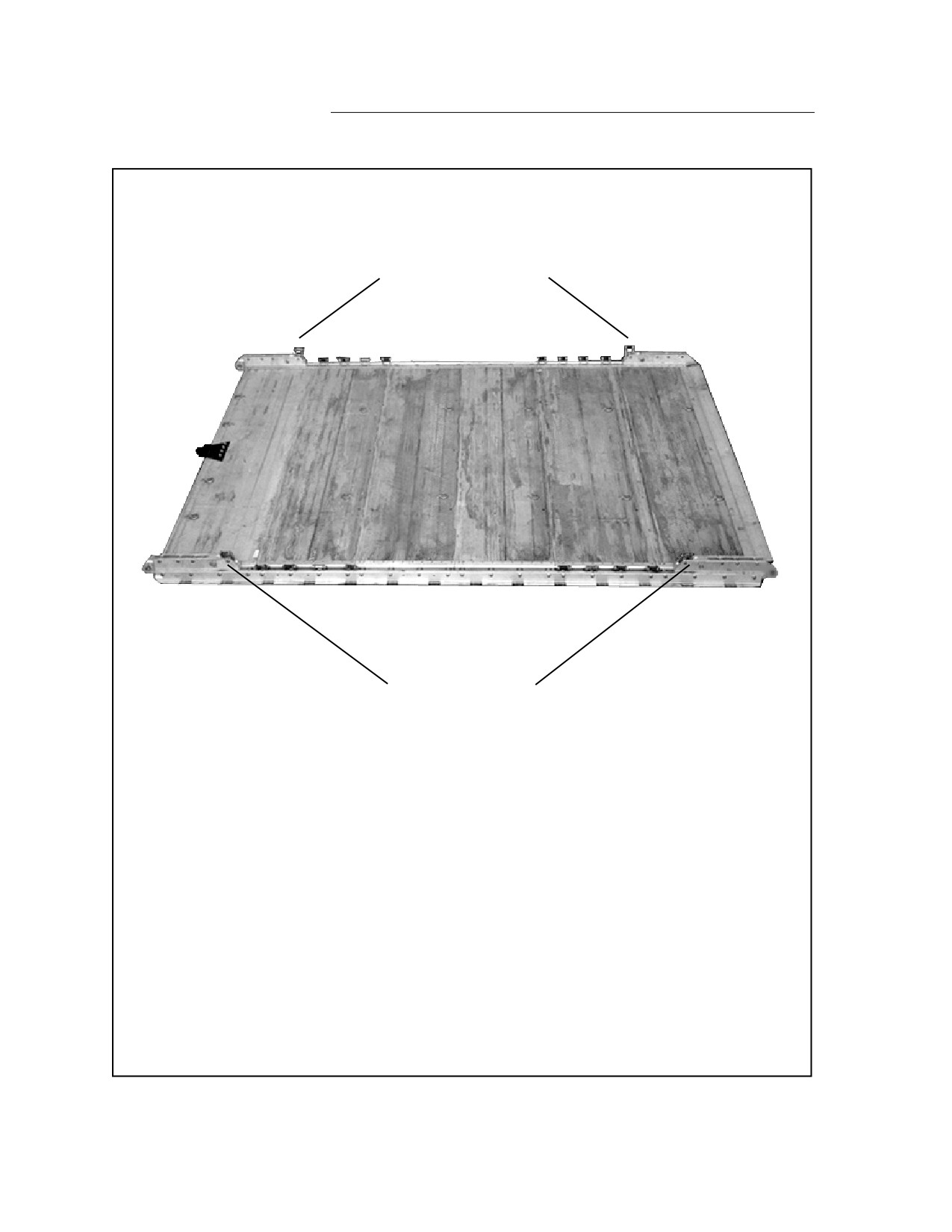
4-2. Prepare a 12-foot, type V airdrop platform as described below.
a. Inspecting Platform. Inspect, or, assemble and inspect, the platform
according to TM 10-1670-268-20&P/TO 13C7-52-22.
b. Installing Tandem Links. Install tandem links as shown in Figure 4-1.
c. Attaching and Numbering Clevises. Attach and number 20 clevis
assemblies as shown in Figure 4-1.
NOTES:
1. The nose bumper may or may not be installed.
2. Measurements given in this load are from the front edge of the platform,
NOT from the front edge of the nose bumper.
4-1
FM 10-500-29/TO 13C7-10-171
CLEVISES
10A THROUGH 1A
LEFT
REAR
FRONT
RIGHT
CLEVISES
10 THROUGH 1
Step:
1.
Install a tandem link to the front of each platform side rail using holes 1, 2, and 3.
2.
Install a tandem link to the rear of each platform side rail using holes 22, 23, and 24
3.
Install a clevis on bushing 4 on each front tandem link.
4.
Install a clevis on bushing 1 on each rear tandem link.
5.
Starting at the front of each platform side rail, install clevises on the bushings bolted
on holes 5, 6, 7, 8, 17, 18, 19, and 20.
6.
Starting at the front of the platform, number the clevises 1 through 10 on the right side
and 1A through 10A on the left side.
Figure 4-1. Platform Prepared
4-2
FM 10-500-29/TO 13C7-10-171
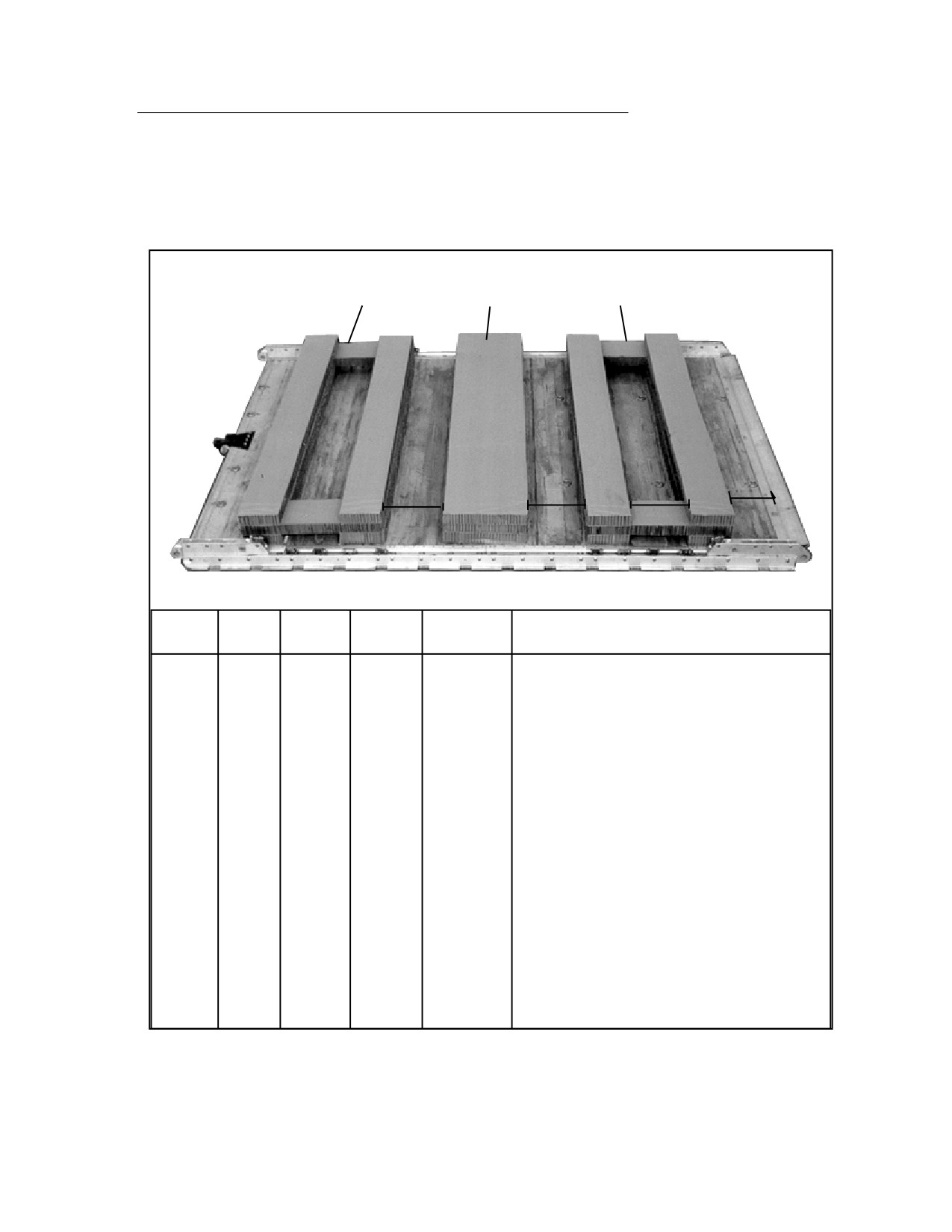
BUILDING AND PLACING HONEYCOMB STACKS
4-3. Build the honeycomb stacks and place them on the platform as shown in Figure
4-2.
STACK
STACK
STACK
3
2
1
FRONT
14”
14”
14”
14”
Stack
Pieces
Width
Length
Material
Instructions
Numbe r
(Inches)
(Inches)
1
2
96
10
Honeycomb
Place one piece 14 inches from the front edge
of the platform. Place another piece 14 inches
from the first piece.
2
10
34
Honeycomb
Place one piece over each end of the two base
pieces as a bridge.
2
76
10
Honeycomb
Place flush over each base piece, filling the
space between the two bridge pieces.
2
96
10
Honeycomb
Place flush over each end of the stack.
2
3
96
20
Honeycomb
Glue layers flush together and center14 inches
from stack
1
3
2
96
10
Honeycomb
Place one piece 14 inches from stack 2. Place
another piece 14 inches from the first piece.
2
10
34
Honeycomb
Place one piece over each end of the two base
pieces as a bridge.
2
76
10
Honeycomb
Place flush over each base piece, filling the
space between the two bridge pieces.
2
96
10
Honeycomb
Place flush over each end of the stack.
Figure 4-2. Honeycomb Stacks Prepared and Positioned
4-3
FM 10-500-29/TO 13C7-10-171
PLACING MISSILES IN A-22 CARGO BAGS
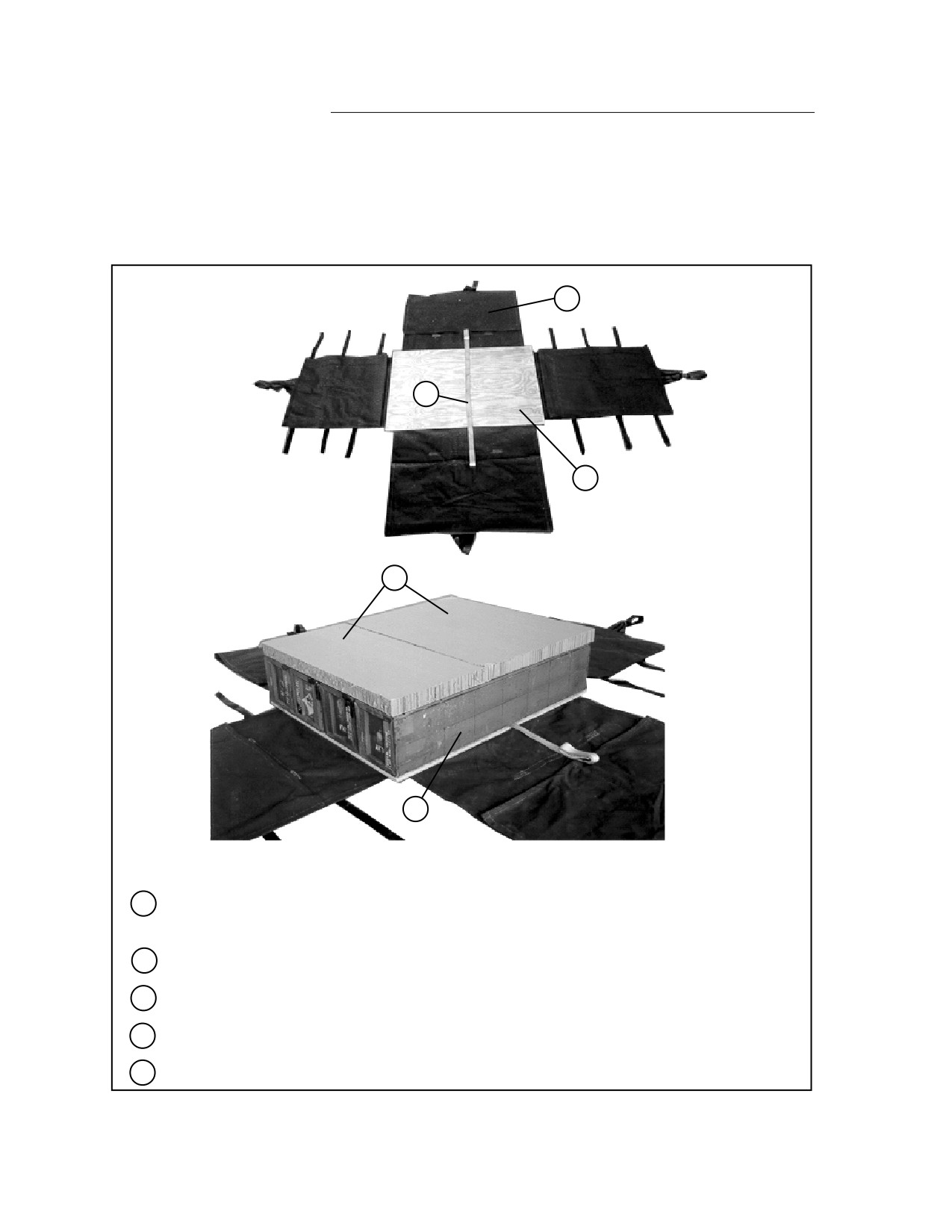
4-4. Place the missiles in four A-22 cargo bags as shown in Figure 4-3. Close the
A-22 cargo bag according to FM 10-500-3/TO 13C7-1-11, and as shown in Figure 4-4.
1
3
2
5
4
1
Position an A-22 cargo bag on a flat surface with the outside of the cover and the webbing
facing down.
2
Place a 3/4- by 48- by 58-inch piece of plywood on top of the A-22 cargo bag.
3
Lay a 15-foot lashing across the shorter dimension of the plywood.
4
Set four boxed missiles on top of the lashing and the plywood.
5
Cover the missiles with one 36- by 48-inch piece and one 22- by 48-inch piece of honeycomb.
Figure 4-3. Missiles Placed in A-22 Cargo Bag
4-4
FM 10-500-29/TO 13C7-10-171
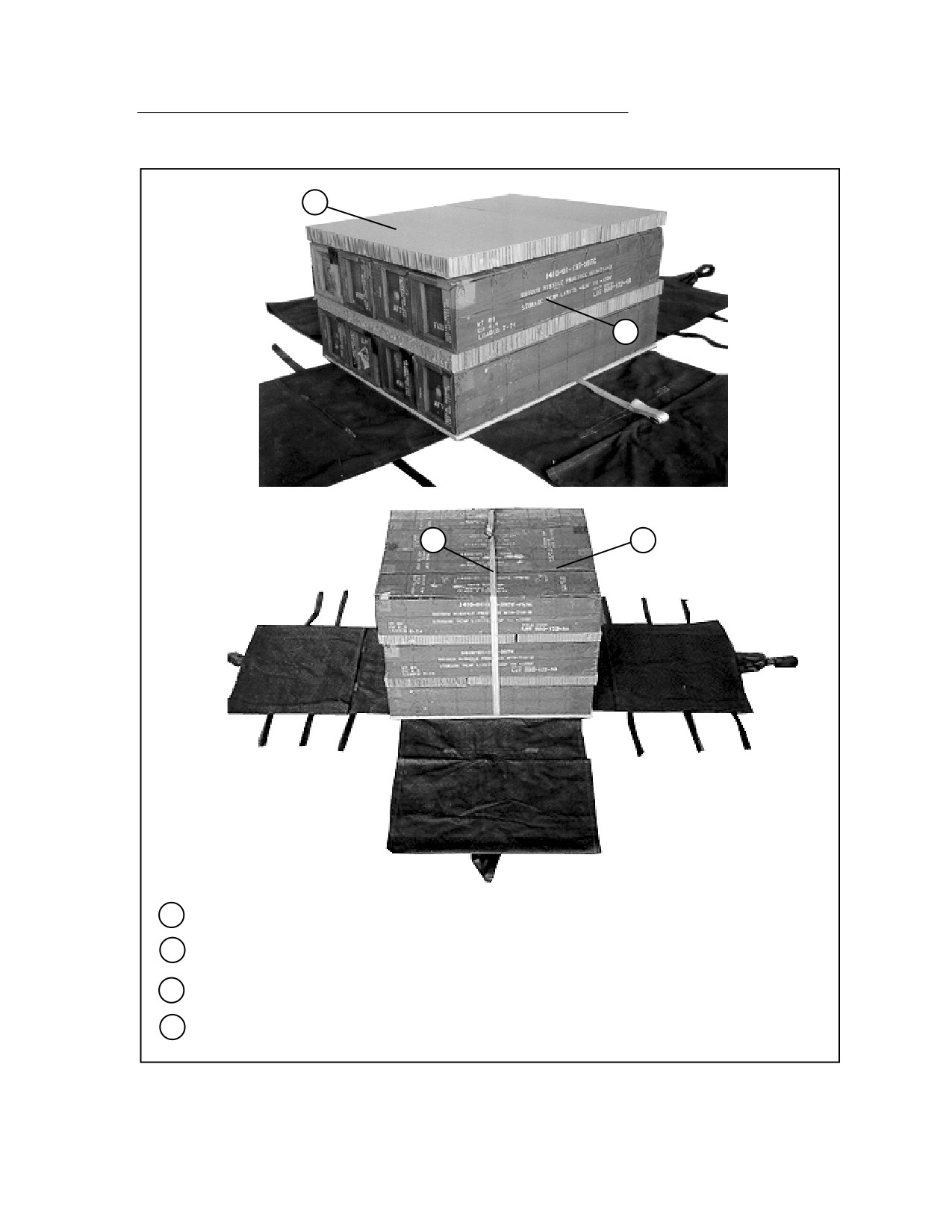
7
6
9
8
6
Place four boxed missiles on top of the honeycomb.
7
Form another layer of honeycomb as was done in step 5 above.
8
Place four boxed missiles on top of the second layer of honeycomb.
9
Bind the missiles together with the lashing positioned in step 3 above, using a D-ring and a
load binder.
Figure 4-3. Missiles Placed in A-22 Cargo Bag (continued)
4-5
FM 10-500-29/TO 13C7-10-171
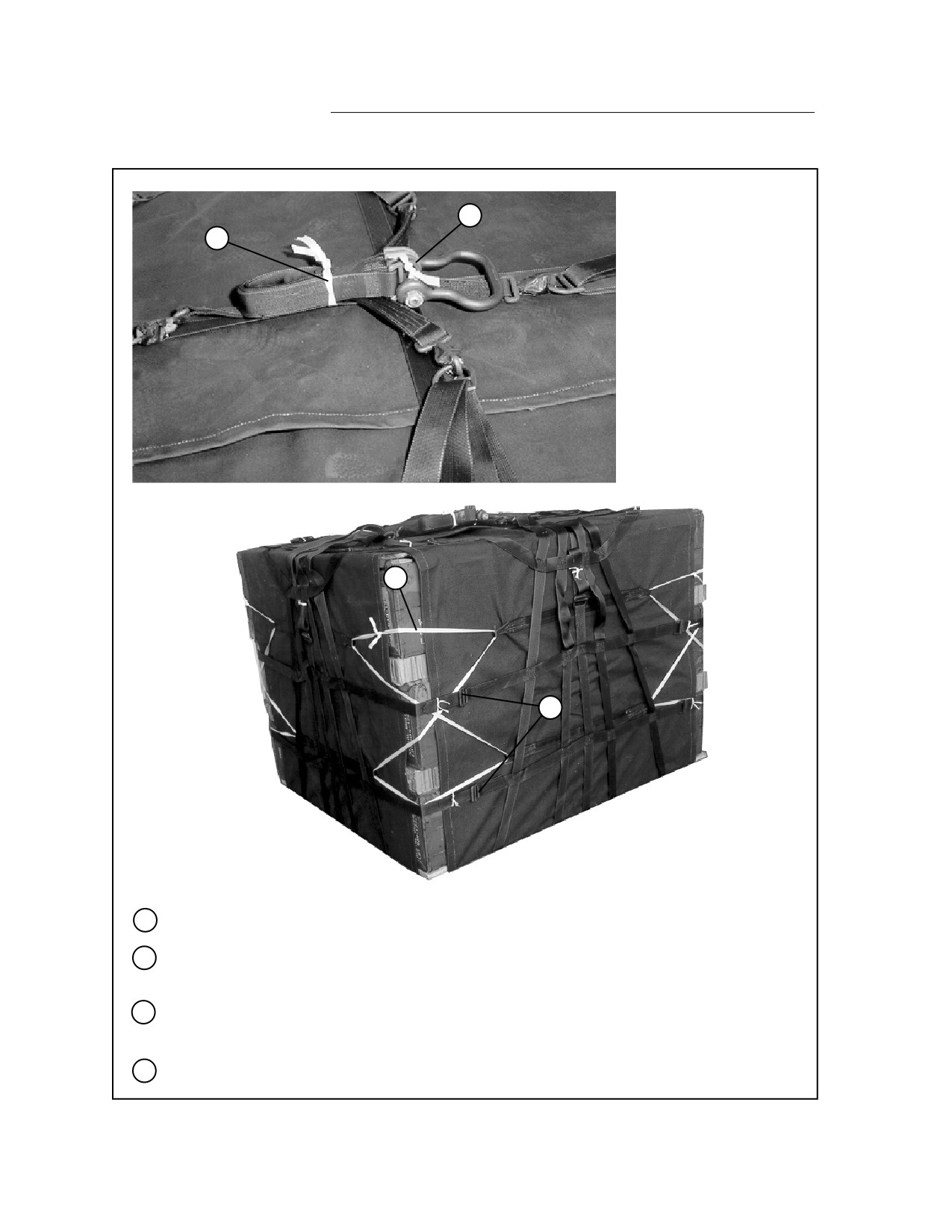
3
4
1
2
1
Close the A-22 cover, and secure the corners with 1/2-inch tubular nylon webbing.
2
Secure the A-22 cargo net at each corner and on top of the load. Fold any excess webbing, and
tie it with type I, 1/4-inch cotton webbing.
3
Attach a medium clevis to the suspension web D-rings. Secure the clevis to the top center
straps of the A-22 with 1/2-inch tubular nylon webbing.
4
Tape the suspension webs together, and secure them to the top center strap with 1/2-inch
tubular nylon webbing.
Figure 4-4. A-22 cargo bag closed
4-6
FM 10-500-29/TO 13C7-10-171
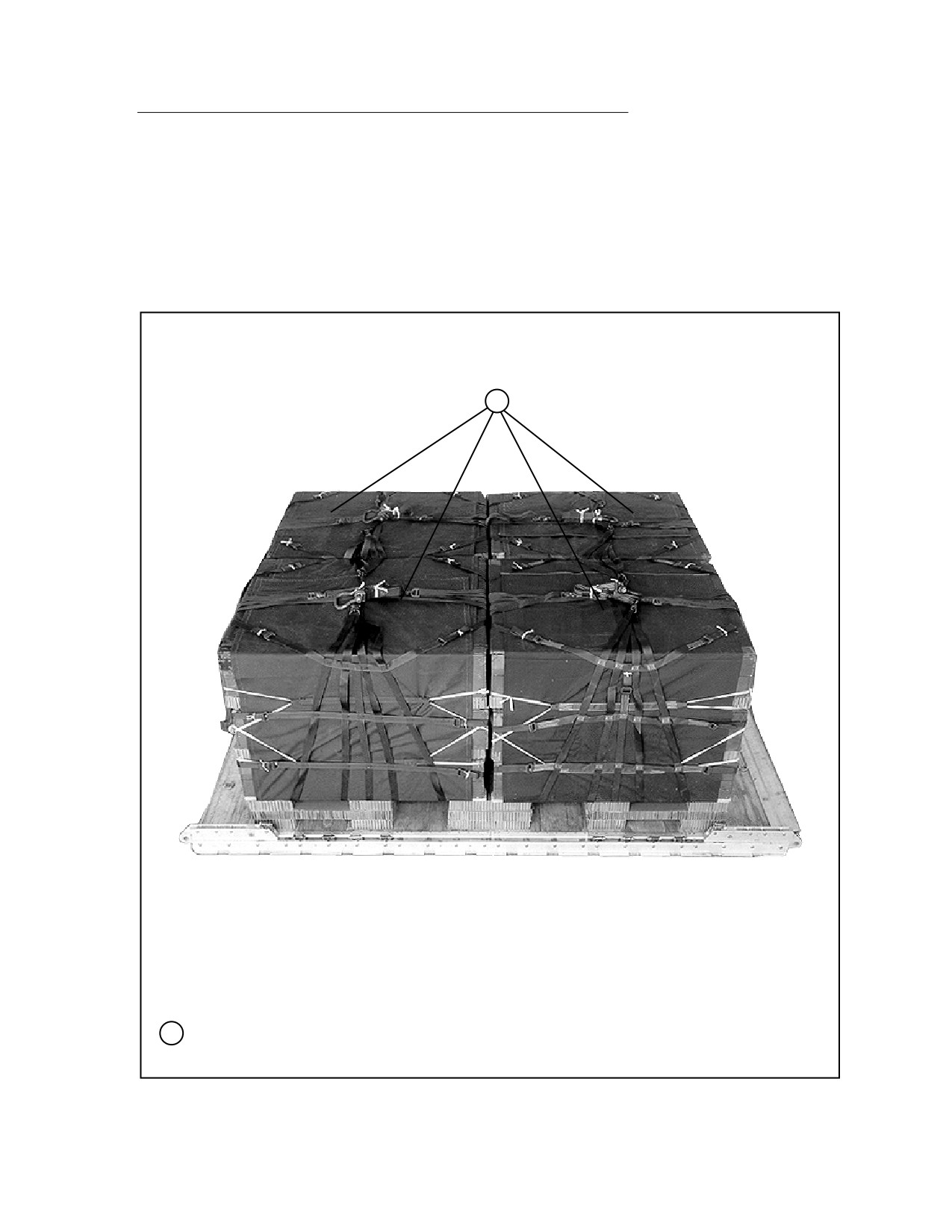
PLACING MISSILES IN A-22 CARGO BAGS ON PLATFORM
4-5. Place the A-22 cargo bags on the honeycomb stacks as shown in Figure 4-5.
1
1
Center the A-22 cargo bags on the platform with their 58-inch sides parallel to the platform side
rails.
Figure 4-5. Missiles in A-22 Cargo Bags Positioned on Platform
4-7
FM 10-500-29/TO 13C7-10-171
LASHING LOAD
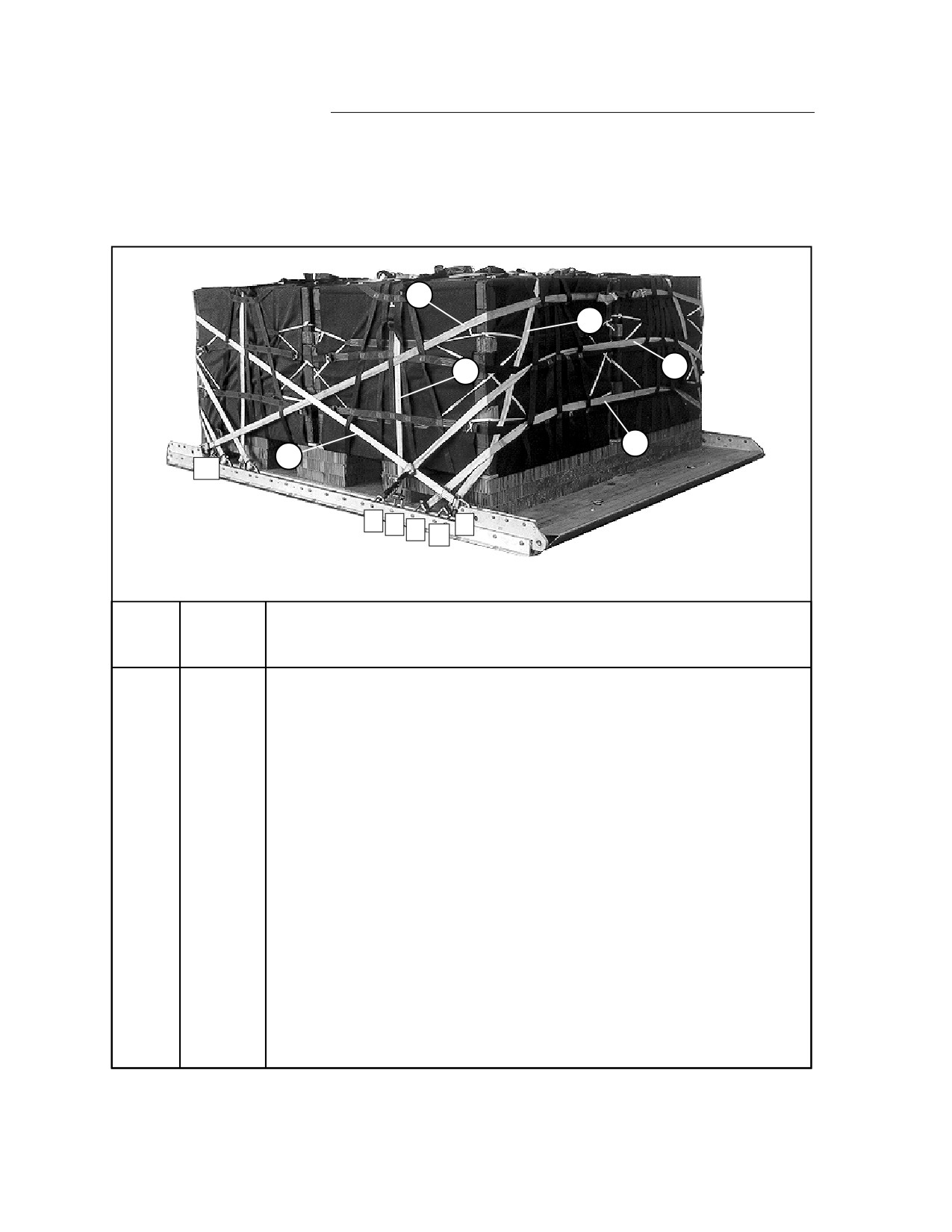
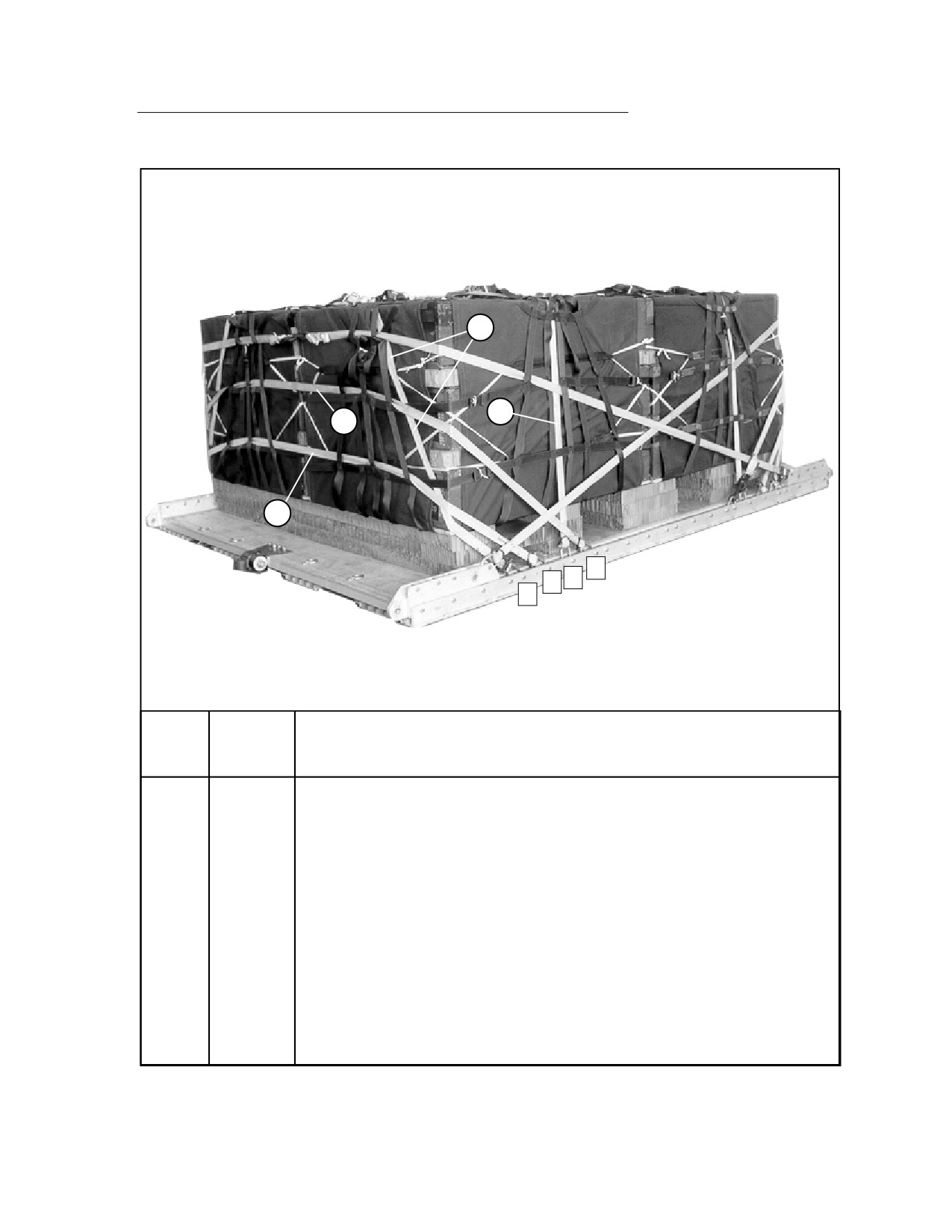
4-6. Lash the A-22 cargo bags to the platform as shown in Figures 4-6 and 4-7.
5
2
4
1
3
6
10
5
4
1
3
2
Tie-down
Lashing
Clevis
Numbe r
Numbers
Instructions
Pass lashing:
1
4 and 4A
Through clevis 4 and through its own D-ring. Pass a second lashing through
clevis 4A and its own D-ring. Pass the lashings over the top of the load (under
the webbing) and through the medium clevis. Secure the lashings with two
D-
rings and a load binder on top of the load.
2
2 and 9A
Through clevis 2 and through its own D-ring. Pass a second lashing through
clevis 9A and its own D-ring. Route the lashings over the load under the
webbing. Secure the lashings on top of the load with two D-rings and a load
binder.
3
3 and 3A
Through clevis 3 and its own D-ring. Pass the lashing around the front of the
load under the webbing. Attach the lashing to clevis 3A with a D-ring and a load
binder.
4
5 and 5A
Through clevis 5A and its own D-ring. Pass the lashing around the front of the
load under the webbing. Attach the lashing to clevis 5 with a D-ring and a load
binder.
5
10 and
Through clevis 10 and through its own D-ring. Pass a second lashing through
10A
clevis 10A and its own D-ring. Pass the lashings around the front of the load
under the webbing. Secure the lashings with two D-rings and a load binder.
6
1 and 1A
Through clevis 1 and through its own D-ring. Pass a second lashing through
clevis 1A and its own D-ring. Pass the lashings around the rear of the load
under the webbing. Secure the lashings with two D-rings and a load binder.
Figure 4-6. Lashings 1 Through 6 Installed
4-8
FM 10-500-29/TO 13C7-10-171
10
7
8
9
6
8
7
9
Tie-down
Lashing
Clevis
Numbe r
Numbers
Instructions
Pass lashing:
7
7 and 7A
Through clevis 7 and its own D-ring. Pass a second lashing through clevis 7A
and its own D-ring. Pass the lashings over the top of the load (under the
webbing) and through the medium clevis. Secure the lashings with two D-rings
and a load binder on top of the load.
8
6 and 6A
Through clevis 6 and its own D-ring. Pass the lashing around the rear of the
load under the webbing. Attach the lashing to clevis 6A with a D-ring and a load
binder.
9
8 and 8A
Through clevis 8 and its own D-ring. Pass the lashing around the rear of the
load under the webbing. Attach the lashing to clevis 8A with a D-ring and a load
binder.
10
9 and 2A
Through clevis 9 and its own D-ring. Pass a second lashing through clevis 2A
and its own D-ring. Pass the lashings around the end and over the top of the
load under the webbing. Secure the lashings with two D-rings and a load binder
on top of the load.
Figure 4-7. Lashings 7 Through 10 Installed
4-9
FM 10-500-29/TO 13C7-10-171
INSTALLING SUSPENSION SLINGS
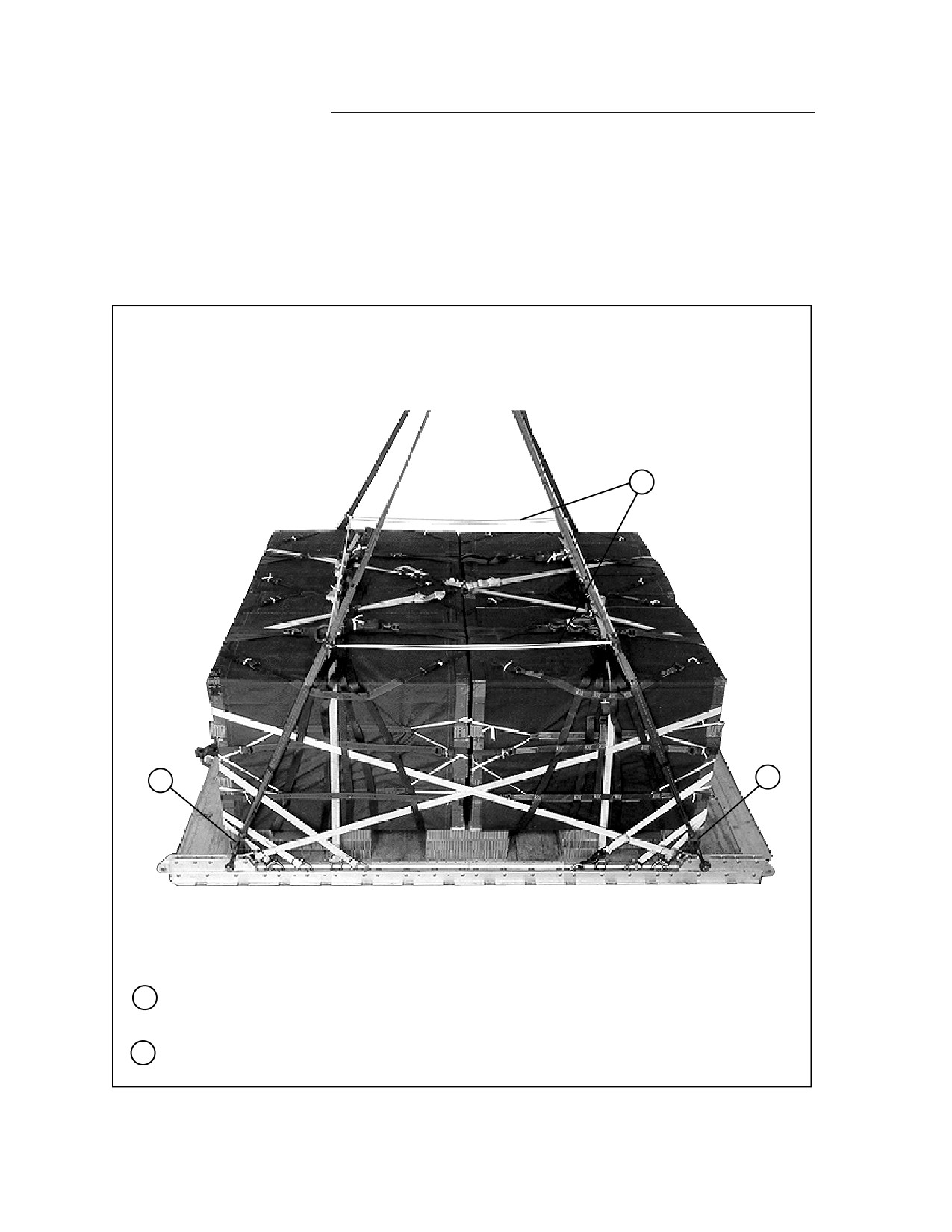
4-7. Install four 12-foot (2-loop), type XXVI nylon webbing slings as suspension
slings. Install and safety the slings according to FM 10-500-2/TO 13C7-1-5, and as
shown in Figure 4-8.
2
1
1
1
Attach a 12-foot (2-loop), type XXVI nylon webbing sling to each of the four tandem links using
a large clevis.
2
Raise the suspension slings above the load and install the deadman’s tie as outlined in FM 10-
500-2/TO 13C7-1-5.
Figure 4-8. Suspension Slings Installed
4-10
///////////////////////////////////////