TADIL J INTRODUCTION TO TACTICAL DIGITAL INFORMATION LINK J AND QUICK REFERENCE GUIDE (JUNE 2000) - page 1
FM 6-24.8
MCWP 3-25C
NWP 6-02.5
AFTTP(I) 3-2.27
FM 6-24.8
US Army Training and Doctrine Command
Fort Monroe, Virginia
MCWP 3-25C
Marine Corps Combat Development Command
Quantico, Virginia
NWP 6-02.5
Navy Warfare Development Command
Newport, Rhode Island
AFTTP(I) 3-2.27
Air Force Doctrine Center
Maxwell Air Force Base, Alabama
30 June 2000
TADIL J
Introduction to Tactical Digital Information Link J
and Quick Reference Guide
TABLE OF CONTENTS
Page
EXECUTIVE SUMMARY
vii
CHAPTER I SYSTEM OVERVIEW
Description
I-1
Communications
I-2
Employment
I-6
Data Link Advantages
I-8
CHAPTER II ARCHITECTURE
Network Design
II-1
Parameters
II-1
Network Completion
II-1
Pulse Deconfliction
II-1
Frequency Assignments
II-3
Architecture Examples
II-3
CHAPTER III OPERATIONS
Multilink Operations
III-1
Joint Service Operations
III-6
iv
Battle Group Surveillance
III-8
Battle Group Air Control
III-9
Joint Interface Control
III-10
Operating Considerations
III-11
Link Troubleshooting Considerations
III-11
APPENDIX A SYSTEM CAPABILITIES AND LIMITATIONS
A-1
APPENDIX B JTIDS CRYPTOGRAPHIC VARIABLE REQUIREMENTS
B-1
APPENDIX C NETWORK DESIGN FACILITIES
C-1
APPENDIX D ARMY TACTICAL DATA LINK-1
D-1
APPENDIX E NORTH ATLANTIC TREATY ORGANIZATION LINK-1
E-1
APPENDIX F QUICK REFERENCE GUIDE
F-1
REFERENCES
References-1
GLOSSARY
Glossary-1
INDEX
Index-1
FIGURES I-1
Network Participation Groups
I-4
I-2
Stacked Nets
I-6
I-3
TADIL J Message Catalog
I-7
I-4
TADIL J Message Sets
I-9
I-5
Track Identification
I-10
I-6
Relative Navigation
I-11
I-7
Geodetic Positioning
I-11
II-1
Minimum Requirements for JTIDS/MIDS Frequency
Assignment Request
II-3
II-2
Navy Architecture Afloat
II-4
II-3
Joint Architecture Afloat
II-5
II-4
Combined Theater Architecture
II-5
III-1 Data Forwarding Rules
III-9
III-2 TADIL J Operating Considerations
III-11
III-3 Troubleshooting Considerations
III-12
B-1
SDU Employment
B-2
v
TABLES I-1
Stacked Nets
I-5
III-1 USN Multilink Planning
III-1
III-2 Model 4 Systems
III-5
D-1
ATDL-1 Systems
D-6
D-2
OPTASKLINK Message Entry Lists
D-7
D-3
OPTASKLINK Message Sets
D-7
E-1
NATO Link-1 Capabilities
E-4
E-2
OPTASKLINK Message Entry Lists
E-6
vi
EXECUTIVE SUMMARY
TADIL J
Introduction to Tactical Digital Information Link J
and Quick Reference Guide
Introduction
This publication provides multiservice procedures for TADIL J operations. It
includes:
•An overview of TADIL J basic terminology and operational considerations.
•System capabilities and limitations.
•Network design and network architecture examples.
•General guidelines for identifying common problems and situations.
•The functions of TADIL J in different types of operations.
Overview
The All Services Combat Identification Evaluation Team (ASCIET) final report for
1996 stated “TADIL J/Link-16 Tactics, Techniques, and Procedures (TTPs) are
immature.” The Joint Requirements Oversight Council (JROC) tasked the Air, Land,
and Sea Application (ALSA) Center to publish TADIL J multiservice TTPs to answer
this deficiency. ALSA convened a working group of subject matter experts, 28 April to 1
May 1998, to analyze the requirements, research the material, and draft an initial
product.
As this is prepared, TADIL J fielding and system implementation is immature and
incomplete. Research conducted by the working group to scope the JROC task
confirmed written deficiencies in TADIL J tactics and some techniques. However,
procedures for TADIL J are adequately addressed in existing documents. These
procedural documents include the Chairman Joint Chiefs of Staff Manual (CJCSM)
6120.01A, “Joint Multi-TADIL Operating Procedures (JMTOP),” published 24 Oct 97
(after the ASCIET findings of 96). It was an in-depth planning, employment, and
operations manual that covered some techniques. The JMTOP is an evolving document
originally containing material for TADILs A, B, and J. The current version (July 1999)
also incorporates TADIL C, Army Tactical Data Link-1 and Interim Joint Tactical
Information Distribution System (JTIDS) Message Standard (IJMS). The classified
Joint Tactical Air Operations (JTAO) Interface Interoperability Handbook (also called
the “Purple Book”), published by US Army Forces Command (FORSCOM) and last dated
1 Jun 95, is also widely recognized by operators as an excellent reference document.
LOGICON documents, “Understanding TADIL Planning and Operations - A Guidebook
for Operators, Planners, and Managers,” dated Oct 1996 and “Understanding Link 16 -
A Guidebook For New Users,” dated September 1996, are excellent introductory level
texts for link planning, employment, and operations. While many excellent references
are available there is no comprehensive index or reference to catalog these for an
operator.
vii
The working group decided that to best meet the JROC tasking and to answer the
operational need, two-companion documents are required. The first is an easily carried,
widely distributed introduction to TADIL J and comprehensive QRG to familiarize the
TADIL J novice with capabilities and systems of the TADIL J world. This guide would
permit its users to function in a TADIL J environment at a rudimentary level and to
provide direction for more comprehensive in-depth study if required. The working
group has focused its effort on producing this document from the most current data
available.
The companion document should be an in-depth manual developed as the fielding
and systems implementation of TADIL J matures across the Services and multi-national
environment. This document should be a joint publication much like Joint Publication
3-09.3, “Joint Tactics, Techniques, and Procedures for Close Air Support” and should
address the multi-TADIL environment. This companion document remains to be
developed.
viii
PROGRAM PARTICIPANTS
The following commands and agencies participated in the development of this
publication:
Joint
Defense Information Systems Agency, Joint Interoperability and Engineering Organization,
TADIL Data Standards, Reston, VA
All Services Combat Identification Evaluation Team (ASCIET), Eglin AFB, FL
Army
Directorate of Combat Developments Requirements Division, Army Air Defense School,
Fort. Bliss, TX
Marine Corps
Marine Corps Tactical Systems Support Activity, Camp Pendleton, CA
Marine Air Control Squadron 24, Virginia Beach, VA
Marine Air Control Squadron 6, Cherry Point, NC
Navy
AEGIS Training and Readiness Center Detachment, Norfolk, VA
ARTC, Dahlgren, VA
VAW 120, NAS, Norfolk, VA
USS Stout (DDG 55), Norfolk, VA
PEO TAD SC, Arlington, VA
COMCRUDESGRU TWO, George Washington Battle Group
Air Force
Aerospace Command and Control, Intelligence, Surveillance, and Reconnaissance Center,
Data Fusion Division, Langley AFB, VA
552nd Operation Support Squadron, Tactics and Weapons Division, Tinker AFB, OK
Headquarters, ACC/DISG, Air Force JTIDS Network Design Facility, Langley AFB, VA
355th OG/OGV, Davis-Monthan AFB, AZ
ix
Chapter I
SYSTEM OVERVIEW
1. Description
Tactical digital information link (TADIL) J is an improved data link used to
exchange near real time information. It is a communication, navigation, and
identification system that supports information exchange between tactical command,
control, communications, computers, and intelligence (C4I) systems. The radio
transmission and reception component of TADIL J is the Joint Tactical Information
Distribution System (JTIDS) or its successor, the Multifunctional Information
Distribution System (MIDS). These high-capacity, ultra high frequency (UHF), line of
sight (LOS), frequency hopping data communications terminals provide secure, jam-
resistant voice and digital data exchange. JTIDS/MIDS terminals operate on the
principal of time division multiple access (TDMA), wherein time slots are allocated
among all TADIL J network participants for the transmission and reception of data.
TDMA eliminates the requirement for a net control station (NCS) by providing a
nodeless communications network architecture.
a. Network Capacity. More specifically, the capacity of a TADIL J network is
apportioned among multiple virtual circuits on which messages dedicated to a single
function are transmitted and received during specific time intervals.
(1) Network Participation Groups (NPGs) . These circuits, or functional groups,
are known as NPGs and are the functional building blocks of a TADIL J network (see
paragraph 2e).
(2) JTIDS Units (JUs). Participants in a TADIL J network, called JUs, are
assigned to NPGs. The JU’s mission and capabilities dictates the NPG to which a JU is
assigned. JUs are designated as either command and control (C2) or non-C2.
(a) C2 JUs. A C2 JU is a JTIDS/MIDS-equipped platform, which, by virtue of
its mission, is capable of directing the activities of other platforms that exercise C2
authority.
(b) Non-C2 JUs. A non-C2 JU is a JTIDS/MIDS-equipped platform with
limited or no capability to direct the activities of other platforms. TADIL J gives each
unit the capability to transmit its own crypto secure location and identification as a
precise participant location and identification (PPLI) platform. JTIDS/MIDS also
provides a navigation capability to mobile units.
b. Features. TADIL J features include the following:
(1) TDMA.
(2) Nodeless architecture.
(3) Net time reference (NTR).
I-1
(4) Encrypted message and transmission.
(5) NPGs.
(6) Jam resistance.
(7) UHF LOS.
(8) Multiple-access modes.
(9) Stacked net and multinet operations.
(10) Cryptographic isolation.
(11) Multiple data rates/data interleaving.
(12) Dynamic network reallocation.
c.
Message Types.
(1) Fixed format (J-series) messages.
(2) Free text messages.
d.
Operational Use.
(1) Surveillance.
(2) Electronic warfare (EW).
(3) Mission management (MM)/weapons coordination (WC).
(4) Air control.
(5) Fighter-to-fighter net.
(6) Secure voice channels.
(7) Navigation.
(8) Positive friendly identification.
(9) Network management.
e.
System Capabilities and Limitations. The quick reference charts in Appendix A
describe the systems that operate with TADIL J in each Service.
2. Communications
a. TDMA Scheme. TADIL J uses a network design that assigns unique time slots for
transmission of data to each JU, thus eliminating the requirement for an NCS. This
I-2
TDMA scheme provides 12-second frames divided into 1536 time slots to be used for
data transmission. To preclude jamming by a narrow band jammer, the transmission
frequency of the terminal is changed for each pulse. This frequency-hopping pattern
defines a net. The capability is also used to provide simultaneous, noninterfering
communications for multinetwork architecture. This means that each of the many
possible nets is using the same 51 frequencies in a different hopping pattern to
communicate over a single JTIDS network.
b. Nodeless Architecture. A node is a unit required to maintain communications. In
TADIL A/Link-11, for example, the NCS is a node. If the NCS ceases operation, the link
goes down. In TADIL J, there are no critical nodes. Time slots are preassigned to each
participant and the link functions regardless of the participation of any particular unit.
The closest thing in TADIL J to a critical node is the NTR.
c. NTR. A TADIL J-equipped unit is assigned NTR duty and acts as the single time
source for time synchronization of all units entering the TADIL J network. The NTR is
needed to start up a network and for a new unit to synchronize with and enter a
network. After a network has been established, however, it continues to operate for
hours without an NTR.
d. Encrypted Message and Transmission. Both the message and the transmission are
encrypted. The message uses an encryption device for message security (MSEC), and
the transmission is encrypted using a time-based transmission security (TSEC). For a
unit to receive another unit’s transmission, they must both be assigned the same TSEC
cryptovariable. For a unit to decrypt the data contained in that transmission, they must
both be assigned the same MSEC cryptovariable. See Appendix B for JTIDS
cryptographic variable requirements.
e. NPGs. The time slots of each frame are allocated to particular functions. The
functional groups are called NPGs. Because an NPG is defined by its function, the types
of messages transmitted on it are also defined. Each of the transmit time slots is
assigned an NPG which it supports. NPGs are either being used or are assigned. Some
NPGs are being used by specific Services, but the NPGs are still reserved for joint use.
The US Navy (USN) uses NPG 14 for indirect PPLIs to forward units to TADIL J. The
US Air Force (USAF)/US Marine Corps (USMC) correctly use NPG 7 surveillance for
indirect PPLIs of forwarded units. The US Army (USA) currently uses NPGs 15, 16, and
25, although they are still reserved for joint use if needed. NPGs are shown in Figure I-
1.
f. Jam Resistance. TADIL J has the capability to operate in a hostile electromagnetic
environment. The TADIL J waveform was developed to provide significant performance
enhancements against optimized, band-matched jammers. To preclude jamming by a
narrow band jammer, the transmission frequency of the terminal is changed for each
pulse (77,000 hops per second) through 51 discrete UHF frequencies. The frequency-
hopping pattern is pseudorandom and is determined by the TSEC.
g. UHF LOS. The JTIDS/MIDS terminal operates between 960 and 1215 megahertz
(MHz). The disadvantage of employing these UHF frequencies is their possible conflict
with identification friend or foe (IFF) navigation aids and their limit to LOS
communications.
I-3
NPG 1
Initial entry
NPG 2
Round-trip timing-addressed
NPG3
Round-rip timing-broadcast (RTT-B)
NPG 4
Network management
NPG 5
PPLI A - (C2 units)
NPG 6
PPLI B - (non-C2 units)
NPG 7
Surveillance
NPG 8
Mission management - (mission types) (USN uses for engagement status)
NPG 9
Air control
NPG 10
EW
NPG 11
Unassigned
NPG 12
Voice A - (either 2.4 or 16 kilobits per second [kbps])
NPG 13
Voice B - (either 2.4 of 16 kbps)
NPG 14
USN for indirect PPLIs (used for forwarding TADIL A, B units to TADIL J)
NPG 15
Reserved for future joint use
NPG 16
Reserved for future joint use
NPG 17
Unassigned
NPG 18
WC
NPG 19
Fighter-to-fighter net
NPG 20
Non-C2 to non-C2
NPG 21
Engagement coordination
NPG 22
Unassigned (UK Composite A [NPGs 4, 8, & 9])
NPG 23
Unassigned (UK Composite B [NPGs 7 and 10])
NPG 24
Unassigned
NPG 25
Reserved for future joint use
NPG 26
Unassigned
NPG 27
Joint PPLI
NPG 28
Unassigned
NPG 29
Free text (residual messages)
NPG 30
Interim JTIDS message standard (IJMS) P message, position
NPG 31
IJMS T message, track report
NPG 400 to 511
USA needlines
Figure I-1. Network Participation Groups
(1) To extend TADIL J communications, the signal must be relayed by another
JTIDS/MIDS terminal or forwarded on a different TADIL. To preclude interference with
IFF, TADIL J does not use frequencies between 1008 and 1053 MHz and 1065 and 1130
MHz.
(2) When operating within 200 miles of the continental US or its territories, the
Federal Aviation Administration (FAA) imposes restrictions on the pulse density that
JTIDS/MIDS can transmit. This is another safeguard to prevent navigation interference.
This FAA restriction creates an operational interoperability problem in other countries.
(3) Regarding air traffic control, other countries generally follow suit with US
Government (FAA) policies/decisions. Some future concerns are with air restrictions
over Japanese and Korean air space, the Australian use of JTIDS, and the USN
installing JTIDS in their Airborne Early Warning Ground Environment Integration
Segment (AEGIS) Systems. See Chapter II for frequency request information.
(4) The range between JTIDS participants is limited by LOS propagation due to
the frequency the terminal uses. To insure information can be exchanged beyond LOS,
terminals can be designed as relays in the network design. This allows a terminal that
receives information to relay the information back on a different net.
I-4
h. Multiple Access Modes.
(1) Dedicated Access. During the design of a TADIL J network, time slots may be
assigned to a single user and only this user transmits in those time slots. Slots not
needed by the user go unused. Terminals in separate geographic areas can reuse
dedicated time slot blocks. This assignment of specific time slots to a single user is
called dedicated access, and it guarantees time slots for the user to transmit data.
(2) Contention Access. During the design of a TADIL J network, each time slot
may be assigned to multiple users. This assignment of specific time slots to multiple
users is called contention access. Each user independently and randomly selects a time
slot from the pool and transmits. When not transmitting, the user listens to all time
slots in the pool. Multiple transmissions in the same time slot can occur. If multiple
users transmit simultaneously, only those units closest to the transmitting terminal
receive the data. Contention access is used for RTT-B, PPLI, fighter-to-fighter, and
secure voice functions.
i. Stacked Net and Multinet Operations. Increased communications capacity is
obtained through the use of stacked net and multinet operations in which different
groups of participants transmit in the same time slot, each on different nets.
(1) Stacked Net Operation. A stacked net operation involves having an NPG
occupy the same slots on consecutive nets. Independent groups of JUs that have no
common members are assigned to different net numbers. In a stacked net structure, the
blocks of time slots used have the same set number, initial slot number, and recurrence
rates, but different net numbers.
(2) Multinet Operation. In a multinet operation, different NPGs that do not have
common participants use some of the same time slots on different net numbers. In
multinet structures, the time slots used on different NPGs may overlap, but different
net numbers and/or crypto keys prevent interference. See Table I-1.
A stacked net is created by assigning the same time slots to the same NPG with the
same TSEC parameter, but with different net numbers. See Figure I-2.
j. TADIL J Message Standard. TADIL J uses specially formatted messages (and free
text) to convey information. These message formats, called J-series messages, are
composed of sets of fields, each of which is composed, in turn, of prescribed numbers of
bits that may be encoded into predetermined patterns to convey specific information.
Table I-1. Stacked Nets
Time Slot Block
NPG
Net #
MSEC
TSEC
Participants
A-8-10
9
0
1
1
CV + 8 F-14Ds
A-8-10
9
2
1
1
E-2C + 8 F-14Ds
A-8-10
9
3
1
1
E-2C + 4 F-14Ds
A-8-10
9
4
2
1
E-3A + 8 F-15s
I-5
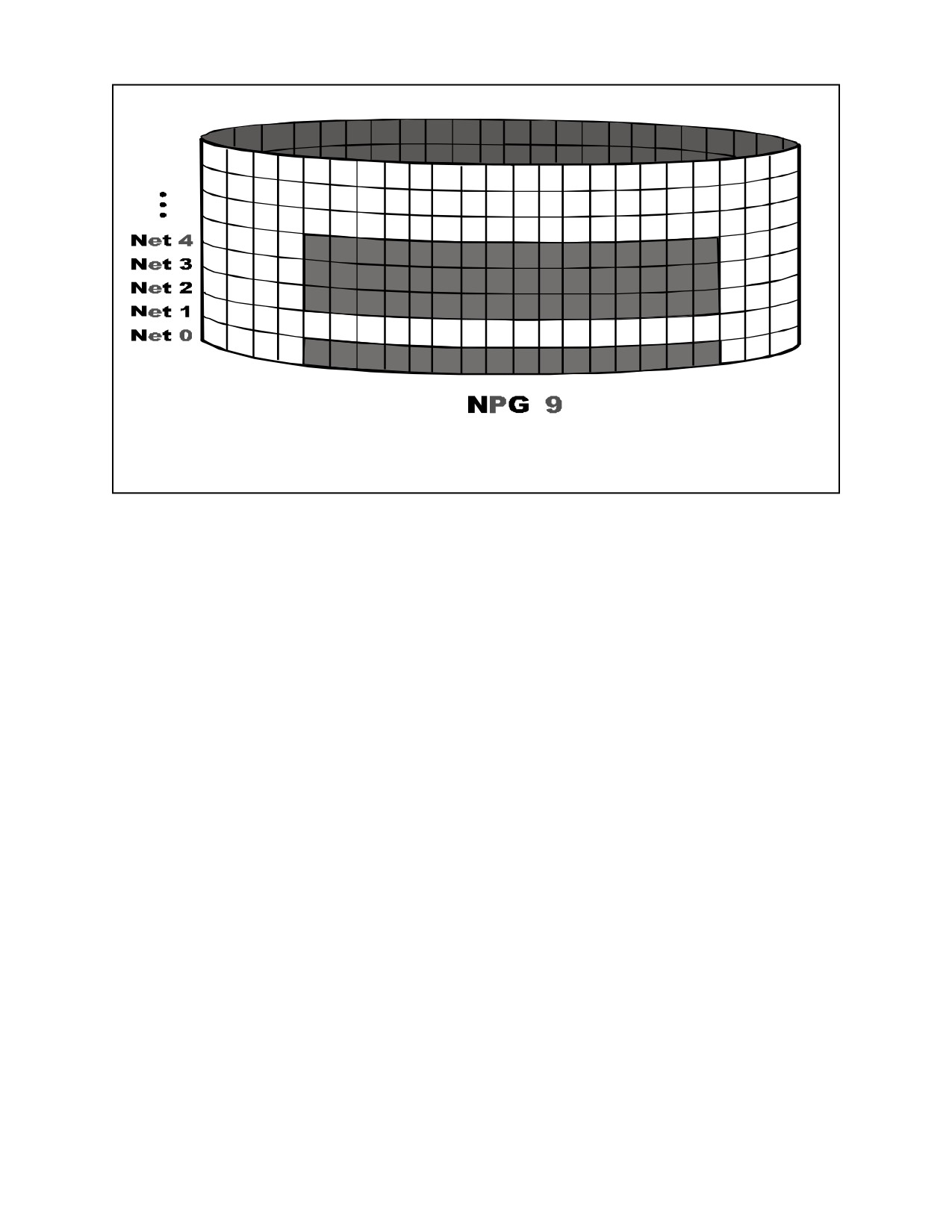
Note: The 16 time slots of time slot blocks A-8-10 are actually interleaved, not
contiguous.
Figure I-2. Stacked Nets
(1) To satisfy the information exchange requirements of the Service systems that
implement TADIL J, a new TADIL J message standard was developed. This new
message standard is designed to support five distinct environments: air, land (ground),
surface (maritime), space, and subsurface.
(2) TADIL J provides for both an information exchange and a network
management capability. Each TADIL J message and its transmission and reception rules
are defined in Military Standard (MIL-STD) 6016, Department of Defense (DOD)
Interface Standards, TADIL J Message Standard. Figure I-3 contains a list of TADIL J
messages. In addition to fixed format, voice and free-text messages are also included.
3. Employment
Employment considerations include surveillance, EW, MM, air control, fighter-to-
fighter nets, secure voice channels, mobile platforms, and positive friendly
identification.
a. Surveillance. Messages that support the surveillance function fall into three
general areas: track and track amplifying information, track management information,
and positional references, which include points, strobes, and fixes.
(1) Tactical data systems (TDSs) that support surveillance normally use active
sensors, such as radar or IFF, or receive position information and status directly from
TADIL C or TADIL J participants. These TDSs generate near real-time track reports
that are exchanged with JTIDS on the surveillance NPG. In addition to active sensors,
some systems with other types of sensors, for example, signal intelligence, infrared, and
electro-optical, can also generate real-time track reports and transmit on the
surveillance NPG.
I-6
Network Ma nagem ent
J8.0 Unit Designator
J8.1 Mission Correlator Change
J0.0 Initial Entry
J0.1 Test
Weapons Coordination and Management
J0.2 Network Time Update
J9.0 Command
J0.3 Time Slot Assignment
J10.2 E ngagement St atus
J0.4 Radio Relay Control
J10.3 Hand Over
J0.5 Repromulgation Relay
J10.5 Controlling Unit Report
J0.6 Communication Control
J10.6 P airing
J0.7 Time Slot Reallocation
Control
J1.0 Connectivity Int errogation
J12.0 Mission Assignment
J1.1 Connectivity Status
J12.1 V ector
J1.2 Route Establishment
J12.2 P recision Aircraft Direction
J1.3 Acknowledgment
J12.3 Flight Path
J1.4 Communication Status
J12.4 Controlling Unit Change
J1.5 Net Control Initialization
J12.5 Target/ Track Correlation
J1.6 Needline Participation
J12.6 Target Sorting
Group Assignment
J12.7 Target Bearing
Precise Participant Location and
Platform and System Status
Ide ntification
J13.0 A irfield Status Message
J2.0 Indirect Interface Unit PP LI
J13.2 A ir Platform and System
J2.2 Air PPLI
Status
J2.3 Surface PPLI
J2.4 Subsurface PPLI
J13.3 S urface Platform and System Status
J2.5 Land Point P PLI
J13.4 S ubsurface Platform and System Status
J2.6 Land Track PPLI
J13.5 Land Platform and System Status
Surveillance
Electronic
J3.0 Reference Point
J14.0 P arametric Information
J3.1 Emergency Point
J14.2 E lectronic Warf are Control/Coordination
J3.2 Air Track
Threat Warning
J3.3 Surface Track
J3.4 Subsurface Track
J15.0 Threat Warning
J3.5 Land Point or Track
National Use
J3.6 Space Track
J28.0 U.S. National 1 (Army)
J3.7 Electronic Warfare Product Inf ormation
J28.1 U.S. National 2 (Navy)
Ant isubmarine Warfare
J28.2 U.S. National 3 (Air Force)
J5.4 Acoustic Bearing and Range
J28.2 (0) Text Message
J28.3 U.S. National 4 (Marine Corps)
Int ellige nce
J28.4 French National 1
J6.0 Intelligence Inf ormation
J28.5 French National 2
Inf ormat ion Management
J28.6 U.S. National 5 (NSA )
J7.0 Track Management
J28.7 UK National
J7.1 Data Updat e Request
J29 National Use (reserved)
J7.2 Correlation
J30 National Use (reserved)
J7.3 Pointer
Miscellaneous
J7.4 Track Identifier
J31.0 Over-the-Air Rekeying Management
J7.5 IFF/SIF Management
J31.1 Over-the-Air Rekeying
J7.6 Filter Management
J31.7 No Statement
J7.7 Association
Figure I-3. TADIL J Message Catalog
(2)
Units that support surveillance without integrated sensors generate non-
real-time tracks. These tracks can be recognized by their track quality (TQ) of zero.
TADIL J provides for air, land, surface, subsurface, and space tracks. In addition, points,
lines, and areas are also exchanged on the surveillance NPG along with amplifying
track information and nonparametric EW product information. Other messages that
support management functions, such as data update requests, correlation messages,
pointers, and IFF difference report, are also exchanged on the surveillance NPG.
b. EW. TADIL J supports the cooperative exchange of EW threat emitter
information between link participants. It supports both EW parametric and control/
coordination messages.
c. MM. Link participants use NPG 8 (principally C2 platforms) to issue and
exchange MM messages. C2 and non-C2 platforms transmit engagement status
messages. These include command, electronic protect, WC, engagement status, platform
and system status, and controlling unit report messages. WC provides the means for
commanders in authority to direct various phases of weapon systems employment
against targets, as well as to direct other C2 actions. Data link participants use NPG 18
for issuing and exchanging WC messages to include pairings (commits) and hand over of
aircraft symbologies.
I-7
d. Air Control. Air control provides a capability for a C2 JU to control non-C2 JUs.
Air control is divided into two components that are configured as a stacked net: the up-
link and the back-link. Each net is assigned to a specific C2 JU and the fighters being
controlled. The controlling unit provides mission assignments and vectors to fighter
aircraft on the time slots assigned to the up-link. Air control back-link provides a
capability for a non-C2 JU to report tracks detected with its weapon system sensors.
For example, a controlled fighter may detect a target with onboard sensors and report
the target position to the controlling JU. The controlling JU attempts to correlate the
target report with those tracks it holds, and for new targets it generates a new track
report
e. Fighter-to-Fighter Net. Fighters exchange sensor target information and aircraft
status among themselves on the fighter-to-fighter net, which is usually configured as a
stacked net, with each fighter group assigned time slots on one of the nets. The
maximum fighter flight size is dependent on the net access designed into the network.
The USN normally uses dedicated access, and flight size can be 2, 4, or 8 fighters per
net. The USAF normally uses contention access, which provides flexibility in flight size.
Dependent on network design, a controller may access a fighter-to-fighter net.
f. Secure Voice Channels. TADIL J provides two (voice groups A and B) secure
digitized voice channels. It is usually configured as a stacked net and has data rates of
2.4 or 16 kilobits per second (kbps). Voice clarity is enhanced when using 16 kbps voice,
but time slot usage is significantly increased. Note that voice circuits remain active
when the terminal is set to the data silent mode of operation. TADIL J voice is not
currently used by some platforms.
g. Navigation. TADIL J provides a mobile platform a relative position derived from
other TADIL J units and can be used to improve a unit’s positional accuracy (see
paragraph 4g on relative navigation [RELNAV]).
h. Positive Friendly Identification. Each JU periodically transmits a PPLI report,
which provides crypto-secure location and identification for the platform. In addition to
position and positive identification, each platform may provide status information such
as fuel, weapons inventory, and mission assignment tasking. This capability is one of
the most important benefits of TADIL J. The capability of all link participants to
frequently provide comprehensive position, identification, and status information is a
considerable improvement over other links and has significant capability to reduce or
prevent fratricide.
4. Data Link Advantages
TADIL J message sets provide enhanced capabilities to report information with a
higher degree of precision than is available with TADILs A or B. See Figure 1-4.
a. Unlimited Participants. TADIL J is not limited to a set number of participants.
Each participant, or JU, is assigned an octal five-digit-unique address. Link addresses
00001 to 00177 are equivalent to TADIL A and B addresses 001 to 177. Therefore, to
accommodate multilink communication, joint operating procedures specified in
Chairman, Joint Chiefs of Staff Manual (CJCSM) 6120 require that C2 JUs always be
assigned addresses below 00177. Non-C2 JUs use only addresses 00200 through 77776.
I-8
b. Track Numbers (TNs). TADIL J employs a five-character alphanumeric TN within
the range 00001 to 77777 or 0A000 to ZZ777. For TN allocation and assignment
purposes, participants must remember that TADIL A TNs 0200 to 7777 are considered
to be the same TNs as the TADIL J TN addresses 00200 to 07777. As a convention, units
that initiate tracks on both TADILs A and J should use their TADIL A track block as
their TADIL J track block to prevent confusion on track identification.
c. TQ Values. TADIL J uses TQ values that range from 0 through 15. A specific
positional accuracy range, as specified in MIL-STD 6016, defines each TQ value. The
highest TADIL J TQ value requires better than 50-foot accuracy. By comparison, the
highest TADIL A/B TQ value is 7 and is defined by each platform.
d. Track Identification. Track identification is reported on TADIL J as an
environment, identification, platform, platform activity, specific type, or nationality. For
an example, see Figure I-5:
e. Platform Status. In conjunction with PPLIs and reports, a JU can report its own
status. This report can include information such as equipment status, ordnance
inventory and variant, radar and missile channels, fuel available for transfer, gun
capability, and estimated time of arrival and departure to and from station.
REFPOINT
Reference point designator - type, latitude/longitude, date time group (dtg)
LINK
Communication link to which message sets apply
PERIOD
Operational period of the network - start/stop dtg
INETWORK
Selected network and network participation group (NPG) design options
JCRYPDAT
Crypto data - crypto variable logic label (CVLL)(s) & assigned key short title(s),
secure data unit (SDU) location
JSTNETS
Establishes net stacking - NPG number, usage
JUDATA
Joint tactical information distribution system (JTIDS) unit (JU) assignments - JU
address, participant type and sequence number, transmission mode, track
numbers, terminal output, user type, initial entry identification, secondary JU address,
track number block
DUTY
Duties/roles - NTR, initial entry JTIDS unit, etc.
JOPTION
NPG design option sequence number - assigned tothe platform
JSDULOC
SDU location - CVLL/SDU location
AMPN
Used to provide information to clarify the preceding set.
NARR
Used to provide additional information on more than one set.
JUFILTER
Use this set to provide TADIL J transmit filter data.
FLTRLINE
Use this set to describe TADIL J line filters.
JDEFAULT
Use this set to provide multifunctional information distribution system TADIL J default
network data.
JTRNMODE
Use this set to provide multifunctional information distribution system TADIL J
network.
Figure I-4. TADIL J Message Sets
I-9
Environment
Air
Identity
Friend
Platform
Fighter
Platform Activity
Combat Air Patrol
Specific Type
FA-18
Nationality
Canada
Figure I-5. Track Identification
f. Information Exchange. The TADIL J message standard allows information to be
exchanged with greater precision than previously available on TADILs A and B.
Significant improvements are attained in position reports through exchanges in latitude
and longitude, course, speeds, altitudes, and lines of bearing. TADIL J messages allow
reporting of multisegmented lines, as well as areas of all shapes and sizes.
g. RELNAV. RELNAV, an automatic function of the terminal, is used to determine
the distance between platforms by measuring the arrival times of transmissions and
correlating them with reported positions. Terminals on a network need this information
to maintain time synchronization. RELNAV is in constant operation in all terminals and
its data can be used to improve a unit’s positional accuracy. If two or more units have
independent, accurate knowledge of their geodetic positions, RELNAV can provide all
units in the network with accurate geodetic positions. As a result, the precise geodetic
position of every unit can be maintained constantly by every other unit. See Figure I-6.
(1) Geodetic Positioning. TADIL J messages implement a three-dimensional
geodetic coordinate system using latitude, longitude, and altitude. This allows positions
to be reported anywhere in the world, subject only to display and data base limitations.
The geodetic grid (GEOGRID) is WGS-84 and positional accuracy of all positions within
this grid are based upon external fixing available to link participants. The GEOGRID is
always active. See Figure I-7.
(2) Relative Grid (RELGRID). In addition to the GEOGRID, the RELGRID may
be activated. This grid is a flat plane similar to the TADIL A grid. It is 1024 by 1024 and
tangent to the GEOGRID at the grid origin. Coordinates in the RELGRID are x, y, z
from the grid origin. The RELGRID functions separately from the GEOGRID and at
time may provide better location information. The RELGRID requires that each unit
enter the same grid origin and that a network functionary role called the navigation
controller (NC) be assigned to one unit. (Note: The NC must be an aircraft. If an aircraft
is not available and the RELGRID is desired, both an NC and a secondary NC must be
assigned.)
h. EW. TADIL J allows greater exchange of EW parametric information and a wider
range of EW control than was provided in legacy data links. EW JUs exchange
parametric data and orders on NPG 10. However, EW product information may be
transmitted over either NPG 10 or NPG 7.
i. Land Points and Tracks. TADIL J messages add land as a track environment.
Land points are normally used to mark the geodetic position of stationary units or
objects such as surface-to-air missile (SAM) sites, military headquarters, bridges, and so
forth. Land tracks can also represent the position of mobile land vehicles such as trucks,
tanks, artillery, and so forth.
I-10
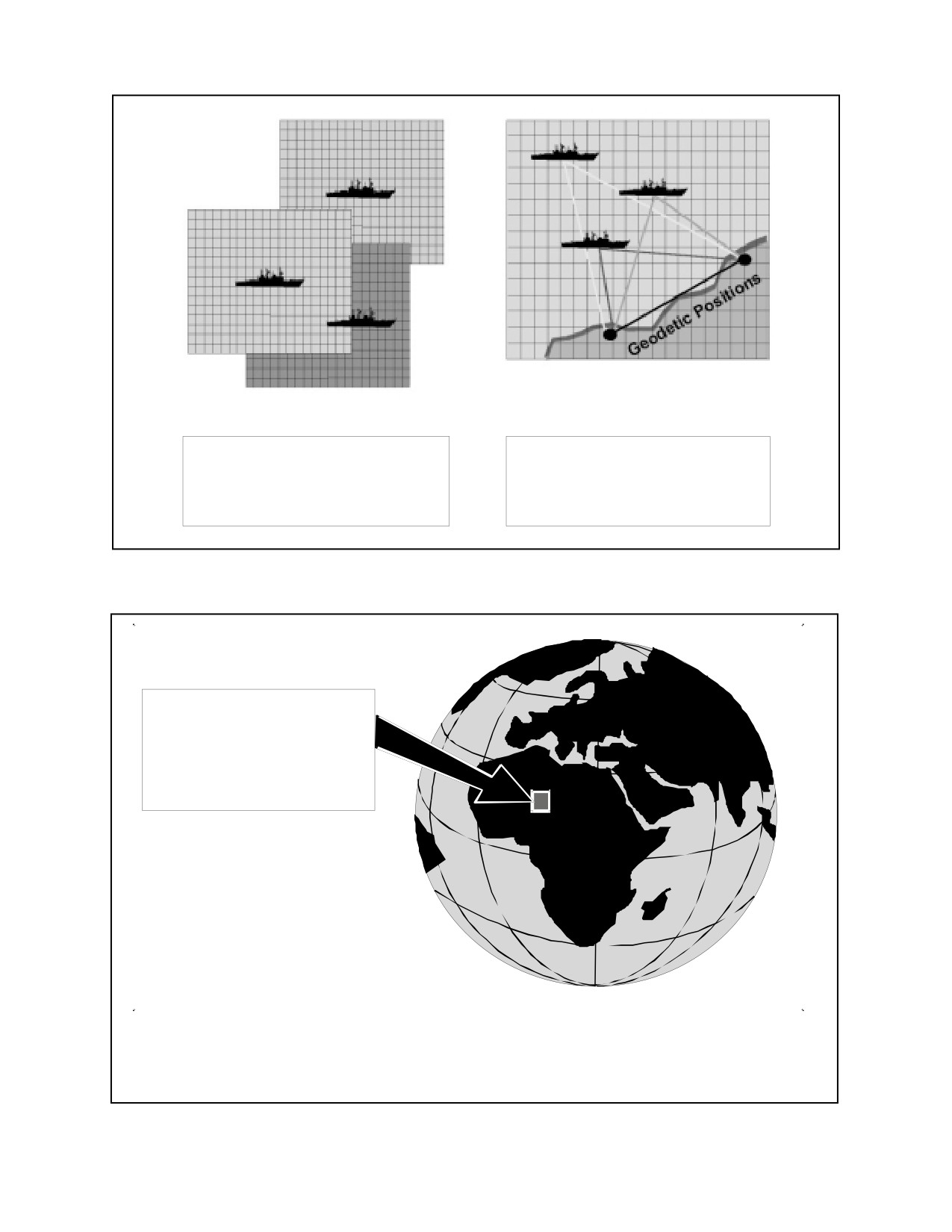
In TADIL-J relative positions are
If two units know their geodetic
measured with respect to the unit
positions, RELNAV can provide
designated as the navigation
geodetic positions for all units .
controller.
Figure I-6. Relative Navigation
Latitude:
20° N
Longitude:
7° E
Altitude:
10,000 feet
Note: With three-dimensional geodetic positioning, a location anywhere in the world
can be reported.
Figure I-7. Geodetic Positioning
I-11
Chapter II
ARCHITECTURE
1. Network Design
The joint interface control officer’s (JICO’s) primary responsibilities functions
include determining the data link architecture and network design parameters needed
to connect the various operational units in the proposed operation. The interface
control officer (ICO)/JICO considers force composition, projected track loading, and
communications and connectivity requirements. Based on these considerations, the
ICO/JICO coordinates with the JTIDS Network Design Library (JNDL) and service
network design facilities (NDFs), when applicable, to select a network from the joint/
Service library or to develop a network request to identify these requirements to an
NDF. Network design consists of identifying a set of information exchange requirements
among tactical platforms, selecting different types of NPGs to support each function,
and allocating each NPG a portion of the network capacity appropriate to its needs.
Appendix C provides a list of network design facilities.
2. Parameters
Two types of parameters are defined at the design phase: network parameters and
platform unique parameters.
a. Network Parameters. Network parameters are universal to all JTIDS units to
ensure compatibility. These common values define the organization of the NPGs, their
net assignments and time slot block assignments, cryptovariable logical label
assignments, and relay functions.
b. Platform-Unique Parameters. Correct platform-unique parameters are needed to
successfully complete initialization data for individual JTIDS units, enabling each to
enter and operate properly on TADIL J. These parameters include transmit-and-receive
time slot assignments for individual platforms and other unique data such as relay
assignments.
3. Network Completion
Once the network is completed and accepted by the requesting command, the
network is provided to the Service NDFs. The respective Service NDF then provides
initialization loads for its Service platforms.
4. Pulse Deconfliction
Pulse deconfliction is a term that refers to the geographical area coordination of
JTIDS use to ensure compliance with pulse density restrictions. Chairman, Joint Chiefs
of Staff Instruction (CJCSI) 6132.01A requires all military users to comply with
deconfliction requirements levied by the US Government. Pulse density restrictions can
be described as the number of pulses emitted within a given geographical area. The
biggest factor contributing to pulse density restrictions is the potential for interference
II-1
with radio navigation systems. The JTIDS deconfliction server (JDS) is an internet-
based, data base application that allows TADIL J units to comply with pulse density
restrictions as they coordinate training opportunities. JDS allows network planners
and users 24-hour access to a list of all scheduled TADIL J activity. Using JDS, units can
easily find potential training opportunities and avoid interfering with other planned
networks. JDS is currently available on the internet within the JNDL web site at
[www.forscom.army.mil/interop/JNDL/JNDL_index.htm]. A defense switching network
dial up capability is planned for the future.
a. JDS Access. The JDS administrator at the JNDL controls access to the JDS
through the use of user names and passwords. Access to the JDS requires completion of
the access request form. The JNDL issues either a deconfliction coordinator-level
password or a JDS viewer-level password. A deconfliction coordinator schedules
TADIL J activity into the JDS. All units may obtain a viewer-level password. The user
name/password security configuration is not sufficient to handle classified information.
The JNDL staff handles all classified events off-line, manually deconflicting them with
unclassified events.
b. JDS Client System Recommendations. Users can access JDS through Microsoft
Internet Explorer 4.01 or higher with 128-bit security or Netscape Navigator 2.0 or
higher. However, only JAVA-enabled 4.0 versions of either can access the next JDS
version, which requires a Pentium 133 personal computer with 32 megabytes of random
access memory or greater and a direct network connection to the internet. If a modem
connection must be used, it should be at least 33.3 kbps.
c. JDS Functions. The JDS allows deconfliction coordinators to schedule JTIDS
activity for a specific time frame in a specific geographic area while checking for
potential time slot duty factor (TSDF) conflicts. The minimum information required for
scheduling includes the point of contact’s (POC) name and phone number, the
9-character network name, and the location, duration, and TSDF. Once scheduled, the
event information is available to all deconfliction coordinators and JDS viewers through
various prescripted data base queries. The information may be modified, updated, or
deleted as necessary, but only by the original scheduler.
d. Joint TSDF Calculator. The TSDF calculator is available to both deconfliction
coordinators and JDS viewers. This calculator is designed to help units determine the
TSDF being used in a network. The user selects a preloaded network from the list
provided. The calculator takes the user to a screen where he selects the number and
type of participants and other options. The calculator then totals and displays both the
total TSDF and the highest single user TSDF for the configuration the user has
specified.
e. JNDL Web Site Features. In addition to the JDS, the JNDL web site contains:
(1) The on-line JTIDS/MIDS network design request form.
(2)
The JTIDS/MIDS network design catalog.
(3) A schedule of JTIDS/MIDS-related training at the joint multi-TADIL school.
(4) A discussion forum for JTIDS/MIDS users.
II-2
(5) A glossary of JTIDS/MIDS terms.
(6) Reference documents.
(7) Links to other JTIDS/MIDS web sites and Service NDFs.
5. Frequency Assignments
Frequency assignments are required for all TADIL J operations. A frequency
assignment may vary because it covers a specific geographic area. The first thing one
must do before submitting a JTIDS/MIDS frequency assignment request is to identify
the requirements. Figure II-1 lists the minimum requirements to include in the
frequency assignment request.
6. Architecture Examples
Figures II-2, II-3, and II-4 provide three examples of architectures. They show
examples of how an architecture might be linked, but are not representative of a
complete or existing JNDL.
Location (for example, warning, restricted, airborne early warning orbit areas or the latitude and
longitude for a specific geographic area).
POC (name, location, phone, e-mail address).
Duration (for example, 3-28 February 0800 - 2000). Note: The location and duration should be
loosely tied together to facilitate more effective pulse deconfliction (for example, point A to point B
within 100 nautical miles either side, 26-28 February. This enables the request to remain at the
UNCLASSIFIED level.)
Required TSDF percentage for network and maximum for any one platform (100/50)
Stop Buzzer POC
Platforms
(e.g. F-14, F-15, E-3, and AEGIS)
JTIDS/MIDS voice requirements
Figure II-1. Minimum Requirements for JTIDS/MIDS Frequency Assignment Request
II-3
F/A-18
TADIL C
E-2C
CVN
Guided
CG
missile
frigate
F-14D
FJUA
TADIL J
TADIL A
CG
CG
Guided missile
Navy
destroyer
destroyer
F-14D
TAOC
TADIL C
TADIL C
F-14B
F/A-18
F-14A
EXAMPLE ARCHITECTURE (AFLOAT)
Figure II-2. Navy Architecture Afloat
II-4
E-3
Low-altitude
JSTARS
air defense
AOC
GBDL
Marine
TACC
FJUB
TADIL B
F-15
TADIL J
TAOC
CRC
ABCCC
TADIL C
PATRIOT ICC
RC-135
F/A-18
PADIL
PADIL
F/A-18
PATRIOT FU
PATRIOT FU
Figure II-3. Joint Architecture Ashore
F-16
VOICE
F/A-18
JSTARS
F-14
E-3
CVN
TADIL C
AOC
Low-altitude
E-2C
air defense
F-15
GBDL
FJUA CG
TADIL A
TADIL J
Marine
FJUB
Guided missile
TACC
TAOC
destroyer
TADIL B
CRC
ABCCC
TADIL C
ICC
RC-135
F/A-18
TADIL C
F-14B
F/A-18
PADIL
F-14A
PATRIOT FU
PATRIOT FU
Figure II-4. Combined Theater Architecture
II-5

Chapter III
OPERATIONS
1. Multilink Operations
With the introduction of TADIL J, all operations will be multilink, consisting of units
operating on various combinations of TADIL C, TADIL A,/B and TADIL J. Multilink
participation must be planned and performed in a manner that provides a common
tactical picture (CTP) to all units. In the multilink environment, those platforms
capable of forwarding data accomplish the necessary information transfers between
different links performing surveillance. Despite employing a variety of equipment,
configurations, and capabilities, TADIL J must integrate with existing communications
links in order to optimize the overall performance of the command, control, and
communications (C3) function. This requires expansion of both link planning and link
control functions in order to take advantage of the full potential of TADIL J capabilities.
a. Multilink Advantages. The advantages of TADIL J show how it can both
complement and improve the other links.
(1) Multiple Functions. Because TADIL J supports multiple functions, it frees
existing radios for other uses, i.e., UHF radios used to support air control data and
voice.
(2) Additional Secure Voice Channels. TADIL J can provide two additional
secure voice channels per platform (each allowing 126 circuit selections) that can be
allocated to multiple groups requiring secure voice. This frees both crypto devices and
radio frequency (RF) equipment. Consequently, the communications planner has
additional resources with which to provide secure voice connectivity and for other uses.
Table III-1. USN Multilink Planning
Feature
TADIL A
TADIL C
TADIL J
Surveillance, position,
Surveillance, position, EW, MM/WC,
Data Functions
Air control
EW, MM/WC
air control
2 secure voice
Voice Functions
No
No
126 nets/voice
Spectrum
HF/UHF
UHF
UHF spectrum L-band
Throughput
1.8 Kbps
3.8 Kbps
54.0 Kbps
System
1.8 Kbps/net
3.8 Kbps per net
Potential of 1 megabits per second
Throughput
4 nets possible
Access Protocol
Polling
Command/response
TDMA
Relative
No
No
Yes
Navigation
Jam Resistance
No
No
Yes
Secure
Yes
No
Yes
Extended LOS
HF only
No
Yes via relay
III-1
(3) Unique Waveform. Since its unique waveform (spectrum) limits over-the-
horizon detection, hinders exploitation, and complicates enemy jamming strategies,
TADIL J-capable forces should be deployed to counter threat electronic strategies. For
example, TADIL J forces can be deployed toward an expected jamming axis, thereby
limiting the jamming effectiveness. Communication alternatives include data on
TADIL J with voice on UHF in order to achieve maximum data (track) throughput.
(4) Higher Communications Loading. TADIL J terminal throughput supports
higher communications loading, allowing more information to be shared by participants.
Increased throughput or capacity allows significantly expanded track loads, while the
TDMA architecture provides quicker track updates that are not tied to a net cycle time.
(5) Improved Computer Display System. TADIL J system throughput allows
tacticians and planners to “select” the connectivity groups that have information
necessary to meet mission requirements. This improves the computer display system
(CDS) and operator efficiency.
(6) TDMA Protocol. TADIL J TDMA access protocol allows programming link
capacity to meet differing tactical needs. UHF back-to-back radio relays could be
eliminated. Relayed air control could extend fighter tactics while still maintaining a
data back link.
(7) Inherent Navigation Capability. TADIL J inherent navigation capability
improves gridlock and shipboard gridlock system operation, reduces target acquisition
time, and enhances cooperative tactics.
(8) Data Forwarding Capability. The introduction of TADIL J with data
forwarding impacts TADIL A platforms in the following ways:
(a) TADIL A operations are improved by moving units to TADIL J and thus
reducing the number of polls in the net cycle.
(b) Major track holders are on TADIL J aircraft carriers (CV), AEGIS, and
E-2C airborne early warning (AEW) aircraft.
(c) All TADIL J tracks are reported to TADIL A units during one poll of the
data forwarder.
(d) The data forwarder automatically reports F-14Ds on TADIL C, whether
controlled or uncontrolled.
(e) Tracks/participating units (PUs) appear from TADIL J units (CVs,
guided missile cruisers [CGs], E-2Cs, F-14Ds, laboratory sites) that are not in the
polling sequence.
(f) Filtering may be required to prevent overloading the TADIL A platform’s
CDS with too many racks.
(g) The gridlock reference unit may be a TADIL J platform.
III-2
b. TADIL A Characteristics. TADIL A employs netted communications techniques
and a standard message format (M-series) for exchanging digital data information
among airborne, land-based, submarine and shipboard tactical data system (TDS).
TADIL A communications are conducted on either the high frequency (HF) or UHF
bands. The following explains TADIL A-associated equipment and its various functions:
(1) TADIL A Computer/Module. Shipboard TADIL A system control may be
provided by the AN/UYK-43 or the AN/UYK-7 computer. The major function of the AN/
UYK-43 computer is to execute the shipboard TDS program; the TADIL A module of the
TDS program provides controls. The AN/UYK-7 is a dedicated TADIL A computer. The
TADIL A computer/module is capable of—
(a) Providing tactical ownership sensor information to data link
participants.
(b) Receiving and processing incoming tactical information from data link
participants.
(c) Maintaining a tactical database.
(d) Performing TADIL A and TADIL C management.
(e) Performing identification functions.
(f) Performing weapons selection and management.
(g) Controlling the data console displays.
(2) TADIL A Data Terminal Set (DTS). The TADIL A DTS converts digital
information from the TDS database, via the KG-40A, to audio tones, which are
modulated, converted to RF, and transmitted by either HF or UHF radios to various
platforms for processing. For live TADIL A operations, the DTS operates in what is
considered to be half-duplex mode. Normal TADIL A operations consist of unit-assigned
duties such as NCS and picket station (PKT). Both NCS and PKTs are considered PUs
in the link, and each has a specific address number assigned to it. Addresses for PUs
range from 001 through 076 in the octal numbering format for a total of 62 available
addresses. The NCS is the unit responsible for polling each PKT unit by interrogating
its PU address each net cycle; this is called the roll call mode. To perform net protocol
functions, the DTS is considered a front-end processor because it does not require the
TDS to be interfaced to perform its functions such as net protocol. However, the DTS
does not transmit the TDS message data unless it is properly interfaced with the TDS
computer.
(3) TADIL A Radios. TADIL A transmitters and receivers provide point-to-point
connectivity between widely separated participants. The radios can be a transmitter/
receiver combination in which the transmitter and receiver are separate, independent
functions. A transceiver is a radio that has interdependent components in one unit that
provide both the transmit and receive functions. Two types of radios are used for
TADIL A: HF and UHF. Link-capable radios require different setup parameters and
sometimes-different internal components than needed by a standard voice radio. The
III-3
primary differences include faster transmit-to-receive switch timing, keyline interface,
audio bypass set at +/- 20 kilohertz (kHz) for data vice +/- 5.5 kHz for voice, and
automatic gain control attack/release timing.
c. TADIL C Characteristics. TADIL C uses a command and response protocol and
the principle of time division multiplexing to derive apparently simultaneous channels
from a given frequency. It connects two points (or units) by assigning a sequence of
discrete time intervals to each of the individual channels. At any given time, a unit
transmits, receives, or idles on a single point-to-point circuit. TADIL C is the USN
primary air intercept control (AIC) tool, as well as the basis for the automatic carrier
landing system. A major capability of TADIL C is the ability to receive and display
targets downlinked by fighter aircraft from beyond the controlling unit’s radar horizon.
TADIL C also has the ability to uplink targets from the controlling unit to the fighter
aircraft and provides target-vectoring data to the fighter aircraft. TADIL C is used on
both USN surface combatants and E-2C AEW aircraft. Both may act as controlling units.
The TADIL C system provides the TADIL J operator/user with the means to conduct
AIC operations with non-TADIL J-capable aircraft. The TADIL C interface between the
advanced combat direction system (ACDS)/command and decision system and the
command and control processor (C2P) allows TADIL C host software to conduct
TADIL J air control operations.
d. Multilink Platform Capabilities. Initial employment of TADIL J in the USN
includes CVs, selected CGs, E-2C Group II, and F-14D aircraft upgrades. These units
have retained their TADIL C and TADIL A capabilities and can conduct various types of
multilink operations. Additionally, Model 5 ships, the E-2C, and the F-14D have
upgraded their CDS databases to be operation specification (OPSPEC) 516 compliant,
giving them TADIL J data registration.
(1) Model 4. Model 4 (Block 0) refers to the existing combat direction system
(CDS) aboard AEGIS and naval tactical data system (NTDS) ships. Their CDS software
conforms to OPSPEC 411 and 404 (Model 4, TADIL A and Model 4, TADIL C). See Table
II-2.
(a) All combat displays and controls are existing TADIL A/TADIL C-
compatible displays. The CDS generates and receives M-, V-, and R series messages via
an “NTDS Fast” interface to the C2P.
(b) All messages transmitted or received over any of the links are routed
through the C2P. Outgoing M, V, and R messages generated by the CDS are either
pipelined to the TADIL A and TADIL C DTS or translated into appropriate J-series
messages for TADIL J. TADIL J messages are further mapped to appropriate NPGs for
transmission.
(c) Incoming messages are similarly pipelined to the CDS from TADIL A
and TADIL C. TADIL J messages are translated from TADIL J to M, V, and R. During
translation, both the expanded message content and enhanced data registration
accuracy of TADIL J are lost. The original link source of the messages cannot be
determined or displayed by the operator. The C2P uses a direct tap from the ship’s
navigation system to make grid translations.
III-4

Table III-2. Model 4 Systems
Model 4/
Model 5/
E-2C
Multilink Capability
F-14D
Block 0
Block 1
Group II
TADIL A surveillance/TADIL C air
X
X
X
control
TADIL J surveillance/TADIL C air
X
X
X
control
TADIL J surveillance/TADIL C air
X
X
X
control
Data forwarding
X
X
-
TADIL J/A surveillance broadcast
X
X
TADIL J air control
X
X
X
X
TADIL C air control
X
X
X
X
Simultaneous TADIL-J/C air control
X
X
X
TADIL J fighter-to fighter advisory
-
X
X
X
OPSPEC 516 databases
-
X
X
X
(2) Model 5. Model 5 system’s Block 1 refers to the upgrading of the CDS (aboard
AEGIS and NTDS ships) to comply with OPSPEC 516 (Model 4, TADIL J). This converts
their data registration system and enables it to be consistent with the TADIL J
messages. (Note: E-2C Group II and F-14D have already made this conversion.)
(a) All combat displays and controls are upgraded to take advantage of the
expanded information contained in the J series messages. The CDS generates and
receives J series messages via an interface to the C2P.
(b) All messages transmitted or received over any of the links are routed
through the C2P. Outgoing J messages are either pipelined to TADIL J or translated
into appropriate M-, V-, and R-series messages for TADIL A and TADIL C. TADIL J
messages are mapped to the appropriate NPGs for transmission. On TADIL A and
TADIL C, the single TADIL J message (from the CDS) may result in as many as 8
messages.
(c) Incoming messages are similarly pipelined to the CDS from TADIL J.
TADIL A and TADIL C messages are translated to TADIL J. The C2P receives
navigation information from the CDS and does not have direct access to the ship’s
navigation system.
(3) E-2C Group II Aircraft. The Group II L-304 computer program maintains a
normalized database that allows it to generate TADIL J and TADIL A messages for
transmission on surveillance to be OPSPEC 516 compliant. All displays and controls are
upgraded to take advantage of the expanded information contained in the J-series
messages. The mission computer can use either the GEOGRID or the RELGRID of
JTIDS RELNAV for data registration. E-2C surveillance, air control, and identification
(PPLI) functions are distinct in all modes. Group II can control up to 20 aircraft on a
combination of TADIL C and TADIL J while transmitting surveillance on either
TADIL J or TADIL A. It can act as a relay for TADIL A or, if operating exclusively on
III-5
TADIL J, relay TADIL J surveillance data. Additionally, the E-2C can monitor fighter-to-
fighter target sorting and provide weapons-free/tight instructions on that net. In all
modes it continues to transmit and process PPLI information.
(4) F-14D Aircraft. The JTIDS Class II terminal has been integrated into the
F-14D as part of the overall avionics upgrade. The aircraft uses the OPSPEC 516 data
registration and has new displays and controls that are fully TADIL J capable. This
allows it to take full advantage of both the TADIL J expanded messages and the
improved navigation accuracy. The F-14D has retained TADIL C capability and can
perform either TADIL C or TADIL J air control. Currently, F-14D software limitations
prevent the simultaneous operation of fighter-to-fighter (on TADIL J) and air control.
Host limitations also prevent the processing of surveillance information. The F-14D
does not process track data received on the surveillance NPG, but is capable of
performing automatic “transparent” relay of the surveillance NPG. The F- 14D receives
track data from the E-2C via the air control NPG. Selected track data may also be
exchanged between F-14Ds via the fighter-to-fighter NPG.
2. Joint Service Operations
Joint and combined operations with other JTIDS-equipped platforms impose unique
requirements due to differences in both hardware/software implementation and in
operating procedures. The USAF does not support the use of design option files or
dynamic air control. The USA does not support 16 kbps voice and platforms equipped
with Class I terminals that do not exchange TADIL J messages. In order to achieve
interoperability, current USN and USAF networks contain special provisions that
support all mixes of USN and USAF C2 and non-C2 units. True joint Service networks
that take full advantage of the multinet capability of JTIDS are planned for the future.
These networks are envisioned to contain both Service-unique and common NPGs.
a. Airborne Warning and Control System (AWACS) E-3 Sentry Aircraft. The E-3
Sentry is an AWACS aircraft that provides all-weather surveillance and C3 needed by
commanders of NATO air and US defense forces. It is the premier air-battle C2 aircraft
in the world today. The entire E-3 fleet is going through the single largest upgrade in its
history. The Block 30/35 Modification Program includes a computer upgrade, a radar
system improvement, new ES measures, a passive detection system, global positioning
system (GPS), and TADIL J AN/URC-107 (V5) Class 2H radio sets. A USAF Test System
3 AWACS aircraft, based at Boeing Field in Seattle, Washington, is used to support the
testing of the AWACS enhancements. The retrofit completion date for the entire fleet of
32 AWACS aircraft is estimated to be in 2001.
b. F-15 Aircraft. F-15s are equipped with the TADIL J AN/URC-107 (V6) Class 2
radio sets. Pilots of TADIL J-equipped F-15Cs have greatly enhanced situational
awareness (SA), enabling use of daytime tactics at night and in low visibility while
reducing the potential of fratricide. A description of air control operations can be found
in the E-2C air control section (see paragraph 4). Twenty-five F-15s are equipped with
TADIL J AN/URC-107 (V) Class 2 radio sets. Twenty are stationed with the 390th
Fighter Squadron (Mountain Home, Idaho). The other five are part of the 57th Test
Group located at Nellis Air Force Base (AFB), Nevada, and are used for tactics
development. The remainder of the F-15 inventory is slated to receive the lower cost
MIDS Fighter Data Link radio set.
III-6
c. JSTARS E-8 Aircraft. JSTARS is a joint USA and USAF program with the USAF
as the lead service. The JSTARS E-8 is a wide-area surveillance aircraft similar to the
Boeing E-3 AWACS. While AWACS is used primarily for air-to-air surveillance, JSTARS
is a long-range, air-to-ground surveillance system designed to locate, classify, and track
ground targets in all weather conditions. Its primary sensor is a multimode radar
system with a phased-array radar antenna in a 26-foot canoe-shaped radome attached to
the bottom of the fuselage. The aircraft is equipped with 18 operator consoles, each of
which has more computing power than an entire E-3. The E-8C communication suite is
designed for communications with upper-level echelon and other surveillance aircraft
and for guiding fighter/bombers aloft onto newly detected targets. Its radios include
UHF Have Quick, VHF single-channel ground and airborne radio system (SINCGARS),
HF long-range radios, and the TADIL J Class 2 radio set.
d. Army Terminals.
(1) Class 1 Terminal. Army Patriot missile batteries use a Class 1 terminal
similar to the AWACS terminal. The Patriot system receives tracks from AWACS via
IJMS. The Army terminals do not include an encoder and thus cannot perform voice
communication via TADIL J.
(2) Class 2 Terminal. The USA has developed a repackaged version of the Class 2
terminal known as the Class 2M. It includes an integrated radio terminal and digital
data processing group (DDPG) and has a volume of 1.25 cubic feet. It is designed to be
carried on the back of a high-mobility, multipurpose, wheeled vehicle (HMMWV) and in
mobile communications centers. It is a single-box configuration (line replacement unit/
weapon replacement assemblies) with the radio terminal and DDPG functions
integrated together.
(3) Equipment Configurations. The Army primarily uses three basic TADIL J
equipment configurations: the Class 2M radio terminal, the dedicated JTIDS relay unit
(DJRU), and the NCS JTIDS. This equipment provides Army units multimission,
multiforce, and multinational data link capabilities. The forward area air defense
(FAAD), theater high-altitude area defense, and Patriot C2 systems are the primary
users. Appendix D provides detailed information on Army Tactical Data Link-1
(ATDL-1).
(4) Adaptable Surface Interface Terminal. The Army also uses the adaptable
surface interface terminal (ASIT), a reconfigured version of the AF ASIT. The Army
ASIT is equipped with the Class 1 AN/URQ-33 Hughes improved terminal (HIT). The
HIT provides access to surveillance data transmitted on the IJMS network from air-
and ground-based surveillance systems. Army systems are being upgraded with MIDS
as they become available.
e. Marine Terminals. The JTIDS Module (JM) is a standard 5-788 shelter secured to
and transported by an M1097 HMMWV, Huey variant. The Marine air control squadron
uses the JM, in conjunction with the tactical air operations module (TAOM), to provide
TADIL J capability to the tactical air operations center (TAOC).
(1) The radio terminal set, AN/TSC-131 (JM), gives the USMC a TADIL J-capable
MACCS. The JM is a shelter that contains a Class 2 terminal and its support equipment,
including antennas and cryptographic equipment. The JM features triservice tactical
III-7
communications-compatible output and is a mobile, rapidly deployable subsystem of a
host platform.
(2) Fully equipped TAOMs provide TADIL A, B, C, and J capabilities, as well as
NATO Link-1 and ATDL-1 interoperability. The USMC (Phase 3) advanced tactical air
command center (TACC) can participate on TADILs A, B, and J and NATO Link-1 and
provide forwarding between those TADILs.
f.
NATO AWACS E-3 Aircraft. NATO AWACS aircraft have JTIDS bilingual Class 2
terminals and upgraded 68030 computer processing units. TADIL J is the NATO
standard system for digital communication (standard NATO Agreement 5516). Appendix
E provides more information on NATO systems.
3. Battle Group Surveillance
Multilink operations over both TADIL A and TADIL J allows the battle group
surveillance function to enhance situational awareness by providing a comprehensive
and consistent tactical picture to all members of the battle group.
a. Participants. The potential mix of participants may include the following:
(1) TADIL A only units.
(2) TADIL A/TADIL J platforms with TADIL A database (Model 4 C2P).
(3) TADIL A/TADIL J with TADIL J databases (Model 5 C2P).
(4) TADIL A/TADIL J with both TADIL A and TADIL J databases (E-2).
(5) E-3 AWACS with a TADIL J database.
b. Data Forwarding. Any C2P-equipped ship can perform the data forwarding
function. All commands are exchanged between TADIL A and TADIL J, including track
data, track management, force orders, and so forth. The forwarding JU—TADIL J to
TADIL A (FJUA)— is the only unit active on both TADIL A and TADIL J. The C2P
maintains a normalized database that enables reporting tracks with either full TADIL J
or TADIL A precision. The C2P translates tracks from the TADIL J grid and its own
ship position in TADIL J to the TADIL A grid and its own ship position.
(1) To prevent redundant tracks and the data forwarding of tracks already
reported on the opposing link, each C2P must be capable of correlating forwarded
TADIL A tracks with local tracks and report only tracks that are held with higher TQ.
Similarly, the TADIL A PUs must be capable of correlating forwarded tracks (those
translated from TADIL J to TADIL A by the data forwarder) with local tracks in order to
prevent redundant or multiple track reporting of the same track.
(2) The data forwarder translates TADIL A PUs into indirect PPLIs and reports
them to all TADIL J platforms in the JTIDS geodetic and relative-coordinate systems.
To convert in the other direction, TADIL J PPLIs appear as special point friendlies. The
III-8
TN of the F-14D is its JU number. TADIL J F-14Ds without an air controller appear as if
the data forwarder is controlling them.
(3) The data forwarder assumes that any platform that is transmitting PPLIs is
a participant on the TADIL J surveillance NPG. Therefore, it does not forward its
tracks onto TADIL J. As a result, if a platform is operating on TADIL J air control and
TADIL A surveillance, the TADIL A tracks will not be forwarded. Data forwarding rules
are shown in Figure III-1.
c. TQ. TADIL A employs TQ numbers that range between 0 and 7 in order to
determine track reporting responsibility. TQ is determined by sensor accuracy, elapsed
time since previous sensor update, velocity of track, and own unit current geodetic
position quality. TADIL J employs TQ numbers that range between 0 and 15. TADIL J
quality values support the additional precision of measurement conveyed by the
additional bits provided in TADIL J data fields. Other TADIL A tracks (unknown,
hostile, and so forth) are converted into TADIL J surveillance tracks by the data
forwarder. A TADIL J TQ is attached to the TADIL A track.
4. Battle Group Air Control
The air control function of TADIL J is similar to that of TADIL C. C2 units (ships and
E-2C aircraft) exercise control over fighters, providing both tactical information and
direction.
a. Parallel Operations. TADIL C can operate in parallel with TADIL J. The
TADIL J circuit is functionally divided into an up-link, where the controller broadcasts
or addresses messages to all fighters, and a back-link on which the fighters respond
with track information or other appropriate information to the C2 unit. MM/WC and
PPLI functional circuits are used in conjunction with the control circuit.
b. Air Control Hand-Over. TADIL J air control includes the capability to digitally
hand over aircraft between air controllers, although most are voice-coordinated. On
TADIL J, the fighter switches net numbers when changing air controllers. TADIL J air
control requires a single JTIDS terminal using separate NPGs to perform air control
and voice functions. To perform a hand-over, the new controller sends a request to
change control to the current controller. The JU number of the new controller is passed
up to the F-14D. The F-14D then generates a request for control that is sent to the new
On TADIL J, the data forwarder must assume PPLI of platforms.
The data forwarder must translate TADIL J track/JU numbers via directional finding sub-blocks.
The data forwarder must be active in both links.
Prior to switching back to TADIL A only, the data forwarder must place the terminal in long-term
transmit-inhibit.
The data forwarder must set the C2P surveillance mode to OFF then to TADIL A only. The
alternate FJUA must have its TADIL A DTS on and the polling and polling sequence entered.
Figure III-1. Data Forwarding Rules
III-9
controller. The new air controller sends the F-14D new back-link time slots after the
new controller receives a WILCO (will comply) from the F-14D. During this process, the
primary receipt messages are sent receipt-compliance (R-C). R-C messages require each
terminal to exchange machine receipts as well as WILCOs. To improve the probability
of reception, each R-C message is sent multiple times until the other terminal complies.
OPSPEC 516 defines the number of times each message is sent. When the process is
complete, the F-14D radar intercept officer sets his JTIDS mode switch from passive to
active intercept. Fighters in the fighter-to-fighter mode cannot be brought under
control.
5. Joint Interface Control
The JICO concept was established to overcome joint and combined interoperability
deficiencies related to management of the joint force multi-TADIL networks.
Incorporated into joint exercises, it has been effective in managing the complexity of the
electronic battlefield, thereby improving the joint force commander’s (JFC’s) ability to
engage hostile forces and prevent fratricide. The United States Joint Forces Command
(USJFCOM) oversees the JICO program.
a. The JICO. The JICO is an operational expert who understands joint warfighting.
The JICO reports to the commander designated by the JFC. The JICO must have a
strong background in joint data link employment and sufficient technical knowledge to
manipulate complex link architectures in order to maximize the combat effectiveness of
joint and combined forces in dynamic operations. The multi-TADIL network and its
interfaces with other networks constitute the theater joint data network (JDN). The
JDN distributes data necessary to develop the CTP and single, integrated air picture.
Acting with authority delegated by the JFC, the JICO serves as the JDN manager to
provide JDN inputs for a complete and seamless CTP for C2 throughout all phases of
the campaign. A multi-service working group developed the functions and tasks of the
JICO for both planning and executing the multi-TADIL networks. For planning, the
JICO compiles information, develops and validates the multi-TADIL architecture,
coordinates development of the operational tasking data link (OPTASKLINK), and
conducts dynamic planning. Execution duties include initiating and maintaining the
multi-TADIL architecture and associated voice circuits, resolving track management
issues, and modifying the architecture as necessary. Monitoring of the link is
accomplished via data link status information. Specifically, the JICO monitors the
status of JUs assigned the various network roles to ensure they are active. JUs
automatically report their status (active, inactive, or limited) via the network
participation status (NPS) indicator (available at the C2P) in the PPLI message. The
JICO monitors the NPS indicator of’ network JUs to determine when a JU assigned a
critical function (NTR, NC, relays, etc.) is no longer in active status and can no longer
function in that capacity. To facilitate the link-monitoring process, JUs that exit the
network should notify the JICO by an alternate means (such as voice).
b. The JICO Cell. Members of a cell, of which the JICO is the officer-in-charge
(OIC), perform the functions of the JICO. A JICO cell can be established for each joint
task force (JTF). The cell consists of the OIC and members necessary to support
continuous operations. To enable the rapid stand-up of new cells for contingency
response and to allow for rotation and surge requirements of existing cells, regional and
III-10
component commands need to be staffed with qualified JICOs and have all necessary
equipment. Members of the JICO cell continuously monitor the multi-TADIL
architecture, ensure connectivity, and resolve interoperability and track management
issues. To ensure JICO personnel maintain proficiency, their training program should
include participation in joint and combined exercises. USJFCOM has overall
responsibility to staff, train, and equip JICO cells.
6. Operating Considerations
To illustrate the complexity of planning and executing TADIL J operations, some of
the many operating considerations that must be taken into account are listed in
Figure III-2. Details of these considerations are beyond the scope of this document, but
all are covered in the Joint Multi-TADIL Operating Procedures (JMTOP).
7. Link Troubleshooting Considerations
Many problems may occur when initializing and operating data links in a multi-
TADIL environment. Most problems encountered with TADIL J occur during the link
initialization and net entry phase of operations. Evaluations of live TADIL J operations
have determined that most problems with initializing and operating the link are due to
operator error. Premission planning and coordination with other participants precludes
many errors. Figure III-3 shows the four basic considerations when troubleshooting
problems with TADIL J.
Accurate OPTASKLINK message
Operating mode and power
Correct network design loads (NDLs)
NTR unit
Surveillance options
NC and secondary NC
Air control options
IEJU responsibilities
Fighter-to-fighter options
TSDF computed and followed
Grid origin
Correct crypto keymat
Stacked net designations
Crypto day
Air control nets
Airborne relays and relief-on-station
procedures
Voice A and B nets
Interference protection feature settings
Fighter-to-fighter nets
Special instructions
• Filtering
• Data registration
Link duty assignments
Deconfliction
JU address and track block assignment
National/international restrictions integrated in
architecture
User sequence and platform type
Figure III-2. TADIL J Operating Considerations
III-11
1. Time.
Remember that GPS time is normally used for TADIL J operations.
Ensure that the agency performing NTR establishes network time for all participants.
Ensure the time differential with the NTR is no more than 6 seconds.
Ensure time is on internal, or if not, that it is getting to the terminal.
2. Crypto.
Verify with the OPTASKLINK that the current crypto keymat is being used.
Verify the crypto day being used (Day 0 or Day 1).
3. Connectivity.
Confirm LOS to the NTR or to an active initial entry JTIDS unit (IEJU).
Confirm establishment of proper connections between the TADIL J terminal, antenna, and
power supply, and so forth.
Confirm that the terminal/antenna is not in a dummy load.
4. Initialization Parameters.
Confirm the NDL in use.
Confirm NTR or normal transmits. Always refer to system-/platform-specific
troubleshooting guides.
5. Synchronization.
If not in fine synchronization, confirm transmission of round trip timing (RTT) messages.
Figure III-3. Troubleshooting Considerations
III-12

Appendix A
SYSTEM CAPABILITIES AND LIMITATIONS
The following quick reference charts represent the systems that operate with
TADIL J in each Service. Additional TADILs are listed if applicable to the system to
increase interoperability knowledge among system users and planners. Each chart
reflects the existence or nonexistence of JTIDS voice. TADIL J is enhanced with JTIDS
voice although this capability uses time slots that are not available for other TADIL J
functions.
TADIL J-Capable Air Force Systems
TADIL J-Capable Air Force Systems
F-15C/D Eagle
Missions
IOC
Terminal Type
JTIDS
TADILs
Forwarder
Voice
(Y/N)
DCA, OCA
2002
MIDS FDL
No
J, IJMS
N
Description/Capabilities
The F-15 C/D is a USAF single-seat, all-weather, air-superiority fighter (AFTTP 3-1, Vol 4)
Limitations
Two UHF radios. MIDS FDL terminal not used for relay.
Special Considerations
None.
F-15C/D Eagle
Missions
IOC
Terminal Type
JTIDS
TADILs
Forwarder
Voice
(Y/N)
DCA, OCA
One squadron
JTIDS Class 2
2.4
J, IJMS
N
fielded
Description/Capabilities
The F-15 C/D is a single seat USAF all-weather, air superiority fighter.
Limitations
Two UHF radios. Not used for relay.
Special Considerations
None.
F-15E Strike Eagle
Missions
Initial Operational
Terminal Type
JTIDS
TADILs
Forwarder
Capability (IOC)
Voice
(Y/N)
AI, CAS, DCA, OCA
2000
MIDS FDL
No
J, IJMS
N
Description/Capabilities
The F-15E is a two-seat, tactical aircraft equipped with modern weapon and navigational
systems.
Limitations
Two UHF radios. Not used for relay.
Special Considerations
None.
F-16 Fighting Falcon
Missions
IOC
Terminal Type
JTIDS
TADILs
Forwarder
Voice
(Y/N)
AI, CAS, CSAR, DCA, OCA,
2006
Block 30:
No
(AFAPD,
N
SEAD
EPLRS
IDM, SADL
Block 40/50: IDM,
(Block 30), J
MIDS low volume
terminal
Description/Capabilities
The F-16 is a single-seat, single-engine fighter that performs multiple missions.
Limitations
One UHF radio. One VHF radio.
Special Considerations
None.
A-1

TADIL J-Capable Air Force Systems (Continued)
F-22 Raptor
Missions
IOC
Terminal Type
JTIDS
TADILs
Forwarder
Voice
(Y/N)
DCA, OCA
2004
Integrated modular
No
J (receive only)
N
avionics
Description/Capabilities
The F-22 is a twin-engine, single- seat, air-superiority fighter intended to replace the F-15C.
The F-22 primarily supports air-to-air missions; however, can also be configured for an air-to-
ground (strike) role.
Limitations
Two UHF radios.
Special Considerations
None.
Air Operations Center (AOC)
Missions
IOC
Terminal Type
JTIDS
TADILs
Forwarder
Voice
(Y/N)
Theater C2
Fielded
JTIDS Class 2, MIDS
2.4/16
A, B, J, ATDL-1
N
Description/Capabilities
The AOC is the senior deployable air operations element of the TACS. It functions as the
JFACC or commander AF operations center. It is the primary element involved in force
management. The AOC includes the facilities and personnel necessary to accomplish the
planning, coordinating, deconflicting, directing and coordinating of theater air operations.
One of the primary functions of the AOC is the planning, production, distribution, and execution
of the air tasking order and airspace control order (AFTTP 3-1 Vol 26).
The other primary function of the AOC is monitoring current execution of air operations.
TADIL J is used to provide real-time C2, surveillance, PPLI and management information in
support of tactical situational awareness for this function. The AOC also expects to use
TADIL J to transmit track, threat and C2 messages in support of time-critical targeting.
Limitations
The continental US numbered AF AOCs are presently equipped differently; 12th AF and 8th AF
do not have JTIDS terminals; 9th AF has some limited JTIDS capability.
Special Considerations
Implementation of the JTIDS capability within the AF modular control equipment units is in
progress and could take from one to two years to complete.
Control and Reporting Center/Control
and Reporting Element (CRC/CRE)
Missions
IOC
Terminal Type
JTIDS
TADILs
Forwarder
Voice
(Y/N)
C2
Fielded
JTIDS Class 2
2.4/16
A, B, C, J, ATDL-1
Y
Description/Capabilities
The CRC and CRE are the ground radar elements of the TACS. CRCs and CREs are tailored
to the specific mission requirements in the area of operations.
Limitations
None.
Special Considerations
None.
E-3 Airborne Warning and Control System
(AWACS) B/C Sentry
Missions
IOC
Terminal Type
JTIDS
TADILs
Forwarder
Voice
(Y/N)
C2
Fielded
Block 20/25: Class 1
2.4
A, C, IJMS, J
N
Block 30/35: Class 2H
(20/25)
(Block 30/35 only)
2.4/16
(30/35)
Description/Capabilities
The E-3 is an airborne C2 platform that supports quick reaction deployments, battle
management, and other aerospace operations to include AI, DCA, ES, OCA, and CSAR and
link management for the JFACC and commander-in-charge.
Limitations
TADIL C is one-way only. The E-3 cannot be a forwarder.
Special Considerations
Concurrent TADIL A, IJMS, and TADIL J operations capable.
USAF calls J voice extended range voice for electronic countermeasures resistance voice.
A-2

TADIL J-Capable Air Force Systems (Continued)
EC-130-E Airborne Battlefield
Command and Control Center (ABCCC)
Missions
Initial Operational
Terminal Type
JTIDS
TADILs
Forwarder
Capability (IOC)
Voice
(Y/N)
C2
Fielded
JTIDS Class 2,
No
AFAPD, J, IJMS,
N
EPLRS
SADL
Description/Capabilities
The ABCCC is an airborne C2 platform that provides a worldwide, rapid response to situations
requiring C3I for the employment of air-to-ground airpower. It operates as an airborne element
of the TACS, functioning as an extension of the AOC (for combat operations) and as a limited
ASOC.
Limitations
None.
Special Considerations
EPLRS/SADL currently installed on only one aircraft.
RC-135 Rivet Joint
Missions
IOC
Terminal Type
JTIDS
TADILs
Forwarder
Voice
(Y/N)
EW
Fielded
JTIDS Class 2
2.4/16
A, J, IJMS
N
Description/Capabilities
The RC-135 Rivet Joint aircraft provides real-time, long- range electronic surveillance of the
theater battlespace by detecting, locating, and identifying air, surface, and land platforms and
radars and other emitters based on land, aircraft, or ships.
Limitations
National asset
Special Considerations
None.
E-8 Joint Surveillance Target Attack Radar System (JSTARS)
Missions
IOC
Terminal Type
JTIDS
TADILs
Forwarder
Voice
(Y/N)
Joint surveillance, targeting,
Fielded
JTIDS Class 2
No
SADL, J, IJMS
N
battle management C2.
Description/Capabilities
The E-8 is employed in theaters of operation to provide real-time battlefield targeting of time-
sensitive moving and stationary ground targets. The system uses a side looking, electronic
scanned, and pulse Doppler radar.
Limitations
None.
Special Considerations
Support to JTF commanders, corps commanders, or other supported commanders as directed.
The JFC determines the most effective use of JSTARS based on the situation and the concept
of operations. JSTARS is also capable of supporting air operations to include AI, CAS, OCA
and other special missions spanning the range of military operations.
A-3

TADIL J-Capable Army Systems
Air Defense Systems Integrator (ADSI)
Missions
IOC
Terminal Type
JTIDS
TADILs
Forwarder
Voice
(Y/N)
Air Defense C2
Fielded
Class 2M
No
J/serial J, A, B,
Y
forward area air
defense (FAAD),
ATDL-1
Description/Capabilities
Main feature is a communications suite that acts as a data link router. Based on an open
architecture design, different data link capabilities may be added and deleted with a change of
an integrated circuit card. Many variants of the ADSI exist and versions may vary greatly from
unit to unit and Service to Service. Deployed with the Army Air Missile Defense Command and
the Army air defense brigade.
Limitations
Nonstandard configurations, widely varying capabilities.
Special Considerations
No voice capability; for Patriot requires an octal 1000 track block field.
Patriot Information Coordination Center
AN/MSQ-116
Missions
Initial Operational
Terminal Type
JTIDS
TADILs
Forwarder
Capability (IOC)
Voice
(Y/N)
Air and missile defense
Fielded
Class 2M
No
A, B, J, ATDL-1,
Y
Patriot data
information link
Description/Capabilities
Integrates the tactical pictures from subordinate fire units. This picture is fused and decisions
are made directing engagements by unit. Serves as the data link interface from Army air
defense into the theater data link structure.
Limitations
Requires an octal 1000 track block.
Special Considerations
Subordinate fire unit radars are phased array fire control radars. Patriot tracks each and every
radar return within its surveillance volume, which if unfiltered or unchecked at the receiving
end, may saturate surveillance radar system based track capacities. Additionally, Patriot has
no manual track correlation capability and may be unaware of the saturation it creates. The
Patriot may initiate filters, which help but do not eliminate the problem.
Forward Area Air Defense (FAAD)
Missions
IOC
Terminal Type
JTIDS
TADILs
Forwarder
Voice
(Y/N)
Air and missile defense
Fielded
Class 2M
No
J (limited), FAAD
N
data link, B
Description/Capabilities
Serves as the gateway between forward air defense units (Stinger) and the joint
TADIL architecture. Deployed at division air avenue command and control and FAAD battalion
air battle management operations centers.
Limitations
Limited transmit capability on TADIL J.
Special Considerations
None.
A-4

TADIL J-Capable Navy Systems
Aircraft carrier (CV)/aircraft carrier (nuclear propulsion) (CVN)
Advanced Combat Direction System (ACDS)
Missions
IOC
Terminal Type
JTIDS
TADILs
Forwarder
Voice
(Y/N)
All NPGs
Fielded
Class 2H
Yes
A, B, C, J
Y
Description/Capabilities
Uses a TDS computer, C2P, JTIDS terminal and antennas. Is a primary carrier battle group C2
platform. Can support primary Navy warfare areas. Integrates 3-dimensional (D) air picture
from various sensors into the TADIL J surveillance picture.
Limitations
USN Class 2H terminals are not bilingual, and therefore, cannot interface with IJMS. Unable to
manually assign system track number (STN). C2P message packing is limited to packed 2.
Special Considerations
Models 4 and 5 are host software programs for TADIL implementations in the USN. Model 4 is
based on TADIL A and loses granularity in translating to/from TADIL J. Model 5 is based on
TADIL J and implements full granularity. CVN (ACDS) operates both Model 4 and 5.
AEGIS, Guided Missile Cruiser (CG)/
Guided Missile Destroyer (DDG)
Missions
IOC
Terminal Type
JTIDS
TADILs
Forwarder
Voice
(Y/N)
AW, C2W, STW, SUW,
Fielded
Class 2H
Yes
A, C, J
Y
USW),
Description/Capabilities
Uses a TDS computer, C2P, JTIDS terminal and antennas. Primary area air defense
commander/rear air defense commander platform. Can support primary Navy warfare areas.
Integrates 3-D air picture from various sensors into the TADIL J surveillance picture; long-
range surface-to-air missile capable.
Limitations
USN Class 2H terminals are not bilingual, and therefore, cannot interface with IJMS.
Special Considerations
Models 4 and 5 are host software programs for TADIL implementations in the USN. Model 4 is
based on TADIL A and loses granularity in translating to/from TADIL J. Model 5 is based on
TADIL J and implements full granularity. AEGIS operated 11 Model 4 and 38 Model 5
platforms in fiscal year 98.
E-2C Group II Navy Upgrade
Missions
IOC
Terminal Type
JTIDS
TADILs
Forwarder
Voice
(Y/N)
C2
Fielded
Class 2H
Yes
A, C, J
N
Description/Capabilities
Uses an L-304 computer with an extra speed processor connected to a JTIDS terminal
Limitations
Cannot receive free text messages. Cannot process TADIL A and TADIL J simultaneously.
USN Class 2H terminals are not bilingual, and therefore, cannot interface with IJMS.
Special Considerations
Limited to 3 JTIDS initialization loads, which limits airborne flexibility.
Amphibious Landing Ship Assault (LHA)/
Amphibious Landing Ship Dock (LHD)
Missions
IOC
Terminal Type
JTIDS
TADILs
Forwarder
Voice
(Y/N)
AW, anti-mine warfare,
Fielded
Class 2H
Yes
A, C, J
Y
C2W, CSAR, mine warfare,
STW,
Description/Capabilities
Amphibious assault combatant. C2 platform used primarily to support amphibious operations.
Integrates 3-D air picture from various sensors into the TADIL J surveillance picture.
Limitations
USN Class 2H terminals are not bilingual, and therefore, cannot interface with IJMS. Unable to
manually assign STN.
Special Considerations
Models 4 and 5 are host software programs for TADIL implementations in the USN. Model 4 is
based on TADIL A and loses granularity in translating to/from TADIL J. Model 5 is based on
TADIL J and implements full granularity. LHAs operate Model 4 software and LHDs operate
Model 5 software.
A-5

TADIL J-Capable Navy Systems (Continued)
Submarine (Nuclear Propulsion)
Missions
IOC
Terminal Type
JTIDS
TADILs
Forwarder
Voice
(Y/N)
STW, SUW, USW,
Fielded
Class 2H
Yes
A, J
N
Description/Capabilities
Operates a stand-alone workstation; not integrated with the platform weapons system.
Submarines are primarily data users and not data providers although they can provide data if
required.
Limitations
USN Class 2H terminals are not bilingual, and therefore, cannot interface with IJMS.
Special Considerations
Intermittent participation.
F-14D Tomcat
Missions
IOC
Terminal Type
JTIDS
TADILs
Forwarder
Voice
(Y/N)
AW, STW, SUW
Fielded
Class 2H
Yes
C, J
N
Description/Capabilities
An all weather, supersonic, multi-mission, air superiority fighter. Can be configured for airborne
intercept, surface attack, and aerial reconnaissance missions.
Limitations
USN Class 2H terminals are not bilingual, and therefore, cannot interface with IJMS.
Special Considerations
F-14A/B is not TADIL J capable.
TADIL J-Capable Navy and Marine Systems
F/A-18C/D/E/F Hornet
Missions
IOC
Terminal Type
JTIDS
TADILs
Forwarder
Voice
(Y/N)
AI, CAS, CSAR, DCA, OCA,
2003
MIDs low volume
Yes
J
Y
SEAD
terminal
Description/Capabilities
The F/A-18 is a single-seat, twin-engine fighter that performs multiple missions.
Limitations
Two UHF/VHF/high frequency (HF) airborne radio communication-210 radios.
Special Considerations
None.
A-6

TADIL J-Capable Marine Systems
Marine Tactical Air Command Center (TACC)
Missions
IOC
Terminal Type
JTIDS
TADILs
Forwarder
Voice
(Y/N)
C2
Fielded
Class 2H
No
A, B, J, NATO Link-1
Y for A, B, J
Description/Capabilities
The TACC is the senior agency within the MACCS. The TACC is comprised of two cells. The
communications suite consists of HF, VHF FM, and UHF radios. The multiple source
correlation system is used to interface TADILs A, B and J into the TACC.
Limitations
No organic satellite or multi-channel communications equipment; link-1 is receive only; no live
sensor inputs.
Special Considerations
None.
Tactical Air Operations Center (TAOC)
AN/TYQ-23 (V1)
Missions
IOC
Terminal Type
JTIDS
TADILs
Forwarder
Voice
(Y/N)
C2
Fielded
Class 2H
No
A, B, C, J, ATDL-1,
Y
NATO Link-1
Description/Capabilities
The TAOC is the air defense agency within the MACCS. The TAOC consists of 6 shelters with
4 operator positions each. Communications consists of HF, VHF (FM) and UHF. The system is
supported by four air search radars, (two long-range 3D and two medium- range 2D).
The functions of the TAOC include command coordination, weapons control, surveillance and
traffic management.
Limitations
No organic satellite or multichannel communications equipment.
Special Considerations
When conducting TADIL J operations, the TAOC requires an additional participating unit
(PU)/reporting unit for forwarding requirements.
TAOC AN/TYQ-23 (V4), Tactical Air Operations Module (TAOM) (V4),
AN/TYQ-82 Tactical Data Communications Platform
Missions
IOC
Terminal Type
JTIDS
TADILs
Forwarder
Voice
(Y/N)
C2
1999
Class 2H
Yes
A, B, C, J, ATDL-1,
Y
ground based data
link, NATO Link-1
Description/Capabilities
The TAOC is the air defense agency within the MACCS. The TAOC consists of 6 shelters with
4 operator positions each. Communications consists of HF, VHF (FM) and UHF. The system is
supported by four air search radars, (two long-range 3D and two medium-range 2D). The
functions of the TAOC include command coordination, weapons control, surveillance and
traffic management.
Limitations
No organic satellite or multichannel communications equipment.
Special Considerations
None.
A-7
Appendix B
JTIDS CRYPTOGRAPHIC VARIABLE REQUIREMENTS
1. Terminals
A Class 2 JTIDS terminal, AN/URC-107 (V) 1, consists of the receiver/transmitter (R/
T), an associated antenna system, a high-power amplifier, a digital processing group
(DPG), a battery pack (BP), and a secure data unit (SDU).
a. R/T Unit. The R/T unit provides all radio and intermediate frequency processing
for JTIDS TDMA functions. The R/T interfaces with the DPG.
b. DPG. The DPG is the central unit of the JTIDS terminal and consists of two
major components—the digital data processor (DDP) and the interface unit (IU).
(1) DDP. The DDP contains the network interface computer program (NICP). It
performs all the real time R/T control and signal processing for TDMA message
transmission and reception. The NICP also encodes transmitted messages and decodes
received messages. The NICP performs all network functions.
(2) IU. The IU contains the subscriber interface computer program (SICP) and is
attached to the front of the DDP. It provides a standard interface to the DDP and a
tailored interface to the host platform. Its primary function is to process the necessary
transfer of data between the DDP and the host platform. The IU central processing unit
stores and executes the SICP functions.
c. BP. A BP provides emergency power to maintain critical data, including the
crypto key oscillator power and system initialization data during brief power
interruptions. The BP also maintains crypto key and initialization data when the
terminal is in STANDBY mode.
d. SDU. An SDU KGV-8 is mounted on the front panel of the IU. Two connectors
provide the electrical interface between the SDU and the IU. The SDU stores the crypto
key required to implement secure communications functions. If the SDU is detached
from the IU, any stored key erases and terminal operation cease.
(1) Variations. SDUs that are currently fielded are KGV-8 (E-2), KGV-8A, KGV-
8B, and KGV-8C. On KGV-8 (E2) and KGV-8A, a connector called the key fill port is
located on the outside of the SDU and allows the crypto key to be loaded. Some terminal
configurations use a remote fill cable and control cable permanently attached to the
SDU to load the crypto key. With the introduction of the KGV-8B, a newly developed
embedded cryptographic module that employs a new data standard, DS-101, was
implemented. It supports keying with the data transfer device (DTD) and a JTIDS
personal computer (PC) with JTIDS-specific software installed for use with a new type
of key material which is encrypted (black). The USN will retrofit the KGV-8B in place of
earlier SDUs. The “B” version eliminates the load control unit (LCU) and introduces the
DTD AN/CZY-10.
B-1
///////////////////////////////////////