FM 7-0 TRAINING FOR FULL SPECTRUM OPERATIONS (DECEMBER 2008) - page 2
Army Training Management
nates to reduce the effects of unit losses and develop future leaders. Command sergeants major, first ser-
geants, and other senior NCOs coach junior NCOs and junior officers to help them master a wide range of
individual tasks.
4-25. Commanders allocate time during collective training for NCOs to conduct individual training. The
time allocated allows for repetition of tasks. NCOs train individuals to standard and understand how indi-
vidual task training relates to mission-essential tasks and supporting collective tasks. Commanders select
individual, crew, and small-team tasks to be trained based on recommendations from NCOs. NCOs base
recommendations on their evaluation of training deficiencies. NCOs recommend tasks for training at train-
ing meetings. (See paragraphs 4-155 through 4-157.) When the commander approves tasks for training, the
tasks are incorporated into the unit’s training plans and subsequent training schedules. NCOs plan and pre-
pare the approved training, execute after action reviews (AARs) during training, and provide feedback on
individual Soldier performance during training meetings. For efficiency, Soldiers assigned a low-density
military occupational specialty may be trained together by a senior NCO.
ARMY CIVILIANS
4-26. The Army Civilian Corps provides stability and continuity for the Army. Army civilians generally
serve in organizations longer than their military counterparts. They provide specialized skills and know-
ledge in day-to-day Army operations. Normally, Army civilians are assigned to the generating force; how-
ever, they are integral to manning, equipping, resourcing, and training both the generating force and opera-
tional Army. Army civilians both support and lead Army operations. Army civilian leaders plan, prepare,
execute, and assess training of their subordinates and organizations. They follow the principles of training
outlined in chapter 2 and use the tools of this chapter to focus the training of their organizations.
ARMY FORCES AND JOINT TRAINING
4-27. Joint training follows joint doctrine. Joint training facilitates understanding of the other Services and
of interagency and multinational partners. The Army trains with those partners to better understand their
capabilities, limitations, cultures, and ways of conducting operations. When assigned as joint force com-
manders, Army commanders establish joint training objectives; plan, prepare, execute, and assess joint
training; and assess training proficiency.
SECTION II - MISSION-ESSENTIAL TASK LIST DEVELOPMENT
4-28. Because sufficient resources, especially time, are not available, units cannot train to standard on
every task needed for all operations across the spectrum of conflict. Therefore, commanders focus training
on the most important tasks—those that help units prepare to conduct operations. They do this through
mission focus and their mission-essential task list (METL). A mission-essential task list is a compilation
of mission-essential tasks that an organization must perform successfully to accomplish its doctrinal
or directed mission. Unit leaders emphasize the priority of METL training but find opportunities to in-
clude non-mission-specific requirements in training plans where possible.
MISSION FOCUS
4-29. Mission focus is the process used to derive training requirements from a unit’s core capabilities
as documented in its authorization document (a table of organization and equipment [TOE] or table of
distribution and allowance [TDA]) or from a directed mission. A directed mission is a mission the unit
is formally assigned to execute or prepare to execute. Commanders normally assign a directed mission
in an execute order, operation order, or operation plan.
4-30. Commanders ensure their unit members train as they will fight by using mission focus to guide the
planning, preparation, execution, and assessment of their training program. Mission focus is achieved pri-
marily through performing a mission analysis and focusing training on tasks essential for mission accom-
plishment. Mission focus is critical throughout the entire training process. Mission focus enables com-
12 December 2008
FM 7-0
4-5
Chapter 4
manders and staffs at all echelons to develop structured training programs that focus on mission-essential
training activities and address tasks specified for all Army units in AR 350-1.
4-31. Commanders use mission focus to allocate resources for training based on mission requirements. An
organization cannot attain proficiency on every mission-essential task because of time or other resource
constraints. Commanders build a successful training program by consciously focusing on those tasks most
critical to mission accomplishment. They identify those tasks on the unit METL.
MISSION-ESSENTIAL TASK LISTS
4-32. A mission-essential task is a collective task a unit must be able to perform successfully to ac-
complish its doctrinal or directed mission. All mission-essential tasks are equally important. Since or-
ganizations must be capable of performing all elements of full spectrum operations, sometimes simulta-
neously, they cannot afford to train exclusively on one element at the expense of the others. Similarly, they
cannot feasibly be proficient in all tasks at all points on the spectrum of conflict. Therefore, commanders
use their METL to focus organizational training.
4-33. Commanders and staffs assess the unit’s state of training in terms of the METL. They determine each
task’s training priority. Commanders consider two factors when assigning training priorities: their assess-
ment of the unit’s proficiency in each task, and the risk to future operations entailed by accepting a lower
level of proficiency on that task. Commanders assign training priorities in coordination with the higher
commander.
4-34. The METL provides the foundation for the unit’s training strategy (see paragraph 4-93) and, subse-
quently, its training plans. Commanders develop training strategies to attain proficiency in mission-
essential tasks. All mission-essential tasks are essential to mission readiness; therefore, mission-essential
tasks are not prioritized. However, commanders focus efforts and resources on those tasks assessed as
needing the most training.
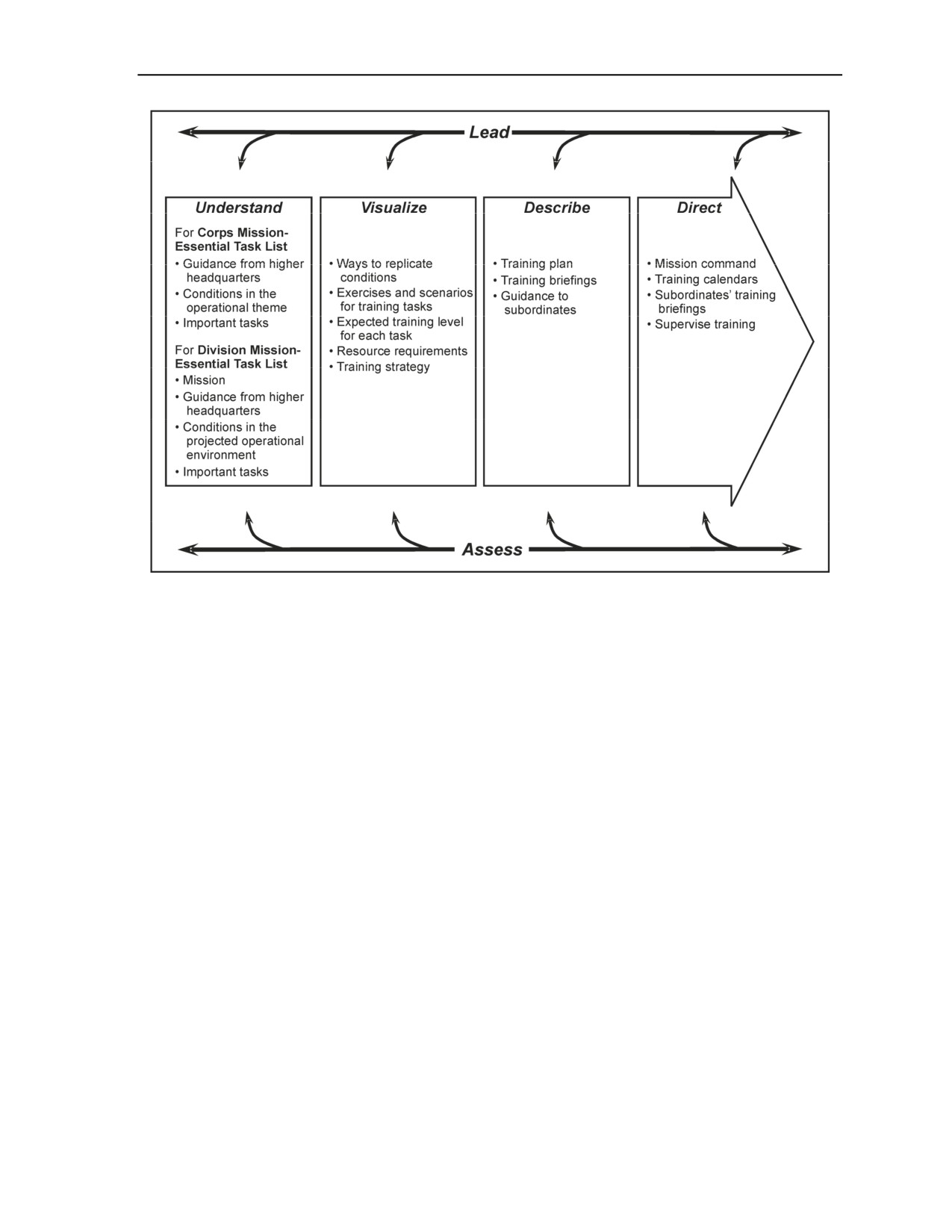
4-35. Commanders exercise a modified form of battle command to manage training. (See figure 4-1.) They
determine—
z
Tasks requiring training.
z
Priority of training effort.
z
How to replicate the conditions of the operational theme or projected operational environment.
z
Risk involved in not training certain tasks to standard.
4-36. Understanding the expected conditions is essential to deciding which tasks to train, the conditions to
replicate, and which risks are prudent. Conditions can be either those described by an operational theme or
those likely to be encountered in a directed mission. Visualizing the required state of readiness and how to
achieve it leads to developing a training strategy that describes the ends, ways, and means of attaining mis-
sion readiness. Finally, the commander describes that strategy in a training plan and directs its accom-
plishment. By participating in and overseeing training, commanders can assess the state of readiness and
the value of the training.
4-37. There are three types of mission-essential task list:
z
Joint mission-essential task list (joint METL or JMETL), which is derived from the Universal
Joint Task List.
z
Core mission-essential task list (core METL or CMETL), which is standardized and based on
doctrine and the organization’s mission according to its authorization document.
z
Directed mission-essential task list (directed METL or DMETL), which is developed by the
commander upon receipt of a directed mission.
Units train on only one METL at a time.
4-6
FM 7-0
12 December 2008
Army Training Management
Figure 4-1. Battle command in training
JOINT MISSION-ESSENTIAL TASK LIST
4-38. A JMETL is a list of tasks that a joint force must be able to perform to accomplish a mission. JMETL
tasks are described using the common language of the Universal Joint Task List (CJCSM 3500.04E). Joint
force commanders select them to accomplish an assigned or anticipated mission. A JMETL includes condi-
tions and standards as well as the tasks themselves. It requires identifying command-linked and supporting
tasks. (CJCSM 3500.03B, enclosure C, describes JMETL development and linkage.)
4-39. Army organizations often provide forces to joint force commanders. A theater army, corps, or divi-
sion headquarters may be designated as joint force headquarters. (See FMI 3-0.1.) This assignment requires
the designated Army headquarters to develop a JMETL. The combatant commander or joint force com-
mander who established the joint task force approves its JMETL. Commanders of Army forces assigned or
attached to a joint force ensure their unit’s DMETL nests with the joint force’s JMETL.
4-40. CJCSI 3500.01E and CJCSM 3500.03B provide an overview of the Joint Training System. They ad-
dress—
z
Developing joint training requirements.
z
Planning joint training.
z
Executing joint training.
z
Assessing joint proficiency.
CORE MISSION-ESSENTIAL TASK LIST
4-41. A unit’s core mission-essential task list is a list of a unit’s corps capability mission-essential
tasks and general mission-essential tasks. Units train on CMETL tasks until the unit commander and
next higher commander mutually decide to focus on training for a directed mission. Then units transition to
a DMETL. (See paragraph 4-69.) A CMETL normally focuses unit training in the reset phase of
12 December 2008
FM 7-0
4-7
Chapter 4
ARFORGEN; however, it can focus training in other ARFORGEN phases if the unit does not receive a di-
rected mission. Units conduct CMETL training under the conditions found in a single operational theme
and at an appropriate point on the spectrum of conflict (for example, midway between insurgency and gen-
eral war) based on higher headquarters’ guidance.
Standardization
4-42. In today’s modular, expeditionary Army, commanders and leaders expect certain capabilities of or-
ganizations assigned to their force package. Standardized CMETLs and focused training conditions at bri-
gade and above help meet these expectations in two ways: they enhance the Army’s ability to rapidly as-
semble force packages, and they minimize the additional training needed for the most probable directed
missions. Maintaining a CMETL training focus provides the Nation the strategic depth required for unfore-
seen contingencies. Headquarters, Department of the Army, adjusts training conditions periodically as it
reassesses likely operational environments. Commanders cannot, and do not need to, train on all CMETL-
related collective and individual tasks. (See paragraph 4-52.) Instead, they train on those tasks they deem
most important. Commanders accept prudent risks on the others.
4-43. Proponents develop standard CMETLs for brigade-sized and higher level units based on unit autho-
rization document mission statements, core capabilities, and doctrine. Headquarters, Department of the
Army, approves—and updates, as needed—these CMETLs after Armywide staffing. CMETLs for corps,
divisions, BCTs, functional brigades, and multifunctional support brigades are synchronized to ensure ap-
propriate supporting-to-supported alignment of mission-essential tasks. Proponents ensure the appropriate
CMETL is the basis for a unit’s combined arms training strategy (CATS). (See paragraphs 4-94 through 4-
95.)
4-44. Most brigade and higher level commanders can find their CMETL in their organization’s CATS.
Battalion and company commanders develop and align their CMETLs to support their higher organiza-
tion’s CMETL. Platoons and below plan and execute collective and individual tasks that support the com-
pany’s CMETL. Staffs identify and train on task groups and supporting collective and individual tasks that
support the headquarters company’s CMETL—they do not have a “staff METL.” Commanders of units for
which a CMETL is not published develop a CMETL based on the unit’s authorization document and doc-
trine. The next higher commander with ADCON approves this CMETL.
4-45. The CMETL for Reserve Component units is the same as that of Regular Army units with the same
authorization document. State homeland security tasks for Army National Guard units are treated as a di-
rected mission and require creating a DMETL. The Army National Guard command with ADCON ap-
proves the DMETL for Army National Guard units assigned a civil support mission.
CMETL Components
4-46. CMETLs include two types of tasks:
z
A core capability mission-essential task is a mission-essential task approved by Headquar-
ters, Department of the Army, that is specific to a type of unit resourced according to its
authorization document and doctrine.
z
A general mission-essential task is a mission-essential task approved by Headquarters, De-
partment of the Army, that all units, regardless of type, must be able to accomplish.
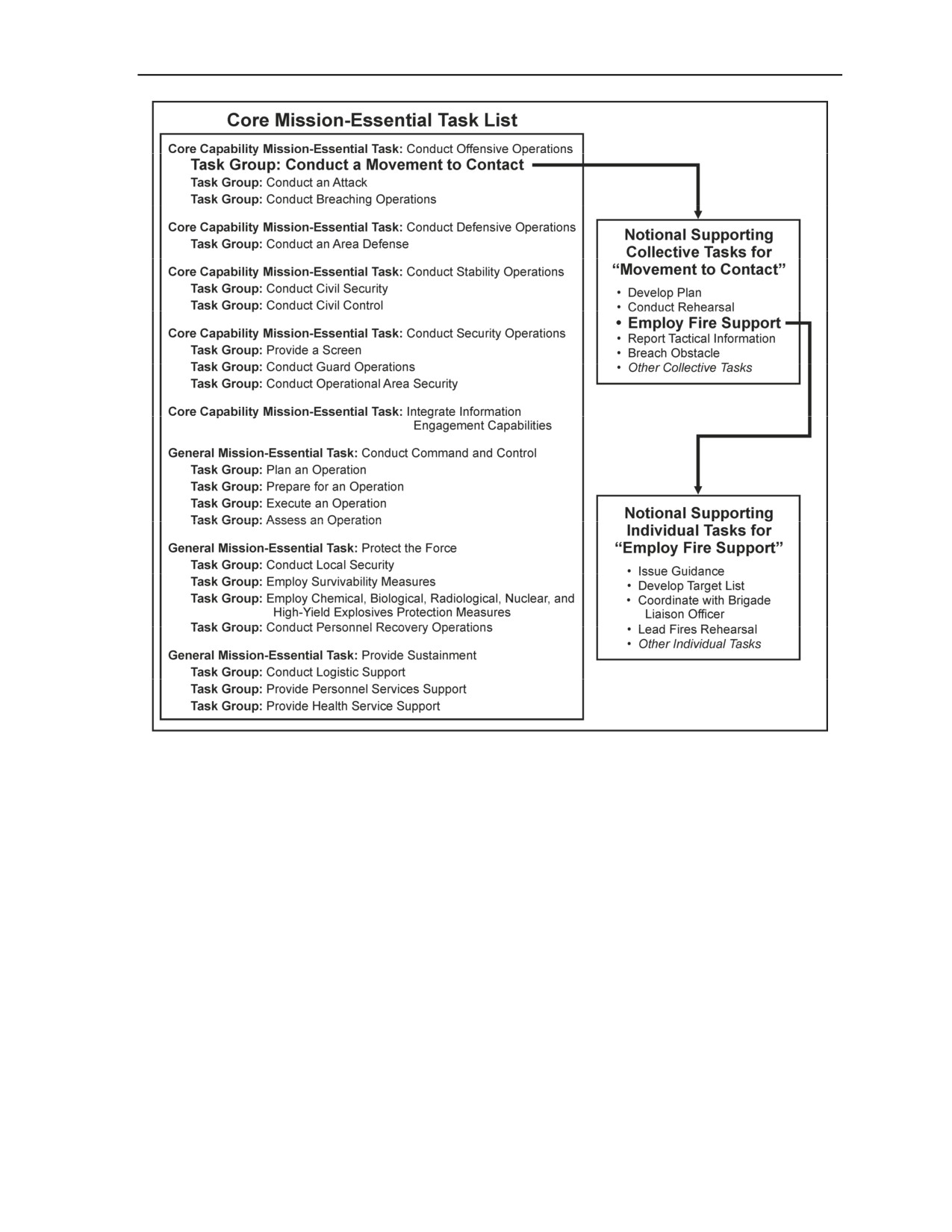
CMETLs are supported by task groups, supporting collective tasks, and supporting individual tasks. (See
figure 4-2 for an example of CMETL taxonomy.)
Task Groups and Supporting Collective Tasks
4-47. A task group is a set of collective tasks necessary to accomplish a specific part of a mission-
essential task. For example, task groups for the mission-essential task “Conduct offensive operations,”
might be “Conduct an attack” and “Conduct a movement to contact.” To accomplish a task group, a unit
must be able to conduct the related supporting collective tasks.
4-8
FM 7-0
12 December 2008
Army Training Management
Figure 4-2. Notional core METL and supporting tasks
4-48. Supporting collective tasks are the tasks that make up a task group. The unit’s CATS usually lists
supporting collective tasks. Commanders assign training priorities to appropriate task groups based on their
assessment of the unit’s proficiency in each task group and the importance of the task group to potential
missions. Then they identify specific supporting collective tasks to train. Identifying these important sup-
porting collective tasks allows the commander to establish the tasks that—
z
Integrate the warfighting functions.
z
Receive the highest priority for resources such as ammunition, training areas, facilities (includ-
ing live, virtual, constructive, and gaming training enablers), materiel, and funds.
z
Receive emphasis during evaluations.
z
Support the higher organization’s METL.
Supporting Individual Tasks
4-49. Developing an effective training strategy requires crosswalking collective, leader, and individual
tasks with each mission-essential task or task group. This crosswalk may involve subordinate commanders,
staffs, command sergeants major, first sergeants, and other key officers, NCOs, and Army civilians. Senior
NCOs understand the unit’s METL; therefore, they are the best qualified to integrate individual tasks into
mission-essential tasks during training.
12 December 2008
FM 7-0
4-9
Chapter 4
4-50. After supporting collective tasks have been identified, the command sergeant major or first sergeant,
with other key NCOs, develops a supporting individual task list for each collective task. Soldier training
publications and CATSs are sources of appropriate individual tasks.
4-51. Some non-mission-specific requirements are critical to the health, welfare, individual readiness, and
cohesiveness of a well-trained organization. Commanders select non-mission-specific requirements (for
example, some of the mandatory training in AR 350-1) on which the organization needs to train. The
command sergeant major or first sergeant usually helps the commander with this.
Identifying Tasks, Setting Prioirities, and Accepting Risk
4-52. Headquarters, Department of the Army, standardizes CMETL tasks and supporting task groups for
echelons above battalion. However, commanders at all levels determine the collective and individual tasks
to train, the training priority of each task, and the risk associated with not training other collective tasks.
The intellectual process associated with METL development has not changed from the traditional process;
however, now their CMETL provides commanders with a framework for training their units to perform all
elements of full spectrum operations: offense, defense, stability, and civil support.
4-53. The supporting collective task lists for each task group can be extensive. Commanders react correct-
ly by saying they cannot train on all the tasks listed. Instead of trying to train on too many tasks, com-
manders should consult with their higher commander and consider the conditions associated with the as-
signed operational theme. Lower commanders then focus training on the tasks most important to
accomplishing the mission in that operational theme. The higher commander underwrites the subordinates’
acceptance of the risk of not training on the other tasks. Tasks not trained are usually those peripheral to
the mission or those the commander has assessed that the unit can perform without significant additional
training. The higher and subordinate commanders’ experiences affect their judgment of what to train and
what not to train. As discussed in paragraphs 4-35 through 4-36, commanders can use the battle command
framework to help focus their training efforts and develop training plans.
4-54. The assignment of an operational theme for CMETL training helps commanders identify the most
important tasks. Given enough time, it may be possible to train sequentially on CMETL tasks under two
different operational themes; however, training for more than one operational theme simultaneously is like-
ly to be counterproductive. (Appropriate commanders assign an operational theme for training in the train-
ing and leader development guidance. See paragraph 4-60.)
DIRECTED MISSION-ESSENTIAL TASK LIST
4-55. A directed mission-essential task list is a list of the mission-essential tasks a unit must perform
to accomplish a directed mission. When a unit is assigned a mission, the commander develops a DMETL
by adjusting the unit’s CMETL based on mission analysis and the higher commander’s DMETL. Once the
DMETL is established, it focuses the unit’s training program until mission completion. Theater-assigned
and theater-committed support units perform the same functions whether deployed or not deployed. There-
fore, these types of units, as well as units in support of specific operation plans, train based on a DMETL.
Developing a Directed Mission-Essential Task List
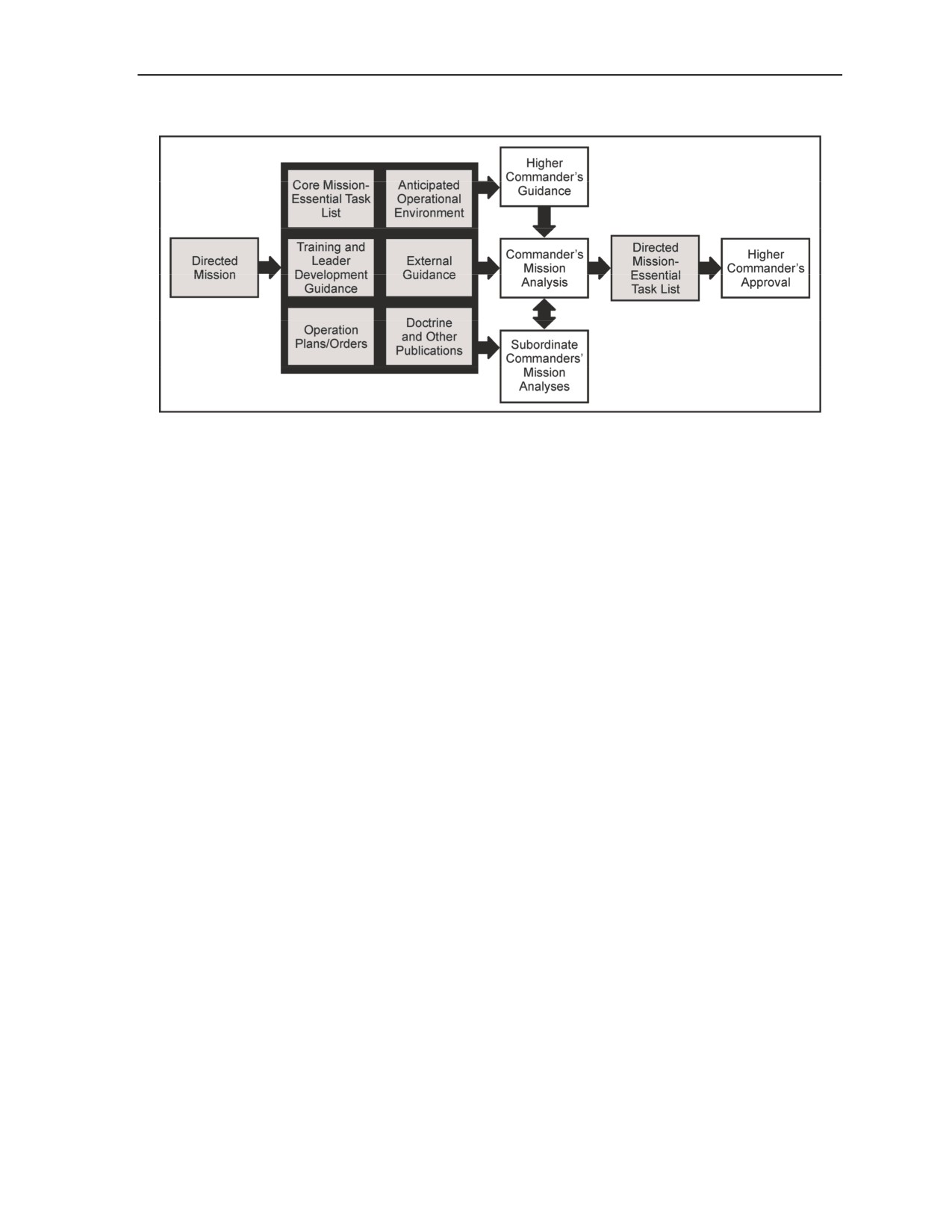
4-56. The DMETL development technique helps commanders identify tasks in which an organization must
be proficient to accomplish its directed mission. (See figure 4-3.) This technique can also be used by units
to develop a CMETL, if none exists for the unit. The technique is a guide, not a fixed process. It melds the
directed mission and the training and leader development guidance with other inputs filtered by command-
ers and subordinate leaders to help commanders determine directed mission-essential tasks. Commanders
personally analyze the directed mission and involve subordinate commanders, staffs, and their command
sergeant major or first sergeant in DMETL development. Subordinates help identify tasks essential to mis-
sion accomplishment. Their participation aids in developing a common understanding of the organization’s
critical mission requirements. This understanding allows DMETLs of subordinate organizations to support
the higher headquarters’ or supported organization’s DMETL.
4-10
FM 7-0
12 December 2008
Army Training Management
Figure 4-3. Commander’s directed METL development technique
4-57. Applying the DMETL development technique—
z
Focuses the organization’s training on essential tasks.
z
Provides a forum for professional discussion and leader development among senior, subordi-
nate, and adjacent (peer) commanders and staffs concerning the links between mission and train-
ing.
z
Enables subordinate commanders, staffs, and key NCOs to crosswalk collective, leader, and in-
dividual tasks to the mission.
z
Leads to commitment of the organization’s leaders to the organization’s training plan.
Directed Mission-Essential Task List Development Fundamentals
4-58. The following fundamentals apply to DMETL development:
z
A DMETL is derived from the commander’s analysis of a directed mission.
z
Directed mission-essential tasks apply to the entire unit. A DMETL does not include tasks as-
signed solely to subordinate organizations.
z
Each organization’s DMETL supports and complements the DMETL of the higher headquarters
or the headquarters to which it provides support.
z
Resource availability does not affect DMETL development. The DMETL is an unconstrained
statement of tasks required to accomplish the unit’s mission.
z
Where directed mission-essential tasks involve emerging doctrine or nonstandard tasks, com-
manders establish tasks, conditions, and standards based on their professional judgment, guid-
ance, and observations, insights, and lessons from similar operations. Higher commanders ap-
prove standards for these tasks as part of DMETL approval.
4-59. During DMETL development, commanders consider how they intend to integrate the warfighting
functions through plans and orders to conduct combined arms operations. Commanders employ the war-
fighting functions to ensure that tasks necessary to build, sustain, and apply combat power are collectively
directed toward accomplishing the mission. A warfighting function is a group of tasks and systems (people,
organizations, information and processes) united by a common purpose that commanders use to accom-
plish missions and training objectives (FM 3-0). The warfighting functions are—
z
Movement and maneuver.
z
Intelligence.
z
Fires.
z
Sustainment.
12 December 2008
FM 7-0
4-11
Chapter 4
z
Command and control.
z
Protection.
Commander’s Mission Analysis
4-60. The starting point for DMETL development is the organization’s directed mission. In some cases,
higher commanders may want to identify an operational theme for the projected operation—major combat
operations, irregular warfare, peace operations, limited intervention, or peacetime military engagement—to
help focus Soldiers and leaders and create a mindset. (Normally they do this in their training and leader de-
velopment guidance.) This provides the means to coordinate, link, and integrate a focused DMETL and ap-
propriate supporting collective and individual tasks throughout the organization.
4-61. When time is limited, commanders may specify DMETL tasks for subordinate units. Commanders
may need to be more prescriptive in their training and leader development guidance as well. When specify-
ing DMETL tasks, commanders acknowledge a commensurate level of risk involved. Risk also occurs
when there is not enough time to analyze all aspects of the mission. Those conditions may result in subor-
dinate commanders and staffs failing to include a task on which the unit must train to prepare completely.
4-62. Commanders consider several factors during their mission analysis and subsequent DMETL devel-
opment. These include the following:
z
The unit’s CMETL.
z
Plans and orders.
z
The anticipated operational environment.
z
External guidance.
z
Doctrine and other publications.
Unit CMETL
4-63. A CMETL can serve as a starting point for DMETL development, since some of the unit’s core ca-
pabilities may be the capabilities needed to accomplish the directed mission. These core capabilities are de-
rived from the unit’s mission as documented in doctrine and paragraph 1 of the unit’s authorization docu-
ment—the fundamental reasons for the unit’s existence.
Plans and Orders
4-64. Operation plans and orders provide missions and related information that are important in determin-
ing required tasks for training. Input for training plans may include—
z
Deployment order.
z
Execution of a contingency plan.
Anticipated Operational Environment
4-65. An operational environment is described in terms of the eight operational variables: political, mili-
tary, economic, social, information, infrastructure, physical environment, and time (PMESII-PT). (See FM
3-0.) Each affects how Army forces conduct (plan, prepare, execute, and assess) military operations.
Commanders tailor forces, employ diverse capabilities, and support different missions to succeed in to-
day’s complex operational environments. The operational variables form the basis for determining the con-
ditions under which a unit will not only operate but also under which it will train. These conditions, when
combined with the standards for the DMETL tasks, help commanders assess unit readiness for a mission.
External Guidance
4-66. External guidance serves as an additional source of tasks that relate to a unit’s directed mission.
Sources of external guidance include—
z
Commander’s training and leader development guidance.
z
Higher headquarters’ DMETL or the DMETL of the deployed or deploying supported force.
4-12
FM 7-0
12 December 2008
Army Training Management
z
Higher headquarters’ or the receiving force’s directives.
z
Mobilization plans (for Reserve Component units).
z
Force integration plans.
Doctrine and Other Publications
4-67. Doctrine and other sources can provide additional information relating to a directed mission. These
include—
z
FM 7-15, The Army Universal Task List.
z
CJCSM 3500.04E, The Universal Joint Task List.
z
AR 350-1, Army Training and Leader Development.
z
CATSs and proponent-developed collective tasks and drills.
z
Proponent-developed CMETLs approved by Headquarters, Department of the Army.
Directed Mission-Essential Task List Approval
4-68. DMETL approval resides with the next higher commander unless otherwise specified. Commanders
of units projected to be assigned to, attached to, or under operational control of a deploying or deployed
force coordinate with that force’s commander during DMETL development. The higher commander with
ADCON approves the DMETL and ensures that the unit’s DMETL supports the deploying or deployed
force’s DMETL. This may involve consulting with the receiving force commander. When Reserve Com-
ponent units are mobilized, DMETL approval shifts to First Army or the appropriate Army Service com-
ponent command.
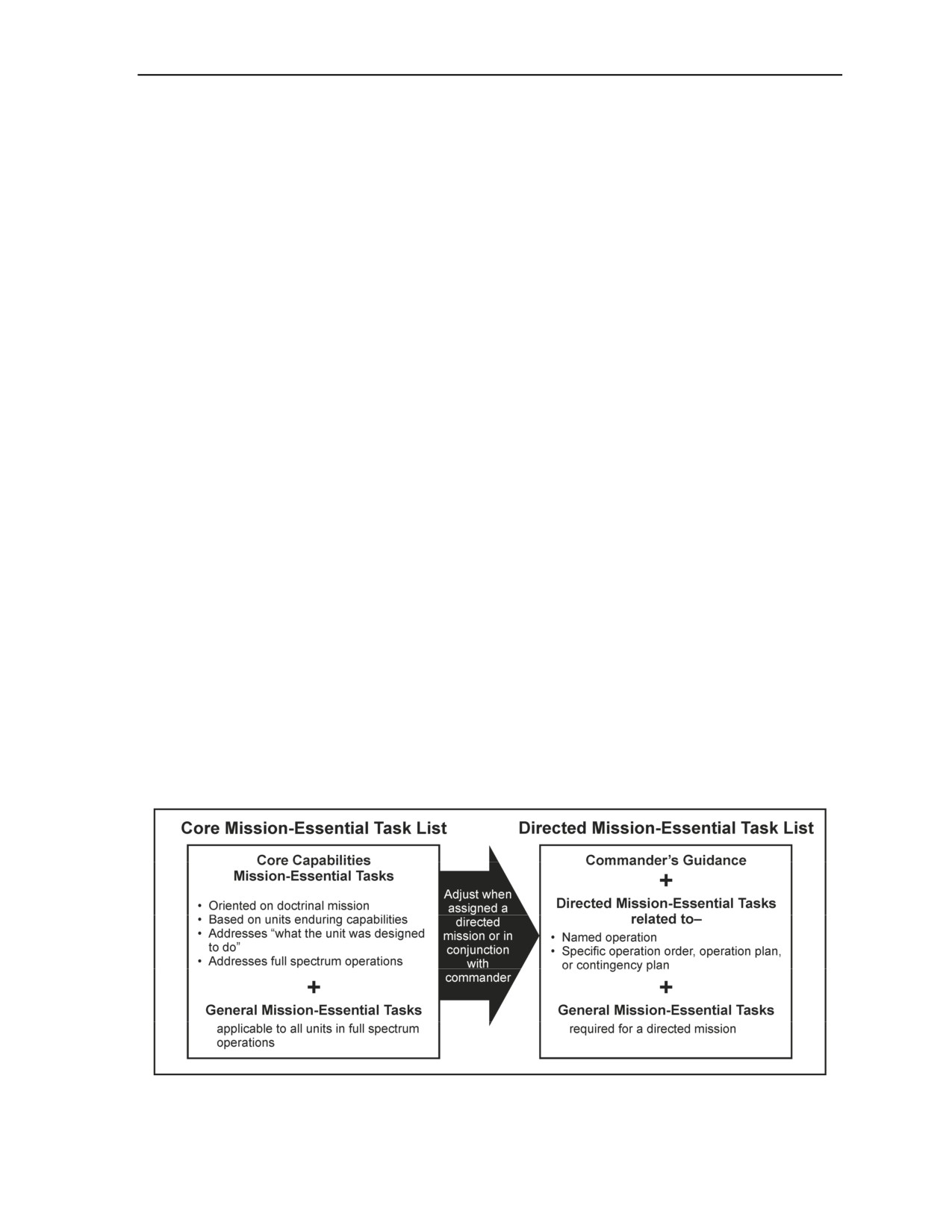
TRANSITIONING FROM A CORE METL TO A DIRECTED METL
4-69. At the time agreed to by the unit commander and the higher commander, the unit’s training focus
transitions from CMETL tasks and assumed conditions of an operational theme to DMETL tasks and con-
ditions that portray the anticipated operational environment. (See figure 4-4.) Since a directed mission may
be assigned during any ARFORGEN phase, commanders prepare to quickly adapt their training and train-
ing support systems from a CMETL to a DMETL focus. Organizations undergoing ARFORGEN are noti-
fied of an upcoming mission or deployment early enough for commanders to adjust their METL and train-
ing focus. A unit begins training on DMETL tasks upon achieving the CMETL proficiency agreed to by
the unit commander and the next higher commander. Exceptions include units with insufficient time be-
tween operational deployments to train on CMETL tasks, and units assigned a mission significantly differ-
ent from their doctrinal mission, capabilities, and equipment. Such units may begin training on DMETL
tasks immediately upon learning of a new mission.
Figure 4-4. Transition from a core METL to a directed METL
12 December 2008
FM 7-0
4-13

Chapter 4
SECTION III - THE ARMY TRAINING MANAGEMENT MODEL
4-70. The foundation of Army training is the Army training management model. (See figure 4-5.) This
model provides the framework commanders use to achieve proficiency in their unit’s mission-essential
tasks. This model mirrors the operations process described in FM 3-0. There are two primary differences
between the two: First, while battle command drives the operations process, the METL drives training
management. And second, the training management model includes bottom-up feedback to support com-
manders’ assessments. While each of the model’s activities is important, successful training largely results
from thorough preparation.
Figure 4-5. The Army training management model
4-71. Automated training management helps commanders plan, prepare, execute, and assess unit training.
The Digital Training Management System (DTMS) is an automated information system that helps com-
manders do this. It aids commanders in managing information and solving problems involving training and
training management. It also provides links to individual and collective tasks through several sources, such
as CATSs, The Army Universal Task List, and the Universal Joint Task List. DTMS provides commanders
with snapshot statuses of unit training. It can also produce the following products:
z
Long- and short-range planning calendars.
z
Event training plans.
z
Training schedules.
z
Individual training records.
z
METL assessment records.
TOP-DOWN/BOTTOM-UP APPROACH TO TRAINING
4-72. The top-down/bottom-up approach to training is a team effort that applies mission command to train-
ing. This approach requires senior leaders to provide training focus, direction, and resources. Subordinate
leaders develop objectives and requirements specific to their organization’s needs and provide feedback on
4-14
FM 7-0
12 December 2008
Army Training Management
training proficiency. They also identify specific organizational training needs and execute training to stan-
dard according to the training schedule or event training plan. This team effort maintains training focus, es-
tablishes training priorities, and enables effective communication among command echelons.
4-73. Guidance, based on mission and priorities, flows from the top down and results in subordinate unit
identification of specific collective and individual tasks that support the higher headquarters’ mission-
essential tasks. Input from the bottom up is essential because it identifies training needed to achieve task
proficiency. Leaders at all echelons communicate with each other on requirements and the planning, pre-
paring, executing, and assessing of training.
PLAN
4-74. Conducting training to standard begins with planning. Units develop training plans that enable them
to attain proficiency in the mission-essential tasks needed to conduct full spectrum operations under condi-
tions in likely operational environments. Commanders determine a training strategy for the unit and pre-
pare training plans. Developing these plans involves identifying and scheduling training events, allocating
time and resources, and coordinating installation support. Commanders perform long-range, short-range,
and near-term planning. They present a training briefing to their higher commander to obtain approval of
their long- and short-range plans. Commanders also request approval of the commander-selected collective
tasks that support the METL during this briefing.
4-75. Planning extends the mission-focus process that links the METL with the subsequent preparation,
execution, and assessment of training. Centralized, coordinated planning develops mutually supporting,
METL-based training at all unit echelons. Planning involves continuous coordination from long-range
planning, through short-range and near-term planning, and ultimately leads to training execution.
4-76. Long-range, short-range, and near-term planning all follow the same process. Commanders at all le-
vels assess training, provide guidance, and publish training plans. The only difference among echelons is
the complexity of assessment, scope, scale, and form of the training and leader development guidance.
Planning begins with two principal inputs: the METL (see paragraph 4-37) and training assessment (see
paragraphs 4-186 through 4-210).
4-77. Training assessments provide focus and direction to planning by identifying training tasks that are
new, where performance needs improvement, or where performance needs to be sustained. Training as-
sessments provide commanders with a starting point for describing their training strategy. The training as-
sessment compares the organization’s current level of training proficiency with the desired level of profi-
ciency based on Army standards. This results in training requirements that are necessary to achieve and
sustain mission-essential task proficiency. The commander, assisted by key leaders, develops a training
strategy that prepares the unit to meet each training requirement.
FUNDAMENTALS OF PLANNING FOR TRAINING
4-78. Adhering to the following fundamentals contributes to well-developed training plans:
z
Maintain a consistent mission focus.
z
Coordinate with habitually task-organized supporting organizations.
z
Focus on the correct time frame.
z
Focus on organizational building blocks.
z
Focus on the unit’s mission-essential and supporting tasks.
z
Incorporate composite risk management (CRM) into all training plans.
z
Lock in training plans.
z
Make the most efficient use of resources.
Maintain a Consistent Mission Focus
4-79. Each headquarters involves its subordinate headquarters when developing training plans. Based on
the higher headquarters’ plans, subordinate commanders prepare plans with a consistent mission focus.
12 December 2008
FM 7-0
4-15
Chapter 4
Coordinate with Habitually Task-Organized Supporting Organizations
4-80. Commanders of BCTs and battalion task forces plan for coordinated combined arms training that in-
cludes their habitually supporting organizations. Commanders of other units deploying with BCTs actively
participate in developing their supported unit’s training plans and develop complementary training plans.
Commanders at all echelons require subordinates to integrate their training plans and monitor coordination
efforts during planning.
Focus on the Correct Time Frame
4-81. Long-range training plans in the Regular Army and mobilized Reserve Component units extend out
at least one year. They may cover an entire ARFORGEN cycle. Reserve Component long-range plans con-
sider a minimum of two years or an entire ARFORGEN cycle. Short-range training plans in the Regular
Army and mobilized Reserve Component units normally focus on an upcoming quarter; however, their fo-
cus may be dictated by a particular ARFORGEN cycle. Reserve Component short-range training plans typ-
ically use a one-year time frame. Near-term planning for the Regular Army and mobilized Reserve Com-
ponent units starts six to eight weeks before the execution of training; Reserve Component near-term
planning starts approximately four months prior. Time frames are flexible and determined between appro-
priate commanders.
Focus on Organizational Building Blocks
4-82. Organizational building blocks include the following:
z
Individual and small-unit skills.
z
Leader development.
z
Battle rosters.
z
Staff training.
Individual and Small-Unit Skills
4-83. The individual Soldier is the heart of any organization’s ability to complete its mission. Soldiers first
learn to perform individual or leader skills to standard in the institutional training base; however, effective,
periodic repetition of tasks in the operational Army is necessary to hone and maintain them. Well-trained
Soldiers—grounded in such basics as physical fitness, first aid skills, marksmanship, and small-unit
drills—are essential to successful collective training. Commanders should emphasize collective training
proficiency of small units—crews, teams, squads, sections, platoons—over company and higher level train-
ing. Small-unit proficiency provides the foundation for large-unit readiness.
Leader Development
4-84. Leaders spend much of their available training time supervising the training of subordinates. Howev-
er, they themselves must also develop as leaders. Leaders do learn on the job during collective training.
Nonetheless, commanders need to provide leader development opportunities and challenges for subordi-
nates during training as well.
Battle Rosters
4-85. A battle roster is a listing of individuals, crews, or elements that reflects capabilities, proficien-
cies in critical tasks, or other information concerning warfighting abilities. Battle rosters track key
crew training information on selected mission-essential systems (such as aircraft, tanks, howitzers, auto-
mated information systems, and forklifts). These rosters are maintained at battalion level and below. Com-
manders also track training data pertinent to readiness, such as crew stability, manning levels, and qualifi-
cation status. Battle rosters designate qualified back-up operators or crewmembers assigned elsewhere in
the unit. During the execution of training, crewmembers on the battle roster train with their assigned crews.
4-16
FM 7-0
12 December 2008
Army Training Management
Staff Training
4-86. Staffs balance routine garrison duties with operational training. However, a staff is a weapon system.
As with any weapon system, a staff requires training to function properly. Staffs provide commanders with
the relevant information needed to make timely, correct decisions. Doing this well requires a commander
and staff to operate as a cohesive team. Forming this team requires the staff and commander to train to-
gether—ideally using live, virtual, constructive, and gaming training enablers. This training helps a staff
understand how the commander operates and thinks. Staff training objectives are derived from the collec-
tive tasks that support the unit METL. Only through frequent, challenging training on digital information
systems can commanders and their staffs become proficient in the intuitive art of battle command.
Focus on the Unit’s Mission-Essential and Supporting Tasks
4-87. Effective training plans focus on raising or sustaining unit proficiency on mission-essential tasks.
Incorporate Composite Risk Management into All Training Plans
4-88. Commanders train their units to tough standards under the most realistic conditions possible. Apply-
ing CRM does not detract from this training goal; rather, it enhances execution of highly effective, realistic
training. CRM involves identifying, assessing, and controlling risks arising from operational factors and
making decisions that balance risk costs with mission training benefits. (See FM 5-19.) Leaders and subor-
dinates at all echelons use CRM to conserve combat power and resources. Leaders and staffs continuously
identify hazards and assess risks. Then they develop and coordinate control measures to mitigate or elimi-
nate hazards. CRM is continuous for each mission or training event. It is incorporated into all training
plans and is a continuous part of preparation for training.
Lock In Training Plans
4-89. Unplanned or unanticipated changes disrupt training and frustrate subordinates. Planning allows or-
ganizations to anticipate and incorporate change in a coordinated manner. Stability and predictability can
result from locking in training plans. This stability is crucial to training Reserve Component units, where a
disruption or delay in training has a significant impact. For instance, a two-hour delay in the start of train-
ing during a weekend assembly represents a 12.5-percent loss in available training time. As much as possi-
ble, senior commanders protect subordinate organizations from unnecessary changes. Commanders decide
the lock-in period for training plans. Nevertheless, change is a part of any operational environment; good
organizations adapt to unavoidable changes.
Make the Most Efficient Use of Resources
4-90. Time and other training resources are always limited. When allocating them, commanders give prior-
ity to the training that contributes most to achieving and sustaining operational proficiency levels.
TRAINING OBJECTIVES
4-91. After mission-essential tasks are selected, commanders identify training objectives for each task. A
training objective is a statement that describes the desired outcome of a training activity in the unit.
It consists of the task, conditions, and standard:
z
Task. A clearly defined and measurable activity accomplished by individuals and organiza-
tions.
z
Conditions. Those variables of an operational environment or situation in which a unit, system,
or individual is expected to operate and may affect performance (JP 1-02).
z
Standard. A quantitative or qualitative measure and criterion for specifying the levels of
performance of a task. A measure provides the basis for describing varying levels of task per-
formance. A criterion is the minimum acceptable level of performance associated with a particu-
lar measure of task performance. For example, the measure when donning a protective mask is
time, and the criterion is a certain number of seconds.
12 December 2008
FM 7-0
4-17
Chapter 4
4-92. The conditions and standards for the majority of a unit’s collective training tasks are identified in ap-
plicable training and evaluation outlines. A training and evaluation outline is a summary document that
provides information on collective training objectives, related individual training objectives, re-
source requirements, and applicable evaluation procedures for a type of organization. CATSs contain
training and evaluation outlines. These can be accessed through DTMS. The following resources can assist
commanders and staffs in developing collective and individual training objectives:
z
Combined arms training strategies.
z
Soldier training publications.
z
DA Pamphlet 350-38, Standards in Training Commission.
z
Deployment or mobilization plans.
z
FM 7-15, The Army Universal Task List.
z
The Universal Joint Task List Portal (available as a link from the Joint Exercise and Training
Division Web page on the Joint Doctrine, Education, and Training Electronic Information Sys-
TRAINING STRATEGIES AND COMBINED ARMS TRAINING STRATEGIES
4-93. A training strategy describes the ways and means the commander intends to use to achieve and sus-
tain training proficiency on mission-essential tasks. The strategy is based on the commander’s assessment
and discussions with the higher commander. Training strategies include the following:
z
Tasks to be trained.
z
Training audience.
z
Training objectives.
z
Order in which the tasks are to be trained, given limited time and other resources.
z
Frequency at which tasks are trained.
z
Types of events used to create conditions for training tasks.
z
Conditions under which the tasks are to be trained.
z
Resources required to execute the training strategy.
z
Alternative ways of training tasks.
4-94. CATSs are publications that provide commanders with a template for task-based, event-driven orga-
nizational training. They can be adapted to the unit’s requirements based on the commander’s assessment.
CATSs state the purpose, outcome, execution guidance, and resource requirements for training events.
Commanders can modify these to meet unit training objectives. Each CATS describes how a particular unit
type can train to and sustain the Army standard. CATSs identify and quantify training resources required to
execute long- and short-range collective training.
4-95. There are two types of CATSs: those that are unique to a unit type (a unit CATS), and those that ad-
dress a functional capability common to multiple units (a functional CATS). Unit CATSs are based on the
core capabilities described in a unit’s authorization document and doctrine. The unit CMETL is published
in the CATS for that unit type. Functional CATSs are based on standard capabilities performed by most
Army units, such as command and control, protection, and deployment.
4-96. Each CATS is a training management tool for commanders, leaders, and other unit trainers. CATSs
identify and group the supporting collective tasks into task groups for each mission-essential task. The dis-
cussion of each task group includes guidance for training the task group, resource requirements, and train-
ing support requirements for each proposed training event.
4-97. CATS training events are iterative to compensate for personnel turbulence, turnover, and skill degra-
dation. Each event’s discussion includes instructions on applying the crawl-walk-run approach to it. (See
paragraphs 4-180 through 4-184.) CATSs identify training objectives and suggest ways to conserve re-
sources by using multiechelon training opportunities. Combined with live, virtual, constructive, and gam-
ing training enablers, these strategies can help commanders efficiently achieve training proficiency.
4-18
FM 7-0
12 December 2008
Army Training Management
TRAINING EVENTS
4-98. Commanders link training strategies to training plans by designing and scheduling training events.
Training events are building blocks that support an integrated set of training requirements related to the
METL. During long-range planning, commanders and staffs broadly assess the number, type, and duration
of training events required to complete METL training. Included in long-range training plans, these events
form the resource allocation framework. They also provide early planning guidance to subordinate com-
manders and staffs. In the subsequent development of short-range training plans, senior commanders de-
scribe training events in terms of METL-based training objectives, scenarios, resources, and coordinating
instructions. Typical training events include joint training exercises, situational training exercises, live-fire
exercises, and combat training center (CTC) exercises. (For a complete listing, see CATSs.)
4-99. Effective training events are well-coordinated and use mission-focused scenarios. They focus the en-
tire organization on one or more mission-essential tasks or task groups. Leaders concentrate on supporting
collective tasks and subordinate unit mission-essential tasks. Well-developed events incorporate conditions
replicating the anticipated operational environment. As appropriate, they place Soldiers and leaders in am-
biguous, uncertain, and rapidly changing conditions. Commanders can do this during the run and even in
the walk phase. (See paragraphs 4-180 through 4-184.) Training should include events that require leaders
and units to make quick transitions between offensive, defensive, and stability or civil support operations
within the limits of the applicable METL.
4-100. Training events require training areas and facilities. Some events may require opposing forces
(OPFORs), observer-controller/trainers, and role players. Other events may need training support system
products and services, such as instrumentation and training aids, devices, simulators, and simulations
(TADSS). Finally, a training event itself is only a tool to meet and sustain METL proficiency. All training
events should be evaluated for their contribution to readiness.
4-101. As much as possible, commanders and leaders at all echelons make the training environment as
close to the anticipated operational environment as possible. They include the appropriate level of com-
bined arms, unified action capabilities, and special operations forces capabilities in all training events. A
combination of live, virtual, constructive, and gaming training enablers can make the training environment
approximate an actual operational environment. By complementing the live environment with virtual and
constructive training enablers, commanders can increase the effective size of the training area, incorporate
joint capabilities, and increase the realism of the training environment. CATSs can assist commanders in
developing training events, including mission rehearsals.
4-102. Large-scale, multiechelon training events should be centrally planned so that senior commanders
can exercise and integrate warfighting functions into coordinated combined arms training. For example,
BCTs can integrate warfighting functions while their battalions exercise their core capabilities. Although
events are centrally planned, training objectives and scenarios should be developed collaboratively by
leaders of the levels to be trained. This collaboration helps all units meet their training objectives and fo-
cuses training on the right echelons. It also minimizes training overhead.
4-103. Externally supported events, including evaluations, allow units to focus on executing training.
Higher headquarters usually provide the following support: scenarios derived from the unit’s METL and
commander-derived training objectives, an OPFOR, observer-controller/trainers, role players, and evalua-
tion support. The maneuver CTCs and Battle Command Training Program are examples of externally sup-
ported training opportunities that provide combined arms, mission-focused training. Maneuver CTC and
Battle Command Training Program events provide training events based on each participating unit’s train-
ing objectives. These events are performed under realistic, stressful conditions.
4-104. Sequential training programs successively train each echelon from lower to higher. However, li-
mited resources (such as time) often prevent using sequential training programs. Therefore, commanders
structure each training event to take full advantage of multiechelon and concurrent training.
12 December 2008
FM 7-0
4-19
Chapter 4
TRAINING RESOURCES
4-105. Commanders use their assessments of mission-essential and critical collective tasks to set training
resource priorities. Resources include, for example, time, facilities, ammunition, funds, and fuel. When
possible, commanders confirm resources before publishing long- and short-range training plans. Other-
wise, resource shortfalls may require deleting low-priority training requirements, substituting less-costly
training alternatives, or reallocating resources to execute METL training not resourced.
4-106. Commanders give resource priority to events that support training on mission-essential tasks. All
tasks may not require equal training time or other resources. Commanders allocate training resources to
sustain the METL proficiency based on their assessments of past performance and current proficiency in
performing mission-essential tasks.
4-107. When available resources limit the size or number of live training events (such as field training
and live fire exercises), commanders can substitute a mix of virtual and constructive simulation exercises.
Using these simulations helps commanders maintain training proficiency while staying within resource
constraints. Commanders determine how these substitutions will affect attaining desired proficiency levels
and provide this information to the next higher commander. The higher commander either provides addi-
tional resources or approves the constrained resource plan.
4-108. Higher commanders estimate resources required to support their training strategies by assessing
subordinate units’ fiscal resource projections. Higher commanders complete similar analyses to estimate
ammunition, facilities, and other resource requirements. Based on these analyses, higher commanders allo-
cate resources to subordinates. Higher and subordinate commanders discuss this resource allocation during
the dialog preceding the training briefing. (See paragraphs 4-126 through 4-127.) Subordinate commanders
include the events and associated resources allocated to them in the long-range training plan. Installation
Management Command manages all ranges, training areas, and TADSS. Therefore, unit commanders work
closely with installation and garrison commanders concerning training resource requirements.
Live, Virtual, and Constructive Training
4-109. The Army relies on a creative mix of live, virtual, constructive, and gaming training enablers to
provide realistic training. Live, virtual, and constructive training is a broad taxonomy that covers the de-
gree to which a training event uses simulations. Units perform, for example, field training exercises, live
fire exercises, deployment exercises, and battle drills under live conditions that replicate an actual opera-
tional environment as closely as possible. This is especially true at the battalion level and below. Virtual,
constructive, and gaming training enablers are used to supplement, enhance, and complement live training.
They can help raise the entry level of proficiency for live training and reduce time needed to prepare train-
ing. They can also provide a variety of training environments, allowing multiple scenarios to be replicated
under different conditions. Based on training objectives and available resources—such as time, ammuni-
tion, simulations, and range availability—commanders determine the right mix and frequency of live, vir-
tual, and constructive training to ensure organizations use allocated resources efficiently.
Live Training
4-110. Live training is training executed in field conditions using tactical equipment. It involves real
people operating real systems. Live training may be enhanced by TADSS and tactical engagement simula-
tion to simulate combat conditions.
Virtual Training
4-111. Virtual training is training executed using computer-generated battlefields in simulators with the
approximate characteristics of tactical weapon systems and vehicles. Virtual training is used to exercise
motor control, decisionmaking, and communication skills. Sometimes called “human-in-the-loop training,”
it involves real people operating simulated systems. People being trained practice the skills needed to oper-
ate actual equipment, for example, flying an aircraft.
4-20
FM 7-0
12 December 2008
Army Training Management
Constructive Training
4-112. Constructive training uses computer models and simulations to exercise command and staff func-
tions. It involves simulated people operating simulated systems. Constructive training can be conducted by
units from platoon through echelons above corps. A command post exercise is an example of constructive
training.
Gaming
4-113. Gaming is the use of technology employing commercial or government off-the-shelf, multi-
genre games in a realistic, semi-immersive environment to support education and training. The mili-
tary uses gaming technologies to create capabilities to help train individuals and organizations. Gaming can
enable individual, collective, and multiechelon training. Gaming can operate in a stand-alone environment
or be integrated with live, virtual, or constructive enablers. It can also be used for individual education.
Employed in a realistic, semi-immersive environment, gaming can simulate operations and capabilities.
Gaming can also be used with live, virtual, and constructive training enablers.
4-114. Games are categorized according to their use. For example, a first-person shooter game is an
action video game that involves an avatar, one or more ranged weapons, and a varying number of enemies.
First-person shooter games can enhance such skills as individual and small-unit tactics, battle drills, mis-
sion planning and rehearsal, troop leading procedures, battlefield visualization, and team building. Another
game category is the real-time strategy game. These games are played continuously without turns—players
act simultaneously. As gaming tools are developed, they provide commanders with additional means to
train for full spectrum operations in any operational theme.
Using Live, Virtual, Constructive, and Gaming Training Enablers
4-115. Using a mix of live, virtual, constructive, and gaming training enablers enhances an organization’s
ability to train effectively and efficiently. These enablers let commanders simulate participation of large
units, scarce resources, or high-cost equipment in training events. Using these enablers reduces the re-
sources required (including maneuver space) to conduct training. For example, properly using these enab-
lers lets commanders perform command and control tasks in a combat vehicle based on messages from
higher headquarters, adjacent units, and subordinates without those elements participating in the training.
The goal of using live, virtual, constructive, and gaming training enablers is to make the training event as
realistic as possible at the lowest cost.
4-116. Brigade-sized and larger units rely more on constructive training events to attain and sustain their
proficiency.
4-117. Battalion-sized and smaller units attain and sustain proficiency and develop warrior tasks primari-
ly using live training. They use simulation and gaming capabilities to—
z
Improve decisionmaking skills.
z
Practice staff drills.
z
Refine standing operating procedures.
z
Rehearse and war-game plans.
z
Practice maintaining situational awareness.
z
Develop leaders.
4-118. In general, commanders at battalion level and lower plan, prepare, execute, and assess training
events using virtual, constructive, and gaming training enablers to—
z
Prepare for live training.
z
Rehearse unit collective tasks, and squad, team, and crew drills.
z
Retrain on—
Selected organizational tasks.
Supporting squad, team, and crew critical tasks.
Leader and individual Soldier tasks evaluated as either “P” (needs practice) or “U” (un-
trained).
12 December 2008
FM 7-0
4-21
Chapter 4
z
Virtually expand the training area of operations without expanding the physical training area.
z
Perform tasks repetitively under varying conditions to develop intuition on how to execute the
tasks.
z
Exercise all warfighting functions.
z
Increase training realism.
z
Allow geographically dispersed units to train as a team.
4-119. Virtual, constructive, and gaming training should be maximized during the reset phase of
ARFORGEN. Units usually do not have all their equipment available for live training then. Units in reset
should take every opportunity to sustain their digital individual and collective battle command proficiency.
Installation battle command training centers (formerly battle simulation centers) are good resources for
this. These facilities conduct digital, simulation-driven command and control exercises. Repetitive, simula-
tion-driven exercises can, over time, help contribute to leader proficiency in the art, as well as the science,
of battle command.
Training Support System
4-120. The Army’s training support system provides resources to support commanders’ training strategies
on request. The training support system provides—
z
Products—instrumentation and TADSS.
z
Services—training support operations and manpower.
z
Facilities—ranges, simulation centers, and training support centers.
4-121. Leaders use these products, services, and facilities to provide a training environment that replicates
projected operational environments. The training support system provides tools to execute Soldier, leader,
staff, and collective training at any location. The system also enables school programs of instruction and
training strategies, such as CATSs and weapons training strategies. In addition, the system provides the op-
erations staff for ranges, command and control training capabilities, training support centers, and training
area management. These resources help leaders focus on the training rather than the training support re-
quirements.
4-122. The Army is adapting installation training support system capabilities to enable CMETL and
DMETL training. Range modernization supports new weapons systems, integrates command and control
information systems, and allows units to conduct training using a variety of scenarios. Urban operations fa-
cilities and combined arms collective training facilities support training for urban operations. Battle com-
mand training centers support many types of training, among them, operator and leader training on com-
mand and control information systems, staff section training, command post exercises, and mission
rehearsal exercises.
TIME MANAGEMENT
4-123. Installation commanders use time management cycles—such as red-green-amber and training-
mission-support—to manage time requirements and resources. The purpose of establishing a time man-
agement cycle is to give subordinate commanders predictability when developing their training plans.
These cycles establish the type of activity that receives priority during specific periods. Time management
cycles identify and protect training periods and resources that support training so subordinate units can
concentrate on METL training during those times. This predictability helps commanders meet and sustain
technical and tactical competence, maintain training proficiency, and support the installation.
4-124. Time management periods are depicted on long-range planning calendars. Typically, cycles last
anywhere from four to eight weeks. A common cycle consists of three periods, one focused on collective
training, one on individual training, and one on installation support. However, specific cycles and their
lengths vary among installations according to the local situation and requirements, such as ARFORGEN
phases, unit deployment dates, and installation size and type.
4-125. No one solution for time management exists, since so many factors affect managing time and pri-
oritizing resources. A system that works at one installation may not work at another. Different circums-
4-22
FM 7-0
12 December 2008
Army Training Management
tances require different solutions. Therefore, installation commanders develop a system that best suits the
installation. This may involve establishing priorities based on ARFORGEN cycles in coordination with
force package commanders. Allocation of available training time is a significant resource consideration in
Reserve Component planning for training. Limited training time requires Reserve Component commanders
to prioritize training requirements carefully.
TRAINING BRIEFINGS
4-126. Commanders present a training briefing to their higher commander to obtain approval of their
long-and short-range training plans. Creating a training briefing has two steps: first a dialog, and then the
formal training briefing. The importance of this two-step collaboration cannot be overstated. Prior to the
training briefing, a unit commander and the next higher commander conduct a dialog. The dialog focuses
on either CMETL or DMETL training. The dialog’s purpose is to determine the specific task groups and
supporting collective tasks to be trained. This dialog helps commanders agree on the following:
z
Commander’s assessment of unit readiness in light of—
The operational theme (for CMETL training), or
The operational theme and projected operational environment (for DMETL training).
z
The conditions under which the unit is to train.
z
Key challenges to readiness.
z
Any nonstandard or unavailable resources required to replicate those conditions.
z
Risks involved with accepting a lower training level on selected tasks.
4-127. In the case of CMETL training, the dialog helps commanders estimate how long it will take to
achieve CMETL proficiency before the unit begins training on its DMETL. The dialog saves both com-
manders’ time during the training briefing. It also ensures that the training unit’s plan is synchronized with
the higher commander’s vision and Department of the Army’s focus.
4-128. The second step, the training briefing, results in an approved training plan and a resource contract
between commanders. The higher commander determines the timing of the dialog and briefing. However,
both should be held early enough to ensure that resources can be locked in for the training unit.
4-129. A training briefing focuses on two subjects: how the unit commander intends to achieve proficien-
cy in the CMETL or DMETL tasks identified during the dialog, and the resources required to do so. While
each unit’s CMETL usually remains constant, the operational theme determines the training conditions,
and the assessment determines the supporting collective tasks to be trained. Those training conditions and
the unit’s experience with the mission-essential tasks determine the priority of effort devoted to the sup-
porting task groups and collective and individual tasks. For example, if the unit is to train under irregular
warfare conditions, the commander may decide to focus more on collective tasks supporting the core mis-
sion-essential task “Conduct stability operations” than those supporting offensive or defensive operations.
When a unit receives a directed mission, the two commanders determine the unit’s DMETL and when the
unit will transition from CMETL to DMETL training. The two commanders repeat the above process to
develop an approved training plan and contract to achieve DMETL proficiency.
4-130. Training briefings produce “contracts,” verbal or otherwise, between the higher commander and
supporting and subordinate commanders. The contract is an agreement on the following:
z
Tasks to be trained.
z
Training conditions.
z
Resources required to create those conditions.
z
Risks associated with where the commanders are focusing training.
z
When the unit will transition from CMETL to DMETL training (for CMETL training briefings).
In agreeing to the negotiated training plan, the higher commander agrees to provide the required resources,
including time, and to minimize subordinate unit exposure to unscheduled taskings. The subordinate com-
mander agrees to execute the approved training plan and conduct training to standard. This shared respon-
sibility helps maintain priorities, achieve unity of effort, and synchronize actions to achieve quality training
and efficient resourcing.
12 December 2008
FM 7-0
4-23
Chapter 4
4-131. As discussed in paragraphs 4-35 through 4-36, commanders can apply a modified form of battle
command to facilitate the dialog. Understanding the operational environment in terms of the operational
variables (PMESII-PT) is essential to determining the tasks to train, conditions to replicate, and prudent
risks to take. Visualizing where the unit needs to be with respect to training proficiency and readiness helps
focus training. Describing the training plan (including the time required, training areas, facilities, ranges,
and other resources) based on the visualization helps clarify the unit’s resource requirements. Finally,
based on the contract, the commander directs the execution of the plan and, as required, assigns responsi-
bilities to each commander.
Example - Commanders’ Dialog (CMETL)
The 3d Brigade Combat Team (BCT), Heavy, of the 52d Division is preparing to re-
deploy after a year of conducting irregular warfare operations in support of a counte-
rinsurgency operation. The BCT commander, COL Smith, is planning his core mis-
sion-essential task list (CMETL) training at home station. His unit will be resetting
equipment and personnel and will not have received orders for a directed mission.
To gain approval of his training plan, COL Smith and the division staff schedule a
training briefing to the commanding general. Then COL Smith sets up a video tele-
conference dialog with the division commander to ensure the training plan is on
track.
The purpose of the dialog between the commanders is as follows:
• For COL Smith to present his assessment of the unit’s CMETL training ratings.
Tasks on which the BCT is fully trained are rated T; those partially trained, P; and
those untrained, U.
• To gain the commanding general’s concurrence with COL Smith’s proposed train-
ing focus. The focus includes task groups and supporting collective tasks on
which the BCT will train to a T.
• To agree on the task groups and supporting collective tasks the BCT will not train
at all (and why), and those they will not train to a T—and the associated risks.
• To identify reset issues, such as when unit equipment will be available for training.
• To identify the resources the BCT requires to replicate the operational theme in
training events—especially those resources not available through the installation
training support system or funded through unit operating tempo.
• To agree on the time COL Smith will receive to reach CMETL training objectives.
• To agree on the means COL Smith will use to assess CMETL readiness.
The dialog allows the commanders to prioritize the BCT’s training efforts to achieve
Army force generation (ARFORGEN) readiness requirements, given equipment, per-
sonnel, and time constraints.
To prepare for the dialog, COL Smith reviews the commanding general’s training and
leader development guidance. The guidance includes the operational theme under
which the unit is to train. The theme describes the operating conditions that the BCT
should replicate—the typical threats and operational environment of a point midway
between general war and insurgency on the spectrum of conflict. Before beginning
the dialog, COL Smith accesses the Digital Training Management System to review
the supporting task groups and collective tasks for each CMETL task. Then, with his
subordinate leaders, he assesses the BCT’s ability to perform its CMETL tasks.
4-24
FM 7-0
12 December 2008
Army Training Management
The commanders begin the dialog by talking about the challenges the BCT will face.
They agree on how they expect the majority of the unit’s leadership changing during
reset to affect training. They also agree on the BCT’s CMETL assessment—one
based primarily on the unit’s recent deployment. COL Smith rates the BCT’s profi-
ciency, given the operational theme conditions, as follows:
• Conduct offensive operations:
P
• Conduct defensive operations:
P
• Conduct security operations:
P
• Conduct stability operations:
T
• Conduct information engagement:
T
• Conduct command and control:
T
• Protect the force:
T
• Provide sustainment:
P
The assessment provides a common frame of reference and helps the commanding
general understand the BCT commander’s resource requests. COL Smith’s position
is that even though the 3d BCT operated successfully at company level and below,
the irregular warfare theme requires BCT-level proficiency. Information engagement
skills have matured significantly during the current operation. The commander is con-
fident that the team can achieve BCT-level proficiency in command and control, pro-
tection, and stability tasks with little additional training. However, BCT- and battalion-
level offensive, security, and sustainment operations have not been trained or eva-
luated in over a year. Further, the BCT and battalions have not trained on defensive
operations for over a year and a half. However, the companies have conducted both
offensive and defensive operations during the deployment.
The assessments lead COL Smith to recommend a focus on collective tasks that
support the following CMETL tasks: “Conduct security operations,” “Provide sustain-
ment,” and “Conduct offensive operations.” He is confident that he can sustain a T in
“Conduct command and control” through one or two BCT-level command post exer-
cises. He believes he can allow “Conduct stability operations” to become a P, since
recent operational experience will let him raise it to T very quickly. He also thinks he
should maintain “Conduct defensive operations” at a P, since the operational theme
does not indicate the likelihood of a threat with near-peer offensive capabilities. The
obvious risk in this plan is that it will not prepare the BCT and its subordinate organi-
zations to face an enemy with significant offensive capabilities.
The commanding general agrees with COL Smith’s assessments and logic, and con-
curs that the risk entailed in not training for defensive operations is low. However, he
tells COL Smith that the 3d BCT needs to be able to conduct a mobile defense at the
P level.
Both commanders agree that there is not enough time available for the BCT to train
on all eight mission-essential tasks (including 21 subordinate task groups), let alone
the many supporting collective tasks associated with each task group. The com-
manders draw on their experience and exercise battle command to understand the
situation, visualize the requirements, and decide on a suitable plan. They determine
which task groups and supporting collective tasks are most critical to readiness and
which ones need training. They also decide which tasks do not require training—
either because they are already trained, can be trained quickly, or are a low risk.
12 December 2008
FM 7-0
4-25
Chapter 4
After some give and take between the two commanders, they decide to assign the
following task groups training priority in this order:
• Conduct an attack.
• Conduct a movement to contact.
• Conduct guard operations.
• Conduct logistic support.
• Conduct a mobile defense.
The division commander also identifies several prioritized supporting collective tasks
for each task group. He reminds COL Smith that while mission-essential tasks are
not prioritized, task groups and supporting collective tasks are prioritized since some
mission-essential tasks require more effort and resources than others.
COL Smith then highlights his significant reset issues:
• The need for equipment for training as soon as possible after redeployment.
• The need to fill certain key positions early in the reset period.
• The rumored shortage of allocations for such schools as sniper, master gunner,
and joint fires observer.
• The usual overscheduling of the virtual and constructive simulation facilities.
• When and how new equipment training is to occur.
• The need for mobile training teams to support collective training on digital com-
mand and control information systems as soon as possible after new equipment
training ends.
The commanding general tasks his staff to provide solutions soon enough to influ-
ence the BCT commander’s training briefing.
The commanding general’s training and leader development guidance addresses
how best to replicate the operational theme’s conditions during training. For example,
the commanding general expects units to be prepared to do the following:
• Face an active insurgency in urban areas.
• Deal with an unfriendly population able to support and generate organized guerril-
la or insurgent activity during stability operations.
• Operate in an austere environment with few essential services to support the
population.
• Coordinate with interagency and nongovernmental organizations.
• Face an organized company-to-battalion-sized mechanized force.
The commanding general expects these conditions to be replicated during collec-
tive training. He states that the division’s 2d BCT can support the 3d BCT’s training
with role players, observers, and a battalion-level opposing force. He also suggests
that the 3d BCT maximize the use of the simulation center to exercise large-scale
staff operations, rather than use troops as training aids during field training exercises.
During the dialog, COL Smith identifies resources he needs that are not available at
home station. These include an urban operations site located at another post and the
use of a close combat tactical trainer suite, since his installation does not have an
urban operations site and the installation’s suite is under renovation.
4-26
FM 7-0
12 December 2008
Army Training Management
Because his artillery battalion has operated as light infantry during the deployment,
the BCT commander asks to exceed the Standards and Training Commission allow-
ance for 155mm rounds. However, the commanding general says he will make that
decision after the COL Smith describes his training plan and justifies the need in the
training briefing.
COL Smith also recognizes that after so many months of focusing on counterinsur-
gency, he will need assistance from the fires brigade commander to train his field ar-
tillery battalion on delivery of fires and fire support tasks. The division commander
concurs and says he will forward the request.
Finally, the leaders acknowledge that if the time allotted for training is cut short, the
3d BCT may not be able to train all the supporting collective tasks to the agreed on
rating. That could result in training “Conduct offensive operations” to a “P” rating,
thus diminishing the BCT’s offensive capabilities. They agree that this risk is accept-
able since BCT-level offensive operations are not anticipated in the projected opera-
tional environment.
COL Smith then states his estimate of the proficiency level he expects to achieve on
each CMETL task before transitioning from the reset to the train/ready phase. He
bases this estimate on the tasks, training conditions required for task proficiency,
likely risks, and ARFORGEN requirements. The commanding general directs COL
Smith to train his platoons and companies to at least a T on their supporting collec-
tive tasks and to train the brigade and battalion staffs to at least a P on their CMETL
tasks as quickly as possible. Accomplishing those training objectives would place the
BCT in the best possible readiness status should a contingency mission cut available
training time short. The commanders agree that a sound assessment of the BCT’s
readiness to transition to training focused on the directed mission-essential task list
(DMETL) requires a two-part evaluation: an externally evaluated command post ex-
ercise to assess the staff, and a BCT external evaluation. Both evaluations will occur
at home station.
The two commanders have clarified the following:
• The BCT commander’s CMETL assessment.
• Tasks the BCT will train and not train.
• The conditions under which the BCT will train.
• Estimates of resources and subject matter experts required.
• Reset and regeneration issues.
• Timelines to achieve CMETL readiness objectives.
• Associated risks to readiness and their potential implications.
• Means for measuring CMETL readiness.
The next step is developing the training plan to achieve the CMETL proficiency the
two commanders have agreed to. When the plan is complete, COL Smith briefs the
commanding general and his staff to obtain approval and finalize the contract be-
tween the two commanders. The commanding general agrees to provide the re-
quired resources and protect the BCT commander’s training time. The BCT com-
mander agrees to execute the approved training plan.
12 December 2008
FM 7-0
4-27
Chapter 4
COL Smith knows that he will have to develop a DMETL training plan if he receives a
directed mission. He would follow a process similar to the one used to develop the
CMETL training plan. The major differences will be that he will have to develop and
gain approval of the BCT’s DMETL, determine when the BCT’s training focus will
transition from the CMETL to the DMETL, and determine how to replicate the condi-
tions in the projected area of operations.
4-132. Division commanders receive a training briefing from all assigned or attached brigades for which
they have responsibility and from the battalions subordinate to those brigades. Brigade commanders and
command sergeants major personally present the overview of the brigade training plan; battalion com-
manders and command sergeants major brief battalion training plans. All habitually associated command-
ers participate in preparing and presenting training briefings. Brigade commanders follow a similar process
internally with their battalions and separate companies.
4-133. Installation Management Command representatives should attend all training briefings. Coordina-
tion between commanders and the installation representatives is required to ensure installation training re-
sources are available and properly allocated.
4-134. The training briefing is a highlight of a commander’s leader development program. The briefing
gives commanders an opportunity to coach and teach subordinates. In addition to discussing their philoso-
phies and strategies for conducting training and full spectrum operations, commanders may also address
doctrine, force integration, and leader development. This interaction enables subordinate commanders and
senior NCOs to better understand how their training relates to the mission-focused training programs of
their higher commanders and peers.
4-135. The higher commander specifies the format and content of training briefings. However, the brief-
ing guidance should be flexible enough to allow subordinates latitude to highlight their initiatives and
priorities. The command sergeant major normally provides an analysis of the unit’s individual training pro-
ficiency and discusses planned individual training and education.
4-136. Units should not discuss readiness issues during training briefings unless the issues are training-
related. Statistical, logistic, manning, or other management data are more appropriate to readiness review
forums. They distract participants from the overall focus of the training briefing.
TRAINING PLANS
4-137. A training plan translates the commander’s training and leader development guidance and training
strategy into a series of interconnected requirements and events to achieve the commander’s training objec-
tives. Planning documents include the frequency and duration of each training event and the resources re-
quired. Required resources and events drive planning considerations. The three types of training plans are
long-range, short-range, and near-term. (See table 4-1.)
Long-Range Planning
4-138. The long-range training plan starts the process of implementing the commander’s training strategy.
Long-range plans identify the major training events for the unit along with the resources required to ex-
ecute the training events. A long-range plan normally covers 12 months for Regular Army and mobilized
Reserve Component units. It covers two years to an entire ARFORGEN cycle for other Reserve Compo-
nent units. However, commanders can adjust the time frame covered to meet their needs.
4-139. A long-range training plan consists of training and leader development guidance and the long-
range planning calendar. Senior commanders publish training and leader development guidance early
enough to give their units enough time to plan, both during operations and in peacetime. Guidance from
senior command echelons is critical to developing and integrating subordinate Regular Army and Reserve
Component long-range training plans. Therefore, long lead times, consistent with the ARFORGEN cycles,
are normal. Each headquarters follows an established timeline so subordinates have time to prepare their
4-28
FM 7-0
12 December 2008
Army Training Management
plans. Higher headquarters should give subordinate units more planning time than they keep for them-
selves.
Long-Range Training and Leader Development Guidance
4-140. Training and leader development guidance includes the commander’s training assessment. Com-
manders down to company level can develop this guidance. Commanders ensure their guidance aligns with
their higher commander’s guidance. Commanders prepare their subordinate leaders for the mission at hand
and develop them for their next duty position. Unit training and leader development guidance is based on
the Chief of Staff, Army’s, training and leader development guidance.
4-141. Commanders refer to the higher commander’s guidance when developing their own training and
leader development guidance. The higher commander’s training and leader development guidance forms
the basis for the dialog that determines the mix of tasks to train, how much time to spend on training vari-
ous tasks, and other resources needed.
Table 4-1. Comparison of long-range, short-range, and near-term training planning
Long-Range
Short-Range
Near-Term
Disseminate mission-essential
Refine and expand on the
Refine and expand on the short-
task list and supporting collective
appropriate portions of the long-
range plan by holding training
tasks
range plan
meetings
Conduct commander’s
Cross-reference each training
Publish event training plans or
assessment
event with specific training
operation orders as needed
objectives
Establish training objectives for
Determine best sequence for
each mission-essential task
Identify and allocate short-lead-
training
time resources, such as local
Schedule projected major
Provide specific guidance for
training facilities
training events
trainers
Coordinate the short-range
Identify long-lead-time resources
Allocate training support system
calendar with all support
and allocate major resources,
products and services, including
agencies
such as major training area
training aids, devices,
rotations
Publish the short-range training
simulators, simulations, and
and leader development
similar resources
Identify available training support
guidance and planning calendar
system products and services;
Publish detailed training
identify new requirements
Provide input to unit training
schedules
meetings
Coordinate long-range calendars
Provide the basis for executing
with supporting agencies to
and evaluating training
eliminate training distracters
Publish long-range training and
leader development guidance
and planning calendar
Provide a basis for the command
operating budget
Provide long-range training input
to higher headquarters
4-142. Subordinate commanders use their training and leader development guidance as a ready reference
to perform training throughout the long-range time frame. Commanders determine the period the guidance
covers based on the mission and situation. The time frame can span an entire ARFORGEN cycle or part of
it. Alternatively, commanders can establish a time frame of a calendar year or more, again depending on
mission and situation. Units of both the generating force and operational Army publish training and leader
development guidance. Table 4-2 (page 4-30) lists topics this guidance often addresses.
12 December 2008
FM 7-0
4-29
Chapter 4
Table 4-2. Training and leader development guidance topics
• Commander’s training philosophy
• Major training events and
exercises
• Commander’s concept for training
• Organizational inspection program
• METL and supporting collective
tasks to be trained
• Battle staff training
• Guidance for conducting major
• Individual training
training events
• Self-development training
• Resources for training
• Standardization
• Guidance for leader development
• Training evaluation and feedback
• Training conditions
• New equipment training and other
• Command priorities
force integration considerations
• Leader development program
• Resource allocation
• Combined arms training
• Time management cycles
• Unified action training, as applicable
• Composite risk management
• Long-range planning calendar
Long-Range Planning Calendar
4-143. The long-range planning calendar depicts the schedule of events described in the training and
leader development guidance. Major training events and deployments scheduled beyond the plan’s time
frame also appear on the long-range planning calendar. Upon approval by the higher commander (normally
during a training briefing), long-range planning calendars are locked in. This provides planning stability
for subordinate units. Only the approving commander can change a long-range planning calendar. The ap-
proving commander agrees to allocate and protect the required resources, including time. Subordinate
commanders agree to conduct training to standard.
4-144. Reserve Component units require extended planning guidance. Therefore, Regular Army and Re-
serve Component planners forecast major events that require Reserve Component participation up to five
years into the future. They include such major events as annual training periods and overseas training dep-
loyments. Both Regular Army and Reserve Component long-range planning calendars contain this infor-
mation.
4-145. During long-range planning, commanders organize training time to support METL training and
mitigate training distracters. (Time management cycles are one technique for doing this.) In addition to in-
dividual requirements, such as leave and medical appointments, units may have temporary duty details and
other support functions at the installation level. Failure to consider these requirements early in planning can
disrupt training.
Short-Range Planning
4-146. Short-range training plans consist of the short-range training and leader development guidance and
a planning calendar. These plans refine the guidance contained in the long-range training and leader devel-
opment guidance and planning calendar. They allocate resources to subordinate units and provide a com-
mon basis for near-term planning. When designing training events, planners allocate enough time to con-
duct the training to standard and time for retraining, if necessary.
Short-Range Training and Leader Development Guidance
4-147. Short-range training and leader development guidance enables commanders and key leaders to fur-
ther prioritize and refine guidance contained in the long-range guidance. Commanders should publish the
short-range guidance early enough for subordinate commanders to develop their short-range training plans.
(See table 4-3.) This guidance should be synchronized with the appropriate ARFORGEN phases and
should be provided to subordinate commands and installations before training starts. After receiving guid-
4-30
FM 7-0
12 December 2008
Army Training Management
ance from their higher headquarters, subordinate units down to company level publish their short-range
training guidance.
Table 4-3. Example of a Regular Army short-range training cycle
Action
Publication Date
Time Frame
Division, or similar level command,
publishes training and leader
3 months prior to start of training
3 months
development guidance
Brigade publishes training and leader
2 months prior to start of training
3 months
development guidance
Battalion, squadron, and separate
company publish training and leader
6 weeks prior to start of training*
3 months
development guidance
At discretion of commanders; prior to
Conduct training briefing
3 + months
start of training
*To allow sufficient time for near-term planning at company level before the start of the training; must be synchronized
with the Army force generation cycle, when appropriate.
4-148. Reserve Component commanders develop training and leader development guidance the same way
as Regular Army commanders do except that Reserve Component timelines are normally longer than those
of the Regular Army. Often Reserve Component unit commanders publish their short-range training and
leader development guidance as annual training guidance. (See table 4-4.) Additionally, Reserve Compo-
nent unit commanders develop a plan for postmobilization training. Commanders update this plan concur-
rently with the short-range training plan.
Table 4-4. Example of a Reserve Component short-range training cycle
Action
Date
Time Frame
Division, or similar level command,
publishes training and leader
6 to 8 months prior to start of fiscal
1 + years
year
development guidance
Brigade and separate battalion
4 to 6 months prior to start of fiscal
1 + years
publish training and leader
year
development guidance
Battalion, squadron, and separate
3 to 4 months prior to start of fiscal
company publish training and leader
1 + years
year
development guidance
At discretion of commanders; prior to
Conduct training briefing
1+ years
start of training
4-149. NCOs play an important role in short-range planning. The command sergeant major or first ser-
geant and other key NCOs provide planning recommendations on the unit’s individual training program
based on the commander’s guidance. Their most important duty is identifying individual training tasks to
integrate into mission-essential tasks during training execution. These tasks are included in the short range
training plan.
Short-Range Planning Calendar
4-150. The short-range planning calendar refines the long-range planning calendar and provides the time-
lines necessary for small-unit leaders to prepare training schedules and event training plans.
12 December 2008
FM 7-0
4-31
Chapter 4
4-151. In preparing a short-range calendar, leaders add details to further refine the major training events
contained on the long-range planning calendar. Some examples of these details include—
z
The principal daily activities of major training events.
z
Home station training scheduled to prepare for major training events, evaluations, and deploy-
ments.
z
Mandatory training that supports the METL, such as command inspections as part of the organi-
zational inspection program, Army physical fitness tests, weapons qualification, and preventive
maintenance checks and services.
z
Significant nontraining events or activities, such as national holidays and installation support
missions.
4-152. The short-range training calendar is coordinated with appropriate Installation Management Com-
mand and supporting agencies. This coordination creates a common training and support focus for sup-
ported and supporting units.
Near-Term Planning
4-153. Near-term planning is performed at battalion level and lower. It includes conducting training meet-
ings and preparing training schedules and event training plans. Near-term planning is done to—
z
Schedule and execute training events specified in the short-range training plan.
z
Provide specific guidance to trainers.
z
Make final coordination for allocating training resources.
z
Complete final coordination with other organizations scheduled to participate in training as part
of the task organization.
z
Prepare detailed training schedules.
4-154. Near-term planning normally covers the six to eight weeks before the training for Regular Army
units and four months before the training for Reserve Component units. In coordination with the higher
headquarters, commanders determine which timeline works best for them and their subordinate units. For-
mal near-term planning culminates when the organization publishes its training schedule. Commanders as-
sign responsibilities and subordinates make coordination for training events during training meetings.
When necessary, they issue event training plans or operation orders for specific training events. (See para-
graph 4-168.)
Training Meetings
4-155. The single most important company meeting is the training meeting. (See TC 25-30.) Training
meetings create the bottom-up flow of information regarding the specific training needs of the small-unit,
staff, and individual Soldier.
4-156. Normally platoons, companies, and battalions hold weekly training meetings. At company and pla-
toon level, meetings directly concern the specifics of training preparation, execution, and preexecution
checks. At battalion level, training meetings primarily cover training management issues.
4-157. Training meetings address only training. Appropriate representatives of subordinate and support-
ing units attend. Bottom-up feed of information and requirements is essential to the success of the meeting.
Training Schedules
4-158. Near-term planning results in a detailed training schedule. Senior commanders establish policies to
minimize changes to training schedules. At a minimum, training schedules—
z
Specify when training starts and where it takes place.
z
Allocate adequate time to train all tasks to standard, including time to repeat training when stan-
dards are not met.
z
Specify individual, leader, and collective tasks on which to train.
4-32
FM 7-0
12 December 2008
Army Training Management
z
Provide multiechelon and concurrent training topics to make maximum use of available training
time.
z
Specify who prepares, executes, and evaluates the training.
z
Provide administrative information concerning uniform, weapons, equipment, references, and
safety precautions.
4-159. Command training schedule responsibilities consist of the following:
z
Company commanders approve and sign their company’s draft training schedule.
z
Battalion commanders approve and sign the schedule and provide necessary administrative and
logistic support. Training is considered locked in when the battalion commander signs the train-
ing schedule.
z
The brigade commander reviews each training schedule published in the brigade.
z
The brigade’s higher headquarters reviews selected training schedules and the list of unitwide
training highlights.
4-160. Senior commanders provide feedback to subordinates on training schedule quality. Those com-
manders visit training to ensure that training objectives are met and tasks are trained to standard.
INSTALLATION AND GARRISON COMMAND TRAINING
4-161. Garrison commanders’ training plans incorporate the following requirements: mobilization, post-
mobilization, deployment, redeployment, and demobilization. These commanders plan and schedule peri-
odic mobilization exercises, emergency deployment readiness exercises, and other contingency plan exer-
cises to sustain proficiency on relevant tasks. Garrison commanders coordinate their training plans with
their supported corps, divisions, and tenant organizations. Garrisons routinely support scheduled unit train-
ing deployments. Garrisons also perform deployment tasks such as operating departure and arrival airfield
control groups and seaports of embarkation and debarkation.
PREPARE
4-162. Formal near-term planning for training culminates when the unit publishes its training schedule
and written event training plans (when necessary). Informal planning, detailed coordination, and prepara-
tion for executing the training continue until the training is completed. Preparation is the heart of training
management. Commanders and other trainers use training meetings to assign responsibility for preparing
all scheduled training.
4-163. Preparation includes the following:
z
Training the trainers.
z
Confirming training area availability.
z
Site reconnaissance.
z
Continuing CRM.
z
Ensuring required TADSS availability.
z
Issuing event training plans.
z
Performing rehearsals and preexecution checks.
z
Continuing to identify and eliminate potential training distracters to maximize training atten-
dance.
4-164. Identifying the responsibility for preexecution checks is a critical portion of any training meeting.
Preexecution checks include the following:
z
Identifying responsibility for training support tasks.
z
Monitoring preparation activities.
z
Assessing whether training can be executed to standard, given the training conditions.
4-165. Subordinate leaders identify and select the collective, leader, and individual tasks necessary to
support the identified training objectives. They do this based on as bottom-up feedback from internal train-
12 December 2008
FM 7-0
4-33
Chapter 4
ing meetings. Commanders develop tentative plans, including requirements for preparatory training, mul-
tiechelon training, concurrent training, and training resources. Often these plans take the form of verbal
guidance issued during training meetings. When necessary, commanders prepare a written event training
plan. All training plans include time and other resources necessary for retraining.
SELECTING AND PREPARING TRAINERS
4-166. Trainers include leaders, evaluators, observer-controller/trainers, OPFOR personnel, and role
players. These people are identified, trained to standard, and rehearsed before training events begin. Ex-
ecuting challenging, doctrinally correct, and professional training requires preparing leaders and trainers
beforehand. This involves coaching them on how to train, giving them time to prepare, and rehearsing
them. Commanders ensure that trainers and evaluators are tactically and technically competent on their
training tasks. Commanders also make sure these people understand how the training relates to the unit
METL and training objectives. Properly prepared trainers, evaluators, and leaders project confidence and
enthusiasm to those being trained.
4-167. Training the trainers is a critical step in preparation for training. Leaders, evaluators, observer-
controller/trainers, and OPFOR personnel involved in any training event must know, understand, and be
proficient on the standard for each task. All leaders are trainers, but all trainers are not necessarily leaders.
A junior Soldier or subject matter expert may be the best person to train a particular collective or individual
task. Subordinate leaders may be the trainer as well as the leader of an element conducting collective training.
EVENT TRAINING PLANS
4-168. A complex training event may require a formal event training plan. Commanders issue the event
training plan as early as possible. They do this after completing a training site reconnaissance and identify-
ing additional training support requirements with their subordinate leaders and trainers. This plan guides
the organization in completing the training event. It identifies elements necessary for the unit to conduct
the training to standard. It may be in the form of an operation order, or it may be oral guidance given in the
weekly training meeting. Trainers coordinate to obtain the equipment, products, and ammunition needed to
support training, based on the site reconnaissance and event training plan. Formal event training plans in-
clude the following:
z
Confirmed training areas and locations.
z
Training ammunition allocations.
z
TADSS that have been coordinated for.
z
Confirmed transportation resources.
z
Soldier support items that have been coordinated.
z
Risk management analysis.
z
Designation of trainers.
z
Final coordination requirements.
INSPECTIONS
4-169. Preparing for training requires inspections to ensure the needed resources are available. Inspec-
tions can be as simple as pretraining checks for a training event. Alternatively, they can be as complex as
an organizational inspection program that scrutinizes the unit’s entire training program. Inspections also
aim to ensure equipment is ready and serviceable, trainers are prepared, resources are available, and safety
is a priority. Inspections help leaders ensure the following:
z
Their organizations have what they need to conduct quality training.
z
Their organizations conduct training to standard.
z
Training time is optimized.
z
Training is focused on the METL.
z
Training objectives are achievable.
z
Individual skills and knowledge are improved.
4-34
FM 7-0
12 December 2008
Army Training Management
REHEARSALS
4-170. Rehearsal is a critical element of preparation. Often called a “ROC (rehearsal of concept) drill,” it
allows leaders and subordinates involved in a training event to develop a mental picture of responsibilities
and events. It helps the organization synchronize training with times, places, and resources. A simple walk-
through or sand table exercise helps leaders visualize where individuals are supposed to be to perform a
coordinated action at a certain time. Leaders see how training is supposed to unfold, what might go wrong,
and how the training could change to adjust for intended and unintended events. Commanders and leaders
also perform rehearsals to—
z
Identify weak points in the event training plan.
z
Teach and coach effective training techniques.
z
Ensure training meets safety and environmental considerations.
z
Ensure leaders and trainers understand training objectives.
z
Determine how trainers intend to evaluate the performance of individuals or organizations.
z
Assess subordinate trainer competencies and provide feedback to them.
z
Give trainers confidence in the event training plan.
EXECUTE
4-171. Training execution occurs at all echelons, from a unified action training exercise to a first-line
leader conducting individual training. Ideally, leaders execute training using the crawl-walk-run ap-
proach—as appropriate and tailored to the individual’s, team’s, or unit’s needs and capabilities—to build
confidence over time and emphasize fundamentals and standards. Effective training execution, regardless
of the specific collective, leader, and individual tasks being executed, requires adequate preparation, effec-
tive presentation and practice, and thorough evaluation. After training is executed, leaders ensure individu-
als recover from training and review successes and challenges to apply observations, insights, and lessons
to future training and operations.
CHARACTERISTICS OF EFFECTIVE TRAINING
4-172. Properly presented and executed training is realistic, safe, standards-based, well-structured, effi-
cient, effective, and challenging.
Realistic
4-173. Realistic training requires organizations to train the way they intend to operate in all dimensions of
the projected operational environment. Realistic training includes all available elements of combined arms
teams and, as appropriate, organizations or individuals normally involved in unified action. It optimizes the
use of TADSS to replicate the stresses, sounds, and conditions of actual operations.
Safe
4-174. Safe training is the predictable result of performing to established tactical and technical standards.
Through CRM, leaders at all echelons ensure safety requirements are integral, not add-on, considerations
to all aspects of planning, preparing for, executing, and assessing training.
Standards-Based
4-175. Standards-based training complies with joint and Army doctrine and is technically correct. Adhe-
rence to standards should not stifle innovation and prudent risk taking. Field manuals, CATSs, and other
training publications provide information to facilitate training, coach subordinate trainers, and evaluate
training results. Training and evaluation outlines (contained in CATSs) provide information concerning
collective training objectives. These outlines also include individual and leader training tasks that support
collective training objectives.
12 December 2008
FM 7-0
4-35
Chapter 4
Well-Structured
4-176. Well-structured training contains a mixture of initial, sustainment, and improvement training
events. It also consists of a mix of individual and leader tasks incorporated into collective tasks. It organiz-
es and sequences training events to allow units to meet their training objectives.
Efficient
4-177. Efficient training makes the best use of training resources. Efficiently executed training makes the
best use of everyone’s time.
Effective
4-178. Effective training builds proficiency, teamwork, confidence, and cohesiveness. Effective training
allows commanders and their organizations to achieve their training objectives.
Challenging
4-179. Challenging training is competitive. Although individuals and organizations may sometimes com-
pete against one another, they should always compete to achieve the prescribed standard. Once the stan-
dard has been achieved, trainers alter the conditions to make the task more challenging. If the standard is
not achieved, trainers take corrective actions and repeat the training. They do this until the standard is met.
Training is done to standard, not to available time.
CRAWL-WALK-RUN
4-180. The crawl-walk-run technique is an objective, incremental, standards-based approach to training.
Tasks are initially trained at a very basic level (crawl), then become increasingly difficult (walk), and final-
ly approach the level of realism expected in combat (run). Training starts at the basic level, beginning with
the crawl stage. However, leaders first assess individual and unit training levels. Some individuals and or-
ganizations may be ready for the walk, or even the run stage, depending on their experience.
4-181. Crawl stage events are simple to perform and require minimal support. The crawl stage focuses on
the basics of the task and proceeds as slowly as needed for individuals and the organization to understand
task requirements. Walk stage training becomes incrementally more difficult. It requires more resources
from the unit and home station and increases the level of realism and the pace. At the run stage, the level of
difficulty for training intensifies. Run-stage training requires the resources needed to create the conditions
expected in the projected operational environment. Progression from crawl to run for a particular task may
occur during a one-day training exercise or may require a succession of training periods.
4-182. In crawl-walk-run training, tasks and standards remain the same; however, the conditions under
which they are trained change. Live, virtual, constructive, and gaming training enablers help provide the
variable conditions for supporting a crawl-walk-run training strategy. Ways to change conditions include
the following:
z
Increasing the difficulty of conditions under which tasks are being performed.
z
Increasing the tempo of the training.
z
Increasing the number of tasks being trained.
z
Increasing or decreasing the number of personnel involved.
4-183. Trainers use the crawl-walk-run approach to determine the amount of detail to include in practice.
If individuals or organizations are receiving initial training on a task, trainers emphasize basic conditions.
If individuals are receiving sustainment training, trainers raise the level of detail and realism until condi-
tions replicate an actual operational environment as closely as possible. Trainers challenge those with con-
siderable experience to perform multiple training tasks under stressful conditions.
4-184. Trainers conduct training using the combination of demonstrations, conferences, discussions, and
practice appropriate to the experience of those being trained. They inform individuals of the training objec-
4-36
FM 7-0
12 December 2008
Army Training Management
tives (tasks, conditions, and standards) and applicable evaluation procedures. Trainers immediately follow
presentations with practice to convert information into usable individual and collective skills.
RECOVERY FROM TRAINING
4-185. Recovery is an extension of training. A training event is not ended until recovery is complete. Re-
covery ends when the organization is again prepared to conduct operations. At a minimum, recovery in-
cludes the following:
z
Performing maintenance training.
z
Cleaning and accounting for equipment and components.
z
Turning in training support items and ammunition.
z
Performing final AARs.
z
Performing final inspections.
ASSESS
4-186. In the training context, assessment is the leader’s judgment of the organization’s ability to
perform its mission-essential tasks and, ultimately, its ability to accomplish its doctrinal or directed
mission. Training assessments address a wide variety of areas, including training support, force integra-
tion, logistics, and personnel availability. These assessments form the basis for determining the organiza-
tion’s training ratings for readiness reporting. Commanders consider the following when making assess-
ments:
z
Their own observations and those of subordinate leaders.
z
Feedback from AARs.
z
Results of unit evaluations, where performance is measured against standards to arrive at the as-
sessment.
4-187. Battalion and higher echelon commanders are concerned with overall unit readiness. Accordingly,
they perform organizational assessments that aggregate numerous evaluations. These commanders estab-
lish an organizational assessment program that—
z
Fixes responsibility within the staff and subordinate organizations for gathering and analyzing
evaluation data and preparing recommendations.
z
Concentrates on the effectiveness of leader and unit training.
z
Uses command sergeants major and other senior NCOs to gather feedback on the individual,
crew, team, and section training.
z
Allows the senior commander to monitor outcomes and act to reshape priorities, policies, or
plans to overcome weaknesses and sustain strengths.
4-188. Feedback is the transmission of verbal or written evaluative or corrective information about
a process or task to individuals and organizations. It provides the basis for assessments. Sources of
feedback include—
z
Personal observations.
z
Reports from higher headquarters.
z
Staff assistance visits.
z
External evaluations, including CTC take-home packages.
z
Readiness reports.
z
Organized inspections.
z
DTMS reports.
4-189. CTC take-home packages provide excellent information for the commander’s assessment of readi-
ness. These packages may include video and written AARs, a report of unit strengths and weaknesses, and
recommendations for future home station training.
12 December 2008
FM 7-0
4-37
Chapter 4
EVALUATIONS
4-190. In the training context, evaluation is the process used to measure the demonstrated ability of
individuals and units to accomplish specified training objectives. Evaluations are one form of feedback.
Commanders evaluate subordinate units two echelons below their unit. Training evaluations provide com-
manders with feedback on the demonstrated proficiency of individuals, staffs, and organizations against a
standard. Training conducted without evaluation is a waste of time and resources. Evaluations can be in-
formal, formal, internal, external, or any combination of them.
Informal Evaluations
4-191. Informal evaluations occur when leaders evaluate their unit’s training against established stan-
dards. Leaders follow an informal evaluation with either an AAR or a critique, depending on the nature of
the feedback to be provided. An example is a squad leader providing verbal feedback on a fire team lead-
er’s ability to control the team during a movement to contact. Another example is a leader visiting ongoing
training and discussing his or her observations of individual and unit performance with subordinate leaders.
In all cases, leaders evaluate training against the standard. This type of evaluation provides real-time feed-
back on the training environment and the proficiency resulting from training.
Formal Evaluations
4-192. Formal evaluations involve dedicated evaluators and are scheduled in training plans. Normally,
formal evaluations are highlighted during short-range training briefings. As much as possible, headquarters
two echelons higher perform formal external evaluations. Division commanders evaluate battalions, bri-
gade commanders evaluate companies, and battalion commanders evaluate platoons. Feedback usually
takes the form of an AAR followed by a written report.
4-193. During and after formal evaluations, evaluators prepare their findings and recommendations. They
provide these evaluations to the evaluated unit commander and higher commanders as required by the
headquarters directing the evaluations. Evaluation documentation can range from an annotated training and
evaluation outline for an internal training evaluation to a comprehensive report for an external evaluation.
Internal Evaluations
4-194. Internal evaluations are planned, resourced, and performed by the organization undergoing the
evaluation. Unit-conducted situational training exercises are an example.
External Evaluations
4-195. External evaluations are planned, resourced, and performed by a higher headquarters or a head-
quarters outside the chain of command. The exercise director is normally two echelons above the evaluated
organization.
4-196. External sources should evaluate training whenever possible to objectively measure performance
in terms of Army and joint standards. However, self-evaluation of individual and organization performance
is just as, if not more, important as that from external evaluators. Effective commanders establish a climate
that encourages open and candid feedback.
Training and Readiness
4-197. Training evaluations are a critical component of measuring readiness. Evaluation measures the
demonstrated ability of individuals, leaders, staffs, and units to perform against the Army or joint standard.
4-198. Senior commanders and leaders focus on unit readiness by requiring evaluations of specific mis-
sion-essential and critical collective subtasks. They also use evaluation results to determine which observa-
tions, insights, and lessons constitute lessons learned. Lessons learned are distributed throughout their
commands and used in planning future training. (See FM 6-01.1, paragraphs 3-52 through 3-55.)
4-38
FM 7-0
12 December 2008
Army Training Management
4-199. Evaluation of individual and small-unit training normally includes every individual involved in the
training. For large-scale training events, evaluators usually base their evaluation on the performance of a
sample of individual and subordinate organizations.
4-200. An evaluation of training is not a test. Evaluations are not used to find reasons to punish leaders
and subordinates. Leaders use evaluations as opportunities to coach and develop subordinates. Evaluations
tell organizations and individuals whether they achieved the standard and help them determine the overall
effectiveness of their training plans.
4-201. Results of evaluations can strongly affect the command climate of an organization. Senior com-
manders should underwrite honest mistakes and create a positive learning environment so the same mis-
takes do not reoccur.
AFTER ACTION REVIEWS
4-202. The after action review is a method of providing feedback to organizations by involving par-
ticipants in the training diagnostic process in order to increase and reinforce learning. Leaders use
formal or informal AARs to provide feedback on training. The AAR provides a forum for structured re-
view and information sharing. AARs allow participating individuals, leaders, staffs, and units to discover
for themselves what happened during the training, why it happened, and how to execute tasks or operations
better. The AAR is a professional discussion requiring active participation by those being trained. AARs—
z
Are two-way discussions, rather than one-way critiques, of the performance of an individual or
organization.
z
Increase the likelihood of learning and foster the development of a learning organization by ac-
tively involving participants.
z
Use “leading questions” to encourage key participants to self-discover important observations,
insights, and lessons from the training event.
z
Emphasize corrective action rather than dwelling on what went wrong.
z
Focus directly on attainment of training objectives derived from the METL.
z
Emphasize meeting Army or joint standards rather than pronouncing judgment of success or
failure.
4-203. AARs are often “tiered” to develop leaders at multiple echelons. For example, feedback from
squad or section AARs should be brought into platoon AARs. Feedback from platoon AARs should feed
discussion in company AARs. After completing an AAR with all participants, senior trainers may continue
the professional discussion with selected leaders. These discussions usually address specific leader contri-
butions to the training. Using this process links training and leader development.
4-204. Some AARs are formal gatherings of unit key leaders. Others are simply one-on-one discussions
between a commander and an observer-controller/trainer over a vehicle hood.
4-205. Unit leaders must be trained to complete informal, internal evaluations as well. They must be able
to plan, prepare, and execute AARs effectively whenever and wherever needed. Taking too much time be-
tween an event and the AAR can cause a loss of learning. This means leaders remain—
z
Familiar with their unit’s METL and how it supports their higher headquarters’ METL.
z
Tactically and technically proficient in the evaluated tasks.
4-206. AARs should be conducted during training as well as at the end of training events or during re-
covery. Leader feedback to subordinates during training allows subordinates to take corrective action im-
mediately. Frequently providing feedback gives organizations opportunities to correct deficiencies before a
training event ends. If leaders only conduct end-of-exercise AARs, valuable lessons may be lost.
4-207. AARs with leaders focus on tactical judgment. These AARs contribute to leader learning and pro-
vide opportunities for leader development. Including evaluator, observer-controller/trainer, and OPFOR
performance in AARs provides additional leader development opportunities. These AARs contribute to the
commander’s overall evaluation of training effectiveness and assessment of unit proficiency.
12 December 2008
FM 7-0
4-39
Chapter 4
4-208. AARs performed during recovery focus on the planning, preparation, and execution of the training
just completed. Organizational AARs focus on individual and collective task performance. They identify
shortcomings and the training required to correct them.
RETRAINING
4-209. Leaders understand that not all tasks will be performed to standard on the first attempt. Thus, they
allocate time and other resources for retraining in their training plans. Retraining allows participants to im-
plement corrective action. Retraining should be completed at the earliest opportunity, if not immediately, to
translate observations and evaluations into tasks trained to standard. Training is incomplete until the organ-
ization achieves the Army standard. Commanders do not allow an organization to end training believing
that a substandard performance was acceptable. In some cases, a “restart” or “redo” of an event may be ne-
cessary before moving to the next training event.
EVALUATORS
4-210. Commanders ensure evaluators are trained as facilitators to perform AARs that elicit maximum
participation from those being trained. External evaluators are trained in tasks they are evaluating and nor-
mally do not participate in the training being executed. In addition to being able to plan, prepare, and ex-
ecute AARs, effective evaluators also—
z
Are familiar with the evaluated organization’s METL and training objectives.
z
Are tactically and technically proficient and rehearsed in the evaluated tasks.
z
Know the evaluation standards.
z
Know the evaluated organization’s tactical and field standing operating procedures.
z
Consider such characteristics as the evaluated organization’s missions, personnel turbulence,
leader fill, and equipment status.
Not only do individuals and units receiving the training learn from the evaluator; evaluators also learn
while observing the evaluated organization.
4-40
FM 7-0
12 December 2008
Glossary
The glossary lists acronyms and terms with Army or joint definitions, and other se-
lected terms. Where Army and joint definitions are different, (Army) follows the
term. Terms for which FM 7-0 is the proponent manual (the authority) are marked
with an asterisk (*). The proponent manual for other terms is listed in parentheses af-
ter the definition.
SECTION I - ACRONYMS AND ABBREVIATIONS
AAR
after action review
ADCON
administrative control
AR
Army regulation
ARFORGEN
Army force generation
BCT
brigade combat team
CATS
combined arms training strategy
CJCSI
chairman of the joint chiefs of staff instruction
CJCSM
chairman of the joint chiefs of staff manual
CMETL
core mission-essential task list
COL
colonel
CRM
composite risk management
CTC
combat training center
DA
Department of the Army
DMETL
directed mission-essential task list
DTMS
Digital Training Management System
FM
field manual
FMI
field manual-interim
JP
joint publication
METL
mission-essential task list
NCO
noncommissioned officer
OPFOR
opposing force
PMESII-PT
political, military, economic, social, infrastructure, information, physical
environment, and time
TADSS
training aids, devices, simulators, and simulations
TC
training circular
U.S.
United States
12 December 2008
FM 7-0
Glossary-1
Glossary
SECTION II - TERMS
administrative control
(joint) Direction or exercise of authority over subordinate or other organizations in respect to
administration and support, including organization of Service forces, control of resources and
equipment, personnel management, unit logistics, individual and unit training, readiness, mobilization,
demobilization, discipline, and other matters not included in the operational missions of the
subordinate or other organizations. (JP 1)
*after action review
A method of providing feedback to organizations by involving participants in the training diagnostic
process in order to increase and reinforce learning.
ARFOR
The Army Service component headquarters for a joint task force or a joint and multinational force.
(FM 3-0)
Army Service component command
(joint) Command responsible for recommendations to the joint force commander on the allocation and
employment of Army forces within a combatant command. (JP 3-31)
*assessment
In the training context, the leader’s judgment of the organization’s ability to perform its mission-
essential tasks and, ultimately, its ability to accomplish its doctrinal or directed mission.
battle command
The art and science of understanding, visualizing, describing, directing, leading, and assessing forces
to impose the commander’s will on a hostile, thinking, and adaptive enemy. Battle command applies
leadership to translate decisions into actions—by synchronizing forces and warfighting functions in
time, space, and purpose—to accomplish missions. (FM 3-0)
*battle roster
A listing of individuals, crews, or elements that reflects capabilities, proficiencies in critical tasks, or
other information concerning warfighting abilities.
composite risk management
The decisionmaking process for identifying and assessing hazards, developing and implementing risk
mitigation actions to control risk across the full spectrum of Army missions, functions, operations, and
activities. (FM 5-19)
condition
(joint) Those variables of an operational environment or situation in which a unit, system, or
individual is expected to operate and may affect performance. (JP 1-02)
*core capability mission-essential task
A mission-essential task approved by Headquarters, Department of the Army, that is specific to the a
type of unit resourced according to its authorization document and doctrine.
*core mission-essential task list
A list of a unit’s core capability mission-essential tasks and general mission-essential tasks.
*directed mission
A mission a unit is formally tasked to execute or prepare to execute.
*directed mission-essential task list
A list of mission-essential tasks that must be performed to accomplish a directed mission.
Glossary-2
FM 7-0
12 December 2008
Glossary
*evaluation
In the training context, the process used to measure the demonstrated ability of individuals and units to
accomplish specified training objectives.
*feedback
The transmission of verbal or written evaluative or corrective information about a process or task to
individuals and organizations.
*gaming
The use of technology employing commercial or government off-the-shelf, multigenre games in a
realistic, semi-immersive environment to support education and training.
*general mission-essential task
A mission-essential task approved by Headquarters, Department of the Army, that all units, regardless
of type, must be able to accomplish.
generating force
Those Army organizations whose primary mission is to generate and sustain the operational Army’s
capabilities for employment by joint force commanders. (FM 1-01)
*institutional training domain
The Army’s institutional training and education system, which primarily includes training base centers
and schools that provide initial training and subsequent professional military education for Soldiers,
military leaders, and Army civilians.
measure of effectiveness
(joint) A criterion used to assess changes in system behavior, capacity, or operational environment that
is tied to measuring the attainment of an end state, achievement of an objective, or creation of an
effect. (JP 3-0)
mission
(joint) 1. The task, together with the purpose, that clearly indicates the action to be taken and the
reason therefor. 2. In common usage, especially when applied to lower military organizations, a duty
assigned to an individual or organization; a task. (JP 1-02)
mission command
The conduct of military operations through decentralized execution based on mission orders.
Successful mission command demands that subordinate leaders at all echelons exercise disciplined
initiative, acting aggressively and independently to accomplish the mission within the commander’s
intent. (FM 3-0)
*mission-essential task
A collective task a unit must be able to perform successfully in order to accomplish its doctrinal or
directed mission.
*mission-essential task list
A compilation of mission-essential tasks that an organization must perform successfully to accomplish
its doctrinal or directed missions.
*mission focus
The process used to derive training requirements from a unit’s core capabilities as documented in its
authorization document or from a directed mission.
mission orders
A technique for developing orders that emphasizes to subordinates the results to be attained, not how
they are to achieve them. It provides maximum freedom of action in determining how to best
accomplish assigned missions. (FM 3-0)
12 December 2008
FM 7-0
Glossary-3
Glossary
*multiechelon training
A training technique that allows for the simultaneous training of more than one echelon on different or
complementary tasks.
operational Army
Those Army organizations whose primary purpose is to participate in full spectrum operations as part
of the joint force. (FM 1-01)
operational environment
(joint) A composite of the conditions, circumstances, and influences that affect the employment of
capabilities and bear on the decisions of the commander. (JP 3-0)
operational theme
The character of the dominant major operation being conducted at any time within a land force
commander’s area of operations. The operational theme helps convey the nature of the major operation
to the force to facilitate common understanding of how the commander broadly intends to operate.
(FM 3-0)
*operational training domain
The training activities organizations undertake while at home station, at maneuver combat training
centers, during joint exercises, at mobilization centers, and while operationally deployed.
*self-development training domain
Planned, goal-oriented learning that reinforces and expands the depth and breadth of an individual’s
knowledge base, self-awareness, and situational awareness; complements institutional and operational
learning; enhances professional competence; and meets personal objectives.
*standard
A quantitative or qualitative measure and criterion for specifying the levels of performance of a task.
*task
A clearly defined and measurable activity accomplished by individuals and organizations.
*task group
A set of collective tasks necessary to accomplish a specific part of a mission-essential task.
*training and evaluation outline
A summary document that provides information on collective training objectives, related individual
training objectives, resource requirements, and applicable evaluation procedures for a type of
organization.
*training management
The process used by Army leaders to identify training requirements and subsequently plan, prepare,
execute, and assess training.
*training objective
A statement that describes the desired outcome of a training activity in the unit. It consists of the task,
conditions, and standard.
unified action
(joint) The synchronization, coordination, and/or integration of the activities of governmental and
nongovernmental entities with military operations to achieve unity of effort. (JP 1)
warfighting function
A group of tasks and systems (people, organizations, information, and processes) united by a common
purpose that commanders use to accomplish missions and training objectives. (FM 3-0)
Glossary-4
FM 7-0
12 December 2008
References
Field manuals and selected joint publications are listed by new number followed by
old number.
REQUIRED PUBLICATIONS
These documents must be available to intended users of this publication.
FM 1-02 (101-5-1). Operational Terms and Graphics. 21 September 2004. (Available online:
https://akocomm.us.army.mil/usapa/doctrine/index.html.)
JP 1-02. Department of Defense Dictionary of Military and Associated Terms. 12 April 2001.
RELATED PUBLICATIONS
These documents contain relevant supplemental information.
JOINT AND DEPARTMENT OF DEFENSE PUBLICATIONS
Most joint publications are available online: http://www.dtic.mil/doctrine/jpcapstonepubs.htm.
CJCSI 3500.01E. Joint Training Policy and Guidance for the Armed Forces of the United States.
31 May 2008. (https://jdeis.js.mil/jdeis/jel/training/cjcsi3500_01e.pdf. [Accessed 12
November 2008.])
CJCSM 3500.03B. Joint Training Manual for the Armed Forces of the United States. 31 August 2007.
CJCSM 3500.04E. Universal Joint Task Manual. 25 August 2008. (The Universal Joint Task List is
available at the Universal Joint Task List Portal, which can be accessed via a link from the
Joint Exercise and Training Division Web page on the Joint Doctrine, Education, and
Training Electronic Information System [JDEIS] Web site, https://jdeis.js.mil/jdeis/index.jsp
[accessed 12 November 2008].)
JP 1. Doctrine for the Armed Forces of the United States. 14 May 2007.
JP 3-0. Joint Operations. 17 September 2006.
JP 3-31. Command and Control for Joint Land Operations. 23 March 2004.
ARMY PUBLICATIONS
Most Army doctrinal publications are available online: https://akocomm.us.army.mil/usapa/doctrine/
Active_FM.html. Army regulations are produced only in electronic media. Most are available online:
http://www.army.mil/usapa/epubs/index.html.
AR 350-1. Army Training and Leader Development. 3 August 2007.
DA Pam 350-38. Standards in Training Commission. 24 July 2008.
FM 1-01. Generating Force Support for Operations. 2 April 2008.
FM 3-0. Operations. 27 February 2008.
FM 5-19 (100-14). Composite Risk Management. 21 August 2006.
FM 6-0. Mission Command: Command and Control of Army Forces. 11 August 2003.
FM 6-01.1. Knowledge Management Section. 29 August 2008.
FM 6-22 (22-100). Army Leadership. 12 October 2006.
FM 7-15. The Army Universal Task List. 31 August 2003.
12 December 2008
FM 7-0
References-1
References
FMI 3-0.1. The Modular Force. 28 January 2008.
TC 25-30. A Leader’s Guide to Company Training Meetings. 27 April 1994.
OTHER PUBLICATIONS
The National Military Strategy of the United States of America. Washington, DC: U.S. Government
Printing Office, 2004. (http://www.dtic.mil/doctrine/jel/other_pubs/nms_2004.pdf. [Accessed
12 November 2008.])
WEB SITES
Universal Joint Task List Portal. (Available as a link from the Joint Exercise and Training Division
Web page on the Joint Doctrine, Education, and Training Electronic Information System
PRESCRIBED FORMS
None
REFERENCED FORMS
None
SOURCES USED
Tsouras, Peter G. ed. The Greenhill Dictionary of Military Quotations. London: Greenhill, 2000.
(Field Marshal Rommel’s observation cited in paragraph 1-22 is taken from page 186b.)
References-2
FM 7-0
12 December 2008