FM 7-0 TRAINING FOR FULL SPECTRUM OPERATIONS (DECEMBER 2008) - page 1
*FM 7-0
Field Manual
Headquarters
Department of the Army
No. 7-0
Washington, DC, 12 December 2008
Training for Full Spectrum Operations
Contents
Page
PREFACE
iii
Chapter 1
TRAINING FOR FULL SPECTRUM OPERATIONS—CHANGING THE
ARMY’S MINDSET
1-1
The Strategic Landscape
1-1
Effects of Today’s Operational Environments
1-3
The Role of Training
1-5
Meeting the Challenges of Full Spectrum Operations
1-7
Implications of the Aim Point on Training and Leader Development
1-8
Chapter 2
PRINCIPLES OF TRAINING
2-1
Training Concept
2-1
Commanders and Other Leaders Are Responsible for Training
2-1
Noncommissioned Officers Train Individuals, Crews, and Small Teams
2-4
Train as You Will Fight
2-5
Train to Standard
2-8
Train to Sustain
2-8
Conduct Multiechelon and Concurrent Training
2-10
Train to Develop Agile Leaders and Organizations
2-11
Chapter 3
THE ARMY TRAINING SYSTEM
3-1
Foundations of Army Training
3-1
Training and Education
3-2
Training and Education Lifecycle of Soldiers and Army Civilians
3-3
Foundations of Leader Development
3-4
Training Domains
3-5
Chapter 4
ARMY TRAINING MANAGEMENT
4-1
Section I - Training Management in the Modular Force
4-1
Army Force Generation Drives Training Management
4-1
The Modular Force’s Effect on Training Management
4-2
Leader Roles in Training Management
4-4
Army Forces and Joint Training
4-5
Distribution Restriction: Approved for public release; distribution is unlimited.
*This publication supersedes FM 7-0, 22 October 2002.
i
Contents
Section II - Mission-Essential Task List Development
4-5
Mission Focus
4-5
Mission-Essential Task Lists
4-6
Section III - The Army Training Management Model
4-14
Top-Down/Bottom-Up Approach To Training
4-14
Plan
4-15
Prepare
4-33
Execute
4-35
Assess
4-37
GLOSSARY
Glossary-1
REFERENCES
References-1
INDEX
Index-1
Figures
Figure 1-1. Aim point for Army training and leader development
1-7
Figure 3-1. Army training domains
3-2
Figure 3-2. Army training and leader development model
3-5
Figure 4-1. Battle command in training
4-7
Figure 4-2. Notional core METL and supporting tasks
4-9
Figure 4-3. Commander’s directed METL development technique
4-11
Figure 4-4. Transition from a core METL to a directed METL
4-13
Figure 4-5. The Army training management model
4-14
Tables
Table 2-1. The Army’s seven principles of training
2-1
Table 4-1. Comparison of long-range, short-range, and near-term training planning
4-29
Table 4-2. Training and leader development guidance topics
4-30
Table 4-3. Example of a Regular Army short-range training cycle
4-31
Table 4-4. Example of a Reserve Component short-range training cycle
4-31
ii
FM 7-0
12 December 2008
Preface
FM 7-0, Training for Full Spectrum Operations, establishes the Army’s keystone doctrine for training.
Since FM 7-0 was last published, enough has changed in the nature of operational environments worldwide
to merit a full review of its content and form. FM 7-0 is the guide for Army training and training manage-
ment. It addresses the fundamental principles and tenets of training.
FM 7-0 addresses the fundamentals of training modular, expeditionary Army forces to conduct full spec-
trum operations—simultaneous offensive, defensive, and stability or civil support operations—in an era of
persistent conflict. Conducting effective training for full spectrum operations must be a top priority of se-
nior leaders during both force generation and operational deployments.
FM 7-0 incorporates new tenets for training modular organizations to conduct full spectrum operations.
However, the manual has further developed the concepts in the 2002 version as well. The Army must not
lose the many sound training practices used before 11 September 2001. In addition, the manual emphasizes
that commanders should leverage the combat experience of seasoned individuals and their leaders in de-
veloping training plans.
FM 7-0 cannot answer every training challenge of today’s complex operational environments. It should,
however, generate reflection and introspection on how Soldiers and units train for full spectrum operations
as an expeditionary Army.
FM 7-0 is organized as follows:
z
Chapter 1 discusses the environment in which training and operations occur. It stresses the need
for the Army to prepare for full spectrum operations. The chapter concludes by discussing the
aim point concept used to focus training on the most likely operational environments.
z
Chapter 2 focuses on the Army’s seven principles of training and the supporting tenets that ap-
ply at all organizational levels and across all components.
z
Chapter 3 describes the Army Training System, defines training and education, describes the
three training domains, and provides a brief discussion of leader development.
z
Chapter 4 describes Army training management. It begins by describing the effects of Army
force generation and modular organizations on training management. Then it addresses how to
develop the mission-essential task list. The bulk of the chapter discusses how to use the Army’s
training management model to plan, prepare, execute, and assess training.
FM 7-0 applies to all leaders at all organizational levels. All leaders are trainers. Leaders include officers,
warrant officers, noncommissioned officers, and Army civilians in leadership positions.
FM 7-0 applies to the Active Army, Army National Guard/Army National Guard of the United States, and
U.S. Army Reserve unless otherwise stated.
FM 7-0 uses joint terms where applicable. Most terms with joint or Army terms are defined in both the
glossary and the text. Glossary references: Terms for which FM 7-0 is the proponent publication (the au-
thority) have an asterisk in the glossary. Text references: Definitions for which FM 7-0 is the proponent
publication are in boldfaced text. These terms and their definitions will be in the next revision of FM 1-02.
For other definitions in the text, the term is italicized and the number of the proponent publication follows
the definition.
FM 7-0 uses individuals as a collective expression for Soldiers and Army civilians.
Headquarters, U.S. Army Training and Doctrine Command, is the proponent for this publication. The pre-
paring agencies are the Combined Arms Doctrine Directorate and the Collective Training Directorate, both
subordinate to the U.S. Army Combined Arms Center. Send written comments and recommendations on
DA Form 2028 (Recommended Changes to Publications and Blank Forms) to Commander, U.S. Army
12 December 2008
FM 7-0
iii
Preface
Combined Arms Center and Fort Leavenworth, ATTN: ATZL-CTD (FM 7-0), Bldg 275, 513 Grant Ave,
Fort Leavenworth, KS 66027-6900; by e-mail to leav-fm7-0_revision@conus.army.mil; or submit on an
electronic DA Form 2028.
iv
FM 7-0
12 December 2008
Chapter 1
Training for Full Spectrum Operations—Changing the
Army’s Mindset
The primary mission of the Army is to fight and win the Nation’s wars. Conducting
offensive and defensive operations has long been the Army’s core capability. Howev-
er, the recent experience of operations in the Balkans, Iraq, and Afghanistan, coupled
with today’s operational environments, clearly indicates that the future will be an era
of persistent conflict—one that will engage Army forces around the world to accom-
plish the Nation’s objectives. This all points to the fact that the Army must adopt a
new mindset that recognizes the requirement to successfully conduct operations
across the spectrum of conflict, anytime, anywhere. FM 3-0 codified this forward-
looking paradigm shift in the Army’s operational concept:
Army forces combine offensive, defensive, and stability or civil support operations
simultaneously as part of an interdependent joint force to seize, retain, and exploit
the initiative, accepting prudent risk to create opportunities to achieve decisive re-
sults. They employ synchronized action—lethal and nonlethal—proportional to the
mission and informed by a thorough understanding of all variables of the opera-
tional environment. Mission command that conveys intent and an appreciation of
all aspects of the situation guides the adaptive use of Army forces.
THE STRATEGIC LANDSCAPE
1-1. The future will be one of persistent conflict. Today’s operational environments are being shaped by
multiple factors. These include science and technology, information technology, transportation technology,
the acceleration of the global economic community, and the rise of a networked society. The international
nature of commercial and academic efforts will also have dramatic effects. The complexity of today’s op-
erational environments guarantees that future operations will occur across the spectrum of conflict.
FUTURE OPERATIONAL ENVIRONMENTS
1-2. An operational environment is a composite of the conditions, circumstances, and influences which
affect the employment of military forces and bear on the decisions of the commander (JP 3-0). Operational
environments of the future will remain arenas in which bloodshed is the immediate result of hostilities be-
tween antagonists. Operational goals will be attained or lost not only by the use of lethal force but also by
how quickly a state of stability can be established and maintained. Operational environments will remain
dirty, frightening, and physically and emotionally draining. Death and destruction resulting from environ-
mental conditions, as well as conflict itself, will create humanitarian crises. Due to the high lethality and
long range of advanced weapons systems and the tendency of adversaries to operate among the population,
the danger to combatants and noncombatants will be much greater than in past conflicts. State and nonstate
actors, can be expected to use the full range of options, including every diplomatic, informational, military,
and economic measure at their disposal. This applies to all adversaries, regardless of their technological or
military capability. In addition, operational environments will extend to areas historically immune from
battle, including the homeland—the United States and its territories—and the territory of multinational
partners, especially urban areas. Operational environments will probably include areas not defined by geo-
graphy, such as cyberspace. Computer network attacks already cross borders and may soon be able to hit
anywhere, anytime. With the exception of cyberspace, all operations will be conducted “among the
people.” Outcomes will be measured in terms of effects on populations.
12 December 2008
FM 7-0
1-1
Chapter 1
1-3. Operational environments will remain extremely fluid. Coalitions, alliances, partnerships, and actors
will change continually. Interagency and joint operations will be required to deal with this wide and intri-
cate range of players. International news organizations, using new information and communications tech-
nologies, will no longer depend on states to gain access to the area of operations. These organizations will
greatly influence how operations are viewed. They will have satellites or their own unmanned aerial recon-
naissance platforms from which to monitor the scene. Secrecy will be difficult to maintain, making opera-
tions security more vital than ever. Finally, complex cultural, demographic, and physical factors will be
present, adding to the fog of war. Such factors include humanitarian crises and ethnic and religious differ-
ences. In addition, complex and urban terrain will often become major centers of gravity and havens for
potential threats. Tomorrow’s operational environments will be interconnected, dynamic, and extremely
volatile.
TYPES OF THREATS
1-4. States, nations, transnational actors, and nonstate entities will continue to challenge and redefine the
global distribution of power, concept of sovereignty, and nature of warfare. Threats are nation-states, or-
ganizations, people, groups, conditions, or natural phenomena able to damage or destroy life, vital re-
sources, or institutions. Preparing for and managing these threats requires employing all instruments of na-
tional power—diplomatic, informational, military, and economic. Threats may be described through a
range of four major categories or challenges: traditional, irregular, catastrophic, and disruptive. While help-
ful in describing threats the Army is likely to face, these categories do not define the nature of an adver-
sary. In fact, adversaries may use any and all of these challenges in combination to achieve the desired ef-
fect against the United States.
1-5. Traditional threats emerge from states employing recognized military capabilities and forces in un-
derstood forms of military competition and conflict. In the past, the United States optimized its forces for
this challenge. The United States currently possesses the world’s preeminent conventional and nuclear
forces, but this status is not guaranteed. Many nations maintain powerful conventional forces, and not all
are friendly to the United States. Some of these potentially hostile powers possess weapons of mass de-
struction. Although these powers may not actively seek armed confrontation and may actively avoid U.S.
military strength, their activities can provoke regional conflicts that threaten U.S. interests. Deterrence
therefore remains the first aim of the joint force. Should deterrence fail, the United States strives to main-
tain capabilities to overmatch any combination of enemy conventional and unconventional forces.
1-6. Irregular threats are those posed by an opponent employing unconventional, asymmetric methods
and means to counter traditional U.S. advantages. A weaker enemy often uses irregular warfare to exhaust
the U.S. collective will through protracted conflict. Irregular warfare includes such means as terrorism, in-
surgency, and guerrilla warfare. Economic, political, informational, and cultural initiatives usually accom-
pany, and may even be the chief means of, irregular attacks on U.S. influence.
1-7. Catastrophic threats involve the acquisition, possession, and use of nuclear, biological, chemical, and
radiological weapons, also called weapons of mass destruction. Possession of these weapons gives an ene-
my the potential to inflict sudden and catastrophic effects. The proliferation of related technology has made
this threat more likely than in the past.
1-8. Disruptive threats involve an enemy using new technologies that reduce U.S. advantages in key op-
erational domains. Disruptive threats involve developing and using breakthrough technologies to negate
current U.S. advantages in key operational domains.
NATURE OF FUTURE CONFLICT
1-9. By combining traditional, disruptive, catastrophic, and irregular capabilities, adversaries will seek to
create advantageous conditions by quickly changing the nature of the conflict and moving to employ capa-
bilities for which the United States is least prepared. The enemy will seek to interdict U.S. forces attempt-
ing to enter any crisis area. If U.S. forces successfully gain entry, the enemy will seek engagement in com-
plex terrain and urban environments as a way of offsetting U.S. advantages. Methods used by adversaries
1-2
FM 7-0
12 December 2008
Training for Full Spectrum Operations—Changing the Army’s Mindset
include dispersing their forces into small mobile combat teams—combined only when required to strike a
common objective—and becoming invisible by blending in with the local population.
1-10. Threats can be expected to use the environment and rapidly adapt. Extremist organizations will seek
to take on statelike qualities. They will use the media, technology, and their position within a state’s politi-
cal, military, and social infrastructures to their advantage. Their operations will become more sophisticated,
combining conventional, unconventional, irregular, and criminal tactics. Threats will focus on creating
conditions of instability, seek to alienate legitimate forces from the population, and employ global net-
works to expand local operations. Threats will employ advanced information engagement and will not be
bound by limits on the use of violence.
1-11. Future conflicts are likely to be fought “among the people” instead of “around the people.” This fun-
damentally alters the manner in which Soldiers can apply force to achieve success. Enemies will increa-
singly seek populations within which to hide as protection against the proven attack and detection means of
U.S. forces, in preparation for attacks against communities, as refuge from U.S. strikes against their bases,
and to draw resources. War remains a battle of wills—a contest for dominance over people. The essential
struggle of future conflicts will occur in areas where people are concentrated. It will require U.S. security
dominance across the population.
EFFECTS OF TODAY’S OPERATIONAL ENVIRONMENTS
1-12. Because the Army, the threats, and the Army’s operational concept have changed, thinking about
Army missions and capabilities must also change. The Army cannot train for the last war. Major combat
operations include more than large-scale offensive and defensive operations; they also include stability op-
erations. All overseas Army operations combine simultaneous offensive, defensive, and stability opera-
tions. Operations within the United States and its territories simultaneously combine civil support, defense,
and offense. Army forces must be not only capable of defeating the enemy’s armed forces but also able to
work in concert with the other instruments of national power—diplomatic, informational, and economic
(the “whole of government”)—to achieve national objectives. Army forces must be campaign capable as
well. Once deployed, they may be required to operate for extended periods across the spectrum of conflict,
from stable peace through general war, until strategic objectives are achieved. This campaign capability is
the ability to sustain operations for as long as necessary to conclude operations successfully.
BASING STRATEGY AND ORGANIZATIONS
1-13. The Army’s basing strategy and formations have changed. Formerly, Army forces were forward-
based and sustained with individual replacements; today Army forces are based primarily in the United
States, with complete units deploying to and from operations. The Army has transformed itself into a mod-
ular, brigade-based, deployable force capable of expeditionary full spectrum operations. The Army Nation-
al Guard and U.S. Army Reserve are converting from a strategic reserve to an operational force.
FULL SPECTRUM OPERATIONS
1-14. The Army’s new operational concept has changed Army operations significantly. All operations are
now full spectrum operations. At present, the operational training domain is developing leaders with signif-
icant competencies in counterinsurgency operations. However, the Army’s strategic depth requires leaders,
Soldiers, and units with competencies in major combat and limited intervention operations as well. The
other training domains must adjust to build and sustain these competencies. (Paragraphs 3-26 through 3-50
discuss the training domains.)
1-15. Full spectrum operations require mentally agile leaders able to operate in any operational theme
across the spectrum of conflict. Effective command and control focuses on commanders rather than staffs.
Commanders, not staffs, drive effective decisionmaking. Commanders must be able to mass fires at deci-
sive points and times and effects over time. Decentralized rather than centralized operations are the norm
today and will likely remain so. All leaders, from the highest to the lowest levels, must understand both the
art and the science of operations and battle command.
12 December 2008
FM 7-0
1-3
Chapter 1
1-16. Leaders synchronize not only combined arms forces but also lethal and nonlethal effects. Training
can no longer focus only on anticipated enemies. In any conflict, the population in the area of operations
will be a key factor—especially in conditions of insurgency and unstable peace. Operations in this part of
the spectrum of conflict occur among the people throughout a campaign; they are not just part of post-
conflict operations. The military alone cannot solve all the problems faced in this environment. Unified ac-
tion—involving joint and multinational forces, and interagency, nongovernmental, and intergovernmental
organizations—now reaches to the tactical level. Leaders at each level must be prepared to operate in this
environment. In addition, Soldiers will continue to depend on the support of Army civilians and contractors
throughout a campaign.
1-17. Civil support operations will continue to involve Regular Army and Reserve Component Soldiers
and civilians operating with nongovernmental, local, state, and federal agencies. Since the homeland is
vulnerable to attacks and natural disasters, all components must be prepared to conduct civil support opera-
tions on short notice. Regular Army forces are normally involved in civil support when natural or man-
made disasters and incidents within the United States and its territories exceed the capabilities of Reserve
Component organizations and domestic civilian agencies.
THREATS
1-18. In the past, the Army primarily trained to fight against other armies with conventional capabilities
within clearly defined military and political boundaries. However, yesterday’s Cold War enemies who
planned to fight in predictable formations have been replaced by unpredictable, fleeting enemies who hide
among the population. Today’s enemies are adaptive, smart, and innovative. Their actions cannot be pre-
dicted with assurance. They will look for ways to attack friendly vulnerabilities. Rather than directly con-
front the Army’s overwhelming superiority, enemies will attack with asymmetric means. In a single cam-
paign, Army forces may fight multiple enemies with different agendas, rather than a single enemy unified
by purpose or command.
1-19. Army forces will not only have to deal with conventional armed forces but also interact with vastly
different cultures and languages of civilian populations. In addition, they will have to deal with both crum-
bling infrastructures and irregular forces. Nonlethal capabilities and information engagement will often be
the primary weapons. Interactions between deployed Army units and the media have increased exponen-
tially. Today’s information environment means that everything Soldiers do will be subject to viewing and
listening by friends and enemies. The ability to get the Army’s message out and compete in the information
environment is often as important as physical actions on the battlefield. Commanders use information en-
gagement to fight this battle. Information engagement influences perceptions and behavior by communicat-
ing information, building trust and confidence, and promoting support for Army operations. (See FM 3-0,
chapter 7.)
SOLDIERS
1-20. Today’s dangerous and complex operational environments require Soldiers who are men and women
of character and intellect. Their character and competence represent the foundation of a values-based,
trained, and ready Army. Soldiers train to perform tasks while operating alone or in groups. Soldiers and
leaders develop the ability to exercise mature judgment and initiative under stress. The Army requires agile
and adaptive leaders able to handle the challenges of full spectrum operations in an era of persistent con-
flict. Army leaders must be—
z
Proficient in their core competencies.
z
Flexible enough to operate across the spectrum of conflict.
z
Able to operate with joint and multinational, military and civilian organizations, and to leverage
the capabilities of others to achieve their objectives.
z
Culturally astute and able to use this awareness and understanding to conduct innovative operations.
z
Courageous enough to see and exploit opportunities in challenging and complex operational en-
vironments.
z
Grounded in the Army Values and Warrior Ethos.
1-4
FM 7-0
12 December 2008
Training for Full Spectrum Operations—Changing the Army’s Mindset
1-21. Commanders at all levels ensure their Soldiers operate in accordance with the law of war. The law of
war [also called the law of armed conflict] is that part of international law that regulates the conduct of
armed hostilities (JP 1-02). It is the customary and treaty law applicable to the conduct of warfare on land
and to relationships between belligerents and neutral states. The law of war includes treaties and interna-
tional agreements to which the United States is a party as well as applicable customary international law.
The purposes of the law of war are to—
z
Protect both combatants and noncombatants from unnecessary suffering.
z
Safeguard certain fundamental human rights of persons who become prisoners of war, the
wounded and sick, and civilians.
z
Make the transition to peace easier.
LEARNING AND ADAPTING
1-22. Contemporary operations challenge Army forces in many ways. The Army has always depended on
its ability to learn and adapt. German Field Marshal Erwin Rommel observed that American Soldiers were
initially inexperienced but learned and adapted quickly and well. Today’s Army is more experienced than
the one in North Africa during World War II; however, today’s complex operational environments require
organizations and Soldiers able to adapt equally quickly and well. Adaptable organizations learn constantly
from experience (their own and others’) and apply new knowledge to each situation. Agility and innova-
tion are at a premium, as are creative and adaptive leaders. As knowledge increases, the Army continuously
adapts its doctrine, organization, training, materiel, leadership and education, personnel, and facilities.
1-23. The Army as a whole must be versatile enough to operate successfully across the spectrum of con-
flict—from stable peace through unstable peace and insurgency to general war. Change and adaptation that
once required years to implement must now be recognized, communicated, and enacted far more quickly.
Technology played an increasingly important role in increasing lethality on twentieth century battlefields.
Now it is assuming more importance and will require greater and more rapid innovation in tomorrow’s
conflicts. No longer can the Army take months to respond to hostile, asymmetric approaches. Solutions
must be disseminated across the force in weeks—and then adapted quickly and innovatively as the enemy
adapts to counter the newfound advantages.
1-24. Despite the many changes in today’s operational environments, one thing remains constant: the Ar-
my and the other Services must retain the ability to fight and win. To do otherwise would create vulnerabil-
ities for enemies to exploit. Retaining this ability requires tough, realistic training.
THE ROLE OF TRAINING
1-25. Effective training is the cornerstone of operational success. Through training, leaders, Soldiers, and
units achieve the tactical and technical competence that builds confidence and agility. These characteristics
allow Army forces to conduct successful operations across the spectrum of conflict. Army forces train us-
ing training doctrine that sustains their expeditionary and campaign capabilities. Focused training prepares
leaders, Soldiers, and units to deploy, fight, and win. Achieving this competence requires specific, dedicat-
ed training on offensive, defensive, stability, and civil support tasks. The Army trains Soldiers and units
daily in individual and collective tasks under challenging, realistic conditions. Training continues in dep-
loyed units to sustain skills and adapt to changes in the operational environment.
1-26. The United States’ responsibilities are global; therefore, Army forces prepare to operate in any envi-
ronment. Training management links training with missions. Commanders focus their training time and
other resources on tasks linked to their doctrinal or directed mission. (See paragraph 4-29.) Because Army
forces face diverse threats and mission requirements, senior commanders adjust their training priorities
based on the likely operational environment. As units prepare for deployment, commanders adapt training
priorities to address tasks required by actual or anticipated operations.
1-27. Army training includes a system of techniques and standards that allows Soldiers and units to deter-
mine, acquire, and practice necessary skills. Candid assessments, after action reviews, and applying lessons
learned and best practices produce quality Soldiers and versatile units, ready for all aspects of an opera-
12 December 2008
FM 7-0
1-5
Chapter 1
tional environment. The Army Training System prepares leaders, Soldiers, and units to employ Army ca-
pabilities adaptively and effectively in today’s varied and challenging conditions.
1-28. Through training, the Army prepares Soldiers to win in land combat. Training builds teamwork and
cohesion within units. It recognizes that Soldiers ultimately fight for one another and their units. Training
instills discipline. It conditions Soldiers to operate within the law of war and rules of engagement. Training
prepares unit leaders for the harsh reality of land combat. It emphasizes the fluid and disorderly conditions
inherent in land operations.
1-29. Within these training situations, commanders emphasize mission command. (See FM 6-0.) To em-
ploy mission command successfully during operations, commanders and subordinate leaders must under-
stand, foster, and frequently practice its principles during training.
1-30. Managing training for full spectrum operations presents challenges for leaders at all echelons. Train-
ing develops discipline, endurance, unit cohesion, and tolerance for uncertainty. It prepares Soldiers and
units to address the ambiguities and complexities inherent in operations. During the Cold War, Army
forces prepared to fight and win against a near-peer competitor. The Army’s training focus was on offen-
sive and defensive operations in major combat operations. As recently as 2001, the Army believed that
forces trained to conduct the offense and defense in major combat operations could conduct stability and
civil support operations just as effectively. However, the complexity of today’s operational environments
and commanders’ legal and moral obligations to the population of an area of operations has shown that ap-
proach to be incorrect. Recent operational experience has demonstrated that forces trained exclusively for
offensive and defensive tasks are not as proficient at stability tasks as those trained specifically for stabili-
ty. For maximum effectiveness, stability and civil support tasks require dedicated training, similar to train-
ing for offensive and defensive tasks. Similarly, forces involved in protracted stability or civil support op-
erations require intensive training to regain proficiency in offensive and defensive tasks before engaging in
large-scale combat operations. Therefore, a balanced approach to the types of tasks to be trained is essen-
tial to readiness for full spectrum operations.
1-31. Leaders, Soldiers, and units must be prepared to achieve military objectives throughout all phases of
a campaign. Army forces must be trained to conduct full spectrum operations under the conditions of any
operational environment, anywhere along the spectrum of conflict. The Army must train, organize, and de-
velop capabilities for stability operations with the same intensity and focus that it does for combat opera-
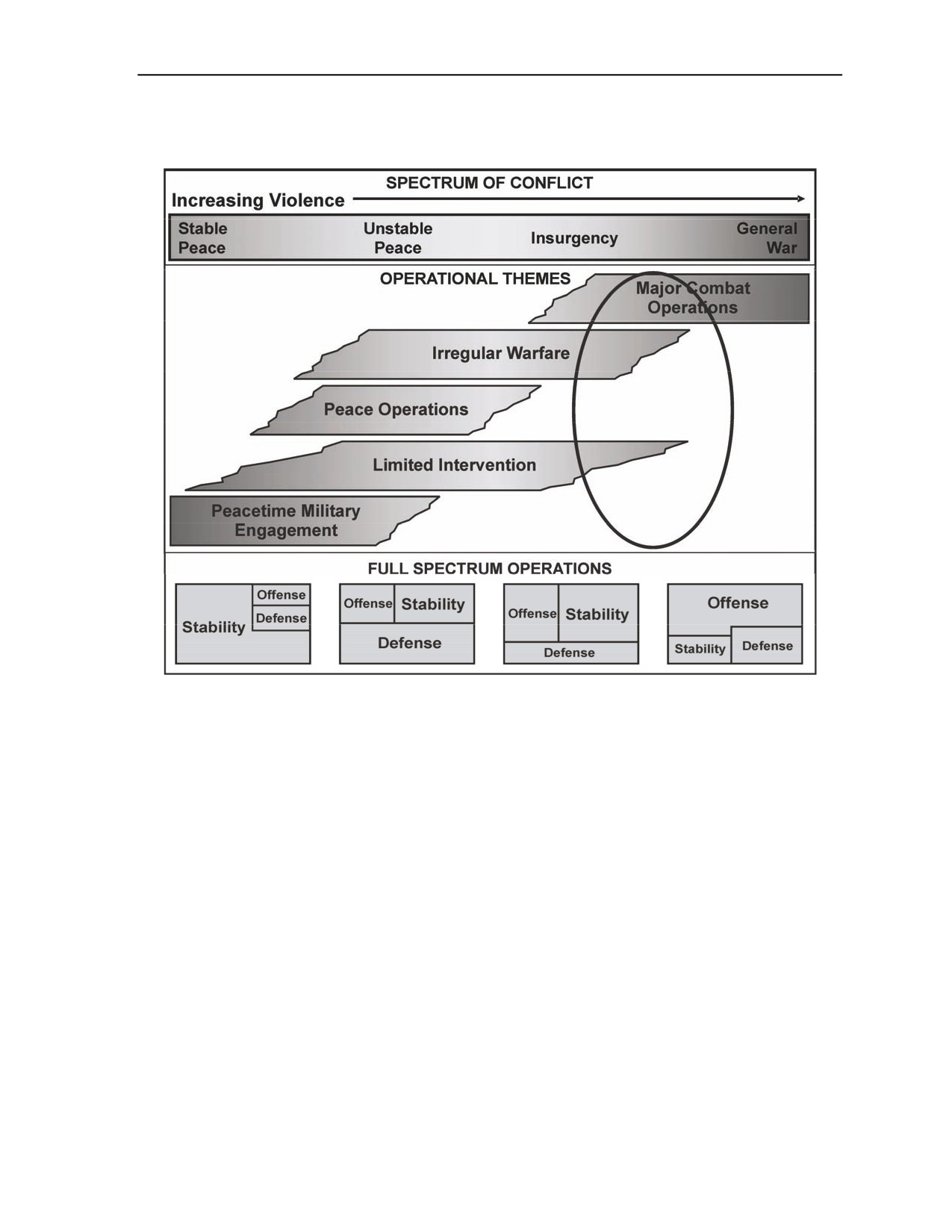
tions. Figure 1-1 displays the relationship of full spectrum operations to the spectrum of conflict and opera-
tional themes. The challenges of today’s operational environments require a change in the Army mindset.
The oval on the diagram—called the aim point—indicates that the focus of Army training and leader de-
velopment must shift leftward from the right side of the spectrum of conflict—from training under condi-
tions of general war to conditions midway between general war and insurgency. Doing this enables Army
forces to sustain the proficiency in irregular warfare and limited intervention developed over the last seven
years of conflict while sustaining their capability for major combat operations.
1-32. The aim point concept is a major cultural change for Army leaders, Soldiers, and units. To be suc-
cessful in future operations, the Army cannot look at operations today as temporary interruptions in prepar-
ing for major combat operations against a near-peer enemy. Nor can it afford to view operations dominated
by the offense and defense and those dominated by stability as either/or propositions. Both usually occur
simultaneously. Army forces must be well-trained and able to deploy rapidly to conduct and win engage-
ments and wars while remaining ready to conduct sustained stability operations. Similarly, in operations
dominated by stability they must remain prepared to conduct offensive and defensive operations. The pre-
dominate operation—offense, defense, or stability—is determined by the situation, objectives, or condi-
tions to be achieved, desired end state, and level of violence. Commanders consider the simultaneous ex-
ecution of these three elements of full spectrum operations in their mission analysis.
1-33. The art of command takes on even greater significance in today’s operational environments. Land
operations occur among the people. While technology can enhance Army forces’ effectiveness, land opera-
tions are basically a human endeavor involving human interactions. As a result, they are conducted in a
complex realm dominated by fog, friction, and uncertainty. Command in this environment is an art, not a
science. It requires leaders who can think creatively, understand their environment to a degree not required
1-6
FM 7-0
12 December 2008
Training for Full Spectrum Operations—Changing the Army’s Mindset
before, and can provide original solutions to ever changing problems posed by adaptable foes applying
asymmetric capabilities.
Figure 1-1. Aim point for Army training and leader development
1-34. A commander’s fundamental challenge is conducting training that develops proficiency in all ele-
ments of full spectrum operations. The fact that units have not had as much time as they would have liked
to train on offensive and defensive operations magnifies this challenge.
MEETING THE CHALLENGES OF FULL SPECTRUM OPERATIONS
1-35. In an era of persistent conflict, uncertainty exists as to where Army forces will operate and what the
mission will be. Therefore, commanders face two training challenges: preparing their units for the most
likely missions, and developing the skills needed to adapt quickly and easily to operations anywhere on the
spectrum of conflict.
1-36. To focus training and leader development in the operational training domain, Headquarters, Depart-
ment of the Army, establishes core mission-essential task lists (core METLs, or CMETLs) for each brigade
and higher echelon unit. (See chapter 4, section II.) CMETLs rarely change. They provide a mix of mis-
sion-essential tasks that cover offensive, defensive, stability, and civil support operations. Units train on
collective and individual tasks derived from and appropriately supporting those broad CMETL tasks.
1-37. Units do not have the time or other resources required to train under the conditions of all operational
environments along the spectrum of conflict. Therefore, Headquarters, Department of the Army, analyzes
possible operational environments and determines the likely force package requirements for each opera-
tional theme at the points along the spectrum of conflict where Army forces are most likely to operate.
Based on this analysis and Headquarters, Department of the Army, guidance, Army command, Army Ser-
12 December 2008
FM 7-0
1-7
Chapter 1
vice
component command, and direct reporting unit commanders focus their subordinate units’ training on spe-
cific operational themes.
1-38. Commanders should leverage the experience of their combat-seasoned Soldiers. These veterans can
help train other Soldiers and reduce the training time required for certain tasks. However, commanders
should not assume that Soldiers and leaders who have served in combat are proficient in all tasks asso-
ciated with a new position.
IMPLICATIONS OF THE AIM POINT ON TRAINING AND LEADER
DEVELOPMENT
1-39. The aim point and standardized CMETL represent a change in mindset. They underlie a revision in
how commanders prepare long- and short-range training plans. Previously, these plans focused solely on
mission-essential tasks and how to train them. Now, developing these plans is a two-step process. The first
step is a commander-to-commander dialog that discusses the following:
z
Training conditions and corresponding resources required.
z
The proportion of effort to be allocated among offensive, defensive, stability, and civil support
tasks.
z
The risks to readiness.
z
The core capabilities required of a unit as it adjusts its training focus to prepare for a directed
mission.
The second step is a training briefing during which the senior commander enters into a “contract” with
subordinate commanders. The contract addresses the tasks to be trained, training conditions, risks asso-
ciated with the training focus and conditions, and the resources required. (See chapter 4, section III.)
1-40. Army units must have the capability to train on stability tasks, such as “Providing essential services”
and “Support to economic and infrastructure development,” while sustaining proficiency in offensive and
defensive operations. This training should include collecting accurate bottom-up intelligence and receiving
and acting on top-down intelligence at the tactical level.
1-41. As much as possible, unit training conditions realistically replicate the projected operational envi-
ronment. For example, besides an opposing force, conditions should incorporate the cultures, languages,
and key leaders in the projected area of operations. Training tasks should also address dealing with the
news media, unified action partners, and special operations forces. In addition, training should incorporate
the contributions of both lethal and nonlethal actions.
1-42. Operations require well-trained leaders, Soldiers, and units who are not only proficient in core war-
fighting competencies but also mentally agile and able to adapt those competencies across the spectrum of
conflict. Effective leaders and Soldiers are agile enough to readily seize fleeting opportunities. Their com-
petencies can expand from those required for warfighting to those supporting stability operations, for ex-
ample, language skills, cross-cultural communication, enabling economic development and governance,
and conflict resolution through negotiation and mediation. These leaders and Soldiers use their knowledge
of culture and language to enable operations and leverage the instruments of national power to achieve ob-
jectives.
1-43. Complex operational environments have required the generating force’s role to change from that of
the pre-2001 institutional Army. Meeting the significant challenges of today’s operational environments
requires an integrated, coordinated team effort from both the operational Army and the generating force.
The operational Army consists of those Army organizations whose primary purpose is to participate in full
spectrum operations as part of the joint force (FM 1-01). In contrast, the generating force consists of those
Army organizations whose primary mission is to generate and sustain the operational Army’s capabilities
for employment by joint force commanders (FM 1-01). The generating force recruits, helps train, and
equips Soldiers and units. It provides doctrine, mobile training teams, training support, and reachback re-
sources to help prepare leaders, Soldiers, and units for missions. The generating force supports training and
education in institutions, at home stations, and in deployed units. The generating force remains ready to ad-
1-8
FM 7-0
12 December 2008
Training for Full Spectrum Operations—Changing the Army’s Mindset
just course content to maintain a balance of capabilities for operations across each of the operational
themes. (FM 1-01 addresses generating force support to operations.)
1-44. Training the modular force is different from training division- and corps-based organizations. Com-
manders of some modular organizations need a greater breadth of skill than their predecessors required.
Training during an era of persistent conflict is different from training for no-notice contingencies. While
the need for trained divisions and corps has not changed, Army Service component commands have a new
requirement for trained deployable command posts. These conditions require Army leaders to think diffe-
rently about how they train their organizations. For example, they should assess whether the benefit of
training overhead (such as external support and the level of evaluators desired) is worth the cost. They
should look for ways to leverage a combat-seasoned force to reduce the ramp-up time to readiness. And
they must look for opportunities to train smartly as the level of funding varies over time.
1-45. Operational environments, threats, and the Army’s operational concept have changed since 2001.
Army forces are now expected to conduct full spectrum operations across the spectrum of conflict. There-
fore, the mindset of all members of the Army—leaders and Soldiers, military and civilian, Regular Army
and Reserve Component—needs to change. All need to adapt to new concepts and think about how the
Army can train more wisely, efficiently, and effectively. In a changing training environment, the constant
of demanding training that focuses on the basics and achieves tough standards under challenging condi-
tions remains immutable.
12 December 2008
FM 7-0
1-9
Chapter 2
Principles of Training
This chapter discusses the Army’s seven principles of training. The principles of
training provide a broad but basic foundation to guide how commanders and other
leaders plan, prepare, execute, and assess effective training. Each principle contains
an associated set of tenets that support and expand it.
TRAINING CONCEPT
2-1. The Army provides combatant commanders with agile individuals, units, and their leaders. These
expeditionary forces are trained and ready to conduct (plan, prepare, execute, and assess) full spectrum op-
erations in support of unified action anywhere along the spectrum of conflict. The Army accomplishes this
by conducting tough, realistic, standards-based, performance-oriented training. Live, virtual, constructive,
and gaming training enablers enhance this training. Units train while deployed, at home station, and at ma-
neuver combat training centers (CTCs). Commanders lead and assess training to ensure the training is
high-quality and that individuals meet established standards. To meet the challenge of preparing for full
spectrum operations, the Army takes advantage of the training capabilities found in the three training do-
mains: institutional, operational, and self-development. (See paragraphs 3-26 through 3-50.) Commanders
apply seven principles to plan, prepare, execute, and assess effective training. (See table 2-1.)
Table 2-1. The Army’s seven principles of training
• Commanders and other leaders are responsible for training.
• Noncommissioned officers train individuals, crews, and small teams.
• Train as you will fight.
• Train to standard.
• Train to sustain.
• Conduct multiechelon and concurrent training.
• Train to develop agile leaders and organizations.
COMMANDERS AND OTHER LEADERS ARE RESPONSIBLE FOR
TRAINING
2-2. Commanders are ultimately responsible for the training, performance, and readiness of their Soldiers,
Army civilians, and organizations. However, leaders across all echelons and throughout the operational
Army and generating force are responsible for training their respective organizations. For example, a
commander is responsible for training a unit, an operations officer for training the operations staff section,
and a platoon leader and platoon sergeant for training a platoon. These leaders ensure their organizations
are trained and mission-ready. Leaders fulfill this responsibility by actively engaging in all aspects of train-
ing and adhering to eight tenets:
z
Commanders are the unit’s primary training managers and primary trainers.
z
Commanders train their direct subordinate units and guide and evaluate training two echelons
down.
z
A leader’s primary objective is to train subordinates and organizations for mission success.
12 December 2008
FM 7-0
2-1
Chapter 2
z
Leaders motivate their subordinates toward excellence and encourage initiative and innovation.
z
Leaders place high priority on training and leader development.
z
Leaders ensure training is executed to standard.
z
Leaders continually assess individual and organizational proficiency.
z
Leaders enforce safety and manage risks.
COMMANDERS ARE THE UNIT’S PRIMARY TRAINING MANAGERS AND PRIMARY TRAINERS
2-3. The commander is the unit’s primary training manager and primary trainer. Commanders develop
their organization’s mission-essential task list (METL), approve subordinate organizations’ METLs, pub-
lish training and leader development guidance, and make resource decisions that allow subordinate leaders
to train effectively. Senior noncommissioned officers (NCOs) at every level of command are vital to help-
ing commanders meet their training responsibilities. Senior NCOs are often the most experienced trainers
in the unit; they are therefore essential to a successful training program.
2-4. Company commanders personally manage their company’s training. Commanders at battalion level
and higher manage training through their operations officer, who develops the unit’s training plans. (See
paragraphs 4-137 through 4-160.) However, to ensure effective unit training, those commanders remain in-
volved in the training process. Effective training leads to well-trained units and ensures the welfare of Sol-
diers and civilians.
2-5. Commanders set the training direction by providing subordinates clear guidance without stifling in-
itiative and innovation. Commanders ensure the unit is focused on the right tasks, conditions, and stan-
dards. To perform their responsibilities as the unit’s primary training manager and primary trainer, com-
manders—
z
Use mission command in training as well as operations. (See FM 6-0.)
z
Supervise the planning, preparation, execution, and assessment of training that results in profi-
cient leaders, individuals, and organizations.
z
Ensure training supports the unit’s needs.
z
Focus training on the unit’s METL.
z
Provide and protect the required resources.
z
Incorporate safety and composite risk management (CRM) into all aspects of training.
z
Ensure training is conducted to standard.
z
Assess subordinate leader and unit proficiency and provide feedback.
z
Develop and communicate a clear vision for training.
z
Ensure the training environment replicates the anticipated operational environment.
COMMANDERS TRAIN THEIR DIRECT SUBORDINATE UNITS AND GUIDE AND EVALUATE
TRAINING TWO ECHELONS DOWN
2-6. Commanders are responsible for training their direct subordinate units. They guide and evaluate two
echelons down. For example, brigade commanders train battalions and evaluate companies; battalion
commanders train companies and evaluate platoons. Commanders develop leaders at one and two levels
below their own through personal interaction and by providing them clear guidance.
A LEADER’S PRIMARY OBJECTIVE IS TO TRAIN SUBORDINATES AND ORGANIZATIONS FOR
MISSION SUCCESS
2-7. Training subordinates, teams, and units for mission success involves training the unit to established
standards under a variety of rapidly changing and stressful conditions. Leaders set intermediate objectives
to prepare their units to reach this primary objective. They employ the Army’s training management model
to ensure mission accomplishment. (See chapter 4, section III.) Leaders focus training on the tasks most
important to mission accomplishment. They avoid trying to do too much, since there is not enough time to
do everything.
2-2
FM 7-0
12 December 2008
Principles of Training
LEADERS MOTIVATE THEIR SUBORDINATES TOWARD EXCELLENCE AND ENCOURAGE
INITIATIVE AND INNOVATION
2-8. Leaders create training conditions that prompt subordinates to be self-starters and creatively over-
come challenges. Effective commanders practice mission command during training to create these oppor-
tunities. Mission command is the conduct of military operations through decentralized execution based on
mission orders. Successful mission command demands that subordinate leaders at all echelons exercise dis-
ciplined initiative, acting aggressively and independently to accomplish the mission within the commander’s
intent (FM 3-0).
2-9. Textbook answers seldom solve a problem exactly. Commanders intentionally create complex, am-
biguous, and uncertain situations that challenge subordinates and organizations. Subordinate leaders then
grow accustomed to making decisions with incomplete information. They learn to work outside their com-
fort zone. Under mission command, leaders require subordinates to assess the situation, determine tasks
that lead to a solution, and execute the tasks to standard. Finally, leaders should reward subordinates by re-
cognizing those who adapt to unfamiliar situations, seize the initiative, and develop creative solutions.
LEADERS PLACE HIGH PRIORITY ON TRAINING AND LEADER DEVELOPMENT
2-10. A leader’s primary focus is preparing subordinates and organizations to conduct full spectrum opera-
tions in a variety of operational environments. Preparation includes training for ongoing operations as well
as likely contingencies. It means making the training tougher than the expected operation. Leaders at all le-
vels make the most of every available training opportunity or event to build organizations and develop in-
dividuals. Good training develops good leaders, and good leaders provide good training.
2-11. Training and leader development remain a priority throughout a deployment. Keeping this priority
improves task performance, hones skills needed for the current operation, and minimizes the degradation of
key skills for future operations.
2-12. Responsibility for training and leader development includes developing staffs. Well-trained staffs are
as important to operational success as well-trained squads, platoons, and companies.
LEADERS ENSURE TRAINING IS EXECUTED TO STANDARD
2-13. The Army is a standards-based organization. Its leaders enforce established standards or establish
and enforce standards where none exist. To ensure training meets standards, leaders stay involved during
all training phases—planning, preparation, execution, and assessment.
2-14. Leaders inspect training for quality and effectiveness. They ensure individuals and organizations
meet training objectives and that training is supported by sufficient resources and qualified trainers. Lead-
ers establish discipline in training by creating and maintaining a climate that drives individuals and organi-
zations to meet the standards. A disciplined unit trains to standard, even when leaders are not present.
Leaders who enforce standards in training prepare their units to meet those standards in operations. They
set the example for future generations of leaders.
LEADERS CONTINUALLY ASSESS INDIVIDUAL AND ORGANIZATIONAL PROFICIENCY
2-15. Leaders continually assess their own proficiency, that of subordinates, and that of their organiza-
tions. Leaders ensure training is relevant to individual and organizational needs so their subordinates are
prepared to meet mission requirements. Leaders assist the commander by continually assessing not only
individual performance and organizational proficiency but also training efficiency and effectiveness.
Equally important, leaders provide feedback on performance to individuals and the organization through
coaching, individual performance counseling (see FM 6-22, appendix B), and after action reviews (AARs).
Leaders develop learning organizations by ensuring these processes are fully integrated into the unit’s cul-
ture and climate.
12 December 2008
FM 7-0
2-3
Chapter 2
LEADERS ENFORCE SAFETY AND MANAGE RISKS
2-16. Involved leaders minimize damage, injury, and loss of equipment and personnel. They do this by
providing effective supervision, enforcing standards, and applying CRM. In some of the most dangerous
operational environments and during the most complex missions, Army forces have experienced fewer
losses than expected. This success is due to good leadership, comprehensive planning, effective supervi-
sion, and enforcing standards. Leaders influence first-line leader risk management decisions and guide
first-line leaders to influence individual risk decisions at the lowest echelons. Leaders—
z
Mitigate identified training risks by developing and implementing control measures that target
specific risks. Leaders use CRM to match solutions to risks they identify. (FM 5-19 contains
CRM doctrine. Paragraphs 2-37 through 2-39 of this manual discuss applying CRM to training.)
z
Make risk decisions at the appropriate level. As a matter of policy, commanders establish and
publish approval authority for risk decisions. Doing this requires leaders to identify risks and
mitigating measures. It also ensures that the right leaders make decisions involving safety.
NONCOMMISSIONED OFFICERS TRAIN INDIVIDUALS, CREWS,
AND SMALL TEAMS
2-17. NCOs are the primary trainers of enlisted Soldiers, crews, and small teams. Officers and NCOs have
a special training relationship; their training responsibilities complement each other. This relationship
spans all echelons and types of organizations. NCOs are usually an organization’s most experienced train-
ers. Their input is crucial to a commander’s overall training strategy (see paragraph 4-93) and a vital ingre-
dient of the “top-down/bottom-up” approach to training. This approach is characterized by direction from
commanders (“top-down”) and subsequent input from subordinate officers and NCOs (“bottom-up”). (See
paragraphs 4-72 through 4-73.) This two-way communication helps ensure the organization trains on the
most important tasks. Five tenets support NCOs as they train individuals, crews, and small teams:
z
Training is a primary duty of NCOs; NCOs turn guidance into action.
z
NCOs identify Soldier, crew, and small-team tasks, and help identify unit collective tasks that
support the unit’s mission-essential tasks.
z
NCOs provide and enforce standards-based, performance-oriented, mission-focused training.
z
NCOs focus on sustaining strengths and improving weaknesses.
z
NCOs develop junior NCOs and help officers develop junior officers.
TRAINING IS A PRIMARY DUTY OF NCOS; NCOS TURN GUIDANCE INTO ACTION
2-18. NCOs train, lead, and care for Soldiers and their equipment. They instill in Soldiers the Warrior
Ethos and Army Values. NCOs take the broad guidance given by their leaders and identify the necessary
tasks, standards, and resources. Then they execute the training in accordance with their leader’s intent.
NCOS IDENTIFY SOLDIER, CREW, AND SMALL-TEAM TASKS, AND HELP IDENTIFY UNIT
COLLECTIVE TASKS THAT SUPPORT THE UNIT’S MISSION-ESSENTIAL TASKS
2-19. To identify Soldier, crew, and small-team tasks, NCOs begin with individual Soldier tasks. Then
they identify the individual, crew, and small-team tasks that link to or support the unit’s mission-essential
tasks. NCOs also help officers identify the collective tasks that support the unit’s mission-essential tasks.
NCOS PROVIDE AND ENFORCE STANDARDS-BASED, PERFORMANCE-ORIENTED, MISSION-
FOCUSED TRAINING
2-20. Disciplined, mission-focused training ensures Soldier proficiency in the individual tasks that support
an organization’s mission-essential tasks. NCOs ensure key individual tasks are integrated into short-range
and near-term training plans. NCOs plan, prepare, execute, and assess training. They help commanders and
other leaders assess training by conducting internal AARs and participating in external AARs. NCOs pro-
vide candid feedback to commanders and other leaders on all aspects of training—especially individual,
2-4
FM 7-0
12 December 2008
Principles of Training
crew, and small team training. They base feedback on their observations and evaluations before, during,
and after training. NCOs identify problems with training and implement solutions on their own initiative.
NCOS FOCUS ON SUSTAINING STRENGTHS AND IMPROVING WEAKNESSES
2-21. NCOs quickly assimilate new Soldiers into the organization, continuously coach and mentor them,
and hone their newly acquired skills. NCOs cross-train their Soldiers in critical skills and duties. Cross-
training prepares Soldiers to accept positions of increased responsibility and take another Soldier’s place if
necessary. NCOs are dedicated to helping each Soldier grow and develop, both professionally and perso-
nally. This dedication is vital to developing future leaders. It is essential to ensuring the organization can
successfully accomplish its mission, even when its leaders are absent. While developing Soldiers’ skills
and knowledge, NCOs foster initiative and agility in subordinates.
NCOS DEVELOP JUNIOR NCOS AND HELP OFFICERS DEVELOP JUNIOR OFFICERS
2-22. NCOs train and coach Soldiers. Senior NCOs train junior NCOs for the next higher position well be-
fore they assume it. Senior NCOs help form high-performing officer-NCO teams and help clarify to junior
officers the different roles of officers and NCOs in training. NCOs also help officers develop junior officer
competence and professionalism and explain NCO expectations of officers.
TRAIN AS YOU WILL FIGHT
2-23. For twenty-first century full spectrum operations, “fight” includes lethal and nonlethal skills. “Train
as you fight” means training under the conditions of the expected operational environment. To train as they
expect to fight, leaders adhere to the following eight tenets:
z
Train for full spectrum operations and quick transitions between missions.
z
Train for proficiency in combined arms operations and unified action.
z
Train the fundamentals first.
z
Make training performance-oriented, realistic, and mission-focused.
z
Train for challenging, complex, ambiguous, and uncomfortable situations.
z
Integrate safety and CRM throughout training.
z
Determine and use the right mix of live, virtual, constructive, and gaming training enablers to
provide conditions for training events that replicate the anticipated operational environment.
z
Train while deployed.
TRAIN FOR FULL SPECTRUM OPERATIONS AND QUICK TRANSITIONS BETWEEN MISSIONS
2-24. Army organizations are required to conduct simultaneous offensive, defensive, and stability or civil
support operations as well as support diplomatic, informational, and economic efforts. Effective training
challenges leaders and organizations with rapidly changing conditions, requiring them to adapt to accom-
plish evolving missions. Commanders create training conditions that force subordinate leaders to quickly
assess situations and develop innovative solutions. Doing this requires being able to train functionally di-
verse subordinate organizations. Leaders and subordinates put as much emphasis on rapid decisionmaking
and execution as on deliberate planning and preparation. They exercise their mental agility to transition
quickly between offensive, defensive, and stability or civil support operations.
TRAIN FOR PROFICIENCY IN COMBINED ARMS OPERATIONS AND UNIFIED ACTION
2-25. Combined arms proficiency is met through effectively integrating the warfighting functions. It is
fundamental to all Army operations. Individuals, units, and their leaders are trained to fight and win the
Nation’s wars; however, they also contribute to implementing the peace alongside and in support of the
diplomatic, informational, and economic instruments of national power. (See FM 3-0.)
2-26. Unified action and joint interdependence require leaders aware of the institutional cultures of organi-
zations making up or working with a joint force. This awareness includes understanding how joint and
12 December 2008
FM 7-0
2-5
Chapter 2
multinational, military and civilian partners operate and make decisions. Individuals, units, and their lead-
ers develop that understanding only by continuous education and by regular training with these partners.
Deployed units prepare to participate in unified action with minimal additional training or lengthy adjust-
ment periods.
2-27. Commanders and leaders should replicate unified action as much as possible during training. Live,
virtual, constructive, and gaming training enablers can help replicate the conditions of an actual operational
environment, including the contributions of unified action partners. Where possible, commanders establish
predeployment training relationships that mirror the operational task organization. These habitual relation-
ships help build a team prepared for unified action.
TRAIN THE FUNDAMENTALS FIRST
2-28. Fundamentals, such as warrior tasks and battle drills, are a critical part of the crawl-walk-run con-
cept. (See paragraphs 4-180 through 4-184.) Warrior tasks are individual Soldier skills critical to Soldier
survival. Battle drills are group skills designed to teach a unit to react and survive in common combat situa-
tions. Both focus individual training on performing basic tasks to a high degree of proficiency. Leaders as-
sess whether or not their subordinates need to begin at the crawl stage. Training fundamentals first can ease
training on more complex individual and collective tasks, such as those related to culture and foreign lan-
guages. It helps Soldiers become more agile and innovative. Soldiers well-trained in basic tasks—such as
physical fitness, lifesaving skills, marksmanship, and small-unit drills—are essential to units confidently
and successfully completing collective tasks.
MAKE TRAINING PERFORMANCE-ORIENTED, REALISTIC, AND MISSION-FOCUSED
2-29. Performance-oriented training involves physically performing tasks. It is an active, hands-on ap-
proach as opposed to a passive, listening one. Performance-oriented training focuses on results rather than
process. It lets individuals and units train all tasks to standard. That training should be stressful physically
and mentally to prepare individuals for conditions encountered during operations. Commanders and subor-
dinate leaders plan realistic training. They integrate training support resources that replicate operational
environment conditions as much as possible.
2-30. Training usually starts with a unit’s core METL. (See paragraph 4-41.) METLs include core capa-
bility and general mission-essential tasks. Core capability mission-essential tasks are those the organization
is designed to perform. General mission-essential tasks are those that all units, regardless of type, must be
able to accomplish. (See paragraph 4-46.)
2-31. The Army has learned that developing proficiency in performing offensive and defensive tasks does
not automatically develop proficiency in performing stability or civil support tasks. Similarly, an army that
focuses only on stability or civil support tasks may have significant difficulties quickly transitioning to of-
fensive and defensive operations.
2-32. Effective training incorporates conditions that allow execution of both core capability and general
mission-essential tasks using lethal and nonlethal actions to adapt to different situations. While no organi-
zation can be completely proficient on all types of operations at all times, all can become proficient in the
tasks it will most likely perform in the near term. As operational environments become more complex and
resources (such as time, money, land, and airspace) become scarcer, the value of live, virtual, constructive,
and gaming training enablers increases. These enablers enhance training effectiveness by replicating the
conditions of an actual operational environment. Leaders are responsible for integrating and effectively us-
ing training aids, devices, simulators, and simulations (TADSS) to enhance realism.
TRAIN FOR CHALLENGING, COMPLEX, AMBIGUOUS, AND UNCOMFORTABLE SITUATIONS
2-33. Leaders train their subordinates and organizations to deal with challenging, complex, ambiguous,
and uncomfortable situations. Such conditions require agile individuals and their leaders to show initiative
and creativity and to be comfortable with fog and friction. Under mission command, leaders require subor-
dinates to exercise initiative by trying different solutions to challenging problems.
2-6
FM 7-0
12 December 2008
Principles of Training
2-34. Effective training builds competent and confident units and leaders. It includes situations where va-
ried and tough conditions test their discipline and resolve. Training under those conditions develop indi-
viduals with the ability to remain calm in chaotic uncertain conditions.
2-35. Challenging training requires individuals to conduct continuous operations and different elements of
full spectrum operations simultaneously. All Soldiers must develop the ability to assess quickly the level of
force required. Training under realistic conditions requires Soldiers to use force commensurate with the
situation. It also trains them to anticipate the second- and third-order effects of their actions.
2-36. Training should also challenge commanders. Some training should place them in situations requiring
quick decisionmaking based on rapid analysis without staff support. Such training prepares individuals, or-
ganizations, and their leaders for the complexities inherent in today’s operational environments. Proficien-
cy in full spectrum operations requires leader-trainers who understand the requirements of those environ-
ments and effectively train their units for them.
INTEGRATE SAFETY AND COMPOSITE RISK MANAGEMENT THROUGHOUT TRAINING
2-37. Risk management and safety are not risk aversion. Risk is inherent in Army training, since success in
operations depends on tough, realistic, and challenging training. Managing risk applies to individual and
collective training under any operational or training environment, regardless of the echelon, component,
mission, or type of force. Composite risk management is the decisionmaking process for identifying and
assessing hazards, developing and implementing risk mitigation actions to control risk across the full spec-
trum of Army missions, functions, operations, and activities (FM 5-19). CRM underpins the protection
element of combat power. Leaders manage risks without degrading training realism. They identify hazards,
mitigate risks, evaluate environmental considerations, and make decisions at the appropriate level. CRM
provides knowledge leaders need to take prudent risks.
2-38. Leaders use the risk management process to determine the right balance between the potential gains
and losses associated with risk in operations and training. (See FM 5-19.) For example, an infantryman
who adjusts the prescribed combat load to maximize combat power and mobility while balancing weight
requirements is making a risk decision.
2-39. CRM expands the scope of the compliance-based Army Safety Program to identify, analyze, and
manage risks that doctrine may or may not address. Individuals and organizations continuously apply CRM
to training and establish control measures to mitigate risks. In training, CRM helps leaders identify the ha-
zards inherent in tough, realistic, and challenging training environments. Leaders can then decide whether
achieving the training objectives merits accepting the risk associated with those hazards. In operations,
commanders use CRM to identify hazards and mitigate the risks those hazards pose to the force. This con-
tributes to preserving the force so commanders can apply maximum combat power to the current operation
and sustain combat power for future operations. Since individuals operate as they have trained, practice in
integrating CRM into the operations process while training is essential.
DETERMINE AND USE THE RIGHT MIX OF LIVE, VIRTUAL, CONSTRUCTIVE, AND GAMING
TRAINING ENABLERS
2-40. A combination of live, virtual, constructive, and gaming training enablers can help replicate an ac-
tual operational environment. Based on resources available—such as time, fuel, funds, and training areas—
commanders determine the right mix of live, virtual, constructive, and gaming training enablers to effec-
tively and efficiently train for a mission or rehearse an operation.
TRAIN WHILE DEPLOYED
2-41. Training does not stop when a unit is deployed. Commanders should periodically review their di-
rected METL to sustain or retrain certain tasks as needed. (See paragraphs 4-55 through 4-68.) As time and
resources allow, they should also train METL tasks to maintain proficiency during long deployments.
Commanders consider the effects of the operational variables (political, military, economic, social, infra-
12 December 2008
FM 7-0
2-7
Chapter 2
structure, information, physical environment, and time [PMESII-PT]) on the area of operations before un-
dertaking such training. (See FM 3-0, paragraphs 1-21 through 1-44.)
TRAIN TO STANDARD
2-42. Army training is performed to standard. Leaders prescribe tasks with their associated standards that
ensure their organization is capable of accomplishing its doctrinal or directed mission. A standard is the
minimum proficiency required to accomplish a task under a set of conditions. (See paragraph 4-91.) The
goal in training is achieving mastery, not just proficiency. Leaders continually challenge individuals and
organizations by varying training conditions to make achieving the standard more challenging. The follow-
ing tenets focus on standards-based training:
z
Leaders know and enforce standards.
z
Leaders define success where standards have not been established.
z
Leaders train to standard, not to time.
LEADERS KNOW AND ENFORCE STANDARDS
2-43. Enforcing standards provides individuals and organizations with a sound basis for training. Effective
training is executed to Army standards, joint standards, or both. Standards include measures of perfor-
mance that leaders use to evaluate the ability of individuals and organizations to accomplish tasks. Stan-
dards usually are established in such publications as doctrine, combined arms training strategies, and unit
standing operating procedures.
LEADERS DEFINE SUCCESS WHERE STANDARDS HAVE NOT BEEN ESTABLISHED
2-44. Individuals and organizations may be required to perform tasks based on emerging tactics, tech-
niques, and procedures or new conditions. These tasks may not have established standards. Leaders adapt
by redefining an existing task or establishing a standard to meet the situation.
2-45. Leaders create achievable standards based on any or all of the following: commander’s guidance;
observations, insights, and lessons from similar operations; their professional judgment; and common
sense. The next higher commander approves these standards. Doctrine describes common tactics, tech-
niques, and procedures that permit commanders, other leaders, and units to adjust rapidly to changing sit-
uations. Where possible, commanders base new standards on doctrine, since doctrine provides the basis for
a common vocabulary and evaluation criteria.
LEADERS TRAIN TO STANDARD, NOT TO TIME
2-46. Leaders allocate enough time to train tasks to standard. When necessary, they allocate time to retrain
tasks under the same or different, preferably more difficult, conditions. Good leaders understand that they
cannot train on everything; therefore, they focus on training the most important tasks. Leaders do not ac-
cept substandard performance in order to complete all tasks on the training schedule. Training a few tasks
to standard is preferable to training more tasks below standard. Achieving the standard may require repeat-
ing tasks or restarting a training event. Leaders should allocate time for remedial training. When a unit
meets the standard in less time than expected, it can use that time for training related tasks—or leaders can
end training early. Training plans should allow for this.
TRAIN TO SUSTAIN
2-47. Units must be capable of operating continuously while deployed. Maintenance is essential for conti-
nuous operations and is, therefore, an integral part of training. Maintenance is more than maintaining
equipment; it includes maintaining and sustaining performance levels, personnel, equipment, and systems
over extended periods. Leaders create training conditions that require units to do this. Leaders incorporate
sustainment into individual and collective training by following these nine tenets:
z
Make maintenance of equipment, individuals, and the organization part of every training event.
z
Equipment maintenance is the cornerstone of sustainment.
z
Soldiers and civilians maintain entire systems.
2-8
FM 7-0
12 December 2008
Principles of Training
z
Leaders train and retrain critical tasks to sustain proficiency.
z
Train to sustain core individual and collective skills and knowledge.
z
Sustain leader presence.
z
Train staffs routinely.
z
Leaders develop a sense of stewardship in subordinates.
z
Preventable loss is unacceptable.
MAKE MAINTENANCE OF EQUIPMENT, INDIVIDUALS, AND THE ORGANIZATION PART OF
EVERY TRAINING EVENT
2-48. Commanders allocate time for individuals and units to maintain themselves and their equipment to
standard during training events. This time includes scheduled maintenance periods (such as for preventive
maintenance checks and services), assembly area operations, and physical training. Leaders train their sub-
ordinates to appreciate the importance of maintaining themselves and their equipment. Organizations per-
form maintenance during operations to the standards they practice in training. Maintenance training in this
context includes not only taking care of equipment but also sustaining critical individual and collective
skills. Maintenance training helps sustain mental and physical fitness, essential skills, and equipment readi-
ness rates. Effective training prepares individuals and organizations to operate for long periods by includ-
ing the maintenance tasks required to sustain operations.
EQUIPMENT MAINTENANCE IS THE CORNERSTONE OF SUSTAINMENT
2-49. Functional, reliable, and maintained equipment is essential to mission success. All Soldiers are re-
sponsible for maintaining their equipment during training and operations. Leaders are responsible for en-
suring they do so. Leaders ensure subordinates execute scheduled maintenance with the same intensity as
other training events. These periods should have clear, focused, and measurable objectives. As with other
types of training, leaders supervise, enforce standards, complete AARs, and hold subordinates accountable.
They lead by example to underscore that maintenance training is important to readiness. Effective mainten-
ance training ensures organizational equipment is available when needed. It also reduces the effect of fre-
quent deployments and high personnel tempo.
SOLDIERS AND CIVILIANS MAINTAIN ENTIRE SYSTEMS
2-50. Leaders train subordinates to maintain entire systems. For example, maintaining a fighting vehicle
involves maintaining its components—weapons; radios; basic issue items; and chemical, biological, radio-
logical, and nuclear equipment—as well as the vehicle itself. Units are systems that require sustainment in
the form of rest, resupply, rotation of shifts, and special training as required.
LEADERS TRAIN AND RETRAIN CRITICAL TASKS TO SUSTAIN PROFICIENCY
2-51. Sustaining proficiency applies to maintaining skill proficiency, since physical health, memory, and
skills deteriorate without regular use and periodic challenges. Limited training time requires leaders to pick
the most important tasks to sustain or improve, for example, those tasks that are essential to mission ac-
complishment and perishable without frequent practice. Retraining tasks that individuals can perform to
standard while not training tasks that individuals cannot perform wastes valuable training time. Command-
ers select the most important tasks when they prepare their METL. (See chapter 4, section II.) They con-
sider AARs, trends, new equipment, and collaboration among leaders at all levels when they do this.
Commanders use the mix of live, virtual, constructive, and gaming training enablers that best sustains indi-
vidual and collective skills.
TRAIN TO SUSTAIN CORE INDIVIDUAL AND COLLECTIVE SKILLS AND KNOWLEDGE
2-52. Leaders balance the time spent training on METL tasks with time spent on such skills as physical
and mental fitness, marksmanship, and navigation.
12 December 2008
FM 7-0
2-9
Chapter 2
SUSTAIN LEADER PRESENCE
2-53. A leader’s physical presence determines how others perceive that leader. It is more than the leader
just showing up; it involves the image that the leader projects. Presence is conveyed through actions,
words, and the manner in which leaders carry themselves and make decisions. Setting the example for
health, physical fitness, resilience, and calmness under pressure is the foundation of leader presence. (See
FM 6-22, chapter 5.)
TRAIN STAFFS ROUTINELY
2-54. The staff is an extension of the commander. It is a vital part of the commander’s command and con-
trol system. (See FM 6-0.) Operations require staffs to operate continuously without losing proficiency.
Staffs should train regularly and often, rather than in short bursts just before a major evaluation. An effec-
tive staff maintenance program progresses to a high level of proficiency. It includes—
z
Operating over extended periods and distances.
z
Enforcing rest plans.
z
Maintaining tactical command and control information systems and other equipment.
z
Establishing security measures.
z
Cross-training.
LEADERS DEVELOP A SENSE OF STEWARDSHIP IN SUBORDINATES
2-55. Resources include the following: individual and organizational equipment, installation property,
training areas, ranges, facilities, time, the environment, and organizational funds. Protection of these assets
is both a leader’s and an individual’s responsibility. Subordinates follow the example leaders set. Preserv-
ing readiness requires enforcing accountability for property and other resources across all echelons.
2-56. Well-disciplined individuals willingly take ownership of and properly care for their equipment. This
sense of stewardship avoids costly and unnecessary expenditures on replacements. In addition, mission ac-
complishment requires individuals to be physically and mentally ready and have their equipment properly
functioning and maintained. This readiness ensures their safety and security, as well as that of everyone
else in the organization. Good stewardship is learned during tough training in which individuals learn to re-
spect and trust themselves and their leaders. Good training also develops appreciation for the importance of
well-maintained equipment and other resources.
PREVENTABLE LOSS IS UNACCEPTABLE
2-57. Soldiers, Army civilians and their leaders are professionally obligated to protect the Nation’s re-
sources—human, financial, materiel, environmental, and informational. Preventable loss can be mitigated
by integrating CRM throughout Army training.
CONDUCT MULTIECHELON AND CONCURRENT TRAINING
2-58. Multiechelon training is a training technique that allows for the simultaneous training of more
than one echelon on different or complementary tasks. It is the most efficient way to train, especially
with limited resources. It requires synchronized planning and coordination by commanders and other lead-
ers at each affected echelon.
2-59. Multiechelon training optimizes the use of time and resources. This is important in an environment
characterized by frequent deployments and limited resources. Multiechelon training can occur when an en-
tire unit trains on a single task or when different echelons of a unit simultaneously train on different tasks.
Multiechelon training allows individuals and leaders to see the effects of one echelon’s execution on
another echelon. This type of training offers commanders an opportunity to reduce training resource re-
quirements. For example, when a lower echelon requires less attention than a higher one, observer control-
ler/trainers can be consolidated at the higher echelon and be required to observe both echelons. While mul-
2-10
FM 7-0
12 December 2008
Principles of Training
tiechelon training involves as many echelons as a commander desires, the focus can seldom exceed two
echelons.
2-60. Concurrent training occurs when a leader conducts training within another type of training. It com-
plements the execution of primary training objectives by allowing leaders to make the most efficient use of
available time. For example, an artillery battery commander supporting an infantry battalion during a non-
firing maneuver exercise might conduct howitzer section training while the fire direction center maintains
communications with fire support officers moving with the infantry. Similarly, while Soldiers are waiting
their turn on the firing line at a range, their leaders can train them on other tasks. Leaders look for ways to
use all available training time. Concurrent training can occur during multiechelon training.
2-61. While large-scale training events provide the best opportunity to conduct multiechelon training,
smaller scale events can provide conditions conducive to training multiple echelons simultaneously. Lead-
ers should exercise initiative and create their own training events within a larger training exercise, based on
the needs of their unit and through coordination with the larger or supported unit.
TRAIN TO DEVELOP AGILE LEADERS AND ORGANIZATIONS
2-62. The Army trains and educates its members to develop agile leaders and organizations able to operate
successfully in any operational environment. The Army develops leaders who can direct fires in a firefight
one minute and calmly help a family evacuate a destroyed home the next. The Army trains leaders who ac-
cept prudent risks to create opportunities to seize, retain, and exploit the initiative. This agility requires
educated, highly trained, and well-disciplined individuals. They must also be physically tough, mentally
agile, and well-grounded in their core competencies and the Warrior Ethos. The Army needs people expe-
rienced and knowledgeable enough to successfully accomplish any mission along the spectrum of conflict
and in any operational theme. Such individuals—expeditionary individuals and their leaders—can adapt to
any situation and operate successfully in any operational environment. These seven tenets underlie devel-
oping competent and agile leaders and organizations:
z
Train leaders in the art and science of battle command.
z
Train leaders who can execute mission command.
z
Develop an expeditionary mindset in Soldiers and Army civilians.
z
Educate leaders to think.
z
Train leaders and organizations to adapt to changing mission roles and responsibilities.
z
Create a “freedom to learn” environment.
z
Give subordinates feedback.
TRAIN LEADERS IN THE ART AND SCIENCE OF BATTLE COMMAND
2-63. Battle command is the art and science of understanding, visualizing, describing, directing, leading,
and assessing forces to impose the commander’s will on a hostile, thinking, and adaptive enemy. Battle
command applies leadership to translate decisions into actions—by synchronizing forces and warfighting
functions in time, space, and purpose—to accomplish missions (FM 3-0). During the Cold War, the Army
thought it knew what was necessary to succeed against a predictable enemy. Now the Army faces different
challenges. These challenges result from multiple circumstances. Some have military causes; others result
from actions by the population in the area of operations. These conditions require an unprecedented under-
standing of a wide variety of factors. Commanders think about these factors in terms of the operational va-
riables (PMESII-PT) and mission variables (mission, enemy, terrain and weather, troops and support avail-
able, time available, civil considerations [METT-TC]). That understanding is essential to successful battle
command.
2-64. Battle command is guided by professional judgment gained from several sources: experience, know-
ledge, education, intelligence, and intuition. Leaders improve their battle command skills through realistic,
complex, and changing training scenarios. Training gives commanders greater understanding that enables
them to make qualitatively better decisions than their opponents. Simultaneously, they focus their intuitive
abilities on visualizing the current and future conditions of their operational environment.
12 December 2008
FM 7-0
2-11
Chapter 2
2-65. Successful battle command involves timely, effective decisions based on combining judgment with
information. It requires knowing when and what to decide. It also requires commanders to assess the quali-
ty of information and knowledge. Commanders identify important information requirements and focus
subordinates and the staff on them. Commanders anticipate the activities that follow decisions, knowing
that once executed, the effects of those decisions are often irreversible. In exercising battle command,
commanders combine analytical and intuitive approaches for decisionmaking. These skills are developed
and honed through rigorous training and mentoring by senior commanders at every echelon.
TRAIN LEADERS WHO CAN EXECUTE MISSION COMMAND
2-66. Commanders who train using mission command develop leaders who practice mission command and
subordinates who are comfortable with and expect to operate using mission orders. (Mission orders is a
technique for developing orders that emphasizes to subordinates the results to be attained, not how they are
to achieve them. It provides maximum freedom of action in determining how to best accomplish assigned
missions [FM 3-0].) If mission command is not practiced in training, leaders will not use it in operations.
2-67. Mission command requires an environment of trust and mutual understanding. Training under mis-
sion command increases trust and allows the unit to achieve unity of effort by focusing on the command-
er’s intent. Subordinates develop initiative and the ability to develop creative solutions to problems—in
short, they become more agile. Effective mission command requires leaders who can develop clear intent
statements—brief statements that provide a clear purpose and end state. As with battle command, com-
manders and other leaders at every level employ mission command in training and operations.
DEVELOP AN EXPEDITIONARY MINDSET IN SOLDIERS AND ARMY CIVILIANS
2-68. Organizations are only as agile as their people are, especially their leaders. Expeditionary individuals
and their leaders are knowledgeable and experienced enough to conduct full spectrum operations in any
operational theme anywhere along the spectrum of conflict—and they know it. Persistent conflict is pro-
ducing a force of seasoned Soldiers with multiple operational experiences. Home station training and rota-
tions at the maneuver CTCs are incorporating offensive, defensive, and stability operations into major
combat operations and irregular warfare scenarios—and in others as needed. However, developing an ex-
peditionary mindset requires complementing operational experiences with self-development through read-
ing and simulations. It also requires institutional training that provides broadening and introspective expe-
riences. Effective institutional training allows Soldiers and Army civilians to reflect on their strengths and
weaknesses and take the steps necessary to develop and enhance their skills and knowledge. Reading
AARs and lessons learned by individuals and units in operations augments personal knowledge and expe-
riences. Expeditionary leaders are versatile in their knowledge, skills, behaviors, and competencies. These
leaders master the skills and competencies associated with other branches in order to train their modular
units. Institutional experiences, home station training, CTC exercises, and self-development all contribute
to producing expeditionary leaders and units.
EDUCATE LEADERS TO THINK
2-69. Expeditionary leaders are trained to think critically and originally. These leaders know how to con-
duct operations. Just as important, they know how to develop novel, original solutions to complex tactical
situations in actual operational environments. Effective training cultivates a leader’s ability to develop
workable tactical concepts, quickly choose among alternatives, and modify their actions as the operational
environment changes. These skills involve a mix of education and experience, reinforced through training,
exercises, and day-to-day operations. Expeditionary leaders understand that no single solution to a problem
exists; what worked yesterday may not work today. They can apply their skills and knowledge to solve re-
curring problems—and new ones as they arise. Leaders also develop their subordinate leaders’ skills by
creating a training environment that challenges subordinates to think beyond familiar drills and common
solutions. Leaders teach subordinates that operations do not always occur under the same conditions, in se-
quence, or with logical transitions.
2-12
FM 7-0
12 December 2008
Principles of Training
TRAIN LEADERS AND ORGANIZATIONS TO ADAPT TO CHANGING MISSION ROLES AND
RESPONSIBILITIES
2-70. Training adaptable leaders and organizations requires creativity and imagination. Commanders and
other leaders prepare themselves, their subordinates, and their units for unfamiliar situations, to include
employing both lethal and nonlethal means. Leaders develop flexible subordinates—subordinates who do
not freeze in unfamiliar situations. Leaders train subordinates to perform at both their current and the next
level of responsibility. That training prepares individuals to assume the next higher position quickly when
needed. Live, virtual, constructive, and gaming training enablers let leaders inexpensively train and retrain
tasks under varying conditions.
2-71. To make units agile, commanders and senior NCOs help subordinates develop their intuition. Lead-
ers coach subordinates through various situations comprising varying conditions and degrees of force. That
coaching helps subordinates recognize similar situations and intuitively know how to handle them without
being limited by a single “approved solution.” Leaders help subordinates recognize alternative—even non-
standard—solutions to complex challenges rather than relying on past solutions that may not fit the situa-
tion. Battle drills are important combat skills; they teach Soldiers how to react instinctively in life-and-
death situations, where aggressiveness may be more important than finesse or where immediate action is
more important than deliberate decisionmaking. However, well-trained Soldiers can quickly identify situa-
tions where battle drills do not fit, think their way through them, and act to resolve the situation.
CREATE A “FREEDOM TO LEARN” ENVIRONMENT
2-72. Leaders foster an organizational climate that allows subordinate leaders to think their way through
unanticipated events and react to unfamiliar situations. (See FM 6-22, chapter 8.) Freedom to learn does
not mean accepting substandard performance. It means establishing a standard that rewards creativity, in-
novation, and initiative—and a command climate that allows honest mistakes. Leaders focus on what was
completed and how individuals responded to the situation. If results are unsatisfactory, subordinates learn
from mistakes through feedback. They analyze why they failed to achieve the desired results, discover how
to adapt, and then try again. Leaders also solicit recommendations from subordinates being trained.
2-73. Subordinates who think they are not allowed to fail or try innovative means to accomplish tasks
avoid taking risks and attempting imaginative solutions. The best lessons are often learned through failure.
However, repeated failures of the same task can indicate an inability to learn or the need to reassess the
training technique, training, or both. Today’s dynamic operational environments require individuals and
their leaders to learn while operating. This important skill requires agile leaders who can learn from their
mistakes under pressure and adapt successfully to a new but similar situation. Learning while operating is
not the same as having the freedom to learn; it is the product of it. A training environment in which indi-
viduals have the freedom to make mistakes produces individuals better able to learn and adapt during oper-
ations.
GIVE SUBORDINATES FEEDBACK
2-74. The Army’s primary feedback technique is the AAR. (See paragraphs 4-202 through 4-208.) Leaders
use AARs to provide feedback based on observations and assessments of performance during training and
operations. AARs are essential for developing agile leaders and subordinates. Feedback helps all individu-
als learn from training. It allows them to reflect on what they did and how they can improve future perfor-
mance. AARs are not critiques; they are a means of self-discovery led by a facilitator. AARs help leaders
and subordinates understand how and why actions unfolded as they did and what should be done next time
to avoid the same mistakes or repeat successes. Leaders can use AARs to gauge training effectiveness and
whether changes are needed in future training. Well-planned and well-executed AARs form the building
blocks of learning organizations. (See FM 6-01.1, appendix B, for using AARs during operations.)
12 December 2008
FM 7-0
2-13
This page intentionally left blank.
Chapter 3
The Army Training System
This chapter discusses the Army Training System, which prepares Soldiers, Army ci-
vilians, organizations, and their leaders to conduct full spectrum operations. This dis-
cussion addresses the importance of discipline in training and the complementary na-
ture of the institutional, operational, and self-development training domains. The
chapter defines training and education, reinforces the importance of leader develop-
ment, and describes the lifecycle of training and education.
FOUNDATIONS OF ARMY TRAINING
3-1. The foundations of Army training are discipline, sound principles and tenets, and a responsive train-
ing support system.
DISCIPLINE
3-2. The essential foundation of any good training program is discipline. Good commanders and leaders
instill discipline in training to ensure mission success. Discipline in training can be summed up this way:
z
Disciplined individuals do the right thing when no one is looking, even under chaotic or uncer-
tain conditions. Discipline demands habitual and reasoned obedience, even when leaders are absent.
z
Disciplined individuals perform to standard, regardless of conditions. They have repeatedly
practiced tasks to standard, sustained training standards, and trained under conditions closely
replicating expected operational environments.
z
Discipline is an individual, leader, and organizational responsibility. It is essential to mission
success. Well-trained, disciplined individuals and organizations increase the likelihood of suc-
cess in any operation.
z
Discipline in training relates to the Army Values. Success in all three training domains demands it.
PRINCIPLES
3-3. The purpose of Army training is to provide combatant commanders with trained and ready Army
forces. Training builds individual confidence and competence while providing individuals with essential
skills and knowledge. Individuals and organizations need skills and knowledge to operate as part of expe-
ditionary Army forces conducting full spectrum operations in any operational environment. The principles
of training established in chapter 2 apply to all Army training, regardless of topic, component, location, or
duration. The Army applies these principles to planning, preparing, executing, and assessing individual and
organizational training in three distinct but linked training domains: institutional, operational, and self-
development. (See figure 3-1, page 3-2.)
TRAINING SUPPORT
3-4. Developing leaders and preparing Soldiers, Army civilians, staffs, and units for full spectrum opera-
tions requires a team effort. The generating force and operational Army share this responsibility. Fulfilling
it requires close coordination, integration, and synchronization. While each training domain has specific re-
sponsibilities, some intentional overlap ensures all tasks needed for full spectrum operations are trained.
The ability to conduct quality training relies on a training infrastructure designed to prepare subordinates
and leaders for the challenges of an operational environment. The Army’s training support system provides
12 December 2008
FM 7-0
3-1
Chapter 3
training support products, services, and facilities necessary to replicate a relevant training environment.
(See paragraphs 4-120 through 4-122.)
Figure 3-1. Army training domains
TRAINING AND EDUCATION
3-5. The Army Training System comprises training and education. Training is not solely the domain of
the generating force; similarly, education continues in the operational Army. Training and education occur
in all three training domains. Training prepares individuals for certainty. Education prepares individuals for
uncertainty. Education enables agility, judgment, and creativity. Training enables action.
3-6. Training develops tactical and technical, individual and collective skills through instruction and re-
petitive practice. Training uses a crawl-walk-run approach that systematically builds on the successful per-
formance of each task. (See paragraphs 4-180 through 4-184.) The stage at which a Soldier or unit enters
training depends on the leader’s assessment of the current readiness level; not everyone needs to begin at
the crawl stage. Mastery comes with practice under varying conditions and by meeting the standards for the
task trained.
3-7. Army training prepares individuals and organizations by developing the skills, functions, and team-
work necessary to accomplish a task or mission successfully. Training is generally associated with “what to
do.” Well-trained organizations and individuals react instinctively, even in unknown situations. Training
also helps develop leaders and organizations able to adapt to change under unfamiliar circumstances. Sol-
diers and teams who execute a battle drill to standard in a new situation under the stress of combat exempl-
ify the result of good training. Repetitive training on a task under varying conditions develops intuition on
how to approach the task under new or unfamiliar conditions.
3-8. Education, in contrast, provides intellectual constructs and principles. It allows individuals to apply
trained skills beyond a standard situation to gain a desired result. It helps develop individuals and leaders
who can think, apply knowledge, and solve problems under uncertain or ambiguous conditions. Education
is associated with “how to think.” It provides individuals with lifelong abilities that enable higher cognitive
thought processes. Education prepares individuals for service by teaching knowledge, skills, and behaviors
applicable to multiple duty positions in peace or war. Educated Soldiers and Army civilians have the foun-
dation needed to adapt to new and unfamiliar situations.
3-9. Traditional training and education may not meet all the needs of an expeditionary Army. The Army
is adapting training and education as appropriate to meet the conditions of today’s operational environ-
ments. Developing new approaches may be necessary to ensure Soldiers and Army civilians are confident
in their ability to conduct full spectrum operations anywhere along the spectrum of conflict with minimal
additional training.
3-2
FM 7-0
12 December 2008
The Army Training System
TRAINING AND EDUCATION LIFECYCLE OF SOLDIERS AND
ARMY CIVILIANS
3-10. Soldiers and Army civilians begin training the day they enter the Army. They continue training until
the day they retire or separate. Individuals train to build the skills and knowledge essential to a trained, ex-
peditionary Army. Training prepares individuals, units, staffs, and their leaders to conduct full spectrum
operations anytime and anywhere along the spectrum of conflict. This lifelong learning occurs in all three
training domains—institutional, operational, and self-development—and involves self-assessment.
INSTITUTIONAL
3-11. The Soldier is, first of all, a warrior. Soldier training begins in the generating force. In schools and
training centers, Soldiers train on individual tasks that ultimately support their projected unit’s core capa-
bility mission-essential tasks. Soldiers are also exposed to the skills of other branches while in schools and
training centers. Finally, Soldiers train on warrior tasks—critical tasks that all Soldiers must perform in full
spectrum operations. Armed with basic skills from the institution, Soldiers are assigned to a unit. There
they integrate into a team and begin training in the operational training domain.
3-12. In contrast, most Army civilians enter the Army with the skills and knowledge required for their po-
sition. Civilians enhance their knowledge, skills, and abilities through the Civilian Education System, func-
tional training, self-development, and assignments. Army civilians are key contributors to Army readiness.
OPERATIONAL
3-13. Operational assignments build on the foundation of individual skills learned in schools. Unit leaders
introduce new skills required by a Soldier’s specialty. In addition, Soldiers master collective tasks that sup-
port the unit’s mission-essential tasks. In units, individuals train to standard on individual and collective
tasks—first with their unit and then as an integrated component of a combined arms team, which may par-
ticipate in unified action. Major training events, combat training center (CTC) exercises, and operational
deployments provide additional experiences necessary for building fully trained units. Regardless of where
individuals train—in the generating force or the operational Army—effective training is relevant, rigorous,
realistic, challenging, and properly resourced. Conditions replicate the projected operational environment
as much as possible. This training environment provides the full range of experiences needed to produce
capable, bold, and agile individuals and units.
3-14. Army civilians usually gain operational experience in the generating force; however, civilians sup-
port both the operational Army and the generating force. They fill positions that make it possible to man,
equip, resource, and train operational Army units. Army civilians provide the skills and continuity essential
to the functioning of Army organizations and programs.
SELF-DEVELOPMENT
3-15. Self-development is just as important as other individual training. It allows individuals to expand
their knowledge and experience to supplement training in the institutional or operational training domains.
Self-development can enhance skills needed for a current position or help prepare an individual for future
positions. It can mean the difference between failure and success. Individuals are responsible for their own
professional growth and for seeking out self-development opportunities. (FM 6-22, paragraphs 8-30
through 8-50, addresses self-development.)
3-16. Civilian knowledge, skills, and abilities are key contributors to Army readiness. They are enhanced
through the Civilian Education System and focused, continuous learning. Commanders and first-line lead-
ers monitor and annually assess individual performance and development. In schools, individuals monitor
their own progress. Regardless of who tracks the self-development plan, the burden of self-development
rests on the individual. It is a function of each person’s desire to improve.
12 December 2008
FM 7-0
3-3
Chapter 3
3-17. Soldiers and Army civilians complete self-assessments with or without supervision. They thoroughly
assess their competencies and seek advice and counsel from others to determine strengths and weaknesses.
Guidance on self-development can come from schools, leaders, mentors, and peers.
3-18. As professionals, Soldiers and Army civilians discipline themselves to pursue training and education
on and off duty. Self-development can take many forms. Examples include the following: reading Army
and joint manuals, professional journals, and military history; taking college courses; completing self-
paced online training modules; or pursuing academic degrees. Such training and education is critical to de-
veloping the agility and breadth of skills needed during full spectrum operations. Individuals can use Army
or commercial training and education products to become more proficient in any area.
LIFELONG TRAINING AND EDUCATION
3-19. Soldiers and Army civilians cycle between the institutional and operational domains for training and
education throughout their careers. They supplement training, education, and experience with structured,
guided, and individualized self-development programs. Individuals return to schools and centers at certain
points to gain new skills and knowledge needed for the next duty assignment and to prepare them for high-
er levels of responsibility. They return to units, sometimes at the next higher grade, assume new responsi-
bilities, and apply the knowledge and experience gained in school to operations.
3-20. Leaders should encourage subordinates to increase their skills and knowledge through training and
education in all three domains. Commanders and other leaders supplement and reinforce what individuals
learn in schools. Subordinates and leaders identify gaps in learning and fill those gaps through self-
development. Similarly, Army civilians hone their skills in the institutional training domain through func-
tional training courses and the Civilian Education System. They return to their current positions more
knowledgeable or move to positions of greater responsibility. This three-pronged, Armywide, team ap-
proach to broadening individual training and education helps develop agile leaders.
FOUNDATIONS OF LEADER DEVELOPMENT
3-21. The Army is committed to training, educating, and developing all its leaders—officers, warrant of-
ficers, noncommissioned officers, and Army civilians—to lead organizations in the complex and challeng-
ing operational environments of the twenty-first century. Training and education develop agile leaders and
prepare them for current and future assignments of increasing responsibility. Army leaders require charac-
ter, presence, and intellectual capacity (see FM 6-22, part two):
z
Leaders of character practice the Army Values, empathize with those around them, and exempli-
fy the Warrior Ethos.
z
Leaders with presence display military bearing; are physically fit, composed, and confident; and
are resilient under stress.
z
Leaders with intellectual capacity possess mental agility, make sound decisions, are innovative,
employ tact in interpersonal relations, and know their profession.
3-22. The Army training and leader development model helps develop trained and ready units led by com-
petent and confident leaders. (See figure 3-2.) Leader development is a deliberate, continuous, sequential,
and progressive process. It develops Soldiers and Army civilians into competent and confident leaders who
act decisively, accomplish missions, and care for subordinates and their families. It is grounded in the Ar-
my Values. The aptitude for command, staff leadership, and special duties (such as teaching, foreign inter-
nal defense team leadership, attaché duties, and joint staff assignments) all contribute to leader develop-
ment and affect future assignments and promotions.
3-23. Leader development occurs through the lifelong synthesis of knowledge, skills, and experiences
gained through the three training domains. Each domain provides distinct experiences and has specific,
measurable actions that develop leaders. The domains interact, with feedback and assessments from vari-
ous sources and procedures contributing to individuals’ development. Performance feedback and formal
and informal assessments help individuals improve performance in their current position and prepare them
to serve successfully at the next level of responsibility.
3-4
FM 7-0
12 December 2008
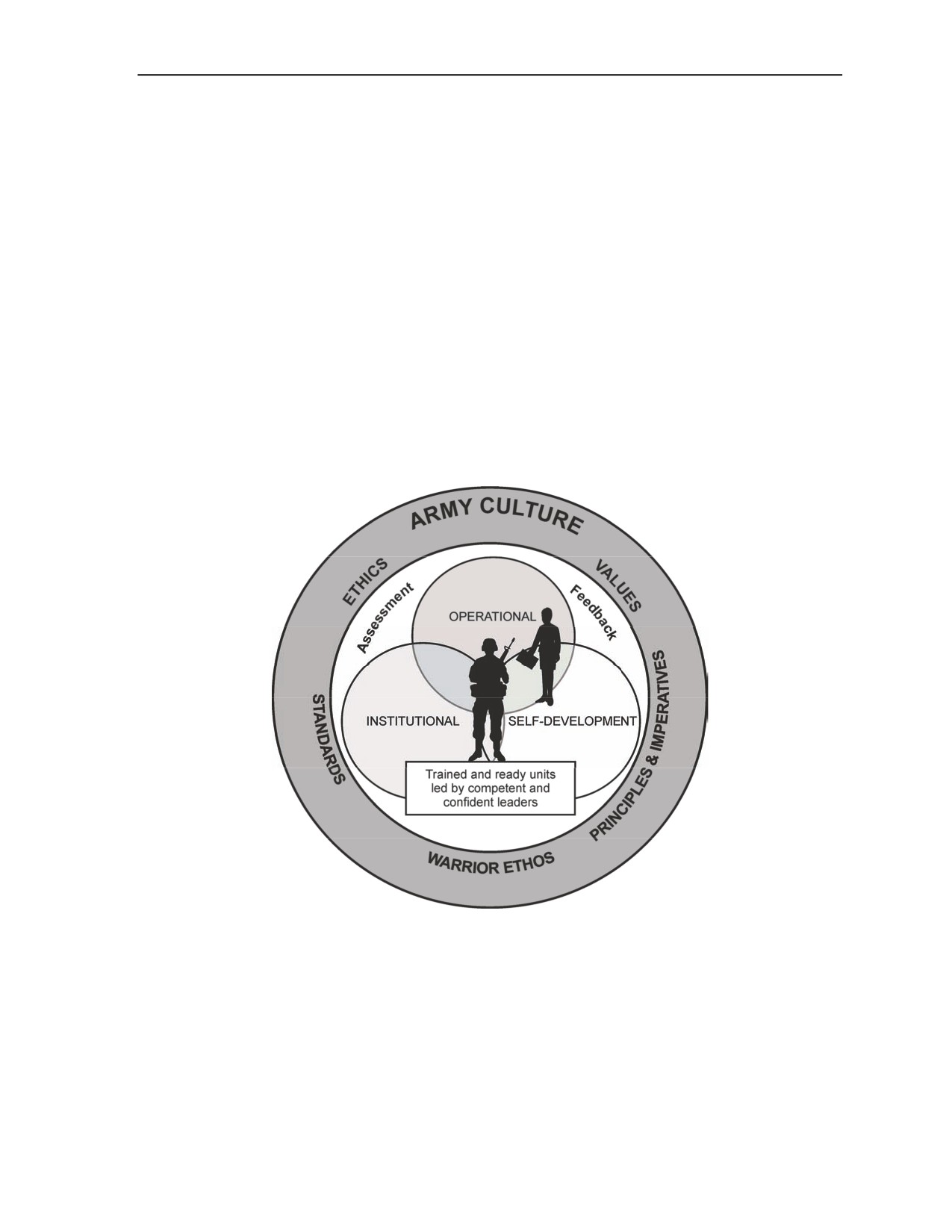
The Army Training System
3-24. Competent and confident leaders are essential to successfully training units, and ultimately to em-
ploying those units in operations. Uniformed leaders are inherently Soldiers first; they remain technically
and tactically proficient in basic Soldier skills. Civilian leaders master the skills and knowledge required of
their position. They hone their leadership abilities to provide organizations with both leadership and man-
agement skills. All leaders seek to be agile and able to observe, understand, and react to the operational en-
vironment. These leaders exercise mission command and apply relevant knowledge, skills, and experiences
acquired through training and education to accomplish missions.
3-25. Commanders and other leaders play key roles in the three training domains by developing subordi-
nate leaders with the following characteristics:
z
Are tactically and technically competent, confident, and agile.
z
Can successfully employ their units across the spectrum of conflict.
z
Possess the knowledge and skills needed to train and employ modular force units and operate as
a part of a unified action.
z
Are culturally astute.
z
Can prepare mission orders that meet their commander’s intent.
z
Are courageous, seize opportunities, and effectively manage risk.
z
Take care of their people.
Figure 3-2. Army training and leader development model
TRAINING DOMAINS
3-26. The three training domains complement each other, providing a synergistic system of training and
education. The integration of the domains is critical to training Soldiers, Army civilians, and organizations.
That integration is especially vital to developing expeditionary Army forces that can successfully conduct
full spectrum operations on short notice anywhere along the spectrum of conflict. Conducting full spectrum
operations requires competent, confident Soldiers experienced and knowledgeable in a multitude of areas.
Skills not developed in one domain are made up in the others. For example, Soldiers who have not de-
12 December 2008
FM 7-0
3-5
Chapter 3
ployed on disaster relief operations need to read and understand observations, insights, and lessons from
these operations. Leaders assess subordinates’ competencies to determine capability gaps. Armed with this
knowledge and knowing what individuals will learn on the job, leaders identify subordinates’ capability
gaps and provide appropriate self-development guidance.
INSTITUTIONAL TRAINING DOMAIN
3-27. The institutional training domain is the Army’s institutional training and education system,
which primarily includes training base centers and schools that provide initial training and subse-
quent professional military education for Soldiers, military leaders, and Army civilians. It is a major
component of the generating force. The institutional domain provides initial military training, professional
military education, and civilian education. Comprised of military and civilian schools and courses, this
domain provides the foundational skills and knowledge required for operational assignments and promo-
tions. Army centers and schools teach specialty skills, warrior tasks, battle drills, and individual skills.
These are enhanced and broadened through operational assignments and self-development. It also provides
functional training and support to the operational training domain. Leaders and individuals master the ba-
sics of their profession in institutional training. This allows units to focus on collective training, while also
sustaining and enhancing individual skills and knowledge. The institutional training domain supports Sol-
diers and Army civilians throughout their careers. It is a key enabler for unit readiness.
3-28. The institutional training domain provides a framework that develops critical thinkers. These leaders
can visualize the challenges of full spectrum operations and understand complex systems. They are mental-
ly agile and understand the fundamentals of their profession and branch. Branch schools provide a basic
understanding of how their branch and the other branches interact. Institutions of higher learning, such as
senior service colleges and civilian graduate schools, take leaders out of their “comfort zone,” helping them
become mentally agile.
3-29. The Army systematically develops Soldiers and Army civilians over time and prepares units to ac-
complish their missions. Training and education becomes progressively more advanced throughout an in-
dividual’s career. Institutional training complements and forms the foundation for the operational training
in units.
3-30. The institutional training domain includes four major components:
z
Support to the field.
z
Initial military training.
z
Professional military education and the Civilian Education System.
z
Functional training.
Support to the Field
3-31. Training for full spectrum operations requires closely linking the institutional training domain with
the operational training domain. The institutional training domain does more than train and educate; it is
where Army doctrine is developed and taught. Doctrine establishes the framework for all the Army does. It
provides the basis for establishing standards for tasks and missions. The institutional domain is an exten-
sive resource that exists to support the operational domain.
3-32. The institutional training domain, as requested and as available, provides training products to help
commanders and other leaders train their units. These products include the following: combined arms train-
ing strategies, training support packages, mobile training teams, on-site courses, distance training, and dis-
tributed learning courses.
3-33. Mobile training teams are a particularly valuable resource. They can provide subject matter exper-
tise; help commanders train Soldiers, teams and units; and can develop Soldiers by bringing courses to
them. Individuals and units reach back to the generating force for subject matter expertise and for self-
development training and education. Army Service component commands prioritize unit requirements for
support from the generating force. (See FM 1-01.)
3-6
FM 7-0
12 December 2008
The Army Training System
Initial Military Training
3-34. Initial military training provides the basic knowledge, skills, and behaviors individuals need to be-
come Soldiers, succeed as members of Army units, contribute to mission accomplishment, and survive and
win on the battlefield. Initial military training is given to all new Soldiers. It motivates Soldiers to become
dedicated and productive and qualifies them in warrior tasks and knowledge. It instills an appreciation for
the Army’s place in a democratic society, inspires the Warrior Ethos, and introduces the Army Values.
3-35. Newly commissioned officer training focuses on developing competent, confident small-unit leaders
trained in tactics, techniques, procedures, and fieldcraft. Newly appointed warrant officer training focuses
on developing competent and confident leaders technically proficient in systems associated with individual
functional specialties. Enlisted Soldier training focuses on qualifications in the designated military occupa-
tional specialty tasks and standards defined by the branch proponent. When Soldiers arrive in their first
unit, leaders continue the socialization and professional development process.
Professional Military Education and the Civilian Education System
3-36. Professional military education and the Civilian Education System help develop Army leaders.
Training and education for officers, warrant officers, noncommissioned officers, and Army civilians is con-
tinuous and career-long. These programs integrate structured programs of instruction—both resident (at a
school or center) and nonresident (distance training, distributed learning, or mobile training teams).
3-37. Formal training and education are broadening experiences. They provide time to learn and to teach
others. Student leaders can use this time to reflect and introspectively assess the status of their knowledge,
skills, and abilities—and how to improve them. Professional military education and the Civilian Education
System are progressive and sequential. They provide a doctrinal foundation and build on previous training,
education, and operational experiences. These programs provide hands-on technical, tactical, and leader
training focused on preparing leaders for success in future assignments. Professional military education and
the Civilian Education System teach individuals how to think, helping them become mentally agile leaders.
Functional Training
3-38. Functional training qualifies Soldiers, Army civilians, and their leaders for assignment to positions
requiring specific skills and knowledge. Functional training supplements the basic skills and knowledge
gained through initial military training, professional military education and the Civilian Education System.
Functional courses accomplish one or more of the following:
z
Meet the training requirements for particular organizations (for example, airborne or contracting
officer training).
z
Meet the training requirements of a particular individual’s assignment or functional responsibili-
ty (such as language or sniper training).
z
Address force modernization training requirements and meet theater- or operation-specific train-
ing requirements (such as detainee operations or high-altitude, rotary-wing flight training).
OPERATIONAL TRAINING DOMAIN
3-39. Soldier, civilian, and leader training and development continue in the operational training domain.
The operational training domain consists of the training activities organizations undertake while at
home station, at maneuver combat training centers, during joint exercises, at mobilization centers,
and while operationally deployed. The four areas of the operational training domain are—
z
Commander and leader responsibilities.
z
Unit training.
z
Major training events.
z
Operational missions.
12 December 2008
FM 7-0
3-7
Chapter 3
Commander and Leader Responsibilities
3-40. Commanders are responsible for unit readiness. Subordinate leaders help commanders achieve mis-
sion readiness by ensuring all training and leader development contribute to proficiency in the unit’s mis-
sion-essential tasks and meet the Army standard.
Unit Training
3-41. Unit training reinforces foundations established in the institutional training domain and introduces
additional skills needed to support collective training. Units continue individual training to improve and
sustain individual task proficiency while training on collective tasks. Collective training requires interac-
tion among individuals or organizations to perform tasks, actions, and activities that contribute to achieving
mission-essential task proficiency. Collective training includes performing collective, individual, and lead-
er tasks associated with each training objective, action, or activity. Unit training occurs at home station,
maneuver CTCs, and mobilization training centers. It also takes place in joint training exercises and while
operationally deployed. Unit training develops and sustains an organization’s readiness by achieving and
sustaining proficiency in performing mission-essential tasks. This training includes preparing to deploy and
conduct operations across the spectrum of conflict. Installations ensure units have access to the training
enablers needed to enhance readiness.
Major Training Events
3-42. Unit training is executed through training events. These events include situational training exercises,
external evaluations, command post exercises, and deployment exercises. They create opportunities to train
organizations and develop agile leaders.
3-43. Major training events help individuals, units, and their leaders improve and sustain their tactical and
technical skills. Some units have not undergone a Battle Command Training Program or maneuver CTC
experience recently. Commanders of these units use live, virtual, constructive, and gaming training enab-
lers to provide combined arms and unified action training experiences. Major training events let command-
ers assess their unit’s mission-essential task proficiency. These events also allow leaders to solve unfami-
liar problems and hone their decisionmaking skills. Major training events provide opportunities for
obtaining observations, insights, and lessons on units’ use of tactics, techniques, and procedures.
3-44. In unified action exercises, leaders learn how to function as part of a diverse team and draw on the
strengths of all team members. Actual representatives or role players should represent the joint, interagen-
cy, intergovernmental, or multinational participants in unified actions, as well as the wide variety of con-
tracted support present during operations.
Operational Missions
3-45. Operational missions reinforce what individuals and organizations learn in the institutional and oper-
ational training domains. Deployments let individuals, staffs, and units develop confidence in the skills
they developed during training. Individuals, staffs, and units also improve performance based on observa-
tions, insights, and lessons gained during operations.
3-46. Training continues during a deployment—whenever and wherever a commander can fit it in. This
training minimizes degradation of key skills and refines and refreshes skills needed for current and future
operations. Operational experience confirms or refutes what leaders and subordinates have learned from
training in all three domains. Operational missions also require individuals and organizations to learn to
adapt to ambiguous, changing situations. Adapting may include modifying tactics, techniques, and proce-
dures based on operational experiences.
COMBAT TRAINING CENTER PROGRAM
3-47. CTCs support training and leader development in both the operational and institutional training do-
mains; they are not a separate training domain but serve as a bridge between the domains. The three ma-
neuver CTCs (the National Training Center, Joint Readiness Training Center, and Joint Multinational
3-8
FM 7-0
12 December 2008
The Army Training System
Readiness Center) and the Battle Command Training Program comprise the Army’s CTC program. The
CTC program is not a place; it is a training concept that supports an expeditionary Army. The CTCs help
commanders develop ready units and prepare agile leaders to conduct full spectrum operations in uncertain
situations at any point along the spectrum of conflict. The CTCs are a critical element of transforming the
Army. Doctrinally based, they help units and their leaders master the doctrine in FM 3-0. They drive the
transformation of training for an expeditionary army. As they help the Army transform, the CTCs continue
to transform themselves by focusing on the following imperatives:
z
The CTC experience must be demanding—both physically and intellectually.
z
The opposing forces and training environment must help drive the development of innovative
leaders and organizations.
z
Units must be prepared to fight upon arrival at a CTC—just as they would in operations.
z
Full spectrum operations—offensive, defensive, and stability or civil support—conducted within
the operational themes of major combat operations and irregular warfare—will be the norm dur-
ing CTC exercises.
z
Scenarios must challenge the intellect of leaders and test their skills in a unified action environ-
ment.
z
The CTCs must leverage live, virtual, and constructive training enablers to integrate unified ac-
tion partners and broaden the training experience.
z
Observer-controller/trainers must have a solid breadth and depth of experience.
z
Feedback must focus on output and not on process.
z
Feedback must be timely so leaders can make corrections.
z
Observer-controller/trainers must know and enforce standards. Restarting or repeating a mission
develops leaders and units more than continuing to the next mission when the current mission
was not executed to standard.
z
CTCs must reflect threat trends and future capabilities.
z
CTCs provide assistance to units at home station within existing resources and scheduling priorities.
z
CTCs exist to help commanders increase unit readiness to deploy as they progress through each
Army force generation (ARFORGEN) phase.
SELF-DEVELOPMENT TRAINING DOMAIN
3-48. Learning is continuous for professionals. Training and education in the institutional and operational
training domains cannot meet every individual’s needs in terms of knowledge, insights, intuition, expe-
rience, imagination, and judgment. Professionals need to pursue improvement in the self-development
training domain as well. The self-development training domain includes planned, goal-oriented learn-
ing that reinforces and expands the depth and breadth of an individual’s knowledge base, self-
awareness, and situational awareness; complements institutional and operational learning; enhances
professional competence; and meets personal objectives. Self-development enhances previously acquired
knowledge, skills, behaviors, and experiences. Self-development focuses on maximizing individual
strengths, minimizing weaknesses, and achieving individual development goals. Individuals establish self-
development goals and identify ways to achieve them in their self-development plan.
3-49. Professionals at all levels continually study Army and joint doctrine, observations, insights, lessons,
and best practices. They learn from military history and other disciplines as well. Soldiers start their self-
development plans during initial military training. Army civilians begin their self-development plans when
they are hired. Self-development plans provide commanders and other leaders a means to improve Sol-
diers’ and Army civilians’ tactical and technical skills. A self-development plan follows all individuals
from position to position throughout their careers.
3-50. Successful self-development requires a team effort between leaders and individuals. Self-development
begins with a self-assessment of one’s strengths, weaknesses, potential, and developmental needs. Com-
manders and other leaders create an environment that encourages subordinates to establish personal and
professional development goals. Refinement of those goals occurs through personal coaching or mentoring
12 December 2008
FM 7-0
3-9
Chapter 3
by commanders and leaders. Reachback, distributed learning, and other technologies support self-
development programs.
3-10
FM 7-0
12 December 2008
Chapter 4
Army Training Management
This chapter describes Army training management—the process used by Army lead-
ers to identify training requirements and subsequently plan, prepare, execute, and as-
sess training. Army training management provides a systematic way of managing
time and resources and of meeting training objectives through purposeful training ac-
tivities. The chapter begins with an overview of Army force generation and training
the modular force. It then discusses leader roles in training management and de-
scribes mission-essential task list development. The chapter concludes with a descrip-
tion of the Army’s training management model.
SECTION I - TRAINING MANAGEMENT IN THE MODULAR FORCE
4-1. Persistent conflict, full spectrum operations, and modular force organizations have altered the way
Army leaders manage training. Training management is the process used by Army leaders to identify
training requirements and subsequently plan, prepare, execute, and assess training. This section pro-
vides an overview of Army force generation (ARFORGEN) and discusses effects modular organizations
are having on training management. It also addresses new training relationships the Army has developed to
support ARFORGEN, including responsibilities related to Reserve Component units. The complementary
roles of officers, noncommissioned officers (NCOs), and Army civilians in training management continue
in the modular force.
ARMY FORCE GENERATION DRIVES TRAINING MANAGEMENT
4-2. The Army supports national policy by organizing, training, equipping, and providing forces to the
combatant commands. The force size and capabilities mix are driven by the National Military Strategy, the
Joint Strategic Capabilities Plan and combatant commanders’ requirements. The Army prepares and pro-
vides campaign capable, expeditionary forces through ARFORGEN. ARFORGEN applies to Regular Ar-
my and Reserve Component (Army National Guard and U.S. Army Reserve) units. It is a process that pro-
gressively builds unit readiness over time during predictable periods of availability to provide trained,
ready, and cohesive units prepared for operational deployments. ARFORGEN takes each unit through a
three-phased readiness cycle: reset, train/ready, and available.
4-3. Units enter the reset phase when they redeploy from long-term operations or complete their planned
deployment window in the available force pool. Units conduct individual and collective training on tasks
that support their core or directed mission-essential task lists. (See paragraphs 4-41 and 4-55.) Because of
personnel retention and historically strong affiliation with local units, Reserve Component units may see
less personnel turbulence upon redeployment than Regular Army units.
4-4. Units move to the train/ready phase when they are prepared to conduct higher level collective train-
ing and prepare for deployment. Units with a directed mission (see paragraph 4-29) progress as rapidly as
possible to achieve directed mission capability. Prior to receiving a directed mission, units focus on devel-
oping their core capabilities. In addition to preparing for operational requirements, Reserve Component
units train for homeland security and homeland defense missions. Army National Guard units train to meet
state-established requirements as well. Combatant command requirements accelerate the process as needed
and influence when units are manned, equipped, and trained.
12 December 2008
FM 7-0
4-1
Chapter 4
4-5. Forces and headquarters deploying to an ongoing operation or available for immediate alert and dep-
loyment to a contingency are in the available phase. At the end of the available phase, units return to the
reset phase, and the cycle begins again.
4-6. Both the generating force and the operational Army participate in and respond to ARFORGEN. The
generating force supports operational Army training. Operational Army commanders develop plans for
training mission-essential tasks. Commanders prioritize resource allocation based on the following factors:
time available, training time required, resource availability, and the directed mission. The generating force
adjusts level of support to meet operational Army requirements. (See FMI 3-0.1 for additional information
on ARFORGEN.)
THE MODULAR FORCE’S EFFECT ON TRAINING MANAGEMENT
4-7. In 2003, the Army implemented a fundamental shift towards a brigade-based, modular force. This
transformation, combined with implementing ARFORGEN, has resulted in changes to training relation-
ships and responsibilities, especially with regard to Reserve Component organizations.
MODULAR FORCE ORGANIZATIONS
4-8. The Army’s shift to modular organizations and the need to conduct full spectrum operations as part
of unified action have changed the way the Army views training and readiness in units. Army formations
are no longer based on large, fixed divisions. Brigade-sized, functional organizations—brigade combat
teams (BCTs), modular support brigades, and functional brigades—have replaced the larger, hierarchical
ones. (See FM 3-0, appendix C.)
4-9. Units are tailored through ARFORGEN to create force packages to meet specific mission require-
ments. Force packages often are composed of units from multiple commands and installations. Thus, mod-
ular brigades often deploy and work for headquarters other than the one exercising administrative control
(ADCON) over them. Senior commanders are responsible for the training and readiness of these units until
they are assigned or attached to a force package. As a result, both ADCON commanders and future force-
package commanders can influence the development, resourcing, and execution of unit training plans and
deployment preparation. However, unit commanders are ultimately responsible for the training, perfor-
mance, and readiness of their units. (FM 3-0, paragraphs B-25 through B-27, discusses ADCON.)
4-10. Staffs at all levels must be well-trained in the operations process in order to integrate modular forma-
tions—or for their unit to be integrated into a force package. Staffs, therefore, require a high degree of un-
derstanding of the limitations and capabilities of the different types of units that may compose a force
package. Commanders also train their staffs to control, or be integrated into, a force package capable of
conducting operations as part of unified action. Staffs must be agile, capable of helping commanders exer-
cise command and control. Through the command and control warfighting function commanders, assisted
by their staffs, integrate all the warfighting functions and subordinate units to accomplish missions. (See
FM 3-0, chapter 4.)
4-11. Staff training requires frequent training on digital command and control information systems. The
staff is a weapon system. As with crews of any weapon system, staffs require training as often as necessary
to maintain readiness and ensure their ability to integrate their information systems with other digital sys-
tems. Staff training cannot be an afterthought. It must be an integral part of the unit’s training plans. Lead-
ers’ operational experience in staff functions and coordination can help focus staff training requirements.
4-12. Modular formations are more agile, expeditionary, and versatile than previous Army organizations.
However, modular organizations require a higher degree of training and operational synchronization at the
brigade level. Today’s BCT commanders coordinate and synchronize the training and proficiency of the
many functional units organic to the BCT. This is quite different from a maneuver brigade commander’s
responsibilities under the Army of Excellence structure. For example, under the Army of Excellence, the
artillery battalion was organic to the division artillery and the support battalion to the division support
command. The commanders of the division artillery and support command oversaw training for their or-
ganic battalions. This arrangement allowed maneuver brigade commanders to focus on training their ma-
neuver battalions. In contrast, today’s BCT commander is responsible for training the BCT’s organic artil-
4-2
FM 7-0
12 December 2008
Army Training Management
lery and support battalions. BCT commanders and staffs may need to reach outside their organization for
expertise to help them train the functional components of their modular unit. Similarly, functional and mul-
tifunctional support brigade commanders are responsible for ensuring their subordinates maintain training
proficiency regardless of location. For example, an engineer brigade headquarters on one post with subor-
dinate battalions on other posts is responsible for training all those battalions. Thus, successfully conduct-
ing combined arms training in modular units requires agile commanders and staffs. This agility is necessary
to ensure that their training strategies result in all BCT units being proficient in their mission-essential
tasks.
4-13. Modular division and corps commanders and staffs must be agile and proficient as well. Divisions
coordinate the operations of multiple BCTs and employ support and functional brigades. Corps and divi-
sions prepare to exercise command and control of large operations. With augmentation, modular division
and corps headquarters can act as joint task force, joint force land component command, ARFOR, and mul-
tinational force headquarters. (See FMI 3-0.1.) Army Service component commands require trained and
ready deployable command posts that can operate anywhere in the world. Thus, while it is brigade focused,
today’s expeditionary Army requires all echelons to prepare for full spectrum operations anywhere along
the spectrum of conflict.
TRAINING RELATIONSHIPS
4-14. Commanders are ultimately responsible for the training, performance, and readiness of their Soldiers,
Army civilians, and organizations. A commander is the unit’s primary training manager and trainer, re-
sponsible for training organic and attached components. As an organizing principle, Army units are as-
signed or attached to a designated headquarters. (See FM 3-0, appendix B.) Although commanders are re-
sponsible for the training and readiness of subordinates, commanders cannot meet this responsibility
without support from the installation. Installations and other generating force organizations support com-
manders, not only in training but also in all aspects of sustainment and administration. Training support is a
shared responsibility between the higher headquarters and the installation. The higher headquarters estab-
lishes training priorities and provides resources, such as evaluators, equipment, and Soldiers. The senior
commander, through the garrison staff, provides facilities, logistics, and other training services and sup-
port. Installation support to all units stationed on that installation continues when the higher headquarters
deploys.
TRAINING RELATIONSHIPS FOR EXPEDITIONARY FORCE PACKAGES
4-15. A key ARFORGEN tenet is that home station training responsibilities remain more static than dy-
namic to minimize command and control turbulence before deployment. Commanders providing units re-
tain training responsibility—even after a subordinate unit is mission-sourced into an expeditionary force
package—until the unit is actually assigned or attached to the expeditionary force package. Force package
commanders normally influence the training of units projected for assignment or attachment to the force
package by exercising coordinating authority, once delegated, with the providing commander. (See FM 3-0,
paragraph B-23.) Force package headquarters periodically provide a training and readiness summary on as-
signed and attached units to their postdeployment headquarters to facilitate training plans for reset.
RESERVE COMPONENT TRAINING RESPONSIBILITIES
4-16. Responsibility for training in the Reserve Components has changed little under ARFORGEN. The
Reserve Components have the additional challenges of interstate coordination and balancing core mission-
essential task list (CMETL) training with homeland security requirements. Command and control of Army
National Guard units in a Title 32, U.S. Code, status is exercised by the state governor or adjutant general.
U.S Army Reserve units are under Title 10, U.S. Code. U.S. Army Reserve units based in the continental
United States are under ADCON of the U.S. Army Reserve Command.
4-17. Before mobilization, Reserve Component commanders are supported commanders, with support
provided by available Army training assets and capabilities. When mobilized, Reserve Component units
are attached to a gaining headquarters. Most ADCON responsibilities then shift to the gaining headquar-
ters, which becomes the supported command for training.
12 December 2008
FM 7-0
4-3
Chapter 4
LEADER ROLES IN TRAINING MANAGEMENT
4-18. Officers, NCOs, and Army civilians have complementary roles and responsibilities to plan, prepare,
execute, and assess training and to ensure training is conducted professionally and to standard.
OFFICERS
4-19. Commanders and other officers are involved in all aspects of training, from planning and preparation
to execution and assessment. Planning for training is centralized and coordinated to align training priorities
and provide a consistent training focus throughout all unit echelons. In contrast, the execution of training is
decentralized. Decentralization promotes bottom-up communication of mission-related strengths and
weaknesses of each individual and organization. Decentralized execution promotes subordinates’ initiative
in training their organizations. However, senior leaders remain responsible for supervising training, devel-
oping leaders, and providing feedback.
4-20. Commanders do more than plan and oversee training; they also prepare and execute both individual
and collective training, as appropriate. Officers personally observe and assess training to instill discipline
and ensure units are meeting Army standards. The unit senior NCO plays a significant role in helping the
commander supervise the unit’s training program. Senior NCOs observe and assess the quality of training
and adherence to standards down to the organization’s lowest levels. Commanders check the adequacy of
external training support during training visits and require prompt and effective corrections to resolve sup-
port deficiencies. Commanders make coordination of training support for subordinate units a priority for
unit staffs. Senior NCOs at every level perform these same actions.
4-21. By personally visiting training in progress, commanders and senior NCOs communicate the para-
mount importance of training and leader development to subordinate organizations and leaders. They re-
ceive feedback from subordinate Soldiers and leaders during training visits. Feedback allows commanders
and senior NCOs to identify and resolve systemic problems in areas such as the following: planning, lea-
dership, leader development, management, and support. Based on their observations and other feedback,
commanders provide guidance and direct changes to improve training and increase readiness. The most
beneficial training visits by senior leaders occur unannounced or on short notice. Such visits prevent exces-
sive preparation—a training distraction—by subordinate organizations.
4-22. Warrant officers must be technically and tactically focused and able to perform the primary duties of
technical leader, advisor, and commander. Through progressive levels of expertise in assignments, training,
and education, warrant officers perform these duties during all operations and at all levels of command.
While their primary duties are those of a technical and tactical leader, warrant officers also provide training
and leader development guidance, assistance, and supervision. Warrant officers provide leader develop-
ment, mentorship, and counsel to other warrant officers, officers, NCOs, and Army civilians. Warrant of-
ficers lead and train functional sections, teams, or crews. Finally, they serve as critical advisors to com-
manders in conducting organizational training.
NONCOMMISSIONED OFFICERS
4-23. NCOs are responsible for the care and individual training of Soldiers. Command sergeants major,
first sergeants, and other key NCOs select and train specific individual and small-unit tasks. They also help
identify unit collective tasks. All these tasks support the organization’s mission-essential tasks. Command-
ers approve the tasks selected and then supervise and evaluate training along with the organization’s offic-
ers and NCOs.
4-24. NCOs focus on the skills and knowledge Soldiers need to develop their fundamental competencies.
Mastery of tasks occurs through repetition. This foundation—which includes such skills as marksmanship,
protection, military occupational specialty skills, and physical fitness—is essential to unit readiness. NCOs
integrate newly assigned enlisted Soldiers into organizations and develop them professionally throughout
their assignment. First-line leaders train Soldiers to conduct individual tasks in their squads, crews, teams,
and equivalent small organizations. First-line leaders and senior NCOs emphasize standards-based, per-
formance-oriented training to ensure Soldiers achieve the Army standard. NCOs cross-train their subordi-
4-4
FM 7-0
12 December 2008
///////////////////////////////////////