FM 4-95 LOGISTICS OPERATIONS (APRIL 2014) - page 2
Chapter 3
3-39. In mature theaters or when the sustainment brigade headquarters is not required to provide logistics
mission command, the sustainment brigade has the ability to deploy ARSOF support operations teams to
collocate with the TSC and/or ESC and ARSOF logistics mission command elements to synchronize ASCC
provided logistics support to deployed ARSOF units.
3-40. The sustainment brigade also has a Special operations medical detachment. The detachment
headquarters mission commands the Special operations resuscitative teams and medical logistics section.
The Special operations resuscitative teams provide forward resuscitative surgical integration, critical care,
staging and en-route critical care for deployed ARSOF.
ARSOF GROUP SUPPORT BATTALION
3-41. The ARSOF group support battalion is a joint and multinational capable organization that can accept,
integrate, and employ augmentation of assets from other Services and nations. The group support battalion
commander may assume the role of deputy commander for support responsible for developing the concept
of support for all component SOF elements within the JTF operating across entire countries or in multiple
countries based on the operational construct. The group support battalion provides direct support to the
forward support company (FSC) which includes supply, transportation, maintenance, ammunition, water,
petroleum, airdrop and medical. Due to the unique employment characteristics of ARSOF units, the group
support battalion habitually does not deploy in entirety as there is only one group support battalion in each
special forces group which must simultaneously support the operations of each battalion. No single support
battalion can cover the geographical dispersion without conventional force logistics support. For more
information on ARSOF logistics capabilities see ATP 3-05.40.
BRIGADE SUPPORT BATTALION
3-42. The BSB is an organic component of a BCT and some support brigades. When resourced, the BSB
provides supply, maintenance, motor transport, and Roles 1 and 2 medical support (see FM 4-02) to the
BCT or supported brigade. It is tailored to support the brigade to which it is assigned. For example, the
BSB of an armor brigade combat team has more fuel distribution capabilities and maintenance than does an
infantry brigade BSB. The BSB plans, prepares, executes, and assesses logistics operations in support of
brigade operations (see ATP 4-90).
3-43. BSBs operate with a single command post. Procedures for providing mission command during
deployment or tactical moves are detailed in ATPs and ATTPs. The operational command relationship of
the BSB is organic to a brigade combat team with the support relationship being direct support. The BSB
can provide general support using the area support method within the limits of its capabilities.
Requirements in excess of its capabilities should be coordinated with the sustainment brigade. See ATP 4-
90 for more information.
AVIATION SUPPORT BATTALION
3-44. The aviation support battalion is organic to the combat aviation brigade and the theater aviation
brigade. It provides aviation and ground field maintenance, brigade-wide satellite signal support, supply,
and Role 1 medical support to the aviation brigade. The aviation support battalion has been optimized to
support the combat aviation brigade’s forward support companies, aviation maintenance companies, and
the brigade HQ and HQ company (see FM 3-04.111).
MISSION COMMAND SYSTEM LOGISTICS
3-45. The mission command system is the arrangement of personnel; networks; information systems;
processes and procedures; and facilities and equipment that enable commanders to conduct operations
(ADP 6-0). Through the mission command system logistics commanders allocate resources and direct the
execution of logistics support to operations. The logistics commander’s mission command system manages
information to produce and disseminate a common operational picture to the commander, staff, and
subordinate units. The goal is to provide commanders with knowledge based on relevant logistics
information to which they can apply judgment to reach situational understanding and discern operational
advantages. An effective mission command system allows the commander to: operate freely throughout the
3-8
FM 4-95
1 April 2014
Operational - Tactical Level Logistics
JOA and exercise mission command from anywhere on the battlefield; delegate authority to subordinate
commanders and staff to allow decentralized execution of operations; synchronize actions throughout the
JOA; and focus on critical actions instead of details.
CONTROL
3-46. The science of control supports the art of command. Control is the regulation of forces and
warfighting functions to accomplish the mission in accordance with the commander’s intent (ADP 6-0).
Aided by staffs, logistics commanders exercise control over assigned forces in their area of operations.
Logistics staffs coordinate, synchronize, and integrate actions, inform the commander, and exercise control
for the commander. Control permits commanders to adjust logistics support operations to account for
changing circumstances and direct the changes necessary to address the new situation. The commander’s
mission command system, especially the staff, assists the commander with the science of control.
3-47. Control relies on continuous flow of information between the commander, staff, subordinates, and
unified action partners about the unfolding situation. Control of logistics is essential for orchestrating all of
the many facets of logistics support to operations. The science of control depends on information,
communications, structure and degree of control.
LOGISTICS STAFF, G-4/S4
3-48. The primary Army staff for logistics is the G-4/S4. The G4/S4 develops, coordinates, and monitors
plans, policies, procedures, and programs for supply, transportation, maintenance, field services, and
facilities for the command’s subordinate units. It determines logistics requirements for subordinate units,
monitors the logistics posture of subordinate units, and establishes support priorities in accordance with the
commander’s priorities and intent. This staff section provides staff supervision of subordinate unit field
feeding and subsistence operations; monitors and analyzes subordinate unit equipment readiness status. It is
also responsible for planning and management of fixed facilities and coordination of construction, utilities,
and real estate for the command.
Logistics Staff, Support Operations
3-49. The SPO staff is a unique primary staff position that only resides in logistics organizations. Unlike
the G-4/S-4, the support operations staff focuses on the logistics mission of providing support to customer
units. The SPO is responsible for managing logistics support to supported organizations in accordance with
the logistics plan. It focuses on detailed planning support for deployment and establishing and maintaining
the Army portion of the theater distribution system. This staff section manages supply, maintenance,
hazardous waste management, field services, transportation, and movement control activities associated
with support to the force. It integrates transportation and movement of units, supplies, and materiel into,
within, and out of theater. It provides this support through a DMC comprised of subordinate branches
(distribution integration, supply, material readiness, munitions, mobility, and log automation); sections
(civil-military operations, HN support); and cells (medical supply, ARSOF). The actual composition of the
DMC is METT-TC dependent.
Engineer Staff
3-50. The engineer staff in the TSC and/or ESC assists the TSC and/or ESC and subordinate commanders
in controlling forces and coordinating warfighting functions based on the current order and commander's
intent. The staff determines requirements and coordinates engineer support for TSC or ESC units. The staff
relies on the theater engineer command or an engineer brigade to provide general engineering expertise that
exceeds the capabilities of the engineer staff in the TSC and/or ESC.
Operational Contract Support Staff
3-51. The TSC SPOs operational contract support branch plays a central role in the planning, execution,
monitoring, and assessment of logistics related operational contract support actions. Key responsibilities
include, but are not limited to:
1 April 2014
FM 4-95
3-9
Chapter 3
z
Membership on the acquisition review board, or joint acquisition review board. The acquisition
review board reviews contracted support requirements against the Annex W
(operational
contract support plan) and priorities established by the CCDR, subordinate joint commands,
and/or theater Army/ARFOR.
z
Contributing to the development of the Army component level Annex W in coordination with
the theater Army/ARFOR G-4, the CSB, and AFSB (OCONUS).
z
Integrating the logistics aspects of Annex W into the overall support plan for the theater or JOA.
z
Requirements development, validation, and prioritization in coordination with the theater
Army/ARFOR G-4, CSB, and subordinate sustainment commands.
z
Nominating commodities and logistics related contracted services for consolidation and/or
theater-controlled procurement.
z
Logistics related contract oversight planning and execution, to include contracting officer
representative and receiving official tracking, in coordination with the all supporting contracting
organizations.
z
Contractor management planning and coordination with focus on government furnished support
in coordination with the theater Army G-3/4, ARFOR G-3/4, supporting contracting
organizations.
LOGISTICS BOARDS AND CENTERS
3-52. The CCDR may also establish boards, centers, offices, and cells to meet increased requirements and
to coordinate and control the logistics effort. Synchronizing and integrating the many joint logistics
functional capabilities, multinational and interagency capabilities, and operational contract support may
require that the logistics planners establish a location or center where the requirements, resources, and
processes can come together in a way that provides knowledge to affect quality decision-making. This
fusion of information is essential to effective logistics support and critical to enabling logistics planners to
see the logistics support requirements with clarity. These staff organizations are comprised of functional
experts representing the joint logistics functions and provide functional assessments, analysis, and expertise
to the planning and execution elements of the J-4. Service components may be tasked to provide functional
logisticians to chair boards and provide representation to the boards or centers.
Joint Logistics Operations Center
3-53. The joint logistics operations center (JLOC) may be established at the combatant command or joint
subordinate commands at the discretion of the CCDR and operated by the logistics staff. The JLOC
receives reports from supporting commands, Service components, and external sources, distills information
for decision/briefings, and responds to questions. The JLOC is tailored to the mission or operation to
coordinate and synchronize the planning and the logistics operations for such functions as engineering,
operational contract support, materiel readiness, mortuary affairs, HNS, and other services. The JLOC
coordinates and synchronizes the planning and execution of ongoing combatant command operations,
interagency support requirements, and validates priority movement for selected senior officials. The JLOC
must coordinate closely with the combatant command JDDOC concerning transportation and distribution
of supplies.
Joint Deployment and Distribution Operations Center
3-54. JDDOC is a joint capability solution designed to synchronize and optimize intertheater and theater
deployment, distribution, and logistics operations within a GCC’s AOR. The JDDOC is an integrated
operations and fusion center (movement control organization), acting in consonance with the GCC’s
overall requirements and priorities, and on behalf of the GCC, may direct common user and intratheater
distribution operations. The JDDOC is a standing operations center, normally under the direction of the
CCDR’s J-4, but may be placed under other command or staff organizations. The JDDOC may move to a
forward-deployed location, or be collocated with a subordinate logistics command, unit, or task force.
Regardless of location, the JDDOC retains its direct organizational relationship to the combatant command
and does not become a subordinate activity of the host organization to which it may be attached. The
JDDOC relies on liaison and collaboration to achieve reach back to access national support capabilities.
3-10
FM 4-95
1 April 2014
Operational - Tactical Level Logistics
Joint Transportation Board
3-55. The Joint Transportation Board may be convened by the Chairman of the Joint Chiefs of Staff during
wartime or contingencies to ensure President and SecDEF transportation requirements are apportioned and
scheduled. When convened, the Joint Transportation Board adjudicates competing requirements and, when
required, evaluates courses of action to make recommendations to the Chairman of the Joint Chiefs of
Staff.
Joint Movement Center
3-56. The Joint Movement Center may be established at a subordinate unified or JTF level to coordinate
the employment of all means of transportation (including that provided by allies or HNs) to support the
concept of operations. This coordination is accomplished through establishment of theater and JTF
transportation policies within the assigned operational area, consistent with relative urgency of need, port
and terminal capabilities, transportation asset availability, and priorities set by a JFC. The JTF Joint
Movement Center works closely with the JDDOC.
Joint Petroleum Office and Subarea Petroleum Office
3-57. The Joint Petroleum Office established by the GCC works in conjunction with its Service
components, Subarea Petroleum Offices and DLA to plan, coordinate, and oversee all phases of bulk
petroleum support for forces employed or planned for possible employment in the AOR. Joint Petroleum
Offices typically have a mix of Service representatives. When tactical operations warrant extensive
management of wholesale bulk petroleum in a JOA, the GCC’s Joint Petroleum Office may establish a
Subarea Petroleum Office. The primary function of the Subarea Petroleum Office is to discharge the staff
petroleum logistics responsibilities of the JTF. The Subarea Petroleum Office is responsible for petroleum,
oil, and lubricants planning and execution within the JOA. This level of planning focuses on support for
each Service component. Its products are the inland petroleum distribution plan and base support plans.
Joint Civil-Military Engineering Board
3-58. The CCDR or subordinate JFC may establish a Joint Civil-Military Engineering Board to assist in
managing civil-military construction and engineer projects and resources. The Joint Civil-Military
Engineering Board is a temporary board, chaired by the CCDR or the CCDR’s designated representative
such as the combatant command J-4, combatant command engineer, subordinate joint force engineer, or
civil affairs officer. The joint force engineer will provide the secretariat and manage the administrative
details of the board.
Joint Facilities Utilization Board
3-59. Joint Facilities Utilization Board evaluates and reconciles component requests for real estate, use of
existing facilities, inter-Service support, and construction to ensure compliance with Joint Facilities
Utilization Board priorities. The JFC may establish a Joint Facilities Utilization Board to assist in managing
Service component use of real estate and existing facilities. The Joint Facilities Utilization Board is a
temporary board chaired by the combatant command or subordinate joint force engineer, with members
from the joint force staff, components, and any other required special activities (e.g., legal, force protection,
comptroller, contracting, and civil affairs). The Joint Facilities Utilization Board serves as the primary
coordination body within the JTF for approving construction projects to support installation and mission
requirements.
Distribution Management Center
3-60. The DMC is a standing section located under the SPO staff of the TSC, ESC and sustainment
brigade. The DMC monitors unit movements associated with reception, staging, onward movement,
integration and redeployment. It monitors the distribution of all classes of supply and services, and
units/personnel supporting the deployed Army forces in theater as well as the movement of retrograde
materiel within the theater. It involves ensuring systems and processes are in place to monitor the flow of
materiel, equipment, and personnel. The DMC provides location of mode assets and movement of critical
1 April 2014
FM 4-95
3-11

Chapter 3
supplies along main supply routes. It provides staff recommendations to direct, redirect, retrograde, and
cross level resources to meet mission requirements. The DMC receives strategic distribution information
from the JDDOC and logistics/unit movement priorities from the JFC. Upon receipt of this information, the
DMC develops the theater distribution plan based on ARFOR and/or JFC guidance.
COMMAND AND SUPPORT RELATIONSHIPS
3-61. Inherent in command and support relationships is a clear understanding of the roles of each
commander. The establishing commander, typically the GCC, will define the supporting to supported
relationships, the degree of authority the supported commander has, and the overall priorities.
3-62. In general, the supported commander identifies his support requirements in terms of priority,
location, timing, and duration. The supporting commander determines the forces, methods, and procedures
to be employed in providing the support. If the supporting commander, subject to his existing capabilities
and other assigned tasks, cannot fulfill the supported commander’s requirements, then the establishing
commander is responsible for determining a solution - i.e. a change in overall priorities or allocation of
resources.
ARMY COMMAND RELATIONSHIPS
3-63. Table
3-1 lists the Army command relationships and inherent responsibilities. Command
relationships define superior and subordinate relationships between unit commanders. By specifying a
chain of command, command relationships unify effort and enable commanders to use subordinate forces
with maximum flexibility. Army command relationships identify the degree of control of the gaining Army
commander. The type of command relationship often relates to the expected longevity of the relationship
between the headquarters involved and quickly identifies the degree of support that the gaining and losing
Army commanders provide. Army command relationships include organic, assigned, attached, OPCON,
TACON, and ADCON.
Table 3-1. Army command relationships
Then inherent responsibilities:
Can impose
Unless
If
Establish/
on gaining
Have
modified,
Are
Have
May be task-
maintain
unit further
relatio
command
ADCON
assigned
Provide
priorities
organized
communi-
command or
n-ship
relation-
responsi-
position
liaison to:
establish-
by 1:
cations
support
ship with:
bility goes
or AO by:
ed by:
is:
with:
relationship
through:
of:
Army HQ
All organic
Attached;
specified
forces
Organic
Organic
OPCON;
Organic
Organic HQ
in
N/A
N/A
organized
HQ
HQ
TACON; GS;
organizing
with the HQ
GSR; R; DS
document
As
ASCC or
OPCON
As required
Combatant
Gaining
required
As required
Service-
Assigned
Gaining HQ
chain of
by OPCON
command
Army HQ
by
by OPCON
assigned
command
HQ
OPCON
HQ
As
Attached;
Unit to
Gaining
Gaining
Gaining
required
Gaining
OPCON;
Attached
Gaining unit
which
unit
Army HQ
unit
by gaining
unit
TACON; GS;
attached
unit
GSR; R; DS
3-12
FM 4-95
1 April 2014

Operational - Tactical Level Logistics
Table 3-1. Army command relationships
Then inherent responsibilities:
Can impose
Unless
If
Establish/
on gaining
Have
modified,
Are
Have
May be task-
maintain
unit further
relatio
command
ADCON
assigned
Provide
priorities
organized
communi-
command or
relation-
responsi-
position
liaison to:
establish-
n-ship
by 1:
cations
support
ship with:
bility goes
or AO by:
ed by:
is:
with:
relationship
through:
of:
Parent unit
and gaining
As
As required
unit; gaining
OPCON;
Gaining
Parent
Gaining
required
by gaining
Gaining
OPCON
unit may
TACON; GS;
unit
unit
unit
by gaining
unit and
unit
pass
GSR; R; DS
OPCON to
unit
parent unit
1
lower HQ
As
As required
Gaining
Parent
Gaining
required
by gaining
Gaining
TACON;GS
TACON
Parent unit
unit
unit
unit
by gaining
unit and
unit
GSR; R; DS
unit
parent unit
Note:
1 In NATO, the gaining unit may not task-organize a multinational force. (See
TACON.)
ADCON administrative control
HQ
headquarters
AO
area of operations
N/A
not applicable
ASCC
Army Service component command
NATO
North Atlantic Treaty Organization
DS
direct support
OPCON operational control
GS
general support
R
reinforcing
GSR
general support-reinforcing
TACON
tactical control
Organic
3-64. Organic forces are those assigned to and forming an essential part of a military organization. Organic
parts of a unit are those listed in its table of organization for the Army, Air Force, and Marine Corps, and
are assigned to the administrative organizations of the operating forces for the Navy (JP 1-02). Joint
command relationships do not include the term organic because a JFC is not responsible for the
organizational structure of units.
3-65. The Army establishes organic command relationships through organizational documents such as
tables of organization and equipment and tables of distribution and allowances. If temporarily task-
organized with another headquarters, organic units return to the control of their organic headquarters after
completing the mission. To illustrate, within a brigade combat team, the entire brigade is organic. In
contrast, within most modular support brigades, there is a “base” of organic battalions and companies and a
variable mix of assigned and attached battalions and companies.
Assigned
3-66. Assigned places units or personnel in an organization where such placement is relatively permanent,
and/or where such organization controls and administers the units or personnel for the primary function, or
greater portion of the functions, of the unit or personnel
(JP
3-0). Unless specifically stated, this
relationship includes ADCON.
1 April 2014
FM 4-95
3-13
Chapter 3
Attached
3-67. Attached places units or personnel in an organization where such placement is relatively temporary
(JP 3-0). Once the mission or function is completed, the attached unit returns to its parent unit.
OPCON
3-68. OPCON is the authority to perform those functions of command over subordinate forces involving
organizing and employing commands and forces, assigning tasks, designating objectives, and giving
authoritative direction necessary to accomplish the mission. OPCON is a command authority that may be
exercised by commanders at any echelon at or below the level of combatant command. OPCON includes
authoritative direction over all aspects of military operations and joint training necessary to accomplish
missions assigned to the command. OPCON should be exercised through the commanders of subordinate
organizations. Normally this authority is exercised through subordinate JFCs and Service and/or functional
component commanders. OPCON normally provides full authority to organize commands and forces and to
employ those forces as the commander in OPCON considers necessary to accomplish assigned missions; it
does not, in and of itself, include authoritative direction for logistics or matters of administration,
discipline, internal organization, or unit training (JP 3-0).
TACON
3-69. TACON is a command authority over assigned or attached forces or commands, or military
capability or forces made available for tasking, that is limited to the detailed direction and control of
movements or maneuvers within the operational area necessary to accomplish missions or tasks assigned.
TACON is inherent in operational control. TACON may be delegated to, and exercised at any level at or
below the level of combatant command. TACON provides sufficient authority for controlling and directing
the application of force or tactical use of sustainment assets within the assigned mission or task (JP 3-0).
TACON allows commanders below combatant command level to apply force and direct the tactical use of
logistics assets, but it does not provide authority to change organizational structure or direct administrative
and logistical support.
ADCON
3-70. When commanders establish command relationships, they determine if the command relationship
includes ADCON. ADCON is the direction or exercise of authority over subordinate or other organizations
in respect to administration and support (JP 1). ADCON of an Army unit must remain in Army channels
and cannot be transferred to a unit of another Service.
3-71. Attachment orders normally state whether the parent unit retains ADCON of the unit. If it does not,
the attachment order specifically states that the gaining unit has ADCON. For OPCON and TACON, parent
units retain ADCON.
ARMY SUPPORT RELATIONSHIPS
3-72. Table 3-2 lists Army support relationships. Army support relationships are direct support, general
support, reinforcing, and general support-reinforcing. Army support relationships are not command
authorities and are more specific than joint support relationships. Commanders establish support
relationships when subordination of one unit to another is inappropriate. Commanders assign a support
relationship when—
z
The support is more effective if a commander with the requisite technical and tactical expertise
controls the supporting unit rather than the supported commander.
z
The echelon of the supporting unit is the same as or higher than that of the supported unit. For
example, the supporting unit may be a brigade, and the supported unit may be a battalion. It
would be inappropriate for the brigade to be subordinated to the battalion; hence, the echelon
uses an Army support relationship.
3-14
FM 4-95
1 April 2014

Operational - Tactical Level Logistics
z
The supporting unit supports several units simultaneously. The requirement to set support
priorities to allocate resources to supported units exists. Assigning support relationships is one
aspect of mission command.
3-73. Army support relationships allow supporting commanders to employ their units’ capabilities to
achieve results required by supported commanders. Support relationships are graduated from an exclusive
supported and supporting relationship between two units—as in direct support—to a broad level of support
extended to all units under the control of the higher headquarters—as in general support. Support
relationships do not alter administrative control. Commanders specify and change support relationships
through task organization.
Table 3-2. Army support relationships
Then inherent responsibilities:
Can
impose on
Are
If
Establish/
gaining
Have
May be
Receives
assigned
Have
relation-
maintain
unit
command
task-
sustain-
position or
Provide
priorities
communi-
further
ship is:
relation-
organized
ment
an area of
liaison to:
established
cations
command
ship with:
by:
from:
operations
by:
with:
or support
by:
relation-
ship by:
Direct
Parent
Parent
Parent
Parent
Supported
Supported
unit;
Supported
support1
See note1
unit
unit
unit
unit
unit
supported
unit
unit
Reinforc
Parent
Reinforced
Parent
Parent
Parent
Reinforced
Reinforced
unit;
Not
- ing
unit; then
unit
unit
unit
unit
unit
reinforced
applicable
parent unit
unit
General
Reinforced
Reinforced
Parent unit;
support-
Parent
Parent
Parent
unit and as
unit and as
then
Not
reinforc-
Parent unit
unit
unit
unit
required by
required by
reinforced
applicable
ing
parent unit
parent unit
unit
General
support
As
As required
Parent
Parent
Parent
Not
Parent unit
required by
by parent
Parent unit
unit
unit
unit
applicable
parent unit
unit
Note: 1 Commanders of units in direct support may further assign support relationships between their subordinate
units and elements of the supported unit after coordination with the supported commander.
3-74. Direct support is a support relationship requiring a force to support another specific force and
authorizing it to answer directly to the supported force’s request for assistance. (Joint doctrine considers
direct support as a mission rather than a support relationship). A unit assigned a direct support relationship
retains its command relationship with its parent unit, but is positioned by and has priorities of support
established by the supported unit.
3-75. General support is that support which is given to the supported force as a whole and not to any
particular subdivision thereof. Units assigned a general support relationship are positioned and have
priorities established by their parent unit.
3-76. Reinforcing is a support relationship requiring a force to support another supporting unit. Only like
units (for example, artillery to artillery) can be given a reinforcing mission. A unit assigned a reinforcing
support relationship retains its command relationship with its parent unit, but is positioned by the
reinforced unit. A unit that is reinforcing has priorities of support established by the reinforced unit, then
the parent unit.
1 April 2014
FM 4-95
3-15
Chapter 3
3-77. General support-reinforcing is a support relationship assigned to a unit to support the force as a
whole and to reinforce another similar-type unit. A unit assigned a general support-reinforcing support
relationship is positioned and has priorities established by its parent unit and secondly by the reinforced
unit.
Relationships Of Echelons Above Brigade Sustainment Units
3-78. Forces allocated to the TSC
(ESC, sustainment brigades, CSSB, functional battalions, and
companies), are normally attached. The TSC is responsible for task organizing forces, establishing
command relationships and priorities of support, and allocating resources, as necessary, to support mission
requirements. In almost all instances, companies and battalions will be further attached to subordinate
logistics mission command headquarters during employment. The command relationship between the
ASCC and TSC is assigned.
3-79. The typical relationship between TSC organizations and supported forces is support. However, under
certain METT-TC conditions, TACON or OPCON may be appropriate. [For example, in a smaller-scale
contingency or during support operations where a division is the senior Army headquarters and a
sustainment brigade is the senior sustainment command in the AO and/or JOA.] Regardless of the formal
command and control relationships, the TSC executes its mission command function and maintains
situational awareness through command reporting enabled by automated logistics mission command
systems, and other mechanisms as established by the GCC and ASCC.
Relationships For Brigades And Below
3-80. The armored, infantry and Stryker BCTs and selected support brigades have organic BSBs. The
armored BCT/infantry BCT and Stryker BCT forward support company (FSC) is organic to the BSB. The
BSB provides support to the maneuver battalions through the FSC; it resources the FSC to set the logistics
conditions necessary to ensure maneuver success. Depending on the current operation and situation an FSC
may be attached to or placed under OPCON of its supported battalion for a limited duration. The fires
brigade FSCs are separate companies (numbered not lettered). They are normally assigned to the BSB and
attached or OPCON to the artillery battalion for the duration of an operation, or as determined by the
brigade commander. Combat aviation brigades have an organic aviation support battalion and FSCs.
However, the FSCs and aviation maintenance companies are organic to aviation brigade battalions, not the
aviation support battalion. Within the maneuver enhancement brigade, engineer battalions have FSCs, but
military police and chemical, biological, radiological, and nuclear battalions do not. The engineer battalions
are the parent of the FSCs. Support to the battlefield surveillance brigade comes from a brigade support
company assigned directly to the battlefield surveillance brigade. The sustainment brigades have neither
BSBs nor FSCs.
Priorities Of Support And Unity Of Effort
3-81. From the President, SecDEF, and GCCs, on down to divisions; commanders communicate their
requirements and priorities for support through commander’s intent, orders, the planning process, and
briefings/conferences (see ADRP 3-0 for in-depth discussion). While doing so, they also ensure that
coordination occurs not only with subordinate units, but also with their higher HQ and laterally to units
which may be called upon to perform in a supporting role. Commanders at all levels continually ensure
cohesiveness and unity of effort. Under the concept of centralized logistics mission command, the TSC
and/or ESC supports the GCC or JTF commander by ensuring that all actions throughout the theater of
operations or JOA, for which the TSC and/or ESC is responsible, continually support unified action and
reinforce the commander’s intent. Commanders at all levels must ensure the supported commander has
confidence in the concept of support and that supporting plans enable the objectives of the supported
commanders. They do this by continuous coordination, to include attending battlefield update briefings and
commanders’ conferences of both the supported commander and their own higher HQ (or sending
appropriate command representation). Additionally, assigning liaison officers to the supported
commander’s planning staff provides unity of effort and ensures that the supporting commander is
knowledgeable of future operations and of the supported commander’s intent throughout the planning
cycle.
3-16
FM 4-95
1 April 2014
Operational - Tactical Level Logistics
3-82. Supporting and supported commanders must develop a collaborative environment. Although the
value of face-to-face interaction is undisputed, capabilities that improve long-distance collaboration among
dispersed forces can enhance both planning and execution of operations. A collaborative environment is
one in which participants share data, information, knowledge, perceptions, and ideas. Collaboration
provides planners with a view of the whole plan while working on various portions of a plan, which
facilitates identifying and resolving conflicts early. The following are some leadership practices of
supported and supporting commanders that have proven to be highly effective in the field.
3-83. Because the AO of the sustainment brigades are not typically along divisional boundaries, but rather
are METT-TC, one sustainment brigade may provide area support to more than one division (or major
combat force) and also more than one sustainment brigade may provide area support to forces belonging to
a single division. If more than one division is supported by one sustainment brigade, the TSC, in concert
with the ASCC plan, will clarify which division has the priority of effort and will ensure that the
sustainment brigade is updated as priorities change. In the instance of more than one sustainment brigade
providing support to forces belonging to a single division, the division commander should have to
coordinate and request support from only one sustainment brigade with courtesy copy to the TSC and/or
ESC. The two sustainment brigades then coordinate their actions for support. This is to ensure optimum
and continuing support and instill confidence in the division commander. It should be transparent to the
division commander that more than one sustainment brigade is providing support. Normally, the
sustainment brigade assigned to provide direct support to the division will also be performing the Manager
Review File and Routing Identifier Code-Geographic management for the entire division, while the other
sustainment brigade provides support to its designated units.
3-84. During RSOI, the sustainment brigade performing theater opening will provide life support and
mission command to any unit undergoing the RSOI process, including units without their HQ. Likewise the
sustainment brigade operating a major hub in the theater distribution role will provide distribution direct to
the ultimate consignee where possible.
SUMMARY
3-85. This chapter discussed the operational environment, PMESII-PT variables, and theater structure
from the COCOM down to the tactical level units. This chapter also discussed how the theater logistics
structure facilitates logistics operations through decentralized mission command. Chapter 3 concluded with
the command and support relationships of logistics organizations within the AOR. The next chapter
completes the discussion of logistics in support of unified land operations through the integration of
logistics into the operations process.
1 April 2014
FM 4-95
3-17
Chapter 4
Integrating Logistics into Operations
Effective integration of logistics sets the conditions to ensure mission success and
extend strategic and operational reach. Integration begins with the operations
process—planning, preparation, execution, and continuous assessment. It is
conducted simultaneously and in synchronization with the operations plan
development. Logistics must be integrated across each level of war and with joint and
multinational operations. Chapters
1-3 provided the overview of logistics and
discussed logistics operations from the strategic level down to the tactical level of
war. Chapter 4 brings it all together and covers how logistics is integrated into the
operations process to support decisive action. This chapter discusses establishing
metrics for logistics operations in order to gauge the success of logistics support
provided; planning, preparing, and executing logistics; and provides an example of
logistics operations from force projection to theater closing.
INTEGRATING LOGISTICS INTO THE OPERATIONS PROCESS
4-1. The Army’s framework for exercising mission command is the operations process—the major
mission command activities performed during operations: planning, preparing, executing, and continuously
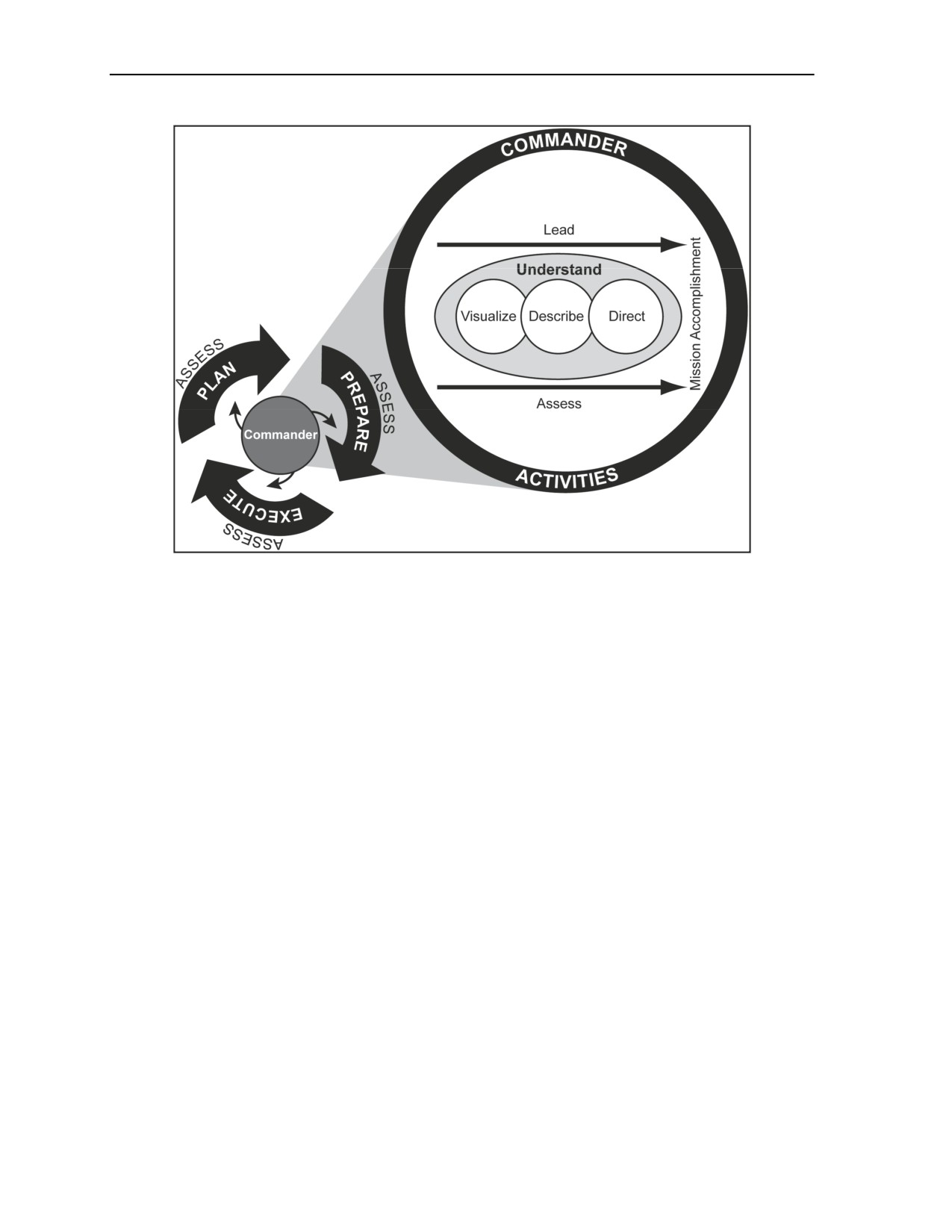
assessing the operation (ADP 5-0). See figure 4-1 on page 4-2 for an illustration of the operations process.
Logistics commanders, supported by their staffs, use the operations process to drive the conceptual and
detailed planning necessary to understand, visualize, and describe their operational environment; make and
articulate decisions; and direct, lead, and assess military operations. Integrating logistics with the
operations process across each level of war is vital for ensuring the synchronization of logistics with the
warfighting functions and unity of effort during operations. Integrating logistics with joint and
multinational operations allow forces to conduct operations using mutual support capabilities while
reducing redundancy and competition for limited resources. Commanders and staffs at every level must
make all efforts to integrate logistics with the operations process.
1 April 2014
FM 4-95
4-1
Chapter 4
Figure 4-1. The operations process
ASSESSMENT FOR LOGISTICS OPERATIONS
4-2. Assessment is the determination of the progress toward accomplishing a task, creating an effect, or
achieving an objective (JP 3-0). Assessment precedes and guides the other activities of the operations
process and is an ongoing process throughout the operations process. Assessment involves deliberately
comparing forecasted logistics outcomes with actual outcomes to determine the overall effectiveness of
logistics support. More specifically, assessment helps the logistics commanders determine progress toward
attaining the desired end state of providing operational reach, freedom of action, and prolonged endurance.
4-3. Logistics commanders should establish quantifiable metrics (measures of effectiveness, measures of
performance) and track progress in order to track the effectiveness of logistics support. Examples of
metrics include operational readiness rates, customer wait times, percentage of requisitions filled, and
quantity of water produced. Examples of tools available for the commander to use to determine progress
toward attaining end state conditions, achieving objectives, and performing tasks logistics include: logistics
boards, cells, and centers, the information network, and the Army integrated Standard Army Management
Information System.
4-4. Throughout the operations process, logistics commanders integrate their own assessments with those
of the staff, subordinate commanders, and other unified action partners. Running estimates provide
information in the form of reports, conclusions, and recommendations for directing action for improvement
from the perspective of each staff section. Other tools for assessing progress of the operation include the
common operational picture, personal observations, after action reviews, and the assessment plan. For more
information on the assessment process and assessment planning see ADRP 5-0 and ATTP 5-0.1.
PLANNING LOGISTICS OPERATIONS
4-5. Planning for logistics support begins with analysis and assessment of the conditions in the
operational environment with emphasis on supporting friendly forces. It involves understanding and
framing the problem and envisioning the set of conditions that represent the desired end state. Logistics
planning indirectly focuses on the enemy but more specifically on sustaining friendly forces to the degree
4-2
FM 4-95
1 April 2014
Integrating Logistics into Operations
the Army as a whole accomplishes the desired end state. There are several tools available for conducting
course of action analysis with a couple of tools highlighted below.
SUSTAINMENT PREPARATION OF THE OPERATIONAL ENVIRONMENT
4-6. Sustainment preparation of the operational environment is the analysis to determine infrastructure,
environmental, or resources in the operational environment that will optimize or adversely impact friendly
forces means for supporting and sustaining the commander’s operations plan. The sustainment preparations
of the operational environment assist planning staffs in refining the logistics estimate and concept of
support. It identifies friendly resources (HNS, contract, or otherwise accessible assets) or environmental
factors (endemic diseases, climate) that impact logistics support.
4-7. Some of the factors considered (not all inclusive) are as follows:
z
Geography. Information on climate, terrain, and other natural resources in the AO to determine
when and what types of logistics are needed. For example, hydrology information determines the
need for such things as early deployment of well-digging assets and water production and
distribution units.
z
Supplies and Services. Information on the availability of supplies and services readily available
in the AO. Supplies (such as subsistence items, bulk petroleum, and barrier materials) are the
most common. Common services consist of bath and laundry, sanitation services, and water
purification.
z
Facilities. Information on the availability of warehousing, cold-storage facilities, production and
manufacturing plants, reservoirs, administrative facilities, hospitals, sanitation capabilities, and
hotels.
z
Transportation. Information on road and rail networks, inland waterways, airfields, truck
availability, bridges, ports, cargo handlers, petroleum pipelines, materials handling equipment,
traffic flow, choke points, and control problems.
z
Maintenance. Availability of HN maintenance capabilities.
z
General Skills. Information on the general skills such as translators, truck drivers, mechanics,
and skilled and unskilled laborers.
OPERATIONS LOGISTICS (OPLOG) PLANNER
4-8. The OPLOG Planner is a web-based interactive tool that assists commanders and staff from strategic
through operational levels in developing a logistics estimate. It is designed to support operations typically
associated with multi-phase operations plans and orders. The OPLOG Planner enables staffs to develop
estimated mission requirements for supply Class I, Class II, Class III(P), Class IV, Class VI, Class VII,
Class X including water, ice, and mail. The tool uses the latest Army approved planning rates and force
structures. It is updated at least annually to stay current with force structure and rate changes.
4-9. OPLOG Planner allows planners to build multiple task organizations from a preloaded list of units
and equipment or from custom built units that are generated or imported. Each task organization is assigned
a consumption parameter set that establishes the rates, climate, joint operations phase (i.e. deter, seize
initiative, dominate), and Army unified land operations. The planners have the option of using predefined
default planning rates or customizing rates based on what a unit is experiencing.
4-10. OPLOG Planner generates the logistics supply requirements which can be viewed by the Entire
Operation, each Phase of the Operation, each Task Organization, each Unit, or each Unit’s Equipment.
Logistics requirement reports can be printed or exported to automated spread sheets for further analysis or
saved for recall to be used in course of action analysis.
PLANNING CONSIDERATIONS FOR DECISIVE ACTION
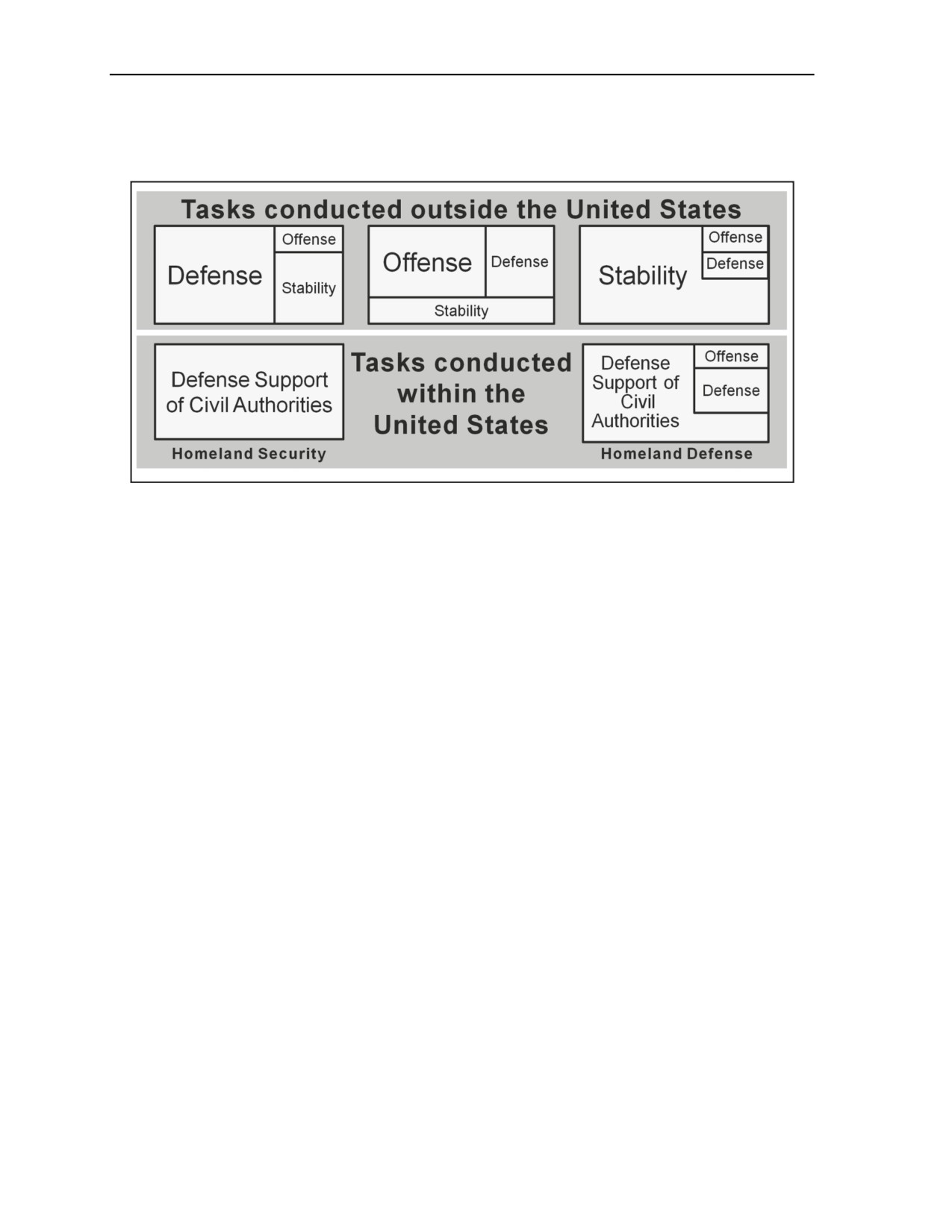
4-11. Army forces demonstrate the Army’s core competencies through decisive action—the continuous,
simultaneous combinations of offensive, defensive, and stability or defense support of civil authorities
tasks. In unified land operations, commanders seek to seize, retain, and exploit the initiative while
synchronizing their actions to achieve the best effects possible. Operations conducted outside the U.S. and
1 April 2014
FM 4-95
4-3
Chapter 4
its territories simultaneously combine three elements—offense, defense, and stability. Within the U.S. and
its territories, decisive action combines the elements of defense support of civil authorities and, as required,
offense and defense to support homeland defense (see figure 4-2).
Figure 4-2. Decisive action
4-12. Decisive action begins with the commander’s intent and concept of operations. As a single, unifying
idea, decisive action provides direction for the entire operation. Based on a specific idea of how to
accomplish the mission, logistics commanders and staffs refine the concept of support during planning.
They adjust it throughout the operation as subordinates develop the situation or conditions change. Often,
subordinates acting on the higher commander’s intent develop the situation in ways that exploit unforeseen
opportunities.
OPERATIONAL ENERGY
4-13. Planning for the effective use of operational energy is an essential consideration. Operational energy
is the sum of energy and associated systems, information and processes required to train, move, and sustain
forces and systems for military operations. Commanders at all levels must reinforce behaviors, and plan for
and employ technical solutions that reduce the amount of energy consumed and make more effective use of
energy. Energy considerations should be included during mission planning and resourcing and then
monitored during mission execution. Commanders should seek out and plan for the use of energy saving
technologies and use other techniques that will reduce both the unit and AO operational energy footprint.
One such technique is using common/efficient power sources shared by multiple units where possible.
Energy conservation practices reduce logistics requirements, increase operational reach and freedom of
action, and prolong endurance.
LOGISTICS SUPPORT TO OFFENSIVE TASKS
4-14. An offensive task is a task conducted to defeat and destroy enemy forces and seize terrain, resources,
and population centers (ADRP 3-0). Logistics operations in support of offensive operations are typically
intense, requiring commanders and staffs to plan for increased requirements and demands on sustainment.
Logistics planners work closely with other warfighting function staffs to determine the scope of the
operations and develop estimates for quantity and types of support required. They anticipate where the
greatest need might occur and develop a priority of support. Logistics planners may consider positioning
logistics units in close proximity to operations to reduce response times for critical support. They also
consider alternative methods for delivering logistics in emergency situations.
4-15. To maintain momentum and freedom of action, coordination between staff planners must be
continuous. During offensive operations, certain requirements present special challenges. The most
important materiel is typically fuel (Class III Bulk) and ammunition (Class V), Class VII, and movement
4-4
FM 4-95
1 April 2014
Integrating Logistics into Operations
control. Based on planning assessments, logistics commanders direct the movement of these and other
support to meet anticipated requirements.
4-16. Another challenge in planning for and sustaining an offensive operation is the lengthened lines of
communication (LOCs). Widely dispersed forces, longer LOCs, and congested road networks increase
stress on transportation systems. As a result, a combination of ground and aerial delivery may be planned to
accommodate the distribution. Distribution managers and movement control units synchronize movement
plans and priorities according to the commander’s priority of support. Distribution must be closely
coordinated and tracked to ensure delivery of essential support. The routing function of movement control
becomes an essential process for coordinating and directing movements on main supply routes or alternate
supply routes, and regulating movement on LOCs to prevent conflict and congestion.
4-17. Using contractors during logistics support to offensive operations entails great risk and raises
significant practical and legal considerations. However when necessary, the force commander may be
willing to accept this risk and use contractors in forward areas. Commanders should seek counsel from their
judge advocates when considering the use of contractors during offensive operations.
LOGISTICS SUPPORT TO DEFENSIVE TASKS
4-18. A defensive task is a task conducted to defeat an enemy attack, gain time, economize forces, and
develop conditions favorable for offensive or stability tasks (ADRP 3-0).
4-19. The commander positions assets so they can support the forces in the defense and survive.
Requirements for sustainment of forces in the defense depend on the type of defense. For example,
increased quantities of ammunition and decreased quantities of fuel characterize most defensive operations.
However, in a mobile defense, fuel usage may be a critical factor. Conversely, in a fixed defensive position,
fuel requirements are lower.
4-20. Typically, defensive operations require more centralized control. Movements of supplies,
replenishment, and troops within the AO have to be closely and continuously coordinated, controlled, and
monitored. In retrograde operations (a type of defense) special care is necessary to assure that combat units
receive necessary support across the depth of the AO and that the logistics units and stocks are not lost as
the unit moves away from enemy activity.
4-21. Distribution managers’ direct resupply forecasted items to designated units. Increases in items such
as barrier and construction materials should be pushed to designated collection points for unit retrieval
whenever possible. Planners should consider the impact of increased ammunition expenditures on available
transportation assets.
LOGISTICS SUPPORT TO STABILITY TASKS
4-22. Stability operations is an overarching term encompassing various military missions, tasks, and
activities conducted outside the U.S. in coordination with other instruments of national power to maintain
or reestablish a safe and secure environment, provide essential governmental services, emergency
infrastructure reconstruction, and humanitarian relief (See JP 3-0.)
4-23. Although Army forces focus on achieving the military end state, they ultimately need to create
conditions where the other instruments of national power are preeminent. Sustainment of stability
operations often involves supporting U.S. and non-governmental organizations in a wide range of missions
and tasks. The tasks most impacted by logistics are briefly discussed below.
Establish Civil Security
4-24. Civil security involves providing for the safety of the HN and its population, including protection
from internal and external threats. Logistics staffs must consider plans to support internment/resettlement
operations. Logistics support may be provided to these operations until HNS, non-governmental
organization, and other government organizations are available.
4-25. Logistics planners must address the support of internment/resettlement operations. Logistics support
to internment/resettlement involves all of the elements of logistics. For example planners should consider
1 April 2014
FM 4-95
4-5
Chapter 4
general engineering support horizontal and vertical construction of detention centers, as well as repair and
maintenance of the infrastructure.
Restore Essential Services
4-26. Efforts to restore essential services involve developing HN capacity to operate, maintain, and
improve those services. At the tactical or local level, logistics in support of civil authorities will restore
essential civil services as defined in terms of immediate humanitarian needs (such as providing food, water,
and shelter) necessary to sustain the population until local civil services are restored. Other logistics tasks
associated with restoration of services include support to dislocated civilians and demining operations.
Support to Economic and Infrastructure Development
4-27. The role of logistics in supporting infrastructure development is significant, especially at the local
level. Here the emphasis is on generating employment opportunities, infusing monetary resources into the
local economy, stimulating market activity, fostering recovery through economic development, and
supporting the restoration of physical infrastructure. Drawing on local goods, services, and labor through
contracting, presents the force an opportunity to infuse cash into the local economy, which in turn
stimulates market activity.
LOGISTICS SUPPORT TO DEFENSE SUPPORT OF CIVIL AUTHORITIES TASKS
4-28. Defense support of civil authorities is support provided by U.S. Federal military forces, DOD
civilians, DOD contract personnel, DOD component assets, and National Guard forces (when the SecDEF,
in coordination with the Governors of the affected States, elects and requests to use those forces in Title 32,
USC, status) in response to requests for assistance from civil authorities for domestic emergencies, law
enforcement support, and other domestic activities, or from qualifying entities for special events. Civil
authorities typically request assistance only when the size and scope of events exceed the capabilities or
capacities of domestic civilian agencies. Defense support of civil authorities (DSCA) tasks are conducted
within the U.S., and DOD forces are always subordinate to civilian control (See ADRP 3-28 for more
information). Army forces support civil authorities in a DSCA situation by performing four primary tasks:
z
Provide support for domestic disaster.
z
Provide support for domestic chemical, biological, radiological, nuclear, or high-yield explosives
incidents.
z
Provide support for domestic civilian law enforcement agencies.
z
Provide other designated support.
4-29. Restoring the transportation infrastructure in the area is central to economic recovery. General
engineering is required in order to initiate immediate improvement of the transportation network. These
networks enable freedom of maneuver, logistics support, and the movement of personnel and material to
support ongoing operations.
PREPARING FOR LOGISTICS OPERATIONS
4-30. Preparation for logistics support to operations consists of activities performed by units to improve
their ability to execute an operation. Preparation consists of those activities performed by units and Soldiers
to improve their ability to execute an operation (ADP 5-0). For logistics to be effective, several actions and
activities are performed across the levels of war to properly prepare forces for operations.
REHEARSALS AND TRAINING
4-31. Rehearsals are a vital component of preparing for logistics operations. A rehearsal is a session in
which the commander and staff or unit practices expected actions to improve performance during execution
(ADRP 5-0). The integration of logistics and operational rehearsals are essential preparation activities.
Rehearsals allow leaders to practice synchronizing operations at times and places critical to mission
accomplishment. Large rehearsals, such as rehearsal of concept drill, require considerable resources, but
provide the most planning, preparation, synchronization, and training benefit. Effective rehearsals imprint a
4-6
FM 4-95
1 April 2014
Integrating Logistics into Operations
mental picture of the sequence and synchronization of the operation’s key actions. Rehearsals improve
mutual understanding and coordination of subordinate and supporting leaders and units. Depending on
circumstances, units may conduct a full dress rehearsal. The extent of rehearsals depends on METT-TC.
See ATTP 5-0.1 for a discussion of the different types of rehearsals.
LIAISON
4-32. Establishing liaison is necessary for preparation of logistics operations. Liaison is that contact or
intercommunication maintained between elements of military forces or other agencies to ensure mutual
understanding and unity of purpose and action (JP 3-08). The liaison officer (LNO) is the personal and
official representative of the sending organization’s commander and should be authorized direct face-to-
face liaison with the supported commander. LNOs must have the commander’s full confidence and the
necessary rank and experience for the mission. Using an LNO conserves manpower while guaranteeing the
consistent, accurate flow of information, coordination, advice, and assistance.
4-33. LNOs are essential for logistics for several reasons. LNOs provide quick information on mission
changes thus enabling responsive adjustments in support of the operation. The LNO enables logistics
command staffs and supported command staffs in their planning and coordination, thereby assuring unity of
effort. The LNO is an important advisor to the supported commander aiding in the employment of logistics
assets. LNOs may also bridge the understanding between unified action partners and logistics planners to
ensure effective use and acquisition of resources.
NEGOTIATIONS AND AGREEMENTS
4-34. Negotiating HNS and theater support contracting agreements may include pre-positioning of supplies
and equipment, civilian support contracts, OCONUS training programs, and humanitarian and civil
assistance programs. These agreements are designed to enhance the development and cooperative solidarity
of the HN and provide infrastructure compensation should deployment of forces to the target country be
required. The pre-arrangement of these agreements reduces planning times in relation to contingency plans
and operations.
4-35. Negotiation of agreements enables access to HNS resources identified in the requirements
determination phase of planning. This negotiation process may facilitate force tailoring by identifying
available resources (such as infrastructure, transportation, warehousing, and other requirements) which if
not available would require deploying additional logistics assets to support.
OPERATIONAL CONTRACT SUPPORT
4-36. Operational contract support plays an ever increasing role in the sustainment of operations and is an
integral part of the overall process of obtaining support. Contract support is used to augment other support
capabilities by providing an additional source for required supplies and services. Because of the importance
and unique challenges of operational contract support, commanders and staffs need to fully understand their
role in managing contract support in the AO.
4-37. The requiring activity (normally brigade through ASCC level units), in close coordination with the
supporting contracting unit/office or Team LOGCAP-Forward, must be able to describe what is needed to
fulfill the minimum acceptable standard for the government. A detailed description of the requirement is
instrumental in allowing the contracting officer to create a solicitation against which bidders can submit a
proposal and successfully deliver in accordance with the terms of the contract. As part of this process, the
requiring activity is responsible to do basic research to ensure the required support is not available through
the non-commercial means (organic military support, multinational, and/or HNS sources) and to determine
if there are any commercial standards for the item of support along with potential local sources of support.
4-38. The requiring activity, with support and guidance from the supporting contracting office and Team
LOGCAP-Forward staff, is also required to develop an independent government estimate and, for service
contracts, a performance work statement (sometimes referred to as a statement of work). The requiring
activity then must obtain staff and command approval of the requirements packet. While the supporting
contracting unit will provide requirements development process advice and guidance, it is ultimately the
1 April 2014
FM 4-95
4-7
Chapter 4
requiring activity's responsibility to ensure that this packet is
“acquisition ready” developed, staffed,
approved, prioritized, and funded in accordance with local command policies.
4-39. Once the contract support request is approved, the requiring activity must also be prepared to provide
government oversight assistance to the contracting organization, that includes at a minimum, qualified
contracting officer representative support for all service contract and receiving official support
(for
community contracts). Finally, all requiring activities must ensure contract support is properly integrated
into their operations in the areas of government furnished support, contractor accountability, force
protection measures (to include biometric vetting of HN contractor personnel), and so forth (see AR 715-9,
JP 4-10, FM 4-92, and ATTP 4-10).
4-40. An important capability for the commander is to incorporate contract support with operational reach.
The major challenge is ensuring that theater support and external support contracts are integrated with the
overall sustainment plan. It is imperative that the TSC and/or ESC SPO and the ASCC G-4 coordinate with
the supporting CSB. The CSB assists the theater Army G-4 to develop the contracting support integration
plans. The CSB commands contracting deployed units to support those plans. Close coordination with the
TSC and CSB is necessary to ensure proper execution of the contract support integration plan. (See chapter
2 for more information on theater support contracts, external support contracts, and system support
contracts).
ARMY PRE-POSITIONED STOCKS
4-41. The APS program is a key Army strategic program. APS is essential in facilitating strategic and
operational reach. USAMC executes the APS program and provides accountability, storage, maintenance,
and transfer (issue and receipt) of all equipment and stocks (except subsistence items which are managed
by DLA for the Army). The reserve stocks are intended to provide support essential to sustain operations
until resupply LOCs can be established. Prepositioning of stocks in potential theaters provides the
capability to rapidly resupply forces until air and sea LOCs are established. Army prepositioned stocks are
located at or near the point of planned use or at other designated locations. This reduces the initial amount
of strategic lift required for power projection, to sustain the war fight until the LOC with CONUS is
established, and industrial base surge capacity is achieved.
4-42. The four categories of APS are: prepositioned unit sets, operational projects stocks, Army war
reserve sustainment stocks, and War Reserve Stocks for Allies (FM 3-35.1).
Prepositioned Unit Sets
4-43. Prepositioned unit sets consist of prepositioned organizational equipment (end items, supplies, and
secondary items) stored in unit configurations to reduce force deployment response time. Materiel is
prepositioned ashore and afloat to meet the Army's global prepositioning strategic requirements of more
than one contingency in more than one theater of operations.
Operational Projects Stocks
4-44. Operational projects stocks are materiel above normal table of organization and equipment, table of
distribution and allowances, and common table of allowance authorizations, tailored to key strategic
capabilities essential to the Army’s ability to execute force projection. They authorize supplies and
equipment above normal modified table of organization and equipment authorizations to support one or
more Army operation, plan, or contingency. They are primarily positioned in CONUS, with tailored
portions or packages prepositioned overseas and afloat. The operational projects stocks include aerial
delivery, mortuary affairs, and force provider base camp modules.
Army War Reserve Sustainment Stocks
4-45. Army War reserve sustainment stocks are acquired in peacetime to meet increased wartime
requirements. They consist of major and secondary materiel aligned and designated to satisfy wartime
sustainment requirements. The major items replace battle losses and the secondary items provide minimum
essential supply support to contingency operations. Stocks are prepositioned in or near a theater of
4-8
FM 4-95
1 April 2014
Integrating Logistics into Operations
operations to reduce dependence on strategic lift in the initial stages of a contingency. They are intended to
last until resupply at wartime rates or emergency rates are established.
War Reserve Stocks for Allies
4-46. War Reserve Stocks for Allies is an Office of the SecDEF directed program that ensures U.S.
preparedness to assist designated allies in case of war. The U.S. owns and finances War Reserve Stocks for
Allies assets and prepositions them in the appropriate theater.
4-47. Land-based APS in Korea, Europe, or Southwest Asia allow the early deployment of a BCT to those
locations. These prepositioned sets of equipment are essential to the timely support of the U.S. National
military strategy in the areas of U.S. national interest and treaty obligations. Fixed land-based sites store
Army prepositioned sets of BCT equipment, operational projects stocks, and sustainment stocks. Land-
based sets can support a theater lodgment to allow the off-loading of Army pre-positioned afloat equipment
and can be shipped to support any other theater worldwide (see FM 3-35.1).
4-48. The Automated Battlebook System contains details on each APS program. G-3 planners and unit
movement officers use Automated Battlebook System to identify equipment in the categories to accompany
troops and not authorized for prepositioning. This automated system also provides a consolidated list of all
APS stockpile inventories. Automated Battlebook System supports deployment planning by providing the
deploying unit with a contingency-updated database for all APS equipment and selected supplies in
prepositioned locations. AFSBs coordinate APS support to include command over units responsible for
maintaining, issuing, and accounting for APS unit equipment and supplies.
4-49. Army prepositioned afloat is the expanded reserve of equipment for an infantry BCT, theater-
opening sustainment units, port-opening capabilities, and sustainment stocks aboard forward-deployed
prepositioned afloat ships. Army prepositioned afloat operations are predicated on the concept of airlifting
an Army infantry BCT with sustainment elements into a theater to link up with its equipment and supplies
prepositioned aboard Army prepositioned afloat ships (see FM 3-35.1).
EXECUTING LOGISTICS OPERATIONS
4-50. Execution means putting a plan into action by applying combat power to accomplish the mission
(ADP 5-0). It focuses on concerted actions to seize, retain, and exploit the initiative. Execution of logistics
operations includes the range of operations from force projection to theater closing and drawdown.
STRATEGIC AND OPERATIONAL REACH AND ENDURANCE
4-51. Strategic and operational reach and endurance enable force projection. Strategic reach is the distance
a nation can project decisive military power against complex, adaptive threats operating anywhere.
Operational reach is the distance and duration across which a joint force can successfully employ military
capabilities (JP 3-0). The ability to conduct strategic and operational reach combines joint military force
projection capabilities.
4-52. Army forces increase the joint force’s strategic reach by securing and operating bases in the AOR.
However, Army forces depend on joint-enabled force projection capabilities to deploy and sustain them
across intercontinental distances. In many instances, land operations combine direct deployment with
movements from intermediate staging bases located outside the operational area.
4-53. Extending operational reach is a paramount concern for commanders. To achieve the desired end
state, forces must possess the necessary operational reach to establish and maintain conditions that define
success. Commanders and staffs increase operational reach through deliberate, focused operational design,
and the appropriate sustainment to facilitate endurance.
4-54. Endurance stems from the ability to maintain, protect, and sustain forces, regardless of how far away
they are deployed, how austere the environment, or how long land power is required. Endurance is enabled
by an Army distribution system that provides forces with a continuous flow of sustainment. A discussion of
the Army distribution system is presented later in this chapter.
1 April 2014
FM 4-95
4-9
Chapter 4
LOGISTICS SUPPORT TO FORCE PROJECTION
4-55. Force projection is the ability to project the military instrument of national power from the U.S. or
another theater, in response to requirements for military operations (JP 3-0). It includes the processes of
mobilization, deployment, employment, sustainment, and redeployment of forces. These processes are a
continuous, overlapping, and repeating sequence of events throughout an operation.
4-56. Force projection operations are inherently joint and require detailed planning and synchronization.
Logistics support to force projection operations is a complex process involving the GCC, strategic and joint
partners such as USTRANSCOM, and transportation component commands like Air Mobility Command,
Military Sealift Command, SDDC, USAMC, DLA, Service Component Commands, and Army generating
forces.
4-57. The Army relies on air and sea transportation to reach most theaters of operations. SDDC is the
ASCC to and primary interface with USTRANSCOM. SDDC is responsible for coordinating strategic
surface movement, and common user port management, to include commercial and mode neutral
movement, in the deployment of Army forces to theater and their redeployment from theater.
4-58. USAMC plays a critical role in force projection. USAMC manages Army equipment throughout all
phases of deployment and redeployment. It maintains APS, ashore and afloat. USAMC and ASA(ALT)
manage equipment requirements for units undergoing modernization, theater-provided equipment,
predeployment, and operational theater support and subsequent redeployment equipping. In accordance
with the direction of HQDA and affected Army commands and direct reporting units, USAMC manages
the redistribution of equipment affected by restationing, and impacts or changes requiring disposition of
Army equipment and supplies. Through the ASC, USAMC assists Forces Command (FORSCOM) with the
rapid projection of Army forces to the JOA and their redeployment, integrates Army logistics with joint and
strategic partners in the national sustainment base, and coordinates distribution plans with USTRANSCOM
and other strategic partners.
Mobilization
4-59. Mobilization is the process of bringing the armed forces to a state of readiness in response to a
contingency. Logistics builds and maintains force readiness. Army generating sustainment forces in the
execution of its Title
10 mission prepare Army forces for unified land operations. Upon alert for
deployment generating force sustainment organizations, ensure Army forces are manned, equipped, and
meet all Soldier readiness criteria. IMCOM operates Army installations that serve as deployment platforms.
Army active and reserve component units mobilize from Army installations that ensure Soldiers,
equipment, materiel, and medical readiness are verified prior to deployment.
Deployment
4-60. Logistics is crucial to the deployment of forces. Deployment is the movement of forces to an
operational area in response to an order. It requires joint and Service sustainment capabilities to
strategically move and maintain deploying forces. Joint transportation assets including air and sealift
capabilities provide the movement capabilities for the Army. Army forces are moved to APOEs and SPOEs
generally by commercial means to begin the deployment process. Logistics commands monitor and track
unit deployment status and provide information to Army HQ.
THEATER OPENING
4-61. Theater opening is the ability to rapidly establish and initially operate ports of debarkation, to
establish the distribution system and logistics bases, and to facilitate port throughput for the reception,
staging, and onward movement of forces within a theater of operations. Preparing for efficient and effective
theater opening operations requires unity of effort among the various commands and a seamless strategic-
to- tactical interface. It is a complex joint process involving the GCC and strategic and joint partners such
as USTRANSCOM, its components, and DLA. Working together, theater opening functions set the
conditions for effective support and lay the groundwork for subsequent expansion of the theater distribution
system. It comprises many of the sustainment functions including, human resources (including Military
4-10
FM 4-95
1 April 2014
Integrating Logistics into Operations
Mail Terminal Team), financial management, health service support, engineering, movement
(air/land/water transport, inland terminal operations), materiel management, maintenance, and contracting.
4-62. When given the mission to conduct theater opening, a sustainment brigade is designated a
sustainment brigade (theater opening) and a mix of functional battalions and multi-functional CSSBs are
assigned based on mission requirements. The sustainment brigade HQ staff may be augmented with a
transportation theater opening element to assist in managing the theater opening mission. The augmentation
element provides the sustainment brigade with additional manpower and expertise to mission command
theater opening functions, to conduct transportation planning, and provide additional staff management
capability for oversight of RSOI operations, port operations, node and mode management, intermodal
operations, and movement control. The sustainment brigade will participate in assessing and acquiring
available HN infrastructure capabilities and contracted support (see ATP 4-93).
4-63. Port opening and port operations are critical components for preparing theater opening. The GCC
and associated regional ASCC is responsible for conducting surveys of infrastructures within their AORs as
part of the deliberate planning effort and the pre-deployment planning prior to non notice operations and
force commitment. In permissive environments supported by HNs, commanders and staffs coordinate with
the HN to ensure sea ports and aerial ports possess sufficient capabilities to support arriving vessels and
aircraft. USTRANSCOM is the port manager for deploying U.S. forces. Army has organic port opening
and terminal operations forces assigned regionally as well as Service retained.
Joint Task Force Port Opening (JTF-PO)
4-64. The JTF-PO is a joint capability designed to rapidly deploy and initially operate aerial and sea ports
of debarkation, establish a distribution node, and facilitate port throughput within a theater of operations.
The JTF-PO is designed to deploy and operate for up to 60 days. The JTF-PO is a standing task force that is
a jointly trained, ready set of forces constituted as a JTF at the time of need OPCON to USTRANSCOM.
See chapter 2 for a more detailed discussion of JTF-PO.
Transportation Brigade Expeditionary
4-65. The transportation brigade expeditionary provides mission command of assigned and attached port,
terminal, and watercraft units conducting expeditionary port-opening, movement control, and austere
intermodal operations at unimproved seaports in support of unified land operations. The transportation
brigade expeditionary provides oversight of the Army watercraft and water terminal assets. The
transportation brigade expeditionary has the ability to perform port management and can provide mission
command to both operating and generating force deployed units.
Seaports
4-66. SDDC is the single port manager for all common user SPODs. The single port manager may have
OPCON of a port support activity provided by any unit. The port support activity assists in moving unit
equipment from the piers to the staging/marshaling/loading areas, assisting the aviation support element
with movement of helicopters in preparation for flight from the port, providing limited maintenance support
for equipment being offloaded from vessels, medical support, logistics support, and security for port
operations.
4-67. Ideally, the SPOD will include berths capable of discharging large medium speed roll-on/roll-off
ships. The SPOD can be a fixed facility capable of discharging a variety of vessels, an austere port
requiring ships to be equipped with the capability to conduct their own offloading, or beaches requiring the
conducting of logistics over-the-shore operations. Whatever the type of SPOD, it should be capable of
accommodating an armored BCT.
4-68. When vessels arrive at the SPOD, the port manager is responsible for discharging the unit equipment,
staging the equipment, maintaining control and ITV, and releasing it to the unit. The port commander
remains responsible for unit equipment and supplies until they reach the staging area where arriving units
assume responsibility for their supplies and equipment. This includes minimum standards that are critical
for the physical security/processing of DOD sensitive conventional arms, ammunition, and explosives,
including non-nuclear missiles and rockets.
1 April 2014
FM 4-95
4-11
Chapter 4
4-69. The movement control team (MCT) manages the processing of the units’ equipment for onward
movement. Their actions are based on advanced manifests received via the Global Air Transportation
Execution System, available transportation, theater priorities, tactical situation, and throughput capacity.
4-70. The Theater Gateway Personnel Accounting Team and supporting human resources company and
platoons will normally operate at the SPOD. The MCT that has responsibility for the SPOD, coordinates
personnel accounting with the supporting CSSB or sustainment brigade for executing life support functions
(billeting, feeding, transportation, and so forth) for personnel who are transiting into or out of the theater.
Aerial Ports
4-71. The APOD is an airfield that has been designated for the sustained air movement of personnel and
materiel. It is designated an APOD by the supported CCDR in coordination with USTRANSCOM.
Reception at the APOD is coordinated by the senior logistics commander and executed by the Contingency
Response Group/Element (Air Force), a MCT, an arrival and departure control group, or both, depending
on the magnitude of the operations. The MCT and/or arrival and departure control group must be in the
lead elements of the transported force. Augmentation with cargo transfer companies, cargo documentation
teams, theater support contractor, and HNS is desired to rapidly clear the port. The port MCT has the
mission of coordinating transport services for the APOD and ensuring quick clearance of cargo movements
into and out of the APOD. Both Air Force and Army have responsibilities at an APOD.
4-72. Air Mobility Command is the single port manager for all common user APODs. Ideally, the APOD
will provide runways of varying capacity, cargo handling equipment, adequate staging areas, multiple links
to the road and rail network, and a qualified work force. The single port manager has OPCON of an arrival
and departure control group provided by the sustainment brigade that has the theater opening mission. The
arrival and departure control group assists in moving unit equipment from the aircraft to the
staging/marshaling/loading areas. It also assists the aviation support element with movement of helicopters
in preparation for flight from the APOD.
4-73. The arrival and departure control group coordinates with the MCT for clearance of personnel and
equipment from the APOD. The Air Force and the inland cargo transfer company do the offloading of
aircraft and move them to the staging area for onward movement. The inland cargo transfer company
discharges, loads, and transships cargo at air, rail, or truck terminals.
EMPLOYMENT
4-74. Employment is the conduct of operations to support a JFC. It prescribes how to apply force and/or
forces to attain specified national strategic objectives. Employment encompasses a wide array of
operations—including but not limited to—entry operations, decisive operations, and post-conflict
operations. Employment includes RSOI, through sustainment preparation activities discussed earlier, Army
forces which are able to enter established ports, assemble units for operations, and move personnel and
equipment to operational areas.
BASING
4-75. A base is a locality from which operations are projected or supported (JP 4-0). The base includes
installations and facilities that provide sustainment. Bases may be joint or single Service areas.
Commanders often designate a specific area as a base and assign responsibility for protection and terrain
management with the base to a single commander. Units located within the base are TACON to the base
commander, primarily for the purpose of facilitating local base defense. Within large bases, controlling
commanders may designate base clusters for mutual protection and mission command.
4-76. The generating force provides capabilities to establish, operate, and manage bases in support of
contingency operations. To support base development, U.S. Army Corps of Engineers maintains base
development teams that operating forces access through reach. IMCOM also provides capabilities to
operate and manage bases in support of JFCs. These capabilities have a contingency operations focus,
emphasizing flexibility and responsiveness. Generating force organizations develop installations according
to standard templates, modified as appropriate to local circumstances. This provides common levels of
support for all of the Services.
4-12
FM 4-95
1 April 2014
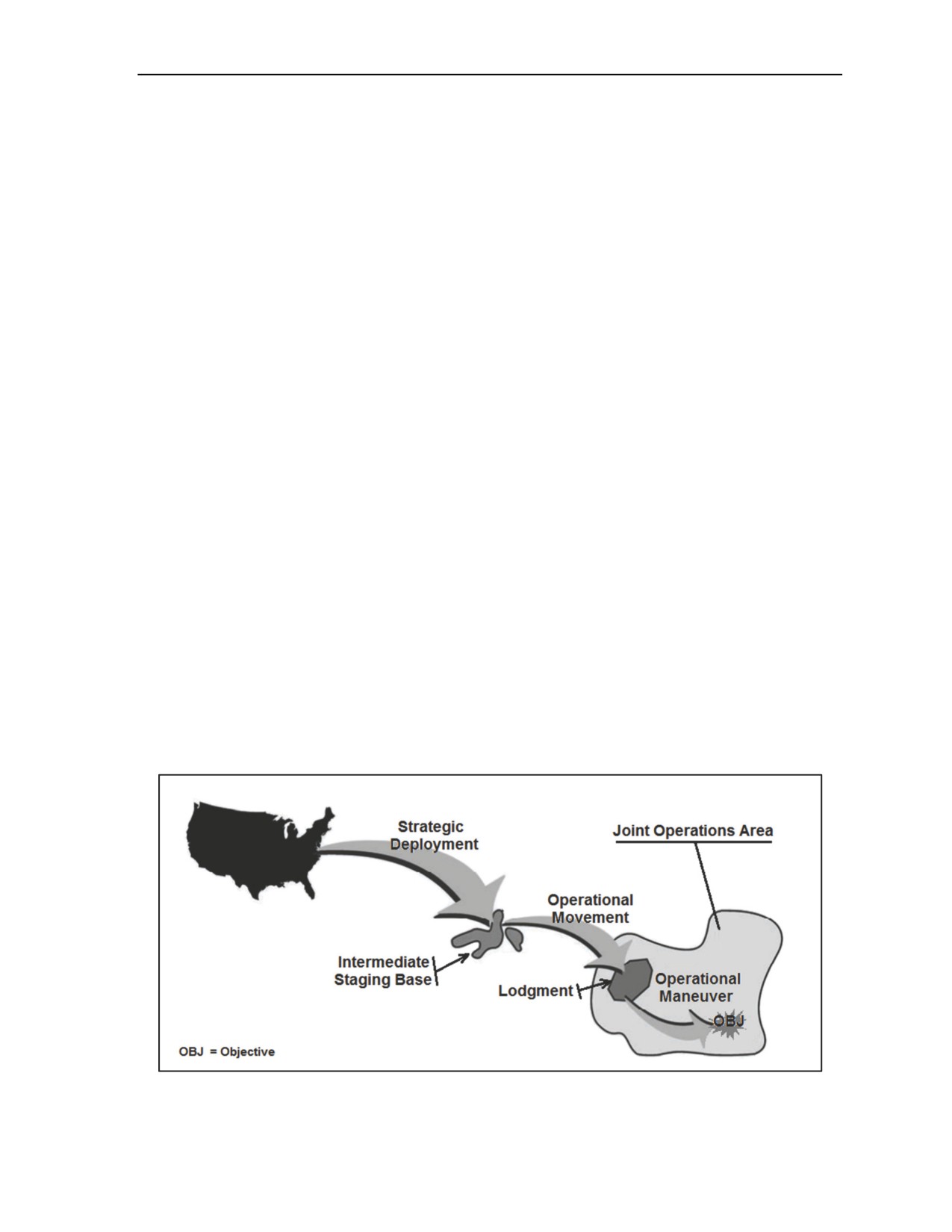
Integrating Logistics into Operations
4-77. In addition to standard base operations, the generating force provides CCDRs capabilities for
conducting theater-specific training. One example is ranges for the conduct of live fire exercises. Another is
rehearsals and facilities for training in the use of electronic warfare. Other capabilities include training
programs to refine the preparation of units and Soldiers for the operational environment.
Warehouse And Billeting And Other Support
4-78. Warehousing, billeting, and other infrastructure capabilities must be identified at each port of
debarkation prior to the arrival of forces in theater. Any limitations influence the efficiency of the entire
sustainment system. Host nation infrastructure such as electrical power grids, sanitation, bulk petroleum,
oil, and lubricant availability, petroleum, oil, and lubricant 'tank farms', and potable water sources and
facilities are important to the successful employment and deployment of forces.
4-79. Force provider is the Army’s system for providing life support for transient forces deploying to
operations. Force provider missions include theater RSOI and base camps for military operations. Force
provider offers environmentally controlled billeting, feeding, and field hygiene (laundry, shower, and
latrine) capabilities. Add on capabilities include: cold weather kit; prime power connection kit; and morale,
welfare, and recreation kit. For more information see FM 4-20.07.
Intermediate Staging Bases (ISB)
4-80. An ISB is a secure base established near, but not in, the AOR through which forces and equipment
deploy (figure 4-3 on page 4-14). While not a requirement in all situations, the ISB may provide a secure,
high-throughput facility when circumstances warrant. The commander may use an ISB as a temporary
staging area en route to a joint operation, as a long-term secure forward support base, and/or secure staging
areas for redeploying units, and noncombatant evacuation operations.
4-81. An ISB is task organized to perform staging, support, and distribution functions as specified or
implied by the CCDR and the theater Army operations order. The ISB task organization is dependent on
the operational situation and the factors of METT-TC. It may provide life support to staging forces in
transit to operations or serve as a support base supporting the theater distribution plan.
4-82. As a support base, an ISB may serve as a transportation node that allows the switch from strategic to
intratheater modes of transportation. Whenever possible an ISB takes advantage of existing capabilities,
serving as a transfer point from commercial carriers to a range of tactical intratheater transport means that
may serve smaller, more austere ports. Army forces may use an ISB in conjunction with other joint force
elements to pre- position selected sustainment capabilities. ISB personnel may perform limited sustainment
functions, such as materiel management and selected sustainment maintenance functions.
Figure 4-3. Basing
1 April 2014
FM 4-95
4-13
Chapter 4
Forward Operating Bases
4-83. Forward operating bases extend and maintain the operational reach by providing secure locations
from which to conduct and sustain operations. They not only enable extending operations in time and
space; they also contribute to the overall endurance of the force. Forward operating bases allow forward
deployed forces to reduce operational risk, maintain momentum, and avoid culmination.
4-84. Forward operating bases are generally located adjacent to a distribution hub. This facilitates
movement into and out of the operational area while providing a secure location through which to distribute
personnel, equipment, and supplies. For more information on basing see FM 3-34.400.
SUSTAINMENT
4-85. Sustainment includes the provision of logistics, personnel services, and health service support
required to maintain and prolong operations until mission accomplishment. The increasingly interconnected
global environment allows the generating force to apply its sustainment capabilities directly within the
JOA. These capabilities include contingency and sustainment contracting; the maintenance and repair of
equipment; acquisition, logistics, and technology functions; and health service support. Generating force
support to sustaining operations focuses on logistics and health service support. For more information on
personnel services and health service support see FM 1-0 and FM 4-02.
4-86. USAMC, in coordination with the supported ASCC’s TSC, facilitates the provision of in-theater
support from DLA depots, other Services, private industry, and other government agencies. Distribution is
a significant part of sustainment operations.
DISTRIBUTION
4-87. Distribution is the key component for executing logistics. It is based on a distribution system defined
as that complex of facilities, installations, methods, and procedures designed to receive, store, maintain,
distribute, and control the flow of military materiel between point of receipt into the military system and
point of issue to using activities and units. The Army’s segment of distribution begins at the point of need,
and terminates at the point of employment and is referred to as tactical movement and distribution.
4-88. Theater distribution is enabled by a distribution management system. Distribution management is the
function of synchronizing and coordinating a complex of networks
(physical, communications,
information, and resources) and the sustainment warfighting function (logistics, personnel services, and
health service support) to achieve responsive support to operational requirements
(ADRP 1-02).
Distribution management includes the management of transportation and movement control, warehousing,
inventory control, materiel handling, order administration, site and location analysis, packaging, data
processing, accountability for people and equipment, and communications. It involves activities related to
the movement of materiel and personnel from source to end user, as well as retrograde operations.
4-89. The DMC orchestrates the distribution of all classes of supply and manages all aspects of theater
distribution by maintaining visibility of requirements, managing the capacity of the system, and controlling
the execution of distribution operations. The DMC considers the impact of unit movement requirements on
the distribution system. It provides current information on location of mode assets and movement of critical
supplies along main supply routes. They provide staff recommendations to direct, redirect, retrograde, and
cross-level resources to meet the distribution mission and user mission requirements.
Distribution Management
4-90. Theater distribution management is conducted by the DMCs located within the SPO section of the
TSC and ESC. The DMC develops the theater distribution plan and monitors distribution performance in
coordination with strategic distribution process owners and the support operations staffs in sustainment
brigades and BSBs, this coordination ensures timely movement and retrograde of logistics within the
CCDR’s area of responsibility. The DMC coordinates distribution with the Human Resources Sustainment
Center and ASCC assistant chief of staff, personnel (G-1)/G-4/G-8 to ensure personnel and resources are
linked. It exercises staff supervision of movement control units in a theater. Figure 4-4 displays the role of
the DMC.
4-14
FM 4-95
1 April 2014
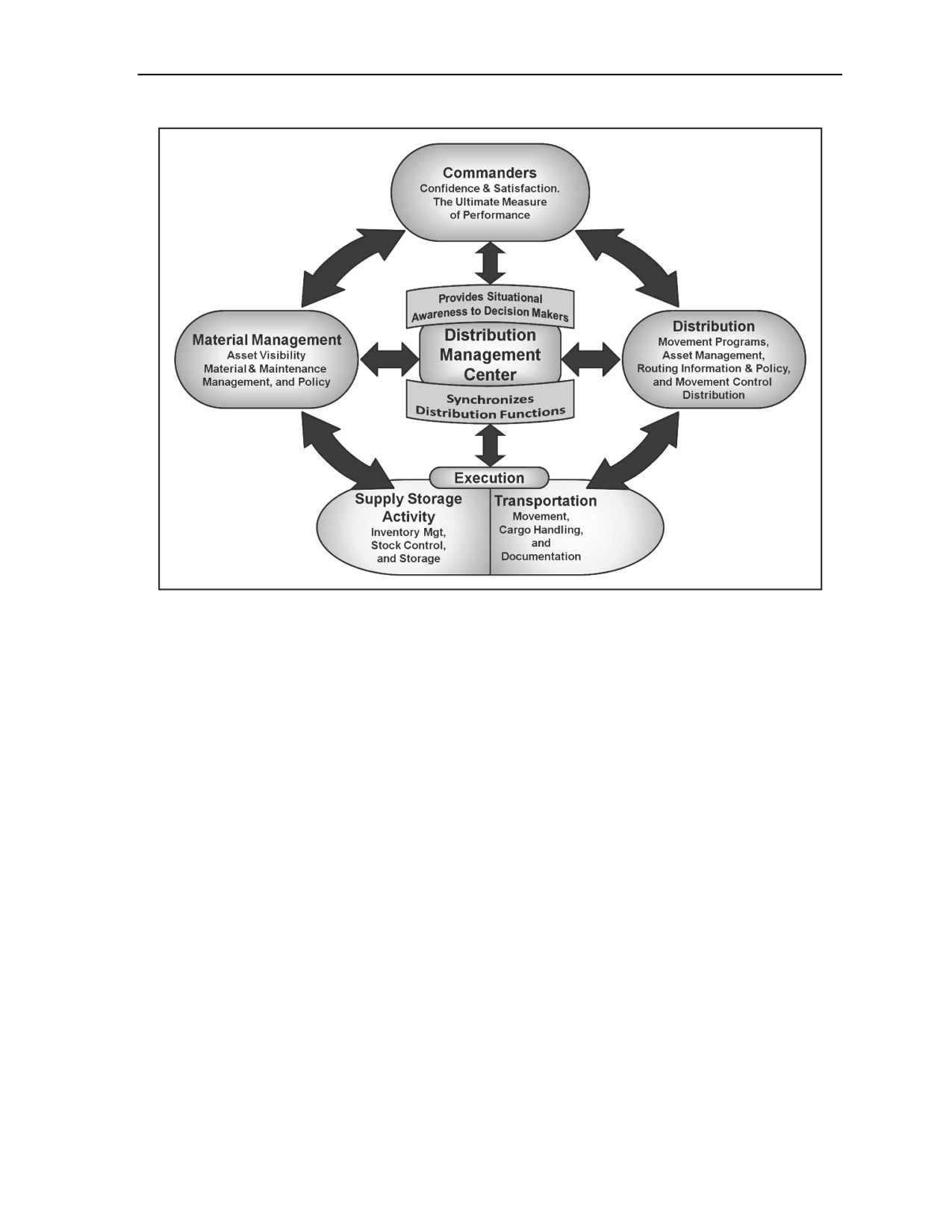
Integrating Logistics into Operations
Figure 4-4. Distribution management center
Materiel Management
4-91. Materiel management is the warehousing, managing, stock/requirements determination, requirements
validation and prioritization for procurement, distribution, redistribution of excess, and retrograding of
materiel. The DMC executes materiel management functions centrally at the TSC and/or ESC thus
reducing redundant materiel management layers and employing a theater-wide view of resources. It
performs materiel management for all classes of supplies (less medical) and maintenance management for
those activities for which the TSC has control and responsibility. DMC personnel perform the day-to-day
planning for sustainment operations; providing the theater interface between strategic and operational-level
support to forces. These planning functions are performed within the parameters of policies, plans,
priorities, and allocations developed in coordination with the ASCC G-4.
4-92. In accordance with ASCC support priorities, the DMC provides direction for receiving, storing, and
issuing theater stocks. When the required stocks are not available or stock replenishment is required, the
requirement passes to the appropriate CONUS national inventory control point. For requirements being
considered for local procurement, the DMC validates the requirement prior to forwarding it to the local
procuring activity.
4-93. Materiel requisitions flow from the requesting unit directly to SSA warehouse activities. These
requisitions are sent to the corps/theater automated data processing service center. The TSC has visibility of
all requisitions received at the corps/theater automated data processing service center. This requisition
process allows the TSC to reach across theater-wide resources and capabilities to satisfy ARFOR
requirements. Enabled by asset visibility, this approach not only reduces but also minimizes the level of
stocks required to be stored throughout the theater.
4-94. Materiel management is conducted through the different branches that make up the DMC. These
branches are the distribution integration branch, materiel readiness branch, supply branch, munitions
branch, mobility branch, and logistics automation branch.
1 April 2014
FM 4-95
4-15
Chapter 4
4-95. The materiel readiness branch is responsible for management of CL IX repair parts. The degree of
management is proportional to the contribution repair parts make to the operational readiness of the end
items they are supporting. Items such as major assemblies, that directly affect the ability of end items to
operate in combat, receive high priority and control. Dollar value is another factor that affects management
of supplies. Combat essential and high-dollar value items are intensely managed at all levels. Low-cost,
noncombat essential items may be managed within the established parameters of the automated logistics
systems at the various echelons of supply, thereby allowing the manager to concentrate on fewer items.
4-96. Class IX support at the operational level focuses on maintaining a theater level of supply that
provides an on-hand level for all repair parts, and a level of stockage for repair items that will not be sent to
the theater via air lines of communication. Easing these supply requirements are the serviceable repair parts
that are generated through maintenance. These theater generated repair parts can offset the requirement to
support from the strategic level of supply.
4-97. The supply branch is responsible for management of all other classes of supply (less CL I, CL V, and
CL VIII). Classes II, III (Packaged), and IV represent a broad range of general supplies. Class II consists of
common consumable items such as clothing, individual equipment, tentage, tool sets and kits, maps,
administrative/housekeeping supplies, and chemical, biological, radiological, and nuclear protective
equipment. Class III (Packaged) consists of packaged petroleum oils and lubricants products that can be
handled in basically the same manner as dry cargo. Class IV consists of fortification, barrier, and
construction materials.
4-98. The munitions branch is responsible for stockage of Class V in theater. The ASCC establishes
priorities for theater Class V, giving priority to the highest usage and most critical ammunition. The TSC
coordinates the shipment and delivery of stocks from CONUS according to the GCC’s support plan.
Shipment is by either surface ships or aircraft. To immediately support rapid deployment forces, initial
shipment is likely to be by air (ammunition accompanying troops and ammunition requirements prior to the
forecasted arrival of APS ships). This is followed by APS ships and then surge shipping. The CCDR and
JFC sustainment planners must consider total force ammunition requirements in a contingency environment
when planning for the movement of stocks and supported forces. The intent is to maximize throughput of
ammunition whenever possible. Requirements are then filled using by the sustainment brigade.
4-99. The DMC executes centralized materiel management capability which enables responsive support to
theater requirements and reduces customer wait time. It also reduces redundant materiel management layers
by centralizing materiel management functions, and employing a theater-wide view of resources.
4-100. The DMC performs materiel management for all classes of supplies (less medical - CL VIII and
classified communications security equipment) and maintenance management for those activities for which
the TSC and/or ESC has control and responsibility. DMC materiel management functions include
managing, cataloging, requirements determination, requirements validation and prioritization for
procurement, distribution, redistribution of excess, and retrograde of materiel. These functions are
performed within the parameters of policies, plans, priorities, and allocations developed in coordination
with the JFC.
4-101. The distribution management of medical materiel is accomplished by a forward support team from
the Medical Logistics Management Center, which collocates with the DMC under the mission command of
the medical command (deployment support) to facilitate the flow of Class VIII materiel throughout the
theater. For more information see FM 4-02.
4-102. In accordance with JFC support priorities, the DMC provides direction for receiving, storing, and
issuing theater stocks. For requirements being considered for local procurement, the DMC validates the
requirement prior to forwarding it to the local procuring activity.
4-103. Requisitions flow from the requesting unit directly to systems controlled by DMC materiel
managers in accordance with standard operating procedures. This streamlined requisition process permits
the TSC to reach across theater-wide resources and capabilities to satisfy Army requirements. Enabled by
asset visibility, this approach not only reduces but also minimizes the level of stocks required. Figure 4-5
depicts materiel management functions and managers.
4-16
FM 4-95
1 April 2014
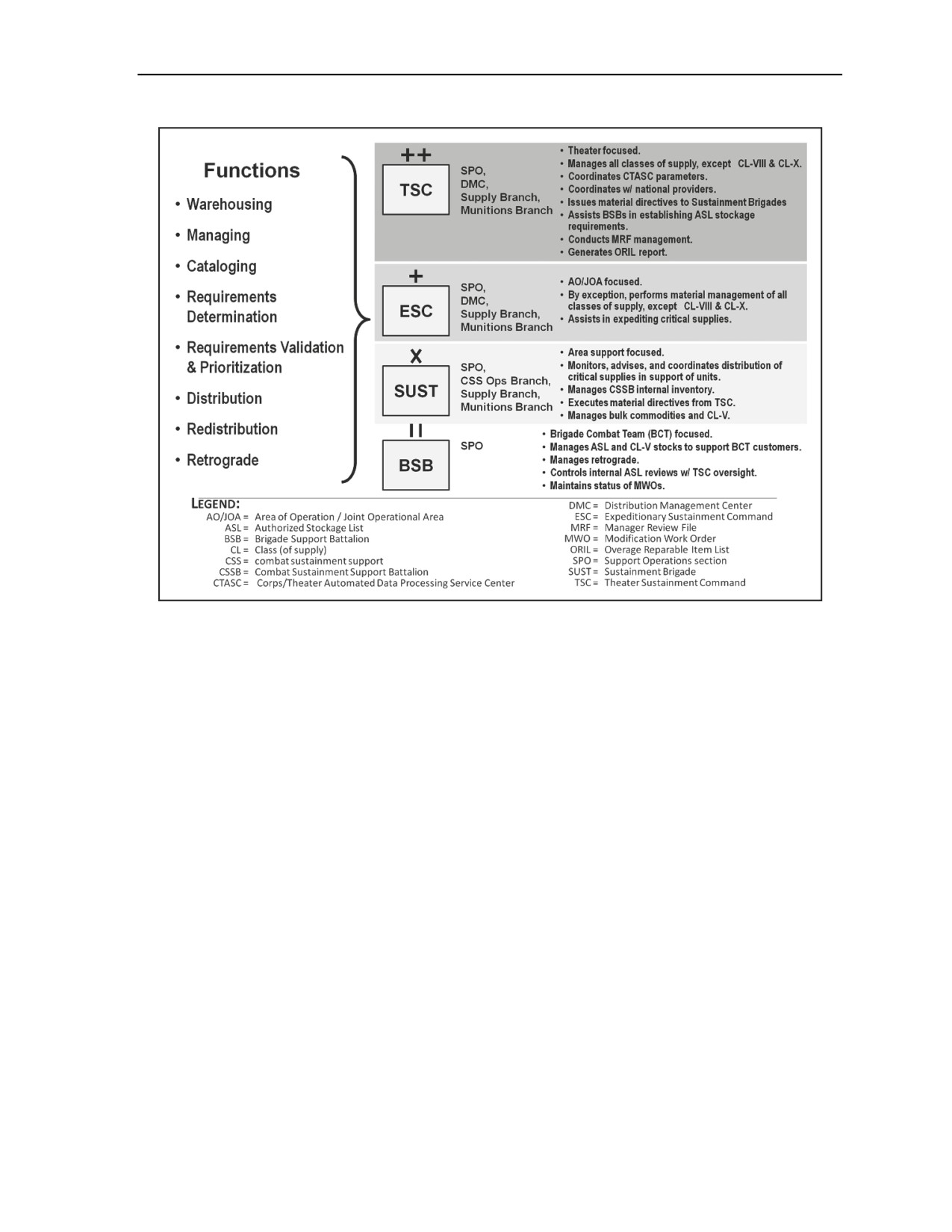
Integrating Logistics into Operations
Figure 4-5. Materiel management functions and managers
Storage Management
4-104. Storage management at the theater level includes receipting, storing, issuing, consolidating, and
preparing for shipment materiel intended for theater-wide use as well as return to wholesale. It is generally
executed in multi-supply class warehouses which stock shipping classes II, IIIP, IV and IX principally, but
may also include the Class VIII storage operation under certain circumstances. Storage sites receive and
store replenishment from wholesale sources and as serviceable returns from customers. Typically
unserviceable items will be stored in separate facilities. Theater-level storage operations can be executed by
Army organizations or, when offered and available, by DLA either from a fixed operation or by DLA’s
deployable depot package.
4-105. Army organizations will be the primary provider of storage management in the initial phases of an
operation. When offered and available, DLA distribution operations once deployed and/or established may
be the main source of theater-level distribution support for classes II, IIIP, IV, and IX and in some
circumstances, VIII. However, these operations are likely to be reliant on the CCDR to provide services
such as billeting, communications, and force protection.
4-106. If DLA performs theater level storage management for classes of supply that experience returns,
such as Class IX, the Army will likely retain responsibility for aspects of retrograde and managing returns,
including documentation and identification of returns, and any required repackaging. The Army will also
have primary responsibility for managing unserviceable retrograde, including storage. The Army will
project this capability forward by deploying augmentee manpower from CSSBs or other units, or
developing item classification units for this purpose.
In-Transit Visibility
4-107. In-transit visibility is the ability to track the identity, status, and location of DOD units, and non-
unit cargo (excluding bulk petroleum, oils, and lubricants) and passengers; patients and personal property
1 April 2014
FM 4-95
4-17
Chapter 4
from origin to consignee, or destination across the range of military operations (JP 3-35). This includes
force tracking and visibility of convoys, containers/pallets, transportation assets, other cargo, and
distribution resources within the activities of a distribution node.
4-108. Visibility begins at the point where personnel and materiel enter the distribution system. Data
concerning personnel and materiel are entered into the appropriate automated system. This data is updated
by subsequent ITV systems until it reaches its final destination (See ATP 4-93 for more information on
automation systems). The information is accessible to all users regardless of the military service or echelon
of command.
4-109. ITV provides the distribution manager the ability to assess how well the distribution process is
responding to supported force needs. Distribution managers gain and maintain visibility (items, personnel,
units, transition hubs, and transport modes) at the earliest practical point in the management process. This
allows managers to operate with timely information. ITV of personnel and materiel is continuous
throughout the distribution process
Retrograde Of Materiel
4-110. Another aspect of distribution is retrograde of materiel. Retrograde of materiel is the return of
materiel from the owning/using unit back through the distribution system to the source of supply, directed
ship-to location, and/or point of disposal
(ATTP 4-0.1). Retrograde includes turn- in/classification,
preparation, packing, transporting, and shipping. To ensure these functions are properly executed,
commanders must enforce supply accountability and discipline and utilize the proper packing materials.
Retrograde of materiel can take place as part of theater distribution operations and as part of redeployment
operations. Retrograde of materiel must be continuous and not be allowed to build up at supply
points/nodes.
4-111. Early retrograde planning is essential and necessary to preclude the loss of materiel assets,
minimize environmental impact, and maximize use of transportation capabilities. Planners must consider
environmental issues when retrograding hazardous materiel.
4-112. Contractor or HNS may be used in the retrograde of materiel. This support is planned and
negotiated early in the operation. HNS must be identified early enough to ensure they are properly screened
and present no security risk. Leaders at all levels are responsible for the adherence of all policies and safety
measures by contractors and HNS.
4-113. Retrograde materiel flows through the distribution system from the tactical to strategic levels.
Retrograde materiel is consolidated at the lowest supply support activity and reported up through the
support operations for distribution instructions. When released by the maneuver commander, USAMC
assumes responsibility for providing disposition instructions, accounting, and shipment of retrograde
materiel from the theater. For more on the retrograde process see ATP 4-91.
4-114. An approved military customs inspection program must be in place prior to redeployment to pre-
clear not only redeployment materiel but also the shipment of battle damaged equipment out of theater. The
theater Army is responsible for establishing the customs inspection program to perform U.S. customs pre-
clearance and U.S. Department of Agriculture inspection and wash down on all materiel retrograded to the
U.S. in accordance with defense transportation regulation (DTR) 4500.9-R.
In-Theater Reconstitution
4-115. In-theater reconstitution is extraordinary actions that commanders take to restore degraded units to
combat effectiveness commensurate with mission requirements and available resources. In-theater
reconstitution should be considered when the operational tempo, mission, or time, does not allow for
replacements by an available unit. Reconstitution requires both generating and operating force
involvement. Generally it should be conducted in a relatively low stress environment.
4-116. The combat readiness of the unit, mission requirements, risk, and the availability of a replacement
unit are the keys for considering reconstitution operations. Commanders must closely evaluate the combat
worthiness of a unit to determine whether a reconstitution operation should be ordered. Commanders must
also decide what type of reconstitution effort would be best for the organization based on METT-TC
4-18
FM 4-95
1 April 2014
Integrating Logistics into Operations
factors. The three major elements of in theater reconstitution are reorganization, regeneration, and
rehabilitation.
Reorganization
4-117. Reorganization is action to shift resources within a degraded unit to increase its combat
effectiveness. Commanders of all types of units at each echelon may conduct reorganization.
Reorganization may be conducted when the operational tempo is such that the risk for removing a unit from
the operation may jeopardize the mission. Depending on METT-TC factors there are two types of
reorganization operations, immediate and deliberate.
Immediate Reorganization
4-118. Immediate reorganization is the quick and usually temporary restoring of degraded units to
minimum levels of effectiveness. Normally, the commander implements immediate reorganization in the
combat position or as close to that site as possible to meet near term needs. Immediate reorganization
consists of cross leveling personnel and equipment, matching weapon systems to crews, or forming
composite units (joining two or more attritted units to form a single mission-capable unit).
Deliberate Reorganization
4-119. Deliberate reorganization is conducted when somewhat more time and resources are available. It
usually occurs farther away from hostile activity than immediate reorganization. Procedures are similar to
those for immediate reorganization. However, some replacement resources may be available. Also,
equipment repair is more intensive and more extensive cross-leveling is possible.
Regeneration
4-120. Regeneration is the rebuilding of a unit. It requires large-scale replacement of personnel,
equipment, and supplies. These replacements may then require further reorganization. Regeneration
involves reestablishing or replacing the chain of command and conducting mission essential training to get
the regenerated unit to standard. Because of the intensive nature of regeneration, it occurs at a designated
regeneration site after the unit disengages from operations. The regeneration site is normally situated in a
relatively secure location.
4-121. Regeneration requires help from higher echelons and may include elements from the generating
force, contract support, and HNS. Since regeneration typically requires large quantities of personnel and
equipment, commanders carefully balance these needs against others in the command as well as the
mission.
Rehabilitation
4-122. Rehabilitation is the processing, usually in a relatively quiet area, of units or individuals recently
withdrawn from combat or arduous duty, during which units recondition equipment and are rested,
furnished special facilities, filled up with replacements, issued replacement supplies and equipment, given
training, and generally made ready for employment in future operations (JP 1-02).
4-123. Rehabilitation will most likely require similar high levels of support to execute. The main
difference is that rehabilitation may occur when time is not a critical factor. If the conditions are such that
forces will rotate in and out of operations on a regular basis, commanders may choose to establish a semi-
permanent rehabilitation site.
In-Theater Reconstitution Operations
4-124. Regardless of the type of reconstitution operation, sustainment of the operation will be intense.
Reconstitution of a unit will require involvement by most, if not all, of the sustainment functions to
execute. Logistics support will require a full range of capabilities including field services, maintenance,
supply, transportation, contract support, and general engineering, and may include human resources and
other sustainment support.
1 April 2014
FM 4-95
4-19
Chapter 4
4-125. The sustainment brigade will be crucial to providing the logistical support to reconstitution. It may
require support from the AFSB, CSB, and USAMC capabilities to provide the full range of required
sustainment.
TERMINATING JOINT OPERATIONS
4-126. Terminating joint operations is an aspect of the CCDR’s functional or theater strategy that links to
achievement of national strategic objectives (JP 5-0). Based on the President’s strategic objectives that
compose a desired national strategic end state, the supported CCDR can develop and propose termination
criteria. The termination criteria describe the standards that must be met before conclusion of a joint
operation. These criteria help define the desired military end state, which normally represents a period in
time or set of conditions beyond which the President does not require the military instrument of national
power as the primary means to achieve remaining national objectives. Termination criteria should account
for a wide variety of operational tasks that the joint force may need to accomplish, to include
disengagement, force protection (including force health protection support to conduct retrograde cargo
inspections and pest management operations), transition to post-conflict operations, reconstitution, and
redeployment. While there may be numerous terminating tasks the Army must achieve, the discussion
below is deliberately broad and not all inclusive. The discussion focuses on redeployment, drawdown of
non-unit materiel, and transitioning of materiel, facilities and capabilities to HN or civil authorities.
4-127. Planning for the transition from sustained combat operations to the termination of joint operations,
and then a complete handover to civil authority, must commence during plan development and be ongoing
during all phases of a campaign or major operation. Planning for redeployment should be considered early
and continued throughout the operation and is best accomplished in the same time-phased process in which
deployment was accomplished.
4-128. Theater closing is the process of redeploying Army forces and equipment from a theater, the
drawdown and removal or disposition of Army non-unit equipment and materiel, and the transition of
materiel and facilities back to HN or civil authorities. Theater closing begins with the termination of joint
operations.
REDEPLOYMENT
4-129. Redeployment is the transfer or rotation of forces and materiel to support another joint force
commander’s operational requirements, or to return personnel, equipment, and materiel to the home and/or
demobilization stations for reintegration and/or out-processing (JP 3-35). Redeployment can be cyclic or a
subset of terminating joint operations.
4-130. Redeployment preparation is actions taken out of contact to ready a unit for its redeployment to
home station. During this phase, the primary generating force role is to manage the disposition of unit
equipment that will either remain in theater as theater-provided equipment or be subject to retrograde to the
sustaining bases for repair or upgrade.
4-131. The deployed ARFOR headquarters is responsible for facilitating units’ movement to ports of
embarkation. SDDC manages sea ports of embarkation and prepares military traffic for movement by sea.
It also provides capabilities, either with organic Military Sealift Command assets or through contract
carriers, to move unit equipment from ports of embarkation to ports of debarkation.
4-132. USAMC, through its Installation Transportation Offices working with the SDDC element at each
port, coordinates unit movements from the port to home station. IMCOM, in coordination with
FORSCOM, USAMC, National Guard Bureau, U.S. Army Reserve, and other generating force
organizations, also facilitates the conduct of reintegration and demobilization as units return from the JOA.
Reintegration includes activities to recover equipment and personnel, demobilization processing, and all
other activities necessary to facilitate the reintegration of Soldiers and Army Civilians into their families
and communities.
4-133. Reuniting unit personnel and their equipment at their home station triggers the start of the lifecycle
management process (reset/train, ready, and available to deploy).
4-20
FM 4-95
1 April 2014
Integrating Logistics into Operations
DRAWDOWN
4-134. Planning for drawdown of non-unit equipment and materiel should occur early in the operational
and strategic planning process. Drawdown planning entails more than returning equipment to CONUS. At
the strategic level, the requirement for specific types of equipment may necessitate the redistribution of
equipment to another AOR.
4-135. Even though equipment drawdown is an important mission in the redeployment operation, it may
not be the Army’s or the GCC main priority; thus, prioritization of equipment redistribution/disposition
must be established early on to maximize distribution capacity and velocity. A challenge is visibility of
strategic- level materiel requirements synthesized into the already established priority timeline.
Overcoming this challenge is through strategic-level collaboration between partners including Service HQs,
GCCs, USAMC, DLA, and USTRANSCOM to effectively and efficiently strategically reset both Joint and
Army forces. Through this partnership, the nation’s resources are preserved for other security needs.
4-136. As planners begin the process of reducing forces in a theater of operations, they must develop a
balance between operational capability and sustainment capability. There is a natural tendency to eliminate
the sustainment and enabler forces first because they do not provide an inherent capability to engage with
the population or enemy. However, as the sustainment and enabling force are withdrawn, there is a direct
impact on the operational forces in the form of reduced operational reach and requirements for assumption
of additional missions.
4-137. To provide unity of effort and ensure operational freedom of action through rapid return, repair,
redistribution, and combat power regeneration for the Army, a USAMC Responsible Reset Task Force
provides a comprehensive solution for drawdown. Reset is a coordinated effort to methodically plan and
execute the timely, repair, redistribution, and/or disposal of non-unit equipment, non-consumable and
materiel identified as excess to theater requirements, to home station, sources of repair, or storage or
disposal facilities. Through the phased redeployment of forces, the Responsible Reset Task Force mission
will reset the Army in the shortest time possible.
4-138. The TSC and/or ESC work closely with the DLA in the close out of materiel in the theater. The
DLA support team serves as the single point of contact to the TSC and/or ESC. The DLA support teams are
tasked to provide support to the theater closure plan and are focused on providing support to echelons at the
theater level and below based on the priorities of effort. During theater closure, the DLA provides support
in the form of adjusting the flow of CL I, II, III (B) (P), IV, VIII and IX to ensure support to the warfighter.
DLA could, if requested, provide a theater consolidation and shipping point for departing forces.
Additionally, DLA assists Army forward operating base closure by providing expeditionary disposal
remediation teams to provide expert advice and oversight to U.S. forces on the preparation for and the
closure of Army units.
CLOSING OPERATIONAL CONTRACTS
4-139. The supporting contracting organization will be required to terminate and close out existing
contracts and orders. Ratifications and claims must be processed to completion. Contracting for life support
services and retrograde support may continue until the last element departs, but standards of support should
be reduced as much as possible prior to final contract closeout. In some operations, the supporting
contracting organization may be required to assist in the transition of contracted support (the contracts
themselves are not transferable) to the Department of State, a multi-national partner or to the HN. This
transition of contract support may include limited continuation of existing contracts in support of high
priority Department of State operations. Because of the nature of contract support transition/closeout during
termination operations, contingency contracting officers will often be some of the last soldiers to leave the
area of operations.
PORT CLOSING
4-140. USTRANSCOM, through SDDC, is responsible for providing and managing strategic common-
user sealift and terminal services in support GCC's drawdown or termination requirements. As the single
port manager, it is SDDC's responsibility to integrate and synchronize strategic and theater re-deployment
execution and distribution operations within each CCDR's area of responsibility. It ensures
1 April 2014
FM 4-95
4-21
Chapter 4
drawdown/termination requirements are met through the use of both military and commercial
transportation assets based on the supported commander’s business rules and the Joint Deployment and
Distribution Enterprise best business practices.
SUMMARY
4-141. Logistics commanders must integrate and synchronize logistics support with the operations plan
and be involved in every step of the operations process. Successful logistics support requires planning,
preparing, and executing logistics operations in a manner that provides operational reach, freedom of
action, and prolonged endurance. Establishing measurable metrics and conducting continuous assessment
of logistics operations enables successful unified land operations.
4-22
FM 4-95
1 April 2014
Glossary
SECTION I - ACRONYMS AND ABBREVIATIONS
ACC
Army Contracting Command
ACSA
aquistion and cross service agreement
ADCON
administrative control
ADP
Army doctrine publication
ADRP
Army doctrine publication
AFSB
Army field support brigade
AO
area of operations
AOR
area of responsibility
APOD
aerial port of debarkation
APOE
aerial port of embarkation
APS
Army pre-positioned stock
AR
Army regulation
ARFOR
Army forces
ARSOF
Army special operations forces
ASA (ALT)
Assistant Secretary of the Army for Acquisition, Logistics, and Technology
ASC
Army Sustainment Command
ASCC
Army Service component command
ATP
Army techniques publication
ATTP
Army tactics, techniques, and procedures
BCT
brigade combat team
BSB
brigade support battalion
CCBN
contracting contingency battalion
CCDR
combatant commander
COCOM
combatant command (Command Authority)
CONUS
continental United States
CSB
contracting support brigade
CSSB
combat sustainment support battalion
CUL
common-user logistics
DA
Department of the Army
DAFL
directive authority for logistics
DCMA
Defense Contract Management Agency
DLA
Defense Logistics Agency
DMC
distribution management center
DOD
Department of Defense
DODD
Department of Defense Directive
DODI
Department of Defense Instruction
DTR
defense transportation regulation
EA
executive agent
1 April 2014
FM 4-95
Glossary-1
Glossary
ECC
Expeditionary Contracting Command
ESC
expeditionary sustainment command
FM
field manual (Army)
FORSCOM
United States Army Forces Command
FSC
forward support company (Army)
G-1
assistant chief of staff, personnel
G-3
assistant chief of staff, operations
G-4
assistant chief of staff, logistics
G-5
assistant chief of staff, plans
G-7
assistant chief of staff, informs and
influences activities
G-8
assistant chief of staff, financial
management
GCC
geographic combatant command
GS
general support
HN
host nation
HNS
host nation support
HQ
headquarters
HQDA
Headquarters Department of the Army
IMCOM
Installation Management Command
ISB
intermediate staging base
ITV
in-transit visibility
J-4
logistics directorate of a joint staff, logistics staff section
JDDOC
joint deployment and distribution operations center
JFC
joint force commander
JLOC
joint logistics operations center
JOA
joint operations area
JP
joint publication
JTF
joint task force
JTF-PO
joint task force-port opening
LCMC
life cycle management command
LNO
liaison officer
LOC
lines of communication
LOGCAP
Logistics Civil Augmentation Program
MCT
movement control team
METT-TC
mission, enemy, terrain and weather, troops and support available-time
available and civil considerations (mission variables) (Army)
NATO
North Atlantic Treaty Organization
OCONUS
outside the continental United States
OPCON
operational control
OPLOG
Operations Logistics
PM
program manager
Glossary-2
FM 4-95
1 April 2014
Glossary
PMESII-PT
political, military, economic, social, infrastructure, information, physical
environment, time (operational variables)(Army)
RSOI
reception, staging, onward movement, integration
SDDC
Surface Deployment and Distribution Command
SecDEF
Secretary of Defense
SOF
special operations forces
SPO
support operations officer
SPOD
sea port of debarkation
TACON
tactical control
TSC
theater sustainment command
TSOC
theater special operations command
U.S.
United States
USAMC
United States Army Materiel Command
USC
United States Code
USTRANSCOM
United States Transportation Command
SECTION II - TERMS
alliance
(DOD) The relationship that results from a formal agreement between two or more nations for broad,
long-term objectives that further the common interests of the members. (JP 3-0)
anticipation
The ability to foresee operational requirements and initiate actions that satisfy a response without
waiting for an operations order or fragmentary order. (ADRP 4-0)
area support
Method of logistics, medical support, and personnel services in which support relationships are
determined by the location of the units requiring support. Sustainment units provide support to units
located in or passing through their assigned areas. (ATP 4-90)
base
(DOD) 1.A locality from which operations are projected or supported. (JP 4-0)
coalition
(DOD) An arrangement between two or more nations for common action. (JP 5-0)
container management
The process of establishing and maintaining visibility and accountability of all cargo containers
moving within the Defense Transportation System. (ADP 4-0)
continuity
Continuity is the uninterrupted provision of sustainment. (ADP 4-0)
defense industrial base
(DOD) The Department of Defense, government, and private sector worldwide industrial complex with
capabilities to perform research and development, design, produce, and maintain military weapon
systems, subsystems, components, or parts to meet military requirements. (JP 3-27)
defensive task
A task conducted to defeat an enemy attack, gain time, economize forces, and develop conditions
favorable for offensive or stability tasks. (ADRP 3-0)
1 April 2014
FM 4-95
Glossary-3
Glossary
distribution
(DOD) 5. The operational process of synchronizing all elements of the logistic system to deliver the
“right things” to the “right place” at the “right time” to support the geographic combatant commander.
(JP 4-0)
distribution management
The function of synchronizing and coordinating a complex of networks (physical, communications,
information, and resources) and the sustainment warfighting function (logistics, personnel services,
and health service support) to achieve responsive support to operational requirements. (ADRP 1-02)
distribution system
(DOD) That complex of facilities, installations, methods, and procedures designed to receive, store,
maintain, distribute, and control the flow of military materiel between the point of receipt into the
military system and the point of issue to using activities and units. (JP 4-09)
economy
Providing sustainment resources in an efficient manner to enable a commander to employ all assets to
achieve the greatest effect possible. (ADP 4-0)
execution
Putting a plan into action by applying combat power to accomplish the mission. (ADP 5-0)
executive agent
(DOD) A term used to indicate a delegation of authority by the Secretary of Defense to a subordinate
to act on behalf of the Secretary of Defense. Also called EA. (JP 1)
force projection
The ability to project the military instrument of national power from the United States or another
theater, in response to requirements for military operations. (JP 3-0)
generating force
Those Army organizations whose primary mission is to generate and sustain the operational Army’s
capabilities for employment by joint commanders. (ADP 1)
improvisation
The ability to adapt sustainment operations to unexpected situations or circumstances affecting a
mission. (ADP 4-0)
integration
Combining all of the sustainment elements within operations assuring unity of command and effort.
(ADRP 4-0)
intermodal operations
The process of using multiple modes (air, sea, highway, rail) and conveyances (i.e. truck, barge,
containers, pallets) to move troops, supplies and equipment through expeditionary entry points and the
network of specialized transportation nodes to sustain land forces. (ADRP 4-0)
in-transit visibility
(DOD) The ability to track the identity, status, and location of Department of Defense units, and non-
unit cargo (excluding bulk petroleum, oils, and lubricants) and passengers; patients and personal
property from origin to consignee, or destination across the range of military operations. (JP 4-01.2)
lead Service or agency for common-user logistics
(DOD) A Service component or Department of Defense agency that is responsible for execution of
common-user item or service support in a specific combatant command or multinational operation as
defined in the combatant or subordinate joint force commander’s operation plan, operation order,
and/or directives. (JP 4-09)
logistics
Planning and executing the movement and support of forces. It includes those aspects of military
operations that deal with: design and development; acquisition, storage, movement, distribution,
Glossary-4
FM 4-95
1 April 2014
Glossary
maintenance, and disposition of materiel; acquisition or construction, maintenance, operation, and
disposition of facilities; and acquisition or furnishing of services. (ADP 4-0)
mission command
The exercise of authority and direction by the commander using mission orders to enable disciplined
initiative within the commander’s intent to empower agile and adaptive leaders in the conduct of
unified land operations. (ADP 6-0)
mission command system
The arrangement of personnel; networks; information systems; processes and procedures; and facilities
and equipment that enable commanders to conduct operations. (ADP 6-0)
mode operations
The execution of movements using various conveyances (truck, lighterage, railcar, aircraft) to transport
cargo. (ADRP 4-0)
movement control
The dual process of committing allocated transportation assets and regulating movements according to
command priorities to synchronize distribution flow over lines of communications to sustain land
forces. (ADRP 4-0)
multinational logistics
(DOD) Any coordinated logistic activity involving two or more nations supporting a multinational
force conducting military operations under the auspices of an alliance or coalition, including those
conducted under United Nations mandate. (JP 4-08)
offensive task
Task conducted to defeat and destroy enemy forces and seize terrain, resources, and population centers.
(ADRP 3-0)
operational environment
A composite of the conditions, circumstances, and influences that affect the employment of
capabilities and bear on the decisions of the commander. (JP 3-0)
operational reach
The distance and duration across which a joint force can successfully employ military capabilities. (JP
3-0)
redeployment
The transfer or rotation of forces and materiel to support another joint force commander’s operational
requirements, or to return personnel, equipment, and materiel to the home and/or demobilization
stations for reintegration and/or out-processing. (JP 3-35)
rehearsal
A session in which the commander and staff or unit practices expected actions to improve performance
during execution. (ADRP 5-0)
responsiveness
The ability to react to changing requirements and respond to meet the needs to maintain support. (ADP
4-0)
simplicity
Relates to processes and procedures to minimize the complexity of sustainment. (ADP 4-0)
stability operations
(DOD) Overarching term encompassing various military missions, tasks, and activities conducted
outside the United States in coordination with other instruments of national power to maintain or
reestablish a safe and secure environment, provide essential governmental services, emergency
infrastructure reconstruction, and humanitarian relief. (See JP 3-0)
1 April 2014
FM 4-95
Glossary-5
Glossary
survivability
(DOD) All aspects of protecting personnel, weapons, and supplies while simultaneously deceiving the
enemy. (JP 3-34)
Glossary-6
FM 4-95
1 April 2014
References
REQUIRED PUBLICATIONS
ADRP 1-02. Terms and Military Symbols. 24 September 2013.
JP 1-02. Department of Defense Dictionary of Military and Associated Terms. 8 November 2010.
RELATED PUBLICATIONS
These documents contain relevant supplemental information.
JOINT PUBLICATIONS
JP 1. Doctrine for the Armed Forces of the United States. 25 March 2013.
JP 3-0. Joint Operations. 11 August 2011.
JP 3-08. Interorganizational Coordination during Joint Operations. 24 June 2011.
JP 3-16. Multinational Operations. 16 July 2013.
JP 3-27. Homeland Defense. 29 July 2013.
JP 3-34. Joint Engineer Operations. 30 June 2011.
JP 3-35. Deployment and Redeployment Operations. 31 January 2013.
JP 4-0. Joint Logistics. 16 October 2013.
JP 4-01.5. Joint Terminal Operations. 6 April 2012.
JP 4-06. Mortuary Affairs. 12 October 2011.
JP 4-08. Logistics in Support of Multinational Operations. 21 February 2013.
JP 4-09. Distribution Operations. 19 December 2013.
JP 4-10. Operational Contract Support. 17 October 2008.
JP 5-0. Joint Operation Planning. 11 August 2011.
ARMY PUBLICATIONS
ADP 1. The Army. 17 September 2012.
ADP 4-0. Sustainment. 31 July 2012.
ADP 5-0. The Operations Process. 17 May 2012.
ADP 6-0. Mission Command. 17 May 2012.
ADRP 3-0. Unified Land Operations. 16 May 2012.
ADRP 3-28. Defense Support of Civil Authorities. 14 June 2013.
ADRP 4-0. Sustainment. 31 July 2012.
ADRP 5-0. The Operations Process. 17 May 2012.
AR 30-22. The Army Food Program. 24 July 2012.
AR 700-137. Logistics Civil Augmentation Program. 28 December 2012.
AR 715-9, Operational Contract Support Planning and Management, 20 June 2011.
ATP 3-05.40, Special Operations Sustainment. 3 May 2013.
ATP 4-12. Army Container Operations. 10 May 2013.
ATP 4-90. Brigade Support Battalion. 31 January 2014.
ATP 4-91. Army Field Support Brigade. 15 December 2011.
ATP 4-93. Sustainment Brigade. 9 August 2013.
1 April 2014
FM 4-95
References-1
References
ATP 4-94. Theater Sustainment Command. 28 June 2013.
ATTP 4-0.1. Army Theater Distribution. 20 May 2011.
ATTP 4-10. Operational Contract Support Tactics, Techniques and Procedures. 20 June 2011.
ATTP 4-33. Maintenance Operations. 18 March 2011.
ATTP 5-0.1. Commander and Staff Officer Guide. 14 September 2011.
FM 1-0. Human Resources Support. 6 April 2010.
FM 3-04.111. Aviation Brigades. 7 December 2007.
FM 3-16. The Army in Multinational Operations. 20 May 2010.
FM 3-34. Engineer Operations. 4 August 2011.
FM 3-34.400. General Engineering. 9 December 2008.
FM 3-35.1. Army Prepositioned Operations. 1 July 2008.
FM 3-93. Theater Army Operations. 12 October 2011.
FM 4-01. Army Transportation Operations. 31 October 2013.
FM 4-02. Army Health System. 26 August 2013.
FM 4-02.7. Multiservice Tactics, Techniques, and Procedures for Health Service Support in a
Chemical, Biological, Radiological, and Nuclear Environment. 15 July 2009.
FM 4-20.07. Quartermaster Force Provider Company. 29 August 2008.
FM 4-20.41. Aerial Delivery Distribution in the Theater of Operations. 29 August 2003.
FM 4-92. Contracting Support Brigade. 12 February 2010.
FM 27-10. The Law of Land Warfare. 18 July 1956.
OTHER PUBLICATIONS
American, British, Canadian, Australian, and New Zealand Publication 323. Coalition Logistics
Handbook. 1 March 2011.
Allied Land Publication 4.2 (Standardization Agreement 2406). Land Forces Logistics Doctrine.
4 February 2010.
DODI 4000.19. Support Agreements. 25 April 2013.
DODD 5100.1. Functions of the Department of Defense and its Major Components. 21 December
2010.
2012.pdf.
NATO Military Committee Decision 319/1. NATO Principles and Policies for Logistics.
Title 10 United States Code. Armed Forces.
Title 32 United States Code. National Guard.
RECOMMENDED READINGS
AR 700-80. Army In-Transit Visibility. 24 September 2008.
ATTP 4-15. Army Water Transport Operations. 11 February 2011.
DODD 5101.9. DOD Executive Agent for Medical Materiel. 23 August 2004.
FM 1-04. Legal Support to the Operational Army. 26 January 2012.
FM 1-05. Religious Support. 18 April 2003.
FM 1-06. Financial Management Operations. 4 April 2011.
FM 3-05. Army Special Operations Forces. 1 December 2010.
FM 3-35. Army Deployment and Redeployment. 21 April 2010.
References-2
FM 4-95
1 April 2014
References
FM 4-02.12. Army Health System Command and Control Organizations. 26 May 2010.
FM 55-1. Transportation Operations. 3 October 1995.
PRESCRIBED FORMS
None
REFERENCED FORMS
DA Form 2028. Recommended Changes to Publications and Blank Forms.
1 April 2014
FM 4-95
References-3