FM 4-95 LOGISTICS OPERATIONS (APRIL 2014) - page 1
FM 4-95
Field Manual
Headquarters
Department of the Army
No. 4-95
Washington, DC, 1 April 2014
Logistics Operations
Contents
Page
PREFACE
iii
INTRODUCTION
iv
Chapter 1
LOGISTICS OVERVIEW
1-1
Logistics Support to Unified Land Operations
1-1
Principles of Logistics
1-2
Elements of Logistics
1-4
Summary
1-9
Chapter 2
STRATEGIC LEVEL LOGISTICS
2-1
Strategic and Joint Interfaces
2-2
Army Title 10 Logistics Requirements
2-2
Logistics Related Unified Action Partners
2-6
Joint Interdependence
2-8
Interagency Coordination
2-14
Multinational Logistics Operations
2-14
Logistics Support to Power Projection
2-17
Generating Force
2-18
Operating Force
2-22
Summary
2-23
Chapter 3
OPERATIONAL - TACTICAL LEVEL LOGISTICS
3-1
Operational Environment
3-1
Theater Structure
3-2
Geographic Combatant Command
3-3
Theater Logistics Structure/Mission Command
3-5
Control
3-9
Command and Support Relationships
3-12
Summary
3-17
Chapter 4
INTEGRATING LOGISTICS INTO OPERATIONS
4-1
Integrating Logistics into the Operations Process
4-1
Assessment for Logistics Operations
4-2
Planning Logistics Operations
4-2
Distribution Restriction: Approved for public release; distribution is unlimited.
i
Contents
Preparing for Logistics Operations
4-6
Executing Logistics Operations
4-9
Terminating Joint Operations
4-20
Summary
4-22
GLOSSARY
Glossary-1
REFERENCES
References-1
INDEX
Index-1
Figures
Figure 1-1. Principles of logistics
1-3
Figure 1-2. Classes and subclasses of supply
1-7
Figure 2-1. Example of logistics in relation to the levels of war
2-1
Figure 2-2. Logistics authorities
2-4
Figure 2-3. Relationship of DOD, the industrial base, and the theater of operations
2-7
Figure 3-1. Area of operations
3-2
Figure 3-2. Example of a notional theater structure
3-3
Figure 4-1. The operations process
4-2
Figure 4-2. Decisive action
4-4
Figure 4-3. Basing
4-13
Figure 4-4. Distribution management center
4-15
Figure 4-5. Materiel management functions and managers
4-17
Tables
Table 2-1. Examples of Army logistics related responsibilities
2-3
Table 3-1. Army command relationships
3-12
Table 3-2. Army support relationships
3-15
ii
FM 4-95
1 April 2014
Preface
Field manual (FM) 4-95 provides detailed information on Army logistics operations. It discusses how the
logistics element of the sustainment warfighting function facilitates operational success by providing Army
forces operational reach, freedom of action, and endurance. FM 4-95 serves as the doctrinal bridge between the
overarching principles prescribed in Army doctrine publication
(ADP) 4-0 and Army doctrine reference
publication (ADRP) 4-0 and the lower level sustainment Army techniques publications (ATP), and Army
tactics, techniques, and procedures publications (ATTP).
The principal audience for FM 4-95 is all members of the profession of arms. Commanders and staffs of Army
headquarters serving as joint task force or multinational headquarters should also refer to applicable joint or
multinational doctrine concerning the range of military operations and joint or multinational forces. Trainers
and educators throughout the Army will also use this publication.
Commanders, staffs, and subordinates ensure that their decisions and actions comply with applicable United
States, international, and in some cases host-nation laws and regulations. Commanders at all levels ensure that
their Soldiers operate in accordance with the law of war and the rules of engagement. (See FM 27-10.)
FM 4-95 uses joint terms where applicable. Selected joint and Army terms and definitions appear in both the
glossary and the text. Terms for which FM 4-95 is the proponent publication (the authority) are italicized in the
text and marked with an asterisk (*) in the glossary. Terms and definitions for which FM 4-95 is the proponent
publication are boldfaced in the text. For other definitions shown in the text, the term is italicized and the
number of the proponent publication follows the definition.
FM 4-95 applies to the Active Army, Army National Guard of the United States, and United States Army
Reserve unless otherwise stated.
The proponent of FM 4-95 is the United States Army Combined Arms Support Command. The preparing
agency is the G3 Doctrine Division, USACASCOM. Send comments and recommendations on DA Form 2028
(Recommended Changes to Publications and Blank Forms) to Commander, United States Army Combined
Arms Support Command and Fort Lee, ATTN: ATCL-TDD (FM 4-95), 2221 A Avenue, Fort Lee, Virginia
23801 or submit an electronic DA Form
2028 by e-mail to: usarmy.lee.tradoc.mbx.leee-cascom-
doctrine@mail.mil.
1 April 2014
FM 4-95
iii
Introduction
FM 4-95, Logistics Operations, is the Army’s doctrine for Army logistics operations at the strategic,
operational and tactical levels of war. This publication emphasizes logistics tactics and procedures in order
to provide all commanders, staffs, and Soldiers an understanding of Army logistics operations.
The contents of FM 4-95 are consistent with ADP and ADRP 4-0, Sustainment, and serve as the doctrinal
foundation for all Army logistics operations. FM 4-95 is consistent to the extent possible with joint logistics
operations. FM 4-95 details logistics operations, mission command for logistics, and logistics support to
theater operations.
FM 4-95 contains four chapters:
Chapter 1 discusses the Army principles of logistics that form the body of thought on how the Army
operates to provide logistics support to unified land operations in the present to near term, with current
force structure and materiel. It also discusses the elements of logistics that make up the distinct function of
logistics.
Chapter 2 discusses the strategic and joint interfaces, Army Title 10 logistics requirements, and identifies
unified action partners that provide logistics support to unified land operations. It will also discuss joint
interdependence, logistics support to force projection and interagency coordination.
Chapter 3 discusses the context (operational environment) within which logistics operations in support of
unified land operations occurs. It discusses the theater structure, mission command for logistics and
command and support relationships.
Chapter 4 discusses how logistics is integrated into the operations process to support decisive action. This
chapter discusses establishing metrics for logistics operations in order to gauge the success of logistics
support provided; planning, preparing, and executing logistics; and provides an example of logistics
operations from force projection to theater closing.
iv
FM 4-95
1 April 2014
Chapter 1
Logistics Overview
Logistics is planning and executing the movement and support of forces. It includes
those aspects of military operations that deal with: design and development;
acquisition, storage, movement, distribution, maintenance, and disposition of
materiel; acquisition or construction, maintenance, operation, and disposition of
facilities; and acquisition or furnishing of services (ADP 4-0).
The sustainment warfighting function consists of three elements: logistics, personnel
services and health service support. Logistics enables the success of operations by
providing joint and Army forces operational reach, freedom of action, and prolonged
endurance. FM 4-95 focuses on the logistics element of the sustainment warfighting
function. For more information on the personnel services and health service support
principles and elements of the sustainment warfighting function see ADRP 4-0,
Sustainment; and the FM 1 and FM 4 series publications.
Logistics involves both military art and science. Knowing when and how to accept
risk, prioritizing a myriad of requirements, and balancing limited resources all require
military art while understanding logistics capabilities incorporates military science.
Logistics operations integrate strategic, operational, and tactical support of deployed
forces while scheduling the mobilization and deployment of additional forces and
materiel. Chapter 1 discusses the Army principles of logistics which form the body of
thought on how the Army operates in the present to near term, with current force
structure and materiel. This chapter also discusses the elements of logistics that make
up the distinct function of logistics.
LOGISTICS SUPPORT TO UNIFIED LAND OPERATIONS
1-1. Army logistics is a critical enabler of unified land operations. Logistics provide the support required
to keep Army and its joint and coalition partners engaged in operations across the operational environment.
The effect of not providing sufficient logistical support could cause forces to slow down or culminate
operations causing a loss of momentum and possible defeat of Army forces. It is essential that logistics
planners and operational planners be inseparable in planning, preparation, execution and assessment of
operations.
OPERATIONAL REACH
1-2. Operational reach is the distance and duration across which a unit can successfully employ military
capabilities (JP 3-0). Depth is the extension of operations in time, space, or purpose, including deep-close-
security operations, to achieve definitive results (ADRP 3-0). Army leaders strike enemy forces throughout
their depth, preventing the effective employment of reserves, command and control nodes, logistics, and
other capabilities not in direct contact with friendly forces. Operations in depth can disrupt the enemy’s
decision cycle. These operations contribute to protecting the force by destroying enemy capabilities before
the enemy can use them. Commanders balance their forces’ tempo and momentum to produce simultaneous
results throughout their operational areas. To achieve simultaneity, commanders establish a higher tempo to
target enemy capabilities located at the limit of a force’s operational reach.
1-3. Sustainment (logistics) determines the depth and duration of Army operations. It is essential to
retaining and exploiting the initiative
(ADRP 3-0). The Army’s robust logistics capability assists in
1 April 2014
FM 4-95
1-1
Chapter 1
providing crucial theater and port opening functions enabling joint forces to conduct strategic and
operational reach. Once the theater is set, Army logistics capabilities continue to provide the bulk of Army
support to other services, common-user logistics (CUL), and other common sustainment resources to
prevent forces from reaching a culmination point.
FREEDOM OF ACTION
1-4. Mission command is the exercise of authority and direction by the commander using mission orders
to enable disciplined initiative within the commander’s intent to empower agile and adaptive leaders in the
conduct of unified land operations (ADP 6-0). Mission command encourages the greatest possible freedom
of action from subordinates. While the commander remains the central figure in mission command, it
enables subordinates to develop the situation. Through disciplined initiative in dynamic conditions within
the commander’s intent, subordinates adapt and act decisively (ADRP 3-0). The ability of logistics forces
to tailor and task-organize ensures commanders freedom of action to change as mission requirements
dictate.
1-5. The logistics mission command structure maximizes the centralized planning and synchronization of
operations. It enables subordinate logistics commanders maximum flexibility to execute their mission based
on the situation within their assigned operational areas. Mission command of logistics equips subordinate
commanders with the confidence and discipline to take bold initiatives to achieve decisive action. A
successful logistics commander provides freedom of action to the operational commander by increasing the
number and quality of available support options.
PROLONGED ENDURANCE
1-6. Endurance refers to the ability to employ combat power anywhere for protracted periods. It stems
from the ability to create, protect, and sustain a force, regardless of the distance from its base and the
austerity of the environment. Endurance involves anticipating requirements and making the most effective,
efficient use of available resources. Endurance gives Army forces their campaign quality. It makes
permanent the transitory effects of other capabilities.
1-7. The endurance of Army forces is primarily a function of their sustainment. Logistics provides the
support necessary to maintain operations until mission accomplishment. Endurance is facilitated by
providing all of the logistics functions to support operations. The application of logistics principles guides
commanders in ensuring operational reach, freedom of action, and prolonged endurance.
PRINCIPLES OF LOGISTICS
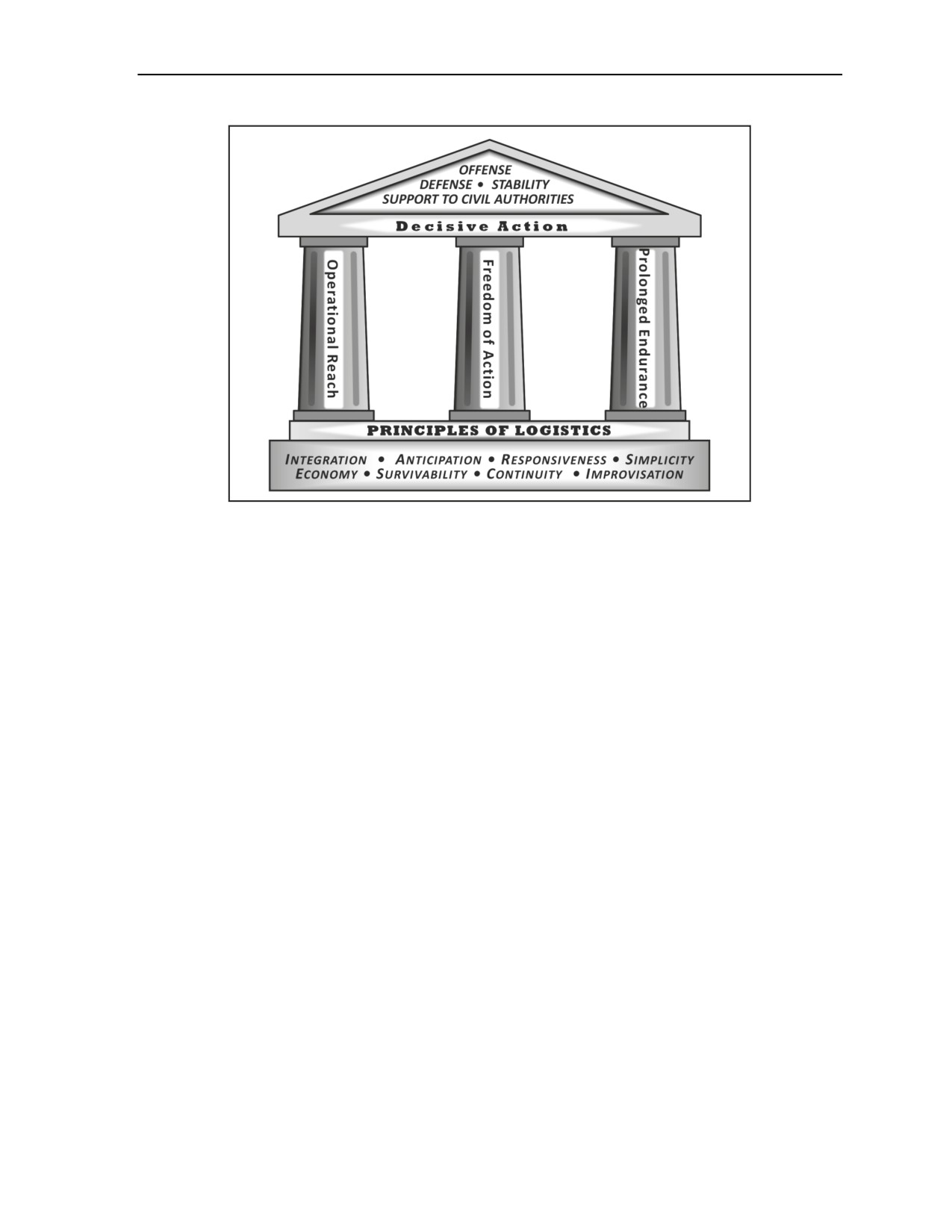
1-8. Army logistics are guided by eight principles as shown in figure 1-1. The logistics principles are the
foundation that provides the Army the operational reach, freedom of action, and prolonged endurance
necessary to support decisive action. While these principles are independent, they are also mutually
supporting. For example, in order for integration and continuity of support to occur, commanders and staffs
must anticipate operational requirements, be responsive in requisitioning and distributing resources and
improvising tactics and techniques responsiveness to operations to unexpected situations.
1-2
FM 4-95
1 April 2014
Logistics Overview
Figure 1-1. Principles of logistics
INTEGRATION
1-9. Integration is combining all of the sustainment elements within operations assuring unity of
command and effort (ADRP 4-0). It requires deliberate coordination and synchronization of logistics with
the personnel services and health service support elements of the sustainment warfighting function as well
as with operations across the strategic, operational and tactical levels of war. Army forces integrate
logistics with joint and multinational operations to maximize the complementary and reinforcing effects of
each Service component and national resources. One of the primary functions of the logistics staff is to
ensure the integration of logistics with operations plans (ADRP 5-0).
ANTICIPATION
1-10. Anticipation is the ability to foresee operational requirements and initiate actions that satisfy a
response without waiting for an operations order or fragmentary order (ADRP 4-0). It is shaped by
professional judgment resulting from experience, knowledge, education, intelligence, and intuition.
Logistics commanders and staffs must understand and visualize future operations and identify appropriate
required support. They must then start the process of acquiring the resources and capabilities that best
support the operation. Anticipation is facilitated by automation systems that provide the common
operational picture upon which judgments and decisions are based.
RESPONSIVENESS
1-11. Responsiveness is the ability to react to changing requirements and respond to meet the needs to
maintain support (ADP 4-0). It is providing the right support in the right place at the right time. It includes
the ability to anticipate operational requirements. Responsiveness involves identifying, accumulating, and
maintaining sufficient resources, capabilities, and information necessary to meet rapidly changing
requirements. Responsive logistics allows commanders to maintain operational focus and pressure, set the
tempo of friendly operations to prevent exhaustion, replace ineffective units, and extend operational reach.
1 April 2014
FM 4-95
1-3
Chapter 1
SIMPLICITY
1-12. Simplicity relates to processes and procedures to minimize the complexity of sustainment (ADP 4-0).
Unnecessary complexity of processes and procedures leads to confusion. Clarity of tasks, standardized and
interoperable procedures, and clearly defined command relationships contribute to simplicity. Simplicity
enables economy and efficiency in the use of resources, while ensuring effective support of forces.
ECONOMY
1-13. Economy is providing sustainment resources in an efficient manner to enable a commander to
employ all assets to achieve the greatest effect possible (ADP 4-0). Economy is achieved through efficient
management, discipline, prioritization, and allocation of resources. Economy is further achieved by
eliminating redundancies and capitalizing on joint interdependencies. Logistics assure the greatest possible
tactical endurance and constitutes an advantage to commanders. Economy may be achieved by contracting
for support or using host nation (HN) resources that reduce or eliminate the use of limited military
resources. Just as centralized control of logistics and decentralized operations helps ensure the economy of
logistics operations, so does centralized control of critical logistics assets, i.e. container handling equipment
and heavy equipment transporters, especially when demands/requirements for a specific capability exceeds
existing resources.
SURVIVABILITY
1-14. Survivability is all aspects of protecting personnel, weapons, and supplies while simultaneously
deceiving the enemy (JP 3-34). Survivability consists of a quality or capability of military forces to avoid
or withstand hostile actions or environmental conditions while retaining the ability to fulfill their primary
mission. This quality or capability of military forces is closely related to protection (the preservation of a
military force’s effectiveness) and to the protection/force protection warfighting function (the tasks or
systems that preserve the force). Hostile actions and environmental conditions can disrupt the flow of
logistics and significantly degrade forces’ ability to conduct and sustain operations. In mitigating risks to
logistics operations commanders must often rely on the use of alternative logistics capabilities and
alternative support plans.
CONTINUITY
1-15. Continuity is the uninterrupted provision of sustainment across all levels of war
(ADP 4-0).
Continuity is achieved through a system of integrated and focused networks linking the three sustainment
elements of logistics, personnel services and health service support to operations. Continuity is achieved
through joint interdependence; linked logistics organizations; a strategic to tactical level distribution
system; and integrated information systems. Continuity assures confidence in logistics allowing
commanders freedom of action, operational reach, and endurance.
IMPROVISATION
1-16. Improvisation is the ability to adapt sustainment operations to unexpected situations or circumstances
affecting a mission (ADP 4-0). It includes creating, inventing, arranging, or fabricating resources to meet
requirements. It may also involve changing or creating methods that adapt to a changing operational
environment. Logistics leaders must apply operational art to visualize complex operations and understand
additional possibilities. These skills enable commanders to improvise operational and tactical actions when
enemy actions or unexpected events disrupt sustainment operations.
ELEMENTS OF LOGISTICS
1-17. The elements of logistics include: maintenance, transportation, supply, field services, distribution,
operational contract support, and general engineering. These elements are pivotal to enabling forces with
operational reach, freedom of action and prolonged endurance.
1-4
FM 4-95
1 April 2014
Logistics Overview
MAINTENANCE
1-18. Maintenance is all actions taken to retain materiel in a serviceable condition. The Army’s two levels
of maintenance are field maintenance and sustainment maintenance (see ATTP 4-33). Maintenance is
necessary for endurance and is performed at all levels of war.
Field Maintenance
1-19. Field maintenance is repair and return to user and is generally characterized by on-(or near) system
maintenance, often utilizing line replaceable units, component replacements, battle damage assessment,
repair, and recovery (see ATTP 4-33). Field maintenance capabilities are generally found in brigade
support battalions and sustainment brigades. The focus of field maintenance is returning a system to an
operational condition. Field level maintenance is not limited to remove and replace, but also provides
adjustment, alignment, and fault/failure diagnosis. Field maintenance also includes battlefield damage and
repair tasks performed by either the crew or support personnel to return or maintain systems in an
operational state. One key criterion of field maintenance is that it always returns the repaired item to the
user.
Sustainment Maintenance
1-20. Sustainment maintenance is generally characterized as “off system” repair to a national standard
using structure and capabilities emanating from the United Stated Army Materiel Command (USAMC) (see
ATTP 4-33). The intent is to perform commodity-oriented repairs on all supported items to one standard
that provides a consistent and measurable level of reliability. Off-system maintenance consists of overhaul
and remanufacturing activities designed to return components, modules, assemblies, and major end items to
the supply system or to units, resulting in extended or improved operational life expectancies. By
exception, sustainment level repair may be returned to the user.
TRANSPORTATION OPERATIONS
1-21. Army transportation units play a key role in facilitating operational reach and prolonged endurance.
Transportation units move assets from ports to points of need and retrograde materiel as required.
Transportation operations encompass the wide range of capabilities needed to allow joint and Army
commanders to conduct operations. Transportation functions include movement control, intermodal
operations, port/terminal operations, mode operations, and containerization.
Movement Control
1-22. Movement control is the dual process of committing allocated transportation assets and regulating
movements according to command priorities to synchronize distribution flow over lines of communications
(LOCs) to sustain land forces (ADRP 4-0). Movement control balances requirements against capabilities
and requires continuous synchronization to integrate military, HN, and commercial movements by all
modes of transportation to ensure seamless transitions from strategic through the tactical level of an
operation. It is a means of providing commanders with situational awareness to control movements in their
operational area. Movement control responsibilities are imbedded in an infrastructure that relies on
coordination for the planning and execution to ensure transportation assets are utilized efficiently while
ensuring LOCs are deconflicted to support freedom of access for military operations.
Intermodal Operations
1-23. Intermodal operations is the process of using multiple modes
(air, sea, highway, rail) and
conveyances (i.e. truck, barge, containers, pallets) to move troops, supplies and equipment through
expeditionary entry points and the network of specialized transportation nodes to sustain land forces
(ADRP 4-0). It uses movement control to balance requirements against capabilities to synchronize terminal
and mode operations ensuring an uninterrupted flow through the transportation system. It consists of
facilities, transportation assets and material handling equipment required to support the deployment and
distribution enterprise.
1 April 2014
FM 4-95
1-5
Chapter 1
Port/Terminal Operations
1-24. Port/terminal operations consist of the receiving, processing, and staging of passengers; the receipt,
transit storage and marshalling of cargo; the loading and unloading of transport conveyances; and the
manifesting and forwarding of cargo and passengers to a destination (JP 4-01.5). A port or terminal may
also be emplaced in an austere or unimproved location to enable operational reach, freedom of action, and
prolonged endurance. They are essential in supporting deployment, redeployment and logistics operations.
For more information see FM 4-01, Army Transportation Operations.
Mode Operations
1-25. Mode operations are the execution of movements using various conveyances (truck, lighterage,
railcar, aircraft) to transport cargo (ADRP 4-0). It includes the administrative, maintenance, and security
tasks associated with the operation of the conveyances.
Containerization
1-26. Containerization is a system of cargo transport based on a range of intermodal International
Organization for Standardization containers. These containers can be loaded and unloaded, stacked,
transported efficiently over long distances, and transferred from one mode of transport to another without
the intermediate handling of the container’s contents.
1-27. Containerization also increases interoperability between Service components and commercial
industry. Additional information on containerization and container management can be found in ATP 4-12,
Army Container Operations.
Container Management
1-28. Container management is the process of establishing and maintaining visibility and accountability of
all cargo containers moving within the Defense Transportation System (ADRP 4-0). In theater, container
management is conducted by commanders at the operational and tactical levels.
1-29. The Military Surface Deployment and Distribution Command (SDDC) is the global container
manager and provides Department of Defense (DOD) with inventory, accountability, tracking, and
visibility services and support, establishes container procedures, functions as the DOD single manager for
container leasing, and controls the movement of all containers in the Defense Transportation System. The
Army Intermodal and Distribution Platform Management Office is a component within SDDC. Army
Intermodal and Distribution Platform Management Office is the Army’s single manager for the managing
and controlling Army-owned/leased International Organization for Standardization containers, flatracks
and other distribution platforms. The Army Intermodal and Distribution Platform Management Office also
develops and implements practices/procedures that ensure the Army operates effectively and efficiently
within the DOD and commercial intermodal systems. See ATP 4-12 for additional information on container
management.
1-30. A Service or joint task force (JTF) commander can appoint/designate a logistics organization within
theater to serve as the country container authority. The country container authority will work hand-in-hand
with the SDDC global container manager representative in theater to ensure the accountability and return of
all containers entering theater.
SUPPLY
1-31. Supply is essential for enhancing Soldiers’ quality of life and providing prolonged endurance in
support of decisive action. Supply provides the materiel and life support that gives Army forces the combat
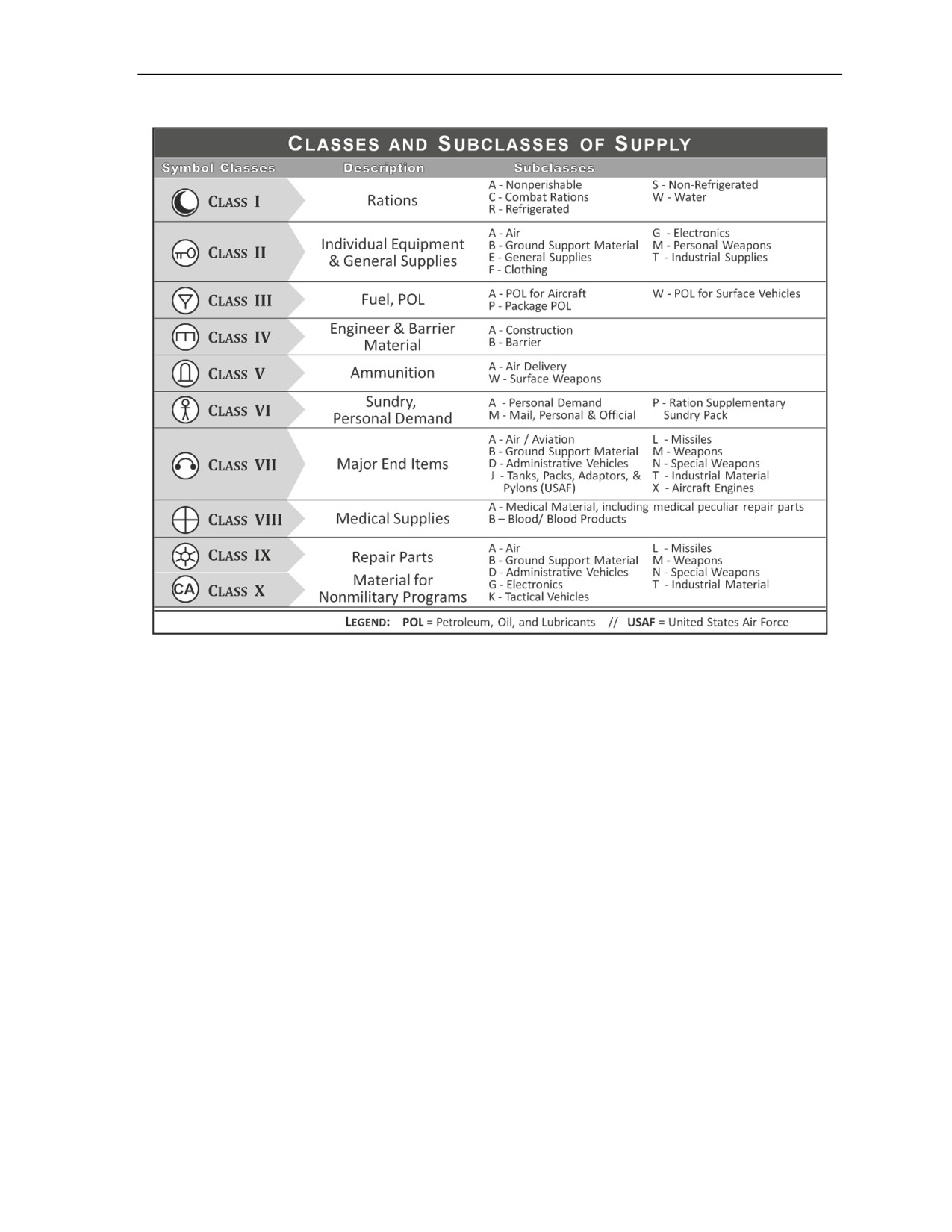
power and prolonged endurance to accomplish the mission. Figure 1-2 displays the supply classes and
subclasses.
1-6
FM 4-95
1 April 2014
Logistics Overview
Figure 1-2. Classes and subclasses of supply
FIELD SERVICES
1-32. Field services maintain the force by providing life support, morale and welfare. Field services
include shower and laundry; field feeding; water production and distribution; clothing and light textile
repair; aerial delivery; and mortuary affairs.
Shower and Laundry
1-33. Shower and laundry capabilities provide Soldiers a minimum of two weekly showers and up to 17
pounds of laundered clothing each week (comprising three uniform sets, undergarments, socks, two towels
and two washcloths). The shower and laundry function does not include laundry decontamination support.
Field Feeding
1-34. Food preparation is a basic unit function and one of the most important factors in Soldiers’ health,
morale, and welfare. The standard is to provide Soldiers at all echelons three quality meals per day (Army
Regulation [AR] 30-22). Proper refuse and waste disposal is important to avoid unit signature trails and
maintain field sanitation standards.
Water Production and Distribution
1-35. Water production and distribution are essential for hydration, sanitation, food preparation, medical
treatment, hygiene, construction, and decontamination. Water production is both a field service and a
supply function. Quartermaster supply units normally perform purification in conjunction with storage and
distribution of potable water.
1 April 2014
FM 4-95
1-7
Chapter 1
Clothing and Light Textile Repair
1-36. Clothing and light textile repair is essential for hygiene, discipline, and morale purposes. Clean,
serviceable clothing is provided as far forward as the brigade area.
Aerial Delivery
1-37. Aerial delivery includes parachute packing, air item maintenance, and rigging of supplies and
equipment. This function supports airborne insertions, airdrop and airland resupply. It is a vital link in the
distribution system and provides the capability of supplying the force even when land lines of
communication have been disrupted or terrain is unfavorable for ground travel, thus adding flexibility to
the distribution system. See FM 4-20.41 for details.
Mortuary Affairs
1-38. Mortuary Affairs is a broadly based military program to provide for the necessary care and
disposition of deceased personnel. For more information on Mortuary Affairs see JP 4-06, Mortuary
Affairs.
DISTRIBUTION
1-39. Distribution is the operational process of synchronizing all elements of the logistic system to deliver
the “right things” to the “right place” at the “right time” to support the geographic combatant commander
(JP 4-0). Additionally, it is also the process of assigning military personnel to activities, units, or billets.
Distribution is the primary means that enables the other elements of logistics to provide operational reach,
freedom of action and prolonged endurance.
1-40. The distribution system consists of a complex of facilities, installations, methods, and procedures
designed to receive, store, maintain, distribute, manage, and control the flow of military materiel between
point of receipt into the military system and point of issue to using activities and units.
1-41. The joint segment of the distribution system is referred to as global distribution while the Army
segment of the distribution system is referred to as theater distribution. Theater distribution is the flow of
equipment, personnel, and materiel within theater to meet the combatant commanders’ (CCDR) mission.
The theater segment extends from the ports of debarkation or source of supply (in theater) to the points of
need. It is enabled by a distribution management system that synchronizes and coordinates a complex of
networks (physical, communications, information, and resources) and the sustainment warfighting function
to achieve responsive support to operational requirements. Mission command of the distribution processes
is key to its success.
1-42. Mission command of distribution is better known as distribution management. Distribution
management is optimizing the distribution networks to achieve the effective and efficient flow of
personnel, equipment, and materiel to meet the combatant commander's requirements. Distribution
management includes the mission command of transportation and movement control, warehousing,
inventory control, order administration, site and location analysis, packaging, data processing,
accountability for equipment
(materiel management), people, and communications. Distribution and
distribution management are discussed in greater details in later chapters. Also see ATTP 4-0.1, Army
Theater Distribution for details.
Operational Contract Support
1-43. Operational contract support is the integration of commercial sector support into military operations.
Operational contract support consists of two complementary functions: contract support integration and
contractor management. Operational contract support has three types of contract support: theater support,
external support, and systems support. See AR 715-9, JP 4-10 and ATTP 4-10 for a full discussion on
operational contract support. A more detailed discussion of operational contract support is contained in
subsequent chapters.
1-8
FM 4-95
1 April 2014
Logistics Overview
GENERAL ENGINEERING
1-44. General engineering provides support that enables logistics. Engineers combine and apply
capabilities from three engineer disciplines (combat, general, and geospatial engineering) to establish and
maintain the infrastructure necessary for sustaining military operations. This involves general engineering
tasks that consist of building, repairing, and maintaining roads, bridges, airfields, port facilities, and other
structures as well as reinforcing force protection measures. Other tasks also include the planning,
acquisition, management, remediation and disposition of real estate, supplying mobile electric power,
utilities and waste management, environmental support, diving and firefighting (see FM 3-34.400).
SUMMARY
1-45. Logistics operations are necessary for successful mission accomplishment. This chapter introduced
the sustainment warfighting function and discussed the principles and elements of logistics that are vital to
the success of decisive action. Logistics provides the Army the personnel/forces, materiel, and equipment
that gives the Army combat power. Logistics also extends operational reach, enables freedom of action, and
facilitates the prolonged endurance of joint and Army forces.
1 April 2014
FM 4-95
1-9
This page intentionally left blank.
Chapter 2
Strategic Level Logistics
The logistics support of unified land operations is linked between the strategic,
operational, and tactical levels. It consists of deliberate coordination and
collaboration with other Services, allies, HN, and other governmental and
nongovernmental organizations. While United States (U.S.) Title 10 requires each
Service provide its own logistics support, it also gives the CCDR the authority to
organize and direct Services’ logistics support as required to accomplish the mission.
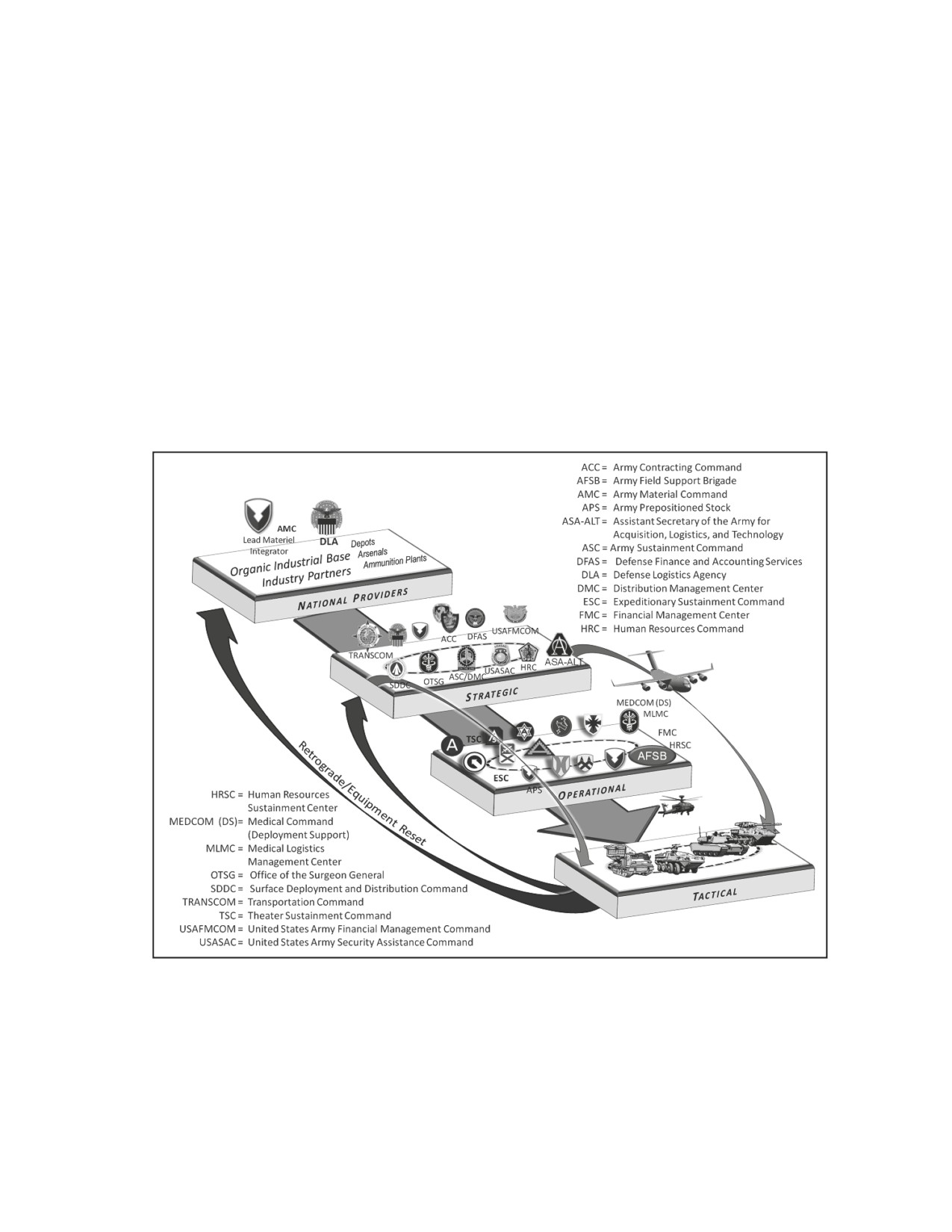
Figure 2-1 demonstrates the logistical connectivity between the strategic to tactical
levels. Logistics support originates at the strategic base, consisting of the Department
of Defense (DOD) and the industrial base, and extends to the tactical level of war.
Figure 2-1. Example of logistics in relation to the levels of war
This chapter covers the strategic and joint interfaces, Army Title
10 logistics
requirements, and identifies unified action partners that provide logistics support to
unified land operations. It will also discuss joint interdependence, logistics support to
force projection and interagency coordination.
1 April 2014
FM 4-95
2-1
Chapter 2
STRATEGIC AND JOINT INTERFACES
2-1. Strategic and joint interfaces include DOD agencies, Services, and commands that link the national
base to the theater. Effective interfaces between the national strategic, operational and the tactical levels are
essential to providing responsive support throughout the theater. Strategic and joint interfaces enable U.S.
forces to maintain combat power as well as enable operational reach, freedom of action, and prolonged
endurance. It is important for logisticians at all levels to have an understanding of who the interfaces are
and the services/capabilities each provide. It is also important to understand how to incorporate and
integrate support from strategic and joint interfaces into the overall concept of logistics support.
ARMY TITLE 10 LOGISTICS REQUIREMENTS
2-2. Title 10, United States Code (USC) and DOD Directive 5100.1, Functions of the DOD and Its Major
Components, describe the organization, roles, and responsibilities for the elements of the DOD to include
the statutory requirements for each Military Department. In accordance with Title 10, each Service retains
responsibility for the logistics support of forces it allocates to a joint force. The Secretary of the Army
exercises this responsibility through the Chief of Staff, U.S. Army and the theater Army assigned to each
combatant command. The theater Army is responsible for the preparation and administrative support of
Army forces assigned or attached to the combatant command. Army Service component command (ASCC)
or designee (theater sustainment command [TSC] and/or expeditionary sustainment command [ESC])
execution of assigned executive agent (EA) or lead Service responsibilities is commonly referred to as
Army support to other services.
2-3. There are twelve Army Title 10 responsibilities; of the twelve, nine (bold lettering) are logistics
related responsibilities:
z
Recruiting.
z
Organizing.
z
Supplying.
z
Equipping (including research and development).
z
Training.
z
Servicing.
z
Mobilizing.
z
Demobilizing.
z
Administering (including the morale and welfare of personnel).
z
Maintaining.
z
Construction, outfitting, and repair of military equipment.
z
Construction, maintenance, repairs of building and structures, utilities, acquisition of real
property and interests in real property necessary to carry out the responsibilities.
2-4. The purposeful combination of complementary Service capabilities to create joint interdependent
forces is often the most effective and efficient means by which to sustain a joint force. Therefore, additional
authorities to Title 10 have been developed to provide for interservice and interagency mutual support.
ARMY EXECUTIVE AGENT RESPONSIBILITIES
2-5. Executive agent (EA) is a term used to indicate a delegation of authority by the Secretary of Defense
to a subordinate to act on behalf of the Secretary of Defense (JP 1). EA refers to Secretary of Defense
(SecDEF) directives and instructions to the head of a DOD component (such as Chief of a Service, CCDR,
or director of a Combat Support Agency) to provide specific categories of support to other agencies or
Service component. The SecDEF designates the Army as the EA for numerous DOD common support
requirements. Examples of the Army’s logistics related EA responsibilities and support to other services as
provided in Department of Defense Directives (DODD) and JPs are shown in table 2-1. These DOD-level
EA requirements relate to lead Service responsibilities. EA reduces redundancy of common support
requirements across the DOD. However, in many cases, lead Service requirements will be closely related to
2-2
FM 4-95
1 April 2014

Strategic Level Logistics
the DOD EA requirements. Under a CCDR’s authority he may assign a Service lead Service
responsibilities for support not EA related.
Table 2-1. Examples of Army logistics related responsibilities
Army Executive Agent Responsibilities
Tasking Document
Support Responsibility
DODD 4705.1
Management of Land-Based Water Resources in Support of Joint Contingency
Operations
DODD 1300.22
Defense Mortuary Affairs Program
DODD 5101.11
DOD Executive Agent for Military Postal Service
Army Support to Other Services
Tasking Document
Support Responsibility
JP 3-34
Airfield Repair
JP 4-01.2
Sealift Support to Joint Operations
JP 4-01.5
Joint Terminal Operations
JP 4-01.6
Joint Logistics Over-the-Shore
JP 4-03
Petroleum, Storage, Distribution, and Protection
JP 4-06
Theater Collection Point and Evacuation Support
JP 4-09
Provide Logistics Support to Enemy Prisoners of War
2-6. The SecDEF or the Deputy Secretary of Defense may designate as an EA for specific
responsibilities, functions, and authorities to provide defined levels of support for operational missions,
administrative, or other designated activities that involve two or more DOD components. By definition, the
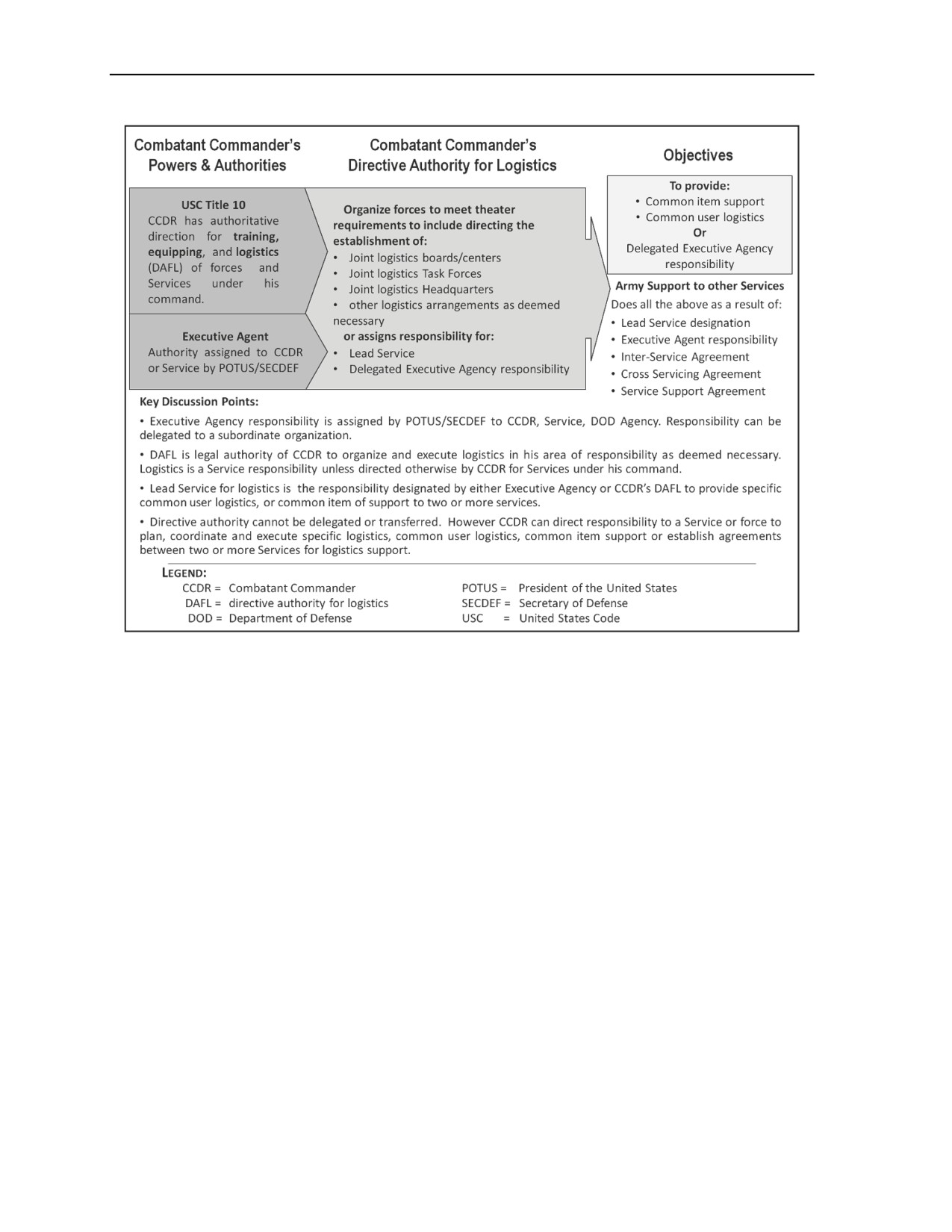
designation as an EA makes that organization responsible for a joint capability (see figure 2-2 on page 2-4).
1 April 2014
FM 4-95
2-3
Chapter 2
Figure 2-2. Logistics authorities
COMBATANT COMMANDER LOGISTICS RESPONSIBILITIES
2-7. Title 10, USC, Sec 164 (Command Authority of Combatant Commanders), specifies the CCDR’s
responsibility for authoritative direction for logistics, (doctrinally referred to as directive authority for
logistics [DAFL]). Unless otherwise directed by the President or the Secretary of Defense, the authority,
direction, and control of the commander of a combatant command with respect to the commands and forces
assigned to that command include the command functions of -(A) giving authoritative direction to
subordinate commands and forces necessary to carry out missions assigned to the command, including
authoritative direction over all aspects of military operations, joint training, and logistics; (B) prescribing
the chain of command to the commands and forces within the command; (C) organizing commands and
forces within that command as he considers necessary to carry out missions assigned to the command;(D)
employing forces within that command as he considers necessary to carry out missions assigned to the
command; (E) assigning command functions to subordinate commanders; (F) coordinating and approving
those aspects of administration and support (including control of resources and equipment, internal
organization, and training) and discipline necessary to carry out missions assigned to the command; and
(G) exercising the authority with respect to selecting subordinate commanders, selecting combatant
command staff, suspending subordinates, and convening courts-martial, as provided in subsections (e), (f),
and (g) of this section and section 822(a) of this title, respectively).
2-8. For logistics, the CCDR has directive authority for organizing, training, and logistics of Service
components under his command. Through DAFL, the CCDR may organize Service logistics capabilities to
establish joint logistics task forces, joint logistics boards and centers, joint logistics special staffs, and joint
logistics headquarters, as needed.
2-4
FM 4-95
1 April 2014
Strategic Level Logistics
Directive Authority for Logistics
2-9. The CCDR uses DAFL to assign responsibility for execution of EA, lead Service responsibilities and
to make other special arrangements such as assigning common user support or common user logistics to a
Service or agency. Directive authority for logistics is the CCDR authority to issue directives to assigned
forces. It includes peacetime measures to ensure the effective execution of approved operations plans,
effectiveness and economy of operation, prevention or elimination of unnecessary duplication of facilities,
and overlapping of functions among the Service component commands (JP 1).
2-10. DAFL, like other combatant command authorities, cannot be delegated or transferred. However, the
CCDR may assign the responsibility for the planning, execution and/or management of as many common
support capabilities to a subordinate joint force commander (JFC) or Service component commander as
required to accomplish the subordinate JFC’s or Service component commander’s mission. For some
commodities, support or services common to two or more Services, the SecDEF or the Deputy Secretary of
Defense may designate one provider as the EA.
2-11. The CCDR must formally delineate assigned responsibilities by function and scope to the
subordinate JFC or Service component commander. When exercising this option, the CCDR must specify
the control and tasking authorities being bestowed upon the subordinate joint command for logistics, as
well as the command relationships it will have with the Service components.
Lead Service
2-12. The CCDR may choose to assign specific common user logistics (CUL) functions, to include
planning and execution to a Lead Service. A lead Service or agency for common-user logistics is a Service
component or DOD agency that is responsible for execution of common-user item or service support in a
specific combatant command or multinational operation as defined in the combatant or subordinate JFC’s
operation plan, operation order, and/or directives (JP 4-09).
2-13. Lead Service assignments can be for single or multiple common user functions and may also be
based on phases and/or locations within the area of responsibility (AOR). The CCDR may augment the lead
Service’s logistics organization with capabilities from another component’s logistics organizations as
appropriate. The lead Service must issue procedures and sustainment funding for all items issued to other
Services as well as a method for collecting items from other Services.
Common User Logistics (CUL)
2-14. CUL is materiel or service support shared with or provided by two or more Services, DOD agencies,
or multinational partners to another Service, DOD agency, non-DOD agency, and/or multinational partner
in an operation. It is usually restricted to a particular type of supply and/or service and may be further
restricted to specific unit(s) or types of units, specific times, missions, and/or geographic areas.
2-15. While normal Service channels may be an effective means of supporting a joint operation, the
Services will often be precluded from deploying the capabilities necessary to provide 100 percent dedicated
Service support. More often than not, the operational situation will require CUL support in order to provide
effective and efficient support of one or more major services or supplies. In fact, CUL support occurs in
almost all joint operations, especially in the form of standing inter-Service support relationships. An
example is Army supply and service support to U.S. Air Force weather detachments attached to Army
regiments, divisions, and corps aviation organizations.
2-16. When properly executed, CUL can produce significant efficiencies by eliminating duplication among
Service components, DOD agencies, multinational partners, and/or contractors in theater. By utilizing
common-item and common-service support, the CCDR may be able to produce significant savings in
equipment, personnel, and supplies deployed to a particular joint operations area (JOA). These savings may
further reduce the requirement for strategic lift, the logistics footprint within a JOA, and possibly the
overall cost of an operation.
1 April 2014
FM 4-95
2-5
Chapter 2
Interservice and Intra-governmental Support Agreement
2-17. Inter-Service support agreements are formal long-term or operational specific support agreements
between Services, DOD, and/or non-DOD agencies governed by DOD Instruction 4000.19, inter-service
and intra-governmental support. These agreements are normally developed at the Service secretariat and
governmental agency director level to document funding and reimbursement procedures as well as
standards of support between the supplying and receiving Service or agencies. Inter-Service, intra-
governmental agreements, while binding Service level agreements, do not connote DOD-level EA
responsibilities. When designated, Army logisticians provide action by one military Service or element
thereof to provide logistics and/or administrative support to another military Service or element thereof.
These actions can be recurring or nonrecurring on an installation, area, or worldwide basis.
Acquistion Cross Service Agreement (ACSA)
2-18. Under ACSA authority (Title 10 USC, sections 2341 and 2342), the SecDEF can enter into an ACSA
for logistics support, supplies, and services on a reimbursable, replacement-in-kind, or exchange-for-equal-
value basis. These agreements can be with eligible nations and international organizations of which the
U.S. is a member. An ACSA is a broad overall agreement, which is generally supplemented with an
implementing agreement. Implementing agreements contain points of contact and specific details of the
transaction and payment procedures for orders for logistics support. Neither party is obligated until the
order is accepted.
2-19. Under these agreements, common support may include food, billeting, transportation (including
airlift), petroleum, oils, lubricants, clothing, communications services, medical services, ammunition, base
operations, storage services, use of facilities, training services, spare parts and components, repair and
maintenance services, calibration services, and port services. Items that may not be acquired or transferred
under the ACSA authority include weapon systems, major end items of equipment, guided missiles, nuclear
ammunition, and chemical ammunition (excluding riot control agents).
JOINT COMMAND FOR LOGISTICS
2-20. The CCDR, through exercising DAFL, may assign joint logistics responsibilities to a Service
component to establish a joint command for logistics (see JP 4-0). Generally, the CCDR will designate the
Service with the preponderance of forces or the most capable logistics structure to fill the joint command
for logistics requirement. The designated joint command for logistics may require augmentation from other
Services to meet joint force requirements.
2-21. For example, if the theater Army is assigned responsibility to establish a joint command for logistics,
the TSC or ESC with augmentation from other Service components is designed to fulfill that mission. A
more detailed discussion of the TSC and/or ESC is contained in subsequent chapters. Also see ATP 4-94,
Theater Sustainment Command.
LOGISTICS RELATED UNIFIED ACTION PARTNERS
2-22. Unified action partners are those military forces, governmental and nongovernmental organizations,
and elements of the private sector with which Army forces plan, coordinate, synchronize, and integrate
during the conduct of operations. Unified action partners include joint forces and components,
multinational forces, and U.S. government agencies and departments (ADRP 3-0).
INDUSTRIAL BASE
2-23. The defense industrial base is the DOD, government, and private sector worldwide industrial
complex with capabilities to perform research and development, design, produce, and maintain military
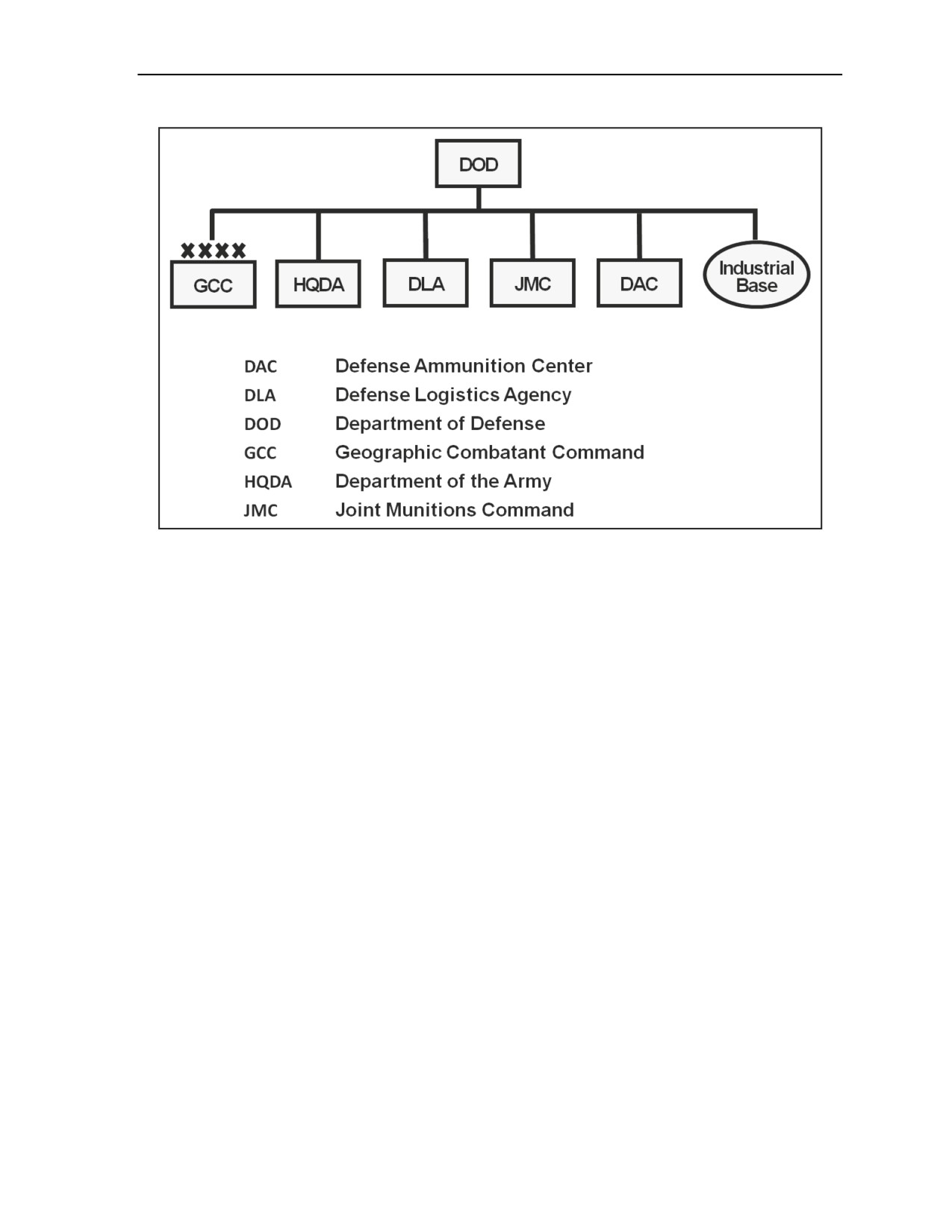
weapon systems, subsystems, components, or parts to meet military requirements (JP 3-27). Figure 2-3
displays the relationships between DOD, Headquarters Department of the Army
(HQDA) and the
geographic combatant command (GCC).
2-6
FM 4-95
1 April 2014
Strategic Level Logistics
Figure 2-3. Relationship of DOD, the industrial base, and the theater of operations
2-24. During a crisis, the Army will call on the existing (wartime) authority to utilize the national industrial
base for preplanned production and buy, lease, or contract for goods and services from any available
commercial source. The industrial base consists of privately owned and government-owned industrial
capability and capacity for the manufacture, maintenance, modification, overhaul, and/or repair of items
required by the U.S. and selected allies. It includes the production base and maintenance base. Active
plants and production lines have some capability to surge during crisis response. Repair parts
manufacturers may be able to surge production for items that sustain deployed weapon systems.
2-25. The Army production base is comprised of Army-controlled industrial activities and contractor
facilities. The Army will coordinate expanded production requirements with the Defense Logistics Agency
(DLA) on common use items. Included in these industrial activities are active and inactive ammunition
plants, arsenals and proving grounds, missile plants, and other miscellaneous plants. These facilities are to
be activated or expanded to provide maximum wartime production levels of materiel. It is DOD policy to
maintain a state of industrial preparedness by working with private industry to produce, maintain, and
repair materiel that meets mobilization requirements. Where it is determined that required mobilization
items cannot be provided by the private sector, then government-owned facilities and equipment are
acquired and maintained to produce them.
2-26. The DOD-level management philosophy applies to the Army’s Industrial Preparedness Program. The
Army depends on private industry as the foundation for production of military materiel. Therefore, when
Army production facilities or depot-level maintenance do not exist, first consideration will be given to
developing private industrial facilities that produce critically needed items.
DEPARTMENT OF DEFENSE AGENCIES
2-27. The DOD relies on the Services, DLA, and non-DOD government agencies such as the General
Services Administration to manage national level logistics. National-level logistics can be described as
wholesale level support to the defense industrial base; development and procurement of new materiel
systems; management and improvement of the logistics infrastructure and rebuild modification and
retirement of old materiel systems when required. These agencies provide an essential interface with the
industrial base through the acquisitioning of military resources, such as storage, movement, and distribution
of materiel; maintenance and disposition of materiel; acquisition or construction, maintenance, operation,
1 April 2014
FM 4-95
2-7
Chapter 2
and disposition of facilities; and acquisition or furnishing of services. Some of these agencies are discussed
in the following paragraphs.
Defense Logistics Agency
2-28. DLA is the focal point for the industrial base and is the EA for consumable supply items minus Class
V. DLA procures, stores, and distributes items to support the military Services and other customers. It also
buys and distributes hardware and electronic items used in the maintenance and repair of military
equipment. DLA provides support for military departments, the GCC, military allies and coalition partners
during peace and war. When directed, DLA also supports interagency and non-DOD organizations by
providing humanitarian assistance and disaster relief. Excluded supply items are munitions, missiles, and
military Service unique items.
2-29. DLA provides reutilization and marketing services at the strategic through operational levels.
Initially, salvage and excess materiel destined for the Defense Reutilization and Marketing Office is
collected in theater areas. As the theater matures, DLA-directed activities may use host nation (HN) or
contractor support to assist in retrograding this materiel for inspection, classification, and disposal.
2-30. DLA has EA responsibilities for subsistence, bulk fuel, construction and barrier materiel, and
medical materiel. DLA is a major source of Class III bulk which allows customers to benefit from “one-
stop shopping" for all of their needs. DLA’s bulk fuels services provide worldwide support of authorized
activities in the areas of contracting, distribution, transportation, and inventory control. DLA provides a
continuous worldwide presence and has liaison officers attached to every combatant command staff to
assist with planning, exercises and current operations. DLA’s contingency support teams and deployable
distribution centers are also utilized to enhance theater distribution to meet the warfighter’s needs.
DEFENSE CONTRACT MANAGEMENT AGENCY (DCMA)
2-31. DCMA is responsible for assuring that procured materiel and services are satisfactory and delivered
when and where needed. DCMA may be directed to provide administrative contract services for contracts
awarded by all DOD components and other designated federal and state agencies, and foreign governments.
DCMA is a separate combat support agency under DOD and deploys its own command structure when
supporting contingency operations. The services performed by DCMA may include:
z
Contract management.
z
Support to small business and labor surplus areas.
z
Transportation and packaging assistance.
z
Acquisition planning support services.
z
Property management.
DEFENSE FINANCE AND ACCOUNTING SERVICE
2-32. The Defense Finance and Accounting Service is responsible for finance and accounting policies,
procedures, standards, systems, and operations that support CCDRs and the Services. It is an agency
supporting the Office of the Under Secretary of Defense, Comptroller, the principal advisor to the SecDEF
for budgetary and fiscal matters. As such, it is the responsibility of the Defense Finance and Accounting
Service to coordinate and collaborate with all civilian defense agencies, the military Services and
combatant commands.
JOINT INTERDEPENDENCE
2-33. Logistics is inherently joint. One area of joint interdependence is joint logistics. Joint
interdependence is the purposeful reliance by one Service’s forces on another Service’s capabilities to
maximize the complementary and reinforcing effects of both. Army forces operate as part of an
interdependent joint force. All services require a wide range of logistics capabilities, personnel services,
and health services to support their forces. The mutual reliance on joint logistics capabilities makes for a
more effective utilization of sustainment resources. Combinations of joint capabilities defeat enemy forces
by shattering their ability to operate as a coherent and effective force.
2-8
FM 4-95
1 April 2014
Strategic Level Logistics
UNITED STATES TRANSPORTATION COMMAND (USTRANSCOM)
2-34. USTRANSCOM is a functional combatant command responsible for providing and managing
strategic common-user airlift, sealift, and terminal services worldwide. USTRANSCOM’s deployment
distribution operation center is USTRANSCOM’s single focal point for all combatant command and major
shipper customers, including the Office of the SecDEF, Joint Staff, Army and Air Force Exchange Service,
DLA, and the Services. The deployment distribution operation center monitors the status of planned and
ongoing movements in the Defense Transportation System through the global transportation network. The
deployment distribution operation center interfaces with the GCC’s joint deployment distribution
operations center (JDDOC).
2-35. Designated as the distribution process owner, USTRANSCOM is responsible for integrating and
synchronizing strategic and theater deployment execution and distribution operations within each GCC’s
AOR. It may also provide personnel augmentation to the GCC’s JDDOC.
2-36. USTRANSCOM’s Service components include: the U.S. Air Force’s Air Mobility Command for
airlift, the U.S. Navy’s Military Sealift Command for sealift, and the U.S. Army’s SDDC for strategic
surface transportation support.
Air Mobility Command
2-37. Air Mobility Command is the U.S. Air Force airlift component of the USTRANSCOM and serves as
the single port manager for air mobility. Air Mobility Command aircraft provide the capability to deploy
the Army’s forces worldwide and help sustain them across a range of military operations. As follow-on
forces to USTRANSCOM’s joint task force-port opening (JTF-PO) aerial port of debarkation (APOD), Air
Mobility Command performs single port management functions necessary to support the strategic flow of
the deploying forces’ equipment and supplies from the aerial port of embarkation (APOE) to the theater.
2-38. APOEs and APODs are usually designated joint aerial complexes and managed by Air Mobility
Command. Where designated, Air Mobility Command is also the operator of common-use APOEs and/or
APODs. The operation of a joint aerial complex can be divided into two parts: air terminal operations and
air terminal support operations. Air terminal operations are run by Air Mobility Command. The TSC
typically has responsibility for air terminal support operations (less health service support) that facilitate
reception, staging, onward movement, integration (RSOI) of deploying forces and materiel to designated
tactical assembly areas to include redeployment operations.
2-39. Air terminal operations include supervising cargo documentation, cargo loading and unloading,
providing clearance, movement operations, and security. As single port manager, Air Mobility Command
and the TSC work together to provide a seamless strategic/theater interface in order to provide for the
efficient RSOI of forces and supplies to and from the theater.
2-40. Air terminal support operations include port clearance, operation of holding and marshalling areas,
postal operations, personnel processing, movement control, onward movement, security, and life support.
The TSC may perform some of these functions at locations other than the joint aerial complex.
2-41. A HN may limit the APOE and/or APOD to military use or the military may share the facility with
commercial activities. In the latter case, commercial carriers, governmental and non-governmental
agencies, and the military often compete for the use of limited resources.
Military Sealift Command
2-42. Military Sealift Command is the Navy’s sea transportation component of USTRANSCOM. The
mission of the Military Sealift Command is to provide ocean transportation of equipment, fuel, supplies,
and ammunition to sustain U.S. forces worldwide during peacetime and in war for as long as operational
requirements dictate.
2-43. Military Sealift Command provides sealift with a fleet of government-owned and chartered U.S.
flagged ships. Military Sealift Command executes voluntary intermodal sealift agreement contracts for
chartered vessels. Sealift ships principally move unit equipment from the U.S. to theaters of operation all
over the world. In addition to sealift ships, Military Sealift Command operates a fleet of prepositioned ships
1 April 2014
FM 4-95
2-9
Chapter 2
strategically placed around the world and loaded with equipment and supplies to sustain Army, Navy,
Marine Corps, Air Force and DLA operations. These ships remain in an operational status at sea or pier
side; ready to deploy on short notice, which significantly reduces the response time for the delivery of
urgently needed equipment and supplies to a theater, theater of operation, or JOA.
Military Surface Deployment and Distribution Command
2-44. SDDC is the Army surface transportation component of USTRANSCOM and is DOD’s single port
manager at the seaport of embarkation (SPOE) and the seaport of debarkation (SPOD). USTRANSCOM
exercises combatant command of SDDC forces. SDDC is also a major subordinate command of the
USAMC who has administrative control (ADCON) for Title 10 functions.
2-45. SDDC performs single port management functions necessary to support the strategic flow of the
deploying forces’ equipment and supplies to and from the theater. In carrying out this responsibility, SDDC
works closely with the JDDOC, TSC, and Military Sealift Command to coordinate the arrival, discharge, or
loading of vessels in accordance with GCC priorities. As single port manager, SDDC and the TSC work
together to provide a seamless strategic/theater interface in order to provide for the efficient RSOI of unit
equipment and supplies to and from the theater. SDDC is also responsible for providing management of all
port operations within the port to include coordinating workload requirements, water-side port security, and
port support activities.
2-46. Continuous coordination and collaboration between SDDC units and the TSC facilitates integrated
and synchronized operations throughout the distribution system. This interface with joint partners will
enable local direction and control of critical resources essential to achieving unity of effort.
Joint Task Force - Port Opening Aerial Port of Debarkation and Seaport Of Debarkation
2-47. The JTF-PO is a joint capability provided by USTRANSCOM that is designed to rapidly establish
and initially operate an APOD and SPOD, establish a distribution node, and facilitate port throughput
within a theater of operations. The JTF-PO is a standing task force that is a jointly trained, ready set of
forces constituted as a joint task force at the time of need. Army elements of a JTF-PO (APOD) will
normally include a transportation detachment (rapid port opening), movement control teams, cargo transfer
units, and transportation truck units. The JTF-PO capability (APOD/SPOD is designed to deploy and
operate for 45-60 days. As follow-on theater logistics capabilities arrive, the JTF-PO (APOD/SPOD) will
begin the process of transferring mission responsibilities to arriving forces or contracted capabilities to
ensure the seamless continuation of airfield and distribution operations. The Army contribution to the JTF-
PO is the Rapid Port Opening Element which deploys within hours to establish air ports of debarkation in
contingency response operations. It also provides in-transit visibility (ITV) and cargo clearance.
2-48. The JTF-PO (APOD) facilitates joint reception, staging, onward movement, and integration and
theater distribution by providing an effective interface with the theater JDDOC for initial APOD
operations. Its capabilities include:
z
Performing APOD assessment.
z
Conducting APOD opening and initial operations.
z
Providing movement control to include coordination for onward movement of arriving cargo and
passengers.
z
Establishing joint ITV and radio frequency identification network.
z
Establishing ITV from APOD to first forward destination.
2-49. The JTF-PO (SPOD) design and capabilities are similar to those of the JTF-PO (APOD). Likewise,
the Army’s contribution to the JTF-PO (SPOD) is the Rapid Port Opening Element which deploys within
hours to establish sea ports of debarkation in contingency response operations.
2-50. The JTF-PO (SPOD) enables and facilitates Joint reception, staging, onward movement, and
integration by bridging distribution and onward movement gaps between strategic and operational levels;
and enabling the coordinated handoff of SPOD operations to follow-on forces. Its capabilities include:
z
Performing SPOD assessment.
z
Rapidly establishing SPOD and forward distribution node operations.
2-10
FM 4-95
1 April 2014
Strategic Level Logistics
z
Managing port support activities for discharge operations.
z
Establishing joint in-transit visibility and radio frequency identification network.
z
Providing movement control to include coordination for onward movement of arriving cargo and
passengers.
z
Establishing in-transit visibility from SPOD to first forward destination.
z
Establishing staging areas.
ASSISTANT SECRETARY OF THE ARMY FOR ACQUISITION, LOGISTICS AND TECHNOLOGY,
ASA (ALT)
2-51. The ASA (ALT) is a civilian political appointee and is responsible for providing executive branch
and DOD civilian oversight of Army logistics. It serves, when delegated, as the Army acquisition
executive, as the senior procurement executive, the science advisor to the secretary, and as the senior
research and development official for the DA. The ASA (ALT) also has the principal responsibility for all
DA matters related to logistics. Included among these logistics responsibilities are:
z
Advising the Secretary of the Army on all matters relating to acquisition and logistics
management.
z
Overseeing the logistics management function including readiness, supply, services,
maintenance, transportation, and related automated logistics systems management.
z
Reviewing the Secretary of the Army portions of the Army International Affairs Plan to ensure
that they are logistically sound and supportable and compatible with the Army’s research,
development, acquisition, and industrial base programs.
z
Overseeing the Army industrial base and industrial preparedness programs.
HEADQUARTERS, DEPARTMENT OF THE ARMY, ASSISTANT CHIEF OF STAFF (G-4)
2-52. HQDA, G-4 enables a ready Army by providing and overseeing integrated logistics policies,
programs, and plans in support of Army Force Generation. The Army Deputy Chief of Staff, G-4 and
USAMC are the Army’s national level logistics staff and operator. The Army G-4 is responsible for
developing the strategy, policy and programming to support Army-wide logistics operation programs for
strategic mobility, supply, maintenance, war reserves and prepositioning, aviation, munitions,
transportation, distribution, readiness, and integrated logistics support. It also manages the readiness of new
systems throughout the acquisition life cycle as well as current readiness of legacy systems.
2-53. The Deputy Chief of Staff, G-4:
z
The responsible official for sustainment to the Assistant Secretary of the Army (ASA) for
acquisition, logistics and technology (ALT).
z
The principal military advisor in the functional area of logistics.
z
Serves as appropriations director for the Trust Revolving Fund Account (commissary surcharge).
z
The proponent for the Sustaining Program Execution Group and for logistics equipment in the
Equipping Program Execution Group.
z
Exercises direct supervision over the Logistics Innovation Agency which is responsible for
logistics innovation, technology exploration, and changes to logistics processes to facilitate joint
interdependency.
U.S. ARMY MATERIEL COMMAND
2-54. The USAMC is the Army’s materiel integrator providing national level sustainment, acquisition
integration support, contracting services, and selected logistics support to Army forces. It also provides
related common support to other Services, multinational, and interagency partners. The capabilities of
USAMC are diverse and are accomplished through its various major subordinate commands and other
subordinate organizations.
2-55. USAMC plans contingency contracting operations at the strategic and operational levels and
provides mission command of the contingency contracting mission. It also handles contracting services for
1 April 2014
FM 4-95
2-11
Chapter 2
deployed units and installation-level services, supplies and common-use information technology hardware
and software. Additionally, USAMC operates a network of Army field support brigades and battalions,
logistics support elements, and brigade logistics support teams which identify and resolve equipment and
maintenance problems, as well as materiel readiness issues for combatant commands. USAMC’s major
commands include: Army Sustainment Command (ASC) and Army Contracting Command (ACC).
Army Sustainment Command
2-56. The ASC provides logistics from the strategic through tactical level by synchronizing acquisition,
logistics, and technology support. The ASC is designed to support the operational Army in the continental
United States (CONUS) and deployed. It is responsible for integrating logistics support with strategic
partners and links the national sustainment base with the expeditionary Army. Major mission areas include
systems support contracting services, logistics synchronization in support of Army Force Generation, Army
prepositioned stocks (APS), theater support, materiel management, and the Logistics Civil Augmentation
Program (LOGCAP). Mission execution is through a global network of organizations to include a
distribution management center
(DMC), Army field support brigades (AFSBs), Army field support
battalions, and brigade logistics support teams.
2-57. The ASC works closely with key DOD strategic partners, specifically USTRANSCOM and DLA to
ensure the Army national sustainment base is properly integrated into joint logistics and that the national
supply system effectively supports deployed Army forces.
2-58. The AFSB is responsible for the integration of acquisition, logistics and technology capabilities in
support of operational and tactical level commanders. The AFSB provides integrated and synchronized
acquisition, logistics and technology support to deployed Army forces. It is regionally aligned to an ASCC
and focused to serve as ASC’s bridge between the generating force and the operating force. When
deployed, the AFSB will be under the operational control (OPCON) of the supported theater Army. This
OPCON relationship is normally delegated to the supporting TSC or expeditionary sustainment command
(ESC) as appropriate. AFSBs are augmented with additional staff or capabilities to meet expanded and/or
unique operational requirements, particularly where retrograde property assistance teams may be used to
facilitate the turn-in of equipment for redistribution or retrograde.
2-59. The AFSB is the primary point of contact for acquisition, logistics and technology support within the
theater. Key functions include:
z
Maintaining accountability of specified Army contractors authorized to accompany the force and
other theater designated contractor personnel.
z
Providing direct reach to the national sustainment base to include expert advice and call forward
assistance regarding readiness and sustainment.
z
Responsible for coordination of Army science and technology functions as well as all materiel
fielding organizations providing new equipment training.
z
Plan and integrate LOGCAP support.
z
Coordinating APS to include off-loading and property accountability.
z
Providing mission command and management of the logistics assistance program through
attached Army field support battalion, logistics support elements, and other USAMC logistics
organizations called forward.
z
Providing mission command of sustainment maintenance organizations deployed to the theater.
These organizations include forward repair activities, theater aviation sustainment maintenance
group, component repair companies, combat vehicle evaluation teams, and equipment support
activities.
z
Identifying, storing, and coordinating the distribution/redistribution of designated theater
provided equipment, and excess non-theater provided equipment Class VII in accordance with
theater policies and procedures.
z
In coordination with the contracting support brigade (CSB) commander, integrating the ASCC
developed Annex W (operational contract support) plan into the overall AFSB support plan.
2-60. For more information regarding the AFSB, its subordinate units, and operations see ATP 4-91, Army
Field Support Brigade.
2-12
FM 4-95
1 April 2014
Strategic Level Logistics
Army Contracting Command
2-61. ACC is a major subordinate command within the USAMC. The ACC provides theater support
contracting services to deployed Army forces, and systems contracting support to Army program executive
officers and program managers, including the LOGCAP executive director. It also provides contracting
services to garrison operations through its two subordinate commands: the Expeditionary Contracting
Command (ECC) and the Mission and Installation Contracting Command. In addition, the ACC provides
reach back contracting support from its CONUS based contracting centers.
Expeditionary Contracting Command (ECC)
2-62. The ECC trains, equips, deploys, and commands all active component Army contracting commands,
units and teams, and reserve contracting elements when activated. It provides trained and ready forces for
theater support contracting for Army deployed forces and provides garrison contracting for all outside the
continental United States
(OCONUS) Army installations and associated forward stationed units. It
accomplishes and supports theater contracting support missions through its subordinate CSBs.
Contracting Support Brigade
2-63. CSBs serve as the Army’s primary theater support contracting headquarters and executes theater
support contracting actions in support of Army forces. The CSB commander also serves as the primary
contracting support advisor to the ASCC. CSB’s are aligned with a specific regionally focused ASCC.
When deployed, the aligned CSB normally has a direct support relationship with the Army forces
(ARFOR) commander in the area of operations (AO) and executes its contracting mission under the
direction and contracting authority of the ECC. The ARFOR commander may further delegate this direct
support relationship as required.
2-64. CSBs provide mission command over a number of contingency contracting battalions, senior
contingency contracting teams, and contingency contracting teams as determined during the mission
planning process.
Contingency Contracting Battalions (CCBN)
2-65. Like the CSB, the primary mission of the CCBN is planning and mission command. The CCBN does
not normally write, award or administer contracts. Their subordinate contingency contracting teams are
responsible for writing, awarding, and administering contracts. CCBNs are normally placed under the
direct command of the deploying CSB or, in small scale operations, may deploy separately from the CSB
headquarters (HQ). In major sustained operations, the CCBN may be combined with senior contingency
contracting teams, contingency contracting teams and/or contracting elements from other Services to form
a regional contracting center.
Senior Contingency Contracting Teams
2-66. Senior contingency contracting teams normally deploy under the mission command of a CSB and
provide theater support contracting services on a general support basis within a designated support area or
in direct support to a designated maneuver or sustainment unit. In long-term operations, senior contingency
contracting teams may be utilized to form regional contracting offices to provide general support to
multiple organizations as directed.
Contingency Contracting Teams
2-67. Contingency contracting teams normally deploy under the mission command of a CCBN and provide
theater support contracting, on a direct support or general support basis. In long-term operations,
contingency contracting teams may be combined with a senior contingency contracting team or other
contingency contracting teams to form regional contracting centers and regional contracting offices as
required.
2-68. For more information regarding the CSB and its subordinate units, see FM 4-92, Contracting Support
Brigade.
1 April 2014
FM 4-95
2-13
Chapter 2
INTERAGENCY COORDINATION
2-69. Interagency coordination is inherent in unified action. Within the context of DOD involvement, the
coordination that occurs between elements of DOD, and engaged U.S. government agencies and
departments for the purpose of achieving an objective (JP 3-0). Army forces conduct and participate in
interagency coordination using strategic communication and defense support to public diplomacy.
2-70. Interagency coordination for logistics is an essential characteristic of unified action. Military logistics
operations must be coordinated with the activities of other agencies of the U.S. government, inter-
governmental organizations, non-governmental organizations, and activities of various HN agencies
2-71. The SecDEF may determine that it is in the national interest to task U.S. military forces with
missions that bring them into close contact with (if not in support of) inter-governmental organizations and
nongovernmental organizations. In such circumstances, it is mutually beneficial to closely coordinate the
logistics activities of all participants. Unity of effort between inter-governmental organizations,
nongovernmental organizations, and military forces should be the goal. However, it must be clear that,
while working with or supporting non-governmental organizations, they are not an arm of the military.
Being construed as such may jeopardize their relationship with the local population. Taskings to provide
logistics support to inter-governmental organizations and non-governmental organizations are normally for
a short-term purpose due to extraordinary events. In most situations, logistics, communications, mobility,
and security are the capabilities most needed.
2-72. For some operations, logistics forces may be employed in quantities disproportionate to their normal
military roles and in nonstandard tasks. Furthermore, they may precede other military forces or may be the
only forces deployed. They also may have continuing responsibility after the departure of combat forces in
support of multinational forces, inter-governmental organizations, or nongovernmental organizations. In
such cases, they must adhere to any applicable status-of-forces agreements and ACSAs to which the U.S. is
a party.
2-73. In a national emergency or complex contingency operation, DOD and the U.S. military often serve in
a supporting role to other agencies and organizations. Commanders and their staffs should develop an
understanding of how military operations and capabilities can be coordinated with those of other agencies
and organizations to focus and optimize the military’s contributions to accomplish the desired end state.
U.S. agencies, the United Nations, inter-governmental organizations, and non-governmental organizations
provide for their own logistics support. However, U.S. military logistics capabilities are frequently
requested and provided to these organizations. The JTF may be asked to assume all or part of the burden of
logistics for these organizations after arrival. This support may include intertheater and intratheater airlift,
ground transportation of personnel, equipment, and supplies, airfield control groups, and port and railhead
operational capabilities.
MULTINATIONAL LOGISTICS OPERATIONS
2-74. Logistics support during multinational operations differs from unilateral joint operations in that the
participating nations represent different national and military objectives, cultures, and approaches to
logistics support. This impacts how the U.S. organizes, prepares, and executes logistics support during
multinational operations.
2-75. JP 3-16, Multinational Operations, lists two basic types of multinational operations—alliance and
coalition—and describes the general command structures associated with each. Each type of operation has
distinctive characteristics that affect the logistics mission command relationships, funding and
reimbursement mechanisms for multinational logistics support, and the scope of multinational logistics
arrangements.
2-76. Army forces support multinational operations in alliances and coalitions throughout the world. A
major logistics objective when participating in multinational operations is to maximize operational
effectiveness while improving cost effectiveness and economy of effort for all nations involved.
2-77. Multinational logistics is any coordinated logistic activity involving two or more nations supporting
a multinational force conducting military operations under the auspices of an alliance or coalition,
2-14
FM 4-95
1 April 2014
Strategic Level Logistics
including those conducted under United Nations mandate (JP 4-08). Multinational logistics includes
activities involving both logistics units provided by participating nations designated for use by the
multinational force commander as well as a variety of Multinational logistics support arrangements that
may be developed and used by participating forces.
2-78. In multinational operations, logistics is primarily a national responsibility. However, within the
North Atlantic Treaty Organization (NATO) logistics have evolved to where it is also viewed as a
collective responsibility (NATO Military Committee Decision 319/1). During multinational operations, the
multinational commander must have sufficient authority and control mechanisms over assets, resources,
and forces to effectively achieve his mission.
2-79. Support provided and received in multinational operations must be in accordance with existing legal
authorities. For example, Chapter 138 of Title 10 authorizes exchanging support between U.S. services and
those of other countries. It authorizes DOD acquisition from other countries by payment or replacement-in-
kind, without establishing an ACSA. Logistics authorized under Chapter 138 does not include major end
items, missiles, or bombs. It does include food, billeting, petroleum, oils, transportation, communications
services, medical services, ammunition, storage, spare parts, maintenance services, and training.
COALITIONS
2-80. A coalition is an ad hoc arrangement between two or more nations for common action (JP 5-0).
Coalitions normally form as a rapid response to unforeseen crises, for limited purposes and for a limited
length of time. Many coalitions are formed under the auspices of the United Nations. The United Nations
does not have a military organization, and therefore, no preplanned formal military structures.
2-81. An example of a coalition is the American, Britain, Canada, Australia-New Zealand program; a
coalition of English speaking nations. While this coalition has not participated in an operation under the
American, Britain, Canada, Australia-New Zealand program, they have served together either under NATO
or other conflict arrangements. The American, Britain, Canada, Australia-New Zealand program develops
handbooks to facilitate the establishment of successful coalition forces. Included in these handbooks is the
Coalition Logistics Handbook.
ALLIANCES
2-82. An alliance is the relationship that results from a formal agreement between two or more nations for
broad, long-term objectives that further the common interests of the members
(JP
3-0). Alliance
participants establish formal, standard agreements for broad objectives. Alliance nations strive to field
compatible military systems, follow common procedures, and develop contingency plans to meet potential
threats. As forces of these nations plan and train together, they develop mutual trust and respect.
2-83. An alliance may use an integrated staff, instead of merely augmenting the staff of one nation’s
organization with other national representatives. Each primary staff officer could be a different nationality,
and usually the deputy commander represents major participants other than the lead nation. An integrated
staff demonstrates the burden sharing and commitment of the partner nations. In most recent operations, the
U.S. has operated within the NATO alliance, which has a military organization to support its political
goals. The U.S. has also agreed to various NATO standardization agreements. Standardization agreements
and NATO Military Committee Decisions enhance interoperability. For example, NATO Standardized
Agreement 2406/ Allied Land Publication 4.2, Land Force Logistics, describes overarching logistics
doctrine for NATO land force operations to include command and control arrangements for logistics forces.
2-84. NATO doctrine allows for the formation of a combined joint force land component command. The
combined joint force land component command HQ can be set at a sub-regional command level or
formation level. The combined joint force land component command commander establishes requirements
and sets priorities for support of forces in accordance with the overall direction given by the JFC.
1 April 2014
FM 4-95
2-15
Chapter 2
MULTINATIONAL LOGISTICS OPTIONS
2-85. A significant challenge in multinational logistics involves establishing effective mission command
systems that are acceptable to all troop contributing nations. To facilitate multinational logistics support,
several command options are available for use. These are discussed below.
Parallel Command
2-86. During the early stages of a contingency, nations rely on their own military command systems to
control the activities of their forces. Hence, the initial coalition arrangement most likely involves a parallel
command structure. Under a parallel command structure, the coalition does not designate a single,
multinational commander. Member nations retain control of their own national forces, and the coalition
partners write a plan effecting coordination among the participants. Parallel command is the simplest to
establish but from a logistics perspective is the least effective.
Lead Nation Command
2-87. As the coalition matures, members often opt to centralize their efforts through establishing a
command structure built around the structure of one of the nations. If nations are very similar in culture,
doctrine, training, and equipment, or if extensive cooperative experience exists, an integrated command
structure may be effective. This direct approach requires each armed force to receive, understand, plan, and
implement missions in the same manner as the other nations. Some nations call this a framework nation
command structure, but the term lead nation command is better known and more commonly used. The lead
nation command structure concept recognizes one nation in the lead role and its mission command system
predominates.
2-88. Other nations participating in the operation provide liaison personnel to the lead nation headquarters.
The lead nation commander, working in close coordination with the commanders of the other national
contingents, determines appropriate command and control and logistics procedures. Staff augmentation
may be required if a partner has unique organizations or capabilities not found in forces of the lead nation.
This augmentation provides the commander with a ready source of expertise on the respective partners’
capabilities during planning and execution.
Role Specialization
2-89. Although not a command structure, role specialization is a method used in multinational logistics
support operations to maximize unity of effort and efficiencies for the multinational force. In role
specialization, one nation or organization assumes the sole responsibility for procuring and providing a
particular class or subclass of supply or service for all or part of the multinational force. Role specialization
is normally used for a finite mission and time because of the great burden it places on the nation or
organization. If properly planned and negotiated, this approach promotes greater efficiency in cases where
one multinational force member is already well established in the area and has contractual arrangements in
place, has a unique relationship with the populace, or has a much greater capability than other nations.
MULTINATIONAL LOGISTICS PLANNING
2-90. Multinational operations of even modest complexity require some centralized coordination of
logistics and the use of mutual support arrangements to facilitate smooth, timely, responsive, and effective
deployment and force sustainment. This may include negotiation of host nation support HNS and
agreements relating to border crossings, customs and duty fees, medical support, civil engineering,
contracting, movement control, and provision of CUL supplies, such as bulk petroleum.
2-91. Maximum unit effectiveness requires commanders to assemble the optimal array of support assets,
relationships, and procedures. To do this, commanders must concurrently engineer support of the
multinational force with mission clarification and force composition. Commanders must emphasize their
analyses of coalition/alliance member capabilities and willingness to support organic elements and other
force components equally with combat planning.
2-16
FM 4-95
1 April 2014
Strategic Level Logistics
2-92. Staffs should evaluate the level of standardization and interoperability among participating nations
and, where situations permit, agree on which nations will provide support functions for the multinational
force, and the procedures and methods for how to provide the support. (See JP 3-16 and FM 3-16 for
multinational operations doctrine. See JP 4-08 for logistics support to multinational forces doctrine. See
Allied Joint Publication-4, and Allied Logistics Publication-4.2 for NATO logistics support operations
doctrine. Also see American, British, Canadian, Australian, and New Zealand Publication 323 for more
information).
LOGISTICS SUPPORT TO POWER PROJECTION
2-93. Power projection is the ability to project the military instrument of national power from the U.S. or
another theater, in response to requirements for military operations (JP 5-0). Power projection is a crucial
element of strategic reach. It entails a host of support and supporting relationships that enables Army forces
to train, prepare, and mobilize to meet national military objectives. Power projection begins with Army
installations also referred to as power projection platforms. Logistics operations are a significant part of
power projection.
POWER PROJECTION PLATFORM
2-94. Power projection platforms are Army installations that strategically deploy one or more high priority
active component brigades or larger and/or mobilize and deploy high priority Army reserve component
units. Installation responsibilities include training, provisioning, and deploying a tactical unit, as well as
acting as a CONUS support base. They facilitate the movement of forces to and from ports using rail and
highways. Rail provides the critical capability required to move Army equipment, especially tanks and
outsized equipment, while minimizing congestion along the nation's highways. The ability of installations
to accomplish the mission as power projection platforms lay heavily in the proper resourcing. Installation
resourcing is one of the primary means required in the balancing of strategic ends, ways, and means to
conduct power projection operations.
INSTALLATION MANAGEMENT COMMAND
2-95. Although not considered a generating force, U.S. Army Installation Management Command
(IMCOM), plays a critical role in power projection. IMCOM through subordinate installations, supports
unit commanders in the conduct of activities ranging from predeployment to redeployment and
reintegration activities. The IMCOM’s mission is to provide the Army the installation capabilities and
services to support expeditionary operations and provide a quality of life for Soldiers and families
commensurate with their service.
2-96. Through its installation transportation offices, IMCOM plans and coordinates the movement of units
from home station to ports of embarkation. IMCOM also provides capabilities to operate and manage bases
on behalf of JFCs. Security for those bases, however, remains the responsibility of operating force
commanders. Army installations become a key power projection platform for the mobilization, deployment,
redeployment, and demobilization of the Reserve Component.
THE U.S. ARMY RESERVE
2-97. The Army National Guard and the Army Reserve makeup the Army reserve components. The Army
National Guard represents Component 2 and the Army Reserve represents Component 3. These two reserve
components make up over half of the Army’s total force.
2-98. The Army Reserve is largely composed of sustainment and maneuver support forces. Almost 80
percent of the Army’s sustainment force structure is in the Army Reserve. The Army Reserve sustainment
capabilities are essential for the operating force and provide the preponderance of medical, logistics, civil
affairs and psychological capabilities.
2-99. Originally considered a strategic reserve force the Army reserve components were not expected to
deploy early into an operation. However, as the operational environment has changed, the deployment
timeline for the Army reserve components has shortened significantly.
1 April 2014
FM 4-95
2-17
Chapter 2
2-100. When authorized by Congressional resolution and directed by the president, the DOD may
mobilize part or all the Army reserve components. There are 5 types of mobilization:
z
Selective mobilization. For “domestic emergencies”, the President may order expansion of the
active armed forces by activation of Individual Ready Reserve units and/or individual Reservists
to deal with a situation where the armed forces may be required to protect life, federal property,
or to prevent disruption of federal activities. A selective mobilization would not be associated
with a requirement for contingency plans involving external threats to the national security.
z
Presidential reserve call-up. The President may augment the active forces by an involuntary call-
up of units and individuals of the Selected Reserve or any member of the Individual Ready
Reserve designated as essential up to 200,000 persons from all Services for up to 365 days to
meet an operational requirement. No more than 30,000 of the 200,000 may be members of the
Individual Ready Reserve. The President must notify Congress whenever this authority to call
up the Individual Ready Reserve is exercised.
z
Partial mobilization. In time of national emergency declared by the President or when otherwise
authorized by law, an authority designated by the Secretary concerned may, without the consent
of the persons concerned, order any unit, and any member not assigned to a unit organized to
serve as a unit, in the Ready Reserve under the jurisdiction of that Service Secretary to active
duty for not more than 24 consecutive months. Not more than 1,000,000 members of the Ready
Reserve may be on active duty, without their consent, under partial mobilization at any one time.
z
Full mobilization. In time of war or national emergency declared by the Congress, or when
otherwise authorized by law, an authority designated by the Service Secretary concerned may,
without the consent of the persons affected, order any unit, and any member not assigned to a
unit organized to serve as a unit, of a Reserve Component under the jurisdiction of that Service
Secretary to active duty for the duration of the war or emergency and for six months thereafter.
z
Total mobilization. Total mobilization involves expansion of the active armed forces beyond the
approved force structure by organizing and/or activating additional units to respond to
requirements of the emergency. All national resources, to include production facilities, needed to
sustain additional forces will also be mobilized. Congressional authorization is required for these
actions.
GENERATING FORCE
2-101. The generating force is those Army organizations whose primary mission is to generate and
sustain the operational Army’s capabilities for employment by joint commanders (ADP 1). Generating
Army capabilities for specific operations requires two types of processes. One is the ongoing process of
manning, training, equipping, and educating the Army for unified land operations. This lies within the
primary mission sets of the generating force. The second process is the activities that prepare Soldiers and
units for a specific campaign or operation. This is the responsibility of the operational Army. The
generating force assists the operating force in preparation for the conduct of unified land operations (for
more information on the operating and generating forces see ADRP 4-0).
2-102. The generating force retains the responsibility to facilitate JFCs’ employment of its capabilities,
whether deployed OCONUS or not. Once generated, landpower capabilities are projected for employment
by JFCs. Many capabilities may be employed without being deployed due to the reach enabled by ongoing
improvements to information technology. The generating force is responsible to move Army forces to and
from ports of embarkation, assist in the management and operation of ports of embarkation and
debarkation, and provide capabilities to GCCs for conducting RSOI. The generating force also plays an
important role in redeploying forces from the JOA.
2-103. Army logistics generating force organizations play a critical role in preparing Army units for
deployment. This section, though not all inclusive, will discuss a few roles and missions of logistics
generating force organizations.
2-18
FM 4-95
1 April 2014
Strategic Level Logistics
UNITED STATES ARMY MATERIEL COMMAND
2-104. The USAMC equips and sustains the Army, providing strategic impact at operational speed. The
USAMC is the Army’s materiel integrator. It provides national level sustainment, acquisition integration
support, contracting services, and selected logistics support to Army forces. It also provides related
common support to other Services, multinational, and interagency partners. The capabilities of USAMC are
diverse and are accomplished through its various major subordinate commands and other subordinate
organizations.
2-105. The USAMC is the lead for the Army’s national-level maintenance and supply programs which are
managed and executed by its subordinate life cycle management command (LCMC). These USAMC
LCMCs coordinate with the USAMC staff as well as related Assistant Secretary of the Army, ASA (ALT),
program executive officers and product/project manager’s offices. Together, USAMC LCMC and Assistant
Secretary of the Army for Acquisition, Logistics and Technology elements work to ensure support for
fielded weapon systems and equipment for their entire life cycle. The LCMC’s support to deploying and
deployed forces is coordinated through the ASC and is executed under the control of the supporting AFSB.
LCMCs are discussed in more detail below.
USAMC LIFECYCLE MANAGEMENT COMMANDS
2-106. The USAMC provides logistics, technology, acquisition support, and selected logistics support to
Army forces as well as USAMC related common support to other Services, multinational and interagency
partners. This is accomplished principally through national-level maintenance and supply programs
managed and executed by the LCMCs. These USAMC LCMCs include USAMC staff as well as related
ASA(ALT) program executive officer and program management (PM) offices. Together, these LCMC
USAMC and ASA(ALT) elements work to ensure support for fielded weapon systems and equipment for
their entire life cycle. Program executive officer and PM staffs often work in the same office or on the
ground in the field along with USAMC LCMC item managers and other technical support personnel. The
LCMCs are:
z
U.S. Army Tank and Automotive Command: This command develops, acquires, fields, and
sustains Soldier and ground systems for the operational Army through the integration of
effective and timely acquisition, logistics, and cutting-edge technology.
z
Joint Munitions and Lethality: The Joint Munitions and Lethality LCMC executes integrated
life-cycle management through providing effective, and affordable munitions and lethality for
the joint force. It is comprised of the Joint Munitions Command, the program executive officer
for ammunition and the U.S. Army Armament, Research, Development, and Engineering Center.
z
Communications-Electronics: The Communications-Electronics LCMC develops, acquires,
fields and sustains Army communications systems. It provides significant technical support
capabilities to deploying and deployed Army forces.
z
Aviation and Missile: This command develops, acquires, fields, and sustains aviation, missile
and unmanned vehicle systems, ensuring system readiness with seamless transition to
operations. The LCMC transitions science and technology into aviation, missile and unmanned
vehicle systems.
USAMC Logistics Support
2-107. USAMC support of operations primarily falls into five categories: distribution management at the
strategic level; maintenance support; operational contract support; management of operating force
equipment; and augmenting munitions and explosives safety management.
Distribution Management
2-108. USAMC maintains and manages the Army’s portions of the strategic distribution system for Army
logistics that supports the theater distribution system. USAMC provides the asset management, logistics
requirements determination, distribution management, and resource management that ensures the
generating force correctly anticipates operating forces’ logistics requirements.
1 April 2014
FM 4-95
2-19
Chapter 2
Maintenance Support
2-109. Through a combination of forward presence, call forward, and technical reach support, USAMCs
LCMCs ensure the safety, reliability, and sustainability of operational Army equipment and munitions.
USAMC draws on the capabilities of its depots, national maintenance contracts, below depot maintenance
activities, and deployable component repair companies. Based on the needs identified by the TSC, USAMC
generates the required sustainment maintenance capability. Component repair units are deployed primarily
to provide sustainment support to secondary item repair and return to supply. USAMC provides limited,
specialized maintenance capability to augment component repair units or theater maintenance units as
needed. USAMC also integrates manufacturers into their support plans.
Forward Repair Activities
2-110. Army-operated depots are part of USAMC’s industrial base and are managed by their respective
commodity-oriented LCMCs. USAMC depots have the organic capability to perform complete end item
overhaul, component overhaul, remanufacturing, and fabrication of components and repair parts. Depot
field support capabilities are provided in theater through the deployment of forward repair activities.
2-111. Specialized maintenance operations, usually identified as forward repair activities, may be of short
or long duration to support unique operating force requirements. These activities are carried out by
Soldiers, Army civilians, and contractors. Examples of USAMC forward repair activities include—
z
Projects to armor tactical wheeled vehicles.
z
The installation of anti-rocket-propelled grenade skirts on tactical vehicles and other
modifications.
z
The repair and refurbishment of vehicles.
z
Specialized communications and electronics component repair.
2-112. To support unique weapons systems and equipment, USAMC LCMCs may establish forward
repair activities or special repair activities. The systems involved are usually low density and technically
complex.
Retrograde Process
2-113. USAMC manages the Army retrograde process. Retrograde is part of the Army’s distribution and
supply chain management. Major end items of equipment, or major components such as engines,
transmissions, weapons systems, and excess repair parts, are returned from the JOA to the sustaining base
to restore unserviceable assets to serviceable condition or to return serviceable excess parts to the supply
system. USAMC, in coordination with operating forces and DOD agencies, maintains ITV of retrograde
assets from the point of origin to final destination through joint ITV systems. For more on the retrograde
process see ATP 4-91.
Operational Contract Support
2-114. Operational contract support provides operating forces contracted resources for a variety of
supplies services, and minor construction. USAMC and ASA
(ALT) also help provide contractor
sustainment and maintenance support to mobilization, deployment, employment, and redeployment.
Planners identify contractor support requirements early in the planning process. If it is determined a
commercial source is required, the designated requiring activity is responsible to develop and acquisition
ready requirements package. All requiring activities must monitor their supporting contracts utilizing unit
provided contracting officer representative and coordinate with the supporting contracting organization to
adjust the contract as necessary based on changes to operational requirements. The three main types of
contractor support are systems support contracts, external support contracts, and theater support contracts.
For additional information on operational contract support, see ATTP 4-10.
Systems Support Contracts
2-115. USAMC’s LCMCs provide the entire life-cycle management of Army systems, munitions, and
platforms. The ASC, through its subordinate AFSBs, assists the LCMCs and separate program executive
2-20
FM 4-95
1 April 2014
Strategic Level Logistics
officers and PM offices in providing system contract support to new or partially fielded Army systems and
platforms. In some cases, utilizing deployable system contract support personnel (often referred to as field
service representatives), the program executive offices and PMs provide technical support to selected
weapon and other major military systems and platforms. They sometimes provide complete maintenance
support. These system contractor personnel can and often do use technical reach and call forward
capabilities for additional assistance. System support contracts are pre-arranged by the ASA
(ALT)
program and PM offices. In major operations, the ASA(ALT) may deploy a forward operations team to
assist the ASCC or designated ARFOR staff in the integration and synchronization of program executive
office and/ or PM systems support and fielding activities.
2-116. Systems support contractors, made up of U.S. citizen contractors authorized to accompany the
force, provide support to the force in training and real-world operations. Systems support contractors
provide either temporary support during the initial fielding of a system, called interim contracted support,
or long-term support for selected materiel systems, referred to as contractor logistics support. ASCC and
TSC support operations officer (SPO) do not normally have a role in determining systems support
requirements.
External Support Contracts
2-117. External support contracts are contracts awarded by contracting organizations whose contracting
authority does not derive directly from the theater support contracting head(s) of contracting activity or
from systems support contracting authorities. External support service contracts provide a variety of
logistics and other non-combat related services and supply support. The largest and most commonly known
external support contract is the Army’s LOGCAP. LOGCAP may provide supply services (e.g. storage,
warehousing, distribution, etc.) for the nine classes of supplies, but the Services source the actual
commodities. ASCC G-4, and TSC SPO are critical in determining sustainment related external support
requirements (e.g. LOGCAP). The requiring activity will be required to develop the requirements and
provide contracting officer representative to monitor contractor performance for contracted logistics
services provided in the affected area of operation. For additional information, see ATTP 4-10 and AR 700-
137.
Theater Support Contracts
2-118. Theater support contracts are primarily an operating force support capability where in-theater
contingency contracting personnel contract common logistics support via commercial vendors primarily
located in or near the operational area. In some situations, theater support contracting for deployed forces
can be reinforced through reach from home station directorates of contracting. Theater support contracts are
provided by the supporting CSB. The requiring activity will be required to develop the requirements and
provide contracting officer representatives to monitor contractor performance for logistics services and
receiving officials for contracted logistics commodities provided in the affected area of operation. For
additional information, see ATTP 4-10.
U.S. ARMY CORPS OF ENGINEERS
2-119. The U.S. Army Corps of Engineers provides engineering, construction, and environmental
management services for the Army, other Services, other assigned U.S. government agencies, and foreign
governments. Some of the frontline services, provided by the U.S. Army Corps of Engineers, include base
camp construction and master planning, antiterrorism/force protection, protective design, utility assessment
and repair, contingency airfields, tactical military hydrology, rapid mapping, reconnaissance of
infrastructure (assessments and surveys), bridge assessment, repair, and other support. These services are
provided by a variety of entities, including forward engineering support teams, contingency real estate
support teams, and U.S. Army Corps of Engineers overseas districts and field offices. The U.S. Army
Corps of Engineers also provides a wealth of technical expertise and analytical capabilities through reach
from its supporting agencies, including: U.S. Army Engineer Research and Development Center, the
Transatlantic Programs Center, and the U.S. Army Engineering and Support Center. For more information
on the U.S. Army Corps of Engineers, see FM 3-34.
1 April 2014
FM 4-95
2-21
Chapter 2
OPERATING FORCE
2-120. The operating force consists of those forces whose primary missions are to participate in combat
and the integral supporting elements thereof. Operational Army units are typically assigned to CCDRs. The
Army normally executes its responsibilities to organize, train, and equip operational Army units through
ASCCs. A more detailed discussion of the operating force is contained in chapter 3.
MANAGEMENT OF OPERATING FORCES’ EQUIPMENT
2-121. To resource training and readiness, the Army effectively and efficiently makes use of all sources of
equipment. One option for equipping forces projecting into robust active theaters is the reallocation of left-
behind equipment in theater.
2-122. In the event that HQDA directs that deploying units fall in on equipment already in theater,
USAMC will maintain deployed units’ equipment. USAMC provides accountability and support of theater-
provided equipment, in coordination with the appropriate ASCC and the HQDA assistant chief of staff,
financial management (G-8) and the assistant chief of staff, operations (G-3)/ assistant chief of staff, plans
(G-5)/ assistant chief of staff, inform and influence activities (G-7).
2-123. Units often operate with a different set of equipment than they are authorized under their modified
table of organization and equipment. To ensure they are fully ready for the operational environment, units
conduct the final phases of their training using the equipment they will employ in theater. USAMC
maintains equipment at training centers to conduct theater-specific premobilization training.
2-124. For more information regarding theater provided equipment see ATP 4-91.
Army Pre-positioned Stocks
2-125. The Army maintains APS to increase the responsiveness of U.S. Army forces and selected allies.
APS consist of pre-positioned unit sets of equipment, operational project stocks, Army War Reserve Stocks
, and war reserve stocks for allies.
2-126. HQDA, G-3 determines the overall APS strategy and requirements. HQDA G-4 is the Army’s APS
PM and develops/coordinates all policy and programmatic related actions. Under the guidance and
oversight of the G-4, USAMC executes the APS program and provides accountability, storage,
maintenance, and transfer (issue and receipt) of all equipment and stocks (except medical supplies and
subsistence items). The Army Surgeon General manages medical supplies, and the DLA manages
subsistence items.
2-127. ASC assists in transferring equipment to unit(s) designated to receive APS. Unit personnel actively
participate in the equipment preparation and transfer process. Upon mission completion, or as directed, this
equipment then is transferred back to ASC. ASC manages and coordinates support to deploying and
deployed forces. The supporting AFSB executes this support.
Augmenting Munitions and Explosives Safety Management
2-128. Operational Army organizations, headquarters and units, routinely rely on civilian specialists to
execute the day-to-day tasks associated with the management of munitions in transportation and storage
during peacetime. Most of these civilian specialists are not organic to these operational Army
organizations. Instead, they are assigned to IMCOM installations or USAMC. Consequently, non-unit
civilian augmentees are required at headquarters, transportation hubs, and storage sites when munitions are
provided to operating forces.
2-129. When U.S. or multinational ammunition is stored or transported during logistics operations in the
area of operations, personnel familiar with the proper methods of handling packaged munitions and the
effects of explosions involving mass quantities of packaged munitions participate during planning and
execution. Proper planning of munitions operations in the logistics system and constant monitoring of
operations and storage preclude the occurrence of and the severity of unintended explosions.
2-22
FM 4-95
1 April 2014
Strategic Level Logistics
2-130. USAMC provides munitions management and explosives safety specialists. They augment
headquarters and unit personnel in the planning and execution of the munitions mission in the JOA.
SUMMARY
2-131. Chapter
2 identified unified action partners that provide logistics support to unified land
operations. It also discussed Army Title 10 logistics requirements, joint interdependence, logistics support
to force projection and interagency coordination. The next chapter extends the discussion beyond national
strategic level logistics and introduces who logistics support is provided to in theater and how support is
provided through mission command at the operational-tactical level.
1 April 2014
FM 4-95
2-23
Chapter 3
Operational - Tactical Level Logistics
Logisticians operate in an increasingly global environment that encompasses air,
land, maritime, space and cyberspace domains. It is within this setting that the
logisticians’ conducts mission command of Army theater level logistics in support of
joint or multinational forces throughout an AOR. This chapter discusses the context
(operational environment) within which logistics operations in support of unified
land operations occurs. It discusses the theater structure, mission command, and the
command and support relationships.
OPERATIONAL ENVIRONMENT
3-1. An operational environment is a composite of the conditions, circumstances, and influences that
affect the employment of capabilities and bear on the decisions of the commander (JP 3-0). Any operational
environment consists of many interrelated variables and sub-variables. How the many variables and
conditions behave and interact with each is difficult to discern and always results in differing
circumstances. Therefore, no two operational environments are the same (ADRP 3-0).
3-2. Understanding a given operational environment is essential to the successful execution of
deployment and logistics operations conducted in support of GCC objectives. Analysis of a specific
operational environment is framed in the context of political, military, economic, social, information,
infrastructure, physical environment, and time
(PMESII-PT) relationships. This PMESII-PT analysis
provides relevant information essential to understanding any given operational environment, including that
of a particular GCC. It also helps logisticians understand the nature of logistical support needed in support
of the GCC’s mission.
3-3. A range of factors will affect ground force operations. These factors include the evolving war on
terrorism, globalization of economies, and natural disasters, failed or failing states, and proliferation of
weapons of mass destruction. As a result of a changing operational environment, logisticians must be
prepared to support operations in a variety of vastly different operational environments. The specific
operational environments may be characterized by:
z
A complex, non-contiguous battlefield, where boundaries may not be clearly defined.
z
A threat scenario in which potential adversaries are not readily identifiable.
z
Simultaneous, geographically dispersed operations that may result in long lines of
communication.
z
Increased coordination between organizations and functions to achieve desired effects.
z
Joint or single Service organizations operating in a collaborative or interdependent joint
environment.
z
Joint, single Service and multinational force interaction with intergovernmental organizations,
non-governmental organizations, and contractors. For more information on multinational, inter-
governmental organization and non-governmental organization support see JP 4-08, Logistics
Support in Multinational Operations and ADRP 4-0, Sustainment.
AREA OF RESPONSIBILITY
3-4. An AOR is a geographical area for which a GCC is assigned military responsibility (JP 1). The
command assesses the level of international military cooperation available with the degree of dedicated
U.S. military resources necessary. These factors influence prospective Army logistics operations in each
1 April 2014
FM 4-95
3-1
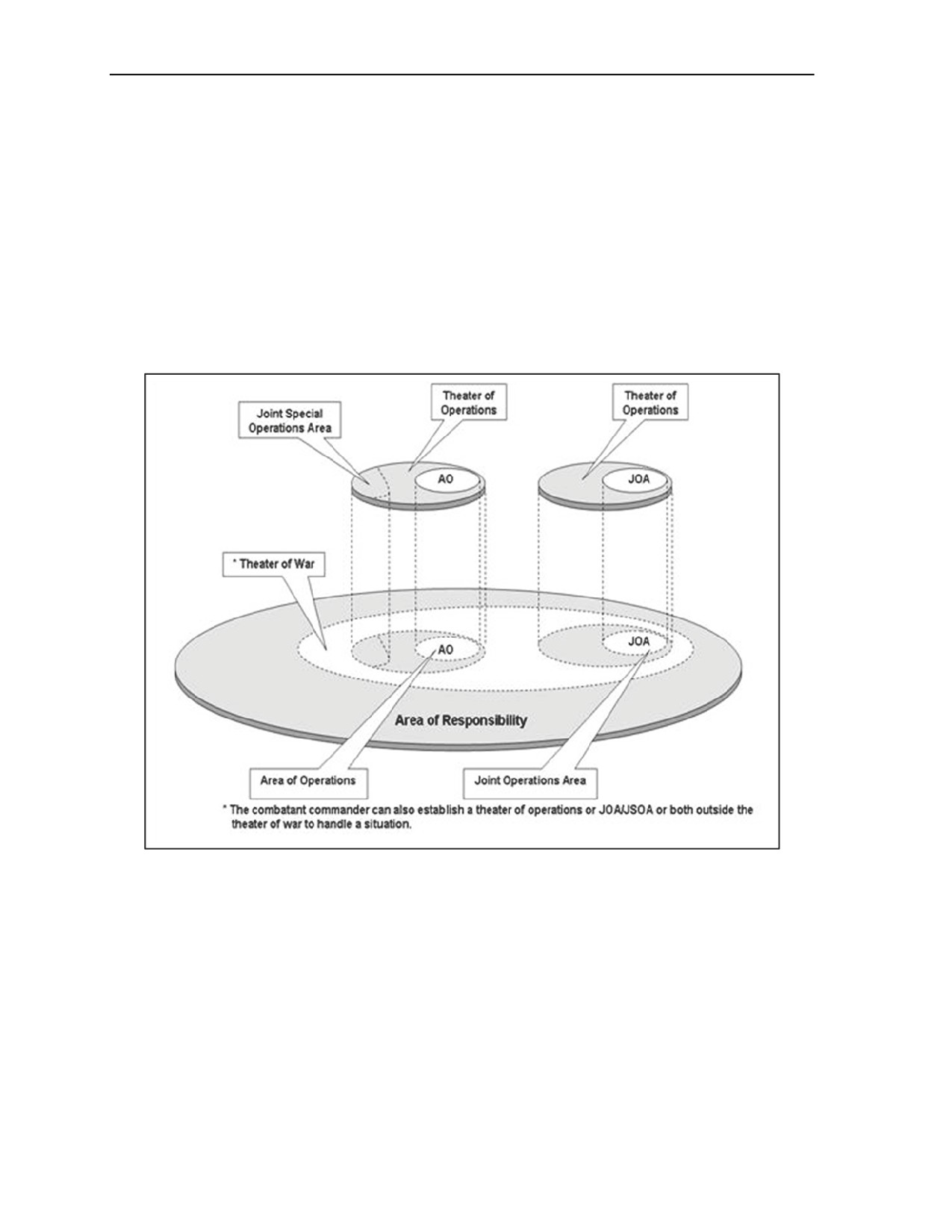
Chapter 3
AOR. Inherently these factors also impact JOA and/or AO at the operational and tactical levels of war as
well.
DESIGNATION OF THE AREA OF OPERATIONS
3-5. To conduct operations within its geographic AOR, the GCC may designate a specific area within the
AOR as a theater of war, theater of operations, or a JOA (see figure 3-1). Commanders may use these terms
independently or in conjunction with one another, depending on the needs of the operation. If used in
conjunction, the theater of war would encompass the larger area with smaller theaters of operation and
JOAs within it. JP 3-0 describes the criteria for each designation in more detail. This manual uses the more
generic term AO to refer to any area where the commander may deploy an ESC and/or sustainment brigade
to conduct operations. The GCC (or subordinate CCDR) maintains responsibility for the operations of U.S.
forces in an AOR or designates a JTF to command forces in a designated area. The ASCC provides Army
forces to the JFC and/or JTF to support those operations. JP 3-0 discusses theater organization.
Figure 3-1. Area of operations
THEATER STRUCTURE
3-6. The CCDR is the senior leader in the GCC (figure 3-2). The CCDR exercises DAFL through the
GCC logistics directorate of a joint staff (J-4). The J-4 uses the Joint Logistics Operations Center and the
JDDOC for planning, preparing, and executing logistics operations. The JDDOC is an organization under
the GCC J-4 and works to achieve the synchronization and integration of strategic requirements. The J-4
can retain control of the JDDOC or position the JDDOC within the ARFOR TSC. The theater Army, as
ARFOR for all theater committed forces, has a G-4 that controls logistics requirements. The theater Army
controls the TSC who is the senior Army logistics commander. The TSC can employ an ESC as the mission
command element in theater. The TSC and/or ESC controls logistics operations through the G-4 (internal
requirements) and the SPO (external requirements). The SPO controls the distribution management center
where support requirements are coordinated. The sustainment brigade coordinates logistics support with the
3-2
FM 4-95
1 April 2014
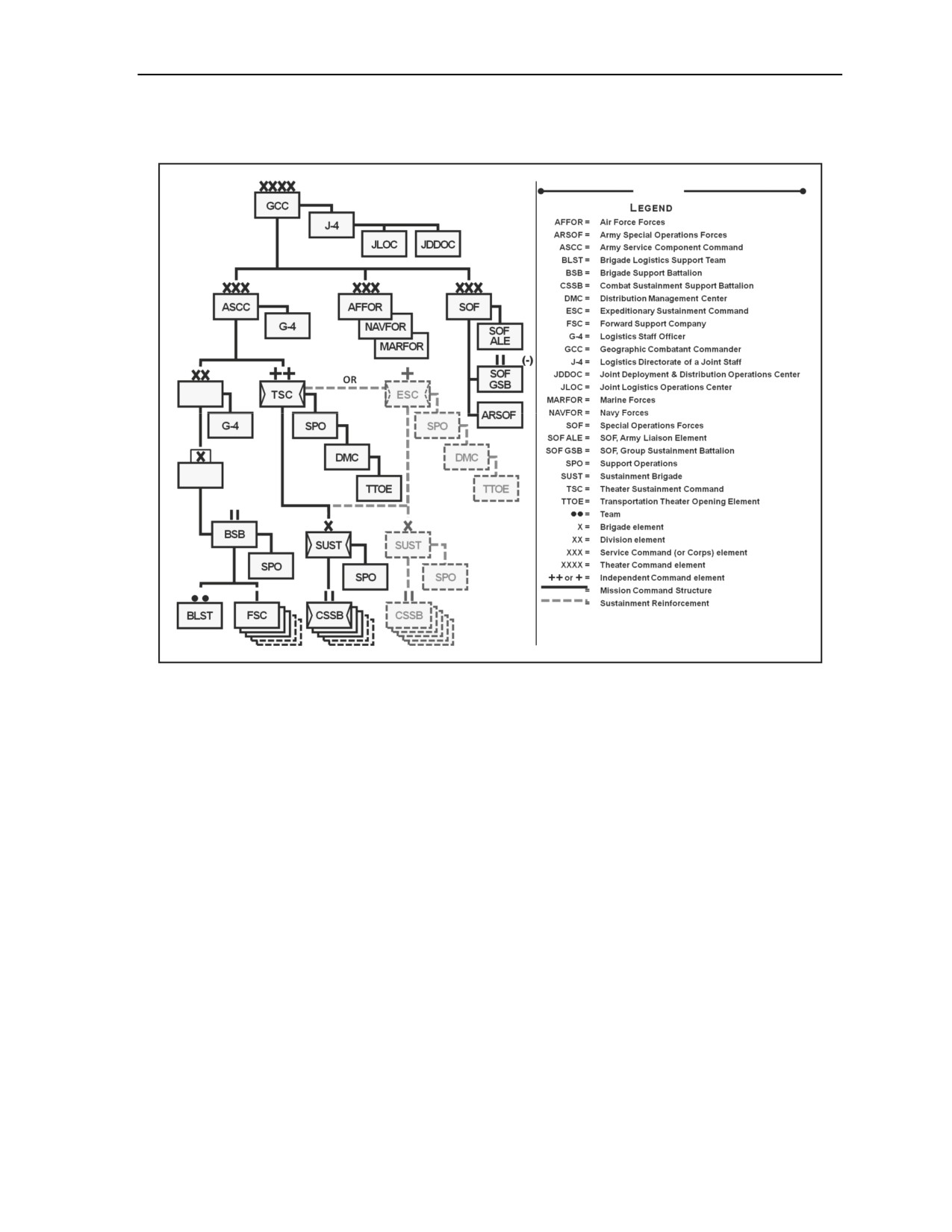
Operational - Tactical Level Logistics
SPO. The brigade combat team (BCT) coordinates support with the sustainment brigade. Figure 3-2
provides an example of a notional theater structure.
Figure 3-2. Example of a notional theater structure
GEOGRAPHIC COMBATANT COMMAND
3-7. USC Title 10 establishes the GCC roles, functions, and responsibilities. As such, GCC exercises
combatant command (COCOM) authority over all forces to accomplish the missions assigned to the
command and is the senior DOD HQ in an AOR. COCOM authority cannot be delegated or transferred.
OPCON is inherent in COCOM and may be delegated within the combatant command by the GCC. GCC
uses authoritative directives to organize forces, as required, to accomplish assigned missions including
logistics. Accordingly, a GCC may designate a Service component commander as a JFC to improve span of
control and provide for unity of effort. The GCC may establish one or more joint force commands.
3-8. CCDRs use DAFL to assign common-user logistics responsibilities to the Service component. This is
conducted in accordance with SecDEF designated EA responsibilities for DOD agencies, Services, and
commands operating within the theater. The GCC logistics directorate (J-4) is responsible for developing
logistics plans, formulating policies that ensure effective logistics support for all forces in the command,
and coordinating execution of the commander’s policies and guidance. The coordination and supervision of
deployment and distribution, supply, maintenance, logistics services, operational contract support, and
engineering are integral to providing effective logistics support across the range of military operations.
Because many of the issues confronting this directorate are of a single-Service nature, close coordination
and collaboration with the Service component commands or their designated representatives are necessary
for achieving unity of effort.
3-9. From a logistics perspective, one of the options available to the GCC is the establishment of a joint
logistics headquarters or a command for joint logistics. Staffed with personnel from each Service the joint
1 April 2014
FM 4-95
3-3
Chapter 3
logistics headquarters or command for joint logistics would serve as a planning and execution headquarters
for the GCC AOR. It should be noted that such a headquarters would not have DAFL as that is the GCC’s
assigned authority and cannot be transferred or delegated. When this option is used the GCC should clearly
delineate the command relationships between the combatant command staff, particularly the J-4, Services,
and the joint force land component commander and his logistics staff. GCC command relationship options
for planning and executing joint logistics operations are OPCON, tactical control
(TACON), or a
supporting to supported relationship.
3-10. If the GCC directs the ASCC to provide lead Service logistics, common user logistics or establish a
command for joint logistics the TSC or ESC will most likely be selected by the GCC as the option to plan
and execute joint logistics for the theater. Once the command relationships between the forces are clarified
then decisions must be made to assure the proper responsibilities are assigned to the TSC or ESC to execute
the joint functions. A more detailed discussion of the TSC and ESC follows later in this chapter.
3-11. To obtain unity of effort for the deployment and distribution of strategic forces the GCC may
establish a JDDOC. Resourced by the GCC and augmented by USTRANSCOM, DLA, the Services, and
other national partners, the JDDOC enables a seamless transition between the strategic deployment and
distribution processes and operational-level functions; enabling optimum use of available resources to
achieve improved efficiency and effectiveness. More details on the JDDOC and other boards, centers and
cells are discussed later in this chapter.
THEATER SPECIAL OPERATIONS COMMAND (TSOC)
3-12. Each GCC has an assigned TSOC. U.S. Special Operations Command has COCOM authority over
the TSOCs but the GCC maintains OPCON. The TSOC commander is responsible for the day-to-day
activities of assigned and attached special operations forces (SOF) and is the senior special operations
advisor to the GCC. The special operations logistics command structure is tailored to support a SOF Task
Force depending upon the level of complexity, duration, and resources required by the circumstances.
3-13. Army special operations forces (ARSOF) are not logistically self-sufficient and rely upon the GCC
theater infrastructure for virtually all of their support above their organic capabilities. ARSOF units have no
organic mortuary affairs, field service, heavy airdrop, or explosive ordnance disposal units. Conventional
force augmentation may be necessary when ARSOF are set up in undeveloped theaters without established
Army theater opening, theater distribution, or area support; when operating from bases which are not
established fixed facilities; or when a high percentage of ARSOF units are committed simultaneously. The
TSOC J4 in coordination with the 528th Sustainment Brigade (Special Operations)(Airborne) ARSOF
liaison element will coordinate logistics support with the theater ASCC.
3-14. For rapid response operations, ARSOF units will maintain the capability to support SOF elements for
an initial period of 15 days. Services and/or EAs should be prepared to support ARSOF as soon as possible
but no later than 15 days after ARSOF are employed.
ARMY SERVICE COMPONENT COMMAND
3-15. Each COCOM has a Service component commander from each Service-level organization (Army,
Air Force, Marine Corps, Navy, and Coast Guard). The ASCC assigned to each GCC supports all areas
required under Title 10 USC.
3-16. The ASCC, also referred to as the theater Army, is the senior Army command in an AOR. The
ASCC commander serves as the principal advisor to the GCC for supporting and employing Army forces in
the AOR. The ASCC accomplishes this by participating in mid- and long-range planning to support the
GCC theater strategy and plan. In addition to fulfilling its Service-specific responsibilities, the ASCC may,
by exception when corps or division headquarters is not available, be tasked to play a joint role during
military operations. For example, with significant augmentation, the GCC may designate the ASCC as the
joint force land component commander. With significant augmentation, the ASCC is also capable of
providing a JTF capable headquarters to serve as the joint headquarters for smaller-scale contingencies.
However, the ASCC was not designed to function as a JTF or a joint force land component command. The
TSC or ESC will serve as the senior Army logistics headquarters assigned to a theater Army. For more
detail on the ASCC and theater Army see FM 3-93.
3-4
FM 4-95
1 April 2014
Operational - Tactical Level Logistics
CORPS
3-17. The corps provides a HQ that specializes in operations as a land component command HQ and a joint
task force for contingencies. When required, a corps may become a transitional tactical HQ under the land
component command, with OPCON of multiple divisions (including multinational or Marine Corps
formations) or other large tactical formations. Its primary purpose is land combat operations. The corps HQ
has the capability to provide the nucleus of a joint HQ.
DIVISION
3-18. Divisions are the Army’s primary tactical warfighting HQ. Their principal task is directing
subordinate brigade operations. Divisions are not fixed formations. Therefore, they may have all types of
brigade combat teams (BCT) or one particular type of BCT. A division can control up to five BCTs with
additional appropriate supporting brigades during major combat operations. The types of support brigades
are combat aviation, fires, maneuver enhancement, battlefield surveillance, and sustainment. The
sustainment brigade normally remains attached to the TSC or ESC for mission command to support one or
more divisions and other units operating in the sustainment brigade’s assigned area. The sustainment
brigade provides general support to the division AO using the area support method. Area support is a
method of logistics, medical support, and personnel services in which support relationships are determined
by the location of the units requiring support. Sustainment units provide support to units located in or
passing through their assigned areas (ATP 4-90). As an exception and when conditions warrant, a division
may have TACON of a sustainment brigade while conducting large-scale operations, such as during
exploitation and pursuit.
BRIGADE COMBAT TEAM
3-19. As combined arms organizations, BCTs form the basic building block of the Army’s tactical
formations. They are the principal means of executing engagements. Three standardized BCT designs exist:
armor, infantry, and Stryker. Battalion-sized maneuver, fires, reconnaissance, and brigade support
battalions (BSB) are organic to BCTs, and they may also contain other functional maneuver support
elements. For more information on the brigade support battalion see ATP 4-90.
THEATER LOGISTICS STRUCTURE/MISSION COMMAND
3-20. The theater logistics structures facilitate mission command of organizations performing logistics
operations.
THEATER SUSTAINMENT COMMAND
3-21. The TSC is assigned to the ASCC and provides general support (GS) to the AOR. The TSC serves as
the senior Army sustainment HQ (less medical) for the theater Army. The TSC provides mission command
of units assigned, attached, or OPCON.
3-22. The TSC is capable of planning, preparing, executing, and assessing logistics and human resource
support for Army forces in theater. As the distribution coordinator in theater, the TSC leverages strategic
partnerships and joint capabilities to establish an integrated theater-level distribution system that is
responsive to theater Army requirements. It employs sustainment brigades to execute theater opening,
theater sustainment, and theater distribution operations.
3-23. The TSCs assigned units provide supply, maintenance, transportation, petroleum, and port and
terminal operations. Other specialized capabilities, such as mortuary affairs, aerial delivery, human
resources, and financial management, are available from the force pool.
EXPEDITIONARY SUSTAINMENT COMMAND
3-24. ESCs are normally under the mission command of the TSC. The ESC provides mission command of
logistics units in designated areas of a theater. The ESC plans, and executes distribution, theater opening,
reception, staging, and onward movement operations. When directed by the GCC or designated
1 April 2014
FM 4-95
3-5
Chapter 3
multinational or joint logistics task force, it may serve as a basis for command for joint logistics with
appropriate joint augmentation. The ESC normally deploys when the TSC determines that a forward
command presence is required. This capability provides the TSC commander with the regional focus
necessary to provide effective operational-level support to ARFOR or JTF. The ESC provides essentially
the same range of support staff capabilities but not to the scale and scope of the TSC.
3-25. The ESC is regionally focused on a specific JOA or AO but may be deployed worldwide. By design,
the ESC is structured to mirror the organizational structure of the TSC but its capabilities (planning
horizons, ability to conduct materiel management) are limited when compared to the TSC. The mission
command relationship of the ESC is attached to a TSC or OPCON to ARFOR. The support relationship is
general support to ARFOR AO or JOA.
THEATER ENGINEER COMMAND
3-26. The theater engineer command is designed to exercise mission command over engineer capabilities
for all assigned or attached engineer brigades and other engineer units and missions for the joint force land
component or theater Army commander. It is the only organization designed to do so without augmentation
and can provide the JFC with an operational engineer headquarters or augment an engineer staff for a JTF.
The theater engineer command is focused on operational-level engineer support across all three of the
engineer disciplines and typically serves as the senior engineer headquarters for a theater Army, land
component headquarters, or potentially a JTF (see FM 3-34).
ARMY FIELD SUPPORT BRIGADE
3-27. An AFSB provides materiel readiness focused support to include coordination of acquisition logistics
and technology actions (less theater support contracting and medical) to Army operational forces. The
AFSB is assigned to the ASC-and when deployed, is placed OPCON to the theater Army. This OPCON
relationship is normally delegated to the supporting TSC or ESC as appropriate. AFSBs serve as ASC’s
link between the generating force and the operational force.
3-28. AFSBs are also responsible for integrating LOGCAP support into contract support integration plans,
in coordination with the theater Army G-4 and the supporting CSB. For more information see ATP 4-91.
Expeditionary Contracting Command
3-29. The ECC is responsible for theater support contracting in support of deployed Army forces
worldwide and garrison contracting support for OCONUS Army installations and associated forward
stationed units. The ECC exercises mission command over the CSB and Army active component
contracting force structure and is the Army’s force provider of contingency contracting assets. (See FM 4-
92).
Contract Support Brigade
3-30. The CSB is assigned to the ECC. CSBs are regionally aligned and provide theater support
contracting services and operational contract support planning assistance in support of the theater Army,
ARFOR headquarters, and their major subordinate commands. The CSB serves under the command and
procurement authority of the ECC, providing direct support to the theater Army, ARFOR, or TSC as
directed. The CSB exercises mission command of contingency contracting battalions and contingency
contracting teams (see FM 4-92).
Contingency Contracting Battalion
3-31. When deployed, the CCBN concentrates on exercising mission command and contracting operations
coordination and execution. The CCBN normally serves under the supporting CSB command and
procurement authority and is generally co-located and aligned with a division or, corps HQs to facilitate
contract support planning and staff assistance. In small-scale operations, a CCBN may deploy separately
from the CSB headquarters; when this happens, the CSB normally places the CCBN in direct support of the
ARFOR. This direct support relationship may be further delegated per mission, enemy, terrain and weather,
3-6
FM 4-95
1 April 2014
Operational - Tactical Level Logistics
troops and support available-time available and civil considerations (METT-TC). For more information on
CCBN see FM 4-92.
SUSTAINMENT BRIGADE
3-32. The sustainment brigade’s focus is the synchronization of logistics with the tactical commander’s
battle rhythm to maintain combat power. It plans, prepares, executes, and assesses sustainment operations
within an area of operations. It provides control of sustainment operations and distribution management.
When deployed, it is a subordinate to the TSC, or by extension the ESC. The sustainment brigade is a
flexible, multifunctional sustainment organization, tailored and task organized according to METT-TC.
3-33. A sustainment brigade supporting theater forces is a tailorable organization comprised of both
functional and multifunctional combat sustainment support battalions (CSSB). The command relationship
of a sustainment brigade is attached to a TSC or ESC and the support relationship is general support using
the area support method. The sustainment brigade is capable of deploying an early entry element sized in
accordance with METT-TC for command of logistics during initial entry operations to establish an initial
command and control presence in a theater, and provide for continuous command and control when the
brigade incrementally repositions its forces in support mission requirements. See ATP 4-93 for more
information on the role and functions of the sustainment brigade.
COMBAT SUSTAINMENT SUPPORT BATTALION
3-34. CSSBs are the building blocks of the sustainment brigades. Their designs are standardized and can
consist of up to seven companies. CSSBs are task organized to support theater opening, distribution, area
sustainment, or life support functions. Selected CSSB may be organized to provide specific types of
support to division aligned brigades lacking selected internal logistics capabilities. The CSSB coordinates,
synchronizes, and executes logistics on an area basis including transportation, maintenance, ammunition,
supply, mortuary affairs, airdrop, field services, water, and petroleum. It provides mission command over
subordinate logistics organizations that support all phases of operations. It oversees distribution and
sustainment as well as coordinates external support.
3-35. The CSSB provides area support, and the operational command relationship of the CSSB is attached
to a sustainment brigade with the support relationship being general support unless otherwise designated by
OPORD, including when supporting division aligned brigades lacking certain internal sustainment
capabilities. The CSSB may also be aligned with a corps and/or division HQs in order to provide area
support for specific logistics functions. See ATP 4-90, ATP 4-93, and ATP 4-94 for more information.
3-36. The CSSB may operate remotely from the sustainment brigade and therefore must maintain
communications with the sustainment brigade. The CSSB establishes voice communications along with
mission command and sustainment information system connectivity to support mission command and
convoy operations as well as to monitor, update, and evaluate internal operations and supported unit
logistics postures.
SUSTAINMENT BRIGADE (SPECIAL OPERATIONS) (AIRBORNE)
3-37. The sustainment brigade (special operations)(airborne) does not have organic logistics units within
its force structure. Its mission is to provide mission command of a SOF logistics task force in support of a
SOF JTF during initial operations and to plan, coordinate, and synchronize sustainment support at the
operational level. During initial entry operations or theater expansion, the sustainment brigade (special
operations)(airborne) may be directed to deploy a tailored brigade headquarters augmented by conventional
force CSSB capabilities to command and control operational-level logistics in support of ARSOF
operations until relieved by ASCC logistics capabilities.
3-38. The sustainment brigade has ARSOF liaison elements which are permanently employed in each
COCOM and have personnel stationed with both the TSOC and ASCC. Their mission is to assist the
TSOCs with operation plan reviews, ensure ARSOF logistics support is written into concept of support
documents, and assist in coordinating logistics support for ARSOF units deploying into theaters to conduct
operations or exercises.
1 April 2014
FM 4-95
3-7
///////////////////////////////////////