EOD MULTI-SERVICE TACTICS, TECHNIQUES, AND PROCEDURES FOR EXPLOSIVE ORDNANCE DISPOSAL IN A JOINT ENVIRONMENT (OCTOBER 2005) - page 2
(1) 4F9X1-EN EOD Core Equipment Set. This UTC comprises EOD specialized
equipment, vehicles, and explosives required in the initial EOD support of major combat,
contingency, and homeland defense operations. The equipment and explosives are loaded on
vehicles to provide a roll-on roll-off capability to protect personnel and resources from the
effects of explosive hazards, munitions accidents, and UXO to include IED. It provides limited
capability to assess and mitigate chemical, biological, radiological, nuclear and explosive
threats. Task UTC UFM3X (EOD M1116 UA-HMMWV), UFMXX (EOD M1097 HMMWV) and
UFMTA (HIGH MOBILITY TRAILER). This UTC contains sensitive/mission-critical EOD
equipment requiring an EOD escort, 4FPXC or 4FPXD, during transport. Expeditionary combat
support is required.
(2) 4F9X3-EN EOD Base Sustainment Equipment. This UTC comprises EOD
specialized equipment and explosives required to provide base sustainment in the support of
major combat, contingency, and homeland defense operations where the EOD core (4F9X1)
UTCs already exists or is scheduled for deployment. It protects personnel and resources from
the effects of explosive hazards, munitions accidents, and UXO to include IED. It provides
limited capability to assess, access, disrupt, neutralize or render safe chemical, biological,
radiological, nuclear and explosive threats. This UTC contains sensitive/mission-critical EOD
equipment requiring an EOD escort, 4FPXC or 4FPXD, during transport. Expeditionary combat
support is required.
(3) 4F9X4-EN EOD Installation Equipment. This is an equipment only UTC. This base
support equipment UTC is required to provide 24-hour emergency and routine EOD support at
home station installations. This UTC supports homeland defense and force protection
operations when paired with companion UTC 4FPXB (1), 4FPXC (1), 4FPXD (2), and 4FPXE
(1). It provides capabilities to detect, defeat, and recover from hazardous munitions
incidents/accidents on and off installations for military munitions and terrorist devices including
WMD. This UTC contains all necessary specialized EOD equipment to support operations
identified above to include robotics, vehicles, and explosives. This UTC is intended for
generation only and is not intended for deployment. This is an equipment only UTC.
(4) 4F9X5-EN EOD Explosive Storage Magazine. This UTC is a deployable explosive
storage magazine set used to store EOD demolition packages required in the support of major
combat, contingency, and homeland defense operations. The magazine is designed to
significantly reduce explosive hazard class and quantity distance requirements. It is used for
temporary explosive storage during initial contingency operations until siting of permanent
explosive storage areas are established. The magazines are employed during homeland
defense operations to support EOD emergency responses. This UTC includes an Air Force
standard security system required for storage of high risk munitions.
(5) 4F9X7-EN EOD Large Robotic System. This UTC is one EOD all-purpose remote
transport system complete with associated equipment. This UTC is used to provide EOD teams
a remote vehicle for large area clearance, base recovery, render safe procedure and/or WMD
operations which involve UXO, IED, or large vehicle IED. This UTC can be employed in the
support of major combat, contingency, and homeland defense operations. This UTC contains
sensitive/mission-critical EOD equipment requiring an EOD escort, 4FPXC or 4FPXD, during
transport.
(6) 4F9XA-EN EOD Officer. An EOD officer is required in the support of major combat,
contingency, and homeland defense operations where EOD personnel and equipment already
exist or are scheduled for deployment. The EOD officer Independently provides forward
command functional management. 4FPXA may be linked with 4FPXB to form an EOD
management team. Personnel will deploy with personal protective clothing and GUU-5 (M-4)
VI-2
FM 4-30.16, MCRP 3-17.2C, NTTP 3-02.5, AFTTP(I) 3-2.32
27 October 2005
and M-9 weapons with ammunition. ECS required. Substitution in accordance with AFI 10-210,
Prime Base Engineer Emergency Force (BEEF) Program, 1 October 2004. 032E4 must be an
EOD qualified officer presently filling an authorized EOD position and/or validated by MAJCOM
EOD functional manager.
(7) 4F9XB-EN EOD Senior NCO Management. This UTC is the EOD management force
that is required in the support of major combat, contingency, and homeland defense operations
where EOD personnel and equipment already exist or are scheduled for deployment. It
independently provides forward command functional management. 4FPXB may be linked with
4FPXA to form an EOD management team. Personnel will deploy with personal protective
clothing and GUU-5 (M-4) and M-9 weapons with ammunition. ECS is required. Substitution of
3E800 with 3E891 is authorized. For Air Reserve Component (ARC) forces: where two 4FPXB
UTCs are postured, the second UTC wartime record will flow as a 3E891-SMSGT.
(8) 4F9XC-EN EOD Team Leadership. EOD team leadership is required in the support
of major combat, contingency, and homeland defense operations. This UTC is linked with UTC
4F9X1 or can augment existing requirements. Personnel will deploy with personal protective
clothing and M-4 and M-9 weapons with ammunition. MSGT 3E871 is required; no substitution
is authorized. Substitution of 7 LVL AFSC allowed using only 3E8XX, two skill levels up or one
skill level down; no other substitutions authorized.
(9) 4F9XD-EN EOD Craftsman Team. The EOD craftsman team is required in the
support of major combat, contingency, and homeland defense operations. This UTC is linked
with UTC 4F9X1, 4F9X3, or can augment existing requirements. Personnel will deploy with
personal protective clothing and M-4 and M-9 weapons with ammunition. 3E871 is required; no
substitution authorized. Substitution of 5 LVL AFSC allowed using only 3E8XX, two skill levels
up or one skill level down.
(10)
4F9XE-EN EOD Journeyman Team. The EOD journeyman team is required in the
support of major combat, contingency, and homeland defense operations. This UTC is linked
with UTC 4F9X1, 4F9X3, or can augment existing requirements. Personnel will deploy with
personal protective clothing and M-4 and M-9 weapons with ammunition. Substitution of only
one 5 LVL AFSC allowed using only 3E8XX, two skill levels up or one skill level down. No other
substitutions authorized.
4. Organizations
During peacetime, the Air Force assigns EOD flights to the civil engineer (CE) organization
within the MAJCOMs. They are responsible for peacetime support of the command mission and
posturing deployable force packages (figure VI-1). In wartime, the EOD force deploys to support
the geographic combatant commanders (figure VI-2).
27 October 2005
FM 4-30.16, MCRP 3-17.2C, NTTP 3-02.5, AFTTP(I) 3-2.32
VI-3
Chief of Staff
US Air Force
HQ USAF/Air Combat Command
USAF Air Staff, Civil
Engineer
Operational
Command
HQ USAF/Infrastructure, Logistics,
and Engineering
EOD Program Board
Major Commands
Air Combat Command
Air Education and Training Command
Civil Engineer Support
Air Force Materiel Command
HQ EOD Action Off
icer
Air Force Special
Operations Command
Air Force Engineer Support Agency
Air Force Space Command
Air Mobility Command
Pacific Air Forces
US A
ir Forces
in Europe
Air Force Reserve Command
Air National Guard
Numbered Air Forces
First, Fifth, Seventh, Eighth, Ninth,
Eleventh, Twelfth, and Eighteenth
Wings
Fighters, Bombers, Airlift, Tankers
Operations Group
Mission Support Group
Maintenance Group
• Flying Squadrons
•
Installation Infrastructure
•
Maintenance
•
Global Reach
•
Operating Support
•
Global Engagement
•
Logistic Readiness
•
Contracting
Security
Civil Engineer
Communication
Operations
Forces
Squadron
Squadron
Fire
Protection
EOD Flight
Figure VI-1. Air Force Peacetime EOD Organization
VI-4
FM 4-30.16, MCRP 3-17.2C, NTTP 3-02.5, AFTTP(I) 3-2.32
27 October 2005
Joint Chiefs of Staff
USAF Chief of Staff
The Air Force Civil
Engineer
EOD Program Board
Combatant Commands
US Central Command
Civil Engineer Support Agency
US Southern Command
Field Operating HQ
US European Command
EOD Program Board
US Northern Command
US Pacific Command
US Strategic Command
US Special
Operations Command
US Transportation Command
US Joint Forces Command
Navy
Air Force
Army
Commander
Commander
Commander
Wings
Fighters, Bombers, Airlift, Tankers
Operations Group
Mission Support Group
Maintenance Group
• Flying Squadrons
•
Installation Infrastructure
•
Maintenance
•
Global Reach
•
Operating Support
•
Global Engagement
• Logistic Readiness
•
Contracting
Civil Engineer
Squadron
Operations
EOD Flight
Fire Protection
Figure VI-2. Air Force Wartime EOD Organization
5. Capabilities
a. General. The minimum EOD team size for incident responses is two qualified operators
employing remote procedures whenever possible. If available, a third EOD-qualified supervisor
provides on-scene safety, supervision, and command advice.
27 October 2005
FM 4-30.16, MCRP 3-17.2C, NTTP 3-02.5, AFTTP(I) 3-2.32
VI-5
b. Capabilities. In addition to the recurring, non-Service-specific EOD capabilities at
appendix E, the Air Force EOD force has the following responsibilities:
(1) Launch and Recovery of Aircraft. Air Force EOD teams directly support sortie
generation. They respond to airfield emergencies according to peacetime requirements of
unreleased or unsafe ordnances/munitions, other EOD safety issues, resource protection, and
situations requiring sound judgment. Wartime operations involving aircraft differ from peacetime
operations primarily from an increased operations tempo and requirement for aircraft battle
damage assessments ensuring there are no UXOs.
(2) Force Protection. To provide a secure environment, Air Force EOD operations require
EOD forces to respond outside traditional base boundaries. Air Force EOD plays a critical role
in force protection by eliminating or mitigating explosive hazards created by known or suspected
criminal and terrorist devices.
(3) Airfield Recovery Operations. CE rapid runway repair includes EOD operations during
airfield recovery operations. The SRC plans, prioritizes, and controls all airfield recovery
operations. The SRC integrates all assets (to include engineer, EOD, security forces, disaster
preparedness, communications, transportation, and resource management) to support post
attack recovery operations.
(4) Aerial Port Operations. Aerial ports are vital links to deploy, employ, sustain, and
redeploy required forces (Service, joint, multinational) during peacetime and contingency
operations. They are susceptible targets for hostile forces wishing to disrupt operations. They
have a substantial EOD mission relative to the increased movement of munitions. Additionally,
enemy ordnance captured for intelligence assessment must transit these ports. EOD teams
respond to aerial port operations according to peace and wartime requirements to protect
resources from UXOs, ensure explosive materials are safely and properly handled while in the
transportation system, and ensure sound judgment is used to prevent loss or disruption of
missions in an explosive hazard environment.
(5) Mortuary Services. Because of ordnance being left on or imbedded in casualties,
processing casualty operations should involve EOD teams. While this is particularly important at
the CONUS-port mortuaries (last military involvement prior to turning over casualties to the
families), EOD teams should also support theater mortuary efforts.
(6) Base Populace Training. Air Force EOD personnel provide training on ordnance
hazards and recognition, mine awareness, terrorist bomb search and recognition procedures,
and personnel protective measures.
(7) DS Units (Full Capability Nuclear Support). The Air Force assigns EOD personnel
dealing with nuclear munitions in personnel reliability program positions. The program is set up
to review the individual’s background prior to working with nuclear munitions. Personnel working
in DS units with full capability nuclear support train to perform all necessary EOD actions on
nuclear weapon systems from site stabilization to site recovery.
(8) Airborne Rapid Engineers Deployable Heavy Operations Repair Squadron, Engineers
(REDHORSE) (ARH) capability. The Air Force airborne REDHORSE team’s primary purpose is
to provide limited UXO clearance capability to ARH elements to repair damaged airfields for C
130 and/or C-17 operations. An Air Force EOD element will be inserted with other members of
the initial ARH assessment team during daylight hours by air insertion, air drop, and/or air-land
methods. They will assess the airfield for potential landmine hazards and UXOs and clear
areas of explosive hazards to allow follow-on Air Force EOD elements to be inserted and ARH
team elements to be air dropped into the immediate area of the airfield. The ARH EOD team
will provide limited explosive hazard clearance capability to support ARH runway repair
VI-6
FM 4-30.16, MCRP 3-17.2C, NTTP 3-02.5, AFTTP(I) 3-2.32
27 October 2005
operations, limited force protection capability, and technical advice to the ARH flight chief on
explosive hazards remaining. Consists of a 6-man team and a 2-man follow team equipped
with limited EOD tools and demolition materials. They can be employed with a REDHORSE
team or as a stand-alone capability.
Note: Air Force EOD forces support tactical land forces off air bases/installations in
response to force protection and intelligence operations.
6. Training
a. Silver Flag. Training prepares EOD forces for contingency EOD operations. This 7-day
course consists of classroom, practical hands-on, and field training exercises. These are
integrated Civil Engineering training sites located at Tyndall (CONUS), Ramstein (Europe), and
Kadena (Pacific) Air Force bases (AFBs).
b. Air Mobility Warfare Center. This center conducts “Eagle Flag” deployment exercises
and EOD Combat Skills Training (CST) to meet Air Force EOD pre-deployment training
requirements. The training site is located at Fort Dix, New Jersey.
c. Training references:
• Joint Nuclear EOD School
• Radiological Emergency Team Operation School
• Advanced IED Disposal (AIEDD) School
• ATF/FBI Post Blast Course
• LVBIED Course-FBI
27 October 2005
FM 4-30.16, MCRP 3-17.2C, NTTP 3-02.5, AFTTP(I) 3-2.32
VI-7

Appendix A
MULTI-SERVICE EOD CAPABILITIES MATRIX
Table A-1. Multi-Service EOD Capabilities Matrix
Army
Navy
Air Force
Marine Corps
Capability
CONVENTIONAL MUNITIONS
Locate/Identify
X
X
X
X
X
X
X
X
X
X
X
X
X
X
RSP
X
X
X
X
X
X
X
X
X
X
X
X
X
Dispose
X
X
X
X
X
X
X
X
X
X
X
X
X
X
Near-Surface
Buried Munitions
X
X
X
X
X
X
X
X
X
X
X
X
X
Detection
Subsurface Buried
X
X
X
X
X
X
X
X
X
X
X
X
X
Munitions Detection
Buried Ordnance
X
X
X
X
X
X
X
X
X
X
X
X
X
Recovery
Large Area
Munitions
X
X
X
X
X
X
X
X
X
X
X
X
Clearance
Airfield Recovery
X
X
X
X
X
X
X
X
X
X
X
X
Sub-munitions
X
X
X
X
X
X
X
X
X
X
X
X
X
Clearance
Surface Munitions
X
X
X
X
X
X
X
X
X
X
X
X
Disruption
Munitions Storage
Area Accident
X
X
X
X
X
X
X
X
X
X
X
Cleanup
27 October 2005
FM 4-30.16, MCRP 3-17.2C, NTTP 3-02.5, AFTTP(I) 3-2.32
A-1
Table A-1. Multi-Service EOD Capabilities Matrix (continued)
Army
Navy
Air Force
Marine Corps
Capability
Naval Sea Mines (1)
Locate/Identify
X
X
X
X
X
RSP
X
X
X
X
Dispose
X
X
X
X
X
Recover
X
Low-Influence
X
X
X X(3) X(3)
Diving
Limpet Mines (1)
Locate/Identify
X
X
X
X
X
RSP
X
X
X
X
Dispose
X
X
X
X
Underwater Ordnance (1)
Locate/Identify
X
X
X
X
X
X
RSP
X
X
X
X
Dispose
X
X
X
X
X
Improvised Explosive Device (IED)/Vehicle Borne Improvised Explosive Device (VBIED)
IED
X
X
X
X
X
X
X
X
X
X
X
X
X
Large VBIED
X
X
X
X
X
X
X
X
X
X
X
X
WMD
Locate/Identify
X
X
X
X
X
X(3)
X(3) X(3) X(3)
X(3)
X(3)
X(3)
RSP
X
X X(3) X
X
X
Nuclear Munitions
Radiation
X
X
X
X
X
X(3)
X
X
X
X
X
X
Detection/Monitor
RSP Nuclear
X
X
X
X(3)
X
X
X
X
X
System
Continue RSP
X X(3)
X(3)
X
X
X
X
X
Seal/Package
X
X
X(3)
X
X
X
X
X
X
A-2
FM 4-30.16, MCRP 3-17.2C, NTTP 3-02.5, AFTTP(I) 3-2.32
27 October 2005

Table A-1. Multi-Service EOD Capabilities Matrix (continued)
Army
Navy
Air Force
Marine Corps
Capability
Biological Munitions
Detection
X(3)
X(3)
X(3)
(5)
Decontaminate
X
X
X
X
(5)
X(3)
Seal/Package
X
X
X
X
X
(5)
X
X(3)
X
X
RSP
X
X
X
X
(5)
X(3)
X
X
X
X
X
X
Emergency
X
X
X
X
X
(5)
X
X(3)
X
X
X
X
X
X
Disposal
Chemical Munitions
Agent
X
X
X
X
X
(5)
X(3)
X
X
X
X
X
X
Identification
Agent
X
X
X
X
X
(5)
X(3)
X
X
X
X
X
X
Decontamination
Seal/Package
X
X
X
X
(5)
X(3)
X
X
X
X
X
X
RSP
X
X
X
X
(5)
X(3)
X
X
X
X
X
X
Emergency
X
X
X
X
X
(5)
X(3)
X
X
X
X
X
X
Disposal
Munitions Intel
X
X
X
X
X
(5)
X
X
X
X
X
X
X
X
X
Gathering
Exploitation
X
X
X
X
X
(5)
X
X
X
X
X
X
X
X
Inerting
(5)
X
X
X
X
Explosive
X
X
X
X
X
(5)
X
X
X
X
X
X
X
X
X
Demolition
Vessel Boarding
X
X
(5)
X
Search & Seizure
NEO
X
X
X
X
X
(5)
X(3)
X
X
X
X
27 October 2005
FM 4-30.16, MCRP 3-17.2C, NTTP 3-02.5, AFTTP(I) 3-2.32
A-3

Table A-1. Multi-Service EOD Capabilities Matrix (continued)
Army
Navy
Air Force
Marine Corps
Capability
TRAP/Combat
X
X
X
X
X
Search and Rescue
Aircraft Crash
X
X
X
X
X
X
X
X
X
X
Recovery
VIP Protection
X
X
X
X
X
X
X
X
X
X
X
X
X
Dynamic Entry
X(4) X(4) X(4)
X
X(4)
X(4)
X(4)
X(4)
Tactical Insert/Extract Personnel and Equipment
Parachute
X
X
X(3)
X(3)
X
X
SPIE
X
X
X
X
X(3)
X(3)
X
X
X
X
Fast Rope
X(3)
X
X
X
X
X(3)
X(3)
X
X
X
X
Rappel
X(3)
X
X
X
X
X(3)
X(3)
X
X
X
X
Combat Rubber
X
X
X
X
X
X
Raiding Craft
Casting
X
X
X
X
X
Robotics (Small)
X
X
X
X
X
X
X
X
X
X
X
X
Robotics (Large)
X
X
X
X
X
X
X
X
X
X
X
Satellite
X
X
X
X
X
X
X
X
X
X
Communications
Organic Tactical
X
X
X
X
X
X
X
X
X
X
X
X
X
X
Communications
Note (1): In water only, otherwise treat as conventional ordnance.
Note (2): Refer to established OPLANs for further guidance.
Note (3): Selected detachments only.
Note (4): See Service chapters for unique breaching capabilities.
Note (5): To fully understand these mission capabilities contact theater special operations
commander.
A-4
FM 4-30.16, MCRP 3-17.2C, NTTP 3-02.5, AFTTP(I) 3-2.32
27 October 2005
Appendix B
EOD PLANNING CHECKLIST FOR JOINT OPERATIONS
1. Mobilization Planning
a. Train, equip, and organize EOD forces within each Service component.
b. Review OPLANs for EOD UTC requirements (personnel and equipment) to include
the planned flow of EOD forces time-phased force deployment data (TPFDD).
c. Consider adding an EOD-qualified officer to the combatant commander’s special
staff and subordinate joint force special staff.
d. Identify opportunities for joint EOD operations in exercise plans, OPLANs,
contingency plans, and OPORDs.
e. Perform an intelligence estimate of information necessary to counter the UXO and
IED threat including:
(1) Ordnance orders of battle.
(2) Terrorist/paramilitary threats and capabilities.
(3) Critical target listing (enemy) and munitions US forces plan to use.
(4) Critical vulnerabilities (friendly) and what munitions the enemy may use.
f.
Coordinate periodic joint, interoperability exercises with multi-Service EOD forces.
2. Deployment Planning
a. Update intelligence estimate.
b. Update mission analysis to determine EOD UTCs to support the mission
requirements, to include:
(1) Service EOD requirements.
(2) Multinational EOD mission requirements.
(3) Total EOD requirements.
c. Source joint or Service specific EOD capabilities through JOPES to support the
combatant commander requirements. Sources of EOD support:
(1) US military EOD forces.
(2) Multinational and/or host nation EOD forces.
(3) Contracted EOD organizations.
d. Determine flow of EOD forces (TPFDD).
3. Employment Planning
a. Develop mission statements and concept of operations.
(1) Identify single-Service EOD missions (see chapters III-VI).
(2) Identify joint EOD missions (see chapter II).
27 October 2005
FM 4-30.16, MCRP 3-17.2C, NTTP 3-02.5, AFTTP(I) 3-2.32
B-1
(3) Select employment options for conducting joint operations (see chapter II).
(a) Service responsibility with DIRLAUTH.
(b) Lead-Service component (with or without TACON/OPCON).
(c) Subordinate EOD JTF.
b. Establish JEODOC (if required) (see chapter II and appendix C).
c. Ensure methodology is in place for intelligence collection and dissemination.
(1) Disseminate new or unknown ordnance technical information within theater.
(2) Process new or unknown ordnance items to appropriate agencies outside theater.
(3) Coordinate with the National Geospatial-Intelligence Agency for updated
mapping, geodesy, and multi-spectral imagery data covering the area of the UXO/EOD
incident.
d. Establish authorized demolition areas for UXO and other explosive hazards in
accordance with applicable host nation, US, and DOD explosive safety and environmental
protection laws and regulations.
4. Sustainment Planning
a. Coordinate administrative and logistical support with theater support command or
Service components.
b. Monitor EOD reports; take action as required.
5. Redeployment Planning
a. Ensure EOD/wing commanders understand and employ appropriate procedures (i.e.,
explosives safety and environmental protection) for the closing of demolition areas.
b. Establish EOD battle hand-off requirements and procedures.
(1) To host nation.
(2) To multinational EOD forces.
(3) To civilian contractors.
c. Determine redeployment flow of EOD forces using JOPES.
d. Conduct post-mission analysis.
e. Reconstitution of forces.
B-2
FM 4-30.16, MCRP 3-17.2C, NTTP 3-02.5, AFTTP(I) 3-2.32
27 October 2005
Appendix C
ESTABLISHING AN EOD JTF
1. Background
A key responsibility of the geographic combatant commander is the designation of an
EOD controlling authority after a full evaluation of the assigned mission. It is vital to the
effectiveness of the TF that the EOD JTF commander, deputy commander, operations
officer and other key operations and planning staff members are qualified EOD officers. All
personnel assigned to the EOD JTF staff should understand multi-Service or joint TTP to
allow for a seamless transition. EOD JTF planning should be in concert with established
joint doctrine as found in JP 5-00.2, Joint Task Force Planning Guidance and Procedures.
2. Authority
Establishment of an EOD JTF is appropriate when EOD C2 requirements exceed the
capabilities of the JFC or lead Service EOD staff or when conducting EOD operations with a
joint force would be more efficient. The JFC normally forms an EOD JTF from the nucleus of
the designated major Service component EOD command. Both the Army and Navy have
existing C2 EOD units around which an EOD JTF is built. Specifically, using the Army’s EOD
group (0-6 command) headquarters, or the Navy’s mobile group (0-6 command), provides a
ready EOD headquarters unit to serve as a building block for an EOD JTF headquarters. A
combatant commander or subordinate JFC establishes an EOD JTF. When formed, the
EOD JTF is a temporary joint EOD headquarters that controls two or more different Service
component’s EOD units in a specific JOA to accomplish the EOD mission. The EOD JTF
supports the theater campaign plan, JTF mission, or other operations as directed.
3. Responsibilities
The EOD JTF is responsible for making recommendations to the senior JFC (senior JTF
commander, sub-unified command commander or geographic combatant commander) on
the proper employment of EOD and for accomplishing assigned operational missions. The
EOD JTF develops a detailed plan using the JOPES for integrated employment of assigned
and attached forces based on an assessment of the operational requirements.
a. Organization of Forces. The commander, EOD JTF, has the authority to organize
assigned or attached forces to meet mission requirements.
b. Commander’s Guidance. The combatant commander is responsible for:
(1) Defining the scope of responsibility of the EOD JTF.
(2) Defining units attached OPCON or TACON, and relationships within the JFC.
(3) Defining EOD JTF‘s JOA and specific missions within the JOA to include specific
responsibility.
(4) Ensuring that all identified external support requirements to include security
support for sustaining the EOD force are properly coordinated.
27 October 2005
FM 4-30.16, MCRP 3-17.2C, NTTP 3-02.5, AFTTP(I) 3-2.32
C-1
4. The EOD JTF Staff
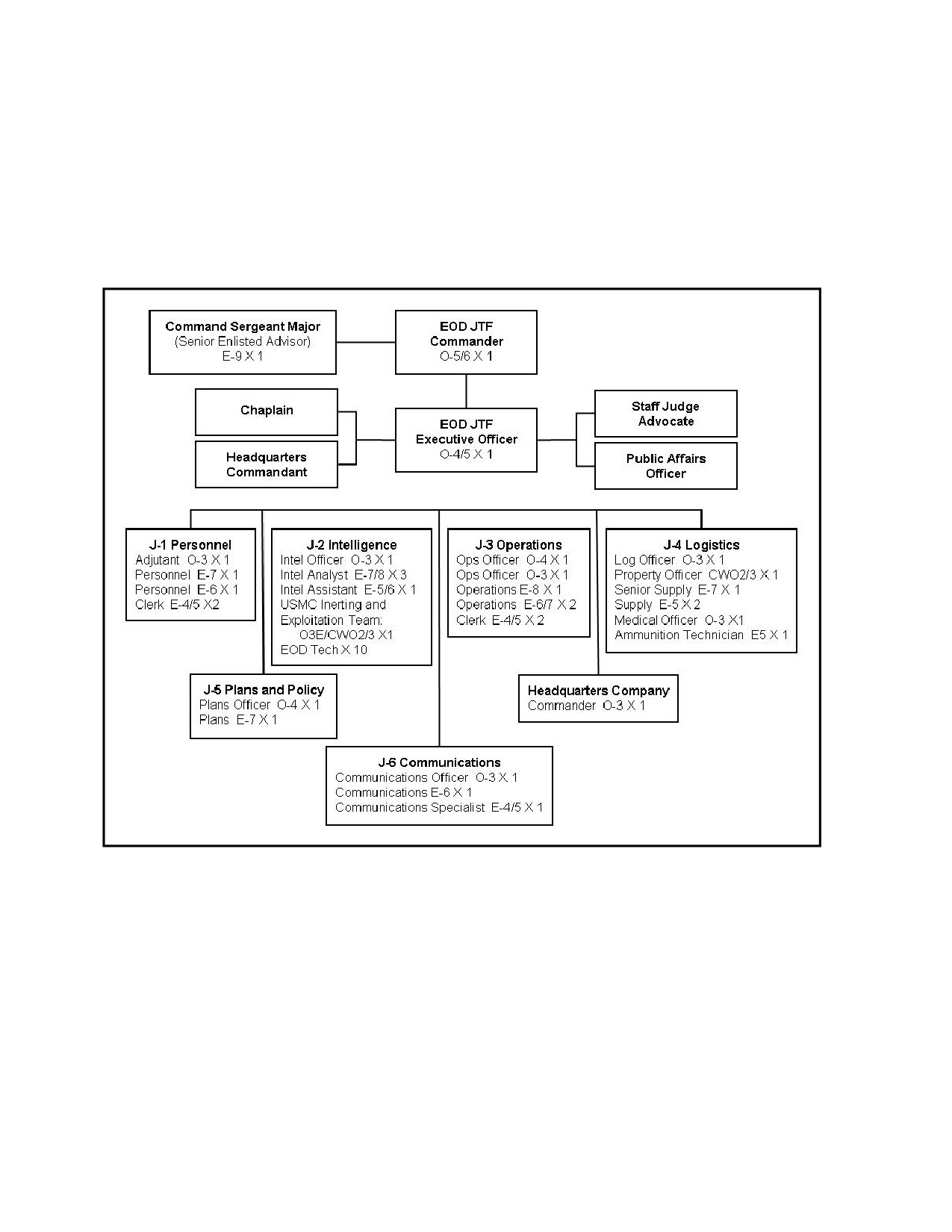
The designated EOD commander coordinates the establishment of the EOD JTF staff. A
doctrinal method is to develop EOD JTF staffs around the "core" of the designated EOD
commander's assigned staff. Other Service EOD personnel augment the designated EOD
JTF's core staff. The geographic combatant commander may also provide certain
augmentation (to include security, medical, and administration/logistics) to an EOD JTF,
depending on the mission and support requirements. See Figure C-1, Notional EOD JTF
Staff Organization.
Figure C-1. Notional EOD JTF Staff Organization
a. Organization. EOD commanders organize the EOD JTF staff as necessary to carry
out assigned duties and responsibilities. The EOD JTF staff includes at a minimum the
normal J-1 through J-4 staff and may include J-5 and J-6 as well as special staff members
as required.
b. Orientation Program. A staff orientation program ensures that all individuals assigned
to the EOD JTF become thoroughly familiar with multi-Service and joint EOD operations.
This can be accomplished through the establishment of a joint reception center, a short
training program, or even use of a “buddy” system whereby an experienced EOD JTF staff
member mentors a newly assigned individual.
C-2
FM 4-30.16, MCRP 3-17.2C, NTTP 3-02.5, AFTTP(I) 3-2.32
27 October 2005
5. Staff Functions and Responsibilities
a. The Manpower and Personnel Directorate (J-1). The J-1 provides joint personnel
planning, coordination, management, and review; assists subordinate commands in
acquiring, replacing, and transferring personnel; provides administrative and personnel
service; monitors and reports the personnel readiness of assigned, allocated, and
apportioned forces to higher headquarters; and provides appropriate input to OPLANs.
b. The Intelligence Directorate (J-2). The primary function of the J-2 is to support the
EOD JTF staff and subordinate assigned/attached units by ensuring the availability of
reliable intelligence and timely indications and warning on the characteristics of UXO/IED on
the battlefield, first-seen ordnance, and potential terrorist threats. Members of the directorate
actively participate in joint staff planning and in planning, coordinating, directing, integrating,
and controlling a concentration of intelligence efforts on the proper enemy items-of-
intelligence interest at the appropriate time. The J-2 also has the functional responsibility for
the acquisition, production, requests, and dissemination of intelligence and
counterintelligence to support EOD operations. The J-2 develops, refines, and updates the
EOD JTF intelligence estimate to provide a common understanding and view of the
battlefield and directs intelligence collection efforts and exploitation of first-seen/recovered
foreign ordnance. The EOD JTF J-2 also analyzes enemy IED TTP and provides to the EOD
J-3, subordinate EOD units, and senior JFC, specific weapons/IED information and
UXO/IED trends, as well as possible countermeasures. The J-2 serves as the single POC
within intelligence channels for the collection and dissemination of technical intelligence
products and provides intelligence input to OPORDs.
c. The Operations Directorate (J-3). The J-3 conducts short-range planning functions,
coordinates and integrates EOD operations within the entire JOA. Should the EOD JTF not
include a J-5, the J-3 would also perform long-range functions. The J-3 conducts crisis
action planning; assists the J-5 (if organized) in deliberate planning; and coordinates and
directs the deployment, employment, and redeployment of assigned and attached forces.
The J-3 is responsible for providing oversight of current operations and planning for
emerging missions; maintaining a current operations estimate; preparing operational plans,
annexes, orders, reports, and records; determining pre-deployment technical training
requirements for replacement EOD personnel; and recommending EOD priorities for
operational support, task organization, and JTF boundaries. J-3 will also monitor and keep
contact with Service EOD units and when necessary, may coordinate through the applicable
Service component to have these Service-controlled EOD units to perform specific EOD
actions outside their normal Service EOD mission. Should the EOD JTF not include a J-6,
the J-3 would also perform the C4I planning and execution functions.
d. The Logistics Directorate (J-4). The J-4 provides logistic oversight for internal EOD
JTF logistics functions and monitors and manages readiness issues. The J-4 formulates
logistics plans and coordinates supply, maintenance, transportation, field services, general
engineering, health services, contracting, host-nation support, and other logistics activities
from the designated unit(s) providing logistic support to the EOD JTF.
e. The Plans Directorate (J-5). The J-5, if not combined with the J-3, conducts
deliberate planning for the EOD JTF, develops and recommends C2 arrangements, and
participates in the JTF, theater, or combatant commander’s campaign and concept planning.
The J-5 also projects future EOD requirements for personnel, material, and organization.
When required, the J-5 provides the EOD JTF input for the JOPES.
f.
The C4I Systems Directorate (J-6). The J-6 is responsible to coordinate
communications, electronics, and automated information systems support within and to the
27 October 2005
FM 4-30.16, MCRP 3-17.2C, NTTP 3-02.5, AFTTP(I) 3-2.32
C-3
EOD JTF. This includes development and integration of C4I architecture and plans that
support the command’s operational and strategic requirements as well as policy and
guidance for implementation and integration of interoperable C4I systems to exercise
command in the execution of the EOD JTF mission.
g. Staff Judge Advocate (SJA). An EOD JTF may or may not have a dedicated SJA
staff, but in all cases must have an SJA advisor identified to provide legal advice. The SJA is
the legal advisor on issues ranging from administrative law to rules of engagement. To
ensure the EOD JTF complies with international law, domestic law, environmental protection
laws, and DOD regulations, the SJA coordinates with the JTF SJA and EOD JTF supported
commands. The SJA also advises the commander and staff on compliance with
environmental laws, regulations, treaties, conventions, status-of-forces agreements (SOFAs)
and their potential impact on operations. Specifically, the combatant command SJA and
JTF SJA are responsible for legal support in the development of the “Environmental
Considerations” annex to an OPLAN and/or OPORD to ensure that legal requirements
related to environmental considerations are incorporated as appropriate.
h. Public Affairs Officer (PAO). An EOD JTF may or may not have a dedicated PAO
staff. If the EOD JTF has its own PAO, it would perform PAO functions as described in JP 5-
00.2.
i.
Chaplain. It is unlikely that an EOD JTF would have chaplain on its staff. Normally,
EOD JTF personnel will receive religious support from the Service chaplain(s) responsible
for religious support within the JOA. There is a high probability that during war EOD
personnel will require the services of a chaplain due to the fact EOD personnel perform
mortuary operations and have direct contact with fatalities (e.g., aircraft crashes, IED post
blast analysis, and major accident responses).
j.
HQ Commandant/Internal Support Coordinator. The EOD JTF commander appoints
the HQ commandant/internal support coordinator who is responsible for all aspects of the
headquarters operation. The commandant/internal support coordinator assumes the initial
functional responsibility for all equipment and facilities assigned to the EOD JTF and
assigns subsequent functions to personnel and agencies in direct control of those activities.
C-4
FM 4-30.16, MCRP 3-17.2C, NTTP 3-02.5, AFTTP(I) 3-2.32
27 October 2005
Appendix D
STANDARDIZED EOD REPORTS
1. Background
Timely and accurate UXO/IED reporting and intelligence information gathering during
EOD operations, regardless of Service component, is critical to the safe conduct of
operations within an area of responsibility. Although reporting procedures are similar
between the Service components and provide similar information, submission and
dissemination procedures differ. Timely, standardized reporting and dissemination provide
multi-Service EOD forces with the ability to effectively counter the hazards associated with
ordnance. During multi-Service operations, using the following reports prevents redundancy
and ensures accurate EOD incident tasking, reporting, and tracking.
2. Explosive Hazard (EH) Spot Report
a. Purpose. The EH Spot Report is a detailed, two-way reporting system that makes
clear where the UXO/IED hazard areas are, the priority for clearance, and which units the
hazard affects. The report is used to request help in handling a UXO/IED hazard that affects
the unit’s mission and is beyond their ability to handle. This report helps the commander set
priorities based on the battlefield situation. The EH Spot Report is the first echelon report
sent when an observer detects UXO/IED. The report consists of nine lines and is sent by the
fastest means available (Table D-1).
b. Routing. Forward the EH Spot Report through the chain of command. Each
commander in the chain who reviews the report may change the priority to reflect the current
tactical situation or projected battle plans. Each commander in the chain is responsible for
forwarding EH Spot Reports through command channels and for setting the proper priority
for each report. A higher-level commander in the chain that changes a priority must inform
subordinate commands, especially the initial reporting unit. In addition to the priority status,
all commanders need to be kept informed of the status of each UXO/IED hazard in their
area. The reporting unit’s higher headquarters that is supported by EOD determines the final
priority. Based on METT-T, with the Army adding a “C” for civil considerations, EOD teams
use the EH spot reports to prioritize and sequence their response to assigned UXO/IED
incidents.
27 October 2005
FM 4-30.16, MCRP 3-17.2C, NTTP 3-02.5, AFTTP(I) 3-2.32
D-1

Table D-1. Sample Explosive Hazard Spot Report
Line 1.
Date-Time Group (DTG): DTG item was discovered.
Reporting Activity: Unit identification code and location (8-digit grid of
Line 2.
UXO/IED).
Line 3.
Contact Method: Radio frequency, call sign, POC, and telephone
number.
Line 4.
Type of Ordnance: Dropped, projected, placed, possible IED, or thrown.
If available, give the size of the hazard area and number of items, if
more than one.
Without touching, disturbing, or approaching (due to a potential tripwire)
the item, include details about size, shape, color, and condition (intact or
leaking).
Line 5.
CBRNE Contamination: Be as specific as possible.
Line 6.
Resources Threatened: Report any equipment, facilities, or other assets
that are threatened.
Line 7.
Impact on Mission: Provide a short description of your current tactical
situation and how the presence of the UXO/IED affects your status.
Line 8.
Protective Measures: Describe any measures taken to protect personnel
and equipment.
Line 9.
Recommended Priority: Recommend a priority for response by EOD
technicians.
Priority
Basis
Stops the unit’s maneuver and mission capability, or threatens critical
Immediate
assets vital to the mission.
Slows the unit’s maneuver and mission capability, or threatens critical
Indirect
assets important to the mission.
Reduces the unit’s maneuver and mission capability, or threatens
Minor
noncritical assets of value.
No Threat
Has little or no affect on the unit’s capabilities or assets.
3. EOD Incident Report
The EOD unit responding to the incident submits its approved electronic report in digital
format. Table D-2 provides the minimum amount of information that should be included in
the report but is not the format of the electronic EOD incident report. The EOD unit should
immediately report essential details of the operation that have immediate and vital
significance. Include the following relevant information in the EOD incident report.
D-2
FM 4-30.16, MCRP 3-17.2C, NTTP 3-02.5, AFTTP(I) 3-2.32
27 October 2005

Table D-2. Sample EOD Incident Report
Line 1.
Responding EOD unit.
Line 2.
Personnel, vehicles, and any special equipment responding to incident.
Line 3.
Site POC or on-scene commander.
Line 4.
Geographical location (latitude/longitude and/or Global Positioning
System) and location with respect to buildings or valuable installations.
Line 5.
Chronological record of operations, including safety precautions taken.
Line 6.
Detailed description and available photographs/drawings of items;
positive identification; external markings/condition of case or body; worn
or damaged parts; corrosion; extent and kind of sea growth; condition of
explosives; fuzing/firing mechanisms; batteries; important components
or fittings; and antistripping devices or booby traps.
Line 7.
Reason object failed to function as designed.
Line 8.
Difficulties or unusual circumstances related to the incident.
Line 9.
RSP used, if applicable.
Line 10.
Final disposition of items.
Line 11.
List expenditure of demolition materials.
Line 12.
Additional pertinent information.
Note: This report does not supersede, unless specified, specific Service reporting
requirements.
4. Technical Intelligence Reports.
Technical intelligence reporting follows the appropriate Service procedures contained in
Army Technical Manual/Air Force Technical Order/Navy EOD Bulletin 60A-1-1-7.
5. Lead Service and EOD JTF EOD Report.
Each Service maintains unique, Service-specific EOD reports and formats. It is useful
when conducting operations as a joint force to have a single reporting format/system.
Those EOD assets under TACON/OPCON of lead Service or EOD JTF prepare the
following intelligence reports for first-seen ordnance:
a. Spot Report. The acquiring unit prepares the spot report as an oral or written report.
The sender transmits the report by the fastest means available. The minimum information
requirements for this report are as follows:
(1) Identification of reporting unit.
(2) What is being reported (for instance ordnance or documents).
b. Preliminary Technical Report (PRETECHREP) Type B (table D-3). An EOD unit
forwards this report when an item of ordnance has technical intelligence value. The sender
27 October 2005
FM 4-30.16, MCRP 3-17.2C, NTTP 3-02.5, AFTTP(I) 3-2.32
D-3
of the report forwards the report to the JEODOC/EOD JTF J-2. An interim RSP is developed
and reported, whether the RSP is issued or not.
Table D-3. Unclassified Sample PRETECHREP
For the protection of sources and methods and unless otherwise directed by on-scene
intelligence personnel, the initial report shall be classified SECRET/NOFORN/WNINTEL.
WARNING NOTICE - INTELLIGENCE SOURCES OR METHODS INVOLVED. The first
paragraph of the report shall read:
1. (U) This report is initially classified S/NOFORN/WNINTEL for protection of sources and
methods. Verification of correct classification by (your Service intelligence organization) is
required.
Foreign nuclear weapons or components, including sabotage devices, are evacuated through
technical intelligence channels. Security classification of such items, once in evacuation
channels, will not be lower than SECRET (RESTRICTED DATA).
PRIORITY
FM: XXXX ORD CO (EOD)
TO: XXXX (JEODOC)
INFO: CDRUSATECHDET INDIAN HEAD MD
NAVEODTECHDIV INDIAN HEAD MD//
FSTC CHARLOTTESVILLE VA//AIFRCB/AIFIM//
DIA WASHINGTON DC//DT2C/DT-3B//
BT
SECRET/NOFORN/WNINTEL
WARNING NOTICE - SENSITIVE INTELLIGENCE SOURCES OR METHODS INVOLVED
SUBJ: PRETECHREP
REF A. MSG XXX SUBJECT: SPOT REPORT
a. ( ) DATE FOUND, LOCATION (map references)
b. ( ) TYPE OF EQUIPMENT AND QUANTITY
c. ( ) ORIGIN
d. ( ) BRIEF DESCRIPTION WITH DISTINGUISHING MARKS
e. ( ) TECHNICAL CHARACTERISTICS WITH AN IMMEDIATE VALUE
f.
( ) NAME OF COMMANDER OF CAPTURING UNIT
g. ( ) TIME AND ORIGIN OF MESSAGE
h. ( ) TENTATIVE RSP (EOD use only)
(Classification)
NOTE: The subject and each paragraph and subparagraph must be classified
individually, but not higher than the classification of the entire message.
Examples: 1. (S/NF); 2. (U)
c. Complementary Technical Report (COMTECHREP) Type B.
D-4
FM 4-30.16, MCRP 3-17.2C, NTTP 3-02.5, AFTTP(I) 3-2.32
27 October 2005
(1) Purpose. Use the COMTECHREP Type B to report information about explosive
ordnance. TECHINT teams prepare these reports, as do EOD personnel. However, EOD
personnel only prepare them in the absence of a TECHINT team or when requested by a G
2 or representative. This report must be as complete and detailed as possible. EOD
personnel prepare and send this report by the fastest means through the JEODOC/EOD
JTF J-2 to the TECHINT unit.
(2) Timing and Completeness. Complete all of the items in the report that you have
information for and strive for the most complete report possible. However, when a detailed
report might result in serious delay and the report is of significant or new items of extreme
urgency, complete only paragraphs a-e, l(1), y, and aa of priority message. See table D-4
(3) Additional Information. Additional paragraphs of particular importance, for
example, those referring to safety (paragraph u) or design (paragraph m) may be included at
the originator’s discretion. Paragraph aa should state an estimated time required for a
detailed report to be completed.
Table D-4. Unclassified Sample COMTECHREP
PRIORITY
FM: XXXX ORD CO (EOD)
TO: XXXX (JEODOC)
INFO: CDRUSATECHDET INDIAN HEAD MD
NAVEODTECHDIV INDIAN HEAD MD//
FSTC CHARLOTTESVILLE VA//AIFRCB/AIFIM//
DIA WASHINGTON DC//DT2C/DT-3B//
BT
SECRET/NOFORN/WNINTEL
WARNING NOTICE - SENSITIVE INTELLIGENCE SOURCES OR METHODS INVOLVED
SUBJ: COMTECHREP
REF A. MSG XXX SUBJECT: PRETECHREP
a. ( ) Date and location of acquisition, acquired by, and for whom.
b. ( ) Nationality, designation, and identification marks.
c.
( ) Description.
d. ( ) Overall length, including fuze, tail, vanes, or control surfaces and fittings; measurement
of various states (if there are several).
e. ( ) Maximum diameter of each state (if there are several).
f.
( ) Shape, design, and internal configuration (streamlining shells).
g. ( ) Span of vanes and control surfaces.
h. ( ) Number, relative positions, and dimensions (width, length, size, and/or configuration of
control surfaces).
i.
( ) Thickness of casing at —
(1)
( ) nose.
(2)
( ) slides.
(3)
( ) base.
j.
( ) Type and materials of body and control surfaces.
k.
( ) Color and markings of —
(1)
( ) nose.
(2)
( ) body.
27 October 2005
FM 4-30.16, MCRP 3-17.2C, NTTP 3-02.5, AFTTP(I) 3-2.32
D-5
(3)
( ) tail and vanes.
l.
( ) Weight —
(1) total, including propellant.
(2)
( ) of filling.
m. ( ) Nature of filling. If chemical or biological warfare in nature, give method of filling, for
example, bomblets or massive fill; specify method of delivery, such as spray, roundburst,
or airburst. For antitank missiles with high explosive antitank (HEAT) warheads, give full
details of cone-liner materials, cone angle, and diameter. For antitank missiles with non-
HEAT warheads, give full description of the warhead.
n. ( ) Type of missile guidance system and method of stabilization environment (control and
guidance radars, acquisition radar); frequencies used for reception response (in case of a
transponder); and proximity fuze (if there is one). Electronic countermeasures and
electronic counter-countermeasures equipment and/or chaff-dispensing equipment.
o. ( ) Sensors.
p. ( ) Diameter of radome and size of homing dish, if fitted.
q. ( ) Dimensions (internal and external) of wave guides in the homing head and wave guides
and/or aerials in the wings or body, and the technology used.
r.
( ) Homing head, transducer design, and shape and size (torpedoes).
s.
( ) Method of propulsion and propeller data (torpedoes).
t.
( ) Detonating system, fuzing system (nose, tail, or transverse) and firing mechanism
details.
u. ( ) Type of suspension, giving details of devices used, such as electrically operated hoods
or release gear.
v.
( ) Antihandling or booby-trap devices.
w. ( ) Other information (to include estimate of time required to prepare item for shipment to
TECHINT center or designated industrial firm for detailed analysis).
x.
( ) Name of officer in command of technical team making examination.
y.
( ) Time and origin of message.
z.
( ) Energy used for mobile systems other than propulsions.
aa.
( ) Estimate of time required for completion.
Note: If feasible, a preliminary set of photographs should be sent with the report.
(Classification)
Note: The subject and each paragraph and subparagraph must be classified
individually, but not higher than the classification of the entire message.
6. Responsibilities
a. Service Responsibility (with DIRLAUTH). DIRLAUTH as authorized by CJTF allows
for more rapid dissemination of ordnance intelligence between Service EOD forces prior to
submitting reports into intelligence channels. Each Service EOD command must coordinate
with other EOD assets to disseminate this information.
b. JEODOC. The JEODOC, when established, is responsible for the collection of
incident tracking reports and ordnance intelligence from Service component EOD assets,
assessment and dissemination of information to all Service EOD assets within the AO, and
submission of consolidated information reports to intelligence channels.
D-6
FM 4-30.16, MCRP 3-17.2C, NTTP 3-02.5, AFTTP(I) 3-2.32
27 October 2005
c. EOD JTF. The EOD JTF collects incident tracking reports and ordnance intelligence
from Service-component EOD assets, assesses and disseminates information to all Service
EOD assets within the AO, and submits consolidated information reports to intelligence
channels.
27 October 2005
FM 4-30.16, MCRP 3-17.2C, NTTP 3-02.5, AFTTP(I) 3-2.32
D-7
Appendix E
EOD RECURRING SUPPORT OPERATIONS
1. Background
The DOD EOD force performs numerous support missions on a recurring basis. Each of
the Services’ EOD personnel assists in the performance of these missions. Service-specific
missions, capabilities, and non-recurring support are identified in the appropriate Service
section of this publication.
2. Recurring DOD EOD Support Missions
The DOD EOD force performs the following missions on a recurring basis:
a. VIPPSA.
(1) Currently the DOS and DOD use joint EOD assets to support the USSS and the
DOS in protecting the President or Vice President of the United States (POTUS/VPOTUS)
and their immediate families (as defined by DOD Instruction 5030.34). This protection is also
provided to the US Secretary of State, foreign heads of state, prime ministers, ministers of
defense, other VIPs, and/or NSSEs, for example, the United Nations General Assembly, as
specified by the President of the United States. The EOD force provides specific protection
from all potentially hazardous explosive devices within assigned secure areas for protecting
VIPs.
(2) The Secretary of the Army is the DOD EA for the direct receipt, approval,
coordination, and tasking of USSS and DOS requests for routine reimbursable and no
reimbursable (primarily being the POTUS and VPOTUS) EOD protective support for
locations worldwide. The Assistant Secretary of the Army (Installations, Logistics, and
Environment) maintains oversight of this support on behalf of the EA. The Joint Director of
Military Support provides staff support to the Secretary of the Army to assist in carrying out
this executive agency. Commander, US Joint Forces Command (USJFCOM), is designated
the operating agent to act on behalf of the EA to plan, coordinate, task, and execute routine
EOD VIP protective support employing assets from the military Services and the unified and
specified commands. The US Army EOD for VIPPSA, Fort Gillem, Georgia, is the tasking
and coordinating agent for the Commander, USJFCOM.
(3) Support requests from USSS or DOS are communicated directly to the VIPPSA.
For missions within CONUS, the VIPPSA identifies the closest EOD unit (of any Service)
and tasks that unit’s command to provide EOD teams to support the USSS or DOS security
details. For OCONUS missions, the VIPPSA tasks the geographical combatant commander
to provide EOD teams. EOD teams assigned to support USSS or DOS are subject to overall
supervision and direction of the USSS Director or the Director of the DOS Office of
Diplomatic Security (or their authorized representative) at the mission site for the duration of
the support mission.
(4) A typical EOD VIP support mission will include the following tasks:
(a) Conduct a site survey of areas to be visited by the protectee.
27 October 2005
FM 4-30.16, MCRP 3-17.2C, NTTP 3-02.5, AFTTP(I) 3-2.32
E-1
(b) Assist in establishing evacuation routes for potentially hazardous explosive
devices.
(c) Search the areas to be visited by the protectee for hazardous explosive
devices.
(d) Clear the protectees’ departure route in the event a hazardous explosive
device is discovered.
(5) If the EOD team discovers a hazardous explosive device, it provides technical
assistance to local law enforcement agencies/bomb disposal teams as requested.
b. Since criminal and terrorist attacks commonly involve the use of explosive devices
on US forces, force commanders should include EOD commanders/planners in all force
protection planning and training. During periods of conflict, the awareness of, and emphasis
on, force protection are heightened, thus increasing EOD response to potentially hazardous
situations. In addition to actual response to explosive devices, EOD forces can provide
training in UXO/IED recognition and reporting; bomb threat search procedures and
evacuation; site vulnerability assessments, and SOP preparation and validation. This
training will increase the effectiveness of the commander’s force protection program. EOD
forces also provide DS to NEO forces.
c. Joint POW/MIA Accounting Command (JPAC) is a standing task force under the
Commander Pacific Command (PACOM). EOD personnel support the JPAC by providing
the fullest possible accounting of US personnel listed as missing in action. Most sites
investigated by JPAC teams are littered with UXO from military action, or in the case of
aircraft crash sites, from UXO that was part of the aircraft’s payload. EOD personnel clear
UXO from investigation sites so that JPAC recovery personnel can operate in a safe
environment. EOD support to this mission is provided by all Services.
d. Certain EOD units have special capabilities and training to recognize and render safe
all known types of WMD. All EOD units are trained to provide first response to suspected
WMD and to assist in coordination of responses by more specialized national WMD
response assets.
e. EOD forces perform technical intelligence gathering and reporting on new or first-
seen foreign ordnance, aircraft, weapons systems, or sabotage devices encountered by
maneuver forces.
f.
EOD forces develop training programs and conduct humanitarian demining
operations (HDO) training in support of SOF in developing countries that are experiencing
landmine/UXO problems.
g. EOD forces conduct inspections of weapon/ammunition storage sites during
peacekeeping operations for compliance with peace agreements. EOD forces assist with the
safety and storage requirements for ammunition and associated components.
h. EOD forces inspect and destroy foreign ammunition and explosive items.
i.
Amnesty Programs. EOD units assist in the collection and disposal of hazardous
munitions and components as part of the maneuver commander’s force protection program
to ensure the continued safety of military personnel.
j.
Accident/Incident/Post Blast Investigation. EOD forces provide technical information
on foreign and US ordnance and conduct crater or munition fragmentation analysis, as part
of an accident or incident investigation.
E-2
FM 4-30.16, MCRP 3-17.2C, NTTP 3-02.5, AFTTP(I) 3-2.32
27 October 2005
REFERENCES
Joint Publications
JP 0-2, Unified Action Armed Forces (UNAAF), 10 July 2001
JP 1-02, Department of Defense Dictionary of Military and Associated Terms, 12 April 2001
(As Amended Through 9 May 2005)
JP 3-0, Doctrine for Joint Operations, 10 September 2001
JP 3-07, Joint Doctrine for Military Operations Other than War, 16 June 1995
JP 3-07.2, Joint Tactics, Techniques, and Procedures for Antiterrorism, 17 March 1998
JP 3-07.5, Joint Tactics, Techniques, and Procedures for Non-Combatant Evacuation
Operations, 30 September 1997
JP 3-15, Joint Doctrine for Barriers, Obstacles, and Mine Warfare, 24 February 1999
JP 5-0, Doctrine for Planning Joint Operations, 13 April 1995
JP 5-00.2, Joint Task Force Planning Guidance and Procedures, 13 January 1999
DOD Instruction 5030.34, Agreement Between the United States Secret Service and the
Department of Defense Concerning Protection of the President and other Officials, 17
September 1986
DOD Directive 3150.8, DOD Response to Radiological Accidents, 13 June 1996
DOD Directive 3150.8-M, Nuclear Weapon Accident Response Procedures (NARP), 22
February 2005
Technical Manual (TM) (Army), Technical Order (TO) (Air Force), EOD Bulletin (Navy), 60A-
1-1-7, Explosive Ordnance Disposal Procedures; Field Evaluation and Intelligence, 23
March 1999
Multi-Service
AR 75-14/MCO 8027.1D/OPNAVINST 8027.1G/AFJI 32-3002, Interservice Responsibilities
and Procedures for Explosive Ordnance Disposal, 14 February 1992
FM 3-100.38, MCRP 3-17.2B, NTTP 3-02.41, AFTTP(I) 3-2.12, MultiService Procedures for
Unexploded Ordnance, date
FM 6-02.85 (FM 101-4), MCRP 3-40.2A, NTTP 3-13.1.16, AFTTP(I) 3-2.22, MultiService
Procedures for Joint Task Force-Information Management, 10 Sep 03
Army
NOTE: The new Army numbering system for field manuals reflects the new number,
followed by the old number in parenthesis.
AR 75-15, Explosive Ordnance Disposal, 22 February 2005
FM 4-30.5, Explosive Ordnance Disposal Operations, 28 April 2005
FM 3-24.32 (FM 20-32), Mine/Countermine Operations, 2 February 2004
FM 4-30.11 (FM 21-16), Unexploded Ordnance Procedures, 30 August 1994
FM 3-34.2, Combined Arms Breaching Operations, 31 August 2000
27 October 2005
FM 4-30.16, MCRP 3-17.2C, NTTP 3-02.5, AFTTP(I) 3-2.32 References-1
Marine Corps
MCWP 3-2, Aviation Operations, April 1999
MCWP 3-16, Techniques and Procedures for Fire Support Planning/Coordination, March
1992
MCWP 3-17.2, Explosive Ordnance Disposal, December 1993
MCRP 3-17.2A, UXO Procedures, August 1994
MCWP 3-33.6, Humanitarian Operations, October 1994
MCWP 3-35.3, Military Operations on Urbanized Terrain, April 1998
MCO 3571.2, Explosive Ordnance Disposal Program, August 1990
Navy
Department of the Navy, US Navy Explosive Ordnance Disposal Plan, 28 March 1997
OPNAVINST 3501.97, Projected Operational Environment and Required Operational
Capabilities for Explosive Ordnance Disposal Ground Forces, 26 January 1996
NWP 3-02.4, Explosive Ordnance Disposal, July 1997
Air Force
AFDD 2-4, Combat Support, 23 March 2005
AFI 10-210, Prime Base Engineer Emergency Force (BEEF) Program, 1 October 2004
AFPD 32-30, Explosive Ordnance Disposal, 20 July 1994
AFMAN 32-3001, EOD Program, 1 June 1998
ANGI 32-3001, Air National Guard Explosive Ordnance Disposal (EOD) Very Important
Persons Protection Support Activity (VIPPSA) Program, 13 May 2003
AFEOD Equipment and Supplies Listing, July 2005
Reference-2
FM 4-30.6, MCRP 3-17.2C, NTTP 3-02.5, AFTTP(I) 3-2.32
27 October 2005
GLOSSARY
PART I - ABBREVIATIONS AND ACRONYMS
A
AA&D
Advanced Access and Disablement
ADCON
administrative control
AEDT
Advanced Explosives Destruction Technique
AEIT
Advanced Explosive Investigative Technique
AFB
Air Force Base
AFDC
Air Force Doctrine Center
AFFOR
Air Force Forces
AFI
Air Force Instruction
AIEDD
Advanced IED Disposal
ALSA
Air Land Sea Application
AMCM
airborne mine countermeasures
AO
area of operations
AR
Army Regulation
ARC
Air Reserve Components
ARFOR
Army Forces
ARG
amphibious ready group
ARH
Airborne Rapid Engineers Deployable Heavy Operations Repair
Squadron, Engineers
ASD
area search detachment
ATF
Bureau of Alcohol, Tobacco and Firearms (TREAS)
B
BCE
base civil engineer
BCT
brigade combat team
BN
battalion
C
C2
command and control
C3
command, control, and communications
C4I
command, control, communications, computers, and intelligence
CATF
commander, amphibious task force
CBRNE
chemical, biological, radiological, nuclear and high-yield explosives
CE
civil engineering
CEA
captured enemy ammunition
27 October 2005
FM 4-30.16, MCRP 3-17.2C, NTTP 3-02.5, AFTTP(I) 3-2.32
Glossary-1
CES
combat expeditionary support
CIF
Commanders In-Extremis Force
CJTF
commander, joint task force
CO
company
COCOM
combatant command (command authority)
COMTECHREP
complementary technical report
CONUS
continental United States
CQB
Close Quarters Battle
CRRC
combat rubber raiding craft
CSB (ME)
combat support brigade (ME)
CSG
carrier strike group
CST
Combat Skills Training
D
DA
direct action
DIRLAUTH
direct liaison authorized
DOD
Department of Defense
DOS
Department of State
DS
direct support
DTG
date-time group
E
EA
executive agent
EH
explosive hazard
EOD
explosive ordnance disposal
EODMU
explosive ordnance disposal mobile unit
EODTEU
explosive ordnance disposal training and evaluation unit
ESB
engineer support battalion
ESG
expeditionary strike group
F
FAST
Fleet Antiterrorist Security Team
FBI
Federal Bureau of Investigation
G
G-2
Army or Marine Corps component intelligence staff officer (Army
division or higher staff, Marine Corps brigade or higher staff)
G-3
Army or Marine Corps component operations staff officer (Army
division or higher staff; Marine Corps brigade or higher staff)
GATOR
Global Antiterrorism Operational Readiness Course
GP
group
Glossary-2
FM 4-30.16, MCRP 3-17.2C, NTTP 3-02.5, AFTTP(I) 3-2.32
27 October 2005
GS
general support
H
HAZWOPER
Hazardous Waste Operator
HDO
humanitarian demining operations
HEAT
high explosive antitank
HMMWV
high mobility multipurpose wheeled vehicle
HQ
headquarters
I
IDN
Initial Distribution Number
IED
improvised explosive device
IM
information management
J
J-1
manpower and personnel directorate of a joint staff
J-2
intelligence directorate of a joint staff
J-3
operations directorate of a joint staff
J-4
logistics directorate of a joint staff
J-5
plans directorate of a joint staff
J-6
command, control, communications, and computer systems
directorate of a joint staff
JEODOC
joint explosive ordnance disposal operations center
JFC
joint force commander
JOA
joint operations area
JOPES
Joint Operation Planning and Execution System
JSOTF
Joint Special Operations Task Force
JTF
joint task force
L
LNO
liaison officer
M
MACA
military assistance to civil authorities
MAGTF
Marine air-ground task force
MAJCOM
major command
MARFOR
Marine Forces
MARFORLANT
Marine Forces, Atlantic
MARFORPAC
Marine Forces, Pacific
MAW
Marine aircraft wing
MCCDC
US Marine Corps Combat Development Command
27 October 2005
FM 4-30.16, MCRP 3-17.2C, NTTP 3-02.5, AFTTP(I) 3-2.32
Glossary-3
MCD
mobile communications detachment
MCIEast
Marine Corps Installations East
MCIWest
Marine Corps Installations West
MCM
mine countermeasures
MCO
Marine Corps order
MCPDS
Marine Corps Publication Distribution System
MDMP
military decision making process
MDSU
mobile diving and salvage unit
ME
maneuver enhancement
MEF
Marine expeditionary force
METT-T
mission, enemy, terrain and weather, troops and support available--
time available
METT-TC
mission, enemy, terrain and weather, time, troops available and civil
considerations (Army only)
MEU
Marine expeditionary unit
MEU(SOC)
Marine expeditionary unit (special operations capable)
MIA
missing in action
MILSTRIP
Military Standard Requisition and Issue Procedure
MK
mark
MLG
Marine logistics group
MMS
Marine mammal system
MOB
mobile
MOD
module
MOOTW
military operations other than war
MSCA
military support to civil authorities
MTTP
multi-Service tactics, techniques, and procedures
MWSG
Marine wing support group
MWSS
Marine wing support squadron
N
NARP
Nuclear Weapon Accident Response Procedures
NAVEODTECHDIV
Naval EOD Technology Division
NAVFOR
Navy Forces
NAVSCOLEOD
naval school explosive ordnance disposal
NAVSUP
Navy Supplement
NCO
noncommissioned officer
NEO
noncombatant evacuation operation
NRF
naval reserve force
NSSE
National Security Special Events
NSWRON
Naval Special Warfare Squadron
NWDC
Navy Warfare Development Command
Glossary-4
FM 4-30.16, MCRP 3-17.2C, NTTP 3-02.5, AFTTP(I) 3-2.32
27 October 2005
O
OCD
ordnance clearance detachment
OCONUS
outside the continental United States
OD
ordnance
OPCON
operational control
OPLAN
operation plan
OPORD
operation order
OPR
office of primary responsibility
P
PAO
public affairs officer
POC
point of contact
POTUS
President of the United States
POW
prisoner of war
PRETECHREP
preliminary technical report
PSD
Personnel Security Details
R
RAC
Radiological Accident
RCT
rescue coordination team
REDHORSE
Rapid Engineers Deployable Heavy Operations Repair Squadron,
Engineers
REMOTECH
Andros Operations and Maintenance
RSP
render safe procedures
S
SASO
support and stability operations
SCUBA
self-contained underwater breathing apparatus
SHORE
shore-based
SJA
Staff Judge Advocate
SMCM
surface mine countermeasures
SNCO
staff noncommissioned officer
SOF
special operations forces
SOFA
status-of-forces agreement
SOP
standard operating procedure
SPIE
specialized personnel insertion/extraction
SRC
survival recovery center
T
27 October 2005
FM 4-30.16, MCRP 3-17.2C, NTTP 3-02.5, AFTTP(I) 3-2.32
Glossary-5
TACON
tactical control
TECHINT
technical intelligence
TF
task force
TPFDD
time-phased force and deployment data
TRADOC
US Army Training and Doctrine command
TRAP
tactical recovery of aircraft and personnel (Marine Corps)
TTP
tactics, techniques, and procedures
U
UMCM
underwater mine countermeasures
USSS
United States Secret Service (Department of the Treasury)
UTC
unit type code
UXO
unexploded explosive ordnance
V
VBSS
visit, board, search, and seizure
VIP
very important person
VIPPSA
very important person protection support activity
VPOTUS
Vice President of the United States
VSW
very shallow water
W
WMD
weapons of mass destruction
PART II - TERMS AND DEFINITIONS
administrative control - Direction or exercise of authority over subordinate or other
organizations in respect to administration and support, including
organization of Service forces, control of resources and equipment,
personnel management, unit logistics, individual and unit training,
readiness, mobilization, demobilization, discipline, and other matters
not included in the operational missions of the subordinate or other
organizations. Also called ADCON. (JP 1-02)
aerial port of debarkation - An airfield for sustained air movement at which personnel and
materiel are discharged from aircraft. Aerial ports of debarkation
normally serve as ports of embarkation for return passengers and
retrograde cargo shipments. Also called APOD. (FM 55-1)
aerial port of embarkation - An airfield for sustained air movement at which personnel and
materiel board or are loaded aboard aircraft to initiate aerial
movement. Aerial ports of embarkation may serve as ports of
debarkation for return passengers and retrograde cargo shipments.
Also called APOE. (FM 55-1)
Glossary-6
FM 4-30.16, MCRP 3-17.2C, NTTP 3-02.5, AFTTP(I) 3-2.32
27 October 2005
alliance - An alliance is the result of formal agreements (i.e., treaties) between two or more
nations for broad, long-term objectives that further the common
interests of the members. (JP 1-02)
area of operations - An operational area defined by the joint force commander for land and
naval forces. Areas of operation do not typically encompass the entire
operational area of the joint force commander, but should be large
enough for component commanders to accomplish their missions and
protect their forces. Also called AO. (JP 1-02)
area of responsibility - The geographical area associated with a combatant command
within which a combatant commander has authority to plan and
conduct operations. Also called AOR. (JP 1-02)
assign - 1. To place units or personnel in an organization where such placement is
relatively permanent, and/or where such organization controls and
administers the units or personnel for the primary function, or greater
portion of the functions, of the unit or personnel. 2. To detail
individuals to specific duties or functions where such duties or
functions are primary and/or relatively permanent. (JP 1-02)
attach - 1. The placement of units or personnel in an organization where such placement is
relatively temporary. 2. The detailing of individuals to specific
functions where such functions are secondary or relatively temporary,
e.g., attached for quarters and rations; attached for flying duty.
(JP 1
02)
battalion - A unit consisting of two or more company-, battery-, or troop-sized units and a
headquarters. Also called BN. (FM 3-90)
brigade - A unit usually smaller than a division to which are attached groups and/or
battalions and smaller units tailored to meet anticipated requirements.
Also called BDE. (JP 1-02)
coalition - An ad hoc arrangement between two or more nations for common action. (JP 1
02)
combatant command - A unified or specified command with a broad continuing mission
under a single commander established and so designated by the
President, through the Secretary of Defense and with the advice and
assistance of the Chairman of the Joint Chiefs of Staff. Combatant
commands typically have geographic or functional responsibilities. (JP
1-02)
combatant commander - A commander of one of the unified or specified combatant
commands established by the President. (JP 1-02)
command and control - The exercise of authority and direction by a properly designated
commander over assigned and attached forces in the accomplishment
of the mission. Command and control functions are performed through
an arrangement of personnel, equipment, communications, facilities,
and procedures employed by a commander in planning, directing,
coordinating, and controlling forces and operations in the
accomplishment of the mission. Also called C2. (JP 1-02)
commander, amphibious task force - The Navy officer designated in the order initiating
the amphibious operation as the commander of the amphibious task
force. Also called CATF. (JP 1-02)
27 October 2005
FM 4-30.16, MCRP 3-17.2C, NTTP 3-02.5, AFTTP(I) 3-2.32
Glossary-7
common servicing - That function performed by one Military Service in support of another
Military Service for which reimbursement is not required from the
Service receiving support. (JP 1-02)
company - A unit consisting of two or more platoons, usually of the same type, with a
headquarters and a limited capacity for self-support. Also called CO.
(FM 3-90)
continental United States - United States territory, including the adjacent territorial waters,
located within North America between Canada and Mexico. Also
called CONUS. (JP 1-02)
contingency plan - A plan for major contingencies that can reasonably be anticipated in the
principal geographic subareas of the command. (JP 1-02)
date-time group - The date and time, expressed in digits and time zone suffix, at which the
message was prepared for transmission. (Expressed as six digits
followed by the time zone suffix; first pair of digits denotes the date,
second pair the hours, third pair the minutes, followed by a three-letter
month abbreviation and two-digit year abbreviation.) Also called DTG.
(JP 1-02)
direct liaison authorized - That authority granted by a commander (any level) to a
subordinate to directly consult or coordinate an action with a
command or agency within or outside of the granting command. Direct
liaison authorized is more applicable to planning than operations and
always carries with it the requirement of keeping the commander
granting direct liaison authorized informed. Direct liaison authorized is
a coordination relationship, not an authority through which command
may be exercised. Also called DIRLAUTH. (JP 1-02)
direct support - A mission requiring a force to support another specific force and
authorizing it to answer directly to the supported force's request for
assistance. Also called DS. (JP 1-02)
executive agent - A term used to indicate a delegation of authority by the Secretary of
Defense to a subordinate to act on the Secretary's behalf. An
agreement between equals does not create an executive agent. For
example, a Service cannot become a Department of Defense
executive agent for a particular matter with simply the agreement of
the other Services; such authority must be delegated by the Secretary
of Defense. Designation as executive agent, in and of itself, confers
no authority. The exact nature and scope of the authority delegated
must be stated in the document designating the executive agent. An
executive agent may be limited to providing only administration and
support or coordinating common functions, or it may be delegated
authority, direction, and control over specified resources for specified
purposes. Also called EA. (JP 1-02)
explosive ordnance - All munitions containing explosives, nuclear fission or fusion
materials, and biological and chemical agents. This includes bombs
and warheads; guided and ballistic missiles; artillery, mortar, rocket,
and small arms ammunition; all mines, torpedoes, and depth charges;
demolition charges; pyrotechnics; clusters and dispensers; cartridge
and propellant actuated devices; electro-explosive devices;
clandestine and improvised explosive devices; and all similar or
related items or components explosive in nature. (JP 1-02)
Glossary-8
FM 4-30.16, MCRP 3-17.2C, NTTP 3-02.5, AFTTP(I) 3-2.32
27 October 2005
explosive ordnance disposal - The detection, identification, on-site evaluation, rendering
safe, recovery, and final disposal of unexploded explosive ordnance.
It may also include explosive ordnance which has become hazardous
by damage or deterioration. Also called EOD. (JP 1-02)
functional component command - A command normally, but not necessarily, composed of
forces of two or more Military Departments which may be established
across the range of military operations to perform particular
operational missions that may be of short duration or may extend over
a period of time. (JP 1-02)
general support - That support which is given to the supported force as a whole and not to
any particular subdivision thereof. Also called GS. (JP 1-02)
general support-reinforcing - General support-reinforcing artillery has the mission of
supporting the force as a whole and of providing reinforcing forces for
other artillery units. Also called GSR. (FM 101-5)
group - A flexible administrative and tactical unit composed of either two or more battalions
or two or more squadrons. The term also applies to combat support
and combat service support units. Also called GP. (FM 3-4.111)
humanitarian demining - Department of Defense and Department of State program to
promote the foreign policy interests of the United States by assisting
other nations in protecting their populations from landmines and
clearing land of the threat posed by landmines remaining after conflict
has ended. The humanitarian demining program includes training of
host nation deminers, establishment of national demining
organizations, provision of demining equipment, mine awareness
training, and research development. (JP 1-02)
improvised explosive device - A device placed or fabricated in an improvised manner
incorporating destructive, lethal, noxious, pyrotechnic, or incendiary
chemicals and designed to destroy, incapacitate, harass, or distract. It
may incorporate military stores, but is normally devised from
nonmilitary components. Also called IED. (JP 1-02)
interoperability - 1. The ability of systems, units, or forces to provide services to and accept
services from other systems, units, or forces and to use the services
so exchanged to enable them to operate effectively together. 2. (DOD
only) The condition achieved among communications-electronics
systems or items of communications-electronics equipment when
information or services can be exchanged directly and satisfactorily
between them and/or their users. The degree of interoperability
should be defined when referring to specific cases. (JP 1-02)
joint force commander - A general term applied to a combatant commander, subunified
commander, or joint task force commander authorized to exercise
combatant command (command authority) or operational control over
a joint force. Also called JFC. (JP 1-02)
joint force land component commander - The commander within a unified command,
subordinate unified command, or joint task force responsible to the
establishing commander for making recommendations on the proper
employment of assigned, attached, and/or made available for tasking
land forces; planning and coordinating land operations; or
accomplishing such operational missions as may be assigned. The
joint force land component commander is given the authority
27 October 2005
FM 4-30.16, MCRP 3-17.2C, NTTP 3-02.5, AFTTP(I) 3-2.32
Glossary-9
necessary to accomplish missions and tasks assigned by the
establishing commander. Also called JFLCC. (JP 1-02)
joint operations - A general term to describe military actions conducted by joint forces or by
Service forces in relationships (e.g., support, coordinating authority)
which, of themselves, do not create joint forces. (JP 1-02)
joint operations area - An area of land, sea, and airspace, defined by a geographic
combatant commander or subordinate unified commander, in which a
joint force commander (normally a joint task force commander)
conducts military operations to accomplish a specific mission. Joint
operations areas are particularly useful when operations are limited in
scope and geographic area or when operations are to be conducted
on the boundaries between theaters. Also called JOA. (JP 1-02)
Joint Operation Planning and Execution System - A system that provides the foundation
for conventional command and control by national- and combatant
command-level commanders and their staffs. It is designed to satisfy
their information needs in the conduct of joint planning and
operations. Joint Operation Planning and Execution System (JOPES)
includes joint operation planning policies, procedures, and reporting
structures supported by communications and automated data
processing systems. JOPES is used to monitor, plan, and execute
mobilization, deployment, employment, sustainment, and
redeployment activities associated with joint operations. Also called
JOPES. (JP 1-02)
joint task force - A joint force that is constituted and so designated by the Secretary of
Defense, a combatant commander, a subunified commander, or an
existing joint task force commander. Also called JTF. (JP 1-02)
liaison - That contact or intercommunication maintained between elements of military forces
or other agencies to ensure mutual understanding and unity of
purpose and action. (JP 1-02)
logistic support - Logistic support encompasses the logistic services, materiel, and
transportation required to support the continental United States-based
and worldwide deployed forces. (JP 1-02)
Marine air-ground task force - The Marine Corps principal organization for all missions
across the range of military operations, composed of forces task-
organized under a single commander capable of responding rapidly to
a contingency anywhere in the world. The types of forces in the
Marine air-ground task force (MAGTF) are functionally grouped into
four core elements: a command element, an aviation combat element,
a ground combat element, and a combat service support element.
The four core elements are categories of forces, not formal
commands. The basic structure of the MAGTF never varies, though
the number, size, and type of Marine Corps units comprising each of
its four elements will always be mission dependent. The flexibility of
the organizational structure allows for one or more subordinate
MAGTFs to be assigned. Also called MAGTF. (JP 1-02)
Marine expeditionary unit - A Marine air-ground task force (MAGTF) that is constructed
around an infantry battalion reinforced, a helicopter squadron
reinforced, and a task-organized combat service support element. It
normally fulfills Marine Corps forward sea-based deployment
Glossary-10
FM 4-30.16, MCRP 3-17.2C, NTTP 3-02.5, AFTTP(I) 3-2.32
27 October 2005
requirements. The Marine expeditionary unit provides an immediate
reaction capability for crisis response and is capable of limited combat
operations. Also called MEU. (JP 1-02)
Marine expeditionary unit (special operations capable) - The Marine Corps standard,
forward-deployed, sea-based expeditionary organization. The Marine
expeditionary unit (special operations capable) (MEU[SOC]) is a
Marine expeditionary unit, augmented with selected personnel and
equipment, that is trained and equipped with an enhanced capability
to conduct amphibious operations and a variety of specialized
missions of limited scope and duration. These capabilities include
specialized demolition, clandestine reconnaissance and surveillance,
raids, in-extremis hostage recovery, and enabling operations for
follow-on forces. The MEU(SOC) is not a special operations force but,
when directed by the Secretary of Defense, the combatant
commander, and/or other operational commander, may conduct
limited special operations in extremis, when other forces are
inappropriate or unavailable. Also called MEU(SOC). (JP 1-02)
military operations other than war - Operations that encompass the use of military
capabilities across the range of military operations short of war. These
military actions can be applied to complement any combination of the
other instruments of national power and occur before, during, and
after war. Also called MOOTW. (JP 1-02)
Military Service - A branch of the Armed Forces of the United States, established by act of
Congress, in which persons are appointed, enlisted, or inducted for
military service, and which operates and is administered within a
military or executive department. The Military Services are: the United
States Army, the United States Navy, the United States Air Force, the
United States Marine Corps, and the United States Coast Guard. (JP
1-02)
mine - 1. In land mine warfare, an explosive or material, normally encased, designed to
destroy or damage ground vehicles, boats, or aircraft, or designed to
wound, kill, or otherwise incapacitate personnel. It may be detonated
by the action of its victim, by the passage of time, or by controlled
means. 2. In naval mine warfare, an explosive device laid in the water
with the intention of damaging or sinking ships or of deterring shipping
from entering an area. The term does not include devices attached to
the bottoms of ships or to harbor installations by personnel operating
underwater, nor does it include devices which explode immediately on
expiration of a predetermined time after laying. (JP 1-02)
multinational - Between two or more forces or agencies of two or more nations or coalition
partners. (JP 1-02)
munition - A complete device charged with explosives, propellants, pyrotechnics, initiating
composition, or nuclear, biological, or chemical material for use in
military operations, including demolitions. Certain suitably modified
munitions can be used for training, ceremonial, or nonoperational
purposes. Also called ammunition. (Note: In common usage,
"munitions" [plural] can be military weapons, ammunition, and
equipment.) (JP 1-02)
27 October 2005
FM 4-30.16, MCRP 3-17.2C, NTTP 3-02.5, AFTTP(I) 3-2.32
Glossary-11
noncombatant evacuation operations - Operations directed by the Department of State,
the Department of Defense, or other appropriate authority whereby
noncombatants are evacuated from foreign countries when their lives
are endangered by war, civil unrest, or natural disaster to safe havens
or to the United States. Also called NEOs. (JP 1-02)
nuclear weapon - A complete assembly (i.e., implosion type, gun type, or thermonuclear
type), in its intended ultimate configuration which, upon completion of
the prescribed arming, fusing, and firing sequence, is capable of
producing the intended nuclear reaction and release of energy. (JP 1
02)
operational control - Command authority that may be exercised by commanders at any
echelon at or below the level of combatant command. Operational
control is inherent in combatant command (command authority) and
may be delegated within the command. When forces are transferred
between combatant commands, the command relationship the gaining
commander will exercise (and the losing commander will relinquish)
over these forces must be specified by the Secretary of Defense.
Operational control is the authority to perform those functions of
command over subordinate forces involving organizing and employing
commands and forces, assigning tasks, designating objectives, and
giving authoritative direction necessary to accomplish the mission.
Operational control includes authoritative direction over all aspects of
military operations and joint training necessary to accomplish
missions assigned to the command. Operational control should be
exercised through the commanders of subordinate organizations.
Normally this authority is exercised through subordinate joint force
commanders and Service and/or functional component commanders.
Operational control normally provides full authority to organize
commands and forces and to employ those forces as the commander
in operational control considers necessary to accomplish assigned
missions; it does not, in and of itself, include authoritative direction for
logistics or matters of administration, discipline, internal organization,
or unit training. Also called OPCON. (JP 1-02)
operations center - The facility or location on an installation, base, or facility used by the
commander to command, control, and coordinate all crisis activities.
(JP 1-02)
ordnance - Explosives, chemicals, pyrotechnics, and similar stores, e.g., bombs, guns and
ammunition, flares, smoke, or napalm. (JP 1-02)
recovery - 1. In air (aviation) operations, that phase of a mission which involves the return
of an aircraft to a land base or platform afloat. 2. The retrieval of a
mine from the location where emplaced. 3. Actions taken to rescue or
extract personnel for return to friendly control. 4. Actions taken to
extricate damaged or disabled equipment for return to friendly control
or repair at another location. (JP 1-02)
Service component command - A command consisting of the Service component
commander and all those Service forces, such as individuals, units,
detachments, organizations, and installations under that command,
including the support forces that have been assigned to a combatant
Glossary-12
FM 4-30.16, MCRP 3-17.2C, NTTP 3-02.5, AFTTP(I) 3-2.32
27 October 2005
command or further assigned to a subordinate unified command or
joint task force. (JP 1-02)
special operations forces - Those Active and Reserve Component forces of the Military
Services designated by the Secretary of Defense and specifically
organized, trained, and equipped to conduct and support special
operations. Also called SOF. (JP 1-02)
status-of-forces agreement - An agreement that defines the legal position of a visiting
military force deployed in the territory of a friendly state. Agreements
delineating the status of visiting military forces may be bilateral or
multilateral. Provisions pertaining to the status of visiting forces may
be set forth in a separate agreement, or they may form a part of a
more comprehensive agreement. These provisions describe how the
authorities of a visiting force may control members of that force and
the amenability of the force or its members to the local law or to the
authority of local officials. To the extent that agreements delineate
matters affecting the relations between a military force and civilian
authorities and population, they may be considered as civil affairs
agreements. Also called SOFA. (JP 1-02)
submunition - Any munition that, to perform its task, separates from a parent munition. (JP
1-02)
tactical control - Command authority over assigned or attached forces or commands, or
military capability or forces made available for tasking, that is limited
to the detailed direction and control of movements or maneuvers
within the operational area necessary to accomplish missions or tasks
assigned. Tactical control is inherent in operational control. Tactical
control may be delegated to, and exercised at any level at or below
the level of combatant command. When forces are transferred
between combatant commands, the command relationship the gaining
commander will exercise (and the losing commander will relinquish)
over these forces must be specified by the Secretary of Defense.
Tactical control provides sufficient authority for controlling and
directing the application of force or tactical use of combat support
assets within the assigned mission or task. Also called TACON. (JP 1
02)
task force - 1. A temporary grouping of units, under one commander, formed for the
purpose of carrying out a specific operation or mission. 2. A semi
permanent organization of units, under one commander, formed for
the purpose of carrying out a continuing specific task. 3. A component
of a fleet organized by the commander of a task fleet or higher
authority for the accomplishment of a specific task or tasks. Also
called TF. (JP 1-02)
time-phased force and deployment data - The Joint Operation Planning and Execution
System database portion of an operation plan; it contains time-phased
force data, non-unit-related cargo and personnel data, and movement
data for the operation plan, including the following: a. In-place units; b.
Units to be deployed to support the operation plan with a priority
indicating the desired sequence for their arrival at the port of
debarkation; c. Routing of forces to be deployed; d. Movement data
associated with deploying forces; e. Estimates of non-unit-related
27 October 2005
FM 4-30.16, MCRP 3-17.2C, NTTP 3-02.5, AFTTP(I) 3-2.32
Glossary-13
cargo and personnel movements to be conducted concurrently with
the deployment of forces; and f. Estimate of transportation
requirements that must be fulfilled by common-user lift resources as
well as those requirements that can be fulfilled by assigned or
attached transportation resources. Also called TPFDD. (JP 1-02)
unexploded explosive ordnance - Explosive ordnance which has been primed, fused,
armed or otherwise prepared for action, and which has been fired,
dropped, launched, projected, or placed in such a manner as to
constitute a hazard to operations, installations, personnel, or material
and remains unexploded either by malfunction or design or for any
other cause. Also called UXO. (JP 1-02)
unit type code - A Joint Chiefs of Staff developed and assigned code, consisting of five
characters that uniquely identify a "type unit." (JP 1-02)
weapons of mass destruction - Weapons that are capable of a high order of destruction
and/or of being used in such a manner as to destroy large numbers of
people. Weapons of mass destruction can be high explosives or
nuclear, biological, chemical, and radiological weapons, but exclude
the means of transporting or propelling the weapon where such
means is a separable and divisible part of the weapon. Also called
WMD. (JP 1-02)
Glossary-14
FM 4-30.16, MCRP 3-17.2C, NTTP 3-02.5, AFTTP(I) 3-2.32
27 October 2005