FM 3-13 Inform and Influence Activities (January 2013) - page 2
Inform and Influence Activities Integration
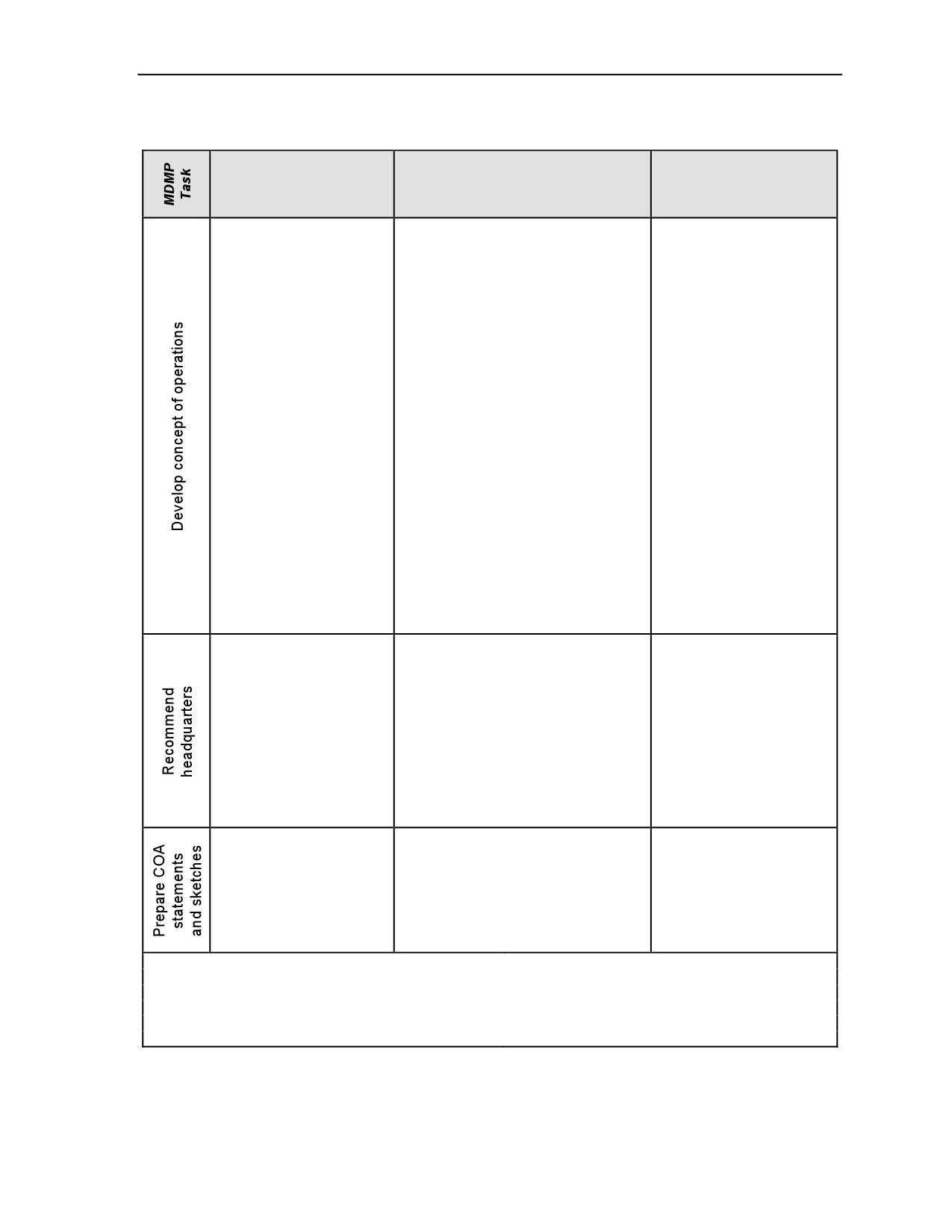
Table 5-3. Course of action development of the MDMP from an IIA perspective (cont.)
Inputs
G-7 (S-7) Actions
G-7 (S-7) Outputs
• COAs
For each COA—
For each COA—
• IPB
• Develop IIA concept of support
• IIA input work sheet
• HVTL
• Develop IIA objectives
containing a refined IIA
concept of support, IIA
• IIA mission statement
• Synchronize IIA actions
objectives, and IIA
• Initial IIA concept of
• Identify and prioritize IIA tasks
tasks
support for each COA
• Nominate selected HVTs
• IIA execution timeline
• Determine initial IIA task execution
• IIA-related HVT
timeline
nominations
• Refine IIA input to risk assessment
• Critical asset list
• Develop IIA assessment plan
• IIA input to risk
• Identify additional EEFI
management plan,
including residual risk
• Identify and assess OPSEC
indicators to determine OPSEC
associated with each
OPSEC vulnerability
vulnerabilities
• Criteria of success and
• Develop OPSEC measures to
IIA IRs to support IIA
shield OPSEC vulnerabilities
assessment
• Determine residual risk associated
with each OPSEC vulnerability
• Additional EEFI
after applying OPSEC measures
• OPSEC vulnerabilities
• Determine feedback required for
• OPSEC measures (IIA
assessment of military deception
tasks) to shield OPSEC
COAs
vulnerabilities
• IPB
• Assess mission command
• Recommendations
strengths and weaknesses to
concerning role of
• IIA running estimate
determine IIA-related vulnerabilities
headquarters in light of
• IIA vulnerability
of specific headquarters
mission command
assessment
vulnerability
• Reevaluate critical asset list
• IIA tasks by IIA
assessment
capabilities
• Updated critical asset
list
• Initial list of information-
related capabilities to
tasks assigned
• COA statement
• Submit input for each COA
• Input for each COA
• An IIA concept of
statement and sketch to G-3
statement and sketch
support and IIA
• Prepare IIA concept of support
• Concept of support of
objectives for each
statement and sketch for each
IIA and sketches for
COA
COA
each COA, stating the
most important
objectives for IIA
COA
course of action
HVTL high-value target list
EEFI
element of friendly information
IIA
inform and influence activities
G-3
assistant chief of staff, operations
IPB
intelligence preparation of the battlefield
G-7
assistant chief of staff, inform and influence activities
IR
information requirement
HPT
high-payoff target
OPSEC
operations security
HVT
high-value target
25 January 2013
FM 3-13
5-13
Chapter 5
Table 5-4. Course of action analysis of the MDMP from an IIA perspective
Inputs
G-7 (S-7) Actions
G-7 (S-7) Outputs
COAs
Develop evaluation criteria for each COA:
• An evaluation of
each military
•
IPB
• Synchronize IIA tasks performed by different
deception COA in
•
IIA input
IIA capabilities
terms of criteria
work
• Integrate IIA concept of support into the
established before
sheets
concept of operations for each COA
the war game
•
IIA
• Synchronize IIA concept of support with that of
For each COA—
execution
higher and adjacent headquarters
•
An evaluation in
timeline
• Identify adversary IIA capabilities and likely
terms of criteria
actions and reactions
established before
• War-game friendly IIA capabilities against
the war game
adversary vulnerabilities
•
Refined IIA input
War-game adversary IIA capabilities against
work sheets
friendly vulnerabilities:
•
Refined IIA
• Synchronize and deconflict initial IIA tasks
concept of support
• Refine targeting guidance and HVTL
•
Refined IIA
• Synchronize and deconflict IIA targets
objectives
• Determine whether modifications to the COA
•
Refined IIA tasks
result in additional EEFI or OPSEC
•
Refined IIA input
vulnerabilities; if so, recommend OPSEC
to attack guidance
measures to shield them
matrix and target
• Assign attack measures to HVTs
support matrix
• Test OPSEC measures
•
IIA IRs and
requests for
• Determine decision points for executing
information
OPSEC measures
identified during
• Determine operational support needed for
the war game
OPSEC measures
•
Refined EEFI and
• Determine OPSEC measures needed to
OPSEC
support possible OPSEC branches and
vulnerabilities, and
sequels
OPSEC measures
• Determine whether any OPSEC measures
•
Paragraph 3 of the
require addition coordination
IIA running
• War game each military deception COA
estimate
• Identify each military deception COA’s
•
IIA input to G-3
potential branches; assess risk to the COA
synchronization
• List the most dangerous or beneficial branch
matrix
on IIA decision support template or G-7 (S-7)
•
IIA input to HVTL
execution matrix
COA
course of action
IIA
inform and influence activities
EEFI
elements of friendly information
IPB
intelligence preparation of the battlefield
G-3
assistant chief of staff, operations
IR
information requirement
G-7
assistant chief of staff, inform and influence activities
OPSEC
operations security
HVT
high-value target
S-7
inform and influence activities staff officer
HVTL
high-value target list
5-14
FM 3-13
25 January 2013

Inform and Influence Activities Integration
Table 5-5. Course of action comparison of the MDMP from an IIA perspective
Inputs
G-7 (S-7) Actions
G-7 (S-7) Outputs
• COA evaluations
• Compare COAs with each other to
• IIA advantages and
from COA
determine the advantages and
disadvantages for each
analysis
disadvantages of each
COA
• COA evaluation
• Determine which COA is most
• Most supportable COA
criteria
supportable from an IIA
from an IIA perspective
perspective
• IIA COA decision
• Determine if any OPSEC
matrix
measures require the
• Paragraph 4, IIA
commander’s approval
running estimate
COA course of action
OPSEC operations security
G-7
assistant chief of staff, inform and influence activities
IIA
inform and influence activities
Table 5-6. Course of action approval of the MDMP from an IIA perspective
Inputs
G-7 (S-7) Actions
G-7 (S-7) Outputs
• Results from COA
• Provide IIA input to COA
• Finalized IIA concept of
comparison
recommendation
support for approved
COA
• Recommended
• Reevaluate IIA input to the
COA
commander’s intent and
• Finalized IIA objectives
guidance
and IIA tasks based on
• Refine IIA concept of support,
approved COA
IIA objectives, and IIA tasks for
• IIA input to WARNO
approved COA and develop
• G-7 (S-7) execution
associated G-7 (S-7) execution
matrix
matrix
• Prepare IIA input to the WARNO
• Participate in COA decision
briefing
• Recommend COA that IIA can
best support
• Request decision on executing
any OPSEC measures that
entail significant resource
expenditure or risk
COA course of action
OPSEC operations security
G-7
assistant chief of staff,
S-7
inform and influence activities staff
officer
IIA
inform and influence activities
WARNO warning order
25 January 2013
FM 3-13
5-15
Chapter 5
Table 5-7. Orders production, dissemination, and transition of the MDMP from an IIA
perspective
Inputs
G-7 (S-7) Actions
G-7 (S-7) Outputs
• Approved COA
• Ensure IIA input (such as,
• IIA synchronization
• Refined commander’s
EEFI and tasks to support
matrix
IIA to subordinate units) is
guidance
• IIA subparagraph to
placed in base OPLAN or
• Refined commander’s
base OPLAN or
OPORD
OPORD
intent
• Finalize IIA annex
• IIA annex
• IIA running estimate
• Coordinate objectives and
• IIA input to the AGM
• G-7 (S-7) execution
tasks to support IIA with
and TSM
matrix
information-related
• IIA input to military
• Finalized IIA mission
capabilities staff officers
statement, IIA concept
deception appendix
• Conduct other staff
of support, IIA
coordination
objectives, and IIA tasks
• Refine G-7 (S-7) execution
matrix
AGM attack guidance matrix
OPLAN operation plan
COA course of action
OPORD operation order
EEFI
elements of friendly information
S-7
inform and influence activities staff officer
G-7
assistant chief of staff, inform and influence activities
TSM target synchronization matrix
IIA
inform and influence activities
5-20. For each step in the MDMP, the G-7 (S-7) or IIA planner is responsible for actions and planning
products that paragraphs 5-21 through 5-33 discuss.
RECEIPT OF MISSION
5-21. In the receipt of mission, the G-7 (S-7) participates in the commander’s initial assessment actions,
receives the commander’s initial guidance, and performs an initial IIA assessment. Lastly, this officer
prepares for subsequent planning.
5-22. The staff updates the IIA running estimate during receipt of mission. The staff also creates IIA
planning products. They—
z
Develop input to initial IPB, including initial essential elements of friendly information (EEFI).
z
Develop input to initial intelligence asset tasking.
z
Submit information requirements to support IIA concerning adversary capability to collect EEFI
to give to the G-2 (S-2).
z
Develop an IIA input into a warning order. Input includes initial EEFI.
MISSION ANALYSIS
5-23. During mission analysis, the G-7 (S-7) helps the G-2 (S-2) with conducting analysis and assessment
regarding the information environment; gathers and shares information on threat information capabilities
and vulnerabilities; and creates information environment-specific IPB products. This officer and the section
coordinate IIA intelligence support requirements with the G-2 (S-2) information synchronization manager.
Lastly, the G-7 (S-7) ensures the G-2 (S-2) staff clearly understands the intelligence support and products
required for IIA planning, execution, and assessment.
5-24. The staff produces key IIA planning products during mission analysis. For the IIA portion of the
mission analysis brief, they detail applicable concepts and objectives; IPB tasks, assets, critical factors, and
assumptions; risk assessment; and information requirements. Other specific IIA products include—
z
Requests for information for intelligence support.
z
A refined IIA running estimate.
z
A statement of the IIA strategy.
5-16
FM 3-13
25 January 2013
Inform and Influence Activities Integration
5-25. An effective mission analysis of the information environment considers all three dimensions
(physical, informational, and cognitive) and the impact each potentially has on an operational environment.
In most cases, the mission analysis will—
z
Identify knowledge gaps translated into intelligence and information requests
(typically
information, information systems and infrastructure, and selected audiences).
z
Identify desired effects for each of the three dimensions (physical is usually the easiest to factor;
cognitive is the most difficult).
z
Identify significant events and agents of change occurring in the information environment, such
as the death of key personalities, loss of equipment or infrastructure, spillover of political unrest,
introduction of new technologies, natural disasters, computer viruses, and others.
z
Identify potential exploitation opportunities (physical, informational, and cognitive) that support
or enable the operation.
z
Identify friendly vulnerabilities in the current information environment (physical, informational,
and cognitive) that may impact mission success.
z
Identify the availability of information-related capabilities needed to achieve the desired effects.
z
Identify the timelines most suitable to support planned operations.
z
Identify the facts, assumptions, constraints, limitations, and regulatory restrictions affecting the
employment of information-related capabilities.
z
Identify specified, implied, and essential tasks.
z
Recommend information-related capabilities.
5-26. Analysis of the information environment identifies subinformation environments, nodes, and
methods that influence the larger information environment. Effective commanders and staffs understand the
information environment will often be inconsistent throughout their area of operations. The information
environments in different areas of a city or different rural areas often manifest different characteristics.
These differences must be considered in the planning process. Key information nodes and communicators
that influence the information environment serve as the equivalent to key terrain and must be identified.
Communication methods change from area to area and vary between different groups and organizations;
therefore, commanders and staffs analyze the methods to distinguish the specific characteristics and
variances.
COURSE OF ACTION DEVELOPMENT
5-27. During course of action (COA) development, the G-7 (S-7) provides advice on the potential impact
of friendly and enemy information activities, related actions, or activities of the relative combat power of
the two sides. This officer focuses IIA planning efforts on achieving an operational advantage at the
decision point of each course of action. Lastly, the G-7 (S-7) develops schemes of support and objectives
for IIA and input to a high-payoff target list for each course of action.
5-28. The staff produces key IIA planning products during course of action development. These include—
z
Objectives and tasks for IIA annotated on the G-3 (S-3) sketch.
z
The concept for the IIA graphic (IIA-specific COA sketch).
z
A draft task organization and synchronization input for IIA.
z
A high-value target list.
z
An IIA assessment plan (measures of effectiveness and measures of performance).
z
A communication strategy.
COURSE OF ACTION ANALYSIS
5-29. During course of action analysis, the G-7 (S-7) helps the G-2 (S-2) with enemy information activities
and assessments, provides input on high-value targets, and develops an IIA concept. This concept supports
each friendly course of action, addresses critical event actions and messages, and reviews and refines task
organization of information-related capabilities to support IIA.
25 January 2013
FM 3-13
5-17
Chapter 5
5-30. The key IIA planning products built during course of action analysis include an IIA war-gaming
work sheet and a draft task organization of information-related capabilities. Through war-gaming, the staff
also refines and integrates IIA information requirements and elements of friendly information into the
operational concept. The staff hones and synchronizes core tasks for the IIA annex.
COURSE OF ACTION COMPARISON
5-31. During course of action comparison, the G-7 (S-7) provides input. This input applies to course of
action selection and evaluation criteria, IIA planning products, and an IIA course of action decision matrix.
COURSE OF ACTION APPROVAL
5-32. During course of action approval, the G-7 (S-7) participates in the course of action selection briefing.
This officer is prepared to discuss how information-related capabilities support each course of action. The
G-7 (S-7) helps finalize the commander’s intent based on the course of action selected. The output from the
G-7 (S-7) is a finalized IIA execution matrix.
ORDERS PRODUCTION, DISSEMINATION, AND TRANSITION
5-33. The G-7 (S-7) provides IIA input to the orders process (see figure 5-4 on page 5-19 and 5-20). This
officer also produces or coordinates the following planning products:
z
Paragraph 3.a (subparagraph 7), paragraph 3.b, and paragraph 3.c of the base order.
z
Input to Annex A (Task Organization).
z
Annex J (Inform and Influence Activities) and its appendixes (public affairs, military deception,
MISO, and Soldier and leader engagement).
z
Input to other functional area annexes—intelligence, fire support, signal, and civil affairs
operations—as required.
5-18
FM 3-13
25 January 2013
Inform and Influence Activities Integration
[CLASSIFICATION]
Copy ## of ## copies
Issuing headquarters
Place of issue
Date-time group of signature
Message reference number
ANNEX J (INFORM AND INFLUENCE ACTIVITIES) TO OPERATION PLAN/ORDER [number]
[(code name)]—[(classification of title)]
(U) References: List documents essential to understanding the attachment.
(U) Time Zone Used Throughout the Plan/Order: Time zone established in the base plan.
1. (U) Situation. Include IIA-related information that paragraph 1 of the OPLAN or OPORD does not cover
or that needs expansion.
a.
(U) Area of Interest. Refer to Annex B (Intelligence) or the combined information overlay as
required.
b. (U) Area of Operations. Refer to Appendix 2 (Operation Overlay) to Annex C (Operations).
(1) (U) Terrain. List critical terrain aspects that impact execution of IIA tasks. Refer to Annex B
(Intelligence) or the combined information overlay as required.
(2) (U) Weather. List critical weather aspects that impact execution of IIA tasks. Refer to Annex B
(Intelligence) or the combined information overlay as required.
c. (U) Enemy Forces. List known and templated locations of enemy units with IIA capabilities. State
enemy course of action and employment if IIA.
d. (U) Friendly Forces. Outline the higher headquarters IIA plan. List designation, location, and outline
of plan of higher, adjacent, and other IIA capabilities that support or impact the issuing headquarters or
require coordination and additional support.
e.
(U) Interagency, Intergovernmental, and Nongovernmental Organizations. Identify and describe
other organizations in the area of operations that may impact the conduct of IIA.
f. (U) Civil Considerations. Refer to Annex K (Civil Affairs Operations) as required.
g. (U) Attachments and Detachments. List units that conduct IIA capabilities only as necessary to
clarify task organization. Examples include tactical MIS teams, combat camera teams, and mobile public
affairs detachments.
h. (U) Assumptions. List any IIA-specific assumptions that support annex development.
2. (U) Mission. State the mission of IIA support of the base plan or order.
3. (U) Execution.
a. (U) Scheme of Inform and Influence Activities. Describe how IIA support the commander’s intent
and concept of operations. Establish priorities of IIA support to units for each phase of the operation. Refer
to Annex C (Operations) as required.
b. (U) Tasks to Subordinate Units. List IIA tasks assigned to specific subordinate units not contained in
the base order.
c. (U) Coordinating Instructions. List IIA tasks applicable to two or more subordinate units not covered
in the base order.
4. (U) Sustainment. Identify IIA priorities of sustainment for key tasks.
[page number]
[CLASSIFICATION]
Figure 5-4. Annotated inform and influence activities annex
25 January 2013
FM 3-13
5-19
Chapter 5
[CLASSIFICATION]
ANNEX J (INFORM AND INFLUENCE ACTIVITIES) TO OPERATION PLAN/ORDER [number]
[(code name)]—[(classification of title)]
5. (U) Command and Signal.
a. (U) Command. State the command post location of the G-7 (S-7).
b. (U) Control. State any IIA liaison requirements not covered in base order.
c. (U) Signal. Address any IIA-specific communication requirements.
ACKNOWLEDGE: Include only if attachment is distributed separately from the base order.
[Commander’s last name]
[Commander’s rank]
OFFICIAL:
[Authenticator’s name]
[Authenticator’s position]
ATTACHMENTS: List lower-level attachment (appendixes, tabs, and exhibits).
Appendix 1 - Public Affairs (Public Affairs Officer)
Appendix 2 - Military Deception (Military Deception Planner)
Appendix 3 - Military Information Support Operations (MISO Officer
Appendix 4 - Soldier and Leader Engagement (IIA Officer)
DISTRIBUTION: Show only if distributed separately from the base order or higher-level attachments.
[page number]
[CLASSIFICATION]
Figure 5-4. Annotated inform and influence activities annex (continued)
INFORM AND INFLUENCE ACTIVITIES PROCESSES
5-34. The G-7 (S-7) uses tools and processes such as the running estimate and the combined information
overlay to gather information to plan, write, and assess IIA events. The tools and processes also help the
commander in the exercise of mission command warfighting function tasks to inform and influence during
operations.
RUNNING ESTIMATE
5-35. A running estimate is the continuous assessment of the current situation used to determine if the
current operation is proceeding according to the commander’s intent and if planned future operations are
supportable (ADP 5-0). The running estimate helps the G-7 (S-7) to record and track pertinent information
about the information environment leading to a basis for recommendations made to commanders. Running
estimates represent the analysis and expert opinion of the G-7 (S-7). Staffs maintain running estimates
throughout the operations process to help commanders in the exercise of mission command.
5-36. When written, a running estimate consists of verbal summaries of available information backed up
by overlays and charts. However, the running estimate format is less an outline for a written product than it
is a way to organize information. The G-7 (S-7) maintains current information on all aspects of the
situation, especially factors of the information environment, and is prepared to make recommendations on
decisions the commander must make. The IIA running estimate format lists aspects of the situation in a
logical sequence. The G-7 (S-7) can use it as a briefing aid to ensure units address all aspects of the
situation.
5-20
FM 3-13
25 January 2013
Inform and Influence Activities Integration
5-37. Without being overly time-consuming, an effective IIA running estimate is as comprehensive as
possible within the time available. Normally, the IIA running estimate provides enough information to
complete the first draft of the IIA annex and provides IIA input to the base operation order (OPORD) or
operation plan (OPLAN). The estimate’s view of future capabilities contributes to the commander’s
visualization. Paragraphs 1 and 2 of the IIA running estimate provide input to the mission analysis briefing.
Paragraphs 3, 4, and 5 provide input to the course of action decision briefing.
5-38. During peacetime and operations, the G-7 (S-7) maintains running estimates for specific missions.
These estimates address decision points, branches, and sequels. If no IIA running estimate exists, the G-7
(S-7) begins developing one upon receipt of mission and continues to refine it throughout the operation.
Staff officers responsible for the conduct of contributing information-related capabilities provide input to
the IIA running estimate during peacetime and when they plan and execute operations. IIA input to the
OPLAN or OPORD comes from the IIA running estimate.
5-39. Developing an IIA running estimate focuses on situation and information environment assessment
rather than course of action development. It aims not to develop a perfect plan but to assemble information
underlying an IIA concept of support that staff can modify to support the overall concept of operations.
5-40. The G-7 (S-7) uses the IIA running estimate to assess and analyze the course of action the
commander is considering. It includes an evaluation of how factors in the area of operations, specifically in
the information environment, may influence each course of action or mission. The running estimate
includes conclusions and recommendations. A comprehensive IIA running estimate addresses all facets of
operations and information and contains both facts and assumptions based on the G-7 (S-7)’s experience
and expertise.
5-41. Running estimate development never stops. The G-7 (S-7) continuously maintains and updates the
IIA running estimate as pertinent information is received. The G-7 (S-7) evaluates the information to
determine possible effects on recommendations and conclusions about courses of actions.
Running Estimate and the Military Decisionmaking Process
5-42. During mission analysis, the G-7 (S-7) produces paragraphs 1 (mission) and 2 (situation and
considerations) of the IIA running estimate. These paragraphs guide all subsequent IIA planning—both for
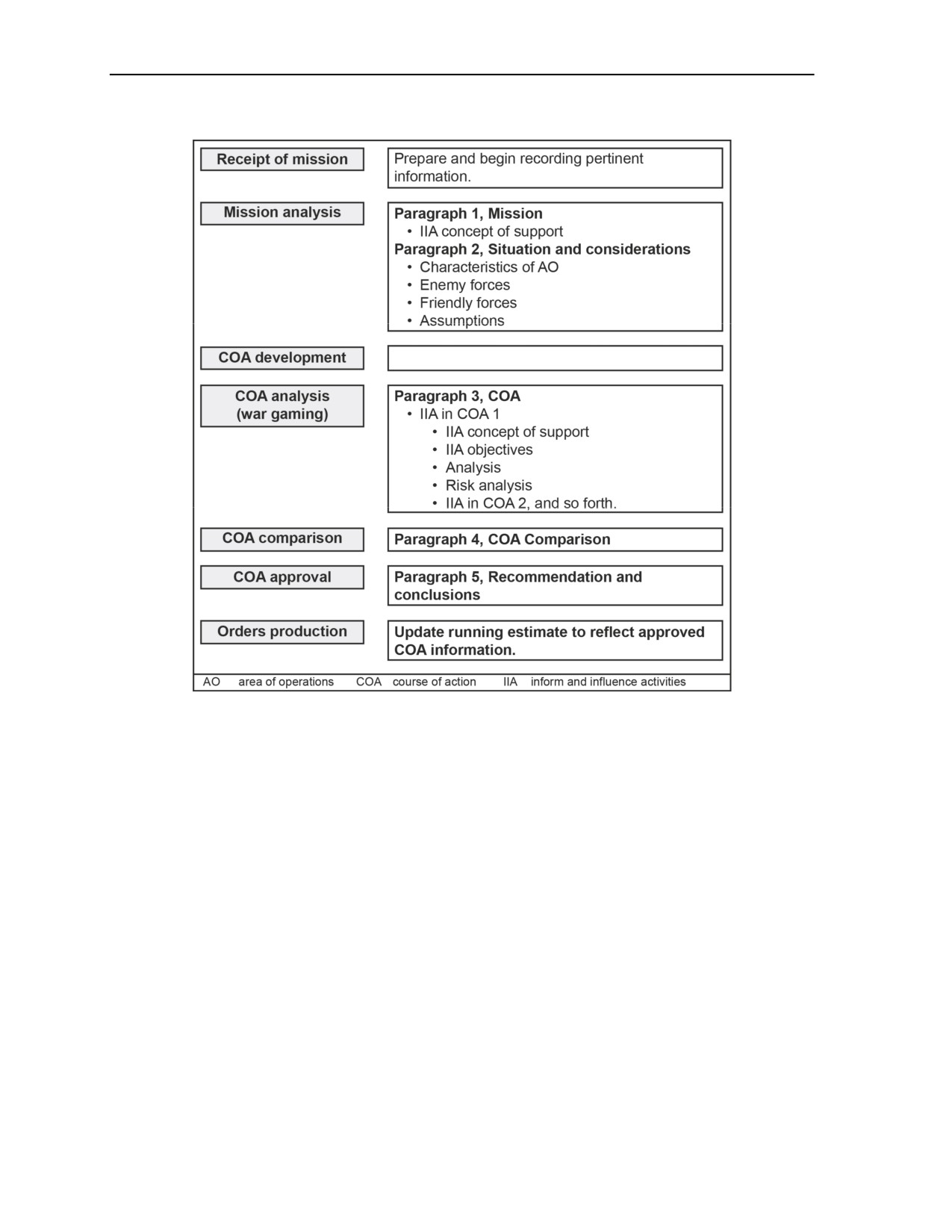
the current operation and for any branches and sequels. (See figure 5-5 on page 5-22.) By the end of
mission analysis, the IIA running estimate includes the following information:
z
The restated IIA mission. The G-7 (S-7) determines the initial IIA mission during the analysis of
the higher headquarters OPLAN or OPORD and the restated IIA mission during mission
analysis. At the same time, the commander approves the restated mission for the overall
operation.
z
Characteristics of the area of operations and the information environment that may influence
friendly, adversary, and enemy operations.
z
Adversary and enemy information capabilities in the area of operations. The information may be
displayed as a situation template or combined information overlay.
z
Assets and resources employed in an IIA role (determined during review of available assets).
z
Critical facts and assumptions. (Facts are placed in the IIA running estimate subparagraph that
concerns them.)
z
IIA criteria of success for analyzing and comparing course of actions.
z
IIA-related high-payoff target recommendations.
z
IIA information requirements.
5-43. At the end of mission analysis, paragraph 2 of the IIA running estimate is well formed. However, it is
not complete. As part of the IIA running estimate, it is updated as new information is received. Normally
paragraph 2 of the IIA running estimate becomes the IIA input to the mission analysis briefing.
25 January 2013
FM 3-13
5-21
Chapter 5
Figure 5-5. Inform and influence activities running estimate and the military decisionmaking
process
Course of Action Development, Analysis, and Comparison
5-44. The G-7 (S-7) uses the information in the IIA running estimate to refine IIA objectives and to check
the soundness of the IIA concept of support for each course of action. The G-7 (S-7) assesses IIA
resources, general strengths, and vulnerabilities that, if exploited by adversary or enemy, could cause the
IIA supporting the course of action to fail. The G-7 (S-7) records the information gathered during course of
action development for use during the course of action analysis. The information developed during the
course of action analysis forms the basis for paragraph 3, course of action analysis IIA running estimate.
5-45. During course of action analysis, the G-7 (S-7) confirms and refines the following information
contained in the IIA running estimate:
z
IIA concept of support and objectives.
z
Information-related capabilities strengths and vulnerabilities.
z
Information-related capabilities resource requirements in terms of amount and effectiveness.
z
IIA effectiveness of risk control measures and resultant residual risk.
5-46. The assistant G-7 (S-7) assesses the IIA concept of support against the IIA criteria of success as units
war-game each course of action. The results of this assessment form the basis for the course of action
comparison recorded in paragraph 4 (course of action comparison).
5-22
FM 3-13
25 January 2013
Inform and Influence Activities Integration
Recommendations and Conclusions
5-47. The G-7 (S-7) staff analyzes the war-gaming of the concepts of support and compares results for
each course of action with the others. The G-7 (S-7) rank orders the concepts of support for IIA according
to how well they meet the evaluation criteria. Usually the comparison and ranking of the concepts of
support are shown on a course of action decision matrix. The matrix and a narrative explanation are
recorded in paragraph 4 of the running estimate. After analyzing and comparing the concepts of support,
the G-7 (S-7) recommends the course of action that the comparison shows IIA can best support. The
recommendation and summarized conclusions become the final paragraph of the running estimate.
5-48. Once the commander approves a course of action, the G-7
(S-7) analyzes how each
information-related capability can best support it. This is not a total reevaluation. Rather, the analysis
results from the course of action comparison based on the approved course of action.
5-49. The G-7 (S-7) prepares the running estimate. Upon completion of the running estimate, the G-7 (S-7)
has prepared the majority of input needed for the OPLAN or OPORD. The G-7 (S-7) can build most of the
IIA annex through “cut and paste” from a well-prepared running estimate.
Running Estimate Briefing
5-50. The running estimate may be presented as a briefing to provide IIA information to the commander
and staff. The G-7 (S-7) normally elaborates on key points derived from preparing the estimate, focusing
principally on adversary and friendly information capabilities and vulnerabilities. Additionally, the G-7
(S-7) presents the support IIA can provide to each course of action. The briefing is part of either the
mission analysis briefing (paragraphs 1 and 2) or part of the commander’s decision briefing (paragraphs 3,
4, and 5). The briefing itself consists of all of paragraph 1 and a summary of paragraphs 2 through 5 of the
running estimate.
COMBINED INFORMATION OVERLAY
5-51. The combined information overlay gives the commander and planners a visual depiction of the ways
in which information affects the area of operations. Similar to the modified combined obstacle overlay,
which the G-2 (S-2) develops during the IPB, the combined information overlay is a simplified depiction of
numerous interconnected variables. The combined information overlay is a tool to visualize a collection of
inputs that can never be completely synthesized. As such, it is never a final product; it is often updated as
new information arises and as time and staffing permits. Reachback capabilities—from the 1st Information
Operations Command (Land), intelligence sources, or other organizations—may provide a starting point for
a combined information overlay, but the G-7 (S-7) continues to verify and refine the overlay with more
localized analysis. Although the combined information overlay may include classified information,
particularly when dealing with technical or military aspects of an operational environment, most
information comes from open-sources dealing primarily with information and how it impacts local
perceptions.
5-52. The IIA working group determines which categories of systems to incorporate into the combined
information overlay. The operational variables of political, military, economic, social, information,
infrastructure, physical environment, and time should be included. It may be useful to depict these variables
on maps or diagrams. When considering the information aspects of an operational environment, examples
within these variables include—
z
Political. Political boundaries
(cities, provinces), political party headquarters, and political
survey data (favorability ratings, voting trends).
z
Military. Leader affiliation, location of forces, class divisions, and readiness levels.
z
Economic. Wealth dispersion, leading industries, banking, economic centers, and balance of
trade.
z
Social. Class distinctions, tribal systems, religion, public opinions, education and literacy levels,
and displaced populations.
25 January 2013
FM 3-13
5-23
Chapter 5
z
Information. Print and electronic media outlets, information flow into and throughout region,
Web access, and literacy.
z
Infrastructure. Roads, bridges, towers, sea and airports, towns and cities, sewage, water, trash,
and healthcare.
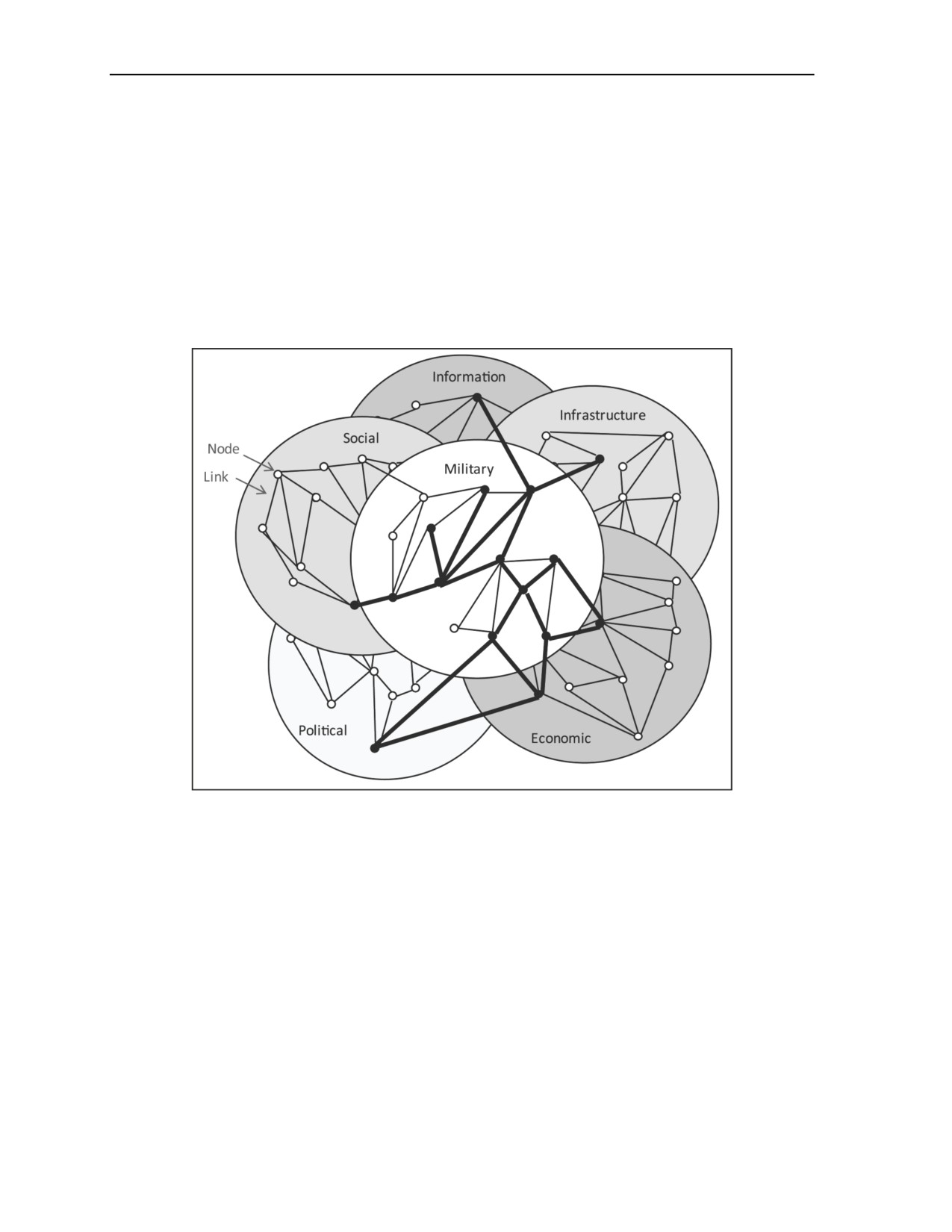
5-53. As the G-7 (S-7) analyzes these variables, the G-7 (S-7) begins to see connections between systems
that impact information and information flow (see figure 5-6). For example, as terrain affects how or if
information reaches isolated populations, military leaders align with certain religious groups or political
systems. A region with a dominant political party may be out of line with popular opinion or a tribe may
control local communications infrastructure, and so forth. Commanders recognize these connections as they
visualize how their efforts can attain a desired end state, including cyberspace structures, such as networks.
This understanding is especially important in planning post-combat operations.
Figure 5-6. Linkages between systems
5-54. Ultimately, commanders require information to help them determine where to expend their limited
resources. In all probability, they want to maintain positive attitudes where they live, isolate recalcitrant
populations with unfavorable opinions of U.S. forces unlikely to change, and expend most effort creating
favorable situations among populations with whom they can communicate.
5-24
FM 3-13
25 January 2013
Chapter 6
Targeting and Inform and Influence Activities
This chapter discusses targeting and inform and influence activities. It first discusses
the targeting process and targeting meetings. Then it discusses decide, detect, deliver,
and assess. Then it discusses find, fix, track, target, engage, and assess. The chapter
then covers criticality, accessibility, recuperability, vulnerability, effect, and
recognizability. Then it discusses targeting and the military decisionmaking process.
It concludes with a discussion of the synchronization matrix.
TARGETING PROCESS
6-1. Targeting and inform and influence activities (IIA) use the same targeting process and formats as
FM 3-60. No separate IIA method exists. The targeting process allows the IIA staff to synchronize limited
resources in time and space to achieve the desired effects for the commander. The targeting focus of the
G-7 (S-7) essentially answers the following for the staff: who are U.S. forces targeting, how will U.S.
forces find them, what message will U.S. forces send them, and how effective was the sent message?
Targeting is not a new or separate process from the military decisionmaking process. Targeting is a critical
process for integrating among warfighting functions. (For more information on the targeting process, refer
to FM 3-60.)
TARGETING MEETINGS
6-2. Targeting meetings are chaired typically by the G-3 (S-3) fires. These meetings have a targeting
warrant officer to help with synchronizing the targeting efforts of the staff. The IIA working group is a
distinct and separate working group effort that feeds the staff going into targeting meetings. Members of
targeting meetings look at how the staff achieves the desired effects to meet the themes and messages
developed in the IIA working group for different audiences. The G-7 (S-7) looks at how the staff integrates
information-related capabilities into operations to achieve the desired effects.
6-3. Targeting and IIA are both integrating processes that affect and reinforce each other.
Information-related capabilities provide assets that detect targets, deliver effects, and then assess these
effects. For example, individual Soldiers provide spot reports after interacting with civilians. These reports
support detection efforts. Civil affairs units provide nonlethal nation-building assistance that seeks to build
confidence in governance structures and separate the populace from the enemy. Public affairs assets assess
the impact of a specific campaign or operation by analyzing media reporting.
TARGETING METHODOLOGIES
6-4. Multiple methodologies exist in targeting. An effective G-7 (S-7) understands those addresses as well
as other methodologies the staff uses for targeting to achieve the commander’s desired effects.
DECIDE, DETECT, DELIVER, AND ASSESS
6-5. While there are multiple methodologies to targeting, Army forces typically uses the decide, detect,
deliver, and assess (D3A) methodology. The D3A targeting process comprises the following four functions:
z
Decide which targets to engage. (Which target audiences are we going to send a message?)
z
Detect the targets. (Which intelligence collection assets will find the target?)
z
Deliver the message. (Was the asset able to deliver the message as intended?)
z
Assess. (How effective was the message received?)
25 January 2013
FM 3-13
6-1
Chapter 6
6-6. Decide is the first step in the targeting process. This step establishes the focus and sets priorities for
intelligence collection assets. It is heavily influenced by the intelligence preparation of the battlefield.
During this step, forces determine to whom they aim their actions, images, and messages. Forces determine
if they require a sequential order to shape an operational environment for either a friendly, neutral, or
adversarial decisionmaker. They determine if they need specific enemy intelligence platforms targeted with
specific information so the adversary or enemy commander takes a specific course of action. Forces also
determine available specific platforms or assets, as well as duration of availability. For example, a
commander may only have unmanned aircraft system support for four hours of coverage, operating in
certain weather conditions. Lastly forces determine if they will cover down other assets to replace that
coverage asset if or when it is lost.
6-7. The second step of the targeting process, detect, directs how sensors or surveillance and
reconnaissance platforms find the specified targets. It attributes a specific platform or asset to search for a
specific target in time and space to address a specific information-related capability. Typically, the staff
closely coordinates with the G-2 (S-2) for developing the collection plan; however, sensors may also
engage the targets once they are found. For example, a maneuver company may commence with a face-to-
face meeting with tribal leaders because the staff designated these leaders as a key target audience to
receive a certain message. Another example would be a signals intelligence platform searching for a radio
frequency the adversary has used for mission command purposes. These detect actions focus on answering
priority intelligence requirements or information requirements.
6-8. The deliver function of the targeting process is the execution of how the staff will shape the
environment once the target has been identified. It identifies which assets to use in time and space, as well
as what information-related capability the assets deliver. For example, a military information support team
delivers loudspeaker messages and handbills during a specific phase of the operation to set conditions for
the next phase.
6-9. The final step in the targeting process is assess. Assessment of effects determines if the intended
target audience needs to be reengaged with the same or modified action image or message. During the IIA
working group or targeting meeting, members of the staff present recommendations to the commander
based on the measures of effectiveness and performance. Staffs continually determine whether or not the
intended outcomes are being met, and if the commander must reestablish targeting priorities or allocate
additional resources to meet the guidance. The outcome of the assessment begins the targeting cycle for the
decide function again.
6-10. Combat assessment is the effectiveness of force employment during military operations, also known
as battle damage assessment. Combat assessment is an aggregate of the measure of effectiveness
assessment. Combat assessment answers the following questions:
z
What did IIA and information operations do?
z
Did IIA and information operations achieve the desired effect in the physical, information, and
cognitive dimensions?
z
Should the IIA and the information operations target be reengaged or modified?
FIND, FIX, TRACK, TARGET, ENGAGE, AND ASSESS
6-11. Some targeting methods depend on the type of unit or mission. One such method—find, fix, track,
target, engage, and assess (F2T2EA)—is particularly useful in high-value individual targeting. Though
typically used in special operations forces units, F2T2EA helps with aligning intelligence and operations
assets for pinpoint targeting of personalities and exploiting vulnerabilities in a given network. For the IIA
staff, targeting means continuous assessment of effects.
(For more information on F2T2EA see
ATP 3-60.1.)
CRITICALITY, ACCESSIBILITY, RECUPERABILITY, VULNERABILITY, EFFECT, AND
RECOGNIZABILITY
6-12. Criticality, accessibility, recuperability, vulnerability, effect, and recognizability (CARVER) help in
selecting the appropriate components when targeting. The CARVER method is used mainly by special
operations forces units to assess, validate, and define requirements planning. Units use the CARVER
6-2
FM 3-13
25 January 2013

Targeting and Inform and Influence Activities
targeting process in addition to vulnerability assessments. Its use is not required but highly recommended
to complete force protection plans.
6-13. The CARVER selection factors help in selecting the best targets or components to attain the
commander’s desired end state. As the staff considers factors, each factor receives a numerical value. This
value represents the desirability of attacking the target. Staffs place the values in a CARVER matrix (see
table 6-1). After assigning values for each target or component, the sum of the values indicates the highest
value target or component to attack in the limits of the requirements and commander’s intent.
Table 6-1. CARVER value rating scale
Value
C
A
R
V
E
R
Value
Loss would
Easily
Extremely
Special
Favorable
Easily
be mission
accessible;
difficult to
operations
sociological
recognized
stopper
away from
replace;
forces
impact,
by all with
security
long
definitely
neutral
no
5
down
have the
impact on
confusion
5
time
means
civilians
(1 year)
and
expertise
to attack
Loss would
Easily
Difficult to
Special
Favorable
Easily
reduce
accessible
replace
operations
impact; no
recognized
mission
outside
with long
forces
adverse
by most,
performance
down
probably
impact on
with little
4
4
considerably
time
have the
civilians
confusion
(<1 year)
means
and
expertise
Loss would
Accessible
Can be
Special
Favorable
Recognized
reduce
replaced
operations
impact;
with some
mission
in a
forces
some
training
performance
relatively
may have
adverse
3
3
short time
the means
impact on
(months)
and
civilians
expertise
to attack
Loss may
Difficult to
Easily
Special
No impact;
Hard to
reduce
gain
replaced
operations
adverse
recognize,
mission
access
in a short
forces
impact on
confusion
2
2
performance
time
probably
civilians
probable
(weeks)
have no
impact
Loss would
Very
Easily
Special
Unfavorable
Extremely
not affect
difficult to
replaced
operations
impact;
difficult to
mission
gain
in short
forces do
ensured
recognize
1
performance
access
time
not have
adverse
without
1
(days)
much
impact on
extensive
capability
civilians
orientation
to attack
Note: For specific targets, more precise target-related data can be developed for each element in the matrix.
6-14. As the staff evaluates each potential target for each CARVER factor, the analyst enters the numerical
value into the matrix. After evaluating all the potential targets, the analyst adds the scores for each target.
25 January 2013
FM 3-13
6-3
Chapter 6
The totals represent the relative desirability of each potential target and constitute a prioritized list of
targets. Staffs consider the targets with the highest totals first for attack.
(For more information on
CARVER analysis, see JP 3-05 and TC 2-33.4.)
6-15. Criticality, or target value, is the primary consideration in targeting. Criticality relates to the degree a
target’s destruction, denial, disruption, and damage impairs the adversary’s political, economic, or military
operations, or the degree a target component disrupts the function of a target complex. In determining
criticality, staffs analyze individual targets in a target system in relation to the other elements critical to the
function of the target system or complex. Critical targets may also be selected for information collection
missions.
6-16. A target’s accessibility is when an operational element can reach the target with sufficient personnel
and equipment to accomplish its mission. A target can be accessible even if it requires the assistance of
knowledgeable insiders. This assessment entails identifying and studying critical paths that the operational
element must take to accomplish its objectives, and measuring those things that aid or impede access.
6-17. A target’s recuperability is measured in time—how long it will take to replace, repair, or bypass the
destruction of or damage to the target. Recuperability varies with the sources and types of targeted
components and the availability of spare parts. Recuperability may not be as important in terrorist targeting
as the considerations of publicity, the symbolism of the target, and the desire to successfully accomplish an
attack.
6-18. A target is vulnerable if there are the means and expertise to successfully attack it. When determining
the vulnerability of a target, the scale of the critical component needs to be compared with the capability of
the attacking element. At the strategic level, a much broader range of resources and technology are
available to conduct the target attack. At the tactical level, resources may be limited to organic personnel,
weapons, and munitions or assets that can be attached, borrowed, or improvised.
6-19. U.S forces only attack a target if they can achieve the desired military effects. These effects may be
of a military, political, economic, informational, or psychological nature. Effects on the populace can
alienate the local inhabitants, strengthen the resistance movement, or trigger reprisals against the
indigenous people in the immediate target area. U.S forces calculate and weight collateral damage against
the expected military benefit to determine if an attack is advisable under the concept of proportionality.
Collateral damage includes, but is not limited to, civilian injuries, deaths, and adverse economic impacts of
the proposed attack.
6-20. A target’s recognizability is the degree to which it can be recognized by the threat, and the
intelligence process, reconnaissance, and surveillance assets, under varying conditions. Weather has an
obvious and significant impact on visibility. Rain, snow, and ground fog often obscure observation. Road
segments with sparse vegetation and adjacent high ground provide excellent conditions for good
observation. Units also consider distance, light, and season. Other factors that influence recognizability
include the size and complexity of the target, the existence of distinctive target signatures, the presence of
masking or camouflage, and the technical sophistication and training of the threat.
TARGETING AND THE MILITARY DECISIONMAKING PROCESS
6-21. The D3A methodology is an integral part of the military decisionmaking process (MDMP) from
receipt of mission through orders production, dissemination, and transition. Like the MDMP, targeting is a
leadership driven process. Targeting frequently begins simultaneously with receipt of mission, and may
even begin based on a warning order. As units conduct the MDMP, targeting focuses more on the
commander’s intent and guidance.
6-22. The steps (see table 6-2) during the MDMP have a direct IIA action and a targeting action that occurs
during the planning process.
6-4
FM 3-13
25 January 2013
Targeting and Inform and Influence Activities
Table 6-2. IIA action steps during the MDMP and targeting process
MDMP Step
IO or IIA Action
Targeting Action
Receipt of
•
Determine specified, implied, and
•
Determine specified,
mission and
essential IO or IIA tasks
implied, and essential fire
support tasks
mission analysis.
•
Select targets for nomination to
HVTL
•
Determine HVTL
•
Determine supporting IO or IIA
•
Translate status of fire
capabilities
support assets into
capabilities
•
Determine supporting IO or IIA
objectives or essential IO or IIA
•
Develop draft targeting
tasks
objectives or essential fire
support tasks
•
Product: CIO, initial synch
targets effects statements
•
Nominate targets to HVTL
COA
•
Input to concept of fires (or
•
Develop concept of fires
development.
effects)
(or effects)
•
Target nominations to HPTL
•
Develop initial HPTL
•
Quantify effects
•
Quantify effects for
essential fire support tasks
•
Product: initial synch matrix,
effects statements refined
COA analysis
•
Results of IIA or IO WG
•
Finalize concept of fires
and
•
Input to TSM
(or effects)
COA comparison.
•
Discuss 1, 2, 3rd order effects
•
Finalize HPTL
•
Product: synch matrix
•
Develop TSM
(command engagement plan)
•
Develop fire support
control measures
COA approval.
•
Targets approved, added to TSM
•
Brief fire support plan as
part of each COA
Orders
•
Cross-walk IIA or IO and fire
•
Write fires paragraph of
production,
support annexes
OPORD and fire support
•
Product: Annex J and Annex D
annex
dissemination,
and transition.
CIO
chief information officer
IO
information operations
COA
course or action
OPORD operation order
HPTL
high-payoff target list
TSM target support matrix
HVTL
high-value target list
WG working group
IIA
inform and influence activities
SYNCHRONIZATION MATRIX
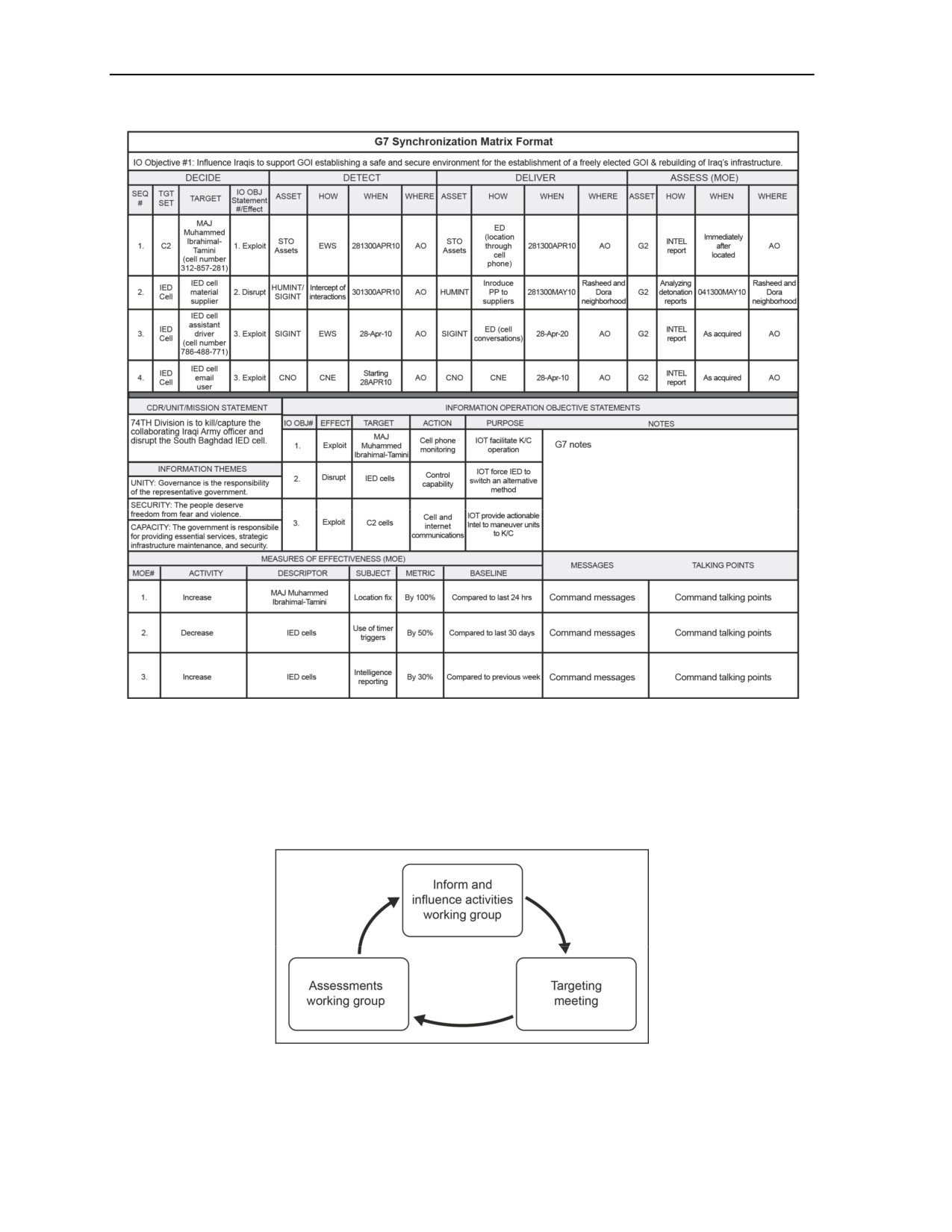
6-23. The primary tool employed by the G-7 (S-7) and refined and driven by the IIA working group is the
synchronization matrix (see figure 6-1 on page 6-6). The sample matrix is a comprehensive management
tool that ties together objectives, themes, messages, targets, and assessments. Used effectively, it helps the
staff ensure that themes, messages, and actions synchronize with each other and with operations to convey
a unified narrative of effects.
6-24. IIA primarily strive to maximize intended consequences and mitigate unintended consequences. The
G-7 (S-7) and the entire staff continually consider how to coordinate what the unit does with what it says
and vice versa. The synchronization matrix facilitates this coordination.
6-25. The top portion of the synchronization matrix covers the D3A portion developed during the targeting
meeting. The middle portion is refined and covered during the IIA working group as well as the themes and
messages throughout the targeting process. The measures of effectiveness portion at the bottom is
developed during the IIA working group and ratified during the assessments working group.
25 January 2013
FM 3-13
6-5
Chapter 6
Figure 6-1. Inform and influence activities synchronization matrix
6-26. The various staffs and organizations have different battle rhythms. At the targeting meeting, the
synchronization for conducting intelligence and operations is coordinated to achieve the desired effects for
the commander. Finally, the assessments working group considers the measures of effectiveness and
determines if the appropriate effects were achieved during the targeting cycle. At that point, the cycle
begins again to reengage those previously identified targets or engage new targets (see figure 6-2).
Figure 6-2. Battle rhythm
6-6
FM 3-13
25 January 2013
Chapter 7
Assessment of Inform and Influence Activities
This chapter discusses assessment of inform and influence activities. First, it
discusses the purpose of assessment. Then it discusses development of assessment.
PURPOSE OF ASSESSMENT
7-1. Assessments help commanders better understand current conditions. The commander uses
assessments to determine how the operation is progressing and whether the operation is achieving the
desired effects. Assessing the effectiveness of inform and influence activities (IIA) challenges both the staff
and commander. Assessment criteria must be measurable and tied to intermediate goals and end states.
Development of assessment criteria for an operation starts at the beginning of planning cycle. The IIA
section develops the mission and objectives for IIA. Each objective is supported by one or more measures
of performance (tasks) and measures of effectiveness. Within each measure of effectiveness are one or
more indicators that show progress towards achieving the desired outcome.
7-2. Assessment is the determination of the progress toward accomplishing a task, creating a condition, or
achieving an objective (JP 3-0). The evaluation of the operation against criteria of success allows the
commander and staff to make decisions and adjust the plan. Assessment entails the following three tasks:
z
Continuously assess the reactions and vulnerabilities of relevant audiences and targets.
z
Continuously monitor the situation and progress of the operation toward the commander’s
desired end state.
z
Evaluate the operation against measures of effectiveness and measures of performance.
7-3. The G-7 (S-7) uses a variety of means to conduct assessments, some internal to the organizations,
others external. When time and resources permit, multiple sources help to corroborate other sources and
strengthen the conclusions drawn from results. The commonly used sources are—
z
Intelligence assets.
z
Soldier and leader engagements.
z
Civil-military operations.
z
Polling and surveys, often conducted by contracted organizations.
z
Media monitoring and analysis, especially local channels.
z
Reports or information sharing with unified action partners.
z
Reports or conversations with local partners.
z
Passive monitoring, often by locals paid to submit reports of what they see and hear.
z
Patrol and spot reports.
ASSESSMENT DEVELOPMENT FOR INFORM AND INFLUENCE
ACTIVITIES
7-4. Assessment of goals and objectives is necessary when using various information-related capabilities
in the conduct of IIA shaping operations. Specific indicators to measure are extremely hard to establish and
must be identified early in the planning process. The identified indicators help the commander and staff to
assess the effectiveness of the shaping operation.
OBJECTIVE DEVELOPMENT
7-5. The unit mission, commander’s guidance, and an understanding of the information environment
provide the information required to shape the objective statement for IIA. The objective statement helps
25 January 2013
FM 3-13
7-1
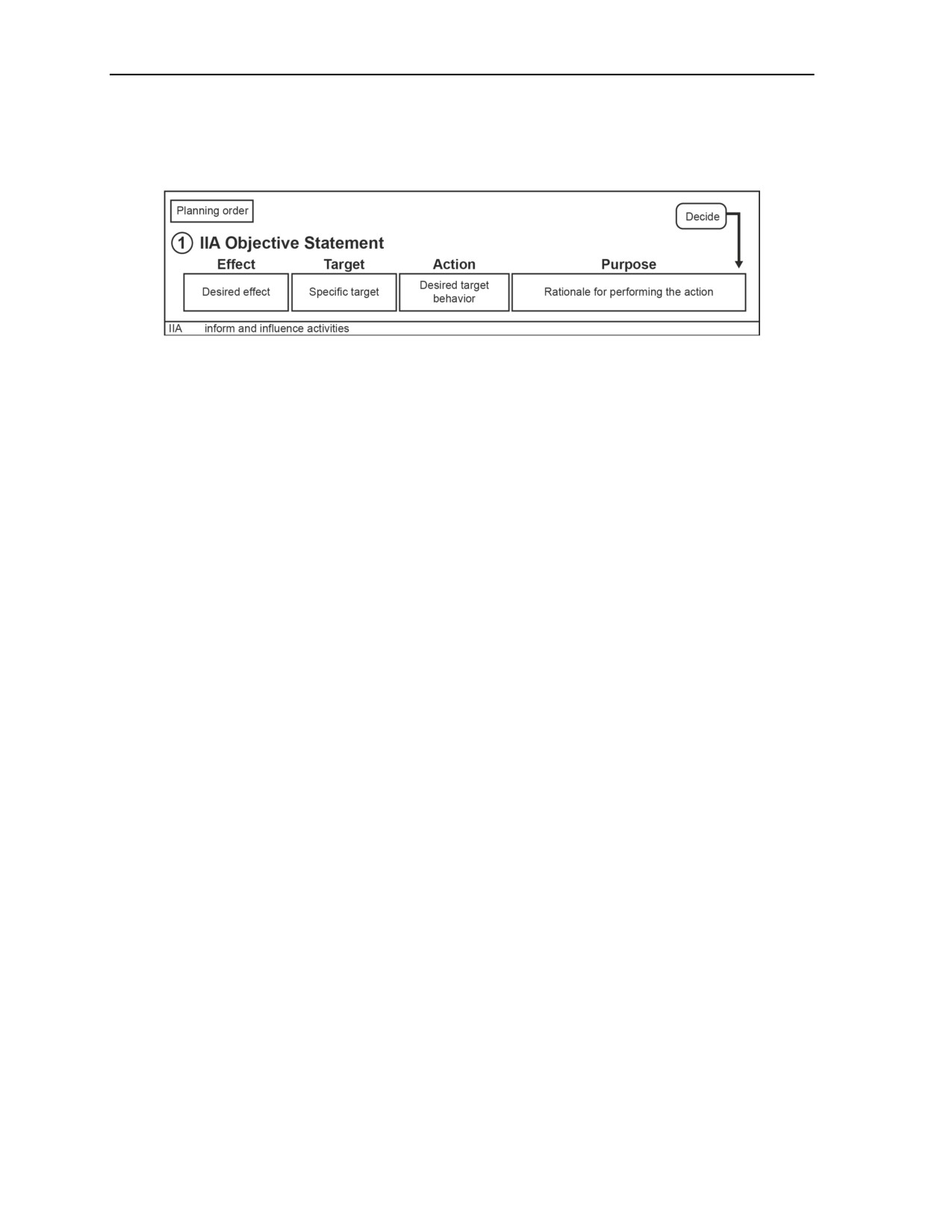
Chapter 7
staffs decide which effects and information-related capabilities they need to achieve the commander’s
intent in shaping the information environment. Figure 7-1 shows how to develop the IIA objective
statement through effect, target, action, and purpose.
Figure 7-1. Sample inform and influence activities objective statement
7-6. The effect describes the specific desired effect (or outcome). Normally inform or influence are the
most commonly used effects under the IIA construct. Additional effects such as deceive, degrade, deny,
destroy, disrupt, exploit, isolate, mitigate, and neutralize are discussed in ATTP 5-0.1. The backwards
planning process dictates the G-7 (S-7) start with the desired effect to ensure follow-on actions are
coordinated.
7-7. The target portion is a detailed description of the target audience. The specific target audience could
be a demographic of the population, an individual, or a defined area.
7-8. Action specifies the behavior or capability of the target audience. The desired target behavior of the
target audience must be measurable, observable, and specific. The units or assets tasked to observe and
report on the target audiences now have a specific criterion to refer to and can confirm or deny seeing the
desired target behavior.
7-9. Purpose explains and justifies the benefit for the target audience. It directly links to the commander’s
intent and mission. Purpose is the planned rationale for the operational benefit the targets’ behavior
demonstrates by performing this action.
7-10. The G-7 (S-7) starts with the effect (describes the desired outcome), identifies the target (describes
the detailed object of the desired effect), describes the action (specifies the capability of the target), and
justifies the purpose
(explains the benefit for the friendly force). In the objective of figure
7-4 (on
page 7-4), the effect is to influence, the target is the locals in the area of operations Kate, the action is to
vote in the upcoming elections, and the purpose is to show support for a democratically elected government
and an independent nation-state.
7-11. The decisionmaker identifies the desired effect before well-intentioned ideas waste staff sections and
limited resources. An effective G-7 (S-7) notes that the action phrase is measurable, observable, and
specific to ease observations and measurements. The G-7 (S-7) also notes that the staff uses the action
phrase to establish the measures of effectiveness as the subject.
7-12. The G-7 (S-7) develops three to five major IIA objectives during mission analysis. Staffs develop
additional subordinate IIA objectives during course of action development and war gaming. These
subordinate objectives are nested under a major IIA objective and have their own measures of effectiveness
and performance. Also noteworthy, the IIA objective statement is the decide portion of the targeting (D3A)
process (see Chapter 6).
MEASURE OF EFFECTIVENESS DEVELOPMENT
7-13. Measures of effectiveness measure the results of the overall mission and execution of IIA objectives.
More practically, measures of effectiveness determine if a desired condition or outcome is in place (that is,
effect), even if it has not been directly caused by planned military action. The G-7 (S-7) writes objectives to
articulate a specific condition or state in an operational environment. Most measures of effectiveness are
crafted and used to measure the effects generated by those tasks collectively executed to achieve each IIA
7-2
FM 3-13
25 January 2013
Assessment of Inform and Influence Activities
objective. The G-7 (S-7) also develops more than one measure of effectiveness per objective statement and
increases IIA assessment quality.
7-14. Measure of effectiveness is a criterion used to assess changes in system behavior, capability, or an
operational environment. It is tied to measuring the attainment of an end state, accomplishment of an
objective, or creation of an effect. Measure of effectiveness describes what the specific target (audience)
needs to do to demonstrate accomplishment of a desired effect. Since the IIA objective identified the
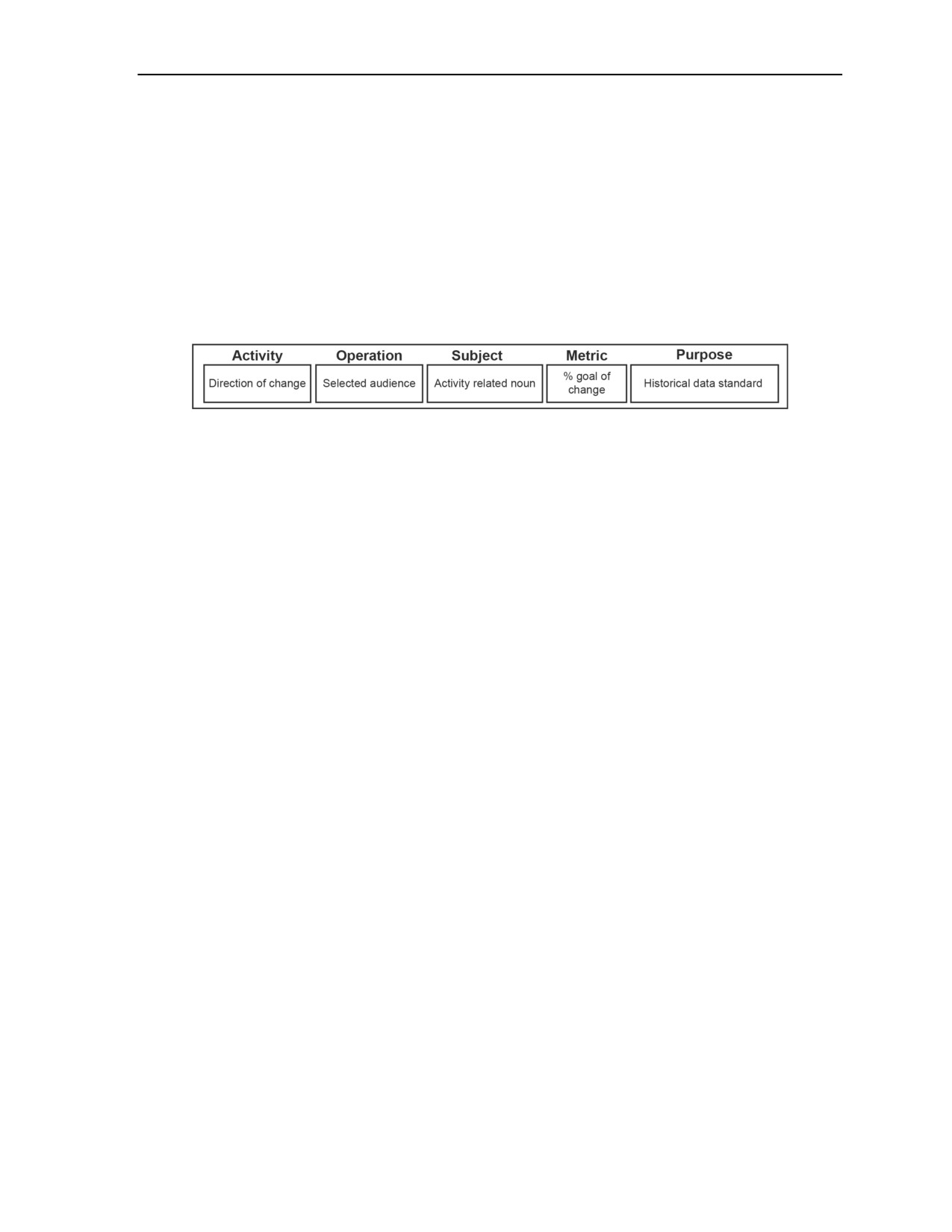
desired effect first, the G-7 (S-7) determines how to measure the desired effect. The activity, descriptor,
subject, metric, and baseline need to form a measure of effectiveness. Other observable actions can only be
considered as indicators if they are not tied to activity, descriptor, subject, metric, and baseline. They may
be subject to scrutiny due to a lack of proper statistical support. Figure7-2 shows how each part of activity,
descriptor, subject, metric, and baseline leads to a measure of effectiveness.
Figure 7-2. Measure of effectiveness components
7-15. The activity specifies a desired direction of change (increase or decrease). Increasing or decreasing
describes how the specific subject (noun) is desired to change.
7-16. The descriptor is a restatement of the target mentioned in the IIA objective. The descriptor is the
target audience and is responsible for performing the activity.
7-17. The subject is a noun related directly to the effected activity. The subject is what the G-7 (S-7) is
trying to influence the target to do. The subject is the measurable, observable, and specific item that
observers or other tasked assets can note.
7-18. The metric is the numerical percentage threshold of effectiveness that the G-7 (S-7) derives from the
military decisionmaking process, commander’s guidance, research, and analysis. The metric is the
percentage goal of how much the specific activity will change to prove effectiveness.
7-19. The baseline is the historical measure from which the current metric is determined to show statistical
or acceptable significance. The G-7 (S-7) may have to establish a baseline metric, if no historical metrics
exists. In some cases, it may take the G-7 (S-7) several months to establish a baseline. The lack of a
historical basis for comparison lengthens the time to determine if the measure of effectiveness is successful.
MEASURE OF PERFORMANCE DEVELOPMENT
7-20. The G-7 (S-7) develops the measure of performance after the staff identifies the desired effect and
develops a method to assess the effectiveness of pursuing the desired effect. Measure of performance is a
criterion used to assess friendly actions tied to measuring task accomplishment. Measure of performance
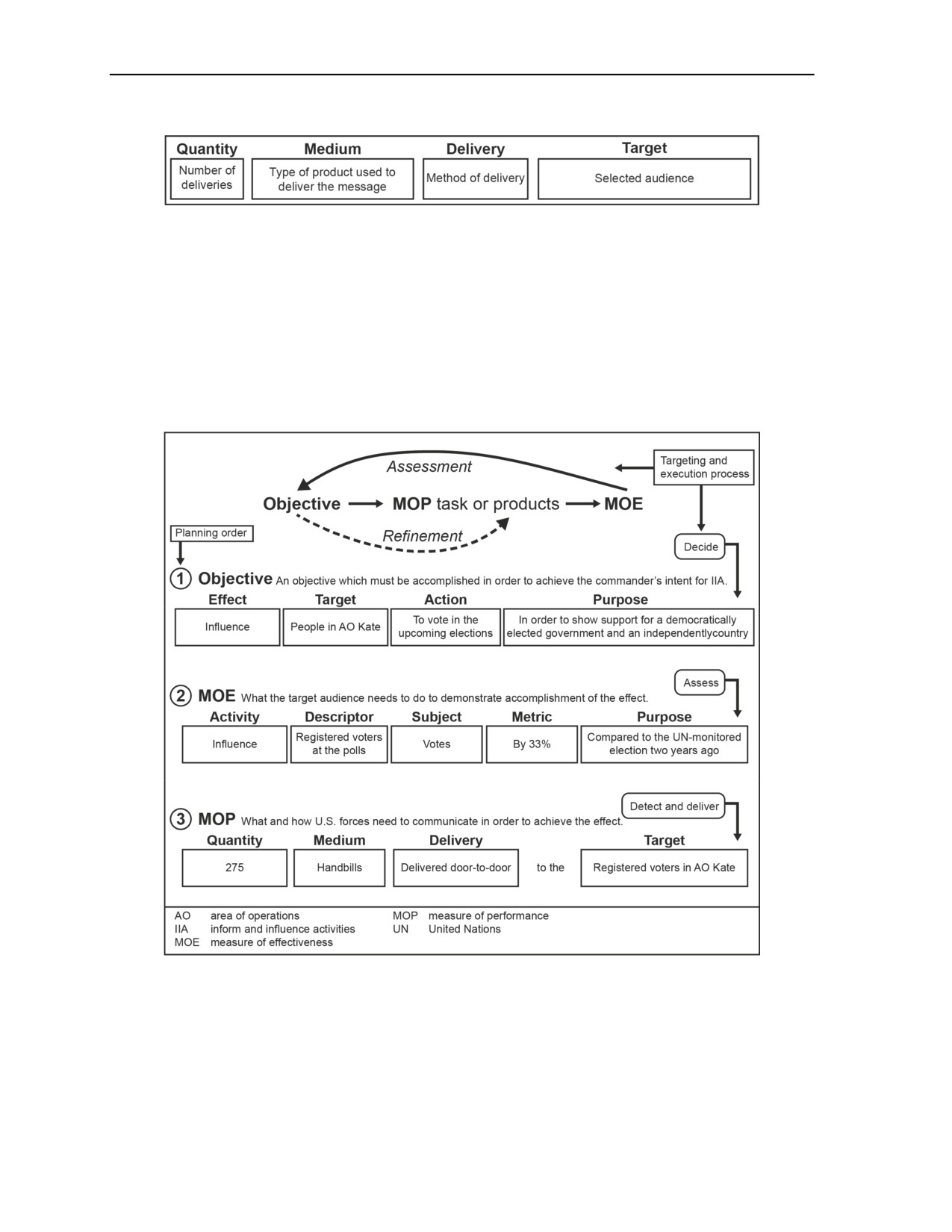
describes what and how Army forces need to communicate to achieve the desired effect. Figure 7-3 on
page 7-4 shows the key components for developing a measure of performance.
7-21. The quantity states the number of broadcasts or deliveries of a message or product. For example, it
can state the number of night patrols.
7-22. The medium describes the product format used to disseminate the message. The medium can
describe any type of print, broadcast, electronic, physical, or personal method to disseminate a message or a
talking point.
7-23. The delivery states how and where U.S. forces delivered the medium or product to the audience. The
delivery method helps to define how a selected audience reacts to a mode of delivery. The specific delivery
method also allows units and assets to support the measure of performance.
7-24. The target provides a detailed description of the selected audience as described in the IIA effect.
Again, an effective G-7 (S-7) diligently identifies and selects an audience to better allocate assets and better
enable units to incorporate assessments into their operations.
25 January 2013
FM 3-13
7-3
Chapter 7
Figure 7-3. Measure of performance components
7-25. IIA cannot generate effects if information-related capabilities do not execute tasks successfully. As
such, assessment accounts for task execution. Because task completion affects execution as well as
assessment, representatives and subordinate units of information-related capabilities report accomplishment
of their respective tasks. Performance measures are not measures of success—they gauge task completion.
7-26. Measures of performance are future operations the G-7 (S-7) needs information about from units and
fellow staff to generate effects. The G-7 (S-7) realizes the measure of performance nests in the detect and
deliver portion of targeting. Figure 7-4 shows a completely developed measure of performance in terms of
quantity, medium, delivery, and target.
Figure 7-4. Assessment methodology for the information objective
7-4
FM 3-13
25 January 2013
Chapter 8
Soldier and Leader Engagement of Inform and Influence
Activities
This chapter discusses Soldier and leader engagement. It first discusses the purpose
of and defines Soldier and leader engagement. Then it identifies the principles of
Soldier and leader engagement. It details the types of Soldier and leader engagement.
This chapter then discusses mission command and Soldier and leader engagement. It
concludes with a discussion of the engagement process.
PURPOSE OF SOLDIER AND LEADER ENGAGEMENT
8-1. Soldier and leader engagement is interpersonal interactions by Soldiers and leaders with
audiences in an area of operations. It can occur as an opportunity, a face-to-face encounter on the street,
or a scheduled meeting. This interaction can also occur via telephone calls, video teleconferences, or other
audiovisual mediums. Soldier and leader engagement supports both inform and influence lines of effort in
the inform and influence activities (IIA) construct. Soldiers and leaders conduct this engagement to provide
information or to influence attitudes, perceptions, and behavior. This engagement provides a venue for
building relationships, solving conflicts, conveying information, calming fears, and refuting rumors, lies, or
incorrect information. Effectively integrating Soldier and leader engagement into operations increases the
potential for commanders to mitigate unintended consequences, counter adversary information activities,
and increase local support for friendly forces and their collective mission.
8-2. Commanders lead Soldier and leader engagement efforts and prepare subordinates for conducting
Soldier and leader engagement activities throughout unified land operations. A fundamental and complex
duty of a land force involves Soldiers having to operate among local audiences. Often, audiences in an area
of operations look, act, and think differently from Soldiers. Sometimes the aims and ambitions of even a
friendly or neutral audience fail to align with those of Soldiers and leaders. As such, Soldiers and leaders
prepare to bridge these differences to build alliances, to encourage cooperation and noninterference, and to
drive a wedge between the friendly and neutral audiences and adversary and enemy audiences.
8-3. Soldier and leader engagement is a component of a commander’s communication strategy
implemented by the G-7 (S-7) through IIA. The commander’s communication strategy includes—
z
Public affairs engagements, especially with the media.
z
Planned, targeted messages and actions by military information support operations (MISO) with
selected foreign audiences.
z
Civil-military operations, such as humanitarian civic assistance.
z
Military civic action projects.
z
Engagements, such as those to support security force assistance efforts, and the capturing of key
civil data.
PRINCIPLES
8-4. In IIA, the following six principles characterize the effective conduct of Soldier and leader
engagement to support decisive actions:
z
Consistent.
z
Culturally aware.
z
Adaptive.
z
Credible.
25 January 2013
FM 3-13
8-1
Chapter 8
z
Balanced.
z
Pragmatic.
CONSISTENT
8-5. Soldier and leader engagements are consistent when they communicate the same essential meaning
as other operational activities. Achieving consistency requires that commanders and their staffs understand
effects in cognitive terms—the perceptions and interpretations that various actors and populations assign to
operations and the conditions they cause. Soldiers and leaders lose credibility when audiences perceive
engagement dialogue (words) as inconsistent with observable behavior (actions).
CULTURALLY AWARE
8-6. Soldiers and leaders conduct this engagement in the context of local customs, beliefs, and ways of
communicating. Doing so builds understanding and cooperation while mitigating insensitivities and
mistrust. Beyond familiarization with cultural practices, interacting with cultural awareness requires that
Soldiers and leaders understand each population’s communication style (direct versus indirect), their value
of relationship over task, and their attitude toward time. A cultural support team facilitating an engagement
illustrates how cultural awareness enhances Soldier leader engagement. Cultural support teams often
consist of female Soldiers so teams can interact with indigenous women in regions where contact between
an unrelated male and female is culturally unacceptable. Specially configured teams, such as cultural
support teams, enable friendly forces to interact with a key demographic group while respecting cultural
norms.
8-7. Indigenous communicators and leaders are sometimes the most effective at framing messages for
populations in the area of operations. In the past, commanders and staffs have developed messages
unilaterally from their own cultural perspective and simply translated or interpreted them into the local
languages or dialects. Invariably, the intended message got lost in translation or the message conflicted
with local views or norms. Leveraging key leaders or actors from target audiences allows units to draw on
their familiarity and credibility with those same selected audiences. It increases the likelihood that an
interaction will inform or influence audiences as desired. Understandably, units balance the use of such
individuals against security concerns. Units employ trained influence specialists
(such as military
information support and noncommissioned officers) and resident cultural experts (such as foreign area
officers or political advisors at higher-level headquarters) to carefully craft messages for delivery through
culturally and linguistically familiar means.
ADAPTIVE
8-8. Adaptability is the ability to shape conditions and respond to a changing operational environment
with appropriate, flexible, and timely actions. Effective Soldier and leader engagement depends on
adaptability. Adaptability relies on Soldiers and leaders who can think critically and use reasonable
judgment, are comfortable with ambiguity, are willing to accept prudent risk, and have the ability to rapidly
adjust to evolving situations. Military information support personnel often conduct Soldier and leader
engagement and program management because of their assessment and selection process, training, and
education. Soldier and leader engagement ties into the overall MISO influence effort.
8-9. Recognizing the interpersonal and often cross-cultural nature of Soldier and leader engagement,
adaptability requires a commitment to learning. Successful adaptation requires acknowledging that in-depth
understanding of the target audience in an area of operations can improve communication. Engagement
characterized by an assumed superiority—a conviction that a message’s inherent rightness disqualifies it
from audience scrutiny—fails to support the conditions necessary to discover and adopt effective
communication approaches. Thus, effective Soldier and leader engagement is more about dialogue and
advising rather than dictating expected behavior.
CREDIBLE
8-10. Successful Soldier and leader engagement depends on trust. A fundamental criterion for trust is the
degree of confidence populations have in the credibility of the Army forces with whom they interact.
8-2
FM 3-13
25 January 2013
Soldier and Leader Engagement of Inform and Influence Activities
Openness and transparency, with consideration for operations security, are fundamental to this effort. Thus,
credibility results from an observable, sustained, and consistent pattern of factual words and principled
deeds attuned to the local culture.
8-11. Establishing habitual relationships between U.S. leaders or Soldiers and representatives of key
audiences helps to promote credibility. The habitual partner becomes the primary conduit through which
information is passed. A conduit reduces the likelihood of information fratricide—the chance that key
audiences will receive conflicting messages or commitments from U.S. or friendly partners. It also reduces
engagement fatigue. Engagement fatigue happens when a single audience becomes overwhelmed by the
number of Soldier and leader engagements in which it must participate. At higher levels, these habitual
engagements form the basis of strategic partnering, which is especially important to security force
assistance and building partner capacity.
BALANCED
8-12. Soldiers and leaders balance their engagement efforts between the inclination to achieve the desired
effect and the requirement to actively listen and understand another’s point of view. During a single Soldier
and leader engagement, Soldiers or leaders may achieve little more than increased understanding of the
audience with whom they interact. Increased understanding is an acceptable objective for a Soldier and
leader engagement. Understanding is critical to the success of subsequent Soldier and leader engagement as
it lays the foundation for establishing solid relationships. A balanced approach to engagements helps to
ensure both parties benefit from the event.
8-13. Imbalanced Soldier and leader engagement tends to have one-way communications, implying that
people mutely receive information. Typically, this imbalance creates an audience perception that a Soldier
considers the audience and their ideas irrelevant, leaving the audience feeling disrespected and
marginalized. These perceptions potentially become significant obstacles to future engagements and
achieving a commander’s intent.
PRAGMATIC
8-14. Communicating is difficult to predict and control. Pragmatic Soldier and leader engagement accepts
the unpredictable, often opaque, nature of communications and operates with realistic expectations of
message control. Leaders guide what their units say and do. However, they cannot control how others
interpret friendly force messages and actions. Soldiers and leaders understand that the cultures, biases,
religions, education, and experiences of the individuals and groups observing them shape perceptions or
interpretations. Given the prevalence of technology, Soldiers and leaders cannot control who eventually
receives communications beyond the intended receiver.
8-15. Pragmatism reflects an expectation and acceptance of prudent risk. Effective Soldiers and leaders
expect small setbacks. Nurturing relationships and building trusted networks sometimes entails interacting
with untrustworthy individuals. Soldiers and leaders may even reveal those maligned actors who previously
went undetected.
8-16. Engagements with the local population and key leaders is a long-term, building effort assessed in
terms of months or years rather than in hours or days. Pragmatism acknowledges that the effects of Soldier
and leader engagement may not be immediately achievable or recognizable. Influencing audiences in an
area of operations requires credibility. Building credibility, or trust, requires repeated and meaningful
interaction. Recognizing any resulting change from these interactions requires familiarity or experience
with the culture in which the Soldier and leader engagement occurs.
TYPES OF SOLDIER AND LEADER ENGAGEMENTS
8-17. In IIA, two types of Soldier and leader engagements exist—deliberate and dynamic. Deliberate and
dynamic engagements differ in planning and execution.
25 January 2013
FM 3-13
8-3
Chapter 8
DELIBERATE ENGAGEMENTS
8-18. Deliberate engagements are anticipated and planned interpersonal interactions that achieve a
specified effect or accomplish a specific objective. These engagements may be face-to-face interactions or
they may be interactions via other means, such as telephone or video teleconference. Examples of
deliberate engagements include—
z
Scheduled meetings with key communicators or formal leaders.
z
Participation in the planned opening of a local school.
z
Delivery of information to a ministry official.
8-19. Effective deliberate Soldier and leader engagement integrates other information-related capabilities.
This integration aims to achieve or complement desired effects. Examples of the integration of other
information-related capability Soldier and leader engagements include—
z
Humanitarian and civic assistance.
z
MISO, such as delivery of products to target audiences.
8-20. Soldier and leader engagement involves method planning. As the Army’s primary influence
capability, military information support Soldiers are trained, educated, equipped, and organized to plan,
conduct, monitor, and assess engagement with foreign populations and select audiences. This includes
planning the engagements with foreign populations, leaders, key communicators, and others with the
specific intent to influence the commander’s objectives.
DYNAMIC ENGAGEMENTS
8-21. Dynamic Soldier and leader engagement interactions are unanticipated or impromptu encounters for
which Soldiers and leaders have not conducted deliberate planning. Dynamic interactions occur frequently.
They may be spontaneous face-to-face conversations with local civilians during dismounted patrols or
unsolicited visitations by local leaders to an operating base or combat outpost.
8-22. Although unplanned, effective leaders prepare their subordinates at all levels to negotiate impromptu
interactions successfully before and during deployment. Preparation for Soldier and leader engagement
starts as early as initial entry training when Soldiers begin internalizing the Army Values found in ADP 1.
Displaying respect for others and communicating honestly (integrity) inevitably increases the likelihood of
positive outcomes in any human interaction. Training for law of land warfare, rules of engagement, and
culture as well as role-playing exercises prepare Soldiers and leaders to have successful interactions.
MISSION COMMAND AND ENGAGEMENTS
8-23. IIA is an essential component of mission command. Mission command seeks to empower
subordinates to lead at their levels. As Soldiers conduct Soldier and leader engagement, they use discipline
and professionalism in day-to-day interactions. Such interaction amplifies positive actions, counters enemy
propaganda, and increases good will and support for the friendly mission. These engagements provide the
most convincing venue for conveying positive information, assuaging fears, and refuting rumors, lies, and
misinformation. Conducted with detailed preparation and planning, interactions often prove crucial in
garnering local support for Army operations, providing an opportunity for persuasion, and reducing friction
and mistrust.
8-24. Commanders are the key engagers because their position and authority often invest them with the
greatest degree of credibility and access to undertake engagements. They do more than simply model
appropriate actions. During stability operations in particular, commanders maximize interactions with the
local populace through frequent Soldier and leader engagement. Doing so enables commanders to—
z
Assess attitudes, beliefs, and behaviors first-hand.
z
Sense shifts in perceptions, both positive and negative, and take appropriate action.
z
Engender the trust and confidence of the local populace.
z
Sense and map the social networks active in the area of operations.
z
Confirm who the key leaders are, as well as trusted, credible voices, both formal and informal.
8-4
FM 3-13
25 January 2013
Soldier and Leader Engagement of Inform and Influence Activities
z
Bolster confidence in and consensus behind effective and mission-supportive local leaders.
z
Deliver messages.
z
Assess how effectively units synchronize words, images, and actions and make needed
refinements.
z
Quickly address adversary information.
z
Ensure Soldiers and subordinate leaders effectively engage the populace in their areas.
8-25. Commanders foster a culture to achieve both their vision and their unit’s mission. As commanders
seek to shape a culture that exhibits and upholds the Army Values (among many other shared beliefs and
practices), they shape a culture of engagement. This culture buoys Soldiers’ confidence to engage many
audiences, especially the populace in which they operate. Commanders may foster a culture of engagement
in multiple ways:
z
Guidance in the development of a robust communication strategy.
z
Reporting and critical information requirements.
z
Organization of the staff.
z
Employment of public affairs and MISO for advice and assistance.
z
Leading by example (such as actively conducting engagements).
z
Training requirements (cultural, language, and negotiation training).
z
Ensuring resources are provided to staff (manning, funds, and time).
z
Building partner capacity with unified action partners.
8-26. Critical to fostering a culture of engagement is the commander’s supplying subordinates with proper
training and guidance. The commander’s themes and messages and unit cultural and language training
requirements provide subordinates with critical tools for engagements. Still, Soldiers and leaders will likely
make mistakes as they navigate the values and norms of an unfamiliar culture. Commanders balance their
response to cultural and linguistic missteps with the task to actively seek engagement with target audiences.
8-27. The staff actively contributes to the operations process and Army design methodology. The staff then
takes the outcome of the commander’s intent and guidance and turns it into plans and orders. Staff
responsibilities include the following:
z
Develop an overall IIA plan nested in the commander’s intent.
z
Plan and assess individual engagements.
z
Synchronize actions with images as a reinforcing mechanism.
z
Prevent information fratricide.
z
Make maximum use of resources.
z
Develop synchronization and execution matrixes.
z
Ensure information sharing.
z
Coordinate through the G-7 (S-7) for other information-related capabilities to support planning
and execution of Soldier and leader engagement.
z
Help the commander in developing themes and messages.
z
Utilizing the targeting process, integrate and synchronize deliberate engagements, and ensure
deconfliction.
z
Analyze target audiences or individuals of interest; provide targeting packets.
z
Collect, analyze, and maintain engagement data.
z
Assess results of engagements.
z
Coordinate refinement of future engagements.
z
Recommend reengagement.
z
Update the IIA running estimate.
8-28. Chapter 4 discusses other staff responsibilities during the planning process. Chapter 3 discusses
information-related capabilities and IIA in the planning process.
25 January 2013
FM 3-13
8-5
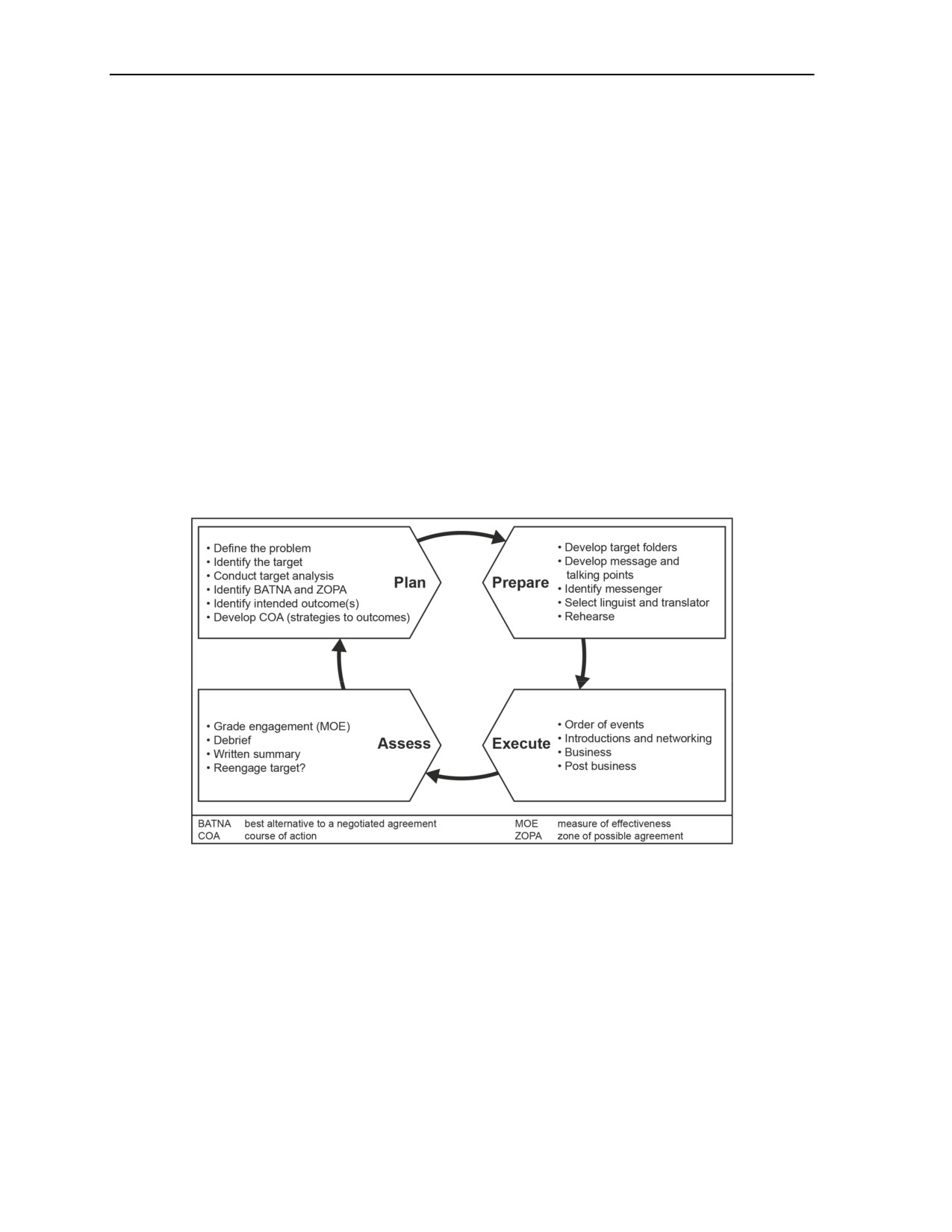
Chapter 8
ENGAGEMENT PROCESS
8-29. Soldier and leader engagements involve detailed planning. They also involve developing the
commander’s intent, messages, and intelligence preparation of the battlefield (IPB) with specific focus on
the information environment, rules of engagement, and an assessment of the area of operations. Throughout
the engagement process, staffs consider all these elements and develop them further.
8-30. The engagement process for Soldier and leader engagements nests with the operations process of
plan, prepare, execute, and assess (see figure 8-1). Each requirement in the engagement process details
requirements for successful Soldier and leader engagements. The G-7 (S-7) has responsibility to integrate
all information-related capabilities into the overall operations process for the commander. The G-7 (S-7)
coordinates with the military information support planner to ensure Soldier and leader engagements are
synchronized with all other information-related capabilities.
PLAN
8-31. Commanders decide what they want to achieve during engagements with their various engagement
targets and target audiences in the area of operations. Soldier and leader engagement objectives nest with
the commander’s intent and the overall objectives established to attain the commander’s desired end state.
The G-7 (S-7) makes the necessary recommendations to the commander for Soldier and leader engagement
objectives and ensuring these objectives nest with and support the commander’s intent and overall
objectives.
Figure 8-1. Engagement process
8-32. The G-7 (S-7) provides recommendations to the commander for the frequency and timing of Soldier
and leader engagements. Continuous messaging to the engagement target and target audiences requires
subordinate leaders and Soldiers to have detailed guidance for the time and frequency of engagements.
Leaders verify that the timing of the engagement does not conflict with other operations. Effective
commanders coordinate and synchronize engagement activities using a working group occurring in the
unit’s battle rhythm such as the IIA working group. This ensures the optimal timing of engagements and
mutual support of other information-related capabilities and ongoing operations.
8-33. The G-7 (S-7) recommends engagement targets to the commander for approval as a part of unit battle
rhythm and targeting cycle decision briefs. During their IPB planning efforts, the G-7 (S-7) recommends to
the commander who to engage, when to engage, and where to engage the target audience. When deciding
those involved, the G-7 (S-7) identifies the key informal and formal leaders, key communicators, actors,
and other influential personalities in their area of operations. Soldier and leader engagements are ideally
8-6
FM 3-13
25 January 2013
Soldier and Leader Engagement of Inform and Influence Activities
targeted engagements deliberately planned using the analysis conducted during IPB. Critical to this process
is the social and link analysis to determine the scope of influence that each engagement target may have.
Properly identifying leader engagement targets maximizes the second- and third-order effects of the
delivered messages. Leader engagement targets with a broader scope of influence potentially create a larger
cascading effect across the area of operations.
8-34. The G-7 (S-7), in coordination with MISO planners, utilizes this analysis to determine the command
themes and messages to emphasize to specific target audiences during Soldier and leader engagements.
These command themes and messages must nest with the command themes and messages of the higher
headquarter and the MISO themes and messages for that area of operations. The G-7 (S-7) also ensures
command themes and messages align with any published public affairs guidance to avoid delivering
conflicting messages. Specific engagement targets and target audiences must have reinforced messaging
through other outputs as affected by additional information-related capabilities in the information
environment. To ensure maximum effect on the engagement targets and target audiences, the G-7 (S-7)
synchronizes these additional information-related capabilities outputs for consistency with Soldier and
leader engagement messages. Military information support forces have the best qualifications to analyze
operational environments and populations in those environments.
8-35. The G-7 (S-7) coordinates closely with other staff elements and subordinate units to recommend the
best venue for a planned Soldier and leader engagement. This venue selection maximizes the opportunity
for success in accomplishing the desired objective or attaining the desired end state. The G-7 (S-7)
integrates and synchronizes other information-related capabilities with the venue to maximize the
opportunity for operational success. Commanders determine the best location and setting in which to
conduct Soldier and leader engagements. The combined information overlay, intelligence estimates,
cultural assessments, and running estimates often influence the venue selection for Soldier and leader
engagements. Furthermore, target audiences seek their own engagements with Soldiers and leaders.
Examples of Soldier and leader engagement venues include—
z
Private meetings.
z
Local government meetings.
z
Civic, market, or community meetings.
z
Public forum or town hall meetings.
z
Civil affairs operations.
z
Civil military operations.
z
Face-to-face public interactions.
z
Telephone conversations.
z
Video teleconferences.
PREPARE
8-36. Soldiers and leaders prepare for deliberate engagements as they would any task or mission. Some IIA
preparation such as language and cultural preparation occurs before deployment. Cultural understanding,
survival-level language, and negotiation training prepare Soldiers and leaders to address the typically
unfamiliar and dynamic foreign environment encountered during an engagement.
Engagement Plan
8-37. The G-7 (S-7) can prepare Soldiers and leaders for an engagement by organizing the event into three
distinct steps: introduction, business, and post-business. These steps form the engagement plan by
providing a logical structure to the engagement and details for the engagement work sheets (see figure 8-2).
For an effective Soldier and leader engagement, the G-7 (S-7) uses local customs, etiquette, and beliefs to
guide and inform planning of each of these steps. Ignoring such key details detracts from the overall
effectiveness of a deliberate engagement and contributes to not accomplishing the desired objective or
attaining the desired end state for an engagement.
25 January 2013
FM 3-13
8-7
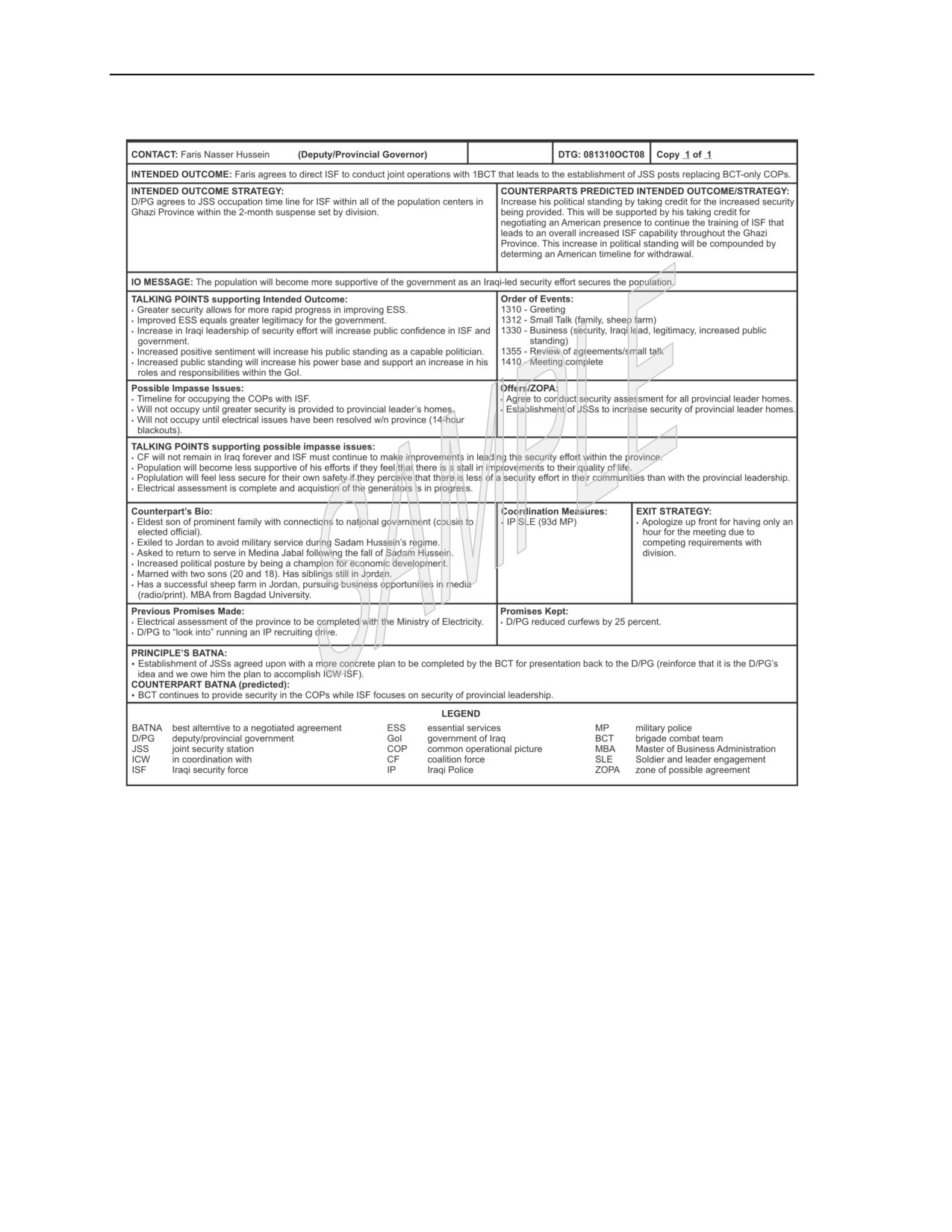
Chapter 8
Figure 8-2. Sample engagement work sheet
The Introduction
8-38. The introduction potentially sets the tone for the remainder of the engagement. Some key
considerations to observe during the introduction step include—
z
Position immediately next to the engaged audience and ensure the designated process has
enough access to record accurate details of the meeting.
z
Establish rapport with the engaged audience. Use the appropriate greeting phrase in the native
language, when possible. If hosting the engagement, adhere to as many local customs as
applicable.
z
Introduce and record the names and positions of everyone in attendance.
z
Follow the norms provided by the local culture and customs during the introduction. If it is
appropriate to serve a beverage, offer small talk, and discuss personal issues, then be prepared to
do so.
z
Apologize in advance for any cultural mistakes made and comment they are not intentional. Ask
the engaged audience to please identify any mistakes made for learning and future engagements.
8-8
FM 3-13
25 January 2013
Soldier and Leader Engagement of Inform and Influence Activities
z
Be careful about telling jokes; they can backfire when translated.
z
Transition from the introduction step to the business step with a prepared transition. Do not just
bluntly start speaking to the specifics of the meeting if the local custom does not dictate such
behavior.
Business
8-39. The business step is the focus of the engagement. In this step, the spokesperson uses the planned
talking points and works toward the zone of possible agreement (ZOPA) for the given engagement.
Soldiers consider the following during this step:
z
Avoid making or implying promises that cannot be kept.
z
Use open-ended questions to facilitate discussion. Yes or no answers tend to be incomplete and
inaccurate.
z
Address all talking points relevant to the engagement. Utilize the talking points to focus the
discussion and reduce any wasted time.
z
Focus on avoiding or overcoming impasses and working toward the anticipated ZOPA.
z
It may be necessary at times to restate or reframe a question or statement. Reframing ensures
that what is said is not misunderstood and helps communicate the meaning when working
through an interpreter.
z
Have a planned signal with the process observer or other assistant for any situation where the
spokesperson may need to break from the engagement (for example, someone has called for the
spokesperson to return to the headquarters due to an unforeseen emergency).
Post-Business
8-40. Post-business includes—
z
Summarizing what both parties agreed to and clarifying expected actions by both parties.
z
Agreeing on a general date for a follow-up engagement, if required.
z
Taking a photo with the engaged audience to build rapport and use in subsequent engagements
as a gift to be presented in an effort to create a feeling of reciprocity.
z
Receiving a thorough debriefing from the G-7 (S-7) of the process observer, translator, and
spokesperson as soon as possible following the engagement.
8-41. Using engagement reports for post-business effectively captures important information from an
engagement to share with other commands or staff sections. The G-7 (S-7) integrates engagement reporting
with routine reporting systems and mechanisms common to the unit and its higher headquarters. Regardless
of the reporting conduit, a timely engagement report ensures situational awareness across the area of
operations. For units with engagement targets that have patterns of life beyond their unit boundaries,
situational awareness can potentially impact adjacent units and the higher headquarters.
8-42. Effective engagement reports include—
z
Reporting unit with contact information.
z
Engagement target name, demographic data, and location.
z
Known affiliations and personality links of the engagement target.
z
Purpose for the engagement.
z
Background of the engagement and synopsis of previous engagements.
z
Attendees.
z
Summary of the engagement outcome and duration.
z
Additional atmospherics and attitudes.
z
Initial assessment of success in reaching intended outcome.
z
Promises made.
z
Date-time group of agreed follow-up meeting (if required).
25 January 2013
FM 3-13
8-9
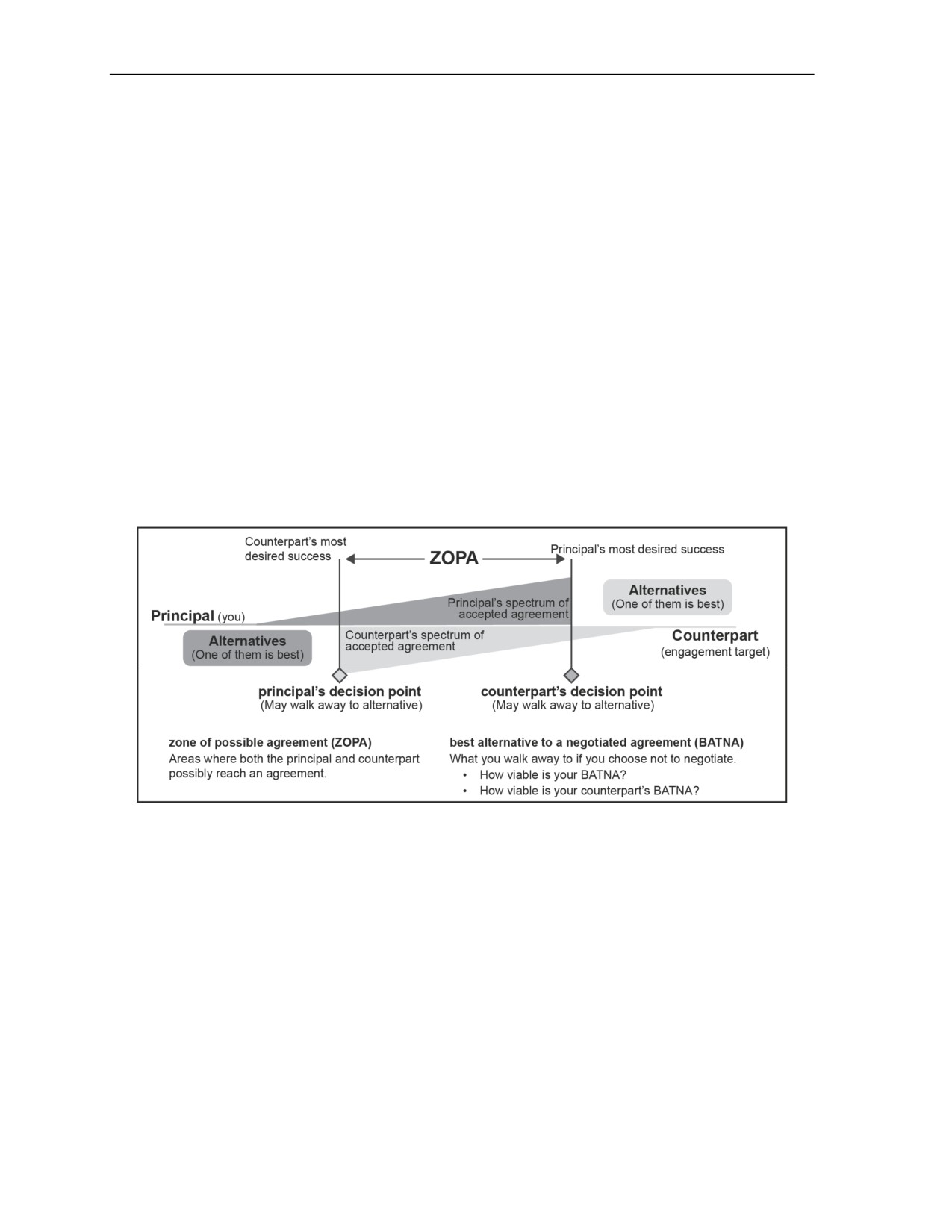
Chapter 8
Negotiations Preparation
8-43. Preparing for Soldier and leader engagements includes deliberately planning through a process that
identifies the intended outcome or desired end state for the engagement. Specifically for Soldier and leader
engagements, pre-engagement analysis identifies the commander’s desired end state of the engagement, the
target’s desired end state, and the consequences from not attaining the desired end states for both parties.
Typical negotiation strategies label these determinations as the best alternative to a negotiated agreement
(BATNA) and the ZOPA. The BATNA identifies what each party is walking away to in the event that there
is no achievement of a desired end state. A BATNA can be conditions, situations, numeric quantities, or
alternate solutions to be pursued through subsequent Soldier and leader engagement with other parties. The
ZOPA identifies the area where the principal’s desired end state overlaps with that of the engagement
target’s. In this area, both can agree to the parameters of a solution or outcome for which the engagement
was designed to achieve. In Soldier and leader engagements, this outcome could be to inform or influence
the engagement target, and it may not necessarily be an agreement that provides a tangible result. In such a
scenario, the ZOPA may relate more to incentives applied to influence the engagement target or to the level
or quantity of details that provide the target enough insight to be considered informed. An effective
principal prepares to address potential impasses that may hamper engagement efforts. To have a successful
engagement, principals identify potential impasses during planning and develop strategies that properly
address them in order. Additionally, attaining the desired end state involves not only the principal reaching
an objective, but engagement targets feeling as though they gained something of value from the meeting.
Commanders, staffs, and ultimately the engagement target must view any Soldier and leader engagement as
a win-win and not as a win-lose situation (see figure 8-3).
Figure 8-3. ZOPA and BATNA
Other Necessary Information
8-44. Units have numerous methods for capturing the data necessary to conduct engagements while
deploying in overseas contingency operations. In preparation for conducting an engagement, leaders know
or have the following information:
z
Engagement target’s name.
z
Title or role of subject or target.
z
Relevant affiliations of target (religious, political, social link analysis).
z
Location of the engagement.
z
Date-time group of the engagement.
z
Picture (if available).
z
Pictures of other personalities accompanying the target.
z
Others to be present at engagement and summary of relevance to event.
8-10
FM 3-13
25 January 2013
Soldier and Leader Engagement of Inform and Influence Activities
z
Commander’s intent or desired end state of the engagement.
z
Best alternative to negotiated agreement (if negotiating) for both parties.
z
Zone of possible agreement between parties.
z
Supported themes, messages, and specific talking points.
z
Local grievances or sensitive issues.
z
Summary of previous engagements (if conducted) should include agreements made, kept, and
those unmet.
z
Updates on target’s actions or situations the target was involved in since last meeting.
z
Agenda for the leader engagement (general order of events).
8-45. In preparation for an engagement, review relevant guidance from the higher headquarters as well as
recent updates to running estimates or activity in the area of operations. Reviewing the commander’s intent,
command themes and messages, and public affairs guidance decreases the risk that information provided or
action taken during a Soldier and leader engagement contradicts higher-level guidance and themes. Finally,
review local grievances and enemy activity. Understanding the issues most relevant to engagement targets
and the target audience allows the Soldier to plan responses to potential accusations or queries.
8-46. IIA units rehearse planned engagements under conditions that closely approximate the environment
and conditions in which they will conduct the engagement. If they use an interpreter, include the interpreter
in the rehearsal. Rehearse the planned dialogue used during the Soldier and leader engagement or use a
back-translation for a document. (A back-translation is a translated document translated back into the
original language and then compared with the original to ensure the meanings match.) Following these
procedures helps in mitigating the risk of information fratricide.
EXECUTE
8-47. During the execution of an engagement, a Soldier or leader considers the following:
z
Avoid rushing through the meeting. Plan for enough time to accommodate the culture and avoid
making the engaged audience feel they are low on the priority list. Prepare for small talk before
discussing business. Take cues from the audience.
z
Ask permission to take photos of the engaged audience. Staffs can later use these photos to
update personality profiles and target folders.
z
Never assume the engaged audience does not speak or understand English.
z
When listening or speaking, always maintain eye contact with the audience Watch the
audience’s gestures, eyes, and body language, not those of the translator.
z
Speak in short sentences. Do not recite a long paragraph and expect the translator to convey the
message accurately. The engaged audiences should feel that they are being conversed with, not
being lectured to. One to two sentences at a time is a good rule.
z
Avoid using acronyms, slang, and idioms. Keep the language simple.
z
Treat all members of the engaged audience with courtesy and respect.
z
Avoid elevating position or embellishing authority. Avoid making promises but follow up as
soon as possible to not decrease the engaged audience’s respect or lose credibility with them.
z
Know the body language from all parties. Ensure the body language does not negate the
message.
z
Utilize a process observer during the meeting to record key notes, the atmosphere, and body
language of participants.
ASSESS
8-48. One of the most difficult aspects of Soldier and leader engagement is assessment. Any assessment
related specifically to Soldier and leader engagement feeds the larger assessment used in determining
overall success in accomplishing the commander’s operational objectives or attaining the desired end state.
During the planning process, the G-7 (S-7) supports the overall assessment process by developing—
25 January 2013
FM 3-13
8-11
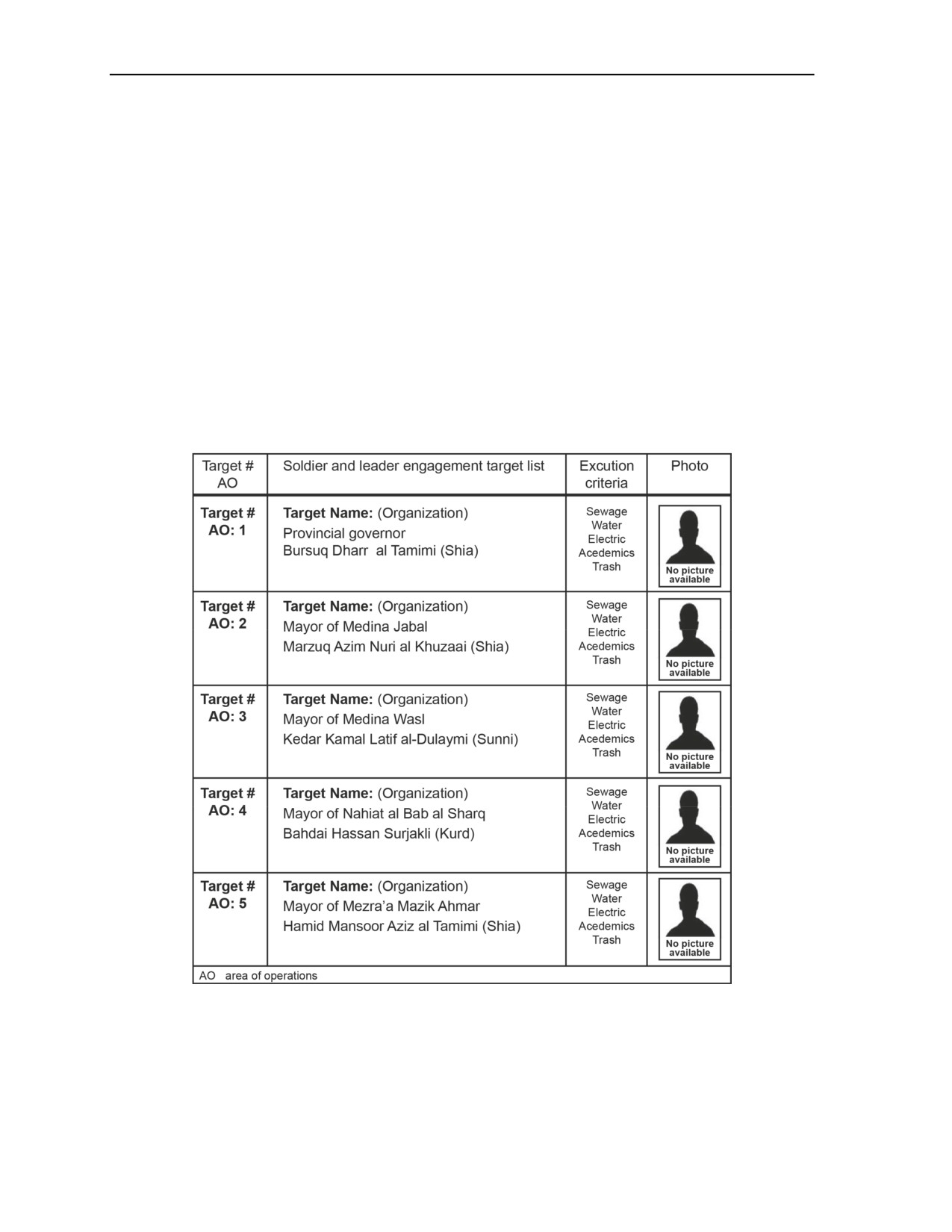
Chapter 8
z
Soldier and leader engagement target list.
z
Measures of performance.
z
Measures of effectiveness.
z
Input into the commander’s critical information requirements.
z
Reporting protocols.
Soldier and Leader Engagement Target List
8-49. The Soldier and leader engagement target list is a high pay-off target list for Soldier and leader
engagement. The G-7 (S-7) prioritizes and gains approval of the list by the commander for face-to-face
engagement to influence the targets and help in accomplishing operational objectives and attaining the
desired end state. From the assessment perspective, this list provides a means to focus Soldier and leader
engagements toward the highest priority selected audiences for the commander. The G-7 (S-7) coordinates
staff for focused information collection efforts and other nonstandard collection assets aimed at collecting
on the engagement target list of personalities or groups. This coordination ensures the priority intelligence
requirements or information requirements are fed with information stemming from collection guidance
given to collection assets (see figure 8-4).
Figure 8-4. Example Soldier and leader target list
Measures of Performance
8-50. The staff measures the performance of tasks to support Soldier and leader engagements through
detailed reporting received from units and assets tasked by the G-3 (S-3) to engage personalities or groups
8-12
FM 3-13
25 January 2013
Soldier and Leader Engagement of Inform and Influence Activities
on the Soldier and leader engagement target list. The details of this measurement verify the engagement
occurred, the spokesperson delivered the proper messages, and the engagement target understood the
message as intended. Such efforts with measures of performance can be difficult to assess; however,
redundant coverage of collection assets in addition to subsequent Soldier and leader engagements provides
additional clarity and refinement to this measurement.
Measures of Effectiveness
8-51. The staff measures the effectiveness of tasks accomplished through the same means as measures of
performance. Generally, the executor of a Soldier and leader engagement provides details with regard to
measures of performance. However, with measures of effectiveness, staff cannot observe an immediate
effect. The effectiveness of Soldier and leader engagements takes time to determine based upon the
eventual actions and words of the engagement target. Additionally, personalities and groups in the
engagement target’s sphere of influence may provide even greater insights into the overall effectiveness of
Soldier and leader engagements in attaining the end state. As such, it will be necessary for the G-7 (S-7) to
continue to monitor intelligence collection reporting dedicated and tasked against priority intelligence
requirements and intelligence requirements that feed the assessments and measures of effectiveness.
Input into Commander’s Critical Information Requirement
8-52. An effective G-7 (S-7) engages in the staff planning processes that drive intelligence and information
collection requirements. Such requirements provide the majority of intelligence and information that
determines measures of performance and measures of effectiveness. Without this coordination and
integration with other staff elements, the G-7 (S-7) causes inefficiency. Inefficiency comes from redundant
reporting requirements and ad hoc reporting channels. The G-7 (S-7) coordination with the G-2 (S-2) and
the G-3 (S-3) ensures the specific information requirements needed to feed measures of performance and
measures of effectiveness are properly captured, recorded, tasked, and disseminated to the collection assets
and subordinate units.
Reporting Protocols
8-53. The G-7 (S-7) formalizes reporting requirements for information captured from Soldier and leader
engagement through staff coordination with the G-2 (S-2) and the G-3 (S-3). To drive the assessment of
Soldier and leader engagements, the G-7 (S-7) identifies the no-later-than reporting suspense and required
specific information. The G-7 (S-7) then coordinates this identification through the G-2 (S-2) and G-3 (S-3)
to incorporate it into the operation order or plan and information collection plan. Disciplined reporting
through standardized reporting mechanisms ensures that subordinate units and collection assets are not
over-tasked and facilitates greater staff integration between the G-7 (S-7) and other coordinating staff
sections.
Other Assessments
8-54. An after action review following a Soldier and leader engagement captures relevant information from
the outcome of an engagement. The G-7 (S-7) may conduct an after action review in lieu of or subsequent
to the initial debrief following an engagement. Although this process sometimes seems unnecessary, a
thorough after action review brings many realizations of minute details not initially captured during a
debrief. All participants sitting collectively in an after action review provide greater insights on any Soldier
and leader engagement and enable establishing a way forward for subsequent engagements or the
employment of other information-related capabilities. After action reviews help responsible parties to
complete the details of their engagement reports before dissemination.
8-55. An effective G-7 (S-7) uses subjective commander’s assessments as an assessment tool since they
can provide invaluable insights into the effects of Soldier and leader engagements within a commander’s
area of operations. The G-7 (S-7) considers subjective assessments in addition to the initial impressions
experienced by participants during engagement interactions. These subjective assessments can inform the
assessment of both measures of performance and measures of effectiveness. Interpreters or process
observers often provide helpful insight into capturing cultural idiosyncrasies. They may notice some
nonverbal cues, facial expressions and gestures, voice intonation and inflection, or certain idiomatic
25 January 2013
FM 3-13
8-13
Chapter 8
expressions and jargon that may otherwise be overlooked and not incorporated in the metric-focused
reporting of other techniques that inform assessments.
8-14
FM 3-13
25 January 2013
Glossary
The glossary lists acronyms and terms with Army or joint definitions. Where Army
and joint definitions differ, (Army) precedes the definition. Terms for which FM 3-13
is the proponent are marked with an asterisk (*). The proponent publication for other
terms is listed in parentheses after the definition.
SECTION I - ACRONYMS AND ABBREVIATIONS
ADP
Army doctrine publication
ADRP
Army doctrine reference publication
AJP
allied joint publication
AR
Army regulation
ATTP
Army tactics, techniques, and procedures
BATNA
best alternative to a negotiated agreement
BCT
brigade combat team
CARVER
criticality, accessibility, recuperability, vulnerability, effect, recognizability
CCIR
commander’s critical information requirement
COA
course of action
D3A
decide, detect, deliver, and assess
DA
Department of the Army
EEFI
essential elements of friendly information
F2T2EA
find, fix, track, target, engage, and assess
F3EAD
find, fix, finish, exploit, analyze, disseminate
FA
functional area
FM
field manual
G-2
assistant chief of staff, intelligence
G-3
assistant chief of staff, operations
G-5
assistant chief of staff, plans
G-7
assistant chief of staff, inform and influence activities
G-9
assistant chief of staff, civil affairs operations
IIA
inform and influence activities
IPB
intelligence preparation of the battlefield
IR
information requirement
JP
joint publication
MDMP
military decisionmaking process
MISO
military information support operations
MOE
measure of effectiveness
OPLAN
operation plan
OPORD
operation order
OPSEC
operations security
S-2
intelligence staff officer
S-3
operations staff officer
25 January 2013
FM 3-13
Glossary-1
Glossary
S-5
plans staff officer
S-7
inform and influence activities staff officer
S-9
civil affairs operations staff officer
STANAG
standardization agreement
TC
training circular
U.S.
United States
ZOPA
zone of possible agreement
SECTION II - TERMS
assessment
The determination of the progress toward accomplishing a task, creating a condition, or achieving an
objective. (JP 3-0)
combat power
(Army) The total means of destructive, constructive, and information capabilities that a military unit or
formation can apply at a given time. (ADRP 3-0)
commander’s critical information requirement
An information requirement identified by the commander as being critical to facilitating timely
decisionmaking. (JP 3-0)
cyber electromagnetic activities
Activities leveraged to seize, retain, and exploit an advantage over adversaries and enemies in both
cyberspace and the electromagnetic spectrum, while simultaneously denying and degrading adversary
and enemy use of the same and protecting the mission command system. (ADRP 3-0)
defensive task
A task conducted to defeat an enemy attack, gain time, economize forces, and develop conditions
favorable for offensive or stability tasks. (ADRP 3-0)
inform and influence activities
The integration of designated information-related capabilities in order to synchronize themes,
messages, and actions with operations to inform United States and global audiences, influence foreign
audiences, and affect adversary and enemy decisionmaking. (ADRP 3-0)
information environment
The aggregate of individuals, organizations, and systems that collect, process, dissseminate, or act on
information. (JP 3-13)
*information fratricide
The result of employing information-related capabilities in a way that causes effects in the information
environment that impede the conduct of friendly operations or adversely affect friendly forces.
information management
The science of using procedures and information systems to collect, process, store, display,
disseminate, and protect data, information, and knowledge products. (ADRP 6-0)
information operations
The integrated employment, during military operations, of information-related capabilities in concert
with other lines of operation to influence, disrupt, corrupt, or usurp the decision-making of adversaries
and potential adversaries while protecting our own. (JP 1-02)
*information-related capabilities
Capabilities, techniques, or activities employing information to effect any of the three dimensions
within the information environment to generate an end(s).
Glossary-2
FM 3-13
25 January 2013
Glossary
knowledge management
The process of enabling knowledge flow to enhance shared understanding, learning, and
decisionmaking. (ADRP 6-0)
mission command
(Army) The exercise of authority and direction by the commander using mission orders to enable
disciplined initiative within the commander’s intent to empower agile and adaptive leaders in the
conduct of unified land operations. (ADP 6-0)
mission command system
The arrangement of personnel, networks, information systems, processes and procedures, and facilities
and equipment that enable commanders to conduct operations. (ADP 6-0)
offensive task
A task conducted to defeat and destroy enemy forces and seize terrain, resources, and population
centers. (ADRP 3-0)
operational environment
A composite of the conditions, circumstances, and influences that affect the employment of
capabilities and bear on the decisions of the commander. (JP 3-0)
physical security
That part of security concerned with physical measures designed to safeguard personnel; to prevent
unauthorized access to equipment, installations, material, and documents; and to safeguard them
against espionage, sabotage, damage, and theft. (JP 3-0)
running estimate
The continuous assessment of the current situation used to determine if the current operation is
proceeding according to the commander’s intent and if planned future operations are supportable.
(ADP 5-0)
situational understanding
The product of applying analysis and judgment to relevant information to determine the relationships
among the operational and mission variables to facilitate decisionmaking. (ADP 5-0)
*Soldier and leader engagement
Interpersonal interactions by Soldiers and leaders with audiences in an area of operations.
strategic communication
Focused United States Government efforts to understand and engage key audiences to create,
strengthen, or preserve conditions favorable for the advancement of United States Government
interests, policies, and objectives through the use of coordinated programs, plans, themes, messages,
and products synchronized with the actions of all instruments of national power. (JP 5-0)
unified land operations
How the Army seizes, retains, and exploits the initiative to gain and maintain a position of relative
advantage in sustained land operations through simultaneous offensive, defensive, and stability
operations in order to prevent or deter conflict, prevail in war, and create the conditions for favorable
conflict resolution. (ADP 3-0)
25 January 2013
FM 3-13
Glossary-3
References
Field manuals and selected joint publications are listed by new number followed by
old number.
REQUIRED PUBLICATIONS
These documents must be available to intended users of this publication.
ADRP 1-02. Operational Terms and Military Symbols. 31 August 2012.
JP 1-02. Department of Defense Dictionary of Military and Associated Terms. 8 November 2010.
RELATED PUBLICATIONS
These documents contain relevant supplemental information.
JOINT AND DEPARTMENT OF DEFENSE PUBLICATIONS
Most joint publications are available online: http://www.dtic.mil/doctrine/new_pubs/jointpub.htm
JP 3-0. Joint Operations. 11 August 2011.
JP 3-05. Special Operations. 18 April 2011.
JP 3-13. Information Operations. 13 February 2006.
JP 3-13.2. Military Information Support Operations. 07 January 2010.
JP 5-0. Joint Operation Planning. 11 August 2011.
JP 6-0. Joint Communications System. 10 June 2010.
DEPARTMENT OF THE ARMY PUBLICATIONS
Most Army doctrinal publications are available online: http://www.apd.army.mil/.
ADP 1. The Army. 17 September 2012.
ADP 3-0 (FM 3-0). Unified Land Operations. 10 October 2011.
ADP 5-0. (FM 5-0). The Operations Process. 17 May 2012.
ADP 6-0. (FM 6-0). Mission Command. 17 May 2012.
ADRP 3-0. Unified Land Operations. 16 May 2012.
ADRP 3-37. Protection. 31 August 2012.
ADRP 6-0. Mission Command. 17 May 2012.
AR 350-2. Opposing Force (OPFOR) Program. 9 April 2004.
ATP 3-60. 1. Dynamic Targeting Multi-Service Tactics, Techniques, and Procedures for Dynamic
Targeting. 7 May 2012.
ATTP 5-0.1. Commander and Staff Officer Guide. 14 September 2011.
FM 3-05.30. Psychological Operations. 15 April 2005.
FM 3-07. Stability Operations. 6 October 2008.
FM 3-28. Civil Support Operations. 20 August 2010.
FM 3-55.12. Multi-Service Tactics, Techniques, and Procedures for Joint Combat Camera Operations.
24 May 2007.
FM 3-57. Civil Affairs Operations. 31 October 2011.
FM 3-60 (6-20-10). The Targeting Process. 26 November 2010.
FM 3-61.1. Public Affairs. Tactics, Techniques, and Procedures. 1 October 2000.
FM 3-90. Tactics. 4 July 2001.
FM 3-92 (100-15). Corps Operations. 26 November 2010.
25 January 2013
FM 3-13
References-1
References
FM 6-01.1. Knowledge Management Section. 16 July 2012.
FM 27-10. The Law of Land Warfare. 18 July 1956.
TC 2-33.4. Intelligence Analysis. 1 July 2009.
TC 7-100. Hybrid Threat. 26 November 2010.
NORTH ATLANTIC TREATY ORGANIZATION PUBLICATION
AJP-3 (B). Allied Joint Doctrine for the Conduct of Operations. 16 March 2011.
REFERENCED FORMS
DA Form 2028. Recommended Changes to Publications and Blank Forms.
References-2
FM 3-13
25 January 2013