FM 3-13 Inform and Influence Activities (January 2013) - page 1
*FM 3-13
Field Manual
Headquarters
Department of the Army
No. 3-13
Washington, DC, 25 January 2013
Inform and Influence Activities
Contents
Page
PREFACE
iv
INTRODUCTION
v
Chapter 1
CONSTRUCT OF INFORM AND INFLUENCE ACTIVITIES
1-1
Inform and Influence Activities Defined
1-1
Inform and Influence Activities Considerations
1-3
Chapter 2
ASPECTS OF INFORM AND INFLUENCE ACTIVITIES
2-1
Integrating Activity
2-1
Information Environment
2-2
Information Operations and Strategic Communication
2-3
Decisive Action
2-5
Stability Operations
2-6
Chapter 3
CAPABILITIES OF INFORM AND INFLUENCE ACTIVITIES
3-1
Information-Related Capabilities
3-1
Other Organic Capabilities Used for Inform and Influence Activities
3-5
Integrated and Synchronized Capabilities
3-6
Chapter 4
ROLES, RESPONSIBILITIES, AND ORGANIZATIONS OF INFORM AND
INFLUENCE ACTIVITIES
4-1
Role of the Commander
4-1
Role of the G-7 (S-7)
4-1
Role of the Staff
4-2
Roles of Others
4-3
Chapter 5
INFORM AND INFLUENCE ACTIVITIES INTEGRATION
5-1
Inform and Influence Activities as an Integrating Function
5-1
Inform and Influence Activities Working Group
5-1
Inform and Influence Activities and the Staff Process
5-8
Inform and Influence Activities Processes
5-20
Chapter 6
TARGETING AND INFORM AND INFLUENCE ACTIVITIES
6-1
Distribution Restriction: Approved for public release; distribution is unlimited.
*This publication supersedes FM 3-13, 28 November 2003.
i
Preface
Targeting Process
6-1
Targeting Meetings
6-1
Targeting Methodologies
6-1
Chapter 7
ASSESSMENT OF INFORM AND INFLUENCE ACTIVITIES
7-1
Purpose of Assessment
7-1
Assessment Development for Inform and Influence Activities
7-1
Chapter 8
SOLDIER AND LEADER ENGAGEMENT OF INFORM AND INFLUENCE
ACTIVITIES
8-1
Purpose of Soldier and Leader Engagement
8-1
Principles
8-1
Types of Soldier and Leader Engagements
8-3
Mission Command and Engagements
8-4
Engagement Process
8-6
GLOSSARY
Glossary-1
REFERENCES
References-1
INDEX
Index-1
Figures
Figure 1-1. Message development flowchart
1-5
Figure 2-1. Information environment
2-3
Figure 5-1. Sample G-7 inform and influence activities working group
5-2
Figure 5-2. Sample S-7 inform and influence working group
5-3
Figure 5-3. Sample information operations working group (coalition, joint)
5-4
Figure 5-4. Annotated inform and influence activities annex
5-19
Figure 5-5. Inform and influence activities running estimate and the military
decisionmaking process
5-22
Figure 5-6. Linkages between systems
5-24
Figure 6-1. Inform and influence activities synchronization matrix
6-6
Figure 6-2. Battle rhythm
6-6
Figure 7-1. Sample inform and influence activities objective statement
7-2
Figure 7-2. Measure of effectiveness components
7-3
Figure 7-3. Measure of performance components
7-4
Figure 7-4. Assessment methodology for the information objective
7-4
Figure 8-1. Engagement process
8-6
Figure 8-2. Sample engagement work sheet
8-8
Figure 8-3. ZOPA and BATNA
8-10
Figure 8-4. Example Soldier and leader target list
8-12
ii
FM 3-13
25 January 2013
Preface
Tables
Introductory Table-1. New Army terms
vi
Introductory Table-2. Rescinded Army terms
vi
Introductory Table-3. Modified Army terms
vii
Table 5-1. Roles and responsibilities of inform and influence activities representatives
5-5
Table 5-2. Mission analysis of the MDMP from an IIA perspective
5-9
Table 5-3. Course of action development of the MDMP from an IIA perspective
5-12
Table 5-4. Course of action analysis of the MDMP from an IIA perspective
5-14
Table 5-5. Course of action comparison of the MDMP from an IIA perspective
5-15
Table 5-6. Course of action approval of the MDMP from an IIA perspective
5-15
Table 5-7. Orders production, dissemination, and transition of the MDMP from an IIA
perspective
5-16
Table 6-1. CARVER value rating scale
6-3
Table 6-2. IIA action steps during the MDMP and targeting process
6-5
25 January 2013
FM 3-13
iii
Preface
Field manual (FM) 3-13 provides doctrinal guidance and directions for conducting inform and influence
activities
(IIA) and discusses the importance of information in operational environments. It describes the
Army’s view of how IIA aid the commander to gain an advantage through information. It develops the other
principles, tactics, and procedures detailed in subordinate doctrinal publications.
The publication does not address every information-related capability commanders can use to help shape their
complex operational environments. It should, however, generate introspection and provide just enough guidance
to facilitate flexibility and innovative approaches for commanders to execute the art of command to inform and
influence. It also provides guidance to the staff to conduct IIA to achieve the desired effects that support the
commander’s intent and objectives. Commanders designate an information-related capability and are only
limited by available resources.
The principal audience for FM 3-13 is commanders and staffs at all echelons of command, Army civilians, and
government contractors.
Commanders, staffs, and subordinates ensure their decisions and actions comply with applicable United States,
international, and, in some cases, host nation laws and regulations. Commanders at all levels ensure their
Soldiers operate according to the law of war and the rules of engagement. (See FM 27-10.)
FM 3-13 implements standardization agreement (STANAG) Allied Joint Publication (AJP)-3 (B).
FM 3-13 uses joint terms where applicable. Selected joint and Army terms and definitions appear in both the
glossary and the text. Terms for which FM 3-13 is the proponent publication (the authority) have an asterisk (*)
in the glossary. Definitions for which FM 3-13 is the proponent publication are boldfaced in the text. For other
definitions shown in the text, the term is italicized and the number of the proponent publication follows the
definition.
FM 3-13 applies to the Active Army, the Army National Guard (ARNG)/Army National Guard of the United
States (ARNG86), and the United States Army Reserve (USAR) unless otherwise stated.
The proponent of FM 3-13 is the United States Army Combined Arms Center. The preparing agency is the
Combined Arms Doctrine Directorate, United States Army Combined Arms Center. Send comments and
recommendations on a DA Form 2028 (Recommended Changes to Publications and Blank Forms) to
Commander, United States Army Combined Arms Center and Fort Leavenworth, ATTN: ATZL-MCK-D (FM
3-13),
300
McPherson Avenue, Fort Leavenworth, KS
66027-2337; by e-mail to
mailto:usarmy.leavenworth.mccoe.mbx.cadd-org-mailbox@mail.mil; or submit an electronic DA Form 2028.
iv
FM 3-13
25 January 2013
Introduction
The lessons learned by tactical and operational formations have caused changes in information operations
during the past decade. The 2003 version of FM 3-0 described information operations as “shaping operations.”
The 2008 version of FM 3-0 then introduced the five information tasks as how the Army conducts information
operations that were “complementary information operations to both inform a global audience and to influence
audiences within the operational area; it is a weapon against enemy command and control and is a means to
affect enemy morale.” Additionally, the command and control warfighting function was “the primary integrator
of information tasks…to shape the operational environment throughout the operations process.” ADRP 3-0
(which superseded FM 3-0) refined the elements of combat power so the mission command warfighting
function includes two staff tasks—conduct IIA and conduct cyber electromagnetic activities—as well as
additional tasks of conducting military deception and information protection. Operations security remains in the
protection warfighting function. ADRP 3-0 defines IIA.
Executing information-related capabilities is the responsibility of various specialists. The Army information
operations officer (functional area 30 through the command’s IIA section) serves as the integration specialist.
The IIA staff officer is responsible for the plan to achieve the commander’s intended effects and is the primary
integrator for holistic effects in the information environment. The IIA section maintains a close relationship and
coordination with all information-related capability specialists and other staff sections. The IIA section and staff
plan, coordinate, and synchronize the designated information-related capabilities’ actions through the operations
process into the commander’s operation plan.
The Army continues to support the newly adopted Secretary of Defense and joint definition for information
operations—the integrated employment, during military operations, of information-related capabilities in
concert with other lines of operation to influence, disrupt, corrupt, or usurp the decision-making of adversaries
and potential adversaries while protecting our own
(JP
1-02). The Army recognizes the importance of
information as an operational variable of an operational environment. The major contribution of IIA is to gain
advantage in the information environment for the commander. Operating in today’s complex environment
requires commanders and their staffs to enable and support joint, interagency, intergovernmental, and
multinational partners to protect and reassure populations and isolate and defeat enemies. Although the Army
has developed IIA and cyber electromagnetic activities as mission command staff tasks, their roles in the
information effort support both information operations and strategic communication. This integration serves as
economy of force to gain advantage in the information environment and to reduce the risk of information
fratricide. The holistic approach of IIA in the information environment reflects the joint construct of the
information-influence relational framework so that its approach is holistic, or addresses the entire information
environment simultaneously rather than just one specific environment. Today’s global information and
communications environment means that messages and actions delivered to one audience also reach other
audiences.
The Army’s concept of IIA is the integration of information-related capabilities that informs and influences
audiences simultaneously. This concept, very similar to the joint’s information-influence relational framework,
supports the national strategic communication effort and information operations tasks to influence, disrupt,
corrupt, or usurp the decisionmaking of adversaries and potential adversaries. The Army functional area (FA)
30 officer is responsible for integrating information-related capabilities to inform and influence when operating
at brigade through Army Service component command headquarters. The FA 30 is also responsible for
integrating information-related capability to inform, influence, disrupt, corrupt, usurp, and protect when
operating at a joint headquarters.
Based on current doctrinal changes, certain terms for which FM 3-13 is proponent have been added, rescinded,
or modified for purposes of this publication. See introductory tables 1 and 2 on page v, and introductory table 3
on page vii. The glossary contains acronyms and defined terms.
25 January 2013
FM 3-13
v

Introduction
Introductory Table-1. New Army terms
Term
Remarks
information-related
New term and definition.
capabilities
Soldier and leader
New term and definition.
engagement
Introductory Table-2. Rescinded Army terms
Term
Remarks
computer network
Rescinded.
exploitation
computer network
Rescinded.
operations
IO assets
Rescinded.
IO capabilities
Rescinded.
IO cell
Rescinded.
IO concept of support
Rescinded.
physical destruction
Rescinded.
vi
FM 3-13
25 January 2013

Introduction
Introductory Table-3. Modified Army terms
Term
Remarks
deceive
Retained based on common English usage. No longer formally
defined.
degrade
Retained based on common English usage. No longer formally
defined.
deny
Retained based on common English usage. No longer formally
defined.
detect
Retained based on common English usage. No longer formally
defined.
disinformation
Retained based on common English usage. No longer formally
defined.
disrupt
No longer formally defined. See FM 3-90.
exploit
Retained based on common English usage. No longer formally
defined.
feedback
Retained based on common English usage. No longer formally
defined.
information fratricide
Modified.
influence
Retained based on common English usage. No longer formally
defined.
IO mission statement
No longer formally defined.
IO objectives
No longer formally defined.
IO resources
No longer formally defined.
IO tasks
No longer formally defined.
IO vulnerabilities
No longer formally defined.
IO vulnerability assessment
No longer formally defined.
team
protect
Retained based on common English usage. No longer formally
defined.
misinformation
Retained based on common English usage. No longer formally
defined.
respond
Retained based on common English usage. No longer formally
defined.
restore
Retained based on common English usage. No longer formally
defined.
25 January 2013
FM 3-13
vii
Chapter 1
Construct of Inform and Influence Activities
This chapter defines inform and influence activities. It also discusses each action in
the definition and considerations of inform and influence activities.
INFORM AND INFLUENCE ACTIVITIES DEFINED
1-1. Inform and influence activities is the integration of designated information-related capabilities in
order to synchronize themes, messages, and actions with operations to inform United States and global
audiences, influence foreign audiences, and affect adversary and enemy decisionmaking (ADRP 3-0).
INTEGRATE INFORMATION-RELATED CAPABILITIES
1-2. All assets and capabilities at a commander’s disposal have the potential to be used to inform and
influence selected audiences to varying degrees. Information-related capabilities are capabilities,
techniques, or activities employing information to effect any of the three dimensions within the
information environment to generate an end(s). (See JP 3-13 regarding information operations.)
Designated information-related capabilities that support inform and influence activities (IIA) and its lines
of effort typically include, but are not limited to, public affairs operations, military information support
operations (MISO), combat camera, Soldier and leader engagement, civil affairs operations, civil and
cultural considerations, operations security
(OPSEC), and military deception. Additionally, other
capabilities the commander may allocate—components of cyber electromagnetic activities, special
technical operations, presence, posture and profile, physical attack, and physical security—are capabilities
not solely designed to inform or influence, but may help in achieving effects and mission objectives.
Success depends on commanders and staffs effectively employing all available operational assets to best
shape the information environment. (See Chapter 2 for information environment definition.)
1-3. Commanders at all echelons lead IIA as part of unified land operations. They apply IIA during the
conduct of decisive action: offensive, defensive, and stability or defense support of civil authorities.
Defense support of civil authorities’ tasks can employ information-related capabilities to enable federal,
state, and local responders in informing the domestic populations affected by natural or man-made
disasters.
SYNCHRONIZE THEMES, MESSAGES, AND ACTIONS WITH OPERATIONS
1-4. Commanders synchronize messages and actions with overarching themes in operations to inform and
influence audiences in their area of operations and area of interest. Audiences include groups,
organizations, and individuals. Commanders ensure overarching themes and their supporting messages and
actions are consistent in their intent and communicated to the lowest level of command. Synchronization of
messages and actions promotes and shapes the attitudes and behaviors of the audiences in the area of
operations while affecting adversary or enemy information efforts. Synchronization of consistent messages
and actions supports the commander’s operational goals and avoids contradiction and information
fratricide. Information fratricide is the result of employing information-related capabilities in a way
that causes effects in the information environment that impede the conduct of friendly operations or
adversely affect friendly forces.
1-5. Soldiers’ actions powerfully influence the credibility of IIA. Visible actions coordinated with
carefully chosen, credible words influence audiences more than uncoordinated or contradictory actions and
words. All audiences—local and regional as well as adversary and enemy—compare the friendly force’s
message with its actions. Consistency contributes to the success of friendly operations by building trust and
credibility. Conversely, if actions and messages are inconsistent, friendly forces lose credibility. Loss of
25 January 2013
FM 3-13
1-1
Chapter 1
credibility makes land forces vulnerable to enemy and adversary information or countermessaging and
places Army forces at a disadvantage. Aligning information-related capabilities with the overall operation
ensures that messages are consistent with the forces’ actions to amplify the credibility of those messages. It
is paramount that inform and influence efforts complement not contradict. Failing to do so jeopardizes
credibility.
INFORM
1-6. The IIA section coordinates, synchronizes, and integrates the information-related capabilities
application to accomplish the directed mission. Commanders have responsibility to conduct public affairs
operations that inform U.S. audiences about their military operations to the fullest extent possible. Using
information-related capabilities such as public affairs, MISO, civil affairs operations, and others enables the
commander to also inform foreign audiences and to provide Army support to strategic communication.
Commanders balance informing audiences about Army operations with the responsibility to protect those
operations and their troops through OPSEC.
INFLUENCE
1-7. IIA enable commanders in integrating and synchronizing the various means of influence to support
operations. U.S. forces strictly limit their influence activities to foreign audiences. Influence activities
typically focus on persuading selected foreign audiences to support U.S. objectives or to persuade those
audiences to stop supporting the adversary or enemy. To accomplish operational objectives effectively,
commanders may direct efforts to shape, sway, or alter foreign audience behaviors.
INFORM DOMESTIC AND GLOBAL AUDIENCES
1-8. Federal laws and military regulations require U.S. forces to inform domestic audiences of their
operations, programs, and activities. The global expanse of the information environment and technology
enables news reports and analyses to rapidly influence public opinion and decisions concerning military
operations. In addition to the domestic audience, commanders understand the imperative to keep other
audiences, including interagency and multinational partners, allies, and international organizations,
informed of their operations as well. They understand that truth and transparency can mitigate the impact
that adversaries and enemies have when seizing on negative news stories and exploiting information to
their advantage through their own information activities.
1-9. IIA support the commander’s objectives through public communications to provide an accurate and
informed portrayal of operations. Public communications include news releases, public service
announcements, and press conferences among others. Audiences receive these messages best through the
actions and words of individual Soldiers. To gather such personal information, units embed media
personnel into the lowest tactical levels, ensuring their safety and security. Public communications foster a
culture of engagement in which Soldiers and leaders confidently and comfortably engage the media as well
as other audiences.
1-10. Homeland security and defense support of civil authorities’ task can require Army
information-related capabilities to enable federal, state, and local responders with informing domestic
audiences of security and disaster response efforts. Units can apply information-related capabilities—such
as MISO with its organic broadcast and print capabilities—to extend the reach of civil authorities in
isolated disaster areas.
INFLUENCE FOREIGN AUDIENCES
1-11. Victory depends on a commander’s ability to shape, sway, and alter foreign audience perceptions,
and ultimately behavior, especially in the area of operations. Commanders rely on IIA planning and employ
information-related capabilities to unify perceptions and support effects to attain their desired end state.
1-12. MISO enable a commander to engage with and influence foreign populations in their language using
media. Military information support staff officers and organic, attached, or supporting military information
support units serve as a commander’s resource for subject matter expertise on influencing foreign
1-2
FM 3-13
25 January 2013
Construct of Inform and Influence Activities
populations. Synchronizing MISO with Soldier and leader engagement and other information-related
capabilities creates a synergy that increases the effect of influence activities. In addition to MISO and other
information-related capabilities, individual Soldiers influence specified foreign audiences. Soldiers
communicate information through their actions, as well as through Soldier and leader engagements to
achieve the commander’s intent. When Soldiers’ actions adhere to the rules of engagement and reinforce
messages, they strengthen and increase trust and credibility. Leaders ensure Soldiers stay continually aware
of current messages and consider them during conduct of operations and when engaging with the audiences
in their area of operations. Through training and command information efforts, commanders empower
Soldiers to influence foreign audiences significantly.
AFFECT ADVERSARY AND ENEMY DECISIONMAKING
1-13. Achieving ultimate victory requires adversary and enemy decisionmakers—from the lowest to the
highest levels—to capitulate to U.S. demands fully. IIA provide options for effective, economical, and most
operationally advantageous means to affect their decisionmaking processes. These activities may affect
those processes through messages and actions, including lethal means. Some messages and actions intend
to create doubt from the individual level while others intend to deny an adversary or enemy force’s ability
to make timely and effective decisions.
1-14. Adversaries and enemies have proven adept at using information to gain a marked advantage over
U.S. forces. Commanders may employ information-related capabilities to mitigate this advantage and gain
the upper hand in the information environment. Effective IIA can affect the data, information, and
knowledge adversary or enemy decisionmakers use through the employment of psychological, cyber
electromagnetic, or physical actions that add, modify, or remove information from the information
environment. Certain information-related capabilities affect the infrastructure that collects, communicates,
processes, and stores information to support targeted decisionmakers, or they influence how audiences
receive, process, interpret, and use data, information, and knowledge.
INFORM AND INFLUENCE ACTIVITIES CONSIDERATIONS
1-15. Unified land operations require commanders to consider what will affect their operational
environments. Commanders lead IIA while considering the following: combat power, mission command,
network enabled systems, themes, information management, knowledge management, legal considerations,
and intelligence support. As an integration process, IIA help commanders with coordinating and
synchronizing all information-related capabilities available to them and with requesting the support of
external information-related capabilities, while accounting for the listed considerations in the operation
plan.
COMBAT POWER
1-16. Commanders consider how they will apply combat power. Combat power is the total means of
destructive, constructive, and information capabilities that a military unit or formation can apply at a given
time (ADRP 3-0). Army forces generate combat power by converting potential into effective action.
Combat power consists of eight elements: leadership, information, mission command, movement and
maneuver, intelligence, fires, sustainment, and protection. The last six elements are established warfighting
functions. Commanders apply combat power through the warfighting functions using the critical elements
of leadership and information.
1-17. To help ensure mission success, commanders apply information as an element of combat power to
shape and lead IIA in the three dimensions (cognitive, informational, and physical) of the information
environment (see paragraphs 2-8 through 2-17). Commanders use information and actions to shape their
information and operational environments to multiply the effects of friendly successes. Ultimately,
commanders use information to create shared understanding and purpose throughout the area of operations,
first in their own organizations and subsequently among all affected audiences. Information is critical to
understanding, visualizing, describing, directing, assessing, and leading operations toward attaining the
desired end state.
25 January 2013
FM 3-13
1-3
Chapter 1
MISSION COMMAND
1-18. Mission command requires commanders to lead and guide the use of information to inform and
influence audiences whose actions may affect an operational environment. Mission command is the
exercise of authority and direction by the commander using mission orders to enable disciplined initiative
within the commander’s intent to empower agile and adaptive leaders in the conduct of unified land
operations (ADP 6-0).
1-19. Commanders also facilitate shared understanding and purpose, usually through the commander’s
intent and subsequent guidance. They conceptualize the desired messages to support overarching themes
that unify activities and reinforce shared understanding. Commanders recognize and execute their critical
role as key engagers through informing and influencing. Commanders ensure operational success by
requiring Soldiers and leaders to communicate with people in their area of operations.
THEMES, MESSAGES, AND ACTIONS
1-20. Commanders use their own themes and messages to support their narratives. Narratives are tied to
actions in their operational environments and area of operations. A narrative is a brief description of a
commander’s story used to visualize the effects the commander wants to achieve in the information
environment to support and shape their operational environments. An effective commander’s theme
supports overarching U.S. Government and higher headquarters themes, has details, and is tailored to
environmental conditions in their area of operations.
1-21. Themes are planning tools that guide the development of the narrative, messages, and other
information products (talking points, MISO objectives, and public affairs guidance). Themes represent the
broad idea the commander wants to convey to the selected audiences. Themes are not communicated to the
selected audiences, messages are. Themes are broad and enduring, and as such, they do not change
frequently.
1-22. There are no IIA or information operations themes and messages, although MISO and public affairs
have themes and messages to support their operations. The G-7 (S-7) may have to develop commander’s
themes and messages, but it does so in coordination with MISO and public affairs representatives.
1-23. Messages support themes. They can be verbal, written, gestured, or electronic communications that
support a theme focused on an audience. They support a specific action or objective. Messages are tailored
to specific audiences. Commanders use messages to communicate clear information and, if necessary, elicit
a response or change in behavior. Messages are situation and mission dependent. Command information
messages convey local commanders’ policies and intent to their subordinates. The public affairs officer
develops command information and public information messages. Public information messages convey
information from host-nation officials to local target audiences through news, public-service information,
and announcements. The public affairs officer develops these messages. Psychological messages convey
specific information to selected foreign audiences to influence their perceptions, attitudes, beliefs, and
behavior. The military information support planner or unit develops these messages. MISO messages and
actions support themes established in the approved MISO program for that particular mission. (See
JP 3-13.2 and FM 3-05.30 for detailed information on MISO.)
1-24. Commanders consider the perceptions and ramifications of their actions to gain and maintain support
of populations in conflict areas. Commanders first understand host-nation laws and cultures, enabling them
to operate more effectively in the information environment. Second, commanders determine how to inform
audiences at home, gain support abroad, and generate support or empathy for the mission in their area of
operations. By leading IIA, commanders ensure their staff is integrating all available information-related
capabilities and other designated operational assets to support messaging and communications efforts,
operational objectives, and the desired end state.
1-25. Commanders integrate and synchronize messages and actions with overarching themes and
operations to inform or influence audiences in their area of operations and area of interest. Commanders
use information to marginalize or defeat adversary or enemy information efforts by shaping the attitudes
and behaviors of foreign audiences residing in the area of operations. Synchronized themes, messages, and
1-4
FM 3-13
25 January 2013
Construct of Inform and Influence Activities
actions support the commander’s operational goals by integrating words, images, and deeds to avoid
confusion or information fratricide.
1-26. Maneuver units at all echelons require consistent command themes and messages when conducting
Soldier and leader engagements with the intent to inform or influence in their area of operations.
Commands often rely on resources and assets to develop their command themes and messages that support
their mission narrative and facilitate accomplishing their objectives or attaining their end state. Sometimes
the G-7 (S-7) develops command themes and messages. The G-7 (S-7) verifies that the themes and
messages support MISO themes and messages along with published public affairs guidance. Additionally,
the G-7 (S-7) synchronizes command themes and messages with all operations to ensure actions, words,
and images are all relevant, consistent, and mutually supportive.
1-27. The development of command themes and messages is a deliberate process that supports a
commander’s lines of effort and objectives along each line. Themes and messages are two distinct elements
with a developed theme guiding the development of supportive messages. Messages are further broken into
separate talking points containing facts and sound bites informed by recent successes, accomplishments,
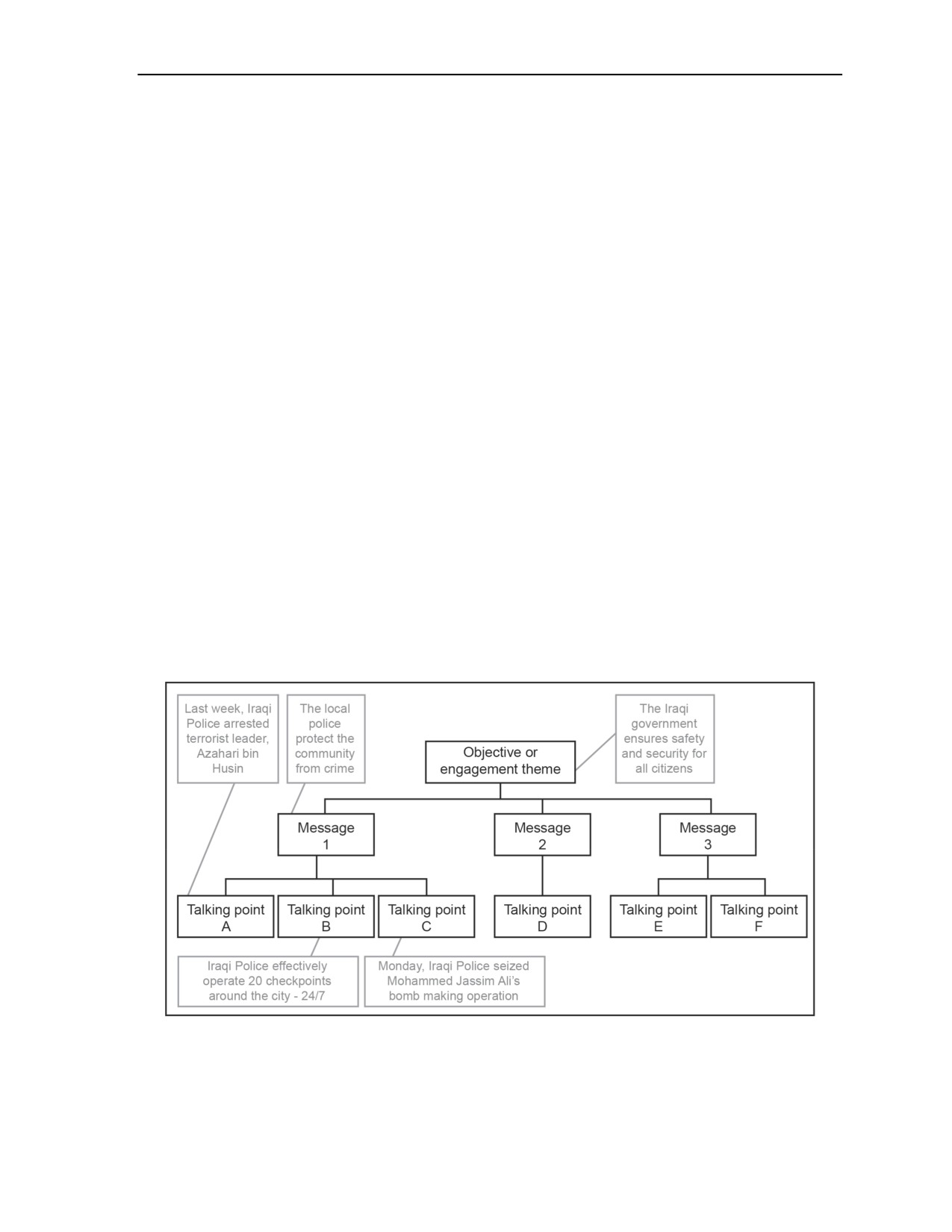
and descriptors related to the theme and subordinate message conveyed (see figure 1-1). Target-audience
vulnerabilities identified through MISO target audience analysis or other analytical means provide a way to
direct messages effectively. The G-7 (S-7) develops messages after identifying vulnerabilities to optimize
message and talking point development and effectiveness. As a guideline, the G-7 (S-7)—
z
Limits each message to one thought.
z
Keeps each message succinct.
z
Keeps messages to a manageable number.
z
Tailors messages for the means and method of delivery and the target audience.
z
Conveys a story (the theme) by arranging the messages from first to last. The sum of the
messages should then tell the story (or theme).
z
Places the bottom line up front and summarizes at the end. The first message contains the most
important thought.
z
Considers developing
“escape” messages that leaders and Soldiers can use to deflect
conversations away from the MISO themes to avoid.
Figure 1-1. Message development flowchart
25 January 2013
FM 3-13
1-5
Chapter 1
LEGAL CONSIDERATIONS
1-28. The planning and execution of specific information-related capabilities, and IIA in general, involve
complex legal and policy issues requiring careful review, coordination, and approval. The U.S. constitution,
U.S. laws, and international laws and agreements set boundaries and establish precedence for military
activities in the information environment. Another country’s legal basis and limitations for a military
activity in the information environment may differ. U.S. forces conducting military activities in the
information environment are subject to U.S. laws and policy. Although not legal experts,
information-related capability specialists can ensure units follow, or at least address, established legal
guidelines. (See JP 3-13 for discussion about legal support.)
1-29. In addition to standing authorizations, regulations, and laws, commanders and staffs account for
other factors when considering the legal implications for specific information-related capabilities. Gaining
new approval and authorization to use information-related capabilities and other supporting capabilities
under certain conditions often proves a long, tedious, and manpower-intensive process. Commanders and
staffs also consider perceptions of host nations or external audiences regarding the use of particular
information-related capabilities as a hostile or intrusive action. Some domestic, international, criminal, and
civil laws affect national security, privacy, and information exchange impact planning options.
Commanders and staffs consider international treaties, agreements, and customary international laws.
Lastly, they consider the effects of information-related capabilities on the structures and relationships
among U.S. intelligence organizations and the overall interagency environment, including
nongovernmental organizations.
INTELLIGENCE SUPPORT
1-30. Planning functions for IIA depend on the intelligence warfighting function for three reasons. First,
the intelligence warfighting function plans much of the Army’s information collection that helps define the
information environment and identifies potential audiences or physical targets for consideration. Second,
intelligence provides real-time insight into the adversary or enemy use of information capabilities to its
advantage or to counter friendly capabilities. Third, intelligence provides capabilities that support the
collection of metrics for the assessment of effects.
1-31. IIA and information operations require intelligence support in all phases of the operations process.
The G-7 (S-7) identifies gaps in information necessary for planning, execution, and assessment of effects
on selected audiences to support operations. The G-7 (S-7) submits these requirements to the G-2 (S-2) as
information requirements. The G-2 (S-2) incorporates them into the collection plan, and the G-3 (S-3) tasks
the appropriate collection assets.
1-6
FM 3-13
25 January 2013
Chapter 2
Aspects of Inform and Influence Activities
This chapter discusses the aspects of inform and influence activities. It first discusses
inform and influence activities as an integrating activity with separate inform lines of
effort and influence lines of effort. Then it discusses the information environment as
commanders use inform and influence activities to accomplish their mission
objectives. Next, the chapter addresses information operations and strategic
communication. It has a discussion of decisive action. Lastly, it concludes with a
discussion of stability operations.
INTEGRATING ACTIVITY
2-1. The concept of inform and influence activities (IIA) brings together several separate functions of
information-related capabilities that commanders designate to shape the information environment.
Specialists with deep subject matter expertise
(planners and operators) of each information-related
capability integrate in their area of expertise and with other staff sections for execution coordination. The
G-7 (S-7) IIA officer and section have responsibility to plan for and integrate all potential operational
assets supporting IIA efforts. Based on assessments, this allows for message alignment, reinforcement, and
consistency to support the overall concept of operations rather than individual events or missions. The G-7
(S-7) uses a line of effort to help focus an integration activity.
LINES OF EFFORT
2-2. Two lines of effort contribute to IIA: the inform line of effort and the influence line of effort. The
two lines allow the commander to employ information-related capabilities simultaneously through mission
command to support unified land operations. These lines of effort enable commanders and staffs to apply
the right capability or mix of capabilities to the right circumstance and audience to achieve synergy while
ensuring statutory and regulatory compliance.
2-3. All activities in the information environment communicate in some way. They serve to make an
impression on the minds of those that observe or hear those communications. Commanders and staffs
distinguish the two lines of effort by the intention of the communicator and the message. Sometimes, a
communication intended merely to inform might eventually lead to a changed opinion or behavior. A
communication designed to influence may not achieve the desired outcome.
INFORM LINE OF EFFORT
2-4. With the inform line of effort, the G-7 (S-7) focuses on providing information messages to domestic
and global audiences that accurately describe operations or providing information pertinent to selected
audiences in an area of operations. The G-7 (S-7) does not try to force a particular point of view on
audiences, but rather provides them with facts so they can increase knowledge or make their own decisions.
Providing credible, factual, and accurate information serves as the best means to counter false or
misleading information disseminated by other information efforts. Maintaining transparency and credibility
is paramount in the inform line of effort. Capabilities typically supporting the inform line of effort include
public affairs, military information support operations (MISO), Soldier and leader engagement, and Army
support to strategic communication. Capabilities such as combat camera, civil affairs operations, operations
security (OPSEC), and cyber electromagnetic activities provide support for inform line of effort message
execution.
25 January 2013
FM 3-13
2-1
Chapter 2
INFLUENCE LINE OF EFFORT
2-5. With the influence line of effort, the G-7 (S-7) aims to change the attitudes and behavior of foreign
neutral, adversary, and enemy audiences to support the accomplishment of U.S., national, and joint
operations area objectives. The influence line of effort guides selected audiences’ behaviors to support
objectives of U.S. commanders. Examples of influence objectives include misleading enemy
decisionmakers or convincing enemy forces to surrender or cease their efforts. The influence line of effort
also creates and strengthens relationships and encourages cooperation of foreign partners, civilians, and key
leaders of operational foreign partners. Effective Army forces leverage relationships based on trust and
mutual confidence, demonstrating how the Army provides added value to others’ objectives. Capabilities
that primarily support the influence line of effort include MISO and Soldier and leader engagement.
Additionally, information-related capabilities—such as military deception, combat camera, civil affairs
operations, OPSEC, and cyber electromagnetic activities—provide support to the influence line of effort.
The influence line of effort is most closely associated with the information operations of joint operations
and is adversary focused.
INFORMATION ENVIRONMENT
2-6. Some people think of the information environment as a new phenomenon. In fact, it has been present
throughout history and has always been an important military consideration. With the advent of the Internet
and widespread availability of wireless communications and information technology, this environment has
become an even more important consideration to military planning and operations than in years past.
Activities occurring in, through, or by means of the information environment have a consequential effect on
an operational environment and can impact military operations and outcomes. Therefore, commanders and
their staffs must understand their operational environments completely. This understanding includes the
information environment and the potential impacts it can have on current and planned military operations.
ELEMENTS OF THE INFORMATION ENVIRONMENT
2-7. The information environment is the aggregate of individuals, organizations, and systems that collect,
process, disseminate, or act on information
(JP
3-13). Conceptually, the information environment
encompasses both tangible (physical) elements and intangible elements (such as human ideas, fears,
perceptions, and decisionmaking).
DIMENSIONS OF THE INFORMATION ENVIRONMENT
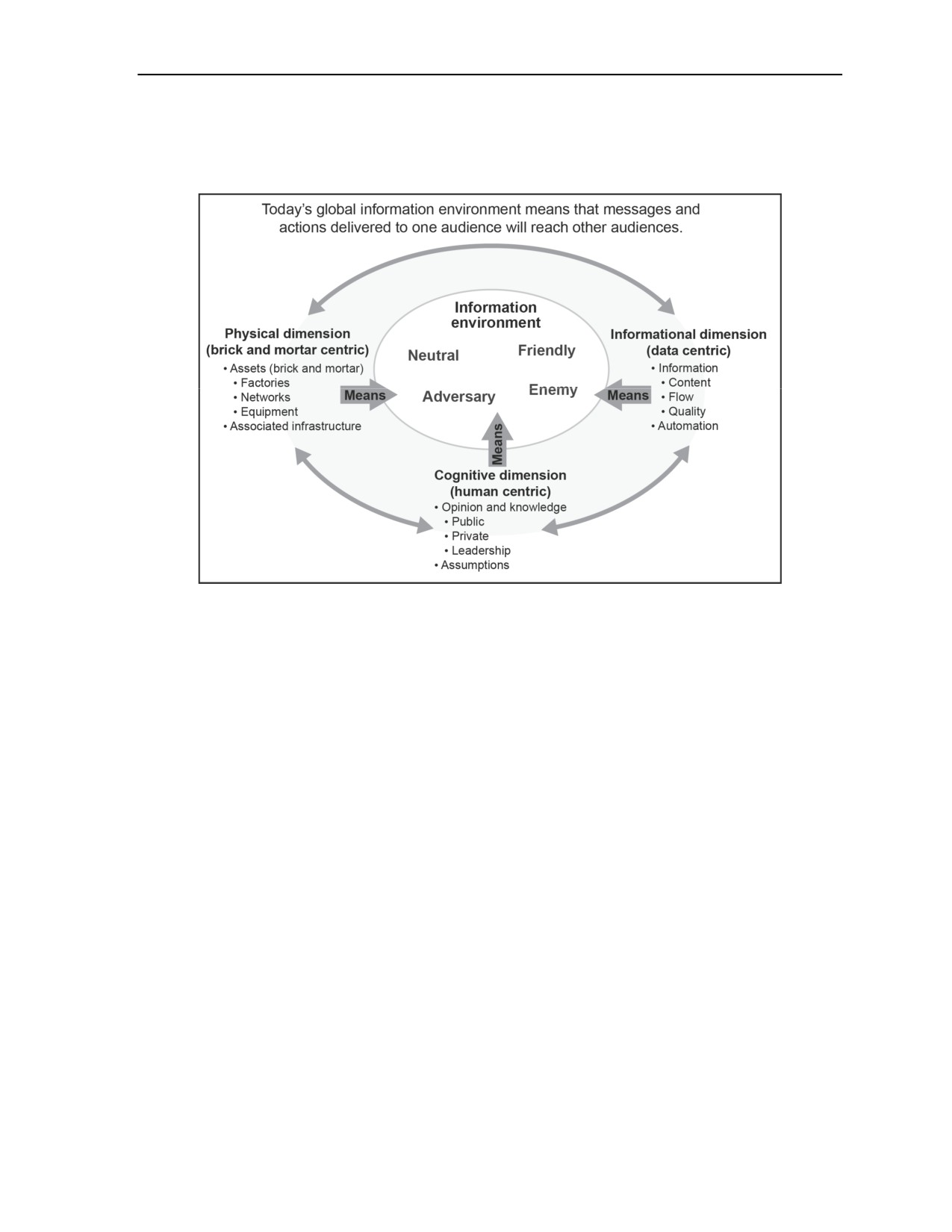
2-8. The information environment consists of the physical dimension, informational dimension, and
cognitive dimension. See figure 2-1. Per its definition, an information-related capability is intended to use a
dimension of the information environment to generate an end.
2-9. The physical dimension is composed of tangible elements such as telecommunications networks,
information systems and infrastructures, satellites, broadcast facilities, meeting places, printed publications,
billboards, flyers, statues, symbolic objects, organizations, groups, and people. In effect, tangible elements
are the means and methods used to enable the flow of information among producers, users, audiences, and
systems. While not tangible, the physical dimension also includes intangible elements such as transmission
paths in the electromagnetic spectrum. Elements in the physical dimension exist on land, or in air, sea, or
space and are the easiest to measure. Traditionally, combat power has been measured primarily in this
dimension.
2-10. The informational dimension consists of the information itself whether static (at rest) or in transit.
The informational dimension refers to content and flow of the information, such as text or images, or data
that staffs can collect, process, store, disseminate, and display. A range of attributes can characterize the
informational dimension: accuracy, integrity, completeness, quality, timeliness, relevance, availability,
reliability, and significance. The informational dimension provides the necessary link between the physical
dimension and the cognitive dimension.
2-11. The cognitive dimension is composed of the values, beliefs, concepts, intentions, and perceptions of
individuals and groups transmitting and receiving information. This dimension focuses on the societal,
2-2
FM 3-13
25 January 2013
Aspects of Inform and Influence Activities
cultural, religious, and historical contexts that influence the perceptions of those producing the information
and of the target audiences receiving the information. In this dimension, decisionmakers and target
audiences are most prone to influence and perception management.
Figure 2-1. Information environment
2-12. Effective commanders avoid viewing this model in a rigid, mechanical manner; they view it as a
conceptual framework to help guide and foster a thorough and comprehensive analysis of the information
environment. Examining an operational problem without fully understanding the impact the information
environment can have can cause an incomplete understanding of an operational environment that could
limit or restrict options and result in unfavorable or undesirable outcomes. Hence, commanders direct their
staffs including a comprehensive and holistic analysis of the information environment as part of the
standard mission analysis.
2-13. Throughout operations, many audiences will concurrently attempt to influence the information
environment to support their objectives. Military forces (both friendly and enemy), political groups and
supporters, media, local and regional interest groups, and key leaders will all have investments and interests
in the information environment. Certain audiences, including U.S. forces, may have pronounced advantages
or disadvantages (temporary or enduring) based on a variety of factors. Factors—such as terrain, access to
technologies, cultural differences, religious influences, historical animosities, and language barriers—often
lend to or detract from an audience’s advantages and disadvantages in the information environment.
Successful commanders and their staffs understand those advantages and disadvantages, as well as the
motivations, intentions, and methods of the various audiences.
INFORMATION OPERATIONS AND STRATEGIC
COMMUNICATION
2-14. At the national strategic level, information is recognized as an instrument of national power, equal to
diplomatic, military, and economic efforts. The President and Congress can implement all diplomatic,
military, and economic efforts to achieve, support, or protect national strategic objectives and interests. Use
of the instruments of national power sends strategic-level messages in a whole-of-government effort. Once
dedicated, the execution entities of each instrument can continue to support and reinforce the specific
United States Government messages. Deploying military units enables the Secretary of Defense and
25 January 2013
FM 3-13
2-3
Chapter 2
military commanders to support and reinforce strategic communication, national objectives, and interests
using military elements such as information operations, public affairs, special operations, and offensive,
defensive, or defense support of civil authorities tasks. The Army, through its conduct of unified land
operations, supports its joint ground component command or joint task force higher headquarters’ strategic
communication and information operations efforts and objectives. Army forces offer support through the
mission command staff tasks of IIA and cyber electromagnetic activities.
INFORMATION OPERATIONS
2-15. Information operations is the integrated employment, during military operations, of
information-related capabilities in concert with other lines of operation to influence, disrupt, corrupt, or
usurp the decision-making of adversaries and potential adversaries while protecting our own (JP 1-02). This
component supports the information-influence relational framework at the national level.
(See joint
doctrine about information-influence relational framework.) Information operations use of the
information-influence relational framework at the joint strategic level illustrates how ways (integrated
application) and means (information-related capabilities) achieve an end (influence, disrupt, corrupt, or
usurp adversary decisionmaking while also protecting friendly abilities).
2-16. At the operational- and tactical-Service levels, each military branch uniquely contributes to an
integrated information operations effort synchronized by the joint force or joint task force headquarters
J-39 division. The Army’s execution of unified land operations supports its higher joint headquarters’ tasks
to support information operations and mission objectives through mission command’s IIA and cyber
electromagnetic activities staff tasks through orders and the operations process. IIA and cyber
electromagnetic activities are the commander’s staff integrating processes. Skilled integration specialists
coordinate and synchronize designated and other information-related capabilities. They use specified
working groups and staff coordination to achieve the Army’s directed tasks to support information
operations and the joint commander’s objectives. The commander’s IIA section focuses information-related
capabilities (including coordinated components of cyber electromagnetic activities) to support the influence
line of effort to affect adversary and enemy decisionmaking while protecting Army capabilities.
2-17. Army units may work as subordinate elements of a joint task force, or they may form the core
headquarters of a joint task force or other joint headquarters. While Army forces doctrinally use the IIA
staff section, G-7 (S-7), to develop an effects and information-related capabilities integration plan through
the operations process, an effective Army staff begins operating according to joint doctrine and joint
manning documentation organization. If the commander designates, the functional area 30 officer at the
headquarters staff leads the J-39 information operations division and continues to develop an integration
plan with available information-related capabilities according to JP 3-13. The Army functional area 30
officer trains for the role of a joint information operations planner.
STRATEGIC COMMUNICATION
2-18. Strategic communication is focused United States Government efforts to understand and engage key
audiences to create, strengthen, or preserve conditions favorable for the advancement of United States
Government interests, policies, and objectives through the use of coordinated programs, plans, themes,
messages, and products synchronized with the actions of all instruments of national power (JP 5-0). The
themes and messages that strategic communication provides have a whole-of-government application and
support national objectives and interests.
2-19. The Department of Defense supports national-level strategic communication by ensuring its military
objectives synchronize with and complement other United States Government information and
communication efforts. At the strategic and joint operations area levels, information operations support
strategic communication by carefully coordinating the geographic combatant command theater security
cooperation plan with respective American Embassy mission strategic and resource plans. At the
operational and tactical levels, the Army uses IIA, in coordination with cyber electromagnetic activities, to
support strategic communication and information operations-focused objectives and to execute joint
directed tasks. The IIA’s functional area 30 integration specialist leads synchronization and coordination
with cyber electromagnetic activities and other staff entities to incorporate effects throughout the operation
plan supported by the integration of information-related capabilities. The IIA section ensures commander
2-4
FM 3-13
25 January 2013
Aspects of Inform and Influence Activities
themes, messages, and actions in the operation plan are nested and integrated across all lines of effort and
support and reinforce higher headquarters and Department of Defense objectives and United States
Government strategic communication.
2-20. At the joint task force level, U.S. forces employ the information operations, strategic communication,
and public affairs triad. U.S. forces use the public affairs charter not to influence but to inform. The charter
supports the themes and messages that the joint and tactical commands provide. The charter includes the
joint and tactical command’s themes and messages in the public affairs guidance and talking points as part
of the communication strategy for the command’s security cooperation activities. Communication strategy
is a commander’s strategy for coordinating and synchronizing themes, messages, images, and actions to
support strategic communication-related objectives and ensure the integrity and consistency of themes and
messages to the lowest tactical level through the integration and synchronization of all relevant
communications activities. The information operations specialist ensures that Department of Defense
participants engaged in those security cooperation initiatives know the themes and messages, especially
when forward deployed. At the operational and tactical levels, the strategic themes and messages of the
joint command and the subordinate command are conveyed to the commanders of the forward deployed
units by their higher headquarters during security cooperation activities.
DECISIVE ACTION
2-21. The central idea of unified land operations is how the Army seizes, retains, and exploits the initiative
to gain and maintain a position of relative advantage in sustained land operations through simultaneous
offensive, defensive, and stability operations in order to prevent or deter conflict, prevail in war, and create
the conditions for favorable conflict resolution (ADP 3-0). This central idea applies to decisive action the
simultaneous combinations of offensive, defensive, and stability or defense support of civil authorities’
tasks. This unifying principle connects the various tasks Army forces may perform. It adds the founding
principles of flexibility, integration, lethality, adaptability, depth, and synchronization. It incorporates the
principle that operational art is the connection between strategic objectives and tactical actions, and
provides a common construct for organizing military operations. An offensive task is a task conducted to
defeat and destroy enemy forces and seize terrain, resources, and population centers (ADRP 3-0). A
defensive task is a task conducted to defeat an enemy attack, gain time, economize forces, and develop
conditions favorable for offensive or stability tasks (ADRP 3-0). Stability operations is an overarching term
encompassing various military missions, tasks, and activities conducted outside the United States in
coordination with other instruments of national power to maintain or reestablish a safe and secure
environment provide essential governmental services, emergency infrastructure reconstruction, and
humanitarian relief (JP 3-0).
2-22. IIA officers and staffs plan to support decisive action throughout unified land operations. Planning
and execution of information-related capabilities includes integrating capabilities and synchronizing actions
that support desired effects ranging from informing and influencing (nonlethal) to destroying (lethal) in the
same area of operations. What are also crucial for IIA are the second- and third-order effects from
operations driven by the various audience perceptions and commanders’ attempts to mitigate negative
reactions and exploit positive ones.
2-23. IIA are the commander’s means to affect the cognitive aspect of an operational environment. An
operational environment is a composite of the conditions, circumstances, and influences that affect the
employment of capabilities and bear on the decisions of the commander (JP 3-0). Operational environments
have always been complex and ambiguous. This is even more so in a networked and interconnected world.
Threats to U.S. security and U.S. interests have become increasingly diverse, innovative, adaptive, globally
connected, and networked. These threats increasingly defy the traditional definition of a threat. They
operate conventionally or unconventionally using adaptive tactics and techniques to accomplish their goals.
They can use sophisticated information campaigns, in combination with lethal and nonlethal attacks, on a
range of targets to sway and influence local to global audiences. The complexity of threats and thus of
operational environments makes simultaneous support of decisive action all the more critical for
commanders and their staffs.
2-24. Commanders and staffs synchronize execution of information-related capabilities to produce
complementary and reinforcing effects during the conduct of decisive action. IIA can support decisive
25 January 2013
FM 3-13
2-5
Chapter 2
action simultaneously by helping a commander achieve an operational advantage while protecting friendly
force critical information assets. Independent support to each task of decisive action without coordination
detracts from the efficient employment of information-related capabilities. Uncoordinated, simultaneous
support to decisive action can result in redundant employment of information-related capabilities and an
inefficient use of resources. Likewise, uncoordinated efforts increase potential for conflicts and operational
interference. This could compromise friendly intentions or result in information fratricide.
INFORM AND INFLUENCE ACTIVITIES SUPPORT OF OFFENSIVE TASKS
2-25. Inform and influence activities support offensive tasks by developing an integration plan of
information-related capabilities to support operational effects. These activities either adversely affect
enemy decisionmaking or influence others to accomplish or promote specific mission objectives.
Commanders can use all information-related capabilities to support offensive tasks.
2-26. Inform and influence activities to support offensive tasks helps units seize the initiative.
Information-related capabilities used to support offensive tasks can create a disparity between the quality of
information available to friendly forces and to adversaries and enemies. Commanders apply effects
including, but not limited to, destroy, disrupt, degrade, deny, deceive, and exploit to influence adversary
and enemy audiences and affect their decisionmaking to create this information advantage.
INFORM AND INFLUENCE ACTIVITIES SUPPORT OF DEFENSIVE TASKS
2-27. Inform and influence activities simultaneously support defensive tasks through integration of
information-related capabilities. The IIA officers may not have primary responsibility for many defensive
activities. However, they remain involved and serve as the primary advisors for assessment, perception, and
potential effects in the information environment from activities and procedures commanders direct. These
activities and procedures protect and defend friendly information, troops, and systems, as well as the ability
to continue shaping their area of operations. Integrated information-related capabilities to support the
defense also deny adversaries and enemies the opportunity to exploit friendly information systems and
information for their own purposes. Commanders apply actions including, but not limited to, protect,
detect, and respond to maintain an operational advantage by safeguarding their area of operations.
2-28. Protect is to take action to guard against manipulation, damage, destruction, or capture of personnel,
equipment, and information. In IIA, OPSEC is integrated into the operations process to mitigate the effects
of adversary or enemy access to or action upon friendly personnel, networks, information systems, and
equipment. It denies adversaries and enemies information about friendly information-related capabilities
and intentions by controlling indicators and capabilities. Protect also includes actions to support perception
management.
2-29. Detect is to discover or discern the existence, presence, or fact of an intrusion into information
systems. Detection is the identification of adversary or enemy attempts to gain access to friendly
information and network enabled systems. Timely detection and reporting enable units to initiate
restoration and response.
2-30. Respond is to react quickly to an adversary or enemy information-based attack or intrusion. Timely
identification of adversaries, enemies, and their intentions and capabilities enables effective responses to
adversary offensive information-based operations. Inform and influence activities can attempt to mitigate
undesired follow-on events or situations.
STABILITY OPERATIONS
2-31. Stability operations can occur simultaneously with the execution of offensive or defensive tasks, or a
phase preceding or following the execution of offensive or defensive tasks. Also, units can deploy to
conduct stability operations as a stand-alone mission. It is also highly likely that, in a larger area of
operations, commanders could simultaneously plan for and direct decisive action operations based on the
specific characteristics of their operational environments.
2-32. Successful execution of stability operations depends heavily on keeping audiences informed,
positively influencing attitudes toward defense support of civil authorities tasks, minimizing noncombatant
2-6
FM 3-13
25 January 2013
Aspects of Inform and Influence Activities
interference, and addressing adversary and enemy information uses when necessary. Commanders and
staffs use the inform and influence lines of effort to secure the trust and confidence of various audiences to
reinforce desired behaviors and to dispel adversary and enemy information. Accurate integration and
synchronization of information-related capabilities within the two lines of effort is critical in stability,
where inform and influence can be one of a commander’s primary efforts. The G-7 (S-7), using the inform
line of effort, coordinates public affairs, combat camera, and Soldier and leader engagement to inform the
U.S. populace, foreign media, and foreign friendly audiences, and to correct misinformation. The influence
line of effort focuses on MISO, Soldier and leader engagement, and other means necessary to influence
audiences in the area of operations.
2-33. The sustained engagement of the host-nation population directly influences the attitudes and shapes
the perceptions of the population. Soldier and leader engagements and MISO can amplify positive actions,
counter enemy information activities, and increase support among the host-nation population
(see
FM 3-07). Integrating Soldier and leader engagement with MISO, other information-related capabilities,
and resources from various agencies helps maintain continuity among words, images, and actions.
Consistency is important and must be conducted with detailed planning and preparation. Therefore, the
commander, the G-7 (S-7), and required staff elements use IIA to coordinate efforts to build and maintain
local trust, to build support for host-nation government and military operations, and to reduce interference
with operations. (See FM 3-07 for additional information.)
25 January 2013
FM 3-13
2-7
Chapter 3
Capabilities of Inform and Influence Activities
This chapter discusses the designated information-related capabilities and organic
capabilities integrated throughout inform and influence activities. It also discusses
why the integration of information-related capabilities is critical to the commander
and successful operations.
INFORMATION-RELATED CAPABILITIES
3-1. Information-related capabilities support a commander’s ability to inform and influence audiences
across a range of operations to shape desired outcomes. When two or more capabilities are integrated and
synchronized, these independent capabilities, tools, or techniques support the inform or influence lines of
effort, inform and influence activities
(IIA), and the Army’s concept to information operations
requirements. IIA integration specialists attempt to synchronize and integrate information-related capability
to bring about and enhance desired effects in the information environment. Therefore, commanders may
delegate any of their organic capabilities and request others to support their objectives in shaping their
operational environments.
3-2. Theoretically, all capabilities send a message (or make an impression). Therefore, commanders
consider all capabilities in devising solutions and plans. The commander and staff regularly use the
following designated information-related capabilities to inform and influence audiences:
z
Public affairs.
z
Military information support operations.
z
Combat camera.
z
Soldier and leader engagement.
z
Civil affairs operations.
z
Civil and cultural considerations.
z
Operations security.
z
Military deception.
3-3. The commander and staffs leverage many capabilities. They can designate other capabilities to
support IIA efforts. The commander can use organic capabilities and designate them to support the inform
or influence lines of effort. This use enhances and reinforces the shaping of the area of operations and the
accomplishment of mission objectives in the information environment. Other capabilities that can support
IIA include the following:
z
Cyber electromagnetic activities, including—
Electronic warfare.
Cyberspace operations.
Electromagnetic spectrum management operations.
z
Special technical operations.
z
Presence, posture, and profile.
z
Physical attack.
z
Physical security.
3-4. The G-7
(S-7) is responsible for coordinating, synchronizing and deconflicting the
information-related capabilities when planning in the inform or influence lines of effort to support the
commander’s objectives, including cyber electromagnetic activities, operations security, or military
deception. This coordination occurs via the IIA working group, electronic warfare working group, targeting
working group, standard staff coordination, and other working groups as necessary.
25 January 2013
FM 3-13
3-1
Chapter 3
PUBLIC AFFAIRS
3-5. Public affairs operations fulfill the Army’s obligation to keep the American people and the Army
informed. They help to establish conditions that lead to confidence in the Army and its readiness to conduct
unified land operations. Public affairs operations strive to enhance public understanding and garner
American, as well as global, support for the Army by engaging with both domestic and foreign media
entities. (See FM 3-61.1.)
3-6. Public affairs Soldiers accomplish their mission through public information, command information,
and public engagement. Public information focuses on informing external audiences. It primarily engages
the media and key audiences to convey Army and command themes and messages to global and American
audiences. Command information focuses on internal audiences—Soldiers, civilians, and family
members—who recognize that an informed force is a more ready, reliable, and resilient force. Public
engagement places special emphasis on two-way communication with identified publics and communities
surrounding military installations. It recognizes that a positive rapport between the Army and its host
communities is mutually beneficial, supporting the Army as an institution as well as its individual Soldiers.
3-7. Integrating public affairs with other information-related capabilities helps the commander shape the
information environment, provides valuable media assessment, and counters enemy propaganda and
disinformation. Public affairs operations support the commander’s development of themes and messages
and collaborates with other information-related capabilities to protect operations security (OPSEC) and
avoid information fratricide.
3-8. Public affairs Soldiers participate in the information-related capability and information integration
process in the IIA section by continually assessing the media information environment to determine the
degree and nature of media coverage. They take steps to correct misinformation and propaganda. They also
seek to leverage other information-related capabilities—such as combat camera or civil affairs operations—
to provide greater accuracy, context, and characterization while informing. Additionally, public affairs
operations provide reinforcing messaging for other information-related capabilities actions and the
overarching strategic communication.
MILITARY INFORMATION SUPPORT OPERATIONS
3-9. Military information support operations (MISO) is the commander’s primary capability to inform
and influence foreign populations in the area of operations. Military information support Soldiers conduct
operations to induce or reinforce specific attitudes and behaviors favorable to U.S. military objectives. (See
Army doctrine for more information on MISO.)
3-10. Military information support Soldiers provide subject matter expertise in the G-7 (S-7) IIA section.
As primary members of the IIA working group, they advise, plan, provide operations oversight, and assess
messages and actions that have potential or actual psychological effects. The military information support
units also provide analysis, development, production, distribution, and dissemination capabilities for MISO
and are the primary executors for the purpose of informing and influencing target audiences. Military
information support Soldiers, when provided dedicated intelligence support, can also provide post-delivery
measures of performance and measures of effectiveness. The IIA section utilizes military information
support analyses of audiences and their environments. The IIA section also assesses adversary information
and capability, including information for effects, misinformation, disinformation, and propaganda.
3-11. Military information support planners and attached military information support units help
commanders in executing Soldier and leader engagement efforts in an area of operations. Military
information support Soldiers are trained, educated, equipped, and organized to plan, monitor, and assess
engagement with foreign populations and select audiences. This engagement includes planning the
engagements with foreign populations, leaders, key communicators, and others with the specific intent to
influence to support the commander’s objectives. Military information support planners plan, manage, and
assess the commander’s Soldier and leader engagement efforts. They support the commander’s larger
engagement strategy and IIA as a whole.
3-2
FM 3-13
25 January 2013
Capabilities of Inform and Influence Activities
COMBAT CAMERA
3-12. Combat camera video specialists provide commanders with still and video imagery capabilities to
support operational and planning requirements. These forces use video documentation capabilities ranging
from aerial to underwater photography to support IIA. They access areas and events inaccessible to other
personnel or media. Furthermore, combat camera teams have a technological capability to transmit
real-time images that in turn serve to reinforce other information-related capability efforts. Likewise, their
documentation of operations provides imagery support that counters misinformation or propaganda. (See
FM 3-55.12 for more information on combat camera.)
SOLDIER AND LEADER ENGAGEMENT
3-13. Soldier and leader engagement broadly describes interactions that occur among Soldiers, leaders, and
audiences in the area of operations. Chapter 8 discusses the specific contributions of Soldier and leader
engagement to IIA.
CIVIL AFFAIRS OPERATIONS
3-14. Civil affairs forces support commanders by engaging the civil component of an operational
environment to conduct civil-military operations or accomplish other stated U.S. objectives. Civil affairs
forces ensure the sustained legitimacy of the mission and the transparency and credibility of the military
force before, during, or after other military missions. This support involves applying specialty skills
(normally the responsibility of a local, regional, or national government) to enhance the conduct of
civil-military operations. As they relate to IIA, civil affairs operations and civil-military operations differ in
purpose, focus, and specialization. Civil-military operations are a commander’s activities that establish,
maintain, influence, or exploit relations among military forces, governmental and nongovernmental civilian
organizations and authorities, and civilians. These activities occur in a friendly, neutral, or hostile area of
operations to facilitate military operations in an effort to influence and support U.S. national objectives.
Civil-military operations may include the military forces’ activities and functions normally the
responsibility of a local, regional or national government. These activities may occur before, during, or
subsequent to other military actions. They may also occur, if directed, in the absence of other military
operations. Designated civil affairs elements, other military forces, or a combination of civil affairs
elements and other forces conduct civil-military operations.
(See FM 3-28 and FM 3-57 for more
information.)
3-15. Civil-military operations or civil affairs operations involve direct interaction with the indigenous
population and institutions. Both civil-military operations and civil affairs operations focus on the
indigenous population and institutions to create a favorable civil environment for military operations. IIA
integrate both operations to support the commander’s engagement strategy. IIA activities recognize the
power of civil-military and civil affairs operations to contribute to the commander’s overall IIA effort. IIA
harmonize this contribution with other capabilities, such as MISO, public affairs, and Soldier and leader
engagement.
CIVIL AND CULTURAL CONSIDERATIONS
3-16. The elements of civil and cultural considerations help supported units and organizations understand
the evolving sociocultural environment and considerations, with special focus on civilians, thereby refining
decisionmaking across a broad spectrum. The commander decides how a human terrain team supports the
staff. The commander can attach any of these teams to the G-7 (S-7) to maximize inform and influence
efforts in the information environment.
3-17. Civil considerations involve attaching human terrain teams to deployed brigade combat teams,
divisions, corps, and theater armies, and supporting the teams with a U.S.-based reachback research center.
Civil considerations use observed sociocultural research and analysis to fill a large operational
decisionmaking support gap. This research provides current, accurate, and reliable data generated by
on-the-ground research on the specific social groups. This knowledge provides a sociocultural foundation
for the staff’s support to the commander’s military decisionmaking process, both in planning and
25 January 2013
FM 3-13
3-3
Chapter 3
execution. It also enables an effective rotation of forces by creating and maintaining an enduring,
sociocultural knowledge base.
3-18. Human terrain teams fully integrate into unit staffs and conduct field research among the local
population. Human terrain teams consist of 5 or 6 military and civilian personnel, and include 1 team
leader, 1 or 2 social scientists, 1 research manager, and 1 or 2 analysts with specific local knowledge. When
possible, teams deploy with at least 1 female to facilitate access to the often inaccessible female population.
3-19. Analysis human terrain teams deploy to support echelons above brigade (such as division and
regional command levels). These teams integrate into the commander’s staff, conduct unclassified
open-source and field research, synthesize the information from the human terrain teams deployed with
subordinate units, and analyze information to support the commander’s military decisionmaking process.
Analysis human terrain teams consist of 5 to 7 military and civilian personnel. A team includes a team
leader, 1 or 2 social scientists, 1 or 2 research managers, and 1 or 2 analysts.
3-20. The theater coordination element, found at the theater level, consists of 6 to 8 military and civilian
personnel, consisting of 1 team leader, 3 social scientists, 1 or 2 research managers, and 1 or 2 analysts.
The theater coordination element provides sociocultural support to the theater staff and decisionmakers as
well as coordinates and manages the social science research and analysis capability.
3-21. The Reachback Research Center is based in the continental United States. This research and analysis
element provides direct support to deployed human terrain teams, analysis human terrain teams, and the
theater coordination element. The Reachback Research Center consists of social scientists and military and
civilian analysts organized in regionally focused cells. The Reachback Research Center supports specific
combatant command sociocultural research and analysis requirements.
OPERATIONS SECURITY
3-22. The Army protects human and automated decisionmaking in peacetime and in conflict using OPSEC.
It is a commander’s responsibility supported by Soldiers and supporting civilian staff members and
operators. OPSEC enhances mission success by preserving the advantages of secrecy and surprise. OPSEC
is a force multiplier. It includes reducing predictability and eliminating indicators of operations.
Commanders use OPSEC countermeasures to deny adversaries knowledge of friendly operations. This
requires adversaries to expend more resources to obtain the critical information needed to make decisions.
(See ADRP 3-37 for more information on OPSEC.)
3-23. The focus of IIA is the integration of words, images, and actions into the commander’s overall plan.
OPSEC helps protect critical information. To achieve success—attaining the commander’s desired effects
and end state—effective messaging through words, images, and deeds must occur. A successfully executed
OPSEC program enables successful messages by preventing misinformation, disinformation, and
information fratricide.
MILITARY DECEPTION
3-24. Military deception involves actions executed to deliberately mislead adversary military, paramilitary,
or violent extremist organization decisionmakers. This information-related capability intends for the
adversary to take specific actions (or inactions) that contribute to the accomplishment of the friendly
mission. The responsibility for military deception does not fall under the direct purview of the G-7 (S-7)
but is considered an influencing capability of IIA. Military deception consists of counterdeception,
deception to support OPSEC, and tactical deception.
3-25. Counterdeception contributes to situational understanding by protecting friendly human and
automated decisionmaking from adversary deception. Counterdeception strives to make Army commanders
aware of adversary deception activities so they can formulate informed and coordinated responses.
3-26. Deception that supports OPSEC aims to protect friendly operations, personnel, programs, equipment,
and other assets against foreign intelligence services, international terrorist organizations, insurgents, and
adversarial collections. It creates multiple false indicators to confuse the adversary or enemy. False
indicators make friendly intentions harder for the adversary or enemy intelligence gathering apparatus to
3-4
FM 3-13
25 January 2013
Capabilities of Inform and Influence Activities
interpret. Military deception also limits the enemy’s ability to collect accurate intelligence on friendly
forces.
3-27. Tactical deception consists of deception activities planned and conducted to support battles and
engagements in real time. Tactical-level commanders plan and execute tactical deception to cause enemy
actions favorable to U.S. objectives. These activities aim to gain a tactical advantage over an adversary, to
mask vulnerabilities in friendly forces, and to enhance the defensive capabilities of friendly forces. Tactical
deception usually nests in other operations as part of the joint force command or joint task force’s
Annex C 3-A.
OTHER ORGANIC CAPABILITIES USED FOR INFORM AND
INFLUENCE ACTIVITIES
3-28. Commanders may designate other capabilities during the operations process to support IIA efforts.
During the operations process, commanders decide what other capabilities not specified as
information-related capabilities to use to support the inform and influence lines of effort.
CYBER ELECTROMAGNETIC ACTIVITIES
3-29. Cyber electromagnetic activities are activities leveraged to seize, retain, and exploit an advantage
over adversaries and enemies in both cyberspace and the electromagnetic spectrum, while simultaneously
denying and degrading adversary and enemy use of the same and protecting the mission command system
(ADRP 3-0). Components of cyber electromagnetic activities are cyberspace operations, electronic warfare,
and electromagnetic spectrum operations. Integration of these capabilities enables Army forces to retain
freedom of action while denying freedom of action to adversaries and enemies. (See Army doctrine for
more information on cyber electromagnetic activities.)
3-30. Although IIA and cyber electromagnetic activities are interrelated, IIA focus on the holistic
information environment. Cyber electromagnetic activities focus on the integration of cyber and
electromagnetic capabilities as an enabler and warfighting platform. Each requires a specific skill set to
perform the required processes. Since both contribute to affecting perceptions and decisionmaking, the
activities are mutually supportive. Therefore, when leveraged to influence a cognitive outcome, cyber
electromagnetic activities components (capabilities) are considered information-related capabilities that
must be synchronized and integrated with IIA. Cyber electromagnetic activities reinforce messaging efforts
by providing additional means for message distribution. IIA and cyber electromagnetic activities integrators
also incorporate cyber electromagnetic activities components. They do this when planning support for
offensive and defensive tasks and while protecting friendly use of the cyberspace domain and
electromagnetic spectrum.
SPECIAL TECHNICAL OPERATIONS
3-31. The special technical operations process is an option when addressing IIA problem sets the staff
identifies. It is also an option when traditional information-related capabilities cannot successfully attain
the desired end state. The staff requests assistance through established staff channels and procedures for
planning. Currently, special technical operations billets exist in division and higher echelons. From these
echelons, they support these planning and execution requests and attempt to fill the gap between traditional
information-related capabilities and special problem sets. When requesting integrated joint special technical
operations support, the staff focuses on the desired end state and not specific capabilities or desired effects.
Integrated joint special technical operations support is a complicated and thorough process. It involves
many agencies to develop the concept of operations and acquire access and authorizations, typically an
involved and lengthy process. Unless staffs already establish a concept of operations and authorizations,
integrated joint special technical operations staffs have significant challenges planning for time-sensitive
events.
25 January 2013
FM 3-13
3-5
Chapter 3
PRESENCE, POSTURE, AND PROFILE
3-32. Although not considered a traditional information-related capability, units often use presence and
posture of other combined arms assets to deliver a commander’s message to an audience. This technique
demonstrates the action part of IIA and proves effective in portraying a message. Conducting a Soldier and
leader engagement with Soldiers carrying weapons in full battle uniform sends a different message from
sending unarmed Soldiers in standard uniform. Depending on the intended effects, the commander may
designate forces to inform and influence a safer environment simply by their presence or by patrolling a
village. The commander may also position forces to shape an operational environment with lethal action
when necessary. All tactical action or inaction sends a message. Commanders must recognize how their
actions in their area of operations support or negate the overall strategy for strategic communication.
PHYSICAL ATTACK
3-33. Physical attack is the application of combat power to destroy or degrade adversary forces, sources of
network enabled systems, and installations. It includes direct and indirect fires from ground, sea, and air
forces. Also included are direct actions by special operations forces. Often commanders use physical attack
to amplify the effects of IIA in an area of operations by degrading or destroying adversary information and
communications capabilities.
PHYSICAL SECURITY
3-34. Physical security is that part of security concerned with physical measures designed to safeguard
personnel; to prevent unauthorized access to equipment, installations, material, and documents; and to
safeguard them against espionage, sabotage, damage, and theft (JP 3-0). (See Army doctrine on physical
security and JP 6-0.)
INTEGRATED AND SYNCHRONIZED CAPABILITIES
3-35. The complexity and scope of the information environment make it difficult to achieve the desired
effects by using a single information-related capability. All information-related capabilities subject matter
experts integrate and synchronize capabilities to achieve an effective holistic approach to operations.
Likewise, protection of friendly network-enabled systems and their components also require careful
integration and synchronization between the IIA section and the subject matter experts.
3-36. Commanders often rely on two means of integration—coordination and deconfliction. Coordination
focuses on how activities or capabilities come together to reinforce and amplify each other. Deconfliction
focuses on how activities or capabilities might compete for resources or create effects that negate or impair
each other. Deconfliction focuses on taking action to avoid or mitigate such outcomes. Commanders
effectively coordinate and deconflict employment of information-related capabilities to achieve
complementary and reinforcing effects. This action decreases the probability of conflicts and interference
that can compromise friendly intentions or result in information fratricide.
3-37. Commanders use synchronization to protect their forces. Information fratricide results when the
effects of information-related capabilities conflict or compete with one other. More importantly, it occurs
when actions contradict information-related messages or effects, creating a “say-do” gap. Such a gap places
the commander’s, the Army’s, and the nation’s credibility at risk.
3-6
FM 3-13
25 January 2013
Chapter 4
Roles, Responsibilities, and Organizations of Inform and
Influence Activities
The chapter discusses the roles and responsibilities of inform and influence activities
personnel, organizations, and supporting elements. It first discusses the role of the
commander, the roles of the G-7 (S-7), and the staff. Then it discusses the roles of
others—the inform and influence activities section and working group, the
1st
Information Operations Command (Land), the theater information operations groups,
and supporting elements.
ROLE OF THE COMMANDER
4-1. Advised by the G-7 (S-7) and supported by the entire staff, the commander leads inform and
influence activities (IIA). The commander addresses the global audience and audiences in each area of
operations through mission command and IIA, while acknowledging the social aspects and dynamics of the
information environment in an area of operations.
4-2. The commander establishes and synchronizes themes and messages to inform and influence friendly,
neutral, and adversary audiences and decisionmakers in the area of operations. The G-7 (S-7) coordinates
and synchronizes the commander’s themes and messages with the higher headquarters to maintain synergy
and to ensure they do not conflict. Commanders incorporate cultural awareness, relevant social and
political factors, and other informational aspects. The commander’s understanding and visualization of the
end state relates to the mission and operational design.
4-3. With the advice from the staff, the commander guides the integration of the information-related
capabilities with other actions in the concept of operations. The staff determines how these information
activities affect the various audiences and their perceptions.
4-4. Commanders, with advice from their staffs, assess how their staffs and subordinate units will use the
inform and influence lines of effort to achieve the commander’s intent with all audiences. The
commander’s intent, along with the mission narrative, describes the commander’s vision of the desired end
state and focuses staffs and subordinate units’ planning efforts. The commander acknowledges and
incorporates the effects of people in the area of operations. Staffs and subordinate units consider how
operations affect attitudes, perceptions, and behaviors. Attaining that desired end state can involve breaking
the enemy’s will or can foster wider and more enduring support among other audiences. These audiences
range from the U.S. audiences to indigenous civilians in the area of operations.
4-5. Some commanders reorganize their staff based on mission requirements, strengths, and weaknesses.
When operating in a joint or multinational environment, commanders may reorganize their staff to better
align with higher headquarters. In addition, commanders designate resources
(information-related
capabilities) to employ to support IIA.
ROLE OF THE G-7 (S-7)
4-6. The G-7 (S-7) serves as the commander’s coordinating staff officer for the planning, integration, and
synchronization of designated information-related capabilities. As the information environment subject
matter expert, the G-7 (S-7) serves as the primary advisor to the commander when operational activity and
its direct or indirect message or perception could influence the information environment. The G-7 (S-7)
utilizes the results of measures of performance and measures of effectiveness to determine the utility of the
plan.
(See chapter 7 for more information on developing measures of performance and measures of
effectiveness.) An effective G-7 (S-7) clearly understands an operational environment, the information
25 January 2013
FM 3-13
4-1
Chapter 4
environment, and the joint and multinational area of operations. IIA planning brings together multiple
information-related capabilities (see chapter 3) and other warfighting functions to support operations. To
provide unity of effort, the G-7 (S-7) oversees overall integration, coordination, and synchronization of
those capabilities with other warfighting functions. Placing responsibility for synchronizing activities of the
information-related capabilities on one coordinating staff officer helps commanders integrate, coordinate,
and synchronize information as a combat element in the planning process.
4-7. The G-7 (S-7)’s primary responsibilities include—
z
Integrating, coordinating, and synchronizing all information-related capabilities being executed
as part of the commander’s IIA efforts.
z
Developing and maintaining the combined information overlay.
(See chapter
5 for more
information on the combined information overlay.)
z
Monitoring execution of approved activities.
z
Continuously assessing measures of performance and effectiveness against the intended plan.
z
Advising the commander and staff when they might need to adjust the plan based on the
assessment.
z
Providing information requirements for the information collection plan.
z
Advising the commander on employing subordinate commanders to help shape an operational
environment.
4-8. The IIA section contributes to the overall intelligence preparation of the battlefield
(IPB) by
developing IIA input and products. This section works with the G-2 (S-2) to develop products that portray
the information infrastructure of the area of operations and aspects of the information environment that can
affect operations. In addition to information about the adversary, these products include information on all
audiences and other decisionmakers, key people, and significant groups in the area of operations. They
address potential strengths and vulnerabilities of adversaries and other groups, as well as friendly forces
operations security (OPSEC) considerations.
4-9. The G-7 (S-7) develops the assessment plan and coordinates assessment collection with higher,
adjacent, and subordinate organizations or units. Secondary responsibilities include nesting the units’ IIA
strategy with information operations and unified action partner information efforts, as well as the overall
strategy, themes, and messages for strategic communication. This includes both vertical and horizontal staff
coordination to ensure consistency of messaging. The G-7 (S-7) accomplishes these responsibilities by
conducting an IIA working group and participating in a joint information operations working group and
other units’ information working group.
4-10. Through the staff planning and coordinating process, the G-7 (S-7) determines and nominates
nonlethal and potentially lethal targets for approval. The G-7 (S-7) establishes assessment measures for
performance and effectiveness to provide post activity assessment in accordance with the decide, detect,
deliver, and assess targeting model. (FM 3-60 discusses targeting in detail. Chapter 6 has more information
on targeting in IIA.) Coordination with the G-2 (S-2) is necessary to plan collection assets to support IIA
assessment.
4-11. The G-7 (S-7) trains the IIA section on staff action battle drills and IIA mission-essential tasks. The
G-7 (S-7) trains or supports training for units and other staff sections for IIA planning.
4-12. The G-7 (S-7) also has responsibility for standard leader actions. These actions include government
contract management and oversight, required supply and equipment coordination with the sustainment
personnel, and Soldier actions and unit readiness requirements of personnel in the IIA section.
ROLE OF THE STAFF
4-13. The G-2 (S-2) section produces intelligence products about adversaries and other aspects of an
operational environment. Intelligence analysts process and analyze information (including open-source
information) to produce intelligence products and assessments. As a primary supporting member of the IIA
working group, intelligence personnel provide information and intelligence for the G-7 (S-7). Those
sections collaborate to incorporate IIA-specific data into IPB products to describe the audiences in the
information environment accurately and throughout the area of interest. The G-7 (S-7) uses the products for
4-2
FM 3-13
25 January 2013
Roles, Responsibilities, and Organizations of Inform and Influence Activities
planning effects, information-related capabilities integration, and operational assessments of
information-related capabilities actions and effects. Intelligence products focus on answering priority
intelligence requirements and identifying high-payoff targets, as well as providing an initial baseline and
ongoing assessment of the area of operations and enemy capabilities.
4-14. The G-7 (S-7) contributes to the overall IPB by developing requirements for information in the
information environment. The G-7 (S-7) provides information requirements to help the G-2 (S-2) develop
IPB templates, databases, and other products that give information about all the audiences in the area of
operations and the area of interest. Information relevant to IIA include but is not limited to—
z
Religion, language, and culture of key groups and decisionmakers.
z
Agendas of nongovernmental organizations.
z
Size and location of neutral, adversary, and enemy forces and assets.
z
Military and civilian communication infrastructures and connectivity.
z
Population demographics, linkages, and related information.
z
Audio, video, and print media outlets and centers, and the populations they service.
z
Location and types of electromagnetic systems and emitters.
z
Network vulnerabilities of friendly, other, adversary, and enemy forces.
4-15. IPB to support IIA planning has a purpose, focus, and end state. The purpose is to gain an
understanding of the information environment and to determine how the threat operates in that
environment. The focus analyzes the threat’s use of the information environment and capabilities to gain an
advantage. The end state identifies the threat vulnerabilities that friendly forces can exploit or must defend
against with information-related capabilities. IPB is vital to conducting effective IIA planning or
information-related capabilities activities at all echelons.
4-16. A commander’s critical information requirement is an information requirement identified by the
commander as being critical to facilitating timely decision making
(JP
3-0). Commander’s critical
information requirements (CCIRs) directly affect decisionmaking and dictate the successful execution of
military operations. They include priority intelligence and friendly forces information requirements. The
G-7 (S-7) recommends CCIRs to the G-3 (S-3). Commanders establish CCIRs to focus assessment efforts
as well as asset allocation.
4-17. The G-3 (S-3) section exercises primary staff responsibility over information collection. Together,
the G-2 (S-2) and G-3 (S-3) sections exploit all available resources to answer the priority intelligence
requirements. The G-7 (S-7) section submits intelligence requirements to the G-2 (S-2) section. The staff
submits intelligence requirements it cannot answer with organic assets to appropriate agencies as requests
for information.
4-18. The G-5 (S-5) section is responsible for incorporating future plans with ongoing missions. The G-7
(S-7) works closely with the G-5 (G-5) section by integrating information-related capabilities to shape the
information environment to give commanders an information advantage in their operational environments.
The two sections also work closely to develop credible deception plans when required for maneuver
operations.
4-19. The G-9 (S-9) section helps in the integration of civil affairs operations, an information-related
capability of IIA. Civil affairs operations and civil-military operations complement IIA and facilitate
mission accomplishment by enhancing the relationship between the civilian populace and the overall force.
(See FM 3-57.)
ROLES OF OTHERS
4-20. The IIA section neither owns nor controls any of a unit’s assets, but it must coordinate with many
who do. Therefore, IIA officers cannot support the section’s mission by themselves. To plan and integrate
successfully, IIA officers collaborate via several means both internally to their unit and supporting units, as
well as externally to reachback units and centers.
25 January 2013
FM 3-13
4-3
Chapter 4
INFORM AND INFLUENCE ACTIVITIES SECTION AND WORKING GROUP
4-21. The IIA section is part of the mission command functional cell. Functional cells coordinate and
synchronize forces and activities by warfighting function. The mission command functional cell consists of
the IIA section, signal staff, and civil affairs staff. In the mission command functional cell, staff sections
that reside in this cell report directly to the chief of staff and not through a cell chief. The G-7 (S-7) leads
the IIA section. This officer oversees the cross-functional integration of information-related capabilities and
planning product development.
4-22. The IIA working group meets to analyze, coordinate, and provide recommendations for a particular
purpose or function. Cross-functional by design, working groups synchronize the contributions of multiple
command post cells and staff sections, as well as any necessary external agencies or organizations. As a
critical planning event, information as an element of combat power is leveraged to best achieve an
operational advantage contributing to mission accomplishment. (See chapter 5 for more information.)
1ST INFORMATION OPERATIONS COMMAND (LAND)
4-23. The 1st Information Operations Command (Land) provides Regular Army information operations
support to the Army and other military forces through—
z
Deployable information operations support teams.
z
Information operations reachback planning and analysis.
z
Resident and mobile information operations and cyberspace training.
z
The synchronization and conduct of Army cyberspace operations.
This command coordinates with other cyberspace operations and network operations stakeholders to
operationally integrate information operations, reinforce forward information operations capabilities, and
defend cyberspace, enabling information operations throughout the information environment.
4-24. The 1st Information Operations Command (Land) field support teams provide information operations
subject matter expertise to supported commands. The teams helps those commands with the planning,
execution, and assessment of information operations during contingency and exercise operations. Field
support teams train to integrate information-related capabilities through IIA to support the command.
4-25. A vulnerability assessment team helps the supported command by identifying information operations
and cyberspace vulnerabilities tied to issues associated with unit training, policy, procedures, equipment,
and other resource areas. The team also helps with resolving those vulnerability issues.
4-26. OPSEC support teams provide supported commands with OPSEC training, help with developing
OPSEC programs, and assess unit OPSEC programs.
4-27. A cyber opposing force (referred to as world-class cyber opposing force) helps supported commands
during operational training events, such as major exercises and training center rotations. The cyber
opposing force serves as a noncooperative, multiple tier (criminal, hybrid, nation state) cyberspace threat to
challenge, train, and develop leaders to operate in a hostile cyber threat environment. The cyber opposing
force executes its opposing force mission according to AR
350-2 and TC 7-100. It operates as an
independent force or as a member of a larger opposing force as the exercise dictates.
4-28. The
1st Information Operations Command
(Land) reachback element provides information
operations and cyberspace operational planning support, intelligence analysis, and technical assistance for
deployed
1st Information Operations Command
(Land) support teams and commands requesting
information operations reachback support. The element provides current and future operations support to
help deployed teams, or the supported commands, with information operations and cyberspace planning
and integration. The reachback element also provides information operations-focused intelligence products
to support operational planning and execution efforts.
THEATER INFORMATION OPERATIONS GROUP
4-29. A theater information operations group provides limited information-related capabilities subject
matter expertise to the Army Service component command and its subordinate commands. The theater
4-4
FM 3-13
25 January 2013
Roles, Responsibilities, and Organizations of Inform and Influence Activities
information operations group units are affiliated with the Army National Guard and the U.S. Army
Reserve. There are currently four theater information operations groups in the Army with two in the U.S.
Army Reserve and two in the Army National Guard. The theater information operations groups are distinct
and specialized Army units deploying mission-derived modular teams from brigade combat team (BCT)
through Army Service component command to support both the joint and Army missions with information
operations planning, preparation, coordination, and assessment capabilities. Across the range of military
operations, they provide the commander with a scalable capability that is both regionally and culturally
focused.
4-30. Theater information operations group commanders deploy scalable theater information operations
group elements with varying capability packages to support information operations and IIA mission
requirements for Army Service component command through BCTs. Theater information operations
groups have personnel to provide cyberspace team packages for planning, integration, security, and
operations support. Operating primarily from the continental U.S., the theater information operations group
S-2 provides direct support information operations reachback capabilities and information operations
centric analysis of regional cultural, social, political, economic, and civil considerations. Additionally, each
theater information operations group maintains deployable IIA integrators, as well as OPSEC and military
deception planning, preparation, execution, and assessment capabilities.
4-31. Tactical field support teams provide information operations and IIA support from BCTs through
Army Service component commands via the following detachments:
z
Teams and elements.
z
Operational field support detachments to support the Army Service component command theater
security cooperative planning and joint missions.
z
OPSEC support detachments to provide information operations vulnerability assessments and
OPSEC planning support.
z
Cyberspace support detachments to assess and enhance cyberspace operations planning and
cyberspace OPSEC.
z
Information operations assessment teams to evaluate the effectiveness of operational and tactical
information operations efforts.
z
Open-source, cultural affairs, and civil considerations analysis elements for regional ethnology
planning support.
SUPPORTING ELEMENTS
4-32. To employ IIA properly, commanders and staffs must grasp the character and impact of the
information environment in their area of operations. To do this, they understand the importance of mission
command systems, information management, and knowledge management. Each system and activity helps
in visualizing the information environment and provides the tools to synchronize IIA events to affect the
information environment.
Mission Command System
4-33. A mission command system is the arrangement of personnel, networks, information systems,
processes and procedures, and facilities and equipment that enable commanders to conduct operations
(ADP 6-0). The mission command system is organized to support commanders’ decisionmaking; to collect,
create, and maintain relevant information; and to prepare knowledge products that support commanders’
and leaders’ understanding and visualization. It is designed to prepare and communicate directives and
establishes the means that commanders and leaders communicate, collaborate, and facilitate the functioning
of teams.
4-34. An effective G-7 (S-7) understands how to use all components of the mission command system to
successfully integrate, coordinate, and synchronize the use of information-related capabilities into the
supported unit’s operations. The G-7 (S-7) uses various available network enabled systems to leverage
existing and emerging technologies to help transfer knowledge horizontally and vertically. (See ADRP 6-0
for more on network enabled systems.)
25 January 2013
FM 3-13
4-5
Chapter 4
Information Management and Knowledge Management
4-35. The G-7
(S-7) uses information management and knowledge management activities to help
commanders build and maintain situational understanding. Situational understanding is the product of
applying analysis and judgment to relevant information to determine the relationships among the
operational and mission variables to facilitate decisionmaking
(ADP 5-0). Staffs determine and
communicate relevant information to build situational understanding. The common operational picture
most effectively communicates relevant information commanders need in digital command posts.
Commanders and staffs use the common operational picture to track and refine information and develop
knowledge and understanding. The staff helps the commander in identifying information gaps,
opportunities, threats to the force, and mission accomplishment using information management procedures
and knowledge management principles.
4-36. Information management is the science of using procedures and information systems to collect,
process, store, display, disseminate, and protect data, information, and knowledge products (ADRP 6-0).
Information management far exceeds technically controlling data. It involves all aspects of network
enabled systems. These systems help the commander by anticipating and prioritizing the processing effort
to answer the CCIRs. Information requirements are answered with relevant information—all information of
importance to commanders and staffs in the exercise of mission command. (See ADRP 6-0 for details about
information requirements.) Information requirements focus on collecting and processing data into
information developed and used as knowledge.
4-37. Knowledge management is the process of enabling knowledge flow to enhance shared understanding,
learning, and decisionmaking (ADRP 6-0). The staff and commanders use knowledge management to
produce knowledge products that help generate collaboration, improve organizational performance, and aid
in the conduct of operations. The by-products of knowledge management are improved staff performance,
improved decisionmaking, and improved situational understanding. Since knowledge transfer occurs
among people, knowledge management includes creating techniques and procedures to develop knowledge
skills in leaders, build experience, and transfer expertise. (See FM 6-01.1 for detailed information on
knowledge management.)
4-6
FM 3-13
25 January 2013
Chapter 5
Inform and Influence Activities Integration
Commanders lead inform and influence activities. This chapter discusses inform and
influence activities as an integrating function. It also discusses how the G-7 (S-7)
plans inform and influence activities in the military decisionmaking process. Unless
otherwise specified, the use of the term staff refers to the G-7 (S-7) section or the
inform and influence activities integration specialist (planner).
INFORM AND INFLUENCE ACTIVITIES AS AN INTEGRATING
FUNCTION
5-1. As an integrating function, inform and influence activities (IIA) own no capabilities but rather
holistically tie together information-related capabilities to achieve the commander’s intent and accomplish
operational objectives. Like command itself, integration is both art and science. Since IIA involves
achieving effects in the physical, informational, and cognitive dimensions, it is less about certainty and
more about probability. The commander’s desired end state is the goal of integration.
5-2. To integrate IIA effectively, commanders—
z
Understand operational and information environments.
z
Frame their commander’s intent and mission narrative not only with the physical and
informational end states.
z
Consider the informational aspects of operations by continually asking how a relevant audience
perceives operations and how they can shape these perceptions to their benefit.
z
Lead the military decisionmaking process (MDMP) with IIA in mind.
z
Frame themes and messages.
z
Ensure that themes, messages, and actions interrelate and are cohesive.
z
Develop their engagement strategy, including media engagements, Soldier and leader
engagements, civil affairs engagements, and other engagements.
z
Actively engage individuals and entities who will help to shape the desired end state.
z
Designate information-related capabilities.
INFORM AND INFLUENCE ACTIVITIES WORKING GROUP
5-3. The IIA working group is a collaborative staff meeting led by the G-7 (S-7). Its purpose is to conduct
detailed integration and synchronization of information-related capabilities to support unit operations. The
G-7 (S-7) is the commander’s primary advisor for IIA in the information environment. The meeting aims to
help information-related capabilities personnel to accomplish unit objectives, mitigate events, and forecast
second- and third-order effects for the commander. The IIA working group is a critical planning event
integrated into the staff’s battle rhythm. It ensures that information, as an element of combat power, has an
operational advantage to mission accomplishment. Figures 5-1 on page 5-2, 5-2 on page 5-3, and 5-3 on
page 5-4 represent working groups at various echelons. The G-7 (S-7) personnel should attend or be a
member of as many boards, bureaus, cells, or working groups as possible. Such personnel gain an
understanding of unit actions and the information environment, provide input to messages and actions, help
with design, and prevent information fratricide.
25 January 2013
FM 3-13
5-1
Chapter 5
Purpose:
Structure:
Prioritize, resource, and synchronize
• Lead: G-7
(chair: G-3, COS, DCG-O, or CDR)
information-related capabilities to support the
decisive, shaping, and sustaining efforts to
• Core participants: MISO, PA, SJA, G-2,
FAO, S-7s, assessment rep, G-3, CEMA,
accomplish the commander’s objective.
fires, G-9, MILDEC, OPSEC, space
Battle Rhythm:
• Other participants: G-6, COMCAM OIC,
Weekly (before targeting meeting)
POLAD, JVB, SOF LNO, STO/SAP rep, DoS
interagency, KM, G-4, DIVENG, DIVSURG,
chaplain, aviation (mission and situation
dependent)
• Crisis response participants: PA, G-7,
COMCAM, G-3, MISO (battle drill dependent)
Inputs and Outputs:
Agenda:
Inputs:
• Due
outs and responsibilities from previous
meeting
• Information-related capabilities staff
representative or section status (running
• Calendar (host-nation, engagements, media
estimates)
events)
• Intelligence collection assets
• Intelligence update
• Combined information overlay, IPB
• Operations update, significant activities
• Media analysis and current communications
• Information engagement update
plans
• Review plans, future operations, and current
• Cultural calendar
operations
• Engagements schedule
• Assessment update (information
requirements, Indicators)
• Target audience analysis
• Opportunity activities (exploitation or
• Theme and message MOPs and MOEs
mitigation)
Outputs:
• Issues
• IIA effects nested with commander’s intent
• Review due outs and assign responsibility
• IIA synchronization matrix
• Guidance and comments
• Soldier and leader engagement plan
• Refined themes, messages, and talking
points
• Refine operational (MISO) products
• Targeting input
• Updated combined information overlay, IPOE
• Plans and orders update (asset allocation,
resource and task)
• Information requirements and long-term
assessments
Figure 5-1. Sample G-7 inform and influence activities working group
5-4. Often, the brigade IIA working group has representatives from the same brigade-level staff sections
and various information-related capability representations as the division IIA working group, with some
deletions or modifications (see figure 5-2). These deletions or modifications are based on a brigade-sized
element, either not resourced for certain capabilities and assets or because they are not staffed with the
same personnel as a division or joint headquarters.
5-2
FM 3-13
25 January 2013
Inform and Influence Activities Integration
Purpose:
Structure:
Prioritize, resource, and synchronize
• Lead: S-7
(chair: S-3, XO, DCO, or CDR)
information-related capabilities to support the
decisive, shaping, and sustaining efforts to
• Core participants: MISO, PA, SJA, S-2,
FAO, BN IIA reps, S-3, fires, S-9, OPSEC,
accomplish the commander’s objective.
CEMA
Battle Rhythm:
• Other participants: S-6, COMCAM, CULAD,
Weekly (before targeting meeting)
JVB, SOF LNO, KM, S-4, ENG, chaplain
(mission and situation dependent)
• Crisis response participants: PA, S-7,
COMCAM, S-3
or battle CPT, MISO (battle
drill dependent)
Inputs and Outputs:
Agenda:
Inputs:
• Due outs and
responsibilities from previous
meeting
• Information-related capabilities staff
representative or section status (running
• Intelligence update
estimates)
• Operations update
• Intelligence collection assets
• IIA update
• Combined information overlay, IPB
• Review plans, future operations, and current
• Media analysis and current communications
operations
plans
• Assessment update (information
• Cultural calendar
requirements, indicators)
• Engagements schedule
• Opportunity activities, significant activities
(exploitation or mitigation)
• Target audience analysis
• Issues
• Theme and message MOPs and MOEs
• Review due outs and assign responsibility
Outputs:
• Guidance and comments
• IIA effects nested with commander’s intent
• IIA synchronization matrix
• Soldier and leader engagement plan
• Refined themes, messages, and talking
points
• Refine operational (MISO) products
• Targeting input
• Updated combined information overlay, IPOE
• Plans and orders update
• Information requirements and long-term
assessments
Figure 5-2. Sample S-7 inform and influence working group
25 January 2013
FM 3-13
5-3
Chapter 5
Purpose:
Structure:
Prioritize, resource, and synchronize
• Lead: J-39
(chair: J-3, COS, DCG-O, or CDR)
information-related capabilities to support the
decisive, shaping, and sustaining efforts to
• Core participants: MISO, PA, SJA, J-2,
FAO, J-39, POLAD assessment rep, J-3,
accomplish the commander’s objective.
fires, J-9, MILDEC, OPSEC, space, CEMA
Battle Rhythm:
and cyber support element, CULAD,
Weekly (before targeting meeting)
subordinate unit G-7s,
• Other participants: J-6,
COMCAM OIC, JVB,
SOF LNOs, STO, DoS or interagency, KM,
J-4, DIVENG, DIVSURG, chaplain, aviation,
USAF LNO, Marine LNO, Navy LNO,
multinational or TF LNO
(mission and
situation
dependent)
•
Crisis response
participants: PA, J-39,
COMCAM, J-9, J-3, MISO (battle drill
dependent)
Inputs and Outputs:
Agenda:
Inputs:
•
Due outs and responsibilities from previous
meeting
• Information-related capabilities staff
representative or section status (running
•
Calendar (host-nation, engagements, media
estimates)
events)
• Intelligence collection
assets
•
Intelligence update
• Combined information overlay, JIPOE
•
Operations update, significant activities
• Media analysis and media event calendar
•
IIA update
• Target audience analysis
•
Review plans, future operations, and current
operations
• Theme and message MOPs and
MOEs
• Assessment update (information
Outputs:
requirements, indicators)
• IIA effects nested with commander’s intent
• Opportunity activities, significant activities
• IIA synchronization matrix
(exploitation or mitigation)
• Soldier and leader engagement plan
• Issues
• Refined themes, messages, and talking
• Review due outs and assign responsibility
points
• Guidance and comments
• Refine operational (MISO) products
• Targeting input
• Updated combined information overlay, IPOE
• Plans and orders update (asset allocation,
resource and task)
• Information requirements and long-term
assessments
Figure 5-3. Sample information operations working group (coalition, joint)
5-5. Based on the situation and unit mission, a crisis action team or a contingency planning team may be
required for exploiting, mitigating, or managing a situation quickly and effectively. The unit may convene a
crisis IIA working group including, but not limited to, the following incidents: civilian casualties because
of unit actions, kidnapping of a Soldier or U.S. citizen, downed U.S. aircraft, or a host-nation government
official who has been killed or injured. The unit should develop battle drills for each adjoining contingency
and identify staff actions to quickly mitigate or manage a situation. The crisis IIA working group typically
consists of representatives from the following sections: public affairs, G-7; combat camera, G-3; and
military information support operations (MISO). The responsibilities of each of the section representatives
is described in table 5-1.
5-4
FM 3-13
25 January 2013
Inform and Influence Activities Integration
Table 5-1. Roles and responsibilities of inform and influence activities representatives
Representative
Responsibility
•
Distribute read-ahead packets
•
Lead working group
•
Establish and enforce agenda
G-7 (S-7)
•
Lead information environment update
•
Recommend CCIRs
•
Keep records, track tasks, and disseminate meeting notes
•
Provide automated and technical information and capabilities
Cyber electromagnetic activities
affecting the electromagnetic spectrum in an operational environment
•
Advise on both psychological effects (planned) and psychological
impacts (unplanned)
•
Advise on use of lethal and nonlethal means to influence selected
audiences to accomplish objectives
•
Develop Soldier and leader engagement plan
MISO
•
Monitor and coordinate assigned, attached, or supporting MIS unit
actions
•
Identifies status of influence efforts in the unit, laterally, and at higher
and lower echelons
•
Provide target audience analysis
•
Provide an intelligence update
G-2 (S-2)
•
Brief information requirements and PIRs
•
Provide information collection plan and assets
•
Provide operations update and significant activity update
•
Task units or sections based on due outs
G-3 (S-3)
•
Update fragmentary orders
•
Maintain a task tracker
•
Identify opportunities for IIA support to lines of effort
Subordinate unit IIA representative,
•
Provide input to assessments
liaison officer
•
Provide input to information environment update
•
Develop media analysis products
•
Develop media engagement plan
Public affairs
•
Provide higher headquarters strategic communication plan
•
Provide changes to themes and messages from higher headquarters
•
Develop command information plan
CA, MISO, cultural advisor, POLAD,
•
Maintain host-nation calendar
human terrain team representative
•
Identify historic and cultural aspects of an operational environment
JVB, protocol, SGS, command group
•
Maintain command engagement calendar, VIP list
Assessments, MISO, CA, cultural
•
Provide assessment update (MOPs and MOEs)
advisor, others
Other information-related capabilities
•
Serve as SME for their staff function
representatives
•
Identify opportunities for IIA support to lines of effort
CA
civil affairs
MISO
military information support operations
CCIR
commander’s critical information requirement
MOE
measure of effectiveness
G-2 (S-2)
assistant chief of staff, intelligence
MOP
measure of performance
G-3 (S-3)
assistant chief of staff, operations
PIR
priority intelligence requirement
G-7 (S-7)
assistant chief of staff, IIA
POLAD
political advisor
IIA
inform and influence activities
SGS
strategic guidance statement
JVB
Joint Visitors Bureau
SME
subject matter expert
MIS
military information support
VIP
very important person
5-6. Normally, core participants for an IIA working group at division level are representatives from the
following:
z
G-7.
z
MISO.
25 January 2013
FM 3-13
5-5
Chapter 5
z
Cyber electromagnetic activities.
z
Public affairs.
z
Staff judge advocate.
z
G-2.
z
G-3.
z
Foreign area officer.
z
G-9.
z
Military deception.
z
Operations security.
z
Assessment.
z
Fires.
z
Brigade S-7.
See figures 5-1 through 5-3 (on pages 5-2 through 5-4) and table 5-1 (on page 5-5) for more information on
IIA representatives.
5-7. Depending on the mission and situation, other participants might include the following:
z
G-6 representative.
z
Political advisor representative.
z
Joint Visitors Bureau representative.
z
Special operations forces representative.
z
Special technical operations representative.
z
Space representative.
z
Human terrain team representative.
z
Department of State representative.
z
Knowledge management representative.
z
G-4 representative.
z
Division engineer.
z
Division surgeon.
z
Chaplain.
z
Aviation representative.
z
Marine Corps, Navy, and Air Force liaison officers.
WORKING GROUP MANAGEMENT
5-8. The working group begins with a discussion of due outs or responsibilities assigned from the
previous working group. Calendars of various types (host-nation, engagements, media events, and so forth.)
are then discussed to synchronize messaging and actions. The Joint Visitors Bureau or a special staff
representative provides a schedule of command group engagements over the next two weeks and highlights
points of interest from past engagements. The public affairs representative discusses upcoming media
events, analysis of the media, and any significant topics derived from completed events. A cultural subject
matter expert discusses the host-nation calendar to inform other participants of significant dates, holidays,
upcoming events, and input on the impact of completed host-nation activities. The G-2 (S-2) representative
provides a brief intelligence update with IIA considerations. The G-3 representative provides the operations
or significant activities update that quickly summarizes current operations, future operations, and plans.
Sometimes the G-5 (S-5) representative helps with conducting this portion.
Information Environment Update
5-9. The information environment update, conducted by the G-7 (S-7), builds upon the intelligence and
operations updates. It considers, in most cases, aspects much larger than a unit operational environment. It
aims to update the working group participants’ situational understanding of the information environment.
5-6
FM 3-13
25 January 2013
Inform and Influence Activities Integration
This includes the physical, informational, and the cognitive dimensions that affect the conduct of decisive
actions in an operational environment.
5-10. Some aspects of the information environment in the physical dimension are road, rail, air, river and
canal systems; electricity, cell towers, cell networks, telephone, telegraph, military communications,
satellites; Internet service providers, Internet cafes, radio, television, printed media; people, meeting places,
organizations, and groups; information infrastructure change; and any system in which information can be
transmitted or moved.
5-11. The informational dimension update includes—
z
Details that constitute good information in a society or culture.
z
Types of information considered important.
z
The duration information remains important.
z
Details or persons that make the information believable and relevant.
z
Details that make the information complete.
z
Specific information transiting or static in available information systems.
5-12. The cognitive dimension considers how key decisionmakers and target audiences use and respond to
specific information or the loss of information, information systems, or key individuals. This dimension
considers what they believe, think, perceive, and know based on their culture, religion, and history. Further,
it examines what happens when an information gap that puts U.S. operations in the right context affects
beliefs and perceptions of the target audience.
5-13. The G-7 (S-7) compiles and presents analysis of the information environment, but the G-7 (S-7) does
not undertake the analysis alone. Routine contributors to the information environment update include
representatives from G-2 (S-2), G-3 (S-2), subordinate units, cyber electromagnetic activities, G-9 (S-9),
military information support units, public affairs, network operations, and space operations. Other
contributors can include engineers, chaplains, special operations forces, aviation units, Department of State
personnel, external organizations or liaison personnel, human terrain team, and interagency elements
personnel.
Assessment Update
5-14. The assessment update is a short synopsis of the impact of U.S. military presence, operations,
products, and unit efforts given by the division assessments officer, with other staff elements, and
subordinate units. Participants then identify opportunity activities (exploitation or mitigation) based on the
host-nation calendar, media events, operations, information environment, and assessment updates. From
this discussion, the division assessments officer identifies and informally assigns due-outs, tasks, suspense
dates, and areas of responsibility until they can be placed into the formal orders process. Last, the
assessment update addresses any related issues not covered as well as guidance and comments from senior
attendees.
Inform and Influence Activities Working Group Input and Output
5-15. Some inputs to the IIA working group include the following:
z
Information-related capabilities staff representative or section status (running estimates).
z
Intelligence collection assets.
z
Combined information overlay and intelligence preparation of the battlefield overlay.
z
Media analysis and media event calendar.
z
Cultural calendar.
z
Engagements schedule.
z
Target audience analysis.
z
Theme and message measures of performance and measures of effectiveness.
z
Synchronization matrix.
25 January 2013
FM 3-13
5-7
Chapter 5
5-16. Possible outputs from an IIA working group are—
z
Refined effects of information-related capabilities nested with the commander’s intent.
z
An updated synchronization matrix.
z
An updated communication strategy.
z
Refined message and talking points.
z
Refined operational (MISO) messages.
z
Targeting meeting input.
z
An updated combined information overlay.
z
Plans and orders update (asset allocation, resource, and task).
z
An updated intelligence preparation of the battlefield (IPB).
z
Commander’s critical information requirements input.
z
Information requirements and long-term assessments.
z
Requests to higher for additional resources and assets.
INFORM AND INFLUENCE ACTIVITIES AND THE STAFF PROCESS
5-17. The MDMP is a seven-step process. The staff analyzes each problem the unit needs to address using
this process to determine the proper requirements for addressing the problem.
5-18. The MDMP unifies the efforts of each staff section to solve a problem. Each staff section provides a
piece contributing to the whole solution. IIA frame the problem and conceive solutions by focusing the
information environment and the effects of this environment on other efforts. For example, if the problem
is that extremist voices are swaying the local populace to support the adversary, then a solution might
involve presenting a counternarrative to divide the populace from the adversary. Implementing this solution
means understanding how the local populace receives information that they listen to and trust, what
messages will resonate effectively, what friendly actions will threaten messaging efforts, and which
channels of communications have the widest appeal and staying power.
5-19. From an IIA perspective, the steps of the MDMP would look like table 5-2 on pages 5-9 through
5-11, table 5-3 on page 5-13, table 5-4 on page 5-14, table 5-5 on page 5-15, table 5-6 on page 5-15, and
table 5-7 on page 5-16.
5-8
FM 3-13
25 January 2013
Inform and Influence Activities Integration
Table 5-2. Mission analysis of the MDMP from an IIA perspective
Inputs
G-7 (S-7) Actions
G-7 (S-7) Outputs
• Higher HQ IPB
• Develop IIA input to the IPB
• IIA input to IPB
products. These
• Higher HQ running
• Analyze key friendly, neutral,
become the combined
estimates
adversary, and enemy leaders and
decisionmakers; supporting
information estimate
• Higher HQ OPLAN or
OPORD
decisionmaking processes; and
• IIA IRs to G-2
communications systems
• Nominations to high-
• Identify adversary and enemy
value target list for lethal
information capabilities and
and nonlethal attack
vulnerabilities
(targeting)
• Analyze friendly information-
• Refined EEFI (OPSEC)
related capabilities and
vulnerabilities
• Identify gaps in current intelligence
on adversary and enemy
information efforts
• Derive IIA-related HPTs
• Describe the part of the
information environment in the
commander’s operational
environment and its effect on
friendly, neutral, adversary, and
enemy information efforts
• Determine probable IIA COAs
• Assess the potential effects of IIA
on friendly, neutral, adversary and
enemy operations
• Determine additional EEFI
(OPSEC)
• Specified and implied
• Identify specified and implied IIA-
• IIA-related tasks
IIA-related tasks from
related tasks in the higher HQ
• Refined EEFI (OPSEC)
higher HQ OPLAN or
OPLAN or OPORD.
• List of information-
OPORD
• Develop IIA-related implied tasks
related capabilities to
• IPB products
• Determine if there are any IIA-
G-3
related essential tasks
• IIA input to the
• Determine additional EEFI
command targeting
(OPSEC)
guidance
• Develop IIA input to the command
targeting guidance
• Assemble critical asset list,
especially low-density delivery
systems
25 January 2013
FM 3-13
5-9
Chapter 5
Table 5-2. Mission analysis of the MDMP from an IIA perspective (cont.)
Inputs
G-7 (S-7) Actions
G-7 (S-7) Outputs
• Current task
• Identify friendly information-related
• List of available
organization (for
capabilities
information-related
information-related
capabilities (IIA running
• Determine if available information-
capabilities)
related capabilities can perform all
estimate paragraph 2c)
• Higher HQ task
IIA-related tasks
• Requests for additional
organization (for
Information-related
• Identify additional resources (such
information-related
capabilities, if necessary
as fire support assets) needed to
capabilities)
execute or support IIA
• Status reports
• Unit standard operating
procedure
• Commander’s initial
• Identify constraints (requirements
• List of constraints on
guidance
and prohibitions) on information-
information-related
• Higher HQ OPLAN or
related capabilities
capabilities (IIA annex
concept of support or
OPORD
coordinating
instructions)
• Higher HQ OPLAN or
• Identify facts and assumptions
• List of facts and
OPORD
affecting IIA sections
assumptions pertinent
to information-related
• Commander’s initial
• Submit IIA IRs for information that
guidance
will confirm or disprove facts and
capabilities (IIA running
estimate paragraph 2)
• Observations and
assumptions
• IIA IRs for information
reports
• Identify facts and assumptions
that will confirm or
regarding OPSEC indicators that
result in OPSEC vulnerabilities
disprove facts and
assumptions
• Higher HQ OPLAN or
• Identify and assess hazards
• List of assessed
OPORD
associated with IIA
hazards to IIA
• IPB
• Identify OPSEC indicators
• IIA input to risk
• Commander’s initial
• Assess risk associated with
assessment
guidance
OPSEC indicators to determine
• List of provisional
OPSEC vulnerabilities
OPSEC measures
• Establish provisional OPSEC
measures
• IIA IRs
• Determine information the
• IIA IRs nominated as
commander needs to make critical
CCIRs
IIA decisions or to assess IIA
actions
• Identify IIA IRs to recommend as
CCIRs
• Initial IPB
• Identify gaps in information needed
• IIA IRs for information
• Priority intelligence
to support IIA planning, execution,
needed to support IIA
and assessment of early-initiation
planning, execution, and
requirements or IIA IRs
actions
assessment of early
initiation actions
• Confirm that the initial information
collection annex includes IIA IRs
• IIA IRs concerning
concerning adversary capability to
adversary capability to
collect EEFI
collect EEFI
5-10
FM 3-13
25 January 2013
Inform and Influence Activities Integration
Table 5-2. Mission analysis of the MDMP from an IIA perspective (cont.)
Inputs
G-7 (S-7) Actions
G-7 (S-7) Outputs
• IIA running estimate
• Prepare to brief IIA portion of
• IIA portion of mission
mission analysis
analysis briefing
• Unit standard operating
procedure
• Restated mission
• Receive and understand the
• None
approved mission statement
• Mission analysis briefing
• Higher HQ commander’s
• Develop recommended IIA input to
• Recommended IIA input
intent
the commander’s intent
to the commander’s
intent
• Results of mission
analysis
• IIA running estimate
• Higher HQ OPLAN or
• Develop recommended IIA input to
• Recommended IIA input
OPORD
the commander’s guidance
to the commander’s
• Results of mission
• Combine the refined EEFI with the
guidance
analysis
provisional OPSEC measures to
• Recommended OPSEC
produce the OPSEC planning
planning guidance
• IIA running estimate
guidance
• Recommended military
deception guidance
• Recommended IIA
targeting guidance
• Commander’s intent and
• Prepare input to the warning order;
• Input to mission,
guidance
Input may include—
commander’s intent,
CCIRs, and concept of
• Approved restated
• Early tasking to subordinate units
mission, restated IIA
operations
• Initial IIA mission statement
mission, and initial IIA
• Recommended initial IIA
• OPSEC planning guidance
objectives
mission statement
• Reconnaissance and surveillance
• IIA mission analysis
tasking
products
• Military deception guidance
• Commander’s intent and
• Review IIA facts and assumptions
• Updated facts and
guidance
assumptions
• Refine initial IIA mission statement
• Approved restated
• Refined IIA mission
mission
statement
• IIA mission analysis
• Refined OPSEC
products
measures
CCIR
commander’s critical information requirement
IIA
inform and influence activities
EEFI
element of friendly information
IPB
intelligence preparation of the battlefield
G-2
assistant chief of staff, intelligence
IR
information requirement
G-3
assistant chief of staff, operations
OPLAN
operation plan
G-5
assistant chief of staff, plans
OPORD operation order
G-7
assistant chief of staff, inform and influence activities
OPSEC operations security
HQ
headquarters
25 January 2013
FM 3-13
5-11
Chapter 5
Table 5-3. Course of action development of the MDMP from an IIA perspective
Inputs
G-7 (S-7) Actions
G-7 (S-7) Outputs
• IPB
• Analyze IIA effects on friendly and
• Description of the
• Task organization
adversary capabilities,
potential effect on the
vulnerabilities, and combat power
relative combat power,
• IIA running estimate
stated by information-
• Vulnerability
related capability
assessment
• Commander’s intent
• Develop different ways for IIA to
• IIA concept of support
and guidance
support each COA
for each COA
• IPB
• Determine information-related
• Input to military
capabilities to use
deception COAs
• Friendly, neutral,
adversary, and enemy
• Determine how to focus
information assets,
information-related capabilities on
resources, and
the overall objective
vulnerabilities
• Determine IIA’s role in the decisive
and shaping operations of each
COA
• Determine possible tradeoffs
between IIA and other assets
• Develop input to military deception
COAs (deception stories)
• Restated mission
• Allocate information-related
• Initial information-
capability for each concept of
related capabilities
• Commander’s intent
support
location
and guidance
• Identify requirements for additional
• Additional information-
• IPB
IIA resources
related capabilities
• Input to military
requirements
deception plan or
• Examine effect of possible military
deception COAs on force
concept
positioning
• Identify military deception means
5-12
FM 3-13
25 January 2013
///////////////////////////////////////