AIRDROP OF SUPPLIES AND EQUIPMENT: Humanitarian Airdrop (NOVEMBER 2003) - page 2
FM 4-20.147/TO 13C7-37-31
DOUBLE A-22 CONTAINER LIMITATIONS
4-3. The double A-22 container has a weight restriction of 2,201 to 3,375 pounds.
Ensure the load weighs a minimum of 28 pounds per square foot IAW FM 10-500-3/
TO 13C7-1-11.
ASSEMBLY LINE RIGGING
4-4. When assembly line rigging is used for double A-22 container loads, five
stations are needed. The stations are: laying out containers and preparing base,
positioning load, rigging load, installing parachute, and inspecting the rigged load.
INSPECTION OF LOAD
4-5. The double A-22 container load must be inspected by a qualified rigger. While
being rigged, this load should be supervised or rigged by a parachute rigger. DD
Form 1748-1 must be completed before airdrop.
PARACHUTE USED
4-6. The system employs a reefed G-12 parachute with both skirt and vent reefing.
Procedures for packing the reefed G-12 parachute can be found in Chapter 1, Section
II of this manual.
4-2
FM 4-20.147/TO 13C7-37-31
SECTION II - RIGGING DOUBLE A-22 CONTAINER
SYSTEM DESCRIPTION
4-7. A typical load is rigged for high-velocity airdrop using a double A-22 container.
The double container is made by using two A-22 sling assemblies. Shrink wrap or
plastic sheeting can be used in lieu of the standard A-22 cargo cover. Double A-22
cargo bag container loads must weigh at least 2,201 pounds but not exceed 3,375
pounds, excluding the weight of the parachute. The load is rigged with a reefed
G-12 parachute.
PREPARING ITEMS AND SKID BOARD
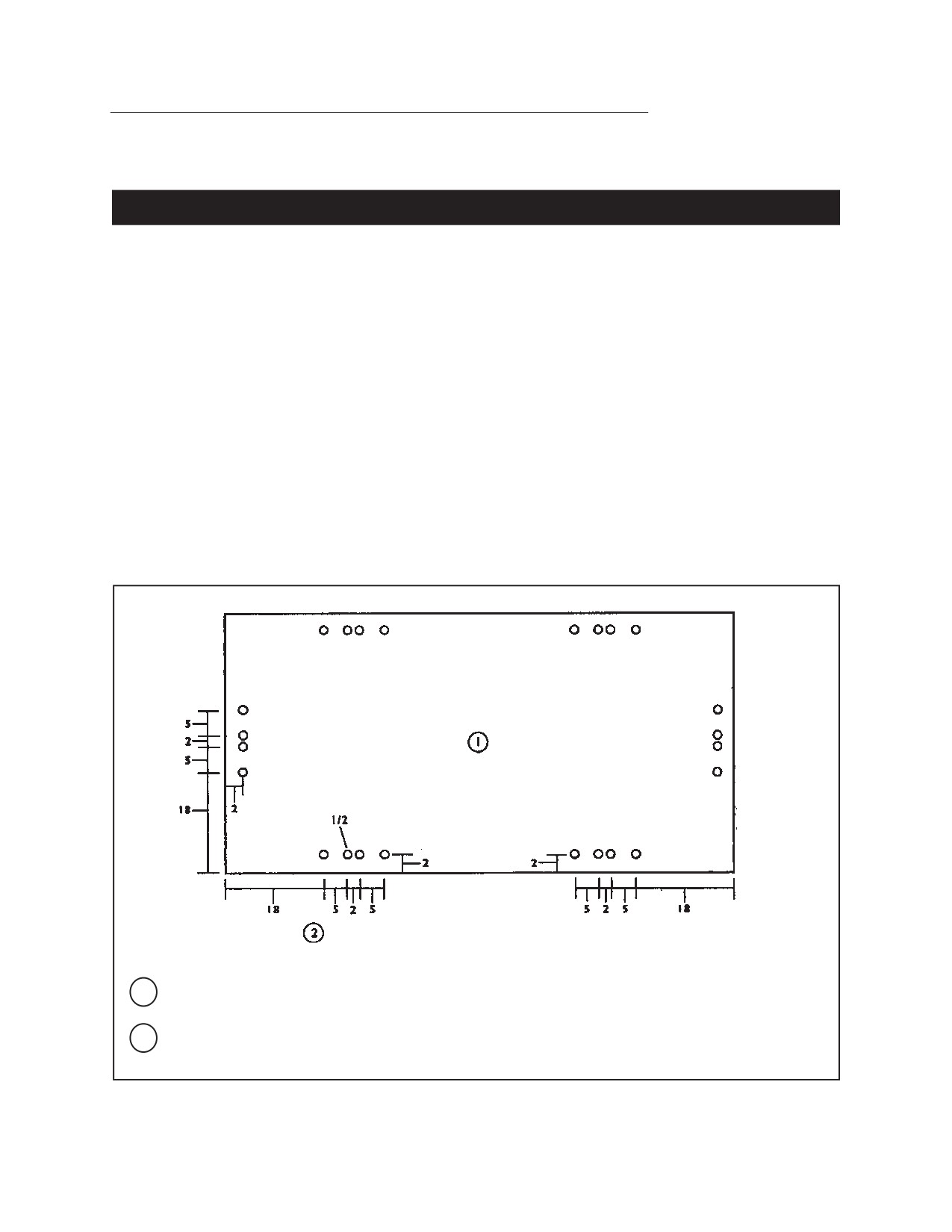
4-8. Prepare the skid board according to Figure 4-2. Prepare the drop items accord-
ing to the load’s sensitivity. Items must be well padded to prevent damage during
airdrop.
1
Place a 1- by 48- by 96-inch piece of plywood on a flat surface.
2
Drill twenty-four 1/2-inch holes on each side as shown above.
Figure 4-2. Skid Board Prepared
4-3
FM 4-20.147/TO 13C7-37-31
PREPARING SKID BOARD TIES AND PLACING HONEYCOMB
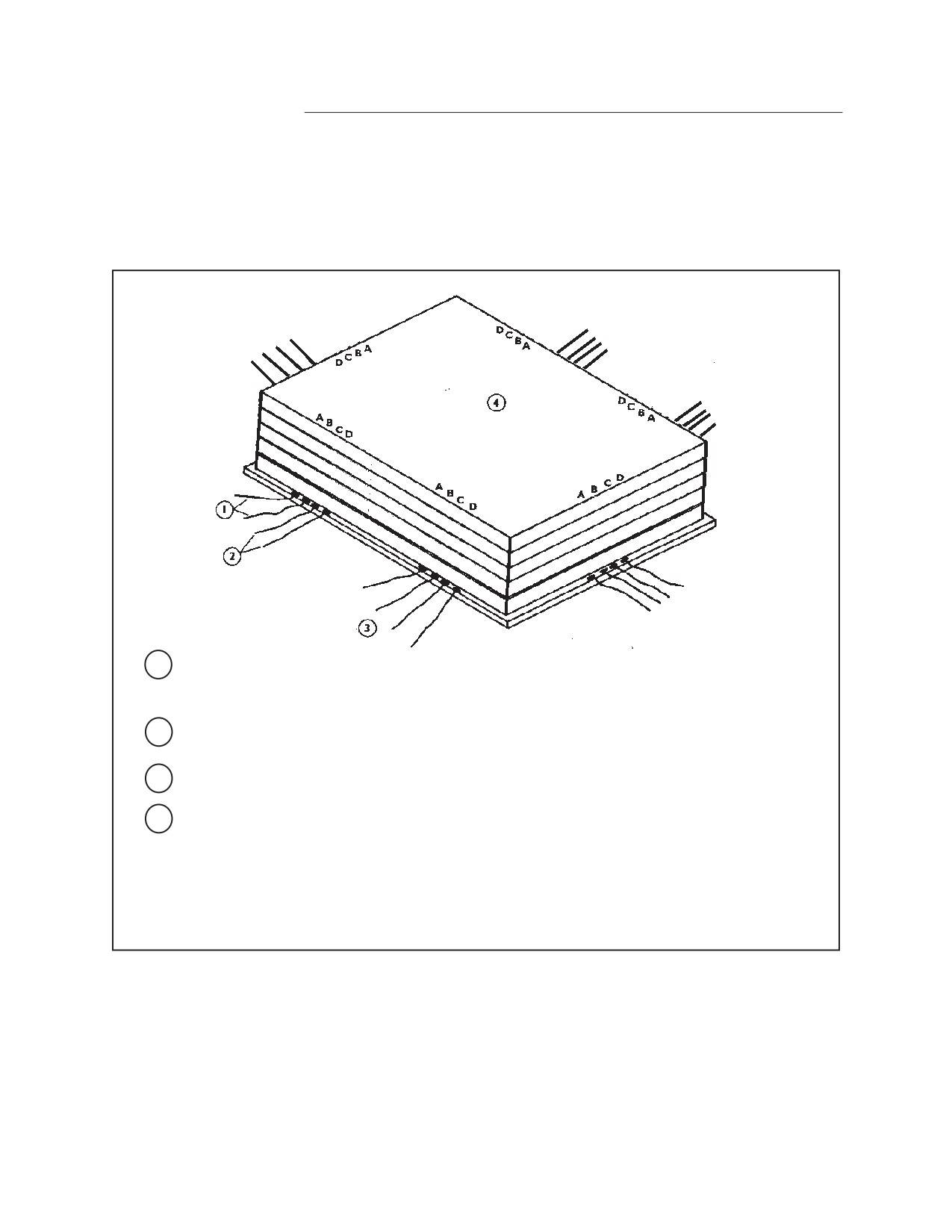
4-9. Prepare the skid board ties and place the honeycomb as shown in Figure 4-3.
1
Cut twelve 10-foot lengths of 1/2-inch tubular nylon webbing. Route one end through hole A
and the other through hole B, from bottom to top.
2
Repeat step 1 for holes C and D.
3
Repeat steps 1 and 2 for the other five sets of holes.
4
Determine the size of the honeycomb needed according to the size of the load. Cut and center
the honeycomb on the skid board. Make sure the honeycomb is moved in 2-inches from all
sides.
Note: All double A-22 container loads will use a minimum of five layers of honeycomb. The two
bottom layers will not exceed 44 by 92 inches and the top three layers will be the size of the load.
Figure 4-3. Skid Board Ties Prepared and Honeycomb Placed
4-4
FM 4-20.147/TO 13C7-37-31
POSITIONING A-22 SLING ASSEMBLIES
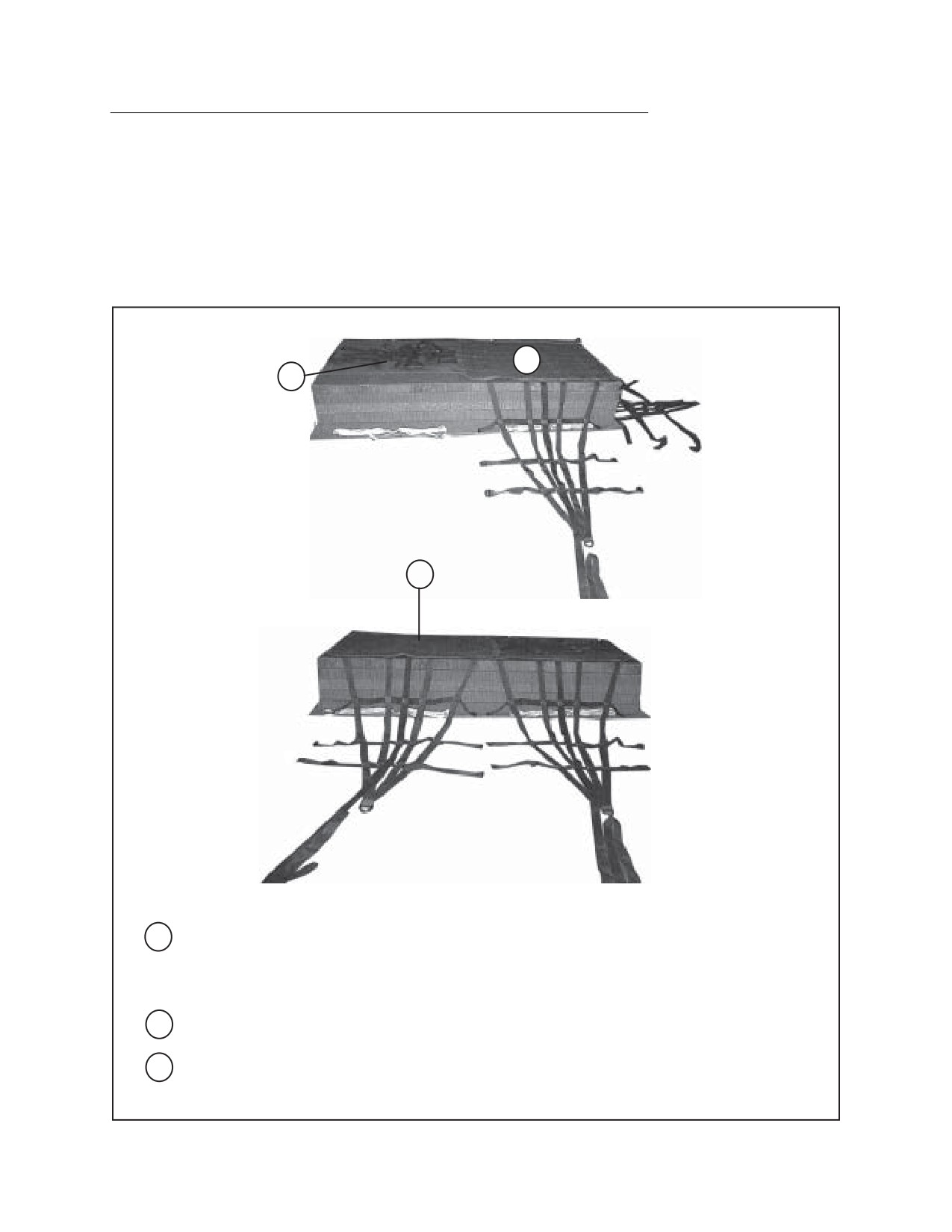
4-10. Position two A-22 sling assemblies on the double A-22 load as shown in Figure
4-4.
1
2
3
1
Place one A-22 sling assembly toward the front of the honeycomb layer. Extend all lateral
straps and support webbing. Make sure the support web D-ring at the rear extends off the
edge of the load.
2
Fold and place all lateral straps on top of the rear support web.
3
Place the second A-22 sling assembly to the rear. Position it in the same manner as the front
assembly. Make sure the D-ring on the front support web extends off the edge of load.
Figure 4-4. A-22 Sling Assemblies Positioned
4-5
FM 4-20.147/TO 13C7-37-31
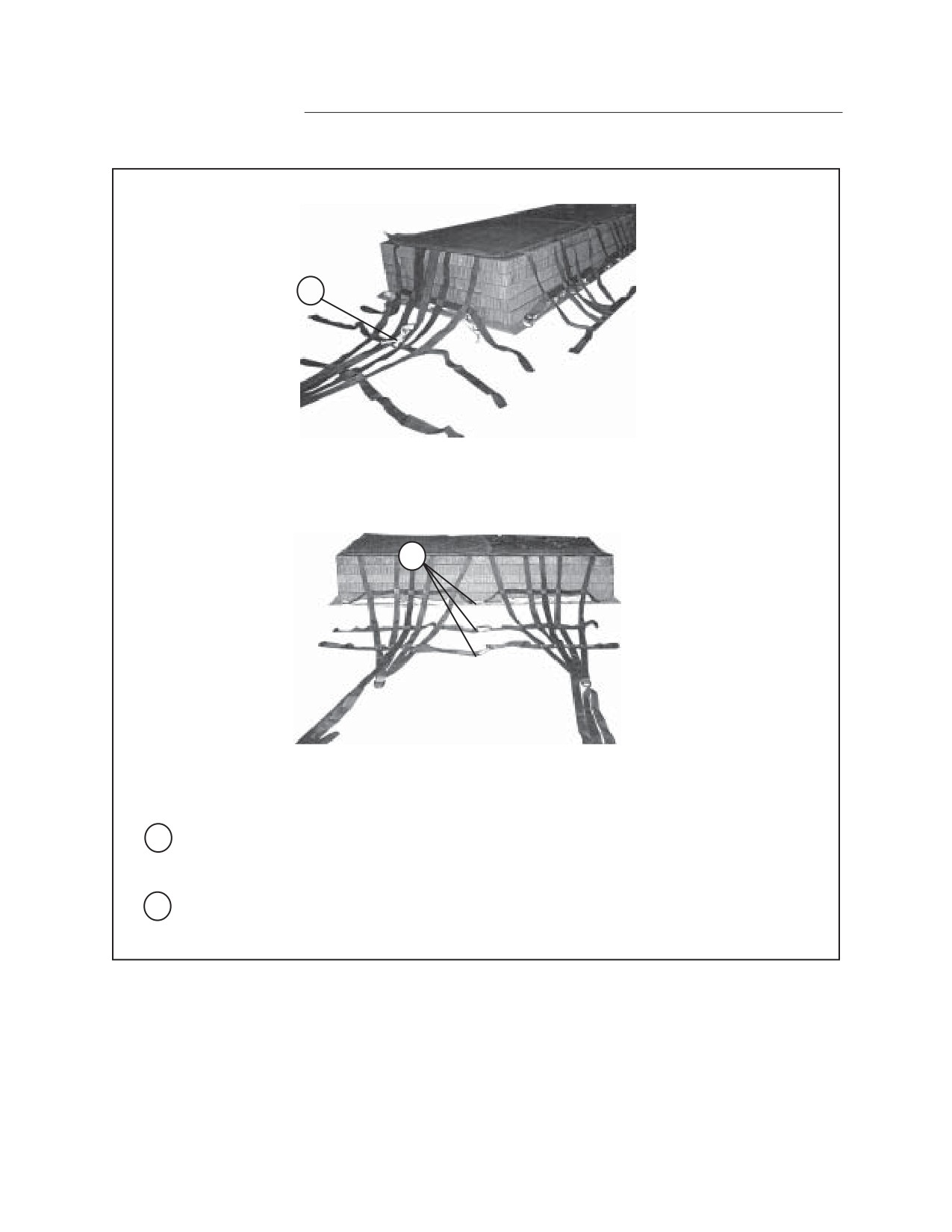
4
5
4
Use a length of type VIII nylon webbing to tie the support web D-rings exposed at the front
and rear of the load to the other A-22 sling assemblies as shown.
5
Cut six lengths of type VIII nylon webbing. Route one length through each set of friction
adapters at the midsection of the load as shown. Do not apply tension at this time.
Figure 4-4. A-22 Sling Assemblies Positioned (continued)
4-6
FM 4-20.147/TO 13C7-37-31
POSITIONING COVERS AND HONEYCOMB
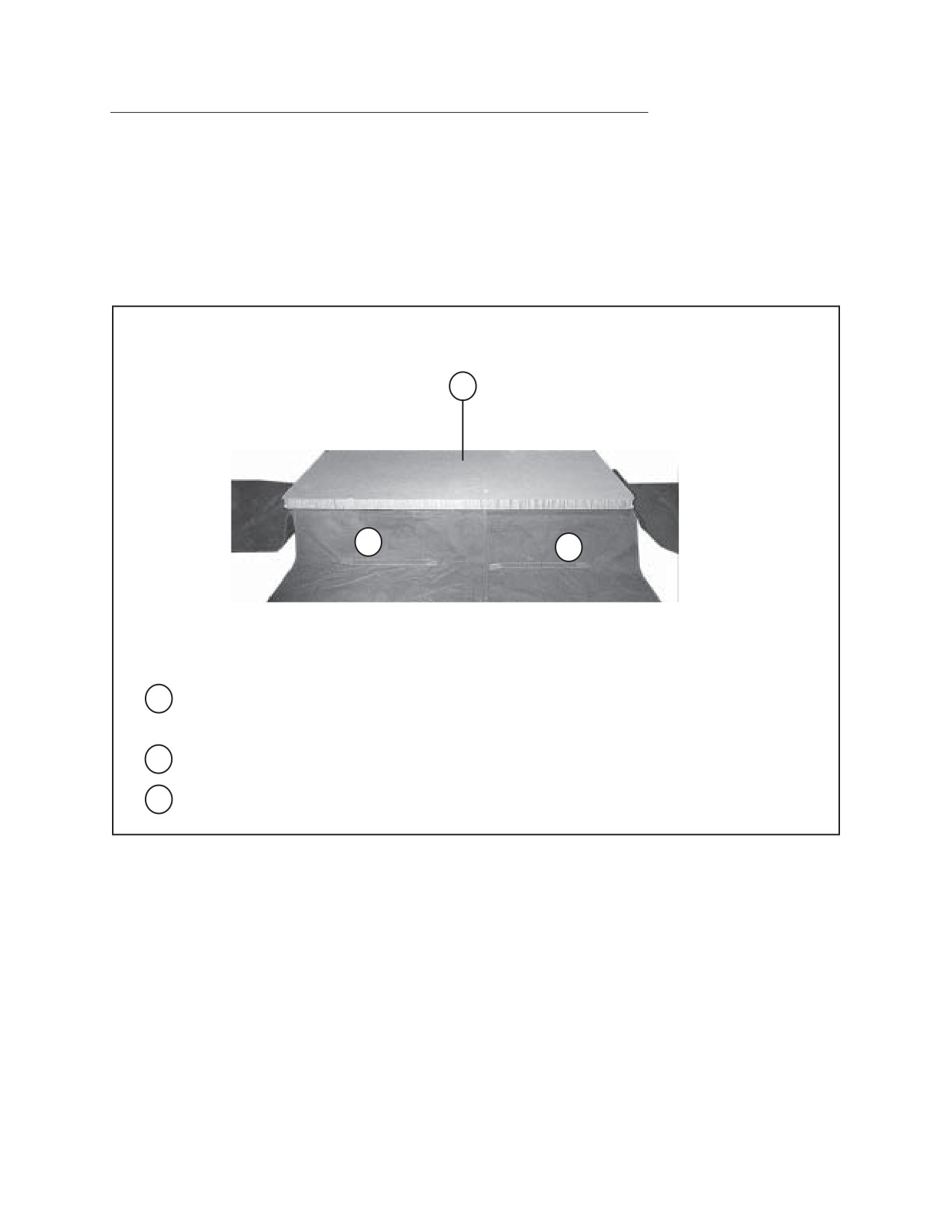
4-11. Use two A-22 cargo bag covers when rigging this load, if needed. Position the
covers as shown in Figure 4-5. Placing an additional layer of honeycomb on top of
the covers as shown is recommended but not required.
3
2
1
1
Place the first cover to the front in the same manner as sling assembly. Fold the rear excess
even with the layer of honeycomb.
2
Repeat step 1 for the second cover but position the cover to the rear of the skid.
3
Center the second layer of honeycomb on the covers and in the same position as the first
layer.
Figure 4-5. Covers and Honeycomb Positioned
4-7
FM 4-20.147/TO 13C7-37-31
POSITIONING LOAD AND CLOSING BAG COVERS
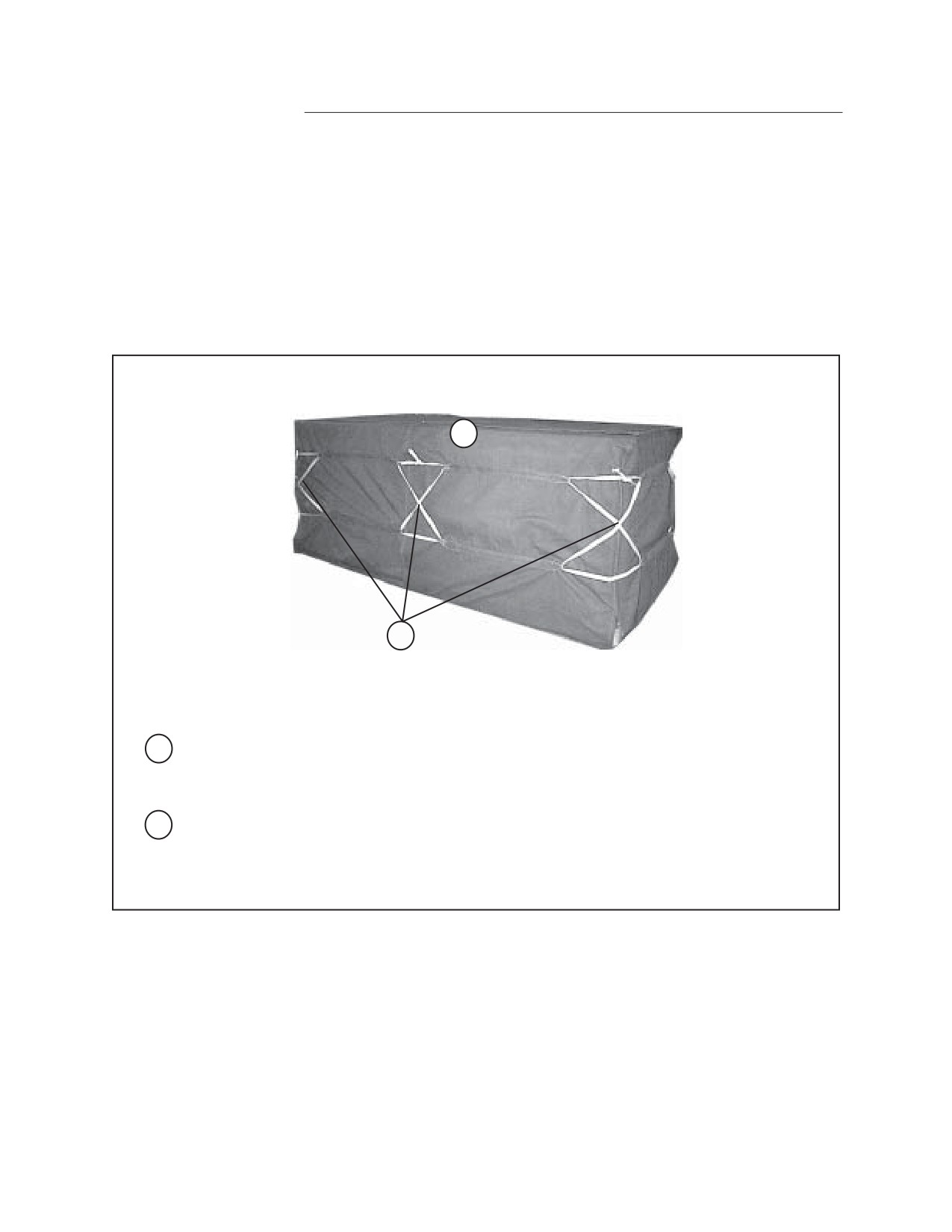
4-12. Center the load so that the weight of the load is evenly distributed. Use
honeycomb and cellulose wadding to protect the items. Use cord, rope, or steel
strapping to keep the load from shifting. Close the bag as shown in Figure 4-6.
1
2
1
Fold the bag covers over the front and rear first, then the sides over the top. Fold under the
excess side covers.
2
Use six lengths of 1/2- inch tubular nylon webbing to lace the bag closed. Pull the webbing
tight and tie the running ends in a surgeon’s knot and bow knot. Tape the excess and the
knot. Leave one running end slightly exposed to allow rapid derigging.
Figure 4-6. A-22 Cargo Bag Covers Closed
4-8
FM 4-20.147/TO 13C7-37-31
SECURING TIE-DOWN STRAPS
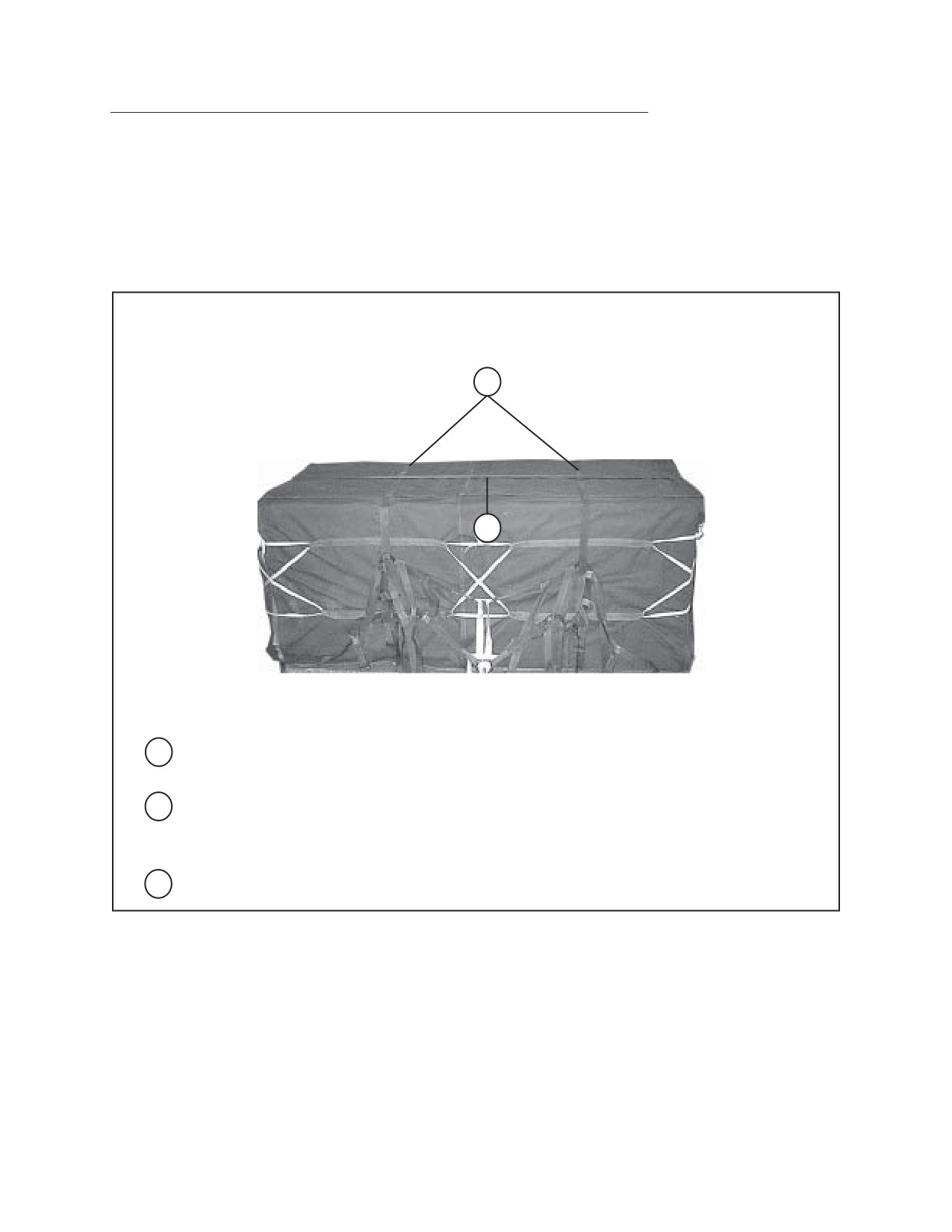
4-13. Secure the tie-down straps as shown in Figure 4-7.
1
2
1
Route the side tie-down straps through the opposing friction adapters. Apply tension to the
straps.
2
If necessary, attach a 36 or 60 inch type VIII nylon webbing strap to either the front or rear
tie-down strap. Route the running end through the friction adapter on the opposite end
and tie an overhand knot in the running end.
3
Fold the excess on the tie-down straps and tape or tie it. (not shown)
Figure 4-7. Tie-Down Straps Secured
4-9
FM 4-20.147/TO 13C7-37-31
SECURING LATERAL STRAPS
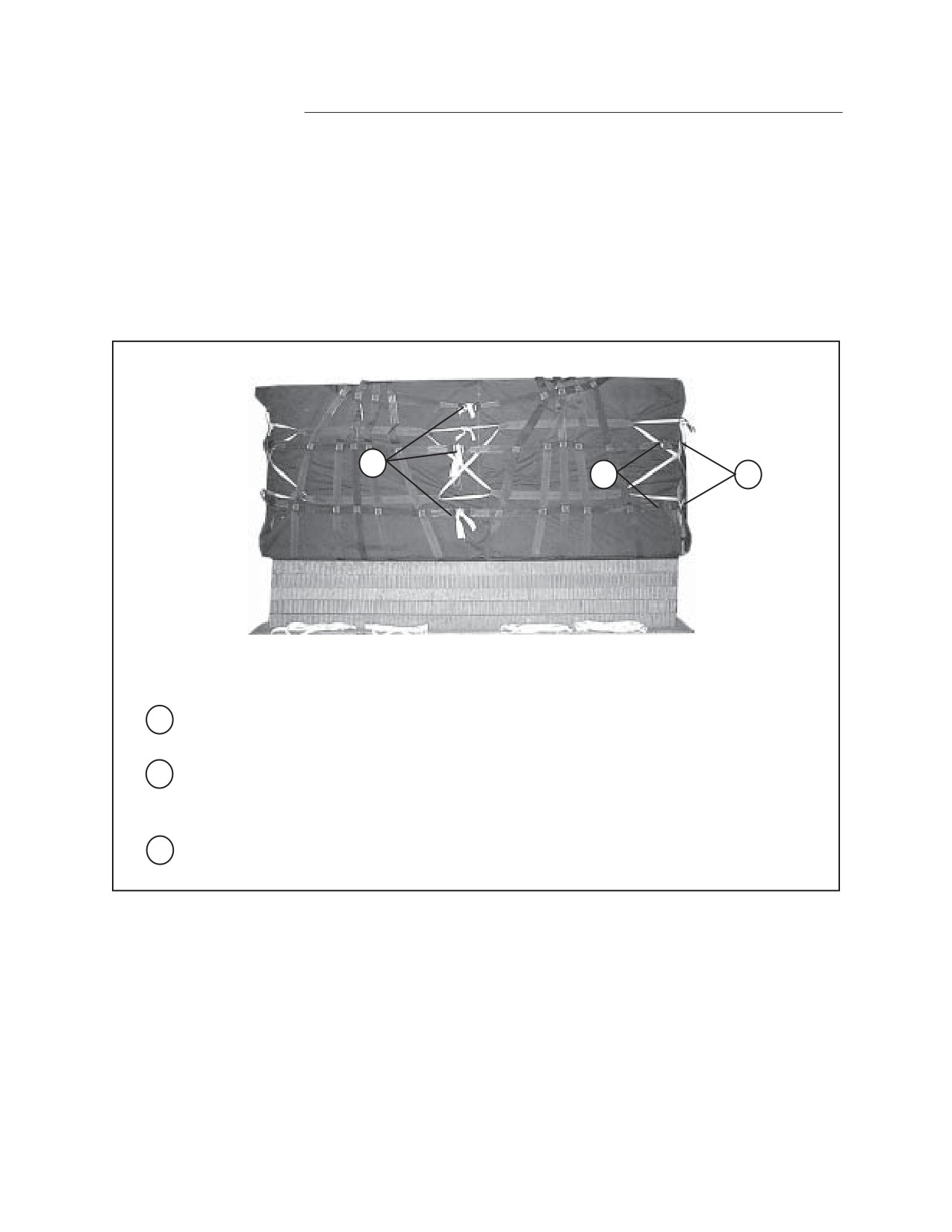
4-14. Secure the lateral straps as shown in Figure 4-8.
2
1
3
1
Lay the remaining portions of the sling assemblies over the load. Route the lateral straps
through the friction adapters.
2
Tighten the center friction adapters and type VIII nylon webbing so that the middle
suspension web on each container is vertical. Install a knot in the running ends of
the type VIII nylon webbing about 3 inches from the friction adapters.
3
Apply equal tension on the remaining lateral straps. Fold the excess and tape or tie in place
as shown.
Figure 4-8. Lateral Straps Secured
4-10
FM 4-20.147/TO 13C7-37-31
SECURING SKID BOARD TIES
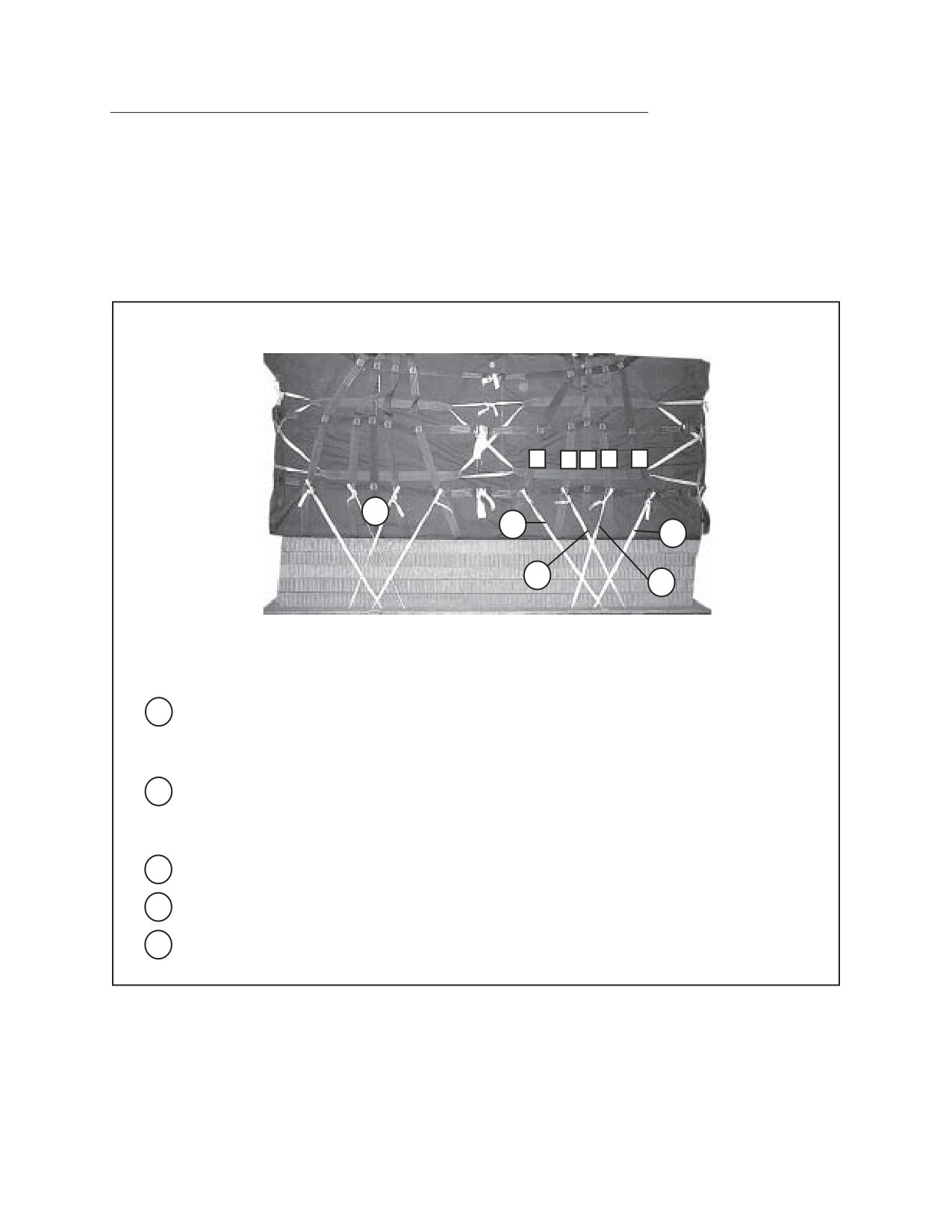
4-15. Secure the skid board ties as shown in Figure 4-9.
1
2
3
4
5
5
4
2
3
1
A B C D
1
Starting at the front right side, take tie-down A and diagonally tie it around the intersection
of the lower lateral strap and fourth support web. Use three half hitch knots and an
overhand knot in the running end.
2
Route tie-down B around the fifth support web and lower lateral strap intersection diagonally.
Pull the excess slack out, and tie it with a trucker’s hitch knot and an overhand knot in the
running end.
3
Repeat step 1 for tie-down D and secure it to the second intersection on the lower lateral strap.
4
Repeat step 2 for tie-down C and secure it to the first intersection on the lower lateral strap.
5
Repeat steps 1 through 4 for the other five sets of tie-downs.
Figure 4-9. Skid Board Ties Secured
4-11
FM 4-20.147/TO 13C7-37-31
INSTALLING SUSPENSION SLINGS
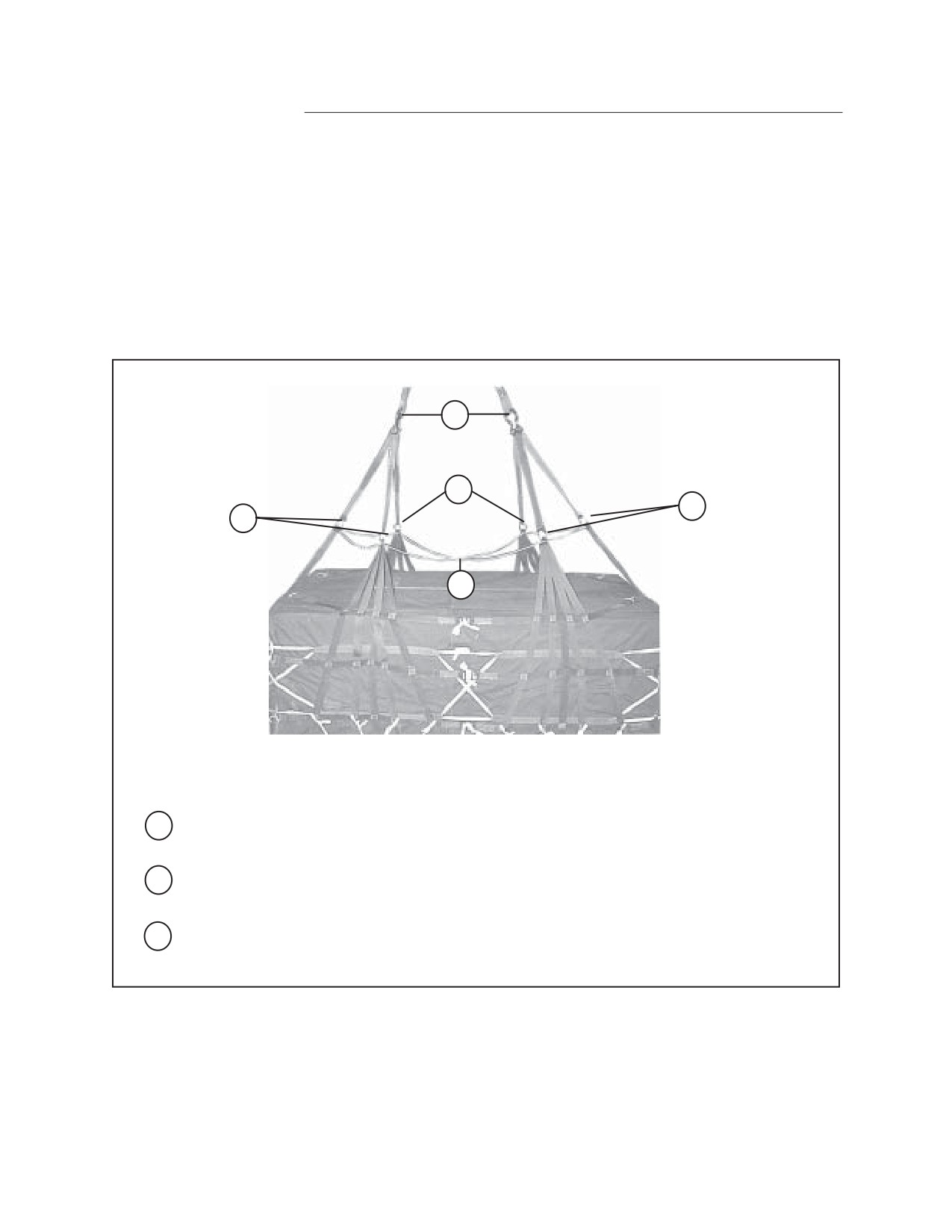
4-16. Install suspension slings using six suspension webs, two 3/4-inch cargo
suspension clevises, and two 3-foot (2-loop), type XXVI nylon webbing slings as
shown in Figure 4-10.
2
1
1
1
3
1
Attach one suspension web to each of the six D-rings. Route the snap hook from outside to
inside. Wrap each hook with masking tape.
2
Place a 3-foot sling on each clevis. Bolt the three suspension webs at the front of the load to
one clevis. Repeat step for the rear set.
3
Route a length of type III nylon cord through the six D-rings as shown above. Tie the ends
together. Make sure the tie has excess to allow suspension sling movement.
Figure 4-10. Suspension Slings Installed
4-12
FM 4-20.147/TO 13C7-37-31
INSTALLING PARACHUTE
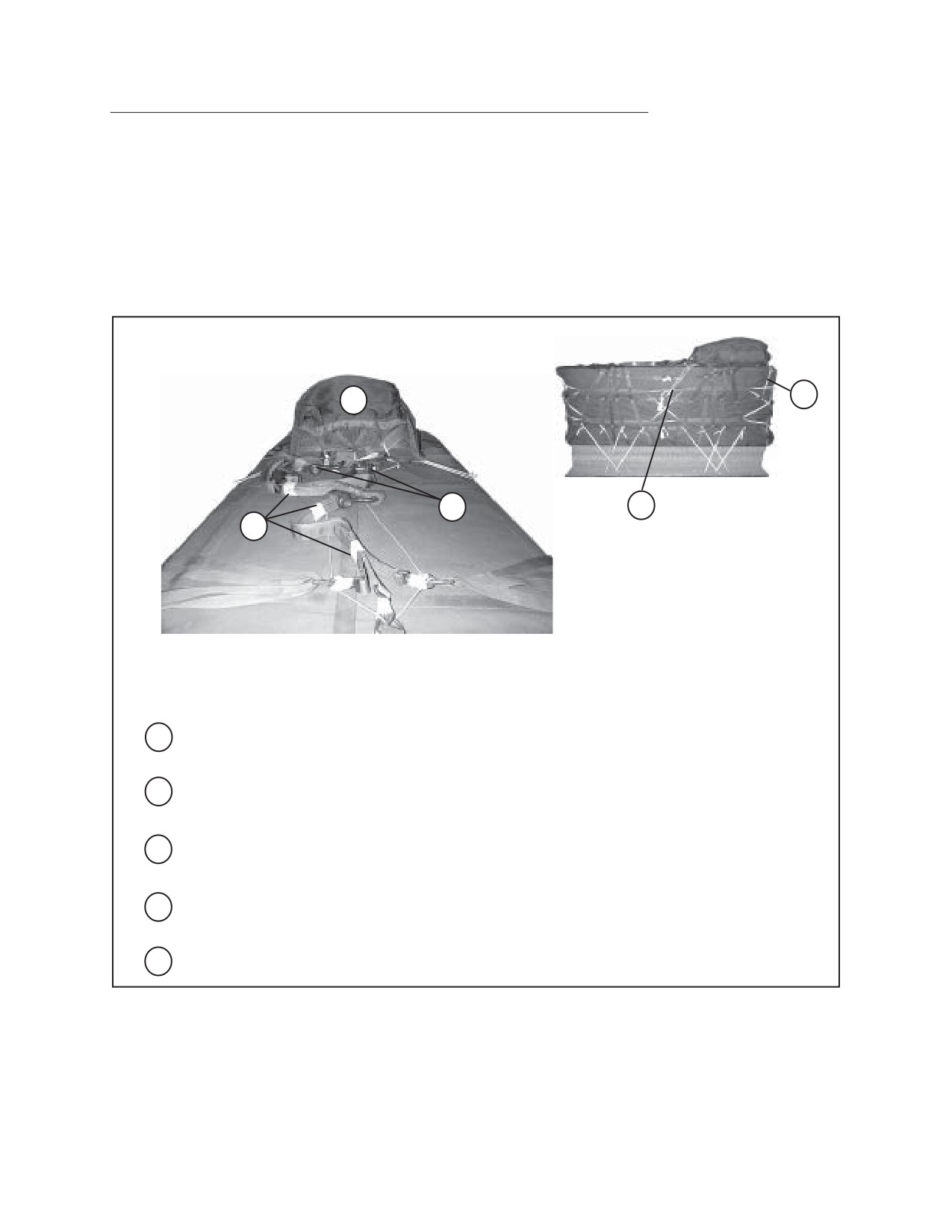
4-17. Install a reefed G-12 cargo parachute as shown in Figure 4-11.
2
1
4
3
5
1
Place a reefed G-12 cargo parachute on the load with the riser compartment up and the
bridle toward the front of the load. Position the parachute on the front of the load.
2
Tie the front corners of the parachute with one turn single type I, 1/4- inch cotton webbing to
the sling assembly.
3
Tie the rear corners of the parachute with two turns single type I, 1/4- inch cotton webbing to
the sling assembly.
4
Bolt the two 3- foot slings to the parachute’s cargo suspension clevis. Make sure the risers
from the parachute are not removed from the clevis.
5
Fold and tape the excess sling with masking tape.
Figure 4-11. Reefed G-12 Cargo Parachute Installed
4-13
FM 4-20.147/TO 13C7-37-31
MARKING RIGGED LOAD
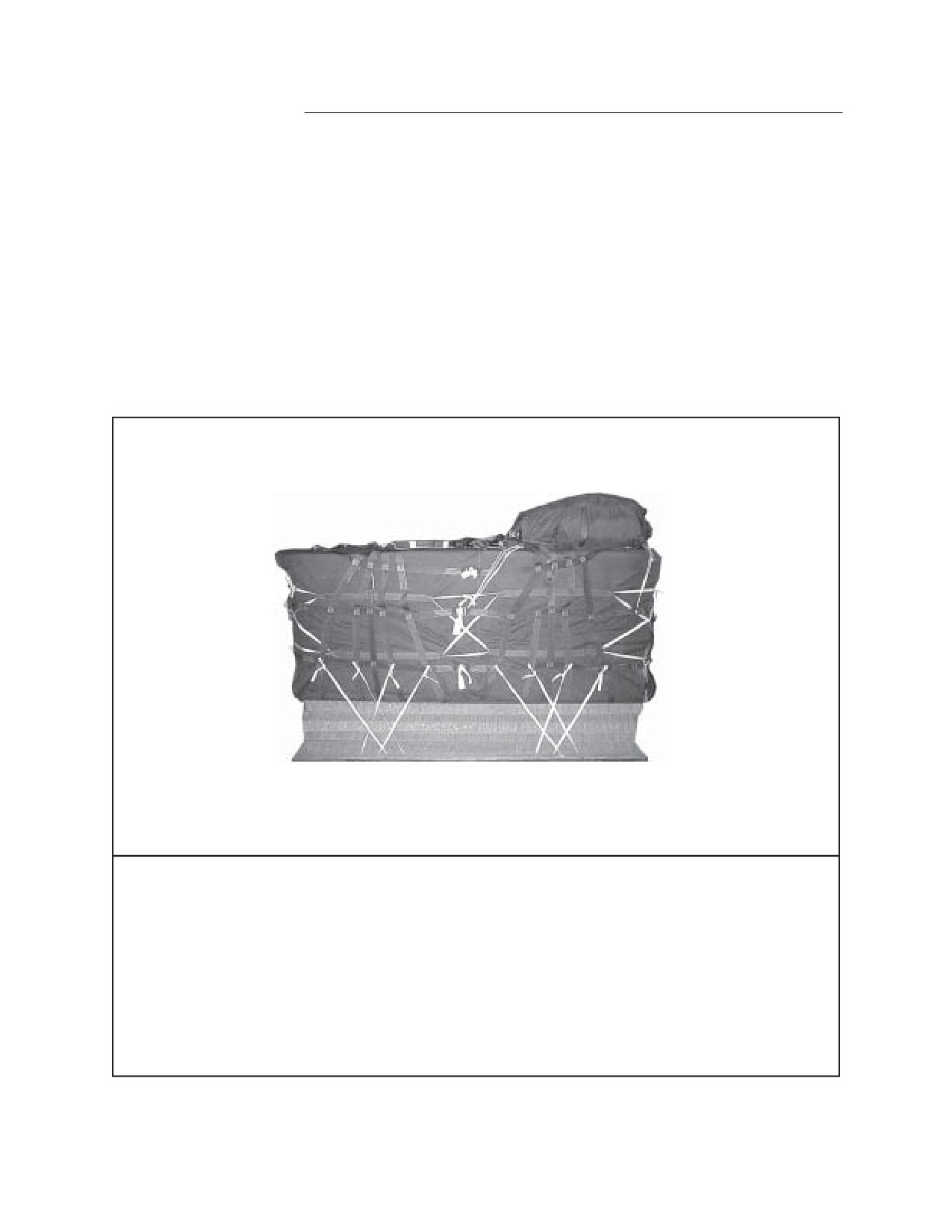
4-18. Mark the rigged load according to FM 10-500-3/TO 13C7-1-11 and as shown in
Figure 4-12. Compute the rigged load data.
EQUIPMENT REQUIRED
4-19. Use the equipment listed in Table 4-1 to rig the load shown in Figure 4-12.
RIGGED LOAD
Weight: Minimum load allowed
2,201 pounds
Maximum load allowed
3,375 pounds
Height:
83 inches
Width:
48 inches
Length:
96 inches
Figure 4-12. Fully Rigged Double A-22 Container
4-14
FM 4-20.147/TO 13C7-37-31
Table 4-1. Equipment Required for Rigging Double A-22 Container
National Stock
Item
Quantity
Number
8040-00-273-8713
Adhesive Paste
As required
1670-00-587-3521
Bag, cargo, A-22
2
4030-00-678-8562
Clevis, suspension, 3/4-inch (medium
)
2
4020-00-240-2146
Cord, nylon type III
As required
1670-00-753-3928
Pad, energy dissipating, honeycomb 36-by-96-by-3-inches
6 sheets
Parachute:
No NS N
Cargo, G-12 Reefed
1
1670-00-216-7297
Pilot, 68-in diam
1
1 sheet
5530-00-914-5118
Plywood, 1-by-48-by-96-inch
1670-01-062-6301
Sling, cargo, airdrop, 3-ft (2 loop), type XXVI nylon webbing
2
7510-00-266-6710
T
ape, masking, 2-inch
As required
8310-01-102-4478
Thread, cotton, ticket number 8/7
As required
Webbing:
8305-00-268-2411
Cotton, 1/4-inch, type I
As required
8305-00-082-5752
Nylon, tubular, 1/2-inch
As required
8305-00-263-3591
T
ype VIII
As required
4-15
FM 4-20.147/TO 13C7-37-31
SECTION III - ALTERNATE RIGGING METHOD FOR DOUBLE A-22
CONTAINER
BUILDING AND POSITIONING A-22 CONTAINERS
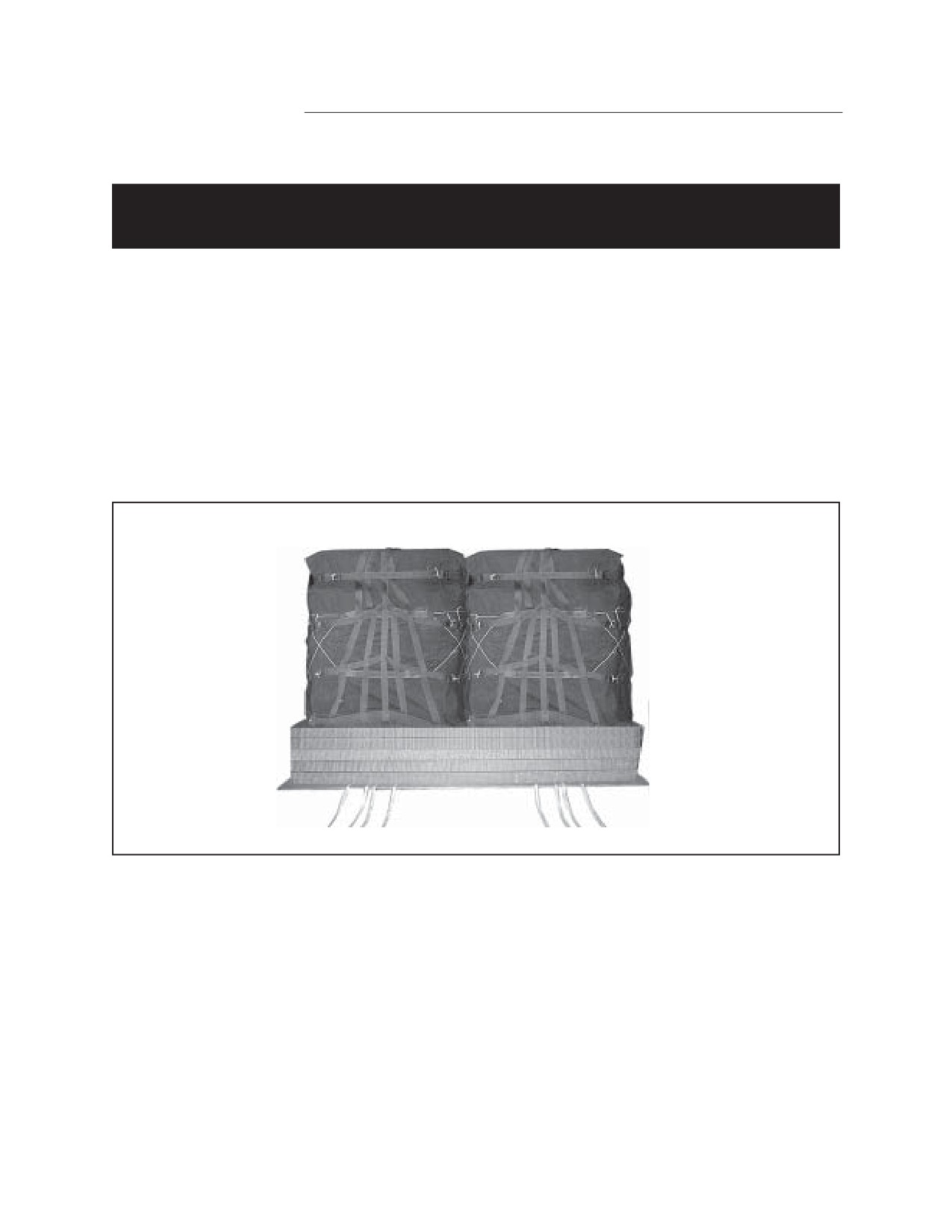
4-20. Build two individual A-22 containers in accordance with FM 10-500-3/TO
13C7-1-11/FMFM 7-47 of the same dimensions. Position the two A-22 containers on
top of the double skid board and honeycomb kit prepared in Figure 4-3. Ensure that
the two individual loads are flush against each other as shown in Figure 4-13.
Figure 4-13. A-22 Containers Positioned
4-16
FM 4-20.147/TO 13C7-37-31
JOINING A-22 CONTAINERS
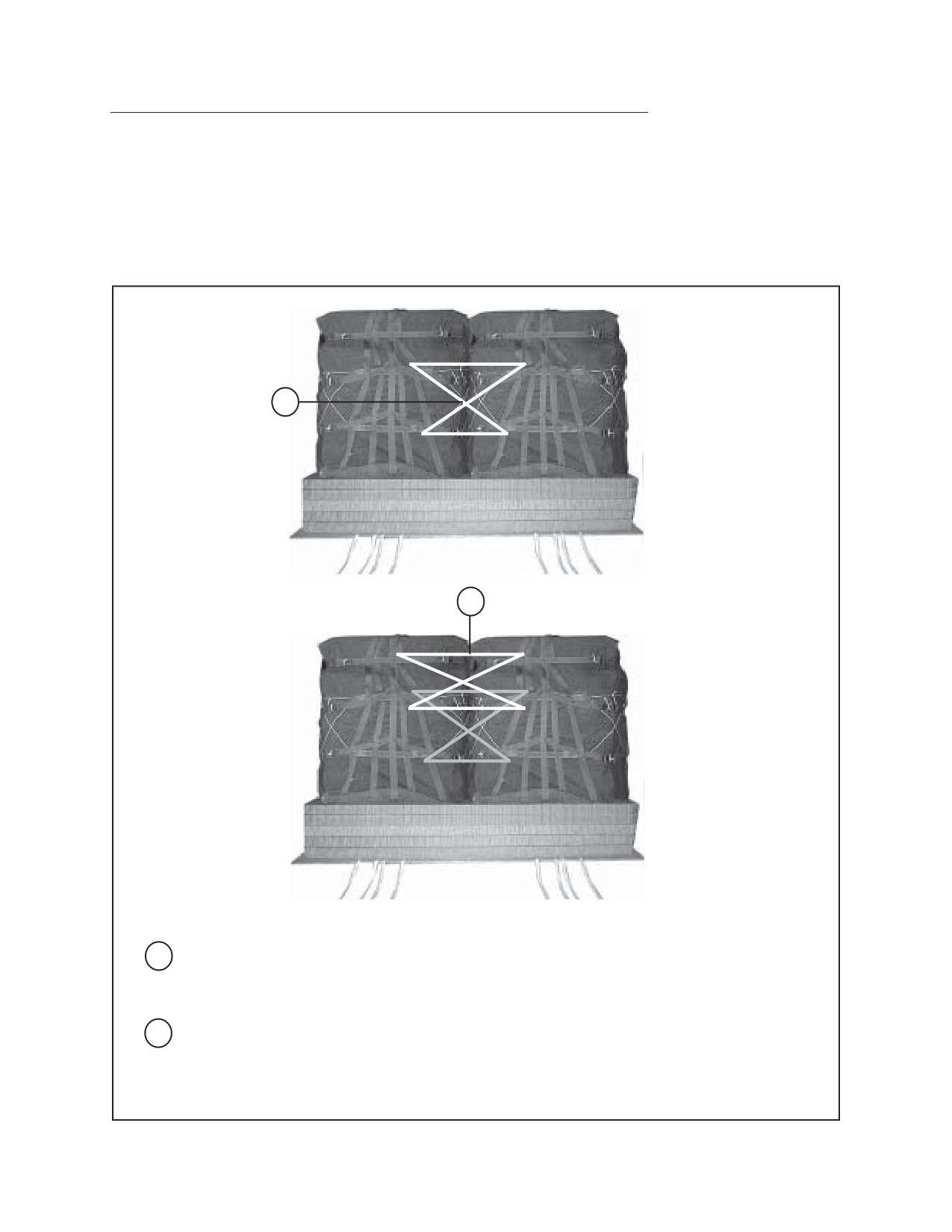
4-21. Join the two assemblies at the mid-section on each side of the load as shown in
Figure 4-14.
1
2
1
Route a length of type VIII nlyon webbing in an hour-glass pattern around the intersection of
the outer support webs and the lower and middle lateral straps of each A-22 container. Tie
off and tighten with a trucker’s hitch.
2
Route another length of type VIII nlyon webbing in an hour-glass pattern around the
intersection of the outer support webs and the middle and upper lateral straps of each A-22
container. Tie off and tighten with a trucker’s hitch.
Figure 4-14. A-22 Containers Joined
4-17
FM 4-20.147/TO 13C7-37-31
ATTACHING SUSPENSION WEBS
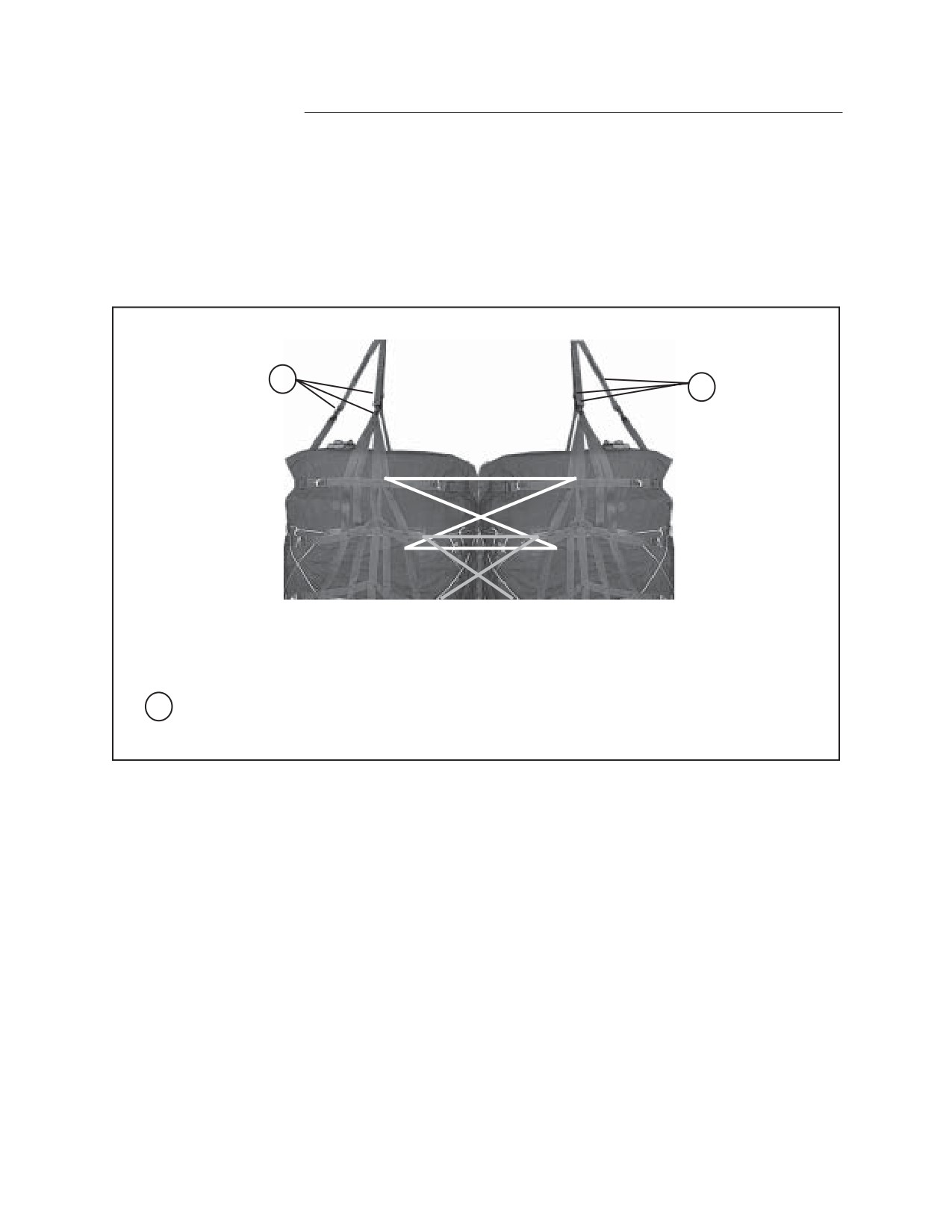
4-22. Attach suspension webs to the two containers as shown in Figure 4-15.
1
1
1
Attach one suspension web to each of the six D-rings. Do not connect a suspension web to the
two center A-22 support webs.
Figure 4-15. Suspension Webs Attached
4-18
FM 4-20.147/TO 13C7-37-31
TYING OFF UNUSED SUSPENSION WEBS
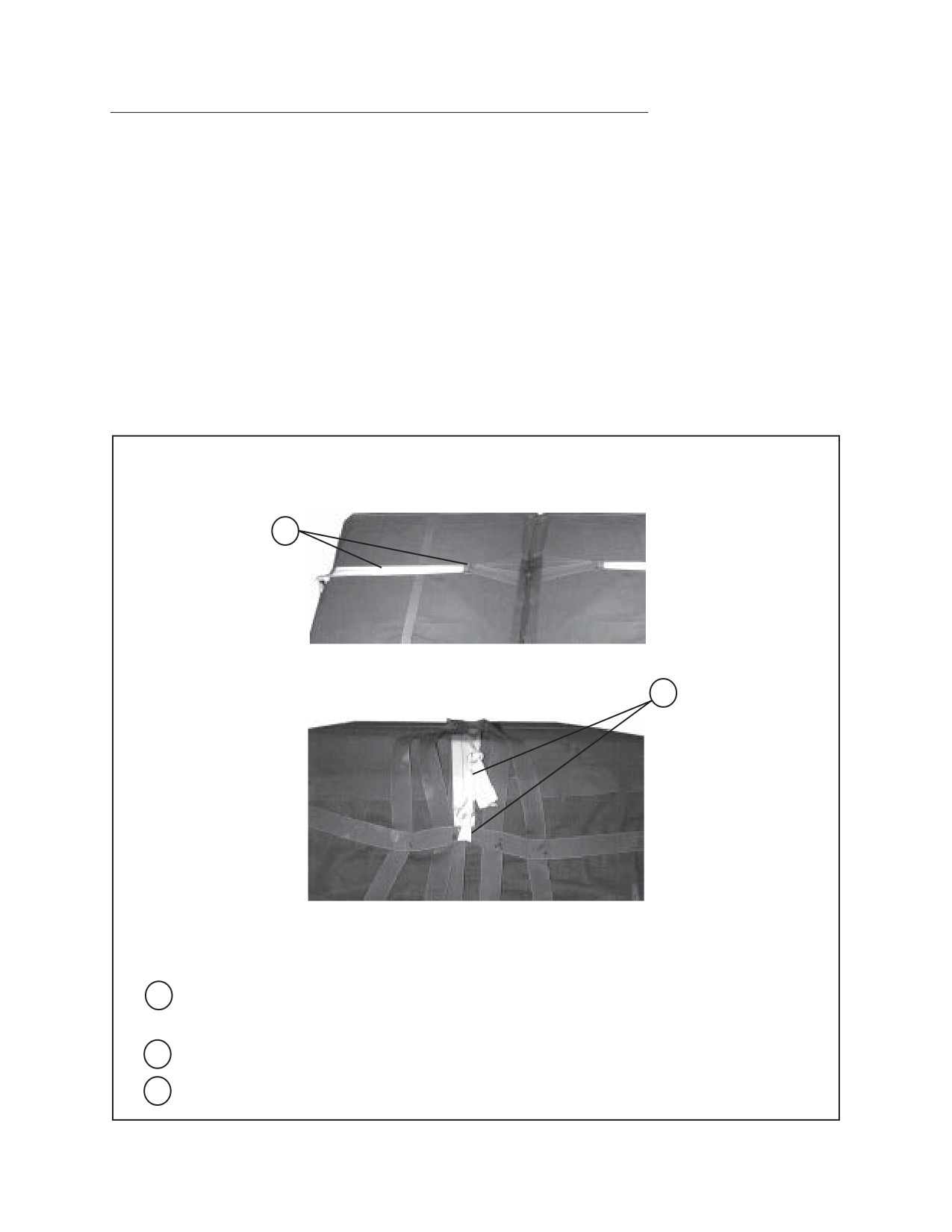
4-23. Fold each unused suspension web on top of the half of the load to which
it was originally rigged as shown in Figure 4-16.
INSTALLING SUSPENSION SLINGS
4-24. Install the suspension slings and complete the rest of the rigging in
accordance with procedures for a reefed G-12 parachute on a double A-22
container.
1
2
1
Route a length of type VIII nylon webbing through the D-ring and down and around the
intersection of the opposite top (or middle) lateral strap and the center support web.
2
Tie off and tighten with a trucker’s hitch.
3
Repeat steps 1 and 2 for the opposite side.
Figure 4-16. Off Unused Suspension Webs Tied Off
4-19
FM 4-20.147/TO 13C7-37-31
Chapter 5
Rigging Quadruple A-22 Container Loads For High
Velocity Airdrop
SECTION I - GENERAL INFORMATION FOR QUADRUPLE A-22
CONTAINER
QUADRUPLE A-22 CONTAINER COMPONENTS
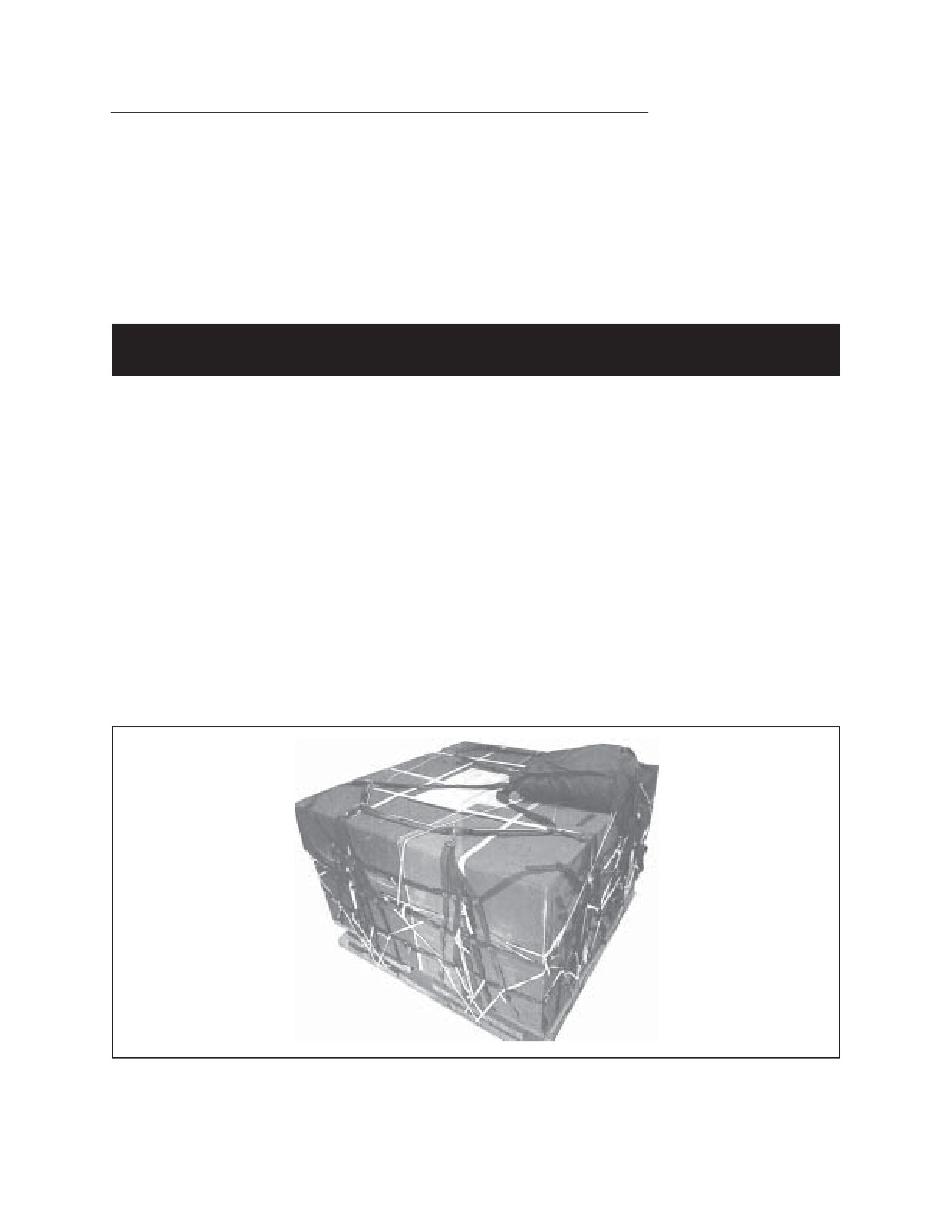
5-1. The quadruple A-22 container, shown in Figure 5-1, employs four standard A-22
sling assemblies which can be laced together to form a larger container. The
system employs a reefed G-12 parachute.
QUADRUPLE A-22 CONTAINER SKID BOARD
5-2. The sling assemblies are secured to a 1-1/2 or 2- by 96- by 96- inch plywood
(Grade AC) skid board with 1/2- inch tubular nylon webbing. Honeycomb is posi-
tioned between the container and the skid board for impact cushioning.
Figure 5-1. Fully Rigged Quadruple A-22 Container System
5-1
FM 4-20.147/TO 13C7-37-31
QUADRUPLE A-22 CONTAINER LIMITATIONS
5-3. The quadruple A-22 container has a weight restriction of 3,500 to 4,375 pounds,
excluding the weight of the parachute.
ASSEMBLY LINE RIGGING
5-4. When assembly line rigging is used for quadruple A-22 container loads, five
stations are needed. The stations are: laying out containers and preparing base,
positioning load, rigging load, installing parachute, and inspecting the rigged load.
INSPECTION OF LOAD
5-5. The quadruple A-22 container load must be inspected by a qualified rigger.
While being rigged, this load should be supervised or rigged by a parachute rigger.
DD Form 1748-1 must be completed before airdrop.
PARACHUTE USED
5-6. The system employs a reefed G-12 parachute with both skirt and vent reefing.
Procedures for packing the G-12 reefed parachute can be found in Chapter 1, Section
II of this manual.
5-2
FM 4-20.147/TO 13C7-37-31
SECTION II - RIGGING OVERSIZED ITEMS IN QUADRUPLE A-22
CONTAINER
SYSTEM DESCRIPTION
5-7. A typical load is rigged for high-velocity airdrop using four A-22 sling assem-
blies. Quadruple A-22 container loads must weigh at least 3,500 pounds but not
exceed 4,375 pounds, excluding the weight of the parachute. The load is rigged with
a reefed G-12 parachute. Typical oversized items include winterization kits which
include stoves, tents, long rolls of plastic, sleeping bags, blankets, etc.
PREPARING ITEMS AND SKID BOARD
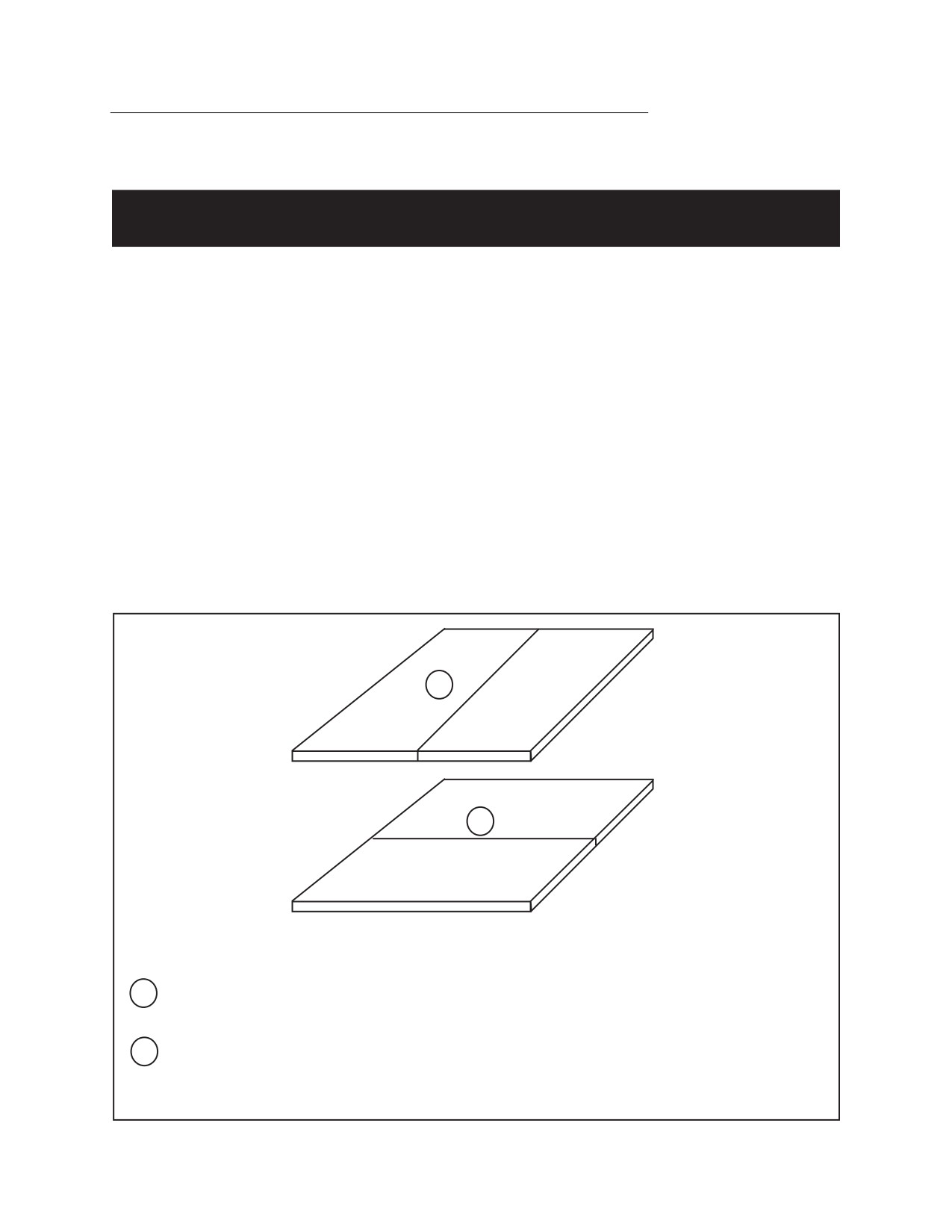
5-8. The skid board will consist of four 1- by 48- by 96-inch sheets of plywood. At
least two of the sheets must be AC grade plywood. The other two sheets can be
Grade D or better. Prepare the skid board according to Figure 5-2. Prepare the
drop items according to the load’s sensitivity. Items must be well padded to prevent
damage during airdrop.
4
34
234
1234
0123
9012
8901
7890
6789
5678
4567
2
3456
2345
1234
0123
9012
8901
7890
6789
5678
4567
3456
2345
12345678901234567890123456789012123456789012341234
1234567890123456789012345678901212345678901234123
4
34
234
1234
0123
9012
8901
7890
1
6789
5678
4567
3456
2345
1234
0123
9012
8901
7890
6789
5678
4567
3456
2345
12345678901234567890123456789012123456789012345234
1234567890123456789012345678901212345678901234123
1
Lay two sheets of plywood (the grade D or better sheets) on the floor, side-by-side, so that they
form a 96- by 96-inch square.
2
Lay two sheets of AC plywood perpendicularly on top of the first two sheets. Line up all four
edges to form a square. The good side of these plywood sheets must be face up.
Figure 5-2. Skid Board Prepared
5-3
FM 4-20.147/TO 13C7-37-31
3
3”-5”
0
3”-5”
0
90
890
890
7890
6789
678
5678
567
4567
3456
3456
2345
1234
4
0123
1234
90123
9012
89012
8901
7890
67890
6789
56789
45678
4567
34567
23456
23456
1234567890123456789012345678901212345678901234567890123456789012123412345
1234567890123456789012345678901212345678901234567890123456789012123412345
123456789012345678901234567890121234567890123456789012345678901212341234
12345678901234567890123456789012123456789012345678901234567890121234123
12345678901234567890123456789012123456789012345678901234567890121234123
1234567890123456789012345678901212345678901234567890123456789012123412
123456789012345678901234567890121234567890123456789012345678901212345
18 5 2 5
2
0
90
90
890
7890
36
6789
789
5678
567
4567
456
3456
2345
2345
1234
6
0123
0123
9012
89012
8901
78901
7890
6789
56789
5678
45678
34567
34567
23456
12345
1234567890123456789012345678901212345678901234567890123456789012123412345
123456789012345678901234567890121234567890123456789012345678901212341234
123456789012345678901234567890121234567890123456789012345678901212341234
12345678901234567890123456789012123456789012345678901234567890121234123
12345678901234567890123456789012123456789012345678901234567890121234123
1234567890123456789012345678901212345678901234567890123456789012123452
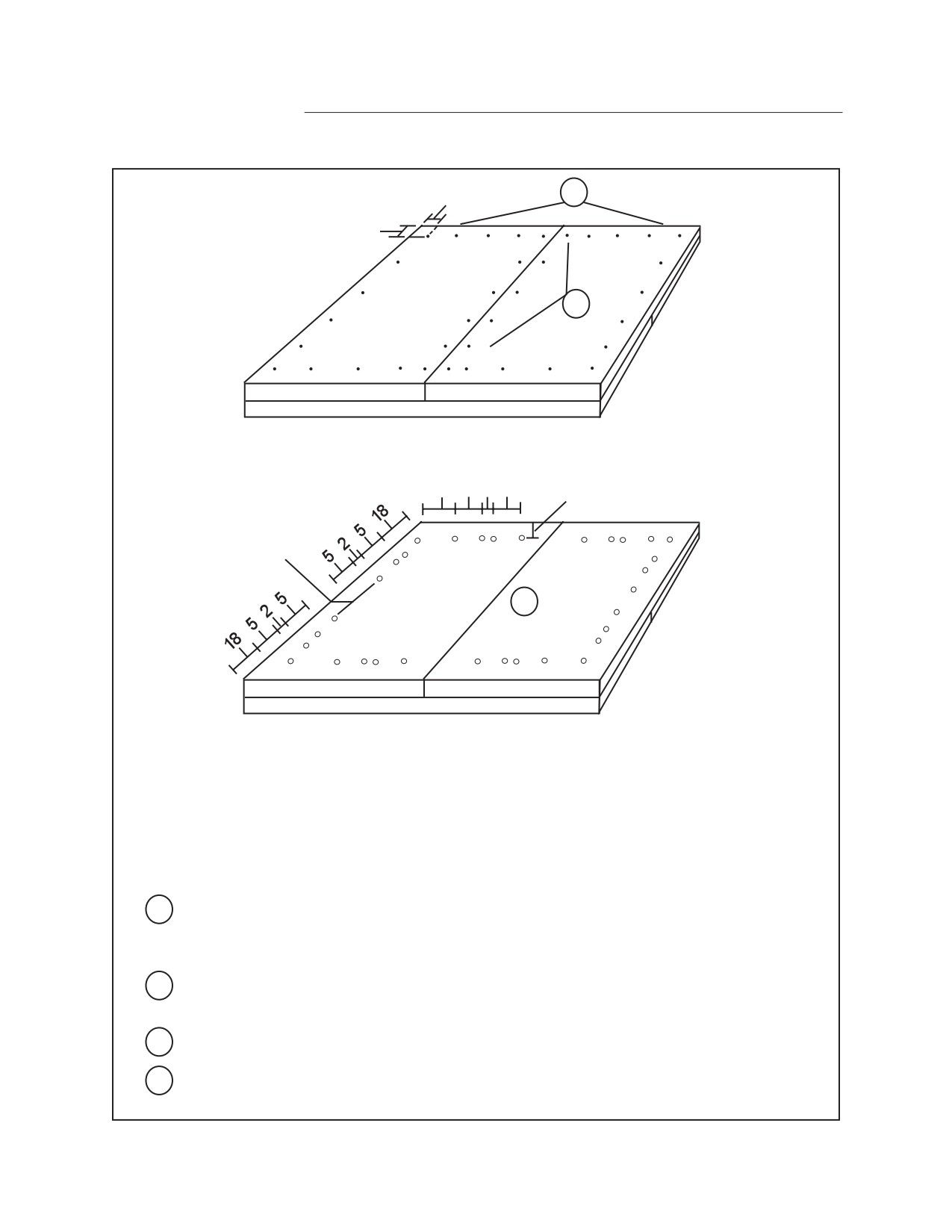
Notes:
1. If AC plywood is not available, BC grade plywood may be substitued. All
loose knots and splinters must be removed from plywood before rigging.
Use 1-inch thick plywood. Do not mix 1-inch and 3/4-inch sheets on the same
skid.
2. The skid board must be loaded into the aircraft so that the bottom sheets
(grade A side) are lengthwise and parallel to the direction of flight. The
seam on the bottom must run parallel to the aircraft roller conveyer.
3
Nail the plywood (into the good side of the AC sheets that are facing up) along the edges
approximately 1 foot apart using 12d nails. The nails should be 3 to 5 inches from the
edges. Ensure each nail head is sunk below the surface of the plywood.
4
Nail along the seam on both sheets of plywood at 1-foot intervals using 12d nails.
Ensure that each nail head is sunk below the surface of the plywood.
5
Flip the skid board upside-down. Bend over all exposed nails (not shown).
6
Drill thirty-two 1/2-inch diameter holes as shown above.
Figure 5-2. Skid Board Prepared (continued)
5-4
FM 4-20.147/TO 13C7-37-31
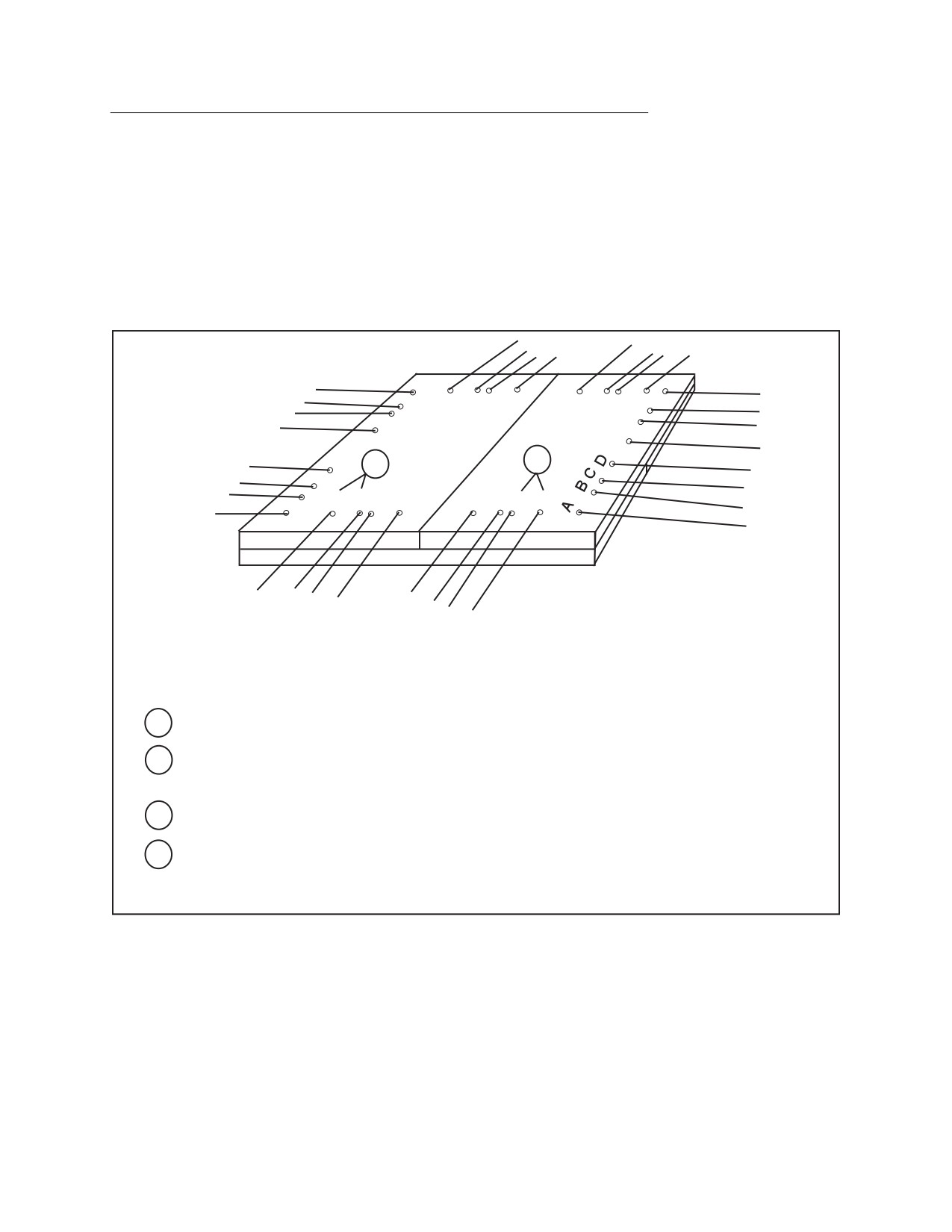
PREPARING SKID BOARD TIES AND PLACING HONEYCOMB
5-9. Prepare the skid board ties and place the honeycomb as shown in Figure 5-3.
0
90
90
890
7890
789
6789
5678
567
4567
3456
3456
2345
2345
1234
0123
3
0123
2
9012
89012
8901
78901
67890
6789
56789
A BC D
A BC D
5678
45678
34567
3456
23456
1234567890123456789012345678901212345678901234567890123456789012123412345
1234567890123456789012345678901212345678901234567890123456789012123412345
123456789012345678901234567890121234567890123456789012345678901212341234
123456789012345678901234567890121234567890123456789012345678901212341234
12345678901234567890123456789012123456789012345678901234567890121234123
1234567890123456789012345678901212345678901234567890123456789012123412
1234567890123456789012345678901212345678901234567890123456789012123452
1
Cut sixteen 10-foot lengths of 1/2-inch tubular nylon webbing.
2
Route one end of a 10- foot length of 1/2-inch tubular nylon webbing through hole A and the
other end through hole B, from bottom to top.
3
Repeat step 2 for holes C and D.
4
Repeat steps 2 and 3 for the other seven sets of holes.
Figure 5-3. Skid Board Ties Prepared and Honeycomb Placed
5-5
FM 4-20.147/TO 13C7-37-31
5
6
7
5
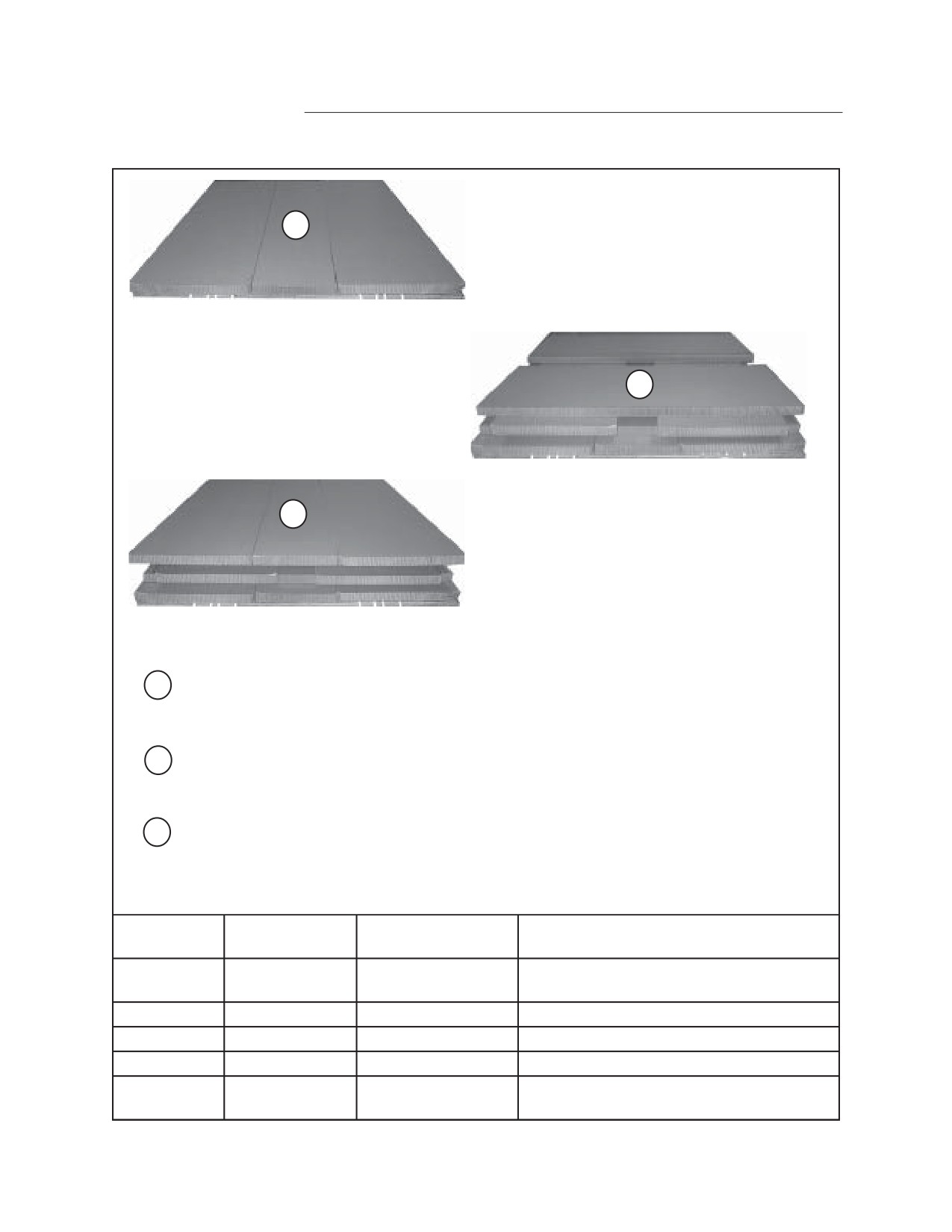
Five layers of honeycomb shall be placed on top of the plywood skid board, starting with layer
number 1, as shown in Table 5-1. Glue each layer of honeycomb together and glue layer
number 1 to the skid.
6
Honeycomb layers number 2, 3 and 4 are blow out layers. Place the honeycomb so that it is
6 inches from the edge of the skid. There should be a 12 inch space between each sheet.
Alternate directions for each layer of honeycomb.
7
Glue three pieces of honeycomb on top of layer 4 to form layer 5 as described in Table 5-1.
Figure 5-3. Skid Board Ties Prepared and Honeycomb Placed (continued)
Layer
Piece s
Length (inches)
Width (inches)
Number
2
96
36
1
1
96
24
2
2
96
36
3
2
96
36
4
2
96
36
2
96
36
5
1
96
24
Table 5-1. Honeycomb Layers for High Velocity Quad A-22 Loads
5-6
FM 4-20.147/TO 13C7-37-31
POSITIONING A-22 SLING ASSEMBLIES
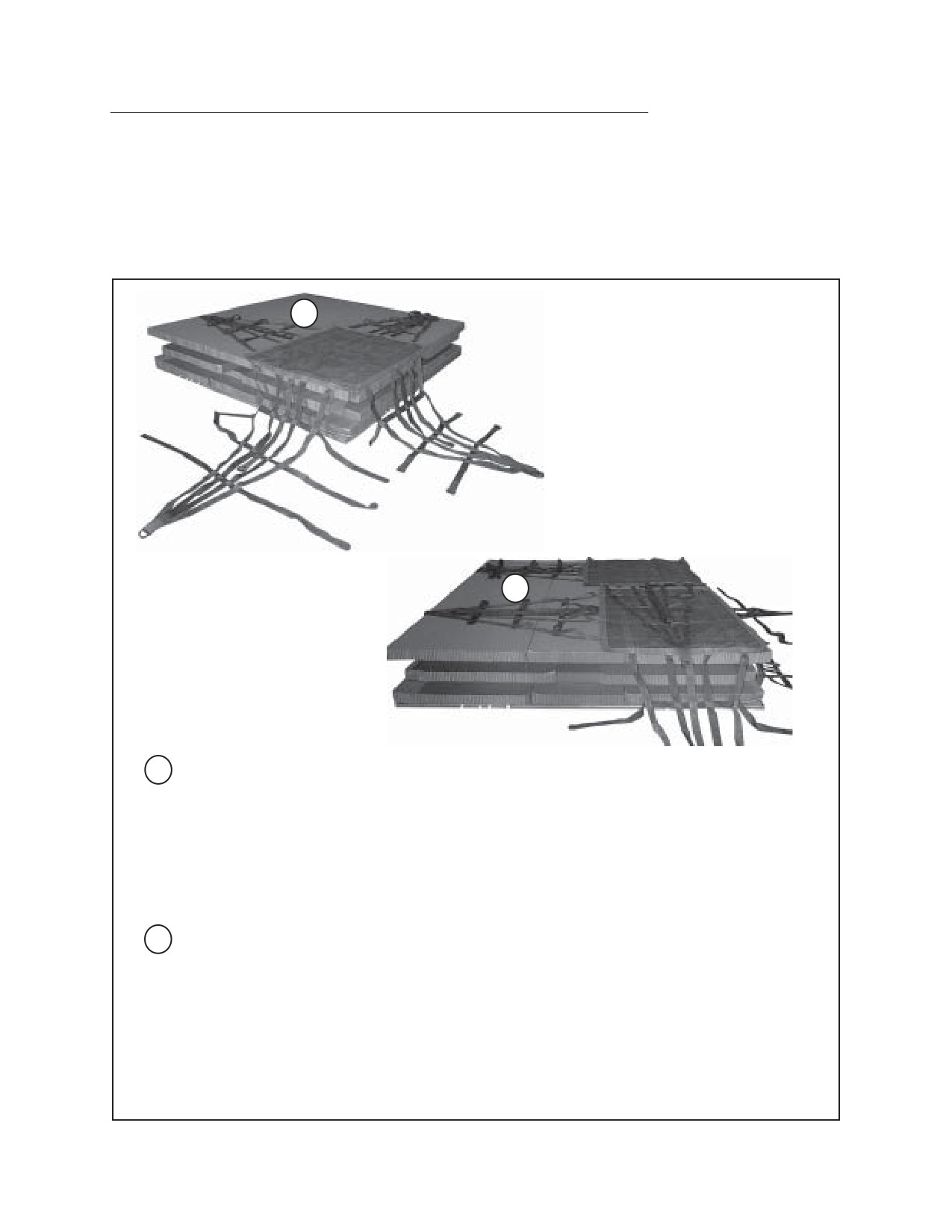
5-10. Position four A-22 sling assemblies on the quad A-22 load as shown in Figure
5-4.
REAR
1
FRONT
REAR
2
FRONT
1
Place the first A-22 sling assembly toward the front-right corner of the honeycomb so the
front-right corner of the scuff pad is aligned with the front-right corner of the honeycomb.
Fully extend all lateral straps and support webbing. Position sling assembly so the two short
center tiedown straps (with the friction adapters) extend off the honeycomb stack toward the
front and right. Make sure the opposite (left and rear) support web D-rings extend beyond the
edge of the honeycomb. Fold and place the lateral straps of the left and rear support webs
( the webs that are on top of the honeycomb) and the long center tiedown straps, so that they
are on top of the support webs.
2
Place the second A-22 sling assembly toward the front-left corner of the honeycomb so the
front-left corner of the scuff pad is aligned with the front-left corner of the honeycomb.
Fully extend all lateral straps and support webbing. Position sling assembly so the two short
center tiedown straps (with the friction adapters) extend off the honeycomb stack toward the
front and left. Make sure the opposite (right and rear) support web D-rings extend beyond the
edge of the honeycomb. Fold and place the lateral straps of the right and rear support webs
( the webs that are on top of the honeycomb) and the long center tiedown straps so that they
are on top of the support webs.
Figure 5-4. A-22 Sling Assemblies Positioned
5-7
FM 4-20.147/TO 13C7-37-31
REAR
3
FRONT
REAR
FRONT
4
3
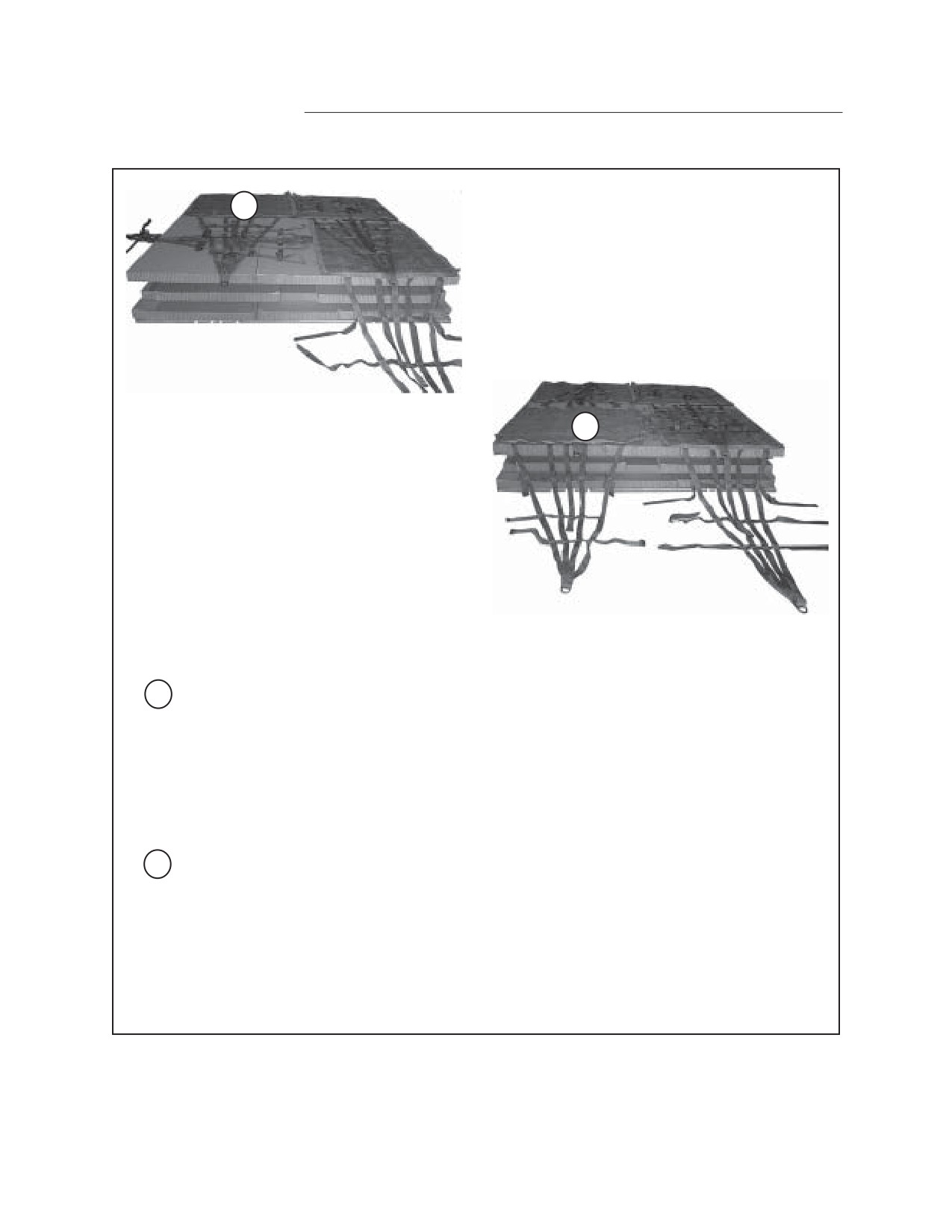
Place the third A-22 sling assembly toward the rear-left corner of the honeycomb so the
rear-left corner of the scuff pad is aligned with the rear-left corner of the honeycomb.
Fully extend all lateral straps and support webbing. Position sling assembly so the two short
center tiedown straps (with the friction adapters) extend off the honeycomb stack toward the
rear and left. Make sure the opposite (right and front) support web D-rings extend beyond the
edge of the honeycomb. Fold and place the lateral straps of the right and front support webs
( the webs that are on top of the honeycomb) and the long center tiedown straps, so that they
are on top of the support webs.
4
Place the fourth A-22 sling assembly toward the rear-right corner of the honeycomb so the
rear-right corner of the scuff pad is aligned with the rear-right corner of the honeycomb.
Fully extend all lateral straps and support webbing. Position sling assembly so the two short
center tiedown straps (with the friction adapters) extend off the honeycomb stack toward the
rear-right. Make sure the opposite (left and front) support web D-rings extend beyond the
edge of the honeycomb. Fold and place the lateral straps of the left and front support webs
( the webs that are on top of the honeycomb) and the long center tiedown straps so that they
are on top of the support webs.
Figure 5-4. A-22 Sling Assemblies Positioned (Continued)
5-8
FM 4-20.147/TO 13C7-37-31
5
5
6
5
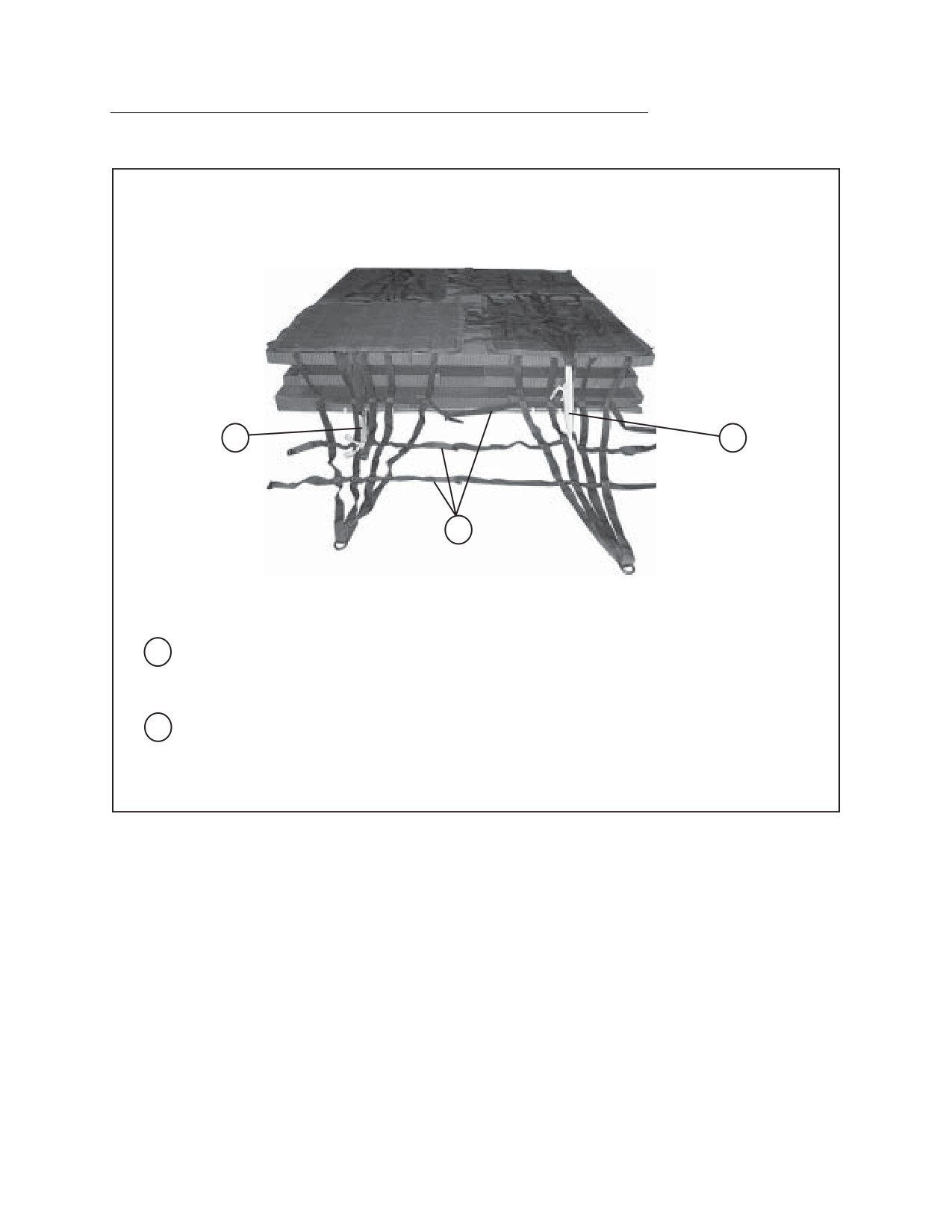
Use lengths of type VIII nylon webbing to tie the eight support web D-rings (that extend
beyond the edge of the honeycomb) to the second lateral strap. Ensure that there is no slack
between the support web D-ring and the second lateral strap.
6
Route the 12 lateral straps at the four midsections of the load through each opposing friction
adapter. Do not apply tension at this time.
Figure 5-4. A-22 Sling Assemblies Positioned (Continued)
5-9
FM 4-20.147/TO 13C7-37-31
POSITIONING A-22 COVERS
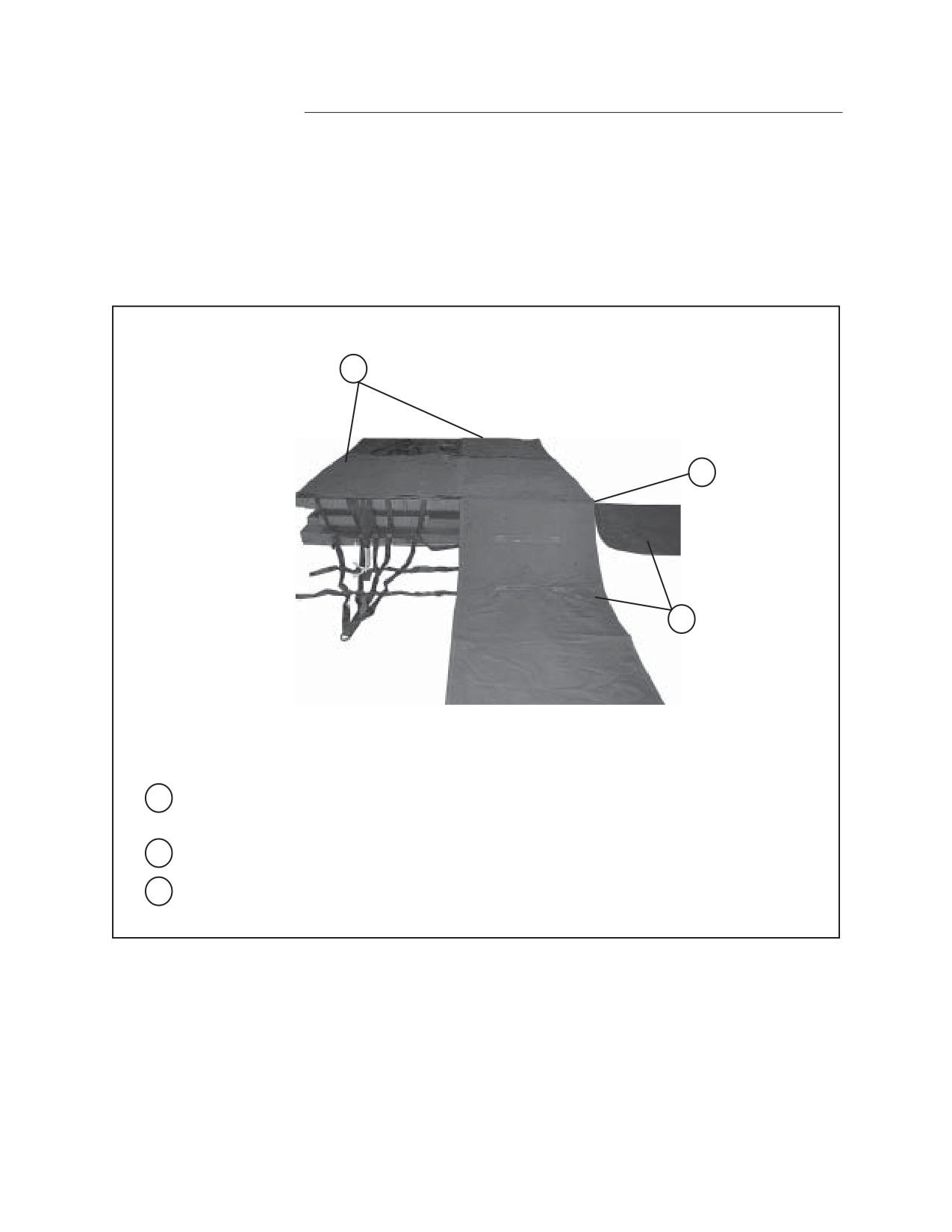
5-11. Use four A-22 cargo bag covers when rigging this load. Position the covers as
shown in Figure 5-5.
3
REAR
FRONT
1
2
1
Place the first cover to the front-right corner of the honeycomb so that the front-right corner
of the cover base is aligned with the right-front corner of the honeycomb.
2
Fully extend all cover flaps out flat.
3
Fold the right-rear and left-front flap excess even with the layer of honeycomb.
Figure 5-5. A-22 Covers Positioned
5-10
FM 4-20.147/TO 13C7-37-31
THIRD
SECOND
4
FOURTH
4
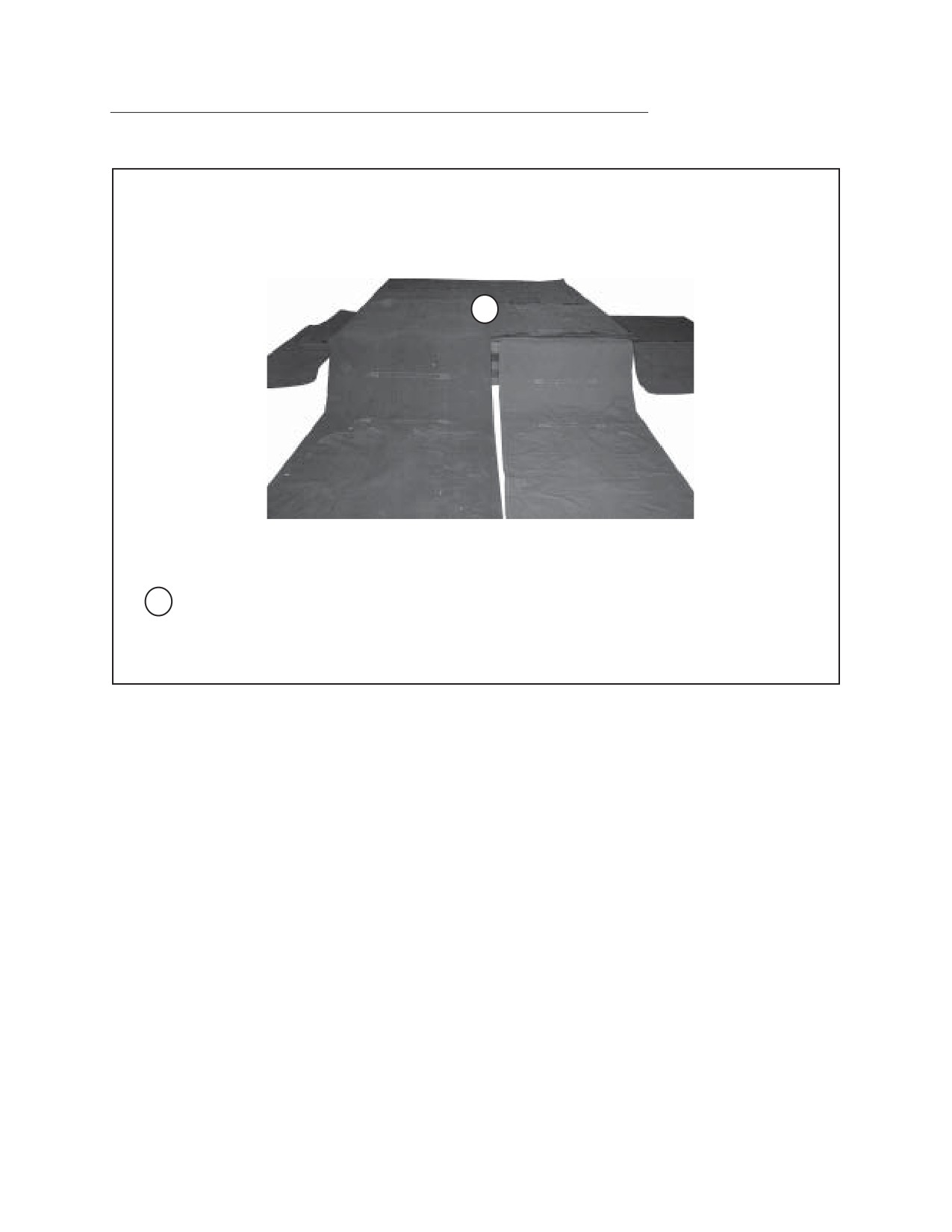
Place the second, third and fourth covers on the left-front, left-rear and right-rear corners,
similar to the first cover. Fully extend all flaps and fold the excess so that they do not
overhang the honeycomb.
Figure 5-5. A-22 Covers Positioned (Continued)
5-11
FM 4-20.147/TO 13C7-37-31
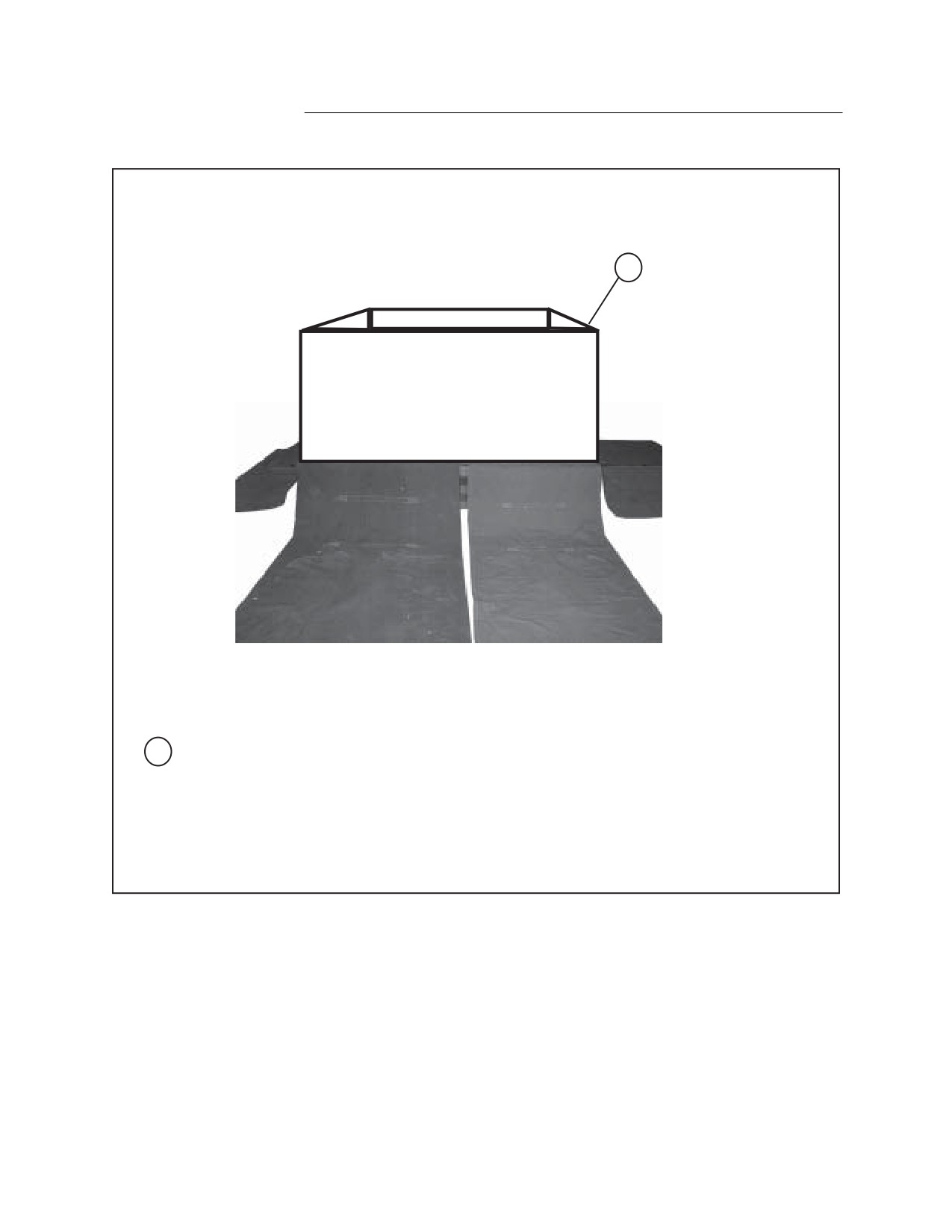
CONSTRUCTING STORAGE BOX AND PREPARING OVERSIZED
ITEM LOAD
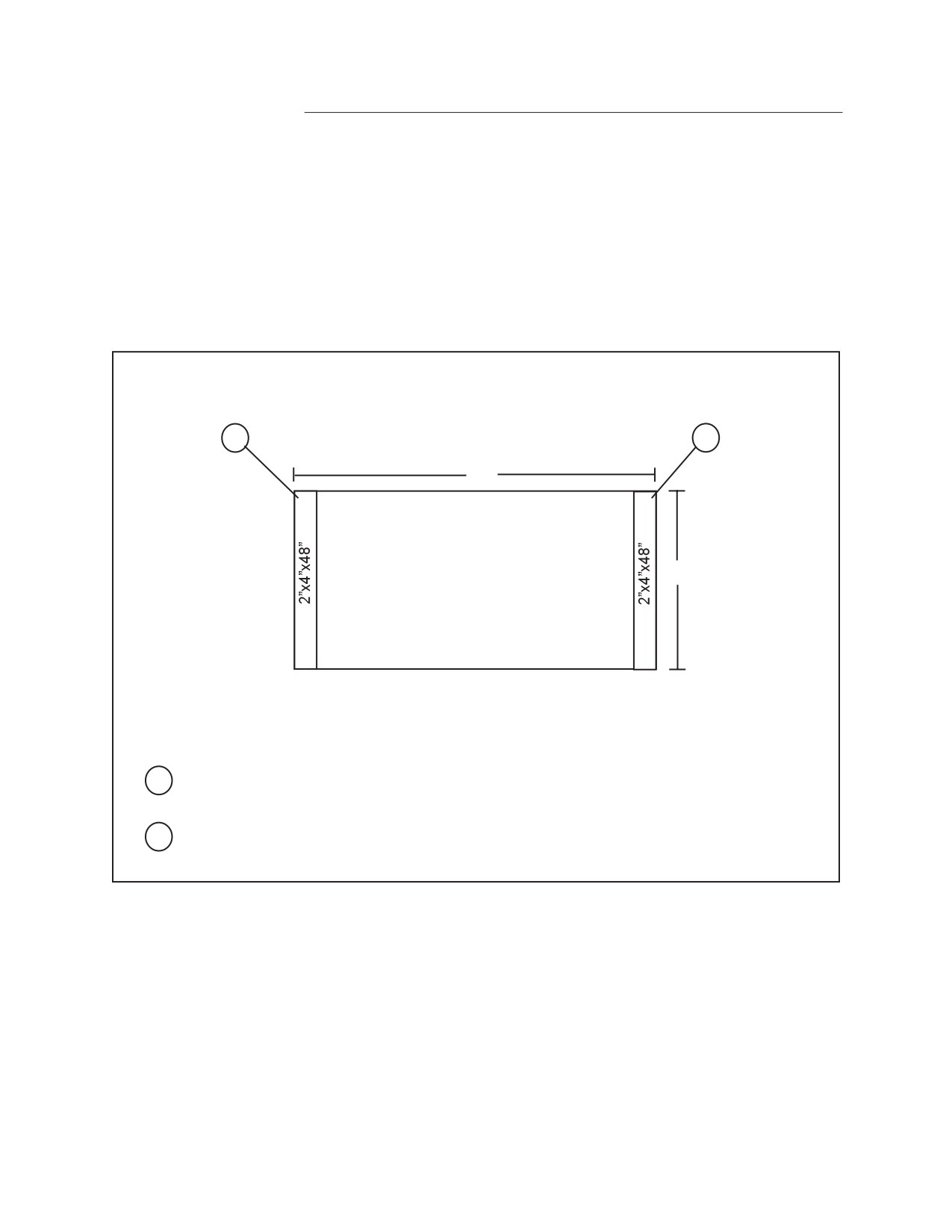
5-12. Construct a 96- by 96-inch plywood box using four sheets of 3/4- by 48- by 96-
inch plywood as shown in Figure 5-6. Prepare the drop items according to the load’s
sensitivity.
1
1
96”
48”
1
Using 6d nails at 1 foot intervals, nail a 2- by 4- by 48-inch piece of lumber onto each of the
48 inch edges of a 3/4- by 48- by 96-inch plywood sheet.
2
Repeat step 1 with an additional sheet of plywood.
Figure 5-6. Storage Box Constructed and Oversized Item Load Prepared
5-12
FM 4-20.147/TO 13C7-37-31
NOTE: Drawing not to scale.
5
3
3
4
3
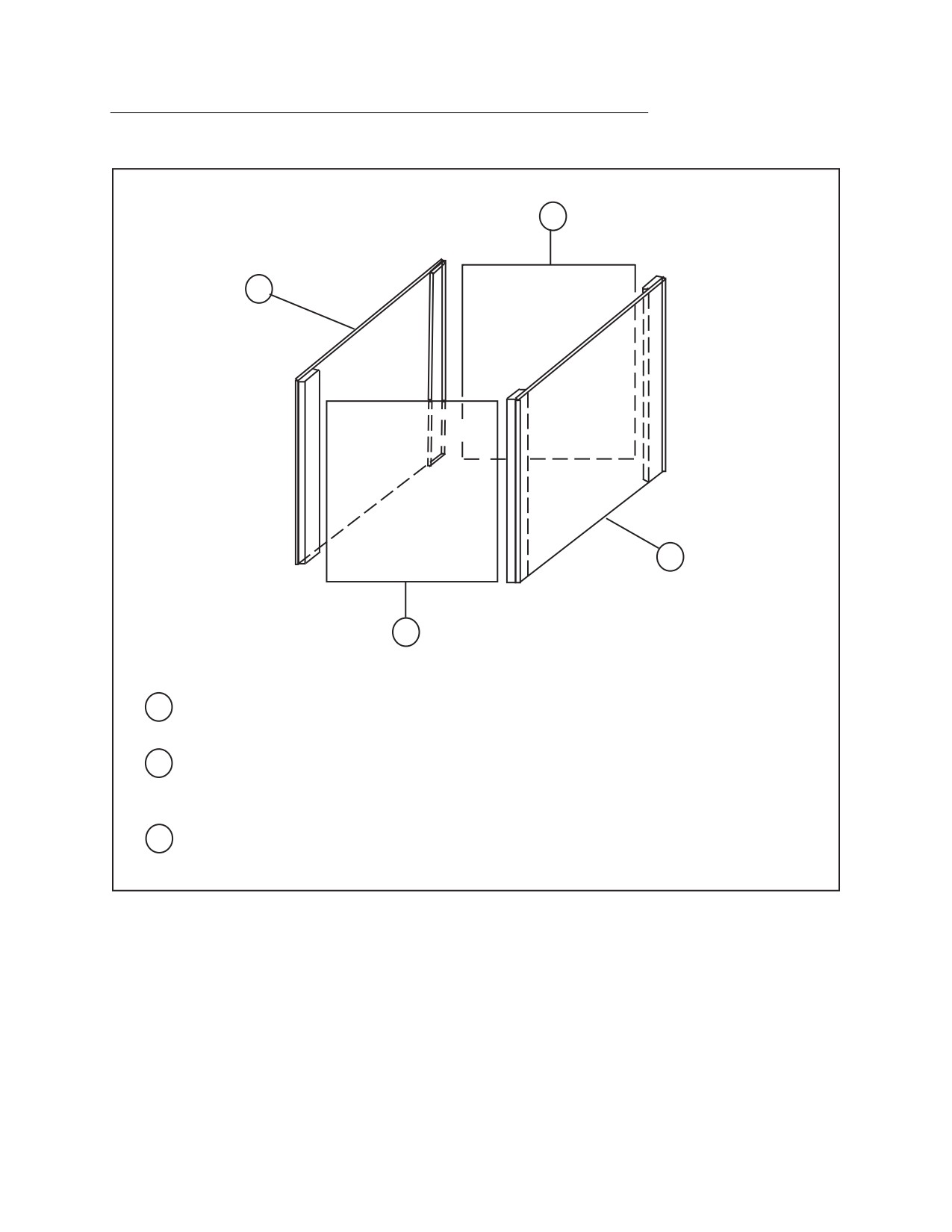
Place plywood sheets prepared in steps 1 and 2 on edge and parallel approximately 8 feet
apart.
4
Position a 3/4 by 48 by 96-inch plywood sheet so that the 48-inch edge covers the exposed
edges of both the plywood sheets prepared in steps 1 and 2. Secure by nailing 6d nails at 1
foot intervals through the plywood and into the studs.
5
Repeat step 4 on the opposite end with an additional sheet of plywood to form a 96- by 96-inch
box.
Figure 5-6. Storage Box Constructed and Oversized Item Load Prepared (Continued)
5-13
FM 4-20.147/TO 13C7-37-31
6
0112345678901234567890123456789012
789011234567890123456789012345678901234
345678901123456789012345678901234567890123456
123456789012345678901234567890121234567890123456789
123456789012345678901234567890121234567890123456789
123456789012345678901234567890121234567890123456789
123456789012345678901234567890121234567890123456789
123456789012345678901234567890121234567890123456789
123456789012345678901234567890121234567890123456789
123456789012345678901234567890121234567890123456789
123456789012345678901234567890121234567890123456789
123456789012345678901234567890121234567890123456789
123456789012345678901234567890121234567890123456789
123456789012345678901234567890121234567890123456789
123456789012345678901234567890121234567890123456789
123456789012345678901234567890121234567890123456789
123456789012345678901234567890121234567890123456789
123456789012345678901234567890121234567890123456789
123456789012345678901234567890121234567890123456789
123456789012345678901234567890121234567890123456789
123456789012345678901234567890121234567890123456789
123456789012345678901234567890121234567890123456789
123456789012345678901234567890121234567890123456789
123456789012345678901234567890121234567890123456789
6
Center the 96- by 96-inch box on top of the prepositioned A-22 cargo bag covers. Large, bulky
or heavy items may be placed on the center of the covers prior to positioning the box.
Note: Heavy items must be placed on the bottom. The items must be placed so that the weight
of the load is evenly distributed. Place lighter items around and on top of the heavy items.
Figure 5-6. Storage Box Constructed and Oversized Item Load Prepared (Continued)
5-14
FM 4-20.147/TO 13C7-37-31
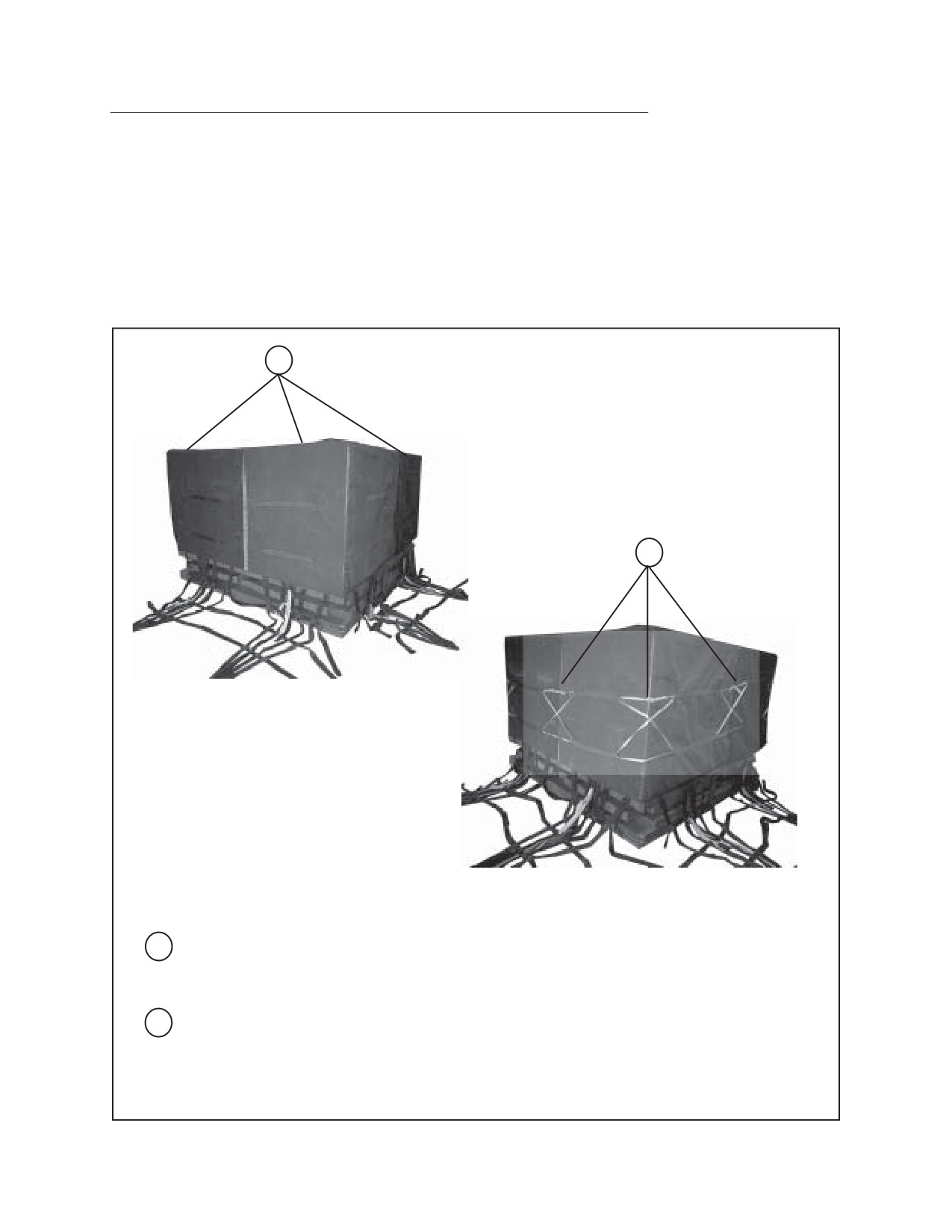
POSITIONING LOAD AND CLOSING BAG COVERS
5-13. Center the load so that the weight of the load is evenly distributed. Pad items
with cellulose wadding or bubble wrap. Place additional items into the box so that
the box is completely cubed out. Place additional honeycomb pieces inside the box
as necessary to form a level top. Close the bag covers as shown in Figure 5-7.
1
2
1
Fold the bag covers over the front and rear first, then the sides over the top. Fold under any
excess in the flaps.
2
Use eight lengths of 1/2- inch tubular nylon webbing or type III nylon cord to lace the bag
covers closed in a hourglass configuration. Pull the webbing tight and tie the running ends in
a surgeon’s knot and bow knot. Tape the excess and the knot. Leave one running end slightly
exposed to allow rapid derigging.
Figure 5-7. A-22 Cargo Bag Covers Closed
5-15
FM 4-20.147/TO 13C7-37-31
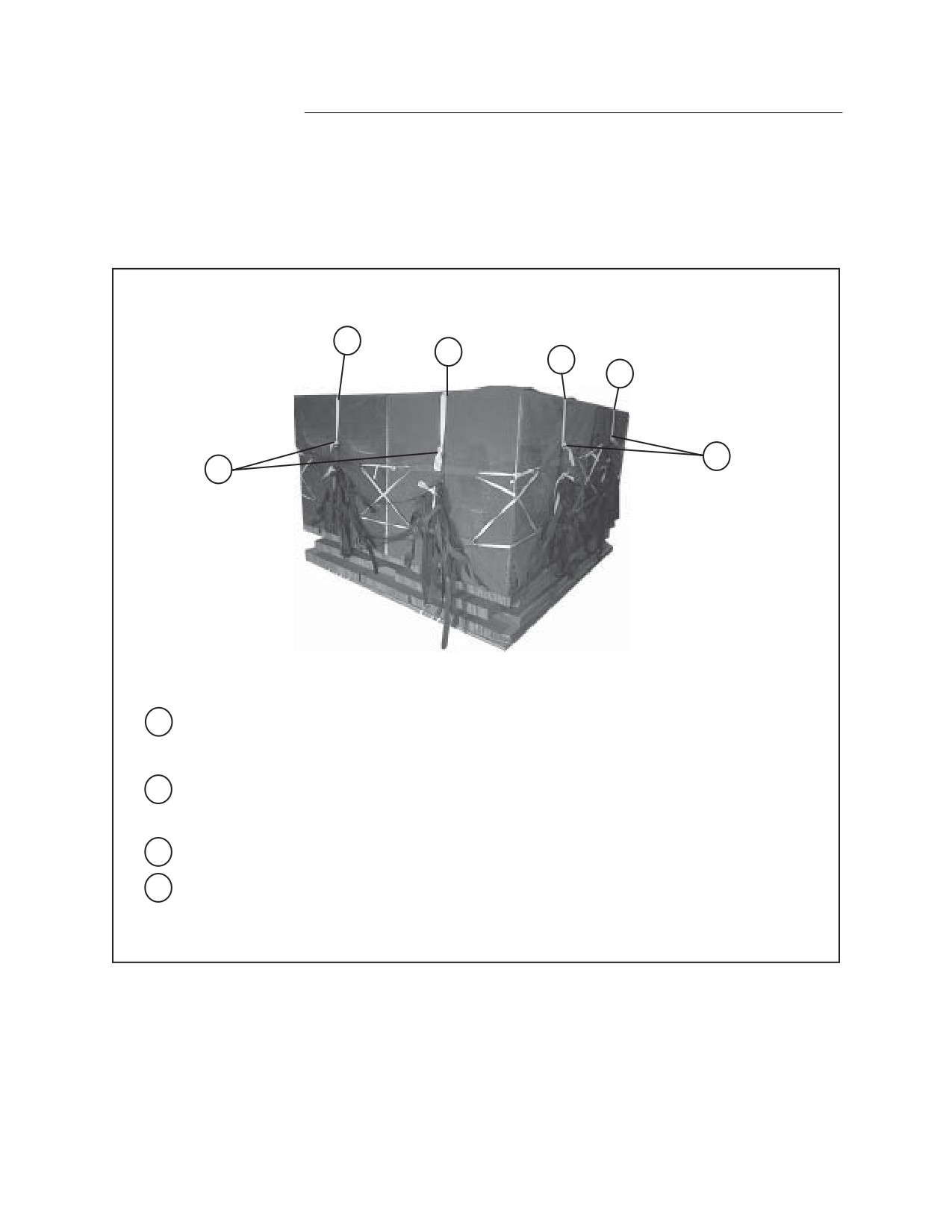
SECURING TIE-DOWN STRAPS
5-13. Secure the tie-down straps as shown in Figure 5-8.
3
3
2
3
4
4
1
The long center tie down straps will not be used. Cut four lengths of type VIII nylon webbing
approximately 16 feet long.
2
Route each end of a single length of webbing through the friction adapters on opposite short
center tie down straps.
3
Repeat step 2 for the other three lengths of type VIII nylon webbing.
4
Apply tension to the four lengths of type VIII nylon webbing. Tie three alternating half-hitch
knots and a knot in the running end at the end of each length of type VIII nylon webbing at
the buckle. Cut excess webbing.
Figure 5-8. Tie-Down Straps Secured
5-16
FM 4-20.147/TO 13C7-37-31
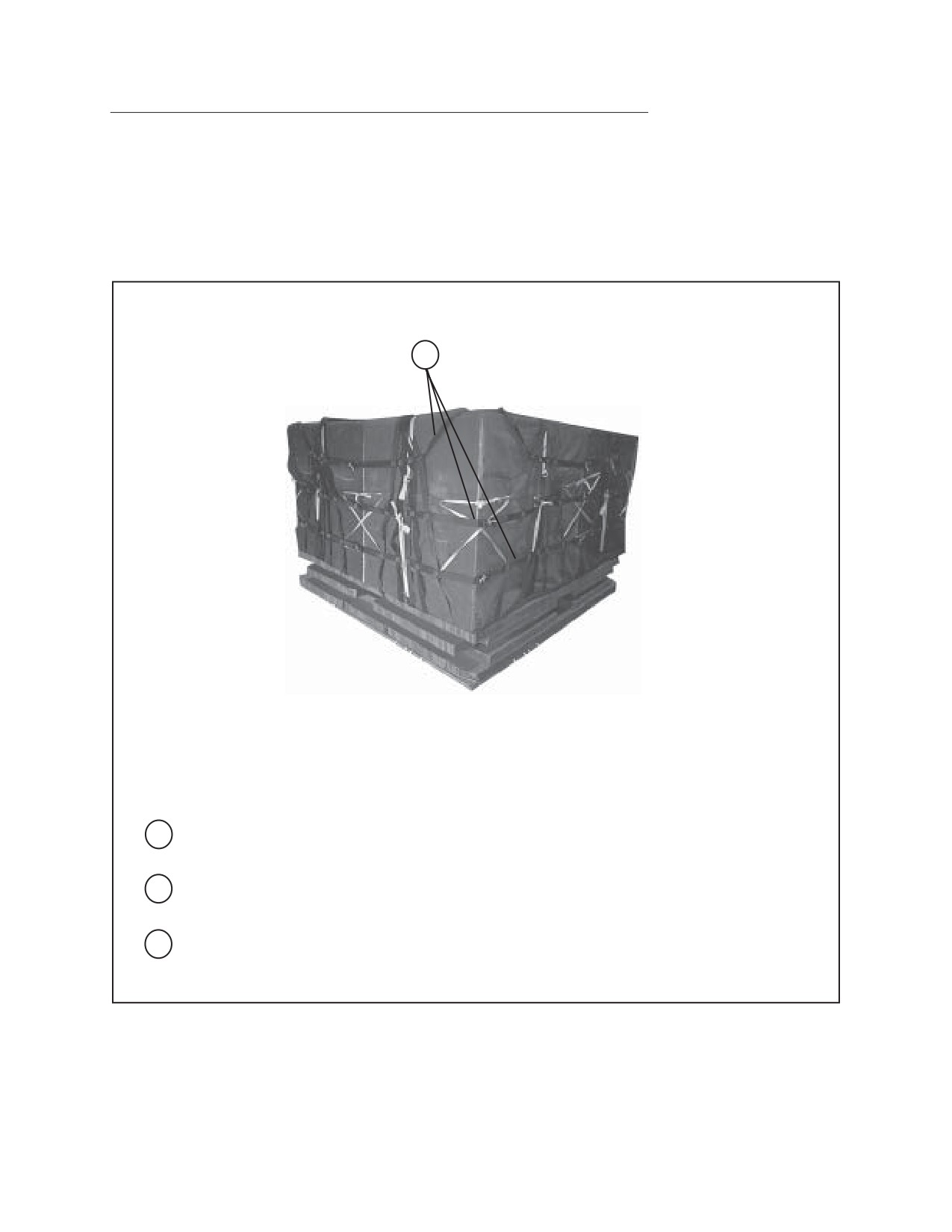
SECURING LATERAL STRAPS
5-15. Secure the lateral straps as shown in Figure 5-9.
1
Note: If the top lateral straps are on top of the load, make sure they are loosely
tightened.
1
Lay the remaining portions of the sling assemblies over the load. Route the corner lateral
straps through the friction adapters.
2
Tighten the center friction adapters so that the middle suspension web on each support web is
vertical.
3
Apply equal tension on the remaining lateral straps. Fold the excess and tape or tie in place
(not shown).
Figure 5-9. Lateral Straps Secured
5-17
FM 4-20.147/TO 13C7-37-31
SECURING SKID BOARD TIES
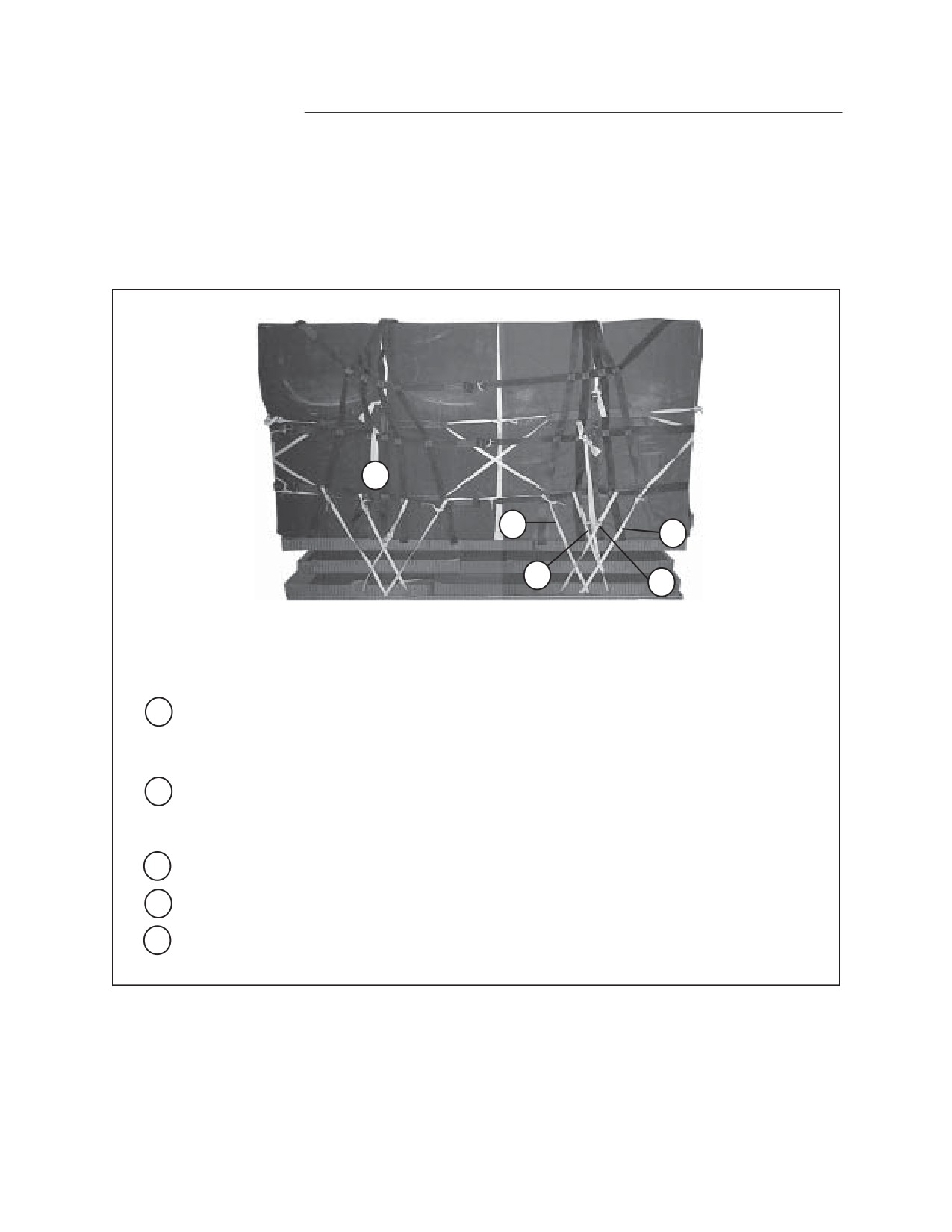
5-16. Secure the skid board ties as shown in Figure 5-10.
5
4
2
REAR
FRONT
3
1
A B C D
1
Starting at the front right side, take tie-down A and diagonally tie it around the intersection
of the lower lateral strap and fourth support web. Use three alternating half hitch knots and
an overhand knot in the running end.
2
Route tie-down B around the fifth support web and lower lateral strap intersection diagonally.
Pull the excess slack out, and tie it with a trucker’s hitch knot and an overhand knot in the
running end.
3
Repeat step 1 for tie-down D and secure it to the second intersection on the lower lateral strap.
4
Repeat step 2 for tie-down C and secure it to the first intersection on the lower lateral strap.
5
Repeat steps 1 through 4 for the other seven sets of tie-downs.
Figure 5-10. Skid Board Ties Secured
5-18
FM 4-20.147/TO 13C7-37-31
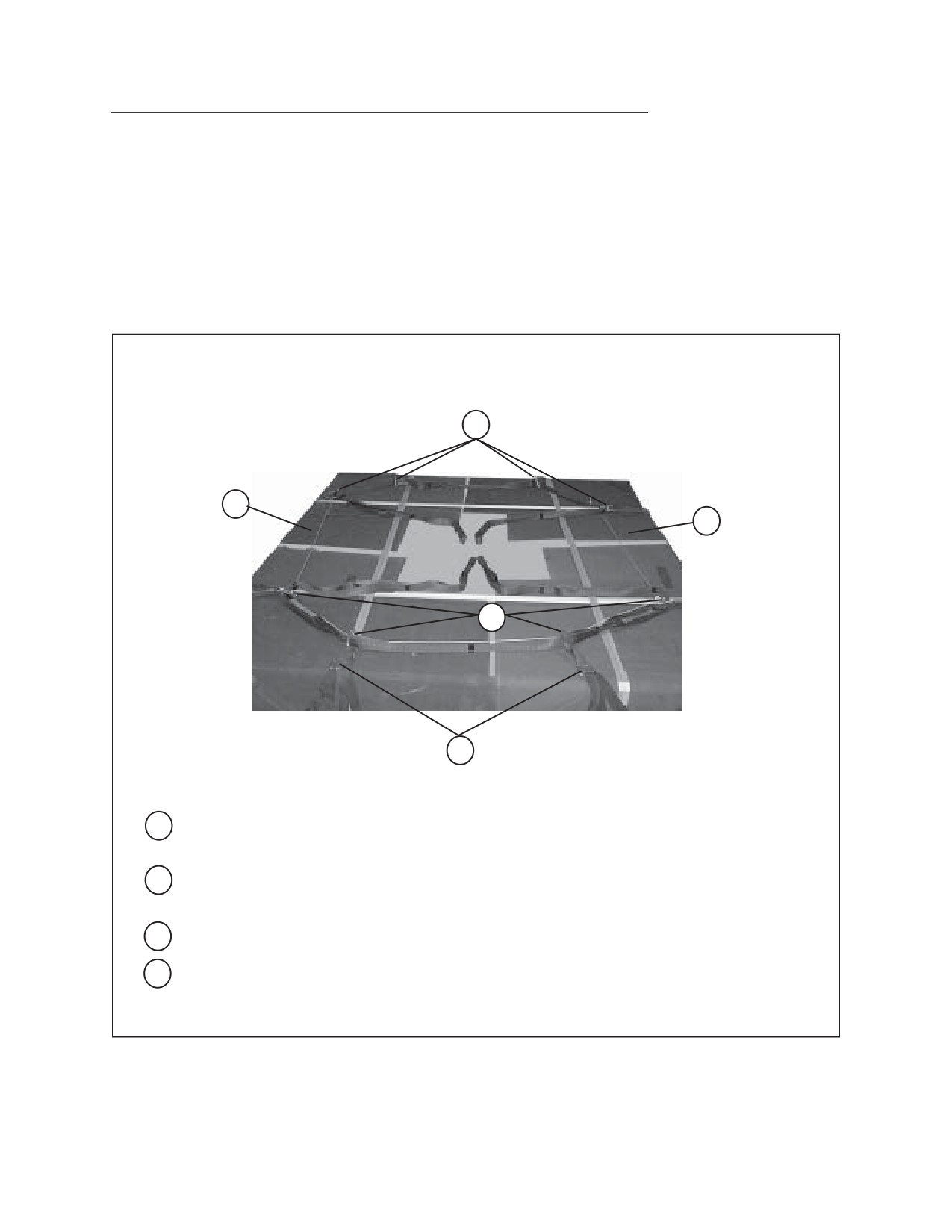
INSTALLING SUSPENSION SLINGS
5-17. Install suspension slings using support webs, type V platform clevises,
and two 20-foot (2-loop), type XXVI nylon webbing slings (two 12-foot (2-loop),
type XXVI nylon webbing slings girth hitched together, may also be used to
form a single 20-foot sling) as shown in Figure 5-11.
Note: Do not mix 12-foot and 20-foot slings on the same load.
3
4
4
REAR
FRONT
2
1
1
Move the D-ring on the support webs down and tape in place. Install a type V platform clevis
on each support web, at the former location of the D-rings.
2
Run a single type XXVI nylon suspension sling through the four type V platform clevises of
the front-right and rear-right support webs.
3
Repeat step 2 for the rear-left and front-left support webs.
4
Route a length of type III nylon cord through the eight type V platform clevises as shown
above. Tie the ends together. Make sure the tie has excess to allow suspension sling
movement.
Figure 5-11. Suspension Slings Installed
5-19
FM 4-20.147/TO 13C7-37-31
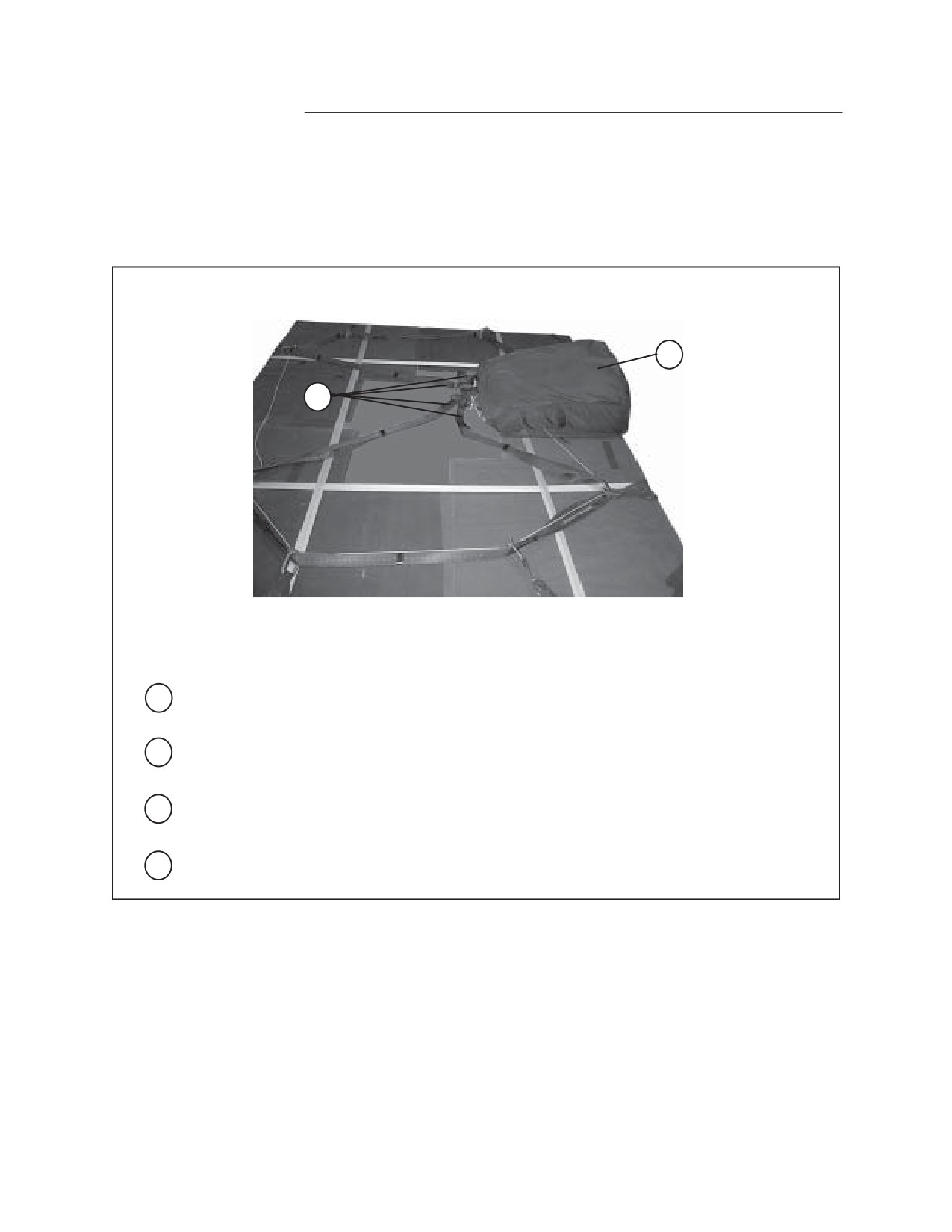
INSTALLING PARACHUTE
5-18. Install a reefed G-12 cargo parachute as shown in Figure 5-12.
2
1
REAR
FRONT
1
Bring the four looped ends of the two suspension slings together and place the loops onto the
G-12 clevis.
2
Place a reefed G-12 cargo parachute on the load with the riser compartment up and
the bridle toward the front of the load. Position the parachute on the front of the load.
3
Tie each corner of the parachute deployment bag to the A-22 sling assembly with according to
procedures in Paragraph 4-17, steps 1 and 2 (not shown).
4
Fold and tape the excess sling with masking tape (not shown).
Figure 5-12. Reefed G-12 Cargo Parachute Installed
5-20
FM 4-20.147/TO 13C7-37-31
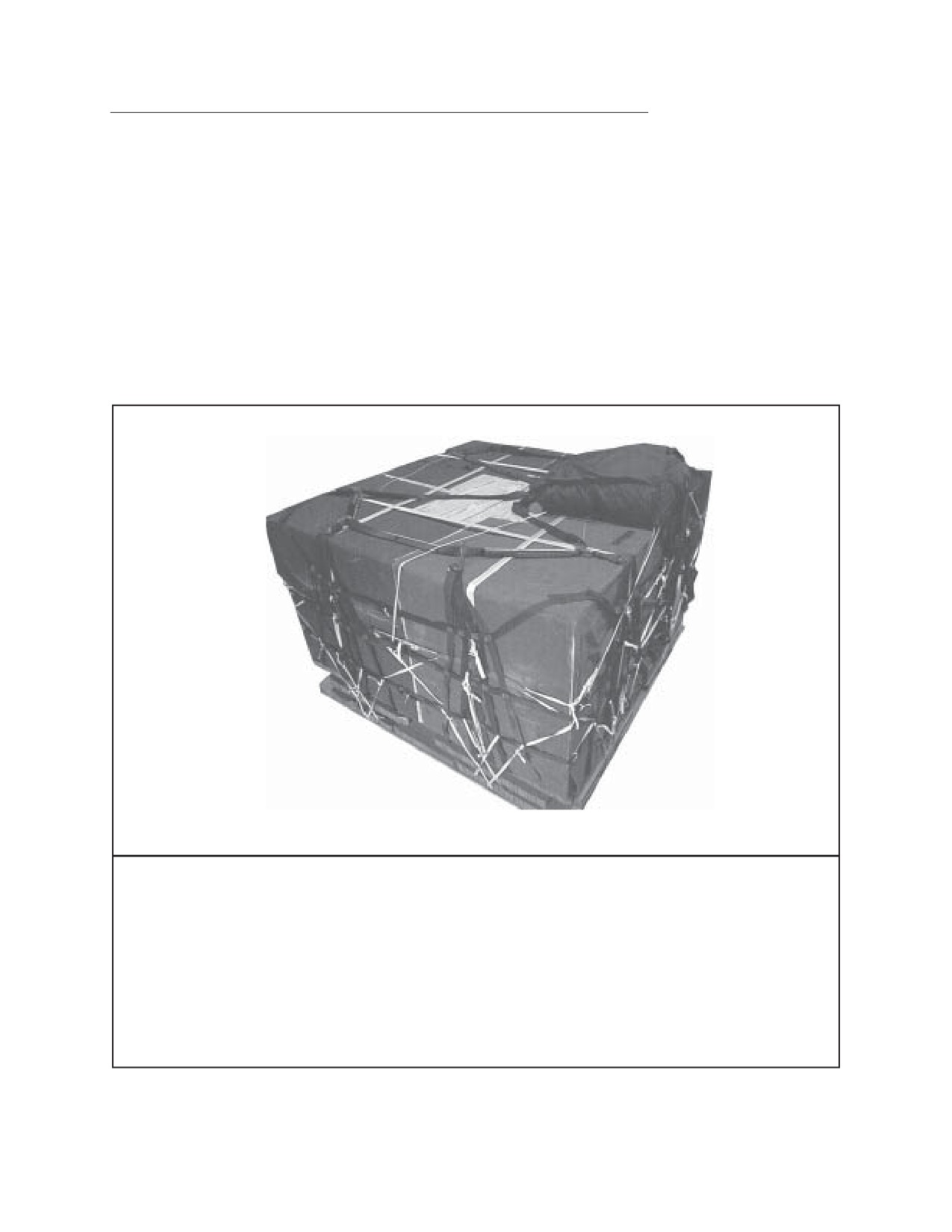
MARKING RIGGED LOAD
5-19. Mark the rigged load according to FM 10-500-3/TO 13C7-1-11 and as shown in
Figure 5-13. Compute the rigged load data.
EQUIPMENT REQUIRED
5-20. Use the equipment listed in Table 5-2 to rig the load shown in Figure 5-13.
RIGGED LOAD
Weight: Minimum load allowed
3,500 pounds
Maximum load allowed
4,375 pounds
Height:
83 inches
Width:
96 inches
Length:
96 inches
Figure 5-13. Fully Rigged Quadruple A-22 Container
5-21
FM 4-20.147/TO 13C7-37-31
Table 5-2. Equipment Required for Rigging Oversized Items in Quadruple A-22 Container
National Stock
Item
Quantity
Number
8040-00-273-8713
Adhesive Paste
As required
1670-01-162-2372
Clevis, cargo, type V
8
1670-00-587-3521
Bag, cargo, A-22
4
1670-01-062-6302
Sling, cargo, airdrop, 20-ft (2 loop), type XXVI nylon webbing
2
1670-01-062-6303
Sling, cargo, airdrop, 12-ft (2 loop), type XXVI nylon webbing
4
Nail, steel, wire, common:
5315-00-010-4657
6d
As required
5315-00-010-4659
12d
As required
1670-00-753-3928
Pad, energy dissipating, honeycomb 36- by-96- by
3-inches
17 sheets
Parachute:
No NS N
Cargo, G-12 Reefed
1
1670-00-216-7297
Pilot, 68-in diam
1
4030-00-678-8562
Clevis, suspension, 3/4-inch (medium
)
1
5530-00-128-4981
Plywood, 3/4-by-48-by-96-inch (box)
4 sheets
5530-00-914-5118
Plywood, 1-by-48-by-96-inch
4 sheets
5510-00-220-6446
2-by 4-by 48-inch lumber
4
7510-00-266-6710
T
ape, masking, 2-inch
As required
8310-01-102-4478
Thread, cotton, ticket number 8/7
As required
Webbing :
8305-00-268-2411
Cotton, 1/4-inch, type I
As required
8305-00-082-5752
Nylon, tubular, 1/2-inch
As required
8305-00-263-3591
Type VIII
As required
4020-00-240-2146
Cord, nylon type III
As required
5-22
FM 4-20.147/TO 13C7-37-31
SECTION III - RIGGING FOOD AND MEDICAL ITEMS IN QUA-
DRUPLE A-22 CONTAINER FOR HIGH VELOCITY AIRDROP
PREPARING AND POSITIONING FOOD AND MEDICAL LOADS
5-21. Prepare and position food and medical items in accordance with Section II
paragraphs 5-7 through 5-11 and paragraphs 5-13 through 5-19 and Table 5-3.
Paragraph 5-12 will be replaced with the following steps.
FOOD ITEMS:
a. Place a 40- by 40-inch piece of honeycomb in the bottom of the box. Place
food items into a tri-wall box. The box should have a base of approximately 43
by 43 inches and should be between 40 and 50 inches high. Heavy bulk food
must be placed on the bottom of the box. The items must be placed so that the
weight of the load is evenly distributed. Lighter items should then be placed
around and on top of the heavy items. Place additional light items into the box
so that the box is completely cubed out. Pad items with cellulose wadding or
bubble wrap. Wrap items in shrink wrap and/or place additional honeycomb
pieces inside box for protection.
b. Fill three additional boxes with food items.
c. Place and center the four boxes on top of the A-22 covers. Standard ware-
house pallets may be rigged under the box for handling ease. If there are gaps
between the boxes, fill the gaps with pieces of honeycomb.
MEDICAL ITEMS:
d. Place four 100 pound clothing/blanket bundles on each quadrant of the
quadruple A-22. Fill any gaps with light non-fragile items. Shrink wrap or
otherwise protect each group of four clothing/blanket bundles.
e. Shrink wrap or otherwise protect all four of the bundles together. Place one
pre-configured box of medical supplies (specially packaged for airdrop) on each
corner of the load and on top of the clothing/blanket bundles.
5-23
FM 4-20.147/TO 13C7-37-31
Table 5-3. Equipment Required for Rigging Food and Medical Items in Quadruple A-22 Con-
tainer
National Stock
Item
Quantity
Number
1670-01-162-2372
Clevis, cargo, type V
8
1670-00-587-3521
Bag, cargo, A-22
4
1670-01-062-6302
Sling, cargo, airdrop, 20-ft (2 loop), type XXVI nylon webbing
2
1670-01-062-6303
Sling, cargo, airdrop, 12-ft (2 loop), type XXVI nylon webbing
4
1670-00-753-3928
Pad, energy dissipating, honeycom b
36-by-96-by-3-inches
10 sheets
24-by-96-by-3-inches
2 sheets
No NS N
Shrink wrap
As required
Parachute:
No NS N
Cargo, G-12 Reefed
1
1670-00-216-7297
Pilot, 68-in diam
1
4030-00-678-8562
Clevis, suspension, 3/4-inch (medium
)
1
8310-01-102-4478
Thread, cotton, ticket number 8/7
As required
Webbing :
8305-00-268-2411
Cotton, 1/4-inch, type I
As required
8305-00-082-5752
Nylon, tubular, 1/2-inch
As required
8305-00-263-3591
Type VIII
As required
4020-00-240-2146
Cord, nylon type III
As required
5-24
FM 4-20.137/TO 13C7-1-19
Glossary
AFB
Air Force Base
AFJMAN
Air Force Joint Manual
AFSOC
Air Force Special Operations Command
ALC
Airlift Logistics Center
AMC
Air Mobility Command
CB
center of balance
CDS
container delivery system
d
penny
DA
Department of Army
DC
Distric of Columbia
diam
diameter
FM
field manual
ft
foot/feet
HDRS
humanitarian daily rations
HUMRO
humanitarian releif operations
HQ
headquarters
HV
high velocity
IAW
in accordance with
in
inch
LCADS
low cost aerial delivery system
lb
pound
MREs
meals ready to eat
Glossary-1
FM 4-20.137/TO 13C7-1-19
No number
TM technical manual
TO technical order
TRADOC US Army Training and Doctrine Command
TRIADS tri-wall aerial delivery system
USA United States of America
YD yards
Glossary-2
FM 4-20.137/TO 13C7-1-19
References
AFJ (I) 13-210/AR 59-4
Joint Airdrop Inspection Records, Malfunction Investigations and
Activity Reporting. 1 May 1998.
*AFMAN(I) 24-204/
Preparing Hazardous Materials for Military Air Shipments.
TM 38-250
December 2001.
**FM 4-20.102/NAVSEA
Airdop of Supplies and Equipment: Rigging Airdrop Platforms.
SS400-AB-MMO-010/
22 August 2001.
TO 13C7-1-5
FM 10-500-3/ TO 13C7-1-11
Airdop of Supplies and Equipment: Rigging Containers.
MARINE CORPS FMFM
26 September 1996.
7-47
TM 10-1670-276-23&P/
Unit and Intermediate Direct Support (DS) Maintenance Manual
TO 13C5-29-2/NAVAIR 13-
(Including RepairParts and Special Tools List) for Parachute, Cargo
1-29
Type: 26-ft Diam, High Velocity. 28 September 1990.
TM 10-1670-281-23&P/TO
Unit and Intermediate Direct Support (DS) Mantenance Manual
13C5-32-2/NAVAIR 13-1-32
(Including RepairParts and Special Tools List) for Parachute, Cargo
Type: 64-ft Diam, models G-12D and G-12E.
1 October 1990.
AFTO Form 22
Technical Order Publication Improvement Report
DA Form 2028
Recommended Changes to Publication and Blank Forms.
February 1974.
DD Form 1748-1
Joint Airdrop Inspection Record (Container).
*** Shipper’s Declaration
Locally Procured Form.
for Hazardous Goods
*AFMAN(I) 24-204/TM 38-250 has superseded AFJMAN 24-204/TM 38-250 (25 November
1994).
** FM 4-20.102/NAVSEA SS400-AB-MMO-010/TO 13C7-1-5 has superseded FM 10-500-2/TO
13C7-1-5 (1 November 1990).
*** Shipper’s Declaration for Dangerous Goods has superseded DD Form 1387-2
(February 1982).
References-1