AIRDROP OF SUPPLIES AND EQUIPMENT: Humanitarian Airdrop (NOVEMBER 2003) - page 1
C1, *FM 4-20.147
TO 13C7-37-31
Field Manual
HEADQUARTERS
NO 4-20.147
DEPARTMENTS OF THE ARMY
Technical Order
AND THE AIR FORCE
NO 13C7-37-31
Washington, DC, 4 January 2005
Airdrop of Supplies and Equipment:
Humanitarian Airdrop
Contents
Page
Preface
v
Chapter 1
General Rigging Information Humanitarian Airdrop Loads
Section I
Description of Humanitarian Loads
Humanitarian Airdrop Methods
1-1
Section II
Parachute Requirements and Packing Procedures
Parachute Requirements
1-2
Packing the Reefed G-12 and 68-inch Diameter Pilot Parachutes
1-3
Distribution Restrictions: Approved for public release; distribution is unlimited.
* This publication supersedes FM 10-547/TO 13C7-37-31, dated 29 September 1980
i
C1, FM 4-20.147/TO 13C7-37-31
Page
Chapter 2
Rigging Extended Tri-Wall Airdrop System (TRIADS)
Section I
General Rigging Information for Extended TRIADS
TRIADS System Components
2-1
TRIADS Skid Board
2-1
TRIADS Container Limitations
2-2
Assembly Line Rigging
2-2
Inspection of Load
2-2
Parachute Used
2-2
AFT Restraint
2-2
Section II
Rigging Extended TRIADS Containers
System Description
2-3
Preparing Items and Skid Board
2-3
Preparing Honeycomb Base
2-3
Preparing Straps and Static Line
2-4
Preparing End Caps
2-4
Installing Skid Board
2-5
Assembling the Box
2-6
AFT Restraint TRIADS and Honeycomb Kit
2-6
Filling the TRIADS Container
2-6
Installing Vertical Strap and Static Line
2-8
Marking Rigged Load
2-9
Chapter 3
Rigging Low Cost High Velocity Container Delivery System (LCADS)
Section I
General Information for LCADS
LCADS System Components
3-1
LCADS Skid Board
3-1
LCADS Container Limitations
3-2
Inspection of Load
3-2
Parachute used
3-2
Section II
Rigging High-Velocity LCADS
System Description
3-3
Preparing Items and Skid Board
3-3
Preparing and Placing Honeycomb
3-4
Positioning Sling Assembly
3-5
Positioning Load and Securing Sling Assembly
3-6
Securing Sling Assembly to Skid Board
3-7
Installing Parachute
3-8
Marking Rigged Load
3-9
Equipment Required
3-9
ii
C1, FM 4-20.147/TO 13C7-37-31
Page
Section III
Rigging Low Velocity LCADS
System Description
3-11
Preparing Items and Skid Board
3-11
Preparing and Placing Honeycomb
3-11
Positioning Sling Assembly
3-12
Positioning Load and Securing Sling Assembly
3-13
Securing Sling Assembly to Skid Board
3-15
Installing Parachute
3-15
Marking Rigged Load
3-16
Equipment Required
3-16
Chapter 4
Rigging Double A-22 Cargo Bag for High Velocity Airdrop
Section I
General Information for Double A-22 Cargo Bag
Double A-22 Cargo Bag Components
4-1
Double A-22 Cargo Bag Skid Board
4-1
Double A-22 Cargo Bag Limitations
4-2
Assembly Line Rigging
4-2
Inspection of Load
4-2
Parachute Used
4-2
Section II
Rigging Double A-22 Cargo Bag
System Description
4-3
Preparing Items and Skid Board
4-3
Preparing Skid Board Ties and Placing Honeycomb
4-4
Positioning A-22 Sling Assembly
4-5
Positioning Covers and Honeycomb
4-7
Positioning Load and Closing Bag Covers
4-8
Securing Tie-Down Straps
4-9
Securing Lateral Straps
4-10
Securing Skid Board Ties
4-11
Installing Suspension Slings
4-12
Installing Parachute
4-13
Marking Rigged Load
4-14
Equipment Required
4-14
Section III
Alternate Rigging Method for Double A-22 Cargo Bag
Building and Positioning A-22 Containers
4-16
Joining A-22 Containers
4-17
Attaching Suspension Webs
4-18
Tying Off Unused Suspension Webs
4-19
Installing Suspension Slings
4-19
iii
C1, FM 4-20.147/TO 13C7-37-31
Page
Chapter 5
Rigging Quadruple A-22 Cargo Bag Loads for High Velocity Airdrop
Section I
General Information for Quadruple A-22 Cargo Bag
Quadruple A-22 Cargo Bag Components
5-1
Quadruple A-22 Cargo Bag Skid Board
5-1
Quadruple A-22 Cargo Bag Limitations
5-2
Assembly Line Rigging
5-2
Inspection of Load
5-2
Parachute Used
5-2
Section II
Rigging Oversized Items in Quadruple A-22 Cargo Bags
System Description
5-3
Preparing Items and Skid Board
5-3
Preparing Skid Board Ties and Placing Honeycomb
5-5
Positioning A-22 Sling Assemblies
5-7
Positioning A-22 Covers
5-10
Constructing Storage Box and Preparing Oversized Item Load
5-12
Positioning Load and Closing Bag Covers
5-15
Securing Tie-Down Straps
5-16
Securing Lateral Straps
5-17
Securing Skid Board Ties
5-18
Installing Suspension Slings
5-19
Installing Parachute
5-20
Marking Rigged Load
5-21
Equipment Required
5-21
Section III
Rigging Food and Medical Items in Quadruple A-22 Cargo Bags for High Velocity
Airdrop
Preparing and Positioning Food and Medical Loads
5-23
Glossary
Glossary-1
References
References-1
iv
C1, FM 4-20.147/TO 13C7-37-31
Preface
This manual tells and shows how to prepare and rig the following configurations of Humanitarian
loads, Extended Tri-Wall Airdrop System (TRIADS), Low Cost High Velocity Container Delivery Sys-
tem (LCADS), Double A-22 Cargo Bag for High Velocity Airdrop and Quadruple A-22 Cargo Bag for
High Velocity Airdrop from a C-17 and C-130 aircraft.
User Information
The proponent of this publication is HQ TRADOC. You are encouraged to report any errors or
omissions and to suggest ways of making this a better manual.
Army personnel, send your comments on DA Form 2028 directly to:
Director
Aerial Delivery and Field Services Department
USA Quartermaster Center and School
1010 Shop Road
Fort Lee, Virginia 23801-1502
Air Force personnel, send your reports on AFTO Form 22 through your respective command Weap-
ons and Tactics to:
Headquarters
Air Mobility Command (AMC/A39T)
402 Scott Drive, Unit 3AI
Scott AFB, Illinois 62225-5302
Air Force personnel in Special Operations Command, send your reports on AFTO Form 22
HQ AMC/A39T will consolidate and forward changes to:
Director
Aerial Delivery and Field Services Department
USA Quartermaster Center and School
1010 Shop Road
Fort Lee, Virginia 23801-1502
Also send an information copy of AFTO Form 22 to:
WR-ALC/LKCB
460 Richard Ray Blvd.
Robins AFB, Georgia 31098-1640
v
FM 4-20.147/TO 13C7-37-31
Chapter 1
General Rigging Information Humanitarian Airdrop
Loads
SECTION I - DESCRIPTION OF HUMANITARIAN LOADS
HUMANITARIAN AIRDROP METHODS
1-1. Humanitarian airdrop utilizes the Container Delivery System (CDS), some
variation of that system, or TRIADS, a special method of free drop. Many factors
can influence the delivery method used.
a. EXTENDED TRI-WALL AERIAL DELIVERY SYSTEM (TRIADS). The
TRIADS system is a corrugated tri-wall box rigged for static line deployment off
the ramp of an aircraft using CDS procedures. Typical loads include loose
Meals Ready-to-Eat (MREs) or Humanitarian Daily Rations (HDRs). Following
deployment the caps of the box separate from the sleeve allowing the container’s
content to scatter and freefall to the ground. TRIADS has a 1,375 pound load
capacity. Chapter Two of this manual covers rigging TRIADS for airdrop.
b. LOW-COST AERIAL DELIVERY SYSTEM (LCADS). LCADS is a
modified, lightweight A-22 system with no scuff pad, cover, or friction adapters
on the lateral bands. It is rigged like a high-velocity A-22 load, but uses one of
several special parachutes. LCADS is used for high-volume delivery of
nonfragile items where airdrop equipment is not recoverable. LCADS has a
2,200 pound load capacity. Chapter Three of this manual covers riggingLCADS
for airdrop.
c. DOUBLE A-22 CONTAINER. The double A-22 container consists of two
A-22 sling assemblies. The covers may or may not be used. Only six of the
suspension webs are used. The double A-22 cargo bag has a 3,375 pound
load capacity. Chapter Four of this manual covers rigging the double A-22
cargo bag.
d. QUADRUPLE A-22 CONTAINER. The quadruple A-22 container consists
of four standard A-22 sling assemblies which can be laced together to form one
large container, or can be individually rigged and then configured side-by-side
for unitized delivery of four loads. The quadruple A-22 cargo bag has a 4,375
pound load capacity. Chapter Five of this manual covers rigging the quadruple
A-22 container.
1-1
FM 4-20.147/TO 13C7-37-31
SECTION II - PARACHUTE REQUIREMENTS AND PACKING PROCEDURES
PARACHUTE REQUIREMENTS
1-2. The parachute requirements for humanitarian airdrop are described below.
a. EXTENDED TRI-WALL AERIAL DELIVERY SYSTEM (TRIADS).
There is no parachute used for TRIADS. The TRIADS uses the free drop
method.
b. LOW-COST AERIAL DELIVERY SYSTEM (LCADS). LCADS employs a
26-foot low cost parachute for high-velocity (HV) airdrop. The 26-foot low cost
parachute is made from more readily available and more economical materials
than the standard 26-foot ringslot parachute. The 26-foot low cost parachute
performs identically to the standard 26-foot parachute except the low cost para-
chute is designed for one-time use, whereas the standard 26-foot parachute is
designed for reuse. The low cost parachute is pre-packed and ready to attach to
the load. Like the standard 26-foot parachute, the low cost parachute is deployed
using a breakaway static line for high altitude operations. The 26-foot low cost
parachute can support suspended weights from 501 to 2,200 pounds.
c. DOUBLE A-22 CONTAINER. The double A-22 container employs a reefed
G-12 parachute with both skirt and vent reefing. The reefing of the G-12
parachute provides for high-velocity ballistics similar to the standard HV CDS.
A standard 68-inch pilot parachute is used to deploy the reefed G-12 and a
breakaway static line is used to deploy the 68-inch pilot parachute. The reefed
G-12 parachute can support suspended weights from 2,201 to 3,375 pounds.
The reefed G-12 and 68-inch pilot parachutes are packed according to Chapter
1, Section II, Paragraphs 1-3 through 1-5 of this manual.
d. QUADRUPLE A-22 CONTAINER. The quadruple A-22 container employs
the same reefed G-12 parachute (skirt and vent reefing) that is used with the
double A-22 container. A standard 68-inch pilot parachute is also used to deploy
the reefed G-12 and a breakaway static line is used to deploy the 68- inch pilot
parachute. When the reefed G-12 parachute is used with the quadruple A-
22 it can support suspended weights from 3,375 to 4,375 pounds. The reefed
G-12 and 68-inch pilot parachutes are packed according to Chapter 1, Section
II, Paragraphs 1-3 through 1-5 of this manual.
1-2
FM 4-20.147/TO 13C7-37-31
PACKING THE REEFED G-12 AND 68-INCH DIAMETER PILOT
PARACHUTES
1-3. The packing procedures for the reefed G-12 parachute are described below.
a. PREPARING PARACHUTE FOR PROPER LAYOUT. Prepare para-
chute for proper layout in accordance with TM 10-1670-281-23&P.
b. SERVICING THE CANOPY VENT. Service the canopy vent in accordance with
TM 10-1670-281-23&P. The wrap of type II cotton muslin cloth is not necessary
if dropping for one-time use. If not used, the canopy vent lines should still be
tied off with two turns single of 1/4-inch, type I cotton webbing.
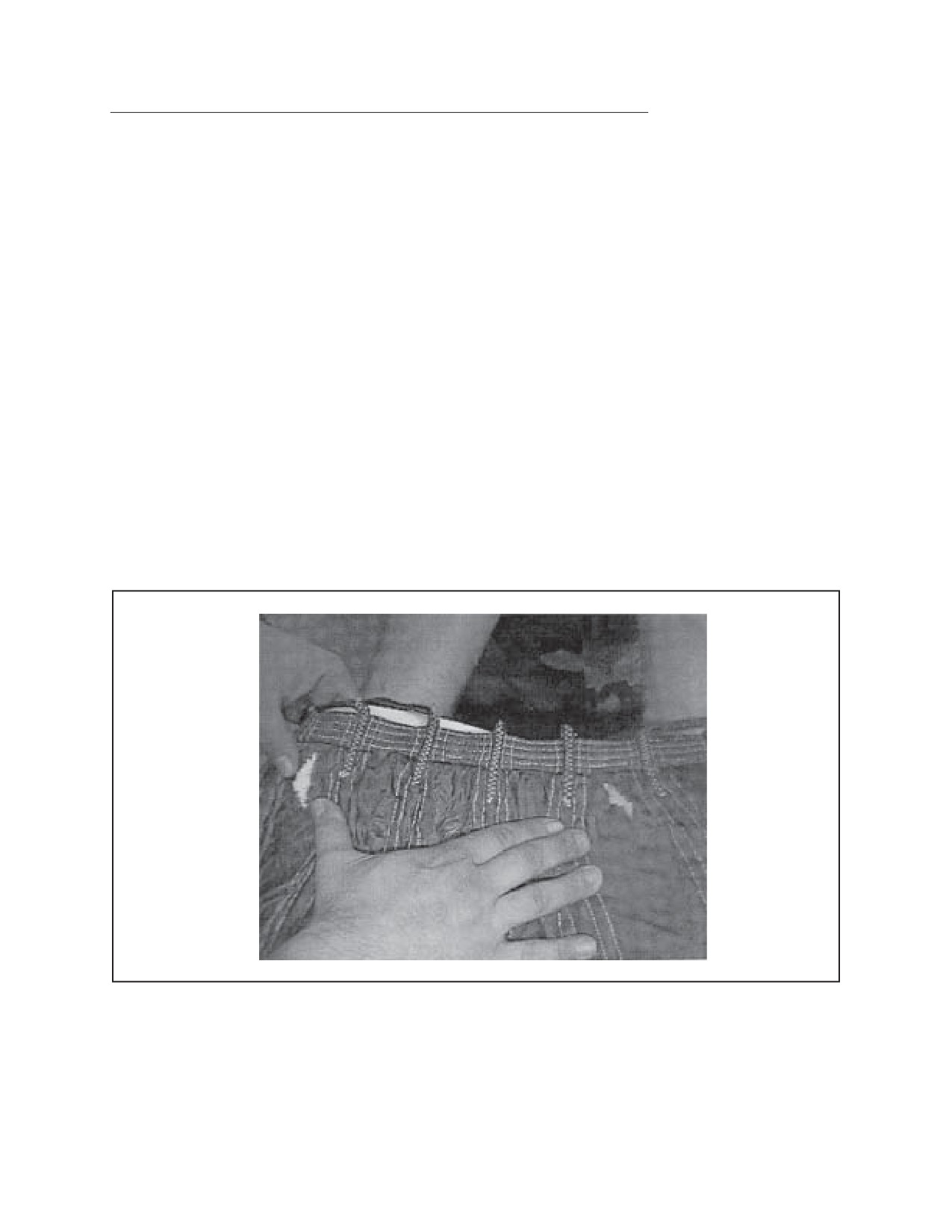
c. REEFING THE CANOPY VENT. Remove the bridle loop from the stationary
post. With a sharp rigging knife, cut a small slit (approximately 1-1/2-inches
in length) in the gore material of every fourth gore, directly below the upper
lateral band, as shown in Figure 1-1.
Figure 1-1. Gore Holes Cut Below Upper Lateral Band
1-3
FM 4-20.147/TO 13C7-37-31
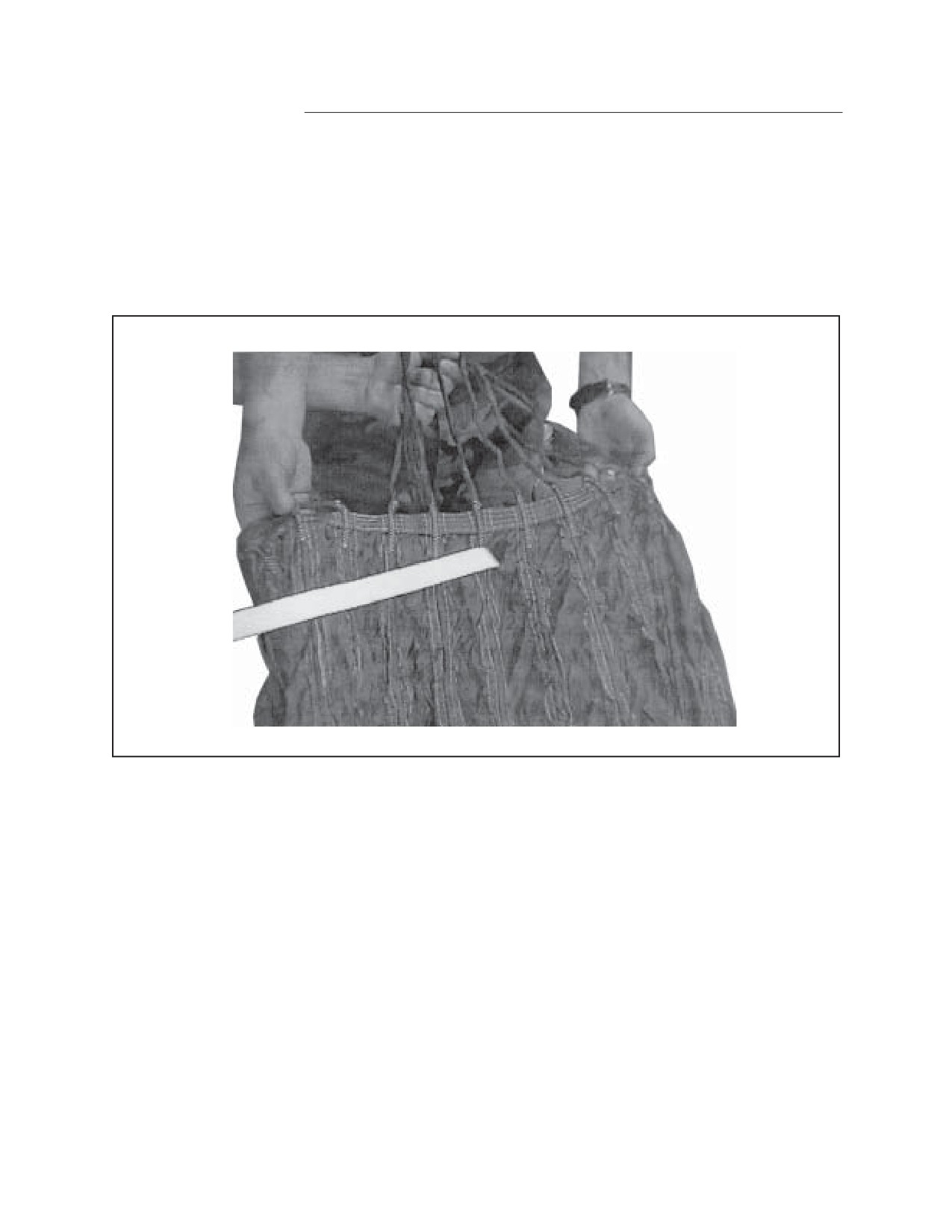
(1) Route a 4 foot long vent reefing line made of 1- inch tubular nylon from the
outside of the gore into the first gore hole as shown in Figure 1-2. Alternate
material for the vent reefing line is 1-23/32- inch wide, type VIII nylon
webbing or one turn triple of 9/16-inch tubular nylon.
Figure 1-2. Vent Reefing Line Routed into First Gore Hole
1-4
FM 4-20.147/TO 13C7-37-31
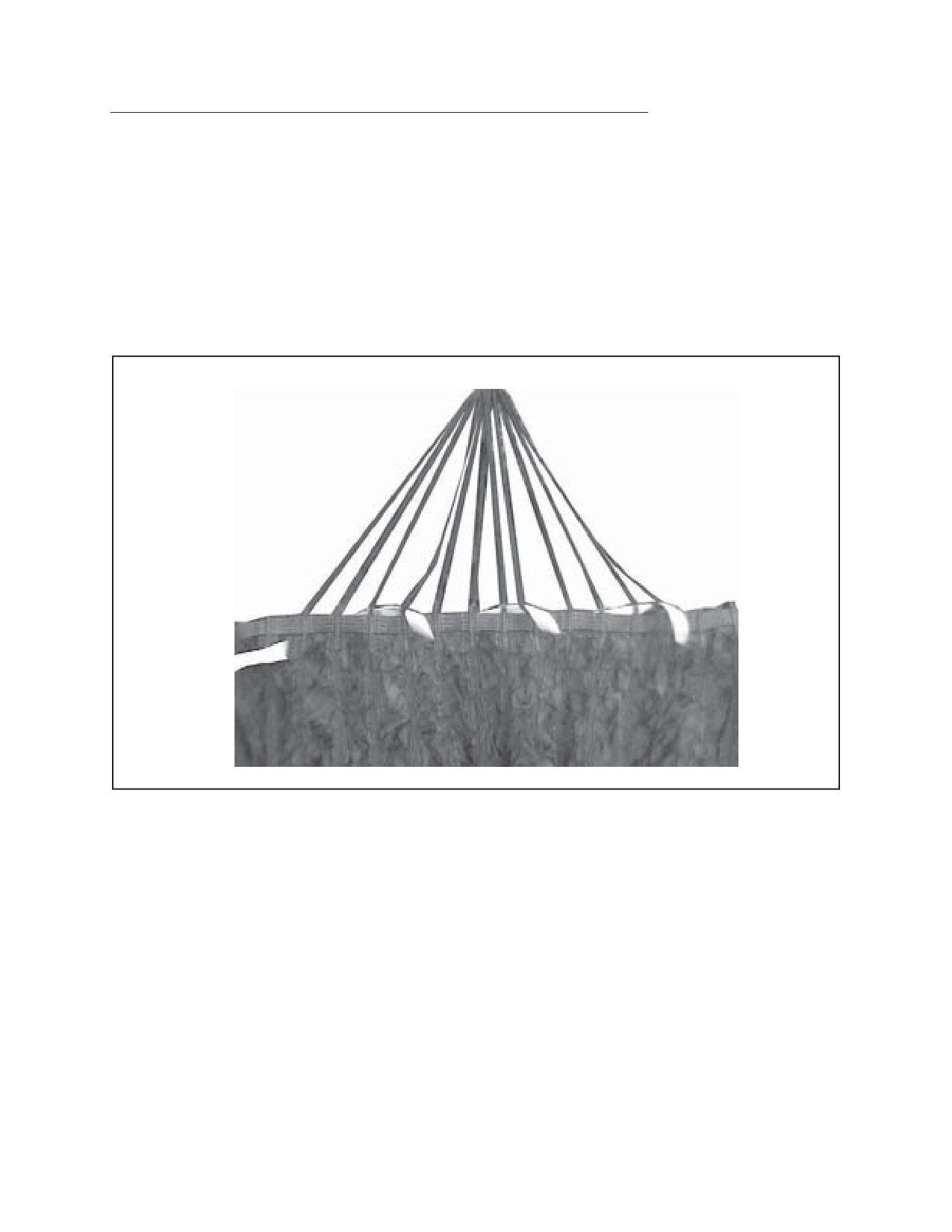
(2) Run the line to the right, over the upper lateral band and down into the
next gore hole as shown in Figure 1-3. Follow Figure 1-1 for cutting gore
holes every fourth gore. Repeat this procedure until the vent reefing line
has run through all 16 gore holes.
Figure 1-3. Vent Reefing Line Routed Around Upper Lateral Band
1-5
FM 4-20.147/TO 13C7-37-31
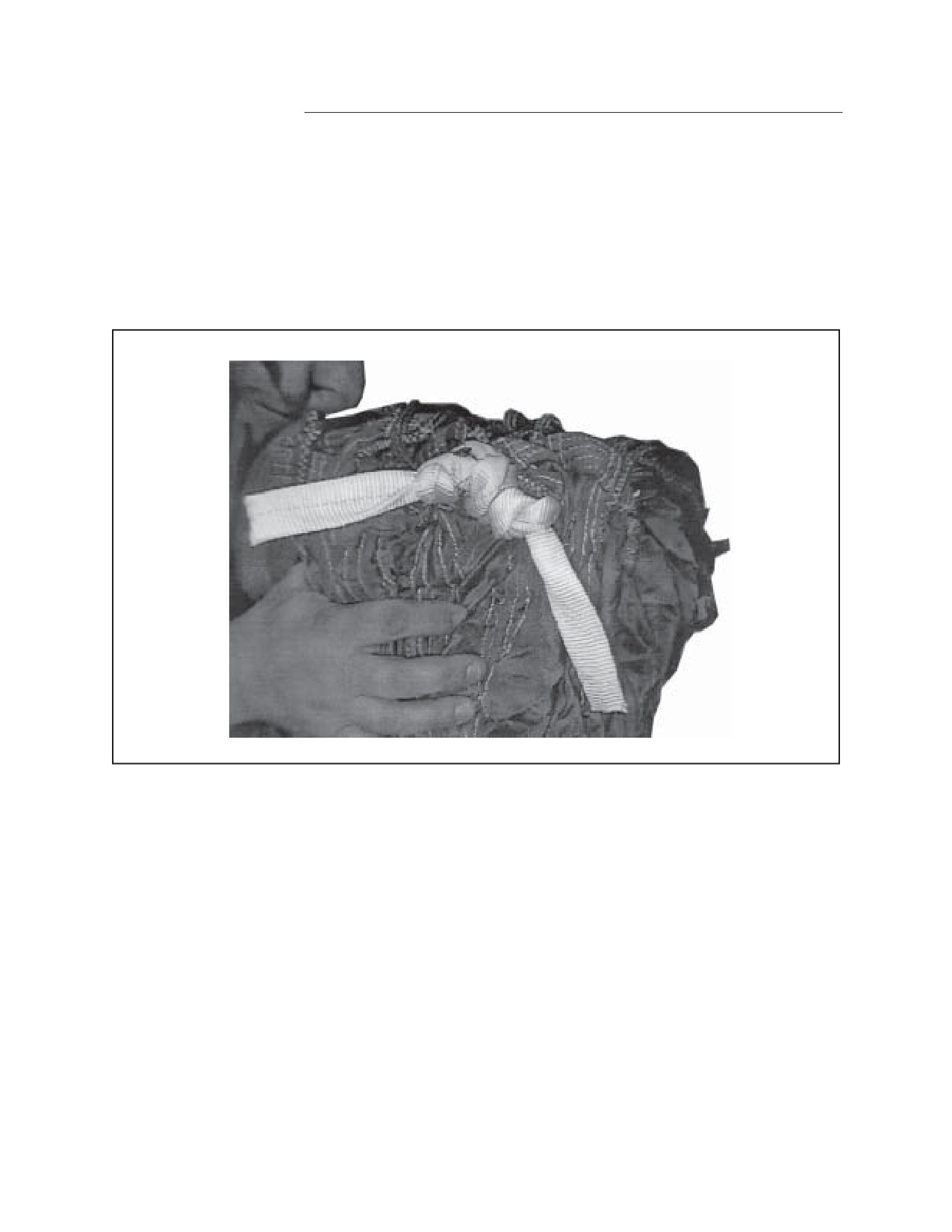
(3) Pull the vent reefing line tight to close off the vent. Tie the two running
ends of the vent reefing line together with a surgeon’s knot and locking
knot, and overhand knots in the running ends. Trim each running end at a
point 2-inches from the surgeon’s knot and locking knot as shown in Figure
1-4.
Figure 1-4. Vent Reefing Line Pulled Tight and Tied Off
1-6

FM 4-20.147/TO 13C7-37-31
APPLYING TENSION
1-4. Apply tension in accordance with TM 10-1670-281-23&P.
FOLDING THE GORES AND REEFING THE CANOPY SKIRT
1-5. Position the large line separator, throw the right suspension line group over
the left group of gores and lines, and position the large pedestal fan in accordance
with TM 10-1670-281-23&P.
a. Lay out a single 47-foot length of 9/16-inch tubular nylon webbing or a
doubled 47-foot length of 1/2-inch tubular nylon webbing. Remove twists and
apply a small amount of tension (just enough to remove slack). While under
tension, measure 2 feet in from both ends and mark the tubular nylon. Fold
the webbing length back onto itself and line up the marks. While holding the
marks together, pull the line out straight, apply a small amount of tension,
and locate and mark the center of the line. This tubular nylon length will be
the skirt reefing line.
Note: When fabricating the skirt reefing lines in large quantities, recommend
marks on the floor or on a packing table be made at 2 feet, 23-1/2 feet, 45 feet
and 47 feet. Use these marks to assist in marking and cutting reefing lines.
All measurements should be within + 1 inch.
b. Route one free running end of the skirt reefing line down through the right
side of the suspension line 33 pocket band, behind suspension line 33, and back
up through the left side of the pocket band. Pull the line through until the
center mark on the skirt reefing line is lined up with suspension line 33 as
shown in Figure 1-5. Tie a temporary slip knot in the reefing line onto suspen-
sion line 33 to keep the reefing line from moving off the mark.
Figure 1-5. Skirt Reefing Line Routed and Centered on Suspension Line 33
1-7
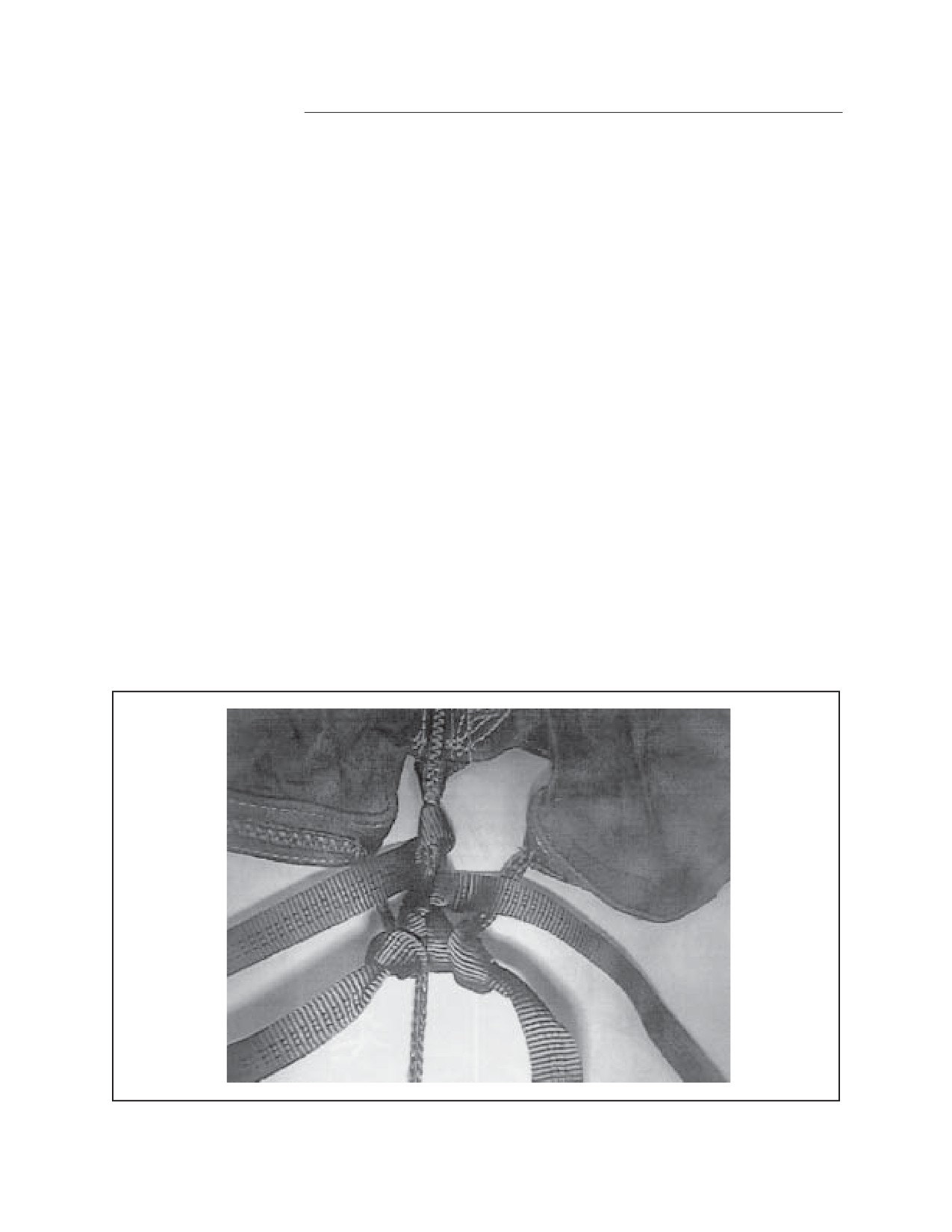
FM 4-20.147/TO 13C7-37-31
c. Begin to fold the right gore group (lines 33 through 64) in accordance with
the TM procedures. As each suspension line is passed over, route the reefing
line through the pocket band, behind the suspension line and back up through
the pocket band of the suspension line being passed over in the same manner as
shown in Figure 1-5. Repeat for every suspension line, leaving about 8 inches of
slack in the reefing line between each suspension line. Tie a temporary slip
knot in the end of the skirt reefing line onto suspension line 64 to keep the
reefing line from slipping out of position.
d. Throw the left group of gores over the folded right group of gores. Untie the
temporary slip knot in the reefing line on suspension line 33. Fold the left gore
group (lines 32 through 1) in accordance with the TM and route the other end of
the reefing line through pocket bands 32 through 2 and behind suspension lines
32 through 2 in the same manner as lines 33 through 64.
e. Untie the temporary slip knot in the reefing line on suspension line 64. Run
both ends of the reefing line down through pocket band 1 and behind suspension
line 1. Line up both marks on the reefing line directly behind suspension line 1.
Wrap each end of the reefing line around suspension line 1 one time as shown in
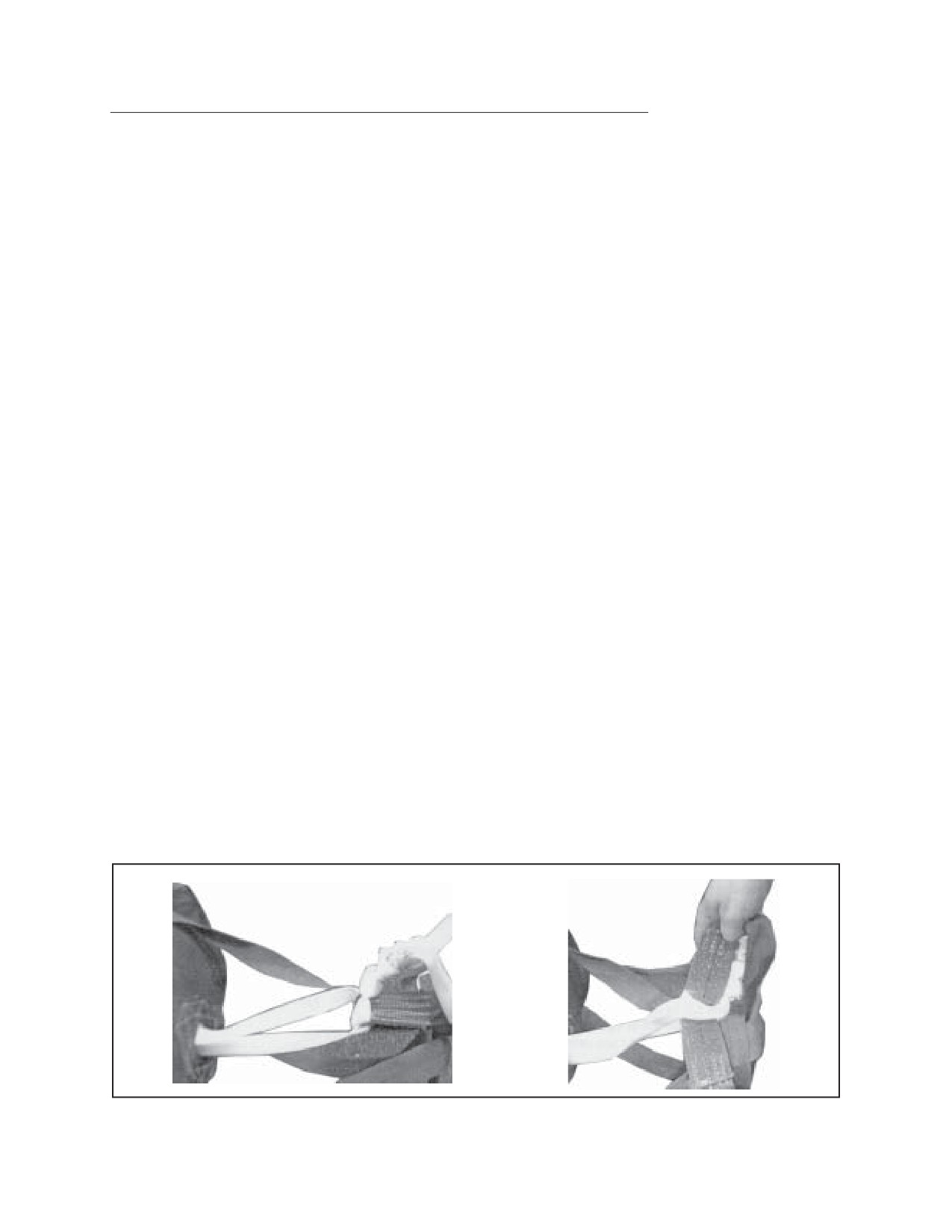
Figure 1-6. Tie the ends of the reefing lines together with a surgeon’s knot and
locking knot and overhand knot in the running ends. Trim each running end
at a point 2-inches from the surgeon’s knot and locking knot. The skirt reefing
is now complete. Complete gore folding in accordance with TM 10-1670-281-
23&P.
Figure 1-6. Ends of Skirt Reefing Line Wrapped Around and Tied Off at Suspension Line 1
1-8
FM 4-20.147/TO 13C7-37-31
f. Complete Packing of the Reefed G-12. Tie the canopy and suspen-
sion linesand tie the connector link assemblies. The break cord tie will be IAW
the instructions in Paragraph f (1). Stow the canopy, suspension lines and
risers, and close the deployment bag in accordance with TM 10-1670-281-
23&P.
(1) Connect the G-12 deployment bag bridle to the parachute apex loop
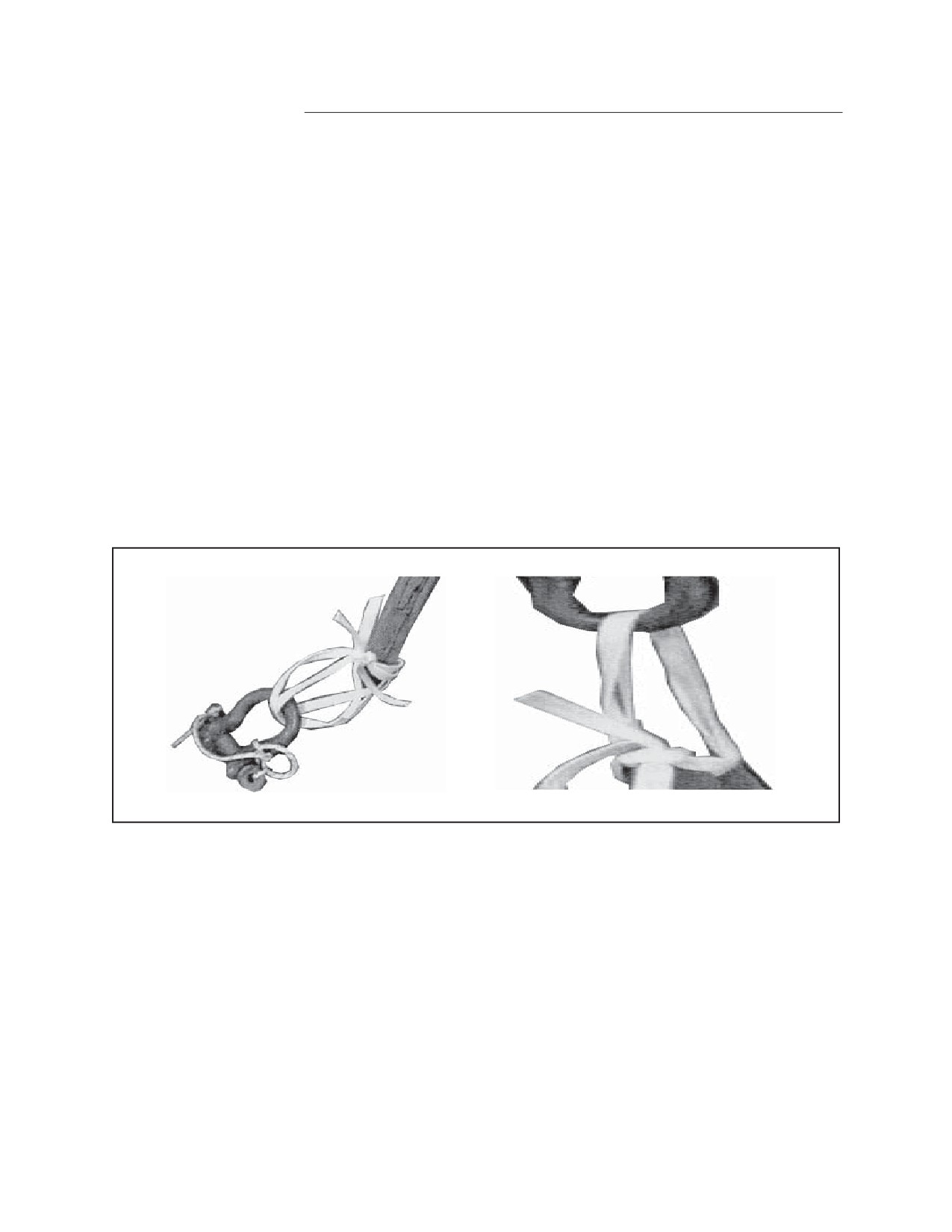
with a 60-inch strap as shown in Figure 1-7. This is necessary to keep the
68-inch pilot parachute permanently attached to the apex of the canopy.
Permanently attaching the pilot chute will stabilize the canopy inflation.
The following alternate materials are authorized for use for the 60-inch
strap:
(a) A 60-inch loop, single turn of Type VIII nylon webbing
(b) A 60-inch loop, single turn of 1-inch tubular nylon webbing
(c) A 60-inch loop, single turn of ¾ -inch tubular nylon webbing
(d) A 60-inch loop, one turn double, of 9/16-inch tubular nylon webbing
(e) The standard 60-inch connector strap, without using L-bar connector
links.
NOTE: When installing the 60-inch connector strap without using the L-bar connector
links, use the same materials and number of turns shown above to connect one end of
the strap to the bag bridle and one end to the apex loop. Use the length required to tie
the strap, leaving no slack between the strap and bridle, or the strap and the apex loop.
(2) The ties defined in the above paragraph must be tied at the bag bridle
center loop as follows: Run the material through the apex loop, pass the
running ends through the top of the deployment bag and then through the
bag bridle center loop from opposite directions. Tie the first part of a
surgeon’s knot inside the center loop, then tie two double overhand knots on
the outside of the center loop with knots in the running ends. Tape the 60-
inch loop at the apex loop and the bag bridle center loop using several turns
of cloth duct tape. When tying the 60-inch connector strap without using
the L-Bar connector links, use the same tie as described at both the apex
loop and the bag bridle center loop.
Figure 1-7. 60-inch Strap Connecting G-12 Deployment Bag to Parachute Apex Loop Completed
1-9
FM 4-20.147/TO 13C7-37-31
g. Packing and Rigging the 68-inch Diameter Pilot Parachute. Pack
and rig the 68-inch pilot parachute for breakaway in accordance with TM 10-
1670-281-23&P, except the static line breakcord tie will be made as follows:
Cut a 24-inch length of 1/4-inch wide type I cotton webbing (in lieu of the
standard type III nylon). Center the length of cotton webbing through the clevis
and insure the running ends are aligned. Pass each running end of the cotton
webbing through the static line attaching loop from opposite directions forming
a 4-inch loop of one turn double between the clevis pin and the attaching loop as
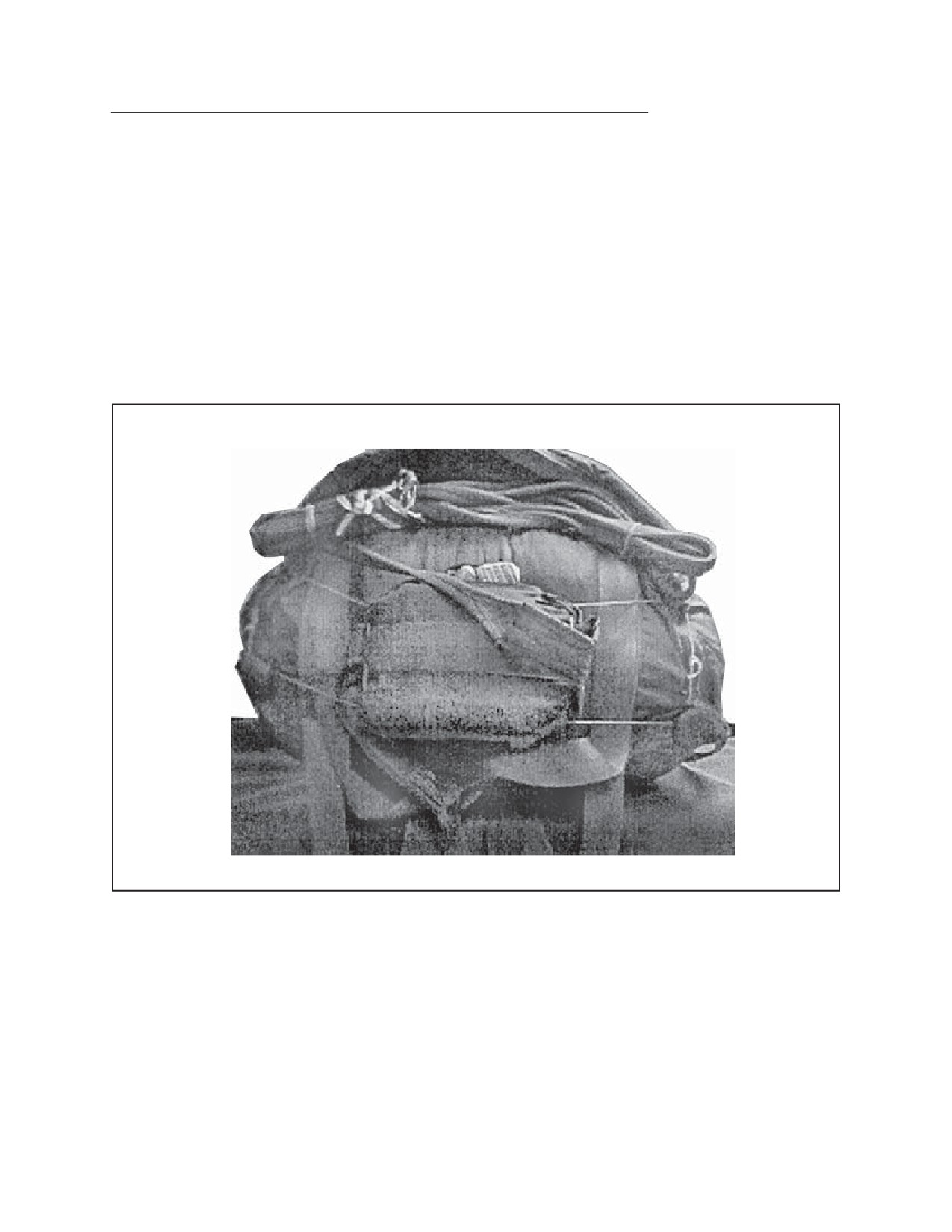
shown in Figure 1-8. Secure the cotton webbing ends on top of the static line
attaching loop with a surgeon’s knot and a locking knot. Trim each running
end at a point 2 inches from the surgeon’s knot and locking knot.
Figure 1-8. Breakaway Static Line Breakcord Tie for 68-inch Diameter Pilot Parachute Secured
1-10
FM 4-20.147/TO 13C7-37-31
POSITIONING PILOT PARACHUTE
1-6. Place the packed pilot parachute on top of the G-12 deployment bag
bridle assembly. Use a single loop of ticket number 8/7 cotton thread to
secure the pilot parachute onto the reefed G-12 parachute in two places.
The first loop of ticket number 8/7 cotton thread will be routed through the
pilot parachute D-bag tie-down loops on one side of the pilot parachute D-bag
and through the same two tie-down loops on one side of the G-12 bag that
are normally used to tie the pilot D-bag. The other loop will be secured in
the same manner on the opposite side as shown in Figure 1-9.
Figure 1-9. 68-inch Diameter Pilot Parachute Secured to G-12 Deployment Bag
1-11
FM 4-20.147/TO 13C7-37-31
Chapter 2
Rigging Extended Tri-Wall Aerial Delivery System
(TRIADS)
SECTION I - GENERAL RIGGING INFORMATION FOR EXTENDED
TRIADS
TRIAD SYSTEM COMPONENTS
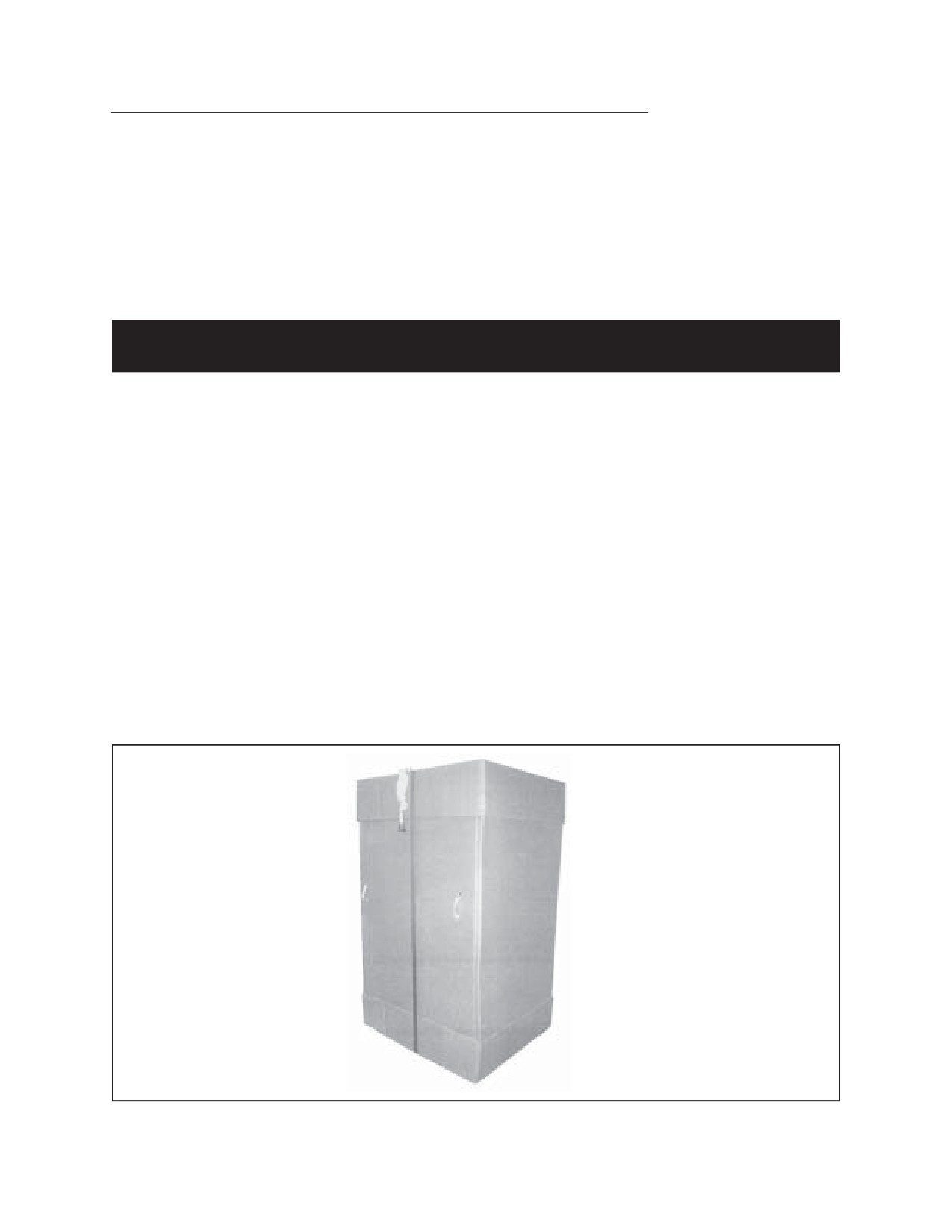
2-1. The TRIAD system, shown in Figure 2-1, is constructed from corrugated tri-
wall cardboard. An 80-inch tall sleeve is enclosed by two 12-inch tall end caps. A
vertical strap with break cord secures the load for transport. The static line, rigged
to the break cord, releases the end caps after deployment from the aircraft permit-
ting the contents of the load to free-fall to the ground.
TRIADS SKID BOARD
2-2. The skid board is made of 1/4- by 48- by 40-inch plywood. If 1/4-inch plywood is
not available, 3/16 or 5/16-inch plywood may be substituted. The skid board will be
secured to the container using glue and 1-inch staples.
Figure 2-1. Fully Rigged TRIAD System with Gate Suspension Loops
2-1
FM 4-20.147/TO 13C7-37-31
TRIADS CONTAINER LIMITATIONS
2-3. The TRIADS container has a weight restriction of 747 to 1375 pounds. Ensure
that the load weighs a minimum of 28 pounds per square foot IAW FM 10-500-3/TO
13C7-1-11.
CAUTION
When dropping MREs or HDRs the maximum load is
dependant on drop altitude. Refer to Table 2-1 for the
system capacity.
ASSEMBLY LINE RIGGING
2-4. When assembly line rigging is used for TRIADS loads, six stations are needed.
The stations are: preparing the caps, preparing honeycomb and skid board, assem-
bly, filling container, strap and static line installation, and final inspection.
INSPECTION OF LOAD
2-5. The TRIADS load must be inspected by a qualified rigger. While being rigged this load
should be supervised or rigged by a parachute rigger. DD Form 1748-1 must be completed
before airdrop.
PARACHUTE USED
2-6. No parachute is used for this system.
AFT RESTRAINT
2-7. Release gate suspension loops and additional honeycomb kits are required for
TRIADS containers at pre-determined release gate locations in the aircraft. Prepare
the honeycomb and straps as shown in Figure 2-6.
NOTE: Installation of the release gate suspension loops and the honeycomb kit must be
completed prior to filling the container with MREs or HDRs.
2-2
FM 4-20.147/TO 13C7-37-31
SECTION II - RIGGING EXTENDED TRIADS CONTAINERS
SYSTEM DESCRIPTION
2-8. The TRIAD System is a corrugated tri-wall box rigged for static line deployment
off the ramp of an aircraft. Typical loads include loose MREs or HDRs. Following
deployment, the caps of the box separate from the sleeve allowing the container’s
contents to scatter and free-fall to the ground.
PREPARING ITEMS AND SKID BOARD
2-9. Refer to Paragraph 2-2 for preparation of the skid board. HDRs or MREs must
be removed from their shipping containers before loading.
PREPARING HONEYCOMB BASE
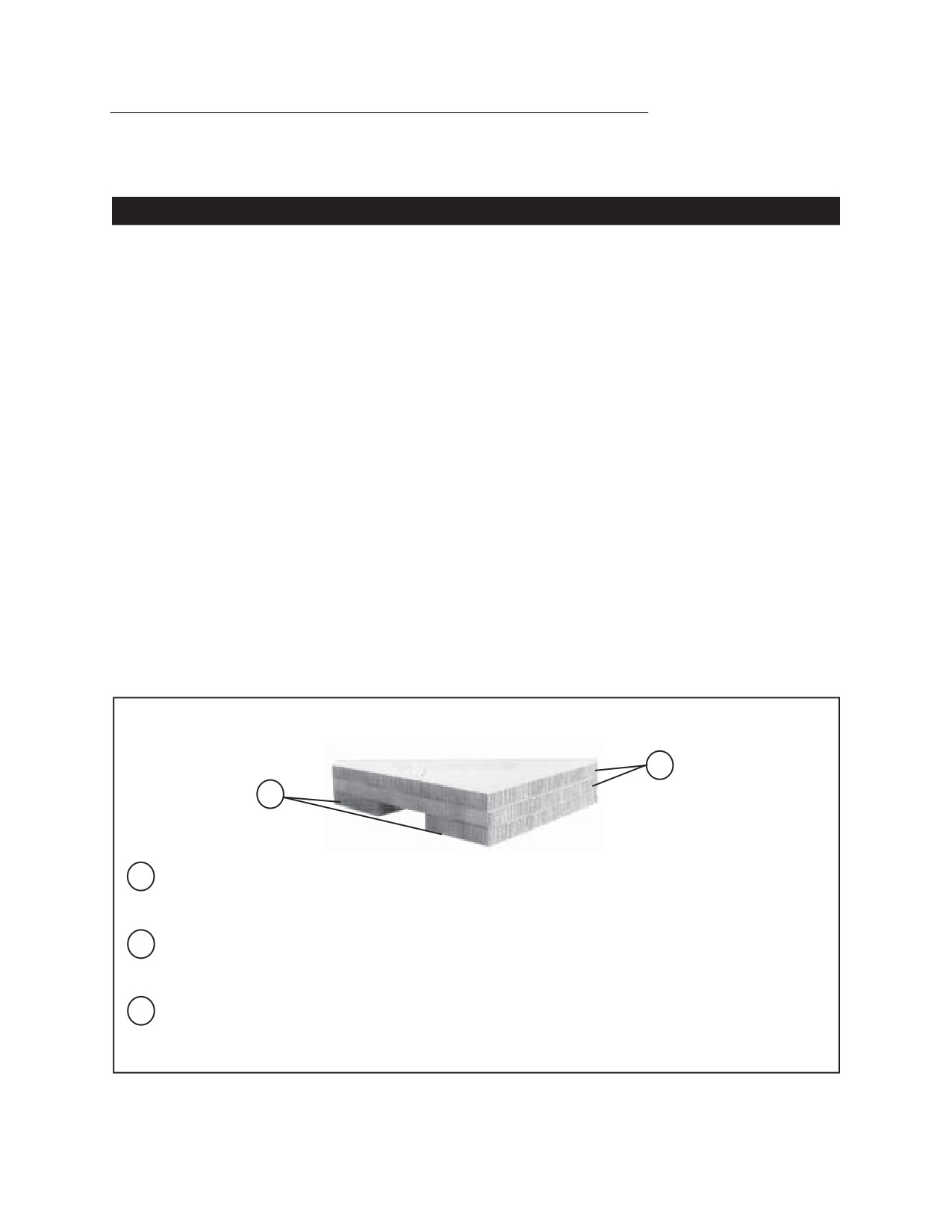
2-10. Prepare the honeycomb base as shown in Figure 2-2. The honeycomb layers
will be glued together however, they will not be glued to the base cap.
2
3
1
Cut two pieces of honeycomb 36 by 46 inches and two pieces of honeycomb 16 by 36
inches.
2
Glue the two 36- by 46-inch pieces of honeycomb together aligning the corners and edges.
3
Glue the two 16- by 36-inch pieces of honeycomb along the 36 inch long edges of the sheets
leaving a 14 inch space in the center.
Figure 2-2. Honeycomb Base Prepared
2-3
FM 4-20.147/TO 13C7-37-31
PREPARING STRAPS AND STATIC LINE
2-11. Prepare the straps and static line as described below.
a. Cut one length of type VIII nylon webbing 288 inches long. Measure 20 inches from
both ends and place a mark. Fold the type VIII nylon webbing at the 20 inch marks and
place a double overhand knot, forming a 4 inch loop in the ends. Place an overhand knot
in the running ends.
b. Cut one length of type III nylon cord, 36 inches long and remove the core
threads.
c. Cut one length of 1-inch tubular nylon webbing 228 inches long. Measure 15 inches
from one end of the nylon and place a mark. Fold the 1-inch tubular nylon webbing at the
mark and tie a double overhand knot to form a 4-inch loop. Tie an overhand knot in the
running end. Install a G-14 clevis in the loop. From the opposite end of the 1-
inch tubular nylon webbing, measure 24 inches and make a mark.
d. Cut four pieces of type VIII nylon webbing (1/2-tubular nylon webbing may be
used as a substitute) 40 inches long.
e. Cut two pieces of 1-inch tubular nylon webbing 36 inches long.
PREPARING END CAPS
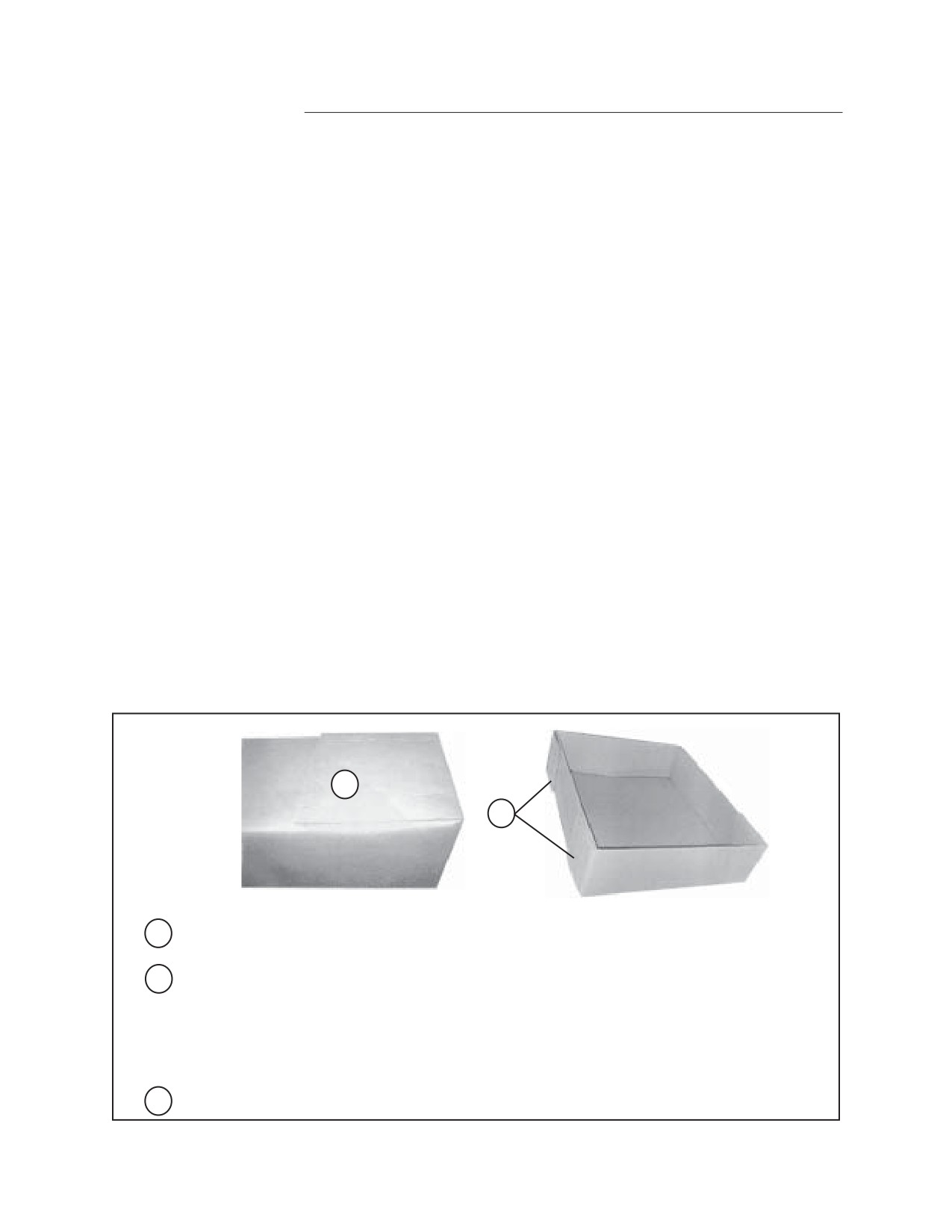
2-12. Prepare the end caps as shown in Figure 2-3.
1
2
1
Form the tri-wall cap by folding all end and side flaps in towards the center.
2
Use an Air Stapler (Bostitch D30AD) or equivalent and secure the tab on each corner to the
adjacent side flap assuring that the corner is square as shown above. If stapler is not
available, cloth-backed tape may be used. Note that the tab should be on the outside of the
cap. Approximately three staples should be used for each corner. It is not necessary for the
staples to fully penetrate both layers of the tri-wall container.
3
Repeat process to form the two caps necessary for the system.
Figure 2-3. End Caps Prepared
2-4
FM 4-20.147/TO 13C7-37-31
INSTALLING SKID BOARD
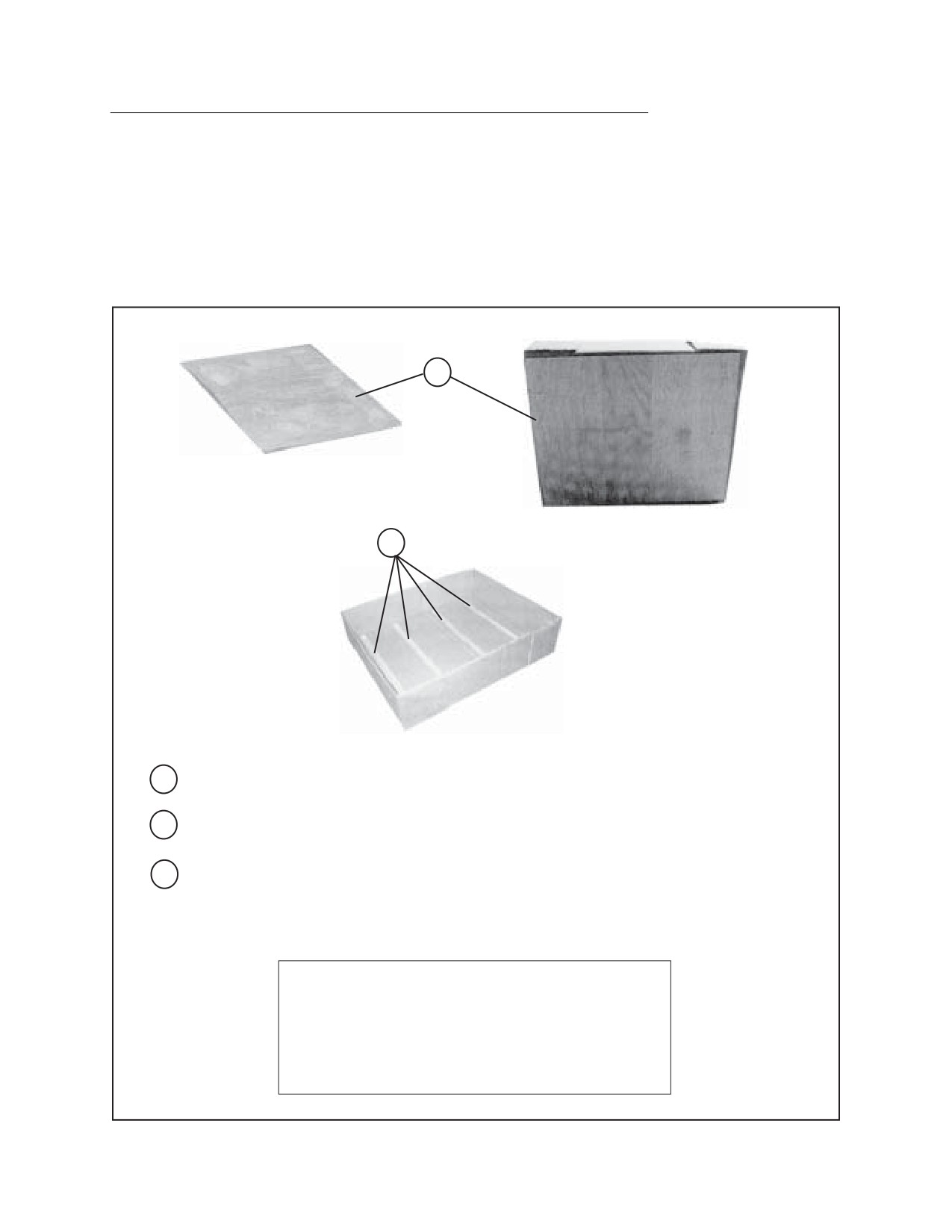
2-13. Install the skid board on the base cap as shown in Figure 2-4.
1
2
1
Apply glue to one side of skid board as shown above and press it onto base cap.
2
Tip the base cap down so that it sits on the plywood skid board. Lay the Type VIII strips
prepared in Paragraph 2-11d equally spaced across the inside bottom of the cap.
3
Using a pneumatic staple gun (Senco L13 or equivalent) with 1-inch staples, staple through
the nylon webbing, cap, and into plywood skid board. Apply adequate pressure to ensure that
the plywood is tightly secured to the base cap. Staples should be spaced approximately every
6 inches down the length of the nylon webbing.
CAUTION
When attaching skid board to the load using staples,
apply adequate pressure to ensure that the connec-
tion is tight and secure. However, staple ends must
penetrate through the bottom of the skid board.
Figure 2-4. Skid Board Attached to Base Cap
2-5
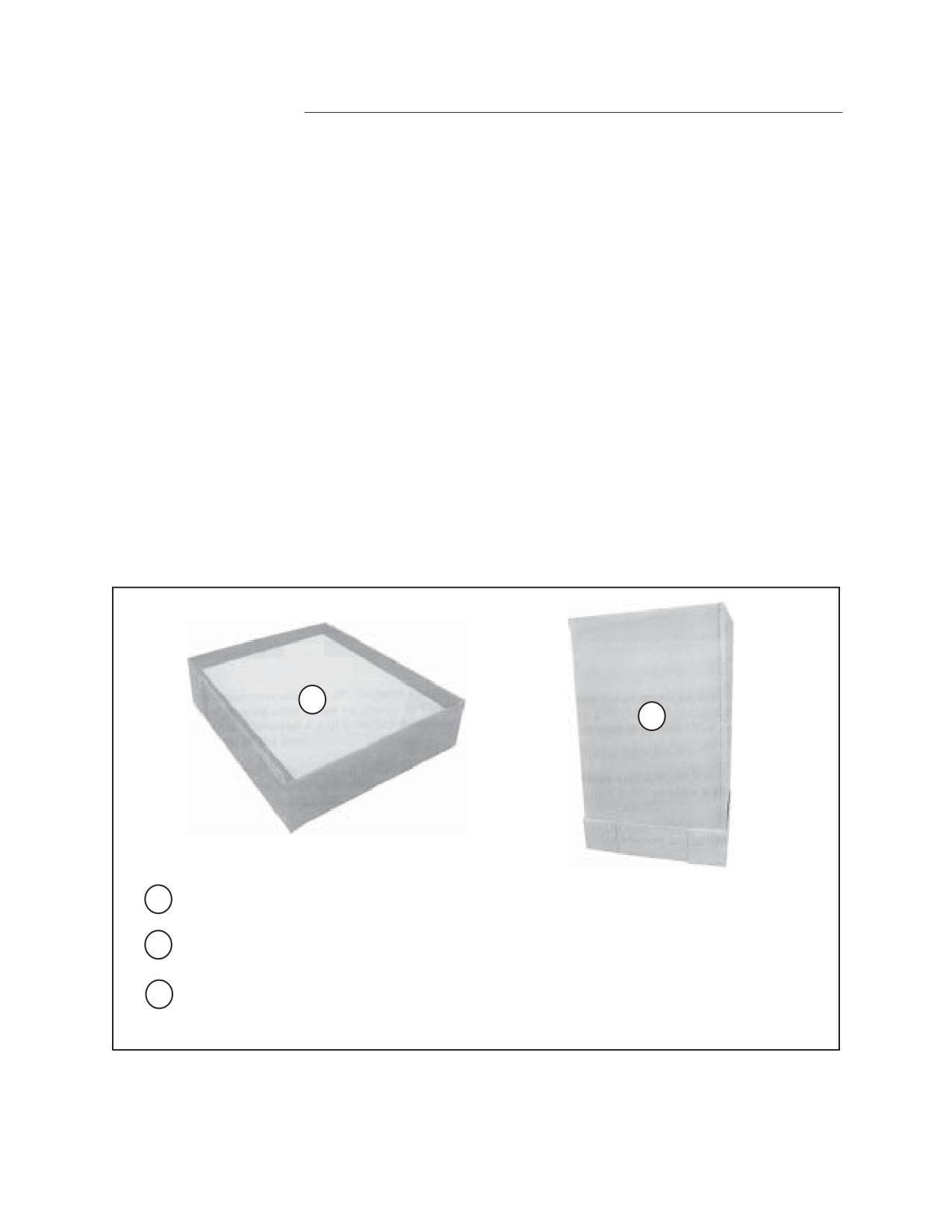
FM 4-20.147/TO 13C7-37-31
ASSEMBLING THE BOX
2-14. Assemble the TRIADS container as shown in Figure 2-5.
GATE SUSPENSION LOOPS AND HONEYCOMB KIT
2-15. TRIADS containers located at release gate locations must have release gate
suspension loops installed and honeycomb reinforcement positioned inside the box.
Construct and install the release gate suspension loops and honeycomb as shown in
Figure 2-6.
FILLING THE TRIADS CONTAINER
2-16. Fill the box with the appropriate weight of HDRs or MREs. Table 2-1 must be
used determine the maximum weight for the drop altitude. Once filled, install the
end cap over the top of the sleeve.
1
2
1
Center the honeycomb in base cap as shown above.
2
Slide the 80 inch high sleeve over the honeycomb and inside the base cap.
3
If the container is located at a release gate location, gate suspension loops and honeycomb
reinforcement must be positioned inside the box before it is filled (see Figure 2-6).
Figure 2-5. TRIADS Container Assembled
2-6
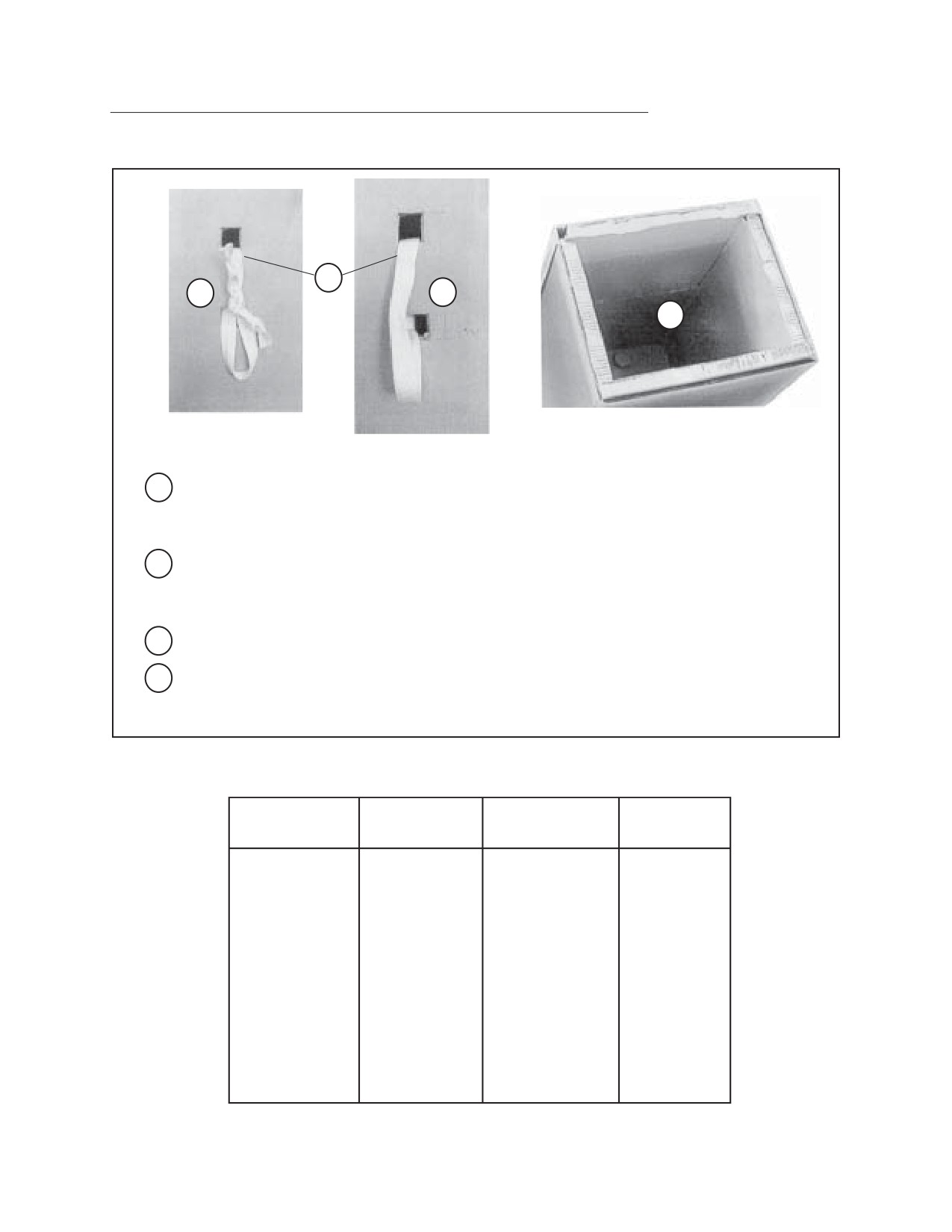
FM 4-20.147/TO 13C7-37-31
2
1
3
4
1
In order to install the release gate suspension loops, four 1-inch square holes must be cut in
one of the 48-inch wide sides as shown above. The holes should be 6 inches apart and located
between 4 and 6 inches inboard of the box corners and at or near the vertical center of the box.
2
Using the 36-inch tubular nylon straps prepared in Paragraph 2-11e, loop the nylon through
the holes as shown above. Tie the ends of the 1-inch tubular with a surgeon’s knot and
locking knot with overhand knots in the running ends.
3
Slide the 1-inch tubular so that the knots are inside the box as shown above.
4
Cut two pieces of honeycomb 71-inches by 47-inches and two pieces 71- inches by 34-inches.
Slide the honeycomb against the inside wall of the sleeve. The honeycomb should be flush
with the top of the sleeve.
Figure 2-6. Release Gate Suspension Loops and Honeycomb Kit Installed
Altitud e
Number of
Number of
Weigh t
(MSL )
HDR's (cases)
MRE's (cases )
(lb
)
1000
610
(61
)
816
(68
)
1373
15000
480
(48
)
648
(54
)
1080
20000
470
(47
)
636
(53
)
1060
25000
470
(47
)
624
(52
)
1060
30000
460
(46
)
612
(51
)
1035
35000
450
(45
)
600
(50
)
1012
40000
440
(44
)
588
(49
)
990
Table 2-1. Maximum Fill Capacity for Desired Drop Altitude
2-7
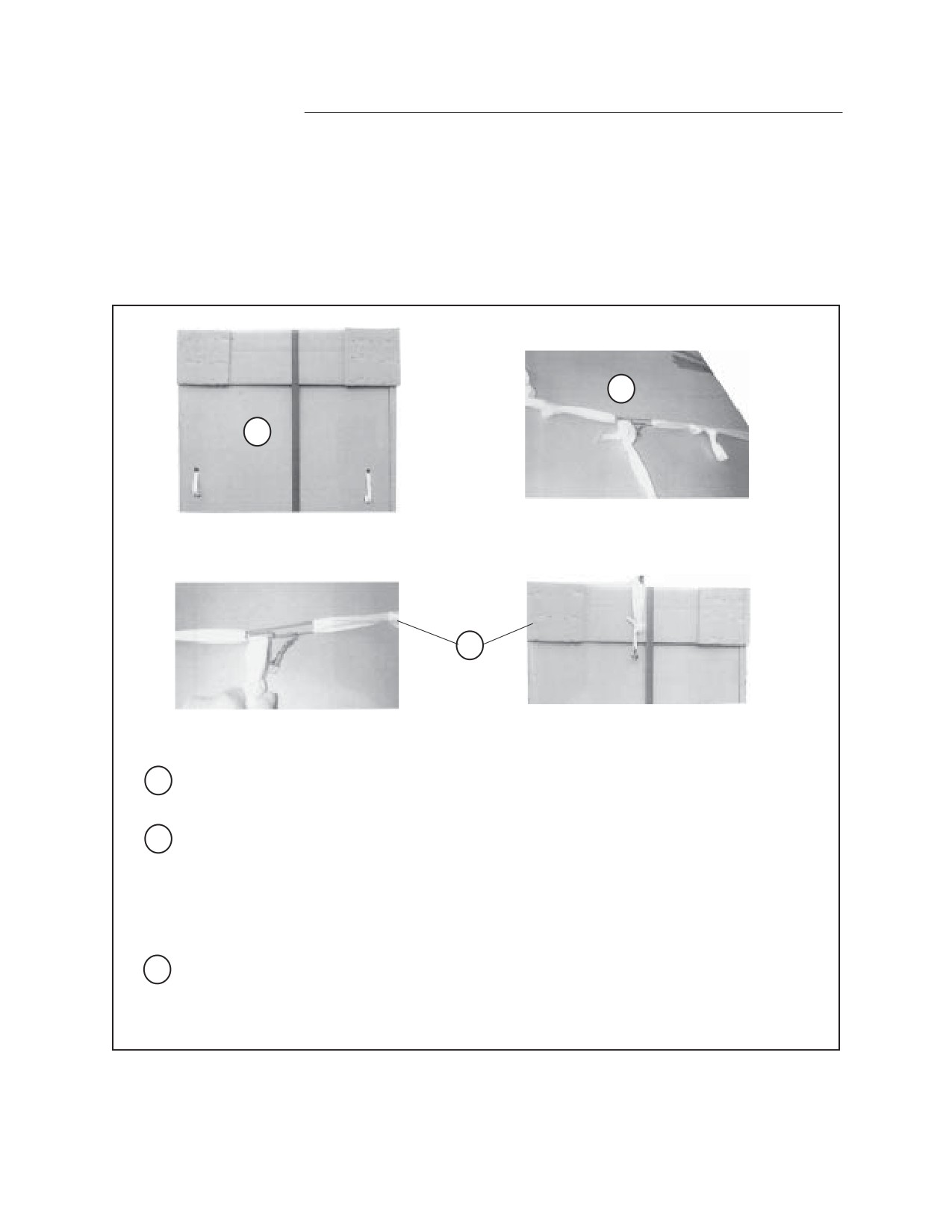
FM 4-20.147/TO 13C7-37-31
INSTALLING VERTICAL STRAP AND STATIC LINE
2-17. Install the vertical strap and static line as shown in Figure 2-7.
2
1
3
1
Loop the 288-inch type VIII strap prepared in Paragraph 2-11 over the top of the box.
2
Secure the ends of the strap using the gutted type III nylon cord described in Paragraph 2-11.
Tie the ends of the gutted type III nylon cord together using a trucker’s hitch. This forms the
break cord tie.
Note: Do not cut the excess type III nylon cord; it will be needed to retighten the break cord tie after
loading onto the aircraft.
3
Slide the free end of the 19-foot long 1-inch tubular nylon webbing line prepared in Paragraph
2-11 through the loop created by the break cord. Align the 24-inch mark with the break cord and tie a
surgeon’s knot and locking knot in the 1-inch tubular nylon webbing. Tie an overhand knot in the
running end to form the static line. Stow the static line as shown above.
Figure 2-7. Vertical Strap and Static Line Installed
2-8
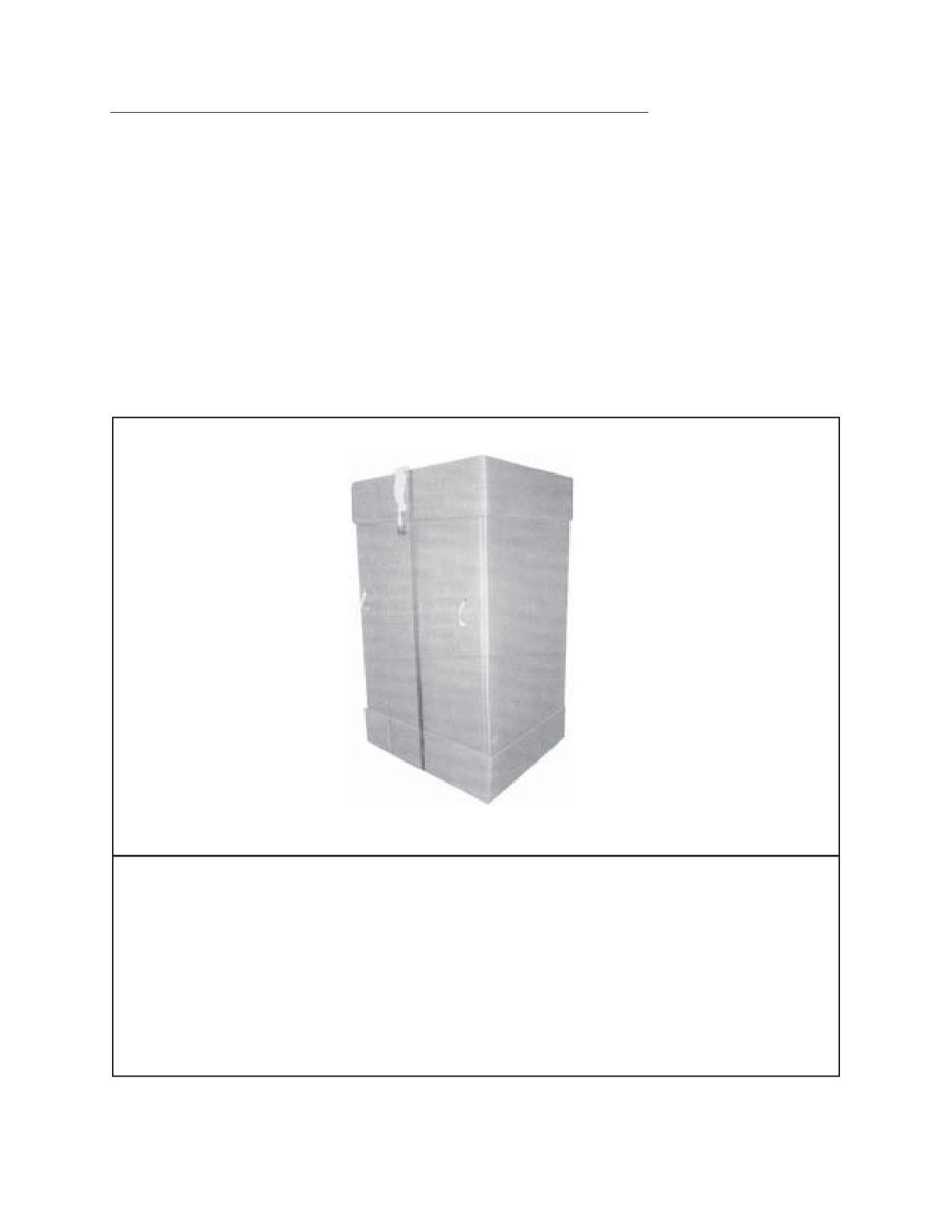
FM 4-20.147/TO 13C7-37-31
MARKING RIGGED LOAD
2-18. Mark the rigged load according to FM 10-500-3/TO 13C7-1-11 and as shown in
Figure 2-8. Compute the rigged load data.
EQUIPMENT REQUIRED
2-19. Use the equipment listed in Table 2-2 to rig the load shown in Figure 2-8.
RIGGED LOAD
Weight: Minimum load allowed
747 pounds
Maximum load allowed
1,375 pounds
Height:
80 inches
Width:
42 inches
Length:
50 inches
Figure 2-8. Fully Rigged Extended TRIADS
2-9
FM 4-20.147/TO 13C7-37-31
Table 2-1. Equipment Required for Rigging Extended TRIADS
National Stock
Item
Quantity
Number
No NS N
Tri-Wall Sleeve 40-by 48- by- 80-inch
1
No NS N
Tri-Wall Cap 40-by 48-by-12-inch
2
5530-00-128-5419
Plywood 1/4-by 48-by-40-inch
1
No NS N
Senco SLS20-L Narrow Crown Stapler, or equivalent
1
No NS N
1-inch Staples, Senco L13, or equivalent
As required
No NS N
Bostitch D30AD Air Stapler, or equivalent
1
No NS N
1 1/2-inch Staples, Bostitch SW9060, or equivalent
As required
8040-00-273-8713
Adhesive Paste
As required
1670-00-753-3928
Pad, energy dissipating, honeycomb 36-by 96- by 3-inches
1 sheets
(If TRIADS is positioned in a release gate location, 5
sheets are required)
4020-00-240-2146
Cord, nylon type III
1
Y
d
8305-00-263-3591
Webbing, nylon type VIII
13 Yds
8305-00-268-2455
Webbing, tubular nylon, 1-inch
7 Yds
8305-00-082-5752
Webbing, tubular nylon, 1/2-in
As required
1607-00-678-8560
Clevis, small, G-1
4
1
8305-00-074-5124
Tape, adhesive, 2-inch
As required
2-10
FM 4-20.147/TO 13C7-37-31
Chapter 3
Rigging Low Cost Aerial Delivery System (LCADS)
SECTION I - GENERAL INFORMATION FOR LCADS
LCADS SYSTEM COMPONENTS
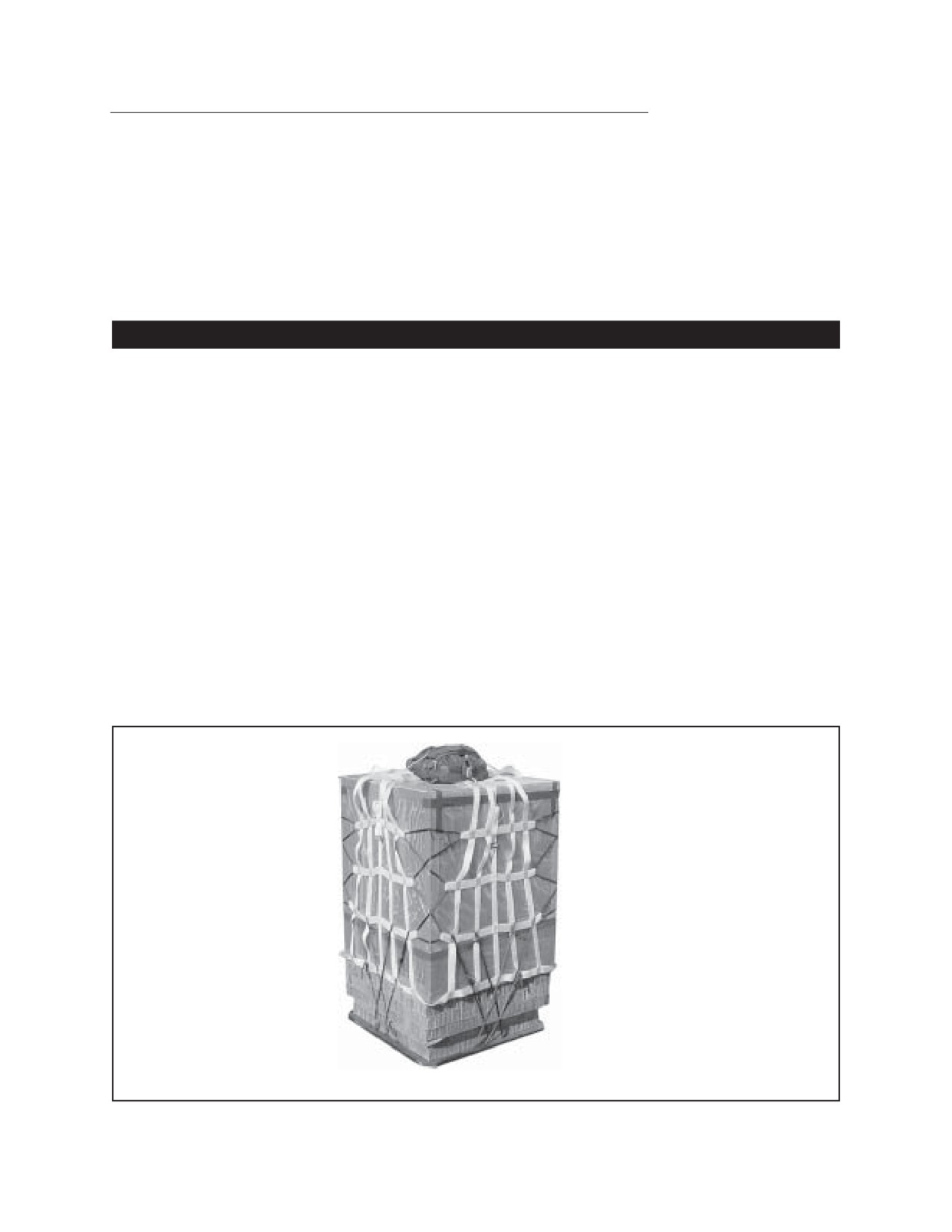
3-1. The LCADS shown in Figure 3-1 employs a low cost version of the A-22 sling
assembly and low cost version of the 26-foot ringslot parachute that can be readily
procured if needed. The low cost sling assembly uses a more readily available and
more economical material and eliminates much of the hardware as compared to the
standard A-22 sling assembly.
LCADS SKID BOARD
3-2. Like the standard high velocity CDS, the sling assembly is secured to a 3/4 or
1- by 48 by 48- inch plywood (Grade AC) skid board with 1/2-inch tubular nylon
webbing. Honeycomb is positioned between the container and the skid board for
impact cushioning.
Figure 3-1. Fully Rigged LCADS System for High Velocity Airdrop
3-1
FM 4-20.147/TO 13C7-37-31
LCADS CONTAINER LIMITATIONS
3-3. The LCADS container has a weight restriction of 501 to 2,200 pounds. However,
it is recommended that the maxmium load be limited to 1,750 to insure load surviv-
ability.
INSPECTION OF LOAD
3-4. The LCADS load must be inspected by a qualified rigger. While being rigged
this load should be supervised or rigged by a parachute rigger. DD Form 1748-1
must be completed before airdrop.
PARACHUTE USED
3-5. LCADS employs a 26-foot HV low cost parachute. The 26-foot low cost para-
chute performs identically to the standard 26-foot HV parachute except the low cost
parachute is designed for one-time use, whereas the standard 26-foot HV is designed
for reuse. The low cost parachute maybe pre-packed and ready to attach to the load.
The standard 26-foot HV parachute may be used if the low cost parachute is not
available.
3-2
C1, FM 4-20.147/TO 13C7-37-31
SECTION II- RIGGING HIGH VELOCITY LCADS
SYSTEM DESCRIPTION
3-6. The LCADS System is rigged as a typical A-22 high-velocity load. Typical loads
include rations, water, and other small items. LCADS container loads must weigh
at least 501 pounds but not exceed 2,200 pounds, excluding the weight of the para-
chute. The load is rigged with a 26-ft low-cost parachute.
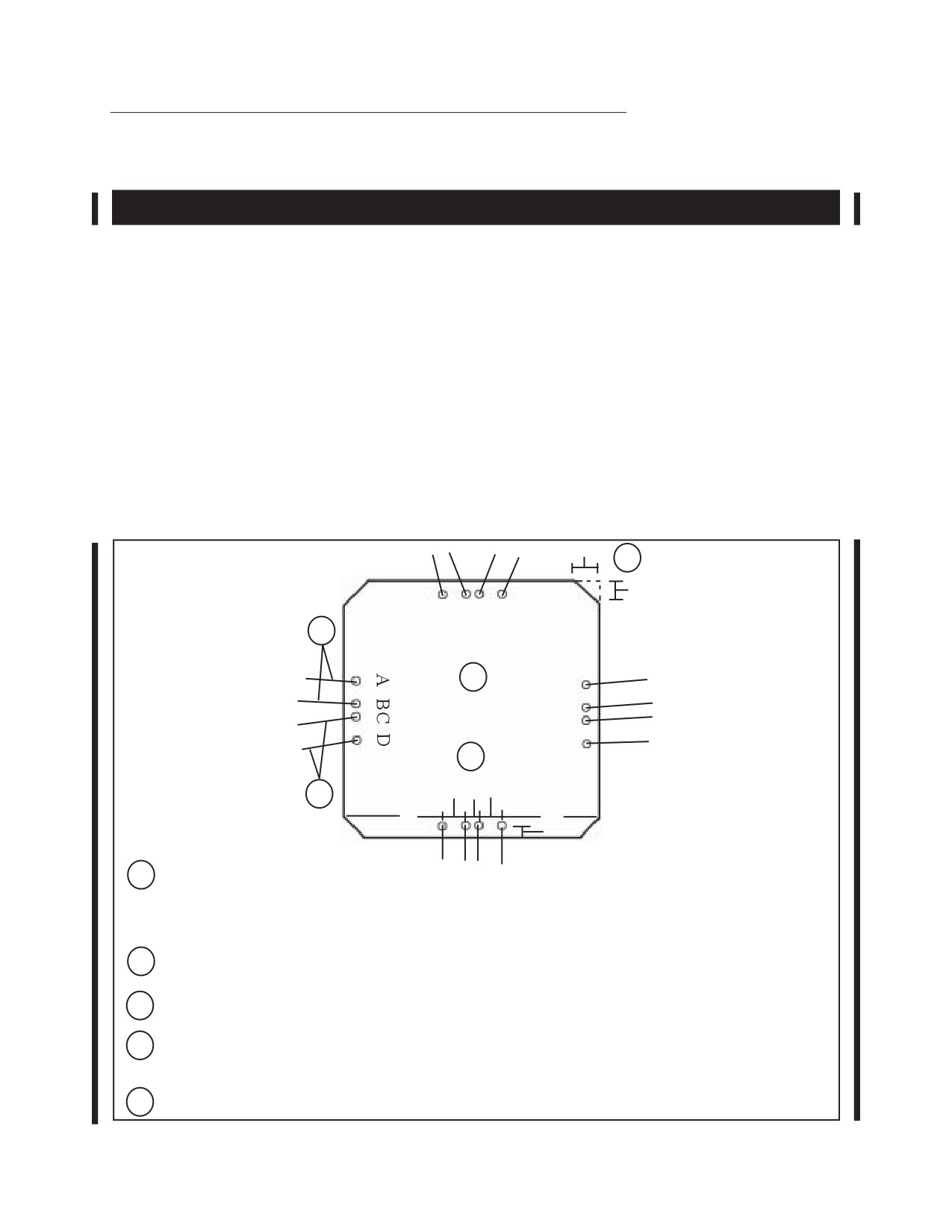
PREPARING ITEMS AND SKID BOARD
3-7. Refer to Figure 3-2 for preparation of the skid board. Prepare the drop items
according to the load’s sensitivity. Items must be well padded to prevent damage
during airdrop.
3
3
3
4
1
48 x 48
2
5
5
25
18
18
2
1
Place a 3/4- or 1- by 48-by 48-inch piece of plywood on a flat surface.
Note: Loads up to 1,600 pounds may use 3/4 inch plywood, loads that exceed must
use 1 inch.
2
Drill four 1/2-inch holes on each side as shown above.
3
Measure 3-inches in from each corner of the skid board and make a cut diagonally.
4
Cut eight 8-foot legths of 1/2-inch tubular nylon webbing. Route one length through hole A from
the bottom and the other end through hole B from the bottom. Even the ends.
5
Repeat step 3 for holes C and D and remaining sides.
Figure 3-2. Preparing the Skid Board
3-3
C1, FM 4-20.147/TO 13C7-37-31
PREPARING AND PLACING HONEYCOMB
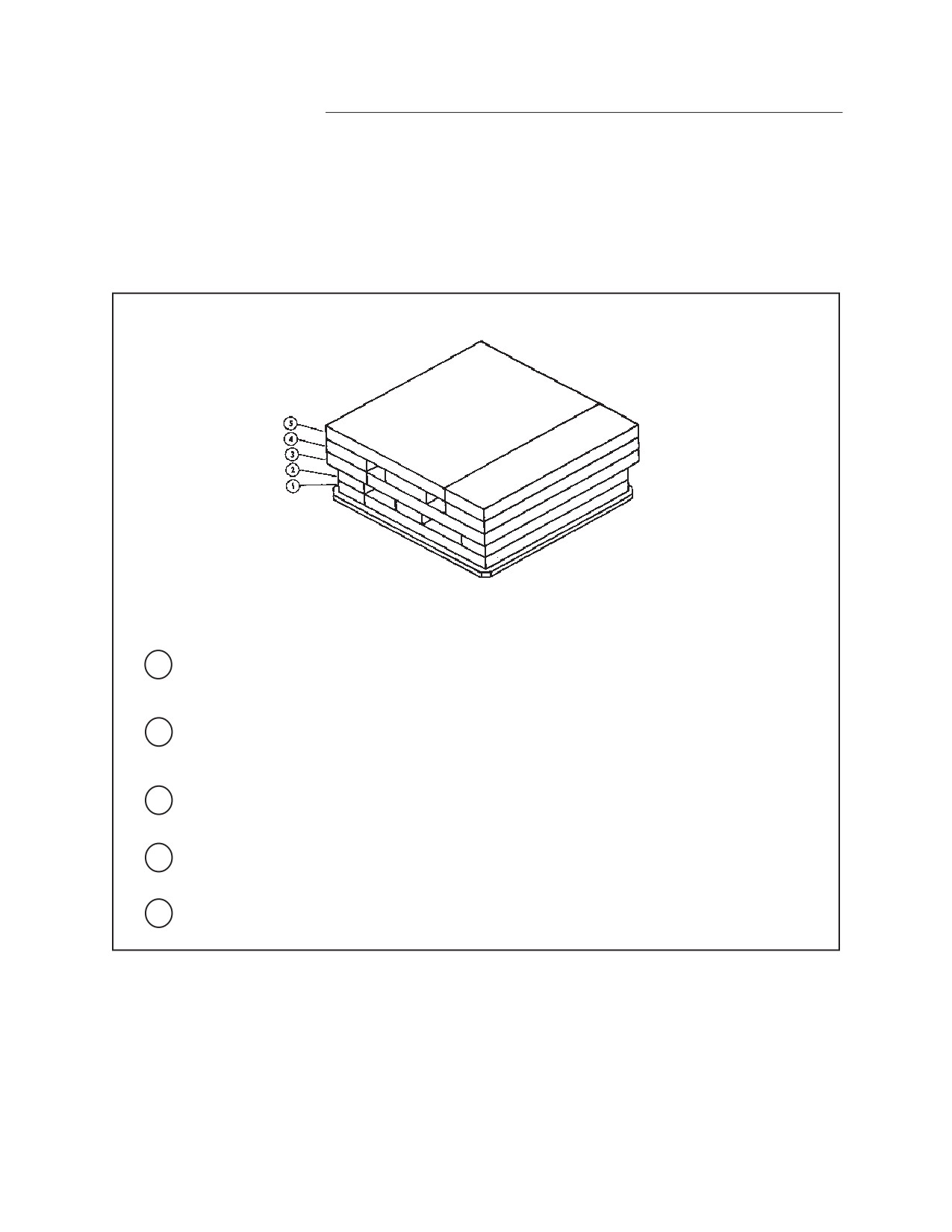
3-8. Prepare and place the honeycomb as shown in Figure 3-3.
1
Center a 36- by 44-inch and an 8- by 44-inch piece of honeycomb side by side on the skid board.
Make sure the layer is 2-inches in from all sides.
2
Cut three 8- by 44-inch pieces of honeycomb. Center one piece on top of the first layer of
honeycomb. Place one piece of honeycomb even with each side edge.
3
Center a 36- by 48-inch and an 12- by 48-inch piece of honeycomb side by side on top of the
second layer of honeycomb.
4
Cut three 12- by 48-inch pieces of honeycomb. Center one piece on top of the third layer of
honeycomb. Place one piece of honeycomb even with each side edge.
5
Repeat step 3 for the fifth layer of honeycomb.
Figure 3-3. Preparing and Placing Honeycomb
3-4
FM 4-20.147/TO 13C7-37-31
POSITIONING SLING ASSEMBLY
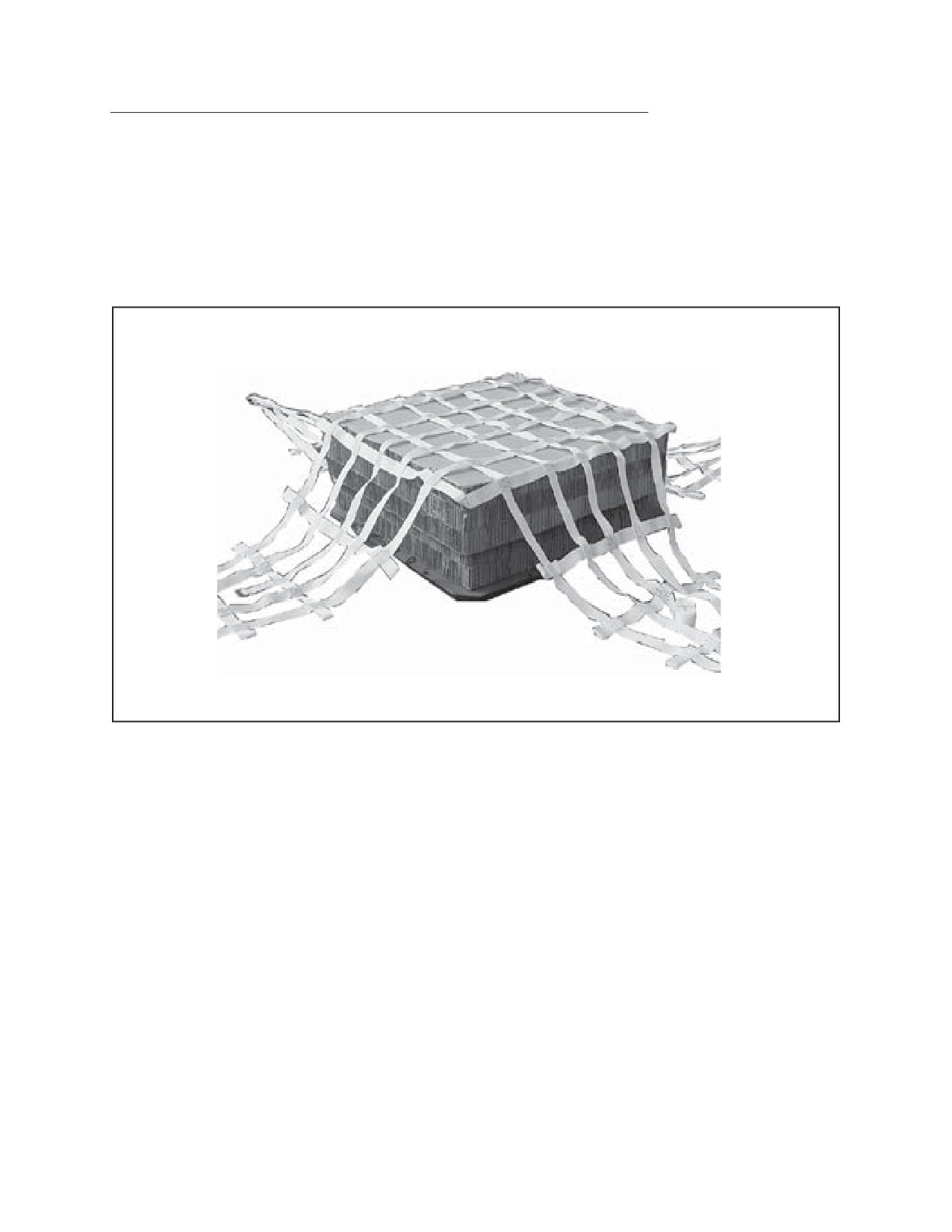
3-9. Center the sling assembly over the honeycomb and skid board as shown in
Figure 3-4.
Figure 3-4. Sling Assembly Positioned
3-5
FM 4-20.147/TO 13C7-37-31
POSITIONING LOAD AND SECURING SLING ASSEMBLY
3-10. After centering the load on the sling assembly and honeycomb, cover the load
with a plastic bag, shrink wrap or if that is not available, an A-22 cargo cover.
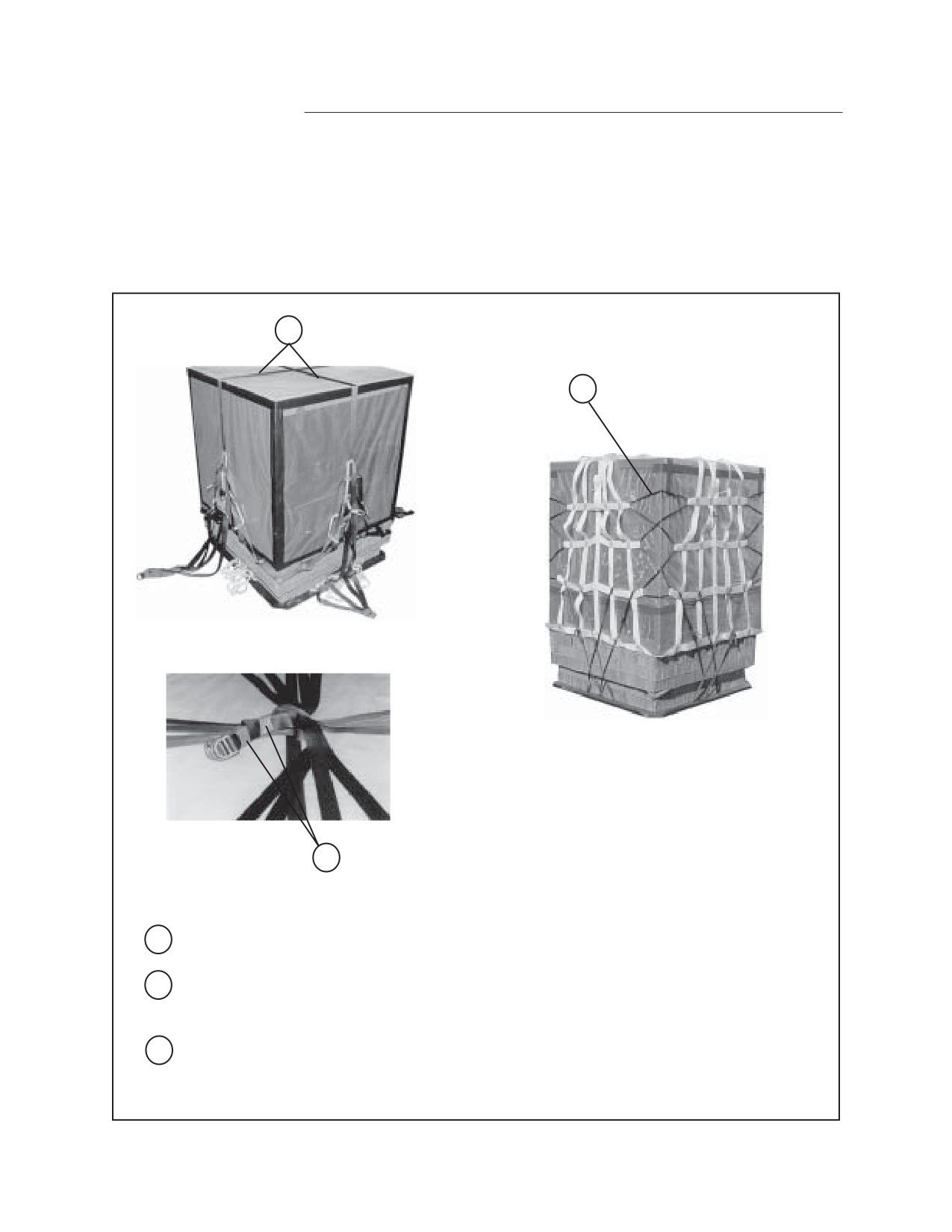
Secure and tie sling assembly as shown in Figure 3-5.
1
2
3
1
Fasten the long and short tie-down straps over the load using the friction adapters provided.
2
Tie each corner of the sling assembly around the load using the loops at the ends of the lateral
straps with 1/2-inch tubular nylon webbing forming a figure eight. Secure with surgeon’s
knot and locking knot with overhand knots in the running end.
3
Bring the ends of the support web up, remove any twists, and tape them together 4 inches
below the lower D-rings using masking tape.
Figure 3-5. Load Positioned and Sling Assembly Secured
3-6
FM 4-20.147/TO 13C7-37-31
SECURING SLING ASSEMBLY TO SKID BOARD
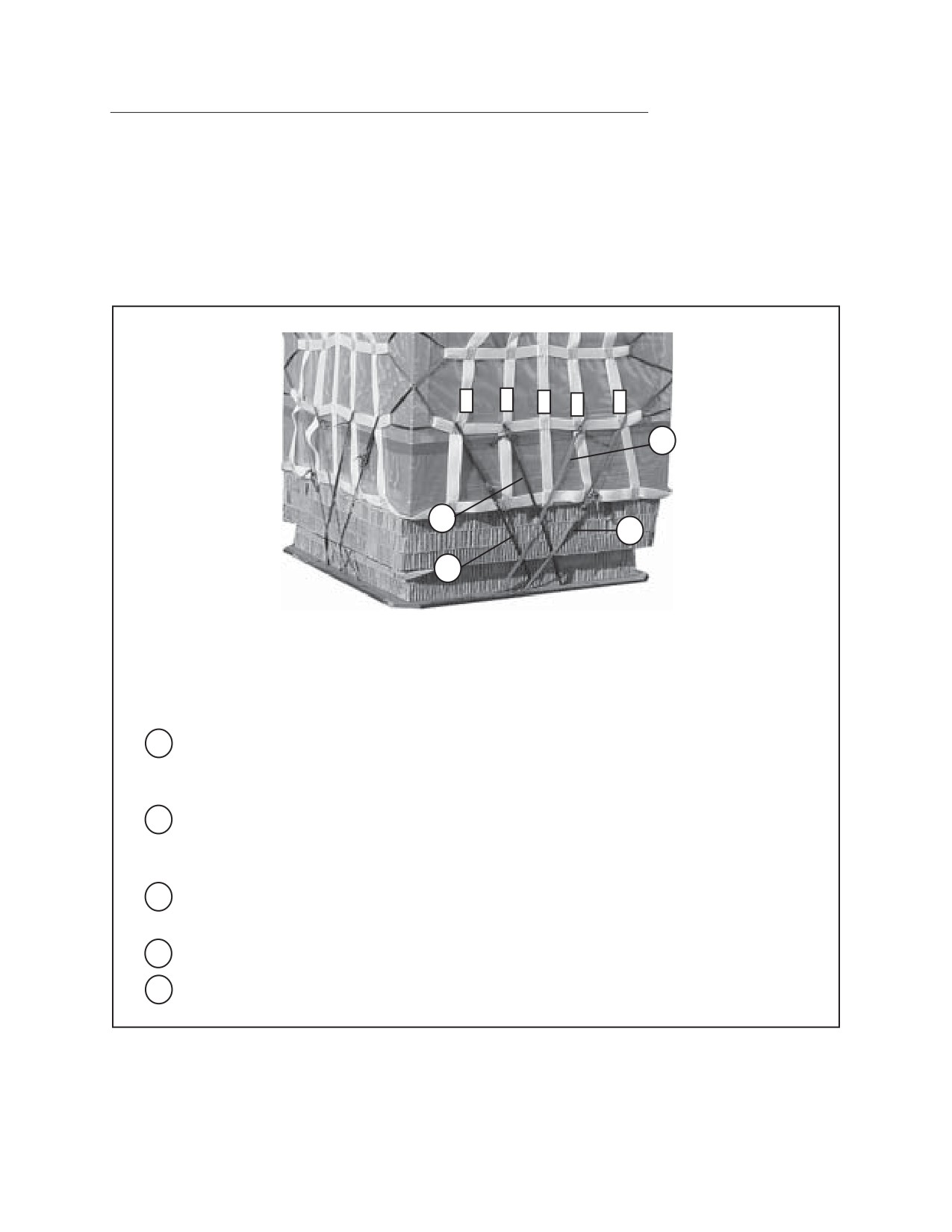
3-11. Tie the sling assembly to the skid board as shown in Figure 3-6.
1
2
3
4
5
1
3
2
4
A
B C D
1
Starting at the left side, take tie-down A and diagonally tie it around the intersection of the
lower lateral strap and fourth support web. Use three half-hitch knots and overhand knots in
the running end.
2
Route tie-down B around the fifth support web and lower lateral strap intersection diagonally.
Pull the excess slack out, and tie it with a trucker’s hitch knot and an overhand knot in the
running end. Cut excess webbing, leaving the end approximately 6 inches long.
3
Repeat step 1 for tie-down D, and secure it to the second intersection on the lower lateral
strap.
4
Repeat step 2 for tie-down C, and secure it to the first intersection on the lower lateral strap.
5
Repeat steps 1 through 4 for the other tie-downs (not shown).
Figure 3-6. Skid Board Secured to Sling Assembly
3-7
FM 4-20.147/TO 13C7-37-31
INSTALLING PARACHUTE
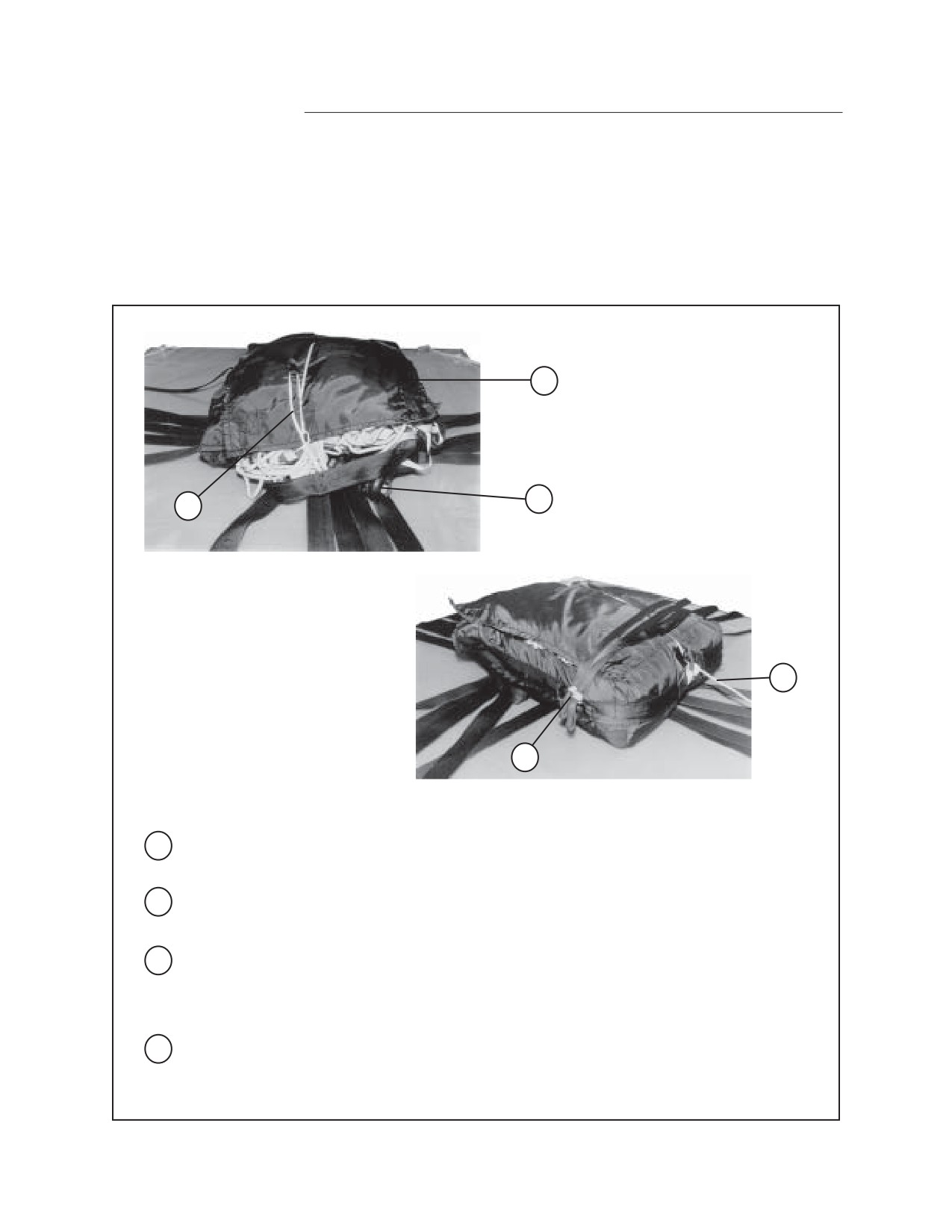
3-12. Install the 26-foot low cost parachute as shown in Figure 3-7.
1
2
3
3
4
1
Place the 26-foot low cost parachute on the load. When the front and the rear have been
designated, the parachute sides should run parallel to front and rear.
2
Place both risers of the 26-foot low cost parachute in the bell of a medium clevis. Put the
D-rings of the sling assembly on the bolt of the clevis, secure the clevis, and tape the nut.
3
Tie a length of type I, 1/4-inch cotton webbing to an upper lateral strap. Pass the webbing
through the loop in the static line, under the static line stows, and over the parachute bag.
Pass the webbing around a strap of the support web, and back up to the loop 18-inches from
the end of the static line. Secure with a trucker’s hitch.
4
Secure the static line with retainer bands as shown above.
Figure 3-7. 26-foot Low Cost Parachute Installed
3-8
FM 4-20.147/TO 13C7-37-31
MARKING RIGGED LOAD
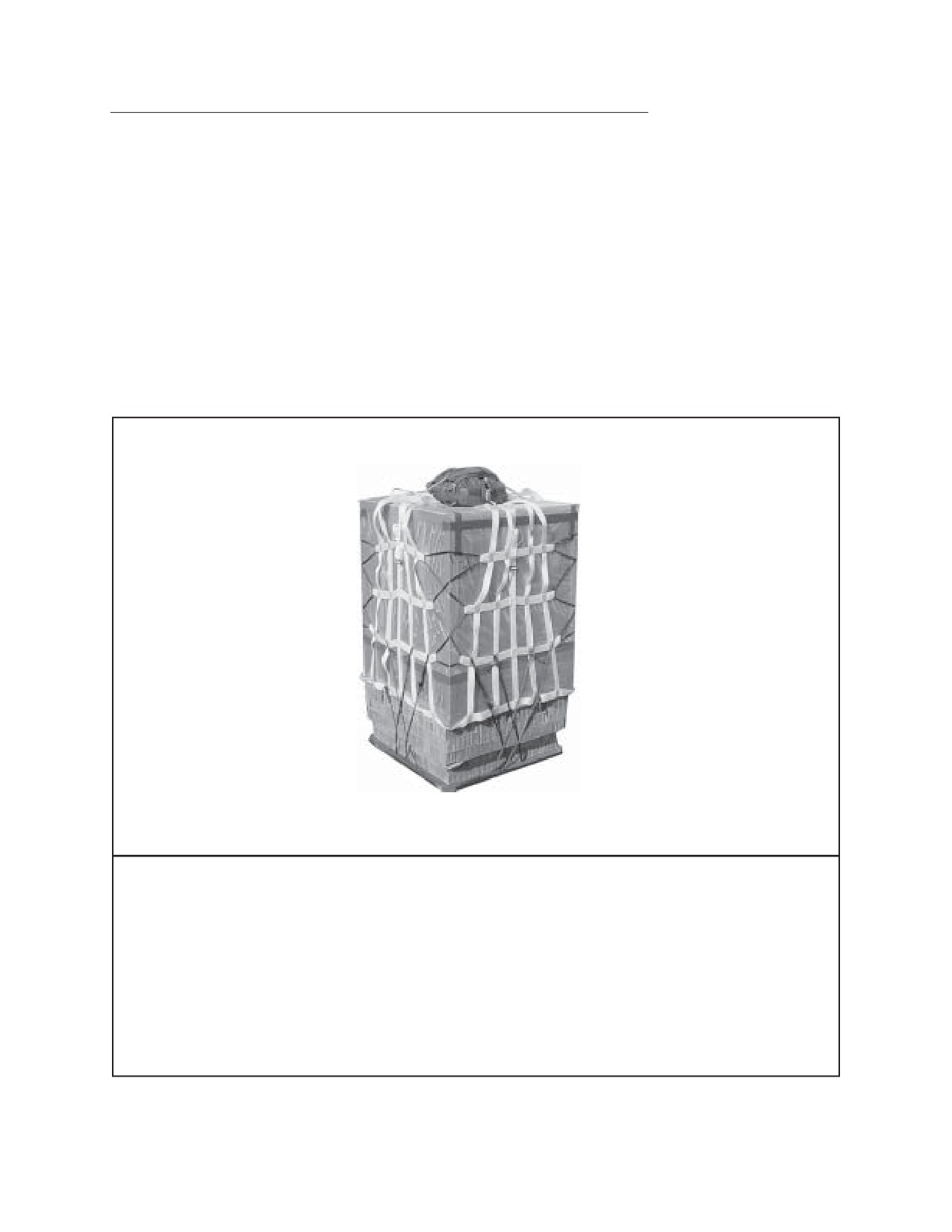
3-13. Mark the rigged load according to FM 10-500-3/TO 13C7-1-11 and as shown in
Figure 3-8. Compute the rigged load data.
EQUIPMENT REQUIRED
3-14. Use the equipment listed in Table 3-1 to rig the load shown in Figure 3-8.
RIGGED LOAD
Weight: Minimum load allowed
501 pounds
Maximum load allowed
2,200 pounds
Height:
83 inches
Width:
48 inches
Length:
48 inches
Figure 3-8. Fully Rigged LCADS
3-9
FM 4-20.147/TO 13C7-37-31
Table 3-1. Equipment Required for Rigging LCADS
National Stock
Item
Quantity
Number
8040-00-273-8713
Adhesive Paste
As required
Bag, cover, 4 mil polyethylene (54- by 52- by 60-inches)
As required
Shrink wrap
As required
Sling assembly, LCAD S
1
4030-00-678-8562
Clevis, suspension, 3/4-inch (medium
)
1
4020-00-240-2146
Cord, nylon type III
As required
1670-00-753-3928
Pad, energy dissipating, honeycomb 36- by-96- by 3- inches
3 sheets
Parachute:
No NS N
cargo, high-velocity, 26-ft, low cost
1
5530-00-128-4981
Plywood, 3/4- by 48- by 96-inch
1 sheet
or
5530-00-914-5118
Plywood, 1- by 48- by 96-inch
1 sheet
7510-00-266-6710
Tape, masking, 2-inch
As required
8310-01-102-4478
Thread, cotton, ticket number 8/7
As required
Webbing:
8305-00-268-2411
Cotton, 1/4-inch, type I
As required
8305-00-082-5752
Nylon, tubular, 1/2-inch
As required
3-10
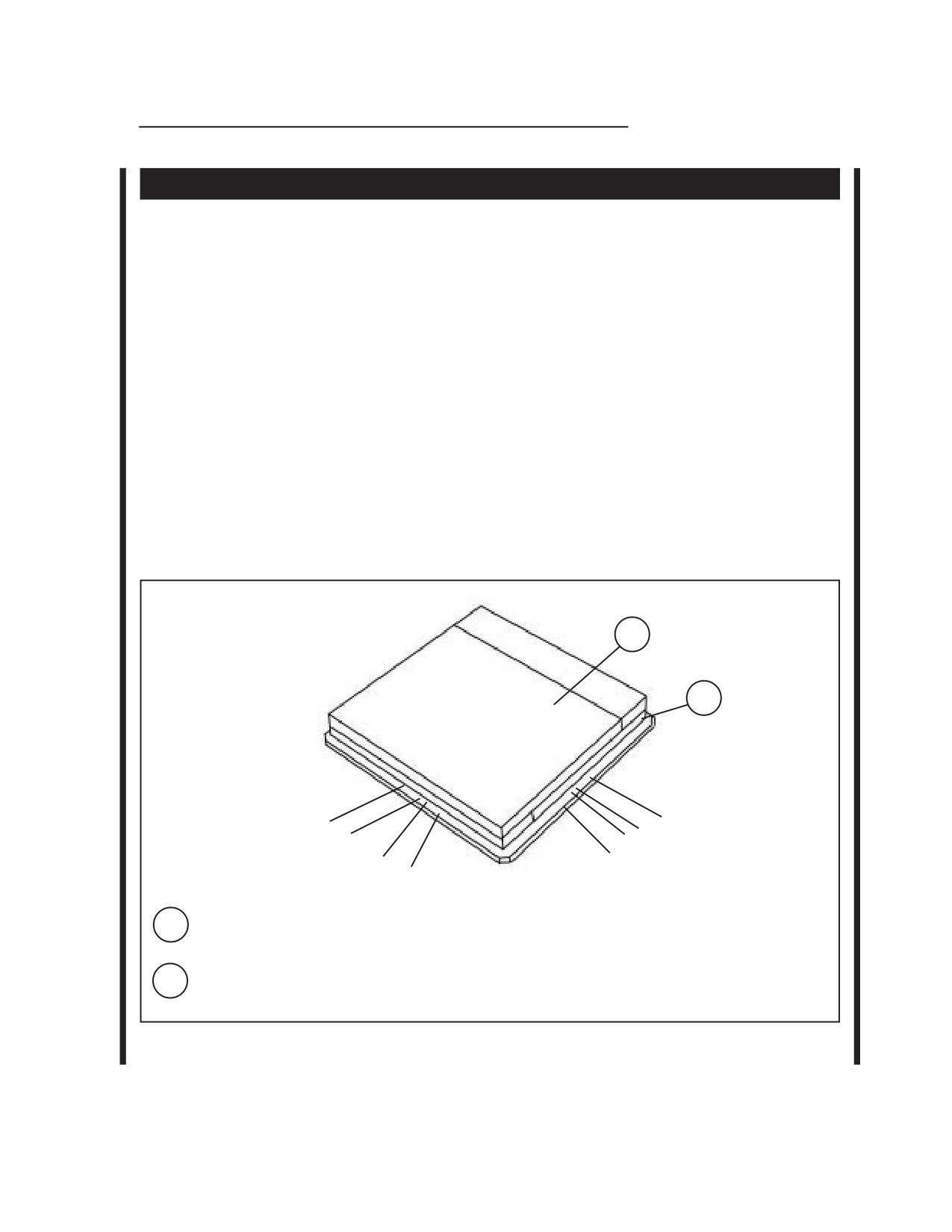
C1, FM 4-20.147/TO 13C7-37-31
SECTION III - RIGGING LOW VELOCITY LCADS
SYSTEM DESCRIPTION
3-15. The LCADS is rigged as a typical A-22 low-velocity load. Typical loads
include rations, repair parts, water, and/or other small items. Items may be
dropped in their original configuration or repackaged for greater protection. The
LCADS container loads must weigh at least 501 pounds but not exceed 2,200
pounds excluding the parachute. The load is rigged with a G-12E cargo parachute.
PREPARING ITEMS AND SKID BOARD
3-16. Prepare the skid board using Figure 3-2. Prepare the items to be dropped
according to load's sensitivity. Items must be well padded to prevent damage
during airdrop.
PREPARING AND PLACING HONEYCOMB
3-17. Prepare and place the honeycomb as shown in Figure 3-9.
NOTE: Glue all honeycomb in-place.
2
1
1
Center a 36- by 44-inch and an 8- by 44-inch piece of honeycomb side by side on the skid
board. Make sure the layer is 2 inches from all sides.
2
Repeat step 1 for a second layer of honeycomb; alternating the pieces of honeycomb.
Figure 3-9. Honeycomb Placed and Prepared
3-11
C1, FM 4-20.147/TO 13C7-37-31
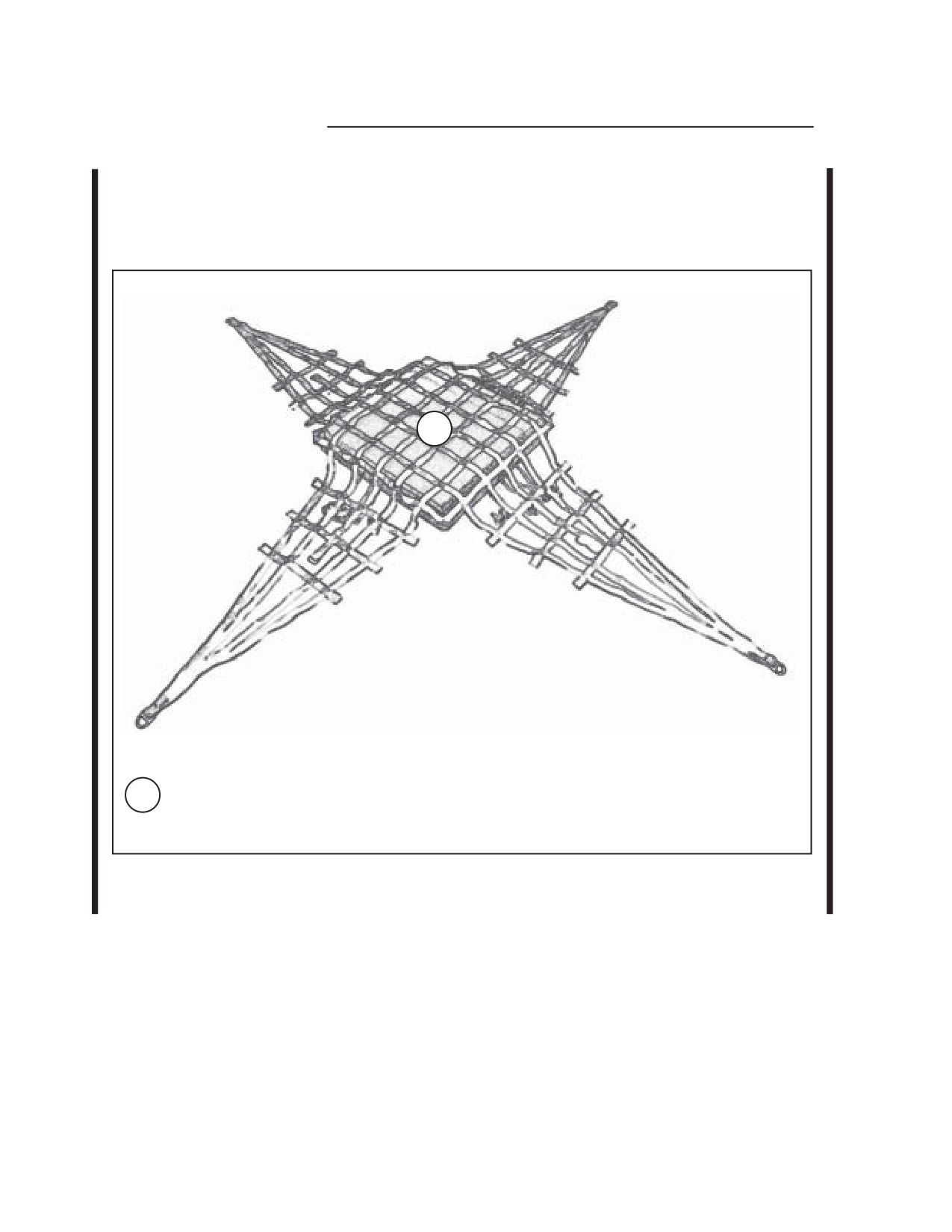
POSITIONING SLING ASSEMBLY
3-18. Center the sling assembly over the honeycomb and skid board as shown in
Figure 3-10. The dimensions of the webbing is 222 by 222 inches.
1
1
Position the webbing centered on top of the 44- by 44-inch piece of honeycomb. Ensure that
the thick lip of the friction adapter is facing down (toward the surface).
Figure 3-10. Sling Assembly Positioned
3-12
C1, FM 4-20.147/TO 13C7-37-31
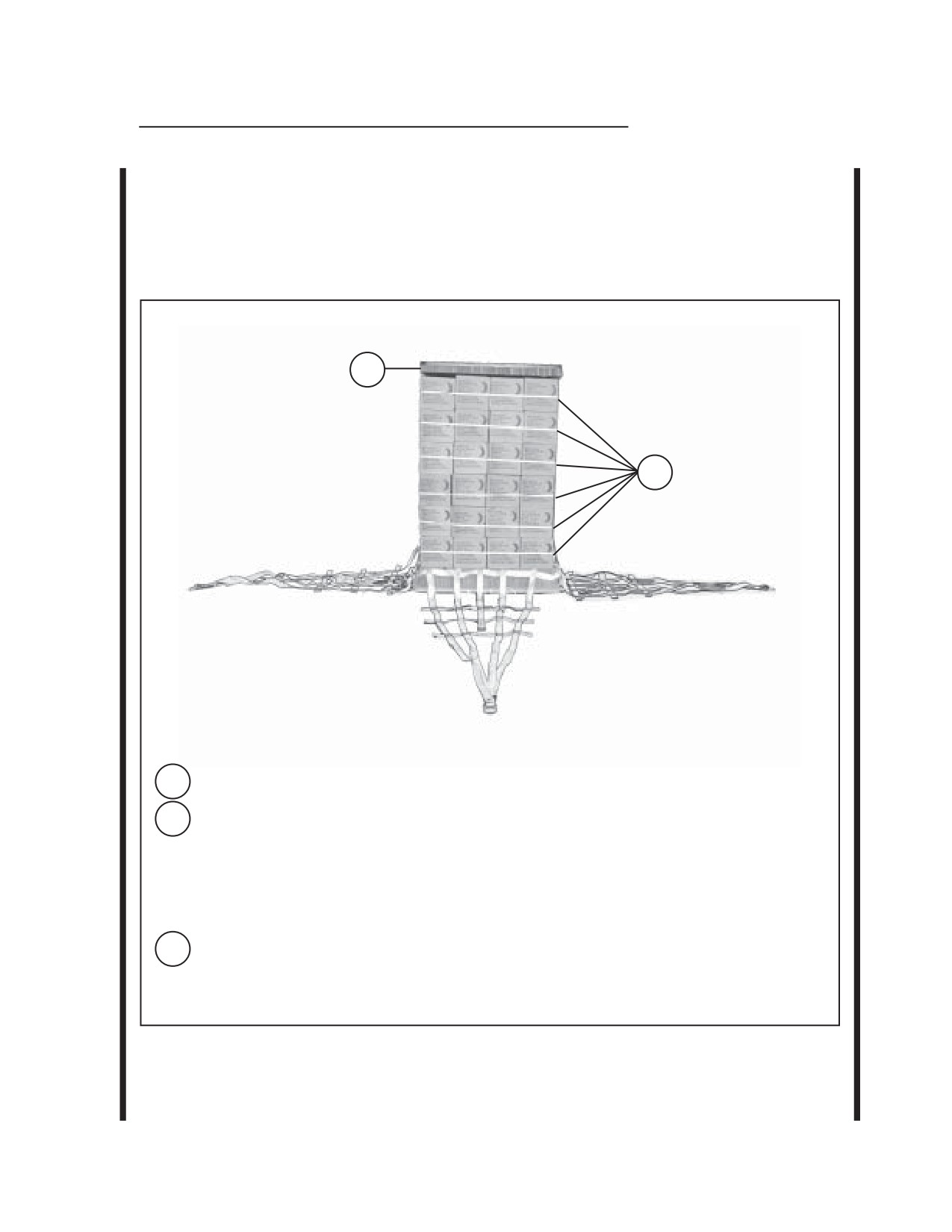
POSITIONING LOAD AND SECURING SLING ASSEMBLY
3-19. Center and secure the load on the sling assembly and honeycomb. If a cover
is available, cover the load with a plastic bag, shrink wrap or an A-22 cargo cover.
A cover is not required. Secure and tie the sling assembly as shown in Figures 3-
5 and 3-11.
2
1
1
Secure the load together with 1/2-inch tubular nylon around each layer.
2
Cut and position a 36- by 44- and 8- by 44-inch piece of honeycomb on top of the load. Tape
the pieces together and around the outside edges. Position the honeycomb centered on top
of the load.
NOTE: When 55-gallon drums are used, cut and position a 44- by 44- by 1-inch piece of
plywood on top of the four 55-gallon drums.
3
Cover the load with shrink wrap, plastic, or an A-22 cover. (Not shown or required)
Figure 3-11. Load Positioned and Sling Secured
3-13
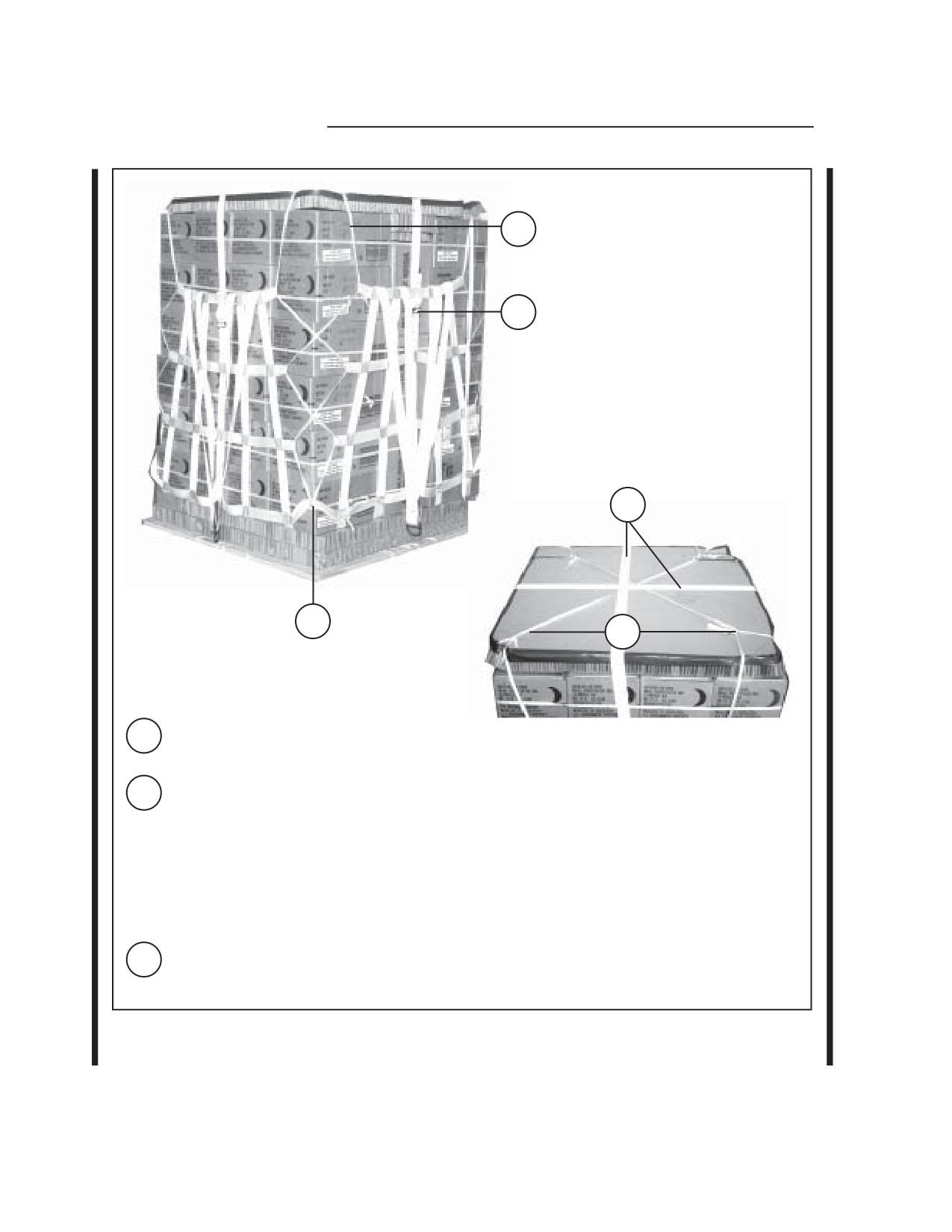
C1, FM 4-20.147/TO 13C7-37-31
5
4
4
5
5
4
Fasten the long and short tie-down straps over the load using the friction adapters pro-
vided.
5
Tie each corner of the sling assembly with 1/2-inch tubular nylon webbing; route the
webbing up through the bottom webbing loop, cross the ties, up through the next loops, and
repeat until the top loops are reached. Secure the ties together on the top corners with a
surgeons knot and locking knot. Secure the excess webbing to the loop of the opposite
corner.
NOTE: On a load where the top lateral straps are above the top of the item, secure the
loops together as closely as possible with the tie on top.
6
Bring the ends of the support web up, remove any twists, and tape them together 4-inches
below the D-rings using 2-inch masking tape (not shown).
Figure 3-11. Load Positioned and Sling Secured (Continued)
3-14
C1, FM 4-20.147/TO 13C7-37-31
SECURING SLING ASSEMBLY TO SKID BOARD
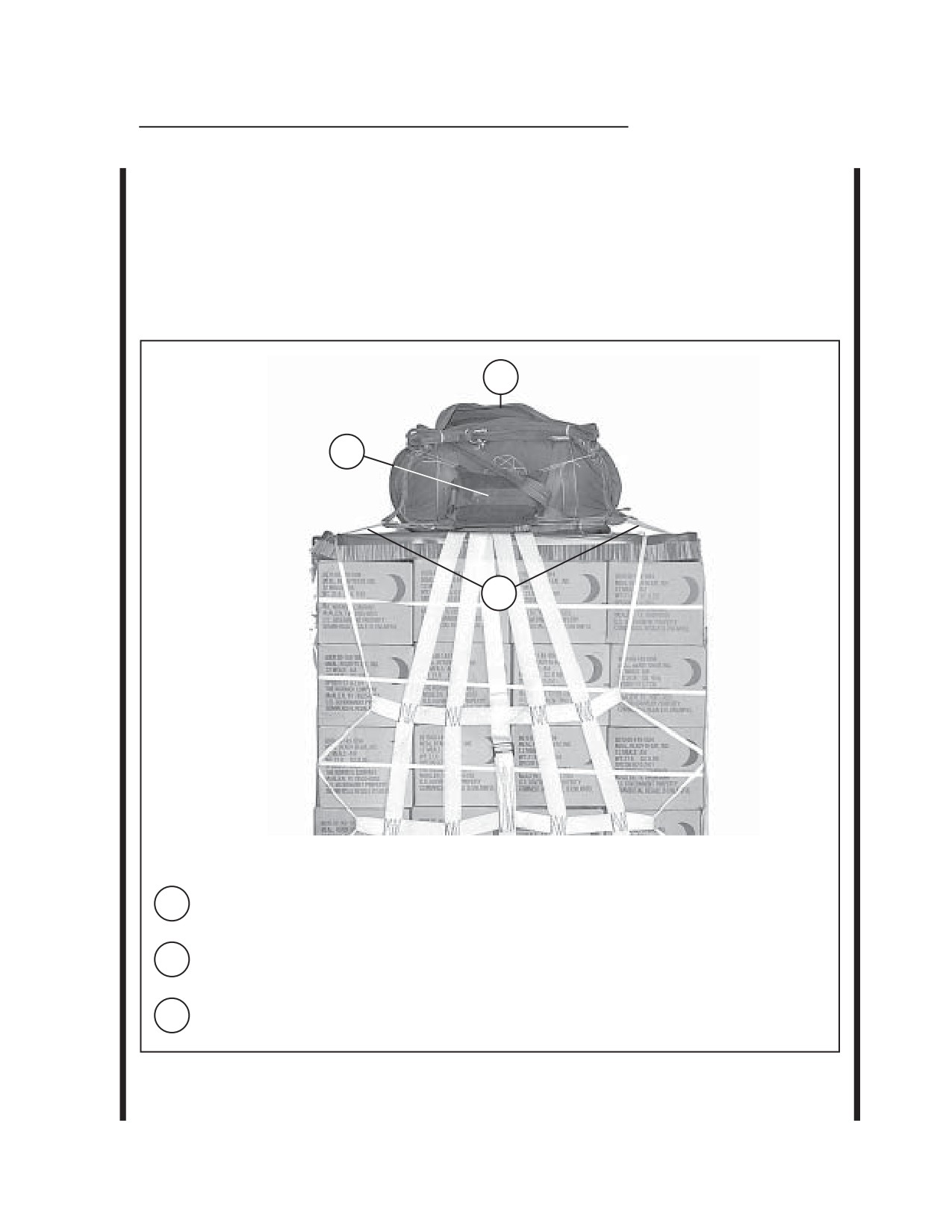
3-20. Tie the sling assembly to the skid board as shown in Figure 3-6.
INSTALLING PARACHUTE
3-21. Install the G-12E cargo parachute as shown in Figure 3-12.
1
3
2
1
Position a G-12E cargo parachute on top of the load and secure the parachute clevis to the
securing web D-rings.
2
Tie the corners of the parachute with one turn single type I, 1/4-inch cotton webbing to the
sling assembly.
3
Secure the 68-inch pilot parachute to the G-12 deployment bag as described in paragraph
1-6.
Figure 3-12. G-12E Cargo Parachute Installed
3-15
C1, FM 4-20.147/TO 13C7-37-31
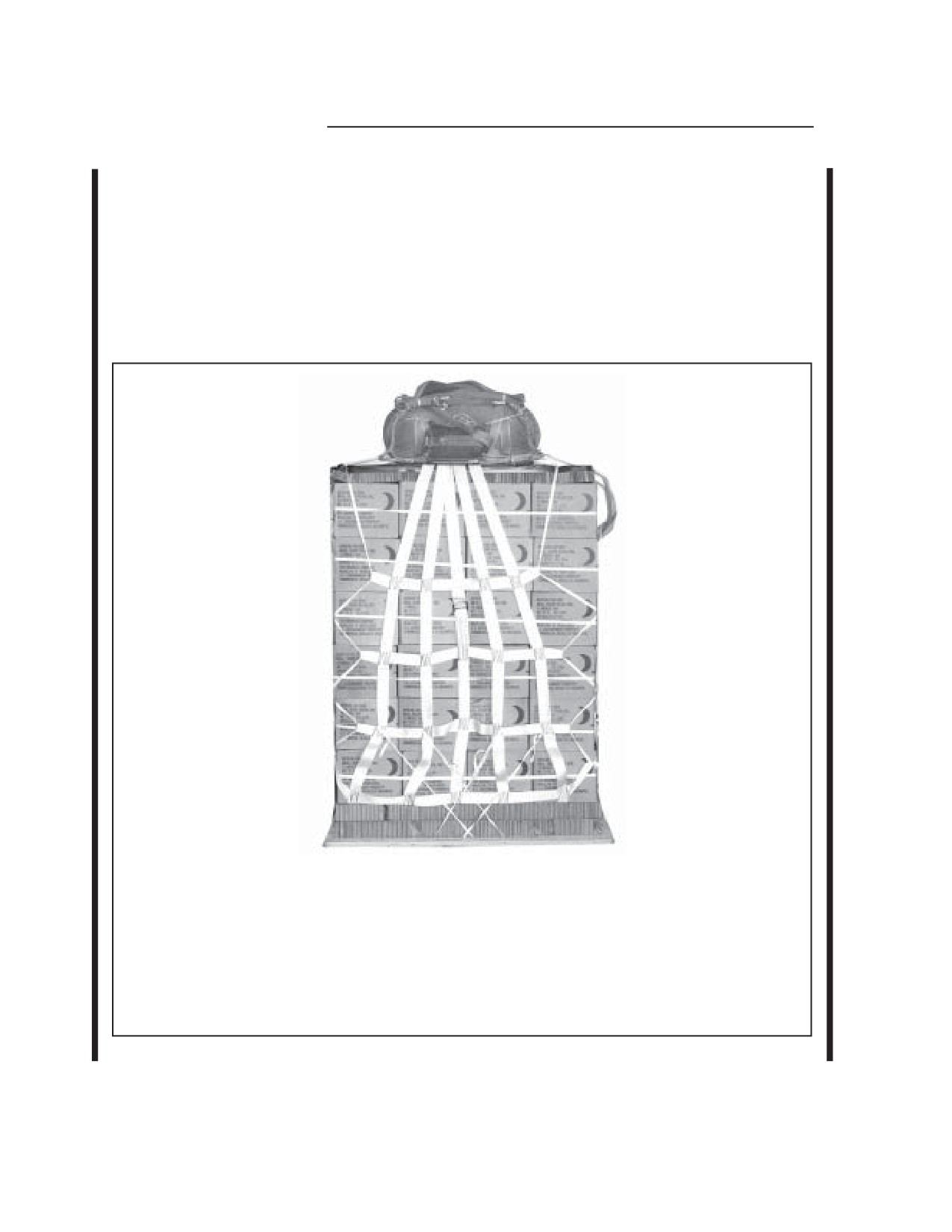
MARKING RIGGED LOAD
3--22. Mark the rigged load according to FM 10-500-3/TO 13C7-1-11 and as shown
in Figure 3-13. Compute the rigged load data.
EQUIPMENT REQUIRED
3-23. Use the equipment listed in Table 3-2 to rig the load shown in Figure 3-13.
RIGGED LOAD
Weight: Minimum load allowed
501 pounds
Maximum load allowed (without parachute)
2,200 pounds
Height:
80 inches
Width:
48 inches
Length:
48 inches
Figure 3-13. Low-Velocity LCADS Rigged
3-16
C1, FM 4-20.147/TO 13C7-37-31
Table 3-2. Equipment Required for Rigging Low-Velocity LCADS
National Stock
Item
Quantity
Number
8040-00-273-8713
Adhesive Paste
As required
Bag, cover, 4mil polyethylene (54- by 52- by 60-inches)
As required
Shrink wrap
As required
Sling assembly, LCAD S
1
4030-00-678-8562
Clevis, suspension, 3/4-inch (medium
)
1
4020-00-240-2146
Cord, nylon type III
As required
1670-00-753-3928
Pad, energy dissipating, honeycomb 36- by
96- by
3-
3 sheets
inches
Parachute:
1670-00-893-2371
Cargo, G-12E
1
1670-00-216-7297
Pilot, 68-inch diameter
1
5530-00-128-4981
Plyw ood, 3/4- by 48- by 96-inch
1 sheet
or
5530-00-914-5118
Plyw ood, 1- by 48- by 96-inch
1 sheet
or
1670-01-342-5913
Skid Board, 1- by 48- by 48-inch
1
or
1670-00-883-1654
Skid Board, 3/4- by 48- by 48-inch
1
7510-00-266-6710
Tape, masking, 2-inch
As required
8310-01-102-4475
Thread, cotton, ticket number 8/7
As required
Webbing :
8305-00-268-2411
Cotton, 1/4-inch, type I
As required
8305-00-082-5752
Nylon, tubular, 1/2-inch
As required
3-17
FM 4-20.147/TO 13C7-37-31
Chapter 4
Rigging Double A-22 Container for High Velocity Airdrop
SECTION I - GENERAL INFORMATION FOR DOUBLE A-22 CONTAINER
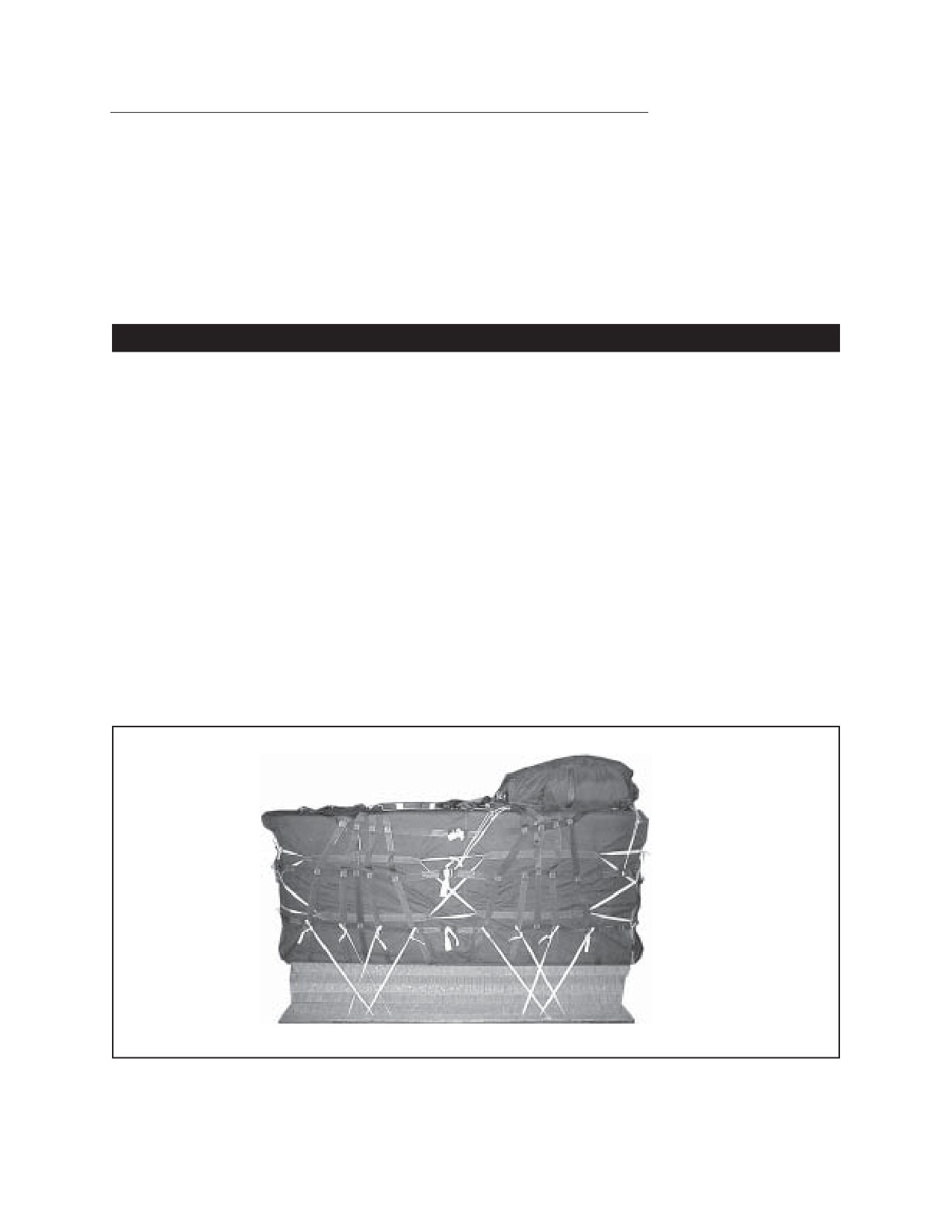
DOUBLE A-22 CONTAINER COMPONENTS
4-1. The double A-22 container, shown in Figure 4-1, employs two standard A-22
sling assemblies which can be laced together to form a larger container, or which
can be individually rigged and configured side-by-side as described in Section III of
this chapter. This system employs a reefed G-12 parachute.
DOUBLE A-22 CONTAINER SKID BOARD
4-2. The sling assemblies are secured to a 1- by 48- by 96- inch plywood (Grade AC)
skid board with 1/2- inch tubular nylon webbing. Honeycomb is positioned between
the container and the skid board for impact cushioning.
Figure 4-1. Fully Rigged Double A-22 Container System
4-1
///////////////////////////////////////