FM 3-5 NBC Decontamination Operations (January 2002) - page 1
FM 3-5
MCWP 3-37.3
Change 1
C1
Field Manual
Headquarters
No. 3-5
Department of the Army
Marine Corps Warfighting Publication (MCWP)
Commandant
3-37.3
US Marine Corps
Washington, DC, 31 January 2002
NBC Decontamination Operations
1. Change FM 3-5, 28 July 2000 as follows:
Remove Old Pages
Insert New Pages
1-3 and 1-4
1-3 and 1-4
2-1 through 2-4
2-1 through 2-5
3-5 and 3-6
3-5 and 3-6
3-17 and 3-18
3-17 through 3-18
3-33 and 3-34
3-33 through 3-34
4-5 through 4-33
4-5 through 4-35
6-1 and 6-2
6-1 and 6-2
9-1 through 9-7
9-1 through 9-7
D-1 and D-2
D-1 and D-2
E-1 through E-17
E-1 through E-19
Glossary-3 through Glossary-6
Glossary-3 through Glossary-6
Bibliography-3 and Bibliography-4
Bibliography-3 and Bibliography-4
Index-1 and Index-2
Index-1 and Index-2
2. A bar ( ) marks new or changed material.
3. File this transmittal in front of the publication.
DESTRUCTION RESTRICTION: Approved for public release; distribution is
unlimited.

C1, FM 3-5/MCWP 3-37.3
consideration
(METT-TC) and the resources available. Decon must be
considered if the contamination levels exceed the negligible risk levels as
follows:
• Chemical and biological contamination causes mild incapacitation in 5
percent or less of unprotected soldiers operating for 12 continuous
hours within
1
meter of contamination. For the chemical-agent
monitor (CAM), this equates to a one-bar reading at a distance of 1
inch from the surface.
• Radiological contamination can cause mild incapacitation in
2.5
percent or less of unprotected, nonpreviously exposed soldiers. This
equates to a reading of no more than 0.33 centigray per hour (cGy/hr).
1-9. MOPP-gear exchange provides excellent protection against field
concentrations of agents; however, wearing the gear causes performance
degradation. Decon is performed to restore the normal operating tempo, but the
logistical support that is required to keep soldiers in MOPP gear impacts
operations. Therefore, decon should be conducted as soon as practical. Table 1-1
provides comparison data for decon levels/techniques.
Table 1-1. Comparison Data for Decon Levels/Techniques
Levels
Techniques1
Best Start Time
Performed by
Advantages
Immediate
Skin decon
Before 1 minute
Individual
Stops agent from
penetrating.
Personal wipe down
Within 15 minutes
Individual or crew
Operator’s spray
down/wipe down
Operational
MOPP-gear
Within 6 hours
Unit
Provides possible
exchange2
temporary relief from
MOPP4. Limits liquid
agent spread.
Vehicle washdown3
Battalion crew or
decon platoon (-)
Thorough
DED and DAD
When mission
Decon platoon
Provides probable
allows reconstitution
long-term MOPP
DTD
Unit
reduction with mini-
mum risk.
1The techniques become less effective the longer they are delayed.
2Performance degradation and risk assessment must be considered when exceeding 6 hours. See FM 3-4 for
battle-dress overgarment (BDO) risk assessment.
3Vehicle washdown is most effective if started within 1 hour.
DECON PRINCIPLES
1-10. Decon immediately for a chemical agent on the skin. Perform higher
levels of decon as a result of the risk assessment. Personnel should
Introduction 1-3
C1, FM 3-5/MCWP 3-37.3
• Decon as soon as possible. The sooner the contamination is removed,
the sooner MOPP levels can be reduced and combat power can be
restored.
• Decon only what is necessary. Weathering is the least costly method of
decon. Expend resources where they count.
• Decon as far forward as possible. While METT-TC dependent,
performing decon as close to the point as possible reduces the spread
of contamination and minimizes any transfer hazard.
• Decon by priority. The commander identifies which items are most
critical to the mission. Restoring combat power and reestablishing
operating tempo are key.
DECON LEVELS
1-11. The three levels of decon operations are immediate, operational, and
thorough (see Table 1-1, page 1-3).
IMMEDIATE
1-12. Skin decon is a soldier’s basic survival skill and should be performed
within 1 minute of being contaminated using the skin decontaminating kit
(SDK).
1-13. Personal wipe down should be performed within 15 minutes. This is
done to remove contamination from individual equipment by using an
individual equipment decon kit (IEDK). Use detector paper or a CAM to locate
the agent. For radiological contamination, use a radiac set to locate it and
then brush, wipe, or shake it off.
1-14. Operators’ spray down/wipe down should be done within 15 minutes.
Operators use the M100 Sorbent Decontamination System (SDS) or the on-
board M11/M13 decon apparatus to decon surfaces that they must touch or
contact to operate the equipment. Radiological contamination in the form of
dust particles may be wiped, scraped, or brushed off.
OPERATIONAL
1-15. A MOPP-gear exchange should be performed within 6 hours of being
contaminated when thorough decon cannot be done. Soldiers will continue to
wear MOPP gear and the operating tempo will be reduced.
1-16. Vehicle washdown should be performed within
6
hour of being
contaminated when the mission does not permit a thorough decon. This
process removes gross contamination and limits the spread of it.
THOROUGH
1-17. Detailed equipment decon (DED) and detailed aircraft decon (DAD)
restore items so that they can be used without MOPP gear. Normally, the
DED and the DAD are conducted as part of a reconstitution or during breaks
in combat operations. These operations require support from a chemical decon
unit.
1-18. Detailed troop decon (DTD) normally takes place in conjunction with
DED/DAD. The contaminated unit conducts this process and supports the
DED/DAD operations.
1-4 Introduction
Chapter 2
Immediate Decon
Once a soldier is aware of chemical or biological contamination on his bare
skin, he initiates immediate decon techniques, without command, by using
his personal SDK. He decontaminates his hood, mask, gloves, and weapon
using the IEDK or an additional SDK. To remove radiological
contamination from equipment and personnel, brush it off and/or use soap
and water.
NOTE: Throughout this manual, SDK refers to the M291 kit and
IEDK refers to the M295 kit.
SKIN DECON
2-1. Start the skin-decon techniques within
1
minute of becoming
contaminated. Some toxic chemical agents, especially nerve agents, kill in
minutes.
CHEMICAL
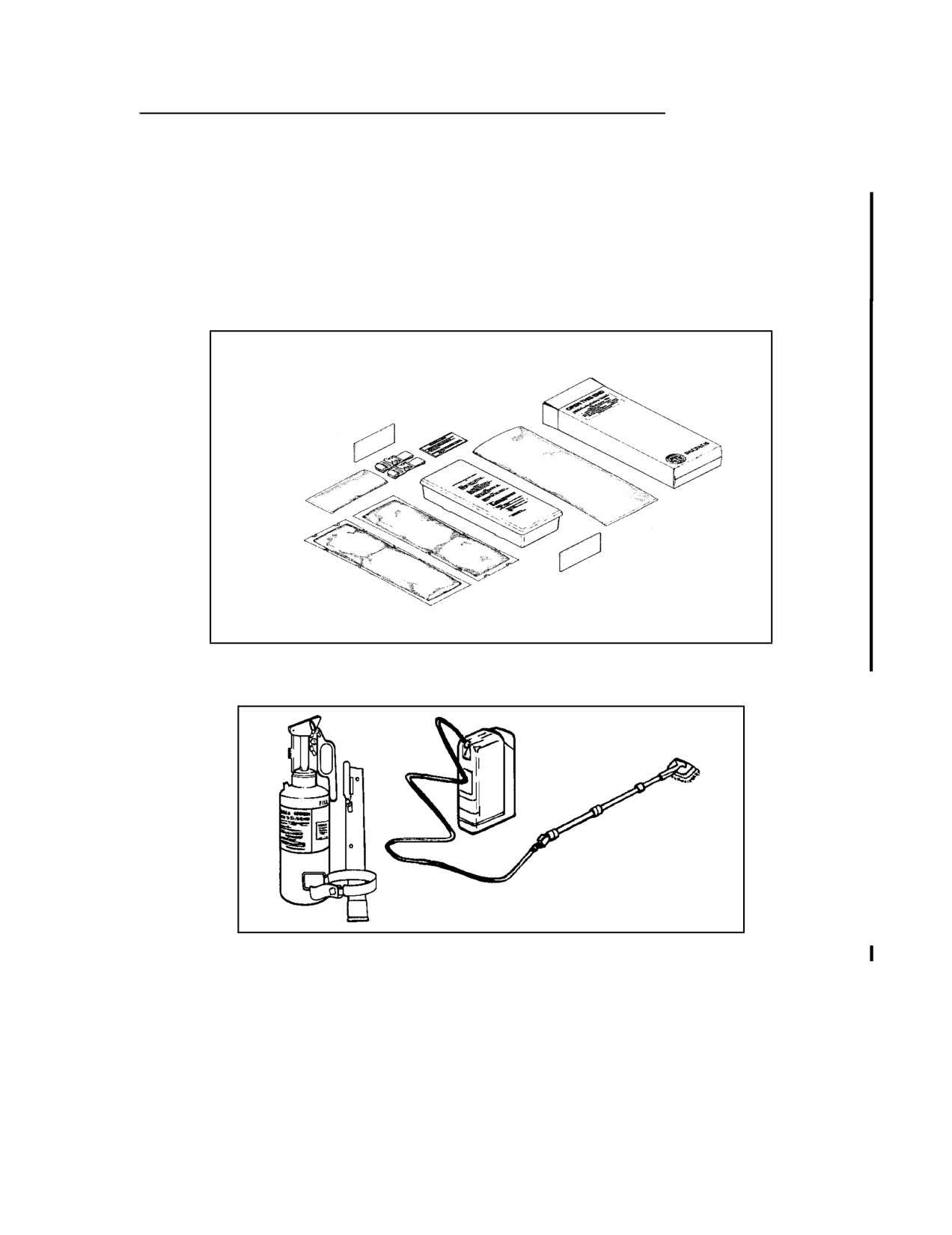
2-2. Use the SDKs within 1 minute of contamination
(see Figure
2-1).
Instructions for use are listed on the outside of the kit itself, on the individual
packet within the kit, and in STP 21-1-SMCT.
M291
Figure 2-1. M291 SDK
2-3. If an SDK is not available, chemical contamination may be pinch-blotted
from the skin with a cloth and flushed with water from a canteen. Soap, if
available, can also be used to wash the agent from the skin. Washing with
soap and water (or hot water) is the next best method for toxic-agent decon if
SDKs are not available, but this method is not as effective as using the decon
kits.
Immediate Decon 2-1
C1, FM 3-5/MCWP 3-37.3
BIOLOGICAL
2-4. Washing with soap and water removes nearly all biological agents from
the skin. A 0.5 percent chlorine (calcium hypochlorite [HTH] or household
bleach) solution is an effective biological decontaminant. See Appendix B for
details on how to make this solution.
RADIOLOGICAL
2-5. To remove radiological dust particles, brush, wash, or wipe them off.
PERSONAL WIPE DOWN
2-6. The personal wipe-down techniques are most effective when done within
15 minutes of being contaminated. The CAM and/or M8/M9 detector paper is
used to detect and monitor equipment.
NOTE: Very high concentrations of DS2 can cause a CAM response in
the G mode.
2-7. Wipe down your mask, hood, gloves, and other essential gear. Do not
attempt to remove chemical contamination from your protective overgarment
unless there are obvious clumps of the agent. In this case, scrape off the
material. Brush off radiological or frozen chemical-agent contamination. See
FM 3-4 for detailed information on your overgarment’s protective qualities.
CHEMICAL
2-8. Decon individual equipment using the IEDKs. Wearing your Kevlar®
helmet protective cover will prevent or reduce the adsorption of any liquid
chemical agent. Washing with soap and water and bleach solutions is
partially effective (see Appendix B).
BIOLOGICAL
2-9. Wash with soap and water. If water is not available, use SDKs in the
same manner as described for chemical-agent decon.
RADIOLOGICAL
2-10. Locate radiological contamination with monitoring equipment and
remove by brushing and shaking it off. Wash exposed areas of your skin and
pay particular attention to your hair and fingernails. Avoid breathing the dust
particles you shake off by wearing your protective mask or a piece of cloth over
your nose and mouth. If wet, conduct a MOPP-gear exchange as soon as
possible because brushing or shaking will not remove the contamination.
Wipe off your equipment with warm, soapy water using rags or damp paper
towels.
OPERATOR’S SPRAY DOWN/WIPE DOWN
2-11. Decon other mission-essential portions of your equipment before
continuing your mission. The CAM and/or M8/M9 detector paper is used to
determine what surfaces require decon.
2-12. Operator’s spray down/wipe down is most effective when done within 15
minutes of contamination.
Immediate Decon 2-2
C1, FM 3-5/MCWP 3-37.3
CHEMICAL
2-13. Decon those surfaces that you must touch on the exterior of the vehicle
or the equipment you must use to do your job with the M100 SDS (see Figure
2-2) or the on-board portable decon apparatus (such as the M11 or M13) (see
Figure 2-3). If the M100 SDS is not available, use the IEDK to decon the
equipment that the DS2 may cause damage to by corrosive action (see Figure
2-4, page 2-4).
M100
Figure 2-2. Sorbent Decontamination System
M13
M11
Figure 2-3. Portable Decon Apparatuses
Immediate Decon 2-3
C1, FM 3-5/MCWP 3-37.3
Figure 2-4. M295 IEDK
WARNING
Use extreme caution at all times when handling DS2. Do not mix DS2 and STB
because it will cause a fire. Do not allow DS2 to be sprayed on personnel or protec-
tive clothing. DS2 is a combustible solution. Do not spray DS2 on hot engine
blocks. Severe chemical burns can result if personnel fail to observe all safety pre-
cautions. DS2 can severely injure eyes and skin and, if inhaled, can cause illness.
DS2 can damage the NBC protective overgarment. Long-term contact with DS2 can
damage the NBC protective gloves, hood, and overboots.
2-14. Scrub the DS2 into the exterior surface with brushes. Wait 30 minutes,
then wash off. If a decon apparatus is not available, use the field-expedient
resources that are available to apply DS2 or STB from bulk containers. If
necessary, use the nonstandard decontaminants that are discussed in
Appendix B.
BIOLOGICAL
2-15. Use a bleach solution for biological contamination; however, if bleach is
not available, use hot, soapy water. Apply with brushes and scrub the surface
well. Rinse the surface after scrubbing (no wait is required). DS2 and STB are
also effective against most known biological contamination, but because of
their caustic nature, they are not preferred. Other nonstandard biological
decontaminants are described in Appendix B.
RADIOLOGICAL
2-16. If you are contaminated by fallout, rain out, neutron-induced
contamination, or any type of radiological agent, use your monitoring
equipment to help locate it and decon as required. If detection equipment is
not available and you suspect that you are contaminated, decon. Radiological
contamination can usually be removed by brushing or scraping. Water is
effective for flushing away radiological contamination; however, the runoff
should be controlled by using drainage ditches that flow into a sump.
Immediate Decon 2-4
C1, FM 3-5/MCWP 3-37.3
Remember, you have not destroyed the contamination, it has just been moved.
The runoff will still be hazardous. If you have time, brush or scoop away the
top inch of soil from your fighting position to lower the amount of radiological
contamination affecting you.
Immediate Decon 2-5
FM 3-5/MCWP 3-37.3
Lake
219 to 547 yards to marshalling-
area control point
Decon point 1
Decon point 2
Decon point 3
MOPP-gear
Move to the tactical AA
exchange
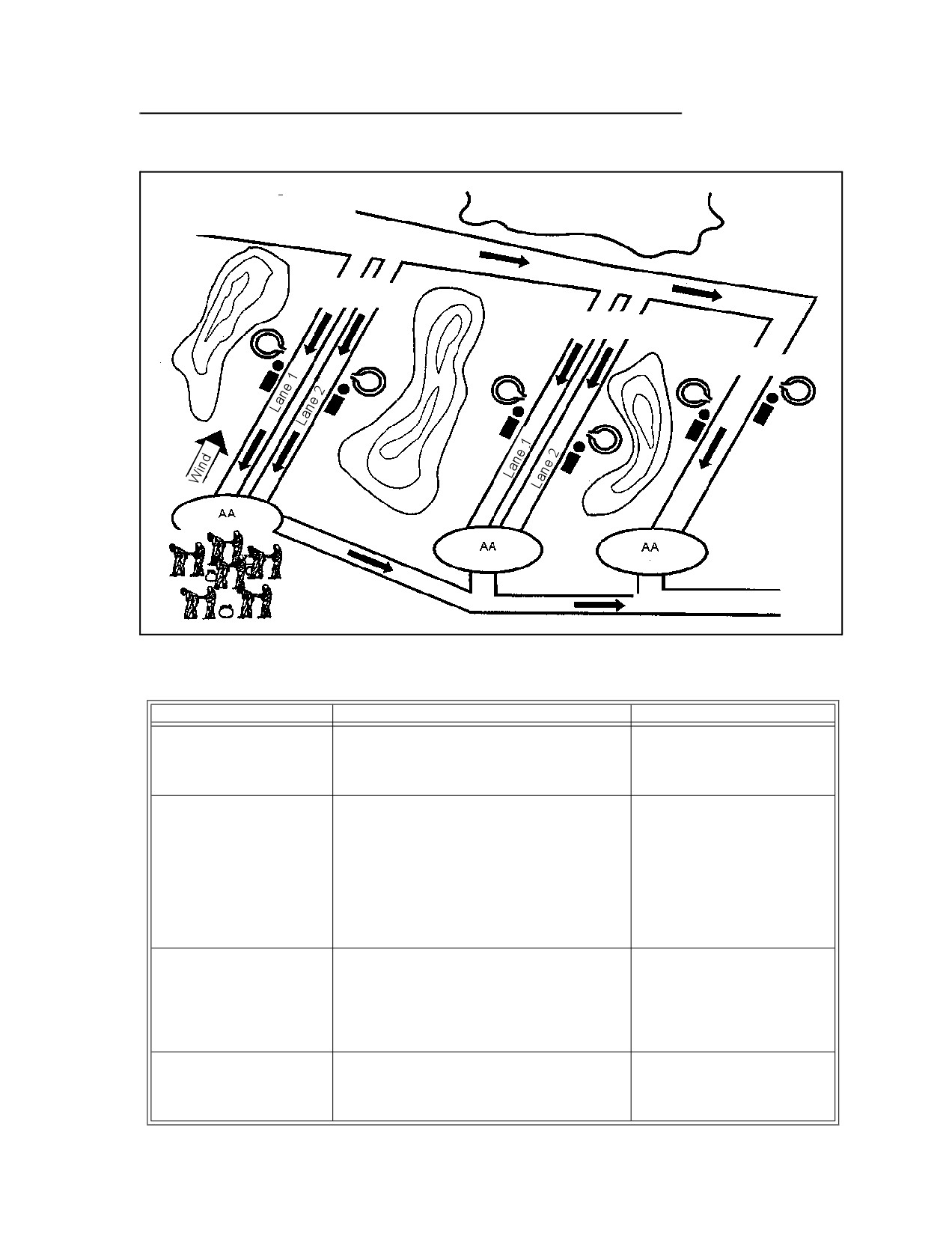
Figure 3-2. Dispersed Operational-Decon Setup
Table 3-3. Vehicle-Washdown Process
Steps
Equipment
Procedures
1. Assemble vehicles. Unit
Watch
Personnel at the control point
is tactically dispersed.
supervise preparing vehicles
Personnel at the control
and directing movement out of
point direct movement.
the AA.
2. Prepare vehicles.
None
Individual/crew closes all
access doors, hatches,
windows, and other openings.
Remove camouflage and
cover muzzles. If required,
crews (less drivers) move to
the MOPP-gear-exchange
area. Move to the wash area
on order.
3. Perform washdown.
Delivery system (such as the M12 and M17,
Soldiers/personnel wash
65-gallon-per-minute [GPM] pump, fire-
equipment from top to bottom.
fighting equipment, and so forth) that delivers
Decon crew wears a
hot, soapy water at 60 to 120 psi. Also
toxicological apron, protective
sufficient water, fuel, and detergent for
(TAP) or wet-weather gear
vehicles.
over MOPP gear.
4. Move out to the next
None
Vehicles move to the MOPP-
position.
gear-exchange area (if
required) or the next battle
position.
Operational Decon 3-5
C1, FM 3-5/MCWP 3-37.3
BUDDY-TEAM METHOD
3-15. This method uses pairs of soldiers under the supervision of their squad/
team leader to conduct the buddy-team MOPP-gear exchange. See Table 3-4,
pages 3-7 through 3-17, for detailed step-by-step procedures for this method.
See Table 3-4a, pages 3-17a through 3-17f, for the procedures for the buddy-
team method MOPP-gear exchange with the joint lightweight integrated-suit
technology (JSLIST). For units equipped with the combat vehicle crewman
uniform system (CVCUS)/chemical protective undergarment (CPU), see Table
3-5, pages 3-18 through 3-21.
TRIPLE BUDDY-TEAM METHOD
3-16. This method is used by soldiers equipped with the M40A1, M42, or M43
mask with the quick-doff hood. A third soldier is needed to hold the filter
canister and hose to prevent the transfer of contamination. See Table 3-6,
pages 3-22 through 3-27, for detailed step-by-step procedures for this method.
For units equipped with the CVCUS/CPU, see Table 3-7, pages 3-28 through
3-30.
INDIVIDUAL (EMERGENCY) METHOD
3-17. This method is used only when a soldier does not have a buddy to help
him and the risk of MOPP-gear failure demands that an exchange occur. See
Table 3-8, pages 3-31 through 3-33, for detailed step-by-step procedures for
this method. See Table 3-8a, pages 3-33a through 3-33d, for the procedures
for the individual (emergency method) MOPP-gear exchange with the JSLIST.
For units equipped with the CVCUS/CPU, see Table 3-9, pages 3-34 through
3-37.
3-6 Operational Decon
Table 3-4. Steps for the Buddy-Team Method MOPP-Gear Exchange (Continued)
Steps
Contamination
Required Equipment
Procedures
Type
8. Secure hood.
All contamination
One IEDK
Buddy #1 uses an IEDK to wipe Buddy #2's gloves. He unrolls Buddy #2's hood and
attaches the straps and tightens the neck cord. Buddy #1 and Buddy #2 reverse
roles and repeat steps 2 through 8.
9. Secure gear.
All contamination
One chemical protective
The soldier secures his individual gear and puts it back on (see Figure 3-15). He
helmet cover per
puts on a new chemical protective helmet cover and moves to the AA. He uses the
person
buddy system to check the fit of all secured gear.
Figure 3-15. Securing the Hood
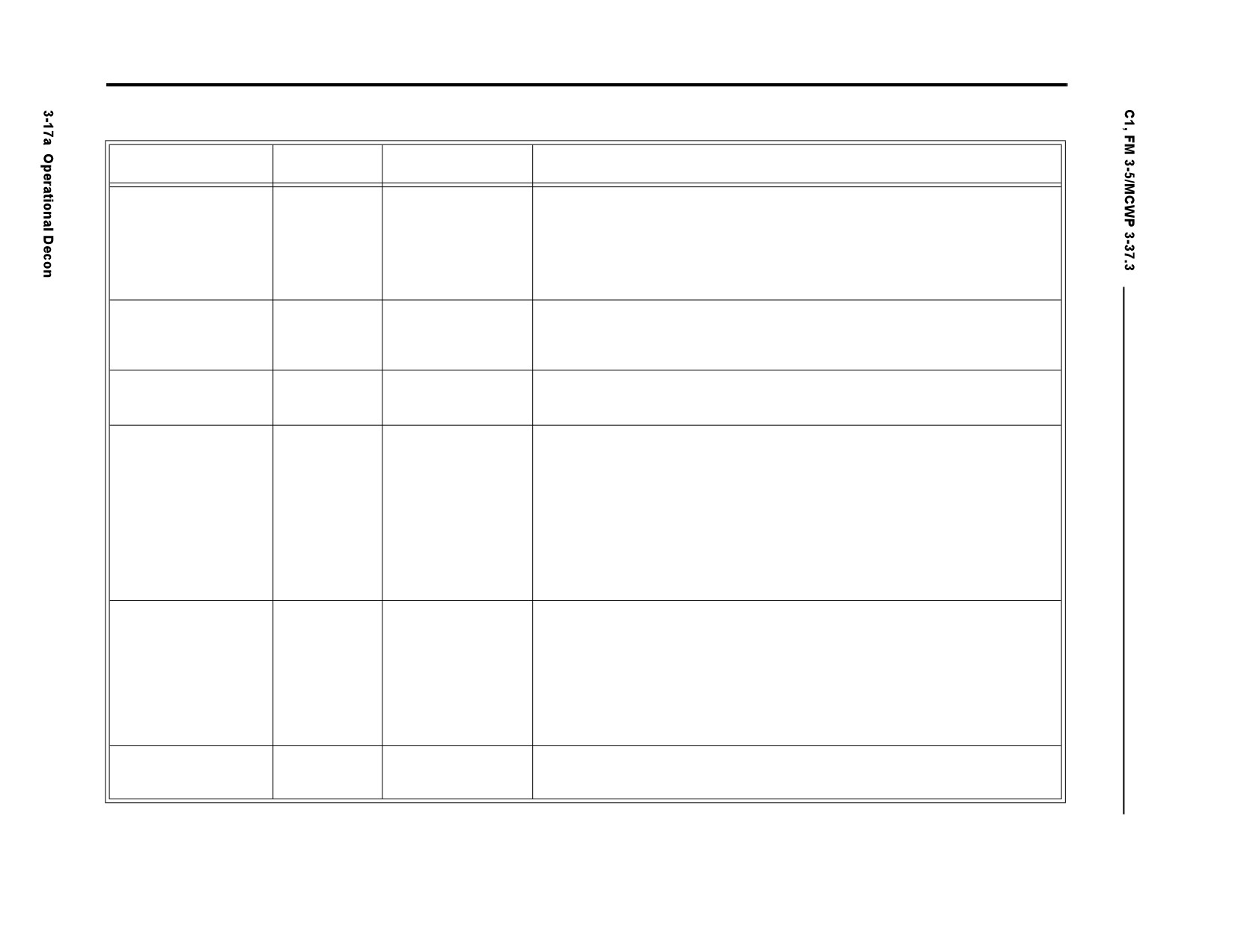
Table 3-4a. Steps for the Buddy-Team Method MOPP-Gear Exchange With the JSLIST Chemical Protective Ensemble
Steps
Contamination
Required Equipment
Procedures
Type
1. Decon gear—
All
Four long-handled
The soldier mixes three parts earth to two parts STB.
removes gross
contamination
brushes
contamination from
One large piece of
individual gear
plastic (poncho or
(weapons, helmet, load-
similar material)
bearing equipment, and
mask carrier).
Chemical/
One 30-gallon
The soldier removes and discards the chemical protective helmet cover. He brushes
biological
container, STB dry
or rubs STB onto his individual gear (helmet and mask carrier) and the hose of the
mix, and one IEDK
M42 or M43 mask if worn. He gently shakes off excess STB and sets aside his gear
on an uncontaminated surface (plastic, poncho, or similar material).
Radiological
Hot, soapy water
The soldier brushes or wipes radiological contamination from his individual gear. He
washes it with hot, soapy water (if available), then sets it aside to dry on an
uncontaminated surface (plastic, poncho, or similar material).
2. Prepare to decon—
All
Cutting tool
Buddy #1 removes the M9 detector paper from Buddy #2’s overgarment. He unties
facilitates later removal
contamination
the bow in Buddy #2’s coat retention cord if tied. He unfastens the webbing-strip
of overgarment trousers
snap at the bottom front of Buddy #2’s coat and releases the coat retention-cord loop
and overboots.
at the waist. Buddy #1 then loosens the bottom of the coat by pulling the material
away from Buddy #2’s body. NOTE: If wearing the M43 protective mask, tie the
microphone cord to the hose of the mask. He unfastens and loosely refastens
the hook-and-pile fastener tapes at Buddy #2’s wrists and ankles. He unfastens or
cuts the fasteners on Buddy #2’s overboots. NOTE: The M40 voice amplifier (M7)
and the M42A2 detachable microphone cannot be decontaminated and will be
disposed of as contaminated waste; however, ensure that these items are
contaminated before disposing of them.
3. Decon the mask and
Chemical/
Two IEDKs per person
Buddy #1 uses an IEDK to wipe Buddy #2’s eye-lens outserts from the top down.
hood—removes gross
biological
(NOTE: Do not press so hard that you break Buddy #2’s face-mask seal.) He
contamination.
then wipes the rest of Buddy #2’s hood from the top of the head to the bottom of the
hood (see Figure 3-5, page 3-9). After he has finished wiping Buddy #2’s mask, he
must wipe his own gloves in preparation for rolling Buddy #2’s hood. He starts from
the rear and rolls Buddy #2’s hood, using 2-inch tucks, until it reaches the center of
his head (see Figure 3-6, page 3-9). He rolls the front of Buddy #2’s hood tightly
under the outlet valve and filter. He ensures that the hood is off of Buddy #2’s
garment (see Figure 3-7, page 3-10).
Radiological
Three containers
Buddy #1 wipes Buddy #2’s mask and hood with a sponge dipped in hot, soapy
(about 3-gallon
water and rinses them with a sponge dipped in clean water. He dries Buddy #2’s
capacity)
mask and hood with paper towels or rags. Buddy #2 wipes his own gloves.
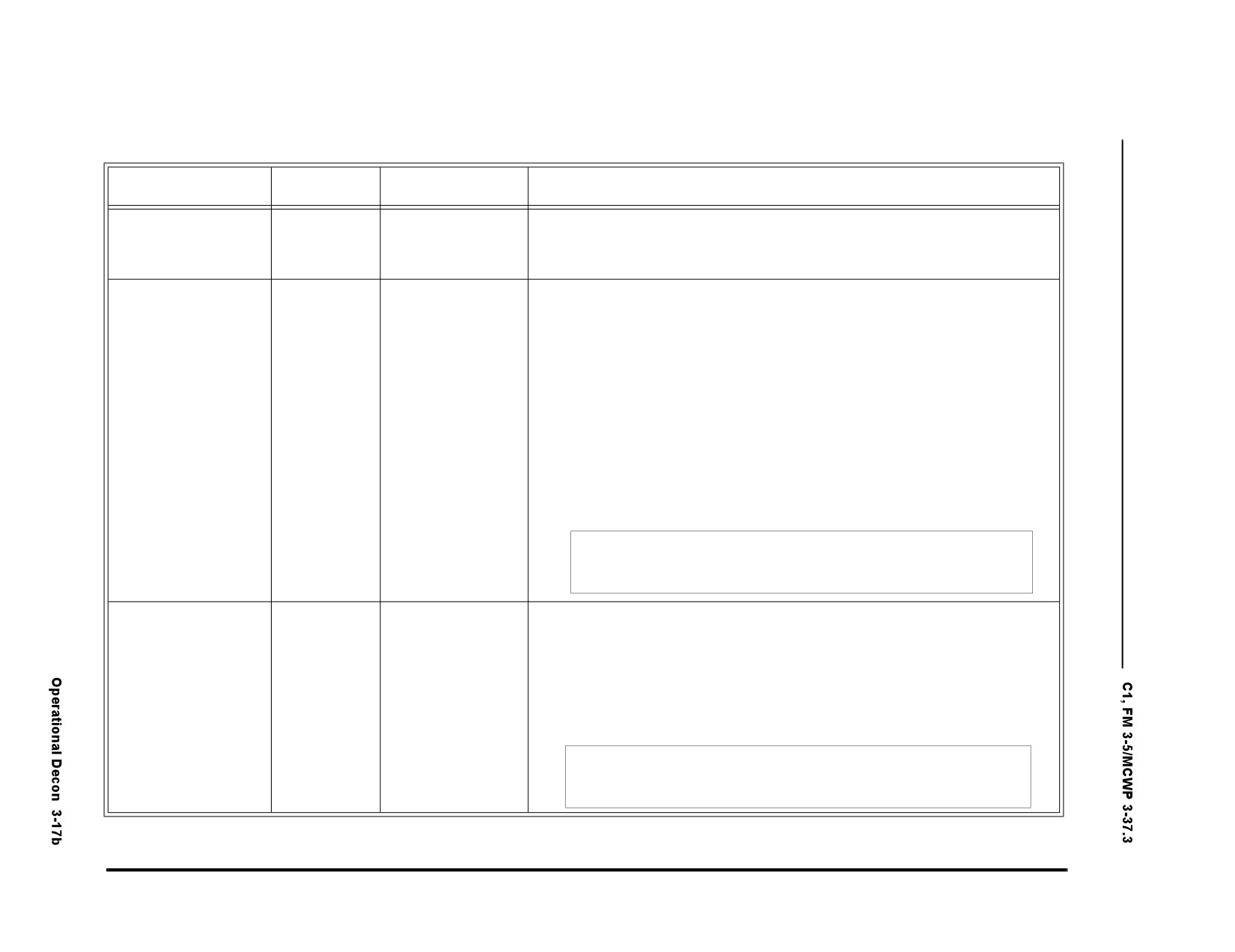
Table 3-4a. Steps for the Buddy-Team Method MOPP-Gear Exchange With the JSLIST Chemical Protective Ensemble (continued)
Steps
Contamination
Required Equipment
Procedures
Type
Two sponges
NOTE: Cool, soapy water is not as effective for removing contamination, but it
Soapy water
can be used if you scrub longer. If the water supply is limited, use drinking water
Rinse water
from your canteen with a wet sponge or cloth. If water is not available, brush and
Paper towels
dust off the radioactive dust particles.
4. Remove the chemical
All
Two discard
Buddy #2 feels for and locates the suspender snap couplers on the outside of his
contamination
containers (for
protective coat—limits
coat and releases them. Buddy #1 unties Buddy #2’s drawcord if tied, presses the
example, plastic
the spread of agents and
barrel lock release, and unsnaps the barrel lock. (NOTE: If buddy #1 has difficulty
bags)
helps prevent agents
grasping the barrel lock, he should use the drawcord to pull the barrel lock
from penetrating through
away from the mask. This will allow him to grasp and unfasten the barrel lock
to the undergarments or
without touching the interior of the hood.) Buddy #1 unfastens Buddy #2’s front
the skin.
closure flap and pulls the slide fastener down from the chin to the bottom of the coat.
Buddy #1 instructs Buddy #2 to turn around. Buddy #1 grasps Buddy #2’s hood, rolls
it inside out, and pulls it off Buddy #2’s head. Buddy #1 grasps Buddy #2’s coat at
the shoulders, instructs him to make a fist to prevent the chemical protective gloves
from coming off, and pulls the coat down and away from him, ensuring that the black
part of the coat is not touched.
(NOTE: If there is difficulty removing the coat in
this manner, Buddy #2 should pull one arm out at a time.) Buddy #1 lays the
coat on the ground, black side up. (NOTE: Buddy #2 will use the coat later as an
uncontaminated surface to stand on when putting on his new overgarment.)
CAUTION
Buddy #1 and Buddy #2 must take care to avoid contaminating the
inside surface of Buddy #2’s coat.
Two discard
5. Remove the chemical
All
Buddy #1 unfastens Buddy #2’s hook-and-pile fastener tapes at the waistband,
containers (from
protective trousers.
contamination
unfastens the two front closure snaps, and opens the fly slide fastener on the front of
step 4)
the trousers. Buddy #1 grasps Buddy #2’s trousers at the hips and pulls them down
to his knees. Buddy #1 instructs Buddy #2 to lift one leg (with the foot pointed down)
and bend slightly at the knee for stability. Buddy #1 grasps the trouser leg of Buddy
#2’s elevated foot and with a hand on each side of the trouser leg, pulls the trouser
leg in an alternating motion until Buddy #2 can step out of it. Repeat the process for
the other leg. Buddy #1 discards the trousers.
CAUTION
Buddy #1 and Buddy #2 must take care to avoid contaminating Buddy
#2’s clothing and skin.
Table 3-4a. Steps for the Buddy-Team Method MOPP-Gear Exchange With the JSLIST Chemical Protective Ensemble (continued)
Steps
Contamination
Required Equipment
Procedures
Type
6. Remove the chemical
All
Two discard
Buddy #1 instructs Buddy #2 to loosen his overboots by alternately stepping on each
protective overboots.
contamination
containers (from
heel and pulling up on his foot (see Figure 3-10, page 3-13). Buddy #1 pulls off
step 4)
Buddy #2’s overboots (one overboot at a time) and Buddy #2 steps directly onto the
coat spread on the ground as each foot is withdrawn from the overboot. NOTE:
Buddy #2 may put his hands on Buddy #1 for balance but must then decontam-
inate his gloves. Buddy #1 discards the overboots.
7. Remove the chemical
All
Two discard
Buddy #2 holds the fingertips of his gloves and partially slides his hands out. When
protective gloves/liners.
contamination
containers (from
both hands are free, he holds his arms away from his body and lets the gloves drop
step 4)
off, away from the black side of the coat. Buddy #2 removes the protective glove
inserts. Buddy #1 discards the chemical protective gloves and inserts.
CAUTION
Buddy #1 and Buddy #2 must take care to avoid letting their gloves
come in contact with the coat spread on the ground.
8. Put on the chemical
All
One JSLIST chemical
Buddy #1 opens the package containing the new trousers without touching the inside
protective trousers.
contamination
protective ensemble
of the package. Buddy #2 removes the trousers without touching the outside of the
per person
package. While standing on an uncontaminated surface, Buddy #2 puts on his trou-
sers, closes the slide fastener, and fastens the two fly opening snaps. He pulls his
suspenders over his shoulders and fastens the snap couplers. He adjusts the length
of the suspenders to ensure a comfortable fit. He adjusts the hook-and-pile fastener
tape at the waistband for a snug fit.
CAUTION
Buddy #2 must take care to ensure that the trousers touch only the
uncontaminated surface.
9. Put on the chemical
All
One JSLIST chemical
Buddy #1 opens the package containing the new coat without touching the inside of
protective coat.
contamination
protective ensemble
the package. Buddy #2 removes the coat without touching the outside of the
per person
package. He puts on the coat, pulls the slide fastener up as far as the chest, and
secures the front closure hook-and-pile fastener tape on the front flap up as far as
the chest. He pulls the bottom of the coat down over his trousers. He grasps the
loop on the back of the overgarment, pulls the loop out and away from the coat, and
brings the loop forward between his legs, pulling on it so that the bottom of the coat
fits snugly over the trousers. He places the loop over the webbing-strip snap and
fastens it. He adjusts the coat retention cord if necessary and ties the excessive cord
in a bow.
Table 3-4a. Steps for the Buddy-Team Method MOPP-Gear Exchange With the JSLIST Chemical Protective Ensemble (continued)
Steps
Contamination
Required Equipment
Procedures
Type
10. Put on the chemical
All
One set of chemical
Buddy #1 opens the package containing the new overboots without touching the
protective overboots.
contamination
protective overboots
inside of the package. Buddy #2 removes the overboots without touching the
per person
outside of the package. He puts the overboots on over his combat boots and
adjusts/secures the fasteners. He pulls his trouser legs over the overboots and
secures the two hook-and-pile fastener tapes on each ankle so they fit snugly
around the overboot.
11. Put on the chemical
All
One JSLIST chemical
Buddy #2 puts the hood on his head. He completely closes the front slide fastener
protective hood.
contamination
protective ensemble
on the coat and secures the hook-and-pile fastener tape on the front flap as far as
per person
the top of the slide fastener. He places the edge of the hood around the edge of the
mask and secures the hook-and-pile fastener tape on the hood.
WARNING
The barrel lock release button must face away from the user
when worn to avoid the barrel lock from unfastening and possi-
bly exposing the user to contamination.
He pulls the drawcord tight around the edge of the mask, snaps the ends of the
barrel lock together, squeezes both ends of the barrel lock while pulling the
drawcord, and slides the barrel lock up under his chin to keep the cord in place.
Without touching Buddy #2, Buddy #1 inspects the hood and mask to make sure that
the hood is positioned properly and the skin is not exposed. Buddy #2 adjusts the
hood and mask as directed. If Buddy #1’s assistance is required for proper
adjustment, Buddy #2 will decontaminate Buddy #1’s gloves before he touches the
hood and mask.
12. Put on the chemical
All
One set of chemical
Buddy #1 opens the package containing the new chemical protective gloves and
protective gloves/liners.
contamination
protective gloves
liners without touching the inside of the package. Buddy #2 removes the gloves and
with liners per
liners without touching the outside of the package. He puts on the liners and gloves,
person (correct size)
pulls the cuffs of the coat over the chemical protective gloves, and fastens the hook-
and-pile fastener tapes on each sleeve of the coat. He puts on the M9 detector
paper as required by the SOP.
13. Reverse roles.
All
One JSLIST chemical
Buddy #1 and Buddy #2 reverse roles and repeat steps 3 through 13.
contamination
protective ensem-
ble per person. One
set of chemical pro-
tective boots per
person
One set of chemical
protective gloves
with liners per
person (correct size)
Table 3-4a. Steps for the Buddy-Team Method MOPP-Gear Exchange With the JSLIST Chemical Protective Ensemble (continued)
Steps
Contamination
Required Equipment
Procedures
Type
14. Secure the gear.
All
One chemical
Buddy #1 places the new chemical protective helmet cover on the personnel armor
contamination
protective helmet
system ground troop (PASGT) helmet if used. He uses the buddy system to check
cover per person
the fit of all secured gear.
C1, FM 3-5/MCWP 3-37.3
THIS PAGE IS INTENTIONALLY LEFT BLANK.
Operational Decon 3-17f
Table 3-5. Steps for the CVCUS/CPU (Buddy-Team Method) MOPP-Gear Exchange
Steps
Contamination
Required Equipment
Procedures
Type
1. Decon gear—
All
Four long-handled
The soldier mixes three parts earth to two parts STB.
removes gross
contamination
brushes
contamination from
A large piece of plastic
individual gear
(poncho or similar
(weapons, helmet,
material)
load-bearing
equipment, and
mask carrier).
Chemical/
One 30-gallon
The soldier removes and discards the chemical protective helmet cover if worn. He
biological
container, STB dry
brushes or rubs the STB onto his individual gear and the hose of the M42 mask if
mix, and one IEDK
worn. He gently shakes off any excess STB and sets aside his gear on an
uncontaminated surface.
Radiological
Hot, soapy water
The soldier brushes or wipes radiological contamination from his individual gear. He
washes it with hot, soapy water (if available) then sets it aside to dry on an
uncontaminated surface (plastic, poncho, or similar material).
2. Prepare for
All
Cutting tool
Buddy #1 unfastens the shoulder straps on Buddy #2’s hood and pulls them over his
decon—
contamination
shoulder and reattaches them to the Velcro fastener. He loosens the drawcord on
facilitates MOPP-
Buddy #2’s hood. He removes the M9 detector paper from Buddy #2's CVCUS. He
gear removal.
unzips the ankles on both legs of Buddy #2’s CVCUS. He unfastens or cuts the
fasteners on Buddy #2’s overboots. NOTE: A soldier can do this step by himself
or with the help of his buddy.
3. Decon mask and
Chemical/
Two IEDKs per person
Buddy #1 uses an IEDK to wipe Buddy #2’s eye-lens outserts from the top down.
hood—removes
biological
(NOTE: Do not press so hard that you break Buddy #2's face-mask seal.) He
gross contamination.
then wipes the rest of Buddy #2’s hood from the top of the head to the bottom of the
hood (see Figure 3-5, page 3-9). After he has finished wiping Buddy #2’s mask, he
must wipe his own gloves in preparation for rolling Buddy #2’s hood. He starts from
the rear and rolls Buddy #2’s hood, using 2-inch tucks, until it reaches the center of
his head (see Figure 3-6, page 3-9). He rolls the front of Buddy #2’s hood tightly
under the outlet valve and filter. He ensures that the hood is off of Buddy #2's gar-
ment (see Figure 3-7, page 3-10).
Table 3-8. Steps for the Individual (Emergency Method) MOPP-Gear Exchange (Continued)
Steps
Contamination
Required Equipment
Procedures
Type
5. Remove
All
Two discard
The soldier wipes around the edges of the packages containing the new items
gloves.
contamination
containers (from
(gloves, overgarments, and overboots) with an IEDK. He opens the new packages.
step 4)
He holds the fingertips of his gloves and partially slides his hands out. When the
One IEDK
fingers of both hands are free, he holds his arms away from his body and lets his
gloves drop.
6. Put on
All
One set of chemical
The soldier removes the overgarment from its package without touching the outside.
overgarment.
contamination
protective overgar-
He puts on the overgarment and fastens it, leaving the trouser legs open until he
ments per person
puts on the new overboots.
One IEDK
7. Put on
All
One set of chemical
The soldier removes the overboots (one at a time) from their package without
overboots and
contamination
protective overboots
touching the outside and puts them on. He removes the gloves from their package
gloves.
per person
without touching the outside, puts them on, and fastens his trouser legs. NOTE: The
One set of chemical
gloves and overboots will have a light powdery coating. This is normal. Do
protective gloves per
not remove it. It will not affect the protective qualities.
person
8. Secure hood.
All
One chemical
The soldier secures his individual gear and puts it back on. He puts on a new
contamination
protective helmet
chemical protective helmet cover and moves to the AA.
cover per person
Table 3-8a. Steps for the Individual (Emergency Method) MOPP-Gear Exchange With the JSLIST Chemical Protective Ensemble
Steps
Contamination
Required Equipment
Procedures
Type
1. Decon gear—
Chemical/
One IEDK
The soldier uses M8 detector paper to determine the areas of gross contamination
removes gross
biological
and field-expedient absorbents
(sand, dirt, or rags) to remove gross liquid
contamination from
contamination. He should take special care to avoid touching these areas during
individual gear
overgarment removal. He uses an IEDK to decon his individual gear (helmet, lCE,
(weapons, helmet,
weapon, and mask carrier).
load-bearing
equipment, and
mask carrier).
Radiological
Hot, soapy water
The soldier removes and discards his chemical protective helmet cover. He brushes
or wipes radiological contamination from his individual gear. He washes it with hot,
soapy water (if available), then sets it aside to dry on an uncontaminated surface
(plastic, poncho, or similar material).
2. Prepare to
All
Cutting tool
The soldier removes the M9 detector paper from his overgarment. He unties the bow
decon—
contamination
in the coat retention cord if tied. He unfastens the webbing-strip snap at the bottom
facilitates later
front of his coat and releases the coat retention-cord loop at his waist. He loosens
removal of overgar-
the bottom of his coat by pulling the material away from his body. NOTE: If wearing
ment trousers and
the M43 protective mask, tie the microphone cord to the hose of the mask. He
overboots.
unfastens and loosely refastens the hook-and-pile fastener tapes at his wrists and
ankles. He unfastens or cuts the fasteners on his overboots. NOTE: The M40 voice
amplifier
(M7) and the M42A2
detachable microphone cannot be
decontaminated and will be disposed of as contaminated waste; however,
ensure that these items are contaminated before disposing of them.
3. Decon the mask
Chemical/
Two IEDKS per person
The soldier uses an IEDK to decon the exposed parts of his mask. He starts at the
and hood—removes
biological
eye-lens outserts and wipes down. He wipes all the exposed parts of the mask. He
gross contamination.
wipes the front edge of his hood including the barrel lock and fasteners under his
chin. He then decons his gloves in preparation to release the hood seal. NOTE:
The soldier must pay particular attention to the areas between the fingers
when decontaminating the gloves.
Radiological
Three containers
The soldier wipes his mask and hood with a sponge dipped in hot, soapy water and
(about 3-gallon
rinses them with a sponge dipped in clean water. He dries his mask and hood with
capacity)
paper towels or rags. He then wipes his gloves. NOTE: Cool, soapy water is not
Two sponges
as effective for removing contamination, but it can be used if you scrub longer.
Soapy water
If the water supply is limited, use drinking water from your canteen with a wet sponge
Rinse water
or cloth. If water is not available, brush and dust off the radioactive dust particles.
Paper towels
Table 3-8a. Steps for the Individual (Emergency Method) MOPP-Gear Exchange With the JSLIST
Chemical Protective Ensemble (continued)
Steps
Contamination
Required Equipment
Procedures
Type
4. Remove the
All
Two discard containers
The soldier feels for and locates the suspender snap couplers on the outside of his
chemical protec-
contamination
(for example, plastic
coat and releases them. He unties the drawcord if tied, presses the barrel lock
tive coat—limits the
bags)
release, and unsnaps the barrel lock. NOTE: If the soldier has difficulty grasping
spread of agents
the barrel lock, he should use the drawcord to pull it away from his mask, allow-
and helps prevent
ing him to grasp and unfasten it without touching the interior of his hood. He
agents from pene-
unfastens the front closure flap and pulls the slide fastener from the chin to the bottom
trating through to
of the coat. He grasps the hood by the outside surface near each end of the barrel
the undergarments
lock, lifts it off his head, and reverse rolls the hood one time while pulling the hood
or the skin.
towards the back of his head to remove it. He grasps the front side of the coat and
pulls it back until it is off his shoulders. He puts his arms behind his back and works
his arms out of the sleeves. NOTE: The soldier ensures that the outside of the
coat does not touch his body. He lays the coat on the ground, black side up.
NOTE: The soldier will use the coat later as an uncontaminated surface to stand
on when putting on his new overgarment.
CAUTION
The soldier must take care to avoid contaminating the inside surface of his
coat.
5. Remove the
All
Two discard containers
The soldier unfastens the hook-and-pile fastener tapes at his waistband, unfastens
chemical protec-
contamination
(from step
4)
the two front closure snaps, and opens the fly slide fastener on the front of his trou-
tive trousers/over-
sers. He loosens his overboots by alternately stepping on each heel and pulling up on
boots.
his foot. The soldier grasps his trousers and pushes them down to his knees. He
walks out of his trousers and overboots simultaneously and steps onto the black side
of the coat.
CAUTION
The soldier must take care to avoid contaminating his clothing and skin.
6. Remove the
All
Two discard containers
The soldier wipes around the edges of the packages containing the new items
chemical protec-
contamination
(from step 4)
(gloves, overgarments, and overboots) with an IEDK and then opens them. He holds
tive gloves/liners.
the fingertips of his gloves and partially slides his hands out. When the fingers of both
hands are free, he holds his arms away from his body and lets his gloves drop. He
removes the protective glove inserts and discards them.
CAUTION
The soldier must take care to avoid letting his gloves come in contact with the
coat spread on the ground.
Table 3-8a. Steps for the Individual (Emergency Method) MOPP-Gear Exchange With the JSLIST
Chemical Protective Ensemble (continued)
Steps
Contamination
Required Equipment
Procedures
Type
7. Put on the
All
One JSLIST chemical
The soldier removes the trousers from the package without touching the outside. He
chemical protective
contamination
protective ensemble
puts them on, closes the slide fastener, and fastens the two fly opening snaps. He
trousers.
per person
pulls the suspenders over his shoulders and fastens the snap couplers. He adjusts
the length of the suspenders to ensure a comfortable fit. He adjusts the hook-and-
pile tape at the waistband for a snug fit.
CAUTION
The soldier must take care to ensure that the trousers touch only the
uncontaminated surface.
8. Put on the
All
One JSLIST chemical
The soldier removes the coat from the package without touching the outside. He
chemical protective
contamination
protective ensemble
puts on the coat, closes the slide fastener up as far as the chest, and secures the
coat.
per person
front closure hook-and-pile fastener tape on the front flap up as far as his chest. He
pulls the bottom of his coat down over his trousers. He grasps the loop on the back of
his coat and pulls it out and away from the back of the coat. He brings the loop for-
ward between his legs, pulling on it so that the bottom of the coat fits snugly over his
trousers. He places the loop over the webbing-strip snap on the front of the coat and
fastens it. He adjusts the retention cord if necessary and ties the excessive cord in a
bow.
CAUTION
The soldier must take care to ensure that his body and clothing touch only
the inner surface of the coat.
9. Put on the
All
One set of chemical
The soldier removes the overboots from the package without touching the outside.
chemical protective
contamination
protective overboots
He puts the overboots on over his combat boots, adjusts/secures the fasteners, pulls
overboots.
per person
his trouser legs over the overboots, and secures the two hook-and-pile fastener
tapes on each ankle so they fit snugly around his overboot.
10. Put on the
All
One JSLIST chemical
The soldier puts the hood on his head, completely closes the front slide fastener on
chemical protective
contamination
protective ensemble
his coat, and secures the hook-and-pile fastener tape on the front flap as far as the
hood.
per person
top of the slide fastener. He places the edge of the hood around the edge of the
mask and secures the hook-and-pile fastener tape on the hood. He pulls the draw-
cord tight around the edge of the mask, snaps the ends of the barrel lock together,
squeezes both ends of the barrel lock while pulling the drawcord, slides the barrel
lock up under his chin to keep the cord in place, and ties off the drawcord if needed.
WARNING
The barrel lock release button must face away from the user when worn to
avoid the barrel lock from unfastening and possibly exposing the user to con-
tamination.
Table 3-8a. Steps for the Individual (Emergency Method) MOPP-Gear Exchange With the JSLIST
Chemical Protective Ensemble (continued)
Steps
Contamination
Required
Procedures
Type
Equipment
11. Put on the
All
One set of chemical
The soldier removes the gloves/liners from the package without touching the out-
chemical protec-
contamination
protective gloves
side. He puts on the liners and gloves, pulls the cuffs of the coat over the gloves,
tive gloves/liners.
with liners per per-
and fastens the hook-and-pile tapes on each sleeve of the coat. He puts on the M9
son (correct size)
detector paper as required by the SOP.
12. Secure the
All
One chemical protec-
The soldier places the new chemical protective helmet cover on the PASGT helmet
gear.
contamination
tive helmet cover
if used. He uses the buddy system to check the fit of all secured gear.
per person
Table 3-9. Steps for the CVCUS/CPU, Individual (Emergency Method) MOPP-Gear Exchange
Steps
Contamination
Required Equipment
Procedures
Type
Chemical/
One IEDK
The soldier uses M8 detector paper to determine the areas of gross contamination
1. Decon gear
removes gross
biological
and field-expedient absorbents
(sand, dirt, or rags) to remove gross liquid
contamination. He should take special care to avoid touching these areas during
contamination
from individual
overgarment removal. He uses an IEDK to decon his individual gear (helmet LCE,
weapon, and mask carrier).
gear (weapon,
helmet, load-
bearing
equipment, and
mask carrier).
Radiological
Hot, soapy water
The soldier brushes or wipes radiological contamination from his individual gear.
He washes it with hot, soapy water (if available) then sets it aside to dry on an
uncontaminated surface (plastic, poncho, or similar material).
2. Prepare to
All
Cutting tool
The soldier unfastens the shoulder straps on his hood, pulls them over his
decon
contamination
shoulders, and reattaches them to the front of the hood. He loosens the drawcord
facilities removal
on the hood of his protective mask. NOTE: If wearing the M43 protective mask,
of overgarment
tie off the microphone cord to the hose of the mask. He removes the M9
trousers and
detector paper from his overgarment and unties/cuts the drawcords on the trouser
overboots.
legs of his overgarment. He unzips the trouser legs and rolls a cuff in each trouser
leg, ensuring that the cuffs do not come above the top of his overboots. He
unfastens or cuts the fasteners on the overboots.
3. Decon mask
Chemical/
One IEDK
The soldier wipes the eye-lens outserts on his mask from the top down. He wipes
and hood
biological
his mask and gloves and rolls his hood. He grasps the straps of the hood and lifts
removes gross
the hood off his shoulders and partially over his head until most of the back of his
contamination
head is exposed. He rolls the hood, starting at the chin, and works around the
from the mask and
entire mask until the rolled hood will stay up and off of his shoulders. He tucks the
hood.
straps and neck cord into the roll. He rolls the hood tightly against his mask without
pulling the hood off the back of his head. He tucks the tail between the upper part
of the canister and the mask.
(Tie the tail over and under the hose for the M42
mask.)
The soldier removes the applicator mitt from the package with his nondominant
hand. Making a "V", he wipes down his hand, paying particular attention to the
areas between his fingers. Once he has thoroughly wiped down his dominant
hand, he must insert it into the applicator mitt and thoroughly wipe down his other
hand.
FM 3-5/MCWP 3-37.3
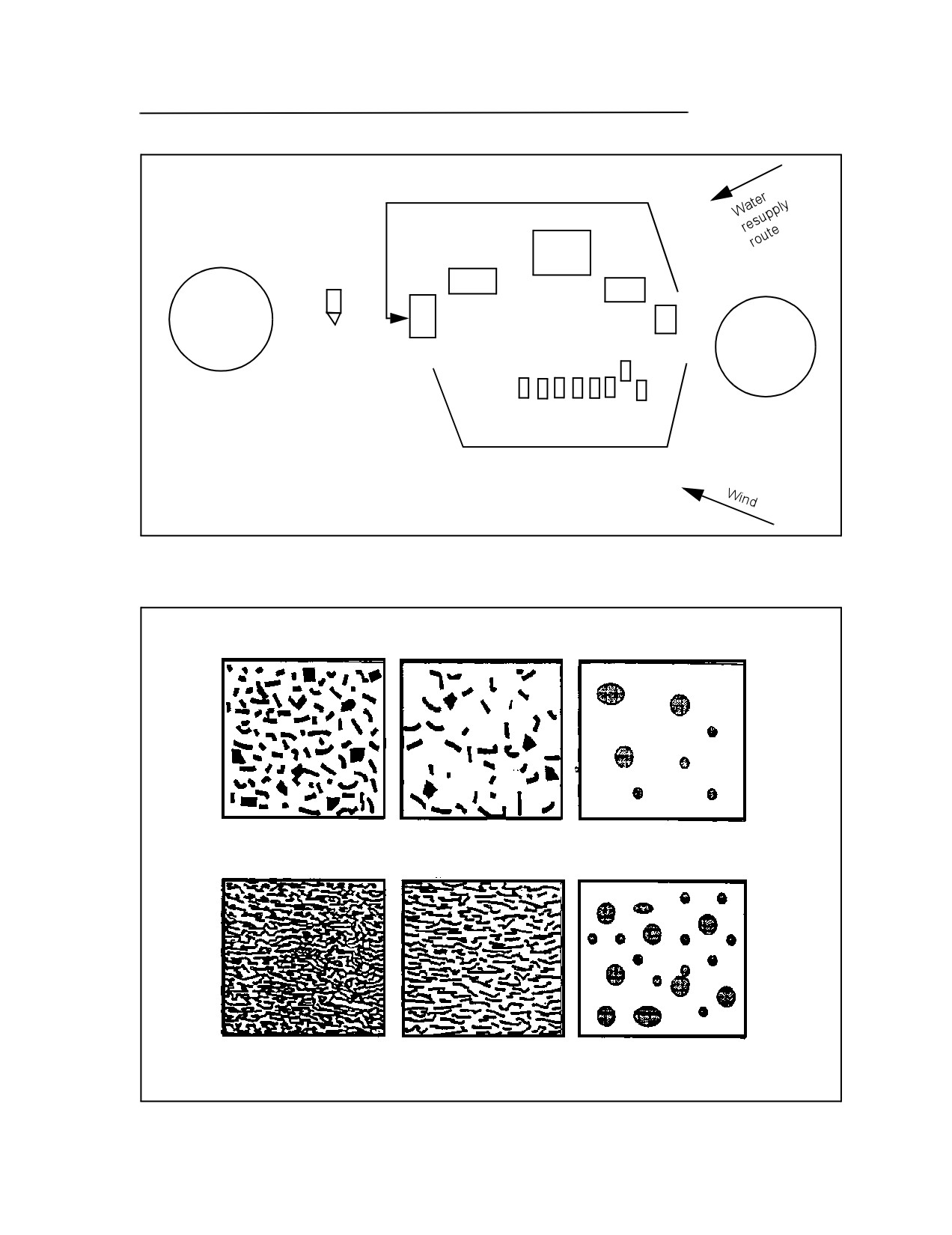
DED
Stations
3
2
4
Predecon
staging
1
5
area
Linkup
Postdecon
point
AA
7
1
2 3
4 5 6
8
Stations
DTD
Figure 4-1. Thorough-Decon Site
Moderate liquid contamination on the M9 detector paper (1 gram/square meter)
Heavy liquid contamination on the M9 detector paper (10 grams/square meter)
Figure 4-2. Contamination Levels
Thorough Decon 4-5
C1, FM 3-5/MCWP 3-37.3
Vehicle Crews
4-19. The vehicle crews, except for the drivers, dismount. As the crews dis-
mount, they remove all contaminated equipment, to include electro-optical
systems from the top and sides of the vehicles. Once the crews have exited the
vehicle, they will not reenter. This prevents contamination from being spread
into the vehicle interior.
Vehicle Preparation
4-20. Using the pioneer tools from the contaminated vehicles, the crews
remove all heavy mud and debris. They concentrate on the vehicle’s undercar-
riage, which is the most likely place for contamination to collect and the hard-
est place to decon. Once the crews are finished with the pioneer tools, they are
placed back on the vehicle. Initial removal of the mud and debris makes it
more likely that the decon wash will remove any remaining contamination.
4-21. Seat covers (when applicable), canvas items, camouflage netting, and
any other materials that can absorb liquid contamination are removed. These
items create a potential transfer hazard and are not easily decontaminated.
Left untreated, absorbed chemical agents will desorb after being decontami-
nated and will create a vapor hazard. Remove items that cannot be decontam-
inated by the standard methods used in the DTD, and place them at the
collection point. Chemical-unit personnel provide advice concerning the decon
or disposal of these items.
4-22. Design vehicle-loading plans to minimize the amount of equipment car-
ried on the outside of the vehicle that cannot be readily decontaminated.
Whenever possible, NBC covers should be used when a chemical attack is
expected (see FM 3-4). All NBC covers are removed and disposed of as contam-
inated waste during the predecon actions.
DED AND DTD AREAS
4-23. In coordination with the chemical unit leader operating the decon site,
the contaminated unit begins sending contaminated vehicles by priority for
processing. Communication is maintained between the predecon staging area
and the chemical unit leaders. All assistant vehicle drivers are the first indi-
viduals sent through the DTD to ensure that there is a driver exchange at sta-
tion 3 (see paragraph 4-100).
POSTDECON AA
4-24. The chemical unit leader selects the general location for the postdecon
AA. It must be big enough to hold the entire unit undergoing the thorough
decon with proper cover and concealment. The postdecon AA is located about
0.62-mile upwind from the DED and DTD areas. The unit assembles in the
postdecon AA after completing DTD and DED operations. The unit occupies
the postdecon AA before moving to a reconstitution location or a tactical AA to
prepare for future operations.
DETAILED TROOP DECON
4-25. The contaminated unit or its higher HQ is responsible for setting up,
operating, manning, and closing the DTD area at the thorough-decon site. The
chemical unit leader determines the general location of the DTD within the
decon site and provides technical advice on setting up, operating, and closing
the DTD area. The supervisor of the DTD must establish a work/rest cycle.
Thorough Decon 4-6
C1, FM 3-5/MCWP 3-37.3
4-26. There are eight stations for a DTD. Spacing between the stations is 10 to
16 feet (see Figure 4-3, page 4-8). Recapitulation of personnel and equipment
for a DTD is provided at Table 4-2, page 4-9.
STATION 1 - INDIVIDUAL-GEAR DECON
NOTE: Soldiers wearing the JSLIST chemical protective overgar-
ment will execute station 1 procedures in the same manner as pre-
scribed for the BDO.
4-27. At this station, contamination is removed from individual gear (LCE,
mask carrier, helmet, and weapon) to a negligible risk level (see Chapter 1 of
this manual).
Preparation
4-28. At this station, the following equipment and supplies are needed:
• Four 30-gallon containers for each two decon lanes used.
• 2 long-handled brushes for each two decon lanes used.
• Sufficient STB slurry mix for chemical contamination.
• Hot, soapy water and a sponge for radiological contamination.
• Rinse water.
• 2 ponchos or plastic sheets.
• Engineer tape.
4-29. Dig a sump that is 6 feet long, 6 feet wide, and 4 feet deep (minimum).
Place three 30-gallon containers near the sump for ease of changing. Fill two
containers with an STB slurry mix. Fill the other two containers with clean
water for rinsing and place it about 3 feet forward of the STB cans. Place two
long-handled scrub brushes at each can of STB slurry.
4-30. To prepare the slurry, mix 100 pounds of STB with 20 gallons of hot water.
The chemical unit provides the hot water. Change the mixture after 20 soldiers
have decontaminated their gear. The rinse water should be changed after every
10 soldiers or when it appears dirty (place the waste mixture in the sump).
4-31. Place a poncho or a plastic sheet on the ground at the checkpoint. Divide
the poncho or the sheet in half using engineer tape. This is the contamination
control line. The checkpoint will be a minimum of 10 feet from all other
stations in order to get a true reading on the detection equipment. Place the
following chemical detection/identification equipment at the checkpoint for an
average company-sized unit:
• 1 CAM.
• 8 books of M8 detector paper.
• 4 M256A1 detector kits.
• 100 plastic trash bags.
• 1 AN/VDR-2 for radiological contamination.
4-32. Three soldiers are required to operate this station. One soldier
supervises the decon of the individual gear and takes the decontaminated
equipment to the checkpoint. He also prepares a new slurry mixture as
necessary. One soldier remains at the checkpoint and checks all the gear
using the detection equipment to ensure that it is decontaminated. One
soldier transports the decontaminated gear to the reissue point.
Thorough Decon 4-7
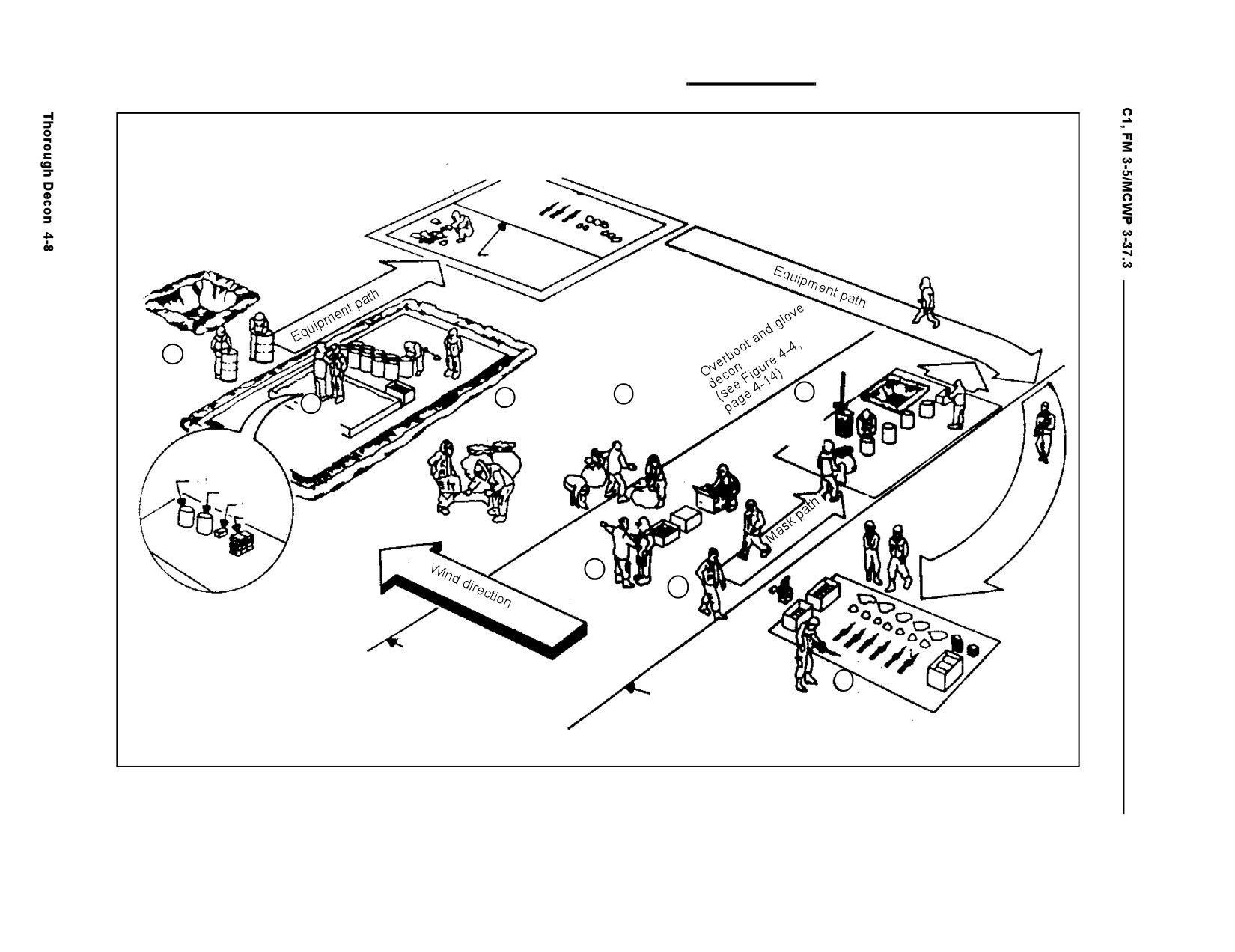
Contamination
control line
1
Individual
gear decon
4
7
3
2
Mask
Overgarment
Overboot and
Overboot
decon
and
removal
glove removal
point
Alternate for
hood
radiological
decon
decon
Soapy water
Rinse
Sponge
Towels
5
Monitor
6
Mask
removal
Liquid-
contamination
8
control line
Vapor-
Reissue
contamination
point
control line
Figure 4-3. DTD Layout

FM 3-5/MCWP 3-37.3
Table 4-2. DTD Personnel and Equipment Recapitulation
Stations
Personnel
Equipment/Supplies
Station 1 - individual-gear
2
attendants
4 30-gallon containers
decon
1
monitor (CAM operator)
2 long-handled brushes
2 ponchos or plastic sheets
1 CAM
8 books of M8 detector paper
4 M256A1 detector kits
100 plastic trash bags
Sufficient STB slurry mix
Rinse water
*Hot, soapy water
*AN/VDR-2
*Sponge
Station 2 - overboots and hood
1
attendant
Cutting tool
decon
One SKD or IEDK per person
Large plastic sheet
Plastic trash bags (as required)
10 drums of STB
1 shovel
Station 3 - overgarment
1
attendant
2 30-gallon containers
removal
100 plastic trash bags
10 boxes of SDKs
Station 4 - overboot and glove
3
attendants
8 30-gallon containers
removal
2 long-handled brushes
M8 detector paper (as required)
1 immersion heater
100 plastic trash bags
1 CAM
Engineer tape
1 cutting tool
2 ponchos or large plastic sheets
10 percent STB/HTH solution
Hot, soapy water
Cold rinse water
Station 5 - monitor
1
attendant (CAM operator)
1 CAM
1
aidman (or combat lifesaver)
First aid supplies
5 books of M8 detector papers
1 case of SDKs
Station 6 - mask removal
2
attendants
1 M8A1 or M22 ACAA
Engineer tape
Station 7 - mask decon point
2
attendants
1 30-gallon container
1
monitor
4 3-gallon containers
1 CAM
2 sponges
One case of paper towels
1 immersion heater
Mask sanitizing solution
Hot, soapy water
Rinse water
Station 8 - reissue point
Unit NBC NCO/supply sergeant
Mask PLL
* Denotes the equipment needed for radiological contamination.
NOTE: Assume that an operational decon was done before the thorough decon.
Thorough Decon 4-9
FM 3-5/MCWP 3-37.3
Execution
4-33. The soldier decontaminates his gear by washing and scrubbing it for 6
minutes in a decontaminant container with hot, soapy water or an STB slurry
mix. If he is wearing the M42 mask, he should use hot, soapy water and a
sponge or an STB slurry mix to decon the hose and canister.
4-34. The soldier dips his gear into the clean water and rinses it for 4 minutes
then hands it to the attendant and proceeds to the next station. The attendant
takes the gear to the equipment checkpoint and places the decontaminated
gear on the “dirty” side of the contamination control line and returns to the
containers to pick up more gear. The monitor at the checkpoint checks the
gear using the appropriate detection device and the procedures associated
with that device. If the residual contamination exceeds negligible risks,
recycle the gear and decon it again (see Chapter 1 of this manual). If the gear
passes the check, place it on the clean side of the contamination control line.
The attendant will carry the equipment to the reissue point.
4-35. Depending on the time available, more extensive washing and checking
procedures may be used. The longer the gear is washed or left out in the air
after washing, the lower the contamination level. The gear may be put in
closed areas or plastic bags and checked for hazardous vapors with the
M256A1 detector kit or the CAM. The CAM only detects the G-series nerve-
agent vapors and the H-series blister-agent vapors.
Risk
4-36. If this step is not done properly, contamination may remain on the
equipment. The resulting vapor hazard could cause casualties to unmasked
personnel, particularly in closed areas (vehicle interiors) or heavily wooded
areas where air circulation is poor.
STATION
2
- OVERBOOT AND HOOD DECON
4-37. At this station, gross contamination on overboots, trouser legs, mask,
and hood is neutralized. If ample hoods are available at the reissue point, the
hood should be cut away.
Preparation
4-38. Prepare a shuffle pit by digging a shallow pit about 3 feet long, 3 feet
wide, and 6 inches deep. Fill the shuffle pit with an STB dry mix or an STB
slurry, depending on water availability. Prepare the STB dry mix by mixing
three parts of earth to two parts of STB. Prepare the STB slurry in the same
manner as at station 1 (see paragraph 4-30). Add more STB to the mix after
10 soldiers have processed through the shuffle pit. The chemical unit will
provide 10 drums of STB for every company-sized unit that goes through the
station.
4-39. At this station, the following equipment and supplies are needed for the
mask and the shuffle pit: 1 cutting tool for each decon lane used, 1 SDK or
IEDK per person, plastic trash bags (as required), 10 drums of STB, and 1
shovel (to mix).
4-40. One soldier is required to operate this station. The attendant directs and
“observes” the soldiers as they decon their overboots and hoods.
Thorough Decon 4-10
C1, FM 3-5/MCWP 3-37.3
Execution
4-41. The soldier walks into the shuffle pit and spreads his legs apart (double-
shoulder width), bends at the waist, and uses his hands to thoroughly rub the
STB dry mix or the STB slurry on his overboots and lower trousers legs. He
should take special care to rub the rear of his overboots. He should also
remove any excess decontaminant from his gloves.
NOTE: If the JSLIST chemical protective overgarment is worn,
proceed to paragraphs 4-44 and 4-45.
4-42. If a replacement hood is available, remove the hood as follows. Buddy #1
cuts the shoulder straps and drawcord on Buddy #2’s hood. Buddy #1 pulls
Buddy #2’s hood inside out over the front of the mask, being careful not to
touch the exposed neck or head. Buddy #1 gathers Buddy #2’s hood in one
hand and using a cutting tool, cuts away the hood as close as possible to the
eye-lens outsert, voicemitter, and inlet-valve covers. Make sure nothing is left
dangling below the bottom of the mask.
4-43. If a replacement hood is not available, Buddy #1 decontaminates and rolls
Buddy #2’s hood in the same manner as for a MOPP-gear exchange. When the
task is completed, Buddy #1 and Buddy #2 reverse roles.
NOTE: Soldiers should check their overboots, rubber gloves, and
overgarment for damage. Any rips, tears, or punctures in these items
should be reported to the monitor at station 5. This allows the
monitor at station
5
to check the soldiers for chemical-agent
symptoms and their clothing for possible contamination.
4-44. Buddy #1 decontaminates his own gloves. He loosens Buddy #2’s
overgarment hood by unfastening the barrel lock.
(NOTE: If there is
difficulty unfastening the barrel lock, loosen the drawcord.) He then
loosens the drawcord around the edge of the hood and unfastens the hook-and-
pile fastener tape at the chin. Buddy #1 must take care to avoid touching
Buddy #2’s skin and throat area.
4-45. Buddy #1 removes Buddy #2’s overgarment hood by opening the front-
closure flap and pulling the slide fastener from the chin down to the chest.
Buddy #1 instructs Buddy #2 to turn around. Buddy #1 grasps the back of
Buddy #2’s hood, rolls the hood inside out (being careful not to contaminate
the inner garment), and pulls the hood off.
Risk
4-46. If this step is not done properly, contamination can be transferred to the
combat boots and the head and neck area from the hood.
STATION
3
- OVERGARMENT REMOVAL
4-47. At this station, contaminated overgarments are removed before the
agent penetrates the overgarment material and touches the undergarments or
the skin.
NOTE: If the JSLIST chemical protective overgarment is worn,
proceed to paragraphs 4-52 through 4-56.
Thorough Decon 4-11
C1, FM 3-5/MCWP 3-37.3
Preparation
4-48. At this station, the following equipment and supplies are needed:
• Two 30-gallon containers for each two decon lanes used.
• 100 plastic trash bags (or about one per soldier).
• 10 boxes of SDKs.
4-49. One soldier is required to operate this station. He directs and "monitors"
the soldiers as they remove their overgarments in the same manner as a
MOPP-gear exchange.
Execution
NOTE: The attendant will avoid touching the soldier's skin or inner
clothing. If contact is made, decontaminate immediately and then
proceed with the overgarment removal.
4-50. The attendant assists the soldier in removing his overgarment. The
attendant cuts and removes the M9 detector paper from around the soldier’s
wrist. He unfastens the Velcro closure over the jacket zipper, waist cord, and
wrist Velcro straps on the soldier’s jacket. He unfastens the back snaps and
instructs the soldier to make a fist. He then pulls the soldier’s jacket down
and away from him.
4-51. The attendant cuts and removes the M9 detector paper from the soldier’s
trousers. He unfastens the Velcro straps and zippers on the cuffs of the
soldier’s trousers. He also unfastens the front waist snaps and unzips the
front zipper. He has the soldier lift one leg and point that foot down and bend
slightly at the knees for stability. The attendant grasps the cuff of the
elevated foot with a hand on each side and pulls the cuff in an alternating,
jerking motion until the soldier can step out of the trouser leg. The process is
repeated on the other leg.
NOTE: The attendant ensures that the soldier steps wide enough so
as not to rub his clean leg against the contaminated boot and
overgarment.
4-52. The attendant assists the soldier in removing his overgarment jacket.
He cuts and removes the M9 detector paper from around the soldier's wrists
and arms. He releases the hook-and-pile fastener tapes at the wrists and at
the bottom of the trousers. He unties the bow in the coat retention cord, if tied.
He unfastens the webbing-strip snaps at the bottom of the jacket and releases
the coat retention cord. Touching only the outside surfaces of the jacket, the
attendant loosens the bottom of the jacket by pulling the material at the
bottom away from the soldier's body. The soldier locates his trouser suspender
snap couplers by feeling for them on the outside of his jacket and releases
them.
4-53. The attendant unfastens the front-closure flap on the front of the jacket
and pulls the slide fastener from the top of the chest down to the bottom of the
jacket. The attendant instructs the soldier to turn around, extend his arms in
front of him, and make a fist to prevent the removal of his chemical protective
gloves. The attendant grasps the jacket near the shoulders and removes it by
pulling it down and away from the soldier's body.
Thorough Decon 4-12
C1, FM 3-5/MCWP 3-37.3
NOTE: If there is difficulty removing the jacket in this manner, pull
one arm out at a time.
4-54. To remove the overgarment trousers, the attendant instructs the soldier
to turn back around. He cuts and removes the M9 paper from the soldier's
trousers. He unfastens the hook-and-pile fastener tapes at the waistband of
the trousers, unfastens the front-closure snaps, and opens the fly slide
fastener.
4-55. The attendant grasps the soldier’s trousers at the hips and pulls the
trousers down to soldier's knees. He has the soldier lift one leg, point that foot
down, and bend slightly at the knee for stability. He grasps the trouser leg of
the elevated foot and with a hand on each side of the trouser leg, pulls the
trouser leg in an alternating motion until the soldier can step out of it. Repeat
the process on the other leg.
NOTE: The attendant ensures that the soldier steps wide enough so
as not to rub his clean leg against the contaminated boot and
overgarment.
Risk
4-56. If this step is not done properly, the agent may be transferred to the
undergarment or the skin.
STATION
4
- OVERBOOT AND GLOVE REMOVAL
NOTE: Overboots and gloves worn with the JSLIST chemical protec-
tive overgarment are removed in the same manner as prescribed for
the BDO.
4-57. At this station, contaminated overboots and gloves are removed to limit
the spread of contamination. The overboots and gloves may also be decontam-
inated for reissue (if serviceable).
Preparation
4-58. At this station, the following equipment and supplies are needed for
every two lanes used:
• Engineer tape.
• 1 cutting tool for each lane used.
• 100 plastic trash bags (or about one per soldier).
4-59. If the overboots and gloves are not being decontaminated, two 30-gallon
containers are needed.
4-60. If the overboots and gloves are being decontaminated, the following are
needed:
• Eight 30-gallon containers.
• 2 long-handled brushes.
• 2 ponchos or large plastic sheets.
• 1CAM.
Thorough Decon 4-13
C1, FM 3-5/MCWP 3-37.3
• 1 AN/VDR-2 for radiological contamination.
• 4 M256A1 detection kits.
• 1 immersion heater.
• 100 plastic trash bags.
• M8 detector paper, as required.
• 10 percent STB/HTH solution.
• Hot, soapy water.
• Cold rinse water.
4-61. If replacement overboots and gloves are available, set up the station as
follows (see Figure 4-4). Establish a liquid-contamination control line and set
two
30-gallon containers
1
foot back from the line. Soldiers support
themselves using the containers and discard their overgarments into the
containers. An attendant directs and monitors the soldiers as they remove
their overboots and gloves in the same manner as a MOPP-gear exchange;
however, the soldiers step over the control line instead of onto a jacket.
Station 3
Overgarment removal
Troop flow
Step 1
Step 2
Step 3
Step 4
Step 5
G
G
G
G
G
G
Station 4
Overboot and glove
removal
O
O
O
O
O
O
Overboot
Hot,
HTH
Rinse
Segregate Check
container
soapy
scrub
water
Legend: O = overboots
Station 5
G = gloves
Monitor
Figure 4-4. Station 4 Layout
Thorough Decon 4-14
C1, FM 3-5/MCWP 3-37.3
4-62. If replacement overboots and gloves are not available, set up the station
as follows: Fill two 30-gallon containers with hot, soapy water and two 30-
gallon containers with a 10 percent STB/HTH solution, placing two scrub
brushes near the containers. Then fill two 30-gallon containers with cold
rinse water. One attendant supervises and assists the soldiers wearing the
M42 mask. The other two attendants decon the overboots and the gloves; one
processes the overboots, while the other processes the gloves.
NOTE: Replace the water in the container once 20 items have been
processed. When available, the decon platoon will assist with the
water requirements.
4-63. For both situations, use engineer tape to mark the liquid-contamination
control line on the ground. Place the cutting tools, two containers, and plastic
bags on the "dirty" side of the liquid-contamination control line. The liquid-
contamination control line separates the "dirty" and "clean" areas. No liquid
agent should be tracked on the ground beyond the liquid-contamination
control line.
Execution
4-64. The liquid-contamination control line separates the “dirty” and “clean”
areas. The attendant unfastens or cuts the elastic closures on the soldier’s
overboots. The soldier faces the liquid-contamination control line and steps
back from it about 12 inches. The attendant steps on the back of the soldier’s
overboot and instructs him to lift his heel and work his foot out of the overboot
and step across the liquid-contamination control line. Repeat the process on
the other foot. If the overboot cannot be removed by this process, the
attendant cuts it off and discards it in the designated container. The soldier
holds the fingertips of his gloves and partially slides his hands out. The
attendant remove the soldier’s gloves.
4-65. If the soldier is wearing the M42 protective mask, the attendant from
station 6 carries the soldier’s filter canister until it is removed.
NOTE: The attendant at station 4 performs his duty from the “dirty”
side of the liquid-contamination control line.
4-66. The overboots and gloves are decontaminated using the following steps:
NOTE: Check all items for holes, tears, and punctures and discard
any item with this defect. Do not decon any item that is
unserviceable.
• Step 1. Submerge the gloves and overboots in their respective container
of hot, soapy water. Some of the contamination is removed during this
step. When the overboots and gloves are removed from the container,
ensure that no water remains inside them.
• Step
2. Submerge the gloves and overboots in their respective
containers of STB/HTH solution. Thoroughly scrub the items until no
visible contamination remains. After scrubbing, submerge each item
once more before moving to the rinse container.
• Step 3. Thoroughly rinse the scrubbed items, making sure that they
are rinsed inside as well as out.
Thorough Decon 4-15
C1, FM 3-5/MCWP 3-37.3
• Step 4. Place usable items on a poncho or a plastic sheet to air dry and
weather.
• Step 5. Place usable items in plastic trash bags along with an M256A1
detector kit. If the detector kit shows contamination remaining, the
attendants can recycle the items or discard them. However, if the kit
show no contamination, the items can be reused.
Risk
4-67. If the overboots are not properly removed, the combat boots may become
contaminated and contamination may be spread to clean areas. If the gloves
are not properly removed, the undergarments and skin may become
contaminated.
STATION 5 - MONITOR
4-68. At this station, contamination on personnel is identified, spot-decon
capabilities are provided, and medical aid is provided, as required.
Preparation
4-69. At this station, the following equipment and supplies are needed:
• First aid supplies.
• 1 CAM.
• 1 AN/VDR-2 for radiological contamination.
• 5 books of M8 detector paper per 100 soldiers.
• 1 case of SDKs.
4-70. An aidman should be present to treat any soldiers suffering from
chemical-agent symptoms. If an aidman is unavailable, a combat lifesaver
should be present.
Execution
4-71. The attendant checks the soldiers for contamination using the CAM.
Liquid agents can be detected with M8 detector paper. Small quantities of
agent vapor can be detected with the CAM. Symptoms of agent poisoning are
the most obvious indication of skin contamination. At this station, the medic
checks each soldier for symptoms of agent poisoning and treats, as required.
Soldiers should report any damage to their MOPP gear that was identified at
stations
2,
3, and
4. The attendant can decon any areas identified as
contaminated with an SDK. Soldiers are remonitored after decon. It is
possible that all liquid-chemical contamination is absorbed into the clothing.
If so, M8/M9 detector paper will indicate negative, even though there is a
hazard.
Risk
4-72. If this station is omitted, the soldier could become a casualty. After this
station, the soldier is not checked for contamination or decontamined again.
Commanders can choose to conduct more extensive contamination checks here
if medical assistance and time are available. This decreases the risk of
casualties.
Thorough Decon 4-16
C1, FM 3-5/MCWP 3-37.3
STATION 6 - MASK REMOVAL
4-73. At this station, the mask is removed without contaminating the soldier.
The mask is taken to a mask decon point, limiting agent transfer at the
station.
Preparation
4-74. At this station, the M8A1 or M22 automatic chemical-agent alarm
(ACAA) and engineer tape are needed. Two soldiers are needed to operate this
station. They remove and carry the masks to station 7.
Execution
4-75. If the hood is still attached to the mask, the attendant pulls the hood
over the front of the mask, grabs the mask by the voicemitter cover, and pulls
the mask off the soldier. The soldier holds his breath as the mask is removed.
If the mask has optical inserts, the attendant holds the mask open so that the
soldier can remove the inserts without touching the outside of the mask. The
soldier walks upwind 16 feet, crosses the vapor-contamination control line,
and then resumes breathing. The attendant brings the mask to station 7.
4-76. If the wind direction remains constant, no chemical vapor hazard is
expected beyond the vapor-contamination control line. Position the M8A1 or
the M22 ACAA upwind of the station to warn of vapor hazards. The soldier
getting decontaminated moves straight ahead while his mask, which may still
give off vapors, is held on the vapor dirty side of the line and taken to station 7
where it is decontaminated.
Risk
4-77. If the step is not done properly, the soldier could breathe toxic vapors.
There is a high probability that the vapor hazard is still present on the mask
and the hood. The soldier must not touch the outside of the mask because it
could contaminate his bare hands. The soldier proceeds to station 8.
STATION 7
- MASK DECON POINT
4-78. At this station, all the contamination is removed from the mask.
NOTE: Once 20 items have been processed in the wash containers,
replace the water. Once 10 item have been processed in the rinse
water, replace it. Place the contaminated waste into the sump.
Preparation
4-79. At this station, the following materials and equipment are needed:
• 4 containers (about a 3-gallon capacity).
• 1 CAM (for chemical only).
• Hot, soapy water.
• Rinse water.
• Mask sanitizing solution.
• Immersion heater.
• One 30-gallon container.
• 2 sponges.
• 1caseofpapertowelspercompany.
Thorough Decon 4-17
C1, FM 3-5/MCWP 3-37.3
4-80. Dig a sump that is 4 feet long, 4 feet wide, and 4 feet deep in which to
discard used filters and canisters. Place the equipment and materials as
shown in Figure 4-3, page 4-8. Three soldiers are needed to operate this
station. Two soldiers strip, wash, rinse, sanitize, and dry masks. The other
soldier checks the masks and carriers them to the reissue point.
Execution
4-81. Remove the eye-lens outserts and the hood if the hood was not cut off at
station 2. Remove and discard the filters or canisters. Put the items into the
properly marked containers. Wash the mask, hood, eye-lens outserts, and the
hoses on the M42 and M43 masks in hot, soapy water. Rinse these items in
clean water, dip them into the sanitizing solution, agitate them for 5 minutes,
and then rinse them again in clean water. Add one tube of mask sanitizing
solution (calcium hypochlorite) to each quart of water. Wipe the masks with
rags until they are almost dry. Discard each container of mask sanitizing
solution into a sump after every 10 masks. The attendant checks the masks for
contamination with a CAM. If the masks are still contaminated, the attendant
recycles them for more decon and then decons his rubber gloves. If the masks
are not contaminated, the attendant takes the masks to the reissue point. The
attendant must take care not to contaminate the reissue point or himself.
Risk
4-82. If this step is not done properly, the soldiers may become contaminated
when the masks are reissued to them at the reissue point. Even though the
step is done correctly, there is still a possible danger when many masks are
stacked together. Small amounts of residual vapor from each mask can
become potentially dangerous.
NOTE: Runners between stations 7 and 8 are in MOPP2 and are
prepared to go into MOPP4.
STATION
8
- REISSUE POINT
4-83. At this station, the mask with its components is provided to the soldier
for reassembly.
Preparation
4-84. At this station, the protective-mask prescribed load-list (PLL) parts are
needed. The unit NBC NCO/supply sergeant sets up the reissue point to
provide the soldiers with replacement parts for all types of protective masks
and assist in mask maintenance.
Execution
4-85. The mask with its components is reissued to the soldier who assembles it
in the AA. The unit chemical NCO affixes canisters to the cleaned M42 and M43
hoses. The soldier picks up individual gear and moves to the postdecon AA.
Risk
4-86. If this step is not done properly, the soldier may be inadequately
equipped for future operations.
NOTE: If time is not available, the NBC NCO will have replacement
chemical suits, overboots, and gloves at this station for reissue. If
time is available, personnel will receive this equipment at the
postdecon AA.
Thorough Decon 4-18
C1, FM 3-5/MCWP 3-37.3
RESUPPLY SUPPORT RESPONSIBILITIES
4-87. The supporting chemical unit (decon or smoke/decon) must supply the
majority of the equipment and supplies that are required to operate the DTD.
This does not relieve the supported unit of the requirement to maintain
adequate supplies to conduct DTD procedures.
4-88. A chemical unit’s operational control continues to receive support from
its parent organization. The supported unit provides the chemical unit with
replacements, supplies, and material at the end of the DED. This shortens the
time the chemical unit is nonmission capable following the DED. The
supported unit must coordinate for the supplies and equipment necessary to
operate the DTD.
4-89. Typical nonchemical units do not have more than two CAMs per
company-sized unit. However, the DTD requires a minimum of three CAMs.
The supported HQ may need to provide additional CAMs. The division support
command (DISCOM) sustains the division’s chemical units. A chemical unit
attached to a maneuver force identifies the resources that are needed to
accomplish the mission and passes these requirements to the maneuver staff’s
Supply Officer (S4)/Logistics Staff at Corps and Division (G4). The S4/G4 then
coordinates with the supporting CSS element to fill the requirement. The
supply units that operate the Class II points issue the protective masks and
overgarments. They normally package protective clothing as complete sets of
MOPP equipment to support a predetermined number of soldiers. Decon
supplies may be issued in preconfigured “push” packages.
DETAILED EQUIPMENT DECON
4-90. Chemical units (decon and smoke/decon platoons) are responsible for
setting up, operating, and closing the DED portion of the thorough-decon
operation. The DED for chemical and biological contamination is comprised of
five stations. For radiological contamination, the DED uses all but station 2.
Stations are normally 98 to 164 feet apart; however, spacing is METT-TC
dependent. Resupply procedures are of critical importance. Resupply vehicles
typically operate autonomously or independently and need to maintain
communications with the platoon headquarters in the event that the platoon
relocates or needs to change linkup locations or mission requirements change.
DECON STATIONS
4-91. The actions that are taken at each of the stations are as follows:
Station 1 - Primary Wash
4-92. At this station, the gross contamination and dirt are removed from the
vehicle. The vehicle is sprayed for 2 to 3 minutes with hot, soapy water. The
vehicle is then scrubbed to help remove caked-on dirt. The mechanical action
of scrubbing also helps remove thickened chemical agents. Although the
undersurfaces are difficult to reach, try to remove as much dirt as possible.
After scrubbing the vehicle, spray it again for 2 to 3 minutes to remove
loosened dirt and contamination. This station uses about 250 gallons of water
per vehicle. Larger vehicles with large quantities of dirt use more water. The
runoff from this station is contaminated and must be treated as hazardous.
The contaminated runoff must be controlled; if available, engineer support
Thorough Decon 4-19

C1, FM 3-5/MCWP 3-37.3
may be used. This station requires high water-pressure systems (M12A1
power-driven decon apparatus
[PDDA] and M17
Lightweight
Decontaminating System [LDS]) rather than low water-volume systems (65-
GPM pumps).
NOTE: Thirty-five cubic feet of space per 250 gallons of liquid runoff
should be used when calculating the size for the drainage pump.
4-93. The effectiveness of the wash depends on the type of wash (hot, soapy
water; hot water; cold water; or steam). The relative effectiveness rankings for
selected surfaces are listed in Table 4-3. Hot, soapy water is water heated to
about 120o to 140o F to which a detergent has been added to reduce its surface
tension. The detergent removes the agent by emulsification, which is followed
by the mechanical displacement of the suspension. Hot water alone is less
effective than hot, soapy water. Because of the high temperature, some agents
are best removed by steam through vaporization. Finally, for some chemical
agents, cold water exhibits better solvent characteristics.
Table 4-3. Effectiveness of Types of Wash
Agents/Surfaces
Relative Effectiveness1
TGD on alkyd-painted metal
Hot water and/or steam; hot, soapy water; cold, soapy water
TGD on CARC-painted metal
Hot, soapy water; hot water and/or steam; cold water
THD on alkyd-painted metal
Hot water and/or steam; hot, soapy water; cold water
THD on CARC-painted metal
Hot, soapy water; hot water and/or steam; cold water
HD on alkyd-painted metal
Hot, soapy water; hot water and or steam; cold water
HD on CARC-painted metal
Hot, soapy water and/or steam; cold water; hot water
VX on alkyd-painted metal
Steam; cold water; hot water and/or hot, soapy water
TGD on canvas/webbing
Steam; hot water and/or hot, soapy water; cold water
GD on canvas/webbing
Steam; hot, soapy water and/or hot water; cold water
THD on canvas/webbing
Steam; hot, soapy water; cold water; hot water
HD on canvas/webbing
Steam; hot water; hot, soapy water; cold water
VX on canvas/webbing
Steam; hot water and/or hot, soapy water; cold water
Overall
Steam; hot water and/or hot, soapy water; cold water
1The types of wash are listed in the order of effectiveness, starting with the most effective to the least effective.
Station 2 - DS2 Application
4-94. At this station, a decontaminant is applied to the entire vehicle. The
vehicle is divided into four parts, and a member of the scrubbing team is
assigned that part of the vehicle. This limits the workload of each member of
the scrubbing team and avoids duplication of work. DS2 is applied starting at
the top of the vehicle and working towards the undercarriage. Every effort is
made to apply DS2 to the undercarriage, especially if the vehicle has crossed a
contaminated area. The mop is the least tiring method of applying DS2. Using
a mop to apply DS2 creates a large amount of spillage. However, continual use
of the M13 decontaminating apparatus, portable (DAP) requires the scrubbing
team to exert more energy than with using the mop. The M13 DAP can be
Thorough Decon 4-20
C1, FM 3-5/MCWP 3-37.3
used to apply DS2
to hard-to-reach areas. Planning factors for DS2
application are provided at Table 4-4.
Table 4-4. Planning Factors for DS2 Application
Planning Categories
Tank
Truck
APC
Gallons of DS2
15
8
7
applied
Minutes to apply solu-
35
29
18
tion
4-95. Before starting the decon operation, the scrubbing team pours 5-gallon
cans of DS2 into 30-gallon containers if mops are going to be used instead of
M13 DAPs. Each member of the scrubbing team wears a TAP apron or wet-
weather gear to protect himself from the DS2.
4-96. Water adversely affects the DS2's ability to react with chemical agents.
If there is excess water remaining on the vehicle from station 1, the scrubbing
team can
• Wait for the majority of the water to evaporate.
• Remove the excess water.
• Increase the amount of DS2 applied.
4-97. There must be sufficient DS2 on the item being decontaminated for
complete neutralization to occur. The DS2-to-agent ratio needs to be 55 to 1
for H agents and 25 to 1 for G agents. For a vehicle the size of an M1A1 tank,
this corresponds to 15 and 7 gallons, respectively.
Station 3
- Contact Time/Interior Decon
4-98. At this station, the DS2 is allowed to completely neutralize the chemical
agent and the interior of the vehicle is decontaminated. Vehicles are moved to a
concealed position. Vehicles will remain in station 3 for no less than 30 minutes.
DS2 reacts with most chemical agents within 5 minutes. However, by allowing
the DS2 to remain on the contaminated surface for 30 minutes, the amount of
agent that will later desorb (off gas) will be significantly reduced. When there is
a 30-minute contact time, there will be no desorption after decon operations for
most chemical agents. However, studies indicate that distilled-mustard (HD)
vapors desorb after decon even if DS2 is allowed to remain for 30 minutes.
4-99. While the vehicle is held at this station for the DS2 to completely react,
the driver inspects the interior of the vehicle for liquid contamination. He is
given M8 detector paper to check for chemical contamination. If he identifies
chemical contamination, he is given decon supplies to decon the interior of the
vehicle. The best decon solution for use in the interior of vehicles is a 5 percent
solution of HTH or STB. The driver wipes all reasonably accessible surfaces
with a rag or sponge soaked in the HTH or STB solution. He should not
attempt to decon areas where there is little likelihood of contamination
(electrical assemblies, area beneath the turret floor, and so forth).
CAUTION
Do not mix HTH or STB with DS2. If mixed, a violent reaction will occur.
Thorough Decon 4-21
C1, FM 3-5/MCWP 3-37.3
4-100. Once the interior decon is completed, the driver places a cover over the
seat and floor of the vehicle. Then he dismounts from the vehicle and proceeds
to the start of the DTD. The assistant driver, having completed the DTD,
mounts the vehicle and moves it to the next station. Drivers must exercise
caution when entering or exiting the vehicle. A DS2-coated surface is slippery,
and the DS2 may react with chemical protective footwear. Personnel should
avoid stepping in DS2 and tracking it into the vehicle.
4-101. For radiological contamination, use an AN/PDR-77 or AN/VDR-2 radiac
detector to determine the extent and location of contamination inside the
vehicle. If there is contamination, determine the intensity of the
contamination inside the vehicle. If the contamination has an intensity
greater than 0.33cGy, the interior of the vehicle must be decontaminated. Use
a sponge to wipe the interior of the vehicle.
Station 4
- Rinse
4-102. At this station, the DS2 is removed from the vehicle. The vehicle is
sprayed with water from top to bottom. Take care to rinse the undercarriage.
This station uses about 200 gallons of water per vehicle. Failure to remove all
DS2 from the vehicle may cause a false-positive reading at station 5. If high
water-pressure systems (M12A1 PDDA and M17 LDS) are not available,
large-volume water pumps (65-GPM pumps) should be used at this station.
The driver removes plastic or other material (if present) covering the seats
and floor and disposes of it as hazardous waste. See Table 4-5 for the
planning factors for the rinse station.
Table 4-5. Planning Factors for the Rinse Station
M1
M2
M113
M109A
5-Ton
Planning Categories
HEMTT
HMMWV
Tank
BFV
APC
PALADIN
Truck
M12A1 PDDA rinse (gallons applied)
325
325
203
325
180
158
90
M12A1 PDDA rinse (minutes applied)
12
12
9
12
8
7
4
57
57
38
57
30
42
23
M17 LDS rinse1 (gallons applied)
14
14
10
14
12
11
6
M17 LDS rinse1 (minutes applied)
1
Rinse is done with a spray wand.
Station 5 - Check
4-103. At this station, the vehicle is checked to see if it has a negligible
contamination level or if it still has significant contamination remaining.
Detection procedures will vary depending on the type of contamination. If
significant contamination is found on the vehicle, the vehicle will be recycled
to station
2
for chemical contamination or station
1
for radiological
contamination. An assistant driver takes the vehicle to the AA.
4-104. Chemical. The CAM is used to check for the presence of vapor from
residual liquid contamination. A one bar or lower reading on the CAM
indicates a negligible contamination level. Once the CAM indicates the
presence of vapor contamination, M8 detector paper is used to verify the
presence of liquid contamination. If it is suspected that both the CAM and M8
Thorough Decon 4-22

C1, FM 3-5/MCWP 3-37.3
detector paper are producing a false positive, use an M256A1 detector kit to
confirm or deny the presence of contamination. See Table 4-6 for a list of
common interferences that can cause false-positive readings on the CAM. If
the vehicle has significant contamination remaining, recycle it. The
commander may modify the recycle criteria based on mission requirements.
Table 4-6. Common Interferences of the CAM
G-Bar
H-Bar
Interferences
Response
Response
DS2
Low
Insect repellent
Low to very high
Brake fluid
High to very high
Very high
General-purpose
High
cleaner
Burning kerosene
High
Breath mints
High
Gasoline vapors
Low
Low
Burning grass
Low to high
Low
Burning gas
Low
Green smoke
Low
Low to high
Break-free oil
Low
Ammonia
Very high
4-105. There will be desorption of chemical agents from the surfaces after
decon. The desorption of vapors on surfaces painted with the CARC will stop
sooner then those surfaces painted with alkyd. Consider this when checking
decontaminated items for overall decon effectiveness.
4-106. Radiological. Use the AN/PDR-77 or AN/VDR-2 to determine if any
contamination remains. If there is contamination remaining, determine the
intensity of the contamination inside and outside of the vehicle. If the
contamination has an intensity greater than
0.33cGy/hr, the vehicle is
recycled to station 1.
RECYCLE CRITERIA
4-107. The commander, with the chemical unit leader’s help, establishes the
recycle criteria before starting decon operations. The recycle criteria
determines which vehicles will return to station 1 after contamination is
detected at station 5. If the unit has sufficient time and resources, any vehicle
having more contamination than the acceptable level should be recycled.
However, time and resources are usually limited, and not all vehicles can be
recycled. The recycle criteria is based on the weathering effects.
RECONSTITUTION CRITERIA
4-108. The operational- and thorough-decon operations that are performed on
vehicles or major equipment will be recorded on DA Form 2404 (Army) or
NAVMC 10245 (Marine). This information will become a permanent record
for these vehicles or major equipment. The entries that are required on these
Thorough Decon 4-23
C1, FM 3-5/MCWP 3-37.3
forms are the type of decon performed, decontaminant used, date/time group
completed, location of decon site, and type of monitoring equipment used to
verify decon completeness. These forms will remain a permanent part of the
unit’s, vehicle’s, and equipment’s records. This information will assist with
reconstitution operations once the conflict or war has ended.
DED LAYOUTS
4-109. Dual-purpose and decon platoons establish thorough decon sites
differently because of organization and equipment differences. The optimum
layout for each type of platoon is described in the following paragraphs (see
Figures 4-5 through 4-8, pages 4-25 through 4-28). This layout provides the
maximum output for platoons at 100 percent personnel and equipment. The
equipment and personnel requirements for the optimum layout are identified
for both the chemical unit (decon platoon) and supported unit (augmenter)
(see Tables 4-7 through 4-10, pages 4-29 through 4-32).
4-110. Since it is likely that all platoons will not be at 100 percent strength,
alternate layouts are discussed. For each alternate layout, chemical-unit
equipment requirements are identified. However, personnel requirements are
not identified by chemical unit and supported unit. The total number of
personnel that are needed is identified, with a minimum number of chemical
unit personnel.
ALTERNATE-LAYOUT PLANNING CONSIDERATIONS
4-111. Chemical unit leaders use METT-TC to determine the best possible
DED layout to execute their mission. When determining alternate DED
layouts, use the following guidelines:
• The ability to spray hot, soapy water or steam under pressure must be
retained at station 1.
• The largest number of people is required at station 2.
• Experienced and qualified CAM operators are required at station 5.
• Water does not have to be hot to rinse off the DS2; however, the lower
the water pressure the more water that is required for the rinse.
DECON PLATOON
4-112. The optimum DED layout for an M12A1 PDDA-equipped platoon
requires the use of all authorized equipment and personnel (see Figure 4-5).
While this DED layout is manpower and equipment intensive, it provides for
the rapid decon of vehicles and equipment (eight vehicles processed per hour).
This layout uses dual lanes at stations 1, 4, and 5 to process two vehicles at one
time. Since the most time- and labor-intensive work takes place at station 3,
this station is designed to process three vehicles at a time. The processing rate
of this layout will be affected by any work/rest cycle (see Table 4-11, page 4-33).
SMOKE/DECON PLATOON
4-113. Smoke/decon platoons equipped with the M17 LDS will set up the DED
differently then the decon units equipped with the M12A1 PDDA. While the
optimum DED layout is manpower and equipment intensive, it provides for the
rapid decon of vehicles and equipment (eight vehicles processed per hour). The
layout uses a dual lane at stations 1, 4, and 5 to process two vehicles at a time.
Since the most time- and labor-intensive work takes place at station 3, this
station is designed to process three vehicles at a time. The processing rate of
this layout will be affected by any work/rest cycle (see Table 4-11, page 4-33).
Thorough Decon 4-24
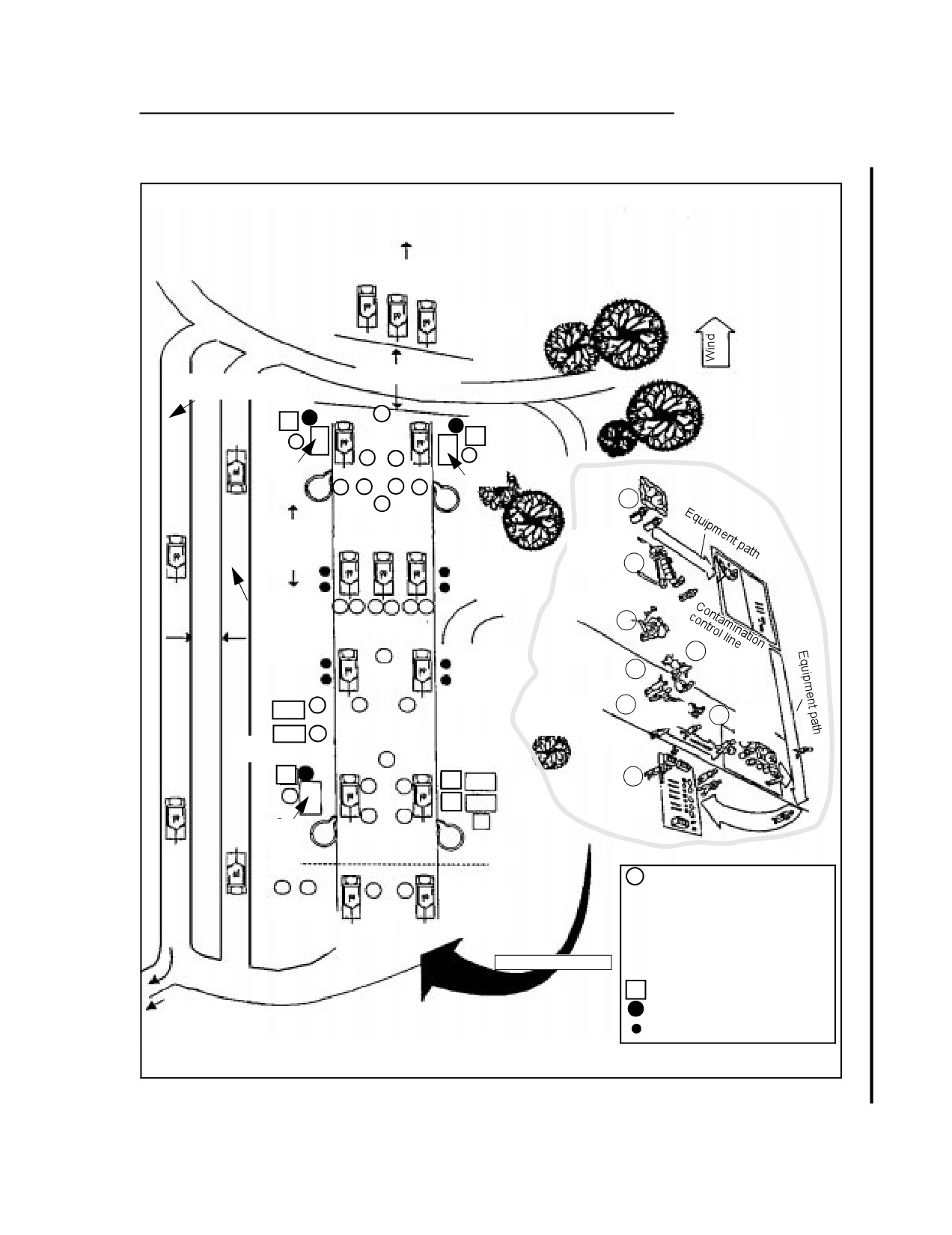
C1, FM 3-5/MCWP 3-37.3
To linkup point
Predecon
actions
328 to 547 yards
Noncontaminated
vehicle route
65
Station 1 -
SL
65
primary
D
D A
Wash
M12A1
D
PDDA
D
A
M12A1
Individual-
PDDA
gear
decon
1
A A
A A
SL
328 to
547 yards
Overboot
D A D A D A
between
and hood
Station 2 -
decon
stations
2
DS2
application
Return route
Overgarment
removal
100 feet
A A A A A A
3
between
Liquid-
routes
contamination
4
Station 3 -
control line
Overboot
NCO
contact time/
5
and glove
interior
Monitor
removal
decon
Vapor-
6
Mask
TPU
Mask
D
contamination
removal
7
A
A
decon
TPU
control line
point
Water
Station 4 -
D
resupply
rinse
SL
65
65
8
TPU
Reissue
A
D
65
TPU
point
D
M12A1
A D
PDDA
Hot line
Legend
Soldiers:
SL = Squad leader chemical
Station 5 -
platoon
PL
PSG
NCO NCO
check
NCO = Decon NCO chemical
CAM CAM
platoon
PL = Platoon leader
PSG = Platoon sergeant
D = Decon platoon member
Clean personnel
A = Augmenter
TPU = Tank and pump unit
65
= 65-GPM pump
= 3,000-gallon tank
To tactical
AA
= Trash can
Figure 4-5. Optimum DED Layout for the M12A1 PDDA-Equipped Unit
Thorough Decon 4-25
///////////////////////////////////////