FM 3-04.513 Aircraft Recovery Operations (July 2008) - page 2
Appendix A
A-11. The general sequence of events are as follows:
•
The battle captain immediately notifies the maneuver unit owning the operational environment.
The captain may also divert aviation brigade units already in the vicinity.
•
Tactical operations requests Air Force X-CAS (airborne) and/or G-CAS (ground alert).
•
The battle captain ensures the medical evacuation (MEDEVAC) unit covering the AO is notified
of the event and passes 9-line reports as necessary.
•
The battle captain calls necessary planners to brigade HQs (table A-2).
Table A-2. Necessary planners
PR
DART
Attack (security)
Attack (security)
Assault (lift)
Assault (lift)
General support aviation
GSAB (CH)**
battalion (GSAB) (A2C2S)*
Security element
ASB commander
ASC/AST commander
Affected unit AMC/AMT
commander
Security element
*A2C2S-Army airborne command and control system
**CH-cargo helicopter
•
The brigade S-2 assesses the enemy situation in the area.
•
The S-2 develops the “enemy most likely” and “most dangerous” courses of action.
•
The S-2 gathers available isolated personnel report data for handover to recovery forces.
•
The air defense and airspace management (ADAM) immediately requests appropriate airspace
control measures.
•
The ADAM cell coordinates and deconflicts UAS coverage of scene.
•
The brigade fire support cell requests no-fire areas to facilitate the recovery.
•
The brigade communications-electronics staff officer initiates nonsecure internet protocol router
blackout as necessary.
•
The automatic surface observing system element provides pertinent weather data affecting the
recovery.
•
The subordinate units possessing the capability to contribute to a recovery effort receive
notification, an intelligence assessment, mission, and launch time.
A-12. This phase ends when aircrew recovery elements launch.
PHASE III-PERSONNEL RECOVERY
A-13. This phase begins at launch and ends when the recovery mission is completed or terminated. If the
PR operation is a result of a downed aircraft, this phase will end when the secured scene is turned over to
DART elements.
A-14. Key tasks for this phase are:
• Maintaining communications with the aviation brigade headquarters and OSC during the en
route portion thorough battle handover to, or integration of, the recovery element by the OSC.
• Accurate reporting as the situation continues to develop.
A-4
FM 3-04.513
21 July 2008
Aviation Brigade Aircraft Recovery Procedures
A-15. The general sequence of events during this phase are:
• Launch of security element.
• Launch of recovery element.
• Link up of security element with OSC.
• Clearance into the LZ.
A-16. Preference for recovery is (brevity code PACE):
• Primary-ground force recovery.
• Alternate-aviation brigade PR mission.
• Contingency-wingman recovery.
• Emergency-echelons above division PR mission.
A-17. The security element will secure the air route and the airspace surrounding the proposed recovery
site. Launch of the recovery aircraft will be timed to balance the time available for the security element to
secure the site, maximize surprise, and minimize station time for lift elements. The security element will
link up with the OSC via secure communications when possible. The decision to transfer overall
responsibility of the scene will be based on rank, available station time, and the ability to control the battle.
The security element will also identify potential LZs for recovery, and verify/recommend ingress and
egress routes to those LZs. Once all elements are reasonably synchronized, the OSC will clear lift assets to
enter an LZ and conduct recovery. This phase ends when aircrew members are recovered and secure within
friendly territory.
PHASE IV-DOWNED AIRCRAFT RECOVERY
A-18. Although DART activities have been ongoing to this point, the main effort will transition to DART
only after aircrews are recovered and the site is permissive enough for the DART. This phase ends when
the downed aircraft is delivered to a secure location. Key tasks during this phase include: site security;
accurate situation reports to higher headquarters; site investigation; assessment of maintenance problems
and solutions; gathering parts and tools required; movement to location; and physical recovery of aircraft.
A-19. The controlling aviation task force battalion commander will generally receive delegated command
and control from the aviation brigade command post for the DART effort until it is deemed impossible for
that battalion to recover the aircraft within their means. Assault/GSAB battalions provide the recovery unit
transportation of DART personnel and equipment.
A-20. If the controlling aviation battalion commander cannot affect a recovery with organic assets, C2
returns to the brigade and main effort shifts to the ASC/AST commander.
A-21. There are three options for aircraft recovery:
• Self-recovery.
• Dedicated recovery-air.
• Dedicated recovery-ground.
A-22. Aircraft destruction or abandonment is the last resort for the aircraft. Abandoned aircraft must be
sanitized or destroyed by any available means to prevent enemy exploitation of the asset and its
components.
A-23. The DART effort will minimally consist of a security element, a recovery team, a transportation
means, and a C2 element. The exact makeup of the DART effort and the method used to recover the
aircraft will be based on analysis of:
• Enemy situation.
• Security of the site.
• Current aircraft condition.
21 July 2008
FM 3-04.513
A-5
Appendix A
• Analysis of information from the aircrew on scene.
• Accessibility by ground recovery assets.
• Accessibility by air recovery assets.
• Availability of parts and tools for repair.
• Type of ground recovery equipment available.
A-24. If an air recovery is to take place, all recovery equipment will likely come from the aviation brigade.
Depending on the enemy situation, multiple trips to the site may be required to align problem, people,
parts, plan, time, tools, and technical assistance (P4T3). If a ground recovery is preferable, recovery
equipment will come from the closest unit with the appropriate transportation assets. The special tools and
Soldiers needed come from the aviation brigade and will generally move via air to the supporting ground
transportation unit or aircraft scene as required.
A-25. Minimum required equipment for ground recovery is a crane, or pair of cranes, capable of lifting
30,000 pounds; a trailer to transport the cranes; a 40-foot trailer capable of carrying 25,000 pounds; and
armored convoy security vehicles equipped with current countermeasures commensurate with the threat.
Disabled CH-47s, in most downed aircraft scenarios, require either repair or aerial recovery.
A-6
FM 3-04.513
21 July 2008
Appendix B
Downed Aircraft Recovery Team Standing Operating
Procedure
This appendix outlines standard operating procedures for DART operations. It is a
representative “how to” guide to standardize DART operations within Army aviation.
GENERAL
B-1. The purpose of this document is to establish standard procedures for the recovery of damaged or
disabled aircraft IAW this manual and FM 3-04.500.
B-2. PR is not aircraft recovery or a DART/BDAR mission; therefore, it is not included in this SOP.
Security elements are addressed and identified due to attempts by hostile forces to obtain friendly force
equipment for technological gain or propaganda. Security personnel may be needed to maintain security for
an unknown time until the airframe is repaired or recovered.
B-3. Battlefield aircraft recovery is an operation resulting from one or more aircraft experiencing combat,
unanticipated/accidental component damage, or failure, resulting in a forced landing in the AO. Based on
an assessment, the aircraft is destroyed or abandoned, repaired and flown out, or recovered to a
maintenance site by either aerial or ground means.
B-4. This SOP is a guide and intended for use by commanders and teams at all levels. Procedures outlined
may be modified or augmented to account for force size, aerial and ground asset availability, manpower,
time and distance considerations, and the tactical situation.
MISSION
B-5. The aviation brigade, on order and utilizing the appropriate task force combination, conducts
downed aircraft recovery in the AOR during day, night, hostile, and peace operations to repair or recover
organic or transitioning assets. The DART is primarily used for aircraft extraction to a secure area. The
DART mission may be augmented with BDAR personnel (METT-TC dependent) for the sole purpose of
BDAR procedures. See table B-1 for a typical DART timeline.
Table B-1. Sample of a downed aircraft recovery team timeline
General Scenario
Timeframe Sequence of Events:
H-4:00
DART receives mission warning order. Initiate and submit initial RFIs. DART
assembled.
H-3:30
DART receives map location, overhead images, photos of damaged aircraft, damage
report, submit secondary RFIs. Brief DART on situation report.
H-3:00
DART one-time flight/ground/air evacuation decision.
H-2:30
PCCs/PCIs completed.
H-2:30
Preparation of mission-specific equipment.
H-1:30
Final S-2 update.
H-1
DART arrives at air/ground movement location.
H-45 min
DART loaded.
H -Hour
DART departs.
21 July 2008
FM 3-04.513
B-1
Appendix B
RESPONSIBILITIES
A. Commander: Responsible for developing an aircraft recovery program. Ensures the DART program is
effectively implemented within the unit. Appoints an officer to function as the task force DART OIC.
B. S-3/Main CP: Provides or delegates command and control of recovery operations as required. Tasks
appropriate brigade assets to support all requirements for the aircraft recovery task force, including
transportation of the DART to and from the location of the downed aircraft. Receives and disseminates
information on the downed aircraft in an expeditious manner. Coordinates any required infantry, engineer,
or other nonbrigade support. Coordinates for an interpreter as needed.
C. S-2: Rapidly evaluates the enemy situation within the downed aircraft area and briefs aircrews and
DART OIC on current enemy threat prior to DART mission departure. Updates intelligence as required.
D. Headquarters Unit Commander: Responsible for assigning medical personnel to respond separately
or in conjunction with the DART, as directed by the main CP. Provides the headquarters with
communication capabilities when required. Provides a primary and alternate radio telephone operator, if
required. Ensures assigned RTOs participate in all DART rehearsals and training.
E. AMC/AMT/ASC/AST Commander: Provides DART support personnel and security team, if not
provided by outside units. Resources all necessary mission equipment. Ensures assigned personnel
participate in all DART training.
F. DART OIC: Ensures the DART is complete, comprehensive, and that all team members are trained to
standards and fully integrated. Develops and implements new and/or additional procedures for the DART.
Responsible for directing DART operations for the entire mission. Executes actions on the objective
keeping team members and higher headquarters appraised of the situation.
G. Quality Control: Provides TI support for the DART to perform assessor duties. An MP accompanies
the team when required.
H. Production Control: Aids in evaluating repairs/parts required for aircraft evacuation. Responsible for
providing the liaison between maintenance personnel and the DART OIC to coordinate all support
activities and parts requisitions. Monitors the recovery operation throughout its entirety.
I. Flight Company: Responsible for providing an MP when the maintenance company MP is unavailable.
Provides an accurate accounting of aircrews onboard and completes table B-2. Provides security for the
aircraft until DART arrival and ensures information required in table B-2 is relayed to the S-2/S-3.
Table B-2. Sample of a downed aircraft recovery report
Line 1- Location and type of aircraft
Line 2- Injuries requiring immediate attention
Line 3- Reason aircraft went down
Line 4- Tail number
Line 5- Date time group (DTG) aircraft went down
Line 6- Sierra (secured) or November (not secured)
Line 7- Call sign of downed aircraft
Line 8- Personnel:
A- Onboard
B- Wounded in
C- Killed in Action
D- Missing in
Action
Action
Line 9- Aircraft:
A- Communications
B- Accessibility by
C- Damage assessment
security (COMSEC)
vehicle/by air (closest
recoverable/not
status destroyed/
LZ)
recoverable/fire
recovered/zeroized
Line 10- Threat situation at site
Line 11- Call sign of sender
B-2
FM 3-04.513
21 July 2008
Downed Aircraft Recovery Team Standing Operating Procedure
PERSONNEL REQUIREMENTS
A. The DART is comprised of AMC/AMT/ASC/AST personnel depending on METT-TC. The team
successfully extracts an aircraft from a downed location to a safe location using the UMARK, a trained
recovery team and recovery assets. Augmentation of the DART mission with trained repair personnel can
recover downed aircraft using standard repair or BDAR measures. The team must contain personnel skilled
in BDAR and UMARK use.
B. Team composition is modified for each mission depending on the situation and tactical considerations.
The protection warfighting function is of the highest importance when determining team configuration.
MEMBER RESPONSIBILITIES AND DUTIES
A. DART OIC: Establishes criteria for selecting and training DART members and ensures necessary
mission essential-equipment is serviceable and on-hand. OIC responsibilities include coordinating DART
deployments, receiving briefings from higher headquarters, and briefing team members prior to
deployment. The DART OIC must plan for all possible contingencies and be proficient in integrating aerial
and ground assets. Significant resources including Soldiers, aircraft, vehicles, and sensitive items enable
orchestration of successful DART missions. DART OICs should be capable of integrating these assets
from different organizations.
B. Maintenance officer (MO) or MP: Orchestrates maintenance and troubleshooting requirements during
aircraft recovery. The MO’s presence may be required when determining if a one-time flight is required
and/or authorized. The MO/MP should be placed on downgrade RED X orders to facilitate aircraft
recovery. The MO/MP may perform primary duties as the DART OIC.
C. DART NCOIC: Trains, and prepares the team for mission execution. He conducts precombat checks
(PCCs) and precombat inspections (PCIs), directs repair and rigging operations, and provides personnel
oversight during all phases of the DART. The NCOIC also directs local security at the recovery site based
on instructions received from the DART OIC. Performs DART OIC duties when responsible for the
mission.
D. Aircraft TI: Responsible for ensuring safe and correct maintenance operations. The TI also makes
assessments and recommendations to the chain of command and pilot-in-command on one-time flight
authorization. Responsible for all mission forms and records.
E. Aircraft mechanic/specialty MOS repairer: Performs the majority of repairs encountered during
typical DART missions. Certain aircraft damage or malfunctions may require the services of a specialty
MOS (sheet metal, power train, pneudraulics, engine, etc). These and other specialty MOSs will participate
as needed based on the type of aircraft malfunction.
F. Armament specialist: Responsible for clearing the downed aircraft, when required. Additionally, the
specialist can affect the majority of armament and electrical repairs required to recover an aircraft. The
armament specialist can also provide additional security when completed with this task.
G. Radio operator: Responsible for establishing and maintaining communications with the controlling CP
throughout mission duration. He is the link between the DART OIC and the main CP. The radio operator is
cross-trained on UMARK use and may be utilized to facilitate recovery. He can also provide additional
security between tasks.
H. Security element: Provides security to the aircrew, DART, and aircraft to include the transporting
aircraft if applicable. The security element is under the direction of the DART OIC.
21 July 2008
FM 3-04.513
B-3
Appendix B
TEAM EQUIPMENT- PROTECTION WARFIGHTING FUNCTION
A. Maintenance/security team will carry their assigned weapon with full combat load of ammunition and
gear to sustain them for 48 hours.
B. Medical personnel will carry a medic bag, folding stretcher, and full combat gear.
C. Supporting aircrews will carry combat gear and wear appropriate flight gear.
D. Appropriate crew-served weapons will accompany the DART to combat the possible threat.
E. All members will carry night vision goggles (NVG) (one set per team member) and spare batteries.
F. Critical equipment includes communications radio with current secure fill, global positioning system
(GPS), maps of objective area and routes, and spare batteries for all required systems.
G. The DART OIC will employ the battalion tactical SOP and current battalion communications card.
TEAM EQUIPMENT-MAINTENANCE SUPPORT
A. Required TMs, forms, and records.
B. Technical inspector kit.
C. Mechanics tool box and special tools as required.
D. Hardened computers for forms and records data processing.
E. Portable lighting.
F. UMARK.
G. Aircraft headset for team leader.
H. BDAR kits.
I. Special tools, test equipment, and power units required for recovery.
J. Powered saw with extra blades, gasoline, and oil for component reduction.
K. Tow bar and tow vehicle with all vehicle basic issue items (BIIs).
SPECIAL CONSIDERATIONS
A. Protection warfighting function: All personnel selected for downed aircraft recovery will consider the
protection warfighting function as the first priority. Commanders will resource team members with any
unique requirements (such as, shorter automatic rifle barrels/buttstocks and carbines) to facilitate efficient
team member movement within vehicles and aircraft. Personnel not required to perform repair tasks are
placed on the perimeter and assigned fields of fire. The NCOIC adjusts the perimeter defense and modifies
fields of fire as personnel are moved on and off the perimeter.
B. Additional personnel augmentation: Additional forces may be required to augment the DART
depending on the situation. This augmentation force may not be organic to the company, battalion, or
brigade. A security element may be provided to reinforce the DART. This may require the DART OIC to
be of sufficient rank and experience to not only lead the DART, but the augmentation forces as well.
C. Mortuary personnel: If a downed aircraft is known or suspected to have human remains onboard,
mortuary affairs will be notified and taken to the site with the DART if available. Team members will
receive adequate mortuary affairs training prior to assuming duties on the DART.
B-4
FM 3-04.513
21 July 2008
Downed Aircraft Recovery Team Standing Operating Procedure
D. Recovery versus salvage:
1. A dedicated recovery mission is defined as the aerial recovery of a downed aircraft or the use of
the UMARK to lift a downed aircraft onto a trailer. Generally, when the DART launches, it will
consist of a rigging team, security element, and transportation assets.
2. A salvage mission typically refers to an aircraft which is beyond economical repair, broken into
many pieces, or burned beyond recognition. This type of operation will require additional specialized
equipment not typically utilized in an aerial recovery. Transporting rough terrain forklifts, light
materiel handling equipment, all-terrain utility vehicles, flat racks, and military demountable
containers to the recovery site significantly expedites this type of recovery.
PROCEDURES
A. Premission planning:
1. S-3/Main CP: Uses the recovery report (table B-2, page B-2) to record all pertinent information
upon notification of a downed aircraft. Notifies the chain of command, PRO, ASB, DART OIC,
production control, and all supporting recovery and security elements.
2. S-2: Evaluates the current enemy situation to determine threat levels at the sight/area of the downed
aircraft. Prepares imagery and intelligence to brief aircrews and the DART upon arrival.
B. Aircrew of the downed aircraft: Performs the following actions based on the threat brief or actual
threat situation.
1. Little/no possibility of capture by enemy:
a. Remove aircraft key.
b. Remove data transfer cartridge (DTC).
c. Lock aircraft.
2. Possibility of capture:
a. Perform above actions.
b. Destroy flight pack.
c. Zeroize aircraft.
d. Remove videotape.
e. Sterilize maps.
3. Imminent capture:
a. Perform above actions.
b. Master zeroize.
c. Destroy DTC.
d. Disable aircraft per air mission brief with the following priority:
(1) Identification, friend or foe/classified electronic equipment.
(2) Armament.
(3) Engine assembly.
(4) Airframe.
(5) Nonsecure radios.
(6) Hydraulic systems.
21 July 2008
FM 3-04.513
B-5
Appendix B
Note. The tactical situation dictates if the recovery will be handled via BDAR. BDAR can result
in high risk. Usually, aviation brigade commanders must approve a high risk mission. Aircrew
members without injuries will not be evacuated from the site until initial aircraft assessment is
complete.
4. DART Members: On notification, assemble at a prebriefed location with all equipment ready for
loading onto the designated aircraft/vehicle for departure. The DART OIC will complete the actions
IAW the DART pre-execution checklist (table B-3) and brief the team.
Table B-3. Example of a pre-execution checklist
DART/BDAR PRE-EXECUTION CHECKLIST
(To be completed by DART/BDAR NCOIC)
YES
NO
N/A
Personnel:
All present
Fighter management/risk management
Manifest completed
Personal Equipment:
Identification (ID) tags and ID cards
License for all equipment to be operated
Proper uniform for mission with overnight bag
Required TA-50 for mission on hand
Individual body armor, advanced combat helmet, and ear plugs
Canteen/camel-back full
Flashlight (extra batteries)and chemical lights
Rules of engagement card, MEDEVAC communications card
Blood chit
Weapon functional checks completed
Sensitive Items and COMSEC:
Weapon serial numbers confirmed
Basic ammunition load
Pyrotechnics, grenades and explosives
COMSEC
Special instructions briefed
Personnel recovery information on file and reviewed
NVG with spare batteries
Intelligence:
Mission briefed (S-2)
All personnel have maps, grids, and protractors
All personnel know sign and counter sign
All personnel know current threat situation
CBRN Equipment:
MOPP suit
Protective mask with inserts
B-6
FM 3-04.513
21 July 2008
Downed Aircraft Recovery Team Standing Operating Procedure
Table B-3. Example of a pre-execution checklist
DART/BDAR PRE-EXECUTION CHECKLIST
(To be completed by DART/BDAR NCOIC)
YES
NO
N/A
M256, M258 kits, and M9 paper
Communications:
All personnel have frequencies/net IDs, communications card
Manpack radio keyed with extra batteries
All personnel have assigned call signs
All COMSEC loaded if required
All antennas up or tied per mission required
Vehicle and Equipment:
Vehicle properly dispatched
Load plans in logbook
Basic Issue Item serviceable and loaded
PMCS completed IAW applicable TMs
Fuel topped off and fuel cans full, vehicle packaged POL on-hand
Water cans full and loaded
Camouflage netting serviceable and loaded
Air lines and safety chains properly connected to trailer
Weapons and mounts on and operational
Miscellaneous:
Meals-ready to eat
Additional ammunition issued if required
Required tools on hand and inventoried
Special tools on hand
All keys on hand
All required safety briefs completed
All required TMs, FMs, and pubs (on laptop)
Generator with light set (when required)
Medical bags
GPS (with spare batteries), map with compass/protractor
Parts/petroleum, oils, and lubricants needed for suspected problem
Long range comms (Cell, Satellite, Beyond line of sight)
Environmental protection items (rain, heat, sun, snow protection)
Mine markers
Powered saw with spare blades, oil, and gas
Individual survival kits (as required)
Comments:
21 July 2008
FM 3-04.513
B-7
Appendix B
5. Production Control: Coordinates for any special tools, parts, or procedures required to affect
recovery.
6. Brigade Staff: Assembles all potential participating unit representatives to establish a tentative
plan. Begins resource allocation to the DART OIC.
7. Ground Vehicle Recovery: Required when the situation does not support DART insertion or
extraction by helicopter, or weather conditions prohibit aircraft operations. The DART OIC will
follow all procedures required for movement of the convoy. Special attention is placed on route
selection and reaction to civilians and hostile forces during movement.
8. Recovery by Aerial Assets: Conducted when time is critical, threat conditions place the convoy in
danger, or ground movement is not possible due to road conditions.
9. DART OIC: Conducts a precombat inspection (PCI) and team briefing prior to departure. At a
minimum, the DART PCI checklist (table A-4, page A-7) will be followed.
10. Aircraft Inspection: Depending on enemy situation, debriefs and inspections must be
accomplished in as much detail as possible to determine the extent of damage to the downed aircraft.
The appropriate BDAR manual and BDAR/DART crash site checklist are used. If the DART OIC
determines the aircraft is recoverable, the OIC directs personnel to accomplish the appropriate repairs
and recover the aircraft. The OIC may employ BDAR techniques if more extensive repairs are
required and the enemy situation permits. The DART OIC will direct ground or aerial recovery with
focused support from the main CP, if the downed aircraft is too badly damaged to permit onsite repair.
11. Special Notes:
a. Upon arrival at the downed aircraft site, immediately establish security.
b. Remain vigilant for antipersonnel mines and pyrotechnics at the downed aircraft site. If
explosives or mines are identified, place a mine marker (nonferrous) in close proximity to the
object and alert the team to keep a safe distance. Notify or employ (if assigned) EOD.
COMMUNICATIONS AND CONTROL
A. The initial report of a downed aircraft occurs on the secure command net.
B. Notification of downed aircraft to internal offices is accomplished on secure internal phone lines or by
runner.
C. En route communications are conducted on a predetermined secure frequency separate from the
command net as briefed by the S-3.
D. A man-pack radio, satellite communication, or any other long-range system provides communications
between the team, support aircraft on the objective, and the CP.
E. Division assets will be briefed on frequencies and reporting procedures, as required.
F. A direct line to higher headquarters is established during the initial recovery process. This ensures
positive communication in the event the enemy situation changes and immediate permission to destroy the
downed aircraft is needed.
RECOVERY PROCESS
A. Security Team: When arriving at the downed aircraft, the security team immediately positions
themselves 50 meters out to the 10, 2, 4, and 8 o’clock positions in relation to the nose of the downed
aircraft.
B. DART OIC: Ensures all weapon systems on the airframe are safed by armament personnel.
B-8
FM 3-04.513
21 July 2008
Downed Aircraft Recovery Team Standing Operating Procedure
C. Medic/Combat Lifesaver (CLS): If the aircrew has not been evacuated, the medic/CLS—
1. Checks the condition of the crew.
2. Provides medical assistance.
3. Reports findings to the DART OIC.
D. Evacuate injured crewmembers (if required).
E. DART MP/TI and Airframe Specific Crew Chief: Immediately evaluates the condition of the aircraft
to determine air worthiness.
RECOVERY CONDITIONS
A. Low/No Threat:
1. Repair of the airframe and systems shall be limited to four hours.
2. Safety WILL NOT be jeopardized to return an aircraft to service.
3. Repair of the aircraft to a ONE-TIME EVACUATION (Circle X) STATUS is acceptable and can
only be authorized by the appropriate commander or the designated representative.
4. The appropriate level commander may authorize a longer on station time not to exceed eight hours.
5. Once determined repairs will take longer than four hours, and the aircraft is reparable and flyable,
production control will coordinate with other units for any additional maintenance support.
B. High Threat:
1. First priority on the objective is to SAFELY evacuate the aircrews.
2. Repair of the airframe and systems shall be limited to 30 minutes on station time and the decision to
extend should be based on enemy situation.
3. Repair of the aircraft to a ONE TIME EVACUATION (Circle X) STATUS is acceptable, and under
HIGH THREAT conditions shall be pre-authorized by the appropriate commander or the designated
representative when the MP and TI agree the airframe is stable enough for flight.
4. Safety WILL NOT be jeopardized to return the aircraft to service.
5. Should the aircraft be deemed nonreparable, the DART OIC will contact the CP and request
disposition to destroy or abandon (temporarily or permanently) the downed aircraft.
POST PROCEDURES
A. Report status of downed aircrews and the aircraft to higher headquarters.
B. Conduct a post-DART inspection of personnel, weapons, and sensitive items.
C. Clean, inventory, store, and replenish items used from the UMARK and/or BDAR kits.
D. Debrief personnel (including Chaplain and Mental Health sessions as required) and perform after-action
review (AAR).
E. Collect recommendations for SOP changes from all sources, internal and external, for consideration on
future DART missions.
REPORTS AND CHECKLISTS
B-6. Table B-4 to table B-10 should be utilized by the DART OIC and members to ensure key planning
considerations are completed.
21 July 2008
FM 3-04.513
B-9
Appendix B
Table B-4. Example of a downed aircraft recovery team process checklist
Actions prior to notification:
Assemble all team members at the beginning of the shift
Verify assignment of aircraft and crew for DART mission, complete PMCS for all vehicles, trailers and equipment
Ensure DART members file PR information with the S-2
Conduct PCIs
Conduct a crew passenger briefing, rehearse entering and exiting aircraft, loading and unloading vehicles, and
trailering material handling equipment
Actions upon notification:
Assemble all DART members at predetermined location
Pick up downed aircrew recovery report (table B-2, page B-2)
Receive situational update from the CP and S-2
Assemble and upload equipment on DART transportation
Review DART mission brief (table B-5, page B-11) with team and brief succession of responsibilities
Review actions on contact
Ensure DART aircraft are equipped with two headsets (one for DART OIC and one for security team NCOIC)
Conduct final precombat check with personnel
Deliver DART manifest and equipment list to operations
Actions at downed aircraft site:
Conduct surveillance of site for mines and pyrotechnics
Establish communications with aircraft and CP (DART OIC or security team NCOIC)
Safe and clear aircraft (check for fire, improvised explosive devices, fuel leaks, electrical sparks)
Perform first aid if required.
Assess aircraft damage/malfunction.
Perform maintenance or rig aircraft for recovery, complete forms and records.
Ensure all sensitive items are accounted for prior to departure.
If the aircraft must be abandoned or destroyed in place, the unit DART destruction checklist (unit develops based
on MDS) is followed after receiving appropriate higher headquarters authorization.
Security Team NCOIC (if applicable)
Actions prior to notification:
Rehearse actions at downed aircraft recovery site
Rehearse C2 signals between team members
Brief succession of responsilities
Actions upon notification:
Brief security team on situation
Draw NVG
Annotate downed aircraft on map and note terrain
Actions at downed aircraft site:
Establish communications with aircraft and CP (DART OIC or security team NCOIC)
Establish perimeter
Place crew-served weapons on enemy avenues of approach
Utilize door gunners on perimeter if available
Designate fields of fire
B-10
FM 3-04.513
21 July 2008
Downed Aircraft Recovery Team Standing Operating Procedure
Table B-5. Downed aircraft recovery team mission brief
Assemble DART for briefing around sand table and map
Develop a route if deployment by ground
Team roll call
Aircraft tail number and type, location of downed aircraft (table A-7, page A-12)
Map briefing of surrounding area
Enemy situation
Hazards (mines, weather, traffic)
Friendly situation
Main CP update
Method of recovery: (vehicle/air or repair and release) (distance and obstructions if by ground)
DART mode of transportation to downed aircraft
Convoy brief and request
Aircraft tail number and parking pad takeoff time?
P4T3:
Problem: What is wrong with the aircraft?
People: Who and how many people will be going?
Parts: What is broken?
Plan: How to fix or recover?
Time: How long will it take to fix or recover?
Tools: What tools are needed? Calibrated, current, etc.
Technical Assistance: As required.
Weather forecast for next 24 to 48 hours
Communications frequencies and call signs
Recovery aircraft frequencies
Communications check prior to departure
Sensitive items check prior to departing DART site
Closure report to AMC on return
21 July 2008
FM 3-04.513
B-11
Appendix B
Table B-6. Example of a downed aircraft report
DTG:_________________________
Line 1
A/C type & tail #
Line 2
Location grid or ref point
(distance/direction from
major landmark)
Line 3
Threat level
Low
Med
High
Unknown
Secure
Line 4
Number of
Litter/Urgent
Critical
Ambulatory
Fatalities
injuries/casualties
Line 5
Person on board (include
any codes listed in the
aviation procedures
guide)
Line 6
Reason
Enemy Action
Mechanical Failure
Other
Line 7
Landing type
Precautionary
Emergency
Hard
Crash
Line 8
Fire/fuel spillage
Fire
Fuel Spill
Line 9
A/C systems affected
Airframe
Engine
Trans
Hyd
Fuel Sys
Electric
Main
Tail
Ldg Gear
Drive/Input
APU
Other
Rotor
Rotor
Shafts
Line 10
Problem
Leak
Fire
Crack
Dent
Hole
Bent
Msn Comps
Over Speed
Over Temp
Over Trq
Line 11
Accessibility & Hazards
Open
Confined (Two or less A/C)
Very Confined (One A/C)
Ordnance
Trees
Wires
Slope
Dust
Snow
Smoke
Fog
Rain
Water
Ice
Fire
Remarks:
Reported by (Name):
A/C tail #/radio frequency/phone number:
Sensitive items/ammunition on board:
Location of individual who can guide rescue party:
Rcvd By (Name):
Rank:
Battle CPT (Name):
Rank:
B-12
FM 3-04.513
21 July 2008
Appendix B
Table B-8. Example of a medical evacuation request
Line
1: Location of Landing Zone: Grid ___________________________________
Line
2: Radio Frequency/Call Sign ______________________________________
Line
3: Number of Patients by Precedence _______________________________
A-Urgent
B-Urgent Surgical
C-Priority
D-Routine
E-Convenience
Line
4: Special Equipment Required ____________________________________
A-None
B-Hoist
C-Extraction equipment
D-Ventilator
Line
5: Number of Patients by Type _____________________________________
L + # Litter
A + # Ambulatory
Line
6: Security of LZ ________________________________________________
N=No Enemy
P=Possible Enemy
E=Enemy In Area (Use Caution)
X=Enemy In Area (Escort Required)
Line
7: Method of Marking LZ _________________________________________
A=Panels
B=Pyro
C=Smoke
D=None
E=Other
Line
8: Patient Nationality ___________________________________________
A=U.S. Military
B=U.S. Civilian
C=Non U.S. Military
D=Non U.S. Civilian
Line
9: Description of Terrain or Hazard ________________________________
B-14
FM 3-04.513
21 July 2008
Downed Aircraft Recovery Team Standing Operating Procedure
Table B-9. Example of a downed aircraft recovery team quick card
Exact location of downed aircraft.
Estimated or verified condition of aircraft.
Ongoing PR mission(s) status.
Last 48 hours/next 48 hours intelligence estimate of the downed aircraft sector.
Call signs and frequencies of security on-site and anticipated time remaining on station.
Call signs and frequencies of en route security.
Call signs and frequencies of sectors that the convoy route crosses (Sheriff’s net).
S-2 provides minimum risk routes and safe areas along anticipated route for checkpoints/rally
points.
UAS support: Obtain most current imagery and task available UAS assets for overwatch.
Table B-10. Mission-specific items
NSN/Model #
NOMEN
UI
Special Remarks
4020-01-047-6815
Fiber rope, assembly, single leg
EA
For multiple sling load operations
4030-01-048-4047
Grab hook assembly
EA
For multiple sling load operations
1670-01-235-0907
Spacer, apex fitting
EA
For multiple sling load operations
5306-00-944-2659
Bolt, shear
EA
For multiple sling load operations
5315-00-234-1864
Pin, cotter
HD
For multiple sling load operations
1670-01-192-5535
Discharger, electrostatic
EA
For multiple sling load operations
5305-00-724-7222
Screw hex
EA
For multiple sling load operations
5310-01-280-6749
Nut plain
EA
For multiple sling load operations
5305-00-821-3869
Screw, cap, hexagon head
HD
For multiple sling load operations
3040-00-773-9380
Shaft shouldered
EA
For multiple sling load operations
5306-00-333-0473
Bolt, U
EA
For multiple sling load operations
5310-00-763-8911
Nut, plain, hexagon
EA
For multiple sling load operations
5310-00-167-0680
Washer lock
HD
For multiple sling load operations
4030-01-048-4044
Shackle assembly
EA
For multiple sling load operations
4240-01-513-4519
Lens, goggles, industrial
EA
Eye protection
4240-01-301-3200
Respirator, air filtering
EA
For HAZMAT/Biohazard removal
8415-01-445-6568
Coverall disposable
PR
For HAZMAT/Biohazard removal
4240-01-504-7863
Goggles, industrial
PR
For HAZMAT/Biohazard removal
Multipack boxes to categorize
8115-01-444-0206
Pallet base, shipping box
EA
parts, components & equipment
Multipack boxes to categorize
8115-01-444-0212
Sleeve, box
EA
parts, components & equipment
21 July 2008
FM 3-04.513
B-15

Appendix C
Battle Damage Assessment and Repair Tools, Equipment,
and Kits
Due to the variety of BDAR component requirements on different airframes, this
appendix provides a generic list of special tools and expendables contained in most
kits (tables C-1 and C-2). Refer to the appropriate BDAR TM for a complete listing
of repair parts, special tools, and expendable supplies and materials.
Table C-1. Special or fabricated tools
Repair Kit (Nomenclature)
Cage Number Part
National Stock
Number
Number
Composite Structures Repair Kit
Repair Kit, connector
(03950)/11-12-13QA
5845-01-014-3534
(Special tools for electrical connector repair)
Emergency Repair Kit
(11851)/DMC895
4920-01-266-7534
(Special and common tools for electrical repair, including
repair parts)
Repair Kit, fluid line (Special and common tools for
(78286)
4920-01-266-7534
tubing and hose)
Repair Kit, fuel cell
(73842)/2F1-3-
1560-00-020-8856
20031GP3
Repair Kit, rotor blade
(29183)/K747-40-1
4920-01-035-0324
Parts Kit, rotor blade
(84955)/K747-202-
1615-01-089-0437
119
Repair Kit, A/C skin
(76381)/8999K5
4920-01-549-1320
Repair Kit, test equipment
(78286)/
4920-01-266-7536
(Electrical test equipment)
70700-0638-041
Repair Kit, wire
(06090)/MK-0015-1
5935-01-254-1688
(Special tools used for electrical wiring repair, Including
repair parts)
Repair Kit, aircraft, maintenance
(76381)/8999K6
4920-01-549-1321
Table C-2. Expendable supplies and materials list
Item Description (Nomenclature)
Cage Number/Part
National Stock
Number
Number
Acetone, technical
(81346)/ASTM D329
6810-00-184-4796
Cleaning compound, solvent
(81349)/MIL-PRF-680
6850-01-472-2717
Cleaning solvent, general
(81755)/DS-108
7930-01-367-0996
Cloth, abrasive
(80204)/ANSI B74.18, 80
5350-00-192-5047
Grit
Cloth, abrasive
(80204)/ANSI B74.18, 100
5350-00-161-9066
21 July 2008
FM 3-04.513
C-1
Appendix C
Table C-2. Expendable supplies and materials list
Item Description (Nomenclature)
Cage Number/Part
National Stock
Number
Number
Grit
Cloth, abrasive
(80204)/ANSI B74.18, 150
5350-00-192-5050
Grit
Cloth, abrasive
(80204)/ANSI B74.18, 220
5350-01-352-6214
Grit
Cloth, abrasive
(80204)/ANSI B74.18, 240
5350-00-161-9715
Grit
Cloth, abrasive
(80204)/ANSI B74.18, 280
5350-00-229-3081
Grit
Cloth, abrasive
(80204)/ANSI B74.18, 320
5350-00-246-0330
Grit
Cloth, abrasive
(80204)/ANSI B74.18, 400
5350-00-174-0986
Grit
Cloth, abrasive
(80204)/ANSI 74.18,
5350-00-271-5950
Assorted
Cloth, cheesecloth
(81348)/CCC-C-440
8305-00-237-3015
Cloth, cleaning
(83582)/8938
7920-01-180-0556
Cloth, satin
(81349)/MILC9084, Class
5305-00-082-6135
2
Fiberglass repair kit
(78286)/S1607-7021
1560-00-856-9222
Hydraulic fluid, fire resistant
(81349)/MIL-PRF-83282
9150-00-149-7432
Hydraulic fluid, petroleum base
(77988)/AVREX904
9150-00-935-9808
Hydraulic fluid, petroleum base
(07950)/ROYCO 756 (gal)
9150-00-223-4134
(07950)/ROYCO 756 (qt)
9150-00-252-6383
Insulation sleeving
(26055)/728-057-001
5970-00-063-1500
Insulation sleeving
(18876)/8034661-3
5970-00-881-8200
Isopropyl, alcohol, technical
(81348)/TT-I-735
6810-01-220-9907
Leak detecting fluid
(24855)/HECK/CHECK,
6850-00-935-4068
Type III
Pad, scouring
(27293)/86
7920-00-934-3469
Paper, abrasive
(80204)/ANSI B74.18, 120
5350-00-721-8115
Grit
Paper, abrasive
(80204)/ANSI B74.18, 150
5350-00-721-8116
Grit
Paper, abrasive
(80204)/ANSI B74.18, 220
5350-00-224-7209
Grit
Paper, abrasive
(80204)/ANSI B74.18, 120
5350-00-221-0882
Grit
Paper, abrasive
(80204)/ANSI B74.18, 150
5350-00-186-8821
Grit
Paper, abrasive
(08204) ANSI B74.18, 220
5350-00-186-8819
Grit
Paper, abrasive
(08204) ANSI B74.18, 360
5350-00-224-7202
Grit
Sealing compound
(81349)/MIL-S-8516
8030-00-174-2579
Sealing compound
(77247)/3D
8030-00-656-1426
C-2
FM 3-04.513
21 July 2008
Battle Damage Assessment and Repair Tools, Equipment, and Kits
Table C-2. Expendable supplies and materials list
Item Description (Nomenclature)
Cage Number/Part
National Stock
Number
Number
Tape, pressure sensitive adhesive
(52170)/232, 1 ½ in.
7510-00-266-6709
Tape, pressure sensitive adhesive
(52170)/232, 2 in.
7510-00-266-6710
Tape, pressure sensitive adhesive
(52170)/232, 3 in.
7510-00-266-6707
Tape, pressure sensitive adhesive
(19203)/8783476
7510-00-266-6712
Towel, machinery wiping
(81348)/DDD-T-541
7920-00-260-1279
21 July 2008
FM 3-04.513
C-3
Appendix D
After-Action Review
D-1. AARs must follow each recovery mission. They validate effective practices and reveal problems
encountered during the mission. AARs generate observations, insights, and lessons to improve future
recovery operations.
D-2. The AAR should contain the following information—
• Recovery unit, phone number, and e-mail address.
• Date.
• Type of aircraft recovered.
• Type of recovery equipment used.
• Condition of recovered aircraft.
• Conditions at recovery site (if combat conditions, so state).
• Recovery team composition (by number and MOS).
• Method of recovery.
• Narrative of recovery (time required, failures, and shortcomings noted in equipment, remarks,
recommendations).
D-3. The S-3 is the approval authority for the release of all AARs.
D-4. Send completed AARs to the Lessons Learned Integration (L2I) division at Commander, United
States Army Aviation Center of Excellence, ATTN: ATZQ-TD L2I, Fort Rucker, AL 36362-5000, or e-
mail: rucker.avtactics@conus.army.mil.
21 July 2008
FM 3-04.513
D-1
Appendix E
Hand and Arm Signals
This appendix implements portions of Standardization Agreements 2999 and 3117.
See FM 3-04.104 for weapons arming hand signals.
HAND AND ARM SIGNALS
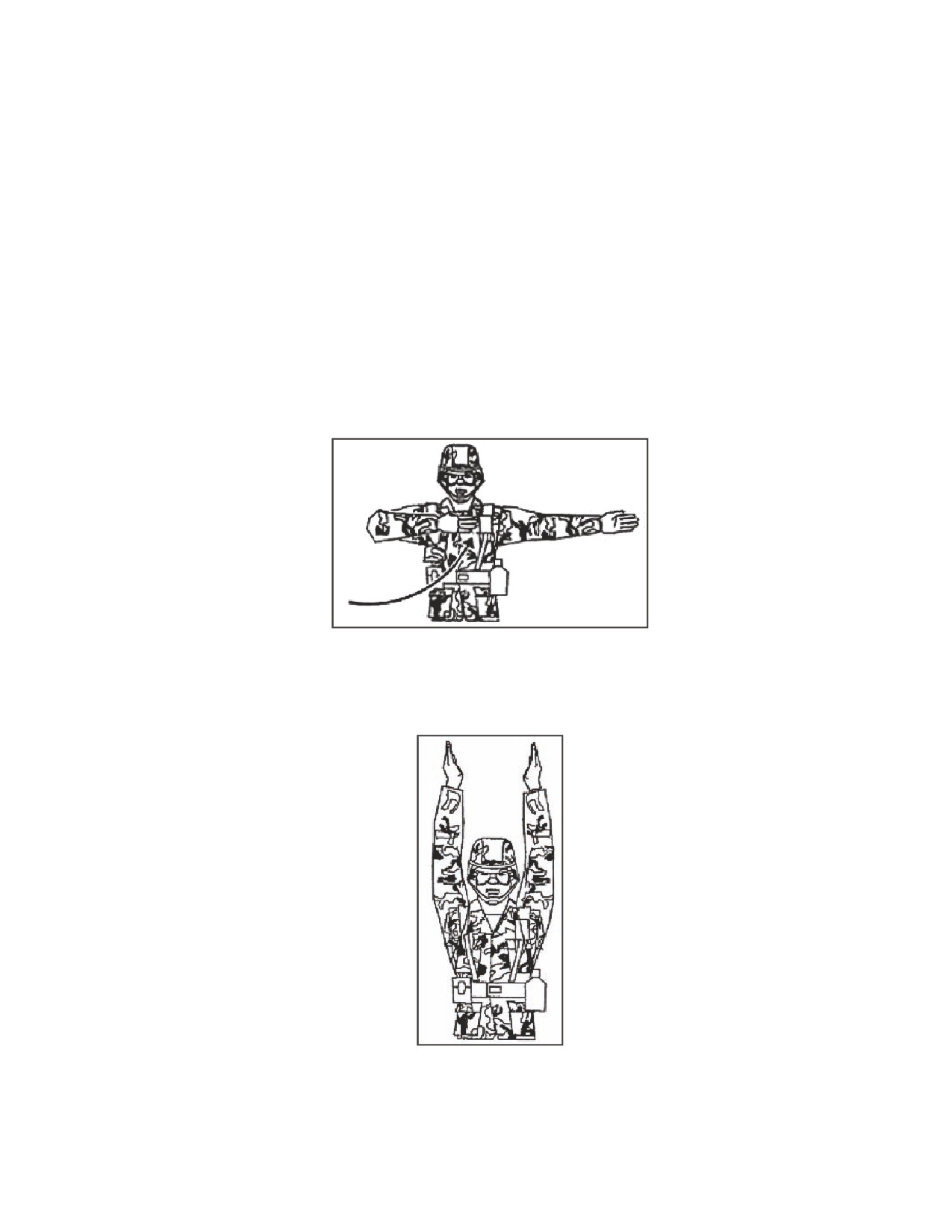
PROCEED TO NEXT GROUND GUIDE
E-1. Both arms extended on same side of shoulder level to indicate direction of next ground guide (figure
E-1).
Figure E-1. Proceed to next ground guide
THIS WAY
E-2. Arms above head in vertical position with palms facing inward (figure E-2).
Figure E-2. This way
21 July 2008
FM 3-04.513
E-1
Appendix E
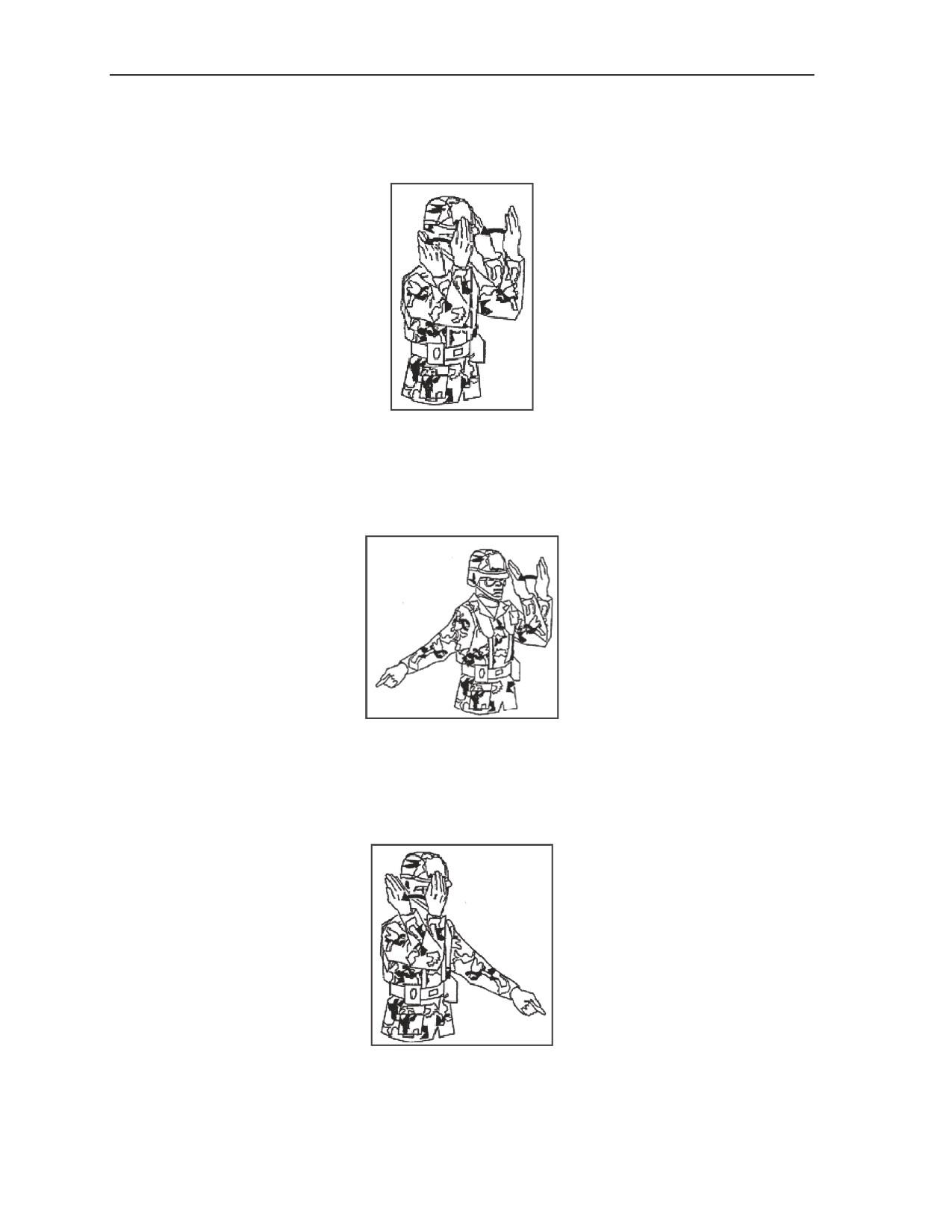
MOVE AHEAD
E-3. Arms a little apart with palms facing backward and repeatedly moved upward and backward from
shoulder height. Indicate the aircraft speed desired by rapidity of arm motions (figure E-3).
Figure E-3. Move ahead
TURN TO LEFT (PORT)
E-4. Position right arm down, and point to left wheel or skid; move left arm repeatedly upward and
backward. Indicate rate of turn by rapidity of arm motions (figure E-4).
Figure E-4. Turn to left (port)
TURN TO RIGHT (STARBOARD)
E-5. Position left arm down and point to right wheel or skid; move right arm repeatedly upward and
backward. Indicate rate of turn by rapidity of arm motions (figure E-5).
Figure E-5. Turn to right (starboard)
E-2
FM 3-04.513
21 July 2008
Hand and Arm Signals
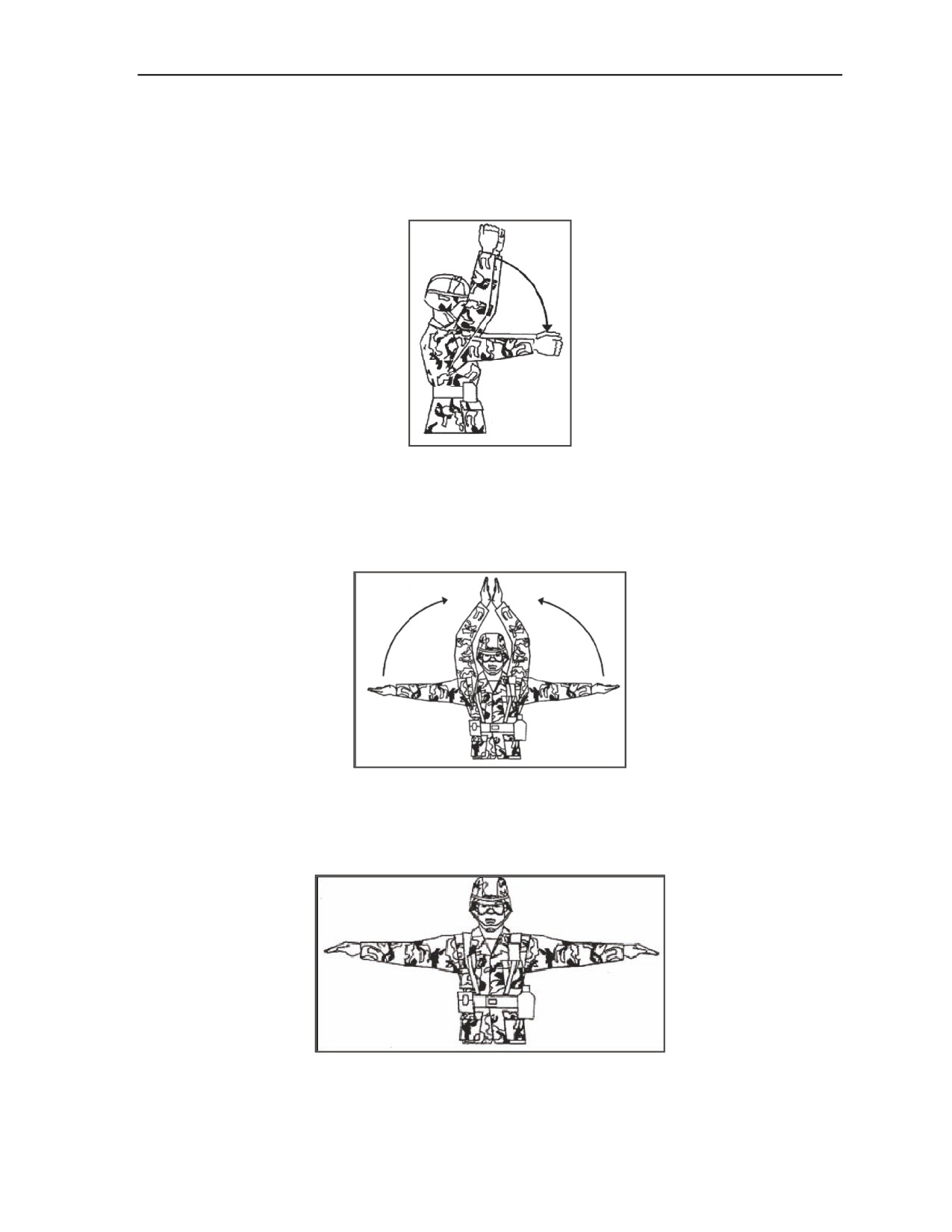
LANDING DIRECTIONS
E-6. Ground guide stands with arms raised vertically above head and facing toward the point where the
aircraft is to land. The arms are lowered repeatedly from a vertical to a horizontal position, stopping finally
in the horizontal position (figure E-6).
Figure E-6. Landing directions
MOVE UPWARD
E-7. Extend arms horizontally to the side, beckoning upward with palms turned up. Indicate rate of ascent
by speed of movement (figure E-7).
Figure E-7. Move upward
HOVER
E-8. Extend arms horizontally sideways with palms turned down (figure E-8).
Figure E-8. Hover
21 July 2008
FM 3-04.513
E-3
Appendix E
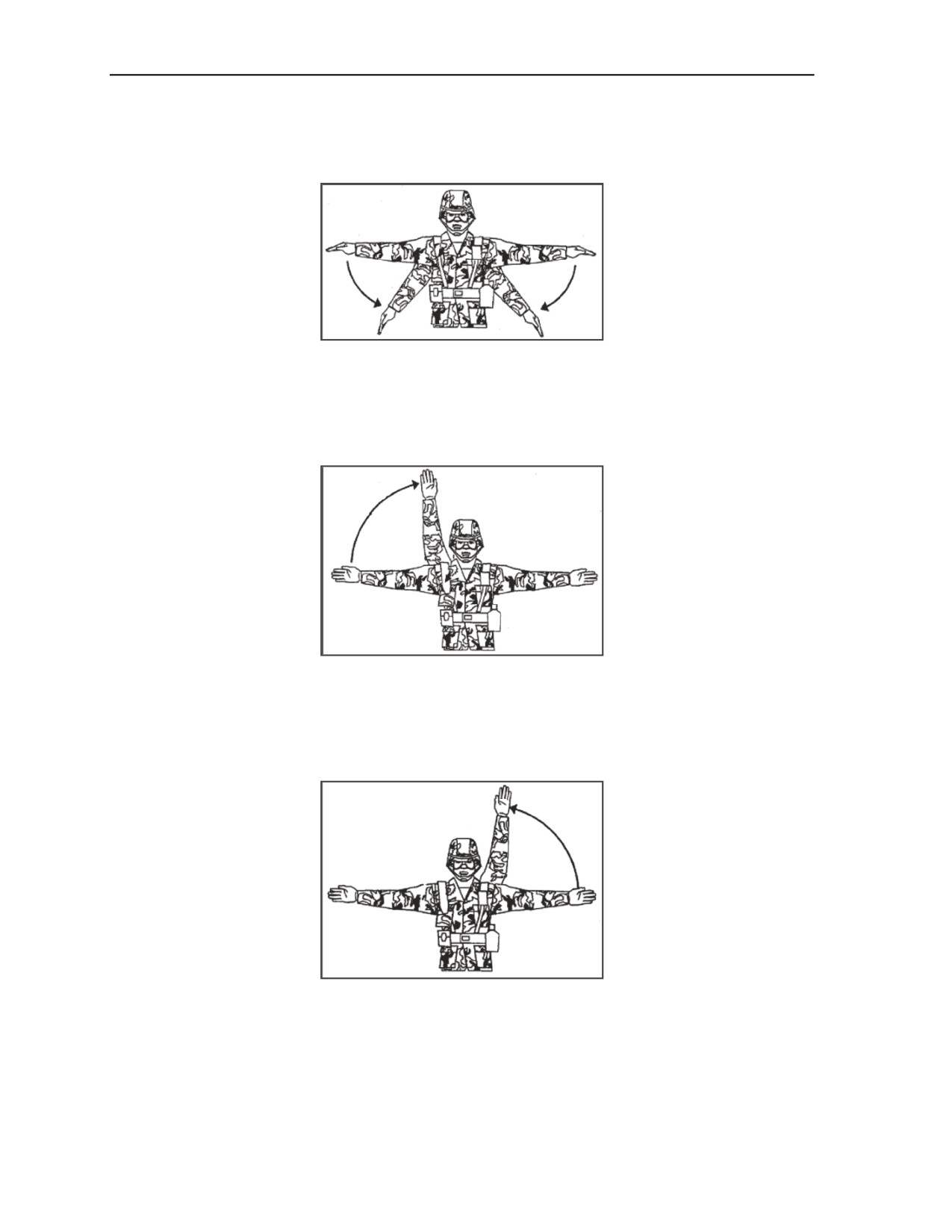
MOVE DOWNWARD
E-9. Extend arms horizontally to the side, beckoning downward with palms turned down. Indicate rate of
descent by rapidity of arm motions (figure E-9).
Figure E-9. Move downward
MOVE TO RIGHT
E-10. Left arm extended horizontally sideways in direction of movement and right arm swung over the
head in same direction in a repeating movement (figure E-10).
Figure E-10. Move to right
MOVE TO LEFT
E-11. Right arm extended horizontally sideways in direction of movement and left arm swung over the
head in same direction in a repeating movement (figure E-11).
Figure E-11. Move to left
E-4
FM 3-04.513
21 July 2008
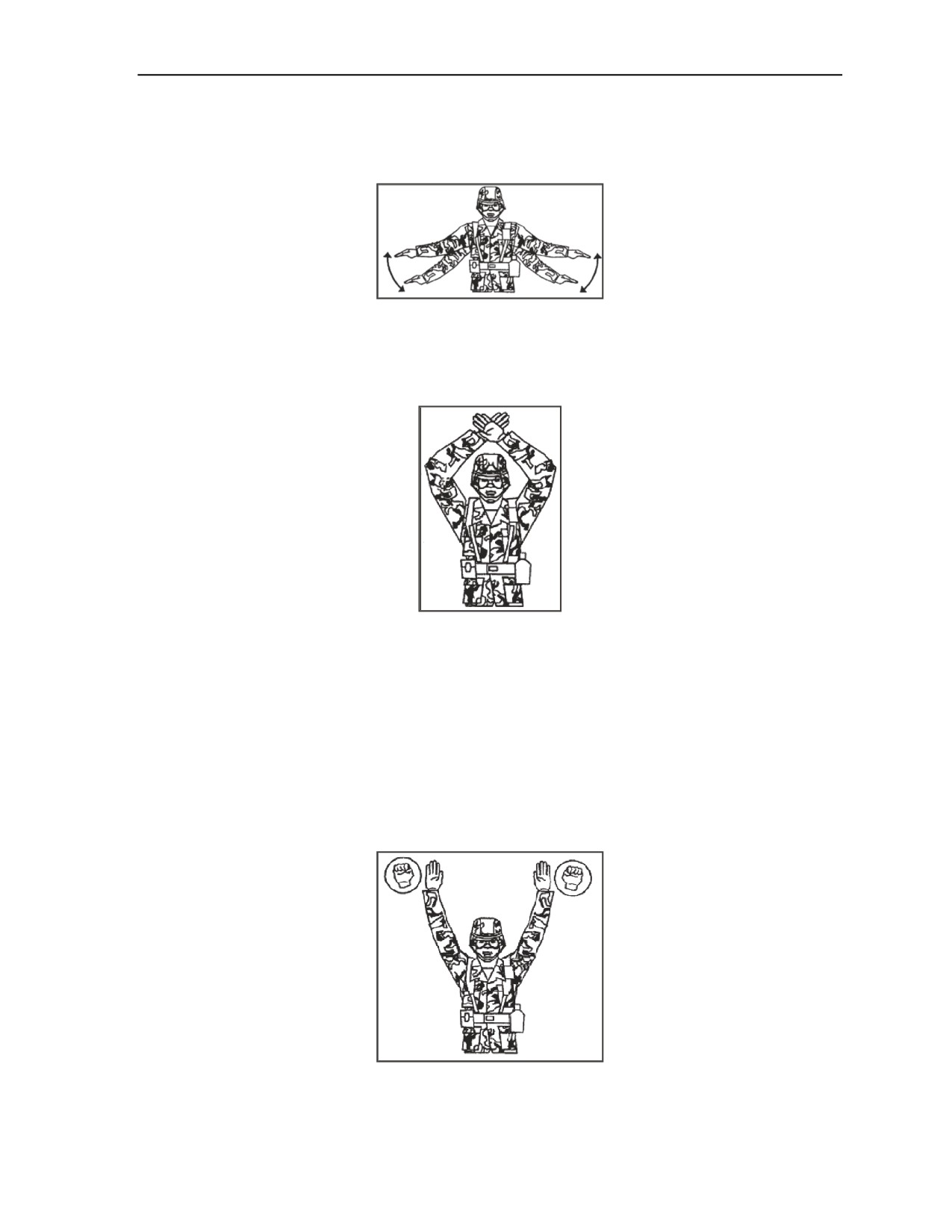
Hand and Arm Signals
SLOW DOWN
E-12. Arms down with palms toward ground and then move up and down several times (figure E-12).
Figure E-12. Slow down
STOP
E-13. Cross arms above head with palms facing forward (figure E-13).
Figure E-13. Stop
BRAKES
E-14. The following graphic depicts hand signals for “brakes” (figure E-14).
• On (Day). Arms above head, open palms, and fingers with palms toward aircraft, and then fist
closed.
• On (Night). Arms above head and then wands crossed.
• Off (Day). Reverse of above.
• Off (Night). Crossed wands and then uncrossed.
Figure E-14. Brakes
21 July 2008
FM 3-04.513
E-5
Appendix E
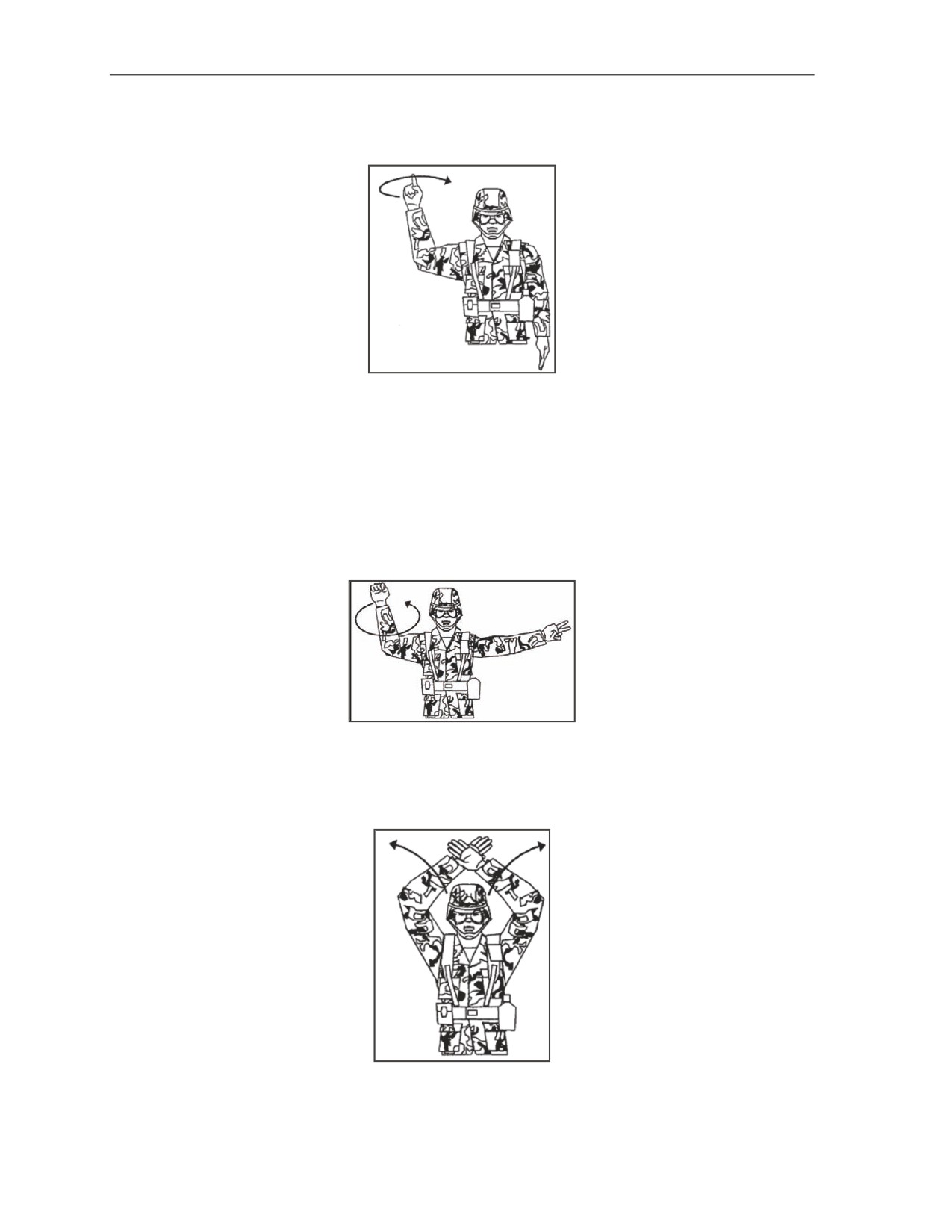
ENGAGE ROTOR(S)
E-15. Circular motion in horizontal plane with right hand above head (figure E-15).
Figure E-15. Engage rotor(s)
START ENGINE(S)
E-16. The following graphic depicts hand signals for “start engine” (figure E-16).
• Day. Left hand overhead with appropriate number of fingers extended to indicate the number of
the engine to be started and circular motion of right hand at head level.
• Night. Similar to day signal except that the wand in the left hand will be flashed indicating the
engine to be started.
Figure E-16. Start engine(s)
WAVE-OFF
E-17. Waving of arms over the head (figure E-17).
Figure E-17. Wave-off
E-6
FM 3-04.513
21 July 2008
Hand and Arm Signals
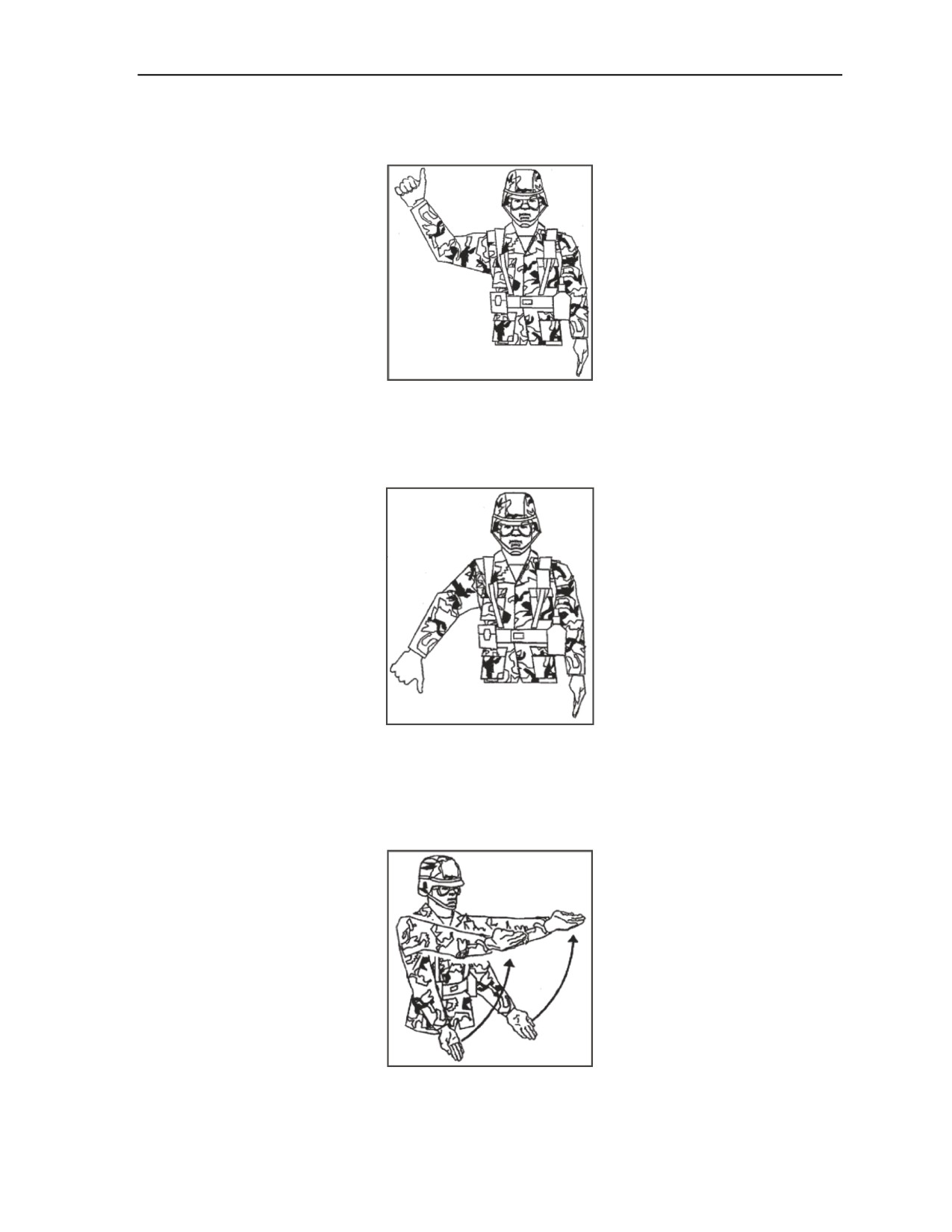
AFFIRMATIVE (ALL CLEAR)
E-18. Hand raised with thumb up (figure E-18).
Figure E-18. Affirmative (all clear)
NEGATIVE (NOT CLEAR)
E-19. Arm held out, hand below waist level, and thumb turned down (figure E-19).
Figure E-19. Negative (not clear)
MOVE BACK
E-20. Hold hands down by side; face palms forward; and, with elbows straight, repeatedly move arms
forward and upward to shoulder height (figure E-20).
Figure E-20. Move back
21 July 2008
FM 3-04.513
E-7
Appendix E
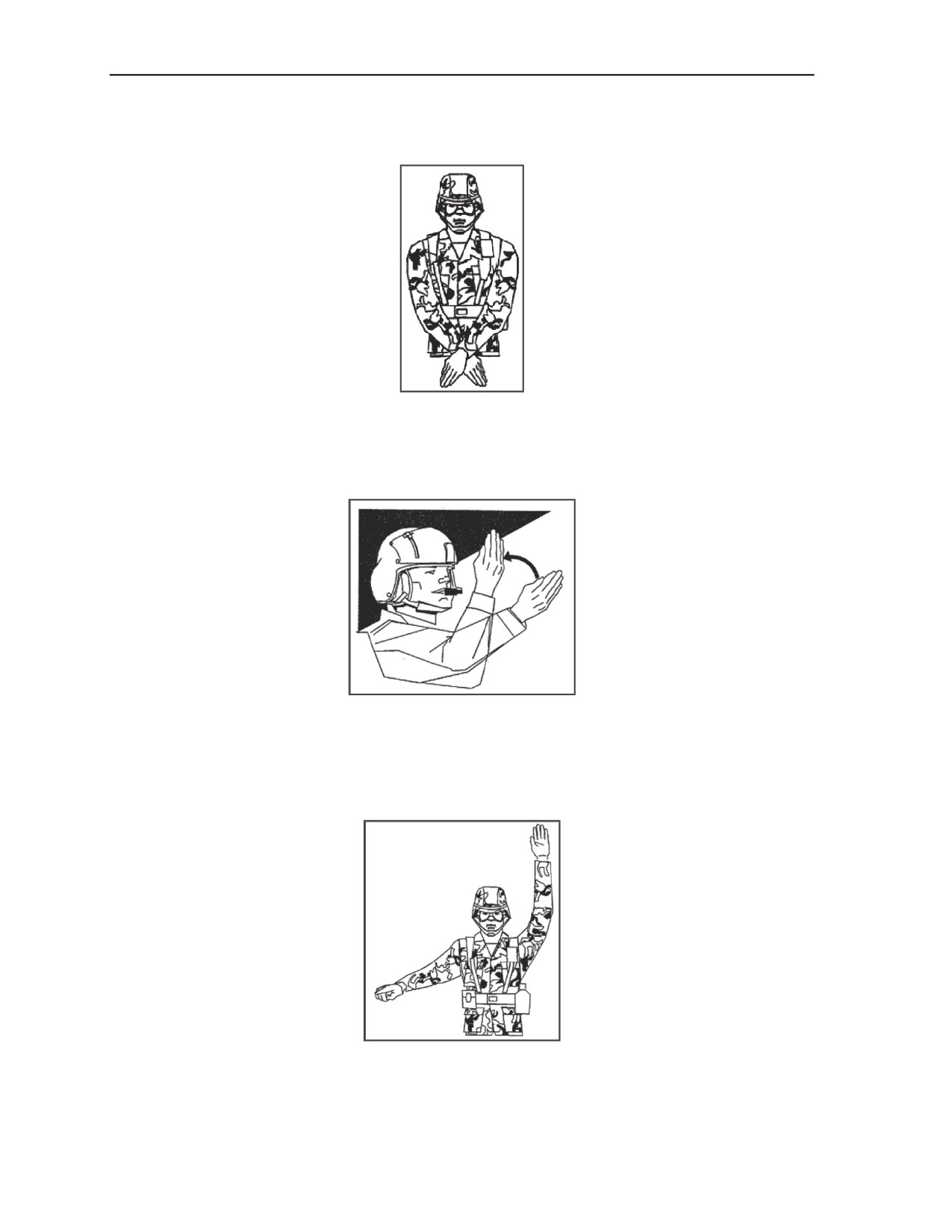
LAND
E-21. Cross hands and extend arms downward in front of the body (figure E-21).
Figure E-21. Land
CLEARANCE FOR PERSONNEL TO APPROACH AIRCRAFT
E-22. A beckoning motion with right hand at eye level (figure E-22).
Figure E-22. Clearance for personnel to approach aircraft
PERSONNEL APPROACH THE AIRCRAFT (GIVEN BY GROUND CREWMEMBER)
E-23. Left hand raised vertically overhead with palm toward aircraft. The right hand indicates the persons
concerned and gestures toward aircraft (figure E-23).
Figure E-23. Personnel approach the aircraft (given by ground crewmember)
E-8
FM 3-04.513
21 July 2008
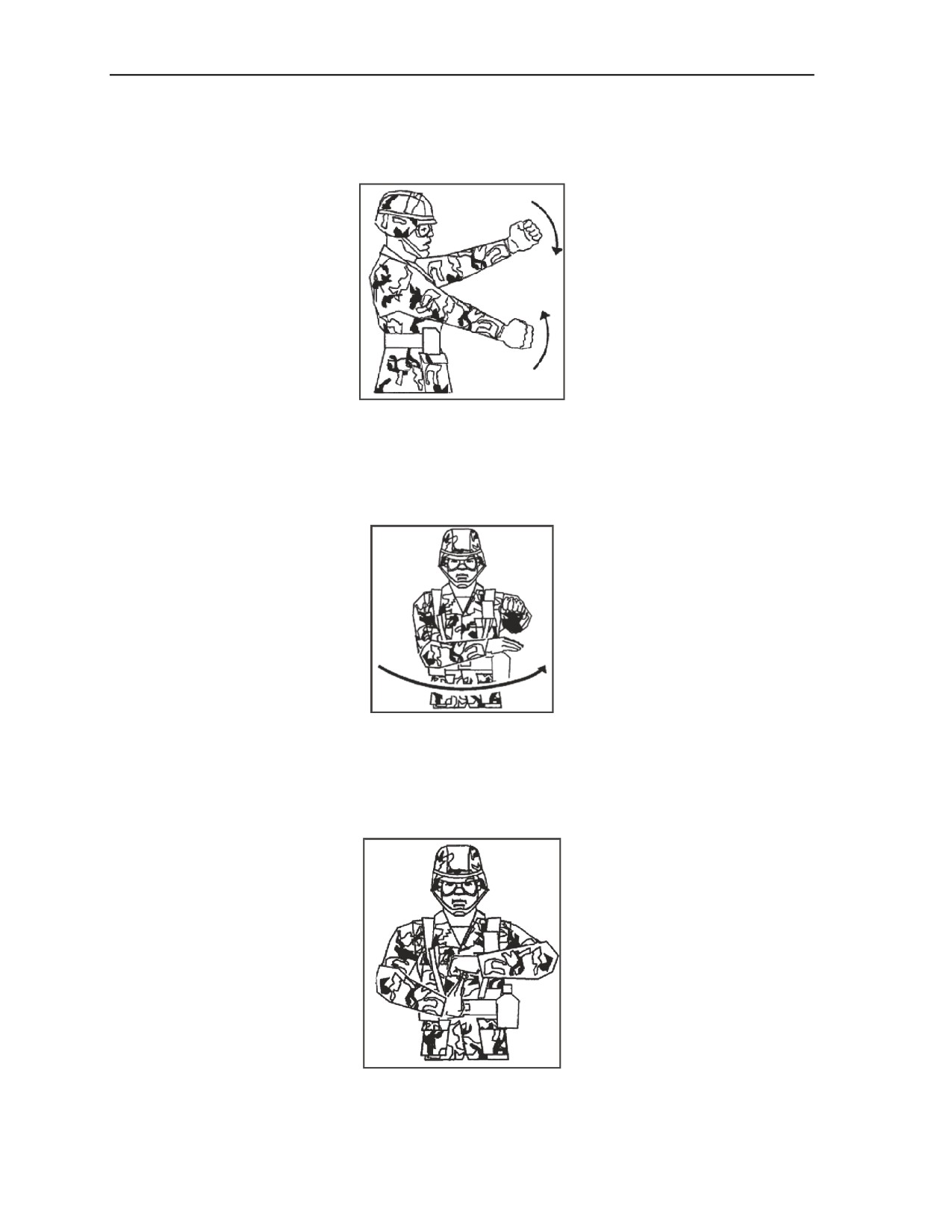
Hand and Arm Signals
UP HOOK
E-24. Right fist, thumb extended upward, raised suddenly to meet horizontal palm of left hand (figure E-
24).
Figure E-24. Up hook
DOWN HOOK
E-25. Right fist, thumb extended downward, lowered suddenly to meet horizontal palm of left hand (figure
E-25).
Figure E-25. Down hook
SLOW DOWN ENGINE(S) ON INDICATED SIDE
E-26. Arms down, palms toward the ground with either the right or left arm waved up and down to indicate
left- or right-side engines, respectively, should be slowed down (figure E-26).
Figure E-26. Slow down engine(s) on indicated side
21 July 2008
FM 3-04.513
E-9
Appendix E
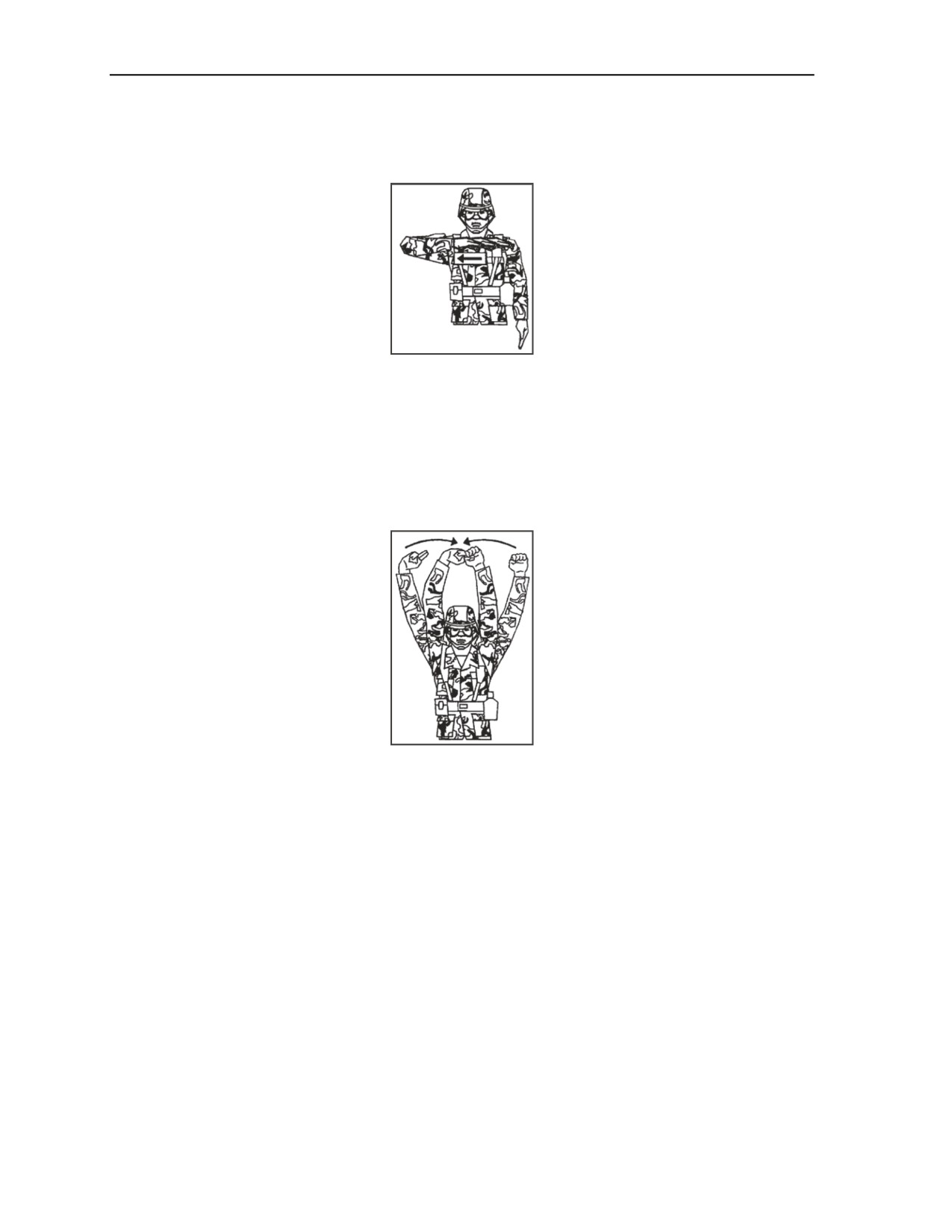
CUT ENGINE(S) OR STOP ROTOR(S)
E-27. Either arm or hand level with shoulder, palm down; draw extended hand across neck in a “throat-
cutting” motion (figure E-27).
Figure E-27. Cut engine(s) or stop rotor(s)
CONNECT AUXILIARY POWER UNIT
E-28. The following depicts hand signals for “connect auxiliary power unit” (figure E-28).
• Day. Extend hands overhead; push first two fingers of right hand into fist of left hand.
• Night. Same movement with the left-hand lighted wand vertical and right-hand lighted wand
horizontal.
Figure E-28. Connect auxiliary power unit
DISCONNECT AUXILIARY POWER UNIT
E-29. The following depicts hand signals for “disconnect auxiliary power unit” (figure E-29).
• Day. Extend hands overhead; pull first two fingers of right hand away from left fist.
• Night. Same movement except that left-hand lighted wand is vertical and right-hand lighted
wand is horizontal.
E-10
FM 3-04.513
21 July 2008
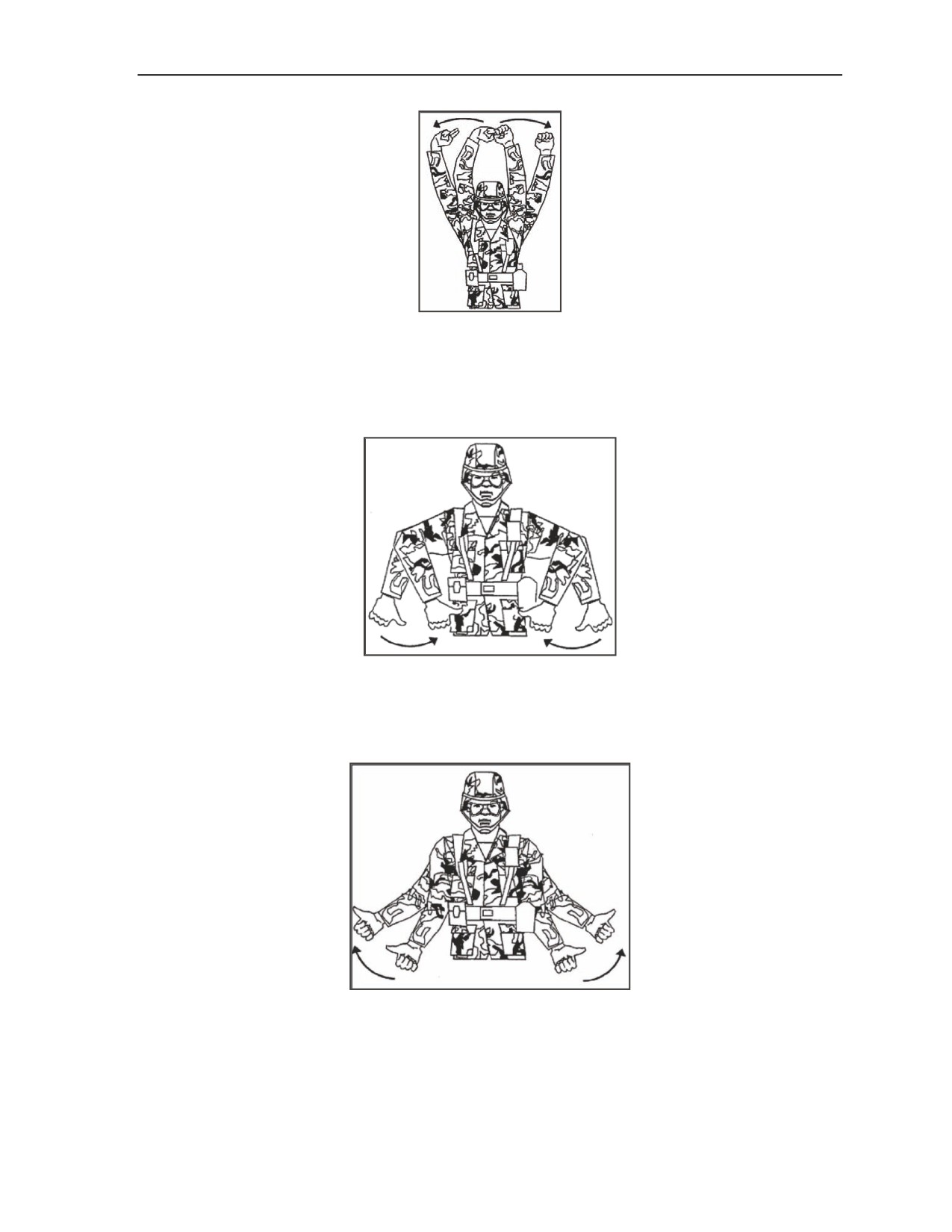
Hand and Arm Signals
Figure E-29. Disconnect auxiliary power unit
INSERT CHOCKS/CHOCKS INSERTED
E-30. Arms down, fists closed, and thumbs extended inward. Swing arms from extended position inward
(figure E-30).
Figure E-30. Insert chocks/chocks inserted
REMOVE CHOCKS
E-31. Arms down, fists closed, and thumbs extended outward. Swing arms outward (figure E-31).
Figure E-31. Remove chocks
21 July 2008
FM 3-04.513
E-11
Appendix E
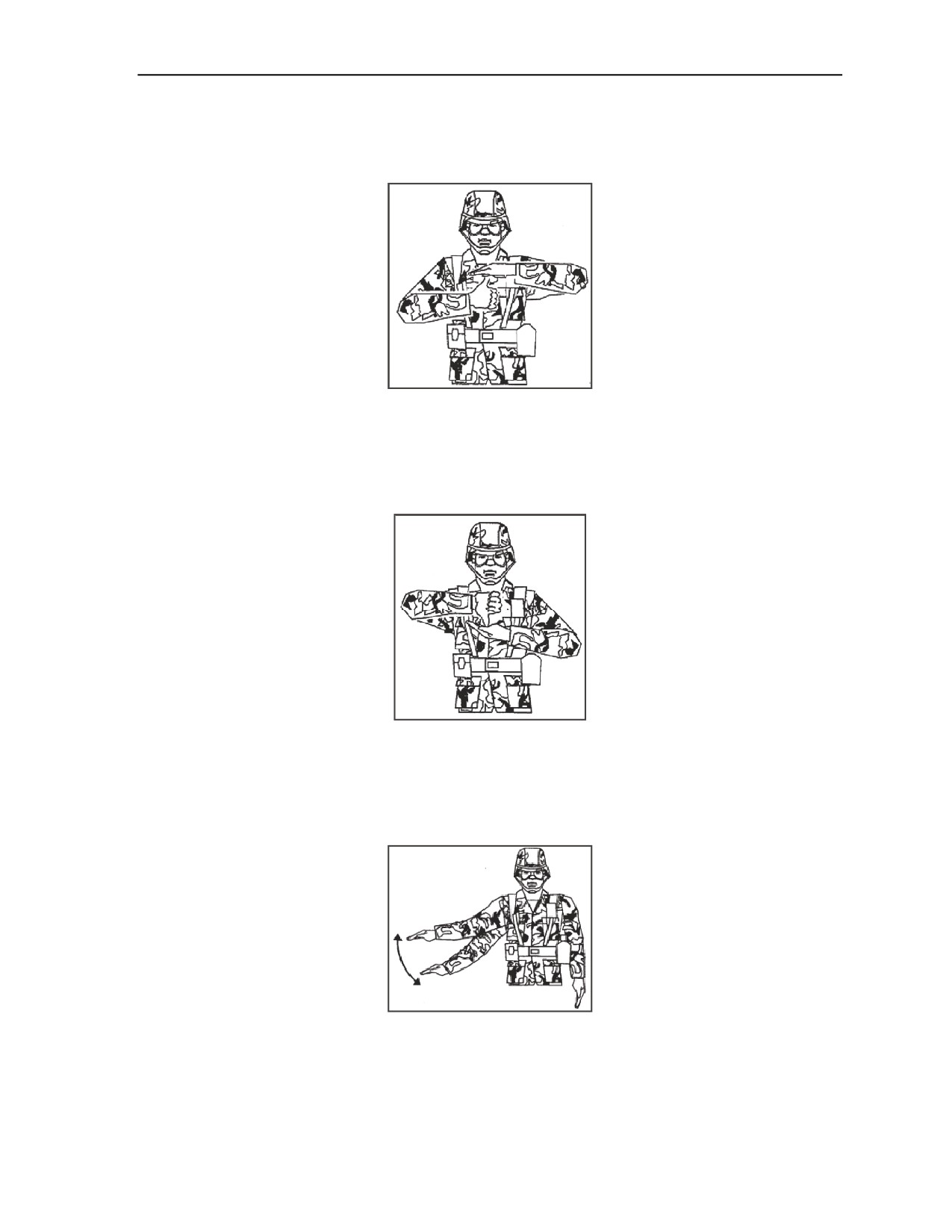
HOOK UP LOAD
E-32. Rope climbing motion with hands (figure E-32, page E-12).
Figure E-32. Hook up load
RELEASE LOAD
E-33. Left arm forward horizontally with fists clenched; extended right hand making horizontal slicing
motion below left arm with palm down (figure E-33).
Figure E-33. Release load
LOAD HAS NOT BEEN RELEASED
E-34. Bend left arm horizontally across chest with fist clenched and palm turned down; open right hand
pointed up vertically to center of left fist (figure E-34).
Figure E-34. Load has not been released
E-12
FM 3-04.513
21 July 2008
Hand and Arm Signals
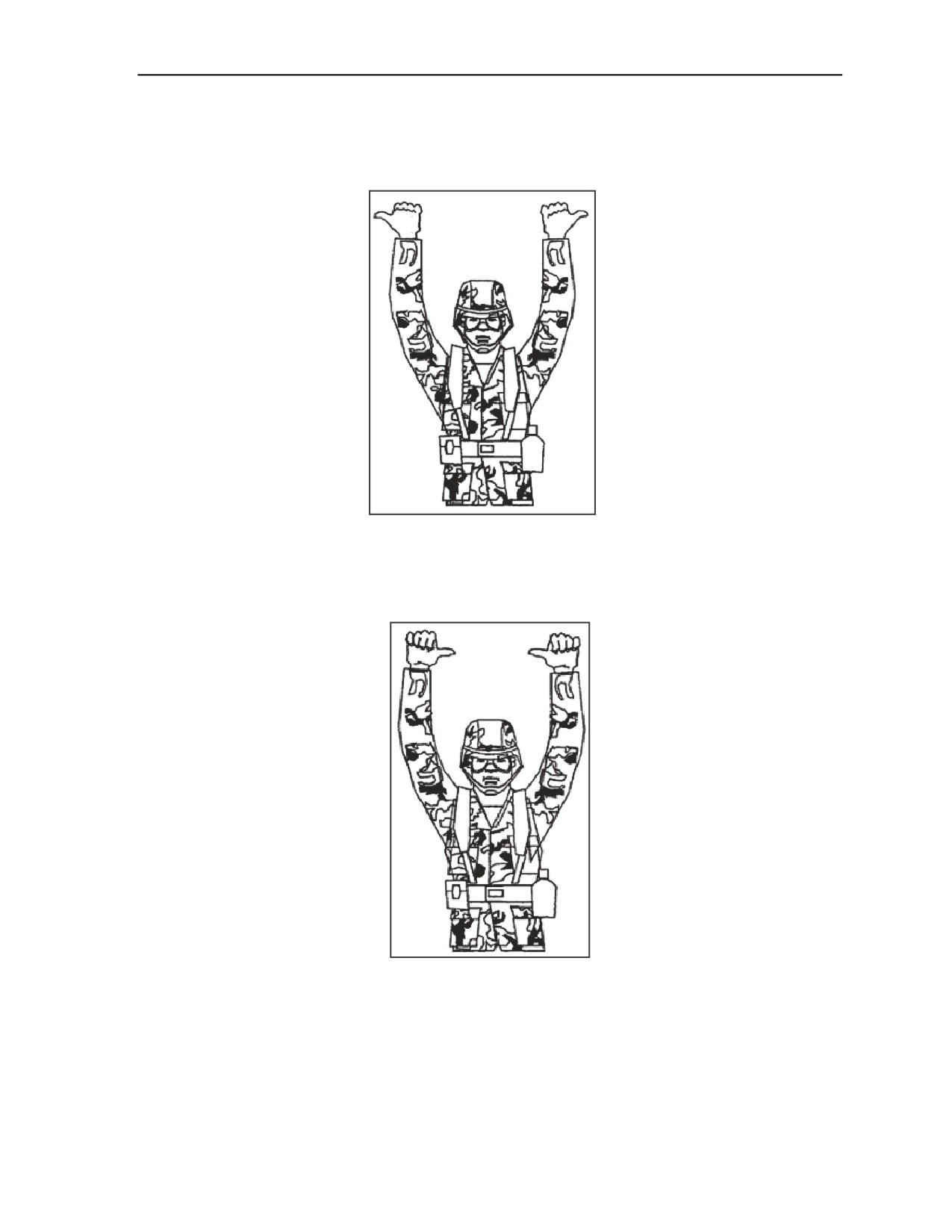
DROOP STOPS OUT
E-35. When rotor starts to “run down,” ground guide stands with both hands raised above head, fists
closed, and thumbs pointing out (figure E-35).
Figure E-35. Droop stops out
DROOP STOPS IN
E-36. When droop stops go in, ground guide turns thumbs inward (figure E-36).
Figure E-36. Droop stops in
21 July 2008
FM 3-04.513
E-13
Glossary
A2C2S
Army airborne command and control system
AAR
after-action review
AASF
Army aviation support facility
ADAM
air defense and airspace management
AMC
aviation maintenance company
AMO
aviation maintenance officer
AMT
aviation maintenance troop
AO
area of operation
AOR
area of responsibility
AR
Army regulation
ARNG
Army National Guard
ASB
aviation support battalion
ASC
aviation support company
AST
aviation support troop
AVCRAD
Aviation Classification Repair Activity Depot
BAMO
brigade aviation maintenance officer
BCT
brigade combat team
BDAR
battle damage assessment and repair
C2
command and control
CAB
combat aviation brigade
CAS
close air support
CBRN
chemical, biological, radiological, and nuclear
CH
cargo helicopter
CLS
combat lifesaver
COMSEC
communications security
CONUS
continental United States
CP
command post
CRM
composite risk management
DA
Department of the Army
DA Pam
Department of the Army pamphet
DART
downed aircraft recovery team
DOD
Department of Defense
DTC
data transfer cartridge
DTG
date time group
EOD
explosive ordnance disposal
FM
field manual
FMI
field manual interim
FS
fire support
21 July 2008
FM 3-04.513
Glossary-1
Glossary
GPS
global positioning system
GSAB
general support aviation battalion
HAZCOM
hazardous communication
HAZMAT
hazardous materials
IAW
in accordance with
ID
identification
JFC
joint force commander
JP
joint publication
JPRC
Joint Personnel Recovery Center
L2I
Lessons Learned Integration
LZ
landing zone
MCP
maintenance collection point
MDS
mission design series
MEDEVAC
medical evacuation
METT-TC
mission, enemy, terrain and weather, troops and support, time available, and
civil considerations
MO
maintenance officer
MOPP
mission-oriented protective posture
MOS
military occupational specialty
MP
maintenance test pilot
NCOIC
noncommissioned officer in charge
NVG
night vision goggles
OIC
officer in charge
OSC
on-scene commander
P4T3
problem, people, parts, plan, time, tools, and technical assistance
PC
pilot-in-command
PCI
precombat inspection
PMCS
preventive maintenance checks and services
PR
personnel recovery
PRCC
personnel recovery coordination cell
PRO
personnel recovery officer
QC
quality control
S-2
intelligence staff officer
S-3
operations staff officer
S-4
logistics staff officer
SOP
standing operating procedure
TACSOP
tactical standing operating procedure
TI
technical inspector
TM
technical manual
UAS
unmanned aircraft system
UMARK
unit maintenance aerial recovery kit
Glossary-2
FM 3-04.513
21 July 2008
Glossary
UMCP
unit maintenance collection point
21 July 2008
FM 3-04.513
Glossary-3
References
These publications are sources for additional information on the topics in this FM.
Find most JPs at http://www.dtic.mil/doctrine/doctrine.htm. Most Army publications
are found online at http://www.army.mil/usapa.
SOURCES USED
These are the sources quoted or paraphrased in this publication.
JOINT PUBLICATIONS
JP 1-02. Department of Defense Dictionary of Military and Associated Terms. 12 April 2001.
JP 3-50. Personnel Recovery. 5 January 2007.
ARMY PUBLICATIONS
AR 5-9. Area Support Responsibilities. 16 October 1998.
AR 750-1. Army Materiel Maintenance Policy. 20 September 2007.
DA Pam 385-10. Army Safety Program. 23 May 2008.
DA Pam 738-751. Functional Users Manual for the Army Maintenance Management System-Aviation
(TAMMS-A). 15 March 1999.
FM 1. The Army. 14 June 2005.
FM 3-0. Operations. 27 February 2008.
FM 3-04.104. Tactics, Techniques, and Procedures for Forward Arming and Refueling Point.
3 August 2006.
FM 3-04.500. Army Aviation Maintenance. 23 August 2006.
FM 3-50.1. Army Personnel Recovery. 10 August 2005.
FM 4-20.197. Multiservice Helicopter Sling Load: Basic Operations and Equipment. 20 July 2006.
FM 5-19. Composite Risk Management. 21 August 2006.
FMI 3-04.155. Army Unmanned Aircraft System Operations. 4 April 2006.
TM 1-1520-237-BD. Aviation Unit and Intermediate Maintenance for Battlefield Damage Assessment
& Repair for Army Model Helicopters UH-60A (NSN 1520-01-035-0266) (EIC:RSA), UH-
60L (NSN 1520-01-298-4532) (EIC:RSM), EH-60A (NSN 1520-01-082-0686) (EIC:RSB) ,
HH-60A (NSN 1520-01-459-9468) (EIC:RSN), HH-60L (NSN 1520-01-471-6773) (EIC:RSI),
UH-60M (NSN 1520-01-492-6324) (EIC:RSP), HH-60M (NSN 1520-1-515-4615) (EIC:N/A).
1 November 2007.
TM 1-1520-240-BD. Aviation Unit and Intermediate Maintenance Battlefield Damage Assessment
and Repair for Army CH-47D Helicopter (NSN 1520-01-088-3669) (EIC:RCD). 15 April
1997.
TM 1-1520-251-BD. Battlefield Damage Assessment and Repair for Helicopter, Attack, AH-64A
Apache (NSN 1520-01106-9519) (EIC:RHA) and AH-64D Longbow Apache (NSN 1520-01-
355-8250) (EIC:RHB). 7 October 2005.
TM 1-1670-260-12&P. Operator’s and Aviation Unit Maintenance Manual Including Repair Parts
and Special Tools List for Unit Maintenance Aerial Recovery Kit (UMARK). 20 March 2003.
TM 55-1520-228-BD. Battlefield Damage Assessment and Repair for Helicopter, Observation OH-
58A and OH-58C (NSN 1520-00-169-7137) and (NSN 1520-01-020-4216). 4 January 1991.
TM 750-244-1-5. Procedures for the Destruction of Aircraft and Associated Equipment to Prevent
Enemy Use. 12 November 1971.
21 July 2008
FM 3-04.513
References-1
References
DOCUMENTS NEEDED
These documents must be available to the intended users of this publication.
DEPARTMENT OF THE ARMY FORMS
DA Form 2028. Recommended Changes to Publications and Blank Forms.
READINGS RECOMMENDED
These Sources contain relevant supplemental information.
JOINT PUBLICATIONS
JP 3-0. Joint Operationn. 17 September 2006.
JP 4-0. Doctrine for Logistic Support of Joint Operations. 6 April 2000.
ARMY PUBLICATIONS
AR 385-10. The Army Safety Program. 23 August 2007.
FM 1-100. Army Aviation Operations. 21 February 1997.
FM 3-04.111. Aviation Brigades. 7 December 2007.
FM 3-04.113. Utility and Cargo Helicopter Operations. 7 December 2007.
FM 3-04.300. Flight Operations Procedures. 26 April 2004.
FM 4-30.3. Maintenance Operations and Procedures. 28 July 2004.
FM 4-30.31. Recovery and Battle Damage Assessment and Repair. 19 September 2006.
FM 7-0. Training the Force. 22 October 2002.
FM 7-1. Battle Focused Training. 15 September 2003.
FM 10-450-4. Multiservice Helicopter Sling Load: Single-Point Rigging and Procedures.
30 May 1998.
FM 10-450-5. Multiservice Helicopter Sling Load: Dual-Point Rigging Procedures. 30 August 1999.
TM 1-1500-204-23-1. Aviation Unit Maintenance (AVUM) and Aviation Intermediate Maintenance
(AVIM) Manual for General Aircraft Maintenance (General Maintenance and Practices)
Volume 1. 31 July 1992.
TM 1-1500-250-23. Aviation Unit and Aviation Intermediate Maintenance for General Tie-down and
Mooring on all Series Army Models, AH-64, UH-60, CH-47, UH-1, AH-1, OH-58
Helicopters. 24 August 1990.
TM 1-1520-248-10. Operator’s Manual for Army OH-58D Helicopter. 2 July 2007.
References-2
FM 3-04.513
21 July 2008