FM 3-04.513 Aircraft Recovery Operations (July 2008) - page 1
*FM 3-04.513
Field Manual
Headquarters
Department of the Army
No. 3-04.513
Washington, DC, 21 July 2008
Aircraft Recovery Operations
Contents
Page
PREFACE
vi
Chapter 1
Management
1-1
Section I - Terms
1-1
Aircraft Recovery
1-1
Downed Aircraft Recovery Team
1-2
Assessor
1-2
Battle Damage Assessment and Repair
1-2
Maintenance Evacuation
1-2
Personnel Recovery
1-2
Section II - Responsibilities
1-3
Joint Personnel Recovery Center
1-3
Personnel Recovery Coordination Cell
1-3
Aviation Brigade Command Post
1-4
Operational Aviation Battalion/Squadron
1-4
Aviation Maintenance Company/Troop
1-5
Aviation Support Company/AVIATION SUPPORT TROOP
1-6
Aircraft Crew
1-7
Unmanned Aircraft Systems Recovery
1-7
Maintenance Personnel
1-8
Downed Aircraft Recovery Team
1-8
Accident Investigation Board
1-10
Section III - Maintenance Support Facilities
1-10
Aviation Classification Repair Activity Depot
1-10
Army Aviation Support Facility
1-11
Continental United States Aircraft Recovery Support
1-11
Chapter 2
Operations
2-1
Section I - General Aircraft Recovery Considerations
2-1
Triggering Conditions
2-1
Aircraft Recovery Operations
2-3
Missions Defined
2-4
Principles
2-5
Preparation
2-7
Environmental Considerations
2-8
Distribution Restriction: Approved for public release; distribution is unlimited.
*This publication supersedes FM 3-04.513, 27 September 2000.
i
Contents
Section II - Mission-Specific Considerations
2-9
Battle Damage Assessment and Repair Training Program
2-9
Downed Aircraft Recovery Team Training Program
2-9
Aircraft Disposition
2-11
Chapter 3
Procedures
3-1
Section I - Recovery Alternatives
3-1
Self-Recovery
3-1
Dedicated Recovery (Aerial)
3-2
OnSite Recovery Challenges
3-2
Dedicated Recovery (Ground)
3-3
Ground Recovery Procedures
3-4
Salvage Recovery
3-4
Maintenance Evacuation
3-5
Section II - Rigging Considerations
3-5
Unit Maintenance Aerial Recovery Kit
3-5
Safety Considerations
3-6
Appendix A
AVIATION BRIGADE DOWNED AIRCRAFT PROCEDURES
A-1
Appendix B
DOWNED AIRCRAFT RECOVERY TEAM STANDING OPERATING
PROCEDURE
B-1
Appendix C
BATTLE DAMAGE ASSESSMENT AND REPAIR TOOLS, EQUIPMENT,
AND KITS
C-1
Appendix D
AFTER-ACTION REPORT
D-1
Appendix E
HAND AND ARM SIGNALS
E-1
GLOSSARY
Glossary-1
REFERENCES
References-1
INDEX
Index-1
ii
FM 3-04.513
21 July 2008
Contents
Figures
Figure 1-1. Downed aircraft recovery team recovers armed unmanned aircraft
1-7
Figure 1-2. Downed aircraft recovery team examines unmanned aircraft engine
1-8
Figure 1-3. Downed aircraft recovery team personnel and equipment for load out
1-10
Figure 2-1. Matrix for the execution of recovery missions
2-1
Figure 2-2. Rehearsal load out for ground recovery
2-10
Figure 3-1. Example of obstacles encountered at pickup site
3-3
Figure 3-2. Downed aircraft recovery team assembles for a ground recovery
3-4
Figure 3-3. CH-47 performs salvage recovery utilizing a flat rack and military
demountable containers
3-5
Figure A-1. Contingency plan phases
A-1
Figure E-1. Proceed to next ground guide
E-1
Figure E-2. This way
E-1
Figure E-3. Move ahead
E-2
Figure E-4. Turn to left (port)
E-2
Figure E-5. Turn to right (starboard)
E-2
Figure E-6. Landing directions
E-3
Figure E-7. Move upward
E-3
Figure E-8. Hover
E-3
Figure E-9. Move downward
E-4
Figure E-10. Move to right
E-4
Figure E-11. Move to left
E-4
Figure E-12. Slow down
E-5
Figure E-13. Stop
E-5
Figure E-14. Brakes
E-5
Figure E-15. Engage rotor(s)
E-6
Figure E-16. Start engine(s)
E-6
Figure E-17. Wave-off
E-6
Figure E-18. Affirmative (all clear)
E-7
Figure E-19. Negative (not clear)
E-7
Figure E-20. Move back
E-7
Figure E-21. Land
E-8
Figure E-22. Clearance for personnel to approach aircraft
E-8
Figure E-23. Personnel approach the aircraft (given by ground crewmember)
E-8
Figure E-24. Up hook
E-9
Figure E-25. Down hook
E-9
Figure E-26. Slow down engine(s) on indicated side
E-9
Figure E-27. Cut engine(s) or stop rotor(s)
E-10
Figure E-28. Connect auxiliary power unit
E-10
Figure E-29. Disconnect auxiliary power unit
E-11
Figure E-30. Insert chocks/chocks inserted
E-11
Figure E-31. Remove chocks
E-11
21 July 2008
FM 3-04.513
iii
Contents
Figure E-32. Hook up load
E-12
Figure E-33. Release load
E-12
Figure E-34. Load has not been released
E-12
Figure E-35. Droop stops out
E-13
Figure E-36. Droop stops in
E-13
iv
FM 3-04.513
21 July 2008
Contents
Tables
Table 1-1. Continental United States aircraft recovery responsibilities
1-11
Table 2-1. Battle damage assessment categories
2-10
Table A-1. Example of wingman actions and considerations
A-2
Table A-2. Necessary planners
A-4
Table B-1. Sample of a downed aircraft recovery team timeline
B-1
Table B-2. Sample of a downed aircraft recovery report
B-2
Table B-3. Example of a pre-execution checklist
B-6
Table B-4. Example of a downed aircraft recovery team process checklist
B-10
Table B-5. Downed aircraft recovery team mission brief
B-11
Table B-6. Example of a downed aircraft report
B-12
Table B-7. Example of a downed aircraft recovery team manifest and tasking
B-13
Table B-8. Example of a medical evacuation request
B-14
Table B-9. Example of a downed aircraft recovery team quick card
B-15
Table B-10. Mission-specific items
B-15
Table C-1. Special or fabricated tools
C-1
Table C-2. Expendable supplies and materials list
C-1
21 July 2008
FM 3-04.513
v
Preface
Field manual (FM) 3-04.513 is intended for use by commanders and U.S. military maintenance personnel
operating and employing resources in an aircraft recovery operational environment.
This manual is the Army’s doctrine for battlefield and garrison recovery operations. The operational concepts
described in this manual are based on Army doctrine established in FM 1, FM 3-0, FM 3-04.111, FM 3-04.500,
and FM 3-50.1. Emphasis is placed on modular force structure and the enhanced operational capability
provided by Army aviation transformation.
This publication applies to the Regular Army, the Army National Guard/Army National Guard of the United
States, and the United States Army Reserve unless otherwise stated. It builds on the collective knowledge and
experience gained through recent operations, numerous exercises, and the deliberate process of informed
reasoning. This publication is rooted in time-tested principles and fundamentals, while accommodating new
technologies and evolving responses to the diverse threats to national security.
Aircraft recovery missions include the assessment, repair, and retrieval, if possible, of aircraft forced down due
to component malfunction, accident, or combat-related damage that prevents the continued safe flight or
operation of the aircraft. The aircraft recovery mission is complete upon the return of all personnel and either:
• The return of the aircraft through self-recovery or dedicated recovery utilizing aerial or surface
recovery methods and techniques.
• The selective cannibalization and destruction or abandonment of the aircraft.
Aircraft recovery is a pre-planned mission for all units with assigned or operational control of Army aircraft
and may require extensive coordination with supporting units. Aircraft recovery is time sensitive to the tactical
situation. Aircraft recovery and maintenance evacuations are closely related, however, maintenance evacuation
is the physical act of moving an aircraft from one maintenance location to another.
This manual is a guide and intended for use by commanders at all levels. Unless otherwise stated, use of the
term battalion or company also refers to squadron or troop. Similarly, use of the term aviation maintenance
company (AMC) refers to aviation maintenance troop (AMT). Also, the use of the term aviation support
company (ASC) refers to aviation support troop (AST). In actual practice, the procedures outlined in this
manual may be modified or augmented to account for force size; availability of aerial and ground assets;
manpower, time and distance considerations; and the tactical situation.
The proponent of this publication is Headquarters, United States Army Training and Doctrine Command. Send
comments and recommendations on Department of the Army (DA) Form 2028 (Recommended Changes to
publications and Blank Forms) or automated link (http://www.usapa.army.mil/da2028/daform2028.asp ) to
Commander, U.S. Army Aviation Warfighting Center ATTN: ATZQ-TD-D, Fort Rucker, Alabama 36362-
5263. Comments may be e-mailed to the Directorate of Training and Doctrine at av.doctrine@us.army.mil.
Other doctrinal information can be found on the Internet at Army Knowledge Online or call Defense Switched
Network 558-3551 or (334) 255-3551.
This manual implements portions of Standardization Agreements 2999 and 3117.
This publication has been reviewed for operations security considerations.
vi
FM 3-04.513
21 July 2008
Chapter 1
Management
Recovery operations are usually triggered by initial notification to the main command
post (CP) and consist of personnel recovery (PR) (which is the priority) and downed
aircraft recovery. These operations may be conducted individually or simultaneously.
Recovery operations may be initiated at the aircraft site and evolve into a dedicated
aviation brigade-level missions.
SECTION I - TERMS
AIRCRAFT RECOVERY
1-1. Joint publication (JP) 1-02 defines recovery
as “actions taken to extricate damaged or disabled
Contents
equipment for return to friendly control or repair at
Section I - Terms
1-1
another location.” Recovery is retrieving an
immobile, inoperative, or abandoned aircraft from
Section II - Responsibilities
1-3
its current position and returning it to a mission-
Section III - Maintenance Support
capable status or a maintenance site for repair.
Facilities
1-10
These actions typically involve—
• Expert assessment of the aircraft.
• Performance of standard or battle damage assessment and repair (BDAR) maintenance actions
enabling aircraft to self-recover.
• Recommendation of actions and/or preparation of the aircraft for a dedicated recovery.
1-2. Unless specifically mentioned, recovery tactics, techniques, and procedures; doctrine; organization;
training; materiel; leadership and education; personnel; and facilities considerations apply to operational
themes from peacetime military engagement to major combat operations..
SELF-RECOVERY
1-3. Self-recovery is defined as actions required for the aircraft to fly out under its own power to either
rejoin the mission or to a maintenance area for additional repairs or inspections. Self-recovery begins at the
location where the aircraft became inoperable or disabled. It ends with the completion of standard and/or
BDAR maintenance procedures correcting faults required for the aircraft to safely fly to a secure area or
rejoin the air mission. This is typically a unit or aviation maintenance company/aviation maintenance troop
(AMC/AMT) function.
DEDICATED RECOVERY
1-4. Dedicated recovery is defined as actions required to extract an aircraft by means of an aerial or
surface recovery vehicle to a maintenance area for repairs and/or inspections. Dedicated recovery begins
with the decision that the aircraft will not be able to self-recover. It ends with the movement of the aircraft
by either aerial or ground vehicle to a maintenance area equipped to conduct required inspections and/or
subsequent repairs. This is typically an aviation support company (ASC) or aviation support troop (AST)
mission.
21 July 2008
FM 3-04.513
1-1
Chapter 1
IMMEDIATE RECOVERY
1-5. Immediate recovery is performed by assets within a flight mission. These assets may include the
aircraft’s crew requiring recovery, other crews participating in the mission, or downed aircraft recovery
team (DART) personnel accompanying and supporting the flight.
DELAYED RECOVERY
1-6. Delayed recovery is performed by a DART not in the flight. Delayed recoveries are categorized as
deliberate and hasty.
• Deliberate-Personnel and assets remain on standby at a predetermined location for the duration
of the mission.
• Hasty-Personnel and assets remain on-call and readily available awaiting notification of a
mission requirement, while executing normal operations.
DOWNED AIRCRAFT RECOVERY TEAM
1-7. A DART is comprised of select personnel who perform assessment, repairs, and recovery of downed
aircraft. This team is equipped, trained, and rehearsed to accomplish aircraft recovery in various
environments and conditions.
ASSESSOR
1-8. An assessor is a technical expert who can evaluate aircraft battle damage. The assessor’s mission is
to provide the commander with an initial assessment of the downed aircraft. An assessor can be one, or a
combination, of the following:
• Aircrew of the downed aircraft.
• Aircrew of another aircraft.
• PR aircrew.
• DART member.
1-9. The ability to determine rapidly that a one-time flight is feasible or a quick-fix repair is possible is
important. It may prevent a situation in which the aircraft would otherwise be destroyed (in place) to
prevent capture or compromise by the enemy.
BATTLE DAMAGE ASSESSMENT AND REPAIR
1-10. BDAR is the use of specialized aircraft damage assessment criteria, repair kits, and trained personnel
to modify peacetime aircraft maintenance standards. This concept includes the return of damaged aircraft
to a safe location and, eventually, to battle.
MAINTENANCE EVACUATION
1-11. Maintenance evacuation is the physical act of moving an aircraft from one maintenance location on
the battlefield to another. Movement is either by fly-out or aerial/ground transportation. Evacuation is to
effect repair, cross-level maintenance workloads, or relieve units of disabled aircraft during tactical moves.
PERSONNEL RECOVERY
1-12. The Army defines PR as “The sum of military, diplomatic, and civil efforts to effect the recovery and
return of U.S. military, Department of Defense (DOD) civilians, DOD contractor personnel, or other
personnel, as determined by the Secretary of Defense, who are isolated, missing, detained, or captured in
an operational environment.” For additional information, refer to FM 3-50.1.
1-2
FM 3-04.513
21 July 2008
Management
1-13. Additionally, when directed by the President of the United States or Secretary of Defense, DOD
shall provide PR support to other governments, agencies, organizations, and individuals in accordance with
(IAW) all applicable laws, regulations, and memorandums of agreement or understanding. JP 3-50
provides further information.
1-14. PR may be performed by the DART. When this occurs, extraction of the crew is primary; aircraft
assessment is secondary. The PR mission is undertaken to—
• Provide safe recovery of the downed aircrew.
• Return aircrews to Level II medical care, if appropriate.
• Re-integrate the aircrew into the unit.
1-15. According to FM 3-04.111, PR is the priority, followed by recovery of the downed aircraft and
equipment. Equipment recovery operations may be conducted simultaneously with the PR operation or
delayed until these operations are complete. Downed aircraft or equipment recovery operations must never
compromise PR operations.
SECTION II - RESPONSIBILITIES
JOINT PERSONNEL RECOVERY CENTER
1-16. The Joint Personnel Recovery Center (JPRC) is responsible for coordinating all PR-related matters
for the joint force commander (JFC), including missions employing joint, interagency, and multinational
forces and capabilities. JPRC responsibilities include—
• Recommending PR courses of action to decisionmakers.
• Developing PR standing operating procedures (SOPs) for the joint force.
• Coordinating externally supported recoveries with interagency and multinational organizations
(including host nation capabilities).
• Assisting personnel recovery coordination cells (PRCCs) in fulfilling their requirements.
• Coordinating for theater and national intelligence support.
PERSONNEL RECOVERY COORDINATION CELL
1-17. Army component commanders are responsible for PR within their area of operations (AO) unless
directed otherwise by the JFC. To coordinate PR missions, these commanders establish a PRCC. For PR
missions within their AO, these cells facilitate task organization of forces as necessary. When working
with joint force components, these cells provide a PR capability only if directed by the JFC.
1-18. PRCC responsibilities include—
• Ensuring reliable communications with subordinate unit personnel recovery officers (PROs),
other PRCCs, and the JPRC.
• Coordinating deliberate recoveries for the component.
• Reviewing accountability and movement reporting procedures of subordinate units.
• Airspace command and control deconfliction during PR missions.
• Assisting in immediate recoveries when requested by subordinate units.
• Coordinating for component fire support (FS) of the operation.
• Ensuring subordinate units have access to SOPs developed by the JPRC.
• Ensuring subordinate units have sufficient evasion aids.
21 July 2008
FM 3-04.513
1-3
Chapter 1
AVIATION BRIGADE COMMAND POST
1-19. The aviation brigade CP provides overall command and control (C2) of recovery operations in their
area of coverage. Due to the extensive communications, resource allocations, taskings, and situational
awareness required for successful recovery operations, the brigade CP provides the most comprehensive
organization for facilitating recoveries. Once initial mission, enemy, terrain and weather, troops and
support, time available, and civil considerations (METT-TC) analysis is accomplished with the required
representatives from each unit or area of expertise, the brigade CP may assign C2 to another organization.
This may depend on several factors including aircraft assessment, the threat, and required mission time. A
successful recovery operation is a highly coordinated effort between the aviation brigade CP, the
controlling organization’s CP, AMC/AMT, ASC/AST, the aviation support battalion
(ASB), other
supporting units, and the ground element in which the operation takes place.
OPERATIONAL AVIATION BATTALION/SQUADRON
1-20. The downed aircraft’s controlling battalion or squadron is responsible for immediately notifying the
aviation brigade CP and coordinating initial aircraft recovery plans with the battalion/squadron
AMC/AMT. The AMC/AMT is generally responsible for conducting the recovery within its capabilities. If
recovery is beyond the capabilities of the AMC/AMT, support is coordinated by the aviation brigade CP
from the ASB’s ASC or Squadron’s AST.
COMMANDER
1-21. The operational battalion/squadron commander retains initial responsibility for aircraft recovery.
Aircraft recovery operations are planned within the context and urgency of the mission, force size, and the
density of recovery assets at the disposal of commanders. Aircraft recovery procedures are included in unit
SOPs, contingency plans, operation orders, and air mission briefs (AMBs). Additional responsibilities
include:
• Ensuring the DART team is trained, resourced, and rehearsed for all environments and mission
profiles in which the unit operates.
• Authorizing deployment of the DART in a force application environment.
• Ensuring aircraft destruction decisions are made at the appropriate command level per SOP and
guidance.
• Authorizing use of cannibalization techniques that permit quick and efficient removal of critical
components and structures from nonreparable or unrecoverable aircraft.
• Authorizing use of BDAR procedures to affect temporary repairs to a specific aircraft in a force
application environment.
• Ensuring DART and BDAR procedures are applied IAW applicable Army regulations (ARs),
Field Manuals (FMs), technical manuals (TMs), and Department of the Army pamphlets (DA
Pams); and are included in unit and subordinate unit SOPs.
• Ensuring BDAR repairs are corrected with standardized repairs as soon as practical, based on
METT-TC.
AVIATION SAFETY OFFICER
1-22. The battalion/squadron aviation safety officer serves as the principle advisor to the commander and
staff on aviation safety matters. The ASO assists the commander during the composite risk management
(CRM) process and monitors the planning and execution of aircraft recovery missions.
1-4
FM 3-04.513
21 July 2008
Management
AVIATION MAINTENANCE COMPANY/TROOP
1-23. The priority for the AMC/AMT is self-recovery and BDAR, with dedicated aircraft recovery as
contingency operations. To preserve the AMC/AMT operational tempo, aerial or ground recovery should
be conducted by the ASC/AST. The AMC/AMT provides mobile, responsive support to repair aircraft
onsite or prepare them for evacuation. The AMC/AMT will conduct BDAR or standard repairs to self-
recover the aircraft. The AMC/AMT commander and production control officer coordinate and schedule
maintenance at locations forward of the battalion. In some cases, the unit commander may authorize use of
aircraft combat maintenance and BDAR procedures. Aircraft combat maintenance and BDAR are generally
AMC/AMT responsibilities with augmentation from the supporting ASC/AST when required.
COMMANDER
1-24. The AMC/AMT commander plans, directs, and supervises company/troop operations and
employment. The commander is also directly responsible for recovery operations within the unit’s
capabilities. The commander’s responsibilities include—
•
Selecting and organizing DART team members by military occupational specialty (MOS) and
skill level.
•
Resourcing all tools, special tools, and mission-specific combat equipment.
•
Establishing a DART training program to ensure personnel are trained and rehearsed in BDAR
and recovery procedures for all environments and mission profiles in which the unit operates.
Training and rehearsals will include:
DART tactical operations and procedures.
Employment of unit maintenance aerial recovery kits
(UMARKs) for all supported
airframes.
BDAR inspection, serviceability, and deferability criteria. Use of BDAR kits and
installation of BDAR components.
BDAR maintenance tasks and methods.
Expedient cannibalization techniques.
CRM procedures.
Hazardous communication (HAZCOM) procedures.
Hazardous materials (HAZMAT) procedures.
Biohazard (human remains) handling procedures.
•
Briefing the DART team on each mission and its CRM to include risk analysis, safety,
HAZCOM, and HAZMAT.
•
Maintaining continuous communication with the dispatched DART.
•
Ensuring BDAR and DART procedures are applied IAW applicable ARs, FMs, TMs, DA Pams,
and the unit SOP.
•
Ensuring all BDAR and DART procedures applied to aircraft systems and subsystems are
properly documented in aircraft logbook.
•
Ensuring all BDAR procedures applied to aircraft components are annotated on the component’s
forms and records.
•
Ensuring BDAR repairs are corrected with standardized repairs as soon as practical, based on
METT-TC.
•
Coordinating postoperation mental health and/or nonaffiliated chaplain support as required.
21 July 2008
FM 3-04.513
1-5
Chapter 1
PRODUCTION CONTROL OFFICER/NONCOMMISSIONED OFFICER IN CHARGE
1-25. The production control officer is the principal maintenance manager and coordinator for AMC/AMT
DART missions. This officer acts as the AMC/AMT commander’s primary maintenance advisor for
company internal production and maintenance activities. The production control officer—
•
Confirms the disabled aircraft’s location.
•
Coordinates and plans aircraft DART operations of assigned or attached airframes.
•
Verifies/validates personnel qualifications ensuring team composition meets minimum
requirements needed to conduct aircraft recovery operations.
•
Ensures required tools and equipment accompany the DART.
•
Verifies/validates serviceability of required equipment.
•
Briefs the DART officer in charge (OIC)/noncommissioned officer in charge (NCOIC) on the
tactical situation (if required) and recovery template/checklist.
•
Briefs the DART OIC/NCOIC on airframe, mission, mission equipment, HAZMAT, and
environmental conditions.
•
Tracks aircraft recovery operations and identifies requests for additional support (personnel or
equipment).
•
Updates the maintenance commander, battalion aviation maintenance officer
(AMO), and
controlling unit commander on aircraft recovery status.
•
Enforces safety procedures IAW the unit’s tactical standing operating procedures (TACSOPs)
and maintenance and aircraft recovery SOPs.
•
Enforces environmental stewardship protection program procedures.
•
Develops and updates the aircraft recovery operations SOP.
•
Contacts, coordinates, and facilitates aircraft recovery operations support with the ASC/AST
chain of command.
•
Provides training development oversight for the DART OIC/NCOIC and personnel.
•
Requests disposition of unrecoverable aircraft and equipment from the appropriate chain of
command.
•
Trains personnel on procedures for hasty destruction of all supported airframes.
1-26. The production control NCOIC coordinates all maintenance actions in the absence of the production
control officer; however, they must function as a team. The production control NCOIC is also responsible
for coordinating personnel and logistical assets required to form the DART.
QUALITY CONTROL OFFICER/NONCOMMISSIONED OFFICER IN CHARGE
1-27. The quality control (QC) OIC/NCOIC is responsible for training and designating QC personnel
assigned to the DART who are qualified to perform duties as:
• Assessor.
• Logbook custodian, for duration of the recovery mission.
• DART NCOIC, in a permissive environment.
AVIATION SUPPORT COMPANY/AVIATION SUPPORT TROOP
1-28. Aircraft maintenance above aviation operational battalion/squadron level is provided by the ASB’s
ASC or Air Cavalry Squadron’s AST. The ASC/AST is the only unit staffed and equipped to perform
ground recovery of brigade or squadron’s airframes. The ASC/AST is generally responsible for dedicated
recovery missions, both air and ground. Additionally, the ASC/AST can facilitate self-recoveries and
1-6
FM 3-04.513
21 July 2008
Management
perform BDAR as part of a DART mission. ASCs/ASTs may provide personnel and equipment to augment
the AMC/AMT performing DART missions when directed by the aviation brigade CP.
1-29. The ASC/AST commander is responsible for forming a DART with rapid response times and robust
capabilities mirroring the requirements of an AMC/AMT DART program. The ASC/AST DART program
should expand beyond the AMC/AMT program by including the primary responsibility for conducting
aerial and ground dedicated recovery missions. Additionally, the ASC/AST will generally support recovery
missions for aircraft in the aviation brigade area of coverage not assigned to the brigade, transitioning the
operational environment or operating in the brigade area of coverage. The priority for the ASC/AST
DART program is dedicated aircraft recovery, with self-recovery and BDAR as contingency operations.
AIRCRAFT CREW
1-30. When an aircraft is forced down, the air mission commander, pilot in command
(PC), a
crewmember, or another aircraft will notify the aviation brigade CP and/or controlling unit CP to request
DART assistance. This information may be relayed through other aircraft operating in the area as METT-
TC allows.
UNMANNED AIRCRAFT SYSTEMS RECOVERY
1-31. The ASC/AST DART may be employed when time, threat, and capabilities dictate. This type of
mission will usually come from the aviation brigade or squadron’s CP directly to the ASB/AST. The
aviation brigade CP will resource the mission the same way as a brigade manned aircraft recovery mission.
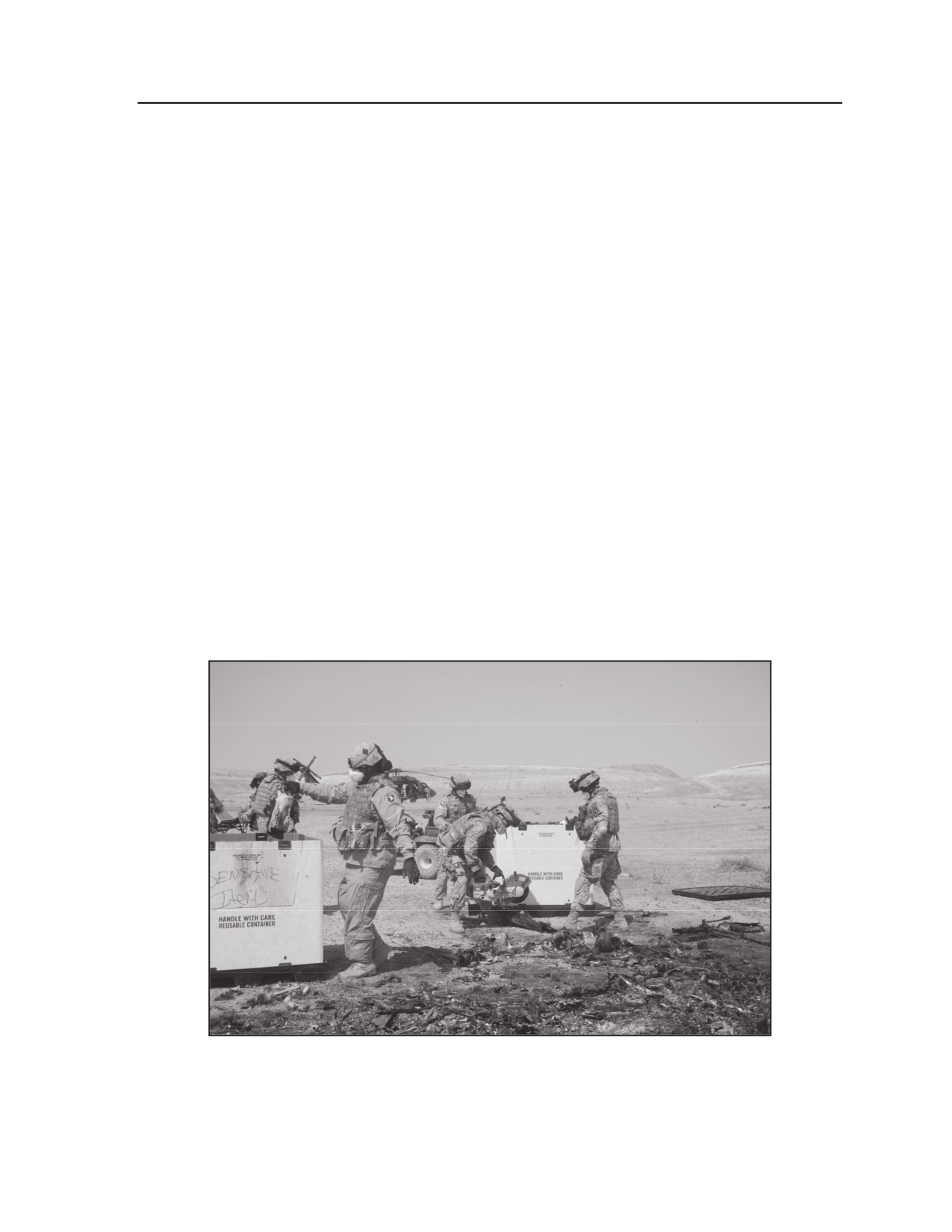
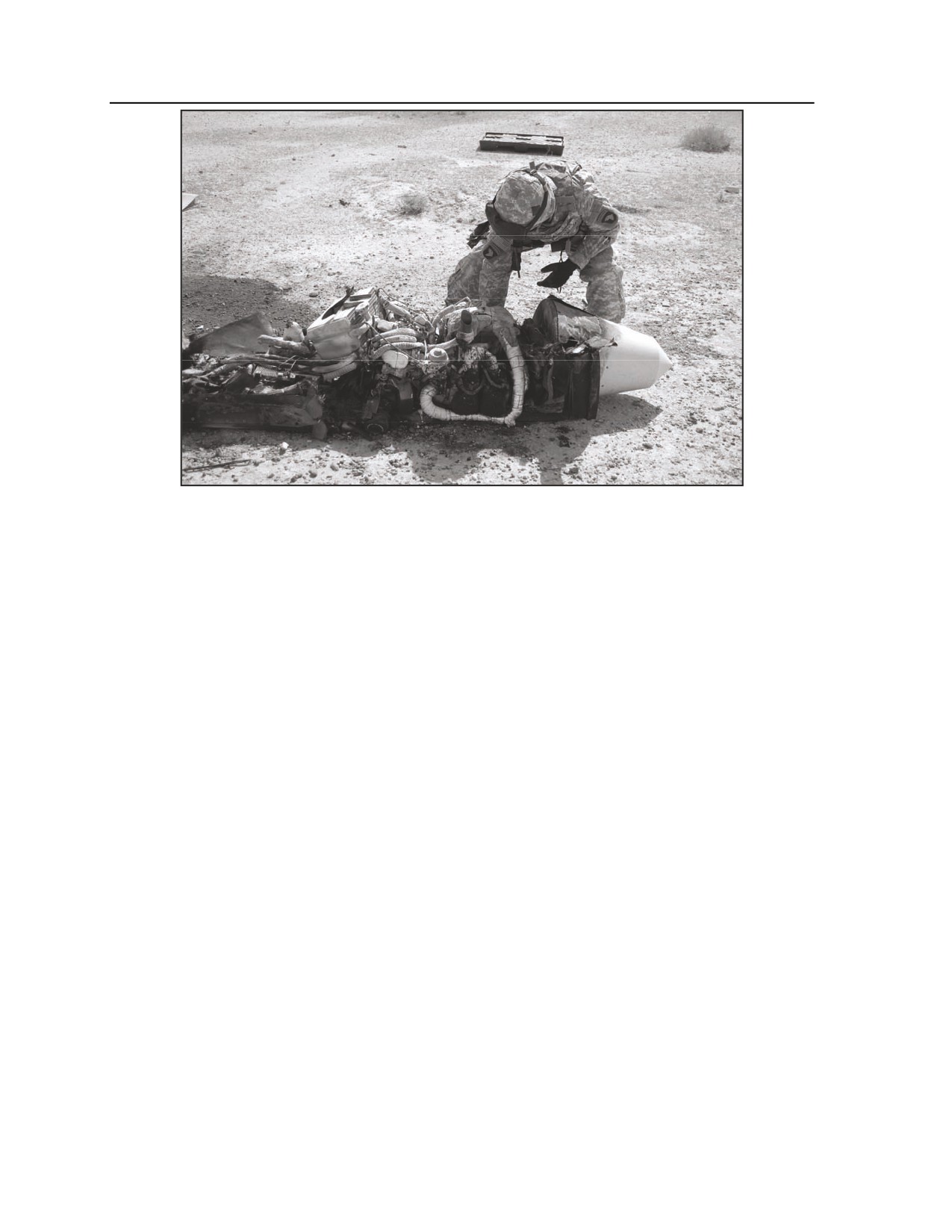
The team’s main goals are to recover aircraft electronics and preserve information regarding the causal
factors of the accident. Figure 1-1 and figure 1-2 (page 1-8) depict an armed unmanned aircraft recovery
operation. The ASC/AST DART and unmanned aircraft system (UAS) unit should conduct contingency
planning for this type of recovery taking into consideration the size of the system, HAZMAT, ordnance,
and the rapid timeline associated with UAS recovery requirements. Further information is contained in
field manual interim (FMI) 3-04.155.
Figure 1-1. Downed aircraft recovery team recovers armed unmanned aircraft
21 July 2008
FM 3-04.513
1-7
Chapter 1
Figure 1-2. Downed aircraft recovery team examines unmanned aircraft engine
MAINTENANCE PERSONNEL
BRIGADE /BATTALION AVIATION MAINTENANCE OFFICER
1-32. The brigade aviation maintenance officer
(BAMO)/battalion AMO will provide continuous
maintenance and logistics information to the commander and staff on matters pertaining to aviation and
aviation-related systems. Based on the current maintenance posture, the BAMO/battalion AMO informs the
command of current and future capabilities and plans maintenance actions based on operational needs. The
BAMO participates in recovery planning and risk assessments at the aviation brigade CP, before, during,
and after recovery operations.
DOWNED AIRCRAFT RECOVERY TEAM
OFFICER IN CHARGE
1-33. The DART OIC retains responsibility for the successful recovery of the aircraft. Due to the number
and complexity of the systems and operations involved in a DART mission, the OIC should be a qualified
aviator or officer with strong air ground integration skills. Typically, the OIC controls tactical vehicle
operations, aircraft operations, or both; as well as security requirements. The OIC performs onsite C2 of
the operation. Given the tactical situation, and if surface recovery is required, the DART OIC
verifies/validates the best ground vehicle route for aircraft recovery. The OIC also coordinates FS (if
required) or aerial coverage with the intelligence staff officer (S-2)/operations staff officer (S-3) based on
the tactical situation along the recovery route. Other responsibilities include—
• Serving as the air or ground mission commander
• Conducting DART rehearsals.
• Briefing the tactical situation and aircraft recovery operation mission specifics.
• Ensuring safety procedures are observed and used IAW the TACSOP, unit maintenance SOP,
and aircraft recovery operations SOP.
1-8
FM 3-04.513
21 July 2008
Management
• Ensuring environmental stewardship procedures are observed and used IAW the tactical standing
operating procedure (TACSOP), unit maintenance SOP HAZMAT annex, and aircraft recovery
operations SOP.
• Providing updates to the chain of command and production control officers regarding ongoing
aircraft recovery operations, to include recovery timelines (completed and pending), as well as
additional personnel and equipment needs.
• Providing security instructions and establishing local security at the recovery site.
• Supervising rigging and loading of disabled aircraft (surface/aerial).
NONCOMMISSIONED OFFICER IN CHARGE
1-34. The DART NCOIC trains and prepares the team for mission execution. The NCOIC conducts
precombat checks (PCCs) and precombat inspections (PCIs), directs repair and rigging operations, and
provides personnel oversight during all phases of the DART. The NCOIC also directs local security at the
recovery site based on instructions received from the DART OIC. Other responsibilities include—
• Performing DART OIC duties when in charge of the mission.
• Developing and executing DART rehearsals.
• Assisting the DART OIC in selecting recovery methods.
• Assisting in the recovery of disabled aircraft IAW the TACSOP and unit maintenance and
aircraft recovery SOP.
• Assisting during BDAR assessment to determine if repairs will permit a one-time flight of
disabled aircraft to a unit maintenance collection point (UMCP).
• Employing safety procedures as briefed by the DART OIC and IAW the TACSOP and unit
maintenance and aircraft recovery SOP.
• Employing environmental stewardship procedures IAW the TACSOP and unit maintenance
(HAZMAT annex) and aircraft recovery SOP.
• Directing rigging operations to ensure successful aircraft loading.
• Ensuring trained biohazard (human remains) recovery personnel are assigned as required.
PERSONNEL
1-35. DART personnel maintain security while en route (if surface recovery operation is used) to the
recovery site. They may also provide local security at the recovery site based on instructions received from
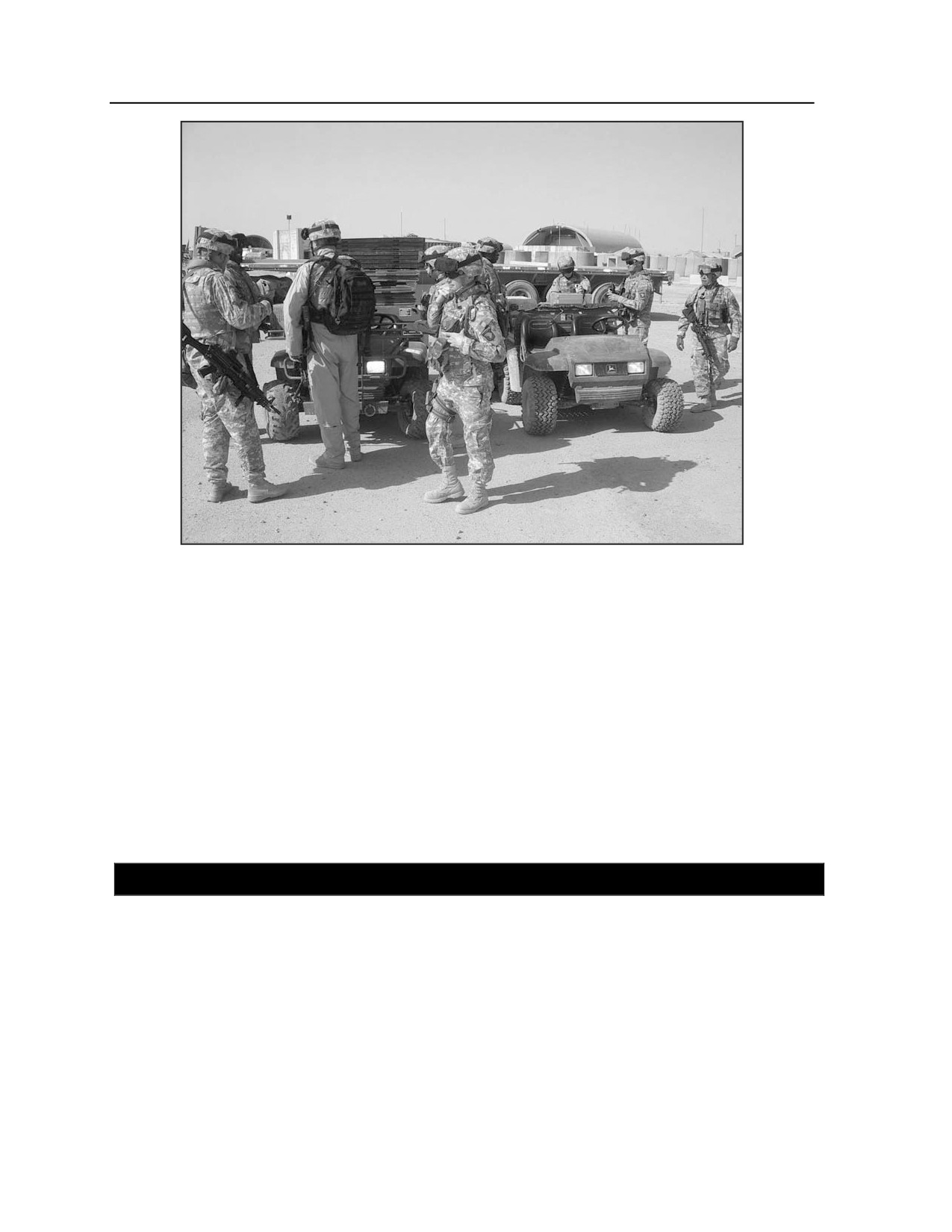
the DART OIC/NCOIC. Other responsibilities include (figure 1-3, page 1-10)—
• Rigging disabled aircraft (surface/aerial) IAW the DART NCOIC instructions.
• Performing required standard repairs (if needed) or BDAR repairs onsite (when possible).
• Tracking inspections and repairs on DA forms (hard copies). Hard copy entries are transferred to
the Standard Army Management Information System of record at the first opportunity available.
• Assisting in the recovery of disabled aircraft to the UMCP or maintenance facility.
21 July 2008
FM 3-04.513
1-9
Chapter 1
Figure 1-3. Downed aircraft recovery team personnel and equipment for load out
ACCIDENT INVESTIGATION BOARD
1-36. According to AR 385-10, the first commander to become aware of an Army aircraft accident places a
guard at the scene. This prevents anyone from moving or disturbing the aircraft or detaching parts until it is
released by the Accident Investigation Board president; and if participating, the United States Army
Combat Readiness Center. It may not be possible to comply fully with this requirement in the combat
environment. Further, aircraft damaged as a direct result of hostile fire are considered a “combat loss”
rather than an accident. Situation permitting, the recovery operation will not begin until one of the
following occurs:
• The commander of the unit to which the aircraft is assigned orders that an accident investigation
board is not required as prescribed by AR 385-10.
• The Accident Investigation Board president releases the aircraft.
SECTION III - MAINTENANCE SUPPORT FACILITIES
AVIATION CLASSIFICATION REPAIR ACTIVITY DEPOT
1-37. The Army National Guard’s (ARNG) Aviation Classification Repair Activity Depots (AVCRADs),
based in the continental United States (CONUS), provides limited depot repair activities. Their primary
mission is to repair and return materiel to the supply system. Secondary missions include providing backup
direct support to supported units; training of military and civilian personnel in select skills; and supporting
other DOD, governmental and nongovernmental agencies, and multinational forces in theater. These
activities must provide the same or expanded sustainment maintenance capabilities during contingency
operations. In addition, AVCRADs may provide BDAR and estimated cost of damage assessments.
AVCRAD personnel and assets, when deployed, augment the theater aviation sustainment maintenance
group.
1-10
FM 3-04.513
21 July 2008
Management
ARMY AVIATION SUPPORT FACILITY
1-38. ARNG facilities provide for aircraft storage, field maintenance, air operations planning and
coordination, and unit training in CONUS. Most Army aviation support facilities (AASFs) consist of
hangars, armories, operations buildings, and associated administrative facilities. AASFs provide recovery
support for units assigned within their state and assist transient aircraft with component failure occurring in
the vicinity of the AASF.
CONTINENTAL UNITED STATES AIRCRAFT RECOVERY SUPPORT
1-39. AR 5-9 indicates activities designated with providing aircraft recovery assistance and services in
CONUS (table 1-1).
Table 1-1. Continental United States aircraft recovery responsibilities
INSTALLATION
AREA OF RESPONSIBILITY
Fort Rucker, AL
FL, GA, SC, TN, AL, and MS
Fort Bragg, NC
NC
Fort Bliss, TX
NM, TX, and counties west of Crane, Crockett, Ector, and Val Verde
Fort Hood, TX
LA, OK, AR, TX, and counties east of Pecos, Terrell, Ward, and
Winkler
Fort Campbell, KY
KY, OH, IL, WI, and MI
Fort Eustis, VA
VA
Fort Riley, KS
KS, MO, NB, IA, and MN
Fort Carson, CO
CO, UT, ID, WY, MT, ND, and SD
Fort Lewis, WA
WA and OR
CA AVCRAD
CA and NV
CT AVCRAD
CT, JY, RI, MA, VT, NH, and ME
Army Avn Spt Fac
PA, WV, MD, DE, and Annville, PA
Army Avn Spt Fac
AZ and Phoenix, AZ
Fort Drum, NY
NY
21 July 2008
FM 3-04.513
1-11
This page intentionally left blank.
Chapter 2
Operations
Garrison and battlefield aircraft recovery place unique challenges on commanders.
This chapter focuses on general procedures used to develop, coordinate, and execute
safe recovery and/or evacuation of aircraft for return to operational status.
SECTION I - GENERAL AIRCRAFT RECOVERY CONSIDERATIONS
2-1. Varying degrees of aircraft damage can be
sustained during periods of intense combat. To
Contents
ensure maximum availability for future missions,
aircraft must be assessed and repaired quickly. In
Section I - General Aircraft Recovery
Considerations
2-1
addition to ballistic damage, a higher number of
component failures can occur due to increased
Section II - Mission-Specific
Considerations
2-9
flying hours and higher stress levels.
TRIGGERING CONDITIONS
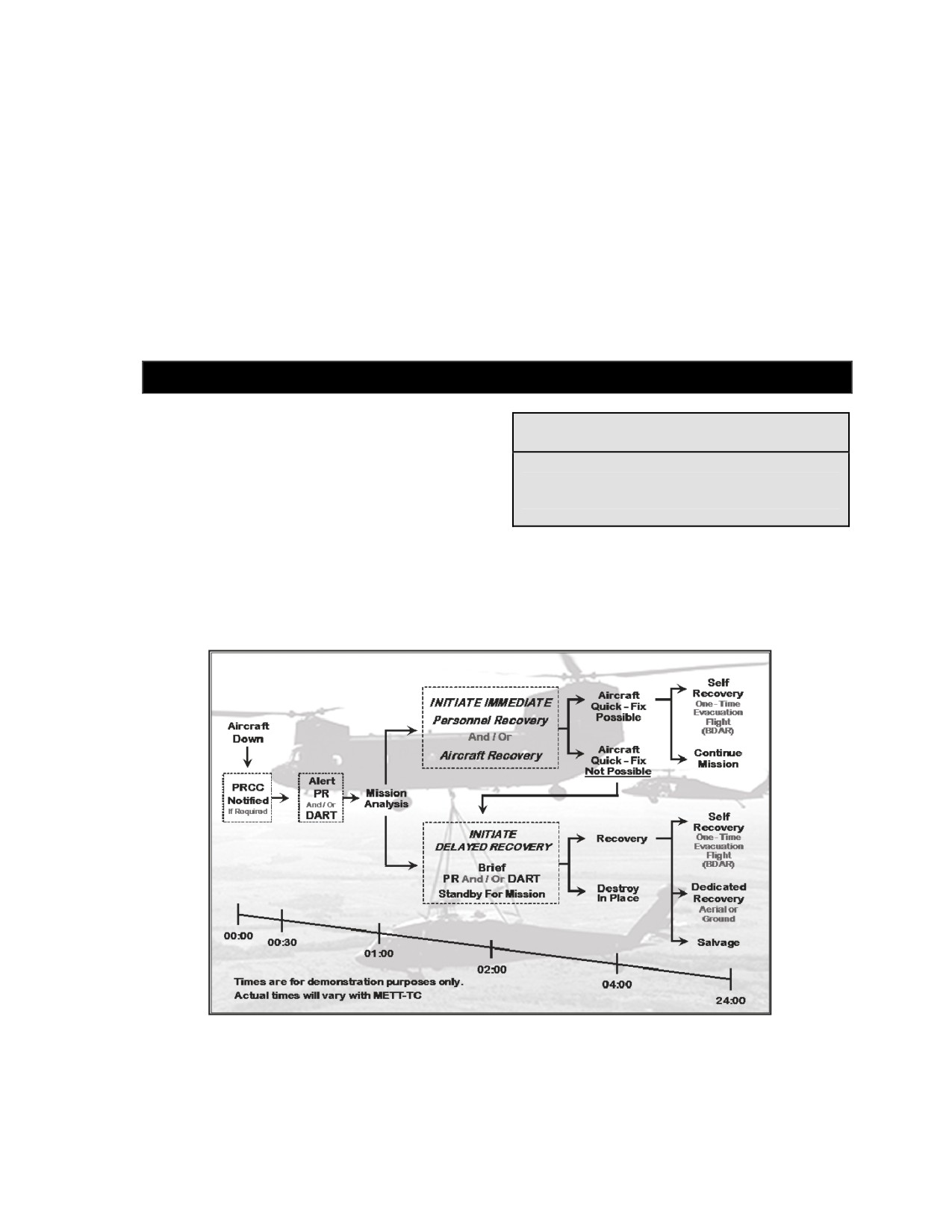
2-2. The visual sighting of an aircraft going down or a report of an aircraft going down within the area of
coverage are triggering conditions for a recovery operation. The PR trigger initiates the DART mission
process. Missions normally proceed consecutively (figure 2-1).
Figure 2-1. Matrix for the execution of recovery missions
21 July 2008
FM 3-04.513
2-1
Chapter 2
2-3. One of two different circumstances may trigger planning for aircraft recovery operations. They
include the following—
• Mission planning for any flight will trigger contingency planning for immediate and/or delayed
aircraft recovery operations by the aviation unit. Planning will be implemented if one of the
aircraft taking part in the operation goes down.
• Recovery assets may be directed by higher headquarters to recover aircraft belonging to other
units, services, or coalition forces. DART operations include contingency planning for these
circumstances and considerations.
REQUEST FOR ASSISTANCE
2-4. The first step in the assessment process is providing the aviation brigade CP with key critical
information. A request for assistance should include the following information.
Critical Information
2-5. Critical information includes—
• Threat situation.
• Aircraft location.
• Friendly ground unit responsible for the terrain.
• Site security and suitability (including existing weather conditions, for DART insertion).
• Aircraft damage, to the extent possible for BDAR personnel, equipment, and parts requirements
to be estimated.
• Personnel status, to determine their ability to assist in repairing damage (for example, injured
personnel will be unable to provide assistance in repair actions).
• Information provided by air traffic controllers.
Minimum Information for In-Flight Emergencies
2-6. Minimum information includes—
• Aircraft identification and type.
• Nature of emergency.
• Pilot’s desires.
• Aircraft position (grid or latitude and longitude coordinates).
Other Information
2-7. Depending on the aircraft communication’s status and urgency of the emergency, the following
items may be obtained from the pilot or aircraft operator:
• Aircraft altitude, airspeed, and last known heading.
• Fuel remaining in time.
• Pilot reported weather.
• Pilot capability for instrument flight, if required.
• Time and place of last known position.
• Navigation equipment capability and navigational aid signals received.
• Visible landmarks.
• Aircraft color.
2-2
FM 3-04.513
21 July 2008
Operations
• Number of people onboard.
• Point of departure and destination.
• Emergency equipment on hand, and weapons and ammunitions available.
AIRCRAFT RECOVERY OPERATIONS
2-8. Aircraft recovery operations can be placed into two separate categories: immediate or delayed.
Commanders must recognize and prepare for both types. METT-TC will be the primary factor for mission
analysis. Mission analysis determines whether recovery will be immediate or delayed (figure 2-1, page 2-
1).
IMMEDIATE RECOVERY
2-9. Immediate recovery is any recovery that can be conducted immediately by aircraft in the flight under
the control of the air mission commander. Immediate recovery of aircraft is possible when aircraft at the
scene of the forced landing can be assessed, fixed, and returned to service, or prepared for a one-time
evacuation mission to a maintenance site in a minimal amount of time. The time required to repair the
aircraft at the scene depends on the tactical situation and condition of aircraft, which may result in a
delayed recovery operation. Aircraft designated as maintenance aircraft should be thoroughly integrated
into all plans.
Example of Immediate Recovery
During an air assault, a UH-60 aircraft experiences a bird strike on the main rotor
system. The aircrew departs the flight and lands the aircraft without incident. The PC
radios the air mission commander and advises him of the emergency. A
maintenance test pilot (MP) participating in the flight assesses and determines that
the aircraft was not damaged by the bird strike. The air mission commander directs
the PC to rejoin the flight and continue the mission.
2-10. Immediate recovery is desirable, as friendly aircraft are usually in the area and enemy forces have
probably not had the opportunity to react. The commander must consider certain factors when planning for
immediate recovery such as—
• Continuation of mission. Immediate recovery may take aircraft away from the primary mission.
Commanders must consider mission intent and decide if it is feasible to take an aircraft away
from an ongoing mission to conduct an immediate recovery. If the mission is an air assault, the
aviation commander must consult with the air assault task force commander before executing
immediate recovery. The aviation commander may designate an aircraft, piloted by maintenance
officers, to conduct the recovery if required.
• Pickup aircraft. A commander may designate specific aircraft, crewed by maintenance
personnel, to conduct immediate recovery. This responsibility may also fall on the nearest
aircraft in support of the downed aircraft. The commander must specify and select the aircraft to
be used for immediate recovery during the planning process. The selected crew must receive
specific, detailed instruction on aircraft recovery execution.
• Recovery aircraft location. The aircraft designated for immediate recovery should be part of the
mission and formation. The recovery aircraft should be positioned where it can best support the
operation.
• Airspace command and control. Separate airspace control measures may be developed to allow
immediate recovery aircraft to perform operations without interfering with the ongoing mission.
Effective C2 must be established to deconflict the immediate recovery aircraft and the ongoing
mission aircraft.
21 July 2008
FM 3-04.513
2-3
Chapter 2
DELAYED RECOVERY
2-11. Delayed recovery is any recovery that cannot be conducted immediately by aircraft in the flight
under the control of the air mission commander. Delayed recovery will be necessary when—
• Utility or cargo aircraft are not available in the flight.
• Enemy activity in the vicinity of the downed aircraft makes an immediate recovery too risky.
• Immediate recovery cannot be executed without adversely affecting the mission; for example, an
air assault formation loaded with ground troops en route to the landing zone (LZ) has no
dedicated maintenance aircraft.
• Location of the downed aircraft is not precisely known.
• Damage to the aircraft is extensive rendering it nonflyable.
• Location of the aircraft does not facilitate an aerial insertion/recovery.
2-12. This operation would be planned as a separate operation and may involve JPRC assets. When
planning separate PR or aircraft recovery missions, procedures for immediate and delayed PR DART
should be included. For example, planning for a separate PR mission should include a contingency plan if
an aircraft goes down while the PR mission is being conducted.
Example of Delayed Recovery
During an air assault, a UH-60 aircraft experiences a bird strike on the main rotor
system. The aircrew departs the flight and lands the aircraft without incident. The PC
radios the air mission commander and advises him of the emergency. An MP
participating in the flight assesses the aircraft and cannot determine if the damage is
within specified tolerances. The air mission commander notifies the combat aviation
brigade (CAB) CP and requests DART support. The DART responds and upon
arrival the assessor/technical inspector (TI) determines the blade damage is within
tolerance and releases the aircraft for flight. The air mission commander directs the
PC to return to base.
MISSIONS DEFINED
AIRCRAFT RECOVERY
2-13. The aircraft recovery mission extracts an aircraft from a downed location to a safe area using
recovery kits, a trained recovery team, and recovery aircraft or tactical vehicles. BDAR-trained repair
personnel can augment a DART using BDAR procedures to expedite self-recovery and safe return of
aircraft and personnel. Furthermore, they prevent enemy retrieval of the aircraft retaining control for future
use and eventual reintegration into the battle. DART should recover the airframe if—
• The tactical situation allows for recovery.
• The aircraft is worth recovering.
• The aircraft can be recovered successfully.
DOWNED AIRCRAFT RECOVERY TEAM
2-14. DARTs perform the following functions:
• Assessing repair requirements.
• Repairing aircraft, or preparing it for a one-time evacuation mission.
• Recommending recovery by aerial or ground means.
2-4
FM 3-04.513
21 July 2008
Operations
• Rigging aircraft for recovery.
• Serving as ground crew for helicopter lift.
• Serving as crew to secure the load aboard a vehicle.
2-15. Typically, there are two types of DART operations: deliberate and hasty.
• Deliberate DART:
Performs standby in a predetermined location until the mission is complete.
Participates in the air mission brief.
Assembles all organic and attached personnel at the standby location.
Preloads all ground recovery assets.
Prepositions all aerial recovery assets for rapid loading.
Ensures PCCs/PCIs are complete.
DART OIC/NCOIC positioned at the controlling CP or appropriate supporting CP.
• Hasty DART:
Continues normal duties until notified of a requirement, and then executes a predetermined
recall time line.
Upon notification, assembles all organic and attached personnel at the standby location.
Upon notification, loads all air or ground recovery assets as required.
Conducts PCCs/PCIs.
DART OIC/NCOIC remains in contact per the unit SOP to ensure rapid response.
2-16. If the aircraft is unrecoverable, the DART—
• Determines parts, subsystems, or components for cannibalization and removes them.
• Destroys, or takes part in the destruction of, a disabled aircraft to be abandoned.
• Performs salvage recovery to sterilize the area and remove the aircraft in part, or in total, for
investigation or disposal.
PRINCIPLES
2-17. The following defines DART requirements and procedures. DART discussion relates to both the
AMC/AMT and ASC/AST levels. AMC/AMT DART should focus their efforts on BDAR and self-
recovery while the ASC/AST should focus on dedicated recovery operations.
DOWNED AIRCRAFT RECOVERY TEAM COMPOSITION
2-18. The DART is initially formed from aviation brigade assets. The DART is generally comprised of
preselected ASC/AST and/or AMC/AMT personnel trained in BDAR and aircraft recovery tactics,
techniques, and procedures. DART members normally include an OIC and/or an NCOIC; an MP; a mission
design series (MDS)-specific technical inspector and assessor; and a trained repair, rigging, and movement
team. One of the riggers must be a qualified rigging inspector able to certify each load. This team member
does not perform rigging tasks. Air/ground integration and the tactical situation will dictate the leadership
and composition of the team. Additional team members can include ASC/AST and AMC/AMT airframe
and component repair personnel based on the aircraft status, as well as a radio operator and security force
based on the tactical situation.
2-19. Upon arrival at the downed aircraft, the DART completes the assessment and recommends a course
of action based on the condition of the aircraft and the tactical situation. DART members may be
authorized to utilize BDAR criteria to expedite the return of the aircraft to the fight by enabling a self-
recovery, or perform a dedicated recovery of the aircraft, by ground or air, to a maintenance area for
repairs.
21 July 2008
FM 3-04.513
2-5
Chapter 2
2-20. These teams may respond to the recovery of an aircraft from within the unit, a supported or adjacent
unit, or any aircraft disabled within sector. Normally, these teams are transported with their equipment by
air to the scene of the disabled aircraft. They are then extracted by air upon mission completion.
BATTLE DAMAGE ASSESSMENT AND REPAIR
2-21. Combat operations make expediting normal maintenance procedures imperative. In such cases, the
unit commander may authorize use of BDAR procedures. BDAR is the procedure used to rapidly return
disabled equipment to the operational commander by the field-expedient repair of components. BDAR may
be a technique used to facilitate a DART mission, or to repair a damaged or failing system identified by
aircrews or maintenance personnel during inspections or operation. BDAR restores the minimum essential
capabilities necessary to support a specific combat mission, or to enable equipment self-recovery. BDAR is
accomplished by bypassing components or safety devices; fabricating repair parts; modifying standard
maintenance procedures; and using substitute fluids, materials, or components. Depending on the repairs
required and amount of time available, repairs may not return the aircraft to a fully mission-capable status.
Operators/crew chiefs, aircraft maintenance personnel teams, maintenance support teams, contact
maintenance repair teams, or trained recovery teams may perform BDAR.
2-22. Battle-damaged aircraft will be inspected and then assessed and classified by a damage assessor
using a method similar to the medical concept of “triage” (deferment, repair, nonrepair). The assessment
determines if the aircraft—
• Can be readily returned to the fight.
• Can self-recover with BDAR maintenance.
• Will need a dedicated recovery by either ground or aerial method.
• Should be sanitized, cannibalized, and destroyed.
2-23. Following assessment, some aircraft are returned to service immediately through deferment. More
seriously damaged aircraft will be repaired using approved BDAR techniques.
2-24. BDAR personnel are typically AMC/AMT Soldiers (normally 15-series MOS). These personnel may
serve as integral participants in the DART mission and are chosen depending on requirements. The actual
composition of BDAR personnel and equipment depends on the type and extent of maintenance work
required of the damaged aircraft.
Battle Damage Assessment and Repair Manuals
2-25. BDAR manuals contain aircraft damage assessment criteria and modified repair procedures. These
manuals are formally processed and validated publications for use in combat environments, as authorized
by the unit commander (see bibliography for applicable manuals). Each aircraft type has its own BDAR
manual that provides information such as—
• Combat damage inspection and assessment techniques.
• Combat area maintenance serviceability and deferability criteria.
• Cannibalization techniques that permit quick, efficient removal of critical components and
structures from unreparable and unrecoverable aircraft.
2-26. BDAR procedures differ with the various MDS. The following technical manuals (TMs) indicate
procedures applied to each airframe:
• TM 1-1520-237-BD (UH-60A/L/E).
• TM 1-1520-240-BD (CH-47D).
• TM 1-1520-251-BD (AH-64A/D).
• TM 55-1520-244-BD (AH-1 AH-1E/F).
2-6
FM 3-04.513
21 July 2008
Operations
KITS
Recovery Kits (Downed Aircraft Recovery Team)
2-27. DARTs use UMARKs for aerial and ground aircraft recoveries. With UMARK tools and materials,
team members can make quick combat extractions of downed aircraft. Recovery kits are transported by
helicopter internally or externally (slingload) and are manportable.
Combat Repair Kits (Battle Damage Assessment and Repair Kit)
2-28. BDAR personnel use specially-designed combat repair kits for repairing major aircraft systems. The
tools and materials found in these kits permit quick, temporary combat-damage repairs. Kits are man-
portable (suitcase-sized). Furthermore, mission and environmental considerations will determine additional
materials and equipment required not resident in these prepackaged kits.
PREPARATION
2-29. Preparation generally occurs in two phases: predeployment preparation and individual mission
phases. Both phases include PCCs and PCIs. The predeployment preparation phase should be integrated
into the unit’s pre-accident plan and includes addressing the items in the following paragraphs. Preparation
for each individual mission phase should include PCCs/PCIs from the predeployment preparation phase
with the addition of mission-specific variables.
PRECOMBAT CHECKS AND INSPECTIONS
Downed Aircraft Recovery Team
2-30. DART PCCs/PCIs include, but are not limited to—
• Personnel qualified/trained/rehearsed.
• Inventoried/inspected UMARKs.
• Security teams.
• Weapons/ammunition.
• Explosive ordnance disposal (EOD) support.
• Communications equipment/communications plan with ground unit responsible for terrain.
• Aircraft weight estimates for downed aircraft.
• Battle graphics on maps.
• Safety procedures for armed downed aircraft.
• Drop-off areas for recovered aircraft identified.
• Sustainment equipment and supplies.
Battle Damage Assessment and Repair
2-31. BDAR PCCs/PCIs include but are not limited to—
• Personnel management. Considerations include—
The number of personnel and skill level by MOS required.
Personnel qualified/trained/rehearsed.
Identifying critically short MOSs.
Appropriate logistics assistant representative support for difficult maintenance decisions
and letters of exception (if required).
• Expendable and consumable supplies availability.
21 July 2008
FM 3-04.513
2-7
Chapter 2
Ensure adequate quantities remain on hand.
• BDAR and other kits.
• Equipment.
Tool boxes inventoried and complete.
Special tools and test equipment within calibration.
Commonly required parts (chip detectors, filters, packing).
COMPOSITE RISK MANAGEMENT
2-32. CRM is a vital instrument employed during the preparation phase. It is the Army’s primary
decisionmaking process for identifying hazards and controlling risks across the entire spectrum of Army
missions, functions, operations, and activities. CRM assists commanders in mitigating risks associated with
hazards having the potential to injure or kill personnel, damage or destroy equipment, or otherwise impact
mission effectiveness. In the past, the Army separated risk into two categories, tactical risk and accident
risk. While these two areas of concern remain, the primary premise of CRM is that it does not matter where
or how the loss occurs, the result is the same—decreased combat power or mission effectiveness. The
CRM process will be incorporated in all recovery operations. For more CRM information, refer to FM 5-
19.
ENVIRONMENTAL CONSIDERATIONS
ENVIRONMENTAL PROTECTION
2-33. Fuel, oil, and other mechanical fluids spilled on the ground during recovery operations can damage
the environment. As with many recovery considerations, the level of environmental protection is mission
dependent. During periods of heightened conflict, simple procedures can help to preserve and protect the
environment. All practical efforts should be made to avoid environmental contamination. Spills of more
than one gallon should be reported through the chain of command to the unit’s logistical element, such as
the battalion logistics staff officer (S-4). Local policy or state laws may require spills of even lesser
amounts be reported.
OPERATIONAL CONSIDERATIONS
2-34. Climate extremes must be considered in recovery operations to include—
• Extreme cold or hot weather conditions. These conditions pose a threat to successful mission
completion if Soldiers are not acclimated properly. When operating in these conditions, rigging
normally takes longer.
• Dusty environments reduce visibility and impair normal breathing.
• Night operations reduce visibility and require artificial lighting.
CONTAMINATED ENVIRONMENTAL CONSIDERATIONS
2-35. Aircraft recovery teams must be trained in chemical, biological, radiological, and nuclear (CBRN)
defense procedures, monitoring, and detection techniques. Teams should have additional decontamination
equipment, decontaminating agents, and protective clothing. Contaminated recovery equipment could
spread an agent along the evacuation route posing a hazard to uncontaminated units and equipment.
Commanders must keep in mind that equipment used to recover contaminated equipment will also be
contaminated. If recovery of equipment is not possible, personnel should keep BDAR to a minimum,
recover to a decontamination area, and finish the BDAR or recovery task. Contaminated equipment must
not be evacuated to uncontaminated areas until fully decontaminated.
2-8
FM 3-04.513
21 July 2008
Operations
BIOHAZARDS
2-36. During recovery operations, caution must be taken with respect to human remains and non-CBRN
pathogens. Recovery personnel should receive training from medical and mortuary affairs experts in the
proper procedures and protective measures when collecting and handling these hazards. Ensure adequate
protective equipment including gloves, masks, coveralls, and specialized containers are available and
utilized.
SECTION II - MISSION-SPECIFIC CONSIDERATIONS
BATTLE DAMAGE ASSESSMENT AND REPAIR TRAINING
PROGRAM
2-37. AR 750-1 requires maintenance unit commanders, including ASC/AST, AMC/AMT commanders, to
conduct nondestructive peacetime BDAR training that simulates combat conditions as closely as possible.
Soldiers must become familiar with BDAR repair kit components. Each maintainer should know how to
perform battle damage assessment for assigned MDS and MOS skill sets.
2-38. Maintenance standards are based on TMs and preventive maintenance checks and services (PMCS).
Commanders can direct the employment of BDAR for normal maintenance failures to evaluate training or
validate new procedures. Maintenance unit commanders should develop sustainment training in which
aircraft maintainers and crew chiefs conduct BDAR, when applicable. BDAR-required skills are found in
individual and collective training tasks. Maintenance unit commanders and leaders should be aware of
which MOSs require knowledge of BDAR. Company and battalion unit task lists, especially in the
AMC/AMT and ASC/AST, require BDAR training.
DOWNED AIRCRAFT RECOVERY TEAM TRAINING PROGRAM
2-39. Training is essential to successful completion of the DART operation. UMARK familiarity reduces
the time required to complete a DART operation. Training should be conducted utilizing every available
opportunity. Garrison recoveries may be enhanced by simulating combat conditions with safety measures
applied. Simulated conditions are as follows:
• Performing security operations.
• Placing time constraints on rigging procedures to simulate enemy threat.
• CBRN simulations using mission-oriented protective posture (MOPP).
• Route planning with simulated threat.
REHEARSALS
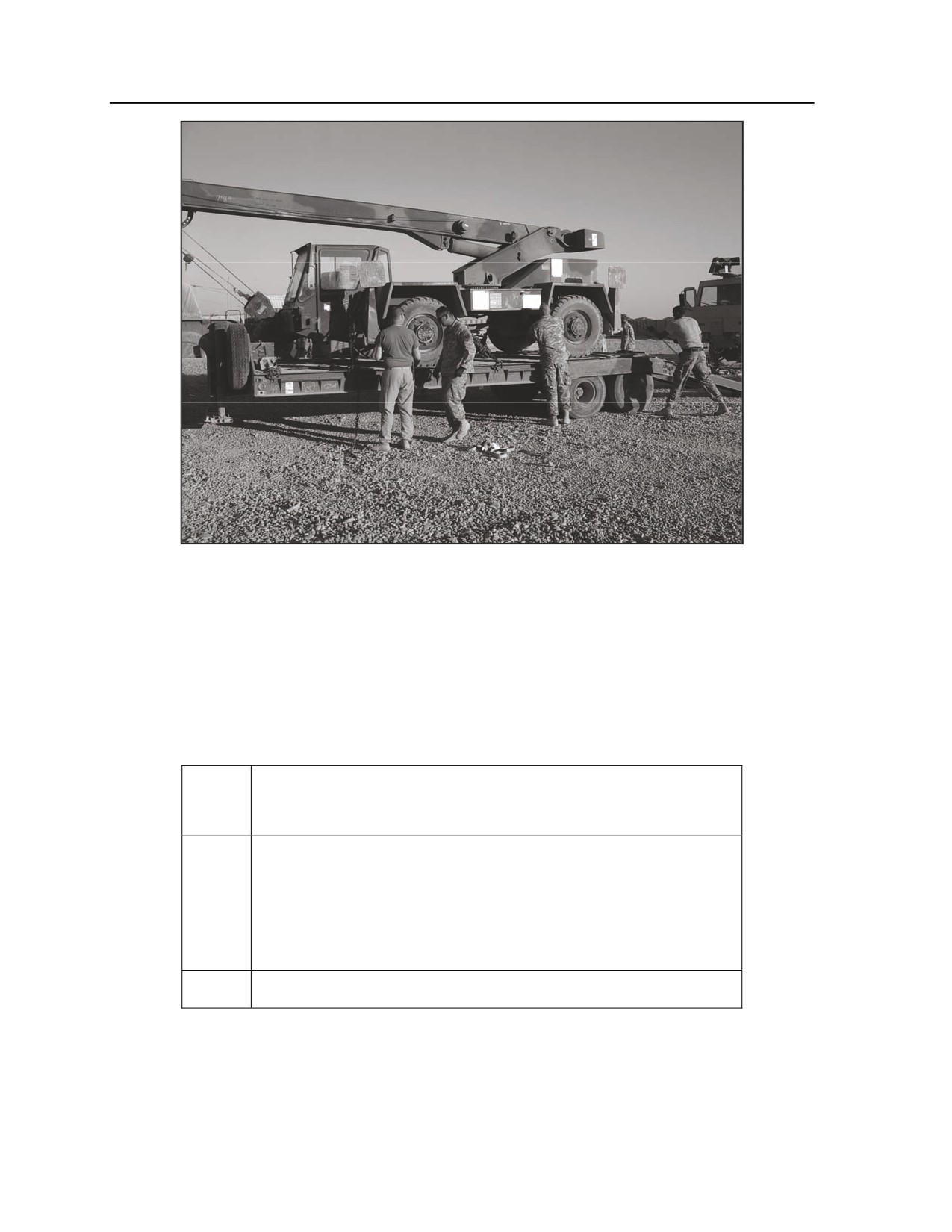
2-40. Rehearsals (figure 2-2, page 2-10) are conducted to enhance proficiency and address last-minute
details and any unforeseen adjustments. Rehearsals should be conducted for DART assembly, onsite
security operations, aircraft assessment, aircraft repair
(BDAR), rigging procedures, and loading and
unloading of the aircraft.
21 July 2008
FM 3-04.513
2-9
Chapter 2
Figure 2-2. Rehearsal load out for ground recovery
BATTLE DAMAGE ASSESSMENT
2-41. The assessor on the scene performs an evaluation of the aircraft and determines if BDAR principles
may be applied or a recovery operation is required. The assessor will then transmit a report to the aviation
brigade CP. This report covers the following items:
• Aircraft condition (table 2-1).
Table 2-1. Battle damage assessment categories
CAT I
The aircraft is reparable. The aircraft can be repaired onsite by bringing
resources to it depending on the tactical situation. (In other words, there is
inadequate time to perform repairs before the amount of support [tactical]
exceeds what is available and on hand.)
CAT II
The aircraft is recoverable and still has intrinsic value. For example, assume
during landing that an aircraft lost all hydraulic fluid. The crew managed to
shut down engines, but the landing was a little hard. No sudden stoppages
were involved. In this instance, both engines, as well as the gear boxes,
transmission, and drive shaft, are in good working order. Weapon systems
subcomponents are also in working order. All these items are recoverable.
The fuselage sustained only minor damage on landing. The entire airframe
is an asset and a prime candidate for aerial recovery.
CAT III
The aircraft is destroyed. The aircraft is assessed as destroyed and crews
have been recovered.
• Aircraft location.
• Eight- to ten-digit grid (artillery destruction mission).
• Brief description of remaining components identified for cannibalization.
2-10
FM 3-04.513
21 July 2008
Operations
AIRCRAFT DISPOSITION
2-42. The disposition of the aircraft is determined by the degree of damage sustained. The assessment
determines if the aircraft will be—
• Repaired and flown from the site.
• Rigged and recovered by aerial or ground applications.
• Destroyed.
• Salvaged for future investigation or disposal.
DESTRUCTION OF AIRCRAFT
2-43. The DART must request disposition of unrecoverable aircraft and equipment from the chain of
command up to the approval authority. The team may cannibalize useable aircraft components and
equipment. Other responsibilities include—
• Prepares aircraft and equipment for destruction IAW TM 750-244-1-5, the TACSOP, unit
maintenance and aircraft recovery SOP, and battalion and brigade commander’s guidance.
• Destroys aircraft on order from the appropriate authority or designated representative.
• Employs safety procedures during aircraft destruction operations as briefed by the DART OIC
and IAW the TACSOP, the unit maintenance (safety annex) SOP, and the aircraft recovery
operations SOP.
• Employs environmental stewardship procedures during aircraft destruction operations IAW the
TACSOP, the unit maintenance (HAZMAT annex) SOP, and the aircraft recovery operations
SOP.
SANITIZATION
2-44. Sanitization prevents the compromise of aircraft systems and critical information in the aircraft or in
the possession of crewmembers and passengers. This requires clearing the downed aircraft site of all
sensitive or significant equipment and documents. Sanitization must be completed prior to abandonment of
an airframe. If onsite sanitization is not possible, destruction of the aircraft by extended-range fire support
systems should be considered as part of the abandonment process.
2-45. The DART OIC/NCOIC should address the following actions—
• Identify and mitigate immediate dangers (for example: fire, armament, fuel leakage, HAZMAT,
and electrical sparks).
• Safe weapons and external stores.
• Disarm and safe all crew-served and/or gunner weapons on the aircraft.
• Remove or zeroize all aircraft survivability, communications, and navigation equipment.
• Remove all maps, kneeboards, strip maps, and documentation from the aircraft and surrounding
area.
21 July 2008
FM 3-04.513
2-11
Chapter 3
Procedures
This chapter covers recovery alternatives and the rigging considerations used when
performing recovery of disabled aircraft. Unfortunately, not all downed aircraft are
able to self-recover or are in a condition to enable UMARK-assisted dedicated
recovery. Critical attachment points and/or the airframe itself may not be structurally
sound. Therefore, fabrication of equipment may be required to utilize UMARK for an
aircraft recovery. This operation will enable the return of aircraft for logistical
considerations or to complete extensive repairs.
SECTION I - RECOVERY ALTERNATIVES
3-1. The assessor recommends to the commander which recovery method to use. Numerous
considerations are taken into account when making
this determination to include enemy situation, the
Contents
unit’s mission status, and the location and condition
of the aircraft. For example:
Section I - Recovery Alternatives
3-1
Section II - Rigging Considerations
3-5
• An aircraft received small arms fire that
severed a hydraulic line and the pilot was able to make a controlled landing in a friendly area.
The DART assessed the aircraft as able to be quickly repaired using a BDAR kit, allowing the
aircraft to self-recover or rejoin the air mission.
• An aircraft’s rotor blades struck trees as it was descending into a battle position. The aircraft
landed hard but upright near the top of a steep ridge. The DART assessed the aircraft for a
dedicated aerial recovery due to the extent of damage and the inability of a transport vehicle to
access the site.
• An aircraft received rocket-propelled grenade and small arms fire as it flew over a city. One
engine and the vertical fin were severely damaged but the pilot was able to land the aircraft in a
field on the edge of a town near an infantry company’s location. The DART assessed the aircraft
for a dedicated ground recovery due to the extent of damage, site security, and the ability of a
transport vehicle to access the site.
3-2. When performing a recovery, the structural soundness of the aircraft must be evaluated and a
dedicated recovery may require strengthening before extraction. This examination assists in determining
the effects of removed/damaged components upon structural integrity. If necessary, components should be
removed to relieve structural stress.
SELF-RECOVERY
3-3. Self-recovery is the preferred method for recovering an aircraft. It may involve dispatching the
DART to the aircraft site with the needed repair parts, equipment, and materials identified by the initial
aircrew assessment. The DART will make necessary repairs (standard or BDAR) to enable the aircraft to
continue the mission, or return to a maintenance collection point or nearest maintenance facility for
additional inspections and maintenance. Normally, the risk to aircrews, DART, and security personnel is
decreased by the shorter duration of a self-recovery and the aircraft is quickly returned to service.
21 July 2008
FM 3-04.513
3-1
Chapter 3
DEDICATED RECOVERY (AERIAL)
3-4. Aerial recovery involves attaching the aircraft to suitable airlift recovery equipment, connecting it to
the lifting helicopter, and flying it to the maintenance collection point (MCP) or maintenance facility. All
downed aircraft must be rigged according to applicable TMs. Planning for this type of recovery entails
thorough analysis of the recovery site and the associated threat due to relatively slow air movement over a
battlefield. Medium-lift helicopters will be required for heavier-type aircraft aerial recoveries.
3-5. High altitude considerations are a vital part of planning. The power required versus power available
is reduced significantly with high altitude operations. Soldier performance is also degraded without
acclimation to this environment.
ADVANTAGES
3-6. Aerial recovery reduces the time that recovery assets are engaged and exposed to the battlefield.
Route reconnaissance and security escort requirements are considerably less intense than during surface
recovery. In addition, the need for aircraft disassembly is greatly reduced. Recovery site accessibility
requirements are not as rigid; however, the distance from which recovery assets may be obtained is greater.
DISADVANTAGES
3-7. The possibility exists for complete loss of aircraft through failure of recovery equipment. Although
exposure time is less, the distance from which recovery activities are detectable is greater. Loss of recovery
assets through enemy action will be more severe, effectively degrading total force fighting capabilities.
This is due to the multi-use value and relative low density of airlift helicopters, particularly medium-lift
helicopters, compared to ground recovery vehicles.
ONSITE RECOVERY CHALLENGES
OBSTACLES
3-8. Trees must be cut so they fall away from the aircraft when clearing an area. This is accomplished
through appropriate tree notching or by a constraint applied to the tree using positioning straps and rope.
Tension is applied before starting the cut by stretching the nylon straps or rope as much as possible.
3-9. All trash should be removed before the recovery helicopter arrives. Small pieces of the disabled
aircraft, small tree limbs and roots, and loose recovery equipment can all become airborne, endangering the
recovery helicopter and ground crew.
VISIBILITY
3-10. Recovery helicopter pilots must be aware of conditions that might restrict visibility such as dust or
snow. This information enables rapid climb out planning if visibility deteriorates to a point where ground
reference is lost. A variety of dust control agents exists; however, natural turf is considered the best control
measure. Efforts should be made to preserve the natural turf cover while working in the pickup area. Note
in figure 3-1 how blowing dust degrades visibility at the pickup site.
3-2
FM 3-04.513
21 July 2008
Procedures
Figure 3-1. Example of obstacles encountered at pickup site
RADIO COMMUNICATION
3-11. The recovery helicopter will not normally proceed to the recovery site until the ground crew
communicates that the disabled aircraft is rigged and ready for hookup. This precludes endangering the
recovery helicopter for a longer period than necessary and minimizes flight time. The ground crew should
also include a radio operator collocated with the signalman. This individual should be in direct contact with
the recovery aircraft to advise the aircrew on the status of the aircraft extraction.
DEDICATED RECOVERY (GROUND)
3-12. Rigging aircraft for ground recovery is essentially the same as for aerial recovery (figure 3-2, page 3-
4). The major difference is that the device used to perform the lift is a crane, team of cranes, or similarly
capable pieces of equipment, instead of a helicopter. Any disassembly of the aircraft required due to road
obstacles—or size of the transport vehicle—is performed using procedures outlined in the appropriate
aircraft TM. Procedures outlined in the appropriate aircraft shipping manual are used to prepare any
devices (e.g., cradles, shipping skids, etc.) required for loading the aircraft onto the transport vehicle.
Personnel observe the same basic safety procedures (disarming, disconnecting batteries, etc.) as during
aerial recovery.
3-13. An aircraft may have severe crash damage; that is, major portions of the aircraft such as the engine,
transmission, and rotor system were torn from the aircraft. If so, rigging procedures may require
modification to recover the aircraft. In this situation, ground personnel determine the method used to lift
the aircraft. Primary concerns are to minimize further aircraft damage and ensure ground crew safety.
21 July 2008
FM 3-04.513
3-3
Chapter 3
Figure 3-2. Downed aircraft recovery team assembles for a ground recovery
ADVANTAGES
3-14. Surface recovery restricts the enemy’s ability to detect movement of recovery assets to an area
relatively close to movement routes. It can be used when weather conditions prohibit flight. In addition, the
threat of total loss of the aircraft during transport due to recovery equipment malfunction is low.
DISADVANTAGES
3-15. Surface recovery may tie up route security assets needed elsewhere. The time needed for surface
recovery is much greater than that required for aerial recovery. Recovery personnel and equipment assets
are unavailable for longer periods during surface recovery. This high exposure time on the battlefield with
slow-moving equipment increases the threat.
3-16. In addition, a significant amount of aircraft disassembly or modification is often required to adapt the
aircraft to surface travel; for example, shortening height dimensions to accommodate overhead road
clearances or the fabrication of extensions for trailers because the aircraft wheelbase is too wide. Ground
routes must be accessible, and meticulous reconnaissance of the route is required. Loading procedures and
travel on rough terrain can further damage the aircraft.
GROUND RECOVERY PROCEDURES
3-17. Ground recovery and evacuation use ground equipment and wheeled vehicles to move disabled
aircraft to an MCP or maintenance facility. When planning a surface recovery—
• Evaluate the aircraft.
• Determine the equipment and transportation requirements needed for recovery.
• Perform a thorough reconnaissance and evaluate available ground routes to and from the
recovery site.
SALVAGE RECOVERY
3-18. A salvage recovery occurs when the aircraft is damaged beyond the ability to utilize the UMARK
and effect ground or aerial recovery. The chain of command may direct salvage recovery operations to
facilitate an investigation, sterilize the battlefield, or for other reasons necessitating the complete recovery
of a severely damaged airframe. In these situations, the use of flat racks, military demountable containers,
and rough terrain forklifts may significantly reduce the time required to consolidate and transport the
various components of a severely damaged aircraft (figure 3-3, page 3-5).
3-4
FM 3-04.513
21 July 2008
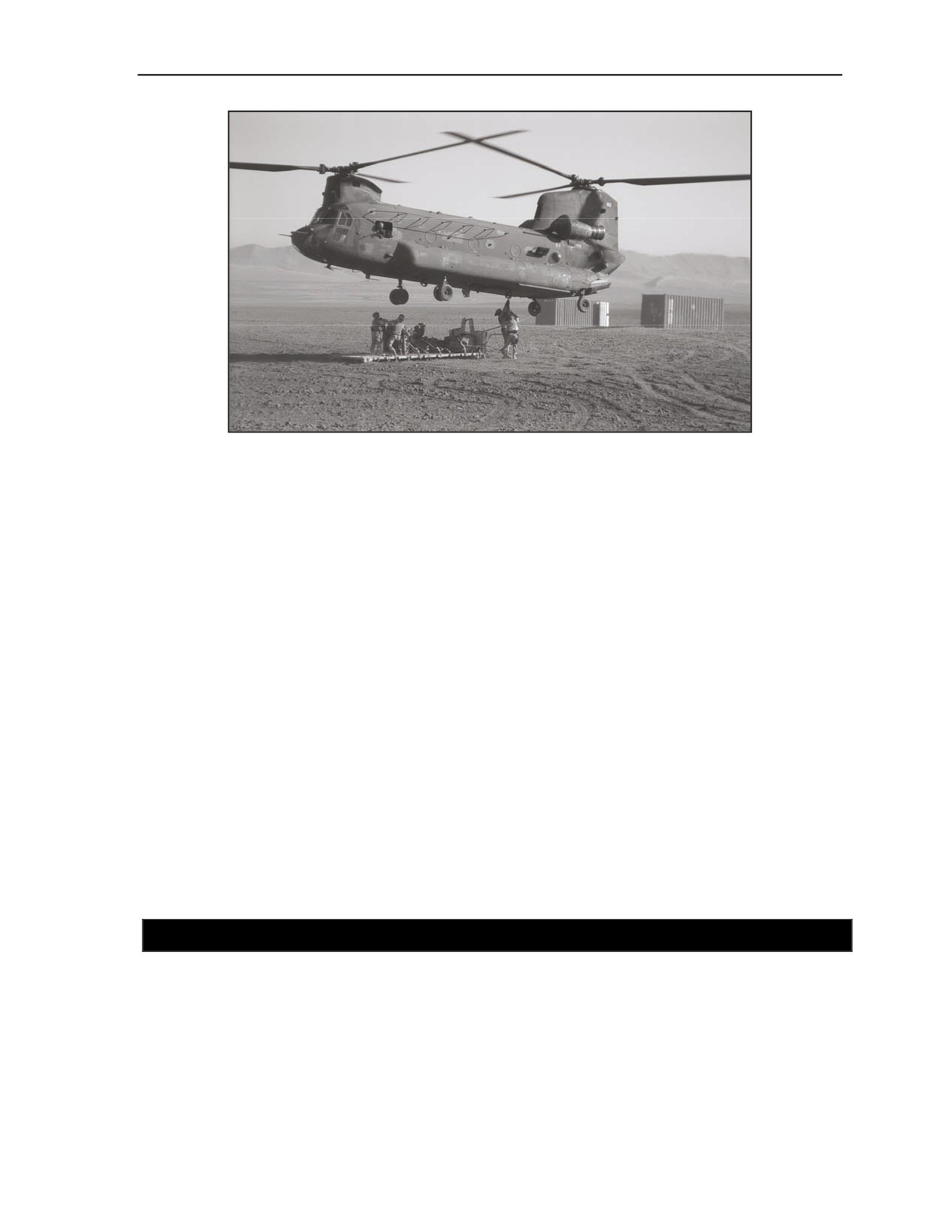
Procedures
Figure 3-3. CH-47 performs salvage recovery utilizing a flat rack and military demountable
containers
MAINTENANCE EVACUATION
3-19. Maintenance evacuation, a preplanned operation, is performed by preparing the aircraft for a one-
time evacuation mission to the unit’s maintenance support facility or movement by aerial or ground means.
Maintenance evacuations between maintenance units are coordinated between the commanders of the units
involved; they are assisted in some cases by the staff maintenance officer arranging supporting equipment
assets.
3-20. Evacuation of groups of aircraft is often driven by unit relocations on the battlefield or reconstitution
of aviation units. These evacuations would likely be controlled by the aviation brigade staff maintenance
officer/S-4 in coordination with division and corps staff. Coordination and tasking of division and corps
assets may also be necessary.
3-21. Nonflyable aircraft may be transported between maintenance facilities or moved due to relocation of
the maintenance facility. When this occurs, the aircraft will be prepared and loaded for ground transport as
specified in the applicable shipping manual. Procedures outlined in shipping manuals are used when
shipping flyable aircraft over extended distances. The same procedures are effective for moving aircraft
that are intact but not flyable due to maintenance. Use of these procedures will minimize the possibility of
aircraft damage that may occur as a result of movement. Sling loading is an option in this situation;
however, the potential damage occurring to the transported aircraft is much greater than with ground
transport. The availability of transportation assets and the urgency of the situation are factors in
determining the method of movement.
SECTION II - RIGGING CONSIDERATIONS
UNIT MAINTENANCE AERIAL RECOVERY KIT
3-22. The UMARK is a system of slings, tie-downs, stabilizing equipment, and interconnecting hardware
that can be assembled in multiple configurations to affect the safe aerial recovery of damaged helicopters.
Helicopter damage may include, but is not limited to—
• The destruction of the main rotor head.
• The main rotor shaft or mast bent, broken, or loose in the transmission.
21 July 2008
FM 3-04.513
3-5
Chapter 3
• The main transmission case cracked, broken, loose, or separated from the airframe.
• Damage to the tail boom to such an extent that it is not suitable as a lifting point.
• Bending or buckling of the airframe so as to create aerodynamic instabilities that could result in
additional damage during the recovery flight.
• Engine(s) severely damaged or separated from the airframe.
3-23. UMARK is designed to allow three ground personnel to rig a disabled helicopter for aerial recovery
in minimal time depending on team proficiency and the condition of the disabled aircraft. An exception to
this time frame would be the aerial recovery of a CH-47 helicopter, which requires the installation of
components from two UMARK kits. Disabled or damaged helicopters may not require stripping of
components, defueling or disarming, or need additional maintenance actions performed prior to aerial
recovery.
3-24. Personnel wearing combat, MOPP-4, or cold weather protective gear can install the UMARK under
all environmental conditions, day or night (using artificial illumination or night vision equipment). The
UMARK can be transported internally by a UH-1, UH-60, or CH-47 helicopter or larger utility/cargo
aircraft, or on the ground by the high-mobility multipurpose vehicle and larger vehicles.
MAINTENANCE AND FORMS/RECORDS
3-25. Preventative maintenance and inspections must be performed to ensure the UMARK kit components
are in serviceable condition. Detailed preventative maintenance checks are outlined in TM 1-1670-260-
12&P.
3-26. Each UMARK kit contains a usage log that shall be annotated after each usage. The maintenance
forms and records which are required by personnel who perform the inspections and maintenance functions
prescribed in this manual are those prescribed by DA Pam 738-751.
3-27. Do not use the kit if the usage log indicates lifts in excess of 20 aerial lifts, 16 cumulative flight
hours or 100 static lifts (crane/hoist). Upon reaching any of the above restrictions contact the Aviation
Ground Support Equipment Office (SFAE-AVAS-AG) at AMCOM, and turn in UMARK kit for post field
analysis (TM 1-1670-260 12&P).
3-28. FM 4-20.197 provides basic procedures for rigging, hooking up loads, and safety procedures.
AFTER-USE INSPECTIONS AND PACKING
3-29. After a completed recovery mission, UMARK equipment must be returned to a ready for issue
condition. All recovery equipment should be dried, cleaned, inspected, and replaced in the UMARK
container. Any damaged components must be replaced.
SAFETY CONSIDERATIONS
3-30. Safety is the first consideration in the recovery of aircraft. Soldiers should be briefed on safety
requirements and HAZMAT considerations prior to each mission. Safety equipment is available to
minimize the risks associated with rigging and lifting damaged aircraft. The following paragraphs describe
some of the safety equipment used while performing these missions.
GROUND CREW EQUIPMENT
3-31. Ground crewmembers involved in helicopter aerial recovery operations are exposed to the hazards of
helicopter noise, rotor downwash creating blowing debris, and static electricity. Therefore, they should
wear eye protection, hearing protection, and gloves when performing their duties. Depending on the
mission, they may need additional personnel protective equipment.
3-6
FM 3-04.513
21 July 2008
Procedures
Static Electricity Discharge Equipment
3-32. In flight, a helicopter generates and stores a charge of static electricity. This static electricity is
discharged to the ground when the helicopter lands. While the helicopter is in flight, however, this charge
remains stored unless a path is provided to channel it to the ground. A ground crewmember provides this
path by contacting the helicopter cargo hook when it is positioned over a cargo hookup point. Although
this charge may not cause an electrical burn, it can cause a muscular reaction (cramps or spasms), which
may result in a fall if the individual is on unsure footing.
3-33. To prevent static electricity shock, the ground crewmember uses either a reach pendant which
provides the hookup person with insulation while connecting the sling assembly to the aircraft, or a
discharge wand to discharge the static electricity to ground. For added protection, the ground crewmember
should also wear 5,000-volt shock-proof gloves, if available, when using the wand.
3-34. The wand consists of an insulated plastic tube with a metal hook on one end with a wire attached
leading to a ground rod. The entire length of wire must be insulated to prevent severe shock. In use, the
ground rod is driven into the earth, and a ground crewmember holds the wand. As the helicopter hovers
over the load, the assistant hookup man holds the wand against the cargo hook; this grounds the stored
electrical charge. Meanwhile, the hookup man places the clevis on the hook.
21 July 2008
FM 3-04.513
3-7
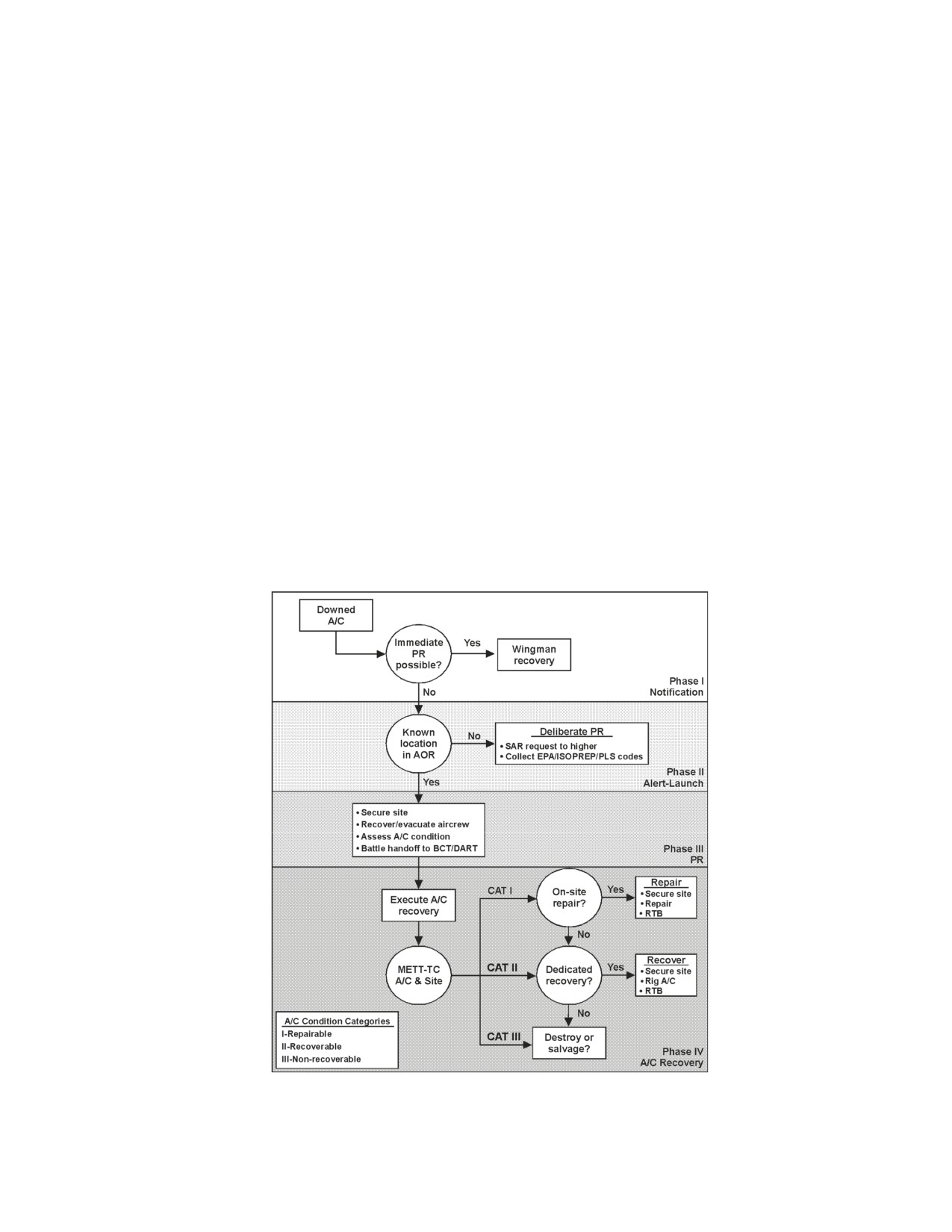
Appendix A
Aviation Brigade Aircraft Recovery Procedures
This appendix provides guidance and coordination for procedures regarding aircraft
recovery within the aviation brigade’s area of responsibility (AOR). Specifically, the
intent is to standardize aircrew and aircraft recovery methods within the brigade
AOR.
CONTINGENCY PLAN
A-1. A contingency plan is executed in the event of a downed aircraft which may result in isolated
personnel. Procedures and considerations remain very similar if the downed aircraft is the result of enemy
action, controlled flight into terrain, or maintenance problems. Deliberate PR in the brigade AOR falls
under the purview of the Personnel Rescue Coordination Center. This plan affects immediate aircrew
recovery (hasty extraction) before, or in lieu of, deliberate PR (planned/executed by PR specialists).
Downed aircraft recovery is the responsibility of the aviation brigade within its AOR. The intent is to focus
aviation brigade and brigade combat team (BCT) forces to maximize the potential recovery of both
personnel and aircraft as soon as possible following an aircraft incident. Aviation brigade forces conduct a
battle handover with coordination center elements if a rescue proves impractical prior to the coordination
center’s response. The contingency plan is divided into four phases (figure A-1).
Figure A-1. Contingency plan phases
21 July 2008
FM 3-04.513
A-1
Appendix A
PHASE I-NOTIFICATION
A-2. This phase begins at the incident and ends upon notification of the aviation brigade headquarters of
an incident involving a downed aircraft and/or isolated persons. Immediate PR can occur during this phase.
Isolated persons are defined as U.S. military, DOD civilian, and/or DOD contractor personnel (and others
designated by the President or Secretary of Defense) separated from their unit while participating in a U.S.
sponsored military activity or mission in a situation where they must survive, evade, resist, or escape.
Notification of the incident will come, most likely, from the wingman of a downed aircraft. It can also
come from coalition ground forces, host-nation military, or police elements. At this time, the senior person
on scene with the ability to best command and control the situation becomes the on-scene commander
(OSC).
A-3. The information reported will be instrumental in planning the personnel and aircraft recovery. In
most cases, the wingman (table A-1) will be in the best position to report, command and control the scene,
execute immediate aircrew recovery, and develop the situation for follow-on operations.
Table A-1. Example of wingman actions and considerations
Aviate
Determine enemy activity and note positions.
Determine injuries.
Secure the scene.
Neutralize threats detrimental to PR/DART.
Assess possibility of self-extraction.
Execute as appropriate.
Navigate
Check all assets on station time, ordnance, and other relevant factors.
Attempt to locate via electronic means (survival radio, global positioning system [GPS] and/or
chart position transmitted over radio by survivor, direction finding).
Determine signal devices.
Report general terrain description.
Locate isolated personnel position within one nautical mile.
Determine ingress and egress routes.
Communicate
Prioritize communication based on METT-TC (BCT, CAB, theater aviation brigade, close air
support [CAS], or sheriff).
Report to the appropriate ground HQ, as well as AVN HQs:
Number and condition of isolated personnel.
Terrain, ingress and egress routes, and isolated personnel signal devices.
Isolated personnel location (grid or distance from known landmark).
Elevation of recovery area.
Wind speed and direction.
Known or suspected enemy activity.
Emergency safe landing area.
Condition of downed aircraft.
Cause of aircraft incident (If known).
Direct isolated personnel to:
Authenticate as necessary.
Prepare signaling devices for use and/or ignition, but use only as prebriefed or when directed by
authenticated rescue forces.
Call threatening enemy positions.
Vector security force, if necessary.
Approach the helicopter only when directed by the recovery force and follow their instructions.
A-2
FM 3-04.513
21 July 2008
Aviation Brigade Aircraft Recovery Procedures
A-4. Key tasks in this phase are:
• Securing the site.
• Executing an immediate aircrew recovery by whatever means available.
• Gathering and reporting information in an accurate and timely manner to ground elements and
aviation brigade headquarters.
A-5. Units, on the scene, will carefully monitor the enemy situation, terrain, and environmental factors
while providing observation; security; and command, control, and intelligence. If, during this phase, a
recovery of personnel is affected by either a friendly aircraft or ground forces, they will continue to
provide security of the site until handoff to ground forces or the aviation brigade DART. This will be based
on analysis of medical condition of recovered personnel as well as the overall security situation.
PHASE II-ALERT/LAUNCH
A-6. This phase begins upon notification to the aviation brigade of an incident involving isolated persons
or downed aircraft. It includes actions at aviation brigade headquarters and ends with the launch of aviation
brigade elements to execute PR. During this phase, aviation brigade elements will plan simultaneously for
PR and DART operations. PR is the main effort. Upon notification, the brigade S-3 retains initial C2
responsibility, and delegates duties and C2 as necessary to the appropriate elements.
A-7. Operations carried over from the notification phase can include, but are not limited to, direct
coordination with maneuver forces on the ground, security of the site, attempts to affect aircrew recovery,
and development of the situation/troubleshooting. During this phase, while executing the current CP battle
drill, the battle captain ensures all entities within the CP remain engaged to develop the situation, gather
information, and make recommendations to the commander.
A-8. Aviation brigade PR elements should include, but are not limited to:
• An attack/cavalry security element.
• An airborne C2 element.
• An assault element.
• An air inserted dedicated ground security element, to affect the actual linkup and recovery.
A-9. Aviation brigade DART elements should include, but are not limited to:
• An attack/cavalry security element.
• An airborne C2 element.
• An assault element.
• A trained safety officer or shoot down investigator.
• Appropriate medical personnel.
• An air inserted DART/assessment element, to affect the actual linkup and recovery.
A-10. Key tasks in this phase are:
• Accurately recording all information from the OSC.
• Attempting verification of OSC information by additional means.
• Rapid mission analysis; notification of brigade chain of command and all subordinate units
playing a role in the recovery operation.
• Reporting to higher headquarters.
• Launching aviation elements in support of recovery efforts by appropriate launch authority.
21 July 2008
FM 3-04.513
A-3
///////////////////////////////////////