ATP 3-09.24 (FM 3-09.22) Techniques for the Fires Brigade (November 2012) - part 2
Fires Brigade Mission Command and Communications
z
Developing input to FIB plans and orders including Appendix 10 (Airspace Control) to Annex C
(Operations), Appendix 5 (Air Support) to Annex D (Fires), and Appendix 1 (Air and Missile
Defense) to Annex E (Protection) to FIB plans and orders.
2-43. For more on the TACP see joint publication (JP) 3-09.3 and FM 3-56.2.
FIRES CELL HEADQUARTERS ELEMENT
2-44. The fires cell’s HQ element supervises selected (normally the fires and inform and influence
activities personnel) elements in planning, coordinating, synchronizing, and integrating the use of Army
indirect fires and joint fires through the targeting process. This includes synchronizing (with the S-3)
physical attack and inform and influence activities against enemy and adversary command and control
nodes.
2-45. The FIB fires cell’s HQ element may be located either at the main or TAC CP in support of current
operations. When at the FIB main CP, the fire support HQ element has a stable mission command
environment from which to guide and monitor functioning of the fires and inform and influence activities
elements and the interaction of the elements with other FIB CP elements. Collocation of the fires cell HQ
element with the commander can be vital for synchronized delivery of fires in support of both FIB
operations and those of the supported command. If the command group is deployed, secure long-range
voice and digital communications between the fire cell HQ element and the fires cell’s fires and influence
activities elements must be assured. The fires cell’s fires elements and inform and influence activities
element must maintain voice and digital connectivity with the command group wherever it is located.
When the FSO is at the main CP a deputy or assistant FSO and a fire support noncommissioned officer
from the fires element may be provided to the command group to make sure up-to-date fires information is
available to the command group by maintaining connectivity with the fires cell. If the FSO is away from
the main CP and communication between the fires cell and the FSO is lost, the deputy FSO in the main CP
must be postured to assume a lead role in planning. Additionally, if communications with the FSO is lost,
the deputy FSO must be postured to assume a lead role in fire support planning, coordination,
synchronization, and integration. Duties and responsibilities of the fires cell HQ element include—
z
Executing FSO duties and responsibilities described in Chapter 1 of this FM and ATTP 5-0.1.
z
Leading the FIB staff in the targeting process to turn the supported commander’s intent and
desired effects into specific targets, surveillance, and TA tasks, and engagements. This includes:
providing targeting guidance (in coordination with the fires cell’s operations and counterfire and
fire control elements); developing and coordinating planned close air support/air interdiction
targets; coordinating and synchronizing the various fire support tasks; and (with the S-3) serving
as the primary integrator of fire support for the FIB. See FM 3-60.
z
Working closely with fires cell’s fires and inform and influence activities elements and the Staff
Judge Advocate to ensure FIB operations are consistent with the rules of engagement and
international law.
z
Providing the FIB staff with immediate access to the operational law expertise they need to
provide scalable fires for FIB operations and to a FIB supported HQ in an increasingly complex
and legally intensive operating environment.
2-15
Chapter 2
AIR DEFENSE AIRSPACE MANAGEMENT
2-46. The fires cell’s air defense airspace management is designed to work with a division, corps, or
theater army airspace control cell and is capable of limited independent operations should the FIB be
employed independent of a division, corps, or other higher HQ. The air defense airspace management
element is equipped to receive the joint air picture and coordinate digitally directly with the battlefield
coordination detachment within the air operations center. The air defense airspace management element
implements and disseminates the airspace control order for FIB and below (the fires and/or air support
element provides the same function for the air tasking order). The air defense airspace management
element also develops and disseminates the FIB’s air defense plan and provides the air picture and early
warning functions. During the planning process the air defense airspace management element is the
principle staff element that plans and coordinates airspace use by indirect surface-to-surface fires, air and
missile defense, Army aviation, and unmanned aircraft system (UAS) assets in support of FIB operations.
The air defense airspace management element submits air control means requests to the division and corps
airspace command and control elements for synchronization, de-confliction, and further processing of air-
space control means for inclusion in the airspace control order. If deployed as a separate task force, the FIB
may receive additional TACP and theater airlift liaison officers to assist in mission planning for the use of
joint assets.
2-47. Duties and responsibilities of the air defense airspace management/brigade aviation element
include—
z
Planning and requesting immediate airspace control or airspace coordinating measures.
z
Deconflicting airspace through the appropriate control authority.
z
Controlling airspace use in the FIB AO (if the FIB is assigned an AO).
z
Maintaining the air and missile defense and airspace control running estimates.
z
Supporting the fires cell airspace control requirements.
z
Providing staff support for airspace control.
z
Serving as the airspace control point-of-contact for FIB subordinate units.
z
Providing future airspace control order/air tasking order requirements.
z
Coordinating sensor and tactical digital information link coverage.
z
Advising the commander and staff on all air and missile defense-related issues.
z
Monitoring current enemy air and missile activities.
z
Providing threat early warning.
z
Tracking friendly air and missile defense operations including unit positioning, status, coverage
fans, sensor plans, changes in the air tasking order, high-priority target lists, airspace control
procedures (including airspace coordinating measures), rules of engagement, and number and
type of air defense missiles available.
2-16
Fires Brigade Mission Command and Communications
z
Coordinating current operations of subordinate air and missile defense forces and passing critical
air and missile defense information.
z
Ensuring the direction of beyond-line-of-sight/non-line-of-sight air and missile defense fires
complies with the joint integrated air defense system.
z
Assisting with airspace coordination and execution, focusing on defense readiness conditions, air
defense warning and weapon control status.
z
Providing and managing linkage to the joint surveillance integration automation project, and
managing and developing the common operational picture into situational understanding.
z
Synchronizing current operational protection of the third dimension.
z
Coordinating FIB current operations with the deputy area air defense commander.
z
Providing mission command system integration of air and missile defense functions with the air
liaison officer, air support element, and other fires cell elements as needed.
z
Providing situational awareness of UAS.
z
Planning and coordinating air and missile defense augmentation.
z
Developing input to FIB plans and orders. Directly responsible to the S-3 for developing and
coordinating Appendix 1 (Air and Missile Defense) to Annex E (Protection) and Appendix 10
(Airspace Control) to Annex C (Operations) to FIB plans and orders.
2-48. For more on airspace control see FM 3-52, FM 3-52.2, and JP 3-52.
INFORM AND INFLUENCE ACTIVITIES ELEMENT
2-49. Under direction of the FSO, the FIB fires cell’s inform and influence activities element (in concert
with the fires elements) synchronizes the planning of fire support including Army indirect fires and joint
fires to support the commander’s intent through physical destruction, information and denial, enemy system
collapse, and erosion of enemy will.
2-50. The fires cell synchronizes physical attack, electronic warfare, and computer network operations
against enemy and adversary mission command. The FIB fires cell’s inform and influence activities
element is responsible for aspects of scalable fires in support of FIB operations. This includes planning,
coordinating, synchronizing, and integrating inform and influence activities and the nonlethal aspects of
mission command warfare for FIB operations—
z
Cyber electromagnetic activities are part of combined arms operations to seize, retain, and
exploit an advantage over adversaries and enemies in both cyberspace and across the
electromagnetic spectrum, denying and degrading adversary and enemy use of the same, and
protecting friendly mission command networks and systems.
z
Inform and influence activities synchronize themes and messages with actions to support
operations. Use it to inform domestic audiences and influence foreign friendly, neutral,
adversary, and enemy audiences through key leader engagements and other designated venues.
2-17
Chapter 2
Note: Army forces receive support for computer network operations from combatant commands and Army
Service component commands. High-demand, low-density assets provide these capabilities. Army fires
cells such as those in the FIB, BCT, division or corps (or other FIB supported command’s) coordinate with
counterparts in higher echelon organizations (for example, theater army fires cell, battlefield coordination
detachment, and electronic warfare coordination center) to obtain needed support.
2-51. Duties and responsibilities of the inform and influence activities element include—
z
Coordinating inform and influence activities and electronic warfare for FIB operations. This
includes developing information related measures of performance and measures of effectiveness
for FIB assessment. Through reach-back, the inform and influence activities element has access
to information necessary to enhance situational understanding to support FIB operations and,
when necessary, making recommendations for augmentation with selected inform and influence
activities and electronic warfare capabilities. Augmentation broadens the range of these assets
available to the FIB.
z
Working closely with the FIB S-3, FSO, and the fires element (and other FIB staff elements as
necessary) to identify inform and influence activities and electronic warfare requirements, focus
necessary FIB assets, integrate them into the targeting process, and assess the effectiveness of
those activities.
z
Coordinating with the division, corps, or other supported higher HQ’s inform and influence
activities, military information support operations, public affairs, and electronic warfare
personnel to ensure FIB inform and influence activities and electronic warfare is synchronized
with that of the supported HQ. In the context of decisive action, the manner in which inform and
influence activities and electronic warfare operations are planned, coordinated, and executed in
concert with the FIB overall mission is crucial to meeting the FIB and supported HQ
commander’s intent.
z
Requesting support for specific inform and influence activities and electronic warfare
capabilities from higher HQ. These functions may include electronic attack, electronic warfare
support, computer network operations, and psychological operations based on METT-TC
factors. The inform and influence activities element integrates and synchronizes these
augmentation assets with FIB operations.
z
Assisting the intelligence cell’s intelligence and targeting elements in analyzing enemy courses
of action, identifying high-value targets, and providing input to the intelligence plan.
z
Coordinating the execution of nonlethal fire support tasks assigned by the supported higher HQ
(including support for special operations forces operating in that higher HQ’ AO).
z
Conducting mission planning analysis, course of action development, and coordinating
production of the scalable fires aspects of the fire support running estimate.
z
Developing input to FIB plans and orders. Directly responsible to the FSO and S-3 for
developing and coordinating the inform and influence activities and electronic warfare portions
of FIB plans and orders.
2-18
Fires Brigade Mission Command and Communications
FIRES ELEMENT
2-52. Under direction of the FSO, the fires cell’s fires element (in concert with the information operations
element) synchronizes the planning of fire support including Army indirect fires and joint fires to support
the commander’s intent through physical destruction, inform and influence activities, enemy system
collapse, and erosion of enemy will. The requirements for strike, counterfire, or fires in support of shaping
operations will be given to the FIB in the form of mission orders. For example, if the division, corps, or
other supported higher HQ were conducting an attack to seize an objective or series of objectives, the FIB
would likely receive fires tasks to isolate and reduce objectives, disrupt reinforcement, protect flanks, and
interdict enemy artillery.
2-53. Duties and responsibilities of the FIB fires cell’s fires element include—
z
Coordinating with the S-2, intelligence cell, and the targeting element (may be assigned to either
the intelligence or fires cell) to integrate fire support targeting requirements into the overall
surveillance and collection plans for the division, corps or other supported HQ.
z
Assisting the intelligence cell’s intelligence and targeting elements in analyzing enemy courses
of action, identifying high-value targets, and providing input to the intelligence plan.
z
Coordinating the execution of fire support tasks (to achieve both lethal and nonlethal effects)
assigned by the supported higher HQ (including support for special operations forces operating
in that higher HQ’ AO).
z
Conducting mission planning analysis, course of action development, and coordinating
production of the fire support running estimate.
z
Developing input to FIB plans and orders. The fires element is directly responsible to the FSO
for developing and coordinating portions of FIB plans and orders that describe the scheme of
fires for FIB operations including Annex D (Fires) to FIB plans and orders.
z
Developing recommendations (working with the air defense airspace management element and,
when provided, the brigade aviation element and TACP) for FSCMs as part of the
OPLAN/OPORD development process. This includes recommendations for the division, corps,
or other supported higher HQ fire support coordination line (if used), and airspace coordination
areas as needed. The recommendations include the measures’ location, establishment, duration,
movement, and cancellation.
z
Synchronizing the OPORDs of subordinate units. Translating the commander’s intent into tasks
to subordinate units and parameters for automation systems in support of FIB operations.
z
Conducting fire support coordination with higher, adjacent, and subordinate unit fires cells.
z
Coordinating tactical airspace control within the FIB AO and with higher/adjacent fires cells
outside the AO.
z
Planning for, requesting, coordinating, and executing joint fires (air, surface, and subsurface) for
the brigade.
z
Integrating attached or cooperating unified action agencies into fire support operations for the
brigade.
2-19
Chapter 2
LIAISON SECTION
2-54. Duties and responsibilities of the liaison section include—
z
Establishing liaison with higher, adjacent, and supported units (as required).
z
Exchanging data and coordinating fire support across boundaries, when directed.
PUBLIC AFFAIRS SECTION
2-55. Duties and responsibilities of the public affairs section include—
z
Planning, coordinating, integrating, and synchronizing the employment of public affairs in FIB
operations. See FM 3-61.1 for more information.
z
Working closely with the FIB FSO and the fires cell’s fires element and targeting element (if
assigned to the fires cell) to identify public affairs requirements, focus necessary FIB assets,
integrate public affairs into the targeting process, and assess the effectiveness of those activities.
This includes coordinating and de-conflicting efforts of augmentation elements such as public
affairs teams and media personnel.
STAFF JUDGE ADVOCATE SECTION
2-56. Duties and responsibilities of the staff judge advocate section include assisting the operations officer
by providing international law and operational law assistance, including advice and assistance on
implementing the DOD law of war program particularly during the targeting process. See FM 1-04 and
ATTP 5-0.1 for additional information on the duties of the staff judge advocate.
SIGNAL SECTION
2-57. The signal section’s focus is on those tasks integral to the mission command warfighting function
that support and facilitate FIB CP operations and information management. This includes tasks associated
with acquiring friendly information, managing relevant information, and directing and leading
subordinates. For more on the mission command warfighting function see ADP 3-0, ADP 6-0, and ATTP
5-0.1.
2-58. Both the FIB commander and the mission command system are important in FIB operations.
Information systems—including communications systems, intelligence support systems, and computer
networks—form the backbone of the commander’s mission command system. They allow the FIB
commander to lead from anywhere in the FIB AO. The mission command system supports his ability to
make informed decisions, delegate authority, and synchronize the warfighting functions. Moreover, the
mission command system supports the commander’s ability to adjust plans for future operations, even
while focusing on the current fight. The staff works within the commander’s intent to direct subordinate
units and control resource allocations. They also are alert for enemy or friendly situations that require
command decisions and advise the commander concerning them. Through mission command, the
commander initiates and integrates all systems and warfighting functions toward mission accomplishment.
2-59. The FIB S-4 and signal staff officer (S-6) must coordinate to ensure there are no gaps in the
maintenance system for communications security, computers, and other specialized mission command
equipment.
2-60. Duties and responsibilities of the signal section include but are not limited to—
2-20
Fires Brigade Mission Command and Communications
z
Developing the FIB’s tactical information network and associated architecture.
z
Advising the S-3 on CP locations based on communications capabilities.
z
Assessing FIB mission command vulnerability to enemy and civilian actions.
z
Recommending FIB network priorities and constraints needed to accommodate bandwidth
limitations.
z
Exercising staff coordination with the FIB signal network support company.
z
Integrating the FIB’s information systems with the warfighter information network.
z
Planning and directing communications protocols and user interfaces between the global
information grid and the FIB network.
z
Managing radio frequency allocations and assignments.
z
Developing input to FIB plans and orders. Directly responsible to the S-6 for developing and
coordinating the mission command portions of FIB plans and orders including as Paragraph 5:
(Command and Signal) and Annex H (Signal) to FIB plans and orders.
z
Coordinating communications requirements with adjacent and higher HQ S-6/assistant chief of
staff, signal (G-6)/communications system directorate of a joint staff (J-6).
z
Integrating the FIB’s information systems to create a common operational picture and
disseminating the common operational picture.
z
Storing relevant information.
z
Providing communications security support to the FIB and all attached organizations.
z
Communicating with joint, interagency, intergovernmental, and multinational agencies.
z
Maintaining selected components of the FIB mission command system.
z
Supervising signal-related maintenance.
2-61. For more on information management see ADP 3-0 and ATTP 5-0.1.
SUSTAINMENT (S-4) SECTION
2-62. The FIB logistics section’s focus is executing the sustainment warfighting function for FIB
operations.
2-63. See FMs 4-0 and 7-15 for more detailed information on the duties and responsibility of the S-4. For
more on the relationship between the sustainment and fires warfighting functions see FM 3-09.
2-64. The FIB sustainment section typically collocates with the BSB in the FIB sustainment area. Its
positioning is the responsibility of the FIB deputy commander, executive officer, or BSB commander.
2-65. Duties and responsibilities of the sustainment section involve providing FIB staff oversight for
execution of sustainment tasks including—
2-21
Chapter 2
z
Maintenance.
z
Transportation.
z
Supply.
z
Field services.
z
Distribution management.
z
Contracting.
z
Explosive ordnance disposal.
z
Related general engineering.
2-66. The sustainment section is also responsible for developing input to the sustainment portion of FIB
plans and orders. The sustainment cell is directly responsible for developing and coordinating paragraph 4:
Sustainment and Annex F (Sustainment) (with the BSB support operations officer for logistics; and the S-1,
brigade surgeon, staff judge advocate and chaplain for personnel services, Army health system support, and
legal and religious support portions of the paragraph and annex).
MEDICAL PLATOON
2-67. Army health system support is a component of the military health system that is responsible for
operational management of health service support and force health protection missions for training, pre-
deployment, deployment, and post-deployment operations. Army health system includes all mission
support service performed, provided, or arranged by the Army medical department to support health service
support and force health protection mission requirements for the Army and as directed, for joint,
intergovernmental agencies, coalition, and multinational forces.
2-68. The FIB medical platoon coordinates Army health system support for both health service support and
force health protection. It coordinates Army health system support operations with the division or other
supported HQ surgeon section and with supporting medical units/elements, as required. The FIB surgeon
establishes medical treatment guidelines for FIB subordinate medical treatment elements.
2-69. The duties and responsibilities of the medical platoon include—
z
Ensuring timely planning, integration, and synchronization of Army health system support with
the FIB operations plan.
z
Coordinating for health service support and force health protection augmentation as required,
ensuring that all FIB Army health system support requirements are met.
UNIT MINISTRY TEAM
2-70. Duties and responsibilities of the unit ministry team include—
z
Providing or performing collective and denominational religious worship services and religious
coverage in the operational environment.
z
Providing spiritual care and counseling to Soldiers, family members, and authorized Army
civilians with spiritual comfort, moral support, and encouragement.
2-22
Fires Brigade Mission Command and Communications
z
Advising the commander on issues of religion, ethics, and morale (as affected by religion),
including the religious needs of all personnel for whom the commander is responsible.
z
Planning, coordinating, and resourcing precise religious support per the mission variables.
z
Advising the commander on religious aspects of the local environment.
SECTION III - DIGITAL COMMAND POST OPERATIONS
2-71. The CPs for digitized units will be small, mobile, deployable, and equipped to access, process, and
distribute the information and orders needed by their echelon. This section outlines the internal operations
of a digital CP. For additional information, see ADP 6-0.
2-72. The digital CP is a collaborative application that enables users to collect, collate, display, map, and
analyze data. Users can do this collectively or individually, in real time. It provides planning and mapping
tools to support the commander’s battle management and by rapidly processing and correlating combat
information from all available sources. It provides the FIB commander with an advanced, distributed,
collaborative, decisionmaking environment, thus eliminating his need to be at a fixed CP.
2-73. The digital CP depends on the ABCS for most of its data and will continue to depend on ABCS until
ABCS is retired and replaced. The primary data server for command post of the future is the CoMotion
repository. The server connects to a data bridge that pulls in real-time data from a variety of servers located
on external machines. CoMotion receives data related to unit positions map overlays, and more, in a
synchronous method.
2-74. The four main digital CP applications are—
z
MapData. MapData caches imagery and map data locally and feeds into both the CoMotion
application and the Command Sight application.
z
CommandSight Application. CommandSight provides a three-dimensional map-based view of
the AO.
z
CoMotion Client. CoMotion Client is a versatile commander’s view into geospatial, temporal,
and other forms of data.
z
OpenPhone Voice Over Internet Protocol Client. This client integrates with the CoMotion
Client to provide seamless audio communications across multiple channels.
DATA EXCHANGE
2-75. The manner in which data is exchanged is central to digital CP operations. ABCS systems share
information either directly with one another, or with using databases. The joint common database is a
database that resides on all the ABCS computers within a CP, and provides data for the common
applications that generate the common operational picture. Battlefield information flows dynamically back
and forth between ABCS systems and the joint common database. When data is entered through an
automated system, this change is forwarded to all ABCS subscribers on the CP's tactical local area network
and posted to the common operational picture.
2-76. CPs also exchange data with each other. This exchange enables CPs to maintain the same data in the
joint common databases of different CPs. Data generated by each automated system flows to its counterpart
2-23
Chapter 2
system at adjacent echelons. Each automated system then transfers this information to the joint common
database at that echelon. Friendly or “blue” picture position information flows from Force XXI battle
command—brigade and below (FBCB2) upward through the FBCB2 system software (embedded
battlefield command) on the server located at each echelon. Then this information is deposited into that
echelon’s joint common database. This data exchange ensures that all CPs have joint common databases
resembling one another. This is essential to creating the common operational picture.
DIGITAL COMMAND POST LAYOUT
2-77. The standardized integrated command post system is the new generation of CP facility systems to
support digitized units. The standardized integrated command post system is a mission command enabler,
providing the platforms from which to conduct digital CP activities. The standard integrated command post
system is designed to facilitate CP operations by providing the flexibility, commonality, and operational
capabilities needed to enhance unit mobility and integrate ABCS and associated communication and
networking equipment. It supports the integration of these control assets into platforms that can serve as a
stand-alone CP or as an integrated element in a larger digitized CP.
2-78. The standard integrated command post system has seven CP variants, including tracked and wheeled
vehicle mounted vans, tents, and hard shelters. The digital CP enables collocation of staff
sections/cells/elements and supporting communications systems to facilitate both face-to-face interaction
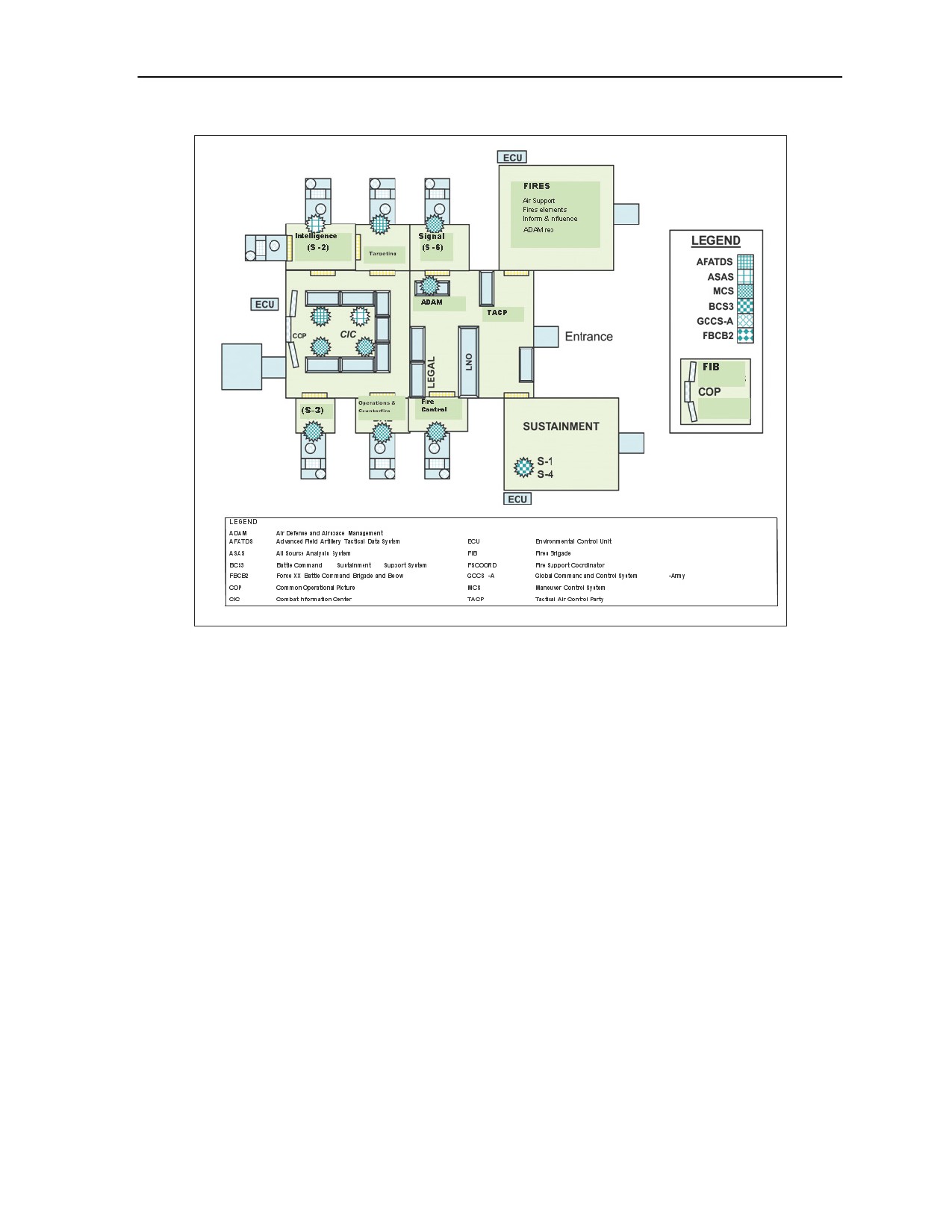
and digital data exchange. A typical FIB CP is shown in figure 2-3.
2-79. As with the analog CP, the digital CP's physical setup must facilitate communication and analysis of
information, as well as accommodate computer hardwire requirements. Within the digital CP, information
is processed at two locations: individual workstations and the combat information center. The focus of the
individual workstation is the individual automated system and the specific warfighting function it supports.
At his workstation, the staff member inputs and monitors data within his sphere of responsibility. He
accesses data posted to web pages and shared files by other staff sections/cells/elements in the local area
network and wide area network to carry out his warfighting function and duties. The focus of the combat
information center is integrated battle monitoring and decisionmaking. It is a special location within the CP
for the display of information. The combat information center is the central area for viewing information in
order for the commander and his staff to maintain situational understanding. The large screen display
accomplishes this, and is the only area in the CP where all key automated system data can be viewed
simultaneously. It is the place where battlefield vision is supported best. The commander uses the combat
information center to illustrate his guidance and, with his staff's assistance, to develop and maintain the
common operational picture.
2-24
Fires Brigade Mission Command and Communications
Figure 2-3. Typical fires brigade CP layout (example)
2-80. Combat information centers vary by unit modified tables of organization and equipment. However,
the typical combat information center has two or more large screen displays, each capable of displaying
nine sub-screens. Each sub-screen can display the common operational picture and can be configured in
various ways to best support the commander’s information display preferences. The more sub-screens used,
the lower the resolution of the image. For this reason, each large screen display screen should use no more
than four sub-screens. With two large screen displays, this allows the display of eight sub-screens, which
should be sufficient.
COMBAT INFORMATION CENTER DATA DISPLAY MANAGEMENT
2-81. Information management plays a key role in the abilities of commanders and staff to maintain an
accurate picture of the battlefield in the combat information center. With feeds from each ABCS system,
the combat information center's large screen display enables them to see more of the battlefield and to
receive greater amounts of real-time battlefield information from warfighting functions than is available
currently with analog systems.
2-82. More information is not necessarily beneficial to mission planning and accomplishment. Data must
be filtered, fused, and focused to create meaningful informational displays relevant to the commander’s
mission. These displays or tactical pictures must be presented in a logical manner on the large screen
display to support situational understanding. Electronically stored information is readily available through a
minimum number of computer keystrokes and there is less need to print paper copies of the information.
However, information saved electronically is often forgotten, once the information is out of the viewer’s
2-25
Chapter 2
sight. Therefore, leaders and staff must know what data is available to them so they can make conscious
decisions about what is to be displayed. Though the large screen display has the capability for displaying
any automated system electronic data, the narrative and static aspects of some information still lends itself
to paper copy posting within the CP. This is especially true for information that is less likely to change
during a mission. In turn, this optimizes the use of large screen display sub-screens by freeing them to
depict dynamic ABCS digital content.
2-83. The commander, deputy commander, executive officer or S-3, fire support officer, and operations
personnel must be able to orchestrate warfighting function coordination through the display of key
information on the large screen display. Each staff section/cell/element must maintain information that
relates to their warfighting function, using visual graphics that support the common operational picture. To
facilitate information control and display, staff sections/cells/elements and their supporting systems should
be arranged around the large screen display to facilitate staff interaction, coordination, and information
analysis. The common operational picture is displayed on the S-3’s maneuver control system (MCS) or
MCS-Light large screen display. Common operational picture control and manipulation and CP local area
network administration are aided by centrally collocating the CP server and the automated system that
projects the common operational picture centrally. The ability to view the large screen display through the
automated system controlling the common operational picture facilitates communication and navigation
through data. During discussions in the combat information center, personnel can focus staff on key
portions of the common operational picture either verbally or with a laser pointer.
2-84. Data is displayed on the large screen display via the common operational picture using the ABCS
common operational picture application, or through overlays provided by individual automated systems.
Portraying the common operational picture graphically requires METT-TC analysis of information. The
common operational picture displays enemy (shown as red feed and graphics), friendly (shown as blue feed
and graphics), terrain (shown as characteristics and impact), and civilian considerations (shown as gray
feed and graphics). Friendly analysis occurs in the combat information center by all warfighting functional
cells and systems. Each automated system provides warfighting function overlays for subsequent data
manipulation and consolidated viewing in the form of operational pictures that form the common
operational picture. Enemy analysis is especially time sensitive information. This demands ready
availability of All Source Analysis System (ASAS) and other systems that are protected from CP traffic
flow.
2-85. The MCS whiteboard or electronic whiteboard (also known as “show me”) equips leaders and staffs
with the capability to conduct collaborative sessions. Participants at distributed locations are linked with
audio and view the same enemy and friendly common operational picture on an MCS display. The
“telestation” feature of whiteboard enables each participant to use a mouse (with a crayon drawing
capability) to depict locations, graphics, and other coordination measures that the participants can view on
their screens.
DIGITAL RUNNING ESTIMATES
2-86. Not all key information can be depicted graphically on the large screen display. Therefore, such
information must be captured in a readily available, continuously updated format for quick dissemination
and assimilation. Each staff section should maintain a running estimate (in narrative form at division and
higher, and in graphical form at the FIB and fires battalion). These graphical running estimates correspond
to wing board and map data in the analog CP.
2-87. Digitization eliminated the need to post information to wing boards, but it created the need to
organize digital data. Units must capitalize on the tactical local area network web pages that each staff
2-26
Fires Brigade Mission Command and Communications
section maintains to organize and post critical mission data. By placing digital running estimates on a web
page, each staff section supports the commander and staff’s needs to quickly review, update, and use
information for battle monitoring and planning. Establishing a standard running estimate format facilitates
navigation through the estimate, and cross-referencing between estimates. Running estimates also should
list available warfighting function overlays by name. This enables viewers to focus better on graphical
review within the ABCS common operational picture application, and to focus all echelons and staff on the
same, most current data. Through digitally equipped liaison officers, analog units should access these
digital estimates to obtain current operational data and to help synchronize their operations with digital
units.
INFORMATION MANAGEMENT
2-88. The staff must be organized to support the information management process of “collect, process,
store, display, disseminate, and dispose.” Doctrine, tactics, techniques, procedures, and unit standing
operating procedures guide this process. The staff must operate according to established procedures that
specify access to common automated data systems, common displays, and report formats. The staff must be
organized to enable vertical and horizontal flows of information. This organization should provide links
between teams within staff sections, between staff sections within a CP, and between CPs at the same,
higher, and lower echelons.
2-89. Digitization enables commanders and staff to focus more on the execution of combat operations, and
much less on planning, coordination, and processing of information. Commanders and staff will have much
more data upon which to base their decisions. Their challenge will be to manage the flow of vast amounts
of data so the right information gets to the right person at the right time.
2-90. These five factors are very important when managing data—
z
Relevancy. Determining the relevant information from the vast amount of data available.
z
Responsibility. Ensuring that each product is the assigned responsibility of a specific staff
section.
z
Accuracy and currency. Ensuring that data is correct and up to date.
z
Dissemination. Ensuring that information generated by the staff gets to the right personnel.
z
Evaluation. Ensuring that information is appropriately assessed.
DISSEMINATION
2-91. Due to bandwidth limitations, it might not be possible routinely to send out products through email.
On the other hand, it is insufficient merely to post information to a web site or shared folder, and expect
others to use it. With the exception of routine, scheduled postings and updates, staffs must notify users
when such changes are made. When a product is posted or revised, staff sections must notify other staff
sections and units that are at the same, lower, and higher echelons. This notification must include
instructions on precisely where to find the product and its file name. This requires units to establish
standing operating procedures that specify file naming conventions and file management procedures.
Whether forwarding products or providing notification of product postings in shared files and web pages, it
is essential the right personnel receive the right information. Correct address information using the ABCS
address books and message handling tables must be established to ensure that data is sent to the correct
battlefield automated system. Addressees must be the users employing the individual ABCS system rather
2-27
Chapter 2
than generic role names in the address book. If this is not done correctly, information on one automated
system will not flow to other automated systems, even in the same CP. During initialization, operators also
must create and distribute automated data systems that can be operated via messages in the current version
of ABCS. This ensures that automated systems are able to share the right kind of information.
EVALUATION
2-92. There is a tendency to accept computer data at absolute face value because it is part of a computer-
automated system, and, therefore, assumed to be always correct. Users of digital systems must resist this
tendency. Errors can be introduced through failures in automated data and communications systems, human
error when inputting data, and failing to update information in a timely manner. Data must be evaluated
within the context provided by situational understanding to verify that it is accurate and current. Users must
follow up discrepancies to ensure they have the right information.
DIGITAL DUTIES AND RESPONSIBILITIES
2-93. Staff functions as described in ATTP 5-0.1 do not change fundamentally in the digital CP. These
functions are carried out differently using the digital tools that ABCS provides. Digitization also requires
personnel to perform new functions as listed below. These digital CP post tasks should be conducted in
addition to, and as a part of standard staff responsibilities.
COMMANDER
2-94. The commander—
z
Provides command guidance for employing ABCS.
z
Provides automation resources.
z
Establishes automation support priorities.
z
Specifies information to be included in the unit’s common operational picture.
z
Establishes the commander’s critical information requirements and ensures they are included in
the ABCS.
z
Ensures subordinate leaders are trained to employ, operate, and sustain automation.
z
Trains subordinate leaders and staff to create, maintain, distribute, and use the common
operational picture.
FIB DEPUTY COMMANDER/EXECUTIVE OFFICER
2-95. The deputy commander/executive officer—
z
Coordinates the staff to ensure ABCS integration across automated systems.
z
Ensures the staff integrates and coordinates its ABCS activities internally, vertically (with higher
HQ and subordinate units), and horizontally (with adjacent units).
z
Manages the commander’s critical information requirements; ensures satisfaction of the
commander’s critical information requirements.
2-28
Fires Brigade Mission Command and Communications
z
Directs the creation and distribution of the common operational picture, including procedures for
updating enemy and friendly situational understanding.
z
Monitors the information filters, collection plans, and networks that distribute the common
operational picture.
z
Provides guidance for automation support.
z
Coordinates the staff to ensure automation support.
z
Supervises the FIB main CP.
z
Monitors liaison teams with analog (non-digitized) units and multinational forces for their
contribution to the common operational picture.
PERSONNEL STAFF OFFICER
2-96. The S-1—
z
Maintains responsibility for human resources functions of the Battle Command Sustainment
Support System.
z
Employs Battle Command Sustainment Support System to monitor and report on human
resources-related functions.
z
Deploys and manages the electronic military personnel office (Defense Integrated Military
Human Resources System when deployed).
INTELLIGENCE STAFF OFFICER
2-97. The S-2—
z
Acts as staff proponent for ASAS and the integrated meteorological system.
z
Supervises ASAS and integrated meteorological system operations and support.
z
Provides guidance on employment and support of ASAS and integrated meteorological system.
z
Supervises the information security program; evaluates security vulnerabilities.
z
Assists the S-6 to implement and enforce local area network security policies.
z
Provides software application expertise on proponent systems.
OPERATIONS STAFF OFFICER
2-98. The S-3—
z
Acts as staff proponent for MCS, AFATDS, air and missile defense workstation (AMDWS), and
FBCB2.
z
Plans, integrates, and employs ABCS.
2-29
Chapter 2
z
Provides operational and support guidance regarding network employment to subordinate units.
z
Maintains overall responsibility for the FBCB2 improved data modem.
z
Creates, maintains, and displays the common operational picture; maintains situational
understanding of all units.
z
Coordinates with S-6 for communications connectivity in support of ABCS.
z
Provides software application expertise on proponent systems.
z
Assigns liaison officers and coordinates their digital support.
SUSTAINMENT STAFF OFFICER
2-99. The S-4—
z
Acts as staff proponent for Battle Command Sustainment Support System.
z
Supervises Battle Command Sustainment Support System operations and support.
z
Provides guidance on employment and support of Battle Command Sustainment Support
System.
z
Provides software application expertise on proponent systems.
SIGNAL STAFF OFFICER
2-100. The S-6—
z
Serves as signal subject matter expert to the commander; advises the commander and staff on all
signal support matters.
z
Monitors wide area network performance; integrates the CP local area network.
z
Maintains responsibility for all automation information system, automation and network
management, and information security.
z
Ensures consistency and compatibility of automation systems.
z
Develops the ABCS annex for plans and orders.
z
Develops ABCS annexes to the garrison and tactical standing operating procedures.
z
Plans and monitors operator digital sustainment training.
z
Monitors and reports on the status of all automation equipment.
z
Manages the networks; is responsible for network employment, network configuration, and
network status monitoring and reporting.
z
Receives planning worksheets with local area network/wide area network requirements.
z
Ensures unit information network connectivity between unit and higher/lower echelons.
2-30
Fires Brigade Mission Command and Communications
z
Plans, coordinates, and manages network terminals.
z
Develops, modifies, and manages network need lines, unit table of organization and equipment,
and automated system configuration files.
z
Plans, coordinates, and manages communications links including reach-back communications.
z
Coordinates with higher echelon signal officers for additional communications support.
z
Develops and coordinates the signal digital support plan.
z
Determines system and retransmission requirements for the tactical situation.
z
Coordinates with higher, adjacent, and subordinate units to develop the signal digital support
plan.
z
Manages the release of ABCS software within the unit.
z
Provides a focal point for automation support (help desk).
z
Implements and enforces local area network security policies (information assurance).
z
Establishes communications security accountability, distribution, destruction, and security
procedures within the unit.
COMMON OPERATIONAL PICTURE
2-101. A common operational picture is a single display of relevant information within a commander’s
area of interest tailored to the user’s requirements and based on common data and information shared by
more than one command. Each automated system provides its own unique view or "picture" of the
operational environment which, taken together, comprise the common operational picture. The commander
can tailor the components of the common operational picture to fit the tactical situation, key features of the
operational environment, and his own requirements for mission command. The common operational picture
is continuously updated; as data changes throughout the network, the common operational picture reflects
those changes. This enables personnel to "see" the operational environment more accurately and in near
real time. Personnel can quickly access and display on a single screen the critical, time-sensitive
information, intelligence, and data drawn from the other automated system within the CP, or from higher
and lower echelons.
SECTION IV - THE ARMY BATTLE COMMAND SYSTEM
2-102. Information management is the science of using procedures and information systems to collect,
process, store, display, disseminate, and protect knowledge products, data, and information.
2-103. The FIB is equipped with the ABCS, which gives the FIB significant advantages in collecting
technical information, and distributing information and intelligence rapidly. The ABCS enables
commanders to rapidly gain reliable information and, therefore, achieve information dominance in their
operational environment. The ABCS satisfies two critical mission command requirements interoperability
and situational awareness. The ABCS employs networks that are interoperable with theater, joint, and
combined mission command systems.
2-31
Chapter 2
2-104. The ABCS consists of battlefield automated systems, which comprise the core for ABCS and
provide capabilities that support the warfighter’s mission needs. Each system aids in planning,
coordinating, and executing operations by providing access to, and the passing of information from, a
horizontally integrated mission command network. The systems discussed identify those automation
systems that may assist the FIB to conduct its mission. The list should not be considered all inclusive.
Rapid equipment fielding, particularly of commercial equipment, can make any list invalid based on new
technology. Fire support personnel must rapidly adapt to employ the systems issued to their unit.
2-105. The ABCS v6.4 provides a net-centric data management capability on a dedicated server. This
ABCS version differs from earlier versions due to the incorporation of the centralized information server.
The addition of the ABCS information server to the FIB CP structure enables horizontal information
exchange. In addition, the ABCS information server employs a publish-and-subscribe server methodology.
The ABCS information server helps the 10 ABCS systems to interoperate as one; thus, ABCS is called a
“system-of-systems.”
ARMY BATTLE COMMAND SYSTEM OVERVIEW
KEY FIRES BRIGADE MISSION COMMAND SYSTEM
2-106. The FIB uses primary mission command systems. These systems are linked to the global command
and control system-Army (GCCS-A), creating seamless connectivity from FIB/BCT to corps. These five
mission command systems correspond to the movement and maneuver, fire support, protection,
intelligence, and sustainment warfighting functions—
z
Maneuver control system. The Maneuver Control System (MCS) is usually found in the fires
cell’s operations and counterfire element.
z
Advanced Field Artillery Tactical Data System. The AFATDS is usually found in the fires
cell’s elements.
z
Airspace Workstation. The Airspace Workstation is found in the Air Defense Airspace
Management element.
z
Air and missile defense workstation. The AMDWS is usually found in the FIB fires cell air
defense airspace management element.
z
All-source analysis system. The ASAS is usually found in the FIB’s intelligence cell.
z
Battle command sustainment support system. The Battle Command Sustainment Support
System is usually found in the FIB’s sustainment cell.
Maneuver Control System
2-107. The MCS is the commander’s/staff’s primary tactical planning and execution, monitoring, mission
command capability from battalion to corps. The MCS serves as a mission-critical system allowing
commanders and staffs to visualize the area of operations and synchronize elements of combat power for
successful execution of combat operations. The MCS operator can tailor the applications to display
graphically the picture of the battlefield he chooses. A combination of systems automatically feeds data to
the MCS to produce the view of the battlefield. These ABCS sources can be local and remote. The MCS is
primarily used for creating and sending OPORDs in a CP. It also is equipped with digital collaborative
tools that commanders and staffs use to plan future operations and review past operations.
2-32
Fires Brigade Mission Command and Communications
2-108. The Maneuver Control System Gateway is a notebook computer that provides some of the services
that are found on a server and has the ability to connect to a server, if needed. The server and the
workstation support Army maneuver functions and provide the common operational picture for the rest of
the command post.
Advanced Field Artillery Tactical Data System
2-109. The AFATDS provides the Army and Marine Corps the automated fire support command, control,
and communications portion of the ABCS. AFATDS capabilities/characteristics include—
z
AFATDS is an integrated fire support asset manager that operates as part of a networked tactical
data processing system. It provides decision aids and an information system for the control,
coordination, and synchronization of all types of fire support means. It uses common
hardware/software from the Army tactical mission command system and is utilized from theater
army down to platoon. AFATDS interfaces with all of the other ABCS systems via a common
operating environment using a combination of database transfer, various message formats (such
as joint variable message format and United States message text format), or an ability to print
data for distribution.
z
AFATDS is also designed to interface with all existing and future fire support systems, other
ABCS/Army Tactical mission command systems, other services, allied forces, and joint mission
command systems. AFATDS enhances the responsiveness, survivability, and continuity of fire
support operations via dispersed processing centers, intelligent remote terminals, and distributed
database management.
z
AFATDS is capable of interfacing with the other Army tactical mission command system
components in message or hard copy format. With MCS, this equates to the transmission of
friendly situation reports, battlefield geometry, and free text messages. The interface with ASAS
is more extensive and includes the following: mission-fired report, commander’s targeting
criteria, intelligence summary, artillery intelligence criteria, target coordination request, free
text, and target intelligence data report.
z
AFATDS automates screening and filtering of potential targets and mission requests, to include
target clearance and coordination in accordance with the commander’s targeting guidance and
attack criteria. Decision aids permit fully automated fire mission processing. For example,
AFATDS prioritizes fire missions based on target value analysis and ensures that fire missions
comply with FSCMs and unit zones of responsibility. It is also capable of deciding which type of
fire support asset should engage a particular target (for example, field artillery, mortars, attack
helicopters, naval gunfire, or air) and recommending the best attack method for a given system
(for instance, volleys, ammunition type, and firing unit). Although commanders can specify
which missions to stop for review/coordination and can resort to voice execution, human
intervention is not usually recommended. AFATDS was designed to plan and execute fire
support automatically for optimum efficiency.
z
AFATDS is composed of a common suite of hardware and software in varying configurations at
different operational facilities interconnected by tactical communications. Upgrades to both
hardware and software occur periodically, and provide increased capability and performance.
Because of this, the FIB must periodically verify the compatibility of their systems with those of
the units with which they may operate.
2-33
Chapter 2
Airspace Workstation
2-110. The Airspace Workstation runs the Tactical Airspace Integration System (TAIS) software which
provides a near-real-time air picture for airspace deconfliction including indirect fires trajectories. Airspace
deconfliction consists of the following two activities:
z
Planning: Where deconflicting planned airspace activities maximizes airspace usage and the
application of combat power in a synchronized and safe manner.
z
Operations: Where the modification or addition of airspace control measures (ACMs) must
occur in near-real-time to support decisive action.
Air and Missile Defense Workstation
2-111. The AMDWS is the mission command component of the air and missile defense planning and
control system. It is the staff planning and situational awareness tool used to integrate sensors, air defense
fire units, and CPs from the air defense artillery battery echelon to the theater echelon. Air and missile
defense planners use AMDWS to display air and missile defense plans, and air situational awareness to
ABCS and commanders at all echelons. It also is the air and missile defense planning and control link to
joint/allied mission command systems. The AMDWS provides visibility of air breather tracks (for example,
aircraft, UAS, cruise missiles), and tactical ballistic missiles (for example, launch point, impact point, and
current location).
All Source Analysis System
2-112. The ASAS is the ABCS intelligence fusion system that provides a timely, accurate, and relevant
picture of the enemy situation to warfighters. ASAS provides graphic representations of the enemy
situation to ABCS. It provides combat leaders all source intelligence to support visualization of the
battlefield, and more effectively conduct the land battle. The system capabilities enable the Soldier to
collaborate with other systems, process and analyze all source intelligence, support non-structured threat
analysis, provide predictive analysis, produce a correlated ground picture, disseminate intelligence
products, and provide target nominations. It also supports management of surveillance and reconnaissance
assets, intelligence collection, provision of combat intelligence/operations security mission support, and
provision of electronic warfare support, and protection. The ASAS interoperates with organic intelligence
and electronic warfare sensors; ABCS; joint, theater, and national sensors and preprocessors; as well as
other service intelligence processors.
2-113. ASAS-Light provides intelligence processing on a laptop computer. ASAS-Light users (for
example, S-2s) are primarily users of preprocessed intelligence information and graphic IPB products
received from military intelligence units. The ASAS Light have been engineered to support the warfighter
by providing enhanced situational awareness in combat situations as well as office automation and planning
capabilities while in a garrison environment. ASAS Light provides tailored software functionality and a
communications interface capability to the operational sections and elements of maneuver Battalions,
Brigades, and Aviation Squadrons. The ASAS Light system provides operators/analysts with tools to
receive and disseminate collateral information, to perform online analysis, and process intelligence
products. See TM 11-7010-336-12&P for additional information on the ASAS-Light
2-114. The ASAS-L Intelligence Fusion Station provides units outside the Analysis and Control Element
(ACE) with remote capability for automated intelligence collection and management functions. The
Intelligence Fusion Station serves as a robust CPU intelligence data base management system and data base
replicator for units to operate ASAS Light software. It provides the user with the ability to input, process,
2-34
Fires Brigade Mission Command and Communications
receive, and send near real-time intelligence data, and to manage and replicate the intelligence data base.
See TM 11-7010-328-12&P for additional information on the Intelligence Fusion Station.
Note: ASAS will be replaced by the Distributed Common Ground System-Army.
Battle Command Sustainment Support System
2-115. The Battle Command Sustainment Support System is the Army’s maneuver sustainment mission
command system that provides a concise picture of unit sustainment requirements and support capabilities.
It provides a running estimate of evolving logistics situations, including an assessment of current combat
power that is essential for warfighters to assess their units’ capabilities to complete their mission. The
Battle Command Sustainment Support System integrates the logistics common picture as well as in-transit
visibility, enabling the warfighter to view material in the logistics pipeline. Ultimately, Battle Command
Sustainment Support System will be able to provide automated future combat power assessments, (for
example, projecting changes in asset status in 24, 48, and 72-hour representations). As the system can
operate on commercial computers, see the appropriate technical manual for the system used.
Force XXI Battle Command Brigade and Below
2-116. FBCB2 is the mobile information system that provides a control capability for units operating at
the tactical level. FBCB2 integrates with the ABCS subsystems, and can transmit situational awareness and
provide mission command messaging. All Army FIBs have FBCB2. FBCB2 operates using two forms of
communication—
z
FBCB2-terrestrial uses a radio-based tactical mobile network.
z
FBCB2 blue force tracking uses satellite communications.
2-117. FBCB2 is found on platforms down to platoon level and on key leader platforms at battalion and
brigade. Current software enables terrestrial and blue force tracking units to share situational awareness.
Future software will enable the exchange of some mission command messaging between terrestrial and
blue force tracking units.
FBCB2-Terrestrial
2-118. FBCB2-terrestrial is part of the lower tactical internet. It uses the enhanced position location and
reporting system (EPLRS), and the single channel ground and air radio system-advanced system
improvement program. EPLRS is currently found on all FBCB2 equipped vehicles in the FIB Selected
FIBs have EPLRS equipped platforms down to platoon leader and platoon sergeant; wingmen have single
channel ground and air radio system-advanced improvement program radios utilizing sub net.
FBCB2-Blue Force Tracking
2-119. FBCB2-blue force tracking uses a light band (L-band) satellite link for communications. FBCB2-
blue force tracking shares situational awareness (for example, blue position reports and geospatial reports)
with terrestrial units and ABCS systems that use reach back tunnels found in regional operation centers.
Currently FBCB2-blue force tracking is not a secret level system and therefore cannot share mission
command messaging with ABCS systems. FBCB2 is authorized at FIBs down to platoon leader and
platoon sergeant level.
2-35
Chapter 2
FIRES BRIGADE SUPPORTING MISSION COMMAND SYSTEMS
DIGITAL TOPOGRAPHIC SUPPORT SYSTEM
2-120. The digital topographic support system (DTSS) provides automated support for terrain mapping
and analysis, and creation of topographic products within the timeframes required by today’s Army. DTSS
provides S-3 engineer sections with the capability for geospatial data generation, collection, and
management; geospatial information processing, presentation, and analysis; and engineer survey and map
reproductions for mission command terrain visualization. DTSS manages the digital topographic database
for ABCS. It also can create annotated image maps from scanned or digital imagery.
INTEGRATED METEOROLOGICAL SYSTEM
2-121. The integrated meteorological system is a tactical, automated weather data receiving, processing,
and dissemination system. It provides timely weather and environmental effects, forecasts, observations,
and decision aid information to warfighting commanders through ABCS. Selected S-2 sections are fielded
with integrated meteorological system to provide near-real-time weather data to conduct IPB. Additionally,
integrated meteorological system provides information to all ABCS battlefield functional areas.
GLOBAL COMMAND AND CONTROL SYSTEM-ARMY
2-122. The GCCS-A is the interface between the tactical ABCS systems found at FIB/BCT and higher
levels. The system architecture links users via the secret internet protocol router network for worldwide
communication. GCCS-A provides common operational picture and associated friendly and enemy status
information. It also provides force employment planning and execution tools such as receipt of forces,
intra-theater planning, readiness, force tracking, onward movement, and execution status. GCCS-A is not
usually fielded to the FIB but in contingency operations could be.
MISSION COMMAND PERSONAL COMPUTER
2-123. The mission command personal computer enables staff sections to interface with GCCS-A using a
local area network within the CP. It depicts current locations of friendly and enemy units; creates, imports,
and exports maps/overlays; and shares overlays and message traffic.
SECTION V - THE FIRES BRIGADE COMMUNICATIONS NETWORK
2-124. The FIB relies on a federation of communications networks that collectively enable mission
command. Not all components of the network are under FIB control. The network is a critical tool in FIB
operations and must be robust, redundant, flexible, and adaptive to the commander. It is important that all
FIB leadership be familiar with the capabilities and limitations of the components of the FIB
communications network. The following is a list of those networks that may be encountered at the brigade.
z
Combat net radio.
z
Blue force tracking.
z
Enhanced position locating reporting system.
z
Mobile subscriber equipment.
z
Joint network node network.
2-36
Fires Brigade Mission Command and Communications
z
Trojan SPIRIT.
z
Sustainment satellite communications.
z
Global broadcast service.
COMBAT NET RADIO
2-125. The FIB uses combat net radios primarily for voice mission command transmission and
secondarily for data transmission where other data capabilities do not exist. The combat net radio is
primarily designed around the single channel ground and airborne radio system, single-channel tactical
satellite and the high frequency radio.
2-126. For more on combat net radio and other tactical radio systems see FM 6-02.43.
SINGLE CHANNEL GROUND AND AIRBORNE RADIO SYSTEM
2-127. The most prevalent radio for the FIB, battalions, and batteries is the single channel ground and air
radio system family of radios. Single channel ground and air radio system is used for short-range, secure
voice communications. Based upon line of sight, it has a planning range of 35 to 40 kms. Since large terrain
features can block line of sight radios, retransmission teams usually are used to ensure coverage of the FIB
AO. Single channel ground and air radio system features include—
z
Very high frequency; frequency modulation radio system.
z
Secure communications by transmitting tactical voice and data, using communications security
and frequency hopping technologies.
z
Single channel (single frequency) mode for interoperability with older radios.
SINGLE CHANNEL TACTICAL SATELLITE RADIOS
2-128. The use of satellite communications gives the commander the greatest range. It is useful to users
separated by long distances, such as rapid deployment forces and special operations units. The single-
channel tactical satellite radio transmits in the ultra high frequency/very high frequency/extremely high
frequency range, which requires the antenna to have line of sight with the satellite. Their lightness,
availability, ease of use, and interoperability with Army digital telephones and cryptographic systems make
them valuable for mobile and covert operations spanning the spectrum of military missions. Satellite access
time must be requested in advance. This radio has a narrow and wide bandwidth and can transmit data.
Spitfire
2-129. The Spitfire provides battalion CPs with an advanced satellite communication system. The Spitfire
is a single-channel, man-portable ultra high frequency satellite communications terminal. The Spitfire
provides line of sight communication and has communications security embedded. With the use of the
single channel ground and air radio system internet controller, it can support beyond line of sight extension
of the tactical internet when operating in a retransmission mode.
Single Channel Anti-Jam Man-Portable Terminal
2-130. The single channel anti-jam man portable terminal provides FIB CPs with a man-portable, secure,
anti-jam communications capability. The single channel anti-jam man-portable provides the primary means
2-37
Chapter 2
for long-range secure communications to the mobile command group during forced entry operations. It
operates in stationary mode and can interface with mobile subscribe equipment and combat net radio,
single channel anti-jam man-portable transmits and receives low rate data and voice in extremely high
frequency band in selectable, point-to-point broadcast modes. It can provide paging capability and range
extension for the tactical internet.
Improved High Frequency Radio
2-131. The improved high frequency radio is a modular designed man pack, vehicular-mounted, or fixed
station radio operating at 2 to 30 megahertz (MHz). It uses ground and sky-wave propagation paths for
medium- to long-range communications. The improved high frequency radio is the primary component of
improved high frequency radio sets. A single side band radio operates in either the upper or the lower
sideband. When used with appropriate data modems the improved high frequency radio accepts input of
voice and data rates up to 2400 bytes per second. The improved high frequency radio passes highly
perishable mission command information for medium- to long-range communications (50 to 300 kms).
OTHER TACTICAL RADIOS
2-132. Also found within the brigade are radios that provide the transport layer for situational awareness,
multi-band, multi-mode radios capable of diverse missions, and hand held radios used for squad/section
operations.
2-133. FBCB2 is a situational awareness system composed of hardware and software, and uses either of
the following two methods of communications.
BLUE FORCE TRACKING L-BAND SATELLITE COMMUNICATIONS
2-134. FIBs equipped with FBCB2-blue force tracking use commercial L-Band satellite communications
to communicate between platforms. The hub for this satellite data traffic is a regional operations center
known as a mission management center.
ENHANCED POSITION LOCATING REPORTING SYSTEM
2-135. FIBs equipped with FBCB2-terrestrial use the enhanced position locating reporting system to
provide rapid, jam-resistant, secure data transfer between FBCB2 systems. The enhanced position locating
reporting system consists of a digital radio, and a network management capability (such as the net control
system or enhanced position locating reporting system network manager), which establishes and controls
the network of individual radios. The planning range for ground-to-ground communications is 3-10 kms
between radios, depending on power output settings and terrain and 100 kms for line of sight ground to air
communications. Enhanced position locating reporting system features include—
z
Secure, electronic warfare resistant data communications, primarily in support of ABCS.
z
Control digital messaging, providing robust, on the move, high-speed, automated data exchange
for FBCB2.
z
Near real-time position location and reporting in support of friendly situational understanding.
2-38
Fires Brigade Mission Command and Communications
MULTI-BAND MULTI MODE RADIOS
2-136. Multi-band, multi-mode radios are capable of performing multiple operations from a single
package—
z
AN/PRC-117F. The AN/PRC-117F radio family is a multi-band, multi-mode man-pack radio
that covers the entire 30-512 MHz frequency. The PRC-117F provides secure interoperability
with single channel ground and air radio system and a host of other tactical radios. It can be
configured for man-pack, vehicular and base station applications suitable for operation in a
multi-mission service environment. The radio is interoperable with legacy encryption systems,
single channel ground and air radio system-advanced improvement program, and HAVE QUICK
II/electronic counter/counter measures operation in voice and data modes. It acts as a translator
between otherwise incompatible radios.
z
AN/PRC-150 (C). The AN/PRC-150(C) is a multi-band tactical radio system. An advanced high
frequency-single side band/very high frequency/frequency modulation-man pack radio provides
reliable, long-range, secure, and tactical communications.
z
HAVE QUICK II. The AN/VRC-83 (V) 2 ultra high frequency/very high frequency-amplitude
modulation HAVE QUICK II radio is used for ground-to-air communications. The AN/VRC-83
provides anti-jam, secure communications links in support of U.S. Air Force and Army
missions. This radio provides a means to communicate in the ultra high frequency-amplitude
modulation and very high frequency-amplitude modulation single channel modes as well as in
the ultra high frequency HAVE QUICK II anti-jam mode.
HAND HELD OR SQUAD RADIOS
2-137. Hand held or squad radios are hand held or body mounted radios normally used by dismounted
troops for short range communications—
z
AN/PRC-148 (V) (C). The AN/PRC-148 (V) (C) is a secure, handheld radio that operates
amplitude modulation/frequency modulation in the 30-512 MHz frequency range for use by joint
Services reconnaissance and infantry units. The AN/PRC-148 is capable of providing units with
a standardized and maintainable hand held radio, which contains embedded Type 1
communications security. It is interoperable with single channel ground and air radio system and
HAVE QUICK II in the single channel mode and the electronic counter/counter measures
frequency hopping modes.
z
Radio Set F43G. The F43G handheld radio is a commercial off-the-shelf system purchased by
the military. It is a short-range, hand-held, non-militarized radio fielded with a headset and an
encryption module. It is employed at the lowest echelon of command, to control
squads/teams/sections. The ICOM F43G is a portable ultra high frequency radio that operates in
the 38-430 MHz frequency range.
Communications Systems Supporting Battalion and Fires Brigade Command Posts
2-138. The major communications systems supporting CPs are the joint network node (JNN) and mobile
subscriber equipment (MSE). There are also dedicated transport systems to support specialized functions
such as intelligence (Trojan SPIRIT) and sustainment satellite communications.
2-39
Chapter 2
JOINT NETWORK NODE
2-139. The joint network node-network suite of equipment is the network enabler fielded to provide
timely, network enabled support to tactical modular force design formations. The major components of the
JNN transport are the unit hub nodes, which are the primary components of the network service center, the
JNN at the division and brigade, and the CP node at battalion. The joint network node-network enables
independent operations and direct termination into the theater network, global information grid, or directly
into a joint HQ. The joint network node-network has voice and data switching equipment allowing
independent operations and enabling both circuit switching and internet protocol based networking. The
JNN provides FIB and battalion connectivity to the global information grid primarily through a commercial
satellite based architecture. The joint network node-network will also work with existing terrestrial
transport line of sight and high capacity line of sight radios, ground mobile forces satellites, tropospheric
scatter (AN/TRC-170), secure mobile anti-jam reliable tactical terminal, and commercial Ka-band satellite,
when available.
MOBILE SUBSCRIBER EQUIPMENT
2-140. The MSE system is the forerunner of the JNN suite of equipment currently fielded to many FIBs.
It is a packet and circuit switched communications system that relies primarily on line of sight links, but
can be connected using the ground mobile force satellite network for reach back.
2-141. The MSE consists of node center switches, large extension nodes, small extension nodes, forced
entry switches, radio access units, and the necessary line of sight assemblages for network connectivity.
2-142. The MSE system provides both voice and data communications on an automatic basis using a
technique called flood-search routing. The system supports both mobile and wire subscribers with a means
to exchange mission command information in a dynamic tactical environment. The tactical packet network
portion of MSE is a packet switching network that is overlaid on the circuit switching network of MSE.
Along with providing data communications, the tactical packet network provides data interoperability with
adjacent systems, including commercial networks.
TROJAN SPIRIT II
2-143. The Trojan SPIRIT II (AN/TSQ-190) provides compartmentalized information connectivity to the
FIB S-2 and intelligence cell via commercial band satellite. This system consists of secure voice, data, and
facsimile, video, and secondary imagery dissemination capabilities. The system receives, displays, and
transmits digital imagery, weather and terrain products, templates, graphics, and text between continental
U.S. bases and deployed forces.
COMBAT SUSTAINMENT SUPPORT SATELLITE COMMUNICATIONS
2-144. The combat sustainment support satellite communications provides the capability for forward
support companies in the FIB to travel with their fires battalions during combat operations, set up at the
quick halt, and continue to provide connectivity to joint logistics through all subsequent phases of
operations from special operations to redeployment.
2-145. Combat sustainment support satellite communications systems include combat sustainment support
very small aperture terminals integrated with wireless combat sustainment support automated information
systems interfaces, which provide dedicated communications to the logisticians in the FIB and fires
battalion sustainment cells and HQ BSB. This enables sustainment Soldiers in the field to electronically
2-40
Fires Brigade Mission Command and Communications
transmit supply requisitions and receive near real time status reports on their orders, 24-hours-a-day, and 7-
days-a-week.
BANDWIDTH OPTIMIZATION
2-146. If leaders take proactive measures, sufficient bandwidth should be available to support necessary
staff interaction at all levels. To do this, commanders and staff should take the following measures to
optimize bandwidth—
z
Commanders should establish clear guidance as to when information is to be sent throughout the
network; they must pay particular attention to critical phases of an operation.
z
Involve the S-6 closely in all phases of the MDMP to ensure support for information
management priorities.
z
Send messages and data only to recipients who truly require the information.
z
Forward emails with long histories or many attachments only when necessary.
z
Enable users to download documents from a file transfer protocol site, server, or website (a
"pull” system) instead of sending documents directly to many recipients (a "push" system).
z
Use file transfer protocol instead of email when sending large files.
z
Compress files or convert them to an application file type that results in a smaller sized file.
z
Transmit text via United States message text or joint variable message format whenever
appropriate.
z
Vary the suspense times for responses if several senders must reply to the same recipient; this
prevents a large number of messages from being downloaded at the same time.
z
Anticipate times when network activity is lowest and establish report suspenses during these
times; avoid establishing suspenses for reports in high usage times.
z
Transmit graphics, imagery, and briefing slides only when essential; if text will suffice, use it
instead.
z
Update information (particularly imagery, such as maps) only as often as is required by the
tactical situation.
z
Use smaller color palettes (for example, 256 colors) to create graphics.
z
Minimize or eliminate animation.
z
Consider sending a graphic in sections rather than as a single large image.
z
Transmit a graphic in the following priority of formats: .gif, .jpeg, .bmp, or .tiff; if higher clarity
of image is necessary, reverse this priority.
z
Transmit scanned documents only if necessary; when necessary, first save them as PDF
documents and then transmit.
2-41
Chapter 2
z
Keep the recipients to a minimum if a large message must be sent to multiple recipients.
z
Minimize the use of sound files. Send .wav files in automated systemic 8- or 11-bit mono
format, if possible.
z
Display the minimum essential icons by carefully using filters when defining the common
operational picture.
z
Update the common operational picture using the longest possible time interval appropriate to
the tempo and tactical situation.
z
Conduct video teleconferencing via high-speed large bandwidth data transport whenever
possible; otherwise, quality is severely degraded.
z
Do not use web pages with a lot of complexity or illustrations.
z
Enforce net discipline; users must remember the tactical internet is for combat operations, and
not for personal/non-mission-related communications.
z
Establish unit standing operating procedures that economize on bandwidth usage.
z
Be brief.
2-42
Chapter 3
The Fires Brigade Operations and Integrating Processes
This chapter describes the fires brigade (FIB) operations and integrating processes. Section I
begins with a discussion of mission orders. Section II describes the FIB operations process:
including the functions of assess, plan, prepare, and execute. Section III describes targeting.
Section IV describes intelligence, surveillance, and reconnaissance and target acquisition
(TA). Section V is devoted to key continuing activities including information management,
fire support coordination, clearance of fires, and airspace command and control. Section VI
concludes this chapter by discussing special considerations including joint air attack team
(JAAT) operations, suppression of enemy air defenses (SEAD), terrain management, survey,
meteorology, and laser management.
SECTION I - MISSION ORDERS FOR THE FIRES BRIGADE
3-1. The FIB receives its tasks in the form of mission orders from the division, corps, or other supported
higher headquarters (HQ).
3-2. Mission orders are directives that emphasize to subordinates the results to be attained, not how they
are achieve them (APD 6-0). A mission order for a FIB includes the following—
z
Supported commander’s intent and concept of operations.
z
Commander’s critical information requirements and other information requirements.
z
Fire support tasks.
z
Priorities for fire support.
z
Minimal coordinating instructions.
3-3. The FIB staff performs mission planning, determines what assets can best fill the division, corps,
joint task force (JTF) or other supported command’s fire support requirements and tasks its subordinate
units.
3-4. The FIB can plan for and employ its organic fire support assets and those it receives as attached,
under its operational control (OPCON), or tactical control (TACON). The FIB may provide these units
mission, tasks, and support relationships as part of field artillery organization for combat and tasks to
subordinate units in FIB plans and orders. These may include additional surveillance, reconnaissance, TA,
and/or other fire support assets. It also includes ground reconnaissance and surveillance, manned aviation,
and additional unmanned aerial assets from division or higher echelons. These assets augment the FIB
based on the higher HQ or supported command’s mission analysis or the requirements of a particular
mission.
3-5. Depending on the size of the division, corps, JTF, or other supported command’s area of operations
(AO) and the unassigned areas within it, the FIB may not have the resources to provide fire support in all
unassigned areas simultaneously such as during forced entry, or parachute/air assault operations. The FIB
3-1
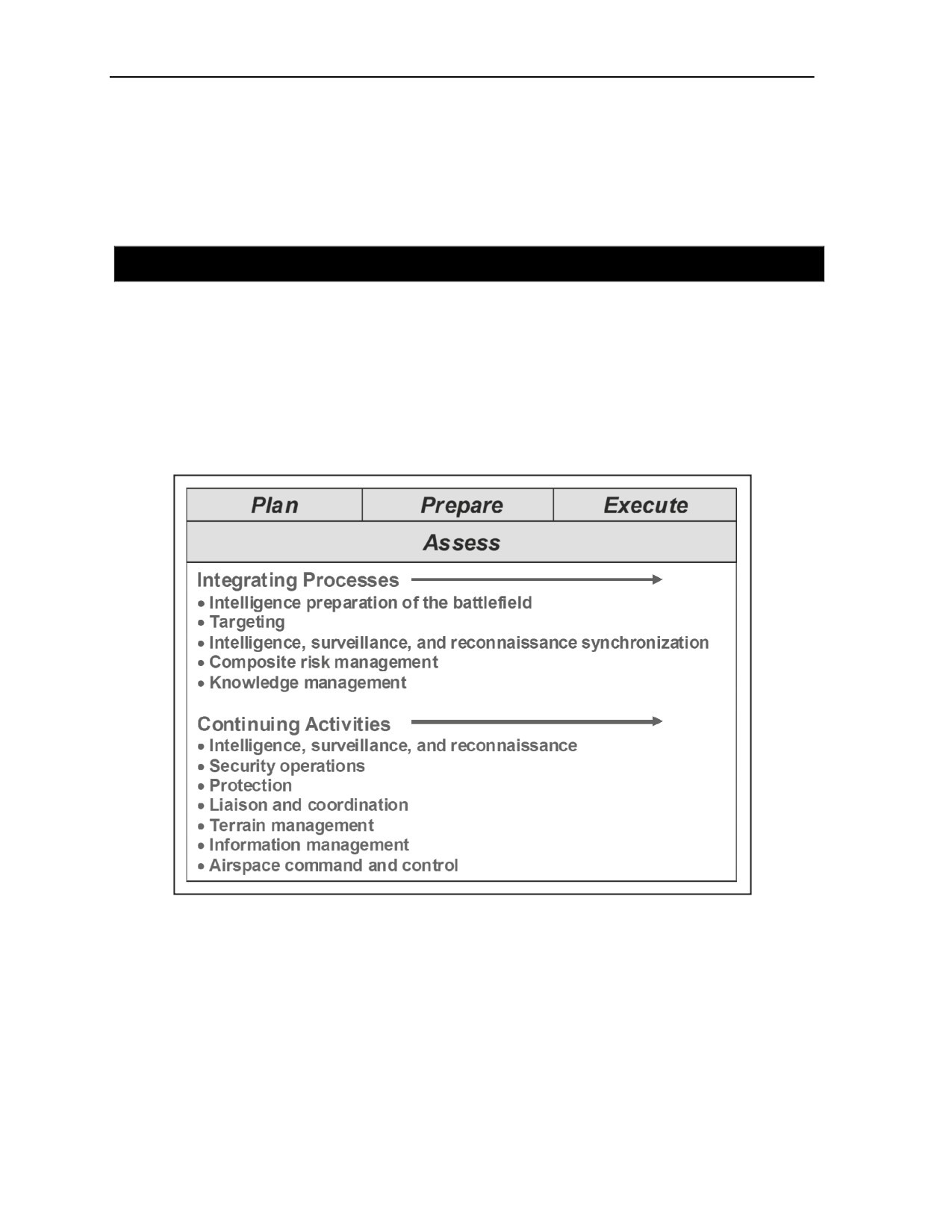
Chapter 3
focuses its assets in the division, corps, JTF or other supported command’s unassigned areas based on the
fire support requirements and priorities established by the supported commander.
3-6. The FIB’s higher HQ may assign the FIB an AO in order to more clearly focus the FIB’s capabilities
or to use it in an economy of force role such as during stability operations or defense support of civil
authorities.
SECTION II - THE FIRES BRIGADE OPERATIONS PROCESS
3-7. The operations process is a commander-centric activity, informed by the mission command approach
to planning, preparing, executing, and assessing military operations (ADP 3-0). The process serves as a
template for coordinating other actions associated with an operation. These include integrating processes,
continuing activities, and actions specific to each operations process activity. Integrating processes and
continuing activities occur throughout an operation. Commanders synchronize them with each other and
integrate them into all operations process activities. The integrating processes, continuing activities, and
specific actions are related within the operations process as shown in figure 3-1.
Figure 3-1. Fires brigade operations and integrating processes
PLANNING
OVERVIEW
3-8. Planning is the art and science of understanding a situation, envisioning a desired future, and laying
out effective ways of bringing about that future (ADP 3-0). Planning involves envisioning a desired end
state and describing the conditions and most effective methods to achieve it. It includes formulating one or
more courses of action for accomplishing the mission. The FIB commander and staff consider the
3-2
The Fires Brigade Operations and Integrating Processes
consequences and implications of each course of action. Once the commander selects a course of action,
planning continues until the plan or order is published. Planning continues throughout an operation. At
minimum, the FIB staff refines plans for branches and sequels throughout an operation.
3-9. Plans forecast but do not predict. A plan is a continuous, evolving framework of anticipated actions
that guides subordinates through each phase of the operation. Any plan is a framework from which to
adapt, not an exact blueprint. The measure of a good plan is not whether execution transpires as planned,
but whether the plan facilities effective action in the face of unforeseen events. Good plans foster initiative,
account for uncertainty and friction, and mitigate risk.
3-10. Scope, complexity, and length of planning horizons differ between operational and tactical planning.
FIB planners integrate FIB capabilities with those of other support brigades, and with other organizations
participating in unified action activities. Comprehensive, continuous, and adaptive planning characterizes
successful operations at both the operational and tactical levels.
3-11. The FIB begins planning upon receipt of a mission from its higher HQ (division, corps, JTF, or other
supported command). Its primary focus is to provide fire support that meets the requirements and priorities
of the higher HQ commander and staff. The FIBs higher HQ must ensure that it allocates the resources the
FIB needs to accomplish its missions. Assets assigned to the FIB may include fire support, surveillance,
TA, maneuver, manned aviation, ground reconnaissance, civil affairs, sustainment, or other assets from
echelons above the FIB.
3-12. To develop plans to accomplish its assigned mission, the FIB follows the seven-step military
decisionmaking process (MDMP) outlined in ADP 5-0 and ATTP 5-0.1. Other references give particular
insight for the FIB staff including—
z
The decide function of the decide, detect, deliver, and assess (D3A) targeting process is part of
planning and is summarized briefly later in this chapter. For an in-depth description of the
targeting process see FM 3-60.
z
FM 3-09 provides insight for field artillery task organization.
MODIFICATIONS
3-13. There are several reasons the FIB commander may modify the MDMP. The following paragraphs
present a few of these reasons—
z
Time-Constrained Environment. In a time-constrained environment, the staff might not be
able to conduct a detailed MDMP, and might choose to abbreviate the process as described in
ADP 5-0. The abbreviated process still uses all seven steps of the MDMP, but the steps are done
in a shortened and less detailed manner.
z
Parallel Planning. Usually, the MDMP does not begin until receipt of the operation order
(OPORD) from higher HQ. However, a change in the situation, anticipation of an order from the
higher command or critical information requirements, can lead the commander to require that
planning begin based on apparent changes. This is referred to as parallel planning. It is
accomplished by issuing warning orders to subordinate units at various stages of the MDMP.
These warning orders give subordinate units the information they need to conduct mission
analysis.
3-3

Chapter 3
z
Distributed Planning. Digital communications and information systems enable members of the
same staff to execute the MDMP without being collocated. Distributed planning saves time and
increases the accuracy of available information by allowing for the rapid transmission of voice
and data information that staffs can use over a wide geographical area.
z
Collaborative Planning. Collaborative planning is the real time interaction among commanders
and staffs at two or more echelons developing plans for a particular operation. The main benefits
of collaborative planning come as much from engaging meaningfully in the process as it does
from the product itself. While the plan may convey the decision, participating in collaborative
planning conveys the context of the decision, as well as an understanding of the available
options and the relationships among forces.
FIRE SUPPORT PLANNING GUIDELINES
Useful Checklists
3-14. Due to time constraints, it may not be possible to accomplish all the actions listed in tables 3-1
through 3-4 however, these guidelines should serve as a “road map” for fire support personnel.
Table 3-1. Long range planning
Action
Responsibility
Obtain enemy order of battle and develop situation template.
S-3, S-2
Check the attack guidance matrix and update as necessary based on current enemy.
S-3, FSO
Develop field artillery and mortar force ratios to be used in war gaming and planning.
S-3, S-2
Legend
S-2 - intelligence staff officer
S-3 - operations staff officer
FSO - fire support officer
Table 3-2. Planning for the immediate battle
Action
Responsibility
Receive higher headquarters operation order.
Staff, S-3, FSO, and fires cell
Conduct mission analysis.
Staff, S-3, FSO, and fires cell
Identify specified/implied tasks of fire support.
S-3, FSO, and fires cell
Identify intent for maneuver and fire support guidance, including priorities for support.
Commander
Course of action development, war game, and produce the decision support template.
S-2, S-3, FSO, Air Liaison Officer,
Conduct initial targeting working group session to determine high-payoff targets and
Aviation Liaison Officer, and Staff
plan for attack. Decision support template documents include responsibilities for
Judge Advocate
observing named areas of interest, target areas of interest, and decision points.
Recommendations for attack of target areas of interest by weapon system and the
associated trigger point. Development of fires brigade directed obstacles. Initial
development of fires brigade target list and target overlay. Input for the initial fires
brigade synchronization matrix.
3-4

The Fires Brigade Operations and Integrating Processes
Table 3-2. Planning for the immediate battle (cont.)
Action
Responsibility
Formulate commander’s attack guidance (based on field artillery attack matrix and
Commander, S-3, FSO, and fires
target value analysis).
cell
Compute number of field artillery targets available for allocation. Allocate field artillery
S-3, FSO and fires cell, Fires
volleys and targets for planning based on commander’s priorities.
Battalion S-3s
Develop commander’s attack criteria from FIB commander’s attack guidance and enter
S-3, FSO, and fires cell
it into fire support computer.
Develop the fire support execution matrix. Distribute the fire support execution matrix
FSO
to subordinate battalion fire support officers and to division and corps fires cells.
Conduct rehearsals. Include as many members of the fire support system as possible:
Commander, S-3, FSO, fires cell,
subordinate fires cells, forward observers, fires battalion S-3s, fire direction officers,
and Fires Battalion S-3s
supported unit mortar platoon leader(s), radar warrant officers, air liaison officers,
aviation liaison officers, and others as necessary. If time does not allow for a face-to-
face rehearsal, consider using radio (dependent on the existing threat). At a minimum,
war game the fire support plan with the S-3, FSO, fires battalion S-3s, and fire direction
officers present. The rehearsal should cover—
z
Verification of target grids, numbers, and trigger points.
z
Positioning of observers.
z
Positioning and movement of field artillery and mortars.
z
Communication networks and variables.
z
Obstacle plan with fire support.
z
Use of close air support and attack helicopters.
z
Maneuver control measures and fire support coordination measures
(FSCM), including field artillery, mortar, and air-delivered weapon risk
estimate distances.
Legend
S-2 - intelligence staff officer
S-3 - operations staff officer
FSO - fire support officer
Table 3-3. Execution planning
Action
Responsibility
S-3, FSO, and selected fires cell personnel position themselves where they can best
S-3, FSO, and fires cell
execute the fire support plan (not always with the FIB commander).
Communicate with—
S-3, FSO, and fires cell
z
Supported commander.
z
Subordinate/higher fires cell.
z
Fires battalion fire direction centers and other fire support assets (for
example, tactical air control party).
Legend
S-3 - operations staff officer
FSO - fire support officer
3-5

Chapter 3
Table 3-4. Provide battle tracking
Action
Responsibility
S-3, FSO and fires cell planners should know the location of all maneuver elements to company
S-3, FSO, and fires cell
level (and their future plans for movement). The location of fire support assets to include, at a
minimum: supporting radars; supporting mortars, organic and direct support/reinforcing field
artillery battalions, and the ammunition status of these assets; subordinate battalion/squadron fires
cells; and the division and corps fires cell. The assigned targets and primary/secondary observers
within their responsibility. The location of all current and proposed FSCMs.
Clear fires rapidly, positively, and safely within their maneuver commander’s area of operations.
S-3, FSO, and fires cell
Ensure that the maneuver commander approves clearance.
Execute fires in accordance with the next higher HQ fire support execution matrix. Fire support
S-3, FSO, and fires cell
execution matrices should be produced at company level and above.
Change priority targets to support the maneuver commander’s scheme of maneuver throughout
S-3, FSO, and fires cell
the operation.
Legend
S-3 - operations staff officer
FSO - fire support officer
Quick Fire Planning
3-15. The S-3, fire support officer (FSO), and fires cell planners must ensure that subordinate fires
battalion S-3s, fire direction centers, and supported maneuver battalion/squadron fires cells understand the
quick fire plan and how it is used. Quick fire planning techniques constitute an informal fire plan. Quick
fire planning differs from deliberate fire planning in that it is normally done for an unanticipated event or
operation and may originate as a bottom-up rather than as a top-down process. The S-3, FSO, and fires cell
planners are responsible for—
z
Identifying targets in the target list to be engaged.
z
Allocating all fire support assets available to engage the targets in the plan.
z
Preparing the schedule of fires.
z
Disseminating the schedule to all appropriate units and staff for execution.
3-16. The quick fire planning sequence begins with receiving the OPORD. The S-3, FSO, and fires cell
planners get the following decisions from the commander—
z
Targets to be engaged.
z
Desired effects on targets.
z
Order and timing of target engagement.
z
Duration of fires.
z
H-hour.
z
Priority of fires.
z
Priority for targeting.
z
Priority for execution.
z
Time check.
3-6
The Fires Brigade Operations and Integrating Processes
z
Estimated rate of movement.
z
Need for target adjustment.
z
Concept of the operation, to include objective and defensive positions, maneuver control
measures, and obstacles.
3-17. The quick fire sequence continues with the following actions—
z
Find out what assets are available for the operation. Concurrently, send a warning order to all
attack units and staff. These include the fires battalion S-3s, mortar platoon leader, air liaison
officer, naval gunfire liaison officer (NGLO), and aviation liaison officer (if applicable).
z
From the fires battalions—obtain the firing units that will be designated to fire in the quick fire
plan schedule.
z
From the supported maneuver commander—obtain the availability of the mortar platoon
(company FSO to battalion FSO for the mortars if a company operation) for inclusion as a firing
unit into the schedule of fires.
z
From within the FIB fires cell—obtain close air support (CAS) mission information. Coordinate
CAS requirements with the air liaison officer (ALO) (for example, aircraft type, ordnance, time
on station, laser codes, and control procedures).
z
From the order or from the NGLO—obtain the availability of naval aircraft and/or NSFS.
z
Evaluate requirements for fire support coordination measures (FSCM) to control and expedite
fires, safeguard troops, adhere to rules of engagement, or meet specific commander’s guidance.
Identify those FSCMs that may be time or event driven. Identify, recommend, and gain approval
on FSCMs as appropriate, and initiate necessary coordination and dissemination as soon as
possible.
z
Plan targets in accordance with the scheme of maneuver, commander’s guidance, and allocated
assets. This includes assets to use, munitions mix, shell-fuze combinations, duration of fire for
each target, and time to fire.
3-18. After receiving the commander’s approval, disseminate the fire plan to attack systems, higher HQ
fires cells, and those who will implement the plan (FSOs, forward observers [FO], and subordinate
battalion/squadron fires cells). Ensure that the subordinate fires cells and/or fire support teams (FIST)
understand the fire plan. At a minimum, address—
z
Positions or locations of FSOs and/or observers during the conduct of the operation.
z
Who is to initiate the fire plan or initiate the fire request on specific on-call targets? Include the
agency to be contacted, when the target is to be initiated, and the communications network to be
used.
z
Which unit has priority of fires or priority targets, if applicable?
z
The use of methods of control in modifying the plan should it become necessary during the
execution of the plan.
z
Any additional FSCMs established to support the quick fire plan.
3-7
Chapter 3
z
The fire support attack elements available when additional targets of opportunity arise during the
execution of the plan.
z
If time allows, conduct a rehearsal to ensure comprehension of the plan. Inform the commander
when the fire support plans are ready. Review the fire support plans and modify them as
necessary.
Risk Management
3-19. Risk management is the process of identifying and controlling risks arising from operational factors
and making decisions that balance risk cost with mission benefits (JP 2-0). Risk management is an integral
part of planning, and must take place at all echelons of the FIB during each phase of every operation. Both
tactical and accidental risks are always present in all operations. Leaders should never approach risk
management with “one size fits all” solutions to the risks that their unit faces. Commanders must manage
risks to their forces to accomplish the mission and take care of Soldiers.
3-20. For more on risk management see FM 5-19.
PREPARATION
OVERVIEW
3-21. Preparation consists of activities that units perform to improve their ability to execute an operation
(ADP 3-0). Preparation creates conditions that improve friendly forces’ chances for success. It facilitates
and sustains transitions, including those to branches and sequels.
3-22. Preparation requires staff, subordinate units, and Soldier actions. Mission success depends as much
on preparation as on planning. Rehearsals help staffs, units, and individuals to better understand their
specific role in upcoming operations, practice complicated tasks before execution, and ensure equipment
and weapons are properly functioning. Key preparation activities include—
z
Plan refinement.
z
Surveillance and reconnaissance.
z
Rehearsals to include subordinate confirmation briefs and backbriefs.
z
Task-organizing.
z
Training.
z
Troop movements.
z
Preparations checks and inspections.
z
Sustainment preparations.
z
Integrating new Soldiers and units.
3-23. Several preparation activities begin during planning and continue throughout an operation. Many
preparation activities continue during execution. Uncommitted forces prepare for identified contingencies
3-8
The Fires Brigade Operations and Integrating Processes
and look to the operation’s next phase or branch. Committed units revert to preparation when they reach
their objectives, occupy defensive positions, or pass into reserve.
REHEARSALS
3-24. The FIB conducts rehearsals to ensure mission success. Techniques for conducting rehearsals are
limited only by the commander’s imagination and available resources. Generally, six techniques are used—
z
Full-dress.
z
Reduced-force.
z
Terrain-model.
z
Sketch-map.
z
Map.
z
Network.
3-25. In select circumstances, such as when a missile firing battery has the requirement to respond directly
to a FIB on-order fire mission, the FIB HQ may participate in those rehearsals conducted by subordinate
units. Generally, four types of rehearsals are used by battery and smaller sized units —
z
Backbrief.
z
Combined arms rehearsal.
z
Support rehearsal.
z
Battle drill or standing operating procedure (SOP) rehearsal.
3-26. See ATTP 5-0.1 for additional information on rehearsal types.
3-27. The FIB S-3, FSO, and fires cell planners should participate in the division, corps, JTF, or other
supported commander's rehearsal. Rehearsals improve total comprehension of the plan. Participants who
are unclear on specific portions of the plan find answers through the repetitiveness afforded by rehearsing
the operation. See ATTP 5-0.1 for a detailed discussion of rehearsals.
3-28. Rehearsal procedures should be established as part of the unit SOPs. At a minimum, the standing
operating procedures should identify the following—
z
Who will participate in the rehearsal?
z
What should be rehearsed?
z
What is the sequence of the rehearsal?
z
What is the priority of the methods for rehearsals (representative or actual terrain, model, map,
sand table, wire, or radio)?
3-29. The fire support plan may be rehearsed as part of the division, corps, JTF, or other supported higher
HQ rehearsal. All assigned and attached combined arms units that comprise or support the FIB will
participate when possible. Normally, the S-3 directs the rehearsal using a synchronization matrix and/or
3-9
Chapter 3
execution checklist; the FSO should use his fire support execution matrix. The rehearsal is normally
executed by reciting and/or performing—
z
Actions to occur.
z
Possible friendly initiatives.
z
Possible reactions to enemy initiatives.
z
Control measures.
z
Significant events relative to time or phases of the operation.
3-30. For each phase or time period of the operation, the FSO (depending upon mission, enemy, terrain and
weather, troops and support available, time available, civil considerations [METT-TC]) should cover the
following—
z
Verify grid locations for critical targets.
z
Verify trigger points for each target, and the target engagement criteria.
z
Confirm a primary and backup observer for each target.
z
Verify primary and backup communications links for each observer.
z
Verify that each target has a task and a purpose (what effects are to be achieved), and that
targeting priorities are clearly outlined.
z
Verify the method of engagement (for example, at my command, time on target, or when ready).
z
Verify that attack guidance, such as unit(s) to fire, shell/fuse combination, and number of
volleys, is specified for each target.
z
Verify that the movement plan specifies when and where units will move.
Fire Support Rehearsal
3-31. The fire support rehearsal is crucial to mission accomplishment because it ensures that fires are
synchronized according to the fire support plan. The fire support rehearsal focuses on maximizing the
ability of fire support systems to support the fire support plan, and achieve the commander’s intent.
Technical fire control issues are not addressed in the fire support rehearsal, but are resolved in subordinate
fires battalion rehearsals. The FIB commander, deputy commander, executive officer, S-3, FSO, and
subordinate battalion representatives attend the fire support rehearsal. FIB staff officers attending may
include the ALO, air defense artillery officer, and airspace management officer, and others as needed.
Subordinate units often bring personnel that may include the S-3, FSO, and combat observation and lasing
team (COLT) members. The deputy commander or executive officer, assisted by the FSO, usually
supervises the rehearsal for the FIB commander.
3-32. The fire support rehearsal should ensure the synchronization of fire support with the operations plan.
Time will inevitably be short, so the rehearsal focuses on the critical portions of the plan. The critical
document supporting the fire support rehearsal is the fire support execution matrix, which includes all fire
support tasks. To conduct the fire support rehearsal, the FIB follows the same procedures outlined in the
combined arms rehearsal sequence of events.
3-10
The Fires Brigade Operations and Integrating Processes
3-33. Fire support rehearsals focus on the execution of fire support tasks and on the fire support execution
matrix, the effectiveness of fire support coordination measures (FSCM), and the timing and
synchronization of all fire support efforts with each other and with the supported command’s operations.
Fire support rehearsals serve to refine the fire support plan, ensure understanding by all fire support
personnel, and prove the feasibility of executing the current plan.
3-34. A fire support rehearsal may include all key maneuver or other supported unit and fire support
personnel involved in planning and executing the fire support plan, to include subordinate fires battalion
tactical operations centers. The fire support rehearsal may also be limited in scope. Two examples of fire
support rehearsals that are limited in scope are one that is focused only on the FIB level fire support
participants (such as the fires cell, S-3, FSO, Army aviation liaison officer, and ALO) and one that is
centered on the FIB through battery fire support network of fires cells, and, as tasked, FISTs and COLTs.
3-35. A fire support rehearsal may be used to prepare for a combined arms rehearsal. It may be necessary
to conduct the rehearsal after a combined arms rehearsal to refine and reinforce key fire support tasks and
to ensure fire support covers any changes to the maneuver or other supported unit plan. If a combined arms
rehearsal is not conducted, a fire support rehearsal may serve as the primary preparation for execution of
the fire support plan.
3-36. Units may use the fire support execution matrix as fire support rehearsal script. Subordinate fires
battalions may use their OPORDs as the fire support rehearsal script.
3-37. Alternative friendly courses of action (branches and sequels to the plan) may also be rehearsed, if
time permits. Rehearsals may be concluded with a summary of each unit’s status (to include firing unit
ammunition status) and location. This summary facilitates planning of future operations.
Rehearsal Sequence
3-38. The following rehearsal sequence guidelines can be used to conduct rehearsals. They can be modified
as needed and tailored to fit offensive or defensive operations. The sequence begins with—
z
Ensuring that all key players are present.
z
Orienting participants to the map, sand table, and/or maneuver graphics that will be used for the
rehearsal.
z
Discussing each event completely and then moving on to the next event (this applies to both an
integrated maneuver/fire support rehearsal and a separate fire support rehearsal).
z
Identifying the maneuver event.
3-39. The sequence continues with discussion of the supporting fire support action in terms of—
z
“Where”—target location.
z
“Who”—execution responsibility and communication links (primary, alternate and backup).
z
“Why”—purpose.
z
“When”—engagement criteria.
z
“What”—desired effects (ammunition and shell-fuze combination required to render destruction,
neutralization, or suppression or other desired effects).
3-11
Chapter 3
3-40. The rehearsal sequence ends with a recap of all critical fire support actions by the individual
responsible (S-3, FSO, battalion FSOs, attachments)—
z
ALO and NGLO recap the critical CAS and naval surface fire support (NSFS) events.
z
FSOs verify all applicable frequencies, call signs, and code words.
z
Conduct final scrub of target list and fire support execution matrix.
z
Exchange information (for example, updated ammunition counts).
z
FSOs quickly recap all critical fire support events using the essential task format.
3-41. For additional information on rehearsals, see ATTP 5-0.1.
EXECUTE
OVERVIEW
3-42. Execution puts a plan into action by applying combat power to accomplish the mission and using
situational understanding to assess progress and make execution and adjustment decisions (ADP 3-0). The
FIB can conduct offensive, defensive, and stability operations simultaneously. The degree of emphasis
placed on each will vary depending on the situation. The force design of the FIB allows it to conduct the
fire support missions necessary to support within the supported higher HQ AO or within the FIB’s own
AO, either with its organic assets or with augmentation from the division, corps or other higher echelon.
The employment of the FIB is described in Chapter 4 of this FM.
RAPID DECISIONMAKING AND SYNCHRONIZATION PROCESS
3-43. The rapid decisionmaking and synchronization process is a decisionmaking and synchronization
technique for commanders and staff to use during execution. Two significant differences between the rapid
decisionmaking and synchronization process and MDMP are—
z
The rapid decisionmaking and synchronization process is based on an existing order. Control
mechanisms in the order (commander’s intent, concept of operations, and commander’s critical
information requirements) identify the commander’s priorities. Leaders use these priorities as
criteria for making decisions.
z
The rapid decisionmaking and synchronization process seeks an acceptable solution, while the
MDMP seeks the optimal (most desirable) one. Using the rapid decisionmaking and
synchronization process lets FIB leaders avoid the time-consuming requirements of developing
decision criteria and comparing courses of action. Under the rapid decisionmaking and
synchronization process, leaders combine their experience and intuition with situational
awareness to quickly reach situational understanding. Based on this, they develop and refine
workable courses of action.
3-44. The rapid decisionmaking and synchronization process includes five steps—
z
Compare the current situation to the order.
z
Determine that a decision, and what type, is required.
3-12