ATP 3-09.24 (FM 3-09.22) Techniques for the Fires Brigade (November 2012) - part 1
ATP 3-09.24 (FM 3-09.22)
Techniques for the Fires Brigade
November 2012
DISTRIBUTION RESTRICTION: Approved for public release; distribution is unlimited.
HEADQUARTERS, DEPARTMENT OF THE ARMY.
*ATP 3-09.24
Army Techniques Publication
Headquarters,
No. 3-09.24
Department of the Army
Washington, D.C., 21 November 2012
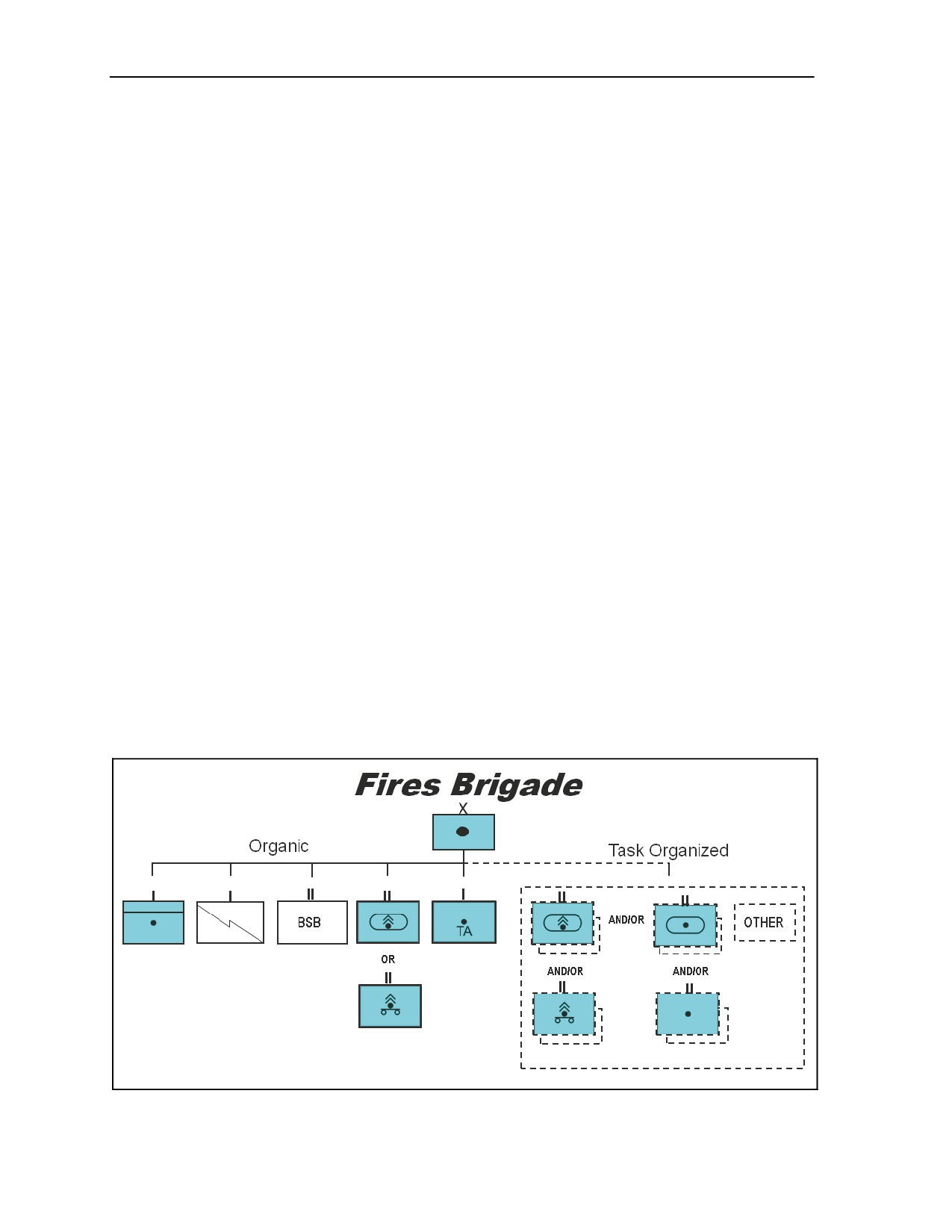
Techniques for the Fires Brigade
Contents
Page
PREFACE
v
INTRODUCTION
vi
Scope
vi
Summary of New Material and Changes From FM 3-09.22
vi
Chapter 1
FIRES BRIGADE ORGANIZATIONAL FRAMEWORK
1-1
Section I - The Fires Brigade
1-1
Role of the Fires Brigade
1-1
Fires Brigade as a Force Field Artillery Headquarters
1-2
Organization of the Fires Brigade
1-4
Section II - Fires Brigade Command and Staff
1-7
Fires Brigade Command
1-7
Duties and Responsibilities of Key Personnel
1-8
Fires Brigade Staff
1-11
Section III - Fires Brigade Staff Augmentees
1-14
Plans Staff Officer (S-5)
1-14
Inform and Influence Activities Staff Officer (S-7)
1-14
Civil Affairs Operations Staff Officer (S-9)
1-14
Chapter 2
FIRES BRIGADE MISSION COMMAND AND COMMUNICATIONS
2-1
Section I - Command Group and Command Posts
2-1
Command Group
2-1
Organization and Positioning
2-2
Main Command Post
2-2
Tactical Command Post
2-5
Distribution Restriction: Approved for public release; distribution is unlimited.
*This publication supersedes FM 3-09.22, 2 March 2001.
i
Contents
Early-Entry Command Post
2-5
Brigade Support Battalion Command Post
2-6
Section II - Command Post Functional Cells, Elements, and Sections
2-7
Personnel Section
2-7
Intelligence and Targeting Cell
2-7
Operations and Counterfire Cell
2-10
Fires Cell
2-13
Liaison Section
2-20
Public Affairs Section
2-20
Staff Judge Advocate Section
2-20
Signal Section
2-20
Sustainment (S-4) Section
2-21
Medical Platoon
2-22
Unit Ministry Team
2-22
Section III - Digital Command Post Operations
2-23
Data Exchange
2-23
Digital Command Post Layout
2-24
Combat Information Center Data Display Management
2-25
Digital Duties and Responsibilities
2-28
Common Operational Picture
2-31
Section IV - The Army Battle Command System
2-31
Army Battle Command System Overview
2-32
Fires Brigade Supporting Mission Command Systems
2-36
Section V - The Fires Brigade Communications Network
2-36
Combat Net Radio
2-37
Single Channel Ground and Airborne Radio System
2-37
Other Tactical Radios
2-38
Bandwidth Optimization
2-41
Chapter 3
THE FIRES BRIGADE OPERATIONS AND INTEGRATING PROCESSES
3-1
Section I - Mission Orders for the Fires Brigade
3-1
Section II - The Fires Brigade Operations Process
3-2
Planning
3-2
Preparation
3-8
Execute
3-12
Assess
3-13
Section III - Fire Support Planning and the Targeting Process
3-13
Targeting Process Steps
3-14
Continuous Refinement
3-16
The Targeting Working Group/Targeting Board
3-16
Section IV - Surveillance, Reconnaissance, and Target Acquisition
3-17
Surveillance and Reconnaissance
3-17
Target Acquisition
3-18
Section V - Key Continuing Activities
3-21
Fire Support Coordination
3-21
Clearance of Fires
3-23
Airspace Command and Control
3-26
ii
Contents
Section VI - Special Considerations
3-26
The Fires Brigade in Early Entry Operations
3-26
Fires Brigade Suppression of Enemy Air Defenses
3-30
Terrain Management
3-33
Survey and Meteorology
3-34
Laser Management
3-35
Chapter 4
FIRES BRIGADE EMPLOYMENT: HOW THE FIRES BRIGADE FIGHTS
4-1
Section I - Operational Environment
4-1
Combined Arms
4-1
Unified land operations
4-2
Section II - The Fires Brigade Framework
4-3
Area of Operations
4-3
Fires Brigade Strike and Counterfire
4-6
Section III - The Fires Brigade in Defensive Operations
4-7
General Considerations for the Fires Brigade in Defensive Operations
4-7
Section IV - The Fires Brigade in Offensive Operations
4-12
General Considerations for the Fires Brigade in Offensive Operations
4-12
Section V - The Fires Brigade in Stability Operations
4-19
General Considerations for the Fires Brigade in Stability Operations
4-19
Chapter 5
FIRES BRIGADE SUSTAINMENT OPERATIONS
5-1
Section I - Fires Brigade Sustainment Staff and Organization
5-1
Fires Brigade Sustainment Staff
5-1
Brigade Support Battalion
5-2
Sustainment for Attachments
5-6
Section II - Fires Brigade Sustainment Functions
5-6
Supply and Transportation
5-6
Maintenance
5-11
Field Services
5-14
Explosive Ordnance Disposal
5-15
Detainee Operations
5-15
Financial Management
5-16
Human Resources Support
5-17
Religious Support
5-20
Legal Support
5-21
Army Health System Support
5-21
Section III - The Fires Brigade Sustainment Area
5-22
Fires Brigade Sustainment Area
5-22
Appendix A
FIRES BRIGADE OPERATIONS ORDER
A-1
Appendix B
FIRES BRIGADE TRAINING
B-1
GLOSSARY
Glossary -1
REFERENCES
References-1
INDEX
Index-1
iii
Contents
Figures
Figure 1-1. Fires brigade organization (example)
1-4
Figure 2-3. Typical fires brigade CP layout (example)
2-25
Figure 3-1. Fires brigade operations and integrating processes
3-2
Tables
Table 3-1. Long range planning
3-4
Table 3-2. Planning for the immediate battle
3-4
Table 3-3. Execution planning
3-5
Table 3-4. Provide battle tracking
3-6
iv
Preface
This field manual (FM) describes techniques for the fires brigade (FIB) in unified land operations.
The manual replaces FM 3-09.22 and complements FM 3-09.
FM 3-09.24 supports Army capstone doctrine in Army Doctrine Publication (ADP) 3-0, FM 3-90.6, as well
as joint doctrine in Joint Publication (JP) 3-0, JP 5-0, JP 3-09, JP 3-13, and JP 3-60.
Defined terms are identified in the text. Definitions for which this publication is the proponent are printed
in boldface. These terms and their definitions will be incorporated into the next revision of ADRP 1-02. For
other definitions in the text, the term is italicized, and the number of the proponent publication follows the
definition. Terms for which this publication is the proponent are indicated with an asterisk in the glossary.
Unless this publication states otherwise, masculine nouns and pronouns do not refer exclusively to men.
This publication applies to the Active Army, the Army National Guard (ARNG)/Army National Guard of
the United States (ARNGUS), and the United States Army Reserve (USAR) unless otherwise stated.
Headquarters, United States Army Training and Doctrine Command is the proponent for this publication.
The preparing agency is the U.S. Army Fires Center of Excellence and Fort Sill. Send written comments
and recommendations on a DA Form 2028 (Recommended Changes to Publications and Blank Forms) to
Directorate of Training and Doctrine, 700 McNair Avenue, Suite 117 ATTN: ATSF-DD, Fort Sill OK
73503 by e-mail to usarmy.sill.fcoe.mbx.dotd-doctrine-inbox@mail.mil; or submit an electronic DA Form
2028.
v
Introduction
SCOPE
This manual describes the fires brigade (FIB) in support of division, corps, or other supported headquarters
(HQ) operations in unified land operations. Chapter 1 begins with the FIB organizational framework. Chapter 2
describes FIB mission command and communications. Chapter 3 describes the FIB operations and integrating
processes. Chapter 4 describes FIB employment. Chapter 5 provides a summary discussion of FIB sustainment.
Appendix A provides an example of a FIB operation order (OPORD). Appendix B describes the training
available for field artillery personnel.
The intended audience for this publication is leaders and staff sections within the FIBs and their supporting and
supported units. These leaders include those in brigade combat team, division, and corps chains of command;
field and company grade officers; middle-grade and senior noncommissioned officers; and brigade, battalion
and squadron staffs. This manual provides guidance for division and corps leaders and staffs for training and
employment of the FIB. This publication may also be used by Army or other unified action organizations to
assist in their planning for working with and supporting the FIB and its operations.
This manual builds on the collective knowledge and experience gained through recent operations, numerous
exercises, and the deliberate process of informed reasoning. It is rooted in time-tested principles and
fundamentals, while accommodating force design, new technologies, and diverse threats to national security.
SUMMARY OF NEW MATERIAL AND CHANGES FROM FM 3-09.22
Chapter 1 describes the organizational framework for the FIB including—
• The role of the FIB, including the FIB as part of a division and as the force field artillery HQ for
the supported higher HQ.
• FIB organization (subordinate units, command, and staff) with a discussion of key personnel
duties and responsibilities.
Chapter 2 describes the FIB command post (CP) and CP operations including—
• The command group and the main, tactical, and early-entry CPs.
• A description of FIB CP cells, elements, and sections and their duties and responsibilities.
• A brief summary of the FIB Army Battle Command System (ABCS) and communications
network.
Chapter 3 describes FIB operations and integrating processes including—
• A summary of FIB operations process—plan, prepare, execute and assess.
• A summary of FIB targeting and intelligence gained from surveillance, reconnaissance; and
target acquisition radars.
vi
Introduction
• A summary of key continuing activities, including inform and influence activities, fire support
coordination, clearance of fires, and airspace control.
• A summary of special considerations for the FIB including early entry operations, joint air attack
team operations, suppression of enemy air defenses , terrain management, survey, meteorology
and laser management.
Chapter 4 describes FIB employment (how the FIB fights) including—
• A summary discussion of the key factors influencing the FIB’s operational environment
(combined arms maneuver and wide area security and joint, interagency, intergovernmental, and
multinational operations) and operational framework (area of operations, allocation of combat
power by purpose, and FIB strike and counterfire operations).
Chapter 5 provides a summary discussion of FIB sustainment.
Appendix A provides an example of a FIB OPORD.
Appendix B describes the training available for fires brigade personnel.
vii
This page intentionally left blank.
Chapter 1
Fires Brigade Organizational Framework
This chapter discusses the fires brigade’s (FIB) basic roles, capabilities, organization, and
command and staff functions/responsibilities. Additionally, it provides a brief description
how functional and integrating cells/elements are formed within the FIB Headquarters (HQ).
SECTION I - THE FIRES BRIGADE
ROLE OF THE FIRES BRIGADE
1-1. A FIB’s primary task is conducting strike operations (FM 3-09). The FIB is the only Army field
artillery organization above the brigade combat team (BCT) and can be directed to execute tasks for any
joint, Service, or functional HQ. The FIB is neither organic to any Army organization or echelon, nor is it
focused on any specific region or geographic combatant commander’s area of responsibility. A division,
corps, joint force land component command, or joint task force (JTF) may have a FIB attached or placed
under operational control (OPCON), however, the FIB is normally attached to a division HQ. When
operating under the control of the joint force commander (JFC) or another Service, the Army Service
component command exercises administrative control over the FIB.
1-2. Fires brigades are task-organized to accomplish assigned tasks. The FIB’s supported commander
assigns the FIB its mission and possibly an area of operations (AO). The supported commander provides
guidance on coordinating the FIB’s actions with BCTs and other supporting brigades in the command. The
FIB’s supported commander provides supporting units to the FIB as necessary. The FIB might be required
to detach some of its subordinate elements to BCTs or other supporting brigades of the command. BCTs,
reconnaissance and surveillance brigades, maneuver enhancement brigades, combat aviation brigades, and
sustainment brigades can all support FIB operations.
1-3. When a FIB is attached for training and readiness authority (TRA), the FIB participates in the
training events, readiness exercises, and the deployments of its supported command. The supported
commander may also direct the FIB commander to assist BCT commanders in training and preparing their
organic fires battalions. The FIB has organic units and will receive other assigned or attached units based
on task organization for a specific contingency or operation or to meet stationing or other requirements.
1-4. For more information on TRA see Annex B, Fires Brigade Training.
FIRES BRIGADE EMPLOYMENT CAPABILITIES
1-5. The FIB gives the supported commander a HQ to plan, synchronize, and execute close supporting
fires for engaged forces, strike, counterfire, and fires in support of decisive and shaping operations
throughout the command’s AO. The FIB has the necessary mission command structure (described in
Chapter 2) to integrate ground and air maneuver forces.
1-1
Chapter 1
FIRES BRIGADE EMPLOYMENT CAPABILITIES
1-6. The FIB is capable of being a supported or supporting unit that is trained, manned, organized, and
equipped to provide for the collective and coordinated use of Army indirect fires, joint fires, and control for
its own or a supported HQ operations. This includes synchronizing physical attack, electronic warfare, and
computer network operations against enemy and adversary command and control nodes. FIBs have the
necessary fire support and targeting structure to effectively execute the entire decide, detect, deliver, and
assess targeting process for its assigned mission. The FIB is capable of providing the division, corps, joint
force land component commander, JTF, or other supported commander with —
z
A force field artillery HQ if so designated by the commander of the FIB’s controlling HQ.
z
A HQ able to mission command the full complement of Army and joint fire support
capabilities. The FIB table of organization and equipment includes a tactical air control
party (TACP) that must be resourced by the U.S. Air Force. This normally occurs when the
fires brigade is deployed. Control of multinational fires may require augmentation by
personnel with the necessary language skills and communications equipment.
z
Technical oversight of all field artillery-specific training within the command.
z
Assisting the supported commander in training preparation for deployment of the
organization’s field artillery personnel.
1-7.
The FIB is capable of providing fires and radar coverage for—
z
Strike operations and counterfire.
z
Support of decisive and shaping operations.
z
Close support to engaged forces (such as reinforcing fires for BCT organic fires battalions).
z
Suppression of enemy air defenses to support joint and Army aviation attack operations.
z
Support of special operations forces operating in the AO of the FIB’s controlling HQ (for
example, a division, corps, JTF, or land component HQ).
z
Support of other supporting brigades operating in the FIB’s supported commander’s AO.
THE FIRES BRIGADE AS A FORCE FIELD ARTILLERY
HEADQUARTERS
1-8. The force field artillery headquarters, if one is designated by the supported commander, is normally
the senior field artillery HQ organic, attached, or placed under the OPCON of that command. The
supported commander specifies the commensurate responsibilities of the force field artillery HQ and, if
necessary, the duration of those responsibilities (FM 3-09) These responsibilities are based on mission
variables such as mission, enemy, terrain and weather, troops and support available, time available, civil
considerations (METT-TC) and may range from simple mentoring and technical oversight to full OPCON
of all field artillery units organic, assigned, attached, or placed under that command.
1-9. When designated as the force field artillery HQ by a supported division commander, the FIB
commander assumes the responsibility as FSCOORD for the division. The division chief of fires serves as
the deputy FSCOORD and takes direction and guidance from the FSCOORD. If the FIB is not designated
1-2
Fires Brigade Organizational Framework
as the FFA HQ, the Division Chief of Fires maintains this responsibility. As the FFA HQ, the FIB’s
functions include:
z
Recommending field artillery organization for combat to the commander.
z
Providing mission command for field artillery units organic, assigned, attached, or placed under
the OPCON or tactical control of the command (thus providing unity of field artillery
command).
z
Assisting the fires cell in producing Annex D (Fires) for the operations order.
z
Training of the field artillery units that are assigned, attached, or placed under the OPCON of the
command and mentoring of the commanders and leaders of these field artillery units. This
includes field artillery technical oversight of the training and assessment of the fires battalions
and other field artillery units organic to BCTs and supporting brigades. Assisting the supported
commander in training preparation for deployment of the maneuver organizations’ field artillery
personnel. The extent of oversight duties and responsibilities must be specified by the division or
other supported commander to ensure full cooperation and compliance by the BCT and other
supporting brigade commanders.
z
Advising the supported commander of field artillery related new equipment fielding and
software updates within field artillery units.
z
Establishing common survey, metrological, and radar target acquisition (TA) plans for the
command.
z
Planning, preparing, and executing fires for close support of engaged forces, and in support of
strike, counterfire, and decisive and shaping operations.
z
Providing centralized mission command for the full complement of Army indirect fires, joint
fires, and multinational fires provided in support of the command. This is especially useful to the
commander in circumstances where major combat operations are likely and when deconfliction
of fires across multiple contiguous AOs is required. Centralized mission command of supporting
Army and joint fires is useful when unconventional forces are operating either independently or
as the only force integrated within indigenous forces and require dedicated all-weather fires and
fire support coordination.
z
Working with the command’s assistant chief of staff, operations (G-3) and fires cell in planning,
coordinating, and executing fire support tasks assigned to the command by its higher HQ. This
can include assisting in the development of fire support plans; accepting or passing control of
fires during passage of lines operations; facilitating single point of contact for outside agency
coordination for strike and counterfire; and coordinating sustainment of fire support for
nonorganic field artillery units and the command’s subordinate units.
z
Facilitating and participating in the commander’s targeting process
1-10. Designating a force field artillery HQ for a command improves centralized control of field artillery in
the force by enhancing—
z
The massing of field artillery fires where needed.
z
Coverage of the force AO by field artillery fires and radars.
1-3
Chapter 1
z
Rapid shifting of field artillery fires as needed to weight the decisive operation.
z
Effective planning for field artillery fires in support of rapid maneuver.
z
If so directed by the supported commander, standardization of field artillery training, readiness
and maintenance throughout the force.
z
Planning the fires and positions of all field artillery units with a general support or general
support-reinforcing support relationship to the force.
z
Coordinating the counterfire battle for the supported commander.
z
Accepting or passing control of fires during passage of lines operations.
z
Authorizing changes to approved or doctrinal communications net structures for nets it controls.
z
Coordinating the sustainment of subordinate field artillery assets.
1-11. See FM 3-09 for additional information.
ORGANIZATION OF THE FIRES BRIGADE
1-12. Organic FIB assets include a multiple launch rocket system (MLRS) or high-mobility artillery rocket
system (HIMARS) battalion, a brigade support battalion (BSB), a signal network support company, a target
acquisition battery (TAB), and a headquarters and headquarters battery (HHB). The FIB and each of the
subordinate elements can be augmented (task-organized) as required. This may include a combination of
one to five rocket/missile (MLRS or HIMARS) and/or cannon fires battalions, as well as other enablers,
such as counterfire radars and mission command warfare capabilities (such as, electronic warfare assets).
For example, executing strike may require placing additional surveillance, reconnaissance and inform and
influence activities assets under the OPCON or tactical control (TACON) of the FIB commander.
Alternatively, a supporting battlefield surveillance brigade can retain control of surveillance and
reconnaissance assets and provide the information to the FIB. Figure 1-1 depicts the normal FIB
organization.
Figure 1-1. Fires brigade organization (example)
1-4
Fires Brigade Organizational Framework
HEADQUARTERS AND HEADQUARTERS BATTERY
1-13. The FIB HHB and its assigned brigade staff provide expertise across a broader range of functional
areas. Chapter 2 of this field manual (FM) provides a description of FIB command post (CP)
sections/cells/elements, their functions, and the duties and responsibilities of the HHB personnel assigned
to them.
TARGET ACQUISITION BATTERY
1-14. The TAB is organized with meteorological, survey, and TA capabilities including the AN/TPQ-37
and AN/TPQ-48-50-series radars. The supported commander will normally designate the FIB as the
command’s counterfire HQ, and may charge the FIB commander with management and coordination of all
counterfire radars in the command. Though the BCTs may retain their organic radars, the management of
these radars, like those in the TAB, may be directed through the counterfire HQ.
Meteorological Support
1-15. Meteorological support includes providing position and target area support to organic and assigned
fires battalions and fires battalions organic to the supported HQ’s BCTs when terrain or distances require
multiple meteorological stations.
Radar Support
1-16. Radar support includes—
z
Detecting, locating, classifying, reporting, and communicating the firing locations and impact
points of enemy mortars, artillery, rockets, and missiles that are beyond the range of the radars in
the fires battalions.
z
General support radar coverage for the supported higher HQ (including special operations forces
operating in the supported HQ AO).
z
Additional radar coverage for BCTs to support the maneuver of their forces and allow movement
of their radar(s).
z
Coordination for radar maintenance support provided by the brigade support battalion.
z
Confirming the actual burst/impact location of friendly fires when required (for instance if
required by the rules of engagement.
z
Integration with Indirect Fire Protection Capability units such as the Counter-Rocket Artillery
and Mortar system.
z
Oversight and integration of the division’s radar zone management.
z
Recommending and coordinating sectors of search within the supported command’s AO and
adjusting coverage by field artillery target acquisition (TA) resources as the situation develops.
Coordination is required to maintain coverage of critical friendly zones/call for fire zones when
attached or when BCT organic fires battalions displace their AN/TPQ-36 radars.
1-5
Chapter 1
Survey Support
1-17. Survey support includes—
z
Ensuring a common survey control for the supported command.
z
Establishing declination stations.
z
Providing survey control to FIB radars and other users.
z
Providing supplemental survey support to BCT organic fires battalions.
Target Processing Support
1-18. Target processing support includes—
z
Monitoring the operation of organic and augmenting field artillery TA resources.
z
Passing targets produced by the TAB’s target processing section to the FIB main CP fires cell’s
fire control element for attack.
z
Maintaining the target production map and the artillery target intelligence file in automated
targeting systems.
z
Maintaining the current target log when operating in a non-automated environment.
z
Requesting battle damage assessment on targets produced and passed to the fire control element
for attack.
z
Acting as net control station for the force field artillery TA command and intelligence net.
SIGNAL NETWORK SUPPORT COMPANY
1-19. The FIB’s signal network support company is organic to the FIB and provides the primary
communications support to the brigade including—
z
Reach connectivity through the division or other supported HQ.
z
Range extension of the FIB’s communications services.
z
Network management.
z
Establishing primary CP voice and/or video capabilities.
z
Performing limited signal electronic maintenance.
1-20. The signal network support company deploys, installs, operates, and maintains the mission command
information systems networks that support FIB operations and integrate with the division, corps, or theater
networks. The signal network support company HQ consists of the command section of the company
(commander, executive officer, first sergeant), as well as the supply noncommissioned officer, chemical,
biological, radiological, nuclear noncommissioned officer, and unit armorer. Key operational elements of
the company include the network operations section, joint network node platoon, and network extension
platoon. They enable FIB communications by providing line-of-sight and beyond-line-of-sight connectivity
for unclassified, secret, and top secret/sensitive compartmented information voice and data, tactical
1-6
Fires Brigade Organizational Framework
network coverage, and CP support. The joint network node platoon is normally located at the FIB main CP
and the network extension platoon at the TAC CP, but depending on METT-TC, can be located where they
can best support FIB operations.
BRIGADE SUPPORT BATTALION
1-21. The BSB is organized to provide sustainment support (supply, maintenance, field services, and
transportation) to the organic units of the FIB. The BSB is a multifunctional unit composed of subordinate
units that provide supplies, maintenance, and repair to the units assigned and attached to the FIB during all
phases of operations. The BSB’s subordinate units include a headquarters and headquarters company,
distribution company, field maintenance company, and one forward support company for each fires
battalion. The forward support companies are in direct support of the fires battalions with the BSB
providing technical oversight. The BSB also provides backup support to the forward support companies
and sustainment support on an area basis to those units who do not have such support.
1-22. For more on the FIB BSB see FM 4-90 and Chapter 5 of this FM.
ROCKET/MISSILE BATTALION
1-23. There is one rocket/missile battalion organic to the FIB. It provides long-range fires in support of the
division, corps, JTF, or other higher HQ decisive and shaping operations and for conducting counterfire.
The battalion could reinforce BCT organic fires battalions. The rocket/missile battalion that is organic to
the FIB is organized as either an MLRS or a HIMARS battalion. Both units are capable of firing the full
suite of MLRS rockets and Army Tactical Missile System missiles. For more on the rocket/missile
battalion see FM 3-09.60.
SECTION II - FIRES BRIGADE COMMAND AND STAFF
FIRES BRIGADE COMMAND
1-24. FIB command includes the—
z
Commander. The FIB commander has complete responsibility and accountability for the FIB
and its actions. He provides his subordinates with missions, resources, and a clear statement of
his intent. If the FIB is designated as the force field artillery headquarters he serves as the
FSCOORD to the corps/division commander and as the principle advisor to the maneuver
commander for all fires functions.
z
Command Sergeant Major. The brigade command sergeant major is the senior enlisted
advisor to the commander.
z
Deputy Commander. The FIB commander determines the deputy commander’s role, duties,
and relationship with the staff and subordinate commanders, and normally assigns him specific
tactical tasks, duties, and responsibilities that require command oversight.
z
Executive Officer. The executive officer directs, coordinates, supervises, and trains the staff and
is responsible for the operations of the FIB main CP.
1-7
Chapter 1
DUTIES AND RESPONSIBILITIES OF KEY PERSONNEL
FIRES BRIGADE COMMANDER
1-25. The FIB commander is responsible for planning, integrating, coordinating, synchronizing, and
implementing FIB operations in support of division, corps, or other higher HQ operations. He sets the pace
and provides unambiguous guidance in the form of missions, tasks, and a clear statement of priorities and
commander’s critical information requirements to the deputy commander, executive officer, S-3, fire
support officer (FSO), and other FIB staff and subordinate unit commanders. Duties and responsibilities of
the FIB commander include—
z
Executing missions assigned to the FIB by higher HQ.
z
Determining specified and implied tasks for the FIB based on the division or other higher HQ
concept of operations, concept of fire support, and other guidance in the operation plan
(OPLAN)/operation order (OPORD).
z
Planning and recommending FIB employment in support of division or other higher HQ
operations.
z
Recommending allocation of fires, assignment of command and support relationships, and
positioning of surveillance, reconnaissance, target acquisition, attack and sustainment assets.
z
Ensuring FIB subordinate units are properly task organized and deployed to execute fires for the
supported command operations.
z
Advising the division or other higher HQ commander on FIB capabilities required to support
committed BCTs and support brigades engaged in the current battle and expedite processing of
immediate requests for fire support.
z
Augmenting, as required, the fire support of a division, corps, or other supported command and
the BCTs and support brigades assigned, attached, or placed under the OPCON of that
command.
z
Overseeing FIB participation in the division, corps, or other supported higher HQ targeting
process, to include the joint targeting process when supporting a joint HQ (see FM 3-60and joint
publication [JP] 3-60.
z
Mission command of the FIB and its subordinate organic, assigned, and attached units and as
designated by the higher headquarters, TRA of the BCT fires battalions.
z
Assessing combat readiness of FIB subordinate organic, assigned, and attached units.
z
Directing mission preparations to include rehearsals.
z
Issuing commander’s critical information requirements.
z
Approving FIB plans and orders.
1-8
Fires Brigade Organizational Framework
FIRES BRIGADE COMMAND SERGEANT MAJOR
1-26. The brigade command sergeant major is the senior enlisted advisor to the commander. He is both a
specialist and a generalist, as he must have technical competence as a field artilleryman while being
broadly knowledgeable in all functional areas such as operations, administration, and sustainment. The
command sergeant major best serves as an extension of the commander’s eyes and as his primary
troubleshooter. He works closely with each of the brigade staff sections, frequently changing his area of
focus based on the needs of the unit and the direction of the commander. The command sergeant major
usually operates independently of, but complementary to the commander, frequently at a critical location
where the commander needs additional supervision, oversight, or observation. Because of this, the
command sergeant major requires a vehicle, radio, and driver. The command sergeant major has specific
responsibilities, which may include:
z
Assist the commander in maintaining effective communication with senior and subordinate
leaders and staffs.
z
Validate that the commander’s directions and intent are being properly communicated through
the leadership chain to the front line Soldiers and that their feedback and concerns are reaching
the commander.
z
Advise the commander and staff on matters pertaining to enlisted Soldiers.
z
Advise the brigade commander on assignment and training of fires personnel assigned to
maneuver headquarters.
z
Assist the S-3 in planning, coordinating, and supervising collective and individual training to
include certification requirements.
z
Mentor fires battalion sergeant majors and noncommissioned officers.
z
Direct noncommissioned officer professional development.
z
Develop future leaders from within the enlisted ranks.
FIRES BRIGADE DEPUTY COMMANDING OFFICER AND EXECUTIVE OFFICER
1-27. There are a number of ways FIB commanders have to divide duties and responsibilities among
principal subordinates, such as the deputy commander, executive officer, and S-3. For instance the deputy
commander might be assigned duties with an external focus such as coordinating with higher staff and the
executive officer to duties with an internal focus such as directing the activities of the FIB staff or vice
versa. The deputy commander might be responsible for current operations, and the S-3 for planning future
operations or vice versa. Depending upon mission variables there is a number of alternatives; one is
described below.
Deputy Commanding Officer
1-28. Usually, FIBs have a deputy commander to serve as the second in command. His duties,
responsibilities, and authority vary based on the commander’s desires, the FIB’s mission, and the scope and
complexity of operations. The FIB commander delegates responsibility to his deputy commander for
specific areas and/or functions. By giving the deputy commander the authority needed to control these
areas and functions, the FIB commander extends the span of his own control. Key considerations include—
1-9
Chapter 1
z
The deputy commander might command a portion of the force or the AO, chair key boards and
working groups, or oversee readiness.
z
The deputy commander does not direct, supervise, or give orders to the executive officer, unless
authorized by the commander.
z
Coordinating and special staff officers generally do not work for the deputy commander, unless
directed by the commander.
z
The deputy commander often serves as the commander’s representative for negotiations, media
activities, and designated key leader engagements.
z
The position of the deputy commander enables the executive officer and S-3 to focus on the
overall integration and synchronization of current operations. The deputy commander can do this
by providing increased senior leader involvement in the planning of future operations.
z
The deputy commander may also serve as a temporary liaison officer to unified action agencies
and multinational staff or command groups when and where METT-TC conditions dictate.
z
The deputy commander serves as the second in command in the commander’s absence.
Executive Officer
1-29. The executive officer is the FIB commander’s “chief of staff.” He directs, coordinates, supervises,
trains, and synchronizes the work of the staff, ensuring efficient and prompt staff actions. The FIB
commander usually delegates executive management authority (equivalent to command of the staff) to the
executive officer for the coordinating and special staff. The commander usually retains responsibility for
supervising the personal staff. Staff members inform the executive officer of any recommendations or
information they pass directly to the commander or deputy commander and instructions they receive
directly from the commander or deputy commander.
1-30. The executive officer must understand the commander’s intent and ensure the FIB staff implements
it. He monitors the combat status of all subordinate units and ensures that status is provided to the
commander and/or deputy commander. The executive officer synchronizes all the elements of combat
power into FIB operations to implement the commander’s intent and concept of operations. Key duties and
responsibilities of the executive officer include—
z
Management of the commander’s critical information requirements.
z
Information management within the FIB.
z
Ensuring FIB actions are horizontally and vertically integrated among the FIB CP, higher HQ,
and subordinate, supported, and supporting elements.
z
Recommending organization of the staff into functional and integrating cells, meetings, working
groups, and boards.
z
Determination of liaison requirements and supervision of liaison officers.
z
Ensuring quality work from staff officers and sections/cells/elements, and ensuring cross talk
throughout assessing, planning, preparation, and execution phases.
z
Synchronizing the FIB staff during the military decisionmaking process (MDMP).
1-10
Fires Brigade Organizational Framework
z
Establishing and maintaining staff planning timelines.
z
Integration of surveillance, reconnaissance, target acquisition, fires and inform and influence
activities within the targeting process and with the MDMP.
z
Supervision of the FIB main CP operations and positioning.
z
Integration of attached units in accordance with the supported higher HQ and FIB plan.
1-31. The executive officer directs, coordinates, supervises, and trains the staff. He functions as the
commander’s principal assistant for internal and external staff coordination during assessment, planning,
preparation, and execution of missions. The executive officer is responsible for all staff activities. He is
responsible for the operations of the FIB main CP. His primary duties and responsibilities in this area
include—
z
Disseminating commander’s guidance and directives.
z
Ensuring staff members aggressively communicate with counterparts at higher, subordinate,
supported, supporting, and adjacent elements.
z
Assisting the commander with mission command.
z
Managing the flow of information within the FIB.
z
Providing the commander and higher HQ with periodic updates on the status of the current
battle, future plans, and warfighting capability assessment.
z
Assessing combat readiness of subordinate units after mission completion.
z
Overseeing maintaining running staff estimates from the brigade staff.
FIRES BRIGADE STAFF
1-32. The FIB staff assists the commander in exercising his authority and making decisions. The staff
must share information vertically and horizontally with each other and among higher and lower HQ
counterparts. The FIB staff includes the—
z
Personal Staff. The FIB commander’s personal staff consists of the chaplain, command sergeant
major, brigade judge advocate, and public affairs officer. They assist the commander in their
areas of expertise and generally are under the direct supervision of the commander.
z
Coordinating Staff. The FIB coordinating staff consists of the personnel staff officer (S-1),
intelligence staff officer (S-2), operations staff officer (S-3), logistics staff officer (S-4), and
signal staff officer (S-6). The coordinating staff develops options and recommendations to
ensure the FIB commander has access to critical and timely information to assess continually,
and to plan, prepare, and execute.
z
Special Staff. In the FIB, many special staff members are supervisors of staff
sections/cells/elements located in the FIB’s main CP including the fire support officer (FSO), the
air defense airspace management officers, liaison officers, brigade surgeon, and others.
1-33. For more on staff roles and functions see ADP 6-0.
1-11
Chapter 1
STAFF SECTIONS
1-34. The FIB staff includes the FIB executive officer and various staff sections. Portions of each FIB staff
section (coordinating, special and personal) are distributed among three FIB mission command
organizations: the command group, TAC CP, and main CP. The FIB TAC CP and main CP are further
organized into warfighting functional and integrating cells (described in chapter 2). These cells contain
elements from FIB staff sections. Portions of each staff section may be assigned to the FIB main CP and/or
TAC CP and to cells and elements within the main CP and TAC CP as desired by the FIB commander.
FIRES BRIGADE COORDINATING STAFF
S-1
1-35. The FIB S-1 is the coordinating staff officer responsible for all matters concerning human resources
support (military and civilian). The FIB S-1 provides technical direction to FIB units in the areas of
personnel readiness management, personnel accounting and strength reporting, personal information
management, casualty operations, postal operations, essential personnel services, reception, replacement,
return-to-duty, rest and recuperation, and redeployment, human resources planning and staff operations,
and morale, welfare, and recreation operations. He coordinates the staff efforts of the FIB’s surgeon and
brigade judge advocate, and is the staff point of contact for equal opportunity, retention, inspector general,
and morale support activities. The FIB S-1 shares responsibility with the FIB S-4 for manning the
sustainment cell and conducting its operations. A more complete listing of S-1 duties is found in FM 1-0,
FM 7-15, and ATTP 5-0.1.
S-2
1-36. The FIB S-2 is the FIB commander’s principal staff officer responsible for all matters concerning the
enemy/threat, the environment as it affects the enemy/threat, intelligence, and counterintelligence. He is
responsible for intelligence readiness, intelligence tasks, intelligence synchronization, other intelligence
support, counterintelligence, and support to security programs. The S-2, supported by the entire staff,
provides the FIB commander with information and intelligence for targeting the enemy/threat’s forces,
systems, and facilities, including intelligence support for target development, target detection, and for
employment of Army indirect fires, joint fires, electronic warfare including scalable fires, and inform and
influence activities. The S-2 is directly responsible for developing and coordinating the intelligence annex
and providing input to Appendix 4 (Field Artillery Support) to Annex D (FIRES) (including the associated
radar deployment order and radar execution matrices) to FIB plans and orders. A more complete listing of
S-2 duties is found in FM 2-0, FM 7-15, and ATTP 5-0.1.
S-3
1-37. The FIB S-3 is the FIB commander’s principal staff officer responsible for preparing FIB plans and
orders, exercising control of subordinate fires delivery formations, and delivering timely and effective fire
support. In addition, the FIB S-3 exercises coordinating staff supervision over a number of closely related
functions to include TA, survey, meteorology, and chemical, biological, radiological, nuclear, and high-
yield explosive operations. A more complete listing of S-3 duties is found in ADP 5-0, ADP 6-0, FM 7-15,
and ATTP 5-0.1.
S-4
1-38. The FIB S-4 is responsible for staff oversight of FIB sustainment operations. Although he is the lead
sustainment planner in the sustainment cell, the FIB S-4 coordinates with and relies heavily upon the BSB
1-12
Fires Brigade Organizational Framework
support operations officer (duties and responsibilities of the BSB support operations officer are described in
Chapter 5) and the BSB staff to develop sustainment plans and requirements for FIB operations. When the
BSB support operations officer is unable to participate directly in sustainment planning functions, the S-4
will provide input and staff oversight to the FIB in the areas of supply, maintenance, transportation,
medical, and field services. The FIB S-4, in conjunction with the BSB support operations officer, acts as
the staff integrator for the BSB, which executes sustainment operations for the FIB. The FIB S-4 is also the
staff point of contact for administrative unit movements and deployments. He is also the primary staff
officer responsible for establishing and maintaining an awareness of the brigade’s sustainment capabilities
and limitations. A more complete listing of S-4 duties is found in ADP 4-0, FM 7-15, and ATTP 5-0.1.
S-6
1-39. The FIB S-6 is the FIB’s coordinating staff officer responsible for all matters concerning command,
control, communications, and computer operations. He provides technical oversight of FIB units in the
areas of network operations information dissemination, and information assurance. He is also the FIB staff
integrator for the signal network support company. A more complete listing of S-6 duties is found in ATTP
5-0.1.
FIRES BRIGADE SPECIAL STAFF
Fire Support Officer
1-40. A fire support officer is a field artillery officer from company through theater army who is
responsible for either advising the commander or assisting the chief of fires/brigade fire support officer to
advise the maneuver commander on fire support matters (FM 3-09). The FIB FSO (together with the S-3)
plans and coordinates the fires warfighting function for FIB operations. He works closely with the S-3 to
ensure mutual understanding of all aspects of fire support assessment, planning, preparation, and
coordination for FIB operations. He assists the S-3 as needed in insuring plans transition smoothly into
execution. The duties and responsibilities of the FIB FSO also include—
z
Planning, coordinating, and synchronizing Army indirect fires and joint fires for FIB operations.
This includes synchronizing physical attack, electronic warfare, and computer network
operations against enemy command and/or control systems.
z
Coordinating with supported organization FSO/fires cells to integrate FIB fires into the
supported organizations’ concept of operations.
z
Supervising the fires cell’s fires, targeting, air defense airspace management element and
working with the air support element (United States Air Force tactical air control party) in
planning and coordinating the use of Army indirect fires, joint fires, and electronic warfare for
FIB operations. Supervising these elements and/or coordinating their efforts in the
synchronization of physical attack, electronic warfare, and computer network operations.
z
Training these fires cell to perform all of their functions.
z
Advising the FIB commander and staff of the capabilities and limitations of available fire
support means including Army indirect fires, joint fires, and electronic warfare. This includes
advice on synchronizing physical attack, electronic warfare, and computer network operations.
z
Participating in the MDMP of the FIB and supported organizations.
1-13
Chapter 1
z
Developing input to FIB plans (if directed) and orders. Directly responsible for developing and
coordinating portions of FIB plans (if directed) and orders that describe the concept/scheme of
fires for FIB operations including Annex D (Fires) to FIB plans (if directed) and orders.
z
Participating in the targeting process in the FIB or higher headquarters as required.
Fires Brigade Staff Judge Advocate
1-41. The FIB’s brigade staff judge advocate is the personal staff officer responsible for operational and
administrative law support to the FIB and is the FIB commander’s personal legal advisor. He provides the
FIB staff with legal advice on the complex operational environment. He participates in the targeting
process by reviewing targets to ensure they are lawful under the rules of engagement and law of armed
conflict. See AR 27-1, FM 1-04, and ATTP 5-0.1 for additional information on the duties of the staff judge
advocate.
SECTION III - FIRES BRIGADE STAFF AUGMENTEES
1-42. The FIB does not have coordinating staff officer positions for the functions of the plans staff officer
(S-5), S-7, and civil affairs staff officer (S-9). When augmented, duties and responsibilities for these
augmentees are as described in the paragraphs that follow. See ATTP 5-0.1 for additional information on
the duties of these staff officers.
PLANS STAFF OFFICER (S-5)
1-43. When provided, the S-5 assesses warfighting requirements, solutions, and concepts for each
course of action (COA). The S-5 develops plans and orders and determines potential branches and sequels
arising from the war-gaming of various COAs. The S-5 coordinates and synchronizes warfighting
functions in all plans and orders. The planning staff ensures that the war game of each COA covers
every operational aspect of the mission. The members of the staff record each event’s strengths,
weaknesses, and the rationale for each action. They complete the decision support template and matrix
for each COA. The rationale for actions during the war game are annotated and used later with the
commander’s guidance to compare COAs.
INFORM AND INFLUENCE ACTIVITIES STAFF OFFICER (S-7)
1-44. To assist in developing initial information themes and messages for the command, the S-7 with support
from the entire staff, reviews the higher HQ information themes and messages. If available, the staff
also reviews internal design products, including the initial commander’s intent, mission narrative, and
planning guidance. Information themes and messages are refined throughout the MDMP as
commanders refine their commander’s intent and planning guidance and COAs are developed,
evaluated, and decided on.
CIVIL AFFAIRS OPERATIONS STAFF OFFICER (S-9)
1-45.
The S-9 ensures each COA effectively integrates civil considerations (the “C” of METT-TC).
The civil affairs operations officer considers not only tactical issues, but also sustainment issues. This
officer assesses how operations affect civilians and estimates the requirements for essential stability tasks
commanders might have to undertake based on the ability of the unified action. Host nation support and
care of dislocated civilians are of particular concern. The civil affairs operations officer’s analysis
considers how operations affect public order and safety, the potential for disaster relief requirements,
noncombatant evacuation operations, emergency services, and the protection of culturally significant sites.
1-14
Fires Brigade Organizational Framework
This officer provides feedback on how the culture in the AO affects each COA. If the unit lacks an assigned
civil affairs operations officer, the commander assigns these responsibilities to another staff member. The
civil affairs operations officer represents the other actors’ points of view if these agencies are not able to
participate in the war game for security or other reasons.
1-15
This page intentionally left blank.
Chapter 2
Fires Brigade Mission Command and Communications
This chapter describes fires brigade (FIB) mission command and communications. Section I
begins with the FIB command post operations. Section II describes FIB command post cells
and elements. Section III describes the Army Battle Command System (ABCS) and Section
IV describes the FIB communications network.
SECTION I - COMMAND GROUP AND COMMAND POSTS
2-1. Army tactics, techniques, and procedures (ATTP) 5-0.1 defines command group, tactical command
post (CP), main CP, and early entry CP as —
z
The command group consists of the commander and selected staff members who assist the
commander in controlling operations away from a command post (ATTP 5-0.1).
z
The tactical command post is a facility containing a tailored portion of a unit headquarters
designed to control portions of an operation for a limited time (ADP 5-0/ATTP 5-0.1).
z
The main command post is a facility containing the majority of the staff designed to control
current operations, conduct detailed analysis, and plan future operations. (ATTP 5-0.1).
z
The early-entry command post is a lead element of a headquarters designed to control
operations until the remaining portions of the headquarters are deployed and operational
(ATTP 5-0.1).
COMMAND GROUP
2-2. The FIB commander locates himself wherever he can be most effective. The FIB command group is
formed anytime the FIB commander is located away from the FIB main CP or TAC CP. The command
group is not a permanent organization and is organized based on the mission. It includes the commander
and those he selects to accompany him away from the CP. The actual configuration of personnel,
equipment, and capabilities of the FIB command group is mission, enemy, terrain and weather, troops and
support available, time available, civil considerations (METT-TC) dependent.
2-3. The command group usually operates using FIB organic assets but may also operate from an Army
airborne mission command system helicopter for limited periods. A combat aviation brigade (assigned,
attached, or placed under the operational control of the supported headquarters [HQ]) provides this asset.
The Army airborne mission command system is a UH-60 aircraft configured with ABCS workstations and
communications systems to allow a small command group to conduct operations over extended distances.
The Army airborne mission command system has the benefit of being able to move rapidly about the
battlefield, quickly cover long distances, use altitude to extend line of sight communications, and facilitate
rapid link-ups for face-to-face coordination. The aircraft is equipped with generators that allow for
continued mission command operations from stationary ground locations within the division HQ.
2-1
Chapter 2
ORGANIZATION AND POSITIONING
2-4. A CP is a unit HQ where the commander and staff perform their activities (ADP 5-0). FIB CPs are
organized and manned to provide support to the commander in accomplishing the mission. The FIB main
CP is primarily designed and equipped to perform long-range planning, analysis, sustainment, coordination,
and other supporting functions not directly essential to the immediate control of current operations.
2-5. Specific FIB CP configurations to support 24-hour operations should be established by unit standing
operating procedures, mission variables, commander’s intent, and higher HQ directives. The CP facilities,
personnel, and equipment authorized by the table of organization and equipment will be configured to
support the commander’s guidance.
MAIN COMMAND POST
2-6. The FIB main CP is the FIB’s primary mission command facility. It primarily conducts future
planning, analysis for current and future operations, sustainment coordination, and other staff functions.
The staff at the main CP operates under the general supervision of the deputy commander or executive
officer. The main CP serves as the primary planning and coordination CP for the FIB. The main CP plans,
directs and monitors all FIB operations, coordinates with higher and adjacent units, and provides in-depth
analysis of information and intelligence together with attendant recommendations to the FIB commander.
The main CP assists the commander in controlling cannon, rocket, and missile delivery systems and other
fire support assets such as surveillance, reconnaissance, and target acquisition. The main CP receives
requests from lower echelons (including brigade combat team (BCT) organic fires battalion fires cells when
the FIB is acting as force field artillery HQ) for additional fire support resources and processes them for
engagement. CP functions are designed to monitor and track events, assist, and support commanders in
mission planning, preparation, and successful management of operations across the spectrum of conflict.
Critical functions include (but are not limited to)—
z
Maintaining contact and coordinating with higher, adjacent, and subordinate units.
z
Adjusting current operation plans (OPLAN)/operation orders (OPORD) for future operations.
z
Receiving, analyzing, and disseminating tactical information (vertically and horizontally).
z
Maintaining situational awareness.
z
Requesting and synchronizing maneuver enhancement and sustainment.
z
Coordinating resources and making recommendations to the commander.
z
Coordinating fire support.
z
Conducting assessment.
z
Coordinating airspace control for fire support including surveillance, reconnaissance, and TA
assets.
z
Receiving and coordinating the use of liaison officers.
z
Providing reachback capability to the TAC CP.
2-2
Fires Brigade Mission Command and Communications
COMMAND POST CELLS
2-7. A command post cell is a grouping of personnel and equipment organized by warfighting function or
by planning horizon to facilitate the exercise of mission command (ATTP 5-0.1). There are two types of CP
cells —functional and integrating. Functional cells group personnel and equipment by warfighting function.
Integrating cells group personnel and equipment to integrate warfighting functional cell activities. Cell
elements are generally manned by personnel of the FIB table of organization and equipment. Individual
main CP elements (or combinations of elements) and/or selected personnel from these elements merge to
form the FIB current operations cell and the plans integrating cell as required.
Functional Cells
2-8. Functional cells coordinate and synchronize forces and activities by warfighting function. The
functional cells within a CP are intelligence, movement and maneuver, fires, protection, sustainment, and
mission command. The functional cells in the main CP are scalable to accommodate staff augmentation
when required. The arrangement of warfighting functional cells within the main CP supports the temporary
movement of staff between cells and elements within the main CP or between the TAC CP and the main
CP. There may also be one or more coordinating, special and personal staff sections residing at the main
CP that are not organized into cells or elements. The main CP includes the command group (when the
command group is not forward with the TAC CP or conducting liaison with a supported division, corps,
joint task force [JTF], or other higher HQ). See ATTP 5-0.1 for additional information on functional cells.
2-9. The FIB is specifically designed and organized to implement the fires warfighting function.
Consequently, not all warfighting functions are organized into their respective separate (pure) warfighting
functional cells. The main CP is not organized with functional cells for the movement and maneuver or
protection warfighting functions. All warfighting functions are either represented or can be made available
to serve temporarily in the FIB CP as part of an integrating or functional cell as needed. Should the FIB be
called upon to integrate attached ground and air maneuver forces for limited operations, a temporary
movement and maneuver element may be formed. Manning can be accomplished by a combination of
personnel drawn from other FIB main CP warfighting functional cells, their elements, and liaison or other
personnel from maneuver, aviation, engineer, special operations forces, civil affairs, or other units that can
be assigned, attached, or placed under the operational control of the FIB.
Integrating Cells
2-10. Integrating cells are organized by planning horizon. They coordinate and synchronize forces and
warfighting functions within a specified planning horizon and include the plans, future operations, and
current operations integration cells. The FIB is not resourced for a future operations cell.
Plans Cell
2-11. The plans cell is formed on an as-needed basis as directed by the commander, deputy commander, or
executive officer. The plans cell may be led by the S-3, fire support officer (FSO), or other key staff officer
designated by the commander. When activated, the plans cell is responsible for planning operations for the
mid-range to long range time horizons. It develops plans, orders, branches, and sequels based on orders
from higher echelons, projected outcome of the current operation, and the FIB commander’s guidance. It
will normally consist of a designated core group of planners and analysts drawn from elements of the main
CPs functional cells, which can be augmented based on mission planning requirements. All staff sections
are required to assist as needed. The deputy commander or executive officer may assign tasks to other main
CP cells and elements concerning requirements or their inputs and contributions necessary for the plans cell
to accomplish its functions.
2-3
Chapter 2
Current Operations Cell
2-12. The main CP current operations cell is responsible for monitoring and controlling operations
throughout the FIB AO, including counterfire operations. It maintains the common operational picture,
coordinates with higher, subordinate, and adjacent units, analyzes information, and provides
recommendations to the FIB commander. The FIB operations staff officer (S-3) (supported by the assistant
S-3) leads the current operations cell. It is manned as required by staff personnel from warfighting
functional cells as selected by the S-3 based on mission variables. The deputy commander or executive
officer assigns tasks to other main CP cells and elements concerning requirements or their inputs and
contributions necessary for the current operations cell to accomplish its functions.
2-13. The organization of the main CP facilitates work and security, smoothes traffic flow, and takes
advantage of cover and concealment. The main CP does not have the organic equipment to conduct mission
command on the move, so it must operate in a stationary mode. The main CP, as currently resourced, is 50-
percent mobile and requires two lifts to displace with organic transportation assets. The detailed internal
staff standing operating procedures (developed by each individual FIB) outline CP configurations and
functions of individuals assigned. Flexible configurations accommodate the use of different types of
existing buildings found in the AO and losses of equipment. Both temporary and long-term configurations
should be planned.
2-14. Functional and integrating cells are not single staff sections. In a sense, they are combined arms staff
components manned by personnel from various FIB staff sections.
POSITIONING THE MAIN CP
2-15. The primary considerations in positioning the FIB main CP are communications (higher, lower, and
adjacent HQ), maintaining mission command control over subordinate and supporting units, survivability,
accessibility and proximity to the supported higher headquarters. The FIB commander determines the best
location for the main CP based on the above considerations and any plan for use of the TAC CP. When
deployed to an AO, the main CP is normally located in an area that reduces exposure to enemy surveillance
and long-range indirect fires. Because of the nature of the FIB mission and the potentially wide dispersion
of its units, the main CP cannot move with its subordinate elements. The main CP relies on its ability to
communicate both voice and digitally to control its dispersed elements and receive reports. Its
communications capability allows it to position anywhere in the division; corps, JTF, or other supported
HQ AO and remain in contact with its subordinates and the supported HQ. It will typically locate within
two to five kilometers (km) of the division, corps, or other supported command’s TAC CP. If the FIB is not
assigned an AO, the main CP’s position must be coordinated with other brigades for terrain management
and security. If the FIB is assigned an AO, the main CP will locate within the FIB AO. Displacements
should be planned so that the main CP is stationary during critical phases of the battle. Mission command
on the move is an option, but has limitations based on systems’ functional capabilities. In many cases,
operations on an extended battlefield, and certainly for noncontiguous operations, will cause serious
communications challenges that must be factored into the positioning decision. Ultimately the commander
determines where to locate the main CP. Options for locating the main CP include —
z
With one of the BCTs or supporting brigades of the supported higher HQ. This could be with a
maneuver enhancement or sustainment brigade with its HQ located in the division, corps, JTF,
or other supported HQ sustainment area.
z
With the combat aviation brigade. This allows for dispersed staff and commanders to reach the
main CP quicker.
2-4
Fires Brigade Mission Command and Communications
z
Within the supported command’s sustainment area, in close proximity to a fixed-wing air base.
This facilitates coordination and meetings between the TAC CP and main CP, other elements of
the division, or other supported or higher HQ including the corps, JTF, theater army, joint force
commander, or joint force land component commander (JFLCC).
TACTICAL COMMAND POST
2-16. A tactical command post for the FIB is not supported by doctrine or table of organization and
equipment (TOE). Any personnel or equipment used to form a tactical command post must come from the
FIB’s organic assets. The TAC CP is a facility containing a tailored portion of the FIB HQ designed to
control portions of an operation for a limited time. The FIB commander employs the TAC CP as an
extension of the main CP to help control the execution of an operation or specific task. It includes only the
Soldiers and equipment essential to the tasks assigned. The TAC CP relies on the main CP for planning,
detailed analysis, and coordination. The TAC CP might be formed as an alternate CP when the main CP
displaces, when the commander must be positioned away from the main CP, or when the mission requires a
second CP to control operations. The TAC CP is usually configured as a lean, highly mobile, forward
deployed CP or with the same capabilities as the main CP (although in a much more austere form). The
TAC CP is capable of mission command for all units assigned, attached, or placed under the operational
control or tactical control of the FIB. Usually, or in accordance with commander guidance, the S-3 is
normally responsible for the TAC CP. The TAC CP is normally manned by —
z
The S-3.
z
A current operations officer, normally the assistant S-3.
z
An intelligence officer, normally the assistant intelligence staff officer (S-2).
z
Selected staff from the intelligence, fire control, operations and counterfire, targeting, fires, air
support, inform and influence activities, and air defense airspace management element in the
FIB main CP.
z
Other staff area representatives from main CP elements as required for a particular operation (for
example, selected staff from the sustainment element).
EARLY-ENTRY COMMAND POST
2-17. An early-entry command post is a lead mission command element of a HQ designed to control
operations until the remaining portions of the HQ are deployed and operational. It normally includes
members of the Main CP and additional planners, intelligence analysts, liaison officers, and others as
required. During contingency operations, the FIB may organize its own early-entry CP to provide
temporary mission command until a fully functional main CP deploys into the AO. Normally austere, its
specific design is driven by METT-TC and may vary from deployment to deployment. The early-entry CP
controls all units committed to the current operation, and conducts those critical mission command
functions required to support the division, corps, or other supported higher HQ in tactical operations as it
initially deploys into an unsecured area.
2-18. To be effective, the early-entry CP is normally sequenced in the deployment to arrive as soon as
possible after the initial BCT and the division, corps, or other supported higher HQ early-entry CP and the
airhead or beachhead is secure. The early-entry CP coordinates fire support for the current division, corps,
JTF, or other supported HQ operation and synchronizes the flow of follow-on FIB subordinate, attached, or
supporting units into the AO and phases them into the division, corps, or other supported HQ fight. It also
2-5
Chapter 2
begins initial planning for the conduct of future operations (branches and sequels). It serves as the FIB’s
mission command link early in the deployment between FIB organic, assigned, and attached forces on the
ground, in the air, and at home station and the higher HQ. It continues this function until the remainder of
the FIB mission command systems arrive. Normal doctrinal functions will be transferred to the main CP
cells and elements as they arrive and are prepared to assume those functions.
2-19. The early-entry CP is not a permanent or a fixed organization. Each situation or contingency mission
may demand different requirements, depending on the specific mission. Each early-entry CP is designed
around a basic functional structure of elements representing each of the FIB functional cells as well as
elements capable of performing the integrating cell functions for plans and current operations, including
sustainment. It is usually the first FIB CP to deploy to a joint operations area and should contain a tailored
staff focused on deployment into and employment of forces in the division or other supported command’s
AO. Including a FIB brigade support battalion (BSB) support operations officer/planner among early-entry
CP personnel is critical to ensuring sustainment systems are in place and functioning as FIB units begin to
arrive in the joint operations area. The staff should be capable of performing the initial intelligence
analysis, execution, adjustment decision making, and problem solving associated with deployment into the
operational area and reception, staging, onward movement, and integration.
2-20. When notified to prepare for deployment, the early-entry CP will maintain a higher readiness
posture, configuring equipment, and personnel into an early-entry CP package to fit constrained lift, with
the other equipment and personnel prepared to follow. While the early entry CP is deploying, the Main CP
monitors deployment of subordinate units, controls the deployment of the remainder of the FIB HQ, and
coordinates with the gaining division, corps, or controlling joint HQ.
BRIGADE SUPPORT BATTALION COMMAND POST
2-21. The BSB CP has a special role in controlling and coordinating the administrative and logistical
support for the FIB. Improvements in communications and information systems mean the FIB is no longer
required to operate a sustainment area CP or sustainment cell that is collocated with the BSB CP (that is,
assuming communications is uninterrupted between the FIB main CP and the brigade sustainment area). If
needed the FIB personnel staff officer (S-1), logistics staff officer (S-4), and surgeon representatives may
be positioned in the BSB CP. The BSB CP performs the following functions for the FIB—
z
Tracking the current operation so the BSB may anticipate support requirements before units
request them.
z
Serving as the entry point for units entering the FIB sustainment area in contiguous operations.
z
Monitoring main supply routes and controlling sustainment vehicle traffic.
z
Coordinating the evacuation of casualties, equipment, and detainees.
z
Coordinating movement of personnel killed in action.
z
Coordinating with the sustainment brigade for resupply requirements.
z
Assisting in operation of a detainee facility or a dislocated civilian collection point.
z
Providing representation to the FIB main CP in support of sustainment planning.
z
Establishing and maintaining the brigade supply support activity.
2-6
Fires Brigade Mission Command and Communications
SECTION II - COMMAND POST FUNCTIONAL CELLS, ELEMENTS, AND
SECTIONS
PERSONNEL SECTION
2-22. Personnel services are those sustainment functions related to Soldiers’ welfare, readiness, and quality
of life. Personnel services complement logistics by planning for and coordinating efforts that provide and
sustain personnel. Personnel services include human resources support, financial management, legal
support, religious support, and band support.
2-23. Duties and responsibilities of the S-1 HQ element include—
z
Human resources planning and operations.
z
Monitoring and reporting human resources-related friendly force information requirements and
essential elements of friendly information.
z
Develop manning recommendations, priorities and courses of action for the division commander
with regard to management of the 13-series career field personnel. Coordinating with the human
resources operations center of the sustainment brigade or theater sustainment command for
external human resources support.
z
Developing the personnel running estimate and assessing the supportability of various courses of
action from a human resources perspective.
z
Providing FIB staff supervision for S-1 element, Army health system support, legal support,
religious support, and enemy prisoner of war and detainee operations.
z
Developing input to FIB plans and orders. Directly responsible for preparing, coordinating, or
providing input to the personnel running estimate and human resources-related input to Annex F
(Sustainment) and Annex J (Inform And Influence Activities) (if required by the commander)
with the S-4 and BSB support operations officer and including appropriate input from other staff
(for example, the brigade surgeon, judge advocate, and chaplain for Army health system, legal
and religious support portions) to FIB plans and orders.
INTELLIGENCE AND TARGETING CELL
2-24. Led by the S-2, the main CP’s intelligence and targeting cell provides the FIB commander and staff
with intelligence information essential to the operation and survival of the FIB and its subordinate units.
The intelligence and targeting cell is focused on executing the intelligence warfighting function including
providing intelligence support to targeting for FIB operations. This functional cell contains intelligence,
targeting, and topographical information and services elements.
2-25. The intelligence warfighting function is the related tasks and systems that facilitate understanding of
the operational environment, enemy, terrain, and civil considerations (ADP 3-0). The intelligence and fires
warfighting functions have a dynamic relationship. In order for the force commander to bring to bear the
maximum combat power from his fire support system upon the enemy, he must have a reliable picture of
the disposition of his enemy. He obtains this through organic and reach-back intelligence capabilities.
Artillery target intelligence can come from many sources such as the following—
z
Direct observation by special operations force, scouts, and forward observers.
z
Electronic warfare sources such as the Prophet radio frequency intercept system.
2-7
Chapter 2
z
Human intelligence sources employed by military intelligence tactical human intelligence
platoons.
z
Weapons-locating radars (for example, AN/TPQ-36, AN/TPQ-37, and AN/TPQ-48 through -50
series).
z
Unmanned aircraft systems.
z
Higher HQ and joint sources HQ assistant chief of staff, intelligence (G-2) elements.
z
Maneuver formations down through the squad level.
2-26. Information feeds from these sources populate intelligence databases. These databases generate
target nominations that are digitally transmitted to the Advanced Field Artillery Tactical Data System
(AFATDS) for mission processing. Assessment of fires on enemy forces, combat functions, and facilities
generates additional intelligence.
INTELLIGENCE ELEMENT
2-27. Duties and responsibilities of the intelligence element and its personnel include—
z
Collecting, analyzing, and disseminating combat information. In hostile areas, the intelligence
element requires continuous operations.
z
Synchronizing available surveillance, reconnaissance, and TA assets.
z
Rerouting information on any enemy activity that will adversely affect the FIB, division, corps
or other supported HQ mission. Threats to the supported HQ mission include air and ground
(direct and indirect) delivered fires, and the use of electronic warfare.
z
Performing intelligence preparation of the battlefield (IPB) and preparing in-depth artillery
focused IPB products relevant to the FIB AO in coordination with the division or other
supported HQ G-2. The FIB IPB is not an independent product. It is an extension of the
supported HQ IPB focused on specific fire support and/or artillery related intelligence
requirements. The IPB process is a continuous process.
z
Performing intelligence support to targeting.
z
Developing the enemy order of battle, with emphasis on strike capabilities.
z
Performing battlefield damage assessment and requesting battlefield damage assessment reports.
z
Assisting the S-3 in subordinate unit positioning to ensure units are deployed in consonance with
IPB insights and survivability requirements.
z
Controlling the employment of all surveillance, reconnaissance, and TA assets that are organic,
assigned, attached, or placed under the operational control of the FIB, to include integrating and
synchronizing the employment of these assets with the FIB S-3, division, corps, or other
supported HQ plan(s) and with adjacent HQ.
z
Developing intelligence products (running estimates/annexes/appendices/templates) and other
intelligence input to all FIB plans and orders. Directly responsible for developing and
2-8
Fires Brigade Mission Command and Communications
coordinating ANNEX B (INTELLIGENCE); and providing input to Appendix 3 (Targeting) and
to TAB __ (Target Acquisition) to Appendix 4 (Field Artillery Support) to Annex D (Fires), to
FIB plans and orders. This includes developing the radar deployment order, radar execution
matrices, and ensuring the associated radar deployment order designates positions and
establishes cueing procedures.
z
Conducting target value analysis to identify potential high-value target (HVT) sets associated
with critical enemy functions that could interfere with the friendly COA or that are vital to
enemy success.
z
Facilitate the development of target selection standards by determining the accuracy of
acquisition systems, associated target location error, and the expected dwell times of targets.
z
Providing recommendations and input to the FIB’s fires cell targeting element (if located in the
fires cell) and targeting working group as they develop the high-payoff target list and attack
guidance matrix for the FIB commander.
z
Monitoring enemy artillery tactics and techniques within the FIB AO and reporting to the FIB
and FIB supported HQ fires cell or equivalent staff section/cell/element.
z
Exchanging combat information and intelligence with the supported HQ, BCTs, support
brigades, FIB subordinate units, reinforcing/reinforced units, and adjacent units as appropriate.
z
Providing input for development of a ground and air defense plan to the FIB S-3 and air defense
airspace management element of the fires cell.
z
Assisting the S-3 with planning, coordination, and conduct of operational security.
z
Coordinating external FIB security requirements.
z
Supporting the development of the commander’s critical information requirements, specifically
priority intelligence requirements.
z
Conducting predictive analysis of enemy indirect fire locations and anticipated times to fires.
z
In coordination with the higher headquarters conduct targeting folders and new analysis of any
enemy cells operating in the brigade area.
TARGETING ELEMENT
2-28. Duties and responsibilities of the targeting element and its personnel include—
z
Collecting, analyzing, and disseminating combat information. In hostile areas, the intelligence
element requires continuous operations.
z
Performing intelligence support to targeting.
z
Assisting in developing intelligence products (running estimates/annexes/appendices/templates)
and other intelligence input to all FIB plans and orders. Directly responsible for developing and
coordinating Annex B (Intelligence); and providing input to Appendix 3 (Targeting) and Tab _
(Target Acquisition) to Appendix 4 (Field Artillery Support) to Annex D (Fires), to FIB plans
and orders. This includes developing the radar deployment order, radar execution matrices, and
2-9
Chapter 2
ensuring the associated radar deployment order designates positions and establishes cueing
procedures.
z
Conducting target value analysis to develop target selection standards, high-value targets, and
targeting data based on the FIB commander's high-payoff target list and attack guidance matrix.
z
Providing recommendations and input to the FIB’s fires cell targeting element (if located in the
fires cell) and targeting working group as they develop the high-payoff target list and attack
guidance matrix for the FIB commander.
z
Providing input for development of a ground and air defense plan to the FIB S-3 and air defense
airspace management element of the fires cell.
z
Supporting the development of the commander’s critical information requirements, specifically
priority intelligence requirements.
OPERATIONS AND COUNTERFIRE CELL
2-29. Led by the S-3, the operations and counterfire cell focuses not only on overall execution of both the
FIB current operation but directs execution of its counterfire operation as well. The cell also contains a
survey element that coordinates for topographical information and services.
2-30. This cell is sufficiently staffed that selected personnel may be forward with the TAC CP when the
TAC CP is deployed. As the S-3 may be located in the TAC CP, the operations officer must be postured to
assume the lead role if the S-3 is not present in the main CP or if communications with the S-3 is lost.
2-31. The operations and counterfire cell tracks and maintains situational understanding of all FIB assets.
Duties and responsibilities of the operations and counterfire cell include—
z
Executing fires in support of a division, corps, or other higher HQ current operations (including
special operations forces operating in the supported HQ’s AO).
z
Planning, coordinating, and controlling FIB tactical movements.
z
Acting as the supported higher HQ’s force field artillery HQ command net control station.
z
Monitoring the supported higher HQ’s tactical situation.
z
Maintaining the common operational picture for the brigade.
z
Receiving and disseminating rules of engagement, fire support coordination measures (FSCM),
maneuver graphics, and other situational awareness information.
z
Providing the intelligence and targeting and fires cells (and other staff as well) data on planned,
current, pending, or changing missions.
z
Coordinating survey and meteorological requirements.
z
Determining logistical support priorities.
z
Integrating space assets to support the FIB mission (see FM 3-14).
2-10
Fires Brigade Mission Command and Communications
z
Positioning of assigned radars, meteorological sections, and supporting fire support-related units.
This includes dissemination, using AFATDS, of the radar deployment order prepared by the FIB
S-2. See Appendix G, FM 3-09.12.
z
Maintaining and updating subordinate and supported unit information and digital/voice status.
z
Monitoring the operation of organic and augmenting TA resources.
z
Recommending and coordinating the sectors of search within the FIB (and/or controlling HQ
AO) area for radars; recommending critical friendly zones and call for fire zones.
z
Ensuring tactical fire control with supporting field artillery and TA assets.
z
Integrating digital fires, the networked fires architecture, and tactical standing operating
procedures for all FIB organizations.
z
Monitoring processing of planned fires in the supported higher HQ fire support plan.
z
Coordinating clearance of all fires with units.
z
Maintaining and updating the current active no-fire areas list.
z
Maintaining digital link to field artillery and TA assets.
z
Tracking and maintaining situational understanding of close air support.
z
Tracking and maintaining situational understanding of naval surface fire support (NSFS).
z
Transmitting fire missions to the battalion fire direction center for processing.
z
Requesting assessment reports.
z
Ensuring mission-fired reports and artillery target intelligence reports are received and
processed.
z
Processing fire plans in support of special operations task forces.
2-32. A fire plan is a tactical plan for using the weapons of a unit or formation so that their fires will
be coordinated.
2-33. The operations and counterfire cell is responsible for coordinating development, publication, and
dissemination of all FIB standing operating procedures and plans and orders. The operations and
counterfire element is directly responsible to the S-3 for developing and coordinating the following annexes
to FIB plans and orders—
z
Annex A (Task Organization).
z
Annex C (Operations).
z
Appendix 10 (Airspace Control) to Annex C (Operations).
z
Appendix 1 (Air and Missile Defense) to Annex E (Protection).
2-11
Chapter 2
z
Appendix 6 (Chemical, Biological, Radiological, and Nuclear Defense) to Annex E (Protection)
(if required).
z
Annex G (Engineer).
z
Annex L (Reconnaissance and Surveillance).
z
Annex N (Space Operations) (if required).
FIRE CONTROL ELEMENT
2-34. The FIB fire control element controls the delivery of tactical field artillery fires in support of current
operations. It provides tactical fire control through automated mission command systems with manual
backup and communications equipment.
2-35. Duties and responsibilities of the FIB fires cell’s fire control element include—
z
Controlling the fires of organic, assigned, and other fires battalions (R, GSR, GS) controlled by
the FIB.
z
Requesting the attack of targets by nonorganic systems, as required.
z
Maintaining the digital fires architecture for all fire support organizations in the FIB and
maintaining connectivity with those of the division, corps, JTF, or other supported higher HQ.
z
Monitoring and operating fire direction and fire support coordination nets in the FIB.
z
Disseminating field artillery targets to appropriate firing elements in coordination with the S-3,
FSOs, and reinforcing/reinforced field artillery (as appropriate).
z
Using the commander’s attack guidance to analyze targets for attack.
z
Reviewing the supported higher HQ and FIB commander’s attack guidance to ensure they are
applied to all fire mission requests. Ensure all brigade elements have the proper guidance and
attack criteria entered into digital systems for both current and planned operations. This includes
all subordinate battalion fires cells throughout the FIB, which will require close coordination
with the supported higher HQ fires cell (or equivalent staff section/cell/element).
z
Executing preplanned fires as requested by subordinate battalion fires cells, observers, and
reinforced units.
z
Coordinating fire mission processing procedures with fires cells, reinforced/reinforcing units,
and targeting/intelligence assets as appropriate. This includes digital fire mission routing and
AFATDS intervention rules.
z
Responding to immediate fire requests in the priority established by the FIB commander's attack
criteria.
z
Determining registration requirements in coordination with the S-3.
z
Providing technical fire direction assistance to subordinate battalion fire direction centers, as
required.
2-12
Fires Brigade Mission Command and Communications
z
Coordinating for technical fire direction in case of catastrophic loss of the technical fire direction
capability of battalion fire direction centers.
z
Ensuring that all fire missions comply with current FSCMs.
z
Assisting the S-3 in monitoring ammunition expenditures; including ammunition lot
management. Recommending changes to attack criteria or other tactical fire direction guidance,
as necessary.
z
Conducting mutual support operations, as required.
z
Establishing and practicing standard procedures for fire control element operations in a degraded
mode.
z
Ensuring the FIB and subordinate battalions meet the five requirements for accurate predicted
fires including accurate target location and size; accurate firing unit locations; updated weapon
and ammunition information; valid meteorological information; and accurate computational
procedures.
TOPOGRAPHICAL INFORMATION AND SERVICES ELEMENT
2-36. Duties and responsibilities of the topographical information and services element include—
z
Supporting FIB IPB by producing the combined obstacle and related terrain analysis overlays.
z
Supporting the fires cell and targeting element with analysis of traffic possibilities, routes, choke
points, avenues of approach, and obstacles.
z
Supporting the intelligence and targeting cell’s intelligence and target development elements
with visible area infiltration routes, landing zones, drop zones, cover, and concealment analysis
for positioning intelligence collectors, and developing long-range surveillance unit target folders.
z
Supporting targeting with line-of-sight, mobility, cover and concealment studies, and structural
information on man-made targets.
z
Providing terrain products to FIB subordinate and supporting units on request.
2-37. For more on topographic information and services see FM 3-34.331, and FM 6-2.
FIRES CELL
2-38. The main CP’s fires cell plans, coordinates, synchronizes, and integrates the fires, movement and
maneuver, and protection warfighting functions for FIB operations—
z
The fires warfighting function the related tasks and systems that provide collective and
coordinated use of Army indirect fires air and missile defense, and joint fires through the
targeting process (ADP 3-0).
z
The movement and maneuver warfighting function is the related tasks and systems that move
and employ forces to achieve a position of relative advantage over the enemy and other threats.
(ADP 3-0). Direct fire is inherent in maneuver.
2-13
Chapter 2
z
The protection warfighting function is the related tasks and systems that preserve the force so the
commander can apply maximum combat power to accomplish the mission (ADP 3-0).
2-39. The FIB fires cell includes an air support, HQ, air defense airspace management, inform and
influence activities, and fires elements. Fires cell members often locate in other cells within the command
post.
2-40. The operations and counterfire, target processing, and fire control elements form the nucleus of the
main CP’s current operations integrating cell. Each of the other elements in the fires cell assists these
current operations core elements by providing additional expertise or dedicated manpower on an as needed
basis. Conversely, the FSO, fires, inform and influence activities, air defense airspace management, air
support element, and liaison elements are the fires cell’s primary contributors to the FIB main CP’s plans
integrating cell, when that cell is activated. All elements in the fires cell assist with planning by providing
expertise or dedicated manpower on as needed basis.
Note: Depending on mission variables and the desires of the FIB commander, the targeting element may be
part of either the fires cell or the intelligence cell. It works well in either place.
AIR SUPPORT ELEMENT
2-41. The fires cell’s air support element normally consists of the Air Force tactical air control party
(TACP) assigned or attached to the FIB. The TACP’s air liaison officer leads the TACP and advises the
FIB commander and staff on air support and its effects. He leverages the expertise of his TACP with
linkages to the supported higher HQ TACPs to plan, coordinate, synchronize, and execute air support
operations. He also maintains situational understanding of the total air support picture.
2-42. Duties and responsibilities of the FIB TACP include planning, coordinating, and directing aerospace
support for the FIB. The TACP attached to the FIB is resourced to support FIB operations from both the
TAC CP and main CP. When the TAC CP is deployed the TACP essentially splits into two smaller TACPs,
one coordinating and executing close air support in the current operation from the TAC CP, and the second
assisting the FIB executive officer and staff in planning and coordinating FIB operations from the main CP.
TACPs coordinate activities through an Air Force air request net and the advanced airlift notification net.
TACP duties and responsibilities include—
z
Serving as the Air Force commander’s representative, providing advice to the FIB commander
and staff on the capabilities, limitations, and employment of air support, airlift, and
reconnaissance.
z
Providing an Air Force coordination interface with the FIB fires cell, subordinate battalion fires
cells, and the air defense airspace management element.
z
Assisting in the synchronization of air and surface fires and preparing the air support plan.
z
Providing direct liaison for local air defense airspace management activities.
z
Integrating into the staff to facilitate planning air support for future operations and advising on
the development and evaluation of close air support, air interdiction, reconnaissance, and joint
suppression of enemy air defenses programs.
z
Providing terminal control for close air support and operating the Air Force air request net.
2-14
///////////////////////////////////////