ADP 3-90 OFFENSE AND DEFENSE (JULY 2019) - part 2
Chapter 2
FIRE TEAMS
2-85. A fire team is a small military unit typically containing four or fewer Soldiers. A fire team is
usually grouped by two or three teams into a squad or section. The concept of the fire team is based on the
need for tactical flexibility. A fire team is capable of autonomous operations as part of its next larger unit,
such as a squad or section. It is usually led by a sergeant.
CREWS
2-86. A crew is a small military unit that consists of all personnel operating a particular system. This
system might be a weapons system (such as a mortar or a machinegun). The system might also be a vehicle
(such as a tank) or a sensor system (such as a target acquisition radar). Based on the system, the rank of the
senior crewmember can vary widely from a junior noncommissioned officer to a commissioned or warrant
officer.
SQUADS
2-87. A squad is a small military unit typically containing two or more fire teams. It typically contains
a dozen Soldiers or less. In some cases, the crew of a system may also be designated as a squad. Squads are
usually led by a staff sergeant.
SECTIONS
2-88. A section is a tactical unit of the Army and Marine Corps smaller than a platoon and larger than
a squad. A section may consist of the crews of two or more Army systems, such as a tank section or several
fire teams.
PLATOONS
2-89. A platoon is a subdivision of a company or troop consisting of two or more squads or sections. A
platoon is normally led by a lieutenant. Platoons tend to contain roughly 30 Soldiers, but in some cases they
contain significantly more or less than that number depending upon the type of formation.
COMPANIES, BATTERIES, TROOPS, AND DETACHMENTS
2-90. Companies, batteries, troops, and detachments are higher echelons than platoons. A company is a unit
consisting of two or more platoons, usually of the same type, with a headquarters and a limited capacity
for self-support. A troop is a company-size unit in a cavalry organization. A battery is a company-size
unit in a field artillery or air defense artillery battalion. A company normally consists of more than 75
Soldiers. Some aviation and armor companies are exceptions to this rule. Companies and air defense and
field artillery batteries are the basic elements of battalions. Companies, batteries, and troops may also be
assigned as separate units to brigades and larger organizations. Some companies, such as special forces
companies, have subordinate detachments instead of platoons, which are organized and trained to operate
independently for extended periods. A detachment is a tactical element organized on either a temporary
or permanent basis for special duties.
2-91. Company-size combat units can fight together or as subordinate platoons. Cavalry troops frequently
operate with their platoons in separate areas. In combined arms battalions, companies either fight as organic
units, or they are task-organized. A company team is a combined arms organization formed by attaching
one or more nonorganic armor, mechanized infantry, Stryker, or infantry platoons to an armor,
mechanized infantry, Stryker, or infantry company, either in exchange for, or in addition to, its organic
platoons. These company teams can include other supporting squads or platoons, such as engineers.
Company teams are task-organized for specific missions. Company teams can match capabilities to missions
with greater precision than units using only organic platoons. However, the attachment of different units at
the company level demands thorough training to achieve the maximum complementary effects. Whenever
possible, platoons and detachments train together before their commitment to actual operations.
2-18
Common Tactical Concepts and Echelons
BATTALIONS AND SQUADRONS
2-92. A battalion is a unit consisting of two or more company-, battery-, or troop-size units and a
headquarters. In cavalry organizations this echelon is called a squadron. Most battalions range in size from
500 to 800 Soldiers, although some sustainment battalions are larger. The Army organizes most of its
battalions by branch, although most sustainment battalions contain a mix of functional organizations.
2-93. Maneuver battalions contain a headquarters company in addition to their branch-specific line
companies. Combined arms battalions are exceptions to this rule in that they contain either two mechanized
infantry companies and one armor company or one mechanized infantry company and two armor companies
in addition to their headquarters company. Non-maneuver battalions typically have a headquarters
detachment instead of a headquarters company. Typically, battalions have three to five companies in addition
to their headquarters company.
2-94. A BCT commander can task-organize subordinate maneuver battalions with other maneuver and
functional and multifunctional support companies to form task forces for special missions. A battalion task
force is a maneuver battalion-size unit consisting of a battalion headquarters, at least one assigned
company-size element, and at least one attached company-size element from another maneuver or
support unit (functional or multifunctional). Task organization increases the capabilities of maneuver
battalions. Field artillery battalions may control batteries of any kind from other field artillery battalions
through an established support relationship. BCT commanders can reinforce engineer battalions with the
same or different types of engineer companies and platoons to form engineer task forces.
2-95. Functional and multifunctional support and sustainment battalions vary widely in type and
organization. They may perform functional services for a larger supported unit within that supported unit’s
AO. All types of battalions are capable of short-term, limited self-defense.
BRIGADES, REGIMENTS, AND GROUPS
2-96. Brigades, regiments, and groups are higher echelons than battalions. A brigade is a unit consisting of
two or more battalions and a headquarters company or detachment. A brigade normally contains
between 2,500 and 5,000 Soldiers. Its capacity for independent action varies by its type. Division
commanders use armored, infantry, or Stryker BCTs, supported by multifunctional support brigades
(including field artillery brigades, combat aviation brigades, maneuver enhancement brigades, and
sustainment brigades) and functional brigades (including air and missile defense brigades, engineer brigades,
civil affairs brigades, and military police brigades) to accomplish their missions. All types of brigades and
BCTs can task-organize by the attachment or detachment of outside organizations to become brigade task
forces.
2-97. A brigade combat team is a combined arms organization consisting of a brigade headquarters, at
least two maneuver battalions, and necessary supporting functional capabilities. BCTs are the largest
fixed tactical units in the Army. However, additional battalions and companies may be attached to them or
their organic battalions, and companies can be detached from them. This occurs as part of force tailoring at
the strategic and operational levels and as part of task organization at the tactical level. All types of BCTs—
infantry, armored, and Stryker—normally contain a headquarters and headquarters company, a field artillery
battalion, a brigade support battalion, a brigade engineer battalion, and a cavalry squadron. BCTs combine
the efforts of their battalions and companies to fight engagements and perform tactical tasks within
division-level battles and major operations. Their chief tactical responsibility is synchronizing the plans and
actions of their subordinate units to accomplish tasks for a division headquarters. (See FM 3-96 for details
on BCTs and their subordinate units.)
2-98. The Army currently retains only two tactical regiments, the 75th Ranger Regiment and the 160th
Special Operations Aviation Regiment. All the Army’s other regiments have no tactical function. Instead,
they are intended to perpetuate regimental history, espirit de corps, and traditions for Soldiers affiliated with
a regiment. Many of the Army’s branches contain only a single regiment, such as the Corps of Engineers and
the Military Police Corps. Each maneuver battalion or squadron carries an association with a parent regiment.
In some BCTs and brigades several numbered battalions carrying the same regimental association serve
together, and they tend to consider themselves part of the traditional regiment. In fact, they are independent
battalions serving a brigade, rather than a regimental headquarters.
2-19
Chapter 2
2-99. Groups are brigade-size organizations that, because of Army modularity, are rarely used outside of
Army’s special operations forces. Army special operations forces use the term to designate large special
forces and psychological operations units. The Army’s modular design deactivated group headquarters in
favor of activating additional brigade headquarters. Explosive ordnance disposal, criminal investigation
division, regional support groups, specialized aviation units, and specialized intelligence units are exceptions
to this rule.
DIVISIONS
2-100. A division is an echelon of command and tactical formation that employs brigade combat
teams, multi-functional brigades, and functional brigades to achieve objectives on land. It is normally
employed as a tactical headquarters that employs a combination of BCTs, multifunctional brigades, and
functional brigades to operate as a formation. Two to five BCTs, a sustainment brigade, a combat aviation
brigade, a division artillery headquarters and headquarters battery, and a maneuver enhancement brigade are
assigned to a division conducting large-scale ground combat operations. A division headquarters is a
self-contained organization with a command group and a fully functional staff that requires no staff support
from subordinate units to provide capabilities for its primary role. The Army organizes each division
headquarters staff into a division headquarters and headquarters battalion. That battalion is augmented by a
reserve component main command post operational detachment to provide it with additional capacity.
Functional support brigades consist of military police, engineer, air and missile defense, and military
intelligence brigades. Functional support brigades normally have command relationships with a division
headquarters (assigned, attached, operational control, or tactical control).
2-101. A division headquarters provides a flexible command and control capability in all operational
environments. A division headquarters may be used in other roles, including acting as the senior Army
headquarters, joint force land component, or a joint task force headquarters in a joint operations area for
small-scale operations. However, when performing these roles, a division requires significant Army and joint
augmentation.
2-102. The mission variables determine the optimal size and mix of capabilities of the forces task-organized
under each division headquarters. The size, composition, and capabilities of the forces task-organized under
a division headquarters may vary between divisions involved in the same joint campaign and may change
from one phase of that campaign to another. Operations focused on the destruction of a conventional enemy
may require a mix of forces and capabilities that differ from those required for an operation focused on
protection of civil populations.
2-103. A division normally operates as a tactical headquarters under the operational control of an Army
corps, ARFOR, or joint force land component commander. The ARFOR is the Army component and senior
Army headquarters of all Army forces assigned or attached to a combatant command, subordinate joint force
command, joint functional command, or multinational command (FM 3-94). As a tactical echelon, a division
headquarters arranges multiple tactical actions of its subordinates in time, space, and purpose to achieve
significant military objectives. A division headquarters leverages joint force capabilities and conducts
shaping operations within its AO to create favorable conditions for the success of its subordinate units. A
division headquarters allocates resources, designates the main and supporting efforts, forecasts operational
requirements, and establishes the priorities of support within its task-organized forces. Sustainment, medical,
and functional units (including military police, engineer, air and missile defense, and military intelligence)
in command or support relationships with a division operate in accordance with established priorities.
CORPS
2-104. A corps is an echelon of command and tactical formation that employs divisions, multi-functional
brigades, and functional brigades to achieve objectives on land. Large-scale combat operations may require
a corps headquarters to function as a tactical land headquarters under an operational-level command, such as
a joint or multinational land component command. A corps headquarters is organized, trained, and equipped
to control the operations of two to five divisions, together with supporting theater-level organizations. The
distinguishing differences between corps and division operations are their scope and scale. During large-
scale combat operations, a corps conducting tactical operations operates as a large combined arms formation
employing capabilities within and across multiple domains, not just as a headquarters. Normally, a corps
2-20
Common Tactical Concepts and Echelons
exercises operational control over two or more Army divisions and a variety of multifunctional and functional
supporting brigades. It exercises tactical control over various Marine Corps units and multinational units, and
it is supported by various theater military intelligence, signal, and sustainment organizations and joint combat
support agencies. The corps has both operational and administrative responsibilities.
2-105. A corps receives capabilities and units from the theater army to conduct operations. There is no
standard organizational structure for a corps. However, a corps generally requires a maneuver enhancement
brigade, a combat aviation brigade, an expeditionary sustainment command, a field artillery brigade, and a
theater military intelligence brigade to conduct large-scale combat operations. Other units may provide direct
or general support.
2-106. Based on the tasks of the divisions and the allocation of brigades, the corps commander determines
the appropriate command and support relationships for subordinate divisions and brigades. A corps may
retain a division or some number of brigades in reserve or for consolidation of gains activities. (However, an
exception to this is that field artillery brigades are not retained in reserve or used for consolidation of gains
activities.)
FIELD ARMIES
2-107. A field army is an echelon of command that employs multiple corps, divisions, multi-functional
brigades, and functional brigades to achieve objectives on land. The field army is the only echelon above
the brigade that is only a headquarters. Large-scale combat operations involving multiple corps may require
the establishment of a field army to function as the senior tactical or operational-level command exercising
command and control over multiple corps-sized formations. The field army’s primary role is to serve as the
ARFOR or joint force land component command for multi-corps operations. When serving as the joint force
land component command, field armies require significant augmentation from the joint and multinational
force. They are most likely to be employed in theaters where peer and near-peer adversaries have the
capability of conducting large-scale ground combat. Field armies possess no standardized force structure.
The Army tailors each field army to the conditions prevailing in its assigned area of responsibility. The field
army receives the necessary capabilities and units from external sources based on its requirements.
2-21
This page intentionally left blank.
Chapter 3
The Offense
This chapter discusses the basics of the offense. These basics include the purposes of
the offense, characteristics of the offense, types of offensive operations, common
offensive control measures, common offensive planning considerations, and
transitions. These basics apply to all types of offensive operations.
PURPOSES OF THE OFFENSE
3-1. The offense is the decisive form of war. The offense is the ultimate means commanders have of
imposing their will on enemy forces. Army forces conduct the offense to defeat and destroy enemy forces as
well as gain control of terrain, resources, and population centers. Commanders may also conduct the offense
to deceive or divert an enemy force, develop intelligence, or hold an enemy force in position. Commanders
seize, retain, and exploit the initiative when conducting the offense. Specific operations may orient on an
enemy force or terrain objective to achieve a position of relative advantage. Taking the initiative from an
enemy force requires the conduct of the offense, even in the defense.
3-2. The main purposes of the offense are to defeat enemy forces, destroy enemy forces, and gain control
of terrain, resources, and population centers. Additionally, commanders conduct the offense to—
z
Secure decisive terrain.
z
Deprive the enemy of resources.
z
Gain information.
z
Deceive and divert an enemy force.
z
Fix an enemy force in position.
z
Disrupt an enemy force’s attack.
z
Set the conditions for successful future operations.
The offense supports friendly operations in the air, maritime, space, and cyberspace domains, and in the
information environment. These operations destroy, dislocate, disintegrate, or isolate an enemy force.
CHARACTERISTICS OF THE OFFENSE
3-3. Audacity, concentration, surprise, and tempo characterize the offense. Commanders maneuver forces
to advantageous positions before an operation. To shape their decisive operation, they initiate selective
contact with enemy forces. The decisive operation determines the outcome of the major operation, battle, or
engagement. Decisive operations capitalize on the successful application of the characteristics of the offense.
(See paragraph 2-79 for more on decisive operations.)
AUDACITY
3-4. Audacity is a willingness to take bold risks. The offense favors the bold execution of plans.
Commanders display audacity by accepting risks commensurate with the value of their objectives.
Commanders dispel uncertainty by acting decisively. They compensate for any lack of information by
developing the situation aggressively to seize the initiative, and then they continuously engage in combat to
exploit opportunities as they arise.
3-1
Chapter 3
CONCENTRATION
3-5. Concentration is massing the effects of combat power in time and space at the decisive point to achieve
a single purpose. Concentration requires the coordination of unified action partner capabilities in multiple
domains to create opportunities that enable offensive land operations. Information systems provide relevant
information that helps commanders determine when to concentrate their forces. By massing combat power
rapidly along converging axes and synchronizing the effects of supporting assets in multiple domains,
attackers overwhelm enemy forces. Commanders adopt the tactics for the situation, protect the force, and
sustain the attack’s tempo.
3-6. To protect their forces before they concentrate, commanders apply joint assets to prevent enemy
detection and interdiction. They request ground, air, maritime, space, and cyberspace resources to delay,
disrupt, or destroy enemy reconnaissance capabilities. Commanders may keep their forces concentrated after
a successful attack to take advantage of their momentum or disperse them to avoid becoming vulnerable to
enemy counteraction.
SURPRISE
3-7. Commanders surprise enemy forces by attacking at a time or place or in a manner for which enemy
forces did not prepare or expect. Commanders achieve surprise by showing enemy forces what they expect
to see while actually doing something different. Surprise delays enemy reactions, overloads and confuses
enemy command and control systems, induces psychological shock, and reduces the coherence of an enemy
force’s defense. Correct assessment of an enemy commander’s intent and a clear sense of timing are
necessary to achieve surprise.
3-8. Operational and tactical surprise complement each other. Operational surprise creates the conditions
for successful tactical operations. Tactical surprise can cause an enemy force to hesitate or misjudge a
situation, creating operational opportunities. Effective commanders exploit surprise before an enemy force
realizes what is happening and can effectively react.
3-9. Modern surveillance and warning systems, the availability of commercial space-based imagery
products, and global commercial news and social networks make surprise more difficult to achieve than in
the past. Commanders deceive an enemy force as to the nature, timing, and objective of an attack by using
bad weather, seemingly impassable terrain, and military deception to shape enemy perceptions. Airborne, air
assault, and special operations forces attacks—combined with strikes by Army and joint fires against
objectives an enemy force regards as secure—create disruptive or debilitating cognitive effects on enemy
soldiers and commanders. The VII and XVIII Corps’ turning movement into the flank and rear of the Iraqi
Republican Guard during OPERATION DESERT STORM is a historical example of achieving operational
surprise during the offense.
TEMPO
3-10. Tempo is the relative speed and rhythm of military operations over time with respect to the enemy
(ADP 3-0). Controlling tempo is necessary to retain the initiative. An attack that achieves results more
quickly than enemy forces can respond disrupts enemy plans. Maintaining a high tempo requires initiative
on the part of subordinates within their commander’s intent. Mission orders allow subordinates the flexibility
to react swiftly to opportunities and threats and maintain a high tempo.
3-11. Commanders adjust tempo continuously. The flexibility of any tactical situation, sustainment realities,
or enemy actions affect tempo. Rapid tempo demands quick decisions informed by accurate running
estimates. Maintaining rapid tempo continually creates opportunities and reduces friendly vulnerabilities.
Maintaining rapid tempo also denies enemy forces the chance to rest or synchronize the employment of their
combat power.
3-12. By increasing tempo, commanders maintain momentum. They plan for rapid transitions and ensure
sustainment operations do not prevent premature culmination of the offense. Attackers shift combat power
quickly to widen penetrations, exploit exposed flanks, and reinforce successes. Friendly forces attack in depth
with fires and maneuver to destroy or disrupt an enemy commander’s ability to command and control enemy
3-2
The Offense
forces. Commanders never permit enemy forces to recover from the shock of an initial assault. They prevent
defenders from massing effects against the friendly decisive operation.
TYPES OF OFFENSIVE OPERATIONS
3-13. The four types of offensive operations are movement to contact, attack, exploitation, and pursuit. The
types of offensive operations describe friendly force arrangements by purpose.
MOVEMENT TO CONTACT
3-14. Movement to contact is a type of offensive operation designed to develop the situation and to
establish or regain contact. The goal of a movement to contact is to make initial contact with a small element
while retaining enough combat power to develop the situation and mitigate the associated risk. A movement
to contact creates favorable conditions for subsequent tactical actions. Commanders conduct a movement to
contact when an enemy situation is vague or not specific enough to conduct an attack. A movement to contact
may result in a meeting engagement. Meeting engagements are combat actions that occur when an
incompletely deployed force engages an enemy at an unexpected time and place. Once an enemy force makes
contact, the commander has five options: attack, defend, bypass, delay, or withdraw. Subordinate variations
of a movement to contact include search and attack and cordon and search operations.
ATTACK
3-15. An attack is a type of offensive operation that destroys or defeats enemy forces, seizes and secures
terrain, or both. Attacks incorporate coordinated movement supported by fires. They may be part of either
decisive or shaping operations. A commander may describe an attack as hasty or deliberate, depending on
the time available for assessing the situation, planning, and preparing. A commander may decide to conduct
an attack using only fires, based on an analysis of the mission variables. An attack differs from a movement
to contact because in an attack commanders know at least part of an enemy’s dispositions. This knowledge
enables commanders to better synchronize and employ combat power.
3-16. Variations of the attack are ambush, counterattack, demonstration, feint, raid, and spoiling attack. The
commander’s intent and the mission variables guide which of these variations of attack to employ.
Commanders conduct each of these variations, except for a raid, as either a hasty or a deliberate operation.
EXPLOITATION
3-17. An exploitation is a type of offensive operation that usually follows a successful attack and is
designed to disorganize the enemy in depth. Exploitations seek to disintegrate enemy forces to the point
where they have no alternative but to surrender or retreat. Exploitations take advantage of tactical
opportunities. Division and higher echelon headquarters normally plan exploitations as branches or sequels.
PURSUIT
3-18. A pursuit is a type of offensive operation designed to catch or cut off a hostile force attempting
to escape, with the aim of destroying it. There are two variations of the pursuit: frontal and combination.
A pursuit normally follows a successful exploitation. However, if enemy resistance breaks down and enemy
forces begin fleeing the battlefield, any type of offensive operation can transition into a pursuit. Pursuits
entail rapid movement and decentralized control. Bold action and calculated initiative are required in the
conduct of a pursuit. The Third U.S. Army’s actions in France between August and September 1944 during
World War II is an example of a pursuit.
COMMON OFFENSIVE CONTROL MEASURES
3-19. Commanders use common offensive control measures to synchronize the effects of combat power.
Chapter 2 introduced airspace coordinating measures, permissive FSCMs, and restrictive FSCMs used in the
offense. Commanders use the minimum control measures required to synchronize the application of the
combat power required to accomplish their mission. This provides subordinates the flexibility needed to
3-3
Chapter 3
respond to changes in the situation. Understanding and using commonly understood control measures enable
commanders and staffs to develop and publish clear and concise mission orders, as well as direct tactical
actions quickly, with minimal communication during execution.
ASSAULT POSITION
3-20. An assault position is a covered and concealed position short of the objective from which final
preparations are made to assault the objective. Final preparations include short halts to coordinate the final
assault, reorganizing to adjust to combat losses or to adjust the attacking force’s dispositions. Final
preparations can also involve technical activities, such as engineers performing their final prepare-to-fire
checks on obstacle clearing systems and the crews of plow- or roller-equipped tanks removing their locking
pins. An assault position may be located near a final coordination line or a probable line of deployment.
ASSAULT TIME
3-21. The assault time is the moment to attack the initial objectives throughout the geographical scope
of the operation. A higher echelon headquarters imposes this time during the offense to achieve
simultaneous results. It is similar to the time on target control method for fire mission processing used by the
field artillery. A commander uses it instead of a time of attack because of the different distances that different
elements of the force must traverse, known obstacles, and differences in unit tactical mobility.
ATTACK BY FIRE POSITION
3-22. An attack by fire position is the general position from which a unit performs the tactical task of
attack by fire. The purpose of these positions is to mass the effects of direct fire systems from one or multiple
locations on the enemy. An attack by fire position does not indicate the specific site. An attack by fire position
normally applies to company-size and smaller units.
ATTACK POSITION
3-23. The attack position is the last position an attacking force occupies or passes through before
crossing the line of departure. An attack position facilitates the deployment and last minute coordination
of an attacking force before it crosses the line of departure (LD). (See paragraph 3-31 for a discussion of the
LD.) It is located on the friendly side of the LD and offers cover and concealment. Whenever possible, units
move through their attack positions without stopping. If a unit occupies an attack position, it stays there for
the shortest amount of time possible to avoid offering the enemy a target.
AXIS OF ADVANCE
3-24. An axis of advance is the general area through which the bulk of a unit’s combat power must
move. When developing an axis of advance, a commander also establishes bypass criteria. Bypass criteria
are measures established by higher echelon headquarters that specify the conditions and size under
which enemy units and contact may be avoided. A commander uses an axis of advance—
z
First, to direct the bypass of locations that could delay the progress of an advancing force, such as
known contaminated areas.
z
Second, to indicate that a force is not required to clear the AO as it advances. The force will need
to clear the axis in accordance with specified bypass criteria.
z
Third, to indicate to a unit involved in offensive encirclement, exploitation, or pursuit operations
the need to move rapidly toward an objective.
BATTLE HANDOVER LINE
3-25. The battle handover line is a designated phase line where responsibility transitions from the
stationary force to the moving force and vice versa. The common higher echelon commander of two forces
establishes a battle handover line after consulting both commanders. The stationary commander determines
the location of the line. The battle handover line is forward of the forward edge of the battle area (FEBA) in
the defense or the forward line of own troops (FLOT) in the offense. The commander draws it to keep the
3-4
The Offense
passing unit in the supporting range of the forward combat elements of the stationary unit until the passage
of lines is complete. The area between the battle handover line and the stationary force belongs to the
stationary force commander. The stationary force commander may employ security forces, obstacles, and
fires in the area.
DIRECTION OF ATTACK
3-26. The direction of attack is a specific direction or assigned route a force uses and does not deviate
from when attacking. It is a restrictive control measure. A commander’s use of a direction of attack
maximizes control over a subordinate unit’s movement, and it is often used during night attacks, infiltrations,
and when attacking through obscurants. Unit commanders establish a direction of attack through a variety of
means, such as target reference points and checkpoints. When using a direction of attack, unit commanders
designate a point of departure. (See paragraph 3-33 for a discussion of the point of departure.)
FINAL COORDINATION LINE
3-27. The final coordination line is a phase line close to the enemy position used to coordinate the lifting
or shifting of supporting fires with the final deployment of maneuver elements. Before crossing this line,
units make final adjustments to supporting fires to reflect the actual situation versus the anticipated situation.
The location should be easily recognizable on the ground. The final coordination line is not an FSCM.
FORWARD LINE OF OWN TROOPS
3-28. The forward line of own troops is a line which indicates the most forward positions of friendly forces
in any kind of military operation at a specific time (JP 3-03). The FLOT normally identifies the forward
location of covering or screening forces. In the defense, it may be beyond, at, or short of the FEBA. It does
not apply to small, long-range reconnaissance assets and similar stay-behind forces. Friendly forces forward
of the FLOT may have a restrictive FSCM, such as a restrictive fire area, placed around them to prevent
friendly fire incidents.
LIMIT OF ADVANCE
3-29. The limit of advance is a phase line used to control forward progress of the attack. The attacking
unit does not advance any of its elements or assets beyond the LOA, but the attacking unit can push its
security forces to that limit. Commanders usually select a feature that is easily identifiable, perpendicular to
the direction of attack, and on the far side of the objective as the LOA. The use of an LOA prevents an
attacking force from overextending and reduces fratricide possibilities and friendly fire incidents by fires
supporting the attack. Unit commanders position an LOA far enough beyond an objective to allow their unit
to flexibly defend it. An LOA prevents units from exploiting success and launching a pursuit. Commanders
should only use LOAs if they do not want their units to conduct an exploitation or pursuit. An LOA and the
unit’s forward boundary should rarely coincide because of limitations that a forward boundary places on
supporting fires beyond that boundary.
LINE OF CONTACT
3-30. The line of contact is a general trace delineating the location where friendly and enemy forces
are engaged. Commanders designate the enemy side of the line of contact by the abbreviation “ENY.” In
the defense, a line of contact is often synonymous with the FLOT. A line of contact may be combined with
an LD in the offense.
LINE OF DEPARTURE
3-31. In land warfare, the line of departure is a line designated to coordinate the departure of attack elements
(JP 3-31). The purpose of an LD is to coordinate the advance of the attacking force, so that its elements strike
enemy forces in the order and at the time desired. An LD also marks where a unit transitions from movement
to maneuver. Commanders also use it to facilitate the coordination of fires. Generally, it should be
perpendicular to the direction the attacking force takes on its way to the objective. Units have different
3-5
Chapter 3
movement rates based on their mobility characteristics and the terrain surrounding their assembly areas.
Commanders consider these different characteristics when establishing an LD to prevent these differences
from affecting synchronization. When possible, commanders select an LD that provides cover for the unit’s
deployment into a combat formation before crossing the LD. In many cases, an LD is also a line of contact
because the unit in contact is conducting the attack from its current positions.
OBJECTIVE
3-32. An objective is a location used to orient operations, phase operations, facilitate changes of
direction, and provide for unity of effort. An objective can be terrain or force oriented. Terrain-oriented
objectives should be easy to recognize. A higher echelon commander uses terrain-oriented objectives to focus
the operations of subordinates, focus phase operations, facilitate changes of direction, and provide for unity
of effort. Commanders determine force-oriented objectives based on known enemy positions. Commanders
may assign intermediate objectives as necessary; however, they generally only assign subordinate
commanders their final objectives.
POINT OF DEPARTURE
3-33. The point of departure is the point where the unit crosses the line of departure and begins moving
along a direction of attack. Units conducting patrols and other operations in a low-visibility environment
commonly use a point of departure as a control measure. Like an LD, it marks the point where the unit
transitions from movement to maneuver under conditions of limited visibility.
PROBABLE LINE OF DEPLOYMENT
3-34. A probable line of deployment is a phase line that designates the location where the commander
intends to deploy the unit into assault formation before beginning the assault. Units, primarily at
battalion echelons and below, use a probable line of deployment when they intend to cross an LD when they
are not in their assault formations. It is usually a linear terrain feature perpendicular to the direction of attack
and recognizable under conditions of limited visibility. Units ideally locate the probable line of deployment
outside the range that enemy forces can place the attacking force under effective direct fire.
RALLY POINT
3-35. A rally point is an easily identifiable point on the ground at which units can reassemble and reorganize
if they become dispersed (ATP 3-21.20). Forces conducting a patrol or an infiltration commonly use this
control measure. The objective rally point is an easily identifiable point where all elements of the
infiltrating unit assemble and prepare to attack the objective. It is typically near the infiltrating unit’s
objective; however, there is no standard distance from the objective to the objective rally point. It should be
far enough away from the objective so that enemy forces will not detect the infiltrating unit’s attack
preparations.
SUPPORT BY FIRE POSITION
3-36. A support by fire position is the general position from which a unit performs the tactical mission
task of support by fire. The purpose of a support by fire position is to increase the supported force’s freedom
of maneuver by placing direct fires on an objective that a friendly force assaults. Commanders select support
by fire positions so that the moving assault force does not mask its supporting fires. Support by fire positions
are normally located on the flank of the assault force and elevated above the objective. Support by fire
positions rarely apply to units larger than company size.
TARGET CONTROL MEASURES
3-37. A target is an area designated and numbered for future firing. Target graphic control measures are
different for point targets, linear targets, and area targets. To support a maneuver phase, individual point or
single targets can combine into a target series or target groups. A group of targets consists of two or more
targets on which a force may place simultaneous fires. A series of targets is fired in a predetermined time
3-6
The Offense
sequence once the series is initiated. Commanders use target series and target groups in various combinations
as required. (A target can also be a person, place, or thing, such as a tank or a group of people against which
messages are directed.) Target control measures also apply in the defense.
TIME OF ATTACK
3-38. The time of attack is the moment the leading elements of the main body cross the line of departure,
or in a limited-visibility attack, the point of departure. A commander uses it when conducting
simultaneous operations where a shaping operation must accomplish its mission to create the conditions for
success of the decisive operation. When determining the time of attack, commanders consider the time
subordinates require to—
z
Conduct necessary reconnaissance, prepare plans, and issue orders.
z
Synchronize plans between all subordinate units.
z
Complete attack preparations, such as pre-combat checks and inspections.
z
Move to an LD or a point of departure.
Commanders designate the time of attack in orders. This is generally when the main body crosses an LD.
However, the headquarters planning the offense specifies the term’s exact meaning.
COMMON OFFENSIVE PLANNING CONSIDERATIONS
3-39. Commanders understand, visualize, describe, and direct. They understand their AO, their mission, and
the capabilities of their forces. Commanders create shared understanding by developing and issuing planning
guidance based on their visualization of how to solve tactical problems. They then direct COA development
and execution of the plan.
3-40. An attacking force’s principal advantage is the initiative. Having the initiative allows commanders to
select the time, place, and methods used by attacking forces. An attacking commander has the opportunity to
develop a plan and concentrate the capabilities of subordinate forces in a specific manner, time, and location
that is most disadvantageous to an enemy force. Commanders focus on attacking the right combination of
targets to accomplish the mission at the least cost. They create exploitable opportunities through rapid,
violently executed, and unpredictable attacks that minimize an enemy force’s ability to respond.
3-41. Each battle or engagement has unique characteristics, such as the types of weapons, degree of tactical
mobility, and the influence of various capabilities across multiple domains. The commanders most likely to
enjoy tactical success are those able to visualize the battlefield, understand the implications of existing
friendly and enemy dispositions, and take effective action first. Commanders maintain this momentum by
following up attacks quickly to deny enemy forces any opportunity to adjust or adapt to the new situation.
The tempo of friendly operations must be fast enough to prevent effective enemy counteraction. Commanders
maintain pressure by adjusting combinations of friendly capabilities to exploit initial gains and create further
dilemmas for an enemy commander.
COMMAND AND CONTROL
3-42. Commanders, assisted by their staffs, integrate numerous processes and activities within their
headquarters and across the force as they exercise command and control. A commander’s intent and mission,
in the context of the mission variables, determine the concept of operations. The concept of operations
expands on the commander’s intent by describing how the commander wants the force to accomplish the
mission. It states the principal tasks required, the responsible subordinate units, and the ways principal tasks
complement one another. (See ADP 6-0 for a discussion of command and control.)
Operations Process
3-43. Commanders assign missions commensurate with the capabilities of the units in their task organization.
The commander’s role in the operations process is to understand, visualize, describe, direct, lead, and assess
the performance of tasks by their units.
3-7
Chapter 3
3-44. All offensive planning addresses the mission variables. During offensive planning, commanders and
staffs place special emphasis on—
z
Missions and objectives, including task and purpose, for each subordinate element.
z
Commander’s intent.
z
Enemy positions, obstacles, strengths, and capabilities.
z
AOs for the use of each subordinate element with associated control graphics.
z
Time the operation is to begin.
z
Scheme of maneuver.
z
Targeting guidance and high-payoff targets.
z
Special tasks required to accomplish the mission.
z
Communicating risk.
z
Options for accomplishing the mission.
z
Transition to stability operations once large scale combat ceases.
3-45. Planning efforts must address the requirement for corps and divisions to conduct operations in their
deep areas to create conditions that allow subordinate BCTs to conduct successful combat operations in the
close area. BCTs and divisions assigned to consolidation areas likewise require planning support for those
aspects for which they have few organic capabilities, such as civil affairs.
3-46. Commanders and staffs translate a unit’s mission into specific objectives for all subordinates. (Reserve
forces have planning priorities, not objectives.) These objectives can involve the conduct of the offense. If
the assigned type of offensive operation has associated forms of maneuver, a commander may specify which
form to use, but effective commanders minimize actions that restrict subordinates’ freedom of action. (See
ADP 5-0 for a discussion of the military decision-making process.)
3-47. Commanders guide the actions of subordinates during execution. Based on their visualization of the
operation, commanders position themselves where they can best influence critical events and make critical
decisions, such as changing priorities of support or employing reserves. This normally means that
commanders are well forward, usually with the force conducting the decisive operation or designated as the
main effort. Once the decisive operation or main effort makes contact with enemy forces, the commander
assesses the situation and directs appropriate action as necessary.
3-48. Commanders consider how to exploit advantages that arise during the execution of the offense. They
anticipate requirements to shift the decisive operation or main effort during the offense to press an
engagement and keep enemy forces off balance. They develop decision points to support these changes and
use both human and technical means to validate the timing of these decisions.
3-49. Commanders consider the presence of civilians within their AOs on their operations and determine
what minimum-essential stability tasks their units need to perform. All units have the capability to perform
stability tasks if the tactical situation allows. These minimum-essential stability tasks generally involve some
aspects of civil control, civil security, and the restoration of essential services.
3-50. Units conduct offensive operations until they defeat the enemy forces in their AOs. Once major combat
operations cease, units may transition to consolidate gains. Commanders clearly articulate to their
subordinates this transition by changing the rules of engagement and allocating combat power
complementary to the shift in the operational environment from one characterized principally by offensive
and defensive operations, to another with greater emphasis on stability tasks.
3-51. Following the conclusion of large-scale combat in an AO, units perform security first and then progress
to stability-related tasks. Units first address the final defeat of all enemy means of resistance and secure key
terrain, infrastructure, and populations. Only then do units consider stability tasks above the minimum
required by the law of war. Planning to consolidate gains is primarily a corps and division responsibility that
occurs before, during, and after large-scale ground combat and includes allocating resources to consolidate
gains. When the shift to stability operations occurs, the staff disseminates the change in purpose down to the
lowest echelons.
3-8
The Offense
Team Development Between Commanders
3-52. Commanders rely on others to execute their intent. Turning intent into reality takes the combined
efforts of teams from both inside and outside their organizations. Commanders build effective teams through
professional development and training. During combat, they organize their forces to accomplish their
missions based on their concept of operations. They assign responsibilities, establish or delegate appropriate
command or support relationships, and establish coordinating instructions. Sound organization provides for
unity of effort, centralized planning, and decentralized execution. Unity of effort is necessary for
effectiveness and efficiency. Centralized planning is essential for controlling and coordinating the efforts of
friendly forces. Simplicity and clarity are critical when organizing Army forces with multinational forces and
other unified action partners.
Degraded Communications
3-53. All units conducting offensive operations should expect to operate in a contested and degraded
communications environment. Degradation may arise from environmental circumstances, enemy action
directed against friendly communications and information systems, or malfunctions. A degraded
communications environment may be permanent or temporary. The use of mission orders and commander’s
intent is critical to remaining effective in a degraded communications environment, regardless of the source
of the degradation. (See FM 6-02 for more information on how units receive signal support.)
3-54. Enemies use several methods to deny friendly use of the cyberspace domain and the electromagnetic
spectrum. These methods include cyberspace attack (digital attack against Army, joint, and other networks),
electronic attack
(jamming of portions of the electromagnetic spectrum), and physical attack against
infrastructure and electronics. Units at each echelon require standard operating procedures and drills for
restoring functionality and connectivity.
3-55. A unit can employ any number of measures to restore functionality to degraded communications and
information systems. A unit may—
z
Use printed maps and overlays to maintain a common operational picture within a command post.
z
Use combat network radios to transmit orders and reports.
z
Increase the use of liaison officers.
z
Use couriers to transport orders, reports, and other information between headquarters and between
maneuver units, using written orders, overlays, or digital media.
z
Run fiber-optic and telephone cables between headquarters. (Commanders and staffs should be
aware that this technique increases the time required to establish and displace command posts.)
z
Displace to terrain that protects headquarters from enemy jamming.
z
Limit electronic emissions.
Lower echelon units have the responsibility to restore communications with their higher echelon. Each
impacted element restores communications using available resources and does not rely on protocols for
establishing communications and liaison (from higher to lower, left to right, supporting to supported) to
govern efforts to restore those communications. Units establish maximum time lapse interval standards for
contact to be reestablished and the methods used to reestablish them. Commanders normally direct this as
part of the operation order through a detailed primary, alternate, contingency, and emergency communication
(PACE) plan.
MOVEMENT AND MANEUVER
3-56. Commanders seek to create multiple dilemmas to prevent an enemy force from reacting in an organized
fashion. They achieve this by moving forces to positions that compel enemy decisions that favor the friendly
commander. When required, security forces prevent an enemy force from discerning friendly dispositions,
capabilities, and intentions, or interfering with the preparations for the attack.
3-57. Close combat is warfare carried out on land in a direct-fire fight, supported by direct and indirect fires
and other assets (ADP 3-0). Close combat encompasses all actions that place friendly forces in immediate
contact with an enemy force where commanders use direct fire and movement in combination to defeat or
destroy enemy forces or gain control and retain ground, often through shock effect. Shock effect describes a
3-9
Chapter 3
temporary partial mental paralysis that an individual or a unit can experience after a sudden upsetting or
surprising event and that prevents an immediate effective response to that event.
3-58. Seizing or retaining terrain that provides advantages to friendly force maneuver allows commanders
to gain and maintain positions of relative advantage. For military purposes, terrain includes physical
(geographic) and non-physical (virtual and cognitive) components. Commanders and staffs include the
cognitive and virtual considerations of an operational environment when describing terrain. Terrain that is of
importance to commanders is described as key or decisive terrain. Key terrain is an identifiable
characteristic whose seizure or retention affords a marked advantage to either combatant. Decisive
terrain is key terrain whose seizure and retention is mandatory for successful mission accomplishment.
If decisive terrain is present, commanders designate it to communicate its importance in the commander’s
concept of operations, first to the echelon staff and later to subordinate commanders.
Armored and Stryker Forces
3-59. Armored and Stryker units provide inherent mobility capabilities. Armored units provide firepower
and protection at the cost of heavy sustainment requirements and limitations in restrictive terrain. Stryker
units provide firepower and great mobility out of contact, but they lack protection against many anti-armor
systems. Both types can operate in CBRN contaminated environments because of their built-in collective
CBRN protection systems. Each has capabilities that, when applied correctly, place a defending enemy force
in a position of disadvantage. Armored and Stryker units can employ any of the forms of maneuver that are
situationally appropriate, although the use of the envelopment tends to provide the greatest payoff. Armored
units are particularly effective when conducting mobile combat against enemy forces in open terrain. Stryker
units use terrain to maneuver outside of direct fire range and then employ their infantry to close with the
enemy. The combat vehicles in these forces allow commanders to rapidly maneuver subordinate forces to
positions of advantage against defending enemy forces and then immediately move to other locations to
disrupt the integrity of an enemy’s defense.
Dismounted Infantry Forces
3-60. Dismounted infantry forces are best suited for the offense in complex terrain. Dismounted infantry
forces employ any forms of maneuver to secure objectives and achieve exploitable positions of advantage
over an enemy force. Those positions of advantage may allow follow-on armored and Stryker forces to
exploit that success, or they may block enemy counterattacking forces. Dismounted infantry forces can
conduct air assaults, providing a division commander with a rapidly deployable force. Any application of
dismounted infantry requires considerations for protection and supporting systems.
Rotary-Wing Aviation and Unmanned Aircraft Systems
3-61. Army aviation units conduct air-ground operations as the aviation maneuver force of the combined
arms team. Army aviation units increase the combat power, agility, flexibility, and survivability of the entire
combined arms team.
3-62. During offensive operations, aviation units and systems normally integrate into the scheme of
maneuver and are given missions similar to those of ground maneuver units. Aviation forces conduct attacks,
air assaults, and reconnaissance. They can deploy aerial minefields and conduct security operations. Attack
helicopters are most effective in conditions of limited visibility against exposed enemy forces on the move.
They are less effective against enemy forces in prepared defensive positions.
3-63. Unmanned aircraft systems conduct reconnaissance, surveillance, and information collection in areas
where there may be excessive risk to manned aircraft. Commanders can employ some types of unmanned
aircraft systems as attack assets. These systems work effectively with manned aircraft and when supporting
indirect fires to increase the depth and breadth of aviation reconnaissance and maneuver. The longer
unmanned systems loiter over a reconnaissance objective, the greater their ability to gain and maintain enemy
contact. (See FM 3-04 for additional information on the employment of Army aviation in the offense.)
3-10
The Offense
Movement Formations
3-64. A movement formation is an ordered arrangement of forces for a specific purpose and describes
the general configuration of a unit on the ground. Commanders can use seven different movement
formations depending on the mission variables: column, line, echelon (left or right), box, diamond, wedge,
and vee. Terrain characteristics and visibility determine the actual arrangement and location of the unit’s
personnel and vehicles within a given formation. (FM 3-90-1 describes these combat formations.)
3-65. Movement formations allow a unit to move on a battlefield in a posture suited to the commander’s
intent and mission. A unit may employ a series of movement formations during the course of an attack; each
has its advantages and disadvantages. Subordinate units within a movement formation can also employ their
own movement formations, consistent with their particular situation. To determine the appropriate formation,
commanders consider the advantages and disadvantages of each formation in the areas of command, control,
maintenance, firepower orientation, ability to mass fires, and flexibility. All movement formations use one
or more of the three movement techniques: traveling, traveling overwatch, and bounding overwatch. (See
FM 3-90-1 for a description of the movement techniques.)
3-66. The use of standard formations allows units to shift from one formation to another, giving additional
flexibility when adjusting to changes in the tactical situation and terrain. By designating the movement
formation planned for use, commanders—
z
Establish the geographic relationship between units.
z
Indicate probable reactions once an enemy makes contact with the formation.
z
Indicate the level of security desired.
z
Establish the primary orientation of subordinate weapon systems.
z
Posture friendly forces for the attack.
The number of subordinate maneuver units available to a headquarters may make some movement formations
impractical.
Soldiers’ Load
3-67. The load that Soldiers carry is an important planning consideration. How much Soldiers carry, how
far, and in what configuration are critical mission considerations requiring command emphasis and
inspection. Historical experience and research show that Soldiers can carry 30 percent of their body weight
and retain much of their agility, stamina, alertness, and mobility. At times conditions dictate that a Soldier’s
load must exceed this recommended weight. Effective commanders and subordinate leaders account for how
excess weight influences the effectiveness of their units and adjust planning accordingly.
ASSURED MOBILITY
3-68. Assured mobility is a framework—of processes, actions, and capabilities—that assures the ability of a
force to deploy, move, and maneuver where and when desired, to achieve the commander’s intent
(ATP 3-90.4). The assured mobility fundamentals of prediction, detection, prevention, avoidance,
neutralization, and protection support framing staff planning of subordinate unit tasks and activities. The
assured mobility framework enables planners to recommend COAs that achieve the commander’s intent.
Assured mobility emphasizes integrated proactive mobility, countermobility, and protection tasks to increase
the probability of mission accomplishment.
3-69. While engineers are principal staff integrators for the assured mobility framework, all staff planners
are essential to ensuring the effective application and integration of mobility, countermobility, and protection
tasks. (See ATP 3-90.4 for more information on combined arms mobility.)
Mobility
3-70. Mobility tasks are those combined arms activities that mitigate the effects of obstacles to enable
freedom of movement and maneuver (ATP 3-90.4). Mobility has six primary tasks:
z
Conduct breaching.
z
Conduct clearing (areas and routes).
3-11
Chapter 3
z
Conduct gap crossing.
z
Construct and maintain combat roads and trails.
z
Construct and maintain forward airfields and landing zones.
z
Conduct traffic management and enforcement.
3-71. Movement and maneuver along multiple axes requires significant coordinated planning and
synchronization. Mobility is necessary for the execution of the offense. It mainly focuses on enabling friendly
forces to move and maneuver freely. Commanders seek the capability to move, exploit, and pursue enemy
forces decisively across a wide front. When attacking, commanders concentrate the effects of combat power
at selected locations. This may require a unit to improve or construct combat trails through areas where routes
do not exist. The surprise achieved by attacking through an area believed to be impassable may justify the
effort expended in constructing these trails. Bypassing obstacles is the preferred method of overcoming
obstacles.
3-72. Maintaining the offensive momentum of both armored and Stryker BCTs requires the careful planning
and allocation of limited organic mobility capabilities. Maintaining the momentum of the offense requires an
attacking force to bypass or breach obstacles as it encounters them. The preferred method of defeating a
defended obstacle is by employing a hasty (in-stride) breach because it avoids the loss of time and momentum
associated with planning, resourcing, and conducting a deliberate breach. An attacking unit makes a
deliberate effort to capture bridges, beach and port exits, and other obstacles intact in order to control their
use or destruction.
3-73. Wet (such as a river) and dry (such as an anti-vehicular ditch) gaps remain major obstacles during
military operations. Wet gap crossings are among the most complex and risky combined arms operations that
friendly maneuver forces encounter. Maneuver units conduct hasty crossings as a continuation of the attack
whenever possible because the time needed to prepare for a gap crossing allows enemy forces more time to
strengthen their defense. The size of a gap, as well as the enemy and friendly situations, dictates the specific
TTP used in conducting a crossing.
3-74. Clearing operations are operations designed to clear or neutralize all mines and obstacles from a route
or area. Clearing requires a combined arms force primarily built around engineer and explosive ordnance
disposal capabilities. This combined arms team conducts clearing as single missions to open or reopen a route
or area. Clearing may also be conducted on a recurring basis to support efforts to defeat recurring obstacles
employed along routes and in areas. (See ATP 3-90.4 for additional information on mobility operations.)
Countermobility
3-75. Countermobility operations are those combined arms activities that use or enhance the effects of
natural and man-made obstacles to deny enemy freedom of movement and maneuver (ATP 3-90.8). The
primary purposes of countermobility are to shape enemy movement and maneuver and to prevent enemy
forces from gaining a position of advantage. Countermobility supports the conduct of the offense, defense,
and stability or defense support of civil authorities across the range of military operations.
3-76. Commanders perform countermobility tasks to isolate objectives and prevent enemy forces from
repositioning, reinforcing, and counterattacking to support the offense. These tasks are also performed to
provide flank protection and to deny or delay an enemy force’s counterattack as the maneuver force
progresses into the depth of the enemy force’s defense. Commanders exploit terrain that offers natural flank
protection to an attacking force, such as rivers or ridgelines. Swamps, canals, lakes, forests, and escarpments
are natural terrain features that are easy to reinforce for flank security. Units can protect their flanks by
denying enemy mobility corridors by building man-made obstacles, such as tank ditches, abatis, or road
craters.
3-77. Countermobility during the offense requires rapid emplacement and flexibility. Obstacles deployed in
the offense, to include scatterable mines, are normally emplaced by engineers, rotary-winged aircraft, or
artillery. Engineers emplacing obstacles must keep pace with advancing maneuver forces and be prepared to
emplace obstacles. Commanders consider likely enemy reactions to friendly actions and then plan how to
block enemy avenues of approach or withdrawal. They also plan the use of obstacles to contain bypassed
enemy elements, prevent enemy forces from withdrawing, and hinder enemy counterattacks.
3-12
The Offense
3-78. Commanders integrate and synchronize countermobility considerations as part of their concepts of
operations because obstacles can hinder both friendly and enemy maneuver. The control and accurate
reporting of minefields and other tactical obstacles are vital. Control of obstacle initiation is necessary to
prevent the premature activation of minefields and emplacement of obstacles.
(See ATP 3-90.8 for
information on obstacle integration and JP 3-15 for information on mine warfare.)
3-79. While conducting offensive operations, commanders place special emphasis on protection tasks related
to survivability and detention operations. All units are responsible for improving their positions, regardless
of role or location. Survivability is a quality or capability of military forces which permits them to avoid or
withstand hostile actions or environmental conditions while retaining the ability to fulfill their primary
mission (ATP 3-37.34). Survivability operations consist of four tasks which enhance the ability to avoid or
withstand hostile actions by altering the physical environment: constructing fighting positions, constructing
protective positions, hardening facilities, and employing camouflage and concealment. (See ATP 3-37.34 for
additional information on survivability.)
Limited Visibility and Obscuration
3-80. The ability to fight at night, under limited-visibility conditions, or while employing obscuration is an
important aspect of conducting maneuver. The performance of tasks and the conduct of operations under
these conditions reduce risk of detection and enemy targeting. Commanders train their units under these
conditions. Conducting offensive operations in these conditions can achieve surprise and make enemy visual
target acquisition more difficult. They also take advantage of a friendly force’s abilities to maneuver and
employ fires under limited-visibility conditions.
3-81. Tasks performed or operations conducted in these three conditions require more planning and
preparation time than similar tasks conducted during daylight. They require additional control measures.
Leaders ensure that the night-vision and navigation systems required to maneuver under these conditions are
available and functional. Leaders rehearse these operations before execution to ensure complete integration
and synchronization of their plan.
3-82. An obscurant is material that decreases the level of energy available for the functions of seekers,
trackers, and vision enhancement devices (ATP 3-11.50). Commanders employ obscuration in the offense
to—
z
Shape and control the operational environment.
z
Protect friendly forces.
z
Attack enemy forces.
z
Deceive enemy commanders.
INTELLIGENCE
3-83. Conducting military operations requires intelligence products regarding threats and relevant aspects of
an operational environment. These intelligence products enable commanders to—
z
Understand enemy capabilities and intent.
z
Visualize an operational environment.
z
Plan operations.
z
Identify and assess potential COAs.
z
Properly direct forces.
z
Employ effective tactics and techniques.
z
Protect friendly forces.
3-84. Generating intelligence is a continuous task, driven by unit commanders. It begins before mission
receipt and provides the knowledge required for the conduct of operations. Information is obtained through
intelligence reach, data mining, academic studies, open-source intelligence, and other information sources.
The information and intelligence obtained are refined for use in assessments, the intelligence preparation of
the battlefield (IPB) process, and mission analysis.
3-13
Chapter 3
3-85. Commanders and staffs use the IPB process to identify aspects of the AO or area of interest across
relevant domains that affect enemy and friendly operations. The IPB process is collaborative and requires
information from staff elements and subordinate units. All staff and subordinate elements use the results and
products of the IPB process for planning. (See ADP 2-0 and ATP 2-01.3 for discussions of the IPB process.)
3-86. The intelligence process contributes to all warfighting functions. It helps commanders protect
subordinate forces and identify key terrain, obstacles, and trafficability. IPB provides the basis for line of
sight overlays and situation templates. Line of sight overlays help protect the force. If an enemy force cannot
observe a friendly force, that enemy force cannot engage the friendly force with direct fire weapons. Situation
templates also help protect the force. If they know how fast enemy forces can respond, commanders can
sequence their operations, so they occur at times and places where enemy forces cannot respond effectively.
Situation templates address terrain, mobility corridors, artillery range fans, movement times between enemy
reserve assembly area locations and advancing friendly forces, and other related intelligence variables.
FIRES
3-87. The targeting process ensures the collective and coordinated use of Army indirect fires, air and missile
defense, and joint fires to gain and maintain fire superiority. Commanders use a variety of methods and assets
to achieve lethal and nonlethal effects on enemy forces to enable friendly maneuver.
Army Indirect Fires and Joint Fires in the Offense
3-88. The use of preparation fires, counterfires, suppression and destruction fires, information operations,
cyberspace operations, and electronic warfare all contribute to gaining and maintaining fire superiority.
Commanders use long-range artillery systems (cannon, rocket, and missile) and joint fires (such as naval
surface fire support, air support, information operations, offensive cyberspace operations, and electronic
attack) to engage enemy forces throughout the depth of their defensive positions.
3-89. Fire support planning is the continuing process of analyzing, allocating, and scheduling fires. It
determines how commanders employ available fires, what types of targets to attack, what collection assets
units use to acquire and track those targets, what assets it uses to attack those targets, and what assets verify
effects on targets. This planning does not stop at the objective or LOA. Coordination among fire cells and
the proper use of FSCMs at each echelon are critical in preventing fratricide while enabling the simultaneity
of fires delivery with forces operating on the ground and in the air.
3-90. The fire support coordinator or chief of fires (depending on the echelon) integrates fires into a unit’s
scheme of maneuver for its commander. The fire support coordinator or chief of fires supports the unit’s
maneuver by planning preparation fires, harassing fires, interdiction fires, suppressive and destruction fires,
and fires to support military deception activities. These fires can be time or event driven. The fire support
coordinator or chief of fires plans fires on known and likely enemy positions. Successful massing of indirect
fires, cyberspace effects, and joint fixed-wing attacks requires a fires cell that is proficient in tracking friendly
indirect fire asset positions and knows weapons employment requirements. It also requires a tactical air
control party proficient in the timely execution of close air support. Fire planning reconciles top-down
planning and bottom-up refinement.
3-91. As an attacking force moves forward, preparation fires neutralize, suppress, or destroy enemy
positions. Commanders assess the probable effects of preparation fires against losing a degree of surprise or
increasing their vulnerability to counterfires when determining whether to fire an artillery preparation.
Commanders may also decide to employ precision munitions against selected high-payoff targets to negate
the requirement for long duration preparation fires using standard munitions.
3-92. A defending enemy force possessing artillery, rocket, cyberspace, and electronic warfare capabilities
seeks to use any advantage to disrupt friendly command or control, fire support, information collection, and
sustainment activities. Methods that an attacking force could employ when faced with a defending enemy
force enjoying superior fire support capabilities include—
z
Target selected enemy forces to enable the forward displacement of friendly fire support systems.
z
Disperse attacking troops, systems, and supplies as much as is possible.
3-14
The Offense
z
Protect attacking troops, systems, and supplies by only moving them into attack positions at the
last possible moment.
z
Counter enemy target acquisition efforts by effectively using counter-reconnaissance and security
operations, military deception, cover, and concealment.
z
Target enemy command and control nodes to disrupt them.
z
Exploit initial penetrations of enemy defensive positions to the maximum extent possible.
(Overrunning enemy artillery systems, command and control nodes, and sustainment assets will
seriously degrade a defending enemy force’s combat power.)
The method or methods attacking commanders employ depend on the applicable mission variables.
3-93. Preparation fires are normally high-volume fires delivered over a short period to maximize surprise
and shock effects. These preparation fires also include the conduct of electronic warfare and offensive
cyberspace operations. They can continue while ground maneuver elements are moving or maneuvering
during the conduct of the offense.
3-94. Artillery and mortars occupy positions that are well forward and within supporting range of the flanks
of attacking maneuver forces to provide responsive indirect fires. Commanders consider the effect that
movement has on the available amount of fire support. When facing an enemy with a highly sophisticated
integrated fires complex, disaggregation of friendly artillery to the section level may be required for
survivability. Commanders support their decisive operations by designating priority of fires. Their main
efforts before their initiation of their decisive operation generally have priority of fires. They place
coordinated fire lines as close to their units as possible without interfering with the maneuver of their forces.
They plan on-order coordinated fire lines that shift as their forces move and maneuver. This allows the rapid
engagement of targets beyond these coordinated fire lines by the maximum number of available systems.
3-95. The effective assignment of Army forward observers, joint fires observers, and target acquisition assets
to quick fire networks facilitates responsive fires. Quick fire networks allow the lead observers to
communicate directly with specific field artillery or mortar firing units. These communication arrangements
enhance responsiveness through streamlined networks and focused priorities. Communications planning also
includes the need for communications networks for the rapid clearing of targets for rotary- and fixed-wing
attacks.
3-96. Commanders conduct information operations to support the offense with both lethal and nonlethal
effects. Through their scheme of information operations, commanders establish objectives in the information
environment and synchronize information-related capabilities to achieve these objectives through the
creation of specific effects. Electronic warfare jamming resources and available supporting cyberspace assets
concentrate on neutralizing enemy fire control, target acquisition, and information collection assets as a
friendly force moves through an enemy’s disruption zone and closes into an enemy’s main defensive
positions in the battle zone. Commanders use military deception to prevent an enemy force from determining
the location and objective of a friendly decisive operation. In addition, intelligence sensors provide guidance
to both friendly jammers and lethal indirect fire weapon systems, so attacking units can destroy enemy
command and control nodes, reconnaissance and surveillance assets, artillery, and other high-payoff targets.
Air and Missile Defense
3-97. Commanders should never assume friendly air superiority. A ground force’s primary air defense
systems are joint fighter aircraft conducting offensive counterair operations. These systems are operated by
the joint force air component commander. Air and missile defense systems include organic or attached
mounted or dismounted maneuver short-range air defense systems. During mission analysis, commanders,
informed by the air defense coordinator, determine the air threat and its effect on the operation. During
offensive operations, commanders direct the positioning of available organic or supporting radars and short-
range air defense systems to locations where they can best support the unit’s attack in accordance with the
critical and defended asset lists. The air defense and airspace management element in a unit staff ensures that
it has communications with the appropriate air and missile defense organization’s command post.
3-98. The supporting air and missile defense command post provides additional information to supported
units, clarifying the air defense situation. This includes information on the engagement of air threats by the
joint force air component commander and Army air defense systems. Attacking units concentrate on
3-15
Chapter 3
conducting passive air defense measures during offensive operations and supplement maneuver short-range
air defense systems coverage with combined arms for air defense measures using organic direct fire systems
against threat air systems. Passive air defense measures are an essential part of air and missile defense
planning at all levels and reduce the effectiveness of the enemy air threat. Effective commanders include
passive air defense measures in planning at all levels.
3-99. Commanders establish air defense priorities based on the concept of operations, scheme of maneuver,
air situation, critical and defended asset lists, and the air defense priorities established by higher echelon
headquarters. If commanders have Army air defense systems in direct support of their attack, their coverage
is generally weighted toward their unit’s decisive operation and establishing a protective corridor over the
terrain traversed by units conducting that decisive operation. Targets selected to support tactical air defense
efforts include—
z
Enemy unmanned aircraft systems.
z
Enemy rotary- and fixed-wing aircraft.
z
Enemy facilities supporting enemy air operations, such as airfields, launch sites, logistic support
facilities, forward arming and refueling points, and aerial command and control sites.
Enemy ground facilities are normally engaged by maneuver and fire support units and not air defense artillery
units. (See FM 3-01 for additional information on air defense measures.)
SUSTAINMENT
3-100. Sustainment enables tactical momentum in the offense, and it requires detailed planning.
Commanders attempt to take advantage of windows of opportunity and execute the offense with minimum
advance warning time. Therefore, sustainment—logistics, personnel services, and health service support—
planners and operators anticipate these events and maintain the flexibility to support an offensive plan
accordingly. Sustainment commanders must act, rather than react, to support requirements. The existence of
habitual support relationships facilitates the ability to anticipate.
Logistics
3-101. Logistics maintains the momentum of an attack by delivering supplies as far forward as possible.
Commanders can use throughput distribution and preconfigured packages of essential items to help maintain
offensive momentum and tempo. Commanders examine their unit’s basic load to determine its adequacy to
support an operation. The basic load is the quantity of supplies required to be on hand within, and moved by
a unit or formation, expressed according to the wartime organization of the unit or formation and maintained
at the prescribed levels
(JP 4-09). Commanders determine the combat load—the supplies carried by
individual Soldiers and combat vehicles. A unit’s sustainment load consists of what remains of that unit’s
basic load once the combat load is subtracted. Unit tactical vehicles carry the sustainment load. Commanders
also determine the supplies required for likely contingencies, such as enemy use of CBRN agents.
3-102. Logistic units and materiel remain close to a maneuver force to ensure short turnaround time for
supplies and services. This includes uploading as much critical materiel—such as petroleum, oils, and
lubricants (known as POL), water, and ammunition—as possible. Commanders conceal logistic preparations
for an attack to deny enemy forces indications of their unit’s tactical plans.
3-103. The availability of adequate supplies and transportation to sustain an operation becomes more
critical as the operation progresses. Supply lines of communications (LOCs) lengthen, and the requirements
for repair and replacement of weapon systems increase. Sustainment units in direct support of maneuver units
must be as mobile as the forces they support. A way to provide continuous support is to task-organize
elements of sustainment units or complete sustainment units with their supported maneuver formations as
required by the mission variables.
3-104. A flexible and tailorable transportation system is necessary for widely dispersed forces and
lengthening LOCs. Required capabilities include movement control, in-transit visibility of carried supplies,
terminal operations, and transportation modes. Securing these LOCs and the units and convoys moving along
them is critical.
3-16
The Offense
3-105. Field maintenance assets move as far forward as the tactical situation allows to repair inoperable and
damaged equipment as quickly as possible. Crews perform preventive checks and services as modified for
the climate and terrain. Rapid battle damage assessment and repair is critical to sustaining an attack.
3-106. Establishing aerial resupply and forward logistic bases may be necessary to sustain maneuver
operations conducted at great distance from a unit’s sustaining base. This often occurs during an exploitation
and pursuit.
3-107. Raids conducted by ground maneuver forces within the enemy force’s support areas tend to be
audacious, rapidly executed, and of short duration. Logistic support is normally minimal when units conduct
raids. Units conducting raids should carry as much petroleum, oils, and lubricants and ammunition as possible
and take advantage of any captured enemy supplies. Once a raiding force crosses its LD, only limited,
emergency aerial resupply of critical supplies and aeromedical evacuation are feasible because of the absence
of a secure ground LOC. Commanders must thoroughly plan for aerial resupply of a raiding force, since it
entails greater risk than normal operations. Under these conditions, units typically destroy damaged
equipment that is unable to maintain the pace of the operation.
Health Service Support
3-108. The burden on medical resources increases due to the intensity of offensive operations and the
increased distances over which support is required as a force advances. Medical units must correspondingly
anticipate large numbers of casualties over a large geographic area. The employment of weapons of mass
destruction will greatly increase casualties. Mass casualty situations can exceed the capabilities of organic
and direct support medical assets. To prevent this from occurring, planners should anticipate this possibility
and coordinate with area support medical units for additional support. Additionally, units should plan and
rehearse nonstandard casualty evacuation procedures. Effective management of mass casualty situations
depends on established and rehearsed mass casualty plans and detailed medical planning. There are a number
of other variables which can ensure the success of a unit’s mass casualty response plan. These include—
z
Coordination and synchronization of additional medical support and augmentation.
z
Prior identification and designation of the projected casualty collection points.
z
Quick location and clearance of the injured.
z
Effective emergency medical treatment.
z
Accurate triage and rapid medical evacuation of the injured to medical treatment facilities at the
next higher role of care.
PROTECTION
3-109. Protection preserves combat power. Commanders address the twelve protection tasks during their
planning, preparation, execution, and assessment of offensive operations. They protect their forces and
critical assets by synchronizing, integrating, and organizing protection capabilities and resources. The
synchronization and integration of area and local security tasks, operations security, air and missile defense,
and cyberspace and electronic warfare operations is essential to protecting the force.
3-110. Various military organizations provide complementary and reinforcing protection capabilities in an
economy-of-force role to protect LOCs, convoys, or critical fixed sites and radars. Bases and base clusters
employ local security measures, but they may remain vulnerable to bypassed enemy forces. These forces
may require commanders to employ tactical combat forces when their threat requires a friendly response
beyond the capabilities of base and base cluster defense forces.
3-111. During the conduct offensive operations, commanders place special emphasis on protection tasks
related to survivability and detention operations. All units are responsible for improving their positions,
regardless of role or location.
3-112. Commanders ensure that their units can perform assigned tasks in CBRN environments. They
establish, train, rehearse, and exercise their units under CBRN conditions before deploying into a theater of
operations and during temporary lulls to build Soldier confidence and competence in these environments.
Leaders and Soldiers know the challenges associated with wearing protective gear. Commanders integrate
CBRN reconnaissance and surveillance into their overall information collection plans.
3-17
Chapter 3
3-113. Army forces execute combined arms operations for countering weapons of mass destruction (known
as CWMD) in an opportunistic manner during offensive operations when enemy forces present targets of
opportunity. Integrated teams made up of maneuver forces and enablers conduct combined arms countering
weapons of mass destruction at the tactical level. These teams provide integral, required capabilities to
perform countering weapons of mass destruction tasks to curtail the research, development, possession,
proliferation, use, and effects of weapons of mass destruction, related expertise, materials, technologies, and
means of delivery. (See ATP 3-90.40 for more information on combined arms countering weapons of mass
destruction.)
3-114. Units can expect to accumulate sizeable numbers of detainees during the conduct offensive
operations. To facilitate collecting enemy tactical information, military intelligence personnel co-locate
interrogation teams at detention facilities. (See FM 3-63 for additional information on detainee operations.)
TRANSITION
3-115. A transition occurs when a commander makes the assessment that units must change their focus
from one element of decisive action to another. A commander halts offensive operations only when attacking
units reach the echelon’s LOA, achieve victory and the end of hostilities, reach a culminating point, or receive
a change in mission from a higher echelon commander.
3-116. All types of offensive operations that do not achieve complete victory reach a culminating point
when the balance of combat power shifts from the attacking force to the defending force. Units conducting
offensive operations lose momentum and may culminate when—
z
They suffer heavy losses of personnel and equipment.
z
They encounter heavily defended areas they cannot bypass.
z
The resupply of fuel, ammunition, and other supplies fails to keep up with expenditures.
z
Soldiers become physically exhausted.
z
Equipment repairs and personnel replacements do not keep pace with losses.
z
The commander determines that advancing further is detrimental to the force. (Examples of this
include moving out of mutual supporting distance with adjacent units or determining that the force
lacks the enablers necessary to continue the advance.)
Attacking units may also slow or stop when reserves are not available to continue an advance, the defender
receives reinforcements, or the defender counterattacks. Several of these causes may combine to halt an
offense. When this occurs, the attacking unit can regain its momentum, but normally this only happens after
difficult fighting, the commitment of additional forces, or an operational pause.
3-117. If commanders cannot achieve their objectives before subordinate forces reach their culminating
points, they plan an operational pause to adjust the operation accordingly. Simultaneously, commanders
attempt to prevent an enemy force from knowing when friendly forces become overextended.
TRANSITION TO DEFENSIVE OPERATIONS
3-118. Commanders retain greater flexibility for defensive operations if they begin preparations before the
force culminates. This may allow commanders to dictate where they conduct defensive operations.
Commanders can plan future activities to aid defensive operations, minimize vulnerability to attack, and
facilitate renewal of offensive operations as a force transitions to branches or sequels of an ongoing operation.
For example, some of a commander’s subordinate units may move into battle positions before the entire unit
terminates the offense. Commanders can echelon sustainment assets forward to establish a new echelon
support area.
3-119. Commanders who anticipate a transition from offensive operations to defensive operations prepare
orders to address when it occurs, what subordinate units will do, and which necessary control measures to
implement. As a unit transitions from an offensive focus to a defensive focus, its commander—
z
Maintains contact and surveillance of enemy forces, using a combination of reconnaissance units
and surveillance assets to develop the information required to plan future actions.
z
Establishes a security area, security force, and local security measures.
3-18
The Offense
z
Redeploys artillery assets to ensure the support of security forces.
z
Redeploys forces for probable future employment.
z
Maintains or regains contact with adjacent units in a contiguous AO and ensures that units remain
capable of mutual support when operating in noncontiguous AOs.
z
Shifts the engineer emphasis from mobility to countermobility and survivability.
z
Consolidates and reorganizes.
z
Explains the rationale for transitioning from the offense to the unit’s leaders and Soldiers.
3-120. Commanders conduct reorganization and resupply concurrently with other transition activities. This
requires a change in the sustainment effort. It shifts emphasis from ensuring a force’s ability to move forward
(including resupply of petroleum, oils, and lubricants, forward repair and maintenance, and replacing combat
losses) to ensuring the force’s ability to defend at a chosen location. A transition is often a time when units
can perform equipment maintenance. Additional assets may also be available for casualty evacuation and
medical treatment because of a reduction in tempo.
3-121. It is difficult to transition to the defense without prior planning. Defensive preparations which are
not deliberately prepared are hasty and almost always initially characterized by severe time and resource
constraints. Forces establishing a hasty defense may be dispersed and lacking combat power due to losses.
Moreover, the shift to the defense requires a psychological adjustment. Soldiers who have become
accustomed to advancing must now halt and fight defensively on often unfavorable terms.
3-122. If a commander determines that it is necessary to stop an offensive operation and conduct a
retrograde, subordinate units may conduct an area defense from their current locations until their activities
can be synchronized to conduct the retrograde operation. The amount of effort expended in establishing an
area defense depends on the prevailing mission variables.
TRANSITION TO STABILITY OPERATIONS
3-123. At some point during an operation, units transition from one phase of the major operation or
campaign plan to another and begin executing a sequel to their previous order the successful conduct of
stability may be the decisive operation to a major operation or campaign. The transition to a focus on the
conduct of stability from the conduct of the offense cannot be an afterthought. To assist in this transition to
a stability focus, units continuously consolidate gains. Commanders actively consider activities necessary to
consolidate gains while seeking to achieve their end state. It is the final exploitation of tactical success.
3-124. If a force achieves its objectives, and the situation makes focusing on defensive operations
inappropriate, then commanders transition to a security and stability focus. The commander’s intent and
concept of operations drives the design and planning for security and stability. Generally, commanders focus
on meeting the minimum-essential stability tasks by providing security and ensuring the provision of essential
food, water, shelter, and medical treatment services to the civilian inhabitants in their AO. This occurs in
coordination with any existing civil institutions and nongovernmental organizations before addressing the
other stability concerns.
3-125. During this period of transition, there is a significant risk to the legitimacy of the mission. There
exists a vacuum in the lull between fighting and establishing a secure environment. This is generally a result
of reconfiguring a force from an operational force to an occupation force. Each context has its own specific
governing laws and rules of engagement. As the force transitions, threats seek to establish systems and
networks that circumvent the nascent security environment. Threats can take advantage by prolonging the
transition. Denying threats safe havens and accounting for all the former enemies’ combat resources enable
friendly forces to limit the duration of this transitory period.
3-19
This page intentionally left blank.
Chapter 4
The Defense
This chapter discusses the basics of defensive operations. These basics include the
purposes of the defense, characteristics of the defense, the three types of defensive
operations, common defensive control measures, common defensive planning
considerations, and transitions.
PURPOSES OF THE DEFENSE
4-1. While the offense is more decisive, the defense is usually stronger. However, the conduct of the defense
alone normally cannot determine the outcome of battles. Army forces generally conduct the defense to create
conditions favorable for the offense.
4-2. The purpose of the defense is to create conditions for the offense that allows Army forces to regain the
initiative. Other reasons for conducting the defense include—
z
Retaining decisive terrain or denying a vital area to an enemy.
z
Attriting or fixing an enemy as a prelude to the offense.
z
Countering enemy action.
z
Increasing an enemy’s vulnerability by forcing an enemy commander to concentrate subordinate
forces.
4-3. A defensive operation is an operation to defeat an enemy attack, gain time, economize forces, and
develop conditions favorable for offensive or stability operations (ADP 3-0). The inherent strengths of the
defense are the defender’s ability to occupy positions before an attack and use the available time to improve
those defenses. A defending force stops improving its defensive preparations only when it retrogrades or
begins to engage enemy forces. Even during combat, a defending force takes the opportunities afforded by
lulls in action to improve its positions and repair combat damage.
4-4. A defending force does not wait passively to be attacked. A defending force aggressively seeks ways
of attriting and weakening enemy forces before close combat begins. A defending force maneuvers to place
enemy forces in a position of disadvantage and attacks those enemy forces at every opportunity. The static
and mobile elements of a defense combine to deprive enemy forces of the initiative. A defending force
contains enemy forces while seeking every opportunity to transition to the offense.
CHARACTERISTICS OF THE DEFENSE
4-5. Defending commanders strive to regain the initiative from attacking enemy forces. This is a primary
feature of the defense. Disruption, flexibility, maneuver, mass and concentration, operations in depth,
preparation, and security are all defensive characteristics used by commanders to regain the initiative. Their
ability to synchronize their decisive, shaping, and sustaining operations greatly improves the probability of a
successful defense.
DISRUPTION
4-6. Defending forces seek to disrupt attacks by employing actions that desynchronize an enemy force’s
preparations. Disruption actions include deceiving or destroying enemy reconnaissance forces, breaking up
combat formations, separating echelons, and impeding an enemy force’s ability to synchronize its combined
arms. Defending forces conduct spoiling attacks to deny an enemy force’s ability to focus combat power.
They counterattack to deny an enemy force the ability to exploit. Defending forces employ electronic warfare
4-1
Chapter 4
and cyberspace assets in addition to lethal systems to target enemy command and control systems and disrupt
enemy forces in depth by isolating forward echelons from their higher echelon headquarters.
FLEXIBILITY
4-7. Defensive operations require flexible plans that anticipate enemy actions and allocates resources
accordingly. Commanders shift the main effort as required. They plan battle positions in depth and the use
of reserves in spoiling attacks and counterattacks.
MANEUVER
4-8. Maneuver allows a defending force to achieve and exploit a position of advantage over an enemy force.
As described in paragraphs 1-23 through 1-32, even in the defense there are elements of the offense. The
defending force seeks opportunities to maneuver against the attacking force.
MASS AND CONCENTRATION
4-9. Defending forces seek to mass and concentrate effects against enemy forces. This action produces
overwhelming combat power at specific locations to support their decisive operations. Defending forces can
surrender ground to gain time for maneuver that allows them to mass and concentrate effects.
4-10. Commanders accept certain risk to mass effects at decisive points or for their main efforts.
Concentrating forces increases the risk of large-scale losses from enemy fires and weapons of mass
destruction. They mitigate this risk by using military deception and concealment to avoid detection of friendly
troop concentrations by enemy intelligence, surveillance, and reconnaissance assets.
4-11. Commanders designate, retain, and when necessary reconstitute a reserve. They employ their reserve
to exploit counterattack opportunities, regain local superiority, preserve the integrity of their defense, and
prevent friendly culmination. They reconstitute their reserve from other forces when their reserve is
committed.
OPERATIONS IN DEPTH
4-12. Operations in depth is the simultaneous application of combat power throughout an area of
operations. Commanders plan their operations in depth. They create conditions by disrupting enemy
long-range fires, sustainment, and command and control. These disruptions weaken enemy forces and prevent
any early enemy successes. Operations in depth prevent enemy forces from maintaining their tempo. In the
defense, commanders establish a security area and the main battle area (MBA) with its associated FEBA.
(See paragraphs 4-31 and 4-33 for more information about the FEBA and MBA respectively.)
PREPARATION
4-13. Defending units prepare their AOs before attacking enemy forces arrive, or they establish the defense
behind a force performing a security operation. Commanders employ forward and flank security forces to
protect their defending forces from surprise and reduce the unknowns in any situation. Defending forces
study the terrain, study enemy forces, and prepare engagement areas. They combine natural and man-made
obstacles to canalize attacking forces into those engagement areas. Defending forces place information
collection assets throughout their AOs to provide intelligence and early warning of enemy actions. They
position combat multipliers, such as fires and sustainment assets, to support their defensive plans. Defending
forces improve the survivability of their units by constructing field fortifications, using camouflage, and
dispersing. Defending forces continue rehearsals and preparations until close combat begins.
SECURITY
4-14. Commanders secure their forces through the performance of security, protection, information
operations, and cyberspace and electronic warfare tasks. Security may include the provision of area security
for civilians, infrastructure, and LOCs. Security operations prevent enemy intelligence, surveillance, and
reconnaissance assets from determining friendly locations, strengths, and weaknesses. These operations also
4-2
The Defense
provide early warning and continuously disrupt enemy attacks. They employ protection efforts to preserve
combat power. This includes protecting their forces from attrition by using available air and missile defense
assets. They conduct information operations to prevent civilian interference with their operations. They
perform military deception, cyberspace, and electronic warfare to inaccurately portray friendly forces’
locations, capabilities, and intentions to mislead enemy commanders and to deny those same enemy
commanders the ability to use cyberspace and the electromagnetic spectrum.
TYPES OF DEFENSIVE OPERATIONS
4-15. Friendly forces use three types of defensive operations to deny enemy forces advantages:
z
Area defense focuses on terrain.
z
Mobile defense focuses on the movement of enemy forces.
z
Retrograde focuses on the movement of friendly forces.
AREA DEFENSE
4-16. The area defense is a type of defensive operation that concentrates on denying enemy forces
access to designated terrain for a specific time rather than destroying the enemy outright. The focus of
an area defense is on retaining terrain where the bulk of a defending force positions itself in mutually
supporting, prepared positions. Units maintain their positions and control the terrain between the position of
enemy forces and the terrain they desire. The decisive operation focuses fires into engagement areas, possibly
supplemented by a counterattack. Commanders can use their reserve to reinforce fires, add depth, block, or
restore a position by counterattack; to seize the initiative; and to destroy enemy forces. Units at all echelons
can conduct an area defense. The Battle of Kursk in July 1943 is a historical example of an area defense by
the Soviets. (See FM 3-90-1 for a discussion of the advantages and disadvantages of the use of a defense in
depth and a forward defense during the conduct of an area defense.)
MOBILE DEFENSE
4-17. The mobile defense is a type of defensive operation that concentrates on the destruction or defeat
of the enemy through a decisive attack by a striking force. The mobile defense focuses on defeating or
destroying enemy forces by allowing them to advance to a point where they are exposed to a decisive
counterattack by a striking force. The striking force is a dedicated counterattack force in a mobile defense
constituted with the bulk of available combat power. A fixing force is a force designated to supplement
the striking force by preventing the enemy from moving from a specific area for a specific time. A
fixing force supplements a striking force by holding attacking enemy forces in position, by canalizing
attacking enemy forces into ambush areas, and by retaining areas from which to launch the striking force.
German General Manstein’s Donbas Operation in the Ukraine in February 1943 was a mobile defense.
4-18. A mobile defense requires an AO with considerable depth. Commanders shape their battlefields
causing enemy forces to overextend their LOCs, expose their flanks, and dissipate their combat power.
Commanders move friendly forces around and behind enemy forces to cut off and destroy them. Divisions
and larger echelon formations normally execute mobile defenses. BCTs and maneuver battalions participate
in a mobile defense as part of a fixing force or a striking force.
RETROGRADE
4-19. The retrograde is a type of defensive operation that involves organized movement away from the
enemy. An enemy force may compel these operations, or a commander may perform them voluntarily. The
higher echelon commander of a force executing a retrograde must approve the retrograde before its initiation.
A retrograde is not conducted in isolation. It is always part of a larger scheme of maneuver designed to regain
the initiative and defeat the enemy.
4-20. The three variations of the retrograde are delay, withdrawal, and retirement:
4-3
Chapter 4
z
A delay is when a force under pressure trades space for time by slowing down the enemy’s
momentum and inflicting maximum damage on enemy forces without becoming decisively
engaged. In delays, units yield ground to gain time while retaining flexibility and freedom of
action to inflict the maximum damage on enemy forces.
z
Withdraw is to disengage from an enemy force and move in a direction away from the enemy.
Withdrawing units, whether all or part of a committed force, voluntarily disengage from an enemy
force to preserve the withdrawing force or release it for a new mission.
z
A retirement is when a force out of contact moves away from the enemy.
In each variation of a retrograde, a force not in contact with an enemy force moves to another location,
normally by a tactical road march. In all variations of the retrograde, firm control of friendly maneuver
elements is a prerequisite for success.
COMMON DEFENSIVE CONTROL MEASURES
4-21. Commanders control a defense by using control measures that provide the flexibility needed to allow
defending commanders to concentrate combat power at the decisive point. They can use battle positions,
direct fire control, and FSCMs in addition to other control measures to synchronize the employment of
combat power. Commanders designate disengagement lines to trigger the displacement of subordinate forces.
BATTLE POSITIONS
4-22. A battle position is a defensive location oriented on a likely enemy avenue of approach. A battle
position is not an AO. Battle positions symbols depict the locations and general orientations of defending
ground maneuver forces. A commander’s use of a battle position does not direct a subordinate to position
that subordinate’s entire force within its bounds. Units as large as battalion task forces and as small as squads
or sections use battle positions. Commanders select positions based on terrain, enemy capabilities, and
friendly capabilities. Commanders assign some or all subordinates battle positions. The unit occupying the
battle position prepares fighting and survivability positions for its weapons systems, vehicles, Soldiers, and
supplies to accomplish its mission.
4-23. Commanders assign subordinates to battle positions in situations when friendly forces need to retain a
greater degree of control than that provided through only using an AO. This greater degree of control occurs
because a commander controls maneuver outside the general location of the battle position. Multiple battle
positions may be assigned to a single unit, which allows that unit to maneuver between battle positions.
Commanders specify mission and engagement criteria to the unit assigned to a battle position. Security,
supporting artillery, and sustainment forces typically operate outside a unit’s battle position. Units occupying
a battle position do not automatically have all the doctrinal responsibilities associated with being assigned an
AO.
4-24. Units occupy or displace from battle positions as part of the overall plan. The commander assigning a
unit to a battle position specifies when and under what conditions the unit displaces from the position. If a
unit is ordered to defend a battle position, its commander has the option of moving off the battle position. If
that unit is directed to retain a battle position, its commander needs to know the specific conditions that must
exist before the unit can displace.
4-25. There are five kinds of battle positions:
z
The primary position is the position that covers the enemy’s most likely avenue of approach
into the area of operations. It is the best position from which to accomplish the defensive
mission, such as the overwatch of an engagement area to prevent enemy penetration.
z
An alternate position is a defensive position that the commander assigns to a unit or weapon
system for occupation when the primary position becomes untenable or unsuitable for
carrying out the assigned task. The unit commander locates alternate positions so the occupants
can continue to fulfill the original task, such as covering the same avenue of approach or
engagement area as the primary position. These positions increase a defending force’s
survivability by allowing the defending force to engage the enemy force from multiple positions.
4-4
The Defense
z
A supplementary position is a defensive position located within a unit’s assigned area of
operations that provides the best sectors of fire and defensive terrain along an avenue of
approach that is not the primary avenue where the enemy is expected to attack. An avenue
of approach into a unit’s AO from one of its flanks normally requires establishing supplementary
positions to allow a unit or weapon system to engage enemy forces traveling along that avenue.
z
A subsequent position is a position that a unit expects to move to during the course of battle.
A defending unit may have a series of subsequent positions. Subsequent positions can also have
primary, alternate, and supplementary positions associated with them.
z
A strong point is a heavily fortified battle position tied to a natural or reinforcing obstacle to
create an anchor for the defense or to deny the enemy decisive or key terrain. Commanders
prepare a strong point for all-around defense. Commanders establish a strong point when
anticipating enemy actions that will temporarily isolate a defending force retaining terrain critical
to the overall defense.
4-26. When assigning battle positions, the commander always designates the primary battle position.
Subordinate commanders designate and prepare alternate, supplementary, and subsequent positions as time
and other resources permit, and if the terrain or situation requires them. Before assigning a strong point,
commanders ensure that the strong point force has sufficient time and resources to construct the position.
Constructing battle positions requires significant engineer support and Class I (primarily water for CBRN
decontamination and consumption), Class IV (construction materials), and Class V (ammunition) supplies.
A minimally effective strong point typically requires one day of effort from an engineer unit of the same size
as the unit defending the strong point. Normally, companies and battalions occupy strong points, although
brigades may construct them. Commanders do not normally establish strong points for units smaller than
company size. This is because a platoon or squad cannot secure a perimeter large enough to contain all
required assets and supplies.
DIRECT FIRE CONTROL MEASURES
4-27. Commanders engage an enemy force with all available fires when it enters a defending unit’s
engagement area. (See FM 3-90-1 for discussions on several direct fire control measures such as target
reference points and trigger lines.)
DISENGAGEMENT LINE
4-28. A disengagement line is a phase line located on identifiable terrain that, when crossed by the
enemy, signals to defending elements that it is time to displace to their next position. Commanders use
disengagement lines in delays and defenses when they do not want a defending unit to become decisively
engaged. Commanders establish criteria for a disengagement, such as number of enemy vehicles by type,
friendly losses, or enemy movement to flanking locations. Commanders may designate multiple
disengagement lines, one for type of each weapon system or subordinate unit.
ENGAGEMENT AREA
4-29. An engagement area is an area where the commander intends to contain and destroy an enemy force
with the massed effects of all available weapons and supporting systems. In the defense commanders shape
the enemy approach and steer enemy formations into engagement areas. They then concentrate overwhelming
combat power in a focused area to defeat an enemy attack. The seven steps of engagement area development
are identify all likely enemy avenues of approach, determine likely enemy schemes of maneuver, determine
where to kill the enemy force, plan and integrate obstacles, emplace weapon systems, plan and integrate
indirect fires, and rehearse.
FIRE SUPPORT COORDINATION MEASURES
4-30. Commanders try to engage an enemy force at extended ranges as the enemy’s attack advances. To
control indirect fires, commanders use permissive and restrictive FSCMs. Permissive FSCMs include the
coordinated fire line, the FSCLs, and free-fire areas. Restrictive FSCMs include the airspace coordination
area, no fire area, restrictive fire area, and restrictive fire lines. (See FM 3-90-1 and FM 3-09 for discussions
4-5
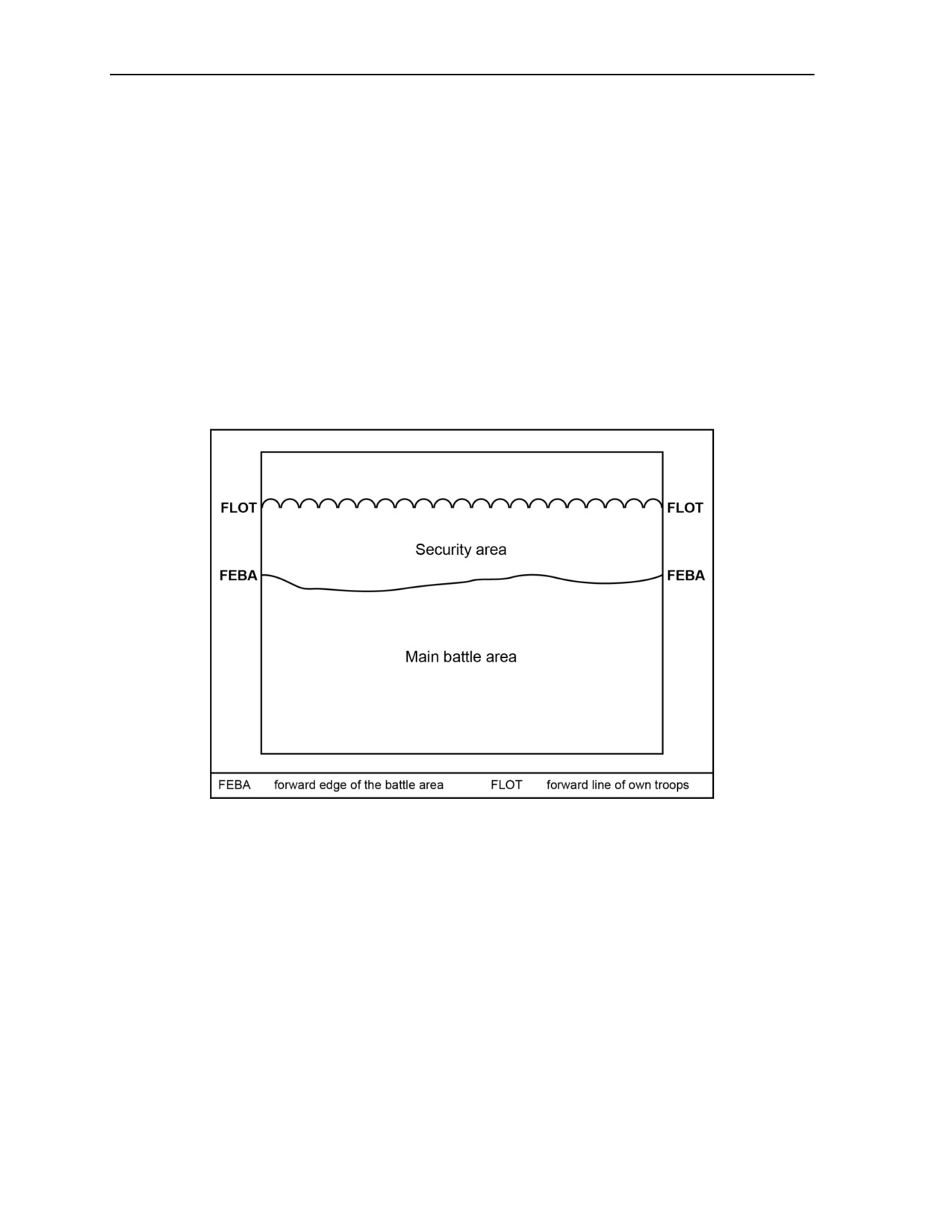
Chapter 4
on most of these FSCMs. See FM 3-52 for discussions on airspace coordination areas.) Commanders can
also designate final protective fire (FPF). Final protective fire is an immediately available, prearranged
barrier of fire designed to impede enemy movement across defensive lines or areas (JP 3-09.3).
FORWARD EDGE OF THE BATTLE AREA
4-31. The forward edge of the battle area is the foremost limits of a series of areas in which ground combat
units are deployed to coordinate fire support, the positioning of forces, or the maneuver of units, excluding
areas in which covering or screening forces are operating (JP 3-09.3). The Army uses a FEBA only during
the defense. The FEBA is not a boundary, but it conveys the commander’s intent. The FEBA shows the senior
commander’s planned limit for the effects of direct fires. It marks the foremost limits of the areas in which
most ground combat units deploy, excluding the areas in which security forces are operating. MBA forces
can temporarily move forward of the FEBA to expedite the retrograde operations of security forces.
Commanders designate a FEBA to coordinate fire support and to help in the maneuver of subordinate forces.
A phase line designating the forward most point of the MBA indicates the FEBA. Defending units must
address this area in their scheme of maneuver and exchange information regarding tactical plans at contact
points. (See figure 4-1.)
Figure 4-1. Defensive arrangement
FORWARD LINE OF OWN TROOPS
4-32. The forward line of own troops is a line that indicates the most forward positions of friendly forces in
any kind of military operation at a specific time (JP 3-03). The FLOT normally identifies the forward location
of covering or screening forces. In the defense, it may be beyond, at, or short of the FEBA. It does not apply
to small, long-range reconnaissance assets and similar stay-behind forces. Friendly forces forward of the
FLOT may have a restrictive FSCMs, such as a restrictive fire area, placed around them to prevent friendly
fire incidents.
MAIN BATTLE AREA
4-33. The main battle area is the area where the commander intends to deploy the bulk of the unit’s
combat power and conduct decisive operations to defeat an attacking enemy. A defending commander’s
major advantage is the ability to select the ground on which the battle takes place. The natural defensive
strength of a position determines the distribution of forces in relation to both frontage and depth. Defending
4-6
The Defense
units typically employ field fortifications and obstacles to reinforce the terrain’s natural defensive aspects.
The MBA includes the area where a defending force counterattacks that defeats or destroys enemy forces.
4-34. In contiguous operations, the MBA extends from the FEBA to the rear boundary of a specific echelon’s
subordinate units. Commanders locate subordinate unit boundaries along identifiable terrain features and
extend them beyond the FLOT by establishing forward boundaries. Unit boundaries should not split avenues
of approach or key terrain. Commanders select the MBA based on the products of the IPB process and their
own analysis using the mission variables. The IPB anticipates how an enemy force will use the available
avenues of approach.
SECURITY AREA
4-35. A security area is that area occupied by a unit’s security elements and includes the areas of
influence of those security elements. It may be located as necessary to the front, flanks, or rear of a protected
unit, facility, or location. Forces in a security area furnish information on an enemy force; delay, deceive,
and disrupt that enemy force; and conduct counterreconnaissance. All units perform security operations
within their AOs, including the support area, to deny enemy reconnaissance and otherwise protect the force.
Units implement security operations and other information protection measures to deny the enemy force
information about friendly dispositions.
4-36. Commanders conduct security operations to provide their forces time and space to react to the approach
of enemy forces by causing the enemy to deploy prematurely. This reveals the enemy forces’ main effort and
which of the available avenues of approach the enemy is using. Commanders conduct security operations to
conceal the location of their main battle positions, prevent enemy observation of friendly preparations and
positions, and prevent enemy forces from delivering observed fire on these positions. Commanders can offset
an attacker’s inherent advantage of initiative regarding the time, place, plan, direction, strength, and
composition of the attack by forcing that enemy to attack into unexpected prepared defenses. They counter
enemy ground and air reconnaissance activities through both active and passive measures. Commanders must
not permit enemy reconnaissance and surveillance assets to determine the precise location and strength of
defensive positions, obstacles, engagement areas, and reserves.
COMMON DEFENSIVE PLANNING CONSIDERATIONS
4-37. The defense is more effective when commanders and staffs have adequate time to thoroughly plan and
prepare defensive positions. Lack of preparation time may cause a commander to maintain a larger-than-
normal reserve or accept greater risk. All units must be capable of mounting a defense with minimal
preparation. A defending commander can increase the effectiveness of the security area, establish additional
alternate and supplementary positions, refine the defensive plan including branches and sequels, conduct
defensive rehearsals, and maintain vehicles and personnel.
4-38. To gain time to organize a defense, commanders may order the security force to conduct a delay while
the main body disengages and moves to more advantageous positions. The security force must know how
long it needs to delay enemy forces for the main body to prepare its defense, and it must be task-organized
to conduct a delay.
4-39. When an attack begins, a defending commander yields the initiative to enemy forces. Defending forces
maintain security and disrupt enemy attacks at every opportunity. Defending commanders disrupt enemy
attacks by using long-range fires to reduce the impact of the attacking enemy forces’ initial blows and start
wresting the initiative from enemy forces. Defending forces draw enemy forces into engagement areas where
they can initiate combat on favorable terms. Commanders surprise enemy forces with concentrated and
integrated fires against exposed enemy formations from concealed and protected positions. They then
counterattack enemy forces, preferably when those enemy forces are most vulnerable to friendly capabilities.
They exploit small tactical successes and opportunities to disrupt an attacker’s momentum.
4-40. Defending forces do not have to kill every enemy soldier or destroy every combat system to accomplish
their mission. They only have to eliminate the enemy force’s ability to synchronize a combined arms team
or break the enemy’s capacity to fight. Those events signal a transition that affords defending commanders
the opportunity to seize the initiative and transition to the offense.
4-7
Chapter 4
4-41. The common defensive planning considerations addressed in paragraphs 4-42 through 4-110 apply to
all types of defensive operations. These considerations are in addition to those common offensive planning
considerations introduced in chapter
3, when appropriately modified for the defense. Defensive
synchronization is normally the result of detailed planning and preparation among the various units
participating in defensive operations. While these activities may be separated in time and space, they are
synchronized if enemy forces feel their combined consequences decisive times and places. The defense is a
mix of static and dynamic actions. As an operation evolves, the defending commander prepares to shift main
and supporting efforts and keep an enemy force off balance.
COMMAND AND CONTROL
4-42. The command and control considerations for the offense discussed in paragraphs 3-42 through 3-55
also apply to the defense. The commander’s intent and mission determine the concept of operations, scheme
of maneuver, and allocation of available resources and priorities.
4-43. Important command and control principles include mission orders, disciplined initiative, and
commander’s intent. Mission orders are the commander’s directives that emphasize the results to be attained,
not how they are to be achieved. Disciplined initiative is action in the absence of orders to react to the enemy’s
unforeseen actions, a new or more serious threat, or an opportunity that offers a greater chance of success
than the original COA. Commanders rely on their subordinates to take their own initiative to adjust to the
new situation and achieve their commander’s intent. The commander’s intent defines the limits within which
subordinates may exercise their initiative. It gives subordinates the confidence to apply their judgment in
ambiguous situations because they know the mission’s purpose, key tasks, and desired end state.
4-44. A defensive mission generally imposes few restrictions on a defending commander. It allows freedom
of maneuver within assigned boundaries, but it requires commanders to prevent enemy penetration of their
rear boundary. Defending an AO is a typical mission for battalion and higher-echelon units. This mission
allows commanders to distribute forces to advantageously use the terrain and plan engagement areas that
integrate direct and indirect fires. Commanders ensure that subordinate unit defensive plans are compatible
and that control measures, such as contact points and phase lines, are sufficient for flank and rear coordination
when assigning AOs. The defensive plan addresses what happens when friendly forces succeed and gain an
opportunity to transition from defensive operations to offensive operations.
4-45. Because an enemy force has the initiative, the defending commander frequently has to shift main and
supporting efforts within the unit’s shaping operations to contain the enemy’s attack until the defending force
can seize the initiative. This may require the commander to adjust subordinate unit AOs, repeatedly commit
and reconstitute the reserve, and modify the original plan.
4-46. Commanders may change task organization to respond to an existing or a projected situation, such as
forming a detachment left in contact before conducting a withdrawal. Commanders of recently reorganized
units place special attention on ensuring that each element understands the unit’s overall mission. This
requires commanders to ensure that objectives are synchronized and subordinates understand their control
measures, movement routes, defensive positions, fire support plans, and specifically assigned tasks. It also
requires specifying the standard operating procedures that each element of a task-organized unit employs.
Synchronizing and integrating task-organized elements results in more effective employment of available
combat power.
4-47. An enemy force often attacks along the boundaries of defending units to break through the MBA.
Therefore, it is extremely important for commanders at every echelon to ensure their defense is properly
coordinated with flanking and supporting units. When possible, commanders coordinate through personal
visits to subordinate commanders on the ground. Their staffs rapidly transmit coordination decisions to all
concerned.
4-48. Since command posts and communications nodes tend to be relatively static in the defense,
commanders place them in hardened areas or protective terrain to reduce their electronic and visual
signatures. Command posts remain capable of rapidly relocating in response to battlefield developments.
4-49. As with the offense, commanders conduct information operations to support the defense. Through their
scheme of information operations, commanders establish objectives in the information environment and
4-8