Snowmobile Arctic Cat (2007 year). Instruction - part 79
 

  Index      Snowmobiles / ATV     Snowmobile Arctic Cat - instruction 2007 year


Search            


Content   ..  77  78  79  80   ..


Snowmobile Arctic Cat (2007 year). Instruction - part 79


8-19

8

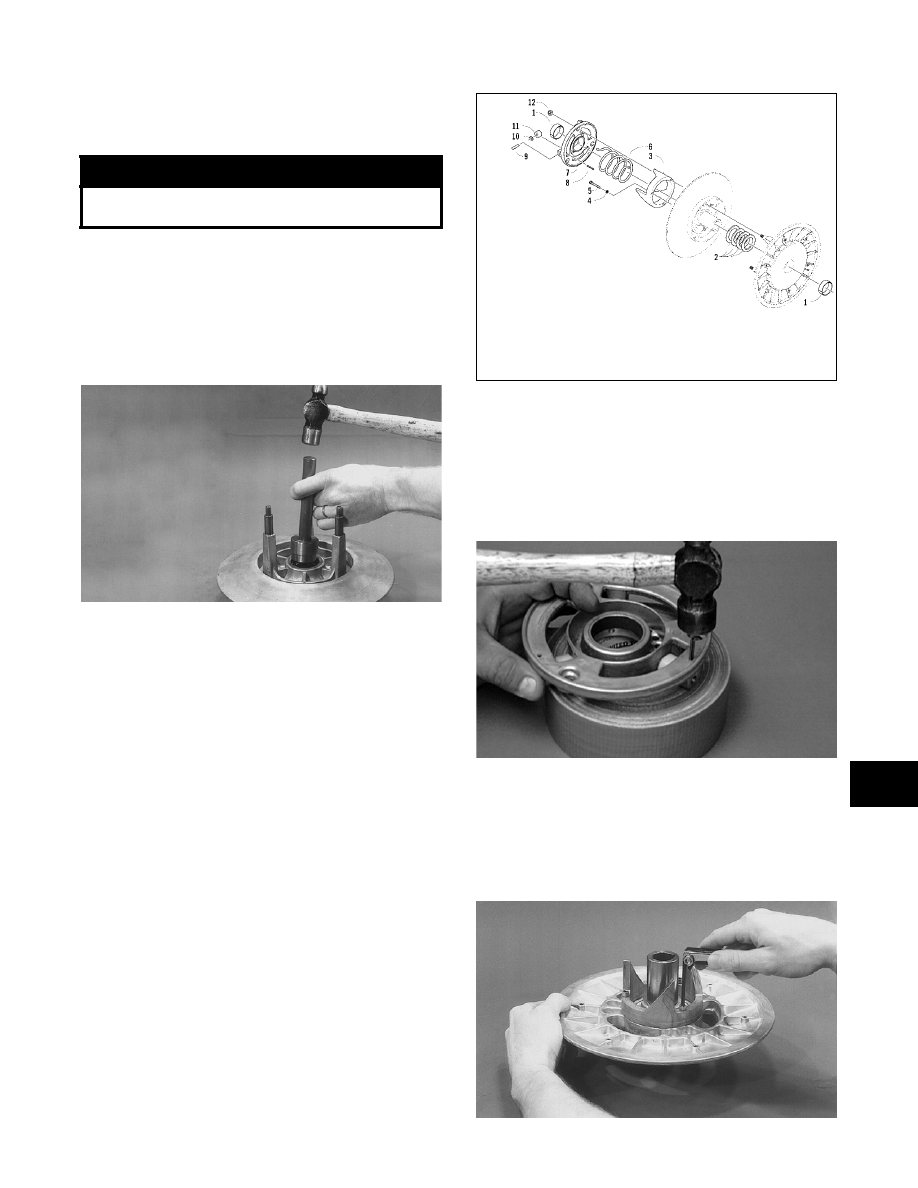
REMOVING BEARINGS

To remove driven pulley bearings, use the Bearing

Removal and Installation Tool (p/n 0644-167) and

the following procedure.

„ NOTE: To remove the movable sheave bearing,
heat must be applied around the bearing.

1. Place the movable sheave (or roller plate) flat on

a press.

2. Using the bearing tool, press the bearing out.

AF154

INSTALLING BEARINGS

„ NOTE: Before installing a bearing, apply red Loc-
tite #271 to the outside face of the bearing.

1. Place the movable sheave (or roller plate) flat on

a press.

2. Using the bearing tool, press the bearing into

position. The bearing must be flush with the out-

side of the bearing boss.

3. Wipe off excess Loctite. Allow the Loctite to

cure for 24 hours at room temperature.

ASSEMBLING

0741-946

1. Place the roller and thrust washer (toward the

outside of the roller plate) and secure with the

roller pin.

2. Secure the roller, thrust washer, and pin into

position with the spring pin. Drive the pin in

until it is flush with the plate.

SC012D

3. Place the torque bracket (cam) into position on

the stationary sheave making sure the degree

number on the bracket aligns with the part num-

ber on the stationary sheave. Install the three

socket head screws and lock washers. DO NOT

tighten at this time.

AI062

! WARNING

Always wear safety glasses when using the bearing
driver.

KEY

1. Bearing

2. Thrust Washer

3. Torque Bracket (Cam)

4. Lock Washer

5. Screw

6. Spring

7. Roller Plate

8. Spring Pin

9. Roller Pin

10. Roller Thrust Washer

11. Roller

12. Lock Nut

8-20

4. Place any thrust washers (as noted during disas-

sembly) on the stationary sheave shaft.

B460

5. Align the scribed line made during disassembly;

then slide the movable sheave onto the station-

ary sheave shaft.

B459D

6. Place the sheaves on a work fixture (roll of duct

tape, etc.).

7. Place the spring over the stationary sheave hub

and hook the turned down end of the spring into

the hole in the casting of the stationary sheave.

B458D

8. Place the roller plate over the spring and hook

the turned-up end of the spring in the 3rd hole

(standard spring tension) of the plate.

9. While holding the sheaves to prevent them from

rotating, grasp the plate and rotate it approxi-

mately 120° clockwise until the mounting holes

align; then push the plate into position and

install the three lock nuts. Tighten the lock nuts

to specifications.

„ NOTE: The line scribed during disassembly
should be aligned.

SC003D

10. Rotate the movable sheave to ensure free move-

ment without binding.

11. Rotate the torque bracket (cam) until it is tight;

then using a long hex wrench, tighten the three

socket-head cap screws securing the bracket.

SC011D

INSTALLING

1. Slide the alignment washers onto the end of the

driven shaft.

2. Install the key in the driven shaft keyway; then

place the stub shaft into the driven pulley. Place

the driven pulley on the shaft. Align its keyway

with the driven shaft keyway.

„ NOTE: A small amount of Loctite Anti-Seize
Thread Compound (p/n 0678-146) applied to the
driven shaft will aid in future driven pulley
removal.

8-21

8

3. Secure the driven pulley by installing any align-

ment washers, the washer, and cap screw.

Tighten the cap screw to specifications.

SC013D

4. Check drive clutch/driven pulley alignment (see

appropriate Drive Clutch/Driven Pulley in this

section); adjust as necessary.

5. Install the drive belt and check drive belt deflec-

tion (see appropriate Drive Clutch/Driven Pul-

ley in this section). Secure the belt guard.

Drive Clutch/

Driven Pulley 

(Bearcat Wide Track Non-

Turbo/Panther 660/

T660 Touring)

CHECKING OFFSET

If premature drive belt wear is experienced or if the

drive belt turns over, parallelism/offset must be

checked. Also, parallelism/offset must be checked

whenever either the drive clutch or driven pulley is

serviced. To check the parallelism/offset, use the

Clutch Alignment Bar (p/n 0644-428) and the fol-

lowing procedure.

1. Open the belt guard and remove the drive belt.

2. Install the clutch alignment bar between the

drive clutch sheaves and against the outside

edge of the driven pulley stationary sheave.

3. Allow the alignment bar to rest on the drive

clutch shaft.

0733-912

„ NOTE: The alignment bar must extend beyond
the front edge of the drive clutch.

4. With the bar against the outside edge of the

driven pulley stationary sheave at points A and

B, the bar should just clear the inside edge of the

stationary sheave of the drive clutch and rest on

the stationary shaft. If the bar does not clear the

inside edge or is more than 1.5 mm (0.060 in.)

from the inside edge, the offset must be cor-

rected.

AF465D

733-912B

CORRECTING OFFSET

1. To correct offset, the driven pulley must be

moved laterally on the driven shaft. Remove the

cap screw and washers securing the driven pul-

ley; then remove the driven pulley.

8-22

„ NOTE: If the driven pulley is tight on the driven
shaft, pull the driven pulley off using the Driven
Pulley Puller (p/n 0744-023).

2. To move the driven pulley inward on the shaft,

remove washer(s) as required from behind the

pulley.

3. To move the driven pulley outward on the shaft,

add alignment washer(s) as required behind the

driven pulley.

„ NOTE: Make sure the keyways match when
installing the driven pulley. Arrange washers to
allow the least amount of “float” on the driven
shaft. A maximum of 1.5 mm (0.060 in.) of float is
acceptable.

4. Install the driven pulley and secure with a cap

screw and washers. Tighten the cap screw to

specifications.

CHECKING PARALLELISM

1. Check parallelism of the drive clutch/driven pul-

ley using the alignment bar and reference points

X and Y with the alignment bar against the

driven pulley at points A and B. Using a calipers

or a machinist’s scale, measure X and Y from

the back side of the alignment bar. Measure-

ments X and Y must be equal or measurement Y

must be more than measurement X, but Y must

not exceed measurement X by more than

1.6 mm (0.062 in.).

733-912A

„ NOTE: The offset must be correct before check-
ing parallelism.

2. If parallelism is not within specifications, the

parallelism must be corrected.

CORRECTING PARALLELISM 

1. To correct parallelism, minor adjustments can be

made by adjusting the torque bumper on the left-

rear engine mount.

A. Loosen the cap screws and nuts securing the

engine mounting brackets to the front end.

B. Using the jam nut on the torque bumper,

adjust parallelism and periodically check the

parallelism. When the parallelism is correct,

tighten the cap screws and nuts securing the

engine mounting brackets to the front end;

then tighten the torque bumper jam nut

allowing 1.5 mm (0.060 in.) clearance

between the torque bumper and the engine.

CM098A

2. Recheck both offset and parallelism to ensure

accuracy and make further adjustments as nec-

essary.

„ NOTE: After parallelism and offset have been
corrected, check for proper drive belt deflection.
This is critical for optimum performance.

DRIVE BELT DEFLECTION

Drive belt length, condition, and deflection are all

important for peak performance. To check and

adjust drive belt deflection, use the following proce-

dure.

1. Turn the engine off; then open the belt guard.

2. Make sure the drive belt is sitting at the top of

the driven pulley sheaves.

3. Place a straightedge on top of the drive belt. The

straightedge should reach from the drive clutch

to the top of the driven pulley.

4. Using a stiff ruler centered between the drive

clutch and driven pulley, push down on the drive

belt just enough to remove all slack. Note the

amount of deflection on the ruler at the bottom

of the straightedge. The deflection should be

within the range of 25-31 mm (1-1 1/4 in.).

„ NOTE: Push down on the belt with the ruler only
until the bottom of the belt flexes upward; then
read the amount of deflection.


Content   ..  77  78  79  80   ..