Snowmobile Arctic Cat (2007 year). Instruction - part 52
5-12
4. Inspect brush leads for cracks, wear, or fraying.
If any of these conditions exist, replace with
new brushes along with new brush springs as a
set.
5. Inspect the rear cover bushing for wear.
6. Inspect the front cover bearing for wear.
7. Inspect the brass commutator end of the arma-
ture for any discolored spots or damage. If the
commutator is slightly discolored or damaged,
the armature must be replaced. This is a molded
commutator and no attempt to turn it down in a
lathe should be attempted.
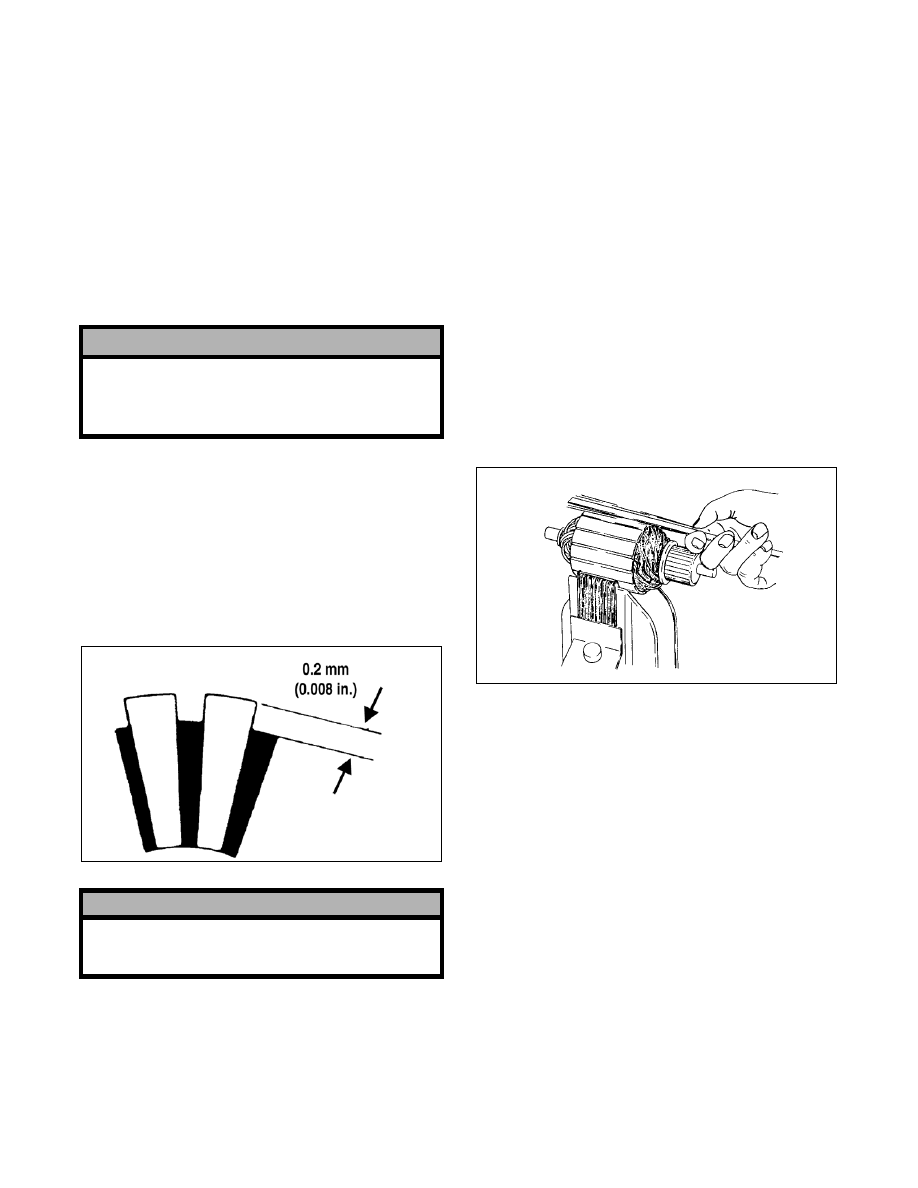
8. Inspect the commutator end of the armature for
buildup in the grooves. Carefully remove any
buildup by undercutting using a thinly ground
hacksaw blade. Do not cut any deeper than the
original groove which can be seen by looking at
the end of the commutator.
9. Using a caliper, measure the undercut. Maxi-
mum undercut groove must be 0.2 mm (0.008
in.).
SNO2171
10. Inspect the commutator for shorting using a
multimeter and the following procedure.
A. Set the selector to the OHMS position.
B. Touch the black lead to the armature shaft.
C. Using the red tester lead, probe the commuta-
tor end of the armature. The meter indicator
should not change. If the indicator shows
resistance, the armature is shorted and must
be replaced.
11. Inspect the armature for shorting using a
“growler” and the following procedure.
A. Place the armature in the “growler.”
B. While holding a metal strip on the armature,
rotate the armature an entire revolution. If the
metal strip vibrates at any point on the arma-
ture, the armature is shorted and must be
replaced.
0725-653
12. Inspect the ground brushes to make sure they are
properly grounded. Use a multimeter and the
following procedure.
A. Set the selector to the OHMS position.
B. Touch the black tester lead to a ground brush.
C. Touch the red tester lead to the brush holder
assembly.
NOTE: If no resistance is indicated, check the
ground connection for tightness and for cleanli-
ness. If there is still no meter indication, replace
the brush assembly.
! CAUTION
Do not use emery cloth to clean the commutator as
emery particles will become imbedded in the brass
commutator resulting in a short circuit. Use only
#200 grit sandpaper.
! CAUTION
Buildup in the grooves must be removed to prevent
any chance of an electrical arc between individual
sections of the commutator.