Snowmobile Arctic Cat (2007 year). Instruction - part 50
 

  Index      Snowmobiles / ATV     Snowmobile Arctic Cat - instruction 2007 year


Search            


Content   ..  48  49  50  51   ..


Snowmobile Arctic Cat (2007 year). Instruction - part 50


5-4

Testing Electrical 

Resistances

(120 cc)

„ NOTE: The following test procedure starts by
testing the resistance fo the spark plug cap and
working back to the stator under the flywheel.
Replace any component that does not have a test
value within specifications.

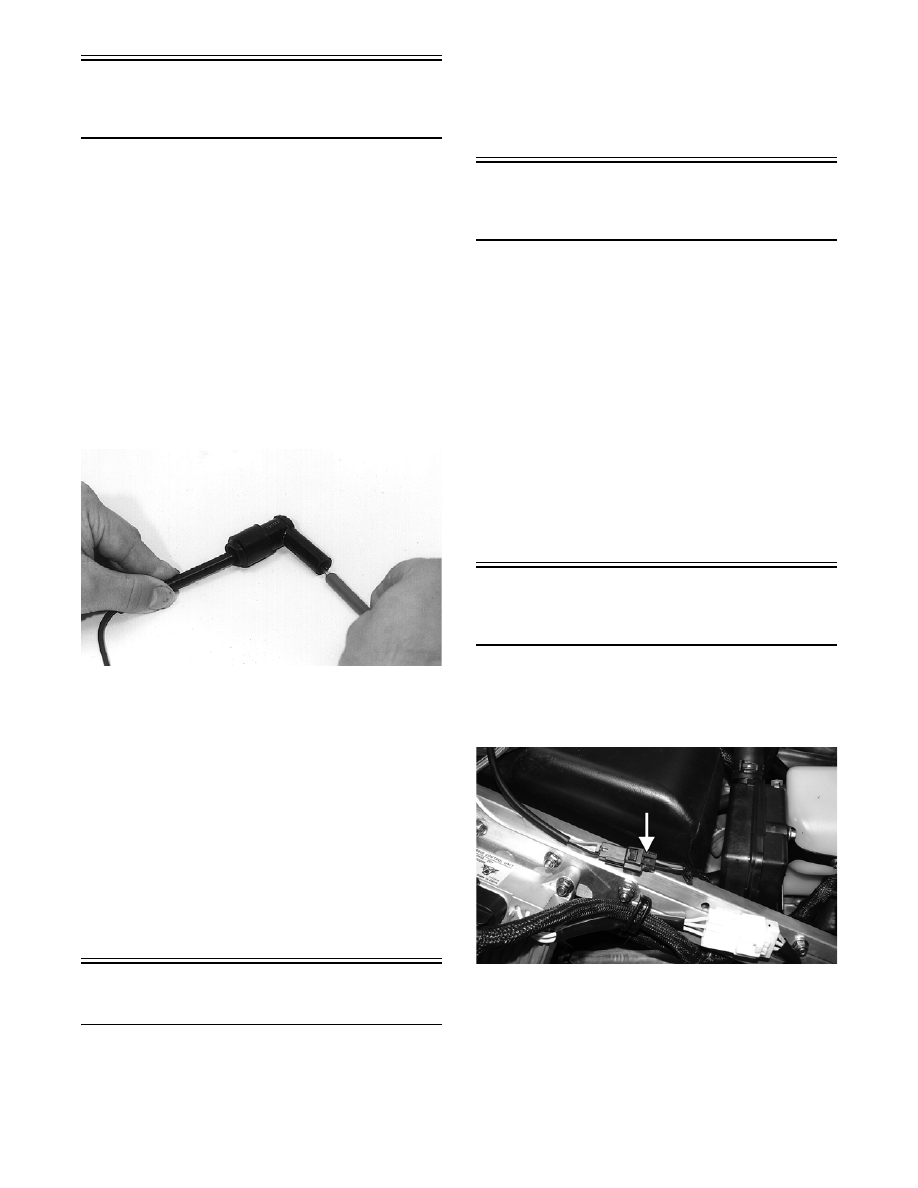
SPARK PLUG CAP

1. Remove the spark plug cap from the high ten-

sion lead by rotating it counterclockwise.

2. Set the selector in the OHMS position.

3. Connect one tester lead to one end of the cap

and the other tester lead to other end of the cap.

B170

4. Spark plug cap resistance must be between

4000-6000 ohms.

LIGHTING COIL

1. Disconnect the two yellow wires from the main

wiring harness.

2. Set the selector to the OHMS position.

3. Connect the tester leads to the two yellow leads

on the engine-side connectors.

4. Lighting coil resistance must be between 0.46-

0.68 ohm.

Testing Ignition Key 

Switch

1. Disconnect the ignition key switch connectors;

then connect the ohmmeter leads to each of the

ignition key switch terminals.

2. With the switch in the OFF position, the meter

must read less than 1 ohm of resistance.

3. With the switch in the ON position, the meter

must read OL (infinite resistance).

Testing

Electric Fuel Pump

(660 cc)

1. Remove the hardware securing the console to

the gas tank and frame; then move the console

out of the way.

2. Disconnect the fuel pump (white two-wire con-

nector) from the main wiring harness.

3. Connect the positive lead of a 12-volt power

supply to the red wire and the negative lead of

the 12-volt power supply to the black wire.

4. The pump should operate (it would be heard

running).

„ NOTE: If the fuel pump fails to operate, the pump
is defective and must be replaced (see Section 4).

Testing Electric Fuel 

Pump

(1100 cc Z1)

1. Open the hood; then locate the fuel pump/level

sensor four-wire connector and unplug the con-

nector.

ZJ011A

„ NOTE: Note that the plug-in terminals are desig-
nated A, B, C, and D for testing purposes.

2. Connect the positive lead of a 12-volt power

supply to the pink wire (A) and the negative lead

of the 12-volt power supply to the black wire

(B).

5-5

5

3. The pump should operate (it would be heard

running).

„ NOTE: If the fuel pump fails to operate, the pump
is defective and must be replaced (see Section 4).

Testing

Fuel Gauge Sender

(660 cc/1100 cc Z1)

1. Remove the hardware securing the console to

the fuel tank and frame; then move the console

out of the way.

2. Disconnect the fuel gauge sender unit (black

two-wire connector) from the main wiring har-

ness.

3. Connect the ohmmeter leads to the two sender

wires.

4. Compare the reading to the chart following.

Testing Ignition 

Components

(1100 cc Z1)

„ NOTE: The battery must be at full charge for
these tests.

VOLTAGE REGULATOR/RECTIFIER 
(DC Voltage Output)

„ NOTE: The voltage regulator/rectifier is incorpo-
rated into the chassis control unit.

1. Set the meter selector to the DC Voltage posi-

tion.

2. Connect the red tester lead to the positive bat-

tery post; then connect the black tester lead to

the negative battery post.

3. With the engine running at 2500-3000 RPM, the

meter must show 14-15 DC volts.

MAGNETO COIL

No Load

The connector is the white three-wire one on the

right side upper frame.

ZJ249A

„ NOTE: Test the connector that comes from the
engine.

1. Set the meter selector to the AC Voltage posi-

tion.

2. Test between the three yellow wires for a total of

three tests.

3. With the engine running at 2500-3000 RPM, all

wire tests must be within 36-44 AC volts.

„ NOTE: If tests failed, check all connections, etc.,
and test again. If no voltage is present, replace the
stator assembly.

Resistance

1. Set the meter selector to the OHMS position.

2. Test between the three yellow wires for a total of

three tests.

3. The meter reading must be less than 1 ohm.

CRANKSHAFT POSITION SENSOR

Resistance

1. Set the meter selector to the OHMS position.

Fuel Gauge Sender

Position

Ohms

Full

4-6

1/2

37.6-56.4

Empty

76-114

! CAUTION

Always disconnect the battery when performing
resistance tests to avoid damaging the multimeter.

! CAUTION

Always disconnect the battery when performing
resistance tests to avoid damaging the multimeter.

5-6

2. Connect the red tester lead to the green wire;

then connect the black tester lead to the blue

wire. The meter reading must be within 173-211

ohms.

PRIMARY COILS

„ NOTE: To access the primary coils, it will be nec-
essary to remove the air silencer. Proceed to Ser-
vicing Air Silencer (1100 cc Z1) sub-section in
Section 3 and follow steps 1-12 of REMOVING.

Peak Voltage

„ NOTE: The peak voltage test should be made
using the Fluke Model 73 Multimeter (p/n 0644-191)
with Peak Voltage Reading Adapter (p/n 0644-307).
If any other type of tester is used, readings may
vary due to internal circuitry.

1. Set the meter selector to the DC Voltage posi-

tion.

2. On coil #1, connect the red tester lead to the red/

green wire; then connect the black tester lead to

the gray/green wire. On coil #2, connect the red

tester lead to the red/green wire; then connect the

black tester lead to the brown/green wire.

3. Crank the engine over using the electric starter.

4. The meter reading must be at least 5.0 DC volts

for both coils.

Throttle Position 

Sensor

(660 cc/1100 cc Z1)


„ NOTE: On the 1100 cc Z1, it will be necessary to
remove the air silencer. Proceed to Servicing Air
Silencer (1100 cc Z1) sub-section in Section 3 and
follow steps 1-12 of REMOVING.

VERIFYING TPS ADJUSTMENT 
TOOL

Before using the TPS adjustment tool, verify its bat-

tery condition. The battery used in the tool is a 9-

volt battery. To check battery condition, use a digital

volt/ohmmeter set on DC volt scale. Test between

the adjustment tool black and red jacks. Insert the

red lead of the digital voltmeter into the red jack of

the adjustment tool and the black lead of the digital

voltmeter into the black jack of the adjustment tool.

The green power light of the analyzer should now be

illuminated. If voltage is found below 4.9 volts,

replace the battery.

CHECKING TPS

„ NOTE: If the snowmobile is in warranty, breaking
the seal on the idle screw jam nut or the Phillips-
head screws on the TPS will void warranty. If the
TPS is tested out of specification, the throttle
assembly must be replaced. If the snowmobile is
out of warranty, proceed to Adjusting TPS. 

„ NOTE: Before using the TPS adjustment tool,
verify its battery condition. The battery used in the
tool is a 9-volt battery; also, the Multi-TPS Test
Harness (p/n 1686-436) must be plugged into the
analyzer for testing voltage.

1. Using Throttle Position Sensor (TPS) Adjust-

ment Tool Kit (p/n 3639-891), connect its wiring

harness to the TPS. Connect the red tester lead

to the white adjustment tool jack; then connect

the black tester lead to the black adjustment tool

jack.

2. Ensure that the throttle cable has the  proper

amount of free-play.

3. With the throttle in the idle position, compare

the reading on the voltmeter to the chart. If the

reading is within prescribed specification, pro-

ceed to step 4.

4. Compress the throttle lever slowly to the full-

open position. The meter reading should show a

smooth rise in voltage all the way to the full-

open throttle position. If the voltage seems to be

erratic or doesn’t meet the prescribed specifica-

tion, repeat this procedure several times to con-

firm results.

5. If the full-open throttle voltage remains erratic

or out of specification, proceed to Adjusting

TPS.

6. If the TPS is within the prescribed specification,

disconnect the adjustment tool harness from the

TPS. Connect the snowmobile TPS harness to

the TPS.

„ NOTE: Before installing the TPS harness con-
nector, apply dielectric grease to the connector
pins.

ADJUSTING TPS

„ NOTE: It is important that the throttle shaft is
against the throttle stop for this procedure.

Engine

Idle Position

Wide-Open 

Position

660 cc

0.870-0.900V

4.020-4.300V

1100 cc Z1

1.110-1.130V

4.180-4.360V

5-7

5

1. Disconnect the throttle cable from the throttle

shaft.

2. Disconnect the TPS wiring harness from the

TPS; then using Throttle Position Sensor (TPS)

Adjustment Tool Kit (p/n 3639-891, connect its

wiring harness to the TPS. Connect the red and

black digital voltmeter leads to the white and

black jacks of the TPS adjustment tool.

3. While observing the digital voltmeter, slowly

rotate the sensor until idle voltage specification

is observed on the LCD (Liquid Crystal Dis-

play) of the multimeter. While holding the sen-

sor in this position, tighten the screw(s) which

secure the sensor to the throttle body securely.

4. Gently snap the throttle open and closed several

times to check the TPS voltage. If it has changed

from the idle voltage specification, loosen the

screw(s) which secure the sensor and make nec-

essary adjustments.

„ NOTE: It is recommended to rotate the idle screw
past the recommended voltage specification by
two or three volts; then rotate the idle screw coun-
terclockwise to the correct idle position voltage.

5. With the idle position set to specification, com-

press the throttle lever to the full-open position.

The full-open specification should be observed.

Gently snap the throttle lever open and closed

several times and note if the reading remains

within the specification.

„ NOTE: If, after adjusting the Throttle Position
Sensor to the IDLE POSITION specification, the
FULL-OPEN POSITION is less than 4.020 volts on
the 660 cc or 4.180 volts on the 1100 cc Z1,
recheck the FULL-CLOSED POSITION setting. If
the FULL-CLOSED POSITION setting is correct,
replace the sensor.

REPLACING TPS

Removing

1. Disconnect the throttle cable from the throttle

shaft.

2. Disconnect the TPS wiring harness from the

TPS; then noting the position of the TPS,

remove the screw(s) securing the TPS to the

throttle body housing and remove the sensor.

Account for the O-ring which fits into groove of

throttle body.

Installing

1. Apply a light coat of silicone grease to the area

around the outside of the TPS flange and into

the O-ring groove. Install the O-ring into the

groove.

2. Install the new TPS onto the throttle shaft by

aligning the “flats” on the throttle shaft cam

with the alignment points of the sensor.

ZJ253B

ZJ254B

3. Install the screw(s), flat washer(s), and lock

washer(s) securing the sensor to the throttle

body. Do not tighten at this time.

4. Adjust the TPS - see Adjusting TPS in this sub-

section.

5. Disconnect the adjustment tool harness from the

TPS. Connect the snowmobile TPS harness to

the newly installed or adjusted TPS.

„ NOTE: Before installing the TPS harness con-
nector, apply dielectric grease to the connector
pins.

TPS Voltage 

Engine

Idle

Full-Open

min

max

min

max

660 cc

0.870

0.900

4.020

4.300

1100 cc Z1

1.110

1.130

4.180

4.360

660 cc

1100 cc Z1


Content   ..  48  49  50  51   ..