Snowmobile Polaris 600 RUSH (2010 year). Instruction - part 65
 

  Index      Snowmobiles / ATV     Snowmobile Polaris 600 RUSH - instruction 2010 year


Search            


Content   ..  63  64  65  66   ..


Snowmobile Polaris 600 RUSH (2010 year). Instruction - part 65


8.26

Steering and Suspensions

9923311 - 2010-2012 PRO-RIDE RUSH/Switchback/RMK Service Manual

© 2011 Polaris Sales Inc.

FRONT SUSPENSION SETTINGS

Overview

The following topics are outlined involving the front 
suspension:

• Maximum  Width
• Handlebar Centering
• Setting Camber
• Ski Toe Adjustment

Before making any adjustments to the front suspension, 
inspect all components for damage. Replace any broken, 
bent or worn components before making any adjustments.

Verify the sway bar and related hardware are not bent, 
loose, or broken. Inspect the shocks. 

The shocks on the front suspension are the only 
components that limit maximum control arm extension. 
Bent shock rod(s) adversely affect front suspension 
settings and handling.

Never install longer (when fully extended) shocks. 
Installing longer shocks will stress the upper control arm 
rod ends and lower control arm spherical bearings.

Always verify track alignment. Proper track alignment is 
critical when aligning the skis with the chassis.

Rod ends must be parallel with mating components. Rod 
ends that are not parallel will increase the “bump steer” 
effect. 

An alignment bar is an essential tool required to set 
camber.

Alignment Bar Specifications

• DIAMETER: .623”-.625” (15.824-15.875mm)
• LENGTH: 45” (114.3cm)
• MATERIAL: C-1018
• Polaris PN: 5333508 (Order from tool vendor.)

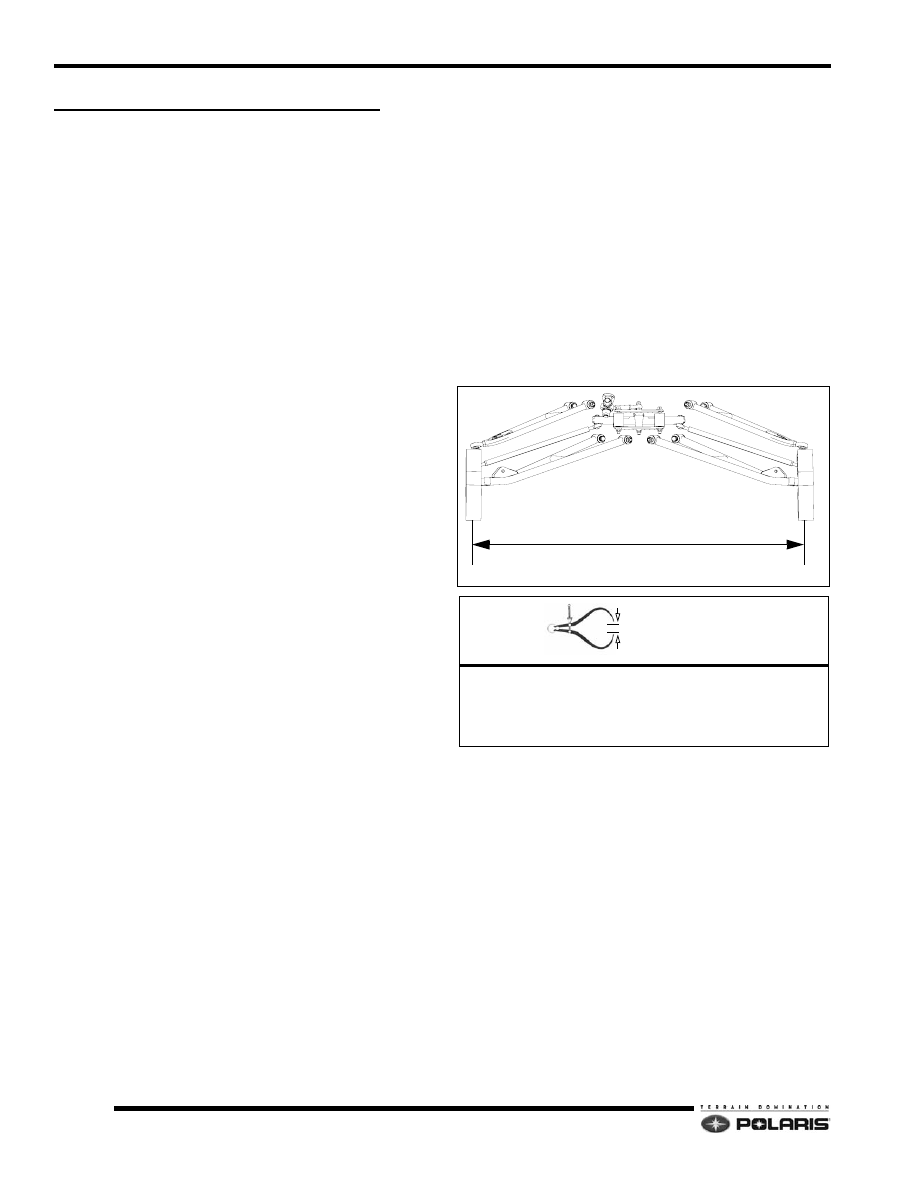
Maximum Setup Width

The maximum width setting is the distance between the 
front center lines of both spindles with the skis off the 
ground and the shocks installed.

Because of the design of the front suspension, maximum 
width can only be changed by adjusting camber. This is 
due to the fact that only the upper control arms feature rod 
ends and thus camber can only be adjusted by turning the 
upper control rod ends in or out.

1.

To measure the maximum setup width, raise the front 
of the snowmobile off the ground with the shocks and 
skis installed.

2.

Center the skis/spindles. Measure the distance 
between the spindle center lines.

3.

If the measurement is out of specification, inspect the 
front suspension for damage. Replace damaged 
components.

4.

If no damage is found, reset the camber.

Handlebar Centering

1.

Raise the vehicle to remove the skis.

2.

Verify the handlebars are straight. Measure from each 
bar end to a common center point at the rear of the 
vehicle.

3.

Verify the steering drag link is not damaged, bent, or 
loose. If it is, the drag link must be either adjusted or 
replaced. If the drag link is correct, adjust the steering 
linkage tie rod ends until handlebar is centered. Note 
that the toe setting will require adjustment.

4.

Reinstall the spindle rod ends, bushings, and skis. 
Torque bolts to specification.

In./cm. 

Maximum Width

Pro-Ride = 41.52/105

Pro-Ride RMK Adjustable = 36.26/92
Pro-Ride Wide Adjustable = 38.58/98

MAXIMUM SETUP WIDTH

8.27

Steering and Suspensions

8

9923311 - 2010-2012 PRO-RIDE RUSH/Switchback/RMK Service Manual

© 2011 Polaris Sales Inc.

Camber

On a snowmobile, camber is the angle of the spindle 
relative to vertical as viewed from the front. The camber 
angle becomes increasingly more negative as the control 
arms deflect upward.

• 0 = Neutral Camber. The spindle is perpendicular 

to the ground.

• + = Positive Camber. The top of the spindle is 

canted outward from the chassis.

• - = Negative Camber. The top of the spindle is 

canted inward towards the chassis.

Camber Adjustment

1.

Verify the handlebars are centered. Measure from 
each end to a common center point at the rear of the 
snowmobile if necessary.

2.

Raise the front of the snowmobile off the ground. 
Remove the skis and ski bushings.

3.

Verify the shocks are at full extension and that no IFS 
components are bent or damaged. Replace any 
component that is damaged before making any 
adjustments.

4.

Insert the alignment bar, PN 5333508 or equivalent, 
through one spindle. Adjust the opposing spindle’s 
upper control arm rod end to adjust the angle of the 
spindle.

5.

Check the measurement between the top-end of the 
alignment bar and the top of the spindle’s bushing/ski 
bolt hole (see illustration below).

6.

Insert the alignment bar into the opposite spindle and 
perform the same steps. Monitor the specified camber 
measurement as the control arm rod end nuts are 
adjusted.

7.

Continue making small rod end changes to both 
control arm rod end nuts until the camber setting 
specification is achieved at both spindles.

8.

Verify the upper rod ends are torqued to specification. 
Ensure the rod ends remain parallel to the spindles 
when torquing nuts. 

9.

Apply a liberal amount of Premium Grease to the ski 
bushings, and then reinstall the bushings and skis. 
Torque fasteners to specification.

In./cm. 

Camber Setting

Top of alignment bar to top of ski bushing / bolt spindle 

hole.

Pro-Ride = 1.68±.31/42±0.8

Pro-Ride RMK Adjustable = 1.95 

 0.31/4.3  0.8

Pro-Ride Wide Adjustable = 2.25 

 0.31/5.7  0.8

0

+

-

CAUTION

DO NOT EXCEED THE MAXIMUM SETUP WIDTH 

SETTING WHEN ADJUSTING CAMBER.

ALIGNMENT BAR

BUSHING / BOLT HOLE

CAMBER SETTING DISTANCE

UPPER CONTROL ARM ROD END NUT

8.28

Steering and Suspensions

9923311 - 2010-2012 PRO-RIDE RUSH/Switchback/RMK Service Manual

© 2011 Polaris Sales Inc.

Toe Adjustment

Toe is adjusted with the shocks and skis installed. Track 
alignment must be correct before starting this process. 

Toe alignment is measured at ride height.

1.

Rock the front end of the vehicle up and down and 
then set it down gently. This will set the front 
suspension at ride height.

2.

Verify the handlebars are centered. Measure from 
each end to a common center point at the rear of the 
snowmobile to verify.

3.

Measure and make a mark 10” (2.54cm) forward of 
the ski mount bolt and 10” (2.54cm) behind the ski 
mount bolt, preferably on the center line of the carbide 
skags.

4.

Place a straight edge along the one side of the track. 
Make sure that the straight edge is touching along the 
length of the track.

5.

Record the measurements from the edge of the 
straight edge to the forward ski mark (X) and the 
rearward ski mark (Y).

6.

Adjust the tie rod so that both measurements are the 
same.

7.

Place the straight edge on the opposite side of the 
track and measure the opposite ski marks.

8.

Adjust the tie rod so that both measurements are the 
same.

9.

Steps 3 to 8 will align the skis with the track. At this 
point, verify the handlebar is centered with the skis.

NOTE: The handlebar can be aligned with the skis 
on models featuring an adjustable drag link by 
adjusting the length of the drag link. If the 
snowmobile does not feature an adjustable drag 
link, handlebar-ski alignment can only be performed 
by adjusting the steering tie rod lengths.

10. Turn both tie rods equally to set ski toe. When 

finished, measurement (X) should be 0" - 1/8" wider 
than measurement (Y).

11. Torque steering tie rod jam nuts to specification and 

lower the vehicle.

8.29

Steering and Suspensions

8

9923311 - 2010-2012 PRO-RIDE RUSH/Switchback/RMK Service Manual

© 2011 Polaris Sales Inc.

DISASSEMBLY AND ASSEMBLY

Spindle Removal

1.

Securely support the front of the machine up off the 
floor.

2.

Remove the ski(s).

3.

Remove the upper control arm (UCA)-to-spindle 
fastener.

4.

Remove the fastener securing the lower control arm 
(LCA) to the spindle. Note the orientation of the 
fastener and nut.

5.

Remove the tie rod from the spindle, by removing the 
nut and bolt.

Spindle Assembly

1.

Assembly is the reverse order of disassembly. 
Reference the front suspension assembly illustration 
for fastener torque values.

Spherical Bearing Replacement

1.

Remove the fastener securing the lower control arm 
(LCA) to the spindle.

2.

Remove the lower shock fastener.

3.

Remove the nuts securing the LCA to the bulkhead.

4.

Remove the snap ring, then, using a press, press the 
spherical bearing out of the LCA.

5.

Press in a new bearing, then install the snap ring.

6.

Assemble the LCA into the spindle, and shock into 
LCA. Reference front suspension assembly 
illustration for fastener torque values.

Upper/Lower Control Arm Removal

1.

Remove the fastener securing the control arm to the 
spindle. Remove the lower shock fastener.

2.

Remove the nuts securing the control arm to the 
bulkhead.

3.

Remove the control arm, pivot bushings, and pivot 
shafts.

Upper/Lower Control Arm Installation

1.

Replace the upper or lower control arm bushings in 
the control arm(s).

2.

Replace the upper or lower control arm(s) into the 
bulkhead.

3.

Reference the front suspension illustration for the 
appropriate fastener torque.


Content   ..  63  64  65  66   ..