Snowmobile Polaris IQ (2007-2008 year). Instruction - part 68
 

  Index      Snowmobiles / ATV     Snowmobile Polaris IQ - instruction 2007-2008 year


Search            


Content   ..  66  67  68  69   ..


Snowmobile Polaris IQ (2007-2008 year). Instruction - part 68


9.24

Shocks

4.

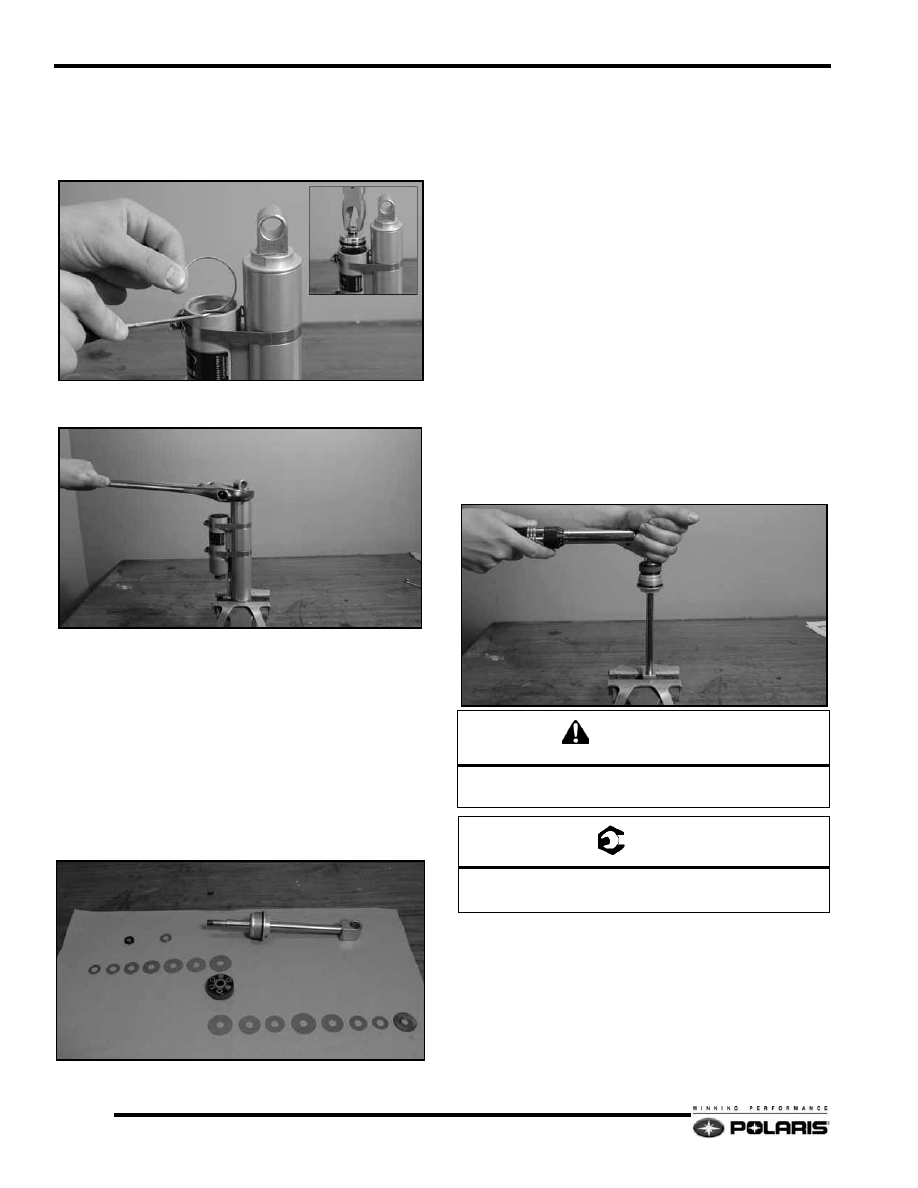
When all of the gas has escaped the reservoir, carefully
push the reservoir cap down to expose the c-clip. Using a
pick, remove the c-clip from the reservoir body.

5.

Remove the cap from the reservoir body.

6.

Using an adjustable wrench, slowly remove the shock rod
bearing cap from the shock body.

7.

using a 1/8” Allen Wrench, remove the bleed screw from
the IFP inside the reservoir. Verify the o-ring comes out
with the screw.

8.

Use a pliers to remove the IFP from the reservoir. Verify
the wear band and o-ring come out with the IFP.

9.

Pour out all of the shock oil into an appropriate storage
container. Dispose of oil properly.

NOTE:  Do not reuse shock oil.

10. Place the shock rod in a soft-jawed bench vise. Remove the

valve shim stack and piston nut. Remove the shims and
piston as they are arranged on the shaft.

11. With the shock disassembled, inspect the following items:

• Piston rod for straightness, nicks, or burrs.

• Cylinder head assembly / bearing.

• Inside of shock body for scratches, burs, or excessive 

wear.

• Teflon piston and IFP wear band for cuts, chipped or 

nicked edges, or excessive wear.

• O-rings for nicks, cuts, or cracks.

• Valve discs for kinks or waves.

• Hose for kinks or cuts.

Ryde FX Remote Reservoir Shock Assembly

1.

Install the shock rod in a soft-jawed bench vise.

2.

Reassemble the valve shim stacks and piston in the order
in which they were removed.

3.

Torque nut to specification.

4.

Secure the shock body in a soft-jawed bench vise.

CAUTION

DO NOT OVERTIGHTEN THE NUT. DAMAGE TO THE 

SHOCK ROD MAY OCCUR.

T 

Shock Rod Lock Nut Torque

15 - 20 Ft.Lbs. (21 - 28 Nm)

9.25

Shocks

9

5.

Fill the shock body with new Ryde FX shock oil. Fill until
the level of the oil is one inch below the top of the reservoir
body.

6.

Using a Vernier Caliper, set the caliper leg to the specified
IFP locating position for the shock.

7.

Apply a thin layer of shock oil to the IFP o-ring and wear
band.

8.

Carefully install the IFP back into the reservoir. Set the IFP
to the specified depth. Take care not to damage the IFP wear
band while setting the IFP depth.

9.

When the IFP is set to the depth specification, reinstall the
bleed screw.

10. Fill the shock body with new Ryde FX shock oil to the

bottom of the shock body threads.

11. Carefully and slowly install the shock rod / bearing

assembly back into the shock body. Use a slight up and
down movement to dispose of any air trapped below the
piston assembly.

12. Using an adjustable wrench, secure the bearing cap

assembly to the shock body.

13. Pour all of the remaining oil out of the reservoir body into

a suitable container.

14. Apply a light film of Lithium grease to the pressure valve

counter bore on the reservoir cap.

15. Apply a thin layer of shock oil to the cap o-ring, then

carefully reinstall the cap back into the reservoir. Push cap
just below the c-clip groove.

16. Use a pliers to pull the cap up against the c-clip.

17. Charge the reservoir with nitrogen to the specified pressure.

Once pressurized, the shock rod should fully extend.

18. With pressure working against the reservoir cap, secure the

pressure valve into the cap, then remove the shock fill tool
from the valve. Reinstall the button head screw.

9.26

Shocks

RYDE FX MONO-TUBE SHOCK 

DISASSEMBLY

Procedures for the proper disassembly and assembly of
Ryde FX gas charged IFP and emulsion mono-tube shock
absorbers.

1.

Remove the shock(s) from the vehicle.

2.

Before unscrewing pre-load springs, measure the
compressed length of the installed spring and mark position
for reinstallation.

3.

If the shock incorporates a spring, remove the spring and
all collateral retainers.

4.

Wash the shock body in parts cleaner; then dry with
compressed air to remove sand and dirt.

5.

Remove bearing, sleeve and/or bushings from lower shock
mount eyelet. Secure the lower mount of the shock in a vise.
The use of soft jaws is recommend to prevent damage or
marks to the shock.

6.

Remove the small button head screw from the pressure
valve assembly.

7.

Depressurize the shock.

8.

Internal Floating Piston Shocks, using a slotted
screwdriver, loosen the pressure valve assembly counter-
clockwise two full revolutions allowing the gas pressure to
fully escape past the pressure valve assembly O-ring.

9.

Emulsion Shocks: With the shock inverted and the piston
rod fully extended, secure the lower mount of the shock in
a vise. Allow a couple of minutes for the gas pressure to
separate from the oil and rise to the top. Using a rag as a
shield to prevent spraying gas and oil; place rag over top
the pressure valve assembly and slowly loosen the valve
assembly with slotted screw driver three full revolutions,
allowing all the gas pressure to escape past the pressure
valve assembly O-ring.

10. Allow all the gas pressure to escape before proceeding with

the removal of the pressure valve assembly. Pressurized gas
and shock oil could eject the valve assembly from the
cylinder resulting in bodily injury.

11. Using a slotted screwdriver, remove the pressure valve

assembly from the lower end mount. Account for an O-ring.

12. Using an adjustable face spanner (PN PS45262), fully

loosen and remove cylinder head assembly.

13. Pour the oil out of the shock body. Discard old oil into an

approved storage container and dispose appropriately.
Never reuse damper oil during shock rebuild.

14. Using the I.F.P extraction tool thread the tool into the I.F.P

and pull upwards, removing the I.F.P from the shock body.
Account for wear band and an O-ring. Note: Not applicable
for emulsion shock

15. Clean the inside of the shock body using clean parts-

cleaning solvent and blow dry using compressed air.

16. Place the shock piston rod upper mount in bench vise, begin

piston and valve removal. Arrange parts removed in the
sequence of disassembly. The piston should have the flat
slots facing the nut end (as highlighted in black).

17. Items to inspect: Piston rod for straightness, nicks or burrs.

Cylinder Head Assembly / DU Bearing clean, inspect, or
replace. Inside of shock body for scratches, burrs or
excessive wear. Teflon piston and I.F.P wear band for cuts,
chipped or nicked edges, or excessive wear. O-rings for
nicks, cuts, or cracks. Cap and rod seals for nicks, cuts or
cracks. Valve discs for kinks or waves. Compression
bumpers (ski shocks only) for chipping, cracking or
missing. Should any of these items be in question
replacement is recommended.

CAUTION

B

EFORE


SERVICING


A


GAS


SHOCK


IT


IS


IMPORTANT


THAT


ALL


THE


GAS


PRESSURE


BE


DISCHARGED


FROM


THE


UNIT

R

EFER


TO


THE


INSTRUCTIONS


LISTED


BELOW


FOR


THE


PROPER


PROCEDURE


OF


DISCHARGING


THE


GAS


PRES

-

SURE


FROM


A


SHOCK

. P

ROTECTIVE


EYE


WEAR


SHOULD


BE


WORN


TO


AVOID


RISK


OF


INJURY


WHILE


SERVICING

 R

Y

-

DE

FX 

GAS


CHARGED


MONO

-

TUBE


SHOCKS

.

CAUTION

W

HEN


REMOVING


THE


SPRING


FROM


A


SHOCK


THAT


UTILIZ

-

ES


A


FIXED


LOWER


RETAINER

THE


USE


OF


A


PROPER


SPRING


COMPRESSOR


SHOULD


BE


USED


TO


AVOID


RISK


OF


BODILY


INJURY

.

WARNING

W

HEN


USING


COMPRESSED


AIR


TO


DRY


COMPONENTS

PROTECTIVE


EYE


WEAR


SHOULD


BE


WORN


TO


AVOID


RISK


OF


INJURY

.

CAUTION

I

T


IS


IMPORTANT


THAT


THE


GAS


SHOCK


BE


RETAINED


IN


THE


VISE


BY


THE


LOWER


MOUNT

. A

NY


OTHER


METHOD


OF


SECURING


THE


CHOCK


BODY


DURING


THESE


PRO

-

CEDURES


MAY


DEFORM


THE


SHOCK


BODY


CYLINDER

.

WARNING

N

ITROGEN


GAS


IS


UNDER


EXTREME


PRESSURE

USE


CAUTION


WHEN


RELEASING


NITROGEN


GAS


FROM


SHOCK

. P

ROTECTIVE


EYE


WEAR


SHOULD


BE


WORN


TO


AVOID


RISK


OF


INJURY

.

9.27

Shocks

9

RYDE FX MONO-TUBE SHOCK ASSEMBLY

1.

Place the piston rod upper mount into the vise. Reassemble
damper rod assembly in the reverse order of disassembly.
Special attention should be paid the order of the Rebound
and Compression disc (shim) stacks, ensuring that they are
in the same order prior to disassembly. Tighten the lock
nut to 15-20 ft-lb. of torque. DO NOT OVER-TORQUE.
If excessive torque is applied, damage to the piston and
valves will occur.

2.

Secure the shock body by its lower mount in vise. The use
of soft jaws is recommend to prevent damage or marks to
the shock. It is important that the gas shock be retained in
the vice by the lower mount. Any other method of securing
the shock body during these procedures may deform the
shock body cylinder.

NOTE:  The next points on IFP are not applicable for
emulsion shocks. Proceed to assembly of the
pressure valve.

3.

Thread the positioning head onto the I.F.P locator tool and
adjust the top of the value indicator to the appropriate
measurement. Depending on which shock absorber is being
worked on, adjust the piston location tool to the specified
depth indicated in the shock specification chart.

4.

Apply a thin film of oil onto the floating wear band and O-
ring and install the floating piston into the top of the shock
body, positioning it below the counterbore. 

5.

Using the tool as a handle, push the floating piston down
into the shock body, being careful not to damage I.F.P wear
band and O-ring, until the value indicator knob comes in
contact with the shock body. The piston should now be
located correctly.  

6.

Screw the pressure valve assembly into the valve port by
hand with a slotted head screwdriver; and tighten to 100-
110 in.lb of torque. 

7.

Fill the shock body with shock oil. Internal Floating Piston
Shocks: Fill the shock body with shock oil to the bottom of
the thread within the cylinder. Emulsion Shocks: Fill shock
body with 110cc's of oil. This will allow for the required
air space to properly gas charge the shock with nitrogen gas.

NOTE:  After filling the shock body with oil, allow a
couple of minutes for all air bubbles to rise to the
top. 

8.

With the cylinder head assembly pushed down against the
piston, carefully, insert the piston rod and assembly into the
cylinder; Slightly oscillating the piston rod to allow piston
to enter shock body bore. A light coating of oil on the piston
wear band will ease installation. 

9.

Slowly push the piston rod and assembly into shock body
until the cylinder head assembly bottoms on the cylinder
counterbore. Slight up and down movement may be
required to allow all air to pass through piston assembly.

10. During installation, some shock oil will overflow. Wrap a

shop cloth around shock body to catch possible oil
overflow. Fast installation of the piston rod and assembly
may displace the floating piston from its original position.
This must not occur if the damper is expected to perform
as designed.

11. Using an open face spanner wrench tighten cylinder head

securely into the shock cylinder. 

12. Pressurize the shock, through the pressure valve, with

nitrogen gas to the specified pressure.

13. If using RydeFX inflation tool Refer to Procedures for use

of replaceable inflation needle instruction manual found in
the RydeFX inflation tool case.

14. After being compressed, the piston rod should fully extend

from the shock body once the shock has been pressurized.

15. Install the small button head screw in the pressure valve

assembly and tighten securely.

16. Reinstall sleeve and bushings in lower shock mount.

FOX PS-5 DISASSEMBLY

1.

Remove the shock from the vehicle.

2.

Remove the steel sleeve from the eyelet using the mallet
and an appropriate sized socket.

3.

Pry the polyurethane bushings out using the flat blade
screwdriver, being careful not to scratch the body cap.

4.

Clean the entire shock assembly with soapy water. Try to
remove as much dirt and grime as possible by scrubbing
with a soft bristle brush. Never pressure wash your shock,
as this can force water and debris inside which will damage
the seals. Dry the shock assembly with compressed air, if
available, or use clean towels.

5.

Use a 3/32" Hex Key to remove the button head screw from
the FOX air valve in the shock body.

6.

Securely clamp Fox Nitrogen Safety Needle in vice.

7.

Insert the Fox Safety Needle squarely into center of gas
valve. 

8.

Using a blunt object, depress the air valve core to release
pressure.

9.

When the shock is FULLY DISCHARGED, pull reservoir
away from the Fox Safety Needle in a straight, smooth
motion.

10. Clamp the body end eyelet of the shock securely in vice

with shaft side up.

11. Using the 1 3/8" wrench, loosen and unscrew the bearing

assembly from the shock body. If the body cap unscrews
instead of the bearing, that is OK. You will need to remove
both for this rebuild procedure.

CAUTION

Point air valve away from face and body when charging 

or discharging any shock.


Content   ..  66  67  68  69   ..