Snowmobile Polaris IQ (2007-2008 year). Instruction - part 67
 

  Index      Snowmobiles / ATV     Snowmobile Polaris IQ - instruction 2007-2008 year


Search            


Content   ..  65  66  67  68   ..


Snowmobile Polaris IQ (2007-2008 year). Instruction - part 67


9.20

Shocks

20. Pressurize the shock body cylinder with nitrogen gas to

specification.

21. Install the small button-head screws back into each valve

assembly.

22. Reinstall the eyelet hardware and test shock. After being

compressed, the piston rod must fully extend from the
body.

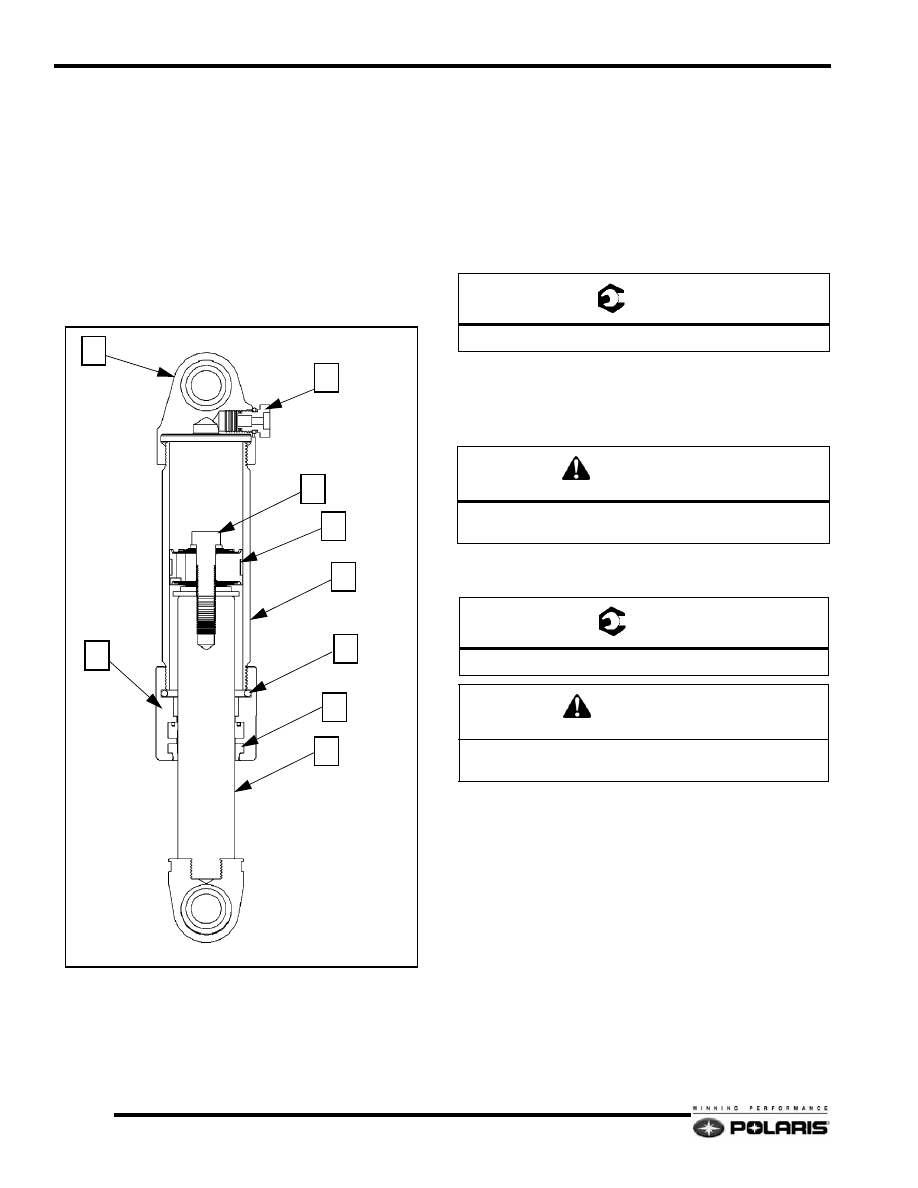
Walker Evans Air Shock Disassembly

IMPORTANT: Verify the protective outer boot is not
torn or damaged. If damaged, inspect the shock shaft
for damage. Replace shock shaft if damage is found.

1.

Place the body cap (1) of the shock in the vise so that the
shock rod (2) is facing downward. 

2.

Remove the service port screw (3) and release the pressure
with the shock charging needle. Verify all pressure is
released.

3.

Place the body cap (1) in the vise, so that the shock rod (2)

is facing upward.

4.

Slowly loosen the shock rod bearing cap (4) and remove
from the shock.

5.

Empty all the shock oil from the shock body and discard
the old oil. 

6.

Inspect the valve stack  (5) as needed. Replace any worn,
wavy, bent valve shims. 

7.

If valve shim service or adjustment is done, torque the
piston retaining bolt (6) to 25-30 ft-lb (34-41 N-m).

8.

If required, replace the bearing cap seal (7) and o-ring (8). 

Walker Evans Air Shock Assembly

1.

Place the specified amount of fluid into the shock body.

2.

Insert and torque down the bearing cap (4) assembly into
the shock body (9).

3.

Flip shock over in the vise so that the shock rod is facing
downward.

4.

Pressurize the shock to specification. Hold the fill tool
needle in the port for thirty seconds to allow the nitrogen
gas to stabilize.

IMPORTANT: Never re-insert the fill tool needle back
into the shock to check pressure after initial charging.
The amount of gas required to fill the tool will give a
false pressure reading. 

Always completely discharge the shock and refill to
obtain an accurate pressure reading.

5.

Check for any leaks.

6.

Reinstall the protective boot and carefully reinstall shock.

3

1

6

7

2

9

4

5

8

T 

Piston Retaining Bolt: 25-30 ft-lb (34-41 Nm)

CAUTION

Do not overfill the shock oil level. Too much shock oil 

may cause the shock rod to hydro lock.

T 

Bearing Cap Torque: 85 ft-lb (115 N-m)

CAUTION

Do not over-torque the shock rod bearing cap or shock 

performance will be compromised.

9.21

Shocks

9

Walker Evans Remote Reservoir / Piggy 
Back Shock Disassembly

NOTE:  Remote reservoir shock shown.

IMPORTANT: To prevent damage or marks to the
shock, the use of soft jaws on a vise is recommended.

1.

Clean and carefully remove shock from the suspension.

2.

Remove button head screw (1) from reservoir cap (if
applicable).

3.

Insert safety needle carefully and depressurize the shock.

4.

Press the end cap into the reservoir to access the snap ring.

5.

Remove the snap ring, then remove the cap from the body.

6.

Place the shock lower eyelet in a vise.

7.

Loosen and remove the bearing cap from the shock.

8.

Remove the used oil from the shock body.

NOTE: Insert the IFP tool (PN PS-45908) and cycle
the internal floating piston (IFP) a few times to purge
the shock oil from the reservoir.

9.

Remove the IFP from the reservoir with the IFP tool (PN
PS-45908).

10. Clean and inspect ALL parts and replace worn out parts if

needed.

IMPORTANT: Seal  kits  are available and should be
installed at this time if seals or o-rings are damaged or
worn.

11. Place the shock rod in a vise so that the threaded part is

facing upward.

12. Place the valve stack on a clean shop towel in order of

removal.

NOTE:  Place the valve stack on a clean shop towel
in case you have to move them. This will also help
when assembling them back onto the shock rod.

9.22

Shocks

13. Inspect the valves for kinks, waves, pits or foreign material.

14. Inspect the piston wear band and replace if damaged or

worn.

Walker Evans Remote Reservoir / Piggy 
Back Shock Assembly

1.

Secure the shock rod in a vise with the threads of the rod
facing up.

2.

Place the compression valve stack on the rod in the reverse
order of disassembly.

3.

Place the valve piston on top of the compression stack.

4.

Place a new lock nut onto the shock rod. Torque the new
lock nut to specification.

IMPORTANT: Do not over torque or damage to the
valve stack can occur.

5.

Secure the shock body by its lower mount.

6.

Set the compression damping adjustment selector to
position “1”.

7.

Fill the shock body and remote reservoir 1/2 full of Walker
Evans 5w shock oil (PN 2874522).

8.

Apply a thin film of oil to the IFP o-ring and floating wear
band located on the shock rod piston.

9.

Compress the wear band and insert the IFP into the
reservoir. Allow as much air as possible to escape as you
install the piston.

10. Screw the IFP tool, PN PS-45908, into the IFP.

11. Hold or place the reservoir as low as possible so the air will

travel upward as you slowly cycle the IFP up and down.

• Be sure to bottom out the piston in the reservoir body.

• Allow time for the bubbles to dissipate.

• Repeat the process until all the air has been removed.

12. Set the IFP so it is approximately 1/8 from the bottom of

the reservoir. Install the bleed screw.

T 

Lock Nut Torque: 14 ft-lb (19N-m)

9.23

Shocks

9

13. With the cylinder head assembly pushed down against the

valve piston, dip the piston assembly in shock oil.

14. Fill the shock body with oil to the bottom of the threads.

Carefully insert the piston rod and valve assembly into the
cylinder.

• Slightly oscillate the piston rod to allow the piston to 

enter the shock body bore as it purges the air out

• Slight up and down movement may be required to allow 

all the air to pass through the piston assembly.

15. Slowly push the piston rod and assembly into the shock

body until the threads can be engaged.

NOTE: During installation, some shock oil will over
flow. Wrap a shop cloths around the shock body to
catch any oil overflow.

IMPORTANT: Fast installation of the piston rod and
assembly may displace the internal floating piston
(IFP) from its original position. Performance issues
will be a result if the IFP is not in its specified position.

16. Tighten the cylinder head onto the shock body.

17. Verify the IFP is set at the specified depth. If not, verify

there is oil on top of the IFP, then open the bleed screw.

18. Set the IFP to specification, then close the bleed screw.

19. Pour out any remaining shock oil from the reservoir.

20. Install the cap making sure the o-ring does not flip-over.

Install the snap ring.

21. Charge the shock to the specified pressure. 

22. Clean the shock of all oil reside and check for any leaks.

23. Install button screw onto the reservoir cap.

Ryde FX Remote Reservoir Shock 

Disassembly

1.

Remove the bushings and eyelet components from the
lower shock body. Mount the shock in a soft-jawed bench
vise.

2.

Remove the button head screw from the pressure valve
assembly.

3.

Slowly open the pressure valve assembly.  Allow all of the
nitrogen gas to escape from the reservoir and shock
assembly.


Content   ..  65  66  67  68   ..