Snowmobile Polaris PRO X (2003 year). Instruction - part 60
 

  Index      Snowmobiles / ATV     Snowmobile Polaris 440 PRO X Fan, 440 PRO X, 600 PRO X, 700 PRO X, 800 PRO X - instruction 2003 year


Search            


Content   ..  58  59  60  61   ..


Snowmobile Polaris PRO X (2003 year). Instruction - part 60


REAR SUSPENSION/TRACK/TRACTION

7.2

Suspension Torque Specifications

3/8

s suspension mounting bolts

35 - 40 ft. lbs. (48 - 55 Nm)

. . . . . . . . . . . . . . . . . . . . . . . . . . . . . . .

7/16

s suspension mounting bolts (PRO X)

55 - 60 ft. lbs. (76 - 83 Nm)

. . . . . . . . . . . . . . . . . . . . . .

Shock rod bolts (do not over torque) (PRO X)

25 ft. lbs. (34.6 Nm)

. . . . . . . . . . . . . . . . . . .

Xtra-10 and Edge Rear Track Shock Upper Pivot Torque

25 ft.lbs (34.6 Nm)

. . . . . . . . .

Shock rod bolts (do not over torque)

35 ft. lbs. (48.4 Nm)

. . . . . . . . . . . . . . . . . . . . . . . . . . .

* Shock rods must pivot freely after torquing

Rear Suspension Specifications

Model

Rear

Suspension

Front
Track

Shock

PN

Front
Track

Shock

(Type)

Front
Track

Shock

Spring

PN*

Front
Track

Shock

Spring

Rate

(lb./in.)

Rear

Track

Shock

PN

Rear

Track

Shock

Desc.

Torsion Spring

Part Number*

Left / Right

Torsion Spring

Diameter / Angle

(Rear Shock

Spring Rate)

Pro X Fan

Pro X

7042205

Ryde FX

IFP

7041870

190#/in

7042184

Ryde FX

IFP res

7042101/7042102

.347(sq.

)

77

q

440 Pro X

Pro X

7042178

Walker

Evans IFP

res

7041671

160#/in

7042179

Walker

Evans IFP

res

7042101/7042102

.347(sq.

)

77

q

600/700/800
Pro X

Pro X

7042214

Ryde FX

IFP res

7041671

160#/in

7042213

Ryde FX

IFP res

7042157/7042158

.359(sq.

)

77

q

*All springs shipped as service parts are black. You must add a suffix of “-067” to spring part number when ordering

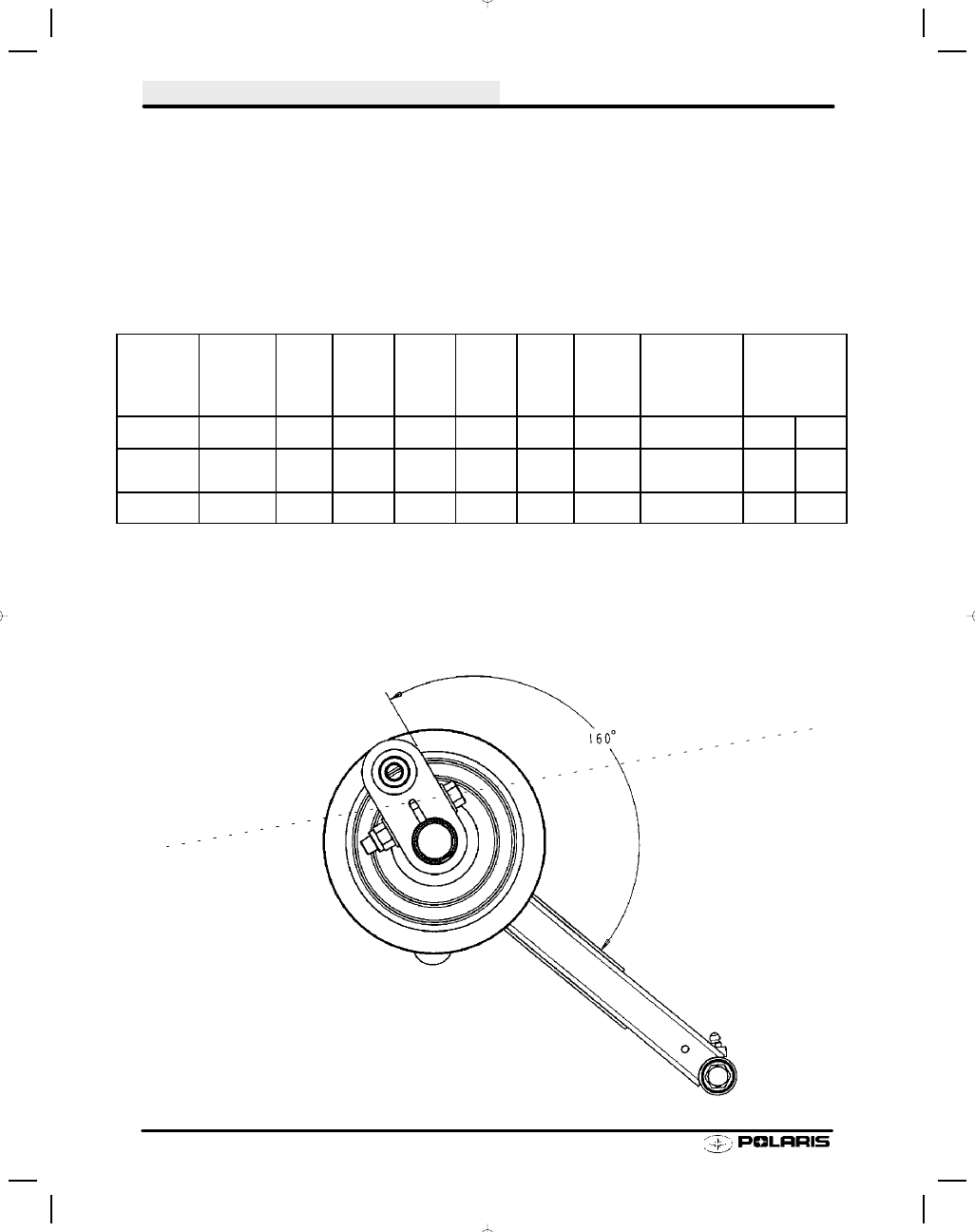
Rear only Xtra Travel Arm orientation

Tunnel Line

REAR SUSPENSION/TRACK/TRACTION

7.3

Rear Suspension Operation

The primary function of the rear suspension is to provide a comfortable ride in all types of riding conditions. It
separates the rider from the ground, while allowing for complete vehicle control. The rear suspension also must
provide weight transfer and maintain track tension.

The rear suspension has many adjustable features for fine tuning to achieve optimum comfort. The suspension
can be adjusted to suit rider preference and deliver excellent performance for a given set of conditions. It should
be noted, however, that suspension adjustments involve a compromise or trade off. A machine set up to perform
well in the moguls would not suit the preference of a groomed trail rider.

Weight Transfer

The shifting of weight from the
skis to the track is called weight
transfer. As engine torque is ap-
plied to the drive axle the torque
is transferred to the track, pulling
it forward. This energy also tries
to pull the suspension forward.
The front torque arm reacts to
this force by pushing down on
the front of the track, in effect ap-
plying more weight to the front of
the track and reducing the
weight on the skis. It is important
to note that energy used to lift
the front of the machine is not
available to push the vehicle for-
ward.

Changing the angle of the front torque arm changes the suspension’s reaction to the force. Adjusting the length
of the limiter strap will change the front torque arm angle. Shortening the strap limits the extension of the front
of the suspension; reducing the angle of the torque arm and increasing ski pressure during acceleration. Length-
ening the strap allows the front of the suspension to extend further; increasing the angle of the torque arm and
decreasing ski pressure during acceleration. Limiter strap adjustment has a great affect on weight transfer. Limit-
er straps only affect ski pressure during acceleration.

Front track shock spring preload also affects weight transfer. A stiffer spring and/or more preload on the spring
transfers more weight to the track. A softer spring and/or less preload keeps more weight on the skis. Keep your
riding application in mind when choosing springs and setting spring preload. Soft springs/preload will increase
ski pressure, but may bottom out. Stiff springs/preload will provide more track pressure (reduced ski pressure),
but may result in a less comfortable ride.

During acceleration, the rear of the suspension will compress and the IFS will extend, pivoting the machine about
the front torque arm. Because of this pivoting effect, rear spring and spring preload also have some effect on
weight transfer. Softer rear springs, or less preload, allow more weight transfer to the track and reduce ski pres-
sure. Stiffer rear springs, or increased preload, allow less weight transfer to the track and increase ski pressure.
The main function of the rear torque arm is to support the weight of the vehicle and rider, as well as to provide
enough travel to absorb bumps and jumps.

Shock valving also has an effect on weight transfer. Refer to shock tuning information in this chapter.
Scissor stops also affect weight transfer. See scissor stop information in this chapter.

REAR SUSPENSION/TRACK/TRACTION

7.4

Springs

Two types of springs are employed in Polaris suspen-
sions, coil springs and torsion springs. Following is some
of the terminology used when referring to coil springs.

S

Free length - the length of a coil spring with no load ap-
plied to the spring

S

Installed length - the length of the spring between the
spring retainers. If the installed length of the spring is
less than the free length, it will be pre-loaded.

NOTE: All springs must have preload or damage to the
retainers and shock may occur.

S

Spring rate - the amount of force required to compress
a coil spring one inch. For example, if 150 pounds of
force are required to compress a spring 1 inch, the
spring rate would be 150 #/in.

S

Straight rate spring - the spring requires the same amount of force to compress the last one inch of travel as
the first one inch of travel. For example, if a 150 #/in. spring requires 150 pounds of force to compress it one
inch, 300 pounds of force would compress it two inches, 450 pounds of force would compress it three inches,
etc.

S

Progressively wound spring - the rate of the spring increases as it is compressed. For example, a 100/200
#/in. rate spring requires 100 pounds of force to compress the first one inch, but requires 200 additional
pounds to compress the last one inch.

S

Dual Rate Springs - See page 6.8 for dual spring rate information.

When a bump is encountered by the suspension, the force of the bump compresses the spring. If the force were
450 pounds, a 100 #/in. spring would compress 4.5 inches. A 150 #/in. spring would only compress 3 inches.
If the suspension had 4 inches of spring travel the 100 #/in. spring would bottom out, while the 150 #/in. spring
would have one inch of travel remaining.

Torsion springs are much like coil springs, although
shaped differently. The rate of the torsion spring is con-
trolled by the free opening angle, the installed opening
angle, the wire diameter of the spring, and the number of
coils.

Coil Spring
Length

Installed
Length

Torsion Spring

Load reduces
opening angle

Load

Wire
Dia.

REAR SUSPENSION/TRACK/TRACTION

7.5

Rear Suspension Tuning

Many factors influence the overall handling characteristics of snowmobile suspensions. Rider weight, riding style,
course conditions, and the condition of suspension components are some of the things that you have to consider
when tuning a suspension.

On new machines, or whenever new suspension parts are installed, the sled should be ridden for at least one
tank of fuel to allow moving parts in the shocks and suspension to wear in.

S

Front Suspension: The front suspension should sag (unloaded) about 1

s (measured at the front bumper)

with the weight of the sled. Use stiffer or softer springs as needed to keep from bottoming too hard, and to ensure
the entire range of travel is used. HINT: Sliding the jounce bumper all the way down the shock rod will show how
much travel is being used.

Rear Suspension Tuning

To begin suspension tuning, check the condition of shocks and other suspension parts.

S

Inspect and grease all suspension parts, making sure they pivot freely. All suspension components should

be greased prior to adjusting the suspension. Regular maintenance greasing should be done with no weight on
the component to allow grease to reach important contact areas.

S

Loaded Sag: Set the preload on the rear springs for the correct sag. There should be 1 1/2

s of sag on the

rear suspension when the rider on the snowmobile, measured at the rear bumper (4

s at rear of tunnel edge on

Edge models). Bounce on the suspension a couple of times to overcome any “suction” and settle the sled to an
accurate reference point. The rider should have their weight placed correctly on the machine. Adjust spring pre-
load to achieve the 1 1/2

s sag dimension on X--Tra 10 or 4” on all EDGE and PRO X models.

S

Unloaded (Free) Sag: When the rider gets off the machine, the suspension should return to 1/2

s of sag.

If the sag is less than 1/2

s stiffer springs may be needed. If it is greater than 1/2s softer springs may be needed.

This may seem backwards at first, but if the spring is too soft, the preload must be greatly increased to prevent
excess loaded sag. This shows up in the form of less unloaded sag. Therefore, a stiffer spring is required. If
the spring is too stiff, the preload will have to be backed off, and unloaded sag will be excessive. This is a very
important step because the proper spring will also help ensure correct weight transfer.

Shock Tuning

The shocks work in two directions. Compression damping prevents the shock from bottoming hard while rebound
damping keeps the shock from springing back too fast. On Indy Select shocks, the compression damping can
be changed by turning the adjuster screw. Refer to shock section in this chapter for adjustment. NOTE: When
we refer to high and low speed, we are referring to the speed of the shock shaft or valve,

not vehicle speed.

Rebuildable Shocks

Begin by taking the shocks apart, inspecting all parts for damage, and changing the oil. Even new shocks should
get an oil change after break in to clean break-in material from the shocks and valve body.

If oil is low, inspect seal cap O-Ring and seals for damage. If air or foam is evident in the oil, the O-Ring in the
floating piston must be replaced. After changing the oil reassemble shocks, making sure oil level, floating piston
depth (IFP), and nitrogen pressure are correct.

The use of nitrogen in Walker Evans Racing Shocks and Ryde FX

¥ shocks provides consistent damping at ex-

treme temperatures. Don’t overcharge the shocks. Excess nitrogen pressure may cause seal “suction” and pre-
vent proper shock action. If too much oil is added, or if the IFP depth is set incorrectly (too low) shock travel will
be limited, and shock damage could result.


Content   ..  58  59  60  61   ..