Snowmobile Polaris 550 Transport Trail Touring. Instruction - part 9
 

  Index      Snowmobiles / ATV     Snowmobile Polaris 550 Transport Trail Touring - instruction


Search            copyright infringement  


Content   ..  7  8  9  10   ..


Snowmobile Polaris 550 Transport Trail Touring. Instruction - part 9


34

THE PERFECT FIT

EDGE 136 Rear Suspension Adjustments

Initial Spring Preload Setting (Sag Method)

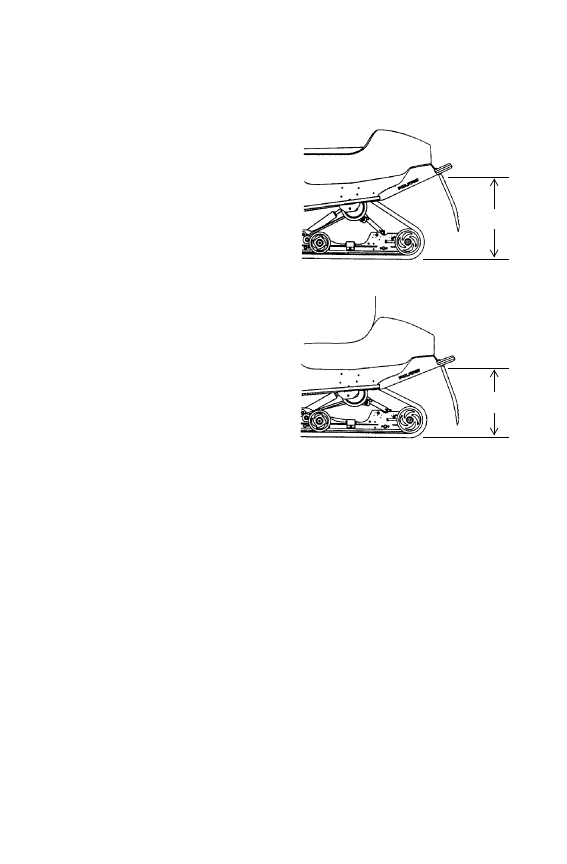
To set up the EDGE rear suspension 

torsion spring preload, measure the 

distance between the ground and 

rear bumper. This is measurement 

X.

Take the first measurement with no 

rider and with the rear suspension at 

full extension. 

NOTE: The rear bumper may need 

to be lifted upward slightly 

to fully extend the rear sus-

pension.

Next, have the rider drop down 

hard on the seat and bounce up and 

down several times, collapsing the 

rear suspension. With the rider 

seated, measure the distance 

between the ground and the rear 

bumper at the exact location used 

for measurement X. This is mea-

surement Y.

To determine sag, commonly referred to as ride-in, subtract measure-

ment Y from X (sag=X-Y). Adjust sag by rotating the torsion spring 

preload cams located on the rear torque arm. Use the illustration for ref-

erence. The ideal amount of Sag for the EDGE rear suspension is four 

inches (X-Y=4).

If the rear suspension rides in less than three inches or more than five 

inches with the torsion spring preload cams at their maximum range of 

adjustment, optional torsion springs (softer or stiffer, respectively) may 

be required. This is only an initial set-up, and final spring preload may 

vary based on rider preference and riding conditions.

X

Y

35

THE PERFECT FIT

EDGE 136 Rear Suspension Adjustments

Rear Spring Tension

To adjust rear torsion spring tension, rotate the three-position cam using 

the engine spark plug tool. Different rate torsion springs are available if 

a firmer ride is desired. See your dealer for more information.

The following information is provided only as a guideline to be used for 

initial suspension set-up. Your set-up may vary based on your desired 

riding style.

Low Tension

Medium Tension

High Tension

36

THE PERFECT FIT

EDGE 136 Rear Suspension Adjustments

Indy Select Rear Shock

Some snowmobiles are equipped with the Indy Select rear shock, which 

allows for adjustments to the compression valving. Locate the adjust-

ment screw near the base of the shock. In half-turn increments, turn the 

screw clockwise to increase compression valving and stiffen the ride, or 

counterclockwise to reduce compression and soften the ride. There are 

approximately three full turns of adjustment available. 

If bottoming continues after the screw has been turned fully clockwise, 

the torsion spring should be adjusted (see page 35). Return the screw to 

its original starting position after the torsion spring has been tightened.

Adjustment Screw

37

THE PERFECT FIT

EDGE 136 Rear Suspension Adjustments

Optional Torsion Springs

Different rate torsion springs are available for some shocks if a firmer 

ride is desired. Contact your dealer for more information.

Suspension Coupling

On all Polaris snowmobile rear suspensions, there are two torque arms 

that control the movement of the rail beam. Prior to the advent of sus-

pension coupling, these torque arms could move independently of each 

other. Rear suspension coupling links the movement of the front and 

rear torque arms to each other. There are two types of rear suspension 

coupling.
Front To Rear Coupling and the Front Rear Scissor Stop 

(FRSS)
The front rear scissor stop (FRSS) couples the movement of the front 

torque arm with the rear torque arm and limits the amount of indepen-

dence between the movement of the front torque arm and the rear torque 

arm.

When hitting a bump, the front torque arm starts to compress. The FRSS 

links that movement to the rear torque arm, causing it to compress and 

raise the rear suspension up as one, allowing the suspension to hit the 

bump only once and reducing kickback. 

The factory setting is usually adequate for all riders and conditions.


Content   ..  7  8  9  10   ..