AMCO VEBA 924-924C. MANUALE AVVERTENZE, USO E MANUTENZIONE - 1

924 - 924C
MANUALE AVVERTENZE, USO E MANUTENZIONE
(ISTRUZIONI ORIGINALI)
WARNING, OPERATING AND MAINTENANCE MANUAL
(ORIGINAL INSTRUCTIONS)
ANWEISUNGS-, BEDIENUNGS- UND WARTUNGSHANDBUCH
(ORIGINALANLEITUNGEN)
7882344-10 11/16
INDICE
A MANUALE AVVERTENZE
A-1
A.1
PERICOLI DI NATURA MECCANICA
A-2
A.1.1
RESISTENZA MECCANICA
A-2
A.1.2
PERICOLO DI SCHIACCIAMENTO
A-5
A.1.3
PERICOLO DI CESOIAMENTO
A-8
A.1.4
PERICOLO DI TRASCINAMENTO O INTRAPPOLAMENTO
A-9
A.1.5
PERICOLO DI URTO
A-9
A.1.6
PERICOLO DI EIEZIONE DI OLIO
A-12
A.1.7
PERDITA DI STABILITÀ
A-13
A.1.8
SCIVOLAMENTO, INCIAMPO E CADUTA
A-16
A.2
PERICOLI DI NATURA ELETTRICA
A-17
A.2.1
CONTATTO CON ELEMENTI IN TENSIONE
A-17
A.2.2
FENOMENI ELETTROSTATICI
A-19
A.3
PERICOLI DI NATURA TERMICA
A-20
A.3.1
BRUCIATURE, SCOTTATURE
A-20
A.3.2
TEMPERATURA AMBIENTALE
A-20
A.4
PERICOLI GENERATI DAL RUMORE
A-21
A.5
PERICOLI GENERATI DA VIBRAZIONI
A-21
A.6
PERICOLI DA SOSTANZE UTILIZZATE DALLA MACCHINA
A-22
A.6.1
PERICOLI DA CONTATTO O INALAZIONE DI FLUIDI DANNOSI
A-22
A.7
PERICOLI DI TIPO ERGONOMICO
A-26
A.7.1
POSTAZIONI DI LAVORO
A-26
A.7.2
VISIBILITÀ
A-27
A.7.3
ERRORE UMANO
A-28
A.8
AVVIAMENTO E SPEGNIMENTO INATTESO DELLA GRU
A-29
A.9
INEFFICIENZA DEI DISPOSITIVI DI SICUREZZA
A-30
A.10
ERRORI DI ACCOPPIAMENTO
A-32
A.11
PERICOLI CAUSATI DA MANOVRE ERRATE
A-34
A.12
AVVERTENZE PER IL SOLLEVAMENTO E IL TRASPORTO GRU
A-37
A.13
AVVERTENZE SUPPLEMENTARI PER RADIOCOMANDO
A-38
A.14
AVVERTENZE SUPPLEMENTARI PER BRACCIO JIB
A-43
A.15
AVVERTENZE SUPPLEMENTARI PER VERRICELLO
A-44
A.16
AVVERTENZE SUPPLEMENTARI PER BENNA-POLIPO
A-47
A.17
AVVERTENZE SUPPLEMENTARI PER TRIVELLA
A-50
B MANUALE D’USO
B-1
B.1
PREMESSA
B-2
B.2
IDENTIFICAZIONE
B-3
B.3
DOCUMENTAZIONE E DESCRIZIONE GRU
B-4
B.3.1
DOCUMENTAZIONE ALLEGATA
B-4
B.3.2
MARCATURA
B-5
B.3.3
CONDIZIONI DI SERVIZIO
B-6
B.3.4
COMPONENTI PRINCIPALI
B-7
B.3.5
DISPOSITIVI DI SICUREZZA, LIMITATORI E INDICATORI
B-8
B.3.6
SIGILLI DI SICUREZZA
B-9
B.3.7
COMANDI GRU NO RDC
B-10
B.3.8
COMANDI RDC
B-11
B.4
DESCRIZIONE DEI COMANDI
B-12
B.4.1
PANNELLI DI CONTROLLO GRU AS NO-RDC
B-12
B.4.2
PANNELLO DI CONTROLLO (GRU RDC)
B-13
B.4.3
DEVIATORE PRINCIPALE
B-16
B.4.4
COMANDI STABILIZZATORI LATO DISTRIBUTORE
B-17
B.4.5
COMANDI STABILIZZATORI LATO OPPOSTO DISTRIBUTORE
B-18
B.4.6
COMANDI OPERATIVI
B-19
B.5
DESCRIZIONE DEI DISPOSITIVI DI SICUREZZA
B-21
B.5.1
VALVOLA DI MASSIMA PRESSIONE DI LAVORO
B-21
B.5.2
VALVOLE DI SOVRAPRESSIONE
B-22
B.5.3
LIMITATORE DI MOMENTO (GRU CE/AS O RDC)
B-23
B.5.4
LIMITATORE DI MOMENTO (GRU NO CE/ NO AS)
B-24
B.5.5
ESCLUSIONE DEL LIMITATORE DI MOMENTO
B-25
B.5.6
PULSANTI D’EMERGENZA (GRU CE)
B-27
B.5.7
VALVOLE DI BLOCCO SUI CILINDRI OLEODINAMICI
B-28
B.5.8
DISPOSITIVI DI BLOCCAGGIO DELLE ASTE STABILIZZATRICI
B-29
B.5.9
DISPOSITIVO DI BLOCCAGGIO DELLE PROLUNGHE MECCANICHE
B-31
B.5.10
LIMITATORI DI ROTAZIONE (OPTIONAL)
B-32
B.6
INDICATORI E LUCI DI SEGNALAZIONE
B-34
B.6.1
DISPOSITIVO SEGNALAZIONE CHIUSURA ASTE STABILIZZATRICI (CE)
B-36
B.7
PITTOGRAMMI
B-37
B.8
CONTROLLI PRELIMINARI DELLE CONDIZIONI DI LAVORO
B-38
B.8.1
CONDIZIONI CLIMATICHE E ATMOSFERICHE
B-38
B.8.2
DISTANZA DA LINEE ELETTRICHE
B-39
B.8.3
PENDENZA DEL TERRENO
B-39
B.8.4
RESISTENZA DEL TERRENO
B-40
B.8.5
VISIBILITÀ
B-41
B.8.6
CONTROLLI GENERALI PRIMA DI OPERARE CON LA GRU
B-42
B.9
OPERARE CON LA GRU
B-43
B.9.1
OPERAZIONI DI AVVIAMENTO (GRU NO-RDC)
B-43
B.9.2
OPERAZIONI DI AVVIAMENTO (GRU RDC)
B-44
B.9.3
PROCEDURA DI STABILIZZAZIONE GRU
B-45
B.9.4
PROCEDURA DI APERTURA STABILIZZATORI GIREVOLI AUTOMATICI
B-47
B.9.5
PROCEDURA DI APERTURA DELLA GRU
B-49
B.9.6
OPERAZIONI DI SOLLEVAMENTO
B-52
B.9.7
DISPOSITIVO DI INCREMENTO DI POTENZA
B-54
B.9.8
PROCEDURA DI CHIUSURA DELLA GRU
B-55
B.9.9
PROCEDURA DI CHIUSURA STABILIZZATORI
B-59
B.9.10
PROCEDURA DI CHIUSURA STABILIZZATORI GIREVOLI AUTOMATICI
B-61
B.9.11
CONTROLLI OBBLIGATORI PRIMA DI LASCIARE LA POSTAZIONE DI LAVORO
B-63
B.10
ANTENNA ARTICOLATA (JIB)
B-64
B.10.1 COMPONENTI PRINCIPALI
B-64
B.10.2 CAMPO DI LAVORO
B-64
B.10.3 LIMITATORE DI MOMENTO JIB (GRU NO RDC)
B-65
B.10.4 LIMITATORE DI MOMENTO JIB (GRU RDC)
B-66
B.10.5 VALVOLE DI BLOCCO SUI CILINDRI JIB
B-68
B.10.6 COMANDI GRU CON JIB
B-69
B.10.7 PROCEDURA DI APERTURA DEL JIB
B-70
B.10.8 PROCEDURA DI CHIUSURA DEL JIB
B-71
B.10.9 MONTAGGIO E SMONTAGGIO DEL JIB
B-72
B.11
ACCESSORI DI SOLLEVAMENTO
B-74
B.11.1 PROLUNGHE MANUALI
B-75
B.11.2 VERRICELLO
B-77
B.11.3 BENNA-POLIPO
B-79
C MANUALE DI MANUTENZIONE
C-1
C.1
TERMINI DI GARANZIA
C-2
C.2
MANUTENZIONE ORDINARIA
C-2
C.2.1
INGRASSAGGIO
C-3
C.2.2
SCHEMA DI INGRASSAGGIO
C-4
C.2.3
RABBOCCO SERBATOIO OLIO
C-5
C.2.4
PULIZIA DELLA GRU
C-6
C.3
MANUTENZIONE PROGRAMMATA
C-7
C.4
MANUTENZIONE STRAORDINARIA
C-7
C.5
INATTIVITÀ
C-7
C.6
MESSA FUORI SERVIZIO DELLA GRU
C-8
C.6.1
DISINSTALLAZIONE
C-8
C.6.2
STOCCAGGIO
C-9
C.6.3
SMALTIMENTO
C-9
D ALLEGATI
D-1
D.1
DATI TECNICI
D-2
D.1.1
CARATTERISTICHE GENERALI
D-2
D.1.2
TEMPI DI APERTURA CILINDRI IDRAULICI
D-4
D.1.3
CAPACITÀ CIRCUITO IDRAULICO
D-4
D.1.4
DIMENSIONI D’INGOMBRO
D-5
D.1.5
ALTEZZA GANCIO
D-7
D.1.6
DIAGRAMMI DI CARICO 924
D-8
D.1.7
DIAGRAMMI DI CARICO 924C
D-19
D.1.8
PESI E BARICENTRI
D-24
D.1.9
SCHEMI IDRAULICI
D-26
D.1.10
SCHEMI ELETTRICI
D-42
D.1.11
FUNZIONI OPERATIVE RADIOCOMANDI
D-46
D.2
PITTOGRAMMI APPLICATI ALLA GRU
D-55
D.3
COPPIE DI SERRAGGIO
D-57
D.4
TABELLE DI CONVERSIONE UNITÀ DI MISURA
D-59
D.5
ANOMALIE
D-60
D.6
CERTIFICATO DI CONFORMITÀ CE
D-63
D.7
REGISTRO DI MANUTENZIONE
D-64
CONTENTS
A WARNING MANUAL
A-1
A.1
MECHANICAL HAZARDS
A-2
A.1.1
MECHANICAL RESISTANCE
A-2
A.1.2
CRUSHING HAZARD
A-5
A.1.3
CUTTING HAZARD
A-8
A.1.4
DRAGGING OR ENTRAPMENT HAZARD
A-9
A.1.5
IMPACT HAZARD
A-9
A.1.6
OIL LEAK HAZARD
A-12
A.1.7
LOSS OF STABILITY
A-13
A.1.8
SLIPPING, TRIPPING AND FALLS
A-16
A.2
ELECTRIC SHOCK HAZARD
A-17
A.2.1
CONTACT WITH LIVE COMPONENTS
A-17
A.2.2
STATIC ELECTRICITY
A-19
A.3
HEAT HAZARDS
A-20
A.3.1
BURNS
A-20
A.3.2
ENVIRONMENTAL TEMPERATURE
A-20
A.4
NOISE HAZARDS
A-21
A.5
VIBRATION HAZARDS
A-21
A.6
HAZARDS RELATING TO SUBSTANCES USED BY THE MACHINE
A-22
A.6.1
TOXIC SUBSTANCE HAZARD (INHALATION OR CONTACT)
A-22
A.7
ERGONOMIC HAZARDS
A-26
A.7.1
OPERATING POSITIONS
A-26
A.7.2
VISIBILITY
A-27
A.7.3
HUMAN ERROR
A-28
A.8
UNEXPECTED START-UP AND SWITCH-OFF OF THE CRANE
A-29
A.9
SAFETY DEVICE FAULTS
A-30
A.10
COUPLING FAULTS
A-32
A.11
HAZARDS DUE TO INCORRECT LOAD MOVEMENTS
A-34
A.12
WARNINGS TO LIFT AND TRANSPORT THE CRANE
A-37
A.13
SUPPLEMENTARY WARNINGS FOR RADIO REMOTE CONTROL
A-38
A.14
SUPPLEMENTARY WARNINGS FOR JIB
A-43
A.15
SUPPLEMENTARY WARNINGS FOR WINCH
A-44
A.16
SUPPLEMENTARY WARNINGS FOR BUCKET-GRAB
A-47
A.17
SUPPLEMENTARY WARNINGS FOR DRILL
A-50
B OPERATING MANUAL
B-1
B.1
PREMISE
B-2
B.2
IDENTIFICATION
B-3
B.3
CRANE DESCRIPTION AND DOCUMENTATION
B-4
B.3.1
ENCLOSED DOCUMENTATION
B-4
B.3.2
MARK
B-5
B.3.3
SERVICE CONDITIONS
B-6
B.3.4
MAIN COMPONENTS
B-7
B.3.5
SAFETY DEVICES, LIMIT SWITCHES AND INDICATORS
B-8
B.3.6
SAFETY SEALS
B-9
B.3.7
CONTROLS OF NOT RDC CRANE
B-10
B.3.8
RDC CONTROLS
B-11
B.4
DESCRIPTION OF THE CONTROLS
B-12
B.4.1
CONTROL PANELS ON AS NOT-RDC CRANE
B-12
B.4.2
CONTROL PANELS (RDC CRANE)
B-13
B.4.3
MAIN DEVIATION VALVE
B-16
B.4.4
STABILIZERS CONTROLS AT CONTROL VALVE SIDE
B-17
B.4.5
STABILIZERS CONTROLS AT CONTROL VALVE OPPOSITE SIDE
B-18
B.4.6
WORK OPERATION CONTROLS
B-19
B.5
DESCRIPTION OF THE SAFETY DEVICES
B-21
B.5.1
MAX WORKING PRESSURE VALVE
B-21
B.5.2
OVERPRESSURE VALVES
B-22
B.5.3
LOAD LIMITING DEVICE (CE/AS OR RDC CRANE)
B-23
B.5.4
LOAD LIMITING DEVICE (NOT-CE/NOT AS CRANE)
B-24
B.5.5
EXCLUSION OF LOAD LIMITING DEVICE
B-25
B.5.6
EMERGENCY STOP BUTTONS (CE CRANE)
B-27
B.5.7
BLOCK VALVES ON HYDRAULIC CYLINDERS
B-28
B.5.8
LOCKING DEVICES FOR STABILIZER EXTENSIONS
B-29
B.5.9
MANUAL EXTENSIONS LOCK DEVICES
B-31
B.5.10
SLEWING LIMITING DEVICES (OPTIONAL)
B-32
B.6
GAUGES AND WARNING LIGHTS
B-34
B.6.1
DEVICE SIGNALLING THE CLOSING OF THE STABILIZER BEAMS (CE)
B-36
B.7
PICTOGRAMS
B-37
B.8
PRELIMINARY VERIFICATION OF OPERATING CONDITIONS
B-38
B.8.1
CLIMATE AND ATMOSPHERIC CONDITIONS
B-38
B.8.2
DISTANCE FROM POWER LINES
B-39
B.8.3
GROUND SLOPE
B-39
B.8.4
GROUND RESISTANCE
B-40
B.8.5
VISIBILITY
B-41
B.8.6
GENERAL PRELIMINARY CRANE CHECKS BEFORE OPERATION
B-42
B.9
OPERATING WITH THE CRANE
B-43
B.9.1
START UP OPERATION (NOT-RDC CRANE)
B-43
B.9.2
START UP OPERATION (RDC CRANE)
B-44
B.9.3
STABILIZATION PROCEDURE OF THE CRANE
B-45
B.9.4
PROCEDURE FOR OPENING THE AUTOMATIC TURNING STABILIZERS
B-47
B.9.5
PROCEDURE FOR OPENING THE CRANE
B-49
B.9.6
LIFTING OPERATIONS
B-52
B.9.7
POWER BOOST DEVICE
B-54
B.9.8
PROCEDURE FOR CLOSING THE CRANE
B-55
B.9.9
PRODEDURE FOR CLOSING THE STABILIZERS
B-59
B.9.10
PROCEDURE FOR CLOSING THE AUTOMATIC TURNING STABILIZERS
B-61
B.9.11
COMPULSORY SAFETY CHECKS BEFORE LEAVING THE WORK PLACE
B-63
B.10
ARTICULATED JIB
B-64
B.10.1 MAIN COMPONENTS
B-64
B.10.2 WORK RANGE
B-64
B.10.3 JIB LOAD LIMITING DEVICE (NOT-RDC CRANE)
B-65
B.10.4 JIB LOAD LIMITING DEVICE (RDC CRANE)
B-66
B.10.6 CHECK VALVES ON JIB CYLINDERS
B-68
B.10.7 JIB CRANE CONTROLS
B-69
B.10.8 PROCEDURE FOR OPENING THE JIB BOOM
B-70
B.10.9 PROCEDURE FOR CLOSING THE JIB BOOM
B-71
B.10.10 ASSEMBLING / REMOVING THE JIB
B-72
B.11
LIFTING ACCESSORIES
B-74
B.11.1 MANUAL EXTENSIONS
B-75
B.11.2 WINCH
B-77
B.11.3 BUCKET-GRAB
B-79
C MAINTENANCE MANUAL
C-1
C.1
WARRANTY TERMS
C-2
C.2
ORDINARY MAINTENANCE
C-2
C.2.1
GREASING
C-3
C.2.2
GREASING CHART
C-4
C.2.3
FILLING UP THE OIL TANK
C-5
C.2.4
CLEANING THE CRANE
C-6
C.3
PLANNED MAINTENANCE
C-7
C.4
EXTRAORDINARY MAINTENANCE
C-7
C.5
INACTIVITY
C-7
C.6
TAKING THE CRANE OUT OF SERVICE
C-8
C.6.1
DISASSEMBLY
C-8
C.6.2
STORAGE
C-9
C.6.3
DISPOSAL
C-9
D ENCLOSURES
D-1
D.1
TECHNICAL SPECIFICATIONS
D-2
D.1.1
GENERAL SPECIFICATIONS
D-2
D.1.2
OPENING TIME OF THE HYDRAULIC CYLINDERS
D-4
D.1.3
CAPACITY OF HYDRAULIC SYSTEM
D-4
D.1.4
OVERALL DIMENSIONS
D-5
D.1.5
HOOK HEIGHT
D-7
D.1.6
LOAD DIAGRAMS 924
D-8
D.1.7
LOAD DIAGRAMS 924C
D-19
D.1.8
WEIGHTS AND CENTRES OF GRAVITY
D-24
D.1.9
HYDRAULIC DIAGRAMS
D-26
D.1.10
ELECTRIC DIAGRAMS
D-42
D.1.10
OPERATING FUNCTIONS OF THE RADIO REMOTE CONTROLS
D-46
D.2
PICTOGRAMS ON THE CRANE
D-55
D.3
TIGHTENING TORQUES
D-57
D.4
CONVERSION TABLES OF MEASUREMENTS UNITS
D-59
D.5
TROUBLE SHOOTING
D-60
D.6
CE DECLARATION OF CONFORMITY
D-63
D.7
MAINTENANCE REGISTER
D-64
INHALT
A ANWEISUNGSHANDBUCH
A-1
A.1
MECHANISCHE GEFAHREN
A-2
A.1.1
MECHANISCHE FESTIGKEIT
A-2
A.1.2
QUETSCHUNGSRISIKO
A-5
A.1.3
SCHERGEFAHR
A-8
A.1.4
GEFAHR DES ERFASSENS UND EINZIEHENS
A-9
A.1.5
STOSSGEFAHR
A-9
A.1.6
ÖLSPRITZGEFAHR
A-12
A.1.7
STABILITÄTSVERLUST
A-13
A.1.8
RUTSCH-, STOLPER- UND STURZGEFAHR
A-16
A.2
GEFAHREN ELEKTRISCHER ART
A-17
A.2.1
KONTAKT MIT SPANNUNGSFÜHRENDEN TEILEN
A-17
A.2.2
ELEKTROSTATISCHE LADUNG
A-19
A.3
GEFAHREN THERMISCHER ART
A-20
A.3.1
VERBRENNUNGEN, VERBRÜHUNGEN
A-20
A.3.2
UMGEBUNGSTEMPERATUR
A-20
A.4
GEFAHREN DURCH LÄRM
A-21
A.5
GEFAHREN DURCH VIBRATIONEN
A-21
A.6
GEFAHREN DURCH VON DER MASCHINE VERWENDETE STOFFE
A-22
A.6.1
GEFAHREN DURCH FLÜSSIGKEITEN MIT SCHÄDLICHER WIRKUNG (BERÜHRUNG, EINATMEN)
A-22
A.7
GEFAHREN ERGONOMISCHER ART
A-26
A.7.1
ARBEITSPLATZ
A-26
A.7.2
SICHTBARKEIT
A-27
A.7.3
MENSCHLICHES VERSAGEN
A-28
A.8
UNVERMITTELTES STARTEN UND ABSCHALTEN DES KRANS
A-29
A.9
FEHELER IN DEN SICHERHEITSEINRICHTUNGEN
A-30
A.10
ANSCHLUSSFEHLER
A-32
A.11
GEFAHREN DURCH MANÖVRIERFEHLER
A-34
A.12
WARNUNGEN FÜR TRANSPORT UND ANHEBEN DES KRANS
A-37
A.13
ZUSÄTZLICHE HINWEISE FÜR DIE FUNKFERNSTEUERUNG
A-38
A.14
ZUSÄTZLICHE HINWEISE FÜR JIB-AUSLEGER
A-43
A.15
ZUSÄTZLICHE HINWEISE FÜR DIE SEILWINDE
A-44
A.16
ZUSÄTZLICHE HINWEISE FÜR SCHALEN-/MEHRSCHALENGREIFER
A-47
A.17
ZUSÄTZLICHE HINWEISE FÜR ERDBOHRER
A-50
B BEDIENUNGSHANDBUCH
B-1
B.1
VORWORT
B-2
B.2
KENNDATEN
B-3
B.3
DOKUMENTATION UND KRANBESCHREIBUNG
B-4
B.3.1
BEILIEGENDE DOKUMENTATION
B-4
B.3.2
KENNZEICHNUNG
B-5
B.3.3
DIENSTBEDINGUNGEN
B-6
B.3.4
HAUPTKOMPONENTEN
B-7
B.3.5
SICHERHEITSEINRICHTUNGEN, BEGRENZER UND ANZEIGER
B-8
B.3.6
SICHERHEITSPLOMBIERUNGEN
B-9
B.3.7
STEUERUNGEN NICHT RDC-KRAN
B-10
B.3.8
RDC-STEUERUNGEN
B-11
B.4
BESCHREIBUNG DER STEUERUNGEN
B-12
B.4.1
SCHALTTAFELN FÜR KRAN AS NICHT X
B-12
B.4.2
SCHALTTAFEL (RDC KRAN)
B-13
B.4.3
HAUPTWEGEVENTIL
B-16
B.4.4
STEUERUNGEN DER ABSTÜTZUNGEN STEUERVENTIL SEITE
B-17
B.4.5
STEUERUNGEN DER ABSTÜTZUNGEN STEUERVENTIL GEGENSEITE
B-18
B.4.6
BEDIENUNGSSTEUERUNGEN
B-19
B.5
BESCHREIBUNG DER SICHERHETSVORRICHTUNGEN
B-21
B.5.1
HÖCHSTBETRIEBSDRUCKVENTIL
B-21
B.5.2
ÜBERDRUCKVENTILE
B-22
B.5.3
MOMENTBEGRENZER (CE/AS ODER RDC KRAN)
B-23
B.5.4
MOMENTBEGRENZER (NICHT-CE/NICHT AS KRAN)
B-24
B.5.5
AUSSCHLUSS DES MOMENTBEGRENZERS
B-25
B.5.6
NOT-AUS TASTEN (CE-KRAN)
B-27
B.5.7
ABSPERRVENTILE AUF HYDRAULIKZYLINDERN
B-28
B.5.8
SPERRVORRICHTUNGEN FÜR ABSTÜTZSTANGEN
B-29
B.5.9
SPERRVORRICHTUNG FÜR DIE MANUELLE VERLÄNGERUNGEN
B-31
B.5.10
DREHBEGRENZER (WAHLFREI)
B-32
B.6
ANZEIGER UND KONTROLLLAMPEN
B-34
B.6.1
WARNVORRICHTUNG VON SCHLUSS DER ABSTÜTZSTANGEN (CE)
B-36
B.7
PIKTOGRAMME
B-37
B.8
VORABKONTROLLEN DER ARBEITSBEDINGUNGEN
B-38
B.8.1
KLIMATISCHE UND ATMOSPHÄRISCHE BEDINGUNGEN
B-38
B.8.2
ABSTAND VON ELEKTRISCHEN LEITUNGEN
B-39
B.8.3
GEFÄLLE DES GELÄNDES
B-39
B.8.4
WIDERSTAND DES GELÄNDES
B-40
B.8.5
SICHTBARKEIT
B-41
B.8.6
ALLGEMEINE KONTROLLEN VOR DER KRANARBEIT
B-42
B.9
BEDIENEN DES KRANS
B-43
B.9.1
STARTEN DES KRANS (NICHT RRS)
B-43
B.9.2
ANLASSEN DES KRANS (RDC KRAN)
B-44
B.9.3
ABSTÜTZVERFAHREN DES KRANS
B-45
B.9.4
ÖFFNUNG DER SELBSTDREHENDEN ABSTÜTZBEINE
B-47
B.9.5
ÖFFNUNGS-VERFAHREN DES KRANS
B-49
B.9.6
HEBEBETÄTIGUNG
B-52
B.9.7
LEISTUNGSZUNAHMEEINRICHTUNG
B-54
B.9.8
SCHLIESSUNGSVERFAHREN DES KRANS
B-55
B.9.9
SCHLIESSUNG DER ABSTÜTZUNGEN
B-59
B.9.10
SCHLIESSUNG DER SELBSTDREHENDEN ABSTÜTZBEINE
B-61
B.9.11
VERBINDLICHE KONTROLLE VOR DEM VERLASSEN DES ARBEITZPLATZES
B-63
B.10
GELENKIGE VERLÄNGERUNG (JIB)
B-64
B.10.1 HAUPTKOMPONENTEN
B-64
B.10.2 ARBEITSBEREICH
B-64
B.10.3 MOMENTBEGRENZER JIB (NICHT RDC KRAN)
B-65
B.10.4 MOMENTBEGRENZER JIB (RDC KRAN)
B-66
B.10.6 BLOCKVENTILE AUF JIB-ZYLINDERN
B-68
B.10.7 KRANSTEUERUNGEN MIT JIB
B-69
B.10.8 ÖFFNUNGSVERFAHREN DES JIB
B-70
B.10.9 SCHLIESSUNGSVERFAHREN DES JIB
B-71
B.10.10 MONTAGE UND DEMONTAGE DES JIB
B-72
B.11
ZUSÄTZLICHE HEBEGERÄTE
B-74
B.11.1 MANUELLE VERLÄNGERUNGEN
B-75
B.11.2 SEILWINDE
B-77
B.11.3 SCHALENGREIFER
B-79
C WARTUNGSHANDBUCH
C-1
C.1
GARANTIEBESTIMMUNGEN
C-2
C.2
ORDENTLICHE WARTUNG
C-2
C.2.1
SCHMIERUNG
C-3
C.2.2
SCHMIERPLAN
C-4
C.2.3
AUFFÜLLEN DES ÖLBEHÄLTERS
C-5
C.2.4
REINIGUNG DES KRANS
C-6
C.3
PLANMÄSSIGE WARTUNG
C-7
C.4
AUSSERPLANMÄSSIGE WARTUNG
C-7
C.5
STILLSTAND
C-7
C.6
AUßER BETRIEB-SETZEN DES KRANS
C-8
C.6.1
DEMONTAGE
C-8
C.6.2
LAGERUNG
C-9
C.6.3
ENTSORGUNG
C-9
D BEILAGEN
D-1
D.1
TECHNISCHE DATEN
D-2
D.1.1
ALLGEMEINE MERKMALE
D-2
D.1.2
ÖFFNUNGSZEIT DER HYDRAULISCHEN ZYLINDER
D-4
D.1.3
VOLUMEN DES HYDRAULIKKREISES
D-4
D.1.4
GESAMTABMESSUNGEN
D-5
D.1.5
HAKEN-HÖHE
D-7
D.1.6
LASTDIAGRAMME 924
D-8
D.1.7
LASTDIAGRAMME 924C
D-19
D.1.8
GEWICHTE UND SCHWERPUNKTE
D-24
D.1.9
HYDRAULIKSCHEMA
D-26
D.1.10
STROMKREISSCHEMA
D-42
D.1.10
FUNKTIONEN DER FUNKFERNSTEUERUNGEN
D-46
D.2
PIKTOGRAMME AUF DEM KRAN
D-55
D.3
ANZUGSMOMENTE
D-57
D.4
UMRECHNUNGSTABELLE DER MAßEINHEITEN
D-59
D.5
STÖRUNGEN
D-60
D.6
CE KONFORMITÄTS-ERKLÄRUNG
D-63
D.7
WARTUNGSBUCH
D-64
INDICE DELLE TABELLE
INDEX OF TABLES
VERZEICHNIS DER TABELLEN
Tab. A-1: Distanze minime di sicurezza - Min. safety distances - Min. Sicherheitsabstände
A-7
Tab. B-1: Condizioni di servizio - Service conditions - Dienstbedingungen
B-6
Tab. B-2: Forza del vento - Wind force - Windstärke
B-38
Tab. B-3: Portata del terreno - Bearing capacity of the soils - Belastbarkeit des Bodens
B-40
Tab. B-4: Segnali manuali di comando - Manual control signals - Steuerungshandzeichen
B-41
Tab. C-1 Grasso per manutenzione - Grease for maintenance - Schmierfett für Wartung
C-3
Tab. C-2 Frequenza di ingrassaggio - Frequency of greasing - Schmierintervalle
C-4
Tab. C-3 Oli idraulici consigliati - Recommended hydraulic oils - Empfohlene Hydrauliköle
C-5
Tab. D-1 Serraggio viteria - Tightening of bolts and screws - Anzug der Schrauben
D-57
Tab. D-2 Serraggio raccordi - Tightening of fittings - Anzug der Anschlüsse
D-58
Tab. D-3 Serraggio tiranti di staffaggio - Tightening of crane mounting bolts - Anzug der Sockelbefestigungen
D-58
Tab. D-4 Conversione unità di misura - Conversion of measurement units - Umrechnung der Maßeinheiten
D-59
A MANUALE AVVERTENZE
A WARNING MANUAL
A ANWEISUNGSHANDBUCH
A-1
A.1 PERICOLI DI
A.1 MECHANICAL
A.1 MECHANISCHE
NATURA MECCANICA
HAZARDS
GEFAHREN
A.1.1 RESISTENZA
A.1.1 MECHANICAL
A.1.1 MECHANISCHE
MECCANICA
RESISTANCE
FESTIGKEIT
Vengono elencati i principali pericoli
The main hazards resulting from failure
Nachstehend werden die hauptsäch-
legati alla non osservanza delle con-
to follow the operating instructions
lichen Gefahren infolge Missachtung
dizioni di lavoro previste nel manuale
described in the user manual are listed
der im Handbuch vorgesehenen
d’uso:
below:
Arbeitsbedingungen aufgeführt:
Range di temperatura ambientale
Environmental temperature range
Bereich der Umgebungstemperatur
- Infragilimento della struttura della gru
- Weakening of the crane structure
- Versprödung der Kranstruktur
- Troppo bassa/ eccessiva viscosità
- Hydraulic fluid viscosity too low/high
- Zu niedrige / zu hohe Viskosität des
dell’olio idraulico
- Hydraulic fluid overheating
Hydrauliköls
- Surriscaldamento olio idraulico
- Weakening of plastic components
- Überhitzung des Hydrauliköls
- Infragilimento delle parti plastiche
- Degradation of flexible hoses
- Versprödung der Kunststoffteile
- Deterioramento
tubi
flessibili
(-40°C 100°C)
- Beschädigung der Schläuche
(-40°C 100°C)
Maximum incline
(-40°C 100°C)
Pendenza massima
- Crane rotation not possible
Maximale Neigung
- Rotazione gru non effettuabile
- Excessive pressure in rotation rod
- Krandrehung nicht durchführbar
- Pressione eccessiva nella canna di
- Excessive stress on rack
- pinion
- Übermäßiger Druck im Drehrohr
rotazione
wheel or thrust block - motor coupling
- Überspannungen in der Verbindung
- Sovratensioni
nell’accoppiamento
- Excessive stress on crane structure
Ritzel/Zahnstange oder Drehkranz/
pignone-cremagliera o ralla-motore
- Loss of stability
Motor
- Sovratensioni nella struttura della gru
Maximum oil flow rate to main
- Überspannungen in der Kranstruktur
- Perdita di stabilità
control valve
- Stabilitätsverlust
Portata massima olio al distributore
- Overloads on the structure caused by
Max. Öldurchfluss am Steuerventil
- Sovraccarichi della struttura dovuti
excessive speed of movement
- Überlastung der Struktur infolge
all’eccessiva
velocità
di
- Excessive oil temperature
übermäßiger Bewegungsgeschwindig-
movimentazione
Maximum wind speed
keit
- Temperatura dell’olio eccessiva
- Excessive stress on crane structure
- Zu hohe Öltemperatur
Velocità massima del vento
- Excessive oscillation of the load
Max. Windgeschwindigkeit
- Sovratensioni dovute alla pressione
- Loss of stability
- Überspannungen durch den auf die
del vento sulla struttura della gru
Precipitation
Kranstruktur einwirkenden Winddruck
- Oscillazione eccessiva del carico
- Lightening, electric shock
- Übermäßiges Schwingen der Last
- Perdita di stabilità
- General malfunctioning of the electric
- Stabilitätsverlust
Precipitazioni atmosferiche
system
Atmosphärische Niederschläge
- Scarica elettrica, elettrocuzione
Use in explosive environments
- Elektrische Entladung, Stromschläge
- Problemi legati al malfunzionamento
- Flammable hydraulic fluid and plastic
- Probleme im Zusammenhang mit dem
generale dell’impianto elettrico
components
allgemeinen Fehlbetrieb der elektri-
Utilizzo in ambienti esplosivi
Use in marine environment
schen Anlage
- Infiammabilità di olio idraulico e
- Rapid
corrosion
of
structural
Verwendung in explosionsgefähr-
componenti plastici
components (cylinders, pins)
deten Bereichen
Utilizzo in ambiente marino
- Excessive
stress
caused by
- Entflammbarkeit von Hydrauliköl und
- Corrosione precoce di parti strutturali
fixed/marine installation conditions
Kunststoffteilen
(cilindri, perni)
Rigid installation base
Verwendung in maritimer Umge-
- Sovratensioni legate alle condizioni di
- Excessive inertia
bung
installazione fissa/marina
- Excessive oscillation of the load
- Vorzeitige Korrosion von Struktur-
Base di Installazione rigida
Lifting component
teilen (Zylinder, Bolzen)
- Eccessive forze d’inerzia
- Excessive stress if components other
- Überspannungen aufgrund der festen/
- Eccessive oscillazioni del carico
than hook used
maritimen Installationsbedingungen
Organo di sollevamento
Power supply voltage
Starre Installationsbasis
- Problemi di sovratensioni se organi
- Incorrect functioning of safety devices
- Übermäßige Trägheitskräfte
diversi dal gancio
- Incorrect functioning of controls
- Übermäßiges Schwingen der Last
Tensione di alimentazione
IP protection level
Hubgerät
- Non corretto funzionamento dei
- Electric system faults
(safety and
- Überspannungsprobleme bei anderen
dispositivi di sicurezza
controls)
Hubgeräten als Haken
- Non corretto funzionamento dei
Versorgungsspannung
comandi
- Nicht einwandfreier Betrieb der
Grado di protezione IP
Sicherheitseinrichtungen
- Avarie al sistema elettrico (sicurezza
- Nicht einwandfreier Betrieb der Steue-
e comandi)
rungen
Schutzart IP
- Defekte am elektrischen System
(Sicherheit und Steuerungen)
A-2
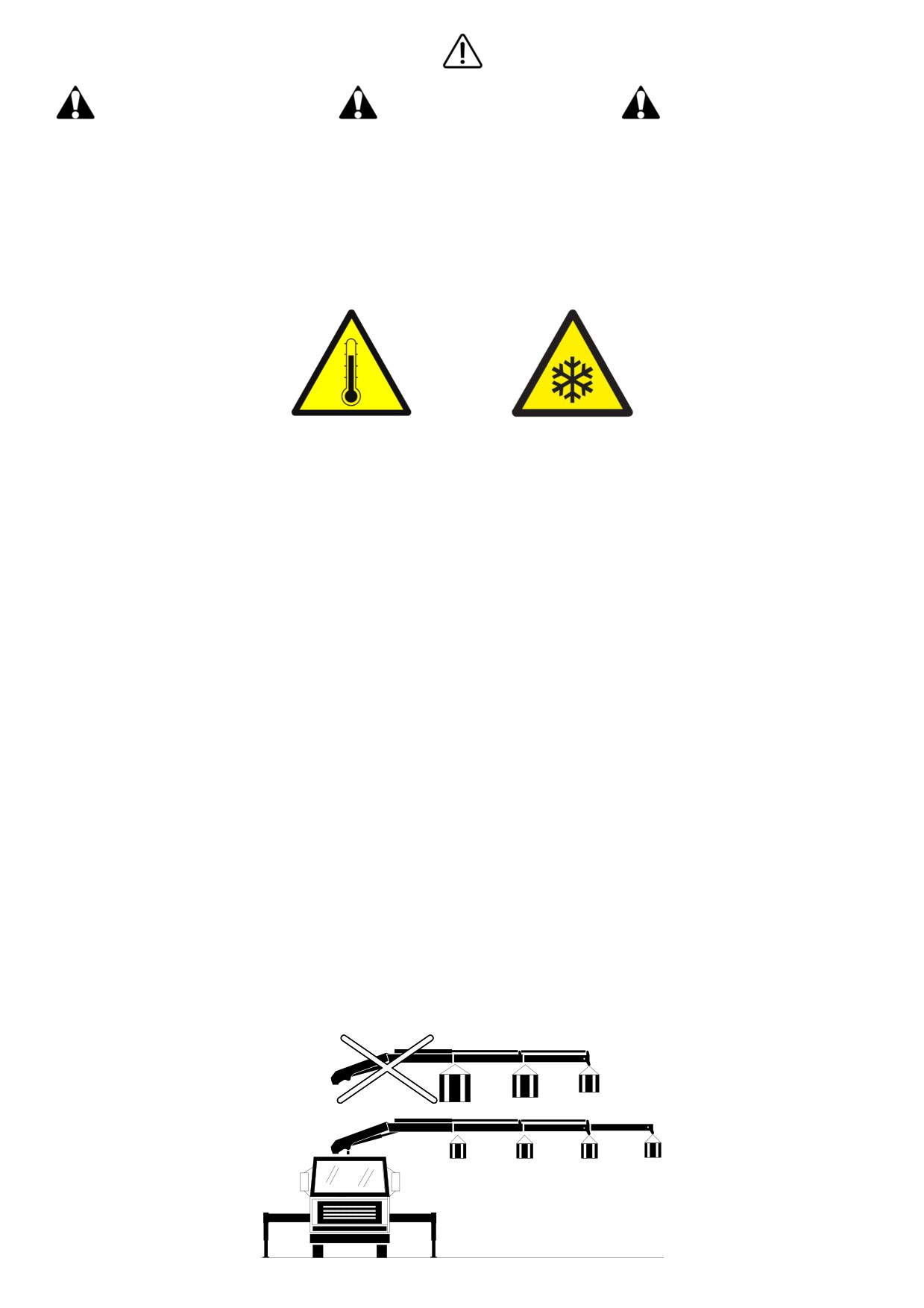
AVVERTENZE
WARNINGS
WARNUNGEN
- Nel caso in cui le condizioni operative
- Do NOT use the crane if the operating
- Wenn die Einsatzbedingungen nicht
non siano compatibili con quelle
conditions are incompatible with the
den Angaben im vorliegenden
indicate
nel presente manuale
instructions given in this manual
Handbuch
(§B.3.3) entsprechen, ist
(§B.3.3),
è severamente vietato
(§B.3.3). Specifically, the user must
die Arbeit mit dem Kran strikt
operare con la gru. In particolare, in
contact the manufacturer of the crane
verboten.
Insbesondere
bei
caso di temperature ambientali fuori
in the event of environmental
Umgebungstemperaturen außerhalb
dal normale intervallo indicato nel
temperatures outside the range
des im vorliegenden Handbuch ange-
presente manuale, l’operatore deve
indicated in this manual.
gebenen Temperaturbereichs muss
interpellare il costruttore prima di
der Kranführer vor Inbetriebnahme
mettere in funzione la gru.
des Krans den Hersteller zu Rate
ziehen.
- In caso di neve e/o ghiaccio pulire i
- Clear any snow or ice from the crane
- Bei Schnee und/oder Eis müssen die
bracci della gru in modo tale da
booms to prevent excessive stress
Kranausleger gesäubert werden, um
evitare sovraccarichi dovuti al peso
caused by the extra weight and to
eine Überlast durch das Gewicht des
della neve stessa e di rimuovere
ensure that movement of telescopic
Schnees zu vermeiden. Eventuelle
eventuali lastre di ghiaccio che
components is not affected.
Vereisungen, die das korrekte Aus-
potrebbero inficiare
il
corretto
und Einfahren der Ausschübe
movimento di uscita/rientro sfili.
behindern könnten, sind ebenfalls zu
entfernen.
- In caso di utilizzo o trasporto in am-
- Contact an authorised assistance
- Bei Verwendung oder Transport in
biente marino è necessario rivolgersi
centre before using or transporting the
maritimer Umgebung ist es zuerst
prima a un centro di assistenza
crane in a marine environment.
notwendig, sich an ein autorisiertes
autorizzato.
Service-Center zu wenden.
- The lifting component to which the
- Das Greifgerät, auf das sich die
- L’organo di presa a cui fanno
diagrams refer in this manual is the
Hubkraftdiagramme des vorliegenden
riferimento i diagrammi portate del
crane hook. If other lifting components
Handbuchs beziehen, ist der
presente manuale è il gancio gru. Per
are to be used the user must contact
Kranhaken. Für andere Greiferarten
organi di presa diversi è necessario
an authorised assistance centre to
muss ein spezifisches Lastdiagramm
farsi rilasciare un diagramma di carico
obtain dedicated load diagrams.
von einem autorisierten Service-
dedicato da un centro di assistenza
Center ausgestellt werden.
autorizzato.
- If a manual extension is used then the
- Falls mit einer manuellen Verlängerung
maximum load for this component is
gearbeitet wird, bestimmt diese die
- Nel caso in cui si operi con prolunga
valid for all operating configurations
zulässige Höchstlast für alle Arbeits-
manuale, questa determina il carico
even when the telescopic sections are
konfigurationen des Krans, auch wenn
massimo ammesso per tutte le
fully retracted. Therefore whatever the
mit
eingefahrenen
Ausschüben
configurazioni di lavoro della gru,
distance from the column axis the
gearbeitet wird. Unabhängig vom
anche quando si opera con sfili
maximum load permitted is the one for
Abstand zur Säulenachse ist die
retratti. Pertanto a qualsiasi distanza
the manual extension currently in use
zulässige Höchstlast deshalb jene der
dall’asse colonna il carico massimo
(the load is indicated on the load
manuellen Verlängerung, mit der
ammesso è quello relativo alla
diagram shown on the plate and
gearbeitet wird
(die Last ist im
prolunga manuale con cui si sta
specified in the user manual).
Hubkraftdiagramm auf dem Typenschild
operando
(il carico è indicato sul
und im Handbuch angegeben).
diagramma portate rappresentato in
targhetta e sul manuale d’uso).
kg
kg
A-3
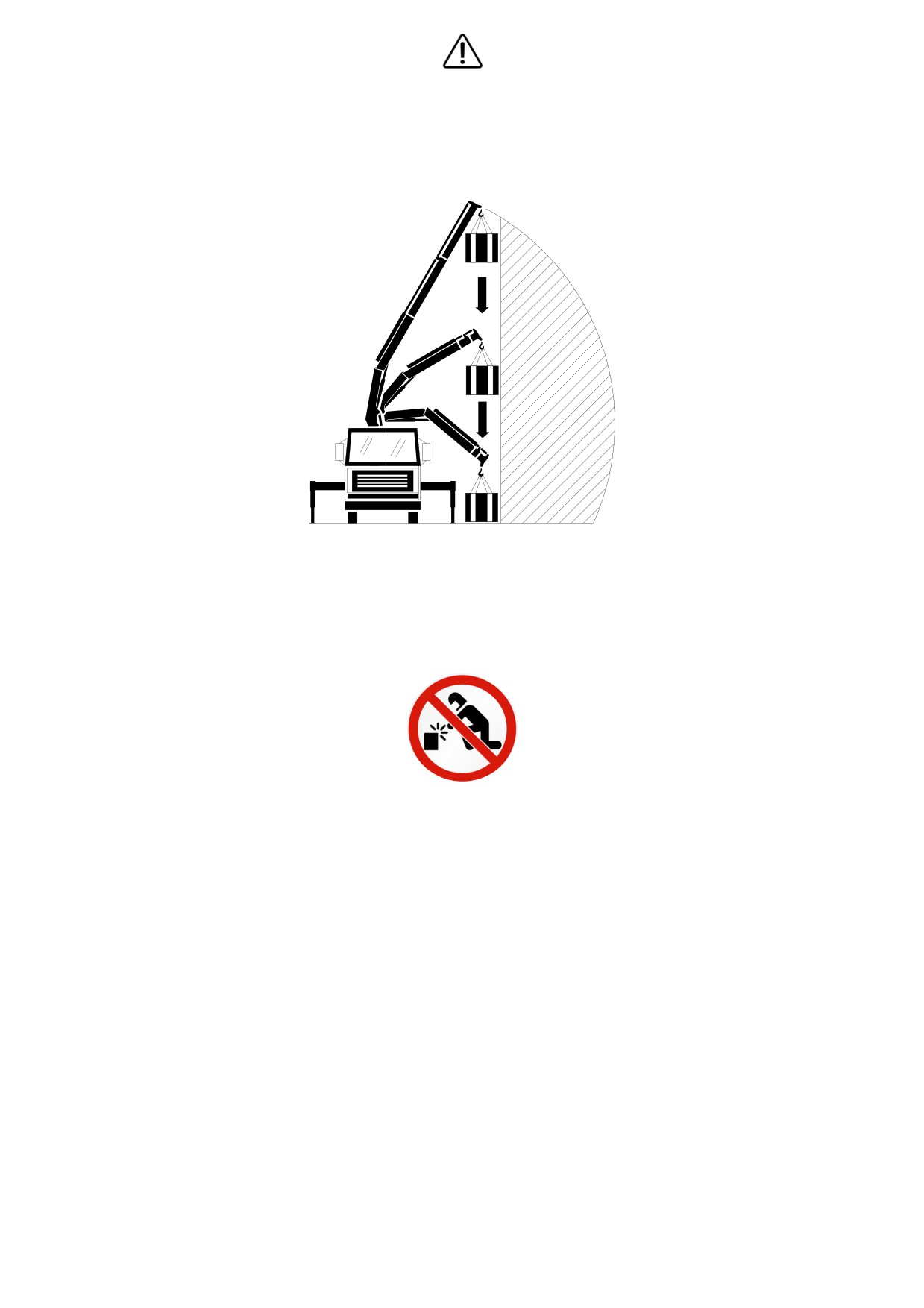
- Non superare mai il valore del
- Do NOT exceed the maximum crane
- Der Wert des max. Hubmoments des
momento di sollevamento massimo
load moment as this may cause
Krans darf niemals überschritten
della gru: questo fatto potrebbe
uncontrollable descent of the load,
werden, denn dadurch könnte ein
causare un’incontrollabile discesa del
damage to components and tipping up
unkontrolliertes Absinken der Last, die
carico, la rottura di componenti e il
of the vehicle.
Beschädigung von Komponenten und
ribaltamento del veicolo.
das Umkippen des Fahrzeugs
verursacht werden.
- È assolutamente vietato effettuare
-
Maintenance on the machine which
- Es ist strikt verboten, Schweißarbeiten
operazioni di manutenzione sulla
requires welding is forbidden. Refer to
an der Maschine vorzunehmen.
macchina tramite saldatura: nel caso
an authorised assistance centre if
Eventuell erforderliche Reparaturen
in
cui si
rendano necessarie
repairs or modifications to metalwork
oder Änderungen am Krangerüst
riparazioni
o
modifiche
alla
are required.
müssen von einem autorisierten
carpenteria è fatto obbligo rivolgersi a
Service-Center durchgeführt werden.
un centro di assistenza autorizzato.
A-4
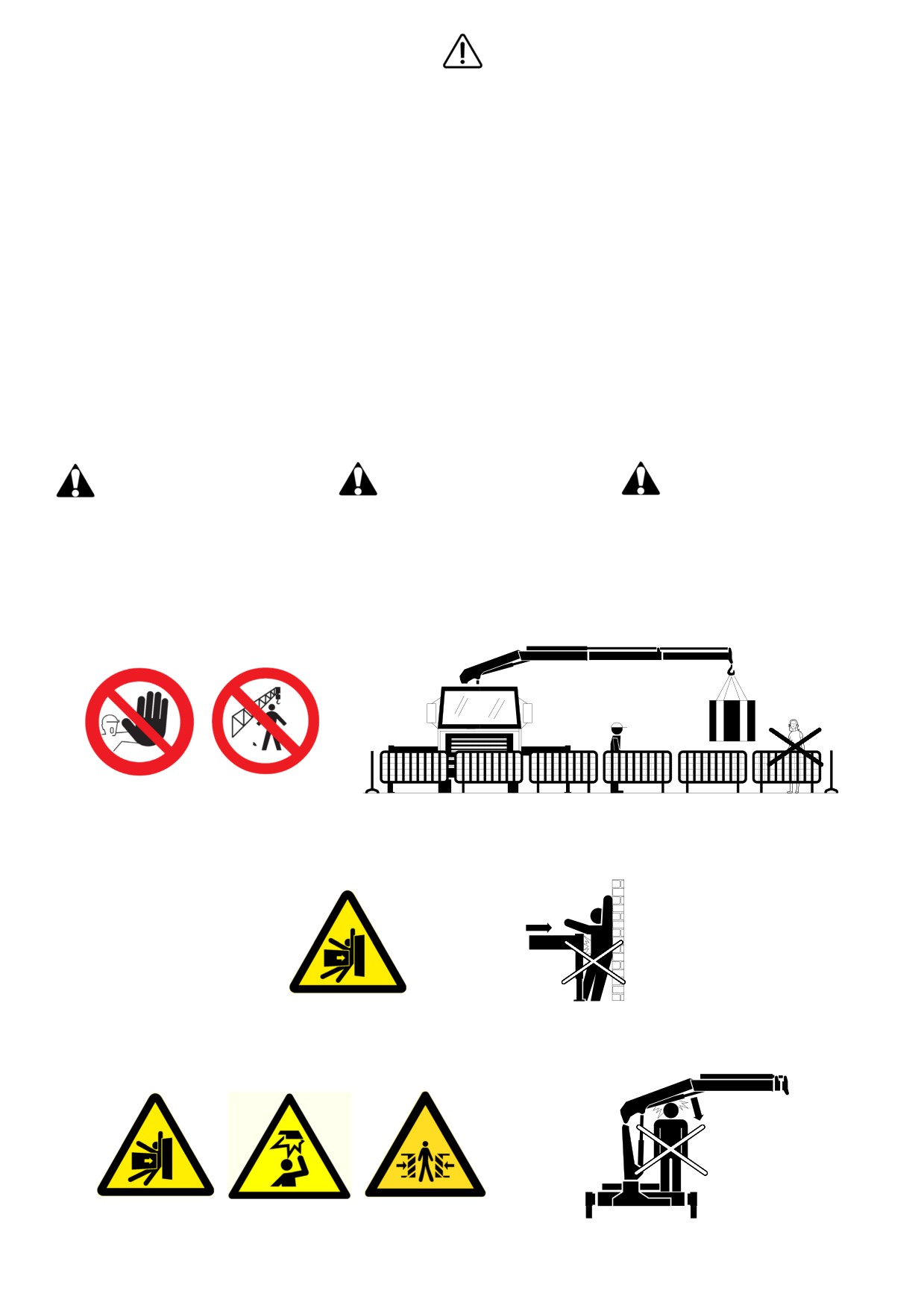
A.1.2 PERICOLO DI
A.1.2 CRUSHING HAZARD
A.1.2 QUETSCHUNGSRISIKO
SCHIACCIAMENTO
I pericoli di schiacciamento derivano
Crushing hazards derive from moving
Quetschgefahren gehen von den
dagli organi in movimento della gru:
components on the crane:
beweglichen Kranteilen aus:
schiacciamento corpo tra gru, cabina
body crushing between the crane,
Einquetschen des Körpers
zwischen
autocarro, cassone
truck cabin and truck body
Kran, Fahrerkabine, Pritsche
schiacciamento arti superiori tra
upper limb crushing between base
Einquetschen der oberen Gliedmaßen
zwischen Sockel und Ausleger
basamento e bracci
and booms
Hand/fingers crushing between levers
Einquetschen
der
Hand/Fimger
schiacciamento mano/dita tra leve e
zwischen Hebeln und Steuerschutz.
protezione comandi
and controls protection
Einquetschen des Körpers zwischen
schiacciamento corpo tra stabilizzatori
body crushing between stabilisers and
ausgefahrenen Stützen und festem
in apertura e corpo fisso
a stationary object during stabilizer
Gehäuse
schiacciamento arti al rientro delle
opening
Einquetschen der Gliedmaßen bei
aste stabilizzatrici
limb crushing when stabiliser rods are
Einfahren der Abstützstangen
schiacciamento arti inferiori sotto il
retracted
Einquetschen der unteren Glied-
piattello dei cilindri stabilizzatori
lower limb crushing under the plate for
maßen unter der Scheibe der Abstütz-
the stabiliser cylinders
schiacciamenti di arti in orifizi
zylinder
limb crushing in openings
Einquetschen von Gliedmaßen in
Öffnungen
AVVERTENZE
WARNINGS
WARNUNGEN
- L’operatore, prima di iniziare le
- Cordon off the working area using
- Bevor er mit der Arbeit beginnt, muss
operazioni, deve circoscrivere la zona
barriers and warning signs before
der Kranführer den Arbeitsbereich mit
di lavoro con apposite transenne e
starting any operations with the crane.
entsprechenden Schranken absperren
vietarne l’ingresso con cartelli di
Use special signals to warn others
und den Zutritt mit Gefahrenschildern
pericolo. Deve comunicare l’inizio
when crane movement is about to
verbieten. Der Beginn der Manöver ist
delle
manovre con apposite
start.
mit geeigneten Warnungen zu
segnalazioni.
signalisieren.
- Non sostare in prossimità delle aste
- Keep all
personnel away from the
- Der Aufenthalt in der Nähe der aus-
stabilizzatrici idrauliche in uscita in
hydraulic
stabiliser
rods during
fahrenden hydraulischen Stangen in
direzione di apertura.
opening.
Öffnungsrichtung ist verboten.
- Non salire sul basamento gru quando
- Do NOT climb on to the crane base
- Bei laufendem Fahrzeugmotor nicht
l’autocarro ha il motore acceso.
when the truck engine is running.
auf den Kransockel klettern.
A-5
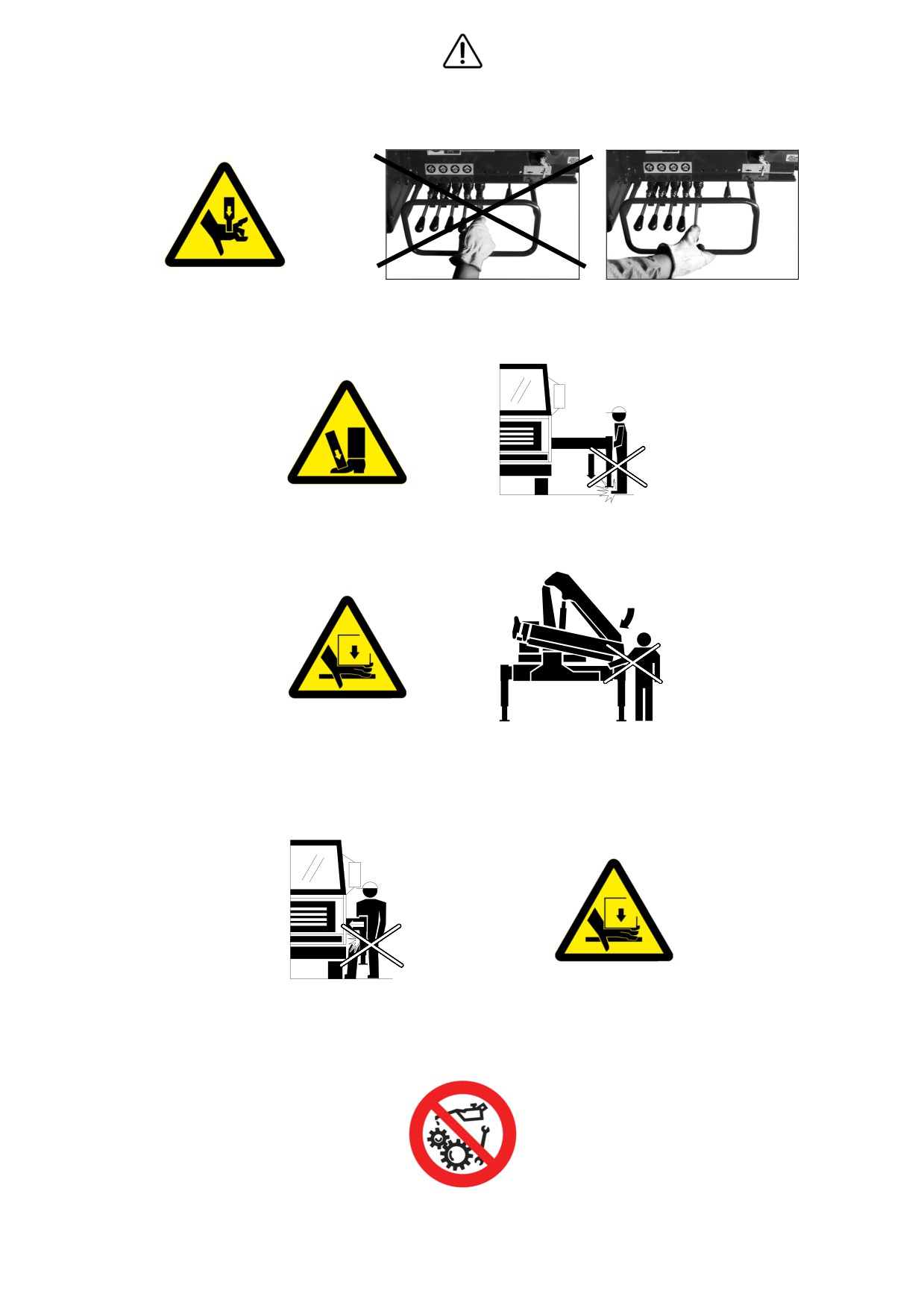
- Durante la movimentazione della gru,
- When handling the crane, avoid
- Bei der Kranbewegung nie die
mai impugnare le leve di comando,
grasping the control levers: operate
Bedienhebel ergreifen, sondern nur
ma azionarle solo con le dita.
them only with the fingers.
mit den Fingern betätigen.
OK
- Non posizionare il piede o arti in
- Do NOT place hands or feet under the
- Den Fuß oder Gliedmaßen nicht unter
genere sotto il piattello del cilindro
stabiliser cylinder plate.
die Scheibe des Abstützzylinders
stabilizzatore.
bringen.
- In fase chiusura gru non interporre gli
- Do NOT place any limbs between the
- Während des Schließvorgangs des
arti tra basamento e braccio.
base and boom during crane closing.
Krans nicht die Gliedmaßen zwischen
Sockel und Ausleger bringen.
- In
fase di rientro delle aste
- Do NOT place lower limbs between
- Beim Einziehen der Abstützstangen
stabilizzatrici non interporre mai gli arti
the stabiliser cylinder and truck and
auf keinen Fall die unteren
inferiori tra il cilindro stabilizzatore e
do NOT place hands near the
Gliedmaßen zwischen Abstützzylinder
l’autocarro e le mani in prossimità
stabiliser
rods
during
closing
und Lkw bringen, und die Hände von
delle aste stabilizzatrici
(retraction) of the stabiliser rods.
den Abstützstangen fernhalten.
- Non
eseguire
operazioni
di
- Do NOT perform maintenance when
- Niemals Wartungsarbeiten durchfüh-
manutenzione ordinaria con gru in
the crane is moving or when the
ren, solange sich der Kran bewegt
movimento o con presa di forza
power take-off is enabled. Do NOT
oder die Zapfwelle eingeschaltet ist.
innestata. Non venire a contatto col la
touch the crane when it is moving.
Den Kran nicht berühren, solange er
gru quando è in movimento.
sich bewegt.
A-6
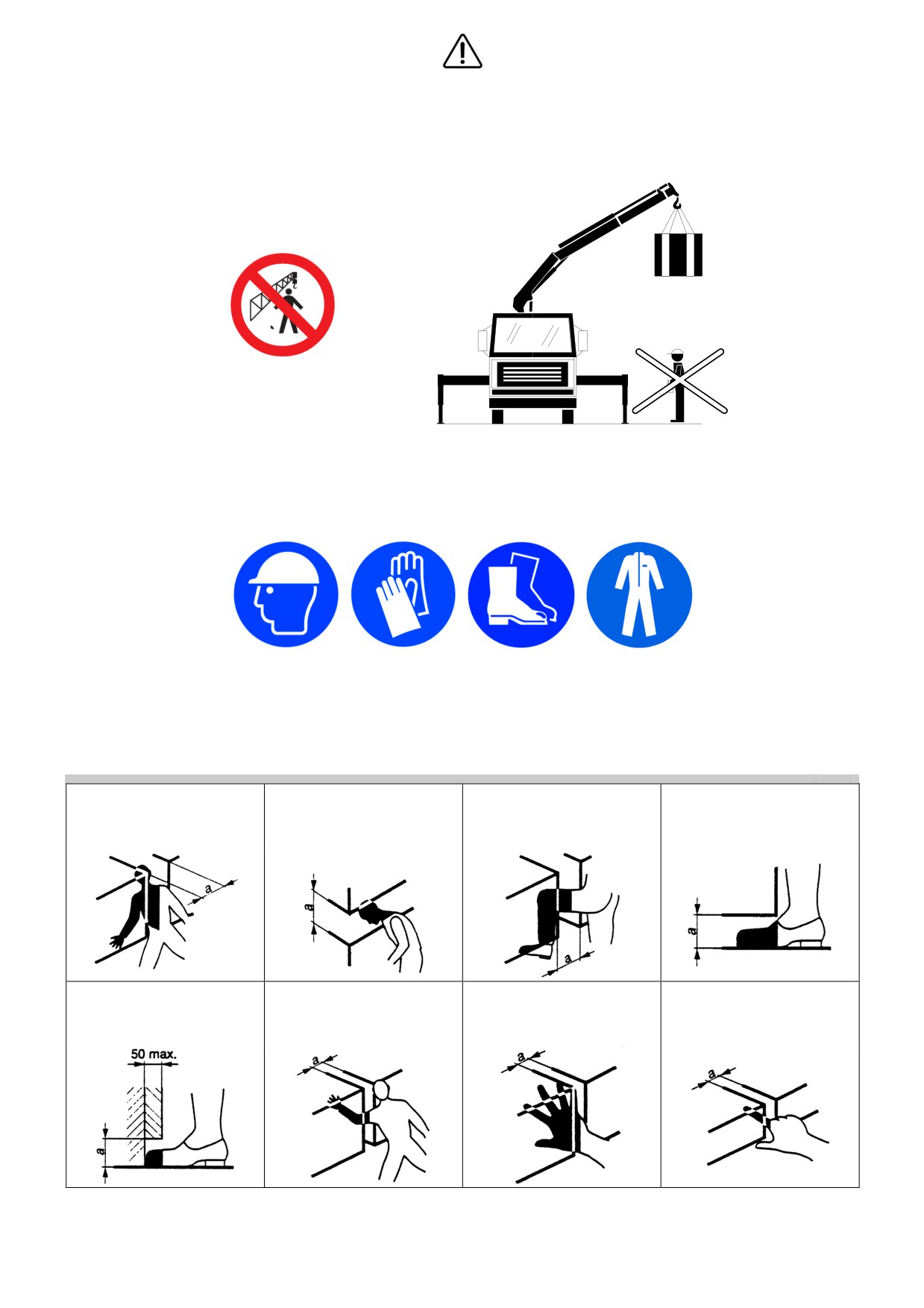
- Evitare situazioni pericolose dove
- Avoid hazardous situations in which
- Gefährliche Situationen, in denen der
l’operatore o i passanti possano
the user, other personnel or passers-
Kranführer oder Passanten vom Kran,
venire schiacciati dalla gru, dagli
by may be crushed by the crane,
von den Stützen oder von der Last
stabilizzatori o dal carico.
stabilisers or the load.
eingequetscht
werden
können,
vermeiden.
- Utilizzare sempre elmetto, scarpe
- Always wear a helmet, industrial
- Immer Schutzhelm, Sicherheits-
antinfortunistiche, guanti da lavoro.
footwear and gloves.
Do NOT wear
schuhe und Arbeitshandschuhe
Evitare di indossare indumenti con
loose or baggy clothing. Personnel
tragen. Keine Kleidung tragen, die
facili appigli. Si consiglia pertanto di
must wear overalls.
leicht hängen bleiben kann. Am
far uso di una tuta da lavoro.
besten einen Arbeitsoverall tragen.
- Rispettare e far rispettare le distanze
- Abide by safety distances and make
- Die Sicherheits-Mindestabstände ein-
minime di sicurezza
(EN 349, vedi
sure all others do the same (EN 349,
halten und für ihre Einhaltung sorgen
Tab. A-1).
see Tab. A-1).
(EN 349, siehe Tab. A-1).
Tab. A-1: Distanze minime di sicurezza - Min. safety distances - Min. Sicherheitsabstände
CORPO
TESTA
GAMBA
PIEDE
BODY
HEAD
LEG
FOOT
KÖRPER
KOPF
BEIN
FUSS
a > 500 mm
a > 300 mm
a > 180 mm
a > 120 mm
DITA DEL PIEDE
BRACCIO
MANO
DITO DELLA MANO
TOES
ARM
HAND
FINGER
ZEHE
a > 120 mm
a > 100 mm
a > 25 mm
a > 50 mm
A-7
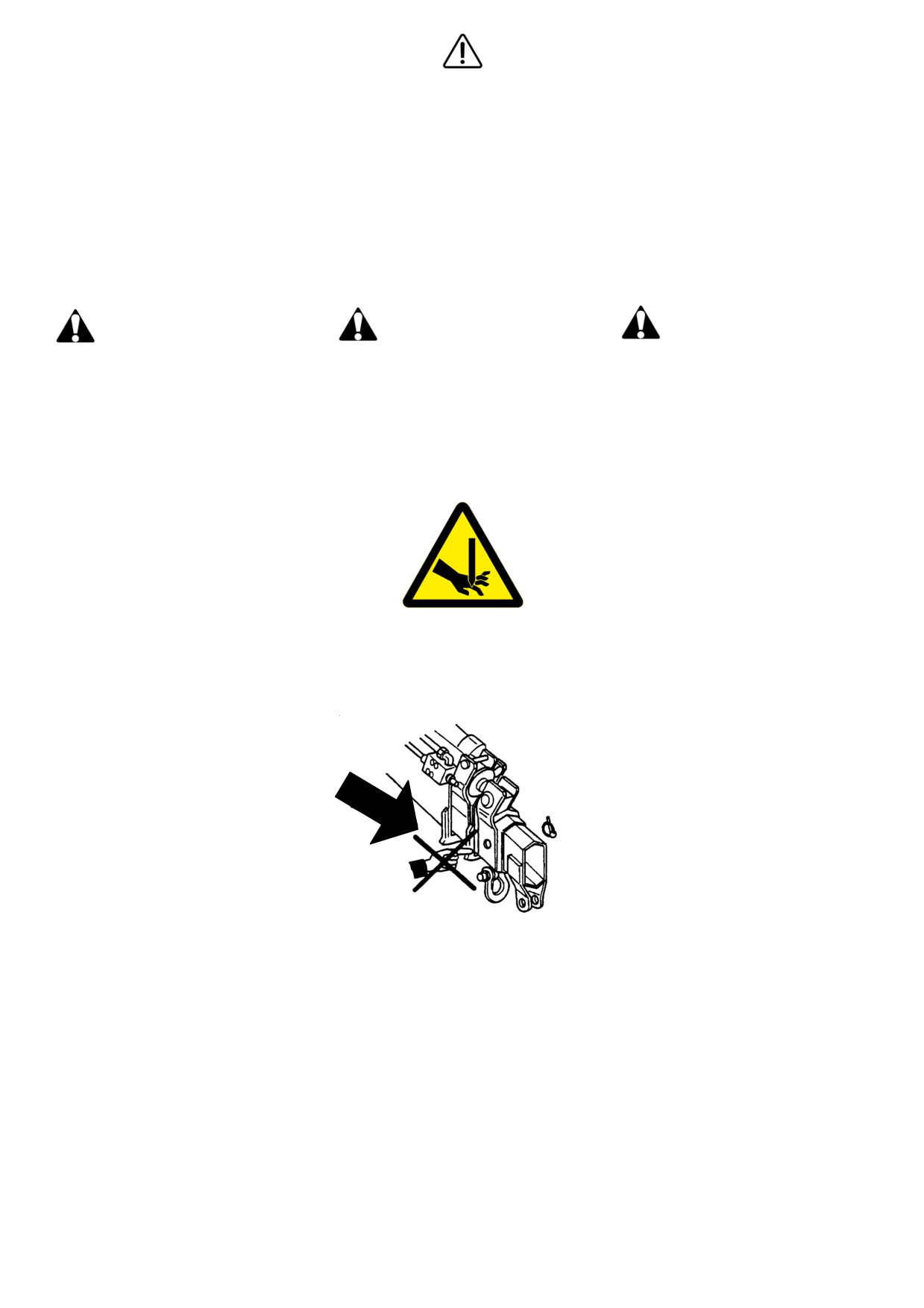
A.1.3 PERICOLO DI
A.1.3 CUTTING HAZARD
A.1.3 SCHERGEFAHR
CESOIAMENTO
Pericolo residuo legato al movimento
Residual hazard associated with
Restgefahr, die auf die Bewegung der
relativo dei bracci e le eventuali bielle in
movement of booms and any
Ausleger und auf die eventuellen Pleuel
movimento relativo. Esiste il rischio
connecting rods. A residual cutting
in relativer Bewegung zurückzuführen
residuo di cesoiamento degli arti
hazard exists for the upper limbs
ist. Es besteht die Restgefahr der
superiori tra parti in movimento relativo
between moving parts associated with
Abtrennung der oberen Gliedmaßen
delle articolazioni dei bracci, del
the booms, base and telescopic
zwischen beweglichen Teilen der
basamento e degli sfili.
components.
Auslegergelenke, des Sockels und der
Ausschübe.
WARNINGS
WARNUNGEN
AVVERTENZE
- When the crane is in operation do
- Während des Kranbetriebs unter
- Non inserire gli arti superiori per
nessun motivo a gru operativa tra le
NOT place upper limbs between the
keinen Umständen die oberen
articolazioni dei bracci e degli
boom joints, near connecting rods or
Gliedmaßen zwischen die Gelenke
in the area where stabiliser rods are
der Ausleger und des eventuellen
eventuali biellismi della gru e in
prossimità dell’ingresso delle aste
retracted into the base. Do NOT insert
Pleuelwerks des Krans oder in die
stabilizzatrici nel basamento. Non
fingers, feet or limbs inside openings
Nähe des Einzugs der Abstützstangen
inserire dita, piedi, arti in genere
on moving parts.
im Sockel bringen. Finger, Füße und
dentro a orifizi di organi in movimento.
Gliedmaßen nicht in Öffnungen
beweglicher Maschinenteile stecken.
- Non inserire dita nelle sedi libere di
- Do NOT insert fingers inside
- Die Finger nicht in die Einbausitze von
perni o organi di fissaggio
(in
unoccupied
pin
or
securing
Bolzen oder Befestigungselementen
particolare dei perni delle prolunghe
component housings (in particular pin
stecken (insbesondere der Bolzen der
manuali).
housing for manual extensions).
manuellen Verlängerungen).
- Non posizionarsi tra basamento e
- Do NOT stand between the base and
- Während des Schließvorgangs des
bracci durante tutte l’operazione di
booms during crane
closing
Krans ist der Aufenthalt zwischen
chiusura della gru (vedi §A.1.2)
(see §A.1.2)
Sockel und Ausleger verboten
(siehe §A.1.2)
- Rispettare e far rispettare le distanze
- Abide by safety distances and make
minime di sicurezza
(vedi
§A.1.2,
sure all others do the same
- Die
Sicherheits-Mindestabstände
Tab. A-1).
(see §A.1.2, Tab. A-1).
einhalten und für ihre Einhaltung
sorgen (siehe §A.1.2, Tab. A-1).
A-8
A.1.4 PERICOLO DI
A.1.4 DRAGGING OR
A.1.4 GEFAHR DES
TRASCINAMENTO O
ENTRAPMENT HAZARD
ERFASSENS UND
INTRAPPOLAMENTO
EINZIEHENS
Pericolo residuo legato alla mancato
Residual hazard associated with failure
Restgefahr, die auf die Nichteinhaltung
rispetto delle distanze di sicurezza nella
to abide by safety distances in the crane
der Sicherheitsabstände im Arbeitsbe-
zona operativa della gru.
operating area.
reich des Krans zurückzuführen ist.
AVVERTENZE
WARNINGS
WARNUNGEN
- Utilizzare sempre elmetto, scarpe
- Always wear a helmet, industrial
- Immer Schutzhelm, Sicherheits-
antinfortunistiche, guanti da lavoro.
footwear and gloves. Do NOT wear
schuhe und Arbeitshandschuhe
Evitare di indossare indumenti con
loose or baggy clothing. Personnel
tragen. Keine Kleidung tragen, die
facili appigli. Si consiglia pertanto di
must wear overalls secured using
leicht hängen bleiben kann. Es
far uso di una tuta da lavoro
buttons and without loose or baggy
empfiehlt
sich
daher,
einen
abbottonata e senza appendici
parts.
zugeknöpften Arbeitsoverall
ohne
volanti.
flatternde Teile zu tragen.
- Non inserire dita, piedi, arti in genere
- Do NOT insert fingers, feet or limbs
- Finger, Füße und Gliedmaßen nicht in
dentro a orifizi di organi in movimento.
inside openings on moving parts.
Öffnungen
beweglicher
Maschinenteile stecken.
A.1.5 PERICOLO DI URTO
A.1.5 IMPACT HAZARD
A.1.5 STOSSGEFAHR
Pericolo residuo legato a
Residual hazard associated with
Restgefahr infolge
urto
contro
il
braccio
in
impact with the crane boom during
Stoß gegen den aus-/einfahrenden
apertura/chiusura della gru
opening/closing
Kranausleger
urto contro il carico movimentato
impact with the moving load
Stoß gegen die beförderte Last
urto contro gli stabilizzatori
impact with the stabilisers
Stoß gegen die Stützen
urto contro prolunghe manuali
impact with manual extensions
Stoß gegen manuelle Verlängerungen
urto dovuto allo sganciamento del
impact caused by release of the load
Stoß durch Lösen der Last
carico
AVVERTENZE
WARNINGS
WARNUNGEN
- Attenzione a non urtare contro parti in
- Take care not to bump into moving
- Vorsicht, nicht gegen in Bewegung
movimento della gru: in particolare
parts on the crane. Specifically, do
befindliche Teile des Krans stoßen.
attenzione e non urtare col capo
NOT bang your head on the boom
Insbesondere nicht mit dem Kopf
contro il braccio in apertura e chiusura
during crane opening and closing.
gegen den aus- oder einfahrenden
gru.
Kranausleger stoßen.
A-9
- Attenzione a non urtare contro gli
- Do NOT bang into the stabilisers
- Während der Stabilisierung des Krans
stabilizzatori durante l’operazione di
when the crane is being stabilised.
nicht gegen die Stützen stoßen.
stabilizzazione gru.
- È
necessario
prestare
molta
- Take great care not to bump into the
- Unbedingt aufpassen, nicht gegen die
attenzione a non urtare contro il carico
suspended load. The load must
schwebende Last zu stoßen. Der
sospeso. L’operatore deve attenersi a
always be moved under safe
Kranführer muss die Last in
movimentare il carico in sicurezza,
conditions away from potential
Sicherheit, gemäß den Vorschriften
secondo le prescrizioni del presente
hazards and obstacles, as specified in
des vorliegenden Handbuchs und fern
manuale e lontano da possibili pericoli
this manual.
von möglichen Gefahren und
e ostacoli.
Hindernissen befördern.
- Verificare sempre che gli organi di
- Always check that the load lifting
- Immer sicherstellen, dass die Hubgeräte
presa del carico
(gancio, grillo,
components
(hook, shackle, slings,
(Haken, Schäkel, Anschlagmittel, Ketten)
imbracature, catene) siano in perfette
chains) are in perfect condition. Do
in perfektem Zustand sind, außerdem
condizioni, verificare che il carico non
NOT exceed the maximum load
sicherstellen, dass die Last nie den auf
superi mai il carico di targa. Verificare
indicated on the plate. Check that the
dem Typenschild angegebenen Wert
che il carico sia agganciato in maniera
load is properly secured to prevent
übersteigt. Sicherstellen, dass die Last
opportuna e tale da scongiurare
accidental falling. Do NOT stand
gut gesichert ist, um das Risiko eines
qualsiasi rischio di caduta accidentale.
under the load.
versehentlichen Herabfallens abzuwen-
Non sostare mai sotto il carico.
den. Nicht unter der schwebenden Last
verweilen.
- Nel caso in cui la gru fosse dotata di
- If the crane is fitted with rotary
- Wenn der Kran mit drehbaren
cilindri
stabilizzatori
girevoli
è
stabiliser cylinders, remain away from
Abstützzylindern ausgestattet ist,
necessario mantenersi esterni al
the cylinder to prevent unwanted
muss sich der Bediener außerhalb
martinetto per evitare di essere colpiti
impact (1). If a manual extension is
des Hebebocks aufhalten, um nicht
(1). In caso di prolunga manuale è
used avoid boom positions causing
getroffen zu werden (1). Im Falle einer
necessario evitare posizioni del
the unpinned extension to move at
manuellen Verlängerung müssen
braccio che possano imprimere
high speeds. Keep away from the
Auslegerpositionen
vermieden
velocità
elevate
alla
prolunga
extension's trajectory (2).
werden, die hohe Geschwindigkeiten
scollegata. Mantenersi fuori dalla sua
an die getrennte Verlängerung
traiettoria di uscita (2).
übertragen können. Nicht innerhalb
ihrer Auswurfbahn verweilen (2).
2
1
A-10
- Se la gru è dotata di stabilizzatori
- If the crane is equipped with stabilizer
- Wenn der Kran mit drehbaren
girevoli che ruotano automaticamente
legs that turn automatically during
Abstützbeinen ausgestattet ist, die
durante l'estensione e la chiusura,
their extension and retraction, take
automatisch während des Aus- und
l'operatore deve prestare la massima
care to prevent impact with things and
Einfahrens
schwenken,
der
attenzione per evitare urti con
persons during the rotation.
Kranführer muss unbedingt darauf
persone e cose durante la rotazione.
achten, um Stöße mit Sache und und
Personen während der Rotation zu
vermeiden.
A-11
A.1.6 PERICOLO DI
A.1.6 OIL LEAK HAZARD
A.1.6 ÖLSPRITZGEFAHR
EIEZIONE DI OLIO
L’eiezione di olio idraulico può
Hydraulic fluid leaks can cause burns,
Das Herausspritzen von Hydrauliköl
provocare ustioni, può irritare occhi e
irritation to the skin and eyes and can
kann Verbrennungen verursachen,
pelle, può penetrare sotto la pelle.
even penetrate under the skin.
Augen und Haut reizen und in die Haut
Questi rischi sono dovuti all’errato
These hazards are associated with
eindringen. Diese Gefahren sind auf
serraggio dei raccordi, allo sfregamento
incorrect tightening of couplings,
den falschen Anzug der Anschlüsse,
dei tubi flessibili contro parti o oggetti
rubbing of flexible hoses against metal
auf das Reiben der Schläuche gegen
metallici, alla torsione eccessiva dei
objects or components, excessive
Metallteile,
auf
die
übermäßige
tubi, a un errato scollegamento dei tubi
bending
of
hoses,
incorrect
Verdrehung der Schläuche, auf einen
durante la manutenzione, ad un’errata
disconnection
of
hoses during
falschen Schlauchanschluss während
riparazione, all’invecchiamento, ecc.
maintenance, incorrect repairs, ageing,
der Wartung, auf eine falsche
etc.
Reparatur, auf Alterungserscheinungen
usw. zurückzuführen.
AVVERTENZE
WARNINGS
WARNUNGEN
- Durante le prime operazioni di lavoro
- When the crane is new and used for
- Aufgrund der Wärmeausdehnung
a gru nuova, si potrebbero verificare
the first time small leaks of oil from the
durch die hohe Temperatur des
piccoli trafilamenti d’olio dai raccordi
couplings may occur due to the heat
Hydrauliköls kann während der ersten
dovuti alle dilatazioni termiche dovute
expansion caused by the high
Arbeiten mit dem neuen Kran unter
alla temperatura elevata dell’olio
temperature of the hydraulic fluid.
Umständen an den Anschlüssen
idraulico. Si rende necessario quindi
Tighten the couplings using the torque
etwas Öl austreten. In diesem Fall
serrare i raccordi con la coppia
settings
suggested
in
the
müssen die Anschlüsse mit dem im
consigliata nel MM. Un serraggio
maintenance manual. Couplings may
Wartungshandbuch
empfohlenen
eccessivo
può
danneggiare
be damaged if they are too tight.
Moment angezogen werden. Durch
l’accoppiamento.
ein zu hohes Anzugsmoment kann
- The crane is designed in such a way
der Anschluss beschädigt werden.
- La gru è stata progettata in modo tale
to prevent rubbing of flexible hoses
da scongiurare qualsiasi sfregamento
against moving parts. However the
- Der Kran ist so ausgelegt, dass die
di
tubi flessibili
con parti in
installation configuration may cause
Schläuche nicht an beweglichen
movimento. Ciononostante se la
hoses to come into contact with other
Teilen reiben können. Sollten die
configurazione di installazione è tale
moving parts. If this happens use
Schläuche
aufgrund
der
che dei tubi vengano in contatto con
additional sheaths to protect the
Installationskonfiguration dennoch in
altre parti in movimento si rende
hoses.
Kontakt mit anderen beweglichen
necessario salvaguardarli con guaine
Teilen kommen, müssen sie mit
- If a hose becomes damaged switch
protettive aggiuntive.
zusätzlichen
Ummantelungen
OFF the machine immediately and
geschützt werden.
- In caso di rottura di tubazioni bloccare
identify the damaged area using a
immediatamente la macchina e
piece of card or wood. Spurts of fluid
- Im Fall von Leitungsbrüchen muss die
verificare il punto di rottura tramite
from a very small hole are powerful
Maschine sofort angehalten, und die
cartoncino o pezzo di legno: un fluido
enough to penetrate the skin.
Bruchstelle mithilfe eines Kartons
che trafila da un foro molto piccolo
oder Holzstücks ausfindig gemacht
- Switch OFF the supply to the system
può avere la forza sufficiente per
werden: Eine aus einem sehr kleinen
and release the residual pressure
penetrare sottopelle.
Loch austretende Flüssigkeit kann
from the hydraulic circuit before
ausreichend Kraft haben, um in die
- Prima che vengano scollegate le
disconnecting any hoses.
Haut einzudringen.
tubazioni devono essere adottate le
- When using blowtorches and other
precauzioni
necessarie atte a
- Bevor die Leitungen getrennt werden,
welding equipment for repairs
garantire che nel circuito idraulico non
müssen
die
erforderlichen
(authorised assistance centres only)
vi sia pressione residua dopo il
Sicherheitsmaßnahmen
ergriffen
switch OFF the pressure to the
disinserimento
dell’alimentazione
werden, um zu garantieren, dass nach
hydraulic system and work away from
dell’impianto.
Abschalten der Versorgung der
hoses and steel lines.
Anlage
kein
Restdruck
im
- In caso di utilizzo di saldatrici o
Hydraulikkreis vorhanden ist.
cannelli per riparazioni (solo da parte
di off. autorizzata) è necessario
- Bei Einsatz von Schweißbrennern
togliere
pressione
all’impianto
oder Lötkolben
(nur durch ein
idraulico e lavorare lontano dalle
autorisiertes Service-Center) muss die
tubazioni, sia flessibili che in ferro.
Hydraulikanlage drucklos gesetzt, und
fern von Schläuchen und Rohren
gearbeitet werden.
A-12
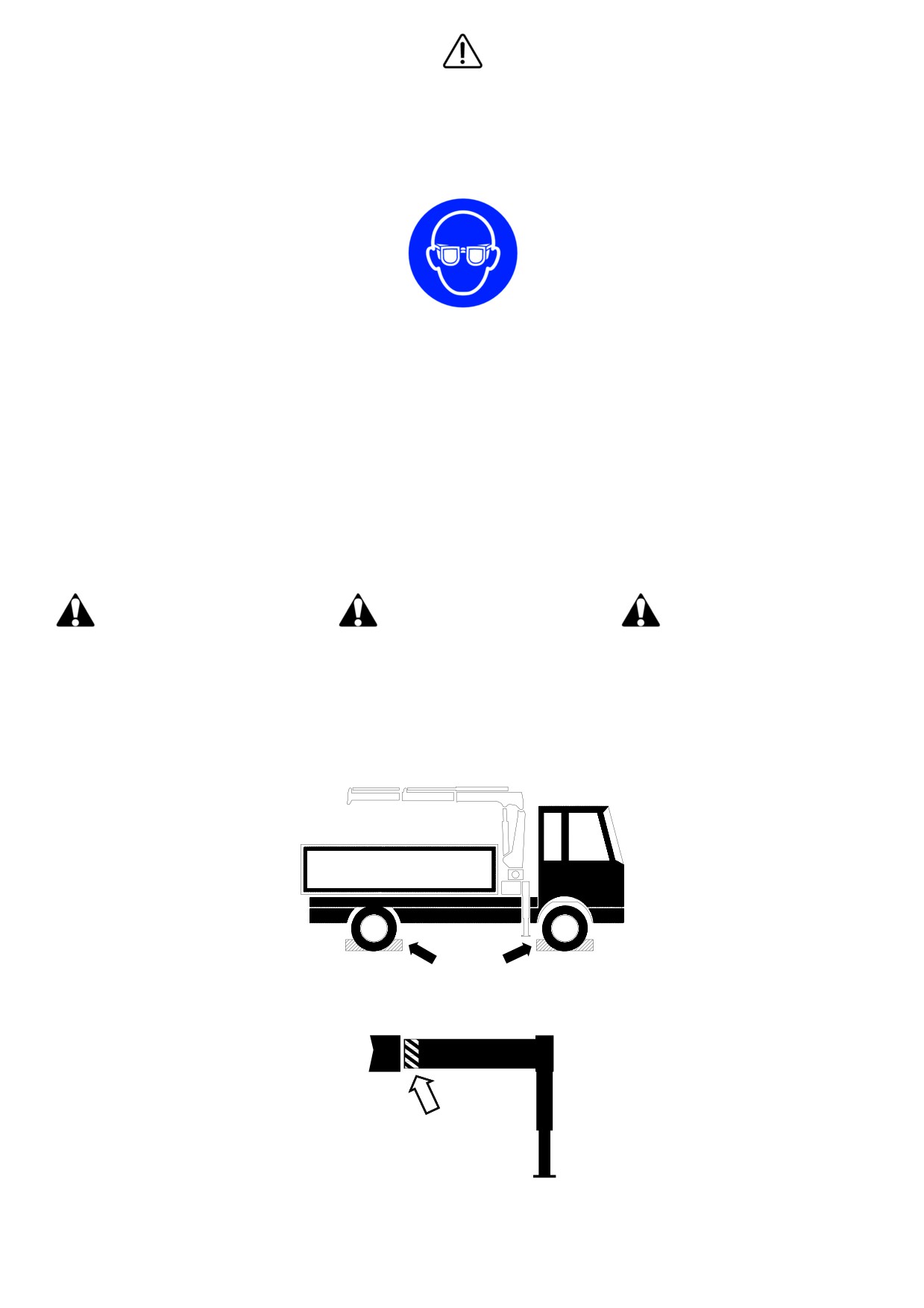
- In caso di guasto, avaria e riparazione
- All maintenance personnel operating
- Im Falle von Betriebsstörungen,
dell’impianto idraulico è necessario
on the hydraulic system must wear
Schäden und Reparatureingriffen an
eseguire la riparazione indossando,
safety footwear, oil-proof gloves,
der Hydraulikanlage müssen für die
oltre alle scarpe di sicurezza, i guanti
overalls, helmet and goggles.
Reparatur Sicherheitsschuhe, ölfeste
antiolio, la tuta da lavoro, l’elmetto
Handschuhe, Arbeitsoverall, Schutz-
anche gli occhiali di sicurezza.
helm sowie eine Schutzbrille getragen
werden.
A.1.7 PERDITA DI STABILITÀ
A.1.7 LOSS OF STABILITY
A.1.7 STABILITÄTSVERLUST
La perdita di stabilità della macchina
Loss of machine stability can cause
Der Stabilitätsverlust der Maschine
può provocare serissimi danni a
serious damage to property and injury
kann
ernste
Personen-
und
persone e cose, pertanto è tassativo
to persons. Carefully follow the
Sachschäden zur Folge haben. Die im
seguire le procedure indicate nel MU
stabilisation
procedure instructions
Bedienungshandbuch beschriebenen
per quanto riguarda la corretta
specified in the user manual. Do NOT
Anleitungen
für
die
korrekte
procedura di stabilizzazione. non
tamper with safety devices. Stabilise the
Durchführung der Stabilisierung sind
manomettere i dispositivi di sicurezza, e
crane on firm ground.
daher strikt
zu befolgen. Die
stabilizzare la gru su terreno non
Sicherheitseinrichtungen unter keinen
cedevole.
Umständen verändern und den Kran
auf einem festen Boden stabilisieren.
AVVERTENZE
WARNINGS
WARNUNGEN
Eseguire la stabilizzazione della
Stabilise the machine in accordance
Die Stabilisierung der Maschine ist
macchina secondo le specifiche indicate
with the safety instructions given in the
gemäß den Spezifikationen im
nel MU: in particolar modo:
user manual, specifically:
Bedienungshandbuch
auszuführen.
Insbesondere:
- Accertarsi che il veicolo sia frenato e
- Check that the parking brake is ON
- Sicherstellen, dass die Bremse
bloccato con apposite zeppe.
and that the wheels are secured using
angezogen und das Fahrzeug mit
chocks.
Bremskeilen blockiert ist.
- Verificare
accuratamente
che
- Check that the rods are fully open.
- Genau kontrollieren, ob die Stangen
l’apertura delle aste sia completa.
vollständig ausgefahren sind.
A-13
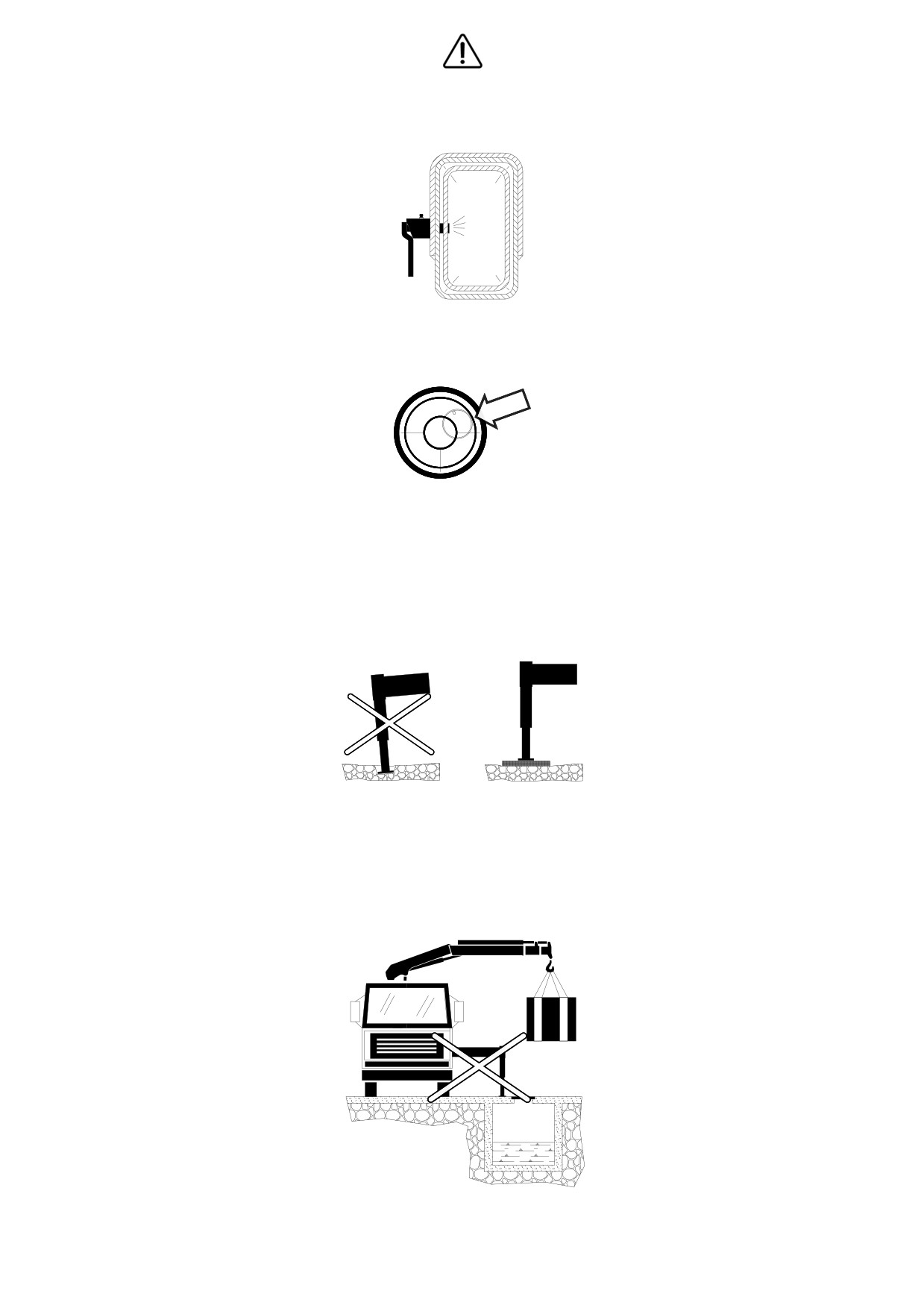
- Accertarsi del perfetto bloccaggio
- Check that the stabiliser rods are
- Bei Öffnung von Hand sicherstellen,
delle aste stabilizzatrici in posizione di
locked in the open position in the
dass
die
Abstützstangen
in
apertura in caso di apertura manuale.
event of manual opening.
ausgefahrener
Stellung
sicher
blockiert sind.
- Verificare che la gru non sia inclinata
- Check that the crane is not inclined at
- Im Vergleich zur Ebene darf die
rispetto all’orizzontale di un angolo
an angle greater than the maximum
Neigung des Krans nicht den
superiore al valore massimo G
permitted G value (use a spirit level).
Höchstwert G übersteigen (Kontrolle
(controllo bolle di planarità).
mit Wasserwaage).
G°
- Verificare che il suolo non ceda sotto
- Make sure that the ground remains
- Der Boden darf unter dem Druck der
la pressione degli stabilizzatori. In
firm under the pressure of the
Stützen nicht nachgeben. Andernfalls
caso di cedimenti l’operatore deve
stabilisers. If it does not, retract the
muss der Kranführer sofort den
fare immediatamente rientrare il
telescopic boom immediately, place
Ausschub einfahren und die Last
braccio telescopico, appoggiare il
the load on the ground and increase
absetzen. Die Arbeit darf erst wieder
carico e riprendere il lavoro solo dopo
the support surface area of the plate
aufgenommen werden, nachdem die
aver
aumentato la
superficie
using other larger plates before
Auflagefläche der Scheibe mit
d’appoggio del piattello con piastre
restarting work.
entsprechend bemessenen Platten
opportunamente dimensionate.
vergrößert wurde.
-
- Non appoggiare gli stabilizzatori in
- Do NOT place the stabilisers near
- Die Stützen nicht in der Nähe von
prossimità di scarichi,
tombini,
drains, manholes, wells, electric
Abläufen, Gullys, Kanalisationen,
fognature, pozzetti, condotti elettrici e,
conduits and in general on any
Brunnenschächten,
elektrischen
in generale, su qualsiasi superficie di
surface unable to support the full force
Leitungen und generell auf keinem
cui non si è certi possa reggere la
of the stabilisers.
Untergrund aufstellen, von dem man
forza massima degli stabilizzatori.
nicht sicher ist, dass er die maximale
Krafteinwirkung der Stützen aushalten
kann.
A-14
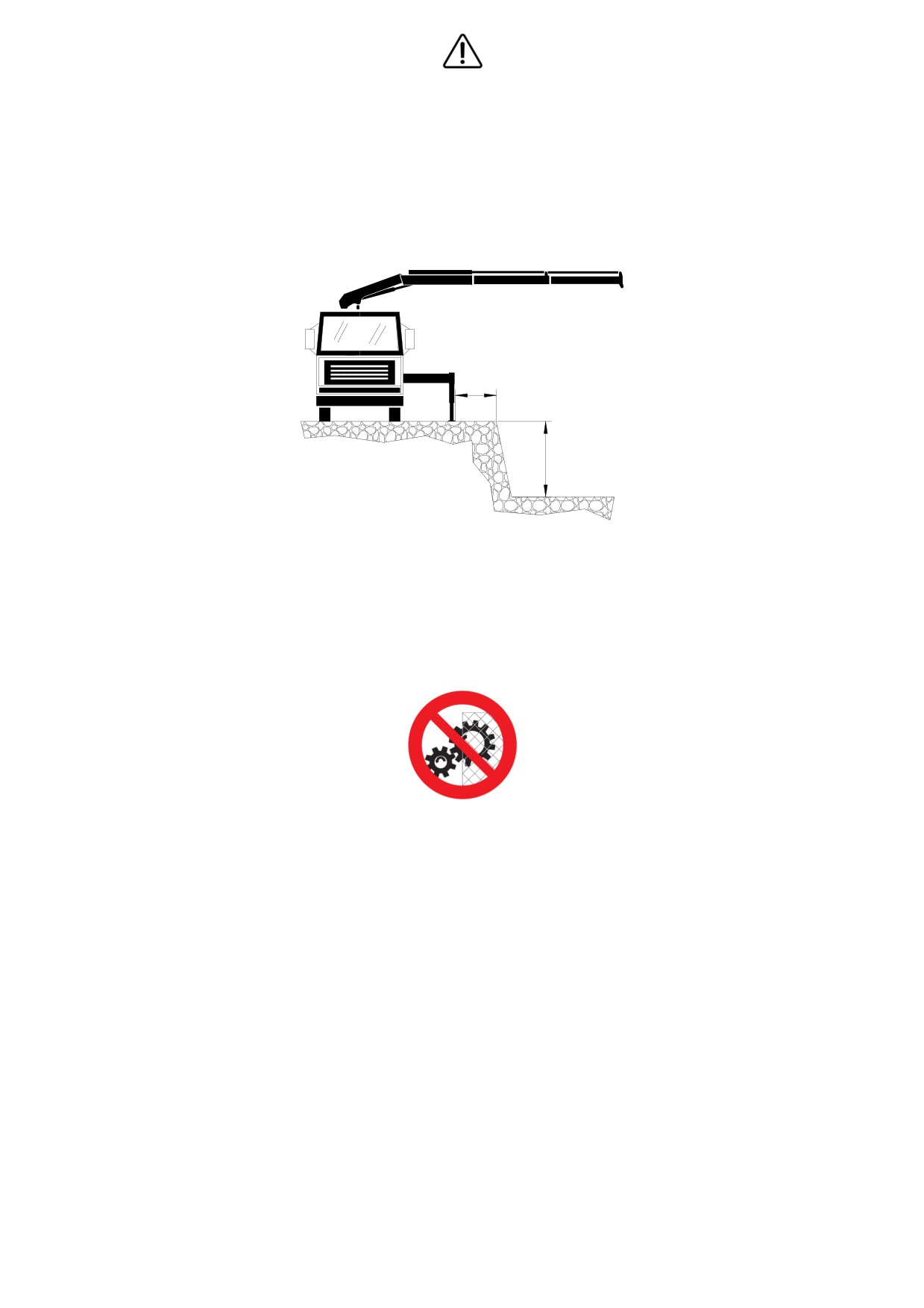
- In caso di lavoro su ponti lo
- When working on bridges the
- Bei Arbeiten auf Brücken muss die
stabilizzatore deve trovarsi almeno ad
stabiliser must be located at least one
Stütze mindestens
1 m vom
una distanza di
1m dal ciglio.
metre from the edge. Make sure the
Brückenrand entfernt
sein. Sicher-
Assicurarsi che gli stabilizzatori siano
stabilisers are at a safe distance from
stellen, dass sich die Stützen in einem
a distanza di sicurezza da fossati e
ditches and steep slopes. As a
sicheren Abstand von Gräben und
scarpate. Come regola empirica si
general rule the distance A between
Böschungen befinden. Als Faustregel
consiglia che la distanza A tra
the stabiliser and edge must be
gilt, dass der Abstand A zwischen
stabilizzatore e ciglio deve essere
double depth B of the ditch.
Stütze und Böschung mindestens
almeno il doppio della profondità B del
doppelt so groß sein muss wie die
fossato.
Tiefe B des Grabens.
A > 2B
A
B
- Non manomettere per nessun motivo i
- Do NOT tamper with electrical,
- Die mechanischen, hydraulischen
dispositivi
di
sicurezza
della
electronic and hydraulic safety
oder elektronischen Sicherheits-
macchina, siano essi meccanici,
devices on the machine. Check that
einrichtungen dürfen unter keinen
idraulici o elettronici. Assicurarsi prima
all safety and protection devices are
Umständen verändert werden. Vor der
di operare con la gru che tutti i
installed and functioning correctly
Kranarbeit
muss
sichergestellt
dispositivi di protezione siano installati
before using the crane.
werden, dass alle Schutzvorrich-
correttamente
e
perfettamente
tungen korrekt installiert wurden und
funzionanti.
einwandfrei funktionieren.
- Durante il primo sollevamento del
- When a load is lifted for the first time
- Beim
ersten
Anheben
und
carico procedere in maniera lenta e
proceed slowly and carefully to ensure
Manövrieren einer Last langsam und
cauta con le movimentazioni, in modo
that the area of stability for the
vorsichtig
vorgehen, um einer
tale da scongiurare un possibile errore
machine has been identified correctly.
möglichen Fehleinschätzung des
di delimitazione dell’area di stabilità
Inform the supervisor immediately of
Stabilitätsbereichs
der Maschine
della macchina. Avvertire immediata-
any loss of stability.
zuvorzukommen. Ein Stabilitätsverlust
mente l’installatore in caso di perdita
muss sofort dem Installateur gemeldet
di stabilità.
werden.
- Verificare periodicamente il corretto
- Routinely check correct functioning of
- Regelmäßig die einwandfreie Funkti-
funzionamento del cilindro stabiliz-
the stabiliser cylinder. Stop work
onstüchtigkeit des Abstützzylinders
zatore e in caso di trafilamento
immediately in the event of any faults
überprüfen. Bei Undichtigkeit sofort
interrompere qualsiasi operazione e
and refer to an authorised assistance
die Arbeit einstellen und zur einer
recarsi presso un centro di assistenza
centre.
autorisierten Service-Center bringen.
autorizzato.
- Do not operate the crane under the
- Nicht unter den in
§A.11 beschrie-
- Non operare nelle condizioni di lavoro
hazardous conditions described in
benen riskanten Arbeitsbedingungen
a rischio descritte al §A.11.
§A.11.
arbeiten.
A-15
A.1.8 SCIVOLAMENTO,
A.1.8 SLIPPING, TRIPPING
A.1.8 RUTSCH-, STOLPER-
INCIAMPO E CADUTA
AND FALLS
UND STURZGEFAHR
Tale rischio è presente se il luogo ove si
This hazard exists where the ground is
Diese Gefahr tritt auf, wenn der Ort, an
opera è scivoloso (olio, acqua o altro
slippery
(oil, water or other material),
dem gearbeitet wird, rutschig
(Öl,
materiale), è sdrucciolevole, non è
bumpy, broken, etc.
Wasser oder anderes Material), glatt,
piano, è sconnesso, ecc.
Fall hazard due to slippery or broken
uneben, rissig usw. ist.
Pericolo di caduta per terreno o zona
ground, etc.
Sturzgefahr
wegen rutschigem,
di lavoro scivoloso, sdrucciolevole,
glattem, holprigem usw. Gelände oder
sconnesso, ecc.
Arbeitsbereich.
AVVERTENZE
WARNINGS
WARNUNGEN
- L’operatore non deve mai lavorare su
- Do NOT use the crane on unstable
- Der Kranführer darf unter keinen
un terreno che possa precludere la
ground. Do NOT work on broken,
Umständen auf einem Gelände
sua stabilità: evitare di operare su
slippery
or
uneven
ground.
arbeiten,
das keine Stabilität
terreni
sconnessi,
scivolosi,
Unexpected stops during movement
garantiert: Die Arbeit auf rissigem,
sdrucciolevoli, in condizione di scarso
or unwanted enabling of controls may
rutschigem, glattem oder unebenem
equilibrio: il bloccaggio improvvisino di
cause serious damage to property
Gelände ist zu vermeiden: durch die
un movimento o l’inserimento
and injury to persons.
plötzliche
Blockierung
einer
involontario di un comando potrebbe
Bewegung oder die unbeabsichtigte
causare serissimi danni a cose e
Auslösung einer Steuerung könnten
persone.
ernsthafte Sach- und Personen-
schäden verursacht werden.
A-16
A.2 PERICOLI DI
A.2 ELECTRIC SHOCK
A.2 GEFAHREN
NATURA ELETTRICA
HAZARD
ELEKTRISCHER ART
A.2.1 CONTATTO CON
A.2.1 CONTACT WITH LIVE
A.2.1 KONTAKT MIT
ELEMENTI IN TENSIONE
COMPONENTS
SPANNUNGSFÜHRENDEN
TEILEN
L’operatore può rischiare la fulmina-
There is an electric shock hazard for the
In folgenden Fällen kann der Kranführer
zione nei seguenti casi:
user under the following conditions:
einen Stromschlag riskierten:
quando la gru viene a contatto con
if the crane comes into contact with
Wenn der Kran elektrische Leitungen
linee elettriche
electricity power lines
berührt
quando la gru viene colpita da fulmini
if the crane is struck by lightening
Wenn der Kran vom Blitz getroffen
wird
AVVERTENZE
WARNINGS
WARNUNGEN
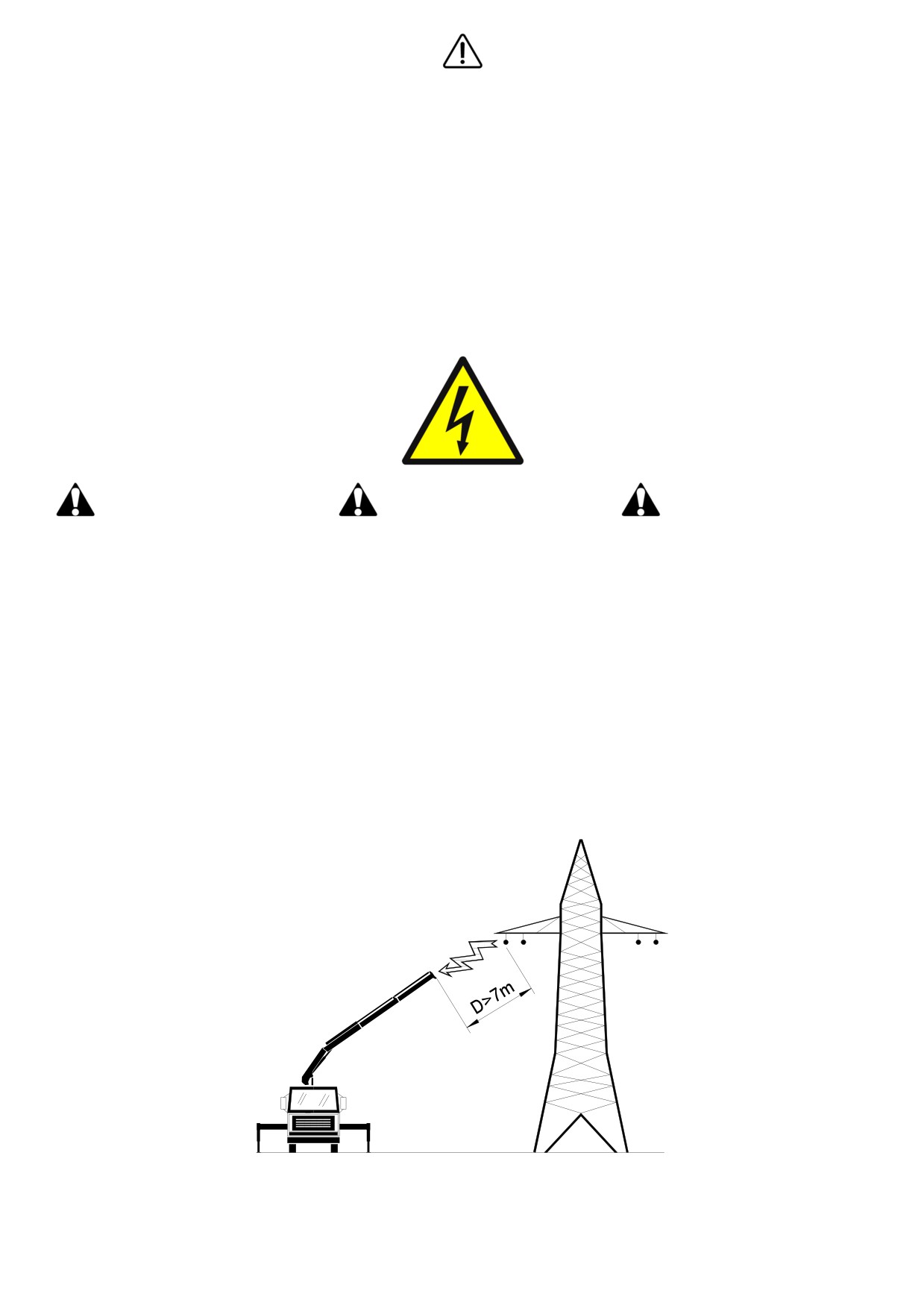
- La gru può essere movimentata in
- The crane should only be operated at
- In
der Nähe von elektrischen
prossimità di linee elettriche aeree
a distance D of at least
7 m from
Freileitungen darf der Kran nur in
solo a distanza D maggiore di 7 m. È
electricity power lines. The crane can
einem Abstand D von mehr als 7 m
possibile operare eccezionalmente a
be used closer to electricity power
manövriert werden. Unter der
distanze inferiori a patto che, previa
lines if, following notification to the
Voraussetzung, dass nach vorheriger
segnalazione all’esercente delle linee
electricity supply company, suitable
Benachrichtigung des Betreibers der
elettriche, si provveda a un’adeguata
protection is adopted to prevent
elektrischen Leitungen für einen
protezione atta ad evitare accidentali
operation too close to the lines and
angemessenen Schutz gesorgt wird,
contatti o pericolosi avvicinamenti ai
accidental contact. The minimum
um versehentliche Kontakte oder eine
conduttori delle linee stesse. La
operating distance must be calculated
gefährliche Annäherung an die
distanza minima di lavoro deve essere
on the basis of maximum crane boom
Stromleiter zu vermeiden, kann
calcolata tenendo in considerazione il
extension towards the lines and
ausnahmsweise auch in geringeren
massimo sbraccio della gru in
maximum movement of the lines.
Abständen gearbeitet werden. Bei der
direzione della linea e l’oscillazione
Berechnung des Mindestarbeits-
massima della linea elettrica.
abstands ist die max. Ausladung des
Krans in Richtung Leitung und die
max. Schwingung der Leitung zu
berücksichtigen.
A-17
The crane should only be used
In der Nähe von spannungs-
In vicinanza di linee elettriche
aeree in tensione è possibile eseguire i
near live power lines if:
führenden Freileitungen darf nur
lavori soltanto se:
Safety distances are adhered to
gearbeitet werden, wenn:
Le distanze di sicurezza vengono
Live parts are covered or surrounded
die Sicherheitsabstände eingehalten
by guards
werden
rispettate
Overhead power lines are switched
die
spannungsführenden
Teile
Le parti in tensione sono state coperte
o delimitate
OFF for the entire duration of work
abgedeckt oder abgesperrt wurden
Le linee elettriche aeree sono state
die elektrischen Freileitungen für die
poste fuori tensione per tutta la durata
gesamte Dauer der Arbeiten
spannungslos gesetzt wurden
dei lavori
PROCEDURA IN CASO DI
PROCEDURE IN THE EVENT
VERHALTEN BEI KONTAKT
CONTATTO CON LINEA ELETTRICA
OF CONTACT WITH ELECTRICITY
MIT ELEKTRISCHER LEITUNG
POWER LINES
Nel caso in cui, nonostante tutta la
Follow the procedure described below
Sollte der Kran trotz aller Vorsicht die
prudenza usata, la gru toccasse la linea
in the event that the crane touches a
elektrische Leitung berühren, die
elettrica, seguire questa procedura:
power line despite the precautions
nachstehenden Verhaltensmaßregeln
taken:
befolgen:
1. Mantenere la calma
1. Keep calm
1. Ruhe bewahren
2. Non lasciare il posto di comando
2. Do not leave the control position
2. Den Führerplatz nicht verlassen
3. Non toccare alcuna parte metallica
3. Do NOT touch any metal parts on the
3. Keine Metallteile der Maschine
della macchina
machine
berühren
4. Avvertire le persone nelle vicinanze
4. Warn people nearby not to approach
4. Die Personen in der Nähe warnen,
di non toccare la gru, il veicolo, il
or touch the crane, truck, load or the
den Kran, das Fahrzeug, die Last
carico o la persona ai comandi e
person in the control position
oder die Bedienungsperson nicht zu
nemmeno di avvicinarsi, ciò potrebbe
5. Switch OFF the electricity power line.
berühren und sich nicht zu nähern,
essere fatale
da dies lebensgefährlich sein könnte
5. Fare disattivare la linea elettrica.
5. Die elektrische Leitung abschalten
lassen.
ATTENZIONE
WARNING
ACHTUNG
Se l’operatore o un suo aiutante si
Do NOT leave the driving cabin or the
Wenn sich der Kranführer oder dessen
trovasse in cabina di guida o sulla
loading platform. If you must abandon
Assistent im Führerhaus oder auf der
piattaforma di carico, questi non deve
your position, do NOT touch the crane
Ladeplattform befindet, darf er diese
lasciare questa postazione. Nel caso
and the ground at the same time.
Stellung nicht verlassen. Sollte er diese
dovesse abbandonare la posizione è
Therefore leave your position by
Stellung verlassen, ist es strikt
assolutamente vietato toccare la gru
jumping to the ground. Do NOT climb
verboten, den Kran anzufassen und
mantenendo contemporaneamente i
down.
gleichzeitig mit den Füßen den Boden
piedi a terra; perciò non si deve
The only solution if personnel are
zu berühren; er darf also nicht vom Kran
scendere dalla gru, ma saltare a terra.
electrocuted is to switch OFF the power
steigen, sondern muss hinunter-
Se un l’operatore o un suo aiutante
lines. Do NOT approach electrocuted
springen.
dovesse trovarsi attaccato al circuito,
personnel. Such action may be fatal.
Wenn ein Kranführer oder dessen
l’unica soluzione è di interrompere la
Assistent mit dem Stromkreis in Kontakt
linea. Avvicinarsi alla persona può
kommen, ist die einzige Lösung die
risultare fatale.
Unterbrechung der Leitung. Sich der
Person zu nähern, kann lebens-
gefährlich sein.
A-18
A.2.2 FENOMENI
A.2.2 STATIC ELECTRICITY
A.2.2 ELEKTROSTATISCHE
ELETTROSTATICI
LADUNG
La gru può accumulare energia
The crane can accumulate static
Der Kran kann elektrostatische Ladung
elettrostatica. Questo può accadere
electricity. This generally occurs when
aufnehmen. Dies kann vor allem
specialmente nel caso in cui gli elementi
the material placed between the
vorkommen, wenn die Elemente
interposti tra i piedi stabilizzatori e il
stabiliser feet and the ground is an
zwischen den Stützfüßen und dem
terreno siano di materiale isolante (es.
insulator e.g. wood, the crane is used
Boden aus isolierendem Material sind
legno) e si operi nelle vicinanze di
near radio transmitters or high
(z.B. Holz) und in der Nähe von
trasmettitori radio e di impianti di
frequency switching systems and when
Funksendern
und Hochfrequenz-
commutazione ad alta frequenza o
a storm is approaching.
Schaltanlagen gearbeitet wird, oder
all’avvicinarsi di un temporale.
Static electricity can affect correct
wenn sich ein Gewitter nähert.
I fenomeni elettrostatici potrebbero
functioning of pacemakers.
Die elektrostatischen Ladung kann
pregiudicare il corretto funzionamento
den einwandfreien Betrieb von
degli stimolatori cardiaci
(pace-
Herzschrittmachern
(Pacemakern)
maker).
beeinträchtigen.
AVVERTENZE
WARNINGS
WARNUNGEN
- Se si desidera evitare l’accumulo di
- Accumulation of static electricity is
- Wenn die Speicherung elektrostati-
energia elettrostatica è necessario
prevented by connecting the crane
scher Ladung vermieden werden soll,
scaricare a terra il telaio dell’autocarro
truck chassis to earth using a special
muss das Fahrwerk des Fahrzeugs
con dispositivi idonei.
device.
mit geeigneten Mitteln auf den Boden
entladen werden.
- È fatto divieto ai portatori di stimolatori
- People with pacemakers fitted are
cardiaci
(pace-maker) di utilizzare o
forbidden from approaching or using
- Trägern
von Herzschrittmachern
venire a contatto con la gru.
the crane.
(Pacemakern) ist es untersagt, den
Kran zu benutzen oder ihn zu
berühren.
A-19
A.3 PERICOLI DI
A.3 HEAT HAZARDS
A.3 GEFAHREN
NATURA TERMICA
THERMISCHER ART
A.3.1 BRUCIATURE,
A.3.1 BURNS
A.3.1 VERBRENNUNGEN,
SCOTTATURE
VERBRÜHUNGEN
Tali rischi sono dovuti a pericolo di
These hazards are caused by:
Diese Gefahren werden verursacht durch die
Contatto con tubi caldi, serbatoio
Contact with hot hoses, hot tanks and
Berührung von heißen Rohren, des
caldo, esplosione tubo con eiezione di
damage to hoses resulting in spurts of
heißen Tanks, das Bersten von
olio caldo
hot oil.
Rohren und anschließende Heraus-
Utilizzo in ambienti esplosivi
Use in explosive environments
spritzen von heißem Öl
Verwendung in explosionsgefährdeten
Bereichen
AVVERTENZE
WARNINGS
WARNUNGEN
-
-Keinen Teil des Hydrauliksystems
-
-Non toccare nessuna parte del
- Do NOT touch any part of the
sistema
idraulico
quando la
hydraulic
system
when the
berühren, wenn die Temperatur 50°C
temperatura supera 50°C (EN 563).
temperature exceeds 50°C (EN 563).
überschreitet (EN 563).
- L’impiego della macchina non è
- Do NOT use the machine in explosive
- Es ist Verboten, den Kran in
previsto in atmosfera esplosiva.
environments.
explosionsgefährdeter Atmosphäre zu
benutzen.
A.3.2 TEMPERATURA
A.3.2 ENVIRONMENTAL
A.3.2 UMGEBUNGS-
AMBIENTALE
TEMPERATURE
TEMPERATUR
AVVERTENZE
WARNINGS
WARNUNGEN
-
-Le postazioni di comando devono
- Control positions must be located so
-
-Durch die Positionierung
der
essere poste in modo da assicurare
that operators cannot touch hot
Steuerstände muss gewährleistet
che gli operatori non possano toccare
surfaces
(>50°C
- EN 563) during
werden, dass die Bediener während
superfici calde
(>50°C - EN 563) e
normal crane functioning. Specifically
des normalen Kranbetriebs keine
durante il normale funzionamento
all hydraulic hoses containing fluid
heißen Oberflächen (>50°C - EN 563)
della gru. In particolare devono essere
under pressure > 50 bar and/or with a
berühren können. Insbesondere
protetti tutti i tubi idraulici contenenti
temperature > 50°C and located at a
müssen alle Hydraulikrohre geschützt
fluidi a pressione maggiore di 50 bar
distance of < 1 m from the operator
werden, die Flüssigkeiten mit einem
e/o aventi temperatura maggiore di
(EN 12999) must be covered to
Druck von über 50 bar und/oder mit
50°C e situati entro una distanza di
protect the operator.
einer Temperatur von über
50°C
1 m dall’operatore (EN 12999).
enthalten und sich in einem Abstand
- Routinely check that the thermometer
von
1 m vom Bediener befinden
- L’operatore
deve
controllare
is functioning correctly. Refer to an
(EN 12999).
periodicamente che il termometro
authorised assistance centre in the
funzioni correttamente. In caso di
event of a fault.
- Der Kranführer muss regelmäßig
malfunzionamento deve rivolgersi a
kontrollieren, ob das Thermometer
un centro di assistenza autorizzato.
- Environmental temperature can affect
korrekt funktioniert. Andernfalls muss
crane control capacity. Do NOT use
sich an ein autorisiertes Service-
- La temperatura ambientale può
the
crane
under
extreme
Center wenden.
condizionare la capacità di comando
environmental conditions
(very hot,
della gru: nel caso particolare in cui
very cold, very high relative humidity).
- Die Umgebungstemperatur kann die
l’operatore si trovi a lavorare in
Bedienfähigkeit beeinträchtigen. bei
condizioni estreme (ambienti o climi
Arbeiten unter extremen Bedingungen
eccessivamente caldi e/o con umidità
(übermäßig heiße oder kalte
relativa eccessiva, ambienti o climi
Umgebungen und/oder hohe relative
eccessivamente freddi), è fatto
Luftfeuchtigkeit) sollte der Kranführer
obbligo di interrompere le operazioni
die Arbeit unterbrechen, wenn er sich
di movimentazione se le condizioni
nicht gut fühlt .
psicofisiche non sono ottimali.
A-20
A.4 PERICOLI
A.4 NOISE HAZARDS
A.4 GEFAHREN DURCH
GENERATI DAL RUMORE
LÄRM
Non significativi in quanto le gru non
There are no significant noise hazards
Nicht signifikant, da die Kräne nicht die
comprendono la sorgente di potenza.
in that the crane does not include the
Leistungsquelle enthalten.
power source.
AVVERTENZE
WARNINGS
WARNUNGEN
- In caso di rumori che superano la
- Wear ear protection equipment if the
- Wenn der von anderen Maschinen
soglia di 80 dB(A) nella postazione di
noise level in the operating position
und/oder Ausrüstungen erzeugte
lavoro dovuti ad altri macchinari e/o
exceeds 80 dB(A) as a result of other
Schalldruckpegel die Schwelle von
dispositivi,
è necessario
che
machinery or equipment in use.
80 dB(A) am Arbeitsplatz übersteigt,
l’operatore indossi cuffie o tappi
muss der Kranführer einen Kapselge-
uditivi.
hörschutz oder Gehörschutzstöpsel
tragen.
A.5 PERICOLI
A.5 VIBRATION
A.5 GEFAHREN DURCH
GENERATI DA
HAZARDS
VIBRATIONEN
VIBRAZIONI
Non significativi in quanto una gru per
There are no significant vibration
Nicht signifikant, weil ein Lkw-Kran nur
autocarro viene utilizzata unicamente
hazards in that a truck crane is used for
für kurze Dauer benutzt wird und die
per brevi periodi di tempo e gli effetti
short periods and therefore there is no
Wirkung der Vibrationen auf den
delle vibrazioni sull’operatore sono
significant effect on the operator.
Bediener als unerheblich eingestuft
considerati non significativi
werden.
A-21
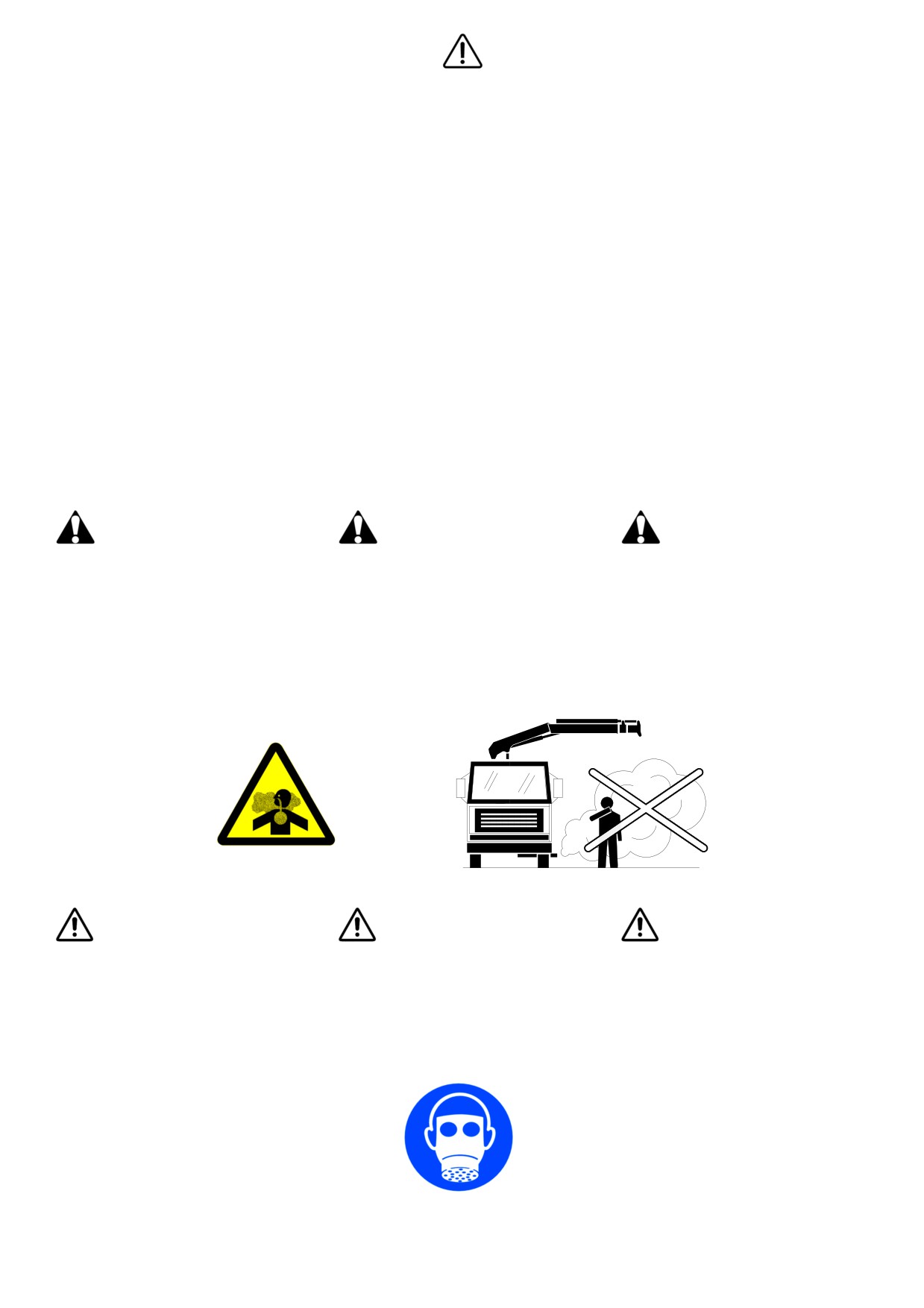
A.6 PERICOLI DA
A.6 HAZARDS
A.6 GEFAHREN DURCH
SOSTANZE UTILIZZATE
RELATING TO
VON DER MASCHINE
DALLA MACCHINA
SUBSTANCES USED
VERWENDETE STOFFE
BY THE MACHINE
A.6.1 PERICOLI DA
A.6.1 TOXIC SUBSTANCE
A.6.1 GEFAHREN DURCH
CONTATTO O INALAZIONE DI
HAZARD (INHALATION OR
FLÜSSIGKEITEN MIT
FLUIDI DANNOSI
CONTACT)
SCHÄDLICHER WIRKUNG
(BERÜHRUNG, EINATMEN)
Tali pericoli sono legati a:
These hazards are associated with:
Diese Gefahren sind zurückzuführen auf:
Inalazioni di gas di scarico e polveri
Inhalation of exhaust fumes or toxic
Das Einatmen von Abgasen und
nocive dovute all’ambiente di lavoro
substances caused by the working
schädlichen
Stäuben
in
der
e/o alle sostanze movimentate
environment and/or the substances
Arbeitsumgebung
Non corretta movimentazione e
moved.
Die nicht korrekte Handhabung und
smaltimento dell’olio idraulico.
Incorrect handling or disposal of
Entsorgung des Hydrauliköls
Non corretta movimentazione e
hydraulic fluid.
Die nicht korrekte Handhabung und
smaltimento del grasso.
Incorrect handling or disposal of grease.
Entsorgung des Schmierfetts.
Incendio
dovuto
all’elevata
Fire caused by highly flammable
Einen Brand infolge der hohen
infiammabilità dell’olio idraulico
hydraulic fluid.
Entflammbarkeit des Hydrauliköls.
Non corretto smaltimento di parti o
Incorrect
disposal
of
crane
Die nicht korrekte Entsorgung von
accessori della gru
components and accessories.
Kranteilen oder Zubehör .
AVVERTENZE
WARNINGS
WARNUNGEN
GAS E POLVERI
TOXIC FUMES AND SUBSTANCES
GASE UND STÄUBE
Le postazioni di comando devono
Control positions must be located so
Durch
die
Positionierung
der
essere poste in modo da assicurare che
that operators are not exposed to
Steuerstände
muss gewährleistet
gli operatori non siano esposti ad
inhalation of exhaust fumes and toxic
werden, dass
die Bediener keinen
inalazioni di gas di scarico e a polveri
substances caused by the working
durch die Arbeitsumgebung und/oder
nocive dovute all’ambiente di lavoro e/o
environment and/or the substances
die beförderten Stoffe erzeugten
alle sostanze movimentate.
moved.
Abgasen und schädlichen Stäuben
ausgesetzt sind.
Nel caso in l’operatore sia
If the operator is exposed to
Wenn der Kranführer Abgasen
esposto ai gas di scarico è necessario
exhaust fumes move the exhaust pipe
ausgesetzt ist, müssen die Auspuffe
spostare i terminali delle mboomitte in
outfeed point further away from the
vom Arbeitsplatz weggeführt werden
un luogo lontano da postazioni di lavoro
operating position (e.g. using removable
(z.B. mit entfernbaren Schläuchen).
(es. con tubazioni flessibili removibili).
flexible hosing).
Wenn der Kran in einer Umgebung mit
In caso di utilizzo gru in ambiente con
Wear a mask if the crane is used in
schädlichen Stäuben benutzt wird,
polveri nocive l’operatore deve utilizzare
environments with toxic fumes or
muss der Kranführer eine Staubschutz-
apposite mascherine antipolvere.
substances.
maske benutzen.
A-22
OLIO IDRAULICO
HYDRAULIC FLUID
HYDRAULIKÖL
L’olio idraulico deve essere movi-
Hydraulic fluid must be handled with
Das Hydrauliköl muss an einem gut
mentato in luogo ventilato con molta
care in a ventilated environment. Wear
belüfteten Ort und mit größter Vorsicht
cautela indossando guanti antiolio e
protective
gloves
and goggles.
gehandhabt
werden.
Bei
der
occhiali
protettivi,
trasportato
in
Hydraulic fluid must be stored and
Handhabung sind ölfeste Handschuhe
contenitori
chiusi e impermeabili
moved in sealed containers to prevent
und Schutzbrillen zu tragen. Das
affinché non si venga direttamente a
leaks and accidental contact with the oil.
Hydrauliköl muss in dicht verschlossenen
contatto con la sostanza e non se ne
Behältern transportiert werden, um einen
provochi accidentali dispersioni.
Kontakt mit der Substanz und
versehentliches Austreten zu vermeiden.
È severamente vietato avvicinare
Hydraulic fluid is flammable. Keep all
Es ist strikt verboten, offenes Feuer in
fiamme libere all’olio idraulico, in quanto
naked flames well away.
die Nähe des Hydrauliköls zu bringen,
materiale infiammabile.
da es sich um leicht entflammbares
Material handelt.
Per un corretto smaltimento dell’olio
Store used oil in sealed containers at a
Für eine korrekte Entsorgung des Altöls
esausto è fatto obbligo di conservarlo in
temperature less than 65 °C. Contact
ist dieses in dicht verschlossenen
contenitori
chiusi impermeabili a
an authorised waste management
Behältern bei Temperaturen unter 65 °C
temperature inferiori a
65°C e
company to dispose of used oil.
aufzubewahren und bei autorisierten
consegnarlo ad aziende autorizzate allo
Sammelstellen abzugeben.
smaltimento.
INDICAZIONE DEI PERICOLI
SPECIFIC HAZARDS
GEFAHRENHINWEISE
- Il contatto ripetuto e prolungato con la
- Repeated and prolonged contact with
- Der wiederholte und anhaltende
pelle può causare arrossamenti,
the skin can cause itching, rashes and
Kontakt mit der Haut kann Rötungen,
irritazioni e dermatiti.
dermatitis.
Reizungen und Hautentzündungen
- Irritante per gli occhi
- Irritant for the eyes.
hervorrufen.
- Infiammabile: non utilizzare getti
- Flammable: do NOT use water to
- Augenreizend
d’acqua per lo spegnimento, ma
extinguish hydraulic oil fires. Use
- Entflammbar: Zum Löschen keinen
schiuma o CO2. In caso di incendio
foam or CO2. Wear a gas mask in the
Wasserstrahl, sondern CO2 benutzen.
indossare la maschera antigas.
event of fire.
Im Brandfall Gasmasken aufziehen.
In caso di fuoriuscita accidentale
Use soil, sand or sawdust to contain the
Produkt bei versehentlichem Austreten
contenere il prodotto con terra o sabbia
fluid in the event of accidental spillage.
mit Erde oder Sand und Sägemehl
e segatura. Se la fuoriuscita è in acqua
If the spillage occurs in water contact
aufnehmen.
Bei
Eindringen
in
informare le autorità competenti.
the relevant authorities.
Gewässer die zuständigen Behörden
verständigen.
PRIMO SOCCORSO
FIRST AID
ERSTE HILFE
- Contatto con la pelle: Lavare con
- Contact with the skin: wash using
- Nach Hautkontakt: Mit Wasser und
acqua e sapone
soap and water.
Seife waschen.
- Contatto con gli occhi: Togliere lenti a
- Contact with the eyes: remove contact
- Nach Augenkontakt: Kontaktlinsen
contatto, lavare con acqua.
lenses and rinse using water.
entfernen, mit Wasser ausspülen.
- Ingestione del prodotto: chiamare il
- Swallowing fluid: call a doctor, do
- Nach Verschlucken: Arzt rufen, kein
medico, non provocare il vomito.
NOT induce vomiting.
Erbrechen herbeiführen.
A-23
GRASSO INDUSTRIALE
INDUSTRIAL GREASE
INDUSTRIEFETT
Il
grasso industriale deve essere
Industrial grease must be stored in
Bei der Handhabung von Industriefett
movimentato con molta cautela
sealed containers. Wear protective
mit größter Vorsicht vorgehen und
indossando guanti e occhiali protettivi,
gloves and goggles and handle with
Handschuhe sowie Schutzbrillen tragen.
trasportato in contenitori chiusi e
care.
Das Fett in dicht verschlossenen
impermeabili.
Behältern transportieren.
È severamente vietato avvicinare
Grease is flammable. Keep all naked
Es ist strikt verboten, offenes Feuer in
fiamme libere al grasso, in quanto
flames well away.
die Nähe des Fettes zu bringen, da es
materiale infiammabile.
sich um leicht entflammbares Material
handelt.
Per un corretto smaltimento del grasso
Store used grease in sealed containers.
Für eine korrekte Entsorgung des
esausto è fatto obbligo di conservarlo in
Contact
an
authorised
waste
Altfettes ist dieses in dicht ver-
contenitori
chiusi impermeabili e
management company to dispose of
schlossenen Behältern aufzubewahren
consegnarlo alle aziende autorizzate
used oil.
und bei autorisierten Sammelstellen
allo smaltimento.
abzugeben.
INDICAZIONE DEI PERICOLI
SPECIFIC HAZARDS
GEFAHRENHINWEISE
- Il contatto ripetuto e prolungato con la
- Repeated and prolonged contact with
- Der wiederholte und anhaltende
pelle può causare arrossamenti,
the skin can cause itching, rashes and
Kontakt mit der Haut kann Rötungen,
irritazioni e dermatiti.
dermatitis.
Reizungen und Hautentzündungen
- Irritante per gli occhi
- Irritant for the eyes.
hervorrufen.
- Infiammabile: non utilizzare getti
- Flammable: do NOT use water to
- Augenreizend
d’acqua per lo spegnimento, ma
extinguish hydraulic oil fires. Use
- Entflammbar: Zum Löschen keinen
schiuma o CO2. In caso di incendio
foam or CO2. Wear a gas mask in the
Wasserstrahl, sondern CO2 benutzen.
indossare la maschera antigas.
event of fire.
Im Brandfall Gasmasken aufziehen.
In caso di fuoriuscita accidentale
In the event of accidental spillage wait
Bei versehentlichem Austreten warten,
attendere che il materiale si solidifichi e
for the grease to solidify. Use a spade
bis das Material fest wird, dann mit
rimuoverlo raschiando con pale e riporlo
to scrape up the material and place it in
Schaufeln abkratzen und in einen für
in un recipiente appropriato per il
a container suitable for recycling or
das Recycling und die Entsorgung
riciclaggio o lo smaltimento.
disposal.
geeigneten Behälter füllen.
PRIMO SOCCORSO
FIRST AID
ERSTE HILFE
- Contatto con la pelle: Lavare con
- Contact with the skin: wash using
- Nach Hautkontakt: Mit Wasser und
acqua e sapone
soap and water.
Seife waschen.
- Contatto con gli occhi: Togliere lenti a
- Contact with the eyes: remove contact
- Nach Augenkontakt: Kontaktlinsen
contatto, lavare con acqua.
lenses and rinse using water.
entfernen, mit Wasser ausspülen.
- Ingestione del prodotto: di norma, non
- Swallowing grease: as a general rule
- Nach Verschlucken: In der Regel sind
sono necessarie misure di primo
first aid is not required. Contact a
keine Erste-Hilfe-Maßnahmen not-
soccorso. Consultare un medico in
doctor if symptoms persist.
wendig. Bei anhaltender Übelkeit
caso di malessere persistente.
einen Arzt aufsuchen.
A-24
Tutti i componenti esausti o non
All used components
(oil,
Alle verbrauchten oder nicht
funzionanti della gru
(olio,
parti
mechanical parts, plastic, electric
funktionierenden
Kranteile
(Altöl,
meccaniche,
materiale
plastico,
components, hoses, etc) must be
mechanische Teile, Kunststoffteile,
componenti elettrici, tubi esausti, ecc.)
disposed of by an authorised waste
elektrische
Komponenten,
alte
devono essere smaltiti da azienda
management company in accordance
Schläuche usw.) müssen von einem
autorizzata secondo la legislazione
with current legislation.
befugten Unternehmen gemäß den
vigente.
geltenden Vorschriften entsorgt werden.
A-25
A.7 PERICOLI DI TIPO
A.7 ERGONOMIC
A.7 GEFAHREN
ERGONOMICO
HAZARDS
ERGONOMISCHER ART
A.7.1 POSTAZIONI DI
A.7.1 OPERATING
A.7.1 ARBEITSPLATZ
LAVORO
POSITIONS
AVVERTENZE
WARNINGS
WARNUNGEN
- L’operatore deve evitare postazioni di
- working areas with a significant
- Der Kranführer sollte das Arbeiten an
lavoro in cui il campo elettromagnetico
electromagnetic field.
Örten
mit
übermäßig hohem
sia eccessivamente elevato.
elektromagnetischem Feld vermeiden.
- L’operatore non deve effettuare sforzi
- Do not place the body under
- Während der gesamten Dauer des
eccessivi durante la tutta fase di
excessive strain when operating the
Kranbetriebs darf der Kranführer
utilizzo della gru: in caso di
crane. If manual operations are
keinen übermäßigen Anstrengungen
movimentazione e/o spostamento
required (e.g. pivoting stabilizer legs,
ausgesetzt sein: bei manueller
manuale di carichi
(es. cilindri
manual extensions, other lifting
Lasthandhabung
(z.B. Bewegung
stabilizzatori
girevoli,
prolunghe
components) or the load must be
drehebarer Abstützbeine, manueller
manuali, altri organi di presa) non
moved by hand do not lift a weight of
Verlängerungen, anderer Greifgeräte)
deve sollevare da solo più di 25 kg
more than 25 kg (20 kg for women).
darf er alleine nicht mehr als
25 kg
(20 kg per le donne).
(20 kg für Frauen) anheben.
A-26
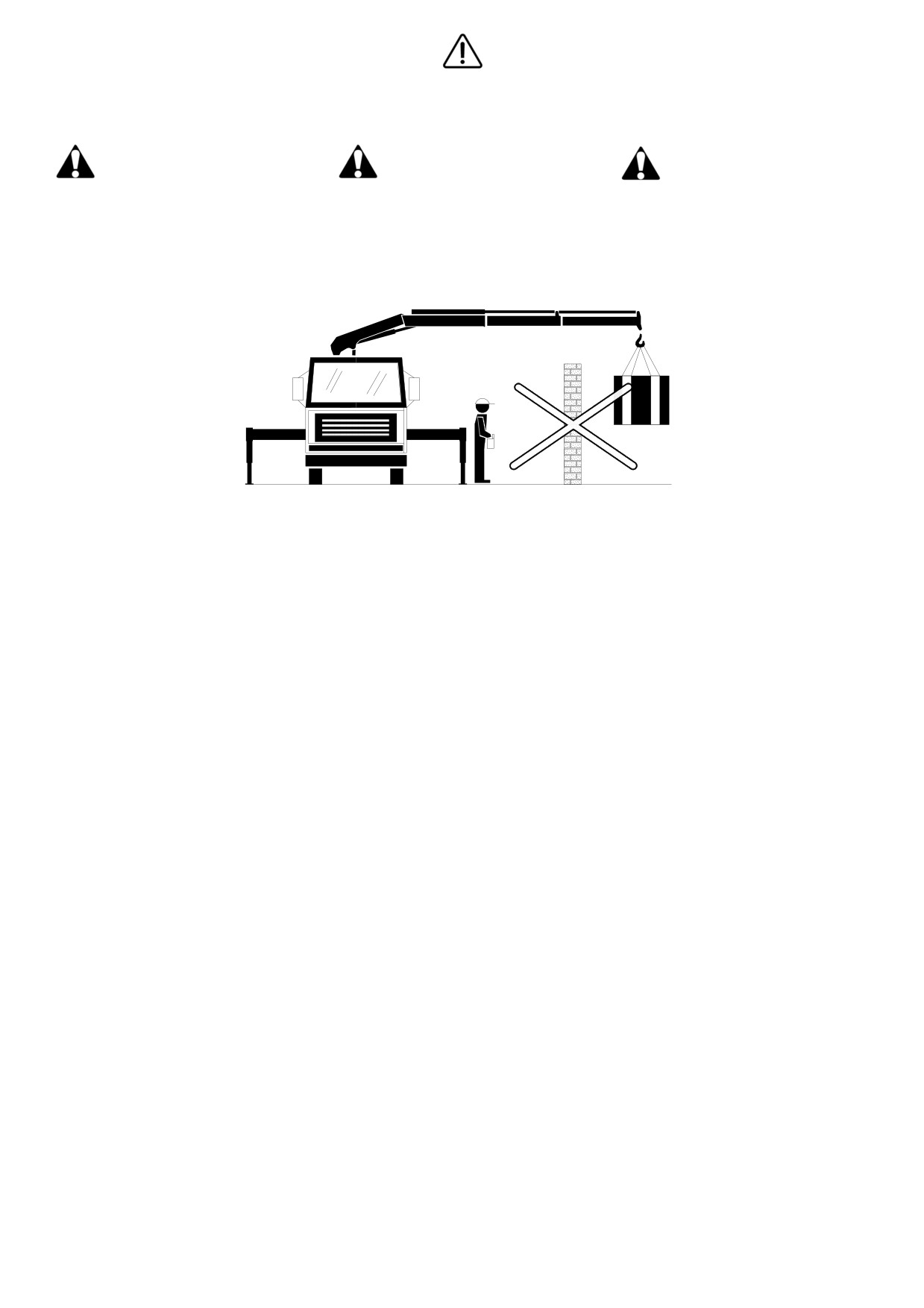
A.7.2 VISIBILITÀ
A.7.2 VISIBILITY
A.7.2 SICHTBARKEIT
AVVERTENZE
WARNINGS
WARNUNGEN
- L’operatore deve sempre lavorare in
- When using the crane the operator
- Der Kranführer muss stets unter
condizioni visive tali da avere una
must have a perfect view of the entire
Sichtbedingungen arbeiten, die ihm
perfetta visione dell’intero raggio
range of machine use as well as
eine perfekte Sicht des gesamten
d’azione
della
macchina, dei
control,
emergency and safety
Schwenkbereichs der Maschine, der
dispositivi di comando, di emergenza
devices.
Bedienelemente, der Not-Aus- und
e di sicurezza.
der Sicherheitssteuerungen gestatten.
- In caso di utilizzo della gru nelle ore
- An
additional
lighting
system
Wenn der Kran abends verwendet
serali è necessario che l’operatore
conforming to EN 1837 must be
wird, muss der Kranführer ein
installi un sistema di illuminazione
installed if the crane is used at night.
zusätzliches
Beleuchtungssystem
supplementare conformemente alla
installieren, das der Norm EN 1837
norma EN 1837.
entspricht.
- Se l’operatore non è in grado di avere
- A qualified assistant must help the
- Wenn der Kranführer keine komplette
una visione completa della zona di
operator if the latter does not have a
Sicht auf den Arbeitsbereich hat,
lavoro deve farsi aiutare da un
muss er sich von einem qualifizierten
clear view of the entire range of
collaboratore qualificato (vedi §B.8.5).
machine use (see §B.8.5).
Assistenten
helfen
lassen
(siehe §B.8.5).
A-27
A.7.3 ERRORE UMANO
A.7.3 HUMAN ERROR
A.7.3 MENSCHLICHES
VERSAGEN
Esistono i seguenti rischi dovuti a:
Hazards relating to human error exist
Es bestehen die folgenden Gefahren
due to the following:
durch:
errata movimentazione gru
incorrect crane movement
falsche Kranbewegung
errata manutenzione
incorrect maintenance
falsche Wartung
errata stabilizzazione della gru
incorrect crane stabilisation
falsche Abstützung des Krans
errato utilizzo della gru (vedi §A.11)
incorrect crane use (see §A.11)
falsche Kranbedienung (siehe §A.11)
mancata/errata delimitazione zona di
incorrect/failed demarcation of crane
fehlende/falsche Absperrung des
lavoro gru (vedi §A.1.2)
operating area (see §A.1.2)
Arbeitsbereichs
des
Krans
(siehe §A.1.2)
AVVERTENZE
WARNINGS
WARNUNGEN
- L’operatore della gru e il suo
- Personnel and assistants operating
- Der Kranführer und sein eventueller
eventuale collaboratore non devono
the crane must not be temporary staff.
Assistent dürfen keine Hilfsarbeiter
essere occasionali, devono aver
They must be at least 18 years old
sein. Sie müssen volljährig sein und
compiuto
18 anni ed essere
and physically fit enough to perform
einen ärztlichen Befähigungsnachweis
riconosciuti idonei dal punto di vista
all tasks. The following aspects must
für die Berufsausübung besitzen.
medico ad esercitare la professione.
be taken into consideration:
Außerdem sind den folgenden
Inoltre si deve tener conto dei
Aspekten Rechnung zu tragen:
seguenti aspetti:
a) Fisico:
a) Physical:
a) Körperliche Verfassung:
- Vista e udito
- Sight and hearing
- Sehvermögen und Gehör
- Mancanza di vertigini quando si
- No fear of heights
- Schwindelfreiheit bei Arbeit in einer
opera ad una certa altezza
- Not under the effects of alcohol,
gewissen Höhe
- Assenza di disturbi dovuti a droga,
drugs or prescription medicines
- Keine Beeinträchtigungen aufgrund
alcool e medicinali
von
Drogen,
Alkohol
oder
Arzneimitteln
b) Psicologico
b) Psychological
- Comportamento sotto stati di
- Conduct in stressful situations
b) Psychologische Verfassung
tensione
- Mental balance
- Verhalten unter Stress
- Equilibrio mentale
- Sense of responsibility
- Geistige Ausgeglichenheit
- Senso di responsabilità
- Verantwortungsbewusstsein
- Gli operatori devono essere in grado
- Operators must be able to read and
- Die Bediener müssen in der Lage
di capire e leggere la lingua nella
understand the language used to write
sein, die Sprache, in der die
quale sono scritti i documenti e le
the crane documents and information
Dokumentation und die Hinweis-
targhe
di
informazione
degli
plates.
schilder der Hubmittel verfasst sind,
apparecchi di sollevamento.
zu lesen und zu verstehen.
- L’operatore deve apprendere e
- Operators must be able to understand
- Der Kranführer muss die im
applicare le nozioni e le prescrizioni
and apply the information and
vorliegenden Handbuch beschriebe-
descritte del presente manuale.
prescriptions given in this manual.
nen Anweisungen und Vorschriften
begreifen und anwenden.
- Se gli operatori devono movimentare
- Operators moving the vehicle on
- Bei Fahrten auf öffentlichen Straßen
müssen
die
Bediener
die
il loro autoveicolo su strada, devono
public roads must have the relevant
conoscere la relativa legislazione ed
authorisation and be aware of local
entsprechenden Rechtsvorschriften
avere l’autorizzazione alla guida se
driving legislation.
kennen und die Fahrerlaubnis
besitzen, wie von der lokalen
richiesta dalla legislazione locale.
Gesetzgebung verlangt.
Si fa divieto di utilizzo della
All those using the vehicle must
Die Benutzung der Maschine ist
macchina a chiunque non abbia
receive
adequate
training
(in
Jedem untersagt, der nicht bei
Auslieferung des Krans vom Installateur
ricevuto
addestramento adeguato
accordance with ISO 9926-1) from
(secondo norma ISO 9926-1) da parte
those responsible for installing the
entsprechend geschult wurde
(gemäß
dell’installatore alla consegna della gru.
crane on delivery. Use by all other
ISO 9926-1).
personnel is forbidden.
A-28
A.8 AVVIAMENTO E
A.8 UNEXPECTED
A.8 UNVERMITTELTES
SPEGNIMENTO
START-UP AND SWITCH-
STARTEN UND
INATTESO DELLA GRU
OFF OF THE CRANE
ABSCHALTEN DES
KRANS
Esistono
pericoli
di,
urto,
Impact, crushing, load loss and stability
Bei
unbeabsichtigtem
und
schiacciamento, perdita del carico,
loss hazards exist as a result of
unvermitteltem Starten und Abschalten
perdita di stabilità dovuti all’avviamento
accidental crane start-up and switch-off.
des Krans bestehen Stoß- und
a allo spegnimento accidentale e
Quetschgefahren sowie Gefahren durch
inatteso della gru.
Verlust der Last und Stabilitätsverlust.
AVVERTENZE
WARNINGS
WARNUNGEN
- Prima di cominciare ad operare con la
- Before using the crane check that
- Vor der Kranarbeit muss sichergestellt
gru è necessario controllare che vi sia
there is enough fuel and that the
werden, dass genügend Kraftstoff
sufficiente carburante e che la batteria
battery is in good condition.
vorhanden ist und dass die
del veicolo sia in buone condizioni.
Fahrzeugbatterie in einwandfreiem
Zustand ist.
- Non permettere a nessuno di
- Do NOT allow anyone to approach the
- Keinem Unbefugten gestatten, sich
avvicinarsi alla gru o all’autocarro
crane or truck during operation
dem Kran oder dem Lkw zu nähern,
mentre la
gru
è operativa
(see §A.1.2).
während der Kran in Betrieb ist
(vedi §A.1.2).
(siehe §A.1.2).
- È fatto obbligo all’operatore di avere
- Those using the crane must be in full
- Der Kranführer muss die Maschine ab
sotto controllo la macchina dal
control of the machine with control
deren Inbetriebsetzung unter Kontrolle
momento in cui è operativa e di avere
and stop devices in easy reach from
haben und die Steuer- und
sempre a portata di mano i dispositivi
the moment of start-up.
Stoppvorrichtungen stets griffbereit
di comando e di arresto.
halten.
- Le operazioni di controllo
e
- Control and maintenance operations
- Für die Durchführung der Kontroll-
manutenzione devono essere fatte a
must be performed with the machine
und
Wartungseingriffe
müssen
macchina e motore spento, con
and engine switched OFF, the brake
Maschine und Motor abgeschaltet, die
veicolo bloccato con freno e bloccato
ON and wheels blocked using special
Bremse angezogen und das Fahrzeug
con apposite zeppe.
chocks
mit Bremskeilen blockiert sein.
A-29
A.9 INEFFICIENZA DEI
A.9 SAFETY DEVICE
A.9 FEHELER IN DEN
DISPOSITIVI DI
FAULTS
SICHERHEITSEIN-
SICUREZZA
RICHTUNGEN
La manomissione degli organi di
Tampering with safety devices can
Die Veränderung der Sicherheitsein-
sicurezza può causare eccessivi
cause excessive stress on the crane,
richtungen kann eine Überbelastung
sovraccarichi alla gru, perdita di
loss of stability, impact, falling loads,
des Krans, Stabilitätsverlust, Stöße,
stabilità, urti, caduta del carico,
sudden release of the lifting
Herabfallen
der
Last,
ein
scollegamento improvviso degli organi
components and manual extensions,
unvermitteltes Lösen der Greifgeräte
di presa e di sfili manuali, incidenti
accidents when moving the vehicle,
und manueller Ausschübe, sowie
durante la circolazione del veicolo,
etc.
Unfälle während der Fahrt des
ecc.
Imperfect closure of the crane when
Fahrzeugs usw. verursachen.
La chiusura non perfetta della gru in
moving the vehicle can cause serious
Wenn der Kran nicht vollkommen in
posizione di trasporto può causare
damage due to impact of protruding
die Transportstellung eingefahren
seri danni durante la circolazione del
components against various objects
wird, können während der Fahrt
veicolo: vi è la possibilità di urti
(bridges, garages, other vehicles,
ernste Schäden verursacht werden:
rovinosi delle parti sporgenti contro
etc.).
es besteht die Möglichkeit folgen-
oggetti in moto relativo (ponti, garage,
Failure to apply decals to the machine
schwerer Stöße herausragender Teile
autoveicoli, ecc.).
may cause the operator not to take
gegen
Gegenstände
(Brücken,
-La mancanza di etichette adesive di
into consideration hazards associated
Garagen, Fahrzeuge usw.).
avvertimento può indurre l’operatore a
with normal crane use.
-Das Fehlen von Warnaufklebern
non prendere in considerazione
kann den Kranführer dazu bringen,
pericoli legati al normale utilizzo della
die Gefahren in Verbindung mit dem
gru.
normalen Gebrauch des Krans nicht
zu berücksichtigen.
AVVERTENZE
WARNINGS
WARNUNGEN
- L’operatore non deve mai e per
- Do NOT remove, modify or disable
- Der Kranführer darf unter keinen
nessun motivo rimuovere, modificare
safety devices be they mechanical
Umständen
die
mechanischen
o disinserire i dispositivi di sicurezza,
(guards, locks, etc.) or electro-
(Schutzschilde, Sperren usw.) und
siano essi meccanici
(protezioni,
hydraulic
(valves, limit switches,
elektrohydraulischen
(Ventile,
blocchi, ecc.), sia elettroidraulici
system seals). Failure to abide by this
Begrenzer,
Anlagenabdichtung)
(valvole,
limitatori,
sigillatura
regulation shall cause the warranty to
Sicherheitseinrichtungen
entfernen,
impianto), pena la decadenza di ogni
be declared null and void.
verändern oder deaktivieren, sonst
forma di garanzia.
verfällt jeder Garantieanspruch.
- Nel caso in cui l’operatore voglia
- Make sure lifting components and
- Vor dem Trennen der Greifgeräte
scollegare organi di presa o prolunghe
manual extensions are not supporting
oder manuellen Verlängerungen muss
manuali deve assicurarsi che questi
a load and are resting on a suitable
der Kranführer sicherstellen, dass
appoggino su un supporto adeguato
support surface before disconnecting
diese auf einem dem Gewicht und
al peso e alle dimensioni e che non vi
them.
den Abmessungen entsprechenden
sia alcun carico appeso.
Träger aufliegen und keine Last daran
hängt.
- L’operatore non deve togliere, rendere
- Do NOT tamper with or remove
- Der Kranführer darf die Warnetiketten
illeggibili le etichette di avvertimento.
warning decals. Do NOT clean the
nicht entfernen oder unleserlich
A tal fine non deve indirizzare getti
decals with solvents. Do NOT use
machen. Aus diesem Grund darf er
d’acqua o vapore in pressione contro
water or steam under pressure to
keinen unter Druck stehenden
la macchina, non deve pulire le
clean the machine.
Wasserstrahl oder Dampf gegen die
etichette con solventi.
Maschine richten und die Etiketten
nicht mit Lösemittel reinigen.
A-30
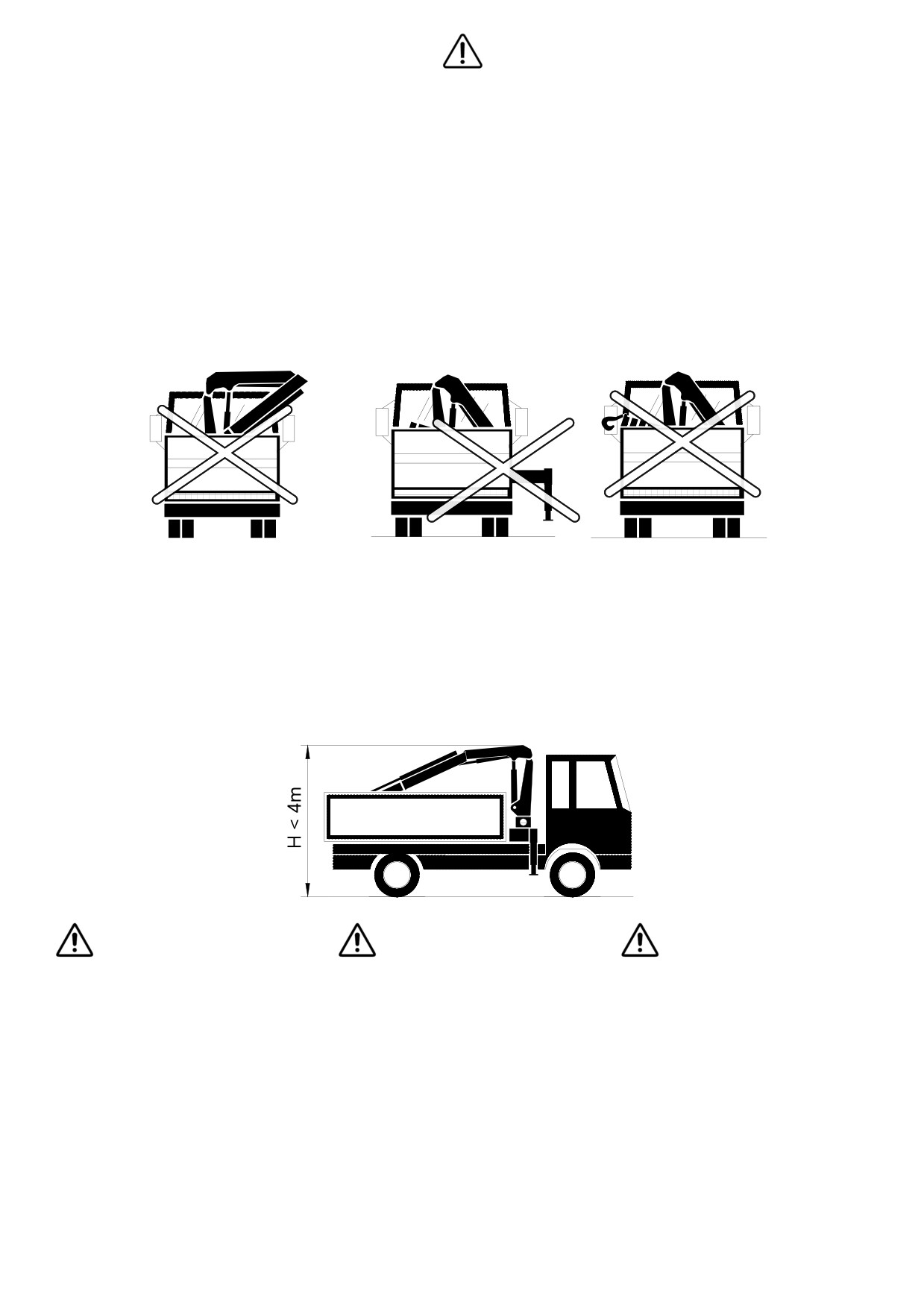
- Prima di ogni trasferimento dell’auto-
- Before moving the vehicle always
- Vor jeder Überfahrt mit dem Fahrzeug
veicolo bisogna sempre verificare che:
check that:
muss immer sichergestellt werden,
dass:
La gru sia chiusa correttamente in
The crane is closed correctly in the
Der Kran korrekt in Ruhestellung
posizione di riposo (1).
rest position (1).
eingefahren wurde (1).
Le aste estensibili stabilizzatrici siano
The stabiliser extension rods are fully
Die ausziehbaren Abstützstangen
completamente retratte e meccanica-
retracted and locked. If the rods are
ganz eingezogen und mechanisch
mente bloccate: in caso di blocco con
locked using a pin then the latter must
blockiert sind: im Falle der Verbolzung
perno, questo deve essere perfetta-
be inserted perfectly in the rod (2).
muss der Bolzen perfekt in der Stange
mente inserito nell’asta (2).
stecken (2).
Non vi siano parti della gru o di
No crane components or accessories
Keine
Kran- oder Zubehörteile über
accessori che fuoriescano dalla
are protruding
outside the profile of
die Fahrzeugumrisse hinausragen (3).
sagoma del veicolo (3).
the vehicle (3).
1
2
3
Nel caso in cui sia prevista la chiusura
The special boom stop used to lock
Wenn das Einfahren des Krans auf
della gru su cassone, che siano
crane rotation and the visual/luminous
die Pritsche vorgesehen ist, muss die
installati l’apposito fermo braccio che
control indicating consent for road use
Auslegerarretierung und die optische
blocca la rotazione della gru e il
(crane boom must not be more than
Leuchtsteuerung installiert sein, die
comando visivo/elettroluminoso che
4 m from the ground) are installed if
die Fahrt mit dem Fahrzeug freigibt
dà il consenso di circolare col veicolo
the crane is stowed over the truck
(der Kranausleger darf den Abstand
(braccio della gru non deve superare
body.
von
4 m vom Boden nicht
la distanza di 4 m da terra).
übersteigen).
In caso di malfunzionamento dei
Refer to an authorised
Wenn die Sicherheitseinrich-
dispositivi di sicurezza, di urti e/o
assistance centre for a thorough service
tungen nicht einwandfrei funktionieren,
danneggiamenti alla macchina, di
in the event faults to safety devices,
an der Maschine Stöße und/oder
mancanza di targhette di avvertenza è
impact or damage to the machine and
Beschädigungen festzustellen sind bzw.
necessario far eseguire un accurato
missing warning decals.
Hinweisschilder fehlen, muss die
controllo presso un centro di assistenza
Maschine einer akkuraten Kontrolle
autorizzato.
durch ein autorisiertes Service-Center
unterzogen werden.
A-31
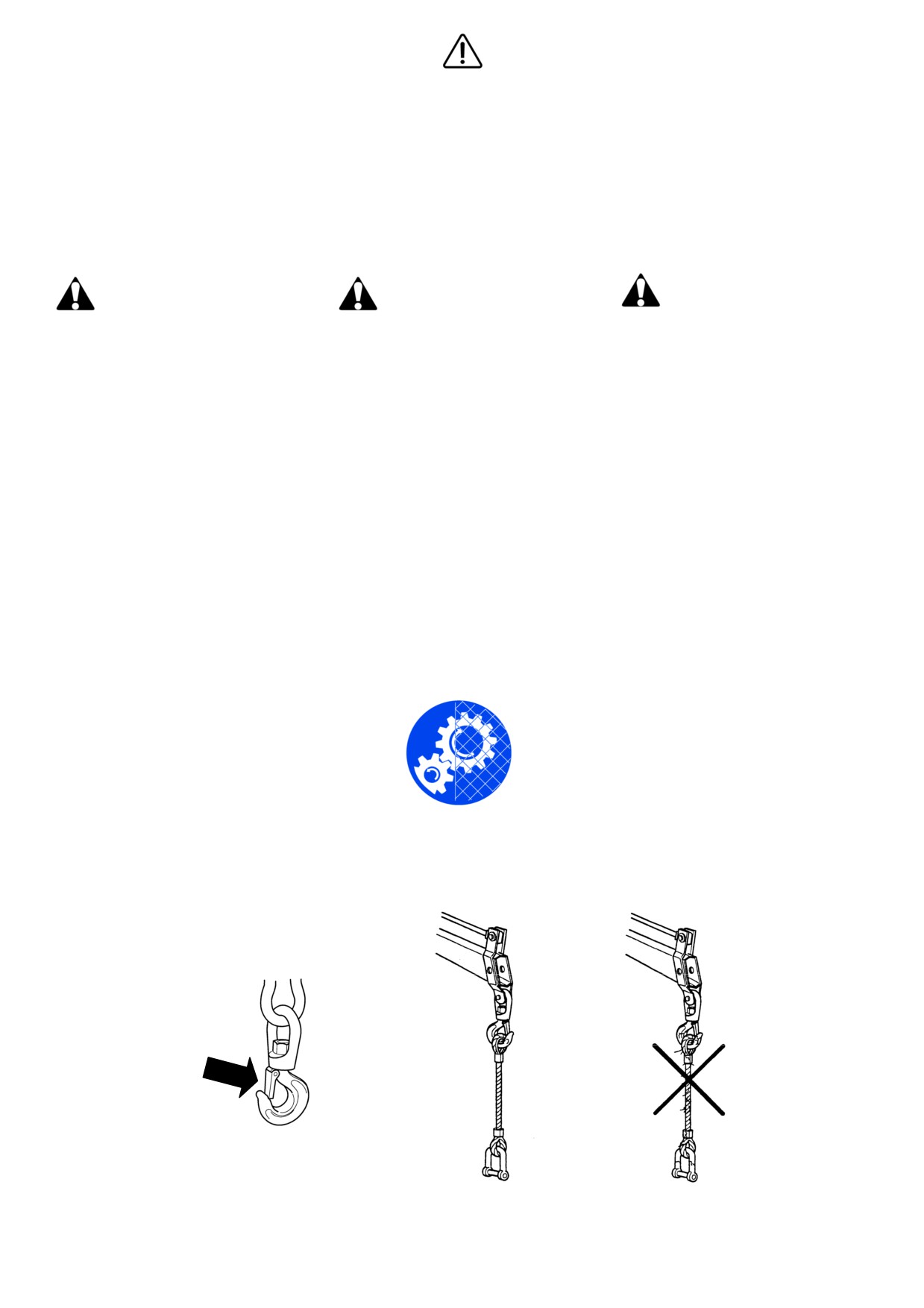
A.10 ERRORI DI
A.10 COUPLING FAULTS
A.10 ANSCHLUSS-
ACCOPPIAMENTO
FEHLER
Possono esserci rischi molto gravi per
There is a serious risk of damage to
Durch den falschen Anschluss
persone e cose dovuti all’errato
property and injury to persons in the
mechanischer oder hydraulischer Teile
collegamento di parti meccaniche o
event of incorrect coupling of
zwischen Kran und Fahrzeug, zwischen
idrauliche tra gru e veicolo, tra gru e
mechanical and hydraulic components
Kran und Hebezeug und zwischen den
organi di sollevamento e tra gli stessi
between the crane and vehicle, crane
Kranteilen können ernste Personen-
organi della gru.
and lifting components and between the
und Sachschäden auftreten.
lifting components themselves.
AVVERTENZE
WARNINGS
WARNUNGEN
Prima di utilizzare la gru l’operatore
The following checks should always be
Vor Benutzung des Krans muss der
deve sempre effettuare i seguenti
made before using the crane:
Kranführer immer die folgenden
Kontrollen durchführen:
controlli:
- Verificare visivamente che il sistema
- Visually check that the hydraulic
- Mittels Sichtkontrolle überprüfen, ob das
Hydrauliksystem funktionstüchtig ist und
idraulico sia efficiente e non vi siano
system is functioning correctly and
perdite d’olio da tubi e raccordi.
that there are no fluid leaks between
aus Schläuchen und Anschlüssen kein
hoses and couplings.
Öl austritt.
- Controllare visivamente l’integrità della
- Visually check the integrity of the
- Sichtkontrolle der Unversehrtheit der
struttura della macchina e dei tubi.
machine structure and hoses.
Maschinenstruktur und der Schläuche.
- Accertarsi che l’organo di presa abbia
- Check that the load capacity of the
- Sicherstellen, dass das Greifgerät die
la portata idonea.
lifting components is adequate.
passende Tragfähigkeit hat.
- Verificare l’integrità dei sigilli dei
- Check the integrity of the seals on the
- Prüfen, ob die Plombierungen der
dispositivi di sicurezza e delle valvole.
safety devices and valves.
Sicherheitseinrichtungen und der
Ventile unversehrt sind
- Verificare l’efficienza dei dispositivi di
- Check the efficiency of the safety
- Die Funktionstüchtigkeit der Sicher-
sicurezza e degli organi di carico.
devices and load lifting components.
heitseinrichtungen und der Hubgeräte
überprüfen.
- Verificare
che
ganci,
grilli,
- Check that hooks, shackles, slings,
- Sicherstellen, dass Haken, Schäkel,
imbracature, funi catene siano in
cables, chains and relevant safety
Anschlagmittel, Seile und Ketten in
condizioni perfette e con le sicurezze
devices are in perfect condition.
einwandfreiem Zustand sind und
efficienti.
funktionstüchtige Sicherungen haben.
A-32
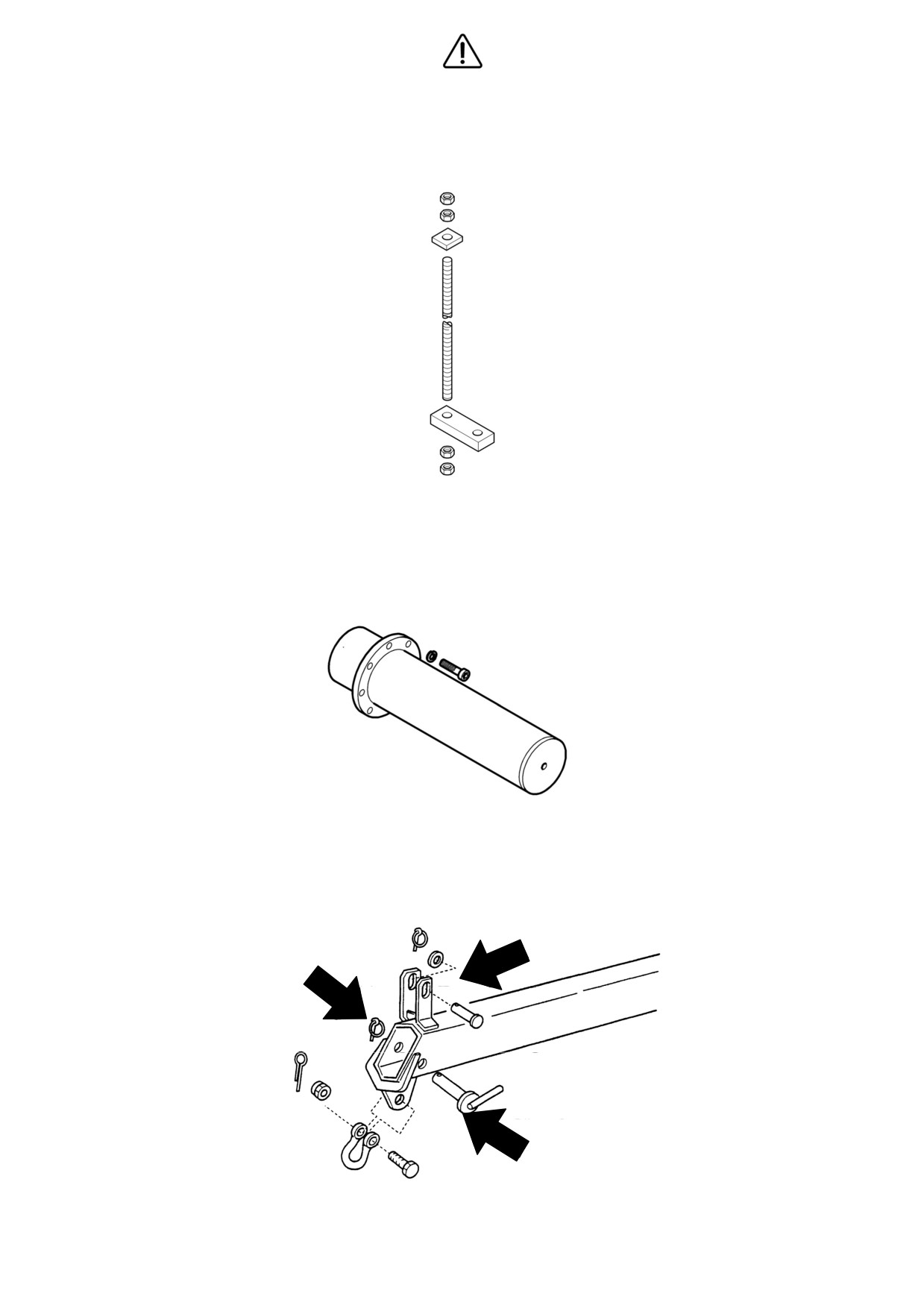
- Verificare che i tiranti di fissaggio
- Check that the tie rods used to secure
- Sicherstellen, dass die Zugstangen
all’autocarro
siano correttamente
the crane to the truck are secured
zur Befestigung am Lkw korrekt
fissati e che la gru non abbia mai
correctly and that the crane is in the
angebracht sind und der Kran sich in
subito movimenti relativi rispetto al
correct position relative to the frame of
der korrekten Position relativ zum
controtelaio.
the truck.
Fahrzeugrahmen befindet.
- Controllare visivamente il serraggio
- Visually check the tightness of rotation
- Mittels Sichtkontrolle den Anzug der
delle viti di fissaggio dei cilindri di
cylinder securing screws and all nuts
Befestigungsschrauben der Drehzy-
rotazione e in generale di tutta la
and bolts in general.
linder und im Allgemeinen aller
bulloneria.
Verschraubungen überprüfen.
- Controllare che perni e viti utilizzate
- Check that pins and screws used in
- Sicherstellen, dass Bolzen und
nelle estensioni e in altri tipi di attrezzi
the extensions and in other lifting tools
Schrauben auf Ausschüben und
siano
assemblati
e
fissati
are assembled and secured correctly.
anderen Hubgeräten korrekt montiert
correttamente.
und befestigt sind.
A-33
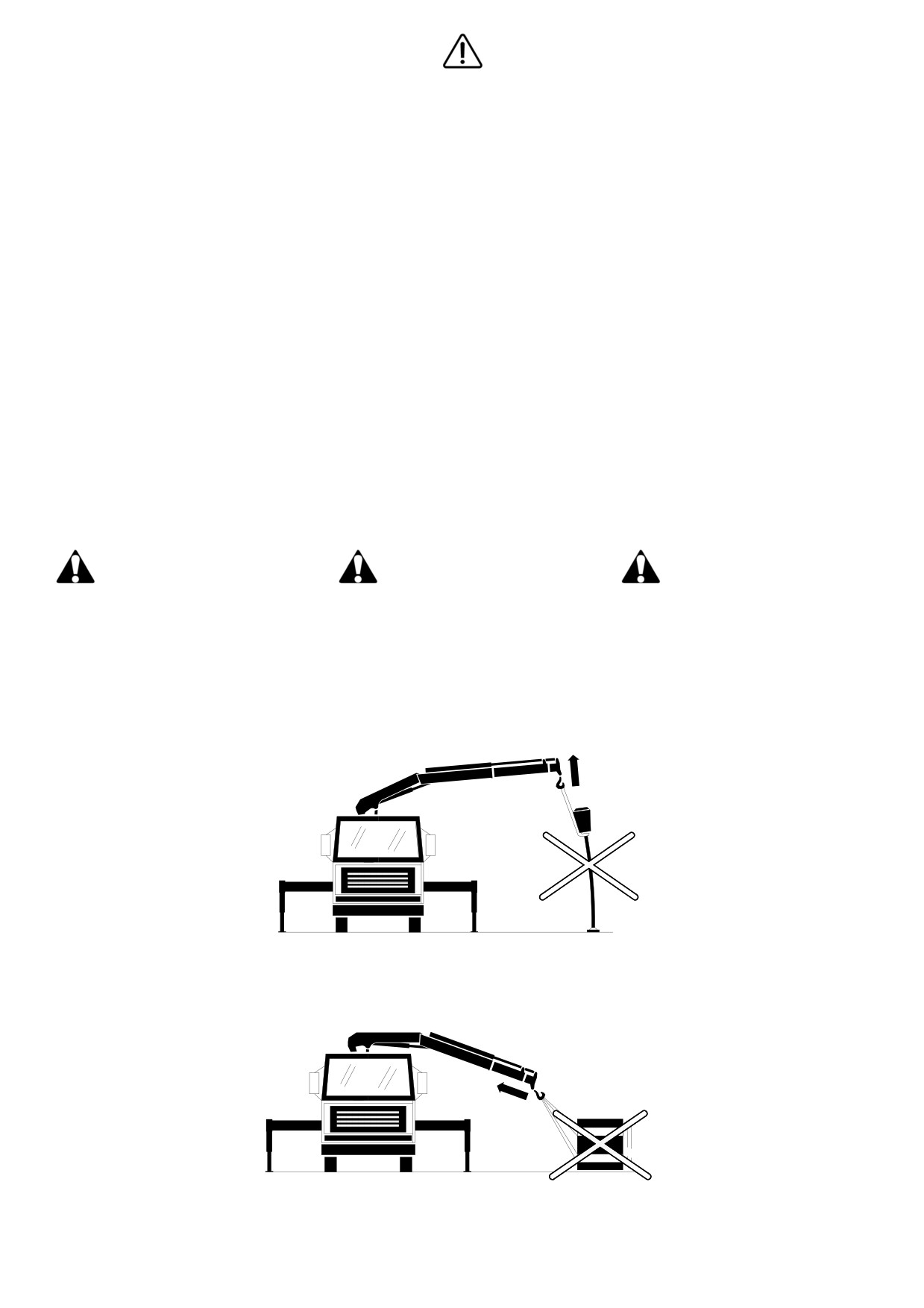
A.11 PERICOLI CAUSATI
A.11 HAZARDS DUE TO
A.11 GEFAHREN DURCH
DA MANOVRE ERRATE
INCORRECT LOAD
MANÖVRIERFEHLER
MOVEMENTS
Esistono ulteriori pericoli residui dovuti
Residual hazards exist as a result of
Es bestehen weitere Restgefahren
alla non corretta movimentazione del
incorrect load movements:
durch nicht korrekte Lastbewegung:
carico:
Loss of stability
Stabilitätsverlust
Perdita di stabilità
Uncontrollable
load,
overload,
Unkontrollierte Last, Überladung,
Carico incontrollato, sovraccarico,
exceeding the tip-up limit
Überschreitung der Kippgrenze
superamento
della
soglia
di
Uncontrollable speed of movements,
Unkontrollierte Weite der Bewe-
ribaltamento
oscillation of the load
gungen, Schwingung der Last
Ampiezza incontrollata dei movimenti,
Unexpected or accidental movement
Unvermittelte, unbeabsichtigte Bewe-
oscillazione del carico
of loads
gung der Lasten
Movimento inatteso, accidentale dei
Unsuitable, worn or unsafe lifting
Ungeeignete, abgenutzte oder nicht
carichi
devices/accessories
sichere Greifgeräte/Zubehöre
Dispositivi/accessori di presa inadeguati,
Lifting of people
Anheben von Personen
logori o non messi in sicurezza
Use during high winds
Benutzung bei Wind
Sollevamento di persone
Risk of damaging load support
Gefahr der Beschädigung der
Utilizzo con vento (agenti atmosferici)
surfaces following movement
Ablageflächen der Last nach der
Pericolo di danneggiamento delle
Uncontrolled descent of the load and
Bewegung
superfici di appoggio del carico a
of the crane boom when the
Unkontrolliertes Sinken der Last und
seguito di movimentazione
overpressure valve on the
2.boom
des Kranauslegers wenn das
Discesa incontrollata del carico e del
cylinder operates.
Überdruckventil auf dem
2.Auleger-
braccio della gru in caso di intervento
zylinder öffnet.
della valvola di sovrapressione sul
cilindro 2.braccio
AVVERTENZE
WARNINGS
WARNUNGEN
Sono severamente vietate le seguenti
The following
movements and
Die
folgenden
Vorgänge
und
operazioni e movimentazioni con la gru:
operations with the crane are strictly
Bewegungen mit dem Kran sind strikt
forbidden:
verboten:
- Utilizzo gru per tirare, estrarre,
- Using the crane to drag, extract,
- Verwendung des Krans, um fest
sradicare,
spingere,
schiacciare
remove, push or crush fixed or stuck
verbundene Gegenstände zu ziehen,
oggetti vincolati.
objects.
auszuziehen, zu entwurzeln, zu
schieben, zu pressen
- Trascinamento di carichi sul terreno,
- Dragging of loads on the ground, on
- Schleppen der Lasten auf dem
su guide, appoggiati a un muro, ecc.
guides, resting against a wall, etc.
Boden, auf Schienen, angelehnt an
eine Wand usw.
A-34
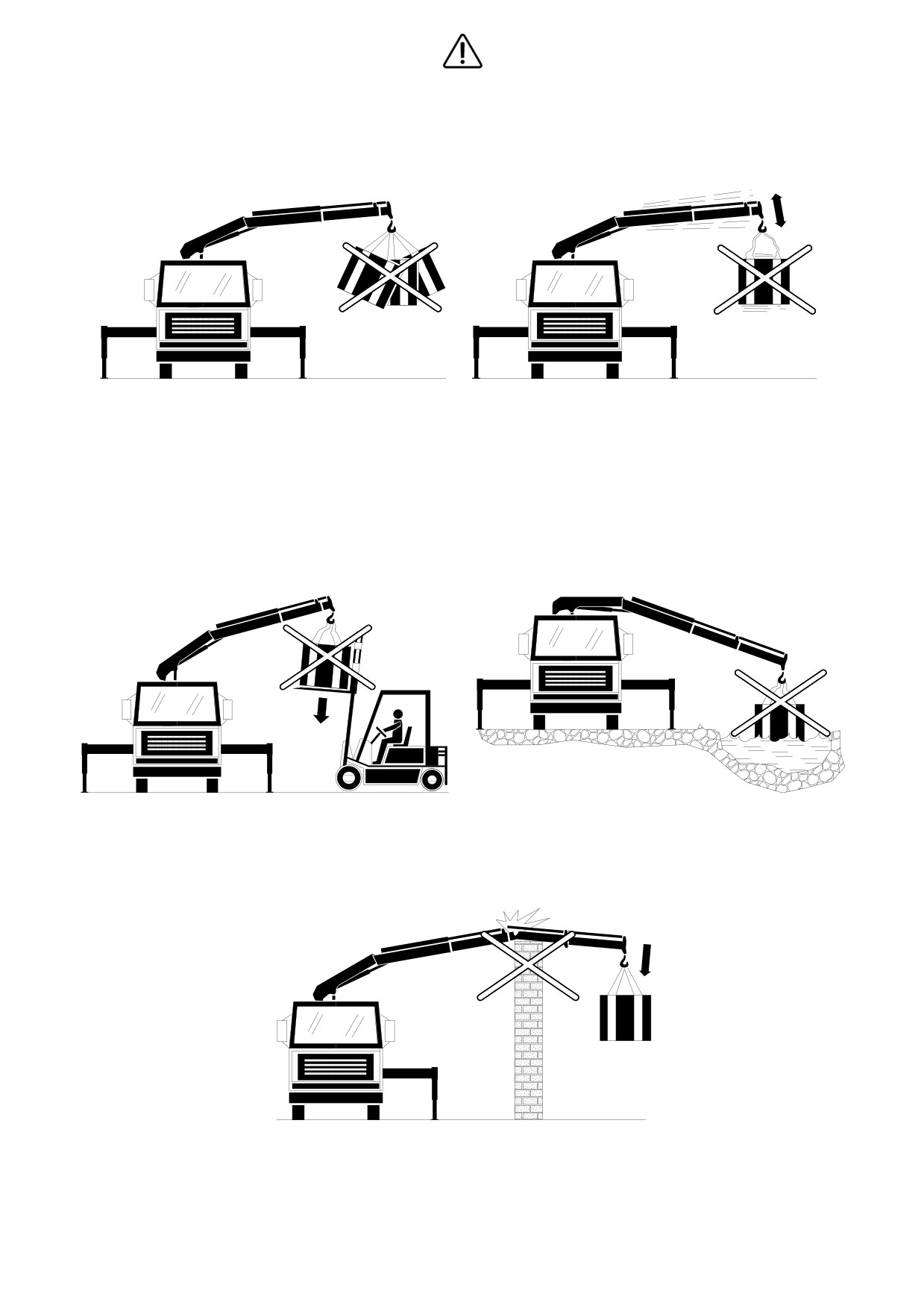
- Movimenti bruschi
(rotazione, salita,
- Brisk movements
(sudden rotation,
- Brüske Bewegungen
(unvermitteltes
discesa improvvise) che inducono
ascent, descent) causing significant
Drehen, Heben, Senken), die
notevoli oscillazioni del carico o
load oscillation or abnormal machine
erhebliche Schwingungen der Last
vibrazioni anomale nella struttura
structure vibration.
und anomale Vibrationen in der
della macchina.
Maschinenstruktur herbeiführen.
- Sollevamento
di
carichi
non
- Lifting of loads not supported by
- Anheben von Lasten, die nicht auf
appoggiati a oggetti fissi solidali al
objects secured solidly to the base of
festen,
mit
dem Kransockel
basamento della gru a meno che
the crane unless the operator knows
verbundenen Gegenständen auflie-
l’operatore
sappia precisamente
the precise size of the load being
gen, es sei denn der Kranführer kennt
l’entità del carico da movimentare (es.
moved (e.g. forklift truck leaving an
den Umfang der zu bewegenden Last
muletto che lascia un carico eccessivo
excessive weight on the crane hook,
genau (z.B. Gabelstapler, der eine zu
appeso al gancio gru, sollevamento di
lifting a floating weight, etc.).
schwere Last am Kranhaken hängen
un carico galleggiante, ecc.)
lässt, Anheben einer schwimmenden
Last usw.).
- La movimentazione vicino a oggetti
- Movements very close to fixed (walls,
- Kranbewegung in der Nähe fester
fissi
(muri, alberi, ecc.) e mobili (gru,
trees, etc.) and mobile (cranes, forklift
(Mauern,
Bäume usw.) und
carrelli elevatori, carroponti, ecc.).
trucks, gantry cranes, etc.) objects.
beweglicher
Hindernisse
(Kran,
Gabelstapler, Laufkräne usw.).
A-35
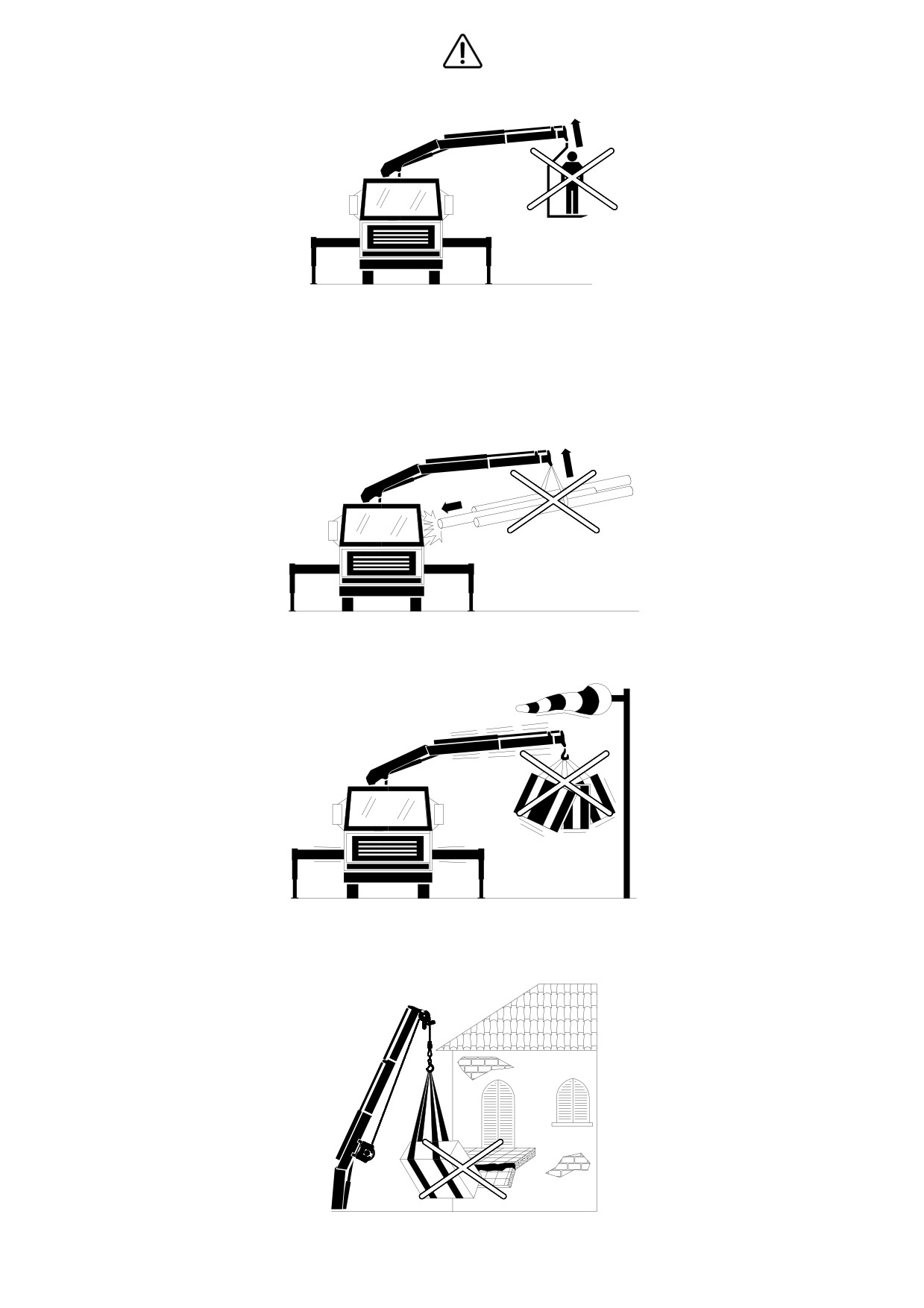
- Il sollevamento di persone.
- Lifting of people.
- Anheben von Personen
- Utilizzare organi di sollevamento non
- Using lifting components which are
- Verwenden von Hubmitteln, die für die
adeguati al carico, logori o senza
worn, not suitable for the load or
Last ungeeignet, abgenutzt oder ohne
sicurezze: pericolo di perdita/caduta
without safety devices. Risk of
Sicherheitsvorrichtungen sind, wodurch
accidentale, scivolamento, eccessiva
accidental loss/fall, slipping, excessive
folgende Gefahren verursacht werden:
rotazione o inclinazione del carico,
rotation or tipping of the load and
Lastverlust
/ Herabfallen der Last,
ampi movimenti incontrollati.
uncontrollable movements.
Verrutschen, übermäßiges Drehen oder
Neigen der Last, weite
unkontrollierte
Bewegungen.
- Utilizzo in condizioni meteorologiche
- Using the machine under adverse
- Verwendung
bei
ungünstiger
avverse (vento eccessivo).
weather conditions (high winds).
Witterung (zu starker Wind).
- Appoggiare il carico su superfici
-
Resting the load on surfaces with
- Absetzen der Last auf Flächen, deren
aventi resistenza, area e inclinazione
unsuitable strength, area or incline.
Widerstand, Größe und Neigung
non idonee.
ungeeignet sind.
A-36
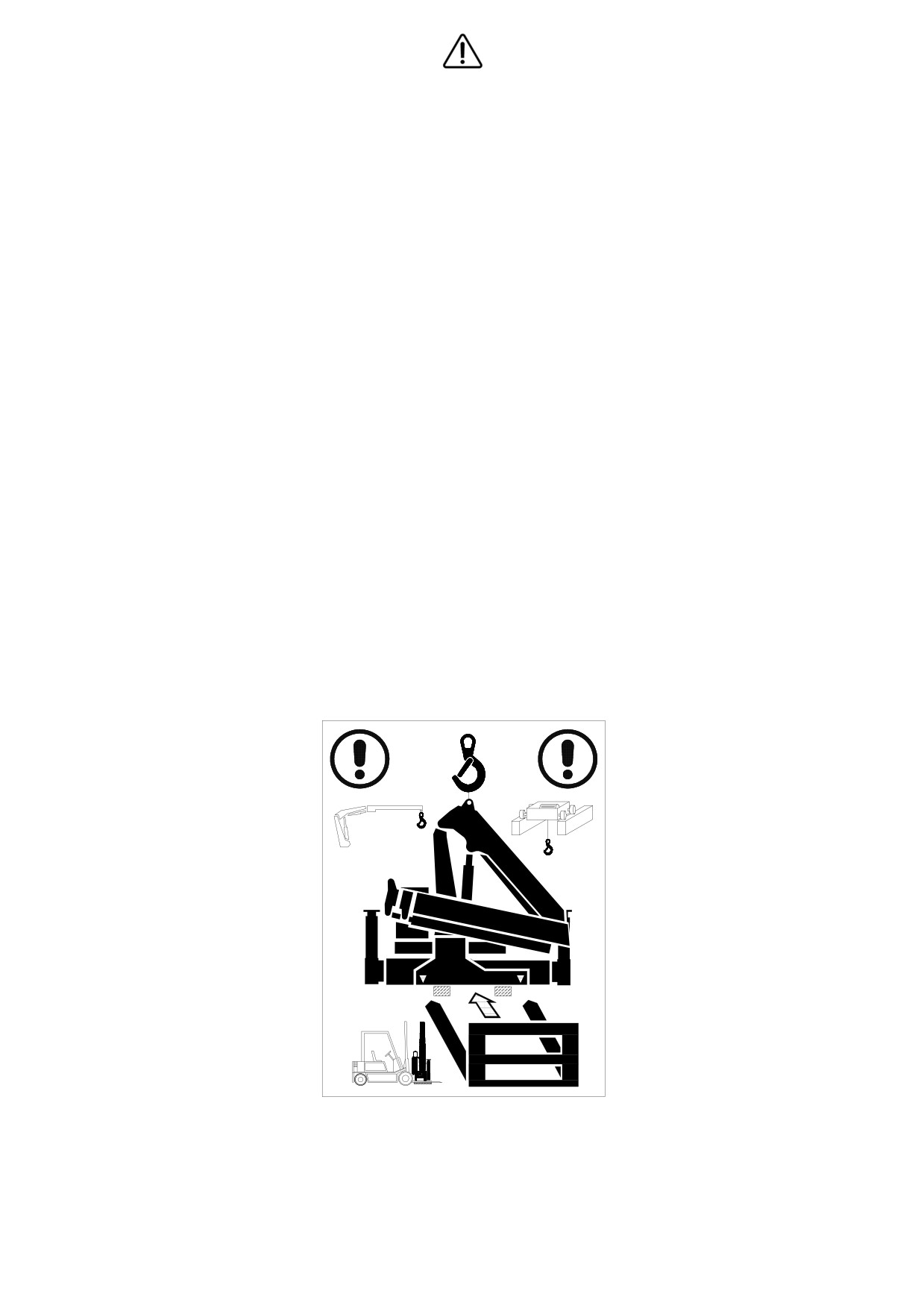
A.12 AVVERTENZE PER
A.12 WARNINGS TO LIFT
A.12 WARNUNGEN FÜR
IL SOLLEVAMENTO E IL
AND TRANSPORT THE
TRANSPORT UND
TRASPORTO GRU
CRANE
ANHEBEN DES KRANS
La gru, quando non installata, deve
If not installed, the crane must be
Wenn der Kran nicht installiert ist, muss
essere movimentata in sicurezza per
moved safely, in order to avoid falls and
er gefahrlos transportiert werden, um
evitare cadute ed urti con cose e
impacts with objects and persons.
Fälle
und Zusammenstöße mit
persone.
Gegenstände und Personen zu
vermeiden.
Il trasportatore durante lo spostamento
During transport of the crane, the carrier
Während des Transports, muss der
deve rispettare le seguenti istruzioni:
must follow these instructions:
Beförderer
diese
Anweisungen
befolgen:
1. Il trasportatore è il responsabile della
1. The carrier is responsible for the
1. Der Beförderer ist verantwortlich für
gru e pertanto deve essere qualificato.
crane and he must be qualified.
den Kran, daher muss er qualifiziert
sein.
2. Utilizzare un mezzo di trasporto o
2. Use means of transport or lifting with
2. Ein Trasportmittel oder eine Hebe-
sollevamento di portata adeguata.
adequate capacity.
vorrichtung mit angemessener Tragkraft
verwenden.
3. Sollevare la gru tramite carrello
3. Raise the crane by lift-truck, crane or
3. Den Kran mit Gabelstapler, Kran oder
elevatore, gru o carroponte.
bridge crane.
Laufkran anheben.
CARRELLO ELEVATORE
LIFT TRUCK
GABELSTAPLER
Inserire le forche sotto il basamento in
Insert the forks under the base in
Die Gabeln bei den Pfeilen unter dem
corrispondenza delle frecce indicate
corrispondence to the indicated arrows
Kransockel (siehe §D.2 und Abb.).
(vedi §D.2 e fig.).
(see §D.2 and fig.).
Den
2.Ausleger an Gabelstaplerseite
Mantenere il 2° braccio della gru sul lato
Keep the 2.boom of the crane at truck
halten: Den Kran befestigen.
carrello: fissare la gru al carrello.
side: fix the crane to the truck.
GRU
CRANE
KRAN
Inserire Il gancio nell'apposito punto di
Insert the hook in the suitable
Den Haken in die Transportöse auf dem
aggancio posto sul 1° braccio della gru
attachment on the 1.boom of the crane.
1.Ausleger einstecken (siehe §D.2 und
(vedi D.2 e fig.).
(see D.2 and fig.).
Abb.).
È necessario limitare le oscillazioni del
It'necessary to limit the load oscillations.
Das ist nötig, um die Lastschwingungen
carico.
zu begrenzen.
4. Durante Il trasporto per terra o per
4. During the transport by land and sea,
4. Während des Transports zu Wasser
mare, fissare la gru o il suo contenitore
fix the crane or its conainer to the
und zu Lande, den Kran oder dessen
al mezzo di trasporto
(cassone,
means of transport
(body, container,
Behälter am Trasportmittel befestigen
container, stiva, ecc.).
hold, etc.).
(Pritsche, Container, Kielraum, usw.).
La gru deve essere protetta dagli agenti
Protect the crane properly from
Der Kran muss vor Wetterungs-
atmosferici e mai disimballata.
atmospheric agents. Never unpack the
einflüssen
geschützt
und
nie
crane.
ausgepackt werden.
A-37
A.13 AVVERTENZE
A.13 SUPPLEMENTARY
A.13 ZUSÄTZLICHE
SUPPLEMENTARI PER
WARNINGS FOR RADIO
HINWEISE FÜR DIE
RADIOCOMANDO
REMOTE CONTROL
FUNKFERNSTEUERUNG
Le gru che vengono movimentate
There are specific hazards when
Die Kräne, die mittels Funksteuerung
tramite radiocomando presentano i
operating the crane using a remote
bewegt werden, weisen die spezifischen
rischi specifici legati a movimentazione
control unit caused by unexpected,
Risiken auf, die mit der unterbrochenen,
interrotta, errata, o imprevista della
interrupted or incorrect movement and
falschen oder unvermittelten Bewegung
macchina e a pericoli elettrici.
electric hazards.
der Maschine und mit elektrischen
I rischi sono legati a:
The hazards are associated with the
Gefahren zusammenhängen.
following:
Die Gefahren sind zurückzuführen auf:
targhe dei comandi non conformi
incorrect control panel indications
die nicht konforme Beschilderung der
errata taratura delle manovre
incorrect calibration of movements
Steuerungen
interferenze elettromagnetiche da
electromagnetic
radio
frequency
eine falsche Einstellung der Manöver
radiofrequenza
interference
elektromagnetische
Interferenzen
eccessiva distanza tra trasmittente e
excessive
distance
between
durch Funkfrequenz
ricevente
transmitter and receiver
den zu großen Abstand zwischen
danneggiamento dei dispositivi interni
damage to internal and external radio
Sende- und Empfangsgerät
ed esterni
del
radiocomando
control
devices
(switches,
die Beschädigung interner und externer
(interruttori, potenziometri, circuiteria
potentiometers, circuitry, etc.)
Vorrichtungen
der
Funksteuerung
varia, ecc.)
using the unit under conditions other
(Schalter, Potentiometer, verschiedene
utilizzo al di fuori delle condizioni di
than
the
prescribed
ones
Schaltkreise usw.)
servizio
prescritte
(temperatura,
(temperature, weather conditions,
die Verwendung außerhalb der
condizioni meteorologiche ecc.)
etc.)
vorgeschriebenen
incontrollato
azionamento
dei
uncontrolled use of the transmitter
Einsatzbedingungen
(Temperatur,
comandi sulla trasmittente dovuta a
controls due to impact, falls, crushing
Witterung usw.)
urti, cadute, schiacciamenti delle leve
of levers and use by unauthorised
die unkontrollierte Betätigung der
del radiocomando stesso, utilizzo da
personnel
Steuerungen am Sendegerät durch
persone non autorizzate
failed power supply from the
Stöße, Stürze, Einklemmen der Hebel
mancata alimentazione proveniente
transmitter batteries
der Funksteuerung, Bedienung durch
dalle batterie della trasmittente
tampering with devices
Unbefugte
manomissione dei dispositivi
human error
die fehlende Stromversorgung von
errore umano
contact with live internal radio control
den Batterien des Sendegeräts
contatto con componenti in tensione
unit components
die Veränderung der Vorrichtungen
all’interno del radiocomando
menschliches Versagen
die Berührung spannungsführender
Teile in der Funksteuerung
AVVERTENZE
WARNINGS
WARNUNGEN
- Prima di iniziare i lavori assicurarsi
- Before starting work check that the
- Vor Beginn der Arbeiten muss
che la gru operi nelle condizioni
crane will operate under the
sichergestellt werden, dass der Kran
ammesse per l’esercizio: temperatura,
conditions
permitting
use:
unter den zulässigen Einsatzbe-
umidità, condizioni meteorologiche,
temperature,
humidity,
weather
dingungen
arbeitet:
Temperatur,
ecc. (vedi manuale avvertenze, uso e
conditions etc.
(see the user,
Feuchtigkeit,
Witterung usw.
(siehe
manutenzione specifico della gru).
maintenance and warnings manual for
spezifisches Anweisungs-, Bedienungs-
the crane).
und Wartungshandbuch des Krans).
- Assicurarsi al primo utilizzo che le
etichette applicate sul joystick della
- Check that the labels applied to the
- Bei erstmaliger Verwendung sicher-
trasmittente riproducano fedelmente
joystick on the transmitter are the
stellen, dass die Etiketten am Joystick
la simbologia delle rispettive leve sul
same as the indications on the control
des Sendegeräts dieselben Symbole
distributore.
valve levers.
wie an den entsprechenden Hebeln
am Steuerventil wiedergeben.
- Prima di operare con la gru muovere
- Before starting work with the crane
sempre i joystick con estrema cautela
move the joystick slowly and
- Vor jeder Kranarbeit die Joysticks
verificando che:
delicately to check that:
sehr vorsichtig bewegen, um zu
la direzione dei comandi rispetti
the direction of the controls is the
überprüfen, ob:
quanto riportato negli adesivi
same as that indicated on the labels
die Richtung der Steuerungen den
il pulsante d’emergenza funzioni
the emergency stop button is
Angaben auf den Aufklebern
correttamente
functioning correctly
entspricht
la velocità dei movimenti della gru
the speeds of the crane movements
die Not-Aus Taste korrekt funktioniert
venga comandata proporzionalmente
are controlled proportionally and
die Bewegungsgeschwindigkeiten des
e gradatamente con l'escursione dei
gradually by the travel of the joysticks
Krans proportional und graduell vom
joystick
Ausschlag des Joysticks gesteuert
werden
A-38
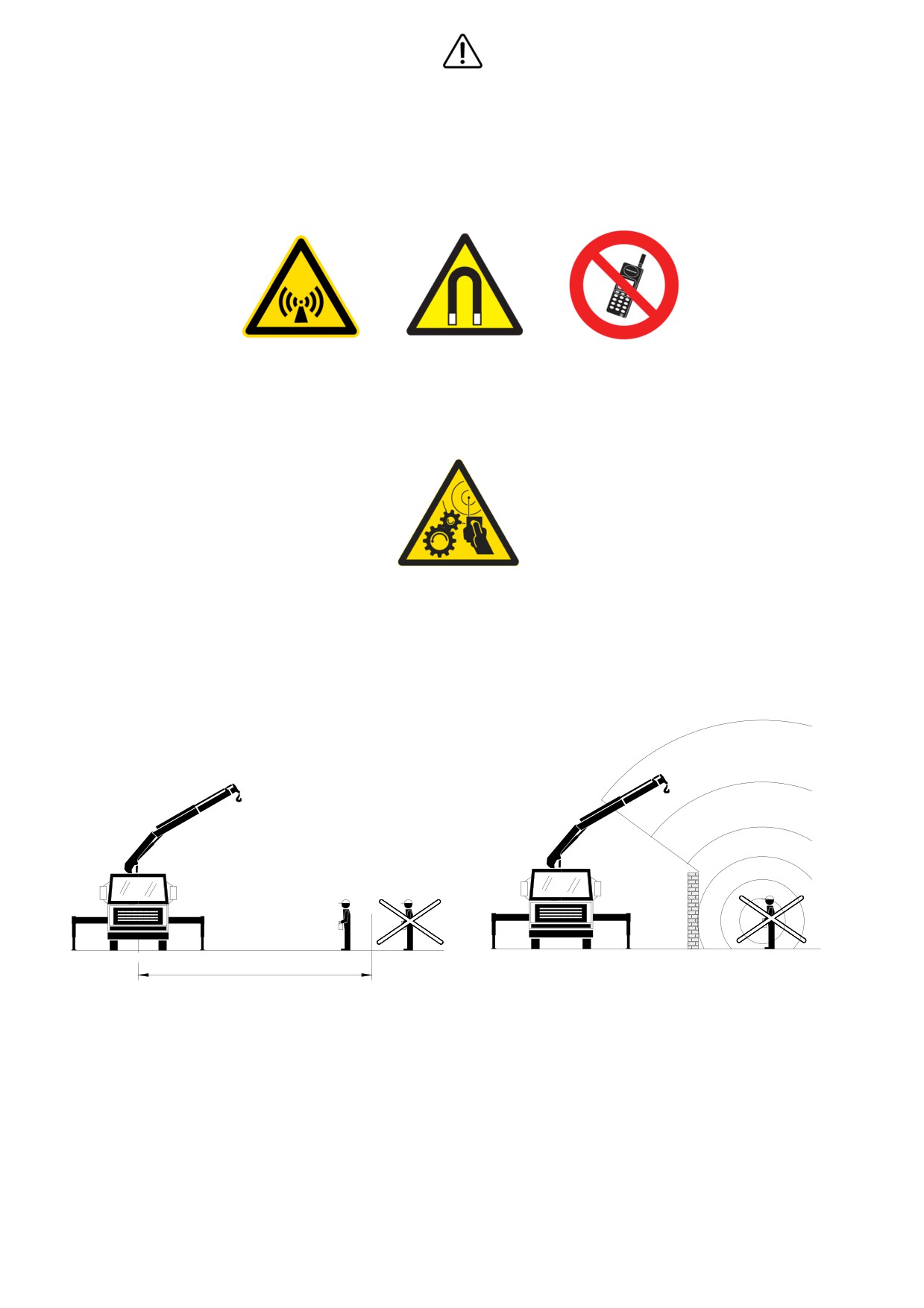
- Accertarsi della presenza nei pressi
- Check for possible sources of
- Kontrollieren, ob in der Nähe des
della zona di lavoro di possibili fonti di
electromagnetic disturbance in the
Arbeitsbereichs mögliche Quellen für
disturbo
elettromagnetico
(altri
vicinity of the working area
(other
elektromagnetische Störungen vor-
radiocomandi, antenne, apparati
radio control units, aerials, radio
handen sind
(andere Funksteuerun-
ricetrasmittenti in genere, impianti
receivers and transmitters in general,
gen, Antennen, Sende-/Empfangs-
elettrici che generano potenti campi
electric systems generating powerful
geräte, elektrische Anlagen, die starke
elettromagnetici, magneti, ecc.).
electromagnetic fields, magnets, etc.).
elektromagnetische Felder erzeugen,
Magnete usw.).
- Prima di iniziare le operazioni,
- Before starting work inform other
- Vor Beginn der Arbeiten, den
avvertire l’eventuale collaboratore o
personnel in the area that the crane is
eventuellen Assistenten oder anderes
altro personale nei paraggi che la
to be operated using the remote
Personal in der Nähe informieren,
movimentazione avviene tramite
control unit.
dass die Bewegung funkgesteuert
radiocomando.
erfolgt.
- Non operare sulla trasmittente quando
- Do not use the transmitter at a
- Das Sendegerät nicht bedienen, wenn
questa si trova ad una distanza dalla
distance from the receiver greater
sich dieses in einem größeren
ricevente superiore a quella indicata
than that indicated
(DRmax) in the
Abstand vom Empfangsgerät befindet,
dal manuale d’uso del radiocomando
radio control unit user manual. No
als im Bedienungshandbuch der
(DRmax). Non deve esserci nessun
physical obstacles should interfere
Funksteuerung angegeben (DRmax).
ostacolo fisico che interferisca con il
with the radio signal.
Das Funksignal darf durch kein
segnale radio.
physisches Hindernis gestört werden.
OK
DRmax
- Effettuare un controllo visivo del
- Visually check the external condition
- Eine Sichtkontrolle des einwandfreien
buono stato esterno di trasmittente e
of the transmitter and receiver
äußeren Zustands des Sende- und
ricevente
(interruttori, componenti e
(switches, components and covers
des Empfangsgeräts vornehmen
involucri devono essere integri, puliti e
must be intact, clean and dry).
(Schalter,
Komponenten
und
esenti da umidità).
Gehäuse müssen unversehrt, sauber
und frei von Feuchtigkeit sein).
A-39
- Proteggere il radiocomando dall’umi-
- Protect the radio control unit against
- Die Funksteuerung vor Feuchtigkeit
dità e da getti d’acqua.
water and damp.
und Wasserspritzern schützen.
- Assicurarsi che non sia stato tolto o
- Check that no devices on the radio
- Sicherstellen, dass keine Vorrichtung der
modificato alcun dispositivo del
control unit have been modified or
Funksteuerung entfernt oder verändert
radiocomando: l’antenna deve essere
removed. The aerial must always be
wurde: Die Antenne muss immer
sempre presente pena il danneg-
fitted to prevent irreparable damage to
vorhanden sein, sonst werden die
giamento irreparabile dei circuiti
the internal receiver circuits.
inneren Schaltkreise des Empfangs-
interni della ricevente
geräts irreparabel beschädigt.
- Utilizzare sempre la cintura o la
- Always use the belt or shoulder strap
- Immer den mitgelieferten Traggurt
tracolla data in dotazione per evitare
supplied to prevent accidental falling
oder Schulterriemen benutzen, damit
accidentali cadute della trasmittente.
of the transmitter.
das Sendegerät nicht hinunterfallen
kann.
- Durante brevi pause di lavoro o
- Switch OFF the transmitter during
- Während kurzer Arbeitspausen oder
cambio di postazione di lavoro,
breaks from work and when the
bei Wechseln des Steuerstands muss
l’operatore
deve spegnere la
operating position is changed. At the
das Sendegerät abgeschaltet werden.
trasmittente.
Al
termine
delle
end of work remember to switch OFF
Am Ende der Arbeit immer das
operazioni di
lavoro, ricordarsi di
the transmitter and remove and
Sendegerät abschalten, die Batterie
spegnere la trasmittente, rimuovere la
recharge the battery using the original
herausnehmen und aufladen. Aus-
batteria e metterla sotto carica
recharging unit supplied. Leave a
schließlich Original-Akkus verwenden.
utilizzando solo gli accumulatori
battery in the recharge unit at all times
Immer eine Batterie im Ladegerät
appositi originali. Lasciare sempre
to ensure that a fully charged battery
lassen, um jederzeit über eine
una batteria nel carica batteria in
is always available.
geladene Batterie zu verfügen.
modo che ci sia sempre una batteria
carica a disposizione.
- Si fa divieto di utilizzo della macchina
- All those using the vehicle must
- Die Benutzung der Maschine ist
a chiunque non abbia ricevuto
receive
adequate training
(in
Jedem untersagt, der nicht bei
addestramento adeguato
(secondo
accordance with ISO 9926-1) from
Auslieferung
des Krans vom
norma ISO 9926-1) da parte
those responsible for installing the
Installateur entsprechend geschult
dell’installatore all’atto della consegna
crane on delivery. Use by all other
wurde (gemäß ISO 9926-1).
della gru.
personnel is forbidden.
A-40
- Durante il lavoro tenere sempre il
- During work the transmitter should be
- Das Sendegerät während der Arbeit
trasmettitore in modo che il quadro di
held at all times with the control panel
immer so halten, dass das Bedienfeld
comando sia rivolto verso di voi.
facing the operator. Make sure that
zum Kranführer gerichtet ist. Der
Assicurarsi di poter leggere tutti i testi
you are able to read and understand
Kranführer muss alle Texte lesen, und
e di capire tutti i simboli per evitare
all labels and symbols to prevent
alle Symbole verstehen können, um
manovre errate.
incorrect movements.
Bedienungsfehler zu vermeiden.
- Terminate
le
operazioni
di
- When you have finished using the
- Nach Beendigung der Bewegungen
movimentazione estrarre la chiave per
remote control unit remove the key to
den Schlüssel herausziehen, um die
escludere
l’alimentazione
del
switch OFF the unit and place the unit
Stromversorgung der Funksteuerung
radiocomando e riporre la trasmittente
in a safe and secure place.
zu unterbrechen und das Sendegerät
in luogo sicuro e protetto.
an einem sicheren und geschützten
Ort verstauen.
- Se il trasmettitore non viene usato,
- If the transmitter is not used switch it
- Wenn das Sendegerät nicht
spegnetelo e conservatelo in un luogo
OFF and keep it in a safe and secure
verwendet wird, muss es abgeschaltet
sicuro per evitare un esercizio non
place to prevent unwanted use.
und an einem sicheren Ort aufbewahrt
autorizzato.
werden, um einen unbefugten Betrieb
zu vermeiden.
- Un contatto con i componenti, che si
- Contact with live components can be
- Ein Kontakt mit den spannungsfüh-
trovano sotto tensione, può causare la
fatal. All covers marked with the
renden Komponenten kann den
morte immediata. Tutti i coperchi (ad
following decal must only be opened
sofortigen Tod herbeiführen. Alle
esempio calotte di protezione), che
by a qualified electrician after the
Abdeckungen (z.B. Schutzkappen), die
sono contrassegnati con la seguente
service voltage has been cut.
mit dem folgenden Hinweisschild
targhetta, possono essere aperti
gekennzeichnet sind, dürfen nur von
esclusivamente da parte di elettricisti
qualifizierten Fachelektrikern geöffnet
specializzati e qualificati, dopo aver
werden, nachdem die Betriebsspan-
innanzitutto disinserito la tensione di
nung abgeschaltet wurde.
servizio.
Se in qualsiasi circostanza la
Switch OFF the machine and
Wenn die Maschine unter
macchina non dovesse reagire
the transmitter and contact an
irgendwelchen Umständen nicht
correttamente, arrestare subito il
authorised service centre if under
korrekt reagieren, den Betrieb sofort
funzionamento,
spegnere
il
any circumstances the machine
einstellen, das Sendegerät ab-
trasmettitore e recarsi presso un
reacts incorrectly.
schalten und zu einer autorisierten
centro di assistenza autorizzato.
Service-Center bringen.
A-41
PERICOLI DA SOSTANZE
HAZARDS DUE TO TOXIC
GEFAHREN DURCH IM
CHIMICHE CONTENUTE NELLA
CHEMICALS INSIDE THE
SENDEGERÄT ENTHALTENE
TRASMITTENTE
TRANSMITTER
CHEMISCHE STOFFE
Tali pericoli sono legati a:
These hazards are associated with:
Diese Gefahren sind zurückzuführen
Non corretto smaltimento delle
Incorrect disposal of used radio
auf:
batterie esauste del radiocomando.
control unit batteries.
nicht
korrekte
Entsorgung der
Infiammabilità delle batterie.
Flammability of batteries.
verbrauchten
Batterien
der
Funksteuerung.
Entflammbarkeit der Batterien.
AVVERTENZE
WARNINGS
WARNUNGEN
- Le batterie esauste o non funzionanti
- Used or faulty remote control unit
- Die
erschöpften
oder
nicht
del radiocomando devono essere
batteries must be disposed of by an
funktionierenden
Batterien
der
smaltite da azienda autorizzata
authorised company in accordance
Funksteuerung müssen von einem
secondo la legislazione vigente.
with current legislation
befugten Unternehmen gemäß den
geltenden
Vorschriften
entsorgt
werden.
- Le batterie sono infiammabili: non
- Batteries are flammable. Keep well
- Die Batterien sind entflammbar: nicht
avvicinarle a fiamme libere.
away from naked flames.
in die Nähe von offenen Feuer
bringen.
A-42
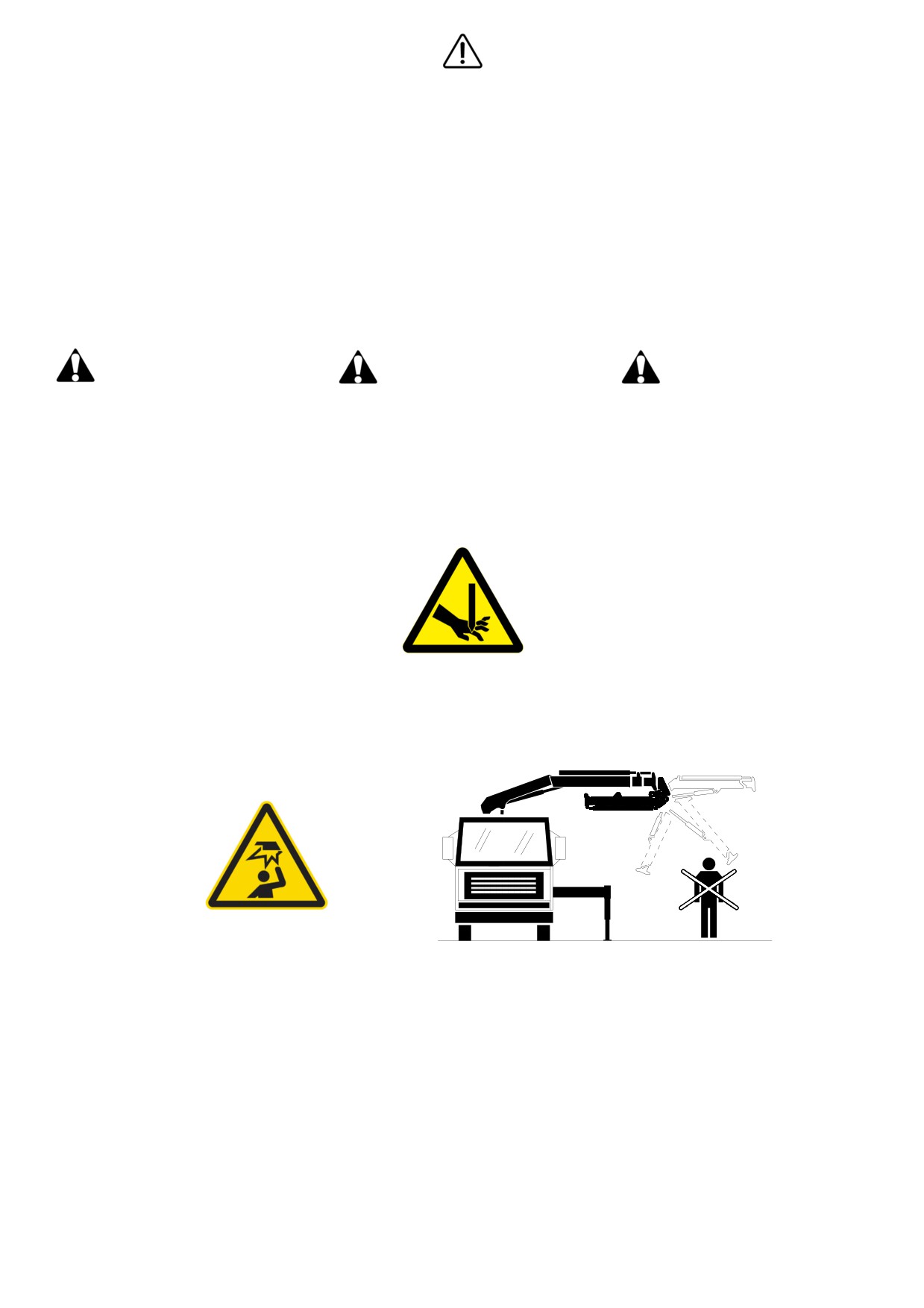
A.14 AVVERTENZE
A.14 SUPPLEMENTARY
A.14 ZUSÄTZLICHE
SUPPLEMENTARI PER
WARNINGS FOR JIB
HINWEISE FÜR JIB-
BRACCIO JIB
AUSLEGER
Le gru che montano il jib presentano i
There are additional specific hazards for
Die Kräne, an denen ein Jib-Ausleger
rischi specifici aggiuntivi che vengono di
cranes mounting a jib, as listed below:
montiert
ist,
weisen zusätzliche
seguito elencati:
Crushing and cutting hazard for upper
spezifische
Gefahren
auf,
die
Pericoli
di
schiacciamento
e
limbs between moving parts on the jib.
nachstehend aufgeführt werden:
cesoiamento degli arti superiori tra le
Impact hazard with property and
Quetsch- und Schergefahr der oberen
parti in movimento relativo del jib.
people during opening an closing of
Gliedmaßen zwischen den bewegli-
Pericolo di urti con cose e persone
jib.
chen Teilen des Jib.
durante le operazioni di apertura e
Gefahr von Zusammenstößen mit
chiusura del jib.
Sachen und Personen während Aus-
und Einfahrens des Jib.
AVVERTENZE
WARNINGS
WARNUNGEN
- Non avvicinare o inserire gli arti
- When the crane is operating do NOT
- Während des Kranbetriebs unter
superiori per nessun motivo a gru
approach or place upper limbs
keinen Umständen die oberen
operativa tra le articolazioni dei bracci
between the jib boom joints and
Gliedmaßen in die Nähe oder
jib e delle bielle. Non inserire dita,
connecting rods. Do NOT insert
zwischen die Gelenke der Jib-
piedi, arti in genere dentro a orifizi di
fingers, feet or limbs inside openings
Ausleger und der Pleuel bringen.
organi in movimento.
on moving parts.
Finger, Füße und Gliedmaßen nicht in
-
Öffnungen
beweglicher
Maschinenteile stecken.
- Attenzione a non urtare contro parti in
- Take care not to bump into moving
- Vorsicht, nicht gegen in Bewegung
movimento del braccio jib, in
parts on the jib boom particularly
befindliche Teile des Jib-Auslegers
particolare durante le operazioni di
during opening and closing of the jib.
stoßen, insbesondere während des
apertura e chiusura del jib.
Aus- und Einfahrens des Jib.
A-43
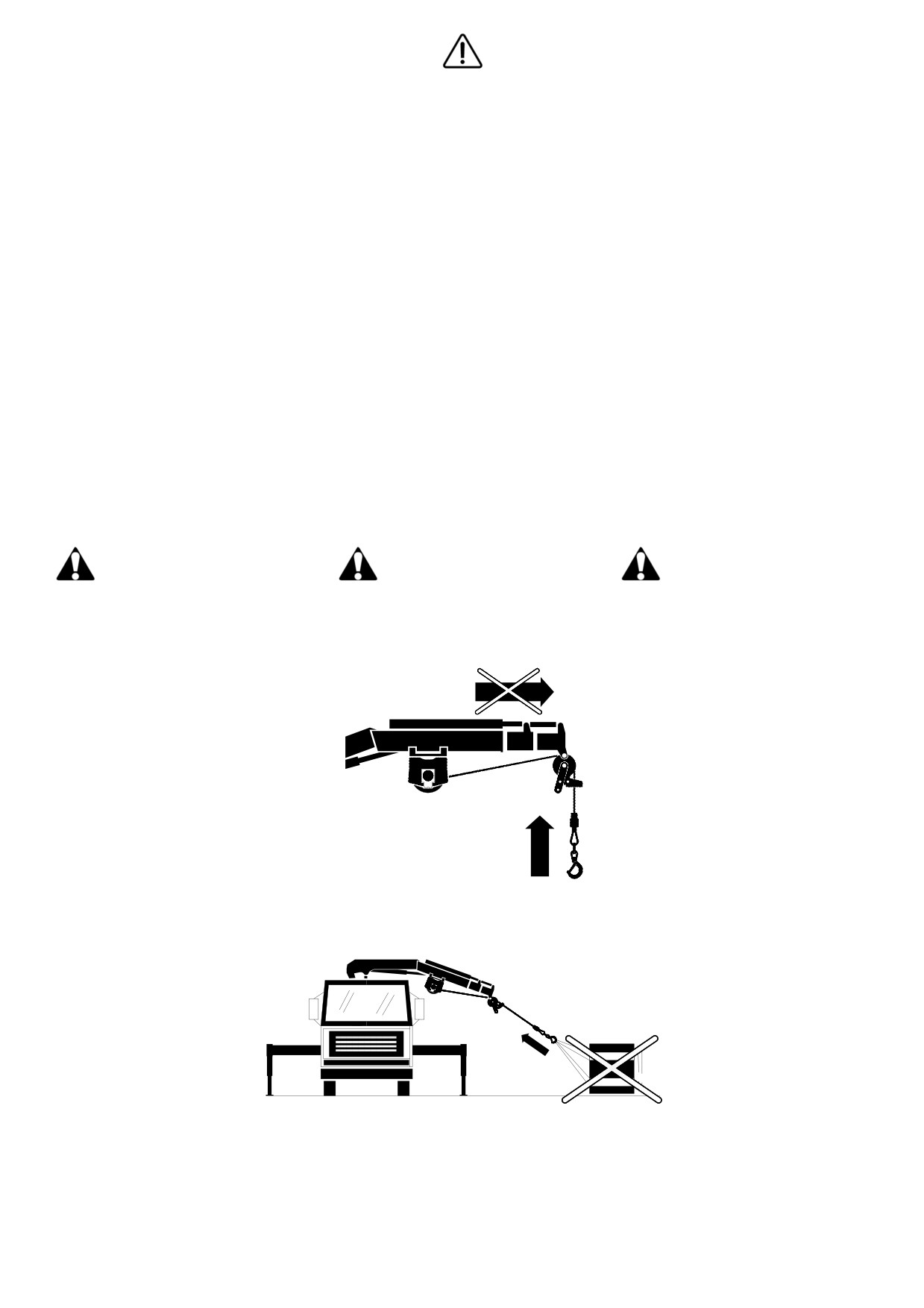
A.15 AVVERTENZE
A.15 SUPPLEMENTARY
A.15 ZUSÄTZLICHE
SUPPLEMENTARI PER
WARNINGS FOR WINCH
HINWEISE FÜR DIE
VERRICELLO
SEILWINDE
Le gru che montano il verricello
There are additional specific hazards for
Die Kräne, an denen eine Winde
presentano i rischi specifici aggiuntivi
cranes mounting a winch as listed
montiert
ist,
weisen zusätzliche
che vengono di seguito elencati:
below:
besondere
Gefahren
auf,
die
Eccessivi sforzi di tensione su fune e
Excessive stress on the cable and
nachstehend aufgeführt werden:
parti
strutturali
della gru che
structural parts of the crane which
Übermäßige Anspannungen an Seilen
potrebbero pregiudicare la sicurezza
may affect structural safety.
und Strukturteilen des Krans, die die
strutturale
Crushing and cutting hazard for upper
Struktursicherheit
beeinträchtigen
Pericoli
di
schiacciamento
e
limbs between the winch cable and
könnten.
cesoiamento degli arti superiori tra
drum and between the cable and
Quetsch- und Schergefahr der oberen
fune e tamburo del verricello e tra
pulley.
Gliedmaßen zwischen Seil und
fune e puleggia
Entanglement hazard in the cable
Trommel der Winde und zwischen
Pericolo di impigliamento nella fune
Hazard involving contact with winch
Seil und Seilscheibe.
Pericoli di contatto con gli organi in
moving parts: crushing between the
Gefahr des Hängenbleibens am Seil.
movimento
del
verricello:
drum and base.
Gefahr des Kontakts mit den
schiacciamenti tra tamburo e base
Cable degradation hazard.
beweglichen Teilen der Winde:
Pericolo di degrado della fune.
Electric shock hazard caused by
Einquetschen zwischen Trommel und
Pericoli
di
scarica
elettrica,
contact between the cable or hook
Basis.
elettrocuzione per contatto della fune
and electric power lines.
Abnutzungsgefahr des Seiles.
o del gancio con linee elettriche
Gefahr elektrischer Entladung und
Stromschlag infolge Kontakt des Seils
oder des Hakens mit elektrischen
Leitungen.
AVVERTENZE
WARNINGS
WARNUNGEN
- È vietato sollevare il carico sfilando il
- Do NOT lift the load by removing the
- Der Teleskopausleger darf nicht
braccio telescopico della gru.
crane telescopic boom.
während des Anhebens der Last
ausgefahren werden.
- È vietato il traino di carichi.
- Do NOT tow loads.
- Das Schleppen von Lasten ist
verboten.
A-44
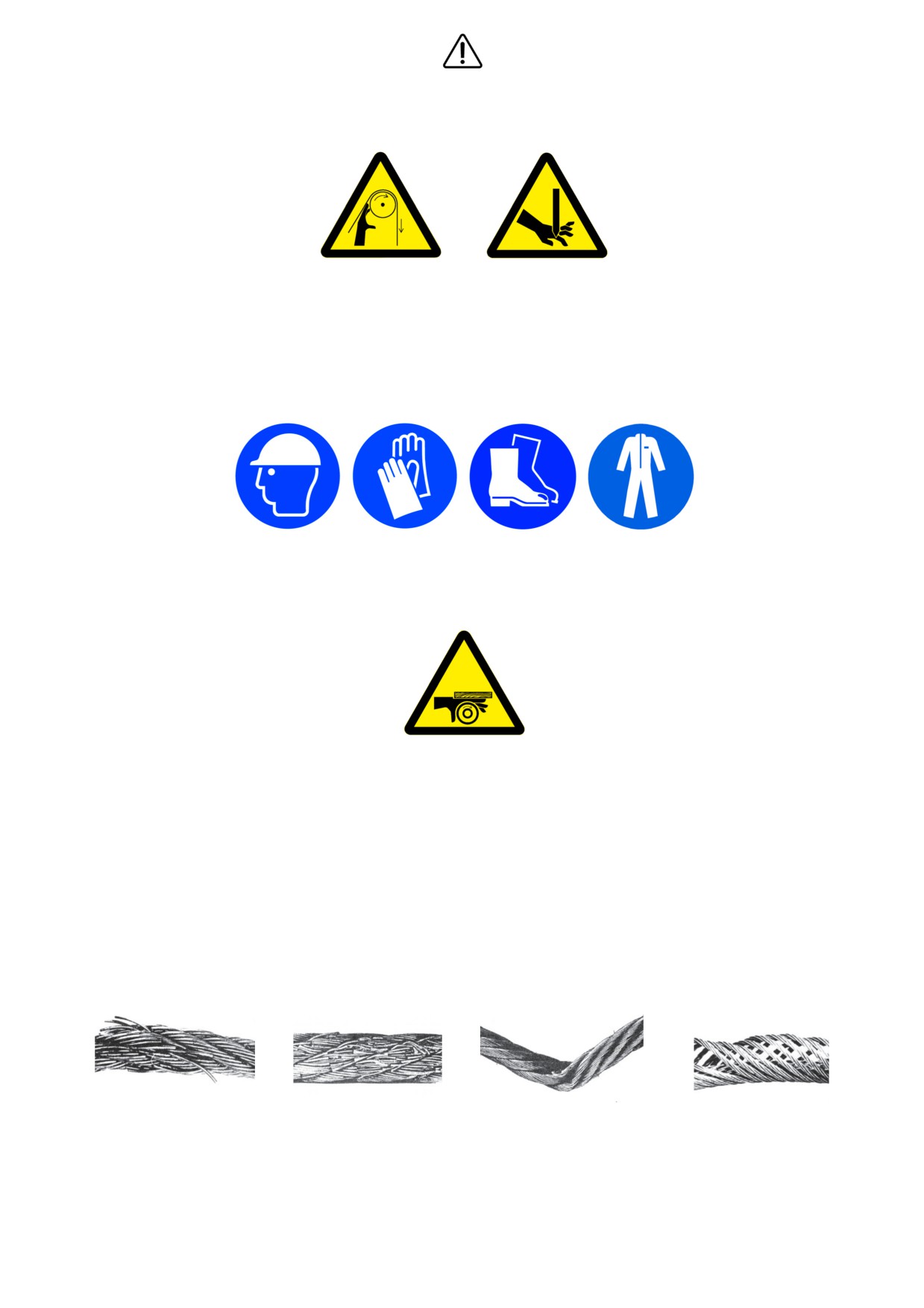
- Non toccare o avvicinarsi alla fune in
- Do NOT approach or touch the cable
- Das Seil nicht berühren und nicht in
prossimità del tamburo e della
near the drum or pulley.
die Nähe der Trommel und der
puleggia.
Seilscheibe kommen.
- Utilizzare sempre elmetto, scarpe
- Always wear a helmet, industrial
- Immer Schutzhelm, Sicherheits-
antinfortunistiche, guanti da lavoro.
footwear and gloves. Do NOT wear
schuhe und Arbeitshandschuhe
Evitare di indossare indumenti con
loose or baggy clothing. Personnel
tragen. Keine Kleidung tragen, die
facili appigli. Si consiglia pertanto di
must wear overalls secured using
leicht hängen bleiben kann. Es
far uso di una tuta da lavoro
buttons and without loose or baggy
empfiehlt
sich
daher,
einen
abbottonata e senza appendici
parts.
zugeknöpften Arbeitsoverall
ohne
volanti.
flatternde Teile zu tragen.
- Durante il lavoro non toccare e
- During operation do NOT approach or
- Während der Arbeit nicht die
avvicinarsi agli organi in movimento
touch the moving parts on the winch
beweglichen Teile der Winde
del verricello
(tamburo, pressacavo,
(drum, cable press, etc.)
(Trommel,
Kabelklemme
usw.)
ecc.)
berühren und nicht in ihre Nähe
kommen.
- Prima di iniziare il lavoro è fatto
- Before starting work carefully check
- Vor Beginn der Arbeit muss die
obbligo
verificare
con
molta
the integrity of the thimble, pocket and
Unversehrtheit der Kausche, der
attenzione l’integrità della redancia,
cable. The most frequent cause of
Tasche und des Seils genau
della tasca e della fune. Le più
damage to the cable are as follows:
kontrolliert werden. Die häufigsten
frequenti cause di danneggiamento
Ursachen für die Beschädigung des
della fune sono:
Seiles sind:
lo scarrucolamento e lo sfregamento
rubbing against moving parts (1)
Entgleisen des Seiles und Reiben
contro parti in movimento (1)
running over worn pulleys (2)
gegen in Bewegung befindliche Teile (1)
lo scorrimento su pulegge logorate (2)
plastic deformation due to crushing (3)
Laufen auf abgenutzten Seilscheiben (2)
la deformazione plastica dovuta a
excessive twisting (4)
plastische Verformung durch Einquet-
schiacciamento (3)
schen (3)
l’eccessivo attorcigliamento (4).
übermäßige Verdrehung (4).
1
2
3
4
A-45
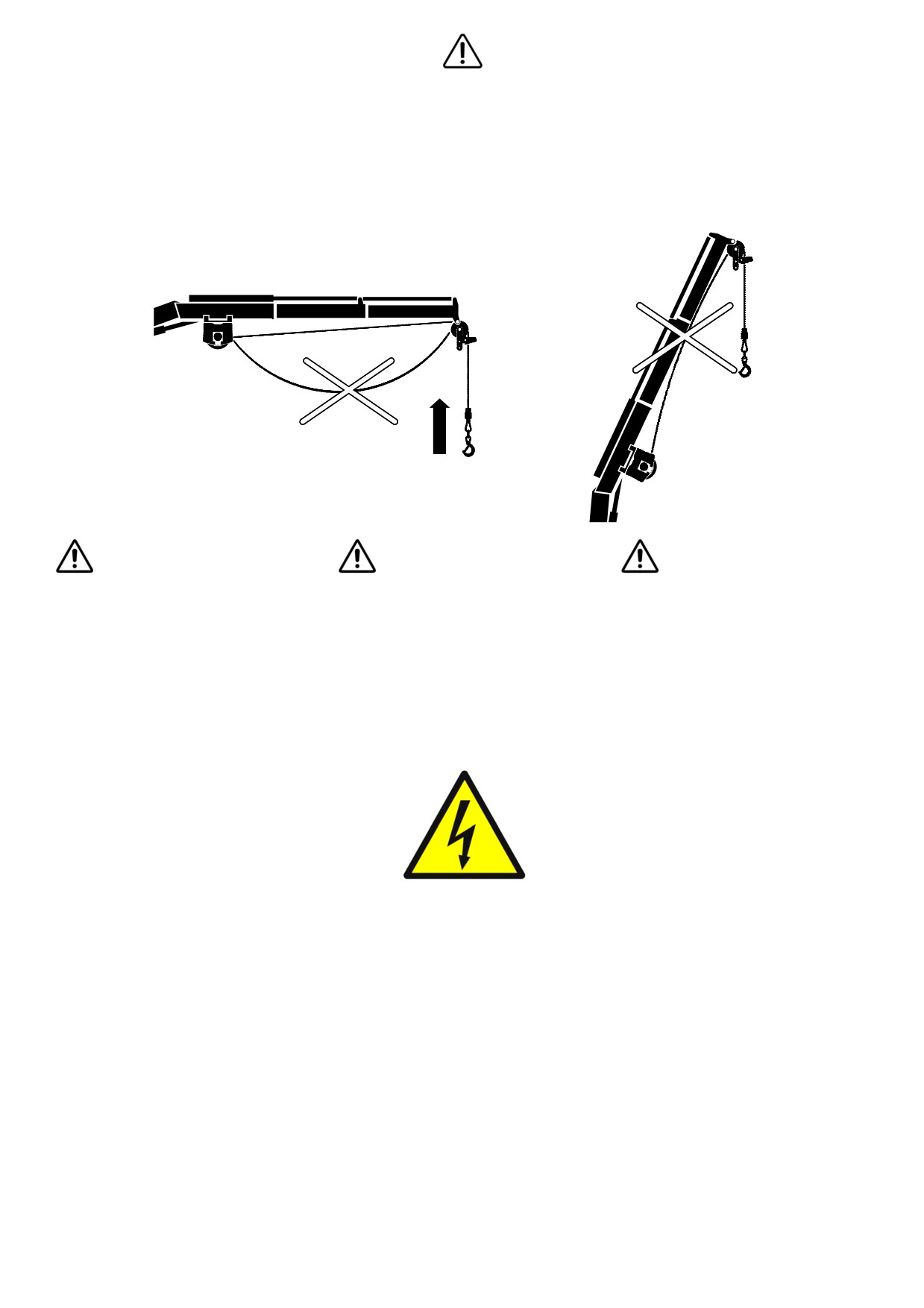
- Inoltre per evitare rischi dovuti al
- During operation always check that
- Um Gefahren durch Verschleiß des
logorio
della
fune è sempre
the cable is taut and not touching the
Seiles zu vermeiden, muss außerdem
necessario accertarsi che la fune
crane structure or any component to
immer sichergestellt werden, dass das
durante l’utilizzo sia sempre in
prevent hazards caused by cable
Seil während der Benutzung stets gut
tensione e non entri mai in contatto
wear. Always use the counterweight.
gespannt ist und nie in Kontakt mit der
con la struttura della gru o di qualsiasi
Kranstruktur oder einem anderen
altro oggetto: non operare mai senza
Gegenstand kommt. Nie ohne
il contrappeso.
Gegengewicht arbeiten.
Nel in cui la fune presentasse
In the event of broken or
Sollte das Seil gerissene Litzen
trefoli rotti o deformazioni permanenti
permanently deformed strands on the
oder
dauernde
Verformungen
(causati da schiacciamenti, stiramenti,
cable
(caused by crushing, excessive
aufweisen
(durch
Einquetschen,
ecc.) è necessaria la sua immediata
strain, etc.) contact an authorised
Verzerren usw.) muss es sofort von
sostituzione presso un centro di
assistance centre for immediate
einem autorisierten Service-Center
assistenza autorizzato.
substitution of the cable.
ersetzt werden.
- È tassativo mantenere la fune
- The winch cable must be kept at least
- Das Seil der Winde muss sich
dell’argano almeno a 7 m dalle linee
7 m from electric power lines bearing
mindestens
7 m von elektrischen
elettriche,
tenendo conto delle
in mind possible cable oscillation.
Leitungen entfernt befinden. Dabei
possibili oscillazioni.
mögliche Schwingungen berücksichti-
gen.
A-46
A.16 AVVERTENZE
A.16 SUPPLEMENTARY
A.16 ZUSÄTZLICHE
SUPPLEMENTARI PER
WARNINGS FOR
HINWEISE FÜR
BENNA-POLIPO
BUCKET-GRAB
SCHALEN-/MEHRSCHA-
LENGREIFER
Le gru che montano la benna o il polipo
There are additional specific hazards for
Die Kräne, an denen ein Schalen- oder
presentano i rischi specifici aggiuntivi
cranes mounting a bucket or grab as
Mehrschalengreifer montiert ist, weisen
che vengono di seguito elencati:
listed below:
zusätzliche spezifische Gefahren auf,
Pericoli
di
schiacciamento
e
Crushing and cutting hazard for upper
die nachstehend aufgeführt werden:
cesoiamento degli arti inferiori e
and lower limbs in the grabs and
Quetsch- und Schergefahr der
superiori tra le valve o nelle parti in
moving parts.
unteren und oberen Gliedmaßen
movimento relativo
Entanglement hazard in the bucket
zwischen den Schalen oder in den
Pericolo di impigliamento negli organi
and rotor parts.
Teilen in relativer Bewegung.
del rotore e della benna
Impact hazard for people and property
Gefahr des Hängenbleibens in den
Pericolo di colpire persone o cose col
when load released or accidental
Rotor- und Greiferteilen.
carico
rilasciato
o fuoriuscito
release of lifting component.
Gefahr, mit der losgelassenen oder
dall’organo di presa
Impact hazard for equipment against
aus dem Greifergerät ausge-
Pericoli legati ad urti e operazioni
objects.
schütteten Last Personen oder
dell’attrezzo contro oggetti.
Structural damage hazard due to
Gegenstände zu treffen.
Pericolo di rottura strutturale per
compression of equipment on load
Gefahren in Verbindung mit Stößen
compressione dell’attrezzo sul carico
when using the crane boom.
und Eingriffen der Ausrüstung gegen
operando col braccio gru.
Hazards due to maintenance
Gegenstände.
Pericoli legati a operazioni di
performed under unsafe conditions.
Gefahr des strukturellen Bruchs
manutenzione non in sicurezza.
wegen Druck der Ausrüstung auf die
Last bei der Arbeit mit Kranausleger.
Gefahren
in
Verbindung
mit
Wartungseingriffen, die nicht unter
Sicherheitsbedingungen ausgeführt
werden.
AVVERTENZE
WARNINGS
WARNUNGEN
- È assolutamente vietato utilizzare
- Do NOT use this accessory to move
- Es ist strikt verboten, die Ausrüstung
l’accessorio per movimentare carichi
forbidden loads as specified in the
zur Bewegung von Lasten zu
non permessi dal manuale uso e
user and maintenance manual for the
verwenden,
die
nicht
vom
manutenzione proprio dell’attrezzo.
equipment.
Bedienungs- und Wartungshandbuch
der Ausrüstung zugelassen ist.
- È severamente vietato inserire arti tra
- Do NOT insert limbs between the
- Es ist streng verboten, mit den
le valve della benna e del polipo.
grabs on the bucket and grab unit.
Gliedmaßen zwischen die Schalen
des Greifers und des Mehrschaleng-
reifers zu fassen.
- Utilizzare sempre elmetto, scarpe
- Always wear a helmet, industrial
- Immer Schutzhelm, Sicherheits-
antinfortunistiche, guanti da lavoro. Si
footwear and gloves. Personnel must
schuhe und Arbeitshandschuhe
consiglia pertanto di far uso di una
wear overalls secured using buttons
tragen. Es empfiehlt sich daher, einen
tuta da lavoro abbottonata e senza
and without loose or baggy parts.
zugeknöpften Arbeitsoverall ohne
appendici volanti.
flatternde Teile zu tragen.
-
A-47
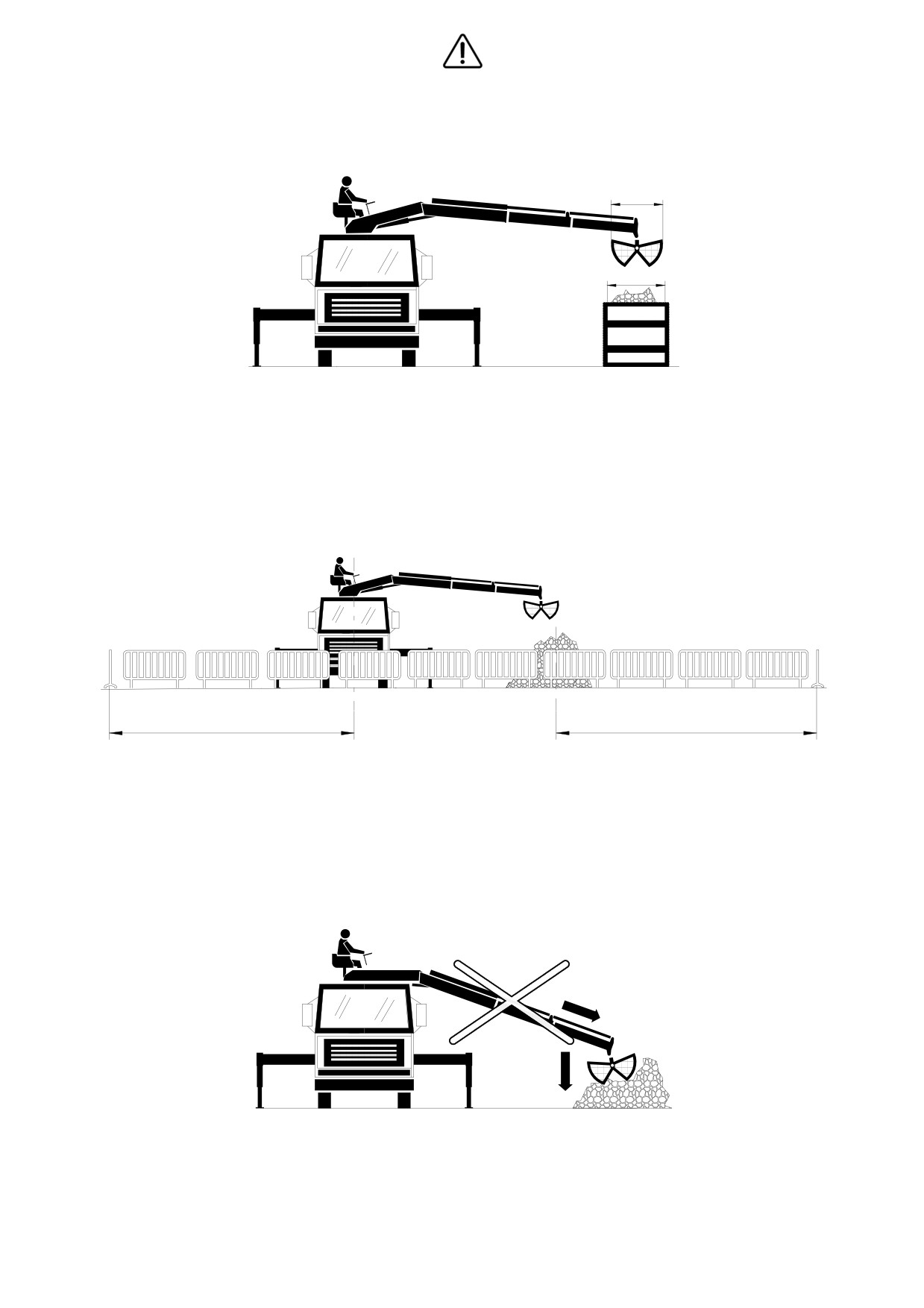
- L’area
di
lavoro deve avere
- The working area must be big enough
- Der Arbeitsbereich muss groß genug
un’estensione sufficiente a contenere
to contain the equipment when
sein, um für die Ausrüstung in der
l’attrezzo nella configurazione di
operating at the maximum opening
Konfiguration der maximalen Öffnung,
massima apertura (Db < A).
level (Db < A).
Platz zu bieten (Db < A).
Db
A
- È necessario delimitare la zona di
- Cordon off the working area using
- Der
Arbeitsbereich
muss mit
lavoro tramite transenne in modo tale
barriers to prevent people from
Schranken abgesperrt werden, damit
da non permettere a cose e persone
approaching nearer than 20 m to the
keine Gegenstände oder Personen
di giungere a distanza inferiore a 20 m
crane and equipment. If in specific
näher als 20 m zur Ausrüstung und
dall’attrezzo e e dalla gru. Nel caso
cases the equipment requires a
zum Kran gelangen können. Im
specifico l’attrezzo richieda una
greater safe distance then this must
besonderen Fall, in dem die
distanza di sicurezza superiore, dovrà
be adhered to.
Ausrüstung
einen
größeren
essere rispettata quest’ultima.
Sicherheitsabstand erfordert, muss
dieser eingehalten werden.
20m (min)
20m (min)
- L’utilizzo della gru è permesso solo
- Only use the crane to lift free loads.
- Der Kran darf nur zum Anheben freier
per il sollevamento di carichi liberi. Si
Do NOT use the crane to crash the
Lasten verwendet werden. Die
vieta
pertanto
all’operatore
di
bucket or grab against objects or
Steuerungen des Krans dürfen daher
utilizzare i comandi della gru per
material or to lift secured loads.
nicht verwendet werden, um den
schiacciare la benna o il polipo contro
Schalen- oder Mehrschalengreifer
oggetti e materiale vario o per
gegen Gegenstände oder verschie-
sollevare carichi vincolati.
denes Material zu drücken oder um
fest verbundene Lasten anzuheben.
A-48
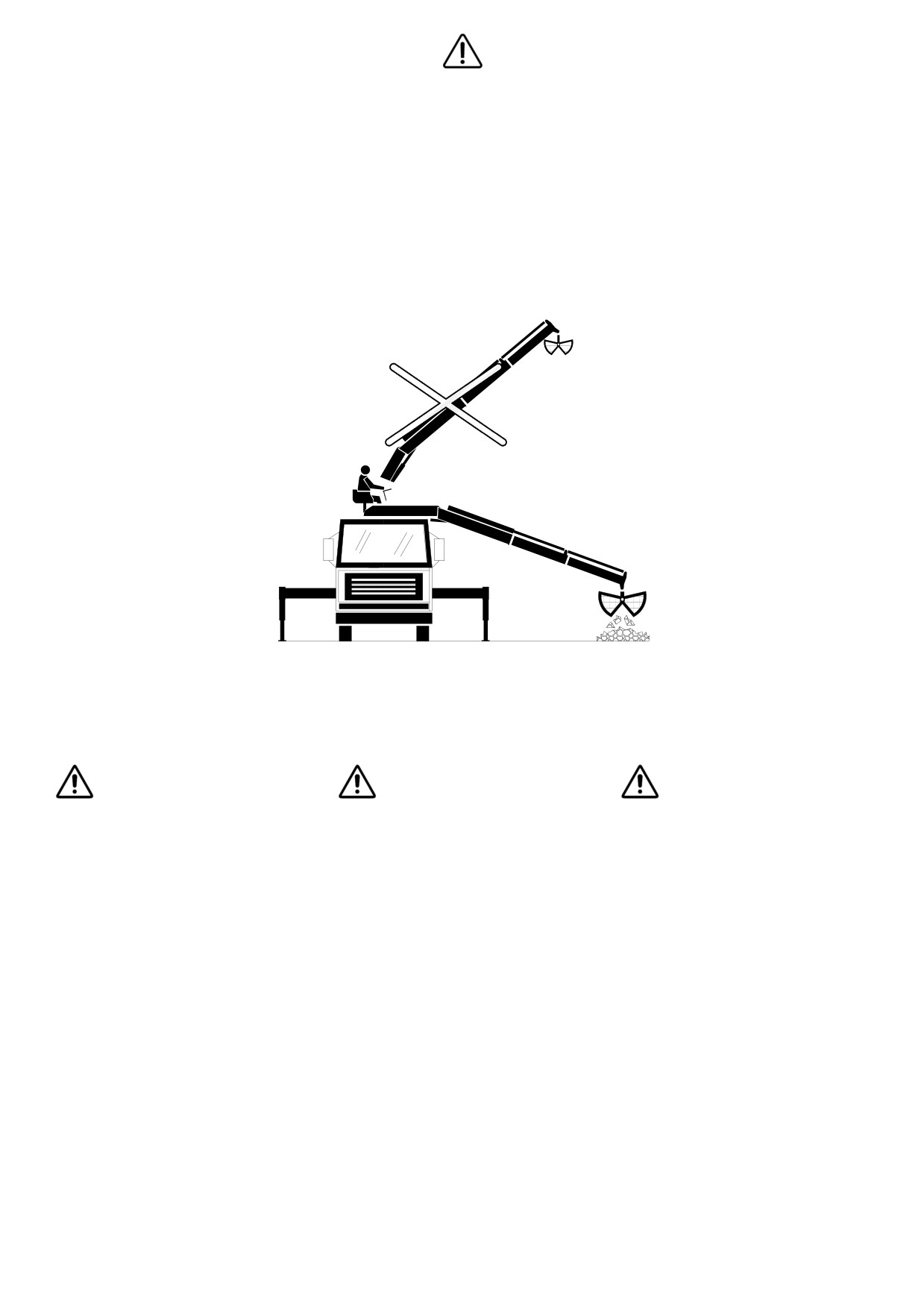
- È vietato l’uso dell’attrezzo per
- Do NOT use the equipment to drag,
- Die Ausrüstung darf weder zum
trascinare, comprimere e compattare
crush or compact material.
Schleppen noch zum Zusammen-
materiale.
drücken oder Verdichten von Material
verwendet werden.
- L’operatore deve rilasciare il carico
- Release the load as close to the
- Der Kranführer muss die Last so nah,
alla minima distanza possibile dal
ground or container as possible. Take
wie möglich am Boden
(bzw. am
terreno
(o dal contenitore) e deve
care that the load does not fall
Behälter) loslassen und
unbedingt
prestare la massima attenzione
accidentally. Do NOT overload the
darauf achten, dass sie nicht
perché non cada o fuoriesca
bucket or grab.
hinunterfällt
oder
versehentlich
accidentalmente. L’operatore non
verschüttet wird. Der Kranführer darf
deve sovraccaricare la benna e il
den Schalen- bzw. Mehrschalen-
polipo.
greifer nicht überlasten.
- Sono vietate manovre di movimen-
- Do NOT operate the equipment over
- Manöver über Stellen, an denen ein
tazione sopra luoghi dove la caduta
areas where accidental fall of the load
versehentliches Hinunterfallen der
accidentale del carico possa costituire
may cause damage to property and
Last eine Gefahr für Sachen oder
pericolo a cose e persone.
injury to persons.
Personen darstellen kann, sind
verboten.
In caso di manutenzione
Before performing maintenance
Zur Wartung muss das Zubehör
dell’accessorio, è necessario appog-
rest the equipment on the ground,
auf dem Boden abgelegt, die Maschine
giarlo al suolo, spegnere la macchina,
switch OFF the machine, disconnect the
abgeschaltet und die Stromzufuhr zur
togliere corrente al quadro comando,
control panel from the power supply and
Schalttafel
unterbrochen
werden.
attendere almeno
2 ore per il
wait for the oil to cool for at least
2
Mindestens 2 Stunden warten, bis das
raffreddamento dell’olio.
hours.
Öl abgekühlt ist.
A-49
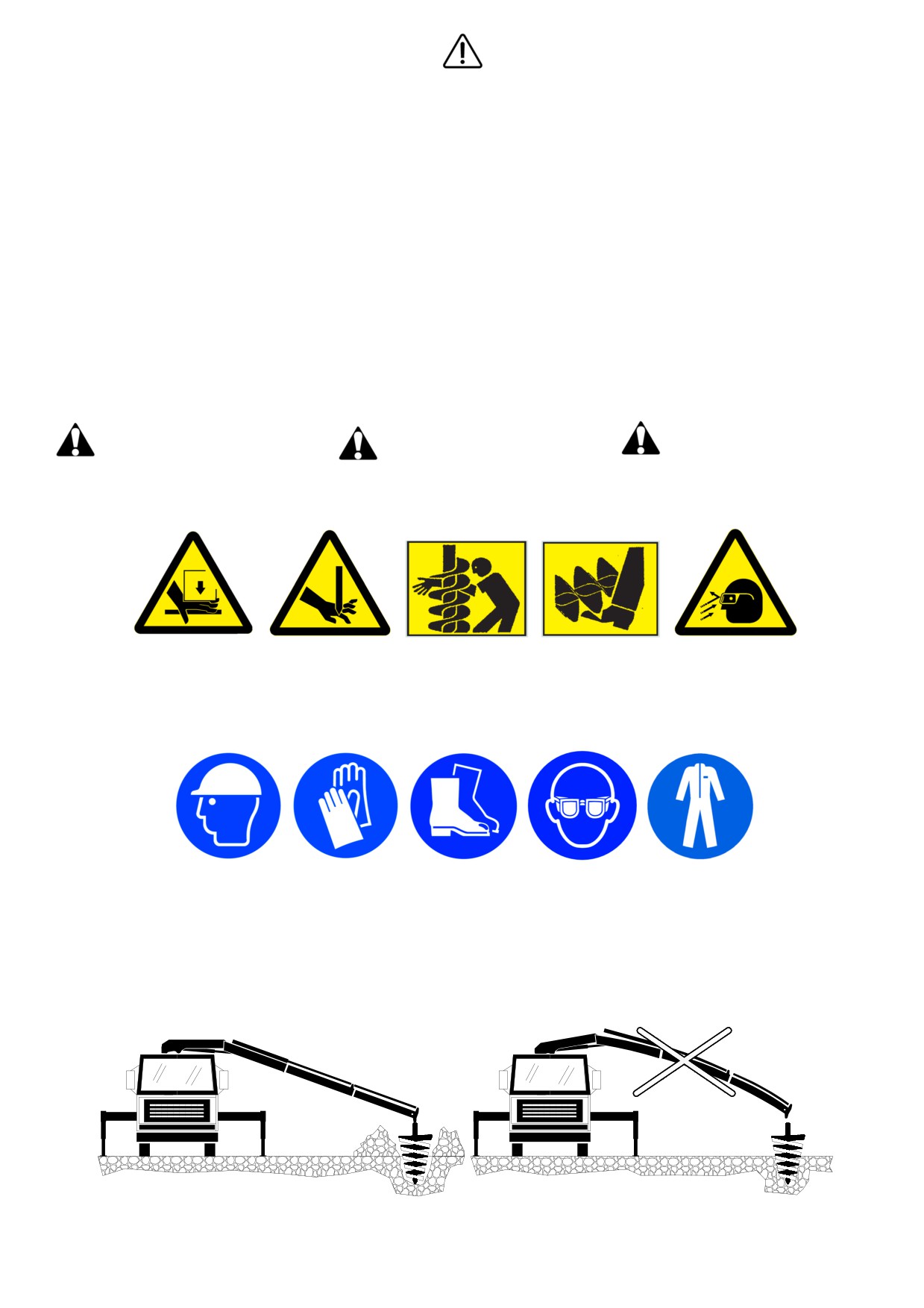
A.17 AVVERTENZE
A.17 SUPPLEMENTARY
A.17 ZUSÄTZLICHE
SUPPLEMENTARI PER
WARNINGS FOR DRILL
HINWEISE FÜR
TRIVELLA
ERDBOHRER
Le gru che montano la trivella
There are additional specific hazards for
Die Kräne mit Erdbohrer weisen
presentano i seguenti rischi aggiuntivi:
cranes mounting a drill as listed below:
folgende zusätzliche Gefahren auf:
Pericoli
di
impigliamento,
Entrapment, crushing and cutting
Quetsch- und Schergefahr der
schiacciamento e cesoiamento degli
hazard for upper and lower limbs on
unteren und oberen Gliedmaßen bei
arti inferiori e superiori a contatto con
the drill body.
Kontakt mit dem Erdbohrer.
il corpo trivella
Flying loose material hazard caused
Gefahr des Herausschleuderns von
Pericoli di eiezione di materiale
by drill operation.
stumpfem Material durch den
contundente da parte della trivella
Impact and cutting hazard during drill
Erdbohrer.
Pericoli di urti e tagli durante la
operation.
Stoß- und Schneidgefahr während der
movimentazione della trivella
Structural damage and tipping hazard
Bewegung des Erdbohrers.
Pericolo di rottura strutturale e
if the drill penetrates the ground but is
Gefahr des strukturellen Bruchs und
ribaltamento nel caso in cui la trivella
unable to expel material.
Umkippens, wenn der Erdbohrer in
penetri nel terreno e non espella
den Boden eindringt und kein Material
materiale
auswirft.
AVVERTENZE
WARNUNGEN
WARNINGS
- È severamente vietato entrare nel
- Es ist strengstens verboten, den
- Keep away from the area in which the
raggio d’azione della trivella.
Aktionskreis des Erdbohrers zu
drill is operating.
betreten.
- Utilizzare sempre elmetto, scarpe
- Always wear a helmet, industrial
- Immer Schutzhelm, Sicherheits-
antinfortunistiche, guanti e occhiali da
footwear, gloves and goggles.
schuhe, Arbeitshandschuhe und
lavoro. Si consiglia di far uso di una
Personnel must wear overalls secured
Schutzbrille tragen. Es empfiehlt sich,
tuta da lavoro abbottonata e senza
using buttons and without loose or
einen zugeknöpften Arbeitsoverall
appendici volanti.
baggy parts.
ohne flatternde Teile zu tragen.
- Il funzionamento corretto della trivella
- Correct functioning of the drill occurs
- Der Erdbohrer funktioniert korrekt,
si ha quando si ha fuoriuscita di
when material is released from the
wenn aus dem Bohrloch Material
materiale dallo scavo. Se invece la
excavation. If the drill tends to penetrate
austritt. Wenn der Erdbohrer hingegen
trivella tendesse con forza a penetrare
the ground without material being
dazu neigt, mit Gewalt in den Boden
nel terreno, bisogna interrompere
released, stop work with the drill
einzudringen, muss die Bohrung
immediatamente l’operazione
di
immediately and remove the drill from
sofort
abgebrochen, und der
trivellazione e far uscire la trivella
the ground by rotating it in an anti-
Erdbohrer in die Gegenrichtung
facendola ruotare in senso contrario.
clockwise direction.
herausgedreht werden.
A-50
B MANUALE D’USO
B OPERATING MANUAL
B BEDIENUNGSHANDBUCH
B-1
//////////////////////////////////////////