Vauxhall Mokka B (2023 year). Manual in english - page 8
230
Driving and operating
● winding roads or narrow roads
● advanced lane keep assist is
active
● covered camera by snow, ice,
slush, mud, dirt, or affected by
windscreen damage or foreign
items, e.g. stickers,
2
may
appear in the Driver Information
Centre, accompanied by a
message
● in the event of a system fault,
2
may appear in the Driver
Information Centre,
accompanied by a message and
a warning chime
Charging
General information
9
Warning
Persons with a pacemaker should
consult a doctor for possible
precautions.
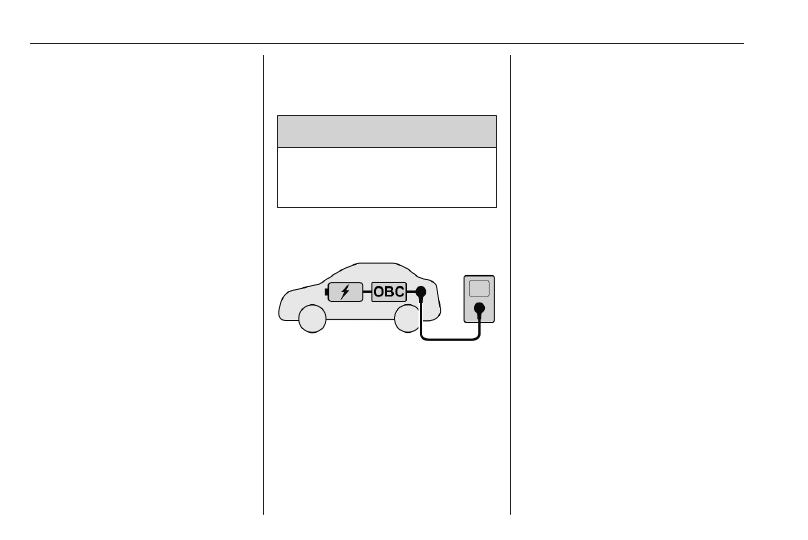
Charging the vehicle's high voltage
battery depends upon several factors:
● high voltage battery of the vehicle
● internal onboard charger (OBC)
● charging cable
● external charging device
The charging cable connects the
vehicle with an external charging
device providing electric power. This
may be a domestic electrical outlet, a
Green'Up socket, a wall box or a
public charging station.
The high voltage battery is charged
with direct current (DC) only. When
charging the vehicle with alternating
current (AC), AC has to be converted
into DC. This is done by the vehicle's
onboard charger. The onboard
charger is available with 7.4 kW
(single-phase) and 11 kW (3-phase).
If the vehicle is charged at a public DC
charging station, no DC conversion is
required. The high voltage battery
can be directly charged with DC
provided by the DC charging station.
The speed of charging the vehicle's
high voltage battery depends upon
the weakest element of the charging
chain. To achieve the maximum
charging speed, charging cable and
charging device have to be attuned to
each other.
Notice
Make sure that the charging cable
used fits to the vehicle's onboard
charger.
231.