Airbus A318/319/320/321. FLIGHT CREW TECHNIQUES MANUAL (2005-2022) - page 5
AIRBUS OPERATIONAL PHILOSOPHY
DESIGN PHILOSOPHY
A318/A319/A320/A321
FLIGHT CREW
COCKPIT PHILOSOPHY - UTILIZATION PRINCIPLES
TECHNIQUES MANUAL
DARK COCKPIT CONCEPT FOR OVERHEAD PANEL
Ident.: AOP-10-20-30-00016240.0001001 / 25 JUL 17
Applicable to: ALL
Most of the systems are controlled from the overhead panel via:
- Pushbutton
- Pushbutton switch
- Switch
- Knob, knob-selector.
Each pushbutton/pushbutton switch has one or two lights:
- The upper one is dedicated to alert or system status (e.g. FAULT light, OPEN light).
If no alert or system status is required, two grey dots replace the light
- The lower one corresponds:
• On pushbutton switch, to the control selection of the system (e.g. ON, OFF, OVRD), or
• On pushbutton, to the system status (e.g. ENG ANTI ICE).
If no control system selection is required, two grey dots replace the light.
The general operational rule is: Light out philosophy. The systems are ready and fit to fly.
COLOR CODING
Ident.: AOP-10-20-30-00016241.0001001 / 20 MAR 17
Applicable to: ALL
DISPLAY UNITS
The information provided on the display units is color coded to indicate:
- The status of the system (ECAM or FMA)
- The status of the mode (FMA)
- The nature of the information (e.g. title of an alert, action to be performed, information).
PUSHBUTTON/PUSHBUTTON SWITCH LIGHT
The information provided on the pushbutton/pushbutton switch is also color coded to indicate the
status of the system:
- Amber: Indicates that a system is failed
- Red: Indicates a failure that may require an immediate corrective action
- Green: Indicates that a system operates normally
- Blue: Indicates the normal operation of a temporarily selected system
- White: Indicates the abnormal position of a pushbutton switch or maintenance/test result
indication
- Blank: The system is fit to fly.
PIA A318/A319/A320/A321 FLEET
AOP-10-20-30 P 1/4
FCTM
A to B
10 AUG 21
AIRBUS OPERATIONAL PHILOSOPHY
DESIGN PHILOSOPHY
A318/A319/A320/A321
FLIGHT CREW
COCKPIT PHILOSOPHY - UTILIZATION PRINCIPLES
TECHNIQUES MANUAL
NEED TO SEE CONCEPT
Ident.: AOP-10-20-30-00016242.0001001 / 20 MAR 17
Applicable to: ALL
The DUs may display information that can potentially overload the flight crew.
In order to prevent this situation, some principles have been established to provide the flight crew
with the right information, at the right time:
- The right information in a given flight phase
- Uncluttered, and non-overloaded “need to show" data
- Redundant, or consolidated data for safety related parameters
- Predictive information on essential parameters.
LESS PAPER COCKPIT
Ident.: AOP-10-20-30-00016243.0001001 / 20 MAR 17
Applicable to: ALL
The less paper cockpit concept:
- Improves the access to pilots' operational information and simplifies some of their tasks
- Reduces the number of paper documents in the cockpit and replaces them by electronic ones:
• Improving information access and search
• Enabling quicker and easier updates.
COCKPIT CONTROLS - BEST PRACTICES
Ident.: AOP-10-20-30-00024657.0001001 / 10 MAY 21
Applicable to: ALL
The cockpit controls (i.e. pushbuttons, levers and handles located on the overhead panel, the main
instrument panel and the pedestal) are designed to ensure a safe and efficient interaction between
the pilots and the aircraft systems. As best practices and in order to properly use the cockpit controls,
the pilot should:
- Not use the cockpit controls as supports for the arms or for the hands. The use of armrests may
prevent such positions
- As PM, not have their hand on a control before they need to use it, to avoid inadvertent activation
- Visually identify the control before selection or action on the control. Then, to close the loop, the
pilot must check the result of the action
- Not request an action on a cockpit control if they suspect that the other crew member does not
share the same plan of action as theirs. The application of the standard callout reduces possible
confusion between cockpit controls in this situations (e.g. The sequence "POSITIVE CLIMB"
announced by PM and "GEAR UP" ordered by PF ensures a common plan of action between both
pilots).
PIA A318/A319/A320/A321 FLEET
AOP-10-20-30 P 2/4
FCTM
C to E →
10 AUG 21
AIRBUS OPERATIONAL PHILOSOPHY
DESIGN PHILOSOPHY
A318/A319/A320/A321
FLIGHT CREW
COCKPIT PHILOSOPHY - UTILIZATION PRINCIPLES
TECHNIQUES MANUAL
In addition, at all times, the flight crew should be ready to rapidly take the appropriate actions on the
cockpit controls, if required.
For information on how to handle the cockpit controls during abnormal operations, Refer to FCTM /
AOP / Management of Abnormal Operations / Handling of cockpit controls.
PIA A318/A319/A320/A321 FLEET
AOP-10-20-30 P 3/4
FCTM
← E
10 AUG 21
AIRBUS OPERATIONAL PHILOSOPHY
DESIGN PHILOSOPHY
A318/A319/A320/A321
FLIGHT CREW
COCKPIT PHILOSOPHY - UTILIZATION PRINCIPLES
TECHNIQUES MANUAL
Intentionally left blank
PIA A318/A319/A320/A321 FLEET
AOP-10-20-30 P 4/4
FCTM
10 AUG 21
AIRBUS OPERATIONAL PHILOSOPHY
DESIGN PHILOSOPHY
A318/A319/A320/A321
FLIGHT CREW
FLY-BY-WIRE - DESIGN PRINCIPLES
TECHNIQUES MANUAL
FLY-BY-WIRE
Ident.: AOP-10-30-10-00016244.0001001 / 20 MAR 17
Applicable to: ALL
GENERAL
The relationship between the pilot input on the sidestick, and the aircraft response, is called the
control law.
The control law determines the handling characteristics of the aircraft.
FLIGHT CONTROL PROTECTIONS
Ident.: AOP-10-30-10-00016246.0001001 / 20 MAR 17
Applicable to: ALL
The purpose of the flight control protections is to:
- Give full authority to the flight crew, in order to enable them to obtain the best aircraft performance
with an instinctive, immediate action on the related control
- Minimize the possibility of over-controlling, overstressing, or damaging the aircraft.
One of the PF's primary tasks is to maintain the aircraft within the limits of the normal flight envelope.
However, some circumstances, due to extreme situations or aircraft mishandling, may provoke the
violation of these limits.
Despite system protections, the PF must not deliberately exceed the normal flight envelope. In
addition, these protections are not designed to be structural limit protections (e.g. opposite rudder
pedal inputs). Rather, they are designed to assist the PF in emergency and stressful situations,
where only instinctive and rapid reactions will be effective.
SIDESTICK
Ident.: AOP-10-30-10-00016247.0001001 / 20 MAR 17
Applicable to: ALL
OPERATIONAL BENEFITS
The main operational benefits of the side-mounted stick:
- It enables a non-obstructed view of the main instrument panel
- It is adapted for emergency situations (e.g. incapacitation, stick jamming, control failures)
- It fits comfortably into the hand with a correct adjustment of the armrest
- It makes the sliding table installation possible (e.g. for maps, documents, meals).
When the autopilot is engaged:
- The sidesticks are locked in neutral position (immediate tactile feedback)
- There is no possibility of simultaneous input from the flight crew and the autopilot
- The autopilot can be disconnected instinctively, at any time, by a firm pressure on the sidestick.
PIA A318/A319/A320/A321 FLEET
AOP-10-30-10 P 1/2
FCTM
A to C
22 MAR 17
AIRBUS OPERATIONAL PHILOSOPHY
DESIGN PHILOSOPHY
A318/A319/A320/A321
FLIGHT CREW
FLY-BY-WIRE - DESIGN PRINCIPLES
TECHNIQUES MANUAL
THRUST/AUTOTHRUST
Ident.: AOP-10-30-10-00016248.0001001 / 20 MAR 17
Applicable to: ALL
NON BACK-DRIVEN THRUST LEVER CONCEPT
Airbus has selected the non-back-driven thrust lever concept:
- The flight crew can easily and intuitively monitor the energy of the aircraft via current energy
cues (speed, speed trend, HUD chevrons , engine parameters), and not via ambiguous
thrust levers movement
- When the autothrust is engaged, the Thrust Lever Position determines the maximum authorized
thrust that may be commanded by the autothrust
- When the flight crew uses manual thrust, the Thrust Lever Position determines the current thrust
(as on any aircraft not equipped with autothrust).
PIA A318/A319/A320/A321 FLEET
AOP-10-30-10 P 2/2
FCTM
D
22 MAR 17
AIRBUS OPERATIONAL PHILOSOPHY
DESIGN PHILOSOPHY
A318/A319/A320/A321
FLIGHT CREW
FLY-BY-WIRE - UTILIZATION PRINCIPLES
TECHNIQUES MANUAL
USE OF SIDESTICK
Ident.: AOP-10-30-20-00016249.0001001 / 03 NOV 21
Applicable to: ALL
Only one flight crew flies at a time.
If the PM wants to act on the sidestick, the PM must:
- Clearly announce “I have control"
- Press and maintain the sidestick pushbutton, in order to get full control of the Fly-By-Wire system.
The flight crew should keep in mind that sidestick inputs are algebraically added. Therefore dual
inputs must be avoided, and will trigger aural and visual alerts.
Either flight crew can make an input on their sidestick at any time.
Either flight crew can deactivate the other flight crew’s sidestick by pressing on their sidestick pb.
FLYING IN RECONFIGURATION LAWS
Ident.: AOP-10-30-20-00018052.0001001 / 29 MAY 20
Applicable to: ALL
When the aircraft is in re-configuration law, the flight crew should consider the following:
- At high altitude, descend to a lower altitude to increase the margin to buffet. Descending by
approximately 4 000 ft below REC MAX ALT reduces significantly the occurrence of stall warning
in turbulence.
- At high speed, maneuver with care and use small control inputs. Depending on the
re-configuration law, the pitch control law can have different modes, but the roll control law will
always be in direct law. For additional information, Refer to FCOM/DSC-27-20-20 Flight Controls
Law Reconfiguration.
ALTERNATE LAW
The handling characteristics within the normal flight envelope, are identical in pitch with normal
law.
Outside the normal flight envelope, the PF must take appropriate preventive actions to avoid losing
control, and/or avoid high speed excursions. These actions are the same as those that would be
applied in any case of non protected aircraft.
DIRECT LAW
The PF must avoid performing large thrust changes, or sudden speedbrake movements,
particularly if the center of gravity is aft. If the speedbrakes are out, and the aircraft has been
re-trimmed, the PF must gently retract the speedbrakes, to give time to re-trim, and thereby avoid
a large, nose-down trim change.
PIA A318/A319/A320/A321 FLEET
AOP-10-30-20 P 1/2
FCTM
A to B →
23 NOV 21
AIRBUS OPERATIONAL PHILOSOPHY
DESIGN PHILOSOPHY
A318/A319/A320/A321
FLIGHT CREW
FLY-BY-WIRE - UTILIZATION PRINCIPLES
TECHNIQUES MANUAL
MECHANICAL BACKUP
In such cases, the objective is not to fly the aircraft accurately, but to maintain the aircraft attitude
safe and stabilized, in order to allow the restoration of lost systems.
The pitch trim wheel is used to control pitch. Any action on the pitch trim wheel should be applied
smoothly, because the THS effect is significant due to its large size.
The rudder provides lateral control, and induces a significant roll with a slight delay. The PF should
apply some rudder to turn, and wait for the aircraft reaction. To stabilize and level the wings,
anticipate by releasing the rudder pedals.
PIA A318/A319/A320/A321 FLEET
AOP-10-30-20 P 2/2
FCTM
← B
23 NOV 21
AIRBUS OPERATIONAL PHILOSOPHY
DESIGN PHILOSOPHY
A318/A319/A320/A321
FLIGHT CREW
PROCEDURES DESIGN
TECHNIQUES MANUAL
WHAT FOR?
Ident.: AOP-10-40-00016250.0001001 / 20 MAR 17
Applicable to: ALL
The objectives of the procedures are to:
- Share a common practice, in order to ensure a safe and efficient flight
- Organize tasksharing and teamworking
- Guide pilots actions (interface between the flight crew and the aircraft).
GENERAL DESIGN AND UTILIZATION PRINCIPLES
Ident.: AOP-10-40-00016251.0001001 / 20 MAR 17
Applicable to: ALL
The procedures are consistent with the Airbus aircraft design philosophy.
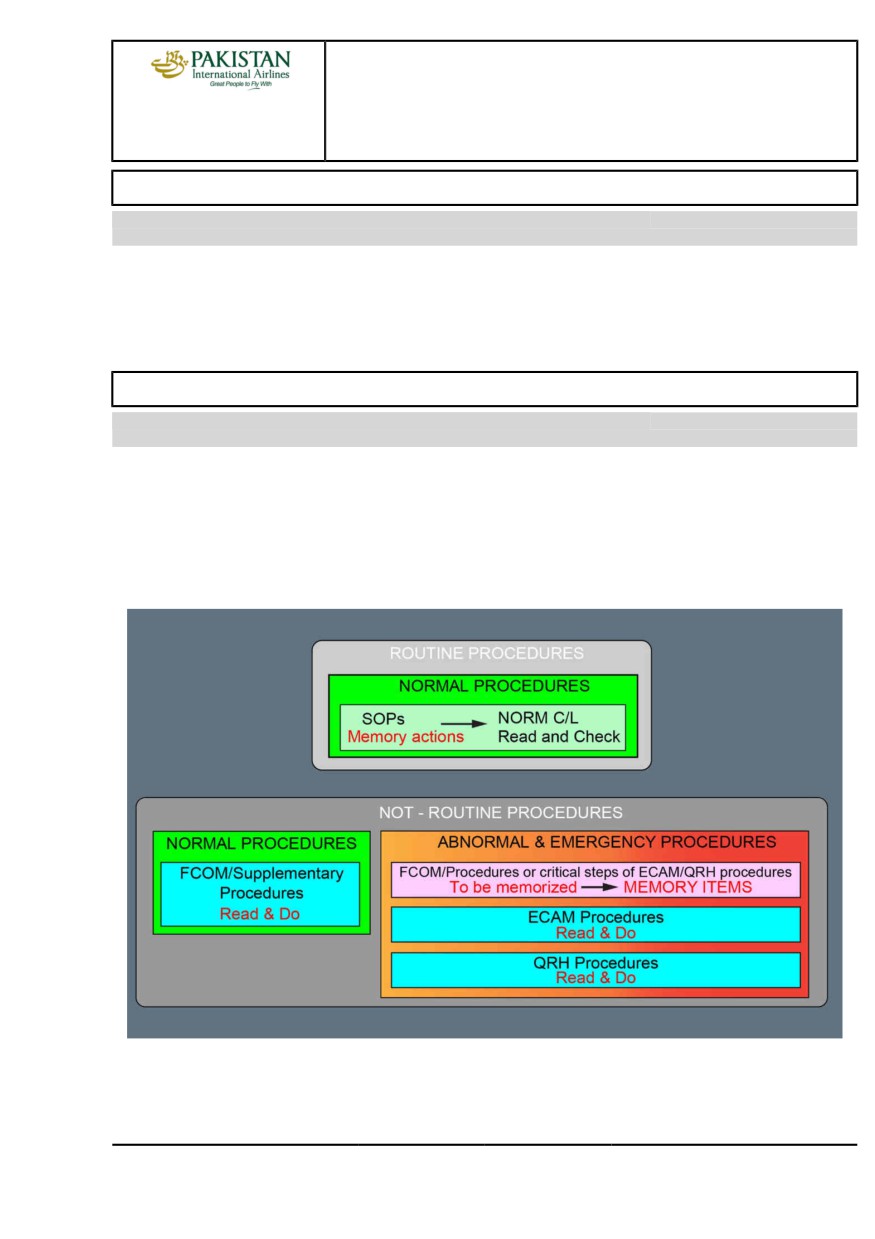
The procedures are divided into routine, and not-routine procedures.
They are easy to identify and to understand.
The pilots are trained to use and strictly apply the procedures.
The tasksharing and a standard communication process are clearly defined, in order to ensure a safe
and efficient use of the procedures.
PIA A318/A319/A320/A321 FLEET
AOP-10-40 P 1/4
FCTM
A to B
10 AUG 21
AIRBUS OPERATIONAL PHILOSOPHY
DESIGN PHILOSOPHY
A318/A319/A320/A321
FLIGHT CREW
PROCEDURES DESIGN
TECHNIQUES MANUAL
NORMAL PROCEDURES - STANDARD OPERATING PROCEDURES (SOP)
Ident.: AOP-10-40-00016252.0001001 / 20 MAR 17
Applicable to: ALL
GENERAL
During the daily normal operations of the aircraft, the flight crew performs actions frequently.
These actions are identified as routine tasks. The routine tasks are supported by the Standard
Operating Procedures (SOPs).
SOP DESIGN PRINCIPLES
SOP are designed according to the following principles:
- One SOP per flight phase
- Actions are described in a chronological order
- Actions are easy to memorize and to apply (cockpit scan, actions flow).
SOP design is effective provided that:
- All systems operate normally
- All automatic functions are used normally.
Some SOP actions are checked against checklists.
SOP UTILIZATION PRINCIPLES
The flight crew should perform SOP actions by memory. The flight crew can also decide to refer
to the QRH, in order to perform both the Preliminary Cockpit Preparation and Securing the Aircraft
procedures.
NORMAL PROCEDURES - SUPPLEMENTARY PROCEDURES
Ident.: AOP-10-40-00016253.0001001 / 20 MAR 17
Applicable to: ALL
GENERAL
During the daily normal operations of the aircraft, the flight crew may have to perform actions
which are not part of the SOP , i.e. not frequently done. These actions are identified as not-routine
tasks dedicated to not-routine situation (e.g. airframe deicing/anti-icing procedures on ground,
manual engine start). The not-routine tasks are supported by the Supplementary Procedures.
The flight crew must perform not-routine actions, using the READ & DO principle.
PIA A318/A319/A320/A321 FLEET
AOP-10-40 P 2/4
FCTM
C to D →
10 AUG 21
AIRBUS OPERATIONAL PHILOSOPHY
DESIGN PHILOSOPHY
A318/A319/A320/A321
FLIGHT CREW
PROCEDURES DESIGN
TECHNIQUES MANUAL
SUPPLEMENTARY PROCEDURES DESIGN PRINCIPLES
The Supplementary Procedures are designed according to the following principles:
- Easy to identify and to understand
- One Supplementary Procedure for a given situation
- Actions are described in a chronological order.
SUPPLEMENTARY PROCEDURES UTILIZATION PRINCIPLES
Supplementary Procedures utilization is effective provided that the flight crew performs the
Supplementary Procedures using the READ & DO principle (generally done by the PM).
ABNORMAL AND EMERGENCY PROCEDURES
Ident.: AOP-10-40-00016254.0001001 / 04 NOV 20
Applicable to: ALL
ABNORMAL AND EMERGENCY PROCEDURES DESIGN PRINCIPLES
These procedures are not-routine, classified in abnormal or emergency, and prioritized in
accordance with the criticality of the situation.
An abnormal or emergency procedure is initiated following:
- A system failure, or
- An operational context.
The design of an abnormal or emergency procedure is defined as:
- A MEMORY ITEM, when the flight crew has no time to refer to the ECAM/QRH/FCOM to ensure
a safe flight path, or
- AN OEB IMMEDIATE ACTION, when the flight crew has no time to refer to specific OEB actions
to ensure a safe flight path, or
- A READ & DO procedure that is handled via the ECAM, QRH, FCOM, or OEB.
The type of procedure is easy to identify:
[MEM] MEMORY ITEMS
ECAM Procedures
[QRH] Procedures
MEMORY
READ & DO
ABNORMAL AND EMERGENCY PROCEDURES UTILIZATION PRINCIPLES
The utilization of abnormal and emergency procedures follows the here below principle:
WHEN?
HOW?
Memory Items
Immediately
Memory
OEB Immediate Actions
Immediately
Memory
Abnormal/Emergency Procedures
When appropriate
READ & DO
ECAM/QRH/FCOM/OEB
PIA A318/A319/A320/A321 FLEET
AOP-10-40 P 3/4
FCTM
← D to E
10 AUG 21
AIRBUS OPERATIONAL PHILOSOPHY
DESIGN PHILOSOPHY
A318/A319/A320/A321
FLIGHT CREW
PROCEDURES DESIGN
TECHNIQUES MANUAL
Intentionally left blank
PIA A318/A319/A320/A321 FLEET
AOP-10-40 P 4/4
FCTM
10 AUG 21
AIRBUS OPERATIONAL PHILOSOPHY
TASKSHARING RULES AND COMMUNICATION
A318/A319/A320/A321
FLIGHT CREW
TECHNIQUES MANUAL
GENERAL
Ident.: AOP-20-00016255.0001001 / 20 MAR 17
Applicable to: ALL
A correct application of tasksharing and communication rules ensures a safe and effective operation
of the aircraft.
NORMAL OPERATIONS
GENERAL
It is the responsibility of the PF to:
- FLY
- NAVIGATE.
It is the responsibility of the PM to:
- MONITOR the flight path, the navigation and the aircraft systems
- COMMUNICATE.
However, when necessary, the flight crew may re-allocate the tasks, as required.
SUPPLEMENTARY PROCEDURES
For Supplementary Procedures, the flight crew should use the following tasksharing:
If the procedure is related to engine start, it is recommended to read the entire
procedure first, and then:
- The PM reads the actions, and
- The PF acts on the controls.
For all other supplementary procedures:
The procedures should be applied in accordance with the READ & DO principle, i.e. the PM
reads the procedure and the PF or the PM acts on the controls, depending on the context.
ABNORMAL OPERATIONS
It is the responsibility of the PF to:
- FLY,
- NAVIGATE
- COMMUNICATE after the initiation of:
• The ECAM actions, or
• A QRH procedure.
It is the responsibility of the PM to:
- MONITOR the flight path and the navigation
- Perform ECAM actions or apply QRH/OEB procedure.
PIA A318/A319/A320/A321 FLEET
AOP-20 P 1/10
FCTM
A →
23 NOV 21
AIRBUS OPERATIONAL PHILOSOPHY
TASKSHARING RULES AND COMMUNICATION
A318/A319/A320/A321
FLIGHT CREW
TECHNIQUES MANUAL
Note:
During the ECAM management process or the application of a QRH/OEB procedure,
the “COM" task is transferred to the PF, as the cognitive skills of the PM are mostly
dedicated to the understanding and the application of the ECAM/QRH/OEB actions.
Therefore, their situation awareness of the environment and the navigation is less
effective than the PF’s one.
FCU/AFS AND EFIS CONTROL PANELS
Ident.: AOP-20-00016256.0001001 / 20 MAR 17
Applicable to: ALL
GENERAL
The FCU (AFS CP and EFIS CP) and MCDU must be used in accordance with specific rules, in
order to ensure:
- Safe operation (correct entries made)
- Effective inter-pilot communication (knowing each other’s intentions).
AFS CP SELECTIONS
AFS CP entries (selection or target adjustment) are performed by:
- The PF, with AP ON, or by the PM (upon PF request)
- The PM (upon PF request), with AP OFF (except AP / A/THR that may be selected on by the
PF).
Engagement by
Selection of
PF
PM
DISCONNECTION: YES
AP /
DISCONNECTION: NO
(via instinctive disconnect pb)
A/THR
ENGAGEMENT: upon PF request
ENGAGEMENT: YES
FD
NO
Upon PF request
AFS CP
knobs
NO
Upon PF request
(AP OFF)
AFS CP
knobs
YES
Upon PF request
(AP ON)
EFIS CP SELECTIONS
Whatever the status of the AP, the PF and the PM must perform their onside EFIS CP selections.
PIA A318/A319/A320/A321 FLEET
AOP-20 P 2/10
FCTM
← A to B
23 NOV 21
AIRBUS OPERATIONAL PHILOSOPHY
TASKSHARING RULES AND COMMUNICATION
A318/A319/A320/A321
FLIGHT CREW
TECHNIQUES MANUAL
FMS ENTRIES VIA MCDU
Ident.: AOP-20-00016257.0001001 / 20 MAR 17
Applicable to: ALL
Below 10 000 ft, entries should be restricted to those that have an operational effect:
- PERF APPR
- DIR TO
- NAVAIDS
- Late change of runway
- Activate SEC F-PLN
- ENABLE ALTN.
Time consuming entries must be performed at all times:
- By the PM upon PF request, or
- By the PF after a temporary transfer of controls to the PM.
HOW TO CONDUCT BRIEFINGS
Applicable to: ALL
Ident.: AOP-20-A-00024936.0001001 / 09 NOV 21
OBJECTIVE OF OPERATIONAL BRIEFINGS
Operational briefings are an integral element of the Threat and Error Management process
for each mission. Briefings should focus on the identification of threats that affect the intended
operations and agreement on mitigation (avoidance, management) of those identified threats.
The second purpose of the flight crew briefing should be the identification of significant differences
or deviations to “routine” operations.
At the end of the briefing, the flight crew should have a shared mental model of the intended
operations, the identified threats, their mitigations and deviations from routine operations.
The flight crew briefing should provide the PM the expected monitoring framework.
The briefing should create more capacity in thinking and acting. It should enable team confidence
building and minimize the startle effect when non-standard situations are encountered. This
increases resilience of the flight crew.
A briefing is complementary to SOPs but is not a repetition of SOP items. A briefing is not to be
confused with setting and checking of the aircraft systems for the intended flight phase. In order to
perform these tasks, the flight crew must follow the SOPs.
PIA A318/A319/A320/A321 FLEET
AOP-20 P 3/10
FCTM
C to D →
23 NOV 21
AIRBUS OPERATIONAL PHILOSOPHY
TASKSHARING RULES AND COMMUNICATION
A318/A319/A320/A321
FLIGHT CREW
TECHNIQUES MANUAL
Ident.: AOP-20-A-00024937.0001001 / 09 NOV 21
BRIEFING TECHNIQUE
GENERAL
Briefing requires out-of-the-box thinking, beyond the pure reflection of routine and standard
operations. It should have a threat-focused view and identify and prioritize likely threats to the
intended operation. It should then detail the actions to mitigate these threats.
Sources of the briefing are the facts gained in the flight crew pre-flight preparation, aircraft
operation, but also the overall knowledge and experience of all involved flight crewmembers.
A briefing should be conversational, interactive and use open questions that involve all flight
crewmembers to share their experience and expectations.
There should be a variation in the amount of detail and in the length of a briefing. A longer, more
detailed briefing may be necessary and adapted to the flight crew experience, such as in the
following situations:
- A flight crew not familiar with the airport or the approach
- Complex airport (e.g. CAT C)
- Procedures or techniques that are rarely flown or applied.
A shorter briefing restricted to the minimum items is possible. For example:
- Operating at a well familiar airport
- Repetitive operations by the same crew
- No or limited threats identified.
A long briefing is not necessarily a good one.
A review of Memory Items or Operating Techniques should normally only be part of the briefing
when they may be potentially required for threat management (e.g. windshear reported in ATIS
- a review of [MEM] Windshear). A briefing of the techniques for rejected takeoff and/or for
engine failure after V1 is normally not required on a routine basis for each takeoff.
THREATS
Threats are all of the following:
- Events or errors that occur beyond the influence of the flight crew
- Increased operational complexity
- Situations that must be managed to maintain the margin of safety.
There is no limit to the possible number of threats that may occur. Using a checklist-style
tool to identify threats creates an obstruction to the open-mind setting and out-of-the-box
consideration. To help with threat identification, memory aids may be of help, provided that they
are not used in a checklist style manner. For example (not-exhaustive):
PIA A318/A319/A320/A321 FLEET
AOP-20 P 4/10
FCTM
← D →
23 NOV 21
AIRBUS OPERATIONAL PHILOSOPHY
TASKSHARING RULES AND COMMUNICATION
A318/A319/A320/A321
FLIGHT CREW
TECHNIQUES MANUAL
AIRPORT
ATC
AIRCRAFT
ENVIRONMENT
- Congestion
- Challenging restrictions
- MEL/CDL
-
Low visibility
- Construction
- Language
- Aircraft defects
-
Approach/runway lighting
- Hotspots
- Phraseology
- Supplementary
-
Runway contamination
- Infrastructure
- Short term changes of
procedures that are not
- Runway condition
clearance
routine
WEATHER
OPERATIONS
CREW
TERRAIN
- Windshear
- Schedule pressure
- Fatigue
-
High terrain
- Convective weather
- Delays
- Low experience
-
Unfamiliar environment
- Cold weather
- Late crew
- Complacency
-
Complex visual approach
- Precipitation
- Load issues
- Distraction
- Unreliable weather reports
- Training
- Crew that is not Standard
Ident.: AOP-20-A-00024938.0001001 / 09 NOV 21
TYPES OF OPERATIONAL BRIEFING
GENERAL
The following operational briefings should be performed for each flight:
- DEPARTURE BRIEFING during cockpit preparation
- ARRIVAL BRIEFING during descent preparation.
A DEBRIEFING should be considered at the end of each flight. This is in order to check how
the plan and the management of expected and unexpected threats and errors worked, and to
see if it is possible to enhance next time in a similar scenario. In case of time constraints this
debriefing should be performed no later than at the end of flight duty. Debriefing is a powerful
tool for long-term safety management.
Other operational briefings:
- CRUISE BRIEFING when the aircraft reaches cruise level and the flight crew expects specific
operational threats (e.g. high terrain enroute, weather awareness and avoidance) or before
the aircraft enters areas with special operational rules (e.g. North Atlantic)
- RELIEF CREW BRIEFING when flight crewmembers change seat in augmented crew
operation
- RE-BRIEFING in the case of any new identified threats or changes to the planned flight
strategy (e.g. when the Departure Change checklist is applied. Also in case of major delay
since the briefing was performed or in case of a major deviation from the original flight plan).
PIA A318/A319/A320/A321 FLEET
AOP-20 P 5/10
FCTM
← D →
23 NOV 21
AIRBUS OPERATIONAL PHILOSOPHY
TASKSHARING RULES AND COMMUNICATION
A318/A319/A320/A321
FLIGHT CREW
TECHNIQUES MANUAL
PREPARATION FOR BRIEFING
Preparation for every briefing starts with the preparation for the flight mission. Preparation
continues throughout the dispatch flight preparation with the collection of data on all of the
following:
- Technical condition of the aircraft
- Route planning
- Weather
- NOTAM
- Load planning
- Company operational requirements
- Fuel planning.
Flight preparation is done partly independently by PF and PM, partly shared by both pilots.
At the aircraft, the following parts of the SOP contain items to be discussed and agreed by both
pilots:
- Aircraft acceptance
- Preliminary performance calculation
- Last part of cockpit preparation after FMS preparation by the PF.
These SOP items are intended to prepare a shared mental image by both pilots. They ensure
that the following operational briefings are concise, effective and focus only on essential items.
For more details, refer to SOPs.
DEPARTURE BRIEFING
The structure and minimum items of the departure briefing are:
Step
PF
PM
1
Cockpit door closed - Set an environment with no distraction(1)
2a
Plan(2)
- T.O RWY (Intersection)
- SID designator
- First cleared altitude
- MSA/MORA for climb trajectory
- Extra fuel and time
Continued on the following page
PIA A318/A319/A320/A321 FLEET
AOP-20 P 6/10
FCTM
← D →
23 NOV 21
AIRBUS OPERATIONAL PHILOSOPHY
TASKSHARING RULES AND COMMUNICATION
A318/A319/A320/A321
FLIGHT CREW
TECHNIQUES MANUAL
Continued from the previous page
Step
PF
PM
2b
Plan(2)
- Hotspots of planned taxi route
- Stop margin for RTO
- EOSID
- Return/diversion considerations
- Special operation
- Non-standard operation
3a
Identified THREATS(3)
3b
Identified THREATS(3)
4
MITIGATIONS(4)
5
MISCELLANEOUS(5)
(1)
For the briefing to be of good quality it is important to minimize interruptions. The cockpit door
should be closed. It should be the task of the Commander (CM1) to anticipate potential disturbance
and to manage this step.
If interrupted, the briefing should resume at the beginning of the step where the interruption
occurred.
(2)
The PM should start to brief the main items of the PLAN. This ensures that both pilots share the
same mental image of the flight trajectory after the FMS preparation (by PF) and check (by PM)
according to SOP. Then, the PF briefs the hotspots of potential taxi-routes if any, and considers at
least the following items:
- Consideration for RTO (stop margin if available)
- The EOSID/Engine-out trajectory
- The considerations for a return landing or diversion if so required (weather/weight).
The PF recalls any Special Operations or Supplementary procedures to be applied.
Briefing the PLAN should normally only be a high-level description. It should normally not be a
repetition of the detailed setting and checking of the flight trajectory in the FMS performed in the
respective SOP items.
(3)
The PM should brief the THREATS identified throughout the preparation for the mission. The PF
highlights additional threats if required.
(4)
The PF and PM discuss and agree on the MITIGATION of the identified threats.
(5)
MISCELLANEOUS is intended to consider additional items e.g.:
- Intended use of automation after takeoff
- Supplementary Procedures if not yet briefed
- Observer safety briefing and duties
- Dangerous goods on board.
PIA A318/A319/A320/A321 FLEET
AOP-20 P 7/10
FCTM
← D →
23 NOV 21
AIRBUS OPERATIONAL PHILOSOPHY
TASKSHARING RULES AND COMMUNICATION
A318/A319/A320/A321
FLIGHT CREW
TECHNIQUES MANUAL
ARRIVAL BRIEFING
The structure and minimum items of the arrival briefing are:
Step
PF
PM
1
Set an environment with no distraction(1)
2a
Plan(2)
- Arrival/transition designator
- MORA/MOCA/MSA for planned trajectory
- STAR
- Runway and type of approach
- Approach minimum
- Go-around trajectory
- Extra fuel and time
2b
Plan(2)
- Guidance for approach
- Landing flaps setting
- Stop margin
- Use of reverse thrust
- Use of autobrake
- Planned runway exit
- Hotspots for taxi-in
- Special operation
- Non-standard operation
3a
Identified THREATS(3)
3b
Identified THREATS(3)
Continued on the following page
PIA A318/A319/A320/A321 FLEET
AOP-20 P 8/10
FCTM
← D →
23 NOV 21
AIRBUS OPERATIONAL PHILOSOPHY
TASKSHARING RULES AND COMMUNICATION
A318/A319/A320/A321
FLIGHT CREW
TECHNIQUES MANUAL
Continued from the previous page
Step
PF
PM
4
MITIGATIONS(4)
5
MISCELLANEOUS(5)
(1)
For the briefing to be of good quality it is important to minimize interruptions. Allocating the right
time before top of descent mitigates potential disturbances. It should be the task of the Commander
(CM1) to anticipate potential disturbance and to manage this step.
If interrupted, the briefing should resume at the beginning of the step where the interruption
occurred.
(2)
The PM should start to brief the main items of the PLAN. This ensures that both pilots share the
same mental image of the flight trajectory after the FMS preparation (by PF) and check (by PM)
according to SOP. The PF briefs what the PF considers for landing.
Briefing the PLAN should normally only be a high-level description. It should not be a repetition of
the detailed setting and checking of the flight trajectory in the FMS performed in the respective SOP
items.
(3)
The PM should brief the THREATS they have identified. The PF highlights additional threats if
required.
(4)
The PF and PM discuss and agree on the MITIGATION of the identified threats.
(5)
MISCELLANEOUS is intended to consider additional items e.g.:
- Special Operations
- Supplementary Procedures if not yet briefed.
PIA A318/A319/A320/A321 FLEET
AOP-20 P 9/10
FCTM
← D
23 NOV 21
AIRBUS OPERATIONAL PHILOSOPHY
TASKSHARING RULES AND COMMUNICATION
A318/A319/A320/A321
FLIGHT CREW
TECHNIQUES MANUAL
Intentionally left blank
PIA A318/A319/A320/A321 FLEET
AOP-20 P 10/10
FCTM
23 NOV 21
AIRBUS OPERATIONAL PHILOSOPHY
MANAGEMENT OF ABNORMAL OPERATIONS
A318/A319/A320/A321
FLIGHT CREW
GENERAL
TECHNIQUES MANUAL
INTRODUCTION
Ident.: AOP-30-10-00021471.0001001 / 20 MAR 17
Applicable to: ALL
Below-listed procedures are performed using the "READ & DO" principle (except MEMORY items or
OEB immediate actions):
- ECAM procedures, are triggered automatically in response to an abnormal behavior of the
systems monitored by the Flight Warning System (FWS)
- QRH procedures, are applied by the flight crew in response to an abnormal event detected by any
flight crewmember
- OEB procedures, are triggered in some situations.
SEQUENCE OF PROCEDURE
Ident.: AOP-30-10-00021472.0001001 / 20 MAR 17
Applicable to: ALL
In most situations, the following sequence is the basic one that should be applied by the flight crew.
However, this sequence may not cover all operational situations. Therefore, in all cases, the flight
crew should exercise their judgment and adapt the sequence of actions to the real conditions.
In the case of abnormal or emergency situations, the flight crew should apply the procedures in the
following sequence, as appropriate:
- MEMORY ITEMS or OEB immediate actions
- OEB
- ECAM
- QRH
ONE PROCEDURE AT A TIME
Ident.: AOP-30-10-00021473.0001001 / 20 MAR 17
Applicable to: ALL
When the flight crew applies a procedure, they must complete the procedure, unless:
- An action requests to apply/consider another procedure,
- The flight crew needs to update their situation assessment due to an unexpected abnormal or
emergency situation (e.g. Smoke detected by the cabin crew or volcanic ash encounter).
USE OF AUTOPILOT
Ident.: AOP-30-10-00021474.0001001 / 20 MAR 17
Applicable to: ALL
The AP has not been certified in all configurations, and its performance cannot be guaranteed. If the
pilot chooses to use the AP in such circumstances, extra vigilance is required, and the AP must be
PIA A318/A319/A320/A321 FLEET
AOP-30-10 P 1/2
FCTM
A to D →
22 MAR 17
AIRBUS OPERATIONAL PHILOSOPHY
MANAGEMENT OF ABNORMAL OPERATIONS
A318/A319/A320/A321
FLIGHT CREW
GENERAL
TECHNIQUES MANUAL
disconnected, if the aircraft deviates from desired or safe flight path. For additional information, Refer
to FCOM/LIM-AFS-10 Autopilot Function.
LAND ASAP DEFINITION
Ident.: AOP-30-10-00021475.0001001 / 20 MAR 17
Applicable to: ALL
If red LAND ASAP is part of the procedure, land as soon as possible at the nearest airport at which a
safe landing can be made.
Note:
Red LAND ASAP information is applicable to a time-critical situation.
If amber LAND ASAP is part of the procedure, consider landing at the nearest suitable airport.
Note:
The suitability criteria should be defined in accordance with the Operator's policy.
PIA A318/A319/A320/A321 FLEET
AOP-30-10 P 2/2
FCTM
← D to E
22 MAR 17
AIRBUS OPERATIONAL PHILOSOPHY
MANAGEMENT OF ABNORMAL OPERATIONS
A318/A319/A320/A321
FLIGHT CREW
HANDLING OF COCKPIT CONTROLS
TECHNIQUES MANUAL
GENERAL
Ident.: AOP-30-20-00021493.0001001 / 04 NOV 20
Applicable to: ALL
In flight, the PF and PM must crosscheck before any action on the following controls:
- ENG MASTER lever
- IR MODE selector
- All guarded controls
- Cockpit C/Bs.
The flight crew must crosscheck the above-listed controls, in order to prevent any inadvertent action
by the flight crew with irreversible effects (e.g. when the flight crew operates red guarded controls).
If the flight crew inadvertently operates a black guarded control, the subsequent effect is reversible.
The flight crew must restrict the reset of systems to those listed in the FCOM/QRH.
TASKSHARING RULES FOR COCKPIT CONTROLS OPERATION
Ident.: AOP-30-20-00021490.0001001 / 05 MAR 18
Applicable to: ALL
To confirm the operation of the above-listed controls, the flight crew should use the following
tasksharing method:
- The PM indicates the related control and requests confirmation from the PF
- The PF verifies the control designated by the PM and gives confirmation to the PM
- The PM operates the related control, as required.
TASKSHARING RULES FOR THRUST LEVERS OPERATION
Ident.: AOP-30-20-00021491.0001001 / 20 MAR 17
Applicable to: ALL
The thrust levers are part of the controls that the PF operates, in order to ensure their “FLY" task.
Therefore, the PM should not operate the thrust levers. If requested by any ECAM/QRH/OEB
procedure, the PM should ask to the PF to operate the corresponding lever. The flight crew should
use the following tasksharing method:
- The PF indicates the related thrust lever and requests confirmation from the PM
- The PM verifies the thrust lever indicated by the PF and gives confirmation to the PF
- The PF operates the related thrust lever, as required.
PIA A318/A319/A320/A321 FLEET
AOP-30-20 P 1/2
FCTM
A to C
10 AUG 21
AIRBUS OPERATIONAL PHILOSOPHY
MANAGEMENT OF ABNORMAL OPERATIONS
A318/A319/A320/A321
FLIGHT CREW
HANDLING OF COCKPIT CONTROLS
TECHNIQUES MANUAL
HANDLING OVERHEAD PANEL CONTROL
Ident.: AOP-30-20-00021492.0001001 / 20 MAR 17
Applicable to: ALL
The cockpit overhead panels are clearly labeled, in order to help the flight crew to correctly identify all
applicable systems and controls.
When the ECAM/QRH/OEB procedure requires the flight crew to perform an action on the overhead
panel or when the flight crew performs a system reset, the flight crew is able to rapidly identify and
find the correct system panel via the white label (uppercase) that is on the side or on top of each
panel.
To perform any action requested by a procedure, the PM should indicate the related panel and
control and announce in sequence:
- The name of the system
- The name of the control, or system reset
- The action.
E.g. “AIR, XBLEED, CLOSE".
The use of this type of approach enables the PM to keep the PF informed of the progress of the
procedure and reduces the risk of the PM operating the wrong control.
It is important for the flight crew to remember that, most of the time, in the case of a system failure,
the FAULT light of the applicable control comes on in amber. This enables the flight crew to correctly
identify the applicable system control on the overhead panel.
After the selection of a control, the PM should check the SD page, in order to verify that the selected
action was performed (e.g. The closure of the crossbleed valve should change the indications that
appear on the SD page).
PIA A318/A319/A320/A321 FLEET
AOP-30-20 P 2/2
FCTM
D
10 AUG 21
AIRBUS OPERATIONAL PHILOSOPHY
MANAGEMENT OF ABNORMAL OPERATIONS
A318/A319/A320/A321
FLIGHT CREW
HANDLING OF ECAM/QRH/OEB
TECHNIQUES MANUAL
GENERAL
Ident.: AOP-30-30-00021494.0001001 / 20 MAR 17
Applicable to: ALL
When an abnormal situation is detected by the flight crew, the first priority of the flight crew is to
maintain a safe flight path before the flight crew performs any READ & DO actions. For takeoff or
go around, the flight crew should delay READ & DO actions until the aircraft reaches a minimum of
400 ft AGL. This is an appropriate compromise between stabilization of the aircraft and a delay in the
actions. However, the flight crew may initiate READ & DO actions below 400 ft AGL, provided that
the flight path is safe.
When the flight crew performs a “READ & DO" ECAM/QRH/OEB procedure, they must:
- Correctly read and apply the ECAM/QRH/OEB actions
- Appropriately share tasks
- Carefully monitor and crosscheck.
However, in some time critical situations, the flight crew has no time to refer to the ECAM/QRH/OEB
procedure. Therefore, the flight crew must know, and strictly apply by memory, items referred to as
MEMORY ITEMS or OEB immediate actions.
TASKSHARING RULES
Ident.: AOP-30-30-00021495.0001001 / 20 MAR 17
Applicable to: ALL
The PF usually remains the PF for the entire flight, unless the Captain decides to re-allocate tasks
differently, or in case of failure that impacts the "FLY" task of the PF.
In addition to the routine tasks "FLY" and "NAVIGATE" performed by the PF, it is the responsibility of
the PF to perform all the following actions:
- Initiate ECAM/QRH/OEB actions that the PM must perform,
- Communicate after ECAM/QRH/OEB actions are initiated and until the PM announces:
• "ECAM actions completed", or
•
“XXX procedure completed", in the case of QRH or OEB procedure.
In addition to the routine task “MONITOR" performed by the PM, it is the responsibility of the PM to
manage the ECAM/QRH/OEB actions after the PF announces “ECAM ACTIONS" or launch a QRH
procedure, as follow:
- Read & Do the ECAM/QRH/OEB actions in a spoken voice
- Obtain PF confirmation before clearing any ECAM.
PIA A318/A319/A320/A321 FLEET
AOP-30-30 P 1/6
FCTM
A to B
23 NOV 21
AIRBUS OPERATIONAL PHILOSOPHY
MANAGEMENT OF ABNORMAL OPERATIONS
A318/A319/A320/A321
FLIGHT CREW
HANDLING OF ECAM/QRH/OEB
TECHNIQUES MANUAL
HANDLING OF ECAM
Applicable to: ALL
Ident.: AOP-30-30-A-00021499.0001001 / 20 MAR 17
GENERAL
The ECAM actions are actions that the PM must perform on ground or in flight following an ECAM
alert, once the aircraft trajectory is stabilized and the PF announced “ECAM actions". The ECAM
actions are divided into several steps, which are clearly identified on the EWD and SD pages.
The PM must:
-
“READ & DO" the ECAM procedures, identified as procedure action lines on the EWD
- Analyse the operational impact on the affected system via the SD page
- Read the STATUS page, including associated procedures.
If an ECAM procedure requests the flight crew to apply a QRH procedure, the flight crew should:
- Keep the procedure displayed on the ECAM
- Apply the requested QRH procedure.
The objective is to avoid the flight crew to be disturbed with subsequent ECAM alerts that may
trigger with less priority.
Ident.: AOP-30-30-A-00021500.0001001 / 20 MAR 17
ECAM TASKSHARING
The flight crew should apply any OEB that affects an ECAM alert. To apply the ECAM procedure,
the flight crew should use the following tasksharing method:
Ident.: AOP-30-30-A-00021501.0001001 / 09 FEB 18
L12
PF
PM
First pilot who notices
MASTER WARNING/CAUTION
RESET
For each ECAM procedure:
"Title of failure"
ANNOUNCE
ECAM
CONFIRM
The PM should check/inspect the overhead panel and/or
associated SD, in order to analyze and confirm the failure,
before they take any action. The flight crew should keep in
mind that the sensors on the overhead panel and/or SD may
be different from the sensors that trigger the failure.
OEB
CONSIDER
Continued on the following page
PIA A318/A319/A320/A321 FLEET
AOP-30-30 P 2/6
FCTM
C →
23 NOV 21
AIRBUS OPERATIONAL PHILOSOPHY
MANAGEMENT OF ABNORMAL OPERATIONS
A318/A319/A320/A321
FLIGHT CREW
HANDLING OF ECAM/QRH/OEB
TECHNIQUES MANUAL
Continued from the previous page
PF
PM
"ECAM ACTIONS"
ORDER
When the ECAM displays several failures, the PF calls out
"ECAM ACTIONS" for the first ECAM only.
Apply the Tasksharing Rules and Communication for Abnormal Operations
Refer to AOP-20 General
ECAM/OEB ACTIONS
PERFORM
"CLEAR (name of the system)?"
REQUEST
ECAM ACTIONS PERFORMED
CHECK
"CLEAR (name of the system)"
CONFIRM
CLR pb
PRESS
Before the PM presses the CLR pb, the flight crew should
carefully check that all actions have been performed.
For each System Display (SD) page:
SD page
ANALYZE
"CLEAR (name of the system)?"
REQUEST
"CLEAR (name of the system)"
CONFIRM
CLR pb
PRESS
When STATUS page appears:
"STATUS"
ANNOUNCE
"STOP ECAM"
ORDER
ECAM ACTIONS
STOP
Consider any normal C/L, system reset, or any
additional procedure, as applicable
"CONTINUE ECAM"
ORDER
STATUS
READ
The procedures associated with the STATUS should be
previewed to evaluate the associated workload. They should
be performed at the appropriate flight phase.
"REMOVE STATUS?"
REQUEST
"REMOVE STATUS"
CONFIRM
STS pb
PRESS
"ECAM ACTIONS COMPLETED"
ANNOUNCE
Ident.: AOP-30-30-A-00021502.0001001 / 03 NOV 21
STOP ECAM
When necessary, the flight crew should stop the ECAM actions when they need to perform
actions which require acknowledgement, check or crosscheck from both flight crewmembers (e.g.
communication to ATC, request of configuration change, baro setting). Then, they should continue
with ECAM actions.
PIA A318/A319/A320/A321 FLEET
AOP-30-30 P 3/6
FCTM
← C →
23 NOV 21
AIRBUS OPERATIONAL PHILOSOPHY
MANAGEMENT OF ABNORMAL OPERATIONS
A318/A319/A320/A321
FLIGHT CREW
HANDLING OF ECAM/QRH/OEB
TECHNIQUES MANUAL
In all cases, the flight crew must stop the ECAM actions before reading the STATUS page, in
order to:
- Perform any normal C/L, if applicable.
The flight crew must perform the pending normal C/L at this stage as it is a good compromise
between the necessary application of ECAM procedures and system analysis and the delay
in the check of systems status (e.g. in the case of failure after takeoff, flaps and landing gear
retracted)
- Consider any system reset.
The ECAM procedure may consider reset of the system by switching OFF then ON the
associated system via the usual cockpit control. However reset action may not be requested
by the ECAM procedure. In this case, it is the flight crew responsibility to consider any system
reset to recover the operation of the affected system, provided that the system reset is permitted
in the system reset table. If the reset is successful, the STATUS page will disappear. The flight
crew must not apply the system reset procedure from memory. They must refer to the QRH.
- Consider application of the ENG RELIGHT procedure after an engine failure with no damage.
The flight crew should consider performing the ENG RELIGHT procedure at this stage as if the
relight is successful the STATUS page will disappear.
STATUS PAGE
The purpose of the STATUS page is to provide an overview of the technical status of the aircraft
in all flight phases. Therefore, it is important that the flight crew checks the whole STATUS page
information, in order to correctly assess the situation and subsequently make appropriate decision.
The STATUS page may contain some actions, that should be performed by the flight crew at a
more appropriate time. The flight crew should read the procedures associated with the STATUS
page during the STATUS page review to evaluate and anticipate the workload for each flight
phase.
Ident.: AOP-30-30-A-00021503.0001001 / 20 MAR 17
IF THE ECAM WARNING (OR CAUTION) DISAPPEARS
If an ECAM warning disappears while a procedure is being applied, the warning can be considered
no longer applicable. Application of the procedure can be stopped. For example, during the
application of an engine fire procedure, if the fire is successfully extinguished with the first fire
extinguisher bottle, the ENG 1(2) FIRE warning disappears and the procedure no longer applies.
Any remaining ECAM procedures should be performed as usual.
PIA A318/A319/A320/A321 FLEET
AOP-30-30 P 4/6
FCTM
← C
23 NOV 21
AIRBUS OPERATIONAL PHILOSOPHY
MANAGEMENT OF ABNORMAL OPERATIONS
A318/A319/A320/A321
FLIGHT CREW
HANDLING OF ECAM/QRH/OEB
TECHNIQUES MANUAL
HANDLING OF QRH
Ident.: AOP-30-30-00021497.0001001 / 20 MAR 17
Applicable to: ALL
GENERAL
When the flight crew needs to apply a QRH procedure, the PM should use the QRH/Abnormal and
Emergency Procedures table of contents in order to search and select the applicable procedure.
IF THE CONDITIONS OF THE APPLICATION OF A QRH PROCEDURE DISAPPEAR
The flight crew can stop any abnormal QRH procedure if the conditions for its application
disappear.
ECAM/QRH/OEB ACTIONS COMPLETED
Ident.: AOP-30-30-00021498.0001001 / 20 MAR 17
Applicable to: ALL
When the ECAM/QRH/OEB actions are completed, the flight crew should:
- Resume the Normal Operations Task sharing rules
- If time permits, review the FCOM for additional information on the applicable procedure(s).
However, the flight crew should not prolong the flight to refer to the FCOM.
- Assess the situation
When convenient, recall the STATUS page, in order to assess the situation:
• Check any fuel penalty factor, and check the remaining fuel at destination or diversion airport
• Check any landing distance penalty, and compute the landing distance at destination or
diversion airport
• Consider all the operational, maintenance and commercial aspects.
- Make the decision
- Inform the ATC, the cabin crew, the passengers, and airline operations as required.
PIA A318/A319/A320/A321 FLEET
AOP-30-30 P 5/6
FCTM
D to E
23 NOV 21
AIRBUS OPERATIONAL PHILOSOPHY
MANAGEMENT OF ABNORMAL OPERATIONS
A318/A319/A320/A321
FLIGHT CREW
HANDLING OF ECAM/QRH/OEB
TECHNIQUES MANUAL
Intentionally left blank
PIA A318/A319/A320/A321 FLEET
AOP-30-30 P 6/6
FCTM
23 NOV 21
AIRBUS OPERATIONAL PHILOSOPHY
MANAGEMENT OF ABNORMAL OPERATIONS
A318/A319/A320/A321
FLIGHT CREW
HANDLING OF ADVISORY
TECHNIQUES MANUAL
GENERAL
Ident.: AOP-30-40-00021478.0001001 / 20 MAR 17
Applicable to: ALL
The ADVISORY enables the flight crew to monitor the drifting parameter. The sensors used to trigger
an advisory may be different from those used by the FWS to trigger an ECAM alert.
TASKSHARING RULES
Ident.: AOP-30-40-00021480.0001001 / 20 MAR 17
Applicable to: ALL
The flight crew should use the following tasksharing method:
- The flight crewmember that first notices an advisory announces “ADVISORY on XYZ system",
- Then, the PF requests the PM to monitor the drifting parameter. If time permits, the PM may refer
to the QRH, in order to:
• Check the advisory triggering conditions in various advisory situations
• Find the associated recommended actions.
PIA A318/A319/A320/A321 FLEET
AOP-30-40 P 1/2
FCTM
A to B
22 MAR 17
AIRBUS OPERATIONAL PHILOSOPHY
MANAGEMENT OF ABNORMAL OPERATIONS
A318/A319/A320/A321
FLIGHT CREW
HANDLING OF ADVISORY
TECHNIQUES MANUAL
Intentionally left blank
PIA A318/A319/A320/A321 FLEET
AOP-30-40 P 2/2
FCTM
22 MAR 17
AIRBUS OPERATIONAL PHILOSOPHY
MANAGEMENT OF ABNORMAL OPERATIONS
A318/A319/A320/A321
FLIGHT CREW
SPURIOUS CAUTION
TECHNIQUES MANUAL
SPURIOUS CAUTION
Ident.: AOP-30-50-00020719.0001001 / 20 MAR 17
Applicable to: ALL
Any spurious caution can be deleted with the EMER CANC pb . When pressed, the EMER CANC pb
deletes both the aural alert, and the caution for the remainder of the flight. This is indicated on the
STATUS page, by the "CANCELLED CAUTION" title.
The EMER CANCEL inhibits any aural warning that is associated with a red warning, but does not
affect the warning itself.
PIA A318/A319/A320/A321 FLEET
AOP-30-50 P 1/2
FCTM
A
22 MAR 17
AIRBUS OPERATIONAL PHILOSOPHY
MANAGEMENT OF ABNORMAL OPERATIONS
A318/A319/A320/A321
FLIGHT CREW
SPURIOUS CAUTION
TECHNIQUES MANUAL
Intentionally left blank
PIA A318/A319/A320/A321 FLEET
AOP-30-50 P 2/2
FCTM
22 MAR 17
AIRBUS OPERATIONAL PHILOSOPHY
MANAGEMENT OF ABNORMAL OPERATIONS
A318/A319/A320/A321
FLIGHT CREW
USE OF SUMMARIES
TECHNIQUES MANUAL
USE OF SUMMARIES
Ident.: AOP-30-60-00018295.0001001 / 20 MAR 17
Applicable to: ALL
GENERAL
The QRH summaries are QRH procedures created to help the flight crew to perform actions in the
case of an ELEC EMER CONFIG or a dual hydraulic failure.
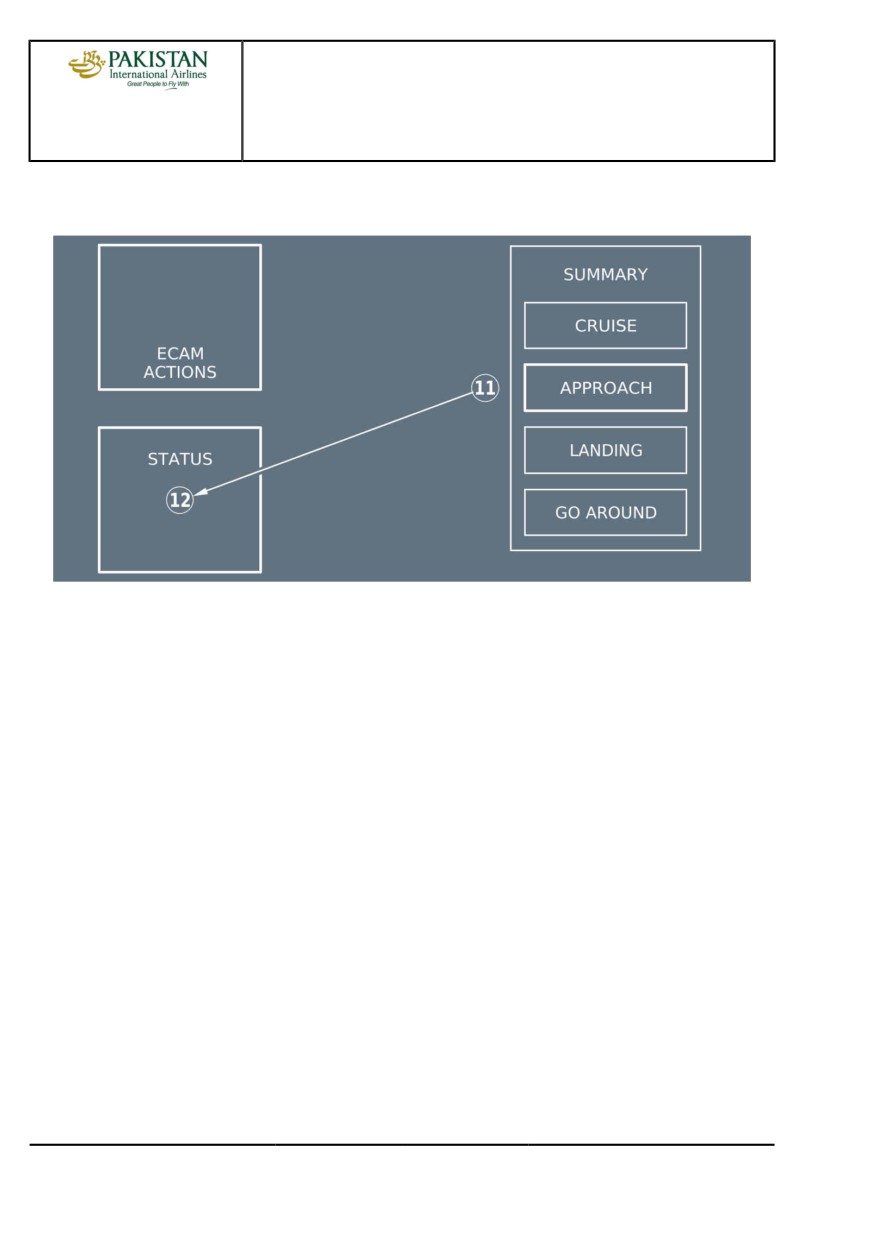
The QRH summaries are divided into four sections: CRUISE, APPROACH, LANDING, and
GO-AROUND.
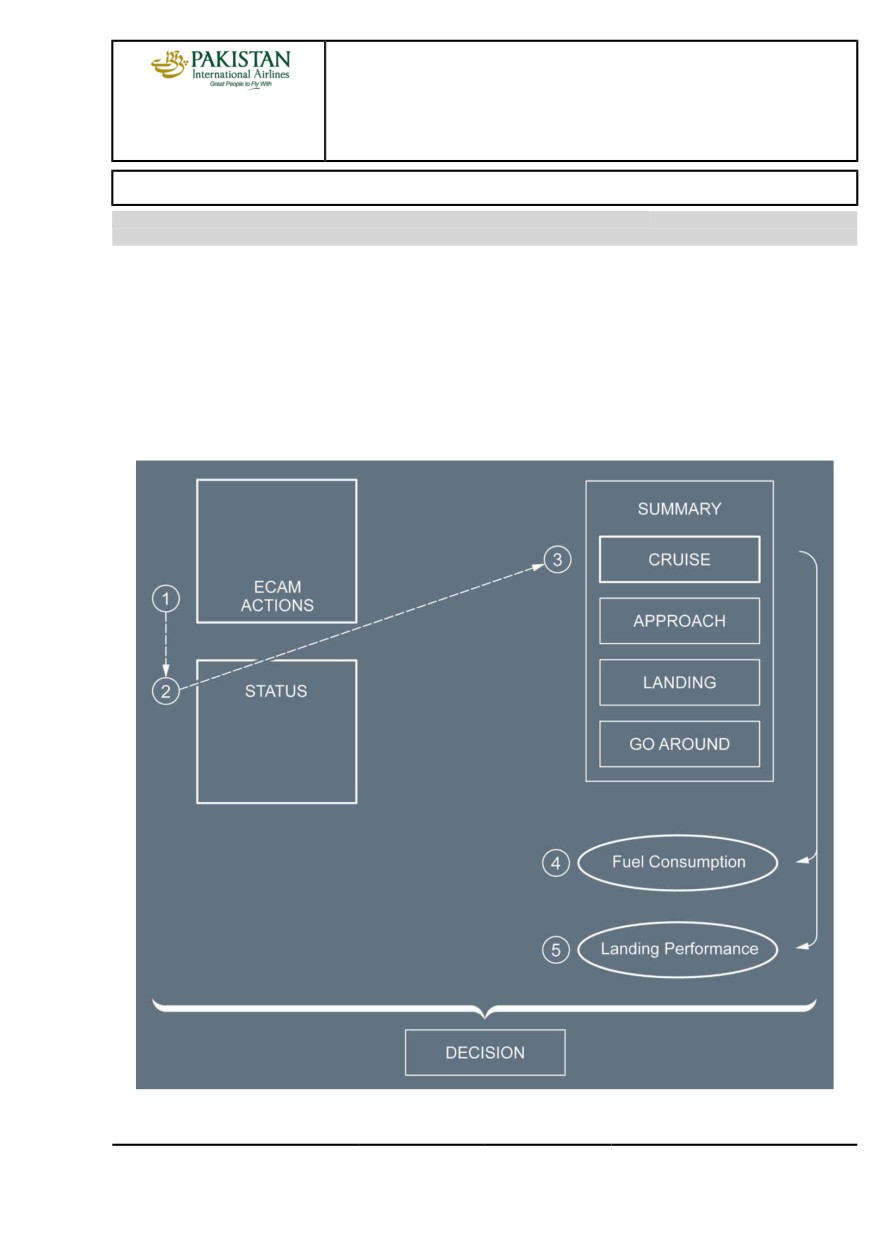
SITUATION ASSESSMENT WITH THE CRUISE SECTION OF THE QRH SUMMARY
Situation Assessment with the QRH Summary
PIA A318/A319/A320/A321 FLEET
AOP-30-60 P 1/4
FCTM
A →
22 MAR 17
AIRBUS OPERATIONAL PHILOSOPHY
MANAGEMENT OF ABNORMAL OPERATIONS
A318/A319/A320/A321
FLIGHT CREW
USE OF SUMMARIES
TECHNIQUES MANUAL
- Steps 1 and 2: The flight crew should apply the ECAM first. This includes both the
procedure and the STATUS page. When ECAM actions are completed, the PM announces
"ECAM ACTIONS COMPLETED". Then, the PM should refer to the corresponding QRH
summaries.
- Step 3: After the check of the STATUS page, the PM should refer to the CRUISE section of
the QRH summaries. The CRUISE section highlights the remaining systems (in ELEC EMER
configuration only), the main limitations, and the flight capability of the aircraft.
The CRUISE section helps the flight crew to assess the situation and to select an appropriate
runway for landing.
As indicated in the CRUISE section, the flight crew should refer to the performance application or
the corresponding chapters of the QRH for:
- The evaluation of increased fuel consumption (step 4)
- The landing performance computation at the selected airport (step 5).
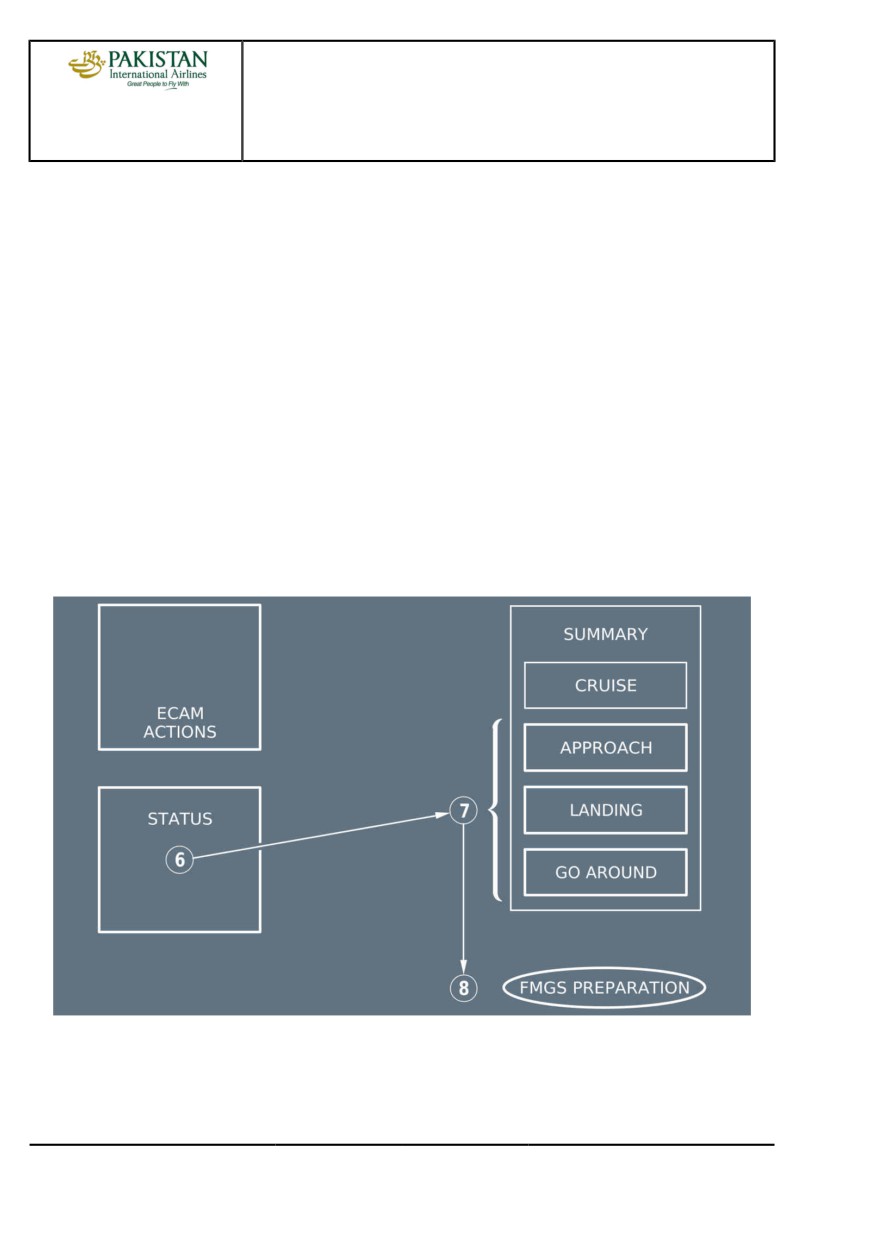
APPROACH PREPARATION
Approach Preparation with the QRH Summary
While the flight crew checks the STATUS page (step 6), they should use the APPROACH,
LANDING, and GO-AROUND sections to support the approach preparation (steps 7 and 8).
PIA A318/A319/A320/A321 FLEET
AOP-30-60 P 2/4
FCTM
← A →
22 MAR 17
AIRBUS OPERATIONAL PHILOSOPHY
MANAGEMENT OF ABNORMAL OPERATIONS
A318/A319/A320/A321
FLIGHT CREW
USE OF SUMMARIES
TECHNIQUES MANUAL
When appropriate, the APPROACH, LANDING, and GO-AROUND sections include the LANDING
WITH SLATS or FLAPS JAMMED procedure and the L/G GRAVITY EXTENSION procedure that
the flight crew must apply during the approach, landing, and go-around phases.
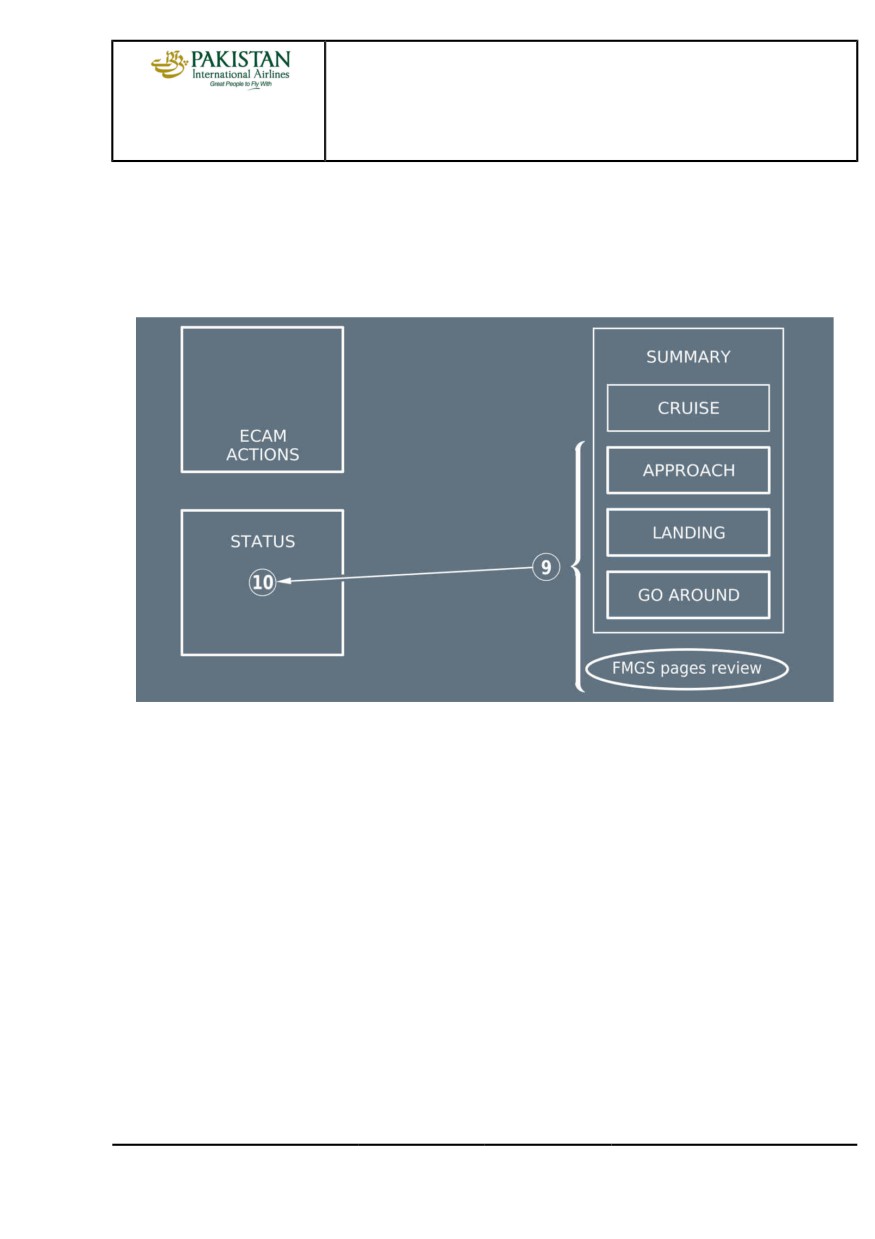
APPROACH BRIEFING
Approach Briefing with the QRH Summary
The flight crew should use the APPROACH, LANDING, and GO-AROUND sections of the QRH
summary to perform the approach briefing, while they crosscheck the associated FMS pages and
the STATUS page (steps 9 and 10).
PIA A318/A319/A320/A321 FLEET
AOP-30-60 P 3/4
FCTM
← A →
22 MAR 17
AIRBUS OPERATIONAL PHILOSOPHY
MANAGEMENT OF ABNORMAL OPERATIONS
A318/A319/A320/A321
FLIGHT CREW
USE OF SUMMARIES
TECHNIQUES MANUAL
APPROACH
Approach with the QRH Summary
To perform the approach, the flight crew should refer to the APPROACH section (step 11).
When the aircraft is in final configuration, the flight crew can rapidly review the LANDING and
GO-AROUND sections, as a reminder (braking, NWS, reversers, and L/G retraction in the case of
a go-around).
Finally, the PM should check the STATUS page (step 12) and check that all the APPR PROC
actions are completed.
PIA A318/A319/A320/A321 FLEET
AOP-30-60 P 4/4
FCTM
← A
22 MAR 17
AIRBUS OPERATIONAL PHILOSOPHY
GOLDEN RULES FOR PILOTS
A318/A319/A320/A321
FLIGHT CREW
TECHNIQUES MANUAL
GOLDEN RULES FOR PILOTS
Ident.: AOP-40-00018441.0001001 / 19 APR 17
Applicable to: ALL
INTRODUCTION
The Airbus "Golden Rules for Pilots" are operational guidelines, based on all of the following:
• Basic flying principles
• The adaptation of these basic flying principles to modern-technology aircraft
• The provision of information about required crew coordination for the operation of Airbus
aircraft.
The objective of these Golden Rules is to also take into account the principles of flight crew
interaction with automated systems, and the principles of Crew Resource Management (CRM), in
order to help prevent the causes of many accidents or incidents and to ensure flight efficiency.
GENERAL GOLDEN RULES
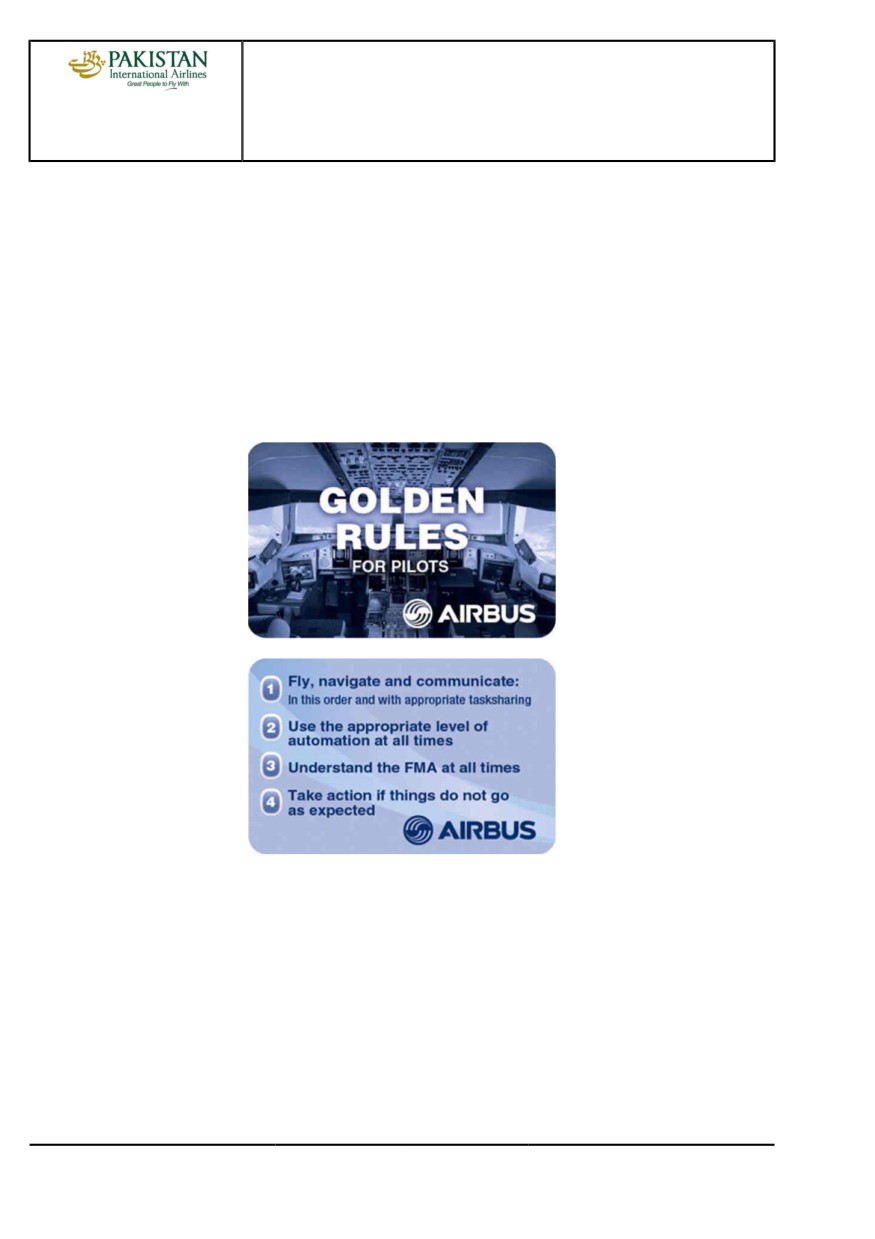
The following four Golden Rules for Pilots are applicable to all normal operations, and to all
unexpected or abnormal/emergency situations:
1. Fly. Navigate. Communicate: In this order and with appropriate tasksharing.
Fly! Navigate! Communicate! The flight crew must perform these three actions in sequence and
must use appropriate tasksharing in normal and abnormal operations, in manual flight or in flight
with the AP engaged.
PIA A318/A319/A320/A321 FLEET
AOP-40 P 1/4
FCTM
A →
05 SEP 17
AIRBUS OPERATIONAL PHILOSOPHY
GOLDEN RULES FOR PILOTS
A318/A319/A320/A321
FLIGHT CREW
TECHNIQUES MANUAL
The following explains each of the three actions, and the steps associated with the performance
of these actions:
•
Fly
"Fly" indicates that:
- The Pilot Flying (PF) must concentrate on "flying the aircraft" to monitor and control the
pitch attitude, bank angle, airspeed, thrust, sideslip, heading, etc., in order to achieve and
maintain the desired targets, vertical flight path, and lateral flight path.
- The Pilot Monitoring (PM) must assist the PF and must actively monitor flight
parameters, and call out any excessive deviation. The PM's role of "actively monitoring" is
very important.
Therefore, both flight crewmembers must:
• Focus and concentrate on their tasks to ensure appropriate tasksharing
• Maintain situational awareness and immediately resolve any uncertainty as a crew.
•
Navigate
"Navigate" refers to and includes the following four "Know where ..." statements, in order to
ensure situational awareness:
• Know where you are…
• Know where you should be…
• Know where you should go…
• Know where the weather, terrain, and obstacles are.
•
Communicate
"Communicate" involves effective and appropriate crew communication between the:
• PF and the PM
• Flight crew and Air Traffic Control (ATC)
• Flight crew and the cabin crew
• Flight crew and the ground crew.
Communication enables the flight crew to safely and appropriately perform the flight, and
enhance situational awareness. To ensure good communication, the flight crew should use
standard phraseology and the applicable callouts.
In abnormal and emergency situations, the PF must recover a steady flight path, and the flight
crew must identify the flight situation. The PF must then inform ATC and the cabin crew of:
▪ The flight situation
▪ The flight crew’s intentions.
The flight crew must therefore always keep in mind the key message:
Fly the Aircraft, Fly the Aircraft, Fly the Aircraft...
PIA A318/A319/A320/A321 FLEET
AOP-40 P 2/4
FCTM
← A →
05 SEP 17
AIRBUS OPERATIONAL PHILOSOPHY
GOLDEN RULES FOR PILOTS
A318/A319/A320/A321
FLIGHT CREW
TECHNIQUES MANUAL
To safely and appropriately perform a flight, both flight crewmembers must have basic flying
skills, and must be able to fly with appropriate tasksharing in all situations.
2. Use the appropriate level of automation at all times.
Aircraft are equipped with several levels of automation, used to perform specific tasks.
The appropriate use of automated systems significantly helps the flight crew with, for example:
• Workload management
• Situation awareness (traffic, ATC communication, etc.).
The flight crew must, at all times, perform both of the following:
• Determine and select the appropriate level of automation that can include manual flight
Note:
The decision to use manual flight must be agreed between both pilots and must be
based on an individual assessment of the pilot. This assessment should include
aircraft status (malfunctions), pilot fatigue, weather conditions, traffic situation, and if
the PF is familiar with the area.
• Understand the operational effect of the selected level of automation.
3. Understand the FMA at all times.
The flight crew must confirm the operational effect of all actions on the FCU, or on the MCDU,
via a crosscheck of the corresponding annunciation or data on the PFD and on the ND.
At all times, the flight crew should be aware of the following:
• Guidance modes (armed or engaged)
• Guidance targets
• Aircraft response in terms of attitude, speed, and trajectory
• Transition or reversion modes.
Therefore, to ensure correct situational awareness, at all times, the flight crew must:
• Monitor the FMA
• Announce the FMA
• Confirm the FMA
• Understand the FMA.
4. Take action if things do not go as expected.
PIA A318/A319/A320/A321 FLEET
AOP-40 P 3/4
FCTM
← A →
05 SEP 17
AIRBUS OPERATIONAL PHILOSOPHY
GOLDEN RULES FOR PILOTS
A318/A319/A320/A321
FLIGHT CREW
TECHNIQUES MANUAL
If the aircraft does not follow the desired vertical or lateral flight path, or the selected
targets, and if the flight crew does not have sufficient time to analyze and solve the situation,
the flight crew must immediately take appropriate or required actions, as follows:
The PF should change the level of automation:
- From managed guidance to selected guidance, or
- From selected guidance to manual flying.
The PM should perform the following actions in sequence:
- Communicate with the PF
- Challenge the actions of the PF, when necessary
- Take over, when necessary.
PIA A318/A319/A320/A321 FLEET
AOP-40 P 4/4
FCTM
← A
05 SEP 17
AIRCRAFT SYSTEMS
Intentionally left blank
AIRCRAFT SYSTEMS
PRELIMINARY PAGES
A318/A319/A320/A321
FLIGHT CREW
TABLE OF CONTENTS
TECHNIQUES MANUAL
AS-BIRD Bird
Introduction
A
Practical Use of the Bird
B
AS-FG Flight Guidance
AS-FG-10-1 Auto Flight
Objective
A
Managed and Selected Modes
B
Main Interfaces with the AP/FD
C
AP/FD Monitoring
D
Recommended Practice for Autopilot (AP) Engagement
E
Use of the FD without the AP
F
AS-FG-10-2 Autothrust
Normal Operations
A
Operations with One Engine Inoperative
B
To Set Autothrust To Off
C
Alpha Floor
D
Autothrust Use - Summary
E
AS-FM Flight Management
AS-FM-10 Use of FMS
Navigation Accuracy
A
ZFW - ZFWCG Entry Errors
B
AS-RUD Rudder
General
A
Operational Recommendations
B
AS-TCAS TCAS
Intruder Classification
A
Operating Techniques
B
AS-WXR Weather Radar
General
A
Weather Detection
B
Analysis of Weather Radar Data
C
Operations in Convective Weather
D
Ice Crystals
E
PIA A318/A319/A320/A321 FLEET
AS-PLP-TOC P 1/2
FCTM
23 NOV 21
AIRCRAFT SYSTEMS
PRELIMINARY PAGES
A318/A319/A320/A321
FLIGHT CREW
TABLE OF CONTENTS
TECHNIQUES MANUAL
Intentionally left blank
PIA A318/A319/A320/A321 FLEET
AS-PLP-TOC P 2/2
FCTM
23 NOV 21

AIRCRAFT SYSTEMS
PRELIMINARY PAGES
A318/A319/A320/A321
FLIGHT CREW
SUMMARY OF HIGHLIGHTS
TECHNIQUES MANUAL
Localization
Toc
ID
Reason
Title
Index
AS-FM-10
B
1
Effectivity update: The information now also applies to MSN
General
05746.
AS-FM-10
B
2
Effectivity update: The information now also applies to MSN
General
05152, 05162, 05253.
AS-FM-10
B
3
Effectivity update: The information now also applies to MSN
Technical Background
05746.
AS-FM-10
B
4
Effectivity update: The information now also applies to MSN
Technical Background
05152, 05162, 05253.
AS-FM-10
B
5
Effectivity update: The information now also applies to MSN
ZFW Entry Error and Operational
05746.
Consequences
AS-FM-10
B
6
Effectivity update: The information now also applies to MSN
ZFW Entry Error and Operational
05152, 05162, 05253.
Consequences
AS-FM-10
B
7
Effectivity update: The information now also applies to MSN
Operational Recommendations
05746.
AS-FM-10
B
8
Effectivity update: The information now also applies to MSN
Operational Recommendations
05152, 05162, 05253.
AS-TCAS
A
1
Effectivity update: The information now also applies to MSN
Intruder Classification
05152, 05162, 05253, 05746.
AS-TCAS
B
2
Effectivity update: The information now also applies to MSN
TCAS
05152, 05162, 05253, 05746.
AS-WXR
B
1
Effectivity update: The information now also applies to MSN
Weather Detection
05152, 05162, 05253, 05746.
AS-WXR
C
2
Effectivity update: The information now also applies to MSN
Analysis of Weather Radar Data
05152, 05162, 05253, 05746.
PIA A318/A319/A320/A321 FLEET
AS-PLP-SOH P 1/2
FCTM
12 JAN 22
AIRCRAFT SYSTEMS
PRELIMINARY PAGES
A318/A319/A320/A321
FLIGHT CREW
SUMMARY OF HIGHLIGHTS
TECHNIQUES MANUAL
Intentionally left blank
PIA A318/A319/A320/A321 FLEET
AS-PLP-SOH P 2/2
FCTM
12 JAN 22