Sea-man Delta-test. Tests with answers (2023) - page 7
Strong winds but with very little rain.
Strong winds and heavy rain.
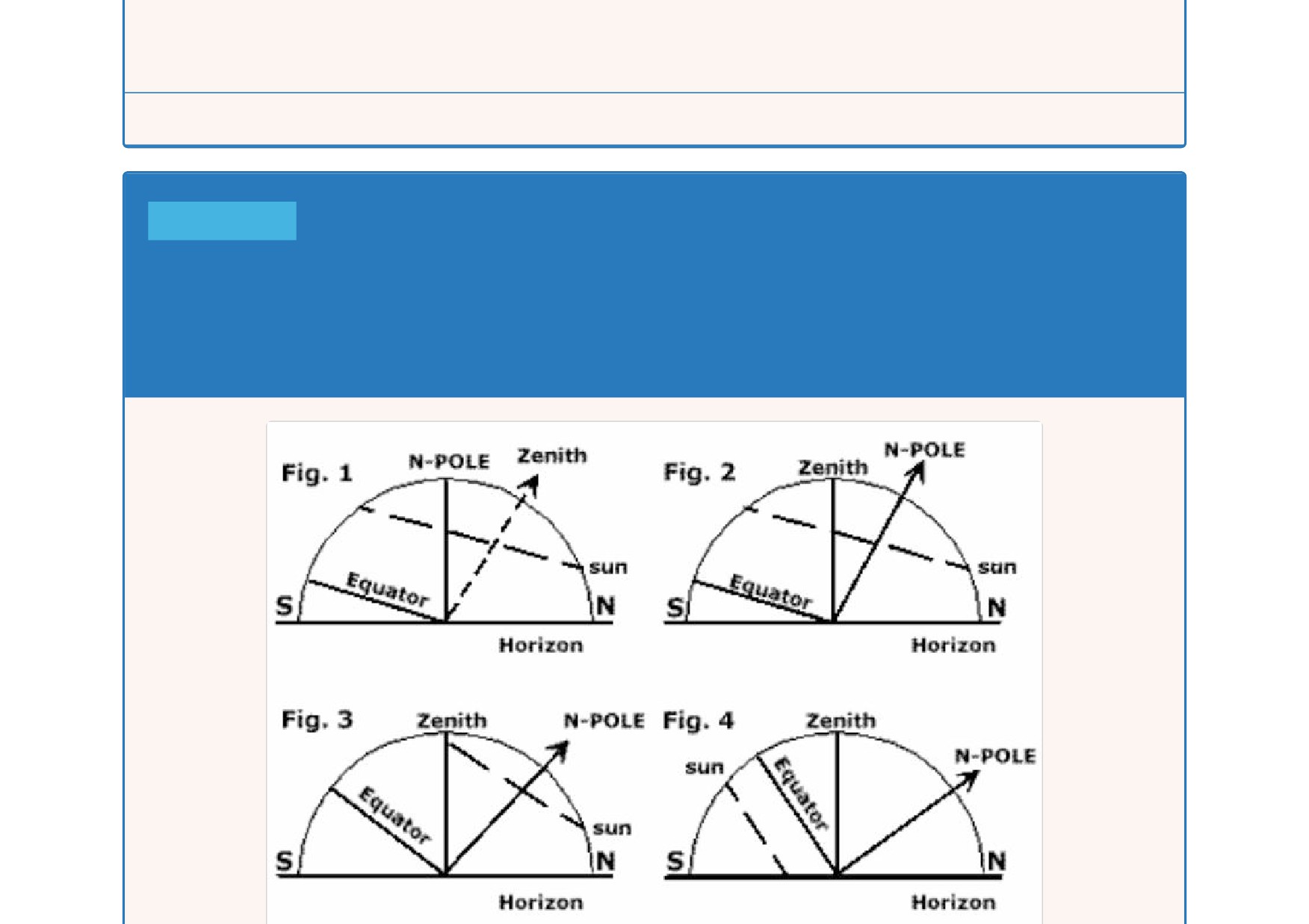
Code: FQLG Which of the following figures drawn on the plane of the Meridian
is correct for an observer in position Latitude 30° 00′ North; Longitude 15°
00′ West, when observing the sun on the meridian, if the sun’s Declination is
15° 00′ South?
Figure 4 is correct. (+)
Figure 3 is correct.
Figure 2 is correct.
Figure 1 is correct.
Code: GFRW What possible reason could there be for the identification mark
associated with a Racon not being visible on the radar screen?
All of the suggested answers. (+)
The Racon may not be transmitting a pulse.
The transmitted radar frequency may not trigger the Racon transmitter.
The radar may be suppressing the mark with application of the Interference Rejection control.
Code: FRYG The Master arrives on the bridge obviously under the influence
of alcohol and states he is taking over the “con” of the ship. What actions
should the Officer of the Watch (OOW) take in this situation?
Attempt to diplomatically avoid taking any actions that would put the ship or crew into danger and call the Chief Officer for
assistance. (+)
Watch the actions made by the Master and if not dangerous, wait until the Master becomes more capable to take control
or leaves the bridge.
Tell the Master you consider him incapable of taking over the responsibility of the watch and that he should retire to his
cabin and sleep it off.
Tell the Master you do not think this is a good idea and retain control of the watch.
Code: QPIQ Which approved publication should be used by a seafarer to help
overcome any misunderstanding in communications?
The (IMO) Standard Marine Communication Phrases (SMCP) booklet. (+)
The Oxford Concise Dictionary.
The (ISC) Bridge Procedures Guide.
Standard Marine Navigational Vocabulary.
Code: TMQK What is the correct understanding of the term “Block Coefficient”
as applied to a ship?
The comparisons of the underwater shape of the ship, to a rectangular block of the same extreme dimensions. (+)
The ratio of the waterplane shape of the ship to a rectangle of the same extreme dimensions.
The restriction of a valve in a pipe to the flow of fluid through that pipe.
The coefficient of a Block and Tackle.
Code: JAMS What is the depth of an iceberg below the surface of the sea?
The draught of an iceberg varies with the type of berg and its age. (+)
The draught of an iceberg is normally about 3/4 of its total depth.
The draught of an iceberg is about the same as the visible part of the iceberg above the water.
The depth of an iceberg below the surface is always about one sixth of its total depth.
Code: GHYX When should gangway nets be rigged?
Whenever the gangway is rigged. (+)
Between sunset and sunrise.
Whenever the gangway is regarded as unsafe.
When it is deemed necessary by the Master of the Chief Officer.
Code: OXAN What sound signal shall be used on ship’s whistle when there is
a man overboard?
3 long blasts repeatedly. (+)
6 long blasts repeatedly.
5 long blasts repeatedly.
4 long blasts repeatedly.
Code: TCQX When a ship is lying at anchor in a tidal area using both forward
Code: TCQX When a ship is lying at anchor in a tidal area using both forward
anchors, to what particular aspect should the officer of the watch be paying
special attention?
When the ship swings to the tide the direction of swing should be controlled to avoid the anchor cables becoming wrapped
round each other. (+)
The ship will become controlled by the tide and the wind will not be allowed to have any effect on the direction the ship lies
at anchor.
The two anchors will restrict the ships swing with the tide and the ship may not lie to the prevailing current and wind.
The tension on both cables should be similar, to avoid one dragging and all the weight of the ship remaining on the other
anchor only.
Code: NDCQ A ship is navigating in the Caribbean in August when it receives
the warning of a Hurricane. To determine the centre of the storm the Master
uses “Buys Ballot’s Law” and faces the wind. On what side of the Master
would the low pressure area be located?
On the right side. (+)
On the left side.
This is not a suitable method to use with a Hurricane.
Straight ahead.
Code: HWCB What is the probable cause of an error in position of the ship
obtained from the GPS system?
Incorrect height of the antenna. (+)
Abnormal sun spot activity causing unusual radiation effects.
A three dimensional instead of a two dimensional position output.
All of the suggested answers.
Code: PUYV What actions should the Officer of the Watch take when the
ship’s steering gear fails?
All of the suggested answers. (+)
Request the engine room to check the steering gear.
Call the Master and advise him of the situation.
Display the NUC signal and consider stopping the engines.
Code: BYCT Where can the size of the Magnetic Compass Error be found?
By taking a transit bearing of two fixed geographical positions and comparing it with the bearing of the same points on the
chart. (+)
On the chart in the centre of the compass rose or by reference to the Variation chart, taking into account the annual
changes.
By taking the error from the Deviation Table on the bridge.
By reference to the last entry in the Compass Error Log Book.
Code: AFPT You are in open water and clear conditions. You are approaching
the pilot station when you hear this signal from a vessel ahead of you. What
does it signify?
That the vessel is operating astern propulsion. (+)
That the vessel is operating astern propulsion. (+)
That the vessel is starting his engine and resuming his passage.
That the vessel is altering his course to starboard.
That the vessel is picking up his pilot.
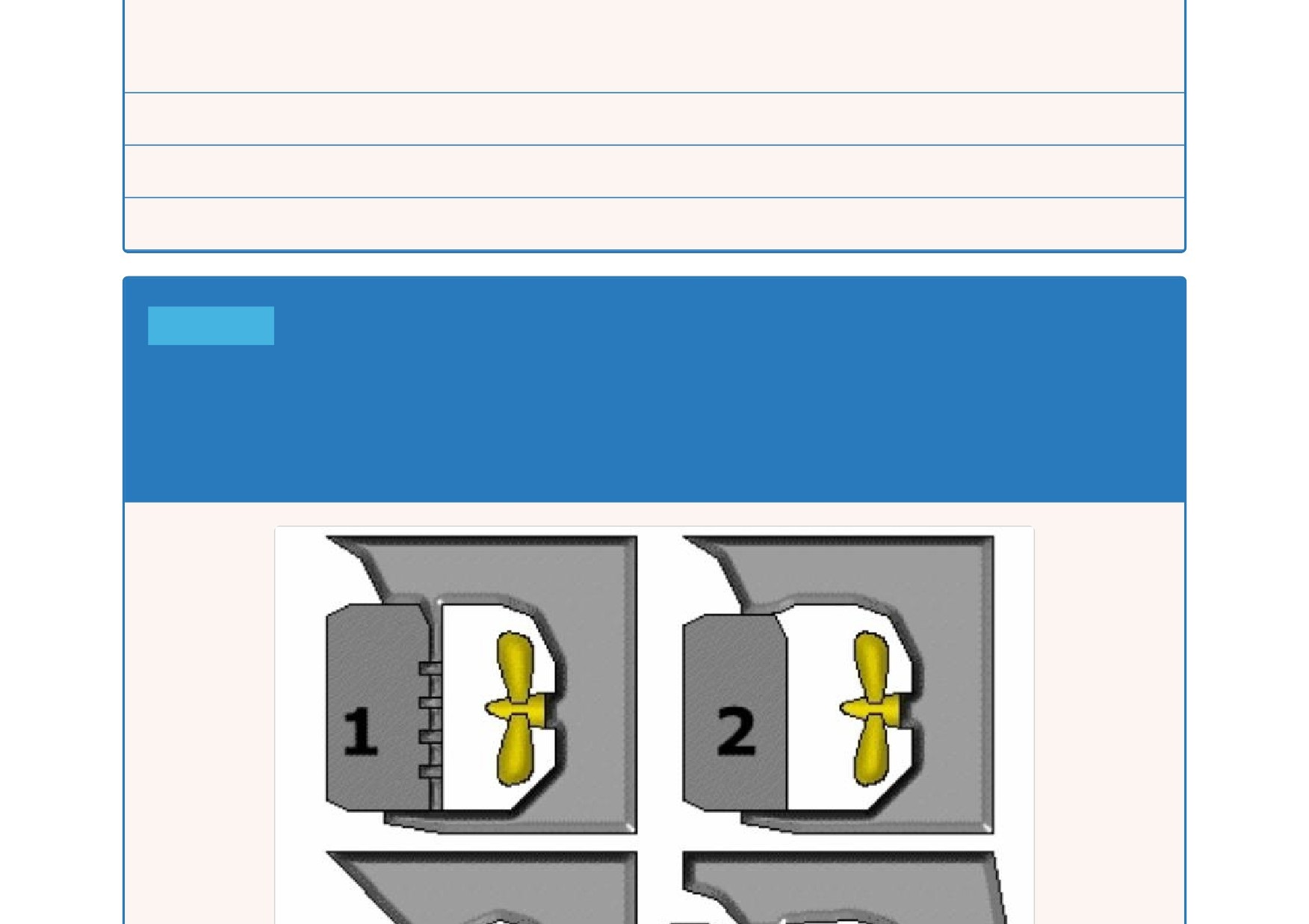
Code: IVIF Which of the following answers correctly specify the following
most common rudders? a) UNBALANCED, b) BALANCED, c) SEMI
BALANCED and d) UNDERHUNG BALANCED. i. e. The number in the
picture is related to the letter adjacent to the name of the rudder.
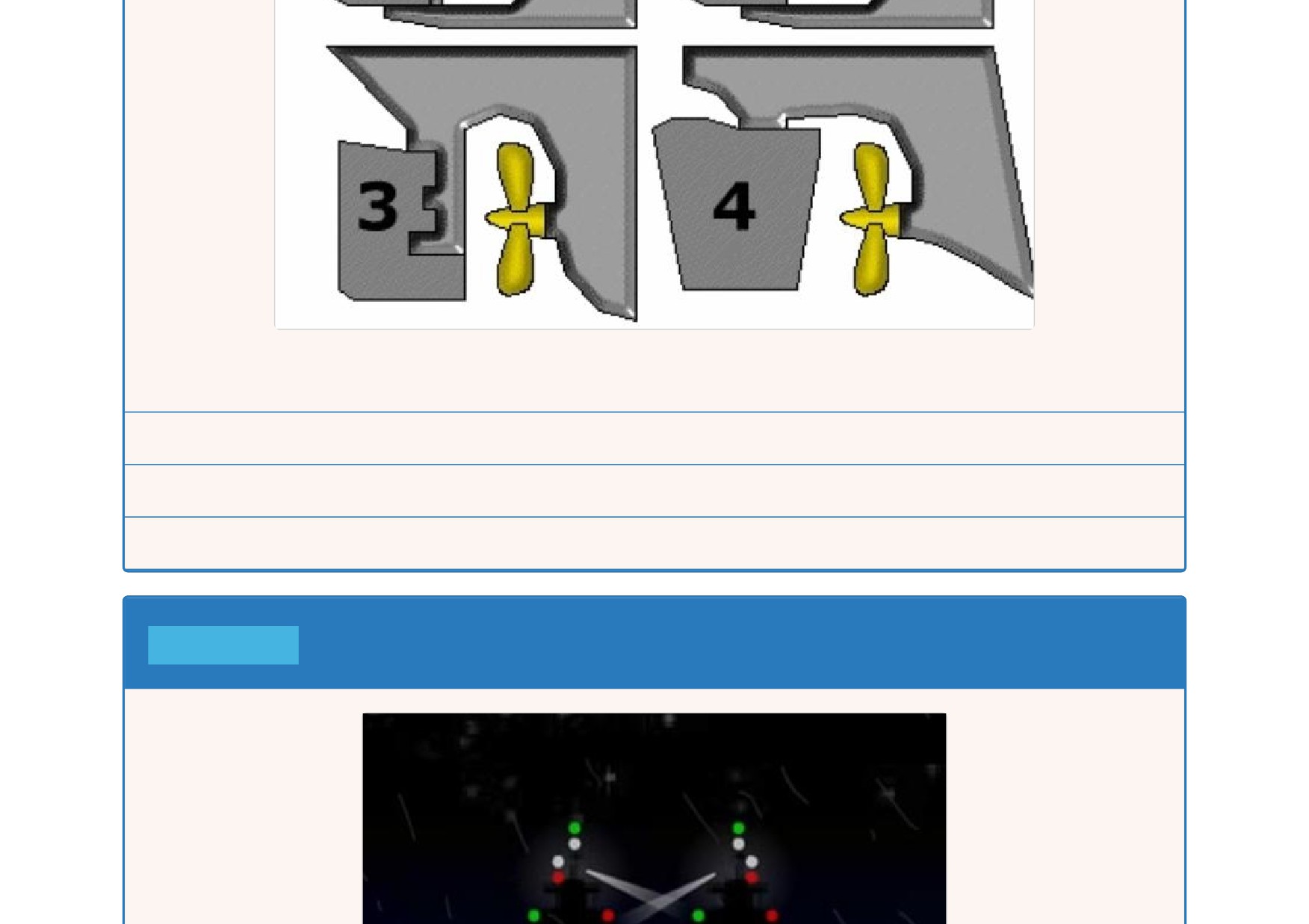
1 = a, 2 = b, 3 = c and 4 = d. (+)
1 = d, 2 = a, 3 = b and 4 = c.
1 = b, 2 = c, 3 = d and 4 = a.
1 = c, 2 = d, 3 = a and 4 = b.
Code: GXYD What is happening here?
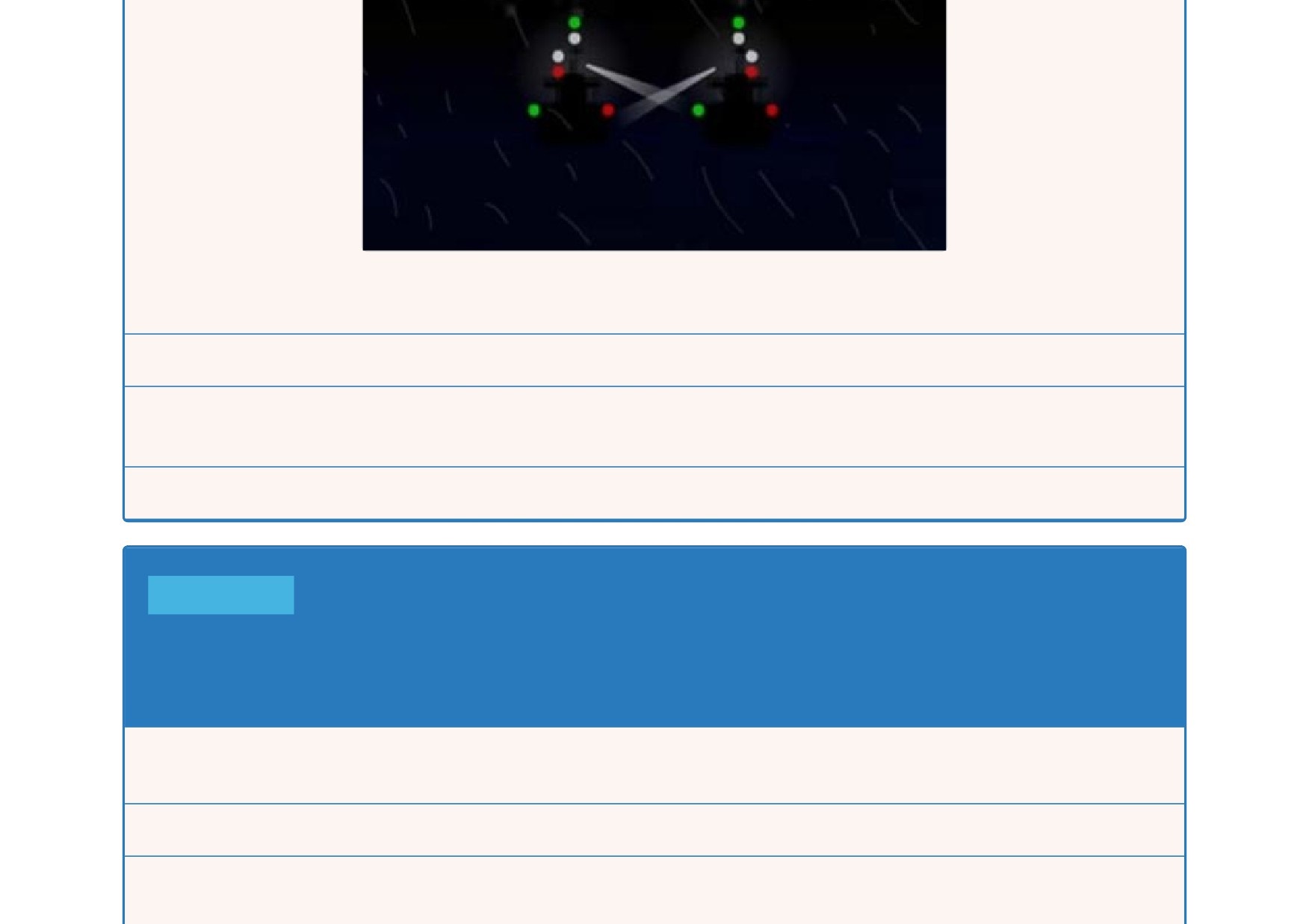
These are two vessels engaged in fishing (pair trawling), showing the additional volutary signals for hauling nets. (+)
These are two vessels engaged in fishing (pair trawling), showing the additional voluntary signals for shooting nets.
This is a vessel engaged in towing a disabled tow, restricted in its ability to manoeuvre, with a searchlight used to highlight
the location of the tow.
These are two vessels engaged in fishing, using purseseine gear. The searchlights are simply working lights.
Code: SLCC The ship’s rudder is full over when the ship’s engines are full
ahead. Will the turning effect (lift force) of the rudder be changed when the
engine is stopped?
Yes, the lift force will be dramatically reduced when the engines are stopped. (+)
No, the turning force applied by the rudder will be maintained within about 90 % of the lift force when going full ahead.

No, the lift force is unaffected by the speed of the propeller.
Yes, the lift or turning force will be reduced to about 50 % of the original lift force when the engines are stopped.
Code: VKUF What letter is represented by this flag and what is it’s meaning
when displayed by a vessel in port?
P - All persons should report on board as the vessel is about to proceed to sea. (+)
P - I require a pilot.
W - All persons should report onboard as the vessel is about to proceed to sea.
S - I am operating astern propulsion.
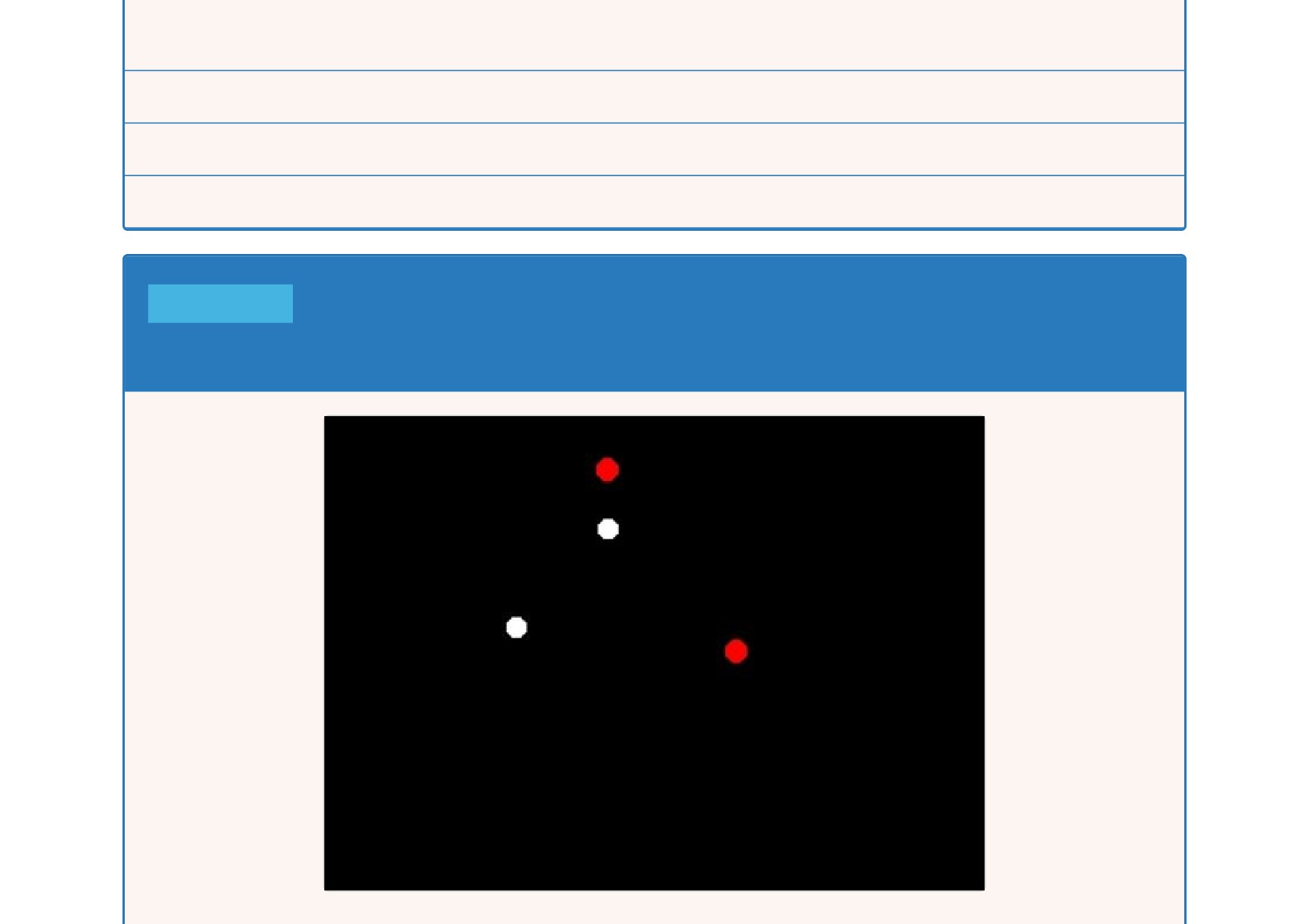
Code: LDKV What type of vessel is this and from what direction are you
seeing it?
This is a vessel engaged in fishing other than trawling, making way through the water, with outlying gear extending more
than 150 m in the direction of the allround white light. I am looking at her port side. (+)
This is a vessel engaged in fishing other than trawling, making way through the water, with outlying gear extending more
than 150 m in the direction of the allround red light. I am seeing her from astern.
This is a vessel engaged in pilotage operations, deploying or recovering a pilot. I am looking at her port side.
This is a vessel engaged in pilotage duties at anchor. I am looking at her port side.
Code: MMMU If your vessel is fitted with wires on selfstowing “split drum”
winches, the advantage of having these split drum winches is:
All the listed alternatives. (+)
Increased brake holding capacity due to the ability to keep the paid out wire in a single layer on the drum.
Less chance of the wire being jammed in the reel.
No crushing of the wire.
Code: BVQF You are proceeding along a narrow channel in front of another
Code: BVQF You are proceeding along a narrow channel in front of another
vessel, both heading for port. You hear this signal from the vessel behind
you. What does it mean?
I intend to overtake you on your port side. (+)
I am operating astern propulsion.
I am faster than you. Get out of the way.
I intend to overtake you on your starboard side.
Code: EMMF The ship has a righthanded propeller and is swinging to
starboard when the engines are slow ahead and the rudder is to starboard.
The engines are stopped and the rate of swing rapidly slows down. How
could the swing to starboard be maintained without the ship making much
headway.
Astern on the engines will allow Transverse Thrust to continue the swing. (+)
By applying the rudder hard over to starboard and going ahead on the engines.
The only effective method is by using the bow thruster to push the bow to starboard.
Transverse Thrust will reduce the swing and therefore a kick ahead is necessary with full starboard helm applied.
Code: HGON The following vessels are all required to make the same sound
signal when in or near an area of restricted visibility: a vessel not under
command; a vessel restricted in her ability to manoeuvre; a vessel
constrained by her draught/a sailing vessel; a vessel engaged in fishing; a
vessel engaged in towing or pushing another vessel. What is that signal?
One prolonged blast, followed by two short blasts, at intervals of not more than 2 minutes. (+)
One prolonged blast, followed by two short blasts, at intervals of not more than 1 minute.
One prolonged blast at intervals at not more than 2 minutes.
Two prolonged blasts, followed by one short blast, at intervals of not more than 2 minutes.
Code: LJLY What would be the effects of a ship passing into shallow water?
The ship is less responsive to both rudder and propeller. (+)
The ship is less responsive to both rudder and propeller. (+)
There is no noticeable difference in performance of the ship.
The speed is not affected, but more rudder is required to steer the ship.
The vessel has a tendency to swing to port with a single fixedpitch righthand turning propeller.
Code: FAVA The ship is drifting in the open sea with a temporary engine
breakdown. The ship is equipped with GPS navigation equipment. What
should the bridge Officer of the Watch do in this situation?
All of the possible answers. (+)
Display the “Not under Command” signal and switch off the normal steaming lights.
Plot the direction and rate of drift and predict the ships position for the period while the ship is “Not Under Command”.
Keep a good lookout for other ships.
Code: PORQ What is the direction of wind associated with an anticyclone
(area of high pressure) in the Northern Hemisphere?
Clockwise around the high pressure. (+)
Straight towards the centre of the anticyclone.
Anticlockwise around the high pressure.
Directly away from the centre of the anticyclone towards the nearest Low pressure.
Code: PETM Why should Ground Stabilised True Motion display mode be
avoided when using the ARPA for anticollision purposes?
The collision regulations are based on ship courses through the water. (+)
True motion does not provide the collision risk of other ships.
The true vector can never give an indication of collision risk with another ship.
The Relative Motion display and relative vectors is the only display to use for anticollision purposes.
Code: OAJW What could be the reason for the magnetic compass to swing
through large angles when the ship is rolling in a seaway?
The heeling error magnets are upside down and/or not in the correct position. (+)
The error due to deviation is large for that ships heading.
The Coefficient B determined by the Compass Corrector at the last drydock was not correctly calculated.
The induced magnetism from the earth’s magnetic field is very strong in that area.
Code: GQJB The lights here show those that must be exhibited by a vessel
engaged in towing, as per rule 24 of the International Collision Regulations.
But how long is the tow behind this vessel?
It exceeds 200 metres. (+)
It is more than 50 metres but less than 200 metres.
It is less than 200 metres.
At least 100 metres.
Code: MCIV The Second Officer, when on watch on the bridge, is often
referred to as the OOW. What does OOW actually stand for?
referred to as the OOW. What does OOW actually stand for?
Officer of the Watch. (+)
On official watch.
Operator of the watch.
On official watchkeeping.
Code: YYXR Which of the following answers most suitably cover the standard
duties of the bridge Officer of the Watch when the ship is at anchorage?
Display anchor signal, check the ships position and keep a good lookout. (+)
Display the anchor signal, patrol the ship frequency and check the anchor chain for dragging.
Display anchor signal and keep a good lookout of other ships in the area.
Display the anchor signal and ensure the ship swings the same way at each change of tide.
Code: EERA If whistles are fitted on a vessel at a distance apart of more than
100 metres, will manoeuvring and warning signals, as defined by rule 34 of
the International regulations for Preventing Collisions at Sea, be given on
one or both whistles?
They shall be given on one whistle only. (+)
They shall be given on both whistles simultaneously.
They shall first be given on the forward whistle, followed by the after whistle, with a 5 second interval in between.
Manoeuvring signals will be given only on the forward whistle; warning signals will be given on both whistles
simultaneously.
Code: JWPF You are on a sailing vessel, underway in open water. This vessel
is sighted on the starboard bow, on a steady bearing and the distance is
closing. By the International Regulations for the Preventing Collisions at
Sea, what action will you follow?
By Rule 18, a powerdriven vessel underway shall keep out of the way of a sailing vessel. I will maintain my course and
speed, but will continue to monitor situation to ensure the other vessel takes avoiding action. (+)
Risk of collision is deemed to exist and, as the other vessel is on a steady bearing on my starboard side, I will maintain my
course and speed.
This vessel is clearly a powerdriven vessel and I anticipate that the bearing will therefore close and she will pass ahead at
a safe distance.
Risk of collision is deemed to exist and, as the other vessel is on a steady bearing on my starboard side, I am required to
keep out of the way. I will make a broad alteration of course to starboard.
Code: GKRE How can an ARPA assist the ship to steer a suitable course to
make good the entrance to a channel?
Select ground stabilised true motion display and alter course so that own ships true vector passes through the middle of
the entrance to the channel. (+)
Select Relative motion display and make Own Ship vector pass through the middle of the entrance to the channel.
Select True ground stabilised vectors and make the vectors from both buoys at the entrance to the channel pass either
side of the centre of the screen.
Acquire the buoy at the entrance to the channel and on relative vector display alter course to make the vector of the buoy
pass directly through the centre of the screen.
Code: AFPT You are in open water and clear conditions. You are approaching
the pilot station when you hear this signal from a vessel ahead of you. What
does it signify?
That the vessel is operating astern propulsion. (+)
That the vessel is starting his engine and resuming his passage.
That the vessel is altering his course to starboard.
That the vessel is picking up his pilot.
Code: ENYM When using the echo sounder in a river the soundings indicated
may be incorrect, what would be the most probable cause of the error?
The density of the water. (+)
Shallow water effects.
There should be no error with a properly working echo sounder.
The strength of the tide and current in the river.
Code: CTLR The ship is required to be stopped in the water as quickly as
possible, but without major changes to the ship’s heading. What is the most
effective method to achieve this?
The use of the rudder hard over both sides combined with reducing engine power, a method known as “high frequency
rudder cycling”. (+)
Put the engine full astern and keep the rudder amidships.
Make a complete turn while reducing the engine power.
Make a zig zag manoeuvre while reducing the engine power.
Code: TDDV The gyro compass can suffer from a compass error and may
need to be allowed for, when steering a course in a dangerous navigational
area. What is the probable cause of the error?
An uncorrected course and speed error. (+)
Compass Deviation.
Fluctuations in the electrical supply to the compass.
Variation.
Code: XWMR When navigating using the GPS, how does the GPS display
indicate when the accuracy of the displayed position is reduced?
A large HDOP value is displayed on the screen. (+)
The GPS display is always very accurate and does not give any indication of lack of accuracy.
A large “Correction Factor” number is displayed on the screen.
The GPS display flashes and sounds an alarm.
Code: PUPO What is correct UTC in this example? Approx. Pos: N49° 51′
W35° 23′, zone +2, Local Time 0900.
11 00. (+)
19 00.
23 00.
07 00.
Code: DTHW The position of the ship provided by the GPS should always be
confirmed by other means, when possible. Which of the following suggested
methods would be the most accurate?
The ranges of three distinctive shore objects on the radar. (+)
Bearing using the Radio Direction Finding of three radio beacons.
Compass bearings of three shore objects.
Bearing and distance from a navigational Buoy.
Code: RFJD What would be considered the most favourable heading of a ship
when launching a lifeboat?
The ship should steer about 30° off the prevailing weather and sea with the boat to be launch on the leeside. (+)
The ship should steer about 100° of the prevailing weather and sea with the boat to be launched on the leeside.
The ship should lie stopped in the water with the weather on the opposite side to the boat to be launched.
The ship should steer with the prevailing weather and sea on the beam and the boat to be launch on the leeside.
Code: BLOW What is the description for a sidelight, as shown in rule 21 of the
International Regulations for Preventing Collisions at Sea?
A green light on the starboard side and red light on the port side, showing an unbroken light over an arc of 112,5°, from
right ahead to 22,5° abaft the beam on the respective side. (+)
A red light or a green light, with a minimum range, in a vessel of 50 metres or more, of 3 miles. In a vessel of 10 metres.
A red, green or yellow lantern, showing an unbroken light over an arc of 112,5°.
A green light on the starboard side and red light on the port side, showing an unbroken light over an arc of 135°, from right
ahead to 22,5° abaft the beam on the respective side.
Code: WIAM When splicing an eye on a mooring wire (using the
recommended 5 full tucks and 2 half tucks) the effective breaking strength of
the wire may be affected by the splice. What would be the anticipated
change in the breaking strength of the wire?
A reduction in strength of 10 % to 15 %. (+)
A reduction in strength of 30 % to 40 %.
A reduction in strength of 1 % to 5 %.
No reduction in strength.
Code: JLRE You are proceeding along a coastal route when you hear this
signal. The visibility is severely restricted. What does the signal mean?
There is a vessel aground in the vicinity. She is more than 100 metres in length. She is sounding an additional warning to
approaching vessels that they are “running into danger”. (+)
There is a vessel aground in the vicinity. She is more than 100 metres in length. She is sounding an additional warning to
approaching vessels, directing them to “keep clear”.
There is a vessel aground in the vicinity. She is less than 100 metres in length. She is sounding an additional warning to
approaching vessels to “navigate with extreme caution”.
There is a vessel at anchor in the vicinity. She is less than 100 metres in length. She is sounding an additional warning to
approaching vessels that they are “running into danger”.
Code: AKMY What are we seeing here?
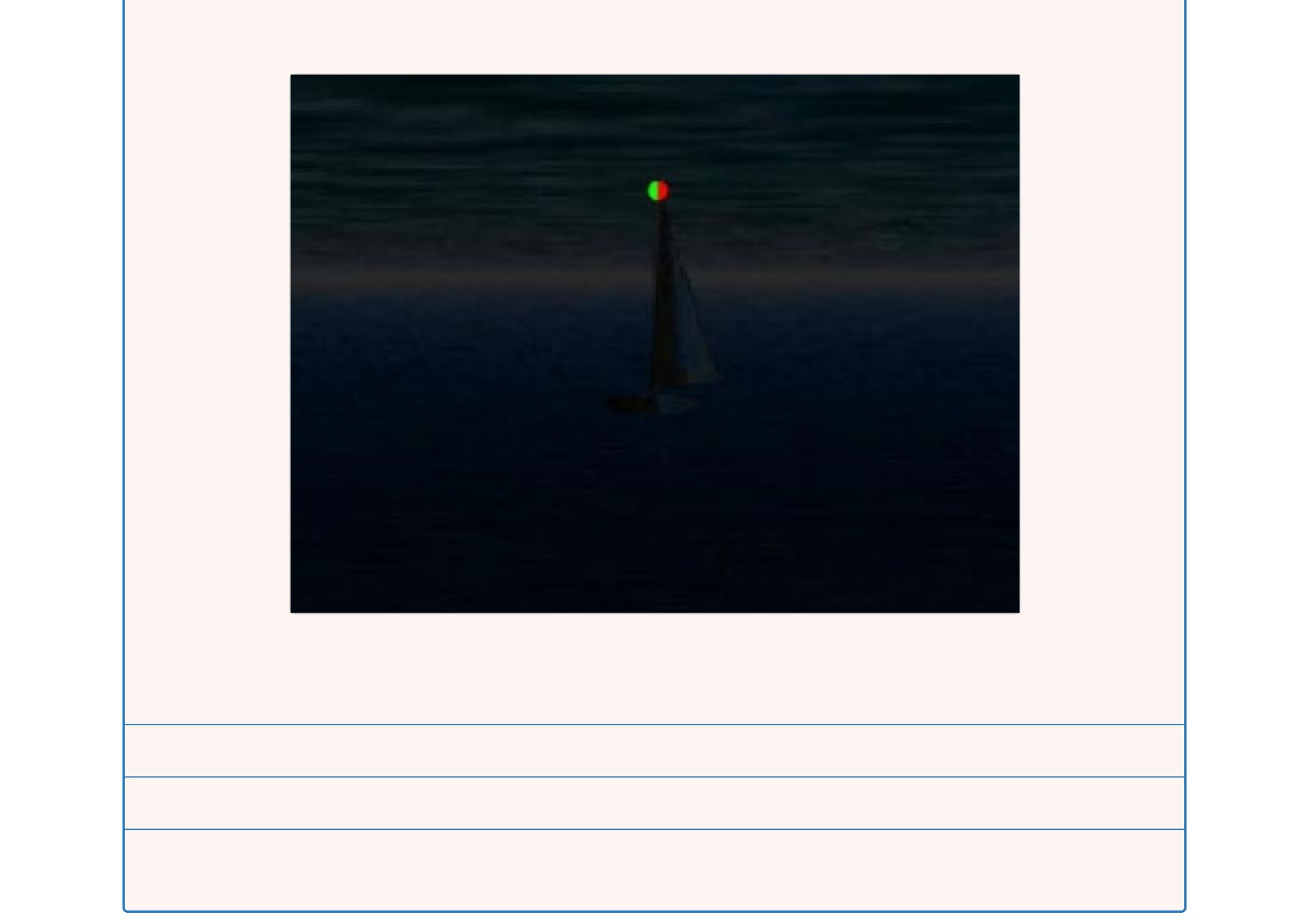
A sailing vessel less than 20 metres in length, displaying the optional combined lantern in lieu of standard sailing lights,
seen headon. (+)
A sailing vessel, seen from astern, where the edges of her sidelights are both visible.
A sailing vessel, at anchor.
A sailing vessel of less than 10 metres in length, displaying the mandatory combined lantern in lieu of sailing lights, seen
headon.
Code: WYXW What can be used to reduce the effect of the state of sea
water?
Vegetable/Fish Oil. (+)
Crude Oil.
Fuel Oil.
Foam.
Code: VNSG Which of the answers best summarises the information which
should be provided for the bridge Officer of the Watch within an effective
Voyage plan?
All of the suggested answers. (+)
Contingency arrangements in case of problems.
Expected prevailing wind and weather.
Courses to steer; distance off dangers; parallel index lines; expected currents; prevailing winds; distance between
alteration points.
Code: XHDE Which method is used to make a physical connection between a
rescue vessel and a wreck?
Rocket line. (+)
Cosmos line.
Sputnik line.
Heaving line.
Code: DPTB You are proceeding up a river, with berths on both banks. You
see this flag hoist on a vessel moored on a berth ahead. What does it
mean?
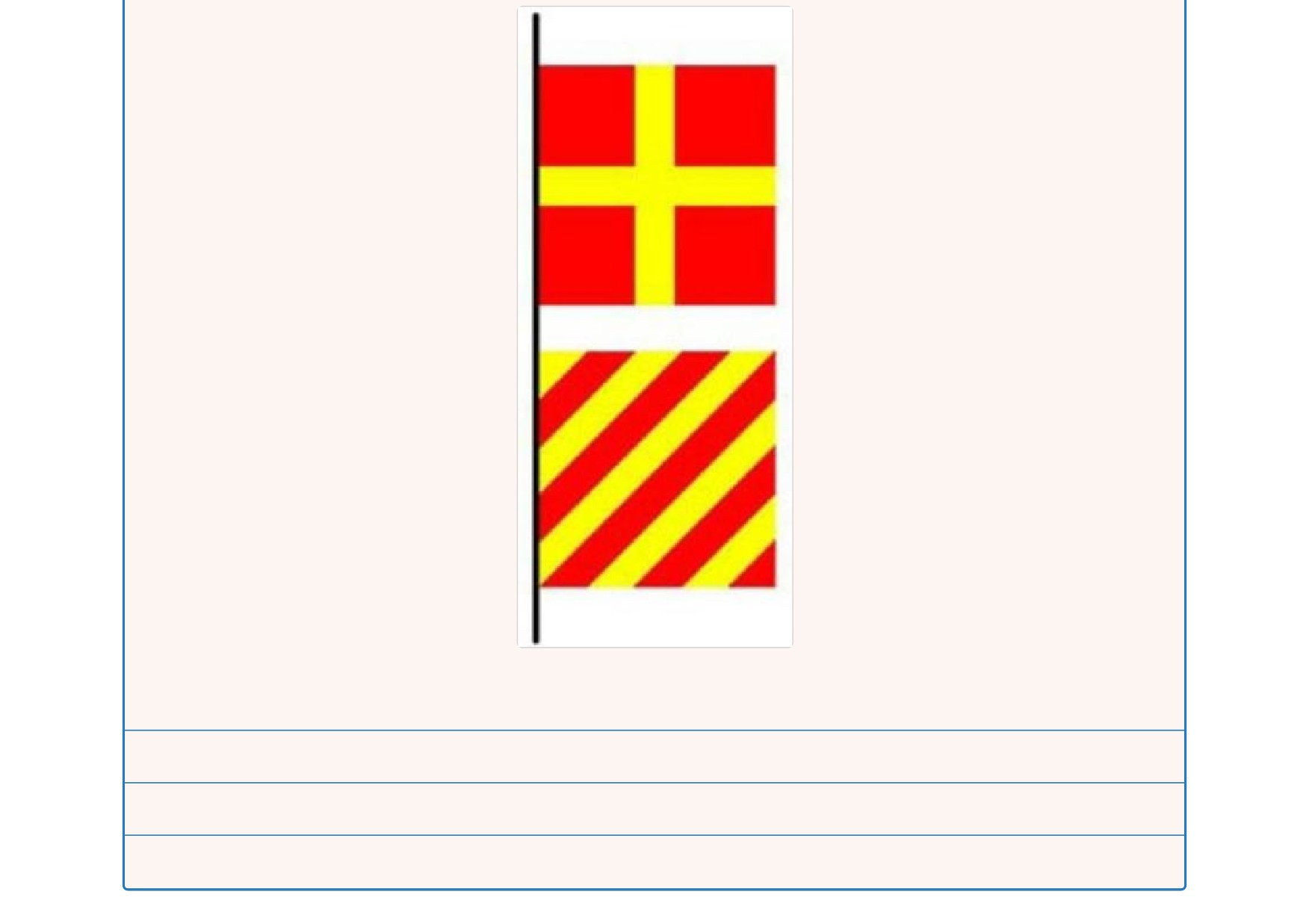
You should proceed at slow speed when passing me. (+)
I am about to depart the berth.
My engine is disabled.
Тест по Radio Communication,
GMDSS
Количество отображаемых вопросов: 198.
Правильные ответы отмечены знаком (+)
Code: KRVT Which of the following is a Accounting Authority Identification
Code?
FR01. (+)
FR01. (+)
227990850.
2 187,5.
F1B.
Code: IUTX An EPIRB has been activated accidentally. Which of the following
is correct for cancelling the false distress alert?
Call the nearest coast station and inform it that a false distress alert has been transmitted. (+)
Send a distress priority VHF DSC call and make broadcast to all stations.
Call a LUT and inform it.
Make broadcast to all stations on VHF 16.
Code: FEWC The effect of reflection of the radio waves in the ionosphere on
the range depends on:
The amount of ionisation. (+)
The amount of ionisation. (+)
The correct adjustment of the dimmer.
The correct adjustment of the button band width.
The correct adjustment of the clarifier.
Code: EGSU On area A1 the function “Reception of shore to ship distress
alerts” is mainly based on:
The use of VHF DSC. (+)
The use of SARSAT COSPAS Epirbs.
The use of SART transponders.
The use of MF DSC.
Code: IYRC The safety message announces that a station:
Will relay a message concerning an important navigational or meteorological warning. (+)
Is in serious and imminent danger and needs immediate assistance.
Is going to be under repairs.
Has an very urgent message concerning the safety of a vessel, a plane or another means of conveyance.
Code: PSIB What is understood by carrier frequency?
The frequency actually used by transmitter and receiver. (+)
Frequency of the carrier wave.
The frequency of upper side band (UBS).
Frequency of single side band.
Code: BKNU Onboard the following message is received on the DSC
controller: DOO: 245329000 CH16; S distress ack 244123000. What station
sent the distress acknowledgement?
245329000. (+)
002453290.
244123000.
None of the given.
Code: JRHG Which wave length applies to a frequency of 2 000 kHz?
150 mtr. (+)
1 500 mtr.
15 mtr.
15 000 mtr.
Code: OROR For a DSCconnection (no “distress alert”) with another vessel
the following frequencies are used:
TX: 2 177,0 kHz RX: 2 177,0 kHz. (+)
TX: 2 189,5 kHz RX: 2 189,5 kHz.
TX: 2 187,5 kHz RX: 2 187,5 kHz.
TX: 2 187,5 kHz RX: 2 182,0 kHz.
Code: YJCM Of the AMsignal:
Amplitude is variable and frequency of the carrier wave is constant. (+)
Amplitude and frequency of the carrier wave are constant.
Is not dependant on the frequency and amplitude.
Both amplitude and frequency of the carrier wave are variable.
Code: SLGM On board they want to have a dialphone call via Inmarsat with
the Apollogracht. In the guides the following ID’s are found for the
Apollogracht: 344320000, 424432010, 424432020, 1300210, 36715. What
ID should be chosen?
1300210. (+)
424432010.
424432020.
344320000.
Code: OUOJ Dish aerials are used with:
InmarsatB and M.
(+)
InmarsatC and M.
InmarsatA and C.
None of the mentioned.
Code: RHCF Which of the following frequency bands would most likely
provide reliable communication between two stations that are 15 miles
apart?
The Very High Frequency (VHF) band. (+)
The High Frequency (HF) band.
The Low Frequency (LF) band.
The Medium Frequency (MF) band.
Code: KIOJ The Inmarsatsatellites are located:
Above the equator. (+)
Alternatively above the poles and the equator.
In a geostationary orbit at approximally 1 000 km Altitude.
Between Lat 70° N and 70° S.
Code: RUQY VHF channel 6 is:
Intership channel.
(+)
Intraship channel.
Safety channel.
Public traffic channel.
Code: BFCW The whipantenna of the MF transceiver was lost in bad
weather. The MF transceiver can be used again:
If the whipantenna is replaced by an antenna of about the same length as the original one. (+)
If the whipantenna is replaced by a SatC antenna.
If instead of the whipantenna, another whipantenna such as the spare VHF antenna is connected.
Only if the whipantenna is replaced by another whipantenna of the same length.
Code: JRHI A VHF transmission range is mainly determined by:
The height of the aerial. (+)
The ocean region.
Whether it is radioŧelephony, radioŧelex or DSC.
The transmission power, propagation and the quality of the receiver.
Code: ARGA By FleetNET communication is understood:
An EGCmessage destined for ships with the same group call number. (+)
A MSImessage destined for ships in specific geographical area.
An urgent message for all ships in a particular area.
A HFNBDPmessage destined for ships in a certain geographical area.
Code: EYJG The authority to order the use of distress signal or distress alerts
is:
Only with the master. (+)
Company safety officer.
The person designated to maintain communication during distress situations.
The first person to discover the distress situation.
Code: GBOK What are the NAVTEX messages categories which cannot be
Code: GBOK What are the NAVTEX messages categories which cannot be
suppressed?
A, B, D. (+)
Weather forecasts.
Satnav messages.
A, B, C.
Code: MGVT The hydrostatic release of an EPIRB should be changed:
Every 2 years. (+)
Every 4 years.
Every 3 years.
Yearly.
Code: ESOV The MERSAR is:
A book of directions for search and rescue at sea. (+)
A survey of vessels favourably located for possible rescue during SAR operations.
A fully automated system for mutual assistance and rescue of persons at sea.
A book for communication regulations at sea.
Code: ECSD When sending an OBS (weather report) with Inmarsat one
should use Service Code “41”. With this address the weather report will
always be transmitted to:
The meteorological station connected with the CES used. (+)
The meteorological office of the ship’s flag state.
KNMI in Holland.
MET office Washington, this office will take care of further dispatch of the weather reports.
Code: KCCQ The impedance of a coax cable for the VHFset depends on:
The structure dimensions and the material of the coax cable. (+)
The temperature of the cable.
The way in which the feed line is controlled.
The length of the coax cable.
Code: JHHH When a satellite receives a “distress alert” from a CospasSarsat
EPIRB, the relay of the “distress alert” can be delayed because the satellite
cannot immediately contact a:
LUT before the satellite is actually seen by this ground station. (+)
NCS before the satellite is actually seen by this ground station.
LES before the satellite is actually seen by this ground station.
Coast station.
Code: KQDQ The prescribed periodic tests of the radio set must be entered
in:
Radio Log. (+)
Ship’s deck log.
Equipment manual.
Manual maritime radio communication.
Code: GLRY Which word will precede an urgency message?
PANPAN. (+)
PAN.
URGENCE.
MAYDAY.
Code: WHNY One can check the functioning of the SART by:
Code: WHNY One can check the functioning of the SART by:
Activating the SART and checking the effect on the radar screen. (+)
Removing it from the holder and turning the SART upside down.
Activating it by extracting the antenna.
Lowering SART in to the sea.
Code: YNBN What do you do after receiving a VHF DSC DISTRESS call?
You set watch on VHF channel 16. (+)
You send immediately a DSC DISTRESS ACKNOWLEDGEMENT call.
You set watch on channel 13.
You send immediately a DSC DISTRESS RELAY call.
Code: DPEX Moored in a harbour, transmitting with a mariphone is:
Always allowed. (+)
Always allowed. (+)
Not allowed.
Allowed in emergency only.
Allowed in consultation with harbour master.
Code: AYOU What is the emergency frequency on MF (Medium Frequency)
radio?
2 182 Hz. (+)
1 616 Hz.
2 617 Hz.
1 718 Hz.
Code: RGYC Which of the following services is not provided by InmarsatC?
Telephone. (+)
Safetynet.
Fleetnet.
Telex.
Code: JGYG Reflection of radio waves in the ionosphere depends on:
Sunspots. (+)
The speed of the waves.
The chosen mode of transmission.
The propagation speed of propagation.
Code: UPGP If a ship according to the rules of GMDSS is equipped with an
MF/HF radio set a DSC listening watch must be kept on:
8 414,5 kHz and on at least one of the following DSC frequencies: 4 207,5 kHz, 6 312,0 kHz, 12 577,0 kHz or 16 804,5
kHz. (+)
2 187,5 kHz, 8 414,5 kHz and for instance 12 577,0 kHz.
2 182 kHz and channel 70.
All DSC distress frequencies.
Code: WEGK The transmitting receiving method, when both stations can
transmit and receive at the same time is called:
Duplex. (+)
Simplex.
Semiduplex.
None of the mentioned.
Code: ARAF How are the NAVTEX areas identified?
By two letters. (+)
By one letter and one digit.
By one digit.
By one letter.
Code: GPRM In what HFband is long distance transmission possible when
both stations are located in Darkness?
8 MHz. (+)
16 MHz.
22 MHz.
4 MHz.
Code: TCYE According to the rules of GMDSS vessels equipped for all sea
areas have to be provided with:
406,0 MHz CospasSarsat EPIRB. (+)
156,3 kHz EPIRB.
1,6 GHz Inmarsat/DSC EPIRB.
121,5/243,0 MHz VHF EPIRB.
Code: MXSP On the MF/HF transmitterreceiver there is a sensitivity control.
Another name for this is:
RFgain. (+)
AGCgain.
AFgain.
LFgain.
Code: IFFT Which class of emission is used for VHF radio telephony
transmissions?
G3E. (+)
H3E.
G2B.
J2B.
Code: PJEU With help of DSC a ship wants to contact a coaststation to have
a question for telephone call. One has to choose from the following DSC
frequencies:
TX: 8 415,0 kHz RX:8 436,5 kHz. (+)
TX: 8 436,5 kHz RX:8 436,5 kHz.
TX: 8 415,0 kHz RX:8 415,0 kHz.
TX: 8 415,5 kHz RX:8 415,5 kHz.
Code: FQVB By the term “Stand by” the operator of a coaststation means
that one should:
Wait until the coaststation calls again. (+)
Give the position of the ship.
Switch back to the calling channel.
Wait on this channel for one hour.
Code: RKOI The identification of a coast station is composed as follows:
00 followed by an MIDnumber and station number. (+)
00 followed by an MMSInumber.
33 followed by the MID number.
00 followed by an MIDnumber.
Code: FNIY A vessel is equipped for all sea areas. In the middle of the Indian
Ocean the EGCreceiver appears out of order. Is it still possible to receive
MSImessages?
Yes, with the MF/HFradio telex. (+)
Yes, with VHF DSC.
Yes, with the MF/HFÐSC.
No.
Code: MKCF On area A3 the function “Transmission and reception of signals
for locating” is mainly based on:
The use of SART transponders. (+)
The use of MF DSC.
The use of HF DSC.
The use of SARSAT COSPAS Epirbs.
Code: SXTH On area A4 the function “Transmission of ship to shore distress
alerts” is mainly based on:
The use of HF DSC and COSPAS SARSAT Epirbs.(+)
The use of VHF DSC and VHF Epirbs.
The use of MF DSC and Inmarsat Epirbs.
The use of HF DSC and Inmarsat Epirbs.
Code: MEJJ On area A2 the function “Transmission of ship to shore distress
alerts” is mainly based on:
The use of MF DSC.(+)
The use of VHF DSC.
The use of SARSAT COSPAS Epirbs.
The use of INMARSAT Epirbs.
Code: XFOI At the entrance to the space where batteries are stored on board
the following notice must be fitted:
No entry with naked light and/or flame. (+)
Crew only.
Keep access free.
Electrician only.
Code: OFQT Your vessel is not in distress and not taking part in a distress
operation. How would you impose radio silence on vessels which are
interfering the distress traffic?
Seelonce Distress. (+)
Seelonce Securite.
Seelonce Mayday.
Seelonce Pan.
Code: KTIH What is SITREP an abbreviation for:
Situation Report. (+)
Ship Indication Transmission Equipment.
Survivor Indication Transponder Equipment.
Ship Transmit Emergency Radio.
Code: UUHU The word NAVTEX is spelled conform the international phonetic
alphabet:
November, Alfa, Victor, Tango, Echo, Xray. (+)
November, Apple, Victoria, Tango, Echo, Xmas.
November, Anna, Victor, Tango, Eduard, Xray.
November, Able, Valencia, Tripoli, Echo, Xantippe.
Code: KSXF The word CHANNEL is spelled conform the international
phonetic alphabet:
Charlie, Hotel, Alfa, November, November, Echo, Lima. (+)
Cornelies, Hotel, Apple, November, November, Echo, Land.
Charlie, Hotel, Able, November, November, Echo, Liverpool.
Cornelies, Hotel, Alfa, November, November, Echo, Lima.
Code: RPSC The word SHIP is spelled conform the international phonetic
alphabet:
Sierra, Hotel, India, Papa. (+)
Singapore, Hotel, India, Paris.
Sierra, Hotel, Item, Papa.
Sugar, Hotel, Italia, Peter.
Code: XHGT What is the acronym FR 01?
AAIC. (+)
MMSI.
MSI.
Call sign.
Code: VJLS Is it necessary to state the accounting code of the vessel in fully
automated radio telexŧraffic with a coaststation?
Yes. (+)
No, because the AAIC is included in the radio telexidentification.
No, when AAIC is unknown, it will be asked for.
It depend upon your location.
Code: NTJX You want to send a DSCcall in connection with a shore
telephonecall. You must choose:
Routine. (+)
Distress.
Safety.
Urgency.
Code: UIOY What is the most important factor influencing the HF range?
The frequency used. (+)
The channel used.
The size of the antenna.
The power of the transmitter.
Code: IJNO What mode must be used on the MF/HF transmission when
making a radiotelephone call?
J3E. (+)
F1B/J2B.
H3E.
G3E.
Code: QQFI MUF stands for:
Highest possible frequency that will be reflected by the ionosphere. (+)
Most utilised frequency.
Highest possible frequency that can be made with an HFŧransmitter on board.
Most effective frequency, to make a connection with an HFŧransmitter.
Code: GJCX Which of the following frequencies is used by the NAVTEX
system?
518 kHz. (+)
121,5 MHz.
156,8 MHz.
2 182 kHz.
Code: JRHI A VHF transmission range is mainly determined by:
Code: JRHI A VHF transmission range is mainly determined by:
The height of the aerial. (+)
The transmission power, propagation and the quality of the receiver.
Whether it is radioŧelephony, radioŧelex or DSC.
The ocean region.
Code: WRUH The type of Inmarsat station A, B, C, M is recognized by:
The first digit of the identification. (+)
The first four digits of the identification.
Last digit of the identification.
The first two digits of the identification.
Code: OQOS At what minimum height above sea level a SART transponder
must be mounted?
1 metre. (+)
2 metres.
0,5 metre.
The good working of a SART transponder doesn’t depend on the height above sea level.
Code: CONY A satellite receives the transmissions of the 406 MHz Cospas
Sarsat EPIRB. The transmissions of the EPIRB will be:
Always passed on to a LUT. (+)
Exclusively passed on to a LUT if the satellite sees both the EPIRB and the LUT.
Exclusively passed on to a LUT only between 70° N and 70° S.
Passed when the satellite in passing the equator.
Code: FFYR According to the rule of GMDSS, channel 70 is used for:
Alerting. (+)
Alerting. (+)
Distress traffic.
Distress and urgency traffic.
Urgent communications.
Code: SAGQ The ideal aerial length depends on:
The frequency chosen. (+)
The weather conditions.
The modulation form chosen.
The class of transmission.
Code: MPUV A battery of 24 Volt supplies during 10 hours a current of 6
ampere. What is the capacity supplied?
60 Ah. (+)
48 Ah.
144 Ah.
240 Ah.
Code: EPFC If a ship in the MFband wants to have a DSCconnection with a
coaststation (no “distress alert” or a test alert) the following frequencies are
chosen:
TX: 2 189,5 kHz RX: 2 177,0 kHz. (+)
TX: 2 187,5 kHz RX: 2 182 kHz.
TX: 2 177,0 kHz RX: 2 177,0 kHz.
TX: 2 177,0 kHz RX: 2 189,5 kHz.
Code: CMTS A CospasSarsat EPIRB can be used in:
All seaareas (A1 to A4). (+)
Only in the seaareas A2 and A3.
Only in seaarea A4.
Only in the seaareas A1, A2 and A3.
Code: DABD A distresscall, onboard via RCC, may only be given Receipt if:
The OOW deems it necessary. (+)
The manager orders.
The captain orders.
OSC from the RCC concerned invites the vessels.
Code: FFFR All designated SAR aircraft and civil aircraft carry equipment
operating on the international aeronautical distress frequencies (amplitude
modulation). The aeronautical distress frequencies are:
121,5 MHz and/or 243,0 MHz. (+)
127,8 MHz and/or 71,6 MHz.
123,8 MHz and/or 247,6 MHz.
243,1 MHz and/or 486,2 MHz.
Code: MXSP On the MF/HF transmitterreceiver there is a sensitivity control.
Another name for this is:
RFgain. (+)
AGCgain.
AFgain.
LFgain.
Code: KULO Which International Convention introduced the GMDSS?
SOLAS. (+)
GMDSS.
STCW.
MERSAR.
Code: BANY The emergency battery of a GMDSS portophone:
Must be replaced before the expiry date is exceeded. (+)
Must be tested once a week.
Cannot be replaced.
Must be charged after expiry date.
Code: XSPR The normal mode of operation for each coast station shall be
indicated in:
The ITU List of Coast Station. (+)
The ITU List of Call signs and numerical identities of station used by the maritime mobile and maritime mobilesatellite
services.
The ITU List of Radiotermination and Special Services.
The ITU List of Ship Stations.
Code: KBXK If requested by a coastal radio station to participate in a rescue
operation, what is the most important information you may give?
Your position, name, call sign and speed. (+)
Your destination.
Your own cargo owner.
Your crews nationality.
Code: GBOK What are the NAVTEX messages categories which cannot be
suppressed?
A, B, D. (+)
A, B, C.
Weather forecasts.
Satnav messages.
Code: QRBC The typical “daylightfrequencies” for long distance transmission
are located in the:
16 or 22 MHzband. (+)
8 or 12 MHzband.
4 or 6 MHzband.
VHFband.
Code: MWIT The number of oscillations of a wave per seconds is called:
Frequency. (+)
Class of emission.
Wavelength.
Period.
Code: FUBR The sensitivity of a communication receiver can be adjusted
with:
RFgain. (+)
Squelch.
Clarifier.
AFgain.
Code: AJUH The battery of an EPIRB should be changed:
Every 4 years. (+)
Every 3 years.
Yearly.
Every 2 years.
Code: STQJ In the Inmarsat Maritime Communications Handbook one can
Code: STQJ In the Inmarsat Maritime Communications Handbook one can
find information about:
2 digit code telex services. (+)
Radio telex commands.
Ship’s Inmarsat Id’s.
Numbers of fax subscribers.
Code: OJHX The prescribed test of an approved portable VHF radio set
(portophone) must be done once a:
Month. (+)
Week.
Year.
Quarter.
Code: XKYT You wish to send an email using the InmarsatC installation. The
Code: XKYT You wish to send an email using the InmarsatC installation. The
message has to be composed in:
ASCII. (+)
X25.
The 400 protocol.
National language of the LES.
Code: WSEL With maintenance of batteries it is of primary importance that:
The space where the batteries are stored is properly ventilated. (+)
There is proper relative humidity in the space where the batteries are stored.
The space is not oily.
There is an absolute free access to the battery space.
Code: UPCJ What does the abbreviation VHF means?
Very High Frequency. (+)
Variable High Frequency.
Variable Hertz Frequency.
Visual High Frequency.
Code: VSQN Inmarsat is short for:
International Maritime Satellite Organisation. (+)
International Maritime Safety Organisation.
Internal Marine Safety Organisation.
International Maritime Satellite System.
Code: EGSU On area A1 the function “Transmission of ship to shore distress
alerts” is mainly based on:
The use of VHF DSC. (+)
The use of VHF DSC. (+)
The use of HF DSC.
The use of portable VHF.
The use of SART transponders.
Code: CKII For how long time should a “SARSAT COSPAS” epirb be able to
operate on its batteries?
48 hours. (+)
96 hours.
12 hours.
24 hours.
Code: OLLX Long distance communication in the HFbands depends on:
Ionisation layers. (+)
Weather conditions.
Satellites.
Ground wave.
Code: AHXB Sea area A4 is in maritime radio traffic sea area:
Outside the sea areas A1, A2 and A3. (+)
Upto 12 miles of land.
Within VHFradiotelephonyrange of coast station, where continuous DSCalarm is available.
With the exception of sea areas A1, A2 and A3, within the range of Inmarsatsatellites, where continuous alarm is
available.
Code: KBCO When a DSCmessage of the “distress” category is received, in
order to start distress alert communication in so far as not indicated in the
alert, you will switch to VHF channel:
16. (+)
67.
85.
13.
Code: XNIP After confirmation that there is no other radioŧraffic, we call on a
VHF working channel of a coaststation. When you don’t get any reply:
You must wait 3 minute minimum before repeating your call. (+)
You must wait 5 minutes before repeating the call.
You can repeat your call immediately.
You must wait 1 minute minimum before repeating your call.
Code: DNJE For how long time should a SART transponder be able to
operate in the active mode?
8 hours. (+)
6 hours.
24 hours.
96 hours.
Code: OFXF Via a coaststation radio medical advice is asked using NBDP.
What command has to be given after ga +?
med +. (+)
pan +.
38 +.
Medical.
Code: XOCQ Give the command after ga + for the transmission of a “store
and forward”message with radioŧelex:
tlx..+. (+)
stf…+.
sta…+.
tlxstf.
Code: SKPM To receive distress alerting and MSI via an InmarsatC set
vessels must have:
SES or an EGC receiver. (+)
MF/HF radio telex scanner with printer.
Suitable for 518 kHz NAVTEX receiver.
A radio officer on board.
Code: JXXF Define the class of emission H3E:
Radiotelephony - Single sideband full carrier. (+)
Radiotelex and DSC - Frequency shift keying of subcarrier with error correction.
Radiotelephony - Frequency modulation.
Radiotelex and DSC - Frequency shift keying of carrier with error correction.
Code: TVTC The altitude effect of the reflection of radio waves in the
ionosphere on the transmission range also depends on:
The day/night situation. (+)
The sensitivity of the receiver.
The position of the preselector tuningbutton.
The equipment used.
Code: EAXB According to the rules of GMDSS all vessels have to be
equipped with:
A possibility to receive MSI. (+)
A VHF in captains cabin.
At least three mariphones.
On both sides an EPIRB.
Code: KTJF If messages are received which aren’t intended for own ship:
They must not be used for any purpose. (+)
They must only be passed to the master.
They must be forwarded to the company.
They must be noted in the radio log book.
Code: VPSJ You receive a distress alert on HF Radio. What should you do?
Wait three minutes and if no acknowledgement is heard from a coast station you should relay the alert. (+)
No response is necessary providing the vessel is more than 24 hours away.
Relay the message immediately on 2 182 kHz.
Acknowledge receipt.
Code: OUOJ Dish aerials are used with:
InmarsatB and M.
(+)
InmarsatC and M.
InmarsatA and C.
None of the mentioned.
Code: FDOF When a character in the NAVTEX message sent is not received
in the proper way:
Nothing or a special character will be printed. (+)
A closely resembling character will be printed.
The message will not be printed at all until, with repeated transmission, it can be automatically compared and corrected.
Any other character will be printed.
Code: QTYE When on HF band a DSC distress alert is received, you have to
listen to:
The radio telephony distress frequency in the band in which the DSC distress alert was received. (+)
2 182 kHz.
The radioŧelex distress frequency in the band in which the DSC distress alert was received.
8 414,5 kHz (DSC distress frequency in 8 MHz).
Code: KTNG What is the first function of GMDSS?
Transmission of ship to shore alerts. (+)
Transmission and reception of on scene communication.
Reception of shore to ship distress alerts.
Transmission and reception of signals for locating.
Code: PUUL Which type of call will be sent by a ship adrift and needing the
assistance of a tug? The weather is not bad and the ship will be aground 24
hours later.
Urgent call. (+)
Distress relay call.
Safety call.
Distress call.
Code: VYLW The prescribed test of EPIRB, SART and portable VHF radio set
must be entered in:
Ship’s radio log. (+)
Maintenance manual.
Radio equipment manual.
Equipment survey.
Code: EXDR On board one can use the reflections in the ionosphere by the
right choice of:
The time of transmission. (+)
The length of the aerial.
The type of equipment.
The mode of transmission.
Code: SJOG What is the proper term used to describe a coast radio station
that primarily handles chargeable shipŧoshore message traffic of a routine
nature?
Public Correspondence Station. (+)
Mobile Radio Service.
Accounting authority.
Network Coordination Station.
Code: ULWC Which word will precede a routine message?
No specific word will precede a routine message. (+)
ROUTINE.
PANPAN.
MAYDAY.
Code: ISXN An area within the radiotelephone coverage of at least one VHF
coast station in which continuous DSC alerting is available is called:
A1. (+)
ASN1.
A2.
Coastal area.
Code: FEWC The effect of reflection of the radio waves in the ionosphere on
the range depends on:
The amount of ionisation. (+)
The correct adjustment of the button band width.
The correct adjustment of the dimmer.
The correct adjustment of the clarifier.
Code: DYLL How will you start a cancelling message after you send by
mistake a distress call on your VHF DSC equipment?
All Stations - This is “SAINTROMAIN”. (+)
MAYDAY - All Stations - This is “SAINTROMAIN”.
PANPAN - All Stations - This is “SAINTROMAIN”.
SECURITE - All Stations - This is “SAINTROMAIN”.
Code: PWOI A distress alert on board may only be transmitted on explicit
order of:
The captain. (+)
The safety officer.
The radio officer.
The navigating officer on duty.
Code: SMBG Via InmarsatC a message is sent to an InmarsatC mailbox with
a positive delivery notification (PDN). The ground station will:
Send a PDN, if the message has arrived in the mailbox. (+)
send no PDN’s with messages intended for the mailbox.
Not send any PDN for this message.
Send a PDN, as soon as the message is collected from the mailbox.
Code: NWSS The following information must be given on the SART:
Date of replacement of the batteries. (+)
The name of the operator.
The MMSI number sent.
The date of replacement of the hydrostatic release unit.
Code: LWAA What information has to be given to set up a radio telex
connection with a coaststation:
ARQ followed by the coaststation’s IDnumber.
(+)
ARQ followed by the call sign of the coast station.
Telex number of the coast station.
FEC followed by the telex countrycode of the coaststation.
Code: CPNV The propagation of radiosignals in the VHFband is:
Almost rectilinear. (+)
Strait.
Dependent on the hour of transmission (day or night).
Dependent on the power emmited and the temperature of the atmosphere.
Code: NEAR To choose the HFband, the time difference between 2 stations:
Is important. (+)
Is multiplied by the hour at the transmitting station.
Is irrelevent.
Is hardly relevant.
Code: YJCM Of the AMsignal:
Code: YJCM Of the AMsignal:
Amplitude is variable and frequency of the carrier wave is constant. (+)
Both amplitude and frequency of the carrier wave are variable.
Amplitude and frequency of the carrier wave are constant.
Is not dependent on the frequency and amplitude.
Code: MOMN A wire aerial for an MF/HFŧransmitter must be suspended
between isolators:
To prevent contact with earth. (+)
To prevent burns when touching the aerial.
To make the way for aerial currents as long as possible.
To save energy.
Code: ENMD Which of the following is a coast station MMSI?
2275300. (+)
22753000.
227005300.
227530000.
Code: YNDY The traffic list of a coaststation is a list of:
Callsigns of ships for which a radioŧelephone call, a telegram or another call is intended.
(+)
Names of ships which, on behalf of safety at sea, are being routed by a traffic control system.
Name of ship’s scheduled for berthing.
Pertinent navigational and weather information.
Code: OXKW If a coaststation doesn’t answer a call on VHF working channel
or doesn’t send a reply signal:
You must call on another working channel. (+)
You must call on another working channel. (+)
You can repeat your call after 2 minutes.
You must call on distress channel.
You can repeat your call immediately when convinced that no other radio traffic is interfered with.
Code: JSAJ The “clarifier” has only effect during:
Receiving in mode J3E. (+)
Transmitting in mode J3E.
Transmitting in mode H3E.
Receiving in mode H3E.
Code: FGVG VHF channel 15 is:
Intership channel.
(+)
Contraship channel.
Public traffic channel.
Distress channel.
Code: RXRO What is the purpose of the radiotelephony two tone alarm?
Activate bridge watchkeeping receivers and attract the attention of the person on watch. (+)
Alert COSPAS/SARSAT satellites.
Activate bridge watchkeeping receivers.
Attract the attention of the person on watch.
Code: VPSJ You receive a distress alert on HF Radio. What should you do?
Wait three minutes and if no acknowledgement is heard from a coast station you should relay the alert. (+)
No response is necessary providing the vessel is more than 24 hours away.
Relay the message immediately on 2 182 kHz.
Acknowledge receipt.
Code: BSDA Automatic amplifier regulation is used for the following reasons:
With weak incoming signals distortion is reduced. (+)
With bad weather the signal is amplified.
With strong incoming signals distortion is reduced.
With absence of incoming signals noise is reduced.
Code: AJSP The frequency 121,5 MHz is used for:
SARSATCOSPAS EPIRBS. (+)
DSS VHF calls.
SART transponder.
INMARSAT E EPIRBS.
Code: KHRV The shipshore HFŧelephonechannel 2 228 consists of the
frequencies 22 081,0 kHz and 22 777,0 kHz. In case of manual operation,
one should tune the receiver on:
22 777,0 kHz. (+)
22 081,0 kHz.
2 228 kHz.
The common receiving frequency for the 22 MHz band.
Code: LSRS What is the meaning of the abbreviation “RQ” at the end of a
DSC sequence?
Acknowledgement request. (+)
Problem of transmission.
Acknowledgement broadcast.
End of sequence.
Code: GGUQ On board you have to switch from transmitting to receiving and
Code: GGUQ On board you have to switch from transmitting to receiving and
vice versa. The shore station can transmit and receive simultaneously. You
are working with two different frequencies. This method is called:
Semiduplex. (+)
Semisimplex.
Simplex.
Duplex.
Code: GHLS Which of the following is a ship MMSI?
227530000. (+)
2275300.
1227200.
22753000.
Code: DTRU With what system is a NAVTEXmessage transmitted?
Code: DTRU With what system is a NAVTEXmessage transmitted?
FEC. (+)
JRC.
ARQ.
SELFEC.
Code: IVMO Command of radioŧraffic between vessels and coast stations
lies:
Always with the coast station. (+)
With coast guard.
With the station that calls.
With the station called.
Code: UAGL The word SATCOM is spelled conform the international phonetic
alphabet:
Sierra, Alfa, Tango, Charlie, Oscar, Mike. (+)
Sierra, Able, Tripoli, Charlie, Oscar, Mike.
Sierra, Anna, Tango, Cornelies, Oslo, Mike.
Sierra, Able, Tango, Cornelies, Oslo, Man.
Code: EAXB According to the rules of GMDSS all vessels have to be
equipped with:
A possibility to receive MSI. (+)
At least three mariphones.
On both sides an EPIRB.
A VHF in captains cabin.
Code: AJXS By reduced transmitting power is meant in VHF a power