Sea-man Delta-test. Tests with answers (2023) - page 6
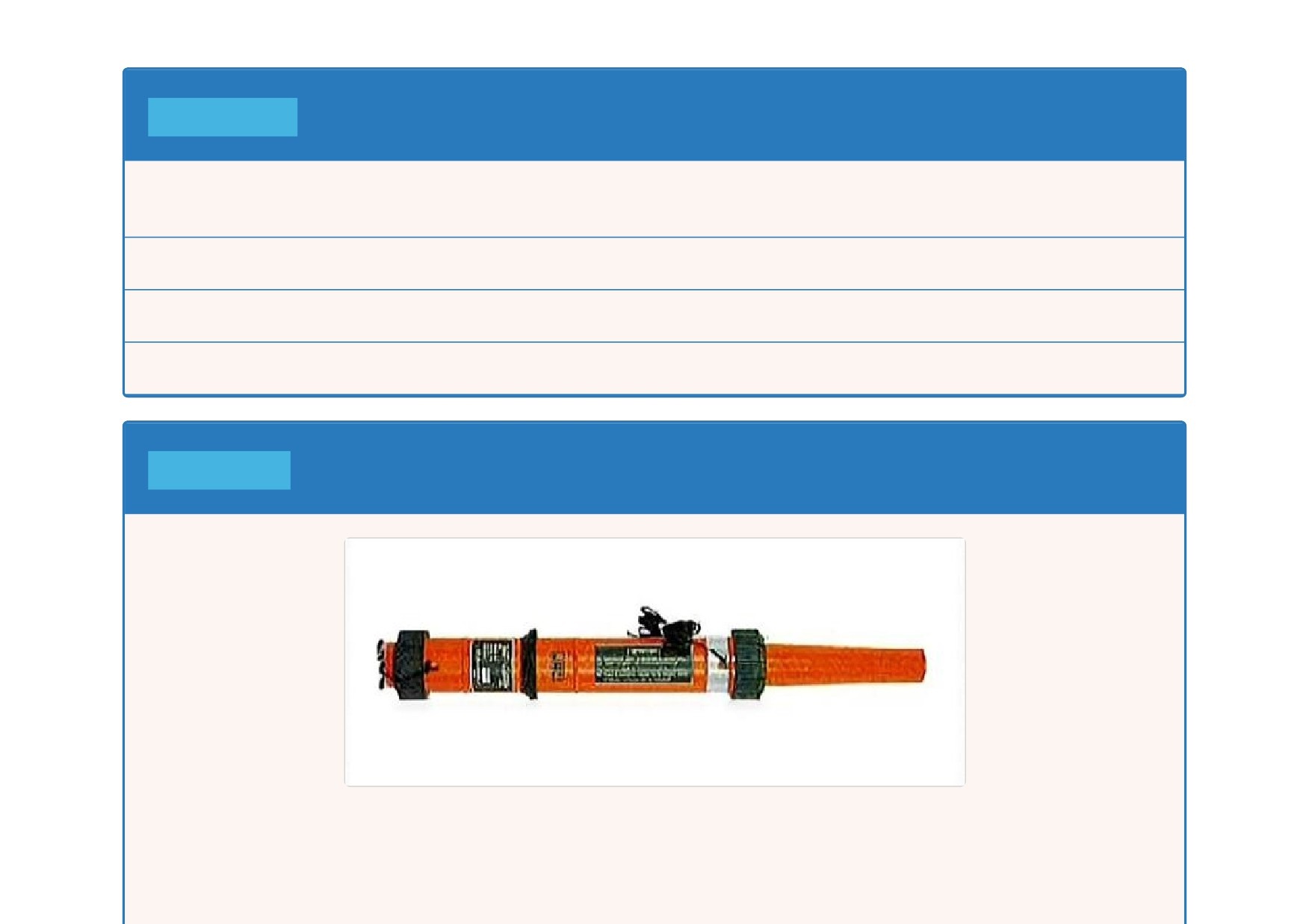
Code: AJWX During duplex mode you are able to:
Interrupt. (+)
Not to interrupt.
Talk to two stations simultaneously.
Interrupt after releasing the PTTswitch.
Code: AJSP The frequency 121,5 MHz is used for:
SARSATCOSPAS EPIRBS. (+)
INMARSAT E EPIRBS.
SART transpondeur.
DSS VHF calls.
Code: AJUH The battery of an EPIRB should be changed:
Every 4 years. (+)
Every 3 years.
Every 2 years.
Yearly.
Code: AKPG Emergency instructions in appropriate languages shall be
posted in passenger cabins. Which information shall as a minimum be
included in the emergency instructions?
The method of donning lifejackets, escape routes and alarm signals. (+)
Name of cabin attendant.
Escape routes and alarm signals.
Where to find thermal protective aids.
Code: ALDR Which one of the listed requirements regarding enclosures of
totally enclosed lifeboats do not correspond to present regulation? The
enclosures shall be provided with:
Windows on both sides which can be closed watertight and opened for ventilation. (+)
Access hatches which can be closed watertight.
Arrangement for rowing.
Access hatches capable of being opened and closed from both sides.
Code: AGDW On a RoRo vessel, when loading Double Stacked containers
on Maffi Trailers how many twist locks should have used between 2
containers?
One on every corner, 4 in total. (+)
One at each end, 2 in total.
One at each end, 2 in total.
Three in total, 2 at the door end, 1 at the opposite end.
Code: CLVE At what calendar interval is a “Special Survey” required?
Beach.
Bleach. (+)
Blanch.
Breach.
Code: AJIA Most fruit cargoes carried under refrigeration require introduction
of fresh air into the cargo space to remove any excess carbon dioxide and
ethylene produced by respiration of the cargo and sensors are fitted to
detect these gases. Shipper’s instructions will often indicate “constant air
change” as a requirement for a cargo. Why, even though this is a crude
method for controlling the cargo space atmosphere, is this type of instruction
given?
It is the standard method and it is always done that way for simplicity.
Fresh air helps to acclimatise the cargo to the prevailing ambient conditions.
Some cargoes are very sensitive to ethylene levels and it may be difficult to accurately measure the low levels that would
affect a cargo. (+)
As much fresh air as possible should always be introduced into the cargo space throughout the voyage to maintain cargo
quality.
Code: AGQB When you are taking an “ullage” on a cargo tank on an oil
tanker, what are you actually doing?
Measuring the distance from the surface of the cargo to the ullage reference point. (+)
Measuring the distance from the bottom of the tank to the ullage reference point.
Measuring the distance from the bottom of the tank to the surface of cargo.
Measuring the distance from the surface of the cargo to the underside of the maindeck.
Code: AJBF In which provision of the Act is the responsibility of the master
for the observation of the provisions relating to supervision of maritime
service stated?
In Section 6 of the Act. (+)
In Section 3 of the Act.
In Section 2 of the Act.
In Section 1 of the Act.
Code: AJOL Your vessel have been in collision with another vessel. You are
taking in water and you have to prepare for leaving the vessel. How will you
act?
Send a distress message and collect survival suits/thermal bags. (+)
Collect your own personal belongings.
Just jump over board and be ready.
Assist your friends to collect their personal belongings.
Code: AGUR What are the compressors fitted as part of the cargo system
onboard LNG carriers normally used for?
Removing boiloff gas. (+)
Inerting and gas freeing the cargo tanks.
Discharging the cargo.
Loading the cargo.
Code: AGRJ Having a CO2 alarm during normal working hours, what
immediate action should be taken?
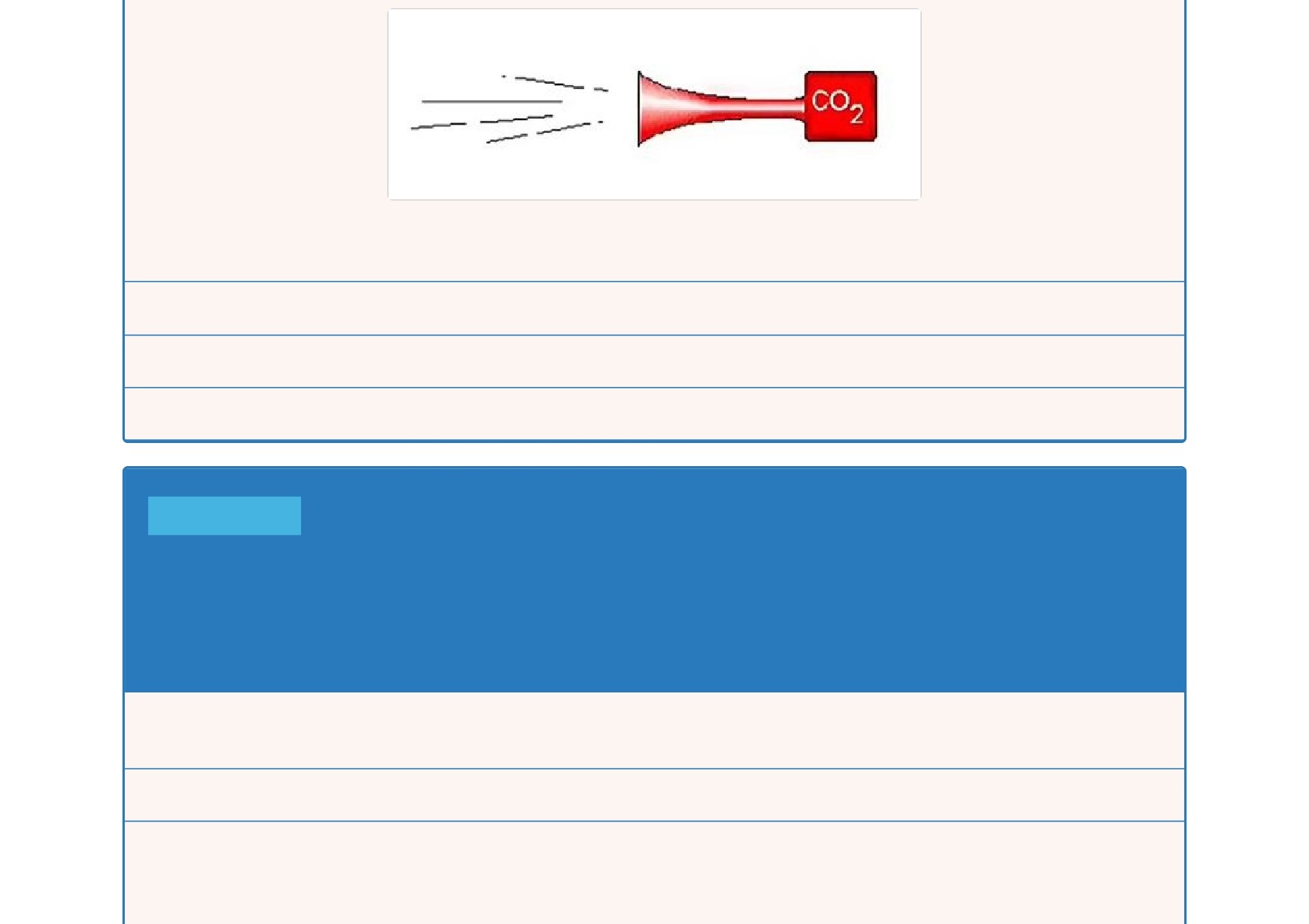
Ignore the alarm.
Get out of the engine room as soon as possible. (+)
Awaiting further order.
Get into the control room.
Code: AGQH Part of the outer surface of a refrigeration compressor
crankcase and the refrigerant return line near the compressor ice up heavily
during normal operation. Which of the options given is the most likely cause
of this problem?
The superheat control setting for the thermostatic expansion valve is set too low. (+)
The filter drier unit in the liquid line is partly blocked.
The seawater flow control valve for the condenser is faulty allowing insufficient cooling water flow.
The oil separator is not functioning correctly and is allowing lubricating oil to pass into the system.
Code: AGUR Which type of compressors is used as cargo compressors
onboard gas carriers?
Oil free piston compressors.
Three stage piston compressors.
Piston, screw and centrifugal type compressors. (+)
Three stage screw compressors.
Code: AGRL How will you calculate transverse accelerations?
Multiply the values taken from tables 2, 3 and 4 of the Cargo Stowage and Security (CSS) Code. (+)
Multiply the values taken from tables 3 and 4 of the Cargo Stowage and Security (CSS) Code.
From formulae given in the Cargo Securing Manual (CSM).
Rule of thumb and past experience.
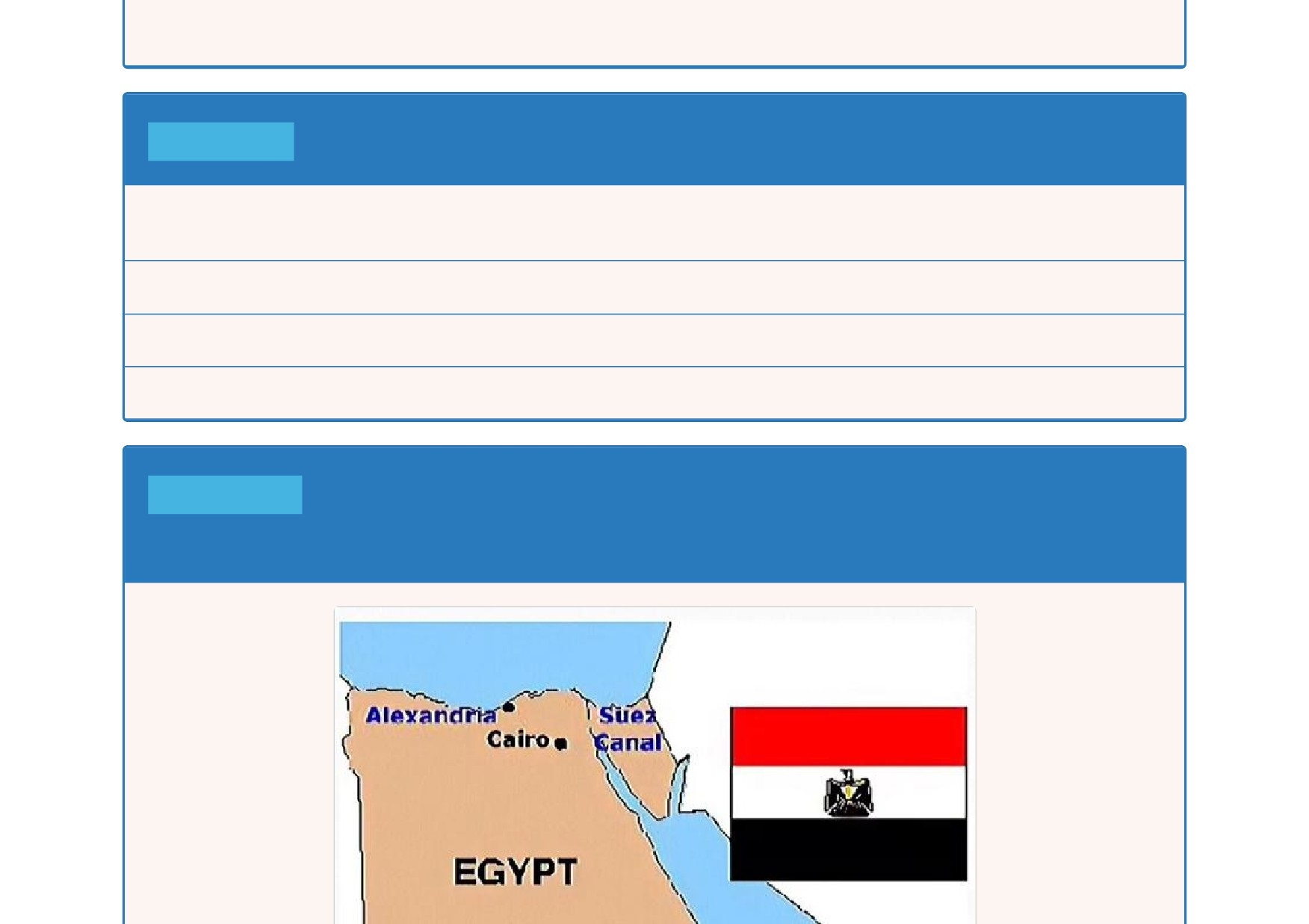
Code: AJMX What is the main vitamin found in flour and grain products?
Vitamin A.
Vitamin B. (+)
Vitamin C.
Vitamin D.
Code: AHWA Is it necessary to construct a passage plan (or voyage plan),
for transiting a canal or river, when under pilot?
A passage plan is always required, irrespective of the length of the voyage, or if the ship is under pilot. (+)
A passage plan is required only when there is no pilot on board.
A passage plan is required from departure from port to arrival at the pilot station at the destination.
A passage plan is required for all deep sea passages, but not for transiting a canal under pilotage.
Code: AHIF How many lifebuoys can you expect to find on board a cargo
ship of 190 metres in length (including those of the quickrelease system)?
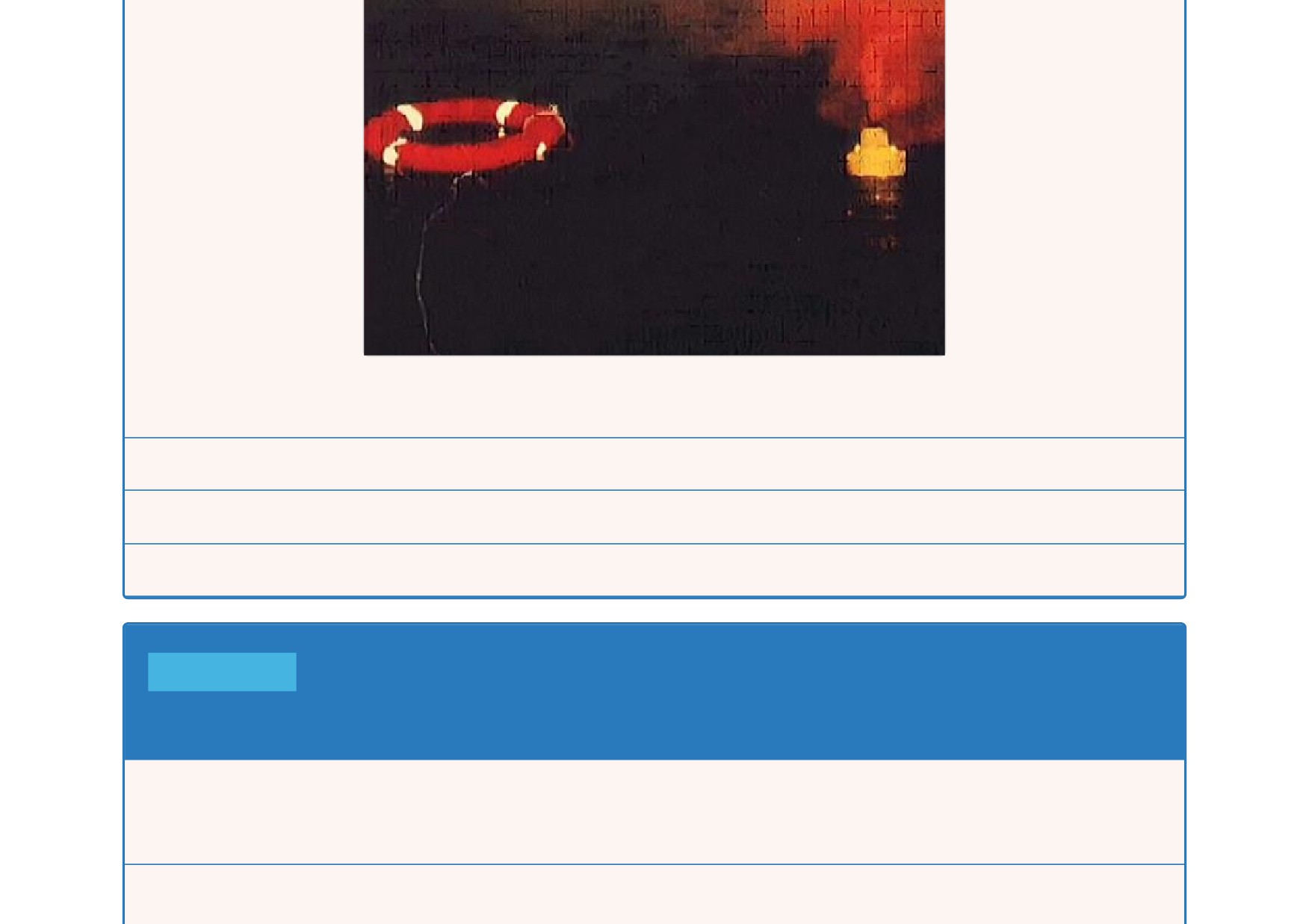
At least 8 distributed on both sides of the ship.
At least 10 distributed on both sides of the ship.
At least 12 distributed on both sides of the ship. (+)
At least 14 distributed on both sides of the ship.
Code: AHTR Does the Health & Safety Executive (HSE) have authority in
dealing with shipping matters?
The HSE has authority only where an interface exists between the ship and shore e. g. means of access regs. In a serious
case, they would contact the local Marine Officer. (+)
They can insist that alcohol/drug tests be carried out after an incident involving a ship or shipping.
They have exactly the same powers as that of a Marine Officer.
They have no legal responsibility over ships or shipping.
Code: AHIC The following DSC was received (at what time received?)
27.05.1997 23:23 CALLED VHF CH70 FORMAT: DISTRESS DISTID:
367449000 N OF: UNDESG DISTRESS POSITION: N 52,43 E04.maj DIST
UTC: 00:00 TELECOM: G3E SIMP TEL EOS: EOS.
23:23. (+)
00:00.
04:05.
Don’t know.
Code: AHJU What should you do if the temperature of Hydrogen Peroxide
Solution 65 % carried is raising 2 °C per 5 hours and the temperature is
above 40 °C?
No special action to be taken.
To avoid uncontrolled decomposition the cargo should be discharged overboard. (+)
The cargo should be heated up to 45 °C.
The cargo should be monitored closely for the next 12 hours.
Code: AHWA Searchlights must be provided for night navigation in the Suez
Canal. Which of the listed requirements are correct?
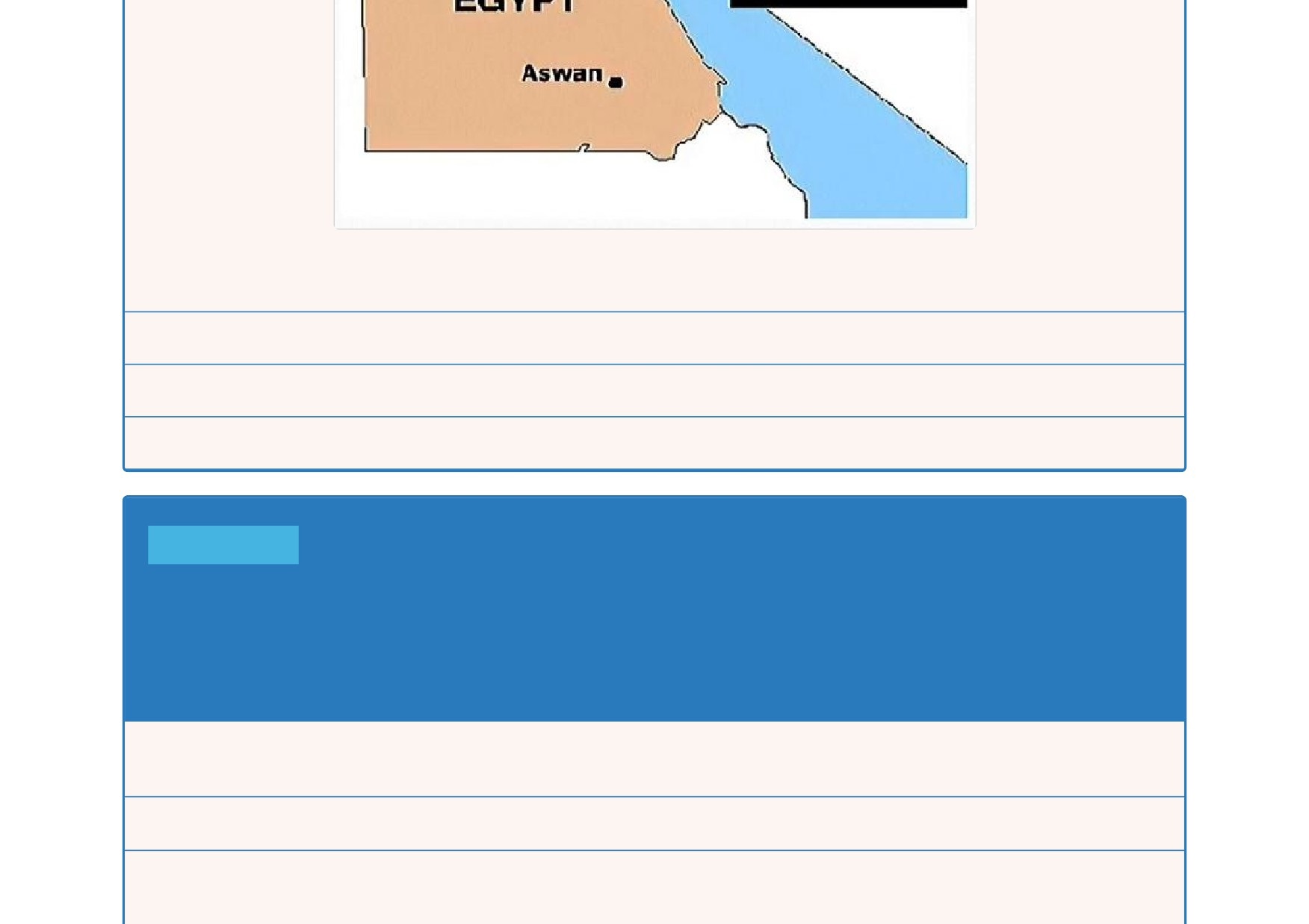
Vessels with bulbous bow, LPG and LNG vessels must provide their own projector.(+)
All vessels must provide their own projector.
Only projectors hired from the Canal Mooring and Light Company are permitted.
If vessels have their own projector, an extra fee will be levied on the vessel.
Code: AHUN The Master is responsible that all crew participate in monthly
emergency drills. If 25 % of the crew (or more) has not participated in such
drill during the last month, what is the time limit to conduct such a drill after
the vessel has left a port?
Within 12 hrs.
Within 24 hrs. (+)
Withing 30 hrs.
Within 48 hrs.
Code: AHKW If your vessel was to load sugar which of these situations
would result in the cargo holds failing inspection?
Traces of insect infestation in the bilges. (+)
Hardened rust spots on shell plating.
Hardened rust spots on the lower bulkhead stool and hopper tank plating.
Ruststained tank top plating.
Code: AHIJ A bulk carrier is loading to complete on summer draught of
10,00 m when in salt water; the vessel is loading in river water; The dock
water allowance is 80 mm; The maximum draught when loading is
completed is:
10,80 metres.
11,24 metres.
9,92 metres.
10,08 metres. (+)
Code: AHVI Which of this information must be included in a piracy attack
alert?
Your ship’s name and call sign. (+)
The number of crew onboard.
The number of pirates/highjackers.
The type of weapons being carried by the pirates/highjackers.
Navigation (NA)
Operational Level
Количество отображаемых вопросов: 160.
Правильные ответы отмечены знаком (+)
Code: CWGL What do the shapes that this vessel is displaying tell us about
her?
That she is not under command. (+)
That she is constrained by her draught.
That she is engaged in towing.
That she is restricted in her ability to manoeuvre.
That she is restricted in her ability to manoeuvre.
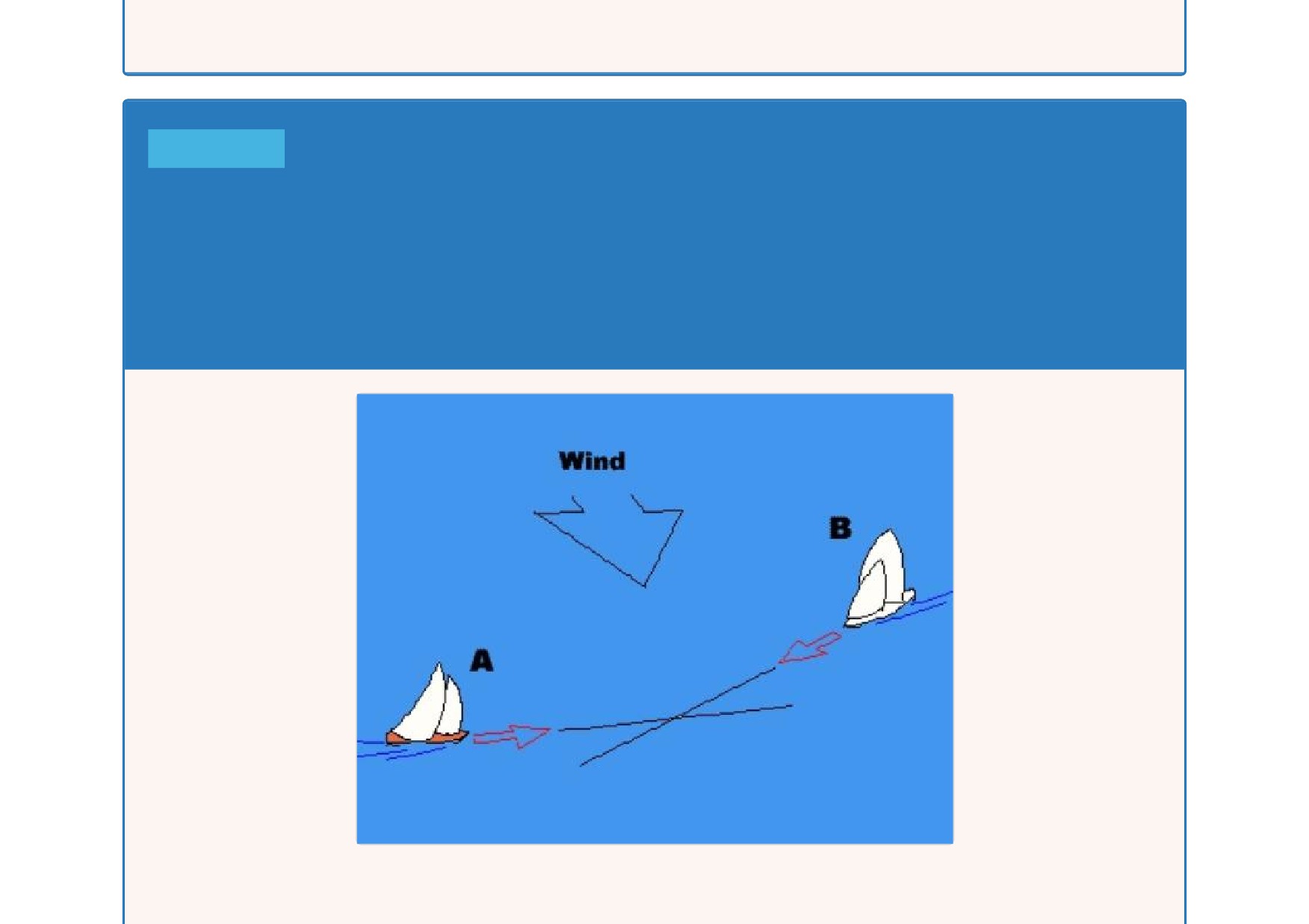
Code: GLIP Rule 12 of the International Collision Regulations prescribes the
action to be taken by a sailing vessel when meeting another sailing vessel.
This depends on the direction of the wind relative to each vessel. In the
situation shown here, which sailing vessel (A or B) must keep out of the way
of the other?
Sailing vessel A must keep out of the way of sailing vessel B. (+)
Sailing vessel B must keep out of the way of sailing vessel A.
Both sailing vessels are required to take avoiding action.
The upwind sailing vessel must keep out of the way of the downwind sailing vessel.
Code: BFXK What are the required data inputs into most gyro compasses to
reduce any possible compass error?
Latitude and Speed. (+)
Deviation and Variation.
Maximum helm angle and rolling period.
All of the data in the suggested answers.
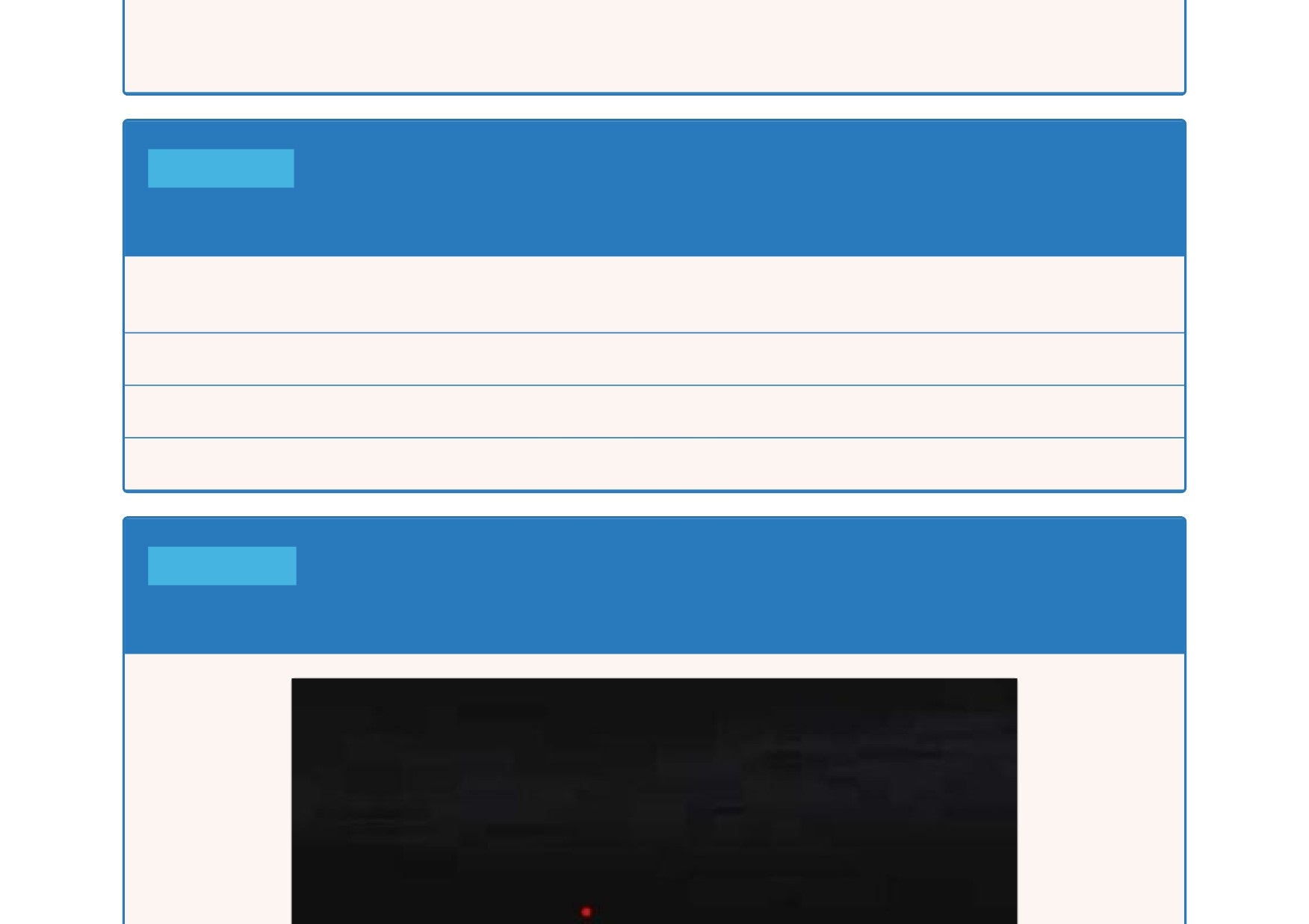
Code: HNXE You are on a powerdriven vessel underway in open water. You
sight these lights on the port bow, on a steady bearing. The distance is
closing. What are you looking at and what action will you take in compliance
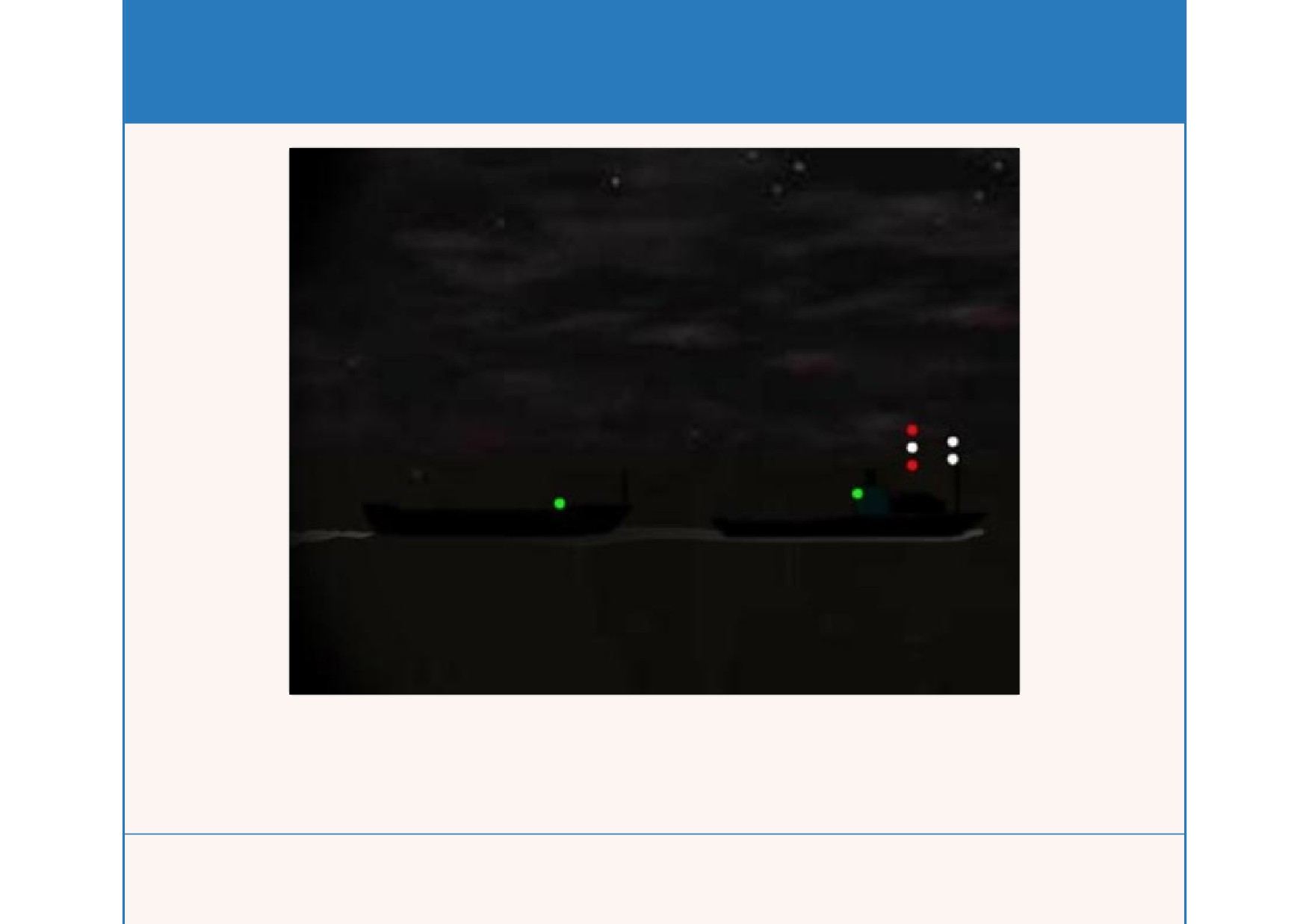
with the International Regulations for Preventing Collision at Sea.
This is a powerdriven vessel engaged in towing, less than 50 metres in length, length of tow under 200 metres and the
tow, both being restricted in their ability to manoeuvre, seen from the starboard side. Under rule 18, I am required to keep
clear and will take appropriate avoiding action. (+)
This is a powerdriven vessel, more than 50 metres in length or less than 50 metres in length and showing a second
masthead light, restricted in her ability to manoeuvre. The sidelight of a second vessel can be seen beyond her. Under rule
18, I am obliged to keep clear of the first vessel and will therefore take appropriate avoiding action.
This is a powerdriven vessel engaged in towing, more than 50 metres in length or less than 50 metres in length and
showing a second masthead light, length of tow 200 metres or more, not under command. I will keep clear under rule 27.
I don’t know.
Code: WGNA A man is reported to have fallen overboard and the Officer of
the Watch releases the lifebuoy and starts a man overboard manoeuvre,
who are the first persons onboard he should inform?
Master and Engine Room. (+)
Chief Officer and lifeboat party.
The Master only.
The crew quarters for extra lookouts.
Code: EAYE What are the main components causing the magnetic compass
to require a regular evaluation and compass correction?
Permanent and induced magnetism in the ships structure. (+)
The change in the position of the magnetic pole causing annual changes in the variation.
The continual changes of courses steered by the ship.
Deviation and Variation.
Code: FRYG The Master arrives on the bridge obviously under the influence
of alcohol and states he is taking over the “con” of the ship. What actions
should the Officer of the Watch (OOW) take in this situation?
Attempt to diplomatically avoid taking any actions that would put the ship or crew into danger and call the Chief Officer for
assistance. (+)
Watch the actions made by the Master and if not dangerous, wait until the Master becomes more capable to take control
or leaves the bridge.
Tell the Master you consider him incapable of taking over the responsibility of the watch and that he should retire to his
cabin and sleep it off.
Tell the Master you do not think this is a good idea and retain control of the watch.
Code: VYBS The ship is involved in a collision, what is the immediate action
by the Officer of the Watch after the incident has taken place?
Sound the General Alarm and stop engines. (+)
Call the Master and check the position for any immediate dangers.
Contact the other ship and send the bridge lookout down to start taking soundings.
Stop engines and check over the side for any signs of pollution.
Code: DRMV You are proceeding along a narrow channel and approaching a
bend, on the inside shore of which is a large hill, which obsures your view
further up channel. What sound signal will you make to indicate your
presence to any vessel that is behind the obstructing hill?
One prolonged blast. (+)
Two short blasts.
Two prolonged blasts.
One short blast.
Code: GBPL What is the correct understanding of the term “bank effect”? If a
ship was approaching the bank at an angle, what would be the effect on the
ship?
The vessel’s bow is pushed away from the bank. (+)
The vessel’s bow is attracted by the bank.
The whole vessel would continue straight towards the bank and would require a large helm order to avoid going aground.
The vessel’s stern is pushed away from the bank.
Code: GKRE How can an ARPA assist the ship to steer a suitable course to
make good the entrance to a channel?
Select ground stabilised true motion display and alter course so that own ships true vector passes through the middle of
the entrance to the channel. (+)
Select Relative motion display and make Own Ship vector pass through the middle of the entrance to the channel.
Select True ground stabilised vectors and make the vectors from both buoys at the entrance to the channel pass either
side of the centre of the screen.
Acquire the buoy at the entrance to the channel and on relative vector display alter course to make the vector of the buoy
pass directly through the centre of the screen.
Code: AFQY What is the weather associated with being in the centre of an
Anticyclone (a region of High Pressure)?
Light winds and fair weather, sometimes fog. (+)
Strong winds but with very little rain.
Persistent rain and very humid weather.
Strong winds and heavy rain.
Code: AXYU What is “AIR DRAUGHT”, in the figure?
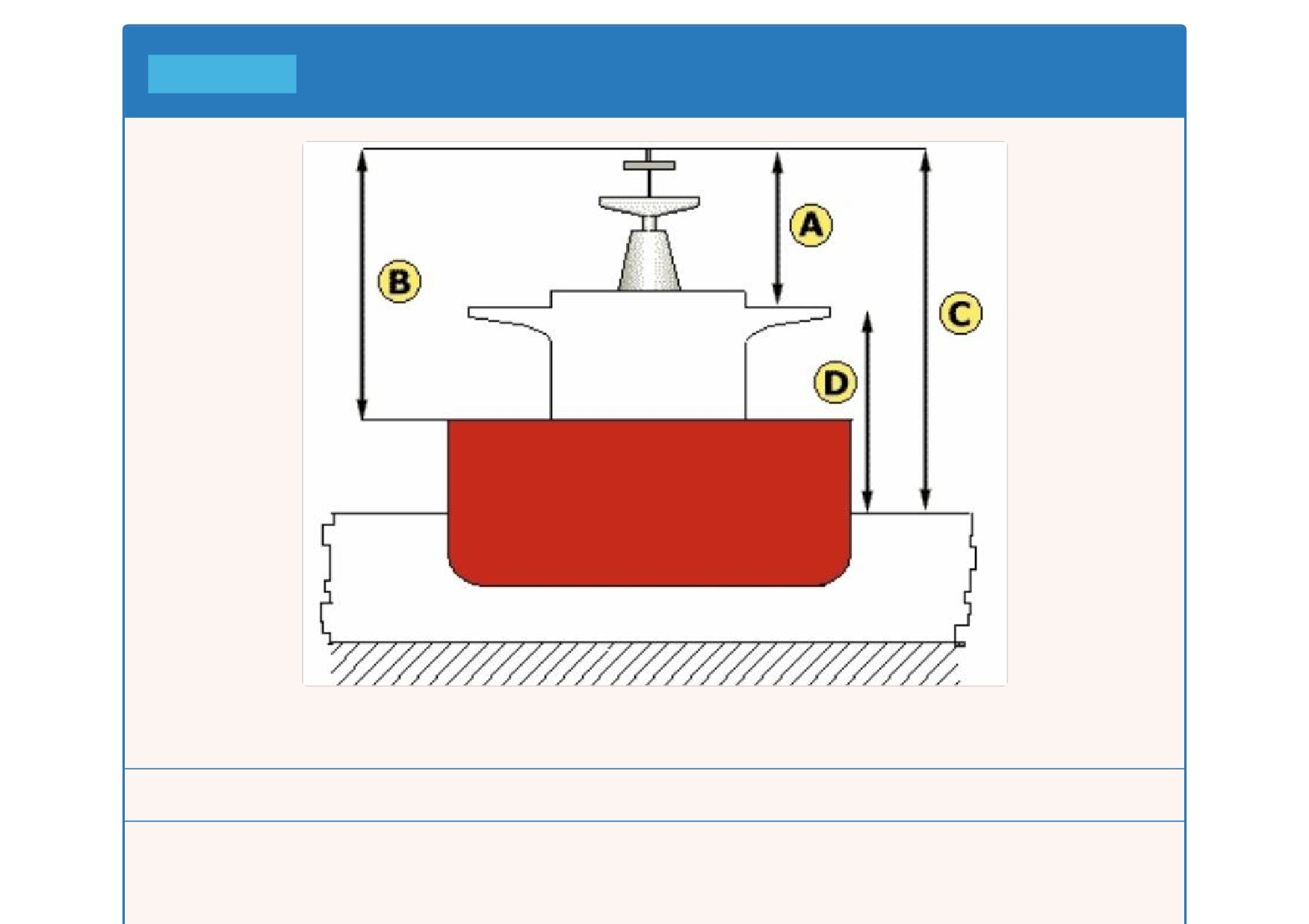
Code: AXYU What is “AIR DRAUGHT”, in the figure?
Air draught is indicated by C, in the figure. (+)
Air draught is indicated by A, in the figure.
Air draught is indicated by D, in the figure.
Air draught is indicated by B, in the figure.
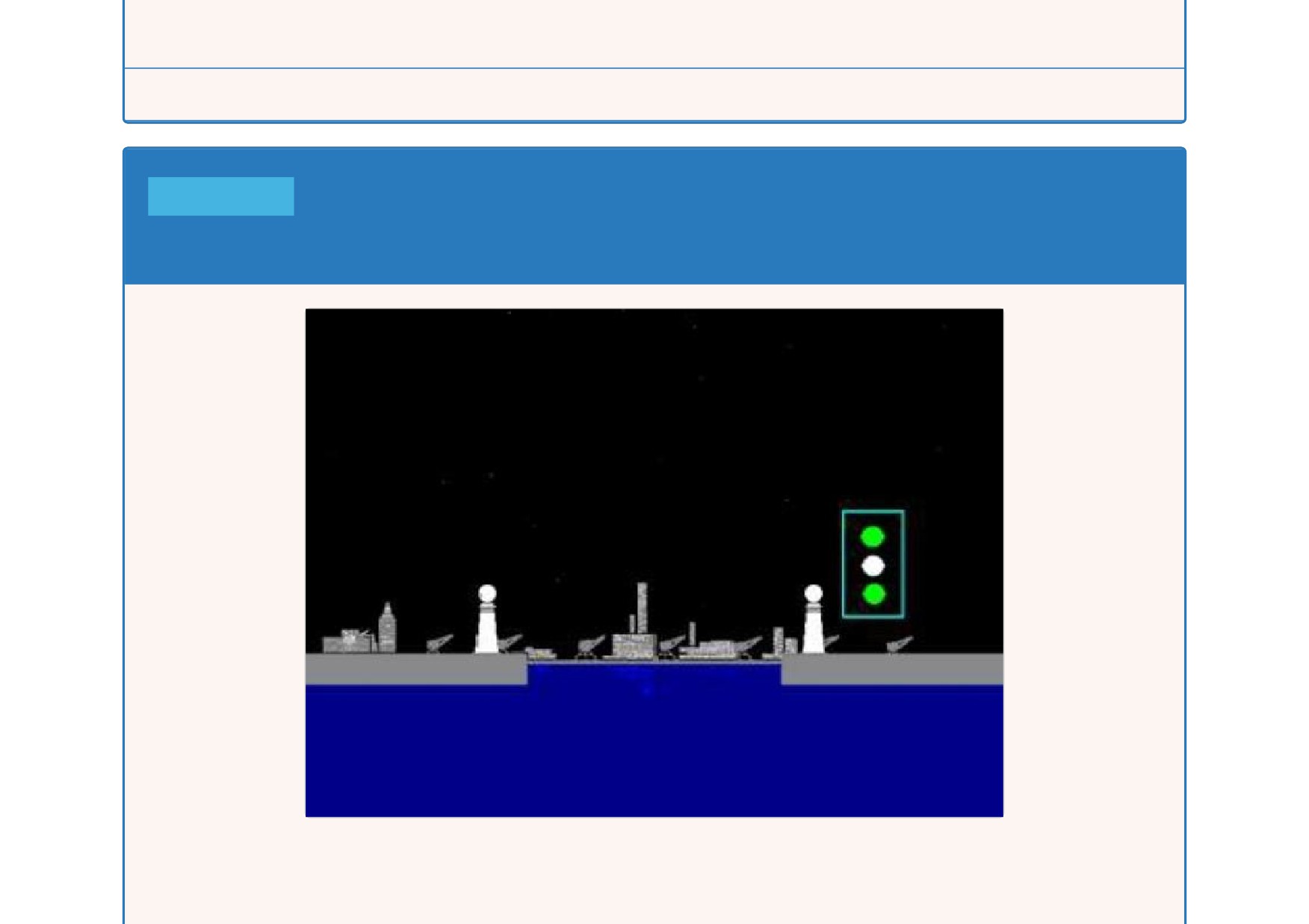
Code: TEXN You are approaching the port entrance. What do these lights
mean?
A vessel may proceed only when she has received specific orders to do so. (+)
A vessel may proceed only when she has received specific orders to do so. (+)
Vessels may proceed - oneway traffic.
A vessel may proceed only when she has received specific orders to do so, except that vessels which can safely navigate
outside the main channel need not comply with this message.
Vessels may proceed - twoway traffic.
Code: CLUY Is the location of the Compass Binnacle critical?
Yes, for the reasons stated in all of the suggested answers. (+)
Yes, it should be on the fore and aft centreline of the ship.
Yes, it should be away from all electrical power cables.
Yes, it should be sited on a nonmetallic base if possible.
Code: ENCD The ship is navigating in dense fog where the visibility is less
than one mile. The Arpa radar is set on a range 12 miles on a course of
314° and own ship has a vector as shown. What is the vector mode selected
on the Arpa?
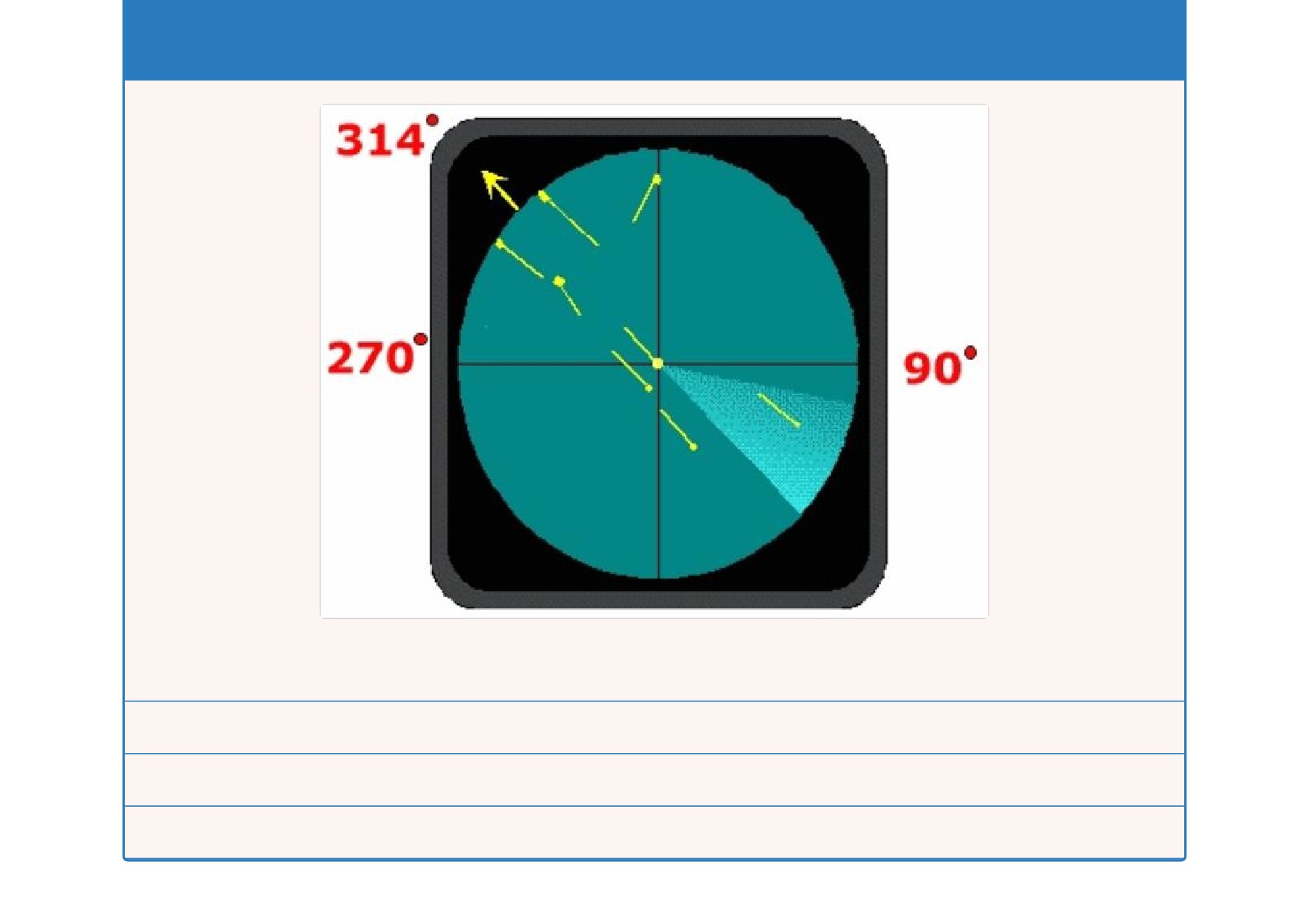
True vectors. (+)
Relative vectors.
Relative vectors, sea stabilised.
Relative vectors, ground stabilised.
Code: YTSF What is the advantages of a GPS satellite system compared to
other navigational aids?
The GPS system gives information about position, speed and time continuously world wide. (+)
The GPS system is based on hyperbola navigation.
The GPS system has a builtin group of six radiobeacons called a Decca chain.
The GPS system gives information about weather and wave conditions in the area.
Code: LIQG The ship is sailing in shallow water with reduced Under Keel
Clearance. If the ship is steaming with the engines at full RPM, what would
be the speed in comparison to the speed achieved in deep water?
Slower than deep water. (+)
The same as deep water.
Faster than deep water.
It would be very difficult to maintain full deep sea RPM on the engines and therefore difficult to assess the speed.
Code: ABFC You are in an area of restricted visibility and hear this signal. It is
repeated at 2 minutes intervals. What does it indicate?
That there is another vessel nearby, that she is underway, but stopped and making no way through the water.(+)
That there are two more vessels nearby.
That there is another vessel nearby, but that she is at anchor.
That there is another vessel in the vicinity and that she has just altered course to port.
Code: TYNC This vessel is sighted ahead and slightly to port. What is her
situation? What will you do?
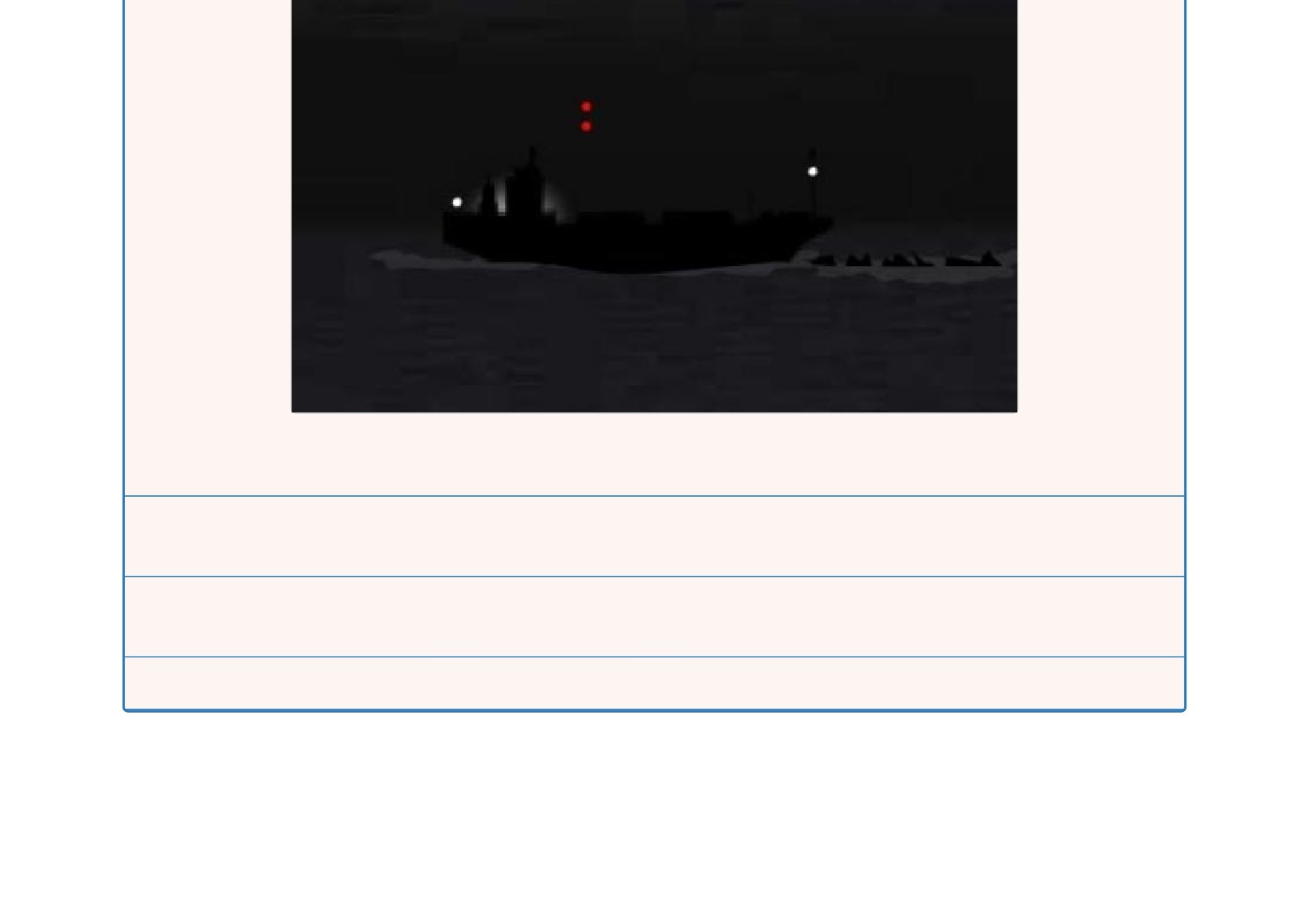
This vessel is aground. I will navigate with extreme caution given the nature of the hazard. (+)
This is a vessel engaged in fishing vessel, with her nets fast on a obstruction. I will keep out of the way by rule 18 of the
International Collision Regulations.
This is a vessel aground. She appears to have been headed to starboard of my track and I will therefore alter course to
port, passing under her stern.
This is a vessel not under command at anchor.
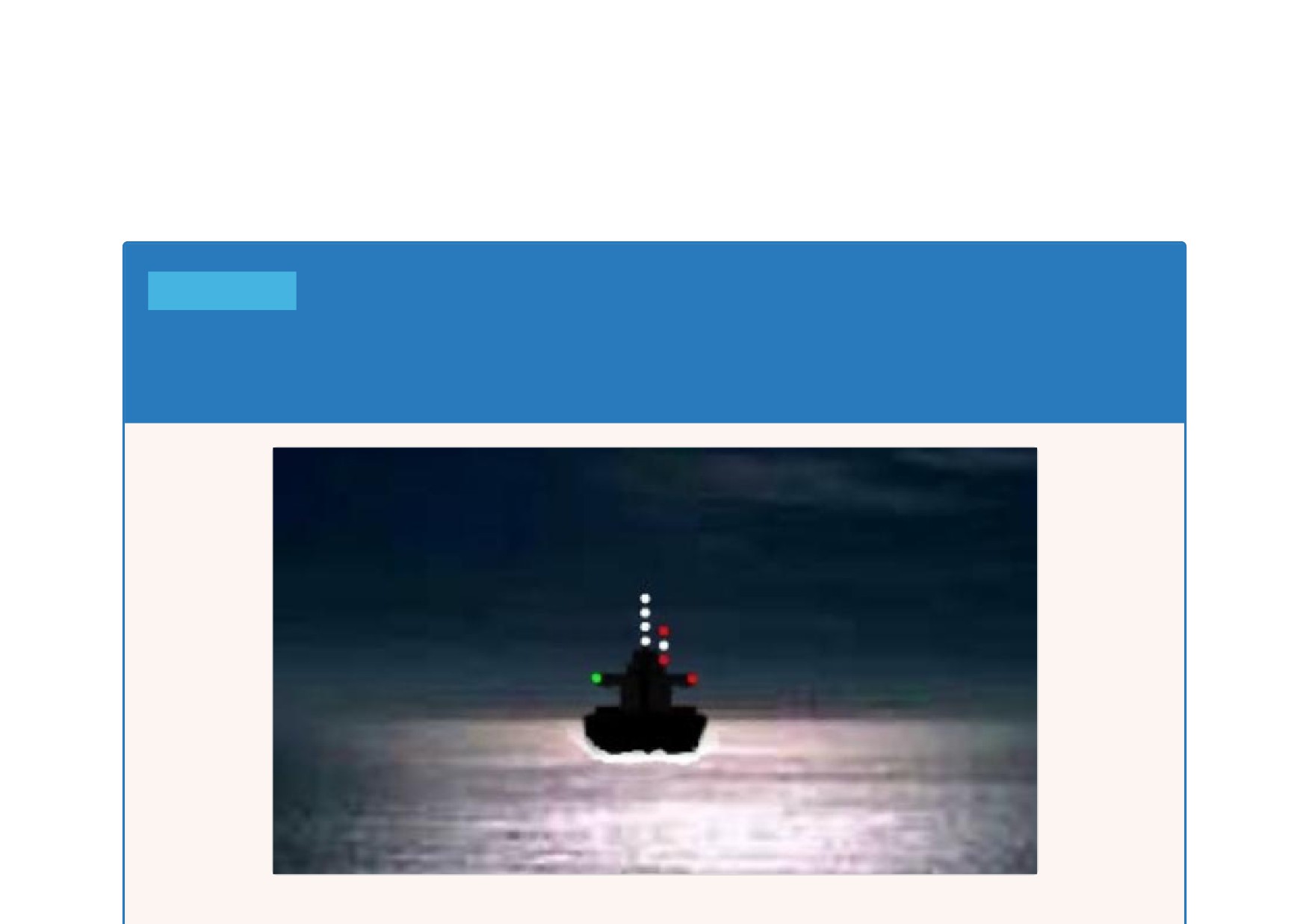
Code: GQJB The lights here show those that must be exhibited by a vessel
engaged in towing, as per rule 24 of the International Collision Regulations.
But how long is the tow behind this vessel?
It exceeds 200 metres. (+)
At least 100 metres.
It is more than 50 metres but less than 200 metres.
It is less than 200 metres.
Code: VQRP A ship is equipped with a righthanded fixed pitch propeller,
which when going from Full Ahead to Full Astern will make the ship sheer to
starboard. Can anything be done to reduce this change in heading?
The rudder can be put to Hard to Port to reduce the water from to the right side of the propeller. (+)
The rudder can be put from side to side in a “Rudder Cycling” movement.
The rudder should be kept amidships when going astern and there is little that can be done to reduce the swing to
starboard.
The rudder should be put Hard to Port to reduce the water flow to the left side of the propeller.
Code: AWCE What does this signal hoist mean?
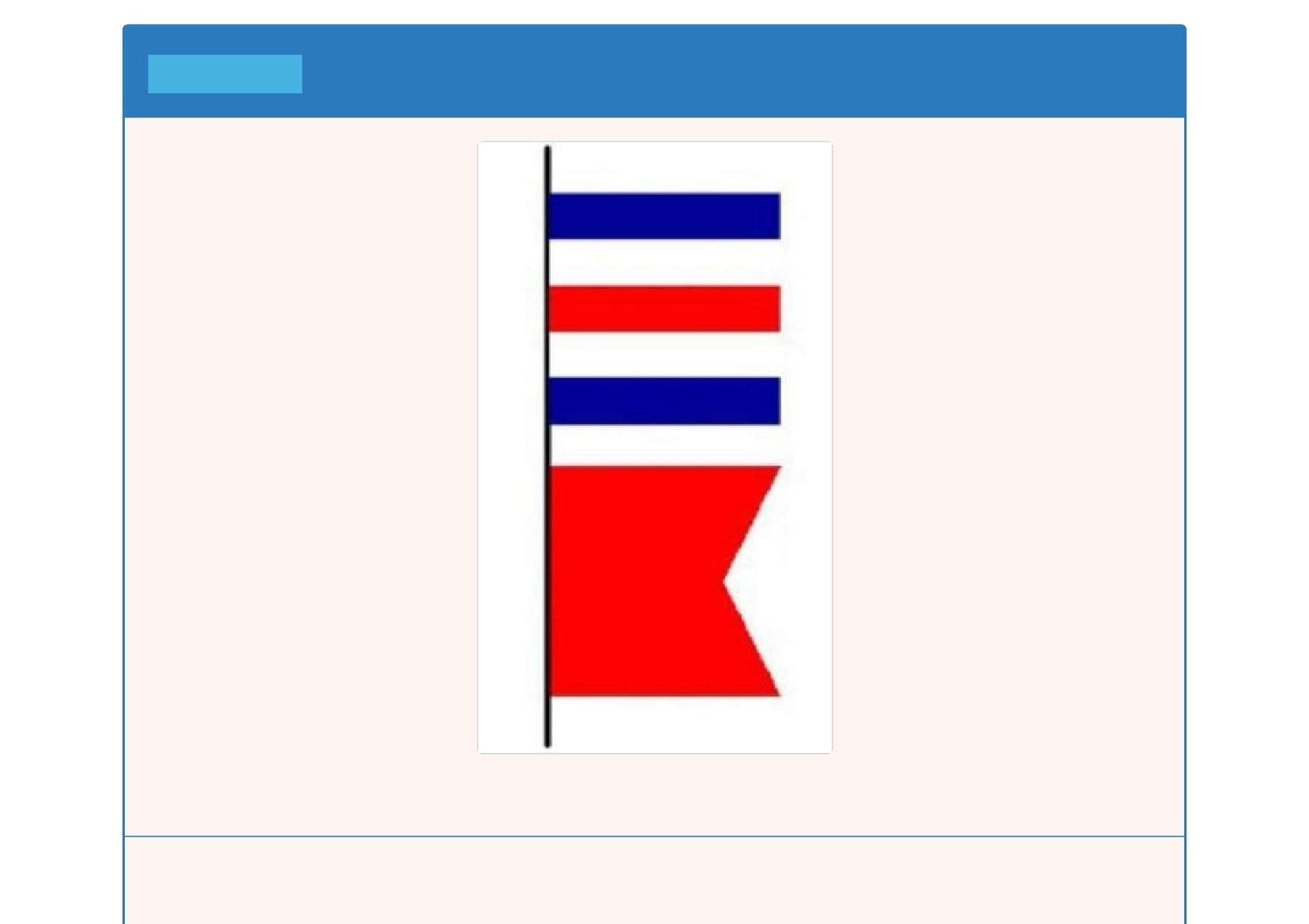
Code: AWCE What does this signal hoist mean?
I require immediate assistance. (+)
Do you require assistance?
Stand by to assist me.
I require medical assistance.
Code: NVTS When plotting a position, where should the Officer of the Watch
select as the ships position, when three gyro compass bearings intercept as
a triangle (Cocked Hat) and not as a single point?
At the point nearest to the danger, if any. (+)
At the point nearest the course line drawn on the chart.
At the point furthest away from any danger.
At the centre of the triangle.
Code: SBVS Two ships travelling in opposite directions are to pass each other
in a narrow river, as illustrated. Explain what is likely to happen as they pass
each other?
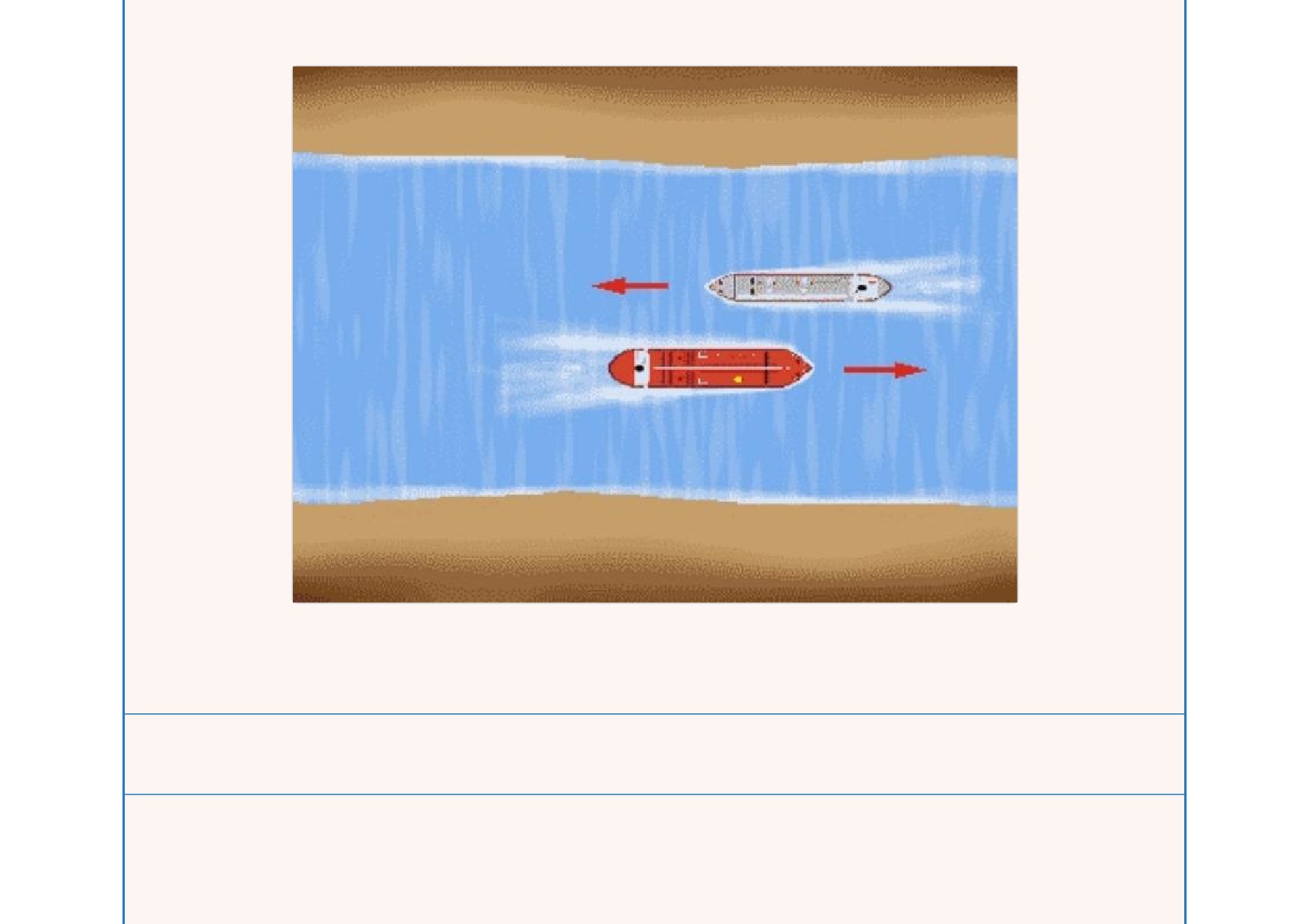
Due to interaction, the bows will repel each other, and then when alongside each other the two ships will be sucked
together and finally the sterns will be repelled as they start to pass clear. (+)
Due to interaction, the bows will attract each other as they approach, then they will repel each other alongside and as they
pass clear, the sterns will be attracted.
As they approach, rudder should be applied quickly to avoid sheering into the path of each other. Then as they are
alongside they will be attracted and finally repel each other as they pass clear.
There will be very little effect between the two ships as they pass.
Code: SBGQ What are the limits of a passage or voyage plan?
From berth to berth. (+)
From Full Away On Passage (FAOP) to End Of Passage (EOP).
It is dependant on the voyage and if there are any river or canal transits.
From pilot to pilot.
Code: WQHI You are in an area of restricted visibility, close to a port. You hear
this signal. What vessel does it come from and what additional information
does the signal provide?
A vessel at anchor, more than 100 metres in length. She is sounding the additional signal to give warning of her position.
(+)
A vessel at anchor, less than 100 metres in length. She is sounding the additional signal top give warning of her position.
A vessel at anchor, more than 100 metres in length. The additional signal indicates that her cable extends at least 25
metres from her bow.
A vessel aground, more than 100 metres in length. The additional signal indicates which side the clear water lies on.
Code: SPYJ Who is ultimately responsible for the voyage plan?
The Master. (+)
The Officer of the Watch (OOW) on duty.
The Second Officer as the official Navigation officer.
The ship owner will provide overall parameters within which the ship must follow.
Code: QPIQ Which approved publication should be used by a seafarer to help
overcome any misunderstanding in communications?
The (IMO) Standard Marine Communication Phrases (SMCP) booklet. (+)
The Oxford Concise Dictionary.
The (ISC) Bridge Procedures Guide.
Standard Marine Navigational Vocabulary.
Code: FDJI What is the two letter signal, to be used by flags, radiotelephony
or radiotelegraphy, meaning “Calling All Ships”?
CQ. (+)
AS.
TT.
CA.
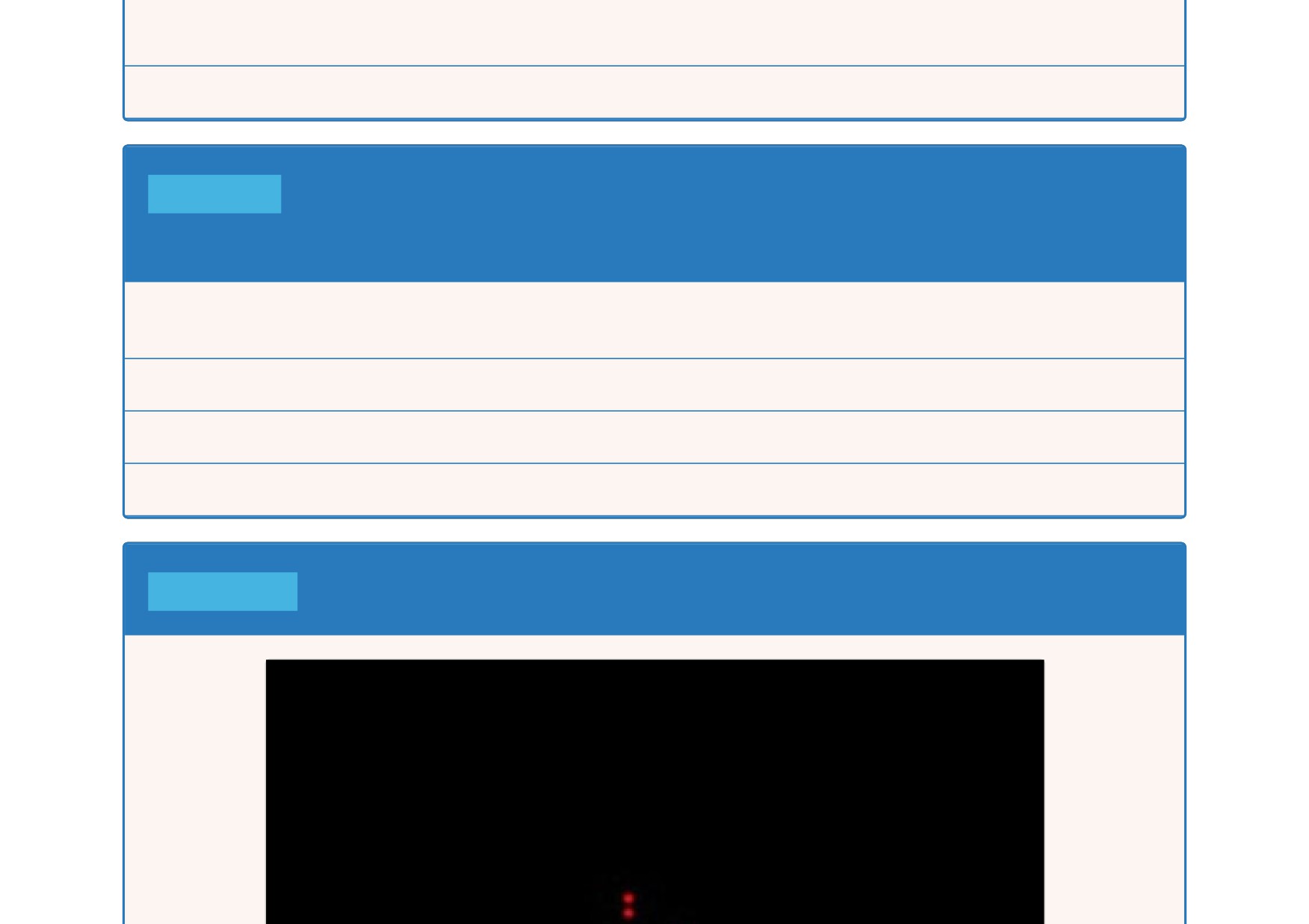
Code: KQAX What is the situation of this vessel?
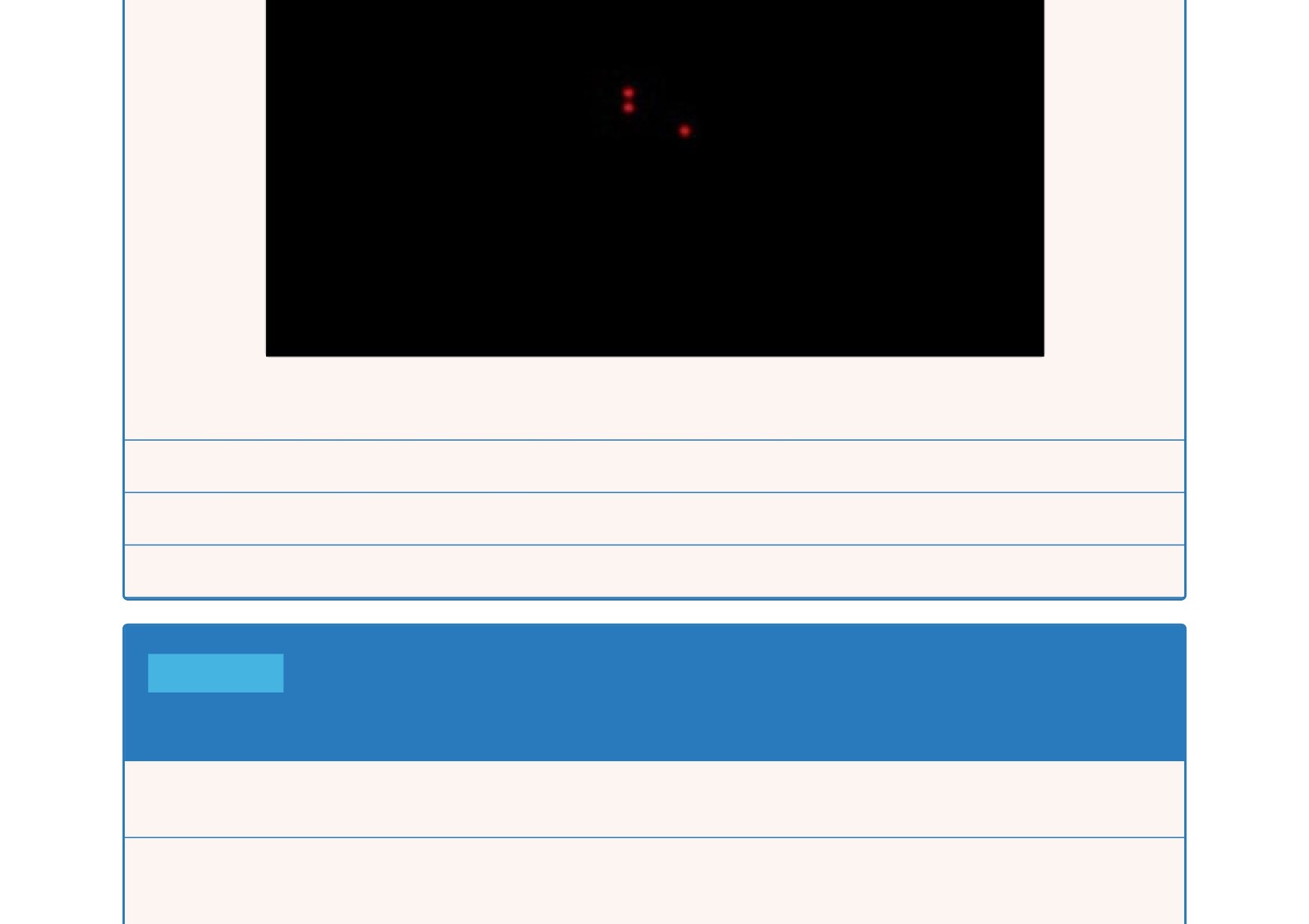
This vessel is not under command, but is making way through the water. (+)
This vessel is not under command and stopped in the water.
This is a vessel constrained by her draft.
This vessel is aground.
Code: TEIE When navigating along a coastline what should be considered the
most accurate method of navigating?
Use of Differential GPS. (+)
Passing close to navigational buoys.
Bearings of navigational shore marks such as lighthouses.
Use of radar ranges and bearings.
Code: NKVO How can a new officer, just boarding a ship, ensure that he
knows the location and operation of all navigational and safety equipment
and take account of the operating limitations of such equipment?
By asking other officers and practicing with the use of the equipment. (+)
The certificate of competency will ensure the officer has suitable competence in operating the bridge equipment.
By following the standard company Induction procedures for a bridge watchkeeping officer.
By using the equipment on regular watchkeeping duties.
Code: AXYU What is “AIR DRAUGHT”, in the figure?
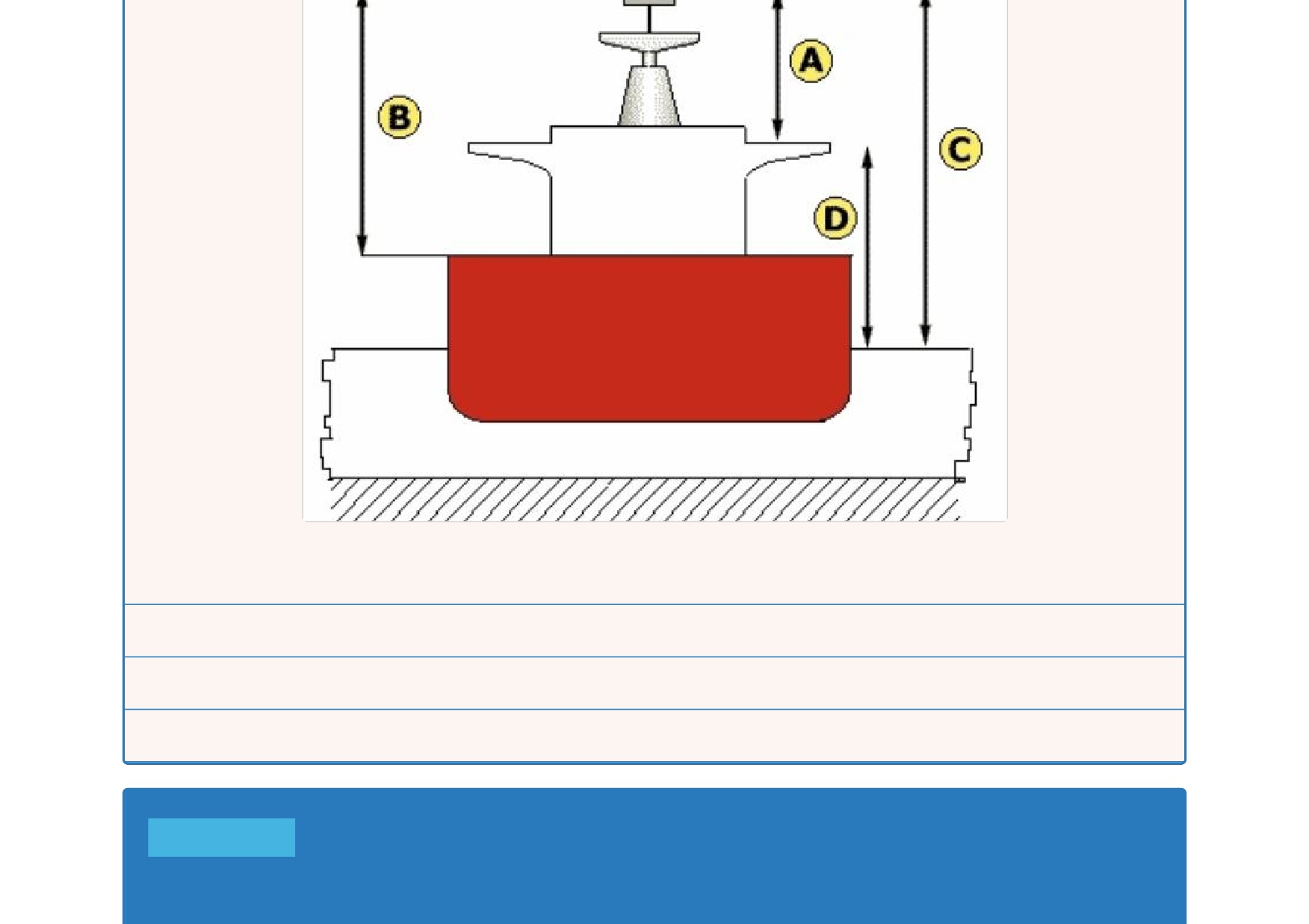
Air draught is indicated by C, in the figure. (+)
Air draught is indicated by A, in the figure.
Air draught is indicated by D, in the figure.
Air draught is indicated by B, in the figure.
Code: RTTQ What action should the Officer of the Watch (OOW) take if he is
forced to make a major deviation from the voyage plan?
Inform the Master. (+)
Make an appropriate entry in the Log Book.
There is no special action necessary.
Check that the deviation will not lead into danger.
Code: KDOB The ship’s engine is going astern and the ship is piking up
sternway. The rudder is amidships and the ship has a single, righthanded,
fixed pitch propeller. What would be expected to happen?
The ship will probably start to change heading to starboard and stern speed will increase. (+)
The ship will move astern at an increasing speed and the stern start to swing off to starboard.
The ship will probably go straight astern without a change in heading and the stern speed will increase.
The ship will probably start to change heading to port and stern speed will increase.
The ship has a single fixed pitch righthanded propeller and is
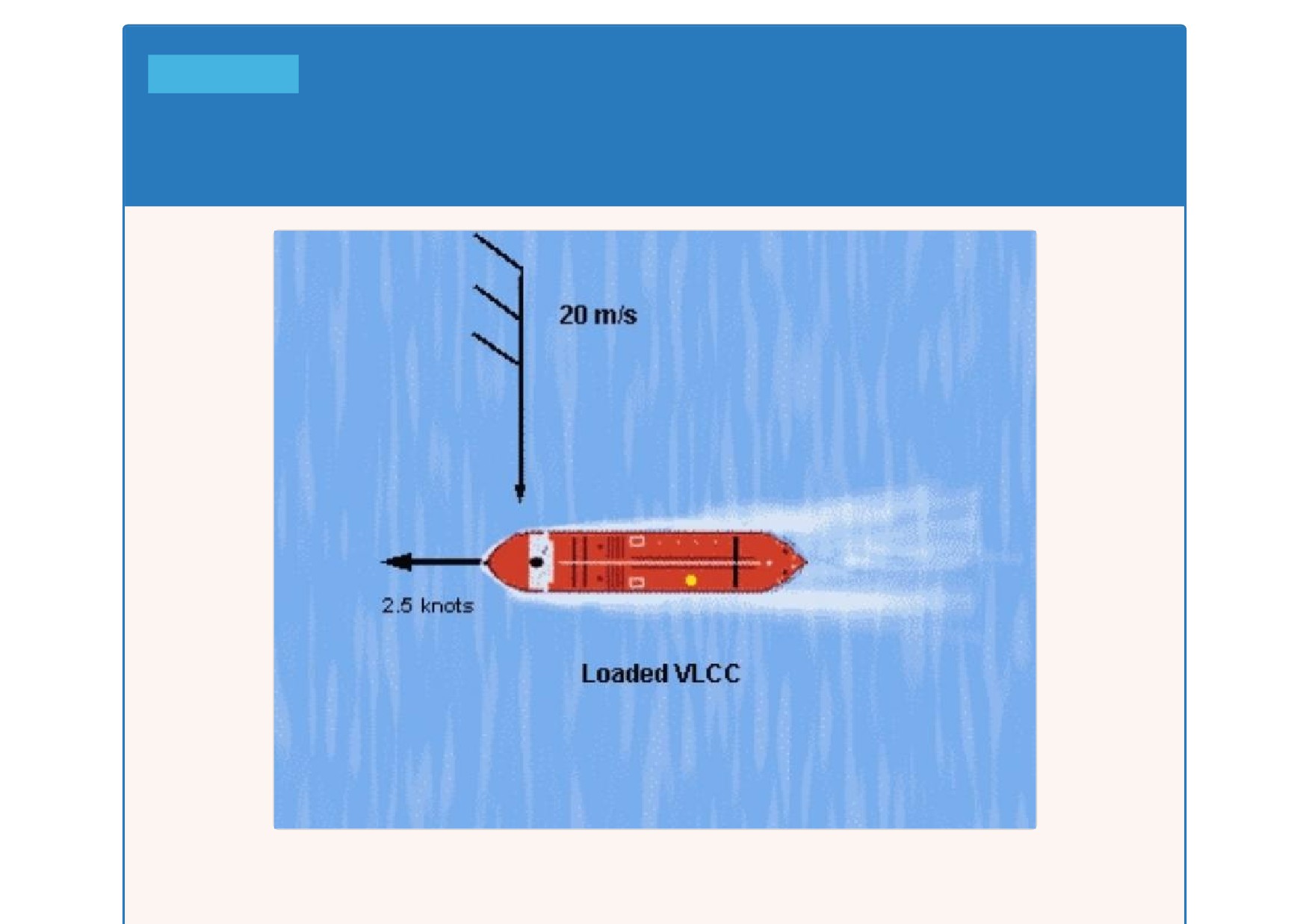
Code: MVVV The ship has a single fixed pitch righthanded propeller and is
going astern as illustrated. What is the most likely way the ship will react in
these circumstances?
The stern will “back” into the wind and the ship’s heading will swing to starboard. (+)
The bow will “seek” the wind and the ship will swing to port.
The ship will go straight astern and the heading will remain approximately the same.
The stern will fall off to starboard, making the heading swing to port.
Code: JSNV The bridge Officer of the Watch (OOW) is plotting the ship’s
position in the chartroom, when the ship is in collision with a fishing vessel.
Why would the OOW be held responsible for the collision?
Under the Rules a proper lookout should be maintained at all times and by all available means. (+)
If risk of Collision existed, the fishing boat should have contacted the larger ship over the VHF before the collision took
place.
Under the Rules the fishing vessel should have kept clear of larger vessels and the OOW would not be responsible.
If the OOW is busy with the safe navigation of the ship he should have exhibited the “Not under Command” signals and
made other ships keep clear.
Code: WWYS When making a new pilot ladder onboard the ship, which of the
following ropes would be best suited as the side ropes on which the steps
are fastened?
Uncovered manila rope. (+)
Polyester rope.
Polypropylene rope.
Nylon rope.
Code: PVJO When the temperature of the air increases with height it is known
as a “Temperature Inversion” and may influence the performance of some
instruments on the ship. What should the bridge Officer of the Watch be
prepared to happen?
Abnormal ranges of VHF RT and Second Trace Returns on the radar. (+)
The GPS may give errors of position because of interference of incoming signals from the satellites.
The bearings obtained from the Directional Finder (DF) will not be as accurate as normal.
The radar will be show abnormal sea clutter as the pulse is trapped by the inversion.
Code: UAAG In the Beaufort Scale of Wind Force, what is the Beaufort
number associated with the wind force known as a “Gale”? This should not
be confused with a “Near Gale” or “Strong Gale”?
Eight (8). (+)
Nine (9).
Seven (7).
Ten (10).
Code: NGQJ Which of the following hull shapes would normally provide a
directionally stable ship?
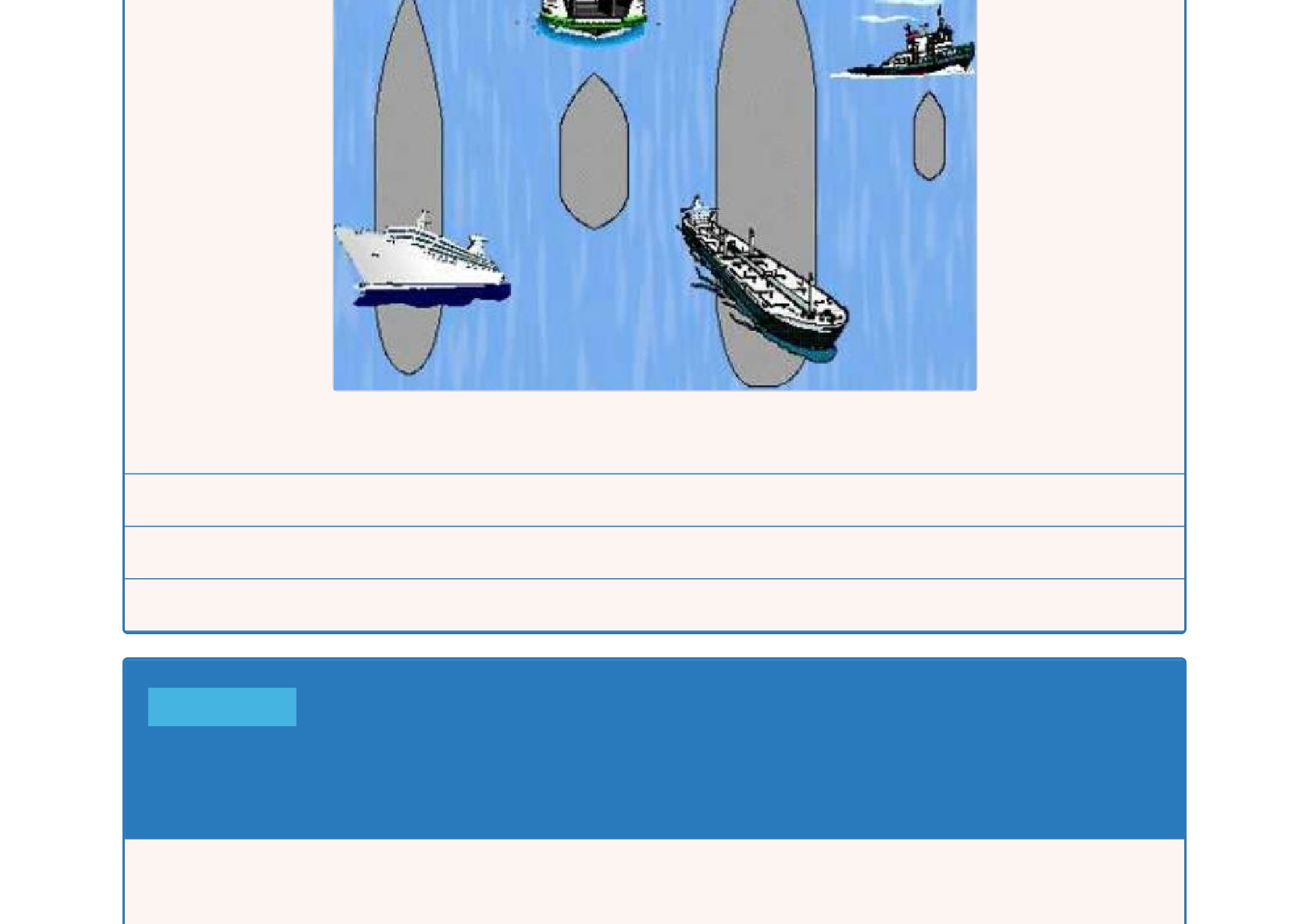
A long ship with a narrow beam. (+)
A short ship with a wide beam.
A short ship with a narrow beam.
A long ship with a wide beam.
Code: RNTY The ship is to berth alongside a quay in calm conditions of no
wind or current. The ship has a single fixed pitch right handed propeller.
Which angle of approach would be considered the most favourable?
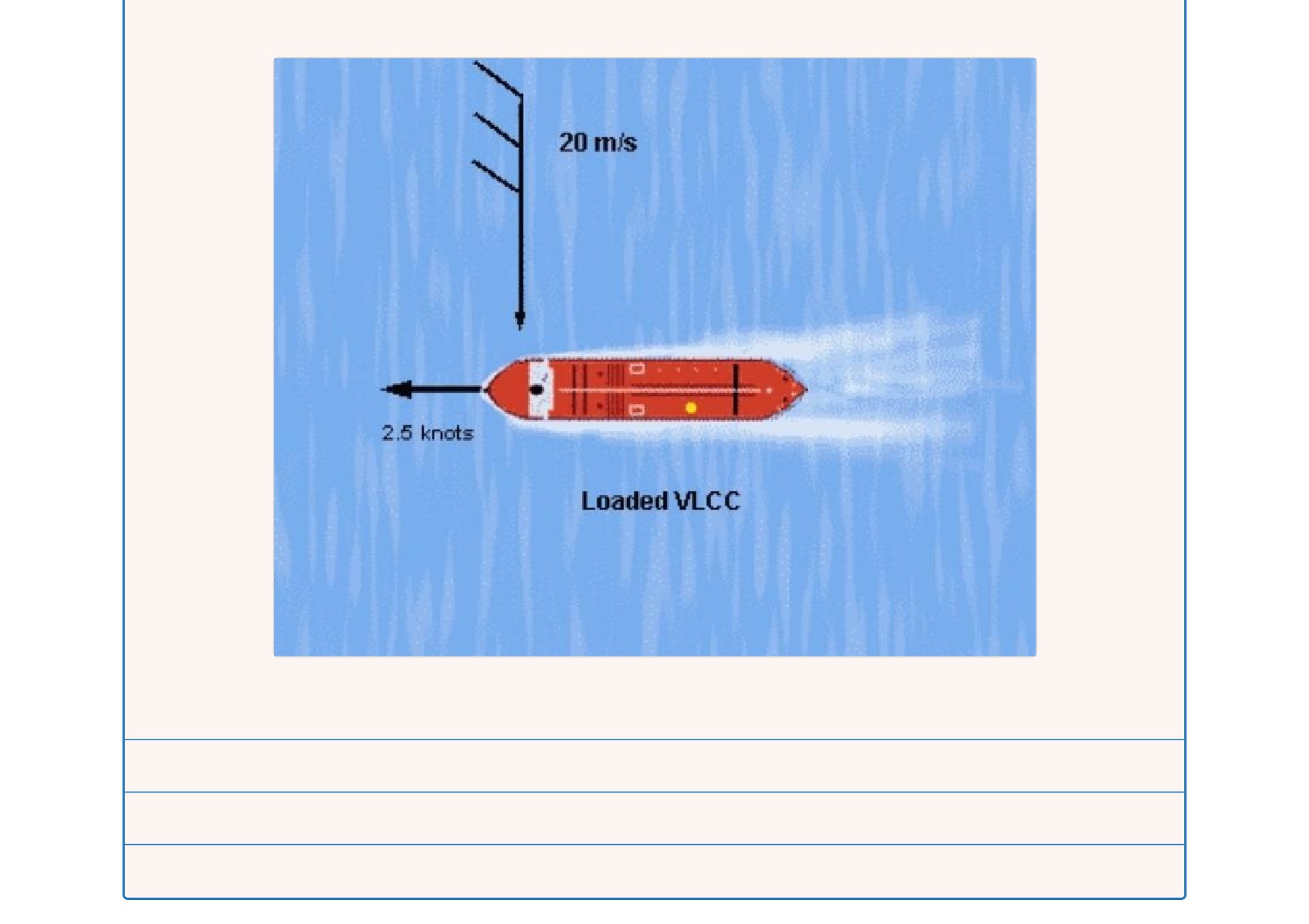
No. 2. (+)
No. 1.
No. 3.
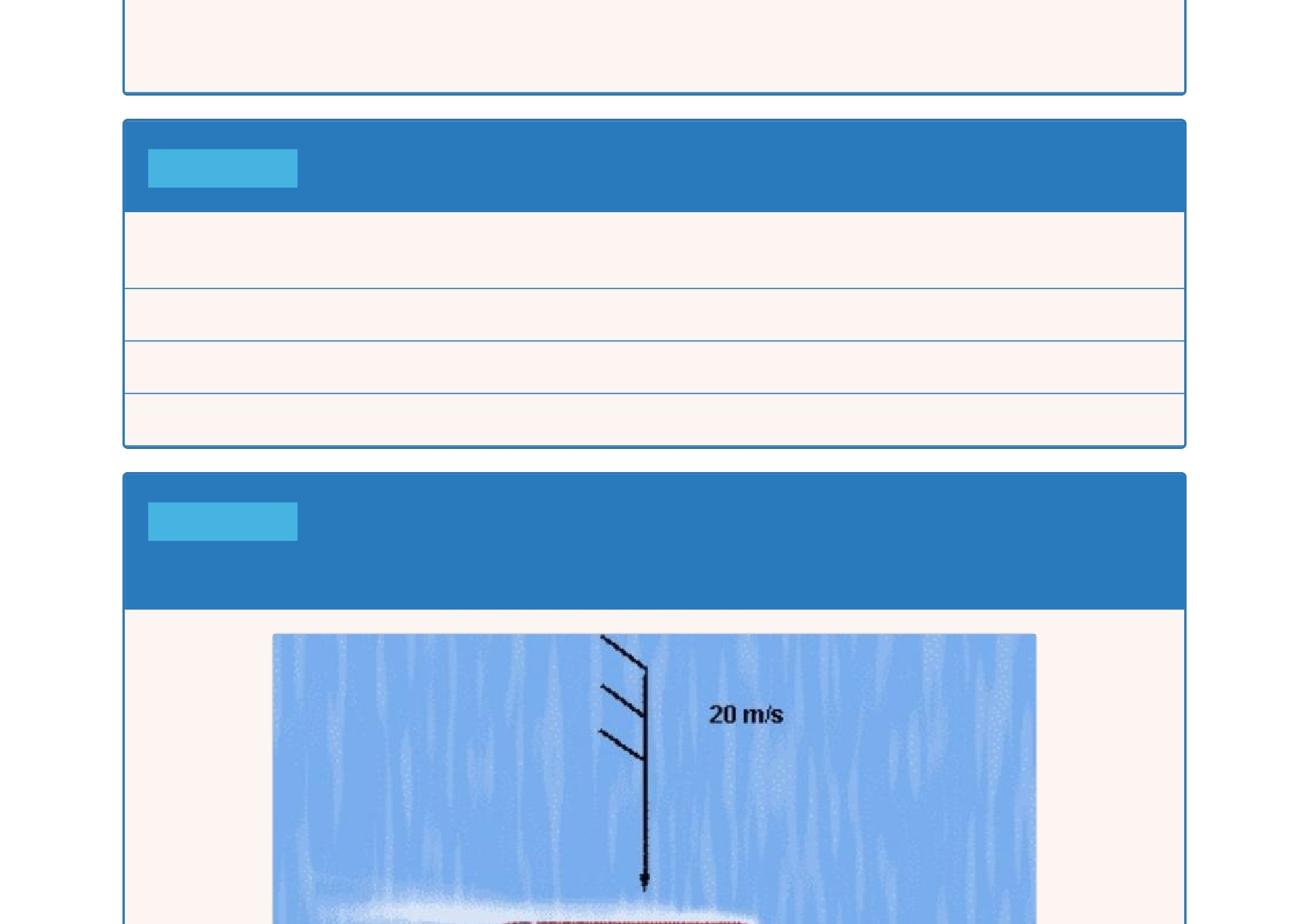
The decision should be left to the pilot who is in charge of the manoeuvre.
Code: ODBF What is the purpose of a fire wire?
A wire for pulling burning ships off the pier. (+)
A wire for pulling firehoses up to the top bridge.
A wire for handling fire buckets.
A wire for securing the Fire Tug alongside a burning ship.
Code: BFHQ How will the ship behave if it experiences a complete loss of
power (blackout) in the situation illustrated?
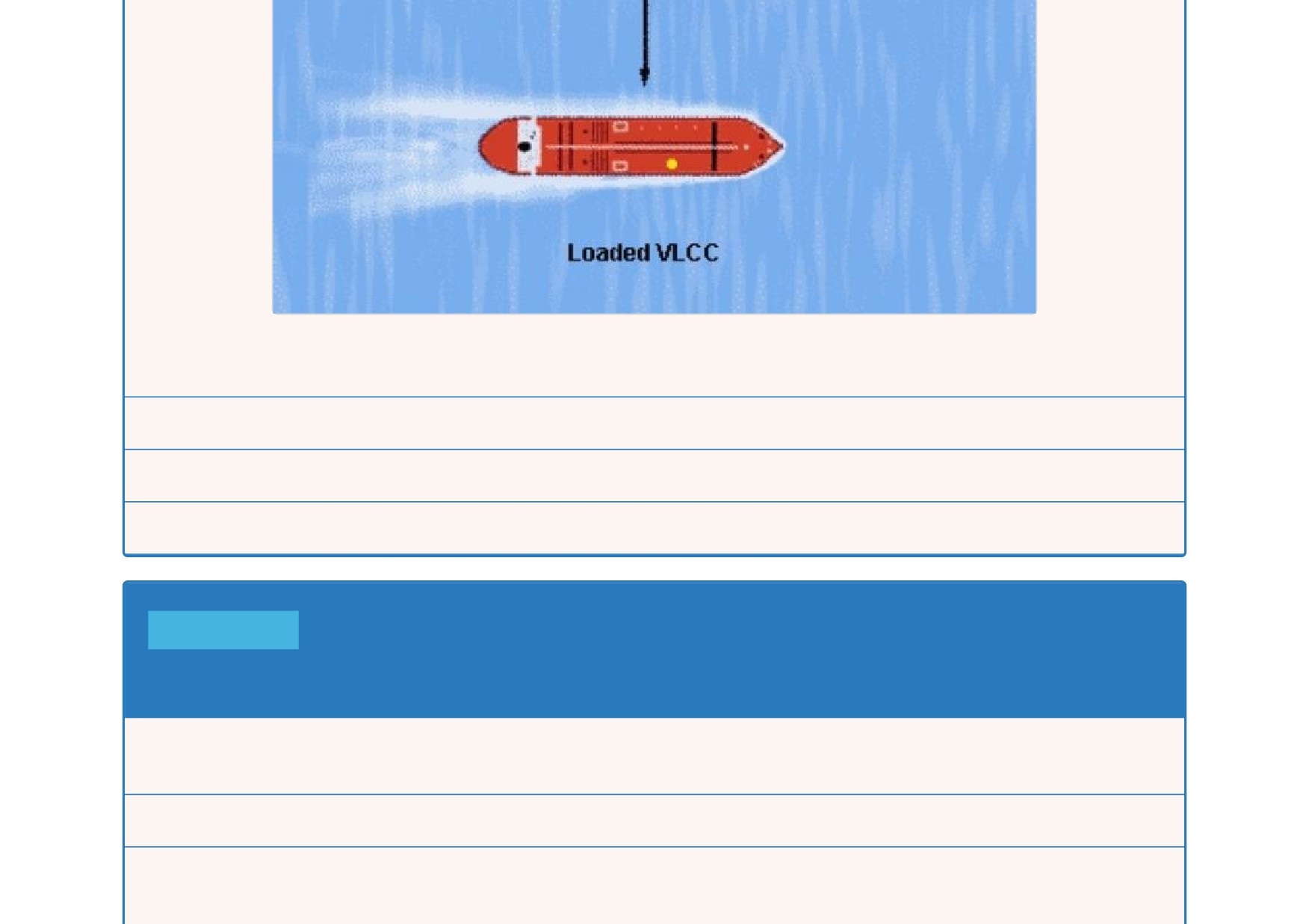
The vessel will gradually swing to port and the speed will slowly reduce. (+)
The vessel will continue on course and the speed will slowly reduce.
The vessel will gradually swing to starboard and the speed will slowly reduce.
The wind will push the vessel sideways, but the heading will not change.
Code: CAHU You are in an area of restricted visibility. You hear this sound
signal. What does it mean?
That there is a vessel in distress nearby. (+)
That there is a vessel at anchor in the vicinity.
That there is a vessel aground in the vicinity.
That there is a vessel engaged in underwater operations in the vicinity. She has divers down.
Code: HAER The position of the ship is found by taking a series of bearings
using a magnetic compass. How should an error of 5° WEST be applied to
the compass bearings?
Subtract 5° to the bearings. (+)
The same error applies to all bearings and therefore it can be ignored.
Add the 5° to the bearings.
The error should be “High” or “Low” and therefore more information is required.
Code: UFAB When fastening synthetic fibre ropes such as polypropylene on
bitts, for safety and better rope control it is recommended to:
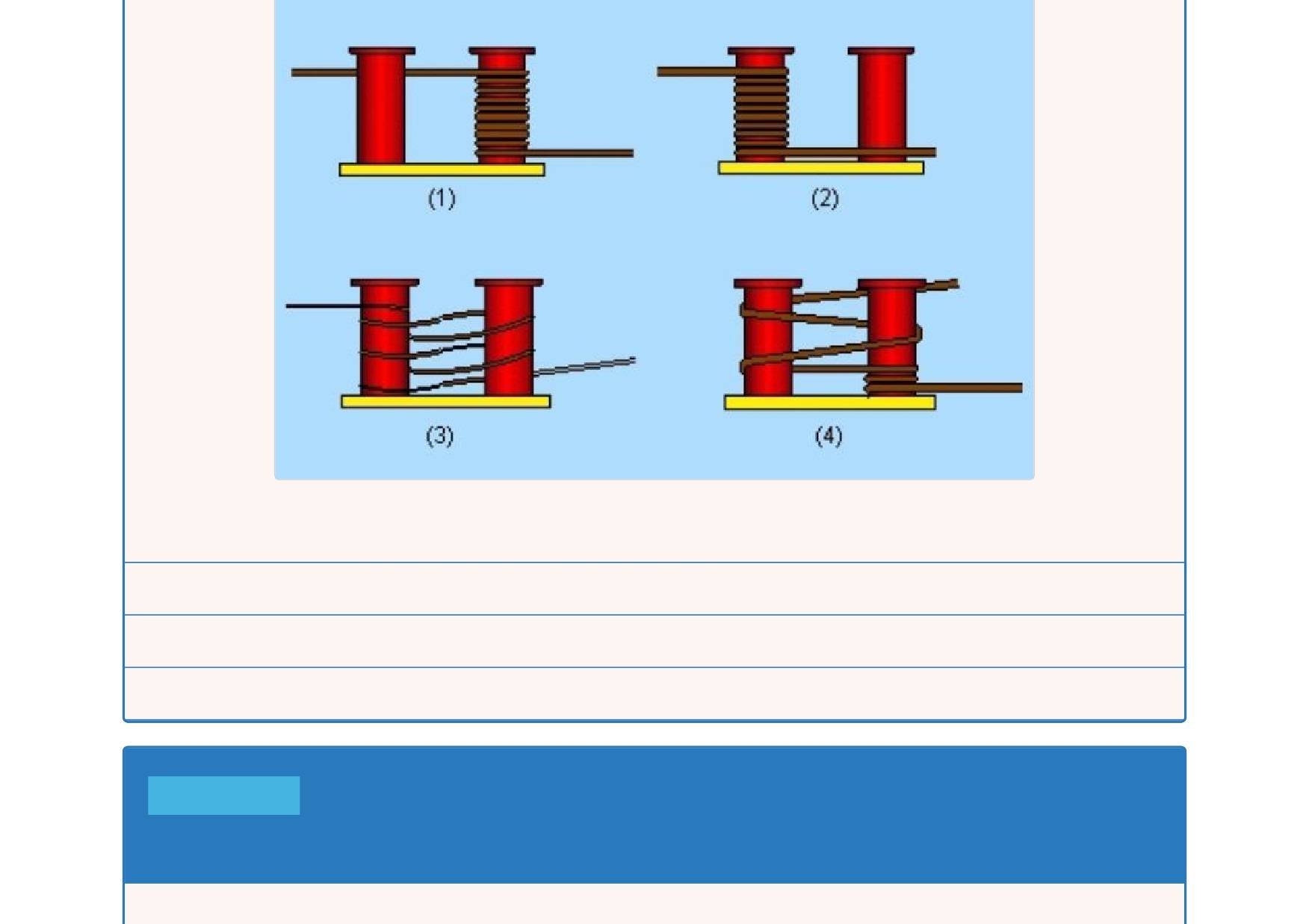
Make two round turns fast on the leading bitt and then figure of eight on both bitts, fig. 4. (+)
Make it fast with round turns on the leading bitt alone, fig. 1.
Make it fast on the second bitt alone, fig. 2.
Make it fast in a figure of eight fashion, fig. 3.
Code: COHV The tug has been released and is all clear. As officer in charge
of that operation, should this be reported and to whom?
Reported all clear to the Bridge. (+)
Report all clear to the tug.
No need for reporting as the order was given from the bridge.
Report all clear to the Engine Room.
Code: FSOS What immediate actions should the Officer of the Watch take
when the ship goes aground on an uncharted shoal in the middle of the
ocean?
Stop engines and call the Master. (+)
Sound the General Alarm and plot the ships position.
Stop engines and immediately request “Full Astern”.
Stop engines and tell the engine room to switch over to high suctions.
Code: SGBA The IMO Standard Marine Communication Phrases are
recommended to be used when the ship’s Officer is verbally talking to
whom?
In circumstances described in all of the answers provided. (+)
When talking on the VHF between ships.
When giving orders on board with other seafarers.
When talking between ship and shore personnel.
Code: UKAP What is the purpose of a sea anchor?
To keep the lifeboat steady against the sea/wind. (+)
To keep the lifeboat in a position close to the vessel.
To adjust the drifting speed of the lifeboat.
To give a better signals to any aircraft searching for survivors.
Code: DCSL What is the correct understanding of the term “a ship with good
Directional Stability”?
A ship which when the rudder is left amidships, it will continue on approximately a straight course. (+)
A ship which when a rudder angle is applied and the ship starts to swing, will continue to swing even after the rudder is
returned to amidships.
A ship where the amount of positive transverse stability (GM) will vary with the direction of the ship’s head.
A ship which will maintain its course unless large rudder angles are applied.
Code: SDOU Two mooring lines are pretensioned equally and have the same
length, same breaking strength and same directional load. However, one is
made of wire (with a full load elastic elongation of about 1,5 % of its length)
and the other made of nylon (with a full load elongation of about 30 % of its
length). If a gust of wind increases the load on the lines, how will it be
shared?
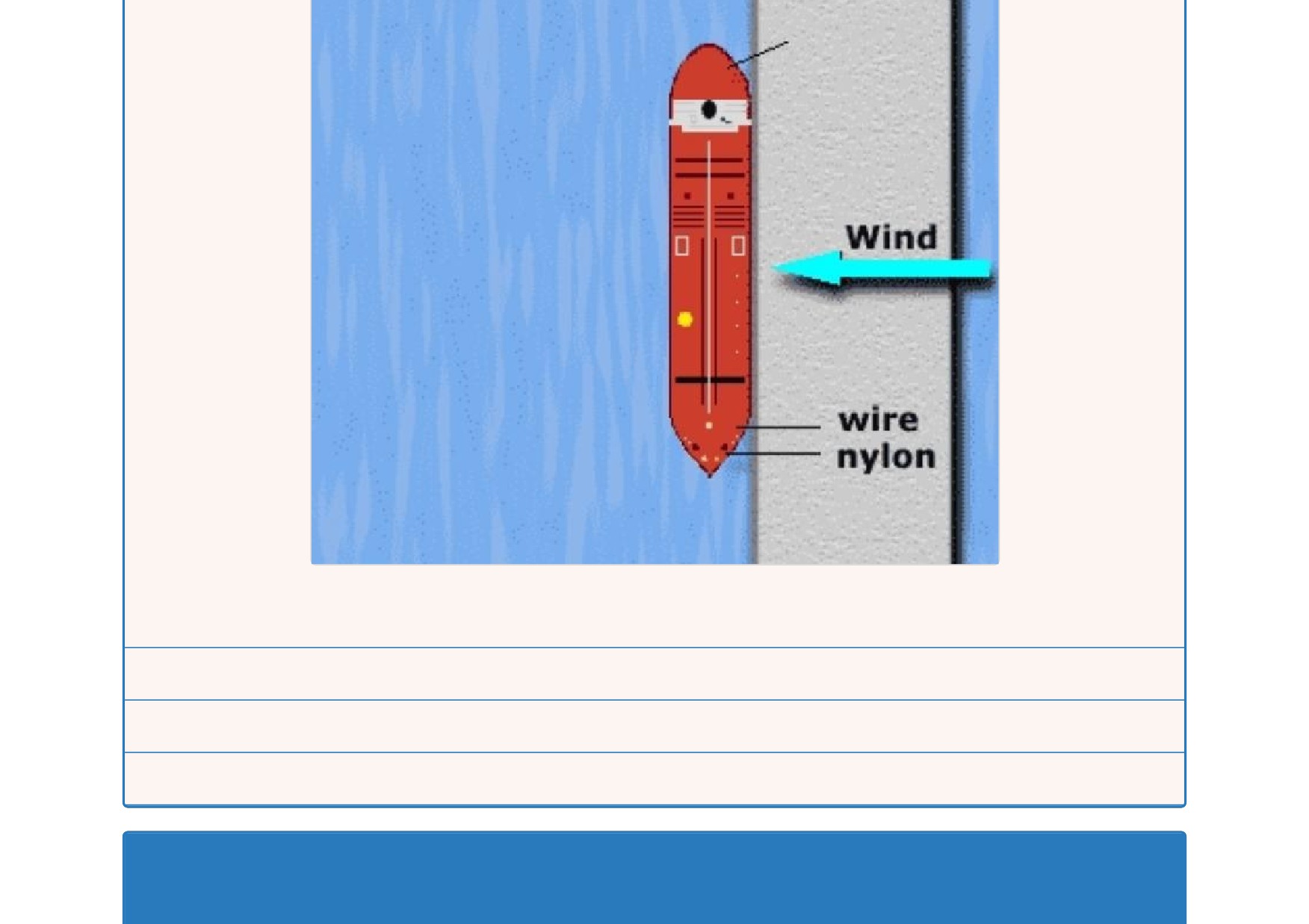
Wire takes 95 % of the extra load. Rope takes 5 % of the extra load.. (+)
Wire takes 55 % of the extra load. Rope takes 45 % of the extra load.
Wire takes 45 % of the extra load. Rope takes 55 % of the extra load.
The wire and rope will share the load equally.
Code: VTBP Can the OOW be the sole lookout?
During daylight when visibility and traffic allows. (+)
Never should the Officer of the Watch be the only lookout.
When the visibility is good and the ship is in the middle of the ocean where there is very little shipping.
Only if the ARPA radar is set onto Auto Acquisition with an audio alarm sounding when a ship is detected.
Code: YQXU Which part of the magnetic compass error changes with a
change in the course steered?
Deviation. (+)
Variation.
Induced magnetism.
All of the suggested answers.
Code: OTYF A ship is being overtaken by another ship while proceeding
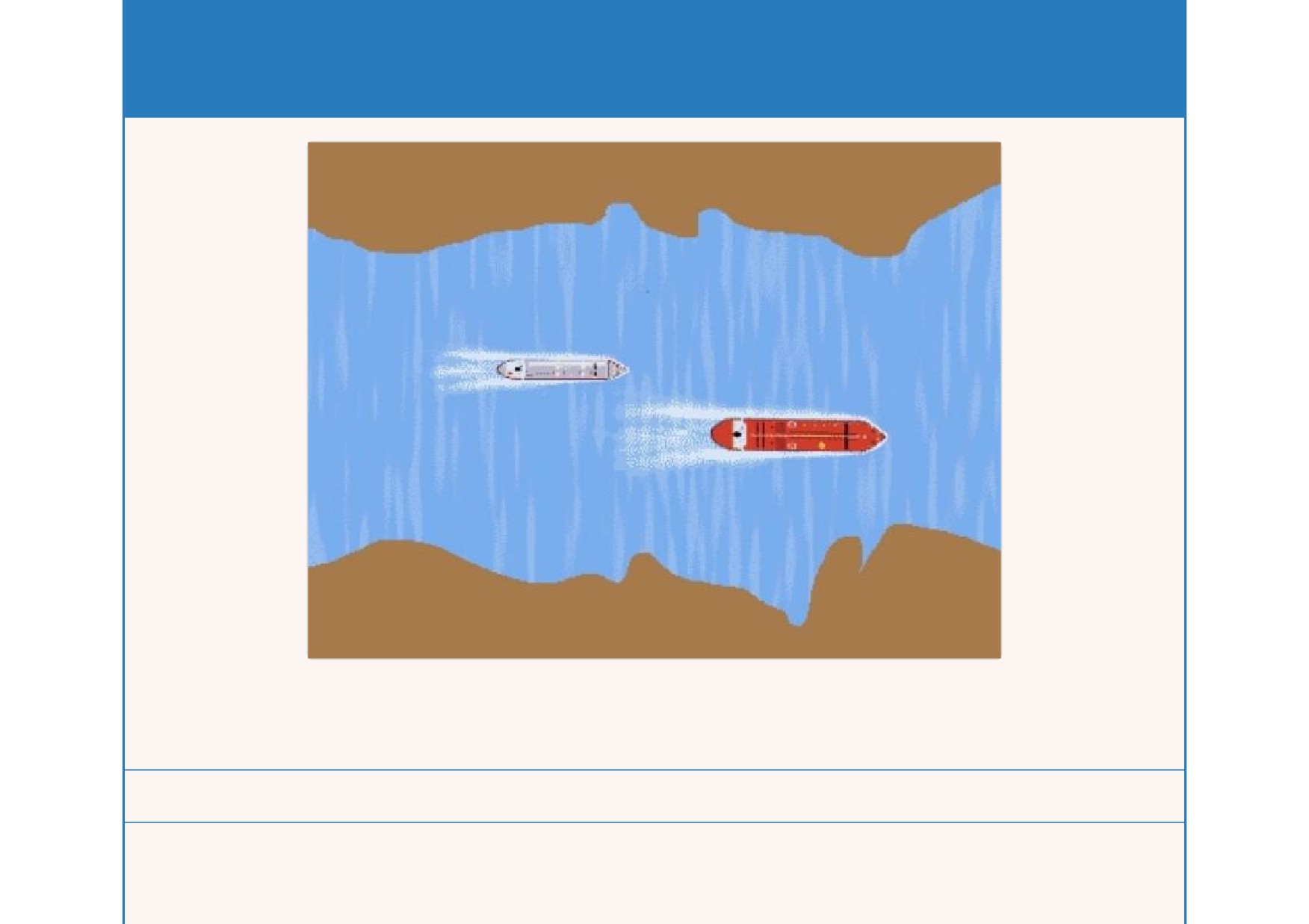
along a river. What should be the required procedure?
The overtaking vessel should request permission from the other ship by sounding two prolonged blasts followed by two
short blasts on the whistle or by direct VHF contact. (+)
The overtaking vessel should request permission to overtake from the Port Control VTS.
The overtaking vessel can overtake but must allow sufficient space to reduce the interaction between the two vessels.
There should be no overtaking in these confined waters.
Code: HNXE You are on a powerdriven vessel underway in open water. This
vessel is sighted wide on the port bow. It’s bearing is opening, but its
distance is closing rapidly. Which of the following is a correct assessment of
the situation and the action to be taken?
Risk of collision is deemed not to exist and I will maintain my course and speed. I will continue to monitor the situation. (+)
Risk of collision is deemed not to exist. However, to be sure of a safe passing distance, I will reduce my speed to allow the
other vessel to pass ahead.
Risk of collision is a possibility. I will maintain my course and speed for now, but be prepared for an alteration of course to
port if the CPA seems to be less than 0,2 nm as we draw closer.
Risk of collision is deemed to exist and I will make a broad alteration of course to starboard, sounding one short blast. I will
reassess the situation when the alteration is carried out.
Code: VFJG What does this flag mean?
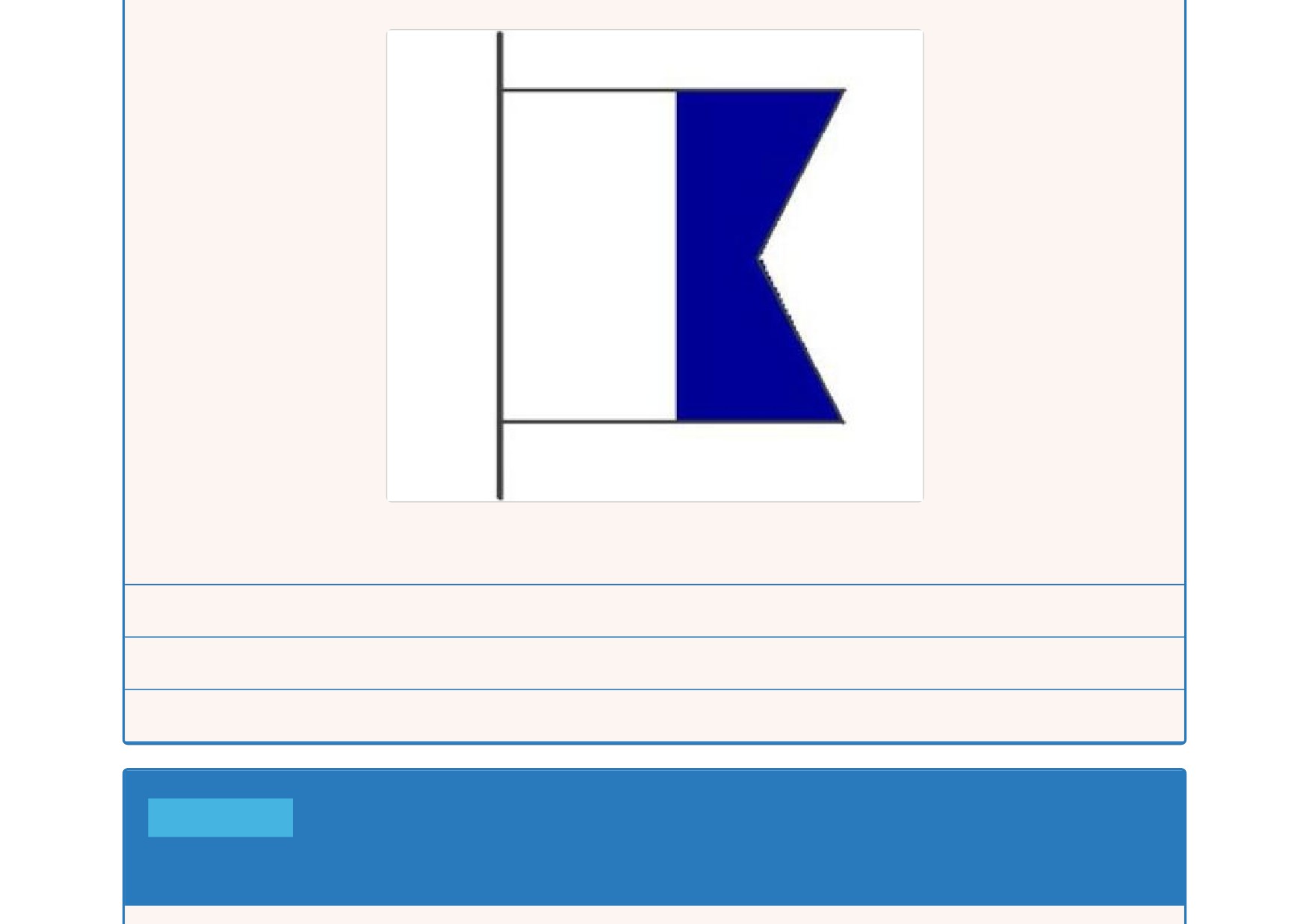
I have a diver down; keep well clear at slow speed. (+)
My vessel is stopped and making no way through the water.
Yes (affirmative).
I wish to communicate with you.
Code: QLFS What corrections must be applied to the echo sounder reading to
compare the depth of water with the depth printed on the chart?
Draught of the ship. (+)
Allowance for the ships speed.
Shallow water effects.
The distance between the pulse Transmitter and Receiver.
Code: UAAG What is understood by the term “Dew point” of the air?
The temperature at which condensation in the air forms into water droplets. (+)
The temperature of the water vapour in a cloud.
The “Dew point” is the point at the centre of an Anticyclone.
All of the suggested answers.
Code: GJLE What special equipment can often provide assistance in locating
a survival craft or man overboard and in the water?
A SART. (+)
A sectored search pattern.
A RACON.
AIS.
Code: TDJH When should voyage planning be done?
Prior to leaving the berth. (+)
During the pilotage when leaving the berth.
Before the pilot is leaves the vessel at the departure port.
Before the vessel completes the previous passage.
Code: FAVA The ship is drifting in the open sea with a temporary engine
breakdown. The ship is equipped with GPS navigation equipment. What
should the bridge Officer of the Watch do in this situation?
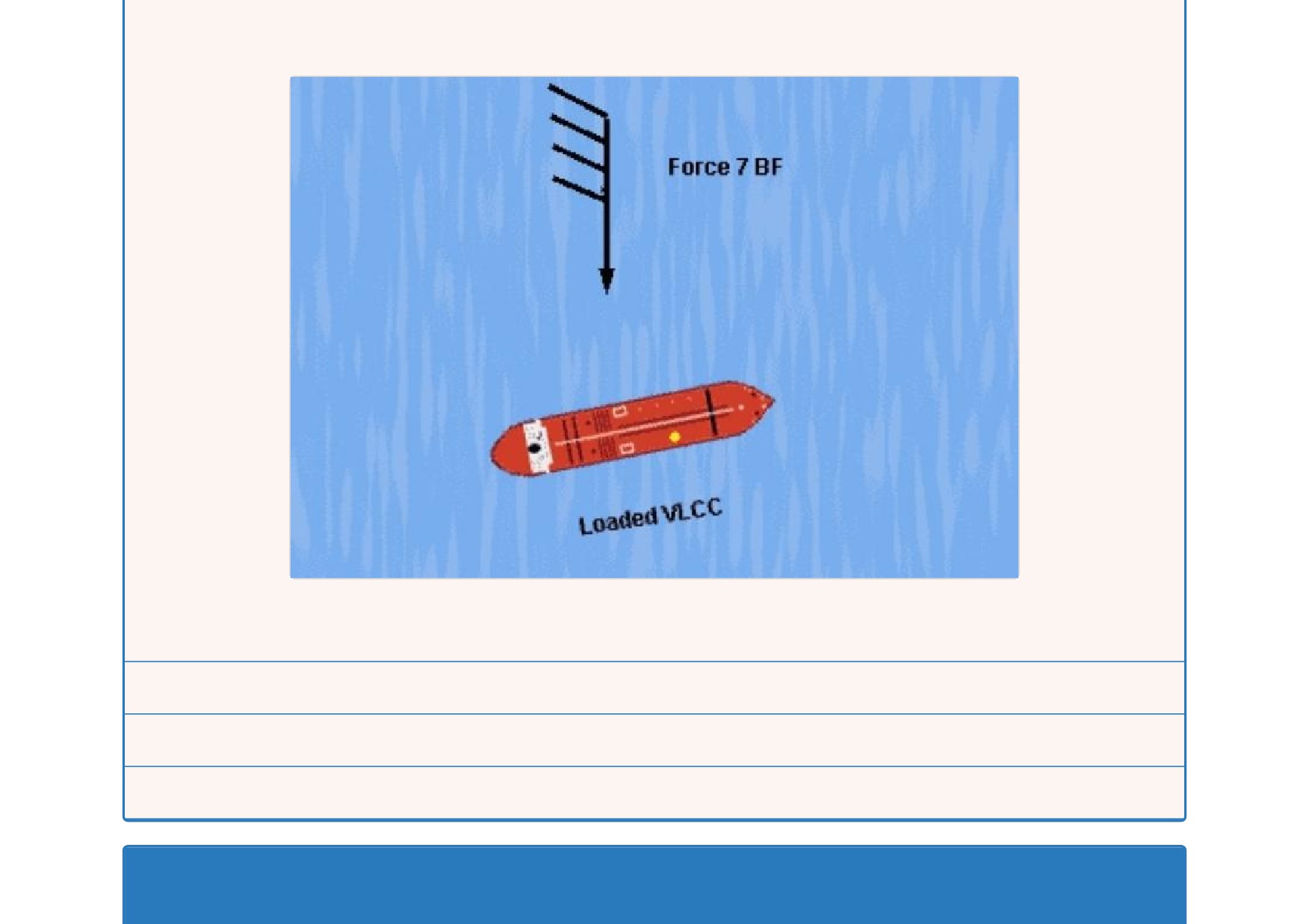
All of the possible answers. (+)
Display the “Not under Command” signal and switch off the normal steaming lights.
Plot the direction and rate of drift and predict the ships position for the period while the ship is “Not Under Command”.
Keep a good lookout for other ships.
Code: RFJD What would be considered the most favourable heading of a ship
when launching a lifeboat?
The ship should steer about 30° off the prevailing weather and sea with the boat to be launch on the leeside. (+)
The ship should steer about 100° of the prevailing weather and sea with the boat to be launched on the leeside.
The ship should lie stopped in the water with the weather on the opposite side to the boat to be launched.
The ship should steer with the prevailing weather and sea on the beam and the boat to be launch on the leeside.
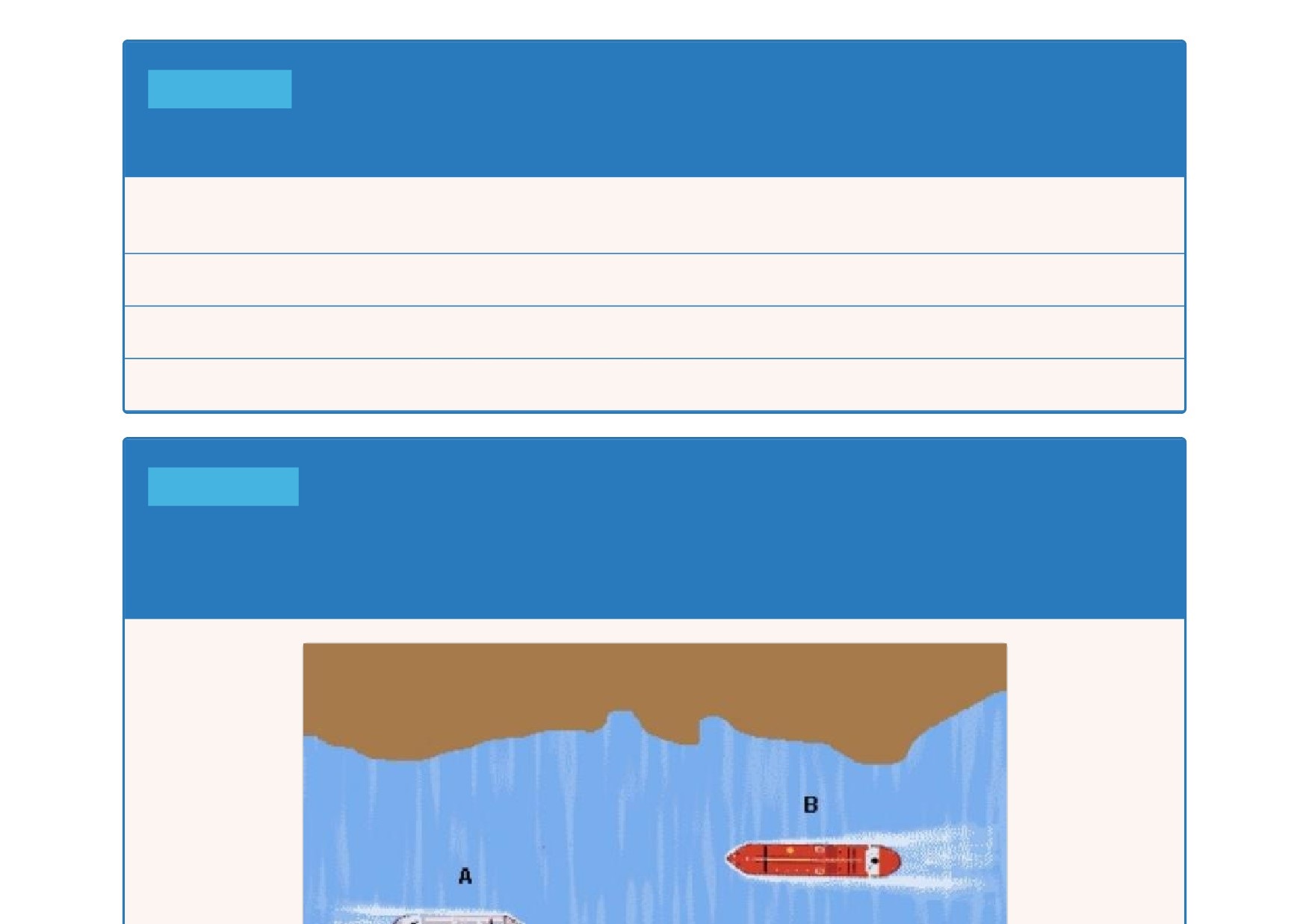
Code: PGKC Two ships are meeting in a restricted channel as illustrated.
Which of the following actions would be the most suitable to take on both
vessels as they approach and pass each other?
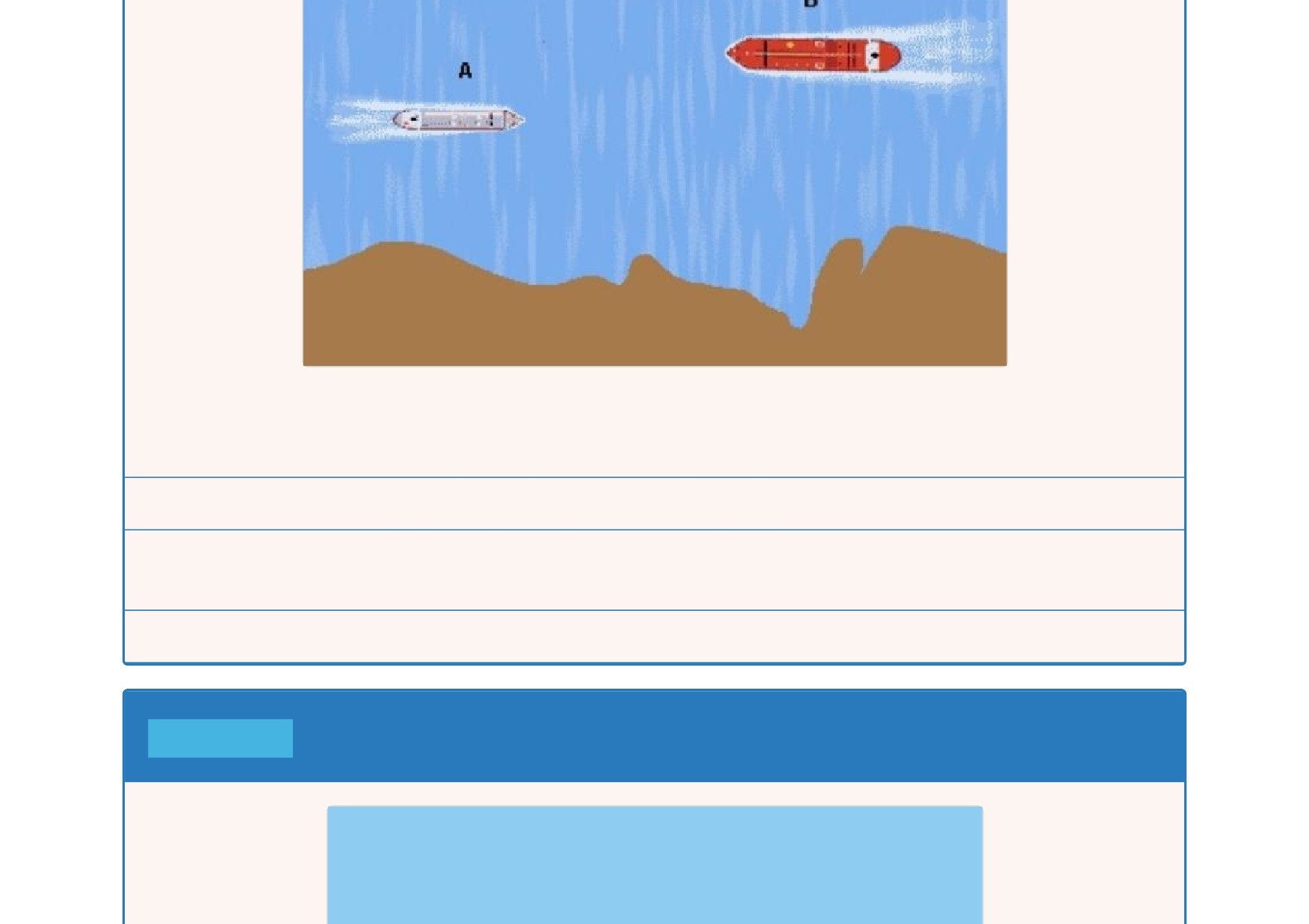
Slow down if possible without losing steerage and be prepared for prompt application of rudder to counteract any swing as
they approach and pass each other. (+)
Keep as far as possible on the starboard side of the channel and maintain speed to retain effective steerage.
Increase speed slightly to pass each other as quickly as possible and thereby reduce the effects of “ship to ship”
interaction.
Maintain speed and a straight course on the starboard side of the channel.
Code: XAPT Which is the “CENTRE LINE”, in the figure?
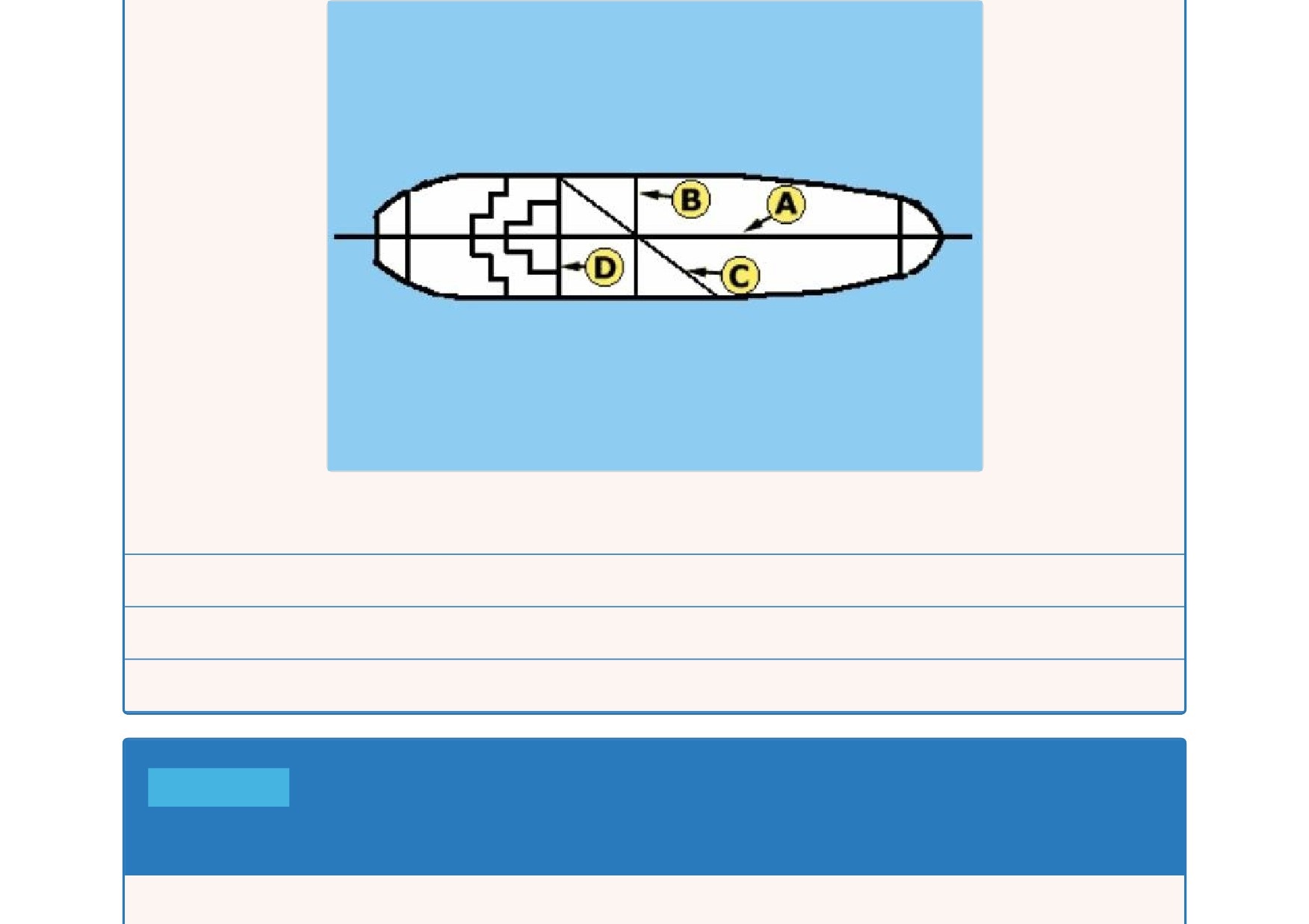
The Fore and aft Centreline is indicated by A, in the figure. (+)
The Fore and aft Centreline is indicated by D, in the figure.
The Fore and aft Centreline is indicated by C, in the figure.
The Fore and aft Centreline is indicated by B, in the figure.
Code: ICMT What is the colour and characteristic of a “towing light”, as
defined in the International Regulations for Preventing Collisions at Sea?
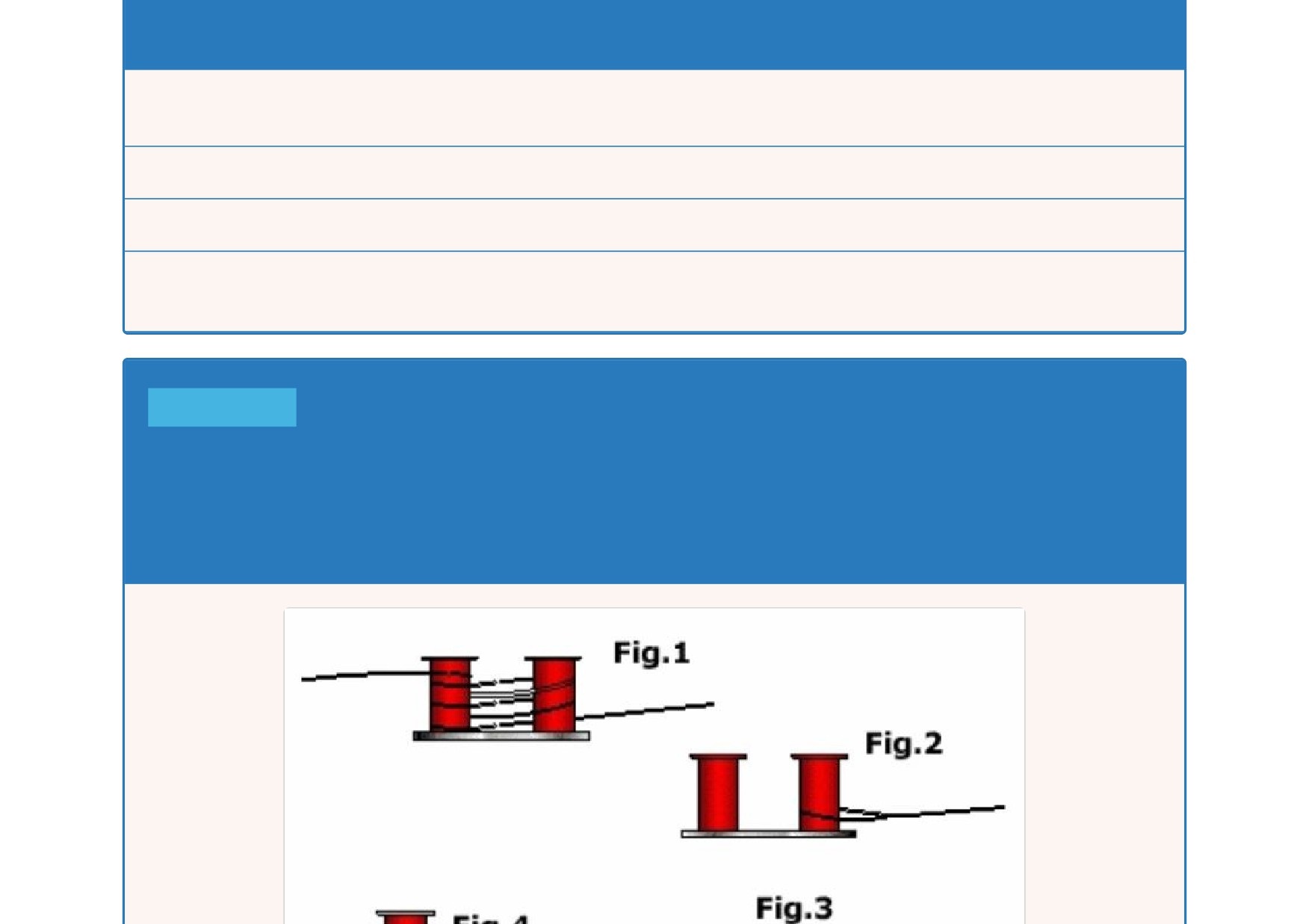
Yellow, fixed, seen over an arc of 135° and so arranged as to display 67,5° from right aft on each side of the vessel.(+)
Amber, allround, flashing, where it can best be seen.
One of two allround amber, alternate flashing lights, displayed where they can best be seen.
White, fixed, displayed as an additional light on the foremast over an arc of 225°, from right ahead to 22,5° abaft the beam
on each side of the vessel.
Code: PQFE The Master has decided to “single up” to a spring line at each
end as the last lines to let go whilst unmooring. Which of the following
methods should be used to hold the lines, whilst waiting for the order to “let
go”?
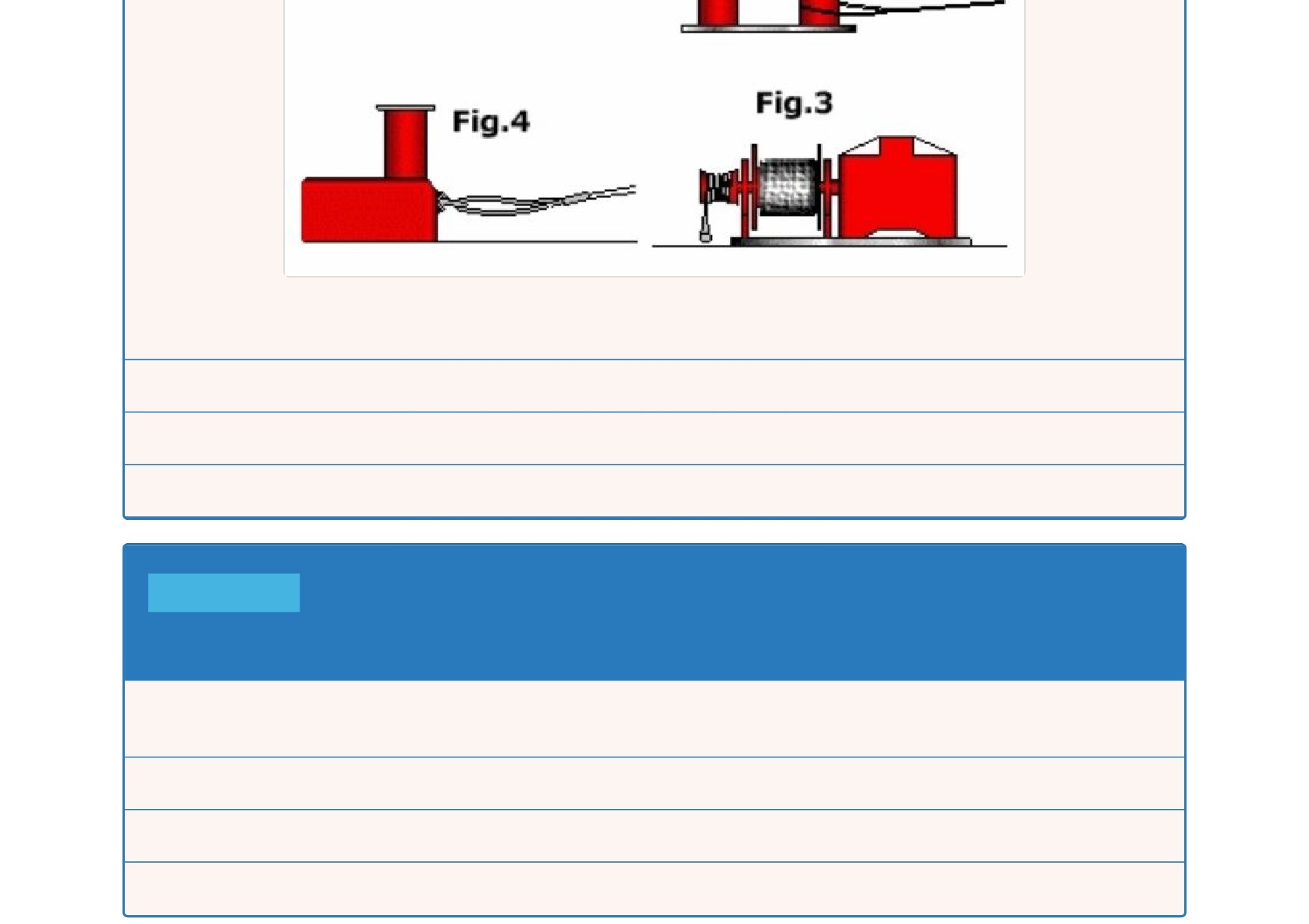
The line should be turned up on the bitts, fig. 1. (+)
The eye of the lines should be put on the bitts, fig. 2.
The line should be held on a stopper ready for immediate release, fig. 4.
The line should be kept on the warping drum of a deck winch, fig. 3.
Code: ACGC What is important to check when transferring a position from the
GPS output to a paper chart?
Any necessary corrections are applied to convert between the GPS datum and the chart datum. (+)
Ensure that the chart has been corrected up to date.
Ensure that the GPS is setup on the same datum as the chart.
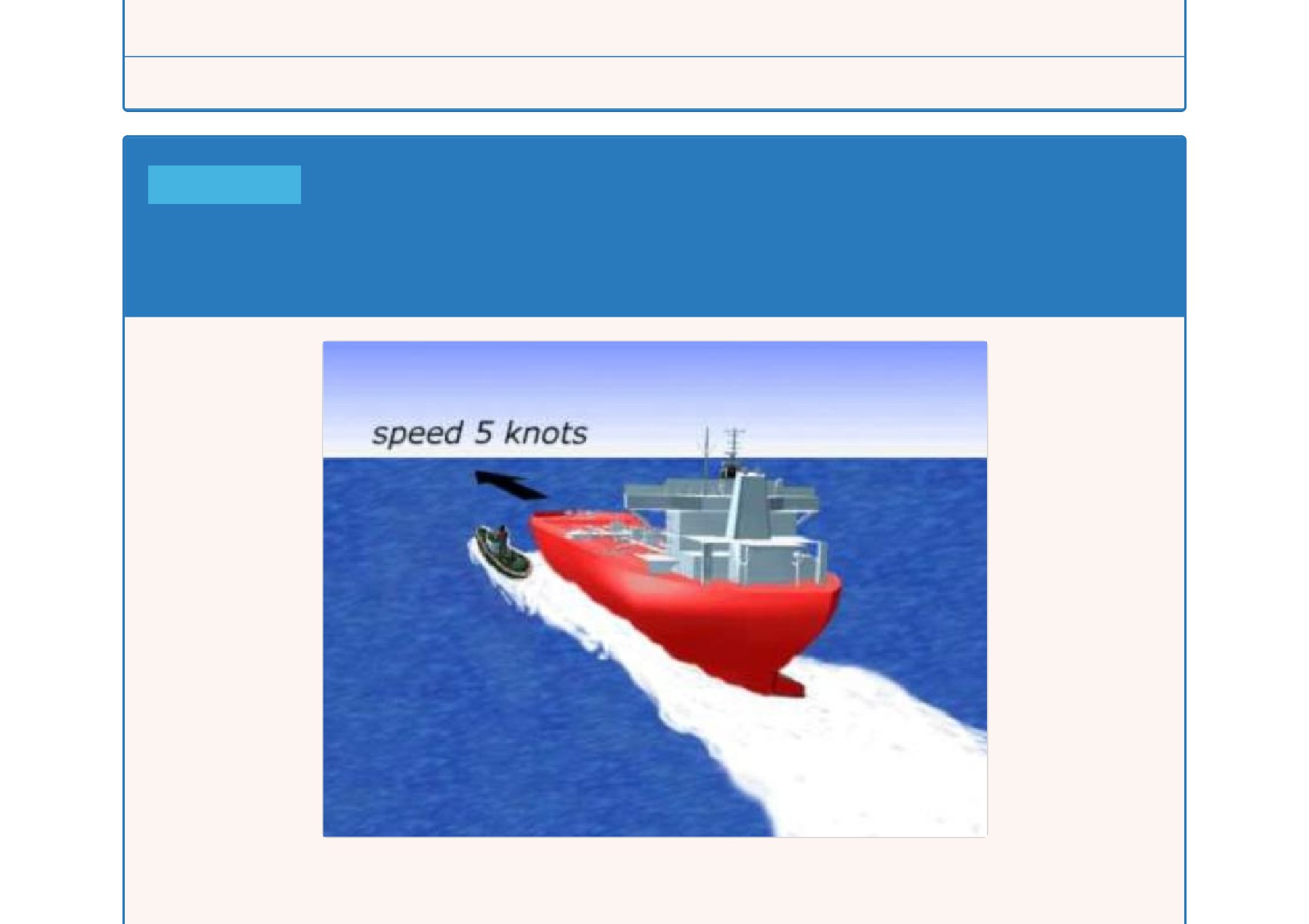
It is important to ensure that the GPS is setup on 2 dimensional and not 3 dimensional position fixes.
Code: WPSE A tug is moving towards the bow of the ship to make fast and is
in the vicinity of the ship’s shoulder, as illustrated. What specific danger
should be considered when making this approach to the bow?
The tug may be turned across the bow of the ship and also suffer a lose of stability with a danger of being turned over if
touched by the ship. (+)
The positive pressure field at the ships bow may repel the tug and make the connection very difficult to establish.
The stern of the tug may be sucked in towards the bow and also suffer a reduction in the positive GM, making it very
unstable.
All of the alternative answers.
Code: PETM Why should Ground Stabilised True Motion display mode be
avoided when using the ARPA for anticollision purposes?
The collision regulations are based on ship courses through the water. (+)
True motion does not provide the collision risk of other ships.
The true vector can never give an indication of collision risk with another ship.
The Relative Motion display and relative vectors is the only display to use for anticollision purposes.
Code: VNSG Which of the answers best summarises the information which
should be provided for the bridge Officer of the Watch within an effective
Voyage plan?
All of the suggested answers. (+)
Contingency arrangements in case of problems.
Expected prevailing wind and weather.
Courses to steer; distance off dangers; parallel index lines; expected currents; prevailing winds; distance between
alteration points.
Code: FRGY If the radar is set onto the Relative Motion Display, what would
an echo of a target with no trail indicate? Note this the trail of the echo and
not a vector.
The target is on the same course and speed as own ship. (+)
The target is on a constant bearing and getting closer to own ship.
The target is stopped and making no way through the water.
The target is on a collision course with own ship.
Code: ETES According to rule 13 of the International Regulations for
Preventing Collisions at Sea, what is the definition of “an overtaking vessel”?
When coming up with another vessel from a direction more than 22,5° abaft her beam. (+)
When the vessel is detected as a radar target or sighted visually in a position directly astern.
When coming up with another vessel from any direction abaft her beam.
When coming up with another vessel from a direction more than 45° abaft her beam.
Code: ROVT Where can a ship expect an act of piracy to take place?
All over the world. (+)
In Far East waters.
In American waters.
At the south end of the Red Sea.
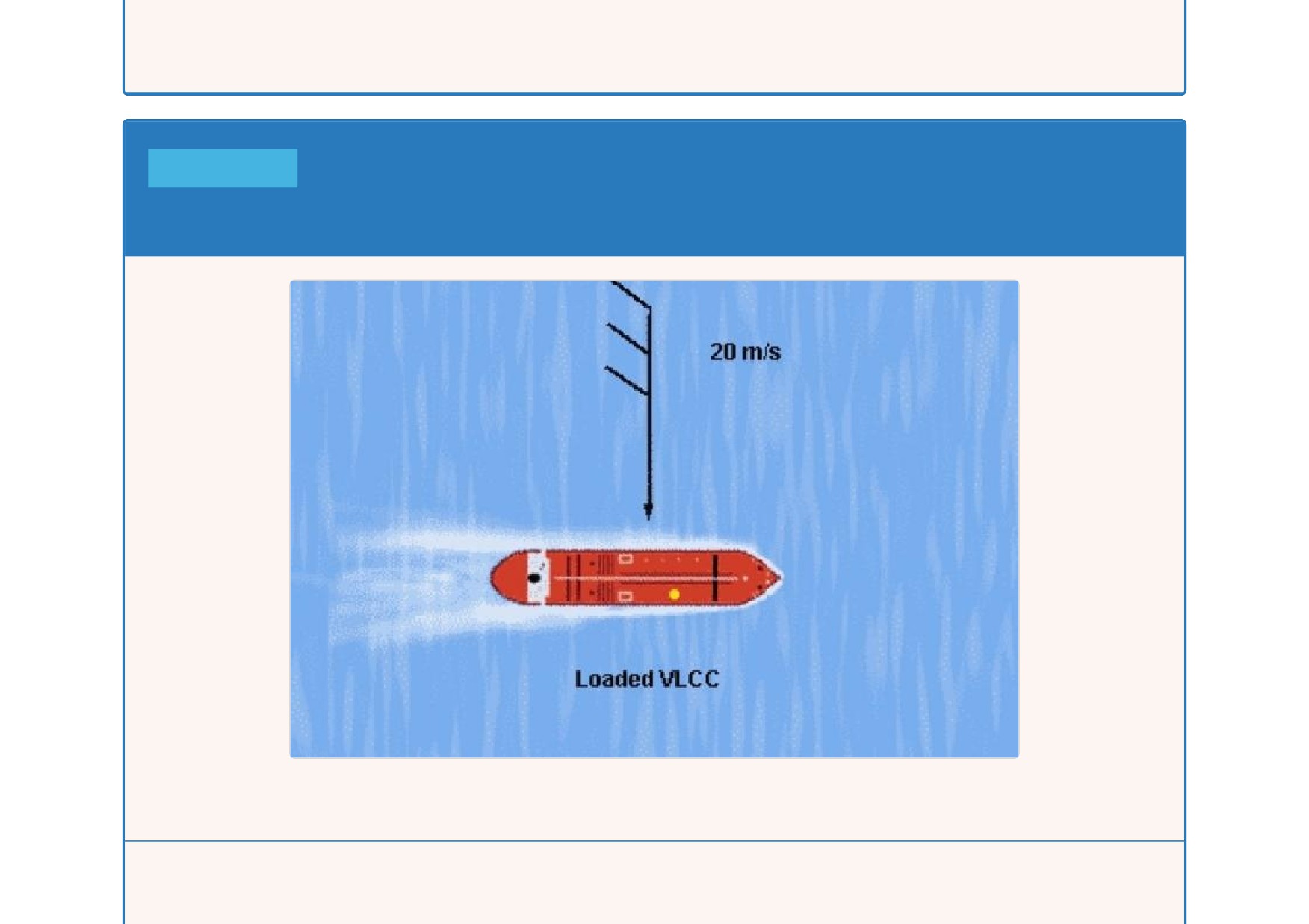
What would be the stopping distance of a VLCC when
Code: QBIM What would be the stopping distance of a VLCC when
proceeding at 8 knots in deep water and the engines are put “Full Astern”?
Varies, but can be determined from trial data. (+)
15 ship lengths.
8 nautical miles.
4 nautical miles.
Code: CRBD If a distress signal is received on board your ship, what should
be the first action that should be taken?
Attempt to establish contact with the distressed vessel. (+)
Contact SAR Authorities via nearest coastal Radio station.
Determine how close your vessel is to the distressed vessel.
Determine if anyone else has heard the distress signal and if your vessel is near the distress.
Code: JLRE You are proceeding along a coastal route when you hear this
Code: JLRE You are proceeding along a coastal route when you hear this
signal. The visibility is severely restricted. What does the signal mean?
There is a vessel aground in the vicinity. She is more than 100 metres in length. She is sounding an additional warning to
approaching vessels that they are “running into danger”. (+)
There is a vessel at anchor in the vicinity. She is less than 100 metres in length. She is sounding an additional warning to
approaching vessels that they are “running into danger”.
There is a vessel aground in the vicinity. She is less than 100 metres in length. She is sounding an additional warning to
approaching vessels to “navigate with extreme caution”.
There is a vessel at anchor in the vicinity. She is more than 100 metres in length. She is sounding an additional warning
signal to approaching vessels, directing them to “keep clear”.
Code: SNQJ What is the correct understanding of the term “Isobar”?
An “Isobar” is a line joining places of equal pressure. (+)
An “Isobar” is the line of the cold front in a frontal depression.
An “Isobar” is the line showing the direction of the predicted path of a hurricane.
An “Isobar” is a line joining places of equal temperature.
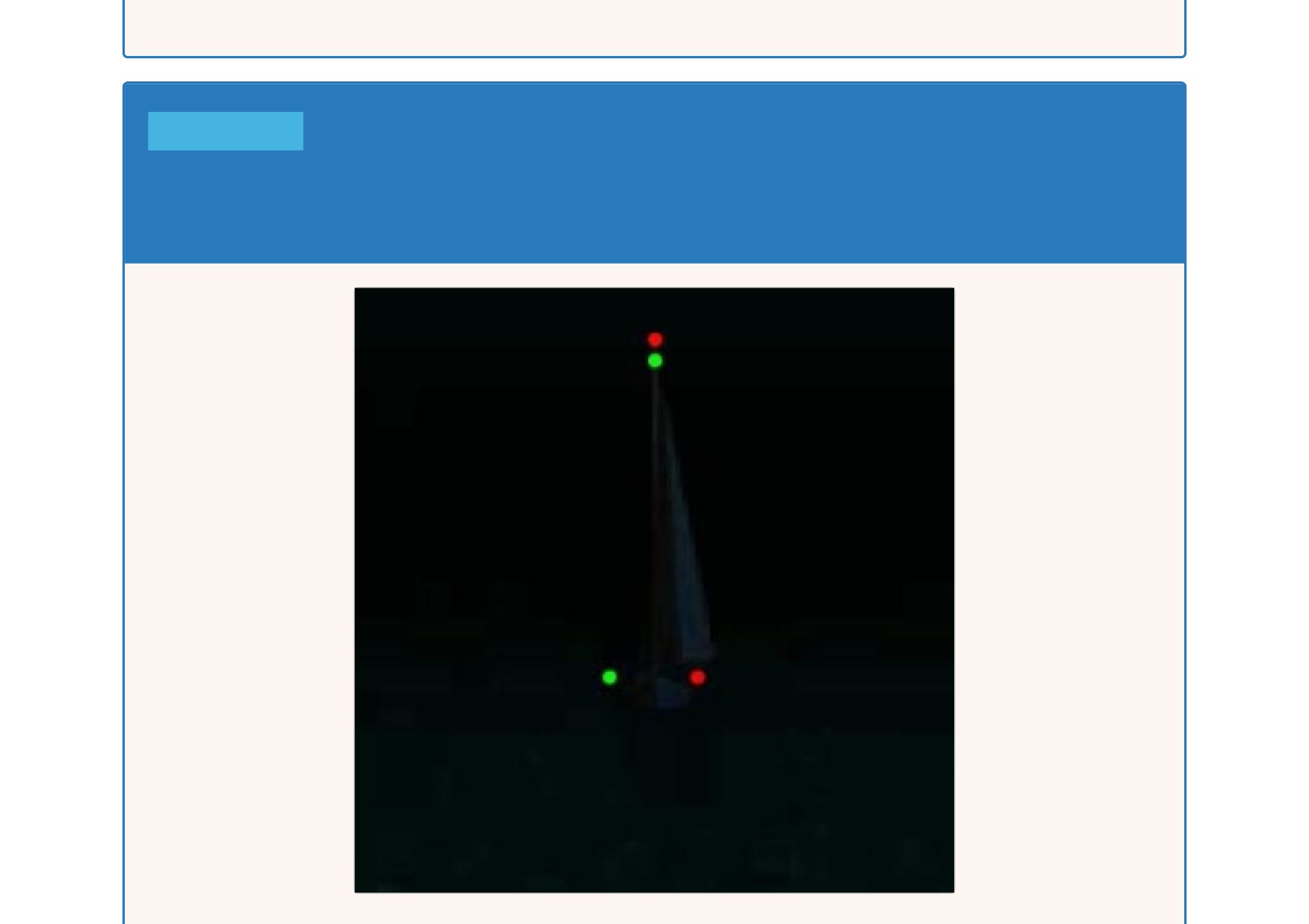
Code: NCMO You are on a powerdriven vessel underway in open water. This
vessel is sighted on the port bow on a steady bearing. What kind of vessel is
it and what will your action be?
This is a sailing vessel underway, seen headon. It is my responsibility to keep clear under rule 18 and I will take
appropriate avoiding action. (+)
This is a vessel engaged in fishing. It is my responsibility to keep clear under rule 18 and I will alter course to starboard,
sounding one short blast.
This is a sailing vessel underway. I am the standon vessel and will maintain my course and speed under rule 17.
This is a sailing vessel not making way through the water. There is no risk of collision and I will maintain my course and
speed.
Code: INOL What are the two parts of the magnetic compass error?
Variation and Deviation. (+)
West and East errors.
The latitude and longitude.
Permanent and induced magnetism.
Code: FYAL If a ship requires 2 nautical miles to stop in the water from a
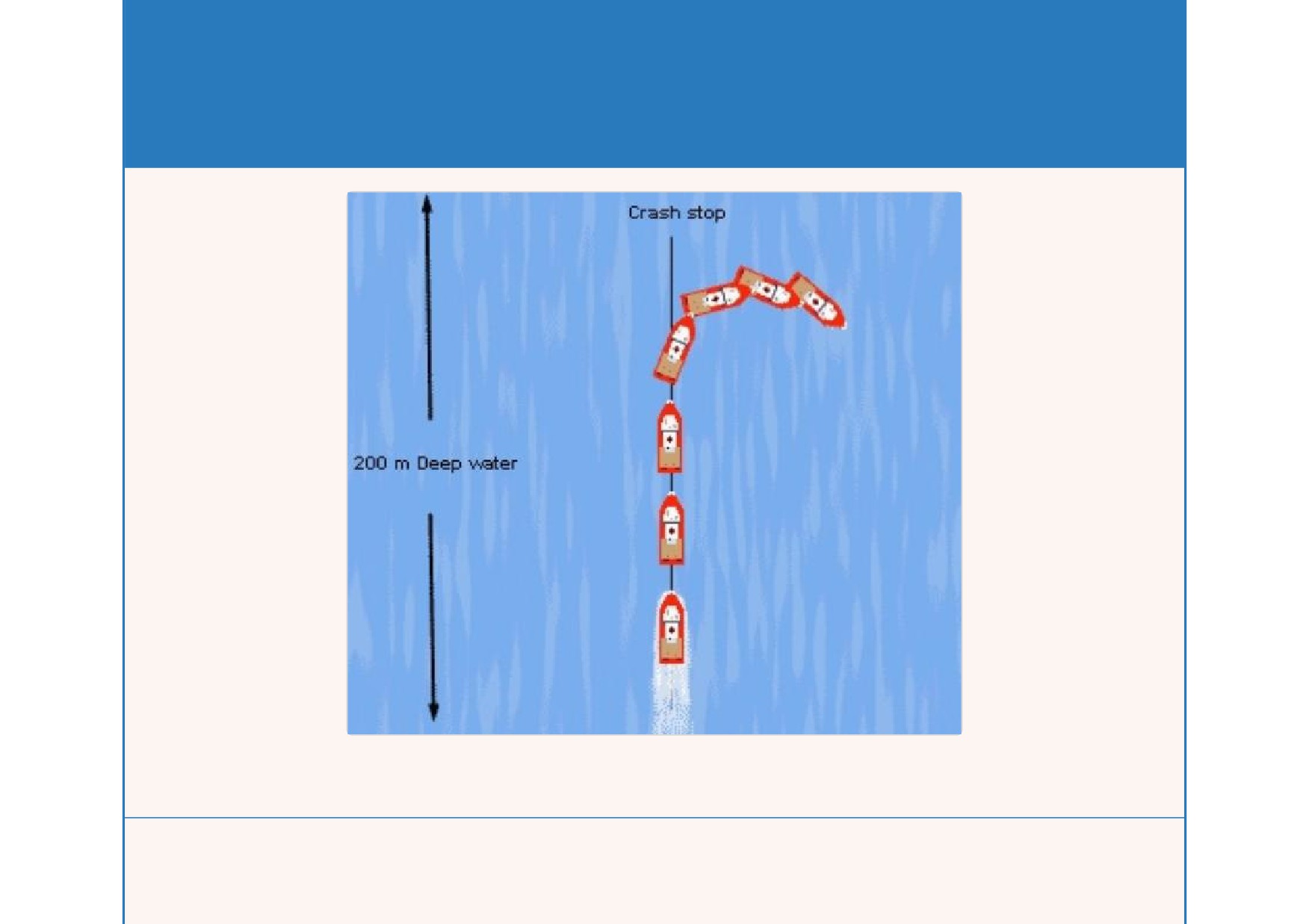
“crash stop” when proceeding at full ahead in deep water. What will the
stopping distance be in shallow water?
A greater distance. (+)
A shorter distance.
About 1,5 nautical miles.
Similar distance to deep water.
Code: JDPH Which of the following precautions should be taken when work is
to be carried out on the radar scanner unit on the mast?
A “Not to be used” sign on all radars and fuses for the complete radar systems to be removed. (+)
Only the electrical fuses forthe radar undergoing repairs needs to be removed, allowing the ship to retain a workable radar.
Only the electrical fuses for the scanner motor needs to be removed.
A sign needs to be attached to all the radars warning the bridge officers of repairs and the fact the radars are “Not to be
used”.
Code: BCXU Which of the four calculations illustrated is the correct one to
determine the latitude of the observer when the sun is on the meridian?
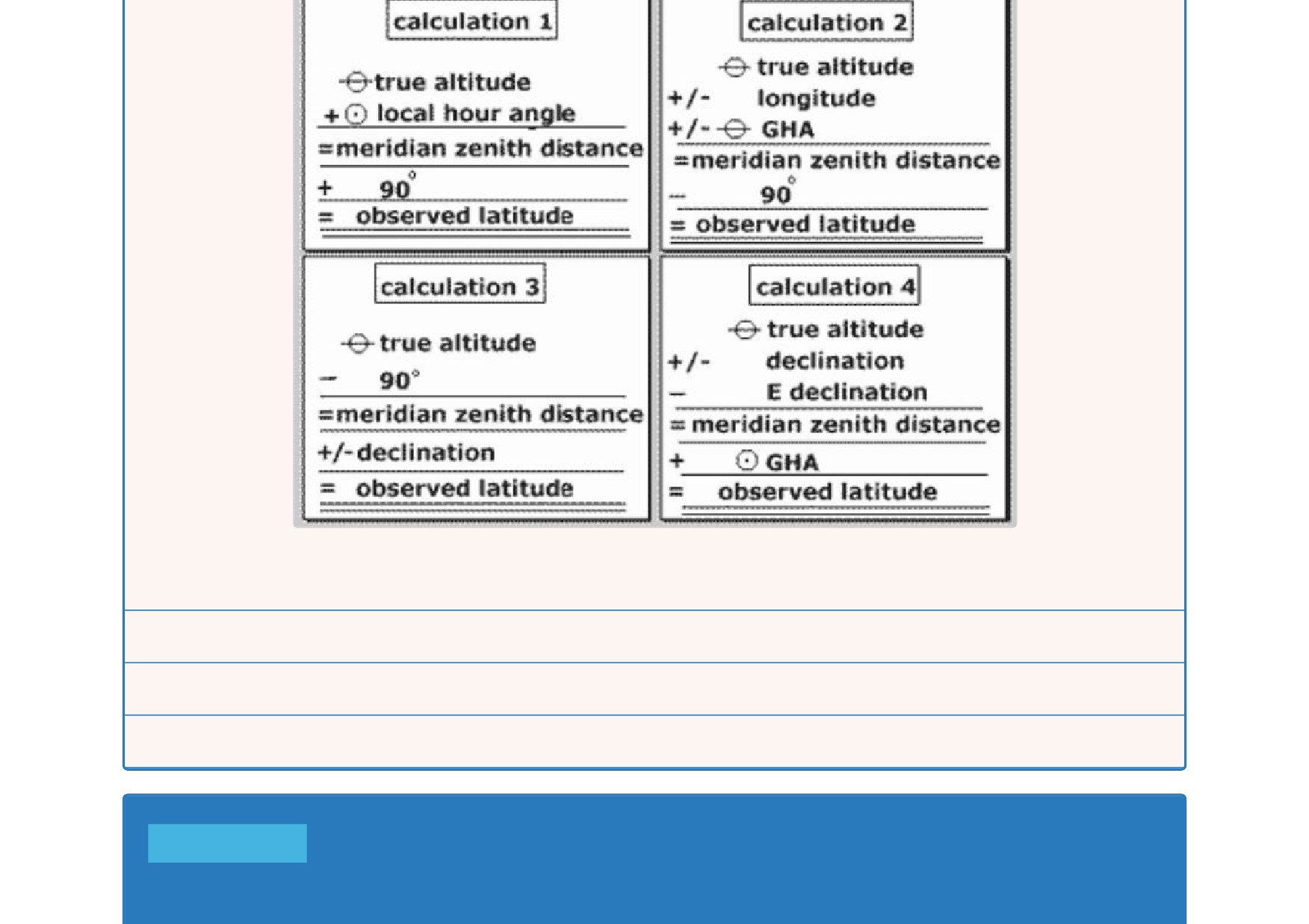
Calculation 3 is correct. (+)
Calculation 4 is correct.
Calculation 2 is correct.
Calculation 1 is correct.
Code: WBOG What are the immediate duties of the bridge Officer of the
What are the immediate duties of the bridge Officer of the
Watch when the ship suddenly runs into a fog bank?
Commence sounding the fog signal, engines on standby, call the Master and lookout, if not already on duty.(+)
Commence sounding the fog signal and reduce speed to Slow Ahead.
Commence sounding the fog signal and call the Master and wait for him to arrive before taking any further actions.
Commence sounding the fog signal and if the radar indicates no echoes in the vicinity, proceed at the normal speed until
ships are detected on the radar or until the fog lifts.
Code: XPMH What, by definition in the International Collision Regulations, is a
“vessel restricted in her ability to manoeuvre”?
A vessel which from the nature of her work is restricted in her ability to manoeuvre as required by the Rules and is
therefore unable to keep out of the way of another vessel. (+)
A vessel engaged in underwater work, such as the laying, picking up or servicing of a pipeline, or which is in support of
diving operations, performing dredging and mineclearance or is deploying or recovering a pilot.
A vessel which because of her draught in relation to the available depth of navigable water is restricted in her ability to
deviate from her course and keep out of the way of another vessel.
A vessel which through some exceptional circumstance is unable to manoeuvre as required by the Rules and is therefore
unable to keep out of the way of another vessel.
Code: DXHH You are approaching a port in a snowstorm. You hear this signal.
What kind of vessel is it and what is it doing?
It comes from a vessel engaged in pilotage duties and it is making way through the water. (+)
It comes from a vessel engaged in pilotage duties at anchor, over 100 metres in length.
It comes from a vessel at anchor, less than 100 metres in length.
It comes from a vessel restricted in her ability to manoeuvre.
Code: UBYW Who is responsible for the number and the position of any tugs
to be used during a mooring operation?
The Master, with consideration of the advice of the pilot. (+)
The Port Authority will dictate the tug requirements and their use within the port limits.
It will be only the wind speed that will determine the required number of tugs and how they are used.
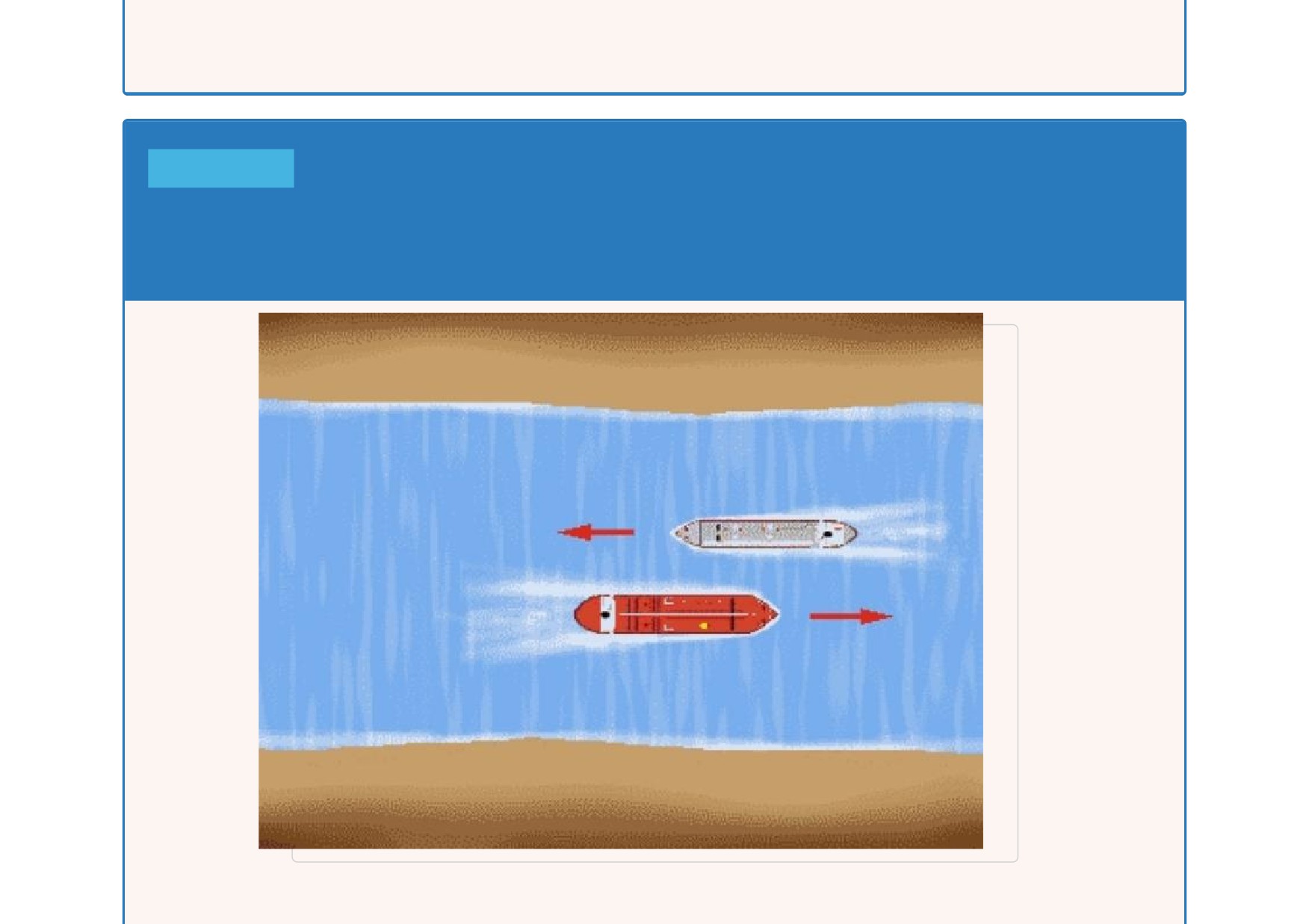
The Pilot is fully responsible for the number and use of tugs within the port area.
Code: SBVS Two ships travelling in opposite directions are to pass each other
in a narrow river, as illustrated. Explain what is likely to happen as they pass
each other?
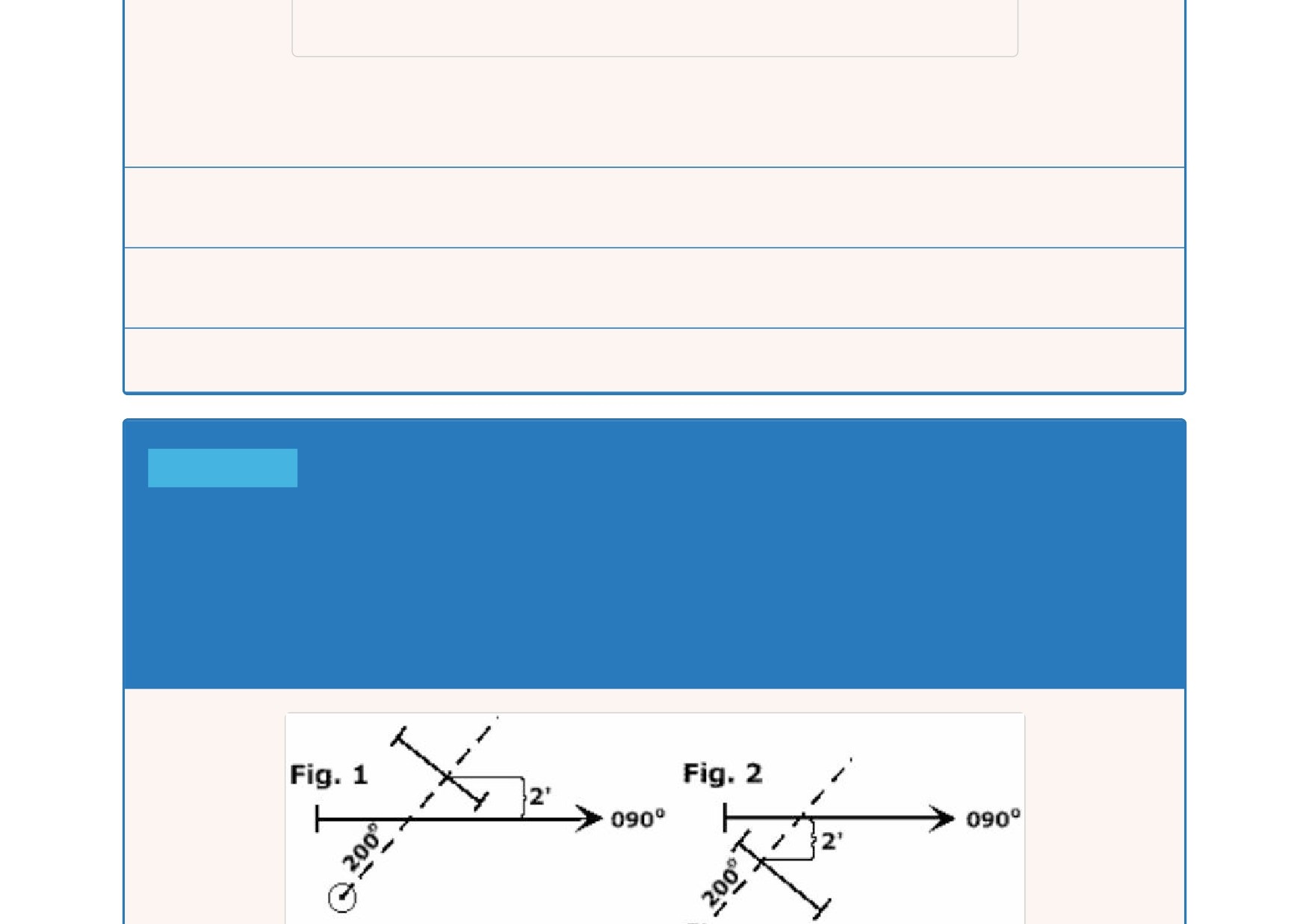
Due to interaction, the bows will repel each other, and then when alongside each other the two ships will be sucked
together and finally the sterns will be repelled as they start to pass clear. (+)
Due to interaction, the bows will attract each other as they approach, then they will repel each other alongside and as they
pass clear, the sterns will be attracted.
As they approach, rudder should be applied quickly to avoid sheering into the path of each other. Then as they are
alongside they will be attracted and finally repel each other as they pass clear.
There will be very little effect between the two ships as they pass.
Code: HEVD Which of the four figures illustrated shows the correct position
line for the following situation: Latitude 50° 00′ N, Longitude 30° 00′ W, Time
1200 GMT. Course steered: 090° True, Speed: 12 knots, bearing of the sun:
200°, Intercept correction: 00° 02′ Towards (observed altitude - computed
altitude).
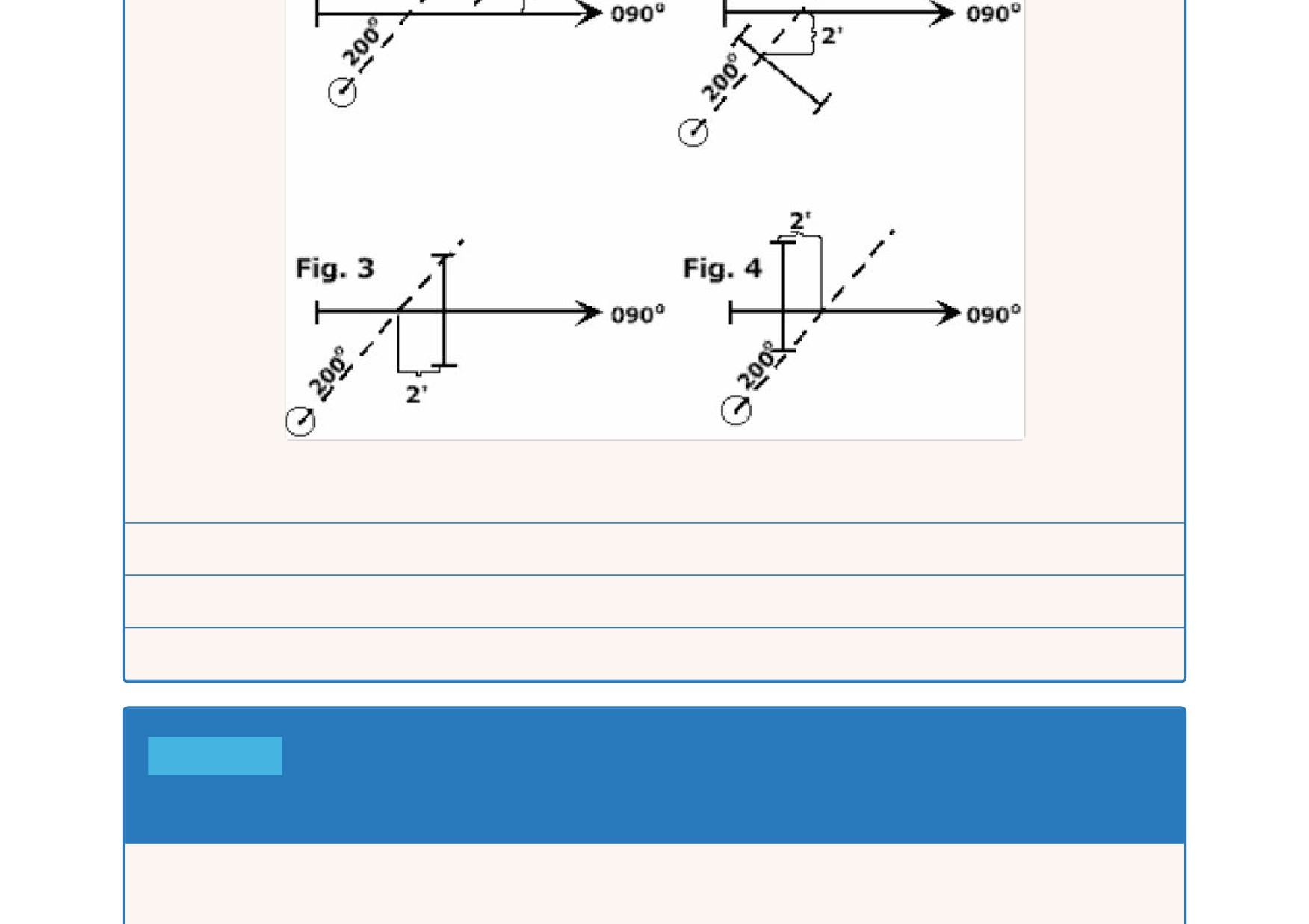
Figure 1 is correct. (+)
Figure 2 is correct.
Figure 3 is correct.
Figure 4 is correct.
Code: JUIS The maximum rudder angle on your ship is 35°. Do you think this
is the angle that the rudder is most effective?
No, the most effective rudder angle is about 25 to 30°, this is because the rudder is stalling at 35° angle.(+)
Yes, the rudder is most effective at max angle.
No, the rudder is most effective at angles between 10 and 20°.
No, the rudder is most effective at small rudder angles.
Code: RCFG What methods could be introduced into a passage plan for
continuous monitoring of the ships position when navigating along a
coastline?
Parallel Index lines. (+)
The radar ranges of the coastline at all course alteration points.
Conspicuous headlands and navigational marks for taking positions.
All of the suggested answers.
Code: YUVN What are the additional duties required by the Officer of the
Watch when navigating in fog?
Sound fog signal, effective radar watch reporting ship movements to Master and keep a good lookout for ships and fog
signals. (+)
When navigating in fog the Master will take over the watch and the Officer of the Watch should follow all of his instructions.
Sound fog signal, plot positions and keep a good lookout.
All of the suggested answers.
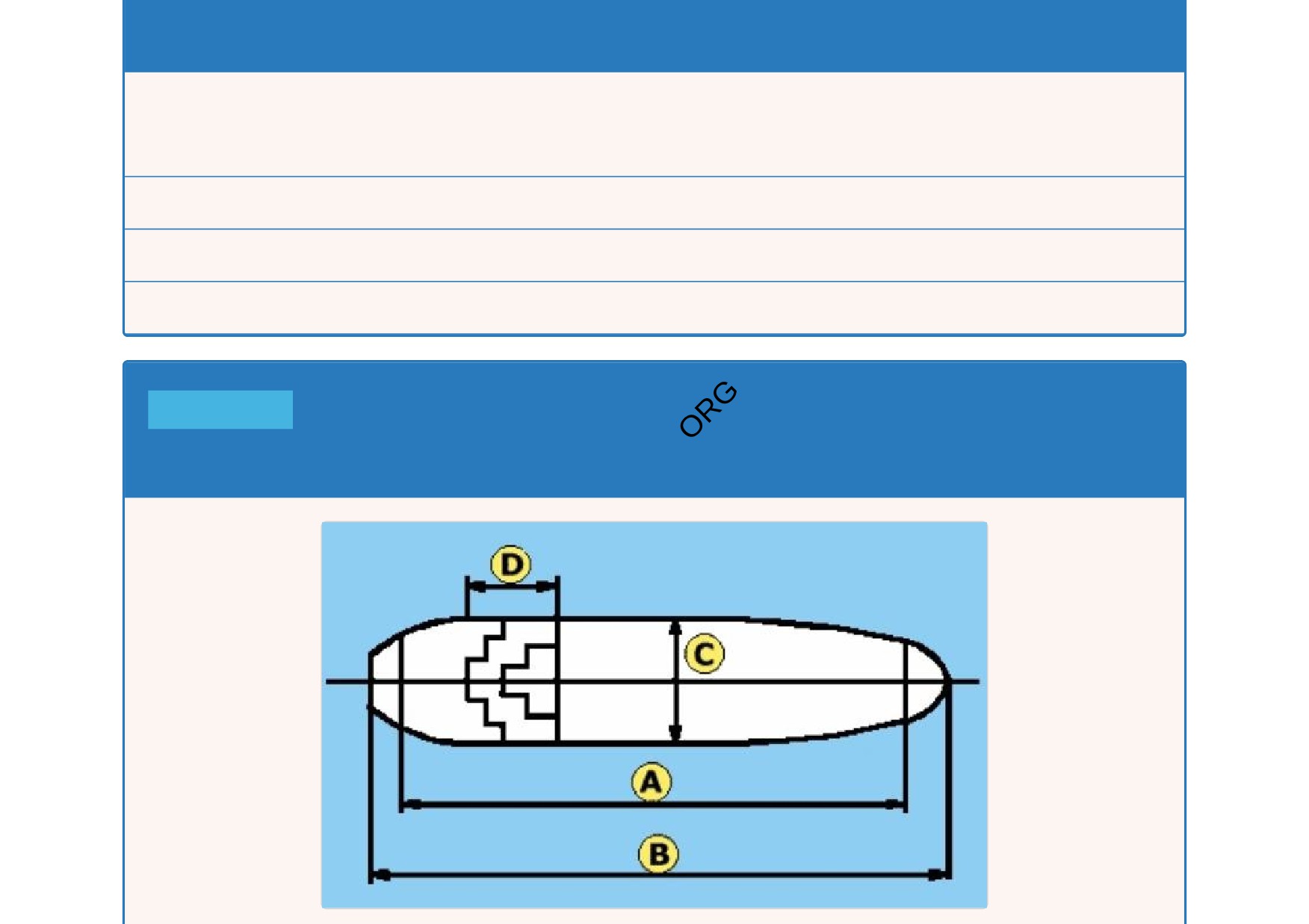
Code: YTTD In the figure, which letter gives the correct understanding of the
term “LENGTH OVERALL”?
Length Overall is indicated by B, in the figure. (+)
Length Overall is indicated by D, in the figure.
Length Overall is indicated by A, in the figure.
Length Overall is indicated by C, in the figure.
Code: IPJW In an extreme case, in addition to having your winch brakes as
tight as can be, you can increase the brake holding capacity of the winch
drum by putting it in gear and setting the power to the “heave” position.
However this may cause:
All the listed alternatives. (+)
The increased braking power of the winch to exceed the breaking strength of the wire and rope paid out from it which
might cause the wire or rope to part.
Strain on the fairleads and rollers in use in excess of their Safe Working Load.
Damage to the winch by distorting the shaft.
Code: LGSE How can the effects of Squat be minimized, when a ship is
proceeding in shallow water?
Maintain a slow speed just sufficient to maintain steerage. (+)
Maintain a speed of about 6 knots and use minimal rudder when manoeuvring.
Enter the shallow water with a stern trim and proceed at a moderate speed.
Decrease the speed and keep this ship to the centre of the channel where the water is probably deepest.
Code: NBTI A ship normally turns (swings) around a point which is not the
centre of gravity. What is this point normally called?
Pivot Point. (+)
Centre of Floatation.
Centre of Turn.
Centre of Buoyancy.
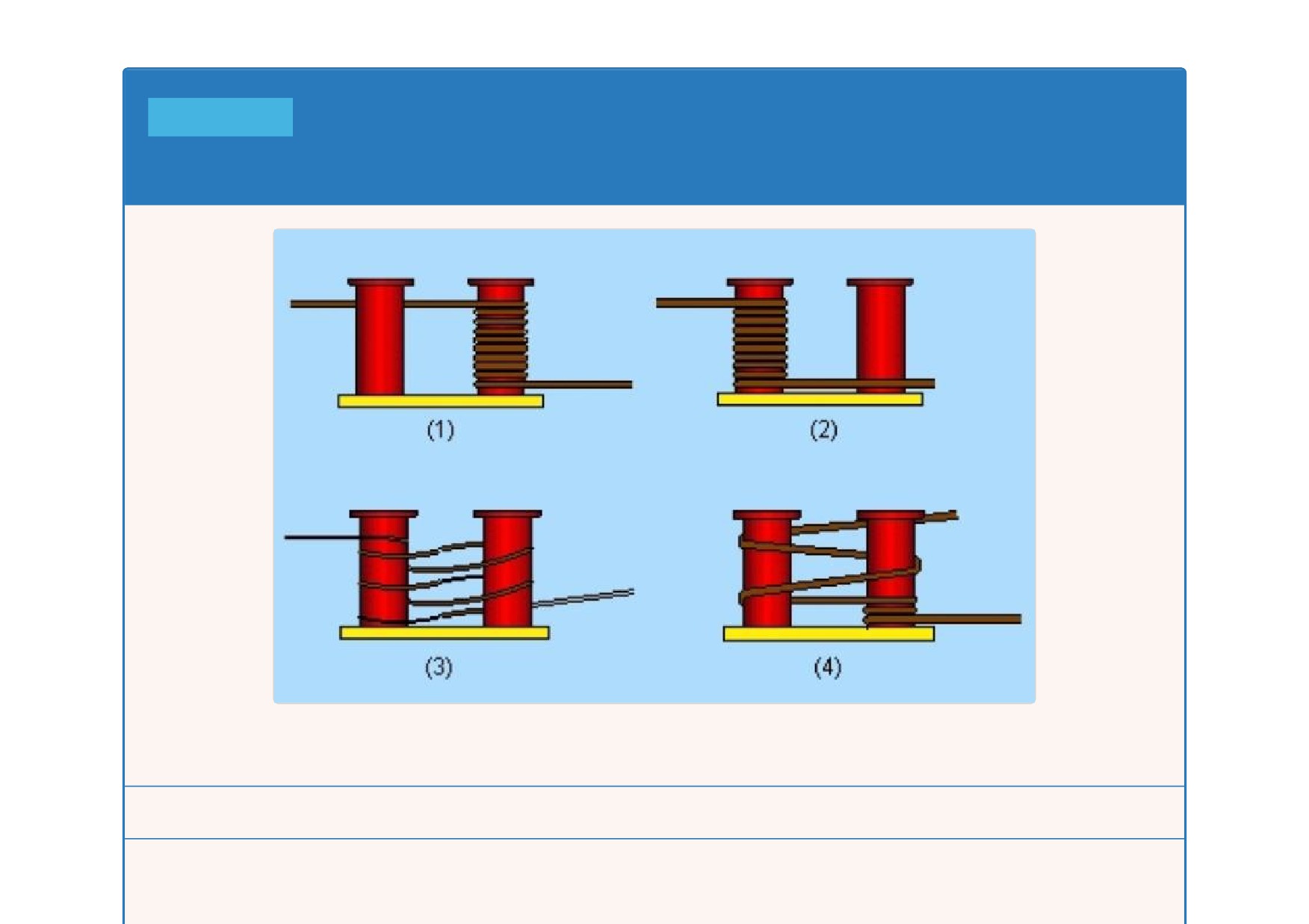
Code: UFAB When fastening synthetic fibre ropes such as polypropylene on
bitts, for safety and better rope control it is recommended to:
Make two round turns fast on the leading bitt and then figure of eight on both bitts, fig. 4. (+)
Make it fast on the second bitt alone, fig. 2.
Make it fast with round turns on the leading bitt alone, fig. 1.
Make it fast in a figure of eight fashion, fig. 3.
Code: GKPK The vessel is steaming off the coast when the engine room
informs the bridge it must stop engines immediately. Shortly afterwards they
informed the bridge they would need a least three hours to fix it. Which of
the following actions would be the most suitable taken by the bridge?
Display the NUC signal, maintain the watch and determine how the ship is drifting and the probable position after 3 hours.
(+)
Display the NUC signal, maintain the watch and ask the Engine room to be a quick as possible.
Display the NUC signal, maintain the watch and wait for further developments.
Display the NUC signal and keep a good lookout.
Code: JGAE Visual signals are used by aircraft in search and rescue
operations to direct ships towards a casualty. The signals shown here are
part of a sequence. What does it indicate?
The assistance of your vessel is no longer required. (+)
The aircraft is directing a vessel towards the casualty.
The aircraft is short on fuel and is returning to base.
The casualty is sighted and will require medical assistance.
Code: LRNP The maximum height that a pilot should be required to climb on a
pilot ladder before reaching the deck or stepping onto an accommodation
ladder platform is:
9 mtrs. (+)
15 mtrs.
6 mtrs.
12 mtrs.
Code: BFHQ How will the ship behave if it experiences a complete loss of
power (black out) in the situation illustrated?
The vessel will gradually swing to port and the speed will slowly reduce. (+)
The vessel will gradually swing to starboard and the speed will slowly reduce.
The wind will push the vessel sideways, but the heading will not change.
The vessel will continue on course and the speed will slowly reduce.
Code: CLUY Is the location of the Compass Binnacle critical?
Yes, for the reasons stated in all of the suggested answers. (+)
Yes, it should be on the fore and aft centreline of the ship.
Yes, it should be away from all electrical power cables.
Yes, it should be sited on a nonmetallic base if possible.
Code: QLFS What corrections must be applied to the echo sounder reading to
compare the depth of water with the depth printed on the chart?
Draught of the ship. (+)
Allowance for the ships speed.
Shallow water effects.
The distance between the pulse Transmitter and Receiver.
Code: HNWY A balanced rudder has some of the rudder area forward of the
rudder axis. About how much area should this be to call it a balanced
rudder?
It should be about 20 %. (+)
It should be about 5 %.
It should be about 55 %.
It should be about 50 %.
Code: YXYL Where would the “pivot point” be considered to be located when
the ship is proceeding at full speed ahead and there is no wind or current?
At about 1/6 of the ship’s length from the bow. (+)
At about 1/6 of the ship’s length from the stern.
At amidships.
At a position near the stern of the ship.
Code: RXRE The rudder is in the hard over position with the propeller stopped
and the ship turning slowly. On a ship with a single fixed pitch right handed
propeller and no thrusters, what can be done to make the ship increase the
speed of turn without significantly increasing the forward speed of the ship?
Give the engines a short kick ahead. (+)
Give dead slow ahead on the engines and leave the rudder in the hard over position.
Give half astern on the engines as this will increase the rate of turn.
Give full astern on the engines until ship has stopped and then full ahead on the engines with rudder hard over.
Code: WAVF You are on a tug and are towing an unmanned barge. You are
restricted in your ability to manoeuvre. The total length of the tow is 219
metres. What daylight signals are required by the International Regulations
for Preventing Collisions at Sea?
A diamond shape, where it can best be seen shall be displayed on the tug and the tow. Three shapes shall also be
displayed in a vertical line, the upper and lower being balls and the middle one a diamond. Diamond shape. (+)
Three shapes shall be displayed on the tug, where they can best be seen, in a vertical line, the upper and lower being
balls and the middle one a cylinder. The signal flag “T” shall also be flown on the tug. A diamond shall be displayed aft on the
tow.
Three shapes shall be displayed forward on the tug, in a vertical line, the upper and lower being balls and the middle one a
diamond.
A diamond shape, where it can best be seen, on the tug only. Three shapes shall also be displayed, being three balls in a
vertical line.
Code: AFQY What is the weather associated with being in the centre of an
Anticyclone (a region of High Pressure)?
Light winds and fair weather, sometimes fog. (+)
Persistent rain and very humid weather.