CHEMICAL, BIOLOGICAL, RADIOLOGICAL, AND NUCLEAR DEFENSE (CBRND) FUNCTIONAL NEEDS ANALYSIS. FINAL REPORT (2005) - page 1

CHEMICAL, BIOLOGICAL, RADIOLOGICAL,
AND NUCLEAR DEFENSE (CBRND)
FUNCTIONAL NEEDS ANALYSIS/
FUNCTIONAL SOLUTIONS ANALYSIS
FINAL REPORT
December 2005
Prepared for
Joint Requirements Office for CBRND
by
Battelle Crystal City Operations
Arlington, Virginia
Contract No. SPO700-00-D-3180
FOR OFFICIAL USE ONLY
For Official Use Only
CBRND Functional Needs Analysis/Functional Solution Analysis
Table of Contents
Table of Contents
Chapter
1. Introduction
Chapter
2. Strategic National Sense
Chapter
3. Strategic Theater Sense
Chapter
4. Operational Sense
Chapter
5. Tactical Sense
Chapter
6. Strategic National Shape
Chapter
7. Strategic Theater Shape
Chapter
8. Operational Shape
Chapter
9. Tactical Shape
Chapter
10. Strategic National Shield
Chapter
11. Strategic Theater Shield
Chapter
12. Operational Shield
Chapter
13. Tactical Shield
Chapter
14. Strategic National Sustain
Chapter
15. Strategic Theater Sustain
Chapter
16. Operational Sustain
Chapter
17. Tactical Sustain
For Official Use Only
For Official Use Only
CBRND Functional Needs Analysis/Functional Solution Analysis
Chapter 1. Introduction
CHAPTER 1. INTRODUCTION
For Official Use Only
For Official Use Only
CBRND Functional Needs Analysis/Functional Solution Analysis
Chapter 1. Introduction
Executive Summary
This document presents the results of the Functional Needs Analysis/Functional Solutions
Analysis (FNA/FSA) for the functional area of chemical, biological, radiological, and nuclear
defense (CBRND). The FNA/FSA are structured in accordance with the Chairman of the Joint
Chief of Staff Instruction (CJCSI) 3170.01D, Joint Capabilities Integration and Development
System (JCIDS), and its companion manual, CJCSM 3170.01A, Operation of the Joint
Capabilities Integration and Development System.
The JCIDS analysis process is composed of a structured, four-step methodology that defines
functional tasks, capabilities to perform the tasks, capability gaps, and potential non-materiel and
materiel solutions. Based on national defense policy and centered on a common joint warfighting
construct, the analyses initiate the formal development of integrated joint capabilities, to include
the identification and justification of requirements necessary to initiate development and
acquisition. The requirements are derived from an analysis of existing joint force operations and
include doctrine, organization, training, materiel, leadership and education, personnel, and
facilities (DOTMLPF) capabilities and deficiencies.
The FNA and FSA analyze and build upon the tasks identified in the previously published
Functional Area Analysis (FAA). (The Protection Functional Control Board approved the
CBRND FAA on 6 January 2005.) The FNA identifies and assesses the capabilities of the joint
force to perform the FAA tasks to designated standards while operating under various (physical,
military, and civil) conditions. The resulting capability gaps will be prioritized via the Joint
Priority List (JPL) process. The gaps identified within this FNA are addressed in the FSA. First,
non-materiel (or DOTLPF) solutions to these capability gaps are considered. Then, for those
capability gaps that are not fully addressed by non-materiel solutions, potential materiel solutions
are considered and presented as Ideas for Materiel Approaches (IMAs).
The FNA/FSA retains the structure of the FAA, and for the purpose of clarity, carries over some
information from the FAA. In particular, the FNA/FSA restates for each task the following
information:
• task title
• task definition
• derivation
• conditions
The task categorization structure of the FAA is reflected in the FNA and FSA in that tasks are
categorized by level of war and “S” area. The levels of war, as found in the Universal Joint Task
List (UJTL) are designated as follows:
• Strategic National (SN)
• Strategic Theater (ST)
• Operational (OP)
• Tactical (TA)
i
For Official Use Only
For Official Use Only
CBRND Functional Needs Analysis/Functional Solution Analysis
Chapter 1. Introduction
The four “S” areas reflect the operational elements found in the Protection Joint Functional
Concept:
• Sense
• Shape
• Shield
• Sustain
For each task, the following are highlighted within the FNA:
• Current capabilities and deficiencies
• Projected Near-/Mid-Term (FY2006-FY2011) capabilities and deficiencies
• Projected Far-Term (FY2012-FY2020) capabilities and deficiencies
Similarly, within the FSA, the following assessments are made:
• DOTLPF solution assessment
• IMA assessment
The capability assessment of each area considered by operational “S” area and level of war is
shown in the following table. The overall assessment for the area of CBRN defense is “yellow”
in the current, near/mid, and far term.
Capability
Operational “S” Area by Level of War
Current
Near/Mid
Far
Strategic National Sense
•
•
•
Strategic Theater Sense
•
•
•
Operational Sense
•
•
•
Tactical Sense
•
•
•
Strategic National Shape
•
•
•
Strategic Theater Shape
•
•
•
Operational Shape
•
•
•
Tactical Shape
•
•
•
Strategic National Shield
•
•
•
Strategic Theater Shield
•
•
•
Operational Shield
•
•
•
ii
For Official Use Only

For Official Use Only
CBRND Functional Needs Analysis/Functional Solution Analysis
Chapter 1. Introduction
Capability
Operational “S” Area by Level of War
Current
Near/Mid
Far
Tactical Shield
•
•
•
Strategic National Sustain
•
•
•
Strategic Theater Sustain
•
•
•
Operational Sustain
•
•
•
Tactical Sustain
•
•
•
OVERALL
•
•
•
The CBRND FNA/FSA is split into 17 separate chapters (or volumes), as follows:
CBRND FNA/FSA Chapters
Chapter
Title
Number
1
Introduction
2
Strategic National Sense Tasks
3
Strategic Theater Sense Tasks
4
Operational Sense Tasks
5
Tactical Sense Tasks
6
Strategic National Shape Tasks
7
Strategic Theater Shape Tasks
8
Operational Shape Tasks
9
Tactical Shape Tasks
10
Strategic National Shield Tasks
11
Strategic Theater Shield Tasks
12
Operational Shield Tasks
13
Tactical Shield Tasks
14
Strategic National Sustain Tasks
15
Strategic Theater Sustain Tasks
16
Operational Sustain Tasks
17
Tactical Sustain Tasks
iii
For Official Use Only
For Official Use Only
CBRND Functional Needs Analysis/Functional Solution Analysis
Chapter 1. Introduction
Table of Contents
Executive Summary
i
List of Acronyms
v
1.0
Introduction
1
1.1
Background
1
1.2
Analysis Objective
2
1.3
Threat Characterization
2
1.4
Methodology
24
1.5
Task Analysis Structure
37
1.6
Report Structure
37
1.7
References
38
List of Figures
Figure 1-1. Comparative Effective Doses (mg) of Biological Warfare, Toxins, and
Chemical Warfare Agents
6
Figure 1-2. Biological Weapon Attack Aerosol Concentrations Superimposed on Natural
Bioaerosol Background at Ft. Sill, Oklahoma
7
Figure 1-3. Airborne Bacterial Concentration Fluctuation in a Single Day
8
Figure 1-4. CBRND Operational Elements
25
Figure 1-5. CBRND FNA and FSA Architectures
27
Figure 1-6. Quantified Criterion Relationship
32
List of Tables
Table 1-1. Pathogens and Toxins of Military Importance and Selected Properties
20
Table 1-2. Radioactive Materials of Military Significance and Selected Properties
21
Table 1-3. Example Measures
32
Table 1-4. Capability Color Coding
34
iv
For Official Use Only
For Official Use Only
CBRND Functional Needs Analysis/Functional Solution Analysis
Chapter 1. Introduction
List of Acronyms
AAS
Advanced Anticonvulsant System
ABCA
American, British, Canadian, and Australian Armies Program
ACADA
Automated Chemical Agent Detector Alarm
AChE
acetylcholinesterase
ACPLA
agent-containing particle(s) per liter of air
ACSA
Acquisition Cross-Service Agreement
A/C SPO
aircraft system program office
ACTD
Advanced Concept Technology Demonstration
AE
aeromedical evacuation
AERP
Aircrew Eye/Respiratory Protection
AF/ILEXR
Air Force Civil Engineer Readiness Program Branch
AFB
Air Force Base
AFCESA
Air Force Civil Engineer Support Agency
AFMIC
Armed Forces Medical Intelligence Center
AFRL
Air Force Research Laboratory
AMEDD
Army Medical Department
AJP
Allied Joint Publication
AMA
Analysis of Materiel Approaches
AO
area of operations
AOR
area of responsibility
AT/FP
antiterrorism/force protection
ATP-45
Allied Technical Protocol 45
BAWS
Biological Agent Warning Sensor
BDO
Battle Dress Overgarment
BIDS
Biological Integrated Detection System
BSK
Biological Sampling Kit
BTWC
Biological and Toxin Weapons Convention
BVO
Black Vinyl Overboot
BW
biological warfare
BWA
biological warfare agent
C2
Command and Control
C4ISR
Command, Control, Communications, Computers, Intelligence,
Surveillance, and Reconnaissance
CAM
chemical agent monitor
CAP
crisis action planning
CAPDS
Chemical Agent Point Detector System
CARC
chemical agent-resistant coating
CASCOM
Combined Arms Support Command
CB
chemical and biological
CBA
capabilities-based assessment
CBMS
Chemical Biological Mass Spectrometer
CBPS
Chemically and Biologically Protected Shelter
CBRD
chemical, biological, and radiological defense
CBRN
chemical, biological, radiological, and nuclear
v
For Official Use Only
For Official Use Only
CBRND Functional Needs Analysis/Functional Solution Analysis
Chapter 1. Introduction
CBRND
chemical, biological, radiological, and nuclear defense
CBRNE
chemical, biological, radiological, nuclear, and high-yield explosives
CCA
contamination control area
CDC
Centers for Disease Control
CDI
Cooperative Defense Initiative
CFFC
Commander Fleet Forces Command
CFU
colony-forming unit
CJCS
Chairman of the Joint Chiefs of Staff
CJCSI
Chairman of the Joint Chiefs of Staff Instruction
CJCSM
Chairman of the Joint Chiefs of Staff Manual
CM
consequence management
CMWD
countermeasures washdown system
COA
course of action
COCOM
combatant command
COG
center of gravity
COLPRO
collective protection
COMINT
communication intelligence
CONOPs
Concept of Operations
CONUS
continental United States
COP
Common Operating Picture
COTS
commercial off-the-shelf
CRP
Contaminated Remains Pouch
CP-DEPMEDS
Chemically Protected Deployable Medical System
CPE
collective protection equipment
CPFC
Chemical Protective Footwear Cover
CPG
Chemical Protective Glove
CPHS
Chemical Protective Helmet System
CPOG
Chemical Protective Over-Garment
CPS
collective protection shelter, or collective protection system
CPU
Chemical Protective Undergarment
CRTI
(Canadian) CBRN Research and Technology Initiative
CW
chemical warfare
CWA
chemical warfare agent
CWC
Chemical Weapons Convention
DCI
Director of Central Intelligence
DCR
DOTMLPF Change Recommendation
DFU
Dry Filter Unit
DIA
Defense Intelligence Agency
DISA
Defense Information Systems Agency
DITSCAP
DoD Information Technology Security Certification and Accreditation
Process
DMSS
Defense Medical Surveillance System
DNA
deoxyribose nucleic acid
DoD
U.S. Department of Defense
DOT
U.S. Department of Transportation
vi
For Official Use Only
For Official Use Only
CBRND Functional Needs Analysis/Functional Solution Analysis
Chapter 1. Introduction
DOTLPF
doctrine, organization, training, leadership and education, personnel, and
facilities
DOTMLPF
doctrine, organization, training, materiel, leadership and education,
personnel, and facilities
DTRA
Defense Threat Reduction Agency
DTRIAC
Defense Threat Reduction Information Analysis Center
DU
depleted uranium
ECP
expedient collective protection
EDS
electrostatic decontamination system
EMP
electromagnetic pulse
EMS
emergency medical services
EOD
explosive ordinance disposal
EPW
enemy prisoner of war
ESF
Emergency Support Function
ESRCBH
Environmental Sheltering with Reduced CB Hazard
FAA
Functional Area Analysis
FAO
Food and Agriculture Organization (of the United Nations)
FDA
Food and Drug Administration
FM
frequency modulation
FM
Field Manual
FMFM
Fleet Marine Forces Manual
FNA
Functional Needs Analysis
FOC
fully operationally capable
FOUO
for official use only
FP
force protection
FSA
Functional Solutions Analysis
FTIR
Fourier transform infrared
GB
sarin
GCCS
Global Command and Control System
GCCS-J
Joint Global Command and Control System
GC/MS
gas chromatography/mass spectrometer (or spectrometry)
GD
soman
GEIS
Global Emerging Infections Surveillance and Response System
GF
cyclosarin
GIG
Global Information Grid
GIS
geographical information system
GM
Geiger-Mueller
GOTS
government off-the-shelf
GPS
Global Positioning System
GVO
Green Vinyl Overboot
HD
sulfur mustard
HHA
handheld assay
HLS
homeland security
HQ
Headquarters
HRP
Human Remains Pouch
HTA
high-threat area
vii
For Official Use Only
For Official Use Only
CBRND Functional Needs Analysis/Functional Solution Analysis
Chapter 1. Introduction
HTH
high-test hypochlorite
HUMINT
human intelligence
IA
Implementing Arrangement
IADDS
Information Assurance Defense in Depth Standards
IAEA
International Atomic Energy Agency
IAW
in accordance with
IBADS
Interim Biological Agent Detection System
IC
intelligence community
ICAM
Improved Chemical Agent Monitor
ICD
Initial Capabilities Document
IDLH
immediately dangerous to life or health
IDN
Integrated Detection Network
IMA
Ideas for Materiel Approaches
IMINT
imagery intelligence
IMS
ionization/ion mobility spectrometry
IND
investigational new drug
IOC
initial operational capability
IPDS
Improved Chemical Agent Point Detection System
IPE
individual protective equipment
IPT
Integrated Process Team
IR
infrared
IT
information technology
ITF
International Task Force
ITWA
Initial Threat Warning Assessment
JBAIDS
Joint Biological Agent Identification and Diagnostic System
JBPDS
Joint Biological Point Detection System
JBSDS
Joint Biological Standoff Detection System
JCAD
Joint Chemical Agent Detector
JCBAWM
Joint Chemical Biological Agent Water Monitor
JCESM
Joint Service Chemical Environment Survival Mask
JCIDS
Joint Capabilities Integration and Development System
JCSD
Joint Chemical Surface Detector
JDOMS
Joint Director of Military Support
JECP
Joint Expeditionary Collective Protection
JEM
Joint Effects Model
JFC
Joint Force Commander, or Joint Functional Concept
JFCOM
Joint Forces Command
JFIRE
Joint Firefighter’s Integrated Response Ensemble
JFOC
Joint Future Operational Capability
JFSC
Joint Forces Staff College
JIC
Joint Integrating Concept, or Joint Intelligence Center
JISE
joint intelligence support element
JLOTS
Joint Logistics over the Shore
JMAO
Joint Mortuary Affairs Office
JMCBDS
Joint Modular Chemical and Biological Detection System
JMET
Joint Mission Essential Task
viii
For Official Use Only
For Official Use Only
CBRND Functional Needs Analysis/Functional Solution Analysis
Chapter 1. Introduction
JMETL
Joint Mission Essential Task List
JMSEL
Joint Master Scenario Events List
JNBCRS
Joint NBC Reconnaissance System
JNTC
Joint National Training Center
JOA
Joint Operations Area
JOC
Joint Operating Concept
JOEF
Joint Operational Effects Federation
JP
Joint Publication
JPACE
Joint Protective Aircrew Ensemble
JPDS
Joint Portable Decontamination System
JPID
Joint Platform Interior Decontamination
JPL
Joint Priority List
JPME
Joint Professional Military Education
JPM-IS
Joint Program Manager for Information Systems
JROC
Joint Requirements Oversight Council
JRO-CBRND
Joint Requirements Office for Chemical, Biological, Radiological, and
Nuclear Defense
JSAM
Joint Service Aircrew Mask
JSGPM
Joint Service General Purpose Mask
JSIG
Joint Service Integration Group
JSLIST
Joint Service Lightweight Integrated Suit Technology
JSLNBCRS
Joint Services Lightweight NBC Reconnaissance System
JSLSCAD
Joint Service Lightweight Standoff Chemical Agent Detector
JSMG
Joint Service Materiel Group
JSPDS
Joint Service Personnel/Skin Decontamination System
JSSED
Joint Service Sensitive Equipment Decontamination
JSTDS (LS, SS)
Joint Service Transportable Decontamination System (Large Scale, Small
Scale)
JTCOPS
Joint Transportable Collective Protection System
JTF
Joint Task Force
JTMEP
Joint Medical Evacuation Program
JTTPs
Joint Tactics, Techniques, and Procedures
JULLS
Joint Universal Lessons Learned System
JWARN
Joint Warning and Reporting Network
JWC
Joint Warfighting Center
LC/MS
liquid chromatography/mass spectrometer (or spectrometry)
LIDAR
light detection and ranging
LIF
laser-induced fluorescence
M&S
modeling and simulation
MA
Mortuary Affairs
MAA
Mission Area Analysis
MADCP
Mortuary Affairs Decontamination Collection Point
MALDI-TOF
Matrix-Assisted Laser Desorption Ionization-Time of Flight
MANSCEN
Maneuver Support Center
MAT
Medical Analysis Tool
MCCDC
Marine Corps Combat Development Command
ix
For Official Use Only
For Official Use Only
CBRND Functional Needs Analysis/Functional Solution Analysis
Chapter 1. Introduction
MeV
megaelectron-volt
MFR
Multi-Function Radiation
MGPTS
Medium General Purpose Tent System
MIS
Medical Information System
MMC
materiel management center
MNA
Mission Need Analysis
MOPP
Mission-Oriented Protective Posture
MORS
Military Operations Research Society
MORSS
Military Operations Research Society Symposium
MOU/A
memorandum of understanding/agreement
MOUT
Military Operations in Urban Terrain
MS
mass spectrometer (or spectrometry)
MSDS
Material Safety Data Sheet
MULO
Multi-purpose Overboot
MWA
military working animal
MWD
military working dog
MWE
military working equine
NARAC
National Atmospheric Release Advisory Center
NATO
North Atlantic Treaty Organization
NBC
nuclear, biological, and chemical
NBCRS
NBC Reconnaissance System
NBCRV
NBC Reconnaissance Vehicle
NCES
Net-Centric Enterprise Services
NEO
noncombatant evacuation operations
NFPA
National Fire Protection Association
NGO
nongovernmental organization
NIOSH
National Institute for Occupational Safety and Health
NIST
National Intelligence Support Team
NMCA
National Military Command Authority
NMCC
National Military Command Center
NMJIC
National Military Joint Intelligence Center
NORAD
North American Aerospace Defense Command
NR-KPP
Net Ready Key Performance Parameter
NSS
National Security Strategy
NSTM
Naval Ships Technical Manual
O/C
observer/controller
OCONUS
outside the Continental United States
OP
Operational
OPCW
Organisation for the Prohibition of Chemical Weapons
OPLAN
Operations Plan
OPME
Officer Professional Military Education
OPNAV
Office of the Chief of Naval Operations
OPTEMPO
operations tempo
ORD
Operational Requirements Document
OSD
Office of the Secretary of Defense
OSHA
Occupational Safety and Health Administration
x
For Official Use Only
For Official Use Only
CBRND Functional Needs Analysis/Functional Solution Analysis
Chapter 1. Introduction
PACOM
Pacific Command
PAPR
powered air-purifying respirator
PARP
poly(ADP-ribose) polymerase
PB
pyridostigmine bromide
PCR
polymerase chain reaction
PD
passive defense
PE
personal effects
PFU
plaque-forming unit
PID
photoionization detector
PIR
priority intelligence requirement
PIRS
photoacoustic infrared spectroscopy
PIU
patient isolation unit
POD
port of debarkation
POE
port of embarkation
POL
petroleum, oil, and lubricants
POM
program objective memorandum
POW
prisoner of war
QDR
Quadrennial Defense Review
QSTAG
Quadripartite Standardization Agreement
R2
rest and recuperation
RADIAC
radiation detection, identification, and computation
RAPID
Ruggedized Advanced Pathogen Identification Device
R&D
research and development
RDD
Radiological Dispersal Device
RD&E
research, development and engineering
RDECOM
Research Development and Engineering Command
RDTE&A
research, development, test, evaluation and acquisition
RESTOP
Restoration Operations
ROMO
range of military operations
ROTA
release other than attack
ROWPU
Reverse Osmosis Water Purification Unit
RSOI
reception, staging, onward movement, and integration
RT-PCR
real-time polymerase chain reaction
SAM
Surveillance and Measurement
SARS
Severe Acute Respiratory Syndrome
SAW
surface acoustic wave
SCBA
self-contained breathing apparatus
SDS
Sorbent Decontamination System
SENS
Sense
SERS
surface-enhanced Raman spectroscopy
SHA
Shape
SHLD
Shield
SITREP
situation report
SJFHQ
standing joint force headquarters
SJTF
Standing Joint Task Force
SME
subject matter expert
xi
For Official Use Only
For Official Use Only
CBRND Functional Needs Analysis/Functional Solution Analysis
Chapter 1. Introduction
SN
Strategic National
SOCOM
Special Operations Command
SOF
special operations force
SOP
standard operating procedure
SPOD
Seaport of Debarkation
SPOE
Seaport of Embarkation
ST
Strategic Theater
STANAG
Standardization Agreement
STB
super tropical bleach
SUST
Sustain
TA
Tactical
TBP
to be published
TDA
table of distribution and allowances
TEMPER
Tent, Expandable, Modular, Personnel
TEP
Theater Engagement Plan
TEU
Technical Escort Unit
TIB
toxic industrial biological
TIC
toxic industrial chemical
TIM
toxic industrial material
TIR
toxic industrial radiological
TMIP
Theater Medical Information Program
TOE
table of organization and equipment
TPFDD
time-phased force and deployment data
TPFDL
Time-Phased Force and Deployment List
TRADOC
Training and Doctrine Command
TTPs
tactics, techniques, and procedures
UAV
unmanned aerial vehicle
UHF
ultrahigh frequency
UJTL
Universal Joint Task List
USACHPPM
United States Army Center for Health Promotion and Preventive Medicine
USAF
United States Air Force
USAMRMC
United States Army Medical Research and Materiel Command
USCENTCOM
United States Central Command
USCG
U.S. Coast Guard
USEUCOM
United States European Command
USFK
U.S. Forces, Korea
USMC
United States Marine Corps
USN
U.S. Navy
USNORTHCOM
United States Northern Command
USPACOM
United States Pacific Command
USSOCOM
United States Special Operations Command
USSOUTHCOM
United States Southern Command
USSTRATCOM
United States Strategic Command
USTRANSCOM
United States Transportation Command
UV
ultraviolet
VHF
very high frequency
xii
For Official Use Only
For Official Use Only
CBRND Functional Needs Analysis/Functional Solution Analysis
Chapter 1. Introduction
VOC
volatile organic chemicals
WHO
World Health Organization
WMD
weapons of mass destruction
WRM
war reserve materiel
xiii
For Official Use Only
For Official Use Only
CBRND Functional Needs Analysis/Functional Solution Analysis
Chapter 1. Introduction
1.0
Introduction
1.1
Background
The Joint Requirements Oversight Council (JROC) established the Joint Requirements Office for
Chemical, Biological, Radiological, and Nuclear Defense (JRO-CBRND) as a Chairman’s
Controlled Activity, reporting to the Chairman of the Joint Chiefs of Staff (CJCS) through the
Director J-8 (JROC Memorandum 163-02, 9 September 2002). The JRO-CBRND assumed the
duties of the Joint Service Integration Group (JSIG) in coordinating and integrating requirements
for all Department of Defense (DoD) CBRND programs and acts as the CJCS focal point for all
CBRND issues in passive defense (PD), force protection (FP), consequence management (CM),
and homeland security (HLS). During fiscal year 2002, JSIG initiated analysis efforts to identify
CBRND deficiencies, in the form of Mission Area Analysis (MAA) and Mission Need Analysis
(MNA), for the functional areas of Contamination Avoidance, Protection, Restoration, and Battle
Management. The JRO-CBRND, guided by the policies and procedures established in Chairman
of the Joint Chiefs of Staff Instruction (CJCSI) 3170.01B, Requirements Generation System, has
continued to oversee the Chemical and Biological Defense Information Analysis Center and
other contracted organizations in the conduct of these efforts, which were completed at the end
of calendar year 2003.
The recently approved CJCSI 3170.01D, Joint Capabilities Integration and Development System
(JCIDS), dated 12 March 2004, reflects a complete rewrite of the procedures and guidance that
support the requirements generation process and provides the foundation for the transition to a
capabilities-based process founded on joint concepts and integrated architectures, rather than just
a threat-based process. The FNA/FSA is not used to specifically support the planning,
programming and budgeting for the Chemical and Biological Defense Program but is used to
support the JCIDS process. The JCIDS companion manual, Chairman of the Joint Chiefs of Staff
Manual (CJCSM) 3170.01A, Operation of the Joint Capabilities Integration and Development
System, dated 12 March 2004, sets forth guidelines and procedures for operation of the JCIDS to
include the conduct of JCIDS analysis.
The JCIDS analysis process is composed of a structured, four-step methodology that defines
capability needs, capability gaps, and approaches to provide those capabilities within a specified
functional or operational area. Based on national defense policy and centered on a common joint
warfighting construct, the analyses initiate the formal development of integrated joint
capabilities, to include the identification and justification of requirements necessary to initiate
development and acquisition. The requirements are derived from an analysis of existing joint
force operation and doctrine, organization, training, materiel, leadership and education,
personnel, and facilities (DOTMLPF) capabilities and deficiencies as prescribed in CJCSI
3170.01D and CJCSI 3180.01, JROC Programmatic Processes for Joint Experimentation and
Joint Resource Change Recommendations, 31 October 2002. As with the JCIDS analysis
guidelines, the guidelines of the previous CJCSI 3170.01B led to results based on the
consideration of the full range of DOTMLPF solutions; therefore, these results remain relevant to
the JCIDS analysis process.
For CBRND, the JCIDS analysis process may be enhanced by engaging the Materiel Developer
and the Joint Developmental and Operational Test & Evaluation communities in the Functional
1
For Official Use Only
For Official Use Only
CBRND Functional Needs Analysis/Functional Solution Analysis
Chapter 1. Introduction
Solution Analysis (FSA) when the Ideas for Material Approaches (IMAs) and DOTMLPF
Change Recommendations (DCRs) are identified. Especially with new technologies,
involvement as early as possible is necessary to plan for long-lead test capabilities,
methodologies development, and validation.
1.2
Analysis Objective
The objective of this analysis is to provide a capabilities-based assessment (CBA) that defines
capability gaps, capability needs, and approaches to provide those capabilities within a specified
functional or operational area. Efforts are made to suggest solutions that may be addressed
through DCRs and Initial Capability Documents (ICDs) respectively. This thorough CBRND
JCIDS Analysis is conducted in the form of a Functional Area Analysis (FAA), Functional
Needs Analysis (FNA), and Functional Solution Analysis (FSA). This particular report
documents the results of the FNA and FSA in the area of CBRND. The effort leverages, to the
extent possible, the results of previous MAAs and MNAs. Information gathered during the
conduct of CBRND analysis efforts initiated under CJCSI 3170.01B has been updated, to include
Joint Staff-approved terminology and exploited to the greatest extent possible.
1.3
Threat Characterization
This section provides an overview of the threat associated with each of the four “S” areas: Sense,
Shape, Shield, and Sustain. For each area, an attempt is made to isolate the key components of
the threats that complicate task performance in the area. For example, the first section addresses
CBRN hazards from the perspective of Sense. It answers the question “What characteristics of
CBRN hazards make them difficult to sense?” Similar questions are asked for the other “S”
areas. However, prior to specific “S” area discussions, an overview of CBRN agents and the
means to disseminate them is provided.
1.3.1
Overview of Chemical and Biological Agents (CB) Agents, Radiological and
Nuclear (RN) Hazards, and Dissemination
1.3.1.1
Chemical Agents
Chemical agents are substances intended for use in military operations to kill, seriously injure, or
incapacitate people because of their physiological effects.1 Under temperate conditions, most
chemical agents are liquids, and liquid dissemination would likely be the simplest method of
delivery. Both persistent agents, such as sulfur mustard (HD) and VX, and nonpersistent agents,
such as sarin (GB) or Lewisite (L), can be delivered in liquid form. Chemical agents may also be
disseminated as vapors, aerosols, or dusty agents. Vapors, aerosols, and dusty agents behave
similarly during dissemination. Unlike liquid agents, they are significantly affected by the wind
and terrain contours during dissemination.
1 U.S. Army Center for Health Promotion and Preventive Medicine (USACHPPM). The Medical NBC
Handbook, USACHPPM Tech Guide 244, Appendix A: Glossary of Terms and Acronyms. May 2000.
2
For Official Use Only
For Official Use Only
CBRND Functional Needs Analysis/Functional Solution Analysis
Chapter 1. Introduction
1.3.1.2
Biological Agents
Biological agents are microorganisms or toxins derived from microorganisms that cause disease
in humans, plants, or animals or cause material deterioration.2 Pathogens are likely to be
disseminated as aerosols, whereas toxins can be disseminated as either aerosols or large liquid
drops.3 Like chemical agents, biological agents disseminated as an aerosol are spread by the
wind and diffusion. High winds may increase the casualty threat for agents that are highly
virulent and decay slowly. Conversely, high winds may reduce the casualty threat for less
virulent agents with higher decay rates. Moderate wind speeds of 7.5-19 mph (12-30 kmph) are
generally considered ideal for most biological agent dissemination.4
1.3.1.3
Radiological and Nuclear Hazards.
Radiological and nuclear materials contain unstable atoms that emit alpha, beta, gamma, and/or
neutron radiation. Radiation-emitting atoms, termed radioisotopes or radionuclides, may be
naturally occurring or artificially produced in nuclear reactors or cyclotrons. Dissemination
behavior typically mimics that of aerosols.5 For example, after a nuclear air burst, vaporized
reaction products, unreacted material, and weapon residues condense into a fine suspension of
particles 0.01-20 ȝm in diameter.6 Quickly drawn up into the stratosphere, particularly if the
explosive yield exceeds 10 kilotons, the radioactive particles are dispersed by atmospheric
winds. They may remain airborne for weeks, months, and even years before eventually settling
to the earth’s surface as fallout. Radiological dispersal devices (RDD) disseminate radioactive
materials through active (explosive) and passive (nonexplosive) means. Active dissemination of
radioactive materials is more efficient than passive means, though the area of effects would
likely be smaller than that of a large-scale biological attack. This expectation is largely due to the
greater particle density and larger particle size expected from a radiological accident or
unsophisticated RDD in comparison to highly milled biological particles expected from a
sophisticated biological dispersal device.
2 USACHPPM. The Medical NBC Handbook, USACHPPM Tech Guide 244, Appendix A: Glossary of Terms
and Acronyms. May 2000.
3 Headquarters, Department of the Army, Department of the Air Force, United States Marine Corps. FM 3-
6/FMFM 7-11-H/AFM 1-5-7: Field Behavior of NBC Agents (Including Smoke and Incendiaries), Chapter 3:
Biological Agents and Nuclear Detonations. Washington, DC. November 1986.
4 Headquarters, Department of the Army. FM 3-3/FMFM 11-17: Chemical and Biological Contamination
Avoidance, Chapter 4: Biological Agents. Washington, DC. November 1992.
5 Commander, Naval Sea Systems Command. Naval Ships’ Technical Manual (NSTM) Chapter 070, Nuclear
Defense at Sea and Radiological Recovery of Ships after Nuclear Weapons Explosions. Revision 2. July 1998. pp.
70-111.
6 Headquarters, Departments of the Army, the Navy, and the Air Force. FM 8-9/NAVMED-P-5059/AFJMAN
44-151: NATO Handbook on the Medical Aspects of NBC Defensive Operations AMedP-6(B), Section 320.
February 1996.
3
For Official Use Only
For Official Use Only
CBRND Functional Needs Analysis/Functional Solution Analysis
Chapter 1. Introduction
1.3.2
Sense
Joint sense capabilities are challenged by technical issues related to chemical agent/toxic
industrial chemical (TIC), biological agent, and radiological/nuclear hazard detection.
1.3.2.1
Chemical Agent/Toxic Industrial Chemical Detection7
(For Official Use Only [FOUO]) The chemical similarity of chemical agents and TICs8 to
detection interferents complicates chemical agent detection. Chemical agents that have low
volatilities or are able to be disseminated as aerosols also undermine detection. Furthermore, the
physiological impact of some chemical agents at low doses challenges detector sensitivity.
Finally, the sheer number of TICs and their similarity in chemical structure to detection
interferents makes comprehensive TIC detection infeasible.
Consider ionization/ion mobility spectrometry (IMS) technology, employed by many point
chemical warfare agent detector/alarms. A spectrum with a series of peaks can be generated
comparing the intensity of a charge versus the travel time. Since ions of chemical agents, TICs,
and other vapors have characteristic travel (mobility) times, the presence and relative amount of
agent or TIC can be determined.
Nevertheless, the presence of a nontoxic chemical vapor with a similar characteristic mobility
time to a toxic chemical vapor of interest may result in a false alarm since the detector may be
unable to distinguish between the two chemicals. Some detectors may false alarm in the presence
of aromatic vapors, cleaning compounds, smoke, fumes, and some wood preservatives.9
Furthermore, since IMS requires a vapor or gas sample for analysis, detectors based on this
technology may be unable to detect liquid chemical agents/TICs with low volatilities. Though
they may be able to detect aerosolized agents or TICs, their reaction chambers may become
contaminated, thus prolonging clearing times.
Though point detectors are typically unable to detect liquid chemical agents unless a sufficient
amount of the deposited agent has volatilized and entered the point detector, liquid detection of
standard chemical agents is available. Though no automated liquid detection technology exists,
chemical agent detector papers can be used to manually detect liquid droplets (100 ȝm in
diameter) of standard chemical agents within 30 seconds.10 However, some detection papers
react to some common battlefield interferents, including cleaning solvents (ammonia), DS2,
7 Refer to the JRO Operational Impact Assessment of Non-Traditional Agents report, July 2003, (S/NF) for
information on nontraditional agent detection.
8 TICs are chemicals having a LCt50 value of less than 100,000 mg-min/m3 (approximately the same as that of
ammonia) in the vapor or aerosol phase in any mammalian species and produced in quantities exceeding 30 tons at
one production facility. USACHPPM Report 47-EM-6154-03: Industrial Chemical Prioritization and Determination
of Critical Hazards of Concern, Technical Annex and Supporting Documents for International Task Force (ITF)-40.
November 2003. p. VII-7. (FOUO)
9 National Institute of Justice. Guide for the Selection of Chemical Agent and Toxic Industrial Material
Detection Equipment for Emergency First Responders. 2000. p. F-8
10 National Institute of Justice. Guide for the Selection of Chemical Agent and Toxic Industrial Material
Detection Equipment for Emergency First Responders. 2000. pp. F-38, -41.
4
For Official Use Only
For Official Use Only
CBRND Functional Needs Analysis/Functional Solution Analysis
Chapter 1. Introduction
“break free” (a weapons cleaner and lubricant), and some petroleum products, ostensibly because
of the similarity of their chemical structures to those of the aforementioned chemical agents.
(FOUO) Numerous chemical agent detectors are not sensitive enough to detect low-dose
chemical agent hazards leading to ocular and nasal effects. For example, the M90 and Chemical
Agent Monitor (CAM) are not sensitive enough to provide warning of lose dose hazards leading
to ocular effects.11
(FOUO) According to International Task Force (ITF)-40, more than 1000 industrial chemicals
potentially pose significant hazards if released in a military situation.12 Consequently, the sheer
number of TICs of concern makes comprehensive TIC detection infeasible. Though some
detectors recognize a limited number of TICs (e.g., chlorine, hydrogen bromide, hydrogen
chloride, hydrogen cyanide, hydrogen fluoride, hydrogen sulfide, and phosgene in the case of the
Joint Chemical Agent Detector [JCAD])13, many detect traditional chemical agents only. Like
chemical agents, many TICs have characteristic IMS mobility times similar to those of
interferents, challenging IMS-based detection.
1.3.2.2
Biological Detection
Biological agents’ potency, microscopic complexity, and similarity in molecular structure to
nonpathogenic (nontoxic) biological matter directly complicate biological agent detection. The
pathology (e.g., incubation period, communicability, and period of response to treatment) of
numerous agents also affects the importance and time-criticality of detection.
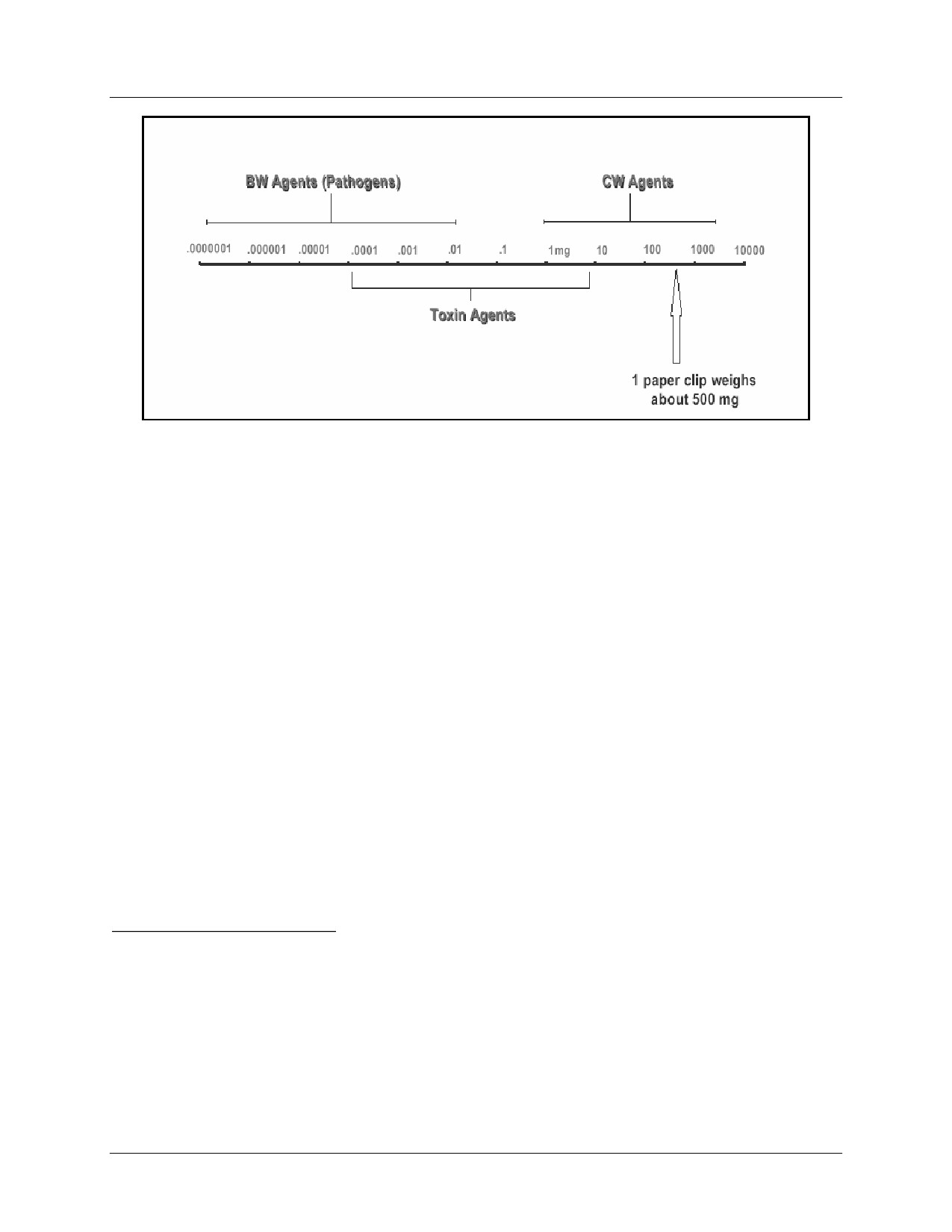
Relative to chemical agents, most biological agents have remarkably low effective doses.
Figure 1-1 shows the approximate ranges of effective doses for pathogens, toxins, and chemical
warfare agents.14 At the extreme, some pathogens are as much as 14 billion times more potent
than chemical agents. The effective doses of toxins are typically greater than those of pathogenic
agents but less than those of chemical warfare agents.
11 Joint Service Integration Group. “Operational Requirements Document for a Joint Chemical Agent Detector
(JCAD) (JTD J2-COO&III) MS III Final.” Ft. Leonard Wood, Mo. April 2002. (FOUO)
12 USACHPPM Report 47-EM-6154-03: Industrial Chemical Prioritization and Determination of Critical
Hazards of Concern, Technical Annex and Supporting Documents for International Task Force (ITF)-40. November
2003. p. ES-iii. (FOUO)
13 Joint Service Integration Group. “Operational Requirements Document for a Joint Chemical Agent Detector
(JCAD) (JTD J2-COO&III) MS III Final.” Ft. Leonard Wood, Mo. April 2002.
14 National Institute of Justice. An Introduction to Biological Agent Detection Equipment for Emergency First
Responders. 2001. p. 1.
5
For Official Use Only
For Official Use Only
CBRND Functional Needs Analysis/Functional Solution Analysis
Chapter 1. Introduction
Figure 1-1. Comparative Effective Doses (mg) of Biological Warfare, Toxins, and
Chemical Warfare Agents 15
For this reason, biological agent detection systems need to exhibit an extremely high sensitivity
to biological agents (i.e., capability to detect very small amounts of biological agents).
Unfortunately, no detection system can recognize all potential agents of concern because
identification is generally limited to a preselected set of agents, which cannot be expanded
without additional equipment and/or programming. For example, the M31A2 Joint Biological
Point Detection System (JBPDS) includes immunoassay tests in which each immunoassay
recognizes one particular biological agent. The agent may remain an undetected hazard under
specific conditions.16 Line source releases from standoff distances are a prime example of attacks
that can generate aerosol concentrations below threshold sensitivity levels.17 Furthermore,
biological detection may be inhibited or defeated by modification of normally detectable agents
to render them undetectable or by interference through environmental pollution.
Biological agents are considerably more complex than chemical agents. For this reason,
detection and identification technology incorporated into chemical agent detection systems is not
easily transferred to biological agent detection systems. While IMS can be used to detect and
identify chemical agents, the technology in its current form is unable to detect or identify
biological agents.18
Since biological agents are similar in size to nonbiological particulates and in size and
composition to nonpathogenic (nontoxic) atmospheric particulates, background aerosol clutter
15 National Institute of Justice. An Introduction to Biological Agent Detection Equipment for Emergency First
Responders. 2001. p. 1.
16 Danzig, Richard. “Catastrophic Bioterrorism - What is to be Done?” Center for Technology and National
Security Policy. Washington, DC. August 2003. pp. 10-11.
17 Kilpatrick, William T., Mark W. Fagan, and Paul Murdock. “Deployment Analysis of Biological Point
Detectors Deployed on Fixed-site Military Installations.” Simulation Technologies, Inc. November 2001. p. 14.
18 National Institute of Justice. An Introduction to Biological Agent Detection Equipment for Emergency First
Responders, 2001. pp. 13-4, 17-19.
6
For Official Use Only
For Official Use Only
CBRND Functional Needs Analysis/Functional Solution Analysis
Chapter 1. Introduction
complicates biological detection. First, nonbiological particulates, whether naturally occurring
(e.g., dust, dirt, and sand) or manmade (engine exhaust, smoke, and industrial effluents) can
interfere with the trigger, which is a particle counter and traditionally the first level of biological
detection. The trigger monitors the total atmospheric particulate concentration against
background levels without discriminating between biological and nonbiological particulates. It
activates the remaining components of the detection system if it detects an increase in the
ambient particulate concentration. After hydrating and concentrating the particulates, the
resulting sample is passed to a generic detection component that analyzes the particulates to
determine whether they are biological in origin.19 If the sample exhibits characteristics of
biological particles, it is passed to the identifier. The identifier can identify the type of biological
agent if the agent is in a preselected set.
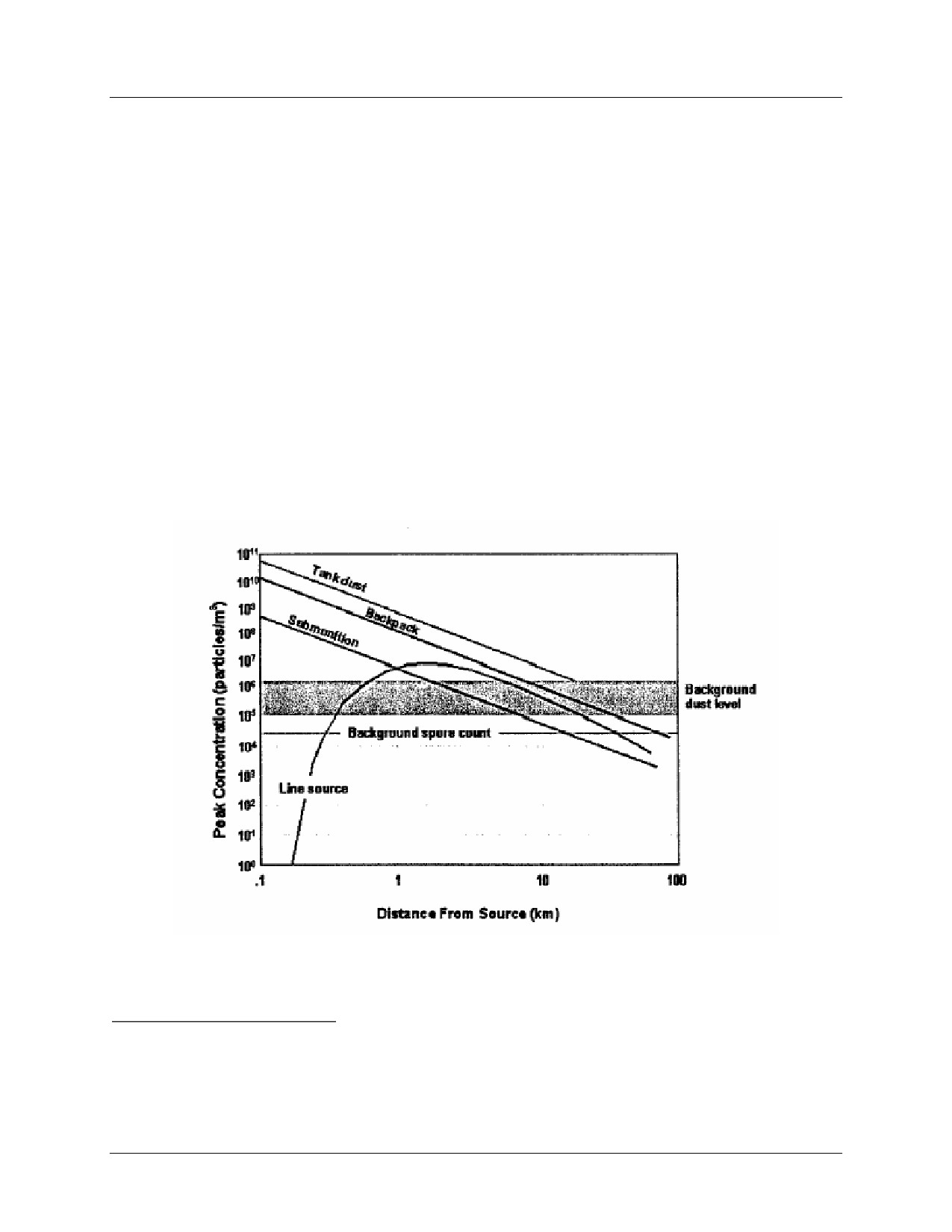
It is true that biological attacks typically generate particle concentrations greater than the
background levels. This tendency is illustrated in Figure 1-2, which compares particle
concentrations generated by three biological weapon attacks (from backpack, submunition, and
line source) to background levels. However, the figure also shows that background dust particles
generated from nearby tank movement results in greater particulate concentrations than those
caused by biological warfare (BW) attacks. Therefore, nonbiological particulates can cause false
positives in trigger-based activating systems, consequently expending analysis consumables.
Figure 1-2. Biological Weapon Attack Aerosol Concentrations Superimposed
on Natural Bioaerosol Background at Ft. Sill, Oklahoma 20
19 After determining aerosol particles to be biological, some detectors can classify the suspect aerosol by broad
category (e.g., spore, bacterium, toxin/macromolecule, or virus).
20 Kilpatrick, William T., Mark W. Fagan, and Paul Murdock. “Deployment Analysis of Biological Point
Detectors Deployed on Fixed-site Military Installations.” Simulation Technologies, Inc. November 2001. p. 13.
7
For Official Use Only
For Official Use Only
CBRND Functional Needs Analysis/Functional Solution Analysis
Chapter 1. Introduction
For this reason, many newer detection systems use cueing technology, which includes a second
detector in addition to a trigger, to discriminate in real time between biological and nonbiological
particulates. The second detector is frequently based on fluorescence. For example, the JBPDS
includes a detector that analyzes the fluorescence of material illuminated by an ultraviolet (UV)
laser. A detection of biological material combined with a rise in particle count activates the
collector and initiates the identification process.21
Second, biological nonpathogenic (nontoxic) particles, such as naturally occurring pollen, molds,
fungi, and bacteria (many of them uncataloged), are ubiquitous in the environment and can
interfere with detection of biological agents. The presence of an aerosolized biological weapon is
generally small in comparison with that of naturally occurring biological nonpathogenic
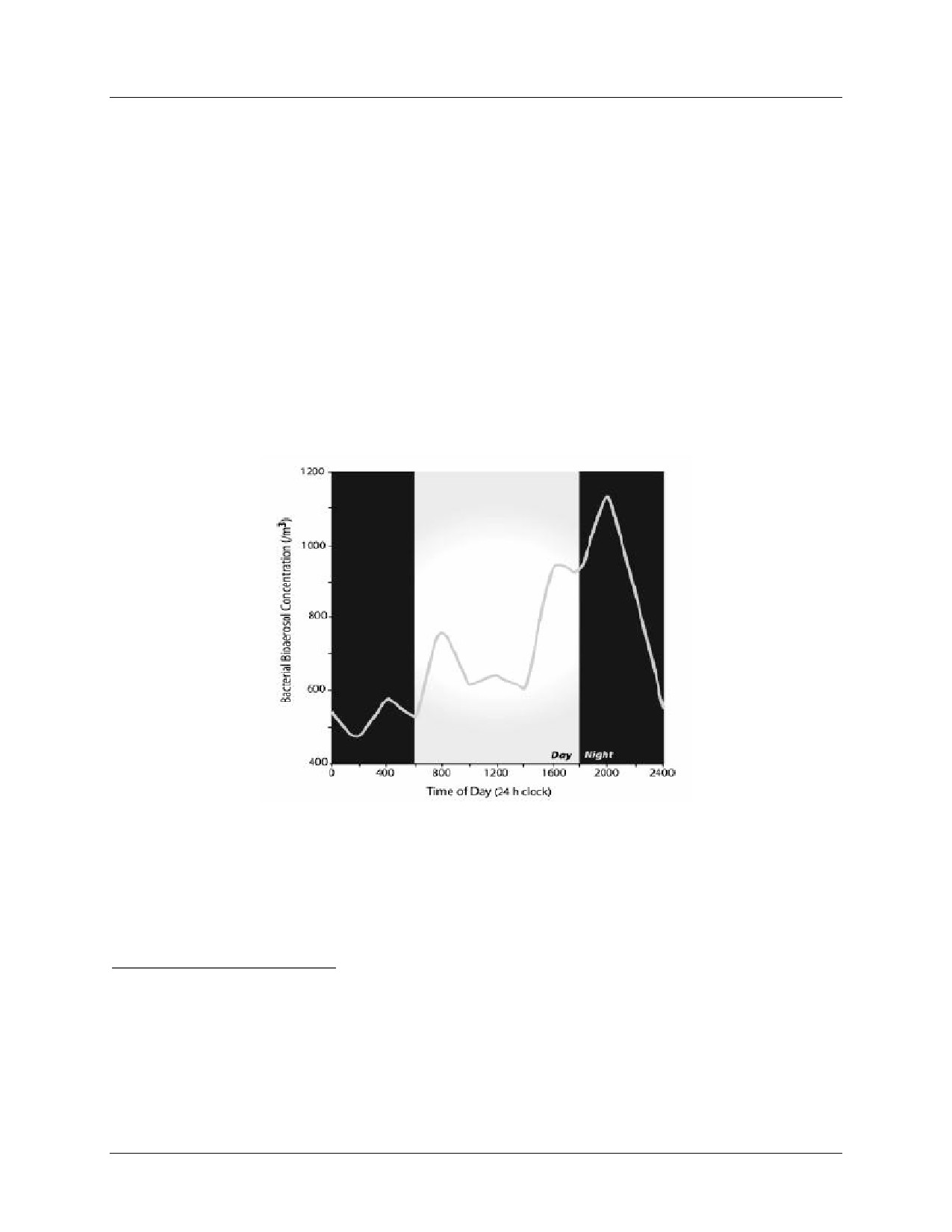
particles. In addition, the concentration of the biological background can fluctuate significantly
according to the season, weather, time of day, and presence of human variables. Figure 1-3
shows the fluctuations in airborne bacterial concentration during a 24-hour period at an
unspecified location.
Figure 1-3. Airborne Bacterial Concentration
Fluctuation in a Single Day 22
Thus, the variability in the biological background level can cause biological detectors, both with
or without cueing technology, to activate their identifiers and expend analysis consumables
because only the identifier can distinguish between preselected biological agents and
nonpathogenic agents.
21 Note that the JBPDS’s cueing technology, termed the Biological Agent Warning Sensor (BAWS), is unable
to distinguish between viable and nonviable agent-containing particles because the signatures of live agents are the
same as their nonviable counterparts. Kilpatrick, William T., Mark W. Fagan, and Paul Murdock. “Deployment
Analysis of Biological Point Detectors Deployed on Fixed-site Military Installations.” Simulation Technologies,
Inc. November 2001. p. 8.
22 National Institute of Justice. An Introduction to Biological Agent Detection Equipment for Emergency First
Responders. 2001. p. 14
8
For Official Use Only
For Official Use Only
CBRND Functional Needs Analysis/Functional Solution Analysis
Chapter 1. Introduction
The potentially fast transit time of bioaerosol clouds causes additional problems for biological
detection if detect-to-warn (also termed “detect-to-protect”) is the intended purpose. Recent Air
Force Research Laboratory (AFRL) studies show that the warning (response) time of biological
point detectors against covert or clandestine attacks must be less than the typical 10-15 minutes
required to complete the immunoassay tests in order to successfully detect-to-warn those in
proximity to the detector.23 If a detector takes 10-15 minutes to sense an attack, the majority of
unprotected personnel in the proximity of the detector will be exposed and many may receive
casualty-causing doses. At the time of the detector alarm, personnel farthest downwind (and
ostensibly within earshot of the detector) may be able to take protective measures and hence
reduce their exposure. However, the reduction in exposed personnel is predicted to be less than
5%. Biological detectors need to alarm within minutes following initial exposure to the threshold
agent concentration for personnel in the vicinity to be able to effectively protect themselves.
There are some cases in which detect-to-warn of a biological attack may be possible. For
example, an urban aerosol anthrax attack is most likely to occur at dusk, when weather patterns
are most favorable to keeping the particles close to the ground and thus likely to be inhaled.24 If
detection can be achieved within 6-10 hours after the release, people can be warned to stay
away, consequently reducing exposure. Unfortunately, present anthrax detectors are usually
sampled manually every 12 or 24 hours, and confirmation of findings takes between one and two
days. Under this timeline, the detect-to-warn capability is essentially nonexistent.
Given the operational time of response and the pathology of anthrax, the detect-to-treat25
capability (i.e., confirm presence of agent so that exposed may be treated before symptom
manifestation) is also deficient. Since it is estimated that 5% of infected personnel will manifest
substantial flu-like symptoms within 48 hours of the attack and a blood culture will confirm
anthrax infection within 3 or 4 hours, the utility of detectors will be marginal. In these situations,
medical surveillance can detect an anthrax attack as quickly as current (technically and
operationally restricted) biological detection capabilities.
The pathology of smallpox, in contrast to that of anthrax, provides for a wider window of reward
for detect-to-treat because a smallpox vaccination administered within approximately 96 hours
after an attack is likely to protect an exposed individual. Immunization after this point is much
less likely to be effective. Though there is no test that determines whether someone is infected
with smallpox before he begins to manifest symptoms some 7-12 days after infection,26
biological detection technology exists that can detect the aerosol release of the smallpox virus
within 24-36 hours. If a smallpox attack has been confirmed, exposed individuals can be
prevented from developing the disease through prompt vaccination. Consequently, in light of
23 Kilpatrick, William T., Mark W. Fagan, and Paul Murdock. “Deployment Analysis of Biological Point
Detectors Deployed on Fixed-site Military Installations.” Simulation Technologies, Inc. November 2001. pp. 10, 15.
24 Danzig, Richard. “Catastrophic Bioterrorism—What is to be Done?” Center for Technology and National
Security Policy. Washington, DC. August 2003. pp. 10-16.
25 Detect-to-treat is also called “detect-to-verify.”
26 At 10-12 days, newly infected individuals will themselves become infectious and may remain ambulatory for
as much as 48 hours during this infectious period, resulting in additional infections.
9
For Official Use Only
For Official Use Only
CBRND Functional Needs Analysis/Functional Solution Analysis
Chapter 1. Introduction
pathologies of these two diseases and current detection and treatment capabilities, timely
detection of a smallpox aerosol attack is more important and feasible than that of an anthrax
aerosol attack.
Standoff biological detection systems are designed to detect and identify biological agents at a
distance away from the aerosol/plume or from the detector system, before the agents reach the
location of the system.27 Active standoff technology typically uses the concept of detecting and
measuring atmospheric properties by laser remote sensing or LIDAR, an acronym for “light
detection and ranging.” In LIDAR, a short laser pulse is transmitted through the atmosphere, and
then a portion of the radiation is reflected back to the system from a distant target or from
atmospheric particles (e.g., molecules, aerosols, clouds, or dust). These systems must be line-of-
sight to the suspect biological agent event. Infrared (IR)-based LIDAR systems are able to detect
small aerosol particles characteristic of biological attacks (<20 μm in diameter) out to ranges of
30-50 km, since the atmosphere is relatively transparent to electromagnetic radiation of this
wavelength. IR LIDAR systems may not be able to discriminate between biological and
nonbiological particles, and interferents, such as water vapor and fog, may inhibit their
performance.28
Unlike IR LIDAR systems, UV LIDAR systems generally can discriminate between biological
and nonbiological particles.29 UV LIDAR systems illuminate biological aerosols with a strong
UV laser pulse that causes biological agents to fluoresce. The red-shifted fluorescence caused by
UV absorbance is detected by the systems and allows for distinguishing between biological and
nonbiological aerosols. However, false positives may be caused in some systems by engine
exhaust and pollens. Furthermore, the range of a typical UV LIDAR system may be limited to
several kilometers30 due to the relative opacity of air to UV light and the high UV background
during daylight hours. UV LIDAR systems are generally more effective during low-light or
nighttime operations because of the lower UV background level.
Passive standoff detection technology relies on the background electromagnetic radiation present
in the environment for the detection of biological agents.31 Passive standoff detection systems
typically analyze the mid-IR (3-5 μm) or far-IR (8-12 μm) region of the spectrum for agent
signatures. Though current IR passive standoff detection systems can detect bioaerosols
immediately following their dissemination, bioaerosols quickly lose their signature and become
invisible to the systems.
27 National Institute of Justice. An Introduction to Biological Agent Detection Equipment for Emergency First
Responders, 2001. p. 33.
28 National Institute of Justice. An Introduction to Biological Agent Detection Equipment for Emergency First
Responders, 2001. p. 15.
29 National Institute of Justice. An Introduction to Biological Agent Detection Equipment for Emergency First
Responders, 2001. p. 33.
30 Johnson-Winegar, Anna. “Joint Service Chemical and Biological Defense Program FY02-03 Overview.”
Department of Defense. Arlington, Va. 2003. p. 18.
31 National Institute of Justice. An Introduction to Biological Agent Detection Equipment for Emergency First
Responders, 2001. p. 35.
10
For Official Use Only
For Official Use Only
CBRND Functional Needs Analysis/Functional Solution Analysis
Chapter 1. Introduction
1.3.2.3
Radiological Detection
The short range of some types of radiation (particularly alpha) complicates radiological point
detection capabilities. Furthermore, radionuclide identification is difficult since the energy levels
of radiation emitted from a source must be quantified and analyzed for the identification to be
reliable. Without such analysis, the source can be classified only according to the type of
radiation it emits. Finally, in light of the properties of radiation, standoff radiological capabilities
do not currently exist.
The range of alpha radiation makes its detection difficult. Whereas beta radiation can travel 7-
26 ft (200-800 cm) in air from its source,32 and gamma and neutron radiation, though energy
dependent, generally travel farther in air than beta radiation, alpha radiation travels only 2-3
inches (5-7 cm) in air.33 Consequently, alpha detectors, such as thin-window Geiger-Muller
detectors, typically must be placed within an inch of the alpha-emitting source. Most alpha-
emitting sources (e.g., uranium-235 and -238, americium-241, and plutonium-238 and -239) also
emit gamma radiation,34 though the energy level of the gamma radiation may be low enough to
make it undetectable. Detection of shielded alpha emitters is particularly difficult. Alpha emitters
plutonium-238, uranium-235, and thorium-232, ostensibly at an amount of 10 curies, each placed
in a 2.5 cm-thick lead container, are not detected through their gamma radiation by a sodium-
iodide (NaI) or plastic scintillator placed 1 m from the container.35 In contrast, cobalt-60, iodide-
131, cesium-137, iridium-192, phosphorus-32, strontium-90, and americium-241, under identical
test conditions, are detected.
Even if a particular type of radiation can be detected, radionuclide identification of the source is
difficult because the equipment needs to be able to measure the energy level of the emitted alpha,
beta, or neutron particle or gamma photon since the energy of the radiation is characteristic of
the radionuclide.36 For example, strontium-90/yttrium-90 emits beta radiation with a maximum
energy of 2.28 MeV. Gamma spectroscopy systems provide a viewable energy spectrum of
emitted radiation unique to a gamma-emitting radionuclide. Modern liquid scintillation units
provide an energy spectrum of beta radiation unique to a beta-emitting radionuclide.
32 Headquarters, Departments of the Army, the Navy, and the Air Force. FM 8-9/NAVMED-P-5059/AFJMAN
44-151: NATO Handbook on the Medical Aspects of NBC Defensive Operations AMedP-6(B), Table 2-11 and FM
4-02.7, Table A-8. February 1996.
33 Headquarters, Departments of the Army, the Navy, and the Air Force. FM 8-9/NAVMED-P-5059/AFJMAN
44-151: NATO Handbook on the Medical Aspects of NBC Defensive Operations AMedP-6(B), Section 215.
February 1996.
34 Roessler, Charles. “Answer to Question #386 Submitted to ‘Ask the Experts.’” Health Physics Society.
35 Alvarez, J. L. Defining, Explaining, and Detecting Dirty Bombs. Auxier & Associates, Inc. Knoxville, Tenn.
pp. 8-9.
36 Allard, David. “Answer to Question #2522 Submitted to ‘Ask the Experts.’” Health Physics Society.
11
For Official Use Only
For Official Use Only
CBRND Functional Needs Analysis/Functional Solution Analysis
Chapter 1. Introduction
Finally, in light of the properties of radioactive materials and radiation, no standoff radiological
detection capability currently exists. Though exploratory research in standoff detection is being
performed, current radiological detection equipment must be exposed to radiation to detect it.
1.3.3
Shape
Joint Shape capabilities are challenged by data overload, bandwidth, electromagnetic pulse
(EMP), jamming, and hostile cyberactivities.37 Disruptions in data movement and surety can
adversely impact the ability of the force to quickly and effectively identify, respond, and mitigate
CBRN/TIM events.38
1.3.3.1
Data Overload
Information essential to effective CBRND requires a diverse set of data inputs, often in near-real
time, from a multitude of sources. These include data elements from information sources such as
medical and veterinary surveillance, patrol observations, situation reports (SITREPs), Allied
Technical Protocol 45 (ATP-45) reports, CBRN survey and sampling teams, sensors,
meteorology, geographical information system (GIS), geographical systems, and others. Data
overload is a challenge that can impede or prevent the functioning of Shape to effectively
manage CBRND. The effectiveness of CBRND Shape requires the continuing collection,
correlation, analysis, and dissemination of information to ensure current situational awareness
and understanding. The potential volume of information flowing to and through CBRND Shape
may exceed the ability of CBRND systems and portals to accept and/or process the data.
1.3.3.2
Bandwidth
The increasing application of automated systems to collect, process, and assess information is
accompanied by escalating requirements for enlarged bandwidth needed for efficient computing
and communications, including data exchange, down to tactical maneuver units. CBRND39 is
one among many users within the force. Operations, support services, medical, logistics, and
others possess requirements for the available bandwidth. Many of these requirements are critical,
while others, although not critical in and of themselves, are essential to mission accomplishment.
For example, targeting and routing data for Joint Task Force (JTF) aircraft as well as fire mission
data are critical to mission accomplishment. Logistics movement requests for resupply fuel and
foodstuffs, although not immediately impacting operations, do support sustained operations and
mission accomplishment. Bandwidth requirements supporting the collection and movement of
CBRND data is potentially significant and likely to conflict with other requirements. As stated
previously, the volume of information likely to flow to and through CBRND Shape is plausibly
substantial. Volume flow increase during and following a CBRN/TIM event is conceivable,
37 Experimentation/exercises have not focused on how staffs at the operational and strategic levels are able to
perform shape functions.
38 Shape relies on Sense to provide accurate and timely data that can be analyzed and promulgated—without
this data, shared awareness and shared understanding are not possible.
39 Until JEM and JOEF are fielded, modeling of CBRN/TIM effects and the impact of these effects on
operations will not be adequate.
12
For Official Use Only
For Official Use Only
CBRND Functional Needs Analysis/Functional Solution Analysis
Chapter 1. Introduction
thereby creating demand for additional bandwidth. Concurrently, other selected users will
require added bandwidth for their data. Medical is but one of these users. Heightened
information flow associated with the treatment and movement of casualties is a probable demand
for available bandwidth. Available and accessible bandwidth may, therefore, act as an
impediment to effective CBRND Shape.
1.3.3.3
Electromagnetic Pulse
EMP is often discussed as the result of nuclear explosions. Although this effect exists, it is not
the sole potential source for EMP. EMP generation devices and certain large nonnuclear
explosions can create an EMP affecting electronic devices and systems in an area. Unshielded
electronics can be disrupted or cease to function, data erased or corrupted, and information
transfer reduced or prevented. The effectiveness of CBRND Shape depends on continuous and
accurate information flow to identify and respond to a CBRN/TIM event. The application of
EMP by an adversary in an area, concurrently with or preceding a CBRN/TIM attack, may
adversely impact detection and response by the joint force. Ongoing research into EMP within
the international community by both the military and civilian sectors, as well as the increasing
availability of cross-technologies, indicates hostile application of EMP is a possibility.
1.3.3.4
Jamming
Signal jamming is a common tactic of modern warfare. The adversary seeks to impede, disrupt,
and preclude the information flow between and among elements of the force. Unsophisticated
equipment possessing the capability to acquire the frequency can jam a signal. Modifiable
advanced technologies are readily available on the open commercial market. A moderately
sophisticated adversary can impact the ability of the force to move information and data, thereby
affecting operations. CBRND Shape is a major user of information generated, collected, and
transferred via wireless technologies (e.g., frequency modulation [FM], ultrahigh frequency
[UHF], very high frequency [VHF], etc.). Jamming of wireless networked sensors to CBRN/TIM
reconnaissance reports, as well as others, is a potential information gap that an adversary may
exploit. The resulting information gap might delay CBRN/TIM detection and response.
1.3.3.5
Hostile Cyberactivities
A significant future challenge will be overt adversarial use of computer network attack. Hostile
cyberactivities are not limited to the actions and activities of an adversary. Cyberattacks may
also be initiated and maintained by nationals of friendly nations—including U.S. citizens—
opposed to U.S. policies and activities. Third parties may also be engaged by an adversary to
conduct hostile cyberactivities against the force. Information systems technologies and
knowledge are widespread and easily available in the global marketplace. Operating systems are
limited to a few and, with selected exceptions, are well known and understood, as are database
systems. Misinformation, data corruption or destruction, software alteration, portal blocking, and
more are all potential issues affecting the reliability and effectiveness of CBRND Shape. For
example, if adversaries gained remote access to a dispersed CBRN/TIM Integrated Detection
Network (IDN), they could create false reports of CBRN/TIM detections until the actual reports
are ignored or suppress reporting of CBRN/TIM detections by the system. Or an unsophisticated
13
For Official Use Only
For Official Use Only
CBRND Functional Needs Analysis/Functional Solution Analysis
Chapter 1. Introduction
adversary could hire a third party to perform cyberattacks on the information systems of the joint
force. An adversary could employ a random generation worm to overload the information portal,
crashing the portal and suppressing information flow, and seize the opportunity to employ a
CBRN/TIM agent. Friendly and U.S. nationals may also conduct cyberattacks against joint
forces. The reasons may range from curiosity to opposition to U.S. policies and activities. An
example of these types of attacks was the attempt by U.S. citizens opposed to U.S. operations in
Iraq to disrupt U.S. government and military information operations.
1.3.3.6
Other Issues
There are challenges to shaping the battlefield that are beyond protecting computer networks
from attack. Additional issues that challenge or disrupt joint Shape capabilities include the
following:
• weather/meteorological and oceanographic
• intelligence (e.g., geospatial intelligence)
• ground effects (urban)
• system interoperability
• C2 early warning
• logistics information availability and accuracy
• operator data/information overload
• cognitive challenges
1.3.4
Shield
Joint Shield capabilities are challenged by technical issues related to individual respiratory
protection against toxic industrial chemicals, individual protection against penetrating radiation,
and prophylaxes for blister and nerve agent exposure.
1.3.4.1
Individual Respiratory Protection against Toxic Industrial Chemicals
(FOUO) In light of the more than 1000 industrial chemicals deemed significant hazards by the
International Task Force 40 (ITF-40)40, complete individual protection against all hazardous
industrial chemicals is infeasible,41 yet respiratory protection against the high-risk toxic
industrial chemicals seems fitting. Nevertheless, military respiratory protection may be deficient
in protecting against numerous, high-risk TICs, ostensibly because of difficulties in designing
gas canisters that effectively bind these TICs. Assigned extreme risks ratings by ITF-40 because
40 USACHPPM Report 47-EM-6154-03: Industrial Chemical Prioritization and Determination of Critical
Hazards of Concern, Technical Annex and Supporting Documents for International Task Force (ITF)-40. November
2003. (FOUO)
41 Note: Military nuclear, biological, and chemical respirators and protective suits were generally designed for
protection against traditional chemical warfare agents, not TICs. Furthermore, in approximately 17% of the 1756
industrial chemicals evaluated by the task force, chemical flammability was either the sole critical hazard or one of
the critical hazards. Most individual and collective protective equipment is not designed to protect against high
temperatures and/or pressures.
14
For Official Use Only
For Official Use Only
CBRND Functional Needs Analysis/Functional Solution Analysis
Chapter 1. Introduction
of their lethality, flammability, instability, and probability of use, these chemicals are poorly
adsorbed by common gas canisters. Accordingly, exposure to any of these chemicals may result
in immediate penetration of a protective mask that uses one of these common gas canisters.
Chemical asphyxiants, upon human internalization, cause hypoxia by either preventing uptake of
oxygen in the blood (e.g., carbon monoxide) or inhibiting normal oxygen transfer either from the
blood to tissues or within a cell.42 In addition, fuming nitric acid, like other highly reactive
materials, can degrade protective equipment.43
(FOUO) Furthermore, some hazardous industrial chemicals are simple asphyxiants, meaning
that, though they may not have a direct physiological impact on the body, they displace oxygen
in the air and thus cause an oxygen-deficient environment.44 Therefore, an individual may need
an atmosphere-supplying respirator if a significant release of these chemicals has occurred. An
air-purifying respirator will be inadequate since it provides oxygen at the surrounding
atmospheric level.
1.3.4.2
Individual Protection against Penetrating Radiation
Effectively protecting (shielding) against penetrating ionizing radiation (e.g., neutron and high-
energy gamma radiation) is difficult, particularly within the context of individual protection.
Whereas light clothing, gloves, or even a sheet of paper can protect against alpha radiation,45 and
less than one-half inch of aluminum, plastic, or glass provides adequate shielding against beta
radiation,46 thick and dense materials are frequently required to sufficiently protect against
neutron and high-energy gamma radiation.
In regards to gamma radiation, shielding effectiveness is a function of the thickness and density
of shielding material. For example, a 2.8-inch (7.2 cm)-thick barrier of water, a 1.3-inch
(3.3 cm)-thick concrete barrier, a 0.4-inch (1.0 cm)-thick iron barrier, or a 0.15-inch (0.38 cm)-
thick lead barrier is required to reduce the incident gamma radiation dose rate by 50% for 500
42 Sutherland, Pamela J. “Spotlight on Asphyxiants.” U.S. Department of Energy’s Chemical Safety Program.
43 USACHPPM Report 47-EM-6154-03: Industrial Chemical Prioritization and Determination of Critical
Hazards of Concern, Technical Annex and Supporting Documents for International Task Force (ITF)-40. November
2003. p. VI-11. (FOUO)
44 Occupational Safety and Health Administration defines an oxygen-deficient atmosphere as one with <19.5%
O2 by volume. The oxygen content is approximately 21% by volume at sea level.
45 Headquarters, Department of the Army. FM 4-02.7: Health Service Support in a Nuclear, Biological, and
Chemical Environment, Table A-8. Washington, DC. October 2002. Headquarters, Department of the Army, the
Navy, and the Air Force, and Commandant, Marine Corps. FM 4.02-283/NTRP 4-02.21/AFMAN 44-16(I)/MCRP 4-
11.1B: Treatment of Nuclear and Radiological Casualties, Section 2-5. Washington, DC. December 2001.
46 Headquarters, Department of the Army, the Navy, and the Air Force, and Commandant, Marine Corps. FM
4.02-283/NTRP 4-02.21/AFMAN 44-16(I)/MCRP 4-11.1B: Treatment of Nuclear and Radiological Casualties,
Section 2-5. Washington, DC. December 2001. Frame, Paul. “Answer to Question #44 Submitted to ‘Ask the
Experts.’” Health Physics Society. http://hps.org/publicinformation/ate/q44.html. Chabot, George. “Answer to
Question #1094 Submitted to ‘Ask the Experts.’” Health Physics Society.
15
For Official Use Only
For Official Use Only
CBRND Functional Needs Analysis/Functional Solution Analysis
Chapter 1. Introduction
keV photons.47 Since individual protective equipment (IPE) does not include thick and dense
shielding, it does not provide sufficient protection from external high-energy gamma radiation.
In regards to neutron radiation, shielding effectiveness is a function of thickness and composition
of the shielding material. Though materials with a high hydrogen content (e.g., water, paraffin,
and damp earth),48 efficiently absorb neutrons traveling through them, gamma radiation may be
subsequently emitted as a result of slow neutron capture in hydrogen nuclei.49 Therefore, other
materials that have considerable affinities for capturing slow neutrons but do not produce
significant secondary gamma radiation in the process may be used. One example of such a
material is boron-10, which, upon neutron capture, produces nonpenetrating alpha particles
rather than penetrating gamma radiation. Since IPE does not include neutron-shielding materials
at appropriate thicknesses, it provides negligible protection against neutron radiation.
1.3.4.3
Medical Prophylaxes
The biochemical complexity of the effects of sulfur mustard on cellular tissue and the effects of
secondary cellular processes (e.g., aging) caused by nerve agent intoxication, particularly soman,
complicates medical prophylaxes for exposure to these chemical warfare agents.
1.3.4.3.1
Sulfur Mustard Vesication
The biochemical complexity of HD vesication has made developing effective medical
countermeasures difficult. In 1996, the first coherent model of the basic pathological processes
that occur in cells and tissues exposed to HD was constructed.50
Not only can HD have many direct effects, such as alkylation of proteins and membrane
components as well as inflammatory cells; in addition, it can target deoxyribose nucleic acid
(DNA) with subsequent activation of poly(ADP-ribose) polymerase (PARP). PARP activation
can then initiate a series of metabolic changes culminating in protease activation. The
penultimate event is the epidermal-dermal separation that occurs in the lamina lucida of the
basement membrane zone. As a result of major inflammatory response and changes in the tissue
hydrodynamics, fluid fills the cavity formed by the epidermal-dermal separation and forms a
blister.
47 Headquarters, Departments of the Army, the Navy, and the Air Force. FM 8-9/NAVMED-P-5059/AFJMAN
44-151: NATO Handbook on the Medical Aspects of NBC Defensive Operations AMedP-6(B), Part I, Section 715.
February 1996.
48 Headquarters, Department of the Army. FM 4-02.7: Health Service Support in a Nuclear, Biological, and
Chemical Environment, Table A-8. Washington, DC. October 2002. FM 4.02-283/NTRP 4-02.21/AFMAN 44-
16(I)/MCRP 4-11.1B: Treatment of Nuclear and Radiological Casualties, Section 2-5. Washington, DC. December
2001.
49 Chabot, George. “Answer to Question #1094 Submitted to ‘Ask the Experts.’” Health Physics Society.
50 Smith, William J., Michael C. Babin, Robyn. C. Kiser, et al. “Development of Medical Countermeasures to
Sulfur Mustard Vesication.” U.S. Army Medical Research Institute of Chemical Defense and Battelle Memorial
Institute. p. 2.
16
For Official Use Only
For Official Use Only
CBRND Functional Needs Analysis/Functional Solution Analysis
Chapter 1. Introduction
Now that the biochemical mechanisms of HD vesication have been elucidated, research is
focusing on finding prophylactic or therapeutic compounds to inhibit one of six biochemical
events: DNA alkylation, DNA strand breaks, PARP activation, disruption of calcium proteolytic
activation, and inflammation.
1.3.4.3.2
Nerve Agent Aging
Though medical treatment, including such drugs as atropine, oximes (2-PAM), and diazepam can
be administered upon the onset of symptoms of acetylcholinesterase (AChE) inhibition, soman
exposure presents an additional therapeutic challenge51 because soman rapidly undergoes a
second reaction, termed “aging,” which makes inhibited AChE resistant to spontaneous or
oxime-mediated reactivation. Aging occurs during intoxication by other nerve agents, but aging
by soman is notably rapid. The aging half-time for soman is a couple of minutes, likely an
inadequate amount of time for even highly trained personnel to administer medical treatment.52
Contrast the aging half-time for soman with that of sarin (several hours), tabun (more than 10
hours), and VX (two days). Pyridostigmine bromide (PB) is approved as a pretreatment for
personnel at high risk for soman exposure as it temporarily masks the active site of a fraction of
AChE molecules and thus protects the enzyme from irreversible reactions with soman
molecules.53 Nevertheless, a single PB dose does not offer prolonged protection. In guinea pigs,
the maximum protective benefit of PB pretreatment against soman occurs 60 minutes after
administration (protective ratio of 12.5).54 Following this time, the protection afforded by the PB
pretreatment begins to decrease, and at 4 hours, the protective ratio is 3.2. Because of this and
other deficiencies of PB pretreatment, some research has focused on identifying proteins that can
act as biological scavengers of organophosphorus compounds and that remain stable in
circulation for long periods of time.55 The biological scavenger needs to be able to
prophylactically inactivate the internalized nerve agent before the agent reacts with the target
AChE. In light of the aging time of soman, it must occur within several minutes of soman
exposure.
51 Lenz, David E. “Bioscavengers as a Pretreatment for Nerve Agent Exposure.” US Army Medical Research
Institute of Chemical Defense. Aberdeen Proving Ground, MD. p. 1
52 Golomb, Beatrice A. A Review of Scientific Literature as It Pertains to Gulf War Illnesses: Volume 2,
Pyridostigmine Bromide, Chapter 3. National Defense Research Institute.
53 Lenz, David E. “Bioscavengers as a Pretreatment for Nerve Agent Exposure.” US Army Medical Research
Institute of Chemical Defense. Aberdeen Proving Ground, MD. p. 1
54 Golomb, Beatrice A. A Review of Scientific Literature as It Pertains to Gulf War Illnesses: Volume 2,
Pyridostigmine Bromide, Chapter 3. National Defense Research Institute.
55 Lenz, David E. “Bioscavengers as a Pretreatment for Nerve Agent Exposure.” US Army Medical Research
Institute of Chemical Defense. Aberdeen Proving Ground, MD. p. 1
17
For Official Use Only
For Official Use Only
CBRND Functional Needs Analysis/Functional Solution Analysis
Chapter 1. Introduction
1.3.5
Sustain
Joint Sustain capabilities are complicated by significant chemical, biological, radiological, and
nuclear (CBRN) persistency, the potential for secondary contamination (cross-contamination),
and nerve agent and toxin physiological effects.
1.3.5.1
Agent Persistency
In addition to affecting Sense and Shield capabilities, the persistency of a CBRN agent
significantly influences the necessity for sustaining operations, particularly decontamination.
More specifically, the persistence56 of chemical agents, viability of biological agents, and half-
lives of radiological agents (and their daughter products) affect the ability of a military force to
quickly restore operational capabilities following a CBRN incident.
1.3.5.1.1
Chemical Agent Persistence
Contamination by nonpersistent chemical agents, such as hydrogen cyanide (which typically
persists for minutes), does not typically require substantial decontamination efforts, though, due
to the fast rate of action of most chemical agents, rapid medical diagnostics and therapeutics
action may by needed to restore exposed personnel. Contamination by persistent chemical
agents, such as VX (which can persist for weeks in low-temperature environments), may
necessitate extensive decontamination if the agent is a significant threat in its current state and
location. Personnel exposed to persistent agents may, like those exposed to nonpersistent agents,
require rapid medical diagnostics and therapeutics.
In addition to a chemical agent’s vapor pressure57 (related to the rate in which the agent
evaporates), meteorological conditions, such as atmospheric temperature, wind speed,
precipitation, and air stability, as well as surface parameters, such as surface temperature,
vegetation, and contact surface, affect the agent’s outdoor persistence. A chemical agent with a
low vapor pressure on a sorbent, porous, nonreactive surface (e.g., sand) in a cold (temperature
slightly above agent’s freezing point), stable, windless, environment without precipitation or
vegetation persists for the greatest amount of time. In contrast, a chemical agent with a high
vapor pressure on a nonsorbent, nonporous surface (e.g., chemical-resistant surface) in a hot,
unstable, high-wind environment with heavy precipitation and vegetation persists for the least
amount of time.58 A nonpersistent agent may remain a hazard in a confined space where the
evaporated agent accumulates. Therefore, decontamination may be required in a poorly
ventilated, confined space, even though it may not be required outdoors.
56 Persistence is rarely defined quantitatively, though one reference defines it as the time required for a 1500-
fold agent density decrease. Sage, G. W., and P. H. Howard. “Environmental Fate Assessments of Chemical Agents
HD and VX.” Syracuse Research Corporation. Syracuse, N.Y. June 1989. p. 5.
57 A chemical’s volatility is related to its vapor pressure. Hence, a chemical with a high vapor pressure is
typically highly volatile.
58 Headquarters, Department of the Army, Department of the Air Force, United States Marine Corps. FM 3-
6/FMFM 7-11-H/AFM 1-5-7: Field Behavior of NBC Agents (Including Smoke and Incendiaries), Chapter 1:
Chemical Agents. Washington, D.C. November 1986.
18
For Official Use Only
For Official Use Only
CBRND Functional Needs Analysis/Functional Solution Analysis
Chapter 1. Introduction
1.3.5.1.2
Biological Agent Viability
Whereas persistence is used to describe the longevity of the hazard posed by a chemical agent,
viability is typically used to describe the longevity of the biological hazard because only
biological agents viable for infection are generally hazardous. For those biological agents that
remain viable for long periods of time, thorough equipment and fixed-site decontamination may
be necessary since passive decontamination (weathering) may be impractical. Consider that
under ideal conditions, non-spore-forming microorganisms can remain viable for up to 100
days,59 and Bacillus anthracis (anthrax) spores can survive for decades.60 Yet anthrax spores
exposed to the direct rays of the sun will not stay viable for more than a few hours if deposited
on a hard flat surface.61 Table 1-1 includes information on the persistence (and other properties)
of pathogens and toxins of military importance.
A biological agent’s viability is affected by its concentration, exposure to UV radiation and
pollutants, environmental temperature, humidity, and the contacting surface material. Biological
agents disseminated at low to moderate temperatures (ideally slightly above the freezing
temperature of water) in unpolluted, humid environments with little or no UV radiation exposure
remain viable for the greatest amount of time. Conversely, biological agents disseminated in
polluted, dry environments at extreme temperatures and high UV radiation exposure remain
viable for the least amount of time. 62
59 Parker, Andrew, Jorma Kirsi, William H. Rose, et al. “Counter Proliferation-Biological Decontamination.”
Andrulis Research Corporation. February 1998. p. 104.
60 Office of the Surgeon General. Textbook of Medical Medicine, Part I Warfare, Weaponry, and the Casualty,
Medical Aspects of Chemical and Biological Warfare. 1997. p. 469.
61 Parker, Andrew, Jorma Kirsi, William H. Rose, et al. “Counter Proliferation-Biological Decontamination.”
Andrulis Research Corporation. February 1998. p. 106.
62 Headquarters, Department of the Army, Department of the Air Force, United States Marine Corps. FM 3-
6/FMFM 7-11-H/AFM 1-5-7: Field Behavior of NBC Agents (Including Smoke and Incendiaries), Chapter 3:
Biological Agents and Nuclear Detonations. Washington, D.C. November 1986.
19
For Official Use Only

For Official Use Only
CBRND Functional Needs Analysis/Functional Solution Analysis
Chapter 1. Introduction
Table 1-1. Pathogens and Toxins of Military Importance and Selected Properties
Persistence of Etiologic
Likely Methods of
Transmissibility
Disease (Etiologic Agent)
Agent63
Dissemination64
Man to Man65
Bacteria and Rickettsia
Anthrax (Bacillus anthracis)
Spores are highly stable
Aerosol
No
Brucellosis (Brucellae abortus, melitensis,
High in wet soil and
Aerosol, food
Via contact with
suis, and canis)
food
supply
lesions
Glanders (Burkholderia mallei) and
Stable in soil and water
Aerosol
Negligible
melioidosis (Burkholderia pseudomallei)
(B. pseudomallei)
Plague (Yersinia pestis)
Up to one year in soil;
Aerosol, infected
High
270 days in live tissue
vectors
Q Fever (Coxiella burnetii)
Months on wood and
Aerosol, food
No
sand
supply
Tularemia (Francisella tularensis)
Months in moist soil or
Aerosol
No
other media
Viruses
Smallpox (variola major)
Stable
Aerosol
High
Viral equine encephalitis (e.g., Western,
Relatively unstable
Aerosol, infected
Low
Eastern, and Venezuelan equine
vectors
encephalitis)
Viral hemorrhagic fevers (e.g., Marburg,
Relatively unstable—
Aerosol
Moderate
Ebola)
depends on agent
Toxins
Botulism (Clostridium botulinum)
Weeks in nonmoving
Food/water supply,
No
water and food
aerosol
Ricin (Ricinus communis)
Stable
Aerosol
No
Staphylococcal enterotoxin B
Stable, resistant to
Aerosol. food/water
No
(Staphylococcus aureus)
freezing
supply
T-2 Mycotoxins
Stable
Aerosol, food/water
No
supply
1.3.5.1.3
Radiological and Nuclear Hazard Half-life
Radiological and nuclear contaminants decay at rates proportional to their half-lives, defined as
the amount of time required for half of the species’ nuclei to undergo radioactive decay.
However, many radioisotopes successively decay into other radioactive elements before
becoming stable. Though iodine-135 has a half-life of only 6.7 hours, one of its daughter
products, cesium-135, has a half-life of 2.3 million years. Following a nuclear explosion,
strontium-90 and cesium-137, two reaction by-products with half-lives of approximately 30
years, cause significant long-term fallout hazards because the radioisotopes can be ingested
63 USACHPPM. The Medical NBC Handbook, USACHPPM Tech Guide 244, Table 4-F. May 2000. U.S. Army
Medical Research Institute of Infectious Diseases. Medical Management of Biological Casualties Handbook. 4th ed.
February 2001. (For glanders and melioidosis, plague, Q fever, tularemia, viral hemorrhagic fevers, botulinum
toxin, and staphylococcal enterotoxin B [resistant to freezing].)
64 USACHPPM. The Medical NBC Handbook, USACHPPM Tech Guide 244, Table 4-F. May 2000.
65 USACHPPM. The Medical NBC Handbook, USACHPPM Tech Guide 244, Table 4-F. May 2000. Medical
Management of Biological Casualties Handbook. 4th ed. February 2001. (For viral hemorrhagic fevers.)
20
For Official Use Only
For Official Use Only
CBRND Functional Needs Analysis/Functional Solution Analysis
Chapter 1. Introduction
through foods which have incorporated them. 66 Since these and many other radioisotopes (and
their daughter products) have long half-lives, radiological decontamination of equipment and
fixed sites may be necessary to restore operations.
Table 1-2. Radioactive Materials of Military Significance and Selected Properties67
Radioactive Material*
Radiation Type
Half-Life68
Americium-241
Alpha (gamma in daughter products)
458 years
Cesium-137
Beta/gamma
30.2 years
Cobalt-60
Beta/gamma
5.26 years
Depleted uranium
Limited alpha/beta/gamma (no threat)
4.51 × 10⁹ years
Iodine-131, -132, -134, -135
Beta/some gamma
8.06 days, 2.29 hours, 53 months,
6.7 hours
Phosphorus-32
Beta
14.3 days
Plutonium-239, -238
Alpha
2.44 × 10⁴ years, 86.4 years
Radium-226
Alpha (beta/gamma in daughter products)
1622 years
Strontium-90
Beta
29 years
Tritium-3
Beta (no threat)
12.6 years
Uranium-238, -235,- 239
Alpha/beta/gamma
4.51 × 10⁹ years, 7.13 × 10⁸ years,
23.5 months
* Italicized materials are reactants or products of nuclear fission or fusion reactions.
1.3.5.2
Secondary Contamination (Cross-Contamination)
The potential for secondary contamination or cross-contamination (i.e., additional contamination
following initial deposition through dissemination), complicates sustaining activities, particularly
decontamination. Chemical agents can interact with the surface material, inhibiting
decontamination, and risking personnel or other material to exposure. Biological and radiological
particles deposited on a surface can become airborne again.69 These phenomena disrupt efforts to
recover essential functions that are free from the effects of CBRN hazards and to return
operational capabilities to preincident levels.
1.3.5.2.1
Chemical Agent Adsorption/Absorption
Adsorption and absorption of chemical agents deposited on the surfaces of certain materials (e.g.,
soil, sand, brick, stone, cement, wood, paints, plastics, rubber, canvas, leather, cotton, and
66 Headquarters, Departments of the Army, the Navy, and the Air Force. FM 8-9/NAVMED-P-5059/AFJMAN
44-151: NATO Handbook on the Medical Aspects of NBC Defensive Operations AMedP-6(B), Section 320.
February 1996.
67 Military Medical Operations Office, Armed Forces Radiobiology Research Institute. Medical Management of
Radiological Casualties. December 1999; Headquarters, Department of the Army, and Commandant, US Marine
Corps. FM 3-5/MCWP 3-37.3: NBC Decontamination. Washington, DC. 28 July 2000.
68 Friedlander, G, Kennedy, J.W., Macias, E.S., et. al. Nuclear and Radiochemistry. John Wiley & Sons. 3rd Ed.
July 1981.
69 Garland, J.A., Watterson, J., Jayasekera, P.N., et. Al. “The Hazard From Reaerosolised Biological Warfare
Agents.” European Research Office of the U.S. Army. London, England. August 1999. p. 5
21
For Official Use Only
For Official Use Only
CBRND Functional Needs Analysis/Functional Solution Analysis
Chapter 1. Introduction
woolens) can significantly inhibit decontamination.70 Adsorption, the physical adherence of a
molecule to a surface, proceeds rapidly as the agent distributes across the surface and seeps into
cracks and crevices. Absorption, the transfer of a diffused molecule into a material’s interior,
proceeds more slowly. Adsorbed agent is resistant to physical removal, but can be removed by
organic solvents or chemical decontaminants. Absorbed agent is even more resistant to removal
by physical or chemical means, and the use of nonaqueous decontaminants can actually cause
chemical agents to penetrate even deeper into the material because of solubility effects.71
Temporary nuclear, biological, and chemical (NBC)-resistant covers over vulnerable equipments
offer protective measures to avoid agent deposition as well as adsorption/desorption on any type
of material surfaces.
If only surface contamination is removed, typically through weathering or active
decontamination, the remaining sorbed agent (both adsorbed and absorbed) will desorb for days,
months, and even years, depending on the agent, material, surface temperature, and boundary
layer flow rate. It is possible for a surface to remain a cross-contamination concern as a result of
desorption even though it appears free of surface contamination. Assessments based solely on
measured vapor evolution rates may not adequately predict the direct contact hazard present at
the desorbing surface. For example, a more severe degree of injury can be caused by direct
contact with mustard-contaminated surfaces without detectable liquid on them than can be
explained simply by vapor evolution. For this reason, detection of agent vapor alone is
insufficient in determining whether a surface is a potential direct contact hazard.
1.3.5.2.2
Biological and Radiological Hazard Reaerosolization/Resuspension
Reaerosolization and resuspension72 of biological agents and radiological particles can extend
the contamination area, resulting in additional casualties and greater decontamination efforts.
Typically caused by the wind and human activities, reaerosolization and resuspension can occur
long after the initial agent dissemination, and under ideal conditions the resultant airborne
concentration can be of the same order as that of the original dissemination. Approximately two
to three months following the Chernobyl accident, radioactive particle resuspension replaced
dissemination from the breached reactor as the dominant contributor to airborne radioisotope
concentrations.73 In this incident, resuspension of the radioactive particles resulted in a long-term
70 Carlon, Hugh R. “Contact Hazard: An Overview.” U.S. Army Armament Munitions Chemical Command.
Aberdeen Proving Ground, Md. January 1990. pp. 7-15.
71 Trapp, Ralf. The Detoxification and Natural Degradation of Chemical Warfare Agents. Stockholm
International Peace Research Institute. London. 1985. p. 73.
72 Ostensibly, “reaerosolization” and “resuspension” are synonymous. “Reaerosolization” is frequently
associated with biological agent particles, whereas “resuspension” usually refers to radiological and inert particles.
Garland, J. A., J. Watterson, P. N. Jayasekera, et al. “The Hazard from Reaerosolised Biological Warfare Agents.”
European Research Office of the U.S. Army. London. August 1999. p. 5.
73 Garland, J. A., J. Watterson, P. N. Jayasekera, et al. “The Hazard from Reaerosolised Biological Warfare
Agents.” European Research Office of the U.S. Army. London. August 1999. p. 12.
22
For Official Use Only
For Official Use Only
CBRND Functional Needs Analysis/Functional Solution Analysis
Chapter 1. Introduction
secondary hazard. Resuspended contaminants were detected across Europe and much of the
Northern hemisphere over several years after the accident.74
Numerous factors, including wind speed, time since deposition, particle size, surface properties
(such as roughness and moisture content), and mechanical disturbance, affect the likelihood and
extent of particle reaerosolization. Biological and radiological agent particles of small particle
sizes, deposited on rough, moist surfaces for a long period since deposition, and exposed to low
wind speeds and little mechanical disturbance are unlikely to be significantly reaerosolized.
Conversely, biological and radiological agent particles of large particle sizes, deposited on
smooth, dry surfaces for a short period since deposition, and exposed to high wind speeds and
extensive mechanical disturbance are likely to be significantly reaerosolized.
1.3.5.3
Medical Treatment
Seizure activity induced by nerve agent exposure, dissimilarities in mechanism of action between
toxin classes, and the fast rate of action of some toxins complicates medical treatment.
1.3.5.3.1
Medical Treatment for Nerve Agent-Induced Seizures
Significant AChE inhibition through exposure to organophosphorus compounds does not cause
just acute, life-threatening consequences. Individuals who survive significant exposure will
likely experience electrical seizure activity.75 Traditional medical treatment will not afford
sufficient protection against seizure activity, which is the most critical factor in development of
brain damage following nerve agent exposure.76 Anticonvulsants such as diazepam can arrest
chemical agent-induced seizures when administered shortly after seizure onset; however, their
effectiveness wanes after approximately 20 minutes, allowing seizures to recur.77 Unless seizure
activity is permanently arrested, neuropathology and long-term behavioral effects may result.
The risk of nerve agent-induced brain damage is so significant that, besides head trauma, nerve
agent exposure is considered the main neurological threat on the modern battlefield. For this
reason, a considerable amount of research is being devoted to developing neuroprotective
adjunct drugs capable of preventing development of delayed neuronal cell death when
administered one or more hours after the onset of seizures.
74 Garland, J.A., Watterson, J., Jayasekera, P.N., et. Al. “The Hazard from Reaerosolised Biological Warfare
Agents.” European Research Office of the U.S. Army. London, England. August 1999. p. 5
75 Newmark, Jonathan, Ballough, Gerald P.H., and Margaret G. Filbert. “Neuroprotection for Nerve Agent-
Induced Brain Damage.” U.S. Army Medical Research Institute of Chemical Defense. Aberdeen Proving Ground,
MD. p. 2
76 Ballough, Gerald P.H and Margaret G. Fibert. “Protection Against Chemical Agent-Induced, Seizure-Related
Neuronal Cell Death.” La Salle University and U.S. Army Medical Research Institute of Chemical Defense. p. 1
77 Newmark, Jonathan, Ballough, Gerald P.H., and Margaret G. Filbert. “Neuroprotection for Nerve Agent-
Induced Brain Damage.” U.S. Army Medical Research Institute of Chemical Defense. Aberdeen Proving Ground,
MD. p. 2
23
For Official Use Only
For Official Use Only
CBRND Functional Needs Analysis/Functional Solution Analysis
Chapter 1. Introduction
1.3.5.3.2
Medical Treatment for Toxin Exposure
Effective medical treatment for toxin exposure is complicated by the different mechanisms of
action between toxin classes and the fast rate of action of some toxins.
Unlike chemical agents, toxins are categorized under many classes, and they differ widely in
their mechanism of action.78 For example, saxitoxin, a neutrotoxin produced by marine
dinoflagellate, blocks nerve conduction directly and causes death by paralyzing muscles of
respiration. Microcystin, produced by blue-green algae, binds specifically to an important
enzyme of liver cells and only damages the liver. Ricin, derived from the bean of the castor
plant, blocks protein synthesis in many cells of the body.
Furthermore, though not as fast-acting as nerve agents, some toxins incapacitate quickly enough
to offer little time for therapy. After inhalation of a lethal dose of saxitoxin, death can occur
within minutes. Unprotected soldiers who inhaled a lethal dose would likely die quickly unless
artificial ventilation were administered immediately. Others cause few or no clinical symptoms
of intoxication for many hours, yet they initiate irreversible biochemical processes within
minutes or several hours, which lead to severe debilitation or death several days later. Though
symptoms and death may not occur for hours, a lethal dose of microcystin will result in
irreversible damage to the liver within 15-60 minutes after exposure. Moreover, though inhaled
ricin may not present signs of intoxication for 12-24 hours, the toxin causes irreversible
biochemical reactions within 60-90 minutes of exposure.
For these and other reasons, development of effective medical treatments for toxin exposure is
difficult. In light of dissimilarities in mechanisms of action between toxins, current treatments,
with few exceptions, are not effective against more than one toxin. Medical treatment must be
fast-acting because of the short delay before irreversible damage occurs following internalization
of some toxins. Finally, since many toxins, including neurotoxins, affect fundamental
biochemical mechanisms within the body, drugs that block or reverse these effects are often
debilitating or toxic themselves. One notable exception is rifampin, an antituberculosis drug,
which safely stops lethal intoxication by microcystin if given to laboratory animals
therapeutically within 15-30 minutes of exposure.
1.4
Methodology
This section provides an overview of the methodology used in conducting the FNA and FSA. It
outlines the context, assumptions, data collection, and specific steps used in the analysis. As
much as possible, the analysis tracks the steps presented in the guiding instruction and manual
(CJCSI 3170.01D and CJCSM 3170.01A).
78 Franz, David R. Defense Against Toxin Weapons. U.S. Army Medical Research Institute of Infectious
Diseases. Ft. Detrick, Md. 1997.
24
For Official Use Only
For Official Use Only
CBRND Functional Needs Analysis/Functional Solution Analysis
Chapter 1. Introduction
1.4.1
Context
Passive CBRND has four operational elements, which serve as key capability categories: Sense,
Shape, Shield, and Sustain. Figure 1-4 displays the interrelationship between these four “S”
elements.
Figure 1-4. CBRND Operational Elements
The JRO Baseline Capability Assessment describes the four operational elements as follows:
• Sense—The capability to continually provide the information about the CBRN/TIM situation
at a time and place by detecting, identifying, and quantifying CBRN/TIM hazards in air,
water, on land, on personnel, equipment, or facilities. This capability includes detecting,
identifying, and quantifying those CBRN/TIM hazards in all physical states (solid, liquid,
gas).
• Shape—The ability to characterize the CBRN hazard to the force commander—develop a
clear understanding of the current and predicted CBRN situation; collect, query, and
assimilate info from sensors, intelligence, medical, etc., in near-real time to inform personnel,
provide actual and potential impacts of CBRN hazards; envision critical Sense, Shield, and
Sustain end states (preparation for operations); and visualize the sequence of events that
moves the force from its current state to those end states.
• Shield—The capability to shield the force from harm caused by CBRN/TIM hazards by
preventing or reducing individual and collective exposures, applying prophylaxes to prevent
or mitigate negative physiological effects, and protecting critical equipment.
• Sustain—The ability to conduct decontamination and medical actions that enable the quick
restoration of combat power, maintain/recover essential functions that are free from the
effects of CBRN/TIM hazards, and facilitate the return to preincident operational capability
as soon as possible.
These elements are defined to be comprehensive while being mutually exclusive. The
comprehensiveness of these elements is designed to ensure that any CBRND task performed by
the joint force, Service unit, staff, or organization could fit underneath one of these elements.
25
For Official Use Only
For Official Use Only
CBRND Functional Needs Analysis/Functional Solution Analysis
Chapter 1. Introduction
The mutual exclusivity of these elements is designed to ensure that any CBRND task performed
by any joint organization or Service unit (i.e., Navy, Marine Corps, Army, Air Force, or Coast
Guard) or combat support agency will fit in only one place in the element structure. The tasks
outlined in this FNA and FSA are organized under these elements.
Another architecture under which the FNA and FSA tasks are aligned is derived from the
Universal Joint Task List (UJTL). This architecture encompasses the levels of war:
• Strategic (National and Theater)
• Operational
• Tactical
The UJTL defines these levels as follows:
The strategic level of war is divided into two sublevels: strategic national (SN), which
encompasses DoD, Service, and interagency tasks, and strategic theater (ST), which
encompasses combatant command tasks. Establishing these sublevels provides clarity and focus
for task development and execution. At this level, a nation, often as a member of a group of
nations, determines national or multinational (alliance or coalition) security objectives and
guidance and develops and uses national resources to accomplish these objectives. Activities at
this level establish national and multinational military objectives, sequence initiatives, define
limits, and assess risks for the use of military and other instruments of national power, develop
global plans or theater war plans to achieve these objectives, and provide military forces and
other capabilities in accordance with strategic plans.
At the operational (OP) level of war, campaigns and major operations are planned, conducted,
and sustained to accomplish strategic objectives within theaters or areas of operations. Activities
at this level link tactics and strategy by establishing operational objectives needed to accomplish
the strategic objectives, sequencing events to achieve the operational objectives, initiating
actions, and applying resources to bring about and sustain these events. These activities imply a
broader dimension of time or space than do tactics; they ensure the logistic, administrative, and
CBRND support of tactical forces and provide the means by which tactical successes are
exploited and sustained to achieve strategic objectives.
At the tactical (TA) level of war, battles and engagements are planned and executed to
accomplish military objectives assigned to tactical units or task forces. Activities at this level
focus on the ordered arrangement and maneuver of combat elements in relation to each other and
to the enemy to achieve combat objectives.
Using the CBRND Operational Elements and the UJTL levels of war, the tasks within this FNA
and FSA are presented in the coming chapters as shown in Figure 1-5. In other words, for each
cell of Figure 1-5, an associated list of tasks was developed. For example, a specific task list was
developed for the area of Strategic Theater/Shape. Separate and distinct lists are generated for
the other cells.
26
For Official Use Only

For Official Use Only
CBRND Functional Needs Analysis/Functional Solution Analysis
Chapter 1. Introduction
S-Element
Sense
Shape
Shield
Sustain
Level
of War
Strategic
National
Strategic
Specific tasks
to be performed
Theater
Operational
Tactical
Figure 1-5. CBRND FNA and FSA Architectures
1.4.2
Assumptions
Assumptions for this analysis include the following:
• FAA-developed tasks, conditions, and standards will remain relevant over the time frame of
the analysis (near, mid-, and far term).
• Threat-related technologies or applications area represented through the Initial Threat
Warning Assessment (ITWA) for CBRND (dated 14 July 2004) provided by the Defense
Intelligence Agency (DIA) in conjunction with this effort.
• Current and planned materiel/equipment development programs will produce materiel/
equipment that performs in accordance with development requirements as stated in the
operational requirements documents and capability development documents.
1.4.3
Data Collection
Data collected during four previous study efforts, including the Contamination Avoidance,
Protection, Battle Management, and Restoration MAAs and MNAs, was leveraged for the FNA
and FSA. Additional information was requested, as needed, to complete the FNA and FSA. A
complete listing of contacts follows, organized by MAA and MNA topic area.
Contamination Avoidance
• Maneuver Support Center (MANSCEN), Ft. Leonard Wood, MO
• U.S. Army Chemical School, Ft. Leonard Wood, MO
• Research Development and Engineering Command (RDECOM), Edgewood, MD
• Air Force Civil Engineer Support Agency (AFCESA), Tyndall Air Force Base (AFB), FL
• Air Combat Command, United States Air Force (USAF), Langley AFB, VA
• Nuclear, Biological, and Chemical Requirements, U.S. Army Training and Doctrine
Command (TRADOC), Ft. Monroe, VA
27
For Official Use Only
For Official Use Only
CBRND Functional Needs Analysis/Functional Solution Analysis
Chapter 1. Introduction
•
Commander Fleet Forces Command (CFFC), Norfolk, VA
•
U.S. Army Office of the Surgeon General, Alexandria, VA
•
NBC Requirements, Marine Corps Combat Development Command (MCCDC), Quantico,
VA
•
Headquarters (HQ), U.S. Coast Guard, Washington, DC
•
HQ, USAF, Air Force Civil Engineer Readiness Program Branch (AF/ILEXR), Washington,
DC
•
Office of the Chief of Naval Operations (OPNAV) N70, U.S. Navy, Washington, DC
•
JSMG CAM Review, Fredericksburg, VA
•
Medical Requirements Subpanel, JSIG (All Service Medical Representatives)
•
NBC Contamination Avoidance Material and Technology Working Group, RDECOM,
Edgewood Arsenal, MD
•
Medical Chemical and Biological Defense Research Program, USAMRMC, Ft. Detrick, MD
•
2002 Chemical and Biological National Security Program Summer Meeting, Crystal City,
VA
•
U.S. SOCOM, McDill AFB, Tampa, FL
•
Stand-off Detection Conference, Williamsburg, VA
•
Series of Strategy-to-Task working group meetings
•
Rapid Detection Technologies for Food and Water Supply Safety and Security Conference,
Washington, DC (2004)
•
Biological-Chemical Detection Symposium, Washington DC (2004)
•
Second TIC/TIM Symposium, Richmond VA (2004)
Protection
• MORS Urban Analysis Workshop, Johns Hopkins Applied Physics Laboratory
• MANSCEN, Ft. Leonard Wood, MO
• U.S. Army Chemical School, Ft. Leonard Wood, MO
• RDECOM, Edgewood, MD
• RDECOM, Natick, MA
• AFCESA, Tyndall AFB, FL
• Air Combat Command, USAF, Langley AFB, VA
• NBC Requirements, U.S. Army TRADOC, Ft. Monroe, VA
• CFFC, Norfolk, VA
• Naval Surface Warfare Center, Panama City, FL
• HQ AFRL, Tyndall AFB, FL
• U.S. Army Office of the Surgeon General, Alexandria, VA
• NBC Requirements, MCCDC, Quantico, VA
• OPNAV N70, U.S. Navy, Washington, DC
• HQ, U.S. Coast Guard, Washington, DC
• HQ, USAF, AF/ILEXR, Washington, DC
• JSMG CAM Review, Fredericksburg, VA
• Protection Symposium Wargame, Tyndall AFB (All Service Representatives, Combat
Development, and Materiel Development)
• Medical Requirements Subpanel, JSIG (All Service Medical Representative)
28
For Official Use Only
For Official Use Only
CBRND Functional Needs Analysis/Functional Solution Analysis
Chapter 1. Introduction
• NBC Protection—Individual Protection Material and Technology Working Group;
RDECOM, Edgewood Arsenal, MD
• NBC Protection—Collective Protection (COLPRO) Material and Technology Working
Group; RDECOM, Edgewood Arsenal, MD
• DoD Canine Program Management Office
• Medical Chemical and Biological Defense Research Program; USAMRMC, Ft. Detrick, MD
•
2002 Chemical and Biological National Security Program Summer Meeting, Crystal City,
VA
• SOCOM, McDill AFB, Tampa, FL
•
2002 Special Operations Forces (SOF) Chemical and Biological Conference, Tampa, FL
•
DoD Canine Program Management Office, Air Force Security Forces Center, Lackland AFB,
TX
• DoD Military Working Dog Veterinary Services Facility, Lackland AFB, TX
• U.S. Army Veterinary Corps, Ft. Sam Houston, TX
• Army Medical Department Center and School
Battle Management
•
2002 and 2003 Chemical and Biological National Security Program Summer Meetings,
Crystal City, VA
•
National Defense University Counter Proliferation Symposium
•
Defense Threat Reduction Agency (DTRA) Test and Diagnostics Symposium, George
Mason University, Fairfax, VA
•
Network Centric Warfare Conference, Tyson Corners, VA
•
Medical Requirements Subpanel, JSIG
•
2002 and 2003 SOF CB Conference, Tampa, FL
•
Series of Battle Information Management Front End Analysis Integrated Process Team (IPT)
meetings (2003)
•
Battle Management Conference, Williamsburg, VA
•
NBC Requirements, MCCDC, U.S. Marine Corps (USMC), Quantico, VA
•
Chemical-Biological Defense Industrial Base Symposium, Pittsburgh, PA
•
World Wide Chemical Conferences (2002 and 2003), Ft. Leonard Wood, MO
•
The Warfighter/Users Vignette Working Group for CBRN Battlespace Information
Management MAA, Crystal City, VA
•
2002 DoD Interoperability Conference, Mesa, AZ
•
HQ, Joint Forces Command (JFCOM)
•
HQ, AFRL, Tyndall AFB, FL
•
RDECOM, Edgewood, MD
•
HQ, AFCESA, Tyndall AFB, FL
•
HQ, Air Combat Command (USAF), Langley AFB, VA
•
U.S. Army TRADOC, Ft. Monroe, VA
•
OPNAV N70, U.S. Navy, Washington, DC
•
CFFC, Norfolk, VA
•
U.S. Army Office of the Surgeon General, Alexandria, VA
•
Medical Chemical and Biological Defense Research Program, USAMRMC, Ft. Detrick, MD
29
For Official Use Only
For Official Use Only
CBRND Functional Needs Analysis/Functional Solution Analysis
Chapter 1. Introduction
• CBRNE IPTs, Orlando, FL, and Las Vegas, NV
• Interservice/Industry Training, Simulation and Education Conference, Orlando, FL
• Shape Integrated Concept Team, Alexandria, VA
• Joint Effects Model (JEM) and Joint Operational Effects Federation (JOEF) Operational
Requirements Document Meetings
• Network Enterprise Conference, Tyson’s Corner, VA
• MANSCEN, Ft. Leonard Wood, MO
• Chemical School, Ft. Leonard Wood, MO
• Joint National Training Capability Conference, Alexandria, VA
• Enterprise Integration Conference, Tyson’s Corner, VA
• MORS Future Warrior Conference 71st Military Operations Research Society Symposium
(MORSS), Quantico USMC Base, VA
•
2002 DoD Interoperability Conference, Mesa, AZ
Restoration
•
Restoration Operations Program, DTRA
•
Mortuary Affairs Center, U.S. Army Quartermaster Center and School, Ft. Lee, VA
•
RDECOM, Edgewood, MD
•
84th Chemical Battalion at the U.S. Army Chemical School, Ft. Leonard Wood, MO
•
Decontamination instructors with the Navy, Air Force, and Marine Corps Service
Detachment, Ft. Leonard Wood, MO
•
AFCESA, Tyndall AFB, FL
•
Air Mobility Command
•
Chemical Biological Incident Response Force, Indian Head, MD
•
Naval Surface Forces, Atlantic
•
Naval Facilities Engineering Command
•
Office of Emergency Preparedness
•
American Nuclear, Biological, and Chemical Delegation to the American, British, Canadian,
and Australian Armies’ Program
•
DoD Military Working Dog Veterinary Services Facility, Lackland AFB, TX
•
Army Medical Department Center and School
•
Joint Readiness Clinical Advisory Board
•
Defense Threat Reduction Agency
•
Defense Advanced Research Projects Agency
•
Walter Reed Army Institute of Research
•
U.S. Army Medical Research Institute of Infectious Disease
•
U.S. Army Medical Research Institute of Chemical Defense
•
Armed Forces Radiobiology Research Institute
•
Joint Program Executive Office
•
Joint Vaccine Acquisition Program
•
USAMRMC
•
Department of Energy
•
Decontamination ICT, Arlington, VA
30
For Official Use Only
For Official Use Only
CBRND Functional Needs Analysis/Functional Solution Analysis
Chapter 1. Introduction
• DoD Canine Program Management Office, Air Force Security Forces Center, Lackland AFB,
TX
• DoD Military Working Dog Veterinary Services Facility, Lackland AFB, TX
• US Army Veterinary Corps, Ft. Sam Houston, TX
Additionally, Battelle recently visited combatant commands as part of ongoing assistance efforts.
Part of the assistance effort, whether for training, exercise, or planning assistance, includes an
analysis of command CBRND requirements. Pertinent data have been incorporated into the
FAA. Combatant commands visited include the following:
• U.S. Central Command (USCENTCOM)
• U.S. Northern Command (USNORTHCOM)
• U.S. Southern Command (USSOUTHCOM)
• U.S. Strategic Command (USSTRATCOM)
• U.S. Pacific Command (USPACOM)
• Joint Forces Command/Joint Warfighting Center (JFCOM/JWC)
• U.S. Special Operations Command (USSOCOM)
• U.S. Transportation Command (USTRANSCOM)
• North American Aerospace Defense Command (NORAD)
• U.S. European Command (USEUCOM)
1.4.4
FAA Results
The FNA process builds upon the results of the FAA process. The primary purpose of the FAA
was to identify CBRND tasks that the force must be able to perform to succeed in assigned
missions. The tasks derived from the UJTL represent clearly defined and measurable activities
accomplished by individuals, staffs, and organizations. The tasks are observable and measurable,
and described using a single verb.
The task lists developed during the FAA included the following elements: task title, definition,
derivation, measures, and conditions. Each of these elements provides the basis for the FNA and
FSA process. For that reason, each of the elements identified during the FAA process (with the
exception of the measures which will be discussed more at length in a subsequent section) are
included in the FNA and FSA and are part of the task analysis of Chapters 2-17.
1.4.5
FNA
The FNA assesses the ability of the current (i.e., FY2005), near/mid-term (i.e., FY2006-
FY2011) and far-term (i.e., FY2012-FY2020) joint capabilities to accomplish the tasks that the
FAA identified under the full range of operating conditions and to the designated standards.
Using the tasks identified in the FAA as primary input, the FNA produces as output a list of
capability gaps or shortcomings that require solutions. It may also identify redundancies in
capabilities that reflect inefficiencies.
31
For Official Use Only
For Official Use Only
CBRND Functional Needs Analysis/Functional Solution Analysis
Chapter 1. Introduction
The FNA describes the capability gap, overlap, or problem in operational and/or broad effects-
based terms. Future adversarial threat capabilities and scientific and technological developments
are considered.
The FNA analysis includes the following four-step process, which will be described in more
detail in subsequent sections:
1. Translate FAA measures into standards.
2. Determine how conditions will affect task performance.
3. Determine task linkages.
4. Determine and characterize current and projected capabilities to perform the task to
designated standard and assess deficiencies in identified capabilities.
1.4.5.1
Standard Development
The FNA process requires the development of standards. Standards are created when measures
that have been developed as part of the task development process during the FAA are quantified.
The measures developed for the CBRND FAA tasks focus on a key element of the task that,
when achieved, contribute to the overall accomplishment of the activity at hand (task
attainment). Most standards are quantifiable and determine how well the task is performed. Since
the measures have been converted into standards for the FNA, the measures from the FAA are
not repeated in this document.
During the FAA, measures were broken down into two parts: first, the criterion that describes the
unit of capacity by which to gauge acceptable levels of performance and, second, a performance
statement describing the element of the task to be gauged. A complete FAA measure combines
these two elements—criterion and performance statement. Examples of complete measures are
shown in Table 1-3.
Table 1-3. Example Measures
Criterion
Performance Statement
Hours
Between radiation surveys
Months
From request for OPLAN until transmitted
Yes/No
TIMs threat analysis conducted?
When a specific value is assigned to a criterion, it becomes a quantified criterion (e.g., 5 days, 15
instances, 80%). A standard is created when the quantified criterion is attached to a performance
statement as displayed in Figure 1-6.
Quantified
Performance
Standard
+
Criterion
Statement
(Six days to deploy MADCP)
Figure 1-6. Quantified Criterion Relationship
There are problems associated with translating measures into standards, specifically the process
of assigning a specific value to a criterion. Research determined that standards do not exist in
32
For Official Use Only
For Official Use Only
CBRND Functional Needs Analysis/Functional Solution Analysis
Chapter 1. Introduction
many cases. For example, one of the standards associated with the decontamination tasks relates
to how well the contamination was removed. No documentation currently identifies an
acceptable level of contamination other than to state that the contamination should not be
detectable. The problem associated with this type of documentation is that the acceptable level
depends on the capability of detectors that do not currently detect to a level of “zero.” Selecting a
specific value to assign to a criterion in these cases cannot be done with scientific data and
evidence that support a specific value. In these instances, a more generic value may have been
selected, such as “Remove contamination to a level that meets operational objectives.” These
objectives can then be determined on a case-by-case basis, taking into consideration operational
requirements and the mission as determined by the commander. In some cases, generic “yes” or
“no” values may have been selected as the quantification. In those few cases, where
documentation to support a standard was found, the documented standard was used.
1.4.5.2
Task Conditions
Conditions were identified as part of the FAA process. A condition is the state of the
environment in which a task is to be performed. As in the UJTL, conditions are categorized as
follows:
• Physical conditions: land, sea, air, or space
• Military conditions: mission, forces, C4ISR (Command, Control, Communications,
Computers, Intelligence, Surveillance, and Reconnaissance), movement, firepower,
protection, sustainment, threat, or conflict
• Civil conditions: political, cultural, or economic.
The FNA process bears in mind these conditions. Conditions have the potential to significantly
affect or degrade the performance of a task to some level. In cases where documentation is
available to document the degradation level, the specific limitation is addressed, and the
reference provided. For example, documentation states that the CAM/Improved Chemical Agent
Monitor (ICAM) requires up to 8 hours to warm up after 30 days of storage; therefore, the
condition “minimum time available” is applicable and may degrade the ability of the
CAM/ICAM to perform to the designated standard-“chemical hazards are detected in near-real
time.” In other cases, where specific documentation of the degradation is not available, the
conditions are only listed.
1.4.5.3
Capability and Deficiency Assessments
Capability and deficiency assessments were conducted for each task using the following three-
step process:
1. Identify individual capabilities to perform a particular task that are currently available
(FY2005) or expected to be available in near/mid-term future (FY2006-FY2011) or far-term
future (FY2012-FY2020).
2. Assess each individual capability for its ability to perform the task to the designated
standards. Include corresponding descriptions of capabilities and deficiencies in table
endnotes.
33
For Official Use Only
For Official Use Only
CBRND Functional Needs Analysis/Functional Solution Analysis
Chapter 1. Introduction
3. Rate current and projected overall capabilities to perform the task to each designated
standard by performing simple arithmetic averages of relevant individual capability scores
(i.e., scores of those individual capabilities available or expected to be available in a
particular time period).
By analogy, the score indicating the overall capability to perform the task to all designated
standards was calculated by performing a simple arithmetic average of the scores indicating the
overall capability to perform the task to individual designated standards. By this protocol, the
overall capability to perform the task across all designated standards was assessed separately for
the current, near/mid-term, and far-term periods.
Most upper-level tasks, in contrast to most tactical tasks, are based on non-materiel elements. For
many of these tasks identifying and assessing individual capabilities was not useful or possible.
In these cases, only the overall current and projected capabilities were evaluated.
The cells containing the information on an individual or overall capability to perform a task to a
designated standard were color-coded using red, amber, and green to indicate the status of the
capability. If a capability scored 0-3, 4-7, or 8-10 according to a particular measure’s scale, then
the corresponding cell was colored red, amber, or green, respectively. In some cases, calculated
scores were not whole numbers. For example, most overall capability scores, whether relative to
a particular standard or across all designated standards, were not whole numbers since they were
usually averages of multiple individual scores. In these instances, the presented score was the
calculated score rounded up or down depending on whether the tenth-place number was 5 or
more. Because of number rounding, cells (or stoplights) were ultimately color coded red, amber,
or green according to the score as stated in Table 1-4.
Table 1-4. Capability Color Coding
Assigned Color
Score
Green
8-10
Yellow
4-7
Red
0-3
In qualitative terms, green, amber, and red typically indicate the following about a capabilities:
•
“Green” typically indicates a full capability to perform the task to the designated standard or
standards.
•
“Amber” typically indicates a partial capability to perform the task to the designated standard
or standards.
•
“Red” typically indicates little or no capability to perform the task to the designated standard
or standards.
In some analysis chapters, the above color coding definitions were expanded upon to better
characterize the status of the examined capabilities. In these cases, detailed definitions are
provided at the beginning of the chapter.
34
For Official Use Only
For Official Use Only
CBRND Functional Needs Analysis/Functional Solution Analysis
Chapter 1. Introduction
1.4.6
FSA
The FSA is a three-part analysis consisting of a DOTMLPF analysis, an assessment of potential
Ideas for Materiel Approaches and an Analysis of Materiel Approaches (AMA). This document
addresses only the DOTMLPF analysis and IMA assessment. AMAs are being addressed as
separate efforts. The FSA is an operationally based assessment of all potential DOTMLPF
approaches to solving (or mitigating) one or more of the capability gaps (needs) identified in the
FNA. The needs identified in the FNA are inputs to the FSA. The FSA identifies potential
solutions, including integrated DOTMLPF changes that leverage existing materiel capabilities;
product improvements to existing materiel or facilities; adoption of interagency or foreign
materiel solutions; and finally, initiation of new materiel programs. Identified capability needs or
redundancies establish the basis for developing materiel approaches in ICD and/or DOTMLPF
approaches.
1.4.6.1
DOTMLPF Analysis
The first analysis in the FSA is to determine whether an integrated DOTMLPF approach can fill
the capability gaps identified in the FNA. There are three potential solutions to meeting the
capability gaps, including (a) the gap can be completely addressed through non-materiel
solutions in the areas of DOTLPF, (b) the gap can be addressed through a partial non-materiel
solution in DOTLPF but also requires a materiel solution, and (c) the gap can be addressed only
through a materiel solution. In cases where the gap can be addressed through a materiel solution,
it is assumed that DOTLPF changes will also be necessary to support the materiel change. The
changes in DOTLPF associated with new materiel solutions are not addressed in this analysis.
1.4.6.1.1
DOTMLPF Definitions
Working definitions for DOTMLPF used by the study team during the analysis are as follows:
Doctrine: Joint doctrine encompasses the fundamental principles that guide the employment of
U.S. military forces in coordinated action toward a common objective. Though neither policy nor
strategy, joint doctrine serves to make U.S. strategy and policy effective in the application of
U.S. military power. Joint doctrine is based on extant capabilities. Joint doctrine is authoritative
guidance and will be followed except when, in the judgment of the commander, exception
circumstances dictate otherwise (CJCSI 5120.02).
Organization: Organization focuses on the missions, staffing, structures, funding, organic
resources, organizational values and priorities, products, and services of organizations necessary
to successfully perform their mission. It includes the visual representations of these
organizations, their characteristics, and the opportunities and challenges to using them to conduct
and perform the assigned mission. Each aspect of organization is reviewed and evaluated. The
assessment of organization includes reviewing primary and secondary missions, staffing at all
levels, management structures and lines of authority, current and projected funding, types and
amounts of organic resources (material and non-material such as people, equipment, procedures,
supplies, etc.), inherent organization priorities such as warfighting or lifesaving, and the products
and services provided by the organization. The assessment identifies necessary modifications to
enable integrated DOTMLPF.
35
For Official Use Only
For Official Use Only
CBRND Functional Needs Analysis/Functional Solution Analysis
Chapter 1. Introduction
Training: Joint training encompasses military training based on joint doctrine or Joint Tactics,
Techniques, and Procedures (JTTPs) to prepare joint forces and/or joint staffs to respond to
strategic and operational requirements deemed necessary by combatant commanders to execute
their assigned missions. Joint training involves forces of two or more military departments
interacting with a combatant commander or subordinate joint force commander, involves joint
forces and/or joint staffs, and is conducted using joint doctrine or JTTPs (CJCSM 3500.03A).
Materiel: Materiel includes products that are traditionally associated with the defense
acquisition process such as weapons, platforms, communication equipment, medical equipment,
transportation, training software, etc. It is assumed that any new materiel solution will need to
have changes throughout DOTMLPF to support the new materiel. These changes associated with
new materiel were not identified as part of the FSA process.
Leadership: Professional development of the joint commander is the product of a learning
continuum that comprises training, experience, education, and self-improvement. The role of
Professional Military Education and Joint Professional Military Education is to provide the
education needed to complement training, experience, and self-improvement to produce the most
professionally competent individual possible.
Personnel: Personnel category seeks to ensure qualified personnel are available to support a
capability. It includes identification of physiological and/or psychological prerequisites (e.g.,
20/20 vision, not color blind, not claustrophobic, lifting and carrying weight requirements, etc.)
and the knowledge, skills, abilities, and competencies necessary to perform a position, job, or
task. It also includes the determination of the applicable specialties and quantities necessary of
the primary users, maintenance personnel, and support functions for the integrated DOTMLPF.
This effort may require changes to existing specialties or the addition of new specialties or
subspecialties.
Facilities: Facilities are the infrastructure and include supplies; engineering support; buildings;
roads; and the activities necessary to build, maintain, and support operations and/or systems.
Current facilities capabilities are identified and reviewed. Additions, changes, and deletions to
existing facilities are specified in the assessment.
1.4.6.2
IMA Assessment
The second and final step in the FSA process is the IMA assessment. Only those identified gaps
from the DOTMLPF assessment that require a materiel solution are addressed in the IMA
process. Research, subject matter experts, and small working groups were used to identify
materiel approaches to provide the required capabilities. The collaborative nature of this effort is
meant to develop potential solutions in an integrated fashion that reflect the future requirements
of joint force commanders. The process leverages subject matter expertise from a variety of
sources in identifying possible materiel approaches. The assessment includes existing and future
materiel programs that can be modified to meet the capability need. The integrated DOTMLPF
implications of any proposed materiel solution are considered throughout the process.
36
For Official Use Only
For Official Use Only
CBRND Functional Needs Analysis/Functional Solution Analysis
Chapter 1. Introduction
1.5
Task Analysis Structure
Each task in Chapters 2-17 is organized by the following elements:
• Task Title—A brief, summary statement of the task to be performed.
• Definition—Statement that provides meaning, detail, and context to the task so that one can
picture the activity being performed. Includes examples of what the task includes and does
not include.
• Derivation—List of documentation that defines where the task is derived from in the national
strategies, Joint Future Operational Capabilities, Operations Plans (OPLANs), Concept
Plans, or UJTL. Subtasks may be derived from documented tasks.
• Conditions—List of environmental factors accompanied by a descriptor that impact the
performance of the task but are not tasks themselves.
• Individual and Overall Capability and Deficiency Assessment—Table that lists and
summarizes current (FY2005) and projected near/mid-term (FY2006-FY2011) and far-term
(FY2012-FY2020) individual capabilities (and associated deficiencies) to perform the task to
the designated standards. It also rates current and projected overall capabilities to perform the
task to the designated standards.
• DOTMLPF Assessment—Table that identifies each deficiency listed in the overall capability
and deficiency assessment and provides recommended non-materiel and materiel solutions in
accordance with DOTMLPF methodology.
• IMA Assessment—Table that identifies materiel approaches to provide the required
capabilities for deficiencies requiring a materiel solution.
1.6
Report Structure
The remainder of the study is structured as follows:
• Chapter 2—Strategic National Sense Task Analysis. Contains the complete analysis of
Strategic National Sense CBRND tasks, including relevant FAA information as well as
results of the FNA and FSA.
• Chapter 3—Strategic Theater Sense Task Analysis. Contains the complete analysis of
Strategic Theater Sense CBRND tasks, including relevant FAA information as well as results
of the FNA and FSA.
• Chapter 4—Operational Sense Task Analysis. Contains the complete analysis of Operational
Sense CBRND tasks, including relevant FAA information as well as results of the FNA and
FSA.
• Chapter 5—Tactical Sense Task Analysis. Contains the complete analysis of Tactical Sense
CBRND tasks, including relevant FAA information as well as results of the FNA and FSA.
• Chapter 6—Strategic National Shape Task Analysis. Contains the complete analysis of
Strategic National Shape CBRND tasks, including relevant FAA information as well as
results of the FNA and FSA.
• Chapter 7—Strategic Theater Shape Task Analysis. Contains the complete analysis of Shape
CBRND tasks, including relevant FAA information as well as results of the FNA and FSA.
37
For Official Use Only
For Official Use Only
CBRND Functional Needs Analysis/Functional Solution Analysis
Chapter 1. Introduction
•
Chapter 8—Operational Shape Task Analysis. Contains the complete analysis of Operational
Shape CBRND tasks, including relevant FAA information as well as results of the FNA and
FSA.
•
Chapter 9—Tactical Shape Task Analysis. Contains the complete analysis of Tactical Shape
CBRND tasks, including relevant FAA information as well as results of the FNA and FSA.
•
Chapter 10—Strategic National Shield Task Analysis. Contains the complete analysis of
Strategic National Shield CBRND tasks, including relevant FAA information as well as
results of the FNA and FSA.
•
Chapter 11—Strategic Theater Shield Task Analysis. Contains the complete analysis of
Strategic Theater Shield CBRND tasks, including relevant FAA information as well as
results of the FNA and FSA.
•
Chapter 12—Operational Shield Task Analysis. Contains the complete analysis of
Operational Shield CBRND tasks, including relevant FAA information as well as results of
the FNA and FSA.
•
Chapter 13—Tactical Shield Task Analysis. Contains the complete analysis of Tactical
Shield CBRND tasks, including relevant FAA information as well as results of the FNA and
FSA.
•
Chapter 14—Strategic National Sustain Task Analysis. Contains the complete analysis of
Strategic National Sustain CBRND tasks, including relevant FAA information as well as
results of the FNA and FSA.
•
Chapter 15—Strategic Theater Sustain Task Analysis. Contains the complete analysis of
Strategic Theater Sustain CBRND tasks, including relevant FAA information as well as
results of the FNA and FSA.
•
Chapter 16—Operational Sustain Task Analysis. Contains the complete analysis of
Operational Sustain CBRND tasks, including relevant FAA information as well as results of
the FNA and FSA.
•
Chapter 17—Tactical Sustain Task Analysis. Contains the complete analysis of Tactical
Sustain CBRND tasks, including relevant FAA information as well as results of the FNA and
FSA.
1.7
References
21 CFR Part 530.30, Extra Label Drug Use in Animals, revised April 1, 2004.
Actions. 30 October 2001.
Alberts, David S., John J. Garstka, Richard E. Hayes, and David A. Signori. Understanding
Information Age Warfare. Command and Control Research Program Publications. August
2001.
Allard, David. “Answer to Question #2522 Submitted to ‘Ask the Experts.’” Health Physics
Allied Tactical Publication 45B (ATP-45B), Reporting Nuclear Detonations, Biological and
Chemical Attacks, and Predicting and Warning of Associated Hazards and Hazard Areas
(Operator’s Manual).
Alvarez, J. L. “Defining, Explaining, and Detecting Dirty Bombs.” Auxier & Associates, Inc.
Knoxville, Tenn.
38
For Official Use Only
For Official Use Only
CBRND Functional Needs Analysis/Functional Solution Analysis
Chapter 1. Introduction
An Evolving Joint Perspective: U.S. Joint Warfare and Crisis Resolution in the 21st Century.
January 2003.
Army War College. Network-Centric Warfare: Defense Transformation and Network Centric
Warfare. Presentation to NCW Education Workshop. October 2003.
ATSDR Medical Management Guidelines (MMGs) for Hydrogen Cyanide (HCN),
Ballough, Gerald P. H., and Margaret G. Fibert. “Protection Against Chemical Agent-Induced,
Seizure-Related Neuronal Cell Death.” La Salle University and U.S. Army Medical Research
Institute of Chemical Defense.
Berger, Eugene L. “Sensitivities of Selected Chemical Detectors.” MITRE Center for Integrated
Intelligence Systems. Bedford, Mass. February 2000.
Birenzvige, A. Inhalation Hazard from Reaerosolization Biological Agents—A Review. CRDEC-
TR-413. DTIC #ADA257164. November 1991.
Briefings and Discussion. DTRA/GMU Transport and Diffusion Conference. George Mason
University. Fairfax, Va. June 2003.
BUMEDINST 6470.10A. “Initial Management of Irradiated or Radioactively Contaminated
Personnel.” 7 December 1998.
BUMEDINST 6470.23. “Medical Management of Non-ionizing Radiation Casualties.”
18 August 1999.
Capstone Requirements Document for Distributed Common Ground/Surface Systems (DCGS).
JROCM 001-03, DAMO-RQ, AF-XORR. 6 January 2003.
Capstone Requirements Document for the Defense Information Systems Network (DISN).
JROCM 048-96. 15 April 1996.
Capstone Requirements Document, Global Combat Support System. JROCM 110-00. 27 June
2003.
Capstone Requirements Document, Global Information Grid (GIG). JROCM 134-01. 30 August
2002.
Capstone Requirements Document, Joint Deployment Systems (JDS). JROCM 107-03. 8 May
2003.
Capstone Requirements Document, Theater Air and Missile Defense. JROCM 056-01. 28 March
2001.
Capstone Requirements Document, Theater Medical Information Program. JROCM 021-99.
25 February 1999.
Carlon, Hugh R. “Contact Hazard: An Overview.” U.S. Army Armament Munitions Chemical
Command. Aberdeen Proving Ground, Md. January 1990.
Chabot, George. “Answer to Question #1094 Submitted to ‘Ask the Experts.’” Health Physics
Chairman of the Joint Chiefs of Staff. Chairman of the Joint Chiefs of Staff Instruction (CJCSI)
3170.01B, Requirements Generation System. 15 April 2001.
Chairman of the Joint Chiefs of Staff. Chairman of the Joint Chiefs of Staff Instruction (CJCSI)
3180.01, Joint Requirements Oversight Council (JROC) Programmatic Processes for Joint
Experimentation and Joint Resource Change Recommendations. 31 October 2002.
39
For Official Use Only
For Official Use Only
CBRND Functional Needs Analysis/Functional Solution Analysis
Chapter 1. Introduction
Chairman of the Joint Chiefs of Staff. Chairman of the Joint Chiefs of Staff Instruction (CJCSI)
6212.01B, Interoperability and Supportability of National Security Systems, and Information
Technology Systems. 8 May 2000.
Chairman of the Joint Chiefs of Staff. Chairman of the Joint Chiefs of Staff Manual (CJCSM
3113.01A), Theater Engagement Planning. 31 May 2000.
Chairman of the Joint Chiefs of Staff. Chairman of the Joint Chiefs of Staff Manual (U.S.
3500.04C), Universal Joint Task List (UJTL). 01 July 2002.
Chairman of the Joint Chiefs of Staff. Chairman of the Joint Chiefs of Staff Manual (CJCSM
3500.04C).Universal Joint Task List (UJTL). 01 July 2002.
Chairman of the Joint Chiefs of Staff. Chairman of the Joint Chiefs of Staff Manual (CJCSM)
3113.01A, Theater Engagement Planning. 31 May 2000.
Chairman of the Joint Chiefs of Staff. Chairman of the Joint Chiefs of Staff Manual (CJCSM)
3170.01B, Operation of the Joint Capabilities Integration and Development System. 12
March 2004.
Chemical and Biological Defense Information Analysis Center. Worldwide Chemical Detection
Equipment Handbook. Gunpowder Br. Aberdeen Proving Ground, Md. October 1995.
Commander, Naval Air Systems Command. NAVAIR A1-NBCDR-OPM-000, Naval Aviation
Nuclear, Biological and Chemical (NBC) Defense Resource Manual. 15 July 1994.
Commander, Naval Air Systems Command. NAVAIR-00-80T-121, Preliminary CBD NATOPS
Chemical Biological Defense. 31 July 2003.
Commander, Naval Sea Systems Command. Naval Ships’ Technical Manual (NSTM) Chapter
070, Nuclear Defense at Sea and Radiological Recovery of Ships after Nuclear Weapons
Explosions. Revision 2. 30 July 1998.
Commander, Naval Sea Systems Command. Naval Ships’ Technical Manual Chapter 070,
Nuclear Defense at Sea and Radiological Recovery of Ships After Nuclear Weapons
Explosion. 30 July 1998.
Commander, Naval Sea Systems Command. Naval Ships’ Technical Manual Chapter 077,
Personnel Protection Equipment. 26 March 1998.
Commander, Naval Sea Systems Command. Naval Ships’ Technical Manual Chapter 470:
Shipboard BW/CW Defense and Countermeasures, Rev. 3. 6 August 1998.
Commander, U.S. Army Training and Doctrine Command; Commanding General, U.S. Marine
Corps Combat Development Command; Navy Warfare Development Command;
Headquarters Air Force Doctrine Center; ALSA Center. FM 3-11.34, MCWP 3.37.5, NTTP
3-11.23, AFTTP (I) 3-2.33: Multi-service Procedures for Nuclear, Biological, and Chemical
(NBC) Defense of Theater Fixed Sites, Ports, and Airfields. August 2000.
Danzig, Richard. “Catastrophic Bioterrorism—What is to be Done?” Center for Technology and
National Security Policy. Washington, D.C. August 2003.
Defense Intelligence Agency. DIA Report DI-1569-15Q-99, “Worldwide NBC Weapons and
Missile Proliferation Threat.”
Defense Intelligence Agency. DIA Report DI-1650-43-00, “Threat Environment Projection:
Chemical and Biological Warfare, 2005-2030.”
Defense Intelligence Agency. DIA Report DI-1650-83-02, “Chemical and Biological Warfare
Capstone Threat Assessment.” February 2002.
40
For Official Use Only
For Official Use Only
CBRND Functional Needs Analysis/Functional Solution Analysis
Chapter 1. Introduction
Defense Intelligence Agency. DIA Report DI-1651-1-00, “Military and Terrorist Use of Toxic
Industrial Chemicals and Materials.”
Defense Intelligence Agency. DIA Report DI-1816-6-98, “Medical Intelligence Assessment of
Deployment Environmental Health Risk.”
Defense Intelligence Agency. DIA Report DI-2410-26-98, “Chemical, Biological, Radiological,
and Nuclear Terrorism: A Growing Threat.”
Defense Intelligence Agency. “Initial Threat Warning Assessment (ITWA) Chemical,
Biological, Radiological and Nuclear Defense.” 14 July 2004.
Defense Threat Reduction Agency (DTRA). Initial Review Draft Combatant Commander’s
Planning Guide for WMD Elimination Operations. 16 January 2003.
Department of Defense, Chemical and Biological Defense Program. Volume 1: Annual Report to
Congress. April 2003.
Department of Defense. Training Transformation Implementation Plan. 10 June 2003.
Department of Defense. Department of Defense Directive (DoDD 8000.1), Management of
Information Resources and Information Technology. 27 February, 2002.
Department of Defense. Department of Defense Directive (DoDD 8100.1), Global Information
Grid (GIG) Overarching Policy. 19 September 2002.
Department of Defense. Department of Defense Directive (DoDD 8260.1), Data Collection,
Development and Management in Support of Strategic Analysis. 6 December 2002.
Department of Defense. Department of Defense Directive (DoDD 8320.1), DoD Data
Administration. 26 September, 1991.
Department of Defense. Department of Defense Directive (DoDD 8500.1), Information
Assurance. 24 October 2002.
Department of Defense. Department of Defense Directive (DoDD 8910.1), Management and
Control of Information Requirements. 11 June 1993.
Department of Defense. Department of Defense Instruction (DoDI 8500.2), Information
Assurance Implementation. 6 February 2003.
Department of Defense. Department of Defense Net-Centric Data Strategy. Chief Information
Officer (CIO). 9 May 2003.
Department of Defense. Military Transformation: A Strategic Approach. Washington, DC: Fall
2003.
Department of Defense. Network-Centric Warfare: Creating a Decisive Warfighting Advantage.
Winter 2003.
Department of Defense. Protection Joint Functional Concept. Version 1.0. 31 December 2003.
Department of Defense. Sense and Respond Logistics: Co-Evolution of an Adaptive Capability
Document Concept. Office of Force Transformation. 17 November 2003.
Department of Defense. Transformation Planning Guidance. April 2003.
Department of Homeland Security Working Group on Radiological Dispersal Device (RDD)
Preparedness, Medical Preparedness and Response Sub-Group, 01 May 2003.
Department of the Army, Field Manual 4-02.18, Veterinary Service Tactics, Techniques, and
Procedures (Draft). June 2004.
41
For Official Use Only
For Official Use Only
CBRND Functional Needs Analysis/Functional Solution Analysis
Chapter 1. Introduction
Department of the Army, Field Manual 4-02.283, Treatment of Nuclear and Radiological
Casualties, 20 December 2001.
Department of the Navy Office of the Chief of Naval Operations and Headquarters, U.S. Marine
Corps, Recovery Operations in a Chemical, Biological, Radiological and Nuclear (CBRN)
Environment NTTP 3-02.1.1/MCWP 3-37.6 (First Draft).
Department of the Navy, Office of the Chief of Naval Operations. NWP 3-20.31,(Rev. A).
Department of the Navy. Commander Military Sealift Command Instruction (COMSCINST
3401.2A, Glossary. 24 March 2000.
Departments of the Army, the Navy, and the Air Force. Army Regulation 40-905, Veterinary
Health Services. Washington, D.C. 16 August 1994.
Departments of the Army, the Navy, and the Air Force. FM 8-9.
Diaz, Jerry. Combat Analyst: Deploying Analytic Support to the Combatant Commander. June
2003.
Director for Operational Plans and Joint Force Development, Joint Staff J-7 Joint Vision and
Transformation Division. Joint Operations Concepts. Washington, DC: November 2003.
DODD 3025.14, Protection and Evacuation of U.S. Citizens and Designated Aliens in Danger
Areas Abroad, 5 November 1990 (w/changes through C-2, 13 July 1992).
DODI 2000.12, DoD Antiterrorism/Force Protection Program. 13 April 1999.
DODI 2000.16, DoD Antiterrorism Standards. 14 June 2001.
DODI 2000.18, DoD Installation CBRNE Emergency Response Guidelines. 4 December 2002.
FDA Approved Animal Drug Products, (Green Book)
http://www.fda.gov/cvm/greenbook/greenbook.html, updated 29 January 2004.
FM 3-100 Chemical Operations. May 1996.
FM 3-101 Chemical Staffs and Units. November 1993.
FM 3-11 Multi-Service TTP for NBC Defense Operations. March 2003.
FM 3-11.21 Multi-Service TTP for NBC Aspects of Consequence Management. December 2001.
FM 3-11.22 WMD Civil Support Team TTP.
FM 3-11.34 Multi-Service Procedures for NBC Defense of Theater Fix Sites, Ports, and
Airfields. September 2000.
FM 3-14 NBC Vulnerability Analysis. November 1997.
FM 3-7 NBC Field Handbook. September 1994.
FM 4-02 Force Health Protection in a Global Environment. February 2003.
FM 4-02.7 Health Service Protection in a NBC Environment. October 2002.
FM 8-10.18 Veterinary Service TTP Services. August 1997.
FM 8-284 Treatment of Biological Warfare Agent Casualties. 17 July 2000.
FM 8-285 Treatment of Chemical Warfare Agent Casualties and Conventional Military
Chemical Injuries. 22 December 1995.
Handbook for Joint Urban Operations, Joint Staff. 17 May 2000.
Handbook. Alexandria, Va. 1998.
42
For Official Use Only
For Official Use Only
CBRND Functional Needs Analysis/Functional Solution Analysis
Chapter 1. Introduction
Headquarters, Department of the Air Force. Network-Centric Warfare: Distributed Mission
Operations: The Next Generation in Joint Readiness Training. 10 July 2003.
Headquarters, Department of the Army, Department of the Navy, Department of the Air Force.
FM 3-9/NAVFAC P-467/AFR 355-7, Potential Military Chemical/Biological Agents and
Compounds. Washington, D.C. 12 December 1990.
Headquarters, Department of the Army, the Navy, and the Air Force, and Commandant, Marine
Corps. FM 4.02-283/NTRP 4-02.21/AFMAN 44-16(I)/MCRP 4-11.1B: Treatment of Nuclear
and Radiological Casualties. Washington, D.C. 20 December 2001.
Headquarters, Department of the Army. FM 3-3/FMFM 11-17: Chemical and Biological
Contamination Avoidance. Washington, D.C. 16 November 1992.
Headquarters, Department of the Army. FM 4-02.7: Health Service Support in a Nuclear,
Biological, and Chemical Environment. Washington, D.C. 1 October 2002.
Headquarters, Department of the Army. FM 3-06.11, Combined Arms Operations in Urban
Terrain. 28 February 2002.
Headquarters, Department of the Army. FM 3-3, Chemical and Biological Contamination.
Headquarters, Department of the Army; Commandant, U.S. Marine Corps. FM 3-5/MCWP 3-
37.3, Change 1, NBC Decontamination Operations. Washington, D.C. 31 January 2002.
Headquarters, Department of the Army; Commandant, U.S. Marine Corps. FM 3-5/MCWP 3-
37.3, NBC Decontamination. Washington, D.C. 28 July 2000.
Headquarters, Departments of the Army, the Navy, and the Air Force, Commandant of the
Marine Corps. FM 3-11.14, Multi-Service Tactics, Techniques and Procedures for Nuclear,
Biological, and Chemical (NBC) Vulnerability Assessment. October 2002.
Headquarters, Departments of the Army, the Navy, and the Air Force. FM 8-9/NAVMED-P-
5059/AFJMAN 44-151: NATO Handbook on the Medical Aspects of NBC Defensive
Operations AMedP-6(B), Section 320. February 1996.
Headquarters, Departments of the Army, the Navy, and the Air Force. User’s Guide for JOPES
(Joint Operation Planning and Execution System). 1 May 1995.
International Atomic Energy Agency, United Nations, Code of Conduct on the Safety and
Security of Radioactive Sources. 8 September 2003.
Institute for Defense Analysis. An Operational Concept for Biological Defense (Draft). 22 July
2003.
ITF-40.
Johnson-Winegar, Anna. “Joint Service Chemical and Biological Defense Program FY02-03
Overview.” Department of Defense. Arlington, Va. 2003.
Joint Chiefs of Staff. Joint Publication (JP) 0-2, Unified Action Armed Forces (UNAAF). 10 July
2001.
Joint Chiefs of Staff. Joint Publication (JP) 1, Joint Warfare of the Armed Forces of the United
States. 14 November 2000.
43
For Official Use Only
For Official Use Only
CBRND Functional Needs Analysis/Functional Solution Analysis
Chapter 1. Introduction
Joint Chiefs of Staff. Joint Publication (JP) 1-02, Department of Defense Dictionary of Military
and Associated Terms. 12 April 2001.
Joint Chiefs of Staff. Joint Publication (JP) 2-0, Doctrine for Intelligence Support to Joint
Operations. 9 March 2000.
Joint Chiefs of Staff. Joint Publication (JP) 2-01, Joint Intelligence Support to Military
Operations. 20 November 1996.
Joint Chiefs of Staff. Joint Publication (JP) 2-02, National Intelligence Support to Joint
Operations. 28 September 1998.
Joint Chiefs of Staff. Joint Publication (JP) 3-0, Doctrine for Joint Operations. 10 September
2001.
Joint Chiefs of Staff. Joint Publication (JP) 3-05, Doctrine for Joint Special Operations.
17 April 1998.
Joint Chiefs of Staff. Joint Publication (JP) 3-06, Doctrine for Joint Urban Operations.
16 September 2002.
Joint Chiefs of Staff. Joint Publication (JP) 3-07, Joint Doctrine for Military Operations Other
Than War. 16 June 1995.
Joint Chiefs of Staff. Joint Publication (JP) 3-07.2, Joint Tactics, Techniques, and Procedures
for Antiterrorism. 17 March 1998.
Joint Chiefs of Staff. Joint Publication (JP) 3-07.3, Joint Tactics, Techniques, and Procedures
for Peace Operations. 12 February 1999.
Joint Chiefs of Staff. Joint Publication (JP) 3-08, Interagency Coordination During Joint
Operations, Vol. I. 9 October 1996.
Joint Chiefs of Staff. Joint Publication (JP) 3-10, Joint Doctrine for Rear Area Operations.
28 May 1996.
Joint Chiefs of Staff. Joint Publication (JP) 3-11, Joint Doctrine for Operations in Nuclear,
Biological, and Chemical (NBC) Environments. 11 July 2000.
Joint Chiefs of Staff. Joint Publication (JP) 3-11, Joint Doctrine for Operations in Nuclear,
Biological, and Chemical Environments. 11 July 2000.
Joint Chiefs of Staff. Joint Publication (JP) 3-13.1, Joint Doctrine for Command and Control
Warfare (C2W). 7 February 1996.
Joint Chiefs of Staff. Joint Publication (JP) 3-16, Joint Doctrine for Multinational Operations.
5 April 2000.
Joint Chiefs of Staff. Joint Publication (JP) 3-17, Joint Doctrine and Joint Tactics, Techniques,
and Procedures for Air Mobility Operations. 14 August 2002.
Joint Chiefs of Staff. Joint Publication (JP) 3-33, Joint Force Capabilities. 13 October 1999.
Joint Chiefs of Staff. Joint Publication (JP) 3-35, Joint Deployment and Redeployment
Operations. 7 September 1999.
Joint Chiefs of Staff. Joint Publication (JP) 3-54, Joint Doctrine for Operations Security.
24 January 1997.
Joint Chiefs of Staff. Joint Publication (JP) 3-55, Doctrine for Reconnaissance, Surveillance,
and Target Acquisition Support for Joint Operations (RSTA). 14 April 1993.
44
For Official Use Only
For Official Use Only
CBRND Functional Needs Analysis/Functional Solution Analysis
Chapter 1. Introduction
Joint Chiefs of Staff. Joint Publication (JP) 3-57, Joint Doctrine for Civil-Military Operations.
8 February 2001.
Joint Chiefs of Staff. Joint Publication (JP) 3-57.1, Joint Doctrine for Civil Affairs. 14 April
2003.
Joint Chiefs of Staff. Joint Publication (JP) 3-59, Joint Doctrine, Tactics, Techniques, and
Procedures for Meteorological and Oceanographic Operations. 23 March 1999.
Joint Chiefs of Staff. Joint Publication (JP) 4-0, Doctrine for Logistic Support of Joint
Operations. 6 April 2000.
Joint Chiefs of Staff. Joint Publication (JP) 4-01, Joint Doctrine for the Defense Transportation
System. 19 March 2003.
Joint Chiefs of Staff. Joint Publication (JP) 4-01.2, Joint Tactics, Techniques, and Procedures
for Sealift Support to Joint Operations. 9 October 1996.
Joint Chiefs of Staff. Joint Publication (JP) 4-01.8, Joint Tactics, Techniques, and Procedures
for Joint Reception, Staging, Onward Movement, and Integration. 13 June 2000.
Joint Chiefs of Staff. Joint Publication (JP) 4-02, Doctrine for Health Service Support in Joint
Operations. 30 July 2001.
Joint Chiefs of Staff. Joint Publication (JP) 4-06, Joint Tactics, Techniques, and Procedures for
Mortuary Affairs in Joint Operations. 28 August 1996.
Joint Chiefs of Staff. Joint Publication (JP) 4-07, Joint Tactics, Techniques, and Procedures for
Common User Logistics During Joint Operations. 11 June 2001.
Joint Chiefs of Staff. Joint Publication (JP) 4-08, Joint Doctrine for Logistic Support of
Multinational Operations. 25 September 2002.
Joint Chiefs of Staff. Joint Publication (JP) 4-09, Joint Doctrine for Global Distribution.
14 December 2001.
Joint Chiefs of Staff. Joint Publication (JP) 5-0, Doctrine for Planning Joint Operations.
13 April 1995.
Joint Chiefs of Staff. Joint Publication (JP) 5-00.1, Joint Doctrine for Campaign Planning.
25 January 2002.
Joint Chiefs of Staff. Joint Publication (JP) 5-00.2, Joint Task Force Planning Guidance and
Procedures. 13 January 1999.
Joint Chiefs of Staff. Joint Publication (JP) 6-0, Doctrine for Command, Control,
Communications, and Computer (C4) Systems Support to Joint Operations. 30 May 1995.
Joint Chiefs of Staff. Joint Publication (JP) 6-02, Joint Doctrine for Employment of
Operational/Tactical Command, Control, Communications, and Computer Systems. 1
October 1996.
Joint Chiefs of Staff/J-8. Protection Joint Functional Concept, Version 1.0. 31 December 2003.
Joint Force Command and Control Concept to Guide Standing Joint Force Headquarters
Development by 2005, Joint Staff. 5 March 2003.
Joint Force Command and Control Concept to Guide Standing Joint Force Headquarters
Development by 2005. DSC. 5 March 2003.
Joint National Training Capability Briefing to and Dialogue with Industry. 10 July 2003.
45
For Official Use Only
For Official Use Only
CBRND Functional Needs Analysis/Functional Solution Analysis
Chapter 1. Introduction
Joint Requirements Office (JRO). Chemical, Biological, Radiological, and Nuclear (CBRN)
Restoration Mission Area Analysis Draft (U). January 2003.
Joint Requirements Office for Chemical, Biological, Radiological, and Nuclear Defense (JRO-
CBRND). Baseline Capabilities Assessment (BCA). 11 September 2003.
Joint Requirements Office for Chemical, Biological, Radiological, and Nuclear Defense (JRO-
CBRND). Battle Management Mission Area Analysis/Mission Needs Analysis and Shape
Interim Functional Area and Needs Report. 10 December 2003.
Joint Requirements Office for Chemical, Biological, Radiological, and Nuclear Defense (JRO-
CBRND). Chemical, Biological, Radiological, and Nuclear (CBRN) Restoration Mission
Area Analysis Draft (U). January 2003.
Joint Requirements Office for Chemical, Biological, Radiological, and Nuclear Defense (JRO-
CBRND). Chemical, Biological, Radiological, and Nuclear (CBRN) Restoration Mission
Need Analysis, Draft (U). November 2003.
Joint Requirements Office for Chemical, Biological, Radiological, and Nuclear Defense (JRO-
CBRND). Joint Enabling Concept (JEC) for Chemical, Biological, Radiological, and
Nuclear (CBRN) Defense. Undated.
Joint Requirements Office for Chemical, Biological, Radiological, and Nuclear Defense (JRO-
CBRND). Joint Operating Concept (JOC) for Chemical, Biological, Radiological, and
Nuclear (CBRN) Defense (Draft). Washington, D.C. Undated.
Joint Requirements Office for Chemical, Biological, Radiological, and Nuclear Defense (JRO-
CBRND). Joint Requirements Office for CBRND Modernization Plan 2004.
Joint Requirements Office for Chemical, Biological, Radiological, and Nuclear Defense (JRO-
CBRND). JROCM 180-03, CBRN Capabilities Baseline Assessment Methodology.
11 September 2003.
Joint Service Integration Group. “Operational Requirements Document for a Joint Chemical
Agent Detector (JCAD) (JTD J2-COO&III) MS III Final.” Ft. Leonard Wood, MO. 30 April
2002.
Joint Services Integration Group (JSIG). Biological Contamination Avoidance Mission Area
Analysis (Final Draft). 24 October 2002.
Joint Services Integration Group (JSIG). First Draft Biological Contamination Avoidance.
Joint Services Integration Group (JSIG). First Draft Protection Mission Area Analysis (U).
3 July 2002. (S/NF)
Joint Services Integration Group (JSIG). First Draft Protection Mission Area Analysis (U).
3 July 2002.
Joint Services Integration Group (JSIG). First Draft Radiological Contamination Avoidance
Mission Area Analysis (U). 28 March 2002. (S/NF)
Joint Services Integration Group (JSIG). Nuclear, Biological, Chemical Contamination
Avoidance Integrated Summary (Final Draft). 22 January 2003.
Joint Services Integration Group (JSIG). Radiological Contamination Avoidance Mission Area
Analysis (Final Draft). 3 December 2002.
JP 3-02, Joint Doctrine for Amphibious Operations. 19 September 2001.
JP 3-02.1, Joint Doctrine for Landing Force Operations. 1 November 1989.
46
For Official Use Only
For Official Use Only
CBRND Functional Needs Analysis/Functional Solution Analysis
Chapter 1. Introduction
JP 3-02.2, Joint Doctrine for Amphibious Embarkation. 16 April 1993.
JP 3-07.5, Joint TTPs for Noncombatant Evacuation Operations. 30 September 1997.
JP 3-07.6, Joint TTPs for Foreign Humanitarian Assistance. 15 August 2001.
JP 3-10 Joint Doctrine for Rear Area Operations. 28 May 1996.
JP 3-10.1 Joint Tactics, Techniques, and Procedures for Base Defense. 23 July 1996.
JP 3-10.1, Joint TTPs for Base Defense. 23 July 96.
JP 3-11 Joint Doctrine for Operations in NBC Environments. 11 July 2000.
JP 3-18, Joint Doctrine for Forcible Entry Operations. 16 July 2001.
JP 4-01.3, Joint TTPs for Movement Control. 9 April 2002.
JP 4-01.4, Joint TTPs for Joint Theater Distribution. 22 August 2000.
JP 4-01.5, Joint TTPs for Transportation Terminal Operations. 9 April 2002.
JP 4-02.2, Joint TTPS for Patient Movement in Joint Operations. 30 December 1996.
JRO Capabilities Gap Analysis. April 2003.
JRO CBRN Joint Future Operational Capabilities. 19 November 2002.
JROCM 134-1 Capstone Requirement Document: Global Information Grid. 30 August 2002.
JSIG/JRO Battle Management MAA/MNA. 10 December 2002.
JSIG/JRO Protection MAA/MNA. July 2002.
Kilpatrick, William T., Mark W. Fagan, and Paul Murdock. “Deployment Analysis of Biological
Point Detectors Deployed on Fixed-site Military Installations.” Simulation Technologies, Inc.
November 2001.
Lenz, David E. “Bioscavengers as a Pretreatment for Nerve Agent Exposure.” U.S. Army
Medical Research Institute of Chemical Defense. Aberdeen Proving Ground, Md.
Logistics Management Institute (LMI). Vision for Management of Army Chemical Defense
Equipment Deployment Basic Load Inventories, AR210T1. November 2002.
Medical Aspects of NBC Defensive Operations. Washington, D.C. February 1996.
Merck Veterinary Manual, 8th ed. 1998.
Military Medical Operations Office, Armed Forces Radiobiology Research Institute, Medical
Management of Radiological Casualties. December 1999.
Military Medical Operations Office, Armed Forces Radiobiology Research Institute. Medical
Management of Radiological Casualties. December 1999.
Military Operations Research Society (MORS). 71st MORSS Final Program and Book of
Abstracts. CD-ROM. 10-12 June 2003.
Mission Area Analysis (U). 28 February 2002. (S/NF)
Murdock, Dr. Paul, CBRN Battle Management Front End Analysis Status, (Draft). AFRL/HEST.
11 March 2003.
Murdock, W. Paul, Jr. Chemical, Biological, Radiological and Nuclear Battle Management
Front End Analysis. Briefing. AFRL/HEST CBD. November 2003.
MWD Veterinary Handbook of Chemical and Biologic Warfare, and Operational and Training
Toxicities (Draft). July 2003.
47
For Official Use Only
For Official Use Only
CBRND Functional Needs Analysis/Functional Solution Analysis
Chapter 1. Introduction
National Institute of Justice. Guide for the Selection of Chemical Agent and Toxic Industrial
Material Detection Equipment for Emergency First Responders. 2000.
National Institute of Justice. An Introduction to Biological Agent Detection Equipment for
Emergency First Responders. 2001.
Network-Centric Warfare: Developing and Leveraging Information Superiority. 2nd ed. (Rev.).
Command and Control Research Program Publication Series. Undated.
Network-Centric Warfare: Needs, Initiatives, and Opportunities. CD-ROM. Washington, D.C.
7-8 April 2003.
Newmark, Jonathan, Gerald P. H. Ballough, and Margaret G. Filbert. “Neuroprotection for
Nerve Agent-Induced Brain Damage.” U.S. Army Medical Research Institute of Chemical
Defense. Aberdeen Proving Ground, Md.
North Atlantic Treaty Organization (NATO). Allied Joint Doctrine for NBC Defense, Allied Joint
Publication (AJP) 3.8 (Draft).
Office of Force Transformation, Department of Defense. Operational Sense and Respond
Logistics Concept Development, Analysis, and Proof of Concept Capability Integration:
Sense and Respond Logistics CONOPS, Vers. 2. 25 August 2003.
Office of the Assistant Secretary of Defense. Network-Centric Warfare: Power to the Edge
through Net-Centricity: KM and Situational Awareness in the New Paradigm. September
2003.
Office of the Secretary of Defense. Defense Planning Guidance, Fiscal Year 2002-2007. 6 April
2000.
Office of the Secretary of Defense. Strategic Planning Guidance, Fiscal Year 2006-2011. March
2004.
Office of the Surgeon General. Textbook of Medical Medicine, Part I Warfare, Weaponry, and
the Casualty, Medical Aspects of Chemical and Biological Warfare. 1997.
Operational Requirements Document for a Nuclear, Biological, and Chemical (NBC) Joint
Warning and Reporting Network (JWARN) (JTD J1-001-III) MSIII Rev. 27 July 1999.
Operational Requirements Document for Joint CBRN Warning and Reporting Network (JWARN)
(Draft, Pending Approval). ACAT III Prepared for Milestone C. 18 March 2004.
Operational Requirements Document for Joint CBRN Warning and Reporting Network
(JWARN). 6 April 2004.
Operational Requirements Document for Joint Effects Model (JEM) (Draft). ACAT III Prepared
for Milestone B. 31 December 2003.
Operational Requirements Document for Joint Effects Model (JEM) 12 March 2004.
Operational Requirements Document for Joint Operational Effects Federation (JOEF) (Draft).
ACAT III Prepared for Milestone B. 25 February 2004.
Operational Requirements Document for Joint Operational Effects Federation (JOEF). 10 May
2004.
Parker, Andrew, Jorma Kirsi, William H. Rose, et al. “Counter Proliferation Biological
Decontamination.” Andrulis Research Corporation. February 1998.
48
For Official Use Only
For Official Use Only
CBRND Functional Needs Analysis/Functional Solution Analysis
Chapter 1. Introduction
Quadrennial Defense Review (QDR) 2001: Strategy-Driven Choices for America’s Security.
National Defense University (NDU) QDR 2001 Working Group. NDU Press, Washington,
D.C.
Rhode Island Veterinary Medical Association, BIOTERRORISM—Fact Sheets on Diseases.
Road Map for national Security: Imperative for Change; U.S. Commission on National Security
for the 21st Century. 31 January 2001.
Roessler, Charles. “Answer to Question #386 Submitted to ‘Ask the Experts.’” Health Physics
Sage, G. W., and P. H. Howard. “Environmental Fate Assessments of Chemical Agents HD and
VX.” Syracuse Research Corporation, Syracuse N.Y. June 1989.
Secretary of the Air Force. Air Force Manual 32-4005, Personnel Protection and Attack.
Secretary of the Air Force. Air Force Manual 32-4017, Civil Engineer Readiness Technician’s
Manual for Nuclear, Biological, and Chemical Defense. 1 June 1998.
Sidell, Frederick R., William C. Patrick III, and Thomas R. Dashiell. Jane’s Chem-Bio Surface
Ship Survivability. January 2000.
Smith, William J., Michael C. Babin, Robyn. C. Kiser, et al. “Development of Medical
Countermeasures to Sulfur Mustard Vesication.” U.S. Army Medical Research Institute of
Chemical Defense and Battelle Memorial Institute.
Sutherland, Pamela J. “Spotlight on Asphyxiants.” U.S. Department of Energy’s Chemical
Safety Program. http://tis.eh.doe.gov/web/chem_safety/Docs/asphyx.pdf.
Technical paper on Q-fever, Center for Food Security and Public Health, Iowa State University
College of Veterinary Medicine Ames Iowa USA 50011.
Toxic Warfare, Theodore Karasik, RAND (Project AF), 2002.
Trapp, Ralf. The Detoxification and Natural Degradation of Chemical Warfare Agents.
Stockholm International Peace Research Institute. London, England. 1985.
U.S. Army Center for Health Promotion and Preventive Medicine. The Medical NBC Handbook,
USACHPPM Tech Guide 244. May 2000.
U.S. Army Medical Research Institute of Infectious Diseases. Medical Management of
Biological Casualties Handbook. 4th ed. February 2001.
U.S. Joint Forces Command/J-9. Joint Operating Concept, Major Combat Operations, Vers.
1.03. 25 February 2004.
U.S. Joint Forces Command/J-9. Joint Operating Concept, Stability Operations, Vers. 0.95.
19 February 2004.
U.S. Joint Forces Command/J-9. Joint Operating Concept, Strategic Deterrence. February 2004.
USACHPPM Report 47-EM-6154-03: Industrial Chemical Prioritization and Determination of
Critical Hazards of Concern, Technical Annex and Supporting Documents for International
Task Force (ITF)-40. November 2003.
White House. The National Security Strategy of the United States of America. September 2002.
White House. The National Strategy for Combating Terrorism. February 2003.
49
For Official Use Only
For Official Use Only
CBRND Functional Needs Analysis/Functional Solution Analysis
Chapter 1. Introduction
White House. National Strategy to Combat Weapons of Mass Destruction. December 2002.
(Unclassified)
White House. National Strategy for Homeland Security. July 2002.
The White House. National Security Presidential Directive 17. National Strategy to Combat
Weapons of Mass Destruction. 14 September 2002. (Classified).
50
For Official Use Only
For Official Use Only
CBRND Functional Needs Analysis/Functional Solution Analysis
Chapter 2. Strategic National Sense Tasks
CHAPTER 2. STRATEGIC NATIONAL SENSE
TASKS
For Official Use Only
For Official Use Only
CBRND Functional Needs Analysis/Functional Solution Analysis
Chapter 2. Strategic National Sense Tasks
Table of Contents
List of Acronyms
ii
2.0
Strategic National Sense
1
2.1
Task SNSENS 1: Sense the decision of a nation-state or transnational
organization to initiate a CBRN/TIM weapons program
4
2.2
Task SNSENS 2: Sense the acquisition of components of a CBRN/TIM weapons
program
10
2.3
Task SNSENS 3: Sense CBRN/TIM weapons program production facility
preparation
16
2.4
Task SNSENS 4: Sense the production of CBRN/TIM agents and delivery
systems
22
2.5
Task SNSENS 5: Sense CBRN/TIM weaponization
28
2.6
Task SNSENS 6: Sense preparations to test and testing of CBRN/TIM
agents/weapons
34
2.7
Task SNSENS 7: Sense the storage locations of CBRN/TIM weapons or
components
40
2.8
Task SNSENS 8: Sense the operational deployment of CBRN/TIM weapons or
units
46
2.9
Task SNSENS 9: Sense CBRN/TIM offensive and defensive training activities
52
2.10
Task SNSENS 10: Sense the presence and identity and monitor the movement and
location of CBRN/TIM expertise
58
2.11
Task SNSENS 11: Sense the employment of CBRN/TIM weapons
62
2.12
Task SNSENS 12: Sense global CBRN/TIM hazards due to employment or
ROTA of CBRN/TIM weapons or materials
67
2.13
Task SNSENS 13: Monitor compliance of signatories to treaties that touch on
CBRN/TIM matters (e.g., Chemical Weapons Convention) and states that are
eliminating their WMD CBRN treaty signatories and elimination states for
compliance
71
2.14
Task SNSENS 14: Monitor international scientific and technology developments
for potential CBRN/TIM implications
73
2.15
Task SNSENS 15: Provide Sense Global Family of Engagement Plan policies and
guidelines to combatant commanders
77
2.16
Task SNSENS 16: Provide global screening for endemic disease and/or hazardous
substances in the environment
81
2.17
Task SNSENS 17: Develop global environmental background data including
climatology
85
For Official Use Only
i
For Official Use Only
CBRND Functional Needs Analysis/Functional Solution Analysis
Chapter 2. Strategic National Sense Tasks
2.0
Strategic National Sense
2.0.1
Introduction
At the strategic level of war, a nation, often as a member of a group of nations, determines
national or multinational (alliance or coalition) security objectives and guidance and develops
and uses national resources to accomplish these objectives. Activities at this level establish
national and multinational military objectives, sequence initiatives, define limits and assess risks
for the use of military and other instruments of national power, develop global plans or theater
war plans to achieve these objectives, and provide military forces and other capabilities in
accordance with strategic plans. The strategic national sublevel encompasses U.S. Department of
Defense (DoD), service, and interagency tasks. Seventeen strategic national sense tasks were
identified in the chemical, biological, radiological, and nuclear (CBRN) Functional Area
Analysis (FAA) including a task for elimination operations. However, the detailed analysis of the
elimination tasks has been deferred to the Joint Requirements Office for Chemical, Biological,
Radiological, and Nuclear Defense (JRO-CBRND)-sponsored FAA/Functional Needs Analysis
(FNA) of the weapons of mass destruction (WMD) elimination and interdiction functional areas.
This chapter, detailing the Strategic National Sense area, restates relevant information from the
CBRND FAA, including a description of each of the 17 Strategic National Sense tasks,
derivation of the task, an indication of other linked tasks, and the pertinent conditions. The FNA
section addresses the capability and deficiency analysis and a brief description of potential near-
term changes. Once all the capabilities are considered, the assessment concludes with a separate,
overarching look at the entire capability spectrum to identify remaining gaps and/or synergies.
The Functional Solutions Analysis (FSA) section addresses possible solutions for the
deficiencies identified in the FNA section. The non-materiel solutions addressed reflect one or
more of the six areas of DOTLPF: doctrine, organization, training, leadership, personnel, and
facilities. Most of the Strategic National Sense tasks involve required capabilities of major staffs
or staff sections within DoD. In those areas where a DoD staff or agency needs to interact within
the interagency, the task focuses on DoD capabilities required to facilitate the interaction.
2.0.2
FNA Summary
The table below summarizes the overall current and projected capability to perform the Strategic
National Sense tasks identified in the CBRND FAA. The overall capability to conduct Strategic
National Level Sense Tasks (SNSENSs) in the current time frame is assessed as “yellow.” The
Joint Staff Directorate for Intelligence, J-2, is responsible for working with national-level
organizations to obtain intelligence that is required to support joint operations. Per joint
intelligence doctrine, the J-2 is responsible for coordinating all intelligence-related CBRN
functions pertaining to adversary employment of CBRN weapons with the appropriate CBRN
staff element, but because of documented training, education, and experience issues, J2
personnel may not have a full grasp of what needs to be coordinated. As the Chairman of the
Joint Chiefs of Staff’s single source of expertise in addressing CBRND issues involving the
warfighter, JRO-CBRND must proactively engage the J2 to determine the adequacy of current
and projected national-level intelligence capabilities to sense all elements of global CBRN/TIM
weapons proliferation. For the purposes of this analysis, current capabilities are listed and issues
that need to be further assessed and clarified are provided for JRO-CBRND action. While the J2
For Official Use Only
1
//////////////////////////////////////////