ATP 3-39.10 POLICE OPERATIONS (AUGUST 2021) - page 4
Chapter 4
4-12
ATP 3-39.10
24 August 2021
a committed by a casual acquaintance will go unreported more often than a crime that is committed by a
complete stranger.
4-54.
Police intelligence products (crime statistics, predictive analysis) can be critical enablers to many crime
prevention efforts. These products can help identify specific areas of concern and focus efforts. Military
police personnel have the expertise to analyze data, identify major problems, and develop lists of possible
countermeasures.
SECTION II – POLICING STRATEGIES
4-55.
Policing strategies and approaches vary depending on the community, the agency, and other
operational and environmental considerations. Several policing strategies and frameworks have been
developed and implemented over the years with varying degrees of success. When selecting a policing
strategy, military police leadership must determine the greatest priority for policing within the AO or
jurisdiction. When the primary goal is to establish rapport and legitimacy with the populace, models that
stress community involvement and interaction (community-oriented approaches, problem-oriented
approaches) are the preferred modes. If crime reduction is the greatest concern, then the problem-oriented
policing approach, harmed focus policing approach or the focused deterrence approach may be more viable.
4-56.
A thorough understanding of different policing models and strategies will assist leaders in forming the
best strategy or combination of strategies for their AO or jurisdiction. This section provides overviews and
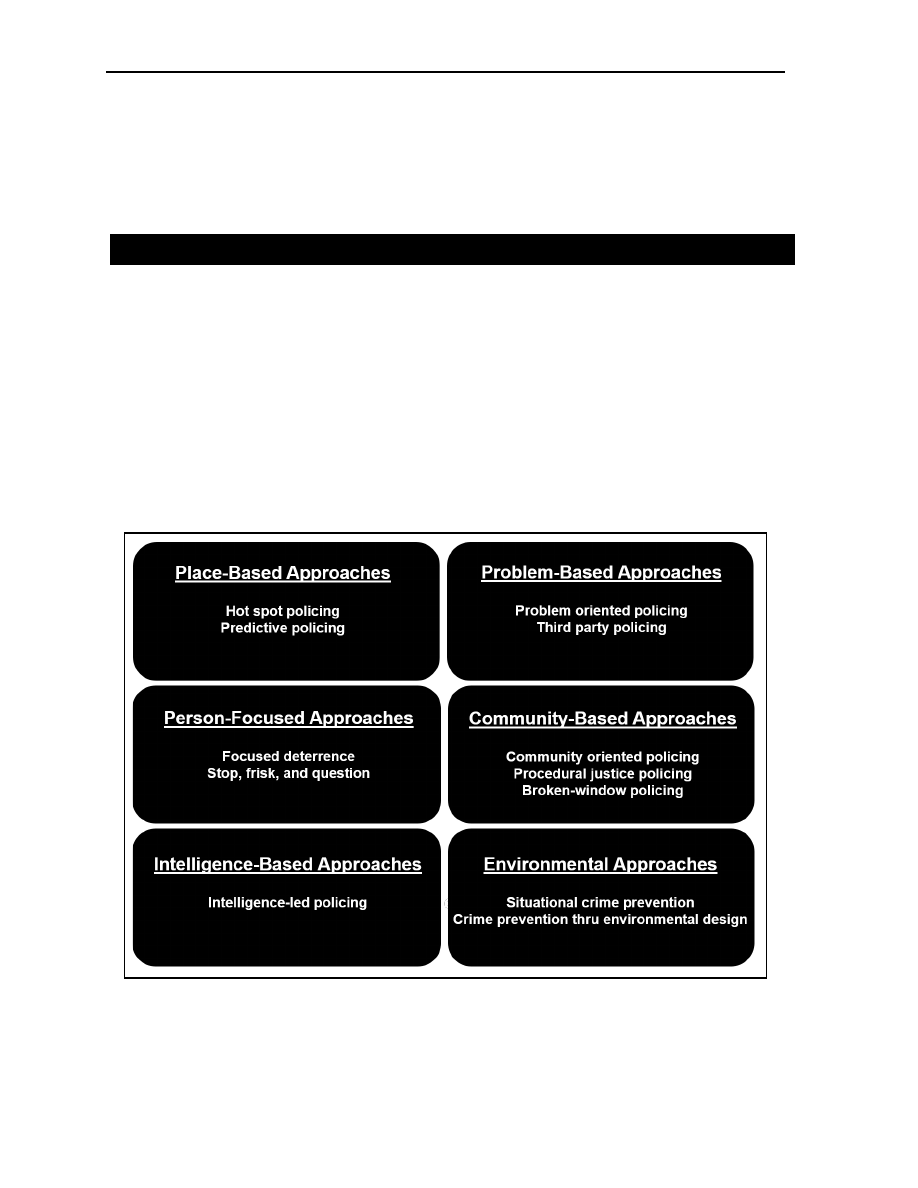
assessments for six different categories of policing strategies and frameworks: place-based, problem-based,
person-focused, community-based, intelligence-based, and environmental-focused (see figure 4-2). The
strategies listed are not all-inclusive but provide a good overview of the more prevalent and widely embraced
policing models.
Figure 4-2. Policing strategies and frameworks
4-57.
Many of these strategies and frameworks have distinct similarities in their application and is evidence
of a normal evolution in policing strategies. Academically, many of these strategies and frameworks are
developed and analyzed as stand-alone approaches; police agencies virtually never implement a single