Asylum Report 2023 - page 2
EUROPEAN UNION AGENCY FOR ASYLUM
judicial protection of an unaccompanied minor applicant cannot vary according to whether this
applicant is the subject of a transfer decision by the requesting Member State or a decision by
which the requested Member State rejects the request to take charge of the applicant. With
regard to the relative of the minor, the CJEU held that the regulation does not confer rights
which could be claimed in court against a decision not to take charge, and the relative cannot
derive a right of appeal against such a decision solely based on Article 47 of the EU Charter.
Interpretation of the concept of a subsequent application
In SI, TL, ND, VH, YT, HN v Bundesrepublik Deutschland (C-497/21), the CJEU
clarified that, within the meaning of Article 2(q) of the recast QD, an application
for international protection cannot be regarded as a subsequent application by
another Member State after a first application is rejected by Denmark, a country
which applies certain provisions of the Dublin III Regulation but does not
implement the recast QD and the recast APD. The court referred to its previous judgment in
LR v Bundesrepublik Deutschland (C-8/20) which concluded that, after a rejection by
Denmark, an application made by the same individual in another Member State cannot be
considered as a subsequent application and thus be rejected as inadmissible.
Family reunification involving minors
In 2022, the CJEU examined three cases concerning the conditions in which
minors, whether beneficiaries of international protection or children of
sponsors, may benefit from family reunification.
In X v Belgium (C-230/21), the CJEU interpreted Articles 2(f) and 10(3a) of the
Family Reunification Directive and ruled that unaccompanied minors do not have to be
unmarried in order to be sponsors for their parents in a family reunification procedure. In
agreement with the opinion of the Advocate General, the court noted that the vulnerability of
minors is not mitigated because of marriage and may, on the contrary, point to an exposure to
a child marriage or a forced marriage.
In SW, BL, BC v Stadt Darmstadt, Stadt Chemnitz (Joined Cases C-273/20 and C-355/20), the
CJEU ruled that the minority of the sponsoring unaccompanied child is not a condition for
family reunification with parents. In addition, Article 13(2) of the Family Reunification Directive
precludes national legislation under which the right of residence of the parents is terminated
as soon as the child reaches the age of majority.
In Bundesrepublik Deutschland v XC, joined by Landkreis Cloppenburg (C-279/20), the CJEU
analysed the date to which national authorities must refer when determining whether the child
of a sponsoring beneficiary of refugee status is a minor for the purpose of family reunification.
When a child has attained majority before the sponsoring parent was granted refugee status
and before the application for family reunification was submitted, the court observed that the
date used to determine if the child is a minor is the date on which the sponsoring parent
submitted an asylum application, provided that an application for family reunification was
submitted within 3 months of the recognition of the parent’s refugee status. In addition, the
legal parent/child relationship is not sufficient on its own to constitute a real family relationship
for family reunification. Nonetheless, it is not necessary for the parent and the child to cohabit
in a single household, to live under the same roof or to support each other financially. The
court noted that occasional visits and regular contact of any kind may be sufficient to establish
the existence of a real family relationship.
50
ASYLUM REPORT 2023
Admissibility of asylum applications lodged by minors whose family members are
beneficiaries of international protection in another Member State
In RO v Bundesrepublik Deutschland (C-720/20), the CJEU interpreted
Article 20(3) of the Dublin III Regulation, which provides for the indissociable
situation of a minor who qualifies as a family member of an applicant for
international protection. In agreement with the opinion of the Advocate General,
the court noted that there is a distinction in EU law between the situation of a
minor whose family members are already beneficiaries of international protection in a Member
State (Dublin III Regulation, Article 9) and a minor whose family members are applicants for
international protection (Dublin III Regulation, Articles 10 and 20(3)).
The court held that Article 20(3) was not applicable in the situation that a minor and the
parents lodge applications for international protection in the Member State in which the minor
was born, when the parents were already provided international protection in another
Member State. In the absence of an agreement expressed in writing by the minor, a request
for international protection by a minor cannot be rejected as inadmissible on the basis of
Article 33(2) of the recast APD, even if the parents received protection in another Member
State but the minor applicant is not a beneficiary of protection in another Member State.
However, the parents’ application may be dismissed as inadmissible on the ground that they
are already beneficiaries of international protection in another Member State.
Maintaining family unity after secondary movements by beneficiaries of international
protection
In a Grand Chamber formation, the CJEU ruled in XXXX v Commissaire général
aux réfugiés et aux apatrides (C-483/20) in a case concerning a parent and his
minor child who had different migration paths, with the minor being a
beneficiary of subsidiary protection in Belgium and the father a beneficiary of
international protection in Austria. The CJEU held that, when an applicant is
already a beneficiary of international protection in another Member State, the recast APD,
read in conjunction with the EU Charter, Articles 7 and 24(2), does not oblige Member States
to verify whether the person fulfils the conditions to claim international protection under the
recast QD and may reject the request for international protection as inadmissible.
However, Member States must refrain from declaring an application as inadmissible when
there are systemic or generalised deficiencies in the other Member State and the living
conditions would amount to a risk of suffering inhuman or degrading treatment contrary to
Article 4 of the EU Charter. In addition, the CJEU highlighted that Member States have an
obligation under the recast QD to maintain family unity by establishing benefits in favour of
family members of beneficiaries of international protection. The court noted that these
benefits are provided in Articles 24-35 of the recast QD, including a right of residence, which
requires three conditions to be met: i) the person must be a family member within the meaning
of Article 2(j) of the recast QD; ii) the family member does not individually qualify for
international protection; and iii) granting the benefit is compatible with the personal legal
status of the family member.
51
EUROPEAN UNION AGENCY FOR ASYLUM
Determining protection provided by the UNRWA
In NB, AB v Secretary of State for the Home Department (UK) (C-349/20), the
CJEU ruled on the assessment of the cessation or end of protection provided
by the United Nations Relief and Works Agency for Palestine Refugees in the
Near East (UNRWA). The court noted that the individual assessment should not
consider only the relevant circumstances prevailing at the time when the
person left UNRWA’s territory, but also those prevailing when the competent
authorities examine an application for refugee status or when the competent judicial
authorities decide on an appeal against a refusal of such a status. It would also be sufficient to
establish that UNRWA’s protection or assistance effectively ceased.
In addition, where the person proves that she left the area of UNRWA for reasons beyond her
control, the Member State must prove that the person can return to that area and benefit from
UNRWA’s protection or assistance. Assistance provided to that person by civil society
organisations is also to be taken into consideration, provided that UNRWA has a formal and
stable cooperation with the organisations.
Access to an administrative file and communication ‘in writing’ of the decision on
international protection
In BU v Bundesrepublik Deutschland (C-564/21), the CJEU ruled on an
applicant’s right to access a copy of the administrative file and the meaning of
communication ‘in writing’ of the administrative decision. The court held that
Articles 23(1), 46(1) and 46(3) of the recast APD, read in conjunction with
Article 47 of the EU Charter, do not contain specific rules on the format and
structure in which the file is communicated to an applicant’s representative. Therefore, they do
not preclude the decision-making authority to provide access to the electronic file in the
format of a series of separate files in PDF format, without consecutive page numbering and for
which the structure can be viewed using a free software.
In addition, in accordance with Article 11(1) of the recast APD, the CJEU held that a
communication of the decision ‘in writing’ does not have to be signed by a case officer. It
simply means that communication should not be implied or made orally.
Withdrawal of material reception conditions
As a follow-up to its ruling in Haqbin (C-238/18) from 2019, the CJEU ruled in
2022 in Ministero dell’Interno v TO (C-422/21) on the withdrawal of material
reception conditions from an applicant for international protection for verbally
and physically assaulting police officers outside an accommodation centre. The
CJEU confirmed that Article 20(4) and (5) of the recast RCD prevents material
reception conditions relating to housing, food and clothing to be withdrawn if this would
deprive the applicant of the most basic needs.
Scope of detention and judicial review of the lawfulness of detention
In a case referred by the Austrian Supreme Administrative Court, IA v Federal
Office for Immigration and Asylum (C-231/21), the CJEU clarified that committing
non-voluntarily an asylum applicant who is a danger to a psychiatric hospital,
authorised by a judicial decision, does not constitute imprisonment under
52
ASYLUM REPORT 2023
Article 29(2) of the Dublin III Regulation. The court further recalled that there are two specific
exceptions for which the 6-month time limit may be extended to implement a Dublin transfer,
included in the second sentence of Article 29(2) of the Dublin III Regulation, namely
imprisonment and absconding.
In K v Landkreis Gifhorn (C-519/20), the CJEU clarified the conditions in which Member States
may temporarily detain third-country nationals in a prison for the purpose of a removal, the
conditions required for a detention establishment to be considered a ‘specialised detention
centre’ within the meaning of the recast Return Directive, Article 16(1), and the extent of a
judicial review by a national court. The CJEU observed that the detention of a third-country
national for the purpose of a removal is intended to ensure the effectiveness of the return
procedure and does not pursue any punitive purpose, which must be reflected in the person’s
conditions of detention. The court noted that national courts must consider the layout of the
premises dedicated to the detention of third-country nationals, the rules specifying their
conditions of detention, and the qualifications and powers of the staff responsible for
supervising their detention. The court further clarified the situations which justify a derogation
under Article 18(1) of the recast Return Directive, the prohibition of detention due to the
vulnerability of a person and the obligation of national courts to effectively verify the
compliance of detention with the conditions imposed by Article 18 of the recast Return
Directive.
In I.L. v Police and Border Guard Board (Politsei- ja Piirivalveamet) (C-241/2), the CJEU held
that Article 15(1) of the recast Return Directive prohibits Member States from detaining an
illegally-staying, third-country national solely on the basis of the general criterion of a risk that
the effective execution of the removal will be jeopardised. The court further noted that such a
measure is contrary to the requirements of clarity, predictability and protection against
arbitrariness.
In B, C and X v State Secretary for Justice and Security (Joined Cases C-704/20 and C-39/21),
the CJEU recalled that the detention of a third-country national constitutes an interference
with the right to liberty enshrined in Article 6 of the EU Charter and the person must be
immediately released when the conditions of the lawfulness of detention are no longer met,
irrespective of whether detention is used in the context of return proceedings due to an illegal
stay, in the processing of an application for international protection or in the context of a
Dublin transfer. The CJEU ruled that the competent judicial authorities have the obligation to
review ex officio the lawfulness of detention decisions by taking into consideration all
elements of the case, even if the failure to comply with the lawfulness of detention has not
been raised by the person concerned before a competent judicial authority.
Withdrawal of international protection on grounds of national security
In the case of GM (C-159/21), referred by the Budapest High Court, the CJEU
ruled on the use of non-reasoned opinions of national security bodies in
procedures to withdraw international protection due to a danger to national
security. The CJEU held that Member States must provide access to confidential
national security information to the courts that rule on the lawfulness of the
decision and establish procedures guaranteeing the rights of defence of the person. The
CJEU noted that Article 23(1) of the recast APD does not allow competent authorities to
exclude the person and their representative from knowing the decisive elements which are
contained in the file. The CJEU specified that the possibility of obtaining authorisation to
53
EUROPEAN UNION AGENCY FOR ASYLUM
access the information, coupled with the prohibition to use the information in the
administrative procedure, does not sufficiently guarantee the right to defence.
The court ruled that a determining authority cannot rely on a non-reasoned opinion given by
national security bodies when the factual basis and assessment by these bodies was not
disclosed to the determining authority. It noted that the determining authority that assesses a
withdrawal cannot endorse a decision adopted by another authority, because it must include
its own assessment of the facts, circumstances and reasons in its decision, and the scope and
relevance of the information provided by national security bodies must be assessed by the
determining authority. Although the right to defence may be limited, the CJEU recalled that
Article 23(1) of the recast APD does not allow competent authorities to exclude a person and
their representative from gaining effective knowledge of the substance of the decisive
elements contained in the file.
Return of rejected applicants for international protection who suffer from a serious illness
In X v State Secretary for Justice and Security [NL] (C-69/21), the CJEU ruled that
a third-country national suffering from a serious illness may not be removed if, in
the absence of appropriate medical treatment in the receiving country, the
person would be subjected to a real risk of rapid, significant and permanent
increase in pain. The CJEU stated that it must be established that the only
effective analgesic treatment cannot be lawfully administered in the receiving country and that
the person would be exposed to a real risk of inhuman or degrading treatment in the absence
of the treatment, for example extreme pain that could cause irreversible psychological
consequences or lead to suicide.
Voluntary departures and forced removal
In UN v Subdelegación del Gobierno en Pontevedra (C-409/20), the CJEU
interpreted Articles 6, 7 and 8 of the recast Return Directive, ruling on the
possibility for an illegally-staying, third-country national to regularise his/her stay.
The CJEU held that national legislation may initially sanction an illegally-staying,
third-country national with a fine and an obligation to leave the territory within a
prescribed period, unless the person’s stay is regularised, and subsequently, if the stay is not
regularised, by a compulsory removal, in accordance with the recast Return Directive.
54
ASYLUM REPORT 2023
Section 3.
EUAA support
“This Regulation establishes a European
Union Agency for Asylum (the ‘Agency’).
The Agency…shall be a centre of
in 2022
expertise by virtue of its independence,
the scientific and technical quality of the
Section 3 details the Agency’s work
assistance it provides and the
programme, work with third countries,
information it collects and disseminates,
and operational and technical assistance
the transparency of its operating
which was provided over the course of
procedures and methods, its diligence in
the year. It also presents an evaluation of
performing the tasks assigned to it, and
these activities, when applicable.
the information technology support
needed to fulfil its mandate.”
While the scope of the Agency’s activities
is multifaceted, highlights in this section
are provided for six key areas:
3.1. Production of asylum knowledge
and technical expertise
3.2. Training
3.3. Operational and technical
assistance
3.4. Third country support
3.5. Cooperation with civil society
organisations
3.6. Protection of fundamental rights
55
EUROPEAN UNION AGENCY FOR ASYLUM
The EUAA’s extended mandate, as foreseen in Regulation (EU) 2021/2303 on the
Establishment of a European Union Agency for Asylum, entered into force on 19 January
2022.225, 226 In line with its enhanced role, throughout the year the EUAA:
offered greater operational and technical support to foster efficiency in asylum
systems;
worked toward improving and accelerating the provision of assistance at the request
of Member States;
further developed operational standards, indicators and practical guidelines to inform
uniform, high-quality decision-making in asylum cases;
supported the practical implementation of CEAS by training asylum and reception
professionals;
contributed to increased situational awareness among EU policymakers to inform
decisions and preparedness;
contributed to capacity-building in non-EU countries; and
supported EU+ countries with resettlement schemes.
The Russian invasion of Ukraine generated large-scale protection needs, and the Agency
responded quickly to offer assistance to countries receiving large numbers of displaced
persons from Ukraine. The Agency proved its role as a centre of expertise in asylum by
expanding its operational and technical support to address evolving needs. As an integral
actor in the collective EU response in addressing the needs of millions of displaced persons,
the EUAA effectively contributed to the implementation of protection solutions across Europe.
To assist Member States in applying CEAS, ensure fair and efficient asylum procedures,
provide high-quality reception standards and harmonise their practices, the EUAA provides
support structured around three pillars:
Technical support includes information collection and analysis; the development of
guidance and practical tools; the exchange of expertise and good practices; and
advice on legal obligations. As of 2023, the EUAA will also be mandated to monitor
the application of EU asylum and reception obligations by Member States;
Training and professional development of national asylum and reception officials to
ensure a common, high-quality application of CEAS standards; and
Operational support to Member States, especially those experiencing
disproportionate pressure on their asylum and reception systems.
For more detailed information on the EUAA’s activities, work programme and
budget, please refer to the EUAA Consolidated Annual Activity Report (CAAR)
2022. For EUAA’s governance documents, please refer to the EUAA website.
56
ASYLUM REPORT 2023
3.1. Asylum knowledge
To provide evidence-based information to a range of audiences,
including policymakers, the EUAA collects, processes, synthesises
and analyses information on specific themes, latest developments,
emerging topics and forecasting in the field of asylum.
Country of origin information and country guidance
Based on the well-established Country of Origin (COI) Report Methodology, the
Agency produced 15 COI reports in 2022 in close collaboration with Member
States. COI was produced consistently and timely, in particular to monitor the
situation in Afghanistan and Ukraine. A guide was also developed on
interviewing sources in the context of COI research.
The Agency continued to support national COI networks, facilitated information-exchange,
built capacity and further generated knowledge in the area of COI, while more than
1,000 responses were provided to individual requests for Medical COI (MedCOI).
Country guidance involves a joint assessment by Member States of the situation in the main
countries of origin. To enhance convergence in EU+ decision-making practices, new country
guidance was produced on Somalia and Iraq, two updates were published on Afghanistan and
additional update processes were completed for Afghanistan and Syria.
Information and analysis of asylum developments
The EUAA continued to manage and update several databases which capture
national developments in asylum and reception systems in EU+ countries, in
addition to court cases related to asylum. Information was included daily into the
Information and Documentation System (IDS) on CEAS, which serves as a
central source of information for policymakers in EU+ countries. Its
jurisprudential counterpart, the publicly-available EUAA Case Law Database, covers case law
related to the implementation of CEAS issued by national courts, the CJEU and the European
Court of Human Rights (ECtHR). In 2022, there were more than 3,000 registered cases. The
database is used to address internal and external requests for jurisprudential information, and
four quarterly publications on case law were published to highlight how courts have shaped
policies and practices related to all aspects of asylum.
The Agency continued to produce situational overviews and analyses on key areas of CEAS,
in particular to address emerging information needs arising, for example, from the arrival of
large waves of displaced persons from Ukraine.
In 2022, the EUAA launched the public platform, Who is Who in International Protection in
the EU+, which presents key stakeholders and their roles in a range of areas in asylum and
reception systems across EU+ countries. The platform contains interactive visualisations to
view the mappings and PDF reports by theme.
57
EUROPEAN UNION AGENCY FOR ASYLUM
Data analysis and research
Through the Early Warning and Preparedness System (EPS), the EUAA
continued in 2022 to foster an effective exchange of a standardised set of
indicators which quantify the asylum and reception situation in EU+ countries.
Following the activation of the Temporary Protection Directive, the Agency
swiftly developed and implemented a regular exchange of statistics on
registrations of temporary protection across EU+ countries.
Work continued on early warning and forecasting to better understand the root causes of
migration and support the planning of suitable policy and operational responses. A key
product was the joint report with the Organisation for Economic Co-operation and
Development (OECD) and the IOM on profiles, experiences and aspirations of displaced
persons from and within Ukraine.
The Agency's strategic analysis products cover a number of asylum-related aspects, including
latest trends, to provide national authorities and relevant EU institutions a situational overview
of asylum across Europe.
Support in enhancing quality standards
To maximise the multiplying effect of expertise-sharing, the EUAA continued to
facilitate practical cooperation and the sharing best practices among Member
States on asylum processes and quality management. It supported the practical
implementation of CEAS through the development of common practical guides
and tools, guidelines and operational standards.
The Agency organised dedicated meetings for national authorities to discuss the
implementation of the Temporary Protection Directive and its implications for the asylum
procedure. In addition, material was developed quickly to provide information to displaced
persons from Ukraine. A Quality Matrix Synthesis Report offers an overview of practices of
national asylum administrations related to the personal interview, evidence assessments and
qualifications for international protection. To assist with the daily work of case officers, new
practical tools were developed for examining claims based on religion, political opinion and
the detection and examination of exclusion cases.
The Agency continued to promote the convergence of practices across the EU. For example,
the EUAA created a tool on family unity, which ensures consistency in the provision of
information to applicants in the Dublin procedure on the possibility of reuniting with family
members. The tool includes an online planner that supports Member States in effectively
implementing Dublin transfers by providing information on procedures, opening hours and
closure dates for border crossing points.
Practical guidance was developed on a range of topics concerning vulnerable persons,
including age assessments, special needs and vulnerability assessments, screening of special
needs and vulnerabilities, country information on support frameworks for people fleeing
Ukraine, critical incident management, support to guardians on temporary protection, mental
health of applicants, and issues related to sexual orientation, gender identity or expression
and sex characteristics (SOGIESC).
58
ASYLUM REPORT 2023
In the area of reception, in 2022 the EUAA developed tools on emergency placement in
private accommodation; rights and obligations in the context of temporary protection; self-
identification of vulnerabilities for beneficiaries of temporary protection in reception; design
and management of modular reception centres; and information provision material for
applicants in reception. The creation of new standards and indicators on reception and related
to vulnerable applicants was initiated, foreseen to be completed in 2023.
As part of the effort to promote common standards and further convergence in the
implementation of the asylum acquis, the EUAA, through a dedicated network, cooperates
with members of courts and tribunals in EU+ countries. In 2022, the Agency produced judicial
analyses, as well as guidance for judicial training, which took stock of the latest developments
in the implementation of CEAS and the most recent jurisprudence from European and national
courts and tribunals. Through a series of workshops and regional conferences, the Agency
helped members of courts and tribunals advance their knowledge in all procedural and
substantial aspects of international protection.
3.2. Training and professional development
The EUAA supports the practical implementation of CEAS by training asylum
and reception officials to have the necessary knowledge, skills and autonomy
to implement efficient and fair procedures, in line with EU standards. The
European Asylum Curriculum, used by the Agency in its training, includes a
wide range of modules which cover the entire spectrum of international
protection.
To further address existing and emerging training needs, in 2022, seven training modules
were developed or restructured, including: i) communication for asylum and reception
practitioners; ii) introduction to vulnerability; iii) introduction to ethical and professional
standards; iv) working with an interpreter; v) introduction to coaching; vi) applicants with
diverse SOGIESC; and vii) orientation course for learners. In addition, a training package was
developed on the Temporary Protection Directive, and training sessions were provided to
thousands of officials to help national authorities, as well as neighbouring countries, to rapidly
build up capacity and manage the humanitarian consequences of Russia’s invasion of Ukraine.
Based on the premise that professional development is a continuous endeavour and in line
with a life-long learning pedagogical approach, the Agency’s training centre developed
training material for trainers. As part of the continuing professional development series, in
2022 six modules were developed focusing on: i) Afghanistan inclusion; ii) Afghanistan
exclusion; iii) Temporary Protection Directive in the context of the war in Ukraine; iv) rumours
management; v) information and communication needs assessment; and vi) communication in
emergencies.
In total, more than 3,000 participations of asylum and reception officials in training sessions
were recorded in 2022, while approximately 600 participations were recorded for the train-
the-trainer sessions on European Asylum Curriculum modules. In the context of operational
assistance provided to Member States (see Section 3.3), the Agency delivered a number of
training sessions to Asylum Support Teams and national asylum and reception officials, with
more than 4,600 participants. Similarly, in the context of its cooperation with third countries,
the EUAA organised a number of training sessions for third-country authorities at national and
regional levels to assist in capacity-building.
59
EUROPEAN UNION AGENCY FOR ASYLUM
3.3. Operational and technical assistance
A key area of work for the EUAA is to provide operational and technical
assistance to Member States in the implementation of its obligations under
CEAS, at the request of a Member State -or on its own initiative with the
agreement of the Member State- where its asylum or reception system is
subject to disproportionate pressure. Following a request by a Member State,
the EUAA in consultation with authorities of the Member State and other
relevant stakeholders undertakes a needs assessment, which informs the joint definition of
assistance measures to be implemented. These measures and the means to implement them
are detailed in an operational plan, which is binding on the Agency, the Member State
requesting the assistance and all participating Member States. Assistance typically comprises
the provision of equipment and support personnel and the implementation of activities to
enhance asylum and reception capacity.
Over the past years, the number of countries seeking the Agency’s operational support has
increased significantly. The Russian invasion of Ukraine and the mass inflow of persons
seeking protection in Europe created new needs for the Agency’s support, especially in the
implementation of the Temporary Protection Directive. In such a volatile and unpredictable
landscape, the ability to quickly mobilise resources and expertise was of utmost importance.
To this end, in 2022, the Agency created a unit to coordinate first response and preparedness
plans for the provision of predictable, effective, efficient and streamlined support. The Agency
also produced an EUAA Asylum and Reception Operational Response Catalogue, which
presents the different types of operational support provided by the EUAA. The catalogue
serves, together with needs assessments, as a foundation for the design of operational plans.
Additionally, actions were taken to improve the coordination and deployment of experts
supporting operational plans, as well as toward the implementation of the asylum reserve
pool, as foreseen in the EUAA Regulation. This enables the Agency to have a reserve of
experts ready for deployment in emergency situations.
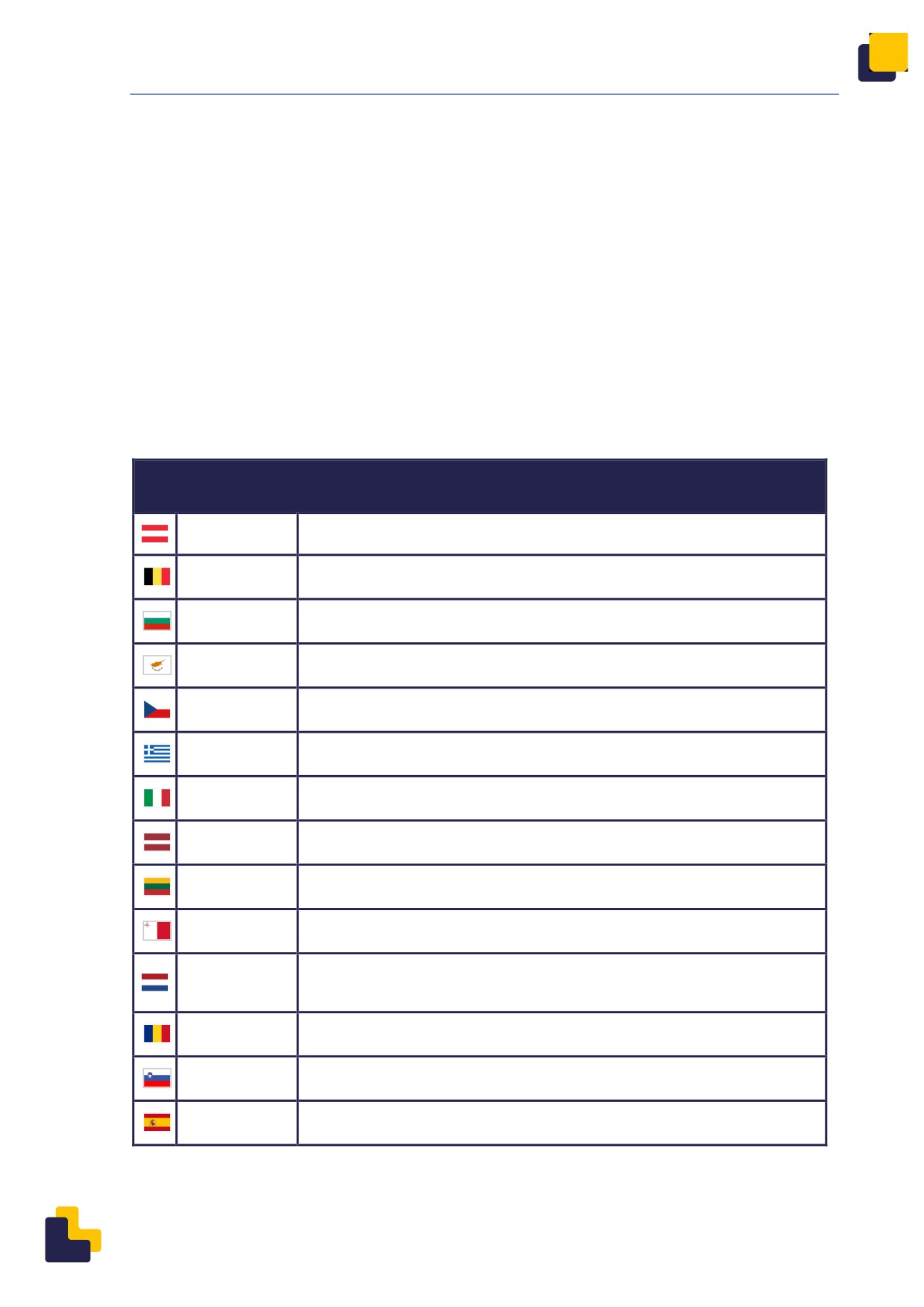
In 2022, the EUAA provided operational support to a record number of 14 EU Member States
(see Table 3.1), with new operating plans signed with Austria, Belgium, Bulgaria, Czechia, the
Netherlands and Slovenia. Following the implementation of these plans in 2022, amendments
for the continuation and expansion of activities in 2023 were signed with Belgium, Bulgaria
and the Netherlands. An extension of the existing operational plan was signed with Czechia,
while a new operational plan for Romania was agreed for 2023. In addition, following requests
by the European Commission, support has been provided in Moldova with information
provision in the context of the Voluntary Transfer Programme, which aims to facilitate the
transfer of persons displaced from Ukraine from Moldova to pledging Member States.
Upon signing an operational plan, Asylum Support Teams - comprised of EUAA personnel,
Member State experts and other experts not employed by the Agency - are deployed on the
ground to provide direct support. Throughout 2022, the Agency assisted Member States in a
range of areas, depending on the specific measures included in each plan. This may include
the provision of hardware/equipment to national asylum and reception authorities; increasing
the capacity and quality of processing applications for international protection; increasing the
capacity and quality of services in national reception systems; supporting the functioning of
the Dublin procedure; supporting the processing of applications at second instance; improving
information management; supporting vulnerability assessments and enhancing protection for
unaccompanied minors; providing information to applicants in the context of asylum and
60
ASYLUM REPORT 2023
reception; and assisting with voluntary relocations. On this last point, following the solidarity
declaration in June 2022, the EUAA started supporting the Voluntary Solidarity Mechanism by
facilitating relocation activities.
Across most countries receiving operational support, a key pillar of assistance has focused on
capacity-building through EUAA training modules on topics covering the existing needs in
each country.
The EUAA continued to manage the Resettlement and Humanitarian Admissions Network by
organising steering group and thematic meetings and meetings of the Expert Platform on Safe
Pathways to Afghans. The Resettlement Support Facility in Istanbul continued to support
resettlement operations by EU countries and served as a platform to exchange knowledge
and expertise. The Agency also delivered training and released operational tools on
resettlement.
Table 3.1. List of operating plans between the EUAA and Members States, 2022
Austria
Operational Plan 2022-2023 agreed by the EUAA and Austria
Belgium
Operating Plan 2022, agreed by EUAA and Belgium
Bulgaria
Operational Plan 2022 agreed by the EUAA and Bulgaria
Cyprus
Operational Plan 2022-2024 agreed by the EUAA and Cyprus
Czechia
Operational Plan 2022 agreed by the EUAA and Czechia
Greece
Operating Plan 2022-2024 agreed by the EUAA and Greece
Italy
Operating Plan 2022-2024 agreed by EASO and Italy
Latvia
Operating Plan 2022, agreed by EASO and Latvia
Lithuania
Operating Plan 2022 agreed by EASO and Lithuania
Malta
Operational Plan 2022-2024 agreed by the EUAA and Malta
The
Operational Plan 2022-2023 agreed by the EUAA and the Netherlands
Netherlands
Romania
Operational Plan 2023 agreed by the EUAA and Romania
Slovenia
Operational Plan 2022 agreed by the EUAA and the Republic of Slovenia
Spain
Operational Plan 2022-2023 agreed by the EUAA and Spain
61
EUROPEAN UNION AGENCY FOR ASYLUM
Highlights of EUAA’s operational support
in 2022
In 2022, the EUAA provided
operational support to a record
number of 14 EU Member States
With the assistance of the EUAA in:
Romania:
Lithuania:
6,000
62,000
information desk
persons were registered for
activities set-up
temporary protection
Romania:
Lithuania:
650
1,000
individuals received
vulnerability pre-screening
training
activities
ASYLUM REPORT 2023
3.3.1. Assessment of EUAA operational support in 2022
The Agency undertakes regular evaluations of its operations to enhance the
overall relevance, effectiveness, efficiency, coherence and added-value of
assistance. This reflective approach contributes to institutional learning,
evidence-based change management, accountability and transparency.
In 2022, the Agency conducted four internal evaluationsv covering operational
support in Lithuania, Latvia and Romania. Ongoing operational plans agreed with Austria,
Belgium, Bulgaria, Cyprus, Czechia, Greece, Italy, Lithuania, Malta, Slovenia, Spain and the
Netherlands that extend beyond the end of 2022 were not due for evaluation.
Lithuania
Under the operational plan with Lithuania, which ran from July 2021 to June 2022, the
Agency provided support in the areas of asylum and reception following a sharp
increase in arrivals in 2021. The evaluation concluded that the Agency provided a rapid and
flexible response and contributed to an EU-wide solidarity approach. In the area of asylum, the
Agency delivered train-the-trainer sessions, COI support and interpretation. It also provided
limited support to first instance asylum processing.
The Agency supported the reception system with information provision, vulnerability
assessments, training and interpretation. Taking into account the geopolitical context, the
operational support was considered relevant and of added-value, in particular in the field of
reception. The evaluation made recommendations to optimise the planning of new
operational plans and interpretation support.
Latvia
The Agency supported Latvia with two operational plans following an increase in
asylum seekers from Belarus in mid-2021. Under the first operational plan (running
from September 2021 to March 2022), the Agency focused on the provision of interpretation
during the asylum procedure and in reception. The support was considered relevant, coherent
and effective in view of its limited scope and was considered ‘fair’ with regard to efficiency
and added-value.
Support under the second operational plan, which covered the remaining of 2022, took place
during stabilised migration pressure. The measures foresaw additional support for training and
contingency planning. The support was considered effective, with 80 participations of more
than 50 Latvian officials in training sessions on information provision, reception and vulnerable
applicants. The smooth cooperation with the authorities underlined the relevance and the
coherence of the action. Despite a number of efficiency gains, the mobilisation of support was
also limited in terms of cost-efficiency because of the short timeline and the volume of the
operation. In view of the reduced added-value of the Agency’s support, the evaluation
supported the closure of the operational plan and recommended the continuation of support
under the Agency’s permanent support framework.
v The evaluations covered the 2021-2022 and 2022 operational plans for Latvia, the 2021-2022 operational plan
for Lithuania, and the 2022 operational plan for Romania.
63
EUROPEAN UNION AGENCY FOR ASYLUM
Romania
Following the Russian invasion of Ukraine, more than 2.5 million people crossed the
border into Romania in 2022. The operational plan with Romania ran from March to
December 2022. It was the Agency’s first operational plan to focus on support in the
implementation of the Temporary Protection Directive.vi
Following rapid mobilisation, the Agency facilitated over 62,000 registrations, information
sessions for over 65,000 individuals and 42 training activities by the end of 2022. The Agency
provided comprehensive and flexible training and information provision involving national
authorities, international organisations and NGOs. In view of the geopolitical context, the
support was deemed relevant and of high added-value. Recommendations involved the need
for better working conditions and the optimisation of mechanisms for the deployment of
experts.
3.4. Cooperation with third countries
As the European centre of expertise on asylum, the EUAA plays an important
role in strengthening CEAS by working with third countries. The overarching
rationale of this work is that a stable and functioning CEAS is contingent not
only on improving legislation and procedures within Europe, but also on
enhancing capacity in asylum and reception systems of third countries.
In view of the Agency’s new mandate and geopolitical developments in the
field of asylum, in March 2023, the Management Board of the EUAA adopted a revised
external cooperation strategy. The strategy sets the overall direction for the Agency’s future
work in the external dimension of CEAS, recalibrating the vision, principles and strategic
objectives of its external actions and outlining a renewed approach to third-country support,
as well as to resettlement and humanitarian admissions. In developing and implementing
activities with third countries, the EUAA cooperates with a range of stakeholders, including
EU+ countries, the European Commission, the EEAS and JHA agencies.
The EUAA’s support to third countries takes place through bilateral roadmaps for cooperation
and EU-funded regional programmes, such as the Instrument for Pre-Accession Assistance.
Roadmaps for bilateral cooperation in 2022 were implemented with Albania, Bosnia and
Herzegovina, Egypt, Kosovo, Montenegro, North Macedonia, Serbia and Türkiye.
In 2022, the Agency further developed practical cooperation among EU+ countries on
external dimension activities, including by organising meetings of the Third Country
Cooperation Network and working group meetings on cooperation with the Western Balkans,
Türkiye and the Middle East and North Africa (MENA) region. The EUAA continued to develop
specific knowledge management tools, such as the third-country support platform, which is a
virtual space that facilitates cooperation and information-exchange among members of the
Third Country Cooperation Network.
vi Council Implementing Decision (EU) 2022/382 of 4 March 2022 establishing the existence of a mass influx of
displaced persons from Ukraine within the meaning of Article 5 of Directive 2001/55/EC, and having the effect of
introducing temporary protection (OJ L 71, 4.3.2022, p. 1).
64
ASYLUM REPORT 2023
With the adoption of the 2022-2023 roadmap for cooperation, the EUAA entered into its
fourth consecutive partnership with the Presidency for Migration Management (PMM), the
Turkish competent authority on asylum and reception. Throughout 2022, in the framework of
the roadmap, a number of participating EU+ countries worked closely with the EUAA to build
the PMM’s institutional capacity, and by extension, to promote positive outcomes for refugees
in Türkiye. The focus was on persons with special needs and on interventions to ensure that
the PMM is better placed to manage fluctuating migration movements.
Partnerships with MENA countries were further calibrated to increase knowledge and enhance
capacities in the areas of asylum and reception. The Agency also continued the
implementation of the EUAA-Egypt Roadmap.
At the regional level, the EUAA successfully delivered activities involving all North African
countries and Niger, thereby laying the basis for the creation of a practitioners’ network,
including relevant stakeholders, such as UNHCR and the IOM. Activities focused on issues
involving vulnerable groups and offered the opportunity to participating countries to share
knowledge on the functioning of their respective asylum systems and to identify needs and
interests for the joint design of future regional activities.
The Agency worked closer with authorities in the Western Balkans to improve knowledge and
capacities to manage fluctuating migration movements and to develop their asylum and
reception systems in a protection-sensitive manner, including for persons with special needs.
Regional training on interviewing techniques and interviewing vulnerable persons were
coupled with on-the-job coaching on core asylum procedures in Albania, Kosovo,vii
North Macedonia and Montenegro.
The EUAA provided train-the-trainer modules, supported the revision of asylum legislation in
Albania and Bosnia and Herzegovina, and assisted with reinforcing the COI unit in Serbia. The
Agency responded to the needs generated by Russia’s invasion of Ukraine through structured
information exchanges on temporary protection and supported contingency plans in
Montenegro.
3.4.1. Assessment of EUAA support to third countries in 2022
At the end of 2022, the Agency concluded the implementation of the 24-month-
long roadmaps for cooperation with Albania, Bosnia and Herzegovina, Serbia
and North Macedonia. Albania and Serbia agreed to extend their roadmaps to
December 2023, while Bosnia and Herzegovina and North Macedonia agreed to
develop new ones.
To assess the relevance, effectiveness, efficiency, coherence and added-value of its support
to third countries, the EUAA managed five external evaluations of its cooperation with
Western Balkan partner countries.viii The evaluations found that roadmaps, as a framework for
cooperation with third countries, were highly relevant to meet the needs of national
authorities. They also served to outline long-term strategic priorities for cooperation. While
vii This designation is without prejudice to positions on status and is in line with the United Nation’s Security Council
Resolution 1244 on the situation relating to Kosovo and the International Court of Justice’s advisory opinion on
Kosovo’s declaration of independence.
viii These covered the roadmaps for cooperation with Albania, Bosnia and Herzegovina, Serbia and
North Macedonia, as well as a cross-cutting evaluation of the roadmap approach as an instrument for cooperation
with these partner countries.
65
EUROPEAN UNION AGENCY FOR ASYLUM
resource capacity constraints and COVID-19-related travel restrictions posed challenges
during the implementation, the roadmaps effectively brought about a number of common
deliverables. These included an increased capacity of national counterparts to manage asylum
processes and further alignment of national legislation with CEAS.
The four roadmaps were found to be coherent and complementary towards parallel activities,
such as the EUAA’s activities at the regional level and ongoing efforts by international
organisations. The Agency’s unique position as a centre of expertise on CEAS was considered
the key added-value.
Highlights of EUAA support to third
countries in 2022
The Western Balkan roadmaps contributed to bringing partner
countries closer to CEAS standards, through legislative support and
the sharing of good practices from EU Member States.
3.5. Consultative forum and civil society organisations
Civil society organisations bring unique expertise and knowledge to asylum
and reception-related discussions. The Agency’s Consultative Forum, initially
established in 2011 as part of EASO, is the main channel for dialogue and
cooperation with civil society organisations working in asylum at the local,
European and international levels.
The cooperation takes place through meetings, electronic consultations on key EUAA
documents, and participation in EUAA activities, including training, workshops, activities
related to vulnerable groups and more.
2022 was a transitional year, as a main priority was to establish and operationalise the revised
Consultative Forum, as foreseen in the EUAA Regulation. Being a part of the Agency’s
administrative and management structure, the reinforced Consultative Forum exercises its
tasks independently and advises the Executive Director and the Management Board on
asylum-related matters, in accordance with the Agency’s specific needs in priority areas.
For its composition, the regulation provides that FRA, Frontex, UNHCR, relevant civil society
organisations and competent bodies active in the field of asylum policy are invited to become
members of the Consultative Forum. Apart from the usual modalities of engagement, such as
meetings and consultations, the regulation foresees the creation of thematic or
geographically-focused consultation groups within the forum.
66
ASYLUM REPORT 2023
As part of its work, the Consultative Forum should be consulted on the development of the
European Asylum Curriculum; the preparation, adoption and implementation of the Agency’s
Fundamental Rights Strategy and Code of Conduct; and the setting up of a complaints
mechanism in the event of violations of fundamental rights by the Agency’s Asylum Support
Teams. Thus, there is an increasing focus of the forum’s work on fundamental rights related to
asylum and, to this end, it works closely with the Agency’s Fundamental Rights Officer (see
Section 3.6).
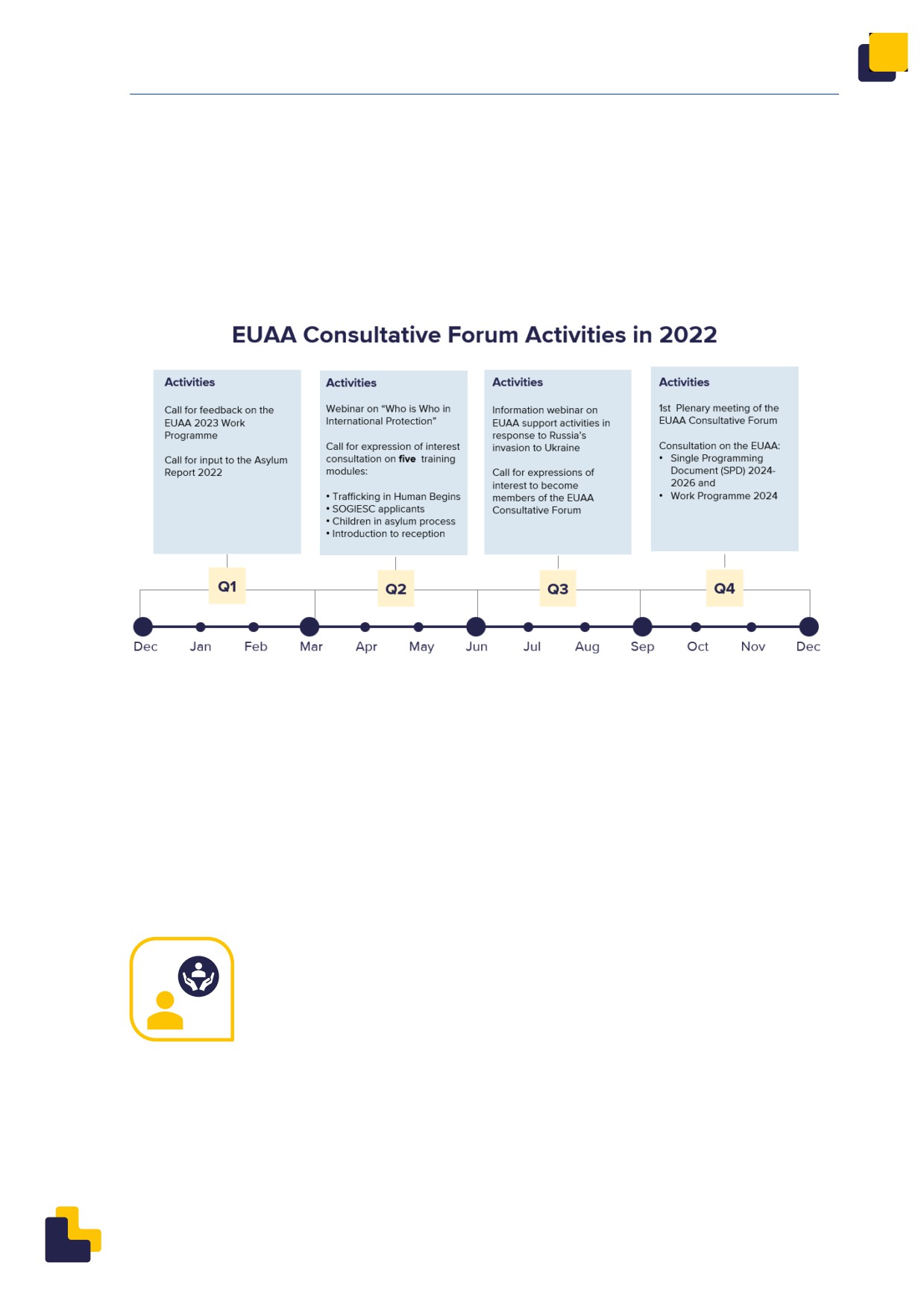
To effect these changes, in June 2022, the Consultative Forum was reconstituted and a call
for expressions of interest in becoming a member was launched, with more than
100 organisations becoming members in the first few months after the call. Since November
2022, the forum has been chaired by one of the member organisations, directly elected by
other forum members. Additionally, two thematic consultation groups were established: one
on country of origin information and one dedicated to vulnerable groups in the context of
asylum.
3.6. Protection of fundamental rights
The EUAA Regulation introduced provisions to ensure that the Agency fully
adheres to fundamental rights when delivering its tasks, including the
appointment of a Fundamental Rights Officer who reports to the Agency’s
Management Board and is responsible for the development of the Agency’s
Fundamental Rights Strategy in close collaboration with the Consultative
Forum. The regulation also provides for the establishment of a complaints
mechanism to respond to claims of breaches of fundamental rights in the context of the
Agency’s operations.
In 2022, the EUAA carried out preparatory activities for the appointment of a Fundamental
Rights Officer, and in February 2023, the Agency’s Management Board selected a candidate
for the position. Steps were also taken to establish the complaints mechanism, whereby any
person who is directly affected by the actions of an expert in an Asylum Support Team, and
67
EUROPEAN UNION AGENCY FOR ASYLUM
who considers that their fundamental rights have been violated due to those actions, or any
party representing such a person, may submit a complaint in writing to the EUAA. The
complaints mechanism is to be implemented by the Fundamental Rights Officer, who is
independent.
In June 2022, the EUAA also updated its Code of Conduct, which all experts who are
deployed as part of Asylum Support Teams (including experts from the Agency’s own staff,
experts from Member States, experts seconded by Member States to the Agency or other
experts not employed by the Agency) are bound to respect. The Code of Conduct will be
further updated in consultation with the Fundamental Rights Officer.
The Agency has been developing an escalation process, according to which the Executive
Director, after informing the host Member State, can suspend or terminate, in whole or in part,
the deployment of Asylum Support Teams. This would take place when, after consulting the
Fundamental Rights Officer, it is considered that there are violations of fundamental rights or
international protection obligations by the host Member State that are of a serious nature or
are likely to persist.
3.7. EUAA Presidency of the JHA Agencies Network
2023
In carrying out its mandate, the EUAA works in regular cooperation with the
other eight Agencies operating in the area of justice and home affairs and
managing security, justice, fundamental rights and gender equality. The JHA
Network was established in 2010 to increase inter-agency cooperation and
explore synergies in areas of common interest.
The Presidency rotates among the participating Agencies on a yearly basis. As of 2022, the
network operates on the basis of a Trio Presidency coordination concept, whereby three
consecutive presiding Agencies work together to identify the overarching topics of discussion
for 3 consecutive years. The first Trio comprises the Presidencies of CEPOL (2022), the EUAA
(2023) and eu-LISA (2024). During the 2023 EUAA Presidency, priorities for the network
include:
Digitalisation, covering issues related to the use of artificial intelligence, biometrics and
interoperability;
Implementation of the EU Green Deal in JHA Agencies;
Information provision in mixed migration situations, acknowledging that swift and
adequate provision of accurate and tailor-made information is important for migrants
and persons in need of international protection so that they do not fall victim to
exploitation or abuse;
Cybersecurity, also in the context of the Russian aggression against Ukraine which has
led to increased risks of cyberattacks on Member States and other strategic targets;
and
Internal and external communication on the network’s activities and functioning in
order to provide better understanding, within EU institutions and to European citizens,
and increase trust.
68
ASYLUM REPORT 2023
While the above constitute the expressed priority areas for 2023, the EUAA is constantly
monitoring developments in the area of justice and home affairs and has a flexible approach in
its Presidency to be able to respond to current events.
Justice and Home Affairs (JHA) Network of Agencies
Priorities of the EUAA Presidency 2023
Digitalisation
Implementation of the EU Green Deal
Information provision in mixed migration situations
Cybersecurity
Internal and external communication on the network’s activities and
functioning
For more detailed information on the 2023 EUAA Presidency of the Justice
and Home Affairs Agencies Network, see the Work Programme
EUROPEAN UNION AGENCY FOR ASYLUM
4.1 Access to the asylum
procedure presents
developments surrounding
access to territory and the first
steps of the asylum procedure,
including making, registering
Section 4
and lodging an application.
4.2 The Dublin procedure
takes an in-depth look into the
system which sets out the
Functioning of
criteria and mechanisms to
determine the Member State
the Common
responsible for examining an
application for international
European Asylum
protection.
System
4.3 Special procedures to
assess protection needs
presents new practices around
border procedures, the safe
country of origin concept,
This section provides an overview of
accelerated procedures,
developments in legislation, policy,
admissibility procedures and
practice and case law in
subsequent applications.
EU+ countries throughout 2022.
Concerns about aspects of national
4.4 Processing asylum
asylum and reception systems are
applications at first instance
included from authorities, civil society
addresses new approaches,
organisations, UNHCR and other
measures, working methods
international organisations.
and policies, such as
prioritisation policies. It presents
The sub-sections are organised by
legislative amendments,
theme, following the steps of the
technological developments
asylum procedure.
and improvements to the quality
of the procedure.
70
ASYLUM REPORT 2023
4.5 Processing asylum
4.10 Legal assistance and
applications at second or
representation outlines
higher instances presents
changes in the provision of free
initiatives to make the
legal counselling and advice to
procedures at second instance
applicants.
more efficient and details
changes on the right to an
4.11 Interpretation services
effective remedy and the
presents amendments and
processing of cases lodged by
concerns around the provision
specific nationalities.
of interpretation, including
institutional changes and policy
4.6 Pending cases discusses
updates. Interpretation in the
the number of applications still
health system is highlighted.
under examination, which is a
key indicator reflecting the
4.12 Country of origin
workload experienced by
information briefly describes
national authorities and the
developments in country of
pressure on national asylum
origin (COI) research and
systems, including reception
production.
systems.
4.13 Statelessness in the
4.7 Reception of applicants for
context of asylum explores the
international protection shows
relationship between
how Member States reacted to
statelessness and asylum,
trends in international
highlighting associated
protection in terms of reception
challenges.
capacities and policies.
4.14 Content of protection
4.8 Detention provides an
presents initiatives taken for the
overview of changes in
integration of recognised
detention capacity, conditions,
beneficiaries of international
duration and alternatives to
protection based on the recast
detention.
Qualification Directive.
4.9 Access to information
4.15 Resettlement and
details new initiatives in
humanitarian admission
information provision
programmes presents
throughout the different stages
resettlement efforts taken by
of the asylum process, including
EU+ countries and
information on the procedure
developments in the framework
and information on everyday life
of humanitarian admission
and rights.
programmes.
71
EUROPEAN UNION AGENCY FOR ASYLUM
Section 4.1.
Access to
procedures
The recast APD guides Member States on
Effective access to the asylum
common procedures to undertake when an
procedure means that people seeking
asylum application is submitted in the
international protection can reach the
territory of a Member State, including at the
authorities and are afforded a fair and
borders, in transit zones or in territorial
efficient process. Obstructing access
waters.
to territory and access to the
procedure may, in certain
The directive outlines access to the
circumstances, result in a person
procedure as a three-step process:
being returned to a country where
their life or freedom may be
Making an application: A person expresses
threatened, breaching the
a wish to any national authority to apply for
international principle of non-
international protection.
refoulement.
Registering an application: The competent
authority officially records the application
for international protection.
Lodging an application: The application
is formally lodged when all
administrative formalities have been
completed.
The time limit for the examination of a claim
for international protection starts elapsing
when the application is lodged and all
formalities have been completed. The
provisions of the recast APD apply to all
applications for international protection
made in the territory, including at the border,
in the territorial waters or in the transit zones
of Member States.
72
ASYLUM REPORT 2023
In 2022, EU+ countries received a significantly higher number of applications for international
protection than in previous years, in addition to all-time highs for nationals outside of the
10 main applicant groups. National authorities adjusted their laws, policies and practices to the
increasing number of applicants, for example by modifying the places of registration.
The activation of the Temporary Protection Directive also triggered changes in the process
and impacted the capacity to register applications for international protection in different
ways. EU+ countries allocated resources to swiftly provide effective access to protection for
displaced persons from Ukraine, which at times resulted in delays to access the procedure for
asylum applicants. For people from Ukraine who did not qualify for temporary protection,
EU+ countries took different approaches to ensure they had access to different forms of
protection, as necessary.227
In view of the mass arrivals and in an effort to provide access while managing their borders,
several countries introduced rules which are applicable in a state of emergency and could be
triggered by mass arrivals. UNHCR, the Council of Europe’s Commissioner for Human Rights
and civil society organisations warned how these changes could potentially inhibit effective
access to the territory and impede the right to apply for international protection. Throughout
the year, FRA documented the impact of some legislation in practice and summarised the
concerning results in its annual report.228
Following a synthesis of relevant international and national sources, FRA warned that, at times
violent, obstructions to effective access to protection were increasing at the borders of
the EU.229 During 2022, four EU operations patrolled the Mediterranean Sea to rescue
migrants at risk, while securing the EU’s borders and targeting migrant smugglers. At the same
time, critical voices argued that there was a shift towards prioritising border control,
enforcement and cooperation with third countries to intercept and return smugglers and
migrants (see Section 2.4).
At the end of 2022, the European Commission presented two action plans with a series of
operational measures to address immediate and ongoing challenges along the Central
Mediterranean and the Western Balkan routes (see Section 2.4). UNHCR welcomed the
adoption of the action plans230 and published a note on legal considerations related to
government roles and responsibilities for rescues at sea, non-refoulement and access to the
asylum procedure.231
The ECtHR issued several interim measures and judgments which found violations related to
collective expulsions, search and rescues, and the principle of non-refoulement. National
courts were also often called upon to decide on the legality of legislative amendments and
national practices. The Protecting Rights at the Borders initiative from the Danish Refugee
Council underlined that strategic litigation was often the last resort to uphold rights and
ensure accountability at the EU’s borders.232
The trend to opt for online appointment systems continued, with the aim of facilitating and
accelerating access to the asylum procedure. Nonetheless, civil society organisations
observed that delays persisted when appointments could only be obtained after several
weeks. These arrangements were also particularly difficult for illiterate applicants and
applicants without digital skills.
73
EUROPEAN UNION AGENCY FOR ASYLUM
4.1.1. Access to territory
With the mass arrival of displaced persons following the Russian invasion of
Ukraine, in addition to the overall increase of asylum seekers through new
routes into Europe, EU+ countries continued their efforts to provide access to
protection, while effectively managing their borders. Nevertheless, on a
number of occasions it was reported that safe access to territory was not
always effectively provided.
As FRA underlined in its annual report, “serious fundamental rights violations against migrants
and refugees at the EU’s external land and sea borders persisted” and fatalities at borders
continued to increase.233 The agency provided an overview of the deaths and disappearances
in different border regions based on IOM reports.234
The European Parliamentary Research Service published an update of its briefing on search
and rescues in the Mediterranean Sea, noting that the region had witnessed the largest
number of casualties and missing persons compared to other migratory routes.235 The Council
of Europe’s Commissioner for Human Rights noted that “pushbacks and the serious violations
of human rights that they entail now risk becoming a permanent and systemic feature of the
way that refugees, asylum seekers and migrants are treated across Europe” and put forward
recommendations to stop all forms of this practice and prevent recurrence.236 The Left Group
in the European Parliament published the second edition of the Black Book of Pushbacks with
testimonies of people on the move having experienced violence at the EU’s borders.237
For the situation on the Eastern Mediterranean route, the ECtHR in Safi and Others v Greece
concluded that the Greek authorities had not done all that could be reasonably expected to
protect the life of people on a sinking fishing boat, which resulted in the death of 11 people. In
a third-party intervention submitted in the ECtHR case of S.A.A. and Others v Greece, UNHCR
restated that national authorities must protect the right to life and the principle of non-
refoulement in search and rescue operations.238 The organisation also published a statement
on the issue in February 2022.239 Refugee Support Aegean provided an overview of interim
measures granted by the ECtHR against Greece between 1 January and 24 June 2022,
including alleged cases of pushbacks.240 The organisation also assessed that the EU-Turkey
Statement resulted in preventing people in need of international protection to enter the
territory of the EU and kept those arriving to the Greek islands in a legal limbo (see
Section 4.3).241
On the Central Mediterranean route, search and rescue operations carried out by civil society
organisations were at the centre of the debate. Following an incident involving the rescue ship
Sea Watch in Italy in 2020, the CJEU ruled on the state’s powers to investigate rescue ships
and noted that rescue ships may be detained only when there is a clear risk to safety, health
or the environment.242
In January 2023, new legislation entered into force in Italy establishing a code of conduct for
NGOs carrying out rescues at sea.243 The Association for Juridical Studies on
Immigration (ASGI) noted that the legislation does not introduce changes in terms of the
requirements for these vessels, but certain formulations of the text in the law could potentially
lead to misinterpretation, which could result in the prohibition of disembarkation.244
74
ASYLUM REPORT 2023
Civil society organisations in Malta reported on cases when the Maltese authorities had
ignored distress signals from drifting vessels.245 UNHCR and the IOM continued to appeal for
the urgent disembarkation of all stranded refugees and migrants in the region.246 The Maltese
government made a statement to rebut the allegations.ix
Long-persisting concerns on accessing international protection at the Spanish-Moroccan
border in Ceuta and Melilla continued in 2022.247 UNHCR,248 the UN Human Rights
Office (OHCHR)249 the Council of Europe’s Commissioner for Human Rights,250 the Spanish
Ombudsperson251 and several civil society organisations252 expressed their deep disturbance
about an incident in June 2022, when 23 migrants died and 76 others were injured when
trying to cross the fence in Melilla.253 They urged the Spanish authorities to investigate and
consider measures to avoid such tragedies in the future. Based on findings from a mission to
Spain, the Council of Europe’s Commissioner for Human Rights concluded that there was no
genuine and effective access to asylum at the border between Nador, Morocco and Melilla,
Spain.254
UNHCR called for urgent support to prevent deaths and protect asylum seekers trying to
reach the EU through the Central and Western Mediterranean routes.255 The organisation also
published its updated risk mitigation strategy for saving lives and offered sustainable solutions
to manage situations with perilous journeys in this region.256
At the eastern borders of the EU, the war in Ukraine led to legal changes to facilitate access
to persons in need of temporary protection,257 while at the same time developments in
Belarus led to legal changes that raised concerns about effective access to the territory and to
the asylum procedure (see Section 4.1.2.1 and Box 2).
Along the Western Balkan route, the Council of Europe’s Commissioner for Human Rights
expressed concern in 2022 that the Bulgarian national border monitoring mechanism
documented an increasing number of pushbacks in 2021.258 The Bulgarian government
underlined that border guards were under constant surveillance and the Frontex Fundamental
Rights Office did not identify violations.259 However, the Frontex Fundamental Rights Officer
noted in its annual report for 2021 that officers’ access to operations remained limited in
general and listed issues detected at the Turkish-Bulgarian border based on serious incident
reports submitted by Frontex staff and complaints by individuals, as well as reports and
information by international organisations, NGOs and public national human rights bodies.260
In Croatia, the first report of the Independent Mechanism for Monitoring the Conduct of Police
Officers covering June 2021 to June 2022 was published. The report concludes that “based
on observations, irregularities regarding the right to seek asylum and access to the asylum
procedure were not established in border police stations” but noted that police officers in
isolated cases conducted illicit deterrence in mine-suspected areas. The report made a
number of recommendations to improve the identification of applicants for international
protection at the border and enhance training for border guards.261 The Ministry of the Interior
listed a series of actions for improvements, including distributing the FRA manual translated in
Croatian, including the manual in the training for border police, training for police officers on
the protection of fundamental rights when performing duties related to the protection of the
ix The Maltese government stated: “Malta strongly rebuts any allegations on ignored distress calls. Malta abides
with international obligations and responds to distress calls in its Search and Rescue Region. All notifications
received are investigated, assessed, prioritised and actions are taken accordingly. Malta seeks to continue to
respect all its international obligations regarding the rescue of persons in distress at sea inside its area of
responsibility.”
75
EUROPEAN UNION AGENCY FOR ASYLUM
state border, and developing a plan and programme for additional training on fundamental
rights for the intervention police. The standard operating procedures for border control at
border crossings and for state border protection were updated, including guidelines for the
identification of applicants for international protection and guidelines and rules of conduct for
border police officers dealing with persons who express their intention to seek international
protection at border crossings.
Nonetheless, the situation at the Croatian border was at the focus of many appeals in several
EU+ countries in the context of the Dublin procedure, and courts in various countries ordered
the suspension of transfers due to concerns over a possible risk of refoulement (see
Section 4.2). The Croatian Ministry of the Interior underlined that it had not received official
information on general suspensions of transfers from certain Member States to Croatia. The
ministry also underlined that Croatian authorities provide individual guarantees related to
acceptance, access to the asylum procedure and prohibition of a return upon request by a
Member State.
Civil society organisations also published reports documenting cases of alleged pushbacks
from neighbouring countries to Serbia.262 The ECtHR found that the Hungarian authorities
failed to protect the life of a person who tried to cross the Tisza river from Serbia to Hungary,
and they did not fulfil their duty to properly investigate the incident.
As arrivals have steadily increased along the Western Balkan route, AsyLex noted that the
focus of concern has shifted from the Italian-Swiss border to the Swiss borders with Austria
and Germany.263
The Austrian Supreme Administrative Court reviewed the judgments of the Regional
Administrative Court of Styria for a Moroccan and a Somali applicant. In both cases, the court
concluded that the regional court’s assessment was not unreasonable when it came to the
conclusion that the applicants made a request for international protection in an audible
manner and the border guards denied the request and returned them to Slovenia. However,
the court did not comment on the content of the conclusion itself. Thus, the judgments of the
Regional Administrative Court finding pushbacks to Slovenia to be unlawful became final.264
Box 2. Non-refoulement
The principle of non-refoulement secures the right of an applicant to remain in the host country
when applying for international protection, including during a Dublin procedure and while
awaiting a decision by the determining authority, in accordance with the procedures at the
administrative level.
It ensures that Member States must allow applicants to remain in the territory to exercise the
remedy of a right to appeal and, when such a right has been exercised, pending the outcome
of the appeal. It must be observed by courts and tribunals when ruling whether an applicant
may remain in the territory of the Member State.
It also protects against a return or an extradition decision which may result in direct or indirect
refoulement, in violation of international and EU obligations of that Member State. In
accordance with the Geneva Convention, the respect for the non-refoulement principle must
be assessed in the application of safe country concepts.
The respect of the non-refoulement principle during the international protection procedure is
one of the most common elements that undergo judicial review. Civil society organisations and
academia offered their views on the cases throughout 2022.
ASYLUM REPORT 2023
Indicative list of recent case law beyond CJEU rulings
European Court of Human Rights [ECtHR], S.H. v Malta: The ECtHR found violations of Articles
3 and 13 of the European Convention due to the lack of an adequate assessment of the asylum
application lodged by a Bangladeshi national in Malta, the lack of legal assistance and the lack
of an effective remedy. The Maltese authorities made a referral to the Grand Chamber and
stated that they strongly disagreed with the conclusions of the court. The referral request was
rejected, and the judgement became final in May 2023.265
European Court of Human Rights [ECtHR], T.Z. and Others v Poland: The ECtHR found a
violation of Article 3 of the European Convention and Protocol No 4, Article 4 to the Convention
for the collective expulsion of six Russian nationals who were turned away at the Polish border
with Belarus without having their applications for asylum examined by the Polish authorities.
European Court of Human Rights [ECtHR], O.M. and D.S. v Ukraine: The ECtHR found a
violation of Article 3 of the European Convention due to the expulsion of applicant from Ukraine
to Kyrgyzstan without assessing the risk of ill treatment and refoulement.
European Court of Human Rights [ECtHR], A.B. and Others v Poland: The ECtHR found
violations of the European Convention and Protocol No 4 due to the refusal of Polish border
guards to receive asylum applications, summary removals to Belarus and non-compliance with
interim measures.
European Court of Human Rights [ECtHR], A.I. and Others v Poland: The ECtHR ruled on the
refusal of border guards to receive asylum applications and summary removal to a third country,
exposing the applicants to a risk of chain refoulement to their countries of origin and inhuman
and degrading treatment and torture.
Poland, Voivodeship Administrative Court [Wojewodzki Sąd Administracyjny], A.D. v Border
Guard: The Administrative Court of Białystok found a violation of the right to access the asylum
procedure and the right to an effective remedy in the case of Iraqi applicants transferred to the
border area with Belarus.
Germany, Regional Administrative Court [Verwaltungsgerichte], Applicants v BAMF: The
Administrative Court annulled a Dublin transfer to Croatia due to systemic deficiencies of the
asylum system and risk of indirect refoulement.
Germany, Higher Administrative Court [Oberverwaltungsgerichte], Applicant: The Higher
Administrative Court of Lower Saxony underlined that the existence of chain refoulement must
be substantiated specifically for Dublin returnees to rebut the presumption of the principle of
mutual trust.
Netherlands, Council of State [Afdeling Bestuursrechtspraak van de Raad van State],
Applicants v State Secretary for Justice and Security (Staatssecretaris van Justitie en
Veiligheid): The Council of State found “obvious and fundamental differences” in asylum policies
between Denmark and the Netherlands related to Syrian applicants. The Council of State held
that the applicants met the burden of proof by providing evidence that the policy of the
determining authority in Denmark was to return Syrian applicants, and this was endorsed by the
Danish Refugees Appeals Board. The Council of State noted that the State Secretary did not
conduct a further investigation to eliminate any doubts about a possible real risk of refoulement.
Read more in the EUAA Case Law Database.
77
EUROPEAN UNION AGENCY FOR ASYLUM
After travelling through the EU, perilous journeys continued on the channel between the
continent and the UK, with many persons in need of protection staying in make-shift camps
while waiting for an attempt to cross.266 UNHCR expressed its concerns towards new policy in
the UK in managing applications from people arriving irregularly by the channel, noting that
the proposal to first detain and then either return applicants or transfer them to a third country
would amount to a denial of accessing the UK asylum system for this group of applicants.267
4.1.2. Access to the asylum procedure
4.1.2.1. Access to the asylum procedure in a state of emergency
Following trends from recent years, several Member States along the EU’s
borders introduced special rules to manage mass arrivals and to declare a state
of emergency in specific situations. While the goal of such measures was to
assist the authorities in monitoring and managing inflows and detecting cases of
smuggling, UNHCR, the Council of Europe and civil society organisations
commented on the impact in practice. They warned of the risks for the right to asylum and the
principle of non-refoulement. Through strategic litigation, civil society organisations
challenged these amendments.
The Act on Granting International Protection to Aliens in Estonia was amended, allowing
border guards to return persons entering in an unauthorised manner without an individual
decision and restricting the places where an application for international protection can be
submitted in the case of an emergency due to mass migration.268 Border guards can refuse
applications made at certain locations. The Council of Europe’s Commissioner for Human
Rights expressed her concerns about the legislation, suggesting that the authorities should
ensure that access to the asylum procedure is facilitated even in these cases, for example, by
ensuring the transfer of applicants from the border to the designated areas.269 The
government replied that the legislation was prepared in compliance with the latest ECtHR
case law, and the possibility of immediate returns was closely linked with a person’s behaviour
and the possibility to enter the country through legal entry points.270 UNHCR regretted that the
legislation significantly restricts the possibility to seek asylum for persons who have entered
irregularly.271
An amendment was passed in Finland to allow the authorities to centralise the reception of
applicants at the border during an exceptionally high number of arrivals.272 The Council of
Europe’s Commissioner for Human Rights expressed similar concerns as they had for
Estonia,273 and the Finnish government assured the body that the new law would be applied in
accordance with international and EU laws.274 The Finnish Refugee Advice Centre assessed
that the legislation was not sufficiently precise to define the situation in which the restrictions
could apply.275
Lithuania passed amendments to the Law on the Legal Status of Aliens in 2021, which entered
into force in January 2022. According to this law, during a state of emergency or an extreme
situation due to a mass influx, foreigners may lodge an application for international protection
from abroad within consular posts designated by the Minister of Foreign Affairs.276 Throughout
the year, additional amendments were passed to clarify when an application is considered to
be lodged under this procedure, when the Border Guard should still accept applications for
international protection from persons who have crossed the border in an irregular manner,
and circumstances when the application is not accepted.277
78
ASYLUM REPORT 2023
Under an urgent preliminary ruling procedure, the CJEU ruled on legislation introduced in the
summer of 2021 in Lithuania. The court stated that any third-country national or stateless
person has the right to make an application for international protection on the territory of the
state, even if the person stays illegally on the territory. In addition, the court highlighted that
the national legislation is in breach of EU law when it allows to detain an applicant on the sole
ground that the person was staying illegally (see Section 4.6). Despite the ruling, the
Lithuanian Red Cross Society observed that border guards continued to return applicants at
the border, and persons wishing to apply for international protection at the consulate in Minsk,
Belarus could only do so if they already had a valid travel document and a valid document
confirming their legal stay in Belarus. The organisation underlined that according to the border
guard’s daily press releases, 11,211 persons were not allowed to enter the country’s territory
between 1 January and 31 December 2022.278
The state of emergency was extended in Latvia as well, meaning that applicants could not
submit an application for international protection in the administrative territories near the
border, except for official border crossing points or immigration detention facilities. In the case
of a Chechen family who tried to enter Latvia in 2017, the ECtHR ruled in 2022 that they did
not provide sufficient evidence that they had tried to apply for asylum with the Latvian
authorities. The same family had repeatedly tried to apply for international protection in
Lithuania and Poland, and in those cases, the court found violations of the European Charter
of Human Rights (ECHR).
The special conditions to submit an asylum application, which were introduced by the
Hungarian government in May 2020, were extended until 31 December 2023.279 According to
these rules, applicants must submit a declaration of intent to apply for international protection
at a Hungarian embassy in a non-EU country (currently only in Belgrade or Kyiv), which is then
considered by the asylum authority. Infringement procedures launched by the European
Commission in 2020 were still ongoing and a referral to the CJEU was made in July 2021.280
The Council of Europe expressed its concern that 3 years after the Ilias and Ahmed judgment,
the authorities still did not reassess the legal presumption of Serbia being a safe third
country,281 which has led to the rejection of declarations of intent to apply for international
protection on the territory of Hungary. UNHCR assessed that these rules “effectively deny
asylum seekers the right to access a fair and efficient asylum procedure”.282 The Hungarian
Helsinki Committee published an information note which analyses national case law related to
the legislation, noting changes in the practice of the National Directorate-General for Aliens
Policing (NDGAP) as well. The organisation observed that the authority had reverted to the
practice of refusing to even accept an application for international protection.283 In a recent
case, the Budapest Regional Court noted that the rules should only apply on epidemiological
grounds and a visa to submit an asylum application could only be rejected if the persons
wishing to apply for asylum were COVID-19 positive.
Poland passed amendments to its legislation allowing for the immediate rejection of an
application for international protection from persons crossing the border in an irregular
manner.284 Through strategic litigation, the Association for Legal Intervention filed several
court cases, while national courts found that the legislation had no legal basis and was
incompatible with the Polish constitution.285 Three cases were communicated by the ECtHR.286
In one of the cases, R.A. and Others v Poland,287 UNHCR intervened as a third party, recalling
that national authorities have a clear legal obligation to ensure asylum seekers’ access to
territory and to the asylum procedure.288 The Association for Legal Intervention also reported
on increasing violence toward migrants by border guards at the Polish-Belarusian border.289
79
EUROPEAN UNION AGENCY FOR ASYLUM
4.1.2.2. Impact of increasing number of applications for international protection
The majority of EU+ countries were faced with an increasing number of
applications for international protection. In addition, they also had to find
solutions to register persons in need of temporary protection. These events led
to several adjustments in registration and lodging procedures, aiming to
facilitate and accelerate the process. Nonetheless, delays persisted in many
countries, often delaying access to material reception conditions (see Section 4.7).
Due to the extraordinary and disproportionately high number of asylum applications at the
border between Austria and Hungary, the police in Austria changed the registration system.
Unaccompanied minors, families and other vulnerable persons continued to be handled in the
regular scheme. Other applicants were registered and finger-printed at the border. In case of
a Eurodac hit, these applicants were transferred to the first reception centres. For others, the
Regional Police Directorates in the provinces were responsible for conducting the first
interviews. Applicants were provided with temporary accommodation during this period.290
An important improvement evolved in access to the procedure in Bulgaria for ‘self-reporting
asylum seekers’ who entered Bulgaria undetected by the police. As of 2022, these third-
country nationals can appear on their own directly at a reception centre of the State Agency
for Refugees and apply for protection, while in the past they would be directed to the police
where they would be subject to detention.291
In October 2022, France established a new branch office of the Office for the Protection of
Refugees and Stateless Persons (OFPRA) in Mayotte to lodge applications for international
protection.292
In November 2022, the French Council of State dismissed a request for urgent interim
measures concerning 234 persons disembarked from the ship Ocean Viking in Toulon. The
council judged that the disembarkation process happened according to the law, civil society
organisations had access to a designated temporary waiting zone after a few hours,
OFPRA swiftly conducted interviews and 66 asylum applicants were allowed to enter the
French territory, and the judiciary annulled detention for the majority of people. Forum
Refugiés-Cosi provided their overview of the events and noted some elements in the process
which, in their view, would require more clarity in the future, especially in the relocation of
applicants to other Member States.293
In the Netherlands, authorities introduced measures to continue processing cases despite
significant challenges in reception capacity. This resulted in the timely registration of
applications, even though applicants had to remain in emergency or crisis reception
facilities.294 Afghans arriving in the Netherlands through evacuation processes were quickly
registered and given access to the asylum procedure.295 Family members joining relatives
who were recognised as beneficiaries of international protection and did not require
accommodation were registered (by appointment) in Zevenaar since December 2021, thus
alleviating pressure on registration capacity in Ter Apel.296
In order to streamline the procedure, Slovenia adopted amendments to the rules on the
procedure for foreigners who wish to apply for international protection and on the procedure
for accepting applications for international protection, which came into force in October 2022.
The amended rules include the obligation to inform a foreigner about the possibility of
applying for international protection when there is an indication of such a need, and the
80
ASYLUM REPORT 2023
written statement on the reasons for applying for international protection is no longer required
in the preliminary procedure.297
On 19 January 2022, the Brussels first instance tribunal ordered the Belgian state to end the
impossibility for applicants to register their application for international protection and stated
that Fedasil should have foreseen appropriate structures to accommodate an increasing
number of applicants (see Section 4.7). Minors, families with children and particularly
vulnerable applicants were given priority and allowed to enter in order to apply for asylum and
receive a reception place. Many of the single men were refused access to the asylum
procedure and requested to return on an unspecified date.298 At the end of 2022, civil society
organisations estimated that there were 3,000 persons who had not been offered
reception.299
The ECtHR indicated interim measures in five cases throughout 2022, concerning
approximately 600 persons, and ordered Belgium to provide material reception conditions to
these applicants. As the particular issue of delays in accessing registration was not raised, the
court did not address these delays.300 By 31 January 2023, the court had taken 1,132 interim
measures concerning 1,133 asylum seekers.301 In order to alleviate the pressure on the arrival
centre, the registration process was reorganised and applicants were required to report again
directly to the Immigration Office in the Pacheco building instead of the arrival centre.302
Efforts to recruit staff continued in general, including registration staff. While ensuring
adequate reception for applicants remained a salient issue throughout 2022 and the
beginning of 2023, by the end of 2022, the Immigration Office managed to register all
applicants on the day of requesting international protection.
The Movement of Asylum Seekers in Ireland (MASI) expressed alarm at the delays in
accessing the asylum procedure after people declared that they are seeking international
protection.303 This situation persisted for a number of months, and the Irish Refugee Council
called for clarity and action on the registration of applications for international protection.304 In
an effort to speed up procedures, Irish authorities, with assistance from UNHCR, took steps to
shorten the initial questionnaire and simplified the language to make the process more
accessible in 2021. The initial questionnaire could also be submitted electronically, and further
action was being taken to translate the document into additional languages. At the end of
2022, a new procedure was introduced to accelerate the application process. Applicants in
reception complete a preliminary interview, an application for international protection and a
new questionnaire with the help of interpreters and cultural mediators.305
Several Italian civil society organisations reported on persisting barriers in accessing the
asylum procedure in various territories of the country.306 In some cases, it was observed that
applicants had to wait several weeks before they could register their application.307 The
Tribunal of Rome ordered the Questura to register the application of an applicant who was
refused access to the premises and was told for several days to return the following day as
the daily capacity for registrations had been reached.
4.1.2.3. Online appointment systems for the registration of applications for
international protection
Circular 5049/2022 introduced a new registration procedure for first-time
applicants in Greece. The Skype service was discontinued, and instead
applicants could make an appointment through an online platform either in
Thessaloniki or Attica. Applicants undergo a reception and identification
81
EUROPEAN UNION AGENCY FOR ASYLUM
procedure in a Reception and Identification Centre (RIC) or a Closed Controlled Access Centre
(CCAC), and they are required to stay in the facility throughout this process, for a maximum of
25 days.308 Civil society organisations observed that this period was often longer in practice
as a 5-day quarantine period applied (see Section 4.7) and noted that this practice was de
facto detention (see Section 4.8).309 Civil society organisations also observed several barriers
in accessing the asylum procedure for subsequent applicants or for applicants coming from a
safe third country (see Sections 2 and 4.3).310, 311
The Spanish Jesuit Refugee Service,312 Convive-Fundación Cepaim313 and CEAR314 in Spain
observed issues in accessing the asylum procedure since the establishment of an online
appointment system for the registration of applications. Appointments were often available
only after several weeks, and many applicants had difficulties in navigating the website, which
was available only in Spanish.315 SOS Racism reported on a technical failure which resulted in
appointment requests getting lost.316 UNHCR reiterated its concern about accessing the
asylum procedure.317 The Spanish Ombudsperson underlined the impact these delays had on
associated rights for applicants, such as access to housing, medical care, psychosocial
support and other social benefits.318
4.1.3. Data on applications for international protection
Nearly a million applications lodged across EU+ countries
About 996,000 applications for international protection were lodged in
EU+ countries in 2022, up by about one-half from 2021 and two-fifths higher
than the pre-COVID level of 2019. More applications were lodged in nearly all
EU+ countries, except in Malta, Lithuania and Liechtenstein (where they
decreased), as well as Latvia (where they remained stable).
While the EU+ total remained well below the high of 2015, the number of
applications exceeded 2015 values in several countries. In fact, as illustrated in Figure 1,
France, Spain, Austria and, at lower levels, Cyprus, Bulgaria, Ireland, Croatia, Romania,
Slovenia, Iceland, Estonia, Portugal and Latvia (in descending order) received the most
applications on record.x, xi In many others, notably the Netherlands, Belgium, Switzerland and,
at lower levels, Poland, Finland, Norway, Denmark and Slovakia (in descending order), the
most applications since at least 2016 were recorded. The rise in applications came in addition
to about 3.9 million beneficiaries of temporary protection, as reported by Eurostat.xii
As in previous years, 7 in 10 applicants (71%) were male in 2022, with their share remaining
stable compared to 2021. Applicants aged 18-34 years, predominantly men, accounted for
x Since at least 2008 (except for Croatia, for which data are available since 2013). According to Eurostat data,
Bulgaria had the same number of applications in 2022 and 2015. However, national statistics indicate that the
number in 2022 was marginally higher. Source: State Agency for Refugees at the Council of Ministers |
Държавната агенция за бежанците при Министерския съвет. (2023). Информация за броя лица, подали
молба за международна закрила и броя на взетите решения в периода 1993 - 2022 г [Information on the
number of persons applying for international protection and the number of decisions taken between 1993 and
2022]. https://aref.government.bg/sites/default/files/uploads/docs/2023-01/Applications-Decisions-1993-2022 -
bulg_12.xlsx
xi Annual data were missing for Iceland. The annual total was estimated using the sum of monthly data
(Eurostat: migr_asyappctzm as of 13 April 2023).
xii Based on beneficiaries of temporary protection at the end of December 2022 (Eurostat: migr_asytpsm as of
13 April 2023).
82
ASYLUM REPORT 2023
more than one-half of all applicants in 2022, while one-quarter were younger than 18. Only
one-fifth of all applicants were older than 35. The distribution of applicants by age group was
similar to previous years, with men accounting for the majority in each age group except
among applicants aged over 65.
Across EU+ countries, 7 out of every 10 applications were lodged in the Top 5 receiving
countries - namely Germany, France, Spain, Austria and Italy (in descending order).
Germany (244,000) continued to be the main receiving country, with applications increasing
by more than one-quarter from 2021, to the highest level since 2016. It was followed at a
distance by France (156,000), where applications rose by 30% from 2021 and reached the
most since at least 2008. Applications lodged in Spain (118,000) increased by about four-fifths,
following a decline in the 2 previous years.
Applications in Austria (109,000) rose the most in absolute terms, nearly tripling from 2021.
This was partially driven by stronger secondary movements, increased flows along the Balkan
route and visa-free policies of some Western Balkan countries. Linked to this, applications in
Bulgaria (20,000) returned to the peak of 2015 and were the highest on record in Romania
(12,000).
All-time highest number of applications in 13 EU+ countries
Figure 1. Applications for international protection by EU+ country, 2022
250,000
The most applications since at least:
200,000
▲ 2008
2016
150,000
100,000
50,000
0
Note: Annual data were missing for Iceland. The annual total was calculated as the sum of monthly applications.
Source: Eurostat [migr_asyappctza, migr_asyappctzm for Iceland] as of 13 April 2023.
83
EUROPEAN UNION AGENCY FOR ASYLUM
Protection needs in Europe reached a new high
70% of asylum applications
were received in just
5 EU+ countries in 2022
Main countries of origin of applicants were Syria
and Afghanistan, followed by Türkiye, Venezuela,
Nearly
and Colombia
n
applications lodged
Syria
Afghanistan
Türkiye
Venezuela
Colombia
Other
across EU+ countries
1,400,000
1,200,000
1,000,000
800,000
600,000
400,000
71%
of applicants
200,000
for international protection
were male
0
2015
2016
2017
2018
2019
2020
2021
2022
#AsylumReport2023
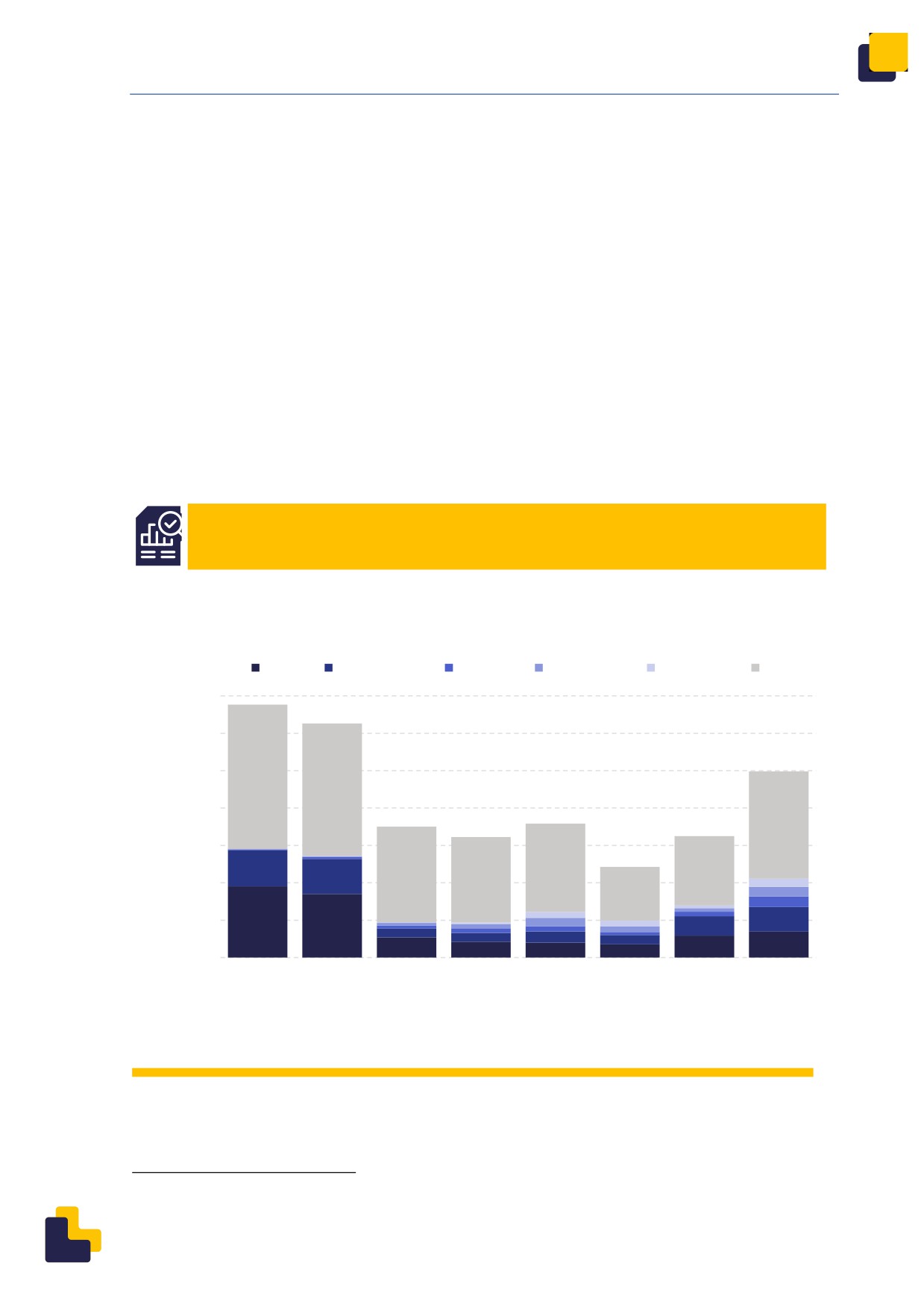
ASYLUM REPORT 2023
Nationals of Syria, Afghanistan, Türkiye, Venezuela and Colombia lodged the most
applications in 2022. While the record levels of 2015 and 2016 were primarily driven by
applications for international protection by persons coming from Syria, Afghanistan and Iraq,
the current increase stems from a much wider range of nationalities (see Figure 2).
In 2015 and 2016, applicants from Syria accounted for more than one-quarter of all
applications, whereas in 2022 they represented one-seventh. In fact, in 2022, the number of
applications by nationals of Syria and Afghanistan were the highest since 2016, while for
several other groups - including nationals of Türkiye, Venezuela and Colombia - they were
the highest on record. The number of applicants from Türkiye more than doubled from 2021,
while applicants from Venezuela and Colombia increased by about three times each.
At lower levels, the number of applicants from India increased by more than six times to the
highest level since at least 2008, with three-quarters of them applying in Austria. At the same
time, citizens of Bangladesh, Georgia, Ukraine, Morocco, Tunisia, Egypt, the Democratic
Republic of the Congo, Peru, Moldova, Burundi, Palestine, Belarus, Yemen and Cuba
(in descending order) also applied in unprecedented numbers.xiii
Syrians and Afghans lodged the most applications since 2016
Figure 2. Applications for international protection by top countries of origin, 2022
Syria
Afghanistan
Türkiye
Venezuela
Colombia
Other
1,400,000
1,200,000
1,000,000
800,000
600,000
400,000
200,000
0
2015
2016
2017
2018
2019
2020
2021
2022
Note: Data were missing for Iceland. The annual total was calculated as the sum of monthly applications which is
included as part of the ‘other’ citizenships.
Source: Eurostat [migr_asyappctza, migr_asyappctzm for Iceland] as of 13 April 2023.
xiii Only citizenships with at least 3,000 applications were considered.
85
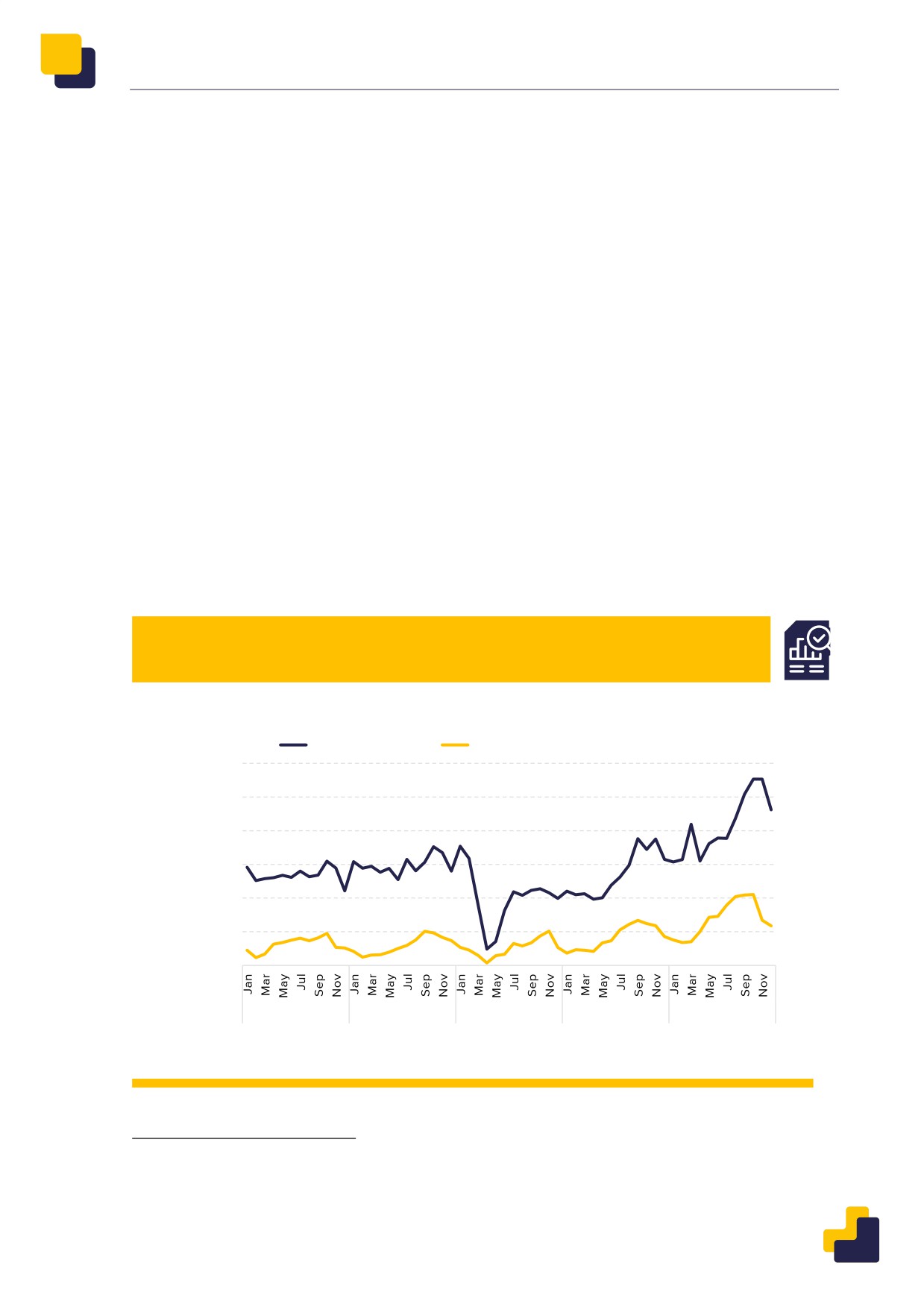
EUROPEAN UNION AGENCY FOR ASYLUM
In 2022, the largest corridors of applicants and receiving countries consisted of nationals of
Syria and Afghanistan applying for international protection in Germany, as well as applicants
from Venezuela and Colombia lodging applications in Spain. For the latter two citizenships,
Spain received the overwhelming majority of applications, while Germany and Austria
received the highest number of applications from citizens of both Syria and Afghanistan.
Following Russia's invasion of Ukraine in February 2022, asylum applications by citizens of
Ukraine temporarily peaked in March 2022, then stabilised at lower levels as most of those
fleeing the country began to register for temporary protection.
4.1.3.1. Applications for asylum and detected illegal border-crossings
In 2022, around 331,000 illegal border-crossings (IBCs) were detected at the EU’s external
borders, according to Frontex.xiv This is the highest number since 2016 and an increase of
two-thirds from the previous year. There were about three times as many asylum applications
lodged in EU+ countries than detections of IBCs on entry. The ratio was similar to 2021,
although at much higher levels.
As illustrated in Figure 3, the two indicators have followed broadly similar fluctuations: after
the pandemic-induced lows of 2020, both have been on the rise for 2 consecutive years.
Nonetheless, applications have been rising at a slightly faster pace than detections, leading to
a growing gap. In the last months of 2022, the gap widened significantly, due to a marked
increase in applications.
Far more asylum applications were lodged than detected
illegal border-crossings
Figure 3. Monthly asylum applications and detections of IBCs in EU+ countries, 2018-2022
Asylum applications
Illegal border-crossing detections (IBCs)
120,000
100,000
80,000
60,000
40,000
20,000
0
2018
2019
2020
2021
2022
Source: Eurostat [migr_asyappctza] as of 13 April 2023 and Frontex [Detections of illegal border-crossings] as of
3 April 2023.
xiv Separately, almost 13 million Ukrainian refugees were counted on entry at the EU's external land borders from
Ukraine and Moldova between 24 February 2022 until the end of 2022, which are not included in these figures.
In the same period, 10 million Ukrainian nationals were reported on exit at the same border sections.
86
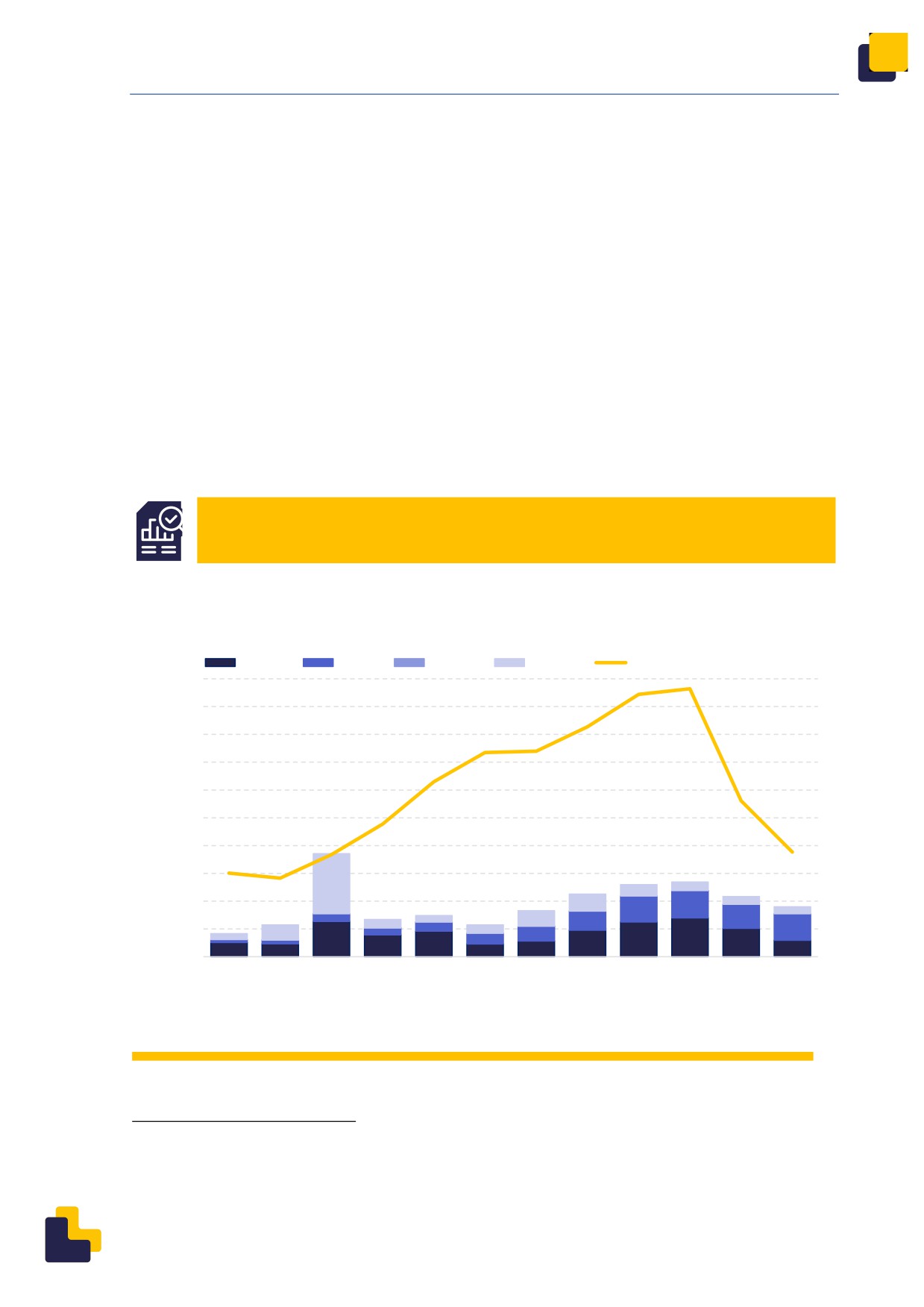
ASYLUM REPORT 2023
The overall picture hides some important differences. In some countries located along specific
routes, detections outnumbered applications. This was the case along the two main routes for
2022, namely the Western Balkan route and the Central Mediterranean route. There can be
multiple explanations for such differences. For example, Hungarian legislation has continued
to limit access to the asylum procedure.xv Furthermore, certain countries along these routes,
such as Croatia, Greece and Italy, were important transit countries for secondary movements.
It is thus possible that many of those detected at these borders have subsequently engaged
in onward journeys. Finally, detections at the border may comprise repeated attempts, and
therefore, the same person may be counted more than once.
Situation along the Western Balkan route
In 2022, there were 144,000 IBC detections reported on the Western Balkan route, 134% more
than in 2021. Overall, in the countries located along the Western Balkan route, more than
three times as many IBCs were detected than asylum applications lodged in 2022. As
illustrated in Figure 4, detected IBCs followed an upward trend between March (7,300) and
October (19,300).
Detections of illegal border-crossings outpaced asylum
applications in countries along the Western Balkan route
Figure 4. Monthly asylum applications and detections of IBCs along the Western Balkan
route, 2022
Bulgaria
Croatia
Hungary
Romania
IBCs - Western Balkan Route
20,000
18,000
16,000
14,000
12,000
10,000
8,000
6,000
4,000
2,000
0
Jan Feb Mar Apr May Jun
Jul
Aug Sep Oct Nov Dec
Source: Eurostat [migr_asyappctza] as of 13 April 2023 and Frontex [Detections of illegal border-crossings] as of
3 April 2023.
xv Article 268 of the decree promulgated by the Hungarian government (Act LVIII of 2020) stipulates that individuals
must express their intent to seek asylum at a Hungarian embassy located in neighbouring, non-EU states and
prescribes the immediate removal from the territory of any person who crosses the border unlawfully, including
individuals who express an intent to seek asylum.
87
EUROPEAN UNION AGENCY FOR ASYLUM
Applications for international protection spiked in Romania in March 2022, as many Ukrainian
nationals applied for asylum prior to the activation of the Temporary Protection Directive.
Otherwise, applications lagged behind IBCs and began to increase more notably around July
2022, peaking at 5,400 in October 2022.
More than one-half of IBCs detected along this route involved citizens of Syria (80,000), while
citizens of Afghanistan (23,000) accounted for another one-sixth. These two citizenships were
the main nationalities driving the increase in 2022. In terms of applications for international
protection, the top two nationalities were also Syrians and Afghans, who accounted for just
over two-fifths of applications lodged in the countries along this route.
At lower levels, detections of persons from Türkiye (8,800), India (7,000), Tunisia (6,800),
Morocco (3,100) and Burundi (2,300) reached unprecedented levels, while Pakistanis (6,400)
and Iraqis (1,900) were detected the most since 2015 and 2016, respectively.xvi The sudden
rises for Turks, Indians, Tunisians and Burundians along this route were linked to the visa
policy in Serbia, which allows these citizenships visa-free entry, in contrast with the visa
regime of EU+ countries. Citizens of Iraq (3,300), Türkiye (2,100), Burundi (2,000),
Morocco (1,900), India (1,600) and Pakistan (1,100) were also among the main nationalities
applying for international protection in the countries along the Western Balkan route.
Under pressure from the EU, Western Balkan countries withdrew visa exemptions for a range
of nationalities towards the end of 2022. As a result, IBCs detected along the Western Balkan
route declined (see Figure 4) and asylum applications, which typically respond with a lag, also
reversed their upward trend.xvii
Situation along the Mediterranean routes
The number of detections in the Central Mediterranean route rose by more
than one-half to about 106,000 in 2022, making it the second-most important
route after the Western Balkan one. For the third consecutive year, detections
of IBCs along the Central Mediterranean route outnumbered asylum
applications in Italy and Malta, the two countries along this route. While asylum
applications lodged in Malta were lower than in the previous year, applications in Italy
increased by over one-half in 2022. Illegal arrivals surged in May 2022 and increased further
in July and August 2022 (see left side of Figure 5), and then asylum applications began to rise
in August 2022, albeit at a slower pace. The overall gap was largely due to many more
Afghans, Egyptians, Ivorians, Tunisians and Syrians detected at the border than lodging
asylum applications.
In 2022, about 44,000 IBCs were detected on the Eastern Mediterranean route. Figures
more than doubled compared with 2021, yet remained below the level of 2019 by one-half.
Nationals of Syria (8,600), Afghanistan (5,100), Nigeria (3,900) and the Democratic Republic of
Congo (3,800) were the top groups, all detected in far higher numbers than in 2021. As in
previous years and as illustrated on the right side of Figure 5, more asylum applications were
lodged in countries along this route than IBCs detected. Compared to 2021, the gap narrowed
as IBCs more than doubled, while applications increased by about one-half. The increase in
applications was driven by more applications in all three countries, however due to its
xvi Only citizenships with more than 1,000 detections of IBCs along the Western Balkan route in 2022 were
considered. Unprecedented levels imply that the number recorded in 2022 was the highest in publicly-available
data from Frontex, i.e. since 2009.
xvii Schengenvisa, Serbia Reintroduces Visas for Tunisia & Burundi Nationals Due to EU Pressure, 24 October 2022.
88
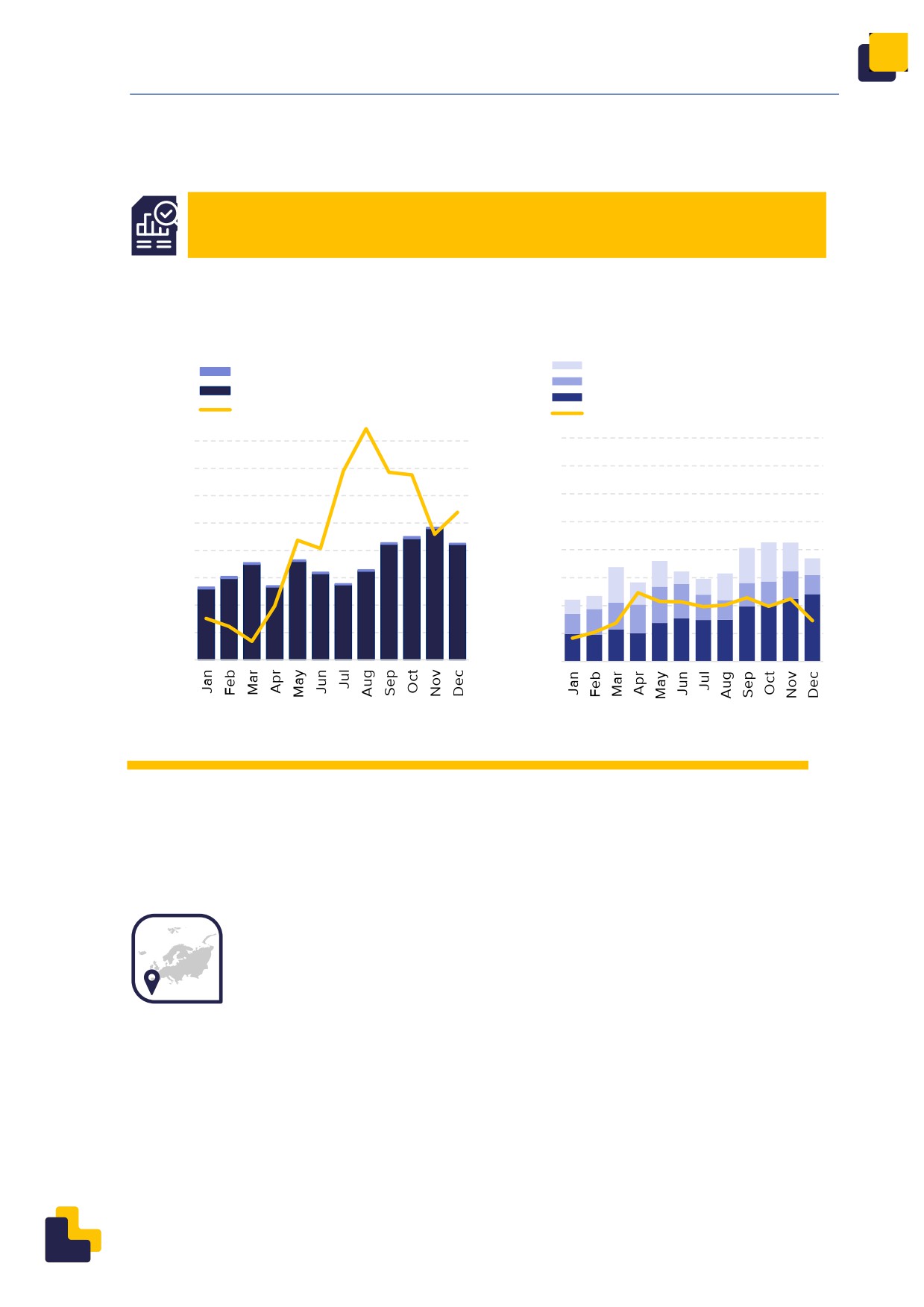
ASYLUM REPORT 2023
geographic location, asylum applications in Bulgaria are likely to have been influenced by
developments along the Western Balkan route too.
Rise in illegal border-crossings along the Central
Mediterranean route triggered increase in asylum applications
Figure 5. Monthly asylum applications and detections of IBCs along the Central
Mediterranean route (left) and the Eastern Mediterranean route (right), 2022
Bulgaria
Malta
Cyprus
Italy
Greece
IBCs - Central Mediterranean Route
IBCs - Eastern Mediterranean Route
16,000
16,000
14,000
14,000
12,000
12,000
10,000
10,000
8,000
8,000
6,000
6,000
4,000
4,000
2,000
2,000
0
0
Source: Eurostat [migr_asyappctza] as of 17 March 2023 and Frontex [Detections of illegal border-crossings] as of
3 April 2023.
Contrasting with the other two Mediterranean routes, there was a decrease in migratory
pressure on the Western Mediterranean route. There were 15,000 IBC detections in 2022
along this route, representing around one-fifth fewer detections than in the previous year.
Western African route
Similarly, on the Western African route, there were 15,000 arrivals in 2022,
which was 31% less than in 2021. As in previous years, most detections along
the Western Mediterranean and Western African routes related to persons from
Africa, although along the Western Mediterranean route they were detected in
fewer numbers in 2022.
The lower number of arrivals from Africa was also reflected in fewer asylum applications in
Spain lodged by nationals of African countries. This decrease in applications, however, was
outweighed by increases in applications from other nationalities, mainly Venezuelans and
Colombians. In fact, total asylum applications in Spain increased significantly in 2022 and
were the highest on record.
89
EUROPEAN UNION AGENCY FOR ASYLUM
4.1.3.2. Data on socioeconomic indicators to analyse trends in asylum in Europe
The impact of the inflows of asylum seekers to EU+ countries depends not only
on the magnitude of asylum applications but also on various factors, such as the
country’s GDP, population size or territory size. To gauge the pressure on
national asylum and reception systems, Figure 6 ranks EU+ countries according
to the number of applications they received relative to these three indicators.
Countries shaded in blue received fewer applications than the EU+ baseline, while those
shaded in red received more.
For 2022, the strain on individual EU+ countries must be taken in a wider context given the
high number of persons registered for temporary protection. Countries such as Poland and
Czechia rank low in terms of the indicators presented in Figure 6, yet had the second- and
third-highest number of beneficiaries of temporary protection in EU+ countries by the end of
2022, respectively, implying that their reception systems may be under a different form of
strain.xviii
In Figure 6, countries are listed in decreasing order based on applications relative to
population size (middle circle), with Cyprus topping the list with about 2,500 applications per
100,000 inhabitants in 2022. Austria and Iceland followed closely behind, with
1,200 applications lodged per 100,000 inhabitants each, while Luxembourg received
379 applications per 100,000 inhabitants.xix Other countries still received relatively high
numbers of applications, ranging from Greece, Croatia, Slovenia, Belgium, Bulgaria, Germany,
Switzerland, Ireland, Malta and Spain (in descending order).
On average, about 216 applications per 100,000 inhabitants were lodged across
EU+ countries in 2022, with 15 of the 31 EU+ countries receiving fewer applications per
100,000 inhabitants. The countries which received the least asylum applications per capita
were Hungary, Slovakia and Czechia (less than 1, 10 and 16 applications per 100,000 citizens,
respectively).
Relative to the territorial size of countries, most applications continued to be lodged in Malta (4
per square km). At quite some distance, other countries with relatively high ratios of
applications per territorial area included Cyprus, Austria and Belgium (inner circle in Figure 6).
Looking at the EU+ as a whole, 0.2 applications were lodged per square km.
GDP is a measure of a nation's economic output and it provides insight into the size and
strength of its economy. As in previous years, Cyprus (82) received the most applications
relative to GDP. It was followed by Austria and Bulgaria, with about 24 applications each, a
consequence of the surge in applications in both countries from the previous year. Hungary,
Slovakia and Czechia were at the other end of the spectrum (in ascending order, outer circle
in Figure 6).
xviii
Based on the number of beneficiaries of temporary protection at the end of December 2022
(Eurostat: migr_asytpsm).
xix Annual data were missing for Iceland. The annual total was estimated using the sum of monthly data
(Eurostat: migr_asyappctzm as of 13 April 2023).
90
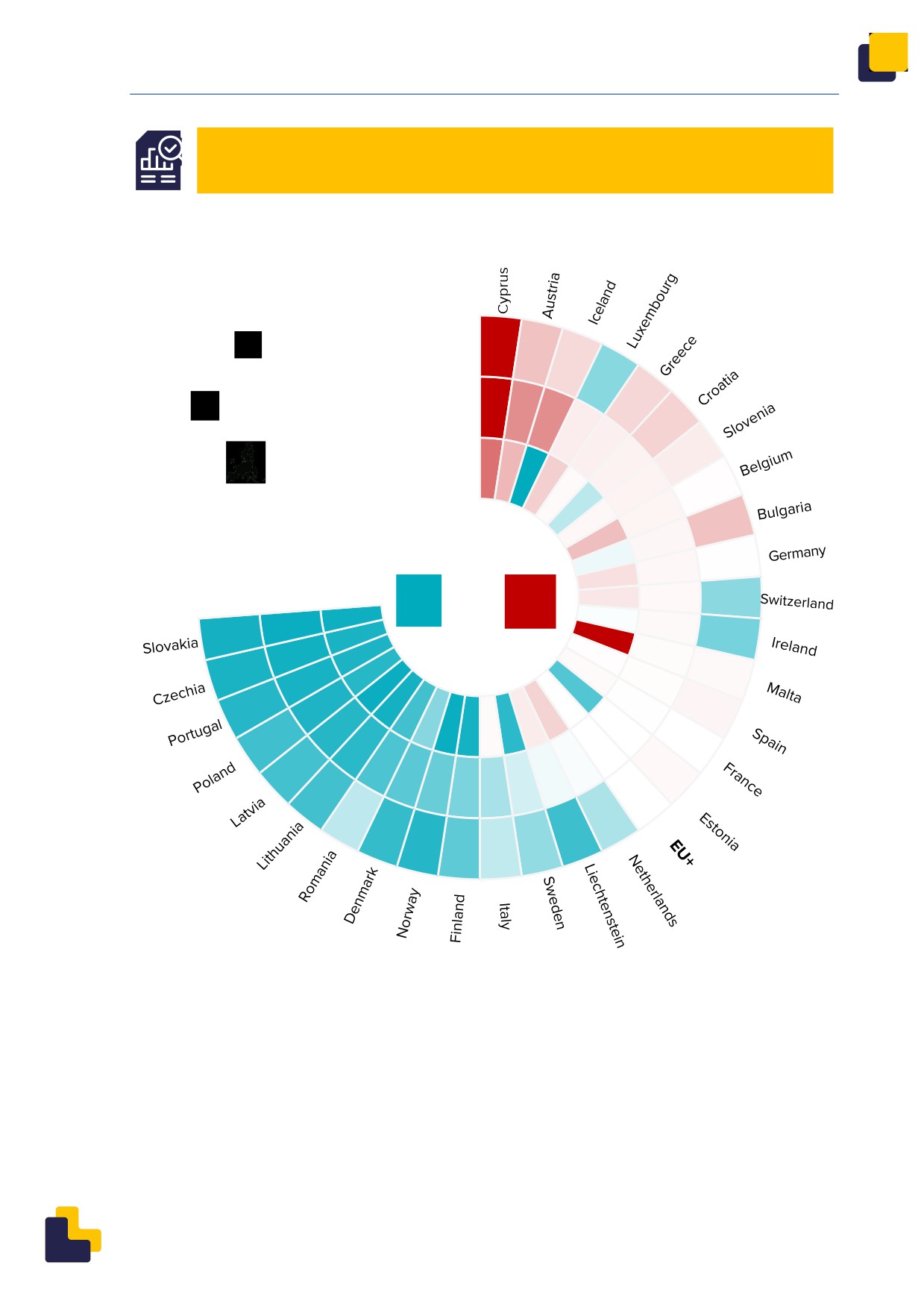
ASYLUM REPORT 2023
In relative terms, most applications were received in Cyprus
Figure 6. Applications for international protection relative to GDP, population and country
size, 2022
by GDP (per million euro)
by population size (per capita)
by country size (per km2)
EU+
Low
High
baseline
Notes: Countries are sorted by the number of applications received relative to population size (clockwise from
highest to lowest). The shades indicate the relative number of applications received compared to the EU+ baseline
(midpoint) for each of the three indicators. Data on GDP for Liechtenstein refer to 2020.
Source: Eurostat for asylum applications [migr_asyappctza and migr_asyappctzm for Iceland] as of 13 April 2023,
population [demo_pjan] as of 4 April 2023 and GDP [nama_10_gdp] as of 19 April 2023, and the World Bank
[AG.SRF.TOTL.K2] as of 1 March 2023.
91
EUROPEAN UNION AGENCY FOR ASYLUM
Section 4.2.
The Dublin
procedure
To achieve these objectives, the Dublin III
Regulation establishes a set of hierarchical
The Dublin III Regulation is the
criteria under Chapter III to determine the
cornerstone of CEAS which
aims to define a clear and
Member State which is responsible for the
examination of an asylum application. These
workable method to determine
which Member State is
include:
responsible for the examination
Criteria to protect family unity and
of an application for
unaccompanied minors (Articles 8-11 and
international protection. Its
16);
objective is to guarantee that
Criteria on the responsibility of the
each person has effective
Member State which played the greatest
access to the asylum procedure
part in the applicant’s entry into or
and that each application will be
residence in the country (Articles 12-15);
examined by one Member State
and
only.
If the first two do not apply, the
responsible Member State is the one
where an application for international
protection was first lodged.
Member States may also assume
responsibility based on the discretionary
clauses of the regulation.
The Dublin III Regulation is applied by all
EU Member States and four associated
countries (Iceland, Lichtenstein, Norway and
Switzerland). Throughout this section, the
term Member States covers the associated
countries as well.
92
ASYLUM REPORT 2023
Developments towards a new solidarity mechanism to complement the Dublin system
continued at the EU level in 2022. The Solidarity Declaration was signed by 18 Member States
and 3 associated countries under the French Presidency of the Council of the EU in
June 2022, establishing a one-year Voluntary Solidarity Mechanism coordinated by the
European Commission. The agreement would ensure adequate support to Member States of
first entry along the Mediterranean and Atlantic routes and take into account the pressure on
all Member States due to increased arrivals as a result of Russia’s invasion of Ukraine.319
This temporary mechanism is also seen as an opportunity to pave the way for discussions for
a more permanent solution under the proposed Asylum and Migration Management
Regulation.320 Member States underlined their commitment to tackle the secondary movement
of persons seeking protection by increasing the implementation of Dublin transfers.321
In addition, the Council adopted the negotiating mandate on the proposed Eurodac and
Screening Regulations, which helps to better follow the paths of applicants for international
protection and persons in irregular situations (see Section 2).
Under the current EU legal framework, Member States, the European Commission and the
EUAA developed a roadmap in 2022 to improve the implementation of transfers under the
Dublin III Regulation, and Member States started to apply the practical solutions defined in the
roadmap to overcome the main obstacles in executing transfers in 2023.322
At the national level, Member States continued with their efforts to carry out Dublin transfers
more efficiently. One of the main issues for Dublin units in 2022 was the lack of staff and high
turnover rates, making it more challenging to address the increasing workload. While
COVID-19 restrictions were gradually lifted in 2022 (with Member States no longer requiring a
negative PCR test or proof of vaccination prior to a Dublin transfer), the impact of the
pandemic lingered on. Organising transfers continued to be challenging with fewer flights and
frequent last-minute cancellations of flights.
The war in Ukraine impacted national Dublin units in various manners. For example, Dublin
case officers were re-assigned to support the arrival of persons in need of temporary
protection. The lack of resources in terms of staff or reception places led to situations where
certain countries did not temporarily accept incoming Dublin transfers. The interlinkage
between the Dublin III Regulation and the activation of the Temporary Protection Directive
needed to be clarified, and it was established that persons with temporary protection should
not be considered as applicants for international protection in this context and their data
should not be registered in Eurodac.
Courts continued to assess the possibility of implementing Dublin transfers in individual cases
and were faced with questions on the scope and limits of mutual trust between EU+ countries,
the impact of differences in asylum policies, concerns around accessing the asylum procedure
for applicants transferred under the Dublin III Regulation to the responsible Member State and
their reception conditions, as well as the use of detention in the context of the asylum
procedure.
The CJEU delivered several preliminary rulings on the interpretation of the Dublin III
Regulation, requiring Member States to adapt their legislation and policies accordingly. This
was seen, for example, in case C-19/21 in which the court clarified that unaccompanied minors
have the right to appeal a rejected take charge request.
93
EUROPEAN UNION AGENCY FOR ASYLUM
4.2.1. Institutional and staff changes to manage the
Dublin procedure
The workload for Dublin units typically increased throughout 2022, as the
number of applications for international protection significantly grew in
general (see Section 4.1.3). Several national authorities, for example in Austria,
Belgium, Cyprus, Germany, Greece, Norway, Romania and Switzerland, noted
that a shortage of staff was one of the main challenges in 2022 to manage
the increasing workload related to Dublin cases. The recruitment of new staff
continued (for example in Belgium, Germany, Norway and Sweden), while staff turnover was
highlighted as a significant challenge in Czechia, Finland, France and Malta.
Staff from Dublin units were often temporarily re-assigned to help with the registration of
persons requesting temporary protection in spring 2022, for example in Bulgaria,
Luxembourg, Poland, Romania, Slovakia and Switzerland. In Member States next to Ukraine,
Dublin transfers were temporarily halted due to the general situation in asylum and reception,
and Dublin staff were re-assigned to other tasks for longer periods. In Bulgaria, the re-
assignment of staff created a temporary backlog in ongoing Dublin cases. In Switzerland,
there were general delays in the asylum procedure (including the Dublin procedure) caused
by both the increase in applications in general and the workload related to temporary
protection. The daily tasks of Dublin units seemed to have been less impacted by the
activation of the Temporary Protection Directive in the last quarter of 2022.
In Ireland, a specific division within the Dublin unit was established in March 2022 in order to
examine applications pursuant to Article 17.
4.2.2. Policy changes for a more efficient
implementation of the Dublin procedure
Members States continued to face several challenges in the implementation
of Dublin transfers in 2022. In addition to the EU-level initiative of a
roadmap,323 some countries undertook actions at the national level to
improve the implementation of Dublin transfers. In March 2023, seven
countries - Austria, Belgium, Denmark, France, Germany, the Netherlands
and Switzerland - called for strengthened cooperation on the Dublin
procedure and reaffirmed their commitment to reform the Dublin system through the Asylum
and Migration Management Regulation and the Asylum Procedure Regulation.324 Policy
changes on the Dublin procedure were triggered by the increase in applications for
international protection and the arrival of Ukrainians in need of protection.
Belgium, for example, applied comprehensive measures to shorten the time of the Dublin
procedure and increase transfer rates. The accelerated procedure for specific, predefined
potential Dublin cases was revised. A new reception facility opened in August 2022 to
accommodate a group of applicants in the Dublin procedure, in parallel to the regular
reception system. Case officers from Dublin units are on site at the reception centre to carry
out Dublin interviews and follow-up on cases after a transfer decision has been issued. The
centre is operated by the Immigration Office, in collaboration with Fedasil, with a capacity of
220 places, but not all places could be used in 2022 due to staff shortages.
94
ASYLUM REPORT 2023
In the Netherlands, the Minister for Migration announced that the Track 1 procedure, which
was established for applicants in the Dublin procedure, would be standardised and made
more efficient as part of general mitigation measures to alleviate pressure on the asylum
system. In addition, the government planned changes so that applicants in the Dublin
procedure would be offered more moderate material reception conditions, in line with shorter
processing times which are foreseen, thus limiting the time and purpose of a stay in
reception.325
The Dutch asylum chain partners conducted a successful one-time joint action. While usually
one detention order per day is handed down, the cooperation between the different
stakeholders made it possible to implement detention orders for nine applicants at the same
time. The applicants had registered again in the application centre, after having been in the
Dublin procedure in the Netherlands and absconding before the implementation of the
transfer.326 While authorities have focused on improving the implementation of transfers, the
Regional Court of The Hague underlined that a transfer cannot be initiated and scheduled
while the case is pending an appeal or a review.
Some countries issued or revised various types of guidance and instructions related to the
Dublin procedure. In Bulgaria, in June 2022 the government adopted amendments to the
ordinance regulating coordination between the asylum and police (border and immigration)
administrations when implementing the Dublin III Regulation.327 The amendments updated and
clarified the division of responsibilities among these authorities.
In Italy, the Ministry of the Interior published a new circular in January 2022 which clarified the
connection between an application for a special protection permit (a national form of
protection established in 2020)328 and the Dublin procedure. Based on the opinion of the
Dublin unit, the commission underlined that the application for special protection should be
considered inadmissible if the person has also applied for international protection and has
been waiting for the Dublin unit’s decision on the Member State which is responsible or the
court’s decision in an appeal against a transfer decision.329 On 20 October 2022, the Civil
Court of Venice ruled that the practice, based on a note distributed by the Dublin unit, to
prevent applicants for international protection in the Dublin procedure from applying for the
special protection permit (a national form of protection, see Section 4.14) contradicts the law.
The Norwegian Immigration Regulations were amended to define which categories of
applicants can be given ‘collective protection’ (which is similar to temporary protection in the
EU legal framework). The Ministry of Justice and Public Security followed up with guidelines to
clarify that the Dublin III Regulation did not apply to people under collective protection.
Slovakia adopted a provision in its national legislation on the suspension of a transfer decision
when a third-country national under the Dublin procedure absconds.330
In France, the Council of State analysed the right to material reception conditions for
applicants who refused to appear for their Dublin transfer to the Member State responsible. It
ruled that this act can be considered as a serious breach of house rules, entailing the
withdrawal of the reception place and the applicant’s expulsion from the facility (see
Section 4.7 Reception of applicants for international protection).
In contrast, the Belgian Council for Alien Law Litigation (CALL) ruled that a similar failure to
appear for an interview for a voluntary transfer does not necessarily imply that the applicant
tried to evade the authorities. The case concerned an applicant who could not be contacted
95
EUROPEAN UNION AGENCY FOR ASYLUM
by police on two consecutive days at his place of residence. CALL cited its case law that
accepting a voluntary transfer would mean that the applicant no longer wants to appeal the
transfer decision, so his behaviour does not necessarily mean that he deliberately tried to
evade the authorities. As a result, the council concluded that this cannot be considered as
absconding and cancelled the extension of the transfer time limit.331
The CJEU ruled that a Dublin transfer cannot be implemented during the reflection period
provided to victims of human trafficking by Directive 2004/81/EC. However, a transfer decision
may be adopted and preparatory measures can be undertaken during this period, provided
that these do not render the reflection period ineffective (see Section 2.6).
Courts examined the legality of measures used by national authorities to use detention to
ensure the implementation of a Dublin transfer when there is a risk of absconding (see
Section 4.8). For example, the Slovenian Supreme Court found that there was a genuine and
immediate risk of absconding by an applicant who was supposed to be transferred back to
Romania but expressed several times that his intended final destination was Austria.
In another case, the same court confirmed that the authorities may first order the detention of
an applicant and then start the administrative procedure to request a response from the
Member State responsible for the applicant’s readmission. The Swiss Federal Court concluded
that the requirements and timelines laid down in the Dublin III Regulation, Article 28, as
interpreted by the CJEU, take precedence over national legislation when it is not compatible
with the regulation. Thus, the applicant could be detained for only 6 weeks, and the extension
of the detention for 3 months was illegal.
For the purposes of extending the transfer time limit under the Dublin III Regulation,
Article 29(2), the CJEU confirmed that the non-voluntary committal of an applicant to a hospital
psychiatric department is not considered to be imprisonment (see Sections 2.6 and 4.8).
Regarding the responsibility of a state for a family member, the Supreme Administrative Court
in Austria clarified in December 2022 that a Member State is responsible for examining an
application for international protection when applying Article 9 of the Dublin III Regulation if
the request for reunification is expressed in writing. The article refers to family members of an
applicant - regardless of whether the family already existed in the country of origin - who is a
beneficiary of international protection and has the right to reside in a Member State. This
regulation not only allows the persons (the applicant and the beneficiary of international
protection) to have a say but gives them the power to decide whether they want to be
reunited, ruling out the possibility that people are brought together against their will. Within
the framework of the right to information, the applicant must be informed of the requirement
of this declaration (Dublin III Regulation, Article 4(1b-c)), and in the event of such a request by
the applicant, it must be verified that the beneficiary of international protection agrees to a
reunification. (VwGH Decision, 15.12.2022, Ra 2022/18/0182).
4.2.3. Practical implementation of Dublin transfers
Impacts of the COVID-19 pandemic
While the direct impact of the COVID-19 pandemic became less significant, there were still
less flights available in general, making it more difficult to organise transfers. At times, the
delays resulted in the courts stepping in to assess practices and their alignment with
96
ASYLUM REPORT 2023
legislation. In 2022, the CJEU settled that the suspension of a Dublin transfer decision due to
the COVID-19 pandemic does not interrupt the 6-month time limit to transfer an applicant to
the responsible Member State (see Section 2.6).
COVID-19 testing requirements for Dublin transfers remained in some countries at the
beginning of 2022, but were typically lifted afterwards. As in 2020 and 2021, EU+ countries
faced situations when applicants waiting to be transferred refused to undergo the required
COVID-19 testing. In line with Swiss and Danish legislative changes in 2021, the Dutch
government proposed a bill creating the legal basis for enforced COVID-19 testing at the
beginning of 2022.332 The Repatriation and Departure Service (DT&V) noted that lifting
COVID-19 restrictions over the late spring and summer of 2022 made the implementation of
transfers easier, but unrestricted access also meant that applicants could abscond more easily
to avoid a transfer.333
Overall length of the Dublin procedure
The overall length of Dublin procedures in 2022 remained of concern, for example in Italy
where ASGI reported that a procedure may take up to 1 year,334 or in the Netherlands, where
the Dutch Refugee Council observed that the processing time under the Dublin procedure
doubled since 2019.335
In Bulgaria, the AIDA report noted that when another Member State accepts responsibility, the
outgoing transfer was usually implemented within 5 months on average in practice, and
in 2022, the State Agency for Refugees reported to have reduced the period to 1 month. If an
incoming transfer was being organised, however, the duration of the actual implementation
varied, reaching in the past up to 15 months. In 2022, some reorganisations which were
undertaken by the State Agency for Refugees decreased the implementation of incoming
transfers to 4 months on average.336
Delays in processing and their impact
The arrival of persons in need of temporary protection from Ukraine had a major impact on the
Dublin system. Next to staff re-allocations affecting the capacity of Dublin units (see
Section 4.2.1), several EU+ countries temporarily suspended receiving incoming transfers,
either all of them or of certain profiles (for example families). In some cases, this led to the
expiration of transfer time limits and, thus, to a shift in the Member State responsible for the
asylum application.
The Dublin unit in Bulgaria faced significant IT challenges in spring 2022. In addition to other
Bulgarian public institutions, the State Agency for Refugees experienced a major cyberattack
and the agency’s information systems - including DubliNet - were suspended for several
days. While the systems’ security was not affected and no data were leaked, communication
was not possible through DubliNet, resulting in a provisional backlog. The work processes
were soon recovered, and the backlog was swiftly cleared.
The Swiss Federal Administrative Court (FAC) looked into the consequences of a canton not
executing a transfer decision by the State Secretariat for Migration (SEM) in two appeal cases.
It confirmed that SEM can remove the lump sum subsidy given to a canton for an applicant in
the Dublin procedure when the canton does not implement the transfer without giving any
objective reasons. The court underlined that the cantons do not have the power to re-discuss
a decision or a judgment in force outside of the procedural framework.
97
EUROPEAN UNION AGENCY FOR ASYLUM
On 2 September 2022, the Civil Court of Rome accepted the urgent appeal submitted by an
asylum seeker whose appeal against a Dublin transfer to Austria had been accepted in 2021
and who, after 1.5 years, was still waiting for Italy’s declaration of having competence to
examine his asylum request. The appeal brought before the Court of Cassation did not have a
suspensive effect and the law does not expressly provide for the possibility of requesting such
a suspension. The Civil Court rejected the arguments presented by the Dublin unit, according
to which the submission of an appeal before the Court of Cassation in the Dublin procedure
would entail the automatic suspension of the procedure itself.
Time limits
The CJEU delivered preliminary rulings in cases of applicants applying for international
protection in more than two Member States. It ruled on the calculation of the transfer time limit
and in which Member State the applicant has access to an effective remedy (see Section 2.6).
The ruling concerned the application of the ‘chain rule’, which is an informal, practical solution
agreed by most (but not all) Member States to facilitate the determination of responsibility in
such cases. In Germany, the Regional Administrative Court of Düsseldorf clarified the time limit
for sending a take back request and confirmed that it is not possible to send the request more
than 3 months after the lodging of the application for international protection, even though this
is done within the 2-month deadline for a Eurodac hit.
The Irish High Court examined the Member State responsible for an applicant who arrived to
Ireland through Belgium, Sweden and the UK. Noting the time limits for take back requests
and for implementing a transfer, the court underlined that at the latest by the end of 2016,
Sweden was responsible for the asylum application and not Belgium, as stated by the
applicant.
Effect of an inadmissibility decision when the transfer time limit has expired
The Supreme Administrative Court in Austria ruled in 2021 (published and commented on in
2022337) on the expiration of the transfer time limit. It addressed the transfer of responsibility
for an asylum application to Austria and its impact on the inadmissibility decision that was
taken earlier in the case, when the authorities concluded that another Member State should
be responsible for the application. The court confirmed that the applicant did not have to
submit a new application. The inadmissibility decision automatically ceases its effect as soon
as the transfer period expires.
CJEU rulings related to children in the Dublin system
The CJEU delivered two preliminary rulings related to children in the Dublin procedure.
C-720/20 concerned a child born in Germany, whose parents received international protection
in another Member State before the birth of the child. The ruling specified that Article 20(3) of
the Dublin III Regulation cannot be applied to the child since the parents were granted
international protection by another Member State. This situation is governed by Article 9 of
the Dublin III Regulation, which requires the submission of a take charge request and the
explicit written consent of both parties involved. Since written consent had not been
submitted, Article 9 could not be applied, therefore, the responsible Member State must be
determined according to Article 3(2) of the Dublin III Regulation (first country where the person
lodged the request for international protection) (see Sections 2.6 and 4.3.3).
98
ASYLUM REPORT 2023
In C-19/21, the court concluded that an unaccompanied minor should be granted the right to
appeal if the requested Member State refused to take charge of examining the application
when the request was sent on the grounds of Article 8(2) (reuniting an unaccompanied minor
with a relative residing in another Member State) (see Section 2.6). However, the relative of
the child did not have this right to appeal.
As a result, many Member States noted that their, policies or practices needed to be adjusted
following the ruling. For example, amendments are needed in several countries to ensure that
the refusal of a take charge request is considered an administrative decision. The practical
modalities of lodging an appeal when the person is not present in the country where the
appeal is lodged needed to be formalised as well. To this end, several countries foresee
changes so that information on the right to appeal is included in the refusal decision. The role
of a legal guardian or representative in lodging an appeal against a refusal to take charge also
needed to be clarified.
Age determination
The Dutch Council of State reviewed the determination of an applicant’s age for the Dublin
procedure in the case of a person who was registered as minor in the Netherlands. As doubts
remained about the applicant’s age after the age inspections (leeftijdsschouw, undertaken by
three officers from the Dutch Immigration and Naturalisation Service (IND), the Royal Military
Police (KMar) and the Aliens Police, Identification and Human Trafficking Department (AVIM)
who spoke separately with the applicant), the council confirmed that the Dublin unit may rely
on the principle of mutual trust and assume that the registration of the age took place with
due care in other Member States. Thus, the applicant can be considered as an adult when the
person has been registered in several Member States with different ages. In addition, the
authorities should consult the source documents in the original registration to conclude the
age when possible.
Assessment of sufficient protection for victims of domestic violence
When assessing the availability of sufficient protection in the country responsible for the
asylum application for a victim of domestic violence, the Swiss Federal Administrative Court
found that it is not relevant whether that country has ratified the Istanbul Convention. The
court examined whether in practice the authorities can and are willing to offer sufficient
protection against the threats of the former husband.
Procedural safeguards
The issue of effective remedy in the Dublin procedure has been the subject of several
CJEU rulings in recent years, and national courts continued to approach the EU court for more
guidance. For example, the Tribunal of Bologna sent two requests to the CJEU for a
preliminary ruling, inquiring about the right to information and a Member State’s duty to hold a
personal interview in light of the right to an effective remedy.
In C-217/22, the court inquired if the applicant can invoke before the courts of the requesting
state the infringement of the duty to provide information and arrange a personal interview in
the Dublin procedure by the requested state.
In C-80/22, the court sought clarity on the consequences of failing to provide the required
information leaflet (according to Article 4(2) of the Dublin III Regulation) or conducting a
personal interview (according to Article 4(2) of the Dublin III Regulation). It questioned if this
99