JEPPESEN GENERAL AIRWAY MANUAL (Issue Date 1 JUL 21) - page 6


  Index      Manuals     JEPPESEN GENERAL AIRWAY MANUAL (Issue Date 1 JUL 21)


Search            copyright infringement  


Content      ..     4      5      6      7     ..


JEPPESEN GENERAL AIRWAY MANUAL (Issue Date 1 JUL 21) - page 6


CHART LEGEND

161

SID/STAR

SID/DP AND STAR LEGEND
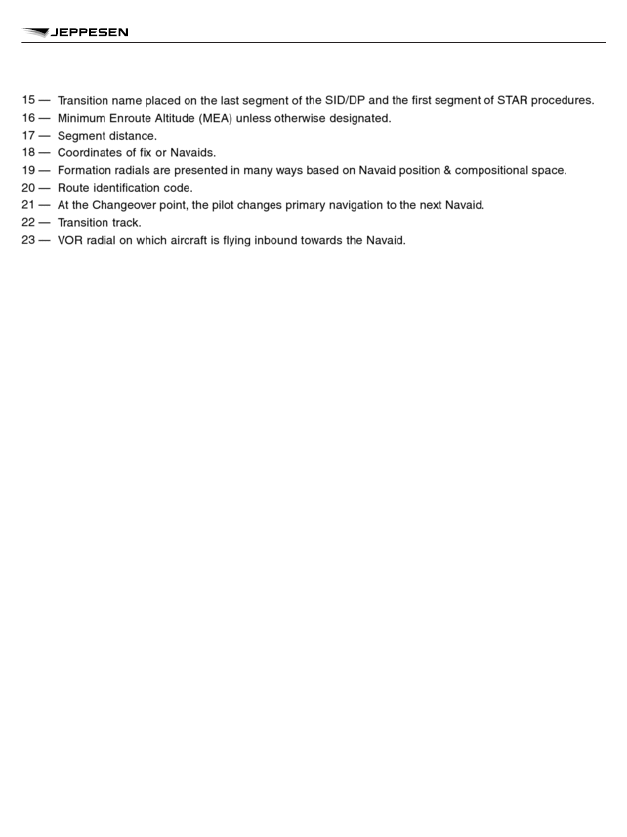
CHART LEGEND

162

SID/STAR

SID/DP AND STAR LEGEND

CHART LEGEND

163

SID/STAR

SID/DP AND STAR LEGEND

END OF SID/DP AND STAR LEGEND

CHART LEGEND

164

SID/STAR

SID/DP AND STAR LEGEND

AIRPORT

CHART LEGEND

165

AIRPORT

AIRPORT CHART LEGEND

CHART LEGEND

166

AIRPORT

AIRPORT CHART LEGEND

CHART LEGEND

167

AIRPORT

AIRPORT CHART LEGEND

CHART LEGEND

168

AIRPORT

AIRPORT CHART LEGEND

CHART LEGEND

169

AIRPORT

AIRPORT CHART LEGEND

END OF AIRPORT CHART LEGEND

CHART LEGEND

170

AIRPORT

AIRPORT CHART LEGEND

APPROACH

CHART LEGEND

171

APPROACH

APPROACH CHART LEGEND

CHART LEGEND

172

APPROACH

APPROACH CHART LEGEND

CHART LEGEND

173

APPROACH

APPROACH CHART LEGEND

CHART LEGEND

174

APPROACH

APPROACH CHART LEGEND

CHART LEGEND

175

APPROACH

APPROACH CHART LEGEND

CHART LEGEND

176

APPROACH

APPROACH CHART LEGEND

CHART LEGEND

177

APPROACH

APPROACH CHART LEGEND

CHART LEGEND

178

APPROACH

APPROACH CHART LEGEND

CHART LEGEND

179

APPROACH

APPROACH CHART LEGEND

CHART LEGEND

180

APPROACH

APPROACH CHART LEGEND

CHART LEGEND

181

APPROACH

APPROACH CHART LEGEND

END OF APPROACH CHART LEGEND

CHART LEGEND

182

APPROACH

APPROACH CHART LEGEND

Publication of minimums does not constitute authority for their use by all operators. Each
individual operator must obtain appropriate approval for their use.

1. GENERAL

The inverted 

“Standard” label in the upper left corner of the minimums box indicates that the

minimums are based on EASA AIR OPS and State Minimums, if provided. They are not com-
pared against other concepts like ECOMS. For a detailed excerpt of EASA AIR OPS minimums
refer to Jeppesen ATC-Chapter "AERODROME OPERATING MINIMUMS - EASA AIR OPERA-
TIONS".
Jeppesen charted minimums are not below any State-provided minimums. RVR/CMV/VIS values
are shown in measuring units as reported by the governing agency.
AOM for take-off and landing are either shown on Jeppesen instrument approach or aerodrome
charts or on a separate minimums listing.
Landing minimums will be shown as RVR, as provided within the EASA tables.
A Visibility, prefixed "VIS", will only be charted if a VIS value is published as State minimum.
A Converted Meteorological Visibility, prefixed “CMV”, will only be charted if a CMV value is pub-
lished as State minimum.
Take-off minimums are shown as RVR, or without prefix if they are either RVR or VIS.
A Visibility, prefixed "VIS", will only be charted for take-off if a VIS value is published as State min-
imum.
Circling minimums without prefix are always visibilities.
For separate minimums listings (like 10-9S pages) RVR, CMV and VIS are abbreviated as “R”,
“C” and “V”.
NOTE: Most of the samples in this document are intended to illustrate only the relevant informa-
tion of the related paragraph. Other sections (like circling minimums) within the samples are inten-
tionally left blank.

2. TAKE-OFF MINIMUMS

Low visibility take-off operations below a visibility of 800m require that the 

operator verifies that

Low Visibility Procedures (LVP) or equivalent procedures have been established and are in force.
Jeppesen charts the lowest possible take-off minimums (including LVTO) because the LVP infor-
mation is not always published in the AIP.
Only if there is a clear statement within the AIP that LVP are not available for the specific airport,
the take-off minimum will be charted as RVR 550m VIS 800m (or higher State value).
The multiple RVR requirement means, that the required RVR value must be achieved for all of the
relevant RVR reporting points (touchdown zone, mid and rollout end of runway), except for the
initial part, which can be determined by pilot assessment. Approved operators may reduce their
take-off minimums to RVR 75m with an approved lateral guidance system and if the runway is
protected for CAT III landing operations and equivalent facilities are available.

CHART LEGEND

183

CHART LEGEND - EASA AIR OPS AERODROME OPERATING MINIMUMS (AOM)

Jeppesen charts a take-off RVR of 75m only if the runway is approved for CAT IIIB operations
with RVR 75m.
Night operations always require runway end lights. This is not indicated in the take-off minimums
box.

Sample of Take-off Minimums

3. CIRCLING MINIMUMS

Circling minimums are only charted if a circling OCA(H) or MDA(H) is provided by the procedure
source. Otherwise, the circling box is removed. If circling is not authorized by the procedure
source, it will be noted in the Briefing Strip header. Where straight-in minimums are higher than
circling minimums (DH/MDH or RVR/VIS), a note is added to remind the pilot that the higher
straight-in minimums have to be used.

Sample of Circling Minimums

CHART LEGEND

184

CHART LEGEND - EASA AIR OPS AERODROME OPERATING MINIMUMS (AOM)

4. NON-PRECISION APPROACH MINIMUMS AND CHART PROFILE

VIEW

According to the EASA AIR OPS requirements for Commercial Air Transport Operations (Part
CAT), all non-precision approaches shall be flown using the continuous descent final approach
(CDFA) technique with decision altitude (height), and the missed approach shall be executed
when reaching the DA(H) or the missed approach point (MAP), whichever occurs first. The lateral
part of the missed approach procedure must be flown via the MAP unless stated otherwise in the
procedure.
Jeppesen criteria for charting of CDFA or non-CDFA minimums are based on 

AMC1

CAT.OP.MPA.115 Approach flight technique – aeroplanes.
Normally, only CDFA minimums are shown. They are identified by the use of a 

DA/MDA(H) label.

Jeppesen does not apply an add-on when publishing a DA/MDA(H) for a CDFA non-preci-
sion approach, because this depends on operator specific factors.
The CDFA condition will always be identified by the term ‘CDFA” above the DA/MDA(H) label.
Non-CDFA minimums are shown in exceptional cases and identified by an MDA(H) label. The
MDA(H) label is also charted if the State explicitly publishes an MDA(H) on procedure source
instead of an OCA(H). The non-CDFA condition will always be identified by the term ‘non-CDFA”
above the MDA(H) label.

Sample of Non-precision Minimums (CDFA)

CHART LEGEND

185

CHART LEGEND - EASA AIR OPS AERODROME OPERATING MINIMUMS (AOM)

Sample of Non-precision Minimums (CDFA + non-CDFA)

The profile depiction will be modified to show the continuous descent track on final approach.
Source-published minimum altitudes will be shown as segment minimum altitudes in the profile
(grey shaded box). These minimum altitudes are typically provided for obstacle clearance and
must not be violated to remain clear of obstacles or terrain.
If not published by the procedure source, a table depicting distance vs altitude or DME vs altitude
information will be calculated by Jeppesen and shown above the profile view.
The missed approach pull-up arrow is shown at the point where the decision height is reached.
There is no level segment depicted prior to the MAP, the MAP symbol is shown at the same posi-
tion as published by the procedure source.

CDFA depiction (profile view)

In exceptional cases it may be necessary to include both, CDFA and non-CDFA flight path. In this
case, a level segment is shown prior to the missed approach point and the pull-up arrow is shown
at the MAP to depict the non-CDFA procedure.

CHART LEGEND

186

CHART LEGEND - EASA AIR OPS AERODROME OPERATING MINIMUMS (AOM)

CDFA and non-CDFA depiction (profile view)

5. CAT I PRECISION AND APV APPROACH MINIMUMS

An RVR of less than 750m may be used:

a. for CAT I operations to runways with FALS and TDZ and CL, 

or

b. for CAT I operations to runways with FALS but without TDZ and/or CL when using an

approved head-up guidance landing system (HUDLS) or an equivalent approved system, 

or

c. for CAT I operations to runways with FALS but without TDZ and/or CL when conducting a

coupled or flight-director-flown approach to decision height, 

or

d. for APV operations to runways with FALS and TDZ and CL when using an approved head-

up display (HUD).

NOTE: A conversion of reported meteorological visibility to CMV should not be used for any RVR
minimum less than 800m. In this case a minimum VIS of 800m applies for the procedure. A char-
ted “RVR XXXm” (any RVR below 800m) have to be understood as “RVR XXXm 

or VIS 800m”.

The European States publish more and more LPV (SBAS CAT I) procedures. To clearly differenti-
ate between the CAT I and APV operations, the terms “LPV CAT I” and “LPV” are used in the
minimums box.

CHART LEGEND

187

CHART LEGEND - EASA AIR OPS AERODROME OPERATING MINIMUMS (AOM)

Sample of CAT I Minimums (FALS + TDZ + CL)

The note “W/o HUD/AP/FD: RVR 750m” indicates that the use of HUD 

or autopilot or flight direc-

tor is required if TDZ or CL are not available. Otherwise the RVR is 750m.

Sample of CAT I Minimums (FALS, no TDZ and/or no CL)

CHART LEGEND

188

CHART LEGEND - EASA AIR OPS AERODROME OPERATING MINIMUMS (AOM)

The note “W/o HUD/AP/FD: RVR 750m” indicates that the use of HUD 

or autopilot or flight direc-

tor is required for the charted RVR. Otherwise the RVR is 750m.

Sample of CAT I Minimums (IALS)

CHART LEGEND

189

CHART LEGEND - EASA AIR OPS AERODROME OPERATING MINIMUMS (AOM)

Sample of APV Minimums (FALS + TDZ + CL)

The RVR is 750m. The RVR could only be reduced to 550m if TDZ 

and CL are operational and a

HUD is used.

CHART LEGEND

190

CHART LEGEND - EASA AIR OPS AERODROME OPERATING MINIMUMS (AOM)

Sample of APV Minimums (FALS, no TDZ and/or no CL)

6. LOWER THAN STANDARD CAT I MINIMUMS

Operators must be approved by their authority to conduct lower than standard CAT I operations.
For approved operators, tailored charts will be created on customer request only.

7. CAT II PRECISION APPROACH MINIMUMS

Minimums are applicable to EASA AIR OPS approved operators as well as to FAR 121 operators
and those applying U.S. Operations Specifications (Ops Specs).
The minimum RVR is 300m.
EASA operators: For category D it is required to conduct an autoland. Otherwise, the minimum
RVR is 350m; however, this value is not charted on Standard Jeppesen charts.
For US operators: Autoland or HUD to touchdown are required.

CHART LEGEND

191

CHART LEGEND - EASA AIR OPS AERODROME OPERATING MINIMUMS (AOM)

Sample of CAT II Minimums

8. OTHER THAN STANDARD CAT II PRECISION APPROACH

MINIMUMS

Other Than Standard CAT II minimums will only be published if the procedure is approved for it by
the aerodrome’s Civil Aviation Authority. Charting is similar to standard CAT II minimums. An
RVR of 400m or below can only be used if CL are available.

Sample of other than Standard CAT II Minimums (FALS + CL)

Sample of other than Standard CAT II Minimums (FALS, no CL)

CHART LEGEND

192

CHART LEGEND - EASA AIR OPS AERODROME OPERATING MINIMUMS (AOM)


Content      ..     4      5      6      7     ..