United Nations Peacekeeping Missions Military Aviation Unit Manual (April 2021) - page 2
ROTARY WINGS - MEDICAL EVACUATION (MEDEVAC)
Task Description. MEDEVAC entails the evacuation of patients, including wounded personnel, between two medical facilities; either
within (in-theatre) or out of the mission area. A MEDEVAC should be conducted, depending on the medical urgency to save lives.
Conditions: The military aviation unit receives a mission to conduct MEDEVAC. The military aviation unit coordinates with the mission
generating headquarters to ensure the appropriate resources are available. All coordination is completed, and the flight crew is notified of its aerial
MEDEVAC mission.
STANDARDS:
1
Upon receipt of this mission, the military aviation unit commanders direct the staff to conduct its mission analysis to ensure that the
helicopter is appropriately configured for the expected type and nature of casualties or patient(s) to be transported. Specified and
implied tasks are examined, along with flight routes, communications, and control measures.
2
Military aviation unit commander conducts map reconnaissance, mission rehearsals and other mission preparation.
3
Planning considerations and preparations include:
Helicopter capabilities (availability of specialized equipment for en route medical care, including stretchers certified and/or for aeronautical
use, approved by the TCC HQ).
• Crew capabilities and training standards.
• Availability of adequately trained aero-medical evacuation crew.
• Weather conditions, terrain and safety altitude.
• Aeronautical information (AIP, NOTAM, airspace).
• Adequate support planning including necessary medical supplies.
• A medical risk assessment to ensure the patient’s condition is within acceptable safety standards.
• Medical Treatment Facilities (levels 1, 2 and 3) should be notified and ready to receive the patient.
• Special consideration should be given for MEDEVAC flights for patients suffering from high-epidemic deceases (Ebola) as per LOA
adhering all the necessary precautionary measures.
4
Medical facility provides transport of patient(s) to dedicated departure location (HLS).
5
Crew is briefed and provided with the following information
• Number and priority of patients
• Type of special equipment required
• Number and type of litter or ambulatory patients
6
Medical personnel or AMET including in preparation and execution of the task.
7
Flight crew conducts the air movement observe, conduct reconnaissance, and report as required.
8
Receiving Medical installation is expecting reception of patient(s) at destination.
9
Flight crew prepares and submits its report after accomplishment of the assigned mission.
115
10
Internal de-briefing is conducted to improve on preparation and conduct of the mission.
11
Minimum Required Training Standards:
• Appropriate category rating
• Appropriate class rating (Qualified and current on type)
• Appropriate and valid medical certification of the crew
• Meeting the UN minimum crew requirement for pilot-in-command and co-pilot
• CASEVAC team / crew must be capable of dealing with the most severe injuries
• Personnel involved in the MEDEVAC must be trained to provide adequate resuscitation, stabilization and en route care so that the
casualty’s condition does not deteriorate because of the evacuation.
• All personnel involved in the operation must be trained in Basic Life Support and competent in basic first aid. Personnel must also
observe basic barrier protection methods when dealing with human body fluids.
ROTARY WINGS - SPECIALIZED OPERATIONS (AIR ASSAULT/QRF/RAPPELLING/FAST ROPING/PARA-DROP/HELOCASTING)
Task Description. It is an air movement of UN forces with rotary-wings to engage and destroy hostile forces, to seize and hold key terrain,
or secure, destroy, disrupt or fix specific hostile forces, and interdicting hostile withdrawal routes in protection of forces or groups in accordance
with the mandate.
Conditions. The military aviation unit receives a mission to transport infantry or designated quick reaction troops in a conflict zone to, in
example, assault an objective or provide a quick reaction response. After a detailed operational risk assessment, an appropriate combination of
helicopters and an experienced, well trained crew is dispatched for the mission.
STANDARDS:
1
Upon receipt of the mission, the military aviation unit commanders direct the staff to conduct a mission analysis for information critical
to the mission’s success. Specified and implied tasks are examined, along with flight routes, communications, and control measures.
2
Military aviation unit commander conducts map reconnaissance, mission rehearsals and other mission preparation.
3
Planning considerations and preparations include:
• Type of mission
• Helicopter capabilities
• Crew capabilities and training standards.
• Detailed briefings and coordination on air assault techniques and tactics by concerned agencies and units.
• Coordination required between different types of helicopters (utility and attack).
• Area of operations.
116
•
Security situation/threat analysis.
•
Weather conditions (VMC).
•
Aeronautical information (AIP, OTAM, airspace).
•
Terrain, obstacles and safety altitude.
•
Host nation clearance, if not given in the LOA.
•
Adequate admin and logistics planning including fuel and ammunition.
•
Air assault techniques and training plus coordination with ground troops.
•
Rules of Engagement.
•
Contingency planning for recovery of a downed helicopter.
•
Developing a temporary Forward Operating Base (FOB).
•
Refueling arrangements in the FOB.
•
Medical cover for any casualties.
•
Combat search & rescue - CSAR.
•
Protective gear for the aircrews.
•
Dusty landing preparatory training & SOP.
•
Modified maintenance SOPs for dusty unprepared operations.
•
Level of armor protection of the helicopters.
•
Minimum operating altitude of the surveillance helicopters accompanying the cargo helicopters.
•
Pilots training for formation flying.
•
Inadvertent Instruments Meteorological Conditions (IIMC) training.
•
NVG capability and training, especially for unprepared landings in the field.
•
Prior insertion of landing zone (LZ) protection party on utility helicopters.
•
Prior sanitization of the area, especially the landing zone LZs by attack / armed helicopters, if available.
4
Coordination measures such as air to ground communication to avoid fratricide are in place.
5
Training and coordination with ground troops conducted incl. detailed mission rehearsal.
6
Crew is briefed and provided with the following information
• Type of mission
• Area of operation
• Time of operation
• Threat assessment
• Type of munitions to be used
• Weather briefing/NOTAMs
• Safety altitude for engagement
• Low flying hazards
117
• Provide appropriate frequencies for both flights following and ground troops.
• Communication failure procedures
• Formation flying considerations / separation, changing station, take-off and landing sequence
• Weight and balance calculation, if required
• Inadvertent Instruments Meteorological Conditions (IIMC)
• Crew resources management
• Instrument Flying Rules - Departures, Arrivals and En-route charts
• Flight directions and GPS preparation
• Refueling responsibility
• Downed helicopter SOP revision
7
Security and support of the landing zones (LZs) by attack / armed helicopters (if available) provided.
8
Prior to insertion, landing zones cleared by ground parties and reported to main party.
9
Flight crew conducting the air movement observe, conduct reconnaissance, and report as required.
10
Internal coordination and reporting in the air party (eg. UH and AH) and with the ground forces is always maintained.
11
Follow up tasks, e.g. close support, armed reconnaissance in support of the ground forces is provided (until ground forces objective is
achieved).
12
Flight crew prepares and submits its report after accomplishment of the assigned mission.
13
Internal de-briefing is conducted to improve on preparation and conduct of the mission.
14
Minimum Required Training Standards:
• Appropriate category rating
• Appropriate class rating (Qualified and current on type)
• Appropriate and valid medical certification of crew
• Meeting the UN minimum crew requirement for pilot-in-command and co-pilot
• Mission specific training for the crew
ROTARY WINGS - SEARCH AND RESCUE (SAR)
Task Description. Search and Rescue consists of operational tasks to locate, communicate with, and recover personnel from isolated
areas in a permissive environment. Search and Rescue is a specialized operation performed by rescue forces to affect the recovery of distressed
personnel. Search and rescue is a technical activity rendered by a group of specially trained personnel. Immediate extraction is another concept of
utilizing the available force for launching a quick rescue operation.
Conditions. The unit receives a mission to conduct search and rescue operations in support of a missing or overdue aircraft, helicopter,
ground troops or personnel trapped in any emergency. Search and Rescue operations can be conducted over a wide variety of inhospitable terrain,
water bodies or disaster-hit areas requiring high performance in aircrews and aircraft. Search and Rescue missions require thorough planning and
118
assessment to dispatch the appropriate crew and suitably configured helicopters.
STANDARDS SAR:
1
Upon receipt of the mission, the military aviation unit commanders direct the staff to conduct a mission analysis for information critical
to the mission’s success. Specified and implied tasks are examined, along with flight routes, communications, and control measures.
2
Military aviation unit commander conducts map reconnaissance, mission rehearsals and other mission preparation.
3
Any special equipment needed such as hoists, slings, winches, firefighting buckets, etc., along with the helicopters and special skills the
crew may require are identified.
4
Planning considerations and preparations include:
• Helicopter capabilities (including availability of required specialized equipment, such as winch).
• Adherence with Mission Aviation SAR SOP
• Crew capabilities and training standards (including special missions).
• Area of operations and nature of terrain.
• Nature of the situation which demands SAR (Sea rescue, fire rescue, flood rescue, etc).
• Appropriate search patterns/techniques.
• General security situation/threat analysis.
• Weather conditions, obstacles and safety altitude.
• Aeronautical information (AIP, NOTAM, airspace).
• Appropriate support planning for maximum search endurance (including provisions for extra fuel tanks).
5
Crew is briefed and provided with the following information
• Type of mission along with type of search to be conducted
• Area of operation
• Time of operation
• Threat assessment
• Weather briefing / NOTAMs
• Appropriate frequencies for both flights following and ground troops
• Communication failure procedures
• The condition of helicopter landing site or landing surface
• Formation flying considerations / separation, changing station, t/o and landing sequence
• Weight and balance calculation, if required
• Inadvertent Instruments Meteorological Conditions (IIMC)
• Crew resources management
• Instrument Flying Rules - Departures, Arrivals and En-route charts
• Flight directions and GPS preparation
119
• Refueling responsibility
• Downed helicopter SOP revision
6
Crews conducting the air movement observe, conduct reconnaissance, and report as required.
7
Crew prepares and submits its report after accomplishment of the assigned mission.
8
Internal de-briefing is conducted to improve on preparation and conduct of the mission.
9
Minimum Required Training Standards:
• Search and Rescue plans must be prepared and rehearsed in advance
• Appropriate category rating
• Appropriate class rating (qualified and current on special missions)
• Appropriate and valid medical certification of aircrew
• Meeting the UN minimum crew requirement for pilot-in-command and co-pilot
ROTARY WINGS - SEARCH AND RESCUE (CSAR)
Task Description. CSAR refers to specialized operations in which an isolated person or persons have to be recovered from non-permissive
environments, typically with the existence of threats to the recovery force. It is a strategic operation. A CSAR mission includes many assets and may
be carried out by a task force of helicopters, ground-attack aircraft, aerial refueling tankers and an airborne or ground command post. It can involve
ground forces such as Versatile Specialized Aviation Section (VSAS). This mission is prepared and conducted after a planning process. The timeline
for CSAR is beginning of the incident +1h to 1 week.
Conditions. The unit receives a mission to conduct combat search and rescue operations in support of a person, persons or ground troops
to be recovered from hostile environments. Combat Search and Rescue operations is conducted in hostile environments requiring high performance
in aircrews and aircraft. Combat Search and Rescue missions require thorough planning (usually, depending on the complexity of the environment
up to 1 week) and assessment to dispatch the appropriate crew and suitably configured helicopters and requires.
STANDARDS CSAR:
1
Upon receipt of the mission, the military aviation unit commanders direct the staff to conduct a mission analysis for information critical
to the mission’s success. Specified and implied tasks are examined, along with flight routes, communications, and control measures as
well as special equipment identified to perform the task.
2
Military aviation unit commanders conduct map reconnaissance, mission rehearsals and other mission preparation.
3
Planning considerations and preparations include:
• Assets capabilities (including availability of required specialized equipment, such as winch).
• Crew capabilities and training standards (including special missions).
• Area of operations and nature of terrain.
• Nature of the situation which demands CSAR (down pilot, threats, environment…).
120
• Appropriate search techniques.
• SOPs
• General security situation/threat analysis.
• Weather conditions, obstacles and safety altitude.
• Aeronautical information (AIP, NOTAM, airspace).
• Appropriate support planning for maximum search endurance (including provisions for extra fuel tanks).
• Coordination with task forces
4
Crew is briefed and provided with the following information
• Type of mission along with type of search to be conducted
• Area of operation
• Time of operation
• Threat assessment
• Weather briefing / NOTAMs
• Appropriate frequencies for both flights following and ground troops
• Communication failure procedures
• The condition of helicopter landing site or landing surface
• Formation flying considerations / separation, changing station, t/o and landing sequence
• Weight and balance calculation, if required
• Inadvertent Instruments Meteorological Conditions (IIMC)
• Crew resources management
• Instrument Flying Rules - Departures, Arrivals and En-route charts
• Flight directions and GPS preparation
• Refueling responsibility
• Downed helicopter SOP revision
5
Coordination and preparation with ground forces performed.
6
Communication and information exchanged with embarked ground forces on situation esp. in the planned landing zone.
7
Flight crew conducting the air movement observe, conduct reconnaissance, and report as required.
8
Flight crew prepared to provide CS/CCA to ground troops.
9
Crew prepares and submits its report after accomplishment of the assigned mission.
10
Internal de-briefing is conducted to improve on preparation and conduct of the mission.
11
Minimum Required Training Standards:
• Appropriate pilot and crew qualifications for specific aircraft types
• Meeting the UN minimum crew requirement for pilot-in-command (PIC) and co-pilot (CP)
• Appropriate and valid medical certification of the crew
121
• Routine flying / special mission checks conducted
• Navigation preparations for the route carried out
• CSAR Area of Responsibility (CSAR AOR) defined
• Restricted Operation Zone (ROZ) defined
Observe the Minimum Required Training Standards related to CASEVAC missions
• Be capable to locate the aircrew or isolated personnel (survivor) by visual or electronic search methods to pinpoint the survivor’s
location and permit recovery
• Provide communication with the survivor by radio or visual signaling to conduct CSAR authentication
• Recover and return the survivor to a friendly area and provide the necessary medical assistance
ROTARY WINGS - SEARCH AND RESCUE (CIMEX)
Task Description. IMEX refers to specialized opportunity operations in which an isolated person or persons are recovered from hostile
environments, typically with the existence of immediate threats to the recovery force. It is a tactical operation. A CIMEX is conducted with military
UN aviation assets already engaged in the operation. For this mission, the UN commander can dedicate in advance, assets for that mission or use
the aviation assets already engaged. For instance, ground troops such as VSAS can be tasked for that mission.
Conditions. The unit receives a mission to conduct a Combat Immediate Extraction Operation in support of an isolated person or persons
from an immediate threat. The operation is conducted in hostile environments (to the recovery force) requiring high performance in aircrews and
aircraft. Combat Immediate Extraction Operations require almost immediate reaction, so the planning and preparation requires training and
coordination in advance (contingency operation) for involved ground and air assets and rehearsed tactics, techniques and procedures (TTPs).
Usually these types of operations are carried out by elements of an Air Special Forces Task Group (ASOTG).
STANDARDS CIMEX:
1
Upon receipt of the mission, the military aviation unit commanders direct the staff to conduct a mission analysis for information critical
to the mission’s success. Specified and implied tasks are examined, along with flight routes, communications, and control measures.
2
Military aviation unit commanders conduct map reconnaissance, mission rehearsals and other mission preparation.
3
Planning considerations and preparations include:
• Assets capabilities (including availability of required specialized equipment, such as winch).
• Embarked troop capabilities.
• Own support capabilities.
• Area of operations and nature of terrain.
• Playtime.
• SOPs
4
Crew is briefed and provided with the following information
122
• Type of mission along with type of search to be conducted
• Area of operation
• Time of operation
• Threat assessment
• Weather briefing / NOTAMs
• Appropriate frequencies for both flights following and ground troops
• Communication failure procedures
• The condition of helicopter landing site or landing surface
• Formation flying considerations / separation, changing station, t/o and landing sequence
• Weight and balance calculation, if required
• Inadvertent Instruments Meteorological Conditions (IIMC)
• Crew resources management
• Instrument Flying Rules - Departures, Arrivals and En-route charts
• Flight directions and GPS preparation
• Refueling responsibility
• Downed helicopter SOP revision
5
Crews conducting the air movement observe, conduct reconnaissance, and report as required.
6
Crew prepares and submits its report after accomplishment of the assigned mission.
7
Internal de-briefing is conducted to improve on preparation and conduct of the mission.
8
Minimum Required Training Standards:
• Appropriate qualifications for specific mission
• Meeting the UN minimum requirements
• Appropriate and valid medical certification of the personnel
• CSAR Area of Responsibility (CSAR AOR) defined
• Restricted Operation Zone (ROZ) defined
Observe the Minimum Required Training Standards related to CASEVAC missions
• Provide communication with the survivor by radio or visual signaling to conduct CSAR authentication
• Recover and return the survivor to friendly control and provide the necessary medical assistance
123
FIXED WING - PASSENGER/VIP TRANSPORTATION
Task Description. Passenger transportation is an air movement of passengers, including VIP, from one location to another, using UN
aviation assets. Military aircraft operating under a Letter of Assist (LOA) must meet contributing nation and UN standards for military aviation
operations and comply with the terms and conditions of the LOA.
Conditions. The unit receives a mission to move troops, personnel, VIPs, support personnel and liaison officers via air movement. The
unit assesses the requirement, type and size of aircraft necessary and provides appropriate airframe and crew to accomplish the mission safely.
STANDARDS:
1
Upon receipt of the mission, the aviation staff conducts mission analysis for:
• Information critical to the mission’s success.
• Specified and implied tasks are examined, along with flight routes, communications and control measures.
• Military aviation unit commanders conduct map reconnaissance, mission rehearsals (if necessary) and other mission preparation.
• The crews conducting the air movement must observe, conduct reconnaissance, and report as required.
2
Passenger Flight: Planning considerations
• Aircraft capabilities (including self-protection, availability, and suitability of passenger safety equipment and design features etc.).
• Crew capabilities and qualifications.
• Command and Control.
• Terrain and safety altitude.
• Weather conditions including day/night operations.
• Aeronautical information (AIP, NOTAM, airspace).
• General security situation of route and destination.
• Host nation clearance if not given in the LOA.
• Support planning for primary and alternate destinations.
• Flight plan filing as per UN/host nation rules.
• Weight and balance calculations.
• Fuel arrangements and its fitness certification.
• Avoidance of excessively dusty landing conditions.
• Inadvertent Instruments Meteorological Conditions (IIMC) Plan.
• Wearing of protection gear by the aircrews.
• Protection arrangements by the ground forces in case of an aircraft grounded at a landing site due to technical reason.
3
Crew is briefed and provided with the following information
• Type of mission
• Area of operation
124
• Time of operation
• Threat assessment
• Airspace limitations / restrictions
• Weather briefing / NOTAMs
• Provide appropriate frequencies for both flights following and ground troops
• Communication failure procedures
• Navigational preparations for the route to be flown
• Formation flying considerations / separation, changing station, t/o and landing sequence
• Weight and balance calculation, if required
• Inadvertent Instruments Meteorological Conditions (IIMC)
• Crew resources management
• Instrument Flying Rules - Departures, Arrivals and En-route charts
• Flight directions and GPS preparation
• Refueling responsibility
• Downed aircraft SOP revision
4
The unit must be able to sustain its personnel and equipment for 24/7 operations.
5
Flight crew performs aerial command and control tasks while transporting passengers.
6
Flight crew determines movement and manoeuvre conditions.
7
Flight crew identifies safety and security threats and briefs the Passengers.
8
Flight crew prepares and submits its report after accomplishment of the assigned mission.
9
Internal de-briefing is conducted to improve on preparation and conduct of the mission.
10
Minimum Required Training Standards:
• Appropriate pilot and crew qualifications for specific aircraft types
• Meeting the UN minimum crew requirement for pilot-in-command (PIC) and co-pilot
• Appropriate and valid medical certification of the crew
• Routine flying / special mission checks conducted
• Navigation preparations for the route carried out
125
FIXED WING - CARGO TRANSPORTATION
Task Description. This task involves the carrying or moving of cargo within the Mission by UN aircraft. As with passenger transportation,
military aircraft operating under a Letter of Assist (LOA) must meet contributing nation and UN standards for military aviation operations and
comply with the terms and conditions of the LOA.
Conditions. The unit receives a mission to move materiel, equipment, ammunition, supplies, food, water, or any other approved materials
via air movement. The unit assesses the requirement, type and size of aircraft necessary and provides appropriate airframe and crew to accomplish
the mission safely.
STANDARDS:
1
Upon receipt of the mission, the aviation staff conducts mission analysis for:
• Information critical to the mission’s success.
• Specified and implied tasks are examined, along with flight routes, communications and control measures.
• Military aviation unit commanders conduct map reconnaissance, mission rehearsals (if necessary) and other mission preparation.
• The crews conducting the air movement must observe, conduct reconnaissance, and report as required.
2
Planning Considerations
• Loading/of loading plan (locations, procedures, handling equipment).
• aircraft capabilities.
• Crew capabilities/training standards.
• Cargo manifest and segregation of dangerous goods
• Coordination measures such as air-to-ground communications.
• Loading as per cargo packing list and manifest.
• Specialized equipment requirements for sling, jib crane, etc.
• Weather conditions.
• Aeronautical information (AIP, NOTAM, airspace).
• Weight and volume according to the aircraft’s allowable limits.
• Type of cargo (dangerous goods or fragile cargo).
• Terrain, obstacles, build-up areas and safety altitude.
• Host nation clearance if required as per LOA.
• Support planning for primary and alternate destination.
• Filing of flight plan as per UN/host nation rules.
• Serviceability of quick release mechanism of the load.
Inadvertent Instruments Meteorological Conditions (IIMC) Plan.
126
3
Crew is briefed and provided with the following information
• Type of mission
• Area of operation
• Time of operation (from base to base)
• Threat assessment
• Airspace limitations / restrictions
• Weather briefing / NOTAMs
• Minimum safe altitude
• Known hazards and conditions of the landing destination
• Provide appropriate frequencies for both flights following and ground troops
• Communication failure procedures
• Special briefing in case of dangerous goods
• The condition of aircraft landing site at the destination.
• Formation flying considerations / separation, changing station, t/o and landing sequence
• Weight and balance calculation, if required
• Inadvertent Instruments Meteorological Conditions (IIMC)
• Crew resources management
• Instrument Flying Rules - Departures, Arrivals and En-route charts
• Flight directions and GPS preparation
• Refueling responsibility
Downed aircraft SOP revision
4
Flight crews are able to perform aerial command and control tasks during transportation of cargo.
5
Flight crew determines movement and manoeuvre conditions.
6
Flight crew identifies safety and security threats and briefs the Passengers.
7
Flight crew prepares and submits its report after accomplishment of the assigned mission.
8
Internal de-briefing is conducted to improve on preparation and conduct of the mission.
9
Flight crew determines movement and manoeuvre conditions.
10
Minimum Required Training Standards:
• Appropriate category rating
• Appropriate class rating (qualified and current on type)
• Appropriate and valid medical certification of the crew
• Meeting the UN minimum crew requirement for pilot-in-command and co-pilot
Crew proficiency in handling specialized equipment
127
FIXED WING - TRANSPORTATION OF DANGEROUS GOODS
Task Description. Dangerous Goods is an international standard term for goods, items or substances that when transported by aircraft in
certain quantities presents a potential risk to people, health, safety, property and/or the environment. This task involves the carrying or moving of
Dangerous Goods cargo within the Mission by UN aircraft, refer to para 1.5.5. As with passenger transportation, military aircraft operating under a
Letter of Assist (LOA) must meet contributing nation and UN standards for military aviation operations and comply with the terms and conditions
of the LOA.
Conditions. Once the requirement to transport DGs is received, the military aviation unit assesses the type and size of cargo, special
handling and storage facilities required and provides a suitably equipped aircraft and crew to accomplish the mission safely.
STANDARDS:
1
A suitably equipped and configured aircraft is made available along with the equipment and specially trained personnel required for
loading and offloading DGs. All mission equipment and special storage facilities are serviceable, and the necessary coordination
accomplished for DG transportation to the desired location.
2
Planning Considerations
• Proper inspection by qualified personnel before packaging.
• Dangerous Goods packaging, labeling and segregation.
• Aircraft capabilities (availability of specific DG handling/loading/unloading. equipment and qualified crew).
• All other considerations for cargo transportation remain valid.
3
Crew is briefed and provided with the following information
• Type of mission
• Area of operation
• Time of operation (from base to base)
• Threat assessment
• Airspace limitations / restrictions
• Weather briefing / NOTAMs
• Minimum safe altitude
• Known hazards and conditions of the landing destination
• Appropriate frequencies for both flights following and ground troops
• Communication failure procedures
• The condition of landing surfaces
• Actions for handling DG emergencies in flight
4
Flight crews are able to perform aerial command and control tasks during transportation of cargo.
5
Flight crew determines movement and maneuver conditions.
128
6
Flight crew identifies safety and security threats and briefs the Passengers.
7
Flight crew prepares and submits its report after accomplishment of the assigned Mission.
8
Internal de-briefing is conducted to improve on preparation and conduct of the mission.
9
Minimum Required Training Standards:
• The TCC should include DGs as part of the crew training program to increase cabin awareness of:
• The risks involved in carrying DGs by air.
• Handling DG incidents onboard the aircraft.
• Appropriate pilot and crew qualifications for specific aircraft types
• Appropriate and valid medical certification of the crew
• Meeting the UN minimum qualification requirement for pilot-in-command and co-pilot
• Routine flying / special mission checks conducted
• Navigation preparations for the route carried out
FIXED WING - SURVEILLANCE AND RECONNAISSANCE
Task Description. The surveillance and/or reconnaissance task is to obtain relevant information to provide the necessary early warning
to the force. This activity, also requires, the availability of day and night electro-optical and infra-red sensor(s). This task may require, for light
attack aircraft, to locate and engage hostile forces. Surveillance - The systematic observation of aerospace, cyberspace, surface, or subsurface
areas, places, persons, or things by visual, aural, electronic, photographic, or other means. Reconnaissance - A mission undertaken to obtain, by
visual observation or other detection methods, information about the activities and resources of an opposing forces, or to secure data concerning
the meteorological, hydrographic, or geographic characteristics of a specific area.
Conditions. The military aviation unit receives a mission to conduct aerial reconnaissance and / or surveillance operations. Aerial
reconnaissance and surveillance operations can include zone, route, area reconnaissance and / or surveillance. This mission can be included in both
troop and equipment movements. Flight crews should always conduct reconnaissance and surveillance of the route they fly and report any
information deemed significant. Force Headquarters will process the products generated by the military unit and determine its operational value.
STANDARDS:
1
Upon receipt of the mission, the military aviation unit commanders direct the staff to conduct a mission analysis for information critical to
the mission’s success. Specified and implied tasks are examined, along with flight routes, communications, and control measures.
2
Military aviation unit commanders conduct map reconnaissance, mission rehearsals and other mission preparation.
129
3
Crew is briefed and provided with the following information
• Type of mission
• Area of operation
• Time of operation (from base to base)
• Threat assessment
• ROEs for aerial engagement
• Airspace limitations / restrictions
• Weather briefing / NOTAMs
• Minimum safe altitude
• Known hazards and conditions of the aircraft landing sites
• Provide appropriate frequencies for both flight-following and ground troops
• Communication failure procedures
• Formation flying considerations / separation, changing station, t/o and landing sequence
• Weight and balance calculation, if required
• Inadvertent Instruments Meteorological Conditions (IIMC)
• Crew resources management
• Instrument Flying Rules - Departures, Arrivals and En-route charts
• Flight directions and GPS preparation
• Refueling responsibility
• Downed aircraft SOP revision
4
Flight crews are able to perform aerial command and control tasks while on surveillance missions.
5
Crews are able to determine movement and manoeuvre conditions including strengths and weaknesses of static and moving forces.
6
Military aviation unit is able to provide information necessary to allow peacekeeping forces to maintain freedom of manoeuvre, and, if
necessary, manoeuvre against hostile elements to minimize their ability to affect UN peacekeeping efforts.
7
Observations about opposing factions or terrain are recorded using visual, photographic, infrared or electronic on board and manually
operated equipment.
8
Crew prepares and submits its report after accomplishment of the assigned mission.
9
Internal de-briefing is conducted to improve on preparation and conduct of the mission.
10
Minimum Required Training Standards:
• Appropriate pilot and crew qualifications for specific aircraft types
• Appropriate and valid medical certification of the crew
• Meet the UN minimum crew requirement for pilot-in-command and co¬pilot
• Routine flying / special mission checks conducted
• Navigation preparations for the route carried out
130
• Minimum Survey Height. The minimum clearance height during aerial reconnaissance is 500 ft. If an aerial reconnaissance survey is to
be flown at less than 159 m (500 ft) it should be flown after conducting a detailed risk analysis considering:
• Terrain relief and vegetation
• Aircraft type
• Aircrew flight and duty times
• Threat assessment
FIXED WING - AERIAL DELIVERY OPERATIONS
Task Description. It is an aerial supply by parachute or airdrop; or an insertion of specialized parachute troops. Aerial supply. This
requirement might be in the aftermath of natural calamities like earthquakes or floods where landing facilities may not be available or when other
means are not available or less efficient. In case of parachute troops requirement. Peace operations may request Aerial Delivery Operations for
inserting specialized parachute troops if required in support of a UN mandate. Conducting aerial delivery operations requires aircraft and crew that
have been specially configured and trained respectively for that purpose.
Conditions. The military aviation unit receives a mission to conduct a parachute drop of supplies and equipment in an operational or
emergency-stricken area. After detailed assessment of the requirement, the unit prepares an appropriate aircraft suitably equipped to perform the
task and ensures availability of the crew required for the mission.
STANDARDS:
1
Upon receipt of the mission, the aviation staff conducts mission analysis for:
• Information critical to the mission’s success.
• Specified and implied tasks are examined, along with flight routes, communications and control measures.
• Military aviation unit commanders conduct map reconnaissance, mission rehearsals (if necessary) and other mission preparation.
The crews conducting the air movement must observe, conduct reconnaissance, and report as required.
2
Planning Considerations
• Aircraft capabilities (specially configured for parachute operations).
• Crew capabilities and training standards.
• Availability of parachute rigging/packing/repacking facilities.
• Coordination for drop zone selection and marking.
• Aeronautical information (AIP, NOTAM, airspace).
• Area of operations, weather conditions and safety altitude.
• General security situation/threat analysis.
• Availability of loadmasters / jumpmaster.
• All other considerations for cargo transportation remain valid
131
3
Crew is briefed and provided with the following information
• Type of mission
• Area of operation and drop Zone preparation
• Time of operation (from base to base)
• Threat assessment
• Airspace limitations / restrictions
• Weather briefing / NOTAMs
• Minimum safe altitude
• Number of troops to be dropped
• Type of cargo to be dropped
• Known hazards and conditions of the landing destination
• Provide appropriate frequencies for both flights following and ground troops
• Communication failure procedures
• Special briefing in case of dangerous goods
• The condition of aircraft landing site at the destination.
• Formation flying considerations / separation, changing station, t/o and landing sequence
• Weight and balance calculation, if required
• Inadvertent Instruments Meteorological Conditions (IIMC)
• Crew resources management
• Instrument Flying Rules - Departures, Arrivals and En-route charts
• Flight directions and GPS preparation
• Refueling responsibility
• Downed aircraft SOP revision
4
Flight crews are able to perform aerial command and control tasks during transportation of cargo.
5
Flight crew determines movement and manoeuvre conditions.
6
Flight crew identifies safety and security threats and briefs the parachute troops.
7
Flight crew prepares and submits its report after accomplishment of the assigned mission.
8
Internal de-briefing is conducted to improve on preparation and conduct of the mission.
9
Minimum Required Training Standards/Self-Evaluation Criteria:
• Rigger Proficiency
• Appropriate category rating.
• Appropriate class rating (qualified and current on type).
• Appropriate and valid medical certification of crew
• Meeting the UN minimum crew requirement for pilot-in-command and co-pilot.
132
• Routine flying / special mission checks conducted
• Navigation preparations for the route carried out
FIXED WING - CASEVAC
Task Description. As with rotary-wing operations, CASEVAC is defined as the primary evacuation of any casualty from the Point of Injury
to the closest appropriate medical facility, utilizing the most appropriate means of transportation. Medical research proves that the risk of death or
permanent disability is significantly reduced if people are treated as soon as possible after the onset of a life-threatening injury or illness. Based on
this evidence, it is of utmost importance that appropriate life, limb and eyesight saving procedures are provided as quickly as possible. Established
optimal CASEVAC timings are referred to as the 10-1-2 timeline.
Conditions. The military aviation unit receives a mission to evacuate seriously injured personnel to the initial medical treatment facilities.
After detailed mission assessment, the unit provides a suitably equipped aircraft and crew to accomplish the mission in the shortest possible
timeframe.
STANDARDS:
1
Upon receipt of this mission, the military aviation unit commanders direct the staff to conduct its mission analysis to ensure that the
helicopter is appropriately configured for the expected type and nature of casualties or patient(s) to be transported. Specified and implied
tasks are examined, along with flight routes, communications, and control measures.
2
Military aviation unit commander conducts map reconnaissance, mission rehearsals and other mission preparation.
3
Planning considerations and preparations include:
• Aircraft capabilities (configured to carry lying and sitting personnel). The aircraft must be configured with original equipment or
certified for aeronautical use and approved by TCC HQ.
• Crew capabilities and training standards.
• Availability of AMET
• Forecasted casualty rate (in case of a sustained military/humanitarian operation).
• Nature and disposition of nearest health facilities.
• Number and type of evacuation platforms available.
• Area of operations, weather conditions, safety altitude.
• Aeronautical information (AIP, NOTAM, airspace).
• General security situation/threat analysis.
• Flight planning and necessary UN and host nation clearances.
• Adequate support planning.
4
Crew is briefed and provided with the following information
• Number and priority of patients
133
• Type of special equipment required
• Number and type of litter or ambulatory patients
5
Medical personnel or AMET is involved in preparation and briefing for the task.
6
Flight crew conducts the air movement observe, conduct reconnaissance, and report as required.
7
Flight crew prepares and submits its report after accomplishment of the assigned mission.
8
Internal de-briefing is conducted to improve on preparation and conduct of the mission.
9
Minimum Required Training Standards:
• Appropriate category rating
• Appropriate class rating (qualified and current on type)
• Appropriate and valid medical certification of the crew
• Meeting the UN minimum crew requirement for pilot-in-command and co-pilot
• Routine flying / special mission checks conducted
• Navigation preparations for the route carried out
FIXED WING - MEDEVAC
Task Description. As with rotary-wing operations, Medical Evacuation (MEDEVAC) in fixed-wing operations entails the evacuation of a
patients, including wounded personnel, between two medical facilities; either within (in-theatre) or out of the mission area. A MEDEVAC should be
conducted, depending on the medical urgency to save lives.
Conditions. The military aviation unit receives a mission to transport seriously injured or ill personnel to an advanced medical treatment
facility located far from the departure point. After detailed mission analysis, the unit provides an appropriate aircraft suitably equipped with
medical facilities and air and medical crew to accomplish the mission safely.
STANDARDS:
1
Upon receipt of this mission, the military aviation unit commanders direct the staff to conduct its mission analysis to ensure that the
aircraft is appropriately configured for the expected type and nature of casualties or patient(s) to be transported. Specified and implied
tasks are examined, along with flight routes, communications, and control measures.
2
Military aviation unit commander conducts map reconnaissance, mission rehearsals and other mission preparation.
3
Planning considerations and preparations include:
• Aircraft capabilities (configured for en route medical care). The aircraft must be configured with original equipment or certified for
aeronautical use and approved by TCC HQ.
• Crew capabilities and training standards.
• Availability of AMET
• A risk assessment should be completed by a medical assessment team, fully assigned and transferred to the aircraft crew, to ensure that
134
the risks involved are understood and the level of risk is within acceptable safety standards.
• Ensure proper documentation of flight safety assurance/doctor-certified patient risk assessment and fitness to travel by air.
• Medical Treatment Facilities (levels 2 and 3 clinics) should be notified and ready to receive the patient.
• Area of operations, weather conditions, safety altitude.
• Aeronautical information (AIP, NOTAM, airspace). o General security situation/threat analysis.
• Flight planning and necessary clearances in accordance with UN and host nation rules.
• Appropriate admin and logistics support planning.
4
Medical facility provides transport of patient(s) to dedicated departure location.
5
Crew is briefed and provided with the following information
• Number and priority of patients
• Type of special equipment required
• Number and type of litter or ambulatory patients
6
Medical personnel or AMET including in preparation and execution of the task.
7
Flight crew conducts the air movement observe, conduct reconnaissance, and report as required.
8
Receiving Medical installation is expecting reception of patient(s) at destination.
9
Flight crew prepares and submits its report after accomplishment of the assigned mission.
10
Internal de-briefing is conducted to improve on preparation and conduct of the mission.
11
Minimum Required Training Standards:
• Appropriate category rating
• Appropriate class rating (qualified and current on type)
• Appropriate and valid medical certification of the crew
• Meeting the UN minimum crew requirement for pilot-in-command and co-pilot
• Proficiency of on-board medical staff
• Navigation preparations for the route carried out
135
FIXED WING - SEARCH OPERATIONS
Task Description. A search operation is the use of any aircraft to prepare and execute an air operation to search for potentially or actually
distressed person(s) on land or at sea in a permissive environment and in support of SAR operations.
Conditions. The military aviation unit receives a mission to use fixed-wing assets for prepare and execute an air operation to search for
potentially or actually distressed person(s) on land or at sea in a permissive environment and in support of SAR operations.
STANDARDS:
1
Upon receipt of the mission, the military aviation unit commanders direct the staff to conduct a mission analysis for information critical to
the mission’s success. Specified and implied tasks are examined, along with flight routes, communications, and control measures.
2
Military aviation unit commander conducts map reconnaissance, mission rehearsals and other mission preparation.
3
Any special equipment needed such as life rafts, survival kits, etc., along with the aircraft and special skills the crew may require are
identified.
4
Planning considerations and preparations include:
• Aircraft capabilities (including availability of required specialized equipment, such as winch).
• Adherence with Mission Aviation SAR SOP.
• Crew capabilities and training standards (including special missions).
• Area of operations and nature of terrain.
• Nature of the situation which demands the mission (Sea, fire, flood, etc).
• Appropriate search patterns/techniques.
• General security situation/threat analysis.
• Weather conditions, obstacles and safety altitude.
• Aeronautical information (AIP, NOTAM, airspace).
Appropriate support planning for maximum search endurance (including provisions for extra fuel tanks).
5
Crew is briefed and provided with the following information
• Type of mission along with type of search to be conducted
• Area of operation
• Time of operation
• Threat assessment
• Weather briefing / NOTAMs
• Appropriate frequencies for both flights following and ground troops
• Communication failure procedures
• The condition of helicopter landing site or landing surface
• Formation flying considerations / separation, changing station, t/o and landing sequence
• Weight and balance calculation, if required
136
• Inadvertent Instruments Meteorological Conditions (IIMC)
• Crew resources management
• Instrument Flying Rules - Departures, Arrivals and En-route charts
• Flight directions and GPS preparation
• Refueling responsibility
• Downed aircraft SOP revision
6
Crews conducting the air movement observe, conduct reconnaissance, and report as required.
7
Crew prepares and submits its report after accomplishment of the assigned mission.
8
Internal de-briefing is conducted to improve on preparation and conduct of the mission.
9
Minimum Required Training Standards:
• Appropriate category rating
• Appropriate class rating (Qualified and current on type)
• Appropriate and valid medical certification of the crew
• Meeting the UN minimum crew requirement for pilot-in-command and co-pilot
• Navigational preparations for the route and area to be searched
FIXED WING - AIR PATROL
Task Description. Aerial patrols are provided over an objective area, critical portion of the area of operations, or other UN area of
responsibility for the purpose of observing and gathering important early warning information.
Conditions. The military aviation unit receives a mission to use fixed-wing assets for patrolling over an objective or critical part of a
peacekeeping area of responsibility with the purpose of gathering early warning of imminent activity using both visual and electronic means.
After detailed mission analysis, the unit provides a suitably equipped aircraft and crew to accomplish the mission safely and efficiently.
STANDARDS:
1
Upon receipt of the mission, the military aviation unit commanders direct the staff to conduct a mission analysis for information critical to
the mission’s success. Specified and implied tasks are examined, along with flight routes, communications, and control measures.
2
Military aviation unit commander conducts map reconnaissance, mission rehearsals and other mission preparation.
3
Planning considerations and preparations include:
• Aircraft capabilities (including self-protection, design and equipment to perform the mission).
• Crew capabilities and training standards.
• Area of operations, terrain, obstacles, weather conditions and safety altitude.
• Aeronautical information (AIP, NOTAM, airspace).
• General security situation/threat analysis.
137
• Filing of flight plan and necessary UN and host nation clearances.
• Support planning for maximum flight range and endurance.
4
Coordination measures such as air to ground communication to avoid fratricide are in place.
5
Training and coordination with ground troops conducted incl. detailed mission rehearsal.
6
Crew is briefed and provided with the following information
• Type of mission
• Area of operation
• Time of operation
• Threat assessment
• Type of munitions to be used
• Weather briefing/NOTAMs
• Safety altitude for engagement
• Low flying hazards
• Provide appropriate frequencies for both flights following and ground troops.
• Communication failure procedures
• Formation flying considerations / separation, changing station, take-off and landing sequence
• Weight and balance calculation, if required
• Inadvertent Instruments Meteorological Conditions (IIMC)
• Crew resources management
• Instrument Flying Rules - Departures, Arrivals and En-route charts
• Flight directions and GPS preparation
• Refueling responsibility
• Downed aircraft SOP revision
7
Flight crew conducting the air movement observe, conduct reconnaissance, and report as required.
8
Flight crew prepares and submits its report after accomplishment of the assigned mission.
9
Internal de-briefing is conducted to improve on preparation and conduct of the mission.
10
Minimum Required Training Standards:
• Appropriate category rating
• Appropriate class rating (qualified and current on type)
• Appropriate and valid medical certification of the crew
• Meeting the UN minimum crew requirement for pilot-in-command and co-pilot
• Navigational preparations for the objective / critical area to be patrolled
138
FIXED WING - ARMED RECONNAISSANCE
Task Description. Reconnaissance by a light attack aircraft to locate and engage as per ROE, in a non-permissive area, rather than to
attack predesignated targets.
Conditions. The military aviation unit receives a mission for conducting armed reconnaissance to locate and engage targets of
opportunity or planned targets within the rules of engagement defined by the Mission mandate. Armed reconnaissance can be both reactive and
pro-active in nature. After fully comprehending the senior field commander’s intent, the military
STANDARDS:
1
Upon receipt of the mission, the military aviation unit commanders direct the staff to conduct a mission analysis for information critical
to the mission’s success. Specified and implied tasks are examined, along with flight routes, communications, and control measures.
2
Military aviation unit commander conducts map reconnaissance, mission rehearsals and other mission preparation.
3
Planning considerations and preparations include:
• Command and control
• Aircraft capabilities (including self-protection, design and equipment to perform the mission).
• Crew capabilities and qualifications.
• Terrain.
• Obstacles / heights in reconnaissance area.
• Weather conditions.
• Aeronautical information (AIP, NOTAM, airspace).
• Minimum safe altitude.
• General security situation/threat analysis.
• Ammunition to be used.
• Availability of required logistical support.
• The number of aircrafts to perform the mission (recommendation: 2, for mutual support in case of emergencies).
• Host nation clearance if not given in the LOA.
• Flight plan filing as per UN/host nation rules.
• Rules of Engagement.
• Threat assessments of hostile Anti-Aircraft weapons.
• Clear identification of own forces and friendly population in the area of operation.
• RT communication / guidance by own intelligence elements on ground amongst the population.
• Inadvertent Instrument Metrological Conditions (IIMC) Plan.
4
Crew is briefed and provided with the following information
• Type of mission
• Area of operation
139
• Time of operation
• Threat assessment
• Type of munitions to be used
• Weather briefing / NOTAMs
• Safety altitude for engagement
• Low flying hazards
• Appropriate frequencies for both flights following and ground troops
• Communication failure procedures
• Formation flying considerations / separation, changing station, t/o and landing sequence
• Weight and balance calculation, if required
• Inadvertent Instruments Meteorological Conditions (IIMC)
• Crew resources management
• Instrument Flying Rules - Departures, Arrivals and En-route charts
• Flight directions and GPS preparation
• Refueling responsibility
• Downed aircraft SOP revision
5
Flight crew is prepared to engage hostile forces while adhering to the UN mandate and rules of engagement.
6
Flight crew is simultaneously conducting reconnaissance, observing and reporting.
7
Military Aviation unit prepared to provide information necessary to allow peacekeeping forces to maintain freedom of manoeuvre, and,
if necessary, manoeuvre against hostile elements to minimize their ability to affect UN peacekeeping efforts.
8
Observations about hostile elements or terrain are recorded using visual, photographic, infrared or electronic on board and manually
operated equipment.
9
Flight crew is able to transit from show-of-force missions to defensive actions or to deliberate and sustained attack on hostile elements
as authorized depending on the development of the situation and/or requests of ground forces.
10
Flight crew prepares and submits its report after accomplishment of the assigned mission.
11
Internal de-briefing is conducted to improve on preparation and conduct of the mission.
12
Minimum Required Training Standards:
• Appropriate category rating;
• Appropriate class rating (qualified and current on type);
• Appropriate and valid medical certification of the crew;
• Meeting the UN minimum crew requirement for pilot-in-charge and co-pilot; and
• Mission-specific crew training.
140
FIXED WING - CLOSE SUPPORT (CS)
Task Description. It is an air action against hostile targets that are in close proximity to friendly forces and that requires detailed
integration of each air mission with the fire and movement of those forces. Close Support is an element of the joint fire support. This fires directly
support land, maritime, amphibious, and special operations forces to engage hostile forces, combat formations, and facilities in pursuit of tactical
and operational objectives.
Conditions. The unit receives a mission to provide Close Support (CS) to UN personnel engaged in any one of a variety of operations (e.g.,
operations against hostile elements, escorting transport helicopters through hazardous airspace or destroying targets endangering the safety and
security of UN personnel, assets or unarmed civilians). The military aviation unit is able to provide the required support with available assets and
crews in the shortest possible timeframe, ensuring safe mission accomplishment.
STANDARDS:
1
Upon receipt of the mission, the military aviation unit commanders direct the staff to conduct a mission analysis for information critical to
the mission’s success. Specified and implied tasks are examined, along with flight routes, communications, and control measures.
2
Military aviation unit commanders conduct map reconnaissance, mission rehearsals and other mission preparation.
3
Planning considerations and preparations include:
• Aircraft capabilities (must be designed and equipped to perform close support tasks).
• Crew capabilities and training standards.
• Detailed briefing and coordination between concerned agencies and units.
• Area of operations.
• Security situation and threat analysis.
• Terrain /obstacles and safety altitude.
• Weather conditions.
• Aeronautical information (AIP, NOTAM, airspace).
• Coordination measures such as air to ground communication to avoid fratricide.
• Ammunition that is consistent with Mission mandate.
• Measures to avoid and minimize collateral damage.
• Host nation clearance if not given in the LOA.
• Admin and logistics support planning for the mission’s duration.
• Rules of Engagement.
• Develop standard message formats in coordination with the ground troops for calling fire.
4
Coordination measures such as air to ground communication to avoid fratricide are in place.
5
Standard message formats are coordinated with the ground troops for fire support request.
6
Crew is briefed and provided with the following information
141
• Type of mission
• Area of operation
• Time of operation
• Threat assessment
• Type of munitions to be used
• Weather briefing/NOTAMs
• Safety altitude for engagement
• Low flying hazards
• Provide appropriate frequencies for both flights following and ground troops.
• Communication failure procedures
• Formation flying considerations / separation, changing station, take-off and landing sequence
• Weight and balance calculation, if required
• Inadvertent Instruments Meteorological Conditions (IIMC)
• Crew resources management
• Instrument Flying Rules - Departures, Arrivals and En-route charts
• Flight directions and GPS preparation
• Refueling responsibility
• Downed aircraft SOP revision
7
Flight crew detects and deters any hostile or aggressive activities while ensuring no collateral damage.
8
The unit provides CAS in both reactive and pro-active operations within the rules of engagement and UN mandate.
9
Flight crew prepares and submits its report after accomplishment of the assigned mission.
10
Internal de-briefing is conducted to improve on preparation and conduct of the mission.
11
Minimum Required Training Standards:
• Appropriate category rating;
• Appropriate class rating (qualified and current on type);
• Appropriate and valid medical certification of the crew;
• Meeting the UN minimum crew requirement for pilot-in-command and co-pilot; and
• Mission-specific crew training.
142
ANNEX B- UAS
UAS - INTELLIGENCE, SURVEILLANCE AND RECONNAISSANCE (ISR)
Task Description. The ISR task is to obtain relevant information to provide the necessary early warning to the force.
Conditions. The military aviation unit receives a mission to use UAS assets for ISR over an area. The main mission consists of employing
UAS to ensure availability of required ISR support.
STANDARDS:
1
The UAS unit should be able to provide the required ISR support and exploitation in accordance with the tasking directed by the U2.
2
Planning considerations
• Commander`s intent (mission goals).
• Effects to be generated.
• Command and Control.
• Platform (Fixed-wings, rotary-wings and UAS) capabilities, including self-protection, design and equipment to perform the intended
tasks.
• Crew capabilities and qualifications.
• Terrain features.
• Obstacles on the ground.
• Weather conditions.
• Aeronautical information (AIP, NOTAM, airspace).
• Minimum safe altitude.
• General security situation/threat analysis.
• Clearance from host nation.
• Adequate support planning.
• Flight plan according to UN and host country rules.
• Rules of Engagement.
3
Crew is briefed and provided with the following information
• Type of mission;
• Area of operation;
• Time of operation (from base to base);
• Threat assessment;
• Airspace limitations / restrictions;
• Weather briefing / NOTAMs;
• Minimum safe altitude;
143
• Provision of appropriate frequencies for both flights following and ground troops;
• Special coordination measures;
• Communication failure procedures; and
• Link (RPA-RPS) failure procedures
4
Crews are able to perform aerial command and control tasks while on surveillance missions.
5
Crews are able to determine movement and manoeuvre conditions including strengths and weaknesses of static and moving forces.
6
Military aviation unit is able to provide information necessary to allow peacekeeping forces to maintain freedom of manoeuvre, and, if
necessary, manoeuvre against hostile elements to minimize their ability to affect UN peacekeeping efforts.
7
Observations about opposing factions or terrain are recorded using visual, photographic, infrared or electronic on board and manually
operated equipment.
8
Crew prepares and submits its report after accomplishment of the assigned mission.
9
Internal de-briefing is conducted to improve on preparation and conduct of the mission.
10
Minimum Required Training Standards:
• Appropriate category rating;
• Appropriate and valid medical certification of the crew;
• Compliance with the UN minimum crew requirement for pilot-in-command; and
• Conduction of routine flying / special mission checks.
144
UAS - COMMUNICATION RELAY
Task Description. The Communication Relay consists of employing the UAS to ensure the flow of information between UN forces (air and
ground).
Conditions. The military aviation unit receives a mission to use UAS assets for communication relay over an area. The main mission
consists of employing UAS to ensure the flow of information among United Nations forces (air and ground).
STANDARDS:
1
The UAS should be able to provide communication between troops on ground or aircraft air to air.
2
Planning considerations:
• Command and Control.
• General security situation/threat analysis.
• Placements of the elements in the scene.
• Airspace coordination.
• RPAS capabilities, including self-protection, design and equipment to perform the intended task.
• Crew capabilities and qualifications.
• Terrain features.
• Obstacles on the ground.
• Weather conditions.
• Aeronautical information (AIP, NOTAM, airspace).
• Adequate support planning.
• Flight plan according to UN and host country rules.
• ROE.
3
Crew is briefed and provided with the following information
• Type of mission;
• Area of operation;
• Time of operation (from base to base);
• Threat assessment;
• Airspace limitations / restrictions;
• Weather briefing / NOTAMs;
• Minimum safe altitude;
• Provision of appropriate frequencies for both flights following and ground troops;
• Special coordination measures;
• Communication failure procedures; and
145
• Link (RPA-RPS) failure procedures.
4
Crews are able to perform aerial command and control tasks while on surveillance missions.
5
Crews are able to determine movement and manoeuvre conditions including strengths and weaknesses of static and moving forces.
6
Military aviation unit is able to provide information necessary to allow peacekeeping forces to maintain freedom of manoeuvre, and,
if necessary, manoeuvre against hostile elements to minimize their ability to affect UN peacekeeping efforts.
7
Observations about opposing factions or terrain are recorded using visual, photographic, infrared or electronic on board and manually
operated equipment.
8
Crew prepares and submits its report after accomplishment of the assigned mission.
9
Internal de-briefing is conducted to improve on preparation and conduct of the mission.
10
Minimum Required Training Standards:
• Appropriate category rating;
• Appropriate and valid medical certification of the crew;
• Compliance with the UN minimum crew requirement for pilot-in-command; and
• Conduction of routine flying / special mission checks.
146
UAS - SEARCH OPERATIONS
Task Description. A search operation is the use of any aircraft to prepare and execute an air operation to search for potentially or actually
distressed person(s) on land or at sea in a permissive environment and in support of SAR operations.
Conditions. The military aviation unit receives a mission to use UAS assets to gather information and detect any activity using sensors.
After detailed mission analysis, the unit provides a suitably equipped and appropriate RPA (Sensor) with crew to accomplish the mission safely and
efficiently.
STANDARDS:
1
A properly configured UAS is made available for the assigned task ensuring availability of experienced crew and adequate C²
communications to report, in real time, useful information that can be converted into actionable intelligence for ground force commanders
2
Planning considerations
• Aircraft capabilities (availability of mission specific equipment).
• Adherence with Mission Aviation SAR SOP.
• Operators’ capabilities and training standards.
• Area of operations, obstacles on the ground, safety altitudes, weather conditions.
• Aeronautical information (AIP, NOTAM, airspace).
• General security situation/threat analysis.
• Flight plan according to UN and host country rules.
• Adequate support planning.
3
Crew is briefed and provided with the following information
• Type of mission;
• Area of operation;
• Time of operation (from base to base);
• Threat assessment;
• Airspace limitations / restrictions;
• Weather briefing / NOTAMs;
• Minimum safe altitude;
• Provision of appropriate frequencies for both flights following and ground troops;
• Special coordination measures;
• Communication failure procedures; and
• Link (RPA-RPS) failure procedures.
4
• Crews conducting the air movement observe, conduct reconnaissance, and report as required.
5
Crew prepares and submits its report after accomplishment of the assigned mission.
147
6
Internal de-briefing is conducted to improve on preparation and conduct of the mission.
7
Minimum Required Training Standards:
• Appropriate category rating;
• Appropriate Sensor Operator qualifications for specific sensor types.
• Appropriate and valid medical certification of the crew;
• Compliance with the UN minimum crew requirement for pilot-in-command and Sensor Operator;
• Conduction of routine flying / special mission checks; and
• Navigational preparations for the route and area to be searched.
RPAS Training
148
ANNEX B - JOINT OPERATIONS
JOINT OPERATIONS
Task Description. These are the integrated military activities of two or more UN components, such as Army, aviation assets, marine and
police forces.
Conditions. The military aviation unit receives a mission to conduct joint operations: integrated operations with other UN components
such as ground or maritime troops, Marines or the UN Police. Joint operations can be conducted over open operational areas or in built-up areas,
like cities and other populated areas. Joint operations require the highest degree of coordination between the participating components to ensure
mission success. Thorough planning and assessment are required to dispatch the appropriate crew and suitably configured RPAS for Joint
operations.
STANDARDS:
1
Upon receipt of this mission, the military aviation unit commanders direct the staff to conduct mission analysis and thorough coordination
with the supported troops. The coordination must include communication arrangements, recording of the Forward Line of Own Troops
and the extent of UN and hostile presence in the area of responsibility
2
The aviation staff conducts its mission analysis for information critical to the mission success.
3
Military aviation unit commanders conduct map reconnaissance, mission rehearsals (if necessary) and other mission preparations.
4
Planning considerations
• Crew capabilities and training standards.
• Coordination for overall command and control of operation.
• Detailed briefings and coordination with concerned agencies and units.
• Appropriate logistics support, including fuel.
• Area of operations, terrain features, obstacles and safety altitudes.
• General security situation/threat analysis.
• Weather conditions.
• Aeronautical information (AIP, NOTAM, airspace).
• Airspace coordination of the flight area.
• Coordination to appropriate air-to-ground communications.
• Measures to avoid/minimize collateral damage.
• Necessary clearances from UN and host nation.
• ROE.
• CONOPS.
149
5
Crew is briefed and provided with the following information
• Type of mission;
• Area of operation;
• Time of operation (from base to base);
• Threat assessment;
• Airspace limitations / restrictions;
• Weather briefing / NOTAMs;
• Minimum safe altitude;
• Provision of appropriate frequencies for both flights following and ground troops;
• Special coordination measures required;
• Communication failure procedures; and
Link (RPA-RPS) failure procedures.
6
The flight crew must observe, conduct reconnaissance, and report as required.
7
Crew prepares and submits its report after accomplishment of the assigned mission.
8
Internal de-briefing is conducted to improve on preparation and conduct of the mission.
9
Minimum Required Training Standards:
• Appropriate category rating;
• Appropriate Sensor Operator qualifications for specific sensor types;
• Appropriate and valid medical certification of the crew;
• Compliance with the UN minimum crew requirement for pilot-in-command and Sensor Operator;
• Conduction of routine flying / special mission checks; and
• Navigational preparations for the route and area to be searched.
150
Annex C
Self-Evaluation Sample Checklists
For Pre-Deployment and In-Mission
Pre-Deployment
Pre-Deployment Self-Evaluation
Serial
Evaluation
Remarks
Determining Factors
Understanding the importance of self-
evaluation. Is the aviation unit personnel open to
understand the importance of self-evaluation pre-
a
mission and in-mission and the aims with it? It is the
commander’s responsibility to educate the
personnel about this aspect.
Generic Peacekeeping Skills. Are all personnel of
the military aviation unit trained on and sensitized
to the generic policy guidelines and directives of
b
conducting peacekeeping operations? Do they
demonstrate a clear understanding of these
guidelines and directives?
Basic Aviation Capabilities. Is the unit able to
c
perform basic aviation capabilities based on the
type of unit?
Mission-Specific Capabilities. Is the unit able to
d
perform mission-specific aviation capabilities based
on the task and type of UN Mission?
Operational Aviation Tasks. Is the unit already
e
familiar with and capable of performing the
different operational aviation tasks expected of it?
Aviation Safety. Does the unit have an aviation
f
safety program (refer Annex D), and all personnel of
the unit trained in aviation safety?
151
Organization. Is the unit organized into task-
g
oriented groups with the appropriate support
structure for its type of UN operations?
Leadership. Is the military aviation unit chain
of command capable, responsive and made
h
accountable to deliver in a peacekeeping
environment?
Staff. Is the military aviation unit staff
integrated, trained and capable of planning,
i
organizing, coordinating and directing the
assigned tasks / operations in the peacekeeping
environment?
Training. Has the military aviation unit
undertaken peacekeeping oriented and
j
mission-specific training and achieved the
requisite standards?
Resources. Is the unit carrying or in possession
of the required number of personnel and
k
minimum essential equipment as per the SUR /
MOU and Mission requirements?
Maintenance Management. Is the military
aviation unit capable of maintaining a minimum
l
serviceability rate of 75 % and does it have the
ability to perform preventive maintenance,
recovery and repair in situ?
Logistics. Are the subordinate units and flights
configured for independent and self-sustained
m
logistics
capability
(food,
water,
accommodation, hygiene and sanitation,
transport, medical, etc.)?
Medical. Do unit personnel meet the requisite
physical and psychological medical standards
n
and have they passed a periodic medical
examination?
152
Regulatory Understanding. Are unit
personnel aware of applicable UN rules,
o
regulations, and the code of conduct? Do they
possess a high standard of professionalism and
regulatory awareness?
Morale and Motivation. Are unit personnel
well motivated to operate in a complex,
p
restrictive, multinational and multidimensional
environment while maintaining high morale?
q
Legal. Do unit personnel and military aviation
unit commanders clearly understand the
responsibility to adhere to, promote and protect
the legal framework for UN Peacekeeping
r
Operations with specific reference to SOFA,
SOMA, ROE, Human Rights and Humanitarian
Law, other relevant international legal statutes
and host nation laws?
Evaluation. Has the unit carried out a formal
self-evaluation, have shortcomings been
s
identified and rectified, and have the TCC
authorities certified the unit to be fit for
deployment in the Mission as scheduled?
153
In-Mission
Pre-Deployment Self-Evaluation
Serial
Evaluation
Remarks
Determining Factors
Performance. Does the unit perform its
a
mission essential tasks effectively and safely as
per peacekeeping norms and Mission SOPs?
Shortcomings. Has the unit taken corrective
b
actions on performance shortcomings observed
by the unit, COE team or Mission leadership?
Skills Refresher Training. Does the chain of
command ensure that unit personnel skills are
c
kept up to date based on their basic
qualification standards?
In-Mission Training. Is the unit carrying out
d
periodic in-mission refresher, task oriented and
Mission-specific training as per TCU guidelines?
Flight Safety Program. Does the unit ensure
safety and standardization when conducting
e
aviation operations, risk assessment, search
and rescue planning and ground safety? (refer
Annex D)
Aircraft Serviceability. Is the unit carrying out
f
periodic inspections and maintenance based on
aircraft technical manuals?
Conduct and Discipline. Does the unit
continue to maintain the highest standards of
g
conduct and discipline in accordance with the
MoU?
154
Appendix 1 to Annex C - Example
This Appendix provides an example of a completed operational competencies check list; it provides a basis for how the table should be
completed. The completed form should be accompanied by a statement from each nation declaring the number of aircraft and crews that
they are bringing to the operation / exercise.
# of
# of
Remarks /
Competency
Qualified
Current
Day
Night
NVD/NVG
National Limitations
Crews
Crews
Trained to minimum separation distance of 2 rotor spans by day
Section (2 ac)
4
4
4
4
4
and 4 rotor spans by night / NVG.
Trained to minimum separation distance of 2 rotor spans by day
Flight (3-4 ac)
4
4
4
4
4
and 4 rotor spans by night / NVG.
Low Level Flying
4
4
4
4
4
Contour Flying
4
4
4
4
4
Nap of the Earth
4
4
4
4
4
Minimum height for night / NVG operations 50ft AGL
(NOE)
Underslung Loads
4
4
4
4
4
Water Bucket
0
0
0
0
0
Helicopter not equipped with water bucket
Limitations (e.g. weather, light, crew day, etc.):
- Nation X has 4 operational crews available for the period of Operation Y.
- For day operations crews are limited to weather of minimum cloud base 300ft and visibility 1500m. Crew duty is limited to 8 hours flying.
- For night operations (including NVG) crews are limited to minimum cloud base 500ft and visibility 3000m. Crew duty is limited to 4 hours
flying during a period of darkness.
- Minimum light levels that crew can fly over the land at night is 10 millilux.
- Crews require 10 hours uninterrupted rest after flying ceases.
155
Appendix 2 to Annex C - Rotary-Wing
# of Qualified
# of Current
Remarks /
Competency
Day
Night
NVD/NVG
Crews
Crews
National Limitations
Rapid Refueling
Aviation Delivered
Ground Refuel
Surface Based
Section
Flight
Low Level Flying
Contour Flying
Nap of the Earth
(NOE)
Underslung Loads
Water Bucket
DVE
White Out
DVE
Brown Out
Operating in
Mountainous Terrain
156
# of Qualified
# of Current
Remarks /
Competency
Day
Night
NVD/NVG
Crews
Crews
National Limitations
Overwater Flight
IMC following IFR
IMC not following IFR
Aided Night Flight
Deck Landing
Helo-casting
Rappelling
Fast-Rope Insertion/
Extraction System
(FRIES)
Para Drops -
automatic
Para Drops - freefaller
Hoisting
Reconaissance and
Surveillance
Armed Reconaissance
VIP Transportation
Passenger
Transportation
Cargo Transportation
157
# of Qualified
# of Current
Remarks /
Competency
Day
Night
NVD/NVG
Crews
Crews
National Limitations
Air Assault / Quick
Reaction Operations
Close Aviation/Air
Support Missions
Aerial Patrol
CASEVAC
MEDEVAC
Search and Rescue
(SAR)
Combat Search and
Rescue (CSAR)
Helicopter Landing
Site Reconnaissance
Joint / Multilateral
Operations
Combat Immediate
Extraction (CIMEX)
Aerial Gunnery
Limitations (e.g. weather, light, crew-day, etc.):
158
Appendix 3 to Annex C- Embarked Rotary-Wing
# of Qualified
# of Current
Remarks /
Competency
Day
Night
NVD/NVG
Crews
Crews
National Limitations
Deck Landing
Hover In-flight
Surface Based
Section
Flight
Low Level Flying
Contour Flying
Nap of the Earth
(NOE)
Underslung Loads
Water Bucket
DVE
Brown Out
Operating in
Mountainous
Terrain
159
# of Qualified
# of Current
Remarks /
Competency
Day
Night
NVD/NVG
Crews
Crews
National Limitations
IMC following IFR
IMC not following
IFR
Aided Night Flight
Fast-Rope
Helo-casting
Rappelling
Other inserction /
extraction
techniques
Para Drops -
automatic
Para Drops -
freefaller
Hoisting
Reconaissance and
Surveillance
Armed
Reconaissance
VIP Transportation
Passenger
Transportation
Cargo
Transportation
Air Assault / Quick
Reaction Operations
160
# of Qualified
# of Current
Remarks /
Competency
Day
Night
NVD/NVG
Crews
Crews
National Limitations
Close Aviation/Air
Support Missions
Aerial Patrol
CASEVAC
MEDEVAC
Search and Rescue
(SAR)
Combat Search and
Rescue (CSAR)
Helicopter Landing
Site Reconaissance
Joint / Multilateral
Operations
Personnel Recovery
(RP)
Aerial Gunnery
Limitations (e.g. weather, light, crew-day, etc.):
161
Appendix 4 to Annex C- Fixed-Wing
# of Qualified
# of Current
Remarks /
Competency
Day
Night
NVD/NVG
Crews
Crews
National Limitations
Rapid Refueling
FARP (Forward
Arming and Refueling
Point)
Surface Based
Section
Flight
Low Level Flying
Contour Flying
Nap of the Earth
(NOE)
Wing Stores
Dusty Environment
Operating in
Mountainous Terrain
Extreme Conditions
162
# of Qualified
# of Current
Remarks /
Competency
Day
Night
NVD/NVG
Crews
Crews
National Limitations
Non-Standard
Operations
IMC following IFR
IMC not following IFR
Aided Night Flight
Para Drops -
automatic
Para Drops - freefaller
NonStandard Off-
Load
Eng Running Ops
Surveillance and
Reconaissance
VIP Transportation
Passenger
Transportation
Cargo Transportation
Dangerous Goods
Aerial Patrol
Search and Rescue
(SAR)
CASEVAC
163
# of Qualified
# of Current
Remarks /
Competency
Day
Night
NVD/NVG
Crews
Crews
National Limitations
MEDEVAC
Personnel Recovery
(PR)
Armed Reconaissance
Close Aviation/Air
Support
Aerial Gunnery
Limitations (e.g. weather, light, crew-day, etc.):
164
Annex D
Aviation Safety
Flight planning is undertaken to provide assurance that aviation operations are conducted
effectively and in the safest possible manner, with the associated risks identified and
reduced or controlled to prevent harm or damage. Safety Assurance in the context of the
military unit is the planned and systematic actions necessary to afford adequate confidence
that the military aviation unit and the related safety program achieves an acceptable or
tolerable level of Safety. Safety Assurance activities include safety performance monitoring
and measurement, management of change and continuous improvement of safety
management. The UN aviation safety system is outlined in the UN Aviation Safety Manual.
The Military Aviation Unit, while having its own safety program and policies, must also
interface with the UN aviation safety system and cooperate with the UN Aviation Safety Unit
activities and functions within the Mission.
Aviation Safety is not only a Commander`s responsibility but is a responsibility that
everyone associated with aviation has in terms of thinking and acting in a way that makes
sure aviation safety is at its highest standard. It contributes to the operative effect and force
preservation and sustainment.
1. Introduction
This annex emphasizes the significance of aviation safety and Aviation Risk Management
and should be read in conjunction with the DPO-DOS Aviation Safety Guidelines, Aviation
Safety Manual 2012 and DOS Aviation Risk Management Policy. Military Aviation Unit
Commanders are strongly advised to embrace accident prevention measures that protect
their people, equipment and readiness. Safety programs promote mission success by
preventing accidents and improving working conditions by, amongst other things,
removing hazards, accelerating fault analysis and conducting preventative maintenance.
Effective Military Aviation Unit Commanders are committed to safety programs that assure
the continuous availability of aviation assets for Mission requirements.
2. Flight Safety
Flight safety is a state of mind, an atmosphere that must become an integral part of
individual and unit procedures, being part of the unit’s aviation safety culture. The
International Civil Aviation Organization (ICAO) defines safety as, “the state in which the
possibility of harm to persons or of property damage associated with aviation
activities, related to, or in direct support of the operation of aircraft are reduced to, and
maintained at or below, an acceptable level through a continuing process of hazard
identification and safety risk management.” In other words, safety is a combination of
required conditions so that a flight reaches its destination with maximum preservation of
life and equipment and minimum risk of accident.
3. Safety Responsibilities
a. Military Aviation Unit Commander
Aviation safety and accident prevention is a command responsibility, but also everyone`s
responsibility who are associated with aviation activities and operations. Safety
enhances mission effectiveness by protecting the people, skills and equipment that
provide the Mission its aviation capability. Safety must be integrated into all aspects of
unit’s activities including operational use, maintenance of aircraft and equipment, and
165
flight and ground crew training. Military aviation unit commanders should:
• Appoint a suitable experienced person as Flight Safety Officer and Ground Safety
Officer.
• Inform the aviation unit why and how they are going to work and approach aviation
safety. An important part of aviation safety is the self-evaluation and monitoring safety
performance.
• Identification and correction of accident-producing conditions and practices.
• Prioritize self-evaluation and resolution of accident-producing problems.
• Development of accident prevention methods and safety programs.
• Encouragement of input from air and ground crews to identify and prevent safety
hazards, thus promoting physical and psychological wellbeing, unit morale and
efficiency.
• Delegation of specific authority and responsibilities to individuals in the overall safety
program.
• Measurement and self-evaluation of the aviation accident and risk control measures
producing needed modifications for optimum results.
• Review of technological developments that can be applied to minimize accidents and
aviation risks.
• Formulation of clearly defined and practical SOPs.
• Inclusion of safety considerations, standardization, proficiency standards and flight
safety rules in all unit training activities and programs.
• Ensure aviation risk management processes are followed for aviation activities.
• Ensure that all aviation accidents and incidents are reported and investigated.
• Coordination with the Mission’s Aviation Safety Unit.
b. Flight Safety Officer
Another key person in unit safety is the Flight Safety Officer. He or she should preferably be
a senior aviator and must be trained and committed to organizational safety. For
standardization, Flight Safety Officer duties should include:
• Planning, organizing, implementing and supervising the unit’s Flight Safety Program.
• Assisting and advising the Military Aviation Unit Commander, and other respective
senior officers in the chain of command, on all flight safety matters.
• Reviewing, analyzing and developing flight safety policies, directives, regulations and
SOPs.
• Support all aviation areas/sections of the unit in the risk management process and
the conduct of risk assessments for all aviation activities.
• Conducting periodic flight safety surveys and self-evaluations, making positive
recommendations for correcting noted safety concerns.
• Monitor all aviation safety recommendations for the actions taken and for continuous
improvements to the system.
• Participating and representing the Military Aviation Unit on the periodic Mission
166
Aviation Safety Council.
• Identifying and reporting any aircrew psychological problems that may affect their
efficiency and safety.
• Maintaining records, and share reports with the Mission Aviation Safety Unit, of unit
aircraft accidents, incidents, near misses, forced landings, precautionary landings,
operational and maintenance hazard reports, violations, recommendations and
corrective actions taken in each case.
• Conducting preliminary investigations of all unit aviation accidents and incidents.
• Organizing and recording the minutes of unit flight safety meetings on a monthly
basis.
• Coordinating with the Mission Aviation Safety Unit on aviation safety matters.
• Prepare for UN Mission safety visits and assessments of the Military Aviation Unit.
• Coordinating with operations, maintenance, training and medical staff to ensure that
flight safety practices are part of all aviation activities.
• Coordinating all aviation safety training and training program throughout all areas of
the unit and aviation activities.
• Monitoring all aviation training and performing spot checks of flying proficiency in
coordination with the unit’s standardization team.
• Establishing and maintaining a unit plan in the event of accidents and conducting
regular rehearsals to ensure its proficiency. This emergency response plan must be
integrated into the Mission emergency response plan.
4. Flight Safety Planning
The Military Aviation Unit Commander and Flight Safety Officer must highlight actions that
can assist in the establishment of an effective flight safety program. An effective safety
program involves planning so that more time is spent on preventing safety hazards rather
than reacting to accidents. The Flight Safety Officer`s main task should be analyzing the
reported incident/accidents and come up with suggestions to the Commander and how
not to make the same mistake again. The Flight Safety Officer should also analyze not only
probable incoming missions but also what measures that can be taken to prevent
incident/accidents. The solution is not to ground the aircraft but to find the balance
between operational and operative effects with the aim to maximize the operational effect
with enough flight safety. The Flight Safety Officer’s job is to convey to the operators the
rationale behind a safety directive, to identify and anticipate safety hazards and advise
operators on remedial measures before the accident occurs. Some methods for effective
communication and safety planning include:
• Flight Safety Hazard Reporting System. The Flight Safety Officer must initiate an
effective and confidential hazard reporting system that encourages personnel to report
any potential hazard, no matter how seemingly minor, that could develop into something
far more serious if not checked and corrected. The hazards must be reported, via the UN
Aviation Safety Unit, so that they can be shared with other units in order to avoid
accidents, as long as confidentiality is not compromised and does not expose the persons
involved.
• Monthly Flight Safety Meetings. The Flight Safety Officer should organize a monthly
Flight Safety Meeting chaired by the Military Aviation Unit Commander. This meeting
167
highlights unit issues and summarizes the command’s safety-related incidents. It is an
opportunity to discuss safety-related trends from the previous month’s performance.
Representatives from subordinate units or sections can take advantage of the meeting to
explain why safety issues persist and can request resources to correct problems.
• Flight Safety Boards, Posters and Bulletins. Safety-related key points that merit
attention in a particular work area can be efficiently publicized by way of dedicated
“Safety Boards,” general bulletin boards and posters. New ideas or approved
amendments concerning safe operation procedures may be posted. Brief narratives with
lessons learned can be added from time to time for the benefit of all personnel.
• Daily Weather and Air Traffic Briefings. is the aircraft captain and aircrew
responsibility with the aid of the mission support element. The Flight Safety Officer must
ensure that operators, especially aircrews, are current on weather and air traffic
conditions, risks and hazards. Daily briefings on these subjects can be arranged allowing
the aircrews and other operators to clarify their concerns about weather and traffic.
• Flight Safety Council. The Flight Safety Officer, in coordination with the Military
Aviation Unit Commander, must establish a flight safety council. The council includes
members from each subordinate branch and unit. The council monitors and ensures
implementation of flight safety rules and regulations in the unit’s daily routine.
5. Full Time Safety Organization
In the pursuit of accident prevention, a full-time safety organization should exist to
monitor, enforce, review, follow up, and manage accident prevention activities. Such
organizations have certain characteristics and responsibilities including:
• Leadership Support. Safety is a leadership responsibility. The unit leadership should
direct safety efforts by providing the required support in terms of command interest,
decision making and providing resources to mitigate safety hazards.
• Systematic Procedures. The safety organization must have approved accident
prevention plans, procedures and guidelines on which safety efforts are based. Without
these plans and guidelines, safety officers will not be able to help the unit progress.
• Creating and Maintaining Interest. Pilots, technicians, air and ground support
crews and other aviation personnel must be periodically reminded of the importance of
accident prevention. The unit safety organization must be innovative and creative to gain
and maintain operator interest in safety activities.
• Striving for Better Working Conditions. Working conditions play an all-important
role in establishing and maintaining an organization’s safety standards. Proper working
conditions have a direct impact on the quality of maintenance, particularly given the
many sensitive items of unit equipment. Units that neglect proper working conditions
are risking parts contamination, technician fatigue and equipment failure.
6. Flight Safety Program
A Flight Safety Program for a military unit has the following elements:
• Management. A demonstrated commitment by the commanders and
service, key personnel, safety organization, responsibilities, and
accountabilities.
• Emergency Plan. What the unit will do in the event of an emergency,
including preparatory training, roles and responsibilities, exercises/drills, and
168
interaction with the mission and other agencies.
• Risk Management. The process that the unit will use for managing risks,
decision making, and the acceptable levels of risk.
• Accident Reporting Procedures. Easy to understand and follow
procedures for quick, accurate and detailed accident reporting. This process
must include the reporting to higher command and civilian authorities and the
Mission Aviation Safety Unit.
• Accident/Incident Investigations. All personnel concerned, particularly
Ground and Flight Safety Officers and engineers, should carefully examine
accidents to determine their causes and corrective measures to prevent future
accidents. Additionally, information on the interaction and cooperation with UN
and State investigations.
• Safety Analysis. Supervisors and line managers should analyze trends in
unit faults, incidents, deficiencies that are reported. By recording fault incidents
and analyzing trends, systemic weakness will emerge that can then be
addressed through remedial measures.
• Safety Performance. The mechanism that will be used in the unit and by the
service to monitor and ensure safety is effective and performance is at the
highest standard possible.
• Safety Training. The safety training program and requirements for all
personnel and management.
• Safety Communication. The safety communication methods used by the
unit to disseminate information and create and improve the safety culture.
• Safety Activities. Outline other safety activities that are conducted by the
unit in the UN peacekeeping environment, as examples: FOD programs, wildlife
programs, crew duty/fatigue risk management, and flight data analysis
programs.
Further information on the elements of an effective safety program can be found in the
Aviation Safety Manual and related policies as referenced through this Annex.
7. Human Behavior in Aviation Safety
Organizational behavior, an important factor in aviation safety management, is concerned
with the psychology of the organization’s personnel. Personnel’s attitude towards their jobs,
their interaction amongst various groups at the workplace, their consciousness towards
safety, and their motivation to perform well, reflect their organizational behavior. The
health of the members of any organization is equally important and directly affects their
organizational behavior. There is a constant psychological tussle between the domestic and
job pressures on one hand and the motivation of the individual to perform optimally at work
on the other, affecting the organizational behavior positively or negatively. In Aviation, any
negative behavioral tendencies would undermine safety, which may lead to an accident
directly and quickly, or may create the peripheral conditions for an accident, indirectly and
slowly.
Historical data and accident studies have demonstrated that human error accounts for 70-
80% in aviation accidents, rather than technical failures of the past, which has focused the
169
emphasis on ‘human factor’ in aviation safety. The James Reason’s “Swiss Cheese” model of
human error causation has been developed to account for the contributing factors to
accidents and when several safety barriers/defences fail and line up lead to an accident.
This model uses the complex socio-technical systems with several diverse causal sequences
contributing to accidents, not a singular event.9
Reason suggests, the high-tech safety mechanisms built into modern aircraft prevent
system failures, however the human interface in those technologies whose failure causes
accidents. These human errors and failures could be divided into active failures or latent
failures. Active failures constitute ‘those errors and violations having an immediate adverse
effect,’. Latent failures are decisions or actions, and the damaging consequence of which may
lie dormant for a long time, only becoming evident when they combine with local triggering
factors (i.e., active failures, technical faults, atypical system conditions, etc) to breach the
system defences.10
The model also presents that human actions at appropriate times could avoid or mitigate
accidents.
Reason’s “Swiss Cheese” model
considers four imaginary stages leading to
an accident. The accident itself, termed as
“unsafe act” is the fourth or last stage. It is
preceded by the third stage comprising the
circumstances leading to the accident,
termed as “preconditions for unsafe act.”
The second stage deals with the failures in
supervision,
termed
as
“unsafe
supervision.” The first stage is about
inadequacies of the system, termed as
“organizational influences.” If these
imaginary four stages are considered to be
slices of Swiss cheese, its characteristic
holes depict failures in those stages. If
somehow those holes are aligned, any tiny
Figure 1: The "Swiss Cheese" model of human error
object would be able to slip through all the
causation (Reason, 1990)
four stages unhindered. This is the analogy
of an accident, which happens when
defences fail at every stage reflecting those holes in the model, and the hazard slips by the
holes aligned by misfortune to allow that slippage. Reason terms the first three stages as
‘latent failures’ and the last stage as ‘active failures.’11
In order to have a glimpse into the minds of the aircrew and maintenance personnel,
anonymous questionnaires and informal interaction can be used by the Commanding
Officer in following domains:
9 J. Reason, “The Contribution of Latent Human Failures to the Breakdown of Complex Systems,”
Philosophical Transactions of the Royal Society of London. Series B, Biological Sciences 327, no. 1241
(1990): 475-84.
10 Ibid.
11 D.A. Wiegmann and S.A. Shappell, “The Human Factors Analysis & Classification System - HFACS,”
Technical Report (Washington DC: Office of Aviation Medicine Federal Aviation Administration,
170
Organizational Factors:
• How do you rate your satisfaction with the UN’s Mission working environment?
• How do you grade the administrative facilities provided by the UN in your deployment
area?
• How do you grade the administrative facilities coordinated by UN in the field areas
visited by you as part of your flying duties?
• Are you satisfied with the job incentives provided in this UN deployment?
• Are you satisfied with your country’s punishment / reward system after an aircraft
accident investigation?
Unsafe Supervision:
• How do you rate the initiatives taken by your Commanding Officer to address
problems?
• How do you see your supervisor as a role model in terms of motivation and guidance?
• How do you rate your Commanding Officer and Force HQ’s compliance with policies
and instructions in routine flying ops?
• How do you see your ability to discuss an issue candidly with your
Commanding Officer?
Pre-Condition to Unsafe Act:
• How do you rate the unit’s working / professional environment?
• How do you rate the availability and maintenance of tools and test equipment?
• How do you find the relevance of aviation SOPs, policies, and guidelines with your
day-to-day tasks?
• How do you assess your personal motivation to maintain physical fitness; not only for
your health, but for enhancing flight safety?
• How often do you find yourself flying in not-so-perfect state of physical health and
peace of mind?
Unsafe Act:
• How often have you undertaken a flying mission under pressure from Commanding
Officer / higher HQ / UN Mission?
• How do you rate the current capacity of the system to prevent violation of SOPs by
aircrew?
• How often have you found aircrew / maintenance personnel committing violations of
flight / maintenance related SOPs?
• How well do you think the current training opportunity in your deployment fulfills
the requirement of maintaining the required flying proficiency?
8. Risk Assessment and Management
a. Introduction
Aviation Risk Management (ARM) is defined as: A logical and systematic method of
establishing the context, identifying, analysing, evaluating, treating, monitoring and
171
communicating risk associated with aviation-related activities in a way that will enable
organizations to minimize losses to an acceptable level and maximize opportunities.
Safe mission accomplishment relies heavily on the integration of risk management into the
planning and execution of aviation operations. There are some risks in the operational
environment over which the Military Aviation Unit has control, some risks over which is has
reduced control, and some risks over which the unit has no control. In each case, an
assessment must be made to accept the risk, mitigate the risk, or cancel the mission if the
risk is unacceptably high. The following discussion of risk management provides an
introduction to what can be a highly technical analysis. The intent of this introduction is to
familiarize the reader with the broader risk management considerations, not replace a more
thorough methodology.
For an authoritative discussion of Risk Management, readers are strongly advised to consult
the DPO/DOS Policy on Aviation Risk Management dated 22 May 2014, the Aviation Safety
Manual and the DPO/DOS Aviation Manual Edition 2018 Annex 5F. That policy contains
discussion and details on acceptable risk levels, decision-making structure, aviation risk
management matrices, proper documentation of risk decisions above the acceptable risk
level, documenting identified hazards and other risk assessment and management related
topics. See the link on References in Annex I.
For the purposes of a simple introduction to the topic, what follows next is an abbreviated
method for considering risk assessment and management.
b. The Risk Management Process
Aviation Risk Management is a continuous process that provides the structure to detect
hazards, determine the associated risks, assess their risk, and implement and sustain risk
control measures. The logic of the process rests with a decision-making process based on
the comparison of the actual (new) risk level with the (pre-determined) acceptable risk.
Then once the decisions are made, control measures are in place, then there is the
supervision of activities, monitoring of the risks and providing feedback of any changes in
activities, degradation of control measures or elevation in risk, in which case the risks are
then reviewed and the process is initiated again.
The fundamentals behind the risk management approaches is to determine the level of risk,
assess if it is acceptable, and decide if the risks can be further reduced with risk mitigation
measures, by modifying the activity, cancelling the activity, or in the outcome accept the risk
by the appropriate authority. The risk management process is not designed to prohibit
operations, especially the nature of military operations, it is to know the risk that military
personnel are being exposed to, ensure it is as low as possible and accept it. The risk
decisions may be based on the following questions:
• Which is greater, the risk of doing or the risk of not doing the activity?
• How important is the activity?
• Will the anticipated gains justify accepting a high level of risk?
• Has there been enough done to lower the risk to a level that is reasonable for
military operations in the peacekeeping environment?
As a general outline of a risk management process, and in use by the United Nations, is a six-
step process to risk management (refer to the DPO/DOS Policy on Aviation Risk
Management dated 22 May 2014):
1. Hazard Identification
172
2. Risk Assessment
3. Risk Mitigation/Analysis
4. Risk Decision
5. Implement Risk Control Measures
6. Supervise & Feedback
• Step 1: Hazard Identification. The process begins by accurately assessing all
aviation activities to identify any hazards. This step is vital, yet often done poorly or not
at all. Consequently, the risk management decisions that follow are made with either
inaccurate or inadequate information. Hazards are identified by military aviation unit
commanders and personnel based on pilot and crew observations, intelligence and
reconnaissance reports of threatening activity, weather, geography, airfield/landing
zone conditions and equipment readiness. A systemic approach is used, taking into
consideration management, policies, human factors, environment, equipment, processes
and procedures, experience, and the level of training, to ensure all aspects of the activity
are analyzed in order to ensure that the associated hazards are identified and their
possible consequences clearly determined. Experience, common sense, and specific risk
management tools help identify real or potential hazards and the associated potential
risks.
• Step 2: Risk Assessment. The risk assessment is the application of quantitative and
qualitative measures to determine the level of risk associated with a specific hazard. Risk
is the effect of uncertainty on objectives and will be expressed in terms of a combination
of the consequences of an event (severity) and the associated likelihood of the
consequences of the hazard. This process defines the likelihood and severity of an
incident or an accident that could result from the hazard based upon the exposure of
personnel or assets to that hazard, and the hazard’s impact on the overall mission.
• Step 3: Risk Mitigation/Analysis. The purpose of the analysis of the risks is to
investigate specific options, strategies and tools that may reduce, mitigate, or eliminate
the risk. Effective risk mitigation measures reduce or eliminate at least one of the three
components (likelihood, severity, or exposure) of a risk.
• Step 4: Risk Decision. The Military Aviation Unit Commander and any delegated
decision makers, at the appropriate level in the field, are to determine the best control
or combination of control measures based on the analysis of overall costs and benefits
vs risk and consequence. Decisions are made on what risks are acceptable without
mitigation, what risks are acceptable with mitigation, and what risks are not acceptable
and require mission cancellation if they are too likely to occur. A key part of this
assessment is whether the Military Aviation Unit can bring the necessary resources to
bear in order to mitigate the risks in question. With the decision of the risk controls to
minimize the risk is the decision to accept the residual risks of the activity.
By assigning aircrew with adequate experience, or with any other appropriate mitigation
measure, the Commanding Officer shall ensure that the medium and high difficulty level
missions are focused upon deliberately. In case Force HQ is to be asked for authorization
due to a high-risk assessment in an assigned mission, it is approached in time for taking
that decision.
• Step 5: Implement Risk Control Measures. Once risk control strategies have been
selected, an implementation strategy needs to be developed and then applied by those
managing the operations in the field and in the relevant sections.
173
• Step 6: Supervision and Feedback. Risk management is a process that continues
throughout the duration of the aviation activities. Field managers at every level must
fulfill their respective roles in assuring that risk control measures are effectively
implemented and sustained throughout the operations. The risk management process
must be periodically reevaluated to ensure effectiveness.
• Proactive Approach. The point of risk management is to anticipate hazards and
risks, assess their probability of occurring and take action to mitigate their affects, not
react to them after they have already jeopardized the operation.
• Command Responsibility. The responsibility for decisions made with regard to risk
management and flight authorization rest with the Military Aviation Unit Commander,
who is held responsible for the lives of his personnel, the readiness of his equipment and
everything his unit does or fails to do.
9. Ground Safety
A Ground Safety Program is essential to prevent personal injury and equipment damage on
the ground, which due to overlap and to reduce duplicity should be combined with flight
safety in a single aviation safety program for the unit. A good Ground Safety Program
ensures smooth operations, unit readiness and enhances flight safety. Ground safety
considerations include:
• Individual Training. Safety training can be categorized as initial, specialized or
recurring. Unsurprisingly, initial training is provided to personnel new to a particular
function. This may include aviation safety training for new pilots and maintenance
technicians, safety inspection training for management personnel, aviation safety
specialist training and actions/response in the event of an accident training. Specialized
training may include Dangerous Goods (DG)/Hazardous Material (HAZMAT) handling
and packaging training, first aid, use of fire extinguishers and cardiopulmonary
resuscitation (CPR) for crewmembers and maintenance technicians. Finally, recurring
aviation safety training is a review and update of initial and specialized training.
• Equipment Maintenance. Proper equipment maintenance is another factor in
ground safety. Periodic and other inspections of aircraft and ground equipment must be
meticulously done to standard. Timely aircraft rotation to locations outside the Mission
is a matter of flight safety. Catastrophic failures can be avoided by rotating aircraft to
locations where advanced maintenance and repairs can be performed to offset the effects
of prolonged operation in adverse and hazardous climatic conditions. LOA/MOU
negotiators must ensure those documents contain clear language providing for the
rotation of aircraft after completing a certain duration or number of flight hours in the
Mission. Negotiations will determine the precise terms of aircraft rotation policy and
responsibility for assuming the cost of rotation.
• Stowage of Equipment and Stores. The appropriate stowage of specialized
equipment and stores, especially flammable materials, is extremely important and must
be emphasized with all unit personnel.
• Personal Safety and Tool Handling. To ensure their personal safety, all personnel
must be trained on using the different tools and materials within their area of expertise.
All personnel must know their tools, machines, capabilities, strengths and weaknesses
to minimize workplace hazards. The proper handling of sophisticated equipment and
correct use of tools are fundamental safety requirements. All crews need to incorporate
174
these practices into their daily job routine.
• Protective Clothing. Military aviation unit commanders should create a climate in
which all personnel make routine use of protective clothing including helmets, goggles
and ear plugs/hearing protection.
• Fire Protection. All personnel must be aware of potential fire hazards and trained in
the proper use of fire extinguishers. Improper use of fire extinguishers and other
firefighting techniques can create more equipment damage than the fire itself.
• Medical Facilities/First Aid. In the event of an emergency, all personnel should be
familiar with the location of the nearest available medical facilities. Military aviation unit
commanders should coordinate with medical staff for periodic unit first aid training.
a. Ground Safety Officer
Ground Safety Officers oversee a wide spectrum of unit activities:
• Aircraft towing and ground running.
• Routine inspections and aircraft maintenance.
• Rectification of aircraft faults.
• Operation of test-benches, test equipment and facilities.
• Workshop procedures and techniques.
• Protection of ground personnel from injury during ground handling and
maintenance operations.
• Technical orders and instructions.
• Use of ground support equipment and vehicles.
• Regulation of vehicular traffic in aircraft parking and maintenance areas.
• Investigation of aircraft incidents associated with weaknesses in
proficiency of ground personnel.
• All other activities concerned with ground handling and maintenance of
aircraft.
• Coordination with Mission aviation support unit for implementation of
Ground Safety Program.
b. Ground Safety Board
Every Military Aviation Unit should have its own ground safety board or committee. Led
by the Ground Safety Officer and in coordination with the Flight Safety Officer, the board
should arrange ground safety meetings, conduct surveys and recommend improvements
to the Military Aviation Unit Commander.
c. Ground Safety Program
A Ground Safety Program has the following elements:
• Management. A demonstrated commitment by the commanders and
service, key personnel, safety organization, responsibilities, and
175
accountabilities.
• Risk Management. The process that the unit will use for managing risks,
decision making, and the acceptable levels of risk.
• Accident Reporting Procedures. Easy to understand and follow
procedures for quick, accurate and detailed accident reporting This process
must include the reporting to higher command, civilian authorities (here
applicable) and sharing these reports with the Mission Aviation Safety Unit.
• Accident/Incident Investigations. All personnel concerned, particularly
Ground and Flight Safety Officers and engineers, should carefully examine
accidents to determine their causes and corrective measures to prevent future
accidents. Additionally, there should be information on the interaction and
cooperation with UN and State investigations.
• Safety Analysis. Supervisors and line managers should analyze trends in
unit faults, incidents, and deficiencies that are reported. By recording fault
incidents and analyzing trends, systemic weakness will emerge that can then be
addressed through remedial measures.
• Safety Performance. The mechanism that will be used in the unit and by the
service to monitor and ensure safety is effective and performance is at the
highest standard possible.
• Emergency Plan. What the unit will do in the event of an emergency,
including preparatory training, roles and responsibilities, exercises/drills, and
interaction with the mission and other agencies.
• Fire Prevention Measures. To protect unit readiness, all personnel must
know fire prevention measures that apply to their specific tasks and work areas.
Regularly scheduled fire prevention and evacuation training will save lives and
equipment. Highly visible markings should indicate fire extinguisher locations.
All personnel must know what to do and emergency contact procedures during
a fire.
• Equipment Damage. Equipment damage must be immediately reported,
and the cause determined to prevent recurrence. Damaged equipment can lead
to personal injury, catastrophic aircraft or vehicle failure and diminished unit
readiness.
• Tools and Equipment. Frequent inspections of tools and equipment should
be organized to replace defective tools. Other processes like tool control
mechanisms should also be included.
• Special Equipment Operation. All drivers and operators must be proficient
or receive additional training in operating their vehicles and special equipment.
• Special Clothing and Equipment. Personnel must be familiar with the use
and handling of special protective clothing and equipment.
• Special Safety Precautions. Many ground operations require special
techniques and attention for safe performance. The associated tools also
require special attention and personnel performing maintenance should be well
trained to avoid physical injury to hearing, vision, hands and limbs, damage to
equipment, tools, facilities and the environment.
176
• Safety Training. The safety training program and requirements for all
personnel and management.
• Safety Communication. The safety communication methods used by the
unit to disseminate information and create and improve the safety culture.
• Safety Activities. Outline other safety activities that are conducted by the
unit in the UN peacekeeping environment, as examples: FOD programs, tool
control programs, wildlife programs and fatigue risk management for ground
crew.
10. Accident Investigations
In the event of an aircraft accident, the UN will carry out an Aviation Safety Technical
Investigation (ASTI) and conduct a Board of Inquiry (BOI), which are both internal
procedures of the United Nations. All aircraft accidents must be investigated thoroughly,
regardless of how obvious the cause(s) may be. All contributing factors will be considered,
and remedial action taken to prevent further occurrences. Accident investigations are
conducted professionally with a focus on accuracy to objectively establish the reason(s) for
the accident.
Accidents involving military aircraft are normally investigated by the investigating
authority of the state of occurrence in conjunction with the relevant investigating
authorities of the government of the state to which the military aircraft belongs. As the hirer
of the aircraft, the UN will be an accredited representative in such investigations. [Legal
note: The intention to be an accredited representative will be filed by the UN Mission
concerned in the accident report to the responsible investigative authority of the state of
occurrence, and to the government of the state to which the military aircraft belongs.]
Aviation Safety Technical Investigations are formal in nature. However, the Military
Aviation Unit Commander may task initially the Flight Safety Officer to conduct a
preliminary investigation to determine the accident’s probable cause. The Military Aviation
Unit Commander may forward the findings to the ASTI for in-depth analysis. For a more
detailed discussion, see the chapter on investigations in the UN Aviation Safety Manual,
(March 2012).
177
Annex E
Night Flight Military Operations in the UN
Night flying is a critical element in military operations. The United Nations Peace Missions
relay in the capabilities provided by the member states, in particular, the ability of the TCCs
aviation units to operate by night in a safe and efficient manner. In fact, 24/7 operations,
including the ability to operate with NVG, is a mandatory requirement in all the UN SURs in
place for specific Peace Missions.
Aerial Night operations in the UN Missions environment must be conducted within the
scope of the UN regulatory framework, mainly the UN Aviation Manual, however,
operational planning and execution of each mission are delegated to national procedures
and respective military regulatory guidelines. While planning and conducting air night
operations, the military commanders must refer to the UN Aviation Manual, Chapter 6
(air/ground services acquisition process), Annex 5E (Aeromedical Evacuations), Annex 5H
(helicopter rotors running on-load/off-load procedures), Annex 5L (night flight
operations), Annex 5M (remote helicopter landing sites (RHLS) - criteria) and Annex 5N
(helicopter landing sites (HLS) -technical criteria.
Military Aviation Units must be fully trained and qualified to perform night operations, in
general, in moderate to high hostile environments.
All aviation operations at night will conduct an appropriate aviation risk management
(ARM) process, considering all aspects of the flight, to include weather challenges and
potential options. It should be noted that while it is recommended and encouraged that all
night helicopter operations take place to approved helipad facilities, with associated night
178
lighting, communications and wind direction indicators, there is no restriction in operating
at night to unlit, un-reconnoitered landing zones, while utilizing night vision goggle /
thermal imaging technology.
Military aviation units would defer to national regulatory guidance in respect to night
helicopter operations. It is expected that military units employing night vision goggle
technology would be competent in what would be considered a core task; tactical or remote
site landing operations to unfamiliar landing zones, at night. However, dusty conditions,
smoke, clouds, and other visual degradations, at and around the landing site, might restrict
helicopter flight operations at night. Furthermore, moon-less nights might also restrict the
utilization of helicopters on NVGs in nights of less than 20 percent illumination, where NVG
operations should not be expected from TCCs that do not have the equipment / expertise to
operate in zero illumination conditions.
It is expected that unacceptable risks may exist with regards to low starlight/moon
illumination, poor weather, and lack of a suitable landing site (e.g. brown out conditions),
which all must be captured and assessed in a comprehensive aviation risk management
process.
Planning considerations
oHelicopter and/or aircraft capabilities
oCurrency and qualifications of the Crew.
oCoordination with concerned agencies and units including.
oCoordination for overall command and control of operation.
oAppropriate logistics support including ammunition and fuel.
oLanding sites prepared and unprepared, considerations.
oArea of operations, nature of terrain, obstacles and safety altitudes.
oNight Vision Devices (NVD) including NVG and FLIR, considerations.
oGeneral security situation/threat analysis.
oNight flying risk assessment
oMeteorological conditions and minima for night ops, including NVG.
179
oAeronautical information (routes, AIP, NOTAM, airspace de-confliction).
oCoordination for appropriate air to ground communications.
oNecessary clearances from UN and host nation.
oROE
oCONOPS
Night Operations / NVG Recommendations (GO/NO-GO checklist)
The below Go/No-Go checklist is recommended for night operations / NVG in general. Each
TCC might use different procedures for the same purpose. Night operations / NVG, Go/No-
Go Checklist must be completed and signed by the pilot and the operations officer during
the pre-flight briefing. This checklist is intended to provide decision making data to unit
commanders during their mission risk assessment process.
Operational Planning
o All nighttime aviation missions have been subjected to the risk assessment process
and have been approved by the Air Operations Officer.
o All applicable aviation positions are assigned to fully qualified personnel.
o Pilots, aircraft and support personnel meet the Unit requirements for nighttime
operations.
o Temporary Flight Restriction (TFR) is in place when appropriate.
o All pilots and crew members meet duty day and flight hour limitations.
Communications
A nighttime communications plan has been prepared and approved to include the
following:
oAir-to-Air
oAir-to-Ground
oTake Off and Landing
o Command and control
Briefings
o Ground units and involved personnel has been briefed according to national and UN
standards.
o Flight crews personnel have been briefed on specifics of night operations.
MOB Operations
o A flight follower Qualified Crewmember has been assigned to the MOB ops centre.
o Procedures have been established for night-time aircraft movement around the
MOB.
o Procedures have been established for maintaining aircraft separation in the airspace
surrounding the MOB.
o Procedures have been established for flight following of assigned aircraft.
o Procedures have been established to control the movement of personnel and
vehicles around the MOB.
o Procedures have been established to provide dust abatement measures during
night-time operations.
o Emergency procedures have been established for response to incidents or accidents
180
at the MOB or applicable location.
Unprepared landing site Operations
o Procedures have been established for identifying the landing pad and the lighting
configuration to be used.
o Safe approach and departure paths have been identified.
o Reporting points have been established to manage spacing and sequencing into
and out of the landing site.
o Potential aerial hazards have been identified.
o Wind-shift decision points have been established and change of direction
procedures are in place.
o Specific hand signals have been identified to be used by personnel at the landing
site.
o Positioning of personnel at the landing site during landing and take-off has been
established.
181
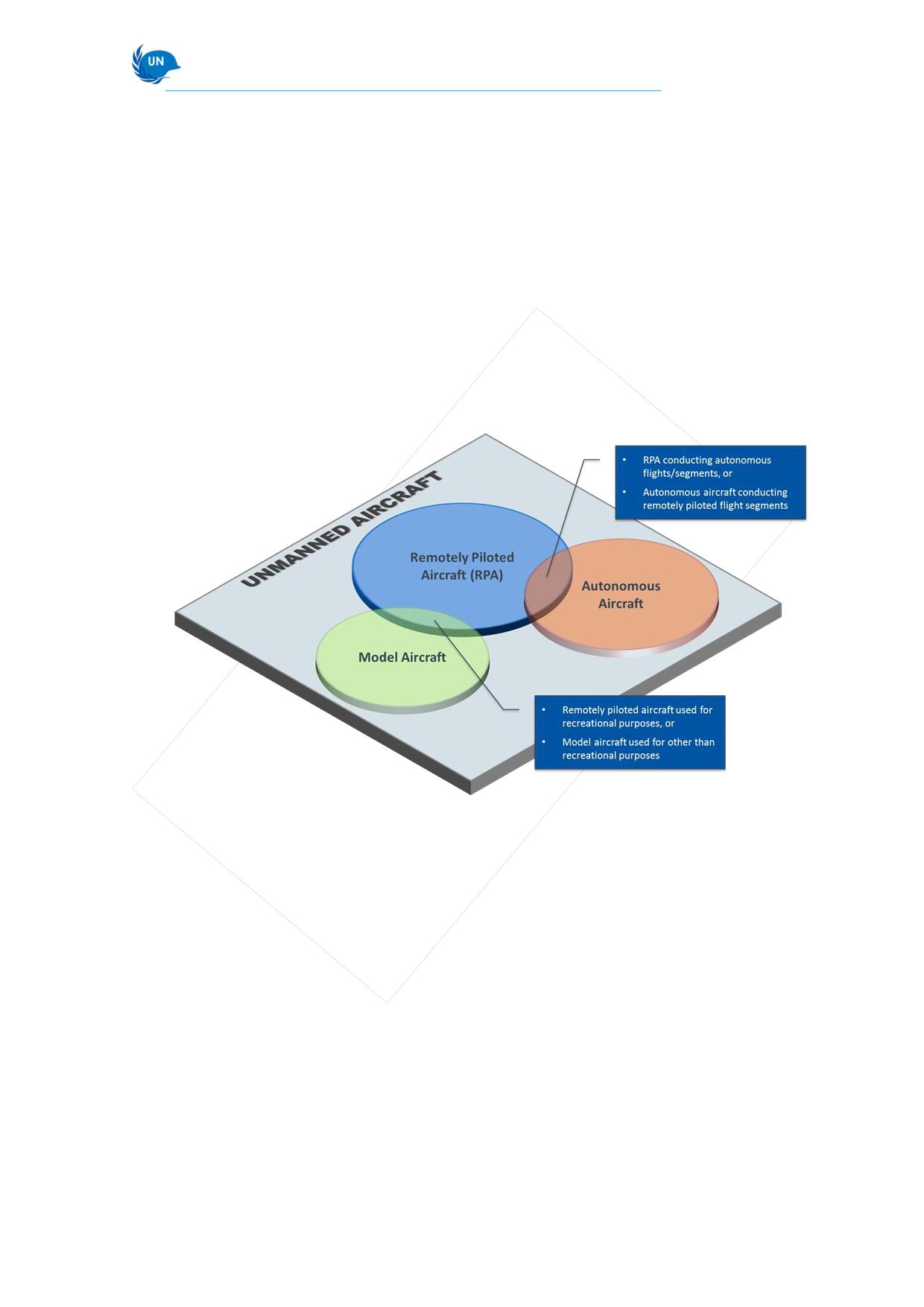
Annex F
Operation with Unmanned/Remotely Piloted Aircraft
Systems (UAS/RPAS)
UAS including RPAS have had an increasingly important role in support of United Nations
peacekeeping and humanitarian operations. A large variety of UAS and RPAS, operated by
both commercial operator and military units, are already being used on multiple missions
for a wide variety of tasks (see Figure 1). The utilization of unmanned aircraft must adhere
to the Standards and Recommended Practices (SARPs) stipulated in the ICAO Annexes and
documents, troop-contributing countries (TCCs) military regulations and United Nations
established applicable policies, procedures and practices.
Figure 1: Types of unmanned aircraft*
Definitions
Unmanned aircraft (UA): The overall term for all aircraft that do not carry a human
operator and can be operated remotely using varying levels of automated functions, such as
flying super marine spitfire model aircraft.
Remotely Piloted Aircraft (RPA): This refers to an unmanned aircraft that is controlled
from a remote pilot station by a pilot (unmanned aircraft pilot - UAP), who is tasked with
the overall responsibility for operation and safety of the RPA and who has been trained and
certified to equivalent standards as a pilot of a manned aircraft as per civilian or military
regulations. This is usually the case for all medium and high-altitude long endurance
(MALE/HALE). See Table 1
Unmanned Aerial Vehicle (UAV): A UAV is an unmanned aircraft that is remotely
controlled by a UAV operator who is tasked with the overall responsibility for operation and
safety of the UAV but does not need to be trained and certified to the same standards as a
182
regular pilot of a manned aircraft as per international civilian or military regulations. This
is typically the case for small and tactical UAS operated for military purposes or for
commercially available quad copters employed for main operating base (MOB) security and
surveillance.
Unmanned Aircraft System (UAS): The overall term for a system whose components
include one or more unmanned aircraft, the supporting network and all equipment and
personnel necessary to control the unmanned aircraft.
Remotely Piloted Aircraft System (RPAS): A UAS whose components include one or more
RPA and requires a UAP for operation.
Visual LOS is used to describe most Class I UAS as the aircraft pilot must be able to see the
UAS at all times to safely control it and avoid collisions with other aircraft, people, buildings
and terrain.
The term radio LOS refers to the means of communicating with larger UAS to provide
directional input and to receive any feed from the sensors; it does not mean that the UAS
must be within visual range.
When using the term beyond LOS (BLOS), this refers to the need to use satellite uplinks
and downlinks to communicate with the UAS and is almost exclusively used to refer to Class
III UAS
Classification of UAS/RPAS
There is a large variety of UAS/RPAS available. Systems are categorized by various
parameters, including type of operations, different performance parameters, payloads,
roles and sensor types. However, other classifications might be valid, depending on the
specific employment of those systems. For the purpose of this manual, the UN classifies
UAS/RPAS by operational employment (see Table 1). The types, performance and tasks for
183
each specific system will be described in the respective Mission Statement of Unit
Requirements (SUR).
o Class I UAS: Small, mini and micro UAS, only operated up to a limited altitude of
not more than 1,000ft above ground level (AGL), normally with a weight of between 1 and
25kg, and within radio line of sight (LOS) of the operator, with a maximum range of up to
50km.
o Class II UAS/RPAS: Tactical UAS/RPAS, normally with a maximum take-off weight
(MTOW) between 150kg and 600kg, equipped with a LOS data link. Normally operated up
to 18,000ft AGL, with a maximum range of 200km. Payload limitations and airworthiness
restrictions may limit these systems to operations in restricted or special use airspace.
o Class III UAS/RPAS: Typically, MALE and HALE UAS/RPAS, normally weighing
more than 600kg and operated up to 65,000ft AGL with unlimited range (beyond radio line
of sight or BRLOS), equipped for limited or even unrestricted use of airspace with an equally
less restrictive or even unrestricted airworthiness certificate.
Table 1: UN UAS/RPAS Table
Normal
Recommended
Aprox
Class
Category
Range
Examples
Employment
Recommended
Altitude (AGL)
Unlimited
HALE
Strategic/National
< 65,000 ft
Global Hawk
(BLOS)
Class
III
Unlimited
Heron/Hermes
MALE
Operational/Theater
< 45,000 ft
(BLOS)
900
Hermes
< 150 km
Class II
Tactical
Tactical Formation
< 18,000 ft
450/Falco
(LOS)
Sperwer
Scaneagle/
< 50 km
Small
Tactical Unit
< 1,000 ft
Shadow 200
(LOS)
Luna
Tactical Subunit
Raven/Aladin
< 25 km
Mini
(manual or hand
<1,000 ft
Puma/Skylark
Class I
(LOS)
launch)
Heidrum V1
WASPIII/MICADO
Tactical Subunit
< 5 km
DJI Phantom 4,
Micro
(manual or hand
< 400 ft
(LOS)
DJI Mavic Pro
launch, tethered)
Hovermast 100
Recommendations on the employment of Class I (mini/micro under 10kg) UAS
To mitigate the potential hazards for Class I (mini and micro) UAS categories operation, the
following points are recommended to be followed by all military UAS/RPAS operators:
184
o Operations within 8 Km from an airfield or heliport are restricted. They are only
allowed with prior coordination with the Mission Aviation Section. If the operations are
conducted within the area of an airfield/heliport with no Aviation Section presence,
Local Air Traffic Control authorization will be required if available. Military mini/micro
UAS may continue to operate close to airports and heliports under urgent operational
requirements;
o Visual line-of-sight (VLOS) operations only;
o UA may not operate over any persons not directly involved the ongoing operation,
not under a covered structure, and not inside a covered stationary vehicle;
o For night operations, activities should be coordinated by Mission’s Aviation Section;
o Must not be flown close to an aircraft, in any case yield right of way to other aircraft;
o Maximum altitude of 400 feet above ground level (AGL) unless a different ROZ has
been previously arranged with the mission authorities;
o No person may act as a remote pilot/operator in command for more than one UA
operation at one time;
o No operations from a moving vehicle unless the operation is over a sparsely
populated area (military convoys might deviate from this rule if operational situation
demands);
o The UA Operator in command must conduct a pre-flight check of the UA to ensure its
serviceability is in condition for safe operation;
o UA operator must be qualified and trained suitability for safe UAS operations;
o All mini/ micro UAS flight operations must be authorized and documented with
adequate and approved SOPs.
All UAS operators, civilian and military, in the Mission area are required to abide by the
above, coordinating all UAS operations with the Mission aviation authorities as required. All
UAS operators are encouraged to report all occurrences and observed hazards to Mission
Aviation staff promptly.
UAS/RPAS Aviation Safety recommendations.
UAS/RPAS Military Units should have a SOP, including a Safety Management System (SMS)
implemented to systematically integrate the management of safety risk into their
operations and decision making. This SOP shall include as a minimum the following
components:
o Safety policy and objectives
o Safety risk management
o Safety assurance
o Safety promotion
o Operational Procedures
Tasking of UAS/RPAS
Class II and III UAS/RPAS aviation units will be tasked by the U2 following the mission air
assets tasking procedures. The management and employment of UAS/RPAS within the field
Missions will be done in accordance with this Manual, the UN DOS Aviation Manual 2018
and the UN Aviation Safety Manual and Aviation Risk Management Policy latest editions.
All operations of the Class II and III UAS/RPAS will be conducted in direct response to
tasking by the U2 and subsequent to an Air Tasking Order through the Mission chain of
command.
185
The issuance of an Air Tasking Order (ATO) will authorize the flight and provide
confirmation of airspace/air traffic management arrangements. Every flight planned for the
UAS/RPAS (with the exception of some Class I UAS as stipulated and determined by the
Mission) shall be included in the respective flight schedule specifying the dates and times of
departure, originating operating site and sortie profile.
The Force Commander exercises operational control (OPCON) and tasking authority over
military UAS component.
On some occasions, particularly in reference to mini and micro Class I UAS/RPAS activity,
for operational reasons, scheduling flights as described in the above paragraphs will not be
possible. Though, efforts must be done to include those flights or activity on the flight
schedule when pre-planned.
These types of small tactical UAS may fly at a short-notice request made by the local
delegated authority, who will notify when possible such eventuality to the Mission Aviation
Section/MAOC/Air Region; based on the specific operational situation.
The Mission is responsible for the overall airspace management coordination plan to
include utilization of UAS/RPAS of any type. For that reason, the operation of small Class I
UAS under the described circumstances or any other specific to each particular Mission,
must be described, specified and regulated through the Mission Standard Operating
Procedures (SOPs).
186
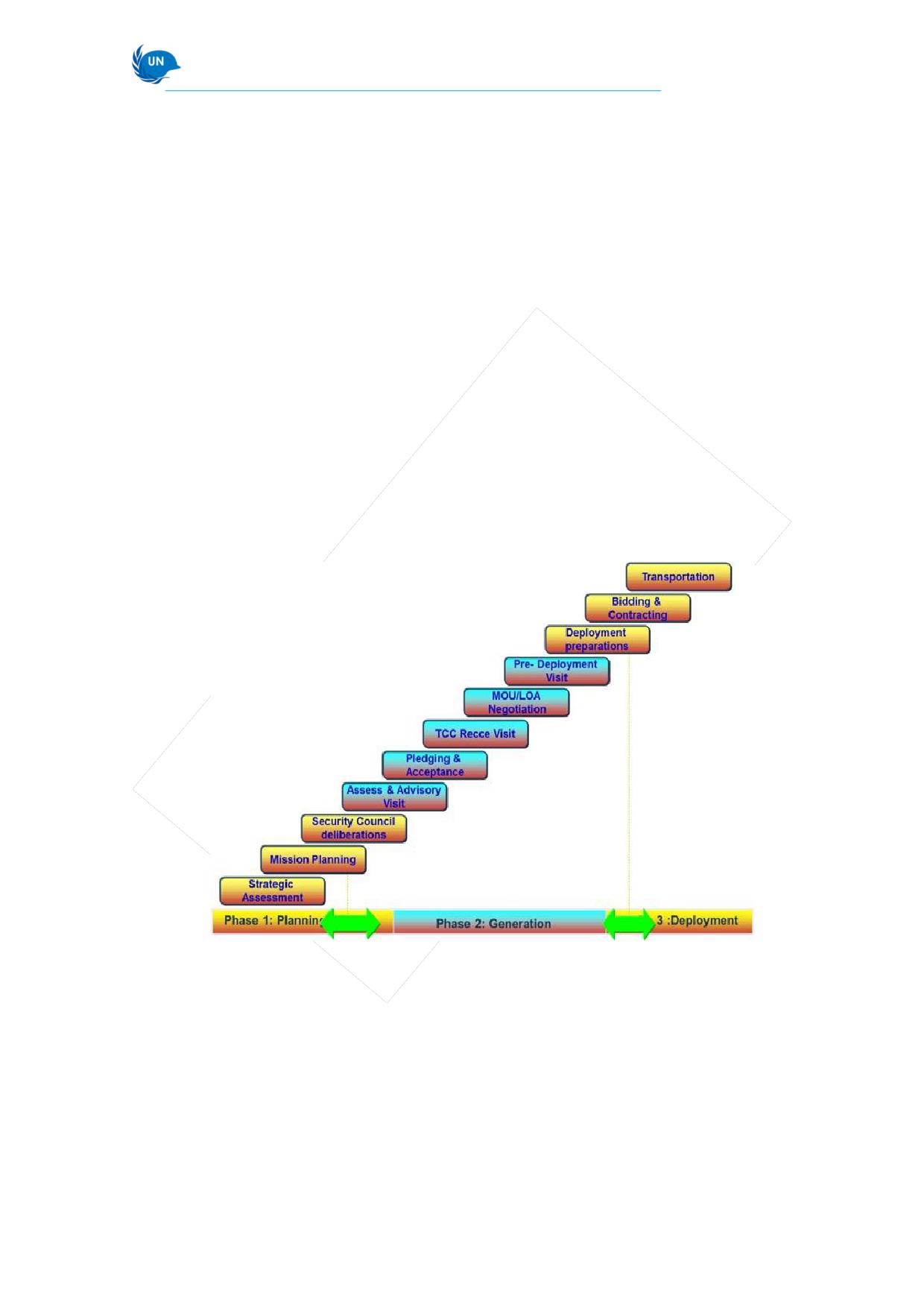
Annex G
Guidance for Military Aviation Units Letter of Assists (LOA)
General
1. Military Aviation Units are deployed in UN peace Missions under two different types of
contractual agreement that must be agreed upon and signed by the TCC and the UN
prior deployment. These are the Memorandum of Understanding (MOU) and the Letter
of Assist (LOA). The operational requirement, equipment, capabilities, functions and
tasks to be performed by the aircraft and crew are defined and established in the LOA.
In common words, the LOA is the contractual document by which the aviation services
are provided to the UN.
2. During the LOA negotiation process, the technical and operational requirements
established in the respective SUR are reflected into the LOA, including aircraft and crew
capabilities, equipment and qualifications. For that reason, it is ultimately important
that the aviation unit critical personnel, including Unit commander, operations officers
and crews are involved during the LOA negotiation process.
LOAs
legal
obligations from both parties for the fulfillment of this agreement. Fin below a template
generic LOA for provision of aviation services, it is recommended that aviation unit
personnel are familiarized with the terms of their LOA before deployment. Be advise
that LOAs defer from one another based on multiple factors, such as type of unit,
TCC, Mission, etc, these template are presented for the purpose of guidance only,
final LOAs are the product of bilateral discussions between the TCC and the UN
on a case by case basis and will be based on approved DPO/DOS UN aviation
regulatory framework.
187
UTILITY HELICOPTER TEMPLATE:
U N I T E D N A T I O N S
N A T I O N S U N I E S
MISSION
(Host Country)
LETTER OF ASSIST
General Terms and Conditions
LOA 20xx-xxx
TCC
Number Type Utility Helicopters
188
GENERAL TERMS AND CONDITIONS OF LETTER OF ASSIST 20XX-XXX FOR
THE PROVISION OF LONG-TERM AVIATION/AIR TRANSPORTATION SERVICES
INVOLVING STATE AIRCRAFT
1.
Letter of Assist documents.
1.1
The cover letter and these Terms and Conditions constitute the entire Letter
of Assist (hereinafter referred to as the Letter of Assist - LOA) for the
provision of long-term helicopter services by the Government of TCC in
support of the United Nations peacekeeping activities in MISSION (Host
Country).
2.
Services.
2.1
Aviation/Air Transportation Services (hereinafter referred to as the
"services") are an important and essential part of United Nations
peacekeeping operations. The purpose of the services is to support the
United Nations peacekeeping activities mandated by the Security Council.
These services may include, but be not limited to, cargo re-supply, troop
movements, medical transport (CASEVAC and MEDEVAC with AMET
provided by the Mission), combat search and rescue, search and rescue, VIP
flights and Observation/Monitoring, Reconnaissance and Surveillance
flights. The provision of such services by the Government shall be subject to
the provision of paragraphs 16 and 19 of this LOA and may involve operation
into hostile areas or fields where there is no ground support or where airfield
security cannot be guaranteed.
2.2
These General Terms and Conditions shall govern the use of State aircraft
providing services to the United Nations under Letters of Assist. For
purposes of these General Terms and Conditions, State aircraft comprise
aircraft owned, leased or chartered by a Government, providing aviation/air
transportation services for United Nations peace-keeping operations under
United Nations Letters of Assist, excluding aircraft operated by the military
of that Government solely for military operations by such Government.
3.
Aircraft and Crew.
3.1
The Government of TCC (hereinafter referred to as the "Government") shall
provide to the United Nations the services of Number type of utility
helicopters (hereinafter referred to as the "Aircraft") operated by a military
contingent from TCC, as per the MOU signed between the UN and The
Government, in connection with the peacekeeping activities of MISSION. The
contingent and its personnel shall form part of the mission in the same way
as any other contingent and in accordance with the existing rules and
regulations contained in the Guidelines for Troop-Contributing Countries.
3.2
The Aircraft shall, inter alia, be capable of the following configurations and
conduct missions as mandated by the Security Council:
3.3
Cargo: For internal cargo complete with proper cargo straps and tie-downs
for a maximum of xxxx (as per SUR) kg of cargo internally at sea level or xxxx
(as per SUR) kg freight externally (by sling);
189
a)
Capability to lift up to xx (as per SUR) fully equipped personnel per
helicopter with individual/crew equipment at one time;
b)
Minimum range of xx (as per SUR)
c)
Capability to sling load pallets and light vehicles;
d)
Day/night IFR flying capable;
e)
Capacity to mount xx (as per SUR) machine gun on each helicopter for self-
protection only;
f)
Capability of 24/7 reaction response under Visual Meteorological
Conditions (VMC);
g)
Capability to generate xx (as per SUR) hours per helicopter per month;
h)
Capability of operating with Night Vision Goggles (NVG);
i)
Helicopter Landing Site (HLS): The ability to operate day and night
(including NVG) under visual meteorological conditions (VCM) in
approved HLS, with standard security provided by UN troops and
ground- to- air communication whenever it is possible as per the UN
Aviation Manual (Annex 5N);
j)
Remote Helicopter Landing Site (RHLS): The ability to operate day and
night (including NVG) under visual meteorological conditions (VCM) in
approved RHLS, with limited assistance on ground as indicated in the UN
Aviation Manual (Annex 5M);
k)
Helicopter Landing Sites not designated approved HLS or RHLS: The
ability to operate day and night (including NVG) under VMC at locations
where no approved HLS/RHLS exist, without assistance from troops on
ground. These operations shall be limited to emergency situations (In-
flight emergency, CASEVAC, etc.) as indicated in the UN Aviation Manual
(Annex 5M) In this case, the Pilot- in- Command (PIC) is the ultimate
responsible for the safe execution of the task on a case by case basis.
l)
Integral refuelling capability;
m)
Passengers: Removable seats for a maximum of xx (as per SUR)
passengers with 9G rated seat belts for each seat. Seat belts must be
connected with metal-to-metal couplings, Seat belts must be connected to
the seats as designed by the manufacturer for that purpose with an
approved attachment method;
n)
CASEVAC/MEDEVAC: Up to xx (as per SUR) stretchers with a
CASEVAC/MEDEVAC team of xx (as per SUR) personnel;
o)
Armoured protection for crew and, where possible, passengers;
p)
Capability (including gloves and ropes etc) for troop insertion by fast
roping/rappelling;
q)
Able to transport troops with loaded weapons, dangerous goods, fuel,
ammunition, and human remains;
190
r)
Capable, when pre-tasked, to maintain continuous readiness for rapid
response tasks such as CASEVAC or QRF transport, with a maximum of 15
min take-off time;
s) Observation/Monitoring, Reconnaissance and Surveillance; this task is
subject to operational risk management assessment. The pilot in
command is the ultimate responsible for the safety of the aircraft and
crew;
t)
Flight Instruments: Required for IFR/IMC and night conditions;
3.4
In addition to the above, the aircraft shall include the following minimum
equipment:
a) Global Positioning System (GPS) with updated database;
b) Night Vision Goggles cockpit compliance;
c) VHF, UHF, HF communications equipment compatible with MISSION
communications equipment and satellite phone;
d) Emergency Locator Transmitters (ELT-406 MHz) with valid inspection;
e) One (1) Transponder 3/A and C;
f)
Non photographic FDR (Flight Data Recorder) and CVR (Cockpit Voice
Recorder);
g) Auxiliary Fuel Pump;
h) Fire extinguishers and first aid kits;
i)
Radio Altimeter;
j)
Direction Finder (DF) equipment capable to guide aircraft to Emergency
Locator Transmitters (ELT
406 MHz); Composite survival kits
appropriate to the mission area;
k) Portable Satellite Tracking System to be provided by the MISSION;
l)
Weather radar;
m) Winch for two (2) persons, with 40m cable and harness;
n) Searchlight of approximately 30 million candelas;
o)
Night vision equipment (NVG); and
p) Forward Looking Infrared Radar (FLIR) for surveillance.
3.5
The flight crews will possess the following minimum qualifications:
a)
The Pilot-in-Command (PIC) for any sortie tasked by the UN will have a
minimum of 1000 total flight hours (800 rotary flight hours), with a
minimum of 250 actual flight hours on the type aircraft. In addition, each PIC
needs to be IFR qualified and will have a minimum of 50 night flight hours on
Type helicopters.
b)
The Co-pilot (CP) will have a minimum of 100 hrs on Type helicopters and
will be IFR and night flying qualified.
191
c)
All air crew shall be properly qualified and trained to fly and operate at night
with NVG as per national standards with a minimum of 30 NVG flight hours.
d)
The number, qualifications, and the flight experience of the crews must be
sufficient to ensure that all the requirements are fulfilled in capacities and
capabilities, for day and night operations, 24/7, and up to xx (as per SUR)
flight hours per month per aircraft in compliance with the applicable national
standards.
e)
Weapon currency is a national responsibility as there are no helicopter
weapon ranges in Host Country for use by MISSION. Pilots must be current
with all the weapon systems for the duration of their stay without the need
of refresher in the Mission.
4.
Term.
4.1
The term of this Letter of Assist is for a TERM of one-year effective xx Month
20xx until xx Month 20xx, on the expiry of this term the UN at its option
with the Government of TCC may extend the term of the LOA for two optional
additional periods of one year each (1+1+1 year) until xx Month 20xx and
xx Month 20xx respectively. (Subject to MISSION mandate). The activation
of the optional years will require the agreement of both parties
5.
Aircraft availability.
5.1
The Aircraft shall be available as follows:
a. Minimum average individual helicopter availability rate of at least 75%
per month (a maximum of 22 maintenance days for the number
helicopters per month).
b. A minimum of Number Type Utility helicopters should be available at any
given time.
6.
Flight Time.
6.1
The Government shall be capable of providing an average of xxx hours of
flight time per month for the fleet of Number Type (xx flight hours per
aircraft) not to exceed xxx hours of flight per year.
6.2
For purposes of this Letter of Assist, "flight time" means the total time from
the moment the helicopter blades start turning for the purpose of taking off
for a flight tasked by the United Nations until it comes to rest at the end of
such flight.
7.
Operational base
7.1
The main operational base for Number Type Utility Helicopters shall be
Location (Host Country).
7.2
For operational reasons the Aircraft may be re-deployed permanently or
temporary (up to xx days) (as per SUR) to another location in the Host
Country or temporarily to another Mission for Intermission Cooperation
with UNSC approval and after prior consultation and approval by the
192
Government of TCC. Temporary forward deployments, to be agreed between
the UN and the TCC, may be subject to aircraft and/or personnel rotation for
maintenance, provision of crew accommodation (as COE Manual, currently
2017, or as revised), meals, local transportation, operational communication
facilities, ground support equipment and security of helicopters, and must be
discussed and agreed with the authorised United Nations Chief Aviation
Officer (CAVO) and TCC Government representative.
8.
Reimbursement
8.1
The United Nations shall reimburse the Government for the satisfactory
performance of the services under this Letter of Assist the following costs:
a)
US$ xxxxxx per flying hour of flight time which includes all costs for
operations, maintenance, inspections, spare parts, oils, lubricants, aircraft
maintenance/support equipment and appropriate aircraft manuals. This
also includes regular security and evacuation exercises in consultation
with the Force HQ and authorized by the Mission’s air specialist.
b) Actual cost for firing chaff, flares, rockets and machine guns by the pilots
during the year. Details of such firings are included in reimbursement of
Ammunition expended by LOA aircraft (Attachment 2) and would be in
excess of the amount agreed in the paragraph 8.2. of the General Terms
and Conditions. Ammunition expended during actual hostilities and
proficiency training will be verified by the United Nations Aviation
Verification Officer for the certification and subsequent reimbursement
at the agreed rates.
c)
Positioning/Depositioning
- Each and every time an aircraft
accumulates a total of xxx flight hours in support of the Mission during the
period of this LOA, the Government is entitled to rotate the aircraft at UN
expense under coordination between the Government and the United
Nations. Rotation can be accomplished under commercial arrangements
or, alternatively, under separate LOA as agreed between United Nations
(Air Transport Service, LD/OSCM/DOS and Movement Control Section of
TMS/LD/OSCM/DOS) and the Government.
d)
US$ xxxxxx total for ‘UN’ painting the Number aircrafts (if required) or
any substitution at US$ xxxxxx each aircraft.
e)
Costs for airport services, excluding taxes from which the United Nations
is exempt, as specified in paragraph 17 below, and costs for aviation fuel
are not included in the cost of the fixed term rental rate set out in (a)
above, and will be reimbursed and/or provided by the United Nations to
the Government at actual cost provided: (i) such costs are incurred during
flight time; (ii) such costs are reasonable; (iii) the Government submits
to the United Nations, together with its invoice, a copy of the invoice
presented to the Government.
8.2
The foregoing notwithstanding, the United Nations shall not reimburse the
Government in excess of US$ xxxxx for the period of three years from xx
Month 20xx to xx Month 20xx.
193
8.3
The United Nations will not pay guaranteed minimum hours, only actual
hours flown that were tasked and certified by the United Nations with
reference to a maximum utilization as defined in paragraph 6.1. Hours
flown for maintenance test flights will not be reimbursed by the UN.
8.4
Certification for reimbursement by the United Nations requires inter alia
verification by the authorized United Nations Chief Aviation Officer that the
Aircraft was operating in accordance with this Letter of Assist. The number
of hours flown should be verified by both parties.
8.5
Aircraft tasked to conduct flight operations outside the scope, direction, or
intent of this Letter of Assist may not be endorsed for reimbursement.
8.6
The United Nations shall make payments to the Government under this
Letter of Assist upon receipt of the Government's invoice and certification by
the authorized United Nations Chief Aviation Officer that the services for the
period of the invoice have been satisfactorily performed. The signature of
the authorized UN Representative on Form FOD 40, Aircraft Use Report
(AUR) constitutes a certificate that the services provided as described
thereon have been satisfactorily performed.
8.7
Government invoices for the items referred to in paragraph 8.1 a., b., c. and
d., should be sent to the Chief, Reimbursement Claims Management and
Performance Section, Uniformed Capability Support Division, Office of
Supply Chain Management, Department of Operational Support
(RCMPS/UCSD/OSCM/DOS). All other invoices are to be presented to
MISSION in accordance with subparagraph 8.1(e) above and will be
reimbursed to the Government by MISSION.
9.
Assignment.
9.1
The Government will not assign, transfer, pledge or make other dispositions
of this Agreement or any part thereof, or any of the Government’s rights,
claims or obligations under this Agreement except with the prior written
consent of the United Nations.
10.
Aircraft call signs.
10.1
The United Nations will, if required, assign to the Government appropriate
United Nations call signs, which the Government may use only for self-
deployment and redeployment of the Aircraft to and from the mission area.
In addition, with respect to long term services Aircraft, once the Aircraft have
arrived at the "mission base of operation", the United Nations will assign to
the Government appropriate United Nations call signs, which the
Government may use only for flights, which have been tasked by the
United Nations. In both above-mentioned instances, the Government may
only use the United Nations call sign together with its own usual call sign in
order to ensure the proper identity of the Aircraft. In this connection, the
Government must always identify itself and the Aircraft, using both call signs,
in all communications with airports and in-flight agencies.
194
11.
Aircraft painting and markings.
11.1
The Government shall paint the Aircraft in United Nations livery (white) and
affix "UN" markings to the Aircraft in accordance with the instructions
attached hereto as Attachment 1. The Government may only use such painted
and marked Aircraft for flights, which have been tasked by the United
Nations.
11.2
Upon the expiration or termination of this Letter of Assist, all UN markings
shall be removed from the Aircraft. Deployment and redeployment flights
with UN markings are allowed provided that it is noted in the flight plan that
the flights are repositioning/ depositioning flights to/from a United Nations
mission. To ensure the availability for United Nations tasking, the
Government shall ensure that aircraft substituted for Aircraft due for
scheduled maintenance are marked in accordance with Attachment 1.
11.3
The painting and markings will be professionally and uniformly applied
without streaking, bleed through, chipping, and over-sprays.
12.
Clearances.
12.1
The Government shall be responsible for obtaining authorizations from
governmental or other authorities and other documents necessary for the
performance of the transportation under this Letter of Assist.
13.
Scheduling of flights.
13.1
The flights under this Letter of Assist shall conform to a flight schedule as
tasked by the United Nations. The flight schedule shall specify the dates and
times of departure, originating airports, routes, sortie profile, number of
passengers and/or total weight of cargo and estimated time of arrival.
13.2
Should any flight(s) be delayed by the Government, the Government shall
promptly notify the United Nations of the delay and the reasons for such
delay.
14.
Facilities provided by United Nations.
14.1
The United Nations may provide the Government such facilities as are
necessary for the performance of services hereunder, as agreed by the
parties and set out below:
a) Facility 1
b) Facility 2
c)
(if applicable)
These facilities are provided for the convenience of the Government at no cost and give
rise to no liability on the part of the United Nations.
15.
Reporting and accidents.
15.1 In the event of any accidents or incidents involving the Aircraft, the
Government shall immediately report such accidents or incidents to the
195
United Nations and all appropriate governmental authorities and shall
protect and preserve all evidence in connection with the accidents or
incidents. In addition, the Government shall co-operate with all
investigations into the accidents or incidents, which may be instituted by the
United Nations and/or governmental authorities, including the preparation
of reports.
16.
Safety.
16.1
The Government shall be solely responsible for the safety and airworthiness
of the Aircraft and the operation of the Aircraft, and represents that during
the term of this Letter of Assist:
a. The Aircraft shall be properly manned, equipped, operated, inspected,
maintained and serviced, in compliance with the rules and regulations of
the Government and any other applicable aeronautical rules and
regulations, including those of the host country when applicable;
b. The Aircraft shall be fit for the purposes for which they are being used
and shall be safe for passenger, cargo and passenger/cargo combination
(-combi) air transportation in the designated area (s) of operation under
this Letter of Assist.
c. Any requirement to rotate or replace the aircraft for maintenance or
safety reasons, within the period of this LOA (xx Month 20xx to xx
Month 20xx ) shall be at the sole responsibility and cost of the
Government. However, any aircraft logging more than xxx flight hours
before the expiry period of this LOA or on completion of the three years
period of the LOA, will be rotated/replaced at UN expense including
painting costs, if required.
16.2
The flight crew, maintenance and other required support personnel shall,
inter alia, be medically fit and possess the necessary training knowledge,
qualifications, skill and experience to perform the duties under this Letter of
Assist. Training and proficiency is a TCC responsibility. The pilots are
required to maintain day and night currency (including NVG) in accordance
with International/Government/ Service/UN regulations. Hours flown to
maintain pilot day/night (NVG) currency will be reimbursed by the UN.
Without prejudice to the above, the United Nations reserves the right to
review and inspect documentation relating to the experience level and
current medical status of all aircrew members, including the Pilot, Pilot-
Navigator (co-pilot), Engineer and Radio Operator. Documents mentioned
in Paragraph 26.1 related to Service Regulations for crew currency and
proficiency will be provided by the Government. In addition, the flight
crew shall be fully fluent in "aeronautical" English.
16.3
The Government agrees that flights tasked by the Mission will fully comply
with the operating procedures in Chapter 3 of the UN Aviation Manual and
with local flying instructions issued by the Mission.
16.4
The UN Aviation Manual, Chapter 3 requires that the Pilot in Command
accomplish a risk assessment. It is to be completed prior to the initial flight
196
each day that covers the day’s tasking. The Government agrees that during
the term of this Letter of Assist, the Pilot-in-Command of the UN tasked
aircraft will complete the risk assessment checklist. The checklist will be
forwarded to the Mission’s Aviation Specialist prior to the initial flight for
review, except when precluded by emergency situations.
17.
Responsibility for claims and insurance.
17.1
The Government shall bear the risk of loss or damage to the body and parts
of the Aircraft and shall be responsible for any claims by its crew and its other
support personnel who are not members of the United Nations peacekeeping
operation arising from the performance of services hereunder. The
Government may meet its responsibility through insurance or self-insurance.
17.2
Government claims in respect of the death, injury or illness of members of
the Aviation Unit attributable to United Nations service shall be dealt with in
accordance with the Guidelines for Troop-Contributors annexed to the MOU
and General Assembly Resolution A/Res/64/269.
17.3
The United Nations maintains insurance covering loss or damage sustained
by third parties, including passengers, for death, bodily injury and/or
property damage and shall handle any claims by such third parties arising
from the performance of services hereunder within the scope of the
insurance policy maintained for this purpose and in accordance with the
established procedures of United Nations peacekeeping operations,
excluding claims by personnel provided by the Government including
members of the Aviation Unit, as referred to in paragraphs 17.1 and 17.2
above. However, if the third-party claim arises from the gross negligence or
willful misconduct of any personnel provided by the Government, including
any member of the Aviation Unit, the United Nations shall be entitled to claim
recovery from the Government in respect of such claims in accordance with
the MOU.
18.
Tax exemption.
18.1
Section 7 of the Convention on the Privileges and Immunities of the United
Nations exempts the United Nations from payment of direct taxes and duties
other than taxes and duties that are no more than charges for public utility
services. Accordingly, the Government authorizes the United Nations to
deduct from the Government's invoice any amount representing such taxes
or duties charged by the Government to the United Nations. Payment of such
corrected invoiced amount shall constitute full payment by the United
Nations. In the event that any taxing authority refuses to recognize the United
Nations exemption from such taxes, the Government shall immediately
consult with the United Nations to determine a mutually acceptable
procedure.
19.
Cancellation by the Government.
19.1
The aircraft shall be at all times under the exclusive command of the
Government. The Government may cancel, delay or abort a flight should the
pilot in command determine that to fly would in the circumstances endanger
197
the safety of the passengers, aircraft or its crew. In particular, the
Government may cancel, delay or abort any flight in case of force majeure.
19.2
In case a flight is cancelled, delayed or aborted for force majeure, the
Government shall be entitled to reimbursement from the United Nations, on
a pro-rata basis, in respect only of flights, or portions of the flight already
completed prior to the decision to cancel, delay or abort such flight.
19.3
In the event that the Government decides to cancel, delay or abort a flight for
any other reasons not directly attributable to the United Nations, including
but not limited to reasons of operational difficulties, technical failure of the
Aircraft, the Government shall not, except where alternate air transportation
has been provided by the Government, be entitled to payment from the
United Nations for that flight, and where payment has already been made,
the United Nations shall be entitled to full reimbursement of any amounts
paid plus reasonable expenses incurred by the United Nations as a result of
such decision.
20.
Termination.
20.1
Either party may terminate the Letter of Assist for cause upon 7 days written
notice to the other party. In the event of termination pursuant to this clause,
no costs relating to termination shall be reimbursable by the terminating
party to the other party.
20.2
Either party may also terminate the Letter of Assist, in whole or in part, upon
30 days written notice to the other party. In the event of termination
pursuant to this clause, the United Nations shall only be responsible for
reimbursement to the Government for services satisfactorily performed in
accordance with this Letter of Assist prior to the effective date of termination.
In the event of termination by the Government, except due to an event of
force majeure, the United Nations shall be entitled to reimbursement by the
Government for all reasonable costs relating to such termination. In the event
of partial termination, the price shall be proportionately reduced.
20.3
The United Nations may also terminate this Letter of Assist at any time for
convenience in the interest of the Organization should the mission mandate
or the funding be curtailed or terminated, in which case the Government shall
be entitled to reimbursement by the United Nations for all reasonable costs
relating to such termination.
21.
Forward commitments.
21.1
The Government shall upon receipt of notice of termination of the Letter of
Assist under paragraph 20 above, bring the services to a close in a prompt
and orderly manner, reduce all expenses to a minimum and shall not
undertake any forward or further commitments in connection with the
Letter of Assist.
198
22.
Modifications.
22.1
No changes in, or modifications to, this Letter of Assist shall be made except
by mutual agreement, in writing, between the United Nations and the
Government.
23.
Settlement of disputes.
23.1
The United Nations will establish a mechanism to discuss and resolve
amicably by negotiation in a spirit of cooperation disputes arising under this
Letter of Assist. In the event that a dispute arises, the Under-Secretary-
General for Field Support will institute discussions and consultations with
representatives of the Government with a view to reaching an amicable
resolution of the dispute. Disputes that have not been resolved through
consultations or discussions, as described above, may be submitted to a
mutually determined conciliator or mediator appointed by the President of
the International Court of Justice, failing which the dispute may be submitted
to arbitration at the request of either party. Each party will appoint one
arbitrator, and the two arbitrators so appointed will appoint a third, who will
be the Chairman. If within thirty days of the request for arbitration either
party has not appointed an arbitrator, or if within thirty days of the
appointment of two arbitrators the third arbitrator has not been appointed,
either party may request the President of the International Court of Justice
to appoint an arbitrator. The arbitrators will fix the procedures for the
arbitration, and each party will bear its own expenses. The arbitrators will
have no authority to award punitive damages. The arbitral award will
contain a statement of reasons on which it is based and will be accepted by
the parties as the final adjudication of the dispute.
24.
Privileges and immunities.
24.1
Nothing in or relating to this Letter of Assist shall be deemed a waiver of any
of the privileges and immunities of the United Nations, including its
subsidiary organs.
25.
Force majeure.
25.1
In the event of and as soon as possible after the occurrence of any event
constituting force majeure, the Government shall immediately give notice
and full particulars in writing to the United Nations of such event if the
Government is thereby rendered unable, wholly or in part, to perform its
obligations and meet its responsibilities under this Letter of Assist.
25.2
Upon receipt of such notice, the United Nations shall have the right to take
such action as, in its sole discretion, it considers to be appropriate or
necessary in the circumstances, including suspension or termination of this
Letter of Assist.
25.3
Force majeure. Any unforeseeable and irresistible act of nature, any act of
war (whether declared or not), invasion, revolution, insurrection, terrorism,
or any other acts of a similar nature of force, provided that such acts arise
199
from causes beyond the control and without the fault and negligence of the
Government. The Government acknowledges and agrees that, with respect
to any obligations under the Letter of Assist that the Government must
perform in areas in which the United Nations is engaged in, preparing to
engage in, or disengaging from any peacekeeping, humanitarian or similar
operations, any delays or failure to perform such obligations arising from or
relating to harsh conditions within such areas, or to any incidents of civil
unrest occurring in such areas, shall not, in and of itself, constitute force
majeure under the Letter of Assist.
26.
Documentation.
26.1 Prior to the aircraft arrival in the Mission, the Government shall provide a
copy in English of the Service (Army, Air Force or Navy) regulation(s)
governing aviation to Air Transport Service, LD/OSCM/DOS. The document
rendered should outline operational requirements, and at a minimum
include crew rest, weather minimum, flight limitations for day, night, over
water and mountains, pilot currency and proficiency requirements, crew
mixture and minimum crew requirements.
26.2 As soon as possible, the Government will provide the Mission’s Aviation
Section a copy, in English, of the Aviation Unit’s Standard Operating
Procedures (SOP) or equivalent document.
For the United Nations
On behalf of the Government of TCC
Signature:
Date:
Name:
Title:
Assistant Secretary- General
Office of Supply Chain Management
200
Attachment 1 to "General Terms of LOA"
PAINTING AND MARKING INSTRUCTIONS
1.
As the size and type of aircraft used in missions can differ considerably, good
judgement and common sense must prevail when painting and marking aircraft
for lease with United Nations Peacekeeping operations. The following
guidelines are provided:
a Entire aircraft will be painted white; however, exhaust wash areas and
critical components may be black. Fire ground rescue safety markings, as
required by ICAO regulations, will be standard colours and remain
clearly visible.
b Paint in black or dark blue the letters "UN" or the words "UNITED
NATIONS" on the underside and topside of either the left or right wings
to be clearly visible and proportionate to size of wing. Helicopters should
have the letters "UN" on the underside of the fuselage and the nose.
c Paint in black or dark blue the letters "UN" or the words "UNITED
NATIONS” on the both sides of the fuselage so as to be clearly visible and
proportionate to the size of the aircraft. Large aircraft may affix the
letters "UN" on the front of the fuselage, with the words "UNITED
NATIONS" on the rear of the fuselage. Helicopters and small aircraft
should use the letters "UN" on both sides of the fuselage. The letters
should be made as large as possible, placed in a logical area
proportionate to the size of aircraft.
d Paint in black or dark blue the letters "UN" on both sides of the vertical
tail surface or affix the UN emblem.
e Serial numbers can remain on the vertical tail surface and on the wings
as required by regulation.
f
Company/Operator name shall not appear on the aircraft. National flag
symbols, if required, may appear discreetly in the usual position. If on the
vertical tail surface, emblems must be below UN symbol.
2.
In all cases, dimensional scale and in-flight legibility must be emphasized. All
lettering and placement shall be in proportion of the size of the aircraft.
3.
These guidelines are provided for long-term charters with permanent markings.
A limited supply of UN decals is available from UNHQ for certain one-time
charter flights.
201
Attachment 2 to "General Terms of LOA"
Reimbursement of Ammunition Expended by Oryx Utility Aircraft
1.
The dispensing of air to ground armament by UN aircraft provided by Troop
Contributing Country (TCC) under LOA requires unique skills and the necessity
for the aircrews to maintain proficiency in the use of the weapons systems.
2.
Ammunition such as Type of Ammunition and Type of Ammunition expended
during day/night security evacuation, proficiency exercises in TCC, live fire
exercises authorized by the Force Commander and approved by the mission's
Chief Aviation Officer, and firing during actual hostilities or proficiency training
exercises within the Mission AOR are included as part of the LOA, and will be
reimbursed in accordance with the wet lease maintenance rates of the COE
Manual (currently 2017, or as revised)or as agreed to by the TCC.
3.
The Scale of ammunition to be used in the proficiency firing shall be as follows:
a. Quantity of Type of Ammunition (per pilot per year)
b. Quantity of Type of Ammunition (per pilot per year)
4.
The rates of reimbursement of expended ammunition will be as under:
a. Type of Ammunition
USD xxx per unit
b. Type of Ammunition
USD xxx per unit
c.
…….
5.
Ammunition expended during proficiency firing in TCC or in MISSION AOR and
actual hostilities within MISSION will be verified by the United Nations Aviation
Verification Officer for the certification and subsequent reimbursement at
above mentioned rates.
6.
According to the COE Manual the United Nations will reimburse the cost of
ammunition expended by the Type helicopters Military Unit during the
duration of the service. Reimbursement rates for this ammunition will be
considered as Contingent-Owned Equipment from the Government of TCC, and
therefore will be excluded from the LOA NTE.
202
ATTACK HELICOPTER TEMPLATE:
U N I T E D N A T I O N S
N A T I O N S U N I E S
MISSION
(Host Country)
LETTER OF ASSIST
General Terms and Conditions
LOA 20xx-xxx
TCC
Number Type Attack Helicopters
203
GENERAL TERMS AND CONDITIONS OF THE LETTER OF ASSIST 20XX-XXX FOR
THE PROVISION OF LONG-TERM AVIATION/AIR TRANSPORTATION SERVICES
INVOLVING STATE AIRCRAFT
1.
Letter of Assist documents.
1.1
The cover letter and these Terms and Conditions constitute the entire Letter
of Assist hereinafter referred to as the Letter of Assist (LOA) for the
provision of long-term helicopter services by the Government of TCC in
support of United Nations peacekeeping activities in MISSION (Host
Country).
2.
Services.
2.1
Aviation/Air Transportation Services (hereinafter referred to as the
"services") are an important and essential part of United Nations
peacekeeping operations. The purpose of the services is to support the
United Nations peacekeeping activities mandated by the Security Council.
These services may include, but not limited to, fire support to ground forces,
armed anti-armour support, armed escort, quick reaction force response,
redeployment of forces and support to ground combat operations, fire
support to search and rescue (SAR) and SAR, extraction operations,
deterrence (show of force), surveillance flights, CASEVAC/MEDEVAC,
emergency logistic support UN personnel (civilian and military, authorized
by Mission’s authority), patrol, observation and monitoring flights. Due to the
nature of peacekeeping operations, such services may involve operation into
hostile areas or fields where there is no ground support or where airfield
security cannot be guaranteed. The aircraft will be operated in accordance
with the mission’s concept of employment.
2.2
These General Terms and Conditions shall govern the use of State aircraft
providing services to the United Nations under Letters of Assist. For
purposes of these General Terms and Conditions, State aircraft comprise
aircraft owned, leased or chartered by a Government, providing aviation/air
transportation services for United Nations peace-keeping operations under
United Nations Letters of Assist, excluding aircraft operated by the military
of that Government solely for military operations by such Government.
2.3
The rules for employment and engagement will be adhered to unless
otherwise authorized by the SRSG (Head of Mission). Unit’s tasks are subject
to change at any time, pending changes in the situation and operational
requirements, which will be addressed by appropriate orders from MISSION.
Significant changes in the Unit’s capabilities may require adjustments to be
discussed at the level of United Nations (DOS/UNHQ) and Permanent Mission
of TCC to the United Nations and may require the concurrence of the
Government of TCC.
3.
Aircraft and Crew.
3.1
The Government of TCC (hereinafter referred to as the "Government") shall
provide to the United Nations the services of Number type attack military
204
helicopters (hereinafter referred to as the "aircraft") operated by a military
contingent from TCC, as per the MOU signed between the UN and The
Government, in connection with the peace-keeping activities of MISSION. The
aircraft are part of the contingent, which is covered under a separate
Memorandum of Understanding (MOU). The contingent and its personnel
shall form part of the mission in the same way as any other contingent and in
accordance with the existing rules and regulations contained in the
Guidelines for Troop-Contributing Countries. The Unit must have sufficient
ground personnel, flight crews and equipment to support operations and
maintenance requirements to operate 24/7.
3.2
The aircraft shall, inter alia, be capable of the following configurations and
conduct missions as mandated by the Security Council:
a)
Armed Escort, Fire support and anti-armour support: with appropriate
weapons to include gun, rocket and anti-tank missile capability;
b)
Patrol/Observation/Monitoring, Reconnaissance and Surveillance by
helicopter crew. Eight soldiers with small arms, Removable seats for a
minimum of 8 soldiers with 9G rated seat belts for each seat. Seat belts
must be connected with metal-to-metal couplings. Seat belts must be
connected to a “Hard Point” on the airframe or floor and not to the seats
unless designed by the manufacturer for that purpose. Attachment
methods are to be to a similar approved standard;
c)
Day/Night VFR, IFR and Night Vision Goggles (NVG) Capability: 24/7
capability including flight instruments required for VMC and IMC
operations, including day and night VFR and IFR flights. Capable of
operating with NVG;
d)
Helicopter Landing Site (HLS): The ability to operate day and night
(including NVG) under visual meteorological conditions (VCM) in
approved HLS, with standard security provided by UN troops and ground-
to- air communication whenever it is possible as per the UN Aviation
Manual (Annex 5N);
e)
Remote Helicopter Landing Site (RHLS): The ability to operate day and
night (including NVG) under visual meteorological conditions (VCM) in
approved RHLS, with limited assistance on ground as indicated in the UN
Aviation Manual (Annex 5M);
f)
Helicopter Landing Sites not designated approved HLS or RHLS: The
ability to operate day and night (including NVG) under VMC at locations
where no approved HLS/RHLS exist, without assistance from troops on
ground. These operations shall be limited to emergency situations (In-
flight emergency, CASEVAC, etc.) as indicated in the UN Aviation Manual
(Annex 5M) In this case, the Pilot- in- Command (PIC) is the ultimate
responsible for the safe execution of the task on a case by case basis.
g)
Capability for 24/7 reaction with 45 mins take-off time;
h)
Capability to refuel from aviation fuel drums from forward locations;
205
i)
Armoured protection for crew;
j)
Additional fuel tanks for extended range (external tanks);
k) Range of xx NM (as per SUR) carrying armament. It is understood that fire
capabilities will be reduced depending on the required range; and
l)
Minimum cruise speed of xx knots (as per SUR).
3.3
In addition to the above, the aircraft shall include the following minimum
equipment:
a) Global Positioning System (GPS) with a valid database;
b) VHF, UHF HF and satellite phone communications equipment compatible
with MISSION communications equipment;
c) Automatic Emergency Locator Transmitter (ELT) with
406 MHz
frequency on each aircraft equipped with a Personnel Locator Beacon
(PRB);
d) Transponder 3/A and C;
e) Composite survival kits appropriate to the mission area;
f) Fire extinguishers and first aid kits;
g) Radar Altimeter;
h) Direction Finder (DF) equipment capable to guide aircraft to Emergency
Locator Transmitters (ELT 406 MHz);
i)
FDR (non- photographic) (Flight Data Recorder) and CVR (Cockpit Voice
Recorder);
j) Portable Satellite Tracking System to be provided by MISSION;
k) ILS/VOR and DME;
l) Automatic Direction Finder (ADF);
m) Radar Warning Receiver (RWR), Chaff and/or Flares (anti heat seeking
weapons counter measures);
n) Helicopter internal and external lights compatible with NVG; and
o) Forward Looking Infra-Red (FLIR).
3.4
The flight crews will possess the following minimum qualifications:
a) The Pilot-in-Command (PIC) for any sortie tasked by the UN will have a
minimum of 600 total flight hour (300 flight hours as PIC), with a
minimum of 100 actual flight hours as PIC on type aircraft. In addition,
each PIC needs to be IFR qualified as per national standards with a
minimum of 80 flight hours and shall be properly qualified and trained to
fly and operate at night with NVG with a minimum of 50 NVG flight hours.
b) The Co-pilot (CP) will have a minimum of 200 total flight hours. In
addition, each CP needs to be IFR qualified as per national standards with
a minimum of 20 flight hours and shall be properly qualified and trained
206
to fly and operate at night with NVG with a minimum of 30 NVG flight
hours.
c) All air crew shall be properly qualified and trained to fly and operate at
night with NVG as per national standards with a minimum of 30 NVG
flight hours.
d) The number, qualifications, and the flight experience of the crews must
be sufficient to ensure that all the requirements are fulfilled in capacities
and capabilities, for day and night operations, 24/7, and up to xx (as per
SUR) flight hours per month per aircraft in compliance with the
applicable national standards.
e) Weapon currency is a national responsibility as there are no helicopter
weapon ranges in Host Country for use by MONUSCO. Pilots must be
current with all the weapon systems for the duration of their stay
without the need of refresher in the mission.
f)
The Government of TCC will conduct the required firing proficiency
training of the flight crew prior to the crew rotations. The reimbursement
of the firing proficiency services for the United Nations will be conducted
upon verification of the actual ammunition used in accordance with
Annex 2 of this LOA and minimum national standards required for the
crew to be current to perform the required United Nations tasks. The
Government shall notify United Nations (Air Transport Section, Logistic
Support Division, and Department of Field Support) in advance on the
dates of such training exercise in advance that United Nations verification
inspector(s) will ensure procedural compliance in accordance with the
United Nations Regulations and Rules.
4.
Term.
4.1
The term of this Letter of Assist is for one year term, effective from xx Month
20xx until xx Month 20xx, on the expiry of this term the UN at its option
with the Government of TCC concurrence may extend the term of the LOA for
two optional additional periods of one year each (1+1+1 year) until xx
Month 20xx and xx Month 20xx respectively. (Subject to MISSION
mandate). The activation of the optional years will require the agreement of
both parties
5.
Aircraft availability.
5.1
The aircraft shall be available as follows:
a) Minimum availability of Number Type attack helicopters daily;
b) Individual helicopter availability of at least 23 days per month (21 days
in February) for each aircraft.
6.
Flight Time.
6.1
The Government shall provide an average of xxx hours of flight time per
month for the fleet of Number Type (xx flight hours per aircraft) not to
exceed a total of xxxx flight hours for the term from xx Month 20xx to xx
207
Month 20xx should the three optional years (1+1+1 ) be activated not to
exceed total of (xxx hrs + xxx hrs+ xxx hrs) subject to Mission’s mandate.
6.2
For purposes of this Letter of Assist, "flight time" means the total time from
the moment a helicopter's rotor blades star turning until the moment the
helicopter finally comes to rest at the end of the flight, and the rotor blades
are stooped for a flight tasked by the United Nations.
7.
Operational base
7.1
The main operational base shall be Location (Host Country), but for
operational reasons the aircraft may be temporarily re-deployed to another
location within MISSION area of responsibilities. Temporarily deployments
(self-supporting) of Number aircrafts detached to forward operational
locations at previously certified airfields or HLS within MISSION Area of
Responsibility (AOR) shall be for periods of up to number (xx) days to (as per
SUR), including all personnel, maintenance, and support requirements. At
those Temporary locations, security will be provided by MISSION Force
elements. Temporary forward deployments in excess of xx days, are to be
agreed between the UN and TCC and may be subject to aircraft and/or
personnel rotation for maintenance, provision of crew accommodations (as
COE Manual currently 2017, or as revised), meals, local transportation,
operational communication facilities, ground support equipment and
security of helicopters. This relocation will be only performed upon
consultations and concurrence of the Government of TCC.
7.2
Inter- Mission Cooperation: Based on the United Nations Security Council
Resolutions (UNSCR’s), with the concurrence of the Government and in
coordination with the Mission(s) involved, the aircraft may operate
temporarily outside of the MISSION AOR in support of other Peacekeeping
Mission, if applicable.
8.
Reimbursement
8.1
The United Nations shall reimburse the Government for the satisfactory
performance of the services under this Letter of Assist the following costs:
a)
The reimbursement will be based on the fixed term rental rate at US$
xxxxxx per month (US$ xxxxxx per aircraft) where the Government shall
be capable of providing an average of xx hours of flight time for the fleet of
Number military aircraft per month (xx flight hours per aircraft) and not
to exceed a total of xxxx flight hours for the term of each year (1+1+1 year),
as specified in paragraph 4. It includes all costs for operations, maintenance,
inspections, spare parts, oils, lubricants, rocket launchers, aircraft
maintenance/support equipment and appropriate aircraft manuals. This
also includes regular security and evacuation exercises in consultation with
the Force HQ and authorized by the Mission’s air specialist.
b)
The amount of fixed monthly rate to be reimbursed to the Government
shall be reduced, on a pro-rata basis, ONLY in the event that the Aircraft
and/or Aviation Personnel do not fulfil the capability and availability
requirements for performing MISSION tasking as set out in paragraphs
208
5 b of this Letter of Assist as per the following formula: US$ xxxxxx
(monthly rate) / number of days per month x NON available days (to be
applied as described in the following paragraph) within that
month=Actual monthly deduction for each aircraft.
The number of NON-available days to be applied in the previous
formula will be calculated on a monthly basis for each helicopter, as
follows:
o
For all months, except February, if availability is less than 23
days, then Non-available days (to be applied) = 23 - days available.
o
For the month of February, if availability is less than 21 days,
then Non-available days (to be applied) = 21 - days available.
c)
Actual cost for firing of anti-tank guided missiles, rockets and machine guns
by the pilots during the year. Details of such firings are included in
reimbursement of Ammunition expended by LOA aircraft (Attachment 2)
and would be in excess of the amount agreed in the paragraph 8.2. of the
General Terms and Conditions. Ammunition expended during actual
hostilities will be verified by the United Nations Aviation Verification Officer
for the certification and subsequent reimbursement at above mentioned
rates.
d)
US$ xxxxx for painting of the four aircraft (US$ xxxxx per aircraft or any
substitution);
e)
Positioning/Depositioning. Under United Nations and Government
arrangements provided each and every time an aircraft accumulates a total
of xxx flight hours in support of the mission. These rotations shall be at UN
expense and coordinated between the Government and United Nations.
Rotations can be accomplished under commercial arrangements or,
alternatively, under separate LOA as agreed between United Nations (Air
Transport Service, LD/OSCM/DOS and Movement Control Section of
TMS/LD/OSCM/DOS) and the Government.
f)
Costs for airport services, excluding taxes from which the United Nations is
exempt, as specified in paragraph 17 below, and costs for aviation fuel are
not included in the cost per flying hour set out in (a) above, and shall be
reimbursed and/or provided by the United Nations to the Government at
actual cost provided: (i) such costs are incurred during flight time; (ii) such
costs are reasonable; (iii) the Government submits to the United Nations,
together with its invoice, a copy of the invoice presented to the Government.
8.2
The foregoing notwithstanding, the United Nations shall not reimburse the
Government in excess of US$ xxxxx for the period of three year from xx
Month 20xx to xx Month 20xx.
8.3
Certification for reimbursement by the United Nations requires inter alia
verification by the authorized United Nations Chief Aviation Officer the
aircraft was operating in accordance with this Letter of Assist.
209
8.4
Aircraft tasked to conduct flight operations outside the scope, direction, or
intent of this Letter of Assist may not be endorsed for reimbursement. The
cost of aviation fuel which was used during test flights after routine
maintenance can be deducted from the UN assessed sum to reimburse the
Government compensation amounts. The basis for this deduction will be a
notification to the UN Mission, confirmed by the national contingent
commander.
8.5
The United Nations shall make payments to the Government under this
Letter of Assist upon receipt of the Government's invoice and certification by
the authorized United Nations Chief Aviation Officer that the services for the
period of the invoice have been satisfactorily performed. The signature of
the authorized UN Representative on Form FOD 40, Aircraft Use Report
(AUR) constitutes a certificate that the services provided as described
thereon have been satisfactorily performed.
8.6
Government invoices for the items referred to in paragraph 8.1 a., c., d., and
e. should be sent to the Chief, Reimbursement Claims Management and
Performance Section, Uniformed Capability Support Division, Office of
Supply Chain Management, Department of Operational Support
(RCMPS/UCSD/OSCM/DOS). All other invoices arc to be presented to
MISSION in accordance with subparagraph 8.1(f) above and will be
reimbursed to the Government by MISSION.
9.
Assignment.
9.1
The Government will not assign, transfer, pledge or make other dispositions
of this Agreement or any part thereof, or any of the Government’s rights,
claims or obligations under this Agreement except with the prior written
consent of the United Nations.
10.
Aircraft call signs.
10.1
The United Nations will, if required, assign to the Government appropriate
United Nations call signs, which the Government may use only for self-
deployment and redeployment of the aircraft to and from the mission area.
In addition, with respect to long term services aircraft, once the aircraft have
arrived at the "mission base of operation", the United Nations will assign to
the Government appropriate United Nations call signs, which the
Government may use only for flights, which have been tasked by the
United Nations. In both of the above-mentioned instances, the Government
may only use the United Nations call sign together with its own usual call sign
in order to ensure the proper identity of the aircraft. In this connection, the
Government must always identify itself and the aircraft, using both call signs,
in all communications with airports and in-flight agencies.
10.2
In order to facilitate the United Nation’s compliance with paragraph 8.1.e, the
Government shall provide 14 days’ written notice of aircraft rotations. The
notice should be addressed to the Chief, Air Transport Service,
LD/OSCM/DOS with a copy to MISSION Chief Aviation Officer and provide
210
the scheduled rotation date, Aircraft Registration Mark, and reason for
rotation.
11.
Aircraft painting and markings.
11.1
The Government shall paint the aircraft in United Nations livery (white) and
affix "UN" markings to the aircraft in accordance with the instructions
attached hereto as Attachment 1. The Government may only use such painted
and marked aircraft for flights, which have been tasked by the United
Nations.
11.2
Upon the expiration or termination of this Letter of Assist, or the withdrawal
of certain aircraft from the fleet provided by the Government, all UN
markings shall be removed from the aircraft prior to departing from the
mission area.
11.3
The painting and markings will be professionally and uniformly applied
without streaking, bleed through, chipping, and over-sprays.
12.
Clearances.
12.1
The Government shall be responsible for obtaining authorizations from
governmental or other authorities and other documents necessary for the
performance of the transportation under this Letter of Assist.
13.
Scheduling of flights.
13.1
The flights under this Letter of Assist shall conform to a flight schedule as
tasked by the United Nations. The flight schedule shall specify the dates and
times of departure, originating airports, routes, sortie profile, number of
passengers and/or total weight of cargo, estimated time of arrival.
13.2
Should any flight(s) be delayed by the Government, the Government shall
promptly notify the United Nations of the delay and the reasons for such
delay.
14.
Facilities provided by United Nations.
14.1
Ground support arrangements, including the provision of accommodation
and facilities, are specified in the relevant MOU between the Government and
the UN as COE Manual (currently 2017, or as revised).
14.2
The United Nations may provide the Government such facilities as are
necessary for the performance of services hereunder, as agreed by the
parties and set out below:
a) Facility 1
b) Facility 2
c)
(if applicable)
These facilities are provided for the convenience of the Government at no cost and give
rise to no liability on the part of the United Nations.
211
15.
Reporting and accidents.
15.1 In the event of any accidents or incidents involving the aircraft, the
Government shall immediately report such accidents or incidents to the
United Nations and all appropriate governmental authorities and shall
protect and preserve all evidence in connection with the accidents or
incidents. In addition, the Government shall co-operate with all
investigations into the accidents or incidents, which may be instituted by the
United Nations and/or governmental authorities, including the preparation
of reports.
16.
Safety.
16.1 The Government shall be solely responsible for the safety and airworthiness
of the aircraft and the operation of the aircraft, and represents that during
the term of this Letter of Assist:
a) The aircraft shall be properly manned, equipped, operated, inspected,
maintained and serviced, in compliance with the rules and regulations of
the Government and any other applicable aeronautical rules and
regulations, including those of the host country;
b) The aircraft shall be fit for the purposes for which they are being used and
shall be safe for passenger, cargo and passenger/cargo combination (-
combi) air transportation in the designated area (s) of operation under
this Letter of Assist.
c) Any requirement to rotate or replace the aircraft for maintenance or safety
reasons within the period of this LOA, (xx Month 20xx to xx Month
20xx), shall be at the sole responsibility and cost of the Government.
However, any aircraft logging more than xxx flight hours before the expiry
period of this LOA or on completion of the three years period of the LOA,
will be rotated/replaced at UN expense including painting costs, if
required.
16.2 The flight crew, maintenance and other required support personnel shall,
inter alia, be medically fit and possess the necessary training knowledge,
qualifications, skill and experience to perform the duties under this Letter of
Assist. The pilots are required to maintain day and night flying currency in
accordance with International/Government/UN regulations. Hours flown
to maintain pilot day/night (NVG) currency will be reimbursed by the
UN. Without prejudice to the above, the United Nations reserves the right to
review and inspect documentation relating to the experience level and
current medical status of all aircrew members, including the Pilot, Pilot-
Navigator (co-pilot), Engineer and Radio Operator. Documents mentioned
in Paragraph 26.1 related to Service Regulations for crew currency and
proficiency will be provided by the Government. In addition, the flight
crew shall be fully fluent in "aeronautical" English.
16.3 The Government agrees that flights tasked by the Mission will fully comply
with the operating procedures in Chapter 3 of the UN Aviation Manual and
with local flying instructions issued by the Mission.
212
16.4
The UN Aviation Manual, Section II Chapter 3 requires a risk assessment be
accomplished by the Pilot-in-Command. It must be completed prior to the
initial flight each day that covers the day’s tasking. The Government agrees
that during the term of this Letter of Assist, the Pilot-in-Command of the UN
tasked aircraft will complete the risk assessment checklist. To the maximum
extent possible, the checklist will be forwarded to the Mission’s Aviation
Specialist for review prior to the initial flight, except where precluded by
emergency conditions. In addition it is required that “Risk/Threat
assessment for the area of operations” to be executed by MONUSCO Aviation
specialists (Force HQ, Aviation Safety Unit and/or Aviation Section) prior to
any operational flight; copy of the assessment summary to be provided to the
Contingent Commander on a daily basis.
17.
Responsibility for claims and insurance.
17.1
The Government shall bear the risk of loss or damage to the body and parts
of the aircraft and shall be responsible for claims by any personnel provided
by the Government who are not members of the United Nations
peacekeeping operation arising from the performance of services hereunder.
The Government may meet its responsibility through insurance or self-
insurance.
17.2
Government claims in respect of the death, injury or illness of members of
the Aviation Unit attributable to United Nations service shall be dealt with in
accordance with the Guidelines for Troop-Contributors annexed to the MOU
and General Assembly resolution A/Res/64/269.
17.3
The United Nations maintains insurance covering loss or damage sustained
by third parties, including passengers, for death, bodily injury and/or
property damage and shall handle any claims by such third parties arising
from the performance of services hereunder within the scope of the
insurance policy maintained for this purpose and in accordance with the
established procedures of United Nations peacekeeping operations,
excluding claims by personnel provided by the Government including
members of the Aviation Unit, as referred to in paragraphs 17.1 and 17.2
above. However, if the third-party claim arises from the gross negligence or
wilful misconduct of any personnel provided by the Government, including
any member of the Aviation Unit, the United Nations shall be entitled to claim
recovery from the Government in respect of such claims in accordance with
the MOU.
18.
Tax exemption.
18.1
Section 7 of the Convention on the Privileges and Immunities of the United
Nations exempts the United Nations from payment of direct taxes and duties
other than taxes and duties that are no more than charges for public utility
services. Accordingly, the Government authorizes the United Nations to
deduct from the Government's invoice any amount representing such taxes
or duties charged by the Government to the United Nations. Payment of such
corrected invoiced amount shall constitute full payment by the United
Nations. In the event that any taxing authority refuses to recognize the United
213
Nations exemption from such taxes, the Government shall immediately
consult with the United Nations to determine a mutually acceptable
procedure.
19.
Cancellation by the Government.
19.1
The aircraft shall be at all times under the exclusive command of the
Government. The Government may cancel, delay or abort a flight should the
pilot in command determine that to fly would in the circumstances endanger
the safety of the passengers, aircraft or its crew. In particular, the
Government may cancel, delay or abort any flight in case of force majeure.
19.2
In case a flight is cancelled, delayed or aborted for force majeure, the
Government shall be entitled to reimbursement from the United Nations, on
a pro-rata basis, in respect only of flights, or portions of the flight already
completed prior to the decision to cancel, delay or abort such flight.
19.3
In the event that the Government decides to cancel, delay or abort a flight for
any other reasons not directly attributable to the United Nations, including
but not limited to reasons of operational difficulties, technical failure of the
aircraft, and unavailability of aviation fuel/ improper quality of aviation fuel,
the Government shall not, except where alternate air transportation has been
provided by the Government, be entitled to payment from the United Nations
for that flight, and where payment has already been made, the United Nations
shall be entitled to full reimbursement of any amounts paid plus reasonable
expenses incurred by the United Nations as a result of such decision.
20.
Termination.
20.1
Either party may terminate the Letter of Assist for cause upon 7 days written
notice to the other party. In the event of termination pursuant to this clause,
no costs relating to termination shall be reimbursable by the terminating
party to the other party.
20.2
Either party may also terminate the Letter of Assist, in whole or in part, upon
30 days written notice to the other party. In the event of termination
pursuant to this clause, the United Nations shall only be responsible for
reimbursement to the Government for services satisfactorily performed in
accordance with this Letter of Assist prior to the effective date of termination.
In the event of termination by the Government, except due to an event of
force majeure, the United Nations shall be entitled to reimbursement by the
Government for all reasonable costs relating to such termination. In the event
of partial termination, the price shall be proportionately reduced.
20.3
The United Nations may also terminate this Letter of Assist at any time for
convenience in the interest of the Organization should the mission mandate
or the funding be curtailed or terminated, in which case the Government shall
be entitled to reimbursement by the United Nations for all reasonable costs
relating to such termination.
214
21.
Forward commitments.
21.1
The Government shall upon receipt of notice of termination of the Letter of
Assist under paragraph 20 above, bring the services to a close in a prompt
and orderly manner, reduce all expenses to a minimum and shall not
undertake any forward or further commitments in connection with the
Letter of Assist.
22.
Modifications.
22.1
No changes in, or modifications to, this Letter of Assist shall be made except
by mutual agreement, in writing, between the United Nations and the
Government.
23.
Settlement of disputes.
23.1
The United Nations will establish a mechanism to discuss and resolve
amicably by negotiation in a spirit of cooperation disputes arising under this
Letter of Assist. In the event that a dispute arises, the Under-Secretary-
General for Peacekeeping Operations will institute discussions and
consultations with representatives of the Government with a view to
reaching an amicable resolution of the dispute. Disputes that have not been
resolved through consultations or discussions, as described above, may be
submitted to a mutually determined conciliator or mediator appointed by the
President of the International Court of Justice, failing which the dispute may
be submitted to arbitration at the request of either party. Each party will
appoint one arbitrator, and the two arbitrators so appointed will appoint a
third, who will be the Chairman. If within thirty days of the request for
arbitration either party has not appointed an arbitrator, or if within thirty
days of the appointment of two arbitrators the third arbitrator has not been
appointed, either party may request the President of the International Court
of Justice to appoint an arbitrator. The arbitrators will fix the procedures for
the arbitration, and each party will bear its own expenses. The arbitrators
will have no authority to award punitive damages. The arbitral award will
contain a statement of reasons on which it is based and will be accepted by
the parties as the final adjudication of the dispute.
24.
Privileges and immunities.
24.1
Nothing in or relating to this Letter of Assist shall be deemed a waiver of any
of the privileges and immunities of the United Nations, including its
subsidiary organs.
25.
Force majeure.
25.1
In the event of and as soon as possible after the occurrence of any event
constituting force majeure, the Government shall immediately give notice
and full particulars in writing to the United Nations of such event if the
Government is thereby rendered unable, wholly or in part, to perform its
obligations and meet its responsibilities under this Letter of Assist.
25.2
Upon receipt of such notice, the United Nations shall have the right to take
such action as, in its sole discretion, it considers to be appropriate or
215
necessary in the circumstances, including suspension or termination of this
Letter of Assist.
25.3
Force majeure as used in this Letter of Assist means any unforeseeable and
irresistible act of nature, any act of war (whether declared or not), invasion,
revolution, insurrection, terrorism, or any other acts of a similar nature of
force, provided that such acts arise from causes beyond the control and
without the fault and negligence of the Government. The Government
acknowledges and agrees that, with respect to any obligations under the
Letter of Assist that the Government must perform in areas in which the
United Nations is engaged in, preparing to engage in, or disengaging from any
peacekeeping, humanitarian or similar operations, any delays or failure to
perform such obligations arising from or relating to harsh conditions within
such areas, or to any incidents of civil unrest occurring in such areas, shall
not, in and of itself, constitute force majeure under the Letter of Assist.
26.
Documentation.
26.1
Prior to the aircraft arrival in the Mission, the Contributing Nation shall
provide a copy in English of the Service (Army, Air Force or Navy)
regulation(s) governing aviation to Air Transport Service, LD/OSCM/DOS.
The document rendered should outline operational requirements, and at a
minimum include crew rest, weather minimum, flight limitations for day,
night, over water and mountains, pilot currency requirements, crew mixture
and minimum crew requirements.
26.2
As soon as possible, the Government will provide the Mission’s Aviation
Section a copy, in English, of the Aviation Unit’s Standard Operating
Procedures (SOP) or equivalent document duly authorised by the adequate
national authority.
For the United Nations
On behalf of the Government of TCC
Signature:
Date:
Name:
Title:
Assistant Secretary- General
Office of Supply Chain Management
216
Attachment 1 to "General Terms of LOA"
PAINTING AND MARKING INSTRUCTIONS
1.
As the size and type of aircraft used in missions can differ considerably, good
judgement and common sense must prevail when painting and marking aircraft
for lease with United Nations Peacekeeping operations. The following
guidelines are provided:
g Entire aircraft will be painted white; however, exhaust wash areas and
critical components may be black. Fire ground rescue safety markings, as
required by ICAO regulations, will be standard colours and remain
clearly visible.
h Paint in black or dark blue the letters "UN" or the words "UNITED
NATIONS" on the underside and topside of either the left or right wings
so as to be clearly visible and proportionate to size of wing. Helicopters
should have the letters "UN" on the underside of the fuselage and the
nose.
i
Paint in black or dark blue the letters "UN" or the words "UNITED
NATIONS” on the both sides of the fuselage so as to be clearly visible and
proportionate to the size of the aircraft. Large aircraft may affix the
letters "UN" on the front of the fuselage, with the words "UNITED
NATIONS" on the rear of the fuselage. Helicopters and small aircraft
should use the letters "UN" on both sides of the fuselage. The letters
should be made as large as possible, placed in a logical area
proportionate to the size of aircraft.
j
Paint in black or dark blue the letters "UN" on both sides of the vertical
tail surface or affix the UN emblem. Helicopters should have the words
"UNITED NATIONS" along the tail boom surface, but it is not absolutely
necessary.
k Serial numbers can remain on the vertical tail surface and on the wings
as required by regulation.
l
Company/Operator name shall not appear on the aircraft. National flag
symbols, if required, may appear discreetly in the usual position. If on the
vertical tail surface, emblems must be below UN symbol.
2.
In all cases, dimensional scale and in-flight legibility must be emphasized. All
lettering and placement shall be in proportion of the size of the aircraft.
3.
These guidelines are provided for long-term charters with permanent markings.
A limited supply of UN decals is available from UNHQ for certain one-time
charter flights.
217
Attachment 2 to "General Terms of LOA"
Reimbursement Rates and Scale of Ammunition Expended by LOA Armed
Aircraft
1.
The dispensing of air to ground armament by UN aircraft provided by Troop
Contributing Country (TCC) under LOA requires unique skills and the necessity
for the aircrews to maintain proficiency in the use of the weapons systems
2.
Ammunition such as Type of Ammunition and Type of Ammunition expended
during day/night security evacuation, proficiency exercises in TCC, live fire
exercises authorized by the Force Commander and approved by the mission's
Chief Aviation Officer, and firing during actual hostilities or proficiency training
exercises within the Mission AOR are included as part of the LOA, and will be
reimbursed in accordance with the wet lease maintenance rates of the COE
Manual (currently 2017, or as revised)or as agreed to by the TCC.
3.
The Scale of ammunition to be used in the proficiency firing shall be as follows:
a. Quantity of Type of Ammunition (per pilot per year)
b. Quantity of Type of Ammunition (per pilot per year)
4.
The rates of reimbursement of expended ammunition will be as under:
a. Type of Ammunition
USD xxx per unit
b. Type of Ammunition
USD xxx per unit
c.
…….
5.
Ammunition expended during proficiency firing in TCC or in MISSION AOR and
actual hostilities within MISSION will be verified by the United Nations Aviation
Verification Officer for the certification and subsequent reimbursement at
above mentioned rates.
6.
According to the COE Manual the United Nations will reimburse the cost of
ammunition expended by the Type helicopters Military Unit during the
duration of the service. Reimbursement rates for this ammunition will be
considered as Contingent-Owned Equipment from the Government of TCC, and
therefore will be excluded from the LOA NTE.
218
Annex H
GLOSSARY
While not intended to be all-inclusive, the following definitions clarify the most commonly
used terms in UN aviation. For those terms not covered here, the definitions contained in
the annexes to the Convention on International Civil Aviation (also known as the Chicago
Convention) apply.
1. Absolute Ceiling. The maximum altitude above mean sea level at which an aircraft can
maintain horizontal flight under standard atmospheric conditions.
2. Accountable Officer. The UN official exercising overall responsibility and authority for
management of air transport and aviation safety.
3. Acceptance Checklist. A document used to assist in checking the external appearance
of dangerous goods packages and their associated documents to determine that all
appropriate requirements have been met.
4. Aerodrome. A defined area on land or water (including any buildings, installations and
equipment) intended to be used either wholly or in part for the arrival, departure and
surface movement of aircraft.
5. Aeronautical Information Publication (AIP). It is a publication issued by or with the
authority of a State and containing details of regulations, procedures and other information
pertinent to the operation of aircraft in the particular country to which it relates.
6. Aeronautical Product. Any aircraft, aircraft engine, propeller, or sub-assembly,
appliance, material, part, or component to be installed thereon.
7. Aeroplane or Airplane. A power-driven heavier-than-air aircraft, deriving its lift in
flight chiefly from aerodynamic reactions on surfaces that remain fixed under given
conditions of flight.
8. Aircraft Category. Classification of aircraft according to specified basic characteristics
(e.g., aeroplane/airplane, helicopter, glider, free balloon). Light, Medium and Heavy.
9. Aircraft (Type Of). All aircraft of the same basic design including all modifications
thereto except those modifications that result in a change in handling or flight
characteristics. For example, C-130.
10. Airframe. The fuselage, booms, nacelles, cowlings, fairings, airfoil surface (including
rotors but excluding propellers and rotating airfoils of an engine), and landing gear of an
aircraft and their accessories and controls.
11. Air Navigation Facility. Any facility used in, available for use in, or designed for use in
aid of air navigation, including aerodromes, landing areas, lights, any apparatus or
equipment for disseminating weather information, for signaling, for radio directional
finding, or for radio or other electrical communication, and any other structure or
mechanism having a similar purpose for guiding or controlling flight in the air or the
219
landing and take-off of aircraft.
12. Air Operator Certificate (AOC). A certificate authorizing an operator to carry out
specified air transport operations.
13. AOC Holder. A civil air transport operator in possession of a valid air operator
certificate. “AOC holder” is used as an alternative to “operator” when referring to a civil air
transport operator.
14. Air Traffic Control (ATC). A service provided for the purpose of expediting and
maintaining an orderly flow of traffic by preventing collisions between aircraft and (on the
maneuvering area) between aircraft and obstructions.
15. Air Traffic Control Unit (ATU). A generic term meaning variously, area control
centre, approach control unit or aerodrome control tower, comprising suitably qualified air
traffic controllers and communication equipment specialists.
16. Appliance. Any instrument, mechanism, equipment, part, apparatus, or accessory,
including communications equipment, that is used or intended to be used in operating or
controlling an aircraft in flight, is installed in or attached to the aircraft, and is not part of
an airframe, engine, or propeller.
17. Approved Maintenance Organization (AMO). An organization approved by a
contracting state, in accordance with the requirements of ICAO Annex 6, Part l, Chapter 8 -
Aeroplane Maintenance, to perform maintenance of aircraft or parts thereof and operating
under supervision approved by that state. An AMO may be part of an operator’s
organization or it may be another organization to which the operator has sub-contracted
maintenance tasks.
18. Approved Maintenance Program. A document which describes the specific
scheduled maintenance tasks and their frequency of completion and related procedures,
such as a reliability program, necessary for the safe operation of those aircraft to which it
applies, approved by the state of registry.
19. Approved Training. Training conducted under special curricula and supervision
approved by a contracting state that, in case of flight crew members, is conducted within
an approved training organization.
20. Authority. The civil aviation authority of the operator’s (AOC holder’s) state.
21. Aviation Task Force. It is a unit or formation established to work on a single
defined task, operation or activity.
22. Calendar Day. The period of elapsed time, using Co-ordinated Universal Time or local
time that begins at midnight and ends 24 hours later at the next midnight.
23. CAT X Fire Fighting. It refers to the International Civil Aviation Organization
(International Civil Aviation Organisation - ICAO) requirements for aerodrome Rescue and
Fire Fighting Service (RFFS) in Annex 14, Volume 1 - Aerodrome Design and Operations.
24. Certify as Airworthy. To certify that an aircraft or parts thereof comply with current
airworthiness requirements after maintenance has been performed on the aircraft or parts
220
thereof.
25. Certifying Staff. Those personnel who are authorized by the approved maintenance
organization in accordance with a procedure acceptable to the authority / state of registry
to certify aircraft or aircraft components for release to service.
26. Commercial Air Transport Operation. An aircraft operation involving the transport
of passengers, cargo, or mail for remuneration or hire.
27. Continuing Airworthiness Information. Any information necessary to ensure that
an aircraft or aircraft components can be maintained in a condition such that airworthiness
of the aircraft, or serviceability of operational and emergency equipment, as appropriate,
is assured.
28. Contracting States. All states that are signatories to the Convention on International
Civil Aviation (Chicago Convention).
29. Controlled Flight. Any flight that is subject to an air traffic control clearance.
30. Co-Pilot. A licensed pilot serving in any piloting capacity other than as pilot-in-
command but excluding a pilot who is on board the aircraft for the sole purpose of receiving
flight instruction.
31. Crew Resource Management. A program designed to improve the safety and
efficiency of flight operations by optimizing error management, through the effective use
of all available resources, by flight crew.
32. Critical Engine. The engine whose failure would most adversely affect the
performance or handling qualities of an aircraft.
33. Critical Phases of Flight. Those portions of operations involving taxiing, takeoff and
landing, and all flight operations below 10,000 feet, except cruise flight.
34. Dual Instruction Time. Flight time during which a person is receiving flight
instruction from a properly authorized pilot on board the aircraft.
35. Flight Crew Member. A licensed crew member charged with duties essential to the
operations of an aircraft during flight duty period.
36. Flight Currency. It is a theoretical and practical knowledge required periodically by
a certified/licensed flight operator/aircrew to enable him to perform his mission/task.
37. Flight Duty Period. The total time from the moment a flight crew member
commences duty, immediately subsequent to a rest period and prior to making a flight or
series of flights, to the moment the flight crew member is relieved of all duties having
completed such flight or series of flights.
38. Flight Following. The recording in real time of departure and arrival messages by
operational personnel to ensure that a flight is operating and has arrived at the destination
airport.
39.
Flight Monitoring. In addition to requirements defined for flight following, flight
221
monitoring includes the:
a. Operational monitoring of flights by suitably qualified operational control
personnel from the point of departure throughout all phases of flight.
b. Communication of all available and relevant safety information between the
operational control personnel on the ground and the flight crew.
c. Provision of critical assistance to the flight crew in the event of an in-flight
emergency or security issue or at the request of the flight crew.
40. Flight Time (Aeroplanes/Airplanes). The total time from the moment an aeroplane
first moves for the purpose of taking off until the moment it finally comes to rest at the end
of the flight. Flight time as here defined is synonymous with the term “block to block” or
“check to check” time in general usage which is measured from the first time an aeroplane
first moves for the purpose of taking off until it finally stops at the end of the flight).
41. Flight Time (Helicopters). The total time from the moment a helicopter’s rotor
blades start turning until the moment the helicopter finally comes to rest at the end of the
flight, and the rotor blades are stopped.
42. Flight Watch. In addition to all of the elements defined for flight following and flight
monitoring, flight watch includes the active tracking of a flight by suitably qualified
operational control personnel throughout all phases of the flight to ensure that it is
following its prescribed route, without unplanned deviation, diversion or delay and in
order to satisfy state requirements.
43.
Forward Operating Base. A FOB is any secured forward military position, that is
used to support strategic goals and tactical objectives. An FOB may or may not contain
an airfield, hospital, machine shop, or other logistical facilities. The base may be used
for an extended period of time. FOBs are traditionally supported by Main Operating
Bases that are required to provide backup support to them. An FOB also improves
reaction time to local areas as opposed to having all troops on the main operating base.
44. Helicopter. A heavier-than-air aircraft supported in flight chiefly by the reaction of
the air on one or more power-driven rotors on a substantially vertical axis.
45. Helicopter Landing Site (HLS). It is a designated landing area in which a
helicopter can land.
46. Inadvertent Instrument Meteorological Conditions (IIMC). It is defined when
a situation where deteriorating weather prevents you from flying under visual
meteorological conditions when you were planning to fly under VFR. IIMC can also be stated
as loss of horizon references and/or an accompanying loss of visual contact with the
ground.
47. Inspection. The examination of an aircraft or aeronautical product to establish
conformity with a standard approved by the appropriate authority. The inspection could
be visual or by use of other means.
48. Instrument Approach Procedure. A series of predetermined maneuvers by
reference to flight instruments with specified protection from obstacles from the initial
approach fix, or where applicable, from the beginning of a defined arrival route to a point
222
from which a landing can be completed and thereafter, if a landing is not completed, to a
position at which holding or en-route obstacle clearance criteria apply. Instrument
approach procedures are classified as Non-Precision Approach (NPA) Procedure and
Approach Procedure with Vertical Guidance (APV).
49.
Instrument Flight Rules (IFR). IFR are a set of regulations that dictate how aircraft
are to be operated when the pilot is unable to navigate using visual references under
visual flight rules.
50. Instrument meteorological conditions (IMC). IMC is meteorological conditions
expressed in terms of visibility, distance from cloud, and ceiling, less than the minima
specified for visual meteorological conditions. See: Annex 2 to the Convention on
International Civil Aviation: Rules of the Air
51. Instrument Flight Time. Time during which a pilot is piloting an aircraft solely by
reference to instruments and without external reference points.
52. Instrument Training. Training received from an authorized instructor under actual
or simulated instrument meteorological conditions.
53. Large Aeroplane/Airplane. An aeroplane/airplane of a maximum certified take-off
mass of over 5,700 kg.
54. Landing Zone (LZ). Landing Zone (LZ) is an area where aircraft can land in order
to deploy and/or conduct operations.
55. Main Operating Base. An area permanently manned, well protected base, used to
support permanently deployed forces, and with robust sea and/or air access
56. Maintenance. The performance of tasks to ensure the continuing airworthiness of an
aircraft, including any one or combination of overhaul, inspection, replacement, defect
rectification, and the embodiment of a modification or repair.
57. Maintenance Control. The operator’s procedure necessary to ensure that all
scheduled and unscheduled maintenance is performed on the operator’s aircraft on time
all in a controlled and satisfactory manner.
58. Maintenance Release. A release completed and signed to certify that the
maintenance work performed has been completed satisfactorily and in accordance with
approved data and the procedure described in the maintenance organization’s procedures
manual.
59. Master Minimum Equipment List (MMEL). A list established for a particular aircraft
type by the organization responsible for the type design with the approval of the state of
design containing items, one or more of which is permitted to be unserviceable at the
commencement of a flight. The MMEL may be associated with special operating conditions,
limitations or procedures.
60. Minimum Equipment List (MEL). A list which provides for the operation of aircraft,
subject to specified conditions, with particular equipment inoperative (which is) prepared
by an operator in conformity with, or more restrictive than, the MMEL established for the
aircraft type.
223
61. Night. The hours between the end of evening civil twilight and the beginning of
morning civil twilight or such periods between sunset and sunrise, as may be prescribed
by the appropriate authority. Civil twilight ends in the evening when the centre of the sun’s
disc is 6 degrees below the horizon and begins in the morning when the centre of the sun’s
disc is 6 degrees below the horizon.
62. Non-Precision Approach (NPA) Procedure. An instrument approach procedure that
utilizes lateral guidance but does not utilize vertical guidance.
63. Notice for Airmen (NOTAM). It is a notice filed with an aviation authority to alert
aircraft pilots of potential hazards along a flight route or at a location that could affect the
safety of the flight.
64. Operational Control. The exercise of authority over the initiation, continuation,
diversion or termination of a flight in the interest of aircraft safety and flight regularity and
efficiency.
65. Operator. A person, organization or enterprise engaged in or offering to engage in an
aircraft operation. Under UN standards, the term “AOC holder” is used in place of “operator”
to refer to a civil air transport operator.
66. Precision Approach (PA) Procedure. An instrument approach procedure using
precision lateral and vertical guidance with minima as determined by the category of
operation. Lateral and vertical guidance refers to the guidance provided by either ground-
based navigation, or computer-generated navigation data.
67. Pilot-in-Command (PiC). The pilot designated by the operator as being in command
and charged with the safe conduct of the flight.
66. Powerplant. An engine used or intended to be used for propelling an aircraft. It
includes turbo superchargers, and accessories necessary for its functioning, but does not
include propellers.
67. Pre-Flight Inspection. The inspection carried out before flight to ensure that the
aircraft is airworthy and fit for the intended flight.
68. Rating. An authorization entered on or associated with a license and forming part
thereof, stating special conditions, privileges or limitations pertaining to such license.
69. Release to Service. Documentary evidence that all required maintenance work has
been completed and the aircraft is airworthy and ready for flight.
70. Remote Helicopter Landing Site (RHLS). It is a landing area which does not require
to meet full ICAO requirements for an HLS. Each field mission shall develop procedures
related to RHLS.
71. Remotely Piloted Aircraft System (RPAS). This includes the aircraft itself along with
the ground control station, telemetry and communications systems, launch and landing
equipment, sensors and other hardware and software used to operate the aircraft.
72. Repair. The restoration of an aircraft / aeronautical product to a serviceable condition
in conformity with an approved standard.
224
73. Rigger. A person qualified to prepare different types of equipment and cargo to be
air dropped.
74. Small Aeroplane/Airplane. An aeroplane/airplane of a maximum certified take-off
mass of 5,700 kg, or less.
75. State of Registry. The state on whose register the aircraft is entered.
76. State of Operator. The state in which the operator’s principal place of business is
located or, if there is no such place of business, the operator’s permanent residence.
77. Technical Log. A document carried on board an aircraft for recording defects and
malfunctions discovered during operation and for recording details of all maintenance
carried out whilst the aircraft is operating between scheduled visits to the base
maintenance facility. It also contains operating information relevant to flight safety,
including sectors operated, and maintenance data that the operating crew need to know.
78. Temporary Operating Base (TOB). A TOB is any secured military position, that
is used to support strategic goals and tactical objectives to be used for a specified period
of time. A TOB may or may not contain an airfield, hospital, machine shop, or other
logistical facilities.
79. Transponder (XPDR). It is a receiver/transmitter which will generate a reply signal
upon proper interrogation; the interrogation and reply being on different frequencies.
80. Very High Frequency (VHF). Radio frequencies from 30 to 300 MHz in amplitude
modulation (AM) known as air band and frequency modulation (FM) known as city band.
81. Visual flight rules (VFR). A set of regulations under which a pilot operates an aircraft
in weather conditions generally clear enough to allow the pilot to see where the aircraft is
going.
82. Visual meteorological conditions (VMC). Meteorological conditions expressed in
terms of visibility, distance from cloud, and ceiling, equal to or better than specified minima.
See: Annex 2 to the Convention on International Civil Aviation: Rules of the Air.
225
Annex I
REFERENCES
The following documents provide more in-depth discussion and guidance on the topics
covered in this manual. The dates of publication have been omitted to allow for the
publication of updated versions. These UN and other references may be obtained through
UN Research Hub, available at: http://research.un.org/en/peacekeeping-community
-
DPO-DOS United Nations Peacekeeping Operations Principles and Guidelines - The
Capstone Doctrine, 2008.01.
-
Standard Operating Procedure on Implementation of Amendments on Conduct and
Discipline in the Model Memorandum of Understanding Between UN and TCCs,
2011.01.
-
Memorandum of Understanding between the United Nations and Troop Contributing
Countries.
-
DPO-DOS Policy on Authority, Command and Control in UN Peacekeeping Operations,
2019.23.
-
LCS/SUPPLY/GT Sourcing of UNOE Weapons and Ammunition in Peacekeeping
Operations, September 2002.
-
COE Manual, 2017.
-
DPO Generic Guidelines for TCCs Deploying Military Units to UN Peacekeeping
Missions, March 2008.
-
DPO-DOS Policy Directive on Contributing Country Reconnaissance Team Visits,
2005.06.
-
Policy Directive on Pre-Deployment Visits, October 2005,03.
-
International Air Transport Association - Dangerous Goods Regulations.
-
DPO-DOS United Nations Manual on Ammunition Management, 2019.27.
-
DPO-DOS Guidelines, Aviation Safety Manual, 31 December 2017.
-
DPO-DOS Aviation Risk Management Policy, 2014.02.
-
UN Aviation Standards for Peacekeeping and Humanitarian Air Transport Operations,
September 2012.
-
UN Night Vision Imaging Systems (NVIS) Policy.
-
Transport of Dangerous Goods Manual for UN PKO.
-
DPO-DOS Aviation Manual, 2018.21.
-
United Nations Infantry Battalion Manual 2020.01.
-
United Nations Standby Arrangements (UNSAS) in the Service of Peace Tables of
Organization and Equipment.
-
DOS Environment Strategy for Field Missions 2017-2023 (formerly DFS Environment
Strategy, 2017-2023)
-
DPKO-DFS Environmental Policy for UN Field Missions, 2009.6)
-
Human Rights Due Diligence Policy on United Nations support to non-United Nations
security forces (A/67/775-S/2013/110)
-
United Nations Policy on Human Rights Screening of United Nations Personnel,
2012
-
United Nations Supplier Code of Conduct, 2018
-
DOS Policy on Casualty Evacuation in the Field, 2020.7
-
United Nations Use of Unmanned Aircraft Systems (UAS) Capabilities Guidelines
2019.05
226