United Nations Peacekeeping Missions Military Aviation Unit Manual (April 2021) - page 1
Produced by:
Office of Military Affairs,
Department of Peace Operations
UN Secretariat
One UN Plaza, New York, NY 10017
Tel. 917-367-2487
Approved by:
Jean-Pierre Lacroix,
Under-Secretary-General for Peace Operations
Department of Peace Operations (DPO).
Atul Khare
Under-Secretary-General for Operational Support
Department of Operational Support (DOS)
April 2021.
Contact: PDT/OMA/DPO
Review date: 30/ 04 / 2026
Reference number: 2021.04
Printed at the UN, New York
Convention. Nevertheless, governmental authorities or Member States may freely
photocopy any part of this publication for exclusive use within their training institutes.
However, no portion of this publication may be reproduced for sale or mass publication
without the express consent, in writing, of the Office of Military Affairs, UN Department of
Peace Operations.
ii
Foreword
We are delighted to introduce the United Nations Peacekeeping Missions Military
Aviation Unit Manual, an essential guide for commanders and staff deployed in peacekeeping
operations, and an important reference for Member States and the staff at United Nations
Headquarters.
For several decades, United Nations peacekeeping has evolved significantly in its
complexity. The spectrum of multi-dimensional UN peacekeeping operations includes
challenging tasks such as restoring state authority, protecting civilians and disarming,
demobilizing and reintegrating ex-combatants. In today’s context, peacekeeping missions are
deploying into environments where they can expect to confront asymmetric threats and
contend with armed groups over large swaths of territory. Consequently, the capabilities
required for successful peacekeeping missions demand greater flexibility and interoperability.
UN peacekeeping operations are rarely limited to one type of activity. While deployed
in the context of a political framework supporting a peace agreement, or in the context of
creating the conditions for a return to stability, peacekeeping missions require the
performance of dangerous tasks involving the timely movement of personnel and logistics; and
sometimes the judicious use of force, particularly in situations involving the protection of
civilians where the host state is unable to provide security and maintain public order.
To meet these complex peacekeeping challenges, military components often play a
pivotal role in maintaining safety, security and stability. Under these circumstances, the
deployment of military aviation assets can contribute decisively towards successful
achievement of the Mission’s mandate.
As the UN continues its efforts to broaden the diversity of the troop contributing
countries, and in order to ensure the effective integration of all types of UN military aviation
units, there is a vital need to formalize capability standards. Together with the seminal work
of military experts from numerous Member States, the Department of Peace Operations (DPO)
and the Department of Operational Support (DOS) have revised this Manual as a means of
enhancing the preparation, operational readiness and efficiency of UN military aviation,
keeping the safety of aviation operations in mind.
iii
In recognition of the work already done, and in anticipation of future improvements,
we would like to express our sincere gratitude to the Member States who volunteered and
devoted so much of their time, energy and expertise in undertaking the first revision of this
Manual. The result is an updated document that builds on the TCCs’ Aviation experience,
weaved into the UN operational setting, to develop a single, convenient guidebook.
Jean-Pierre Lacroix
Atul Khare
Under-Secretary-General
Under-Secretary-General
Department of Peace Operations
Department of Operational Support
iv
Preface
I am very pleased to introduce the United Nations Peacekeeping Missions Military Aviation
Unit Manual, a practical guide for commanders and their staff in peacekeeping operations, as
well as for the Member States and the United Nations Headquarters.
I would like to express my sincere gratitude to the Member States Working Group, field
missions, training institutions, other peacekeeping practitioners and stakeholders and
colleagues from the Department of Operational Support for the dedicated support and
substantial contribution they have provided in the revision of this Manual.
We will continue to refine and update this Manual ensuring its relevance in the ever-changing
operational environment. In the meantime, we have every expectation that this document,
especially with the concerted efforts of its intended readers, will contribute immensely to
improving and enhancing our collective performance in the pursuit of peace.
Lt. Gen. Carlos Humberto Loitey
Assistant Secretary-General for
Military Affairs, Military Adviser
Department of Peace Operations
v
Military Aviation experts of the UN Peacekeeping Missions, Military Aviation Unit
Manual First Working Group, in Salvador, Brazil, 2019.
Appreciation is extended to the TCC Working Group for their expertise and time in
assisting to draft this manual.
Ser
Name & Country
Ser
Name & Country
1.
Maj. Gen. Najeeb Ahmad, Pakistan (Chair)
12.
Col. Pierre Verborg, France
Air Cdre. HS Thuyacontha, Sri Lanka (Co-
2.
13.
Maj. Chopard Nicolas, France
Chair)
3.
Col. Marcelo de Moura Silva, Brazil (Co-Chair)
14.
Sqn. Ldr. C Gaddah, Ghana
4.
Maj. Humberto Baldessarini Pires, Brazil
15.
Sqn. Ldr. C Dawoe, Ghana
5.
Lt. Cdr. Jorge André Maia Luz, Brazil
16.
Sqn. Ldr. Eric Amo-Henaku, Ghana
6.
Maj. Fabricio Nery Fernandes, Brazil
17.
Col. Haddou Kessou, Morrocco
Lt. Col. Muhammad Babur Sarfraz Khan,
7.
Lt. Cdr. Alexandre Malcher, Brazil
18.
Pakistan
8.
Snr. Col. Zhe QU, China
19.
Wg. Cdr. JS Samarasekara, Sri Lanka
9.
Lt. Col. Dongliang GUO, China
20
Lt. Col. Klas Grankvist, Sweden
Mr. Jerome Michael Tarutani, United States of
10.
Maj. XU Yang, China
21.
America
11.
Maj. Ping WANG, China
OMA/ DPO/ UNHQ
1.
Maj. Gen. Hugh Van Roosen, OMA
3.
Wg. Cdr. Samatha Gomani: Project Manager
Lt. Col. Fabricio Javier Tejada Yudica: Military
2.
Brig. Gen. El Hadji Babacar Faye, OMA
4.
Aviation Planning Officer
DOS various entities/ UNHQ
1.
Mr. Miguel Lens Pardo, Air Transport Service
3.
Mr. Ovais Ahmed, Aviation Safety Section
Lt. Col. Margarita Marta Correas Rodriguez, Air
Mr. Leon De Berri Matheson, Aviation Safety
2.
4.
Transport Service
Section
vi
Purpose
The second edition of the United Nations Peacekeeping Missions, Military Aviation
Unit Manual provides field commanders and their staff a guide for planning and conducting
military aviation operations in support of United Nations peacekeeping operations. The
United Nations Headquarters and mission staff will find this manual an essential reference
as they plan, generate and employ military aviation for UN missions.
The intent of this manual is not to attempt to override the national military aviation
or safety doctrines/policies of individual Member States or Troop Contributing Countries
(TCCs), nor impose requirements on national training, operations or structures. This
manual does not prescribe any military tactics, techniques and procedures which remain
the prerogative of individual Member States. Nor is it the intent of this manual to serve as
an instrument for military aviation unit selection. Indeed, military aviation unit structures
will be adapted, ultimately, in accordance with any concept of operations (CONOPS) and
Statement of Unit Requirements (SUR). Afterwards, the Letter of Assist (LOA) and the
Memorandum of Understanding (MOU) will be negotiated between the UN and TCC. Instead,
this manual serves as a complement to existing or emerging TCC’s military aviation
capability, and preparation for the enhanced performance achieved through
interoperability with other TCCs participating in the peacekeeping operation.
This manual is written primarily at the operational level. It is based on UN guidance
reflecting lessons learned, feedback from field missions and input from peacekeeping
practitioners experienced in UN military aviation operations. Workshops conducted by
interested Member States and TCCs produced the original draft that was finalized in 2015.
It was designed to assist contingents in the re-orientation of their units from a national
military aviation focus to one in which they are an integral part of a unified UN peacekeeping
operation.
The second edition is a result of deliberations undertaken by another working
group in 2019 to identify the areas in this manual that need to be modified based on
considerations of TCC delegates, recent UN doctrinal development, and on the
contemporary and past UN Aviation Units’ feedback.
vii
Scope
This manual focuses on the UN military unit aviation, not civilian, aviation.
Discussed within is an overview of the military aviation setting in UN peacekeeping
operations. The capabilities of rotary and fixed-wing aviation are examined in terms of their
employment concept, tasks, organization and support requirements (pre-deployment, in-
mission, and during relief, rotation and repatriation). Military aviation currency
sustainment for air crews, as well as military aviation unit’s self-evaluation is examined with
checklists provided along with tasks, conditions and standards that can be modified to suit
any TCC’s aviation unit. Additional focus has been put on self-evaluation, including modified
checklists, along with advice on seeking support from the UN or third parties. Most
importantly, is the modified flight safety annex (Annex D) with suggestions on how
contingents can create an organizational culture that promotes operational readiness
through active safety programs by considering human factor and risk assessment.
Also covered in this manual is the enlightening description of UN military aviation
asset command and control. The intent of this manual is to clarify key aspects of UN military
aviation for both military and civilian personnel, and thereby foster a unified approach to
aviation field employment.
viii
TABLE OF CONTENTS
Description
Page
Chapter 1: Employment Concept UN Military Aviation
1.1
Introduction
1
1.2
Command and Control
1
1.3
Planning Considerations for Air Operations Staff
1
1.4.
Rotary-Wing Unit Employment Concept
4
1.5.
Fixed-Wing Unit Employment Concept
19
1.6.
Unmanned Aircraft System (UAS) Unit Employment Concept
27
1.7.
Embarked Aviation Unit Employment Concept
28
1.8.
Military Airfield Support Unit (ASU)
29
Chapter 2: Capabilities and Tasks of the UN Military Aviation Unit
30
2.1
Introduction
30
2.2
Types of Military Aviation Units
30
2.3
Rotary-Wing Unit Capabilities and Tasks
32
2.4
Fixed-Wing Unit Capabilities and Tasks
45
2.5
Unmanned/Remotely Piloted Aircraft Systems (UAS/RPAS) Unit
51
Capabilities and Tasks
2.6
ASU Unit Capabilities and Tasks
53
Chapter 3: Organization of the UN Military Aviation Unit
3.1
Introduction
56
3.2
Rotary-Wing Unit Organization
57
3.3
Fixed-Wing Unit Organization
63
3.4
UAS/RPAS Unit Organization
66
3.5
ASU Unit Organization
67
Chapter 4: UN Military Aviation Unit Support
4.1
The UN Mission Logistical Framework
68
4.2
Combat Service Support in UN Military Aviation
68
4.3
UN Support Process: From Pre-Deployment to the Mission Area
69
4.4
CASEVAC and Medical Support
70
4.5
Troop Contributing Country Support
71
4.6
UN Mission Support
71
4.7
What to Expect: Typical Logistical Support for Military Aviation
71
Units in a UN Mission
4.8
Embarked Aviation Detachment Support
75
Chapter 5: UN Military Aviation Unit Training
5.1
Introduction
79
5.2
Pre-Deployment Training
80
5.3
Deployed Proficiency and Currency Sustainment
81
5.4
Aircrew Training
82
5.5
Ground Crew Training
91
5.6
Tactical Training for Military Aviation Unit Commanders and Staff
92
5.7
Training, Operational and Equipment Readiness, and Troop
93
Contributing Country Reimbursement
5.8
Features of Naval Aviation Unit Training
93
ix
5.9
Language Proficiency Standard for Aircrew in Peacekeeping
93
Chapter 6: Self-Evaluation of the UN Military Aviation Unit
6.1
Introduction
95
6.2
UN Assistance
95
6.3
Self-Evaluation
96
Annexes
Annex A: Aircraft /Helicopter Categories
93
Annex B: UN Military Aviation Unit: Tasks, Conditions and Standards
101
Annex C: Self-Evaluation Sample Checklists for Pre-Deployment and In-
151
Mission
Annex D: Aviation Safety
165
Annex E: Night Flight military Operations
178
Annex F: Operation with Unmanned/Remotely Piloted Aircraft Systems
182
(UAS/RPAS)
Annex G: Guidance for Military Aviation Units Letter of Assists (LOA)
189
Annex H: Glossary
219
Annex I: References
226
x
CHAPTER 1
Employment Concept for UN Military Aviation
1.1 Introduction
This chapter will assist the Force and Sector Commanders, and all UN Mission staff,
understand and correctly employ the full capability of UN military aviation assets. The
current momentum in peacekeeping operations necessitates a highly responsive approval
authority- reflecting the urgencies of daily military operations as well as civilian logistical
requirements. Understanding the proper employment and approval authority for UN
military aviation assets is essential to meeting time-sensitive operational demands.
1.2 Command and Control
1.2.1 Military Aviation Unit commanders and relevant personnel must be familiar with the
UN Policy for Command and Control latest published edition.
1.2.2 UN military aviation assets are Operational Control (OPCON) by the Force
Commander, who is authorized to further assign aviation assets under Tactical Control
(TACON) to a designated commander for specific purposes and periods. TACON includes
the detailed and local direction and control of movement or maneuvers necessary to
accomplish an assigned mission or specific tasks. However, due to their criticality in civilian
as well as military functions, not to mention related financial implications, military aviation
assets are under the UN Tasking Authority of the civilian Director or Chief of Mission
Support. However, there are emergency/crisis situations warranting an Aviation response
(eg: Casualty Evacuation (CASEVAC) but also tactical transportation or every life-or-death
situation) when immediacy of Aviation response is critical. Therefore, in order to provide
adequate and timely support on 24/7 basis to the troops and for saving lives through a
timely and efficiently executed missions, the Director of Mission Support (DMS) shall
dedicate certain quantum of Aviation support to facilitate command and control. This would
permit a unified planning process under FC responsibility more adapted to peacekeeping
operations under Chapter VII of UN Charter. This pre-decided quantum of aviation support
must be under the direct tasking authority of the Force Commander. With this delegation of
authority FC shall be held fully accountable for the results as he has planning control over
his aviation military assets, particularly in Chap. VII missions.
1.2.3 The Chief of Service Delivery1 2 reports to the Director or Chief of Mission Support
(DMS/CMS). The Chief of Service Delivery centrally manages and exercises tasking
authority on behalf of the DMS/CMS over all assigned uniformed logistics personnel and
enabling units, including UN military aviation assets (with the exception of those aviation
assets in direct support of military operations), along with signals, engineers,
transportation, medical and explosive ordnance disposal. The Mission’s aviation priorities
are determined by the Special Representative of the Secretary-General (SRSG)/Head of
Mission (HOM) as advised by the Mission’s senior executive team. For a definitive discussion
of the chain of command authorized to sanction different aviation missions, refer to the
1 Service Delivery was formerly known as Integrated Support Services.
2 See also the other UN Military Unit Manuals on some of these enablers available at UN Resource
1
DPO/DOS Policy on Authority, Command and Control in United Nations Peacekeeping
Operations (Ref. 2019, dated October 2019).
1.3
Planning Considerations for Air Operations Staff.
For the purposes of this , the employment concept for UN
military aviation assets is organized by considering separately the distinct capabilities,
airframes and employment concept of rotary, fixed-wing aircraft and Unmanned Aircraft
Systems (UAS) assets; but first, a brief examination of planning considerations.
1.3.1 Planning considerations for task assignment
The prime responsibility of the air operations staff at Sector and Force Headquarters is to
assign tasks to military aviation units best suited for a particular operation. Planning
considerations for task assignment include:
• Type of mission.
• Type of terrain.
• Number of passengers.
• Details and nature of load to be carried.
• Tactical situation.
• Conditions of Pick-Up and Landing Zones/airstrips.
• Duration of mission.
• Nature of urgency.
• Crew proficiency.
• English proficiency
• Helicopter/aircraft capabilities.
• Risk assessment/flight safety.
• Availability of ground support facilities.
• Type of fuel available.
• Requirement, type and availability of ammunition.
• Availability of specialized equipment for specialized operations.
• Weather conditions.
• Crew duty time.
In compliance with the DPKO/DFS Environmental Policy for Field Missions (2009.6) para.
37 on Energy and the need to “ensure the use of energy is optimized by the mission with the
aim to minimize the mission’s greenhouse gas emissions”, with the DOS Environment Strategy
for Field Missions (2017-2023) and its vision “to deploy responsible missions that achieve
maximum efficiency in their use of natural resources and operate at minimum risk to people,
societies and ecosystems; contributing to a positive impact on these wherever possible”,
missions, under the C/DMS guidance, shall implement, whenever possible, transportation
energy efficiency measures including maximizing aircraft passenger and cargo loads.
2
1.3.2 Task assignment for the airfield and security of the Forward Operating Base
Another key planning consideration is the need for clearly delineated task assignments for
airfield and forward operating base security. Normally, the Mission will assign the airfield
security task to one of its infantry units, which may or may not be from the same TCC as the
military aviation unit. In cases where the supporting security detachment is not from the
same TCC as a military aviation unit, clearly defined command and control arrangements
must be established. However, if the military aviation unit’s TCC requires the use of its own
soldiers for security, this requirement will need to be negotiated with the UN.
1.3.3 Human Rights Due Diligence
In the aviation context, compliance with UN standards to safeguard international human
rights and humanitarian law is particularly important in light of the high visibility of UN
aviation assets and operations, and the possibility that some of the assets and personnel
deployed may have been deployed in robust operations in non-UN contexts. In accordance
with the Secretary-General’s UN system wide instructions and as reinforced by UN Security
Council resolutions, all UN support to non-UN security forces must be provided in
compliance with the Human Rights Due Diligence Policy on UN Support to non-UN Security
Forces
(HRDDP)
available
on
the
UN
Resource
Hub:
For all personnel deployed, the Policy on Human Rights Screening of UN Personnel must be
strictly followed, including the required self-certification, TCC/PCC screening and proactive
screening by the Secretariat itself, so as ensure that the United Nations neither selects nor
deploy for service in aviation or aviation support any individual who has been involved in
violations of international human rights or humanitarian law. For any procurement in
relation to air operations, the United Nations Supplier Code of Conduct applies, according
to which UN suppliers must not be complicit in human rights abuses and a range of other
conduct contrary to the United Nations values and principles. Due diligence checks of
suppliers to ensure compliance with the Supplier Code of Conduct should be ensured.
1.3.4 Search and Rescue Planning and Standard Operating Procedures
Search and Rescue planning is critical to aviation support operations. All military aviation
units are required to prepare Standard Operating Procedures (SOPs) for Search and Rescue
(SAR). Operators will be familiar with their national SOPs regarding Search and Rescue /
Combat Search & Rescue, but those national SOPs may not be completely applicable to the
environment and topography of the UN Mission. Thus, once a military aviation unit is
deployed to the UN Mission area, they must update their SAR plans to reflect the new
environment and operating conditions. Unit’s SAR plans and SOPs must be aligned to
Mission Aviation SOPs, SAR Chapter, and should take into consideration the following:
• Plans prepared in the event of an accident.
• Accident alarm system.
• Actions for overdue aircraft.
• Local lost procedure.
• Actions for on Base accident.
• Actions for off Base accidents.
• Actions for medical emergency.
3

• Actions on forced landing.
• Steps to ensure that all concerned know their specific tasks and roles according to the
plan and SOP.
1.4 Rotary-Wing Unit Employment Concept
In addition to performing essential personnel and equipment movement, military rotary-
wing units support the Mission’s security and stability by performing aerial reconnaissance
and surveillance, observation, screening and security operations. When required, rotary-
wing units conduct show of force, support and intervention operations. Additional tasks
may also include, but not limited to, armed reconnaissance, air assault/quick reaction
operations, close support missions, CASEVAC/MEDEVAC, search and rescue operations,
Very Important Person (VIP) transportation, helicopter landing site reconnaissance
operations and joint operations. Unit tasks will of course depend upon the type of
helicopters available, as well as what was previously agreed in Memorandum of
Understanding (MOU) or Letter of Assist (LOA).
1.4.1 Reconnaissance and Surveillance
Helicopter reconnaissance and surveillance are keenly important by virtue of the real time
ability to identify and report the locations of hostile forces and equipment. The ability to
identify and geo-locate elements on the ground can support a variety of UN operations by
providing early warning of peace violations, enhancing force protection, and improving
Mission readiness to mitigate most threats. These types of operations may include a variety
of reconnaissance and surveillance techniques such as:
• Reconnaissance: A mission undertaken to obtain, by visual observation or other
detection methods, information about the activities and resources of opposing forces, or
to secure data concerning the meteorological, hydrographic, or geographic
characteristics of a specific area.
• Surveillance: The systematic observation of aerospace, cyberspace, surface, or
subsurface areas, places, persons, or things by visual, aural, electronic, photographic, or
other means.
• Planning considerations, include:
o Commanders intent (what is the mission?)
o Effects to be created. Command and Control.
4
o Helicopter capabilities including self-protection, design and equipment to perform
the intended task.
o Crew capabilities and qualifications.
o Terrain.
o Obstacles.
o Weather conditions.
o Aeronautical information (Aeronautical Information Publications (AIP), Notices to
Airmen (NOTAM), airspace).
o Minimum safe altitude.
o General security situation/threat analysis.
o Clearance from host nation.
o Adequate support planning.
o Flight plan filing as per UN and host country rules.
o Rules of Engagement.
o Weight and balance calculations.
o Inadvertent Instruments Meteorological Conditions (IIMC) Plan.
o Communication with own forces on ground, if any.
o Fitness of fuel and its certification, especially at alternate airfields.
o Wearing of appropriate protection gear by the aircrews and observers.
o Night Vision Devices (Night Vision Goggles, Forward Looking Infrared Radar (FLIR),
Thermal Imaging) and Infra- Red Search Light (If applicable)
1.4.2 Armed Reconnaissance
Armed reconnaissance, if authorized under the Mission mandate and approved by
appropriate UN authorities, is reconnaissance to gather information while simultaneously
being prepared to use force, mainly in self-defense, by locating and attacking hostile armed
elements as they arise during the course of the reconnaissance in assigned general areas,
rather than attacking pre-designated targets. Armed reconnaissance often involves
engaging hostile elements as they threaten the local civilian population.
• Planning Considerations Include:
o Command and Control
o Helicopter capabilities (including self-protection, design and equipment to
perform the mission).
5
o Crew capabilities and qualifications.
o Terrain.
o Obstacles / heights in reconnaissance area.
o Weather conditions.
o Aeronautical information (AIP, NOTAM, airspace).
o Minimum safe altitude.
o General security situation/threat analysis.
o Ammunition to be used.
o Availability of required logistical
support.
o The number of helicopters to perform the mission (recommendation: 2, for
mutual support in case of emergencies).
o Host nation clearance if not given in the LOA.
o Flight plan filing as per UN/host nation rules.
o Rules of Engagement.
o Threat assessments of hostile anti-aircraft weapons.
o Clear identification of own forces and friendly population in the area of
operation.
o RT communication / guidance by own intelligence elements on ground amongst
the population.
o Making a combat team of an armed helicopter with a support helicopter for
evacuating the aircrew of armed helicopter, in case it is downed by hostile fire.
o Inadvertent Instrument Metrological Conditions (IIMC) Plan.
o Wearing of protection gear by the aircrew.
1.4.3 Passenger Transportation
Passenger transportation is an air movement of passengers, including VIP, from one
6
location to another, using UN aviation assets. Military aircraft operating under a LOA must
meet contributing nation and UN standards for military aviation operations and comply
with the terms and conditions of the LOA. When transporting civilian passengers, military
aircraft must be certified for passenger transport by the relevant aviation authority or
national regulations.
• Planning Considerations
o Helicopter capabilities (including self-protection, availability of passenger safety
equipment and design features etc.).
o Crew capabilities and qualifications.
o Command and Control.
o Terrain and safety altitude.
o Weather conditions including day/night operations.
o Aeronautical information (AIP, NOTAM, airspace).
o General security situation of route and destination.
o Host nation clearance if not given in the LOA.
o Support planning for primary and alternate destinations.
o Flight plan filing as per UN/host nation rules.
o Weight and balance calculations.
o Fuel arrangements and its fitness certification.
o Avoidance of excessively dusty landing conditions.
o Inadvertent Instruments Meteorological Conditions (IIMC) Plan.
o Wearing of protection gear by the aircrews and passengers (is required).
o Protection arrangements by the ground forces in case of a helicopter grounded at
a landing site due to technical reason.
o Assigning a qualified crew (proficient in English) to demonstrate the safety
features of the aircraft and assist in case of an emergency.
7
1.4.4 Cargo Transportation
This task involves the carrying or moving of cargo within the Mission by UN utility
helicopters. The cargo can be loaded inside a cargo compartment, or outside the cargo
compartment using a sling (depending upon the availability of special equipment and
helicopter capability). As with passenger transportation, military aircraft operating under
a Letter of Assist (LOA) must meet contributing nation and UN standards for military
aviation operations and comply with the terms and conditions of the LOA.
•
Planning Considerations
o Loading/offloading plan (locations, procedures, handling equipment).
o Helicopter capabilities.
o Crew capabilities/training standards.
o Coordination measures such as air-to-ground communications.
o Loading as per cargo packing list and manifest.
o Specialized equipment requirements for sling, jib crane,
aviation nets (certified) etc.
o Weather conditions.
o Aeronautical information (AIP, NOTAM, airspace).
o Weight and volume according to the helicopter’s allowable
limits.
o Type of cargo (for dangerous goods, refer to para 1.4.5
o Terrain, obstacles, build-up areas and safety altitude.
o Host nation clearance if required as per LOA.
o Support planning for primary and alternate destination.
o Filing of flight plan as per UN/host nation rules.
o Serviceability of quick release mechanism of the load.
o Inadvertent Instruments Meteorological Conditions (IIMC) Plan.
8
1.4.5 Transportation of Dangerous Goods
Dangerous Goods (DGs) are any articles and substances having properties that, if
uncontrolled, could adversely affect the safety of the passengers, crew or aircraft on which
they are carried. The International Air Transport Association (IATA) DG guidance is issued
in order to provide procedures for the shipper of dangerous goods, and guidelines for the
operator of UN military helicopter that facilitate the safe transportation of dangerous items.
The military unit should have procedures that cover the transport of DGs, which outlines
the roles, responsibilities, documentation, and handling procedures. The carriage of DGs
(whether internally, externally mounted or underslung) in military helicopters within the
UN mission must be in accordance with the following:
• For the transport of DGs (excluding ammunition, explosives and fuel), to be in
accordance with IATA and International Civil Aviation Organization (ICAO) procedures,
national and UN procedures regarding the movement of dangerous goods in military
helicopter.
• For the transport of ammunition, explosives and fuel, to be in accordance with
national regulations covering the transportation of ammunition and fuel. For the handling
of ammunition in UN missions, refer to UN Manual on Ammunition Management, 2020.
• Planning Considerations
o Ensure Dangerous Goods are prepared and suitable for transport by air.
o Proper inspection by qualified personnel before packaging.
o Dangerous Goods packaging, labeling and segregation.
o Completion of Dangerous Goods documentation (declarations, Notice to Captain
(NOTOC), manifest).
o Aircraft capabilities (availability of specific DG handling/cargo restraints and
qualified crew).
o Dangerous Goods handling, loading, unloading, airfield/Helicopter Landing Site
(HLS) facilities, and associated safety distances.
o Security of Dangerous Goods and escorts (as required).
o Aircraft capabilities (availability of specific DG handling/loading/unloading.
equipment and qualified crew).
o All other considerations for cargo transportation remain valid.
9
1.4.6 Specialized Operations (Air Assault/Quick Reaction
Operations/Rapelling/Fast roping/Para-drop/Helocasting)
It is an air movement of UN forces with rotary-wings to engage and destroy hostile forces,
to seize and hold key terrain, or secure, destroy, disrupt or fix specific hostile forces, and
interdicting hostile withdrawal routes in protection of forces or groups in accordance with
the mandate.
• Planning Considerations
o Type of mission
o Helicopter capabilities.
o Crew capabilities and training standards.
o Detailed briefings and coordination on air assault techniques and tactics by
concerned agencies and units.
o Coordination required between different types of helicopters (utility and
attack).
o Area of operations. o Security situation/threat analysis.
o Weather conditions (Visual Meteorological Conditions (VMC).
o Aeronautical information (AIP, NOTAM,
airspace).
o Terrain, obstacles and safety altitude.
o Host nation clearance, if not given in the LOA.
o Adequate admin and logistics planning including fuel and ammunition.
o Air assault techniques and training plus coordination with ground troops.
o Rules of Engagement.
o Contingency planning for recovery of a downed helicopter.
o Developing a temporary Forward Operating Base (FOB).
o Refueling arrangements in the FOB.
10
o Medical cover for any casualties.
o Combat search & rescue - CSAR.
o Protective gear for the aircrews.
o Dusty landing preparatory training & SOP.
o Modified maintenance SOPs for dusty unprepared operations.
o Level of armor protection of the helicopters.
o Minimum operating altitude of the surveillance helicopters accompanying the
cargo helicopters.
o Pilots training for tactical flying.
o Inadvertent Instruments Meteorological Conditions (IIMC) training.
o Night Vision Goggles (NVG) capability and training, especially for unprepared
landings in the field.
o Prior insertion of landing zone (LZ) protection party on utility helicopters.
o Prior sanitization of the area, especially the landing zone LZs by attack / armed
helicopters, if available.
1.4.7 Close Support Missions
Close Support is the action performed by armed helicopters against hostile targets that are
in anticipated or direct contact with own ground forces. This operation requires detailed
integration of each air mission with the fire and maneuver of UN ground or maritime forces
and must be in accord with the Mission’s Rules of Engagement (RoE) and Concept of
Operations (CONOPS)/mandate.
• Planning Considerations
o Helicopter capabilities (must be designed and equipped to perform close support
tasks).
11
o Crew capabilities and training standards.
o Detailed briefing and coordination between concerned agencies and units.
o Area of operations.
o Security situation and threat analysis.
o Terrain /obstacles and safety altitude.
o Weather conditions.
o Aeronautical information (AIP, NOTAM, airspace).
o Coordination measures such as air to ground communication to avoid fratricide.
o Ammunition that is consistent with Mission mandate.
o Measures to avoid and minimize collateral damage.
o Host nation clearance if not given in the LOA.
o Admin and logistics support planning for the mission’s duration.
o Rules of Engagement.
o Develop standard message formats in coordination with the ground troops for
calling fire.
1.4.8 Aerial Patrol
It is an air operation in a specific area in a given time in order to identify hostile activity or
new threats to protected forces.
• Planning considerations
o Helicopter capabilities (appropriate equipment for visual/electronic surveillance
and real time audio/visual relay).
o Crew capabilities and training standards.
o Appropriate air-to-ground communication system to pass the information to
relevant agency/unit.
12
o Terrain, obstacles and safety altitude.
o Weather conditions.
o Aeronautical information (AIP, NOTAM, airspace).
o General security situation/threat analysis.
o Host nation clearance if not given in the LOA.
o Appropriate support planning.
1.4.8 Casualty Evacuation (CASEVAC)
CASEVAC3 is defined as the primary evacuation of any casualty from the Point of Injury to
the closest appropriate medical facility, utilizing the most appropriate means of
transportation. Medical research proves that the risk of death or permanent disability is
significantly reduced if people are treated as soon as possible after the onset of a life-
threatening injury or illness. Based on this evidence, it is of utmost importance that
appropriate life, limb and eyesight saving procedures are provided as quickly as possible.
Established optimal CASEVAC timings are referred to as the 10-1-2 timeline:
•
10 (Platinum Minutes) - Immediate lifesaving measures of haemorrhage control and
airway support are to be commenced at the POI after the onset of injury/illness as soon
as possible. and secured within 10 minutes. Focus is on control of major bleeding and
ensuring an airway for breathing. This is often referred to as the ‘Platinum 10 Minutes’.
•
1 (Golden Hour) - Advanced lifesaving support (ALS) and damage control
resuscitation (DCR) are provided by emergency medical personnel within 1 hour of the
onset of injury/illness. This allows for life-saving intervention and en-route stabilisation
until arrival at an appropriate medical facility and is often referred to as the ‘golden
hour’.
3 DOS/2020.7 Casualty Evacuation in the Field (Policy) at United Nations Peacekeeping Resource Hub
13
•
2 - The casualty should receive damage control surgery (DCS) within 2 hours of the
onset of injury/illness.
10-1-2 timeline is cumulative in nature with a limit of 2 hours from the onset of
injury/illness to DCS.
• Planning Considerations
o Alert matrix
o Command and Control
o Operating hours since major engine overhaul
o Civil Aviation in the area
o Aeromedical Evacuation Team (AMET)
o Threat on the ground
o Landing Zones (LZ)
• Location. The LZ must be in close proximity to the aid station. Casualties may
require carrying by hand to the waiting aircraft. However, the LZ must be set up at
sufficient distance so that it will not interfere with aid station operations. If
possible, the LZ should be selected downwind from the aid station to avoid blowing
dust on the aid station.
• Marking. LZ markings must be visible from the air. In order to prevent accidents
caused by Foreign Object Debris (FOD), it is better to mark a landing zone is by
using smoke or illuminating devices (e.g. smoke/light candles, infrared strobe
lights, etc).
• Communications. Radio frequency and call signs used by the ground unit at the
LZ should be preplanned.
• Capacity. LZ size determines how many helicopters can land at one time to load
casualties.
• Obstacles. LZs should be free of obstacles.
• Drop off location and follow-on medical support.
o Flexibility. The CASEVAC system must have enough flexibility to enable the health
services to respond to changing operational and clinical situations.
o General security situation/security of pick-up site.
o Forecast casualty rate.
o Capabilities of the evacuation teams (resources, personnel and equipment).
o Capabilities of the assets such as payloads and ranges.
o Adequate support planning.
1.4.9 Medical Evacuation (MEDEVAC)
MEDEVAC entails the evacuation of patients, including wounded personnel, between two
medical facilities; either within (in-theatre) or out of the mission area. A MEDEVAC should
be conducted, depending on the medical urgency to save lives. For comprehensive guidance
on medical operational, logistical and administrative guidelines for Member States, UN
14
Headquarters and field Missions, consult the Medical Support Manual for United Nations
Peacekeeping Operations will be available at the UN Peacekeeping Resource Hub:
In addition to a host of other essential information, the Medical Support Manual provides
information on the command and control structure for integrating medical support in field
Missions, CASEVAC/MEDEVAC procedures, pre-deployment medical screening
requirements, entitlements to medical care in field Missions and certification requirements
for field Mission medical professionals.
• MEDEVAC Planning Considerations
o Helicopter capabilities (availability of specialized equipment for en-route medical
care).
o Crew capabilities and training standards.
o Availability of adequately trained AMET.
o Weather conditions, terrain and safety altitude.
o Aeronautical information (AIP, NOTAM, airspace).
o Adequate support planning including necessary medical supplies.
o A medical risk assessment to ensure the patient’s condition is within acceptable
safety standards.
o Medical Treatment Facilities (levels 2 and 3) should be notified and ready to
receive the patient.
o Special consideration should be given for MEDEVAC flights for patients suffering
from high-epidemic diseases (Ebola) as per LOA adhering all the necessary
precautionary measures.
1.4.10 Search and Rescue Operations
Search and Rescue consists of operational tasks to locate, communicate with, and recover
personnel from isolated areas in a permissive environment. Search and Rescue is a
specialized operation performed by rescue forces to affect the recovery of distressed
personnel. Search and rescue is a technical activity rendered by a group of specially trained
personnel. Immediate extraction is another concept of utilizing the available force for
launching a quick rescue operation.
• Planning Considerations
o Helicopter capabilities (including availability of required specialized equipment,
such as winch).
o Crew capabilities and training standards (including special missions).
o Area of operations and nature of terrain.
o Nature of the situation which demands SAR (Sea rescue, fire rescue, flood rescue,
etc).
o Appropriate search patterns/techniques.
o General security situation/threat analysis.
15
o Weather conditions, obstacles and safety altitude.
o Aeronautical information (AIP, NOTAM, airspace).
o Appropriate support planning for maximum search endurance (including
provisions for extra fuel tanks).
1.4.11 Combat Search and Rescue (CSAR) Operations
CSAR refers to specialized operations in which an isolated person or persons must be
recovered from non-permissive environments, typically with the existence of threats to the
recovery force. It is a strategic operation. A CSAR mission includes many assets and may
be carried out by a task force of helicopters, ground-attack aircraft, aerial refueling tankers
and an airborne or ground command post. It can involve ground forces such as Versatile
Specialized Aviation Section (VSAS). This mission is prepared and conducted after a detailed
planning process. The CSAR timeline runs from the incident +1h to the incident +1 week.
• Planning Considerations
o Assets capabilities (including availability of required specialized equipment, such
as winch).
o Crew capabilities and training standards (including special missions and clearance
to operate during the night wearing NVG if necessary).
o Area of operations and nature of terrain.
o Nature of the situation which demands CSAR (downed pilot, threats,
environment…).
o Appropriate search techniques.
o SOPs
o General security situation/threat analysis.
o Weather conditions, obstacles and safety altitude.
o Aeronautical information (AIP, NOTAM, airspace).
o Appropriate support planning for maximum search endurance (including
16
provisions for extra fuel tanks).
o Coordination with task forces
1.4.12 Combat Immediate Extraction (CIMEX) Operations
Immediate Extraction (IMEX) refers to specialized opportunity operations in which an
isolated person or persons are recovered from hostile environments, typically with the
existence of immediate threats to the recovery force. It is a tactical operation. A CIMEX is
conducted with military UN aviation assets already engaged in the operation. For this
mission, the UN commander can dedicate in advance, assets for that mission or use the
aviation assets already engaged. For instance, ground troops such as VSAS can be tasked for
that mission. The timeline for CIMEX is within 0 (after the incident) to aviation assets
endurance (approximately 2 hours)
• Planning Considerations
o Assets capabilities (including availability of required specialized equipment, such
as winch).
o Embarked troop capabilities.
o Own support capabilities.
o Area of operations and nature of terrain.
o Playtime.
o SOPs
o General security situation/threat analysis.
o Coordination with task forces
1.4.13 Neutralization/Interdiction to protect civilians and friendly forces
Action, in order to protect civilians or friendly forces, consisting of:
o Putting the opponent out of combat for a given period and zone.
o Preventing an individual, group, or organization the use of space, personnel or
facilities by physical and/or psychological measures.
• Planning Considerations
o Assets capabilities (including availability of required specialized equipment).
o Playtime.
o Forward Area Refueling Point (FARP) display.
o Crew capabilities and training standards (including special missions).
o Area of operations and nature of terrain.
o General security situation/threat analysis.
o Weather conditions, obstacles and safety altitude.
o Aeronautical information (AIP, NOTAM, airspace).
o Coordination with ground forces.
o Media management.
o Risk of Collateral damage.
17
o ROE
1.4.14 Helicopter Landing Site Reconnaissance Operations
It is the execution of a landing site reconnaissance with the purpose of familiarizing with
an approved HLS, carrying out a technical assessment to validate the existing HLS or
approving a new HLS (with relevant specialists).
• Planning Considerations
o Helicopter capabilities (operational/technical limitations).
o Condition of landing site (sand, rocks, slopes, surroundings).
o Crew capabilities/training standards.
o Necessary security clearances from UN and host country.
o Area of operations including general security situations and threat
analysis.
o Mine / improvised explosive device (IED) clearance, if required.
o Global Positioning System (GPS) coordinates, elevation and area
weather.
o Aeronautical information (AIP, NOTAM, airspace).
o Presence of natural obstacles in the area.
o Mission SOPs for reconnaissance of helicopter landing sites.
o Adequate logistics support planning.
o Filling of flight plan as per UN and host country rules.
o Logistic planning for use of Versatile and Specialized Aviation Section.
1.4.15 Joint / Multilateral Operations.
Joint operations are the integrated military activities of two or more UN components, such
as Army, aviation assets, marine and police forces. Multilateral operations are the integrated
military activities of one or more UN contingents with other Non-UN components, such as
the host country police force, or any other force in the Mission area
• Planning considerations
o Helicopter capabilities (including compatibility of communications with ground
troops).
o Aircrew English proficiency
o Translator/Air Liaison Officer English proficiency (if required)
o Currency of the Crew and training standards.
o Detailed briefings and coordination with concerned agencies and units.
o Coordination for overall command and control of operation.
o Appropriate logistics support including ammunition and fuel.
o Area of operations, nature of terrain, obstacles and safety altitudes.
o General security situation/threat analysis.
18
o Weather conditions.
o Aeronautical information (AIP, NOTAM, airspace).
o Coordination for appropriate air to ground communications.
o Coordination / measures to avoid fratricide.
o Measures to avoid/minimize collateral damage.
o Necessary clearances from UN and host nation.
o ROE
o CONOPS
1.5 Fixed-Wing Unit Employment Concept
1.5.1 The role of fixed-wing assets is to support the Mission’s execution of its mandate
particularly regarding security and stability. Tasks depend upon the type of aircraft
available. Fixed-wing tasks may include surveillance and reconnaissance (including
electronic surveillance), passenger, cargo and dangerous goods transportation, aerial
delivery operations (supply drops by parachute), CASEVAC/MEDEVAC, search operations,
VIP transportation and aerial patrol. In some cases, single-engine armed fixed-wing aircraft
also be used to conduct show of force and intervention operations. The possibilities include,
but are not limited to, armed reconnaissance, close support, escort of helicopters.
1.5.2 Surveillance and Reconnaissance.
The surveillance and/or reconnaissance task is to obtain relevant information to
provide the necessary early warning to the force. This activity, also requires, the availability
of day and night electro-optical sensor(s). This task may require, for light attack aircraft, to
locate and engage hostile forces.
1.5.2.1 Surveillance - The systematic observation of aerospace, cyberspace, surface, or
subsurface areas, places, persons, or things by visual, aural, electronic, photographic, or
other means.
1.5.2.2 Reconnaissance - A mission undertaken to obtain, by visual observation or
other detection methods, information about the activities and resources of an opposing
forces, or to secure data concerning the meteorological, hydrographic, or geographic
characteristics of a specific area.
19
• Planning Considerations
o Aircraft capabilities (must be designed and equipped to carry out the task).
o Crew capabilities and training standards.
o Area of operations including nature of terrain, weather conditions and obstacles.
o Aeronautical information (AIP, NOTAM, airspace).
o Minimum safe altitude for the mission.
o General security situation/threat analysis.
o UN and host nation clearance.
o Adequate support planning for the mission.
o Filing of flight plan according to UN/host nation rules.
1.5.3 Passenger Transportation
Fixed-wing assets conduct small to large scale air movement of passengers from one
location to another. The aircraft must be properly equipped and configured to accommodate
passengers. Military aircraft operating under a Letter of Assist (LOA) must meet
contributing nation and UN standards for military aviation operations and comply with the
terms and conditions of the LOA. When transporting civilian passengers, military aircraft
must be certified for passenger transport by the relevant aviation authority or national
regulations.
• Planning Considerations
o Aircraft capabilities
o Crew capabilities and training standards.
o Area of operations, terrain, obstacles and safety altitude.
o Weather conditions.
o Aeronautical information (AIP, NOTAM, airspace).
o General security situation/threat analysis.
o Terminal availability/passenger handling facilities.
o Flight planning and necessary UN and host nation clearances.
20
o Appropriate admin and logistics support planning.
1.5.4 Cargo Transportation
Fixed-wing UN transport utility aircraft, properly configured to accommodate cargo, move
cargo from one location to another. Military aircraft operating under a Letter of Assist (LOA)
must meet contributing nation and UN standards for military aviation operations and
comply with the terms and conditions of the LOA. For mixed transportation of cargo and
passengers, cargo aircraft must be certified for passenger transportation by a national
certification authority and meet UN standards for carriage of passengers with unimpeded
access to emergency exits. In some cases, passenger numbers may be limited to meet UN
standards.
• Planning Considerations
o Aircraft capabilities (configured in accordance with ICAO/CAA/UN rules for cargo
transportation).
o Crew capabilities and training standards.
o Aircraft loading plan/weight management plan.
o In case of dangerous goods, refer to para 1.5.5.
o Area of operations (including reconnaissance of landing sites), weather conditions
and safety altitude.
o Aeronautical information (AIP, NOTAM, airspace).
o General security situation/threat analysis.
o Cargo handling and terminal facilities.
o Flight planning and necessary UN/host nation clearances.
o Appropriate admin and logistics support planning.
o Unimpeded aisles and access to emergency exits when passengers are carried.
21
1.5.5 Transportation of Dangerous Goods
Dangerous Goods (DGs) are any articles and substances having properties that, if
uncontrolled, could adversely affect the safety of the passengers, crew or aircraft on which
they are carried. The IATA DG guidance is issued in order to provide procedures for the
shipper of dangerous goods, and guidelines for the operator of UN military aircraft that
facilitate the safe transportation of dangerous items. The military unit should have
procedures that cover the transport of DGs, which outlines the roles, responsibilities,
documentation, and handling procedures. The carriage of DGs (whether internally,
externally mounted, or underslung) in military helicopters within the UN mission must be
in accordance with the following:
• For the transport of DGs (excluding ammunition, explosives and fuel), to be in
accordance with IATA and International Civil Aviation Organization (ICAO) procedures,
national and UN procedures regarding the movement of dangerous goods in military
aircraft.
• For the transport of ammunition, explosives and fuel, to be in accordance with
national regulations covering the transportation of ammunition and fuel.
For all flights involving transport of any DGs, the DGs aspects and considerations
below must be incorporated into the military aviation risk management processes prior to
each flight.
• Planning Considerations
o Ensure Dangerous Goods are prepared and suitable for transport by air.
o Proper inspection by qualified personnel before packaging.
o Dangerous Goods packaging, labeling and segregation.
o Completion of Dangerous Goods documentation (declarations, Notice to Captain
(NOTOC), manifest).
o Aircraft capabilities (availability of specific DG handling/cargo restraints and
qualified crew).
o Dangerous Goods handling, loading, unloading, airfield facilities, and associated
safety distances.
o Security of Dangerous Goods and escorts (as required).
o All other considerations for cargo transportation remain valid.
22
1.5.6 Aerial Delivery Operations
It is an aerial supply by parachute or airdrop; or an insertion of specialized parachute
troops.
Aerial supply. This requirement might be in the aftermath of natural calamities like
earthquakes or floods where landing facilities may not be available or when other means
are not available or less efficient.
In case of parachute troops requirement. Peace operations may request Aerial
Delivery Operations for inserting specialized parachute troops if required in support of a
UN mandate. Conducting aerial delivery operations requires aircraft and crew that have
been specially configured and trained respectively for that purpose.
• Planning Considerations
o Aircraft capabilities (specially configured for parachute
operations).
o Crew capabilities and training standards.
o Availability of parachute rigging/packing/repacking facilities.
o Coordination for drop zone selection and marking.
o Aeronautical information (AIP, NOTAM, airspace).
o Area of operations, weather conditions and safety altitude.
o General security situation/threat analysis.
o Availability of loadmasters / jumpmaster.
o All other considerations for cargo transportation remain valid.
1.5.7 Casualty Evacuation
As with rotary-wing operations, CASEVAC4 is defined as the primary evacuation of any
casualty from the Point of Injury to the closest appropriate medical facility, utilizing the
most appropriate means of transportation. Medical research proves that the risk of death
or permanent disability is significantly reduced if people are treated as soon as possible
after the onset of a life-threatening injury or illness. Based on this evidence, it is of utmost
23
importance that appropriate life, limb and eyesight saving procedures are provided as
quickly as possible. Established optimal CASEVAC timings are referred to as the 10-1-2
timeline:
•
10 (Platinum Minutes) - Immediate lifesaving measures of haemorrhage control and
airway support are to be commenced at the POI after the onset of injury/illness as soon
as possible. and secured within 10 minutes. Focus is on control of major bleeding and
ensuring an airway for breathing. This is often referred to as the ‘Platinum 10 Minutes’.
•
1 (Golden Hour) - Advanced lifesaving support (ALS) and damage control
resuscitation (DCR) are provided by emergency medical personnel within 1 hour of the
onset of injury/illness. This allows for life-saving intervention and en-route stabilisation
until arrival at an appropriate medical facility and is often referred to as the ‘golden
hour’.
•
2 - The casualty should receive damage control surgery (DCS) within 2 hours of the
onset of injury/illness.
10-1-2 timeline is cumulative in nature with a limit of 2 hours from the onset of
injury/illness to DCS.
Rapid evacuation of casualties is a command responsibility and vital to operational
effectiveness. Early evacuation to the appropriate treatment level offers a higher probability
of saving life and limb.
• Planning Considerations
o Aircraft capabilities (configured to carry lying and sitting
personnel).
o Crew capabilities and training standards.
o Availability of AMET (refer to Medical Support Manual for UN
Missions 2015).
o Forecasted casualty rate (in case of a sustained military/humanitarian
operation).
o Nature and disposition of nearest health facilities.
o Number and type of evacuation platforms available.
o Area of operations, weather conditions, safety altitude.
o Aeronautical information (AIP, NOTAM, airspace).
o General security situation/threat analysis.
o Flight planning and necessary UN and host nation clearances.
o Adequate support planning.
1.5.8 Medical Evacuation
As with rotary-wing operations, Medical Evacuation (MEDEVAC) in fixed-wing operations
entails the evacuation of a patients, including wounded personnel, between two medical
facilities; either within (in-theatre) or out of the mission area. A MEDEVAC should be
conducted, depending on the medical urgency to save lives. Once again, for comprehensive
guidance on medical operational, logistical and administrative guidelines for Member
States, UN Headquarters and field Missions, readers should consult the Medical Support
24
Manual for United Nations Field Missions
-
3rd Edition
-
2015 available at:
http://dag.un.org/handle/11176/387299.
• MEDEVAC Planning Considerations
o Aircraft capabilities (configured for en route medical care).
o Crew capabilities and training standards.
o Availability of AMET
o A risk assessment should be completed by a medical assessment team, fully
assigned and transferred to the aircraft crew, to ensure that the risks involved are
understood and the level of risk is within acceptable safety standards.
o Ensure proper documentation of flight safety assurance/doctor-certified patient
risk assessment and fitness to travel by air.
o Medical Treatment Facilities (level 2 and 3 clinics) should be notified and ready to
receive the patient.
o Area of operations, weather conditions, safety altitude.
o Aeronautical information (AIP, NOTAM, airspace). o General security
situation/threat analysis.
o Flight planning and necessary clearances in accordance with UN and host nation
rules.
o Appropriate admin and logistics support planning.
1.5.9 Search Operations
A search operation is the use of any aircraft to prepare and execute an air operation to
search for potentially or distressed person(s) on land or at sea in a permissive environment
and in support of SAR operations.
• Planning Considerations
o Aircraft capabilities (availability of mission specific equipment).
o Crew capabilities and training standards.
o Area of operations, obstacles, safety altitudes, weather conditions.
o Aeronautical information (AIP, NOTAM, airspace).
o Landing area analysis/final clearance for landing.
o General security situation/threat analysis.
o Filing of flight plan and necessary UN and host nation clearances.
o Adequate admin and logistics support planning.
1.5.11 Aerial Patrol
Aerial patrols are provided over an objective area, critical portion of the area of operations,
or other UN area of responsibility for the purpose of observing and gathering important
early warning information.
25
• Planning Considerations
o Aircraft capabilities (including self-protection, design and equipment to perform
the mission).
o Crew capabilities and training standards.
o Area of operations, terrain, obstacles, weather conditions and safety altitude.
o Aeronautical information (AIP, NOTAM, airspace).
o General security situation/threat analysis.
o Filing of flight plan and necessary UN and host nation clearances.
o Support planning for maximum flight range and endurance.
1.5.12 Armed Reconnaissance
Reconnaissance by a light attack aircraft to locate and engage as per ROE, in a non-
permissive area, rather than to attack predesignated targets.
• Planning considerations:
o Aircraft capabilities (including self-protection and air-to-ground attack weapons).
o Crew capabilities and training standards.
o Area of operations, terrain, obstacles, weather conditions and safety altitude.
o Aeronautical information (AIP, NOTAM, airspace).
o General security situation/threat analysis.
o Filing of flight plan and necessary UN and host nation clearances.
o Support planning for maximum flight range and endurance.
o Rules of engagement.
1.5.13 Close Support by Fixed wing
It is an air action against hostile targets that are in close proximity to friendly forces and
26
that requires detailed integration of each air mission with the fire and movement of those
forces.
Close Support is an element of the joint fire support. This fires directly support land,
maritime, amphibious, and special operations forces to engage hostile forces, combat
formations, and facilities in pursuit of tactical and operational objectives.
• Planning considerations:
o Aircraft capabilities (including self-protection and air-to-ground attack weapons,
communication and Data-Link capabilities).
o Crew capabilities and training standards.
o Area of operations, terrain, obstacles, weather conditions and safety altitude.
o Aeronautical information (AIP, NOTAM, airspace).
o General security situation/threat analysis.
o Filing of flight plan and necessary UN and host nation clearances.
o Support planning for maximum flight range and endurance.
o Support troops.
1.6 Unmanned Aircraft Systems (UAS) Unit Employment Concept
UAS military units are essential to obtain, in near-real time, intelligence and track
individuals or groups of interest in ISR (Intelligence, Surveillance and Reconnaissance)
operations, or to provide communication relay. The tasks of the unit depend on the type of
UAS (refer to Annex F), its capabilities and payloads available. These capabilities, functions
and tasks will be described in the respective Statement of Units Requirements approved by
the Department of Peace Operations (DPO). In addition to those already mentioned,
additional tasks may also include Search Operations and Joint Operations. Some specialized
systems, that need a bigger structure to operate are called RPAS, including UAS like Line of
Sight (LOS) and Beyond Line of Sight (BLOS) systems that use advanced and complex
control systems. Refer to Annex F for more detailed description. Weapons of any type are
NOT to be used from UAS in the United Nations Peace Operations.
1.6.1 ISR (Intelligence, Surveillance and Reconnaissance) using UAS
The execution of ISR mission by UAS provides a secure way to obtain information for the
decision-making of the UN troops. The ability to analyze data in real time, identifying and
reporting location of hostile forces and equipment, identifying elements on the ground
conducting violations, providing early warning, and improving troops readiness to mitigate
threats. ISR missions can provide a variety of techniques, depending on the sensors
employed, desired objective and the scenario conditions. For this purpose, it is essential that
the UAS units are employed within the terms of the Peacekeeping-Intelligence Policy 1 May
2019.
27
1.7 Embarked Aviation Unit Employment Concept
Operating aircraft from ships demands a specific understanding of the command
relationship, assignments, tasks, preparation and training required to conduct Naval Air
Operations safely and efficiently.
The Embarked Aviation Detachment (EAD) is a fraction of an aircraft squadron, with the
task of operating organically from a ship. The EAD consists of pilots, equipment and sensor
operators and aircraft maintenance specialists related to aspects of air operations, flight
safety and administration focused on the EAD demands. The exact composition of the EAD
will depend on the characteristics and duration of the operation, the type of vessel and the
number of aircraft on board.
1.7.1 Embarked Aviation Rotary-Wing Unit Employment Concept
Military helicopters operating from ships support the Mission security and stability,
increasing the range of the sensors and armaments of the ships, whether for anti-surface,
anti-submarine or electronic warfare, power projection ashore, including amphibious
operations. The aircraft used on board must have all the characteristics and personnel
qualified for such use as reconnaissance and surveillance, observation,
CASEVAC/MEDEVAC, VIP transportation, search and rescue operation, cargo
transportation and passenger transportation. In addition to those already mentioned,
additional tasks may also include; armed reconnaissance, air assault/quick reaction
operations, close support missions and firefighting, all of these, in maritime or coastal
scenarios. All naval aviation operations will be under control from the mother ship.
The ship intended to perform air operations must be capable of such operations and shall
have qualified personnel to safely perform all missions agreed upon in the Letter of Assist
(LOA) and the Memorandum of Understanding (MOU).
• Planning Considerations:
o Commanders intentions (what is the mission?);
o Tactical Scenario;
o Command and Control;
28
o Ship capabilities to carry out the task;
o Helicopter capabilities including design and equipment to perform the intended
task;
o Crew capabilities and qualifications;
o Operation Area, threat analysis, distances and limitations;
o Weather and sea conditions;
o Minimum safe altitude;
o General security situation;
o Adequate planning support; and
o ROE.
1.8 Military Airfield Support Unit
In accordance with the UN Aviation Manual (2018), and based on the Annex 14 to the
Convention on International Civil Aviation the aerodromes should have Emergency Crash
and Rescue (ECR), NAVAIDS, ground handling services (GHS), ground support equipment
(GSE), Meteorological information, etc. Those services can be performed directly by United
Nations staff or by a contracted commercial airport ground handling service provider or by
a TCC military Airfield Support/Service Unit.
In case a military ASU is generated to provide these services, the Unit should be able to
provide Airfield / Ramp Control, Flight Following, Aviation Emergency Crash and Rescue
(including Mobile ERT, off-base), Terminal (Cargo / Passenger Handling) Services and
weather observation, on a 24/7 basis, or as requested in the respective SUR.
The Unit Employment Concept states that the unit is to provide services in specific airfield
such as flight following, emergency crash response (ECR) and firefighting, and terminal
operations. The ASU needs to coordinate with the other service provider to keep abreast on
the happenings and essential services. The relevant Statement of Unit Requirement (SUR)
defines the requirements for the sustainable support provided by the ASU to secure
continuous airfield operations at the specific airfield.
In case a TCC is not capable of deploying a special type of service (like meteorological
service), then UN would agree to a triangular partnership with other capable TCCs.
29
CHAPTER 2
Capabilities and Tasks of the UN Military Aviation Unit
2.1
Introduction
2.1.1 This chapter explains the types, roles, capabilities and tasks of UN military aviation
units. Aviation services are an essential part of United Nations peacekeeping operations.
Flying day and night, seven days a week, military aviation may involve operations into
hostile areas, locations where ground support is nonexistent or places where airfield
security cannot be guaranteed. Given these demands, a UN military aviation unit must be
organized, equipped and capable of dealing with countless eventualities. Unlike a standard
infantry battalion, the organization and capabilities of a military aviation unit are highly
dependent on the unique requirements of each field mission, its Force concept, desired end
state and UN mandate. The specifics of equipment, organization, tasks and capabilities
discussed in this manual are meant only as guidelines.
2.1.2 The military aviation operational capabilities and tasks described herein are
divided according to the broad categories of rotary, fixed-wing aircraft and Unmanned
Aerial Systems, offering a quick comparison based on the different aircraft characteristics.
Within each aircraft type are listed the most common capabilities and tasks performed by
that particular military aviation asset. For a more extensive discussion of how these tasks
are performed, see Chapter 1, Employment Concept for UN Military Aviation, and Annexes
B and C.
2.2 Types of Military Aviation Units
UN military aviation units consist of three types (see Annex A for a comparison):
• Rotary-Wing
The rotary wing units could be either or a combination of the following:
o Light Utility Helicopter Unit
o Medium Utility Helicopter Unit
30
o Heavy Cargo Helicopter Unit
o Attack /Armed Helicopter Unit
• Fixed-Wing
o Light Air Reconnaissance Unit
o Transport/Tactical Airlift Unit
o Attack/Armed Aircraft Unit
• Unmanned Aerial Systems (UAS)5
o Class I
o Class II
o Class III
5 Refer to page 113 of UN Aviation Manual 2018.
31
2.3
Rotary-Wing Unit Capabilities and Tasks
NVG capability is a mandatory UN requirement for every category of helicopter units. All
the helicopters must have appropriate communication equipment for communicating with
the ground troops.
2.3.1 Light Utility Helicopter Unit
• Role of the Light Utility Helicopter Unit. The Light Utility Helicopter unit is a Force
asset operating day and night in support of UN Mission operations. Its role is primarily
operational, with a limited logistical role for UN operations in hostile areas where there
is no ground support, or where airfield security cannot be guaranteed. The light utility
helicopter unit will normally be based at sector headquarters, but 25-30% of helicopters
from the unit may be detached for up to 30 days, or as specified in the LOA, on the Force
Commander’s authority in support of operations in other parts of the area of operations.
The unit must be able to sustain its personnel and equipment while maintaining a
capacity for 24/7 operations.
• Capabilities of the Light Utility Helicopter Unit. The light utility helicopter unit
should have the capability to:
o Fly under day/night visual flight rules.
o Sling load pallets.
o Fly a ferry range of approximately 250 nm (460 km). Depending on the carrying
load requirements, the altitude and the temperature, the specified range may be
reduced.
o Provide 24/7 reaction response under visual meteorological conditions (VMC).
o Conduct Air Assault operations, both day and night, in conjunction with specially
trained troops.
o Establish its own FARP by day and night.
o Refuel in the field area from barrels, and/or field area refueling points, if required.
o Provide a response time to take off within 2 hours of warning, except when
designated as the Quick Reaction Force (QRF). The Force Commander will define the
required QRF response time according to operational needs and unit capacities.
o Transport fuel from the field area refueling point for other helicopters.
o Activate automatic direction finder (ADF) equipment to guide aircraft to an
32
emergency locator transmitter (ELT-121.50, 243.00 and 406.00 MHz).
o Mount one machine gun on each helicopter for self-protection.
o Evacuate four lying and six sitting casualties.
o Mount and employ a winch sufficient to lift two persons with a 40 meters cable.
o Achieve a flight altitude up to 14000 ft above mean sea level (AMSL).
o Provide (if required) basic FLIR for LZ Surveillance, Search and Rescue, Air
Patrolling and situational awareness when flying NVG.
• Tasks of the Light Utility Helicopter Unit. The light utility helicopter unit has the
following tasks:
o Reconnaissance and surveillance.
o Passenger transportation.
o Limited cargo transportation (internal and sling).
o Air assault/quick reaction operations.
o Casualty evacuation.
o Search and rescue operations.
o VIP transportation.
o Helicopter landing site reconnaissance operations.
o Joint operations.
• Aircraft of the Light Utility Helicopter Unit. This unit consists of helicopters with a
maximum takeoff weight of less than 4000 kilograms. See Annex A in order to consult
aircraft in this category. Each unit will have at least 3-4 helicopters, or more depending
upon Mission requirements and the LOA.
• Minimum Equipment Requirements of the Light Utility Helicopter Unit. Light
utility helicopters are to be equipped with:
o GPS.
o Satellite tracking system.
o Satellite phone.
o Very High Frequency (VHF) / Amplitude Modulation (AM) and High Frequency
(HF) communication equipment compatible with Mission communications.
o Headset/intercom system to enable one passenger to communicate with the flight
crew during a reconnaissance flight.
o Auxiliary fuel pump, filter and approved fuel drums for refueling.
o Fire extinguishers and first aid kits.
o Radar altimeter.
o Transponder.
o Automatic Direction Finder (ADF).
33
o Survival kits appropriate to the Mission area with emergency locator transmitters
(ELT-406 MHZ).
o Hearing protection for each passenger.
o Operate a search light of approximately 30 million candlepower compatible with
NVG.
o Night vision devices compatible with NVG.
• Maintenance Requirements of the Light Utility Helicopter Unit. The light utility
helicopter unit must include a fully independent maintenance component capable of
conducting all necessary scheduled maintenance and repairs.
2.3.2 Medium Utility Helicopter Unit
• Role of the Medium Utility Helicopter Unit. The medium utility helicopter unit’s
primary role is the projection of force across the Mission area, particularly the rapid
deployment of specialized troops. The unit’s secondary role is logistical support and
support to the Mission’s various monitoring responsibilities that contribute to
situational awareness and decision making. The medium utility helicopter unit is a Force
asset, sometimes assigned to the brigade/sector level, providing, day and night, tactical
and logistical support. The unit is normally based at sector headquarters but, on the
authority of the Force Commander, 25-30% of its helicopters may be detached to another
part of the area of operations for up to 30 days, or as specified in the LOA. The unit must
be able to sustain its personnel and equipment for 24/7 operations.
• Capabilities of the Medium Utility Helicopter Unit. The medium utility helicopter
unit should have the capability to:
o Fly day/night, under visual/instrument flying rules.
o Fly a ferry range of approximately 360 nm (670 km). Depending on the load
carrying requirements, the altitude and temperature, the specified range may be
reduced.
o Provide
24/7 reaction response under VMC/ Instrument Meteorological
Conditions (IMC).
34
o Be fully operational in tropical climates and dusty conditions.
o Lift up to 10 troops with individual and crew equipment (full battle order),
depending on the atmospheric conditions.
o Provide (if required) basic FLIR for LZ surveillance, Search and Rescue, Air
Patrolling and situational awareness when flying NVG.
o Secure and lift internal cargo with proper cargo straps and tie downs for up to
3000 kg at 1500 ft AMSL.
o Carry sling load pallets and light vehicles (up to at least 3000 kg) complete with
hooks, slings, spiders, straps and nets.
o Pre-position on a Temporary Operations Base (TOB) for up to four weeks.
o Refuel in the field area from barrels, if required.
o Provide a response time to take off within 2 hours of warning, except when
designated as the Quick Reaction Force (QRF). The Force Commander will define the
required QRF response time according to operational needs and unit capacities.
o Transport fuel from the field area refueling point for other helicopters.
o Land on unprepared terrain using Visual Flight Rules (VFR), by day and night
without assistance from the troops on the ground.
o Activate direction finder (ADF) equipment to guide the aircraft to an emergency
locator transmitter (ELT-406 MHz).
o Mount two machine guns on each helicopter for self-protection and support of
other helicopters when flying in formation.
o Evacuate 5-6 lying or 10 sitting casualties with at least 2 medical attendants.
o Mount and employ a winch sufficient to lift two persons with a 40-meter cable.
o Conduct Search and Rescue by single helicopter.
o Operate a search light of approximately 30 million candlepower.
o Attach additional fuel tanks for extended range.
o Deploy/insert troops by fast rope/rappelling.
o Provide an on-board intercom system with at least six plug-in stations for
communication during air patrols and mobile monitoring.
• Tasks of the Medium Utility Helicopter Unit. The medium utility helicopter unit has
the following tasks:
o Surveillance and reconnaissance.
o Air patrols.
o Air assault/quick reaction operations.
o Helicopter landing site reconnaissance operations.
o Joint operations.
o Search and rescue operations.
o CASEVAC/MEDEVAC.
o Passenger transportation.
35
o Surveillance and reconnaissance tasks.
o Cargo transportation (internal and sling).
Aircraft of the Medium Utility Helicopter Unit. Medium utility helicopter units consist
of helicopters with a maximum takeoff weight of more than 4000 kilograms and a
capacity of at least 10 passengers. See Annex A in order to consult aircraft in this
category. Each unit will typically have 4-6 helicopters, or more depending upon LOA
arrangements.
•
Minimum Equipment Requirements of the Medium Utility Helicopter Unit.
Medium utility helicopters are to be equipped with:
o Global Positioning System (GPS).
o Satellite tracking system.
o Satellite phone.
o VHF/AM and HF communication equipment compatible with Mission
communications.
o Headset/intercom system to enable one passenger to communicate with the flight
crew during reconnaissance flights.
o Auxiliary fuel pump, filter and approved fuel drums for refueling.
o Fire extinguishers and first aid kits.
o Radar altimeter.
o Transponder, Mode C.
o Weather radar.
o Automatic Direction Finder (ADF).
o Instrument Landing System (ILS)/ VHF Omnidirectional Range (VOR)
o Helicopter Terrain Awareness and Warning System (HTAWS).
o Survival kits appropriate to the Mission area with emergency locator transmitters
(ELT-406 MHZ).
o Hearing protection for each passenger.
o Winch for two persons with 40-meter cable.
o Search light of approximately 30 million candlepower, compatible with NVG.
o Night vision devices.
•
Maintenance Requirements of the Medium Utility Helicopter Unit.
The number and qualifications of maintenance personnel for the medium utility
helicopter unit must be sufficient to meet all requirements for day and night operations,
24/7 for up to 45 flight hours/month/helicopter or as specified in the SUR. The
maintenance capabilities remain the same as for the light utility helicopter unit.
36
2.3.3 Heavy Cargo Helicopter Unit
• Role of the Heavy Cargo Helicopter Unit. The heavy cargo helicopter unit is a Force
asset. It operates day and night in support of Mission operations. This unit has a
primarily logistical role, with some operational tasks to support UN operations. The unit
is normally based at sector headquarters but, on the authority of the Force Commander,
25-30% of its helicopters may be detached to another part of the area of operations for
up to 30 days, or as specified in the LOA. The unit must be able to sustain its personnel
and equipment for 24/7 operations.
• Capabilities of the Heavy Cargo Helicopter Unit. The heavy cargo helicopter unit
must have the capability to:
o Fly day/night, under visual/instrument flying rules.
o Achieve a ferry range of approximately 380 nm (700 km). Depending on the
carrying load requirements, the altitude and the temperature, the specified range may
be reduced.
o Provide 24/7 reaction response under VMC/IMC.
o Lift at least 16 troops (depending on the type of helicopter) with individual and
crew equipment (in full battle order), depending on the atmospheric conditions.
o Pre-position at forward locations for up to four weeks. This capability will be
coordinated and agreed upon during the LOA negotiations depending on the military
requirements for any specific Mission.
o Refuel at field areas from barrels, if required.
o Provide a response time to take off within 2 hours of warning, except when
designated as the Quick Reaction Force (QRF). The Force Commander will define the
required QRF response time according to operational needs and unit capacities.
o Transport fuel from field area refueling points for other helicopters.
o Fly and land on unprepared terrain in VMC by day.
o Fly and land by night on unprepared terrain, without assistance from troops on the
37
ground, only if conditions of dust, ambient light, MET and crews` NVG currency and
proficiency permit.
o Activate automatic direction finder (ADF) equipment to guide aircraft to an
emergency locator transmitter (ELT-406 MHz).
o Mount two machine guns on each helicopter for self-protection and support of
other helicopters when flying in formation.
o Evacuate 8-10 lying or 14-18 sitting casualties with at least 2 medical attendants.
o Provide and mount a winch capable of lifting two persons with a 40-meter cable.
o Carry sling pallets and light vehicles (up to 3500 kg) complete with hooks, slings,
spiders and nets.
• Tasks of the Heavy Cargo/ Utility Helicopter Unit. The heavy cargo/utility
helicopter unit has the following tasks:
o Medium/heavy cargo transportation (internal and sling).
o Surveillance and reconnaissance.
o Passenger transportation.
o Air Assault/Quick Reaction operations.
o CASEVAC/MEDEVAC.
o Search and rescue operations.
o Helicopter landing site reconnaissance operations.
• Aircraft of the Heavy Cargo Helicopter Unit. Heavy cargo helicopter units consist
of helicopters with a maximum takeoff weight of more than 9000 kilograms. See Annex
A in order to consult aircraft in this category. Each unit typically has 3-4 helicopters, or
more depending upon LOA specifications.
• Minimum Equipment Requirements of the Heavy Cargo Helicopter Unit. Heavy
cargo helicopters are to be equipped with:
o GPS.
o Flight data recorder/cockpit voice recorder.
o Satellite tracking system.
o Satellite phone.
o VHF/AM and HF communication equipment compatible with Mission
communications.
o Headset/intercom system for one passenger to communicate with the flight crew
during a reconnaissance flight.
o Auxiliary fuel pump, filter and approved drums for refueling.
o Fire extinguishers and first aid kits.
o Radar altimeter.
o Transponder, Mode 3/A Mode C.
38
o Weather radar.
o Automatic Direction Finder (ADF).
o Survival kits appropriate to the Mission area with emergency locator transmitters
(ELT-406 MHZ).
o Hearing protection for each passenger.
o Winch capable of lifting 2 persons with a 40-meter cable.
o Search light of approximately 30 million candlepower compatible with NVG.
o Auxiliary fuel tanks for extended flights.
o Night vision devices.
o TAWS (Terrain Awareness and Warning System
• Maintenance Requirements of the Heavy Cargo Helicopter Unit. The number and
qualifications of unit maintenance personnel must be sufficient for day and night
operations, 24/7, and for up to the minimum average flight hours/month/helicopter, in
compliance with applicable standards. The maintenance capability requirements for the
heavy cargo helicopter unit are the same as those for light and medium utility helicopter
units.
2.3.4 Attack/Armed Helicopter Unit
Attack/Armed helicopters have the ability of firing to hostile targets (i.e. fire support).
Attack helicopters are more focused on pure offensive capabilities; therefore, they are
designed to mainly carry weapons. Those weapons may include advanced tactical radars,
anti-armor, air to ground, or air-to-air guided weapons, and equipped with integrated
fire control and aiming system. In case of armed helicopters, they are designed mainly to
transport armed troops, although they can be mounted with some weapons for fire
support role. The usual type of weapons that can be mounted on armed helicopters are
guns, cannons, unguided rockets, bombs or cluster of bombs.
39
• Role of the Attack/Armed Helicopter Unit. The attack/armed military aviation unit
is a Force asset and operates day and night in support of operations. It has a primarily
defensive and deterrent role, especially in the protection of civilians (POC) and must be
able to sustain its personnel and equipment. The aircraft must possess forward arming
and refueling capability, as well as capacity for 24/7 operations.
• Capabilities of the Attack/Armed Helicopter Unit. The attack helicopter unit must
have the following capabilities:
o Guns, rockets and (if possible) anti-tank missile capability.
o Day/night VFR/ Instrument Flight Rules (IFR) capabilities.
o Range of 220 nm (409 km) carrying maximum allowable armament.
o Minimum cruise speed of 100-120 knots.
o 24/7 reaction response with up to 45 minutes take-off time.
o Establish own forward operating LZ.
o Refuel from barrels at field area.
o Communicate and liaise with coordinating agencies supporting operations.
o If possible, capability to operate with Night Vision Goggles.
• Tasks of the Attack/Armed Helicopter Unit. The attack helicopter unit has the
following tasks:
• Primary Tasks:
o Fire support to UN ground forces.
o Deterrence/interdiction/neutralization of hostile elements or weapons, as part of
protection of civilians and self-defense.
o Area surveillance and reconnaissance.
o Armed escort.
o Fire support to search and rescue operations.
o Close Aviation Support.
• Secondary Tasks: Preferably, it should also be able to do the following:
o Observation, monitoring and surveillance by helicopter crew.
o CASEVAC.
o Search and rescue.
• Aircraft of the Attack/Armed Helicopter Unit. See Annex A in order to consult
aircraft in this category. Each unit will typically have 3-4 attack helicopters, or more
depending upon the LOA agreement.
40
• Minimum Equipment Requirements of the Attack/Armed Helicopter Unit. The
helicopters are to be equipped with:
o Automatic Direction Finder (ADF) equipment.
o Emergency Locator Transmitters (ELT-406 MHz).
o Global Positioning System.
o Fire extinguishers and first aid kits.
o Flight data recorder (FDR) and cockpit voice recorder (CVR).
o Transponder Mode 3/A
o Radio altimeter.
o Survival kits appropriate to Mission area with emergency locator transmitters
(ELT-406 MHZ).
o Night vision devices.
Desirable:
o Forward Looking Infra-Red Radar capability for surveillance and Search and
Rescue.
o Weather radar.
o Anti-heat seeking weapons countermeasures.
o Winch for two persons.
o Search light of approximately 30 million candlepower NVG compatible.
o Possibility to use additional tanks to increase range up to 360 nm (670 km).
o IFR capability.
o Laser designator.
• Maintenance Requirements of the Attack/Armed Helicopter Unit. Capability
remains the same as for other helicopter units except for the additional need for
ammunition handling/ storage/ weapons / ordnance experts.
41
2.3.5 Helicopter for Embarked Operations
Role of the helicopter for embarked operations. Helicopters for embarked operations
may be multipurpose, utility, reconnaissance or attack helicopters, all of them operating
from a ship with capacity to operate 24/7. Embarked operation has characteristics of
employment and operation, as well restrictions that deserve special attention. The joint
operation of the aircraft intends to increase the range of the sensors and armaments of the
ships, so that the aircraft used on board must have all the characteristics and personnel
qualified for such use. The types of embarked operations will depend on Ship capacity;
however, some ships with embarked operations capability use Light Utility, Medium Utility
or Heavy Cargo helicopters Units.
• Capabilities of the Helicopters for embarked operations. The helicopters shall be
capable of:
o Day/Night observation with Forward Looking Infrared Systems (FLIR) or night
vision devices if in reconnaissance and attack, or in surveillance tasks;
o Provision of MEDEVAC/CASEVAC;
o Capability to provide airlift troop transportation and logistics when required.
o Participation in Search and Rescue (SAR) operations;
o Day/Night IFR capability devices if in reconnaissance and attack or in surveillance
tasks;
o Provision of limited extraction if necessary.
o Transponder Mode 2, 3, A/C/S.
o Minimum sustainability of 1h30min flight per day.
• Tasks. The helicopter for embarked operations has the tasks according to its
categories (light / medium / heavy), and the following task, when applicable:
o Capability to engage any hostile surface vessel.
• Aircraft for Embarked operations. See Annex A in order to consult aircraft in this
category. The number of aircraft embarked will depend on the ship and the LOA
42
agreement.
• Minimum Equipment Requirements of the helicopter embarked operations.
The helicopters are to be equipped with:
o Automatic Direction Finder (ADF) equipment.
o Emergency Locator Transmitters (ELT-406 MHz).
o Global Positioning System (GPS).
o Radio altimeter.
o Transponder 3/A
o Latching equipment to hold the aircraft over the deck.
o Equipment to moor the blades.
o Survival kits appropriate to Mission area with emergency locator transmitters
(ELT-406 MHZ).
o Night vision devices.
o Winch capable of lifting 2 persons with a 40-meter cable.
Desirable:
o Emergency flotation system.
o Flight Data Recorder (FDR) and Cockpit Voice Recorder (CVR).
o Forward Looking Infra-Red Radar capability for surveillance and Search and
Rescue.
o Weather radar.
o Additional fuel tanks.
o Carry sling load complete with hooks, slings, spiders, straps and nets.
o Hoist for two persons.
o Search light of approximately 30 million candlepower NVG compatible.
• Maintenance Requirements of the Helicopter embarked operations. The
helicopter for embarked operations must include a maintenance component capable of
conducting necessary scheduled maintenance and repairs. This component must include
all required equipment, tools, maintenance manuals and specialist documentation.
Portion of the necessary equipment may be used from the ship equipment.
43
2.3.6 Versatile and Specialized Aviation Support / Security Section
• Role of the Versatile and Specialized Aviation Support / Security Section (VSAS)
is to provide every specific support that a rotary / fixed wings unit could expect. These
platoons are highly specialized and dedicated to tactical support of aviation units. Even
though it can be transported with vehicles most of the time, when deployed especially
for unplanned missions requiring emergency aviation response, it is an embarked unit.
• Capabilities of the VSAS
o Support CASEVAC and Immediate Extraction;
o Reconnaissance of DZ/LZ;
o Security of DZ/LZ.
o On field replenishment;
o Day/Night guidance of aircraft;
o Fast roping, air transportation;
o Setting up a FARP.
Minimum Equipment Requirements of the VSAS
The VSAS are recommended to be equipped with:
o Signals means compatible with both ground and aviation unit;
o Survival kits appropriate to Mission area with emergency locator transmitters
(ELT-406 MHZ).
o Location capabilities.
The VSAS are desired to be equipped:
o Image intensification, e.g., binoculars.
o Night vision devices.
o Hoist capability.
44
2.4
Fixed-Wing Unit Capabilities and Tasks
2.4.1 Light Aerial Reconnaissance Unit
• Role of the Light Aerial Reconnaissance Unit. The light aerial reconnaissance unit
is a Force asset. It operates day and night in support of Mission operations. Its primary
function is reconnaissance but can perform a limited transportation role. The unit must
be able to sustain its personnel and equipment as well as have a 24/7 operational
capacity on airfields where night landing and takeoff facilities are available.
• Capabilities of the Light Aerial Reconnaissance Unit. The light aerial
reconnaissance unit must be:
o Properly certified for day/night VFR/IFR operations.
o Equipped with ISR sensors to support the reconnaissance role.
o Overwater certifiable, in accordance with Federal Aviation Regulation (FAR), Part
25 (ditching requirements).
o Capable of using JP-8 or Jet-A fuel.
o Able to carry a minimum of 2-6 passengers, plus crew.
o Able to take off and land with a minimum of 1800 lbs. (818 kg). total of passengers
and cargo from unimproved, austere landing surfaces such as dirt, grass, gravel, etc.
o In possession of aircraft using cargo doors that allow loading/unloading of 36-inch
(91,44 cm) warehouse skids and loading/unloading of litter patients.
o In possession of aircraft able to operate from austere bases without any ground
support other than fuel being available for re-fueling operations.
o Capable of a 900 nm range without using ferry tank(s). Additionally, the aircraft
must be capable of internal ferry tank operations.
o Using aircraft with dual pilot duty stations.
45
• Tasks of the Light Aerial Reconnaissance Unit. The light aerial reconnaissance unit
has the following tasks:
o Area surveillance and reconnaissance with day and night electro-optical and infra-
red sensor capability.
o Visual surveillance and reconnaissance.
o Tactical air patrol.
o Visual observation in support of search and rescue operations.
o Limited passenger and cargo transportation.
o Casualty evacuation.
o VIP transportation.
• Aircraft of the Light Aerial Reconnaissance Unit. See Annex A in order to consult
aircraft in this category. Each unit will have 2-3 aircraft depending on LOA arrangements
and based on the relevant SUR.
• Minimum Equipment Requirements of the Light Aerial Reconnaissance Unit.
The aircraft are to be equipped with:
o Pod for digital imagery with electro-optical and infra-red cameras for day and
night operations.
o Cameras with vertical and standoff capability with focal planes of more than 150
mm.
o Category 1 Instrument Flight Rules (IFR) approach capable.
o Dual Azimuth Automatic Direction Finder (ADF).
o Dual Very High Frequency (VHF) Omni-directional Range (VOR)/Distance
Measuring Equipment (DME).
o Global Positioning System (GPS).
o Transponder Mode 3/A. Mode C.
o Weather radar, transponder that permits full utilization of the aircraft's on-board
IFR flight capabilities to include Instrument Meteorological Conditions/Instrument
Landing System (IMC/ILS) landings.
o Communications suite that consists of an internal crew intercom and the ability to
communicate with Air Traffic Control (ATC) facilities and operational agencies, both
line of sight (LOS) and BLOS via voice on dual VHF Voice, High Frequency (HF), and
Ultra High Frequency (UHF) desired.
o Operational radius of 800 km, with drop tanks if required.
o Survival kits appropriate to Mission area with emergency locator transmitters
(ELT- 406 MHZ).
Desirable:
o Satellite tracking system and GPWS (or equivalent) must.
46
• Maintenance Requirements of the Light Aerial Reconnaissance Unit
The light air reconnaissance unit must have an independent maintenance component,
capable of routinely carrying out necessary scheduled maintenance and repairs. This
component must include all required equipment, tools, maintenance manuals and specialist
documentation to conduct all maintenance activities. The number and qualifications of
maintenance personnel must be sufficient to ensure that all maintenance requirements are
met for day and night operations, 24/7, and for up to the average minimum flight
hours/month /unit, in compliance with applicable standards. Tactical Air Transport Unit
2.4.2 Tactical Air Transport Unit
• Role of the Tactical Air Transport Unit. The transport / tactical airlift unit is a Force
asset operating day and night in support of Mission operations. Its primary function is
cargo and parachute/air drops, and it can be used for freight carrying and passenger
transportation in its secondary role. The unit must be able to sustain its personnel and
equipment, as well as sustain 24/7 operations on airfields where night landing and
takeoff facilities are available.
• Capabilities of the Tactical Air Transport Unit. The transport / tactical airlift unit
must have the following aircraft capabilities:
Operational Capability
o Operate in a hostile environment or in the absence of flight handling facilities.
o Operate from main operating bases and unpaved runways.
o Pre-position independently at forward locations for up to 30 days.
o Conduct self-defense by passive defense equipment, laser warning receivers and
chaff/flare dispensers, including add-on armored plates for the aircrew (desirable).
o Aircraft may be required at any time, day/night, for both VFR and IFR flights on a
24/7 basis, given a response time of 4 hours and crew rest. Adequate flight crews
(numbers vary depending on aircraft type) are required to maintain this capability.
o Aircraft must be capable operating on airfields of 1000 meters in length, including
both paved and unpaved surfaces.
47
Transport / tactical airlift capability:
o Lift a minimum of 40 troops with full equipment. (desirable: 90 troops).
o Internal cargo capacity, complete with proper cargo straps and tie-downs, for a
minimum 5000 kg (desirable: 15000 kg, with dimensions of 7.65 m x 2.90 m x 2.35
m; e.g., sufficient to carry an armored personnel carrier).
o Removable paratrooper seats for up to 54 passengers complete with 9G rated seat
belts for each seat. Seat belt buckles are to have metal-to-metal couplings, which
operate in a snap and lock manner that do not allow slippage.
o Aircraft must be capable of 1800 nm with an extended range of 2200 nm, for a
minimum of 10 hours duration at a normal cruising speed of 200 knots (desirable:
280 knots).
o Able to airdrop freight and deploy paratroopers with an opened rear ramp.
o The cargo area must be a roller deck capable of accepting standard size pallets
loaded to a height of at least 1.7 meters.
o CASEVAC capable with removable litter kits for casualty or medical evacuation
flights for a minimum of 20 litter cases. (desirable: 50 litter cases).
• Tasks of the Tactical Air Transport Unit. The tactical air transport unit has the
following tasks:
Primary Task: Provide tactical airlift for the Mission.
Secondary Tasks:
o CASEVAC/MEDEVAC capabilities augmentation.
o Passenger transportation.
o Cargo transportation.
• Aircraft of the Tactical Air Transport Unit. See Annex A in order to consult aircraft
in this category. Each unit will typically have 1-2 aircraft depending upon the LOA.
• Minimum Equipment Requirements of the Tactical Air Transport Unit. The
aircraft are to be equipped with:
o 1 x Global Positioning System (GPS).
o 2 x self-activated Emergency Locator Transmitters (ELT-406 MHZ).
o Dual VHF/AM (118.00-135.975 MHz), VHF/AM low band (33.00- 158.95 MHz).
o HF communications equipment compatible with Mission communications
equipment HF (1 - 29 MHz).
o UHF FM (military frequencies).
o Traffic Collision Avoidance System (TCAS).
o Automatic Emergency Locator Transmitter (ELT-406 MHz).
o Transponder Mode 3/A. Mode S.
o Weather radar.
48
o Passenger briefing cards in English.
o Posted “No-Smoking” signs prohibiting smoking on the aircraft in English.
o Fire extinguishers and first aid kits.
o Survival kits appropriate to the Mission area.
o Radar altimeter.
o Enhanced Ground Proximity Warning System (EGPWS)
o Navigational systems such as ILS/VHF Omnidirectional Range (VOR), Distance
Measuring Equipment (DME) and ADF.
o Tracking system.
o A flotation device (life jacket) for each passenger when conducting flights over
water.
o Cargo nets and straps.
o Satellite phone.
o Self-protection systems.
• Maintenance Requirements of the Tactical Air Transport Unit. The unit must have
an independent maintenance component capable of routinely carrying out all necessary
scheduled maintenance and repair. This component must include all required
equipment, tools, maintenance manuals and specialist documentation to conduct
necessary maintenance activities.
2.4.3 Attack/Armed Fixed Wing Unit
• Role of the Attack/Armed Fixed-Wing Unit. The attack/armed military aviation
unit is a Force asset and operates day and night in support of operations. It has a
primarily defensive and deterrent role, especially in the protection of civilians (POC) and
must be able to sustain its personnel and equipment. The aircraft must possess forward
arming and refueling capability, as well as capacity for 24/7 operations.
• Capabilities of the Attack/Armed Fixed-Wing Unit. The attack fixed-wing unit
must have the following capabilities:
49
o Machine Guns/cannons, bombs, rockets and, (if possible) anti-tank missile
capability.
o Day/night VFR/IFR capabilities.
o Range of 150 nm (280 km) carrying permissible armament.
o Possibility to use additional fuel tanks to increase range, but to the detriment of
armament.
o Minimum cruise speed of 180-200 knots.
o 24/7 reaction response with 45 minutes take-off time.
o Operate in forward advance positions, taking off, landing, refueling and rearming
at a FARP located on a tarmac road.
o Operate with Night Vision Goggles (NVG) and Forward Looking Infrared (FLIR) is
desirable.
• Tasks of the Attack/Armed Fixed-Wing Unit. The attack Fixed-Wing unit has the
following tasks:
Primary Tasks
o Fire support to UN ground forces.
o Interdiction/neutralization of hostile elements or weapons, particularly as part of
protection of civilians.
o Area surveillance and reconnaissance.
o Escort; and
o Fire support to search and rescue operations.
• Aircraft of the Attack/Armed Fixed-Wing Unit. See Annex A in order to consult
aircraft in this category. Each unit will typically have 3-4 attack/fighter aircraft or more,
depending on the LOA agreement.
• Minimum Equipment Requirements of the Attack/Armed Fixed-Wing Unit. The
aircraft are to be equipped with:
o Automatic Direction Finder (ADF) equipment.
o Emergency Locator Transmitters (ELT-406 MHz).
o GPS.
o Flight data recorder (FDR) and cockpit voice recorder (CVR).
o Survival kits appropriate to the mission area with emergency locator transmitters
(ELT-406 MHZ).
o Night vision devices; and
o Image intensification, e.g., binoculars.
o Forward Looking Infra-Red capability for surveillance and support for Search and
Rescue operations.
o Self-Protection System (Chaff and Flare Dispensing System and MAWS).
50
o Transponder Mode 3/A C.
o Weather radar or Storm Scope.
o Additional fuel tanks.
o Data link system.
o TAWS/ GPWS (or equivalent).
o Satellite tracking system.
o Ejection seat for the pilots.
o Laser Range Finder.
o Armor.
• Maintenance Requirements of the Attack/Armed Fixed-Wing Unit. The
attack/armed fixed-wing unit must include a fully independent maintenance component
capable to conduct necessary scheduled maintenance and repairs.
2.5
Unmanned/Remotely Piloted Aircraft Systems (UAS/RPAS) Unit Capabilities
and Tasks
2.5.1 Class II RPAS Unit
• Role of the RPAS Unit: The characteristic of this unit is to operate limited to a
maximum distance radius of the operating site, respecting the RPA line of sight and the
communication link antenna. The size of the operating area can vary significantly
depending on the RPA model used and the elevations near the data link antenna. The
data provided depends on the sensors available for the RPAS. Refer to Annex F for
detailed description on the classifications of RPAS.
• Capabilities of the RPAS Unit: The Class II RPAS unit must have the following
capabilities:
o Proper certification for day/night operations.
o Surveillance and reconnaissance with day and night electro-optical and infra-red
sensors.
o Minimum operation range with payload: 80 Nm (150 km).
o Minimum endurance flight with payload: 8 hours.
o 24/7 (24 hours per day / 7 days per week) reaction response.
o Near-real time image relay to the headquarters and ground units via a Remote
Viewing Terminal (RVT).
o Flight operation above 14.000ft AMSL.
o Capability to operate LASER marker.
• Tasks of the Class II RPAS Unit: The Class II RPAS unit has the following tasks:
o ISR with day and night electro-optical and infra-red sensor.
o Visual observation in support of search and rescue operations.
51
o Communication relay.
• Class II RPAS Unit: The unit consists of a line of sight (LOS) with minimum range of
80 NM (150 KM) and minimum ceiling of 14,000 FT AMSL. See Annex A in order to
consult aircraft in this category.
• Minimum Equipment Requirements of the Class II RPAS Unit. The RPAS are must
be equipped with:
o Ground control station.
o Ground data terminal.
o Payloads.
o Remotely Piloted Aircraft (RPA).
o Generator.
o Ground support equipment.
o GPS.
o Transponder 3/A and C.
o Communications suite that consists of an internal crew intercom and the ability to
communicate with Air Traffic Control (ATC) facilities and operational agencies, both
in LOS and BLOS, via voice, on dual VHF UHF desired.
o Flight data recorder.
• Maintenance Requirements of the Class II RPAS Unit. The RPA unit must include
a fully independent maintenance component capable of conducting necessary scheduled
maintenance and repairs. This component must include all required equipment, tools,
maintenance manuals and specialized documentation. The number and qualifications of
the unit maintenance personnel must be sufficient for day and night operations, 24/7.
2.5.2 Class III RPAS Unit
• Role of the Class III RPAS Unit: The characteristic of this unit is to operate Beyond
line of sight via satellite communication. The size of the operating area can vary
depending on the satellite coverage and RPA endurance. The data provided depends on
the sensors available for the RPAS.
• Capabilities of the Class III RPAS Unit: The Class III RPAS unit must have the
following aircraft capabilities:
o Proper certification for day/night operations.
o Surveillance and reconnaissance with day and night electro-optical and infra-red
sensors.
o Satellite coverage.
o Minimum endurance flight with payload: 24 hours.
o 24/7 (24 hours per day / 7 days per week) reaction response.
o Near-real time image relay to the headquarters and ground units via a Remote
Viewing Terminal (RVT);
52
o Flight operations capable at 24.000ft at AMSL;
o Capability to operate LASER marker.
• Tasks of the Class III RPAS Unit: The Class III RPAS unit has the following tasks:
o ISR with day and night electro-optical and infra-red sensors;
o Visual observation in support of search and rescue operations; and
o Communication relay.
• Class III RPAS Unit: The unit consists of BLOS with satellite coverage and the ability
to operate at 24,000 FT AMSL. See Annex A in order to consult aircraft in this category.
• Minimum Equipment Requirements of the Class III RPA Unit. The aircraft are
must to be equipped with:
o Ground control station;
o Ground data terminal;
o Satellite terminal;
o Payloads;
o Remotely Piloted Aircraft (RPA);
o Generator;
o Ground support equipment;
o Global Positioning System (GPS);
o Transponder 3/A and Mode C;
o Communications suite that consists of an internal crew intercom and the ability to
communicate with Air Traffic Control (ATC) facilities and operational agencies, both
in line of sight (LOS) and BLOS, via voice on dual VHF and UHF desired; and
o Flight data recorder.
• Maintenance Requirements of the Class III RPAS Unit. The RPA unit must include
a fully independent maintenance component capable of conducting all necessary
scheduled maintenance and repairs. This component must include all required
equipment, tools, maintenance manuals and specialized documentation. The number
and qualifications of the unit maintenance personnel must be sufficient for day and night
operations, 24/7.
2.6 ASU Capabilities and Tasks
Role of the ASU Unit: Units able to provide Airfield / Ramp Control, Flight
Following, Aviation Emergency Crash and Rescue (including Mobile ERT, off-base),
Terminal (Cargo / Passenger Handling) Services and weather observation or capability to
collect weather information from the relevant service provider in case.
• Capabilities of the ASU Unit: The ASU unit must have the following aircraft
capabilities:
53
o Conduct on-base aircraft emergency crash and rescue for Category X6 (to be
confirmed by the mission) airfield firefighting coverage and limited off-base crash and
rescue.
o Provide training for all personnel involved in ECR activities to operate the
Category X fire truck (the mission is to confirm the type of vehicle) as and when
required, and hold national driving licenses that permit such activity (i.e., vehicle over
7T, heavy goods, etc.).
o Provide at least two (2) IATA trained personnel authorized to certify dangerous
goods (by air, Category X), at least two (2) K-Loader operators with valid and
recognized driving license to operate this type of equipment/cargo operations in the
proximity of aircraft. Also, at least two (2) Forklift operator (up to 10T) with valid and
recognized national driving license.
o Conduct aircraft pushback/towing, loading and unloading activities. All air
technical and ramp personnel involved must be trained on operating near aircraft and
operating a tow truck as and when required and must have a national driving license;
o Conduct military air terminal and ramp (tarmac) handling to support military
tactical/combat operations.
o Operate by day and night and handling X number of flights per 24 hours incoming
and or departing from the airfield in compliance with the UN regulatory standards.
o Have an off-base capable, mobile emergency response team (ERT) consisting of
qualified rescuers (search and rescue winch crew) trained in accordance with search-
and-rescue and Hazmat handling procedures with metal and or composite build
aircraft components.
o Provide land transportation for the personnel and conduct maintenance works for
the equipment.
• Tasks of the ASU Unit: The key tasks usually required of this type of unit are as
follows:
o Provide flight following information service and aeronautical information services.
o Exercise airfield and ramp control and directing and moving aircraft on the
ground.
o Conduct operational flight monitoring, air to ground operations coordination,
aircraft polling and tracking with oversight and reporting of aircraft movement to,
from and within the area of responsibility.
o Follow (if not, be in touch with the same service provider) weather observation
service to air traffic control, air operations mission planners and aircrews
(Meteorological terminal area routine (METAR) / forecast / significant weather /
phenomena reports / visibility, ceiling, temperature, pressure, wind strength and
local weather historical statistic handling).
o Provide aircraft ECR, including a firefighting capability.
o Support military tactical operations: ramp access, reception capability to manage
incoming / outgoing military and police personnel / troops and Special Forces tactical
movement with weapons, ammunition and specialized cargo handling, cargo
6 Refer to ICAO Annex 14, Doc 9137
54
consolidation, luggage handling and security screening, loading and unloading
military aircraft for special operations.
o Manage incoming and outgoing personnel and cargo, including passenger and
baggage handling, ticketing, and ramp access cargo consolidation, break down and
distribution, passengers, and luggage security screening, aircraft loading and
unloading.
• ASU Unit: The unit consists of personnel and equipment capable to conduct the tasks
listed above.
• Minimum Equipment Requirements of the ASU Unit. The unit is recommended to
be equipped with:
o Communication Equipment usually provided by UN.
o Weather observation/ forecasting equipment, if required.
o Electrical Generators, to be confirmed (nature and number) during MOU
negotiation.
o Water Storage Equipment.
o Engineering Equipment: Water Treatment Plant (ROWPU or equivalent 2000L/H,
1, to be confirmed during MOU negotiation.
o Accommodation Equipment.
o Ammunition containers.
o Support Vehicles (Commercial and Military Patterns).
o Material Handling Equipment.
o Aircraft/Airfield Support Equipment: Firefighting truck (category to be
confirmed), provided by UN.
o Water and Compressor Trailers.
• Maintenance Requirements of the ASU Unit. The ASU unit must include a fully
independent maintenance component capable of conducting all necessary scheduled
maintenance and repairs of its integral equipment. This component must include all
required equipment, tools, maintenance manuals and specialized documentation. The
number and qualifications of the unit maintenance personnel must be sufficient for day
and night operations, 24/7.
55
CHAPTER 3
Organization of the UN Military Aviation Unit
3.1 Introduction
3.1.1 As the chapters on Capabilities, Employment Concept and Tasks have
demonstrated, the UN military aviation unit must be organized, equipped and capable of
dealing with an abundance of requirements. The organization and resulting capabilities of
each military aviation unit are necessarily dependent on the unique requirements of each
UN field Mission and mandate. The specifics of capabilities, employment concept, tasks,
organization and equipment discussed in this manual are meant only as a starting point for
planning and negotiation between the TCC and UN Headquarters. Prior to deployment, the
TCC will discuss and finalize with UN authorities’ details such as the number of sections,
personnel, helicopters and aircraft as part of the MOU or LOA process.
3.1.2 The organizational charts and accompanying text on the following pages describe
each of the military aviation units in terms of generic structure, personnel strength and
numbers of aircraft. Required internal unit functions and responsibilities upon which an
aviation unit should be organized include, but are not limited to:
• Flight safety
• Mission planning
• Maintenance
• Duty operations
• Medical
• Liaison
• Logistics/administration
• Ground safety
• Security and support for the aircraft deployment areas.
• Meteorology
56
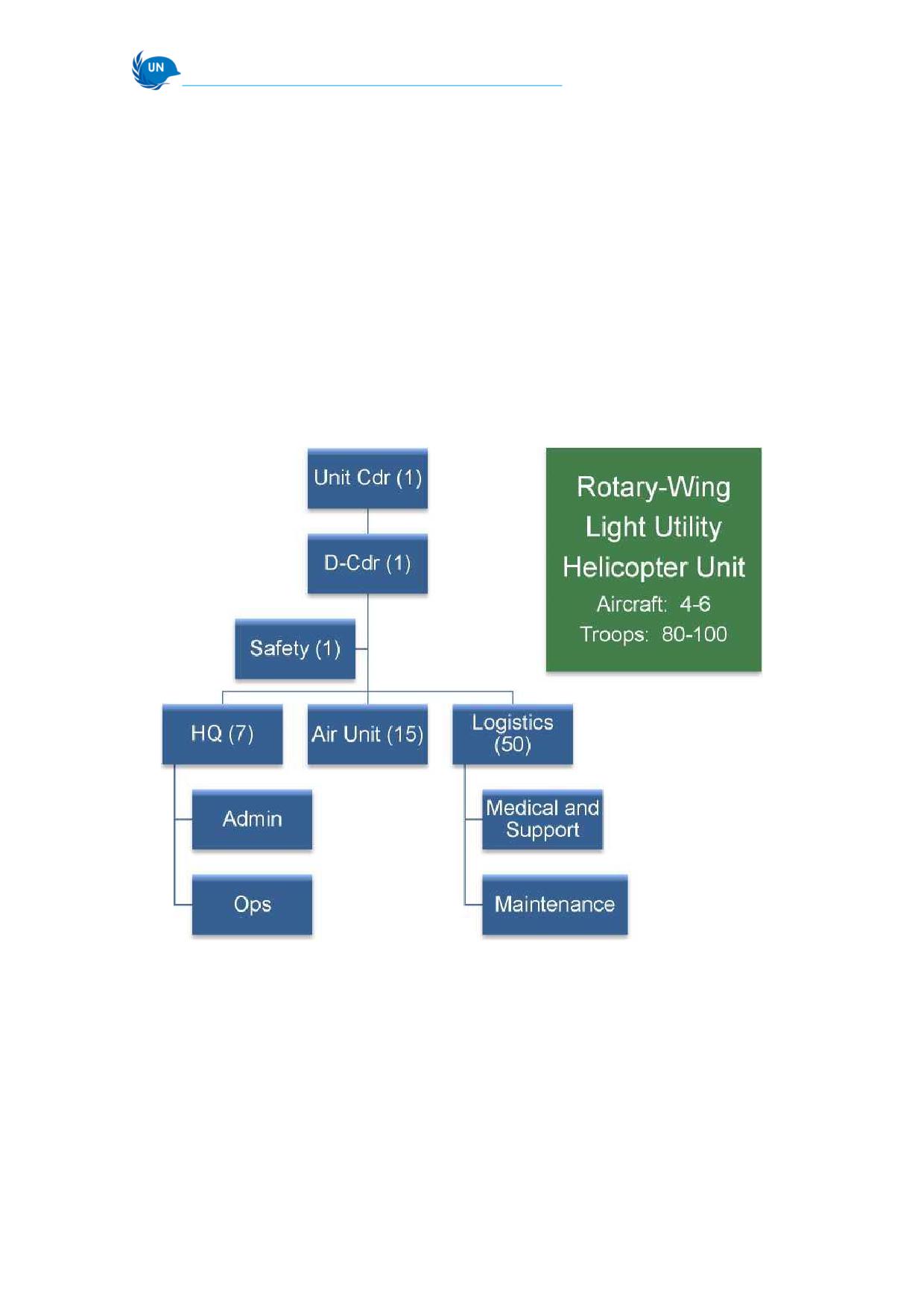
3.2 Rotary-Wing Unit Organization
3.2.1 Light Utility Helicopter Units
As illustrated in the chart below, the light utility helicopter unit consists of 80 to 100
personnel including pilots, maintenance staff, staff officers, security and administrative
personnel and 4 to 6 light utility helicopters. Actual strength, composition and deployment
locations are subject to TCC negotiations with the UN. The unit must be able conduct 24/7
flying operations in low, medium or high threat environments and have the requisite
personnel and equipment to support operations and maintenance for up to an average of
60 flight hours/aircraft/month, or as otherwise stipulated in the Statement of Unit
Requirements (SUR). The unit is always required to maintain at least 75% of its helicopters
in serviceable condition or as otherwise stated in TCC agreements with the UN.
*Note: The actual number of aircraft and troop strength will depend on the specific
types and number of aircraft required for a particular UN Mission, all subject to UN-
Troop Contributing Country negotiation.
57
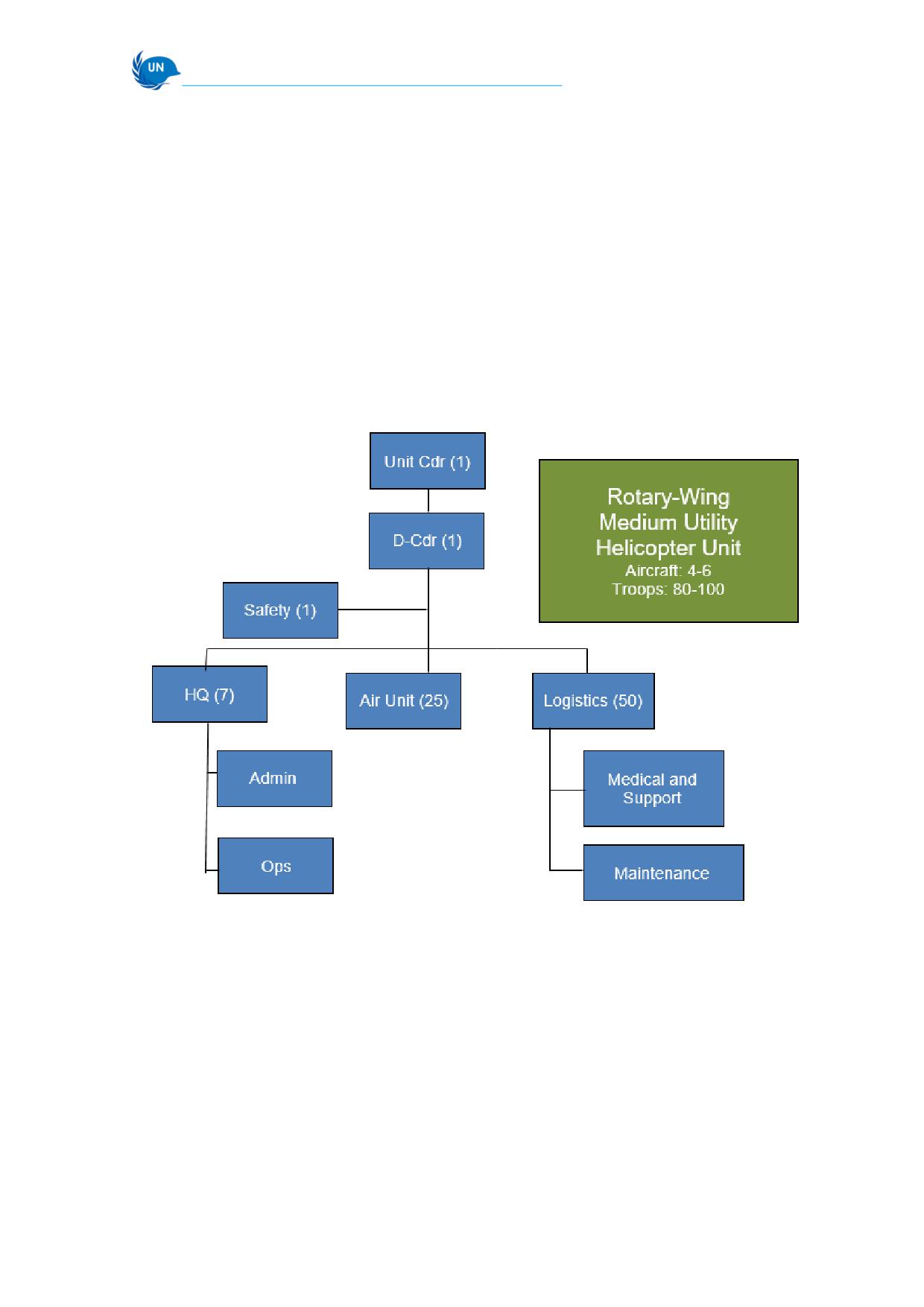
3.2.2 Medium Utility Helicopter Units
The medium utility helicopter (see chart below) unit typically consists of 80-100 personnel
including pilots, maintenance staff, staff officers, security and administrative personnel and
4 medium utility helicopters. Actual strength, composition and deployment locations are
subject to TCC negotiations with the UN. The unit must be able to conduct 24/7 flight
operations in low, medium or high threat environments, and have the requisite personnel
and equipment to support operations and maintenance for up to an average of 40-45 flight
hours/aircraft/month or as stipulated in the SUR. The unit is always required to maintain
at least 75% of its helicopters in serviceable condition or as otherwise stated in TCC
agreements with the UN.
*Note: The actual number of aircraft and troop strength will depend on the specific
types and number of aircraft required for a particular UN Mission, all subject to UN-
Troop Contributing Country negotiation.
58
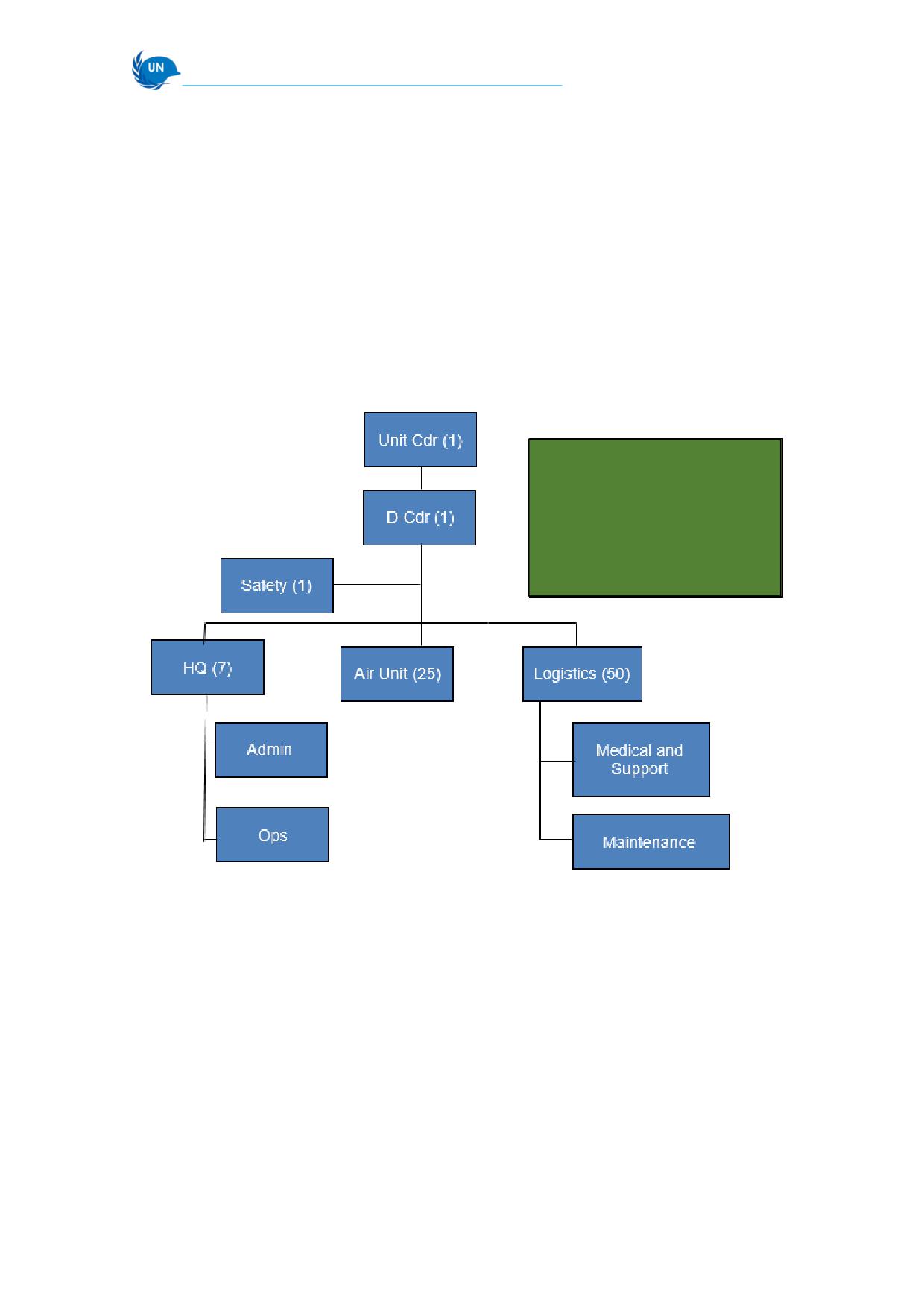
3.2.3 Heavy Cargo/Utility Helicopter Units
The heavy cargo/utility helicopter unit typically consists of 80-100 personnel including
pilots, maintenance personnel, staff officers, administrative and security personnel and 3-5
heavy cargo helicopters. Actual strength, composition and deployment locations are subject
to TCC country negotiations with the UN. The heavy cargo helicopter unit must be able to
conduct 24/7 flying operations in low, medium or high threat environments. It has the
requisite personnel and equipment to support operations and maintenance up to an
average of 50 flight hours/aircraft/month (or as specified in the SUR). The unit must always
have a minimum of 75 % helicopters serviceable unless stated otherwise in the LOA.
Rotary-Wing
Heavy Cargo
Helicopter Unit
Aircraft: 3-5
Troops: 80-100
*Note: The actual number of aircraft and troop strength will depend on the specific
types and number of aircraft required for a particular UN Mission, all subject to UN-
Troop Contributing Country negotiation.
59
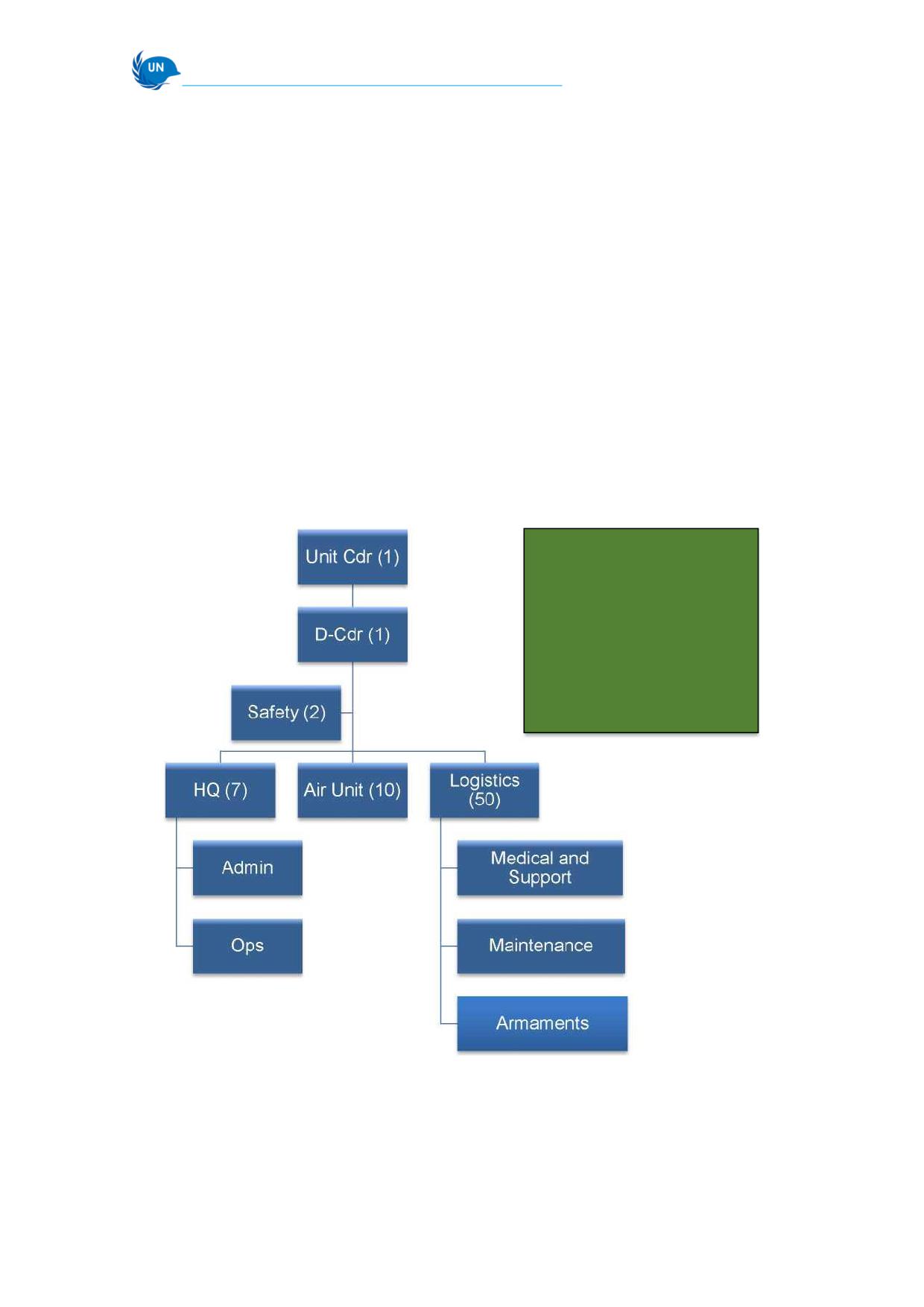
3.2.4 Attack or Armed Helicopter Units
As shown in the following chart, the attack or armed helicopter unit may consist of 80-100
personnel including pilots, maintenance personnel, armament experts, staff officers,
administrative and security personnel, and 3-4 attack helicopters. Actual strength,
composition and deployment locations are subject to TCC negotiations with DPO. The unit
must be staffed and equipped to conduct fire support, information gathering, armed
surveillance, tactical escort, insertion and extraction of troops, logistical resupply and
search and rescue missions. The unit must be able to conduct 24/7 flight operations in low,
medium or high threat environments and have the requisite personnel and equipment to
support operations and maintenance for up to an average of 50 flight hours/aircraft/month
(or as stated in the SUR), with a minimum of 75 % (or as per LOA) of its helicopters
serviceable at all times. The helicopters must be able to operate independently, or in
formation with other helicopters of other units depending on operational/tactical
requirements. The unit must be capable of deploying helicopters as a single machine or in
pairs to separate locations for limited periods of time, depending on operational
requirements.
Rotary-Wing
Attack/Armed
Helicopter
Unit
Aircraft: 3-4
Troops: 80-100
*Note: The actual number of aircraft and troop strength will depend on the specific
types and number of aircraft required for a particular UN Mission, all subject to UN-
Troop Contributing Country negotiation.
60
3.2.5 Embarked Aviation Detachment (EAD) Organization
The composition of the EAD will depend on the characteristics and duration of the
operation, the type of vessel, helicopter category (light, medium or heavy) and the quantity
of aircraft on board. In this way, the EAD shall provide pilots, maintenance, safety and
administrative personnel, and will vary according to the assigned mission, as well as the
supply of resources (operation level) and aviation facilities (support class) in which the ship
is certified. It should be defined in conjunction with the TCCs.
The level of the operation is the qualification of the ship defined by the existing resources,
correlated to the environmental conditions of visibility and luminosity (day and night
period) under which the ship-aircraft binomial can operate.
The class of support is defined by the condition of the materials and qualification of the
ship's personnel, including basic conditions of aviation facilities on ships, depending on the
availability of maintenance and service facilities.
The EAD shall be operationally subordinate to the Commander and administratively to the
Executive Officer of the ship. The EAD must have adequate flexibility in the routine
regarding meals, rest and physical training in order to better meet the required readiness.
The components of the EAD are not to be scheduled to services or collateral roles in the ship.
•
Responsibilities:
•
Commander of the Ship
The authority and responsibility of the ship's master with the aircraft on board shall
include, but are not limited to:
o Conducting air operations, observing flight safety recommendations.
o Control of the launch / recoil operations.
o Monitoring the air traffic in the vicinity of the ship, keeping organic aircraft
informed of such traffic.
o Control of the operations on the landing platform and hangar.
o Support of preventive and corrective maintenance services, when necessary.
o Aircraft safety against adverse weather.
o Monitoring of the maximum flight hour limits, the necessary crew rest, as well as
the fatigue factors of the equipment.
o Assurance that crews have an appropriate briefing for the missions.
o Provision of adequate accommodation [for man and women] to the EAD.
o Supervision of the stores and aviation equipment.
o Provision of supplies for the aircraft.
o Provision of qualified personnel to handle and store aviation ammunition.
o Knowledge of the operational limitations of the helicopter.
o Information on the status and aviation fuel availability.
o maintain the classification of the ship for air operations in relation to the resources
(level of operation) and the aviation facilities (support class) available on the ship.
61
o maintenance flight crews, maneuver teams and crash teams operationally
qualified for the missions.
•
Commander of the Helicopter Unit
The Commander of the Helicopter Unit, before boarding the EAD, is responsible for:
o Preparing and training the EAD that will embark according to the tasks to be
performed.
o Designating the components of the EAD.
o Ensure that the components of the EAD have the necessary qualifications for the
tasks to be carried out on board.
o ensuring that the aircraft designated for boarding meet the operational and safety
requirements for the mission.
o establishing the maintenance procedures to be followed by the EAD.
o Ensuring that the EAD personnel have the necessary training before embarkation.
• Senior EAD Officer
The Embarked Aviator Officer on the highest position on board will be the Senior EAD
Officer and will have the following duties:
o Assist in the elaboration of the daily flight schedules, being responsible for the
completion of the air missions, in accordance with the doctrine, SOP and internal Pilot
Orders.
o Ensure that pilots involved in the missions participate in the briefings and
debriefings relating to them.
o Keep the training of Embarked Aviators Officers up to date, requesting the master
of the ship the training flights deemed necessary.
o Supervise the maintenance services performed on the aircraft and advise the
ship's commander on the need to carry out maintenance flights.
o Check, before boarding, if the EAD has the equipment recommended for the air
operations.
o Ensure the discipline of the military personnel and the fulfillment of the orders
received by the EAD.
3.2.6 Versatile and Specialized Aviation Support / Security Section
It is not a stand-alone section. It can be equipped with light armored vehicles, including
collective heavy weapons, if necessary. It is recommended to be included in an aviation unit,
where it can provide support such as:
o FARP protection.
o MEDEVAC/CASEVAC support.
o Temporary Landing Zone Display.
It should be a platoon size unit :
o Platoon Cdr (1)
62
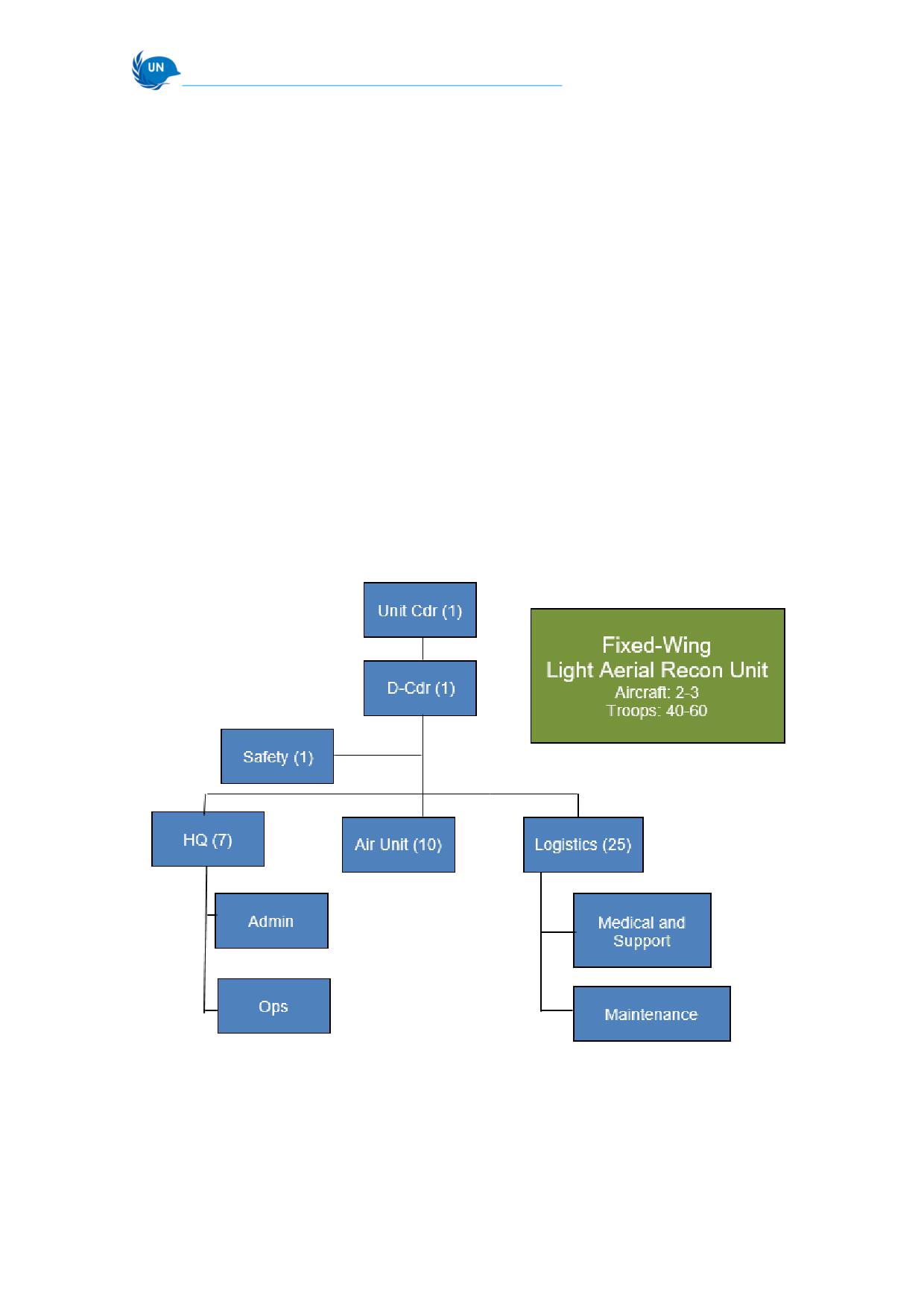
o D-Cdr (1)
o Signal (3)
o Groups (20 to 30)
3.3
Fixed-Wing Unit Organization
3.3.1 Light Aerial Reconnaissance Units
The fixed-wing light aerial reconnaissance unit shown below typically consists of up to 60
personnel including pilots, maintenance personnel, staff officers, administrative and
security personnel and 2-3 light aerial reconnaissance aircraft. Actual strength, composition
and deployment locations are subject to TCC negotiations with the UN. The unit must be
able to conduct 24/7 flight operations at airfields where night landing and takeoff facilities
are available. The light aerial reconnaissance unit must also have the requisite personnel
and equipment to support operations and maintenance for up to an average of 80 flight
hours/aircraft/month (or as specified in the SUR), with a minimum of 75% (or as stated in
the LOA) aircraft serviceable at all times.
*Note: The actual number of aircraft and troop strength will depend on the specific types and
number of aircraft required for a particular UN Mission, all subject to UN-Troop Contributing
Country negotiation.
63
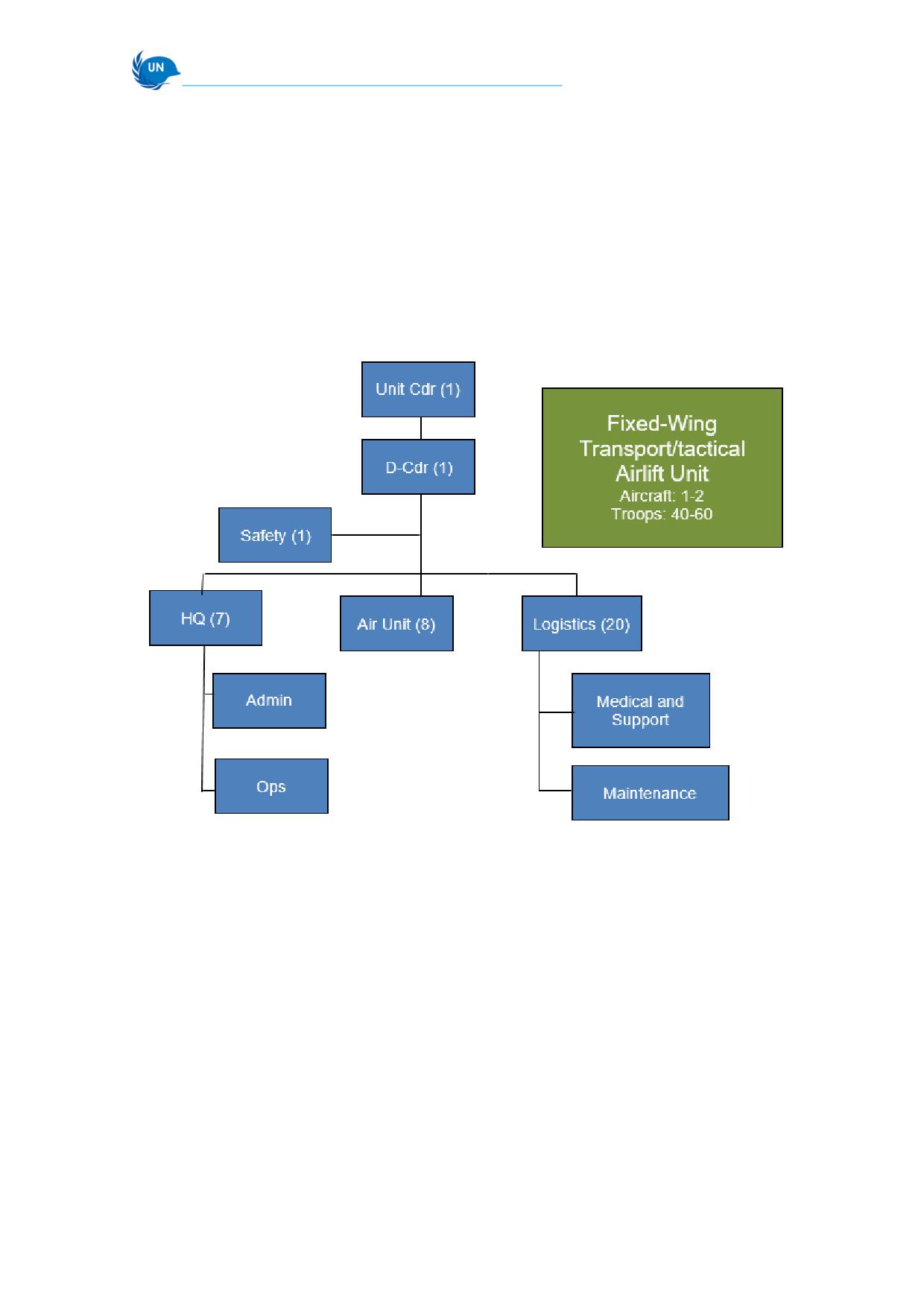
3.3.2 Transport/Tactical Airlift Units
The transport/tactical airlift unit typically consists of 40-50 personnel including pilots,
maintenance personnel, staff officers, administrative and security personnel and 1 to 2 transport
aircraft. Actual strength, composition and deployment locations are subject to TCC negotiations
with DPO. The unit must be able to conduct 24/7 flight operations at airfields where night landing
and takeoff facilities are available and have the requisite personnel and equipment to support its
operations and maintenance.
*Note: The actual number of aircraft and troop strength will depend on the specific types and
number of aircraft required for a particular UN Mission, all subject to UN-Troop Contributing
Country negotiation.
64
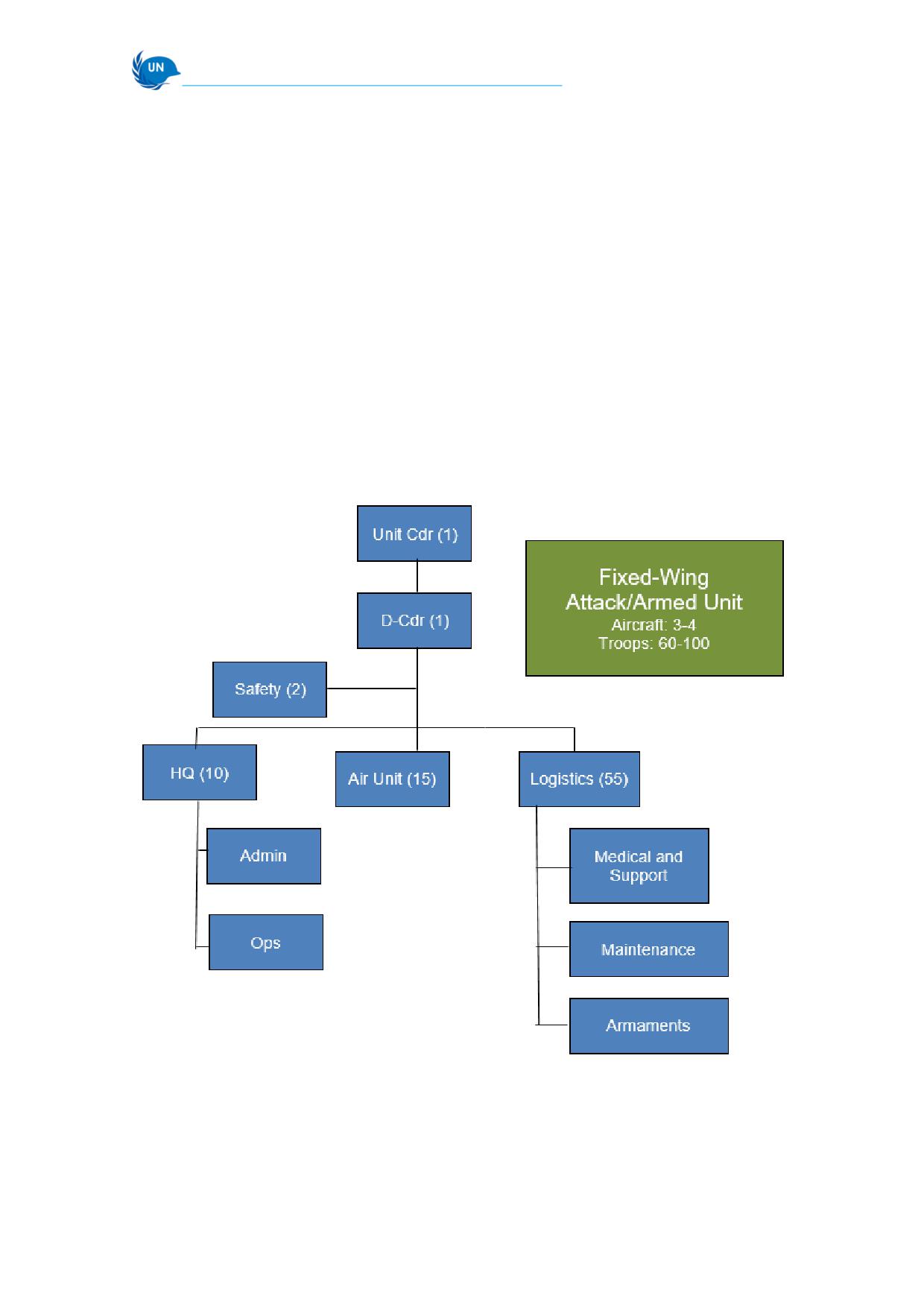
3.3.3 Attack/Armed Fixed-Wing Units
As shown in the following chart, the attack or armed fixed-wing unit may consist of 60-100
personnel including pilots, maintenance teams, armament experts, staff officers, administrative
and security personnel, and 3-4 light attack aircraft. Actual strength, composition and
deployment locations are subject to TCC negotiations with DPO. The unit must be staffed and
equipped to conduct fire support, information gathering, armed surveillance and tactical escort.
The unit must be able to conduct 24/7 flight operations in low, medium or high threat
environments and meet the personnel and equipment requisite to support operations and
maintenance for up to an average of 50 flight hours/aircraft/month (or as stated in the SUR),
with a minimum of 75 % (or as per LOA) of its aircraft serviceable at all times. Depending on the
mission, the aircraft must be able to operate independently, or in formation with other aircraft,
according to operational or tactical requirements. The unit must be capable of deploying one
single aircraft or two paired aircraft to separate locations for limited periods, according to
operational requirements.
*Note: The actual number of aircraft and troop strength will depend on the specific types and
number of aircraft required for a particular UN Mission, all subject to UN-Troop Contributing
Country negotiation.
65
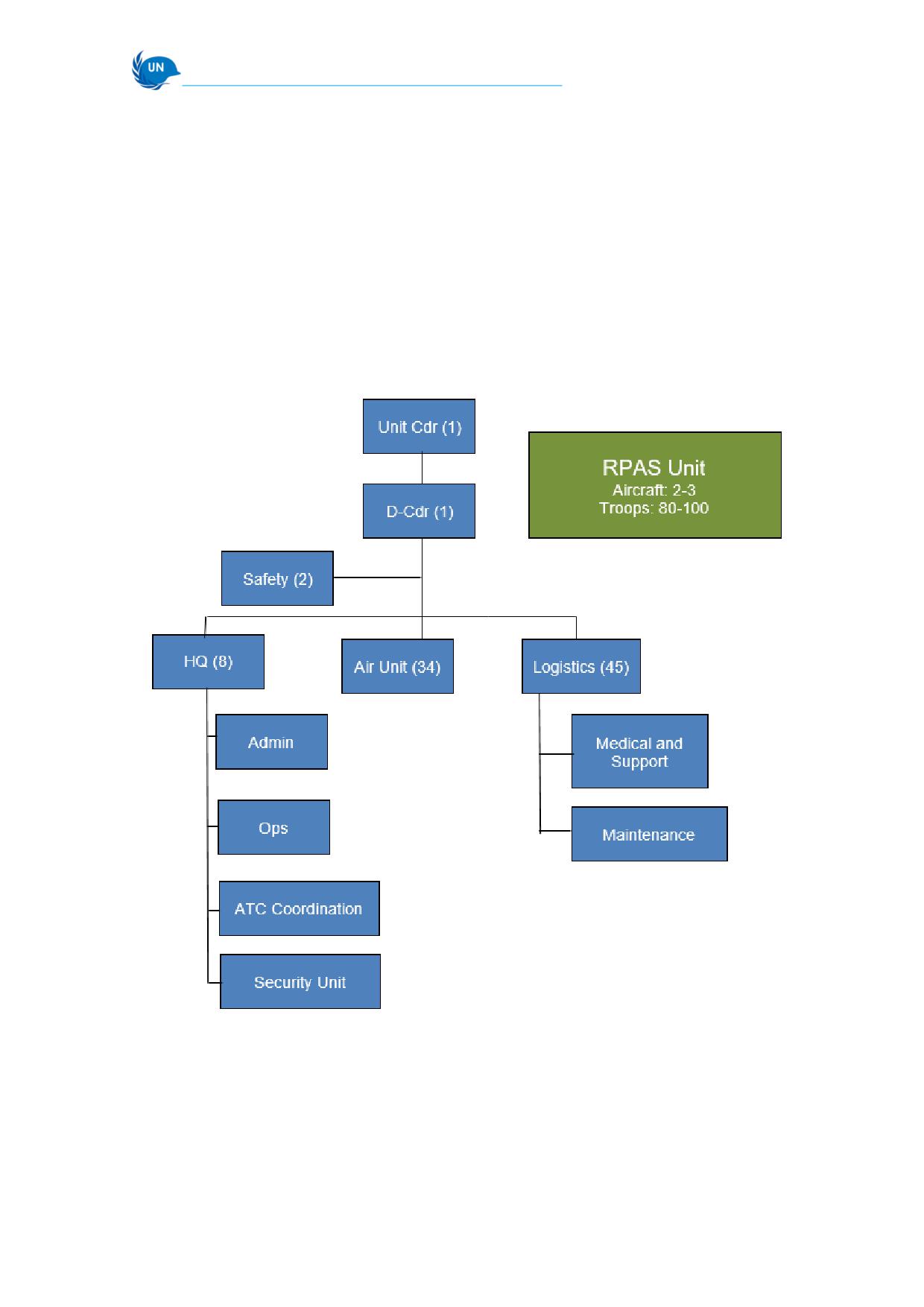
3.4
UAS/RPAS Unit Organization
The RPAS unit shown below typically consists of up to 100 personnel including pilots,
maintenance teams, staff officers, administrative and security personnel and 2-3 RPA. Actual
strength, composition and deployment locations are subject to TCC’s negotiations with the UN.
The unit must be able conduct 24/7 flight operations at airfields where night landing and takeoff
facilities are available. RPAS unit must also meet the personnel and equipment requisites to
support operations and maintenance for up to an average of 80 flight hours/aircraft/month (or
as specified in the SUR), with a minimum of 75% (or as stated in the LOA) or its aircraft
serviceable at all times.
*Note: The actual number of aircraft and troop strength will depend on the specific
types and number of aircraft required for a particular UN Mission, all subject to UN-
Troop Contributing Country negotiation.
66
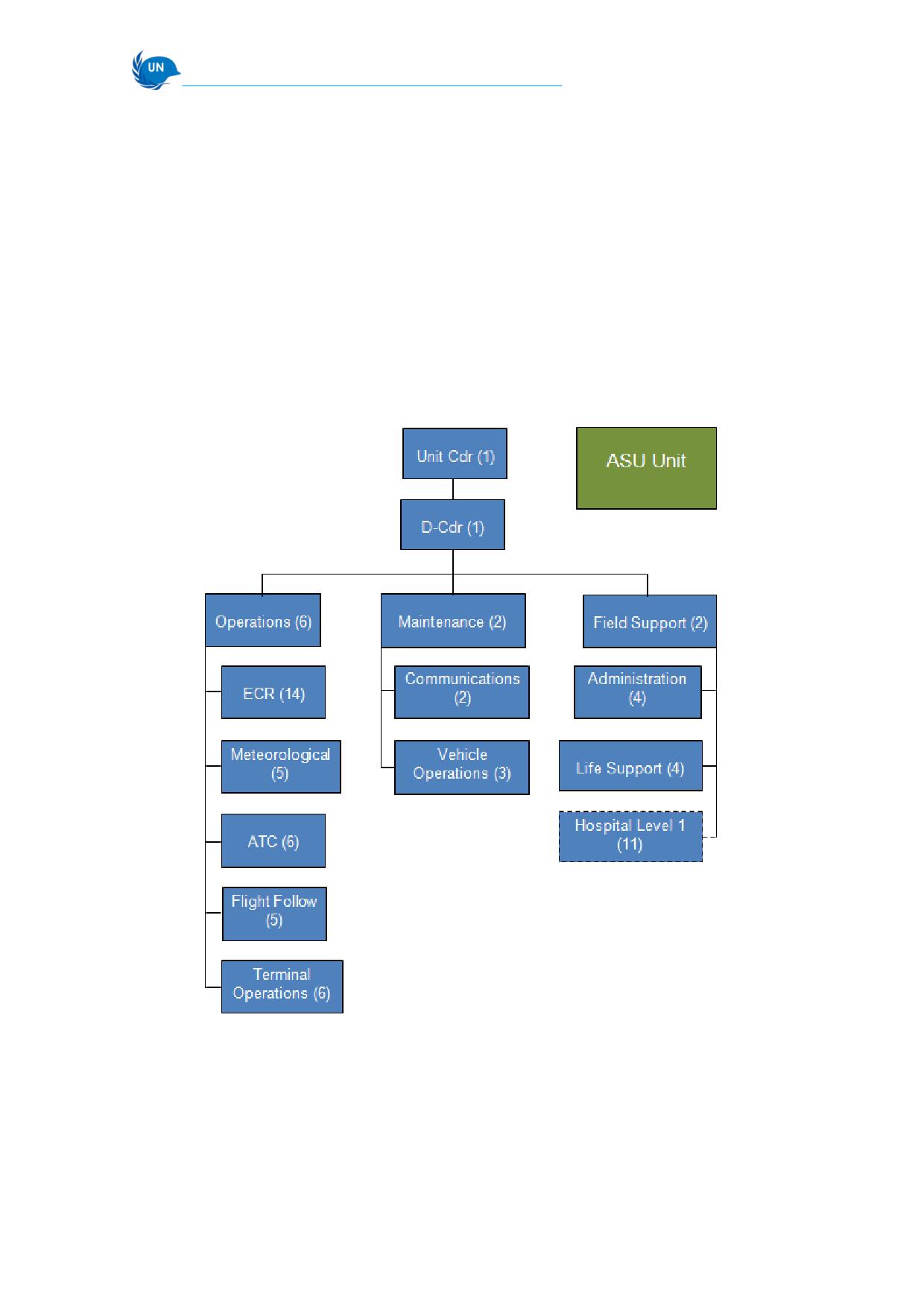
3.5
ASU Unit Organization
The ASU unit shown below typically consists of 50-70 personnel including operations,
maintenance and field support. Actual strength, composition and deployment locations are
subject to TCC’s MOU negotiations with the UN. The unit must be able conduct 24/7 flight
operations at airfields. ASU unit must also meet the personnel and equipment requisites to
manage an estimated (to be confirmed by the specific mission) air traffic of (e.g. 06/10
flights per 24 hours incoming and/or departing from each airfield), Aircraft crash and
rescue, and firefighting Category X (to be confirmed by the specific mission), Dangerous
Goods certification and aircraft pushback/towing capacity (if required). Also, a Military
Hospital Level 1 might be required.
Indicative only. Additional 11 troops might be required for Hospital Level 1.
Troops: 50 to 70
If required
*Note: The actual number of equipment and troop strength will depend on the specific
support required for a particular UN Mission, all subject to UN-Troop Contributing Country
negotiation.
67
CHAPTER 4
UN Military Aviation Unit Support
4.1 The UN Mission Logistical Framework
Logistics support, including Combat Service Support (CSS), in a UN Mission is provided by
the Director or Chief of Mission Support (DMS/CMS). The DMS/CMS is assisted by a senior
military (Aviation) logistician. The Mission Support Plan is published under the authority of
the DMS/CMS. The Mission Support Plan is the authoritative basis for the planning and
management of logistics support in the UN Mission.
4.2 Combat Service Support in UN Military Aviation
4.2.1 UN military aviation units generally operate in hostile and austere environments,
deploying deep into the AOR, potentially in isolation from other UN Forces and far from any
logistical base. As such, provision should be made for an addition of unit own security of
platoon strength (or as appropriate) for the protection of assets and crew. Alternate
agreements could be made in the MOU and LOA between the UN and TCCs.
4.2.2 A specialized combat service support (CSS) arrangement is therefore essential to
support military aviation and should include specific CSS capabilities and procedures. The
CSS arrangement must be well prepared and planned during the early stages of mission
planning, and for each type of military aviation unit once deployed. Under CSS from Mission
engineers, the aviation unit may expect and be specific about the following (if required):
• Accommodations specific to their tasking and equipment, including specific storage
requirements to protect against temperature and the environment.
• Specific/additional electrical/power requirements.
• Additional water scaling.
• Waste treatments plants to cater for the additional quantity and/or type of scaling.
• Roads, tracks, runways, airstrips and heliports as per requirement, including their
upkeep and maintenance.
• Specific road, airfield, airstrip and heliport requirements at the reception area, or to
ensure connectivity and onward movement of forces or forward staging.
• Any specific training infrastructure.
• Field repair / recovery equipment and SOPs.
• Dust suppression liquid chemicals and SOPs.
• Support for intra-mission FOBs.
• Camp security.
4.2.3 UN support to military aviation units includes logistics, rations and fuel, strategic
deployment movement of Contingent-Owned Equipment (COE) and personnel from the
home country to the Mission area, as well as support to in-theater movement of medical
68
capabilities beyond Level I, including alternate CASEVAC capabilities involving other assets.
4.3 UN Support Process: From Pre-Deployment to the Mission Area
4.3.1 The role of DOS in supporting UN military units is encompassed in the Mission
Support Concept. See also the UN Infantry Battalion Manual (UNIBAM) for further
discussion of unit- level support structures, categories of support capabilities, engineering
support, Contingent Owned Equipment (COE) and the Memorandum of Understanding
(MOU), National Support Elements (NSE), the Letter of Assist (LOA), administrative policies
and the critical issue of COE and personnel movement.
4.3.2 As with any military unit in UN peacekeeping, UN military aviation must take
advantage of the various opportunities existing prior to deployment to ensure the best
possible preparation of personnel and units. The TCC reconnaissance site survey (the UN
authorized field visit for key commanders and staff prior to unit deployment) and the
subsequent Pre-Deployment Visit (PDV) by UN experts to the TCC both serve to assist and
advise in deployment preparation and support.
• Pre-Deployment Reconnaissance and Site Survey
As early as possible, a survey team of TCC personnel must visit the UN Mission area of
responsibility. The UN will provide the TCC sufficient time to plan the deployment well
in advance of the expected deployment date. Irrespective of the threat level, the UN
should support the site survey team to visit all landing sites and airfields the UN intends
to task the assets to. The site survey team’s assessment should, at minimum, include
notes on terrain, runway, landing zones, obstacles, fuel availability, ground electrical
power, firefighting and approach landing systems and, most importantly, security. This
information ensures adequate planning and preparation for TCC contingent selection
and deployment. The survey team should also analyze the Mission’s logistical support
facilities so that plans can be made for any additional requirements. The site survey
should especially take a note of the soil condition at likely landing zones and suggest dust
suppression measures to avoid the hazard of brownout for large helicopters.
• Personnel and Aircraft Transportation Pre and Post-Deployment
Arrangements and contracts for transportation of personnel and assets must be finalized
with clear instructions for transportation of personnel, helicopters, allied equipment and
large fixed-wing assets from the TCC’s home country to the Mission. Arrangements for
settling any claims for damages during transportation require special attention. Specific
aircraft asset preparations must be in accordance with UN standards (e.g., installation of
essential equipment, aircraft colorings and markings, etc.) and their inspections
conducted by a UN team in the troop 7 contributing country contingent’s home country
before the equipment is declared fit for transportation to the Mission country.
• Repatriation of Flying Assets
Arrangements for final repatriation of helicopters and aircraft by means of aerial
transportation, ship or under their own power will be decided by the UN and TCC before
deployment. In the case of heavy, fixed-wing passenger or cargo planes, the issue of fuel
and reimbursement for flying and transit handling charges must be clarified in advance
7 See also the UN Infantry Battalion Manual.
69
to avoid any unnecessary delays at any of the transit airports.
4.3.3 Unique Equipment, Self-Sustainment and Reimbursement for COE
• If not in the COE Manual, major equipment will be treated as “special case” equipment,
if the situation requires. If the equipment is under wet lease, maintenance of this
equipment is a troop/police contributor responsibility. In accordance with the COE
Manual, any special minor equipment or consumables not covered by the standard self-
sustainment rates can be handled as “unique equipment.” These items will be handled
through bilateral, special case arrangements between the troop/police contributor and
the UN. Military aviation unit unique equipment requirements may include aircraft
parking facilities, navigation aids, air traffic control, airfield lighting, aircraft
shelters/hangars, airfield crash/rescue/fire facilities, aircraft battle damage repair
capabilities, airfield protection and any aviation-specific security provisions. In addition,
special equipment that the TCC aviation unit cannot provide immediately and does not
necessarily impede operations but required for deployment in the mission should be
provided by the UN to be handled through bilateral special case arrangements.
• While most COE items and scales would be as covered in the current version of the
COE Manual, aviation operational requirements vary significantly in certain aspects,
such as the scale of issue of night vision devices and High Frequency communications
(see Annex B). The additional costs to the TCC for these extraordinary requirements may
be reimbursed as negotiated with UNHQ.
4.3.4
The UN Mission and Contingent-Owned Communications and Information
Technology Systems
• A military aviation-specific communication and information technology system is
deployed by the military aviation unit headquarters down to each aviation sub-
element to ensure adequate security and communications as required for aviation
operations. The military aviation unit’s internal communications and information
systems are provided by each TCC.
• Nevertheless, equipment for communications between the Mission headquarters
and the military aviation unit headquarters, as well as between the military aviation
unit headquarters and its subordinate units, is also provided as UN-Owned
Equipment (UNOE). UNOE ensures that aviation unit has integral secure military
grade communications within the Mission communications network.
4.4 CASEVAC and Medical Support
For comprehensive guidance on medical operational, logistical and administrative
guidelines for Member States, UN Headquarters and field Missions, consult the Manual for
United Nations Field Missions - 3rd Edition - 2015” available on the UN Resource Hub
In addition to a host of other essential information, the Medical Support Manual provides
information on the command and control structure for integrating medical support in field
Missions, CASEVAC/MEDEVAC procedures, pre-deployment medical screening
requirements, entitlements to medical care in field Missions and certification requirements
for field Mission medical professionals.
70
4.4.1 Military Aviation Unit Casualty Evacuation (CASEVAC): Military aviation units often
operate deep into hostile-held territory conducting Casualty Evacuation (CASEVAC)
operations. To mitigate the inherent challenges, CASEVAC operations are prepared by
detailed planning and training, pre-arranging for dedicated evacuation resources and
coordinating for the required medical capability.
4.4.2 Detailed CASEVAC Planning and Training: During the planning phase of each
operation, special attention is given to CASEVAC capabilities, procedures and timing with
the UN Mission MEDEVAC/ CASEVAC assets and Level 2/3 hospitals that will provide
specific medical support and training for the Mission’s military aviation unit. MEDEVAC/
CASEVAC training is aimed at interoperability between air assets and other components
such as the Quick Reaction Force.
4.4.3 Dedicated CASEVAC Resources: When dedicated MEDEVAC/CASEVAC military
aviation resources are required, they must be planned for and obtained in advance. Aviation
support capacities include peacekeeping military air units with tactical fixed-wing aircraft
as well as utility, observation and attack helicopters. Aviation support can be provided by
the transportation cell in the Field Operations Support unit managing Mission aviation
(including military transport helicopters), movement control and MEDEVAC/CASEVAC.
Under this arrangement, aviation support is placed under the authority of the Director/
Chief of Mission Support (DMS/CMS).
4.5 Troop Contributing Country Support
Logistical support for military aviation units is the responsibility of the TCC, except where
otherwise provided by the UN Mission or host nation. As military aviation units are normally
nationally formed, each military aviation unit must include a logistics and support element,
primarily dealing with national support, integrating support from other sources such as the
UN Mission or host nation. If several TCCs are providing aviation assets to the same Mission,
they may wish to coordinate their aviation support effort to achieve synergy and efficiency.
4.6 UN Mission Support
4.6.1 Overall logistical support for military aviation units is coordinated through the Force
Headquarters. The military aviation cells in the Force Headquarters must liaise with both
the logistical structure (DCOS Operations Support, U-4 LOG, U-1 PER) and the Mission
Support Centre8 under the office of the DMS/CMS.
4.6.2 Operations and logistics planning will determine the specific logistics requirements
and the associated logistics command and control structures for each operation when
military aviation units are committed. Resupply of deployed military aviation units in
remote areas is planned and executed as an operational task. Generally, it requires
specialized equipment and procedures to ensure refueling and POL capability.
4.7 What to Expect: Typical Logistical Support for Military Aviation Units in a UN
Mission
4.7.1 General: The following discussion of logistical support for military aviation units is
for illustrative purposes only. However, this discussion reflects real-world examples
providing a realistic understanding of the logistical support an aviation contingent is
expected to bring to, and that which it can expect from, a UN Mission. Actual logistical
The Mission Support Centre was formerly known as the Joint Logistics Operations Centre (JLOC).
71
support requirements are articulated in the Statement of Unit or Force Requirements and
the TCC MOU. Arrangements for logistical support are provided in the UN’s Generic
Guidelines for TCCs Deploying Military Units to the UN Peacekeeping Mission, and in the UN’s
COE Manual. Subject to the terms of TCC MOU negotiations, the military aviation unit
contingent is required to be self-sustainable with integral support and maintenance
elements, and to sustain its operations at the permanent and temporary deployment
locations. A full description of the requirements and standards for all self-sustainment
categories are contained in the COE Manual. At a minimum, the contingent must be self-
sustaining in the following areas:
4.7.2 Accommodations
• Initial Accommodations: The UN Mission will prepare green field sites under austere
conditions at the deployment location. The contingent must deploy with sufficient
tentage for all accommodations (for men and women), storage, offices, ablutions and
workshop needs. Water sources will be arranged by the UN Mission. The contingent must
deploy sufficient water purification units to produce and consume its own purified
water. The Mission will provide Field Defense Stores (FDS) and additional FDS kits for
use in mobile operations.
• Permanent Accommodations: The UN Mission will strive to provide hard wall
accommodations (for men and women) after the initial six-month period in COE tentage;
failing which the UN Mission may be required to pay a penalty until prefabricated
accommodations [for men and women]can be provided.
• Deployable Accommodations: The contingent must deploy with a sufficient quantity of
tentage necessary for short term operational and tactical deployments. The contingent
must be prepared to deploy for short term operational and tactical operations. This is
meant to ensure sufficiently comfortable rest arrangement for the aircrew to enable a
safe and well-rested crew undertaking the assigned mission.
• Tentage Structure: Tentage must include flooring and the ability to heat and cool as
appropriate, as well as netting at doors, windows and inner/outer fly of tents. Double
layered tents with metal pipe frames are recommended due to field conditions. It is also
recommended to mount the tents on cement or wooden foundations to ensure their
stability. Deployable accommodations noted in the paragraph above are excluded from
this requirement.
• Helicopter parking shelters / rub hall / LAMS arrangements.
4.7.3 Ablutions: The Mission will strive to provide ready-to-use field ablutions with
running water and waste management at the initial campsite. The contingent must be
prepared to deploy with its own field ablutions (field latrines and showers) to use for
subsequent operational/tactical deployments.
4.7.4 Catering: The contingent must be self-sustainable in catering. Upon deployment,
the Mission may not provide a hard wall structure for the kitchen and consequently, the
contingent must be prepared to deploy with a fully mobile kitchen (e.g., kitchen trailers).
The contingent must have cooks, clean and healthy kitchen facilities and equipment to
include, but not limited to, deep freeze storage capacity for up to fourteen days, cold food
storage capacity for seven days, dry food storage, hot dishwashing capability, mobile cold
storage devices, dishes and cutlery. The contingent must be able to support all its organic
units and personnel (including augmented personnel) with deployable kitchen equipment
whilst operating in the field.
72
4.7.5
Communications: The contingent must provide its own mobile and secure
communications down to the independent unit, section or team level and be able to
communicate 24 hours a day, 7 days a week with the Brigade, Sector or Force headquarters
in the Mission language, typically either French or English.
• High Frequency (HF) communications are mandatory and must have a minimum
range of 250 km. The contingent must install its own HF base stations and antennae with
at least 2 sets of HF radios (as primary and backup) manned by its own qualified
operators for effective radio communications with the Brigade HQ, other contingents
and its own elements operating outside the Very High Frequency (VHF) and/or the Ultra
High Frequency (UHF) area of coverage. The capability to communicate from the
equivalent of platoon to Company to Battalion to Brigade HQ must exist for all military
aviation unit elements.
• VHF/UHF: VHF/UHF Communications (air-to-air to ground) is mandatory and must
have a range of at least 30 to 35 kilometers to facilitate CASEVAC.
• Telephone: The contingent must provide, install and operate its own switchboard and
telephone network down to its sections within the AOR.
4.7.6 Office Support
• Office Space: Office workspace must be inside tentage, but when and where possible,
hard- wall structure may be provided for Brigade and Battalion headquarters
equivalents.
• Office Furniture and Equipment: The contingent must be self-sustainable to meet all
its needs in terms of office furniture, equipment, supplies and computers (including
electronic data processing, reproduction equipment and required software).
4.7.7 Electrical: The contingent must be self-sustainable electrically and must supply a
stable power supply down to section level, including observation posts and other elements.
4.7.8 Minor Engineering: The contingent must have light utility and general engineering
support capability in order to enhance the contingent's infrastructure. The contingent must
be self-sustainable and have, at minimum, the capacity to handle the following tasks:
• Non-Field-defensive construction for the contingent
• Limited construction of light structures
• Minor electrical repair and replacement
• Minor repair to plumbing and water systems
• Maintenance of all necessary tools, supplies and workshop equipment
• Deliver the aforementioned capacities by means of mobile support throughout the
AOR.
4.7.9 Laundry and Dry Cleaning: The contingent must have a cleaning unit with
sufficient laundry facilities for all military and personal clothing, including dry cleaning of
operationally required specialist clothing. All laundry and dry-cleaning equipment must be
kept hygienic and in good repair with ample spare parts. The contingent must have a minor
equipment and supplies to keep the accommodation and camp area clean.
4.7.10 Fire Detection and Alarm: The contingent must have automatic fire detection and
73
alarm equipment.
4.7.11 Basic Fire Fighting: The contingent must have the capability to conduct basic
firefighting in both accommodations and work areas.
4.7.12 Field Defense Stores: The UN will provide identification and Field Defense Stores.
There is typically no need for Nuclear, Biological and Chemical (NBC) protection.
4.7.13 Observation:
• General Observation: The contingent must have the capacity to observe 24 hours a
day, 7 days a week with section-level handheld binoculars and magnifying night vision
equipment.
• Night Observation: Night vision systems, such as night vision goggles (NVG) and
Forward-Looking Infrared Radar (FLIR), must be capable of passive and/or active
infrared (IR), thermal or image nighttime line of sight observation. Night vision systems
must be capable of detecting human-size objects within a range of 1000 meters.
• Global Positioning System: The contingent must have the capacity to acquire an
accurate geographic fix on its own locations with Global Positioning System (GPS)
equipment and laser range finders.
4.7.14 Explosive Ordnance Disposal (EOD) Capabilities: For the contingent’s own
safety, an EOD capability should preferably be provided to all deploying elements.
4.7.15 Miscellaneous General Stores: At a minimum, the contingent must be self-
sustainable in terms of bedding, furniture, morale and welfare equipment and amenities.
• Bedding: The contingent must provide bed linens, blankets and/or sleeping bags,
mattress covers, pillows and towels to all personnel.
• Furniture: The contingent must provide a bed, mattress, nightstand, table light and a
locker to all personnel.
• Morale and Welfare: The contingent must provide TVs, DVD players, music systems,
satellite TV systems, a library, games, exercise equipment and internet cafe(s) with 5-10
personal computers (for a company-sized unit) for the morale and welfare of its
personnel. So as not to interfere with the Mission’s official computer and internet
network, the contingent must contract with a civilian internet service provider for its
own dedicated morale and welfare network.
4.7.16 Initial Provisioning and Self Sufficiency
• Water: The contingent must deploy with bottled water for a length of time agreed
upon during MOU negotiations. Within the first seven days, the contingent is expected to
install its own water purification plant to produce bulk-treated water from a UN-
provided water source.
• Rations: The contingent must deploy with rations for a length of time agreed upon
during MOU negotiations. The UN Mission will provide rations thereafter. The contingent
must have the capacity of establishing storage such as reefer trucks and containers for
fourteen days of rations and fourteen days of combat ration packets, or for a duration
agreed upon during MOU negotiations.
• Supply: The contingent is required to deploy with fully self-sufficient stocks of supply
74
items and spare parts for maintenance of its major and minor equipment. The contingent
must be fully self-sufficient for all other supply categories (except fuel) for the first 90
days after deployment and must maintain stock levels of at least 45 days of repair parts
for all types of supplies at any given time during its operations. Resupply of consumables
and spare parts is a contingent responsibility.
• Petroleum, Oil and Lubricants (POL): In the majority of UN Missions, the contingent
must be prepared to employ only diesel-fuelled vehicles, equipment and machines as
diesel is normally the only type of fuel available. The UN will deliver fuel to the existing
fuel distribution points from the first day after the contingent’s arrival in the Mission
area. The contingent is required to collect its POL from the distribution points. Beyond
the fuel distribution points, the contingent must provide self-delivery. The contingent
must have the capacity to establish bulk storage facilities for fourteen supply days of
diesel. The contingent should also have the capacity to distribute diesel to its vehicles
and generators.
• Medical: The contingent must be prepared to deploy with one Medical Level I Hospital.
Contingent personnel must be trained in administering basic immediate first aid and
have the appropriate medical equipment. Additionally, higher level medical facilities will
be deployed in the Mission area of responsibility to provide levels II and III care. Level
IV medical care will also be available, sometimes outside the Mission area.
4.8 Embarked Aviation Detachment Support
As long as the aircraft is on board, support for air operations is provided by the ship's crew,
which must have qualified Maneuver and Crash Teams, possess the necessary and
appropriate material, and establish a training program that ensures a high standard of
efficiency and safety for all personnel engaged in air operations, in order to ensure that the
ship resources (level of operation) and aviation facilities (support class) remain in the
category in which the ship is certified.
The level of operation is the qualifying factor of the ship and it is determined by the existing
resources related to the environmental conditions in terms of visibility and luminosity (day
and night periods) under which the ship-aircraft binomial can operate.
The class of support is determined by the condition of the equipment and qualification of
the ship's personnel, including basic conditions for aviation facilities on ships, concerning
maintenance and service availability.
In general, the ship should have the following responsibilities in supporting naval
operations:
4.8.1 Maneuver Team
It is an organic crew of the ship, responsible for the manning and landing / launch /
guidance maneuvers of the aircraft. Maintaining the qualification of the team is the
responsibility of the ship's commander. In case of aircraft crash, the team personnel may be
used as a reserve of the Crash Team.
4.8.2 Crash Officer
The Crash Team Leader is responsible for the firefighting and rescue in case of aircraft crash.
75
4.8.3 Crash Team
Team responsible for performing firefighting, rescue and, if necessary, drop the aircraft
from the ship in case of a crash. If necessary, it will be aided by the vessel's Damage Control
group.
4.8.4 Alert Boat or Inflatable Boat Team
The ship’s crew responsible for the tasks to be performed in case of aircraft crash on the
sea.
4.8.5 Launch and Landing Officer (LLO)
The LLO is responsible for:
o Conducting the Maneuver Team.
o Ensuring the observance of safety procedures for air operations.
o Conducting FOD patrol prior to commencement of air operations.
o Ensuring that only personnel essential to air operations are present in the
helideck.
o in ships where there is no Enlisted Orientator, acting as aircraft Orientator by
means of visual signals and/or radio in aircraft landing/launching.
o Checking that the Crash, Rescue, Firefighting and Helicopter Teams are in position.
o Controlling air operations on the landing platform: Departure, landing, pick-up
(sling operations), external cargo (hook operations) and HIFR (Helicopter In-Flight
Refueling - only for ships where landing operations are not available).
o Coordinating the movement of aircraft, permission to start engines, unhinge and
disengage rotors, departure and landing helicopters with the Service / Maneuver
Officer.
o Supervising the information relay from the helideck station to the Bridge, to the
combat center and to the helicopter.
o Supervising the aircraft refueling, to ensure fuel testing and quality.
o Participating in the air operations briefings or being represented by a qualified
officer in order to receive and transmit all the information.
o Ensuring that all personnel are briefed on air operations safety and receive the
appropriate clothing and protection items before going on board a helicopter.
4.8.6 Orientator
The Enlisted, a member of the Maneuver Team, responsible for:
o Orienting the aircraft through appropriate visual signals, assisting the pilot in
approaching, landing and takeoff, and pick up maneuvers (sling operations), external
cargo (hook operations) and HIFR (Helicopter In-Flight Refueling - only for ships
where landing operations are not available).
o Advising the LLO about safety conditions for air operations on helideck.
o Guiding the Maneuver Team.
76
4.8.7 Aviation Safety Officers (ASO)
The Aviation Safety Officer(s) (as outlined in Annex D) is responsible for directly advising
the ship’s Commander, the Helicopter Unit’s Commander and the Senior EAD Officer, and
liaising and cooperating with the United Nation Mission Aviation Safety Unit on Aviation
Safety matters, being assigned the tasks of spreading the doctrine of safety management
including the Prevention and Investigation of Aviation Accidents. The ASO(s) is responsible
for maintenance and compliance with the relevant Aviation Safety Program, Aviation
Accident Prevention Program, Aviation Emergency Plans, as well as the Pre-Investigation
Plan and other instructions emanating from that Service. In addition, the Aviation Safety
Officer(s) are to ensure suitable training and safety promotion occurs, provide support the
aviation risk management process (including hazard identification), and oversee aviation
safety in the embarked environment in accordance with Annex D.
4.8.8 Chief Engineer
The Chief Engineer is responsible for the maintenance and operation of the aviation fuel
system and must ensure that it meets the standard specifications and that fuel supply, and
the maneuvering are carried out in accordance with standard safety precautions.
4.8.9 Damage Control Officer (DCO)
The DCO is responsible for supervising the control of faults and firefighting involving the
aircraft.
4.8.10 Operations Officer / Room Supervisor
The Ship's Operations Officer / Room Supervisor is responsible for:
o Supervising the control of helicopters in flight, except during landing and take-off
maneuvers, which are the responsibility of the LLO.
o Establishing communications between the aircraft and the air traffic controller at
the combat center / bridge. It is desirable that this circuit can be monitored in the
bridge.
o Applying the ship's Aviation Emergency Plan for immediate action in case of need.
4.8.11 Service / Ship Maneuver Officer
The Service / Maneuver Officer is responsible for:
o Keeping the Commander informed of the progress of air operations.
o Maneuvering the ship in order to obtain adequate wind conditions.
o Maintaining steady course and speed during: opening and folding of blades,
insertion and withdrawal of sleeves, unhinging and disengagement of rotors, aircraft
operation at the gate (IFR operations) or having reported "on final approach" (VFR
operation), launch and landing of the aircraft until it has taken off or is piled and / or
correctly parked on the helideck with the rotors stopped.
o Keeping the flight deck ready to receive and support aircraft in emergency.
o Applying the ship's Aviation Emergency Plan for immediate action in case of need.
o Marking the time and position of persons overboard during air operations or
dropping the aircraft in the event of a crash at sea.
77
o Ensuring that the alert boat and / or inflatable boat are trimmed and ready to
operate, if necessary.
Due to the limitations of support and space available, the aircraft maintenance onboard may
be reduced to routine preventive inspections, corrective repairs and replacement of
components that do not require special tools or equipment. Maintenance of larger
components and larger inspections may require moving the aircraft and maintenance crew
to their base of origin or, if not possible, to an aerodrome on the ground, preferably an Air
Base, which may offer better support.
78
CHAPTER 5
UN Military Aviation Unit Training
5.1 Introduction
5.1.1
Military peacekeeper training is primarily a national responsibility. What is more,
training, regardless of subject, is a command responsibility at every organizational level.
Military commanders and supervisors at each level have a legal and moral obligation to
ensure their personnel and units are properly trained to accomplish their missions.
5.1.2
Military aviation units are normally regular (single TCC) or composite units
(multiple TCCs) trained by their national training programs. National training is ideally
within the parameters set by the UN in consultation with member states. Therefore,
peacekeeping training is administered to a unit that is operationally ready to undertake the
full range of required tasks. To fully understand interoperability in UN operations, the
deploying unit will probably need to receive a UN-orientation and familiarity with its
operating obligations under the Mission’s Director or Chief of Mission Support-controlled
Service Delivery system.
5.1.3
This chapter is designed to assist military commanders and their subordinate
leaders with their responsibilities maintaining aircrew proficiency and the operational
readiness of their units assigned to a UN mission. Briefly explained here, are the various
tiers of training which the military personnel should undergo prior to deployment and
during the Mission. Also provided is an overview of the suggested methodology for training
a UN military aviation unit during the phases of pre-deployment, induction and proficiency
sustainment during deployment.
5.1.4
Aircrew training requirements discussed in this chapter are task-oriented and not
necessarily specific to UN peacekeeping operations. The intent is to provide a convenient
guide of planning considerations for commanders as they prepare their aviators and units
to support peacekeeping and stability operations. These topics will require greater levels of
detail for self-assessments, either through national training standards or those standards
provided by the UN, where appropriate. To meet the need for greater detail in UN-
appropriate training, specialized training materials (STMs) for this manual are being
developed by DPO to provide peacekeeping training standards for TCCs participating in UN
operations.
5.1.5
An aircrew consists of a team of personnel who are responsible for the safe
operation of an aircraft in the performance of its mission. Aircrews consist of Rated aviators
and Non-Rated Crewmembers. Positions and qualifications are designated by national
standards. A description of key positions are as follows.
a. Rated Crewmembers (RCM):
(1) Air Mission Commander (AMC) - The AMC is aviation task force commander
(or a designated subordinate commander for air assaults below the battalion
level) who commands all aviation forces through all phases of the air mission.
(2) Pilot-in-Command (PIC) - A PIC is an experienced aviator who is certified to
79
independently and safely operate an aircraft in all flight conditions (Day, Night,
IFR). The PIC is responsible for safe operation of the aircraft, the safety of all
occupants, and the conduct of operational and training aspects of a specific
mission. The PIC is also responsible for ensuring that all other Rated and Non-
rated crewmembers in the aircraft perform their duties and responsibilities as
assigned.
(3) Co-Pilot (CP) or Pilot (PI) - CP and PIs are rated aviators assigned to an
aircraft as a rated crewmember. CP/PIs assist the PIC in the technical and
tactical operation of the aircraft. As a rated crewmember, CP/PIs must remain
current and proficient in all assigned tasks. Generally, CP/PIs are battle
rostered with PICs to ensure a crew mix that balances experience and skill.
b. Non-Rated Crewmembers (NRCM): NRCMs are flight personnel (other than
the aviators who perform duties on board an aircraft) who are essential for the
safe operation of the aircraft. They work as a coordinated team with the RCMs
while the aircraft is in flight.
(1) Crew Chief (CC) - Designated NRCM who is responsible for the daily
maintenance and functions of the aircraft while in flight. The CC takes direction
from the RCMs and help to ensure the safety of the aircraft, its passengers and
internal / external cargo. Depending upon the configuration of the aircraft, the
CC may also serve as a gunner on the aircraft’s organic weapons. Qualification
and currency standards may also apply to the CC depending upon the aircraft’s
mission profile.
(2) Flight Engineer (FE)/ Load Master (LM) - FEs are specially trained aircraft
specialist who are responsible for the correct configuration of internal /
external cargo to ensure compliance within aircraft parameters. FE also take
direction from the aircraft’s RCMs to help to ensure the safe operation of the
aircraft. Depending upon the aircraft’s mission profile, the FE may also have
requisite qualification and currency standards.
(3) Other NRCM Positions - Depending upon the aircraft’s mission profile, other
NRCMs may include flight medics, aeromedical personnel and auxiliary door
gunners. As with other NRCM positions, performance of these in-flight duties
may require compliance with qualification and currency standards in support
of the aircraft’s operational employment.
c. Non-crewmembers: Non-crewmembers (Technical Inspectors (TI), avionics
technicians, maintenance personnel, etc) perform duties directly relate to the
in-flight mission of the aircraft but are not essential to the operation of the
aircraft.
5.2
Pre-Deployment Training
5.2.1 Each TCC has its own national standards and training programs that develop and
maintain pilot currency, qualified and proficient aircrews. Pre-deployment training is the
responsibility of each contributing country and determines the contingent’s level of success
and safety throughout its deployment. Pre-deployment training maintains crew proficiency
in basic flight tasks while preparing aircrews to conduct specialized missions necessary for
the specific operational environment. Specialized missions include those involving special
mission equipment or specialized training such as flying with night vision goggles or
conducting hoist, fast rope or air assault operations. Special mission training must be
80
documented, reinforced and held to defined standards of execution. These specialized tasks
must be integrated into pre-deployment training programs.
5.2.2 Pre-deployment training is critical as it is the TCC’s opportunity to ensure its
military aviation units and aircrews are current, qualified and operationally ready to
execute their assigned mission tasks. Pre-deployment training must be mission focused,
relevant, and rigorous to prepare aircrews for the actual operational environment and the
responsibilities of their assigned missions. At a minimum, TCCs should conduct pre-
deployment training similar to that described herein, augmented by in-mission or
sustainment training. TCCs should document their training to verify standards and levels of
readiness. The training examples provided in Annexes B and C of this manual illustrate the
level of competency aircrews, ground crews and leaders will require to execute the
demands of missions in an operational environment. The lists and tasks are not all inclusive
and TCC’s should prepare for the full range of aviation operations needed by the Mission.
5.3
Deployed Proficiency and Currency Sustainment
5.3.1 Proficiency includes all Mission-specific and sustainment training necessary to
maintain aircrew qualifications and currencies while deployed. In mission training
augments skills developed during pre-deployment training including rules of engagement,
the UN peacekeeping ethics, mandate and MOU. In-mission training also includes local area
orientations and those critical skills required for special mission equipment training on
night vision systems, night flying, hoist operations, fast rope, desert and dusty landing
conditions, and air assaults. Depending upon the length of the deployment, aircrews will
also need to maintain their currency and qualifications in both their basic aircraft type and
the mission specific skills required by the operational environment.
5.3.2 The most significant part of in-mission training is orientation or induction training.
Induction training familiarizes aviation personnel with the environmental and cultural
factors as well as the practicalities of operational environment, particularly as it affects
aircrew and aircraft performance. Military aviation unit commanders should accomplish in-
mission training by combining air and ground crews in the same training, thus increasing
each crew’s skill, knowledge and interoperability. Military aviation unit commanders and
staff can refer to the UN Infantry Battalion Manual for additional guidance and resources for
developing training plans. Examples of aviation-specific in-mission training opportunities
include:
• On-The-Job Training: A comprehensive aircrew training program covering job
performance skills highlighted in pre-deployment training but reinforced with the
reality of daily in-mission requirements.
• Mission Scheduling: Military aviation unit commanders should take the opportunity
to schedule high timed aviators with less experienced personnel during routine
operational missions. This combination of skill levels produces incidental training for
those lacking experience.
• Aircrew and Mission Briefings: A vital part of continuous or in-mission aircrew
training, briefings ensure adherence to desired training and capability standards for
personnel and aircraft. Briefings can include academic subjects as well as pre- and post-
mission briefs and reports. Suggested topics may include situational awareness,
interpreting weather reports, air traffic control requirements, special equipment
requirements, the nature of aviation tasks, safety and risk management, pilot ability
skills, mission planning (including fuel and ammunition consumption rates), problems
81
and recommended solutions and explanation of misconduct cases (if applicable). Weight
and balance calculation, weather interpretation, instruments flying procedure, risk
assessment etc.
• SOPs and Pilot Orders: SOPs and pilot orders help create safe and efficient
operations. SOPs and pilot orders are usually based on the experience of previous
military aviation units, as well as existing UN SOPs and guidelines issued by the mission’s
Air Operations Branch. Aviation Safety and Risk Management SOPs include such vital
subjects as guidelines for night flying procedures, night vision goggle operation,
mountain flying, confined area operations, pinnacle operations and landing within built
up and crowded areas and any maritime considerations associated with the operational
environment. SOPs and pilot orders must be relevant to the specific military aviation unit
type and the country in which the unit is deployed. New military aviation unit
commanders and staff officers should consult Chapter 11, Section III of the UN Aviation
Manual (2018 edition) for more information on SOP formulation. SOPs and pilot orders
of the previous unit should be reevaluated and revised, where necessary.
• Assessment Criteria. The military aviation unit commander can use carefully crafted
assessment criteria to assess aircrew proficiencies and the level of unit readiness, even
as they are being evaluated on flying and special mission performance. Written tests and
performance evaluations offer continuous training opportunities for each crewmember
during their deployment. Flying assessment grade slips, in vogue in the TCCs Military
aviation units, should be continued in UN and complete assessment record of flying
checkouts with instructor pilots / Commanding Officers be maintained in individual’s
pilot folder.
• Training Documentation. A system of documenting individual performance is
required to meet flight safety requirements and to ensure the operational readiness of
aircrews. Such documentation assists military aviation unit commanders as they select
the appropriate crew for specific mission requirements and provides the basis for
identifying any additional training needed. Training needs of each individual pilot should
be ascertained at the beginning of the unit’s tenure and then completed with an even
spread over the entire period of tenure. The training should encompass general flying,
instrument flying, night flying and special operation relevant to the mission.
5.4 Aircrew Training
Aircrew training is a national responsibility and TCCs are expected to certify that their
aircrews are fully qualified to perform the basic military aviation unit tasks as specified in
the MOU/LOA and SUR. Aircrews are expected to conduct pre-deployment and
continuous/in-mission training as described in this chapter and at Annexes B and C. The
following chart describes the UN’s qualification standards for aircrews, however, individual
TCCs would finalize their experience criteria with the UN in their LOAs:
82
UN MILITARY AVIATION UNIT (RW / FW)
UTILITY AIRCREW EXPERIENCE REQUIREMENTS
If experienced in
TOTAL
NVG
Flight Currency
both FW & RW -
PIC hours
PIC hours on
IFR qualified
F/H
qualified
DAY / NIGHT /
minimum FW/RW
On FW and RW
type
with min F/H
Min
w/min FH
NVG / IFR
F/H@
AMC
1200
-
Rotary
PIC
1000
600
300
150
80
50
wing
CP
300
200
-
20
30
45-days
Fixed
PIC
1200
1000
500
250
200
50
wing
CP
600
500
-
-
100
30
UN MILITARY AVIATION UNIT (LIGHT FW ATTACK/ISR)
SPECIFIC AIRCREW EXPERIENCE REQUIREMENTS
IFR
NVG
Flight Currency
PIC hours on
TOTAL F/H
PIC hours
qualified
qualified
DAY / NIGHT /
Type
w/min F/H
w/min FH
NVG / IFR
AMC
1200
-
Light FW
PIC
600
300
100
80
50
45-days
Attack/ISR
CP
200
-
-
20
30
UN MILITARY AVIATION UNIT (RW ATTACK AND EMBARKED)
SPECIFIC AIRCREW EXPERIENCE REQUIREMENTS
If experienced in
IFR
TOTAL
PIC hours
NVG
Flight Currency
both FW & RW -
PIC hours
qualified
F/H
On FW and
qualified
DAY / NIGHT /
minimum FW/RW
on type
with min
Min
RW
w/min FH
NVG / IFR
F/H@
F/H
Attack and
AMC
1200
-
Embarked
PIC
600
400
200
150
80
50
45-days
Rotary
CP
300
200
-
20
30
wing
88
UN MILITARY AVIATION UNIT Class II and III (UAS)
SPECIFIC AIRCREW EXPERIENCE REQUIREMENTS
NVG
Flight Currency
PIC hours on
IFR qualified
TOTAL F/H
PIC hours
qualified
DAY / NIGHT /
Type
w/min F/H
w/min FH
NVG / IFR
EP
40
40
40
-
-
UAS Class II
IP
425
75
75
-
-
45-days
and III
SC
600
150
150
-
-
Crew Qualifications
The flight crews will possess the following minimum qualifications:
• The PIC or Operator for any sortie tasked by the UN will have a valid and current and national Military Pilot License (MPL) or
equivalent based on the type of UAS or a Commercial Pilot License with Instrument Rating for the type of UAS/RPAS.
• The currency requirements, in respect to the MPL RPAS and/or UAS, will be a national responsibility. These qualification requirements
must be reflected on an approved SOP or equivalent.
Key:
AMC = air mission commander
PIC =pilot-in-command
CP =copilot
RW =rotary-wing
FW =fixed-wing
NVS = night vision system
IFR =instrument flight rules
NVG=night vision goggles
EP = external pilot
IP = internal pilot
SC = station commander
@ = Fixed Wing experience to be mentioned for the pilots to be employed on Fixed Wing duties and Rotary Wing experience to be
mentioned for pilots to be employed on Rotary Wing
Note: All flying done on full flight level D simulator shall be counted towards the flying hours experience of aircrew.
Flight Currency: is considered in executing the environment tasks within the last 45 days
89
5.4.1 Details of flight experience and currency duly recorded in Pilot’s Flying Logbook
5.4.1.1 Rotary Wing. The following parameters of flight experience and its performance during the last one year by the aircrew is considered
essential for validating the experience mentioned in the tables given in paragraph 5.4 above:
• Confined Area Ops
• Pinnacle Ops (if applicable)
• Dusty Landing Ops (if applicable)
• Sling Ops
• Winching/Hoist Ops
• NVG Ops
• Night Ops
• Running landing/Take Off
• Mountain Ops (if applicable)
• IFR Ops
• Hot and Heavy Flights
• Tactical Flights
• Formation Flying
• Heliborne Weapons firing (If applicable)
• Fire Fighting/Bambi Bucket ops (if applicable)
• Emergency handling practices
• Embarked Ops (if applicable)
• FARP Ops
5.4.1.2 Fixed Wing. The following parameters of flight experience and its performance during the last one year by the aircrew is considered
essential for validating the experience mentioned in the tables given in para 5.4 above:
• ISR
• Passenger Transportation
• Logistic lift Ops
• MEDEVAC/CASEVAC Ops
• Low level Flight Ops
90
• Tactical Air drops
• NVG Ops
• FARP Ops
• Personnel Airdrops
• Cargo Air-drops High/Low Altitude airdrops
• Command and Control Ops
• Night flying Ops
• Unpaved Runway Ops
• Engine running Ops
• Tactical Approaches (low and high altitude)
5.4.1.3 UAS Class II and III. The following parameters of flight experience and its performance during the last one year by the aircrew is
considered essential for validating the experience mentioned in the tables given in para 5.4 above:
• ISR
• Command and Control Ops
• Unpaved Runway Ops (if applicable)
91
5.5
Ground Crew Training
5.5.1 Ground Crew Pre-Deployment Training
Proper training is especially important for the military aviation unit maintenance and
support staff. Ground crew personnel require the highest level of skill and proficiency to
ensure fleet health and asset serviceability. Refueling, rearmament and ground handling
procedures must be handled professionally to avoid catastrophic mishaps. All requisite
training for ground support personnel must be documented. Their training must be
rigorous and conducted to trade- specific standards prior to deployment. The following
examples are not all-inclusive but do illustrate the tasks, activities and standards ground
crew personnel must meet:
• Maintenance Qualification Training. TCCs and military aviation unit leadership are
responsible for aircraft maintenance qualification training. That training identifies the
best maintenance personnel with the appropriate quality standards and technical skills.
In addition to being technically qualified, these maintenance personnel must be certified
(if required by the TCC) and capable of deploying to the area of operation in support of
aviation forces. These technicians, in collaboration with the flight crews, are directly
responsible for aircraft`s operational readiness and the unit’s ability to generate flight
sorties. Each technical expert, working in any one of a variety of specialties (e.g., avionics,
engine and transmission maintenance, electrical, sheet metal, etc.) must have the
requisite training and equipment prior to and throughout deployment.
• Mission-Specific Maintenance Training. Ground maintenance personnel must be
trained on the equipment they are required to operate. Mission specific training must be
conducted when new equipment or procedures are introduced to meet specific mission
requirements. For example, a new type of Mission radio may require pre-deployment or
induction training. Mission-unique systems like lighting, generators, auxiliary power
systems, and engine/aircraft wash equipment may be unfamiliar and require training.
As another example, maintenance personnel may have to conduct the majority of their
tasks at night or during times of limited visibility due to Mission requirements. TCC and
aviation maintenance commanders must ensure that all tasks and activities are
conducted by trained and properly resourced maintenance personnel.
• Downed Aircraft Recovery. The recovery of downed aircraft is an on-call mission
using assigned personnel and specialized equipment to recover aircraft unable to return
to its base of operations due to maintenance or hostile action. The Downed Aircraft
Recovery Team (DART) consists of select personnel from the aviation maintenance unit
who perform the assessment, repair and recovery of the downed aircraft. To effectively
recover aircraft in various operational conditions, DART teams must train and rehearse
these tasks using appropriate recovery equipment and Ground Support Equipment prior
to deployment.
• Ground Support Equipment (GSE) Training. A wide variety of GSE support fleet
operations. GSE includes auxiliary and ground power units, electrical power generators,
maintenance cranes and specialized maintenance workshop equipment. All personnel
required to operate GSE must be certified (licensed) to operate and maintain their
specific piece of equipment, regardless of whether it is unit or UN-provided.
• Specialized Vehicles Drivers Training. Special driver training may be required for
ground maintenance staff and aircrew members. Specialized vehicles such as self-
propelled cranes, aircraft handling vehicles, towing tractors, forklifts, etc. may be
unfamiliar to Mission personnel. All personnel required to operate any vehicle must be
91
trained, certified and supervised in the operation, maintenance and utilization of the
vehicle. Maintenance personnel must understand the limits and constraints imposed on
the use of the vehicle to avoid damaging the vehicle or aircraft.
• Communications Equipment. Military aviation unit commanders must ensure their
soldiers are prepared to use the communications equipment provided such as hand-held
radios, satellite phones and ground-based communications systems. Aviation ground
crew personnel must be trained in the correct use, maintenance and servicing of
communications equipment. Unfamiliar radio communications procedures, poor
information sharing and difficulty using a foreign language may endanger mission
success.
5.5.2 Ground Crew Deployed Proficiency and Currency Sustainment
Training levels must be strengthened and sustained once unit personnel arrive in the
Mission. Ongoing training while deployed hones existing skills and introduces new
capabilities, particularly those related to unit readiness in the field mission. Quality control
and assurance are vitally important for ground and maintenance crews in a deployed
environment. Effective military aviation unit commanders understand the importance of
quality management and the direct effect it has on operational readiness. Examples of in-
mission training for ground crews include:
• On-The-Job Training: A comprehensive ground crew training program covering job
performance skills highlighted in pre-deployment training but reinforced with the
reality of daily in-mission requirements. Ground crews and units particularly benefit
from the establishment of a strict quality control mechanism ensuring safe and efficient
flight operations when the entire Mission needs it most.
• Ground Crew Briefings: A vital part of continuous or in-mission ground crew
training, briefings ensure adherence to desired training and capability standards for
personnel and aircraft. Briefings can include academic subjects as well as pre- and post-
mission briefs and reports. Suggested topics may include quality control and assurance,
unit readiness, situational awareness, safety and risk management, special equipment
requirements, the nature of aviation tasks, mission planning (including fuel and
ammunition consumption rates), problems and recommended solutions and explanation
of misconduct cases (if applicable).
• SOPs and Guidelines: Military aviation unit commanders are required to establish
Aviation Safety and Risk Management SOPs and guidelines for ground support
operations including topics such as aircraft documentation, scheduled and other
maintenance procedures ground handling, parking, mooring, use of protective covering,
use of towing vehicle etc in accordance with UN standards. The unit staff should also
indicate the most important SOPs to provide guidelines for new military aviation unit
commanders as they assume their responsibilities upon arrival in the Mission.
5.6 Tactical Training for Military Aviation Unit Commanders and Staff
5.6.1 Aviation operations in support of UN Missions are inherently dangerous and
complex. Annexes B and C provide examples illustrating the tasks and responsibilities
expected of military aviation unit commanders and staffs in the UN environment. Proper
training of military aviation unit commanders and staff will help mitigate some of the
challenges and complexities of UN Missions. Detailed descriptions of the tasks, conditions
and standards of typical requirements are at Annex B, providing broad guidelines for
92
training and preparing military aviation units for peacekeeping operations.
5.6.2 TCCs are responsible for providing a military aviation unit with capable, proficient
and professional commanders and staff members. Those leaders, in turn, are responsible
for developing the leadership and technical skills of their subordinates. Training in the
tactical environment focuses everyone’s efforts because lives depend on individual
competence, personnel and equipment readiness and unit cohesion.
5.7 Training, Operational and Equipment Readiness, and Troop Contributing
Country Reimbursement
5.7.1 A military aviation unit commander must ensure his unit’s readiness as verified
through Operational Readiness Inspections (ORI) or other periodic verification inspections.
Inspection checklists may be obtained from the concerned Mission and sector headquarters
sections. Inspection preparations are necessary to ensure timely and complete TCC
reimbursement.
5.7.2 Reimbursement is also based, in part, on serviceability. In order to be reimbursed
under the terms of the LOA, military aviation units must provide the Mission minimum
assured flying and serviceability support. Serviceability is a function of the military aviation
unit’s total command climate, logistical competence, training, and operational equipment
readiness. However, flight safety considerations retain supreme significance, which should
never be compromised for an over-ambitious serviceability target.
5.8
Features of Embarked Aviation Unit Training
Specific responsibility relationships for an aviation operation on ships include some
detailed information on the preparation and use of Embarked Aviation assets in each phase,
as follows:
• Pre-Deployment Training - Squadron Commander.
• Continuous or In-Mission Training - Ship Commander.
• Aircrew Training - Squadron Commander.
• Ground Crew Pre-Deployment Training - Squadron Commander.
• Ground Crew Continuous / In-Mission Training - EAD Senior Officer.
5.9
Language Proficiency Standard for Aircrew in Peacekeeping Operations
The required operational level of English proficiency for all pilots is the ICAO Level 4 or
equivalent; also, the same for any other aircrew involved in radio communications (e.g.
navigator, etc.). The aircrew will be subject to evaluation on this account in the mission area
by the Technical Compliance Unit or equivalent.
The relevant certification of level will be presented upon arrival in the mission area to the
Technical Compliance Unit or equivalent. The certifying authority must be the national Civil
Aviation Authority director level or above in case the certification is being done by civilian
entities, and in case the certification is being done by the military entities, it should be given
on the authority of the respective Chief of Staff of the relevant Armed Force.
• Aviation Safety Training
Effective aviation safety management, to prevent injury and damage to property, cannot
be achieved without developing and encouraging a positive aviation safety culture at all
93
levels of the unit, of which an aviation safety-training program is critical to this success.
An aviation safety-training program is required, which is to include initial training,
specialised training, pre-deployment training and periodic recurrent training. All
personnel are to undergo aviation safety training relevant to their roll and command
responsibilities. The training program should include all relevant topics from the
aviation safety program, including but not limited to safety reporting, risk management,
and organisational and human factors, refer to Annex D and the UN Aviation Safety
Manual.
94
CHAPTER 6
Self-Evaluation of the UN Military Aviation Unit
6.1 Introduction
UN encourages the TCC to perform self-evaluation before entering into the mission area and
during mission operations after every mission. This is with the aim of increasing the
operational effect but at the same time keep a high/or a certain level of flight safety of
human factors. It is the Command responsibility to see and make possible for aviation unit
to perform self-evaluation, but it is also everyone’s duty to do self-evaluation with the aim
to improve. This demands a just culture.
Self-evaluation plays a key role in achieving and maintaining operational readiness. In UN
peacekeeping operations, TCCs conduct their own self-evaluations to assess and monitor
the state of individual and collective training, and to check the maintenance and
performance of equipment. By conducting self-evaluation, TCCs can authoritatively
determine how well their personnel, units and equipment perform according to UN
standards, and consequently take TCC-appropriate action to make any necessary
improvements. In this way, TCC self-evaluation contributes to higher states of operational
readiness. This chapter provides the considerations, references, methodology, structure
and key self-evaluation criteria military aviation units require to be fully mission-capable
by:
• Providing guidelines to the TCC and military aviation unit commander, including
suggested self-evaluation considerations using measurable and quantifiable criteria and
standards.
• Providing measures to be taken during pre-deployment and in-mission self-
evaluation.
• Providing timely self-evaluation to enable appropriate mid-course corrective actions
well ahead of deployment.
• Facilitating efficient planning and safe execution of air support for peacekeeping
operations.
6.2 UN Assistance
6.2.1 UN DPO and DOS Assistance. The UN’s Departments of Peace Operations (DPO) and
Operational Support (DOS) promote self-evaluation, operational readiness and
commitment to UN standards by:
• Guiding, assisting, facilitating or supplementing TCC evaluation efforts with a flexible
and accommodative approach.
• Providing training assistance.
• Coordinating training and assistance through third party support, where required.
95
• Arranging pre-deployment visits (for initial deployment only) to check availability
and quality of equipment and to ensure that Statement of Unit Requirement provisions
are implemented.
Providing Operational Advisory Teams from the Military Planning Service, Office of
Military Affairs to guide and assist emerging and more experienced TCCs.
• Assisting in the assessment of operational readiness.
6.2.2 Assistance from the UN Mission. The Mission leadership provides the following
assistance:
• Guides TCCs on the unit’s expected performance objectives, pre-deployment
preparation requirements and Mission-oriented training requirements.
• Coordinates pre-deployment reconnaissance.
• Organizes in-mission induction training; provides logistics support; provides
operational tasks, roles and responsibilities for the military aviation unit.
• Keeping in view the unit`s capabilities and broader flight safety considerations.
• Conducts the unit’s in-mission operational efficiency checks.
6.3 Self-Evaluation
6.3.1 Self-Evaluation Considerations
• Operational Readiness. A UN military aviation unit is expected to have high standards
in basic training capabilities, core operational tasks for each type of military aviation unit
and should have developed mission-oriented task-specific drills and procedures.
Weakness in any one of these areas adversely affects operational readiness. Self-
evaluation criteria should focus on revealing a unit’s capability in these various elements
of operational readiness.
6.3.2 Self-Evaluation References
In addition to this manual and its aviation-related references (Annex I), the
following UN peacekeeping documents also provide guidelines and standards for self-
evaluation and operational readiness. A most useful link to access most if not all of these
documents
is
available
on
the
UN
Resource
Hub:
• UN Aviation Manual (2018);
• TCC-specific UN peacekeeping operations manuals, guidelines and SOPs.
• UN Aviation Standards for Peacekeeping and Humanitarian Air Transport
Operations.
• DPO and DOS Guidelines on Aviation Safety Manual.
• DPO and DOS Policy Directive about Aviation Risk Management (ARM).
• Mission Mandate, Memorandum of Understanding, Status of Forces Agreement and
Rules of Engagement.
• Statement of Force/Unit Requirements issued by OMA.
96
• Command and control authority for aviation missions.
• Mission Concept of Operations, Operational Directives and Orders, Operational
Plans, SOPs and mission-specific case studies.
• Generic Guidelines for Troop-Contributing Countries Deploying Military Units, the
COE Manual and Guidelines on Peacekeeping Training.
• Lessons Learned and Best Practices of current and past peacekeeping missions.
• After-Flight Reports.
6.3.3 Pre-Deployment Self-Evaluation Preparation
Self-evaluation is a command responsibility prior to UN DPO’s pre-deployment visit, the
designated military aviation unit Commanding Officer should undertake the following
activities:
• Raising and establishing a military aviation unit in accordance with the Statement of
Unit Requirements.
• Training in accordance with UN military aviation unit tasks and operational
demands.
• Developing mission-specific, task-oriented, individual and collective expertise and
capabilities.
• Identifying shortcomings and instituting remedial measures to improve capabilities.
• Making timely adjustments and mid-course corrections.
• Utilizing experienced trainers from other military aviation units to train the new
military aviation unit awaiting deployment.
• Final pre-deployment inspection and rehearsal of the military aviation unit by
national peacekeeping experts under TCC arrangements.
6.3.4 Methodology for In-Mission Self-Evaluation
The suggested methodology for maintaining operational readiness and carrying out self-
evaluation includes:
• Continuous and simultaneous monitoring and review of performance in-mission by
the military aviation unit commander.
• Identifying potential weak areas and conducting periodic selective evaluations to
assess and readjust corrective actions.
• Reassessing capabilities and skills when the Mission operational situation changes or
when there is a gap between Mission requirements and performance.
• Validating key appointments in command and staff positions to match responsibilities
with ability and providing guidance and support where required.
• The aviation unit should perform self-evaluation with two aims. The first is to identify
what the aviation unit is doing well, with the aim to pass on to others so they may, if they
want, adopt that. The second aim is to identify what the aviation unit can improve, with
the aim to pass that on the others so they can learn from it.
97
6.3.5 Self-Evaluation Key Topics
To assess the operational readiness of a military aviation unit, the UN demands that the self-
evaluation has to be implemented based on distinct topics such as organizational structure,
capability in maintaining a military aviation unit’s core capabilities, operational tasks and
capabilities, training requirements and desired standards, aviation safety requirements,
aircraft serviceability, standard equipment, maintenance and logistic support capabilities
and interpersonal relationship. These self-evaluation topics will address different levels
within the military aviation unit to include individuals, task-oriented groups, subordinate
units, staff and military aviation unit commanders; and analyze task-oriented activities at
the subordinate unit and unit headquarters.
6.3.6 Conclusion
The aim on the self-evaluation is to increase operational effect. The aviation unit should do
that by performing self-evaluation regularly with the aim of identifying what the aviation
unit is performing good and what the aviation unit can improve.
Self-evaluation yields great benefits in terms of operational readiness and early
identification of unit weaknesses. Early identification allows performance or equipment
shortfalls to be addressed before they cause mission failure or the loss of life. TCCs that lack
the financial or technical ability to support their deploying units with the resources needed
for self-evaluation should discuss their needs with DPO/DOS at UN Headquarters. Every
effort will be made to assist the TCC with its requirements, either by expert assistance from
UN Headquarters or through third party support. See Annex C of this manual for sample
self-evaluation checklists covering pre-deployment and in-mission requirements. See
Appendix 1-4 of Annex C for sample competency record checklists of the Aviation unit’s
aircrew. The purpose of providing these competency checklists is to provide the Force HQ
with a clear picture of the competency which the Aviation unit brings with it to the field.
98
Annex A
Aircraft and Helicopter Categories
HELO / MEDIUM
HELO / LIGHT
HELO / HEAVY
HELO / ATTACK &
UTILITY / LIGHT
(MTOW>4,000Kg or
UTILITY / LIGHT
UTILITY / MEDIUM
(MTOW<4,000Kg)
(MTOW>9,000Kg)
ARMED
SINGLE ENGINE
Pax>10)
- A 109*
- AS 365*
-Relentless- B-525*
- A129*
- C-208&C-208B
- Be-200
- CN-235 Be-1900
- Alouette II
- AW139*
- Chinook-BV-107* /
- AH-1* Cobra
- PC-6
- Islander Trislander
- An-26 An-74
- Alouette III
- AW169*
CH-47*
- AH-2* Rooivalk
- PC-12
- Do-28&128
- C-212
- AS 355*
- AW189*
- CH-53* Series
- AH-64*
- N22&N24
- DHC-4 DHC-6 DHC-7
- B-206 Series
- B-205
- EH-101*
- HAD Tiger*
- Let L 410&420
- DO-228
- B-222*
- B-212*
- H-215* (Former AS
- Mi-24* Series / Mi-
- MU-2
- F-27 F-50
- B-230*
- B-214*
332 / AS 532)
35* Series
-
- Arava
- B-407
- B-412* Series
- H-225* (Former EC-
- Mi-28* Series
Commander&TurboCo
- Let L 610
- B-429*
- B-430*
725)
- Mi-8 with MGs
mm
- Saab 340
- B-505
- BK-117
- Puma SA-330
mounted?
- Pa-28 & Pa-31
- Skyvan Shorts 330
- BO-105*
- H-155* (Former
- Mi-8* Series
&360
- H-125 (Former AS
EC-155 B1)
- Mi-17* Series
350)
- H-160*
- Mi-26* (Extra-Heavy)
- H-130 (Former EC-- H-175* (Former
- NH-90*
130 T2)
EC-175)
- S-92*
- H-135* (Former
- Ka-32*
EC-135)
- Oryx*
- H-145* (Former- PZL W-3*
EC-145 T2)
- S-58
- Ka-26*
- S-61* Series
- MD-500, MD-520,
- S-76*
MD-600
- UH-60 Series
- MD Explorer*
- Mi-2*
- SA 315B
- SA 341
- SA 342
- R-22
CARGO / MEDIUM
CARGO / HEAVY
CARGO / EXTRA /
PAX / TURBO /
PAX / TURBO /
PAX / TURBO / HEAVY
EXECUTIVE
(MPL<40,000Kg) (MPL<100,000Kg)
HEAVY
LIGHT (Pax<19)
MEDIUM
(20<Pax<89)
99
- C-295
- C-130
- An-124
- An-28
- ATR-42 / 72
- Electra
- Citation
- An-12
- An-22
- An-24
- II-18
-
- L-100&132&382
- II-72
- BAe 748
Falcon20&200&50&
- Belfast
-
CV-
2000
- II-18
540&580&600&640
- Gulfstream
- An-72
- Dash-8 DO-328
- Westwind
- An-32
- Jetstream
- Learjet
- Saab 2000
- HS125&800&1000
- Avanti
- Sabreliner
PAX / JET /
Class II UAS - LOS
PAX / JET / LIGHT
PAX / JET / HEAVY
WIDEBODY
Class III UAS - BLOS
MEDIUM
Class I UAS
(RANGE >80 NM;
(Pax<19)
(200<Pax<299)
(Pax>300)
(SATCOM)
(20<Pax<199)
CELLING > 14,000 ft)
- CL-600&601&604
- Bae
146 (Avro- A300B2&B4&-600
- A340&-500&-600
Small UAS
- BRUAG Ranger
- CAIG Wing Loong
- Falcon900
RJ70)
- A310
- B-747
- Luna
- Hermes 450
- Hermes 900
- Yak-40
- A319 A320 A321
- A330&-200
- B-777
- Shadow 200
- IAI Searcher
- Heron-1
- BAc I I I
- B-757 B-767
- II-96M
- Orbiter 2
- Patroller
- MQ-1 Predator
- B-707 B-727 B-737
- II-86 II-96-300
- Tristar DC-10 MD-- Orbiter 3
- RQ-2 Pioneer
- MQ-9 Reaper
-
CRJ
F70
11
- Mini UAS (various- Tier I
- TAI Anka
F100
types)
- Wing Loong II
Key: *
Indicates Twin Engine
MTOW
Maximum Take-off Weight
MPL
Maximum Payload
PAX
Passengers
100
Annex B
UN Military Aviation Unit: Tasks, Conditions and Standards
ROTARY WINGS - SURVEILLANCE AND RECONNAISSANCE
Task Description. The surveillance and/or reconnaissance task is to obtain relevant information to provide the necessary early warning
to the force. This activity, also requires, the availability of day and night electro-optical sensor(s). This task may require, for light attack aircraft, to
locate and engage hostile forces. Surveillance - The systematic observation of aerospace, cyberspace, surface, or subsurface areas, places, persons,
or things by visual, aural, electronic, photographic, or other means. Reconnaissance - A mission undertaken to obtain, by visual observation or
other detection methods, information about the activities and resources of an opposing forces, or to secure data concerning the meteorological,
hydrographic, or geographic characteristics of a specific area.
Conditions. The military aviation unit receives a surveillance and reconnaissance mission with various objectives aimed at providing field
commanders situational awareness for informed decision making. After a detailed assessment of tasks and requirements, the unit dispatches a
suitably equipped helicopter and qualified crew to conduct the mission safely and efficiently.
STANDARDS:
1
Upon receipt of the mission, the military aviation unit commanders direct the staff to conduct a mission analysis for information critical to
the mission’s success. Specified and implied tasks are examined, along with flight routes, communications, and control measures.
2
Military aviation unit commanders conduct map reconnaissance, mission rehearsals and other mission preparation.
3
Crew is briefed and provided with the following information
• Type of mission
• Area of operation
• Time of operation (from base to base)
• Threat assessment
• ROEs for aerial engagement
• Airspace limitations / restrictions
• Weather briefing / NOTAMs
• Minimum safe altitude
• Known hazards and conditions of the helicopter landing sites
101
• Provide appropriate frequencies for both flight-following and ground troops
• Communication failure procedures
• Formation flying considerations / separation, changing station, t/o and landing sequence
• Weight and balance calculation, if required
• Inadvertent Instruments Meteorological Conditions (IIMC)
• Crew resources management
• Instrument Flying Rules - Departures, Arrivals and En-route charts
• Flight directions and GPS preparation
• Refueling responsibility
• Downed helicopter SOP revision
4
Flight crews are able to perform aerial command and control tasks while on surveillance missions.
5
Crews are able to determine movement and manoeuvre conditions including strengths and weaknesses of static and moving forces.
6
Helicopter unit is able to provide information necessary to allow peacekeeping forces to maintain freedom of manoeuvre, and, if necessary,
manoeuvre against hostile elements to minimize their ability to affect UN peacekeeping efforts.
7
Observations about opposing factions or terrain are recorded using visual, photographic, infrared or electronic on board and manually
operated equipment.
8
Crew prepares and submits its report after accomplishment of the assigned mission.
9
Internal de-briefing is conducted to improve on preparation and conduct of the mission.
10
Minimum Required Training Standards
• Appropriate category rating
• Appropriate class rating (qualified and current on type)
• Appropriate and valid medical certification of the crew
• Meeting the UN minimum crew requirement for pilot-in-command and co-pilot
• Mission-specific training imparted
• Navigational preparations carried out
102
ROTARY WINGS - ARMED RECONNAISSANCE
Task Description. Armed reconnaissance, if authorized under the Mission mandate and approved by appropriate UN authorities, is
reconnaissance to gather information while simultaneously being prepared to use force, mainly in self-defense, by locating and attacking hostile
armed elements as they arise during the course of the reconnaissance in assigned general areas, rather than attacking pre-designated targets.
Armed reconnaissance often involves engaging hostile elements as they threaten the local civilian population.
Conditions. The military aviation unit receives a mission for conducting armed reconnaissance to locate and engage targets of opportunity
or planned targets within the rules of engagement defined by the Mission mandate. Armed reconnaissance can be both reactive and pro-active in
nature. After fully comprehending the senior field commander’s intent, the military aviation unit commander dispatches an appropriately armed
helicopter and crew to ensure mission success.
STANDARDS:
1
Upon receipt of the mission, the military aviation unit commanders direct the staff to conduct a mission analysis for information critical to
the mission’s success. Specified and implied tasks are examined, along with flight routes, communications, and control measures.
2
Military aviation unit commander conducts map reconnaissance, mission rehearsals and other mission preparation.
3
Planning considerations and preparations include:
• Command and control
• Helicopter capabilities (including self-protection, design and equipment to perform the mission).
• Crew capabilities and qualifications.
• Terrain.
• Obstacles / heights in reconnaissance area.
• Weather conditions.
• Aeronautical information (AIP, NOTAM, airspace).
• Minimum safe altitude.
• General security situation/threat analysis.
• Ammunition to be used.
• Availability of required logistical support.
• The number of helicopters to perform the mission (recommendation: 2, for mutual support in case of emergencies).
• Host nation clearance if not given in the LOA.
• Flight plan filing as per UN/host nation rules.
• Rules of Engagement.
• Threat assessments of hostile Anti-Aircraft weapons.
• Clear identification of own forces and friendly population in the area of operation.
• RT communication / guidance by own intelligence elements on ground amongst the population.
103
• Making a combat team of an armed helicopter with a support helicopter for evacuating the aircrew of armed helicopter, in case it is
downed by hostile fire.
• Inadvertent Instrument Metrological Conditions (IIMC) Plan.
• Wearing of protection gear by the aircrew.
4
Crew is briefed and provided with the following information
• Type of mission
• Area of operation
• Time of operation
• Threat assessment
• Type of munitions to be used
• Weather briefing / NOTAMs
• Safety altitude for engagement
• Low flying hazards
• Appropriate frequencies for both flights following and ground troops
• Communication failure procedures
• Formation flying considerations / separation, changing station, t/o and landing sequence
• Weight and balance calculation, if required
• Inadvertent Instruments Meteorological Conditions (IIMC)
• Crew resources management
• Instrument Flying Rules - Departures, Arrivals and En-route charts
• Flight directions and GPS preparation
• Refueling responsibility
• Downed helicopter SOP revision
5
Coordination performed with an armed helicopter crew to provide additional protection in high threat environments (if applicable).
6
Flight crew is prepared to engage hostile forces while adhering to the UN mandate and rules of engagement.
7
Flight crew is simultaneously conducting reconnaissance, observing and reporting.
8
Helicopter unit prepared to provide information necessary to allow peacekeeping forces to maintain freedom of manoeuvre, and, if
necessary, manoeuvre against hostile elements to minimize their ability to affect UN peacekeeping efforts.
9
Observations about hostile elements or terrain are recorded using visual, photographic, infrared or electronic on board and manually
operated equipment.
10
Flight crew is able to transit from show-of-force missions to defensive actions or to deliberate and sustained attack on hostile elements as
authorized depending on the development of the situation and/or requests of ground forces.
104
11
Flight crew prepares and submits its report after accomplishment of the assigned mission.
12
Internal de-briefing is conducted to improve on preparation and conduct of the mission.
13
Minimum Required Training Standards
• Appropriate category rating
• Appropriate class rating (Qualified and current on type)
• Appropriate and valid medical certification of the crew
• Meeting the UN minimum crew requirement for pilot-in-charge and co¬pilot
• Mission-specific crew training
• Currency and proficiency of scanners and door gunners (if employed)
ROTARY WINGS - CLOSE SUPPORT
Task Description. It is an air action against hostile targets that are in close proximity to friendly forces and that requires detailed
integration of each air mission with the fire and movement of those forces. Close Support is an element of the joint fire support. This fires directly
support land, maritime, amphibious, and special operations forces to engage hostile forces, combat formations, and facilities in pursuit of tactical
and operational objectives.
Conditions. The unit receives a mission to provide close support (CS) to UN personnel engaged in any one of a variety of operations (e.g.,
operations against hostile elements, escorting a convoy through unfriendly territory, escorting transport helicopters through hazardous airspace
or destroying targets endangering the safety and security of UN personnel, assets or unarmed civilians). The military aviation unit is able to provide
the required support with available assets and crews in the shortest possible timeframe ensuring safe mission accomplishment.
STANDARDS:
1
Upon receipt of the mission, the military aviation unit commanders direct the staff to conduct a mission analysis for information critical
to the mission’s success. Specified and implied tasks are examined, along with flight routes, communications, and control measures.
2
Military aviation unit commanders conduct map reconnaissance, mission rehearsals and other mission preparation.
3
Planning considerations and preparations include:
• Helicopter capabilities (must be designed and equipped to perform close support tasks).
• Crew capabilities and training standards.
• Detailed briefing and coordination between concerned agencies and units.
• Area of operations.
• Security situation and threat analysis.
• Terrain /obstacles and safety altitude.
• Weather conditions.
105
• Aeronautical information (AIP, NOTAM, airspace).
• Coordination measures such as air to ground communication to avoid fratricide.
• Ammunition that is consistent with Mission mandate.
• Measures to avoid and minimize collateral damage.
• Host nation clearance if not given in the LOA.
• Admin and logistics support planning for the mission’s duration.
• Rules of Engagement.
• Develop standard message formats in coordination with the ground troops for calling fire.
4
Coordination measures such as air to ground communication to avoid fratricide are in place.
5
Standard message formats are coordinated with the ground troops for fire support request.
6
Crew is briefed and provided with the following information
• Type of mission
• Area of operation
• Time of operation
• Threat assessment
• Type of munitions to be used
• Weather briefing/NOTAMs
• Safety altitude for engagement
• Low flying hazards
• Provide appropriate frequencies for both flights following and ground troops.
• Communication failure procedures
• Formation flying considerations / separation, changing station, take-off and landing sequence
• Weight and balance calculation, if required
• Inadvertent Instruments Meteorological Conditions (IIMC)
• Crew resources management
• Instrument Flying Rules - Departures, Arrivals and En-route charts
• Flight directions and GPS preparation
• Refueling responsibility
• Downed helicopter SOP revision
7
Flight crew detects and deters any hostile or aggressive activities while ensuring no collateral damage.
8
The unit provides CS/CCA in both reactive and pro-active operations within the rules of engagement and UN mandate.
9
Flight crew prepares and submits its report after accomplishment of the assigned mission.
10
Internal de-briefing is conducted to improve on preparation and conduct of the mission.
106
11
Minimum Required Training Standards
• Appropriate category rating
• Appropriate class rating (qualified and current on type)
• Appropriate and valid medical certification of the crew
• Meeting the UN minimum crew requirement for pilot-in-command and co-pilot
• Mission-specific crew training
• Currency / proficiency of scanners and door gunners (if employed)
ROTARY WINGS - PASSENGER/VIP TRANSPORTATION
Task Description. Passenger transportation is an air movement of passengers, including VIP, from one location to another, using UN
aviation assets. Military aircraft operating under a Letter of Assist (LOA) must meet contributing nation and UN standards for military aviation
operations and comply with the terms and conditions of the LOA.
Conditions. The military aviation unit receives a mission to move troops, personnel, VIPs or civilians to a known location by helicopter.
After the necessary mission assessment, a suitably configured helicopter is made available along with a trained crew to ensure safe mission
accomplishment.
STANDARDS:
1
Upon receipt of the mission, the aviation staff conducts mission analysis for:
• Information critical to the mission’s success.
• Specified and implied tasks are examined, along with flight routes, communications and control measures.
• Military aviation unit commanders conduct map reconnaissance, mission rehearsals (if necessary) and other mission preparation.
The crews conducting the air movement must observe, conduct reconnaissance, and report as required.
2
Passenger Flight: Planning considerations
• Emergency briefing for the passengers
• Helicopter capabilities (including self-protection, availability of passenger safety equipment and design features etc.).
• Crew capabilities and qualifications.
• Command and control.
• Terrain and safety altitude.
• Weather conditions including day/night operations.
• Aeronautical information (AIP, NOTAM, airspace).
• General security situation of route and destination.
107
• Host nation clearance if not given in the LOA.
• Support planning for primary and alternate destinations.
• Flight plan filing as per UN/host nation rules.
• Weight and balance calculations.
• Fuel arrangements and its fitness certification.
• Avoidance of excessively dusty landing conditions.
• Inadvertent Instruments Meteorological Conditions (IIMC) Plan.
• Wearing of protection gear by the aircrews.
• Protection arrangements by the ground forces in case of a helicopter grounded at a landing site due to technical reason.
B
VIP Flight: Planning considerations
• Authorization process in Mission operating procedures.
• Helicopter capabilities including self-protection and VIP seating as per the TCC SOP configuration.
• Air crew rating and necessary security clearance.
• Crew capabilities and training standards, including necessary security clearances.
• Flight planning to include weather conditions, flight routes, obstacles en route, safety altitude, priority handling details, etc.
• General security situation / threat analysis.
• Weather conditions, obstacles and safety altitude.
• Aeronautical information (AIP, NOTAM, airspace).
• Host nation clearance if not given in the LOA.
• Appropriate logistics support planning.
3
Crew is briefed and provided with the following information
• Type of mission
• Area of operation
• Time of operation
• Threat assessment
• Airspace limitations / restrictions
• Weather briefing / NOTAMs
• Provide appropriate frequencies for both flights following and ground troops
• Communication failure procedures
• Navigational preparations for the route to be flown
• Formation flying considerations / separation, changing station, t/o and landing sequence
• Weight and balance calculation, if required
• Inadvertent Instruments Meteorological Conditions (IIMC)
• Crew resources management
108
• Instrument Flying Rules - Departures, Arrivals and En-route charts
• Flight directions and GPS preparation
• Refueling responsibility
• Downed helicopter SOP revision
The unit must be able to sustain its personnel and equipment for 24/7 operations.
4
Flight crew performs aerial command and control tasks while transporting VIP/passengers.
5
Flight crew determines movement and manoeuvre conditions.
6
Flight crew identifies safety and security threats and briefs the VIP/Passengers.
7
Flight crew prepares and submits its report after accomplishment of the assigned mission.
8
Internal de-briefing is conducted to improve on preparation and conduct of the mission.
9
Minimum Required Training Standards
• Appropriate category rating
• Appropriate class rating (Qualified and current on type)
• Appropriate and valid medical certification of the crew
• Meet the UN minimum crew requirement for pilot-in-command and co¬pilot
ROTARY WINGS - CARGO TRANSPORTATION
Task Description. This task involves the carrying or moving of cargo within the Mission by UN utility helicopters. The cargo can be loaded
inside a cargo compartment, or outside the cargo compartment using a sling (depending upon the availability of special equipment and helicopter
capability). As with passenger transportation, military aircraft operating under a Letter of Assist (LOA) must meet contributing nation and UN
standards for military aviation operations and comply with the terms and conditions of the LOA.
Conditions. The military aviation unit receives a mission to move cargo, equipment or supplies by helicopter to a known location within
the same theater of operations. After the necessary mission assessment, a suitably configured helicopter is made available along with a trained
crew to ensure safe mission accomplishment.
STANDARDS:
1
Upon receipt of the mission, the aviation staff conducts mission analysis for:
• Information critical to the mission’s success.
• Specified and implied tasks are examined, along with flight routes, communications and control measures.
• Military aviation unit commanders conduct map reconnaissance, mission rehearsals (if necessary) and other mission preparation.
• The crews conducting the air movement must observe, conduct reconnaissance, and report as required.
109
2
Planning Considerations
• Loading/of loading plan (locations, procedures, handling equipment).
• Helicopter capabilities.
• Crew capabilities/training standards.
• Coordination measures such as air-to-ground communications.
• Loading as per cargo packing list and manifest.
• Specialized equipment requirements for sling, jib crane, etc.
• Weather conditions.
• Aeronautical information (AIP, NOTAM, airspace).
• Weight and volume according to the helicopter’s allowable limits.
• Type of cargo (dangerous goods or fragile cargo).
• Terrain, obstacles, build-up areas and safety altitude.
• Host nation clearance if required as per LOA.
• Support planning for primary and alternate destination.
• Filing of flight plan as per UN/host nation rules.
• Serviceability of quick release mechanism of the load.
• Inadvertent Instruments Meteorological Conditions (IIMC) Plan.
3
Crew is briefed and provided with the following information
• Type of mission
• Area of operation
• Time of operation (from base to base)
• Threat assessment
• Airspace limitations / restrictions
• Weather briefing / NOTAMs
• Minimum safe altitude
• Known hazards and conditions of the landing destination
• Provide appropriate frequencies for both flights following and ground troops
• Communication failure procedures
• Special briefing in case of dangerous goods
• The condition of helicopter landing site at the destination.
• Formation flying considerations / separation, changing station, t/o and landing sequence
• Weight and balance calculation, if required
• Inadvertent Instruments Meteorological Conditions (IIMC)
• Crew resources management
110
• Instrument Flying Rules - Departures, Arrivals and En-route charts
• Flight directions and GPS preparation
• Refueling responsibility
• Downed helicopter SOP revision
4
Flight crews are able to perform aerial command and control tasks during transportation of cargo.
5
Flight crew determines movement and manoeuvre conditions.
6
Flight crew identifies safety and security threats and briefs the VIP/Passengers.
7
Flight crew prepares and submits its report after accomplishment of the assigned mission.
8
Internal de-briefing is conducted to improve on preparation and conduct of the mission.
9
Flight crew determines movement and manoeuvre conditions.
10
Minimum Required Training Standards
• Appropriate category rating
• Appropriate class rating (qualified and current on type)
• Appropriate and valid medical certification of the crew
• Meeting the UN minimum crew requirement for pilot-in-command and co-pilot
• Crew proficiency in handling specialized equipment
ROTARY WINGS - TRANSPORTATION OF DANGEROUS GOODS
Task Description. Dangerous Goods is an international standard term for goods, items or substances that when transported by aircraft in
certain quantities presents a potential risk to people, health, safety, property and/or the environment. This task involves the carrying or moving of
Dangerous Goods cargo within the Mission by UN aircraft, refer to para 1.4.5. As with passenger transportation, military aircraft operating under a
Letter of Assist (LOA) must meet contributing nation and UN standards for military aviation operations and comply with the terms and conditions
of the LOA.
Conditions. Once the requirement to transport DGs is received, the military aviation unit assesses the type and size of cargo, special
handling and storage facilities required and provides a suitably equipped aircraft and crew to accomplish the mission safely.
STANDARDS:
1
A suitably equipped and configured aircraft is made available along with the equipment and specially trained personnel required for
loading and offloading DGs. All mission equipment and special storage facilities are serviceable, and the necessary coordination
accomplished for DG transportation to the desired location.
2
Planning Considerations
• Proper inspection by qualified personnel before packaging.
111
• Dangerous Goods packaging, labeling and segregation.
• Aircraft capabilities (availability of specific DG handling/loading/unloading. equipment and qualified crew).
• All other considerations for cargo transportation remain valid.
3
Crew is briefed and provided with the following information
• Type of mission
• Area of operation
• Time of operation (from base to base)
• Threat assessment
• Airspace limitations / restrictions
• Weather briefing / NOTAMs
• Minimum safe altitude
• Known hazards and conditions of the landing destination
• Appropriate frequencies for both flights following and ground troops
• Communication failure procedures
• The condition of landing surfaces
• Actions for handling DG emergencies in flight
4
Flight crews are able to perform aerial command and control tasks during transportation of cargo.
5
Flight crew determines movement and maneuver conditions.
6
Flight crew identifies safety and security threats and briefs the Passengers.
7
Flight crew prepares and submits its report after accomplishment of the assigned Mission.
8
Internal de-briefing is conducted to improve on preparation and conduct of the mission.
9
Minimum Required Training Standards:
• The TCC should include DGs as part of the crew training program to increase cabin awareness of:
• The risks involved in carrying DGs by air.
• Handling DG incidents onboard the aircraft.
• Appropriate pilot and crew qualifications for specific aircraft types
• Appropriate and valid medical certification of the crew
• Meeting the UN minimum qualification requirement for pilot-in-command and co-pilot
• Routine flying / special mission checks conducted
• Navigation preparations for the route carried out
112
ROTARY WINGS - CASUALTY EVACUATION (CASEVAC)
Task Description. CASEVAC is defined as the primary evacuation of any casualty from the Point of Injury to the closest appropriate
medical facility, utilizing the most appropriate means of transportation. Medical research proves that the risk of death or permanent disability is
significantly reduced if people are treated as soon as possible after the onset of a life-threatening injury or illness. Based on this evidence, it is of
utmost importance that appropriate life, limb and eyesight saving procedures are provided as quickly as possible. Established optimal CASEVAC
timings are referred to as the 10-1-2 timeline.
Conditions: The military aviation unit receives a mission to conduct CASEVAC. The military aviation unit coordinates with the mission
generating headquarters to ensure the appropriate resources are available. All coordination is completed, and the flight crew is notified of its aerial
CASEVAC mission.
STANDARDS:
1
Upon receipt of this mission, the military aviation unit commanders direct the staff to conduct its mission analysis to ensure that the
helicopter is appropriately configured for the expected type and nature of casualties or patient(s) to be transported. Specified and
implied tasks are examined, along with flight routes, communications, and control measures.
2
Military aviation unit commander conducts map reconnaissance, mission rehearsals and other mission preparation.
3
Planning considerations and preparations include:
• Alert matrix
• Command and Control
• Operating hours since major engine overhaul
• Civil aviation in the area
• Medical Teams
• Threat on the ground
• Landing and Pick-up Zones (LZ/PZ)
• Location. The LZ/PZ must be near the aid station. Casualties may require carrying by hand to the waiting aircraft. However, the LZ/PZ
must be set up at sufficient distance so that it will not interfere with aid station operations. If possible, the LZ/PZ should be selected
downwind from the aid station to avoid blowing dust on the aid station.
• Marking. LZ/PZ markings must be visible from the air.
• Communications. Radio frequency and call signs used by the ground unit at the LZ should be pre-planned.
• Capacity. LZ/PZ size determines how many helicopters can land at one time to load casualties.
• Obstacles. LZs/PZs should be free of obstacles.
• Drop off location and follow-on medical support.
• Flexibility. The CASEVAC system must have sufficient flexibility to enable the health services to respond to changing operational and
clinical situations.
• General security situation/security of pick-up site.
113
• Forecast casualty rate.
• Capabilities of the evacuation teams (resources, personnel and equipment).
• Capabilities of the assets such as payloads, ranges and stretchers certified and/or for aeronautical use, approved by the TCC HQ.
• Adequate support planning.
4
Crew is briefed and provided with the following information
• Number and priority of patients
• Type of special equipment required
• Number and type of litter or ambulatory patients
5
Medical personnel or AMET is involved in preparation and briefing for the task.
6
Flight crew conducts the air movement observe, conduct reconnaissance, and report as required.
7
Flight crew prepares and submits its report after accomplishment of the assigned mission.
8
Internal de-briefing is conducted to improve on preparation and conduct of the mission.
9
Minimum Required Training Standards:
• Appropriate category rating
• Appropriate class rating (Qualified and current on type)
• Appropriate and valid medical certification of the crew
• Meeting the UN minimum crew requirement for pilot-in-command and co-pilot
• CASEVAC team / crew must be capable of dealing with the most severe injuries
• Personnel involved in the MEDEVAC must be trained to provide adequate resuscitation, stabilization and en route care so that the
casualty’s condition does not deteriorate because of the evacuation.
• All personnel involved in the operation must be trained in Basic Life Support and competent in basic first aid. Personnel must also
observe basic barrier protection methods when dealing with human body fluids.
114
//////////////////////////////////////////