AMBULANCE SERVICE OF NEW SOUTH WALES EUROCOPTER 145 CABIN STAFF SYLLABI AND TRAINING NOTES (2010) - page 3
Winching Procedures - Normal
1.
GENERAL
Winching is performed for a wide variety of purposes and provides one of the most useful extensions to a
helicopter's versatility. Broadly, winching is carried out for rescue and emergency purposes, or for
commercial reasons such as marine pilot transfer. The conditions for commercial winching are more
restrictive and are covered later in this Part.
Carriage of Persons
On winching operations, only the following crew members shall be carried in the aircraft:
a.
a flight crew member
b.
a flight crew member under training
c.
a person who performs an essential function in connection with the winching operation
d.
a person who is to be or has been winched
2.
INTRODUCTION
Before any winching operation takes place, three (3) important considerations MUST be applied to the
requirement. These are:-
a.
when to winch;
b.
time in the hover; and
c.
crew qualifications.
When to winch
Winching operations should not be undertaken when other reasonable methods are available. Such
matters as the condition of survivors, effects of the operation upon them, the safety of the crew and aircraft
and the urgency of the situation should all be considered before a decision to conduct winching operations
is made. If alternative methods of recovery are available, and the danger to survivors is not increased by a
delay, rescue by winch should not be attempted. Winch recovery of deceased persons for humanitarian
reasons should only occur if there is no practicable alternative available.
Time in Hover
During winching operations the time spent within the avoid area of the HV curve should be kept to a
minimum.
Crew qualifications
Winching operations are not to be carried out by pilots unless they are endorsed “Hoist All Heli”. Winching
operations are not be carried out by Cabin Staff until they have been certified competent having completed
the syllabus of training as defined in the Training Manual, Section 8.
Qualified personnel shall be subject to checks of proficiency and shall not carry out winching operations
until their proficiency is current. Aircrewman and Utility Winch Operators shall be endorsed by the
Company to operate only those winch types on which they have received formal training and certified
competent to use.
Note: Throughout this section please read RCM as a generic title for all down the wire operation
ASNSW EC145 Cabin Staff Training Notes
Revision 1 - July 2010
page 2 of 28
Winching Procedures - Normal
Operators shall be qualified and designated:
a.
Aircrewman (ACM)
A member of the flight crew other than a pilot, who is qualified and proficient in the techniques
necessary to perform Search and Rescue, Emergency Medical, Rappelling, Sling Load, Passenger
Transport and Winching operations. An Air crewman is a qualified rescue crewman and cabin
attendant.
b.
Utility Winch Operator (UWO)
A member of the flight crew other than a pilot, who is qualified and proficient in the techniques and
procedures necessary to perform sling load and basic winching operations by day.
c.
Rescue Crewman (RCM) - Ambulance Rescue Person (ARC)
A member of the flight crew other than a pilot, who is qualified and proficient in the operation of
equipment and techniques necessary to be despatched from a helicopter to a person or persons in
distress and to render the necessary aid prior to evacuation by the most appropriate means in the
military SAR, EMS and Offshore roles.
d.
Medical Crewperson (MC)
A member of the flight crew other than a pilot, who is qualified and proficient in the operation and
techniques necessary to be despatched from a helicopter to a person or persons in distress and to
render the necessary aid prior to evacuation by the most appropriate means.
e.
Medical Attendant (MA)
A member of the flight crew other than a pilot who is qualified and proficient in the role of medical
passenger retrieval, transport and control.
Note: Primary response may require hover disembarkation / embarkation procedures.
CAUTION:
MC/MAs are not qualified to conduct water rescue operations.
Personal equipment
RCM through the nature of their role will at times be placed into varying situations in differing climatic
conditions. The equipment required to achieve the task will vary depending on the operating area and the
weather conditions at the time. Contract requirements will also govern the need for differing rescue
equipment.
With these factors in mind the minimum equipment requirements for RCM are detailed below.
Over Land Operations
i.
Full coveralls
ii.
Safety gloves
iii.
Safety helmet
iv.
Ear and eye protection
v.
Crewman’s harness incorporating quick release mechanism & ‘J’ knife
vi.
Life jacket incorporating a personal locator beacon (Remote area operations)
vii.
Suitable protective footwear
viii.
Torch and strobe light (night operations)
ix.
Hand held radio enabling two way communications
x.
Survival Kit (where necessary)
Note: The “J” knife is to be fixed to the belly belt of the rescue harness
ASNSW EC145 Cabin Staff Training Notes
Revision 1 - July 2010
page 3 of 28
Winching Procedures - Normal
Over Water Operations (RCM)
i.
Full wet suit (suitable for operating climate)
ii.
Fins, mask, snorkel, gloves and booties
iii.
Diver’s knife
iv.
Crewman’s harness incorporating quick release mechanism & ‘J’ knife
v.
Lightweight safety helmet (where practical)
vi.
Inflatable life jacket incorporating a personal locator beacon
vii.
Hand held radio (waterproof) enabling two-way communications
viii.
One man life raft (where practical)
ix.
Torch and strobe light (night operations)
Note: The “J” knife is to be fixed to the belly belt of the rescue harness
CAUTION:
Winch Operators are to wear in addition to their standard safety equipment, flying/safety
gloves and where appropriate kneepads.
3.
WINCH CURRENCY
Pilots
A pilot is to ensure that he conducts at a period not exceeding six (6) months, two (2) operational winch
procedures. A pilot having failed to maintain such recency shall not conduct an operational winch
procedure until the recency requirement which has lapsed has been completed.
Cabin Staff
Cabin Staff shall not conduct rescue operations from a Company aircraft unless they have satisfactorily
completed the Winch Operator Training Course as defined in the training manual section 8.
The training course shall be deemed “current” for a period of twenty - four (24) months from the date of
completion. Where an operator has not been used in the role for the above period it will be necessary to
requalify on the course.
Where cabin staff have not performed the duties specific to their qualification on a particular aircraft type for
a period greater than 6 months, a line check shall be completed prior to returning to flying duties, unless
exempted by the Chief Pilot or the Senior Aircrewman.
All cabin staff will be required to demonstrate their competency annually and their log books endorsed
(stamped, signed and dated) “Competent to Perform the Duties” (in a specific role and aircraft type) by
Check and Training staff on behalf of the Chief Pilot.
NOTE:
For those cabin staff who do not hold a log book, e.g. client staff, the Cabin Staff Training
Certificate endorsed ‘Line check” shall suffice.
ASNSW EC145 Cabin Staff Training Notes
Revision 1 - July 2010
page 4 of 28
Winching Procedures - Normal
4.
RECENCY REQUIREMENTS
RECENCY (OPERATIONAL)
Where Cabin Staff perform an operational task, those evolutions conducted are to be counted and
annotated accordingly as a recency event.
Failure to Maintain Currency
Cabin Staff who fail to maintain recency shall not perform in an operational capacity until the recency
requirement which has lapsed has been completed.
The Chief Pilot or his nominated deputy may, at his discretion, waive the requirements for a check flight
should an operational winch procedure be deemed necessary for the preservation of life.
The recency requirement, which has lapsed, must subsequently be completed at the earliest opportunity.
5.
TRAINING LIMITATIONS
Live winching for training purposes shall be restricted to those occasions where the persons carried on the
winch wire require training or currency.
Persons carried on the winch shall be kept at a height above the surface where in the event of separation
from the cable the likelihood of injury is reduced. The recommended height above the surface for over land
operations shall be no more than 15 ft.
Only Company air crew, client crew members or staff under training shall be carried on the winch cable.
Persons shall only be winched in stretchers as determined by medical necessity. For training and
demonstration purposes, ballasted stretchers are to be used.
During training exercises, any winch malfunction shall cause the training exercise to be terminated
immediately. Maintenance advice shall be sought prior to any further training.
Over Water Training
a. When conducting wet winch training, a safety boat with an appropriately briefed crew (two persons
min.) is to be in a position enabling immediate response should assistance be required. Ideally, and
where practical, an appropriately qualified aircrew member should be positioned on the vessel.
NOTE:
A thorough briefing for the safety boat crew is imperative and should include, but not be
limited to, the following information:
• Communications - Channels/Frequencies (primary and secondary), radio silence requirements
(winch ops)
• RADHAZ - Requirements for HF radios and radars to be secured
• Callsigns - All players
• Events - Detailed listing and sequence of events
• Emergencies - Aircraft minor and major, swimmers assistance and responders actions, vessel
emergency.
For daytime free swimming operations within closed waters or close in shore, it is acceptable to have in
lieu of a safety boat, a suitably qualified and dressed safety swimmer in attendance and ready for
immediate dispatch.
NOTE:
Where practical the safety swimmer is to be in two-way communications with the aircraft at
all times.
ASNSW EC145 Cabin Staff Training Notes
Revision 1 - July 2010
page 5 of 28
Winching Procedures - Normal
b. The recommended height above the surface for over-water operations shall be no more than 50 feet.
CAUTION:
When utilising a safety swimmer (RCM) in lieu of a safety boat the aircraft is not to fly a
circuit while the swimmer is in the water. The swimmer is to be kept visual at all times.
c. For personnel participating in a controlled water exercise where the requirements of Para a are met,
the wearing of operational life jackets will be mandatory only for those personnel not wearing a full wet
suit and by definition positively buoyant.
d. Wherever possible, winch areas over fresh water shall be utilised. (The importance of avoiding salt-
laden environments cannot be over emphasized. Pilots should discuss the proposed mission with the
client to ascertain whether an acceptable fresh water alternative exists.)
e. Winching to vessels is a mode of training that is the exception to a. and c.
f.
When conducting open water live winch training the following Sea State limitations shall apply. No
winch training is to be carried out when:
i.
seas are greater than 1.5 mtrs;
ii.
swell is greater than 2,5 mtrs; or
iii.
the combination of sea and swell is greater than 3.0 mtrs.
CAUTION:
Any person acting as the winchee should limit rescue strop lifts to no more than five (5)
cycles (environment conditions dependent).
NOTE:
Coastal and local water forecasts can be found on the Bureau of Meteorology Website
Winching Areas
Basic Winch Training
For basic winch training the requirements of CAO 29.11, subsection 5 are to be adhered to.
Advanced Winch Training
There is a role necessity that some crews eg. SAR/EMS carry out winch training to areas more confined
than CAO 29.11, para 5.1 will allow. To that end appropriately authorised crews may conduct operational
training operations in accordance with CAO 29:11 para 5.3, 5.5 and 5.7.
Further extensions of basic winching restrictions, ie winching height, may be authorised for client initiated
SAR exercises and Cabin Staff initial training. For client initiated exercises every attempt should be made
to coordinate with the client so as to avoid any increase in winching height above 15'.
During this discussion it should be made clear that:
a.
helo crews will gain only limited benefit from an increase in winching height;
b.
possible safety implications to those being winched at this increased height will exist; and
c.
it may be possible to achieve the training aims from careful selection of an area allowing winching
below 15'.
However, if the client considers it imperative to use an area that requires winching above 15', then the
restrictions of sub para ‘e’ below will apply, and a voyage report is to be raised on the task.
Crews will be specifically authorised “Advanced Live Winching”. This authorisation will only be given by an
Approved Person for pilot/crewman as appropriate, and advanced live winching is not to be undertaken
unless the aircraft captain and the winch operator are so authorised.
ASNSW EC145 Cabin Staff Training Notes
Revision 1 - July 2010
page 6 of 28
Winching Procedures - Normal
Advanced Live Winching is not to be carried out unless:
a.
detailed plan and briefing is conducted with regard to all aspects of the sortie and in particular
aircraft and winch malfunctions;
b.
the crew is correctly authorised;
c.
the aircraft is operated clear of obstructions and at a height that will ensure the person on the
winch gets no higher than 15 feet above the ground;
d.
due consideration is given to obstacles that may be encountered by the person on the winch cable;
and
e.
during any client-specific training exercises and initial Cabin Staff training the absolute maximum
height is to be 50'.
NOTE:
1.
Where possible, the Training area shall have vehicle access.
2.
‘Approved Person’ means:
Chief Pilot
Chief Training Captain
Senior Aircrewman
3.
The only exception to the height limitations above is to be during actual rescue
operations.
6.
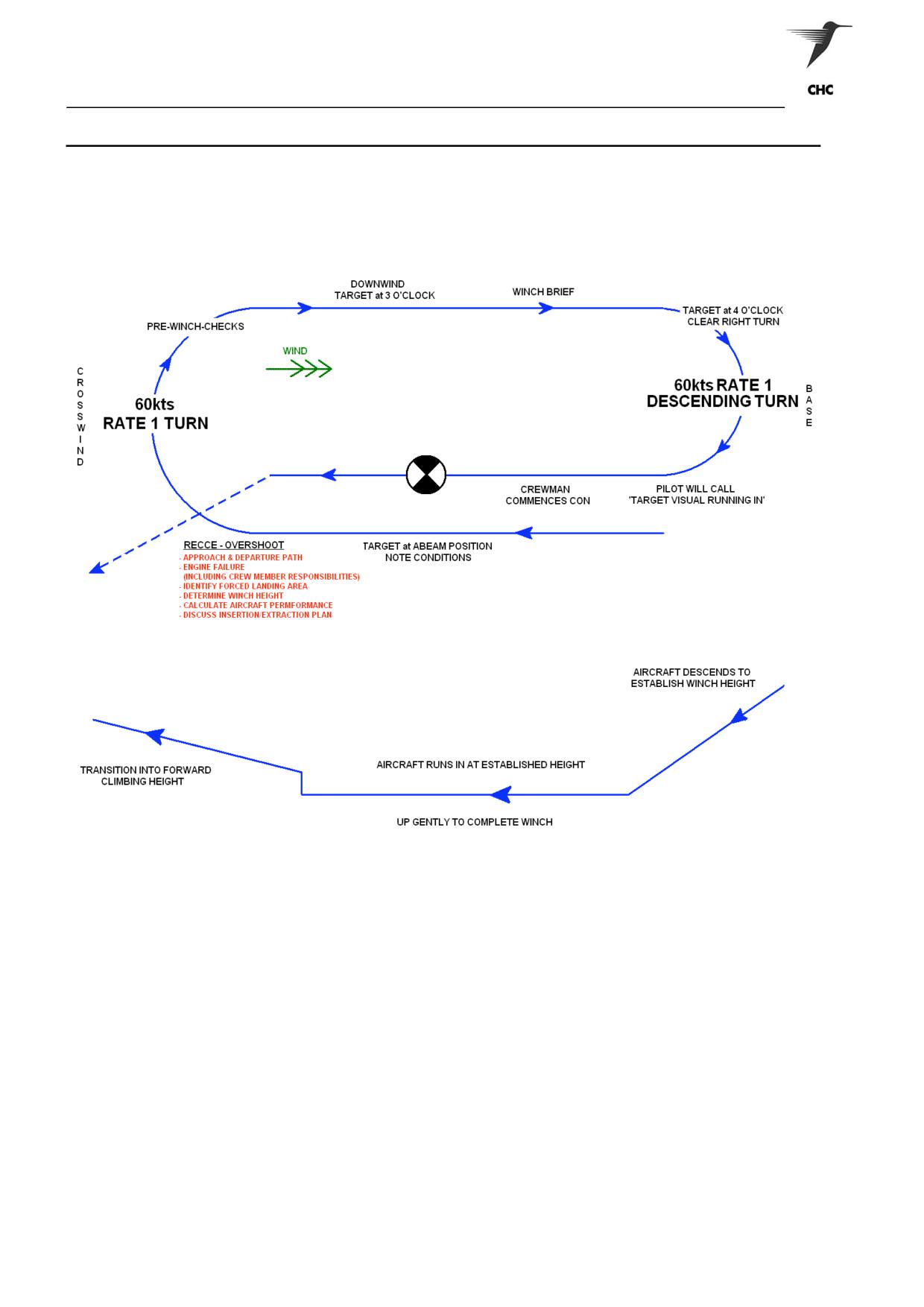
THE WINCH CIRCUIT
The helicopter is flown at a safe height and airspeed while the preparation for the winch is completed.
Using a standard circuit means that all members of the crew will be acquainted with the normal sequence
to be followed, and will only require briefing on the specific aspects of the immediate operation ahead.
With all preparation completed prior to the approach, the helicopter is exposed for the minimum time in the
avoid area of the HV curve. For training purposes the circuit is normally conducted right hand at 200 feet
above obstructions at 60kts. (See Annex A)
Individual members of the crew shall be made responsible to keep the target in sight and a positive hand
over made prior to resuming other functions. It is essential that one member of the crew maintains visual
contact with the target throughout the circuit.
a.
Reconnaissance
After the target has been sighted the crew establishes an orbit over the position to inspect the
target discussing the following points: approach/departure paths, engine failure brief (to include
individual crew member’s responsibilities), identification of forced landing areas and the winch
height. Aircraft performance is to be calculated prior to committing to the winch. The winch
insertion and if possible the extraction plan should be discussed at this point highlighting any
issues. The ACM and RCM then make the relevant equipment ready.
Note: It is imperative that ALL crew members are involved in the reconnaissance brief.
b.
Downwind
The reconnaissance is extended into a downwind leg and once established the FP calls
“Downwind”. Pre-Landing and Pre-Winch checks are completed. The winch operator shall
conduct the winch brief at this point e.g. “Set in the back for a 30’ live winch”.
The helicopter is flown downwind until the target is at the 4 o’clock position where the winch
operator will report “Target is at 4 o’clock xxx Clear Right turn” (circuit direction may be reversed as
necessary), the base turn is commenced at this point. The winch operator shall continue to call
target position until the FP reports “Target Visual”, the winch operator shall respond “Roger” and
then cease the flow of information.
During the base turn aircraft speed and height are reduced, and the helicopter is flown into wind
and aligned with the target. The FP will call “Your CON” when he requires the winch operator to
begin his talkdown, the winch operator shall respond “Roger I have the CON” and then commence
a non-stop flow of information of Distance, Line, Rate of Descent, Speed and Height Above
Instructions until on top of the winch area.
ASNSW EC145 Cabin Staff Training Notes
Revision 1 - July 2010
page 7 of 28
Winching Procedures - Normal
c.
The Hover
The winch operator shall con the aircraft to overhead the target/survivor and perform the winch
with hover patter as required.
After the "survivor" is attached to the cable, he cons the helicopter to overhead the survivor and at
the same time advising the pilot 'WINCHING IN THE SLACK". Once steady in the overhead with
no slack cable, the winch operator shall call "UP GENTLY".
The helicopter climbs vertically and lifts the survivor clear of the surface, at which point the winch
operator shall call, "CLEAR OF THE SURFACE" "CLEAR OF THE DECK" (vessel winch).
The pilot, feeling the weight coming on, shall assess power and C of G and calls either “CLEAR TO
WINCH/"CONTINUE" or "STOP WINCHING".
During the "winch in" the winch operator shall keep the pilot informed of cable length and, if
required, make adjustments to the helicopter’s position. The winch operator stops the winch
momentarily below the helicopter for a control check. When the survivor is at the top of the door
and all the cable has been winched in, the winch operator shall assist the survivor into the cabin.
During this period, it may be necessary for him to leave the door and, therefore, he shall not be a
reliable look-out for the pilot. Before he leaves the door, he must make sure that he informs the
pilot, "LEAVING THE DOOR, YOUR REFERENCE".
WARNING:
THE LIFT IS COMPLETE ONLY WHEN THE CREWMAN AND SURVIVOR ARE BOTH
SECURE N THE CABIN.
WARNING:
DURING TRAINING, THE RESCUE CREWMAN/SURVIVOR SHALL NOT EXIT THE
AIRCRAFT OR BE WINCHED ANY HIGHER THAN IS NECESSARY. MAXIMUM
HEIGHTS ARE DETAILED IN 8.4 TRAINING LIMITATIONS.
d.
Departure
Once the winch is completed, the pilot transitions into forward flight. When winching in an empty
hook, the pilot shall not transition forward until less than 15 feet of cable remains below the
helicopter. During live winching, the transition forward shall only commence after the survivor is
safely inside the cabin.
7.
CREW DUTIES
Success in winching operations depends on crew co-operation. The crew usually consists of two pilots, a
winch operator, and a rescue crewman. Winching can be flown from either pilot seat, although water and
deck winching is easier with the Flying Pilot on the same side as the target or hovering reference.
The duties of the individual crew members are:
Captain
-
co-ordination and conduct of the operation.
Flying Pilot
-
handling the aircraft during winching operations.
Non Flying Pilot
-
monitoring and communication on all radio frequencies not
associated with the winch
-
navigation of the helicopter including recording position (if required)
-
fuel and engine monitoring
-
completion of normal and winching checks, and monitoring
progress and activity in the cabin
-
monitoring height and obstructions
-
maintaining a log.
ASNSW EC145 Cabin Staff Training Notes
Revision 1 - July 2010
page 8 of 28
Winching Procedures - Normal
ACM/Winch Operator
-
management of the rear cabin
-
pre flight inspection of winch, equipment and intercom system
-
storage of equipment, including survival equipment
-
safety and security of all personnel in the rear cabin
-
operation of the winch and con of the helicopter.
The commentary given by the winch operator is of the utmost importance. During the final stages of the
approach where the pilot loses sight of the position he relies on the winch operator to:
-
guide him to the overhead position
-
manoeuvre the helicopter to maintain position
-
provide a "picture" of the situation under the helicopter
-
maintain the helicopter clear of obstructions.
Rescue Crewman
-
Assisting the ACM/winch operator.
-
Recovery of survivors.
-
Render the necessary First Aid
Medical Crew/Attendant -
Assisting the ACM/RCM.
Recovery of patients.
Render the necessary medical aid.
8.
HF TRANSMISSIONS DURING OPERATIONS
Whilst the winch is in use transmissions on HF radio are not permitted. This is to guard against the
possibility of such transmissions causing the cable cut mechanism to operate. When winching to ships, or
other sites where powerful HF radios operate, the helicopter crew shall endeavour to ensure the vessel
ceases HF radio transmissions. High powered radars should be placed in the standby mode.
9.
CORROSION CONSIDERATIONS
Salt water from winching over the sea causes corrosion to the helicopter and its components.
Contamination can occur from rotor wash recirculating over the fuselage and entering engine intakes, the
cable wetting the winch, and from personnel being winched on board. A thorough rinsing programme is to
be performed immediately salt water winching has been completed. Personnel wet winching is not
permitted for training purposes without a wet floor except where personnel are winched up, remain outside
the cabin, and lowered back into the water.
10.
COMMUNICATIONS
Winching operations require a high degree of co-operation and mutual trust between all crew members
involved.
The rescue crewman relies upon both the winch operator and the pilot for his safe recovery.
The winch operator relies upon the flying pilot to correctly and accurately position and maintain the
helicopter above the target.
The Flying Pilot relies upon both the winch operator and the crewman for positioning directions and the
conduct of the operation.
To facilitate co-operation, an accurate and steady communication between all three crew members on the
operation must
Communications with the RCM when external to the aircraft is an important element of the overall winching
operation. With this in mind the RCM is to have two-way radio communications with the aircraft (where
practical) during all winching operations both land and water.
ASNSW EC145 Cabin Staff Training Notes
Revision 1 - July 2010
page 9 of 28
Winching Procedures - Normal
Communications shall be carried out via the aircraft's intercommunication system. Because of the
inherently noisy environment involved with the winch operation, all unnecessary audio sources should be
eliminated and communications confined to concise, accurate, unambiguous and clear messages.
On approach to the target, the pilot may lose visual contact with the target due to shielding by the aircraft
fuselage. It then becomes the duty of the winch operator to direct the pilot onto the target. Simple, but
clear directions to effect accurate positioning are to be transmitted continually to the pilot.
The following is a list of key words to be used during the winching operations. These words are mandatory
and contain precise and unambiguous meanings. Amplifying comments are to be avoided or kept to a
bare minimum when necessary. Whilst a constantly flowing patter of information is required to enable the
Flying Pilot to position the helicopter accurately, there is no place for verbosity or ambiguity.
11.
KEY WORDS (patter)
The following mandatory words are to be used during winching. Where the list of mandatory words does
not satisfy a given incident, be brief.
Emergency Commands
a.
Cut, Cut, Cut
This command is given, normally, by the winch operator, if the wire becomes fouled and is a hazard to the
helicopter. However the command may be given by the captain or Flying Pilot. The command is to CUT
the cable. Both the Non Flying Pilot and the winch operator shall operate their controls immediately.
Cutting the cable should be a last resort, particularly with personnel on the hook. However it may be
necessary to protect the helicopter and its crew.
b.
Climb, Climb, Climb
This command is given, usually by the winch operator, if:
i.
the helicopter gets too low and is likely to strike an obstruction; or
ii.
when the rapid lifting of the winch load is required, e.g. a shark in immediate vicinity of crewman or
survivor, etc. action to be taken concurrently with a winch in at full speed.
c.
Isolate, Isolate, Isolate
This command is given by the winch operator if he suspects a winch runaway has occurred. The
immediate action is to turn off the hoist master switch.
Executive Commands
Units - Run In
Throughout the final approach of a winching operation, all lateral and longitudinal distance
directions are passed to the Flying Pilot by the Winch Operator in "units". The unit is not a specific
measurement, but rather a gauge of distance to allow the Pilot to more accurately judge the
relative rate of closure and subsequent control movements required to position the aircraft on top
of the target.
Units - Hover
Once established in the hover all aircraft lateral, height and obstacle clearance information is to be
given in ‘feet’.
ASNSW EC145 Cabin Staff Training Notes
Revision 1 - July 2010
page 10 of 28
Winching Procedures - Normal
12.
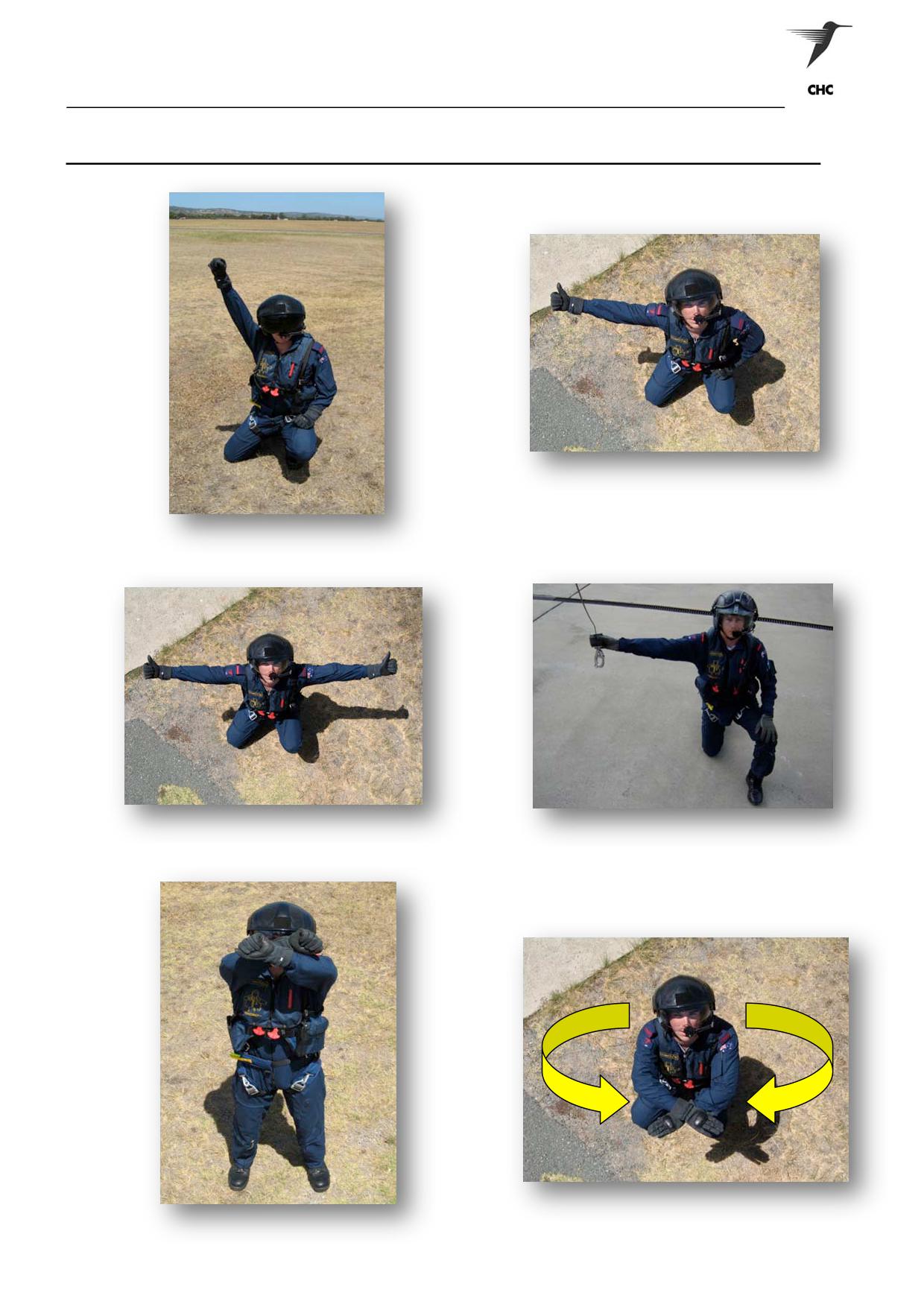
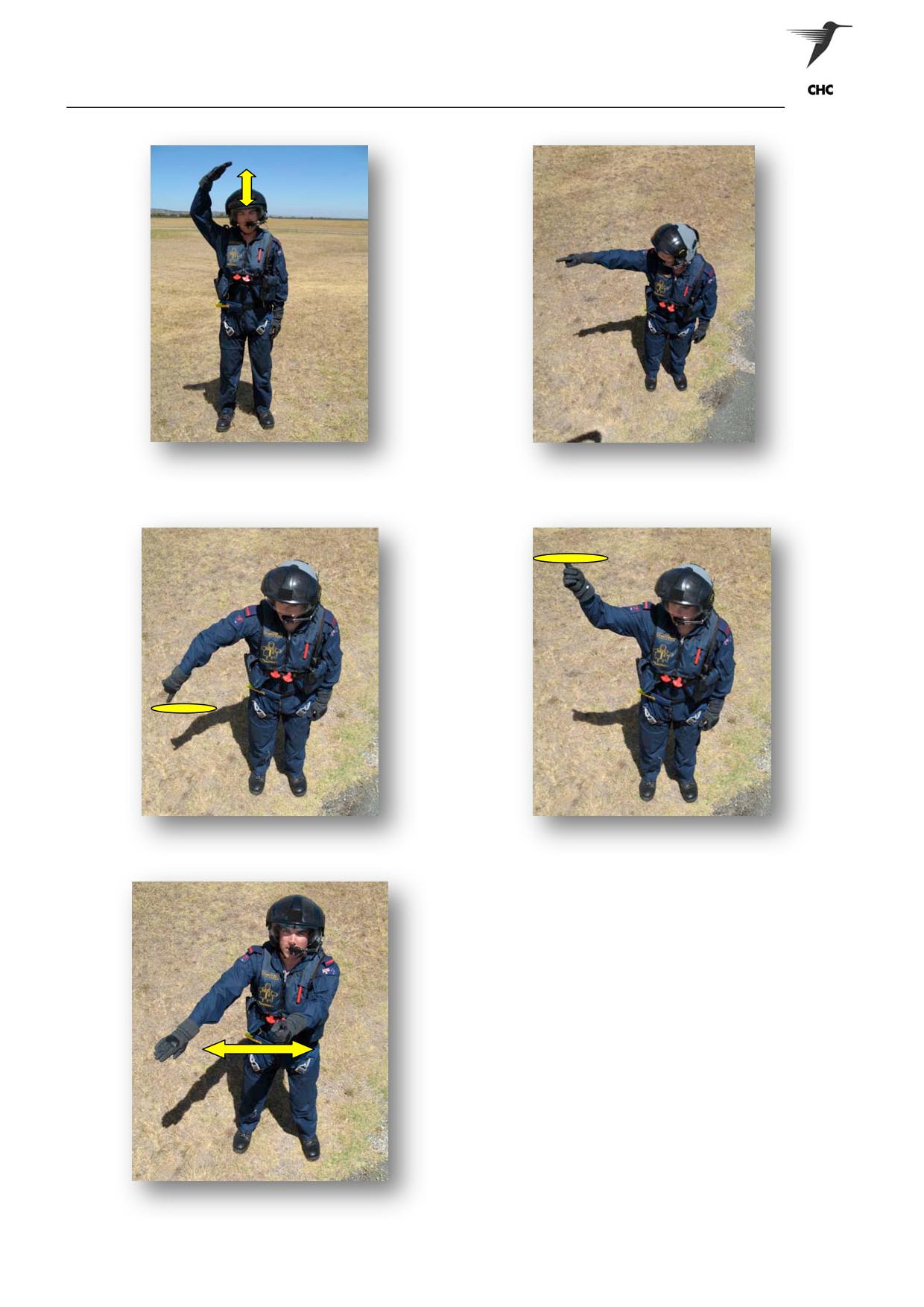
CREW HAND SIGNALS
A system of hand signals to be used between the RCM and the winch operator have been developed to aid
the conduct of the operation. When given, they should be clear and unambiguous and no variations
attempted, unless by prior arrangement between the crewmembers.
The signals are as follows:
Signal:
One arm extended horizontally with cable hook in the hand
Meaning:
I have disconnected from the wire and require the hook to be raised to the helicopter.
Signal:
One arm raised vertically
Meaning:
Bring the helicopter overhead and lower the cable
Signal:
One arm extended horizontally from the body and thumb up
Meaning:
Ready to be winched up. Take up the slack. Held until clear of obstructions
Signal:
Both arms extended horizontally and thumbs up
Meaning:
Clear of all obstructions / or during high winch ops - 10 feet to run to the ground
Signal:
Both /one arm/s moved across the body in a horizontal motion, palms down
Meaning:
I require to be returned to the surface /aircraft
Signal:
Right hand-patting top of head
Meaning:
Stop winching in or out
Signal:
Right or left arm extended and index finger pointed in a horizontal direction. Given after
stop winching signal
Meaning:
Move the helicopter in the direction indicated
Signal:
Right hand extended 450 skywards or towards ground and describing continuous arcs
Meaning:
Winch up or down slowly until other direction given
Signal:
A cross, formed by the forearms and held up in front of the face
Meaning:
Abort task. Expedite recovery
Signal:
Left arm extended horizontally, fist clenched, the other hand making a horizontal slicing
movement below the fist, palm downward
Meaning:
Person/load to be disconnected from winch hook or Tag Line to be released or cut away
from the stretcher
Refer to ANNEX B - Crew Hand Signals
ASNSW EC145 Cabin Staff Training Notes
Revision 1 - July 2010
page 11 of 28
Winching Procedures - Normal
13.
METHODS OF RECOVERY
INTRODUCTION
During rescue winch operations it will be necessary for personnel to move about the rear cabin in both,
preparation for and on completion of a utility task. As a means of control and safety the winch operator is
to remain vigilant in respect to both personnel movements and equipment security within the rear cabin and
on the winch cable. To that end the winch operator is to ensure that no person moves about the rear cabin
unrestrained and that thorough equipment checks are conducted before and after the tasks.
During both the winch in and out phases, the winch operator is to monitor the load at all times, in particular
as it approaches an obstruction. Should there by any potential for fouling the winch operator is to cease
winching and only recommence where he is assured that the load is clear.
Also for consideration during rescue winch operations is the operating speed of the latest generation hoists
currently fitted to company aircraft, and the close proximity of the running cable to the airframe. The
potential for equipment/personnel fouling on aircraft extremities is a real possibility and therefore extreme
care needs to be taken when transitioning loads past things such as aircraft skids, steps, undercarriage,
bear paws and auxiliary fuel tanks etc.
The techniques as detailed below are to be employed during all rescue winch operations.
Winching Out
When the RCM is required to be winched out the crew are to conduct a thorough briefing outlining the
sequence of events inclusive of an aircraft emergency brief. This is done to ensure that ALL personnel are
aware of their individual responsibilities and their actions in the event of an emergency. Also, a radio check
is to be conducted with the RCM prior to committing to the winch ensuring good two-way communications.
When ready the rescue winch hook will be passed to RCM by the winch operator prior to arriving overhead.
With the hook in hand the RCM is to secure himself and any other necessary equipment to it. He then
conducts his own set of security checks and when satisfied, presents the hook assembly to the winch
operator for the first of two (2) inspections.
NOTE:
When connecting the RCM and equipment to the winch hook the RCM/MA is to where
practical connect himself first followed by all other necessary equipment. This will allow for
the continual safe removal/addition of equipment to/from the winch hook while the
RCM/MA remains safely attached.
NOTE:
When presenting the hook for presentation the RCM/MA is to grasp the winch cable
immediately above the winch hook buffer assembly in such a manner that the winch
operator is able to see the hook and all equipment on it without obstruction.
Upon recognition that the RCM/MA is ready for inspection the winch operator is to first inspect the winch
hook and RCM’s/MA’s Capewell Release for security, then move to the RCM’s/MA’s head and working
down from there inspect all other role and personal equipment.
When satisfied that all equipment is secure the winch operator is to request a ‘thumbs up’ signal from the
RCM/MA and on receipt of this signal he will then point to the RCM’s/MA’s wander lead/seat belt as an
indication that he may now release from it.
CAUTION:
The RCM/MA is not to release from the wander lead/seat belt unless directed to do so by
the winch operator.
At this point the winch operator will motion (hand signal) to the RCM/MA to come to the door, the RCM/MA
then disconnects from the ICS, goes on to the hand held radio (where necessary) and moves slowly toward
the door.
CAUTION
It is most important that the winch operator does not allow the RCM/MA to reach the door
area prior to all of the slack winch cable being taken up as a slip/fall by the RCM/MA at this
point may result in cable shock loading.
ASNSW EC145 Cabin Staff Training Notes
Revision 1 - July 2010
page 12 of 28
Winching Procedures - Normal
With the RCM/MA positioned at the door and secure, the winch operator makes any necessary final aircraft
position changes before carrying out the final equipment check. This check is to ensure that nothing has
changed during the RCM’s/MA’s transition from within the cabin to the aircraft door. When satisfied the
winch operator is to give the “thumbs up” signal to the RCM/MA who will, when ready give the “thumbs up”
signal back. Upon recognition of this signal the winch operator requests a “Clear to Winch” from the FP.
With a clearance the winch operator winches in slowly lifting the RCM/MA from the floor to a point where
he is in a balanced and stable position in the doorway. From here the RCM/MA is carefully winched out
past all of the aircraft extremities and down to the surface.
CAUTION:
When lowering the RCM/MA the winch operator is to do so in SLOW SPEED ONLY and is
not to select fast speed on the winch pendant until the RCM/MA is well clear of all airframe
extremities. As the RCM/MA approaches the surface the winch operator is to again select
SLOW SPEED ONLY and is to ensure that the RCM/MA is placed carefully onto the
surface.
Once on the surface and stable, the RCM/MA disconnects himself along with all other equipment and holds
the winch hook well clear as an indication to the winch operator that it is safe to recover the hook to the
aircraft.
Winching In
Prior to the winch recovery the winch operator is to ensure that all is in readiness both in the aircraft and on
the ground e.g. Site cleared of non essential personnel, No or Limited obstructions, Tag Line Attendant
proficiency, Tag Line Position and survivor briefing etc. All of this can be achieved utilising the hand held
radio.
When recovering the RCM/MA and/or survivor, the winch operator is to winch them to a position where
they are balanced and stable in the aircraft doorway (survivor facing outward). At this point the RCM/MA
will grasp a hand hold and prepare to enter the cabin. When both the winch operator and the RCM/MA are
ready, the winch operator will winch out while at the same time the RCM/MA makes his way into the cabin
with the winch operator assisting where necessary during a double lift recovery. This assistance will
require the winch operator to manoeuvre the survivor into the rear cabin by means of the grab handle on
the rear of the rescue strop.
The winch operator may need to reposition so as to allow the RCM/MA a clear path of entry. As the
RCM/MA enters the cabin the winch operator repositions at the aircraft doorway and maintains aircraft
clearances as required.
Upon entering the cabin the RCM/MA is to secure any third party personnel/equipment and then secure
himself by means of either a wander lead or seat belt. All personnel on the winch hook are to remain so
until the winch operator inspects that they are secure by seat/wander lead. When satisfied that all
personnel are secure the winch operator will point to the winch hook as an indication to the RCM/MA to
disconnect all personnel from it. The winch operator then houses the hook.
CAUTION:
On completion of the winch “control check” the winch operator is to continue to raise the
load toward the aircraft in SLOW SPEED ONLY. At no time from this position on is fast
speed to be selected on the winch pendent.
Particular attention is to be paid to the fending off of the load from obstructions as it passes
over it. This is to be done in conjunction with the RCM/MA when conducting double lifts.
CAUTION:
For all over land rescue strop operations recoveries, the chest strop is to be utilised.
CAUTION:
For all water recoveries, inflated life jackets and life jackets of the solid foam type are to be
removed once the survivor is secure within the aircraft. Also, the use of the chest strap
should be considered when recovering an uncooperative/unconscious patient from the
water. This technique will enable the RCM to ably assist the ACM with survivor entry into
the rear cabin.
Survivors/passengers are to be issued with a company standard passenger life jacket for
all flights over water.
ASNSW EC145 Cabin Staff Training Notes
Revision 1 - July 2010
page 13 of 28
Winching Procedures - Normal
The Single Rescue Strop
Introduction
The single strop lift method of recovery is used for the rescue of experienced or pre-briefed personnel who
are in a fit state to keep themselves in the strop. They can be specifically briefed beforehand, or by a
rescue crewman lowered to brief them prior to the winch.
Description
The single strop is a horse collar shaped device which is connected to the rescue winch hook by means of
a ‘D’ ring. Incorporated in the design is an adjustable chest strap with snap hook and small ‘D’ ring. The
strop maintains it’s horse collar shape by means of a snap hook and “D” ring connection.
Use of the Single Rescue Strop
The rescue Winch Operator delivers the strop into the hands of the survivor who then places it on himself
by one of two methods:
a.
Leaving the strop in the horse collar shape the survivor places one arm and his head through the
collar opening, the winch hook is then rotated around to the front of the survivor’s body where his
remaining arm is placed through the collar. At this point the collar should be sitting comfortably
around the survivor’s back and under his arms with the rescue winch hook in front of his face. The
chest strap is then released from its stowed position from within the strop comfort padding and
connected across the chest and adjusted for comfort.
b.
The second method is achieved by disconnecting the large snap hook which in effect will lengthen
the strop out to it’s full length. The survivor then brings the free end of the strop around the back of
his body and under his arms. The large snap hook is then reconnected to the ‘D’ ring. Once again
the strop should be sitting comfortably around the survivor’s back and under his arms with the
rescue winch hook in front of his face. The chest strap is then released from its stowed position
from within the strop comfort padding and connected across the chest and adjusted for comfort.
When comfortably secure and ready for the lift the survivor gives the rescue winch operator the ‘thumbs
up” signal. The rescue winch operator then winches the survivor to the aircraft and manoeuvres him safely
inside.
CAUTION:
Care should be taken as the survivors weight is taken as the winch hook assembly could
strike him in the face or head.
CAUTION:
When using a rescue strop fitted with the smaller type 1014 ‘D’ ring (two parallel cross
bars) in conjunction with the ‘D’ Lock winch hook, a type C843 Karabiner is to be used to
connect the strop to the winch hook. The Karabiner is to be passed through the ‘D’ ring of
the rescue strop and then onto the winch hook. This will alleviate any potential for the type
1014 ‘D’ ring to roll up and lock over the hard eye on the rescue winch hook.
ASNSW EC145 Cabin Staff Training Notes
Revision 1 - July 2010
page 14 of 28
Winching Procedures - Normal
The Double Lift
Introduction
The double life is the recovery method where the RCM/MA assists the survivor into the appropriate rescue
equipment and then accompanies them throughout the rescue winch cycle to the aircraft. This is the
preferred method for the recovery of survivors and is to be used where personnel are not familiar with
winching techniques or are unable to be lifted unaccompanied.
Double Lift Technique
The double lift recovery is conducted utilising the single lift strop on it’s own or in conjunction with the
hypothermia strop. The RCM/MA is connected to the rescue winch hook by means of his harness along
with the appropriate rescue equipment. Double lifts may be conducted with suitable personnel using two
single lift strops on the rescue winch hook.
In preparation for the lift the survivor’s arms are to be placed by his side once the rescue strop has been
fitted correctly. When ready for the lift the RCM/MA gives the winch operator the thumbs up signal. As the
survivor is lifted clear of the surface the RCM’s/MA’s legs lightly grip the survivor’s trunk and arms
providing both support and security. The RCM/MA uses one hand to support the survivor’s head and the
other to ensure the strop remains secure, and to guide the way past the airframe and into the helicopter.
CAUTION:
When attempting to place the rescue strop on to a large framed person or someone who is
wearing a life jacket, it is advisable to disconnect the large snap hook on the rescue strop
allowing it to open to its full length. The free end of the strop can then be brought around
behind the survivor’s back and reconnected in preparation for the lift. If the survivor is
wearing an inflatable life jacket, the jacket should be deflated to 50% capacity before
attempting the above procedure.
Hypothermia Strop Lift
Introduction
The Hypothermia Strop Lift technique is designed for the recovery of personnel from both on land and in
the water who are suffering from or suspected of suffering from hypothermia. Additionally personnel on
land who may be suffering from minor lower leg injuries can also be recovered using the hypothermia strop
technique. The Hypothermia Strop method of recovery can be executed by utilising either the Hypothermia
Strop in conjunction with the Single Strop or by the Rescue/Hypothermia Combination Strop. The recovery
technique is designed to maintain the survivor in a sitting position while being recovered to the aircraft.
Description
Hypothermia Strop
The hypothermia strop is a horse collar shaped device, which connects to the rescue winch hook by means
of a large ‘D’ ring. A snap hook at the free end of the strop connects to the small ‘D’ ring below the rescue
winch attachment point giving the device its horse collar shape.
Rescue/Hypothermia Combination Strop
The Rescue/Hypothermia Combination Strop is a Single Rescue Strop incorporating within the design a
free pivoting Hypothermia Strop. The hypothermia strop component is fitted to the outside perimeter of the
rescue strop and held in place by means of two metal rings and Velcro tabs. A beaded grab handle is fitted
to aid the RCM/MA when positioning the strop under the survivor’s knees.
ASNSW EC145 Cabin Staff Training Notes
Revision 1 - July 2010
page 15 of 28
Winching Procedures - Normal
Use of the Hypothermia Strop - Rescue/Hypothermia Comb. Strop
Hypothermia Strop
There are three acceptable methods by which the hypothermia strop may be placed on to a survivor.
These are detailed below;
a.
With the hypothermia strop left in the horse collar shape the RCM/MA places the single rescue
strop on to the survivor as for a normal double lift. He then guides the survivor’s legs through the
hypothermia strop opening until it is positioned under and behind the survivor’s knees.
b.
The second method is achieved by disconnecting the snap hook from the small ‘D’ ring on the
hypothermia strop which in effect will lengthen it to it’s full length. This is to be done prior to water
entry. The RCM places the single rescue strop on to the survivor as for a normal double lift. He
then passes the free end of the hypothermia strop under and around the survivor’s knees and then
reconnects it to the small ‘D’ ring by means of the snap hook.
c.
The third method of recovery requires the RCM to position both the single strop and the
hypothermia strop over his shoulder with the hypothermia strop being outer most. On entering the
water the RCM presents his hand (corresponding side with the rescue strops) to the survivor
whereby secure contact is made. The RCM then passes both strops along the survivor’s arm, over
his head and then over the remaining arm. With both strops positioned as for a normal double lift
the RCM then reaches behind the survivor and positions the hypothermia strop under and behind
the survivor’s knees.
Rescue/Hypothermia Combination Strop
The RCM places the Combination strop on to the survivor as for a normal double lift. Once in place the
hypothermia strop component is pulled away by means of the beaded handle and positioned under and
behind the survivor’s knees.
NOTE:
For water operations the RCM is to split the strop grab handles prior to water entry.
When comfortably secure and ready for the lift the RCM gives the rescue winch operator the ‘thumbs up’
signal. The rescue winch operator then winches the RCM and survivor to the aircraft and manoeuvres them
safely inside. The survivor ascends to the aircraft in a sitting position orientated across the front of the RCM
with the survivor’s feet facing forward (relative to the aircraft) where practicable.
CAUTION:
If the survivor is wearing swim fins these are to be discarded or removed and held securely
prior to the lift as they can induce spin.
STRETCHER LIFTING TECHNIQUE (LAND)
a.
Preparation for Winching
The RCM/MA is to complete the following inspection of the equipment and the patient prior to the lift:
i.
Ensure that all patient restraints are secure
ii.
Ensure that the locking pins/couplers are in place/done up
iii.
Ensure that the sling legs are not twisted
iv.
Ensure that all sling leg karabiners/links are in the locked position
v.
The Tag Line is to be connected to the stretcher via a quick release system and readied for use.
The tag line attendant is to be in a position where control of the stretcher can be assured. The
2’oclock position relative to the aircraft is the optimum.
vi.
Ensure that the tag line attendant is adequately briefed on the procedure and knows his job
vi.
Ascertain that the patient is comfortable. If conscious, advise the patient as to what shall be taking
place.
ASNSW EC145 Cabin Staff Training Notes
Revision 1 - July 2010
page 16 of 28
Winching Procedures - Normal
vii.
Note: Tag line connection will normally be to the foot end quick release Ronstan however; under
certain conditions the head end Ronstan maybe a viable option.
NOTE:
Optimum Tag Line control is achieved through a shallow tag line angle i.e. the further the
TLA is displaced from the stretcher the better.
CAUTION:
It should be noted that when the stretcher is initially lifted from the ground/surface it will
have a tendency to plumb towards the TLA. This is due to the fact the TLA is pulling on the
tag line in an effort to maintain the necessary tension.
The winch operator is not to commence winching in u until he is assured that the TLA is in
full control.
WARNING:
THE WINCH OPERATOR IS TO ENSURE THAT THE TLA IS IN THE OPTIMUM
POSITION PRIOR TO COMMENCING A STRETCHER WINCH RECOVERY. IF DOUBT
EXISTS AS TO THE ABILITY OF THE TLA TO MAINTAIN TAG LINE CONTROL
THROUGHOUT, THEN RECOVERY BY OTHER MEANS SHOULD BE CONSIDERED.
Tag Line
The Stuff Bag Type Tag Line presents in a nylon bag containing the following components;
•
130 meters of 6mm high visibility reflective cordage (not tied in) incorporating an optional weak link
assembly,
• Instruction guide,
• Third party ear & eye protection,
• Safety gloves, and
• Hook knife,
b.
Hooking Up
To ensure that the patient can be correctly received into the helicopter, it is important that the correct
sequence of events occurs during the hooking up phase.
NOTE:
The RCM/MA is not to call the aircraft in for the hook up until completely ready for the lift.
The aircraft crew are to be informed by radio (if practical) of any abnormalities with the
procedure prior to the lift.
i.
The RCM/MA positions himself alongside and facing the stretcher, with the patient’s head to his
left.
ii.
The winch hook is delivered to the RCM/MA whereby he connects both the stretcher lifting ring and
his harness karabiner.
iii.
The winch hook spring gate is to be closed and the pip pin in place prior to the lift.
c.
Winching
When ready, the winch operator proceeds as for a double lift recovery.
When suspended from the rescue winch hook, the stretcher shall be located across the upper thighs of the
RCM/MA. The RCM/MA can adopt a comfortable position by grasping the nearest forward and rear sling
leg while at the same time maintains control of the stretcher. He is also able to converse with the patient
and to attend to the patient during the winch.
From a position immediately below the wheels/skids:
i.
The winch operator is to ensure that the stretcher and the RCM/MA are winched towards the
aircraft at a slow rate to avoid contact with the landing gear and fuselage.
ii.
The RCM/MA shall manoeuvre himself so that the stretcher is located alongside the door, with
himself on the outboard side.
ASNSW EC145 Cabin Staff Training Notes
Revision 1 - July 2010
page 17 of 28
Winching Procedures - Normal
CAUTION:
Extreme care must be taken by both the RCM/MA and the winch operator to ensure that
the patient does not come into contact with any part of the aircraft.
iii.
Once the stretcher is in a position at the aircraft door and under control of the winch operator
and/or the RCM/MA the tag line is to be released and the FP notified when it is clear.
iv.
The stretcher is then manoeuvred into the aircraft and secured prior to being removed from the
winch hook.
d.
Tag Line Technique - Two RCM/MA
During a stretcher lift where two competent tag line attendant are available at the scene the following
technique is to be used:
i.
With the stretcher fully prepared for the lift one RCM/MA will perform the hook up and accompany
the stretcher to the aircraft while the other RCM/MA or a competent person on site will perform the
duties of the tag line attendant. The RCM/MA accompanying the stretcher is to ensure that the tag
line is correctly secured to the quick release mechanism. The tag line attendant is then positioned
in the optimum tag line position in preparation for the lift.
ii.
When ready for the lift the RCM/MA at the stretcher shall ensure he has a ‘thumbs up’ signal from
the tag line attendant prior to giving the ‘thumbs up’ to the winch operator. On receipt of the
‘thumbs up’ signal from the RCM/MA the winch operator may commence winching operations.
iii.
As the stretcher is lifted clear of the ground the RCM/MA is to ensure that no cable/hook fouling
occurs and a final inspection of all equipment is carried out. During the winch in process the tag
line attendant is to keep the tag line taught ensuring the stretcher does not develop a spin.
iv.
Once the stretcher reaches the skid/floor level of the aircraft the tag line attendant may relax on the
tag line to assist the winch operator with the embarkation orientation of the stretcher.
v.
At this point the RCM/MA may, if instructed by the winch operator or if pre briefed, release the tag
line and then continue assisting with the embarkation. As the tag line is released the winch
operator is to inform the FP that the line has been released and is clear.
e.
Tag Line Technique - One RCM
During a stretcher lift where only one RCM is available the following technique is to be used:
i.
With the stretcher fully prepared for the lift the tag line is secured to the quick release and may
either be run out and pre positioned in the optimum tag line position or held at the stretcher by the
RCM prior to him moving to the tag line position.
ii.
With the hook up complete the RCM gives the winch operator the ‘thumbs up’ signal whereby the
stretcher is lifted just clear (2-3ft) of the ground. As the stretcher is lifted clear the RCM is to ensure
no cable/hook fouling occurs and it is at this point that a final inspection of all equipment is carried
out prior to continuing. All being well the RCM then moves carefully to the tag line position whilst
maintaining control of the tag line. Once in position and ready, the ‘thumbs up’ signal is again given
to the winch operator. On receipt of this signal the winch operator may commence winching in.
iii.
During the winch in process the tag line attendant is to keep the tag line taught ensuring the
stretcher does not develop a spin.
iv.
Once the stretcher reaches the skid/floor level of the aircraft the tag line attendant may relax on the
tag line to assist the winch operator with embarkation orientation of the stretcher.
v.
The winch operator is to release the tag line as soon as practical at this point and inform the FP
that the tag line has been released and is clear.
ASNSW EC145 Cabin Staff Training Notes
Revision 1 - July 2010
page 18 of 28
Winching Procedures - Normal
f.
Precautions
The following points are the minimum to be covered in the TLA’s briefing
:
i.
Stretchers which are capable of being folded or packed (e.g. paraguard) must be winched in the
stowed position when empty. It is prohibited to winch an empty stretcher of this type in the open
position.
ii.
Empty stretchers, which cannot be folded (e.g.71 Ferno Basket Stretcher), are only to be winched
in the vertical position and accompanied by the RCM.
iii.
Where practical patients recovered in stretchers are to be accompanied by a RCM/MA. For over
water winching, the RCM is to provide sufficient flotation for himself and the patient.
iv.
Stretchers can achieve high rates of spin (particularly the basket stretcher). Therefore a tag line is
to be attached to one end of the stretcher via a quick release system (Ronstan Quick Release)
which can be released by either the RCM attending the stretcher or the winch operator at the
aircraft door. The tag line is to be controlled by a competent person on the ground (tag line
attendant). Both the RCM and the Tag Line attendant are to carry a hook knife or equivalent as a
back up to the quick release mechanism.
v.
The importance of the tag line attendant’s (TLA) role during a stretcher winch cannot be over
stressed and therefore the TLA is to have been fully briefed on the tag line procedure/technique as
detailed below prior to stretcher winching operations taking place. Also he is to be wearing eye
and ear protection, safety gloves and where possible a safety helmet.
The following points are the minimum to be covered in a TLA”s briefing:
a.
tag line use rationale;
b.
correct use of supplied safety equipment such as gloves, goggles etc;
c.
positive identification of the TLA’s standing position;
d.
correct method for holding the tag line reel ie. The reel is to be held firmly with both hands
and can be orientated either straight up and down allowing the line to pay out from under
the rubber boot as the reel rotates in the users hands or the reel may be cocked off on an
angle with the bevelled edge facing the stretcher allowing the line to reel off from under the
rubber boot;
e.
an indication as to the required tension to be maintained throughout the recovery;
f.
under no circumstances is the rubber boot to be removed from the reel;
g.
a thumbs up signal to the RCM is to be given when ready to take the strain;
h.
when attempting to gain extra purchase the TLA is NOT to loop the line around his hand;
and
i.
the tag line will be released once the stretcher is at the aircraft door and stable.
vi.
Where practical ensure that the patient has suitable eye and ear protection fitted for the lift.
vii.
Operationally there could at times be a requirement for small items of medical/operational
equipment to accompany the patient and stretcher back to the aircraft. Where it is decided to
employ this procedure, the RCM is to ensure that all equipment is well secured within the stretcher
body with no loose articles hanging on the outside of the framework. Also the aircraft crew are to
be informed by radio as to what equipment will be accompanying the stretcher.
NOTE:
Any safety helmets (when not in use) that may be accompanying the stretcher are to be
attached to the Medevac II stretcher by looping the helmet chinstrap through one of the
Foot End Hand Holds ONLY.
ASNSW EC145 Cabin Staff Training Notes
Revision 1 - July 2010
page 19 of 28
Winching Procedures - Normal
14.
WINCHING TO VESSELS
Helicopter and deck crews must ensure that all possible preparation for the transfer is completed whilst the
helicopter is at the DATUM, and only close the deck when the aircraft captain, crewman and deck crew
acknowledge that it is safe to do so.
The datum is the position from which the helicopter shall close to the ship to effect the transfer. The
transfer point is the area on the ship where the winch transfer takes place.
At the datum the helicopter shall be:
a.
hovering into the relative wind;
b.
maintaining station with the vessel;
c.
no closer than three rotor diameters to the vessel; and
d.
providing the pilot and crewman with the best view of the ship.
Introduction
The technique for winching to vessels at sea depends on a number of factors. If the vessel is stable, has a
suitable winching site, and coherent communication is available to the crew, then the deck winching
procedure is used. For vessels where the deck winching procedure is not suitable because it is lacking a
winch site, obstructions, unstable, or communication is not possible, then standard winching or hi-line
winching is recommended. In cases where the danger of winching to the vessel is unacceptable and no
other options are available, then personnel may need to enter the water, or be winched into smaller boats.
The last method is the least preferred and in many circumstances not acceptable. In which case the winch
may have to be terminated.
WARNING:
PRIOR TO MOVING IN OVER THE DECK THE AIRCRAFT CREW ARE TO ENSURE
THAT THE VESSEL’S RADARS ARE OFF OR IN STANDBY AND THAT NO HF
TRANSMISSIONS ARE MADE BY EITHER PARTY. ALSO IT SHOULD BE CONVEYED
TO THE CREW OF THE VESSEL THAT ALL OTHER COMMUNICATIONS ARE TO BE
KEPT TO AN ABSOLUTE MINIMUM THROUGHOUT THE WINCHING PHASE.
Transfer Procedure
a.
Initial Brief
A ship is normally treated as a confined area in that a low recce shall be flown. If possible, always
keep a boat on heading at minimum speed for it to maintain its course.
The inspection of the ship is normally conducted by the Winch Operator from a position where the
crew have good visual contact with the vessel. If the vessel is under way the rescue may be
conducted by formatting on the vessel at a height and speed that keeps the helicopter clear of
obstructions.
The Winch Operator shall describe the vessel from bow to stern, commenting on the following
points:
i.
possible winch areas;
ii.
obstructions (side rails, winches, etc.);
iii.
loose articles (hatch covers, tarpaulins, etc.);
iv.
position of survivor(s);
v.
hazards (masts, radar, antennae, inflatables, fenders, etc.);
vi.
tallest obstruction; and
vii.
define winch/transfer area.
ASNSW EC145 Cabin Staff Training Notes
Revision 1 - July 2010
page 20 of 28
Winching Procedures - Normal
The helicopter captain in conjunction with the Winch Operator shall then decide which site and
what winching technique is to be used.
It may then be necessary to move the vessel onto a different heading. The Winch Operator shall
again assess the winching/transfer area and at the datum, establish the winching height (usually
skid height plus 10ft above the tallest obstruction).
When all the checks have been completed, the pilot shall position the helicopter at the datum at the
safety height to allow the lowering of the winch hook. If only the strop/hook is to be lowered, it may
be necessary for a weight to be attached to the strop/hook to stabilise it because of down draft
and trail.
The safety height is the height chosen by the aircraft captain, where the passenger/rescue
crewman shall remain above sea level after being despatched from the aircraft. This height is not
usually above 50 feet.
Once the passenger/rescue crewman is outside the aircraft, the winch operator shall CON the
aircraft to the Winching Height.
Once the height of the Rescue Passenger/Crewman and aircraft is correct, the Pilot shall call "AT
THE WINCHING HEIGHT, READY TO CONTINUE"; the Winch Operator shall then begin his
patter for the transfer.
Once the person on the winch is directly above the Winch/Transfer area, he is lowered to the deck.
Once on the deck and balanced, the person is to vacate the strop and give the "Thumbs up". If the
aircraft is picking up a Passenger/Rescue Crewman, the Winch Operator must make sure that
loose cable does not pose a hazard to the Passenger/Rescue Crewman whilst the strop is being
fitted.
b.
The Lift
When the Winch Operator is satisfied that the person to be lifted is secure and he has received the
"thumbs up" signal, he shall effect the clearance from the vessel using the following patter:
"WINCHING IN THE SLACK",
"UP GENTLY".
When the Passenger/Rescue Crewman is clear of the deck, he shall advise:
"CLEAR OF THE DECK",
"MOVE - (left/right/forward/back)"
The clearance away from the deck forms part of the Winch Operator's briefed plan to recover the
Passenger/Rescue Crewman. Personnel on the cable shall, where practical, be kept over the
water rather than over the vessels structure during recovery, to ensure that in the event of a
separation from the winch, personnel fall into the water.
Once the rotors are safely clear of the boat, the Winch Operator shall call:
"CLEAR OF THE BOAT"
Further movement may be required and shall be cleared by - e.g. "CLEAR FORWARD/DOWN"
Having safely recovered the Passenger/Rescue Crewman, the aircraft shall regain the Datum if
further transfers are required.
ASNSW EC145 Cabin Staff Training Notes
Revision 1 - July 2010
page 21 of 28
Winching Procedures - Normal
NOTE:
The winch operator is to call the vessel’s position as the aircraft moves clear eg, “the
vessel is in your 2o’clock clearing forward and right”. This will assist the FP in gaining
visual contact with the vessel.
c.
Emergencies
Practice emergencies are not to be conducted during Deck Winching exercises. During training,
Lost Contact only may be practised.
CAUTION:
Personnel being winched to/from vessels are to wear a life jacket (where practical).
15.
Hi-LINE PROCEDURE
A Hi-Line procedure is used when conducting either over water or over land rescue winch recoveries when
normal winching would be hazardous.
a.
When the winching area is confined or obstructed in such a way that there is a risk of the winch
cable snagging or the RCM/MA striking obstructions.
b.
The vessel or winch area is so small that the Pilot cannot remain in visual contact whilst in the
hover.
c.
When normal winching techniques would be unable to effect transfer.
During night Hi-line transfers, the shot bag shall be illuminated with high intensity artificial light
sticks (cyalume).
c.
When conducting Hi-line transfers to/from a life raft it is acceptable that once the RCM has entered
the raft that the hi-line shot bag and all excess rope be lowered down in between the raft chamber
and the outer boarding rope. This will ensure that all excess rope will be out of harms way during
the transfer process.
NOTE:
It may be advisable to attach an additional shot bag for this procedure to assist in the sink
rate of the excess line.
e.
When conducting a stretcher lift recovery from a vessel utilising the Hi Line procedure it may be
necessary to route the Hi Line through the Tag Line quick release ronstan. This particular
configuration ensures the stretcher remains under the positive control of the TLA and that the weak
link functionality is maintained during the winch in process.
CAUTION:
When configuring the Hi Line through the quick release ronstan it is essential that the Hi
Line hand hold is on the outboard side.
When recovering the RCM last from the scene, the hi-line can either be recovered with him or
discarded, which ever is deemed as the safest option by the crew.
ASNSW EC145 Cabin Staff Training Notes
Revision 1 - July 2010
page 22 of 28
Winching Procedures - Normal
Description
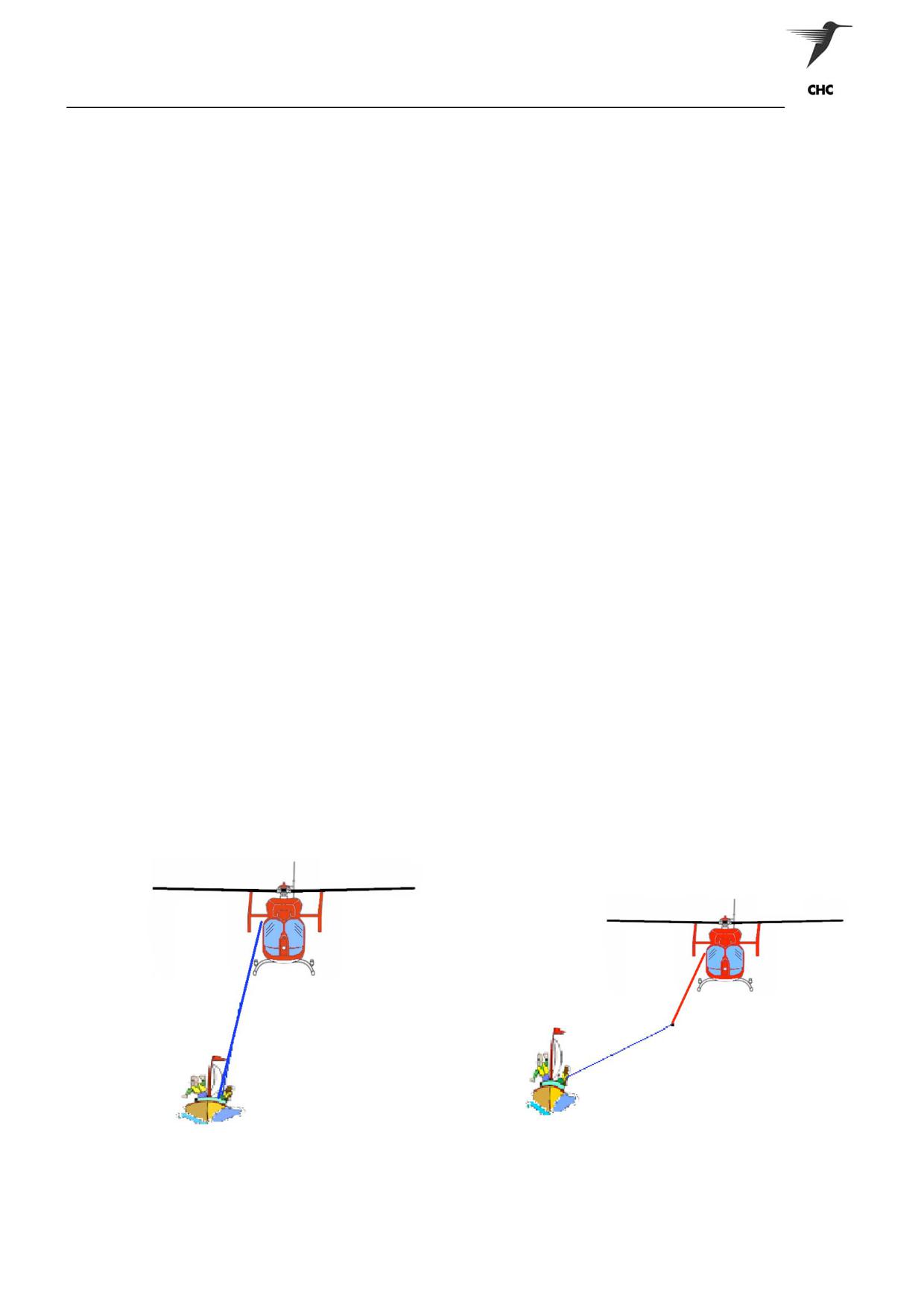
The Hi-Line is the name given to describe the piece of equipment in its entirety. The various components
of the equipment are:
a.
Canvas or nylon pack cover.
b.
30 or 45 metres (100 or 150 ft) cord stowed inside the pack cover.
c.
The cord has a shot bag on one end (the "down" end) and a soft eye with snap hook on the other
and (aircraft end). The snap hook is attached to a 136 kg (300 lb) cord loop which acts as a weak
link. The cord loop is attached to the aircraft winch hook.
A Karabiner snap hook is attached to the outer casing of the pack; and is used to secure the Hi-line to the
aircraft floor.
Preparation
The transfer area should be selected to give a clear area with unobstructed access to the deck edge. The
aircraft should be positioned so that the Hi-Line streams downwind into the transfer area. (If at anchor, it
may be possible to drop the shot bag vertically onto the transfer area.)
The Hi-Line is attached to the Winch Hook by a steel ring and weak link assembly. The appropriate
weights are attached to the lower end of the Hi-Line which is then streamed from the cabin door. The line
is hand lowered until the weight lands in the transfer area. It may be necessary to adjust the helicopter's
position to achieve this. Once the Hi-Line is in hand on deck the aircraft is manoeuvred clear of the vessel
to a position where the FP is visual and able to maintain station. All of the HiLine is paid out from this
position.
It must be assumed that vessel crews are not familiar with the Hi-Line technique. It is, therefore, important
that the crew is briefed whenever possible, either by radio or by attaching a message to the end of the Hi-
Line.
Hi-Line is lowered to the deck from overhead.
The aircraft then moves clear and descends
until the FP is visual.
ASNSW EC145 Cabin Staff Training Notes
Revision 1 - July 2010
page 23 of 28
Winching Procedures - Normal
Transfer - Helicopter to Vessel
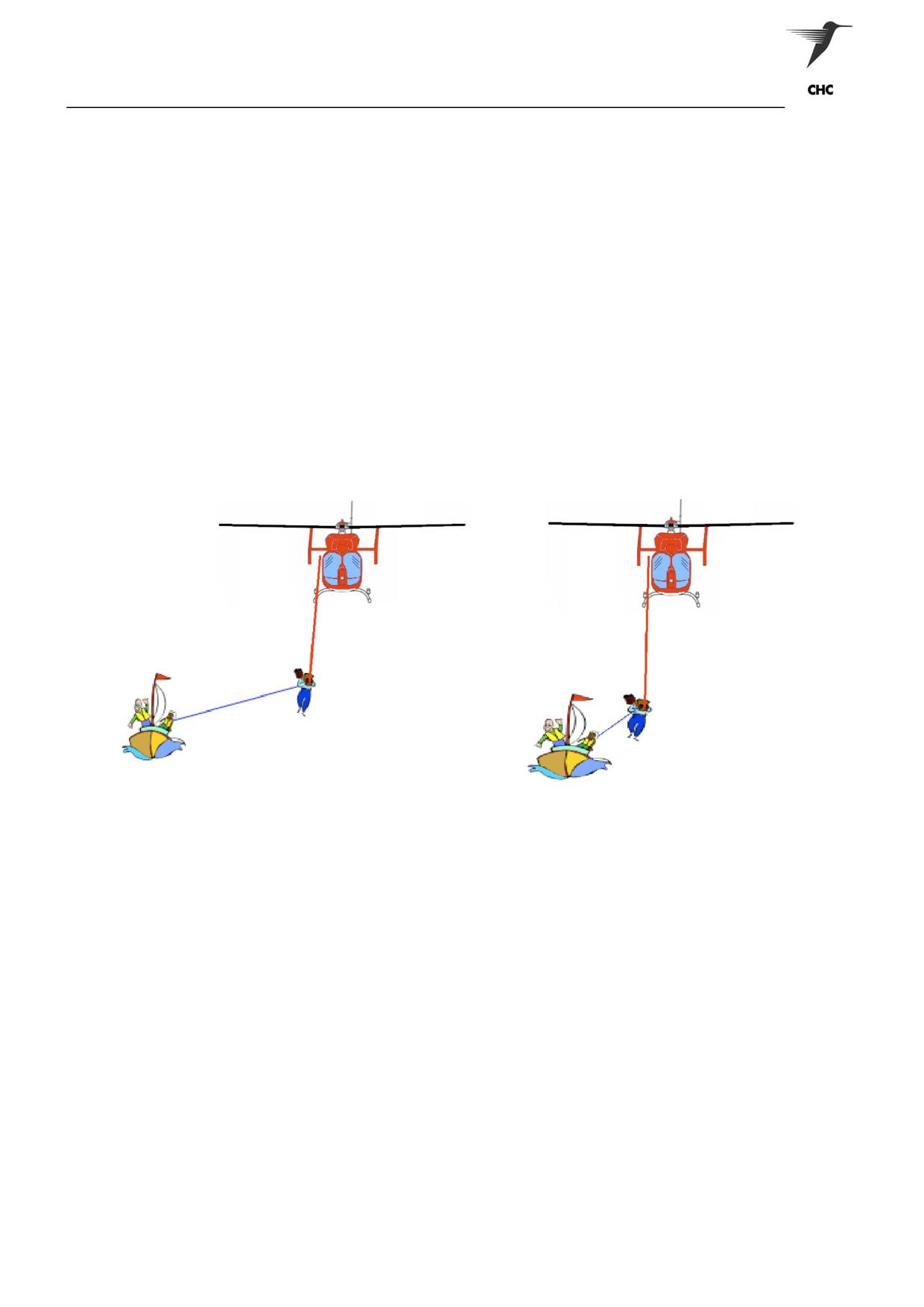
The RCM/MA is winched out from a safe height. As he is lowered , the aircraft climbs and moves toward
the vessel and positions as close to the vessel as it is safe to do so.
NOTE:
Aircraft may not reach directly overhead the transfer position
When sufficient height has been gained, gentle hauling in by the deck party shall bring the RCM/MA to the
vessel. Once on deck and free of the hook/strop a "thumbs up" sign shall be given to the helicopter. The
Winch operator then recovers the winch hook as the aircraft moves clear and descends to a position where
the FP is visual and able to maintain station with the vessel/transfer area. The Rescue Crewman shall
supervise the operation and ensure that the end of the Hi-Line is NOT secured to any part of the vessel.
The RCM is winched out from a safe height.
The aircraft climbs and moves towards the
vessel. The Deck Party gently haul the
RCM/MA to the vessel.
ASNSW EC145 Cabin Staff Training Notes
Revision 1 - July 2010
page 24 of 28
Winching Procedures - Normal
Transfer - Vessel to Helicopter
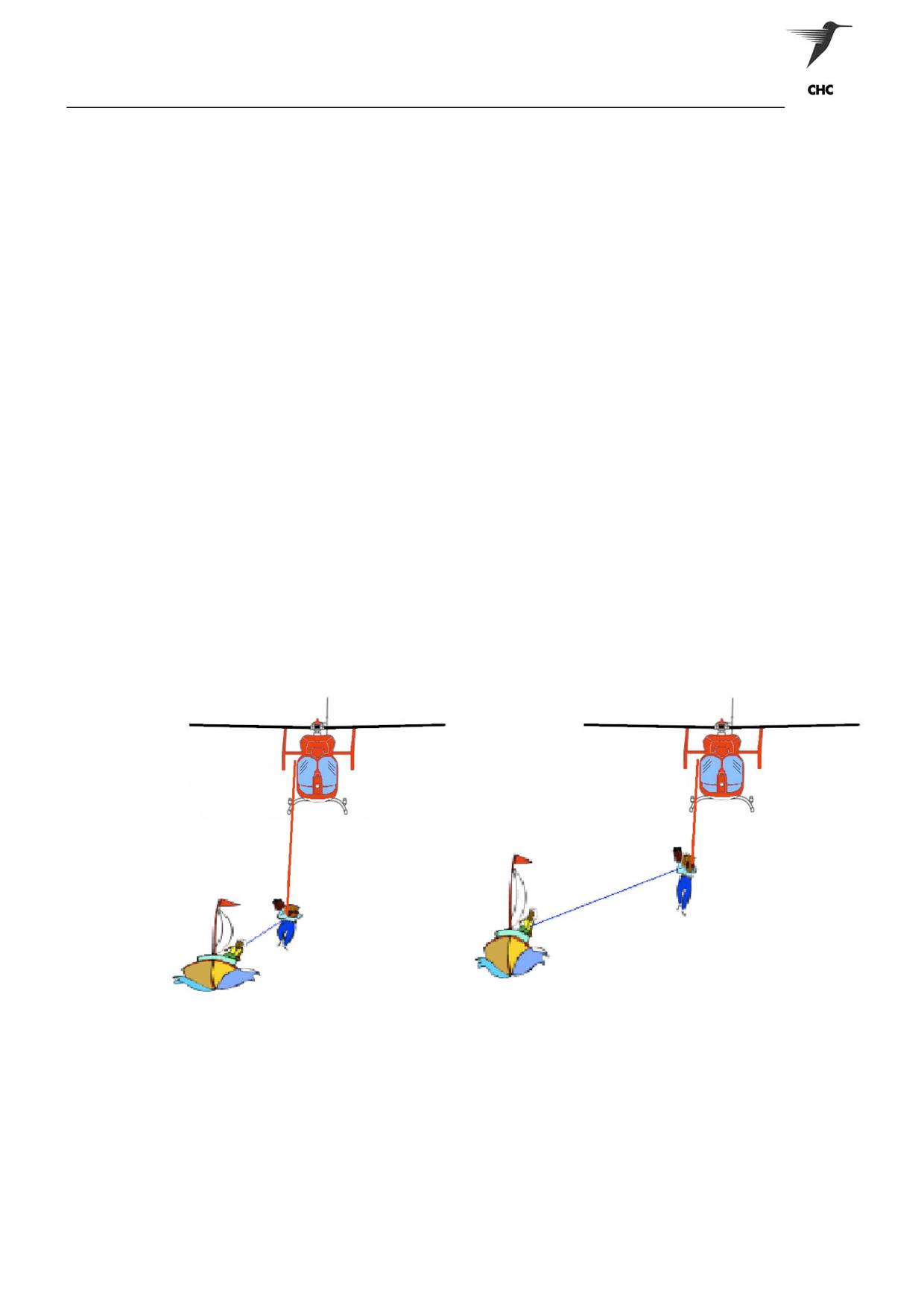
With the survivor secured in the strop and a "thumbs up" sign given. The aircraft climbs and moves toward
the vessel and positions as close as it is safe to do so.
The Winch Operator takes up the slack in the winch cable and the survivor is lifted from the vessel. The
Hi-Line is paid out by the deck party, allowing the survivor to plumb under the helicopter.
When all personnel have been recovered the Hi-Line is retrieved by the Winch operator. In certain
circumstances where the RCM is the last to be recovered he may choose to either;
a.
cut the Hi Line away as he is lifted clear of the deck,
b.
throw all of the Hi Line over the side of the vessel prior to the lift,
c.
disconnect the Hi Line from the winch hook prior to the lift, or
d.
elect to enter the water and be recovered from there.
Note: In situations where there is no Hi Line attendant a swing may develop during recovery.
The helicopter moves clear and descends whilst winching in takes place. The height and relative position
of the survivor is maintained throughout.
CAUTION:
Excessive cable angle must be avoided
The RCM/Survivor is lifted clear of the deck.
The aircraft moves clear and descends until
FP is visual.
ASNSW EC145 Cabin Staff Training Notes
Revision 1 - July 2010
page 25 of 28
Winching Procedures - Normal
WINCH CIRCUIT
ANNEX A
ASNSW EC145 Cabin Staff Training Notes
Revision 1 - July 2010
page 26 of 28
Winching Procedures - Normal
CREW HAND SIGNALS
ANNEX B
Ready to be winched up. Take up the slack
(Held until clear of obstructions)
Br
th
Abort task, expedite recovery
I require to be returned to the surface / aircraft
ASNSW EC145 Cabin Staff Training Notes
Revision 1 - July 2010
page 27 of 28
Winching Procedures - Normal
Stop winching in or out
Move the helicopter in the direction
indicated
Winch out slowly until other direction given
Winch in slowly until other direction given
Person / load to be disconnected from
winch hook - Release Tag Line from stretcher
ASNSW EC145 Cabin Staff Training Notes
Revision 1 - July 2010
page 28 of 28
Winching Procedures - Emergency
WINCHING PROCEDURES - EMERGENCY
1
Introduction
2
Minor Emergency (Aircraft)
3
Major Emergency (Aircraft)
4
Winch Emergencies
Height
Fouled cable
Intercom failure
Runaway in/out
Emergency cut
Stoppage
5
Pendulum Dampening
6
Stretcher Spin
7
Static Electricity
ASNSW EC145 Cabin Staff Training Notes
Revision 1 - July 2010
page 1 of 7
Winching Procedures - Emergency
1
Introduction
Winching operations carry with them a number of hazards. The helicopter may be operating near to
maximum power in the hover, especially in difficult situations and unfavourable meteorological conditions.
The winch cable below the aircraft is a potential source of danger in that it may become snagged. In any
case, maximum efforts must be taken to minimise the danger to aircraft/crew.
In an emergency it may be necessary to shed the load from below the helicopter by cutting the winch
cable. Cable cutting devices are fitted which allow the flight crew to sever the cable and jettison the load.
Good airmanship and decision-making are paramount in an emergency situation given that there may be
little time to react in the event of a major malfunction. Prior to the operation the Flying Pilot is to conduct a
brief detailing his intentions in the event of minor or major aircraft emergency.
In an emergency situation, it is necessary to prioritise your actions towards:
a.
the aircraft and it’s crew
b.
the rescue crewman; and
c.
the survivor
Note:
During winch training exercises, any winch malfunction shall cause the training exercise to
be terminated immediately. Maintenance advice shall be sought prior to any further
activity.
CAUTION:
There are at present up to six (6) different aircraft types being operated by the company
and it should therefore be noted that the emergency/trouble shooting procedures as laid
down in this section are in a generic format. Individual aircraft flight manuals are to be
referred to for specific emergency procedures.
2
Minor Emergencies (Aircraft)
In the event of a minor emergency or where an engine failure occurs and the pilot can maintain a single
engine hover the Flying Pilot will advise the Winch Operator of the situation and call either “Continue” or
“Abort
(nature of emergency).
If the Flying Pilot calls “Continue” the Winch Operator is to continue the winch unless otherwise advised. If
the Flying Pilot calls “Abort” the Winch Operator is to acknowledge “Roger” and then expedite operations.
If the RCM/survivor are at the cabin door they are to be bought back into the aircraft and secured
immediately, the Winch Operator is to secure the cabin and report “Clear to rotate”.
If the RCM/survivor are below the door the Winch Operator shall respond “Steady” and inform the Pilot of
their position and his intentions, ie. to winch the load in or winch load out. Once the RCM/survivor are in
the aircraft and secure or the winch hook is empty and under his control the Winch Operator shall report
“Clear to rotate”.
ASNSW EC145 Cabin Staff Training Notes
Revision 1 - July 2010
page 2 of 7
Winching Procedures - Emergency
3
Major Emergencies (Aircraft)
If the Flying Pilot cannot maintain a hover and a forced landing or ditching is imminent he is to call “Brace,
Brace, Brace”.
If the RCM/survivor are at the cabin door or if in the opinion of the Winch Operator are in a retrievable
position he is to continue and secure them and himself.
If the RCM/survivor are considered to be in such a position that their safe recovery is unlikely the Winch
Operator is to call “Cut, Cut, Cut”. Both the Pilot and the Winch Operator are to activate their cable cutters.
If the Flying Pilot is to attempt an immediate fly away he is to call “Flying away”. The Winch Operator will
acknowledge “Roger” and his actions are as per a forced landing/ditching.
NOTE:
Where possible the Winch Operator is to call “Cut, Cut, Cut” in a position where the
likelihood of injury to the RCM/survivor is reduced.
Upon recognising an emergency situation the rescue crewman is to release himself by means of the
Capewell release immediately after contacting the surface or is in close proximity to it. The survivor, if
attached is to be released at the same point by the rescue crewman.
4
Winch Emergencies
Height (Low)
If the aircraft is climbing or descending without command, the Winch Operator shall call "CHECK HEIGHT".
The FP shall respond “Roger” and then call the height to the winch operator and maintain that height until
another change is commanded.
If the aircraft gets dangerously low, the Winch Operator is to call "CLIMB, CLIMB, CLIMB". The FP is to
climb immediately to a safe height as directed by the winch operator.
Fouled Cable
Initial Actions:
1.
Inform the pilot of the problem
2.
Ensure the aircraft is in a safe position
If the winch hook or cable becomes entangled during winching operations, the Winch Operator shall
ensure that sufficient cable is winched out to prevent placing the winch cable under tension.
WARNING:
THE WINCH OPERATOR IS NOT UNDER ANY CIRCUMSTANCES TO ATTEMPT TO
UNTANGLE THE CABLE BY USING THE RESCUE WINCH TO DRAG OR PULL THE
CABLE CLEAR OF THE OBSTRUCTION.
The Winch Operator shall attempt to clear the entanglement by hand.
In the event the entanglement cannot be cleared, the Winch Operator shall sever the winch cable using the
manual hand cutters.
NOTE:
If a quick splice is carried and the cable has been cut using the manual wire cutters, the
quick splice may be considered as a means for recovering the rescue crewman/survivor. It
is to be used for emergency recovery only and not for extended winching operations.
If the entanglement causes the pilot to loose control of the helicopter, the Winch Operator shall call "CUT,
CUT, CUT" and the pilot and Winch Operator shall immediately operate the cable cut mechanism.
ASNSW EC145 Cabin Staff Training Notes
Revision 1 - July 2010
page 3 of 7
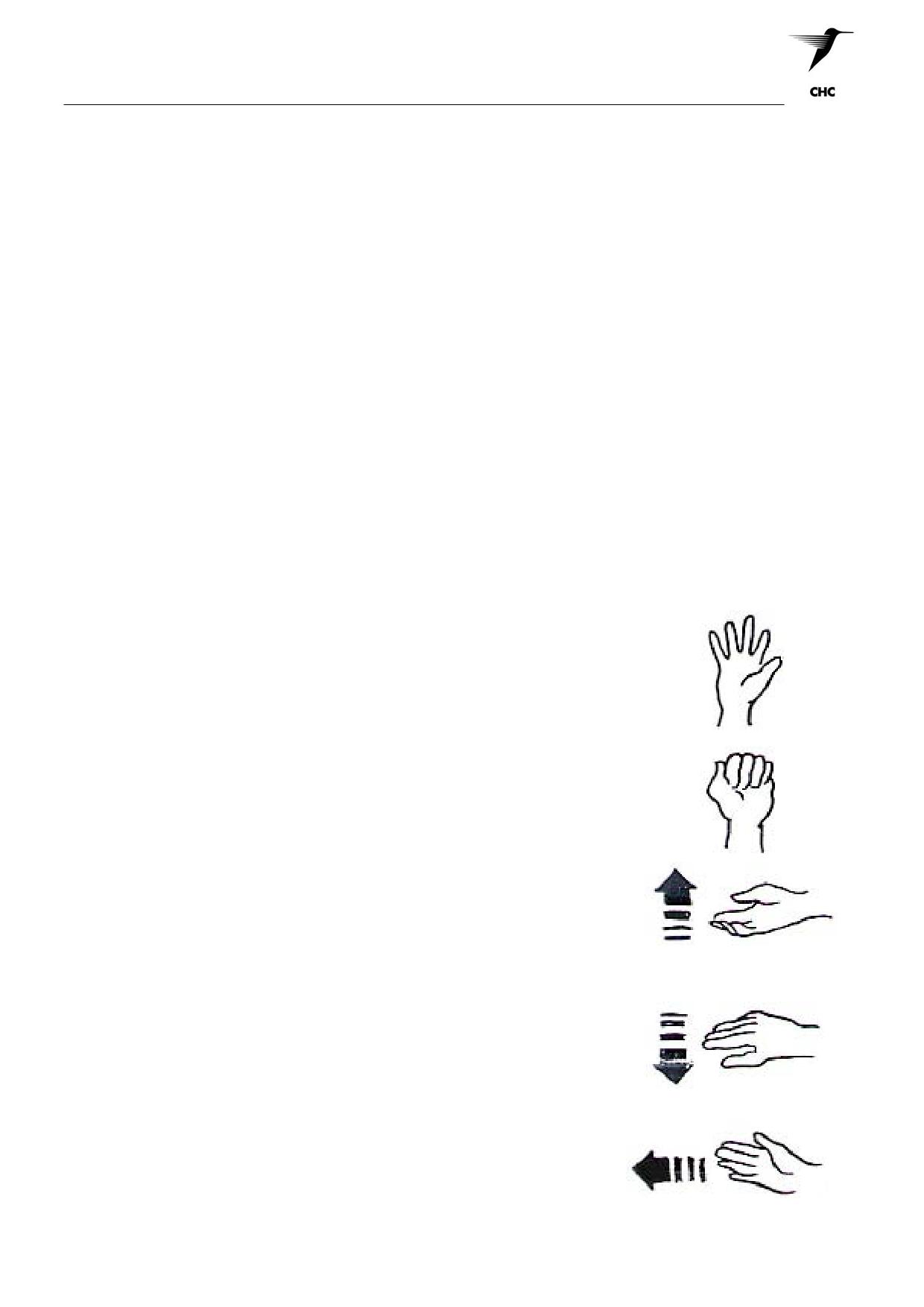
Winching Procedures - Emergency
Intercom Failure
1.
Inform the pilot by either shouting ‘INTERCOM FAILURE” or physically touching the pilot’s
shoulder. If the intercom failure occurs on the run in, the pilot is to overshoot and re-establish in
the circuit. If the intercom failure occurs in the hover, the pilot is to maintain the aircraft’s position
until further directions are passed from the winch operator.
2.
Ensure that the aircraft/rescue crewman and survivor are in a safe position prior to trouble
shooting.
NOTE:
Upon notification from the winch operator that an intercom failure has occurred the pilot is
to acknowledge that fact by either a “thumbs up” signal or by nodding his head.
Initial actions: The winch operator is to check for any obvious problems ie ICS lead disconnection or hot
mike malfunction. If further trouble shooting is required then the operator is to complete
the winch cycle, secure the rear cabin and give the clear to rotate signal. Once in safe
forward flight further fault diagnosis can be carried out.
NOTE:
During Single Pilot operations the use of Hand Signals may not be possible/effective
therefore the winch operator will need to pass all information by Shouted Commands.
Recommended Hand Signals
Quick or slow movements of the hand indicate the intensity of the required helicopter
displacement.
STANDBY for STEADY
KEEP POSITION
Fist Steady
UPWARD
Palm moving upwards
DOWNWARD
Palm moving downward
FORWARD
Hand moving in
flight direction
ASNSW EC145 Cabin Staff Training Notes
Revision 1 - July 2010
page 4 of 7
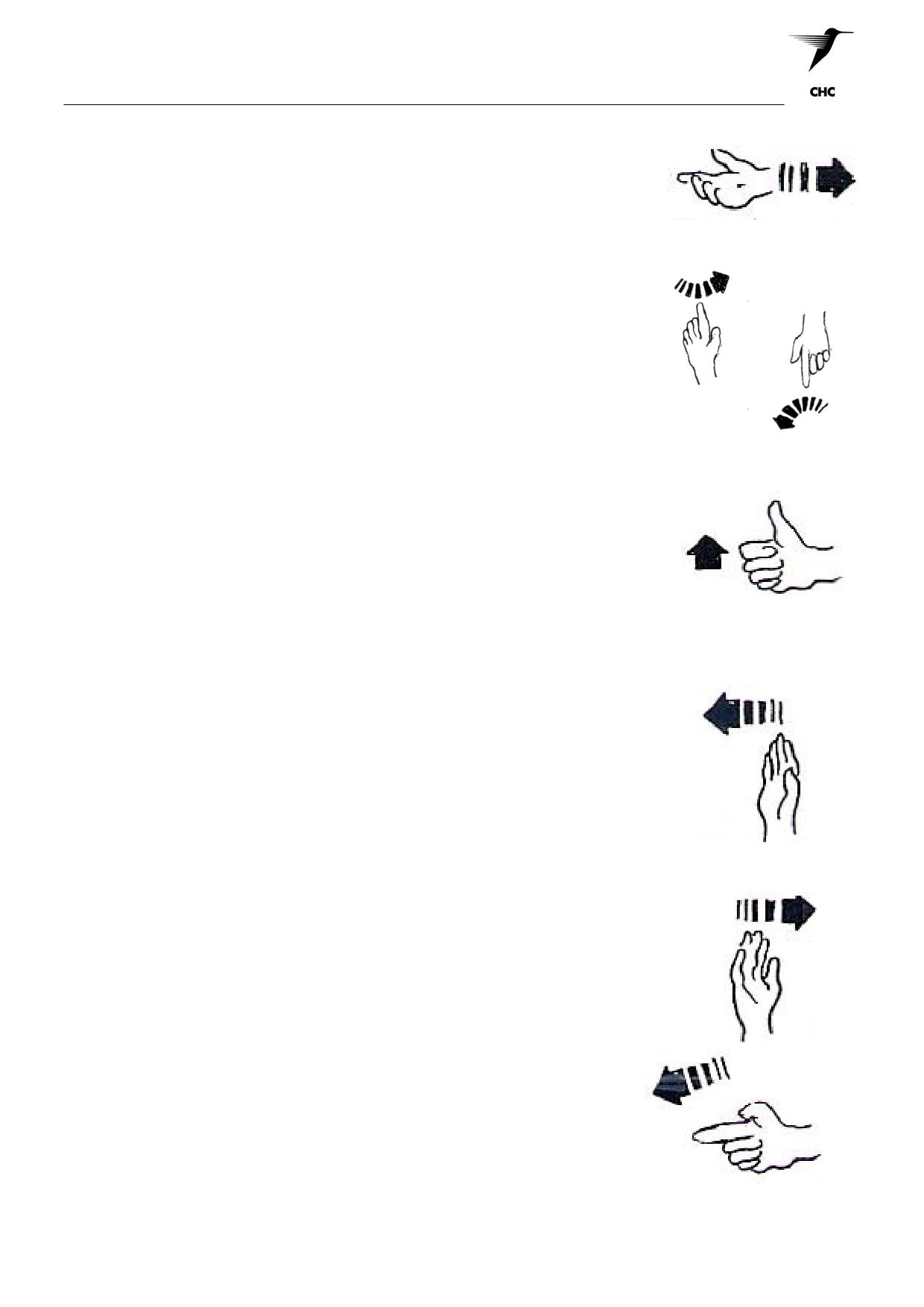
Winching Procedures - Emergency
REARWARD
Palm moving rearward
WINCH IN/OUT
Index finger pointing up or down
and describing continuously arcs until
The “STEADY” signal is given.
LIFT LOAD POWER CHECK
Thumb upward
Note: The NFP is to give the thumbs up
to the winch operator when clear to winch.
LEFT
Palm moving to the left
RIGHT
Palm moving to the right
CLEAR TO ROTATE
Chopping motion of the arm with the
index finger pointing ahead.
ASNSW EC145 Cabin Staff Training Notes
Revision 1 - July 2010
page 5 of 7
Winching Procedures - Emergency
Runaway Out/In
Definition:
An uncommanded running out or in of the cable.
Initial Actions:
1.
Call
"ISOLATE! ISOLATE! ISOLATE!"
"RUNAWAY IN/OUT"
Two pilot ops: NFP selects hoist power OFF
Single pilot ops: FP selects hoist power OFF
NOTE:
On aircraft types where hoist power can be isolated from the rear cabin, the winch operator
is to select hoist power OFF also.
WARNING:
ON THOSE AIRCRAFT TYPES WHERE THE HOIST POWER SWITCH IS IN CLOSE
PROXIMITY TO THE CABLE CUT SWITCH, THE WINCH OPERATOR IS TO ENSURE
THAT HE HAS POSITIVELY IDENTIFIED THE CORRECT SWITCH BEFORE
CARRYING OUT ANY SWITCHING ACTION.
2.
Ensure the aircraft/rescue crewman and survivor is in a safe position prior to
troubleshooting.
Emergency Cut
Please Refer to the Major Emergencies (Aircraft) in this Section
Stoppage
Initial Actions:
1.
Inform the Pilot of the malfunction
2.
Ensure the aircraft/rescue crewman and survivor are in a safe position prior to
troubleshooting.
Possible causes:
Power failure
Mechanical failure
Pendant failure
Cable drum malfunction
Possible Continuing/Recovering Actions
The aircraft captain may:
i.
continue with wire as Static lift;
ii.
fly to open/suitable recovery area and land;
iii.
fly to safe area, detach rescue crewman/survivor;
iv.
recover cable by hand; and
v.
place rescue crewman with survivor. If impossible to recover cable, detach the
rescue crewman and recover the cable by hand.
Whatever you decide to do, make sure that all crew members are consulted and there is a total
understanding of what actions have been and shall be taken.
WARNING:
EXTENDED FLIGHT WITH PERSONNEL ON THE WINCH HOOK SHOULD BE
AVOIDED DUE TO THE DANGER OF HYPOTHERMIA, DUE TO THE WIND CHILL
FACTOR.
WARNING:
EXTENDED FLIGHT (>30 MINS) WITH PERSONNEL ON THE WINCH HOOK SHOULD
BE AVOIDED DUE TO THE HAZARDS ASSOCIATED WITH ORTHOSTATIC
INTOLERANCE (SUSPENSION TRAUMA).
SUSPENSION TRAUMA IS CAUSED BY AN ACCUMMULATION OF BLOOD IN THE
LEGS WHICH IN AFFECT, REDUCES THE AMOUNT OF BLOOD CIRCULATION
THROUGH THE BODY AND TO THE VITAL ORGANS.
ASNSW EC145 Cabin Staff Training Notes
Revision 1 - July 2010
page 6 of 7
Winching Procedures - Emergency
5
Pendulum Damping
If the winch load develops a pendulum or swing, the Winch Operator is to attempt to dampen the swing by;
a.
stop winching in/out;
b.
push or pull against the direction of the swing, keeping the pilot advised of the actions
c
if only a small swing is involved winching in may continue with caution.
CAUTION:
Any swing left unchecked may result in the survivor/winch crewman suffering injury on
impact with the aircraft and/or the ground.
6
Stretcher Spin
If during recovery to the aircraft the stretcher develops a spin the winch operator is to immediately inform
the FP of the situation and attempt to regain control by one of the following methods:
• Allow adequate time for the TLA to regain control with the tag line;
• Winch out to a point where the stretcher is clear of the rotor downwash;
• If the stretcher is in close proximity to the surface, carefully place it back to the pick up point;
• If the stretcher is in close proximity to the aircraft then continue to winch in until under control at the
skid/step. In this situation it is advisable to continue winching ‘IN’ throughout and not to conduct a
‘Control Check’ as this will delay the recovery;
• If in mid winch, then it may be necessary to either, carefully position the stretcher close to an object
e.g. a tree so that the RCM can regain control or, release the tag line and begin a VERY SLOW
transition to forward flight until the spin stops.
WARNING:
ONCE THE TAG LINE HAS BEEN RELEASED THE AIRCRAFT SPEED IS TO BE KEPT
TO AN ABSOLUTE MINIMUM. A SUITABLE SET DOWN POINT IS TO BE IDENTIFIED
AND THE STRETCHER PLACED CARFULLY BACK ONTO THE SURFACE NOTING
THAT SOME RESIDUAL SPIN MAY REMAIN.
7
Static Electricity
The build up of aircraft static electricity during rescue winch operations is a potential hazard to those
personnel who are suspended on the winch cable and to personnel who may come into contact with the
winch cable, hook or load prior to any static electricity being adequately discharged.
As standard procedure, personnel involved in rescue winch operations are, where practical, to ensure that
the winch hook is adequately earthed prior to coming into contact with it. This can be achieved by allowing
the winch hook to come into contact with the surface before attempting to take control of it, or where
practical, by utilising an earthing pole.
Caution:
Operations within close proximity to thunder storms and operations in a dry and dusty
environment are conducive to aircraft static electricity build up.
ASNSW EC145 Cabin Staff Training Notes
Revision 1 - July 2010
page 7 of 7
Night Winching Operations
Night Winching Operations
1
General
2
Over Water Operations
ASNSW EC145 Cabin Staff Training Notes
Revision 1 - July 2010
page 1 of 2
Night Winching Operations
1
General
A crew shall not engage in winching operations at night unless the helicopter is equipped with the following
items:
i.
Two white lights, controllable by the winch operator, shining downwards and of sufficient intensity
to clearly illuminate the winch cable and the area directly below the helicopter.
NOTE:
A single light having two separate energized filaments or a suitable hand-held torch may
be approved as meeting the requirements for a second light
ii.
Two white lights controlled by the pilot in azimuth and elevation without removing his hands from
the flying controls.
NOTE:
A single white light having two separately energized filaments may be approved as
meeting this requirement provided that the selection of the alternative filament can be
accomplished by the pilot without removing his hands from the flying controls.
iii.
A torch shall be available to the winch operator at the winching station
iv.
A cyalume stick is to be attached to the rescue winch hook.
v.
The rescue crewman shall carry a torch and a strobe light.
2
Over Water Operations
Winching overwater at night may be conducted provided that sufficient illumination - either celestially or
artificially - is available to provide not only attitude but altitude reference as well.
Section 4a.9.1 (CHC Operations Manual) provides additional relevant information, and crews must be
aware of not only the amount of preparation that is required before such a task, but also how they would
respond should conditions change.
For example, what might initially appear as a straight-forward exercise whilst hovering into wind and facing
a low back-lit cliff can suddenly become unviable with only a slight heading change.
Clearly, it is not possible to provide a complete - or comprehensive - series of scenarios to govern when
night winching tasks over water may be carried out. Sound judgement is required, and when any doubt
exists as to whether or not adequate illumination will be available for both attitude, and altitude reference,
the task is to be abandoned.
ASNSW EC145 Cabin Staff Training Notes
Revision 1 - July 2010
page 2 of 2
Confined Area Operations
CONFINED AREA OPERATIONS
1
Introduction
2
Single and Double Angle Approaches
3
Aircraft Clearances
4
Communications
5
Key Words
ASNSW EC145 Cabin Staff Training Notes
Revision 1 - July 2010
page 1 of 7
Confined Area Operations
1
INTRODUCTION
Confined areas are defined as these areas where obstructions are known to or are suspected of existing
within close proximity to the aircraft and or persons or equipment suspended from it e.g. buildings, boats,
larger vessels and timbered areas.
The means by which the successful termination of flight within a confined area is achieved is dependant on
a number of factors, e.g. aircraft power available, aircraft weight, ambient conditions and the experience
and compliment of the crew
Confined area operations should not be conducted when there exists any doubt that the aircraft can be
safely accommodated in the area available
Under no circumstances is it acceptable for crews to continue into areas where an expected contact
between rotors and foliage is used as a ‘stop point’.
Prior to committing to an approaching/landing in a confined area, a reconnaissance circuit should be
conducted where points such as those listed below are discussed by the crew as part of the plan in
determining whether or not to continue and how the approach will be executed:
a
Power available
b
Size, Shape, Slope and Surrounds
c
Wind direction and velocity
d
Approach and overshoot paths
e
Terrain Turbulence and Touchdown point
Once the decision is made to conduct an approach a circuit is flown with the CON is given to the crewman
on the finals. Standard aircraft Patter and CON is used as laid down in Section 4a, Part 8, and when
utilising the client RCM for clearance assistance a “Check Left/Right” call is made by the crewman. If clear,
the response from the client RCM is to be “Clear Left/Right” or if not clear then the obstruction is to be
reported using the clock code and distance from the main /tail rotor.
2
SINGLE AND DOUBLE ANGLE APPROACHES
Based on the PSWAT checks, the approach to the hover or landing within a confined area is accomplished
by either a single or double angle approach.
Single angle approaches are executed into smaller / tighter areas where the flying pilot is able to establish
a constant glide slope to the approach/landing point remaining clear of all obstructions.
Double angle approaches are executed into smaller/tighter areas where a constant glide slope cannot be
maintained. This approach requires the flying pilot to terminate in a high hover above the touch down point
and then descend vertically into the area manoeuvring as necessary to avoid obstructions.
3
AIRCRAFT CLEARANCES
When entering into and manoeuvring within a confined area, accurate clearance information on the main
and tail rotors is paramount. The flying pilot is to be notified as to when the tail rotor is clear on the final
approach and when it is clear to descend into the area.
Once within the area the crewman with the assistance of the client RCM is to positively clear a sector
before giving the command to move, e.g. “You are clear back, move back xxx”. Also the touchdown point is
to be checked for obstructions prior to the aircraft being cleared to the ground.
On departure from a confined area the flying pilot may elect to have the crewman positively CON the
aircraft up and clear or, if it is clear all round he may choose to climb the aircraft vertically and rotate when
clear with the crewman monitoring main and tail rotor clearances throughout the departure.
Note 1:
If during EMS operations it is deemed necessary to conduct a confined area
approach/landing then the crewman is to relocate to the rear cabin to provide aircraft
clearances in conjunction with the client RCM. The decision to relocate to the rear cabin
should be made as early as possible to allow for cabin preparation and where possible
prior to departure to alleviate relocating in flight.
ASNSW EC145 Cabin Staff Training Notes
Revision 1 - July 2010
page 2 of 7
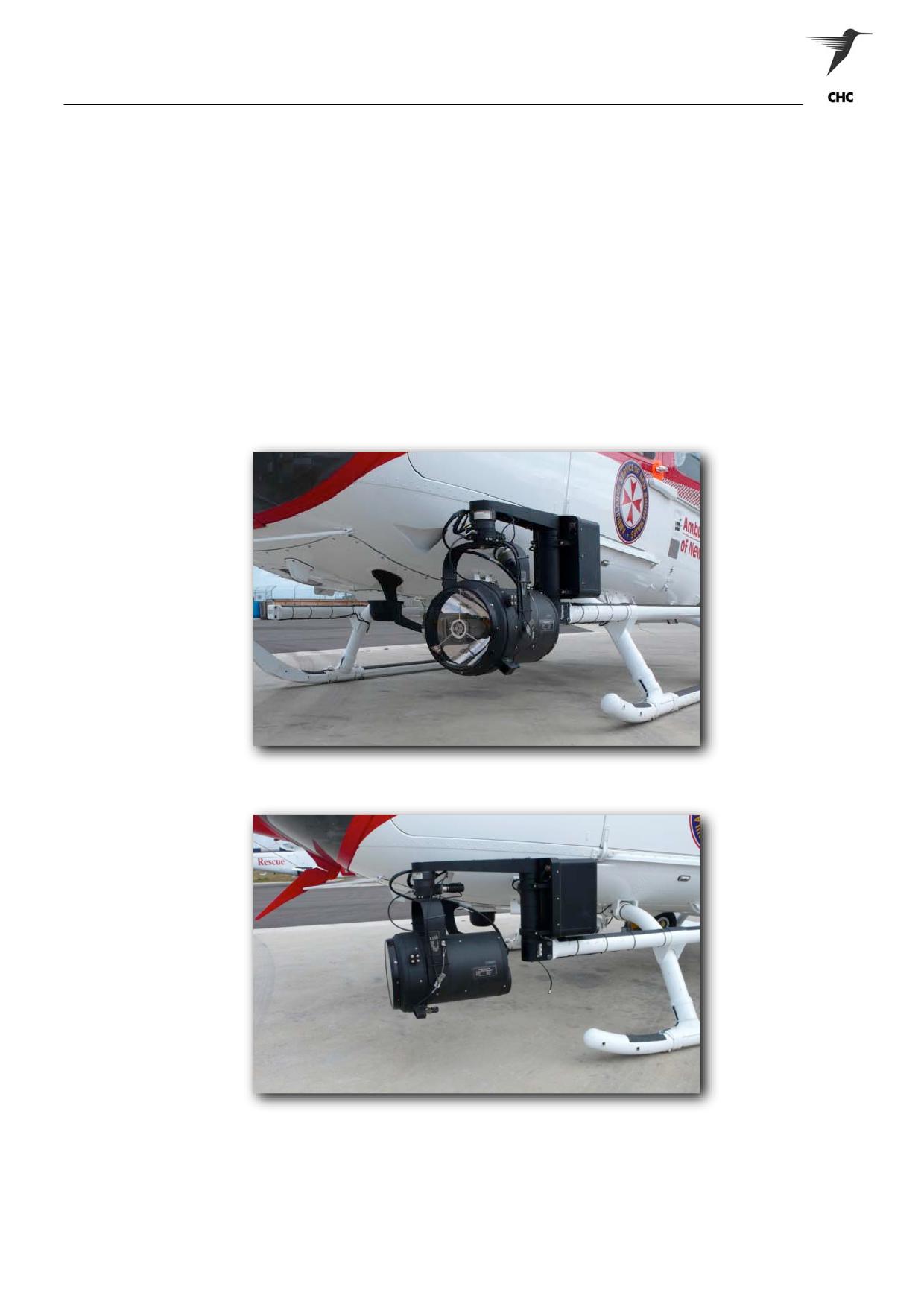
Confined Area Operations
Note 2:
At our EMS bases a number of non-company personnel are trained in the role of the
Rescue Crewman (RCM) and as part of this training they are introduced to the procedures
and techniques required for the safe conduct of CAs.
While the professionalism and enthusiasm for their role of client RCM cannot be
questioned, company aircrew are reminded that utility operations such as CA’s are not the
RCM’s core business and therefore their input is to be taken as advisory only.
When conducting CAs to sites where the existence of obstructions may require the aircraft
to be manoeuvred within the area by the Aircrewman, in conjunction with the pilot, is to
clear all sectors and continually do so throughout the operation.
WARNING:
IF AT ANY TIME A CREWMEMBER CONSIDERS THAT THE AIRCRAFT IS GETTING
DANGEROUSLY CLOSE TO AN OBSTRUCTION HE IS TO CALL “STEADY”. THE
OBSTRUCTION / CONFLICTION IS THEN TO BE REPORTED (POSITION &
PROXIMITY) TO THE PILOT.
Caution:
The NiteSun is the closest obstruction to the ground at only 7.5 inches clear.
ASNSW EC145 Cabin Staff Training Notes
Revision 1 - July 2010
page 3 of 7
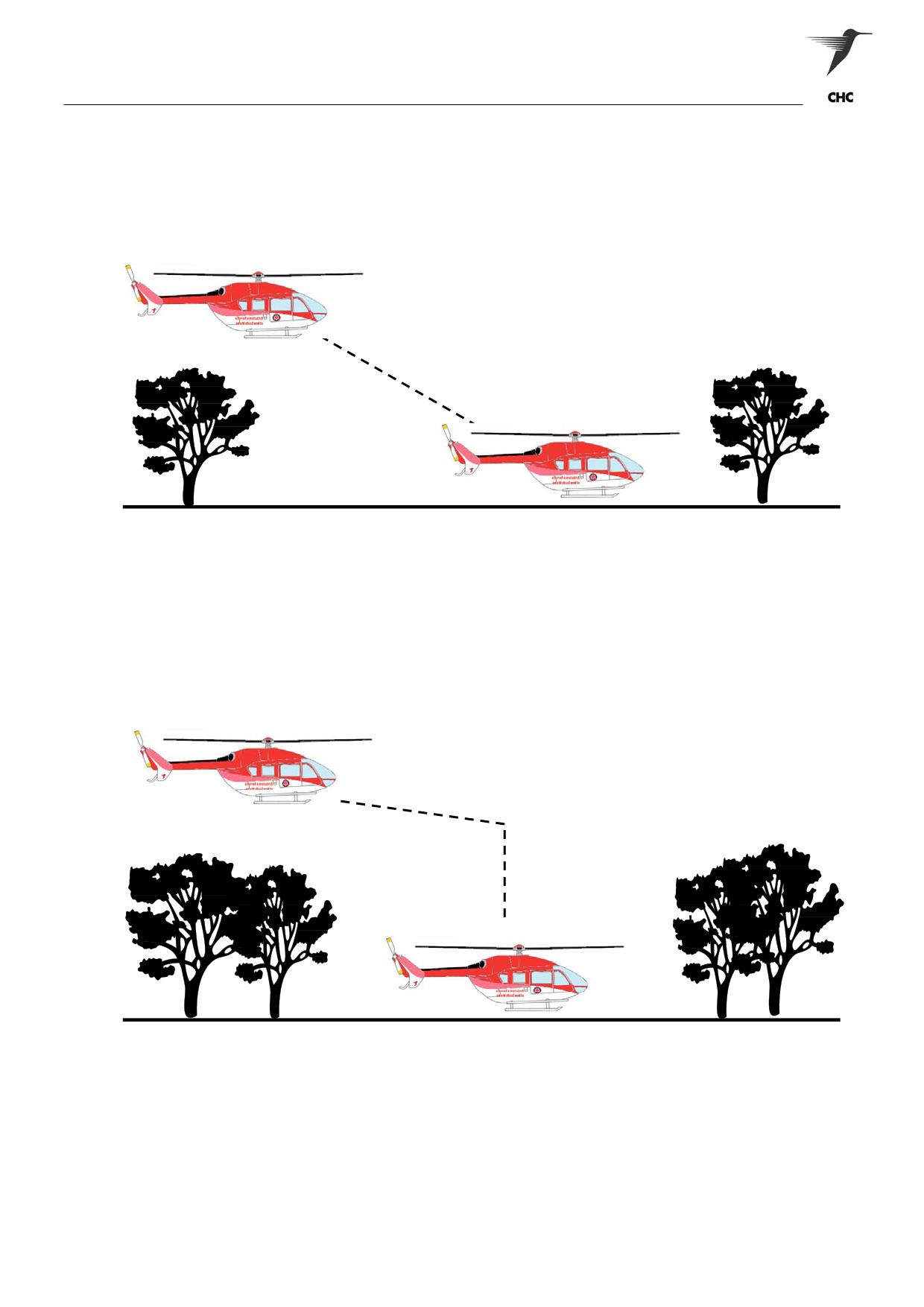
Confined Area Operations
Figure 18-1 Single Angle Approach
Figure 18-2 Double Angle Approach
ASNSW EC145 Cabin Staff Training Notes
Revision 1 - July 2010
page 4 of 7
Confined Area Operations
4
COMMUNICATIONS
Winching operations require a high degree of co-operation and mutual trust between all crew members
involved.
The rescue crewman relies upon both the winch operator and the pilot for his safe recovery.
The winch operator relies upon the flying pilot to correctly and accurately position and maintain the
helicopter above the target.
The Flying Pilot relies upon both the winch operator and the crewman for positioning directions and the
conduct of the operation.
To facilitate co-operation, an accurate and steady communication between all three crew members on the
operation must
Communications with the RCM when external to the aircraft is an important element of the overall winching
operation. With this in mind the RCM is to have two-way radio communications with the aircraft (where
practical) during all winching operations both land and water.
Communications shall be carried out via the aircraft's intercommunication system. Because of the
inherently noisy environment involved with the winch operation, all unnecessary audio sources should be
eliminated and communications confined to concise, accurate, unambiguous and clear messages.
On approach to the target, the pilot may lose visual contact with the target due to shielding by the aircraft
fuselage. It then becomes the duty of the winch operator to direct the pilot onto the target. Simple, but
clear directions to effect accurate positioning are to be transmitted continually to the pilot.
The following is a list of key words to be used during the winching operations. These words are mandatory
and contain precise and unambiguous meanings. Amplifying comments are to be avoided or kept to a bare
minimum when necessary. Whilst a constantly flowing patter of information is required to enable the Flying
Pilot to position the helicopter accurately, there is no place for verbosity or ambiguity.
5
KEY WORDS (patter)
The following is a list of key words to be used during the utility operations. These words are mandatory
and contain precise and unambiguous meanings. Amplifying comments are to be avoided or kept to a bare
minimum when necessary. Whilst a constantly flowing patter of information is required to enable the flying
pilot to position the helicopter accurately, there is not place for verbosity or ambiguity. Where the list of
mandatory words does not satisfy a given incident, be brief.
Emergency Commands
Climb, Climb, Climb
This command is given, usually by the winch operator, if:
i.
the helicopter gets too low and is likely to strike an obstruction; or
ii.
when the rapid lifting of the winch load is required, e.g. a shark in immediate vicinity of crewman or
survivor, etc. action to be taken concurrently with a winch in at full speed.
ASNSW EC145 Cabin Staff Training Notes
Revision 1 - July 2010
page 5 of 7
Confined Area Operations
Executive Commands
Units - Run In
Throughout the final approach of a Confined Area operation, all lateral and longitudinal distance directions
are passed to the Flying Pilot by the Winch Operator in "units". The unit is not a specific measurement, but
rather a gauge of distance to allow the Pilot to more accurately judge the relative rate of closure and
subsequent control movements required to position the aircraft on top of the target.
Units - Hover
Once established in the hover all aircraft lateral, height and obstacle clearance information is to be given in
‘feet’.
Aircraft Control
COMMAND
MEANING
“ROGER”
I understand what has been said.
Request from Winch Operator for permission to open rear
“CLEAR DOORS”
doors.
“CLEAR TO OPEN”
Permission from Pilot for Winch Operator to open rear doors.
Height Corrections
The following commands are used to correct aircraft height:
COMMAND
MEANING
“GO UP X”
Climb x feet
“GO DOWN X”
Descend x feet
“HEIGHT GOOD”
The height is correct
Precautionary call that correction may be required.
“CHECK HEIGHT”
(The Pilot will call the height to the Winch Operator).
ASNSW EC145 Cabin Staff Training Notes
Revision 1 - July 2010
page 6 of 7
Confined Area Operations
Hover Corrections
The following commands are used to maintain the correct position:
COMMAND
MEANING
"MOVE FORWARD X"
Move the helicopter in the required direction. Rate of closure
should be given continuously. These commands are to be
combined if necessary, using the technique of furthest distance
"MOVE BACK X"
to move becoming the primary movement and smallest distance
being the secondary followed by the required number of units.
"MOVE RIGHT X"
To move to a target in the one o'clock, the instruction is "MOVE
FORWARD AND RIGHT 3", or if the target is in the 8 o'clock
"MOVE LEFT X"
position, the instruction would be "MOVE LEFT AND BACK 5".
If a line correction was required as part of a correction the
"GO UP X"
instructions would follow:
"MOVE LEFT AND BACK 5", "MOVE LEFT AND BACK 4".
"GO DOWN X"
"MOVE LEFT ONLY 3", "LEFT ONLY 2...STANDBY...STEADY".
"STANDBY"
Used as a warning prefix to "STEADY".
"STEADY"
The helicopter is to be established and maintained in the hover.
NOTE:
During Confined area operations positive clearances must be given before giving hover
corrections, especially to the left or back. For example, "YOU ARE CLEAR BEHIND,
MOVE BACK 5".
e.
Lost Visual Contact Report
COMMAND
MEANING
The Winch Operator/pilot has lost sight of the target or
survivor. The call “LOST VISUAL CONTACT” is followed by
“LOST VISUAL CONTACT X
an estimate of the target/survivor’s last known position, using
O’CLOCK”
clock code and distance, e.g. “ESTIMATE 2 O’CLOCK 500"
(distance in units).
“TARGET/SURVIVOR
The target/survivor is now sighted again; the call is in clock
VISUAL X O’CLOCK, X
code and distance in units.
DISTANCE”
ASNSW EC145 Cabin Staff Training Notes
Revision 1 - July 2010
page 7 of 7
Hover Exit / Entry Procedures
HOVER EXIT / ENTRY PROCEDURES
1
General
2
Hover Exit/Entry Crew Safety
3
Crew Qualifications
4
Carriage of Persons
5
Equipment Requirements
6
Procedure
7
Conduct of Operations
8
Emergencies
ASNSW EC145 Cabin Staff Training Notes
Revision 1 - July 2010
page 1 of 5
Hover Exit / Entry Procedures
1
General
Hover exit/entry is used to deploy/recover personnel and equipment to/from remote areas where landing is
not possible, but a low hover sufficient for personnel to deplane/embark safely can be conducted.
The crew consists of a pilot, Aircrewman, and hover exit/entry crew (medical party). The medical party must
be trained in hover exit/entry skills prior to these type operations.
2
Hover Exit/Entry Crew Safety
Prior to operations, the pilot in command shall make an assessment of;
a.
the hover site and determine that the medical party will not encounter dangerous terrain or
obstacles that may cause them injury during exit/entry or whilst moving in and around the helicopter.
b.
the local ambient conditions ensuring that a steady hover can be maintained during the hover
exit/entry.
c.
the danger to the medical party being exposed to external factors while on the ground. If the pilot
considers the risk unacceptable then an alternate site or cancellation of the hover exit is to be made.
In all cases a safe exit/entry point, escape route and rendezvous time and position must be planned with
the medical party. Communication procedures also need to be established.
3
Crew Qualifications
Only pilots and qualified Aircrewmen that have satisfactorily completed hover exit training may conduct
hover exit/entry procedures.
4
Carriage of Persons
For hover exit/entry operations only the following persons shall be carried on the helicopter
a
A flight crew member
b
A flight crew member under training
c
A person who performs an essential function in connection with the hover exit/entry operation
d
A hover exit/entry crew member
5
Equipment Requirements
The helicopter in the normal EMS configuration is suitable for hover exit/entry operations.
Personnel engaged in the operation shall have;
a
Protective helmet including ear and eye protection
b
Protective flight suit
c
Protective gloves/boots
d
Communications - Checked prior to disembarkation.
e
Crew Life Jacket containing standard survival aids (remote scene)
The Aircrewman and hover medical party shall ensure that the cabin of the helicopter and their equipment
is checked for hover exit/entry operations.
Caution:
Equipment should not be unloaded from the tail boom baggage compartment during these
type operations.
ASNSW EC145 Cabin Staff Training Notes
Revision 1 - July 2010
page 2 of 5
Hover Exit / Entry Procedures
6
Procedure
Exit
A circuit is flown around the exit site where the pilot, Aircrewman and medical party can “recce” the site.
Once the site has been assessed as suitable the pilot briefs the crew on the actions in the event of an
engine failure, including:
a.
Intentions
b.
Forced landing area
The circuit is flown at approximately 200ft AGL in a right hand direction to allow the Aircrewman to maintain
sight of the target. The pilot shall report to the crewman;
a.
Downwind
b.
Turning Base
c.
Target Visual and,
d.
You Have the CON when he requires the Aircrewman to commence conning the aircraft.
Hover exits are limited to a height not exceeding 1.3mtrs below the skids/step.
NOTE:
This height limitation is based on an average individual. The height may need to be
adjusted to suit accordingly.
NOTE:
Where the intention of the pilot is for the medical party to deplane from the left hand door
then the Aircrewman may con the helicopter from the left hand side if appropriate.
On approach to the hover exit area the Aircrewman shall request “clear doors” indicating which door he
intends to open.
When it is clear to do so the pilot will respond “ clear to open doors”. The Aircrewman shall slide the door
fully open.
The Aircrewman will con the pilot to the hover exit position. The Aircrewman continues the patter
throughout the exit procedure in relation to the progress of each member, aircraft position and obstructions.
Once at the correct position and height, the Aircrewman shall request “clear to continue”. When the pilot is
ready he shall respond “clear to continue”. The medical party shall then exit one at a time.
The Aircrewman shall indicate to the medical party member that they are to prepare for exit by means of
pointing to the party member’s seatbelt/wander lead connection point after conducting an equipment check
and giving and receiving a “thumbs up” . Upon recognition of this signal the medical party member is to
unfasten his restraint and move to the disembarkation door with firm hand hold. The Aircrewman shall then
indicate to exit the helicopter by pointing to the ground after conducting the second equipment check and
giving and receiving the second “thumbs up”.
The exiting medical party member shall then pivot facing inboard and exit the aircraft gradually, without
jumping.
The medical party member shall lower themselves until both feet are touching the ground transferring
weight from arms to legs, maintaining a firm grasp of the aircraft step with straight arm and observing the
Aircrewman for further direction and the distribution of packs.
If the helicopter is able to hover either with one skid on the ground or at a height where the exiting member
can step to the ground from the skid while still maintaining a firm handgrip then the exiting member may do
so.
ASNSW EC145 Cabin Staff Training Notes
Revision 1 - July 2010
page 3 of 5
Hover Exit / Entry Procedures
Once on the ground the exiting members shall depart the helicopter in the 3 or 9 o’clock direction after
pointed hand direction and thumbs up from the Aircrewman and crouch down well outside of the rotor disc.
The Aircrewman shall report to the pilot “Medical Crew and Equipment Clear”, with the aircraft then able to
depart.
Should the pre - briefed conduct change and the Aircrewman require the medical party to remain in
position on the ground, he will present a steady clenched fist meaning, “remain in position”.
Entry
The procedure for a hover entry is basically the reverse of a hover exit.
The Aircrewman will con the pilot to the hover entry position. The Aircrewman continues the patter
throughout the entry procedure in relation to the progress of each member, aircraft position and
obstructions.
The medical party are to position themselves well clear of the touchdown point and in the aircraft’s 3 or 9
o’clock position depending on which side the embarkation is to occur. They are to remain in this position
until cleared by the Aircrewman to enter under the disc.
Once the aircraft is at the correct position and height, the Aircrewman shall request “clear to continue”.
When the pilot is ready he shall respond “clear to continue”. The medical party shall then enter the aircraft
one at a time.
The Aircrewman shall indicate to the medical party that they are clear to enter by means of a ‘thumbs up’
and pointing to the ground adjacent the embarkation point. Upon recognition of this signal the medical party
member is to make his way slowly to the aircraft in preparation for entry.
Once at the open doorway and on receipt of a thumbs up from the Aircrewman, the medical party member
is to ensure that he has a firm hand hold prior to transferring his weight on to the skid/step. The medical
party member is to enter the aircraft in a slow and controlled fashion making his way to a seat and then
securing himself and any equipment appropriately. The Aircrewman may assist throughout this process
where necessary.
If the helicopter is able to hover either with one skid on the ground or at a height where the entering
member can step from the ground to the skid while still maintaining a firm handgrip then the crewmember
may do so.
7
Conduct of operations
The pilot in command of a helicopter engaged in hover exit operations shall be responsible for ensuring
that:
a
An appropriately qualified Aircrewman is carried in the aircraft
b
All operating crewmembers are properly qualified to perform the duties to which they have been
assigned.
c
All personnel involved in the operation are properly briefed prior to commencement; and
d
All precautions are taken to ensure the safety of all persons in the helicopter or on the ground.
8
Emergencies
Intercom Failure
If the intercom fails during the hover exit/entry operation, the Aircrewman should communicate with the pilot
by shouting instructions or hand signals to complete the operation.
ASNSW EC145 Cabin Staff Training Notes
Revision 1 - July 2010
page 4 of 5
Hover Exit / Entry Procedures
Minor Emergency
In the event of a minor emergency the flying pilot will advise the Aircrewman of the situation by calling
either “Continue or Abort”……(nature of emergency). If the pilot calls “Continue”, the Aircrewman is to
continue the exit/entry unless otherwise advised. If the pilot calls “Abort” the Aircrewman is to acknowledge
“Roger” and then expedite operations. If the medical party are on the skids/step or unsecured in the cabin
the Aircrewman shall indicate to them (by pointing) to return to their seats. The Aircrewman is to secure the
medical party immediately and then secure the cabin and report “Clear to rotate”. If the medical party are in
the process of climbing off/onto the skids/step the Aircrewman will respond “steady” until the member is
either clear of the aircraft or secure inside, and then report “Clear to rotate”.
Major Emergency
If the pilot is unable to maintain a hover and a forced landing is imminent, he is to call “Brace, Brace,
Brace” The Aircrewman shall indicate to the medical party (pointing) to return to their seats, while shouting
“Brace, Brace, Brace”. He is to secure the medical party and himself immediately.
Upon recognising an emergency, the medical party must secure themselves inside the helicopter or
expedite their exit and make their way to a safe position.
Low Height
If the helicopter is descending without command, the Aircrewman shall call “Check Height”. The pilot shall
respond “Roger, Check Height”. If the helicopter gets dangerously low, the Aircrewman is to call “Climb,
Climb, Climb”. The pilot is to climb immediately.
ASNSW EC145 Cabin Staff Training Notes
Revision 1 - July 2010
page 5 of 5