Technology of watch production - part 80
 

  Index      Books     Technology of watch production (Tarasov) 1964 year


Search            


Content   ..  78  79  80  81   ..


Technology of watch production - part 80


with  intermediate  annealing for which purpose  the  s trip  ends  are  conn

e

cted

to  terminals ,   and  the  strip  is  heated by electric current to red incandescence .  

The  strip  surface i s  c oated with a n  ochre paste  t o  prevent oxidation. 

The  c ompleted  rolled strip  consists  of  three  rigidly bound layers:  outer 

layers  of gold 2 0 ft  and 

1

0 ft  thick,  and a  core of  0 . 3 5  to  0 . 5 mm  thicknes s .  

Stamping and other  mechanical  operations  similar t o  those used i n  producing 

gold  cases  are performed on the  strip .  Blanks are annealed after stamping 
operations  in furnaces with a  neutral  medium . 

The  gold layer  thickness  is  reduced from  its  original  2 0 ft  to  1 0 ft  on  pro­

tuberances,  acute  angles and transitions  which  result from  drawing and 
forming operations .  The  layer thickness  on these features  is  s ometimes 

as little  as  3  to 4 /t ,   which  corresponds  to 3  to 4  years  wear .  Bright points 

appear  at the  spots  where  the  gold  is thin  (the  nickel  silver shows  through), 

and,  in order to obtain a  uniform  hue,  the case is  galvanically gold-plated 

( 1 -2ft ). 

The  galvanic  layer is  rapidly worn,  however,  and hues  appear on 

the watch  case.  To avoid these problems s harp  transitions  should be  avoid­

ed in  gold-plated cases and they should have  a  streamlined  form . 

The  quantity  of  gold used in a  thermally-plated case is  only  1 0  to 

12 

o/o, 

the quantity  required for a  s olid- gold cas e .   It is ,  howe ver,  difficult to  de­

termine  the  exact amount  of gold in a case gold-plated by the thermal method. 

Wristwatch  cases  have  s ometimes  backs  made of stainless  steel .  The 
middles  of  such  watches  are  so  designed  as  to  make  the  back invisible  from 

the side.  The  amount of  gold required for a  watch of this type is  only  0 . 4  g. 

A  variation of the  thermal-plating process  involves  the separate  blanking 

of nickel- silver and  gold  parts  which are  then  soldered with tin  or  bound 

together by means  of a  special compound,  after 

which they are subjected to the subsequent ope rations . 

This  method  has  the  advantage  that  the  gold  sc rap 

is  s eparate from  the  nickel - silver  scrap  and  s o  can 

be  salvaged.  The  scrap  from  the  bim etallic  strips 
has  to be  subjected to  etching to  remove  the  nickel 

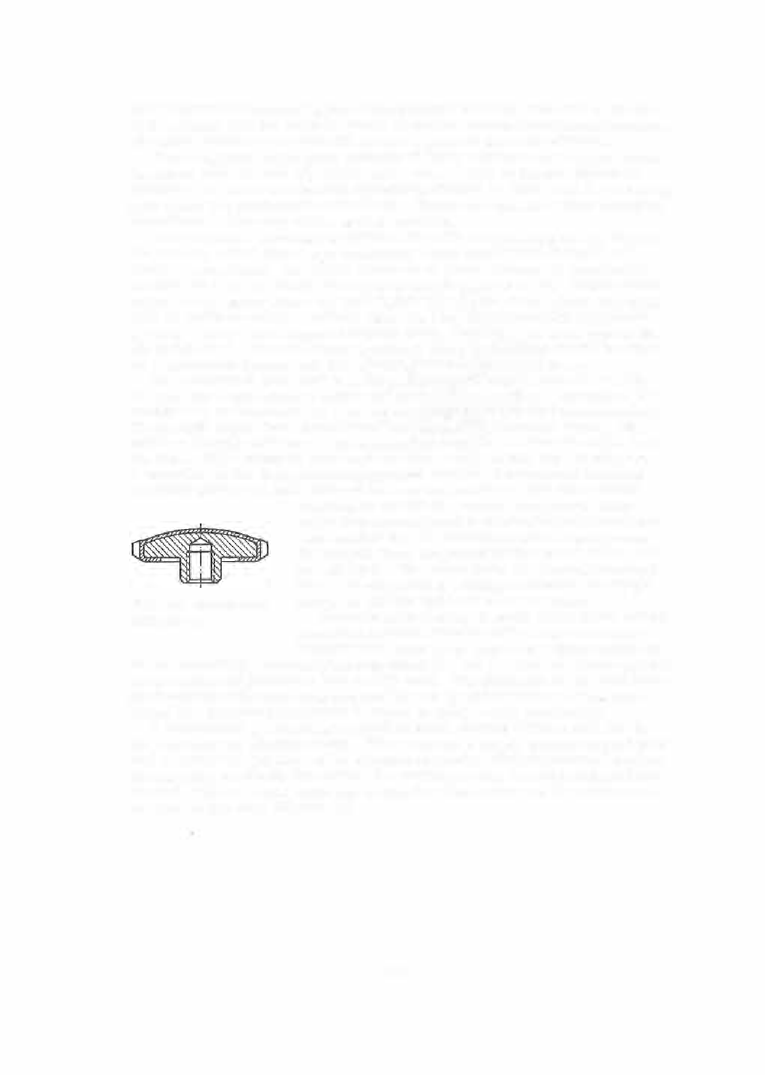
FIGUR£ 47.  Winding crown 

silver  so  that the  gold  can  be  recuperated. 

with gold envelope 

Galvanic  gold- plating  of  watch  cases  is not widely 

p racticed because galvanic baths  only work satis ­

factorily  with pure  gold ,   and  a  pure- gold  coating is 

of low durability.  Electrolytes  containing  1 4 - and  1 8 - carat gold  are  unstable 

in operation and p roduce  a  low-quality coat.  The  thickness  of  the  gold  layer 

produced by such baths  does  not  excee d  5  to  7 ll and  repeated plating  oper­

ations are the refore  necessary  in order to obtain a  2 0 ft  thick layer .  

A  mechanical  gold-plating method involves  clos ely fitting a  gold foil  to 

the  case and the  winding c rown.  This  requires  a  larger amount  of gold than 

that  required by the  thermal  or  galvanic  methods .  This  mechanical  method 

is now being used only for coating the winding crown,  to which end  gold foil 

is  used,  0 . 0 5 - 0. 1 0 mm  thick and having the  same  color  and the  same  carat 
number as  the  case  (Figure  4 7 ). 

3 1 7  

DIALS  AND  HANDS 

The  dials 

of wrist- and  pocket- watches  are  made  of  L- 6 2  brass  or  L - 9 0  

tombac .  Their design  and finish are  very diverse.  The  dial  field  can be 
white  ( silvering ),  pink (alloy  gilding),  or black  (oxidation  or black- nickel 

plating).  The  marks  on  the  dial  may be flush  or raised and  include  the 

watch-scale  figures  or the  symbols  which  replace them ,  and  the  divisions 
of the  minute  and  second  scales with incomplete  (or  completely lacking) 

numbering  (Figure  48).  The  figures  are p rinted by using printer ' s   ink  or 

luminous  paste ,  or are embossed in dies  (raised figures ). 

FIGURE 48.  W atch dials: 

a-" Zvezda" ;  b-" Mayak" ;  c-"Sportivnye" .  

The  process  of  dial  manufacture  consists  basically o f  the  following oper­

ations :  blanking,  soldering the feet,  recessing,  p reparing the surface  for 

coating  (de greasing and etching),  silvering or gilding,  varnishing,  printing 

and drying. 

FIGURE 49.  Dial blank ( first operation) 

3 1 8  

For example ,   the  dial  blank for caliper K - 2 6   wristwatches  is  blanked 

with two  through  holes  for  the  axes  of the  hands ,  and two blind  holes  for 

the feet  (Figure  4 9 ) .   The operation is performed  on a  1 5-t  crank press by 

a  c ompound  die  (Sh- 04 ).  The  permissible  run- out of the  outer  diameter 

relative  to the central  hole is  0 . 02 mm. 

The blank is  ground  on the  S - 2 9  machine,  the  object being the leveling 

of its  face,  after  which it is  degreased in  an organic  solvent. 

Two  feet are pressed into the blank and  s oldered using PSR- 45  silver 

solder (Figure 5 0 ).  The ring-shaped s older preform is placed on the dial foot; 

the  soldering location is m oistened with borax;  and  the  foot is  s oldered in 
a  gas  burner .   In  some  plants  the  feet  are  welded  on an  electrical  welding 

machine . 

FIGURE  50.  Soldering the feet 

FIGURE 51.  Sizing the feet 

The  soldered joint  is  then cleaned ,   and  the  feet and  the  dial face  are 

straightening  (Figure  5 1 ).  The cleaning is performed by m eans  of a  hollow 

mill in a  vertical  drilling machine,  while the straightening is performed 

on a  special  semiautomatic  m achine.  The dial - face  flatness  is  tested using 
a  ruler. 

Section AA 

�;" 

FIGURE 5 2 .   Machining the recesses for the 
winding pinion and the balance cap 

3 1 9  

0. OS 

FIGURE 53.  Pol­

ishing the dial face 

The  slot for the  winding pinion  is  then milled,  and  the  recess for the 

balance  cap  bored  on horizontal  and  vertical  milling machines ,   respective ­

ly  (Figure  52 ).  The  machines are  adjusted using an adjusting or  position­
ing template ,  and  the two holes for  the  hands  serve  as a  referenc e .  

A fter the  edges  are bent,  the  dial  face  is ground  and polished (Figure 5 3 )  

o n  the  S-42A  machine  by felt disks  charged with  emery paste  o f  grain- size 

2 8 0  to 3 2 0  and with chromium - oxide paste.  The surface - finish quality must 

be  grade"\7'\i"V\7 1 0,  and  no  scratches,  dents ,  or  other defects  visible under 

a  5 X magnifying  glass  are permitted. 

The  dials are washed before inspection in four  baths  with  "Galosha "  

brand benzine  (GOST 44 3 - 4 1 )  and  are  bushed  using a  soft-hair brush. 

Dials  which pass inspection move  on to the  next operation,  which is the 

boring of the  s econds-hand  recess  (Figure  54 ) .   The  operation i s  performed 

at a  high  tool-feed rate  of  0 . 1 0- 0 . 1 5  m m / rev in  order to obtain a  clean A r­

chimedean  spiral  on  the  recess  surface  (Figure  54, b ).  The  central  part 

of the  dial  field  is  sometimes faced,  using the  feed  rate  mentioned,  in  order 

to  obtain an  aesthetic  design. 

FIGURE  54.  Seconds-hand recess 

The  blank  is  again  washed in  four  benzine  baths  and  is  then  subjected to 

silvering.  Silver plating  is  preceded by  electrolytic  degreasing,  washing 

in  very  hot and  in  cold water,  and brushing of the  face  in  order  to  remove 

the  oxides  and  give  it a  uniform  hue .  The  blank  is  then  suspended from  a 

frame  and  charged  into  the  silver-plating bath  where  a  1 . 5  to  2 

f! 

thick silver 

layer  is  deposited.  Three baths  wash  off  the  remainder of the electrolyte, 

and  the  dials  are  then  rins ed in  cool  running water after which they are 

spread,  faces down,  on tissue  paper  for drying. 

V a r n i s h i n g   is a  critical operation,  as it  must  protect the  silver sur­

face  against the  effects  of air and so preserve its appearance for many years. 

The  varnish must resist the action of sun and that  of other light  sources . 

It  must be  colorless,  and must not  distort the dial  field or change  its  color. 

The thickness  of  the  varnish  coat must be  5 - 6 ft ,   so as  to be  invisible  to 

the  eye . 

These requirements  are  satisfied,  to  a  ce rtain  extent,  by  the  BMK- 5 

resin,  which  is  soluble  in amylacetate  and  in  acetone.  The  dials  are  dried 

before  varnishing by  consecutive  dippings  in three  acetone baths  and  are 

then  varnished in a  centrifuge,  and  dried at  4 0 - 4 5°C  in a  glass  cupboard 

in  order  to  prevent  dust from  setting on  them. 

320 


Content   ..  78  79  80  81   ..