Military reference books and manuals (2009-2023, Volume 7) - page 21
Glossary
SJA
staff judge advocate
S-level
equipment on-hand level
SME
subject matter expert
SOP
standing operating procedure
SSO
special security officer
TC
training circular
TDA
table of distribution and allowances
T-level
training level
TOC
tactical operations center
TOE
table of organization and equipment
TRADOC
United States Army Training and Doctrine Command
ULLS
unit level logistics system
UMT
unit ministry team
U.S.
United States
USAIC
United States Army Intelligence Center
USD (I)
Undersecretary of Defense for Intelligence
USR
unit status report
WO
warrant officer
Glossary-4
TC 2-22.304
3 August 2009
FOR OFFICIAL USE ONLY
References
REQUIRED PUBLICATIONS
These documents must be available to the intended user of this publication.
JOINT PUBLICATIONS
JFSC Pub 1. The Joint Staff Officer’s Guide 2000. Available online at
http://www.au.af.mil/au/awc/awcgate/pub1/index2000.htm.
JP 1-02. Department of Defense Dictionary of Military and Associated Terms. 12 April 2001.
JP 3-0. Joint Operations. 17 September 2006.
JP 3-63. Detainee Operations. 30 May 2008.
ARMY PUBLICATIONS
AR 190-8. Enemy Prisoner of War, Retained Personnel, Civilian Internees and Other Detainees.
1 October 1997.
AR 220-1. Unit Status Reporting. 19 December 2006.
AR 381-10. US Army Intelligence Activities. 3 May 2007.
AR 381-20. The Army Counterintelligence Program. 15 November 1993.
Army Dir 2007-02. Deployment Cycle Support (DCS) Directive. 26 March 2007.
DAMI-CD Memorandum. Department of the Army Interim Intelligence Interrogation Policy.
17 August 2007.
FM 2-0. Intelligence. 17 May 2004.
FM 2-22.3. Human Intelligence Collector Operations. 6 September 2006.
FM 3-0. Operations. 27 February 2008.
FM 3-19.40. Internment/Resettlement Operations. 4 September 2007.
FM 3-50.1. Personnel Recovery. 10 August 2005.
FM 6-0. Mission Command: Command and Control of Army Forces. 11 August 2003.
FM 7-0. Training for Full Spectrum Operations. 12 December 2008.
FM 34-60. Counterintelligence. 3 October 1995.
HQDA, DCS, G-2 Memorandum. Contractor Interrogator Selection, Training, and Certification
Requirements. 7 March 2006.
HQDA, DCS, G-2 Memorandum. Department of the Army Interim Intelligence Interrogation Policy.
17 August 2007.
INSCOM Policy Memorandum # 23. Required Minimum Training for Human Intelligence (HUMINT)
Personnel Prior to and During Deployment. 14 February 2005.
OTHER PUBLICATIONS
DODD 2310.1. DOD Program for Enemy Prisoners of War (EPOW) and Other Detainees.
(Short Title: DOD Enemy POW Detainee Program). 18 August 1994.
DODD 3115.09. DOD Intelligence Interrogations, Detainee Debriefings, and Tactical Questioning.
9 October 2008.
ICD 302. Document and Media Exploitation. 6 July 2007. Available online at
3 August 2009
TC 2-22.304
References-1
FOR OFFICIAL USE ONLY
References
USD (I) Memorandum. Clarification of Intelligence Interrogation Policy—Detainee Status
Determinations and the Conduct of Interrogations during Segregation and Separation.
20 September 2007.
USD (I) Memorandum. Clarification of Intelligence Interrogation Policy—Monitoring of Non-DOD
Interrogations, Debriefings, and Questioning of Detainees. 4 April 2007.
RELATED PUBLICATIONS
These sources contain relevant supplemental information.
JOINT PUBLICATIONS
JP 2-0. Joint Intelligence. 22 June 2007.
JP 5-0. Joint Operation Planning. 26 December 2006.
ARMY PUBLICATIONS
AR 20-1. Inspector General Activities and Procedures. 1 February 2007.
AR 380-5. Department of the Army Information Security Program. 29 September 2000.
CALL Handbook 07-03. Family Readiness Group Information. July 2007.
CALL Handbook 07-23. Rear Detachment Operations. August 2007.
FM 3-31. Joint Force Land Component Commander Handbook (JFLCC). 13 December 2001.
FM 5-0. Army Planning and Orders Production. 20 January 2005.
FM 27-10. The Law of Land Warfare. 18 July 1956.
FMI 4-02.46. Medical Support to Detainee Operations. 8 November 2007.
HQDA, DCS, G-3/5/7 (DAMO-ZT) Memorandum. Army Campaign Plan, Change 5. 5 April 2007.
OTSG/MEDCOM Memorandum. Behavioral Science Consultation Policy. 20 October 2006.
TC 2-22.303. The 2X Handbook. 31 July 2006.
OTHER PUBLICATIONS
CJCSI 5810.01C. Implementation of the DOD Law of War Program. 31 January 2007.
Detainee Treatment Act of 2005, Public Law Number 109-163, Title XIV.
DOD 5105.21 M-1. Department of Defense Sensitive Compartmented Information Administration
Security Manual. March 1995.
DODD 2310.01E. The Department of Defense Detainee Program. 5 September 2006.
DODD 2310.08E. DOD Medical Program Support for Detainee Operations. 26 April 2006.
DODD 2311.01E. DOD Law of War Program. 9 May 2006.
DODD 5210.48. Polygraph and Credibility Assessment Program. 25 January 2007.
DODD 5240.01. DOD Intelligence Activities. 27 August 2007.
DODI 2310.08E. Medical Program Support for Detainee Operations. 6 June 2006.
DODR 5240.0-R. Procedures Governing the Activities of DOD Intelligence Components That Affect
United States Persons. December 1982.
EO 12333. United States Intelligence Activities. 4 December 1981.
EO 13491. Ensuring Lawful Interrogations. 22 January 2009.
AR 15-6 Investigation of the Abu Ghraib Prison and 205th Military Intelligence Brigade. 23 August
2004. Available online at
http://oai.dtic.mil/oai/oai?verb=getRecord&metadataPrefix=html&identifier=ADA429125.
References-2
TC 2-22.304
3 August 2009
FOR OFFICIAL USE ONLY
References
SOURCES USED
None.
PRESCRIBED FORMS
None.
REFERENCED FORMS
DA Forms are available on the APD website (www.apd.army.mil).
DA Form 2028. Recommended Changes to Publications and Blank Forms.
3 August 2009
TC 2-22.304
References-3
FOR OFFICIAL USE ONLY
This page intentionally left blank.
Index
Entries are by paragraph number.
detainee healthcare team (DHT),
A
L-M-N
3-20
analysis, 1-1, 1-3, 1-5,1-28, 3-23
liaison, 1-8, 3-23, 3-39
detention facility commander, 3-4
Army force generation
mission essential task list (METL),
document and media exploitation
(ARFORGEN), figure 1-5, 1-21,
1-2, 2-7
(DOMEX), 1-1, 1-2, 1-7-1-8,
2-1, 3-3
mobile interrogation team (MIT),
1-14, 1-18,1-20, 3-16, 3-29,
available force pool, 2-1, 2-11, 3-1,
1-9, 3-25, 3-43
3-42
3-3
O-P
G-H
B
objective table of organization and
headquarters and headquarters
behavioral science consultation
equipment (OTOE), 1-3
detachment (HHD),1-2-1-3, 1-5,
team (BSCT), 1-4, 3-15, 3-37,
figure 1-2, 2-9, 3-14,
other government agency
3-52
(OGA),1-4, 3-37
human intelligence and analysis
biometrics automted toolset,
and requirements detachment,
Q-R-S
table 3-2
1-3, 1-13, figure 1-4, 3-15
polygraph team, 1-4, 3-20, 3-50
C
human intelligence collection team
reset force pool, 2-1, 2-3-2-4, 3-3
(HCT), 1-7, 1-9-1-10, 3-26, 3-43
collection management and
screening,1-1, 1-5, 1-7, 1-12, 3-16,
dissemination (CM&D),3-23
human intelligence company,
3-29, 3-37, 3-42, 3-44
1-17-1-18, figure 1-3
combined arms training strategy
segregation and separation, 3-37,
(CATS), 2-1, 2-6-2-8
human intelligence section,1-3,
3-45
1-4, 1-7
commander, detainee operations
signals intelligence (SIGINT), 3-23
(CDO), 1-8, 3-4-3-5, 3-15-3-16,
I-J-K
3-48, 3-52
special security officer (SSO), 3-20
Intelligence and Security
contigency expeditionary force
staff judge advocate (SJA), 1-4,
Command (INSCOM)
(CEF), 3-2, 3-5, 3-15-3-16,
3-18
Detention Training Facility
3-48, 3-52
standing operating procedure
(IDTF), 2-7
counterintelligence (CI), 1-4, 1-11,
(SOP), 1-8, 2-13, 3-6,
inspector general (IG), 3-18
3-25, table B-3
figure C-1
interrogation, 1-1, figure 1-1,
D-E-F
1-3, 1-8, 1-11, 1-19
T
debriefing, 1-1, 1-7, 1-10, 1-16,
interrogation policy, 3-38
technical channels, 3-5, 3-8, 3-16
3-4, 3-7, 3-14, 3-16, 3-47-3-48
joint exploitation cell (JEC),
train/ready force pool, 2-1, 2-8,
dependencies,1-19
3-15, 3-25
2-10
deployment expeditionary force, 3-2
joint interrogation and debriefing
training tasks, table B-1
center (JIDC),
detainee assessment board (DAB),
U-V-W-X-Y-Z
1-1, 2-2, 3-4
3-49-3-51
unit status report (USR), 1-23
3 August 2009
TC 2-22.304
Index-1
FOR OFFICIAL USE ONLY
This page intentionally left blank.
TC 2-22.304
3 August 2009
By order of the Secretary of the Army:
GEORGE W. CASEY, JR.
General, United States Army
Chief of Staff
Official:
JOYCE E. MORROW
Administrative Assistant to the
Secretary of the Army
0919402
DISTRIBUTION:
Active Army, the Army National Guard, and the United States Army Reserve: Not to be distributed;
electronic media only.
FOR OFFICIAL USE ONLY
FOR OFFICIAL USE ONLY
PIN: 085732-000
*FM 3-19.40 (FM 19.40)
Field Manual
Headquarters
No. 3-19.40
Department of the Army
Washington, DC, 1 August 2001
Military Police
Internment/Resettlement Operations
Contents
Page
PREFACE
v
PART ONE
FUNDAMENTALS OF INTERNMENT/RESETTLEMENT OPERATIONS
Chapter
1
INTRODUCTION
1-1
Procedures
1-1
Definitions
1-2
Objectives
1-5
Agencies
1-6
Protection of Captives and Detainees
1-11
Protection of Enemy Prisoners of War and Civilian Internees
1-12
Protection of Refugees
1-13
Chapter
2
COMMANDER AND STAFF RESPONSIBILITIES
2-1
Section I - Commanders
2-1
Procedures
2-1
Principles and Policies
2-2
Security
2-5
Section II - Staff Officers
2-9
Adjutant General
2-9
Finance Officer
2-9
Civil-Military Operations Officer
2-9
Chaplain
2-10
Engineer Officer
2-10
Public Affairs Officer
2-10
Signal Officer
2-10
Staff Judge Advocate
2-10
Medical Operations
2-11
Distribution Restriction: Approved for public release; distribution is unlimited.
_____________________
*This publication supersedes FM 19-40, 27 February 1976, andFM19-60,27May1986.
i
FM 3-19.40
Page
Movement Control Officer
2-12
Inspector General
2-12
Psychological Operations
2-12
Section III - Training
2-13
PART TWO
ENEMY PRISONERS OF WAR AND CIVILIAN INTERNEES
Chapter
3
DIVISION COLLECTING POINTS AND CORPS HOLDING AREAS
3-1
Overview
3-1
Processing Captives
3-2
Evacuating Captives
3-8
Division Collecting Points
3-10
Corps Holding Areas
3-15
Collocated Screening Sites
3-17
Collecting Points in Other Operations
3-18
Chapter
4
ENEMY PRISONERS OF WAR
4-1
Evacuation
4-1
Receiving and Processing Areas
4-1
Assignment to Internment Facilities
4-9
Control and Discipline
4-12
Clothing
4-15
Subsistence
4-17
Medical and Sanitation Considerations
4-17
Correspondence
4-17
Canteens
4-18
Social Programs
4-18
Security
4-21
Chapter
5
CIVILIAN INTERNEES
5-1
General Protection
5-1
Administrative Responsibilities
5-2
Principles and Policies
5-3
Clothing
5-5
Subsistence
5-5
Receiving and Processing Areas
5-6
Control and Discipline
5-10
Internee Committee
5-12
Correspondence
5-13
Complaints and Requests
5-13
Medical Treatment
5-13
Sanitation
5-13
Transfer
5-14
Release
5-15
Social Programs
5-15
Employment
5-16
Security
5-17
Disturbances
5-18
Facility Markings
5-18
ii
FM 3-19.40
Page
Chapter 6
INTERNMENT/RESETTLEMENT FACILITIES
6-1
Planning
6-1
Security Requirements
6-2
Layout
6-3
Receiving and Processing Centers
6-5
Medical and Sanitation Considerations
6-7
PART THREE UNITED STATES MILITARY PRISONERS
Chapter 7
ARMY CORRECTIONS SYSTEM
7-1
Levels of Confinement
7-1
Correctional Facilities
7-3
Legal Rights and Requirements
7-3
Segregation
7-4
Custody and Control
7-5
Correctional-Treatment Programs
7-8
Employment and Education
7-10
Recreation
7-10
Compensation, Clemency, and Parole
7-11
Correctional Staff
7-12
Prisoner Services Branch
7-16
Personal Property and Funds
7-18
Mail and Correspondence
7-19
Support Personnel
7-20
Transfer and Disposition Procedures
7-21
Logistics
7-22
Medical and Dental Treatment
7-23
Chapter 8
BATTLEFIELD CONFINEMENT OF UNITED STATES MILITARY PRISONERS . 8-1
Planning
8-1
Field Detention Facility
8-3
Field Confinement Facility
8-3
Transfer and Disposition of Prisoners
8-19
PART FOUR
MILITARY POLICE SUPPORT TO CIVIL-MILITARY OPERATIONS
Chapter 9
POPULACE AND RESOURCE CONTROL
9-1
Dislocated-Civilian Operations
9-2
Planning Dislocated-Civilian Operations
9-3
Military Police Support to Dislocated-Civilian Operations
9-7
Chapter 10
HUMANITARIAN ASSISTANCE AND EMERGENCY SERVICES
10-1
Section I - Humanitarian Assistance
10-1
Operational Environment
10-1
Rules of Engagement
10-3
Legal Considerations
10-3
Military Police Support
10-4
iii
FM 3-19.40
Page
Section II - Emergency Services
10-14
In Continental United States
10-14
Outside Continental United States
10-17
Appendix A
METRIC CONVERSIONS
A-1
Appendix B
USE OF FORCE AND RIOT CONTROL MEASURES
B-1
Use of Force
B-1
Deadly Force
B-1
Rules of Engagement
B-2
Nonlethal Weapons
B-3
Crowd Dynamics
B-6
Riot Control Measures
B-9
Riot Control Agents
B-11
Positions
B-14
Formations
B-16
Appendix C
EQUIPMENT GUIDE
C-1
Appendix D
MILITARY POLICE INTERNMENT/RESETTLEMENT UNITS
D-1
GLOSSARY
Glossary-1
BIBLIOGRAPHY
Bibliography-1
INDEX
Index-1
iv
Preface
In 1996, the United States (US) Army Military Police (MP) Corps restructured its four combat
support (CS) missions into the following five CS functions. These functions adequately describe
MP capabilities in support of US forces deployed worldwide.
• Maneuver and mobility support.
• Area security.
• Law and order (L&O).
• Internment/resettlement (I/R).
• Police intelligence operations.
Field Manual (FM) 3-19.40 depicts the doctrinal foundation, principles, and processes that MP
will employ when dealing with enemy prisoners of war (EPWs), civilian internees (CIs), US
military prisoner operations, and MP support to civil-military operations (populace and resource
control [PRC], humanitarian assistance [HA], and emergency services [ES]). FM 3-19.40 is not a
standalone manual, and it must be used in combination with other publications. These
publications are pointed out throughout the manual, and a consolidated list is provided in the
bibliography.
This manual provides guidance that can be used by US Army service schools, students, sister
services, and federal agencies. It is fully compatible with current joint, multinational, and
interagency doctrine.
The proponent of this publication is HQ TRADOC. Send comments and recommendations on
Department of the Army (DA) Form 2028 directly to Commandant, US Army Military Police
School, ATTN: ATSJ-MP-TD, 401 MANSCEN Loop, Suite 2060, Fort Leonard Wood, Missouri
65473-8926.
This publication implements Standardization Agreement (STANAG) 2044, Procedures for
Dealing With Prisoners of War (PW) (Edition 5), 28 June 1994. NOTE: The DA term EPW is
interchangeable with the term PW used in STANAG 2044. The DA uses the term PW
when referring to US soldiers who are prisoners of the enemy and uses the term EPW
when referring to enemy soldiers who are prisoners of the US.
Appendix A contains a metric conversion chart.
Unless this publication states otherwise, masculine nouns and pronouns do not refer exclusively
to men.
v
PART ONE
Fundamentals of Internment/Resettlement
Operations
Part One provides information that is critical in understanding the I/R function.
Chapter 1 introduces the manual by providing key definitions, establishing the I/R
objectives and principles, and providing a list of agencies concerned with I/R
operations. Chapter 2 describes commander and staff responsibilities that are unique
to I/R operations. Together, these chapters provide leaders and soldiers with the
foundation necessary for successful implementation of national military objectives as
they relate to I/R operations.
Chapter 1
Introduction
This chapter provides key definitions as set forth by the Geneva and
Hague Conventions, Army regulations (ARs), and the Uniform Code of
Military Justice (UCMJ). These definitions explain personnel categories
that the MP commander may be tasked to handle, protect, and account for.
He must ensure that personnel are treated according to established laws,
regulations, and international agreements. The MP leaders and soldiers
conducting I/R operations must maintain task proficiency for each
category.
PROCEDURES
1-1. Unlike EPW/CI operations in the past, I/R operations include additional
detained persons. The I/R operations include handling, protecting, and
accounting for dislocated civilians (DCs) and conducting battlefield
confinement of US military prisoners. With the alignment of these additional
categories, leaders and soldiers must ensure that they understand and are
prepared to apply the rules of engagement (ROE) and the rules of interaction
(ROI) that apply to each category. The keys to a successful I/R operation are
getting the mission accomplished and performing the mission under the
correct mind-set. For example, the ROE that may apply to an EPW may not
apply to a refugee or a US military prisoner. However, an MP may be tasked to
handle each category during the course of an operation. This dimension is
addressed throughout the manual to increase the MP commander’s
situational awareness (SA) as it relates to this aspect of I/R operations.
Introduction 1-1
FM 3-19.40
DEFINITIONS
1-2. The following terms are defined below:
• Combat zone (CZ).
• EPW.
• CI.
• Retained person (RP).
• Other detainee (OD).
• DC.
■
Displaced person (DP).
■
Refugee.
■
Evacuee.
■
Stateless person.
■
War victim.
■
Migrant.
■
Internally displaced person (IDP).
■
Expellee.
• US military prisoner.
COMBAT ZONE
1-3. The CZ is the area required by combat forces to conduct operations. It
normally extends forward from the land force’s rear boundary. The
communications zone (COMMZ) is the rear part of the theater of operations
(TO). It is behind and contiguous to the CZ. The COMMZ contains lines of
communication (LOC), supply and evacuation areas, and other agencies
required for the immediate support and maintenance of field forces. It reaches
to the continental United States (CONUS), to a supporting combatant
command’s area of responsibility (AOR), or to both. An EPW must be moved as
quickly as possible from the CZ to the COMMZ where an I/R unit interns him.
NOTE: For a complete discussion on the operational framework of a
CZ, see FM 3-0.
ENEMY PRISONER OF WAR
1-4. As defined in the Geneva Convention Relative to the Treatment of
Prisoners of War (GPW), 12 August 1949, an EPW is—
• A member of an enemy armed force or a member of a militia or a
volunteer corps forming part of an enemy armed force.
• A member of a militia or a volunteer corps (including an organized
resistance movement) that (1) belongs to an enemy power, (2) operates
in or outside its own territory (even if the territory is occupied), and (3)
fulfills the following conditions:
■
The organization is commanded by a person responsible for his
subordinates.
■
The organization has a fixed, distinctive sign that is recognizable
at a distance.
■
The members are carrying arms openly.
1-2 Introduction
FM 3-19.40
■
The organization is conducting operations according to the laws
and customs of war.
• A member of an enemy armed force who professes allegiance to a
government or an authority not recognized by the detaining power
(the US).
• A person who accompanies an enemy armed force without actually
being a member (a civilian member of a military aircraft crew, a war
correspondent, a supply contractor, a member of a labor unit, or a
member of a service that is responsible for enemy welfare) if he has
authorization and an identification (ID) card from the armed force.
• A crew member (a master, a pilot, or an apprentice of a merchant
marine or a member of a civil aircraft under the enemy’s power) who
does not benefit from more favorable treatment under other provisions
of international law.
• Inhabitants of an unoccupied territory who spontaneously take up
arms to resist invading US armed forces (without having time to form
themselves into a regular armed unit) if they carry arms openly and
respect the laws and customs of war.
1-5. The following persons are treated as EPWs:
• A person who qualifies for EPW status under paragraph 1-4 (if the US
is a party to the conflict) and falls into the hands of the US as a
neutral or nonbelligerent power.
• A person belonging to or having belonged to an armed force of a
country occupied by the US (if the US considers it necessary by reason
of such allegiance to intern him) even though he may have been
originally liberated from EPW status by the US while hostilities were
going on outside the occupied territory. Particular application is made
to a person who has made an unsuccessful attempt to join an armed
force that is engaged in combat or who has failed to comply with a
summons for internment.
1-6. Captured enemy personnel are presumed to be EPWs immediately upon
capture if the circumstances are unmistakable (armed, uniformed enemy). If
questions arise as to whether captured personnel belong in the EPW category,
they receive the same treatment as EPWs until their status is determined by
a competent military tribunal according to AR 190-8.
CIVILIAN INTERNEE
1-7. A CI is a person who is interned during armed conflict or occupation if he
is considered a security risk or if he needs protection because he committed an
offense (insurgent, criminal) against the detaining power. A CI is protected
according to the Geneva Convention Relative to the Protection of Civilian
Persons in Time of War (GC), 12 August 1949.
RETAINED PERSON
1-8. An RP is an enemy who falls within one of the following categories:
• A person who is a member of the medical service of an enemy armed
force.
Introduction 1-3
FM 3-19.40
• A medical person exclusively engaged in—
■
Searching, collecting, transporting, or treating wounded or sick
personnel.
■
Preventing disease.
■
Administering a medical unit or establishment.
• A chaplain attached to an enemy armed force.
• A member of the International Federation of Red Cross and Red
Crescent Societies (IFRC) or another voluntary aid organization. The
organization must be duly recognized and authorized by its
government. The staff may be employed in the same duties as medical
personnel if the organization is subject to military laws and
regulations.
1-9. An RP is a special category for medical personnel and chaplains because
of their special skills and training. They may be retained by the detaining
power (see FM 27-10) to aid EPWs, preferably those of the armed force to
which the RP belongs. Per the Geneva Conventions, RPs receive the same
benefits and protection as EPWs. The following privileges and considerations
are extended to RPs due to their professions:
• Correspondence privileges that are over and above those afforded to
EPWs.
• Facilities to provide medical care, spiritual assistance, and welfare
services to EPWs.
• Transportation for periodic visits to EPW branch I/R facilities and
hospitals outside the EPW I/R facility to carry out medical, spiritual,
and welfare duties.
• Work assignments that are restricted to medical and religious duties
they are qualified to perform.
• Quarters that are separate from EPW quarters when practicable.
NOTE: For a complete discussion on RPs, see AR 190-8.
OTHER DETAINEE
1-10. A person in the custody of US armed forces who has not been classified
as an EPW (Article 4, GPW), an RP (Article 33, GPW), or a CI (Article 78, GC)
is treated as an EPW until a legal status is ascertained by competent
authority.
DISLOCATED CIVILIAN
1-11. A DC is a civilian who left his home for various reasons. His movement
and physical presence can hinder military operations. He most likely requires
some degree of aid (medicine, food, shelter, or clothing). A DC may not be
native to the area (local populace) or to the country where he resides. A DC is
a generic term that is further subdivided into the following categories:
• DP. A DP has been dislocated because of war, a natural disaster, or
political/economic turmoil. Consequently, the motivation for civilians
to flee and their status under international and domestic laws vary, as
does the degree of assistance required and the location for relief
1-4 Introduction
FM 3-19.40
operations. Likewise, the political, geographical, environmental, and
threat situations also vary.
•
Refugee. The Geneva Convention Relative to the Status of Refugees
(1951) states that a refugee is a person who “owing to a well-founded
fear of being persecuted for reasons of race, religion, nationality,
membership in a particular social group, or political opinion, is outside
the country of his nationality, and is unable to or, owing to such fear, is
unwilling to avail himself of the protection of that country.”
•
Evacuee. An evacuee is a civilian who is removed from his place of
residence by military direction because of personal security or other
requirements of the military situation.
•
Stateless person. A stateless person is a civilian who has been
denationalized, whose country of origin cannot be determined, or who
cannot establish his right to nationality claimed.
•
War victim. A war victim is a civilian who suffered an injury, a loss of
a family member, or damage to or destruction of his home because of
war.
•
Migrant. A migrant is a worker who moves from one region to
another by chance, instinct, or plan.
•
IDP. An IDP may have been forced to flee his home for the same
reasons as a refugee, but he has not crossed an internationally
recognized border.
•
Expellee. An expellee is a civilian who is outside the boundaries of his
country of nationality or ethnic origin and is being forcibly repatriated
to that country or a third country for political or other purposes.
UNITED STATES MILITARY PRISONER
1-12. A US military prisoner is sentenced by a court-martial to confinement
or death and ordered into confinement by competent authority, whether or not
the sentence has been approved by the convening authority. A person placed
into confinement by competent authority pending trial by court-martial is a
pretrial prisoner or a pretrial detainee.
OBJECTIVES
1-13. The objectives of I/R operations are to process, handle, care for, account
for, and secure—
• EPWs.
• CIs.
• RPs.
• ODs
• DCs.
• US military prisoners.
1-14. The principles employed to achieve the objectives are according to the
Hague Convention (1907), the Geneva Conventions (1949), the Geneva
Convention Relative to the Status of Refugees (1951) and its protocol (1967),
and current STANAGs. These principles include—
Introduction 1-5
FM 3-19.40
• Humane treatment and efficient care.
• Prompt evacuation from the CZ.
• Provisions for captive or detainee interrogation.
• Procedures for evacuation, control, and administration of internees
with other CS and combat service support (CSS) operations.
NOTE: The principles employed for US military prisoners are
outlined in AR 190-47 and Department of Defense (DOD) Directive
1325.4.
AGENCIES
1-15. The expanded MP functions of I/R involve certain international and
domestic organizations not previously considered during MP operations.
There are numerous private relief organizations, foreign and domestic, that
are involved in humanitarian relief and I/R operations. Likewise, the media
normally provides extensive coverage of I/R operations. In many instances, the
DOD will not be the lead agency in I/R operations, which adds to the
complexity. For instance, the DOD could be tasked in a supporting role, with
the Department of State (DOS) or another agency in the lead.
DEPARTMENT OF DEFENSE
1-16. Under the Geneva Conventions and subsequent protocols, a capturing
power is responsible for proper and humane treatment of detainees from the
moment of capture or other apprehension. The Secretary of the Army is the
executive agent for DOD I/R operations and administration. He is responsible
for plans, policy development, and operational coordination for persons
captured and interned by US armed forces. Navy, Marine, and Air Force units
that detain or capture persons turn them over to the Army at designated
receiving points after initial classification and administrative processing.
1-17. Per DOD Directive 3025.1, the Secretary of the Army tasks DOD
components to plan and commit DOD resources in response to requests for
military support from civil authorities. The Director of Military Support
(DOMS) provides leadership in this effort.
1-18. Examples of DOD decision makers are the Under Secretary of Defense
(USD) for Policy and the Deputy Assistant Secretary of Defense (DASD) for
Humanitarian and Refugee Affairs (H&RA). The USD for Policy develops and
administers military policies and programs for international HA and foreign
relief operations. The DASD for H&RA executes the policies and tasks the
services accordingly.
DEPARTMENT OF STATE
1-19. The DOS is organized into functional and regional bureaus. It
represents the US via embassies throughout the world.
FEDERAL EMERGENCY MANAGEMENT AGENCY
1-20. Per the Stafford Act, the federal government responds to disasters and
emergencies to save lives and protect public health, safety, and property. The
1-6 Introduction
FM 3-19.40
Federal Emergency Management Agency (FEMA) is responsible for the
nation’s emergency management system. Local and state programs are the
heart of the nation’s emergency management system, and most disasters are
handled by local and state governments. When devastations are especially
serious and exceed local and state capabilities and resources, states turn to
the federal government for help.
1-21. When the President declares a major disaster, FEMA coordinates
response activities for federal agencies that may participate. The agencies
help states and localities recover from disasters by providing services,
resources, and personnel. They transport food and potable water, provide
medical aid, assist with temporary housing, and furnish generators for
hospitals and other essential facilities. The FEMA also works with states and
territories during nondisaster periods to plan for disasters, develop mitigation
programs, and anticipate requirements.
1-22. The Federal Response Plan addresses the consequences of disasters and
emergencies. It applies to natural disasters (earthquakes, hurricanes,
typhoons, tornadoes, and volcanic eruptions), technological emergencies
(radiological and hazardous material [HM] releases), and other incidents. The
plan describes the basic mechanisms and structures to mobilize resources and
conduct activities that augment state and local efforts. It uses a functional
approach to group the types of federal assistance that a state is most likely to
need under emergency support functions (ESFs). Each ESF is headed by a
primary agency based on its authorities, resources, and capabilities in the
functional area. The ESFs are the primary mechanisms through which federal
assistance is provided. Federal assistance is provided to affected states under
the overall coordination of a federal coordinating officer, who is appointed by
the FEMA director on behalf of the President.
MISCELLANEOUS AGENCIES
1-23. Other federal agencies provide advice, assistance, and resources to
plan, implement, and accomplish I/R operations. They are the—
• Department of Transportation (DOT). Its technical capabilities
and expertise in public transportation are available to assist in
specific operations.
• United States Department of Agriculture (USDA). It has projects
and activities ongoing in foreign countries and provides technical
assistance and expertise.
• United States Agency for International Development (USAID).
Although not directly under the control of DOS, USAID coordinates
activities at the department and country levels within the federal
government.
• Office of Foreign Disaster Assistance (OFDA). It provides prompt
nonmilitary assistance to alleviate death and suffering of foreign
disaster victims. The OFDA may request DOD assistance for I/R
operations. The coordination and determination of forces required is
normally accomplished through DOD and the joint task force (JTF).
• United States Information Agency (USIA). The USIA helps
achieve US objectives by influencing public attitudes overseas. It
Introduction 1-7
FM 3-19.40
advises the US government on the possible impacts of policies,
programs, and official statements on foreign opinions. The USIA helps
HA forces gain popular support and counters attempts to distort and
frustrate US and JTF objectives.
• Department of Justice (DOJ). The I/R forces may contact the DOJ
Community Relations Service for assistance in domestic HA
operations. It provides on-site resolution assistance through a field
staff of mediators and negotiators.
• Public Health Service
(PHS). It promotes protection and
advancement of the nation’s physical and mental health. The US
forces work with the PHS during refugee operations in and near the
US and its territories.
• Immigration and Naturalization Service
(INS). It provides
information and services to the public while enforcing immigration
control. The INS is essential for processing and settling migrants and
refugees in the US and its territories.
CIVILIAN ORGANIZATIONS
1-24. Civilian organizations are responsible for a wide range of activities
encompassing HA; human rights; the protection of minorities, refugees, and
DPs; legal assistance; medical care; reconstruction; agriculture; education;
arts; science; and project funding. The commander must understand the
mandate, role, structure method, and principles of civilian organizations.
Without this understanding, it is impossible to establish an effective
relationship with them.
1-25. These organizations may already be in the area of operations (AO),
providing HA or some type of relief when I/R operations are planned and
implemented. The principle coordinating federal agency is the USAID, and
civilian organizations are required to register with the USAID to operate
under US auspices.
Types of Civilian Organizations
1-26. There are three principle types of civilian organizations:
• International organization
(IO). An IO is established by
intergovernmental agreements and operates at the international
level. Examples of IOs include the—
■
United Nations (UN).
■
United Nations High Commissioner for Refugees (UNHCR).
■
United Nations Development Program (UNDP).
■
United Nations Office for the Coordination of Humanitarian
Affairs (UNOCHA).
■
World Food Program (WFP).
■
International Medical Corps (IMC).
• Nongovernmental organization (NGO). An NGO is a voluntary
organization that is not funded by a government. It is primarily a
nonprofit organization that is independent of a government, an IO, or
1-8 Introduction
FM 3-19.40
a commercial interest. It is legally different than an IO because it
writes its own charter and mission.
The NGOs are increasingly numerous and sophisticated, and they can
number in the hundreds in any conflict. They remain strongly
independent from political control to preserve their independence and
effectiveness. In many cases, their impartiality has been of great
benefit, forming the only available means of rebuilding relations when
political dialog has broken down. They are often highly professional in
their field and extremely well motivated and prepared to take physical
risks in appalling conditions. Examples of NGOs include the—
■
Save the Children Foundation (SCF).
■
Médecin Sans Frontiéres (Doctors Without Borders) (MSF).
■
Catholic Relief Services (CRS).
■
National Council of Catholic Bishops (NCCB).
An NGO is mandated or nonmandated:
■
Mandated. A mandated NGO has been officially recognized by
the lead IO in a crisis and has been authorized to work in the
affected area.
■
Nonmandated. A nonmandated NGO has no official recognition
or authorization and, therefore, works as a private concern. A
nonmandated NGO can be subcontracted by an IO or a mandated
NGO. It can also obtain funds from private enterprises or donors.
•
International humanitarian organization (IHO). An IHO is an
impartial, neutral, and independent organization whose mandate is to
assist and protect victims of conflict. It carefully guards its neutrality
and does not desire to be associated with or dependent upon the
military for fear of losing its special status in the international
community that allows it to fulfill its mandate. Examples of IHOs
include the—
■
International Organization for Migration (IOM).
■
International Committee of the Red Cross (ICRC).
■
IFRC.
Civilian Lead Agencies
1-27. A lead agency is mandated by the international community to initiate
the cooperation of civilian organizations that volunteer to participate in an
operation. The lead agency is normally a major UN agency, such as the
UNHCR or the UNOCHA, and it—
• Acts as the point of contact (POC) for other agencies.
• Coordinates field activities to avoid duplicating effort and wasting
resources.
Understanding Civilian Organizations
1-28. A good working relationship can be established with NGOs, IOs, and
IHOs through trust and understanding. The most effective way for military
forces to understand an organization’s knowledge, skills, and abilities is to
Introduction 1-9
FM 3-19.40
establish and maintain a liaison with it. This understanding can also be
gained through educating military leaders in military schools and courses.
UNITED NATIONS
1-29. The UN is involved in the entire spectrum of HA operations from
prevention to relief. Typically, UN relief agencies establish independent
networks to execute their humanitarian-relief operations. The UN system
delegates as much as possible to agency elements located in the field, with
supervisory and support networks traced from field officers back to UN
headquarters. Military planners must be familiar with UN objectives to
ensure compatibility with military plans and orders. The UN agencies include
the United Nations Disaster Relieve Coordinator (UNDRC) and the UNHCR:
• UNDRC. It coordinates assistance to persons compelled to leave their
homes because of disasters.
• UNCHR. It—
■
Provides international protection to refugees. It promotes the
adoption of international standards for the treatment of refugees
and supervises implementation of the standards.
■
Seeks permanent solutions for refugee problems. It facilitates
voluntary repatriation and reintegration of refugees into their
country of origin. Where practical, it facilitates their integration
into a country of asylum or a third country.
■
Provides other activities that include emergency relief counseling,
education, and legal assistance. These activities entail a very
active role in monitoring human rights.
■
Helps governments meet their obligations concerning refugees
under various international statues.
INTERNATIONAL RED CROSS AND RED CRESCENT MOVEMENTS
1-30. Three organizations make up the International Red Cross and Red
Crescent Movement. They are the—
• IFRC. It provides relief operations to help victims of natural and man-
made disasters. It has a unique network of national societies
throughout the world. The IFRC is the umbrella organization for the
ICRC.
• ICRC. It acts as a monitoring agent for the proper treatment of EPWs
and other detained persons. It coordinates National Red Cross and
Red Crescent Societies’ international relief operations for victims of
conflict. The ICRC reports violations of international humanitarian
laws and promotes awareness and development of humanitarian laws
among nations.
• National Red Cross and Red Crescent organizations.
NOTES:
1. These organizations are distinctly different and have separate
mandates and staff organizations. Do not consider them to be one
organization.
1-10 Introduction
FM 3-19.40
2. Red Crescent organizations are found in predominately Muslim
countries. They have the same goals and missions as Red Cross
organizations.
1-31. Although the ICRC is essentially Swiss, it has worldwide operations and
acts as a neutral intermediary in armed conflicts. The ICRC ensures that
conflict victims receive appropriate protection and assistance within the scope
of the Geneva Conventions, their protocols, and the ICRC mandate. The ICRC
undertakes protection and assistance activities for the benefit of detainees
and civilian populations by—
• Visiting detainees and attempting, through confidential contacts, to
ensure compliance with the Geneva Conventions.
• Supervising prisoner releases and exchanges.
• Providing emergency relief to civilians who are affected by an armed
conflict or a natural disaster.
• Tracing individuals who are displaced because of an armed conflict or
a natural disaster.
• Organizing family contacts and reunions.
PROTECTION OF CAPTIVES AND DETAINEES
1-32. The provisions of the Geneva Conventions are applicable to captives and
detainees from the time they are captured until they are released or
repatriated. AR 190-8 is the implementing regulation. When a person is
captured during the heat of battle, he is entitled to protection as a detainee.
1-33. Detainees receive humane treatment without distinction of race,
nationality, religious belief, political opinion, or similar criteria. Captives and
detainees are not murdered, mutilated, tortured, or degraded. They are not
punished for alleged criminal acts without previous judgment pronounced by
a legally constituted court that has accorded them judicial guarantees which
are recognized as indispensable to a fair trial. Individuals and capturing
nations are responsible for acts committed against detainees if the acts violate
the Geneva Conventions.
1-34. Captives and detainees are entitled to respect, and they are treated
with honor and as human beings. They are protected against violence, insults,
public curiosity, and reprisals. They are not subjected to physical mutilation or
medical or scientific experimentation that is not required for normal medical,
dental, or hospital treatment. Coercion is not inflicted on captives and
detainees to obtain information. Those who refuse to answer are not
threatened, insulted, or exposed to unpleasant or disadvantageous treatment.
Female captives and detainees are treated with respect and accorded fair and
equal treatment.
PROTECTING POWER
1-35. A neutral state or a humanitarian organization, such as the ICRC, is
designated as a protecting power. The protecting power monitors whether
detainees are receiving humane treatment as required by international law.
Representatives or delegates of a protecting power are authorized to visit
detainees where they are interned or confined and to interview them
Introduction 1-11
FM 3-19.40
regarding their internment, welfare, and rights. The interview may be
conducted without witnesses. Such visits cannot be prohibited except for
imperative military necessity.
UNITED STATES POLICY TOWARDS DETAINEES
1-36. Basic US policy underlying the treatment of detainees and other
captured or interned personnel during the course of a conflict requires and
directs that all personnel be accorded humanitarian care and treatment from
the moment of custody until their final release or repatriation. The US
personnel are fully and equally bound to observe this policy whether
capturing troops, custodial personnel, or anyone else, regardless of the
capacity they may be serving. This policy is equally applicable for protecting
detained and interned personnel whether they are known to have committed
or are suspected of committing a serious offense that could be characterized as
a war crime. The punishment of such persons is administered by the due
process of law and under legally constituted authority. Inhumane treatment,
even if committed under stress of combat and with deep provocation, is a
serious and punishable violation under national law, international law, and
the UCMJ.
PROTECTION OF ENEMY PRISONERS OF WAR AND CIVILIAN
INTERNEES
1-37. The Geneva Conventions, comprised of four treaties, form part of the
supreme law of the land and provide the internationally recognized
humanitarian standards for the treatment of war victims. The US ratified the
Geneva Conventions for the Protection of War Victims, 12 August 1949. It
recognizes the spirit and intent of these treaties in its treatment of EPWs, CIs,
and detained and interned persons. The Geneva Conventions became effective
in 1956, and the US observes and enforces the terms of these conventions.
They are collectively referred to as the Geneva Conventions and include the—
• GPW. This convention provides humane treatment of EPWs. It
regulates the treatment of internees (care, food, clothing, and
housing), discipline and punishment, labor and pay, external relations,
representation, the international exchange of information, and the
termination of captivity.
• GC. This convention deals with the protection for populations against
the consequences of war, the status and treatment of protected
persons, and the treatment of CIs.
• Geneva Convention for the Amelioration of the Condition of
the Wounded and Sick in Armed Forces in the Field, 12 August
1949
(GWS). This convention provides protection for members of the
armed forces and other persons on the battlefield who are wounded or
sick. Members in the conflict search for and collect wounded and sick
persons, protect them against pillage and ill treatment, and ensure
their adequate care. They also search for dead persons and prevent
them from being despoiled.
• Geneva Convention for the Amelioration of the Condition of
Wounded, Sick, and Shipwrecked Members of Armed Forces at
1-12 Introduction
FM 3-19.40
Sea, 12 August 1949 (GWS [SEA]). This convention provides
humane treatment and protection for members of the armed forces
and other persons at sea who are wounded, sick, or shipwrecked. It
also protects hospital ships and burial at sea.
1-38. STANAG 2044 prescribes concepts and procedures for the control and
administration of EPWs by US armed forces operating in Europe under
operational control (OPCON) of the North Atlantic Treaty Organization
(NATO), in coordination with one or more NATO allies, and supported by the
doctrine contained in this manual. STANAG 2044 provides—
• Terms and definitions relating to EPWs.
• Procedures for using EPW personnel record forms.
• Procedures for handling EPWs, their personal property, and their
money.
PROTECTION OF REFUGEES
1-39. The Geneva Convention Relative to the Status of Refugees (1951) and
its protocols (1967) provide a general, universally applicable definition of
refugee. They address the minimum standards for the treatment of refugees,
specifying the obligations of the host nation (HN) and the refugees to one
another. Among the important provisions of the 1951 Convention is the
principle of nonrefoulement (Article 33). The principle of nonrefoulement is
often referred to as the cornerstone of international protection. This principle
prohibits the return or expulsion of a refugee to the territory of a state where
his life, freedom, or personal security would be in jeopardy. Through
widespread practice, the principle is considered to be a rule of customary law,
binding nations whether or not they are signatories.
1-40. The 1951 Convention also provides protection of refugees. A refugee has
the right to safe asylum; however, international protection comprises more
than physical safety. Refugees receive the same rights and help as any other
foreigner who is a legal resident, including certain fundamental entitlements
of every individual. Refugees have basic civil rights, including freedom of
thought and movement and freedom from torture and degrading treatment.
Similarly, refugees have economic and social rights. Every adult refugee has
the right to work, and no child refugee is deprived of schooling. In certain
circumstances, such as large-scale inflows of refugees, asylum states may feel
obliged to restrict certain rights, such as freedoms of movement, work, and
education. Such gaps should be filled by the international community when
possible. When resources are unavailable from the government of the asylum
country or other agencies, the UNHCR will assist.
NOTE: For further details, see the UNHCR Handbook for the Military
on Humanitarian Operations, First Edition, 1995.
Introduction 1-13
Chapter 2
Commander and Staff Responsibilities
All MP commanders and staff members must be familiar with applicable
ARs, Army directives, and international laws necessary for the successful
operation of I/R and confinement facilities. This chapter discusses areas of
greatest concern when performing the I/R function.
SECTION I - COMMANDERS
2-1. An MP battalion commander tasked with operating an I/R facility is also
the facility commander. As such, he is responsible for the safety and
well-being of all personnel housed within the facility. Since an MP unit may be
tasked to handle different categories of personnel (EPW, CI, OD, refugee, and
US military prisoner), the commander, the cadre, and support personnel must
be aware of the requirements for each category.
PROCEDURES
2-2. Commanders are familiar with applicable regulations, directives,
international laws, and administrative procedures. The servicing staff judge
advocate (SJA) provides legal advice and training on I/R matters. Regulations
and other guidance relative to the administration, employment, and
compensation of internees are prescribed in—
• AR 190-8.
• Defense Finance and Accounting Service—Indianapolis (DFAS-IN)
37-1.
• FM 14-100.
• DA Pamphlet (Pam) 37-100-95.
• FM 27-10.
2-3. Copies of the Geneva Conventions and compound regulations, orders, and
notices relating to internee conduct and activities are posted in each facility, in
the language of internees who are housed there. If internees do not have
access to posted copies, the facility commander makes copies available to
them.
2-4. The commander is responsible for the administrative processing of each
internee. When processing is complete, he submits a DA Form 2674-R to the
servicing internment/resettlement information center (IRIC), which functions
as the field operations agency for the national IRIC located in CONUS.
Commander and Staff Responsibilities 2-1
FM 3-19.40
PRINCIPLES AND POLICIES
2-5. The following principles apply to I/R facilities:
• Use housed personnel for internal maintenance and operation.
• Use captured supplies and equipment
(excluding weapons and
ammunition).
• Maintain control.
2-6. An EPW/CI has the right to—
• Submit requests and complaints regarding the conditions of
confinement.
• Elect representatives.
• Send and receive correspondence.
NOTE: The rights of US military prisoners are outlined in AR 190-47
and DOD Directive 1325.4.
STANDING ORDERS
2-7. Standing orders provide uniform, orderly administration of an I/R
facility. The orders to be obeyed by housed personnel are published in their
language and posted where they can read the orders and refer to them.
Standing orders include rules, procedures, and instructions (see Figure 2-1)
governing the following activities and other matters as deemed appropriate:
• Schedule of calls, including—
■
Reveille.
■
Morning roll.
■
Readiness of quarters for inspection.
■
Sick.
■
Mess.
■
Evening roll.
■
Lights out.
• Housed personnel actions that support the emergency action plans of
the internment facility, such as—
■
Fire drills.
■
Air raid drills.
■
Emergency evacuations.
■
Natural disaster drills.
■
Blackouts.
■
Escapes.
• Hours for religious services, recreation activities, and so forth.
• Procedures for emergency sick call.
• Designated smoking areas.
2-2 Commander and Staff Responsibilities
FM 3-19.40
1. You must comply with rules, regulations, and orders. They are necessary for safety, good order, and
discipline.
2. You must immediately obey all orders of US personnel. Deliberate disobedience, resistance, or conduct of a
mutinous or riotous nature will be dealt with by force.
3. You are subject to disciplinary or judicial punishment if you disobey a rule, a regulation, or an order or if you
commit any act, conduct, disorder, or neglect that is prejudicial to good order or discipline.
4. You will not receive disciplinary or judicial punishment until you have an opportunity to explain your conduct
and to defend yourself. If you commit an offense for which judicial punishment may arise, investigation of the
offense will be coordinated with the SJA before being undertaken to ensure that it is conducted according to the
Geneva Conventions. You may call witnesses, and if necessary, you will be provided with the services of a
qualified interpreter.
5. You may receive disciplinary punishment that includes discontinuing privileges over and above the
treatment provided for by the Geneva Conventions. You may receive a fine up to one half of your 30-day
advance and working pay. Privates may be assigned fatigue (extra) duty up to 2 hours daily, noncommissioned
officers (NCOs) may be required to perform supervisory duties only, and officers may not be compelled to work.
6. You may not establish courts or administer punishment over other captives.
7. You may not have knives, sticks, metal pieces, or other articles that can be used as weapons in your
possession at any time.
8. You may not drill or march in military formation for any purpose except as authorized and directed by the
facility commander.
9. You may not meet or issue propaganda for political purposes.
10. You may not wear or display national political items.
11. You may not gamble.
12. You may not possess or consume alcoholic beverages.
13. You may retain personal effects and property that are authorized by the facility commander.
14. You may smoke at times and places specified by the facility commander.
15. You will follow the required courtesies toward your army’s officers. If you are an enlisted captive, you will
salute all US commissioned officers. If you are an officer captive, you will salute US commissioned officers of a
higher grade and the facility commander, regardless of his grade.
Figure 2-1. Sample Standing Orders
NOTICE OF PROTECTION
2-8. To protect persons from acts of violence, bodily injury, and threats of
reprisals at the hand of fellow internees, post a notice of protection (Figure
2-2) in the internees’ language in every compound.
NOTICE
A detainee who fears that his life is in danger, or fears that he may suffer physical injury at the hands of another
detainee, should immediately report to a US member of the facility without consulting his representative. The
facility commander ensures adequate protection for the victim by segregation, transfer, or other means. A
detainee who mistreats a fellow detainee will be punished.
(Signed by the Commanding Officer)
Figure 2-2. Sample Notice of Protection
Commander and Staff Responsibilities 2-3
FM 3-19.40
RECORDS AND REPORTS
2-9. The commander establishes local records and reports necessary for the
effective operation of the I/R facility. They provide information about the
control, supervision, and disposition of personnel housed in the facility. He
determines the type (administrative, operational, logistical, intelligence, and
personnel) of reports and the frequency (routine or as required). Normal
reports (duty officer logs, worksheets, and situation maps) are also required.
MEDICAL AND SANITATION CONSIDERATIONS
2-10. Commanders consider the following when establishing medical care (see
AR 190-8):
• A medical officer, a physician’s assistant (PA), or a nurse practitioner
examines each internee monthly and—
■
Records his weight on DA Form 2664-R.
■
Monitors his general health, nutrition, and cleanliness.
■
Examines him for contagious diseases, especially tuberculosis
(TB), venereal disease, lice, louse-borne disease, and human
immunodeficiency virus (HIV).
• The medical treatment facility provides isolation of communicable
diseases, disinfection, and inoculations. Use retained medical
personnel and EPWs with medical training to the fullest extent
possible when caring for sick and wounded EPWs. When medical care
is inadequate, transfer housed personnel to military or civilian
medical facilities where the required treatment is available.
2-11. Certain sanitation standards must be met to prevent disease and
ensure cleanliness. These standards include—
• Ensuring that internees receive as much water as US soldiers.
• Providing adequate space within housing units to prevent
overcrowding.
• Providing sufficient showers and latrines and ensuring that they are
cleaned and sanitized daily.
• Teaching dining-facility workers the rules of good food sanitation and
ensuring that they are observed and practiced.
• Disposing of human waste properly to protect the health of all
individuals associated with the facility according to the guidelines
established by preventive medicine (PVNTMED).
• Providing sufficient potable water for drinking, bathing, laundry, and
food service.
• Providing materials for personal hygiene.
• Training personnel on proper garbage disposal to prevent insects and
vermin that can contribute to health hazards.
SOCIAL PROGRAMS
2-12. Encourage and support active education, religious, recreation, and
employment programs when practical. If possible, provide adequate facilities,
instruction material, and recreation equipment.
2-4 Commander and Staff Responsibilities
FM 3-19.40
2-13. Accredited representatives of protecting powers and the ICRC are
allowed full access to the I/R facility and internees. Representatives of
approved religious organizations, relief societies, NGOs, IHOs, and other
organizations assisting housed personnel are permitted to visit according to
policies and procedures prescribed by the DA.
2-14. Advanced coordination is encouraged by representatives of NGOs, IOs,
and IHOs who want access to internees. This avoids confusion when
representatives arrive at the facility. Likewise, the facility staff coordinates in
advance with organizations to establish an access roster of representatives
and a means of verifying their identity.
Religion
2-15. Housed personnel are allowed freedom of worship, including attendance
at services of their respective faith held within the facility. Retained chaplains
and other EPW clergymen are permitted to devote their time to ministering to
members of their faith. The MP commander may permit other ordained
clergymen, theological students, or chaplains to conduct services within the
compound. The US personnel will not attend services with EPWs, RPs, CIs, or
ODs.
Recreation
2-16. Participation in recreation activities promotes general health and
welfare and alleviates tension and boredom. In addition to athletic contests,
group entertainment can be provided by concerts, plays, recorded music, and
motion pictures.
SAFETY PROGRAM
2-17. Set up and administer a safety program for housed personnel in each
I/R facility. Follow the procedures outlined in AR 385-10 and associated
circulars and pamphlets to establish the safety program. Maintain records
and reports for the internee safety program separate from those for the Army
safety program.
AGRICULTURAL PROGRAM
2-18. The EPWs are allowed to raise vegetables for their use. Subsequently,
commanders must be aware of resources, procedures, and HN guidelines
applicable to this program.
SECURITY
2-19. The MP commander establishes security measures that effectively
control housed personnel with minimal use of force. The same use of force that
is employed for one category of housed personnel may not be applicable to
another. Commanders protect housed personnel from threats outside the
facility. The physical construction of the facility and the presence of guard
personnel create the most obvious means of providing internal and external
security. Maintaining a high state of discipline, a system of routines, and
Commander and Staff Responsibilities 2-5
FM 3-19.40
required standards of behavior are all measures that enhance effective
security and control.
2-20. Many housed personnel will actively cooperate with US authorities or
will assume a passive, compliant role. They will be composed, in part, of
individuals with ideologies favorable to the US. Others, through resignation or
apathy, will simply adapt themselves to the conditions of their internment.
2-21. Some housed personnel will engage in a campaign of embarrassing and
harassing US personnel to create propaganda of value to their cause. The
EPWs want to force the use of maximum US troops for other-than-combat
missions. The leaders of the uncooperative faction may try to establish a
united effort and blind obedience by all its members. They will not be content
with merely planning and attempting to escape or using normal harassment
tactics. The leaders will assign duties and missions to individuals so that
resistance will not stop while they are interned. Any relaxation of security will
be immediately detected and fully exploited.
2-22. Maintain firm control at all times. Adapt policies, tactics, techniques,
and procedures (TTP) to achieve this end state.
FACILITY GUARD FORCE
2-23. The facility guard force provides internal and external security. The
force has a commander of the guard, one or more sergeants of the guard, a
relief commander for each shift, and the necessary number of guards. There
are two types of orders for guards:
• General orders. All guards are required to know, understand, and
comply with the general orders outlined for sentinels in FM 22-6.
• Special orders. They apply to particular posts and duties. Special
orders supplement general orders and are established by the
commander.
2-24. The facility guard force is the primary source of security for the I/R
facility. Its responsibilities include—
• Internal.
■
Sally port.
■
Search teams.
■
Receiving and processing lines.
■
Escorts.
■
Facility gates.
• External.
■
Holding area.
■
Towers.
■
Transfer area.
■
Work site.
■
Perimeter.
■
Brigade tactical operations center (BTOC).
2-6 Commander and Staff Responsibilities
FM 3-19.40
Standby Guards
2-25. Standby guards are soldiers who are not on duty. The standby guard
force is large enough to reinforce tower and sally port guards; however, it is
not normally used as a quick-reaction force (QRF) to enter enclosures and
quell disturbances or conduct searches.
Tower Guards
2-26. Tower guards are posted in towers and positioned so that they have
overlapping fields of vision of the entire perimeter. This allows one or more
guards to observe activities within enclosures. A tower guard’s primary duties
are to prevent escape and to observe and report unauthorized or suspicious
activities.
Walking Patrols
2-27. Walking patrols supplement the perimeter security when weather
conditions or electrical failure prevents tower guards from clearly observing
the entire perimeter. Gate guards are posted at perimeter gates and the sally
port to—
• Exercise control over personnel, vehicles, and work details.
• Conduct shakedown searches according to facility standing operating
procedures (SOPs), special orders, and security regulations.
• Prevent the smuggling of weapons or other contraband items into the
facility.
• Prevent escapes.
Military Working Dogs
2-28. Military working dogs (MWDs) offer a psychological and real deterrent
against physical threats presented by housed personnel. However, they cannot
be used as security measures against US military prisoners. The MWDs
reinforce security measures against penetration and attack by small enemy
forces that may be operating in the area. They also provide a positive, effective
alternative to using firearms when preventing disturbances. The various
techniques for employing MWDs are—
• Demonstrations. Hold periodic demonstrations in full view of housed
personnel to increase the psychological deterrent of MWDs.
Emphasize how easily and quickly an MWD can overtake a fleeing
individual, highlight his ability to attack and overcome physical
resistance, and demonstrate his tracking ability. To ensure a
successful demonstration, use only the best qualified MWD teams.
• Perimeter security. Use an MWD team as an adjunct to perimeter
security by making periodic, unscheduled patrols around the
perimeter fence during periods of darkness. During inclement
weather, a temporary blackout, or an electrical failure, increase the
number and frequency of patrols. Ensure that housed personnel are
aware of MWD presence by having dogs bark at infrequent intervals
during the night.
Commander and Staff Responsibilities 2-7
FM 3-19.40
• Inspections. Walk an MWD team through living areas to search for
contraband. Depending on the type of MWD team available, it can
search for explosive devices and components and/or illegal drugs.
• Work details. Position an MWD between the work detail and the area
offering the greatest avenue of escape. The MWDs provide a valuable
adjunct to work detail guards, particularly those employed in areas
offering the greatest potential for escape.
USE OF FORCE AND RULES OF ENGAGEMENT
2-29. An MP commander ensures that soldiers understand use-of-force
guidelines and the ROE established by higher headquarters for each mission.
Because the use of force and the ROE vary depending on the category of
housed personnel and the operational environment, the commander develops
SOPs that follow the guidance provided. He balances the physical security of
forces with mission accomplishment and the protection of deployed forces.
NOTE: For more information on the use of force, see Appendix B.
2-30. The restrictions on combat operations and the use of force are clearly
explained in the ROE and are understood and obeyed at all levels. Soldiers
study and train on the use of the ROE and discuss them for their mission. The
ROE address the distinctions between internee categories and the
instruments of control available for each category. Use the following issues to
develop ROE guidelines:
• What is considered lethal force?
• Under what conditions is lethal force used?
• Under what conditions is nonlethal force used?
• What are the required warnings, if any, before using force (lethal or
nonlethal)?
TYPES OF DISTURBANCES
2-31. Housed personnel may organize a disturbance within the facility to
weaken the guard force. At the beginning of a disturbance, initiate a record of
events. Commanders must be concerned with two types of disturbances—riots
and disorders:
• Riots.
■
Organized. Leaders of housed personnel organize the internee
population into quasi-military groups.
■
Unorganized. It is spontaneous in nature, although it can be
exploited and diverted by leaders into an organized riot.
■
Multiple. When housed personnel in one compound start rioting,
personnel in other compounds also riot.
• Disorders.
■
Organized. It can be a demonstration, a refusal to work or eat, a
work slowdown, or the damage or destruction of property.
■
Unorganized. It is spontaneous in nature.
NOTE: For more information on riots and disorders, see Appendix B.
2-8 Commander and Staff Responsibilities
FM 3-19.40
SECTION II - STAFF OFFICERS
2-32. Staff officers at tactical headquarters and CSS commands are normally
responsible for the same functional areas inside an I/R or confinement facility.
However, the emphasis on different aspects and the scope and magnitude of
EPW, CI, and US military prisoner activities vary in CS and CSS commands.
This section describes additional staff officers that may be found at different
echelons of command (primarily I/R MP units) and their areas of
responsibility. FM 101-5 describes the roles, relationships, organization, and
responsibilities of staffs in the US Army.
ADJUTANT GENERAL
2-33. The adjutant general (AG) maintains personnel records for EPWs, CIs,
and US military prisoners. The AG’s personnel and administrative section can
inprocess eight persons per hour, depending on the category. It—
• Provides accountability documents to the IRIC if applicable.
• Maintains labor records and time cards for prisoners.
• Submits the required reports on prisoners.
• Prepares documents for administrative court-martial charges for
EPWs, CIs, and US military prisoners.
FINANCE OFFICER
2-34. The finance officer—
• Accounts for impounded financial assets
(cash and negotiable
instruments) of housed personnel.
• Records pay/labor credits, canteen purchases/coupons, and other
transactions.
• Prepares payrolls, makes disbursements, and processes repatriation
settlements.
• Advises the commander on finance and accounting issues.
NOTE: See FM 14-100 for more information.
CIVIL-MILITARY OPERATIONS OFFICER
2-35. The civil-military operations (CMO) officer—
• Provides technical advice and assistance on strategies for community
relations and information.
• Plans community relations programs to gain and maintain public
understanding and goodwill and to support military operations.
• Provides liaison and coordination with other US government agencies;
HN civil and military authorities concerned with I/R operations; and
NGOs, IOs, and IHOs in the AO.
• Coordinates with the SJA on the ROE for dealing with housed
personnel.
Commander and Staff Responsibilities 2-9
FM 3-19.40
• Provides technical advice and assistance on the reorientation of enemy
defectors, EPWs, CIs, and detainees.
CHAPLAIN
2-36. The chaplain or the unit ministry team—
• Provides religious support for assigned soldiers and internees.
• Advises the commander on the impact of faiths and practices of
indigenous religious groups in the AO and internees within the
facility.
• Provides religious support to the command and the community,
including confined and hospitalized personnel.
• Exercises supervision and control over internee religious leaders
within the facility.
ENGINEER OFFICER
2-37. The engineer officer is a captain in a brigade and a lieutenant in a
battalion. He trains and supervises internees who perform internal and
external labor (construction and repair of facilities). The engineer officer is
responsible for—
• Construction, maintenance, repair, and operation of utilities (water,
electricity, heat, and sanitation).
• Construction support.
• Fire protection.
• Insect and rodent control and fumigation.
PUBLIC AFFAIRS OFFICER
2-38. The public affairs officer (PAO)—
• Understands and fulfills the information needs of soldiers, the Army
community, and the public in matters relating to internees and the I/R
facility.
• Serves as the command’s spokesman for all communication with the
external media.
• Facilitates media efforts to cover operations by expediting the flow of
complete, accurate, and timely information.
SIGNAL OFFICER
2-39. The signal officer is located in the brigade. He is responsible for all
matters concerning signal operations, automation management, network
management, and information security.
STAFF JUDGE ADVOCATE
2-40. The SJA is located in the brigade and the brigade liaison detachment
(BLD). He—
2-10 Commander and Staff Responsibilities
FM 3-19.40
•
Provides operational law advice and support for US military prisoner
operations and resettlement operations, particularly the
interpretation of the Geneva Conventions.
•
Provides advice on the application of force to quell riots and other
disturbances.
•
Provides support and advice during investigations following the death
or injury of an internee during internment.
•
Serves as the recorder for Article 5 tribunals. (A tribunal determines
the status of a person who has committed a hostile act but whose
status is doubtful.)
•
Serves as the commander’s liaison to the ICRC.
•
Provides legal advice on—
■
Military justice.
■
Administrative law (investigations and command authority).
■
Civil law (contract, fiscal, and environmental laws).
■
International law
(law of land warfare, Geneva Conventions,
status of forces, ROE, and treatment of detained persons).
■
Claims.
■
Legal assistance.
•
Provides technical advice and assistance on the internee labor policy
as it relates to supporting local indigenous requirements not directly
advancing the war effort.
•
Complies with all treaties and conventions.
MEDICAL OPERATIONS
2-41. The surgeon section—
• Is responsible for the combat health support (CHS) of the command
and internees within the facility.
• Advises the commander.
• Plans and directs echelon I CHS.
• Arranges echelons II and III CHS (including air/ground medical
evacuation and hospitalization) when required.
• Provides disease prevention through PVNTMED programs.
2-42. The medical treatment squad—
• Provides routine medical care
(sick call) and advanced trauma
management for duty soldiers and internees.
• Supervises qualified RPs who are providing medical care for internees.
• Performs initial medical exams to determine the physical fitness of
arriving internees as stipulated by the Geneva Conventions.
• Is capable of operating as two separate treatment teams.
2-43. The PVNTMED section—
• Provides limited PVNTMED services for the facility.
• Performs sanitary inspections of housing, food service operations,
water supplies, waste disposal operations, and other operations that
may present a medical nuisance or health hazard to personnel.
Commander and Staff Responsibilities 2-11
FM 3-19.40
• Provides training and guidance to the staff, unit personnel, and
others.
MOVEMENT CONTROL OFFICER
2-44. The movement control officer (MCO)—
• Plans and coordinates the movement of internees and their property
with the Corps Support Command (US Army) (COSCOM) movement
control center.
• Coordinates with brigade operations for daily transportation
requirements and evacuation and transfer of internees. This includes
determining the transportation requirements for the evacuation of
detainees from one level of internment to the next and coordinating
the arrangements.
INSPECTOR GENERAL
2-45. The inspector general (IG) is located in the brigade. He—
• Advises the commander on the organization inspection policy (OIP).
• Conducts inspections, surveys, and studies to comply with
international, state, and US laws.
• Receives allegations and conducts investigations and inquiries based
on reports and information obtained from EPWs, CIs, DCs, US
military personnel, and multinational guard and police forces.
• Consults with international and US agencies in matters pertaining to
the overall health and welfare of the protected population.
• Determines the MP unit’s discipline, efficiency, morale, training, and
readiness and provides feedback to the chain of command.
• Assists the protected population in coping with family issues and
resolving complaints consistent with military necessity.
• Identifies trends to correct and improve I/R operations consistent with
current doctrine, military laws, international laws, UN mandates, and
foreign-nation (FN) and state laws.
• Assists in the resolution of systemic issues pertaining to the
processing and administration of the protected population.
• Reports allegations of war crimes (from protected personnel or US
soldiers) through the chain of command to the SJA or the United
States Army Criminal Investigation Command (USACIC). The
responsibility for investigating alleged war crimes rests with the SJA
and the criminal investigation division (CID), not the IG.
PSYCHOLOGICAL OPERATIONS
2-46.
Psychological operations (PSYOP) are not part of the I/R structure;
however, the PSYOP officer in charge (OIC) of the EPW/CI PSYOP team
supporting I/R operations serves as the special staff officer responsible for
PSYOP. The PSYOP officer advises the MP commander on the psychological
impact of actions to prevent misunderstandings and disturbances by EPWs
and CIs. The EPW/CI PSYOP team—
2-12 Commander and Staff Responsibilities
FM 3-19.40
• Assists the MP force in controlling EPWs and CIs.
• Exposes EPWs and CIs to US and allied policies.
• Develops and executes PSYOP programs to condition EPWs and CIs to
accept facility authority and regulations.
• Gains the cooperation of EPWs and CIs to reduce guard needs.
• Identifies malcontents, trained agitators, and political officers within
the facility who may try to organize a resistance or create a
disturbance.
• Develops and executes indoctrination programs to reduce or remove
proenemy attitudes.
• Recognizes political activists.
• Helps the MP commander control EPWs and CIs during emergencies.
• Plans and executes a PSYOP program that produces an
understanding and appreciation of US policies and actions.
• Uses comprehensive information, reorientation, educational, and
vocational programs to prepare EPWs and CIs for repatriation.
NOTE: See FMs 3-05.30 and 33-1-1 for additional information about
PSYOP support to I/R operations.
SECTION III - TRAINING
2-47. The necessary care and control of housed personnel is best achieved
with carefully selected and trained personnel. The specialized nature of duty
at different facilities requires individuals who can be depended on to cope
successfully with behavior or incidents that call for calm, fair, and immediate
decisive action. These personnel must possess the highest qualities of
leadership and judgment. They are required to observe rigid self-discipline
and maintain a professional attitude at all times.
2-48. Personnel assigned or attached to I/R facilities are trained on the care
and control of housed personnel. They are fully cognizant of the provisions of
the Geneva and UN Conventions and applicable regulations as they apply to
the treatment of housed personnel. A formal training program should
include—
• Principles and laws of land warfare, specifically provisions of Geneva
and UN Conventions and HN laws and customs.
• Supervisory and human relations techniques.
• Methods of self-defense.
• The use of force, the ROE, and the ROI.
• Firearms qualification and familiarization.
• Public relations, particularly CONUS operations.
• First aid.
• Stress management techniques.
• Facility regulations and SOPs.
• Intelligence and counterintelligence techniques.
• Cultural customs and habits of internees.
Commander and Staff Responsibilities 2-13
FM 3-19.40
• The basic language of internees.
2-49. The guard force should receive additional training in—
• Riot control measures, control agents, and dispersers.
• QRF actions.
• Searching techniques, including the use of electronic detection devices.
• Nonlethal equipment and weapons.
2-50. Medical soldiers assigned to the facility may be required to deliver
babies and care for infants and small children. Their training should
include—
• Delivery procedures.
• Birthing techniques.
• Medical conditions associated with malnutrition and water-, food-, and
arthropod-borne diseases.
2-14 Commander and Staff Responsibilities
PART TWO
Enemy Prisoners of War and Civilian Internees
Part Two addresses handling, securing, and accounting for EPWs and CIs. The MP
performing EPW/CI operations must follow specific ROE and ROI applicable to this
category of I/R operations. The EPWs and CIs are not treated as DCs or US military
prisoners. Leaders and soldiers must be knowledgeable of the Geneva and Hague
Conventions, applicable protocols, ARs, and US laws. During war or military
operations other than war (MOOTW) involving US forces, the accountability and safe,
humane treatment of captives are essential. The US policy demands that all persons
who are captured, detained, or held by US forces during conflict be treated humanely.
This policy applies from the moment captives are taken until they are released,
repatriated, or transferred. Chapter 3 describes division collecting points (CPs) and
corps holding areas (CHAs) that may be established throughout the battlefield.
Chapter 4 addresses procedures for EPWs, and Chapter 5 describes procedures for
CIs. Chapter 6 addresses unique planning requirements to be considered when
operating an I/R facility.
Chapter 3
Division Collecting Points and Corps Holding Areas
Chapters 3 and 4 implement STANAG 2044.
A large number of captives on the battlefield hampers maneuver units as
they move to engage and destroy an enemy. To assist maneuver units in
performing their mission—
• Division MP units operate CPs in the division AO.
• Corps MP units operate holding areas in the corps AO.
OVERVIEW
3-1. The MP units accept captives from capturing units as far forward as
possible, and captives are held in CPs and CHAs until they are removed from
the battlefield. Normally, CPs are operated in the division AO and CHAs are
operated in the corps AO; but they can be operated anywhere they are needed.
The CPs and CHAs sustain and safeguard captives and ensure a minimum
level of field processing and accountability. Wounded and sick captives receive
medical treatment, and captives who require lifesaving medical attention are
evacuated to the nearest medical facility.
Division Collecting Points and Corps Holding Areas 3-1
FM 3-19.40
3-2. The MP establish listening posts (LPs), observation posts (OPs), guard
posts, and fighting positions to protect captives and prevent their escape.
Captured soldiers are trained to believe that escape from captivity is their
duty; therefore, they must be closely guarded. Consider the morale and
physical condition of captives when determining the number of guards
needed. Guards must be prepared to use and maintain firm control and
security.
3-3. The MP work closely with military intelligence (MI) interrogation teams
at CPs and CHAs to determine if captives, their equipment, and their
weapons have intelligence value. This process is accelerated when MI
interrogation teams can observe captives during arrival and processing, and
interrogators can also be used as interpreters during this phase. Before a
captive is interviewed by MI personnel, he must have a Department of
Defense (DD) Form 2745 (Figure 3-1) attached to him and be accounted for on
DD Form 2708.
3-4. If the CP or the CHA comes under a nuclear, biological, or chemical
(NBC) attack, remove captives from the contaminated area and
decontaminate them to the same level as US forces. Request assistance for
decontaminating captives through command channels. The supply officer
issues NBC protective equipment and clothing to captives, using captured
materials (when available) or US materials (if necessary).
PROCESSING CAPTIVES
3-5. Processing begins when US forces capture or detain an individual. The
processing is accomplished in the CZ for security, control, intelligence, and the
welfare of captives in evacuation channels. This is referred to as field
processing. The capturing unit begins field processing by using the Five Ss
and T procedure (search, segregate, silence, speed, safeguard, and tag). At the
CP or the CHA, MP continue processing with the principles of STRESS
(search, tag, report, evacuate, segregate, and safeguard).
3-6. After receiving a captive from a capturing unit, MP are responsible for
safeguarding and accounting for the captive at each stage of his removal from
the battlefield. The processing procedure begins upon capture and continues
until the captive reaches the I/R facility and is released. The process of
identifying and tagging a captive helps US forces control and account for him
as they move rearward from the battlefield. Before a captive is interned,
repatriated, or released, MP at the I/R facility must provide full-scale
processing.
3-2 Division Collecting Points and Corps Holding Areas

FM 3-19.40
ˇˇˇ˝
ˇ
ˇ˛
˘˙
ˇ˛˝¸˚˙¸˘¯˜ˆ
ˇ˛˛
˚ ˇ
ˇ˝˛˚˙˘
˚¯
ˇˇˇ˝
ˇ
ˇ˛
˘˙
ˇ˛˝¸˚˙¸˘¯˜ˆ
ˇ˛˛
˚ ˇ
ˇ˝˛˚˙˘
˚¯
ˇˇˇ˝
ˇ
ˇ˛
˘˙
ˇ˛˝¸˚˙¸˘¯˜ˆ
ˇ˛˛
˚ ˇ
ˇ˝˛˚˙˘
˚¯
Figure 3-1. Sample DD Form 2745
Division Collecting Points and Corps Holding Areas 3-3
FM 3-19.40
CAPTURING UNIT
3-7. The Five Ss and T procedure is performed by the capturing unit. The
basic principles are search, segregate, silence, speed, safeguard, and tag (see
Table 3-1).
Table 3-1. Five Ss and T Procedure
Procedure
Description
Search
Search captives for weapons and ammunition, items of intelligence value, and other
inappropriate items.
NOTE: Conduct same-gender searches when possible. If mixed-gender searches are
necessary for speed or security, conduct them in a respectful manner and avoid any
action that could be interpreted as sexual molestation or assault. To prevent allegations
of sexual misconduct, the on-site supervisor carefully controls soldiers who perform
mixed-gender searches.
Segregate
Segregate captives by rank, gender, nationality, and status.
Silence
Do not allow captives to speak or allow anyone to speak to them. Speak to captives only to give
orders.
Speed
Remove captives from the battlefield as quickly as possible.
Safeguard
Safeguard captives according to the Geneva Conventions and the US policy. Provide medical
care as needed.
Tag
Tag captives with a DD Form 2745 or a field-expedient capture tag that includes the following
information:
•
Date of capture.
•
Location of capture (grid coordinates).
•
Capturing unit.
•
Special circumstances of capture (how the person was captured, if he resisted, if he gave
up, and so forth).
NOTE: The capturing unit must complete a capture tag because failure to do so hinders
further processing and disposition.
COLLECTING POINTS AND HOLDING AREAS
3-8. When a captive arrives at a division CP or a CHA, he is processed by the
STRESS method. The basic principles are search, tag, report, evacuate,
segregate, and safeguard (see STANAG 2044).
Search
3-9. Search and inspect each captive and his possessions. Conduct
same-gender searches when possible. If mixed-gender searches are necessary
for speed or security, conduct them in a respectful manner and avoid any
action that could be interpreted as sexual molestation or assault. To prevent
allegations of sexual misconduct, the on-site supervisor carefully controls
soldiers who perform mixed-gender searches. Some items can be retained
during captivity, some items are impounded and eventually returned, and
certain items are confiscated and never returned, even if the captive is
released or repatriated.
3-10. Retained Items. A captive is allowed to keep certain items during his
captivity. They are generally divided into two groups. The first group consists
3-4 Division Collecting Points and Corps Holding Areas
FM 3-19.40
of items taken during the receiving portion of inprocessing and returned later
in the process. The second group consists of items that the captive can keep at
all times. NOTE: These lists are not all inclusive.
• Group 1.
■
Military mess equipment (except knives and forks).
■
Helmet.
■
Protective clothing and equipment
(NBC suits, helmets, and
protective masks) for use during evacuation from the CZ.
■
Personal clothing.
■
Badges of rank and nationality.
■
Military decorations.
■
ID cards and tags.
■
Rations (in the early stages of captivity).
• Group 2.
■
Religious literature (within reason).
■
Personal items having no intelligence value (jewelry and pictures).
3-11. Impounded Items. A captive is not allowed to keep impounded items
during his internment. They can make escape easier or can compromise US
security interests. Impounded items normally include—
• Cameras.
• Radios.
• Currency.
• Negotiable instruments.
3-12. Confiscated Items. The following items are confiscated when
searching a captive:
• Weapons.
• Ammunition.
• Items of intelligence value (maps and orders).
• Other inappropriate items.
3-13. The MP coordinate with MI interrogation teams to determine which
confiscated items have intelligence value. Personal items (diaries, letters from
home, and family pictures) can be taken by MI teams for review and then
returned to the proper owner via MP.
NOTES:
1. Currency is only confiscated on a commissioned officer’s order (see
AR 190-8), and it must be accounted for on DA Form 4137.
2. For an in-depth discussion on impounded and confiscated
property, see AR 190-8 and DFAS-IN 37-1.
3-14. Property Accountability. When seizing property from a captive—
• Bundle it or place it in a bag to keep it intact and separate from other
captives’ possessions.
• Prepare DA Form 4137 for confiscated and impounded property.
Division Collecting Points and Corps Holding Areas 3-5
FM 3-19.40
• Prepare a receipt for currency and negotiable instruments to be signed
by the captive and the receiver. Use cash collection vouchers so that
the value can be credited to each captive ’s account. List currency and
negotiable instruments on the captive’s personal-property list, but
treat them as impounded property.
• Keep the original receipt with the property during evacuation. Give
the captive a copy of the receipt, and tell him to keep it to expedite the
return of his property.
• Have MI sign for property on DA Form 4137 and for captives on DD
Form 2708.
• Return confiscated property to supply after it is cleared by MI teams.
Items kept by MI because of intelligence value are forwarded through
MI channels.
• Evacuate retained items with the captive when he moves to the next
level of internment.
• Maintain controlled access to confiscated and impounded property.
Tag
3-15. Tag each captive with a DD Form 2745. The MP at CPs and CHAs check
each tag for the—
• Date and time of capture.
• Capturing unit.
• Place of capture.
• Circumstances of the capture.
The remaining information on the tag is included as it becomes available.
3-16. A DD Form 2745 is a perforated, three-part form that is individually
serial-numbered. It is constructed of durable, waterproof, tear-resistant
material with reinforced eyeholes on Parts A and C. Part A is attached to the
captive with wire or string, Part B is maintained by the capturing unit for
their records, and Part C is attached to confiscated property so that the owner
can be identified later.
3-17. The MP at division CPs ensure that a DD Form 2745 is placed on each
captive who arrives at the CP without one. They may direct the capturing unit
to complete a capture tag before accepting the prisoner into the CP. The MP—
• Make a statement on the tag if the captive arrived without it.
• Instruct the captive not to remove or alter the tag.
• Annotate the tag’s serial number and the captive ’s name on a locally
developed manifest.
NOTE: See Soldier Training Publication (STP) 21-24-SMCT for more
information on DD Form 2745.
Report
3-18. Report the number of captives at each CP through MP channels. This
aids in the transportation and security planning processes.
3-6 Division Collecting Points and Corps Holding Areas
FM 3-19.40
Evacuate
3-19. Evacuate captives from the CZ through appropriate channels as
humanely and quickly as possible. Do not delay movement to obtain names,
ranks, service numbers, or dates of birth. When moving captives, give them
clear, brief instructions in their own language when possible. Military
necessity may require a delay in movement beyond a reasonable time. When
this occurs, ensure that there is an adequate supply of food, potable water,
appropriate clothing, shelter, and medical attention available.
3-20. The MP ensure that the proper paperwork (DA Form 4137, DD Form
515, and DD Form 2708) is complete before captives are evacuated. If
necessary, a DD Form 2708 (annotated with the number of prisoners) and a
manifest will suffice. Do not expose captives to unnecessary danger, and
protect them while they are awaiting evacuation. For seriously wounded or
sick captives, medical personnel determine if prompt evacuation is more
dangerous than retaining them in the CZ.
Segregate
3-21. The OIC or the noncommissioned officer in charge (NCOIC) is
responsible for the custody of captives. He designates segregation procedures
and levels to ensure their security, health, and welfare. Segregate captives
into the following categories:
• Officers, NCOs, and enlisted members (male and female).
Deserters and those who gave up without a fight may be further
segregated for their protection. Nationally recognized ideologies and
ethnic groups can also be segregated.
• CIs and refugees. They are separated from EPWs.
• US military prisoners. They are separated from all other
prisoners/detainees (EPWs, CIs, ODs, and refugees). (See Chapter 8
for a complete discussion on the confinement of US military
prisoners.)
3-22. Ultimately, all captives are classified as an EPW, a CI, or an OD.
However, it may be impossible to readily classify all captives. If there is any
doubt about a captive’s status, protect him under the rules of the Geneva
Conventions and the US policy until a competent tribunal can determine his
status. (See AR 190-8 for further information.)
3-23. Do not use coercion to obtain information from captives. This includes
basic information such as name, rank, service number, and date of birth that
captives are required to provide under the Geneva Conventions. Coercion or
inhumane treatment of captives is prohibited and is not justified by the stress
of combat or deep provocation. Inhumane treatment is a serious violation of
international law and the UCMJ.
3-24. Do not speak to captives except to give orders or directions. Do not let
captives talk to or signal each other. This prevents them from plotting ways to
counter security and plan escapes. An uncooperative captive can be gagged in
certain tactical situations; however, only use a gag for as long as needed and
ensure that it does not harm the captive.
Division Collecting Points and Corps Holding Areas 3-7
FM 3-19.40
Safeguard
3-25. To safeguard captives according to the Geneva Conventions and the US
policy—
• Provide first aid and medical treatment for wounded and sick
captives. Evacuate them through medical channels, using the assets
available to evacuate US and allied forces.
• Provide food and water. These supplies must be commensurate to
those for US and allied forces (see FM 27-10 and STANAG 2044).
• Provide firm, humane treatment.
• Allow captives to use protective equipment in case of hostile fire or
NBC threat.
• Protect captives from abuse by other captives and local civilians.
• Report acts and allegations of inhumane treatment through MP
channels (see AR 190-40).
• Do not locate captives near obvious targets (ammunition sites, fuel
facilities, and communications equipment).
EVACUATING CAPTIVES
3-26. Remove captives from the CZ as quickly as possible. The intent is to
move them from division CPs to an I/R facility. The goal is for higher echelons
to go forward to lower echelons and evacuate captives to the rear as follows:
• Division MP move forward to the forward CP to escort captives to the
central CP.
• Corps MP move forward to the central CP to escort captives to the
CHA.
• Echelons above corps (EAC) MP move forward to the CHA to escort
captives to the I/R facility.
3-27. If escort guard companies are available in the TO, they are placed under
OPCON of the MP commander. They—
• Provide supervisory and security personnel during evacuation and/or
movement.
• Go forward to the corps and the division to escort captives to the I/R
facility.
• Escort captives from the division forward CP to the corps or the EAC
(in coordination with the respective echelon provost marshal [PM]).
SICK AND WOUNDED CAPTIVES
3-28. Medical personnel decide which captives must be medically evacuated
or moved within MP channels, while MP or other command-directed
nonmedical personnel provide prisoner security. Generally, walking wounded
are moved through MP channels and litter patients are moved through
medical channels. The US provides the same medical care for wounded and
sick captives as it does for its own forces and allied soldiers. The degree of
medical care, not status (such as EPW or CI), determines the disposition of
wounded soldiers.
3-8 Division Collecting Points and Corps Holding Areas
FM 3-19.40
3-29. Seriously wounded or ill captives are stabilized and evacuated through
medical channels to the rear area as quickly as possible. If the captive
requires medical evacuation—
• Report the captive ’s medical condition through medical channels to
the next higher echelon.
• Request disposition instructions from the corps medical regulating
officer (MRO).
3-30. The MRO coordinates transportation and identifies the treatment
facility where wounded and sick captives are taken. Accountability for
captives within medical channels is the responsibility of the MRO and the
hospital commander. They coordinate their efforts with the IRIC.
3-31. The MP determine if there is a security risk during medical evacuation
of wounded and sick captives. Ordinarily, captives who require medical
evacuation are less likely to be a security risk. However, captives well enough
to be a security risk are treated and returned to MP control.
3-32. If medical personnel request MP to guard captives at a medical facility
in the corps area and the corps commander chooses to delegate that
responsibility to the MP, the PM allocates support on a case-by-case basis. The
MP structure is not designed to provide MP to guard hospitalized captives on
a continuous, uninterrupted basis.
ABLE-BODIED CAPTIVES
3-33. The MP guard able-bodied captives during movement to prevent escape,
liberation, or injury. A general planning consideration when determining the
number of MP necessary is one for every five to ten captives. An MP unit
tasked to escort captives considers the following information when
determining the number of guards needed:
• The mission, enemy, terrain, troops, time available, and civilian
considerations (METT-TC).
• The number of captives being moved.
• The condition and morale of the captives. Fatigued and/or cooperative
individuals require fewer guards then fresh, motivated individuals.
• The type of transportation and its scheduled arrival.
• The type of terrain along the evacuation route. Routes where dense
vegetation is close to the road often require more guards then open,
clear terrain.
• The threat level along the route. As the threat level increases, so does
the need to increase security. Consider the anticipated presence of
suspected sympathizers and hostile, local nationals along the route.
• The location of MP units or bases/base clusters along the route.
• The location and number of rest stops. This is based on the
transportation, the distance, and the terrain.
3-34. When moving forward to escort captives to the rear area, MP
responsibilities begin at the CP or the CHA where custody is accepted. Verify
the method of moving captives, the location and time of pickup, and the
number of captives contained in orders from higher headquarters. The MP
units cannot transport captives with organic assets.
Division Collecting Points and Corps Holding Areas 3-9
FM 3-19.40
3-35. The preferred method for moving captives through a battlefield is the
backhaul system. This transportation system relies on assets that have
delivered their primary cargo and are available to move personnel and
materials to another location. The availability of vehicles will vary, depending
on the cargo delivered to the area. The command and control (C2) element of
the MP unit tasked with evacuation arranges transportation through the local
MCO.
3-36. If the backhaul system cannot be employed, the MP unit guarding the
captives requests an alternate means of transportation. Captives are moved
on foot only as a last resort and upon approval of the MP unit commander.
DIVISION COLLECTING POINTS
3-37. A division operates two types of CPs—forward and central. A division
MP company operates forward CPs in each maneuver brigade AO and a
central CP in the division rear area. Both CPs are temporary areas designed
to hold captives until they are removed from the battlefield. Forward CPs are
positioned as far forward as possible to accept captives from maneuver
elements. Central CPs accept captives from forward CPs and local units.
FORWARD COLLECTING POINTS
3-38. Forward CPs (Figure 3-2) are needed when a brigade conducts an
offensive operation and is likely to take captives. When a maneuver brigade
has an MP platoon in direct support (DS), MP teams set up and operate
forward CPs. A brigade without an MP platoon in DS sets up and operates its
own forward CPs.
3-39. The number of MP teams needed to operate a forward CP is based on
the number of captives expected and METT-TC. The projected number of
captives is based on mission analysis and intelligence estimates conducted by
the brigade Intelligence Officer (US Army) (S2). Division forward CPs are
mobile; they can be set up, expanded, and relocated quickly as the tactical
situation warrants.
Location
3-40. The brigade operation plan (OPLAN) or operation order (OPORD)
provides the general location of forward CPs. They are located near or in the
brigade support area (BSA), in an area that prevents captives from observing
activities within the BSA. They are also located near main supply routes
(MSRs) to make delivery, evacuation, and resupply easier.
Medical Support
3-41. Medical support is provided by the MP company medical section.
Additional medical support can be requested through the forward support
battalion (FSB) to the brigade medical officer. The brigade OPORD includes
specific actions and support (operational requirements) needed from non-MP
units.
3-10 Division Collecting Points and Corps Holding Areas

FM 3-19.40
Concertina
Trench or cover
Water can or lister bag
Latrine
NOTES:
1. The size of the enclosure and the placement of internal facilities, water, latrines, trenches,
and cover vary based on the situation.
2. Construction supplies are concertina, barbed wire, long and short pickets, staples, anchors,
and water cans. See FM 5-34 for a complete list of supplies and instructions on components.
Figure 3-2. Forward CP
Planning Considerations
3-42. When a division MP company commander is tasked with planning and
operating a forward CP, he—
• Coordinates with the unit responsible for the area.
• Conducts a recon of the area before selecting a location.
• Locates it far enough from the fighting to avoid minor shifts in the
main battle area (MBA) (normally 5 to 10 kilometers).
• Notifies the BSA tactical operations center
(TOC) and the PM
operations section of the selected location (grid coordinates). The BSA
TOC reports the location to the brigade TOC, and the brigade TOC
notifies subordinate units.
• Coordinates with MI on collocating an MI interrogation team at the
CP.
• Provides potable water and, if required, food for captives.
3-43. A forward CP is seldom located near the indigenous population to
prevent problems caused by the presence of captives in the area. A forward CP
is usually a guarded, roped-off area (concertina or razor tape) or a secure,
fixed facility. The capture rate and the captive categories determine the size of
Division Collecting Points and Corps Holding Areas 3-11
FM 3-19.40
the forward CP. If possible, use existing structures (vacant schools,
apartments, and warehouses) to conserve resources and provide protection for
captives. When selecting a location, consider—
• Security.
• Medical support.
• Food and potable water.
• Field sanitation (latrine facilities).
• Shelter.
• Cover. (Captives can dig or build cover to protect themselves from
direct and indirect fire.)
• Access routes.
Accountability
3-44. Account for each captive and his equipment when they arrive at the
forward CP.
Evacuation
3-45. Captives should not remain at a forward CP more than 12 hours before
being escorted to the central CP. When they have been processed and are
ready for evacuation, MP leaders—
• Report the status to the BSA TOC and the PM (through MP channels).
• Request transportation, rations, and water from the FSB Supply
Officer (US Army) (S4).
• Ensure that receipts are ready for signature.
• Ensure that property is properly tagged and given to escort guards.
CENTRAL COLLECTING POINTS
3-46. A central CP (Figure 3-3) is larger than a forward CP, but it has a
similar setup and operation. The larger holding capacity of a central CP
requires additional MP. If sufficient MP are unavailable, it is augmented by a
division, corps, or EAC band to assist with perimeter security. Captives are
provided food, water, first aid, and medical attention as required.
Location
3-47. As stated in the division OPLAN or OPORD, a central CP is located
near the division support area (DSA) in an area that prevents captives from
observing activities within the DSA. It is also located near MSRs to make
delivery, evacuation, and resupply easier.
Medical Support
3-48. Prevent captives from incurring disease and nonbattle injuries (DNBI)
(heat and cold injuries or communicable diseases) while in captivity. Isolate
captives who exhibit obvious signs of disease (diarrhea, vomiting, or fever)
until medical personnel make an evaluation. If a large number of captives
appear ill, notify medical and command channels for immediate
action/treatment.
3-12 Division Collecting Points and Corps Holding Areas

FM 3-19.40
Not to scale
15'
15'
Fighting position
Concertina
Latrine
Water
NOTES:
1. The MP use existing structures when possible to reduce construction requirements.
2. The size and configuration of compounds and the placement of internal facilities,
field-processing sites, MI screening sites, PSYOP areas, close-confinement areas for disruptive
captives, and medical areas vary based on the situation.
3. Construction supplies are GP medium tents (20 captives per tent), concertina, barbed wire,
long and short pickets, staples, anchors, and water cans. See FM 5-34 for the use of
triple-standard concertina wire.
Figure 3-3. Central CP
3-49. The division PVNTMED section supports the central CP by—
• Monitoring drinking water and advising on disinfection procedures.
• Controlling animals and insects that carry disease.
• Ensuring that captives help prevent illness by—
■
Drinking enough water.
■
Wearing clothing that is suited for the weather and the situation.
■
Handling heating fuels carefully.
■
Avoiding contact of exposed skin to cold metal.
■
Using insect repellent, netting, and insecticides.
■
Taking approved preventive medication.
■
Using purification tablets when water quality is uncertain.
■
Disposing of bodily wastes properly.
■
Practicing personal hygiene.
Division Collecting Points and Corps Holding Areas 3-13
FM 3-19.40
Planning Considerations
3-50. When a division MP company commander is tasked with establishing
and operating a central CP, he—
• Coordinates with the unit responsible for the area.
• Conducts a recon of the area before selecting a location.
• Notifies the PM of the exact location (grid coordinates). The PM
notifies the division rear CP operations cell, who notifies area units.
• Coordinates with MI on collocating an MI interrogation team at the
CP.
• Ensures that the location is accessible to units escorting captives from
forward CPs.
3-51. Like a forward CP, a central CP is seldom located near the indigenous
population. Use existing structures, when available, to conserve resources. If
structures are unavailable, construct the central CP from similar material as
forward CPs. However, a central CP is larger and must contain some type of
tentage or shelter to protect captives from the elements. A bunker in each
compound or free access to a bunker is needed to protect captives from direct
and indirect fire. Enlisted captives can be tasked to help construct a central
CP (especially bunkers); however, officer captives cannot be used.
3-52. A central CP is as mobile as a forward CP. It must also be set up,
expanded, and relocated quickly as the tactical situation dictates. Units
within the DSA provide support as stated in the division OPORD. The MP
company medical section provides medical support to personnel in the central
CP, and additional medical support can be requested from the command
surgeon.
Accountability
3-53. Account for each captive and his equipment when they arrive at the
central CP. Use the STRESS method to process captives who are brought
directly to the central CP by a capturing unit (see paragraph 3-8).
Evacuation of Captives
3-54. Captives should not remain at the central CP more than 24 hours before
being evacuated to the CHA. When all captives are accounted for, processed,
and ready for evacuation to the CHA, MP leaders—
• Report the status to the division rear CP and to the PM (through MP
channels).
• Request transportation, rations, and water through logistics channels
in the division rear.
• Ensure that receipts are ready for signature.
• Ensure that property is tagged with Part C of DD Form 2745 and
given to the escort guards.
3-14 Division Collecting Points and Corps Holding Areas
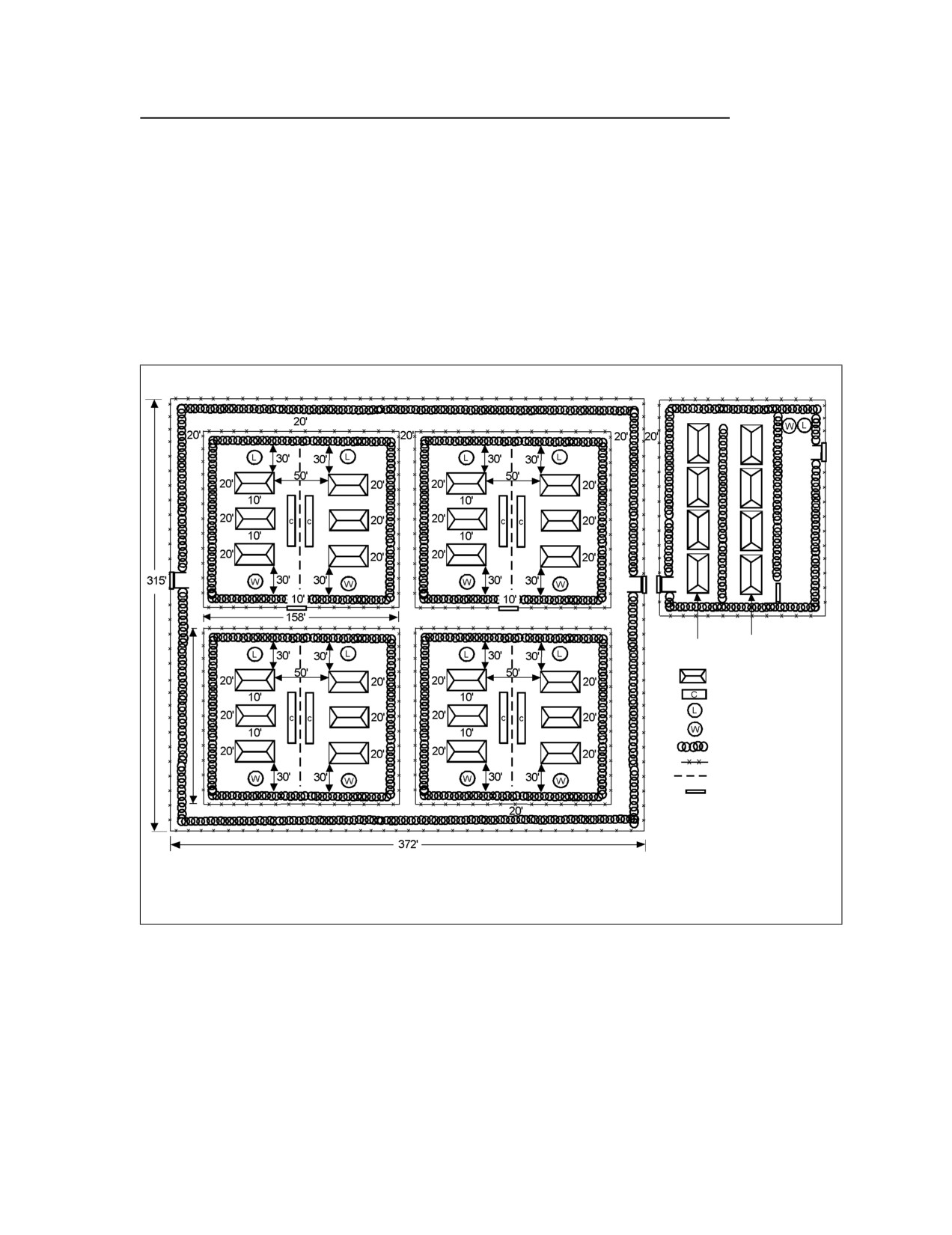
FM 3-19.40
CORPS HOLDING AREAS
3-55. A CHA (Figure 3-4) can hold more captives for longer periods of times
than a central CP. Depending on the availability of MP units to establish I/R
facilities, corps MP units must be prepared to hold captives at the CHA more
than 72 hours. If the CHA keeps captives more than 72 hours, MP must plan
and coordinate for the increased logistics and personnel required to operate a
long-term facility. The decision to hold captives longer is based on METT-TC
and the availability of forces. Captives remain in the CHA until they are
evacuated to an I/R facility or until hostilities end.
GP medium tent
Cover
Latrine
Water
Concertina
Barbed wire
Center line
10' wooden gate
NOTES:
1. Construction supplies include concertina, barbed wire, long and short pickets, staples, and
anchors.
2. See FM 5-34 for instructions on the use of triple-standard concertina wire.
Figure 3-4. Corps Holding Area
3-56. A CHA receives captives from CPs and units that capture them in the
rear area. Usually, one CHA is established to support each division conducting
operations. However, additional CHAs may be required based on the—
• Size of the corps area.
• Type of terrain.
• Length of the LOC between the CHA and the division central CPs.
• Number of captives being moved.
Division Collecting Points and Corps Holding Areas 3-15
FM 3-19.40
LOCATION
3-57. A CHA is usually located near a base or a base cluster in the corps rear
area. When selecting a site—
• Coordinate with the unit responsible for the area (terrain) and the
corps rear CP.
• Conduct a recon to select a location.
■
Is it adjacent to an MSR, a railroad, or an airfield?
■
Are existing buildings available?
■
Is it close to supply facilities?
■
Is it easily protected from enemy activities?
• Ensure that the location allows division of the site into two or more
compounds for segregation, security, and ease of control.
• Report the exact location (grid coordinates) through MP channels to
the unit responsible for the area. The MI coordinates with MP on
collocating an MI interrogation team at the CP. However, MP may
have to contact MI to initiate the action.
• Ensure that the site is accessible to units escorting captives from
division central CPs.
CONSTRUCTION
3-58. A CHA is more permanent than CPs. Existing structures may be used
and are preferred. The capture rate and the captive categories determine the
size of the CHA. A multistory building has a smaller perimeter to guard;
however, it requires using guards on each floor and may present a security
risk for the guards. Depending on the tactical situation, perimeter lighting
can be used.
3-59. When constructing a CHA, divide it into two or more compounds for
segregation, security, and ease of control. Consider providing more than one
entrance into the CHA. Include a reception area for further processing,
searching, and examining of selected captives by MI. Include sanitary
facilities (showers and latrines) and shelter (tentage and existing buildings)
from the elements and direct and indirect fire.
GUARD FORCE
3-60. The exact CHA setup and design depend on many factors, including
construction materials, terrain, and forces. An MP platoon or company from a
corps MP battalion usually operates a CHA. A platoon can guard 500 captives,
while a company can guard 2,000. During mass captures, a guard force
augmentation may be required to handle unexpected workload. The corps
band can augment MP guards to aid in security. As the population of the CHA
increases, evacuations to the I/R facility also increase.
LOGISTICS
3-61. Request supplies through logistic channels for construction,
maintenance, and day-to-day operations of a CHA. Support agreements can be
arranged between MP headquarters and a base or base cluster where the
CHA is located. Plan ahead to provide food and water.
3-16 Division Collecting Points and Corps Holding Areas
FM 3-19.40
MEDICAL AND SANITATION CONSIDERATIONS
3-62. The CHA guards isolate wounded captives and captives suspected of
having a communicable disease until medical personnel can examine them
(see Chapter 2). Take necessary sanitary measures to ensure a clean, healthy
CHA and to prevent epidemics. Request PVNTMED units to assist and advise
unit field sanitation teams on—
• The survey and control of disease-carrying insects and rodents.
• Sanitary engineering (water treatment and waste disposal).
EVACUATION
3-63. The procedures used to escort captives from division forward and
central CPs to a CHA are also used to escort captives from a CHA to an I/R
facility.
COLLOCATED SCREENING SITES
3-64. To facilitate collecting enemy tactical information, MI may collocate
interrogation teams at CPs and CHAs. This provides MI with direct access to
captives and their equipment and documents. Coordination is made between
MP and MI to establish operating procedures that include accountability. An
interrogation area is established away from the receiving/processing line so
that MI personnel can interrogate captives and examine their equipment and
documents. If a captive or his equipment or documents are removed from the
receiving/processing line, account for them on DD Form 2708 and DA Form
4137.
INTERROGATION TEAMS
3-65. The MI interrogation teams screen captives at CPs and CHAs, looking
for anyone who is a potential source of information. Screeners observe
captives from an area close to the dismount point or processing area. As each
captive passes, MI personnel examine the capture tag and look for branch
insignias that indicate a captive with information to support command
priority intelligence requirements (PIR) and information requirements (IR).
They also look for captives who are willing or attempting to talk to guards;
joining the wrong group intentionally; or displaying signs of nervousness,
anxiety, or fear.
3-66. The MP assist MI screeners by identifying captives who may have
answers that support PIR and IR. Because MP are in constant contact with
captives, they see how certain captives respond to orders and see the type of
requests they make. The MP ensure that searches requested by MI are
conducted out of sight of other captives and that guards conduct same-gender
searches.
3-67. The MI screeners examine captured documents, equipment and, in some
cases, personal papers (journals, diaries, and letters from home). They are
looking for information that identifies a captive and his organization, mission,
and personal backg1round (family, knowledge, and experience). Knowledge of a
captive’s physical and emotional status or other information helps screeners
determine his willingness to cooperate.
Division Collecting Points and Corps Holding Areas 3-17
FM 3-19.40
LOCATION
3-68. Consider the following when planning an MI screening site:
• The site is located where screeners can observe captives as they are
segregated and processed. It is shielded from the direct view of
captives and is far enough away that captives cannot overhear
screeners’ conversations.
• The site has an operation, administrative, and interrogation area. The
interrogation area accommodates an interrogator, a captive, a guard,
and an interpreter as well as furniture. Lights are available for night
operations.
• Procedures are implemented to verify that sick and wounded captives
have been treated and released by authorized medical personnel.
• Guards are available and procedures are implemented for escorting
captives to the interrogation site.
• Procedures are published to inform screeners who will be moved and
when they will be moved.
• Accountability procedures are implemented and required forms are
available.
COLLECTING POINTS IN OTHER OPERATIONS
3-69. The CPs can also be operated during river crossing, amphibious,
airborne, armored, and air assault operations:
•
River crossing operations. Establish temporary CPs on entry and
exit sides of the river (corps MP often take control of CPs). Return
from the exit bank and evacuate captives to the rear, preventing
interference with tactical operations and protecting captives from
hostile fire. Coordinate with traffic control personnel at the crossing
site to prevent interference with assault forces who are moving
forward. Use a secondary crossing site if available.
•
Amphibious operations. The assault force initially operates CPs in
the beachhead and then escorts captives to designated ships. The MP
coordinate with the support force for handling captives after they are
escorted from the beachhead. When facilities, supplies, and personnel
permit, retain captives in the objective area if they can be protected
from enemy fire.
•
Airborne operations. The METT-TC considerations for collecting
captives include the geographical location of the airhead, the tactical
plan, the availability of transportation, and plans for linking up with
ground forces. Captives are primarily moved by air during the early
stages of the operation, which requires CPs to be established near
landing zones (LZs). Consider attaching additional MP elements from
area EAC to guard captives during evacuation.
•
Armored operations. Armored units can penetrate deep into hostile
territory, bypassing pockets of enemy resistance on their way to the
objective. This leaves isolated enemy units on the battlefield, which
may hinder the normal evacuation of captives to the rear area. Hold
captives at the CP until they can be safely evacuated from the
battlefield.
3-18 Division Collecting Points and Corps Holding Areas
FM 3-19.40
• Air assault operations. Organic MP elements accompany assault
elements to the objective. Establish CPs near LZs and airfields where
the evacuation process begins. If necessary, attach nondivisional MP
elements to guard captives during evacuation.
Division Collecting Points and Corps Holding Areas 3-19
Chapter 4
Enemy Prisoners of War
Chapters 3 and 4 implement STANAG 2044.
The MP are responsible for evacuating EPWs from division CPs to CHAs
and then to internment facilities (normally located in the COMMZ). This
chapter addresses procedures for properly handling, processing, and
safeguarding EPWs. The procedures outlined in this chapter are also
applicable to RPs. (See Chapter 1 for complete definitions and AR 190-8 for
more details.)
EVACUATION
4-1. Corps MP commanders evacuate EPWs from CHAs to internment
facilities promptly and safely. Their responsibilities include security,
accountability, and support. They also account for equipment and documents
and provide escort guards if an escort guard company is unavailable.
4-2. Escort guard companies are responsible for EPW operations in the TO,
and they escort EPWs from CHAs to internment facilities. They are assigned
to MP I/R battalions and brigades. However, if they arrive before MP I/R units,
they are attached to MP CS brigades. To expedite prompt, full evacuation of
EPWs, escort guards can be pre-positioned in CHAs so that they are
continuously available.
4-3. The evacuation chain normally moves EPWs from a division forward CP
to a division central CP, to a CHA, and then to an internment facility. When
circumstances permit, such as taking advantage of available transportation,
evacuation procedures may bypass one or more echelons below corps (EBC)
facilities.
RECEIVING AND PROCESSING AREAS
4-4. Receiving and processing begin when EPWs arrive. However, due to
limited manning, these functions are not operational 24 hours a day. An
internment facility receives, secures, houses, and feeds EPWs until receiving
and processing lines are operational. The EPWs are then brought forward,
and the internment process begins.
4-5. Use a controlled-flow format to escort EPWs through the processing line.
Normally, four EPWs are processed at a time and the average is eight per
hour. These numbers may increase or decrease based on the capture rate and
the nature of the operation. Secure unprocessed EPWs in a holding area.
Enemy Prisoners of War 4-1
FM 3-19.40
4-6. Request interpreters from MI, PSYOP, allied forces, or local authorities
as necessary. This may require identifying and clearing trusted EPWs or local
nationals to interpret. Interpreters are usually necessary when entering data
into the Internment/Resettlement Information System (IRIS).
4-7. The preparation and dispatch of DA Forms 2674-R are governed by AR
190-8, and they are prepared at each internment facility. Brigade or
internment facility commanders may require feeder reports from various
compounds to facilitate the preparation of internee strength reports.
NOTE: See STANAG 2044 for more information on reports and
accountability as they apply to NATO TOs.
4-8. Table 4-1 outlines the internment process for EPWs. It shows who is
responsible for each step and what actions they must accomplish. Based on
METT-TC, the commander may tailor stations to meet the situation. Stations
1 through 4 are in the receiving line, and Stations 5 through 9 are in the
processing line.
Table 4-1. Processing Actions at the EPW Processing Area
Responsible
Station
Purpose
Actions
Individuals*
Receiving Line
1
Search
MP
Assign ISNs.
Follow accountability procedures.
Escort EPWs and their property.
Strip-search EPWs (by MP of the same sex) before entering
the processing area unless prohibited by conditions.
Remove and examine property, place it in a container or a tray,
mark it with a control number, and take it to a temporary
storage area. (Some property may be returned in the
processing line.)
Supervise the movement of EPWs to the next station.
2
Personal
MP and
Allow EPWs to shower, shave, and get haircuts.
hygiene
processed
Disinfect EPWs using the guidelines established by the
EPWs (when
PVNTMED officer.
possible)
Supervise the movement of EPWs to the next station.
*The number of people used to perform tasks depends on the number of EPWs and the amount of time
available. Other soldiers assigned to the unit may perform non-MP-specific tasks if necessary.
4-2 Enemy Prisoners of War
FM 3-19.40
Table 4-1. Processing Actions at the EPW Processing Area (continued)
Responsible
Station
Purpose
Actions
Individuals*
3
Medical
Medical
Inspect EPWs for signs of illness or injury.
evaluation
personnel and
Evacuate EPWs who need treatment at a medical facility.
MP
Give immunizations or request immunization support from the
supporting medical unit before internment or evacuation.
Initiate treatment and immunization records.
Place control numbers on medical records to reduce linguist
support. (Names, service numbers, and ISNs are entered at
Station 1 with the aid of an interpreter.)
Annotate medical records with the date and place EPWs were
inspected, immunized, and disinfected.
Weigh EPWs and establish a weight register.
Supervise the movement of EPWs to the next station.
4
Personal items
MP
Issue personal-comfort items (toilet paper, soap, toothbrush,
and toothpaste).
Issue clothing (clean and distinctive, like brightly colored
jumpsuits if available) that is—
•
Taken from EPWs at Station 1.
•
Obtained from captured enemy supplies.
•
Obtained through normal supply channels.
Ensure that clothing is marked “PW” as required.
Escort EPWs to the processing area (Station 5).
Processing Line
5
Administrative
Processing
Ensure that ISNs are assigned to EPWs. Note the capture tag
accountability
clerk (assisted
numbers that ISNs are replacing so that late-arriving property
by an
can be matched to its owner.
interpreter, MI,
Initiate personnel records, ID documents, and property
or others) and
receipts.
MP
Use digital equipment to generate forms and records.
Prepare forms and records to maintain the accountability of
EPWs and their property (STANAG 2044).
Prepare forms for repatriation or international transfer as
specified in local regulations or SOPs.
Supervise the movement of EPWs to the next station.
*The number of people used to perform tasks depends on the number of EPWs and the amount of time
available. Other soldiers assigned to the unit may perform non-MP-specific tasks if necessary.
Enemy Prisoners of War 4-3
FM 3-19.40
Table 4-1.
Processing Actions at the EPW Processing Area (continued)
Responsible
Station
Purpose
Actions
Individuals*
6
Photography
MP
Fingerprint EPWs. Identify and record the information on
and
fingerprint cards.
fingerprinting
Take two photographs (with instant film or digital technology).
Have EPWs look straight ahead, and fill the frame with their
face.
Use photograph name boards (black backg1round with white
characters). List ISNs and names (translated into English) at
the bottom center.
Attach one photograph to the EPW’s personnel record.
Give a completed, laminated ID card (which contains the
second photograph) to the EPW.
Supervise the movement of EPWs to the next station.
7
Personal
MP
Inventory and record property (in the presence of EPWs)
property
brought from temporary property storage areas.
Make separate lists for returned, stored, impounded, and
confiscated property. List property to be returned to EPWs or
stored during internment on a separate list.
Provide receipts for property placed in temporary storage.
Provide receipts for money placed in EPW accounts (AR
190-8 and DFAS-IN 37-1).
Return retained property that was taken from the EPW at
Station 1.
Supervise the movement of EPWs to the next station.
8
Records
MP
Review processed records for completeness and accuracy.
review
Escort EPWs back to processing stations to correct errors if
necessary.
Let EPWs prepare notification-of-capture cards. If being
interned at the same place as processing, let EPWs prepare
notification-of-address cards. If EPWs are unable to write their
own cards, have someone authorized by the commander to do
it for them.
Prepare and maintain an accountability roster of all EPWs.
9
Accountability
MP
Sign for and take custody of EPWs (can use movement
transfer
manifest), their records, and their impounded property if
moving to another facility.
Evacuate or ship impounded property separately according to
JTRs.
*The number of people used to perform tasks depends on the number of EPWs and the amount of time
available. Other soldiers assigned to the unit may perform non-MP-specific tasks if necessary.
4-4 Enemy Prisoners of War
FM 3-19.40
RECEIVING LINE
4-9. When EPWs arrive at the internment facility, segregate them from those
who arrived earlier and those who are partially processed. Count the EPWs
and match them against the manifest and the receipts for them and their
equipment.
4-10. Field-process each EPW if the capturing unit or the CP did not
field-process him (Chapter 3). Ensure that he receives the serial number from
his capture tag (DD Form 2745). (The number is used to track him until he
receives an internment serial number [ISN]).
4-11. Record his capture tag serial number and last name on an ID band. Use
a banding kit to attach the band to his left wrist. Match his capture tag serial
number with the number on his personal property, or if necessary, mark his
capture tag serial number on his personal property.
4-12. Store personal property in a temporary storage area until EPWs are
fully processed, and control access to the storage area. Ensure that EPWs
receive food and water and, if necessary, first aid and medical treatment. Take
them to the processing area as soon as the receiving process is complete. If
they cannot be processed immediately, hold them in the receiving area.
PROCESSING LINE
4-13. After EPWs have completed the receiving portion of their processing,
move them to the processing line, where they are formally processed into the
facility. They are entered into the IRIS database, and the IRIC forwards the
information to the national IRIC for dissemination to the protecting power.
The processing element—
• Keeps segregated EPWs apart as much as possible during processing.
• Conducts administrative processing.
• Expedites the processing of EPWs selected by MI teams for
interrogation.
• Assigns each EPW an ISN.
• Replaces the control number on each EPW’s wrist with his ISN.
PERSONNEL FILE
4-14. Ensure that the following forms are included in each EPW’s personnel
file:
• DA Form 1131-R. Use this voucher to verify the balance of funds.
• DA Form 1132-R. List the EPW’s personal property on this form.
• DA Form 2662-R. Issue this card if the EPW does not hold one from
his country.
• DA Form 2663-R. Prepare this card for each EPW upon processing
into the facility.
• DA Form 2664-R. Initiate this form upon inprocessing and update it
monthly.
• DA Form 4137. Record confiscated currency on this form.
• DA Form 4237-R. Prepare this form for each EPW processed into the
facility.
Enemy Prisoners of War 4-5
FM 3-19.40
• DD Form 2708. Use this form to account for evacuated EPWs,
regardless of the evacuation channel.
• DD Form 2745. File Part B of this tag in the personnel record.
INTERNMENT SERIAL NUMBER
4-15. The national IRIC forwards blocks of ISNs to designated IRICs in the
TO and CONUS as required. The ISNs are used to identify EPWs in US
custody. Each ISN is a unique, individual number; no two are alike. An ISN
consists of two parts:
• The first part contains the letters “US,” a number indicating the TO
where the EPW came into US custody, and two letters representing
the EPW’s country of origin.
• The second part is a series of six numbers that are assigned (in
sequential order) to each EPW processed in the command. The
numbers are followed by the letters “EPW,” “CI,” “RP,” or “OD” to
denote the EPW’s category.
For example, the first EPW processed by the US Army in TO 9, whose country
designation is AB, is assigned ISN US9AB000001EPW.
4-16. If the situation permits, the IRIC processes EPWs at division CPs and
CHAs. Assign ISNs as early as possible. However, if an ISN is not assigned
until Station 1 (see Table 4-1, page 4-3), use the capture tag number, the
manifest number, or another control number until an ISN is assigned.
NOTE: See STANAG 2044 and AR 190-8 for additional information on
ISNs.
IDENTIFICATION BAND
4-17. The EPW ID bands are used to—
• Verify EPW rosters against the compound population.
• Identify compound work details.
• Match EPWs with their medical records.
• Check identities of EPWs being transferred or repatriated against
transfer rosters.
• Permit rapid, reliable ID of EPWs.
• Enhance facility administration and operation.
4-18. An EPW can remove his ID band, but doing so destroys the band so that
someone else cannot use it without being detected. The MP cannot prevent
EPWs from destroying bands; however, most EPWs accept the use of the band
for ID purposes.
4-19. Record the EPW’s ISN and last name on his ID band, and secure it to
his left wrist. To enhance facility administration and operation, use various
colored bands to further identify EPWs by category. For example, use—
• Blue for officers.
• Red for NCOs.
• Yellow for enlisted soldiers.
• Black for RPs.
4-6 Enemy Prisoners of War
FM 3-19.40
• Green for CIs.
• White for ODs.
If EPW ID bands are unavailable, use a medical wristband or something
similar.
4-20. When serious deterioration is detected or the ISN and name is obscured,
replace the ID band with a new one. Conduct periodic, random checks to
detect wear and tear and efforts to destroy the band. In addition, look for
efforts to exchange bands between EPWs (removing the ID band results in
damage that is easily detected). When firm ID is needed, such as transfer or
hospitalization, carefully examine the ID band for evidence of having been
removed. Conduct periodic, routine inspections of randomly selected ID bands
in dining-facility lines, during compound inspections, and at other opportune
times.
FLOW OF INFORMATION
4-21. Regard the information collected from EPWs as sensitive to protect
them and the soldiers who are guarding them. If belligerent nations discover
how many EPWs are in a facility or discover the location of a facility, it may be
targeted to silence the sources of information. Maintain proper security
throughout the information flow, and disseminate information through proper
channels. The IRIC acts as a hub for information that CHAs and internment
facilities produce. Report personnel records electronically on the IRIS or, if
necessary, as a paper file.
4-22. The information flow begins when the EPW is captured and a DD Form
2745 is initiated. The ISN, which is assigned upon arrival at a CHA or an
internment facility, is the key to tracking EPWs throughout the I/R system.
4-23. Information collected during processing (initial and full) and entered
into the IRIS (CHA or internment facility) is sent to the IRIC. The IRIC
collects the entire personnel file; it is normally electronic with a hard-copy
backup. The internment facility reports the information to the IRIC, who
disseminates it as appropriate. The strength report (DA Form 2674-R) is the
only information passed up the internment facility’s chain of command.
Questions regarding the information or EPW flow in the TO are directed to
the IRIC.
NOTE: Hasty processing can be initiated if normal processing cannot
be done in a reasonable amount of time (normal processing is
completed later).
Initial Processing
4-24. During initial processing (at the point of capture), gather critical
information from EPWs and assign ISNs. The minimum information needed
during initial processing is the—
• Complete name (first, middle, and last).
• Service number.
• Rank.
• Capturing unit.
Enemy Prisoners of War 4-7
FM 3-19.40
• Date of capture.
• Place of capture (grid coordinates).
• Circumstances of capture.
4-25. The above information (along with the capturing country, the TO, the
power served, the sequence number, and the EPW category) is enough to move
the EPW into an internment facility where additional information is gathered.
Much of the information is gleaned from the capture tag. The IRIC provides
block ISNs, and other information is theater- and situation-driven. The initial
processing is quick and effective.
Intermediate Processing
4-26. Per AR 190-8, the national IRIC is responsible for collecting the
following items to complete the intermediate processing:
• The date of birth.
• The city of birth.
• The country of birth.
• The name and address of next of kin (NOK) (father/mother).
• The location of confiscated property.
• The nationality.
• A general statement of health.
• The nation in whose armed services the individual is serving.
• The name and address of a person to be notified of the individual’s
capture.
• The address to which correspondence may be sent.
• Certificates of death or authenticated lists of the dead.
• The location of war graves (grid coordinates) and particulars of the
dead.
• The notification of capture (including the date sent).
• The list of personal articles of value not restored upon repatriation.
Full Processing
4-27. Remember, an EPW is only required to give his name, rank, and service
number. However, collect additional information if possible. An EPW is
considered fully processed when the personnel file is complete. This includes
the fields completed during initial and intermediate processing and those
listed below:
• Education.
• Religion.
• Marital status.
• Internment facility unit identification code (UIC).
• Sex.
• Languages spoken.
• Internment facility location.
• Enemy unit.
• Arm of service.
4-8 Enemy Prisoners of War
FM 3-19.40
• Military occupational specialty (MOS).
• Civilian occupational specialty (COS).
• Corps area of capture.
• Mother’s maiden name.
• Permanent home address.
• Other particulars from the ID card.
• Distinguishing marks.
• Impounded personal property and money.
• Photograph.
• Prepared by, date prepared, place prepared, and signature.
• Immunizations.
• Internment employment compensation.
• Serious offenses, punishments, and escapes (including dates).
• Transfers.
• Financial status at the time of first and second international
transfers.
• Repatriation.
• Financial status at the time of repatriation.
• Remarks.
ASSIGNMENT TO INTERNMENT FACILITIES
4-28. Selectively assign EPWs to internment facilities that best meet their
needs and the needs of the detaining power. To prevent problems, isolate
EPWs from the general population if they hold violent, opposing ideologies.
After EPWs are assigned to a facility, they may be further segregated due to
nationality, language, and so forth. Normally, EPWs are segregated into the
following categories:
• Officer.
• NCO.
• Enlisted.
• CI.
• RP.
• Male.
• Female.
4-29. The EPWs may be further assigned to separate compounds. Always
intern females in compounds that are separate from males. Further
separation of EPWs may be necessary depending on security issues. (See
Chapter 6 for further information on I/R facilities.)
CLASSIFICATION AND REASSIGNMENT
4-30. The initial classification of an EPW is based on unsupported statements
or documentation provided by them. Assignment to a specific compound
within the internment facility is based on the assumption that the identity
provided by the EPW is correct.
Enemy Prisoners of War 4-9
FM 3-19.40
4-31. After an EPW is assigned to a facility, expect a continuing need for
further reclassification and reassignment. Because the identity of the EPW
was based on unsupported statements or documentation supplied by him, it
may be necessary to reclassify him a second time as his identity becomes
apparent. Agitators, enemy plants, or EPW leaders are eventually uncovered
by their activities. They may be reclassified according to their new identity or
ideology and reassigned to a more appropriate facility.
4-32. Anticipate the reclassification and reassignment of EPWs within the
facility or to other facilities. The initial classification may be challenged by the
EPW or MP assets. An individual may provide statements or documents that
indicate he should be reclassified, or observations made by MP or MI may
determine that an individual was incorrectly classified.
TRIBUNAL
4-33. A tribunal is held according to Article 5, GPW. It determines the status
of an individual who does not appear to be entitled to EPW status but—
• Commits a belligerent act to aid enemy armed forces.
• Engages in a hostile activity to aid enemy armed forces.
• Asserts that he or she is entitled to treatment as an EPW.
TRANSFER BETWEEN FACILITIES
4-34. A transfer may be a result of reclassification or another situation
requiring the movement of an EPW. Transfer an EPW from one facility to
another under conditions that are comparable to those for a member of the US
armed forces when possible. Security measures are determined by MP and are
influenced by the type of EPW being transferred, the mode of transportation
used, and other pertinent conditions.
4-35. The facility commander—
• Publishes a transfer order and informs EPWs of their new postal
addresses in time for them to notify their NOK and the IRIC.
• Verifies the accuracy and completeness of EPW personnel records and
provides records (in a sealed envelope) to MP accompanying the
movement.
• Verifies that EPWs possess their authorized clothing and equipment.
• Prepares impounded personal property for shipment with escorting
MP or separate shipment as appropriate.
• Briefs escort MP on their duties and responsibilities, including
procedures to be followed in case of an escape, a death, or another
emergency.
• Provides or arranges for rations, transportation, and notifications
according to prescribed procedures.
• Ensures that EPWs are manifested by name, rank/status, ISN, power
served, nationality, and physical condition. Attach the manifest to the
original receipt and forward it to the IRIC.
• Prepares paperwork in English and other languages (if required)
before transferring EPWs.
4-10 Enemy Prisoners of War