Military reference books and manuals (2009-2023, Volume 7) - page 20
Appendix G
Hosts a variety of public and private Web applications that support the intelligence community.
G-6. University of Military Intelligence (UMI), at http://www.universityofmilitaryintelligence.us , is the
distance learning arm of the MI Schoolhouse. From the UMI Web site, MI professionals can access—
Self-paced and reachback training.
The Cultural, Foreign Language Integration Center.
MI training resources.
The New Systems Training and Integration Office at Fort Huachuca, AZ.
The Intelligence Collaboration Center.
Knowledge Center (documents, FMs).
Training, agencies, policy, doctrine, and links to other intelligence related sites.
source—
Events.
Discussion forum.
Intelligence products.
Handbooks.
Links of interest.
databases and excellent resources, such as—
Military and Government Collection.
Academic Search Premier—click on “Academic Resources.” This database contains 4,700
publications with full text coverage in biology, chemistry, education, engineering, humanities,
physics, psychology, religion and theology, sociology.
G-10. Department of the Army Intelligence Information Service (DAIIS) Country Research portal, at
Intelligence Communications System (JWICS), Secure Internet Protocol Router Network (SIPRNET),
Combined Enterprise Regional Information Exchange System (CENTRIXS), and unclassified networks.
This results in a “one stop shop” for intelligence information. Data is pushed across multiple networks to
ensure the intelligence consumers have access to the data from the network on which they operate. For
example, collateral data from JWICS is pushed down to SIPRNET, and unclassified data is pulled up to
JWICS and SIPRNET. Some of the links on this site include—
Open-source products (Early Bird, Terrorism Daily Update, Basra Bugle).
Foundry Program—also available on SIPRNET at
http://www.portal.inscom.army.smil.mil/g3/or/foundry/default.aspx.
Intelligence community links
(Federal Bureau of Investigation
[FBI], Central Intelligence
Agency [CIA], National Security Agency [NSA]).
Combatant command links.
Analyst references (CIA World Factbook).
G-11. DAIIS is available at—
JWICS: http://dadpm.inscom.ic.gov.
Intelligence Dominance Center Portal on JWICS: http://idcportal.inscom.ic.gov/.
SIPRNET: http://dadpm.inscom.army.smil.mil.
SIPRNET Portal: http://www.portal.inscom.army.smil.mil/.
CENTRIXS: http://dadpm.inscom.mcfi.cmil.mil.
AKO: https://www.us.army.mil/suite/page/132281.
G-2
TC 2-50.5
6 January 2010
FOR OFFICIAL USE ONLY
Intelligence Resources
G-12. General weather Web sites include—
Climatology (14th Weather Squadron):
https://www.afccc.af.mil/SCIS.
SIPRNET: http://afccc.asheville.af.smil.mil.
JWICS: http://www.afccc.ic.gov.
Joint Air Force and Army Weather Information Network (JAAWIN):
https://weather.afwa.af.mil.
SIPRNET: http://weather.offutt.af.smil.mil.
Links to more specific forecasts created by regional operational weather squadrons are available
through JAAWIN.
G-13. Open-Source Information System, now called Intelink, is a private Intranet connecting various
networks for the exchange of unclassified U.S. Government and other open-source information in
intelligence community agencies, military commands, and certain other organizations. No special software
is needed. With a password, access Intelink at https://www.intelink.gov:
Intelink-SBU account. Request an Army sponsored Intelink remote access account through a
personal AKO e-mail to: accounts@intelink.gov. Upon receipt, scroll down to the end of the
brochure for the form and send as an e-mail attachment to receive a password.
Intelink databases and sites. Use the Open-Source Information System login and password.
Request an Intelink password once connected to Intelink. Use this password for the first-time
login and for accessing Jane’s. The original interface is in the right frame under Favorites. The
following are a few of the topics accessible on Intelink:
The National Ground Intelligence Center, at
Army.
Foreign Military Studies Office/World Basic Information Library, at
Training and Doctrine Command, Intelligence Support Activity. The Foreign Military Studies
Office manages and operates the Fort Leavenworth Joint Reserve Intelligence Center and
conducts analytical programs focused on emerging and asymmetric threats, regional military and
security developments, and other issues that define evolving operational environments
worldwide.
visualization tool. Pathfinder has become a core enabling technology in overseas contingency
operations.
information, military systems, terrorism, and country studies.
features databases to search for articles in newspapers, journals, and magazines. Included are the
Academic Search Premier, Military & Government Collection, Business Source Premier, and
Environmental Issues and Policy Index.
Open-Source Center
(formerly the Foreign Broadcast Information Service), at
language Web sites and multimedia. The center also hosts a variety of commercial databases,
such as Jane’s, Oxford Analytica, Lexis-Nexis, Economist Intelligence Unit, and others.
Smart Cards, Country Handbooks, and others.
Oxford Analytica, at
consulting firm that provides business and political leaders with timely analysis of worldwide
political, economic, and social developments.
6 January 2010
TC 2-50.5
G-3
FOR OFFICIAL USE ONLY
Appendix G
G-14. Other open-source sites:
free download.
The Intelligent Road/Rail Information Server, http://www.tea.army.mil/tools/irris.htm.
Defense Technical Information Center, http://www.dtic.mil/.
Center for Army Lessons Learned, http://call.army.mil/.
Strategic Studies Institute, http://www.strategicstudiesinstitute.army.mil/.
MESSAGE TRAFFIC
G-15. Intelligence tear line reporting:
A semiautomated process used to migrate tear line messages to JWICS, STONEGHOST,
SIPRNET, CENTRIXS, and releasable servers.
access messages.
G-16. SIPRNET message traffic (DAIIS on SIPRNET):
Access the Multimedia Message Manager (M3) on SIPRNET, at
http://dadpm.inscom.army.smil.mil/m3/index.asp. M3 is the standard message handling system
for the intelligence community and provides—
Real-time dissemination of message traffic.
Retrospective information searches.
Message composition, coordination, and release.
SIPRNET M3 accounts provide access to Army G-2 collateral message traffic.
Message traffic sources include—
CIA.
Open-Source Center.
Operations IRAQI FREEDOM (OIF)/Operation ENDURING FREEDOM (OEF) tactical
reports.
FBI.
INTELLIGENCE PRODUCTION
G-17. Community On-Line Intelligence System for End Users and Managers (COLISEUM)—
http://coliseum-s.dia.smil.mil.
Executes DOD policy and procedures under the Defense Intelligence Analysis Program.
Ensures Army customers obtain new intelligence production from the Defense Intelligence
Agency (DIA), Service national production centers, and joint intelligence centers.
Researches and validates Army intelligence production requirements.
ANALYST AIDS
G-18. Analysts use numerous techniques and tools to assist in providing intelligence support to operations.
Figure G-1 and tables G-1 through G-4 (pages G-5 through G-6) depict some, but not all of the analyst aids
used to determine terrain slope calculations, lane widths, route types, identification ranges of targets, and
foot march factors.
G-4
TC 2-50.5
6 January 2010
FOR OFFICIAL USE ONLY

Intelligence Resources
Figure G-1. Degree of slope calculator
Table G-1. Land widths shown on U.S. military maps
Meters
Feet
Trail
Less than 1.5
Less than 5
Track
At least 1.5 but less than 2.5
At least 5 but less than 8
One lane
At least 2.5 but less than 5.5
At least 8 but less than 18
Two lanes
At least 5.5 but less than 8.2
At least 18 but less than 28
More than two lanes
At least 8.2
At least 28
Table G-2. Identification ranges
Targets
Naked eye
Magnification 7.8 power
Tank crewmembers, troops, machine
gun, mortar, antitank gun, antitank
500 meters
2,000 meters
missile launchers.
Tank, APC, truck (by model).
1,000 meters
4,000 meters
Tank, Howitzer, APC, truck.
1,500 meters
5,000 meters
Armored vehicle, wheeled vehicle.
2,000 meters
6,000 meters
APC—armored personnel carrier
6 January 2010
TC 2-50.5
G-5
FOR OFFICIAL USE ONLY

Appendix G
Table G-3. Route types and military load classifications
The route type is determined by its ability to withstand weather. It is determined by the worst
Route type
section of road on the entire route and is categorized as follows:
An all-weather route that, with reasonable maintenance, is passable throughout the year to a
volume of traffic never appreciable less than its maximum capacity. This type of route is
Type X
normal, formed of roads having waterproof surfaces and being only slightly affected by rain,
frost, thaw, or heat. This type of route is never closed because of weather effects other than
snow or flood blockage.
A limited, all-weather route that, with reasonable maintenance, is passable throughout the
year, but at times having a volume of traffic considerably less than maximum capacity. This
type of route is normally formed of roads that do not have waterproof surfaces and are
Type Y
considerably affected by rain, frost, thaw, or heat. This type of route is closed for short periods
of time (up to one day at a time) by adverse weather conditions, during which heavy use of
the road would probably lead to complete collapse.
A fair-weather route passable only in fair weather. This type of route is so seriously affected
Type Z
by adverse weather conditions that it may remain closed for long periods of time.
Improvement of such a route can only be achieved by construction or realignment.
A route’s military load classification is a class number representing the safe load-carrying
capacity and indicating the maximum vehicle class that can be accepted under normal
conditions. Usually, the lowest bridge military load classification (regardless of the vehicle
Military load
type or conditions of traffic flow) determines the route’s military load classification. If there is
classification
not a bridge on the route, the worst section of road will determine the route’s overall
classification. The entire network’s class is determined by the minimum load classification of a
road or a bridge within the network. The broad categories are as follows:
Class 50
Average traffic route.
Class 80
Heavy traffic route.
Class 120
Very heavy traffic route.
Table G-4. Basic data foot march factors
Rate of march*
Normal march
Forced march
Visibility
(km/h)
(8 hours) (km)
(12 hours) (km)
Day
4
32
48
Roads
Night
3
24
36
Day
2
16
24
Cross-country
Night
1
8
12
*Computed on a 50-minute hour, allowing for a 10-minute halt each hour.
Length of a column. To determine the length of a column occupied by a dismounted unit, multiply the
estimated or known number of personnel by the applicable factor.
Length of column, factor table, and foot marches
Formation*
2 m/person distance
5 m/person distance
Single file
2.4
5.4
Column of twos
1.2
2.7
*Foot marches will vary with the tactical situation. Normal formation is a column of twos with a file on
either side of the road and staggered, much like U.S. forces. However, columns of threes and fours may
be employed where conditions permit.
Pass time. To determine the pass time in minutes for a dismounted unit, multiply the length of the column
by the appropriate factor for the estimated or known rate of march.
Pass time factor, foot marches
Rate (km/h)
Factors
4
.015
3
.018
2
.020
1
.023
h—hour
km—kilometer(s)
m—meter
G-6
TC 2-50.5
6 January 2010
FOR OFFICIAL USE ONLY
Glossary
AA
avenue of approach
ACE
analysis and control element
AGM
attack guidance matrix
AKO
Army Knowledge Online
AO
area of operations
AOI
area of interest
AR
Army regulation
ASCC
Army Service component command
ASCOPE
memory aid for civil considerations—areas, structures, capabilities,
organizations, people, events
AUTL
Army Universal Task List
BCT
brigade combat team
BDA
battle damage assessment
BMCT
begin morning civil twilight
BMNT
begin morning nautical twilight
C2
command and control
CARVER
criticality, accessibility, recuperability, vulnerability, effect, recognizability
CARVERSHP
criticality, accessibility, recuperability, vulnerability, effect, recognizability,
symbolism, historical, political
CBRN
chemical, biological, radiological, nuclear
CBRNE
chemical, biological, radiological, nuclear, high-yield explosives
CCIR
commander’s critical information requirement
CENTRIXS
Combined Enterprise Regional Information Exchange System
CI
counterintelligence
COA
course of action
CONUS
continental United States
COP
common operational picture
CTC
combat training center
D3A
decide, detect, deliver, assess
DA
Department of the Army
DAIIS
Department of the Army Intelligence Information Service
DCGS-A
Distributed Common Ground System-Army
DIA
Defense Intelligence Agency
DLIFLC
Defense Language Institute Foreign Language Center
DOD
Department of Defense
6 January 2010
TC 2-50.5
Glossary-1
FOR OFFICIAL USE ONLY
Glossary
DST
decision support template
DTG
date-time group
EECT
end evening civil twilight
EEFI
essential element of friendly information
EENT
end evening nautical twilight
EW
electronic warfare
F3EAD
find, fix, finish, exploit, analyze, disseminate
FAIO
field artillery intelligence officer
FFIR
friendly force information requirement
FM
field manual
FRAGO
fragmentary order
FSCOORD
fire support coordinator
G-1
assistant chief of staff, personnel
G-2
assistant chief of staff, intelligence
G-2X
human intelligence and counterintelligence staff officer (general staff)
G-3
assistant chief of staff, operations
GEOINT
geospatial intelligence
GMI
general military intelligence
GPS
Global Positioning System
HCT
HUMINT collection team
HPT
high-payoff target
HPTL
high-payoff target list
HUMINT
human intelligence
HVI
high-value individual
HVT
high-value target
HVTL
high-value target list
I&W
indications and warning
IED
improvised explosive device
IKN
Intelligence Knowledge Network
INSCOM
United States Army Intelligence and Security Command
INTSUM
intelligence summary
IO
information operations
IPB
intelligence preparation of the battlefield
IR
information requirement
ISR
intelligence, surveillance, and reconnaissance
J-2
intelligence directorate of a joint force
JAAWIN
Joint Air Force and Army Weather Information Network
JP
joint publication
JPAS
Joint Personnel Adjudication System
JWICS
Joint Worldwide Intelligence Communications System
Glossary-2
TC 2-50.5
6 January 2010
FOR OFFICIAL USE ONLY
Glossary
LOC
line of communications
M3
Multimedia Message Manager
MCOO
modified combined obstacle overlay
MDMP
military decisionmaking process
MEA
munitions effects assessment
METL
mission-essential task list
METT-TC
memory aid for the mission variables—mission, enemy, terrain and weather,
troops and support available, time available, and civil considerations
MI
military intelligence
MIHB
military intelligence handbook
MP
military police
MTT
mobile training team
NAI
named area of interest
NCOES
noncommissioned officer education system
OEF
Operation ENDURING FREEDOM
OES
officer education system
OIF
Operation IRAQI FREEDOM
OPLAN
operation plan
OPORD
operation order
OPSEC
operations security
OSINT
open-source intelligence
PIR
priority intelligence requirement
POL
petroleum, oil, lubricants
PMESII-PT
political, military, economic, social, information, infrastructure, physical
environment, and time
PSYOP
psychological operations
RDSP
rapid decisionmaking and synchronization process
RFI
request for information
RIP
relief in place
ROE
rules of engagement
S&TI
scientific and technical intelligence
S-1
personnel staff officer
S-2
intelligence staff officer
S-2X
human intelligence and counterintelligence staff officer
S-3
operations staff officer
SAF
small-arms fire
SCI
sensitive compartmented information
SEAD
suppression of enemy air defenses
SIGACT
significant activity
SIGINT
signals intelligence
SIPRNET
Secure Internet Protocol Router Network
6 January 2010
TC 2-50.5
Glossary-3
FOR OFFICIAL USE ONLY
Glossary
SIR
specific information requirement
SOFA
status of forces agreement
SOP
standing operating procedure
SPIRIT
Special Purpose Integrated Remote Intelligence Terminal
STP
soldier training plan
SWO
staff weather officer
TA
target acquisition
TAI
target area of interest
TC
training circular
TECHINT
technical intelligence
TES
Tactical Exploitation System
TLE
target location error
TOA
transfer of authority
TRADOC
United States Army Training and Doctrine Command
TSS
target selection standards
TTP
tactics, techniques, and procedures
TVA
target value analysis
UAS
unmanned aircraft system
UMI
University of Military Intelligence
U.S.
United States
USAF
United States Air Force
USAICoE
United States Army Intelligence Center of Excellence
Glossary-4
TC 2-50.5
6 January 2010
FOR OFFICIAL USE ONLY
References
REQUIRED PUBLICATIONS
These documents must be available to the intended user of this publication.
JOINT PUBLICATIONS
JP 1-02. Department of Defense Dictionary of Military and Associated Terms. 12 April 2001.
JP 2-0. Joint Intelligence. 22 June 2007.
JP 3-0. Joint Operations. 17 September 2006.
ARMY PUBLICATIONS
FM 1-02. Operational Terms and Graphics. 21 September 2004.
FM 2-0. Intelligence. 17 May 2004.
FM 3-0. Operations. 27 February 2008.
RELATED PUBLICATIONS
These sources contain relevant supplemental information.
JOINT PUBLICATIONS
JP 3-09. Joint Fire Support. 13 November 2006.
JP 3-35. Deployment and Redeployment Operations. 7 May 2007.
JP 3-59. Meteorological and Oceanic Operations. 24 September 2008.
JP 3-60. Joint Targeting. 13 April 2007.
JP 4-0. Joint Logistics. 18 July 2008.
JP 5-0. Joint Operation Planning. 26 December 2006.
ARMY PUBLICATIONS
AR 190-13. The Army Physical Security Program. 30 September 1993.
AR 380-67. The Department of the Army Personnel Security Program. 9 September 1988.
AR 381-10. U.S. Army Intelligence Activities. 3 May 2007.
FM 2-01.3. Intelligence Preparation of the Battlefield/Battlespace. 15 October 2009.
FM 2-19.4. Brigade Combat Team Intelligence Operations. 25 November 2008.
FM 2-22.2. Counterintelligence. 21 October 2009.
FM 2-22.3. Human Intelligence Collector Operations. 6 September 2006.
FM 2-91.6. Soldier Surveillance and Reconnaissance: Fundamentals of Tactical Information
Collection. 10 October 2007.
FM 3-05.40. Civil Affairs Operations. 29 September 2006.
FM 3-06.11. Combined Arms Operations in Urban Terrain. 28 February 2002.
FM 3-90. Tactics. 4 July 2001.
FM 3-90.15. Sensitive Site Operations. 25 April 2007.
FM 4-0. Sustainment. 30 April 2009.
FM 4-01.011. Unit Movement Operations. 31 October 2002.
6 January 2010
TC 2-50.5
References-1
FOR OFFICIAL USE ONLY
References
FM 5-0. Army Planning and Orders Production. 20 January 2005.
FM 6-0. Mission Command: Command and Control of Army Forces. 11 August 2003.
FM 6-20-10. Tactics, Techniques, and Procedures for the Targeting Process. 8 May 1996.
FM 6-99.2. U.S. Army Report and Message Formats. 30 April 2007.
FM 7-15. The Army Universal Task List. 27 February 2009.
FMI 2-01. Intelligence, Surveillance, and Reconnaissance (ISR) Synchronization. 11 November 2008.
FMI 2-01.301. Specific Tactics, Techniques, and Procedures and Applications for Intelligence
Preparation of the Battlefield. 31 March 2009.
FMI 3-35. Army Deployment and Redeployment. 15 June 2007.
FMI 5-0.1. The Operations Process. March 2006.
TC 2-22.4. Technical Intelligence. 19 November 2009.
TC 2-33.4. Intelligence Analysis. 1 July 2009.
OTHER PUBLICATIONS
Lanicci, John M. “Integrating Weather Exploitation into Air and Space Power Doctrine.” Air Power
12, No. 2. Summer 1998: 52-63.
Military Intelligence Handbook (MIHB) 2-50. Intelligence Systems. 22 July 2008.
PRESCRIBED FORMS
None.
REFERENCED FORMS
DA Form 2028. Recommended Changes to Publications and Blank Forms.
DA Form 3964. Classified Document Accountability Record.
References-2
TC 2-50.5
6 January 2010
FOR OFFICIAL USE ONLY
Index
decide, detect, deliver, and
Global Positioning System
A
assess (D3A), E-3, E-4, E-5,
(GPS), F-5
all-source intelligence, A-10, E
E-11, E-13, E-15, E-18
graphic intelligence summary
13
Department of the Army
(INTSUM), D-1, D-3, D-5,
areas, structures, capabilities,
Intelligence Information
D-6
organizations, people,
Service (DAIIS), G-2
counterinsurgency, D-6
events (ASCOPE), C-1
dissemination, B-10
H
Army force generation
Distributed Common Ground
(ARFORGEN), 4-1
high-payoff target (HPT), 3-28,
System-Army (DCGS-A), 3
available, A-1, A-6
E-7, E-8, E-10. See also
6, 4-3, 4-6, 4-7, A-1, A-9, B
reset, A-1, A-2
target development.
10, F-2
train/ready, A-1, A-5
high-payoff target list (HPTL),
document and media
Army Knowledge Online
D-15, E-5, E-8, E-10
exploitation (DOMEX), E-20
(AKO), A-8
high-value individual (HVI),
Army Knowledge Online (AKO)
E
E-18, E-26
intelligence, G-2
electronic intelligence (ELINT),
high-value target (HVT), 3-23,
Army Universal Task List
4-4
3-28, E-7, E-18. See also
(AUTL), E-2
target development.
essential element of friendly
attack guidance matrix (AGM),
information (EEFI), B-2
high-value target list (HVTL),
E-5, E-8, E-9, E-10, E-16, E
D-15
event template, 3-16. See also
17
intelligence preparation of
human intelligence (HUMINT),
the battlefield (IPB).
3-22, 4-4, A-10, B-6, C-3,
B
E-20, E-27
executive summary, D-11
battle damage assessment
(BDA), D-6, D-12, E-15, E
I
F
16, E-26
imagery intelligence (IMINT),
find, fix, finish, exploit, analyze,
biometrics, A-10
A-10, E-20, E-28
and disseminate (F3EAD),
brigade combat team (BCT), 4
E-18, E-20
indications and warning (I&W),
6
4-8, D-6, D-12
fires, E-9
destruction fires, E-10
indicator, 3-24, 3-26, B-4, C-1
C
harassing fires, E-9
information requirement, 4-1,
command channel, B-10
neutralization fires, E-10
E-11, E-12, E-17
commander’s critical
suppressive fires, E-9
information requirement, B-2
information requirement
force projection, 4-1
(CCIR), B-2, B-10, D-6
integrated meteorological
deployment, 4-2
system (IMETS), 4-6, F-2
Community On-Line
employment, 4-7
capabilities, F-2
Intelligence System for End
mobilization, 4-1
Users and Managers
redeployment, 4-8
Intelink, G-3
(COLISEUM), G-4
sustainment, 4-8
intelligence
counterintelligence (CI), 4-4, 4
friendly force information
readiness training, A-1
5. See also intelligence
requirement (FFIR), B-2, B
intelligence architecture, B-10
categories.
10
intelligence briefing, C-1
counterintelligence(CI), A-10
G
intelligence categories
criticality, accessibility,
counterintelligence (CI), 1-3
G-2/S-2, 4-2, 4-3, 4-7, 4-8. See
recuperability, vulnerability,
current intelligence, 1-3
also intelligence preparation
effect, and recognizability
general military intelligence
of the battlefield (IPB).
(CARVER), E-20, E-24
(GMI), 1-3
geospatial intelligence
indications and warning
D
(GEOINT), 3-6, A-10, A-11
(I&W), 1-3
debriefing, C-2, C-3
6 January 2010
TC 2-50.5
Index-1
FOR OFFICIAL USE ONLY
Index
scientific and technical
modified combined obstacle
M
intelligence (S&TI), 1-3
overlay (MCOO), 3-4
matrix event, 3-26
target intelligence, 1-3
operational environment,
measurement and signature
3-1
intelligence disciplines, 4-5,
intelligence (MASINT), A-11,
perception assessment
A-1, A-9
E-28
matrix, 3-22
all-source intelligence, 1-3
population status overlay,
measurement and signature
geospatial intelligence
3-10
intelligence MASINT), E-28
(GEOINT), 1-3
human intelligence
process, 3-1
military decisionmaking
relationship matrix, 3-18
(HUMINT), 1-3
process (MDMP), 2-1, 4-4
situation template, 3-26
imagery intelligence
G-2/S-2, 2-2
(IMINT), 1-3
threat template, 3-13
intelligence preparation of
time event chart, 3-17
measurement and signature
the battlefield (IPB), 2-1
urban terrain overlay, 3-6
intelligence (MASINT),
running estimate, 2-2
weather analysis, 3-8
1-3
intelligence, surveillance,
open-source intelligence
intelligence training resources
and reconnaissance
(OSINT), 1-3
cultural awareness, A-7
(ISR), 2-2
signals intelligence
Foundry Program, A-8
mission, enemy, terrain and
(SIGINT), 1-3
functional courses, A-6
weather, troops and support
technical intelligence
joint intelligence combat
available, time available and
(TECHINT), 1-3
training center, A-8
civil considerations
language training, A-7
Intelligence Knowledge
(METT-TC), 4-3, 4-4, B-14
military intelligence
Network (IKN), A-6, G-1
Multimedia Message Manager
gunnery, A-8
intelligence preparation of the
(M3), G-4
Soldiers training plans, A-8
battlefield (IPB), E-17
munitions effects assessement
intelligence warfighting
intelligence preparation of the
(MEA), E-17
function, 1-1, B-2, B-10
battlefield (IPB), 4-4, A-2,
tasks, 1-2
munitions effects assessment
E-6, E-17. See also military
warfighting functions, 1-1
(MEA), E-15
decisionmaking process
(MDMP).
intelligence, surveillance, and
O
reconnaissance
activities matrix, 3-20
open-source, G-2, G-3, G-4
definition, B-1
areas, structures,
open-source intelligence
capabilities,
intelligence, surveillance, and
(OSINT), A-11
organizations, people,
reconnaissance (ISR), 3-26,
events (ASCOPE), 3-2,
4-3, 4-7, B-1, B-2, B-7, B-9,
P
3-3
B-12, C-2, D-1, D-17, E-2,
pattern analysis, 3-13, 3-15,
association matrix, 3-17
E-12. See also military
3-16
congregation and mass
decisionmaking process
assembly points overlay,
(MDMP).
priority intelligence requirement
3-9
(PIR), B-2, B-8, B-10, B-13,
intelligence, surveillance, and
course of action (COA),
B-14, D-6, D-17, E-11, E-12,
reconnaissance (ISR)
3-23
E-26, E-28
synchronization, B-2, B-6
cultural comparison chart,
protection warfighting function,
intelligence, surveillance, and
3-21
4-5
reconnaissance (ISR)
decision support template
synchronization matrix, B-8
psychological operations
(DST), 3-28
(PSYOP), 3-22, A-1
event matrix, 3-27
J
event template, 3-26
R
joint intelligence operations
G-2/S-2, 3-1, 4-3
center (JIOC), 4-4
rapid decisionmaking and
high-value target list
synchronization process
(HVTL), 3-28
Joint Personnel Adjudication
(RDSP), 2-1
imagery overlay, 3-6
System (JPAS), G-1
reconnaissance, 3-6
incident overlay, 3-15
K
key infrastructure overlay,
reconnaissance, surveillance,
3-7
key terrain, 4-10
and target acquisition
line of communications
(RSTA), E-6
L
overlay (LOC), 3-5
redeployment. See force
line of sight overlay, 3-5
light data, 4-10, E-26, F-7, F-8
projection
link diagram, 3-20
Index-2
TC 2-50.5
6 January 2010
FOR OFFICIAL USE ONLY
Index
request for information (RFI),
target development, E-1, E-2,
train/ready. See Army force
B-4, B-11, E-12
E-6
generation (ARFORGEN).
high-payoff target (HPT),
request for information (RFI),
U
E-6
B-7
high-value target (HVT), E-6
University of Military
running estimate, E-6. See also
Intelligence (UMI), G-2
target selection standard
military decisionmaking
(TSS), E-2, E-5, E-8, E-12,
process (MDMP).
W
E-17
war game, E-10
S
target value analysis (TVA),
warfighting function, E-13
signals intelligence (SIGINT),
D-15, E-7
A-11, E-20, E-28
warfighting functions, 2-1, 3-23,
targeting, E-1, E-2, E-5, E-25,
4-9, B-1, E-6
significant activity (SIGACT),
E-26
D-7
second-order effect, E-1
weather, F-8, F-9, G-3
stability operations, E-18
solar activity, F-4
specific information
weather exploitation, F-5
requirement (SIR), B-5, B-7,
tear line, G-4
weather intelligence, F-1
B-11, B-14, E-12
technical channel, B-11
staff channel, B-10
technical intelligence
(TECHINT), 4-2
T
threat, D-4, D-5, D-6, D-14
target, E-1, E-11, E-12, E-15,
E-26
threat characteristics, 3-11,
A-5, E-7, E-8, E-22
6 January 2010
TC 2-50.5
Index-3
FOR OFFICIAL USE ONLY
This page intentionally left blank.
TC 2-50.5
6 January 2010
By order of the Secretary of the Army:
GEORGE W. CASEY, JR.
General, United States Army
Chief of Staff
Official:
JOYCE E. MORROW
Administrative Assistant to the
Secretary of the Army
0935005
DISTRIBUTION:
Active Army, Army National Guard, and United States Army Reserve: Not to be distributed; electronic
media only.
PIN: 086063-000
FOR OFFICIAL USE ONLY
TC 2-22.304
Military Intelligence Battalion (Interrogation)
August 2009
DISTRIBUTION RESTRICTION: Distribution authorized to U.S. Government agencies and their contractors
because it requires protection in accordance with AR 380-5 and as specified by DCS G-3 message DTG
091913ZMAR04. This determination was made on 26 March 2008. Other requests shall be referred to
ATTN: ATZS-CDI-D, U.S. Army Intelligence Center, Fort Huachuca, AZ
85613-7017, or via email at:
ATZS-FDC-D@conus.army.mil.
FOREIGN DISCLOSURE RESTRICTION STATEMENT: FD6. This product has been reviewed by the product
developers in coordination with the U.S. Army Intelligence Center and Fort Huachuca Security Division, Foreign
Disclosure Office. This product is releasable to students from foreign countries on a case-by-case basis.
DESTRUCTION NOTICE—Destroy by any method that prevents disclosure of contents or reconstruction of the
document in accordance with AR 380-5, Chapter 6, Section V.
Headquarters, Department of the Army
FOR OFFICIAL USE ONLY
This publication is available at
General Dennis J. Reimer Training and Doctrine
TC 2-22.304
Training Circular
Headquarters
Department of the Army
No. 2-22.304
Washington, DC, 3 August 2009
Military Intelligence Battalion (Interrogation)
Contents
Page
PREFACE
iii
Chapter 1
FUNDAMENTALS
1-1
Overview
1-1
Organization
1-2
Headquarters and Headquarters Detachment—Missions and Functions
1-2
Human Intelligence Company—Missions and Functions
1-7
Human Intelligence Analysis and Requirements Detachment—Missions and
Functions
1-9
Military Intelligence Battalion (Interrogation) Dependencies
1-11
Mission Essential Task List
1-11
Army Force Generation
1-11
Chapter 2
RESET AND TRAIN/READY
2-1
Overview
2-1
Preparation to Reset
2-1
Reset
2-1
Combined Arms Training Strategy
2-2
Unit Training Plan
2-2
Train/Ready
2-3
Other Tasks to Accomplish
2-4
DISTRIBUTION RESTRICTION: Distribution authorized to U.S. Government agencies and their contractors
because it requires protection in accordance with AR 380-5 and as specified by DCS G-3 message DTG
091913ZMAR04. This determination was made on 26 March 2008. Other requests shall be referred to ATTN:
ATZS-CDI-D, U.S. Army Intelligence Center, Fort Huachuca, AZ 85613-7017, or via email at: ATZS-FDC-
D@conus.army.mil.
FOREIGN DISCLOSURE RESTRICTION STATEMENT: FD6. This product has been reviewed by the product
developers in coordination with the U.S. Army Intelligence Center and Fort Huachuca Security Division, Foreign
Disclosure Office. This product is releasable to students from foreign countries on a case-by-case basis.
DESTRUCTION NOTICE—Destroy by any method that prevents disclosure of contents or reconstruction of the
document in accordance with AR 380-5, Chapter 6, Section V.
i
FOR OFFICIAL USE ONLY
Contents
Chapter 3
AVAILABLE
3-1
Overview
3-1
Joint Interrogation and Debriefing Center
3-1
Human Intelligence Section
3-9
Human Intelligence Collector and Analyst Teams
3-10
Challenges
3-10
Appendix A EXAMPLE RESET PLAN
A-1
Appendix B EXAMPLE TRAINING TASKS
B-1
Appendix C EXAMPLE JOINT INTERROGATION AND DEBRIEFING CENTER STANDING
OPERATING PROCEDURES—TABLE OF CONTENTS
C-1
GLOSSARY
Glossary-1
REFERENCES
References-1
INDEX
Index-1
Figures
Figure 1-1. Organization of a MI battalion (interrogation)
1-2
Figure 1-2. Headquarters and headquarters detachment
1-3
Figure 1-3. Human intelligence company
1-7
Figure 1-4. Human intelligence analysis and requirements detachment
1-9
Figure 1-5. Sample MI battalion (interrogation) ARFORGEN model
1-12
Figure 3-1. Command and control model for a joint operations area
3-2
Figure 3-2. Example of the physical layout of a notional JIDC
3-3
Figure 3-3. Example JIDC organization
3-5
Figure 3-4. Organization of a JIDC J-2 section
3-8
Figure 3-5. Organization of a JIDC J-3 section
3-8
Figure A-1. Example reset plan
A-1
Figure C-1. Example table of contents of JIDC SOPs
C-1
Tables
Table B-1. Warrior tasks common to all Soldiers
B-1
Table B-2. Intelligence specific tasks
B-2
Table B-3. Battalion collective tasks
B-3
Table B-4. Subordinate element tasks
B-6
ii
TC 2-22.304
3 August 2009
FOR OFFICIAL USE ONLY
Preface
TC 2-22.304 provides doctrinal guidance concerning the military intelligence (MI) battalion (interrogation).
The TC complements existing doctrine, in particular FM 2-22.3, and incorporates lessons learned from recent
operations. The MI battalion (interrogation) is specifically designed to operate within a joint interrogation and
debriefing center (JIDC). The battalion command, staff, personnel, and equipment form the nucleus of the
JIDC. The battalion is task-organized and augmented with additional personnel from other Services,
Government civilians, and civilian contractors to form a JIDC.
The TC discusses MI battalion (interrogation) operations through the lens of the Army force generation
(ARFORGEN) process—a structured progression of increased unit readiness, over time, resulting in recurring
periods of availability. This discussion can help personnel, assigned to or supporting a MI battalion
(interrogation), to focus on tasks they need to accomplish, no matter where they are in the readiness cycle. This
TC—
• Fills a gap in existing intelligence documentation on how a MI battalion (interrogation) operates.
• Addresses recommendations that doctrine be developed for the organization and operation of a
JIDC, which derives from AR 15-6 investigation of the Abu Ghraib detention facility and the
205th MI Brigade.
• Complies with the Army Campaign Plan 2008 direction to have the U.S. Army Training and
Doctrine Command (TRADOC) develop doctrine to guide employment of the current and future
modular force in joint operations.
• Targets as an audience the MI battalion
(interrogation) commander, staff, and assigned or
supporting personnel (military, Government civilians, and civilian contractors).
• Serves as a reference for planners, doctrine writers, training developers, trainers, materiel
developers, capability managers, concept developers, requirements developers, and other
personnel addressing issues related to a MI battalion (interrogation).
• Uses the historical Army doctrinal terms “collection management” and “collection management
and dissemination,” which are currently used in manning documents such as the MI battalion
(interrogation) objective table of organization and equipment (OTOE) and the JIDC joint manning
document (JMD).
This TC is unclassified, but marked FOR OFFICIAL USE ONLY (FOUO). Therefore, certain safeguards
should be taken—do not discard the TC in an open trash, make available to the public, or post it on an
uncontrolled web site. It can, however, be shared with individuals on a need to know basis. This TC
intentionally refrains from addressing any classified topics or references in order to facilitate foreign disclosure
to coalition partners (if operationally required) for use in multinational operations. See AR 380-5, which
prescribes procedures for the safeguarding of defense information.
TC 2-22.304 applies to the Active Army, the Army National Guard/Army National Guard of the United States,
and the U.S. Army Reserve, unless otherwise stated.
Headquarters U.S. Army Training and Doctrine Command is the proponent of this publication. The preparing
agency is the U.S. Army Intelligence Center (USAIC) and Fort Huachuca, Fort Huachuca, AZ. Send written
comments and recommendations on DA Form 2028 (Recommended Changes to Publications and Blank Forms)
to: Commander, ATZS-CDI-D (TC 2-22.304), USAIC, 550 Cibeque Street, Fort Huachuca, AZ 85613-7017;
by email to ATZS-FDC-D@conus.army.mil; or submit an electronic DA Form 2028.
TC 2-22.304 uses joint terms where applicable. The terms with joint or Army definitions are in the text. They
are italicized and the number of the proponent publication follows the definition.
3 August 2009
TC 2-22.304
iii
FOR OFFICIAL USE ONLY
This page intentionally left blank.
Chapter 1
Fundamentals
OVERVIEW
1-1. A military intelligence (MI) battalion (interrogation) is an organization designed to provide unit
cohesiveness, command and control
(C2), and adequate structure for the conduct of intelligence
interrogation operations. The unit will usually be co-located in detainee holding facilities operated and
maintained by the military police (MP) battalion internment and resettlement (I/R). The mission of the MI
battalion
(interrogation) is to conduct intelligence screening, debriefing, interrogation, and support to
document and media exploitation (DOMEX) operations in a joint interrogation and debriefing center
(JIDC) to support a joint task force (JTF) commander. Each intelligence activity is defined for a clear
understanding of the MI battalion (interrogation) mission:
z
Screening. Identifying and assessing the areas of knowledge, cooperation, and possible
approach techniques for an individual who has information of intelligence value. Screening is a
timesaving measure that identifies those individuals most likely to have information of value and
most likely to cooperate (FM 2-22.3).
z
Debriefing. Systematic questioning of individuals, not under detention, to obtain information to
answer specific intelligence requirements. Human intelligence (HUMINT) collectors use direct
questioning and elicitation when debriefing. In all cases, the individuals being debriefed are
willing to submit to questioning and are not subject to constraints on their freedom of movement
(FM 2-22.3). Sources who may be debriefed at a JIDC include—
Department of Defense (DOD) personnel.
Refugees and displaced persons.
Walk-ins.
Isolated, missing, detained, or captured personnel (for example, freed hostages, returned
prisoners of war, and those reported as missing in action). See FM 3-50.1 for more
information.
z
Interrogation. Systematic effort to procure information to answer specific collection
requirements, using approved interrogation approaches, of an individual who is in the custody of
the forces conducting the questioning, consistent with applicable law and policy. HUMINT
collectors must be trained and certified to conduct interrogation
(FM 2-22.3). Only those
interrogation approaches found in FM 2-22.3 will be used.
z
Document and media exploitation. Archiving and reporting of information obtained through the
processing, translation, analysis, and dissemination of collected hardcopy documents and
electronic media, which are under the United States (U.S.) Government’s physical control and
are not publically available (Intelligence Community Directive [ICD] 302).
1-2.
For more information on—
z
HUMINT activities, see FM 2-22.3.
z
An MP battalion (I/R), see FM 3-19.40.
z
DOMEX, see ICD 302.
z
JIDC operations, see FM 3-31 and JP 3-63.
3 August 2009
TC 2-22.304
1-1
FOR OFFICIAL USE ONLY

Chapter 1
ORGANIZATION
1-3. The objective table of organization and equipment (OTOE) for a MI battalion (interrogation) (Table
of Organization and Equipment [TOE] 30725G000) authorizes 162 personnel, which includes 16 officers,
6 warrant officers (WOs), and 140 noncommissioned officers (NCOs) and Soldiers. The battalion is
organized into three components: a headquarters and headquarters detachment (HHD) (TOE 30726G000),
a HUMINT company (TOE 30727G000), and a HUMINT analysis and requirements detachment (TOE
30728G000). Each fielded MI battalion (interrogation) receives its required personnel and equipment under
the provisions of a modified table of organization (MTOE). However, this TC discusses the MI battalion
(interrogation) from the perspective of its OTOE manning and structure. Figure
1-1 depicts the
organization of a MI battalion (interrogation).
Figure 1-1. Organization of a MI battalion (interrogation)
1-4. When deployed to operate within a JIDC, a MI battalion (interrogation) may be augmented under a
joint manning document (JMD). Such augmentation may include additional HUMINT collectors, civilian
contractors, counterintelligence (CI) personnel, liaison personnel from the supporting CI and HUMINT
operations management staff (C/J/G-2X), technical experts to exploit captured enemy equipment (CEE)
and documents and media, and intelligence analysts. Special staff capabilities, such as polygraph teams,
and personal staff capabilities, such as staff judge advocate (SJA) officers, may be added so the battalion
can accomplish its JIDC mission. Augmenting personnel may be provided by the Army, Air Force, Marine
Corps, Navy, and other government agencies (OGAs), such as the Federal Bureau of Investigation (FBI),
National Clandestine Service (NCS), Immigrations and Customs Enforcement, or others.
Note. Civilian contractor interrogators will be trained and certified in interrogation operations.
HEADQUARTERS AND HEADQUARTERS DETACHMENT—
MISSIONS AND FUNCTIONS
1-5. As the Army component of the JIDC, the battalion HHD—
z
Provides planning and coordination of detainee screening, interrogation, document exploitation,
and analysis.
z
Provides command, control, and administration required to conduct operations.
z
Directs training and manages resources, personnel, and logistics for the battalion.
z
Ensures unit readiness.
z
Provides field feeding, religious, supply, maintenance, and network support.
1-6. The battalion HHD consists of—
z
The battalion command group.
z
S-1 (personnel and administration).
z
S-2/S-3 (intelligence/operations).
z
S-4 (logistics).
1-2
TC 2-22.304
3 August 2009
FOR OFFICIAL USE ONLY

Fundamentals
z
S-6 (communications).
z
Detachment headquarters.
z
Unit ministry team (UMT).
z
Maintenance section.
z
Field feeding section.
Figure 1-2 depicts the organization of the HHD.
Figure 1-2. Headquarters and headquarters detachment
1-7. The following sections describe the mission and function of the HHD staff relevant to intelligence
operations. For additional information on staff functions, see FM 6-0.
BATTALION COMMAND GROUP
1-8. The battalion command group directs training, planning, personnel, logistics, and operations to meet
battalion mission requirements. They perform the following functions:
z
C2 of subordinate units and elements performing interrogation operations.
z
Staff planning, control, and supervision of administration and operations of all units assigned
and attached.
z
Plan and prepare intelligence programs, inspections, investigations, and security matters for the
battalion.
z
Address priority intelligence requirements
(PIRs), publish intelligence information reports
(IIRs), as appropriate, and post direct reporting to classified networks or databases.
z
Plan, prepare, and coordinate interrogation operations and support to DOMEX operations.
z
Plan, coordinate, and conduct CI activities to support the detainee exploitation effort.
z
Coordinate planning, collection, evaluation, initial analysis, and dissemination of CI, HUMINT,
and analysis of intelligence exploited from detainees.
z
Coordinate with the supporting C/J/G-2X staff for intelligence collection focus.
z
Provide staff security support to ensure all interrogators and linguists have appropriate security
clearances.
z
Develop security operations and procedures; assess operations security (OPSEC) and physical
security.
z
Coordinate detainee hold, movement, and control procedures under control of the commander,
detainee operations (CDO) and the MP battalion (I/R).
3 August 2009
TC 2-22.304
1-3
FOR OFFICIAL USE ONLY
Chapter 1
z
Ensure certification of Government, civilian, military and contract HUMINT collectors,
investigators, analysts, linguists, and any personnel involved in direct face-to-face detainee
exploitation, to operate in the JIDC.
z
Validate the senior HUMINT collection technician’s decision regarding detainees identified as
“of intelligence interest.”
z
Execute collection and reporting according to the joint commander’s validated collection plan.
z
Provide information of tactical value to the affected maneuver units.
z
Disseminate incoming and outgoing reports and message traffic as specified in the standing
operating procedures (SOPs).
z
Facilitate other agencies’ coordination with the senior HUMINT collection technician for
intelligence or law enforcement exploitation.
z
Coordinate with local officials, adjacent and subordinate intelligence activities.
z
Provide intelligence oversight of subordinate units.
S-1—PERSONNEL AND ADMINISTRATION
1-9. The S-1 coordinates with higher headquarters for correct manning of the battalion, while providing
administrative support to assigned operational companies. The battalion S-1 performs the following
functions:
z
Maintain military and Army civilian status (manning documents).
z
Coordinate with higher and subordinate staffs on personnel actions.
z
Update and coordinate unit policy documents.
z
Maintain the battalion Standard Installation Division Personnel System (SIDPERS).
z
Ensure military assignments to subordinate companies match correct enlisted distribution target
model and officer distribution plan (ODP) guidance.
z
Manage battalion publications.
z
Manage battalion mail and official documentation distribution.
z
Review MTOE and table of distribution and allowances (TDA) documentation for authorized
and assigned strengths.
S-2/S-3—INTELLIGENCE AND OPERATIONS
1-10. The battalion S-2/S-3 coordinates the execution of the battalion CI and HUMINT missions. The
battalion S-2/S-3 performs the following functions:
z
Plan, prepare, and manage the battalion’s intelligence operations and missions.
z
Manage mission requirements and mission organization.
z
Plan, prepare, and coordinate interrogation, debriefing, CI, and DOMEX operations.
z
Conduct intelligence, surveillance, and reconnaissance (ISR) synchronization, and coordinate
intelligence and security efforts throughout the unit with emphasis on threats, contingency
operations, and force protection.
z
Manage sources, and oversee and coordinate source registry databases, as appropriate.
z
Plan and prepare for the battalion’s intelligence programs, inspections, investigations, and
security matters.
z
Advise the commander on intelligence missions.
z
Provide the commander with functional expertise for ISR synchronization and ISR integration
of the battalion’s intelligence collection assets.
z
Ensure personnel, physical, and document security, and plan security training for the battalion.
1-4
TC 2-22.304
3 August 2009
FOR OFFICIAL USE ONLY
Fundamentals
z
Manage the force requirements, including force structure documents (MTOE and TDA), force
modernization, and force development actions for the battalion.
z
Maintain intelligence oversight of battalion assets and operations, and manage and conduct
oversight of the OPSEC program in the battalion.
S-4—LOGISTICS
1-11. The S-4 provides logistic support of assigned companies and conducts logistic planning for all
classes of supply. The battalion S-4 performs the following functions:
z
Manage supply distribution to subordinate companies.
z
Responsible for battalion equipment readiness.
z
Manage the battalion unit level logistics system (ULLS), and ensure compliance of maintenance
and repair submissions.
z
Monitor and analyze equipment maintenance status.
z
Manage the battalion property book.
z
Responsible for MTOE equipment documentation (Section 3) changes.
z
Coordinate battalion deployment and movement requirements.
z
Allocate resources to maintain operational momentum during deployment.
z
Coordinate with brigade S-4 on new equipment fielding.
z
Coordinate with the brigade S-4 for food and water (Class I) resupply for the battalion.
z
Manage petroleum, oil, and lubricants (POL) (Class III), and ammunition (Class V) resupply (in
coordination with S-3 to meet training requirements).
z
Coordinate with the MI brigade (Intelligence and Security Command [INSCOM]) S-4 on all
logistic matters.
z
Coordinate with the collocated MP battalion (I/R) regarding accountability of detainee personal
property, which may have been seized.
z
Manage the battalion budget.
z
Coordinate administrative and combat service support requirements.
S-6—COMMUNICATIONS
1-12. The battalion S-6 performs the following functions:
z
Maintain signal communications and communications security (COMSEC) requirements for the
battalion, both in garrison and while deployed.
z
Perform COMSEC custodian functions and coordinate with the battalion S-2 on the COMSEC
program.
z
Provide advice and technical direction to the commander and other information systems users on
the installation, operation, and maintenance of voice and data communications, teleprocessing
operations, and spectrum management that support battlefield automated systems.
z
Coordinate, manage, and maintain the automation support requirements and communications
systems priorities for the battalion.
z
Coordinate with the MI brigade (INSCOM) S-6, INSCOM headquarters, and Army Service
component command (ASCC) G-6, as required, on automation and communications systems
priorities, and automation development and integration.
z
Manage the tactical communications equipment readiness program.
z
Conduct tactical communications assessments to ensure compatibility and compliance.
z
Evaluate and recommend communications training and maintenance programs for the battalion.
z
Review MTOE and TDA documents to ensure correct communications personnel and
equipment requirements and authorizations.
3 August 2009
TC 2-22.304
1-5
FOR OFFICIAL USE ONLY
Chapter 1
z
Conduct message handling in accordance with communications priorities.
z
Conduct information technology site surveys to ensure compatibility and compliance.
z
Conduct systems development life cycle for nonstandard automation systems.
z
Manage tactical interface with battalion automation systems (tactical and nonstandard).
z
Evaluate and recommend information technology automation requirements for the battalion.
z
Maintain the battalion computer local area network (LAN) and network interface outside the
battalion, as directed by the brigade S-6. Ensure interface with ASCC and INSCOM global
networks.
z
Manage and maintain the battalion HHD automation equipment.
z
Provide information technology information assurance support for assigned operational
companies.
z
Maintain battalion software site licenses for nonstandard automation equipment.
z
Ensure the battalion complies with the MI brigade
(INSCOM) software site licenses for
nonstandard automation equipment.
DETACHMENT HEADQUARTERS
1-13. The detachment headquarters provides C2 of detachment elements; they manage and conduct
detachment support functions, administration, and logistic sustainment for detachment personnel. The
detachment headquarters performs the following functions:
z
Provide supply, resupply, deployment, and redeployment of detachment personnel and
equipment to and from forward deployed detachment elements.
z
Establish and maintain unit manning documents.
z
Manage unit training program.
z
Manage billeting, laundry, and force protection.
z
Maintain individual training requirements and personnel training records.
z
Maintain vehicle and communications equipment maintenance program.
z
Maintain chemical, biological, radiological, and nuclear (CBRN) equipment and weapons.
z
Maintain accountability of the unit property book.
UNIT MINISTRY TEAM
1-14. The battalion UMT provides spiritual and emotional support to the battalion’s Soldiers. It advises the
commander on Soldiers’ morale, moral climate, and religious welfare. UMT personnel coordinate as
necessary multidenominational services to meet the battalion population demographics. They interface with
the MI brigade (INSCOM) chaplain and with supporting and adjacent UMTs to maintain mutually
supporting religious services.
MAINTENANCE SECTION
1-15. The maintenance section is responsible for oversight of battalion equipment readiness. They perform
the following functions:
z
Provides maintenance support contact teams and maintenance personnel, tools, and equipment
necessary to perform unit-level maintenance on organic vehicles and generators.
z
Provides limited vehicle recovery and limited refueling operations.
z
Conducts management and oversight of daily preventative maintenance checks and services
(PMCS) of battalion motor vehicles, generators, and utility equipment, both in garrison and
while deployed.
z
Inputs and manages the battalion’s ULLS.
1-6
TC 2-22.304
3 August 2009
FOR OFFICIAL USE ONLY

Fundamentals
z
Manages the stock of repair parts (Class IX) and maintains the prescribed load list (PLL) to meet
the battalion maintenance program.
z
Conducts unit-level maintenance in accordance with applicable technical manuals.
z
Coordinates with direct service organization for higher level echelon maintenance.
z
Develops and publishes vehicle maintenance SOPs for the battalion.
z
Coordinates with direct support maintenance units to ensure correct stock of authorized stockage
list (ASL) repair parts.
z
Coordinates, orders, and maintains Class III package to meet utility equipment, generator, and
motor vehicle schedule maintenance requirements.
FIELD FEEDING SECTION
1-16. The MI battalion (interrogation) cannot sustain independent field feeding operations. Instead, the
field feeding section coordinates with the MP battalion (I/R) for field feeding support.
HUMAN INTELLIGENCE COMPANY—MISSIONS AND FUNCTIONS
1-17. The HUMINT company screens and interrogates detainees. Detainees include enemy prisoners of
war (EPWs), retained persons, and civilian internees. The HUMINT company also debriefs civilian
internees, refugees, and displaced persons. They may also participate in debriefings of U.S. and
multinational personnel who were captured and escaped or released from enemy control, or who have
evaded capture.
1-18. A HUMINT company consists of a company headquarters; two HUMINT sections headquarters,
each with 10 HUMINT collection teams (HCTs); a CI team; and a detainee screening section. Figure 1-3
depicts the organization of the HUMINT company.
Figure 1-3. Human intelligence company
COMPANY HEADQUARTERS
1-19. Company headquarters provides HUMINT collection and CI management oversight. They also
provide operations, administrative, and logistic support to the HUMINT company, both in garrison and
while deployed. The company headquarters supports the battalion establishment of the JIDC and provides
supply, resupply, deployment, and redeployment of company personnel and equipment to and from the
area of operations (AO). Administrative and training functions of the company headquarters include—
z
Establishing and maintaining unit manning documents.
z
Managing unit training program.
z
Maintaining individual training requirements and personnel training records.
z
Maintaining accountability of the unit property book.
3 August 2009
TC 2-22.304
1-7
FOR OFFICIAL USE ONLY
Chapter 1
HUMAN INTELLIGENCE SECTIONS
1-20. There are two HUMINT sections in the HUMINT company. Each section performs the following
functions:
z
Prioritize HCT missions.
z
Plan, coordinate, direct, and executes HCT operations.
z
Supervise screenings, debriefings, and interrogations.
z
Support DOMEX.
z
Maintain liaison with other intelligence elements.
z
Establish and manage a language training program for assigned linguists.
1-21. The HUMINT sections normally operate an
8 to
12 hour shift. They may, with personnel
augmentation—for example, security, communication, or translating personnel—be task-organized to
perform HUMINT collection operations at other detention facilities in separate geographic locations. Each
HUMINT section has the capability to manage, coordinate, and conduct HUMINT activities while
operating at other regional JIDCs. In such cases, HUMINT sections can determine collection focus and
disseminate reporting (as authorized by local SOPs). The HUMINT sections—
z
Coordinate activities with the CI team and the detainee screening section.
z
Preview and provide reports to the S-3 and horizontally to the HUMINT analysis and
requirements detachment. (See the discussion on headquarters detachment in this chapter.)
z
Ensure effective communications and liaison with host-nation interrogation activities.
HUMAN INTELLIGENCE COLLECTION TEAMS
1-22. There are 10 HCTs subordinate to each HUMINT section. Although they are trained and equipped to
conduct HUMINT collection operations, the HCTs require additional training and equipment to conduct
military source operations (MSO). The HCTs perform the following functions:
z
Interrogate EPWs and high-level political and military personnel.
z
Debrief civilian internees, refugees, displaced persons, and other foreign nationals.
z
Assess detainees for potential use as MSO assets.
z
Prepare intelligence reports.
z
Support DOMEX operations.
z
Support exploitation of captured military equipment.
z
Serve as mobile interrogation teams (MITs), as required.
1-23. An HCT, in coordination with the Joint Personnel Recovery Agency (JPRA), may participate in
debriefing U.S. or multinational personnel captured or detained and then escaped or released from enemy
control. Personnel recovery debriefing activities may be supported by a behavioral science consultant
psychologist who is also certified by the JPRA as a “survival, evasion, resistance, and escape (SERE)
psychologist.”
Note. Such debriefings will occur at a different location from the one used by the MPs to
process detainees (as designated by the JIDC commander).
COUNTERINTELLIGENCE TEAM
1-24. The CI team primarily conducts CI collection to support detainee interrogation operations. They also
provide CI services support to the MI battalion (interrogation). The CI team performs other CI missions, as
1-8
TC 2-22.304
3 August 2009
FOR OFFICIAL USE ONLY

Fundamentals
directed by the supporting J-2X/task force counterintelligence coordinating authority (TFCICA). For more
information on CI activities, see AR 381-20. The CI team performs the following functions:
z
Plan and conduct CI operations to detect, identify, exploit, or neutralize intelligence collection
activities. Prevent sabotages, subversion, and terrorism targeting Army activities and personnel.
z
Question walk-in sources.
z
Assess detainees for use in MSO activities.
DETAINEE SCREENING SECTION
1-25. The detainee screening section screens and assesses detainees. They typically collocate with the MP
processing element in a JIDC. The detainee screening section performs the following functions:
z
Conduct initial screening of detainees to determine their intelligence value in satisfying the
commander’s PIRs, information requirements (IRs), and requests for information (RFIs).
z
Recommend detainees for subsequent discussions with the CI team to identify and exploit
information of CI interest.
z
Employ biometric collection devices.
z
Prepare intelligence reports.
HUMAN INTELLIGENCE ANALYSIS AND REQUIREMENTS
DETACHMENT—MISSIONS AND FUNCTIONS
1-26. The HUMINT analysis and requirements detachment conducts analysis to support HUMINT
collection, manages and deconflicts requirements, and processes reporting. The analytical elements of this
detachment occasionally produce single-source intelligence reporting, but their primary function is to
gather, archive, and analyze information collected from HUMINT sources, and to fuse the information with
other available intelligence, which supports and provides for the HUMINT sections conducting new or
subsequent HUMINT collection sessions. During the course of their operations, the HUMINT analysis and
requirements detachment continually coordinates their activities with the supported analysis and control
element (ACE) and joint information center (JIC).
1-27. The HUMINT analysis and requirements detachment consists of a detachment headquarters, a
collection management section, a fusion and analysis section, and a DOMEX team. Figure 1-4 depicts the
organization of the HUMINT analysis and requirements detachment.
Figure 1-4. Human intelligence analysis and requirements detachment
DETACHMENT HEADQUARTERS
1-28. The detachment headquarters provides C2, quality control, and analytic oversight of detachment
elements. It supports the JIDC’s battalion establishment, and it also manages and conducts detachment
support functions, administration, and logistic sustainment for the detachment. Furthermore, headquarters
3 August 2009
TC 2-22.304
1-9
FOR OFFICIAL USE ONLY
Chapter 1
supplies, resupplies deployment and redeployment of personnel and equipment. The detachment performs
the following functions:
z
Establish and maintain unit manning documents.
z
Manage unit training program.
z
Maintain individual training requirements and personnel training records.
z
Maintain the vehicle and communications equipment maintenance program.
z
Maintain CBRN equipment and organic weapons.
z
Maintain the unit property book.
COLLECTION MANAGEMENT SECTION
1-29. The collection management section conducts ISR synchronization and ISR integration for the MI
battalion (interrogation) forces and assets. They are responsible for validating the collection requirements
based on the JTF commander’s critical information requirements (CCIRs), PIRs, and IRs. They coordinate
with the MI brigade (INSCOM) operations battalion, other Army and Service units, and joint and national
agencies on collection requirements and priorities. In addition, the collection management section performs
the following functions:
z
Deconflict mission tasking requirements for interrogation-focused missions.
z
Ensure quality control and disseminate intelligence products produced from—
Interrogating EPWs and high-level political and military persons.
Debriefing civilian internees, refugees, displaced persons, and other non-U.S. persons.
Exploiting captured enemy documents (CEDs) captured with or on detainees.
z
Quickly release time-sensitive information as spot reports.
z
Support ongoing HUMINT collection operations.
z
Review, edit, and release intelligence reports.
z
Develop, maintains, and transmit intelligence databases, as required.
FUSION AND ANALYSIS SECTION
1-30. The fusion and analysis section provides direct support and initial analysis of HUMINT collection
operations. They perform trend analysis of intelligence derived from interrogations, as well as coordinate
and execute JIDC operational analysis needs and requirements. The fusion and analysis section also
performs the following functions:
z
Receive, process, and determine the significance and reliability of incoming information and
reports.
z
Fuse and analyze intelligence information.
z
Produce all-source intelligence products and intelligence reports.
z
Provide analyst support packages.
z
Maintain intelligence files, records, and databases.
DOCUMENT AND MEDIA EXPLOITATION TEAM
1-31. The DOMEX team is responsible for the exploitation of captured documents and media associated
with detainee interrogation operations. They screen and extract information from source-associated
property (documents and media), and report information of intelligence interest. The DOMEX team
performs the following functions:
z
Coordinate DOMEX with the theater joint document exploitation center (JDEC).
z
Screen, prioritize, translate, exploit, track, and log all CEDs, media, and other source
documents.
1-10
TC 2-22.304
3 August 2009
FOR OFFICIAL USE ONLY
Fundamentals
z
Determine the significance and reliability of collected information and integrate it with current
intelligence.
z
Input intelligence information into the national databases for use by the intelligence community.
MILITARY INTELLIGENCE BATTALION (INTERROGATION)
DEPENDENCIES
1-32. The MI battalion (interrogation) depends on the—
z
Theater network command or theater senior signal unit for primary communications and entry
support to the theater communications network.
z
Support maintenance company of the sustainment brigade for electronic repair and maintenance
of COMSEC equipment and vehicle recovery operations.
z
Financial management company for finance support.
z
Support brigade medical company for medical support.
z
Headquarters and headquarters company (HHC), MI brigade (INSCOM) for legal, personnel,
and administrative services.
z
MP battalion (I/R) for the care and health services support of detainees and for interrogation
rooms.
z
MP guard company for the transport and security of detainees, to and from the interrogation
locations, and for field feeding support.
MISSION-ESSENTIAL TASK LIST
1-33. In order to achieve and sustain unit proficiency, the MI battalion
(interrogation) commander
prioritizes Soldier training tasks. Since an Army organization cannot achieve and sustain unit proficiency
from every possible training task, the commander identifies specific tasks essential for accomplishing the
unit’s wartime operational mission. The commander documents these tasks in a mission essential task list
(METL), which serves as the foundation for the unit-training program. For more information on METL
development, see FM 7-0. The following tasks may be included in a MI battalion (interrogation) METL:
z
Deploy and redeploy the battalion.
z
Conduct HUMINT collection operations.
z
Conduct CI activities.
z
Support DOMEX operations.
z
Conduct analysis to support HUMINT, CI, and DOMEX operations.
z
Provide C2 of joint forces and integrate OGAs into the battalion.
z
Coordinate operations with MP battalion (I/R).
z
Sustain the battalion.
z
Protect the battalion.
ARMY FORCE GENERATION
1-34. Although a MI battalion (interrogation) is not a U.S. Army Forces Command (FORSCOM) unit, the
battalion may follow the Army force generation (ARFORGEN) operational readiness cycle. ARFORGEN
is a three-phased process for preparing forces to recover from a deployment and prepare for redeployment.
(See FM 7-0) The process applies to Regular Army and Reserve Component units. It progressively builds
unit readiness during predictable periods of availability to provide trained, ready, and cohesive units
prepared for operational deployments. The process supports combatant commander requirements. Time
lines associated with ARFORGEN, as outlined in this TC, are for general planning purposes; therefore,
they are subject to change. A MI battalion (interrogation) may move from phase to phase, as directed by
3 August 2009
TC 2-22.304
1-11
FOR OFFICIAL USE ONLY

Chapter 1
the Army Synchronization Order (ASO), in order to deploy or transition. Under ARFORGEN, Army units
proceed through three phases or “force pools” designated “reset,” “train/ready,” and “available”:
z
Reset—Units redeploy from operations, receive and stabilize personnel, and reset equipment.
z
Train/ready—Units conduct mission-specific collective training that focuses on the units’
directed METL.
z
Available—Units are in their planned deployment window and are fully trained, equipped, and
resourced to meet operational requirements.
1-35. Figure 1-5 provides a graphic example of a MI battalion (interrogation) following the ARFORGEN
model.
Figure 1-5. Sample MI battalion (interrogation) ARFORGEN model
UNIT STATUS REPORTING
1-36. In the Army, unit commanders, including MI battalion (interrogation) commanders, convey—to their
chain of command—concerns and personal assessments about their unit’s overall combat mission readiness
using a unit status report (USR) per AR 220-1. On the USR is an overall unit category-level (C-level), also
called overall or ready level, which commanders assign to the unit. The assignment is based on objective
and subjective calculations and assessments of personnel (P-level), equipment on-hand (S-level), equipment
readiness (R-level), and training (T-level). Through a USR, the MI battalion (interrogation) commander
communicates the unit’s readiness to transition from one ARFORGEN force pool to the next.
1-12
TC 2-22.304
3 August 2009
FOR OFFICIAL USE ONLY
Chapter 2
Reset and Train/Ready
OVERVIEW
2-1. After an operational deployment to support a joint task force (JTF), the military intelligence (MI)
battalion (interrogation) transitions to the Army force generation (ARFORGEN) reset force pool upon
redeploying to their home station. Regular Army units have six months (Reserve Component units have
24 months) to reset—to recover from recent deployment. When the MI battalion (interrogation) transitions
from the reset to the train/ready force pool, the commander applies the combined arms training strategy
(CATS) that prepares the battalion for the transition to the available force pool.
PREPARATION TO RESET
2-2. The Regular Army and Reserve Component MI battalion (interrogation) prepare for reset six months
before their scheduled return. Although the unit focuses on accomplishing its mission in a joint
interrogation and debriefing center (JIDC), they develop the reset plan—from return date minus 180 days
through return date minus 60 days. The outgoing battalion commander—
z
Develops a unit reset plan (see appendix A).
z
Oversees the conduct of 100 percent inventories of unit equipment to identify shortages.
z
Oversees theater provided equipment (TPE) and automatic reset indicator (ARI) inventories, and
turns in this equipment. An ARI example is a damaged or stressed vehicle requiring repairs that
are above the organizational or direct support maintenance level. An installation directorate of
logistics (DOL), contractors, or the Army’s industrial base performs these types of repair.
z
Supervises the loading of unit equipment for shipment.
z
Coordinates with and ensures that the rear detachment prepares home-station training plans. For
more information on rear detachment responsibilities, see Center for Army Lessons Learned
(CALL) Handbook, Number 07-03, and CALL Handbook, Number 07-23.
RESET
2-3. The reset force pool establishes a unit’s return date from overseas deployment when 51 percent of
the unit has returned from deployment. Regular Army and Reserve Component units in this force pool have
no initial readiness expectation. When a MI battalion (interrogation) returns to its home station, the
commander assigns the unit a C-5 on the unit status report (USR) for 180 days (Regular Army) or 365 days
(Reserve Component), but continues to report P-, S-, R-, and T-levels on a monthly basis. This indicates
the unit is not prepared to undertake its wartime mission because it is reconstituting. When the Reserve
Component MI battalion (interrogation) arrives at their home station, they demobilize; there are no
mandatory drills for 60 days and no annual training for 180 days.
2-4. Units in the reset force pool will not receive external (off-installation) taskings before exhausting all
possible alternatives. However, units retain the capability to perform defense support to civil authorities,
homeland defense, homeland security, or respond to geographic combatant command requirements.
2-5. During reset, the following tasks are accomplished:
z
Commanders perform battalion and company changes of command, return their units to a more
“routine” duty day, and implement guidance in Army Directive 2007-02.
3 August 2009
TC 2-22.304
2-1
FOR OFFICIAL USE ONLY
Chapter 2
z
S-1 supports Soldier reintegration with their families (for example, institutes 30-day block
leave) and arranges Soldier health assessments, briefings, and counseling.
z
S-2 handles Soldier security clearance issues.
z
S-3 focuses training on individual skills, facilitates Soldier attendance at institutional training
courses
(for example, Officer Education System
[OES] and Noncommissioned Officer
Education System [NCOES]), and arranges for Soldier linguists to complete language training
and Defense Language Proficiency Test (DLPT) certification.
z
S-4/S-6 oversees the unit’s preventative maintenance checks and services (PMCS) when unit
equipment arrives at home station. It oversees the receipt and reset of left-behind equipment
(LBE) and new equipment arriving from depot.
COMBINED ARMS TRAINING STRATEGY
2-6. The CATS is the Army’s overarching strategy for planning, resourcing, and executing short- and
long-range individual and collective training. The collective tasks, in the Army training and evaluation
program mission training plan
(MTP), are the foundation for the CATS. The United States Army
Intelligence Center (USAIC) Training Development and Support (TDS) Directorate developed a CATS for
a MI battalion (interrogation), which commanders can use as a training management tool. The CATS uses
Automated Systems Approach to Training (ASAT), the Army’s training development software. View the
CATS for a MI battalion (interrogation) on Army Knowledge On-Line (AKO) at https://www.us.army.mil:
z
Login using the designated AKO username and password.
z
Type MI battalion (interrogation) in the Search box using the AKO Public directory.
z
Click Search.
z
The first few results indicate sites that address CATS.
2-7. Commanders consider a unit’s mission essential task list (METL) proficiency, commander’s training
guidance, and theater-specific deployment guidance. They use CATS to select the training events that
achieve and sustain unit proficiency based on the training level (T-level) rating on a USR (see appendix B
for example tasks selected by commanders. The culmination of the train/ready phase is a field training
exercise (FTX) mission rehearsal exercise (MRE), which should be conducted as a combined FTX MRE
along with a military police (MP) battalion (internment/resettlement [I/R]). The certification MRE may be
conducted at the U.S. Army Intelligence and Support Command (INSCOM) Detention Training Facility
(IDTF) at Camp Bullis, Texas, which is specifically designed to support MI battalion (interrogation)
training. The MRE should accurately reflect the battalion’s operations in a JIDC.
UNIT TRAINING PLAN
2-8. While in the train/ready force pool, the MI battalion (interrogation) applies CATS to accomplish
required individual and collective training. The CATS is designed based on a crawl-walk-run—an
objective, incremental, standards-based approach to training—progression, which is repeated, as necessary,
to attain, sustain, and enhance proficiency. (See FM 7-0.)
z
Crawl. Events that are simple to perform and require minimal support. It focuses on the basics
of the task and proceeds as slowly as needed for individuals and the organization to understand
task requirements, for example, sergeant’s time and classroom instruction.
z
Walk. Training becomes incrementally more difficult. It requires more resources from the unit
and home station and increases the level of realism and the pace, for example, situational
training exercise, tactical exercise without troops, and staff exercise.
z
Run. The level of difficulty for training intensifies. Training requires the resources needed to
create the conditions expected in the projected operational environment, for example, FTX, live
fire exercise, deployment exercise, communications exercise.
2-9. During the train/ready phase, the MI battalion (interrogation) may divide its unit training plan into
90-day periods, each beginning after the unit has completed reset. The unit-training plan culminates in a
2-2
TC 2-22.304
3 August 2009
FOR OFFICIAL USE ONLY
Reset and Train/Ready
battalion FTX MRE. The goal of the plan is to attain and sustain a T-1 rating on the USR, which indicates
the unit has successfully performed at least 85 percent of its METL tasks to standard. Subordinate echelon
training is
“nested” in higher element tasks and training events, which are identified as gates—
requirements to be completed before proceeding further. First, teams and sections are trained using crawl
and walk training events. Next, their training is integrated into the next higher echelon’s crawl-walk-run
training events. The headquarters and headquarters detachment (HHD) run training events are conducted
under the battalion’s command and control (C2).
TRAIN/READY
2-10. A Regular Army battalion remains in the train/ready force pool for one year, and a Reserve
Component battalion remains in the force pool from two to four years. When a MI battalion (interrogation)
is in the train/ready force pool, the commander conducts individual and collective training while focusing
on the JIDC mission. Training occurs at each level—from team through battalion. The battalion rotates
through a combat training center (CTC), conducts live fire exercises, and a battalion FTX (MRE), during
which all battalion elements can be trained and evaluated at the run level. The FTX (MRE) marks the
culmination of the battalion’s time in the train/ready force pool.
2-11. Units in the train/ready force pool increase training readiness and capabilities as quickly as possible,
given resource constraints. They achieve the required capability levels, as established in their designated
METL, before deploying from train/ready or transitioning into the available force pool. A MI battalion
(interrogation) transitions to the available force pool when the battalion commander assesses that the unit
has achieved full spectrum capability levels, or when the Army Synchronization Order (ASO) directs the
unit to deploy or transition. Units are eligible for personnel sourcing, can be trained, equipped, resourced,
and committed, if necessary, to meet operational (surge) requirements. A surge constitutes deploying units
from the train/ready force pool. Regular Army MI battalions (interrogation) in the train/ready force pool
may be deployed, and a Reserve Component MI battalion
(interrogation) may be mobilized for
deployment.
2-12. While training, a MI battalion (interrogation) is also eligible for personnel and equipment resourcing
in order to meet wartime mission requirements. As approved by Headquarters, Department of the Army
(HQDA) and based on requirements determined by INSCOM and the U.S. Army Forces Command
(FORSCOM), the MI battalion (interrogation) is equipped for its wartime mission to support a combatant
commander’s requirements. The battalion may receive equipment from the U.S. Army Materiel Command
(AMC)—which distributes and redistributes equipment and materiel from the Army’s national equipment
pool (NEP)—consisting of LBE, reset equipment, and Army pre-positioned stocks (APS). AMC may also
maximize unit readiness by employing available maintenance capabilities, including depots, an installation
DOL, contractors, and AMC technical expertise.
2-13. Commanders, at all levels, ensure interrogations are humane and legal. They should establish a
certification program to help new human intelligence
(HUMINT) collectors to build rapidly their
capabilities and confidence as interrogators. Such a program ensures all newly assigned HUMINT
collectors are fully aware of local standing operating procedures
(SOPs), theater requirements, and
applicable laws and policies. Commanders should rely on their 351M warrant officers (WOs) to provide
technical expertise and advice on HUMINT collection operations, train HUMINT collectors, and mentor
their HUMINT collector noncommissioned officers
(NCOs).
351M WOs should regularly conduct
interrogations to maintain their skills and afford them credibility when mentoring less experienced
HUMINT collectors. Additionally, this will use their expertise to produce intelligence that might otherwise
go uncollected.
2-14. When training NCO HUMINT collectors, commanders should ensure these NCOs are trained not
only as interrogation team and section leaders, but also as interrogators, for the same reasons as 351M
WOs. For NCO HUMINT collectors, planning should not focus solely on supervisory skills and reviewing
or editing reports. They should spend time working with detainees to hone their skills and to ensure they
understand the challenges facing their subordinates. Furthermore, working side-by-side with their
3 August 2009
TC 2-22.304
2-3
FOR OFFICIAL USE ONLY
Chapter 2
interrogators allows NCO HUMINT collectors to discern their strengths and weaknesses. This knowledge
helps NCO HUMINT collectors to assign interrogators based on their ability to use different approaches,
depth of knowledge in the topic to be exploited, questioning ability, maturity, social skills, and age.
2-15. Leaders in the HUMINT collection field should ensure training is relevant, effective, and conducted
regularly to provide HUMINT collectors with the latest and best interrogation tools.
2-16. By the end of the train/ready phase, the battalion’s USR should reflect that the unit is at a C-1 level
of readiness. This level notifies the Army chain of command that the unit possesses the required resources
and training to undertake its full wartime mission—to operate in a JIDC to support a JTF.
OTHER TASKS TO ACCOMPLISH
2-17. While units at all levels focus on training in the train/ready force pool, other tasks should also be
accomplished:
z
S-1 resolves unit personnel shortages.
z
S-3 coordinates new equipment training (NET), as appropriate.
z
S-4 coordinates equipment reset and turns in LBE, as appropriate.
2-4
TC 2-22.304
3 August 2009
FOR OFFICIAL USE ONLY
Chapter 3
Available
OVERVIEW
3-1. The military intelligence (MI) battalion (interrogation) enters the available force pool after the
commander certifies the unit is fully mission capable, trained, and ready for deployment or when directed
by the Army Synchronization Order (ASO) to deploy or maintain ready-to-deploy status.
3-2. When in this force pool, the MI battalion (interrogation) may or may not deploy. If the unit does not
have deployment orders and a directed mission, it is assigned to the contingency expeditionary force
(CEF). A CEF unit continues to train against its core mission essential training list (METL), although the
unit is available for worldwide deployment. The battalion may train or conduct exercises with other
Services, Government agencies, or military and security forces from other nations. If it has deployment
orders and has training for a directed mission from the gaining combatant command, the unit is assigned to
the deployment expeditionary force (DEF).
3-3. A MI battalion (interrogation) may spend 12 months in the available force pool. Units leaving the
force pool revert to the reset force pool upon redeployment. If not deployed, during periods of low (steady
state) demand, the unit resumes the Army force generation (ARFORGEN) operational readiness cycle.
JOINT INTERROGATION AND DEBRIEFING CENTER
3-4. When assigned to a DEF unit, a MI battalion (interrogation) deploys overseas, where it operates in a
joint interrogation and debriefing center (JIDC) to support a joint task force (JTF) commander. The term
JIDC has two contexts:
z
A JIDC is a physical location, generally collocated with a military police (MP) detention
facility, for the exploitation of intelligence information from detainees and other personnel who
are not detainees.
z
A JIDC is also an organization—a MI battalion (interrogation)—which has been augmented
with Service members from other military services through a joint manning document (JMD).
3-5. In a JIDC, the MI battalion (interrogation) commander may serve as the JIDC commander; however,
when a more senior officer is also assigned to the JIDC, the MI battalion (interrogation) commander may
serve instead as the JIDC deputy commander for operations (DCO). The JIDC commander and the MP
detention facility commander (DFC) both serve under the commander, detainee operations (CDO), who
serves under the JTF’s command. Figure 3-1, page 3-2, depicts the command and control (C2) model for a
joint operations area.
3 August 2009
TC 2-22.304
3-1
FOR OFFICIAL USE ONLY

Chapter 3
Figure 3-1. Command and control model for a joint operations area
3-6. The JIDC commander and the DFC closely coordinate their respective activities. The JTF staff J-2X
coordinates with the JIDC commander, provides priorities and tasking, and establishes technical channels
to the JIDC. (FM 2-0 discusses technical channels.) J-2X technical channels, while not a C2 function,
ensure adherence to existing policies or regulations and provide technical guidance and collection focus for
MI operations. The CDO exercises operational control (OPCON) over the JIDC commander and the DFC.
When a JIDC is collocated within the MP detention facility, the DFC exercises tactical control (TACON)
over the JIDC for actions involving the humane treatment, custody, and evacuation of detainees and for
facility force protection. The CDO or DFC does not establish interrogation priorities that pass instead to
the JIDC commander through J-2X technical channels. The JIDC must have unfettered access to the J-2X.
For more information on this relationship, see FM 3-19.40.
3-7. A MI battalion (interrogation) commander should consider developing JIDC standing operating
procedure (SOP) to provide standardized guidance concerning the administration and operations of the
unit. See appendix C for an example JIDC SOP table of contents, which may be considered as a starting
point for SOP development.
JOINT INTERROGATION AND DEBRIEFING CENTER—PHYSICAL
LAYOUT
3-8. JP 3-63 and FM 3-19.40 discuss the importance of planning detainee operations, including site
selection for MP detention and MI JIDC facilities. Factors such as logistic supportability, security,
mitigation of escape attempts, and engineering aspects should be addressed. Consideration should be given
to the garrison support activities that sustain a facility where internment and interrogation operations are
located.
3-9. The JTF commander has OPCON over the MI battalion (interrogation), and the INSCOM MI
brigade retains its administrative control (ADCON) relationship. The JIDC is generally collocated with an
MP detention facility, such as a theater internment facility (TIF), but not physically located within the MP
detention facility. However, in such cases where a JIDC is operating within an MP detention facility,
HUMINT collectors are under the TACON of the DFC for actions involving the humane treatment,
custody, and evacuation of detainees and for facility force protection. For more information on command
and support relationships, see FM 2-22.3, FM 3-0; or JP 3-0. The TACON relationship, however, does not
include the prioritization of intelligence collection activities. As discussed in earlier, the J-2X establishes
technical channels with the JIDC to ensure passage of technical oversight, technical guidance, and
prioritization of JIDC intelligence collection activities and reporting.
3-2
TC 2-22.304
3 August 2009
FOR OFFICIAL USE ONLY
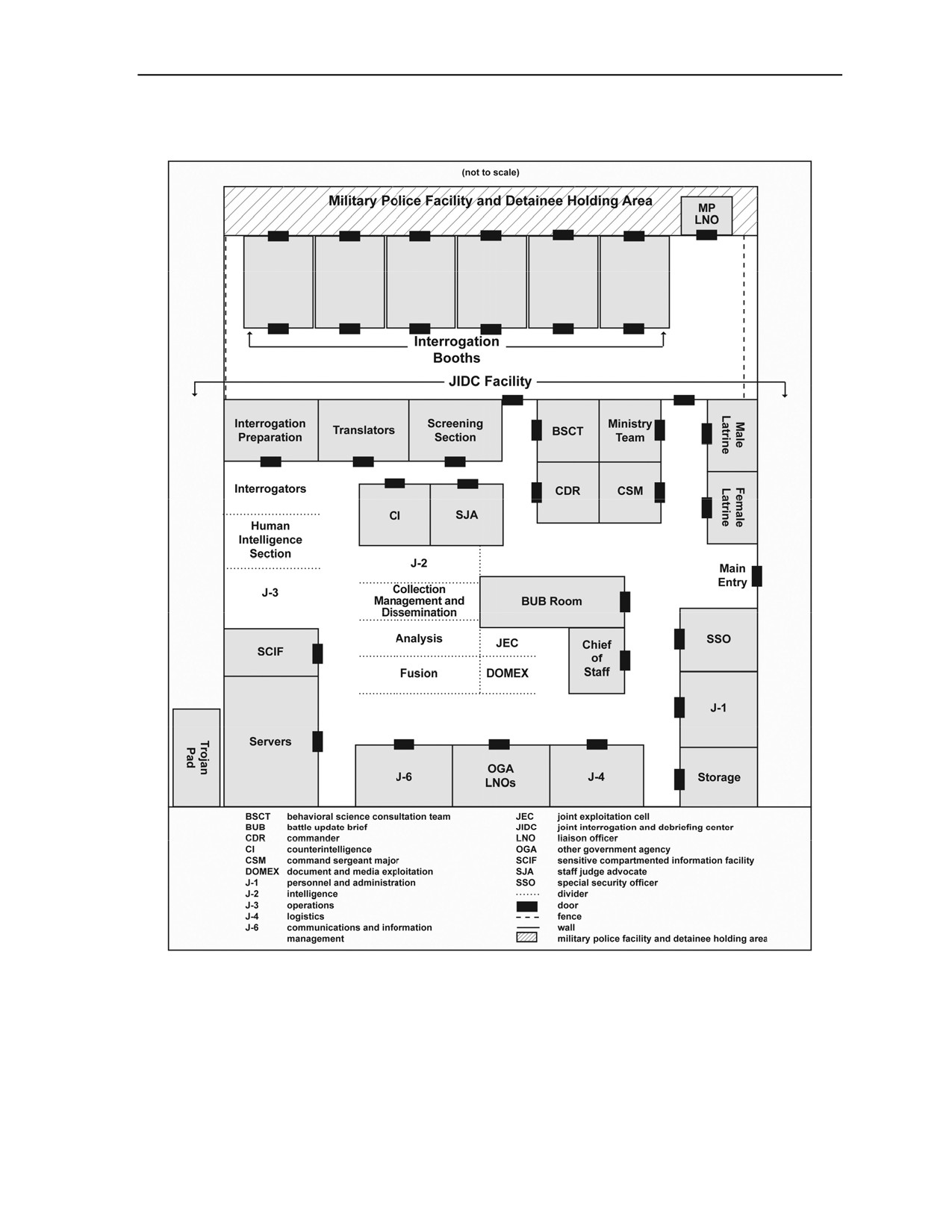
Available
3-10. Figure 3-2 provides an example of the physical layout of a notional JIDC collocated with an MP
detention facility.
Figure 3-2. Example of the physical layout of a notional JIDC
3-11. When setting up an area for long-term interrogation operations, interrogators should provide proper
lighting, climate control, seating, workspace and materials, monitoring, safety, and security. Not every
approach technique requires special preparation of the interrogation area, but interrogators should have the
option to arrange seating, lighting, or other props in the area to create the appropriate atmosphere to
support their selected approach strategies. Interrogators may want to provide a relaxed atmosphere for a
3 August 2009
TC 2-22.304
3-3
FOR OFFICIAL USE ONLY
Chapter 3
rapport-based approach, a business-like area resembling an office to support a ruse, or perhaps a sterile
“prison cell-like” booth for a fear-based or futility approach. They should acknowledge what the local
populace considers as a relaxed, business-like, or “prison cell-like” atmosphere, and not rely solely on what
the average American considers as typical of each type of atmosphere. If time, resources, and space allow,
constructing booths to support each of the scenarios listed above should be considered.
3-12. Listed are general guidelines for booth construction in order to keep the interrogation booth and
surrounding area free from distractions, such as external stimuli like the view from a window, music
sounds, talking, or pictures on the walls of the booth. If the booth has windows, they should be covered or
high enough to provide no view.
3-13. When planning for and constructing interrogation booths, JIDC commanders should consider—
z
Security.
Through overall physical security, protecting from direct and indirect fire, and protecting
both detainees and friendly forces personnel.
Designing and locating booths to preclude the general detainee population from monitoring
who enters and exits interrogation booths.
Designing and locating a temporary holding cell adjacent to interrogation booths with
accommodations for transferring detainees between MP and MI personnel.
Adequate lighting between booths and in the immediate surrounding area to allow
personnel to move at night without difficulty and to allow the guard force easy monitoring
of the area.
Monitoring capabilities such as one-way mirrors, video and audio feeds, recording
capabilities, and two-way communications with JIDC (does not need to be in each booth but
can be located in a central location easily accessible from all booths).
Panic buttons in each booth directly connected to JIDC and the guard force.
Wall- or floor-mounted eyebolts for securing detainees.
z
Climate control.
Air conditioner.
Heat.
Ventilation.
Lighting.
z
Power and networking.
Each interrogation booth should have at least one power outlet; more outlets allow the
interrogators to rearrange the booth in order to facilitate and support their planned approach
strategy.
Power may be locally provided; therefore, voltage and frequency may be different from the
standard 120 volts and 60 hertz.
Each booth should have at least one network adapter; more adapters allow simultaneous
network connections for the interrogator, analyst, or any other individual who may be
participating in the interrogation session.
A network adapter’s security level should be the same as the JIDC’s to allow for real-time
communication between an interrogation booth and JIDC.
Non-Secure Internet Protocol Router Network (NIPRNET) access should be considered to
allow more flexibility when interrogating detainees or debriefing sources.
z
Miscellaneous.
Designing and locating toilet facilities in easy reach of interrogation booths (consider
separate facilities for detainees and U.S. forces or other friendly personnel).
Designing and locating a potable water supply in easy reach of interrogation booths.
Designing and locating a first aid station in close proximity of interrogation booths.
3-4
TC 2-22.304
3 August 2009
FOR OFFICIAL USE ONLY

Available
JOINT INTERROGATION AND DEBRIEFING CENTER—
ORGANIZATION
3-14. A JIDC is a joint organization resourced under the provisions of a JMD. The MI battalion
(interrogation) command, staff, personnel, and equipment form the JIDC’s nucleus. The JIDC is task-
organized and augmented with joint Service military personnel, Government civilians, and civilian
contractors. Each established JIDC is a unique organization, reflecting the impacts of the mission variables
that are mission, equipment, terrain and weather, troops and support available, time available, civil
considerations (METT-TC). Figure 3-3 provides an example JIDC organization.
Figure 3-3. Example JIDC organization
3-15. When a MI battalion (interrogation) deploys to operate in a JIDC, its commanders, staff officers, and
personnel are task-organized into the JIDC structure along with other augmentation personnel. When
assigned based on JIDC paragraph and line numbers of the JTF JMD, the battalion commander may
become the JIDC commander and battalion staff officers (S-1, S-2, S-3, S-4, S-6) may become the JIDC
joint staff officers (J-1, J-2, J-3, J-4, J-6). Likewise, the headquarters and headquarters detachment (HHD)
commander may become the headquarters and headquarters company (HHC) commander.
3 August 2009
TC 2-22.304
3-5
FOR OFFICIAL USE ONLY
Chapter 3
3-16. The JIDC commander may receive a personal staff and a special staff. In addition, when determined
by mission requirements, a behavioral science consultation team (BSCT)—ideally assigned to the special
staff to the CDO—share their place of duty with the JIDC and detention facility. When in the JIDC, the
BSCT works on the JIDC commander’s special staff. Personnel from the human intelligence (HUMINT)
company and HUMINT analysis and requirements detachment may be reassigned to positions in the
HUMINT sections and joint exploitation cell (JEC).
JOINT INTERROGATION AND DEBRIEFING CENTER—
COMMANDER
3-17. JIDC commanders are responsible for all matters relating to intelligence collection and reporting in
the JIDC. They are also responsible for all interaction between the JIDC and the DFC, other units, staff
elements, and organizations. Other responsibilities may include, but are not limited to—
z
Coordinating with the DFC to ensure the roles and responsibilities of HUMINT collectors and
MPs, as well as areas requiring close coordination, are understood and applied throughout all
phases of detainee interrogation operations.
z
Coordinating with the DFC concerning MI personnel participation in detention facility base
operations support, including tenant unit security, incentives, medical support, control
procedures, translator support, logistic support, and detainee processing and screening.
z
Informing the CDO about interrogation operations.
z
Establishing and maintaining technical channels to the supporting J-2X.
z
Implementing screenings, debriefings, interrogations, CI, and support to DOMEX operations per
the priorities and guidance outlined by the J-2X in order to satisfy the JTF commander’s
intelligence collection requirements.
HEADQUARTERS AND HEADQUARTERS COMPANY
3-18. The HHC provides all of the combat enablers (for example, safety, force protection, facility
acquisition and maintenance, vehicles, supplies, computers, equipment maintenance, administration,
morale events, Uniform Code of Military Justice [UCMJ], and uniform standards) to support the JIDC.
Supply and maintenance noncommissioned officers (NCOs) support the company command team (the
company commander and first sergeant) The HHC commander closely coordinates with the chief of staff
and the J-3.
PERSONAL STAFF
3-19. A JIDC’s personal staff is not organic to the MI battalion (interrogation); therefore, the staff is
granted to the JIDC through an augmentation JMD. The personal staff is directly responsible to the JIDC
commander. It includes assistants who handle matters requiring close personal control by the commander.
The JIDC personal staff includes—
z
A staff judge advocate (SJA) advises the JIDC commander on all legal issues. The SJA—
Provides intelligence oversight.
Acts as the command judge advocate concerning military justice and administrative matters.
Acts as the subject matter expert (SME) on intelligence law, interrogation policies, the
Geneva Conventions, the law of war (law of armed conflict), national security law, and
military justice.
Reports to the JIDC commander, who may use the DCO as a point of contact for the SJA in
order to facilitate JIDC operations communications.
z
An inspector general (IG) serves as an extension of the JIDC commander. The IG—
Serves the commander and the JIDC by executing the four IG functions—teaching and
training, inspections, assistance, and investigations.
3-6
TC 2-22.304
3 August 2009
FOR OFFICIAL USE ONLY
Available
Employs the IG inspection and action processes.
Enhances the JIDC’s discipline, readiness, and operational warfighting capability.
Serves as a direct means through which the JIDC commander conducts oversight of
detainee treatment and JIDC personnel.
For more information on the IG, see AR 20-1.
CHIEF OF STAFF
3-20. The JIDC chief of staff is the principal staff officer, assistant, and advisor to the JIDC commander.
The chief of staff coordinates and directs the work of the JIDC special staff and the JIDC joint staff, but
generally concentrates attention on the activities of the J-1, J-4, and J-6. The J-2 and J-3 coordinate with
the chief of staff, but receive direction from the DCO or JIDC commander.
Special Staff
3-21. A JIDC’s special staff is not organic to the MI battalion (interrogation); therefore, the staff is granted
to the JIDC through an augmentation JMD. The JIDC special staff reports to the JIDC chief of staff and
helps the commander and the joint staff with tactical, technical, and administrative matters. The JIDC
special staff may include a—
z
Detainee health care team (DHT). Monitors and maintains the health of those detainees who
are undergoing interrogations as specified in Geneva Conventions, Executive Order
(EO)
12333, and combatant command or JTF policies. For more information, see FM 4-02.46.
z
Polygraph team. Provides specific polygraph services, as needed, to support JIDC operations.
For more information on polygraph activities, see Department of Defense Directive (DODD)
5210.48.
z
Special security officer (SSO). Provides sensitive compartmented information (SCI) operations
from the sensitive compartmented information facility (SCIF) and the SCI security programs.
The SSO advises and helps the JIDC commander on all matters pertaining to the security of SCI
materials, equipment, and procedures. For more information regarding SSO activities, see DOD
5105.21 M-1.
Joint Staff
3-22. The JIDC joint staff reports to the JIDC chief of staff and executes the responsibilities of the JIDC
commander, such as developing policy, preparing and coordinating plans, and overseeing all functions
assigned to the commander. The MI battalion (interrogation) staff becomes a joint staff when it includes
members from the other Services (for example, Navy, Air Force, and Marine Corps). The joint staff
sections listed are responsible for the following areas:
z
J-1—personnel administration.
z
J-2—intelligence.
z
J-3—operations.
z
J-4—logistics.
z
J-6—communications and information management.
For more information on a joint staff, see Joint Forces Staff College (JFSC) Publication 1.
3 August 2009
TC 2-22.304
3-7
FOR OFFICIAL USE ONLY

Chapter 3
J-2—INTELLIGENCE
3-23. Figure 3-4 depicts the organization of a JIDC J-2 section.
Figure 3-4. Organization of a JIDC J-2 section
3-24. The JIDC J-2 coordinates with the chief of staff, but generally receives day-to-day direction from the
DCO or JIDC commander. The JIDC J-2 section is responsible for oversight of the following:
z
Fusion and analysis cell. Coordinates and uses intelligence analytical products from JTF
subordinate divisions or brigade combat teams (BCTs) and from theater intelligence analytical
elements. The cell conducts all-source analysis, to support JIDC HUMINT collection operations,
in order to satisfy the supported JTF commander’s intelligence collection requirements.
z
Collection management and dissemination (CM&D) section. Focal point of intelligence
flowing in and out of the JIDC. The section receives all intelligence collection requirements
from external organizations; all raw information and refined intelligence flows out of the JIDC
through the CM&D section.
z
Signals intelligence (SIGINT) section. Provides SIGINT analytical and technical support, as
required.
z
Military police liaison officer (LNO). Provides a personal interface with the collocated MP
detention facility, as required.
J-3—OPERATIONS
3-25. Figure 3-5 depicts the organization of a JIDC J-3 section.
Figure 3-5. Organization of a JIDC J-3 section
3-8
TC 2-22.304
3 August 2009
FOR OFFICIAL USE ONLY
Available
3-26. The JIDC J-3 section is the focal point for all interaction between the JIDC and external
organizations. It coordinates with the chief of staff and receives day-to-day direction from the DCO or
JIDC commander. The JIDC J-3 section—
z
Drives all JIDC functions by coordinating the planning, preparation, and execution of JIDC
projects, events, and daily operations.
z
Works closely with the supporting JTF J-2X to determine interrogation priorities, coordinate
employment of JIDC LNOs and mobile interrogation teams (MITs), and to obtain technical
guidance and collection focus, as required.
z
Coordinates movement of unit personnel, briefings, and visitors.
z
Provides overall case management for all detainees deemed of intelligence interest.
z
Coordinates the transfer of detainees through an MP LNO.
z
Consists of—
Joint exploitation cell (JEC). Identifies detainees for further exploitation to satisfy the JTF
commander’s intelligence collection requirements through face-to-face screenings and the
exploitation of detainee property (including DOMEX). Coordinates with the JDEC, as
required.
Counterintelligence section. Provides full spectrum CI support to the JIDC in order to
detect and neutralize adversary intelligence collection assets and capabilities. The CI section
supports detainee interrogations of CI interest, as required. For more information on CI
activities, see AR 381-20.
Human intelligence section. See Human Intelligence Section, which follows.
HUMAN INTELLIGENCE SECTION
3-27. The heart of a JIDC is the HUMINT section, whose officer in charge is the authority to determine
access to all detainee exploitation and is responsible for managing day-to-day collection activities. The
HUMINT section is analogous to an operational management team (OMT), which supports HUMINT
collection teams (HCTs) and has similar responsibilities (see TC 2-22.303 for more information on an
OMT). The HUMINT section officer in charge or NCO in charge may establish subordinate sections, each
with its own designated HUMINT collector and analyst teams (usually 10 for each section).
3-28. Internally, in a JIDC, the HUMINT section works closely with the CM&D section, fusion and
analysis cell, the linguist and translator pool, and others. Externally, in a JIDC, the HUMINT section
coordinates with the MPs, projected JIDC MITs and LNOs, the JTF J-2X staff, other government agencies
(OGAs), external agencies, and others.
3-29. The HUMINT section’s work begins when the CM&D passes information requirements (IRs) and
requests for information (RFIs) to the section, which identifies detainees of intelligence interest who may
possibly provide information to satisfy these requirements. The HUMINT section schedules interrogation
sessions in the available booths and tasks collection requirements through subordinate sections to
appropriate HUMINT collector and analyst teams for satisfaction.
3-30. The collector and analyst teams develop interrogation plans (see FM 2-22.3), which are submitted as
specified in the JIDC SOPs. Screening sheets and exploited detainee property (DOMEX) from the JIDC J-3
JEC are available to the HUMINT collector and analyst teams, whose analysts use the information, along
with any other accessible information obtained from intelligence databases, to develop analyst support
packages for each detainee of intelligence interest. After an interrogation session is completed, the
HUMINT collector and analyst team may produce intelligence information reports (IIRs), which the
HUMINT section sends to CM&D for release and dissemination. The section then coordinates with the J-2
and J-3 to ensure databasing and interoperability of the data throughout the interrogation process.
Information flow should be seamless as data passes from entity to entity.
3-31. The HUMINT section coordinates closely with the MPs, collocated at the detention facility,
regarding detainee accountability and movement to and from the interrogation, security of interrogation
sessions, and detainee transfers. The HUMINT section also coordinates with OGAs and external agencies
3 August 2009
TC 2-22.304
3-9
FOR OFFICIAL USE ONLY
Chapter 3
that request to interview or interrogate detainees of intelligence interest in the JIDC. The JTF may establish
written policy and procedures concerning OGA and external agency detainee interviews or interrogations.
The HUMINT section may task a JIDC HUMINT collector to monitor the detainee interview or
interrogation to ensure compliance with the JTF policy.
HUMAN INTELLIGENCE COLLECTOR AND ANALYST TEAMS
3-32. Human intelligence collector and analyst teams may be assigned team members who are cleared
interpreters, behavioral science consultants, representatives from other intelligence collections agencies or
activities, law enforcement personnel, or other subject matter experts (SMEs). Participation by other
agencies on the teams enhances agencies’ ability to share information. These teams may focus on specific
areas, regions, or target sets, for example, tribal groups, bomb makers, terrorist organizations, political
parties, foreign fighters, or other issues of intelligence interest. The teams are designed so analysts can
provide HUMINT collectors with guidance and direction on collection topics for sources. In this respect,
the interrogators support the analyst rather than the other way around. The arrangement makes sense,
considering the purpose for intelligence interrogation is to obtain information that satisfies intelligence
requirements—supported commanders’ PIRs, national requirements, or source-directed requirements
(SDRs).
3-33. Brainstorming—before and after an interrogation session—focuses collection. The collector and
analyst decide when the analyst should attend a particular interrogation session, especially a particularly
difficult session or when new information becomes available.
3-34. Analysts should be available to view interrogation sessions, either directly in the interrogation booth
or from the observation room. Analysts can often spot leads that the HUMINT collector misses or suggest
topics for follow-up. If the HUMINT collector and analyst decide the analyst should take an active role in
the interrogation session, they should acknowledge that the HUMINT collector is in charge of the
interrogation, regardless of the interrogation’s progress. The interrogator provides any incentives offered;
controls the interrogation plan, progression, and schedule; and sets the topics for exploitation.
3-35. The analyst should be aware that the detainee might seek information as well. HUMINT collectors
are trained to maintain control of the interrogation session, but analysts and other active participants in the
interrogation session generally are not. These individuals should follow the HUMINT collector’s lead and
direction to preclude the detainee from gaining control.
3-36. If the analyst observes the interrogation session from outside the booth, reviewing the analyst
support package or other sources of information while the interrogation is in progress enables the analyst to
advise the HUMINT collector, during breaks.
3-37. Before terminating an interrogation session, the HUMINT collector should confirm with the analyst
any new topics to exploit from the research, or whether the analyst identified any leads the HUMINT
collector failed to fully exploit.
CHALLENGES
3-38. Lessons learned indicates the following as some of the challenges a MI battalion (interrogation)
should be prepared to address when operating in a JIDC:
z
Interrogation policy.
z
LNOs.
z
MITs.
z
Screening.
z
Segregation and separation.
z
Other governmental agencies.
z
Detainee assessment board.
z
BSCT.
3-10
TC 2-22.304
3 August 2009
FOR OFFICIAL USE ONLY
Available
INTERROGATION POLICY
3-39. The governing combatant command, theater, or JTF interrogation policy
(for example, the
Multinational Forces-Iraq interrogation policy) have direct impact on JIDC operational tempo, intelligence
collection activities, oversight, and support activities. When preparing for deployment and for operating in
a JIDC, the commander, staff, and MI battalion (interrogation) Soldiers must acknowledge and understand
the governing interrogation policy of the JTF they will be supporting; therefore, the policy should be
incorporated into battalion collective, subordinate element, and individual Soldier training.
LIAISON OFFICERS
3-40. Because LNOs are critical to JIDC operations, the JIDC should establish SOPs for LNOs specifying
daily, weekly, monthly, and ad hoc tasks to perform and reporting requirements. The JIDC should identify
personnel in the unit who can serve as LNOs to other organizations.
JIDC Liaison Officer to the Military Police Detention Facility
3-41. A JIDC LNO to the MP detention facility coordinates detainee transfers, MP escorting of detainees
to and from interrogations, detainee welfare, and other common concerns of the DFC and JIDC
commander, such as the coordination of allowing or denying incentives.
JIDC Liaison Officer to the Joint Task Force J-2X
3-42. A JIDC LNO to the JTF J-2X coordinates collection requirements and priorities and handles RFIs.
JIDC Liaison Officer to a Joint Task Force Division or Brigade Combat Team
3-43. A JIDC LNO to a JTF division or BCT—
z
Identifies detainees of intelligence interest while evacuating them to the rear.
z
Implements procedures to track the results of DOMEX of detainee property.
z
Ensures inclusion of detainee property in screening reports that have property tracking numbers
assigned by DOMEX teams at the BCT-level. This ensures accountability and subsequent
exploitation at the JIDC-level. The practice saves time and may preclude the JIDC J-3 JEC
DOMEX team from redoing translation or exploitation of detainee property.
z
Recommends tagging detainee property at the BCT-level with a point of contact (name and
contact information). Therefore, the JIDC DOMEX team, analysts, or HUMINT collectors, if
necessary, can address incomplete data, clarify details, or obtain missing information that may
help with detainee exploitation at the JIDC.
z
Coordinates with a local JIDC MIT if available or coordinates with the JEC screening section,
HUMINT section analysts, and the CM&D section. The JEC screening section provides a heads
up of potential detainees of intelligence interest. The HUMINT section analysts can begin
database research on initial information. The CM&D section can identify requirements detainees
might satisfy. This procedure ensures effective screening and exploitation of newly arrived
detainees at the JIDC, so they will not “drop through the cracks” upon evacuation to the rear.
MOBILE INTERROGATION TEAMS
3-44. The JIDC identifies HCTs, subordinate to the HUMINT section, to be used as MITs. Through
coordination with the supporting J-2X, these teams are dispatched from the JIDC to JTF subordinate
divisions or BCTs to support surge operations or special projects. The JIDC MITs can augment other
HUMINT capabilities and help identify, close to the point of capture, detainees of intelligence interest.
MIT detainee interrogation results, disseminated through JIDC LNOs, can help with subsequent detainee
exploitations upon their evacuation to the JIDC.
SCREENING
3-45. Screening is an extremely important component in the detainee questioning process. It is vital to the
rapid collection of information. During screening, interrogators can potentially identify information that
3 August 2009
TC 2-22.304
3-11
FOR OFFICIAL USE ONLY
Chapter 3
will aid in prioritizing detainees. Detainee screening should be conducted by unit interrogators who are
experienced, mature, and extremely knowledgeable of the collection requirements. Often, these
interrogators are warrant officers (WOs) and senior NCOs, but leaders should be receptive to their junior
HUMINT collectors as effective screeners and assign them accordingly. Screeners should be able to make
reasonable decisions based on limited information. Although detainees may have been screened at another
detention facility, they should be rescreened at the JIDC because of different or new intelligence collection
requirements. Periodically, JIDC screeners should be rotated between the JEC screening section and the
HUMINT section to prevent screener “burn out.”
SEGREGATION AND SEPARATION
3-46. Between the point of capture and their arrival at the JIDC, detainees are kept segregated. Based on
lessons learned, once detainees are permitted to intermingle in a common pool, the shock of capture
dissipates; they quickly learn resistance techniques and corroborate each other’s stories. For this reason,
Soldiers learn the “five Ss and a T”—search, silence, safeguard, segregate, speed to the rear, and tag (see
FM 2-22.3 for handling of detainees and their personal property).
3-47. It is critical for capturing units, MP personnel evacuating detainees to the rear, and JIDC personnel
to distinguish between
“segregation” and
“separation.” Commanders involved in handling detainees
enforce segregation. However, separation is a restricted interrogation technique, described in FM 2-22.3,
which requires authorization, safeguards, and oversight. For more information, see Undersecretary of
Defense for Intelligence (USD [I]) Memorandum, Clarification of Intelligence Interrogation Policy—
Detainee Status Determinations and the Conduct of Interrogations during Segregation and Separation,
20 September 2007.
OTHER GOVERNMENT AGENCIES
3-48. The JIDC must establish SOPs to address procedures for interviewing or interrogating detainees in
the JIDC by personnel from OGAs and external agencies. As per DODD 3115.09, any other U.S.
Government agencies’ personnel, foreign government representatives, or other parties who request to
conduct intelligence interrogations, debriefings, or other questioning of persons detained by the DOD must
agree to abide by DOD policies and procedures before being allowed access to any detainee under DOD
control. Such agreement shall be formalized in a written document signed by the agency, Government
representative, or party requesting access to a detainee. A trained and certified DOD interrogator shall
monitor all interrogations, debriefings, and other questioning conducted by non-DOD or non-U.S.
Government agencies or personnel. If an interrogator is not available, a DOD representative with
appropriate training and experience shall monitor the interrogation, debriefing, or other questioning. The
DOD monitor shall terminate the interrogation, debriefing, or other questioning, and report to higher
authorities if the other party does not adhere to DOD policies and procedures.
3-49. There is no requirement for JIDC personnel to monitor law enforcement, for example, Army
Criminal Investigation Division [CID]) interviews or interrogations of detainees. Before gaining access to
the JIDC, OGAs and external agencies coordinate with the CDO and JTF J-2X, who, ideally, will provide
early warning about OGA or external agency intentions and schedules. For more information, see DODD
3115.09 and USD (I) Memorandum, Clarification of Intelligence Interrogation Policy—Monitoring of
Non-DOD Interrogations, Debriefings, and Questioning of Detainees, 4 April 2007.
DETAINEE ASSESSMENT BOARD
3-50. Detainees are screened upon processing, which determines their level of knowledge, level of
cooperation, and potential to provide information that satisfies intelligence requirements (for screening
information, see FM 2-22.3). HUMINT collectors performing screening characterize detainees as “of
intelligence interest” or “of no intelligence interest.” Detainees characterized as “of intelligence interest”
are interrogated. Under the provisions of governing combatant command, theater, and JTF interrogation
policy, the JIDC commander and staff should be prepared to establish a formal process and procedure to
review the status of each detainee designated as “of intelligence interest.” To execute this formal review
process, the JIDC may establish a detainee assessment board (DAB).
3-12
TC 2-22.304
3 August 2009
FOR OFFICIAL USE ONLY
Available
3-51. DAB members may include representatives from CM&D, who can articulate the requirements
detainees might satisfy (or the requirements detainees satisfied). CM&D representatives can also discuss
what intelligence reporting resulted from detainee interrogations. HUMINT section representatives can
discuss detainees’ placement and access to intelligence information and their cooperation. JEC
representatives can provide feedback from initial detainee screening and exploitation of detainees’
property. Other DAB members may include BSCT representatives, the polygraph team, the CI section, and
the SJA.
3-52. The DAB reviews the status of a detainee designated as “of intelligence interest,” and provides a
written recommendation to the JIDC commander. If the detainee “of intelligence interest” has not been
fully exploited, but can potentially satisfy intelligence requirements, the DAB may recommend that the
JIDC continue with the detainee interrogation. Conversely, the DAB may determine that the detainee has
been fully exploited and possesses no further information of intelligence value. Then, the DAB would
recommend that the JIDC terminate the detainee interrogation; the detainee is considered as “of no
intelligence interest.”
BEHAVIORAL SCIENCE CONSULTATION TEAM
3-53. The BSCT works for the CDO and supports the MP DFC and the MI JIDC commander. Behavioral
science consultants are nonphysician health care personnel qualified in behavioral sciences. behavioral
science consultants do not provide medical treatment or clinical practice services; they will not function as
detainee health care providers, or provide health care services except during emergencies when dedicated
medical personnel are not immediately available. Behavioral science consultants provide consultative
services to support authorized intelligence activities. When working at the JIDC, the BSCT are members of
the JIDC commander’s special staff. The team reports to the JIDC chief of staff and helps the commander
and the joint staff with tactical, technical, and administrative matters, which include providing
psychological expertise and consultation to assist the JIDC in conducting safe, legal, ethical, and effective
intelligence interrogations and debriefing operations. The BSCT’s mission encompasses the following
objectives:
z
To provide psychological expertise to assess detainees and their environment, as well as provide
recommendations to improve the effectiveness of intelligence interrogations and debriefing
operations. behavioral science consultants are authorized to make psychological assessments of
the character, personality, social interactions, and other behavioral characteristics of
interrogation subjects; based on their assessments, behavioral science consultants advise
authorized personnel performing lawful interrogations. It is important to note behavioral science
consultants can advise interrogators and observe interrogations but may not participate in or
direct interrogations. They can only provide advice when interrogations are in accord with the
applicable laws.
z
To provide training in listening and communications techniques and skills. Behavioral science
consultants may also brief HUMINT collectors on the results of studies and assessments about
safe and effective interrogation methods, and the potential effects of interrogation subjects’
cultural characteristics or considerations.
z
To provide psychological expertise by monitoring, consulting, and offering feedback regarding
the entire detainee environment, which helps the JIDC to ensure the humane treatment of
detainees, prevention of abuse, and the safety of U.S. personnel.
3 August 2009
TC 2-22.304
3-13
FOR OFFICIAL USE ONLY
This page intentionally left blank.
Appendix A
Example Reset Plan
Figure A-1 provides an example reset operation plan/operation order
(OPLAN/OPORD) for a notional MI battalion (interrogation). Consult FM 5-0 for
more information on the preparation of an OPLAN/OPORD.
References
a. HQDA Policy on Property Accountability During Deployment and Redeployment, dated 22 November 2005.
b. HQDA Change to Property Accountability During Deployment and Redeployment Message, dated 221958Z NOV 05.
c.
Higher Headquarters OPLAN/OPORD/FRAGO.
1.
SITUATION.
a. Enemy forces (not applicable).
b. Friendly forces (not applicable).
c.
Environment (not applicable).
d.
Attachments and detachments (not applicable).
2.
MISSION. On order, MI battalion (interrogation) executes the Army’s reset program to support ARFORGEN. MI
battalion
(interrogation) conducts the synchronization, planning, preparation, and tracking of unit reset
requirements. MI battalion (interrogation) performs this mission through coordination with JTF staff, supporting
combatant command/ASCC staff, INSCOM staff, and rear detachment to facilitate rapid reset of the unit for
worldwide availability.
3.
EXECUTION.
a. Scheme of support: MI battalion (interrogation) prepares and conducts a unit command and staff biweekly reset
brief and participates in the biweekly HQDA G-2/INSCOM reset task force VTC. Maintain battalion web site and
AKO reset knowledge center as a reset information repository for co-use by all reset staff agencies. MI battalion
(interrogation) synchronizes and coordinates unit reset conferences as directed. MI battalion (interrogation)
publishes the conference results and subsequently manages and updates information.
b. Tasks to subordinate units and staff.
(1) Commander HHD: Coordinate and synchronize battalion initial reset planning conference NLT redeployment (R)
minus (-) 180. The conference intent is to project how many items are scheduled to be reset for the battalion. All
ARI items will be included in the projected total quantity. Subordinate units will turn in a minimum of 25 percent of
ARI in theater and 100 percent in 60 days of equipment returning to the CONUS. This conference will facilitate
the planning and synchronization of workloading for service providers as well as provide initial reset planning
data for logistic support providers. Notify JTF, ASCC, INSCOM, and subordinate units of all planning conference
dates.
(2) Commanders HUMINT company and HUMINT analysis and requirements detachment.
(a) Provide reset data on units. Provide HHD visibility on the quantity of items to be reset, including all items
inducted per the ARI list. Synchronize and track the equipment status throughout the reset process including
workloading with service providers, sourcing solutions, critical shortages, equipment on hand percentages and
completion of field level reset on each commodity.
(b) Designate a reset POC in the unit. Provide contact information of reset POCs to HHD NLT XX July 20XX.
(c) Participate in reset planning conference not later than R-60. The conference intent is to validate equipment
density by line item number and to project how many items are scheduled for reset. All ARI items will be included
in the projected total quantity. This conference will facilitate the planning and synchronization of workloading for
service providers as well as ensuring INSCOM is involved in the process.
(d) Submit biweekly reset reports NLT R-90.
(3) Rear detachment: Prepare training plans for unit personnel to support reset training.
c.
Coordinating instructions.
(1) The MI battalion (interrogation) reset knowledge center is located on both NIPRNET and SIPRNET.
(2) Units are responsible for maintaining their designated folder.
(3) Read/write access must be requested through the HHD S-6. Contact XX at i.b.reset@us.army.mil
4.
SERVICE SUPPORT (not applicable).
5.
COMMAND AND SIGNAL.
a. Command (not applicable).
b. Signal. See reset point of contact list.
Figure A-1. Example reset plan
3 August 2009
TC 2-22.304
A-1
FOR OFFICIAL USE ONLY
Appendix B
Example Training Tasks
Appendix B outlines examples of military intelligence (MI) battalion (interrogation)
training tasks; accompanying conditions, standards, and performance measures are
not included. For complete information on each training task, condition, standard,
and performance measure, refer to the combined arms training strategy (CATS) for a
MI battalion (interrogation), which can be viewed on Army Knowledge On-Line
(AKO) at http://www.us.army.mil./ :
• Login using the designated AKO username and password.
• Type MI battalion (interrogation) in the Search box using the AKO Public directory.
Click Search.
• The first few results indicate sites that address CATS.
MI battalion (interrogation) commanders will determine the training tasks along with
their accompanying conditions, standards, and performance measures based on their
mission-essential task list (METL).
WARRIOR TASKS
B-1. Table B-1 depicts warrior training tasks applicable to all Soldiers in the battalion.
Table B-1. Warrior tasks common to all Soldiers
Shoot
•
Qualify with assigned weapon.
•
Engage targets with M240B machine gun.
•
Engage targets with M60 or M249 machine gun.
•
Engage targets with M2 .50 caliber machine gun.
•
Engage targets with MK-19 grenade machine gun.
•
Correct malfunctions of assigned weapon (M2, M240B, M249, M60, MK-19).
•
Engage targets with weapons using night vision sight.
•
Engage targets using aiming light (AN/PEQ-2A, AN/PAQ-4).
•
Employ mines and grenades.
Move
•
Determine location on ground (terrain association and global positioning system [GPS]).
•
Navigate from one point to another (dismounted and mounted).
•
Move over, through, or around obstacles (except minefields).
•
Prepare and operate a vehicle in a convoy.
•
Communicate.
•
Perform voice communications (situation report [SITREP], spot report, call for fire, medical evacuation).
•
Use visual signaling techniques.
3 August 2009
TC 2-22.304
B-1
FOR OFFICIAL USE ONLY
Appendix B
Table B-1. Warrior tasks common to all Soldiers (continued)
Fight
•
Move under direct fire.
•
React to direct and indirect fire (dismounted and mounted).
•
React to improvised explosive device (IED).
•
React to man-to-man combat (combatives).
•
React to chemical or biological attack or hazard.
•
Decontaminate self and individual equipment using chemical decontamination kits.
•
Maintain equipment.
•
Evacuate a casualty.
•
Perform first aid of open wound (abdominal, chest, and head).
•
Perform first aid of bleeding extremity.
•
Select a temporary fighting position.
Joint urban operations
•
Perform movement techniques.
•
Engage targets.
•
Enter a building.
INTELLIGENCE SPECIFIC TASKS
B-2. Table B-2 depicts intelligence-specific training tasks applicable to Soldiers who perform intelligence
missions in specific battalion elements.
Table B-2. Intelligence specific tasks
Headquarters collection management
•
Disseminate intelligence reports.
•
Develop indicators for intelligence requirements.
•
Report intelligence information.
•
Identify potential targets.
Fusion and analysis
•
Deploy the all-source workstation.
•
Terminate the all-source enclave.
•
Perform target analysis.
Human intelligence analysis
•
Supervise document and media exploitation (DOMEX) operations.
•
Assemble information to support a threat assessment.
•
Review reports.
•
Perform target analysis.
Human intelligence sections and human intelligence collection teams
•
Prepare the human intelligence (HUMINT) exploitation site.
•
Maintain HUMINT operational logs.
•
Map track a source.
•
Screen potential HUMINT sources.
•
Use direct questioning techniques.
•
Use an interpreter.
•
Develop an interrogation plan.
•
Question source for information of intelligence value.
•
Develop approach strategies.
•
Develop a topical sequence.
•
Review HUMINT collection plans.
B-2
TC 2-22.304
3 August 2009
FOR OFFICIAL USE ONLY
Example Training Tasks
Table B-2. Intelligence specific tasks (continued)
Counterintelligence
•
Conduct a walk-in source interview.
•
Conduct counterintelligence (CI) screening operations.
•
Conduct CI force protection source operations (CFSO).
•
Perform CI analysis.
•
Input data into CI databases, files, and indices.
•
Assemble information to support a threat assessment.
•
Manage intelligence contingency funds .
Equipment and software training (as appropriate to unit)
•
CI and HUMINT automated tool set (CHATS).
•
CI and HUMINT Information Management System (CHIMS).
•
Biometrics automated toolset.
•
Intelligence work space.
•
Pathfinder.
•
Analyst Notebook.
•
J-2X portal.
•
Distributed Common Ground System-Army (DCGS-A).
BATTALION COLLECTIVE TASKS
B-3. Table B-3 depicts battalion collective training tasks.
Table B-3. Battalion collective tasks
Provide support to force protection
•
Disseminate intelligence reports.
•
Report enemy information.
•
Map track a source.
•
Use direct questioning techniques.
•
Question source-for- force protection information.
•
Conduct a walk-in source interview.
•
Conduct CFSO.
•
Perform CI analysis.
•
Perform target analysis.
•
Identify potential CI targets.
•
Conduct CI screening operations.
•
Input data into CI databases, files, and indices.
•
Use an interpreter.
Maintain operational oversight of collection assets
•
Supervise DOMEX operations.
•
Maintain HUMINT operational logs.
•
Supervise CI operations.
•
Review reports.
•
Review HUMINT collection plans.
3 August 2009
TC 2-22.304
B-3
FOR OFFICIAL USE ONLY
Appendix B
Table B-3. Battalion collective tasks (continued)
Establish and maintain operational relationships with military police and outside agencies
•
Law of Land Warfare.
•
Geneva Conventions.
•
Rules of engagement/use of force.
•
Department of Defense directives (DODDs).
•
Theater policy and guidance.
•
Perform voice communications.
•
Disseminate intelligence reports.
•
Report enemy information.
•
Maintain HUMINT operational logs.
•
Input data into CI databases, files, and indices.
•
J-2X portal access.
•
Pathfinder access.
Conduct joint interrogation and debriefing operations per Army policies, DOD directives, and international law
Process intelligence and operational reports
Protect the force
•
Qualify with assigned weapon.
•
Engage targets with M240B machine gun.
•
Engage targets with M60 or M249 machine gun.
•
Engage targets with M2 .50 caliber machine gun.
•
Engage targets with MK-19 grenade machine gun.
•
Correct malfunctions of assigned weapon (M2, M240B, M249. M60, MK-19).
•
Engage targets with weapons using night vision sight.
•
Engage targets using aiming light (AN/PEQ-2A, AN/PAQ-4).
•
Employ mines and grenades.
•
Determine location on ground (terrain association and GPS).
•
Navigate from one point to another (dismounted and mounted).
•
Move over, through, or around obstacles (except minefields).
•
Prepare and operate a vehicle in a convoy.
•
Perform voice communications (SITREP, spot report, call for fire, and medical evacuation).
•
Use visual signaling techniques.
•
Move under direct fire.
•
React to direct and indirect fire (dismounted and mounted).
•
React to IED.
•
React to man-to-man combat (combatives).
•
React to chemical or biological attack or hazard.
•
Decontaminate self and individual equipment using chemical decontamination kits.
•
Maintain equipment.
•
Evacuate a casualty.
•
Perform first aid of open wound (abdominal, chest, and head).
•
Perform first aid of bleeding extremity.
•
Select a temporary fighting position.
•
Perform movement techniques during an urban operation.
•
Engage targets during an urban operation.
•
Enter a building during an urban operation.
B-4
TC 2-22.304
3 August 2009
FOR OFFICIAL USE ONLY
Example Training Tasks
Table B-3. Battalion collective tasks (continued)
Sustain the force
•
Evaluate a casualty.
•
Perform first aid of open wound.
•
Perform first aid of bleeding extremity.
•
Equal opportunity or prevention of sexual harassment.
•
Combat stress or suicide prevention.
•
Hot weather injury prevention.
•
Situational awareness training.
•
Cultural awareness training (country brief) for all Soldiers.
•
Antifratricide measures.
•
Family member assistance.
•
Soldier relief act.
Conduct base defense operations
•
Qualify with assigned weapon.
•
Engage targets with M240B machine gun.
•
Engage targets with M60 or M249 machine gun.
•
Engage targets with M2 .50 caliber machine gun.
•
Engage targets with MK-19 grenade machine gun.
•
Correct malfunctions of assigned weapon (M2, M240B, M249. M60, MK-19).
•
Engage targets with weapons using night vision sight.
•
Engage targets using aiming light (AN/PEQ-2A, AN/PAQ-4).
•
Employ mines and grenades.
•
Move under direct fire.
•
React to direct and indirect fire (dismounted and mounted).
•
React to IED.
•
React to man-to-man combat (combatives).
•
React to chemical or biological attack/hazard.
•
Decontaminate self and individual equipment using chemical decontamination kits.
•
Evacuate a casualty.
•
Perform first aid of open wound (abdominal, chest and head).
•
Perform first aid of bleeding extremity.
•
Antiterrorism Force Protection-1 training.
•
Secure and defend a position.
Provide command, control, communications, and computers of JIDC operations
•
Perform voice communications (SITREP, spot report, call for fire, medical evacuation).
•
Use visual signaling techniques.
•
Maintain equipment.
•
Deploy the all-source workstation.
•
Establish an operational All-Source Analysis System (ASAS) after move.
•
CHATS/CHIMS.
•
Terminate an all-source enclave.
•
Prepare a CHATS for operations.
•
Biometrics automated toolset.
•
J-2X portal.
•
Pathfinder access.
3 August 2009
TC 2-22.304
B-5
FOR OFFICIAL USE ONLY
Appendix B
Table B-3. Battalion collective tasks (continued)
Establish a battalion tactical operations center
•
Perform voice communications.
•
Maintain equipment.
•
Secure and defend a position.
•
Establish operational ASAS after move.
•
Prepare a CHATS system for operations.
•
Assemble information to prepare a CI threat assessment.
•
J-2X portal.
•
Pathfinder access.
Review human intelligence operational logs
•
Maintain operational logs.
•
Review reports.
Conduct daily battle update briefs
•
Perform voice communications.
•
Report enemy information.
•
Review reports.
•
Identify potential targets.
Conduct very important person briefs and escort very important persons
•
Perform media protocol.
•
Report enemy information.
•
Review reports.
SUBORDINATE ELEMENT TASKS
B-4. Table B-4 depicts detachment, company, section, element, and team training tasks.
Table B-4. Subordinate element tasks
S-1 section
•
Conduct battalion personnel administration.
•
Manage the joint-manning document.
•
Develop and refine a U.S. contractor administration standing operating procedures (SOPs).
•
Develop and refine a local contractor hire SOPs.
S-2/3 section
•
Manage battalion tactical operations center (TOC).
•
Battle track all battalion organic and attached elements.
•
Conduct operational coordination for all missions.
•
Manage risk for all battalion movements and missions.
S-4 section
•
Provide logistic support to battalion.
•
Develop and refine battalion logistic SOPs.
S-6 section
•
Establish and maintain JIDC communications architecture.
•
Provide technical support.
Unit ministry team
•
Provide ministry support to battalion.
Maintenance section
•
Provide maintenance support to battalion.
Feeding team
•
Provide food service support to battalion.
B-6
TC 2-22.304
3 August 2009
FOR OFFICIAL USE ONLY
Example Training Tasks
Table B-4. Subordinate element tasks (continued)
HHD and headquarters HUMINT company/headquarters HUMINT analysis and requirements detachment
•
Provide detachment and company command and control.
•
Protect the force.
•
Manage administrative and logistic support requirements for detachment and company operations.
Human intelligence section
•
Direct screening operations.
•
Direct HUMINT exploitation operations.
•
Manage HUMINT operations at the tactical level.
•
Manage HUMINT debriefing operations.
•
Direct HUMINT administration operations.
•
Maintain operational logs and files.
•
Review HUMINT operational logs.
•
Manage interpreters/translators to support HUMINT collection operations.
•
Supervise/manage interrogation operations.
•
Coordinate and deconflict MI or military police (MP) issues.
•
Validate HUMINT collection plans; coordinate and obtain higher command approvals for special
circumstances interrogations.
•
Review and maintain detainee dossiers.
•
Coordinate external agency participation in interrogation operations.
•
Maintain operational oversight of interrogation operations.
•
Conduct operational oversight of mobile interrogation team support missions.
•
Conduct operational oversight of DOMEX.
•
Conduct operational oversight of detainees of MI interest.
Detainee screening section
•
Conduct interrogations and debriefings.
•
Prepare an interrogation plan.
•
Write intelligence and operational reports.
•
Use an interpreter during interrogation.
•
Use intelligence databases.
•
Conduct screening operations.
•
Integrate intelligence analysis into screening operations.
•
Develop personnel of intelligence interest profiles.
•
Employ biometrics automated toolset.
•
Incorporate DOMEX screening into interrogation screening.
Collection management section
•
Supervise and deconflict collection requirements.
•
Refine collection requirements levied on JIDC.
•
Disseminate and publish intelligence reports.
•
Supervise directed research to support JIDC collection operations.
Fusion and analysis section
•
Provide analytical support to CI and interrogation operations.
•
Supervise directed research to support HUMINT collection operations.
•
Combine intelligence from multidiscipline sources.
•
Identify intelligence gaps and assist in refining requirements.
Document and media exploitation team
•
Conduct and manage DOMEX operations.
•
Provide local interrogation DOMEX support.
•
Forward document and media data to theater and national agencies.
Human intelligence collection teams/screening section
•
Conduct operational and tactical HUMINT operations.
•
Prepare detainee packets.
3 August 2009
TC 2-22.304
B-7
FOR OFFICIAL USE ONLY
Appendix B
Table B-4. Subordinate element tasks (continued)
Counterintelligence team
•
Maintain operational logs and files.
•
Manage incentives locker.
•
Manage intelligence contingency funds.
•
Provide CI support to JIDC.
•
Develop sources to satisfy MP DFC SDR.
•
Develop personnel of CI interest profile.
•
Conduct initial Subversion and Espionage Directed Against the U.S. Army (SAEDA) investigations.
•
Conduct CFSO.
CULTURAL AWARENESS TRAINING
B-5. Cultural awareness classes given to deploying Soldiers center on explaining the mindset of devout,
fundamentalist religious or political groups. However, the detainees questioned are often secular. They
may be associated with the prevailing religious or political beliefs, but do not adhere to all the tenants or
requirements.
B-6. HUMINT collector tactics designed to focus on the motivations of the fundamentalist religious or
political groups may be ineffective on the more secular detainees who are drawn into extremist groups.
They are motivated by their social contacts rather than by their religious or political beliefs. Therefore,
cultural awareness classes designed for HUMINT collectors should focus not only on the views of the
major religions and political parties in the theater of operations but also on secular beliefs and motivations.
B-7. Cultural awareness classes should be detailed and targeted to Soldiers’ regions of deployment or to
detainees’ places of origin. A study of the social, historical, tribal, familial, religious, and other factors
centered on a region reveals explicable and exploitable motivations not present in the national population,
as a whole.
B-8. HUMINT collectors and analysts should comprehend how other cultures perceive the United States
and its multinational partners. Propaganda or false or exaggerated reporting by local or regional news
sources—influenced or controlled by threat governments—overwhelm the indigenous populace of the
theater of operations. HUMINT collectors should prepare to either counter the skewed perceptions or use
them to their advantage.
B-9. HUMINT collectors should consider the following factors when preparing to conduct operations in a
particular theater of operations:
z
What constitutes a family unit.
z
Religion practices and how devoutly.
z
Basis of the economy.
z
Relationships between populations of regions, cities, and even neighborhoods.
z
Populations’ perceptions of their place in the world.
These and other factors affect HUMINT collectors’ decisionmaking when attempting to gain their sources’
cooperation.
B-8
TC 2-22.304
3 August 2009
FOR OFFICIAL USE ONLY
Appendix C
Example Joint Interrogation and Debriefing Center
Standing Operating Procedures—Table of Contents
Military intelligence (MI) battalion (interrogation) commanders are encouraged to
develop joint interrogation and debriefing center
(JIDC) standing operating
procedures (SOPs) to provide standardized guidance concerning the administration
and operations of unit, supporting combatant command, and operating environments.
Figure C-1 is a sample table of contents, adapted from existing JIDC SOPs.
Completed, detailed SOPs may be classified (see AR 380-5). JIDC subordinate
elements may also develop their own internal SOPs
to
complement
and
refine
overarching JIDC SOPs.
TABLE OF CONTENTS
Chapter 1: Introduction
Section I: Mission
Section II: Organization
Chapter 2: Headquarters and Headquarters Support
Section I: Overview
Section II: Duties and Responsibilities
Section III: Individual Processes
Chapter 3: Staff Judge Advocate
Section I: Duty Positions
Section II: Interrogation Legal Advisor Role
Section III: Intelligence Oversight Role
Section IV: Command Judge Advocate Role
Section V: Professional Expertise
Chapter 4: Behavioral Science Consultant Team
Section I: Mission
Section II: Personnel
Section III: Mission Essential Tasks
Section IV: Detainee Mental Health Evaluations and Medical Care
Section V: Ethical and Legal Responsibilities
Section VI: Security
Section VII: Work Schedules
Section VIII: Chain of Command
Section IX: Points of Contact
Chapter 5: Detainee Healthcare Team
Section I: Introduction
Section II: Mission
Section III: Personnel
Section IV: Detainee Health Status
Section V: Special Circumstances
Section VI: Reporting Detainee Abuse
Section VII: Detainee Separation Evaluation
Figure C-1. Example table of contents of JIDC SOPs
3 August 2009
TC 2-22.304
C-1
FOR OFFICIAL USE ONLY
Appendix C
Chapter 6: Polygraph Section
Section I: Mission
Section II: Manning
Section III: Requesting Polygraph Services
Section IV: Conduct of Polygraph Examinations
Section V: Documentation and Reporting of Polygraph Examination Results
Section VI: Quality Assurance Review
Chapter 7: Counterintelligence Section
Section I: Mission
Section II: Manning
Section III: Authority
Section IV: Jurisdiction
Section V: Priorities
Section VI: Liaison Activities
Section VII: SAEDA
Section VIII: Intelligence Contingency Funds
Chapter 8: J-1, Personnel Administration
Section I: Accountability
Section II: In and Out Processing
Section III: Briefings
Section IV: Leave Process
Section V: Personnel Evaluations
Section VI: Personnel and Finance Actions
Section VII: Promotion Board Procedures
Section VIII: Awards and Decorations
Section IX: Postal Operations
Chapter 9: J-2, Intelligence and Security
Section I: Purpose
Section II: Applicability
Section III: Mission
Section IV: Organizational Chart
Section V: Battle Rhythm
Section VI: Roles and Responsibilities
Chapter 10: Special Security Officer
Section I: General
Section II: Personnel Security
Section III: Physical Security
Section IV: Information Security
Section V: Security Violations
Chapter 11: J-3, Operations
Section I: Mission
Section II: Manning
Section III: Movement Procedures
Section IV: Visitors
Section V: Briefings
Section VI: Reports
Section VII: Detainee Abuse Reporting
Section VIII: Detainee Transfers
Section IX: Training
Section X: MI Hold Scrubs
Chapter 12: J-4, Logistics
Section I: Equipment/Supply Acquisition
Section II: Fund Procurement
Section III: Property Book Oversight
Section IV: Equipment Turn-In
Section V: Vehicle Maintenance
Section VI: Unit Movement
Figure C-1. Example table of contents of JIDC SOPs (continued)
C-2
TC 2-22.304
3 August 2009
FOR OFFICIAL USE ONLY
Example JIDC SOPs—Table of Contents
Chapter 13: J-6, Communications and Information Management
Section I: Purpose
Section: II: References
Section III: Definitions
Section IV: Policies
Chapter 14: Joint Exploitation Cell
Section I: JEC Overview
Section II: Screening Section
Section III: Property Exploitation Section
Section IV: Other Products
Chapter 15: Human Intelligence Section
Section I: Purpose, Scope, References
Section II: Collection Management
Section III: Intelligence Analysis in Support of Interrogation
Section IV: Interrogation Case Management
Section V: The Interrogation Process
Section VI: Battle Rhythm
Section VII: Duty Positions
Section VIII: External Agency Interrogations
Section IX: Detainee Rights
Section X: Miscellaneous
Chapter 16: Fusion and Analysis Cell
Section I: Purpose
Section II: Applicability
Section III: Mission
Section IV: Organization and Responsibilities
Section V: Continuous Support
Section VI: Requests for Support
Chapter 17: Liaison Officers
Section I: Overview
Section II: Daily Tasks
Section III: Weekly Tasks
Section IV: Monthly Tasks
Section V: Ad Hoc Tasks
Chapter 18: Contractor Support
Section I: Overview
Section II: References
Section III: Contractor Management and Staffing
Section IV: Daily Interaction
Section V: Life Support
Section VI: Equipment
Chapter 19: Force Protection
Section I: Overview
Section II: JIDC Operations Responsibilities
Section III: JIDC Sections Responsibilities to Operations
Annexes
A—Biometrics automated toolset Entry Step by Step
B—DOMEX Checklist
C—Interrogation Booth Scheduling Worksheet
D—Report Writing Guide
E—Dossier Layout
F—Interrogation Plan
G—Separation Request
H—Detainee Inter-camp Movement Request
I—Analyst Support Package
J—Source Screening Worksheet
K—Maintenance SOP
L—Dispatch Risk Assessment
M—Force Protection SOP
Glossary
Figure C-1. Example table of contents of JIDC SOPs (continued)
3 August 2009
TC 2-22.304
C-3
FOR OFFICIAL USE ONLY
This page intentionally left blank.
Glossary
2X
The staff counterintelligence and human intelligence operations manager at
each echelon, for example, C/J/G/S-2X, and the staff section that manages
counterintelligence and human intelligence.
351M
human intelligence collection technician
ACE
analysis and control element
AKO
Army Knowledge Online
AMC
United States Army Materiel Command
AO
area of operations
ARFORGEN
Army force generation
AR
army regulation
ARI
automatic reset indicator
ASCC
Army Service component command
ASAS
All-Source Analysis System
ASL
authorized stockage list
ASO
Army Synchronization Order
BCT
brigade combat team
BSCT
behavioral science consultation team
BUB
battle update briefing
C2
command and control
CALL
Center for Army Lessons Learned
CATS
combined arms training strategy
CBRN
chemical, biological, radiological, and nuclear
CCIR
commander’s critical information requirement
CDO
commander, detainee operations
CED
captured enemy document
CEF
contingency expeditionary force
CFSO
counterintelligence force protection source operations
CHATS
counterintelligence and human intelligence automated tool set
CHIMS
Counterintelligence and Human Intelligence Information Management System
CI
counterintelligence
C-level
category level (overall level or ready level)
CM&D
collection management and dissemination
COMSEC
communications security
CONUS
continental United States
DA
Department of the Army
DCO
deputy commander for operations
DEF
deployment expeditionary force
DFC
detention facility commander
3 August 2009
TC 2-22.304
Glossary-1
FOR OFFICIAL USE ONLY
Glossary
DHT
detainee health care team
DOMEX
document and media exploitation
DOD
Department of Defense
DODD
Department of Defense directive
DODI
Department of Defense instruction
DODR
Department of Defense regulation
DOL
directorate of logistics
EO
executive order
EPW
enemy prisoner of war
FM
field manual
FORSCOM
United States Army Forces Command
FRAGO
fragmentary order
FTX
field training exercise
G-2
assistant chief of staff, intelligence
G-6
assistant chief of staff, signal
GPS
global positioning system
HCT
human intelligence collection team
HHC
headquarters and headquarters company
HHD
headquarters and headquarters detachment
HQDA
Headquarters, Department of the Army
HUMINT
human intelligence
ICD
intelligence community directive
IED
improvised explosive device
IG
inspector general
IIR
intelligence information report
INSCOM
United States Army Intelligence and Security Command
IR
information requirement
I/R
internment/resettlement
ISR
intelligence, surveillance, and reconnaissance
J-1
joint staff, personnel administration directorate
J-2
joint staff, intelligence directorate
J-3
joint staff, operations directorate
J-4
joint staff, logistics directorate
J-6
joint staff, communications and information management directorate
JDEC
joint document exploitation center
JEC
joint exploitation cell
JIDC
joint interrogation and debriefing center
JMD
joint manning document
JP
joint publication
Glossary-2
TC 2-22.304
3 August 2009
FOR OFFICIAL USE ONLY
Glossary
JPRA
Joint Personnel Recovery Agency
JTF
joint task force
LBE
left behind equipment
LNO
liaison officer
METL
mission essential task list
mission, equipment, terrain and weather, troops and support available, time
METT-TC
available, and civil consideration (mission variables)
MI
military ntelligence
MIT
mobile interrogation team
MP
military police
MRE
mission rehearsal exercise
MSO
military source operations
MTOE
modified table of organization and equipment
NCO
noncommissioned officer
NCOES
Noncommissioned Officer Education System
OES
Officer Education System
OGA
other government agency
OMT
operational management team
OPCON
operational control
OPLAN
operation plan
OPORD
operation order
OPSEC
operations security
OTOE
objective table of organization and equipment
PIR
priority intelligence requirement
P-level
personnel level
PMCS
preventative maintenance checks and services
RFI
request for information
R-level
equipment readiness level
S-1
personnel and administration staff
S-2
intelligence staff
S-3
operations staff
S-4
logistics staff
S-6
communications staff
SAEDA
subversion and espionage directed against the United States Army
SCI
sensitive compartmented information
SCIF
sensitive compartmented information facility
SDR
source directed requirement
SIGINT
signals intelligence
SIPRNET
Secure Internet Protocol Router Network
SITREP
situation report
3 August 2009
TC 2-22.304
Glossary-3
FOR OFFICIAL USE ONLY