Military reference books and manuals (2009-2023, Volume 7) - page 7
Control Force Operations
2-26. Continually assess what is to be accomplished against what others are
trying to accomplish. Some groups may not have goals that conflict with those
of US forces, but their actions may. Other groups may have goals and
activities that do conflict. In either case, the assessment of group goals
compared to the goals of US forces helps to understand and avoid potential
conflicts.
CIVIL DISTURBANCE OPERATIONS PREPARATION
2-27. Counterdemonstration workgroups are a mixture of traditional and
nontraditional staff proponents brought together to coordinate the resources
to be employed by task force (TF) units before a potential civil disturbance.
Meetings of the counterdemonstration workgroup are held on a regular basis
(generally weekly) and are chaired by the Assistant Chief of Staff G3
(Operations and Plans) (G3). The following staff proponents may be involved,
and others may be involved as needed:
z
Public affairs office (PAO).
z
Joint military commission (JMC), if organized.
z
Provost marshal office (PMO).
z
PSYOP.
z
G2, Assistant Chief of Staff G5 (Civil Affairs) (G5), Assistant Chief of
Staff G6 (Signal) (G6).
z
Civil affairs (CA).
z
Army airspace command and control (A2C2).
z
Chaplain.
z
Engineer.
z
Surgeon.
z
Fire support element (FSE).
RELATIONSHIPS DEVELOPMENT
2-28. Working relationships between commanders and protest group leaders
are increasingly seen as the best means for preventing bad outcomes in crowd
situations. This is called the negotiated management model of crowd control.
LEAs in large metropolitan cities in the US and Europe practice it.
2-29. Open dialog helps develop working relationships between commanders
and protest group leaders, providing an opportunity to communicate clearly.
Talking allows group leaders to tell authorities and tactical commanders what
they want to accomplish. It also allows authorities and commanders to tell
group leaders what they are prepared to do and how they might respond to
certain crowd behaviors. Such communications can do much to resolve issues
and prevent violence.
2-30. Commanders may not be able to talk to all leaders before a crowd
assembles. Some groups do not have recognized leaders and are ad hoc
organizations. Other groups may have several leaders, but only some of those
leaders will negotiate. In such cases, meetings with some leaders may tell you
who the other leaders are and provide critical information. Negotiations may
also encourage more moderate leaders to do things that will support the
commander.
2-6
FM 3-19.15
18 April 2005
Control Force Operations
2-31. Initiate communication with group leaders to work out issues before an
event. Commanders should make a concentrated effort to maintain a working
relationship with the leaders of protest groups.
2-32. Communication also means persuasion. Commanders should make a
concerted effort to win over demonstration leaders. Commanders may tell
group leaders that they want to help them complete their mission in a safe
manner. They should encourage demonstrators to protest in an acceptable
way and, if possible, offer favors to get them to do just that.
NOTE: Commanders must only offer what they are willing and able to
deliver.
2-33. Several rules apply in negotiations, and credibility is key. Only
communicate necessary information and those actions that authorities and
commanders intend to do. Negotiations are made from a position of strength,
and by negotiating an agreement may be reached. However, contingencies
should be developed in the event that the agreement is violated.
2-34. Working relationships between commanders and protest group leaders
often result in protest groups policing themselves. This is one of the basic
premises of negotiated management. Protesters are more likely to listen to
their own leaders, as opposed to listening to US forces. Protest organizers are
likely to buy into a cooperative effort and agree to ground rules set during
preprotest negotiations. Many protest leaders seek to stay on the right side of
the law.
ACCEPTABILITY
2-35. Deployed US forces will find themselves engaged in crowd control
operations under difficult circumstances. The host nation (HN) may have
groups that do not accept the presence of US forces, which will make imposing
order and the protection of citizens difficult at best. US forces will be under
intense media and political scrutiny (an environment much like what LEAs
operate in on a day-to-day basis).
2-36. Winning in this environment is not like winning in combat. US forces
may appear to be invincible and formidable, but they risk being portrayed as
oppressors. Thus, US forces can lose by appearing to win. Groups that
perceive themselves as oppressed will readily seek victimhood in an effort to
gain the support of public opinion. Winning in this environment is about
seizing and holding the moral high ground. US forces must maintain the
authority and legitimacy of what they are doing.
2-37. Projecting a favorable image will require outreach to local leaders and
citizens. It will also require developing a relationship with the media. For
example, the Los Angeles Sheriffs Department often invites the media to
accompany their tactical commander during crowd control situations. This
shows that they have nothing to hide. It also provides an opportunity for
individuals to see the commander’s side of an event.
2-38. In this environment, commanders must consider how actions will play
among several audiences—local, allied, US, and international. The media
effect is inescapable. In some cases, it will be difficult to accommodate all of
18 April 2005
FM 3-19.15
2-7
Control Force Operations
these audiences. However, the most important audience will be the US public,
which is key to the continued support of US forces.
CROWD ASSESSMENT QUESTIONS
2-39. Assessing crowds requires its own set of questions. These questions
should be answered before a crowd assembles or as quickly as possible if a
gathering occurs without notification. In some cases, all the questions may not
be answered. These questions represent a logical way to think about crowds.
The questions are as follows:
z
Who are they? What is the overarching identity of the crowd?
Are they strikers, ethnic factions, or social protesters? Do they
identify themselves as strikers, ethnic groups, religious
factions, or protesters against some perceived social injustice?
Understanding who they are will indicate what they may do. It may be
possible to determine identities and goals from advance assembling
instructions, leaflets distributed to bystanders, placards and banners,
and chants and songs.
z
What are their goals? What the group wants to accomplish by
assembling could determine the extent to which they can be
accommodated once they have assembled. They may only seek
recognition for their cause (being seen and heard). If so, this goal is
usually easy to accommodate. However, some groups may have more
demanding goals, for example the demonstrators in Seattle who
sought to stop the WTO. Goals that cannot be accommodated make
confrontation very likely.
z
What is the composition of the crowd and are there any known
factions? Seattle demonstrations against the WTO were comprised of
groups that were protesting environmental issues, wages, and child
labor laws. Differing goals and the resulting friction were evident
between such organizations as the Ruckus Society and the American
Federation of Labor-Congress of Industrial Organizations (AFL-CIO).
Factions within a crowd represent threats and opportunities.
z
What are they capable of doing? Protest groups often claim that
they will assemble large numbers of people to produce some disruptive
action. However, there is often a difference between the claim and
reality. An organization may claim that it can mass a 100,000 people,
but in reality can only get 40,000. Organizers exaggerate for the
following reasons: they want to boost the morale of their own people
and they want the media to report that they have strength in
numbers. Studying the past activities of a group may provide
indications of what they are capable of doing in the future.
z
What are their traditional behaviors or cultural repertoires?
What people do during protests is not universal. It varies with the
group and the culture. Social protest organizations and striking
unions will carry placards and banners. Other groups will protest in a
more quiet way, like the 5,000 women in Sarajevo whose standard
Sunday behavior was to sit and block traffic. They were protesting the
loss of male relatives in the Bosnian war. Understanding the goals of
2-8
FM 3-19.15
18 April 2005
Control Force Operations
the protesters can be helpful in deciding how to respond to their
behaviors.
z
When and where will they assemble? Every protest organizer has
a time and place for assembling and perhaps a destination for the
crowd to move toward. If the organizer attempts to mobilize large
numbers of participants, the time and place for assembling and
dispersing must be made known in the instructions. This information
may be stated in the mobilization instructions or disseminated by an
informal network, such as word of mouth. Such impromptu networks
in densely populated areas can enable rapid assembling.
z
Where will they go? Many crowds have destinations. Organizations
may march a specified distance to ensure that their cause gets
sufficient attention. Commanders need to know the route to minimize
disruptions to the rest of the community. In Los Angeles, LEAs
attempt to reroute traffic and prevent congestion caused by protest
marches. It is also necessary to provide security along the route to
prevent counterdemonstrators from confronting the marchers. This
will prevent an even greater problem for the community.
z
What are the possible targets of violence? Riots, in particular,
may focus on target facilities. In the 1992 Los Angeles riots, gun stores
were major targets. In developing countries, targets may be more
basic. In Somalia, throngs of people stormed food supply facilities. In
Haiti, riots broke out over trash dumps where US forces had discarded
the remnants of meals, ready to eat (MREs).
z
What is the worst-case scenario? The worst-case scenario must be
recognized for the sake of avoidance. This may be when a peaceful
crowd degenerates into a violent riot.
z
When and where will they disperse? Crowds have a life cycle that
includes how they disperse (see Chapter 1). Commanders must
consider this. It is essential that there be one or more avenues that
individuals can use to disperse. These dispersal routes should be
clearly marked, visible, and open-ended. There may be a need for US
forces to assist the crowd with dispersal. For example, in Los Angeles
a 70,000-man march went from east to central Los Angeles. Once at
their destination, they engaged in peaceful activities and then
dispersed. The LEAs provided transportation back to the assembly
area (AA); otherwise, the protesters would have returned to the AA in
a disorganized and unsupervised manner.
z
Are there plans for subsequent gatherings? A crowd may
disperse for a short time so participants can take care of personal
needs. This could be days or only a few hours.
LEGAL CONSIDERATIONS
2-40. The legal authority in which a peace operation is conducted defines the
parameters of the operation. All commanders, leaders, and soldiers must
know the legal authority that regulates their operations.
18 April 2005
FM 3-19.15
2-9
Control Force Operations
MANDATES
2-41. There are two types of mandates—United Nations (UN) and non-UN.
Mandates are the authority under which an operation is conducted. UN
mandates are created from resolutions by the UN Security Council (UNSC) or
the UN General Assembly (UNGA) that authorize and define an operation.
Non-UN mandates are created from treaties, accords, resolutions, or
agreements evolving from other international or regional organizations.
STATUS OF FORCES AGREEMENT AND STATUS OF MISSION AGREEMENT
2-42. A status of forces agreement (SOFA) and a status of mission agreement
(SOMA) are key documents that define the legal authority and responsibilities
of a force and force personnel participating in an operation. A SOFA or SOMA
may be a treaty or memorandum of understanding. It is an agreement
negotiated between the UN and the host countries, which details the rights,
privileges, immunities, and nature of services to be provided to the force and
its personnel and their responsibilities and obligations.
INTERNATIONAL LAW
2-43. Legally, international law affects most stability operations and support
operations (SOSO). These laws consist mainly of international agreements,
treaties, and customary international law, which include the agreements and
laws known as the law of war. International agreements prescribe the rights,
duties, powers, and privileges of nations relative to particular undertakings.
International agreements will affect US participation in SOSO in the—
z
Right of US forces to enter a foreign country.
z
Status of US forces while in the foreign country.
z
Construction and operation of US bases of operations.
z
Aircraft overflights and landing rights.
z
Processing of claims for any damage to persons and property of the
foreign country.
2-44. These agreements or customary international laws govern all aspects of
operations carried out. In the absence of a viable HN government or proper
international agreement, many aspects of the operations are controlled by
domestic (US) or customary international law.
UNITED STATES LAW
2-45. Operations in peace and conflict must comply with US law, whether as a
statute, executive order, regulation, or other directive from a branch or agency
of the federal government. The Uniform Code of Military Justice (UCMJ)
applies to questions of military justice. Various statutes, Executive Order
12333; Section 3, Code of Federal Regulations (CFR); and DOD and service
regulations govern all intelligence-gathering activities. The staff judge
advocate (SJA) must actively advise and participate in all activities from
initial planning to redeployment.
2-10
FM 3-19.15
18 April 2005
Control Force Operations
HOST NATION LAW
2-46. If a viable HN government exists, whether at the national or the local
level, all laws of the HN will apply to US forces in that country unless an
international agreement provides otherwise. The types of laws that may
inhibit US operations are in the fields of immigration, labor, currency
exchange, the procurement of goods and services, customs and taxes, and
criminal and civil liabilities. A SOFA usually covers these areas before an
operation begins. Therefore, planners must understand the law to assess it
and determine if it will adversely affect the operation. Assistance may be
available from the local US embassy or the command judge advocate; if not,
the command may have to rely on other sources for guidance. If local law
hinders the operation, the commander must inform the US embassy and
request that it negotiate a solution.
CIVIL AUTHORITIES
2-47. There will be times that US forces will deploy to nations where the
infrastructure of civil authorities has survived the conflict and is functional.
Local authorities and police are responsible for ensuring the safety of their
citizens, including the UN High Commissioner for Refugees (UNHCR). US
forces assist in this by providing general military security and by facilitating
negotiations. In countries where the civil authority infrastructure has
collapsed, the UN mandate may require the coalition of forces to help ensure
the safety of citizens until their own civil authorities can be rebuilt.
RULES OF ENGAGEMENT
2-48. The rules of engagement (ROE) are the commander’s rules for the use of
force (RUF). Commanders are responsible for interpreting, drafting,
disseminating, and training on the ROE. Ensure that the SJA assists
throughout the ROE development process. This will ensure that the ROE will
not improperly constrain actions, but are still consistent with domestic and
international law and policies and orders of the chain of command.
2-49. Clearly stated ROE are published before Army forces are committed.
The highest military authority, with input from subordinate commanders, will
continually evaluate the ROE and modify them as appropriate. When the use
of NLW has been authorized in the ROE, the decision to use NLW should be
delegated to the lowest possible level, preferably the platoon or squad level.
This requires that all personnel, not just leaders, have a clear understanding
of the ROE and the commander’s intent (see FM 3-22.40).
2-50. In peace operations, the use of force is restrained while the diplomatic
solution is sought through negotiation or mediation. Accordingly, ROE are
more restrictive in peace operations, making them more politically sensitive.
In today’s world, peace operations are usually conducted by a coalition of
forces operating under the purview of the UN charter and customary
international law. Therefore, the UN may mandate certain restraints. Using
overwhelming force could compromise diplomatic efforts to reach a peaceful
settlement. Even a single, relatively small engagement could jeopardize the
legitimacy of the peacekeeping force and upset negotiations or mediations.
Commanders must beware that in any confrontation ROE decisions made by
18 April 2005
FM 3-19.15
2-11
Control Force Operations
soldiers can have strategic political implications on current and future
operations. Therefore, it is vital that leaders and soldiers hold a common
understanding of when, how, and to what degree force is to be used. This
requires training.
MULTINATIONAL OPERATIONS
2-51. Multinational operations include military forces from different nations.
These operations are usually interagency operations. Conducting operations
with foreign military partners, like operations with civilian partners, is
uncommon to many soldiers, so a clear understanding of this different
environment is necessary.
2-52. The majority of US peace operations will be part of a UN peace
operation. Their multinational character merits particular attention because
national interests and organizational influence may compete with doctrine
and efficiency. Commanders can expect contributing nations to adhere to
national policies and priorities, which at times complicate the multinational
effort.
2-53. When working within a multinational force and with allies, do the
following:
z
Train coalition partners and allies on tactics and techniques.
z
Remember that teamwork and trust are essential.
z
Achieve unity of effort.
z
Consider equipment and communications capability and interface.
z
Strive to eliminate sources of confusion and misunderstanding.
z
Remember that military doctrine varies from country to country.
z
Remember that national culture influences the way units operate.
z
Remember that language barriers represent a significant challenge.
SCALABLE EFFECTS
2-54. Scalable effects concepts are a measured approach in response to a
crowd gathering. By recognizing a use-of-force policy, soldiers must be taught
and understand that they use the minimum force necessary. Without the
appearance of a graduated response, the gathering crowd may consider
actions as excessive, causing a possible escalation of hostilities or violence. Do
the following to aid in the scalable effects process:
z
Try to persuade the crowd to quietly disperse by talking with leaders.
z
Use translators as necessary.
z
Let the first approach be by local authorities (the mayor or police).
z
Pass out handbills requesting that the crowd return home.
z
Use video and still cameras to photograph individuals and events for
later use at trials.
z
Give warnings before moving to the next level of force.
2-55. Ideally, the force should be positioned out of sight of the crowd. Have
the troops move into position with few shouted commands. For maximum
2-12
FM 3-19.15
18 April 2005
Control Force Operations
effect on the crowd, have them form their formation decisively and
professionally. Do the following to aid in the formation process:
z
Display force in a graduated manner (for example, a UH 60, hardened
vehicles, and soldiers with charged weapons).
z
Exploit the psychological effects of show of force.
z
Demonstrate force (do not use on unarmed civilians).
z
Escalate the PSYOP message.
z
Highlight the target pointer.
z
Demonstrate sniper precision strike capability.
z
Employ riot control measures.
z
Use NL munitions.
z
Use RCAs (if approved).
z
Move through the crowd using riot control formations and movement
techniques.
z
Use the graduated response matrix (GRM)
2-56. With the increased participation of US forces in contingency operations
around the world, it accentuates the need to establish procedures for applying
graduated military responses to situations that threaten these missions.
Numerous GRMs and similar products exist throughout the military. These
products graphically portray available responses in a graduated manner. The
intent of these products is to give the on-scene commanders a list of options
with which to control or defuse a situation before it gets out of hand. Most
threats can be eliminated without loss of life or collateral damage by
effectively applying the resources available.
PLAN A GRADUATED RESPONSE MATRIX
2-57. The planning for and development of a GRM begins with the mission
analysis portion of the military decision-making process (MDMP). Some
missions require US forces to enforce treaties or accords to protect the lives of
civilians in uncertain or hostile environments (such as noncombatant
evacuation operations [NEO]) or to provide large-scale humanitarian
assistance. These missions require some sort of graduated response criteria to
maintain order and prevent uncertain environments from becoming hostile.
The development of a GRM requires the following seven steps:
z
Identify the need for a GRM.
z
Establish a team to develop the GRM.
z
Develop targets.
z
Coordinate staff functions.
z
War-game.
z
Receive command approval.
z
Operate deliberately.
Identify the Need for a Graduated Response Matrix
2-58. Not all missions require a GRM. The decision to use a GRM requires
careful consideration. Once it is agreed that a GRM is necessary, it requires
guidance from the commander regarding the response options available.
18 April 2005
FM 3-19.15
2-13
Control Force Operations
Determining the appropriate responses is based on the facts, assumptions,
and limitations identified during mission analysis.
2-59. Planners (staff) must agree on the intent of the GRM. The GRM can be
used as a training and rehearsal tool. It provides leaders with the most likely
vignettes that can be incorporated into a COA analysis, predeployment
training, and rehearsals. The GRM can also be used as a handy reference
during situations that require graduated responses.
Establish a Team to Develop the Graduated Response Matrix
2-60. Establish a GRM development team with a broad range of skills,
knowledge, and professionalism. The following list of individuals makes up a
typical GRM team:
z
Provost marshal or senior military police advisor.
z
FSE.
z
Brigade legal officer.
z
PSYOP representative.
z
Land information warfare or information operations officer.
2-61. Since the GRM is designed to give commanders graduated options for
dealing with both hostile and nonhostile threats to the mission, this team
composition allows for target selection, application of the ROE, and attack
methods using both NL and lethal means.
Develop Targets
2-62. The FSE, in conjunction with the S2 section, develops targets for both
lethal and NL attacks. In the case of stability operations, these targets are
usually not the conventional specific point or piece of equipment on the
ground. They are more situational than specific. The GRM identifies
situations or acts that subordinate elements could face during the mission.
The sample GRM in Figure 2-1 shows three possible situations or acts that on-
scene commanders could expect to encounter. From the targeting standpoint,
these are groups of more specific targets.
2-63. During mission analysis, the fire support officer (FSO) identifies both
lethal and NL assets available to the unit. A tactical PSYOP team (TPT)
attached to the unit is an example of a NL attack asset that should not be
overlooked. The following are examples of what the FSO should look for:
RCAs.
TPTs.
Electronic warfare assets.
CA teams.
Information operations (IO) teams.
Artillery smoke projectiles.
Aircraft (AH-64s, OH-58Ds, and AC-130s).
Mortars.
2-64. The lethal assets described could be used in a NL show of force or
demonstration to defuse a situation before it requires lethal force. The critical
element of this mission analysis is not to focus solely on lethal assets. In
2-14
FM 3-19.15
18 April 2005

Control Force Operations
Crowd
Nonlethal Response
Action
Command
Riot Control Means
Show of Force
Demonstration of Force
Presence/PSYOP
(if approved)
Unarmed
- Ensure that the
- Display force along with
- Do not demonstrate force
- Employ RCAs at the
Civilians
on-site commander
escalating the dispersal
toward unarmed civilians.
point of penetration.
of the TPT directs
proclamation.
- Use PSYOP to
the broadcast of
- Display force in a
exploit the
the dispersal
graduated manner, such
psychological effect.
proclamation and/
as a helicopter hovering
or passes
- Move through the
over a crowd or soldiers
handbills.
crowd using riot
with charged weapons.
control formations and
- Escalate the tone
- Exploit the psychological
movement techniques.
of the dispersal
effect of a show of force.
proclamation from
information to a
warning of force.
Armed
- Display force along with
Civilians
escalating the dispersal
(knives,
proclamation.
clubs)
- Highlight the target pointer.
- Demonstrate sniper precision
strike capabilities.
Armed
- Do not use RCAs—
Crowds/
they may escalate
Military
the situation.
(firearms)
Hostile intent/hostile act occurs by armed threat.
Crowd
Lethal Response
Action
Small Arms
Sniper Response
Aerial Fires
Indirect Fires
Direct Fire
Unarmed
- Ensure that target
- Determine that sniper
- Determine that small arms
- Determine that air
Civilians
leaders or
attack is insufficient.
direct fire is ineffective.
assets are unavailable
troublemakers are
or ineffective.
- Consider demonstrating
- Use the minimum response
targeted.
capabilities.
necessary.
- Use the minimum
- Use the minimum
response necessary.
- Exploit the psychological
- Use a minimal precision strike
response
effect of a lethal
initially; use subsequent fires
- Ensure that the
necessary.
response.
based on the situation.
response is directed
- Exploit the
by the on-site
- Escalate gradually,
- Exploit the psychological
psychological
commander.
starting with a small
impact of each strike.
effect of an attack.
caliber, single round and
work up to a large caliber,
automatic.
Armed
- CAS/indirect fires must be authorized by the
Civilians
MACOM commander.
(knives,
- Consider requesting permission for use when—
clubs)
•
All lesser means have been ineffective.
•
There are physical eyes on target.
•
Proximity to civilians has been considered.
•
Risk to friendly forces/evacuees outweighs the
risk of collateral damage.
Armed
Civilians/
Military
(firearms)
Figure 2-1. Sample GRM Card
18 April 2005
FM 3-19.15
2-15
Control Force Operations
stability operations, the Army wants to prevent acts of hostility first and then
be prepared, if necessary, to apply lethal force.
2-65. Graduated responses can range from command presence through the
show of force, a demonstration, the use of RCAs, and other techniques (such as
the application of lethal force using snipers, small arms, AC-130s, and indirect
fires).
Coordinate Staff Functions
2-66. To coordinate staff functions the rest of the GRM team assembles to
complete the escalation sequence for each response. PYSOP and legal
representatives are critical attendees during the escalation sequencing
process. In the area of psychological operations, the TPT must exploit the
effects of all responses.
2-67. The legal officer evaluates each escalation of force option and graduated
response to ensure that it is consistent with the ROE. The GRM is designed to
recommend applications of force consistent with the ROE, yet not limit the
leader or individual soldier’s right of self-defense. A GRM should clearly show
that if a hostile act occurs, lethal options would be first and foremost.
2-68. In the case of lethal responses, the commander’s guidance must again
be applied. For example, lethal responses are allowed only in self-defense.
War-Game
2-69. Once the types of escalations for each potential graduated response are
determined and annotated, the GRM must then be war-gamed. The staff must
walk through each act or situation from the on-scene commander’s standpoint.
Receive Command Approval
2-70. Once the GRM has been war-gamed, it must be submitted to the
commander for approval. This is the final check to ensure that the GRM team
has applied the commander’s guidance correctly and met his intent.
Operate Deliberately
2-71. Operating deliberately affords commanders ample opportunity to plan
and prepare for possible civil disorder situations. Through the effective
gathering of information and a working cooperation with local government
and police officials, commanders can often be made aware of dates, times,
locations, and what groups may assemble before the operation. The purpose is
to gather as much information as possible who is involved, where they are
assembling, what incident promoted the activity, and what seems to be the
prevailing attitude of the assembling crowd.
2-72. Civil disturbance operations are dynamic, ever-changing environments
requiring effective communications both up and down the chains of command.
They require advance preparation and planning using the established
troop-leading procedures (TLP) outlined in FM 3-19.4. The eight-step process
of TLP aids commanders and their subordinate leaders in planning and
preparing for an operation. Most steps can be accomplished concurrently, but
rarely is there enough time to go through each step in detail. Despite this,
2-16
FM 3-19.15
18 April 2005
Control Force Operations
leaders must follow these steps to ensure that nothing is left out of the
planning process. As outlined in FM 3-19.4, the following are the eight steps of
TLP:
z
Receive and analyze the mission.
z
Issue a warning order.
z
Make a tentative plan.
z
Initiate movement.
z
Conduct a reconnaissance.
z
Complete the plan.
z
Issue the order.
z
Supervise, refine, and rehearse.
CONDUCT HASTY OPERATIONS
2-73. Conducting hasty operations seems to be the norm rather than the
exception. Unlike deliberate operations, hasty civil disorder operations are
reactionary in nature with little or no time for planning. In these situations,
the event of a crowd gathering is already underway. There is very little, if any,
advanced warning of the unfolding situation, and commanders are usually put
in the position of sending their soldiers into an already volatile, and perhaps
hostile, environment.
2-74. Commanders should be in immediate and constant communication with
local civil and police authorities. The purpose is to gather as much information
as possible about who is involved, where they are assembling, what incident
promoted the activity, and what seems to be the prevailing attitude of the
assembling crowd.
2-75. It is essential that commanders operating in environments where civil
disturbance operations are likely ensure that their soldiers receive training at
all levels. Commanders and subordinate leaders need to instinctively rely on
the same TLP that they would in a deliberate operation. See FM 3-19.4.
CONDUCT TACTICAL OPTIONS
2-76. In the peacekeeping and peace enforcement environment, the use of
conventional firearms or the threat of their use may not be the solution to a
situation where US forces must separate two belligerent, hostile ethnic groups
or prevent a similar group from entering an area that is off limits to them.
2-77. Crowd control options are often combined. Commanders choose their
options based on an evaluation of the particular crowd. Commanders select
any combination of control techniques and force options they think will
influence the particular situation (METT-TC). Commanders must always try
to choose the response that can be expected to reduce the intensity of the
situation.
Monitoring
2-78. Monitoring an assembled crowd consists of gathering necessary
intelligence and watching them to determine progress and development. It is
this gathered information that helps commanders select the appropriate
18 April 2005
FM 3-19.15
2-17
Control Force Operations
actions. Gathered information can often be used to help defuse a situation
through persuasion.
2-79. Monitoring is continuous. Without timely information, responses could
cause the situation to escalate beyond what it should have or cause a response
to be inadequate based on the situation.
2-80. Commanders may task teams with specific missions to monitor crowd
activity and note any new developments. Monitoring done by these
observation teams gives the commander up-to-the-minute information so he
can gauge crowd activity and intent in relation to the overall situation.
2-81. Observation teams monitor crowd activities to gather information. They
observe and report on crowd size, location, and mood and on the developing
situation. An observation team may consist of a marksman, a radio operator,
and an observer equipped with binoculars. They may be posted strategically
on rooftops and other high terrain that overlooks the crowd. Sometimes
observers use helicopter-mounted observation devices. This also affords
security for the operational forces. Commanders must know where their
observation teams are located so they are not mistaken for teams of snipers.
2-82. The timely flow of information may allow the commander to influence
the outcome of the situation with simple negotiations. Monitoring is
appropriate when more decisive action is not feasible because of crowd size or
when the intensity of a situation might escalate. It is particularly useful in
large, nonviolent demonstrations. Monitoring can serve as an interim
measure until more control forces arrive. It includes establishing
communication with crowd leaders to convey official interest and intent to the
crowd. Monitoring also includes efforts to gain the cooperation of crowd
leaders.
2-83. Communication with crowd leaders and participants can help a
commander control a situation without more severe measures. If
communications exist with crowd leaders, the authorities may be able to
divert the leaders or the crowd from their stated or apparent goal. Pressure
can be put on leaders to channel the crowd into an area that minimizes
disruption to the community and aids crowd control operations. March routes
and demonstration areas can be limited to those that will help contain the
crowd and reduce their potential for disrupting the community. Pressure can
be positive (offering concessions) or negative (with deterrents).
2-84. If the commander can gain the cooperation of crowd leaders, it can
decrease the potential for disorder, and if crowd leaders seek cooperation from
authorities, officials should try to be accommodating. Crowd leaders can be
placed in liaison positions between the crowd and the control force. Crowd
leaders can be made responsible for managing the crowd by policing their own
activities.
2-85. Taking still pictures or videotaping the faces of individuals within a
crowd may prevent or reduce unlawful and violent acts. This could lessen
their sense of anonymity. If needed, photographs or videotapes can be used as
evidence for prosecution. To be effective, crowd members must see their
2-18
FM 3-19.15
18 April 2005
Control Force Operations
presence being recorded. The photographer or cameraman should be in
uniform to let the crowd know who he or she is. Recorders must be close
enough to the crowd to be seen easily, but not close enough to be endangered.
Blocking
2-86. It is not uncommon for protests and demonstrations against the US or
its forces to occur outside the main entrances to military installations or US
Embassies. Because of the sensitive nature of equipment and information that
can be found at these locations, blocking unauthorized entry is critical.
2-87. Blocking is the physical denial of advance upon a facility or an area by a
crowd. Commanders may have to task their forces to block a crowd. Blocking
physically denies crowd advance. Crowd control formations, particularly line
formations, along with barricades can be used to block advancing crowds.
Barricades of vehicles, concertina wire, and water-filled barrels are used to
block or channel the movement of the crowd.
Dispersing
2-88. Dispersing is taking deliberate actions to fragment an assembled crowd
in order to prevent the destruction of property or prevent injury. It is
extremely effective against smaller crowds in congested urban environments.
However, this may increase and spread lawless activity rather than reduce it.
Thus, the commander’s forces must control dispersal routes and the areas in
which the dispersal will occur. Forces must protect the facilities that could be
considered likely targets of opportunity for dispersing individuals or groups.
Dispersal of the crowd may require apprehension of small groups still active
in the area. Proclamations, shows of force, crowd control formations, and
RCAs can disperse crowds.
2-89. Avoid (if possible) the dispersion of crowds into wide-open areas because
it gives the crowd the opportunity to grow rapidly in size. The direction of
crowd movement is difficult to anticipate and channel.
2-90. Once the crowd has started to disperse, it may occasionally be necessary
for the forces to advance, keeping the crowd on the move and in the right
direction. A crowd on the move should not be hurried to avoid panic. At no
time should the crowd be cornered in a position where there is the perception
of no escape. This invokes the “fight-or-flight” syndrome, possibly escalating
violent activity.
2-91. Issuing a proclamation (see Figure 2-2, page 2-20) can help disperse a
crowd. Proclamations officially establish the illegal nature of crowd actions
and put the populace on notice that the situation demands special measures.
Proclamations prepare the people for the presence of military authority and it
tends to inspire respect. Proclamations support law-abiding elements and
psychologically bolster military forces trying to restore order. They also
demonstrate the gravity of the situation to all concerned and are excellent
ways to make a commander's intentions known to a crowd. It is also a good
way to reduce crowd size before direct action is taken. Commanders can make
18 April 2005
FM 3-19.15
2-19
Control Force Operations
a verbal proclamation similar to the following statement: “In the name of the
President of the United States, I command that you disperse and retire
peaceably to your homes.” Such a proclamation may even make direct action
unnecessary.
I. DISPERSAL
Unlawful Gathering
“Attention! Attention! This area must be cleared at once! Further unlawful behavior will not be
tolerated. Clear this area at once or the necessary force to do so will be used.”*
Demonstration
“Disperse and retire peaceably! Disperse and retire peaceably! Attention all demonstrators!”
“The demonstration in which you are participating ends at ______. The permit that was agreed to
by the leaders of the demonstration expires at that time. All demonstrators must depart from the
______ by _____. All persons who wish to leave voluntarily may board the buses. These buses
will go to the _____. Those who wish to take buses should move to ______. Those
demonstrators who do not leave voluntarily by ______ will be arrested and taken to a federal
detention center. All demonstrators are urged to abide by the permit.”*
Warning of Looting
“Return to your homes! Someone may be looting them at this moment! During a disturbance,
criminal activity is at its peak. Your family or your property may be in danger.”*
II. EMPLOYMENT OF TROOPS
Employment
“Attention! Attention! Troops are present in this area. They are preparing to advance. Order must
and will be maintained. Disperse peaceably and leave this area. To avoid possible injury, leave at
once.”
“Disperse now and avoid possible injury! Disperse now and avoid possible injury!”*
(Repeat until troops are committed.)
When Troops Are Committed
“Troops are advancing now. They will not stop until this crowd is dispersed and order is restored.
To avoid injuries, leave the area at once. Return to your homes as peaceful citizens. Troops have
their orders, and they will not stop until the crowd is dispersed. Do not get hurt. Leave this area.”*
III. PRESENCE OF CHILDREN
(Used in conjunction with other announcements.)
“Attention! Attention! Do not attempt to cause further disorder. Disperse now in an orderly manner
and avoid possible injury to children. Return at once to your homes.”*
IV. ADDITIONAL INSTRUCTIONS
*Indicate the method, streets, and direction that the crowd should use when dispersing.
Figure 2-2. Sample Proclamation
2-20
FM 3-19.15
18 April 2005
Control Force Operations
2-92. In making a proclamation, a commander may consider imposing a time
limit. However, the situation may change, and not imposing a time limit
leaves the commander free to choose other actions when he wants. A
proclamation must be specific in its instruction.
2-93. If a time limit is stated, it must be a reasonable length of time for the
crowd to comply with the instructions. When drafting a proclamation, the
commander must consult closely with the SJA. He must use the simplest
language possible to maximize the effects of the proclamation. If
proclamations must be translated to a local language, the translation must be
made with great care.
2-94. The commander at the scene may direct that a proclamation be issued
over public address (PA) systems. The force of the words used in the
proclamation must be gauged to the composition of the crowd. If the crowd
consists of normally law-abiding citizens who are presently assembled to show
disagreement with an existing situation, the proclamation requires less force.
On the other hand, if the crowd consists of militant rioters, the proclamation
requires more force. The text may take a number of forms, depending on the
situation.
2-95. A show of force is often a useful measure for dispersing a crowd. When
troops arrive, the psychological impact of their arrival can be used. Soldiers
can dismount from the helicopters, buses, or trucks in plain sight of the crowd,
but they must be far enough away to prevent a provoked attack of thrown
objects. The first echelon to dismount from the vehicle secures the
surrounding area.
2-96. When small groups are scattered throughout a large disturbance area, a
show of force can be made by marching troops conducting motor marches,
conducting saturation patrolling, and setting up static posts. Sometimes
marching well-equipped, highly-disciplined soldiers in view of a crowd may be
all that is needed to convince them to disperse and retire peaceably. On the
other hand, a show of force may attract people to an event. It may also
provoke a nonviolent crowd into a violent confrontation. Intelligence can help
best in preparing a show-of-force response.
Containing
2-97. Containment is the process of limiting a crowd to the area they are
presently occupying. It is a suitable option when the crowd must be prevented
from spreading to surrounding areas and communities. Additionally, it
prevents those outside the already assembled crowd from joining the
gathering. Containment is useful when apprehensions become necessary for
preventing those in the crowd from escaping. Crowd control formations,
perimeter patrols, and barriers are effective methods to accomplish
containment. In all instances, caution must be used to avoid the
“fight-or-flight” syndrome common to people feeling trapped with no escape.
2-98. Armored vehicles, armored security vehicles (ASVs), and up-armored
high-mobility multipurpose wheeled vehicles (HMMWVs) are adaptable to
roadblock operations as they can serve as barriers. They also provide added
protection for the soldiers inside and those outside manning the roadblocks
because they provide an easily accessible barrier for them to crouch behind.
18 April 2005
FM 3-19.15
2-21
Control Force Operations
2-99. Military vehicles traveling at close intervals in a column formation next
to a crowd are largely a psychological barrier (see Chapter 6). They can be
used to contain a large, fast-moving crowd. The moving cordon creates a
temporary obstacle between the crowd and the line beyond which they will not
be allowed to cross. A well-trained driver in a mobile cordon can do a better job
than dismounted soldiers. In order to execute safe, quick reversals of direction
for mobile cordons on narrow roads, the soldiers executing this formation
must be highly-trained vehicle operators.
2-100. By-the-number commands issued over vehicle radios are the most
common method for coordinating a cordon movement. Vehicles equipped with
PA systems can also prove effective to issue both commands to troops and
directives to the crowd. The cordon speed is no more than 5 miles per hour
with an interval of at least 20 feet. Blue and red lights, sirens, blinkers, and
horns may or may not be used. Armored vehicles can also serve as mobile
command posts. When used properly, vehicles provide security,
communications, and mobility.
DECIDE TO CONTAIN OR DISPERSE
2-101. Current crowd control doctrine places emphasis on crowd dispersal.
Forced dispersal may result in a crowd breaking up into multiple groups that
scatter over a large area. This may pose even greater public order problems
and may pose a continued threat to control forces. A crowd is often better
controlled by means of containment (confining its activities to a given area). A
crowd has a limited duration, and its numbers are likely to diminish as
individual needs take precedence over those of the crowd.
2-102. During the G8 summit protest in Ottawa, Canada, in June 2002,
several thousand people showed up to demonstrate against the evils of world
corporate leaders. Canadian Police determined that their best response to this
event was a “soft response.” Throughout the two-day event, hundreds of
officers in standard patrol uniforms operated in four-officer teams, prestaged
throughout the city. As the demonstrators began to assemble and eventually
took to marching, officers provided escorts both in the front and rear of the
enormous crowd along with officers marching to the flanks of the
demonstration. This “soft approach” frustrated demonstrators, especially
those who had it within their agenda to cause property damage and personal
injury. Even more frustrating to the demonstrators was the heavy downpour
of rain they endured on both days. Their organizations quickly disbanded out
of concern for their own creature comforts. In the end, 10,000 people
participated in the protest, with only three arrests made in two days.
USE PATROLS
2-103. Alert, aggressive patrolling of the disturbance area deters the
gathering of crowds. The use of saturation patrolling is most effective for this
purpose. It allows information to be collected, and it creates the psychological
impression of the control force being everywhere at once.
2-104. Standard military transport vehicles provide mobility and
communications for area coverage. Soldiers must be deployed with enough
vehicles to provide the flexibility to handle all situations in the disturbance
2-22
FM 3-19.15
18 April 2005
Control Force Operations
area. The vehicles can be modified with sandbags, wire screens, or similar
materials to protect against sniper fire and thrown objects. If sniper fire is
expected or has been encountered, then up-armored HMMWVs or light
armored vehicles should be used for patrolling.
2-105. Armored vehicles patrolling an area of violence provide an added
psychological effect and allow troops to maneuver close to snipers to make an
apprehension. They may also be used as rescue vehicles to extract hostages or
people surrounded by a hostile crowd.
2-106. Varying patrol routes and times for mounted and dismounted patrols
keep lawbreakers from being able to pick a safe place or time to act. Patrols
are particularly useful in preventing overt arson and violence. Patrol
members can also spot and promptly report fires. Whenever possible, military
patrols are integrated with civil police patrols. Joint patrols conserve military
forces and aid civilian military communications. They also help troops become
familiar with an area quickly. In addition, the civil police are available to
make apprehensions, if needed. Patrol members must practice proper
standards of conduct and fair treatment of civilians at all times. They are
performing an important community relation and control function.
2-107. Motorized patrols, because of their speed and mobility, provide timely
reconnaissance and broad area coverage. Motorized patrols are in radio
contact with TF headquarters (HQ). They can make periodic contact with foot
patrols and stationary posts, while patrolling their own areas. Moreover,
motorized patrols can respond quickly to calls for help from other patrols and
guard posts. Motorized patrols should have at least three vehicles with three
men in each. Strength in numbers is necessary for protection. When planning
patrol routes, avoid areas where the patrols can be isolated or placed in
jeopardy. In addition, motorized patrols are equipped with fire extinguishers
to put out small fires, thus reducing the burden on the fire department.
2-108. Besides foot and motorized patrols, air patrols provide a third
dimension in directing the overall control effort in the disturbance area. They
can perform reconnaissance and surveillance and provide near real time
formation over the disturbance area. They are an excellent means of providing
timely information to the commander concerning the demonstration area and
its surrounding perimeter. They can monitor the actions of rioters, the extent
of damage, the status of access routes, locations and conditions of road
barriers, and other important conditions.
USE DELAYING TACTICS
2-109. AOs that units are assigned to patrol are often larger than the unit has
resources to manage effectively. In addition, units must manage taskings,
contingency plans, and other commitments, which will quickly drain available
manpower. This problem will manifest itself when factions threaten to riot or
gather in large numbers to demonstrate. In order for the commander to stall
for time while he shifts unit assets, he may want to delay the arrival of buses
and vehicles full of demonstrators. This technique is based on the assumption
that demonstrators are moving to the demonstration site by vehicle. Key and
secondary routes into the demonstration site must be analyzed by the S2
when he does the IPB.
18 April 2005
FM 3-19.15
2-23

Control Force Operations
NOTE: There should be an overwatch when this technique is
attempted.
2-110. As demonstrator buses and/or vehicles move toward the demonstration
site, soldiers in two HMMWVs block the road just ahead of the approaching
vehicles. Once the demonstrators dismount their vehicles and begin to close in
on the soldiers, the soldiers leapfrog (see Figure 2-3) 1 kilometer farther down
the road to repeat the process again. This is repeated as often as necessary.
This process, if repeated enough times, should discourage the demonstrators
enough that they give up and go home. It should also provide enough time to
shift assets to the demonstration site.
2-111. Demonstrators are just as capable of blocking secondary and key
routes leading into a demonstration or riot site to prevent relief forces from
assisting with riot control as US forces are capable of preventing
demonstrators access to the site. One must remember that demonstrators are
often well organized and have handheld radios and other items. A great
example of this was the 1999 demonstration against the WTO in Seattle,
Washington. Police had erected temporary portable fences in the downtown
areas to keep demonstrators from disrupting the delegates. Determined to be
disruptive, the demonstrators relocated the temporary fences by not allowing
police to enter the area. Police were forced to back patrol cars over their own
fences to gain access.
HMMWVs
Bus loads of
move a short
Demonstrators
distance down Demonstrators
Figure 2-3. Delaying Tactics
2-24
FM 3-19.15
18 April 2005
Chapter 3
Apprehension, Search, and Detention
During the course of a civil disturbance, some members of the crowd may
take part in unlawful activities, such as looting and assault. This will
require the civil authorities or attached elements to apprehend, search,
and detain people who are participating in the demonstration.
Circumstances of the unfolding situation may require US military forces to
be called upon to search, take custody of, and detain people who are
participating in some form of protest and violating the law. Search,
apprehension, and detention operations are conducted to halt these
violations and to deter future violations.
LEGAL CONSIDERATIONS
3-1. All apprehensions are made by the civil police force, unless it is not
possible for them to do so. Individuals must be known to have committed an
illegal act, or there must be probable cause to believe that an individual
committed such an act to be apprehended. If it becomes necessary for a
military control force to apprehend or temporarily detain such violators,
control force members often do so with the approval of the civil authorities.
This ensures that all searches, apprehensions, and detentions (if necessary)
are conducted within the parameters of the law.
3-2. Commanders operating overseas, similar to Bosnia and Kosovo, may find
themselves without an established government or LEAs to work with.
Commanders on the ground are then thrust into positions of authority,
making them responsible for the actions, conduct, searches, apprehensions,
and detentions performed by their troops.
3-3. If US military forces are called upon by the local authorities, certain
policies have to be observed during search, apprehension, and detention
operations. First, treat all people firmly but with reasonable courtesy and
dignity. Remember that participating in a legal demonstration to express
views is a right of all people, not just Americans in the US. The action,
attitude, and behavior of US soldiers performing these operations are very
important.
3-4. Our forces should never be seen as a military policing force on our own
soil or as an occupying force in another country. Treating people with
contempt, hostility, or excessive force increases the likelihood of resistance
and violence. Searching people, placing them under apprehension, and
detaining them without probable and just cause or without concern for their
constitutional rights create problems and hinder due process. Numerous cases
exist where authorities violated an individual’s rights, resulting in the
prosecution of police authorities or civil suits being waged against the officers
18 April 2005
FM 3-19.15
3-1
Apprehension, Search, and Detention
and their leaders. This includes the military personnel assisting those
officials.
3-5. It is very important that civil law enforcement (if available) be present
and supervise all activities. Military personnel conducting a search or making
an apprehension must carry out all the procedures carefully within the
parameters of their training and the authority given to them. For each search
and apprehension performed, the apprehension element must document the
specific conduct of the person that violated the law.
3-6. Apprehending officers and supporting US servicemen must provide
careful descriptive data for each subject. This description must be sufficient so
that, at a later time, the suspected person can be clearly identified as the
subject in question. Names and addresses of witnesses to the violation must
be obtained. This information can be recorded on Department of Defense (DD)
Form 2708 (Receipt for Inmate or Detained Person). Apprehension teams must
retain and tag each item of physical evidence, such as weapons or stolen
goods, that supports the apprehension on DA Form 4137 (Evidence/Property
Custody Document). The team must give the owner a receipt for all property
collected as evidence and retained.
TYPES OF SUBJECTS
3-7. There are two types of subjects (cooperative and uncooperative); they are
as follows:
z
Cooperative. Cooperative subjects actively and willingly comply with
instructions. Cooperative subjects are usually compliant and offer no
resistance to verbal directions or physical actions. However, if they
provide any resistance to authority, it is usually passive. Some
examples of this resistance are as follows:
Yelling.
Screaming.
Tightening the body.
Pulling away.
Letting the body go limp.
z
Uncooperative. Uncooperative subjects will display preattack cues.
Uncooperative subjects will actively resist being apprehended. Often,
this resistance comes in the form of physical actions, such as—
Assaulting verbally.
Refusing to be handcuffed.
Refusing to be searched.
Attempting to push away, forcing a pursuit.
Wrestling with the apprehension team.
Striking out at the apprehension team with fists, hands and
elbows, and feet.
Striking out at the apprehension team with weapons, such as
knives, clubs, bats, bricks, rocks, or firearms.
3-2
FM 3-19.15
18 April 2005
Apprehension, Search, and Detention
APPREHENSION
3-8. US military forces will be in a supporting role to the local civilian
authorities or acting as the control force in civil disturbance operations. When
making apprehensions, it is best to use apprehension teams. These teams
provide quick, organized responses to developing situations. Teams can be
organized at the team, squad, or platoon level depending on the number of
apprehensions expected. The intelligence information gathered helps to
prepare for events where apprehensions may be necessary.
3-9. Each team (if possible) consists of a civilian police or apprehension
officer, security element, and recorder. Team apprehension officers make the
actual apprehension with the help of the security elements. If there is not a
civilian police officer available to act as the apprehension officer, then it may
be an officer or noncommissioned officer (NCO).
3-10. Ensuring that the apprehension process is properly conducted and
documented, determine who is to be apprehended. Then inform the subject of
why he is under apprehension and supervise his handling.
3-11. Security elements help the apprehension officer handle subjects.
Security elements move, restrain, and search subjects under the supervision
of the apprehension officer. The primary responsibility of the security
elements is to watch the crowd and act as a blocking force, keeping the crowd
from interfering with the apprehension. Recorders document the event,
preferably by video, and complete DD Form 2708. If possible, recorders also
photograph the apprehension officer with each subject. This aids in the
identification process because it links the apprehension officer to the subject
and provides the apprehension officer with documentation of the
apprehension for use in court.
3-12. Electronically capturing the events as they unfold is essential in all civil
disturbance operations. If personnel and equipment are available, videotape
the events as they happen or, at a minimum, take still photographs to provide
pictorial documentation that may be used later in court. Recording the scene
before, during, and after the apprehension provides necessary evidence and
can also help eliminate additional hostile and illegal activities. Having control
force members take videos or pictures can help control crowd reaction. It
reduces the feelings of anonymity that a crowd often enjoys and makes crowd
members less prone to unruly or illegal acts.
3-13. Verbal commands given to the subject should be in a voice and manner
appropriate for the purpose and the situation. Commands should be simple,
concise, and in an understood language. Verbal commands should be
convincing and convey an expectation that the instructions will be obeyed.
With desperate, frightened people, sympathy combined with an attitude of
firm assurance on the soldier's part may avoid additional violent behavior or
trouble. An attitude of forceful authority may be needed with an
uncooperative person. Commands given by soldiers must be done in a manner
and context so that the subject has no confusion as to what the soldier is
ordering them to do.
3-14. A subject will need to be transported from the area. In CONUS
operations, civil authorities will usually be responsible for providing the
18 April 2005
FM 3-19.15
3-3

Apprehension, Search, and Detention
transportation of a subject. Exceptions to this may be if the demonstration
occurs on an installation. OCONUS operations may require US forces to
provide vehicles, such as trucks, buses, or sedans, that will be used to
transport a subject. Whenever possible, vehicles used to transport a subject
should be modified with barriers to separate them from the drivers. If a
barrier cannot be provided, a guard is to be placed in the vehicle. Passenger
compartments are checked for items that could be used as weapons. When
guards are required, the guard always sits with his weapon away from the
prisoner. Prisoners must be placed where they can be best controlled, but they
are not fastened to the vehicle with hand irons or Flex-Cufs. When seat belts
are available they must be fastened. See Soldier Training Publications (STPs)
19-95C1-SM and 19-95C24-SM-TG.
3-15. Female escorts should always be used to transport a female subject. If
female escorts are not available, measures must be taken to avoid false
charges of molestation or sexual misconduct. Net control stations should be
notified of the departure and arrival times and vehicle mileage readings
(before and after). At least two male escorts must be present at all times when
a female escort is not available. These procedures also apply when the male
and female roles are reversed.
FLEX-CUFS
3-16. The two main positions used to place Flex-Cufs on a subject are the
standing-supported and the prone.
3-17. When using the standing-supported position, the search man—
z
Escorts the subject to a wall or other sturdy vertical surface (see
Figure 3-1).
Figure 3-1. Standing-Supported Position
z
Instructs the subject (verbally) to do the following:
Turn his head away.
Place his free arm (palm out, thumb down, and elbow locked)
against the surface of the wall.
3-4
FM 3-19.15
18 April 2005

Apprehension, Search, and Detention
Spread his feet until instructed to stop.
Place his heels against the wall.
z
Uses the leg closest to the controlled arm to pin the subject’s leg
(above the knee) to the wall.
z
Reinforces verbal commands with pain compliance techniques if the
subject fails to follow instructions.
z
Maintains a double 90° hold on the controlled arm with his inside
hand. With his free hand, the search man grasps the middle portion of
the Flex-Cuf, keeping one cuff up and one cuff down.
z
Places the first cuff (bottom cuff) on the subject’s controlled arm,
maintaining wrist manipulation (see Figure 3-2).
z
Reaches through the free cuff with his outside hand and instructs the
subject to place his free hand in the center of his back. With his
outside hand, the search man takes the subject’s free hand and
completes the restraint by securing the cuff. He ensures that there is
at least one-finger distance between the cuff and the subject’s wrist
(see Figure 3-3, page 3-6).
Figure 3-2. Cuffing the First Hand From the Standing Supported Position
3-18. When using the prone position, the search man—
z
Grasps the Flex-Cuf with his outside hand, maintains tension on the
subject’s arm, and places the first cuff on the subject’s controlled wrist
(see Figure 3-4, page 3-6). Next, the search man secures the cuff,
keeping at least a one-finger distance between the cuff and the wrist.
z
Reaches through the free cuff with his outside hand and instructs the
subject to place his free hand in the center of his back (see Figure 3-5,
page 3-7).
z
Reinforces verbal commands with pain compliance techniques if the
subject fails to follow instructions. The search man bends the subject’s
controlled arm (using the natural break of the elbow as a hinge)
toward the hand in the middle of the subject’s back. With the outside
hand, the search man takes the subject’s free hand and completes the
restraint by securing the cuff.
18 April 2005
FM 3-19.15
3-5

Apprehension, Search, and Detention
Figure 3-3. Cuffing the Second Hand From the Standing Supported Position
Figure 3-4. Cuffing the First Hand From the Prone Position
3-6
FM 3-19.15
18 April 2005

Apprehension, Search, and Detention
Figure 3-4. Cuffing the First Hand From the Prone Position (continued)
Figure 3-5. Cuffing the Second Hand From the Prone Position
SEARCHES
3-19. Initial contact with the subject is the most dangerous time during any
apprehension; therefore, initial contact must be a swift and decisive team
effort. Do not give the subject time to think or react. Distract his attention
when possible. Apprehension teams are comprised of a search man, threat
cover man, and security man (if necessary). Their responsibilities are as
follows:
z
The search man—
Issues verbal commands.
Conducts searches.
Handles radio communication.
Holsters his weapon before approaching a subject and informs the
threat cover man that he is holstering his weapon.
Performs control procedures and handcuffs the subject.
18 April 2005
FM 3-19.15
3-7
Apprehension, Search, and Detention
Moves the subject to a safe area.
Removes weapons (if any) and sensitive evidence from the subject.
Disengages after the subject is restrained.
Controls and escorts the subject to a detention area.
z
The threat cover man—
Provides cover for the search man.
Discourages escape and resistance.
Discourages hostile interference.
Alerts the search man of threats.
Resists distractions and maintains target acquisition or scanning.
Assesses threats constantly and prepares for the unexpected.
z
The security man (if necessary)—
Provides cover for the search man.
Discourages hostile interference.
Alerts the search man of threats.
Resists distractions and maintains target acquisition or scanning.
Assesses threats constantly and prepares for the unexpected.
Search Principles
3-20. A subject should always be put at a disadvantage and searched
immediately, but circumstances may dictate postponing the search until a
safer place can be found. At a minimum, a quick pat down can be done en
route to a safer location. The longer the apprehension takes, the greater the
risk of drawing a hostile crowd and violent acts toward the control force.
3-21. Crowds often sympathize with a subject and try to help him or escalate
the activities of the crowd toward violence. A subject's actions may also incite
the crowd to violence. The longer a subject is the focal point of an
apprehension, the easier it is to stir a crowd to hostile or violent acts.
Apprehension teams should choose to move the subject out of the crowd’s
view. For the safety of the team, always apply Flex-Cufs or handcuffs and
escort the subject to an area where a search can be done safely.
3-22. Search team members never operate alone; searches are conducted by a
minimum of two team members. Initial steps must be taken to put the subject
at a physical disadvantage. Before conducting a search (regardless of rank,
sex, position, age, or physical condition), a team member applies the handcuffs
or Flex-Cufs. Verbal commands must be short, clear, and distinct.
3-23. A search is conducted on everyone that has been apprehended to ensure
that the team and those being apprehended are safe. The search man must
abide by the following procedures when conducting a search:
z
Search in a clear, secure area (when possible).
z
Be ready to counter any resistance or an assault by the subject.
Consider the subject armed until proven (by search) otherwise.
z
Employ the appropriate level of force immediately, based on the
actions of the subject.
3-8
FM 3-19.15
18 April 2005
Apprehension, Search, and Detention
z
Do not step over the subject when he is at a disadvantage on the
ground; go around him and remain out of sight.
z
Do a 360° search of the subject’s waistline for weapons. Search obvious
and inconspicuous areas. Inconspicuous areas such as the groin,
armpits, chest, and small of the back must be searched on both men
and women; however, do not linger in these areas.
NOTE: Conduct same-gender searches when possible. If mixed gender
searches are necessary for speed or security, conduct them in a
respectful manner and avoid any action that could be interpreted as
sexual in nature. To prevent allegations of sexual misconduct, the
apprehension officer shows careful control of the soldiers who
perform mixed-gender searches.
z
Maintain security.
z
Brief subjects quickly on what to do and who to follow.
z
Remember that when conducting a search, a subject’s body can be
divided for a more efficient and thorough search. For example, search
from head to toe or from side to side.
NOTE: The search man announces the items found and secures
weapons and contraband.
z
Military forces
(when supporting civil authorities) may perform
searches of people and property that are not usually subject to
military law during a civil disturbance.
z
Remember that it is always better for civilian police to search civilians
and civilian property (when possible).
z
Remember that if military forces are called upon to support police it is
usually a last resort and there are not enough civilian officers
available to accomplish the mission.
z
Military personnel may search people incident to an apprehension.
3-24. The prescribed methods of searching someone are the frisk, the
standing, and the prone. The method of search used largely depends on the
situation and the mission. Searches are made not only of the subject and his
personal effects such as purses, bags, and wallets, but also of the immediate
surrounding area. This prevents the subject being searched from grabbing a
weapon or destroying evidence. It may also be necessary for military forces to
search private property, including vehicles, if there is—
z
Reasonable belief that a person has committed or is committing a
violent crime and is hiding in a building or a vehicle.
z
Reasonable belief that a vehicle contains weapons or instruments of
violence.
z
Probable cause for searching a building or a vehicle.
z
Probable cause to believe that (unless immediate action is taken)
evidence of a crime will be destroyed before a warrant can be obtained.
NOTE: Search teams should always consist of two personnel—one to
conduct the search, and the other to provide security and overwatch
for the soldier conducting the search. Before being searched, a
subject should always be restrained and put at a disadvantage by
18 April 2005
FM 3-19.15
3-9
Apprehension, Search, and Detention
securing his hands with handcuffs or Flex-Cufs. Ask the subject if
there is anything in his pockets that could hurt the searcher, such as
knives or needles.
Frisk Search
3-25. The frisk search (also known as the stop and frisk, pat down, and terry
stop) is a search incident to a lawful stop. Subjects are not under
apprehension at this point, but if it were an apprehension situation, handcuffs
or Flex-Cufs would be applied first. Frisk searches are used when there is
reasonable belief that a subject may be armed with anything that could be
considered a safety threat.
3-26. Legal and regulatory circumstances for conducting a frisk search are
covered in the Manual for Courts-Martial (MCM). When a lawful stop is
performed, the person stopped may be frisked for weapons when that person
is reasonably believed to be armed and dangerous.
3-27. The primary purpose of a frisk search is safety. Frisk-search techniques
are to be used only on a compliant subject. Frisk searches only cover the outer
garments. Do not search the pockets of the individual unless a weapon is
suspected. A frisk search begins when the search man informs the subject of
the intent to search.
z
During the preparation phase, the search man—
Tells the subject that he must perform a search for weapons for
the subject’s safety and his own.
Tells the subject to turn and face away from him and instructs the
subject to keep his hands out to his sides where they are visible.
NOTE: The cover man providing security moves around the subject
and positions himself out of reach and in front of the subject.
Instructs the subject to spread his feet until instructed to stop
(more than shoulder width) and point his toes outward
compromising his balance (see Figure 3-6).
NOTE: Do not kick at the subject’s feet to spread them apart; it is
unnecessary and unprofessional.
Tells the subject to bring both of his hands back to the small of his
back with palms out, thumbs up, and the back of his hands
together.
Instructs the subject not to move (see Figure 3-7).
z
During the performance phase the search man—
Approaches the subject from behind (if possible) at a 45° angle, off
center. The search man approaches with caution to ensure that his
feet are to the outside of the subject’s stance. See Figure 3-8, page
3-12.
Stays just inside arms reach and grips the subject’s fingers with
his support hand. The search man firmly grips at least one finger
on each of the subject’s hands (both thumbs, both index fingers, or
an index and middle finger). An overhand or an underhand grip
can be used effectively.
3-10
FM 3-19.15
18 April 2005

Apprehension, Search, and Detention
Figure 3-6. Approaching the Subject to Perform a Frisk Search
Figure 3-7. Giving Instructions to Subject Before Frisk Search
NOTE: The primary purpose of gripping the fingers is to control the
subject’s hands while performing the frisk search (see Figure 3-9,
page 3-12). If the subject is going to resist or become aggressive, he
will attempt to free his hands first. If the subject attempts to pull his
fingers from the search man’s grip, the search man must respond
instantly by increasing his grip. If the grip on the fingers is lost, the
search man should immediately push away from the subject and
create a safe distance. This will allow the search team to respond
with the necessary force to regain control of the situation.
18 April 2005
FM 3-19.15
3-11

Apprehension, Search, and Detention
Figure 3-8. Performing a Frisk Search
Figure 3-9. Gripping the Subject’s Fingers During a Frisk Search
Ensures that the subject always looks away from him.
Places his strong hand on the outside of the subject’s elbow
(similar to the handcuffed escort position).
NOTE: The search man searches one side (the front, back, or side) at a
time from head to foot.
Divides the subject (visually) straight down his middle and does
not cross the line while conducting the search.
NOTE: The search man is just feeling or searching for possible
weapons, so an open hand should be used.
Works at arm’s reach. It is the sense of touch not the sense of sight
that is being used. While performing the search, search men
3-12
FM 3-19.15
18 April 2005
Apprehension, Search, and Detention
should stay behind and to the side of the subject. This provides the
search man with a tactical advantage and prevention from being
struck by the subject’s elbows or knees if he should begin to resist.
3-28. When searching below the subject’s knees, the search man takes a half
step back and to the outside. He squats down, but does not drop his knees to
the ground.
3-29. If no weapons are found and the subject is to be detained, the hands are
secured with Flex-Cufs and the subject is escorted to the holding area. If the
subject is to be released, collect information (name and address) and escort
him away from the crowd.
Standing Search
3-30. Safety is the primary concern when dealing with a subject under
apprehension. Therefore, the search man must protect himself by restraining
subjects under apprehension before conducting the standing search. All
subjects under apprehension have the propensity to turn violent or hostile.
Putting a subject at a physical disadvantage provides safety for the subject
and the search man. It limits the subject’s ability to hide, destroy, or remove
any evidence he may have on him.
3-31. Apply Flex-Cufs to the subject quickly during the apprehension. It is
impossible to predict what a subject will do when put under apprehension. A
subject may initially be cooperative and compliant, but as the subject becomes
aware of his situation he may be overcome with emotion and begin to struggle
or pull away.
3-32. There is no legal or regulatory prohibition against opposite-gender
searches. Common sense prevails and whenever possible, searches should be
done by soldiers of the same gender to avoid obvious questions and
complaints. Once a subject is put at a physical disadvantage by cuffing and is
more easily controlled, it affords the necessary time to get someone of the
same gender there to conduct the search.
z
During the preparation phase, the search man—
NOTE: Standing searches always begin with the subject in the
handcuffed escort position (see Figure 3-10, page 3-14).
Takes his outside hand (farthest from subject) and places it on the
outside of the subject’s elbow while his inside hand (closest to
subject) has a reverse-handshake grip of the subject’s hand. At
this point, both hands are on the same arm (see Figure 3-10,
page 3-14).
Ensures that his position is on the same side of the subject’s body
being controlled (behind and to the side). When changing sides,
change hand position.
Instructs the subject to spread his feet until instructed to stop
(usually more than shoulder width) and point his toes outward,
compromising the subject’s balance.
18 April 2005
FM 3-19.15
3-13

Apprehension, Search, and Detention
Figure 3-10. Handcuffed Escort Position
NOTE: Do not kick at a subject’s feet to spread them; it is unnecessary
and unprofessional. If the subject becomes noncompliant or
aggressive, pain compliance is usually the best tool to use, but only
use enough force to gain compliance.
Uses his outside hand to conduct the search. His inside hand is
always used to maintain control during the search.
z
During the performance phase, the search man—
NOTE: Only one side (the front, back, and side) of the subject is
searched at a time from head to toe (see Figure 3-11).
Divides the subject (visually) (straight down the middle using the
spine as the centerline). He does not cross this line while
conducting the search. Searches must be systematic, from head to
foot. If there is an interruption, it must be started all over again.
Searches with an open hand, using a rub down or squeezing
method. Do not only pat down like in the frisk search.
Works at arms reach. It is the sense of touch, not the sense of sight
that is being used. To prevent the possibility of being struck by an
elbow or knee, the search man stays behind and to the side of the
subject.
Takes a half step back and to the outside when searching below
the subject’s knees. The search man squats down, but does not
drop his knees to the ground. Maintaining positive control is
essential throughout the search, so never the reverse handshake
is never released.
Change sides when satisfied that all items have been removed
from the side in which the search started. Without losing positive
control, the search man conducts the search on the other side of
the subject.
3-14
FM 3-19.15
18 April 2005

Apprehension, Search, and Detention
Figure 3-11. Performing the Standing Search
NOTE: Changing sides is accomplished by moving the outside hand
(the searching hand) to the subject’s uncontrolled handcuffed hand
located on the outside. The outside hand and forearm will cross over
the top of the reverse-handshake grip of the inside hand (see
Figure 3-12, page 16).
Crosses over the reverse-handshake grip with the outside hand
and grips the subject’s uncontrolled handcuffed hand in a
reverse-handshake grip.
Releases (quickly) the first reverse-handshake grip moving that
hand to the subject’s elbow as he sidesteps to the side yet to be
searched. The search man repeats the standing search technique
used on the first side of the subject.
Gives strong verbal commands and uses only the force necessary
to control the subject if he resists or becomes aggressive at any
time during the search.
Removes all items found during the search to be evaluated as
potential evidence or a weapon. Items not considered a weapon or
of evidentiary value will be returned to the subject at a later time.
Prone Search
3-33. Safety is the primary concern when dealing with a person under
apprehension. Therefore, the search man must protect himself by restraining
subjects under apprehension before conducting this search. Remember that
all subjects under apprehension have the propensity to turn violent or hostile.
That is the reason a prone search would be necessary. After performing an
arm bar takedown on a noncompliant subject, it is especially important for the
search man to put him at a physical disadvantage to provide for the subject’s
safety and his own. By doing so, the subject’s ability to hide, destroy, or
remove any evidence is limited.
18 April 2005
FM 3-19.15
3-15

Apprehension, Search, and Detention
Figure 3-12. Performing the Standing Search (Changing Sides)
3-34. The safest way to handcuff or Flex-Cuf a noncompliant subject is in the
prone position, when the search man has greater control of the subject. It is
usually the safest position in which to conduct a search
3-35. Handcuff the subject quickly during the apprehension. It is impossible
to predict what a subject will do when put under apprehension. Often a
subject may initially be cooperative and compliant; however, as the he
becomes aware of his situation, he may become overcome with emotion and
begin to struggle or pull away.
3-36. There is no legal or regulatory prohibition against opposite-gender
searches. Common sense prevails and whenever possible, searches should be
done by the same gender to avoid obvious questions and complaints. Once a
subject is at a physical disadvantage by cuffing and is more easily controlled,
it affords the necessary time to get someone of the same gender there to
conduct the search.
NOTE: The subject is put into a physical disadvantage when he is
taken facedown to the ground using an arm bar takedown and cuffed.
z
During the preparation phase, the search man—
Ensures that the Flex-Cufs are not too tight.
Rotates his entire body around the subject’s shoulder and center
at the outside of the subject’s hip with his shin over the subject’s
shoulder and one knee on the ground. At least one knee should
remain over the subject’s back (near side), with the other on the
ground.
Pins the subject down by pressing his knee on the side of the
subject’s back or down on his closest elbow if resistance or
aggression is encountered. He simultaneously grips the subject’s
closest handcuffed hand, grabs it with a reverse handshake, and
applies pain for compliance.
3-16
FM 3-19.15
18 April 2005
Apprehension, Search, and Detention
Uses strong, forceful verbal commands, such as “Stop resisting,
stop moving around.”
Ensures that the subject’s feet and ankles are crossed.
CAUTION
Stay alert. If the subject uncrosses his feet and ankles, it is
usually a sign of preattack.
Removes all items found during the search so they can be
evaluated as potential evidence. Items not considered a weapon or
of evidentiary value will be returned to the subject at a later time.
z
During the performance phase, the search man—
NOTE: The search man must be systematic from head to foot while
conducting the prone search. If interrupted during the search, it is
important to start from the beginning to ensure that nothing is
missed. It is better to go over the same area two or more times than to
miss something that can be used as a weapon.
NOTE: The search man searches only one side (the front, back, or
side) of the subject at a time until that side is complete.
Divides the subject (visually) straight down the middle, using the
spine as the centerline.
NOTE: He does not cross this line while conducting the search.
Searches with an open hand, using a rub down or squeezing
method for best results. He does not just pat down the subject like
in the frisk search.
Works at an arm’s reach, searching only the area of the subject’s
body that is not in contact with the ground. The sense of touch, not
the sense of sight, is being used.
Stops the search as the subject’s knees are reached. He taps one of
the subject’s legs and firmly commands him to raise his foot up
and back, allowing for an inspection of the bottom of his foot. He
then searches from the knee to the ankle area. This is performed
on both the subject’s legs and feet.
NOTE: At this point, the entire back side of has been searched. What
remains to be searched is the front side of the subject (the chest and
front of the hips, waist, groin, and thighs).
Pivots back and faces the subject. Using the hand closest to the
subject’s head, the search man reaches across the subject’s back
and firmly grips the shoulder, rolling the subject up on the his side
toward him to expose the areas not yet searched.
Rolls the subject back down on his chest once all areas have been
searched.
18 April 2005
FM 3-19.15
3-17
Apprehension, Search, and Detention
3-37. The search man must be completely satisfied that he has found
everything. He must be especially sensitive to areas where weapons are often
concealed like the waistband, the small of the back, ankles, pockets, shoes, the
tongue of the shoes, and the groin area.
NOTE: Before removing subjects from the area, a brief summary must
accompany them. The summary must include the subject’s name,
what he is suspected of doing, the time and date of the incident, and
who saw him do the action.
DETENTION
3-38. Civil authorities must provide adequate detention facilities for all
subjects. Authorities must be prepared to detain large numbers of people.
They may choose to expand existing detention facilities or set up temporary
facilities to accommodate the extra load. If possible, large-scale arrests are
delayed until sufficient detention facilities have been set up.
3-39. If US military forces are committed to support local authorities,
commanders should coordinate with them to ensure that adequate detention
facilities are available and to learn their locations and capacities. If there are
more detainees than civil detention facilities can handle, civil authorities may
ask the military to provide support by setting up and operating temporary
facilities. Army correctional facilities cannot be used to detain civilians. A
temporary military detention facility can be set up if—
z
Federal troops have been employed according to provisions.
z
The TF commander has verified that available civilian detention
facilities can no longer accommodate the number of prisoners awaiting
arraignment and trial by civil courts.
z
The Army Chief of Staff has granted prior approval.
3-40. Use of the temporary facility ends as soon as civil authorities can take
custody of the detainees. Military forces are responsible for the custody,
health, comfort, and sustenance of all detainees in their facilities until custody
is transferred to civil authorities. Temporary facilities cannot be used to
confine people arraigned or convicted in civil courts.
3-41. Women are detained in their own facility. Temporary facilities are
supervised and controlled by officers and NCOs trained and experienced in
military correctional operations. Females guard females. If two female guards
are unavailable, use two male guards or one male and one female guard (see
FM 3-19.40).
3-42. The same operational procedures that apply to the management of an
installation confinement facility (see FM 3-19.40) apply to the management of
temporary detention facilities, except for training, employment, and
administrative discipline. Guards and support personnel under direct
supervision and control of military officers and NCOs need not be trained or
experienced in military correction operations. They must be specifically
instructed and closely supervised in the proper use of force, custodial
procedures, and the completion of military and civilian forms and reports that
may be used. Soldiers that may be tasked to operate a temporary detention
3-18
FM 3-19.15
18 April 2005
Apprehension, Search, and Detention
facility should be familiar with the forms and reports used for civilian
apprehensions too.
3-43. Temporary facilities are set up on the nearest military installation or on
suitable property under federal control. Ideally, the facility should be close
enough to the disturbance area to minimize transportation and escort needs.
However, it should be far enough away not to endanger those being detained.
Whenever possible, existing structures are adapted for this use, but
construction may be needed to provide segregation for ensuring effective
control and administration.
3-44. The basic structure must include the following:
z
Search areas.
z
Holding areas for incoming men and women.
z
A processing area.
z
Holding areas for men and women who have committed
misdemeanors.
z
Holding areas for men and women who have committed felonies or are
violent.
z
A holding area for detainees’ property and evidence obtained during a
search.
z
A holding area for administrative support and records.
z
A medical station.
z
Latrines.
For more information on these structures see FM 3-19.40.
3-45. Facility personnel must ensure that proper sanitation is maintained.
When large numbers of people are detained or processed through a facility,
sanitation becomes a problem. Medical personnel must conduct regular health
inspections to detect unsanitary practices and conditions.
3-46. Facilities must be organized for a smooth flow of traffic. Processing
stations must be set up so there is a linear or circular sequence of movement.
These stations are set up out of sight of the holding areas. If possible, they are
separated by a door to reduce noise. To reduce distractions, each station may
be partitioned. Detainees may be more cooperative if they are out of sight of
each other.
3-47. Injured people are given prompt medical treatment and transportation
to medical facilities when necessary. A medical aid station for screening
detainees and treating minor injuries is set up inside or next to the detention
facility. Treatment areas, however, must be out of sight of the processing and
holding areas. If possible, access to the medical facility bypasses the holding
and processing areas. Facility personnel may also consider setting up a
separate holding area for injured detainees.
3-48. Detention facility operation plans must contain emergency procedures.
As a minimum, the following areas must be addressed:
z
Fire evacuation.
z
Disturbance control.
z
Facility security.
18 April 2005
FM 3-19.15
3-19
Apprehension, Search, and Detention
NOTE: Depending on the situation, other emergency procedures may
be needed.
3-49. Upon arrival at the detention facility, the detainee is logged in and
searched, regardless of whether a complete search has already been conducted
by the apprehending team in the field. Separate search areas are set up for
men and women. Weapons, contraband, flame-producing devices, suspected
evidence, money, and high-value items are confiscated. Medications are also
confiscated. Medical personnel screen detainees that have had medications
confiscated. Receipts are provided for any property or evidence that is
confiscated. Confiscated items are tagged, and the items are stored in a
controlled-property area.
3-50. As a detainee is brought to the facility, a file is initiated. Assigned
detainee case numbers are used on all paperwork, such as logs, evidence tags,
reports, and visual documentation. All paperwork (including photographs)
that began outside the detention facility is marked with the case number.
Facility personnel may also use hospital identification tags. Using indelible
ink, the case number is written and attached to the tag on the detainee's
wrist. Different colors may be used to identify different subject classifications,
such as misdemeanors, felonies, or violent offenders. If opposing factions are
involved, procedures are established to ensure that members of opposing
factions are not processed together or detained in the same holding area.
3-51. After a detainee has been searched and classified, he is taken to a
processing station where his paperwork is processed. If subjects passively
resist by going limp, they may be moved by wheelchair. This reduces the
number of escorts needed and the fatigue to facility personnel. Paperwork is
reviewed to ensure that all information is complete, including charges,
witnesses, and reasons for the apprehension.
3-52. Equipment such as height charts, scales, fingerprinting equipment, and
cameras must be available for completing the police report and identifying the
subject. Detainees may use aliases and not carry identification, so pay special
attention to obtaining as much information as possible about the detainee's
physical characteristics.
3-53. After processing is complete, the detainee is placed in the appropriate
holding area. Paperwork for the detainee is forwarded to the administrative
section. Files are reviewed for completeness and to determine the disposition
of the detainee. Information from the file may be placed in a computer to find
repeat subjects. Computers may be used to file criminal information only.
3-54. Custody transfers and release procedures must be coordinated with civil
authorities and the appropriate legal counsel. Every effort must be made to
arraign subjects quickly. The purpose of a detention facility is not to keep
people off the streets, but to aid in processing subjects through the legal
system. To speed up the release process, planners should consider issuing
citations or subpoenas for minor offenses.
3-55. Military force members may have to respond to writs of habeas corpus.
Writs are court orders addressed to a prisoner's custodian. Such a writ directs
the custodian to bring the prisoner to court to determine the legality of the
3-20
FM 3-19.15
18 April 2005
Apprehension, Search, and Detention
prisoner's apprehension and detention. Custodians must ensure that all
documentation concerning the case is brought to court with the detainee.
3-56. Military personnel must obey writs issued by federal courts. For writs
issued by a state court, the custodian or his legal advisor should respectfully
reply that US authority is holding the prisoner. The Office of the SJA can
answer any questions and explain the correct procedures.
18 April 2005
FM 3-19.15
3-21
This page intentionally left blank.
Chapter 4
Riot Shield and Riot Baton Techniques
A soldier may be required to be part of a riot control formation where his
primary weapon is a riot baton and his only protection a riot shield. A riot
baton in the hands of a well-trained soldier is an invaluable weapon in a
crowd control situation and may also be the most appropriate weapon. A
riot baton is a very versatile weapon that can be used as an offensive
and/or defensive weapon. The riot shield offers protection from the top of
the head to just below the knees.
OVERVIEW
4-1. Use of the riot baton and riot shield is based on METT-TC and the
commander’s choice-of-force option. Formations committed to a riot with riot
batons must have lethal overwatch, lethal weapons, and NLW employed
within the formation and reserve forces with additional NL and lethal
capabilities. These forces are positioned to rapidly reinforce the control force
formation.
4-2. During the termination phase of the disturbance (when the violence has
subsided and is expected to remain that way), soldiers are placed in a
defensive posture. They may be equipped with a riot shield and a riot baton to
perform their tasks. The riot shield is primarily a defensive weapon, which
may be used in an offensive mode. It is primarily used as an offensive weapon
when the formation is in close contact with rioters. The riot baton can also be
used when formations are on the offensive and in contact with the crowd.
However, crowd control elements employed with riot shields and riot batons
must have lethal weapons and NLW available.
WARNING
Riot control formations are never employed with riot
shields and riot batons only. There must always be lethal
overwatch elements in position and lethal and NL
capabilities within the riot control formation with a ready
reserve force armed with lethal and NL capabilities.
RIOT SHIELD
4-3. In the hands of a properly trained soldier, the riot shield has proven to be
the first line of defense for a formation. The riot shield may be used as an
offensive weapon when in contact with an aggressive crowd.
4-4. The riot shield may be held with one arm. It is secured to the weak side
arm with a self-sticking strap system and a handle. This system is designed to
18 April 2005
FM 3-19.15
4-1

Riot Shield and Riot Baton Techniques
make the riot shield an extension of the soldier’s arm. The riot shield is held at
a slightly inward angle. This allows for debris thrown at the soldier to fall
harmlessly to the ground (see Figure 4-1).
At the Ready
On Guard
On-Guard Profile
Figure 4-1. Riot Shield Positions
RIOT SHIELD CARRIES
4-5. The two basic riot shield carries are as follows:
z
At the ready. The at-the-ready position is used while in a column
formation or on the move toward hostilities. This position is designed
for rapid movement. It should not be used when in contact with a
crowd.
z
On guard. The on-guard position is used when the riot control
formation is in contact with the crowd or contact is eminent. It is used
primarily in the following formations:
Line.
Wedge.
Echelon.
Diamond.
Circle.
DEFENSIVE AND RETENTION TECHNIQUES
4-6. The primary purpose of the riot shield is for defense. However, each riot
shield holder must be proficient in riot shield retention techniques.
4-2
FM 3-19.15
18 April 2005

Riot Shield and Riot Baton Techniques
DEFENSE
4-7. The first line of defense for the formation is the riot shield. It is designed
to withstand strikes from objects thrown by the crowd. In addition to
protecting the riot shield bearer, it also protects other members of the
formation from thrown objects.
RETENTION
4-8. When the control force is in contact with the crowd, the crowd will
attempt to strip the riot shield from the bearer. When a subject grabs the top
of the riot shield (see Figure 4-2), the riot shield holder slaps the riot shield
with his strong hand near the subject’s hands and gives the following
commands (while continuing to slap the riot shield until the subject releases
it):
z
“Get back.”
z
“Get away.”
z
“Stop.”
Figure 4-2. Riot Shield Retention Technique (Top Attempt)
4-9. If the riot shield is grabbed from the bottom (see Figure 4-3, page 4-4),
then the riot shield holder forcefully drops to one knee, pinning the subject’s
fingers and/or hands to the ground. This must be done quickly and with force.
RIOT BATON
4-10. A riot baton in the hands of a properly trained soldier is a formidable
weapon. However, it must be used in conjunction with other measures to be
most effective. Soldiers must be trained with the riot baton to the point that
its various techniques are automatic to them. This training must also include
18 April 2005
FM 3-19.15
4-3

Riot Shield and Riot Baton Techniques
Figure 4-3. Riot Shield Retention Technique (Bottom Attempt)
learning the vulnerable points of the human body so they can avoid areas that
may cause permanent injury or death when struck.
WARNING
The riot baton is never raised above the head to strike a
subject in a club fashion. Not only is it likely to cause
permanent injury; but it also gives an unfavorable image
of the control force. The soldier is also vulnerable to an
attack on his rib cage when his arm is raised.
TARGET AREAS OF THE HUMAN BODY
4-11. The target areas of the human body are divided into three areas that
represent the primary-, secondary-, and final-target areas. These areas are
color coded as green (shown as gray in Figure 4-4), yellow (shown as white in
Figure 4-4), and red (shown as patterned gray in Figure 4-4).
Primary-Target Areas
4-12. The primary-target areas are those areas which, when struck or
restrained, cause the least amount of trauma to the body. These include the
meaty or muscular areas of the body, such as the—
z
Foot, shin, and instep.
z
Inside and outside of the thigh.
z
Lower abdominal region.
z
Fore- and upper-arms.
4-4
FM 3-19.15
18 April 2005

Riot Shield and Riot Baton Techniques
Ears
Temple
Eyes
Bridge of nose
Back of
Upper lip
Hollow
neck
Jaw
behind ear
Throat
Upper
Collarbone
Shoulder
Shoulder
arm
blades
Upper
Solar
Kidneys
abdomen
plexus
Spine
Rib
Inside of
Forearm
Elbow
cage
wrist
joint
Groin
Back of
Lower
hand
abdomen
Tailbone
Thigh
(coccyx)
Buttock
Knee joint
Shin
Back of heal
Instep
Calf
(Achilles tendon)
Green (lowest level of
Yellow (moderate
Red (deadly force)
trauma)
level of trauma)
Final-target areas:
Primary-target areas:
Secondary-target
Reasoning: Minimum
areas:
level of resultant trauma.
Injury tends to be
Reasoning: Moderate
Reasoning: Highest
temporary rather than
level of resultant trauma.
level of resultant trauma.
permanent; however,
Injury tends to be more
Injury tends to be
exceptions can occur when
permanent, but may also
permanent rather than
applying as a restraint
be temporary when
temporary and may
technique.
applying as a striking
include unconsciousness,
technique.
serious bodily injury,
NOTE: When
shock, or death.
performing a block
with a riot baton, the
whole body is a green
area, except for the
head, neck, and spine.
Figure 4-4. Escalation of Trauma Chart
18 April 2005
FM 3-19.15
4-5
Riot Shield and Riot Baton Techniques
Secondary-Target Areas
4-13. The secondary-target areas are those areas of the body which, when
struck or restrained, cause a moderate level of trauma to the body. This type
of trauma tends to be longer lasting because the time to heal is longer than
with other parts of the body. If these areas are struck with a riot baton,
serious injury may occur. However, some of these areas are used for control or
restraining holds that tend to lessen the threat of injury. Some secondary
targets are the—
z
Collar bone and shoulder blades.
z
Elbows and knees.
z
Upper abdominal region.
Final-Target Areas
4-14. The final-target areas are those areas which, when struck with a riot
baton, cause serious trauma that tends to be fatal or critical. However, there
are some areas that (when used for restraining only), will not cause death or
serious injury. Some final-target areas are the—
z
Front and back of the head (eyes, ears, nose, upper lip, and hollow
behind the ear).
z
Neck and throat.
z
Upper chest.
z
Xiphoid process.
z
Spinal column.
z
Groin area.
JOINTS OF THE HUMAN BODY
4-15. The joints of the human body are often described as hinges and, when
manipulated in a certain fashion, allow for better control of the subject being
restrained, especially if he is aggressive. When applied correctly, minimal
pressure is needed to control the subject. When a subject attempts to resist, he
creates additional pain for himself. By anatomically locking out these hinges,
the subject will be forced to comply. When restraining a subject, emphasis
must be placed on locking out two of the three joints of the upper body or two
of the three joints of the lower body. The joints are as follows:
z
Shoulder. Apply pressure to the shoulder to prevent the subject from
freely moving the upper portion of his body.
z
Elbow. Apply pressure on the elbow or just above the elbow on the
ulner nerve.
z
Wrist. Apply pressure by pancaking the hand to twist or lock out the
wrist. Apply pressure at the break of the wrist and push the subject’s
thumb toward a stationary object (the wall or the ground) to lock the
hand out.
z
Hip. Apply pressure to the hip to knock the subject off balance or alter
his center of gravity.
4-6
FM 3-19.15
18 April 2005
Riot Shield and Riot Baton Techniques
z
Knee. Apply pressure to the knee by pushing outward on it to cause
the subject to be placed off balance, or use the knee as a hinge for pain
compliance.
z
Ankle. Apply pressure to the ankle by clasping and turning it in a
counterclockwise manner to lock the hinge out.
TYPES OF RIOT BATONS
4-16. The Army is currently fielding two types of riot batons, wooden and
expandable. The most common riot baton is the 36-inch hickory riot baton
with thong. There is also the 24- to 36-inch expandable riot baton, which has
been added to the nonlethal capabilities set (NLCS). Regardless of which riot
baton the soldiers are equipped with, all techniques for blocking and striking
are identical. Similar to the riot shield, the riot baton offers soldiers both
offensive and defensive capabilities.
4-17. Soldiers must be properly trained in all blocking and striking
techniques. Improper use of the riot baton by an untrained soldier has the
potential for creating a greater problem than what already exists.
NOMENCLATURE OF THE RIOT BATON
4-18. The riot baton is divided into four basic parts: the long end, long portion,
grip portion, and grip end (see Figure 4-5). Although the expandable and
wooden riot batons differ, their nomenclature is quite similar.
Long end
Grip portion
Long portion
Grip end
Figure 4-5. The Riot Baton
TYPES OF RIOT BATON CARRIES AND POSITIONS
4-19. As with any other weapon that the soldier will use, there are certain
carries and positions from which the riot baton may be used offensively or
defensively.
Two-Hand Carry
4-20. The two-hand carry is the most common carry for the riot baton. It is
intended for executing all blocks and returning with strikes. When the
expandable riot baton is in the collapsed position (at 24 inches), the long end
of the riot baton is angled downward approximately 45°. When it is extended
to 36 inches the long end is angled upward approximately 45°.
18 April 2005
FM 3-19.15
4-7

Riot Shield and Riot Baton Techniques
4-21. The wooden riot baton is secured with the soldier’s hand by means of a
leather thong. He hooks the thumb of his strong hand (palm down) in the
thong, pulls the thong across the back of his hand, and grips the riot baton.
This provides him with a very secure grip (see Figure 4-6).
4-22. The two-hand carry is intended for executing all blocks and returning
with strikes. The soldier grips the riot baton with both hands. His strong hand
grips the short end of the riot baton, and his weak hand grips the long portion
of the riot baton, 2 to 4 inches from the end. His palm is down with his strong
hand pulled in close against his strong side hip.
4-23. Wherever the long portion of the riot baton is pointed is where the
soldier will strike or jab. The riot baton should be kept at a 45° angle to the
ground. All blocks and two-hand jabs and strikes are executed from the
two-hand carry.
Figure 4-6. Two-Hand Carry
Outside-Arm Carry (Expandable Riot Baton Only)
4-24. The outside-arm carry (see Figure 4-7) is used with the expandable riot
baton in the collapsed (24-inch) position only. Assuming a wide-based
defensive stance (knees slightly bent and feet shoulder width apart), a soldier
draws the grip portion of the riot baton with his strong hand. Without striking
out or widely swinging the riot baton, he brings the long portion up against
the outer part of his strong arm (the tricep area). The soldier’s weak hand
should be raised in a position to protect and block strikes from an aggressor. It
is from this carrying position that a soldier can effectively use both the front
and rear strikes. Front and rear strikes should never be performed with an
expandable riot baton in the expanded position or with a 36-inch wooden riot
baton.
CAUTION
The expandable and 36-inch wooden riot batons provide a
greater risk of injury to the soldier’s wrist.
4-8
FM 3-19.15
18 April 2005
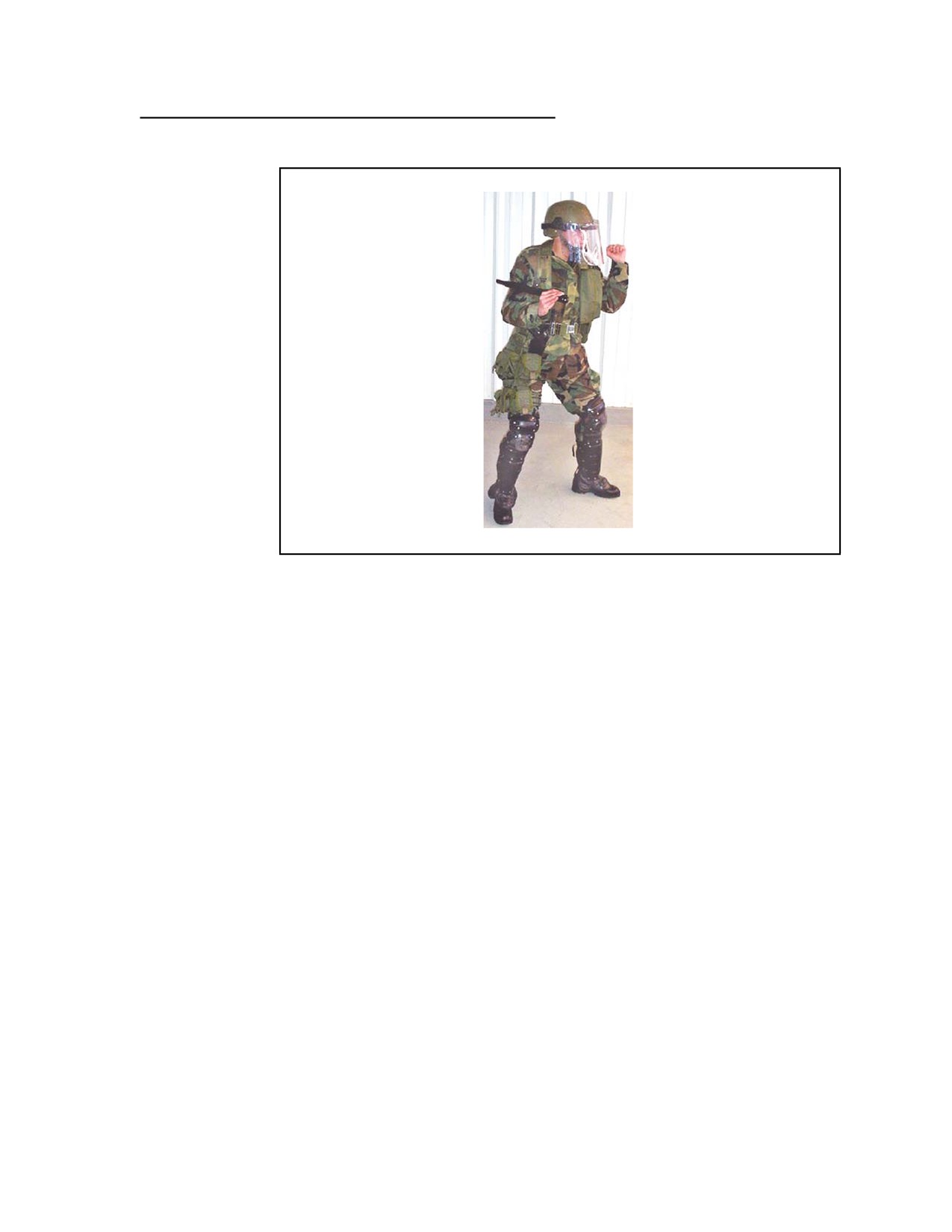
Riot Shield and Riot Baton Techniques
Figure 4-7. Outside-Arm Carry
Vertical High-Profile Carry
4-25. Assuming a wide-based defensive stance, the soldier draws the riot
baton with his strong hand by the grip portion. Once the riot baton has been
drawn from the carrier, the soldier swings the riot baton in a downward
motion, fully extending the arm and holding the riot baton down and parallel
to the strong side leg. The soldier’s weak hand is raised in a position to protect
and block strikes from an aggressor (see Figure 4-8, page 4-10). Although this
carry can be used with both riot baton systems, it is best suited for the
expandable riot baton collapsed to 24 inches. The vertical high-profile carry
clearly shows the soldier with a drawn riot baton in an effective defensive
posture and ready for attack. A drawn riot baton in the hands of a trained
soldier may offer just the kind of deterrence needed to stop the activity of an
aggressor.
Vertical Low-Profile Carry
4-26. Assuming a wide-based defensive stance, the soldier draws the riot
baton with his strong hand by the grip portion. Once the riot baton has been
drawn from the carrier, the soldier swings the riot baton in a downward
motion, fully extending his arm and holding the riot baton down and parallel
to his strong side leg. His weak side hand is raised in a position to protect and
block strikes from an aggressor (see Figure 4-9, page 4-10). Although this
carry can be used with both types of riot batons, it is best suited for the
expandable riot baton collapsed to 24 inches. This position portrays the soldier
in an effective defensive position ready for an attack, but with a possible
hidden weapon. The major difference between the vertical low-profile and
high-profile carry is that in the low-profile carry the soldier hides the riot
18 April 2005
FM 3-19.15
4-9

Riot Shield and Riot Baton Techniques
baton behind his strong side leg, allowing for some element of surprise to a
potential aggressor. A drawn riot baton in the hands of a trained soldier may
offer the deterrence needed to stop the activity of an aggressor.
Figure 4-8. Vertical High-Profile Carry
Figure 4-9. Vertical Low-Profile Carry
4-10
FM 3-19.15
18 April 2005

Riot Shield and Riot Baton Techniques
RIOT BATON BLOCKING TECHNIQUES
4-27. There are five basic types of riot baton blocking techniques that are
executed from the two-hand carry position.
High Block
4-28. The high block is very effective in blocking a downward, vertical strike
directed at the top of the head and shoulders. This type of downward, vertical
strike may be from a club, pipe, or similar object. The high block is a two-step
movement. To perform a high block the soldier performs the following steps:
Step 1. Raises the riot baton straight across his body until it is parallel to
the ground (see Figure 4-10).
Step 2. Brings the riot baton straight-up in front of his body until the
long portion of the riot baton is in front of his forehead (approximately 2
inches from his head). The riot baton should be in a horizontal position
above his head and slightly angled down toward his weak hand, as it
absorbs the shock from the strike (see Figure 4-10). The fingers of his
weak hand should be open and behind the long portion of the riot baton
when blocking the object to protect his fingers from being smashed by the
strike.
Figure 4-10. High Block (Steps 1 and 2)
Low Block
4-29. A low block is very effective in blocking an upward vertical strike
directed at the groin, lower abdomen, chest, or chin. This upward vertical
strike may be from an individual's foot, knee, or fist (for example, an upper cut
to the chin). To perform a low block, the soldier performs the following steps:
Step 1. Raises the riot baton straight across his body until it is parallel to
the ground (see Figure 4-11, page 4-12).
Step 2. Brings the riot baton straight down in front of his body, bending
at his knees and keeping his body upright until the long portion of the riot
baton is just below his knees (see Figure 4-11). The riot baton should be
horizontal and parallel to the ground as it absorbs the shock from an
18 April 2005
FM 3-19.15
4-11

Riot Shield and Riot Baton Techniques
upward strike. His weak hand fingers should be open and behind the long
portion of the riot baton when blocking the object to protect his fingers
from being smashed by the strike.
Figure 4-11. Low Block (Steps 1 and 2)
Strong Side Block
4-30. A strong side block is very effective in blocking a horizontal strike
directed at the strong side of the head, neck, chest (or flank), or hip area. The
horizontal strike may be from an individual’s foot, fist, elbow, knee, or
weapon. To perform a strong side block, the soldier performs the following
steps:
Step 1. Raises the riot baton straight across his body in a vertical position
where the grip portion is in his strong hand and the long portion is in his
weak hand with the fingers straight up (see Figure 4-12).
Step 2. Turns his body laterally by rotating his hips toward his strong
side and moving the riot baton across his body, keeping the riot baton
vertical (see Figure 4-12).
4-31. The strong side block provides protection for a soldier from the front to
the rear of his body. A riot baton held in the vertical position absorbs the
shock of a strike coming from the strong side. The fingers of his weak hand
should be open and behind the long portion of the riot baton, when blocking
the object to protect his fingers from being smashed by the strike.
Weak Side Block
4-32. A weak side block is very effective in blocking a horizontal strike
directed at the weak side of the head, neck, chest, or hip area. The horizontal
strike may be from an individual's foot, fist, elbow, or knee. To perform a weak
side block, the soldier performs the following steps:
Step 1. Moves the riot baton in a vertical position toward his weak side,
ensuring that the grip portion is pointing straight down and the long
portion is pointing straight up.
4-12
FM 3-19.15
18 April 2005

Riot Shield and Riot Baton Techniques
Figure 4-12. Strong Side Block (Steps 1 and 2)
Step 2. Keeps the fingers of his weak hand open and behind the long
portion of the riot baton when blocking the object to protect his fingers
from being smashed by the strike. At the moment of contact with the
opposing strike, the blocking surface of the long portion should be at a
right angle to the opposing object.
Step 3. Assess the situation following a weak side block, and take
appropriate follow-up action, as needed.
Middle Block
4-33. A middle block is very effective in blocking a front horizontal strike
directed at the face, throat, chest, abdomen, or hip. The horizontal strike may
be from an individual trying to tackle near the waist or shove or punch at the
face. To perform a middle block, the soldier performs the following steps:
Step 1. Moves the riot baton toward the middle of his body at a 45° angle,
keeping the long portion pointed up and slightly forward of the grip
portion (see Figure 4-13, page 4-14).
Step 2. Keeps the fingers of his weak hand open and behind the long
portion of the riot baton when blocking the object to protect his fingers
from being smashed by the strike. However, his weak hand may have to
grip the long portion when pushing an individual away or forcing an
individual down on the ground if the individual is trying to tackle.
RIOT BATON STRIKING TECHNIQUES
4-34. Seven strikes can be executed using the riot baton. Two of these strikes
come from the outside-arm or vertical carry. The other five strikes come from
the two-hand carry.
18 April 2005
FM 3-19.15
4-13

Riot Shield and Riot Baton Techniques
Figure 4-13. Middle Block
One-Hand Forward Strike
4-35. The one-hand forward strike is a very quick and effective offensive
strike. It is usually employed as a countermeasure to an attack from the front
that has been blocked effectively.
4-36. Target areas can be as high as the outside upper arm, down to the outer
thigh region. An effective one-hand forward strike must be aggressively quick,
with the purpose of distracting, disabling, or altering behavior. Therefore,
those employing this technique must be sensitive to what part of the riot
baton they use to strike the individual. Strike the target with the last 2 to 4
inches of the long end for optimal results.
4-37. A one-hand forward strike may be employed in one of the following
three ways. When selecting available targets, use the principles in Figure 4-4,
page 4-5.
z
A horizontal manner.
z
A downward diagonal manner to destabilize an individual.
z
A vertical manner in front of the body to clear an aggressor’s hands.
NOTE: When the one-hand forward strike is used in a vertical
manner, keep the long portion straight up, not angled forward. By
keeping the long portion up rather than angled forward, the chance
of striking the individual in the face or head is significantly reduced.
For the counterstrike to be effective, follow through with the
technique when the baton makes contact with the aggressor and/or
his object to destabilize the him. A pattern of movement such as a
4-14
FM 3-19.15
18 April 2005
Riot Shield and Riot Baton Techniques
forward shuffle, forward pivot, strong side step, or rear pivot may
enhance this technique.
WARNING
Do not execute the one-hand forward strike with the
wooden or expandable riot baton in the extended position.
It has been shown to cause injury to the wrist of the user.
4-38. When using the vertical or outside-arm carry position (see Figures 4-7,
page 4-9 and 4-8, page 4-10), the soldier quickly moves the riot baton across
his body using the strength and power of his hips, moving from his strong side
to his weak side (see Figure 4-14, page 4-16). Ending this strike leaves the riot
baton positioned under the weak side armpit in preparation for the one-hand
reverse strike (see Figure 4-14). When delivering this strong side strike
technique (in a horizontal or downward diagonal manner), ensure that the
palm is facing up. In a vertical delivery, the palm will be toward the chest
rather than up. Pause following the one-hand forward strike and assess the
situation. Take appropriate follow-up action, as needed. If the situation does
not call for additional strikes, avoid striking again.
One-Hand Reverse Strike
4-39. The starting position for the one-hand reverse strike is under the weak
side armpit (see Figure 4-14). The one-hand reverse strike is used as a follow-
up strike and is quick and effective.
4-40. Target areas can be as high as the outside upper arm, down to the outer
thigh region. An effective one-hand reverse strike must be aggressively quick,
with the purpose of distracting, disabling, or altering behavior. Therefore,
those employing this technique must be sensitive to what part of the riot
baton they use to strike the individual. Strike the target with the last 2 to 4
inches of the riot baton for optimal results.
4-41. A soldier may employee a reverse strike in one of the following three
ways:
z
A horizontal manner.
z
A downward diagonal manner to destabilize an individual.
z
A vertical manner.
4-42. In front of the body to clear an individual’s hands. When the one-hand
reverse strike is used in a vertical manner, keep the long portion straight up,
not angled forward. By keeping the long portion up rather than angled
forward, the chance of striking the individual in the face or head is
significantly reduced. When selecting available targets, use the principles in
Figure 4-4, page 4-5.
4-43. The one-hand reverse strike is considered a follow-up strike to the one-
hand forward strike. As a follow-up strike, it is important that soldiers are
taught the discipline of assessing the target. An aggressor may not require
another strike, based on his condition and actions after enduring the one-hand
forward strike.
18 April 2005
FM 3-19.15
4-15

Riot Shield and Riot Baton Techniques
Forward Strike
Target Assessment
Reverse Strike
Figure 4-14. One-Hand Forward and Reverse Strikes
4-44. When using the one-hand reverse strike, the solder quickly moves the
straight baton across his body, using the strength and power of his hips (from
weak side to strong side). When the strike is completed, the soldier’s arm will
be back in the outside-arm carry position (see Figure 4-7, page 4-9). The
soldier ensures that his palm is facing down when delivering the counterstrike
in a horizontal or diagonal manner. This will prevent injury to the user’s
wrist. In a vertical delivery, the palm will be toward the chest rather than up.
Following the one-hand reverse strike, assess the situation and take
appropriate follow-up action, as needed. If the situation does not call for
additional strikes, the soldier should avoid striking again.
4-45. When the one-hand reverse strike is used in a vertical manner, keep the
long portion straight up, not angled forward. By keeping the long portion up
rather than angled forward, the chance of striking an individual in the face or
head is significantly reduced. For the counterstrike to be effective, follow
through with the technique when the baton makes contact with the aggressor
and/or his object to destabilize him. A pattern of movement such as the
forward shuffle, forward pivot, strong side step, or rear pivot may enhance
this technique.
WARNING
This strike will not be executed with a 36-inch wooden or
expandable riot baton in the extended position. It has
been shown to cause injury to the wrist of the user.
Two-Hand Strong Side Horizontal Strike
4-46. Starting from the two-hand carry position, the two-hand strong side
horizontal strike can be aggressively quick. The purpose of this strike is to
create distance, distract, disable, or alter behavior. Strong side horizontal
strikes are quick and effective offensive strikes, usually employed as a
4-16
FM 3-19.15
18 April 2005
Riot Shield and Riot Baton Techniques
countermeasure to close frontal attacks that have been effectively blocked.
When selecting available targets, use the principles in Figure 4-4, page 4-5.
4-47. The two-hand carry position enables soldiers to use riot batons at the
24- or 36-inch length. To effectively employ this strike, use the strength and
power of the hips to thrust the riot baton in a horizontal manner.
Simultaneously, pull back with the weak hand as the strong hand drives the
grip end toward the target, striking a rib or the abdominal region of the
aggressor (see Figure 4-15, page 4-18). Following the two-hand strong side
horizontal strike, assess the target before following up with another strike. An
aggressor may not require another strike, based on his condition and actions
after enduring the one-hand forward strike.
NOTE: A pattern of movement such as a forward shuffle or forward
pivot may enhance this technique.
Two-Hand Weak Side Horizontal Strike
4-48. An effective two-hand weak side horizontal strike must be aggressively
quick to create distance, distract, disable, or alter behavior. The weak side
horizontal strike is a quick and effective offensive strike usually employed as
a follow-up strike to the strong side horizontal strike. It is a countermeasure
designed to close frontal attacks that have been effectively blocked. When
selecting available targets, use the principles in Figure 4-4. Maintaining a
strong defensive stance after employing a strong side horizontal strike puts
the soldier in position to execute a two-hand weak side horizontal strike.
4-49. Use of the two-hand carry position enables soldiers to use riot batons at
24 or 36 inches. To effectively employ this strike, use the strength and power
of the hips to thrust the riot baton in a horizontal manner. Simultaneously,
pull back with the strong hand as the weak hand drives the grip forward
toward the aggressor, striking a rib or the abdominal region of the target (see
Figure 4-15). Following the two-hand weak side horizontal strike, it is
important to assess the aggressor. An aggressor may not require another
strike, based on his condition and actions after enduring the one-hand forward
strike.
NOTE: A pattern of movement such as a forward shuffle or forward
pivot may enhance this technique.
Two-Hand Front Jab
4-50. The two-hand front jab starts from the two-hand carry position (see
Figure 4-16, page 4-18). It is aggressively quick and creates distance,
distracts, disables, and/or alters behavior. Front jabs are effective offensive
strikes, usually employed as a countermeasure to charging and overpowering
frontal attacks. When selecting available targets, use the principles in
Figure 4-4.
18 April 2005
FM 3-19.15
4-17

Riot Shield and Riot Baton Techniques
Figure 4-15. Two-Hand, Strong Side, and Weak Side Horizontal Strikes
4-51. Use of the two-hand carry position enables soldiers to use riot batons at
24 or 36 inches. Use the strength and power of the hips to effectively employ
this strike in a slightly downward or horizontal manner. Simultaneously, use
both arms to shoot the long end of the riot baton straight out from the body to
the target area. Immediately, pull back the riot baton to the two-hand carry
position (see Figure 4-16).
Figure 4-16. Front Jab
4-52. Forward jabs drive the long end of the riot baton toward the aggressor,
striking a rib, a hip flexor, or the abdominal region (see Figure 4-4, page 4-5).
Following the two-hand front jab, it is important that soldiers assess the
aggressor before following through with another strike, as the aggressor may
not require another strike.
NOTE: A pattern of movement such as a forward shuffle will enhance
the power of this technique.
4-18
FM 3-19.15
18 April 2005

Riot Shield and Riot Baton Techniques
Two-Hand Rear Jab
4-53. Starting from the two-hand carry position, the two-hand rear jab is
aggressively quick and creates distance, distracts, disables, or alters behavior.
Rear jabs are quick and effective offensive strikes usually employed as a
countermeasure to charging and overpowering attacks from the rear. When
selecting available targets, use the principles in Figure 4-4, page 4-5.
4-54. Use of the two-hand carry position enables soldiers to employ riot
batons at 24 or 36 inches. To effectively employ this strike, use the strength
and power of the hips to thrust the riot baton in a slightly downward or
horizontal manner. Simultaneously, turn the head to the rear to see and
assess the target. Use both arms to shoot the riot baton straight back from the
body to the targeted area and immediately pull back the riot baton to the two-
hand carry position (see Figure 4-17).
NOTE: A pattern of movement such as a rear shuffle will enhance the
power of this technique.
Figure 4-17. Rear Jab
Two-Hand Middle Strike
4-55. The two-hand middle strike starts from the two-hand carry position. It
is aggressively quick and creates distance, distracts, disables, or alters
behavior. It is proven to be an effective follow-up technique to a two-hand
weak or strong side block or to destabilize an individual by pushing him back
and away. The two-hand middle strike is used as a two-count movement.
When selecting available targets, use the principles in Figure 4-4.
4-56. To perform a two-hand middle strike (see Figure 4-18, page 4-20) the
soldier does the following:
Step 1. Brings the riot baton up to chest level and slightly off parallel to
the ground.
Step 2. Steps forward aggressively, simultaneously thrusting the long
portion of the riot baton forward in a horizontal manner. Both arms are
18 April 2005
FM 3-19.15
4-19

Riot Shield and Riot Baton Techniques
fully extended at the end of the movement with a quick snappy return to
the step 1 position. Use the entire body to generate the power.
NOTE: It is important that soldiers assess the aggressor before
applying a follow-up strike. If the soldier steps forward as he employs
the middle strike, it will afford greater impact and power.
Figure 4-18. Middle Strike
Riot Baton Retention
4-57. A common technique an aggressor may use is grabbing for a soldier’s
riot baton or, in some cases, even taking the riot baton and using it against
the soldier. This causes a disruption or distraction.
4-58. Maintaining physical control of the riot baton is essential for the safety
of the soldier and the control force as a whole. Aggressors will generally
attempt to grab the riot baton where they can get the strongest hold. Soldiers
must resist the instinct of getting into a tug-of-war match over the riot baton,
which often proves to be ineffective.
4-59. Using the momentum of the aggressor to pull the riot baton away, the
soldier simply steps into or closer to the aggressor with the weak side foot.
With the momentum created, the aggressor’s hold on the riot baton is
lessened. The soldier then rapidly uses the tracing-C technique to recover the
riot baton.
4-60. A soldier using the tracing-C technique does the following:
Step 1. Pushes up on the riot baton.
Step 2. Pulls the riot baton around in an upward swing as if tracing a C
in the air from bottom to top with the long end.
NOTE: This movement seems to wrap the aggressor’s arms around
themselves (see Figure 4-19).
Step 3. Drives (immediately with a quick and forceful movement) the
long end of the riot baton straight down, as if slicing the C in half (see
Figure 4-19).
4-20
FM 3-19.15
18 April 2005

Riot Shield and Riot Baton Techniques
Figure 4-19. Riot Baton Retention
4-61. Once the soldier reaches the top of the C and the aggressor is tied up, it
is impossible for the aggressor to maintain hold of the riot baton. Further
actions such as a strike may or may not be necessary. Soldiers must be able to
assess the situation and react accordingly.
WORKING AS A TEAM
4-62. Soldiers never have to rely solely on their own skills or abilities in riot
control operations. Although individual skills were discussed in this chapter,
it is important to remember that well-trained soldiers employing offensive,
defensive, riot shield, and riot baton techniques will perform the collective
task of crowd control well.
4-63. Riot control operations are dynamic and often chaotic. Soldiers armed
with riot shields provide a first line of defense while those armed with riot
batons and firearms provide overwatch as the formation moves toward
engaging a hostile crowd. To work effectively and in concert, soldiers must be
properly trained, drilled, and exercised. If an aggressor approaching a line of
skirmishers violently grabs a riot shield, help is required to maintain control
(see Figure 4-20, page 4-22). A soldier armed with a 36-inch wooden riot baton
or an expandable riot baton (extended to 36 inches) can be of assistance. The
soldier simply moves forward into a gap between the riot shields where he can
quickly strike the top or side of the riot shield, slicing the long end across or
straight down onto the hands and fingers of the aggressor (see Figure 4-18).
4-64. Riot batons are not the only way to effectively knock an aggressor’s
hands from a riot shield. Soldiers armed with 12-gauge shotguns or
M16/M203s can just as effectively smash the hands or fingers of a persistent
aggressor with the barrel of their weapons using the technique described
above.
18 April 2005
FM 3-19.15
4-21

Riot Shield and Riot Baton Techniques
Figure 4-20. Clearing a Riot Shield
NONLETHAL MUNITIONS
4-65. With the inclusion of NL munitions, commanders now have additional
tools that afford excellent standoff capabilities. This is critical because
commanders now have intermediate options for dealing with a hostile crowd.
No longer will a commander issue a proclamation, have it ignored by the
crowd, and then be forced to use lethal munitions to backup the proclamation.
Now he can use NL munitions to gain the same standoff distance but without
the catastrophic results of lethal munitions.
4-66. NL munitions include (but are not limited to) a 12-gauge shotgun and
40-millimeter rounds. These blunt munitions have the capability of effectively
engaging targets as close as 5 meters and as far as 50 meters. Range is
dependent upon each round. These munitions are used from a distance to
dissuade, discourage, and disperse the crowd. If the crowd disperses from 50
meters and soldiers are in close contact with the crowd, then the mission has
been successful.
TAP-DOWN TECHNIQUE
4-67. Commanders must be familiar with the characteristics and capabilities
of all rounds to use them effectively. When 12-gauge and M203 weapons are
used within a line of skirmishers (usually located behind the riot shields), it is
imperative that a method is developed, trained, and practiced to effectively
operate as a team. Operators of these weapons may encounter problems in riot
control situations when trying to identify and effectively engage legitimate
targets. The tap-down technique is used to overcome target identification and
engagement with NL munitions. If ordered to engage targets or the situation
authorizes an engagement, soldiers armed with NL munitions may step
forward, level their weapons, and fire upon legitimate targets (see
Figure 4-21).
4-68. A soldier that is armed with a NLW and is using the tap-down
technique must first tap on the shield holder’s shoulder. Tapping on the shield
holder’s shoulder alerts him that the gunner is preparing to fire. In response
4-22
FM 3-19.15
18 April 2005

Riot Shield and Riot Baton Techniques
to the tap, the shield holder drops to one knee while keeping the riot shield
firmly affixed to their front for protection. The gunner takes a step forward
and fills the gap. He then leans into the riot shield bearer’s back with his knee
and fires. This technique ensures that the long end of the weapon is extended
beyond the riot shield.
WARNING
The long end of the weapon must be projected beyond the
riot shield before firing. This is a critical safety step, which
will prevent NL projectiles from hitting the riot shield and
injuring soldiers.
4-69. Once soldiers firing munitions have fired, they raise their weapon back
to a high port arms. The soldiers clear their weapons and tap the riot shield
bearer a second time, signaling them to rise to a standing position.
Figure 4-21. Tap-Down Technique
18 April 2005
FM 3-19.15
4-23
This page intentionally left blank.
Chapter 5
Nonlethal Capabilities Set and Employment Considerations
During the past several decades, US forces have regularly performed
peacekeeping and peace enforcement missions at a greater tempo than in
the past. In the peacekeeping and peace enforcement environment, the use
of conventional firearms or the threat of their use may not be the solution
to a situation where US forces must separate two belligerent, hostile
ethnic groups or prevent a similar group from entering an area that is
off-limits to them. However, a show of force using NLW and NL munitions
will cause crowds to disperse, separate, or leave the area with minimal
casualities. The NLCS is a well-rounded, versatile package of both
commercial off-the-shelf (COTS) and government off-the-shelf (GOTS) NL
equipment and munitions. NLCS contents are divided into four distinct
categories: personnel protectors, personnel effectors, mission enhancers,
and training devices.
PERSONNEL PROTECTORS
5-1. Personnel protectors provide the individual soldier with added protection
to the sensitive and vital areas of his body. They provide excellent protection
for the individual soldier from trauma often inflicted by thrown objects (such
as rocks, bricks, sticks, and bottles).
NONBALLISTIC RIOT FACE SHIELD
5-2. A nonballistic riot face shield (see Figure 5-1, page 5-2) has two
adjustable positions and is constructed of hard durable plastic that securely
attaches to the Kevlar® helmet. It may be worn with an M17 or M40
protective mask and is designed to protect the soldier’s head, face, and neck
from thrown objects. Nonballistic riot face shields will not protect from attacks
with ballistic weapons, such as firearms. All soldiers operating in a civil
disturbance environment should be outfitted with riot face shields.
NONBALLISTIC FULL-LENGTH SHIELD
5-3. A nonballistic full-length riot shield (see Figure 5-2, page 5-2) is a body
shield constructed of hard durable plastic. Left- and right-handed personnel
can easily use the nonballistic full-length riot shield. It is designed to protect
the soldier’s face, torso, and upper legs from thrown objects. Nonballistic full-
length riot shields will not provide protection from ballistic weapons. Only the
front line of skirmishers and those providing lateral protection to both flanks
of the formation will be outfitted with nonballistic full-length riot shields.
18 April 2005
FM 3-19.15
5-1

Nonlethal Capabilities Set and Employment Considerations
Figure 5-1. Nonballistic Riot Face Shield
Figure 5-2. Nonballistic Full-Length Riot Shield
NONBALLISTIC SHIN GUARD
5-4. The nonballistic shin guards (see Figure 5-3) are constructed of hard
durable plastic and are easily fastened to a soldier’s legs. They are designed to
protect the soldiers, feet, shins, and knees from thrown objects. They will not
provide protection from ballistic weapons, such as firearms. All soldiers
operating in a civil disturbance environment should be outfitted with shin
guards.
BALLISTIC RIOT FACE SHIELD
5-5. The ballistic riot face shield (see Figure 5-4) has two adjustable positions
constructed of acrylic and bullet-resistant materials that provide the wearer
with Level IIIA protection. The ballistic riot face shield easily attaches to the
Kevlar helmet and is capable of being worn with either an M17 or M40
protective mask. It will protect the soldier from hand-thrown objects. Because
of its excessive weight (3.4 pounds), the ballistic riot face shield should not be
worn for standard riot control operations. Ballistic riot face shields are best
suited for use within specialized teams associated with riot control operations;
for example, teams responsible for the search and apprehension of identified
criminals or building- and alley-clearing operations.
5-2
FM 3-19.15
18 April 2005

Nonlethal Capabilities Set and Employment Considerations
Figure 5-3. Nonballistic Shin Guards
Figure 5-4. Ballistic Riot Face Shield
BALLISTIC FULL-LENGTH RIOT BODY SHIELD WITH LIGHT KIT
5-6. The ballistic full-length riot body shield (see Figure 5-5, page 5-4) is
constructed from Spectra Shield® bullet-resistant material that provides a
soldier with Level IIIA protection. It will protect the soldier from thrown
objects. Because of its excessive size (18 pounds and 20 by 36 inches), the
ballistic full-length riot body shield should not be used as part of a standard
riot control operation. Ballistic full length riot body shields are best suited for
use within specialized teams associated with riot control operations; for
example, teams responsible for the search and apprehension of identified
criminals or building- and alley-clearing operations.
18 April 2005
FM 3-19.15
5-3

Nonlethal Capabilities Set and Employment Considerations
Figure 5-5. Ballistic Full-Length Riot Body Shield
BALLISTIC SHIN GUARDS
5-7. Ballistic shin guards (see Figure 5-6) are constructed of Kevlar KM2
materials and provide a soldier with Level IIIA protection to the feet, shins,
and upper legs. They protect the soldier from hand-thrown objects. There are
three different sizes, and because of their excessive weight (7 to 10 pounds),
ballistic shin guards should not be deployed as part of a standard riot control
operation. Ballistic shin guards are best suited for use within specialized
teams associated with riot control operations; for example, teams responsible
for the search and apprehension of identified criminals or building- and
alley-clearing operations.
Figure 5-6. Ballistic Shin Guards
PERSONNEL EFFECTORS
5-8. Personnel effectors are those items that provide soldiers with an NL
response without the necessity of always coming into direct physical contact
with aggressors. Personnel effectors are 12-gauge and 40-millimeter
ammunition that inflict blunt trauma. These munitions are compatible with
the shotgun and the M203 grenade launcher already in the Army inventory.
There are also diversionary and rubber ball grenades, which distract and
inflict blunt trauma.
5-4
FM 3-19.15
18 April 2005
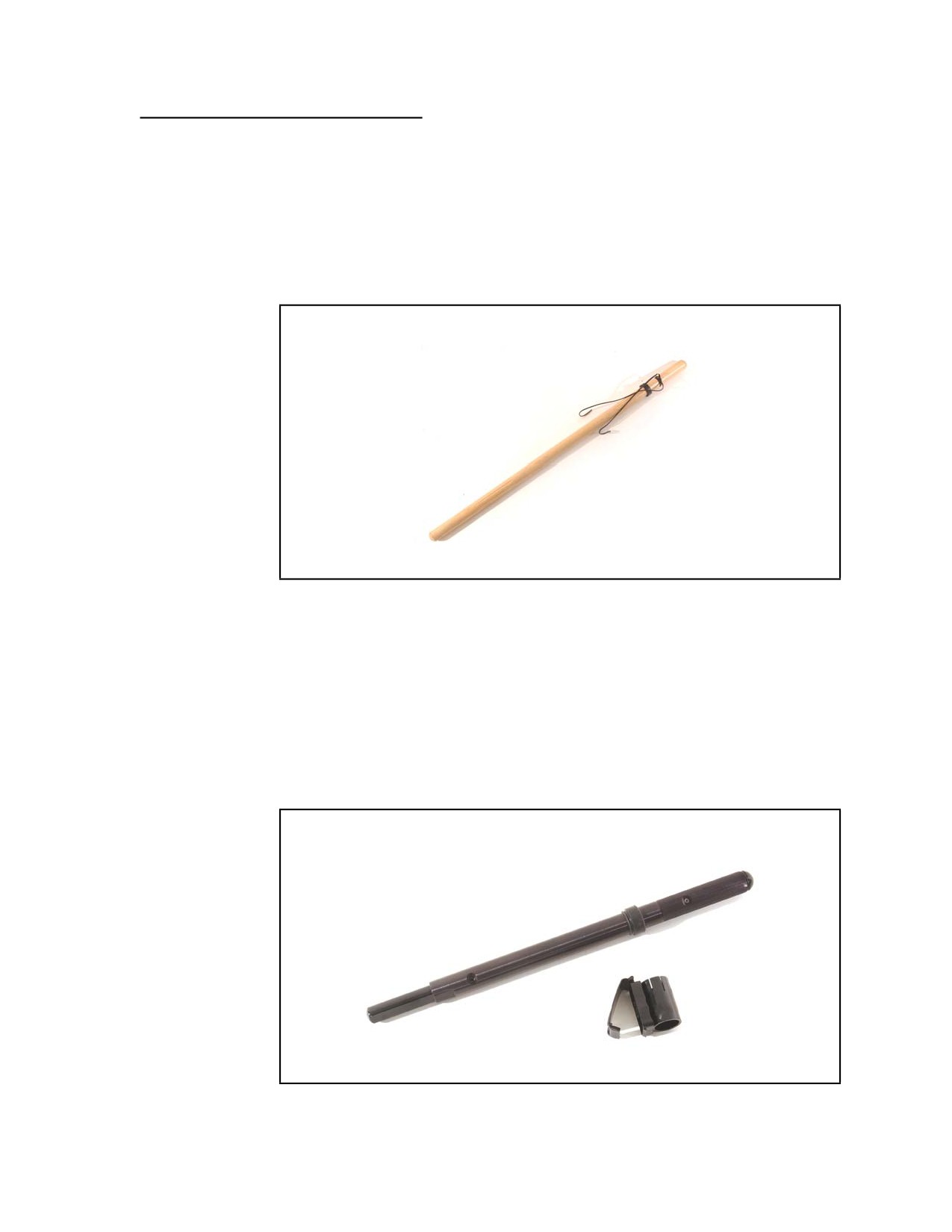
Nonlethal Capabilities Set and Employment Considerations
WOOD RIOT BATON WITH BELT RING (36 INCHES)
5-9. The 36-inch wood riot baton (see Figure 5-7) is made from solid oak.
When held properly, the riot baton thong provides greater retention
capabilities. Intended primarily for self-defense, the 36-inch wood riot baton
can be used effectively as an offensive tool if it becomes necessary to keep
rioters out of arm’s reach of soldiers conducting crowd control operations.
Figure 5-7. Wood Riot Baton
EXPANDABLE RIOT BATON WITH CARRIER (24 TO 36 INCHES)
5-10. The expandable riot baton (see Figure 5-8) provides the soldier with an
NL means of crowd control and self-defense. The riot baton comes with a
mounting device that attaches the riot baton to a belt. The riot baton is 24 to
36 inches in length and is primarily intended for self-defense. The expandable
riot baton can be used effectively as an offensive tool if it becomes necessary to
keep rioters out of arm’s reach of soldiers conducting crowd control operations.
Figure 5-8. Expandable Riot Baton and Carrier
18 April 2005
FM 3-19.15
5-5

Nonlethal Capabilities Set and Employment Considerations
500 (3 INCH) 12-GAUGE SHOTGUN
5-11. The 12-gauge shotgun (see Figure 5-9) is a pump action shotgun
currently in NLCS inventory. The pump action shotgun is chambered to take
up to 3-inch shells. The 3-inch chamber allows for the use of M1012 and
M1013 NL munitions. This shotgun also provides a visually distinct
alternative to standard military weapons that may be desired based on
mission considerations (force signature and acceptability).
Figure 5-9. 12-Gauge Shotgun
M7 66-MILLIMETER LAUNCHER WITH M315 INSTALLATION KIT
5-12. The M7 (see Figure 5-10) is a 66-millimeter vehicle-mounted, NL,
grenade-launching device that is mounted on a HMMWV. It is an indirect fire
support system that can deliver the M98 distraction grenade that creates a
flash-bang effect, L96A1 antiriot grenade, or M99 blunt trauma grenade that
creates a sting-ball effect. The M315 installation kit is used to install an M7
discharger on the turret ring of appropriate HMMWV variants. An adjustable
bracket allows the launch angle to be depressed for engaging targets at ranges
of 50, 75, and 100 meters. The system enforces standoff distances and deters
potential threats.
Figure 5-10. M7 Launcher
5-6
FM 3-19.15
18 April 2005

Nonlethal Capabilities Set and Employment Considerations
MODIFIED CROWD CONTROL MUNITION-GROUND EMPLACEMENT
5-13. Similar in nature to the claymore mine, the modified crowd control
munition-ground emplacement (MCCM-GE) (see Figure 5-11) is an NL
munition that can deliver six hundred .32-caliber rubber pellets and a flash-
bang effect. The MCCM-GE will stop, confuse, disorient, and/or temporarily
incapacitate area targets and/or personnel at ranges out to 30 meters.
WARNING
Avoid employing the MCCM-GE within 10 meters of
personnel as it may cause serious bodily harm or death.
Figure 5-11. MCCM-GE
12-GAUGE, FIN-STABILIZED POINT, NONLETHAL CARTRIDGE (M1012)
5-14. The M1012 (see Figure 5-12) is a single projectile round made of hard
rubber that is shaped like a bomblet and designed to be fired a at a single
target. With a muzzle velocity of 500 feet per second, the M1012 has the
effective range of no closer than 5 meters and no further than 30 meters.
Engagement inside 5 meters could cause serious injury or death. Beyond 30
meters the kinetic energy dissipates to the point where the round becomes
ineffective.
Figure 5-12. M1012
18 April 2005
FM 3-19.15
5-7

Nonlethal Capabilities Set and Employment Considerations
12-GAUGE, CROWD DISPERSAL, NONLETHAL CARTRIDGE (M1013)
5-15. The M1013 (see Figure 5-13) is a multiple projectile round with .23
caliber hard rubber pellets that is designed to be fired at and employed with
the purpose of affecting multiple targets. With a muzzle velocity of 900 feet
per second, the M1013 has an effective range of no closer than 5 meters and no
further than 30 meters. Engagement inside 5 meters could cause serious
injury or death. Beyond 30 meters, the kinetic energy dissipates to the point
where the rubber pellets become ineffective.
Figure 5-13. M1013
40-MILLIMETER SPONGE GRENADE (M1006)
5-16. The M1006 (see Figure 5-14) is a single projectile round made of pliable
foam rubber with a hard plastic back. The M1006 is designed to be aimed and
fired at a single target. With a muzzle velocity of 265 feet per second, the
M1006 has an effective range of no closer than 10 meters and no further than
50 meters. Engagements inside 10 meters could cause serious injury or death.
Beyond 50 meters, the kinetic energy dissipates to the point where the round
becomes ineffective.
Figure 5-14. M1006
5-8
FM 3-19.15
18 April 2005
Nonlethal Capabilities Set and Employment Considerations
40-MILLIMETER CROWD DISPERSAL CARTRIDGE
5-17. The crowd dispersal cartridge (CDC) (see Figure 5-15) is a multiple
projectile round with .48 caliber hard rubber balls that is designed to be fired
and employed with the purpose of affecting multiple targets. With a muzzle
velocity of 450 feet per second, the CDC has an effective range of no closer
than 10 meters and no further than 30 meters. Engagement inside 10 meters
could cause serious injury or death and beyond 30 meters the kinetic energy
dissipates until the rubber balls become ineffective.
Figure 5-15. CDC
RUBBER BALL GRENADE (GG04)
5-18. The GG04 (see Figure 5-16, page 5-10) is a multiple projectile, flash-
bang grenade with 100 .25-caliber hard rubber pellets. Each grenade has a
fuse delay of 2.8 to 3 seconds with a flash measuring approximately 1 million
CP and 180 decibels at 3.5 feet. At detonation, rubber pellets are dispatched at
360° with an effective range of 2 to 3 meters and a maximum engagement
range of 15 to 20 meters. The rubber ball grenade is designed to be hand-
thrown or muzzle-launched from a 12-gauge shotgun.
RUBBER BALL GRENADE LAUNCHING CUP AND AA30 12-GAUGE LAUNCH ROUND
5-19. The launch cup (see Figure 5-17, page 5-10) firmly attaches to the 12-
gauge shotgun without any additional tools. It works in concert with the AA30
12-gauge launch round to propel the rubber ball grenade approximately 100
meters. The shooter simply inserts the full body and the safety lever of the
grenade into the launching cup, pulls the pin, loads a 12-gauge round, and
fires (approximately) at a 30° angle. The desired effect is to have the grenade
explode approximately 7 to 10 feet above the target.
RELOADABLE FLASH-BANG GRENADE (M84)
5-20. The M84 (see Figure 5-18, page 5-10) is a reloadable flash-bang thrown
grenade. Each grenade has a 1- to 2-second fuse delay, with a flash capability
of 1.5 to 2.5 million CP and a bang of 168 to 175 decibels. Although it is part of
18 April 2005
FM 3-19.15
5-9

Nonlethal Capabilities Set and Employment Considerations
the NLCS, use of the M84 is not recommended for use in crowd control
situations. Specialty teams, such as security response teams, and search
teams may use this device effectively.
Figure 5-16. GG04
Figure 5-17. Launching Cup and AA30
Figure 5-18. M-84
5-10
FM 3-19.15
18 April 2005

Nonlethal Capabilities Set and Employment Considerations
FLEX-CUFS
5-21. Flex-Cufs consist of a tough pliable plastic band with a self-locking
mechanism in the center for each end. When the Flex-Cuf (see Figure 5-19) is
threaded the restraint bands circle around the wrists or ankles, impeding
movement and securing the individual. They are lightweight and disposable
and require a cutting tool or other instrument to remove.
Figure 5-19. Flex-Cufs
INDIVIDUAL RIOT CONTROL AGENT DISPERSER (M36)
5-22. The M36 (see Figure 5-20) contains a Dibenz (F, -1 4-oxazepine [CR]
solution. It can deliver 25 one-second bursts out to 12 feet. Individual
disposable RCA dispersers are intended primarily for self-defense or to keep
rioters out of arm’s reach of soldiers conducting crowd control formations or
soldiers engaged in missions where a noncombatant exists.
Figure 5-20. M36
MIDSIZE RIOT CONTROL AGENT DISPERSER (M37)
5-23. The M37 (see Figure 5-21, page 5-12) is the size of a standard fire
extinguisher that uses compressed air to force the RCA out to a range of 30
feet. It has the capacity to employ 18 bursts for 3 seconds per charge. It is
excellent for providing a wide coverage of RCAs onto a hostile crowd while
18 April 2005
FM 3-19.15
5-11

Nonlethal Capabilities Set and Employment Considerations
maintaining excellent standoff capability. The M37 can be refilled and is
rechargeable. It can be filled with CR solution (liquid agent) or CS1 (dry
agent). For training purposes, CR can be substituted with water and CS1 can
be substituted with talcum powder.
Figure 5-21. M37
SQUAD RIOT CONTROL AGENT DISPERSER (M33A1)
5-24. The M33A1 (see Figure 5-22) is designed to provide crowd control and
protection at the squad level. It is capable of projecting a ballistic stream of
RCAs beyond 25 feet in up to 25 half-second bursts. It consists of a frame and
harness assembly, compressed-gas cylinder (agent container assembly), air
pressure assembly, gun and hose assembly, multijet spray unit, and check
valve assembly. The M33A1 can be refilled and is rechargeable. For training
purposes, CR can be substituted with water and CS1 can be substituted with
talcum powder.
Figure 5-22. M33A1
MISSION ENHANCERS
5-25. Mission enhancers aid the commander in various tactical situations.
Mission enhancers include various types of devices used for illumination,
vehicle denial, traffic control missions, and force protection enhancement.
5-12
FM 3-19.15
18 April 2005
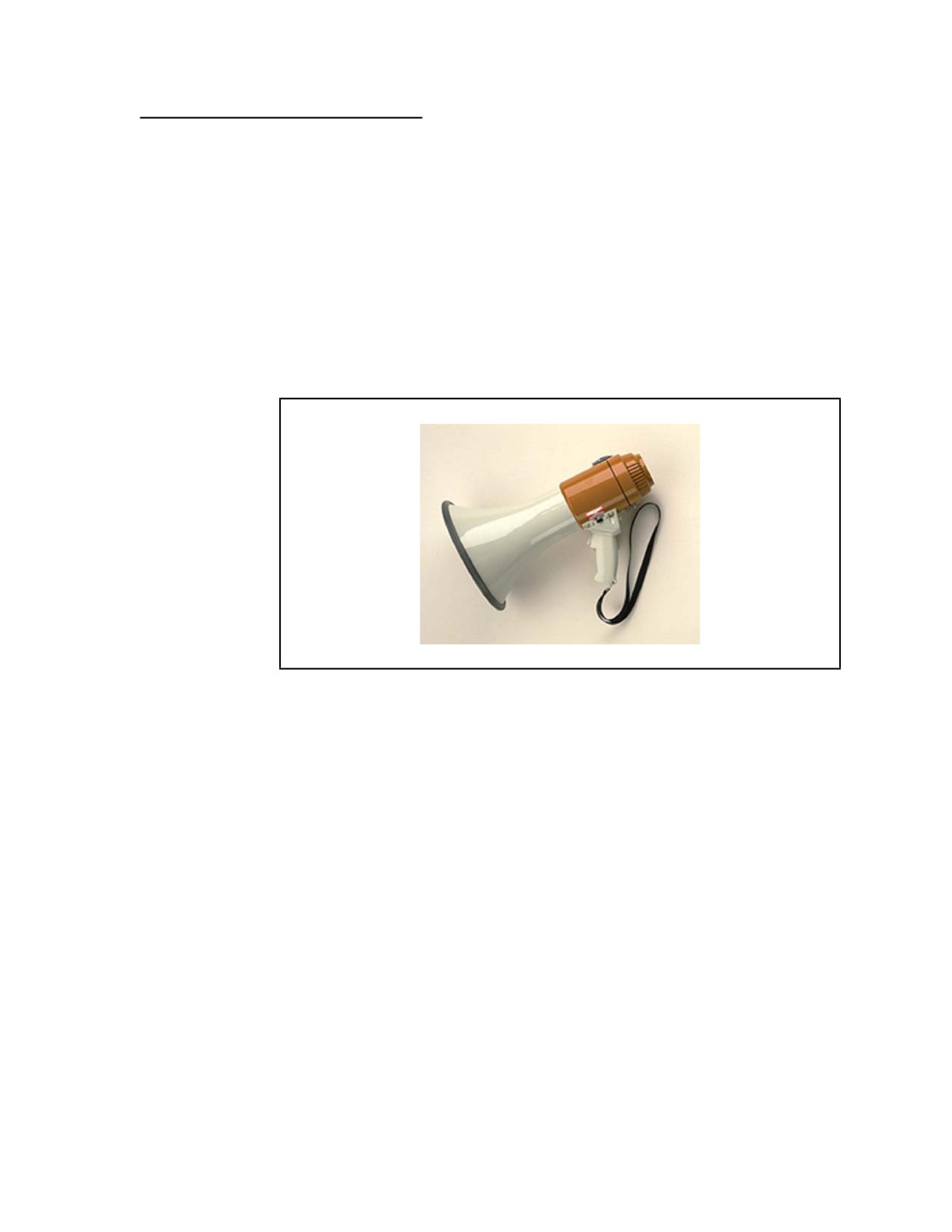
Nonlethal Capabilities Set and Employment Considerations
PORTABLE BULLHORN
5-26. The portable bullhorn (see Figure 5-23) provides squad leaders with the
capability to project their voices above the noise and commotion created by
crowds and mobs. The megaphone has a built-in siren for alarm purposes that
allows the operator to use the device as an ordinary megaphone and siren
alarm during emergencies. The bullhorn is portable and easy to carry. The
acoustic range of the megaphone for a clear voice output is ¾ to 1 mile. The
power output of the megaphone is rated at 15 watts with a maximum rating of
20 watts. The dimensions of the megaphone are 14.5 inches with a 9-inch
diameter bell. It weighs 3.5 pounds without batteries. Battery requirements
for the megaphone are eight dry-cell size C batteries.
Figure 5-23. Portable Bullhorn
GROUND-MOUNTED BULLHORNS
5-27. Ground-mounted bullhorns (see Figure 5-24, page 5-14) are a critical
communication enhancement device for conducting crowd control tactics. The
bullhorn can facilitate communication with the crowd in conjunction with
PSYOP support and assistance with the communication of commands to
troops engaged in the crowd control process. The power output of the ground-
mounted bullhorn is rated at 22 watts. The dimensions of the bullhorn are
13.75 by 9 by 14.75 inches, and it weighs 15 pounds.
INDIVIDUAL VOICE AMPLIFICATION SYSTEM (M7)
5-28. The M7 (see Figure 5-25, page 5-14) is a critical communication
enhancement device for conducting crowd control tactics using RCAs while
wearing the M40 protective mask. The M7 is fitted to the M40 protective mask
to facilitate oral communication and increase the user's ability to
communicate using radios and other devices.
18 April 2005
FM 3-19.15
5-13

Nonlethal Capabilities Set and Employment Considerations
Figure 5-24. Ground-Mounted Bullhorns
Figure 5-25. Individual Voice Amplification System
INDIVIDUAL HIGH-INTENSITY SEARCHLIGHT WITH HOLSTER
5-29. The individual high-intensity searchlight (see Figure 5-26) is used
primarily for illumination in crowd control operations at night. An individual
can use it for general illumination of the operational area to pinpoint agitators
and threats, reduce the ability of the rioters to see troop formations and
actions, enhance tactical deception and actions, and enhance tactical
deception techniques for units conducting crowd control operations.
HIGH-INTENSITY LIGHT
5-30. A high-intensity light (see Figure 5-27) is intended for use in low light or
night conditions. A high-intensity light can project a beam that will enable the
user to identify an individual person up to 1,900 yards away. It has an
adjustable beam spread of 1° to 15° and will run continuously at maximum
power for up to 45 minutes. The internal power supply requires 4 hours for a
full charge.
5-14
FM 3-19.15
18 April 2005

Nonlethal Capabilities Set and Employment Considerations
Figure 5-26. Individual High-Intensity Searchlight with Holster
Figure 5-27. High-Intensity Light
HIGH-INTENSITY LIGHT SYSTEM WITH 12-GAUGE SHOTGUN ATTACHMENT KIT
5-31. This 12-guage high-intensity light system (see Figure 5-28, page 5-16) is
used to illuminate possible targets in crowd control situations where there is
little or no light. It serves to blur or blind the aggressor’s ability to see. It
mounts easily to the end of the 12-gauge shotgun barrel.
40-MILLIMETER CARRYING POUCH
5-32. The 40-millimeter carrying pouch is made from durable canvas
material, (see Figure 5-29, page 5-16) and can be easily affixed to load-bearing
equipment (LBE) and/or a load-bearing vest (LBV) using Velcro straps. It is
capable of carrying up to six 40-millimeter rounds.
18 April 2005
FM 3-19.15
5-15