Military reference books and manuals (2009-2023, Volume 6) - page 45
Appendix D
Table D-1. Sample internment facility inspection checklist (continued)
Preventive Medicine Inspection Checklist
Yes
No
Laundry Facilities
Short-term: 1 sink or bucket, preferably with a wringer, per tent plus detergent.
Long-term: Commercial laundry, if available; Army field laundry, individual machines.
Are adequate laundry facilities provided based on the anticipated use of the camp?
Are showers provided for long-term (greater than 5-day occupancy)?
Solid Waste: Are adequate waste containers provided (two-hundred 33-gallon trash cans for a 5,000-person
camp)?
Are cans covered and clean?
Is there evidence of flies or other insects or rodent harborage?
Is there medical or hazardous waste produced?
Is this waste disposed of in accordance with command directives?
Are waste collection and disposal personnel protected?
Describe:
Latrines
Note. Excavated (for example, slit trench) and receptacle (for example, burn-out and chemical) latrines are permissible,
however, excavated latrines are not recommended for long-term camps. Minimum distances for both short- and long-term
camps are: 100 feet from water supplies; 300 feet from any water source; 300 feet downwind from dining facility or food service
operation; and 50 feet from dwellings.
Are minimum distances met?
Are latrines located at the lowest elevation so rain water run off drains away from the camp?
Are latrines cleaned daily?
Are a minimum of one latrine for every 25 male detainees and one latrine for every 17 female detainees
provided?
Are adequate supplies available for the type of waste disposal used?
Are adequate handwashing facilities (one for every five latrines) with proper supplies available near latrines and
food operations?
Potable Water
Does the quantity of potable water provided comply with the water consumption planning factors applicable to
the type of camp and facilities provided?
•
1.5 gallons per person per day for drinking in temperate climates.
•
3.0 gallons per person per day for drinking in tropical and arid climates.
•
2.0 gallons per person per day for drinking in arctic climates.
•
1.7 gallons per person per day for personal hygiene.
•
1.7 gallons per person per day for centralized hygiene (showers) (one shower per week per person)
•
2.8 gallons per person per day for food preparation.
•
3.1 gallons per person per day for laundry.
•
1.24 gallons per person per day for medical treatment.
•
Detainees of certain religious faiths (for example, Islam) should be provided an additional 0.5-1.5
gallons of potable water per person per day for washing and drinking associated with religious
practices.
•
Detainees who practice anal washing following defecation require an additional 0.25-0.5 gallons per
day.
Does the quality of the potable water provided meet field water requirements specified in TB MED 577?
Note. Use DA Form 5457 and DA Form 5456 for potable water container and water point inspections.
Vector Control
Is there any evidence of insect and or rodent infestation?
D-2
FMI 4-02.46
8 November 2007

Preventive Medicine Inspection Checklist
Table D-1. Sample internment facility inspection checklist (continued)
Are pest control measures, especially against filth flies and rodents, in place?
Describe:
Food
Is food from approved source?
Does food operation meet requirement of TB MED 530?
Note. Use DA Form 5162-R for food service inspections.
Comments:
Inspector Name:
Rank
Unit
_________________________________________________________________________________________
(signature)
(date)
Detainee Escort Name:
Rank
Unit
_________________________________________________________________________________________
(signature)
(date)
8 November 2007
FMI 4-02.46
D-3
This page intentionally left blank.
Appendix E
Planning Checklist for Medical Support
to Detainee Operations
This appendix provides a planning checklist for the conduct of medical support to
DO. Medical units and personnel may be called upon to provide health care to a
detainee population on an area support basis or as a direct support mission collocated
with an internment facility. During the planning process, each medical unit should
plan for supporting DO in the event they are called upon to do so. This checklist
should not be considered as all inclusive, each operation will have its own unique
requirements that must also be considered. This checklist is intended to be thought
provoking and serve as an initial point of consideration. Some areas of consideration
may overlap as they may affect more than one AMEDD function.
GENERAL CONSIDERATIONS
E-1. Are there any cultural, religious, or social beliefs that impact on the provision of health
care?
(Health care personnel must be aware of the detainee’s beliefs when prescribing courses of
treatment. Some cultures and religions have dietary restrictions or prohibitions concerning the use of
blood and blood products. Detainee compliance with prescribed courses of treatment will be higher if
they are not contrary to their beliefs. Social norms must also be considered as they pertain to gender
considerations and interactions. Health care personnel should be familiar with hand gestures which
might be offensive to someone from another culture. Additionally, health care personnel must ensure
they understand the importance of respectfully handling detainees’ religious documents,
books/scriptures, and articles.
[For additional guidance concerning detainee religious considerations
consult the supporting chaplain.])
E-2. Are interpreters available to translate detainee complaints to the attending health care
personnel?
(Has a local language guide been developed to assist asking medical questions? Have
pictograph translation tools been developed? Are translation technologies that may augment
translation capability available? Is a commercial product available? Could visual products used
offend the detainees [such as detailed, realistic drawings of the human body?])
E-3. Is there a PAO assigned to the TIF or to the medical unit?
(If there is not a PAO assigned—
what is the theater policy on release of information concerning detainee health care operations? What
procedures are there for when inquiries are made by NGOs or other organizations present in the AO?
What is the policy concerning the ICRC? Has this policy been articulated and disseminated to all
health care personnel assigned to the detainee health care mission?)
E-4. How is the information flow within the facility managed?
(What types of outside information
reaches the detainee population? What are the sources of this information? Can negative information
on detainee health care that is propagated by the enemy be countered? How is the detainee population
impacted [such as compliance with treatment regimes, refusal to take prescriptions, or detainees not
seeking medical assistance] by this negative information?)
E-5. What is the probable composition of the detainee population?
(What is the probable age
range of detainees? What will be the percentage of detainees who are female? Will there be any
children requiring pediatric care? Will there be any pregnant women? Will there be detainees
requiring geriatric care? Will there be any detainees suffering from major behavioral disorders?)
8 November 2007
FMI 4-02.46
E-1
Appendix E
E-6. What is the health status of the general population in the AO?
(What are the endemic and
epidemic diseases? What are the ten leading causes of death? What is the nutritional status of the
population? What is the dental status of the population? Do pregnant women receive prenatal care?
Do children receive immunizations? If so, what kinds? What is the mental status of the population
[such as has the nation been at war for a long period of time]? Has the civilian population been
exposed to atrocities? Is there a continuing threat of violence or civil unrest? Does the civilian
population have the basic necessities for life [housing, food, work, and a feeling of security or safety]?)
E-7. What is the visitation policy for detainees?
(Will detainees be permitted visitors? If detainees
may have visitors what are the PVNTMED considerations [such as introduction of diseases] posed by
visitors? Will detainees be permitted to accept food products from visitors? What PVNTMED
measures may be necessary [such as storing food products in domicile area]?)
E-8. What are the capabilities of the HN medical infrastructure?
(What are the capabilities of the
local medical infrastructure? Can they support the needs of detainees? Do they have the capability to
accept detainees who require medical specialty care? What is the HN’s capability with regards to the
treatment and management of those suffering from mental disorders? Are there any facilities in
country that can manage this population? Has an evaluation of the HN medical infrastructure been
accomplished? Refer to Tables E-1 and E-2 for an evaluation checklist.)
Table E-1. Evaluation of available public health services
Public Health System/Services
•
Number of public health personnel, facilities, and capabilities.
•
Hospitals by type and location (such as general medical, psychiatric, or orthopedic).
•
Number of hospital beds by type (such as surgical, intensive care, intermediate care, or
general medicine).
•
Number of operating room tables and table hours.
•
Medical clinics (private, public, or sponsored by NGOs) and locations.
•
Number of physicians per population.
•
Number of physicians by specialty.
•
Ancillary services available (such as PT, occupational therapy (OT), diagnostic
laboratory, prosthetics capability, community health nurses, magnetic resonance imaging
[MRI], computed tomography [CT] scan, or respiratory therapy).
•
Number of nonphysician health care providers (such as PAs, nurse practitioners,
podiatrists, audiologists, or optometrists) by type.
•
Medical evacuation/casualty transport systems (public, private, and military ground and
air ambulances).
•
Number of dental providers and types of dental care available (such as emergency and
essential care and/or oral surgery).
•
Number of BH clinics and available services.
•
Number and types of BH personnel (such as psychiatrists, psychologists, social workers,
and the like).
•
Number and types of medical research facilities.
•
Veterinary medicine personnel, facilities, and capabilities.
•
Pharmaceutical manufacturing.
•
Availability and types of medical equipment, medical equipment repair, and medical
supplies.
•
Availability and quality of blood and blood products.
E-2
FMI 4-02.46
8 November 2007
Planning Checklist for Medical Support to Detainee Operations
Table E-1. Evaluation of available public health services (continued)
• Availability, quality, and production capability of medicinal gases.
Public Health System/Services
•
Optical fabrication capabilities.
•
Assistive listening devices fabrication capabilities.
•
Prosthetics manufacturing capabilities.
•
What type of sterilization/sanitation equipment capabilities are in service?
•
Number, types, and capabilities of medical laboratories (such as public health,
clinical/diagnostic, and research).
•
Names and titles of key personnel within the public and private health care
infrastructures.
•
Number, types, and location of medical schools or medical training centers.
•
Determine the leading causes of death of the general population or specified
subpopulations.
•
What is the infant mortality rate?
•
What is the life expectancy (in years)?
•
Determine the prevalence of endemic and epidemic diseases in the AO.
•
Determine the prevalence of HIV/acquired immunodeficiency syndrome.
•
Determine the prevalence for STDs (such as gonorrhea, syphilis, hepatitis, and herpes).
•
Determine the OEH risk (to include heat and cold injury, exposure to loud
noise/radiation/toxic industrial materials [TIMs], and poisonous or toxic flora and fauna).
•
Determine the nutritional status of the general population or specified subpopulations.
•
Determine immunization level of general population or specified subpopulations.
Table E-2. Evaluation checklist for a host nation medical treatment facility
Medical Facility Checklist
• Is the medical facility a private, public, military institution, or provided by an NGO?
• Is the medical facility a hospital, clinic (such as outpatient, emergency, or substance
abuse), doctor’s office, or long-term care facility?
• Where is the facility located? How accessible is it (such as on a major thoroughfare, on
side streets, or accessible by air)?
• What type of care does the facility provide (such as emergency and general medicine,
surgical, orthopedic, maternity/obstetrics, pediatric, psychiatric, rehabilitative, or long-
term care)?
• What are the number and types of beds (such as surgical, intensive care, intermediate
care, or general medicine)?
• What ancillary services are available (such as PT, OT, audiology, respiratory therapy,
diagnostic x-ray, nuclear medicine, PVNTMED, or diagnostic laboratory services)?
• What is the staffing level of the facility?
• Does the facility provide outpatient services? If so, what types of care?
• What is the standard of care provided at the facility? How does it compare to US
facilities?
• How are medical professionals credentialed? What is their scope of practice?
• What is the nosocomial infectious disease rate for the facility?
8 November 2007
FMI 4-02.46
E-3
Appendix E
Table E-2. Evaluation checklist for a host nation medical treatment facility (continued)
• Does the facility have the capability to isolate infectious disease patients?
Medical Facility Checklist
•
What types of medical equipment are available in the facility (such as diagnostic [CT
scan or MRI], rehabilitative, or patient care [ventilators, respirators, or orthopedic])?
•
What types of support services are available (such as laundry, housekeeping, or food
service)? Are there shared services with another facility? If not, how are the patients fed
(such as by relatives)?
•
Does the facility have an emergency room? Is it staffed and equipped to provide trauma
care?
•
What is the capacity of the facility to respond to a mass casualty situation (resulting from
urban combat, terrorist incidents, man-made or natural disasters, or employment of
chemical, biological, radiological, and nuclear [CBRN] weapons)?
•
What is the level of medical supplies maintained within the facility (days of supply)?
•
How is the facility resupplied with expendable and nonexpendable medical supplies?
Are medicines readily available or must they be obtained on an individual case basis?
Are relatives required to obtain required medications? Is local vegetation collected and
used for medicinal purposes?
•
Does the facility have the capability to collect, test, and store blood? What are the
diseases for which blood is tested?
•
If the facility cannot collect and test blood, where do blood and blood products come
from? Has it been tested? Does the facility have a refrigerated storage capability? What
are the maximum units of blood which can be stored?
•
Does the facility have its own ambulances (number and type [air and ground]) or is this a
service which is provided by another agency/business?
•
Is the hospital accredited by its parent nation and/or hospital organization (such as in the
US by the JCAHO)?
•
Does the facility perform its own medical equipment maintenance or must be it sent out
for repair?
•
Does the facility have dependable electric service? Does it have a backup generator for
power outages?
•
Does the facility have running water? If not, from what source does the staff obtain
water? Is it potable or does it require treatment before use?
•
Does the facility have an operational environmental control system? Heat? Air
conditioning?
•
What sanitation facilities are available in the facility? Restrooms for patients and staff?
Bath tubs/showers for patients? Handwashing stations/capabilities in patient care areas?
Disposal capabilities for general, medical, and human waste? Disposal capabilities for
wastewater? How are medical and hazardous waste segregated and disposed of?
•
Does the facility have a pest management problem (rats, ants, flies, lice, and/or other
animals and insects)?
•
Other. Any other issues, concerns, or situations that affect the specific facility being
evaluated.
E-4
FMI 4-02.46
8 November 2007
Planning Checklist for Medical Support to Detainee Operations
TRAINING
E-9. Have all unit members received refresher training in the Law of Land Warfare and military
regulations?
(Have unit members been briefed on the aspects of the Geneva Conventions,
international laws, and military regulations as they pertain to the treatment and care of EPWs,
detainees, and civilians?)
E-10. Have all unit members received an orientation briefing to the AO?
(Have unit members
received an orientation briefing to the cultural, social, economic, and religious beliefs, practices, and
language of the civilian population in the AO. Did the orientation include information on endemic and
epidemic diseases and OEH threats found in the AO? If there are different sects or subpopulations in
the AO, have these been delineated?)
E-11. Have all unit members received refresher training in medical ethics?
(Has refresher
training in medical ethics been conducted? Did training address the ethical issues of treating EPWs
and detainees as developed and directed by OTSG? Did the training address the recognition of the
signs and symptoms of abuse/maltreatment and how to report it? Does the MTF [above Role 2]
convene a medical ethics board when ethical issues arise? Do medical personnel know the reporting
process when an alleged or suspected abuse occurs?)
E-12. Have all unit members received refresher training in field hygiene and sanitation?
(Has
refresher training on field hygiene and sanitation practices been conducted? Did the training include
personal protective measures for the individual, the small unit leader, and the unit? Did the training
address field sanitation and personal hygiene requirements for internment facilities, DHAs, or DCPs
and what actions are required if deficiencies are noted?)
E-13. Have clinical and PAD personnel received training on the creation, maintenance, storage,
and disposition of detainee medical records? (Have all providers and administrative personnel been
trained on the requirements for creating and maintaining detainee medical records? Have tactical
standing operating procedures been developed at all roles of care delineating procedures for creating
and maintaining these records? Have all personnel been trained on the release and/or access to a
patient’s medical information/record?)
E-14. Are training aids available (such as posters, handouts, and pocket-sized cards) that can be
displayed or given to unit members to reinforce training?
(Has the unit produced or obtained
training aids covering areas such as medical ethics, Geneva Conventions, reporting of abuse or
mistreatment, or similar subjects to serve as reminders to unit members?)
E-15. Has training been conducted for unit members/care givers on the hazards and recognition
of combat and operational stress reactions resulting from working in an internment facility?
(Unit members should receive training on stress prevention and the recognition of signs and symptoms
of stress resulting from working in internment facilities. Who will provide the stress prevention
training/refresher training which should be accomplished periodically during the deployment? Is there
a unit-level peer mentor program in place? What is their scope of training? Who will provide training
and consultation for the peer mentor program?)
E-16. Have unit members received training on self-defense and how to act if taken hostage?
(Have unit members received training in self-defense techniques? Have unit members been instructed
on how to act if taken hostage? Have unit members been instructed on how to react if a riot or unruly
detainees are encountered? Have unit members received training in the separation of providing
medical care and not performing custody and control functions?)
E-17. Has medical education that can earn the medical staff continuing education units and
initial capabilities training been conducted?
(Have instructors been identified to conduct training?
What are the instructors’ qualifications and credentials? Have medical focus training areas been
identified that are unique to the AO?)
8 November 2007
FMI 4-02.46
E-5
Appendix E
COMMAND, CONTROL, COMMUNICATIONS, COMPUTERS, AND
INTELLIGENCE
E-18. What medical information systems are available?
(Have the appropriate medical
information systems been considered for installation in particular for Class VIII support and medical
epidemiological reporting of infectious disease? Are medical information systems available for
preparing and maintaining medical records and reports? In Role 3 facilities, are the pharmacy
functions, to include provider prescription functions, automated?)
E-19. What are the command and support relationships between key participants? (What is the
relationship between the organic MP unit medical personnel and the supporting medical unit/task
force? What is the relationship to the CDO? What is the relationship with the DOMD? What
command relationship exists within the facility [MP, MI, and medical]? Is there an actual perceived
separation of detention functions? Do medical personnel participate in any form of custody or
interrogation operations? Do MPs or security personnel participate in any health care functions? Are
interrogation personnel of all types forbidden from access to any and all medical information on
detainees?)
E-20. What is the potential threat against the TIF?
(Is the internment facility and its collocated
medical units a potential target for enemy combatants, terrorists, or insurgents? Is there a possibility
that the internment facility could fall under a siege? Is there the possibility that CBRN weapons could
be employed against the facility? How do these threats impact medical support and are plans in place
to mitigate the adverse effects should an event occur?)
E-21. What is the morale of the facility (both cadre and detainees)?
(What is the morale of the
care givers, the guards, and the detainees? How does this affect good order and discipline? What
actions can be taken to improve morale, if it is low? What are the causes of low morale?)
PREVENTIVE MEDICINE
E-22. What PVNTMED assets/resources are available/organic to the internment facility? (What
organic resources does the MP unit operating the facility have? What is the scope of their training?
Do they have required supplies and equipment? Will they require augmentation to support the TIF
operation? What is the availability of PVTMED assets to augment the TIF? Are other Service
PVNTMED assets available for support? Are there plans for contracted PVNTMED support?)
E-23. What is the level of awareness of the detainee population to basic field sanitation and
personal hygiene practices?
(Will PVNTMED personnel be required to conduct PVNTMED training
to the detainee population? Are handouts, posters, or other training aids on PVNTMED practices
available in the detainees’ language? Are there any social, religious, or cultural considerations that
may impact PVNTMED practices and reduce compliance with appropriate standards?)
E-24. What is the frequency of required PVNTMED inspections?
(Are the organic internment
facility PVNTMED personnel going to conduct the routine PVNTMED inspections and at what
frequency? Are the organic resources going to require augmentation to accomplish the inspection
mission? Has a unit needs assessment been requested by the commander from a combat and
operational stress control-type unit or element? What is the recommended frequency for a formal unit
needs assessment? How often are x-ray machine surveys conducted and who conducts them?)
E-25. Has a site survey been accomplished for proposed or existing internment facility locations?
(Was an environmental health site assessment and an equivalent base camp assessment done prior to
establishing the internment facility? Are there any indications of environmental contamination at the
site? If a preexisting facility is to be used, does it have the minimum space requirements for detainee
domiciles/cells, adequate ventilation, and sufficient sanitary facilities/devices for the supported
population? What are the environmental considerations of the area surrounding the facility or upon
which it was developed? What is the impact of weather conditions [such as heavy rains] on the
site/facility [such as flooding]? There are several site surveys available.)
E-6
FMI 4-02.46
8 November 2007
Planning Checklist for Medical Support to Detainee Operations
E-26. Has the facility been planned, designed, and constructed to comply with sanitation and
hygiene standards and criteria?
(Has adequate space been provided for detainee living space? Are
adequate sanitation, feeding, and medical facilities provided? Was the site selected considering
disease and injury threats?)
E-27. What vector and pest control activities are required at the facility?
(Are there clinical
evidence of vectorborne diseases? What is the immune status of the population? What are the
pathogens of concern and what is their behavior/ecology? Are there factors in the facility that increase
the risk of vectorborne diseases? Does the facility have any signs of rodent activity? Is there an insect
or arthropod infestation within the facility or on the grounds? If yes, what is the source of the
infestation? Is aerial spraying required?)
E-28. Are adequate supplies of appropriate and safe food provided in quantities and quality to
meet detainee needs?
(Are food sources approved by military veterinarians? Are food service
personnel trained and adequately supervised in food service sanitation? Do food service personnel
apply sanitary practices during food transport, storage, preparation and serving? Do food service
facilities meet Army sanitary requirements?)
E-29. Are medical and OEH surveillances being conducted?
(What surveillance activities are
being performed? How often is the data collected and what is the frequency of reporting? Who is
analyzing data to determine trends and patterns?)
E-30. How are the needs for field hygiene and sanitation being met at temporary holding areas?
(Do temporary holding areas have sufficient latrines and handwashing devices? Are field expedient
measures being employed [such as individual waste collection bags]? Are field latrines being properly
constructed and cleaned daily? How are all types of waste [garbage, hazardous waste, and regulated
medical waste] segregated, stored, transported, and disposed of?)
E-31. Are quantities of adequate quality water provided for potable and nonpotable uses?
(Are
adequate supplies of potable water available at convenient locations? Are adequate supplies of
appropriate quality water conveniently available for personal hygiene and laundry? Are the
appropriate sanitary control and surveillance activities conducted on potable and nonpotable supplies?
Are detainee clothes laundered properly at least weekly?)
MEDICAL TREATMENT
E-32. What medical equipment is available within the internment facility?
(What types of
diagnostic and treatment equipment are in the medical treatment area? Is the internment facility
equipped with any major pieces of medical equipment, such as x-ray, ultrasound, medical laboratory
equipment, dental chairs, or hand-held x-ray? Is special medical equipment required for
subpopulations within the detainee population such as pediatric, geriatric, or maternity?)
E-33. What is the extent of medical screening conducted from the point of capture, through
temporary internment sites, to the internment facility?
(Is medical screening and treatment at the
point of capture or in temporary holding areas conducted by a dedicated medical staff or is it provided
by Role 1 and Role 2 MTFs on an area support basis? What do the screening protocols encompass
prior to arrival at the internment facility? If a detainee requires immediate medical care which cannot
be provided at the temporary holding area, how is medical evacuation support coordinated/obtained?
Who provides the personnel required to guard the detainee during evacuation? How is the medical
care provided at temporary holding areas documented and what is the disposition of this
documentation?)
Note. Medical personnel do not guard detainees. Guards must be provided by either the
echelon commander or the supporting MP units.
E-34. What are the medical screening requirements at the internment facility?
(What medical
screening [such as physical examination, height and weight, diagnostic testing, and immunizations]
8 November 2007
FMI 4-02.46
E-7
Appendix E
procedures/protocols are required by international law and what procedures/protocols are required by
command policy? What will the requirements be for a BH assessment? Will this be conducted
routinely on all detainees or on an “as indicated” basis?)
E-35. What tracking mechanisms are in place to monitor detainee patients within the MTF?
(Do security personnel always maintain custody and control of detainees during the provision of health
care? What is the policy for the use of restraints by medical personnel? Are all medical examinations
and health care interactions documented? How are detainees identified (arm band, identification card,
or other)? Do detainees have more than one form of identification on them at all times? Is an
individual medical record created for each detainee? Does the medical record incorporate all medical
documentation initiated in temporary holding areas [normally restricted to a completed DD Form
1380])?
E-36. What sick call services will be provided?
(How will daily sick call be conducted? Will the
detainees be brought to a medical treatment area or will medical personnel conduct sick call within the
detainee compounds or at the wire? What medical services are available at sick call? How are
specialty consultation requirements being met? Will detainees have to be transported to an MTF [not
collocated with the internment facility] for routine or diagnostic care?)
E-37. What are the medical criteria for requesting a compassionate release of a detainee for
medical reasons?
(What are the established criteria for considering a detainee for a compassionate
release based on his medical condition? How is the request initiated? Who must it be staffed with? If
approved, how is the detainee outprocessed and what coordination is accomplished with the
civilian/HN medical infrastructure?)
E-38. What is the capability to provide prosthetic devices as required?
(What is the command
policy concerning prosthetic devices? Are prosthetic devices manufactured in the HN or neighboring
countries? Are amputations resulting from mines and/or explosive devices a significant medical issue
among detainees?)
E-39. How will detainee medications be distributed?
(Is there a policy that medications should be
prescribed for administration one or two times daily, when feasible? Will the medications be
distributed in the detainee compound or in the medical treatment area? Are all medications distributed
by medical personnel? What are the documentation procedures for the distribution of medications?
Must detainees sign that they have received their medication? Have procedures been established
should a detainee refuse to take prescribed medication? Have the personnel distributing the
medication been instructed on how to check to ensure the medication was swallowed/ingested?)
E-40. Is there a mass casualty plan?
(Has a mass casualty plan been developed and rehearsed?
What is the potential for the internment facility to be either bombarded or attacked? Has the plan been
synchronized with the facility commander and staff? Should the facility come under attack, how will
wounded detainees be located, acquired, and treated? Also, include estimate of a triage point and
coordination for the use and augmentation of nonmedical vehicles to assist in transporting casualties.
During the mass casualty, is there a plan to secure/guard detainees [by nonmedical personnel] while
receiving medical care to both ensure their safety and control?)
E-41. Is there a plan for the outbreak of a contagious disease?
(Is there a strategy for medical
disease surveillance to facilitate early detection of an outbreak? Has a plan been developed to manage
an outbreak of contagious disease within the detainee population? Is there the capability to establish a
medical holding area where ill detainees can be isolated from the rest of the population? Will
augmentation of the medical staff be required if such an event occurs? What is the MTF’s infection
control plan to prevent outbreaks?)
E-42. How is EMT provided?
(Does the facility have medical personnel on duty on a 24-hour
basis? Where is EMT provided [in medical treatment area or in the compound]? If the detainee must
be evacuated to a higher role of care, how is medical evacuation arranged? Can the health care
specialist providing emergency care communicate directly with the supporting hospital ER? Can the
health care specialist communicate with the hospital ER while providing en route medical care on the
E-8
FMI 4-02.46
8 November 2007
Planning Checklist for Medical Support to Detainee Operations
evacuation platform? Have guard personnel been trained in enhanced first aid measures [CLS skill
level]? Is there at least one guard on duty for each shift with CLS training? Have medical personnel
received initial and periodic refresher training on the proper techniques for restraining combative
patients? Are there sufficient restraints available to meet the unit’s needs?)
E-43. Will medical photography be used to document traumatic injuries, wounds, or preexisting
conditions?
(Does the unit have the appropriate photography equipment to document detainee
injuries? Is there a command policy on obtaining photographic documentation of injuries? Has
training been conducted on the need to ensure such photographs are correctly filed in the detainee’s
medical record and safeguarded from unauthorized release?)
E-44. What are the requirements for medical screening for detainees being released from
custody? (Are detainees medically outprocessed from the internment facility? What arrangements are
made for detainees taking medication and/or undergoing medical treatment for chronic illnesses? For
traumatic injuries? Is there a CMO liaison that can assist in coordinating continuing medical support
requirements with the civilian/HN medical infrastructure? Has the detainee indicated whether he felt
he had a positive or negative medical experience? If negative, will he reveal why he feels this way?
Has the detainee requested a copy of his medical records?)
HOSPITALIZATION
E-45. What hospitals are established in the AO?
(Are these US facilities? What are the
capabilities of these hospitals? What is the anticipated length of stay of detainee patients? What is the
difference in length of stay for detainee patients versus US or multinational forces? How does the
difference in length of stay affect the professional mix of health care providers?)
E-46. What are the surgical requirements for the detainee population?
(Are detainees requiring
surgical intervention treated at FSTs? What are the follow-on surgical requirements of a detainee
treated at an FST? Does the collocated medical unit at the internment facility have a surgical
capability? If not, how is surgical care coordinated for on a routine basis? On an emergency basis?
Will augmentation of surgical capability be required for a mass casualty situation [such as an attack on
the internment facility]?)
E-47. What ancillary services are available by the hospitals within the AO? (If convalescence for
some injuries/illnesses is anticipated to occur, is ancillary support such as PT or OT available within
the hospital and/or theater? What other rehabilitative services are required for the detainee
population?)
E-48. What is the policy on physical separation of patients? (Are detainee patients separated from
other patients [for example, US Forces, multinational forces, and government employees and civilian
contractors] when health care is administered? Are detainee patients separated by gender? Are
detainee patients kept far enough apart to prevent passing of notes, weapons, and information? Are
detainees afforded personal privacy during physical examinations and medical care?)
E-49. What procedures/notifications are required when a detainee is admitted to a US facility?
(Will a detainee be evacuated from the point of capture or a temporary holding facility directly to a
hospital? Will a detainee be evacuated from the point of capture or a temporary holding facility
directly to a hospital collocated with the internment facility? Will the detainee be evacuated from the
internment facility to a collocated hospital or to another hospital facility within the theater?)
E-50. Has a formulary been established for prescription drugs?
(Does it include medications for
diseases endemic to the local area? Does it include medicine for chronic diseases/conditions? Does it
contain medications for maternal and child health? Are the medications available in the local area, so
that treatment can continue once the detainee is released? Are psychotropic medications included in
the formulary?)
E-51. How will detainees be transferred from one hospital to another within the AO, if required
for specialty care?
(Who will provide the transportation assets? What coordination is required to
affect the transfer? Who will provide security and guard detainees?)
8 November 2007
FMI 4-02.46
E-9
Appendix E
E-52. Is there a CMO liaison to assist in coordinating follow-on medical care in the civilian
community for detainees requiring continued medical care after release?
(Is follow-on medical
care in the civilian community coordinated for detainees being released? Who performs this task?
What are the specific capabilities of the civilian medical infrastructure?)
E-53. How often will security inspections be conducted to identify security risks within the
hospital and/or treatment areas?
(Security risks—A hospital setting can present many items which
can be used as a weapons for a detainee to injure himself or his caretakers [both medical (such as
syringes) and nonmedical (such as pens and pencils)]. All medical supplies should be selected for
functionality and safety. Who will conduct these inspections?)
E-54. What is the policy on body cavity examinations/searches?
(Are body cavity examinations
done by medical personnel for medical reasons only? What is the command policy concerning security
personnel performing body cavity searches? Are hernia examinations forbidden during routine
screening? Are all body cavity examinations/searches and hernia examinations performed by medical
personnel of the same gender as the detainee patient?)
E-55. Are detainee patients’ medical information kept private to the extent possible?
(Is all
detainee medical information restricted from interrogation personnel? Is the internment facility chain
of command entitled to detainee medical information for health and welfare reasons? What procedures
are used to provide necessary information [such as documentation similar to a physical profile]? Do
medical personnel report all medical information gained during a medical interaction that may
seriously jeopardize the health and safety of the detainee, other detainees, and/or facility staff to the
proper authorities?).
E-56. Is a policy established for decedent affairs?
(Are all detainee deaths reported to the CDO,
DOMD, and CID? What is the command policy on the performance of autopsies? How are the
deceased detainee’s next of kin notified and who is responsible for performing this notification? Does
the AFME have primary jurisdiction and authority within DOD to conduct a forensic investigation to
determine the cause and manner of a detainee death? Has the final disposition of the detainee’s
medical record been completed?)
NUTRITION CARE
E-57. Are dietitians available to provide consultation on nutrition care issues?
(Dietitians are
normally assigned to Role 3 hospitals. However, they may be consulted by any medical unit which
requires their expertise. Dietitians should evaluate the nutritional value of the detainees’ diet to ensure
there is a sufficient caloric intake and that the minimum essential daily requirements for vitamins and
minerals are achieved. If detainees are performing work assignments, their nutritional requirements
should be reevaluated to ensure their caloric and macronutrient intake is sufficient/appropriate for the
type of work being performed.)
E-58. Is the data obtained from the monthly required weigh-ins analyzed to determine trends
and to ensure detainees with significant weight changes are identified?
(A monthly weigh-in is
required for all detainees. This may be accomplished in a variety of setting, such as the medical
treatment area, at the dining facility prior to a meal, or at headcounts. The weight must be recorded on
DA Form 2664-R for each detainee. This data must be reviewed to determine trends and identify
detainees with specific weight-related conditions. The organic medical personnel can evaluate the
data, but should consult with a dietitian if any issues are identified.)
E-59. Are there any cultural, religious, and/or social considerations related to diet?
(Does the
detainee’s religion have any restrictions on the type of food which can be consumed? If there are
prohibited items, what precautions are required to ensure that how the food is prepared does not affect
its status
[cross-contamination from prohibited foods to acceptable foods]? Does the detainee’s
religion dictate fasting during certain times or during religious holidays? How can the detainee’s diet
be adjusted to compensate for periods of fasting?)
E-10
FMI 4-02.46
8 November 2007
Planning Checklist for Medical Support to Detainee Operations
E-60. What are the ramifications and procedures to be followed should detainees go on a hunger
strike?
(What are the procedures for managing hunger strikes? What are the medical ramifications
should the hunger strike become prolonged? What is the theater policy on intervention?)
E-61. Are medical supplemental rations available?
(Are special medical diets and/or supplements
available for detainees who are not inpatients? Do certain clinics need to maintain a stock of liquid
nutritional supplements for detainees undergoing treatment [such as the dental treatment area for
patients undergoing oral surgery or for diabetic patients?])
E-62. What is the command policy on providing MREs to feed the detainee population? (What is
the command policy on the use of MREs for detainees? Can MREs be used at the point of capture or
temporary holding areas? What is the maximum length of time MREs can be used? When MREs are
used, how are detainees with religious- or social-based dietary restrictions accommodated?)
DENTAL SERVICES
E-63. What units will provide dental services for the detainee population?
(Will dental resources
be available within the medical treatment area [dental resources are not organic to the internment
facility medical contingent]? If there is a medical unit collocated at the facility, does it have organic
dental resources? If not, how will dental problems be referred for care?)
E-64. What dental services are available in the AO? (What is the theater policy on dental care for
detainees?)
E-65. What dental conditions will necessitate the evacuation of patients from the internment
facility to a dental treatment facility within the AO?
(What oral conditions cannot be treated
satisfactorily in the internment facility? What coordination is required to arrange for the evacuation of
dental patients? What organization provides oral and maxillofacial referral care for detainees?)
BEHAVIORAL HEALTH, NEUROPSYCHIATRIC CARE, AND STRESS
CONTROL
E-66. Who is responsible for the detainee BH programs and treatment?
(Who will provide BH
services to the detainees? What accommodations will differences in language require? What services
will be available within the internment facility? Will BH resources be collocated with the supporting
medical unit? Are there any HN BH providers that may be contracted for the purpose of managing and
treating detainees with mental disorders?)
E-67. How will detainees with BH and NP conditions and/or stress-induced reactions be
evacuated, if required?
(On dedicated medical vehicles? On general transportation assets? Will NP
patients require an escort, sedation, or restraints for evacuation by aircraft? What facility within the
AO will detainees requiring inpatient psychiatric care be regulated to?)
E-68. Who will conduct TEM assessment for staff?
(Who within the facility provides follow-up
care, if required?)
E-69. How are detainees screened for BH disorders/stress during the initial medical screening
conducted when the detainee is inprocessed to the TIF?
(Will a BH professional be part of the
inprocess medical screening team? What procedures are followed if a detainee appears to be suicidal
or expresses suicidal thoughts?)
E-70. What are the procedures if a detainee attempts to commit suicide?
(Have guard personnel
been trained on appropriate procedures and notifications if a detainee attempts to commit suicide?
How are the emergency treatment personnel notified? What are the procedures to be followed
[security, segregation, observation, and treatment] after a suicide attempt? What are the identified
protocols for the use of mechanical and/or chemical restraint? What are the protocols for other
management techniques such as line-of-sight and attendant arms-length behavioral management?)
8 November 2007
FMI 4-02.46
E-11
Appendix E
MEDICAL EVACUATION AND MEDICAL REGULATING
E-71. Do medical evacuation vehicles/aircraft require armed escort while performing their
mission?
(If yes, what units will provide this support? What is the response time? Can ground
evacuation vehicles only move as part of convoys or are they permitted to move independently? Are
ground ambulances used within the compound? If the detainee must be evacuated from the internment
facility and collocated medical unit, will he be moved by ground or air ambulance? What coordination
is required for security and guards?)
Note. Medical personnel do not guard detainees during medical evacuation. Guards and other
required security are provided by the echelon commander and/or supporting MPs.
E-72. How will medical evacuation be requested when a detainee requires evacuation through
medical channels from the point of capture or temporary holding facility directly to a hospital?
(How will medical evacuation be requested from the point of capture or temporary holding facility?
What unit will provide guards/escorts for detainees? Is there more than one facility detainees can be
taken to? Who regulates their flow to hospitals within the AO?)
E-73. Has a policy been established on detainee evacuation?
(Is the priority of casualty care and
evacuation based solely on severity of wounds or illness? Are enemy casualty and detainee evacuation
methods the same as but separate from that provided to other casualties and patients? Are detainees
ever evacuated/transferred out of country?)
MEDICAL LOGISTICS
E-74. What is the Class VIII stockage level? (Has theater policy been established and disseminated
concerning the days of supply required for Class VIII in support of US medical units conducting
detainee health care operations? Have medical supplies/pharmaceuticals normally not carried in
medical equipment sets been identified and available in sufficient quantities to support the detainee
population with chronic health conditions, maternal and child health care, obstetrical/gynecological
care, pediatric care, and geriatric care? Have initial support requirements for Class VIII been
sufficient, if not, have adequate measures been put into play to remedy supply support shortages?)
E-75. What are the requirements and considerations for the use of blood and blood products in
detainee health care? (Are there any cultural, religious, or social prohibitions on the use of blood and
blood products for any of the subpopulations of detainees? What is the source of supply of blood and
blood products? If the source comes from within the local area, how is the blood collected? What tests
are performed on the blood after collection? How is the blood tracked and matched to the detainee
transfused? What procedures are required for emergency use
[transfusion] of blood? What
documentation is required for the informed refusal of the use of donated blood? Does the facility have
a refrigerated storage capability? What is the maximum number of units of blood which can be
stored?)
E-76. How will resupply be affected? (Are units using line item requisitioning or are preconfigured
push packages being used? Will supply point distribution be used? Will medical vehicles/aircraft
provide backhaul for medical supplies, equipment, and blood?)
E-77. What reports are required to be submitted to the supporting MEDLOG facility?
(Are
these reports automated? Are automated systems interoperable? What are the report formats and
suspense times/dates? If automation is not available how are requisitions processed?)
E-78. Have daily logistics requirements been determined?
(Internment facility planners should
identify the type of day-to-day support needed to run and maintain the facility. Those requirements are
subsequently reported to the higher HQ to ensure required assets are available for support.)
E-12
FMI 4-02.46
8 November 2007
Planning Checklist for Medical Support to Detainee Operations
VETERINARY SERVICES
E-79. What type of rations is to be provided to the detainee?
(This is dependent upon the
anticipated availability of food sources within the theater. What is the maximum length in days that
MREs can be used to feed a detainee population? Are food sources and services contracted for the
facility?)
E-80. Will US Forces provide veterinary inspection of subsistence for hygiene
(safety),
wholesomeness, and quality for the internment facility?
(Will veterinarians inspect local food
sources used for subsistence for detainee populations? Are local food sources available? Will food be
purchased outside of the AO and shipped in?)
E-81. What are the animal medicine requirements for MWDs within the facility?
(Where is the
veterinary treatment facility located? Will injured or ill MWDs have to be evacuated for treatment? If
yes, does the handler have to accompany the animal? Will the animal require sedation? What type of
platform will be used for the evacuation?)
E-82. Are there any veterinary PVNTMED aspects of the operation within the facility? (Is there
a zoonotic disease threat within the facility? Are there any food animals maintained in the compound?
Are there any feral or wild animals with access to the facility? Are there any unauthorized pets? If
animals, other than MWDs, are in the compound, have they been immunized [such as for rabies]? Are
diseases such as anthrax endemic to the AO? Will an epidemiological investigation be conducted
should an outbreak occur? Who will conduct the investigation?)
MEDICAL LABORATORY
E-83. What diagnostic/clinical capabilities are available at the internment facility?
(The organic
MP medical personnel at the internment facility do not have a diagnostic/clinical laboratory capability.
If there is not a collocated medical unit, will the medical asset organic to the internment facility be
augmented to provide this capability? Is the capability available a Role 2 [medical company] or Role
3 [hospital] capability? If there is a Role 2 capability, what specific tests can be processed at the
facility? What specimens would have to be forwarded to the supporting Role 3 hospital to be
accomplished? What are the procedures for packaging and forwarding specimens to the next role of
care for evaluation?
Has the stockage level for laboratory supplies and reagents been
assessed/determined?)
E-84. What is the capability and capacity of the medical laboratory resources supporting the
facility to store and process blood?
(What is the storage capacity of the medical unit supporting the
internment facility? Will the medical unit be limited to only O positive and negative red blood cells
[similar to a Role 2 capability] or will other blood types be available [similar to a Role 3 capability]?
What is the capability of the laboratory to type and cross match blood? Is there sufficient storage,
refrigeration, freezer, and room temperature space for all supplies? Are the laboratory/blood bank
environmental conditions proper for laboratory work and proper functioning of equipment?)
E-85. How are specimens/samples collected, packaged, and chain of custody maintained on
suspect biological warfare (BW) and chemical warfare (CW) agent materials? (Should suspect BW
or CW agents be used against the internment facility, what are the procedures for collecting and
packaging specimens/samples? How is support from the technical escort unit [TEU] coordinated?
What if TEU support is not available? How are specimens/samples escorted and chain of custody
maintained? To what facility are these specimens/samples submitted for presumptive and confirmatory
identification? How are routine specimens collected, packaged, and transferred to the next higher level
of laboratory support? How are specimens collected and transported within the facility to ensure
specimen integrity, identification, and security? How are laboratory results reported back to the health
care provider [such as electronic, paper, distribution, or carrier/messenger]?)
8 November 2007
FMI 4-02.46
E-13
Appendix E
CHEMICAL, BIOLOGICAL, RADIOLOGICAL, AND NUCLEAR
ENVIRONMENT
E-86. What actions are to be taken if CBRN weapons are used against the facility? (Do detainees
have individual protective equipment or does the facility have adequate equipment available? Have
detainees been instructed on what procedures to follow in the event of an attack? Has a medical
response plan been developed to provide required support in the aftermath of such an event? Will
medical augmentation be required?)
E-87. What actions are to be taken in the event an accidental release of TIMs takes place in or
near the internment facility?
(What is the medical response plan in the event detainees are exposed
to a TIMs release? Will medical assets require augmentation? How will detainee exposures be
documented?)
E-14
FMI 4-02.46
8 November 2007
Appendix F
Sample Extract Mission Essential Task List
with Collective Tasks
This appendix provides a sample mission essential task list (METL) for a Role 3
hospital unit with task-organized elements providing medical support to DO. This
abbreviated METL and associated collective tasks are illustrative in nature and are
provided to provoke thought regarding DO. This sample METL is not all-inclusive
and should be modified to the specific unit type/task force executing a DO mission.
Some collective tasks pertain to unit-level operations. For example, the collective
task “Perform Mortuary Affairs” does not imply that the supporting medical unit will
perform MA functions for DO; rather, the medical unit must be prepared to perform
unit-level MA procedures should a unit member become a casualty. Once the unit
establishes the collective tasks associated with each mission essential task, the
individual tasks can be delineated to support each of the collective tasks. Table F-1
provides a sample extract METL with collective tasks.
Table F-1. Sample mission essential task list
METL Task
Collective Task
Collective Task
Number
Defend Hospital Area
63-1-1038.08-855A
Supervise OPSEC Program
63-2-1016.08-855A
Employ OPSEC Measures
63-2-1003.08-855A
Conduct Tactical Road March
63-2-1006.08-855A
Defend March Elements
63-2-1011.08-855A
Set Up Hospital Defense
63-2-R306.08-855A
Employ Physical Security Measures
63-2-1024.08-855A
Defend Hospital Area
63-2-1026.08-855A
Reorganize Hospital Defense
63-1-1001.08-855A
Conduct Mission Analysis
Conduct Intelligence Preparation of the
63-1-1002.08-855A
Battlefield
63-1-1003.08-855A
Formulate Feasible Courses of Action
63-1-1004.08-855A
Develop Intelligence Estimate
63-1-1009.08-855A
Prepare OPLAN/OPORDs and Annexes
63-1-1012.08-855A
Plan Hospital Area Tactical Operations
63-1-1017.08-855A
Establish Communications
Operate the Tactical Operations Center
63-1-1022.08-855A
(TOC)
63-1-1045.08-855A
Provide C2
63-1-1052.08-855A
Direct Response to Threat Actions
8 November 2007
FMI 4-02.46
F-1
Appendix F
Table F-1. Sample mission essential task list (continued)
METL Task
Collective Task
Collective Task
Number
63-1-1053.08-855A
Direct Area Damage Control Operations
63-2-1014.08-855A
Plan Area Damage Control Operations
63-1-1040.08-855A
Maintain Communications
Establish Hospital Area of Operations
Supervise Establishment of Subordinate
63-1-1019.08-855A
Elements and Hospital HQ
Establish TOC, Administrative Areas, and
63-1-1020.08-855A
Operational Areas
08-1-0218.08-855A
Establish Hospital HQ Area
63-2-0008.08-855A
Establish Company HQ Area
08-2-0220.08-855A
Establish Hospital Operational Areas
63-1-1011.08-855A
Develop Occupation Plan
63-1-1017.08-855A
Establish Communications
63-1-1045.08-855A
Provide C2
63-1-1040.08-855A
Maintain Communications
Perform Hospitalization Support and Services Operations
Prepare for Hospitalization Support and
08-1-0225.08-855A
Services Operations
Coordinate Hospitalization Support and
08-1-0226.08-855A
Services Operations
63-1-1042.08-855A
Provide Personnel Service Support
63-1-1043.08-855A
Provide Administrative Service Support
10-2-C320.08-855A
Provide Unit Supply Support
08-1-0249.08-855A
Provide Medical Supply Support
43-2-R322.08-855A
Perform Unit-Level Maintenance
Conduct Battlefield Stress Reduction and
08-2-R303.08-855A
Prevention Procedures
19-3-3106.08-855A
Handle EPWs
Process Captured Documents and
19-3-3105.08-855A
Equipment
08-2-0314.08-855A
Treat Hospital Casualties
10-2-C318.08-855A
Perform MA Operations
08-1-0230.08-855A
Perform PAD Services
08-1-0231.08-855A
Provide EMS
08-1-0233.08-855A
Provide Movement of Patients
08-1-0234.08-855A
Perform Staff Administrative Functions
08-1-0235.08-855A
Provide Orthopedic Cast/Traction Services
08-1-0236.08-855A
Provide Central Materiel Services
Provide Medical Consultation and
08-1-0237.08-855A
Treatment Services
08-1-0238.08-855A
Provide Respiratory Therapy Functions
08-2-0700.08.855A
Perform PVNTMED Operations
08-1-0239.08-855A
Provide Nursing Services
F-2
FMI 4-02.46
8 November 2007
Sample Extract Mission Essential Task List with Collective Tasks
Table F-1. Sample mission essential task list (continued)
METL Task
Collective Task
Collective Task
Number
08-1-0240.08-855A
Provide Pharmacy Services
08-1-0241.08-855A
Provide PT Services
08-1-0534.08-855A
Provide OT Services
08-1-0242.08-855A
Perform Surgical Services
08-5-0001.08-855A
Provide Eye Surgery Services
08-2-0317.08-855A
Provide Dental Services
08-1-0244.08-855A
Provide Laboratory Services
08-1-0245.08-855A
Provide Blood Banking Services
08-1-0246.08-855A
Provide Neuropsychiatric Services
08-1-0252.08-855A
Provide Patient Convalescent Care
08-1-0247.08-855A
Provide Radiology Services
08-1-0250.08-855A
Provide Nutrition Care Services
Provide Comprehensive Religious Support
08-1-0248.08-855A
to Patients and Unit Members
63-1-1022.08-855A
Operate the TOC
63-1-1045.08-855A
Provide C2
63-1-1040.08-855A
Maintain Communications
Plan Hospitalization Support and Services Operations
Conduct Battlefield Stress Reduction and
08-2-R303.08-855A
Prevention Procedures
08-2-0314.08-855A
Treat Hospital Casualties
08-1-0241.08-855A
Provide PT Services
08-1-0534.08-855A
Provide OT Services
63-1-1001.08-855A
Conduct Mission Analysis
Conduct Intelligence Preparation of the
63-1-1002.08-855A
Battlefield
63-1-1003.08-855A
Formulate Feasible Courses of Action
63-1-1004.08-855A
Develop Intelligence Estimate
63-1-1005.08-855A
Develop Personnel Estimate
63-1-1006.08-855A
Develop Logistics Estimate
Develop a Hospitalization Support and
63-1-1007.08-855A
Services Estimate
63-1-1009.08-855A
Prepare OPLAN/OPORDs and Annexes
63-1-1011.08-855A
Develop Occupation Plan
63-1-1012.08-855A
Plan Hospital Area Tactical Operations
63-1-1045.08-855A
Provide C2
63-2-1014.08-855A
Plan Area Damage Control Operations
Perform Theater-Level Detainee Health Care Support and Service Operations
Establish Coordination with the Designated
DOMD
Establish and Maintain Split-Based
Operations C2
8 November 2007
FMI 4-02.46
F-3
Appendix F
Table F-1.
Sample mission essential task list (continued)
METL Task
Collective Task
Collective Task
Number
Conduct Health Threat Assessment for
Detainee Population
Perform Medical Inprocessing for Inpatient
Detainees
Establish Identification of Detainee
Patients
Establish Detainee Medical Record
Maintain Detainee Medical Record
Perform Inpatient Hospitalization Support
for Detainees
Evacuate Detainee Patients Within Theater
Move Detainee Patients Within Theater
Perform Initial Medical Screening/Physical
Examination of Detainees
Perform Dispensary/Sick Call Support for
Detainees
Establish Wound Care Clinics
Provide Oversight for Detainee Health
Care at DCPs and DHAs
Perform Dental Services for Detainees
Perform Behavioral Health Services for
Detainees
Coordinate/Plan for Linguist Support
Report Abuse/Suspected Abuse of
Detainees
Coordinate for Security of Detainee
Patients
Perform Credentialing/Privileging of HN
and Multinational Health Care Providers
Perform Mass Casualty Operations
Perform Geneva Conventions/Law of
Armed Conflict Training
Perform Orientation on Separation of
Health Care from Custody and Control
Perform Orientation on Separation of
Health Care from Interrogation Operations
Perform Medical and OEH Surveillance of
Detainee Population
F-4
FMI 4-02.46
8 November 2007
Appendix G
Linguist Support
This appendix expands the discussion of linguist support in Chapter 3.
LINGUIST CATEGORIES
G-1. The commander and staff must identify linguist requirements by category—
Category I—Have native proficiency in the target language (Level 4-5) and an advanced
working proficiency in English. May be locally hired or from a region outside the AO. They do
not require a security clearance. Must be screened by the Army counterintelligence support
team.
Category II—Are US citizens screened by Army counterintelligence personnel and are granted
access to secret clearance by the designated US government personnel security authority. Have
native proficiency in the target language (Level 4-5) and an advanced working proficiency in
English.
Category III—Are US citizens screened by Army counterintelligence personnel and are granted
either top secret (TS)/sensitive compartmentalized information (SCI) clearance or an interim
TS/SCI clearance by the designated US government personnel security authority. Meet a
minimum requirement of Interagency Language Round Table Level
3.
Are capable of
understanding the essentials of all speech in a standard dialect. Must be able to follow
accurately the essentials of conversation, make and answer phone calls, and understand radio
broadcasts and news stories, and medical and oral reports (both of a technical and nontechnical
nature).
SOURCES OF LINGUISTS
G-2. There are various sources that a medical commander can use to obtain the linguists necessary to
support detention health care operations. It is vital to know the advantages and disadvantages of each type
of linguist and to carefully match the available linguists to the various aspects of the operation.
ACTIVE ARMY
G-3. A number of MOSs in the MI field have language-qualified Soldiers. Due to their Soldier skills,
English proficiency, and security clearances they can be very useful as translators/interpreters. However,
these are usually low-density MOSs and these Soldiers cannot normally be spared to be used as translators.
G-4. In addition to MI-related MOSs there are some special operations forces-related MOSs that also have
qualified linguists. Particular attention, however, must be paid to the recorded language proficiency and
test date of these individuals since standards vary by field. Again, these tend to be low-density MOSs and
the Soldiers are normally not available to accomplish translator functions.
G-5. The Army also includes numerous Soldiers of all grades who are proficient in a foreign language and
are receiving foreign language proficiency pay but whose primary duties do not require foreign language
proficiency. They may have attended a civilian school to learn a foreign language or they may have
acquired proficiency through their heritage. They have the advantage of being trained Soldiers and are
therefore readily deployable to all areas of the battlefield. These Soldiers may have the specific vocabulary
and military skill knowledge for certain linguist support missions. For example, a health care specialist
who speaks the local language would be an invaluable asset to the medical unit. There are disadvantages
in that they already have another job and units are reluctant to give up personnel especially if they are in
8 November 2007
FMI 4-02.46
G-1
Appendix G
key positions. Their capabilities are difficult to assess. Since they are not required to take the Defense
Language Proficiency Test if they are not receiving foreign language proficiency pay, it is often difficult
for the S1 to identify them as a linguist or for a nonlinguist to judge the level of their foreign language
capability.
RESERVE COMPONENT
G-6. Reserve Component (RC) language-dependent MOSs include those discussed above in the Active
Army (paragraphs A-3 and A-4). Reserve Component linguists have the same set of advantages and
disadvantages as listed above for Active Army language-dependent MOSs. The RC also includes linguists
in MOS 97L (translator/interpreter). These Soldiers are specifically trained to be a translator and
interpreter. They have the same advantages as the Active Army linguists. An added advantage is that
since their sole job is translation and interpretation, they do not have to be removed from another job in
order to be used as a linguist.
OTHER SERVICE LINGUISTS
G-7. Other Service linguists have the advantage of deployability, loyalty, and clearance, but must often
have to learn the Army system and specific Army vocabulary. They are also difficult to obtain since their
parent Service probably also lacks a sufficient number of trained linguists. Other Service linguists,
however, will be valuable in joint operation centers and joint activities. When serving as the joint task
force HQ, Army commanders and staffs must be aware of the linguists in the other Services in order to
plan for the participation and optimize their employment.
CONTRACT UNITED STATES LINGUISTS
G-8. United States civilians can be contracted to provide linguist support. They have an advantage over
HN hires in that their loyalty to the US is more readily evaluated and it is easier for them to be granted the
necessary security clearance. However, there may be limitations on the deployment and use of civilians. A
careful assessment of their language ability is important because, in many cases, they use “old-fashioned”
terms or interject US idioms.
MULTINATIONAL LINGUISTS
G-9. Multinational linguists have their own set of advantages and disadvantages. These linguists may be
unfamiliar with the US military system unless they have previously participated in a multinational
operation with US Forces. They may have a security clearance, but clearances are not necessarily equal or
reciprocal, automatically guaranteeing access to classified or sensitive information between nations. They
support the command’s interest but may have differing priorities or responsibilities within their assigned
AO. These linguists also are already fulfilling specific duties for their own nation, which may also have a
shortage of linguists. The major disadvantage to acquiring and maintaining multinational linguist support
is that they are outside the C2 (via military authority or military contract) of the US Forces. These linguists
will be valuable in multinational operations centers and activities.
HOST NATION CONTRACT LINGUISTS
G-10. Local national hires will provide the bulk of your linguist support. They are usually less expensive
to hire than US civilians and will know the local dialect, idioms, and culture. The expertise of these
linguists in particular areas or subject matters can be an asset. However, there are several potential
problems with using HN hires, to include limited English skills, loyalty considerations, and security
concerns; therefore, a screening interview or test is necessary to determine their proficiency in English.
These individuals must also be carefully selected and screened by Army counterintelligence personnel
(with US linguist support) initially and periodically throughout their employment.
G-2
FMI 4-02.46
8 November 2007
Appendix H
Immunizations
This appendix stipulates responsibilities for the establishment of detainee
immunization programs and provides general guidance to establish policies for their
implementation. Special considerations for developing a detainee immunization
program are provided as a list of considerations to assess when developing these
programs. Immunizations for detainees serve a dual purpose. While they are
beneficial to the detainee for their personal protection, they also serve as a force
multiplier for our forces. The goal is to keep the detention facility population as
healthy as possible to decrease the strain on the medical assets. Immunizations
provide an effective way of reducing the risk from specific diseases.
MILITARY VACCINE AGENCY
H-1. The Military Vaccine Agency is the central office that provides military leaders, health care
providers, and Soldiers a synchronized access point for information, education, and coordination of the
anthrax, smallpox, influenza, and other vaccination programs. The Agency coordinates the Army’s overall
vaccination program, monitors other Services’ program implementation plans, and executes the Army’s
implementation plans. For additional information on the immunization program refer to AR 40-562, AR
190-8, and DODI 6205.4.
RESPONSIBILITIES
THE SURGEON GENERAL
H-2. The Secretary of the Army, as the DOD Executive Agent for the Immunization Program, has
appointed The Surgeon General to implement this program. The Surgeon General will—
Provide technical assistance to the GCC through the Military Vaccine Agency.
Provide advice to the DOMD and/or task force surgeon on the detainee immunization policy.
Monitor vaccine supplies and distribution for detainee immunization programs.
DETAINEE OPERATIONS MEDICAL DIRECTOR/TASK FORCE SURGEON
H-3. The DOMD and/or task force surgeon (if a DOMD is not designated)—
Develops the theater detainee immunization policy to protect detainees against diseases that may
be a significant cause of death or illness (for example, influenza or tetanus-diphtheria).
Implements detainee immunizations in consonance with the Law of Land Warfare, international
conventions, protocols, and law and accepted professional ethical standards with regard to the
proper and ethical health care of detainees.
Ensures immunization policies maintain uniformity of procedures and provides detainees with
standard of health care to approximate that afforded US Armed Forces.
Ensures immunizations provided to detainees are voluntary and free of charge and known risks
associated with the vaccine are clearly provided to the detainee (in his own language) before
beginning with the immunization.
Ensures all detainee immunizations are annotated in the detainee’s medical record.
8 November 2007
FMI 4-02.46
H-1
Appendix H
INTERNMENT FACILITY SURGEON
H-4. The TIF surgeon will—
Implement the DOMD/task force surgeon’s detainee immunization program.
Inform the DOMD/task force surgeon of any specific infectious diseases or medical conditions
that may require modification to the detainee immunization program.
Ensure health care personnel do not conduct any form of medical research that involves
detainees (DODD 3216.2), even if the detainee grants permission. Maintenance of standard
immunization statistics
(such as adverse effect rates) absent of any detainee personal
identification data is acceptable for the management of this program.
SPECIAL DETAINEE IMMUNIZATION POLICY CONSIDERATIONS
H-5. Without special permission from the Army Surgeon General’s Human Subjects Research Review
Board, detainees will not be immunized with any vaccines under investigational new drug or emergency
use authorization status. For additional information refer to OTSG Regulation 15-2.
H-6. When there is a threat or use of BW agents, it is DOD policy that the GCC will determine
requirements for immunizing non-US military personnel. Specific details of this policy are contained in
DODI 6205.4.
H-7. Factors to consider in deciding which vaccinations to offer include—
Physicians should consider the likelihood of a detainee’s preexisting immunity to preclude
individual detainees from receiving irrelevant vaccinations.
Seasonal threats (such as influenza) may affect the timing of certain vaccination programs.
Religious beliefs and practices will be considered, but should not provide justification for not
offering immunizations to detainees.
The anticipated length of detention, endemic population risk factors, and living conditions will
be considered.
Because detainees will be informed in their own language about the relative benefits and risks of
the specific immunizations offered, interpreters must be available to medical personnel
administering immunizations.
Detainee medical inprocessing provides an opportunity to accomplish screening and
immunizations. As a staff safety and security issue, it is essential to maintain needles and other
sharp items accountability. Sharp items should never be out of sight of the health care provider
and should be maintained well outside of the reach of the detainees at all times.
DETAINEE IMMUNIZATION RECORDS
H-8. Detainee immunizations will be annotated in the detainee’s medical record as they would for any
other patient. When possible, the entry should also include the name of the vaccine in the detainee’s native
language.
H-2
FMI 4-02.46
8 November 2007
Glossary
A
administered
AFJI
Air Force joint instruction
AFME
Armed Forces Medical Examiner
AFPMB
Armed Forces Pest Management Board
AHLTA
Armed Forces Health Longitudinal Technology Application
AHS
Army Health System
ALD
assistive listening device
AMEDD
Army Medical Department
AO
area of operations
AOC
area of concentration
AOR
area of responsibility
APD
Army Publishing Directorate
APO
Army post office
Apr
April
APRN
advanced practice registered nurse
AR
Army regulation
ASCC
Army service component commander
ASD(HA)
Assistant Secretary of Defense (Health Affairs)
attn
attention
B1
thiamin
B2
riboflavin
B3
niacin
BAS
battalion aid station
bde
brigade
BH
behavioral health
b.i.d.
twice a day
BMI
body mass index
BP
blood pressure
BSC
behavioral science consultation
BSCT
behavioral science consultation team
BUMEDINST
Bureau of Medicine and Surgery instruction (US Navy)
BW
biological warfare
C
Celsius
C2
command and control
C&E
collection and exploitation
CBC
complete blood count
CBRN
chemical, biological, radiological, and nuclear
CDC
Centers for Disease Control and Prevention
8 November 2007
FMI 4-02.46
Glossary-1
Glossary
CDO
commander, detainee operations
cfm
cubic feet per minute
CG COMDTINST
Coast Guard commandant instruction
chem
chemical
CI
civilian internee
CID
Criminal Investigation Division
circ
circumference
CLS
combat lifesaver
CMO
civil-military operations
CSOP
clinical standing operating procedure
CT
computed tomography
CW
chemical warfare
CZ
combat zone
DA
Department of the Army
DA Pam
Department of the Army pamphlet
DCP
detainee collection point
DD
Department of Defense
DEA
Drug Enforcement Agency
DEPMEDS
Deployable Medical Systems
DHA
detainee holding area
DMSB
Defense Medical Standardization Board
DNBI
disease and nonbattle injury
DO
detainee operations
DOB
date of birth
DOD
Department of Defense
DODD
Department of Defense directive
DODI
Department of Defense instruction
DOEHRS-HC
Defense Occupational Environmental Health Readiness System—Hearing
Conservation
DOMD
detainee operations medical director
DRI
Dietary Reference Intake
DRS
Detainee Reporting System
DT
diphtheria-tetanus
EMB
ethambutol
EMS
emergency medical services
EMT
emergency medical treatment
EPW
enemy prisoner of war
ER
emergency room
ETOH
alcohol
F
Fahrenheit
FAC
free available chlorine
Glossary-2
FMI 4-02.46
8 November 2007
Glossary
FDA
Food and Drug Administration
FM
field manual
FMC
United States Field Medical Card
FMI
field manual interim
FST
forward surgical team
ft
feet
FUO
fever of unknown origin
FV
family visit
g
gram(s)
G2
Assistant Chief of Staff (Intelligence)
G2X
Assistant Chief of Staff, Intelligence (Human Intelligence and
Counterintelligence)
GC
Geneva Convention Relative to the Protection of Civilian Persons in Time of
War, 12 August 1949
GCC
geographic combatant command
GP
general purpose
GPW
Geneva Convention Relative to the Treatment of Prisoners of War, 12 August
1949
GWS
Geneva Convention for the Amelioration of the Condition of the Wounded and
Sick in Armed Forces in the Field, 12 August 1949
HCT
human intelligence collection team
HEENT
head, eyes, ears, nose, and throat
HEP
hepatitis
HgbA1c
glycosylated hemoglobin
HIV
human immunodeficiency virus
HN
host nation
HQ
headquarters
I/R
internment/resettlement
ICRC
International Committee of the Red Cross
ICU
intensive care unit
IG
Inspector General
INH
isoniazid
IO
international organization
IOM
Institute of Medicine
ISN
internment serial number
IV
intravenous
JCAHO
Joint Commission on Accreditation of Healthcare Organizations
JOA
joint operational area
Jul
July
kg
kilogram
LAB
laboratory
8 November 2007
FMI 4-02.46
Glossary-3
Glossary
MA
mortuary affairs
MC
Medical Corps
mcg
microgram
MCO
Marine Corps order
MCRP
Marine Corps reference publication
med/meds
medical; medicine; medication(s)
MEDCOM
medical command
MEDLOG
medical logistics
METL
mission essential task list
METT-TC
mission, enemy, terrain and weather, troops and support available, time
available, and civil considerations
mg
milligrams
MHS
Military Health System
MI
military intelligence; middle initial
min
minute
MMR
mumps, measles, rubella
Mon
Monday
MOS
military occupational specialty
MP
military police
MRE
meal, ready-to-eat
MRI
magnetic resonance imaging
MTF
medical treatment facility
MWD
military working dog
NATO
North Atlantic Treaty Organization
NCOIC
noncommissioned officer in charge
NDRC
National Detainee Reporting Center
NGO
nongovernmental organization
NP
neuropsychiatric
NS
no-show
OD
other detainee
OEH
occupational and environmental health
OIC
officer in charge
OMR
outpatient medical record
OMT
operational management team
OPCON
operational control
OPNAVINST
Office of the Chief of Naval Operations instruction
OPORD
operations order
OPSEC
operations security
OSD
Office of the Secretary of Defense
OT
occupational therapy
OTC
over-the-counter
Glossary-4
FMI 4-02.46
8 November 2007
Glossary
OTSG
Office of The Surgeon General
PA
physician assistant
PAD
patient administration division/patient administrator
PAO
public affairs office(r)
pH
hydrogen ion concentration
pm/PM
post meridiem; provost marshal
PMG
Provost Marshal General
PMM
preventive medicine measures
POW
prisoner(s) of war
PPD
purified protein derivative
ppm
parts per million
PT
physical therapy
PVNTMED
preventive medicine
PZA
pyrazinamide
q.d.
every day
R
refused
RBC
red blood cells
RC
Reserve Component
RIF
rifampin
RP
retained person/personnel
RTC
return to compound
S1
Personnel Staff Officer, United States Army
S3
Operations Staff Officer, United States Army
S4
Logistics Staff Officer, United States Army
SB
supply bulletin
SCI
sensitive compartmentalized information
SECDEF
Secretary of Defense
SF
standard form
SGT
sergeant
SIPRNET
secret internet protocol router network
SIR
serious incident report
SJA
staff judge advocate
SM
streptomycin
SOP
standing operating procedure
sq
square
STD
sexually transmitted disease
T
temperature
tab
tablet
TB
tuberculosis
TB MED
technical bulletin, medical
8 November 2007
FMI 4-02.46
Glossary-5
Glossary
TEM
traumatic event management
TEU
technical escort unit
TG
technical guide
TIF
theater internment facility
TIM
toxic industrial material
TOC
tactical operations center
TRAC2ES
Transportation Command Regulating and Command and Control Evacuation
System
TS
top secret
TST
tuberculin skin test
Tue
Tuesday
UA
urinary analysis
UN
United Nations
US
United States
USA
United States Army
USACHPPM
United States Army Center for Health Promotion and Preventive Medicine
USACIDC
United States Army Criminal Investigation Command
USAF
United States Air Force
USAMEDDC&S
United States Army Medical Department Center and School
USDA
United States Department of Agriculture
USN
United States Navy
USTRANSCOM
United States Transportation Command
WHO
World Health Organization
WQAS-E
water quality analysis set-engineer
yds
yards
Glossary-6
FMI 4-02.46
8 November 2007
References
SOURCES USED
These are the sources quoted or paraphrased in this publication.
UNITED NATIONS RESOLUTION
This document is available online at: http://www.un.org
UN Security Council Resolution 1546, The Situation Between Iraq and Kuwait, 8 June 2004.
INTERNATIONAL PUBLICATIONS
These documents are available online at: http://www.icrc.org/ihl.nsf
Geneva Convention for the Amelioration of the Condition of the Wounded and Sick in Armed Forces in the
Field, 12 August 1949.
Geneva Convention for the Amelioration of the Condition of Wounded, Sick, and Shipwrecked Members of
Armed Forces at Sea, 12 August 1949.
Geneva Convention Relative to the Treatment of Prisoners of War, 12 August 1949.
Geneva Convention Relative to the Protection of Civilian Persons in Time of War, 12 August 1949.
EXECUTIVE ORDERS
This document is available online at: http://www.state.gov
Executive Order 13224, Blocking Property and Prohibiting Transactions With Persons Who Commit,
Threaten To Commit, or Support Terrorism, 23 September 2001.
UNITED STATES CODE
This document is available online at: http://www.access.gpo.gov/nara/cfr/waisidx_07/28cfr549_07.html
Title 28, Code of Federal Regulations, Part 549, Subpart E, Hunger Strikes, Inmate, 1 July 2007.
DEPARTMENT OF DEFENSE
These documents are available online at: http://www.dtic.mil/whs/directives/index.html
DODD 2310.01E, The Department of Defense Detainee Program, 5 September 2006.
DODD 2311.01E, DOD Law of War Program, 9 May 2006.
DODD 3216.02, Protection of Human Subjects and Adherence to Ethical Standards in DOD-Supported
Research, 25 March 2002 (Certified current as of 24 April 2007).
DODD 5154.24, Armed Forces Institute of Pathology (AFIP), 3 October 2001 (Certified current as of
23 April 2007).
DODI 5154.30, Armed Forces Institute of Pathology Operations, 18 March 2003.
DODI 6205.4, Immunization of Other Than US Forces
(OTUSF) for Biological Warfare Defense,
14 April 2000.
DD Form 1289, Prescription Form.
DD Form 1380, US Field Medical Card.
DD Form 2745, Enemy Prisoner of War (EPW) Capture Tag.
DD Form 2766, Adult Preventive and Chronic Care Flowsheet.
DD Form 2766C, Adult Preventive and Chronic Care Flowsheet (Continuation Sheet).
DD Form 2882, Pediatric and Adolescent Preventive and Chronic Care Flowsheet.
8 November 2007
FMI 4-02.46
References-1
References
MULTISERVICE PUBLICATIONS
These documents are available online at: http://www.usapa.army.mil/
AR 40-562/BUMEDINST 6230.15A/AFJI 48-110/CG COMDTINST M6230.4F, Immunizations and
Chemoprophylaxis, 29 September 2006.
AR 190-8/OPNAVINST 3461.6/AFJI 31-304/MCO 3461.1, Enemy Prisoners of War, Retained Personnel,
Civilian Internees and Other Detainees, 1 October 1997.
FM 21-10/MCRP 4-11.1D, Field Hygiene and Sanitation, 21 June 2000.
DEPARTMENT OF THE ARMY
This document is available online at: https://www.us.army.mil. After login, select: Files; U.S. Army
Organizations; MEDCOM; AMEDD Pub, Policies & FMs; OTSG Pubs and Policies; Regulations;
Boards, Commiss. & Committ.
OTSG Regulation 15-2, Human Subjects Research Review Board, 11 January 1989.
These documents are available online at: http://www.usapa.army.mil/
AR 25-400-2, The Army Records Information Management System (ARIMS), 2 October 2007.
AR 40-3, Medical, Dental, and Veterinary Care, 18 October 2007.
AR 40-5, Preventive Medicine, 25 May 2007.
AR 40-66, Medical Record Administration and Health Care Documentation, 21 June 2006.
AR 40-68, Clinical Quality Management, 26 February 2004.
AR 40-400, Patient Administration, 13 October 2006.
DA Pam 27-1, Treaties Governing Land Warfare, 7 December 1956.
DA Pam 40-501, Hearing Conservation Program, 10 December 1998.
DA Pam 638-2, Procedures for the Care and Disposition of Remains and Disposition of Personal Effects,
22 December 2000.
FM 3-19.40, Internment/Resettlement Operations, 4 September 2007.
FM 4-02.56, Army Medical Field Feeding Operations, 29 April 2003.
FM 4-20.64, Mortuary Affairs Operations, 9 January 2007.
FM 4-25.12, Unit Field Sanitation Team, 25 January 2002.
FM 8-55, Planning For Health Service Support, 9 September 1994.
FM 27-10, The Law of Land Warfare, 18 July 1956.
SB 8-75 Series, Army Medical Department Supply Information, 20 January 2007.
TB MED 530, Occupational and Environmental Health Food Sanitation, 30 October 2002.
TB MED 561, Occupational and Environmental Health Pest Surveillance, 1 June 1992.
TB MED 577, Sanitary Control and Surveillance of Field Water Supplies, 15 December 2005.
This document is available online at: http://www.afpmb.org/pubs/tims/tims.htm
AFPMB TG 30, Filth Flies, Significance, Surveillance and Control in Contingency Operations, Reviewed
and validated, March 2006.
This document is available online at: http://chppm-www.apgea.army.mil/tg.htm
USACHPPM TG 307, Sanitation and Hygiene Standards for Establishing, Operating, and Inspecting Army
Field Detention Facilities, April 2006.
These documents are available online at: http://www.usapa.army.mil/
DA Form 1829, Hospital Food Service—Ward Diet Roster.
DA Form 2664-R, Weight Register.
DA Form 2669-R, Certificate of Death.
DA Form 3444-Series, Inpatient Treatment Records and Dental Records.
DA Form 3862, Controlled Substances Stock Record.
DA Form 3875, Bulk Drug Order.
DA Form 4137, Evidence/Property Custody Document.
DA Form 4256, Clinical Record—Doctor’s Orders.
DA Form 5162-R, Routine Food Establishment Inspection Report.
DA Form 5456, Water Point Inspection.
DA Form 5457, Potable Water Container Inspection.
DA Form 8005-Series, Outpatient Medical Record (OMR).
References-2
FMI 4-02.46
8 November 2007
References
STANDARD FORMS
These documents are available online at: http://www.usapa.army.mil/
SF 509, Medical Record—Progress Notes.
SF 511, Medical Record—Vital Signs Record.
SF 513, Medical Record—Consultation Sheet.
SF 558, Medical Record—Emergency Care and Treatment (Patient).
SF 600, Medical Record—Chronological Record of Medical Care.
SF 603, Health Record—Dental.
SF 603A, Medical Record—Dental-Continuation.
WEB SITES
Agricultural Research Service, National Nutrient Database for Standard Reference, Release 20, Nutrient
Data Laboratory Web site: http://www.ars.usda.gov/ba/bhnrc/ndl
Dietary Reference Intakes, Food and Nutrition Board, Institute of Medicine of the National Academies Web
Defense Medical Standardization Board (DMSB) Web site: http://www.jrcab.army.mil
Quick Reference Guide to Documenting Operations for Deployed Units of the Army, available at Web site:
Reports on Defensive Operations, http://www.defenselink.mil
E-MAIL ADDRESS
Office of the Surgeon General Clinical Consultant for Teleconsultants e-mail address:
derm.consult@us.army.mil
OTHER REFERENCES
This document is available online at: http://www.bordeninstitute.army.mil
Textbook of Military Medicine: Military Medical Ethics, Volumes I and II, 2003.
This document is not available online.
Joint Commission on the Accreditation of Healthcare Organizations (JCAHO) Guidelines, 2005.
This document is available online at: http://www.hipaadvisory.com/REGS/law/index.htm
Health Insurance Portability and Accountability Act of 1996, Public Law 104-191.
READINGS RECOMMENDED
UNITED STATES CODE
This document is available online at: http://www.access.gpo.gov/uscode/uscmain.html
10 United States Code (USC) 1471, Forensic Pathology Investigations, 18 March 2004.
DEPARTMENT OF DEFENSE
This document is available online at: http://www.dtic.mil/whs/directives/index.html
DODI 2310.08E, Medical Program Support for Detainee Operations, 6 June 2006.
This document is available online at: http://www.ha.osd.mil/policies/
ASD(HA) Policy Memorandum 05-006, Medical Program Principles and Procedures for the Protection
and Treatment of Detainees in the Custody of the Armed Forces of the United States, 3 June 2005.
ARMY PUBLICATIONS
These documents are available online at: http://www.usapa.army.mil/
AR 190-45, Law Enforcement Reporting, 30 March 2007.
AR 195-2, Criminal Investigation Activities, 30 October 1985.
FM 4-02, Force Health Protection in a Global Environment, 13 February 2003.
8 November 2007
FMI 4-02.46
References-3
References
FM 4-02.17, Preventive Medicine Services, 28 August 2000.
FM 4-02.18, Veterinary Service—Tactics, Techniques, and Procedures, 30 December 2004.
FM 4-02.51, Combat and Operational Stress Control, 6 July 2006.
OTHER REFERENCES
This document is available online at: http://www.bordeninstitute.army.mil
Emergency War Surgery, 2004.
References-4
FMI 4-02.46
8 November 2007
FMI 4-02.46
8 November 2007
By order of the Secretary of the Army:
GEORGE W. CASEY, JR.
General, United States Army
Chief of Staff
Official:
JOYCE E. MORROW
Administrative Assistant to the
Secretary of the Army
0729107
DISTRIBUTION:
Active Army, Army National Guard, and U.S. Army Reserve: Not to be distributed. Electronic media
only.
PIN: 084412-000
TC 2-91.8
Document and Media Exploitation
June 2010
DISTRIBUTION RESTRICTION: Distribution authorized to U.S. Government agencies only because it requires
protection in accordance with AR 380-5 or as specified by DCS G-3 Message DTG 091913Z MAR04. This
determination was made on 13 August 2007. Contractor and other requests must be referred to ATTN: ATZS-
CDI-D, U.S. Army Intelligence Center of Excellence, Fort Huachuca, AZ 85613-7017, or via e-mail at ATZS-
FDC-D@conus.army.mil.
DESTRUCTION NOTICE: Destroy by any method that will prevent disclosure of contents or reconstruction of the
document in accordance with AR 380-5.
Headquarters, Department of the Army
FOR OFFICIAL USE ONLY
This publication is available at
General Dennis J. Reimer Training and Doctrine
TC 2-91.8
Training Circular
Headquarters
Department of the Army
No. 2-91.8
Washington, DC, 08 June 2010
Document and Media Exploitation
Contents
Page
PREFACE
iv
INTRODUCTION
v
Chapter 1
DOCUMENT AND MEDIA EXPLOITATION OVERVIEW
1-1
Document and Media Exploitation Defined
1-1
What Is a Document?
1-1
Captured Materials
1-2
The Document and Media Exploitation Process
1-4
Chapter 2
INITIAL COLLECTION PHASE
2-1
Section I - Collector’s Responsibilities
2-1
Handling Procedures
2-1
Hazardous Materials
2-2
Section II - Collection of Captured Materials
2-2
Collect
2-2
Screen
2-5
Extract and Report Time-Sensitive Information
2-5
Tag
2-5
Inventory and Group
2-8
Evacuate
2-8
Return/Release of Captured Materials to a Detainee
2-10
Section III - Battalion Intelligence Staff
2-12
Collect
2-12
Screen, Categorize, and Extract and Report Time-Sensitive Information
2-13
Inventory and Group
2-13
DISTRIBUTION RESTRICTION: Distribution authorized to U.S. Government agencies only because it requires
protection in accordance with AR 380-5 or as specified by DCS G-3 Message DTG 091913Z MAR04. This
determination was made on 13 August 2007. Contractor and other requests must be referred to ATTN: ATZS
CDI-D, U.S. Army Intelligence Center of Excellence, Fort Huachuca, AZ 85613-7017, or via e-mail at ATZS-FDC-
D@conus.army.mil.
DESTRUCTION NOTICE: Destroy by any method that will prevent disclosure of contents or reconstruction of the
document in accordance with AR 380-5.
i
FOR OFFICIAL USE ONLY
Contents
Tag
2-13
Evacuate
2-13
Chapter 3
PROCESSING PHASE
3-1
Section I - Brigade and Above DOMEX Processing Site
3-1
Inventory and Log Procedures
3-2
Screening Captured Materials
3-4
Categorizing Captured Materials
3-5
Recover
3-6
Digitize
3-7
Transcribe
3-7
Translate
3-7
Review
3-10
Section II - Process Captured Enemy Documents for Upload into the
National Harmony Database
3-11
Harmony Numbers
3-11
Batch Name
3-12
Batch Identification Number
3-12
Batch Report
3-12
Workflow Batch Information Sheet
3-13
Media Exploitation Reports
3-13
Chapter 4
ANALYSIS AND PRODUCTION PHASE
4-1
Producing Intelligence
4-1
Identify and Extract Reportable Information
4-1
Evaluate Source Reliability
4-2
Evaluate Information Accuracy
4-3
Analyze Information
4-4
Use Analytical Tools
4-4
Assess Reporting
4-5
Update Databases
4-5
Chapter 5
REPORTING AND DISSEMINATION PHASE
5-1
Collected Information
5-1
Report Information
5-1
Assess Reporting
5-3
Disseminate Reporting
5-3
Upload Reports to the National Harmony Database
5-4
Evacuate for Further Processing, Exploitation, or Disposition
5-4
Chapter 6
TACTICAL, OPERATIONAL, AND STRATEGIC EXPLOITATION
STRUCTURE
6-1
DOMEX Requirements
6-1
Task-Organizing DOMEX Teams
6-2
DOMEX Elements in Recent Military Operations
6-2
Army Organizations Supporting DOMEX
6-5
DOMEX Presence at Joint Facilities and Organizations
6-8
Department of Defense Organizations
6-10
National-Level Organizations with DOMEX Capabilities
6-11
ii
TC 2-91.8
08 June 2010
FOR OFFICIAL USE ONLY
Contents
Chapter 7
SUPPORT TO DOMEX OPERATIONS
7-1
DOMEX Team Coordination with the Supported Unit
7-1
Coordination in a Multinational Environment
7-3
Linguist Support
7-3
Coordination with Military Police
7-4
Site Exploitation Coordination
7-5
National-Level Support Agencies
7-6
Technical Intelligence Organizations
7-7
Appendix A THE ROLE OF INTELLIGENCE IN DOMEX OPERATIONS
A-1
GLOSSARY
Glossary-1
REFERENCES
References-1
INDEX
Index-1
Figures
Figure 1-1. DOMEX process
1-4
Figure 1-2. Evacuation destinations
1-6
Figure 2-1. Initial collection phase
2-2
Figure 2-2. Example spot report
2-4
Figure 2-3. DD Form 2745 (Enemy Prisoner of War Capture Tag)
2-6
Figure 2-4. Example of DA Form 2823 (Sworn Statement)
2-9
Figure 2-5. Example of DA Form 4137 (Evidence/Property Custody Document)
2-11
Figure 3-1. Processing phase
3-1
Figure 3-2. Harmony number format
3-11
Figure 4-1. Analysis and production phase
4-1
Figure 5-1. Reporting and dissemination phase
5-1
Tables
Table 1-1. Examples of captured enemy documents
1-2
Table 1-2. Examples of captured enemy materiel
1-3
Table 2-1. Categories of captured materials
2-15
Table 3-1. Deployable Harmony DOMEX tools
3-10
Table 4-1. Source reliability ratings
4-2
Table 4-2. Information accuracy ratings
4-3
08 June 2010
TC 2-91.8
iii
FOR OFFICIAL USE ONLY
Preface
TC 2-91.8 provides doctrinal guidance to Army professionals in a tactical, operational, or strategic environment
who conduct and support document and media exploitation (DOMEX). TC 2-91.8—
• Can be used by leaders; planners; doctrine writers; trainers; and training, materiel, and combat
developers for addressing DOMEX-related issues.
• Informs commanders and their staffs about the mission, requirements, and capabilities of
DOMEX assets.
• Is an integral component in supporting the overseas contingency operations.
• Supports the development of training support packages; doctrine, tactics, and techniques
packages; and mobile training teams.
For purposes of this manual, captured materials include captured enemy documents and captured enemy
materiel.
This training circular uses joint and Army terms. These terms are italicized and the number of each proponent
publication follows the definition.
This training circular is the proponent publication for the Army definition of document and media exploitation.
The definition is bolded in text.
All intelligence operations must be accomplished within applicable laws and policies, which include U.S. law,
the law of war, relevant international law, relevant Department of Defense (DOD) directives, DOD instructions,
and military executive orders, including fragmentary orders.
DOMEX operations require intelligence components to perform authorized functions in a manner that protects
the constitutional rights and privacy of U.S. persons. There is no absolute ban regarding properly authorized
intelligence collections on U.S. persons. Intelligence components may collect information on U.S. persons when
it falls within one of the procedures listed in DOD 5240.1-R and AR 381-10.
TC 2-91.8 applies to the Active Army, the Army National Guard (ARNG)/Army National Guard of the United
States (ARNGUS), and the United States Army Reserve (USAR), unless otherwise stated.
United States Army Training and Doctrine Command (TRADOC) is the proponent for this publication. The
preparing agency is the U.S. Army Intelligence Center of Excellence (USAICoE), Fort Huachuca, AZ. Send
written comments and recommendations on DA Form 2028 (Recommended Changes to Publications and Blank
Forms) directly to Commander, USAICoE, ATTN: ATZS-CDI-D (TC 2-91.8), 550 Cibeque Street, Fort
Huachuca, AZ
85613-7017. Send comments and recommendations by e-mail to ATZS-FDC-
D@conus.army.mil or submit an electronic DA Form 2028.
iv
TC 2-91.8
08 June 2010
FOR OFFICIAL USE ONLY
Introduction
DOMEX IN MODERN MILITARY OPERATIONS
Modern military operations are conducted in complex and ever-changing operational environments.
Tactical military leaders must have access to accurate and timely information when conducting operations.
Tactical, operational, and strategic leaders are enabled by accurate information about enemy forces through
rapid and accurate extraction, exploitation, and analysis of captured materials.
Document and media exploitation (DOMEX) is an increasingly specialized, full-time mission that requires
advanced automation, communications, and analytical support, as well as expert linguists. DOMEX and
translation operations were once considered human intelligence (HUMINT) processing activities, directly
associated with language capabilities and extensive backg2round knowledge in area studies. Currently,
HUMINT is not the sole asset capable of conducting DOMEX operations. Personnel involved in DOMEX
do not require HUMINT training to screen or translate documents. DOMEX is an Army-wide responsibility
used by all military specialties.
To use DOMEX products as force multipliers, rapid exploitation of captured materials must occur at the
lowest echelon. At the tactical level, DOMEX assets provide timely and accurate intelligence support to the
warfighter besides the collection, analyses, rapid exploitation, and evacuation of captured materials.
DOMEX assets also provide commanders with discussion ideas and feedback from higher echelon analysis
operations.
The intelligence staff uses any form of communication to disseminate vital information, including
DOMEX-derived information. Depending on the tactical situation, available resources, commanders’
critical information requirements, and specific information requirements, the staff disseminates critical
information quickly and accurately from the lowest to the highest echelon—specifically to tactical
commanders.
Commanders and staffs determine how to task-organize their intelligence, surveillance, and reconnaissance
assets to accomplish the mission. For commanders’ or task requirements that cannot be fulfilled by
assigned assets, units consider requesting specialized or uniquely trained units. Assigning these specialized
units to the requesting organization may be the best solution, but often they are assigned to higher
headquarters and attached to requesting organizations based on availability and priority.
Efficient DOMEX operations require a synchronized concept of operations. Other than in intelligence units,
representation from assigned intelligence personnel generally ends at the battalion level with the battalion
intelligence staff. Battalion staffs plan for the DOMEX operations of their subordinate units. They provide
intelligence below the battalion level by task-organizing intelligence personnel as company intelligence
support teams, or they train company or platoon personnel in specific handling, screening, and inventorying
techniques.
When tactical assets are insufficient, operational and strategic assets can be used to support a unit’s organic
assets through personnel augmentation or through virtual or long-distance support to tactical operations—
from the continental or outside the continental U.S. DOMEX support elements.
The skills, knowledge, and equipment for specialized processing are available at intelligence community
organizations through the communications intelligence architecture. Units can request assistance from
the—
• National Security Agency.
• Defense Intelligence Agency.
• National Geospatial-Intelligence Agency.
08 June 2010
TC 2-91.8
v
FOR OFFICIAL USE ONLY
Introduction
• National Media Exploitation Center.
• National Ground Intelligence Center (NGIC).
• Joint document exploitation centers.
Other U.S. or multinational intelligence community organizations use specialized techniques and
procedures to extract additional information from captured audio and video materials. Application of
specialized processing techniques and procedures may require the classification of the processed
information and restrict its dissemination.
SITE EXPLOITATION OPERATIONS
DOMEX can occur during site exploitation operations. Captured materials may be acquired—
• From detainees or from an immediate association with detainees.
• From refugees or local civilians.
• In abandoned enemy positions in the operational environment.
• By the capturing unit or by various specialized exploitation personnel, such as multifunctional
teams, raid support teams, and exploitation teams.
THE ARMY DOMEX PROGRAM
The Department of the Army (DA) G-2 has designated NGIC as the program manager for the Army
DOMEX program. NGIC is responsible for creating, developing, and training DOMEX teams. The Army
DOMEX program has established tactics, techniques, and procedures that support standing operating
procedures development in coordination with DOMEX standards developed by—
• Defense Intelligence Agency.
• DA G-2.
• U.S. Army Training and Doctrine Command.
• U.S. Army Intelligence and Security Command.
• U.S. Army Intelligence Center of Excellence.
The Army DOMEX program provides—
• Direct support to combatant commanders.
• Training to Soldiers and joint Service personnel preparing to deploy.
• Translation support through the Reserve Language Support Program.
• Tactical operations support to the National Harmony Database.
• Deployable systems enhancement.
• Tools integration.
NGIC’s Foreign Materiel Program uses data derived from captured materials to save lives by preventing
technological surprise on the battlefield. Captured materials can provide detailed reporting on foreign
weapon capabilities and vulnerabilities.
vi
TC 2-91.8
08 June 2010
FOR OFFICIAL USE ONLY
Chapter 1
Document and Media Exploitation Overview
The demand for accurate and timely document and media exploitation (DOMEX)
information has grown tremendously in recent years. Commanders now recognize
that DOMEX is a force multiplier at all echelons. Threat capabilities and limitations
along with the identification of support elements, operational structures, and
intentions of future threat operations may be derived through the exploitation of
captured materials; such information has proven invaluable in both conventional
warfare and irregular warfare.
DOCUMENT AND MEDIA EXPLOITATION DEFINED
1-1. Document and media exploitation is the processing, translation, analysis, and dissemination of
collected hardcopy documents and electronic media that are under the U.S. Government’s physical
control and are not publicly available.
1-2. DOMEX includes the systematic extraction of information from all media in response to
commanders’ collection requirements. DOMEX operations—
z
Maximize the value of intelligence gained from captured documents.
z
Provide commanders with timely and relevant intelligence to effectively enhance awareness of
enemy capabilities, operational structures, and intents.
z
Provide timely and accurate intelligence support to the warfighter throughout the spectrum of
conflict.
z
Assist in criminal prosecution and legal processes by maintaining chain of custody procedures
and preserving the evidentiary value of captured materials.
WHAT IS A DOCUMENT?
1-3. A document is any piece of recorded information regardless of its physical form or characteristics.
Documents may include—
z
Printed materials—books, newspapers, pamphlets, operation orders (OPORDs), and identity
cards.
z
Handwritten materials—letters, diaries, and notes.
z
Electronically recorded media—computer files, tape recordings, video, sound or voice
recordings, and digital media.
z
Storage devices on communications equipment—cell phones, answering machines, and radios.
z
Information engraved or stamped on a weapon or weapon system (qualifies as a document since
that information can be exploited).
Note. Digital media usually refers to electronic media that works on digital codes. For purposes
of this manual, digital media comprises information contained on both digital and analog
devices.
08 June 2010
TC 2-91.8
1-1
FOR OFFICIAL USE ONLY
Chapter 1
CAPTURED MATERIALS
1-4. To assist in their exploitation and evacuation, captured materials are divided into—
z
Captured enemy documents (CEDs).
z
Captured enemy materiel (CEM).
1-5. Captured materials are documents, items of equipment, or materiel in the possession of enemy forces
that subsequently end up in the hands of friendly forces, regardless of origin, including U.S. or
multinational documents or materiel once in enemy hands. During military operations, understanding the
DOMEX process requires understanding collected, exploited, and processed items.
CAPTURED ENEMY DOCUMENTS
1-6. A CED is any piece of recorded information—written, printed, engraved, and photographic matter—
that pertains to the enemy and weather and terrain data. CEDs include video, sound, or voice recordings;
imagery; and electronic files contained in computers. CEDs also include associated materials such as
punched cards, punched paper tape, and printed output, as well as reproductions of the original material by
whatever process.
1-7. There are three types of CEDs—identity, personal, and official, which includes documents of
organizational value and confiscated items of governmental or military origin. Table 1-1 lists examples of
each type of CED. Knowledge of these CED types assists collectors in determining the handling and
disposition of the CEDs.
1-8. Storage devices on communications equipment, such as cell phones, answering machines, radios,
digital video and voice recorders, and closed circuit televisions, may contain CED data. Table 1-1 lists
additional examples of storage devices that may contain CED data.
Table 1-1. Examples of captured enemy documents
Identity documents
• Passports.
• Military, police, or civil ID
• Coalition issued ID cards.
• Driver’s licenses.
cards.
• Voter registration cards.
• Identification (ID) cards.
• Residence cards.
• Food ration cards.
• Nationality or citizenship
• Employee ID cards.
cards.
• Union affiliation cards.
Personal documents
• Letters and notes.
• Diaries.
• Photographs.
Official documents
• Overlays.
• Codes.
• Informal documents such as
• Field orders.
• Field manuals.
hand-drawn sketches,
diagrams, and drawings.
• Maps.
• Reports.
Data on memory devices
• Zip and Jaz disks.
• Compact flash cards.
• Multimedia cards.
• Memory sticks.
• Extreme digital picture cards.
• Smart media cards.
• Digital camera memory
• Secure digital memory cards.
• Readers and adaptors.
devices.
• Personal computer memory
• Video game consoles and
• Wristwatches that store data.
cards.
cartridges.
Data on magnetic or digital storage devices
• Compact disks.
• Digital cameras.
•
8-track tapes.
• Digital video (DV) disks.
• Audio tapes.
•
8-mm tapes.
• Floppy disks (3.5″ and 5.25″).
• Video home systems.
•
Hi-8 tapes.
• Magnetic tapes.
• Beta video tapes.
• Mini-DV tapes.
1-2
TC 2-91.8
08 June 2010
FOR OFFICIAL USE ONLY
Document and Media Exploitation Overview
Note. Some documents may seem of little importance to operations, but they are in fact
important. Therefore, it may be necessary to collect some CEDs that, at face value, might appear
of little significance to the collector. Proper precollection training assists collectors in choosing
the documents that should be collected.
CAPTURED ENEMY MATERIEL
1-9. CEM includes foreign warfighting equipment and associated equipment—for example, weapons,
weapons systems, and weapon components such as improvised explosive devices. (See FM 2-22.401.)
CEM also includes all types of foreign and nonforeign equipment—
z
Found on a detainee or on the battlefield that may have a military application.
z
Identified on the collection requirements list within annex B (Intelligence) of the OPORD.
z
That is unidentified, appears modified, or is otherwise out of the ordinary or unexpected.
1-10. There are a multitude of items that may be considered CEM; however, CEM containing
electronically recorded media is the most relevant to DOMEX. Table 1-2 provides examples of CEM.
Table 1-2. Examples of captured enemy materiel
Unidentified and modified warfighting equipment and associated materiel
• Vehicles.
• Self-propelled weapons.
• Components of equipment,
• Weapons.
• Radios.
explosive materiel, and
technology applications
• Aircraft.
• Unidentified and modified
associated with improvised
• Artillery.
military or personal property
explosive devices.
or gear.
Note. This includes any related spares, repair parts, and support equipment.
Computer hardware equipment
• Central processing units.
• Mainframe computers.
• Printers.
• Desktop computers.
• Servers.
• Scanners (sheet-fed, flatbed,
• Laptop computers.
• Personal digital assistants.
film).
Computer drives (external and internal)
• External magnetic hard
• Zip drives.
• Magnetic tape drives.
drives.
• Micro drives.
• Floppy drives.
• External digital hard drives.
• Tape drives.
• Flash drives.
• Jaz drives.
• Key drives.
Peripherals and network devices
• Data cables and wires.
• Hubs.
• Routers.
• Docking stations.
• Power cradles and chargers.
• Spare batteries.
Communications materiel
• Radios.
• High-power cordless phones.
• Pagers.
• Antennae systems.
• Satellite phones.
• Standard cordless phones.
• Cellular phones.
• Fax machines.
• Digital answering machines.
• Subscriber identity module
• Global Positioning System
• Caller identification boxes.
cards.
receivers.
• Video cassette recorders.
Note. Equipment containing digital media is sometimes designed to disguise or conceal its true
purpose. This equipment is cleverly hidden or transported on an individual as wristbands, pens,
watches, earrings, pocketknives, credit cards, toys, and other everyday objects. Thorough and
proper search techniques ensure collection and exploitation of such digital media, regardless of
its form.
08 June 2010
TC 2-91.8
1-3
FOR OFFICIAL USE ONLY
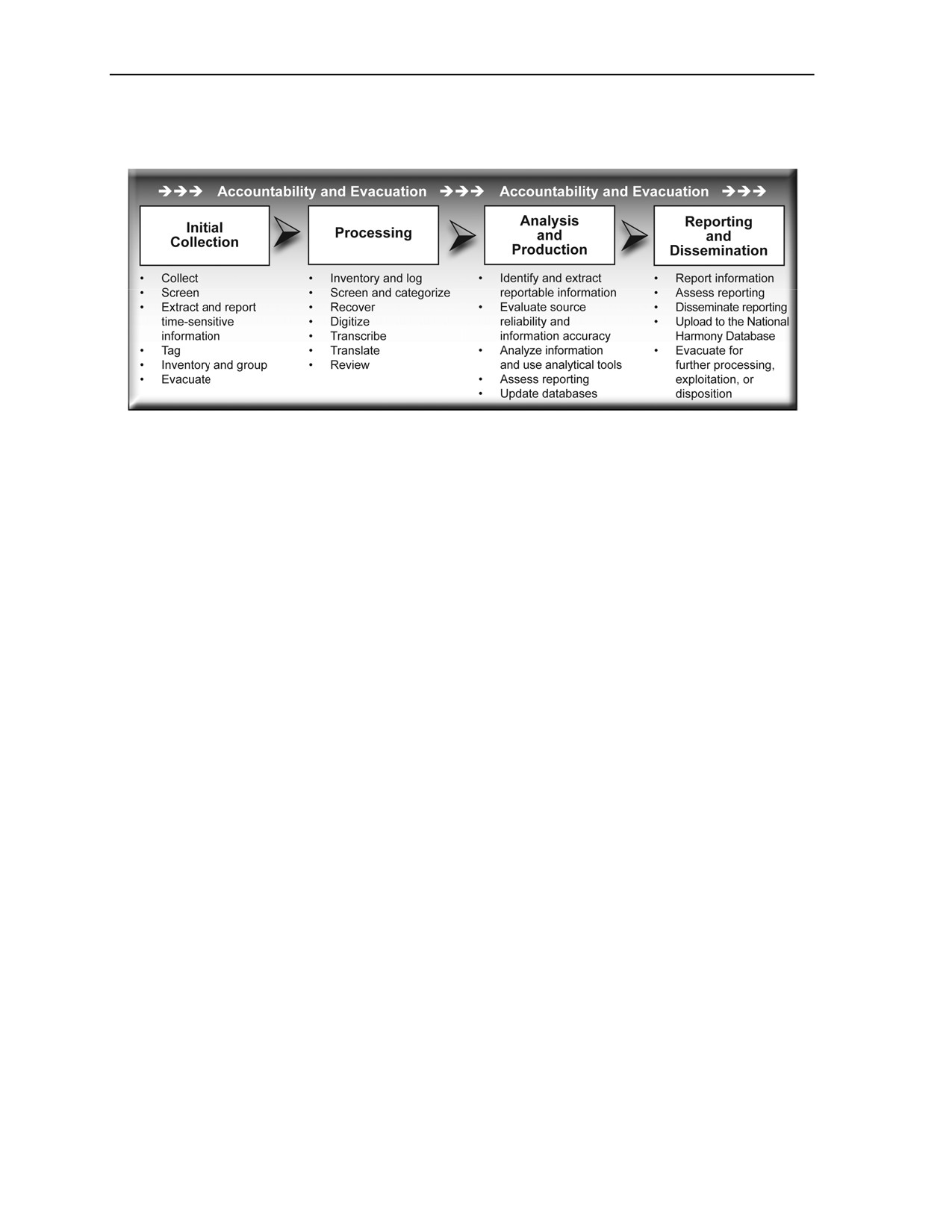
Chapter 1
THE DOCUMENT AND MEDIA EXPLOITATION PROCESS
1-11. The DOMEX process, as depicted in figure 1-1, comprises four phases.
Figure 1-1. DOMEX process
1-12. The capabilities and responsibilities of each DOMEX operation vary with the echelon—from hasty
exploitation by the capturing unit at the tactical site, to advanced processing at a joint DOMEX processing
site. Many of the procedures within each phase may occur across the echelons, depending on the
requirements of that echelon, including the inventory, screening, accountability, translation, analysis,
reporting, and evacuation of captured materials.
ACCOUNTABILITY THROUGHOUT THE DOMEX PROCESS
1-13. Accountability procedures are exercised throughout the four phases of the DOMEX process.
Accountability includes—
z
Inventorying captured materials as they arrive.
z
Initiating necessary trace actions based on the transmittal sheet.
z
Maintaining a log of captured materials or evidence/property custody documents.
1-14. Strict accountability of captured materials is vital to maintaining the integrity of timely and relevant
intelligence and the chain of custody for prosecutorial purposes. Accountability begins when the collector
takes possession of captured materials. Maintaining accountability occurs even after the evacuation
process; each element or activity takes possession of the original captured materials and maintains
complete and accurate records of the location and status of these captured materials. This ensures total
control of the captured materials.
1-15. Accountability procedures include—
z
Logging captured materials in and out.
z
Copying captured materials as required.
z
Procedures for the proper storage of captured materials.
z
Receiving and transmitting captured materials.
z
Maintaining files.
z
Other routine activities.
1-16. Depending on the quantity of captured materials, accountability procedures can be performed by one
individual at a lower echelon, or by several individuals in warehouse-sized operations with large volumes
of documents at a theater document repository.
1-4
TC 2-91.8
08 June 2010
FOR OFFICIAL USE ONLY
Document and Media Exploitation Overview
EVACUATION THROUGHOUT THE DOMEX PROCESS
1-17. Proper evacuation procedures are necessary to preserve the integrity of potential intelligence and the
evidentiary value of the captured materials. Strict accountability during evacuation procedures ensures
information derived from captured materials is useable in all areas—during in-depth analysis, as evidence
in judiciary proceedings, and for other such functions as deemed appropriate. Evacuation may occur several
times throughout the processing of the captured materials in question, the destinations of which depend on
the phase of exploitation, the resources available, document types, and the intelligence or evidentiary
potential of the captured materials involved.
1-18. Maintaining segregation of the captured materials throughout the entire chain of custody is essential
to preserve the intelligence and evidentiary value of the captured materials. Segregation involves keeping
captured materials separate according to their types, categories, or sources; their acquisition date; and other
factors determined by individual circumstances. Handlers of captured materials maintain segregation
during evacuation and transfer of the materials in accordance with applicable policy and procedures.
Evacuation of Classified Captured Enemy Documents
1-19. Classified CEDs are handled in accordance with AR 380-5 and the appropriate level of classification.
Personnel accompanying the transfer of the CEDs must have the appropriate security clearance and courier
orders and must ensure appropriate security containers or safes are used to secure the contents.
Evacuation Destinations
1-20. The capturing unit sends captured materials through intelligence channels (the battalion intelligence
staff processing site is the first element to receive the captured materials) to a supporting brigade-level
captured materials processing site. Information gained from captured materials is often time-sensitive;
therefore, it is vital that coordination (established by unit standing operating procedures before conducting
operations to ensure the smooth transfer of priority captured materials) occurs among the capturing unit,
intelligence staff, and subsequent processing site.
Note. If the captured materials are associated with a detainee, they are evacuated with the
detainee.
1-21. Capturing units are capable of exploiting some captured materials to avoid losing valuable time. Any
time lost in processing and analyzing captured materials may reduce or even negate the value of the
information. Procedures used by any element must ensure the captured materials reach their proper
destinations in a timely manner. Communication and digital devices are frequently the most valuable and
time-sensitive of captured materials; therefore, they are delivered immediately to technicians with the
capability to exploit them. To expedite this process, the intelligence staff should have an established liaison
with the appropriate technical specialists and facilities.
1-22. Once the captured materials are inventoried and initially exploited, the capturing unit attaches a
captured materials transmittal sheet and evacuates the materials.
1-23. Captured materials are evacuated based on their primary evacuation destinations (see figure 1-2,
page 1-6):
z
Criminal evidence.
z
Specific limiting criteria (SLC).
z
Technical intelligence (TECHINT).
z
CED processing.
Maps and charts.
Air Force documents.
Navy documents.
08 June 2010
TC 2-91.8
1-5
FOR OFFICIAL USE ONLY

Chapter 1
z
Signals intelligence (SIGINT).
z
Human intelligence (HUMINT).
Figure 1-2. Evacuation destinations
Criminal Evidence
1-24. The battalion intelligence staff separates, secures, and sends all documents constituted as criminal
evidence (used in legal proceedings against persons suspected of significant crimes) to the appropriate
authority. The staff separates these documents from other documents, marks them accordingly as
“CRIMINAL EVIDENCE,” and stores them under guard or in a secured area until presented to the nearest
staff judge advocate, criminal intelligence asset, or war crimes investigative unit. The collecting unit should
contact the criminal investigation division liaison first and seek assistance from the staff judge advocate for
additional guidance on chain of custody requirements.
Specific Limiting Criteria
1-25. SLC captured materials are of a counterterrorist or counterintelligence nature and require special
handling because, if compromised, they could endanger ongoing operations, sensitive sources, or methods.
Items containing SLC information are classified Secret and immediately evacuated to the nearest
counterintelligence activity.
1-6
TC 2-91.8
08 June 2010
FOR OFFICIAL USE ONLY
Document and Media Exploitation Overview
Technical Intelligence
1-26. Captured materials of TECHINT interest include equipment identified on the collection requirements
list, new weapons, tracked vehicles, and equipment manuals. Unidentified, modified, or unexpected
equipment should elicit a spot report. Once generated, the spot report is sent through reporting channels for
disposition and instructions. TECHINT equipment of interest is then transported to the nearest captured
materiel exploitation center for processing and exploitation. Captured or recovered technical documents
consist of firing tables, logbooks, packing slips, and other documentation. If the tactical situation does not
allow for equipment evacuation, the associated documents or a photograph of the equipment is forwarded
to the captured materiel exploitation center along with a description of the equipment. (See TC 2-22.4.)
Captured Enemy Document Processing
1-27. If further CED processing or exploitation is required, CEDs are evacuated to the next higher echelon
CED processing site for subsequent screening, processing, and dissemination:
z
Maps and charts containing any operational graphics are sent to the battalion intelligence staff,
who forwards them to the brigade or division analysis and control element or all-source analysis
center for analysis and exploitation by imagery intelligence personnel.
z
Air Force documents are evacuated through the battalion intelligence staff and brigade
DOMEX processing site to the nearest Air Force headquarters or Air Force Office of Special
Investigations element.
z
Navy documents are evacuated through the battalion intelligence staff and brigade DOMEX
processing site to the nearest Naval Criminal Investigative Service at Navy headquarters.
Signals Intelligence
1-28. Captured materials with cryptographic or communications systems information are evacuated to a
unit’s supported SIGINT unit or to other SIGINT units specified in annex B (Intelligence) of the OPORD.
Communications-electronics equipment, not immediately exploitable for HUMINT value, is evacuated
immediately with dial settings and frequencies recorded to the supporting SIGINT unit by the quickest and
most secure means possible. Captured materials containing cryptographic or communications systems
information are handled as Secret. (See table 2-1, page 2-15, for document categories.) Category A
captured materials may contain time-sensitive operational and technical information requiring immediate
processing and analysis by SIGINT personnel. The staff limits the number of personnel having knowledge
of the materials’ capture or contents.
Note. In order to facilitate follow-on operations, specially trained media exploitation personnel
at the brigade level are capable of digitizing, exploiting, and reporting captured materials. In
such cases, communications-electronics equipment with a memory card, including computers,
telephones, personal digital assistants, and Global Positioning System terminals, may be
exploitable by DOMEX teams or other specially trained media exploitation personnel before
evacuation to the supporting SIGINT unit or the National Media Exploitation Center for more
in-depth exploitation.
Human Intelligence
1-29. Captured materials removed from detainees accompany them to the detainee holding or detention
facility. This is an essential task since the captured materials are necessary for effective HUMINT
collection operations. The unit transporting the detainees and the captured materials keep them separate to
ensure detainees do not alter or destroy the materials. Captured materials need to be bagged and tagged
with their detainees’ information to maintain the association of each document or materiel with its detainee.
Note. All other documents, unless specifically outlined above, are evacuated to the next higher
echelon.
08 June 2010
TC 2-91.8
1-7
FOR OFFICIAL USE ONLY
Chapter 1
FINAL DISPOSITION—DOMEX REPOSITORIES
1-30. DOMEX repositories are established warehouses that—
z
Receive captured materials for centralized archival accountability.
z
Establish a centralized point for permanent storage.
z
Provide transportation to other repositories in theater of operations or at higher echelons for final
disposition of captured materials, as applicable.
1-31. While warehousing procedures for captured materials differ according to command, unit standing
operating procedures, and other guidelines, warehousing procedures may include the reception, screening,
category evaluation (as applicable), tagging, inventorying, digitization, and uploading of captured materials
to the Harmony database suite and final storage. The Harmony database suite forwards electronic captured
materials to the translation teams for data entry, gist translations (rough outline of a text’s meaning), and
quality control in the Harmony database suite, as needed, before final upload to the National Harmony
Database.
1-8
TC 2-91.8
08 June 2010
FOR OFFICIAL USE ONLY
Chapter 2
Initial Collection Phase
The rapid and accurate extraction of information from captured materials contributes
significantly to commanders’ situational understanding. The collection of captured
materials functions as the U.S. and multinational forces’ initial acquisition of threat
documents and materiel. Proper collection and handling procedures are vital to the
document and media exploitation (DOMEX) process.
SECTION I - COLLECTOR’S RESPONSIBILITIES
2-1. Tactical operations, such as raids and cordon and search operations, where site exploitation is
conducted result in substantial yields of captured materials. Soldiers and leaders must understand the
importance of the collecting team’s handling and exploitation of captured materials and their relationship to
DOMEX. Proper team handling and exploitation—
z
Feed the intelligence and operations processes.
z
May quickly answer commander’s critical information requirements (CCIRs).
z
Lead to follow-on tactical operations.
z
Assist in the prosecution of criminals.
2-2.
“Collectors” refer to personnel or elements involved in the initial collection phase. They may include
the capturing unit, exploitation team, DOMEX team, human intelligence collection team, raid support team
(RST), weapons intelligence team, or battalion intelligence staff. Regardless of how U.S. and multinational
forces initially obtain captured materials, the collector is responsible for—
z
Removing captured materials from a person, vehicle, or facility—safety permitting.
z
Not marking, altering, or defacing captured materials.
z
Performing hasty screenings of captured materials to identify time-sensitive information of
immediate tactical value.
z
Reporting time-sensitive information.
z
Properly handling, tagging, and packaging captured materials.
z
Placing dry documents in waterproof containers (boxes or plastic bags).
z
Completing two copies of DD Form 2745 (Enemy Prisoner of War Capture Tag), part C,
DA Form 7671-R (Captured Enemy Materiel), or a field expedient tag. (See TC 2-22.4.)
z
Placing one copy of the completed DD Form 2745, part C inside the document container.
z
Attaching one copy of the completed DD Form 2745, part C to the outside of the container or to
the captured enemy materiel (CEM).
z
Evacuating captured materials to battalion or higher intelligence staff or other dedicated
DOMEX processing site.
HANDLING PROCEDURES
2-3. The proper collection and handling of captured materials are vital because they allow captured
materials to move forward through the DOMEX process. Proper handling of captured materials has become
a critical function in recent military operations particularly when information or evidence must be used by
U.S. forces for exploitation purposes and by host-nation authorities for prosecutorial actions. The
08 June 2010
TC 2-91.8
2-1
FOR OFFICIAL USE ONLY
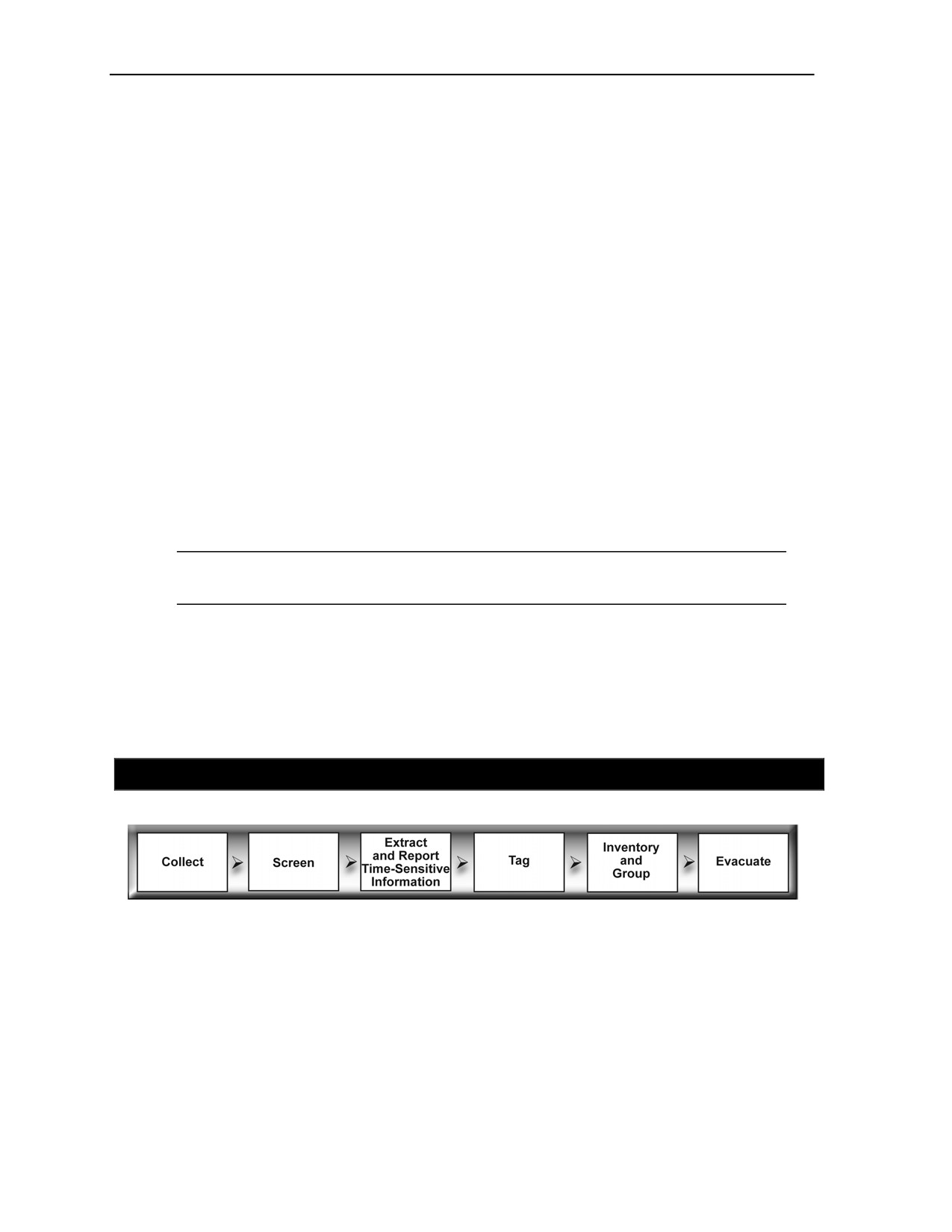
Chapter 2
mishandling of captured materials could result in the loss of valuable information, a lost opportunity to
exploit enemy vulnerabilities, or the loss of friendly forces.
2-4. Captured materials should not be handled before their actual collection. Trained collectors use
extreme caution when collecting, handling, and protecting forensic evidence. However, collections
occurring in high-threat environments may require the fast pick up and bagging of evidence by untrained
personnel, consequently, without the prerequisite protection of forensic evidence. Because the actual
collection of captured materials is key to the DOMEX process, when trained collectors are not present,
untrained personnel must exercise the utmost care in their collection of evidence, thus not destroying
forensic materials. The safety of U.S. and multinational forces is of primary importance under any
condition or circumstance.
2-5. In handling captured materials, personnel involved in all phases of the DOMEX process must take
every precaution to preserve the evidentiary value of the original captured materials. The captured materials
may carry the fingerprints of those individuals being charged in criminal proceedings. When possible,
handlers at each echelon should wear the appropriate gloves to preserve evidence that can be extracted
through fingerprint analysis.
HAZARDOUS MATERIALS
2-6. Before inventorying captured materials, personnel involved in their handling must ascertain whether
hazardous materials are rendered safe; personnel safety is the first priority. In the event that munitions or
other hazardous materials, such as chemical, biological, radiological, nuclear, and high-yield explosives
(CBRNE), are discovered during the inventory of captured materials, evacuate the area immediately and
summon the appropriate authorities.
Note. The explosive ordnance disposal (EOD) unit is the only asset authorized to perform
render-safe procedures.
2-7. The EOD unit can initially assess and neutralize found munitions. These munitions may include
single munitions, captured enemy ammunition sites, and items recovered during military operations
(patrols, raids, maneuvers). Weapons intelligence teams may contribute valuable information regarding
locally encountered devices and munitions, as well as collect technical intelligence. For safe handling
procedures, consult trained professionals such as the EOD unit, support battalion ammunition specialists, a
CBRNE representative, or another appropriate activity in accordance with unit standing operating
procedures (SOPs).
SECTION II - COLLECTION OF CAPTURED MATERIALS
2-8. The initial collection phase of the DOMEX process comprises the tasks as listed in figure 2-1.
Figure 2-1. Initial collection phase
COLLECT
2-9. The manner in which a capturing unit executes the initial collection phase of the DOMEX process
depends on whether the captured materials are associated with a detainee or a site.
2-2
TC 2-91.8
08 June 2010
FOR OFFICIAL USE ONLY
Initial Collection Phase
COLLECTING CAPTURED MATERIALS ASSOCIATED WITH A DETAINEE
2-10. When collecting captured materials associated with a detainee, capturing units secure and search the
detainees by employing the search, silence, segregate, speed, safeguard, and tag (5Ss + T) method and by
securing all captured materials in the area of capture. The capturing unit allows detainees to retain
protective military equipment—such as helmets; protective masks; body armor; identification cards and
tags; and insignias of grade, service, and nationality—only after the items have been searched for any
hidden documents or materiel.
2-11. Capturing units remove all documents or materiel, except for one official primary identification
document, from detainees to safeguard them from alteration or destruction. The capturing unit evacuates
these captured materials with, but not on the detainees. Following interrogation, the HUMINT collector or
DOMEX team, as per unit SOPs in accordance with applicable rules and regulations, decides which
personal documents or materiel to return to the detainees. (For further information, see Article 17, Part III,
Section I, Geneva Conventions.)
COLLECTING CAPTURED MATERIALS ASSOCIATED WITH A SITE
2-12. Before capturing materials associated with a site, the capturing unit clears the site to ensure safe
entry. The unit then processes individuals not to be detained and the captured materials in accordance with
unit SOPs. Items captured at a site are identified with that site upon collection.
2-13. If resources and time are available, the capturing unit should photograph the site, the documents
(such as graffiti on wall), and any materiel too large or dangerous to remove from the site (such as large
equipment, ordnance, and hazardous materials). A digital photograph provides a graphic record of possible
relationships of the captured materials, as found at the site, that support the DOMEX process and tactical
operations. The unit must annotate or otherwise include the captured materials tag with a digital photograph
or sketch to ensure their accountability and traceability.
COLLECTING LARGE QUANTITIES OF CAPTURED MATERIALS
2-14. If a capturing unit has neither the resources nor the expertise to collect large quantities of captured
materials, the unit should request collection and exploitation support from—
z
Task-organized site exploitation elements.
z
RSTs.
z
DOMEX or other specialized exploitation teams.
z
Supporting military intelligence units.
z
Corps DOMEX support elements.
z
Nearest joint document exploitation center.
Note. The RST consists of a task-organized detachment from the corps DOMEX support
element assembled to augment existing unit resources for a limited duration, surge, or suspected
high-yield or high-value operations.
2-15. Requesting collection and exploitation support reduces the burden on the requesting unit, facilitates
the rapid extraction of information, and enables the priority evacuation of important documents to higher
echelons. The requesting unit must safeguard and protect the captured materials until the exploitation team
arrives. The capturing unit submits a spot report in the size, activity, location, unit, time, and equipment
(SALUTE) format or a similar report and includes a request for collection and exploitation support in the
remarks line. (See figure 2-2, page 2-4.) The report should include—
z
Location of captured materials, including eight-digit map coordinates.
z
Enemy situation in the vicinity of the captured materials site.
z
Description of the captured materials site (such as city hall, munitions storage facility, or
terrorist training camp).
08 June 2010
TC 2-91.8
2-3
FOR OFFICIAL USE ONLY
Chapter 2
z
Estimate of the number and type of captured materials.
z
Presence of computers, file servers, copying machines, or similar communications and
processing equipment.
TITLE: Spot Report
TO: Usually, address of the supported S-2/G-2 (in accordance with [IAW] unit standing operating
procedures [SOPs]).
FROM: Unit or team designation or duty position, as appropriate.
DTG: When report is being submitted (in date-time group format).
Report Number: IAW unit SOPs.
1. (S)ize/Who: Expressed as a quantity and echelon or size (for example, 1X brigade). If multiple
echelons are involved in the activity being reported, there can be multiple entries (for example, 1X
brigade; 2X battalion). Nonstandard units are reported as such (for example, bomb-making class; support
staff).
2. (A)ctivity/What: Focal point of the report that relates to the priority intelligence requirement (PIR) or
important non-PIR information being reported. It should be a concise bullet statement.
3. (L)ocation/Where: Generally a grid coordinate that includes the 100,000-meter grid zone designator.
The entry can also be an address, if appropriate, but still should include an eight-digit grid coordinate. City
names are followed by the two-character country code. (See FM 1-02.) If the activity being reported
involves movement (for example, advance, withdrawal), the location entry includes “From” and “To.” The
route used will be reported under “Equipment/How.”
4. (U)nit/Who: This entry identifies who is performing the activity described in the “Activity/What” entry.
Include the complete designation of the military unit, identification of a civilian or insurgent group, or the
full name of an individual, as appropriate.
5. (T)ime/When: For a future event, this is when the activity will initiate. Past events are usually not the
subject of SALUTE reports, but if a past event is to be reported, the “Time/When” entry will generally
reflect when the event ended. Ongoing events are reported as such. Reports of composition of forces,
morale, and electronic technical data and other nonevent topics are reported as ongoing. When reporting
on the disposition, the “Time/When” entry is generally the last time the source was at the disposition.
6. (E)quipment/How: The information reported clarifies, completes, or expands on information reported in
any of the previous sources. It includes information concerning equipment involved, tactics used, and any
follow-up information not reported in the previous paragraphs.
7. Remarks: Use this entry to report the source of the information, whether a person, a captured enemy
document, open-source media, or other source. Include the date of information and the PIR that the
reported information addresses. Include map data for coordinates given in the “Location/Where” entry,
stating map series name, sheet number, scale, and edition. If there are enclosures to the spot report,
such as sketches, annotate them here.
Note. The above examples are for guidance and not to be construed as strict requirements.
Figure 2-2. Example spot report
2-16. The capturing unit makes every effort to ensure that computers, magnetic media, telephones,
recording devices, and communications equipment remain in captured configuration (powered up or
powered down) until relieved by specially trained exploitation personnel. Capturing-unit personnel remain
in place to provide security while the exploitation team processes the site.
2-17. The exploitation team notifies the requesting unit of their estimated arrival time and route as well as
any other relevant force protection information. The exploitation team collects, tags, inventories, and
evacuates the captured materials in accordance with unit SOPs and instructions in the operation order
(OPORD). Depending on the enemy situation and time available, the exploitation team performs a hasty
2-4
TC 2-91.8
08 June 2010
FOR OFFICIAL USE ONLY
Initial Collection Phase
screening of the captured materials before evacuation to ensure the identification and reporting of time-
sensitive information.
SCREEN
2-18. The capturing unit performs a hasty screening of all captured materials to determine—
z
Their type.
z
Whether the captured materials are exploitable at the field location.
z
If relevant, the detainees to which they are associated.
2-19. The initial screening aids in expediting the evacuation process and can assist in the site tactical
questioning of detainees regarding the captured materials. During screening, time-sensitive information or
information of immediate tactical value is identified and reported.
Note. The battalion intelligence staff repeats the screening of captured materials to identify time-
sensitive information or information of immediate tactical value and categorizes the captured
materials. Therefore, during the screening of captured materials, the capturing unit should not
decide what is important and unimportant because the information may be of intelligence value
to higher echelons.
EXTRACT AND REPORT TIME-SENSITIVE INFORMATION
2-20. Once identified, pertinent information is reported using the spot report in SALUTE format for
immediate dissemination. A copy of all reports is evacuated with the detainee and captured materials. If
linguists are unavailable to translate written items and translation equipment is unavailable for key word
identification, swift evacuation is critical for translation support.
Note. Under no circumstances is magnetic media to be reviewed or exploited at the field site.
Safeguard magnetic media against damage until it can be evacuated to the appropriate technical
experts, such as media exploitation personnel. At the brigade and corps levels, media
exploitation personnel may be task-organized as part of a DOMEX team. Media exploitation
personnel may also be at facilities such as joint document exploitation centers and combined
media processing centers.
TAG
2-21. Collectors are responsible for properly tagging captured materials using DD Form 2745.
(See
figure 2-3, page 2-6.) Tagging responsibilities and procedures must be clearly established by unit SOPs; the
document tag is an essential task that establishes accountability and traceability of all captured documents.
As part of core warrior tasks, all personnel must be instructed on proper tagging procedures, with emphasis
on protecting and preserving the original condition and markings of the captured materials. The capturing
unit should not make any marks on or otherwise deface original captured materials.
08 June 2010
TC 2-91.8
2-5
FOR OFFICIAL USE ONLY
Chapter 2
Figure 2-3. DD Form 2745 (Enemy Prisoner of War Capture Tag)
2-6
TC 2-91.8
08 June 2010
FOR OFFICIAL USE ONLY
Initial Collection Phase
TAGGING PROCEDURES
2-22. A unit-specific administrative number is required to account for each detainee or captured enemy
document (CED) or CEM. Unit SOPs have a unit-specific format for creating unit-specific administrative
numbers. The following convention may be used:
z
Platoon designation.
z
Company designation.
z
Battalion designation.
z
Date-time group (DTG) of capture.
z
Unique sequential number.
2-23. For example, the third detainee captured by the 2d Platoon of B Company, 2d Battalion, 125th
Infantry, at 0845 hours on 24 February 2009 would be recorded as—2/B/2/125/240845FEB09/0003.
Tagging Captured Materials Not Associated with a Detainee
2-24. Assign administrative numbers to each package and annotate the number on the captured materials
tag. Since captured materials not associated with a detainee do not have a person or a person’s name
associated with them, the location, location description, and DTG of capture are critical for exploitation
purposes. This information helps a unit differentiate materials collected during multiple rotations to a war
zone. A unit is likely to use the same numbering system to avoid confusion from rotation to rotation
regarding a location and DTG of capture.
2-25. CEDs not associated with a detainee may be bundled, bagged, or packaged and given a separate
administrative number for each package followed by the letter “D” as the identification for document. For
example, the administrative number for the fourth package of documents captured at a certain site or during
a particular incident by the 2d Platoon, B Company, 2d Battalion, 125th Infantry, at 0845 hours on 24
February 2008 would be 2/B/2/125/240845FEB08/0004D. In the event of a large volume of CEDs,
additional numbers may be used.
Note. Although there is no specific form or format for the captured materials tag, it can be
produced or reproduced locally or DD Form 2745, part C may be used.
Tagging Captured Materials Associated with a Detainee
2-26. When captured materials are associated with a detainee, the capturing unit completes DD Form 2745,
part C:
z
Record the administrative number in block 2 (Serial No.).
z
Record the captured materials and any personal effects (money and items of personal or
sentimental value, such as letters, pictures, jewelry) associated with a detainee in block 10
(Description of Weapons, Special Equipment, Documents).
2-27. At a minimum, the capturing unit provides the following information:
z
Capturing unit identification.
z
Date and time of capture in DTG format.
z
Location of capture, including eight-digit map coordinates and a detailed physical description of
the location.
z
Identity of the detainee or other source that possessed the document, if applicable.
z
Summary of circumstances for capture.
2-28. Bag and tag the captured materials and personal effects. Individually receipt and transfer high-value
items (such as money and jewelry) that have a perceived or actual value, regardless of that actual value.
This ensures accountability. Attach DD Form 2745, part C to all captured materials and personal effects
associated and evacuated with the detainee; use multiple forms, if necessary. Keep all captured materials
08 June 2010
TC 2-91.8
2-7
FOR OFFICIAL USE ONLY