Military reference books and manuals (2009-2023, Volume 6) - page 34

Control Force Formations
4-54. The 2d squad may be moved from general to lateral support at anytime by the platoon leader. The
platoon leader commands, “2d squad, lateral support, move.” To have the 2d squad join the line from either
support position, the platoon leader commands, “2d squad, extend the line, move.” The 2d squad leader
commands, “Follow me.” On the command of execution, the squads set up individual lines, closing and
dressing on the existing line. To assemble the platoon from a platoon line formation with lateral support,
follow the same steps as for the platoon line.
Platoon Line Formation With Direct Support
4-55. The command for forming a platoon line formation with 2d squad in direct support is “Platoon line,
2d squad in direct support, move.” The 1st and 3d squads execute a line as before. The 2d squad executes a
squad line directly to the rear and centered on the 1st line. The Soldiers in the supporting line cover the
intervals between the Soldiers in the 1st line. To do this, the squad and team leaders of the 1st and 3d
squads must take two steps to the rear to allow space for the 2d squad to move into place. After seeing the
squad and team leaders move back from the line, the 2d squad leader commands, “Follow me” and leads
the squad into position (see figure 4-12).
Figure 4-12. Platoon line formation with direct support
4-56. To assemble a platoon formation with direct support, the procedure is the same as the platoon line
formation, except that the 2d squad moves to the AA first. To assemble the support squads from any
position to general support, the platoon leader commands, “2d squad in support, move.” The 2d squad then
returns to a column behind the line formed by the other two squads.
PLATOON ECHELON RIGHT AND LEFT FORMATIONS
4-57. The command for forming a platoon echelon right formation is “Platoon, echelon right, move.” After
the platoon leader’s preparatory command, the squad leader of the 1st squad commands, “Follow me.” The
squad leaders of the 2d and 3d squads command, “Stand fast.” On the command of execution, the 1st squad
moves out and executes an echelon right at the location designated by the platoon leader. As the 1st squad
clears the column, the 3d and 2d squads extend the echelon. The 2d squad performs support to this
formation in the same ways it supports a line formation.
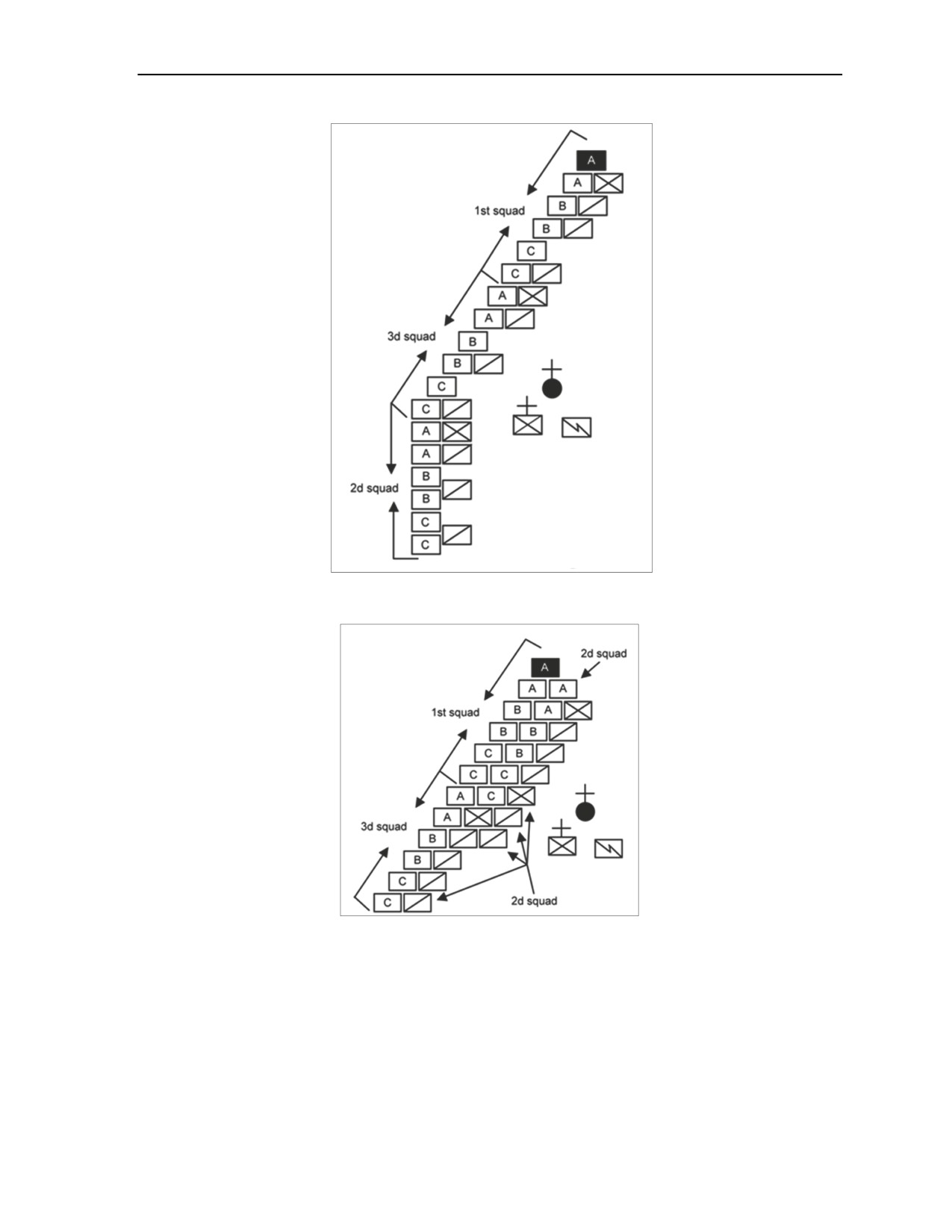
4-58. The command for forming a platoon echelon left is “Platoon echelon left, move.” The platoon
echelon left is formed in the same manner as the echelon right (see figure 4-13, page 4-14). Figure 4-14,
page 4-14; figure 4-15, page 4-15; and figure 4-16, page 4-15 show support formations in a left echelon.
4-59. To assemble the platoon, the platoon leader takes up position to the rear of the formation with the
platoon headquarters. On the preparatory command, “Platoon Assemble,” the 1st squad leader does an
about-face movement while all other members assume the port arms position and face the baseman. On the
command, “Move,” the 1st squad moves first, followed by the 3d and 2d squads. Each squad dresses with
the 1st squad as it reaches the AA. The assembly of the echelon right formation is the same as the echelon
left.
21 April 2014
ATP 3-39.33
4-13

Chapter 4
Figure 4-13. Platoon echelon left formation
Figure 4-14. Platoon echelon left formation with the 2d squad in general support
4-14
ATP 3-39.33
21 April 2014
Control Force Formations
Figure 4-15. Platoon echelon left formation with the 2d squad in lateral support
Figure 4-16. Platoon echelon left formation with the 2d squad in direct support
PLATOON WEDGE FORMATION
4-60. The command for forming the platoon wedge formation is “Platoon wedge, move.” After the platoon
leader’s preparatory command, the squad leaders of the 1st and 3d squads command, “Follow me.” At the
same time, the 2d squad leader commands, “Stand Fast.” On the platoon leader’s command of execution,
the 1st and 3d squads move directly to the front. The 1st squad executes an echelon left on the baseman
while the 3d squad executes an echelon right. When the last man of the 1st and 3d squads clear the 2d
squad, the 2d squad leader commands, “Follow me,” and moves out to the left and right. The 2d squad
21 April 2014
ATP 3-39.33
4-15

Chapter 4
splits and the A and B teams go to the right and the C team goes to the left to extend the formation (see
figure 4-17). Assembly of the wedge formation is the same as the platoon line.
Figure 4-17. Platoon wedge formation
Platoon Wedge Formation With General Support
4-61. The command for forming a platoon wedge formation with support is “Platoon wedge, 2d squad in
support, move.” The 1st and 3d squads execute the wedge, while the 2d squad remains in a column
formation (see figure 4-18).
Figure 4-18. Platoon wedge formation with 2d squad in general support
Platoon Wedge With Lateral Support
4-62. The command for forming a platoon wedge formation with lateral support is “Platoon wedge, 2d
squad in lateral support, move.” The 1st and 3d squads execute the wedge while the 2d squad stands fast.
4-16
ATP 3-39.33
21 April 2014

Control Force Formations
After the 1st and 3d squads have cleared the column, the 2d squad leader commands, “Follow me.” If no
direction is given, the 2d squad splits to cover both flanks. A squad may be used to cover one flank by
commanding, “2d squad right (or left) lateral support” (see figure 4-19 and figure 4-20).
Figure 4-19. Platoon wedge formation with the 2d squad in lateral support
Figure 4-20. Platoon wedge formation with the 2d squad in lateral support (right)
4-63. To move the 2d squad from general support to lateral support, the platoon leader commands, “2d
squad, lateral support, move.” To have the 2d squad join the wedge from general or lateral support, the
platoon leader commands, “2d squad, extend the wedge, move.” To extend the wedge, the 2d squad splits
and the teams move to the left and right, respectively.
Platoon Wedge With Direct Support
4-64. The command for forming a platoon wedge formation with the 2d squad in direct support is “Platoon
wedge, 2d squad in direct support, move.” The 1st and 3d squads execute a wedge. The 2d squad waits for
the squad and team leaders to move to the rear, as in the line formation, before executing a wedge directly
21 April 2014
ATP 3-39.33
4-17

Chapter 4
behind and centered on the main formation. The individuals in the supporting wedge cover the intervals
between individuals in the leading wedge (see figure 4-21).
Figure 4-21. Platoon wedge formation with the 2d squad in direct support
PLATOON DIAMOND AND CIRCLE FORMATIONS
4-65. These formations are used in open areas or where the crowd may be able to envelop the formation.
The diamond and circle formations are primarily defensive in nature and difficult to maneuver. The
decision about which formation to use is based on the ability of the platoon to perform them. The command
for having a platoon form in a diamond or circle formation is “Platoon diamond (or circle), move.” On the
command of execution, the 1st squad leader moves the baseman to the place indicated by the platoon
leader. The baseman becomes the 12 o’clock position while the 1st squad lines up to the left of the baseman
covering the 8 to 12 o’clock positions. The 3d squad aligns itself to the right of the baseman, covering the
12 to 4 o’clock positions and the 2d squad aligns itself, covering the 4 to 8 o’clock positions (see figure
4-22 and figure 4-23).
Figure 4-22. Platoon diamond formation
4-18
ATP 3-39.33
21 April 2014

Control Force Formations
Figure 4-23. Platoon circle formation
4-66. To assemble from a platoon diamond or circle formation, the headquarters element takes the same
steps as that of a line formation. The 1st squad leads the platoon back to the AA followed by the 2d and 3d
squads. Squads fall into a column formation as they file back to the AA.
RELIEF FOR ELEMENTS IN PLACE
4-67. During crowd control operations, the platoon leader may rotate squads to give them a rest. The
platoon leader is not limited to using only those squads specified in the preceding examples as the lead
elements of the formations. They can replace the base elements by commanding direct support to the 1st
squad and then directing the 1st squad into general support. The support element (the 2d squad) then passes
through the 1st squad. Once the 2d squad is formed directly behind the 1st squad, the 1st squad leader
commands, “Right face.” The members of the 1st squad do a right face movement and the 2d squad steps
quickly though the 1st squad and forms the base formation. The 1st squad leader then commands, “Follow
Me,” and leads his squad to the general support position. This procedure is often necessary when protective
masks are used and chemical irritants employed. The 1st squad then replaces the 3d squad in the same
manner. Platoons participating in company operations are relieved in the same manner.
PLATOON FORMATIONS WITH FOUR SQUADS
4-68. When forming control force formations from the column, the platoon leader moves to the right of the
platoon and faces it when giving commands. The platoon leader gives the hand-and-arm signal and the
preparatory command. On the command of execution,
“Move,” the platoon leader points to the
approximate location where he wants the platoon to form. The platoon leader pauses between the
preparatory command and the command of execution to allow each squad leader to issue a preparatory
command to the squad.
PLATOON LINE FORMATION
4-69. The command for forming a platoon line formation is “Platoon line, move.” Immediately following
the platoon leader’s preparatory command, the squad leaders of the 1st and 4th squads command, “Follow
me.” The squad leaders of the 2d and 3d squads command, “Stand fast.” On the platoon leader’s command
of execution, the 1st and 4th squads move forward to the point designated by the platoon leader. The 1st A
team member of the 1st squad is the baseman for the platoon formation. The 1st squad forms a squad line to
the left of the baseman and the 4th squad forms a squad line to the right of the baseman with all lines
dressed to the right. After the 1st and 4th squads have cleared the platoon, the 2d and 3d squad leaders
command, “Follow me.” The 2d squad forms a squad line to the left of the 1st squad. The 3d squad forms a
squad line to the right of the 4th squad. All squads dress with the 4th squad (see figure 4-24, page 4-20).
21 April 2014
ATP 3-39.33
4-19

Chapter 4
Figure 4-24. Platoon line formation with four squads
Platoon Line Formation Assembly
4-70. When assembling from the platoon line formation, the platoon leader and the headquarters personnel
take a position to the rear of the platoon. The platoon leader then gives the command, “Platoon assemble,”
while raising the right arm and making a circular motion above the head. Platoon members automatically
assume the port arms position. The 1st squad leader and the baseman do an about-face movement. All other
platoon members do an about-face movement toward the baseman. On the platoon leader’s command of
execution, the platoon leader points to where they want the platoon to assemble. The squad leader
4-20
ATP 3-39.33
21 April 2014

Control Force Formations
commands, “Follow me,” and moves the squad toward the AA. The 1st squad files to the baseman position,
followed by the 2d squad. As the 2d squad clears the baseman position, the 4th squad leader then
commands, “Follow me,” and leads the squad to the AA, followed by the 3d squad. As the 1st squad comes
to a halt facing the crowd in the AA, the 2d squad assumes its position to the right of the 1st squad. As the
4th squad assembles, it dresses on the 1st squad, leaving space for the 3d squad to return to its place in the
formation. Once the platoon is formed into a column formation, headquarters personnel take a position in
the formation. The PSG then commands, “Counter-column, march,” and moves the platoon to the rally
point.
Platoon Line Formation With General Support
4-71. Whenever the command for establishing a crowd control formation contains the phrase “In support”
without any other modification, such as “Lateral,” it means that the support element is to remain in general
support. The command for forming a platoon line with two squads in general support is “Platoon line, 2d
and 3d squads in support, move.” The 1st and 4th squads execute the line, while the 2d and 3d squads
remain in the column (see figure 4-25). To assemble a platoon with two squads in general support, the
procedure is the same as that of the platoon line, except that the 1st and 4th squads dress on the 2d and 3d
squads.
Figure 4-25. Platoon line formation with 2d and 3d squads in general support
Platoon Line Formation With Lateral Support
4-72. The command for forming a platoon line formation with two squads in lateral support is “Platoon
line, 2d and 3d squads in lateral support, move.” The 4th and 1st squads execute the line as before, and the
2d and 3d squads stand fast. After the line has been formed, the squad leaders of the 2d and 3d squads
command, “Follow me.” The 2d squad forms a column behind the last man of the 1st squad. The 3d squad
forms a column behind the last man of the 4th squad (see figure 4-26, page 4-22).
21 April 2014
ATP 3-39.33
4-21

Chapter 4
Figure 4-26. Platoon line formation with 2d and 3d squads in lateral support
4-73. Squads may be moved from general support to lateral support at any time by the platoon leader. The
platoon leader commands, “2d and 3d squads, lateral support, move.” To have the 2d and 3d squads join
the line from either support position, the platoon leader commands, “2d and 3d Squads, Extend the line,
move.” The 2d and 3d squad leaders command, “Follow me.” On the command of execution, the squads set
up individual lines, closing and dressing with the existing line. To assemble the platoon from a platoon line
with lateral support, the procedure is the same as that of the platoon line, except lateral support squads face
forward until they move to the AA.
Platoon Line Formation With Direct Support
4-74. The command for forming a platoon line with two squads in direct support is “Platoon line, 2d and
3d squads in direct support, move.” The 1st and 4th squads execute a line as before. The 2d and 3d squads
execute a second line directly to the rear and centered on the first line. The members in the direct support
line cover the intervals between members in the baseline. To do this, the squad and team leaders of the 1st
and 4th squads must take two steps to the rear to allow space for the 2d and 3d squads to move into place.
After seeing the squad and team leaders move back from the line, 2d and 3d squad leaders command,
“Follow me,” and lead the squads into position (see figure 4-27).
Figure 4-27. Platoon line formation with 2d and 3d squads in direct support
4-75. To assemble the support squads from any position to general support, the platoon leader commands,
“2d and 3d squads in support, move.” The 2d and 3d squads then return to a column behind the line formed
by the 1st and 4th squads. To assemble the entire platoon, the procedure is the same as that of a platoon
line, except that the 2d squad moves to the AA first, followed by the 3d, 1st, and 4th squads.
Platoon Line Formation With One Support Squad
4-76. The command for forming a platoon line formation with one squad in support is “Platoon line, 3d
squad in support, move.” The 1st squad moves out and executes a squad line. The 2d and 4th squads form a
line on the side of the left and rights sides of the 1st squad. The 3d squad remains in column formation. The
support squad may be used in lateral support on one or both sides of the formation or in direct support of
4-22
ATP 3-39.33
21 April 2014

Control Force Formations
any segment of the formation. To assemble the platoon, the procedure is the same as that of a platoon line,
except that all squads dress with the 3d squad.
PLATOON ECHELON RIGHT AND LEFT FORMATIONS
4-77. The command for forming a platoon echelon right formation is “Platoon echelon right, move.” After
the platoon leader’s preparatory command, the squad leader of the 1st squad commands, “Follow me.” The
squad leaders of the 2d, 3d, and 4th squads command, “Stand fast.” On the command of execution, the 1st
squad moves out and executes an echelon right at the location designated by the platoon leader. As each
squad clears the column, the next successive squad moves out and extends the echelon that has been
formed. To assemble the platoon, the procedure is the same as that of a platoon line, except that all squads
file back in order.
4-78. The command for forming a platoon echelon left formation is “Platoon echelon left, move.” The
platoon echelon left is formed in the same manner as the echelon right, but in reverse order (see figure
4-28). To assemble the platoon, the procedure is the same as that of an echelon right. (See figure 4-29, page
4-24; figure 4-30, page 4-24; and figure 4-31, page 4-25 for examples of echelon formations with support.)
Figure 4-28. Platoon echelon left formation with four squads
21 April 2014
ATP 3-39.33
4-23

Chapter 4
Figure 4-29. Platoon echelon left formation with 2d and 3d squads in general support
Figure 4-30. Platoon echelon left formation with 2d and 3d squads in lateral support
4-24
ATP 3-39.33
21 April 2014

Control Force Formations
Figure 4-31. Platoon echelon left formation with 2d and 3d squads in direct support
PLATOON WEDGE FORMATION
4-79. The command for forming the platoon wedge formation is “Platoon wedge, move.” After the platoon
leader’s preparatory command, the 1st and 4th squad leaders command, “Follow me.” At the same time, the
2d and 3d squad leaders command, “Stand fast.” On the platoon leader’s command of execution, the 1st
and 4th squads move directly to the front. When the last members of the 1st and 4th squads clear the 2d and
3d squads, the 2d and 3d squad leaders command, “Follow me,” and move out to the left and right. The 1st
squad executes an echelon left on the baseman and the 4th squad executes an echelon right. The 2d squad
forms an echelon left on the last man of the 1st squad. The 3d squad forms an echelon right on the last man
of the 4th squad. This completes the wedge formation (see figure 4-32). To assemble the platoon, the
procedure is the same as that of a platoon line.
Figure 4-32. Platoon wedge formation with four squads
21 April 2014
ATP 3-39.33
4-25

Chapter 4
Platoon Wedge Formation With General Support
4-80. The command for forming a platoon wedge formation with two squads in support is “Platoon wedge,
2d and 3d squads in support, move.” The 1st and 4th squads execute the wedge while the 2d and 3d squads
remain in column formation (see figure 4-33).
Figure 4-33. Platoon wedge formation with 2d and 3d squads in general support
Platoon Wedge Formation With Lateral Support
4-81. The command for forming a platoon wedge formation with lateral support is “Platoon wedge, 2d and
3d squads in lateral support, move.” The 1st and 4th squads execute the wedge while the 2d and 3d squads
stand fast. After the 1st and 4th squads have cleared the column, the 2d and 3d squad leaders command,
“Follow me,” and move out to the left and right. The 2d squad forms a column formation behind the last
man of the 1st squad. The 3d squad forms a column formation behind the last man of the 4th squad (see
figure 4-34).
Figure 4-34. Platoon wedge formation with 2d and 3d squads in lateral support
4-26
ATP 3-39.33
21 April 2014

Control Force Formations
4-82. To move the 2d and 3d squads from general to lateral support, the platoon leader commands, “2d and
3d squads, lateral support, move.” To have the 2d and 3d squads join the wedge from general or lateral
support, the platoon leader commands, “2d and 3d squads, extend the wedge, move.” The 2d and 3d squad
leaders command, “Follow me,” and move out to the left and right to extend the wedge on the 1st and 4th
squads.
Platoon Wedge Formation With Direct Support
4-83. The command for forming a platoon wedge with two squads in direct support is “Platoon wedge, 2d
and 3d squads in direct support, move.” The 1st and 4th squads execute a wedge. The 2d and 3d squads
execute a wedge and close in on the leading wedge. The members in the supporting wedge cover the
intervals between members in the leading wedge. To do this, the squad and team leaders of the 1st and 4th
squads must take two steps to the rear to allow space for the 2d and 3d squads to move into place. After
seeing the squad and team leaders move back from the line, the 2d and 3d squad leaders command, “Follow
Me,” and lead the squads into position (See figure 4-35). To move the 2d and 3d squads back to general
support, the platoon leader commands, “2d and 3d squads support, move.” Then the 2d and 3d squads move
to the general support positions. To assemble a platoon from a platoon wedge with direct support, the
procedure is the same as that of a platoon wedge, except that the 2d squad assembles first, followed by the
3d, 1st, and 4th squads.
Figure 4-35. Platoon wedge formation with 2d and 3d squads in direct support
Platoon Wedge Formation With One Support Squad
4-84. The command for forming a platoon wedge formation with one squad in support is “Platoon wedge,
3d squad in support, move.” The 1st squad moves out and executes a squad wedge. The 2d and 4th squads
form echelons left and right on the 1st squad. The 3d squad remains in the column formation.
PLATOON DIAMOND AND CIRCLE FORMATIONS
4-85. The platoon diamond and circle formations are used in open areas or where the crowd may be able to
envelop the formation. They are primarily defensive in nature and hard to maneuver. The decision
concerning which formation to use is based on the ability of the platoon to perform them. The command for
having a platoon form in a diamond or circle formation is “Platoon diamond [or circle], move.” On the
command of execution, the 1st squad leader moves the baseman to the location indicated by the platoon
leader. The baseman becomes the 12 o’clock position. The 1st squad lines up to the left of the baseman
covering the 9 to 12 o’clock positions. The 4th squad aligns themselves to the right of the baseman
covering the 12 to 3 o’clock positions. The 3d squad aligns itself covering the 3 to 6 o’clock positions. The
2d squad aligns itself covering the 6 to 9 o’clock positions.
21 April 2014
ATP 3-39.33
4-27

Chapter 4
4-86. To assemble a platoon from a platoon diamond or circle formation, the headquarters element uses the
same procedures as that of a line formation. The 1st squad leads the platoon back to the AA followed by the
2d, 3d, and 4th squads. The squads fall into a column formation as they file back to the AA.
COMPANY FORMATIONS
4-87. When a company commander orders his company into control force formations from a column, they
move to the left near the head of the column so that they are seen by the platoon leaders. The commander
then faces the company. As the commander gives the preparatory command, they point to where they want
the formation. If no location is indicated, the company forms immediately in front of the lead platoon.
4-88. For relieving elements in place, a platoon leader within a company formation may rotate the squads
to give them rest.
COMPANY LINE FORMATIONS
4-89. A company commander has several options of line formations for the company. These include line in
depth and line in mass with the various methods of support used.
Company Line in Depth Formation
4-90. The command for forming a company line in depth formation (see figure 4-36) is “Company line in
depth, move.” After the company commander’s preparatory command, each platoon leader gives the
command, “Platoon line.” The squad leaders follow with the commands to the squads to form the platoon
line. On the command of execution, each platoon establishes a platoon line immediately to its front.
Figure 4-36. Company line in depth formation
4-91. If the commander wants a more formidable formation, they command, “2d platoon, direct support,
move.” The squad and team leaders from the 1st platoon take two steps backward. The 2d platoon moves
forward and covers the intervals between the members of the lead platoon. The platoon leader of the 3d
platoon then moves his platoon forward to occupy the position formerly held by the 2d platoon.
4-92. If the 3d platoon is called on to support the company line, it moves forward and takes up a position
directly behind the 2d platoon in the same manner. Platoon leaders and PSGs help each other in controlling
the company.
Company Line-in-Mass Formation
4-93. The command for forming a company line-in-mass formation is “Company line in mass, move” (see
figure 4-37). The company line in mass is the same as a company line with both platoons in direct support.
Instead of forming it in stages, the company commander indicates the desire for this formation in the initial
4-28
ATP 3-39.33
21 April 2014

Control Force Formations
command. The platoons each form a line, and the 2d and 3d platoons close on the 1st platoon without
further command.
Figure 4-37. Company line-in-mass formation
Company Line Formations With Support
4-94. In company formations, the 1st platoon usually forms the lead element and the 2d and 3d platoons
provide support (see figure 4-38; figure 4-39; and figure 4-40, page 4-30). The support platoons can be
employed in the same manner as the support squads in platoon formations. One platoon can be relieved
from the lead element by another platoon, while in formation, by having a support platoon pass through the
lead platoon.
Figure 4-38. Company line mass formation with one platoon in depth
Figure 4-39. Company line-in-mass formation with one platoon in lateral support
21 April 2014
ATP 3-39.33
4-29

Chapter 4
Figure 4-40. Company line formation with one platoon in lateral support and one
platoon in general support
COMPANY ECHELONS AND WEDGE FORMATIONS
4-95. Company echelons (see figure 4-41; figure 4-42; figure 4-43; and figure 4-44, page 4-32) and
company wedge formations (see figure 4-45, page 4-32; figure 4-46, page 4-33; and figure 4-47, page 4-33)
are formed in the same manner and with the same variations as the company line formation. A company
assembles from a crowd control formation in the same manner as a platoon or a squad does. However, due
to the size of company formations, the commander must consider the area that the company is operating in
when assembling the company. If following the guidelines of platoon assembly, the commander will have
no difficulty. When assembling the company, the commander takes a position to the rear of the formation
and commands, “Company assemble.” The platoon leaders take charge of the respective platoons. Usually,
the 3d platoon assembles first, just behind the formation. After the 3d platoon is assembled, the 2d platoon
assembles in front of the 3d platoon and the 1st platoon assembles in front of the 2d. All platoons assemble
facing the commander. The 2d and 3d platoons then dress with the 1st platoon. As each platoon is
assembled, they are ordered to port arms by the platoon leader to await further orders from the commander.
If four platoons are used, the 4th platoon assembles first.
Figure 4-41. Company echelon right formation with one platoon in lateral support and one
platoon in general support
4-30
ATP 3-39.33
21 April 2014

Control Force Formations
Figure 4-42. Company echelon right in mass formation with one platoon in lateral support
Figure 4-43. Company echelon left formation with one platoon in general support
21 April 2014
ATP 3-39.33
4-31

Chapter 4
Figure 4-44. Company echelon right in mass formation with one platoon in general support
Figure 4-45. Company wedge formation with two platoons in general support
4-32
ATP 3-39.33
21 April 2014

Control Force Formations
Figure 4-46. Company wedge formation with one platoon in lateral support
Figure 4-47. Company wedge formation with one platoon in lateral support and one platoon in
general support
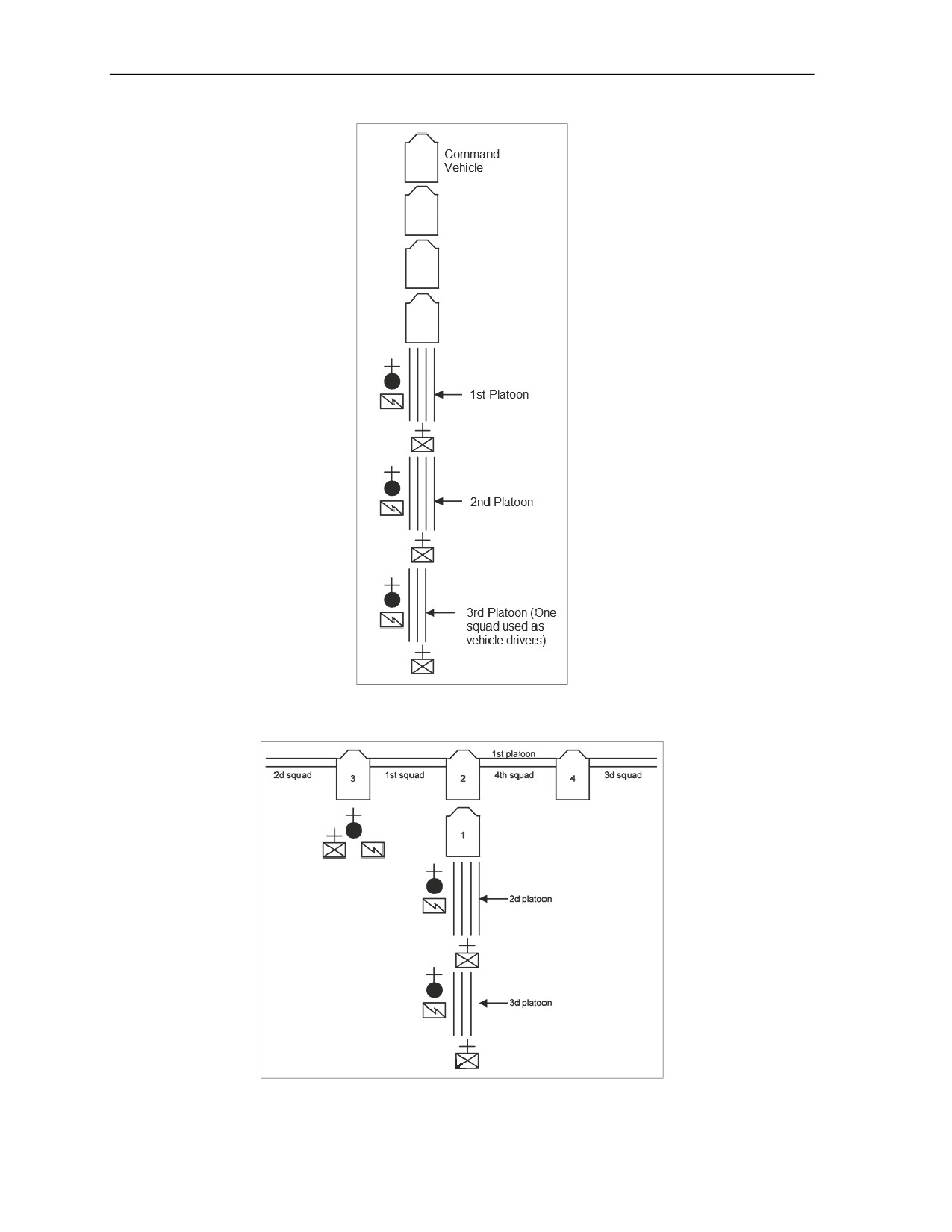
FORMATIONS WITH VEHICLES
4-96. The commands for vehicles and foot troops are the same as those for foot troops alone. Because of
the additional noise and distances involved, the company commander gives the hand-and-arm signal for the
line. The command and the signal apply to the lead platoon only. The other platoons remain in general
support until further directed (see figure 4-48, page 4-34; figure 4-49, page 4-34; figure 4-50, page 4-35;
figure 4-51, page 4-35; figure 4-52, page 4-35; and figure 4-53, page 4-36).
21 April 2014
ATP 3-39.33
4-33
Chapter 4
Figure 4-48. Company column formation with vehicles
Figure 4-49. Company line formation with vehicles and two platoons in general support
4-34
ATP 3-39.33
21 April 2014

Control Force Formations
Figure 4-50. Company line formation with vehicles, one platoon in lateral support and one
platoon in general support
Figure 4-51. Company echelon left formation with vehicles, one platoon in lateral support and
one platoon in general support
Figure 4-52. Company line-in-mass formation with vehicles and one platoon in general support
21 April 2014
ATP 3-39.33
4-35

Chapter 4
Figure 4-53. Platoon line formation with vehicles
4-97. The motor section moves out with vehicle number two moving to the right. Vehicle number two
passes the lead vehicle and establishes the position for the center of the line. At the same time, the 3d and
4th vehicles swing out to the left and right. They form to the left and right and slightly to the rear of vehicle
number two. The 1st and 4th squads of the lead platoon then move forward and form lines to the left and
right, on the front end of vehicle number two. As soon as the troops are in position, the 3d and 4th vehicles
close in on the squads and tighten the formation. The 2d and 3d squads of the lead platoon then form a line
to the left and right of the 3d and 4th vehicles to complete the company line. The command vehicle (vehicle
number one) takes up a position behind the line where the commander can direct and control the unit. The
2d and 3d platoons move forward and are used in general, lateral, or direct support. In some instances, foot
troops move into position first and vehicles join the formation, as needed.
4-98. To form a company echelon or a company wedge with vehicles, the company follows the same
procedures used for company formations without vehicles. Vehicles are moved into the appropriate
positions using procedures similar to those used for a company line.
4-36
ATP 3-39.33
21 April 2014

Control Force Formations
4-99. To assemble troops and vehicles, the command vehicle moves to a position behind the formation.
The commander faces the formation and gives the vehicle section the signal for assembly. Immediately, the
vehicles return to the proper positions in column formation behind the command vehicle while the troops
stand fast. The second in command then assembles the troops in the usual manner.
ADDITIONAL FORMATIONS
4-100. Along with the five basic control force formations (line, echelon, wedge, diamond, and circle),
there are additional formations that are utilized for specific situations. It is up to the leader on the ground to
determine which formations, or variations of those formations are necessary and best suits the situation that
the control force encounters. Two additional formations that can be used by the control force are junction
check and open formation.
JUNCTION CHECK
4-101. A junction check is basically the modification of a line formation where one end of the line turns
inward to a 90 degree angle. This formation is used to see down a cross street, alley, or area around a
structure such as a building. To conduct a junction check, the leader of the element that is currently in a line
formation gives the command, “Junction check, right [or left].” On the command of execution, the element
on the opposite side of the direction given turns inward (staying on line) 90° to the main line. The element
is now facing down the direction given by the leader and can observe the junction (cross street, alley, or
side of building). Figure 4-54 shows the junction check with a platoon line.
Figure 4-54. Junction check (right) with platoon line formation
OPEN FORMATION
4-102. The open formation is utilized when there is no immediate threat to the control force, when the
element wants to move more quickly without staying in a tight line or other formation, or when the control
force wants to cover more area and give off a larger presence to the crowd. To put the element into the
open formation, the leader commands, commands, “Platoon [or another element], open.” The open order
21 April 2014
ATP 3-39.33
4-37

Chapter 4
can be given to any element. To transform into the open formation, internal elements (for example, squads),
remaining on line, stagger behind or in front another element. The individual Soldiers spread out to a
distance of one baton plus six inches between them. Figure 4-55 shows a platoon line formation that has
moved into the open formation. In this example, 1st squad stays in place, 2d squad forms in front, and 3d
squad forms behind 1st squad. The command element moves rearward to allow space for the formation,
and remains behind the main element.
Figure 4-55. Open formation from a platoon line formation
4-38
ATP 3-39.33
21 April 2014
Chapter 5
Confinement Facilities
Civil disturbances do not always occur in large open areas where the size of the
responding force or the type of formation employed is not hampered by a lack of
space. In the military confinement environment, inmate disturbances often occur in
small, closed areas, such as an inmate’s housing unit, a gymnasium, a dining facility,
or a chapel where maneuver space and equipment limit the size of the element that is
employed. The layout of each facility is different and presents its own unique
problems when employing forces. This chapter covers the use of small military police
teams, forced cell move teams (FCMTs), and the formations used to move an unruly
inmate from one cell to another. Small generic riot control formations are discussed
to provide the commander with a basic employment option that they can tailor to the
facility to enable them to regain control of the affected area. The use of nonlethal
munitions and RCAs are incorporated into this discussion as well.
CROWD DYNAMICS
5-1. Within a confinement facility, inmates can be of various backg2rounds and cultures. Inmates usually
form groups based on these factors, but also based on such things as gang or group affiliation, protection
needs, or shared ideas and beliefs. Disturbances in these facilities occur for various reasons and to different
degrees of severity and size. Sometimes different groups of inmates with opposing views clash. The most
severe, and usually the most dangerous, disturbance is when the majority of inmates come together and riot
against the facility and its cadre. In confinement facility disturbances, inmates employ a number of tactics
to resist control or achieve goals. These tactics may be unplanned or planned and nonviolent or violent.
When a disturbance carries many purposes, it is likely that tactics are well planned.
NONVIOLENT TACTICS
5-2. Nonviolent tactics range from name calling to building barricades. Inmates may attempt to distract
control force members by shouting at or ridiculing them or by using abusive language, obscene remarks,
taunts, and jeers. The inmates’ goals are to anger and demoralize the control force. They also want
authorities to take actions that may later be exploited as acts of brutality.
VIOLENT TACTICS
5-3. Violent crowd tactics used by inmates are often extremely destructive and can include physical
attacks on cadre, other inmates, and property. Use of violent tactics is limited only by the attitudes and
ingenuity of the inmates, leader training, and the materials available to them. Inmates often commit
violence with crude homemade weapons. If unplanned violence occurs, inmates will use mops, brooms,
chairs, beds, or whatever else is on hand as weapons of violence. During planned violent disturbances,
inmates can easily conceal makeshift weapons or tools to use against the control force. Inmates often erect
barricades to impede troop movement or to prevent the control force from entering certain areas or
buildings. Inmates can be expected to vent emotions on individuals (cadre or inmates), the control force,
equipment, and institution’s property. Inmates direct potentially dangerous items like carts, barrels, liquids,
and burning material at the control force.
21 April 2014
ATP 3-39.33
5-1
Chapter 5
GRIEVANCE PROTEST
5-4. A grievance protest may be organized as a riot. However, under normal circumstances, a riot of this
type is not of an extremely violent nature. It may turn violent when leaders attempt to exploit any successes
or weaknesses found in the control force.
UNORGANIZED RIOTS
5-5. Unorganized riots are characterized as being spontaneous in nature. However, they could be
exploited and diverted by leaders at any subsequent stage of the riot, turning it into a different type. They
may begin as an isolated assault against authority figures, or acts of civil disobedience. Under determined
leadership, an unorganized riot could change to an organized riot.
MULTIPLE RIOTS
5-6. Multiple riots may happen when a disturbance occurs in one area of the confinement facility, causing
others to riot in the areas. To control this situation with only one riot control force available, the force
commander should first subdue the most violent riot. At the same time, he should employ some of his
control forces to contain the other riots until the main control force is able to move to those locations to
subdue them.
CADRE BEHAVIOR
5-7. The cadre is susceptible to crowd behavior. They become emotionally stimulated during tense
confrontation with unruly and violent inmates. Commanders must be aware of the mood and attitude of the
crowd and its effect on the control force cadre. To counteract the effects of crowd behavior on the cadre,
the commanders must institute rigorous training and firm and effective leadership. This training must
include a complete awareness and understanding of the use of force and the commander’s intent. These are
all necessary to offset the effect of crowd contagion or the control force as a second crowd effect upon the
control force. Even with the best training and leadership, control force members must exercise individual
and collective restraint.
PLANNING
5-8. Planning includes the preparation and training conducted before a crisis occurs. The purpose of
planning is to have plans and standing operating procedures (SOPs) in place so that the cadre may react to
an emergency and successfully contain and neutralize the situation. The planning process includes plan
development, information collection, and training.
Note. Information collection is essential for the successful containment, neutralization, or
prevention of a riot within a confinement facility.
5-9. During the planning process, leaders must be aware of the potential risks, as well as the level of risk,
involved in quelling disturbances within a confinement facility. Careful planning minimizes collateral
damage and risks to control force members and hostages. When a disturbance in a confinement facility
occurs, leaders need to determine and disseminate key pieces of information, these include—
z
Location of the disturbance.
z
Estimated number of participants or rioters.
z
Accessibility of weapons, tools, and cleaning supplies.
z
The inmates’ military training.
z
If there is a hostage situation.
Note. During planning leaders must consider that the crowd may become more combative with
the arrival of a control force.
5-2
ATP 3-39.33
21 April 2014
Confinement Facilities
5-10. Once the control force team has been alerted to a disturbance within the confinement facility, leaders
further develop a plan to fit the situation. Troop leading procedures and METT-TC come into play;
however, in these situations, time is a factor and the team must act quickly. Having quality plans and SOPs,
and with previous training, the control force team is able to move in quickly to deal with any situation that
may occur.
5-11. Based on the analysis of the factors from paragraph 5-9, the commander makes an estimate of the
situation. This estimate must be as thorough as time permits. Using the estimate, the commander considers
COAs, selects NLWs and RCAs to be used, and determines the need for engineer support. In choosing a
COA, the following factors of the disturbance are considered:
z
Number of hostages.
z
Number of inmates holding the hostages.
z
Who the leader is.
z
Attitude and demeanor of the rioters.
z
Location of the riot.
Inside areas of the confinement facility, such as the dining facility, work site, or housing
wing.
Outside areas of the confinement facility, such as the exercise or work areas.
z
Accessibility of weapons or material to make weapons.
z
Accessibility of chemicals, such as cleaning supplies.
5-12. The use of NLW and nonlethal munitions must be considered when developing plans. There must be
strict accountability and control of RCAs, employment, and other appropriate nonlethal means (such as
high-pressure water hoses).
USE OF CHEMICAL IRRITANTS
5-13. The use of chemical irritants can be a valuable nonlethal tool for control force leadership to consider
during the planning phase. These chemical irritants can drive a threat from an established, enclosed position
or deny the rioters access to a certain area without long-lasting effects to those involved. The proper use of
chemical irritants may prevent the control force from having to enter a dangerous area; however, improper
use can cause property damage, injury, or death.
5-14. The installation commander authorizes the use of chemical irritants after the control force leader
determines the type and dosage. The confinement facility’s SOP needs to outline the procedures for
securing authorization and provides guidance to help the control force leader make decisions. The
confinement facility commandant/commander should inform the installation commander of the situation,
since the installation commander is ultimately responsible. Team members must be aware of how chemical
irritants affect personnel and plan accordingly. Inmates not involved must be removed from the area and
the chemical cloud’s path. The fire department and emergency medical services should be on standby
during operations involving chemicals.
Pepper Irritant
5-15. The pepper irritant receives its name from varieties of the capsicum plant that it is made from. The
active ingredient, is extracted from the plant and micro-pulverized to make the irritant. It is neither a
chemical nor a gas, but an all-natural organic substance. It is effective against individuals who are
emotionally disturbed or under the influence of drugs or alcohol. There is a very small part of the
population that are not affected by pepper spray (less than 1 percent). Pepper spray is often used to divert
the threat from making or continuing an assault. OC does not cause permanent damage. Its effects last 30 to
60 minutes after individuals are placed in fresh air.
5-16. Pepper spray can have various effects on people, which include the following:
z
Swelling of mucous membranes and the upper respiratory system; however, it does not shut
down the system.
z
Burning (intense) and discoloration (bright red) of exposed skin.
21 April 2014
ATP 3-39.33
5-3
Chapter 5
z
Dilating the capillaries.
z
Swelling of the eyelids.
z
Burning and involuntary closing of the eyes.
z
Coughing uncontrollably.
z
Gagging.
z
Gasping for air.
z
Losing strength and coordination (temporarily).
Dissemination of Chemical Irritants
5-17. Careful consideration for the dissemination of chemical irritants must be taken by leaders and
Soldiers when the approval for use has been given. There are six methods of dissemination discussed in the
following paragraphs.
Pyrotechnic Method
5-18. In the pyrotechnic method of dissemination, the chemical irritant is placed in a canister with an inert
material that is ignited when the device is activated. The agent is then carried into the air on the smoke
particles of the inert material.
5-19. There are some disadvantages when using a pyrotechnic device indoors. These disadvantages are that
the device—
z
May cause a fire.
z
Has a very slow saturation time (40 to 45 seconds to burn completely).
z
Can be thrown back by the threat, even while burning.
Bursting Method
5-20. In the bursting method of dissemination, the irritant and an inert powder are placed in a saw-toothed
canister. After a small detonation, the canister splits and expels the irritant in a cloud. The bursting method
has both advantages and disadvantages, which include—
z
Advantages—
There is no risk of fire.
There is no risk of the canister being thrown back.
The contents disseminate quickly.
The canister is effective, easy to carry, and easy to control.
z
Disadvantages—
There is a slight possibility of fragmentation when detonated.
The fuse head may separate from the canister.
Only 50 to 90 percent of the irritant may be disseminated.
The direction of the cloud formation depends on where the device is detonated.
Aerosol Method
5-21. In the aerosol method of dissemination, the irritant is suspended in an inert liquid that is located in
the rear portion of the device. When the projectile penetrates the structure, the rear portion splits open and
the irritant is disseminated in a mist. The aerosol method is most appropriate for tactical operations when
chemical irritants are used before entry. The aerosol method has both advantages and disadvantages, which
include—
z
Advantages—
Easily carried.
Easily deployed from various ammunition (37 millimeter, 40 millimeter, and 12 gauge).
Contents are dispersed quickly.
Easily controlled and accurate (fin-stabilized rounds).
5-4
ATP 3-39.33
21 April 2014
Confinement Facilities
z
Disadvantages—
Can cause injury to individuals if fired at close range.
Can damage property if it strikes a weak portion.
Projectile Method
5-22. Chemical-containing projectiles can be very effective when used correctly. A Soldier must know
which projectile to use in each unique situation.
z
Thirty-seven-millimeter projectile. A 37-millimeter projectile can incapacitate individuals in
an enclosed area of 4,500 cubic feet. It can penetrate the following:
A sheet of 3/4-inch thick plywood at 25 yards.
An automobile windshield at 33 yards.
A hollow-core door at 58 yards.
z
Forty-millimeter projectile. A 40-millimeter projectile is more effective at greater ranges than
a 37-millimeter projectile because of its rifled bore. It can incapacitate individuals in an enclosed
area of 4,500 cubic feet. It can penetrate the following:
A sheet of 1 inch thick plywood at 10 yards.
An automobile windshield at 55 yards.
A hollow-core door at 109 yards.
z
Twelve-gauge projectile. A
12-gauge projectile can be loaded into a shotgun with no
modifications to the weapon. It can be fired as a single round, or it can be magazine-fed. The 12-
gauge projectile can incapacitate individuals in an enclosed area of 1,000 cubic feet. The angle at
which the projectile strikes the barrier can affect its penetration capability. It can penetrate the
following:
A sheet of 3/4-inch plywood at 33 yards.
An automobile windshield at 33 yards.
A hollow-core door at 100 yards.
Fogging Method
5-23. The irritant is suspended in a fogging solution and dispersed with a fogging machine. It is not
recommended for tactical operations. The fogging method has its advantages and disadvantages, which
include—
z
Advantages—
Produces enough chemical irritant to cover an enclosed area of 100,000 cubic feet in 26
seconds.
Disseminates quickly.
Provides high-volume capabilities.
Very effective for riot control and crowd dispersal.
z
Disadvantages—
Noisy.
Cumbersome.
Multipurpose Grenade Method
5-24. A multipurpose grenade can be hand-thrown or launched from a shotgun with an adapter. It has an
extended shelf life of 6 years and an adjustable fuse delay of 2 to 5 seconds. The irritant is located in the
cylinder portion of the device and is forced out the bottom of the grenade upon detonation.
21 April 2014
ATP 3-39.33
5-5
Chapter 5
WARNING
A multipurpose grenade deployed incorrectly could result in
injury. Safety rules should be observed at all times.
RECORD OF EVENTS
5-25. Reporting procedures for serious incidents should be included in planning. A record of events must
be initiated to provide a basis for the preparation and submission of a formal report to higher headquarters.
At a minimum, this needs to include the following:
z
Time the incident was reported and by whom.
z
Time the incident was reported to the facility commander.
z
Time the control force was assembled.
z
Time the control force entered the facility.
z
Weather conditions as they relate to the use of RCAs.
z
Number of cadre and inmates injured or killed, including how they were injured or killed and the
medical attention given to them.
z
Time the operation was completed.
z
Time the riot control force restored order.
EQUIPMENT
5-26. Leaders must consider what equipment is to be used by the control force. This information needs to
be clearly established in the unit’s SOP. The recommended basic riot gear used by the control force in a
confinement facility includes—
z
Riot baton.
z
Riot shield.
z
Helmet with face shield.
z
Groin protector.
z
Body Armor.
z
Leather gloves.
z
Shin protection.
CONTROL FORCE FORMATIONS
5-27. The five basic formations for civil disturbance operations are the line, wedge, echelon, diamond, and
circle. In the correctional environment the basic formations for disturbances are the line, wedge, or echelon
with apprehension teams in support. Generally, the diamond and circle formations are not used in the
correctional environment. The minimum size force that the commander should consider is an augmented
platoon, with a two-to-one advantage over the rioters.
5-28. Correctional facility cadre must be proficient in all riot control formations. These are usually trained
at the squad level and above, but performed by a platoon or company-size unit. Squad line, echelon left,
echelon right, and wedge formations form the basis for platoon and company formations. Each squad must
be adept in the basic formations before practicing in platoon-size or larger formations. In the correctional
environment, the support platoon plays a key role by supporting the control formation with apprehension
and equipment teams. See chapter 4 for an in-depth discussion on civil disturbance formations.
SPECIALIZED TEAMS
5-29. Situations and events during a civil disturbance situation within a confinement facility can vary
greatly. Due to the confined space within a facility, the employment of specialized teams (extraction teams
5-6
ATP 3-39.33
21 April 2014
Confinement Facilities
and FCMTs) requires careful planning and procedures to be in place. The members that make up these
teams need to be thoroughly trained and confident in duties and abilities. These specialized teams, team
responsibilities, and the signals used (verbal and hand-and-arm) need to be clear in the unit’s SOP. Due to
various sizes and designs of confinement facilities, as well as a unit’s personnel and experience, specialized
teams can be of various sizes and responsibilities. The following discussion on the two primary specialized
teams is general in nature, and is only a recommendation for some of the basic requirements. Teams need
to be flexible to meet the needs of the commander and the situation.
Extraction Team
5-30. Extraction teams give the control force the ability to remove inmates from the crowd. Inmates
identified as leaders or agitators and inmates that are injured or no longer want to resist can be extracted
from the crowd. Extraction teams can also be used to enter confined areas where the formation cannot
operate.
5-31. A typical extraction team consists of eight members and one leader. The nine-Soldier team has four
shield holders, two nonlethal gunners, two apprehension and search members, and a squad leader. The
squad leader controls the movement of the team and assists the team in exiting the control formation. They
maintain communications with the formation and coordinate the team’s operations with the formation. The
squad leader also ensures that the team uses the minimum amount of force necessary to extract inmates.
5-32. The extraction team may deploy through the middle of the formation or from around either of the
flanks. The team should be deployed within a distance of approximately 10 meters so that the formation
can still provide immediate support. If the extraction team is deployed farther than 10 meters, the formation
must advance to close the gap.
5-33. The extraction team exits the formation in two columns; shield holders in the first and second ranks,
nonlethal gunners in the third rank, apprehension and search members in the fourth rank, and the leader
last. Team members grip the shoulder or equipment of the member in front of them. The shield holders will
envelop the inmate that is to be extracted and form a protective barrier. Once the shield holders have
enveloped the inmate, the nonlethal gunners will cover the sides with the weapons while the apprehension
and search members control and restrain the inmate. When the team has the inmate under control, the squad
leader will give the order for the team to withdraw. The team withdraws in reverse order (apprehension and
search members with the inmate, followed by nonlethal gunners and shield holders). Team members then
move backwards, facing the crowd and gripping the shoulder or equipment of the member in front of them.
5-34. Proper equipment that is both offensive and defensive in nature is required for an extraction team.
Recommended equipment for an extraction team include—
z
Disposable restraints (zip-ties).
z
Restraint cutters.
z
Pepper spray.
z
Helmets with face shields.
z
Groin protectors.
z
Body Armor.
z
Elbow pads.
z
Leather gloves.
z
Shin protectors.
z
Knee pads.
z
A video camera.
Forced Cell-Move Team
5-35. The other specialized team is the FCMT. The intent of a forced cell-move is to move an unruly or
uncooperative inmate from a cell to another location. This is a difficult task and must not be taken lightly.
A forced cell-move must be thoroughly planned, rehearsed, and resourced to ensure the safety of the team
members and the inmate.
21 April 2014
ATP 3-39.33
5-7
Chapter 5
5-36. The commander considers a forced cell-move for several reasons. The inmate may refuse to eat, take
medication, accept medical attention, get a haircut, keep himself clean, work, or move or rotate cells when
ordered to. An inmate may become unruly, a danger to themselves or a cell mate, or may require medical
attention but is refusing. An inmate in these situations may also be verbally and physically abusive to
facility cadre.
5-37. A typical FCMT is composed of six corrections Soldiers and two support personnel from military
police and medical sections specially trained in forced cell-movement. Primarily, the team consists of the
following personnel:
z
One officer in charge (OIC).
z
Five corrections Soldiers.
z
One military police investigator.
z
One medic.
5-38. Proper equipment that is offensive and defensive in nature is required for an FCMT. Recommended
equipment for a FCMT include—
z
Helmets with face shields.
z
Groin protectors.
z
Body Armor.
z
Elbow pads.
z
Leather gloves.
z
Shin guards.
z
Knee pads.
z
A pinning shield.
z
Restraints (hand or leg irons or zip ties).
z
A video camera.
Actions Prior to Team Employment
5-39. The OIC gives an operations order to team member five (the team leader) of the FCMT. As a
minimum, the operations order should answer the following questions about the incident leading up to the
move:
z
Did the inmate fail to comply with orders?
z
Did the inmate assault cadre or other inmates?
z
What is the objective of the forced move?
z
Is pepper spray authorized for use?
z
Has the inmate been moved before?
z
What is the condition of the area where the inmate is currently located?
z
Has the inmate tested positive for human immunodeficiency virus (HIV)?
z
Does the inmate have a weapon or the materials to make one?
z
Is the area barricaded?
z
Has he smeared himself with body fluids or other slippery substances?
z
Can the inmate be approached without risk to them or others?
5-40. The team is assembled for inspection by the OIC, and the team members are required to brief the
OIC on individual duties and responsibilities. A line formation is the customary formation for this
inspection. It should take place out of sight of the inmates.
5-41. Each Soldier takes one step forward and briefs the OIC with their rank and name, team member
number, their duties and responsibilities, and the equipment they possess. The team member then faces so
that the camera can record the number printed on the back of the body armor, and they hold up any special
equipment they are to use (see figure 5-1, figure 5-2, and figure 5-3).
5-8
ATP 3-39.33
21 April 2014

Confinement Facilities
Figure 5-1. Recording FCMT member duty position
Figure 5-2. Recording FCMT member equipment
Figure 5-3. Recording FCMT member number on armor
21 April 2014
ATP 3-39.33
5-9
Chapter 5
Individual Team Member Responsibilities
5-42. Each FCMT team member of has their own responsibilities during a forced cell-move. The team
members must do their designated jobs and work as a team. The following discussion is based on a typical
eight member team. As always, situations and needs of the commander may alter what or how missions are
executed.
z
Team member one. During the team inspection, team member one steps forward and briefs the
OIC as follows: “I am [rank and name], team member one. My mission is to pin the inmate
using the minimum amount of force necessary. I carry the pinning shield.” Team member one is
the eyes and ears of the team. Their responsibility is to carry the pinning shield up to the cell
door and describe the scene with as much detail as possible (especially including anything that
may cause harm to the team). The pinning shield is used to protect the team from body fluids
thrown at them by the inmate. Team member one describes the scene in the cell to his teammates
by turning his head to the right and speaking in a loud voice so that all team members can hear
him. A slap on the right shoulder by team member two alerts member one that all team members
have heard the information. If member one receives a slap on the left shoulder from team
member two, or no slap at all in a timely manner, they repeat the situation report in a loud, clear
voice. At a minimum, he must answer the following questions and report them to the team:
Does the inmate have a weapon, if so, what kind?
Does the inmate appear dry?
Is the inmate clothed or wearing extra clothing?
Has the inmate smeared anything on his body?
Can the inmate’s hands be seen?
Is the cell barricaded or visibly booby-trapped?
Is the cell dry?
Are cell furnishings intact?
The decision to enter the inmate’s area with or without the pinning shield is team member one’s
decision, unless the inmate is known to have a weapon. Should member one decide to enter
without the pinning shield, they then enter with both hands held approximately chest high.
When team member one is unable to determine if the inmate has a weapon, the pinning shield is
used. Charging through the open cell door, team member one drives the inmate to the bunk or
ground with the shield. Once pinned and other team members have secured the inmate’s arms
and legs, team member one secures the inmate’s head and ensures that it is not twisted or turned
in relation to its natural form. Various pressure points on the inmate’s head may be utilized to
help subdue them.
z
Team member two. During the team inspection, team member two steps forward and briefs the
OIC as follows: “I am [rank and name], team member two. My mission is to secure the inmate’s
right arm using the minimum amount of force necessary. I carry one set of hand irons.” They
then hold the hand irons up for video camera taping and say, “I also carry one canister of pepper
spray to be used at the direction of the team OIC.” They then hold up the canister for video
camera taping and then turn around so that the camera can record the number on the back of the
body armor. Team member two lines up directly behind team member one. Member two keeps
contact with team member one until they can secure the inmate’s strong arm. Once inside the
cell, team member two secures the prisoner’s strong hand with wrist restraints and announces,
“Hands secured” to team member five. If the inmate’s strong arm cannot be immediately
secured, team member two secures a portion of the inmate’s body and progresses to the inmate’s
strong arm. Once the inmate’s hands are secure, they announce, “Hands secured” to team
member five.
z
Team member three. During the team inspection, team member three steps forward and briefs
the OIC as follows: “I am [rank and name], team member three. My mission is to secure the
inmate’s left arm using the minimum amount of force necessary.” Team member three then
faces so that the camera can record the number on the back of the body armor. Team member
three lines up directly behind team member two. Team member three keeps contact with team
member two until they can grasp a portion of the inmate’s body. They then concentrate on
5-10
ATP 3-39.33
21 April 2014
Confinement Facilities
securing the inmate’s support hand and assisting team member two in applying hand restraints.
Team member three maintains control of the inmate’s hands and looks at team member five for
further instructions.
z
Team member four. During the team inspection, team member four steps forward and briefs
the OIC as follows: “I am [rank and name], team member four. My mission is to secure the
inmate’s right leg using the minimum amount of force necessary. I carry one set of leg irons.”
They hold the leg irons up for the camera to record and then faces so that the camera can record
the number on the back of the body armor. Team member four lines up directly behind team
member three. Team member four keeps contact with team member three until they can secure a
portion of the inmate’s body. Team member four concentrates on securing the right leg of the
inmate. It is their responsibility to apply the leg irons. Once the legs are secure, member four
announces, “Legs secure” to team member five.
z
Team member five (team leader). Team member five steps forward and briefs the OIC as
follows: “I am [rank and name], team member five. My mission is to secure the inmate’s left leg
using the minimum amount of force necessary. I carry a restraint key (hold up for the camera to
view). I am also the team leader for this mission and it is my responsibility to ensure that the
team uses the minimum amount of force necessary to subdue the inmate.” The team leader then
faces so that the camera can record the number on the back of the body armor. Team member
five taps team member four on the right shoulder when they have heard the situation report from
team member one. If they do not hear the report or need to hear it again, they tap team member
four on the left shoulder. Team member five keeps in contact with team member four until they
can secure a portion of the inmate’s body. Team member five secures the left leg and assists
team member four in applying the leg irons. Once they have heard that the hands and legs are
secure, team member five signals for the team to conduct a search of the inmate for weapons and
contraband. The team leader then directs the team to conduct an equipment check, which is done
in place.
Note. At no time is the inmate to be released by any team member during equipment check.
z
Medic. During the team inspection, the medic briefs the OIC in the following manner: “I am
[rank and name], the medic. My mission is to treat all injuries that may occur during the move.”
The medic follows the instructions given by the OIC. Their mission is to observe the inmate for
signs of injury before the forced cell-move and assess the inmate’s condition during and after the
move.
z
Military police investigator. The military police investigator is responsible for videotaping the
entire forced cell-move. This includes the OIC briefing the operations order, each team member
briefing their responsibilities to the OIC, and any medical treatment rendered to the inmate.
z
Officer in charge. The OIC, usually an E-7 or above, is responsible for ensuring that the team
uses the minimum amount of force necessary to subdue the inmate. The OIC is also responsible
for ensuring that all necessary precautions have been taken to ensure team and inmate safety.
The OIC gives the inmate the initial orders to comply and informs the inmate of the
consequences of noncompliance. The OIC does this by placing themselves at the front of the
inmate’s cell. The orders are not given until they can be enforced by the FCMT (see figure 5-4,
page 5-12).
5-43. The following is an example of a prepared statement that is read to the inmate by the OIC: “I am
(rank and name), OIC of this team. At this time I am ordering you to lie face down on your bunk (or other
designated location) with your head to the rear of the cell. Cross your hands behind your back and cross
your feet as the team enters the cell and uses the minimum amount of force necessary to place you in
restraints and move you to (give location). Failure on your part to comply with these instructions or to resist
the team will result in the use of force, to include pepper spray pepper spray, physical self-defense, and
physical restraint. Do you understand these instructions? If so, lie down on the bunk.”
5-44. After reading the instructions to the inmate, the OIC faces the camera and states if the inmate
complied. The OIC then waits 60 seconds and motions for the team to position itself in front of the
inmate’s cell. The OIC directs the opening of the cell when the team is positioned at the cell entrance and
21 April 2014
ATP 3-39.33
5-11

Chapter 5
prepared to enter. The OIC positions himself so that he can observe team entry to and departure from the
cell. If pepper spray is authorized, the OIC tells the team when to spray the inmate with pepper spray.
Figure 5-4. OIC with FCMT prior to cell entry
Movement of the Inmate
5-45. Once the FCMT has secured and searched the inmate, team member five commands, “Prepare to
lift.” Team member one positions their hands to control the inmate’s head during the move, and turns the
inmate’s head toward the wall. Team members two and three position themselves on the inmate’s right and
left sides. They grasp the wrist or forearm of the team member opposite them to form a platform for the
inmate to lie on. Team member four positions himself on the inmate’s right side even with the inmate’s
knees. This places member four in position to control the inmate’s legs. Team member five’s position is on
the inmate’s left side and enables them to control the inmate’s lower legs and feet. When in position, team
member five ensures that all team members are in place before commanding, “Ready, lift.”
5-46. On the command “Lift,” all team members simultaneously stand, bringing the inmate up with them.
They should sandwich the inmate between them to facilitate control. Team member five then commands,
“Prepare to turn, ready—turn.” The inmate is always turned toward the bunk. If a bunk is not available,
team member five should specify which direction to turn the inmate. The inmate is then removed from the
cell.
Treating Any Injuries
5-47. Once the inmate is on the tier, outside the cell, team member five commands, “Prepare to lower,
team—lower.” The team simultaneously lowers the inmate to the floor with the team keeping positive
control of the inmate. The medic asks the inmate, “Do you have any injuries at this time?” If the inmate has
no injuries, the medic looks at the camera and states, “Inmate [inmate name] appears to have sustained no
injuries.” If the inmate has sustained injuries, the medic treats those injuries and completes a sworn
statement. If pepper spray was employed, the medic decontaminates the inmate using water and paper
towels. The medic instructs the inmate to tilt their head to the side, and then proceeds to flush their eyes
with water for approximately 5 minutes. The medic then dries the inmate’s face.
Placement of the Inmate in a Cell
5-48. Team member five orders an equipment check before returning the inmate to a cell. The team leader
then commands, “Prepare to lift, team—lift.” Team members position themselves exactly where they were
when they removed the inmate from the cell. Next, team members simultaneously lift the inmate and return
them to the predetermined cell. They move the inmate into the cell head first with their face toward the
bunk. Once inside the cell, team member five commands the team to lower the inmate onto the bunk. Team
members then remove the inmate’s restraints, keeping positive control of the inmate at all times. Team
5-12
ATP 3-39.33
21 April 2014
Confinement Facilities
members use a nonverbal signal (or verbal, if needed) to notify team member five when the restraints are
removed. He signals another equipment check. Team members then account for all equipment in place and
prepare to exit the cell.
Team Exiting the Cell
5-49. The team exits the cell in the same manner as they entered, but in reverse order. Team member four
moves into a position where he can control both of the inmate’s legs while team member five moves
toward the cell door. When team member four is ready to exit the cell, team member three moves to control
the inmate’s legs, team member two moves to where they can control both of the inmates arms, and team
member one maintains control of the inmate’s head. Team member four maintains contact with team
member three at all times. When team member three is ready to exit the cell, team member two moves into
a position where he can control the inmate’s lower body and team member one moves into position to
control the inmate’s upper body. Using a prearranged, nonverbal signal (or verbal, if needed), the team
pulls team members one and two from the cell. The FCMT is prepared to reenter the cell if the inmate
attempts to attack team members one and two as they exit the cell. The FCMT remains ready to reenter
until the cell door is secured.
21 April 2014
ATP 3-39.33
5-13
This page intentionally left blank.

Appendix A
Metric Conversion Chart
Table A-1 is a metric conversion chart. A complete listing of preferred metric units
for general use is contained in Fed-Std-376B.
Table A-1. Metric conversion chart
U.S. Units
Multiplied By
Equals Metric Units
Feet
0.30480
Meters
Inches
2.54000
Centimeters
Inches
0.02540
Meters
Inches
25.40010
Millimeters
Miles (statute)
1.60934
Kilometers
Miles per hour
0.04470
Meter per second
Pounds
0.45359
Kilograms
Yards
0.91440
Meters
Metric Units
Multiplied By
Equals U.S. Units
Centimeters
0.39370
Inches
Kilometer
0.62137
Miles
Meters per second
2.23700
Miles per hour
Meters
3.28080
Feet
Meters
39.37000
Inches
Meters
1.09361
Yards
Millimeters
0.03937
Inches
Kilograms
2.20460
Pounds
21 April 2014
ATP 3-39.33
A-1
This page intentionally left blank.
Appendix B
Practical Application
It is always best to derive lessons learned from practical operations in the field. These
are operations where a measure of success was acquired, along with important
lessons learned. The following reflects an actual task force application of the doctrine
highlighted in the contents of this manual.
GENERAL INFORMATION
B-1. The purpose of this appendix is to provide task force units and elements with the latest guidance on
providing crowd control and preventing civil disturbances.
Note. See figure 4-1 for a symbol key for the figures in the appendix.
B-2. Local civilians often gather in towns or along strategic locations throughout an area of operation to
demonstrate grievances or other causes (for example, protesting the apprehension of a fellow citizen,
policies of U.S. forces, and policies of government services). Although civilians have the right to assemble,
crowd gatherings are predominantly ethnically based, motivated, and influenced. Local civilians can apply
for a permit to legally conduct a rally 72 hours in advance as long as their assembly is peaceful and
unobtrusive to government services, freedom of movement, or the rights of others. On occasion,
information collection can indicate a possibility for violence. In these instances or during spontaneous
crowd formations, the task force must provide forces in support of a safe and secure environment or to
assist civilian police in preventing unlawful acts. If unlawful acts are committed, detain violators for
adjudication under the legal system.
B-3. During lawful assemblies, the task force must make every effort to treat individuals with respect.
This means that the task force must engage in peaceful gatherings using interpersonal communication
skills. This ensures that demonstrators understand that task force personnel respect their right to lawfully
assemble during peaceful demonstrations. When possible, task force engagement of a peaceful assembly
should be unobtrusive.
B-4. Take precautions to avoid becoming a catalyst to the civil disturbance. Do not display civil
disturbance equipment or weapons, overtly prepare defenses against a crowd, or aggressively violate crowd
space, unless presented with information, intelligence, or negative indicators of pending violence.
NEGATIVE INDICATORS OF A POTENTIAL CIVIL DISTURBANCE
B-5. Predictive intelligence is the best indicator of a potential civil disturbance and may provide insight on
internal planning, external influences, environmental conditions, or catalyst events that should influence
task force planning and response. Any response to negative indicators should be sequential, measured, and
focused on deescalating rather than escalating the crowd.
B-6. When people begin to assemble, leaders should pay particular attention to crowd dynamics. If the
crowd demeanor or dynamics change from peaceful assembly to unruly behavior or unlawful acts, negative
indicators should provide an advance warning and prompt a measured response. Negative indicators of a
potential change in crowd dynamics and unlawful activities should prompt immediate countermeasures.
ORIENTATION
B-7. Crowd orientation is very important. Knowing where people are and what they are doing is essential
to crowd management. Crowd dynamics change from people milling around and talking among themselves
21 April 2014
ATP 3-39.33
B-1

Appendix B
in isolated groups to a more collective focus concentrated on a single objective (task force personnel,
specific agitators or magnets, a government figure, other activity).
MASSING
B-8. The crowd begins to mass or tighten into a large contiguous body from a loose formation to a static
congregation located in a more concentrated area. According to the Contagion Theory, if unchecked,
massing can provide anonymity and a collective feeling of invulnerability. This change in group dynamics
could provide ideal conditions for a civil disturbance (see figure B-1).
Figure B-1. Crowd massing
CHANTING
B-9. People may begin chanting slogans or yelling ethnically charged rhetoric or obscenities. Because
chanting can indicate an increase in crowd intensity, interpreters should be positioned in strategic locations
to interpret crowd rhetoric.
SIGNALING
B-10. Signaling occurs when members of the crowd position themselves to communicate and synchronize
crowd actions tied to a plan with specific objectives. Signaling may indicate the intent to escalate the
message through the use of violent or unlawful acts.
BLOCKING
B-11. The crowd may attempt to block public thoroughfares (for example, entrances and exits to public
buildings, main supply routes, community streets, or other traffic areas that may degrade freedom of
movement or similar actions). This escalates the level of attention that is given to the crowd’s message or
prevents the freedom of movement to opposing persons or groups.
ARMING
B-12. Any signs that the crowd is arming itself with objects (bottles, rocks, sticks) are a clear indication of
impending danger to the task force and other civilians. Sometimes members of the crowd can be seen
handing out bottles or other weapons to others in the crowd. Arming demonstrates intent toward violence
and is unlawful.
OUTSIDE INFLUENCE
B-13. The presence of people from outside the community may indicate more sophisticated planning and
resources than would otherwise be expected from local community members. Outside people may feel
B-2
ATP 3-39.33
21 April 2014

Practical Application
insulated from responsibility for local actions and, therefore, provide a dangerous catalyst for a violent civil
disturbance.
AGITATORS AND INSTIGATORS
B-14. Agitators and instigators are common elements associated with civil disturbances. They often
provide a catalyst to incite the crowd toward violence. Whether spewing rhetoric or committing unlawful
acts, their continued presence will fuel potential strife.
ABSENCE OF CHILDREN
B-15. Recent civil disturbances have shown that even when children were initially present at a rally, they
were absent before the civil disturbance erupted with violence. While the presence of children is not a
guarantee of a peaceful assembly, the removal of children from a rally may provide early warning for a
pending escalation of hostilities or a full-blown riot.
PREVENTION OF CROWD ESCALATION
B-16. If task force personnel believe, based on intelligence or negative indicators, that a crowd is planning
to, or may spontaneously, riot they should immediately engage crowd participants using the preventive
tactics, techniques, and procedures.
B-17. The force executing these preventive techniques can include a number of civil disturbance teams and
elements capable of executing the tasks shown in figure B-2; figure B-3, page B-4; and figure B-4, page
B-4. These figures demonstrate a full range of crowd control teams and elements, to include camera teams
with interpreters, checkpoints, quick reaction force, riot control formation, NLW teams, apprehension
teams, blocking teams, and detainee evacuation, as required. Figure B-2, figure B-3, and figure B-4
illustrate the evolution of a crowd formation and the recommended positioning of teams and elements to
engage people as they congregate. Included with each security team is a designated camera or video
recorder.
Figure B-2. Early contact and unobtrusive crowd control measures
B-18. Depending on the situation and crowd dynamics, it may not be necessary to establish all crowd
control teams and elements, but they should be included in planning. Regardless of task organization, teams
and elements must be prepared to execute the crowd control and civil disturbance tasks. The order to
execute the following tactics, techniques, and procedures should be tailored based on local conditions.
21 April 2014
ATP 3-39.33
B-3

Appendix B
Figure B-3. More obtrusive engagement as the crowd demonstrates
negative indicators
Figure B-4. Full engagement as crowd unlawfully demonstrates
EARLY CONTACT
B-19. Engaging people as a crowd forms is essential to prevention. Whether based on intelligence or
negative indicators, people should be engaged early, before the crowd masses as shown in figure B-1, page
B-2, rather than waiting until after the crowd masses as shown in figure B-2, page B-3. Early contact will
assist task forces in personalizing their interaction and ensuring that people understand their presence is
known, documented, and can be linked to their actions.
B-20. Cameras are one of the best tools for preventing civil disturbances. The use of cameras to document
crowd formations, particularly lens-size groups (small enough to fit in a single photo), will personalize
contact and eliminate feelings of anonymity among the crowd. People whose identity has been documented
will think twice before committing unlawful acts. Even without documenting names, photo analysis can
B-4
ATP 3-39.33
21 April 2014
Practical Application
identify people associated with the civil disturbance, especially those who participated as crowd instigators,
agitators, or those who may have committed unlawful acts.
B-21. As people begin to gather in and along streets, camera teams should be deployed as unobtrusively as
possible to engage people before they congregate in mass. As depicted in figure B-2, page B-3, camera
teams should consist of two Soldiers with an interpreter and be employed in a widely dispersed pattern.
Such small, dispersed camera teams are less likely to intrude on lawful rallies or create invasive friction
that might become a catalyst to a civil disturbance.
B-22. As the crowd begins to demonstrate negative indicators for a possible civil disturbance (see figure
B-3 camera teams should become more invasive by actively engaging groups to take their pictures. Camera
teams should focus cameras on instigators, agitators, or magnets
(personnel that garner respect or
compliance from the crowd). If a person is purposely avoiding the camera, even if their activities are
lawful, the team should take special measures to obtain their picture. Each time a camera team takes a
picture of a person or group of people, they must immediately engage them using the warning outlined in
paragraph B-25.
B-23. Once the crowd has massed and displays negative indicators or begins to riot, camera teams should
immediately move behind the riot formation line (see figure B-3). It is essential; however, that camera
teams continue to document the event, focusing on people who are committing illegal acts such as arming
themselves, throwing objects, and assaulting task force personnel.
B-24. Immediately following a crowd control or civil disturbance mission, photos must be consolidated,
processed, and submitted to the task force analysis and control element for analysis. A near real-time
analysis will provide immediate intelligence for ongoing operations to prevent subsequent civil
disturbances or to detain violators from the previous operation.
CROWD WARNING
B-25. Once the team has taken a picture of a person or group of people, they should warn the crowd that as
individuals they would be held accountable for their actions. Using an interpreter, the camera team leader
will make solid eye contact with the person or group and state the following warning: “We have your
picture. You will be held accountable for your actions. If you commit an unlawful act, you will be detained,
if not today, tomorrow. Blocking roads or access to public buildings is unlawful.”
LIMIT CROWD SIZE
B-26. Persons seeking to conduct a rally must apply for a permit through civilian authorities at least 72
hours prior to the meeting. If a rally has not been lawfully scheduled through civilian authorities, or if it
has, but is demonstrating negative indicators and is turning into a civil disturbance, task force units and
elements should attempt to limit the crowd or separate gatherings under 10 people (see figure B-2, page B-
3). Walking patrols can assist camera teams in breaking up large groups. Walking patrols should operate in
conjunction with camera teams. This will ensure that camera teams can accurately document and provide
the aforementioned warning to prevent further escalation of crowd size or behavior.
CLEAR ROUTES
B-27. Routes should be considered key terrain and must be controlled by the task force to retain the
initiative. Note how a quick-reaction force divides to clear side streets between protected buildings in
figure B-3, page B-4. Blocking routes or public thoroughfares is not only illegal, but severely restrictive to
civil disturbance operations. Routes must remain open to allow movement of task force and elements,
whether it is for camera teams during early contact or for the quick-reaction force to respond during an
actual civil disturbance. Because blocking routes is illegal, camera teams must document responsible
persons for immediate or subsequent detention and legal processing.
ISOLATE THE AREA
B-28. As depicted in figure B-2, page B-3 checkpoints should be established to isolate the area. While
checkpoints can prevent people from entering the isolated area, they should never prevent people from
21 April 2014
ATP 3-39.33
B-5
Appendix B
exiting the area. When trapped, people may escalate the level of violence out of fear, anger, or desperation.
When placing checkpoints, leaders should find a location that is close enough to limit the number of
persons being isolated, but far enough away that they will not draw a crowd from people within the isolated
area. Checkpoints are essential to preventing others from joining the already gathered crowds. These
checkpoints must provide adequate space for processing vehicles in both directions; but when limited by
space or other considerations, it should simply block traffic trying to enter the isolated area. Improve force
protection measures in and around checkpoints as necessary. Strategically placed checkpoints can provide
numerous countermeasures to prevent and control a civil disturbance or to identify and detain persons who
may have committed unlawful acts during the riot. Use checkpoints to prevent potential participants from
joining the crowd or civil disturbance. Checkpoints should also prevent any activity that may commingle
ethnic groups. The checkpoint must process people who departing the area by documenting personal and
vehicle information with the pictures of all occupants in front of or adjacent to the vehicle.
ESTABLISH LETHAL OVERWATCH
B-29. The mentality of taking the high ground is just as important in civil disturbance operations as in any
other type of operation. Although quick-reaction force assets on the ground have nonlethal and lethal
capabilities, it is critical to ensure their safety by deploying marksman/observer teams, as shown with the
C-team depicted on top of the buildings in figure B-3, page B-4 and figure B-4, page B-4.
DETAIN PERSONS COMMITTING UNLAWFUL ACTS
B-30. The detention and legal processing of persons who commit unlawful acts, against task force or local
laws sends a clear message that all people will be held accountable for their actions. Immediately detain
persons who are committing unlawful acts and are isolated or easily accessible, unless this would create a
catalyst event or endanger the apprehension team. If it is not feasible to immediately detain them, a picture
with relevant information should be forwarded for analysis and inclusion on the detain list for their
detention at a later date and time. Remember, as stated in the warning, they will be detained, if not today,
tomorrow. Detainees should be quickly relocated to the forward processing site for detainee evacuation (see
figure B-4, page B-4). Detainee evacuation sites should be behind the control formations to prevent any
interference from the local population. Sites should be positioned at two separate locations, such as at the
end of a town or located along a main supply route. All people who are detained based on solid evidence of
a crime (for example, pictures of them armed with dangerous objects, blocking a road, assaulting task force
members) will be turned over to local authorities for legal processing. When executing a mission based on
the detain list, do not show unauthorized persons the list or separate pictures from the list.
QUICK-REACTION FORCE
B-31. The quick-reaction force should be positioned with easy access to decisive points to interdict
formations or gathering of crowds, support checkpoints, or provide sustained operations in support of early
contact teams. Notice in figure B-2, page B-3, how the QRF is positioned out of direct sight of the crowd
until employment becomes necessary. Quick-reaction force personnel are readily organized, equipped, and
easily moved into position to move between buildings and through obstacles (see figure B-3, page B-4).
B-32. At this point, if the crowd ignores verbal orders, nonlethal munitions from appropriate standoff
distances could be used to influence and motivate the crowd to comply. Use of nonlethal munitions could
prevent the necessity for quick-reaction force personnel to come into direct physical contact with the
crowd. Early positioning of the quick-reaction force could become a catalyst event that may instigate a civil
disturbance.
B-33. Assembling directly in front of the protected buildings demonstrates to the crowd that there is
strength in numbers and the quick-reaction force is determined to disperse the crowd from the area. As a
reminder, remove the flanking checkpoints that may block the dispersal of the crowd.
B-6
ATP 3-39.33
21 April 2014
Glossary
The glossary lists acronyms with Army or joint definitions.
SECTION I - ACRONYMS AND ABBREVIATIONS
AA
assembly area
ADP
Army doctrine publication
ADRP
Army doctrine reference publication
AR
Army regulation
ATP
Army techniques publication
ATTN
attention
CFR
Code of Federal Regulation
COA
course of action
CONUS
continental United States
DA
Department of the Army
DC
District of Columbia
DCSA
Defense Support of Civil Authorities
DD
Departement of Defense
DM
designated marksman
DOD
Department of Defense
DODD
Department of Defense directive
DODI
Department of Defense instruction
FCMT
forced cell move team
Fed
federal
FM
field manual
G-2
Assistant Chief of Staff, Intelligence
GRM
graduated-response matrix
HIV
human immunodeficiency virus
HN
host nation
IPB
intelligence preparation of the battlefield
JP
joint publication
LEA
law enforcement agency
METT-TC
mission, enemy, terrain and weather, troops and support available,
time available, and civil considerations
MI
military intelligence
MISO
military information support operations
MO
Missouri
MSCoE
Maneuver Support Center of Excellence
MWD
military working dog
MTTP
multi-Service tactics, techniques, and procedures
NGR
National Guard regulation
No.
number
NLW
nonlethal weapons
OCONUS
outside the continental United States
OIC
officer in charge
PIO
police intelligence operations
PSG
platoon sergeant
21 April 2014
ATP 3-39.33
Glossary-1
Glossary
RCA
riot control agent
ROE
rules of engagement
RUF
rules for the use of force
S-2
intelligence officer
SJA
staff judge advocate
SOP
standard operating procedures
Std
standard
U.S.
United States
USAMPS
United States Army Military Police School
USC
United States Code
SECTION II - TERMS
None
Glossary-2
ATP 3-39.33
21 April 2014
References
REQUIRED PUBLICATIONS
These are the sources quoted or paraphrased in this publication.
ADRP 1-02. Terms and Military Symbols. 24 September 2013.
JP 1-02. Department of Defense Dictionary of Military and Associated Terms. 8 November 2010.
RELATED PUBLICATIONS
These documents contain relevant supplemental information.
ARMY PUBLICATIONS
ADP 3-28. Defense Support of Civil Authorities. 26 July 2012.
ADRP 3-28. Defense Support of Civil Authorities. 14 June 2013.
ADRP 5-0. The Operations Process. 17 May 2012.
AR 190-14. Carrying Firearms and Use of Force for Law Enforcement and Security Duties.
12 March 1993.
AR 380-13. Acquisition and Storage of Information Concerning Nonaffiliated Persons and
Organizations. 30 September 1974.
AR 381-10. US Army Intelligence Activities. 3 May 2007.
ATTP 3-39.34. Military Working Dogs. 10 May 2011.
FM 2-01.3. Intelligence Preparation of the Battlefield/Battlespace. 15 October 2009.
FM 3-06. Urban Operations. 26 October 2006.
FM 3-22.40. Multiservice Tactics, Techniques, and Procedures (MTTP) for Tactical Employment of
Nonlethal Weapons (NLW). 24 October 2007.
FM 3-39. Military Police Operations. 26 August 2013.
FM 5-19. Composite Risk Management. 21 August 2006.
FM 27-10. The Law of Land Warfare. 18 July 1956.
TC 3-19.5. Nonlethal Weapons Training. 5 November 2009.
JOINT PUBLICATIONS
JP 1-04. Legal Support to Military Operations. 17 August 2011.
JP 3-28. Defense Support to Civil Support. 31 July 2013.
OTHER PUBLICATIONS
32 CFR, Part 215. Employment of Military Resources in the Event of Civil Disturbances.
Constitution of the United States.
DODD 3025.18. Defense Support of Civil Authorities (DCSA). 29 December 2010.
DODD 5200.27. Acquisition of Information Concerning Persons and Organizations not Affiliated with
the Department of Defense. 7 January 1980.
DODI 3025.21. Defense Support of Civilian Law Enforcement. 27 February 2013.
Executive Order 12333. United States Intelligence Activities. 4 December 1981.
Fed-Std 376B. Preferred Metric Units for General Use for the Federal Government. 27 January 1993.
House Joint Resolution 1292. 6 June 1968.
21 April 2014
ATP 3-39.33
References-1
References
NGR 500-1. National Guard Domestic Operations. 13 June 2008.
10 USC, Subtitle A, Part I, Chapter 15, Section 331. Federal Aid for State Governments.
10 USC, Subtitle A, Part I, Chapter 15, Section 332. Use of Militia and Armed Forces to Enforce
Federal Authority.
10 USC, Subtitle A, Part I, Chapter 15, Section 333. Interference With State and Federal Law.
10 USC, Subtitle A, Part I, Chapter 15, Section 334. Proclamation to Disperse.
18 USC, Part I, Chapter 67, Section 1385. Use of Army and Air Force as a Posse Comitatus.
PRESCRIBED FORMS
None.
REFERENCED FORMS
DEPARTMENT OF THE ARMY FORMS
DA Form 2028. Recommended Changes to Publications and Blank Forms.
DA Form 4137. Evidence/Property Custody Document.
DEPARTMENT OF DEFENSE FORMS
DD Forms are available from the OSD web site:
DD Form 2708. Receipt for Pre-Trial/Post Trial Prisoner or Detained Person.
WEB SITES
Army Knowledge Online, Doctrine and Training Publications Web site,
Army Publishing Directorate, Army Publishing Updates Web site,
28 January 2014.
RECOMMENDED READINGS
These sources contain relevant supplemental information.
ARMY PUBLICATIONS
ADP 3-0. Unified Land Operations. 10 October 2011.
ADRP 3-0. Unified Land Operations. 16 May 2012.
FM 3-13. Inform and Influence Activities. 25 January 2013.
FM 3-53. Military Information Support Operations. 4 January 2013.
OTHER PUBLICATIONS
Uniform Code of Military Justice.
10 USC, Chapter 18. Military Support for Civilian Law Enforcement Agencies.
References-2
ATP 3-39.33
21 April 2014
Index
Entries are by page number.
commands, 2-8, 2-19, 3-2, 3-18,
designated marksmen teams, 4-2,
A
4-3, 4-5, 4-6, 4-7, 4-9, 4-10, 4-
4-8
accountability, 5-3
11, 4-12, 4-13, 4-15, 4-17, 4-21,
detain list, B-6
agendas, 1-3, 1-8
4-22, 4-27, 4-28, 4-30, 4-33, 4-
dispersal process, 1-3
air patrols, 2-19
38, 5-12
coercion dispersal, 1-3
company echelons and wedge
analysis, 1-7, 2-4, 2-8, 2-10, 2-11,
emergency dispersal, 1-3
formations, 4-30
5-3, B-4, B-5, B-6
routine dispersal, 1-3
anarchists, 1-2, 1-6
company line formation, 4-30
dispersing, 2-5, 2-17, 4-2
company line formations with
anonymous, 1-3
dissemination of chemical irritants,
support, 4-29
5-4
antiglobalization, 1-2
company line in depth formation,
aerosol method, 5-4
apprehension team, 2-8, 2-20, 2-
4-28
blasting method, 5-4
21, 2-22, 4-8, 5-6, B-3
fogging method, 5-5
company line in mass formation,
arming, B-2, B-5
multipurpose grenade method,
4-28
5-5
B
containment, 1-5, 2-18
projectile method, 5-5
ballistic riot face shield, 3-16
control force, 1-1, 1-4, 1-5, 1-6, 1-
pyrotechnic method, 5-4
barricades, 1-7, 1-8, 2-16, 5-1
7, 1-8, 1-9, 2-1, 2-4, 2-5, 2-7, 2-
DM
13, 2-16, 2-17, 2-19, 2-20, 2-21,
baton baton blocking techniques,
See designated marksmen
2-22, 3-1, 3-2, 3-7, 3-15, 3-16,
3-7
(DM), 2-7
3-18, 4-1, 4-2, 4-3, 4-4, 4-5, 4-
high block, 3-7
DM teams
6, 4-7, 4-8, 4-11, 4-19, 4-28, 4-
low block, 3-7
See designated marksmen
37, 5-1, 5-2, 5-3, 5-6, 5-7
middle block, 3-9
teams, 4-2
control force team, 5-3
strong-side block, 3-8
support-side block, 3-9
correctional facility cadre, 5-6
E
baton carries, 3-5
course of action (COA), 2-1, 2-11,
expandable riot baton, 3-5, 3-6, 3-
two-hand carry, 3-5
5-3
11, 3-12, 3-18
behavior, 1-4, 1-5, 1-6, 1-7, 2-5, 2-
crowd assessment, 2-4
explosives, 1-8
7, 2-13, 2-21, 3-10, 3-11, 3-12,
extraction teams, 2-7, 2-22, 4-3,
crowd control, 1-5, 2-1, 2-6, 2-7,
3-13, 3-14, 3-15, 5-2, B-1, B-5
4-7, 5-7
2-12, 2-15, 2-16, 2-18, 3-1, 3-
blocking, 2-16, 2-20, 2-21, 3-5, 3-
17, 3-18, 4-1, 4-2, 4-3, 4-4, 4-9,
F
7, 3-8, 3-9, B-2, B-3, B-5, B-6
4-12, 4-19, 4-21, 4-30, B-1, B-3,
B-5
FCMT
by-the-number commands, 2-19
See forced cell-move team
crowd control options, 2-15
C
(FCMT), 5-7
crowd dispersal, 1-3, 4-2, 5-5
cadre behavior, 5-2
fight-or-flight, 1-4, 2-17, 2-18
crowd types, 1-6
cameras, 2-8, 2-16, B-4, B-5
final phase, 1-3
agitated, 1-6
casual crowds, 1-6
casual, 1-6
fire, 1-3, 1-6, 1-7, 1-8, 1-9, 2-11,
mob-like or riotous, 1-6
2-19, 3-18, 4-1, 4-2, 4-8, 5-4
catalyst, B-1, B-3, B-5, B-6
sighting, 1-6
firearms, 1-8, 2-12, 2-15, 3-18
chanting, 1-4, 1-7, B-2
crowds, 1-2, 1-3, 1-4, 1-5, 1-6, 1-
FMCT
checkpoints, B-3, B-5, B-6
7, 1-8, 2-4, 2-5, 2-6, 2-12, 2-16,
See forced cell move team
chemical irritants, 1-5, 5-3, 5-4
2-19, 4-1, 4-3, B-6
(FCMT), 5-10
children, 1-9, B-3
See forced cell-move team
D
(FCMT), 5-8, 5-11, 5-12, 5-
civil law enforcement, 2-21
deliberate operation, 2-15
13
civil unrest, 1-1
demonstrations, 1-1, 1-6, 1-7, 2-5,
forced cell move team (FCMT)
clear routes, B-5
2-16, 4-7, 4-8, B-1
team member five, 5-12
COA
Department of Defense (DOD), 2-
forced cell-move team (FCMT), 5-
See course of action (COA), 2-
4
1
4
deployment, 2-7
inspection, 5-8, 5-10
medic, 5-11
designated marksmen (DM), 2-7
21 April 2014
ATP 3-39.33
Index-1
Index
officer in charge, 5-8, 5-10, 5-
N
platoon wedge with direct support,
11
4-18, 4-27
negative indicators, B-1, B-3, B-4,
team member five, 5-11, 5-12,
B-5
platoon wedge with general
5-13
support, 4-26
negotiated management, 1-3, 2-6,
team member four, 5-11, 5-12
2-7
platoon wedge with lateral
team member one, 5-10
support, 4-17, 4-26
team member three, 5-10, 5-13
negotiations, 2-7
team member two, 5-10, 5-13
platoon wedge with one support
NLW
squad, 4-27
See nonlethal weapons (NLW),
G
2-12, 2-13, 3-1, 3-18, 4-1, 4-
political grievances, 1-1
gathering, 1-1, 1-2, 1-3, 1-4, 1-7,
2, 4-4, B-3
predeployment, 2-11
2-4, 2-5, 2-8, 2-12, 2-15, 2-18,
nonballistic riot face shield, 3-16
predictive intelligence, B-1
2-22, 5-2, B-1, B-5, B-6
assembly process, 1-2
nonlethal weapons (NLW), 2-7, 2-
preparation and training, 5-2
impromptu, 1-2, 2-5
12, 2-13, 3-1, 3-18, 4-1, 4-2, 4-
proclamation, 2-17, 4-1
organized, 1-1, 1-2, 1-4, 1-7, 1-
4, B-3
psychological operations
9, 2-5, 2-20, 4-1
nonviolent tactics, 1-7, 5-1
(PSYOP), 2-12
graduated response matrix
O
PSYOP
(GRM), 2-10
See psychological operations
officer in charge, 5-8, 5-10, 5-11,
graduated-response matrix
5-12
(PSYOP), 2-12
(GRM), 2-9
OIC
R
grievance protest, 5-2
See officer in charge, 5-8, 5-
GRM
rate of march, 4-6
10, 5-11, 5-12
See graduated response
RCA
open sources, 2-3
matrix (GRM), 2-10
See riot control agent (RCA),
orientation, B-1
2-7, 2-9, 2-11, 2-13, 2-17, 4-
H
11, 5-1, 5-3, 5-6
P
hand-and-arm signals, 4-4, 4-5
religious-based fighting factions,
patrol routes, 2-19
HN
1-1
See host nation (HN), 2-3, 2-6
pepper spray, 2-13, 5-3, 5-8, 5-10,
reserve forces, 3-1, 4-3, 4-8
5-11, 5-12
hostages, 2-19, 5-2
responsibilities, 1-4, 1-5, 2-6, 5-7,
photographic record, 2-8
humanitarian assistance, 2-10
5-8, 5-10, 5-11
physical barriers, 1-8
riot baton, 1-5, 2-13, 3-1, 3-3, 3-4,
I
planned violent disturbances, 5-1
3-5, 3-7, 3-8, 3-9, 3-10, 3-11, 3-
interval and distance, 4-7
planning process, 1-4, 2-6, 2-12,
12, 3-13, 3-14, 3-15, 3-18, 5-6
L
5-2
riot baton retention, 3-15, 3-16
plans, 2-1, 2-5, 2-19, 4-2, 5-2, 5-3
law enforcement agencies, 2-3
riot baton striking techniques, 3-10
platoon, 2-20, 4-2, 4-4, 4-11, 4-12,
one-hand forward strike, 3-10
law enforcement sources, 2-3
4-13, 4-15, 4-17, 4-18, 4-19, 4-
one-hand, reverse strike, 3-11,
lethal overwatch, 3-1, 4-2, 4-8, B-
20, 4-21, 4-22, 4-25, 4-26, 4-27,
3-12
6
4-28, 4-29, 4-30, 4-33, 4-36, 4-
two-hand, front jab, 3-14
lethal protection, 2-7, 4-8
38, 5-6
two-hand, middle strike, 3-15
two-hand, rear jab, 3-14
M
platoon diamond and circle
two-hand, strong-side,
formations, 4-18, 4-27
massing, 1-8, B-2
horizontal strike, 3-12
platoon echelon right and left
military police investigator, 5-8, 5-
two-hand, support-side,
formations, 4-13, 4-23
11
horizontal strike, 3-13
platoon formations, 4-11, 4-29
military sources, 2-4
riot control agent (RCA), 1-4, 2-7,
four squads, 4-19
2-9, 2-11, 2-13, 2-17, 4-11, 5-1,
military transport vehicles, 2-19
three squads, 4-11
5-3, 5-6
military working dog (MWD), 2-7
platoon line formation, 4-11, 4-12,
riot gear, 5-6
mob, 1-4, 1-6, 1-7, 1-8, 1-9, 2-13,
4-13, 4-16, 4-19, 4-20, 4-21, 4-
riot shield, 2-13, 3-1, 3-2, 3-3, 3-
4-2, 4-8
22, 4-28, 4-37
16, 3-17, 3-18, 4-4, 4-7, 4-8, 5-
Molotov cocktails, 1-8
platoon wedge formation, 4-15, 4-
6
25
monitoring, 2-16
riots, 1-1, 1-2, 1-7, 5-2
platoon wedge formation with
motorized patrols, 2-19
rocks, 1-8, 3-16, B-2
general support, 4-16
multiple riots, 5-2
ROE
Index-2
ATP 3-39.33
21 April 2014
Index
See rules of engagement
squad formations, 4-9
U
(ROE), 1-6, 2-6, 2-11, 2-12,
assembly formation, 4-10
unanimous, 1-3
4-2
circle formation, 4-10
unorganized riots, 5-2
diamond formation, 4-10
rules of engagement (ROE), 1-6,
echelon formation, 4-9
2-6, 2-11, 2-12, 4-2
V
line formation, 4-9
vehicles, 1-8, 1-9, 2-8, 2-16, 2-18,
S
wedge formation, 4-10
2-19, 2-20, 2-21, 4-4, 4-5, 4-7,
sample proclamation, 2-17
standing operating procedure
4-33, 4-36
scalable effects process, 2-8
(SOP), 5-2, 5-3, 5-6, 5-7
violent tactics, 5-1
standoff distance, 4-1, B-6
show of force, 2-8, 2-11, 2-12, 2-
17, 4-1
W
T
sniper, 1-9, 2-7, 2-8, 2-11, 2-19, 4-
walking patrols, B-5
tap-down technique, 3-18
1, 4-8
war, 1-7, 3-15
thrown objects, 1-8, 2-17, 2-19, 3-
SOP
war-game, 2-10, 2-12
16, 3-17
See standing operating
weapon positions, 4-5
tracing-C technique, 3-15
procedure (SOP), 5-3, 5-6,
safe-port arms, 4-5
5-7
wooden riot baton, 3-5, 3-18
21 April 2014
ATP 3-39.33
Index-3
This page intentionally left blank.
ATP 3-39.33
21 April 2014
By order of the Secretary of the Army:
RAYMOND T. ODIERNO
General, United States Army
Chief of Staff
Official:
GERALD B. O’KEEFE
Administrative Assistant to the
Secretary of the Army
1408007
DISTRIBUTION:
Active Army, Army National Guard, and United States Army Reserve: Distributed in electronic media
only (EMO).
PIN: 104102-000
klg
DISTRIBUTION RESTRICTION STATEMENT
The technical or operational information in this manual is
required solely for official use; therefore, distribution is
authorized to U.S. Government agencies only. This
determination was made on 1 January 1993. For further
information, see page i of this document.
WARNING: Military or civilian personnel who misuse or
disclose to unauthorized persons information marked For
Official Use Only (FOUO) may be subject to administrative
sanctions brought under UCMJ Article 92, or in accor-
dance with AR 690-700, Chapter 751, Table 1-1. Elec-
tronic copies made of any publication herein must (1) bear
the Four Official Use Only marking, and (2) include this
WARNING in its entirety.
Protective marking is in accordance with
paragraph 3-200, Exemption 3a, AR 25-55.
Destroy by any method that will prevent
disclosure of contents or reconstruction of
the document.
Headquarters, Department of the Army
Date of this Publication is 1 August 2003. Current as of 1 July 2003.
This bulletin supersedes TB 380-41, October 1994 and rescinds
the use of DA Forms 2008 and 2009.
FOR OFFICIAL USE ONLY
TB 380-41
DISTRIBUTION RESTRICTION STATEMENT
OUTSIDE THE U.S. GOVERNMENT RELEASE:
Requests from outside the U.S. Government for release of this publication under the
Foreign Military Sales Program must be made to Commander, U.S. Army Security Assistance
Center, ATTN: AMSAC-MI/I, 5002 Eisenhower Ave., Alexandria, VA 22333-0001. Request
from outside the U.S. Government for release of this publication under the Freedom of
Information Act must be made to the Director, Communications-Electronics Command
(CECOM), Communications Security Logistics Activity (CSLA) at ATTN: SELCL-ID-P3, U.S.
Army CECOM CSLA, 2133 Cushing Street, STE 3600, Fort Huachuca, AZ 85613-7041.
i
FOR OFFICIAL USE ONLY