Military reference books and manuals (2009-2023, Volume 6) - page 33
Operational Threats
1-24. According to this theory, the blame for violence must be shared between the gathered crowd and the
control force. It states that the actions and reactions of the control force play a significant part in the levels
of violence that occur and places the blame on law enforcement. Therefore, leaders and members of the
control force must be fully aware of their actions, reactions, and behaviors and how they affect the gathered
crowd and its participants’ actions and behaviors.
1-25. The interaction between the two crowds can be described using the metaphor of a dance, complete
with well understood rules of dance etiquette. The escalation of tension and the potential for violence
begins when one side or the other violates these rules. Through the violation of the implicit rules of dance
etiquette, one crowd or the other triggers entry of both into an ever-escalating cycle of action, reaction, and
counteraction. Dependent on preexisting expectations and on the present response, escalation of tension and
violence may ensue.
1-26. Along with the interaction of the two crowds, there are several factors to consider for a crowd
management event that affect the escalation of tension and outbreak of violence. Acknowledging and
understanding these factors can help predict outcomes of crowd events and, thus, aid in prior planning and
decisionmaking on the scene. These factors are—
z
Official anticipation. Official anticipation is the prediction of the occurrence of an event and
eventual outcome by control force leadership before the event. An expectation of escalation is
created through public pronouncements. Media reporting predictions by officials result in a self-
fulfilling prophecy, wherein authorities bring about confrontation by anticipating violence where
none was imminent and by overreacting to minor incidents, making them into major ones.
z
Political intervention and diplomatic restriction. Political intervention or diplomatic
restriction affects the tactics and strategies used by the control force by limiting the options
available, or by dictating the choice of tactics. For example, in some countries where U.S. forces
are deployed, the use of chemical irritants is restricted. These restrictions reduce the on-scene
commander’s options and crowd control arsenal.
z
Choice of strategy and tactics. Tactical and strategic choice points should be clearly
identifiable. Determine if tactical and strategic choices
(for example, containment versus
coercive dispersal) made at those points served to increase or decrease the potential for tension
and violence.
z
Rogue responses. Rogue responses are apparent random instances of hostility on either side that
serve to spotlight marginal participants and spectators and increase tension within core
participants. This behavior is considerably more aggressive than the behavior of others with
similar responsibilities.
(For example, a control force member strikes out with their riot baton
hitting a demonstrator out of frustration or anger because of continuous verbal abuse while the
rest of the control force remains calm in formation.) To qualify as rogue, less than 10 percent of
the members or participants engage in this behavior during an event and engagement is clearly
excessive.
z
Application (and misapplication) of nonlethal technology. Focused use of NLW targeted on
obvious offenders may decrease tension. Conversely, random and uncontrolled application, such
as spraying a crowd composed of participants, media, spectators, and passersby with a chemical
irritant may increase tension, may put focus on those involved, and may result in
counterviolence.
z
Boundaries. Drawing a line in the sand randomly creates an artificial boundary that either
crowd becomes firmly invested in to the point that their defense or their breach becomes a matter
they believe requires the use of force.
z
Illusion of communication. The illusion of communication is when the control force operates
as though instructions (an order to disperse) have been heard and understood, but individuals,
groups, and crowds may not have heard or understood because of language barriers, garbled
amplification, or inadequate projection.
z
Denigration and vilification. Denigration and vilification are the dehumanizing and
stereotyping of opposing crowds. The depersonalization of the opposing crowd leads to the
21 April 2014
ATP 3-39.33
1-5
Chapter 1
magnification of the sense of threat. (As in, the control force labeling all protestors as anarchists,
or when demonstrators label all control force members as mindless followers of an oppressive
government.)
z
Goldilocks principle. This principle refers to how the degree of response to a past crowd
management event by the control force was characterized as too hard or too soft by political
operatives or the media. Future events result in an adjusted response that is either too hard or too
soft instead of responding to the situation as directed by the commander’s guidance, planning,
ROE, and rules for the use of force (RUF).
z
Official perspective. Official perspective is a variable that is also known as military police
knowledge, military police perception, or military police worldview. This perspective reflects the
filters applied in creating the definition of the situation upon which strategic and tactical
decisions are made. It incorporates organizational culture, predispositions, and prejudices;
personal stereotypes; perception of legitimacy; and commitment to protecting the freedom of
expression and assembly. As such, it contributes to a self-fulfilling prophecy—by behaving
according to their assumptions and expectations, the control force may create and contribute to
the expected outcome. If the crowd is predicted to change into a violent mob and behaves
accordingly, then the chances of a violent outcome are increased.
CROWD TYPES
1-27. Gaining an understanding of crowd dynamics and behaviors that cause individuals or groups to join
together is every leader’s responsibility. For the sake of description, crowds are identified as casual,
sighting, agitated, and mob-like or riotous. Do not confuse motives inferred from the crowd actions with
the description of the crowd type.
CASUAL
1-28. Casual crowds are identified as individuals or small groups with nothing in common to bind them
together. If they have an agenda, it is their own. They arrive separately and leave separately. Casual crowds
are made up of individuals or small groups occupying the same common place, such as a shopping mall
where these individuals or small groups meet.
SIGHTING
1-29. Sighting crowds are similar to casual crowds with one additional element—an event. There are
numerous events that cause people to come together as a crowd, such as; sporting events, fires and
accidents, music concerts, labor strikes, demonstrations, and protests. Individuals or groups gather at these
events for the same purpose. It is the event or one’s curiosity that compels a sighting crowd to come
together.
AGITATED
1-30. Agitated crowds are generally casual or sighting crowds with the addition of strong emotions
expressed verbally. As more people within the crowd become emotionally involved, a sense of unity can
develop, causing changes in the overall demeanor of the crowd. Yelling, screaming, crying, and profane
name-calling are all associated with an agitated crowd.
MOB-LIKE OR RIOTOUS
1-31. Mobs have all the elements found in the first three types of crowds, with the addition of aggressive,
physical and, sometimes, violent actions. Under these conditions, individuals within a crowd will often say
and do things they usually would not. Extreme acts of violence and property damage are often a part of
mob activities. Mobs consist of (or involve) the elements of people and groups being mixed together and
becoming fluid.
1-6
ATP 3-39.33
21 April 2014
Operational Threats
CROWD TACTICS
1-32. During a civil disturbance, individuals and small groups within a crowd use any number of tactics to
resist authority, disrupt, and add turmoil to achieve their goals. The more organized and purposeful a crowd
becomes, the more likely that a tactic will be used. These tactics can be planned or unplanned and violent
or nonviolent.
1-33. Commanders and leaders must be aware that highly organized groups of protesters and
demonstrators have developed tactics to disrupt the control force. These crowd tactics were published in
handbooks for communist organizers during the Cold War, and today, the Internet contains sites that are
devoted to sharing these and other tactics with the general public and various protest groups. Although
some of these tactics are outdated, commanders and leaders must be aware of them and their potential
consequences. Commanders must be aware that well-organized crowds may attempt to engage the control
force, surround it, and overpower it by sheer numbers. To avoid this, commanders must do a detailed
terrain analysis (intelligence preparation of the battlefield [IPB]) of the area to include all approach and exit
routes in the area. The control force flanks have to be protected to avoid being enveloped by the mob. To
avoid being enveloped, the on-site commander should keep the crowd at a comfortable distance from the
control force formation. Establishing predetermined rally points for the control force is critical in the event
that this type of tactic is used by the crowd.
NONVIOLENT TACTICS
1-34. Most gatherings of individuals and small groups into a crowd do not involve violent behavior. A
public disorder or disturbance usually involves some name-calling, demonstrations to express views,
corporate yelling and chanting, and even singing and dancing. Nonviolent actions of a crowd are disruptive
because they are in direct conflict with what authorities want them to do, such as refusing to leave when
directed, locking arms, and sitting in front of or around areas and buildings that the authorities are
attempting to clear.
VIOLENT TACTICS
1-35. A crowd that becomes a mob can be very violent and destructive. Although some nonviolent
activities occur, violent crowds strike out physically at bystanders, others in the crowd, or members of the
control force on the scene. They destroy private and government property, set fires, employ bombs (in
extreme cases), or use other weapons or tools at their disposal. Some violent tactics, such as setting fires,
are done to create confusion or as a diversion from another activity. The only limitations for violent crowds
are their own imaginations, the training of their leaders, and the materials readily available.
1-36. Riots vary considerably in targets and players. A communal riot, for instance, deals with deep-seated
ethnic, religious, and language differences. Commodity riots involve an attack on property by acts of
vandalism, looting, and arson. Protest riots
(such as the riot around the World Trade Organization
Assembly in Seattle, Washington in
1999), illustrated individuals and groups that aggressively and
sometimes violently acted out or voiced their opposition to the assembly. The Democratic Convention in
Chicago, Illinois, in 1968 reflects a riot that directly targeted police and authority in general. Celebration
riots occur across the United States as a result of home team victories in sporting events, among other
reasons. Celebrating crowds look to make the moment more memorable through raucous acts that
demonstrate their joy or happiness; for example, the riots that took place in Chicago in 1992 as a result of
the Chicago Bulls winning the National Basketball Association Championship.
COMMON TACTICS USED AGAINST AUTHORITIES DURING A RIOT
1-37. Organized mobs try to defeat, disrupt, confuse, and deter the control force by employing several
different tactics. These tactics include—
z
Constructing barricades.
z
Using weapons and projectiles.
z
Feinting and flanking actions.
z
Participating in verbal abuse.
21 April 2014
ATP 3-39.33
1-7
Chapter 1
z
Perceiving that people are innocent or weak.
z
Using vehicles or other objects.
z
Setting fires.
Barricades
1-38. Violent crowds may erect physical barriers to impede the movement and prevent authorities from
entering certain areas or buildings to hide their activities. Common materials used for barricades include—
z
Vehicles.
z
Felled trees.
z
Furniture.
z
Felled light poles.
z
Fencing materials.
1-39. By constructing barricades, the rioters are trying to disrupt the movement of the control force. If the
control force does advance toward the barricade, the rioters want the obstacle to split the control force and
leave it vulnerable to mob actions.
Weapons and Projectiles
1-40. Mobs will often use various types of weapons and projectiles against authorities to achieve their
agendas and goals. It is extremely important that leaders train Soldiers to recognize possible threats of the
various weapons that can be used by crowds or mobs, enabling the Soldiers to react with the appropriate
minimum force. The types of weapons and projectiles used could be almost anything. Some examples
include, but are not limited to—
z
Firearms.
z
Molotov cocktails.
z
Explosives.
z
Blades.
z
Baseball bats.
z
Axes.
z
Bottles.
z
Rocks.
1-41. Sniping or massing fire from within the crowd, in buildings, or other covered positions can, at times,
be effective tools for terrorists or other belligerent rioters using a crowd to cover their acts.
1-42. Angry mobs will often attempt to disrupt the control force by throwing rocks and other projectiles.
As the situation deteriorates, the mob may escalate the violence by using a battery of slingshots that will
pellet the control force with projectiles. They may also use smoke grenades (homemade or store-bought) to
mask their movements. Molotov cocktails are also used against personnel, employed vehicles, and portions
of the control force. A group or individual may attempt to gain a position above an armored vehicle to
enable them to drop a Molotov cocktail into an open hatch.
1-43. Explosives can be used by rioters in many ways: as simple diversions, to block the advances of
formations, or to provide an escape for rioters. In worst-case scenarios, explosives can be used to purposely
kill, injure, or demoralize authorities that are protecting the safety of everyone.
1-44. In many cases, a crowd throws anything in their reach that can be picked up. Rotten fruit or
vegetables, rocks, bricks, bottles, sticks, and pieces of lumber are most often used because they are readily
available. More sophisticated types of thrown objects are improvised bombs, such as petrol bombs or tennis
balls with nails sticking out of them. Never discount that these individuals and groups could acquire
hand-thrown explosives, such as dynamite or grenades.
1-8
ATP 3-39.33
21 April 2014
Operational Threats
Feinting and Flanking Actions
1-45. Organized mobs may attempt to disrupt the movement of the control force by feinting an assault.
When the control force moves to blunt the assault, the mob will assault the exposed flanks in an attempt to
split the control force and envelop a portion of it.
Verbal Abuse
1-46. In almost every instance of a civil disturbance or riot, verbal abuse will be an aggressive tool.
Obscene language, racial remarks, taunts, ridicules, and jeers should always be expected. It is apparent that
the purpose for using verbal abuse is to anger, demoralize, and provoke a physical response. Undisciplined,
untrained Soldiers who face such an attack could cause the situation to escalate. Just one provoked action
of a Soldier could be interpreted as an act of brutality by the media.
Perceived Innocent or Weak People
1-47. Women, children, and the elderly are often used as pawns in civil disturbance events. On many
occasions, the innocent and the weak are moved to the front of the crowd and used as a barrier. With the
innocent and the weak directly facing authorities, aggressive and violence-prone individuals or groups
behind them attempt to provoke authorities to react. Often, this tactic is to exploit the situation in the eyes
of the media for propaganda value. Despite the perception of sometimes being weaker, women, children,
and the elderly can be just as committed to the cause as those behind them.
Vehicles and Other Objects
1-48. Vehicles and other objects can be placed on higher ground (atop a hill or in a building) to disrupt the
control force. For example, a vehicle or tire can be set on fire and rolled down a hill, carts or barrels filled
with hazardous or flammable materials can be pushed down a hill, or burning furniture and petrol bombs
can be thrown from two-story or higher buildings toward a formation of Soldiers.
Fire
1-49. Rioters have set buildings, vehicles, and other structures on fire to block the advances of authorities
and to create confusion and diversions. If property damage is the goal of a crowd, fire is an effective tool. A
sniper, for example, may set a building on fire to divert attention or provide maximum target possibilities.
Another tactic sometimes used is to flood the lower floors or basements of structures with flammable
liquids or gas and then ignite it at an opportune moment.
21 April 2014
ATP 3-39.33
1-9
This page intentionally left blank.
Chapter 2
Control Force Planning and Tactics
Crowd management requires its own thought process. Emphasis should be on
prevention rather than confrontation. In combat, military forces are taught to fight
and eliminate threats. In crowd control, military forces must deal with noncombatants
that have recognized rights; these rights must be respected while maintaining public
order. This is an issue that law enforcement agencies (LEAs) have been struggling
with for years. Dealing with crowd control incidents is a matter of using some basic
guidelines. It also includes asking the right questions in a logical manner so that key
issues are not omitted. Commanders and staffs must use these guidelines along with
mission variables (mission, enemy, terrain and weather, troops and support available,
time available, and civil considerations [METT-TC]), the location of the incident
(CONUS or OCONUS), and the risk management process (see FM 5-19) to ensure
that proper planning and appropriate tactics are used.
PLANNING CONSIDERATIONS
2-1. Information is the key to developing civil disturbance plans. One must know who the demonstrators
are; when, where, and why they are demonstrating; what their capabilities are; and what their possible
course of action (COA) is. A commander’s need for current, valid information cannot be overemphasized.
The commander must learn as much as they can about the participants (their age range, motivations,
strategies, tactics, targets, and dedication). The more knowledge that commanders have about the
participants, the better equipped they are to counter different actions. Along with information on the
situation itself, commanders and staffs need to know what they are authorized and prohibited from doing
legally. Commanders and staffs need sound information, along with integrating risk management, to decide
how to best use their available resources.
2-2. The side that possesses better information and uses that information to gain understanding has a
major advantage over its opponent. Forces that have this advantage can use it to bring about changes in
attitudes, decisions, and actions in assembled demonstrators. In planning for crowd control or civil
disturbance missions, planners must decide what data is needed to develop threat assessments and courses
of action.
LEGAL CONSIDERATIONS
2-3. Commanders must know the legal boundaries, their sources, and how they apply to interacting with
civilians in OCONUS and CONUS. The staff judge advocate (SJA) office is able to assist with information
as well. The SJA office should be included in planning and involved in any activity with potential legal
implications. For civil disturbance missions there are differences in the legal boundaries, and in how U.S.
federal forces can be utilized, depending on if the event is within the United States or within a foreign
country. The planning and execution for these missions needs to be conducted within those legal
parameters.
Continental United States Versus Outside the Continental United States
2-4. For the U.S. Army, conducting civil disturbance missions within the United States. will vary greatly
when compared to conducting civil disturbance missions within a foreign country where the U.S. Army is
conducting operations. Except as expressly authorized by the Constitution of the United States or by
another act of Congress, the Posse Comitatus Act (18 USC 1385) prohibits the use of the Active Army as
enforcement officials to execute state or federal law and perform direct law enforcement functions within
21 April 2014
ATP 3-39.33
2-1
Chapter 2
CONUS. For OCONUS operations, especially when the HN does not have a legitimate government or law
enforcement capabilities, the U.S. Army may have to perform these functions, including responding to civil
disturbances and performing the tactics and techniques discussed in this manual.
2-5. When the U.S. Army is conducting unified land operations within a foreign country, and there is a
need for U.S. forces to conduct a civil disturbance mission, there are certain legal considerations that must
be made. These considerations include (if applicable): United Nations or non-United Nations mandates,
status-of-forces agreements, international laws, HN laws, the civil authorities (if functioning) of the foreign
country, and ROE.
2-6. Within CONUS, military operations would fall under the defense support of civil authorities (see
ADP 3-28 and ADRP 3-28). Military support to law enforcement is one of two categories: direct and
indirect support. When authorized by the Secretary of Defense, federal military forces may provide indirect
support to law enforcement agencies; but support is limited to logistical, transportation, and training
assistance except when emergency authority applies. State and territorial governors can use state National
Guard forces for direct support to civilian law enforcement; however, such use is a temporary expedient
and must be in accordance with state laws (see ADP 3-28).
2-7. The Constitution of the United States, laws, regulations, policies, and other legal issues limit the use
of federal military personnel in domestic support operations. Any Army involvement in civil disturbance
operations involves many legal issues requiring comprehensive legal reviews. However, federal forces are
authorized for use in civil disturbance operations under certain circumstances. The following references
pertain to the use of federal forces within the United States, therefore; commanders, staffs, and leaders must
be familiar with, and adhere to, the parameters within them—
z
Insurrection Act (10 USC 333-334).
z
Posse Comitatus Act (18 USC 1385).
z
32 CFR, Part 215.
z
AR 381-10.
z
DODD 3025.18.
z
DODI 3025.21.
z
NGR 500-1.
2-8. The Constitution of the United States provides two exceptions for which the Posse Comitatus Act
does not apply. These exceptions are based upon the inherent right of the U.S. government to ensure the
preservation of public order and to carrying out governmental operations within its territorial limits by
force, if necessary. These two exceptions are—
z
Emergency authority. A sudden and unexpected civil disturbance, disaster, or calamity may
seriously endanger life and property and disrupt normal governmental functions to such an
extent that local authorities cannot control the situation. At such times, the federal government
may use military force to prevent the loss of life or wanton destruction of property and to restore
government functions and public order. In these circumstances, federal military commanders
have the authority, in extraordinary emergency circumstances where prior authorization by the
President is impossible and duly constituted local authorities are unable to control the situation,
to engage temporarily in activities that are necessary to quell large-scale, unexpected civil
disturbances (see DODD 3025.18).
z
Protection of federal property and functions. When the need for the protection of federal
property or federal functions exists, and duly constituted local authorities are unable to, or
decline to provide adequate protection, federal action, including the use of military forces, is
authorized.
2-9. Laws passed by the U.S. congress include four exceptions to the Posse Comitatus Act. With the first
three laws discussed below (10 USC 331-333) there is a prerequisite that the President must take personal
2-2
ATP 3-39.33
21 April 2014
Control Force Planning and Tactics
action, including the issuance of a proclamation calling upon insurgents to disperse and retire peaceably
within a limited time. The four exceptions, based on law are—
z
10 USC 331. When a state is unable to control domestic violence and they have requested
federal assistance, the use of the militia or Armed Forces is authorized.
z
10 USC 332. When ordinary enforcement means are unworkable due to unlawful obstructions or
rebellion against the authority of the United States, use of the militia or Armed Forces is
authorized.
z
10 USC 333. When a state cannot or will not protect the constitutional rights of the citizens, due
to domestic violence or conspiracy to hinder execution of State or Federal law, the use of the
militia or Armed Forces is authorized.
z
House Joint Resolution 1292. This resolution directs all departments of the U.S. government,
upon request of the Secret Service, to assist in carrying out its statutory duties to protect
government officials and major political candidates from physical harm.
Rules of Engagement and Rules for the Use of Force
2-10. The ROE are directives issued by competent military authority that delineate the circumstances and
limitations under which U.S. forces will initiate and/or continue combat engagement with other forces
encountered (JP 1-04). Clearly stated ROE are published before Army forces are committed. The highest
military authority, with input from subordinate commanders, will continually evaluate the ROE and modify
them as appropriate. Commanders must be aware that, in any confrontation ROE decisions made by
Soldiers can have strategic political implications on current and future operations. Therefore, it is vital that
leaders and Soldiers hold a common understanding of when, how, and to what degree force is to be used.
This requires training.
2-11. RUF are directives issued to guide U.S. forces on the use of force during various operations. These
directives may take the form of execute orders, deployment orders, memoranda of agreement, or plans (JP
3-28). The key with RUF is that the minimum force necessary to defeat the threat should be used. Force
should be used as a last resort, and the use of force must be reasonable in intensity, duration, and magnitude
based on the totality of the circumstances to counter the threat. (For further discussion on the use of force
for law enforcement and security duties, see AR 190-14).
2-12. Commanders at all levels are responsible for establishing ROE and RUF for mission accomplishment
that comply with the ROE and RUF of senior commanders, the law of armed conflict, and applicable
international and domestic law. It is critical that commanders consult with their command judge advocates
when establishing ROE and RUF (JP 3-28).
INFORMATION COLLECTION
2-13. Information superiority helps forces to anticipate problems and requirements. It allows commanders
to control situations earlier and with less force, creating the conditions necessary to achieve the optimal end
state. Inform and influence activities, military information support operations (MISO), and civil military
operations are activities that may provide the commander with control techniques in the situational
development phase.
2-14. Information is available from a multitude of sources. A diverse source pool is best because it
prevents a single biased perspective. Primary sources are as follows:
z
Open sources.
Libraries.
Periodicals and newspapers.
Television and radio.
Internet.
z
Law enforcement sources.
Local LEAs.
National LEAs.
HN LEAs.
21 April 2014
ATP 3-39.33
2-3
Chapter 2
z
Military sources (according to AR 381-10).
Department of Defense (DOD) intelligence community.
Local military intelligence (MI) field offices.
2-15. Intelligence activities during the defense support of civil authorities within CONUS should be
coordinated through higher headquarters for approval, in addition to consulting with a SJA. Additionally,
Executive Order 12333 provides guidelines for the use of MI, including permitted and prohibited activities
during the defense support of civil authorities operations (ADP 3-28).
Note. Most information collection activities are only done during operations OCONUS. The
U.S. military does not conduct MISO within CONUS.
2-16. Police intelligence operations (PIO) is a military police function imbedded within the three military
police disciplines (see FM 3-39). This function is a process of actively and passively collecting information
that is of a police, criminal, or combat nature. As military police perform the three disciplines of security
and mobility support, police operations, and detention operations, they are gathering information that
supports, enhances, and contributes to the commander’s protection program, situational understanding, and
operational environment visualization by portraying relevant threat information that may affect operational
and tactical environments. Appropriate procedures must be followed when providing police intelligence
products to MI personnel with respect to American citizens or corporations. PIO can be a vital avenue for
the collection of information pertaining to civil disturbances.
2-17. The IPB is a systematic process of analyzing and visualizing the portions of the mission variables of
threat, terrain and weather, and civil considerations in a specific area of interest and for a specific mission.
By applying IPB, commanders gain the information necessary to selectively apply and maximize
operational effectiveness at critical points in time and space (FM 2-01.3). During the IPB process, the
intelligence officer
(S-2) or Assistant Chief of Staff, Intelligence
(G-2) uses all available databases,
intelligence sources, products, and related MI information to analyze the threat and the environment. The
PIO function supports this process by providing the S-2 with collected police, criminal, and combat
information that can directly and significantly contribute to the success of the MI effort. In addition to
combat information, the PIO function provides additional information on possible criminal threats and
COAs. This is intended to support the S-2 IPB process and can be used by the commander to upgrade force
protection. When events have occurred that cause individuals and groups to gather into crowds, proper IPB
(coupled with PIO) aids commanders in their decisionmaking process. Proper information collection,
analysis, and use greatly assist the commanders in civil disturbance situations and help in the determination
of control force size, placement, and tactics to be used. (For more information and regulatory guidance on
information collection and acquisition, see AR 380-13 and DODD 5200.27.)
THREAT ANALYSIS AND CROWD ASSESSMENT
2-18. Threat analysis is vital for any military mission. The assessment of crowds requires its own set of
questions. These questions should be answered before a crowd assembles or as quickly as possible. In some
cases, all the questions may not be answered. The following questions represent a logical way to develop an
understanding of the crowd the commander is tasked to control.
z
Who are they and what is the overarching identity of the crowd? Do they identify
themselves as strikers, ethnic groups, religious factions, social protestors, some other group, or
even a combination of these? Understanding who they are will indicate what they may do. It
may be possible to determine identities and goals from advance assembling instructions, leaflets
distributed to bystanders, placards and banners, or chants and songs.
z
What are their goals? What the group wants to accomplish by assembling could determine the
extent to which they can be accommodated once they have assembled. They may only seek
recognition for their cause
(being seen and heard). If so, this goal is usually easy to
accommodate. However, some groups may have more demanding goals, for example the
demonstrators in Seattle who sought to stop the World Trade Organization. Goals that cannot be
accommodated make confrontation very likely.
2-4
ATP 3-39.33
21 April 2014
Control Force Planning and Tactics
z
What is the composition of the crowd and are there any known factions? Seattle
demonstrations against the World Trade Organization were composed of groups that were
protesting environmental issues, wages, and child labor laws. Differing goals and the resulting
friction were evident between such organizations as the Ruckus Society and the American
Federation of Labor-Congress of Industrial Organizations. Factions within a crowd represent
threats and opportunities.
z
What are they capable of doing? Protest groups often claim that they will assemble large
numbers of people to produce some disruptive action. However, there is often a difference
between the claim and reality. An organization may claim that it can mass a 100,000 people, but
in reality can only get 40,000. Organizers exaggerate because they want to boost the morale of
their own people and they want the media to report that they have strength in numbers. Studying
the past activities of a group may provide indications of what they are capable of doing in the
future.
z
What are their traditional behaviors or cultural repertoires? What people do during protests
is not universal. It varies with the group, individual, and the culture. Social protestors and
striking unions may carry placards and banners, while other groups may protest in a quiet way.
Understanding these behaviors, along with their goals, can be helpful in deciding how to
respond.
z
When and where will they assemble? Every protest organizer has a time and place for
assembling and a destination for the crowd to move toward. If the organizer attempts to mobilize
large numbers of participants, the time and place for assembling and dispersing must be made
known in the instructions. This information may be stated in the mobilization instructions or
disseminated by an informal network, such as word of mouth. Such impromptu networks in
densely populated areas can enable rapid assembling. Knowing the location is a key to planning
for a commander and their staff.
z
Where will they go? Many crowds have destinations. Organizations may march a specified
distance to ensure that their cause gets sufficient attention. Commanders need to know the route
to minimize disruptions to the rest of the community. Knowing the route allows LEAs to take
such measures as rerouting traffic to prevent congestion caused by protest marches. It is also
necessary to provide security along the route to prevent counterdemonstrators from confronting
the marchers. This will prevent an even greater problem for the community.
z
What are the possible targets of violence? Riot participants, in particular, may focus on target
facilities, personnel, or objects. There is no set target list for rioters, and it depends on the
location and what is in the area. Some common targets include: authority figures (the control
force), government facilities, food supply facilities, gun stores, retail stores (especially those
with high value items), and symbols of authority or government (such as statues, flags, or signs).
z
When and where will they disperse? Crowds have a life cycle that includes how they disperse
(see chapter 1). Commanders must consider this. It is essential that there be one or more avenues
that individuals and groups can use to disperse. These dispersal routes should be clearly marked,
visible, and open-ended. There may be a need for U.S. forces to assist the crowd with dispersal.
Assistance includes: securing routes, marking routes, and providing or helping arrange
transportation.
z
Are there plans for subsequent gatherings? Organizers may have multiple gatherings planned
on different dates or locations. Also, a crowd may disperse for a short time so that participants
can take care of personal needs. This could be days or only a few hours.
z
What is the worst-case scenario? Worst-case scenarios must be recognized, discussed, and
planned for, if for nothing else, to avoid them. This could be when an originally peaceful
demonstration evolves into a full-blown riot.
PREINCIDENT PLANNING
2-19. Seek to know as much as possible about social protestors or other organized groups prior to a crowd
management event. This will provide insight into the organization and its functions and provide a warning
as to what to expect. Knowing as much about these organizations as possible, will help in anticipating their
next move.
21 April 2014
ATP 3-39.33
2-5
Chapter 2
2-20. Preincident planning is initiated at the operational level with guidance from the strategic level. The
planning includes guidance on crowd control and addresses responsibilities, training, organization,
operating procedures, use of force and ROE. The most difficult and productive decisions are those made in
the preincident planning process.
Define Goals
2-21. When defining a goal, determining the end state is one of the first steps. Defining the goal is
fundamental. However, actually working toward and accomplishing the goal is easier said than done, as the
process can drive the situation. Commanders and leaders must be aware of this. The military force must
focus on what they are trying to accomplish.
Focus on Prevention
2-22. Planning should focus on the prevention of unfavorable outcomes. Experience has shown some
LEAs attempting to help crowds accomplish their goals within the law has been beneficial and even led to
conceding some violations for the purpose of avoiding confrontation. However, LEAs maintains a law
enforcement presence, which signifies social restraint. The LEAs also decides when and where they will
not compromise and the amount of force to use.
Avoid Confrontation
2-23. Crowd situations are highly unpredictable, but history has proven that confrontation will most likely
cause crowd resistance. When pushed, people tend to resist opposition to the realization of their purposes.
ACCEPTABILITY
2-24. Deployed U.S. forces will find themselves engaged in crowd control missions under difficult
circumstances. The host nation (HN) may have groups that do not accept the presence of U.S. forces, which
will make imposing order and the protection of citizens difficult at best. U.S. forces will be under intense
media and political scrutiny (an environment much like what LEAs operate in on a day-to-day basis).
2-25. Winning in this environment is not like winning in combat. U.S. forces may appear to be invincible
and formidable, but they risk being portrayed as oppressors. Thus, U.S. forces can lose by appearing to win.
Groups that perceive themselves as oppressed will readily seek being seen as victims in an effort to gain the
support of public opinion. Winning in this environment is about seizing and holding the moral high ground.
U.S. forces must maintain the authority and legitimacy of what they are doing.
2-26. Projecting a favorable image will require outreach to local leaders and citizens. It will also require
developing a relationship with the media. For example, the Los Angeles Sheriff’s Department often invites
the media to accompany their tactical commander during crowd control situations. This shows that they
have nothing to hide. It also provides an opportunity for individuals to see the commander’s side of an
event.
2-27. In this environment, commanders must consider how actions will play among several audiences—
local, allied, United States, and international. The media effect is inescapable. In some cases, it will be
difficult to accommodate all of these audiences. However, the most important audience is the American
public, because it is vital to the continued support of U.S. forces.
RELATIONSHIP BUILDING WITH THE CROWD
2-28. Working relationships between commanders and protest group leaders are increasingly seen as the
best means for preventing bad outcomes in crowd situations. This is called the negotiated management
model of crowd control. The LEAs in large metropolitan cities in the United States and Europe practice it.
2-29. Open dialog helps develop working relationships between commanders and protest group leaders,
providing an opportunity to communicate clearly. Talking allows group leaders to tell authorities and
tactical commanders what they want to accomplish. It also allows authorities and commanders to tell group
2-6
ATP 3-39.33
21 April 2014
Control Force Planning and Tactics
leaders what they are prepared to do and how they might respond to certain crowd behaviors. Such
communications can do much to resolve issues and prevent violence.
2-30. Commanders may not be able to talk to all leaders before a crowd assembles. Some groups do not
have recognized leaders and are ad hoc organizations. Other groups may have several leaders, but only
some of those leaders will negotiate. In such cases, meetings with some leaders may tell who the other
leaders are and provide critical information. Negotiations may also encourage more moderate leaders to do
things that will support the commander.
2-31. Initiate communication with group leaders to work out issues before an event. Commanders should
make a concentrated effort to maintain a working relationship with the leaders of protest groups.
2-32. Communication also means persuasion. Commanders should make a concerted effort to win over
demonstration leaders. Commanders may tell group leaders that they want to help them complete their
mission in a safe manner. They should encourage demonstrators to protest in an acceptable way. Several
rules apply in negotiations, and credibility is vital. Only communicate necessary information and those
actions that authorities and commanders intend to do. Negotiations are made from a position of strength,
and by negotiating an agreement may be reached. However, contingencies should be developed in the event
that the agreement is violated.
2-33. Working relationships between commanders and protest group leaders often result in protest groups
policing themselves. This is one of the basic premises of negotiated management. Protesters are more likely
to listen to their own leaders, as opposed to listening to U.S. forces. Protest organizers are likely to buy into
a cooperative effort and agree to ground rules set during pre-protest negotiations. Many protest leaders seek
to stay on the right side of the law.
WEAPON AND AMMUNITION CONFIGURATIONS
2-34. Individuals designated as nonlethal shooters must have the means to transition to lethal rounds, if
lethal firing is required. Lethal rounds are carried separately from nonlethal rounds so that the shooter will
not confuse them in the heat of confrontation. These nonlethal shooters must be well trained in transition
drills from nonlethal to lethal firing, as well as weapons retention.
2-35. Squad leaders should designate nonlethal shooters within their squad. Ideally, the squad should not
change its organization to accommodate NLW.
2-36. Commanders should not dispatch patrols with only NLW capabilities. They should plan patrols with
nonlethal capabilities in addition to their lethal capabilities. Soldiers are never sent in harm’s way without
lethal protection. NLW are only considered additional tools for the mission and not a mission in itself.
2-37. Recovery, apprehension, and extraction teams should be established before deployment. Team
members should be equipped with personal protective equipment, a sidearm, nonlethal munitions and
weapons, and disposable restraints. They should have some training in open-hand control, pain compliance,
and handcuffing techniques.
2-38. Crowd control formations
(see chapter
4) should be well trained and well rehearsed. Rapid,
coordinated movements of a well-trained and well-rehearsed control force can often be a strong deterrent.
2-39. Lethal overwatch, in the form of a designated marksman (DM), always covers the control force.
During an engagement, the use of a DM provides confidence and safety to those facing a riot. The DM in
an overwatch position scans the crowd to identify threats and designates personnel for recovery, as well as
firing lethal rounds
(if a lethal threat is presented). They are ideally suited for flank security and
countersniper operations.
MILITARY WORKING DOG TEAMS
2-40. Military working dog (MWD) teams may be employed with a control force formation as a method of
deterring the crowd from approaching or engaging the formation. The teams should be in the rear of the
formation in plain sight of the crowd, but in front of the command element. The MWD teams work back
and forth behind the formation as an intimidation measure. The presence of the MWD may produce a
profound psychological effect on the crowd. These teams may also be used to help control individuals who
21 April 2014
ATP 3-39.33
2-7
Chapter 2
are under the control of apprehension teams by acting as a deterrent to unlawful acts. (See ATTP 3-39.34
for additional information on MWD.)
CAUTION
Do not unleash an MWD on a crowd.
VIDEO AND PHOTOGRAPHY
2-41. Video and still camera men should make a photographic record of the civil disturbance scene, and
especially individuals in the crowd who are leaders and instigators. Events must be documented to hold
personnel, factions, gangs, or groups accountable for acts that violate law, destroy property, or cause
physical harm. Electronically recording these events aids in the prosecution of such cases. Cameras also act
as a deterrent since most individuals will not act in certain ways if they know they are being recorded.
URBAN TERRAIN ANALYSIS
2-42. Of all the environments in which the Army may need to conduct operations, the urban environment
confronts commanders with a combination of difficulties rarely found in other environments. The distinct
characteristics of the environment result from the combination of man-made features and supporting
infrastructure superimposed on the existing natural terrain and the density of civilians in close proximity to
combat forces. The human dimension it represents is potentially the most important and perplexing for
commanders and their staffs to understand and evaluate. Commanders must make extraordinary efforts to
assess and understand their particular urban environment to plan, prepare for, and execute effective civil
disturbance operations. See FM 3-06 for detailed discussion of the urban environment and factors for
planning military operations.
GRADUATED RESPONSE
2-43. The graduated-response process is a measured approach in response to a crowd gathering. By
recognizing a use of force policy, Soldiers must be taught and understand that they use the minimum force
necessary. Without the appearance of a graduated response, the gathering crowd may consider actions as
excessive, causing a possible escalation of hostilities or violence. To aid in the graduated-response process,
the following are possible actions:
z
Try to persuade the crowd to quietly disperse by talking with leaders.
z
Use translators as necessary.
z
Let the first approach be by the local authorities (the mayor or police).
z
Pass out handbills requesting that the crowd return home.
z
Use video and still cameras to photograph individuals and events (this can be a deterrent, being
used later as evidence).
z
Give warnings before moving to the next level of force.
2-44. Ideally, the force should be positioned out of sight of the crowd. Have the troops move into position
with few shouted commands. For maximum effect on the crowd, have them form their formation decisively
and professionally. To aid in the formation process, if properly authorized, do the following:
z
Display force in a graduated manner (for example a helicopter, hardened vehicles, and Soldiers
with weapons).
z
Exploit the psychological effects of show of force.
z
Demonstrate force (not on unarmed civilians).
z
Escalate the MISO message.
z
Highlight the target pointer.
z
Demonstrate sniper precision strike capability.
z
Employ riot control measures.
2-8
ATP 3-39.33
21 April 2014

Control Force Planning and Tactics
z
Use nonlethal munitions.
z
Use RCAs (tear gas, pepper spray) if approved.
z
Move through the crowd using riot control formations and movement techniques (see chapter 4).
z
Use the graduated-response matrix (GRM) (discussed below).
2-45. With the increased participation of U.S. forces in unified actions around the world, it accentuates the
need to establish procedures for applying graduated military responses to situations that threaten these
missions. Numerous GRMs and similar products exist throughout the military. These products graphically
portray available responses in a graduated manner. The intent of these products is to give the on-scene
commanders a list of options with which to control or defuse a situation before it gets out of hand. Most
threats can be eliminated without loss of life or collateral damage by effectively applying the resources
available (see figure 2-1 for an example of a GRM card).
Note. Remember there is a difference in the actions that can be taken by military forces within
CONUS as compared to OCONUS.
Crowd
Nonlethal Response
Action
Command
Demonstration of Force
Riot Control
Presence and
Show of Force
Means (if
MISO
approved)
Unarmed
• Ensure that the
• Display force
• Do not demonstrate force toward
•
Employ
Civilians
on-site
along with
unarmed civilians.
RCAs at the
commander of
escalating
point of
the tactical
the dispersal
penetration.
military
proclamation.
•
Use MISO to
information
• Display force
exploit the
support
in a
psychological
operations team
graduated
effect.
directs the
Armed
manner, such
• Display force along with escalating
•
Move
broadcast of the
as a
Civilians
the dispersal proclamation.
through the
dispersal
(Knives,
helicopter
crowd using
• Highlight the target pointer.
Clubs)
proclamation
hovering over
riot control
and passes out
• Demonstrate sniper precision strike
a crowd or
formations
handbills.
capabilities.
Soldiers with
and
• Escalate the
charged
movement
tone of the
weapons.
techniques.
dispersal
• Exploit the
proclamation
psychological
from information
effect of a
Armed
to a warning
•
Do not use
show of
Crowds
force.
RCAs; they
force.
and Military
may escalate
(Firearms)
the situation.
Hostile intent and hostile act occurs by armed threat.
Figure 2-1. Sample GRM card
21 April 2014
ATP 3-39.33
2-9

Chapter 2
Crowd
Lethal Response
Control
Small Arms
Sniper Response
Aerial Fires
Indirect Fires
Direct Fire
• Ensure that
• Determine
• Determine that small arms direct fire is
• Determine
target leaders or
that sniper
ineffective.
that air assets
troublemakers
response is
are
• Use the minimum response
are targeted.
insufficient.
unavailable or
necessary.
Unarmed
ineffective.
• Use the
• Consider
• Use a minimal precision strike initially;
civilians
minimum
demonstratin
use subsequent fires based on the
• Use the
response
g capabilities.
minimum
situation.
necessary.
response
• Exploit the
• Exploit the psychological impact of
• Exploit the
psychological
necessary.
each strike.
psychological
effect of a
• Ensure that
effect of an
lethal
the response
attack.
response.
is directed by
• Escalate
the on-site
commander.
gradually,
Armed
starting with a
• Close air support and indirect fires must be authorized.
civilians
small caliber,
• Consider requesting permission for use when—
(knives,
single round
All lesser means have been ineffective.
clubs)
and work up
to a large
There are physical eyes on the target.
Armed
caliber,
Proximity to civilians has been considered.
crowds and
automatic.
Prudent risk to friendly forces and evacuee’s
military
outweighs the prudent risk of collateral damage.
(firearms)
Legend:
RCA riot control agent
MISO military information support operations
Figure 2-1. Sample GRM card (continued)
PLANNING A GRADUATED-RESPONSE MATRIX
2-46. The planning for and development of a GRM begins with the mission analysis portion of the military
decision-making process. Some missions require U.S. forces to enforce treaties or accords to protect the
lives of civilians in uncertain or hostile environments (such as noncombatant evacuation operations) or to
provide large-scale humanitarian assistance. These missions require some sort of graduated-response
criteria to maintain order and prevent uncertain environments from becoming hostile. The development of a
GRM requires the following seven steps:
z
Identify the need for a GRM.
z
Establish a GRM development team.
z
Develop targets.
z
Coordinate staff functions.
z
War-game.
z
Receive command approval.
z
Operate deliberately.
IDENTIFY THE NEED FOR A GRADUATED-RESPONSE MATRIX
2-47. Not all missions require a GRM. The decision to use a GRM requires careful consideration. Once it
is agreed that a GRM is necessary, it requires guidance from the commander regarding the response options
available. Determining the appropriate responses is based on the facts, assumptions, and limitations
identified during mission analysis.
2-10
ATP 3-39.33
21 April 2014
Control Force Planning and Tactics
2-48. Planners (staff) must agree on the intent of the GRM. The GRM can be used as a training and
rehearsal tool. It provides leaders with the most likely vignettes that can be incorporated into a COA
analysis, predeployment training, and rehearsals. The GRM can also be used as a handy reference during
situations that require graduated responses.
ESTABLISH A TEAM TO DEVELOP THE GRADUATED-RESPONSE MATRIX
2-49. Establish a GRM development team with a broad range of skills, knowledge, and professionalism.
The following list of individuals makes up a typical GRM team:
z
Provost marshal or senior military police advisor.
z
Fire support element.
z
Brigade legal officer.
z
MISO representative.
z
Land information warfare or inform and influence activities officer.
2-50. Since the GRM is designed to give commanders graduated options for dealing with hostile and
nonhostile threats to the mission, this team composition allows for target selection, application of the ROE,
and attack methods using both nonlethal and lethal means.
Develop Targets
2-51. The fire support element, in conjunction with the S-2 section, develops targets for lethal and
nonlethal responses. In the case of stability operations, these targets are usually not the conventional
specific point or piece of equipment on the ground. They are more situational than specific. The GRM
identifies situations or acts that subordinate elements could face during the mission. The sample GRM in
figure 2-1 shows three possible situations or acts that on-scene commanders could expect to encounter.
From the targeting standpoint, these are groups of more specific targets.
2-52. During mission analysis, the fire support officer identifies both lethal and nonlethal assets available
to the unit. A tactical military information support team attached to the unit is an example of a nonlethal
attack asset that should not be overlooked. The following are examples of what the fire support officer
should look for:
z
RCAs.
z
Tactical military information support teams.
z
Electronic warfare assets.
z
Civil Affairs teams.
z
Inform and influence activities.
z
Artillery smoke projectiles.
z
Aircraft.
z
Mortars.
Note. Figure 2-1 is only a sample GRM card and would not be appropriate for every situation of
civil disturbance. There are also significant differences in actions that can be taken by military
forces when operating OCONUS as compared to CONUS.
2-53. The lethal assets described could be used in a nonlethal show of force or demonstration to defuse a
situation before it requires lethal force. The critical element of this mission analysis is not to focus solely on
lethal assets. In stability tasks, the Army wants to prevent acts of hostility first and then be prepared, if
necessary, to apply lethal force.
2-54. Graduated responses can range from command presence through the show of force, a demonstration,
the use of RCAs, and other techniques (such as the application of lethal force using snipers, small arms,
aircraft, and indirect fires).
21 April 2014
ATP 3-39.33
2-11
Chapter 2
Coordinate Staff Functions
2-55. To coordinate staff functions, the rest of the GRM team assembles to complete the escalation
sequence for each response. Inform and influence activity and legal representatives are critical attendees
during the escalation sequencing process. In the area of MISO, the tactical military information support
team must exploit the effects of all responses.
2-56. The legal officer evaluates each escalation of force option and graduated response to ensure that it is
consistent with the ROE. The GRM is designed to recommend applications of force consistent with the
ROE, yet not limit the leader or Soldier’s right to self-defense. A GRM should clearly show that if a hostile
act occurs, a lethal response is an option.
War-Game
2-57. Once the types of escalations for each potential graduated response are determined and annotated, the
GRM must then be war-gamed. The staff must walk through each act or situation from the on-scene
commander’s standpoint.
Receive Command Approval
2-58. Once the GRM has been war-gamed, it must be submitted to the commander for approval. This is the
final check to ensure that the GRM team has applied the commander’s guidance correctly and met his
intent.
Operate Deliberately
2-59. Operating deliberately affords commanders ample opportunity to plan and prepare for possible civil
disorder situations. Through the effective gathering of information and a working cooperation with local
government and police officials, commanders can often be made aware of dates, times, locations, and what
groups may assemble before the operation. The purpose is to gather as much information as possible: who
is involved, where they are assembling, what incident promoted the activity, and what seems to be the
prevailing attitude of the assembling crowd.
2-60. Civil disturbances are dynamic, ever-changing environments requiring effective communications
both up and down the chains of command. They require advance preparation and planning using the
established troop leading procedures. Troop leading procedures aid commanders and their subordinate
leaders in planning and preparing for an operation (see ADRP 5-0). Most steps can be accomplished
concurrently, but rarely is there enough time to go through each step in detail. Despite this, leaders must
follow the troop leading procedure steps to ensure that nothing is left out of the planning process.
NONLETHAL WEAPONS
2-61. U.S. forces regularly perform peacekeeping and peace enforcement missions at a greater tempo than
in the past. In the peacekeeping and peace enforcement environment, the use of conventional firearms or
the threat of their use may not be the solution to a situation where U.S. forces must separate two
belligerent, hostile ethnic groups or prevent a similar group from entering an area that is off-limits to them.
However, a show of force using NLW and nonlethal munitions should cause crowds to disperse, separate,
or leave the area with minimal casualties. For more information on the tactical use of NLW see FM 3-
22.40.
2-62. The fundamental principles of mission planning are not changed by the incorporation of NLW into a
plan. NLW are intended to be operational enhancement tools. The first concern of a commander is the
successful completion of the mission. Nonlethal munitions provide a commander with a wider range of
response options, but these munitions are not a replacement for lethal capabilities. Commanders must
always be capable of answering a lethal attack with a lethal response.
2-63. When a commander commits their Soldiers and equipment to a crowd control situation, he commits
his forces with the additional tools of nonlethal capabilities. This is an addition to the force continuum that
2-12
ATP 3-39.33
21 April 2014
Control Force Planning and Tactics
the control force commander now has available. Commanders that properly employ nonlethal munitions
and weapons have a tactical advantage over those who rely completely on lethal means.
2-64. There are various nonlethal capabilities, NLW, and nonlethal munitions available to U.S. forces. For
more information on nonlethal munitions, capabilities, and training see TC 3-19.5. Examples of nonlethal
include—
z
RCAs (tear gas and pepper spray).
z
Rubber and bean bag style munitions (fired from shotguns and grenade launchers).
z
Riot batons and riot shields.
z
Riot megaphone and other acoustical devices.
z
Riot grenades (rubber pellet filled or flash-bang).
z
Smoke grenades.
z
Electro-muscular disruption (TASER®).
2-65. If the tactical situation dictates a nonlethal response, a Soldier who levels a weapon loaded with
nonlethal munitions must be trained in distance to the target and appropriate points of aim. Based on the
Soldier’s understanding and training on the characteristics and capabilities of the round, they can easily
discern and engage targets to the desired effect. NLW are only nonlethal when fired within their
parameters.
2-66. Nonlethal munitions and equipment are not completely nonlethal; they are nonlethal by design. The
term nonlethal does not guarantee zero mortality or nonpermanent damage. NLW can add flexibility to
combat operations and enhance protection by providing an environment in which friendly troops can
engage threatening targets with a reduced risk of noncombatant casualties and collateral damage.
DANGER
If NLW are fired outside their parameters, they may cause serious
injury or death.
CORE CAPABILITIES
2-67. Core capabilities are those fundamental competencies that enable the commander to achieve the
desired operational outcome. In the case of NLW, this includes providing a flexible means of response to
protect friendly forces and influence the actions of potential adversaries and noncombatants. With nonlethal
capabilities, these goals can be achieved without resorting to lethal force and in a manner that will
minimize collateral damage. The core capabilities associated with nonlethal effects fall into the following
two major categories:
z
Counterpersonnel. Nonlethal counterpersonnel capabilities enable the application of military
force with a reduced risk of fatalities or serious casualties among noncombatants or, in some
instances, among enemy forces. There are several specific nonlethal counterpersonnel
capabilities to be explored. These include the means to influence the behavior and activities of a
potentially hostile crowd, and the capability to bring a mob engaged in a riot under control.
While there are many similarities in these two scenarios, each involves unique challenges, which
may require radically different solutions.
z
Countermaterial. Nonlethal countermaterial capabilities enhance missions by rendering
equipment and facilities unusable without complete destruction. Nonlethal countermaterial
capabilities enable the application of military force to defuse potentially volatile situations under
circumstances in which more destructive conventional military means might prove
counterproductive.
NONLETHAL WEAPON CAPABILITIES IN FORMATIONS
2-68. The mix of NLW within the control force formation is based on METT-TC. For example, the first
rank of the formation will have riot shields, riot batons, and their personal weapon (slung across their back
21 April 2014
ATP 3-39.33
2-13
Chapter 2
[left to right] with the butt up and muzzle down or holstered). The second row will have a mix of shotguns
and grenade launchers. Shotguns and grenade launchers may be used as area denial or point target weapons
depending on the specific munitions used. The shotgun provides cover for the slower loading grenade
launcher. The commander may move these weapons within the formation to meet the needs of the mission
and to create distance between the formation and the crowd.
CROWD MANAGEMENT TACTICS
2-69. When operating in an environment where civil disturbances occur, commanders must be aware of the
various tactics that are used in managing a crowd. Sometimes there is ample time for planning and
preparing, especially if there is a scheduled demonstration coming up, and there is also good
communication with protest leaders. Other times, a civil disturbance may erupt without any prior warning,
and the response is conducted in a hasty manner. (See table 2-1 for crowd management techniques used
during different levels of escalation and crowd behavior.)
Table 2-1. Escalating situation crowd management techniques
Situation
Response
Crowd management techniques
Lawful assembly
• Meet with event organizers and stakeholders
Lawfully protected activities
• Determine crowd history and risk
• Speeches
• Check permit limitations
• Marches
• Observe and assess crowd behavior
• Demonstrations
• Separate opposing factions
• Rallies
• Maintain a video log
• Picketing
• Interact with organizers and gain cooperation
• Public assemblies
• Use facilitation, not confrontation
• Protests
• Provide direction and expectations at mission
• Celebratory events
briefing
Crowd intervention techniques
• Use organizers to gain voluntary compliance
Isolated unlawful behavior
• Isolate, apprehend, and remove law violators
Isolated unlawful activity by individuals or small groups
as quickly as possible
should not cause the declaration that the assembly is
unlawful.
• Video Soldier and violator actions
• Isolated destruction of property
• Use amplified communication equipment to
gain compliance
• Isolated acts of violence
• Use low-profile tactics, do not increase
• Isolated object (rocks, bottles) throwing
tensions by unnecessary aggressive
• Individual sit down demonstrators
appearance or behavior
Use Crowd Control Techniques
• Put control force in place
• Identify dispersal routes
Unlawful Assembly
• Use amplified communication to give
dispersal proclamation
Assemblies may be dispersed when they are violent,
pose a clear danger of violence, or when they are
• Disperse unlawful crowd
breaking another law in the process. Action may be
• Video actions of Soldiers and violators
taken to stop a crime before giving an order to
• Apprehend those who fail to disperse or those
disperse.
conducting illegal activity
• Ensure proper escalation of force
• Deploy nonlethal munitions as needed to
defend control force or to disperse the crowd
2-14
ATP 3-39.33
21 April 2014
Control Force Planning and Tactics
Table 2-1. Escalating situation crowd management techniques (continued)
Situation
Response
Use Crowd Control Techniques
• Put control force in place
• Stop the illegal activity
• Video actions of Soldiers and violators
• Apprehend law violators
Riot
• Deploy nonlethal munitions as needed to
One or more groups or individuals that are part of a
defend control force or to disperse the crowd
larger crowd that involves threats or actual acts of
• Use lethal munitions if deadly threat exists
violence against persons or property.
• Ensure proper escalation of force
• Protect lives, property, vital facilities
• Remain present, reassess situation
• Return to normalcy
• Act quickly
Note. The civil disturbance response activities depicted in table 2-1 are carried out by the forces
responding to the particular civil disturbance. Not all of these activities will be conducted by
U.S. forces, especially if the event is within CONUS and federal forces have been authorized to
be used in a supporting role. Legal considerations must be adhered to, and federal forces must
follow all applicable laws and regulations. However, when the U.S. Army is the primary force
responding to a civil disturbance within the foreign country they are operating in (OCONUS),
U.S. forces may have to conduct most, if not all of the activities discussed in table 2-1. The
following tactics would most likely be conducted during civil disturbance missions OCONUS
when the host nation has no legitimate law enforcement capabilities and U.S. forces are in the
lead. There are significant restrictions for the use of federal forces within CONUS.
CONDUCT HASTY MISSIONS
2-70. Conducting hasty missions seems to be the norm rather than the exception. Unlike deliberate
missions, hasty crowd management is reactionary in nature with little or no time for planning. In these
situations, the event of a crowd gathering is already underway. There is very little, if any, advanced
warning of the unfolding situation, and commanders are usually put in the position of sending their Soldiers
into an already volatile, and perhaps hostile, environment.
2-71. Commanders should be in immediate and constant communication with local civil and police
authorities. The purpose is to gather as much information as possible about who is involved, where they are
assembling, what incident promoted the activity, and what seems to be the prevailing attitude of the
assembling crowd.
2-72. It is essential that commanders operating in environments where civil disturbances are likely ensure
that their Soldiers receive training at all levels. Commanders and subordinate leaders need to instinctively
rely on the same troop leading procedures that they would in a deliberate operation.
CONDUCT TACTICAL OPTIONS
2-73. In the peacekeeping and peace enforcement environment, the use of conventional firearms or the
threat of their use may not be the solution. In a situation where U.S. forces must separate two belligerent,
hostile ethnic groups or prevent a similar group from entering an area that is off limits to them, there are
different tactical options.
2-74. Crowd control options are often combined. Commanders choose their options based on an evaluation
of the particular crowd. Commanders select any combination of control techniques and force options they
think will influence the particular situation (METT-TC). Commanders must always try to choose the
response that can be expected to reduce the intensity of the situation.
21 April 2014
ATP 3-39.33
2-15
Chapter 2
Observing
2-75. Observing an assembled crowd consists of gathering necessary information and watching them to
determine progress and development. It is this gathered information that helps commanders select the
appropriate actions. Gathered information can often be used to help defuse a situation through persuasion.
2-76. Observing is continuous. Without timely information, responses could cause the situation to escalate
beyond what it should have or cause a response to be inadequate based on the situation.
2-77. Commanders may task teams with specific missions to observe crowd activity and note any new
developments. Observing done by these teams gives the commander up-to-the-minute information so that
they can gauge crowd activity and intent in relation to the overall situation.
2-78. Marksman/observer teams watch crowd activities and gather information. They observe and report
on crowd size, location, and mood, as well as the developing situation. A marksman/observer team consists
of a marksman, a radio operator, and an observer equipped with binoculars. They may be posted
strategically on rooftops and other high terrain that overlooks the crowd.
2-79. Observing is also done through the use of electronic surveillance equipment. These camera devices
are strategically placed to observe sensitive areas such as entry control points, perimeters, government
facilities, as well as other important locations such as combat outposts. High powered cameras mounted on
towers and aerial vehicles are important tools for observing and developing situations on the ground.
2-80. The timely flow of information may allow the commander to influence the outcome of the situation
with simple negotiations. Observing is appropriate when more decisive action is not feasible because of
crowd size or when the intensity of a situation might escalate. It is particularly useful in large, nonviolent
demonstrations. Observing can serve as an interim measure until more control forces arrive.
2-81. Communication with crowd leaders and participants can help a commander control a situation
without more severe measures. If communications exist with crowd leaders, the authorities may be able to
divert the leaders or the crowd from their stated or apparent goal. Pressure can be put on leaders to channel
the crowd into an area that minimizes disruption to the community and aids crowd control operations.
March routes and demonstration areas can be limited to those that will help contain the crowd and reduce
their potential for disrupting the community. Pressure can be positive (offering concessions) or negative
(with deterrents).
2-82. If the commander can gain the cooperation of crowd leaders, it can decrease the potential for
disorder. If crowd leaders seek cooperation from authorities, officials should try to be accommodating.
Crowd leaders can be placed in liaison positions between the crowd and the control force. Crowd leaders
can be made responsible for managing the crowd by policing their own activities.
2-83. Taking still pictures or videotaping the faces of individuals within a crowd may prevent or reduce
unlawful and violent acts. If needed, photographs or videotapes can be used as evidence for prosecution. To
be effective, crowd members must see their presence and actions being recorded. The photographer or
camera operator should be in uniform so that the crowd knows who he is. Recorders must be close enough
to the crowd to be seen easily, but not close enough to be endangered.
Blocking
2-84. It is not uncommon for protests and demonstrations against the United States or its forces to occur
outside the main entrances to United States military installations or embassies. Because of the sensitive
nature of equipment and information that can be found at these locations, blocking unauthorized entry is
critical. Blocking is also necessary to stop a crowd from gaining access to sensitive locations, such as food
distribution points, or other areas deemed off limits to unauthorized persons.
2-85. Blocking is the physical denial of advance upon a facility or an area by a crowd. Commanders may
have to task their forces to block a crowd. Blocking physically denies crowd advance. Crowd control
formations, particularly line formations, along with barricades can be used to block advancing crowds.
Various items can be used as barricades to block (or channel movement) of a crowd. These items include:
vehicles, concertina wire or other fencing material, concrete barriers, or other types of barriers like water
filled barrels.
2-16
ATP 3-39.33
21 April 2014
Control Force Planning and Tactics
Dispersing
2-86. Dispersing is taking deliberate actions to fragment an assembled crowd to prevent the destruction of
property or prevent injury. It is extremely effective against smaller crowds in congested urban
environments. However, this may increase and spread lawless activity rather than reduce it. Thus, the
commander’s forces must control dispersal routes and the areas in which the dispersal will occur. Forces
must protect the facilities that could be considered likely targets of opportunity for dispersing individuals or
groups. Dispersal of the crowd may require apprehension of small groups or individuals still active in the
area. Proclamations, shows of force, crowd control formations, and RCAs can disperse crowds.
2-87. Avoid (if possible) the dispersion of crowds into wide-open areas because it gives the crowd the
opportunity to grow rapidly in size. The direction of crowd movement is difficult to anticipate and channel.
2-88. Once the crowd has started to disperse, it may occasionally be necessary for the forces to advance,
keeping the crowd on the move and in the right direction. To avoid panic, a crowd on the move should not
be hurried. At no time should the crowd be cornered in a position where there is the perception of no
escape. This invokes an acute stress response, and can possibly escalate violent activity.
2-89. Issuing a proclamation
(see figure
2-2, page
2-18) can help disperse a crowd. Proclamations
officially establish the illegal nature of crowd actions and put the populace on notice that the situation
demands special measures. Proclamations prepare the people for the presence of military authority and it
tends to inspire respect. Proclamations support law-abiding elements and psychologically bolster military
forces trying to restore order. They also demonstrate the gravity of the situation to all concerned and are
excellent ways to make a commander’s intentions known to a crowd. It is also a good way to reduce crowd
size in case direct action is needed. Commanders can make a verbal proclamation similar to the following
statement: “In the name of the President of the United States, I command that you disperse and retire
peaceably to your homes.”
2-90. In making a proclamation, a commander may consider imposing a time limit. However, the situation
may change, and not imposing a time limit leaves the commander free to choose other actions when he
wants. A proclamation must be specific in its instruction.
2-91. If a time limit is stated, it must be a reasonable length of time for the crowd to comply with the
instructions. When drafting a proclamation, the commander must consult closely with the SJA. He must use
the simplest language possible to maximize the effects of the proclamation. If proclamations must be
translated to a local language, the translation must be made with great care.
2-92. The commander at the scene may direct that a proclamation be issued over public address systems.
The force of the words used in the proclamation must be gauged to the composition of the crowd. If the
crowd consists of normally law-abiding citizens who are presently assembled to show disagreement with an
existing situation, the proclamation requires less force. On the other hand, if the crowd consists of militant
rioters, the proclamation requires more force. The text may take a number of forms, depending on the
situation.
Note. The control force must ensure that the crowd actually hears and understands any
proclamation given, to avoid the illusion of communication.
2-93. A show of force is often a useful measure for dispersing a crowd. When troops arrive, the
psychological impact of their arrival can be used. Soldiers can dismount from the helicopters, buses, or
trucks in plain sight of the crowd, but they must be far enough away to prevent a provoked attack of thrown
objects. The first echelon to dismount from the vehicle secures the surrounding area.
2-94. When small groups are scattered throughout a large disturbance area, a show of force can be made by
marching troops conducting motor marches, conducting patrols, and setting up static posts. Sometimes
marching well-equipped, highly disciplined Soldiers in view of a crowd may be all that is needed to
convince them to disperse and retire peaceably. On the other hand, a show of force may attract people to an
event. It may also provoke a nonviolent crowd into a violent confrontation. METT-TC and information
collection contribute to the decision of what type of show of force is to be used to aid in crowd dispersal.
21 April 2014
ATP 3-39.33
2-17
Chapter 2
Figure 2-2. Sample proclamation
Containing
2-95. Containment is the process of limiting a crowd to the area that they are presently occupying. It is a
suitable option when the crowd must be prevented from spreading to surrounding areas and communities.
Additionally, it prevents those outside the already assembled crowd from joining. Containment is useful
when apprehensions become necessary. Containment prevents those in the crowd from escaping. Crowd
control formations, perimeter patrols, and barriers are effective containment methods. In all instances,
caution must be used to avoid the fight-or-flight response that is common to people feeling trapped with no
escape.
2-96. Military vehicles are adaptable to roadblock operations as they can serve as barriers. They also
provide added protection for the Soldiers inside and those outside manning the roadblocks because they
provide an easily accessible barrier for them to crouch behind.
2-97. Military vehicles traveling at close intervals in a column formation next to a crowd are largely a
psychological barrier (see chapter 4). They can be used to contain a large, fast-moving crowd. The moving
cordon creates a temporary obstacle between the crowd and the line beyond which they will not be allowed
to cross. A well-trained driver in a mobile cordon can do a better job than dismounted Soldiers. To execute
2-18
ATP 3-39.33
21 April 2014
Control Force Planning and Tactics
safe, quick reversals of direction for mobile cordons on narrow roads, the Soldiers executing this formation
must be highly-trained vehicle operators.
2-98. By-the-number commands issued over vehicle radios are the most common method for coordinating
a cordon movement. Vehicles equipped with public address systems can also prove effective to issue both
commands to troops and directives to the crowd. The cordon speed needs to be slow and safe, no more than
5 miles per hour with an interval of at least 20 feet. Blue and red lights, sirens, blinkers, and horns may or
may not be used. Armored vehicles can also serve as mobile command posts. When used properly, vehicles
provide security, communications, and mobility.
Patrolling
2-99. Alert, aggressive patrolling of the disturbance area deters the gathering of crowds. The use of
patrolling is most effective for this purpose. It allows information to be collected, and it creates the
psychological impression of the control force being everywhere at once.
2-100. Standard military transport vehicles provide mobility and communications for area coverage.
Soldiers must be deployed with enough vehicles to provide the flexibility to handle all situations in the
disturbance area. The vehicles can be modified with sandbags, wire screens, or similar materials to protect
against sniper fire and thrown objects. Armored vehicles are used to help protect against sniper fire or other
small arms attacks.
2-101. Armored vehicles patrolling an area of violence provide an added psychological effect and allow
troops to maneuver close to snipers to make an apprehension. They may also be used as rescue vehicles to
extract hostages or people surrounded by a hostile crowd.
2-102. Varying patrol routes and times for mounted and dismounted Soldiers keeps lawbreakers from
being able to pick a safe place or time to act. Patrols are particularly useful in preventing overt arson and
other acts of violence. Patrol members can also spot and promptly report fires. Whenever possible, military
patrols are integrated with civil police patrols. Joint patrols conserve military forces and aid civilian
military communications. They also help troops become familiar with an area quickly. In addition, the civil
police are available to make apprehensions, if needed. Patrol members must practice proper standards of
conduct and fair treatment of civilians at all times. They are performing an important community relation
and control function.
2-103. Motorized patrols, because of their speed and mobility, provide timely reconnaissance and broad
area coverage. Motorized patrols are always in radio contact with their headquarters. They can make
periodic contact with foot patrols and stationary posts while patrolling their own areas. Moreover,
motorized patrols can respond quickly to calls for help from other patrols and guard posts. Motorized
patrols should have at least three vehicles with three personnel in each. Strength in numbers is necessary
for protection. When planning patrol routes, avoid areas where the patrols can be isolated or placed in
jeopardy. In addition, motorized patrols are equipped with fire extinguishers to put out small fires, thus
reducing the burden on the fire department.
2-104. Besides foot and motorized patrols, air patrols provide a third dimension in directing the overall
control effort in the disturbance area. They can perform reconnaissance and surveillance and provide near
real-time information of the disturbance. They are an excellent means of providing timely information to
the commander concerning the demonstration area and its surrounding perimeter. They can observe the
actions of rioters, the extent of damage, the status of access routes, locations and conditions of road
barriers, and other important conditions.
Delaying
2-105. Areas that units are assigned to patrol are often larger than the unit has resources to manage
effectively. In addition, units must manage taskings, contingency plans, and other commitments, which will
quickly drain available manpower. This problem will manifest itself when factions threaten to riot or gather
in large numbers to demonstrate. In order for the commander to stall for time while they shift unit assets,
delaying the arrival of buses and vehicles full of demonstrators is an option. This technique is based on the
21 April 2014
ATP 3-39.33
2-19

Chapter 2
assumption that protestors are moving to the demonstration site by vehicle. Key and secondary routes into
the demonstration site must be analyzed by the S-2 when they do the IPB.
Note. There should be an overwatch when this technique is attempted.
2-106. As demonstrator buses or other vehicles move toward the demonstration site, Soldiers in two
vehicles block the road just ahead of the approaching vehicles. Once the demonstrators dismount their
vehicles and begin to close in on the Soldiers, the Soldiers drive backwards approximately 1 kilometer (see
figure 2-3) down the road to repeat the process again. This is repeated as often as necessary. This process,
if repeated enough times, may discourage the demonstrators enough that they give up and go home. At a
minimum, it provides enough time to shift assets to the demonstration site.
Figure 2-3. Delaying tactic
2-107. Demonstrators are just as capable of blocking areas or routes leading to a demonstration site. This
prevents relief forces or other emergency services from assisting with the situation. One must remember
that demonstrators are often well organized and have handheld radios and other items. A great example of
this was the 1999 demonstration against the World Trade Organization in Seattle, Washington. Police had
erected temporary portable fences in the downtown areas to keep demonstrators from disrupting the
delegates. Determined to be disruptive, the demonstrators relocated the temporary fences, thus blocking
police from that area. Police were forced to back patrol cars over their own fences to gain access.
APPREHENSION TEAMS
2-108. During the course of a civil disturbance, some members of the crowd may take part in unlawful
activities, such as looting and assault. This will require the civil authorities or attached elements to
apprehend, search, and detain people who are participating in the demonstration. Circumstances of the
unfolding situation may require U.S. forces to be called upon to search, take custody of, and detain people
who are participating in some form of protest and violating the law. Apprehensions are conducted to halt
these violations and to deter future violations.
2-109. U.S. forces will be in a supporting role to the local civilian authorities or acting as the control force
in civil disturbance missions. When making apprehensions, it is best to use apprehension teams. These
teams provide quick, organized responses to developing situations. Teams can be organized at the team,
squad, or platoon level depending on the number of apprehensions expected. Information collection and
IPB help to prepare for events where apprehensions may be necessary.
2-110. Each team (if possible) consists of a civilian police or apprehension officer, security element, and
recorder. Team apprehension officers make the actual apprehension with the help of the security elements.
If there is not a civilian police officer available to act as the apprehension officer, then it will be done by
U.S. forces personnel (preferably a noncommissioned officer or an officer).
2-20
ATP 3-39.33
21 April 2014
Control Force Planning and Tactics
Legal Considerations
2-111. All apprehensions are made by the civil police force, unless it is not possible for them to do so.
Individuals must be known to have committed an illegal act, or there must be probable cause to believe that
an individual committed such an act to be apprehended. If it becomes necessary for a military control force
to apprehend or temporarily detain such violators, control force members often do so with the approval of
the civil authorities. This ensures that all searches, apprehensions, and detentions
(if necessary) are
conducted within the parameters of the law.
2-112. Participating in a legal demonstration to express views is a right of all people, not just Americans
in the United States. The actions, attitudes, and behaviors of U.S. Soldiers performing these operations are
very important. Treat all people firmly, but with reasonable courtesy, dignity, and respect.
2-113. U.S forces should never be seen as a military policing force on our own soil or as an occupying
force in another country. Treating people with contempt, hostility, or excessive force increases the
likelihood of resistance and violence. Searching people, placing them under apprehension, and detaining
them without probable and just cause or without concern for their rights creates problems and hinders due
process. Numerous cases exist where authorities violated an individual’s rights, resulting in the prosecution
of police authorities or civil suits being waged against the officers and their leaders. This includes the
military personnel assisting those officials.
2-114. It is very important that civil law enforcement (if available) is present and supervises all activities.
Military personnel conducting a search or making an apprehension must carry out all the procedures
carefully within the parameters of their training and the authority given to them. For each search and
apprehension performed, the apprehension element must document the specific conduct of the person under
apprehension.
2-115. Apprehending officers and supporting U.S. forces personnel must provide careful descriptive data
for each subject. This description must be sufficient so that, at a later time, the suspected person can be
clearly identified as the subject in question. Names and addresses of witnesses to the violation must be
obtained. This information can be recorded on DD Form 2708 (Pre-Trial/Post Trial Prisoner or Detained
Person). Apprehension teams must retain and tag each item of physical evidence, such as weapons or
stolen goods, which supports the apprehension on DA Form 4137 (Evidence/Property Custody Document).
The subject is provided a copy of the DA Form 4137 as a receipt for the collected evidence.
Apprehension of Subjects
2-116. Once an individual has been identified as a subject that violated the law, inform them that they are
under apprehension. Ensure that the apprehension process is properly conducted and documented.
2-117. Security elements help the apprehension officer handle subjects. Security elements move, restrain,
and search subjects under the supervision of the apprehension officer. The primary responsibility of the
security elements is to watch the crowd and act as a blocking force, keeping the crowd from interfering
with the apprehension. Recorders document the event, preferably by video, and complete DD Form 2708. If
possible, recorders also photograph the apprehension officer with each subject. This aids in the
identification process because it links the apprehension officer to the subject and provides the apprehension
officer with documentation of the apprehension for use in court.
2-118. Electronically capturing the events as they unfold is essential in all civil disturbance missions. If
personnel and equipment are available, videotape the events as they happen or, at a minimum, take still
photographs to provide pictorial documentation that may be used later in court. Recording the scene before,
during, and after the apprehension provides necessary evidence and can also help eliminate additional
hostile and illegal activities. Having control force members take videos or pictures can help control crowd
reaction and makes crowd members less prone to unruly or illegal acts. Subjects need to be transported
from the area. In CONUS operations, civil authorities will usually be responsible for providing the
transportation of a subject. Exceptions to this may be if the demonstration occurs on an installation.
OCONUS operations may require U.S. forces to provide vehicles, such as trucks, buses, or sedans that will
be used to transport a subject. Whenever possible, vehicles used to transport a subject should be modified
21 April 2014
ATP 3-39.33
2-21
Chapter 2
with barriers to separate them from the drivers. If a barrier cannot be provided, a guard is to be placed in
the vehicle. Passenger compartments are checked for items that could be used as weapons.
2-119. Whenever possible, female civil authorities or female Soldiers are to be used during search and
transport of a female subject. If a female escort in not available, then a minimum of two males will be used.
Tactical Use of Apprehension Teams
2-120. During civil disturbance missions and the use of control force formations, apprehension teams are
a great asset. Apprehension teams are not only stand alone teams used in apprehending subjects, but also
can be part of an extraction team. Extraction teams are usually squad size and are generally formed from
the support element. Extraction teams deploy from the control force formation into the crowd, usually no
more than 10 meters, to extract individuals in danger or subjects to be detained. The control force protects
the extraction team and provides immediate support.
2-121. Depending on the situation and METT-TC, apprehension teams can be used to move throughout
the disturbance area primarily looking for law violators. If the risk is acceptable, these teams apprehend the
violators. These teams are also used for information gathering and reporting, as well as deterrence to
criminal activity from members of the crowd.
2-22
ATP 3-39.33
21 April 2014
Chapter 3
Equipment and Techniques
During civil disturbance missions there are several key pieces of equipment that are
recommended to enhance the effectiveness of Solider and to aid in their protection.
Correct techniques and use of this equipment, along with proper risk management,
aids in a successful mission by ensuring Soldier safety and proper use of force during
civil disturbance missions.
RIOT SHIELD AND RIOT BATON
3-1. A Soldier may be required to be part of a riot control formation where their primary tool is a riot
baton and their key protection is a riot shield. A riot baton is a very versatile weapon that can be used as an
offensive or defensive weapon. The riot shield offers versatile protection, primarily covering from the top
of the head to below the knees.
3-2. Use of the riot baton and riot shield is based on METT-TC and the commander’s decision on use of
force options. Formations committed to a riot with riot batons must have lethal overwatch, lethal and NLW
within the formation, and reserve forces with additional nonlethal and lethal capabilities. The reserve forces
are positioned to rapidly reinforce the control force formation.
3-3. During the termination phase of the disturbance (when the violence has subsided and is expected to
remain that way), Soldiers are placed in a defensive posture. They may be equipped with a riot shield and a
riot baton to perform their tasks. The riot baton is sometimes used as an offensive weapon when the
formation is in close contact with rioters. The riot baton can also be used when formations are on the
offensive and in contact with the crowd.
RIOT SHIELD
3-4. The riot shield has proven to be the first line of defense for a control force formation. The riot shield
may also be used as an offensive weapon when in contact with an aggressive crowd.
3-5. The riot shield is constructed of hard, durable plastic and is held with one arm. It is secured to the
support-side arm with a strap and handle system. This system is designed to make the riot shield an
extension of the Soldier’s arm. It is designed to protect the Soldier’s face, torso, and upper legs. The riot
shield is held at a slightly inward angle. This allows for debris thrown at the Soldier to fall harmlessly to
the ground.
Carrying Positions
3-6. There are two basic riot shield carrying positions (see figure 3-1, page 3-2), they are as follows:
z
At-the-Ready. The at-the-ready position is used while in a column formation or on the move
toward a disturbance. This position is designed for rapid movement. It should not be used when
in contact with a crowd.
z
On-Guard. The on-guard position is used when the control force formation is in contact with
the crowd or contact is eminent. It is used primarily in the following formations:
Line.
Wedge.
Echelon.
Diamond.
Circle.
21 April 2014
ATP 3-39.33
3-1

Chapter 3
Note. See chapter 4 for control force formations.
Figure 3-1. Riot shield positions
Defense and Retention Techniques
3-7. The riot shield is designed to withstand strikes from objects thrown by the crowd. Each riot shield
holder must be confident in the defensive capabilities of the shield. They must also be trained and
proficient in riot shield retention techniques.
3-8. When the control force is in contact with the crowd, rioting individuals may attempt to strip the riot
shield from the Soldier. When a subject grabs the top of the riot shield (see figure 3-2), the riot shield
holder slaps the riot shield with his strong hand near the subject’s hands and gives a loud, verbal command
“Let go, get back, get away, stop” while continuing to slap the shield until the subject lets go.
Figure 3-2. Riot shield retention (top grab attempt)
3-9. If the riot shield is grabbed from the bottom (see figure 3-3), then the riot shield holder drops to one
knee, pinning the subject’s fingers or hands to the ground. The Soldier gives a loud, verbal command (such
as, “Let go”) and stands back up. Repeat this as necessary until the subject has released of the shield.
3-2
ATP 3-39.33
21 April 2014

Equipment and Techniques
Figure 3-3. Riot shield retention (bottom grab attempt)
RIOT BATON
3-10. A riot baton in the hands of a properly trained Soldier is a formidable weapon. However, it must be
used in conjunction with other measures to be most effective. Soldiers must be trained with the riot baton to
the point that its various techniques are automatic to them. This training must also include learning the
vulnerable points of the human body so that they can avoid areas that may cause permanent injury or death
when struck.
WARNING
The riot baton is never raised above the head to strike a subject in
a club fashion. Not only is it likely to cause severe injury, but it
also gives an unfavorable image of the control force. The Soldier
is also vulnerable to an attack on their rib cage when the arm is
raised.
Target Areas of the Human Body
3-11. The target areas of the human body are divided into three areas that represent the primary, secondary,
and final target areas. These target areas (shown in figure 3-4, page 3-4) are represented in gray (primary),
white (secondary), and patterned gray (final).
Primary Target Areas
3-12. The primary target areas are those areas, which when struck or restrained, because the least amount
of trauma to the body. These include the meaty or muscular areas of the body, such as—
z
Foot, shin, and instep.
z
Inside and outside of the thigh.
z
Lower abdominal region.
z
Forearm and upper arm.
21 April 2014
ATP 3-39.33
3-3

Chapter 3
Figure 3-4. Escalation of trauma chart
Secondary Target Areas
3-13. The secondary target areas are those areas of the body, which when struck or restrained, cause a
moderate level of trauma to the body. This type of trauma tends to be longer lasting because the time to
heal is longer than with other parts of the body. If these areas are struck with a riot baton, serious injury
may occur. However, some of these areas are used for control or restraining holds that tend to lessen the
threat of injury. Some secondary targets of the body include—
z
Collar bone and shoulder blades.
z
Elbows and knees.
z
Upper abdominal region.
Final Target Areas
3-14. The final target areas are those areas which, when struck with a riot baton, cause serious trauma that
tends to be fatal or critical. However, there are some areas that (when used for restraining only), will not
cause death or serious injury. Some final targets of the body include—
z
Front and back of the head (eye, ear, nose, upper lip, and hollow behind the ear).
z
Neck and throat.
z
Upper chest.
z
Xiphoid process (lowest segment of the human sternum).
3-4
ATP 3-39.33
21 April 2014

Equipment and Techniques
z
Spinal column.
z
Groin area.
Types of Riot Batons
3-15. The Army has two basic types of riot batons: wooden and expandable. The wooden riot baton is
approximately 36 inches in length and usually has a small, leather strap (thong) attached at the grip portion
for better retention control. The expandable riot baton is 24 inches and expands to 36 inches. Regardless of
the baton, all techniques for blocking and striking are identical. The riot baton offers offensive and
defensive capabilities.
3-16. Soldiers must be properly trained in all blocking and striking techniques. Improper use of a riot baton
by an untrained Soldier may have the potential to cause greater injury than intended to the aggressor or to
the Soldier.
Parts of the Riot Baton
3-17. The riot baton is divided into four basic parts: the long end, long portion, grip portion, and grip end
(see figure 3-5). Although the expandable and solid riot batons differ, their nomenclature is similar.
Figure 3-5. Riot batons
Carrying and Positions
3-18. As with any other weapon, there are certain carries and positions from which the riot baton may be
used offensively or defensively.
Two-Hand Carry
3-19. The two-hand carry is intended for executing all blocks and returning with strikes. When the
expandable riot baton is in the collapsed position (at 24 inches), the long end of the riot baton is angled
downward approximately 45°. When it is extended to
36 inches, the long end is angled upward
approximately 45°.
3-20. The Soldier grips the riot baton with both hands. The strong hand grips the grip end of the riot baton,
and the support hand grips the long portion of the riot baton, 2 to 4 inches from the long end. The palm is
down, with the strong hand pulled in close against the strong-side hip.
Outside-Arm Carry (Expandable Riot Baton Only)
3-21. The outside-arm carry is used with the expandable riot baton in the collapsed (24-inch) position only.
Assuming a wide-based defensive stance (knees slightly bent and feet shoulder width apart), a Soldier
draws the grip portion of the riot baton with his strong hand. Without striking out or widely swinging the
riot baton, the Soldier brings the long portion up against the outer part of the strong arm (the tricep area).
The Soldier’s support hand should be raised in a position to protect and block strikes from an aggressor. It
is from this carrying position that a Soldier can effectively use both the front and rear strikes.
21 April 2014
ATP 3-39.33
3-5

Chapter 3
Vertical, High-Profile Carry
3-22. Assuming a wide-based defensive stance, the Soldier draws the riot baton with their strong hand by
the grip portion. Once the riot baton has been drawn from the carrier, the Soldier swings the riot baton in a
downward motion, fully extending the arm and holding the riot baton down and parallel to the strong-side
leg ensuring that it is visible to crowd members. The Soldier’s support hand is raised in a position to protect
and block strikes from an aggressor (see figure 3-6). Although this carry can be used with both riot baton
systems, it is best suited for the expandable riot baton collapsed to 24 inches. The vertical high-profile carry
clearly shows the Soldier with a drawn riot baton in an effective defensive posture and ready for attack. A
drawn riot baton in the hands of a trained Soldier may offer just the kind of deterrence needed to stop the
activity of an aggressor.
Figure 3-6. Vertical, high-profile carry
Vertical, Low-Profile Carry
3-23. Assuming a wide-based defensive stance, the Soldier draws the riot baton with their strong hand by
the grip portion. Once the riot baton has been drawn from the carrier, the Soldier swings the riot baton in a
downward motion, fully extending the arm and holding the riot baton down and behind the strong-side leg.
The Soldier’s support-side hand is raised in a position to protect and block strikes from an aggressor (see
figure 3-7). Although this carry can be used with both types of riot batons, it is best suited for the
expandable riot baton collapsed to 24 inches. This position portrays the Soldier in an effective defensive
position ready for an attack, but with a possible hidden weapon. In a low-profile carry, the Soldier holds the
riot baton hidden behind the strong-side leg displaying a nonaggressive posture, while in a high-profile
carry the baton is outside of the leg and easily seen. A drawn riot baton in the hands of a trained Soldier
may offer the deterrence needed to stop the activity of an aggressor.
3-6
ATP 3-39.33
21 April 2014

Equipment and Techniques
Figure 3-7. Vertical low profile
Riot Baton Blocking Techniques
3-24. The use of a riot baton in a defensive manner is done primarily through the use of blocking
techniques. There are many ways that an aggressor attacks a control force Soldier. Common items used by
the aggressor include sticks, baseball bats, bricks, clubs, and pipes.
High Block
3-25. The high block is very effective in blocking a downward, vertical strike directed at the top of the
head and shoulders. This type of downward, vertical strike may be from a club, pipe, or similar object. The
high block, is a three-step movement. To perform a high block the Soldier performs the following steps:
z
Step 1. Raise the riot baton straight across the body until the baton is parallel to the ground (see
figure 3-8, page 3-8).
z
Step 2. Bring the riot baton straight up in front of body until the long portion of the riot baton is
in front of the forehead (approximately 2 inches from the head). The riot baton should be in a
horizontal position above the head and slightly angled down toward the support hand as it
absorbs the shock from the strike (see figure 3-8). The fingers of the support hand should be
open and behind the long portion of the riot baton when blocking the object to protect the fingers
from being injured by the strike.
z
Step 3. Assess the situation following a high block, and take appropriate follow-up action as
needed.
Low Block
3-26. A low block is very effective in blocking an upward, vertical strike directed at the groin, lower
abdomen, chest, or chin. This upward, vertical strike may be from an individual’s foot, knee, fist, or from a
weapon such as a club or pipe. To perform a low block, the Soldier performs the following steps:
z
Step 1. Raise the riot baton straight across the body until the baton is parallel to the ground (see
figure 3-9, page 3-8).
z
Step 2. Bring the riot baton straight down in front of the body, bending at the knees and keeping
the body upright until the long portion of the riot baton is just below the knees. The riot baton
should be horizontal and parallel to the ground as it absorbs the shock from an upward strike.
21 April 2014
ATP 3-39.33
3-7

Chapter 3
The support hand fingers should be open and behind the long portion of the riot baton when
blocking the object to protect the fingers from being injured by the strike.
z
Step 3. Assess the situation following a low block, and take appropriate follow-up action, as
needed.
Figure 3-8. High block (steps 1 and 2)
Figure 3-9. Low block (steps 1 and 2)
Strong-Side Block
3-27. A strong-side block is very effective in blocking a horizontal strike directed at the strong side of the
head, neck, chest (or flank), or hip area. The horizontal strike may be from an individual’s foot, fist, elbow,
or knee or from a weapon. To perform a strong-side block, the Soldier performs the following steps:
z
Step 1. Raise the riot baton straight across the body in a vertical position where the grip portion
is in the strong hand and the long portion is in the support hand (see figure 3-10).
z
Step 2. Turns body laterally by rotating the hips toward the strong side and moving the riot
baton across the body, keeping the riot baton vertical (see figure 3-10).
z
Step 3. Assess the situation following a strong-side block, and take appropriate follow-up action
as needed.
3-8
ATP 3-39.33
21 April 2014

Equipment and Techniques
Figure 3-10. Strong-side block (steps 1 and 2)
3-28. The strong-side block provides protection for a Soldier from the front to the rear of the body. A riot
baton held in the vertical position absorbs the shock of a strike coming from the strong side. The fingers of
the Soldier’s support hand should be open and behind the long portion of the riot baton when blocking the
object to protect the fingers from being injured by the strike.
Support-Side Block
3-29. A support-side block is very effective in blocking a horizontal strike directed at the support side of
the head, neck, chest, or hip area. The horizontal strike may be from an individual’s foot, fist, elbow, or
knee or from a weapon. To perform a support-side block, the Soldier performs the following steps:
z
Step 1. Move the riot baton in a vertical position toward the support side, ensuring that the grip
portion is pointing straight down and the long portion is pointing straight up.
z
Step 2. Keep the fingers of the support hand open and behind the long portion of the riot baton
when blocking the object to protect the fingers from being injured by the strike. At the moment
of contact with the opposing strike, the blocking surface of the long portion should be at a right
angle to the opposing object.
z
Step 3. Assess the situation following a support-side block, and take appropriate follow-up
action as needed.
Middle Block
3-30. A middle block is very effective in blocking a front horizontal strike directed at the face, throat,
chest, abdomen, or hip. The horizontal strike may be from an individual trying to tackle near the waist or
shove or punch at the face. To perform a middle block, the Soldier performs the following steps:
z
Step 1. Move the riot baton toward the middle of the body at a 45° angle, keeping the long
portion pointed up and slightly forward of the grip portion (see figure 3-11, page 3-10).
z
Step 2. Keep the fingers of the support hand open and behind the long portion of the riot baton
when blocking the object to protect the fingers from being injured by the strike. However, the
support hand may have to grip the long portion when pushing an individual away or forcing an
individual down on the ground if the individual is trying to tackle.
z
Step 3. Assess the situation following a middle block, and take appropriate follow-up action, as
needed.
21 April 2014
ATP 3-39.33
3-9

Chapter 3
Figure 3-11. Middle block
Riot Baton Striking Techniques
3-31. Seven strikes can be executed using the riot baton. Two of these strikes come from the outside-arm
or vertical carry. The other five strikes come from the two-hand carry.
One-Hand Forward Strike
3-32. The one-hand forward strike is a very quick and effective offensive strike. It is usually employed as a
countermeasure to an attack from the front that has been blocked effectively.
3-33. Target areas can be as high as the outside upper arm, down to the outer thigh region. An effective
one-hand, forward strike must be aggressively quick, with the purpose of distracting, disabling, or altering
behavior. Therefore, those employing this technique must be sensitive to what part of the riot baton they
use to strike the individual. Strike the target with the last 2 to 4 inches of the long end for optimal results.
3-34. When selecting available targets, consider proper placement according to the zones discussed in
figure 3-4, page 3-4. The one-hand, forward strike is employed in one of three ways:
z
A horizontal manner.
z
A downward diagonal manner to destabilize an individual.
z
A vertical manner in front of the body to clear an aggressor’s hands.
Note. When the one-hand, forward strike is used in a vertical manner, keep the long portion
straight up, not angled forward. By keeping the long portion up rather than angled forward, the
chance of striking the individual in the face or head is significantly reduced. For the
counterstrike to be effective, follow through with the technique when the baton makes contact
with the aggressor or the object to destabilize them. A pattern of movement such as a forward
shuffle, forward pivot, strong-side step, or rear pivot may enhance this technique.
3-10
ATP 3-39.33
21 April 2014

Equipment and Techniques
WARNING
This technique is used with the expandable riot baton in the
nonextended position. Do not execute the one-hand, forward
strike with the 36-inch wooden baton or expandable riot baton in
the extended position. It has been shown to cause injury to the
wrist.
3-35. When using the vertical or outside-arm carry position, the Soldier quickly moves the riot baton
across the body using the strength and power of the hips, swinging the baton from the strong side through
the support side (see figure 3-12). Ending this strike leaves the riot baton positioned under the support-side
armpit in preparation for the one-hand, reverse strike (see figure 3-12). When delivering this strong-side
strike technique (in a horizontal or downward diagonal manner), ensure that the palm is facing up. In a
vertical delivery, the palm will be toward the chest rather than up. Pause following the one-hand, forward
strike and assess the situation. Take appropriate follow-up action, as needed. If the situation does not call
for additional strikes, do not strike again.
Outside-arm carry
Forward strike
Target assessment
Figure 3-12. Forward strike
One-Hand, Reverse Strike
3-36. The starting position for the one-hand, reverse strike is under the support-side armpit (see figure
3-13, page 3-12). The one-hand, reverse strike is used as a follow-up strike and is quick and effective.
3-37. Target areas can be as high as the outside upper arm, down to the outer thigh region. An effective
one-hand, reverse strike must be aggressively quick, with the purpose of distracting, disabling, or altering
behavior. Therefore, those employing this technique must be sensitive to which part of the riot baton they
use to strike the individual. Strike the target with the last 2 to 4 inches of the riot baton for optimal results.
3-38. When selecting a target, consider proper placement according to the zones discussed in figure 3-4,
page 3-4. A Soldier may employ a one-hand, reverse strike in one of the following ways:
z
A horizontal manner.
z
A downward diagonal manner to destabilize an individual.
z
A vertical manner (in front of the body to clear an aggressor’s hands).
21 April 2014
ATP 3-39.33
3-11

Chapter 3
Figure 3-13. Reverse strike
3-39. When the one-hand, reverse strike is used in a vertical manner, keep the long portion straight up, not
angled forward. By keeping the long portion up rather than angled forward, the chance of striking the
individual in the face or head is significantly reduced.
3-40. The one-hand, reverse strike is considered a follow-up strike to the one-hand, forward strike. As a
follow-up strike, it is important that Soldiers are taught the discipline of assessing the target. An aggressor
may not require another strike, based on the condition and actions after enduring the one-hand, forward
strike.
3-41. When using the one-hand, reverse strike, the Soldier quickly moves the straight baton across the
body, using the strength and power of the hips (from support-side to strong-side). When the strike is
completed, the Soldier’s arm will be back in the outside-arm carry position. The Soldier ensures that the
palm is facing down when delivering the counterstrike in a horizontal or diagonal manner. This will prevent
injury to the user’s wrist. In a vertical delivery, the palm will be toward the chest rather than up. Following
the one-hand, reverse strike, assess the situation and take appropriate follow-up action, as needed. If the
situation does not call for additional strikes, the Soldier should avoid striking again.
3-42. When the one-hand, reverse strike is used in a vertical manner, keep the long portion straight up, not
angled forward. By keeping the long portion up rather than angled forward, the chance of striking an
individual in the face or head is significantly reduced. For the counterstrike to be effective, follow through
with the technique when the baton makes contact with the aggressor or the object to destabilize them. A
pattern of movement such as the forward shuffle, forward pivot, strong-side step, or rear pivot may enhance
this technique.
WARNING
This technique is used with the expandable riot baton in the
nonextended position. Do not execute the one-hand, reverse
strike with a 36-inch wooden baton or expandable riot baton in
the extended position. It has been shown to cause injury to the
wrist.
Two-Hand, Strong-Side, Horizontal Strike
3-43. The two-hand, strong-side, horizontal strike starts from the two-hand carry position and is
aggressively quick. The purpose of this strike is to create distance, distract, disable, or alter behavior.
Strong-side, horizontal strikes are quick and effective offensive strikes, usually employed as a
countermeasure to close frontal attacks that have been effectively blocked.
3-12
ATP 3-39.33
21 April 2014

Equipment and Techniques
3-44. The two-hand carry position enables Soldiers to use riot batons at the 24 or 36 inch length. To
effectively employ this strike, use the strength and power of the hips to thrust the riot baton in a horizontal
manner. Simultaneously, pull back with the support hand as the strong hand drives the grip end toward the
target, striking a rib or the abdominal region of the aggressor (see figure 3-14). A pattern of movement,
such as a forward shuffle or forward pivot, can enhance this technique. Following the two-hand, strong-
side, horizontal strike, assess the target before following up with another strike. An aggressor may not
require another strike, based on his condition and actions after an initial strike.
Figure 3-14. Two-hand, strong-side, horizontal strike
Two-Hand, Support-Side, Horizontal Strike
3-45. An effective two-hand, support-side, horizontal strike must be aggressively quick to create distance,
distract, disable, or alter behavior. The support-side, horizontal strike is a quick and effective offensive
strike usually employed as a follow-up strike to the strong-side, horizontal strike. It is a countermeasure
designed for close frontal attacks that have been effectively blocked. Maintaining a strong defensive stance
after employing a strong-side, horizontal strike puts the Soldier in position to execute a two-hand, support-
side, horizontal strike.
3-46. Use of the two-hand carry position enables Soldiers to use riot batons at 24 or 36 inches. To
effectively employ this strike, use the strength and power of the hips to thrust the riot baton in a horizontal
manner. Simultaneously, pull back with the strong hand as the support hand drives the grip forward toward
the aggressor, striking a rib or the abdominal region of the target (see figure 3-15). A pattern of movement,
such as a forward shuffle or forward pivot, can enhance this technique. Following the two-hand, support-
side, horizontal strike, it is important to assess the aggressor. An aggressor may not require another strike,
based on his condition and actions after an initial strike.
Figure 3-15. Two-hand, support-side, horizontal strike
21 April 2014
ATP 3-39.33
3-13

Chapter 3
Two-Hand,Front Jab
3-47. The two-hand, front jab starts from the two-hand carry position. It is aggressively quick and creates
distance, distracts, disables, or alters behavior. Front jabs are effective offensive strikes, usually employed
as a countermeasure to charging and overpowering frontal attacks.
3-48. Use the strength and power of the hips to effectively employ this strike in a slightly downward or
horizontal manner. Simultaneously, use both arms to shoot the long end of the riot baton straight out from
the body to the target area. Immediately, pull back the riot baton to the two-hand carry position.
3-49. Forward jabs drive the long end of the riot baton toward the aggressor, striking a rib, a hip flexor, or
the abdominal region (see figure 3-16). A pattern of movement, such as a forward shuffle, enhances the
power of this technique. Following the two-hand, front jab, it is important that Soldiers assess the aggressor
before following through with another strike, as the aggressor may not require another strike.
Figure 3-16. Front jab
Two-Hand, Rear Jab
3-50. Starting from the two-hand carry position, the two-hand, rear jab is aggressively quick and creates
distance, distracts, disables, or alters behavior. Rear jabs are quick and effective offensive strikes usually
employed as a countermeasure to charging and overpowering attacks from the rear.
3-51. To effectively employ this strike, a Soldier turns the head to the rear to identify the target. Then the
Soldier uses the strength and power of the hips to thrust the riot baton slightly downward or in a horizontal
manner (see figure 3-17). They use both arms to shoot the riot baton back from the body to the targeted
area and immediately pull back the riot baton to the two-hand carry position. A pattern of movement, such
as a rear shuffle, enhances the power of this technique.
Figure 3-17. Rear jab
3-14
ATP 3-39.33
21 April 2014

Equipment and Techniques
Two-Hand, Middle Strike
3-52. The two-hand, middle strike starts from the two-hand carry position. It is aggressively quick and
creates distance, distracts, disables, or alters behavior. It is proven to be an effective follow-up technique to
a two-hand support- or strong-side block or to destabilize an individual by pushing him back and away. The
two-hand, middle strike is used as a two-count movement.
3-53. To perform a two-hand, middle strike (see figure 3-18) the Soldier does the following:
z
Step 1. Brings the riot baton up to chest level and slightly off parallel to the ground.
z
Step 2. Steps forward aggressively, simultaneously thrusting the long portion of the riot baton
forward in a horizontal manner. Both arms are fully extended at the end of the movement with a
quick snappy return to the Step 1 position. Use the entire body to generate the power.
Figure 3-18. Two-hand, middle strike
Riot Baton Retention
3-54. A common technique an aggressor may use is grabbing for a Soldier’s riot baton or, in some cases,
even taking the riot baton and using it against the Soldier. This causes a disruption or distraction.
3-55. Maintaining physical control of the riot baton is essential for the safety of the Soldier and the control
force as a whole. Aggressors will generally attempt to grab the riot baton where they can get the strongest
hold. Soldiers must resist the instinct of getting into a tug-of-war match over the riot baton, which often
proves to be ineffective.
3-56. Using the momentum of the aggressor to pull the riot baton away, the Soldier simply steps into or
closer to the aggressor with the support-side foot. With the momentum created, the aggressor’s hold on the
riot baton is lessened. The Soldier then rapidly uses the tracing-C technique to retain control of the riot
baton.
3-57. The movement of the tracing-C technique’s wraps the aggressor’s arms around themselves, and then
causes them to release the baton. A Soldier using the tracing-C technique does the following:
z
Step 1. Pushes up on the riot baton.
z
Step 2. Pulls the riot baton down and around in an upward swing as if tracing a C in the air from
bottom to top with the long end.
z
Step 3. Drives (immediately with a quick and forceful movement) the long end of the riot baton
straight down, as if slicing the C in half (see figure 3-19, page 3-16).
3-58. Once the Soldier reaches the top of the C and the aggressor is tied up, it is impossible for the
aggressor to maintain hold of the riot baton. Further actions such as a strike may or may not be necessary.
Soldiers must be able to assess the situation and react accordingly.
21 April 2014
ATP 3-39.33
3-15

Chapter 3
Figure 3-19. Tracing-C technique
ADDITIONAL PROTECTIVE EQUIPMENT
3-59. Along with the riot batons and riot shields, there are additional pieces of equipment (face shields,
elbow pads, shin guards, protective vests, and ballistic riot shields) that increase the effectiveness of a
control force. These items provide the individual Soldier with added protection to the sensitive and vital
areas of the body. They also provide excellent protection for the Soldier from trauma often inflicted from
thrown objects (rocks, bricks, sticks, bottles).
RIOT FACE SHIELDS
3-60. All Soldiers operating in a civil disturbance environment should be outfitted with riot face shields.
The riot face shields have two adjustable positions and are designed to fit securely on the Soldier’s helmet.
A nonballistic riot face shield is constructed of hard, durable plastic and protects the Soldier’s head, face,
and neck from thrown objects (see figure 3-20). It is also designed to be worn over the Soldier’s chemical
protective mask if needed. Nonballistic face shields are not bullet-resistant.
3-61. Units can also obtain ballistic riot face shields for use in civil disturbance missions. The ballistic face
shield is constructed of acrylic and bullet-resistant materials that provide the wearer with Level IIIA
protection. Because of the extra weight, ballistic riot face shields should not be worn for standard riot
control formations. They are best suited for use within specialized teams associated with the riot control
mission; for example, teams responsible for the search and apprehension of identified criminals or for
building or alley clearing.
Figure 3-20. Nonballistic riot face shield
3-16
ATP 3-39.33
21 April 2014

Equipment and Techniques
SHIN GUARDS
3-62. All Soldiers operating in a civil disturbance environment should be outfitted with shin guards. They
are designed to protect the Soldier’s feet, shins, and knees from thrown objects or strikes. The nonballistic
shin guards are constructed from durable plastic and are easily fastened to a Soldier’s legs. They are not
bullet-resistant.
3-63. Units can obtain ballistic shin guards for use in civil disturbance missions. Ballistic shin guards are
constructed of bullet-resistant materials (Kevlar®), and provide the Soldier with Level IIIA protection to
the feet, shins, and knees. They also protect the Soldier from hand-thrown objects. Because of the excessive
weight (7 to 10 pounds), ballistic shin guards should not be used as part of the standard riot control
formation. Instead, they are best suited for use within specialized teams that are responsible for the search
and apprehension of identified criminals or for building or alley clearing. (See figure 3-21 for shin guards.)
Figure 3-21. Shin guards
BALLISTIC RIOT SHIELDS
3-64. Units may obtain ballistic riot shields for civil disturbance missions. They are constructed from
bullet-resistant material that provides Level IIIA protection to the face, torso, and upper legs. Because of its
excessive weight (18 or more pounds), the ballistic riot shield should not be used as part of a standard
crowd control formation. They are best suited for use within specialized teams for search and apprehension
of identified criminals, or for building and alley clearing. (See figure 3-22 for a ballistic riot shield.)
Figure 3-22. Ballistic riot shield
FIRE EXTINGUISHERS
3-65. During civil disturbance response missions, especially with the control force, having fire
extinguishers available is highly recommended. As stated earlier, individuals in a crowd may use
incendiary devices such as Molotov cocktails against the control force. With a Soldier behind the front line
of shields carrying a fire extinguisher, the control force has the ability to quickly respond to, and put out, a
fire near or on other control force members before there is a chance of serious injury or the shield line.
21 April 2014
ATP 3-39.33
3-17
Chapter 3
TEAM WORK
3-66. Teamwork is essential during civil disturbances. Soldiers should never have to rely solely on their
own skills or abilities in riot control missions. Although individual skills are discussed in this chapter, it is
important to know that well-trained Soldiers who employ offensive, defensive, riot shield, riot baton, and
NLW techniques working as a team will perform the collective task of crowd control well.
TEAM TECHNIQUE FOR RETAINING A RIOT SHIELD
3-67. Riot control operations are dynamic and often chaotic. Soldiers armed with riot shields provide a first
line of defense, while those armed with riot batons and firearms provide overwatch as the formation moves
toward engaging a hostile crowd. To work effectively and in concert, Soldiers must be properly trained,
drilled, and exercised. If an aggressor approaching a line of skirmishers (members of an employed control
force) violently grabs a riot shield, help is required to maintain control. A Soldier armed with a 36-inch
wooden riot baton or an expandable riot baton (extended to 36 inches) can be of assistance. The Soldier
simply moves forward into a gap between the riot shields where he can quickly strike the top or side of the
riot shield, slicing the long end across or straight down onto the hands and fingers of the aggressor.
3-68. Riot batons are not the only way to effectively knock an aggressor’s hands from a riot shield.
Soldiers armed with shotguns or rifles can just as effectively strike the hands or fingers of a persistent
aggressor with the barrel of the weapons using the technique described above.
TAP-DOWN TECHNIQUE FOR EMPLOYING NONLELTHAL ROUNDS
3-69. Commanders must be familiar with the characteristics and capabilities of all nonlethal rounds to use
them effectively. When shotguns or grenade launchers are used within a line of skirmishers (usually located
behind the riot shields), it is imperative that a method is developed, trained, and practiced to effectively
operate as a team. Operators of these weapons may encounter problems in riot control situations when
trying to identify and effectively engage legitimate targets. The tap-down technique is used to enhance
target identification and engagement with nonlethal munitions. If ordered to engage targets or the situation
authorizes an engagement, Soldiers armed with nonlethal munitions may step forward, level the weapons,
and fire upon legitimate targets.
3-70. A Soldier who is armed with a NLW and is using the tap-down technique must first tap on the shield
holder’s shoulder. Tapping on the shield holder’s shoulder alerts them that the gunner is preparing to fire.
In response to the tap, the shield holder drops to one knee while keeping the riot shield firmly affixed to the
front for protection. The gunner takes a step forward and fills the gap. The gunner then leans into the riot
shield bearer’s back with the knee and fires. This technique ensures that the long end of the weapon is
extended beyond the riot shield.
3-71. Once Soldiers firing munitions have fired, they raise the weapon back to a high-port arms. The
Soldiers clear the weapons and tap the riot shield bearer a second time, signaling them to rise to a standing
position.
PUSH/PULL WITH VERBAL COMMANDS TECHNIQUE FOR EMPLOYING NONLETHAL
ROUNDS
3-72. Another technique for employing nonlethal rounds from a line of skirmishers on a legitimate target is
the push/pull with verbal commands technique. This technique is basically an evolution of the tap-down
technique discussed above, and is seen by many as a superior method.
3-73. A Soldier who is armed with a NLW and is using the push/pull with verbal commands technique will
step forward and physically grab the shield holder’s shoulder area, give a command such as, “Nonlethal,
get down” and then physically push the shield holder down. The shield holder goes down to one knee while
keeping the riot shield firmly affixed to the front for protection. The nonlethal gunner leans into the shield
bearer’s back with their knee and fires, ensuring that the end of the weapon is extended beyond the shield.
3-74. After firing, the nonlethal gunner raises the weapon back to a high-port arms and clears the weapon.
The nonlethal gunner then physically grabs the shield bearer’s shoulder area and gives a command such as,
3-18
ATP 3-39.33
21 April 2014

Equipment and Techniques
“Nonlethal clear, get up.” The nonlethal gunner then helps pull the shield holder back up, and the shield
holder resumes the position with the line.
3-75. This technique is considered superior to the tap-down technique since it employs more physical
contact and verbal commands so that the shield holder knows exactly what is happening. If the shield
holder is expecting the tap-down method there may be confusion at times when, during a skirmish line,
something accidentally taps a shield holder and they get down, and this was not the intent.
WARNING
The long end (barrel) of the weapon must be projected beyond the
riot shield before firing. This is a critical safety step, which
prevents nonlethal projectiles from hitting the riot shield or
Soldier and causing injury.
WEAPON POSITIONS
3-76. The primary method of carrying weapons in the control force formation is at the safe-port position
(see figure 3-23). It allows the Soldier to control both ends of the weapon while moving in and out of the
formation and advancing on the crowd.
3-77. High-port position (see figure 3-23) is a position of complete readiness. It is used whenever troops
are in contact with a crowd that is showing resistance or not withdrawing. This is a tiring position and is
hard to maintain for extended periods. Commanders must rest the troops at every opportunity by using less
tiring positions.
Figure 3-23. Weapon positions
21 April 2014
ATP 3-39.33
3-19
This page intentionally left blank.

Chapter 4
Control Force Formations
In any civil disturbance situation, the commander of the responding unit has many
options for controlling the crowd. These options include holding discussions with
crowd leaders, making proclamations over loudspeakers, displaying a show of force,
and employing NLW from a distance based on level of threat and the use of force
continuum. The use of proper risk management helps the commander determine the
course of action. If the determination is made that the crowd must be dispersed or
moved and is unwilling to do so on its own, the control force is employed. A control
force has multiple tactics and techniques that can be utilized in varying situations.
Control force formations, when properly employed and executed against a crowd, are
some of the most effective methods of crowd control.
GENERAL INFORMATION
4-1. Control force formations are used to disperse, contain, or block a crowd. These formations are more
effective in urban areas. When the control force is employed in urban areas, it is easier to split a crowd into
smaller segments, isolate instigators, or funnel the crowd into the desired location by using buildings and
other man-made structures. Commanders must be mindful of the fact that well-organized crowds may
attempt to move to the flanks of a formation or get behind the formation to gain a positional advantage.
Note. Figure 4-1 is a symbol key for the formation figures in this chapter and appendix B.
Figure 4-1. Symbol key
4-2. With the use of NLW, it is possible to create an effective standoff distance (15 to 100 meters)
between the crowd and the control force. It is also possible to advance on and disperse the crowd without
coming into direct contact with it.
4-3. Commanders must be aware of the limitations of control force formations. They are not the answer to
all civil disturbance situations. Do not expose the formation to sniper fire or unnecessary violence simply
for a show of force. Control force formations should be used when it is decided that a crowd poses a threat
and must be dispersed or moved to a specified area. If considering dividing a large crowd, the commander
must consider that this might not solve the problem. It may worsen the problem by creating smaller
21 April 2014
ATP 3-39.33
4-1
Chapter 4
elements that may engage the control force in small-mob tactics, such as sniping, looting, burning, and
attempting to envelop the control force. These tactics can be defeated by area control measures, such as
building searches, patrolling, and other tactics. After dispersing the crowd, the control force must not
assume that there will be an immediate return to peaceful activities. The use of formations is only part of
the total dispersal effort.
4-4. Commanders must assess and secure the area that the control force will be operating in. This may be
accomplished with the use of helicopter overflights and by visually securing rooftops, high elevations, and
vantage points. DM/observer teams may be used to secure the rooftops and provide lethal overwatch for the
control formation. The control force commander must be aware that DM teams are positioned on rooftops.
4-5. Crowd control formations and the support teams have more capabilities than just crowd dispersal.
They also have the capability to apprehend and detain certain members of the crowd that the commander
feels may instigate the crowd to further violence, or those individuals who have blatantly committed a
crime. Commanders must analyze the threat, determine the mission of the control force, and decide which
control force formations will accomplish that mission according to METT-TC.
4-6. During civil disturbance missions the crowd is primarily made up of civilians. However,
commanders must analyze and prepare for any potential opposition. The formations discussed in this
chapter are guidelines and may be adapted to fit any mission or situation. Whatever the modification,
Soldiers must stay in position and on line. Through training and rehearsals, Soldiers become proficient in
basic formation movements and are able to adjust to changing situations. Soldiers must also be prepared to
move up or down on the levels of force continuum based on the situation.
ACTIONS BEFORE MOVEMENT
4-7. A commander is prudent to include civil disturbance training in the annual training plan of the unit. If
the unit deploys to an area where civil disturbances are a recurring event, sustainment training must occur
more frequently.
4-8. Before moving the control force to the rally point, an intense rehearsal must be conducted by the
leadership and the control force. A top-down review of the ROE and RUF must be accomplished. The ROE
and RUF must be part of the unit training plan and each Soldier must be trained to standard. The use of
NLW (type-specific) must be granted to the on-site commander from the approval authority.
4-9. Before moving the control force to the civil disturbance area and into a potentially hostile urban
environment, the commander and staff must review the preincident plans and expand them (as needed)
based on current information. Because of the employment of forces against ambiguous threats, IPB
becomes critical. Information is the key to developing an appropriate response to civil disturbances.
4-10. During the planning phase (see chapter 2), the information provided by the IPB will aid the staff in
selecting various routes and rally points. The selection of ingress and egress routes must include a variety
of ways in and out of the area. Direct and indirect routes and those with cover and concealment are
necessary. The rally point must be cleared and secured by an advance party capable of controlling the area.
ACTIONS AT RALLY POINT
4-11. Once at the rally point, the commander makes contact with the local police, civil authorities, or
military officer. He then assesses the situation, decides the next course of action, and issues orders, as
appropriate. The platoon sergeants (PSGs) form the platoons into a column formation and place the team
leaders directly in front of the teams (see figure 4-2). Team and squad leaders make last minute checks of
the Soldiers and await orders.
4-12. The commander places the lethal overwatch (DM teams) in areas that overlook the control force and
the crowd. They may be to the flanks and slightly to the front of the formation. It is the DM team
responsibility to protect the formation from lethal fire by constantly scanning the crowd.
4-13. When the commander receives word that DM teams are in place, the control force is put into a crowd
control formation and is moved quickly from the rally point to where the crowd is assembled. Depending
on the situation, movement should be in a column formation or one of the three basic control force
4-2
ATP 3-39.33
21 April 2014

Control Force Formations
formations (line, echelon, and wedge). Reserve forces are left at the rally point until ordered forward as
additional lethal overwatch or to reinforce the formation.
Figure 4-2. Column formation
FORMATIONS
4-14. Control force formations, when properly employed and executed against a crowd of limited size, are
one of the most practical methods of crowd control. Experience has indicated that the most frequently used
control force formations are the line, echelon, and wedge. The two lesser-used formations are the diamond
and circle. Descriptions of all the formations are as follows:
z
Line formation. The line formation is the basic formation, and it is used more often because of
its offensive and defensive applications. As an offensive formation, the line formation is used to
push or drive crowds straight back, across an open area, or up a city street. As a defensive
formation, the line formation is used to hold the crowd or to deny access to areas.
z
Echelon formation. The echelon formation is an offensive formation, and it is used to turn or
divert groups in open or built-up areas and to move crowds away from buildings, fences, and
walls.
z
Wedge formation. The wedge formation is an offensive formation that is used to penetrate and
split crowds into smaller groups.
z
Diamond formation. The diamond formation, when used as an offensive formation, is used to
enter a crowd. It is the formation of choice for extraction teams. As a defensive formation, the
diamond formation is used when all-around security is required in open areas. The decision to
use this formation is based on the conformation of the crowd.
z
Circle formation. The circle formation is used for the same purpose as the diamond formation.
The decision to use this formation is based on the conformation of the crowd.
4-15. There are many suitable variations of the control force formations that may be employed, but
appropriate commands and signals must be created to execute the formations. Because of the somewhat
complicated nature and the coordination required for these formations, new variations must be trained,
practiced, and rehearsed before they are used in a civil disturbance.
4-16. Training must also enforce Soldier understanding of the need to stay formed for individual
protection. Individual Soldiers are much more vulnerable to attack when they break ranks and chase after
crowd members. When an individual Soldier breaks ranks, they not only put themselves in danger, but they
also put the entire formation in danger.
21 April 2014
ATP 3-39.33
4-3
Chapter 4
VEHICLES AND FORMATIONS
4-17. Military vehicles may be employed with the control force formation when determined by METT-TC.
They present a strong psychological effect and offer protection for the occupants. Wheeled armored
vehicles are best because they do not deface the pavement. Whenever vehicles are used in a crowd control
formation, the commander must ensure that he is still able to see and control the formation. This may
require him to occupy a position in a similar vehicle behind the formation or command subordinate leaders
to move away from the front line and into the line of sight control. This will require additional hand-and-
arm signals to allow the commander and subordinate leaders to communicate. Commanders can effectively
use vehicles as primary communication tools by using horns and lights as signals to organize movement or
actions. However vehicles are used, it takes a good measure of training and practice for them to be
effective.
4-18. Although vehicles add strength to formations, certain precautions must be taken. Covering the
windshield with sturdy, close-mesh fencing and the standard safety glass will offer some level of protection
to the occupants. Shields or mobile barriers may be built by using barbwire to mount wooden or metal
frame strung with across the front of a vehicle. Members of the formation should walk as near to the front
corners of each vehicle as possible to keep rioters from attacking the sides and rear of the vehicles.
ELEMENTS OF A CONTROL FORCE FORMATION
4-19. There are four elements that make up the basic crowd control formation. They are as follows:
z
Base element. The base element is made up of two ranks. The first rank is shield holders, while
the second rank contains the NLW. This is the front line of the formation.
z
Support element. The support element forms up in a column formation behind the base element
and has a variety of uses. It may be used to replace base element members as needed, provide
lateral or direct support, or perform extraction team operations. The support element helps the
base element by performing the following essential tasks:
General support. The general-support element is formed from an uncommitted squad in the
platoon. When a company is tasked as the control force element, one of the platoons
becomes the general-support element. The element is in a column formation centered on
and behind the main formation. From this formation, the general-support element can move
to lateral or direct support, as needed.
Lateral support. The lateral-support element is used to protect the flanks of the formation.
This is done by moving a set number of teams forward from the general-support element or
by using the end teams in the formation; however, this will make the formation smaller.
Once in position, these teams become part of the formation, with a riot shields facing the
flanks of the formation.
Direct support. When direct support is ordered, the general-support element moves forward
as they move into a formation. While moving forward, the squad and team leaders from the
control force formation step back and allow the riot shield holders from the support element
to step behind riot shield holders of the original formation. This allows the support riot
shield holders to form up between and behind the riot shield holders of the original
formation. Now, there are two lines of riot shield holders between the crowd and NLW
firers. This formation is the strongest of the formations and requires more planning and
practice to master.
z
Command element. The command element contains several different members. A general
configuration for the command element is the platoon leader, the PSG, a radio operator, a video
recorder operator (if used), and an interpreter (if required). This element does not have a fixed
location within the formation and moves about as needed.
z
Lethal overwatch element. The lethal overwatch element is a team formed from reserve
security forces.
4-4
ATP 3-39.33
21 April 2014
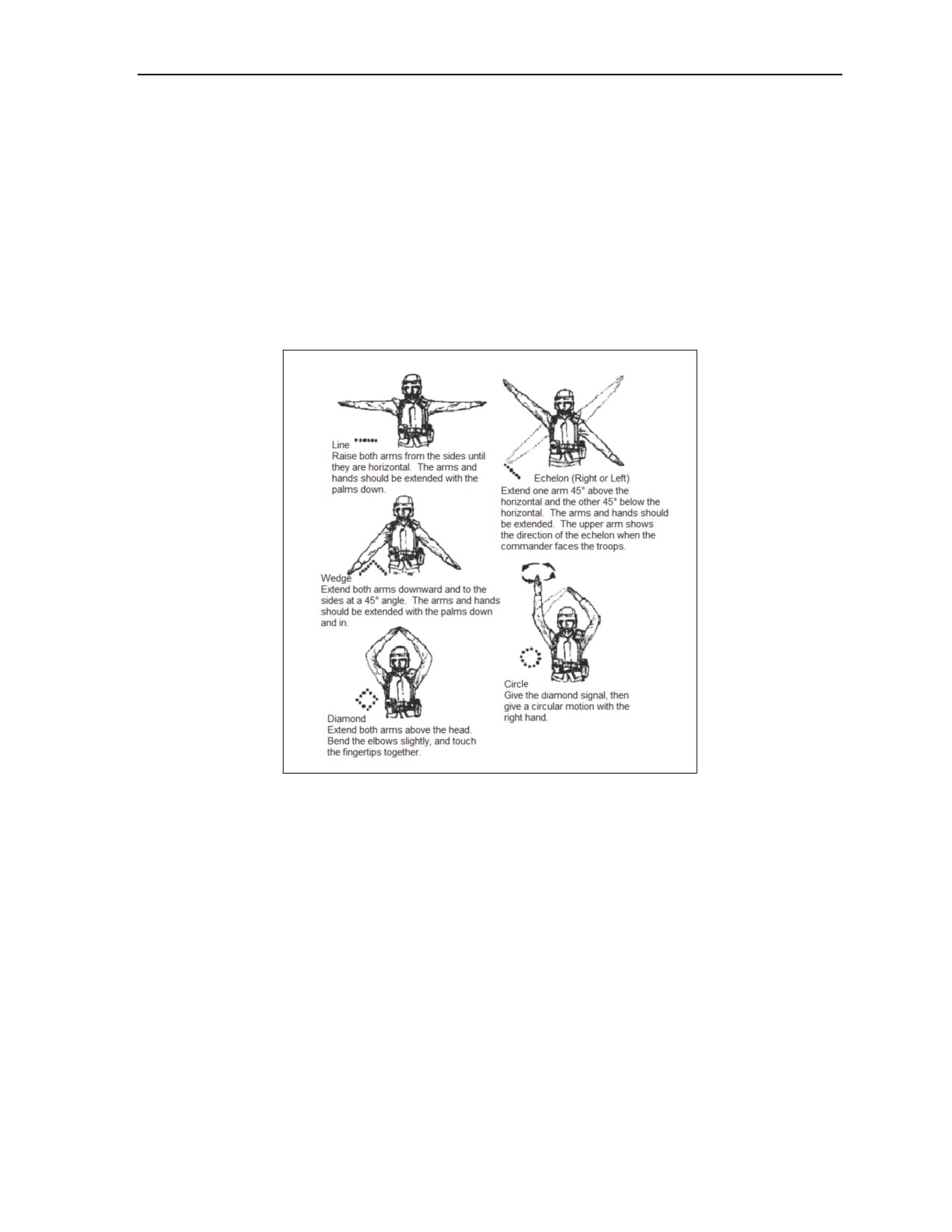
Control Force Formations
4-20. The reserve support element is not part of the control force formation until it is brought forward from
the rally point to join the formation. It remains until released by the formation commander. Lethal
overwatch teams are formed from the reserve force. Once lethal overwatch teams are deployed and in
position, they are under the control of the formation commander. Communication between the lethal
overwatch team and the formation commander is a priority because the commander approves target
selection and engagement.
COMMANDS
4-21. Verbal commands are given to the control force formation. Verbal commands for the on-guard
position are given in one count. All other commands are given in two counts, a preparatory command
followed by a command of execution. However, verbal commands cannot be relied on completely, so
commanders must plan to use hand-and-arm signals (see figure 4-3).
Figure 4-3. Hand-and-arm signals
4-22. Verbal commands are the primary method for communication during control force missions. When
vehicles are part of the formation, radios become an alternate method for relaying commands. To improve
communication, commanders may use hand-and-arm signals with verbal commands. The basic commands
used in control force formations are outlined in table 4-1, page 4-6. These commands can be added to or
combined to form more complex commands, therefore forming more complex formations.
21 April 2014
ATP 3-39.33
4-5

Chapter 4
Table 4-1. Control force basic commands
Commands
Command
Given By
Purpose
Platoon on line
Platoon leader or commander
To form a line formation
Platoon wedge
Platoon leader or commander
To form a wedge formation
Platoon echelon
Platoon leader or commander
To form an echelon formation
Platoon diamond
Platoon leader or commander
To form a diamond formation
Platoon circle
Platoon leader or commander
To form a circular formation
Formations
As a command of execution
Note: The platoon leader or
commander also identifies the
Move
Platoon leader or commander
location for the formation by
pointing the arm to the desired
location for the formation.
To place a specified unit in the
General support
Platoon leader or commander
rear of the base element
To place support elements on
Lateral support
Platoon leader or commander
the left or right flank of the base
element
To move support elements
Support
Direct support
Platoon leader or commander
forward to strengthen the base
element
Open
Extraction team leader
To open a space in the formation
To inform the extraction team to
Up
Extraction team leader
start moving back to the main
formation
Weapon system
To ready nonlethal gunners to
gunners, number of
fire weapons; for example,
rounds, type of
Platoon leader or commander
grenade launcher gunners, three
rounds, and prepare
rounds, area target, prepare to
to fire
fire
Fire
To tell riot shield holders to get
Shield down
nonlethal gunners
down on one knee and lower the
riot shield to the ground.
To tell riot shield holders to stand
Shield up
nonlethal gunners
and raise the riot shield
To use when not in contact with
Port arms
Platoon leader or commander
the crowd
To tell nonlethal gunners what
position to hold the weapons in
Weapons
while the formation is in physical
High port
Platoon leader or commander
contact with the crowd. This
allows for rapid targeting and
firing of nonlethal munitions
MOVEMENTS
4-23. Control force formations move in the same manner as
regular formations. This allows the
commander to maneuver the formation by commanding the number of steps it should move and in what
direction, such as “Five steps, forward march.” The normal rate of march for entering and leaving a control
force formation is double-timing. The half-step march is used when the formation is in direct contact with
the crowd. This slows the formation down and allows for better mission command. The squad and team
leaders echo preparatory commands and provide cadence while in control force formations.
4-6
ATP 3-39.33
21 April 2014
Control Force Formations
INTERVAL AND DISTANCE
4-24. Interval is the lateral space between elements. Distance is the space between elements in a column.
The usual interval and distance between Soldiers in control force formations is 30 inches. The interval and
distance can be adjusted based on METT-TC. If the crowd has to be physically pushed back, a close
interval is preferred. This allows the riot shields to be overlapped, creating a stronger wall. During peaceful
demonstrations, the interval could increase to double arm width, allowing the formation to cover more area
and still control the crowd. The interval and distance could change several times during the course of
operations before the crowd is dispersed.
EXTRACTION TEAMS
4-25. The extraction team is a squad (see figure 4-4) that is generally formed from the support element, but
could also be formed from reserve security forces (if this squad has four teams, the formation commander
may incorporate the fourth team into the formation or use them as a reserve for the squad). Once the team is
formed, the formation commander has operations control until the team mission is complete and it returns
to the rear of the formation. This team provides the riot control formation with the means to employ NL
and lethal cover forward of the formation. During control force missions, extraction teams conduct the
following:
z
Extract vehicles or personnel that are in immediate danger from the crowd.
z
Detain and escort downed rioters to the rear of the formation.
z
Detain and search subjects (done by the identified apprehension team).
z
Cover confined or congested areas where a full riot control formation cannot be inserted.
Figure 4-4. Extraction team formation
4-26. The extraction team is usually a squad; however, based on METT-TC, it can be smaller or larger.
While the recommended distance for deploying the extraction team from the control force formation is no
farther than 10 meters, this too may change based on METT-TC. The control force formation protects the
extraction team and provides immediate support, if necessary.
4-27. The extraction team may deploy from anywhere within the formation. When given orders to deploy,
the squad leader of the extraction team gives the formation commands, identifies at least two personnel in
the squad to be the apprehension team that conducts the search and apprehension of the subject. The squad
leader leads the squad to the base line of the formation. He then extends his arm between the two riot shield
holders and commands, “Open,” while tapping the riot shield holders on the side of the shoulder. The two
riot shield holders take one step backward and one step to the right or left. This clears a path for the
extraction team. The extraction team leader then states the number of personnel leaving the formation, such
as “Ten security personnel leaving.” As the last extraction team member exits the formation he states, “Last
man.” The two riot shield holders then return to the original position in the formation. The adjacent base
element squad or team leaders pass the number of personnel in the team through the formation.
4-28. As the extraction team approaches an instigator or incapacitated demonstrator, the riot shield holders
envelop the target and face in the direction of the nearest threat. Nonlethal gunners on the left and right
cover the respective areas. The search and apprehension team immediately controls and restrains the target.
To avoid confusion, one team member concentrates on controlling the subject while another team member
applies a restraining system. When the search and apprehension team has the subject under control, the
extraction squad leader sounds off with, “Up.” Upon hearing the “Up” command, it is repeated by all
extraction team members. Team members then grab a shoulder of the team member in front of them to
21 April 2014
ATP 3-39.33
4-7
Chapter 4
backtrack into the formation. As the extraction team approaches the formation, the nearest base element
leader will extend his arm and command, “Open,” while tapping the riot shield holders on the side of the
shoulder. The riot shield holders move one step backward and to the right or left to open the formation. As
he enters the formation, the extraction team leader sounds off with the number of personnel entering the
formation, such as “Ten security personnel and one demonstrator.” The adjacent base element leader counts
the number of personnel as they enter the formation. When the last man enters the formation, he states,
“Last man.” The riot shield holders then return to the original places in the formation. The adjacent squad
and team leaders in the base element pass the information through the formation that the extraction team
has returned.
LETHAL OVERWATCH TEAMS
4-29. During a nonlethal engagement, the use of a DM team provides confidence and safety to those facing
the mob. If a lethal threat is presented, the DM team in an overwatch position (armed with a standard
military rifle that is mounted with a high-powered scope) can scan the crowd, identify agitators and riot
leaders for apprehension, or fire lethal fire if so ordered or warranted. It is also ideally suited for flank and
counter-sniper operations.
4-30. The DM team sets the security overwatch and provides real-time intelligence and reporting that is
vital to mission success. It provides coverage during the entire approach to the crowd, and its ability to
select positions and provide cover fire (if and when warranted) is critical to the safety of the control force.
Successful execution requires training, practice, and rehearsal with the control force formation.
4-31. The DM team is organized from a standard three- or four-Soldier team. Each individual on the team
is equipped with a standard-issue weapon. One individual has a rifle with a scope, another has a set of
binoculars, and two other individuals provide security for the team. Each team is equipped with a radio for
communication with the headquarters element of the control force formation.
4-32. The teams must have a visual advantage over the crowd to provide lethal protection to the formation.
This is best accomplished by placing them on nearby rooftops, in the upper floors of buildings, and on
hilltops. They must have the optical equipment to identify mob leaders, instigators, and individuals with
weapons. Team integrity must be maintained. With three-Soldier teams, the positions are marksman,
observer, and security. If a team has four Soldiers, the fourth can be utilized as additional security, or
another option is outfitting them with a camera to record events.
4-33. Two teams should be deployed to cover the flanks of the formation. Each team should be deployed to
a position that is in front of the formation and in an overwatch position. The number of teams deployed is
based on METT-TC. As the formation moves forward, the teams leapfrog forward from the formation.
4-34. The reserve forces, located at the rally point, can provide another lethal force of some size that can be
brought forward, as needed. Each Soldier in the control force formation should have a sidearm or a rifle.
The rifle is slung diagonally across the back with the rifle butt over the left shoulder and the muzzle below
the right hip. Lethal munitions are in a separate ammunition pouch that is isolated from nonlethal
munitions. This is to prevent the mixing of nonlethal and lethal ammunition.
RESERVE FORCES
4-35. A large reserve of Soldiers should be maintained during civil disturbance operations. Knowing that a
large reserve force is available provides confidence and safety within the control force and helps prevent
them from overreacting to provocative acts with disorderly and criminal elements in the crowd. When
determining the number of reserve forces required, it should be resolved in favor of a large number. Lethal
overwatch teams, forces to augment the control force, and apprehension teams come from the reserve
forces.
4-36. Apprehension teams are a must when it is likely that a large number of people will be apprehended.
These teams provide an organized response to what could be a chaotic situation. The teams can be
organized at the team or squad level, depending on the number of apprehensions expected. These teams
usually operate behind the base element. During peaceful demonstrations, these teams can be sent forward
to remove demonstrators who refuse to disperse.
4-8
ATP 3-39.33
21 April 2014
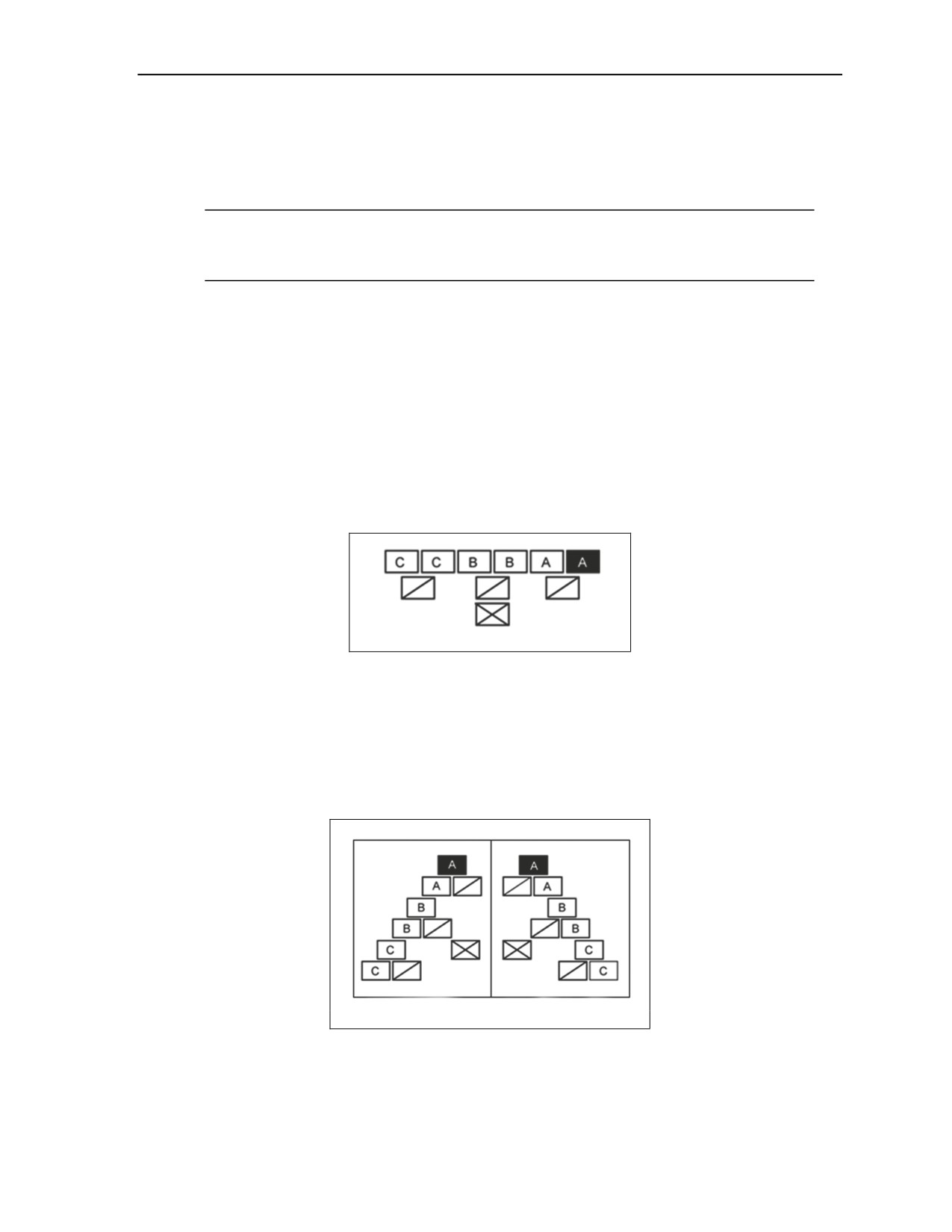
Control Force Formations
SQUAD FORMATIONS
4-37. The smallest formation is a squad formation, which is used in back of the main formation (usually a
company formation) to cover side streets. Squad members must know the positions regardless of which
control force formation they are in, squad to company.
Note. Three-team squads have been used in the following squad formation diagrams. When
squads have four teams (for example, a Military Police Squad), the fourth team can be added to
the formation or used as a reserve team for the squad formation.
4-38. When moving a squad into a crowd control formation from a column formation, the squad leader
takes one or more steps to the right of the squad and faces it. The squad leader gives the command and
hand-and-arm signal for the formation they want. Then they indicate where the formation is to be located
by pointing in that general direction. The A team leader commands, “Follow me,” and places the baseman
at the position indicated by the squad leader. The squad forms on the baseman position.
LINE FORMATION
4-39. The command for forming a squad in a line formation is, “Squad line formation, move.” On the
command of execution, the A team leader leads the baseman to the place indicated by the squad leader. The
squad members align themselves in sequence with the baseman at normal intervals (see figure 4-5). Based
on the situation, the squad leader may designate a specific interval. They do this when giving the
preparatory command. If no interval is specified, the squad automatically forms using the normal interval.
Figure 4-5. Squad line formation
ECHELON FORMATION
4-40. The command for having a squad form in an echelon formation is, “Squad echelon right (or left),
move.” On the command of execution, the A team leader places the baseman at the location indicated by
the squad leader. The squad members align themselves in sequence with the baseman; one pace to the side
and one pace to the rear (see figure 4-6).
Echelon left
Echelon right
Figure 4-6. Squad echelon formations
21 April 2014
ATP 3-39.33
4-9

Chapter 4
WEDGE FORMATION
4-41. The command for moving a squad formation into a wedge formation is, “Squad wedge, move.” On
the command of execution, the A team leader moves the baseman to the place indicated by the squad
leader. The A team lines up to the left of the baseman, one pace to the left and one pace to the rear of each
preceding man. B team members align themselves with the baseman, one pace to the right and one pace to
the rear of each preceding man. C team members align themselves in the same way to the left of the
baseman (see figure 4-7).
Figure 4-7. Squad wedge formation
ASSEMBLY
4-42. When assembling a squad from the line formation, the squad leader takes a position at a sufficient
distance to the rear of the squad and commands, “Squad assemble.” At the same time, the squad leader
raises the right hand in the air and makes a circular motion. The A team leader and the baseman do an
about-face movement.
4-43. The other squad members face toward the baseman. On the command of execution, “Move,” the
squad leader points to the place where he wants the squad to assemble. The A team leader double-times to
the designated spot, and the other members of the squad follow. Team leaders fall into the file in the
designated positions as they move to the assembly area
(AA). To assemble from a squad echelon
formation, the steps are the same as a line formation.
4-44. To assemble from a squad wedge formation, the squad leader takes the same steps as for the line and
echelon formations. The B team members do a half left face, and the A team and C team members do a half
right face. The C team pauses at the baseman position and allows the B team to clear the formation before
moving to the AA.
DIAMOND AND CIRCLE FORMATIONS
4-45. The diamond and circle formations are used during extraction team operations. They are small
formations used to penetrate the crowd or cover small areas. The decision on which formation to use is
based on METT-TC and the ability of the squad to perform.
4-46. Commands for forming a squad in a diamond or circle formation is, “Squad diamond (or circle),
move.” On the command of execution, the A team leader moves the baseman to the place indicated by the
squad leader. The A team lines up to the left of the baseman, covering the 9 to 12 o’clock positions. B team
members align themselves to the right of the baseman, covering the 1 to 5 o’clock positions. C team
members align themselves covering the 6 to 8 o’clock positions (see figure 4-8).
Figure 4-8. Squad diamond or circle formation
4-10
ATP 3-39.33
21 April 2014

Control Force Formations
4-47. To assemble from a squad diamond or circle formation, the squad leader takes the same steps as he
would for a line formation. The A team leads the squad to the AA followed by the B team and then the C
team. Teams fall into a column formation as they file back to the AA.
PLATOON FORMATIONS WITH THREE SQUADS
4-48. The platoon headquarters consists of the following individuals: the platoon leader, the PSG, and a
messenger or radio operator. When directed by the platoon leader, other individuals such as the selected
marksman, interpreter, RCA disperser operators, and firefighters may augment the platoon headquarters. In
forming all control force formations from the column, the platoon leader moves to the right of the platoon
and faces them when giving commands. Along with the preparatory command, the platoon leader gives the
hand-and-arm signal. On the command of execution, “Move,” the platoon leader points to the approximate
location where they want the platoon to form. The platoon leader pauses between the preparatory command
and the command of execution to allow each squad leader to issue a preparatory command to the squad.
PLATOON LINE FORMATION
4-49. The command for forming a platoon line is, “Platoon on line, move.” Immediately following the
platoon leader’s preparatory command, the squad leaders of the 1st and 3d squads give the command,
“Follow me.” The leader of the 2d squad gives the command, “Stand fast.” On the platoon leader’s
command of execution, the 1st and 3d squads move forward to the point designated by the platoon leader.
The 1st team member of the 1st squad is the baseman for the platoon formation. The 1st squad forms a
squad line to the left of the baseman while the 3d squad forms a squad line to the right of the baseman and
dresses with the 1st squad. After the 1st and 3d squads have cleared the platoon, the 2d squad leader gives
the command, “Follow me.” The 2d squad splits and the A and B teams form a line to the right of the 3d
squad. The C team (with the squad leader) forms a line to the left of the 1st squad (see figure 4-9).
Figure 4-9. Platoon line formation (three squads)
Assembling From a Platoon Line Formation
4-50. When assembling the platoon from the platoon line formation, the platoon leader and the
headquarters personnel take a position to the rear of the platoon. The platoon leader then gives the
command, “Platoon assemble,” while raising the right arm and making a circular motion above the head.
Platoon members automatically assume the port arms position. The 1st squad leader and the baseman do an
about face. The 3d squad leader moves to the head of the squad. All other members do an about-face
movement toward the baseman. On the platoon leader’s command of execution, the platoon leader points to
where they want the platoon to assemble. The 1st squad leader gives the command, “Follow me,” and
moves the squad toward the AA. The squad moves to make a single file line to the baseman position
followed by the C team of the 2d squad. As the 1st squad clears the baseman position, the 2d squad leader
comes to a halt at the baseman position. The 3d squad leader gives the command, “Follow me,” and leads
the squad to the AA followed by the A and B teams of the 2d squad. The A team leader of the 2d squad
comes to a halt at the baseman position. Once the 3d squad has cleared the baseman position, the 2d squad
leader gives the command, “Follow me,” and leads the squad to the AA. The 2d squad reassembles into the
original column formation as they move to the AA. As the 1st squad comes to a halt (facing the crowd) in
the AA, the 3d squad dresses with the 1st squad and leaves space for the 2d squad to return to its place in
21 April 2014
ATP 3-39.33
4-11
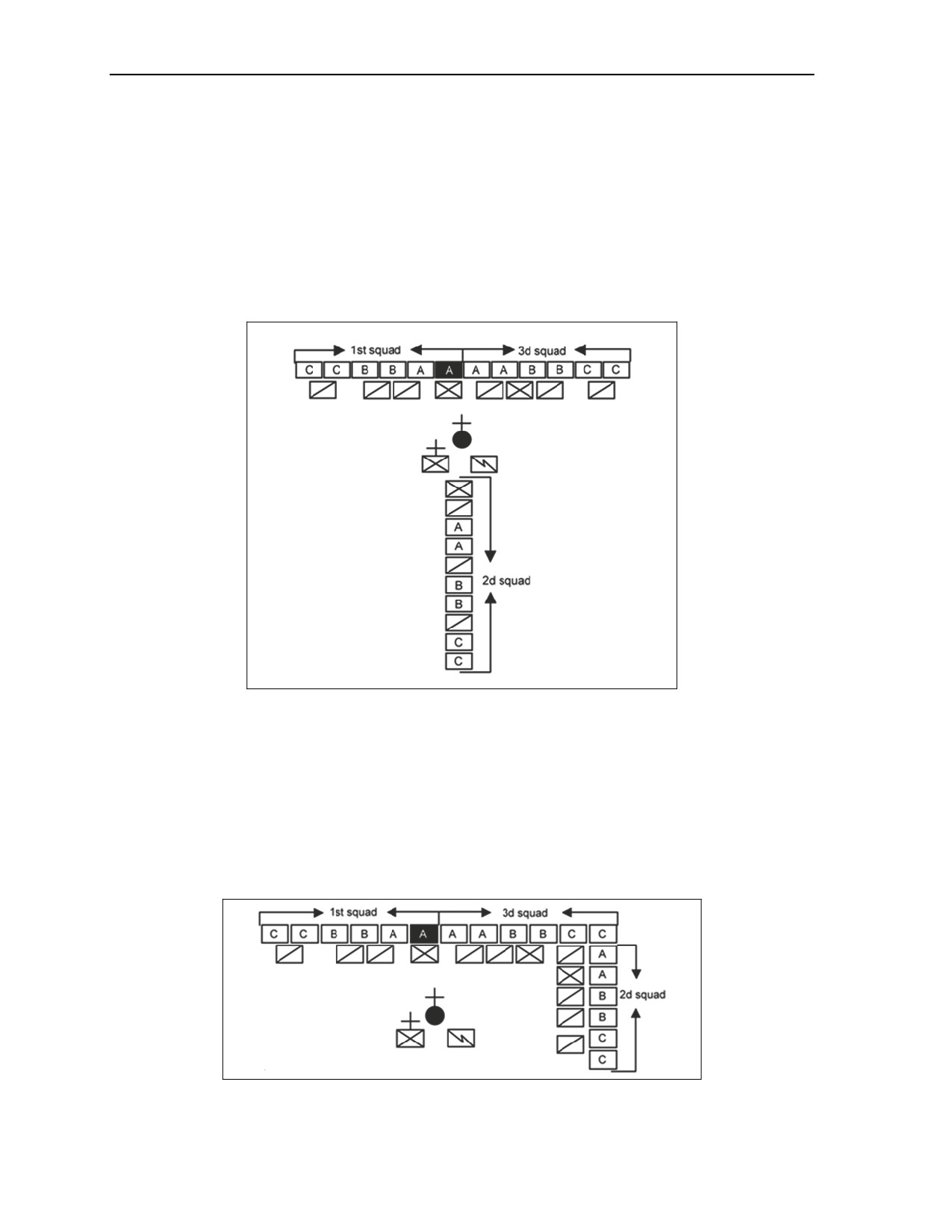
Chapter 4
the formation. Once the platoon is formed into a column formation, headquarters personnel take the
position in the formation. The PSG, giving commands, moves the platoon to the rally point.
Platoon Line Formation With General Support
4-51. Whenever the command for establishing a crowd control formation contains the phrase “In support”
(without modification), it means that the support element is to remain in general support.
4-52. The command for forming a platoon line with the 2d squad in general support is, “Platoon line, 2d
squad in support, move.” The 1st and 3d squads of the platoon form the line while the 2d squad remains in
the column (see figure 4-10). To assemble a platoon with a squad in general support, the procedure is the
same as the platoon line, except that the 1st and 3d squads dress with the 2d squad.
Figure 4-10. Platoon line formation with general support
Platoon Line Formation With Lateral Support
4-53. The command for forming a platoon line with 2d squad in lateral support is “Platoon line, 2d squad
in lateral support, move.” The 1st and 3d squads execute the line as before, and the 2d squad stands fast.
After the line has been formed, the 2d squad leader gives the command, “Follow me.” The A and B teams
move to the right flank while the squad leader and the C team move to the left flank of the formation. The
2d squad forms columns behind the last Soldiers of the line formation. If no direction is given, the 2d squad
splits to cover both flanks. A squad may be used to cover one flank by giving the command, “2d squad
right (or left) lateral support” (see figure 4-11).
Figure 4-11. Platoon line formation with lateral support (right)
4-12
ATP 3-39.33
21 April 2014